
Palm Springs City Zoning Code
DIVISION 7
SUPPLEMENTAL DISTRICT REGULATIONS
Subdivision II.- Recreational Vehicles, Commercial Vehicles and Similar Vehicles[12]
Cross reference— Stopping, standing and parking, § 74-31 et seq.
Subdivision VII.- Child Care Facilities[13]
Cross reference— Businesses, ch. 14.
Subdivision VIII.- Family Day Care Homes[14]
Cross reference— Businesses, ch. 14.
Subdivision IX.- Planned Developments[15]
Editor's note— Ord. No. 2014-06, § 2, adopted May 8, 2014, amended subdivision IX in its entirety to read as herein set out. Former subdivision IX, §§ 34-1061—34-1067, pertained to cluster/planned unit developments, and derived from Code 1994, §§ 30-731—30-737.
Subdivision X. - College-Hospital Overlay[16]
Editor's note— Ord. No. 2014-06, § 9, adopted May 8, 2014, repealed subdivision X, §§ 34-1081—34-1089, which pertained to townhouse/row houses and derived from Code 1994. §§ 751—759, Ord. No. 2013-07, § 3, 3-14-2013.
Subdivision XV.- Automotive Repair Establishments, Car Washes, Convenience (Food and Beverage) Stores, Full-Service Fuel Stations, and Gas Stations with and without Convenience Stores[17]
Editor's note—Ord. No. 2020-06, adopted April 23, 2020, amended subdiv. XV in its entirety to read as herein set out. Former subdiv. XV pertained to convenience stores, full-service fuel stations, and gas stations without convenience stores, consisted of §§ 34-1201—34-1207, and derived from the 1994 Code; and Ord. No. 2013-03, adopted February 14, 2013.
Subdivision XVI.- Vehicle Sales[18]
Editor's note— Prior to the reenactment of Subdiv. XVI by Ord. No. 2013-04, said subdivision waas repealed by Ord. No. 2013-03, § 3, adopted Feb. 14, 2013. The former Subdiv. XVI, §§ 34-1221—34-1227, pertained to full service fuel stations and derived from §§ 30-861—30-867 of the 1994 Code.
Subdivision XVII.- Flex Units[19]
Editor's note— Ord. No. 2013-03, § 4, adopted Feb. 14, 2013, repealed the former Subdiv. XVII, §§ 34-1241 and 34-1242, which pertained to gasoline service islands in conjunction with convenience stores and derived from §§ 30-881 and 30-882 of the 1994 Code. Ord. No. 2013-01, § 6, adopted Feb. 14, 2013, renumbered Subdivs. XVIII—XXV as XVII—XXIV as set out herein. The historical notation has been retained with the amended provisions for reference purposes.
Subdivision XVIII.- Hospitals/Full Service Medical Facilities[20]
Note— See the editor's note to Subdiv. XVII.
Subdivision XIX.- Wireless Telecommunication Towers and Antennas[21]
Note— See the editor's note to Subdiv. XVII.
Cross reference— Utilities, ch. 78.
Subdivision XX.- Reserved[22]
Editor's note— Ord. No. 2014-06, § 11, adopted May 8, 2014, repealed subdivision XX, §§ 34-1300, 34-1301, which pertained to large employment centers and derived from Ord. No. 2008-29, § 4, 12-11-2008.
Subdivision XXI.- Bars[23]
Note— See the editor's note to Subdiv. XVII.
Subdivision XXII.- Nightclubs[24]
Note— See the editor's note to Subdiv. XVII.
Subdivision XXIII.- Adult Entertainment[25]
Note— See the editor's note to Subdiv. XVII.
Subdivision XXIV.- Sale or Dispensing of Controlled Substances[26]
Editor's note— Ord. No. 2011-27, adopted Dec. 8, 2011, renumbered §§ 34-1321—34-1330 as §§ 34-1326—34-1335 and enacted new §§ 34-1319—34-1322 as set out herein. The historical notation has been retained with the amended provisions for reference purposes.
Sec. 34-881.- Landscaping and paving.
Landscaping requirements for residential, commercial and other allowable uses shall conform to the requirements established in article III of this chapter. The maximum area of impervious and semi-pervious parking surface in the front yard of any residential zoning district, shall be 40 percent, unless the front yard shall contain a semicircular driveway in which event, the maximum area of impervious and semi-pervious parking surface shall be 60 percent of the front yard. Driveways shall be setback a minimum of three feet from side yards to accommodate sodded or landscaped pervious area along the perimeter of each parcel between the driveway and the property line.
(Code 1994, § 30-601; Ord. No. 2007-08, § 7, 4-26-2007; Ord. No. 2016-21, § 8, 1-12-2017)
Sec. 34-882. - Signage.
Signs shall conform to the requirements established in article IV of this chapter.
(Code 1994, § 30-602)
Sec. 34-883. - Fences, walls and hedges.
The following regulations shall apply to fences, walls and hedges:
(1)
Fences and walls enclosing any use shall comply with the permit procedures established in the village building code as set forth in chapter 10, article II.
(2)
Where two streets intersect, a 30-foot visibility triangle area shall be formed, where there shall be a clear space with no obstructions to vision. Fences, walls and hedges shall be restricted to a height of three feet above the average grade of the street as measured at the centerline of the street.
(3)
Walls, fences or similar structures erected in any land development district shall not contain any substances, such as broken glass, spikes, nails, electric shock, barbed wire or similar materials, designed to inflict pain or injury to any person or animal.
(4)
On properties other than those zoned for commercial or industrial development, on the front property line and on that portion of the side property line to the front building setback line, a fence, wall or hedge shall have a maximum vertical height of four feet as measured from the average grade of the centerline of the street abutting the front yard.
(5)
On residentially zoned properties on the rear property line and that portion of the side property line from the rear property line to the front of the front building setback line, a fence, wall or hedge shall have a maximum vertical height of six feet as measured from the finished grade of the lot.
(6)
On properties zoned for commercial or industrial development, all fences, walls or hedges shall have a maximum vertical height of eight feet as measured from the finished grade of the lot.
(7)
Any fence or wall adjacent to a right-of-way shall be screened on the street side with hedge plants a minimum of three gallons in size, two feet on center and 36 inches high at time of planting, supplemented by trees spaced not more than 20 feet apart. On nonresidential properties, chain link fencing is prohibited in the front or side yards adjacent to a public street unless approved pursuant to subsection 34-162(h).
(8)
The finished side of all fences shall face the street or adjoining property.
(9)
Notwithstanding the foregoing, on residentially zoned properties, a manicured hedge abutting a collector or arterial roadway may have a maximum vertical height of ten feet, outside of any visibility triangle and where not in conflict with overhead utilities.
(Code 1994, § 30-603; Ord. No. 2013-02, § 3, 2-14-2013; Ord. No. 2015-12, § 9, 4-9-2015; Ord. No. 2015-42, § 2, 12-10-2015)
Sec. 34-884. - Temporary short-term sales.
The following shall apply to all temporary short-term sales.
(1)
Authorized temporary short-term sales, including permitted locations, duration, maximum number per year, and whether a land development permit is required, are set forth in Table 34-884A.
Table 34-884A
Authorized Temporary Short-Term Sales
(2)
A temporary building, structure, or tent shall comply with section 34-893 of this Code.
(3)
Any person who holds a garage sale, yard sale, or auction within the corporate limits of the village shall be required to first obtain a permit for a fee as determined by the village. The permit shall be conspicuously displayed on the premises where the garage sale, yard sale or auction is to occur. Any person holding such a sale within corporate limits of the village shall be prohibited from holding another such sale within a six-month period. No garage sale or yard sale shall be held for a period longer than two consecutive days. No auction shall be held for a period longer than one day.
(4)
An individual, business, or commercial enterprise which conducts an outdoor sale or holiday sale within the village limits shall be required to obtain a permit for a fee as determined by the village. Individuals, businesses and commercial enterprises will be limited to four such outdoor sales per year.
(5)
Any person seeking an auction, holiday sale, or outdoor sale permit shall first submit to the land development department an application showing the:
a.
Name of the person sponsoring the sale activity.
b.
Purpose for which the proceeds of the sale are to be used, and the amount of commission, if any, that shall be paid by such person to the person conducting the business, if applicable.
c.
Length of time which the sale shall extend.
d.
Name of persons directing the sale activity.
e.
Emergency information.
f.
Property owner's consent.
g.
Diagram showing the layout and traffic flow.
The land development department may thereupon, at its discretion, grant or reject the application in whole or in part; withhold action on any application pending investigation; or submit the application to the village council for its approval. The land development department shall be guided in the exercise of its discretion, and shall take into account that the issuance of a sales permit does not in any way sanction the creation of a nuisance. Factors to be considered in determining whether a nuisance will be sanctioned shall include, but not limited to, traffic volume and patterns; availability of parking; noise; type of items to be sold; impositions on neighbors or the neighborhood; prior history of sales conducted by the applicant or held on the property in question; and the condition of the property where the auction or sale is to be located.
(6)
Garage sales, yard sales, or auctions in residential districts are only permitted between the hours of 6:00 a.m. and 6:00 p.m. Such sales at any other time of day are hereby prohibited.
(7)
Outdoor sales or auctions held by business or commercial enterprises within the commercial or industrial district are permitted for hours of normal business operation; however, at no time shall such sales extend 30 minutes beyond published sunset. No loud speaker systems shall be permitted during outdoor sales or auctions.
(8)
An auction shall be permitted only for the sale of real property in a residential zoning district. The contents specific to that real property may be included in the same auction. A list of any personal property will be submitted to the land development department prior to the sale. Transporting property in from other sources for the auction is prohibited. No loud speakers shall be permitted in conjunction with an auction.
(9)
At an auction sale, the owner or auctioneer shall hire, at his own expense, a minimum of one uniformed police officer to be present for the full term of the sale. The police officer will be paid at the customary rate as established by the village.
(10)
Signs and notices for all temporary short-term sales will be posted only on private property. Notices are prohibited from being posted on telephone or electric poles, or trees, or distributed as door hangers. Advertisements distributed to residents must be sent via the United States Postal Service.
(Code 1994, § 30-604; Ord. No. 2010-09, § 3, 7-8-2010; Ord. No. 2013-05, § 2, 2-14-2013)
Cross reference— Businesses, ch. 14.
Sec. 34-885. - Height limits.
Structures for elevators, stairways, tanks, skylights, ventilating fans, air conditioners or similar equipment required to operate and maintain a building, as well as radio and television antennas, flagpoles and chimneys, may be erected above the heights prescribed by individual land development districts, provided that the structures are designed to blend architecturally with the building and screened in accordance with the provisions of this article.
(Code 1994, § 30-605)
Sec. 34-886. - Houseboats.
No boat, vessel or watercraft of any kind or type shall be used as a dwelling place within the village.
(Code 1994, § 30-606)
Sec. 34-887. - Reserved.
Editor's note— Ord. No. 2007-08, § 7, adopted April 26, 2007, amended the Code by repealing former § 34-887 in its entirety. Former § 34-887 pertained to churches and houses of worship, and derived from the Code of 1994, § 30-607.
Sec. 34-888. - Conformance with definition required; use of property for conventions, seminars, etc.
(a)
The use of any residential dwelling within any land development district of the village shall conform to and accommodate the definition of the term "family" as set forth in section 1-2. Noncompliance with such provision is hereby declared to be a violation of this Code and shall subject to the penalties provided in section 1-12 of the Code or any other remedy at law available to the village.
(b)
It shall be unlawful for the owner, lessee or other person in possession or control of any property within any land development district of the village to permit the property to be used for the purpose of holding conventions, seminars, sales meetings or other forms of accommodating a larger number of persons than such property or residence is zoned for or usually accommodates.
(Code 1994, § 30-608; Ord. No. 2016-01, § 4, 3-10-2016)
Cross reference— Definitions generally, § 1-2.
Sec. 34-889. - Construction and maintenance of special exception uses.
All uses and activities that satisfy the requirements of section 34-608 and which have been approved by the village council as permitted special exception uses in any land development district, shall be constructed and maintained so as not to be injurious or offensive to the occupants of adjacent premises by reason of the emission or creation of noises, vibrations, smoke, dust, explosive hazard, or glare, and shall conform to the standards of performance established in this article.
(Code 1994, § 30-610; Ord. No. 2007-08, § 5, 4-26-2007)
Sec. 34-890. - Home occupations.
Home occupations shall be permitted only in residential land development districts and only when a local business tax receipt is issued by the village. Before any local business tax receipt may be issued, such home occupation must first meet each of the following requirements:
(1)
The home occupation shall require a local business tax receipt to be issued by the land development director and shall be conducted within the residential premises and only by the person who is licensed to do so and who is also a resident of the premises. The individual shall be permitted to engage not more than one employee to assist in the home occupation. In no such case shall more than one local business tax receipt be issued to any person at one time.
(2)
There shall be no alteration in the residential character of the premises in connection with such home occupation. Home hobbies are in no way restricted by these regulations.
(3)
No home occupation shall occupy more than 20 percent of the gross floor area of a residence, exclusive of any porch, attached garage or similar space not suited for or intended to be occupied as living quarters; provided, however, in no event shall the home occupation occupy more than 300 square feet. Outdoor storage, including storage in carports, is prohibited.
(4)
No goods or materials pertaining to such home occupation shall be sold on the premises.
(5)
No chemical, mechanical, electrical or professional equipment that is not normally a part of domestic or household equipment shall be used for commercial purposes. Machinery which causes interference in radio or television reception shall be prohibited.
(6)
No sign shall be permitted to advertise the home occupation, nor shall any merchandise or article be displayed for advertising purposes.
(7)
Goods and materials pertaining to such home occupation shall be stored in compliance with sections 10-3 and 10-4 of this Code.
(Code 1994, § 30-611; Ord. No. 2007-01, § 5, 1-11-2007; Ord. No. 2013-08, § 6, 3-14-2013)
Cross reference— Businesses, ch. 14.
Sec. 34-891. - Hours of operation and hours of construction activity.
The following shall apply to hours of operation and hours of construction activity:
(1)
No commercial use shall commence business activities prior to 7:00 a.m., nor continue such activities later than 11:00 p.m. Outside delivery to such commercial activities shall not commence prior to 8:00 a.m. or continue later than 9:00 p.m.
(2)
Any commercial business activity desiring to operate prior to 7:00 a.m. or later than 11:00 p.m. may apply in writing for a hearing before the village council, setting forth the desired hours of operation and the reasons for deviations from the provisions of subsection (1) of this section. The village council, in its discretion, may vary the hours from those set forth in subsection (1) of this section.
(3)
Such restrictions shall not apply to lounges, bars, package stores, restaurants or clubs in which alcoholic beverages are served. The hours of operation for such establishments shall be as set forth in section 14-61. Hours of package retail sales of alcoholic beverages for off-premises consumption shall be governed by F.S. ch. 562, unless specifically approved for an hours of operation variance by the village council that includes sales of alcoholic beverages.
(4)
No construction activity shall commence prior to 7:00 a.m., nor continue later than 6:00 p.m. Monday through Friday. Saturdays no construction activity shall commence prior to 9:00 a.m., nor continue later than 5:00 p.m. No construction activity shall occur on Sundays. The land development director, at his or her discretion, may vary these hours upon written request which sets forth the desired hours of construction activity and the reasons for the requested deviation.
(Code 1994, § 30-612; Ord. No. 2009-21, § 2, 12-12-2009; Ord. No. 2013-07, § 2, 3-14-2013; Ord. No. 2019-12, § 3, 9-12-2019)
Sec. 34-892. - Accessory uses, buildings and structures.
(a)
Location. All accessory uses, buildings and structures shall be located on the same lot as the principal use and not within any required yard area, except as provided in this section. Where the accessory building is attached to the principal building or connected thereto by a breezeway, the side yard shall be measured from the outer wall thereof.
(b)
Height. No accessory use, building or structure shall exceed the height permitted in the district in which the principal use is located.
(c)
Use. The accessory building shall not be rented or otherwise used as a separate dwelling unit.
(d)
Utility sheds.
(1)
Utility sheds may be located as close as five feet from the side and rear of the principal structure or use.
(2)
The total square footage of any utility shed shall not exceed 168 square feet. The height of the top of the wall beginning at the roofline and ceiling cannot exceed a maximum of eight feet and the highest peak cannot exceed 12 feet from natural grade. The utility shed walls shall be a minimum of four feet and a maximum of 14 feet long. No more than one utility shed may be constructed on a residential lot.
(e)
Bollards. Access barriers, pedestrian protection devices, and vehicle guards, all commonly referred to as "bollards" shall be comprised of decorative or ornamental posts that complement the architectural style, material and/or color of the principal structure.
(f)
Utility/mechanical equipment boxes. All mechanical equipment and utility facilities shall be screened from view with landscaping, fence or walls. Equipment boxes that cannot be fully screened shall be wrapped with a decorative vinyl wrap. Corner properties located at a signalized intersection shall include the traffic control box in the aesthetic program. The design of vinyl wraps shall be approved by the land development director, and shall not include commercial messages or logos.
(Code 1994, § 30-613; Ord. No. 2011-14, § 1, 7-28-2011; Ord. No. 2016-21, § 9, 1-12-2017)
Cross reference— Buildings and building regulations, ch. 10.
Sec. 34-893. - Canopies prohibited.
Canopies and freestanding canopies, as defined in section 1-2 of this Code, (excluding tree canopies), are prohibited within the village, unless the village building official has determined that the canopy meets the requirements of the Florida Building Code, and the village has issued a building permit and certificate of completion for the canopy. Any canopy existing within the village at the time of the adoption of the ordinance from which this section derives shall be deemed to be a nonconforming use, and shall be removed no later than June 31, 2007, unless an after-the-fact building permit is applied for and issued for the canopy by the village on or before June 31, 2007. This amortization period was adopted by the Village council, based upon the commencement of the 2007 hurricane season on June 1, 2007; the degree of nuisance, and other adverse effects that this nonconforming use creates; the relative ease and minor expense with which this nonconforming use may be eliminated; and a finding that this period of amortization will not be detrimental to, or endanger the public health, safety, morals, comfort, or general welfare, and will not substantially diminish or impair property values during the amortization period. The owner of real property on which any freestanding canopy is located, which has not been permitted or completely removed as of July 1, 2007, shall be subject to code enforcement action and/or other legal action by the village.
(Ord. No. 2007-08, § 7, 4-26-2007)
Sec. 34-894. - Swing set and other play structure regulations.
Swing sets and other play structures, including but not limited to, play houses, tree-houses, jungle jims, slides, and other similar structures or devices intended for the use of children's play (collectively referred herein as play structures") shall be permitted as an accessory use for single family residences and duplexes subject to the following requirements:
(1)
Play structures shall be located in the rear yard and shall be set back at least ten feet from the rear and side setback line and shall be screened from view to the maximum extent possible.
(2)
Play structures shall not exceed 22 feet in length or 12 feet in height measured to the highest part of the structure.
(3)
Play structures shall be properly maintained in a safe condition, including but not limited to, the repair and replacement of any worn, torn, broken, missing, rusted or discolored parts and materials.
(4)
The combined square footage of all play structures shall not exceed 260 square feet.
(5)
The play structure must be located on the same lot as the primary structure and may not be connected to or attached to the principal building.
(6)
Odd shaped structures such as domed or igloo shaped buildings, Quonset huts, hanger shaped structures, and other buildings and structures which are irregular and/or are not architecturally consistent, compatible or harmonious with the principal residential structure and the general character of the neighborhood are not permitted and shall not be allowed as a "play structure" or as an accessory use to a single family home or a duplex. Play structures must be harmonious and compatible with the architectural design and character of the surrounding neighborhood.
(7)
Play structures shall not be used for habitation or as a dwelling space or unit.
(8)
Play structures which are located on single family and/or duplex properties which pre-date May 10, 2007, and which do not conform to the requirements of this section, shall be considered to be a nonconforming accessory use and a nonconforming structure, and subject to the provisions of this Code regulating nonconforming uses and structures.
(9)
The play structure shall not have a roof or more than 25 percent of the length of the structure.
(Ord. No. 2007-08, § 7, 4-26-2007)
Sec. 34-895. - Temporary land uses in zoning districts.
(a)
Applicability. This section regulates principal activities and uses of real property that are not specifically allowed in a zoning district, but may be necessary or appropriate on a temporary basis.
(b)
Generally. This section provides for the orderly and effective management of temporary land uses not specifically allowed in a zoning district. Temporary uses are often found to be necessary and desirable for limited periods of time although they might not be in keeping with the intent and purpose of the zoning district if allowed on a long-term basis. This section provides for thorough administrative review of these special types of temporary land uses. These provisions are designed to allow certain reasonable temporary uses while minimizing adverse impacts upon the public health, safety and welfare and other authorized uses within a zoning district. All temporary uses authorized under this section shall be the principal use of the real property and shall not be an accessory use. Temporary, accessory uses are governed by section 34-829, Temporary licensing of certain uses. Further, auctions and sales events governed by section 34-884, Temporary short-term sales, shall not be authorized as temporary uses under this section.
(c)
Permits. Application for a temporary use permit shall be made to the land development director in accordance with the applications and procedures section set forth herein.
(d)
Temporary uses. Subject to any conditions that may reasonably be imposed by the land development director and/or the village council, a temporary use permit may be issued for such temporary, principal uses as a construction staging area; temporary off-site modular unit for redevelopment; parking lots; and, other temporary, principal uses. The foregoing list is not an exhaustive list.
(e)
Application and procedures.
(1)
A property owner may submit an application to the land development director for a temporary use permit consistent with this section and pay the application fee as set forth by village resolution. The application fee for a temporary use permit shall be the same as the application fee for a temporary license granted under section 34-829. The application fee will be nonrefundable even if the application is denied. The application shall contain information describing the principal use for which a temporary use permit is being sought and the proposed length of such use. If the applicant is seeking any change to the physical layout or footprint of the site, a site plan or site plan amendment application shall be submitted with the application for temporary use permit. The land development director may request further information from the applicant as is necessary to fully understand the scope of the proposed temporary use and impacts to surrounding properties, facilities and infrastructure including, but not limited to, traffic flow and parking plans. Failure to provide such information may result in a denial of the application.
(2)
Approval of a temporary use permit may be made contingent upon the property owner complying with specific statutory, building code and/or village code requirements regardless of whether such requirements are specifically applicable to the proposed temporary use. Further, approval of a temporary use permit may be made contingent upon the property owner providing a surety bond from a company with a Best's rating of AAA guaranteeing that the property will be restored to its original condition upon termination or expiration of the temporary use permit. The amount of the bond, if any, shall be determined by the land development director in his or her sole discretion. Approval of a temporary use permit shall be contingent upon the property owner signing a written agreement with the land development director regarding the temporary use, restrictions on such use and other terms and conditions as the village may reasonably determine necessary for its protection. If a surety bond is required, the requirements for the bond shall be addressed in the written agreement. The land development director is authorized to set forth in the written agreement a specific effective date and expiration date for the temporary use which shall not exceed two years. Failure to sign the written agreement with the land development director will be grounds for denial of the application.
(3)
The approval authority for a temporary use permit application is the land development director if the application seeks a temporary use of 60 days or less. If a temporary use permit application seeks a temporary use which will exceed 60 days, the approval authority is the village council, with due public notice prior to approval. Except for such shorter time limitations as may be specifically set by the land development director or village council, a temporary use permit authorized under this section shall not exceed a term of two years.
(4)
If a temporary use permit expires and the term of the temporary use permit was for less than two years, the property owner may submit an application to have the term of the temporary use permit extended. The application for extension shall be the same as the initial application for a temporary use permit and the same application fee shall be paid to the village. The extension application shall be reviewed by the land development director consistent with the conditions and requirements as the initial petition and approved by the same approval authority which approved the initial temporary use permit. The total term of a temporary use permit (including any extension thereof) shall not exceed two years. An extension will not be granted if the village terminated the temporary use permit due to a violation of the temporary use permit condition(s), the written agreement or applicable law.
(f)
Temporary signs. One or more temporary signs may be erected by a property owner who obtains a temporary use permit. Prior to erecting any such temporary sign(s), the property owner shall submit an application to the land development director for the temporary sign(s); pay the fee established by the village council; and, obtain a temporary sign permit from the land development director. The land development director may impose any and all reasonable conditions on such temporary signs including, but not limited to, requiring all such temporary signs to conform to all other sign requirements of this Code. Further, all such temporary signs must be installed at the real property designated in the temporary use permit and only advertise the permitted temporary use for said real property. The temporary sign or combination of temporary(s) shall be less than or equal to 32 square feet in total surface area. All temporary signs must be removed immediately upon the temporary use permit expiring or being terminated.
(g)
Termination and remedies.
(1)
All temporary use permits are revocable. The land development director and/or village council (as applicable) may immediately revoke a temporary use permit, and refuse to grant future applications for a temporary use permit for real property, if there is a violation of any temporary use permit condition(s), the written agreement or applicable law. If a temporary use permit is revoked or upon the expiration of a temporary use permit, all use(s) of the property authorized under the temporary use permit must immediately cease and all use(s) of the property must immediately conform to the village code which may include, but is not limited to, additional actions by the property owner to reinstate the appearance of the property in a specific manner.
(2)
The land development director reserves the right to revoke temporary use permits under this subsection which he or she originally approved and may revoke temporary use permits approved by the village council if the revocation of the temporary use permit is necessary for the immediate protection of public health, safety, welfare or to prevent the damage to personal property including property of the village. Further, if it becomes necessary in order to protect the public health, safety, welfare or to prevent the damage to any personal property, the land development director may also cause any and all utility connections necessary for the temporary use to be immediately disconnected along with the revocation of the temporary use permit. As time allows, the land development director shall endeavor to notify the property owner prior to revoking any temporary use permit and disconnecting any utility connections under this section. The village council reserves the right to revoke all temporary use permits approved under this section.
(3)
The village may pursue any and all legal remedies without limitation against any property owner and/or occupant who violates the conditions of a temporary use permit, the written agreement and/or the applicable law including, but not limited to, code enforcement proceedings, other administrative proceedings; and/or injunctive relief. All actions taken by the village to enforce the provisions of this section shall subject the property owner and/or occupant to the reasonable costs incurred by the village in enforcing this section including, but not limited to attorney's fees and costs at all administrative, quasi-judicial, trial and appellate levels. Upon the issuance of an order from any board, special magistrate or court of competent jurisdiction awarding attorney's fees and/or costs to the village, such attorney's fees and/or costs shall become a lien on the property, if unpaid after 30 days following the entry of the order.
(4)
Any owner who is granted a temporary use permit understands and agrees that the village's right to revoke and/or terminate the owner's temporary use permit as stated herein is absolute and shall not result in any inequity to the owner because of any authorized improvement(s) made by the owner to the property or any other expense incurred or paid by the owner for the temporary use. Accordingly, the right granted by a temporary use permit shall not be construed as an irrevocable right or license or a right or license coupled with an interest because of said improvement(s) or expenses of the owner.
(h)
Prohibitions. Nothing contained in this section shall permit or allow any adult entertainment or adult entertainment establishment to be authorized by temporary use permit.
(i)
Transferability. A temporary use permit shall only be issued to the current property owner and such permit shall not be assigned, conveyed or transferred to any third party or person without the prior written approval of the land development director or village council (as applicable).
(j)
Appeal. Any person or entity who applies for a temporary use permit and is denied by the land development director may appeal to the village council for a temporary use permit. Such appeal application shall be filed with the land development director within 30 days of the land development director's written denial. Any person or entity who applies for a temporary use permit and is denied by the village council may appeal the village council's decision to the circuit court. Such an appeal shall not be a hearing de novo but shall be limited to appellate review of the record created before the village council. An appeal shall be filed within 30 days of the village council's decision.
(k)
Exemptions. Authorized, temporary uses of village owned property shall be exempt from the requirements of this section.
(Ord. No. 2011-21, § 2, 1-26-2012)
Sec. 34-896. - Special events.
(a)
Permit required. Any person, corporation, or other entity of any kind who desires to conduct any type of special event, must obtain a special event permit from the village in order that the village may adequately provide for the potential impacts created by the proposed event. The fee for such permit shall be set by resolution of the village council. Outdoor sales, grand opening promotions, and other similar events, per section 34-884, are not subject to this section. For the purposes of this section, "special event" shall mean any occasion, including, but not limited to, exhibitions, celebrations, festivals, special sales events, shows, and other activities taking place on nonresidential private property that involves, on a temporary basis, the occupation of land and/or construction of improvements not identified in an approved site plan or other development approval. Special events shall not include activities to be conducted entirely within public parks or on public right-of-way or vacant property. Factors indicative of a special event includes any one or more of the following:
(1)
Closing of a public street, sidewalk, or alleyway.
(2)
Blocking or restricting public property.
(3)
Blocking or restricting access to private property of others.
(4)
Use of pyrotechnics or special effects.
(5)
Use of open flame, explosions, or other potentially dangerous displays or actions.
(6)
Use or display of animals, aircraft, or watercraft.
(7)
Sale or service of merchandise, food or nonalcoholic and alcoholic beverages on public and private property where otherwise prohibited by ordinance.
(8)
Installation of a stage, band shell, vehicle(s), of any kind, trailer, van, portable building, booth, grandstand, or bleachers on public or private property where otherwise prohibited by ordinance.
(9)
Placement of "No Parking" signs or barricades in a public right-of-way.
(10)
Electronic amplification of music, voices, sounds, or activities.
(11)
Determination by village staff that the event will result in substantial impact on city resources, facilities, or public safety services in response thereto.
Examples of special events include, but are not limited to, the promotion of concerts, markets, seminars, expositions, community events, fairs, festivals, carnivals, filming, processions, parades, circuses, amusement rides, rodeos, fundraising, marathons and other running events, walkathons, block party, bicycle races and tours, sporting events, car shows, revivals, dances, assemblages, or any other similar organized activity, whether for profit or not for profit, and any other situations which are outside the normal scope of permitted activities for a location, or which may have some impact on the community-at-large.
(b)
Written application. Written application must be submitted to the village at least 30 days prior to the date for which the special event is proposed. The application shall contain the following information:
(1)
Type of event.
(2)
Sponsor or persons responsible for event.
(3)
Proposed location with property owner's written consent.
(4)
Proposed date, commencement time and duration of event.
(5)
Approximate number of participants.
(6)
Proof of insurance. A certificate of insurance showing the village as an additional insured may be required, in an amount determined by the village based on the size of the event. Insurance shall not be cancelled or reissued without written notice to the village.
(7)
Traffic, fire-rescue, utilities impact, if any, and proposed mitigation plan.
(8)
Copy of all required state and county permits, as applicable.
(9)
A detailed site plan for an outdoor event, including, but not limited to, property boundaries, road access, location of trash receptacles, sanitary facilities, tents or other structures, location of rides, if applicable, location of parking, location of temporary dwellings, offices and equipment, location of any live entertainment, outdoor music, or stages, and proposed setbacks of activities, fences, tents, booths, etc. from adjacent properties. A detailed life safety plan for an indoor event depicting a floor plan with interior improvements, proposed event layout, egress points, occupancy calculation, and related information.
(10)
A detailed statement of use, including, but not limited to, sponsor(s), vendors, band(s), and/or other musical operations, planned activities, duration of event, hours of operation, anticipated attendance, temporary lighting to be provided on site, security, utilities, and use of generators.
(11)
Temporary signs or banners may be permitted as part of a special event. Any proposed signage related to a special event shall be illustrated in a detailed sign plan, including the proposed location, size, type, copy area, graphics and color, including the dates of installation and removal of the sign(s). One sign or banner, not to exceed 32 square feet in surface area, is permitted for each side of the subject property that fronts a public right-of-way, not more than two weeks prior to any special event. No such sign shall be permitted within a safe-site visibility triangle, and shall be constructed so as not to create any hazardous or dangerous conditions to the public. Temporary signs shall be removed within 24 hours after the event.
(12)
If food service will be available at the event, the applicant shall provide a complete list of food service vendors, their respective Palm Beach County mobile occupational license permit, Florida State health certificates, and a list of the type of food service proposed.
(13)
If alcoholic beverages are proposed to be provided at the special event, a copy of the permit issued by the Florida Department of Beverages and Tobacco must be provided to the village prior to the event, along with proof of alcohol liability insurance. Alcoholic beverage sales must be in compliance with the Village Code.
(14)
Any special event that is proposing to include live entertainment or other outdoor amplified music or announcements shall adhere to the following:
a.
A sound management plan shall be submitted as part of the special event application for review.
b.
The special event must meet the requirements of section 34-1382, noise.
c.
The land development director, or designee, may require the applicant to hire an acoustical engineer, may require a certified acoustical engineering plan, a cash-refundable surety, or the applicant may be required by the village to hire personnel who are qualified to monitor the noise levels for compliance, as determined by the village.
(15)
A refundable security bond, or similar financial pledge acceptable to the village, may be required, at the discretion of the land development director, or designee, to ensure that any damage is repaired and the premises returned to its previous condition prior to the event, including the removal of any signs or banners, within two calendar days of the event.
(16)
A special event permit holder shall indemnify and save the village harmless from any and all such claims, suits, actions, damages, or causes of action arising as a result of the special event, or of the condition of the premises on which the special event is held, including any personal injury or loss of life, or damage to or loss of property, and from and against any order, judgements, or decrees which may be entered, and from and against any costs, attorneys' fees, expenses, and liabilities incurred in and about the defense or settlement of any claims and the investigation thereof. A hold harmless agreement may be required at the discretion of the land development director, or designee.
(c)
Minimum impact. All special events shall be coordinated with the village in order to lessen adverse impacts and to allow for continuous protection of health, safety, and welfare for all.
(d)
Number per year. No more than four special events every calendar year shall be held on a property by any applicant, unless otherwise approved by the village council. Village-sponsored and co-sponsored events are exempt from the limitation on the number of events per year.
(e)
Traffic control. Use of a village police special detail officer or acceptable alternative to direct and control traffic may be required.
(f)
Sanitation. Plans for sanitation, including temporary bathroom facilities, inspection of food facilities, drainage, garbage and litter control, and recycling shall be approved by the land development director.
(g)
Compliance. If a violation occurs at a special event permitted by the village, the land development director, or designee, may deny permits to the applicant for future special events for a period of no more than 18 months.
(h)
Conditions for granting a special event permit. All special event permit applications approved pursuant to this section shall be subject to the following conditions:
(1)
Any public areas utilized shall be cleaned within two calendar days following any special event and in all respects restored to its former condition.
(2)
All village ordinances, rules, or regulations applicable to the special event shall be observed unless specifically waived by the village for good cause and public interest.
(3)
The special event permit may be revoked by the village if any conditions listed in this section arise any time after the issuance of the permit and prior to or during the special event.
(i)
Special event contract and village service fees. The village may require, as a condition of a special permit, that the applicant enter into a contract with the village relative to the duties and responsibilities of the permit holder as a condition of the special event. By such contract, the village shall require that the applicant pay to the village the municipal costs in providing services in support of the special event. The village may require that the applicant pay to the village a rental fee for the use of public property. All fees shall be paid prior to the start of the event.
(1)
Police services. The village police department shall review the permit application and assess the need for police services. If police services are required, the applicant is responsible for coordinating with the police department on these services and is responsible for the cost of these services. The police chief, or designee, is the final authority on the need for police service, including the number of officers required and hours assigned.
(2)
Fire rescue services/emergency medical services. Palm Beach County Fire Rescue may review the permit application and assess the need for fire rescue services and/or emergency medical services. If such services are required, the applicant is responsible for coordinating with Palm Beach County Fire Rescue on these services and is responsible for the cost of these services. The battalion chief, or designee, is the final authority on the need for fire rescue and/or emergency medical services.
(3)
Public services. The public services department shall review the permit and assess the need for public services, including, but not limited to, road closures, temporary utility connections, maintenance of traffic operations plans, temporary pedestrian crosswalks, etc. If services of the department are required, the applicant is responsible for coordinating with the public services department on these services and is responsible for the cost of these services. The public services director, or designee, is the final authority on the need for these services.
(4)
Leisure services. The leisure services department shall review the permit for any special event proposed on public property to assess the need for a use/rental agreement, leisure services staff support, special accommodations, post-event clean-up and repair, and other considerations. If services of the department are required, including use/rental agreements, the applicant is responsible for coordinating with the leisure services department on these services and is responsible for the cost of these services. The leisure services director, or designee, is the final authority on the need for these services.
(j)
Appeal of permit application. The applicant may appeal, by written request, the denial of a special event permit to the village manager's office, within ten days of the land development director's decision. The written request shall specifically state what portion of the denial is being appealed. The village manager's office shall have 30 days to make a decision and to notify the applicant. The village shall reserve the right to charge a nonrefundable filing fee to offset all, or a portion of, the costs involved in handling the appeal.
(k)
Enforcement. Any violations of any provision of this section shall be enforced by the village code enforcement special magistrate consistent with article V, code enforcement, of the Code of Ordinances.
(Ord. No. 2015-25, § 2, 6-11-2015; Ord. No. 2021-04, § 2, 5-13-2021)
Sec. 34-897. - Continued use of existing single-family home during construction of a replacement single family home.
The village council may authorize the continued use of a legally existing single-family home (this does not apply to recreational vehicles or temporary structures) during the construction of a new replacement single family home with, but not limited to, the following conditions:
(1)
The lot or building site is large enough to accommodate the existing single family home and the construction of the replacement home while meeting all village code requirements, (no variances or waivers) including but not limited to, all development and building standards.
(2)
The property owner must provide a notarized letter explaining the reason why the existing home should remain during construction and the owner's intent to move into the new construction and have the existing house demolished within 30 days after a temporary certificate of occupancy on the new construction is issued.
(3)
Demolition of the existing single family structure must occur within 30 days after issuance of the temporary certificate of occupancy.
(4)
The property owner must enter into an agreement with the village, approved by the village manager, providing that the property owner agrees to provide legal access to the village, in a manner prescribed by the village, to allow the village or its contractor to enter onto the property and demolish such structure if the property owner fails to comply with this section or if the property owner fails to comply with the terms of the agreement, which shall also include a date certain as to when the structure must be demolished. The date certain may not extend beyond nine months from the date of entering into the agreement. The agreement shall require the property owner to provide a bond or other level of security in order to compensate the village for any demolition costs. The village manager shall have the authority to extend the date certain once, upon the written request of the owner, and such extension may not exceed a period of 30 days. If the village manager denies an extension request the property owner shall have the right to appeal such denial to the village council, but only if such appeal is requested within ten days of the denial by the village manager, which denial may be sent to property owner by regular mail or email.
(5)
The agreement shall give the village the right to enter onto the property, without any further legal action by the village, and demolish the structure.
(Ord. No. 2018-09, § 2, 5-10-2018)
Sec. 34-898. - Mobile food dispensing vehicles and mobile vendors.
(a)
No person, natural or corporate, shall conduct any business from within the public rights-of-way within the municipal limits of the village. Specifically prohibited under this section is the sale of food of any kind, goods, wares or merchandise from a vehicle whether motorized or not, regardless of the number of wheels affixed thereto, or on foot.
(b)
There is a general prohibition of mobile vending within private or public property, except as expressly provided herein for mobile food dispensing vehicles, and except as allowed through a special event permit pursuant to section 34-896.
(c)
Mobile food dispensing vehicles shall be permitted on all ongoing construction sites within the village on a temporary basis, irrespective of the zoning category, during normal hours of construction specified in section 34-891.
(d)
Mobile food dispensing vehicles shall be prohibited in the village, other than in the commercial general (CG) land development (zoning) district, and subject to the following requirements:
(1)
Written permission shall be obtained from the property owner stating that the mobile food dispensing vehicle may operate on the premises.
(2)
Limitation of one mobile food dispensing vehicle per property.
(3)
Hours of operation for mobile food dispensing vehicles shall not be earlier or later than those of the principal business, however, in no event shall a mobile food dispensing be allowed to remain on the property after 9:00 p.m. or before 7:00 a.m.
(4)
Mobile food dispensing vehicle shall be removed from the premises when not in operation. Location shall be picked up of any litter and all refuse shall be removed from the property. No fluids shall be discharged from the vehicle.
(5)
Public restroom shall be available on the property for customers of mobile food dispensing vehicle.
(6)
On-site parking shall be maintained for the principal use of the property, as well as for customers of the mobile food dispending vehicle.
(7)
No mobile vending shall be located within 500 feet of the grounds of any nursery, elementary, middle or high school between one hour prior to the start of the school day and one hour after dismissal at the end of the school day.
(8)
No mobile vending shall occur in such a way as would restrict or interfere with the ingress or egress of the abutting property owner or tenant or create or become a public nuisance, increase traffic congestion or delay or constitute a hazard to traffic, life or property or an obstruction to adequate access to fire/medic, police or sanitation vehicles.
(9)
Mobile food dispensing vehicle shall be parked on paved or non-dusting surface.
(10)
No outside display of products.
(11)
No use of tables, seats, umbrellas or similar furnishings for customers, with exception of garbage receptable.
(12)
All mobile vendors must provide for their own trash and garbage removal such that no trash or garbage remains on the premises upon which the sale or vending transaction was conducted. Vendors are prohibited from utilizing village-owned receptacles for disposal of trash or garbage.
(13)
No advertising, except the posting of prices and products and name of the vendor on the vehicle. No freestanding advertising, nor waving of flags or motioning to vehicles on the street. No use of public address system or amplified music.
Sec. 34-911.- Reserved.
Editor's note— Ord. No. 2007-08, § 7, adopted April 26, 2007, amended the Code by repealing former § 34-911. Former § 34-911 pertained to definitions, and derived from the Code of 1994, § 30-398; and Ord. No. 2005-25, adopted October 13, 2005. The definitions formerly contained in § 34-911 can now be found in § 1-2.
Sec. 34-912. - Parking in public rights-of-way.
(a)
No person shall park or store, or knowingly permit another person to park or store, any of the following vehicles in or upon any public right-of-way at any time within any land development district of the village:
(1)
Commercial vehicle.
(2)
Mobile unit.
(3)
Trailer.
(4)
Bus.
(5)
Recreational vehicle.
(6)
Inoperable vehicle.
(b)
Any vehicles parked in a right-of-way in violation of this section may be towed, and the charges for towing and storage shall constitute a lien against such vehicle, as provided by state law. Enforcement personnel shall give notice to the vehicle owner or operator of such removal and information as to the location of such vehicle.
(c)
The above provisions shall not prohibit stopping or standing of the vehicles above for the purpose of on or off-loading, deliveries, or services at residential locations such as pool cleaning, yard maintenance, tree trimming, towing, or the like. It shall also not prohibit automobile and light truck parking for special events, including, but not limited to, private parties, not to exceed six hours per event.
(d)
Notwithstanding the above, no vehicle, or trailer of any description shall be parked over a public sidewalk, at any time. This provision shall be enforceable under the zoning provisions of the Village Code, and also as a "parking violation" under the provisions of chapter 74, article II of this Code.
(Ord. No. 2005-25, § 2(30-626), 10-13-2005; Ord. No. 2015-08, § 3, 3-12-2015)
Sec. 34-913. - Parking in all residential land use districts; certain parking prohibited.
(a)
All vehicles permitted to be parked on any residential premises, as provided in this section, must be primarily operated by a resident of the premises or a guest, or business invitee of the said resident.
(b)
The following vehicles shall not be parked in any residential land use district except for the purpose of loading or unloading materials or persons engaged in providing a commercial service at the premises or for the purpose of the driver to make a temporary convenience stop at the residence (a temporary convenience stop shall be limited to no more than one hour in any 24-hour period and shall not be between the hours of 11:00 p.m. and 7:00 a.m.):
(1)
Tractor trailers, and semi-trailer trucks;
(2)
Tow trucks, wreckers or flat bed vehicle carriers;
(3)
Commercial buses, school buses, or vans accommodating more than 16 passengers;
(4)
Dump trucks;
(5)
Construction equipment and vehicles, whether self-propelled or towed, including farm tractors, backhoes, front-end loaders, cranes, cement mixers, pitch buckets or similar items;
(6)
Step vans and panel trucks, and any vehicle used for the commercial sale of food or beverages;
(7)
More than three, in total, of any taxi, car service vehicle, limousine, or stretch limousine provided the allowable vehicles are able to be parked on a paved surface and not obstructing any sidewalk or extending into any swale or public right-of-way areas;
(8)
Boom or bucket trucks;
(9)
Swamp buggies and half-tracks;
(10)
Any vehicle that exceeds the roof height of the principal building on the lot.
(c)
No mobile unit shall be parked or stored on private property within the village, unless provided for in a properly approved site plan.
(Ord. No. 2005-25, § 2(30-627), 10-13-2005; Ord. No. 2017-19, § 2, 9-28-2017)
Sec. 34-914. - Parking in single-family residential land use districts; use of portable storage containers and roll-off dumpsters in all zoning districts.
(a)
Parking or storage locations for cars, light trucks, motorcycles, and other vehicles not otherwise provided for in this subdivision, shall be permitted as provided below. Such parking shall first be accomplished, whenever physically possible, based on the layout of the lot and permanent building(s), as follows:
(1)
Within a garage, covered carport, or front driveway.
(2)
In any interior, or side yard, behind the front building line, at the height of or below the roofline of the house,
(3)
In the rear yard behind the setback line, at the height of or below the roofline of the house,
(4)
In the swale portion of the public right of way, and not within the paved roadway, in front of a single-family residence. However, not more than two automobiles or light trucks may be parallel parked, and no vehicle so parked shall remain parked for more than 48 hours at a time.
(b)
No vehicle, boat and trailer, recreational vehicle, hobby vehicle or race vehicle shall exceed 40 feet in length.
(c)
The use of a shipping container, a portable storage container, or any type or brand of portable/mobile storage container (collectively referred to herein as "storage container(s)" or a roll-off construction dumpster ("dumpster") within any zoning district in the village, is subject to the following regulations:
(1)
Neither a storage container nor a construction dumpster, shall be located on any property, for more than 72 consecutive hours, unless the occupant-owner or occupant-lessee, first obtains a permit from the village land development department. Applicants for such a permit, must complete and submit a permit application, on a form prescribed by the village, and pay a permit fee as established by resolution of the village council. A permit for a roll-off dumpster and the related permit fee is not required by this section, if the roll-off dumpster is separately permitted pursuant to a valid building permit issued by the village. The land development department may require the applicant to submit documentary evidence to demonstrate that the applicant is either an occupant-owner, or and occupant-lessee of the property on which the storage container or dumpster will be located, such as a deed, lease agreement, utility bill, etc.
(2)
Not more than one standard size (eight-foot height × eight-foot width × 16-foot length) storage container or one roll-off construction dumpster in a size not to exceed (4.5-foot height × eight-foot width × 22-foot length) (20-yard capacity), may be located on an impervious or semi-pervious surface, at a single-family residence, multi-family residential property or commercial property, for a time period not to exceed 30 consecutive days. In the event of exceptional circumstances, the permit holder may request an extension of an additional 30 consecutive days time. Any request for an extension of time must be in writing, and must include a written justification statement demonstrating "good cause" as to why the 30-day period should be extended for up to an additional 30 consecutive days. The decision to grant or deny the request for an extension, shall be within the sole discretion of the village. Not more than one permit, per year, for a storage container or a dumpster, shall be issued by the village for the same property.
(3)
No storage container or dumpster shall exceed the height of the roofline of the house or building. No storage container or dumpster, shall be located within a utility easement, drainage easement, right-of-way, front yard area (except for driveways), alley right-of-way or street right-of-way. No storage container or dumpster shall be stored within a required side yard setback between a building and an adjacent street or property line. The storage container or dumpster, must be owned or leased by the occupant-owner or occupant-lessee of the property, and may not be used for living or sleeping purposes, or for any other use except storage.
(4)
Upon the issuance of a tropical storm watch and/or a hurricane watch by the National Weather Service, the occupant-owner or occupant-lessee of property on which a storage container or roll-off dumpster is located, shall use every reasonable and best effort to remove, or to arrange for the removal of, the storage container or roll-off dumpster from the property. In the event removal is not possible, the storage container or the roll-off dumpster and its contents, shall be secured against windloads up to 150 mph. The occupant-owner and/or occupant-lessee of property on which a storage container or roll-off dumpster is located, shall be subject to civil liability and/or code enforcement action, for damages and/or code violations caused by an unsecured storage container or roll-off dumpster and/or its contents.
(d)
Parking or storage locations for not more than the following:
(1)
One boat and trailer, or recreational vehicles, or any combination thereof, shall be permitted so that such parking shall first be accomplished, whenever physically possible, based on the layout of the lot and fixed obstructions as follows:
a.
Within a garage or covered carport, if not otherwise used to park or store a vehicle such as a car, motorcycle, or light truck;
b.
In any interior, or side yard, behind the front building line, at the height of or below the roofline of the house.
(2)
Additional boats and trailers, or recreational vehicles or any combination thereof, shall be permitted in the side yard or rear yard behind the setback lines, at the height of or below the roofline of the house.
(e)
Each vehicle, boat and trailer, trailer, recreational vehicle, hobby vehicle or race vehicle must be parked on an impervious or semipervious surface.
(f)
The maximum area of impervious and semipervious parking surface in the front yard in any residential zoning district, shall be 40 percent, unless the front yard shall contain a semicircular driveway, in which event, the maximum area of impervious and semipervious parking surface shall be 60 percent of the front yard. Paver blocks set in sand shall only be considered as 25 percent pervious and 75 percent impervious. See section 34-881 also.
(g)
Each hobby vehicle or race vehicle must be completely and securely covered by a commercial, weatherproof, opaque fabric cover. Such vehicle shall be screened from view, if parked in an interior, side or rear yard.
(h)
No major repairs or overhaul work on vehicles which constitutes either a public or private nuisance shall be made or performed on any property within the village, unless otherwise permitted by this Code.
(i)
All parking areas shall be maintained in a clean, and neat manner, and the vehicles, boat and trailer, trailer, recreational vehicle, or combination thereof, shall be in usable and operable condition at all times, and shall have a current tag, if required by state law to have a registration and tag.
(j)
Variances from the size, location, screening and distance requirements set forth in this section shall only be for good cause shown in an administrative variance application to the land development director, as set forth in section 34-607.
(Ord. No. 2005-25, § 2(30-629), 10-13-2005; Ord. No. 2006-15, § 1, 5-11-2006; Ord. No. 2007-08, § 7, 4-26-2007; Ord. No. 2011-12, § 1, 6-9-2011; Ord. No. 2016-21, § 10, 1-12-2017)
Sec. 34-915. - Use of vehicle, boat, trailer or other conveyance for living or sleeping; prohibited.
(a)
It shall be unlawful for any owner, operator, or person having custody of any vehicle, boat, trailer, recreational vehicle, or other conveyance to permit the use of same for living or sleeping purposes while parked or stored anywhere and at any time within the village. It shall also be unlawful for an owner or occupant of land to knowingly permit such a vehicle, boat, trailer, recreational vehicle or other conveyance to be parked or stored on property in violation of this section.
(b)
In the event of damage to a single family home caused by a natural disaster, including but not limited to fire, flood, and/or hurricane, a state registered recreational vehicle may be used for living or sleeping purposes. The recreational vehicle shall be located on the same lot as the single family home and shall meet the setback requirements. Active permits must be open for the repair of the damaged single family home. The recreational vehicle may be occupied for no more than 180 consecutive calendar days with a valid permit from the land development department. A one-time extension shall be permitted at the discretion of the land development director. The recreational vehicle shall be connected to water and sewer and water and sewer accounts shall remain active during the term of the permit.
(Ord. No. 2005-25, § 2(30-639), 10-13-2005; Ord. No. 2013-18, § 2, 7-11-2013)
Sec. 34-916. - Parking commercial vehicles on commercial property.
(a)
It shall be unlawful for any owner, operator, or person having custody of any commercial vehicle to park or store the vehicle such as, but not limited to:
(1)
Tractor trailers, and semi-trailer trucks;
(2)
Tow trucks, wreckers or flatbed vehicle carriers;
(3)
Commercial buses, school buses, or vans accommodating more than 16 passengers;
(4)
Dump trucks;
(5)
Construction equipment and vehicles, whether self-propelled or towed, including farm tractors, backhoes, front-end loaders, cranes, cement mixers, pitch buckets or similar items;
(6)
Step vans and panel trucks, and any vehicle used for the commercial sale of food or beverages;
(7)
More than three, in total, of any taxi, car service vehicle, limousine, or stretch limousine provided the allowable vehicles are able to be parked on a paved surface and not obstructing any sidewalk or extending into any swale areas;
(8)
Boom or bucket trucks;
(9)
Swamp buggies and half-tracks.
(b)
On commercially zoned property for more than two hours unless the vehicle has business with an on-site business, such as loading or delivering goods, and then only with the express permission of the property owner and within an area nonobstructive to other vehicles using the site and not obstructing designated parking spaces. In no case shall a refrigeration truck be allowed to operate on commercially zoned property before 7:00 a.m. or after 11:00 p.m. nor shall a commercial vehicle be used primarily as storage space.
(Code 1994, § 30-629; Ord. No. 2017-19, § 3, 9-28-2017)
Sec. 34-917. - Operation of all-terrain and other off-road vehicles.
No person shall operate any all-terrain vehicle or other off-road vehicle within the village on public rights-of-way.
(Ord. No. 2005-25, § 2(30-632), 10-13-2005)
Sec. 34-918. - Minimum requirements by use.
As a means of complying with this division, and with the provisions of section 34-914 herein, any applicant seeking a commercial or multifamily development order, including but not limited to any building permit, site plan approval, special exception use, or other land development district regulation, may submit a traffic study prepared and certified by a professional engineer with a specialty in traffic, calculating the number of guest or visitor parking spaces required for the type of development being sought, and conforming to cited and demonstrated professional standards and best practices. Once submitted, such study may be used, and relied upon, by the village council in establishing the number of required parking spaces for the development, or similar developments, even if such required spaces would be higher or lower under other provisions of this Code.
(Ord. No. 2005-25, § 2(30-919), 10-13-2005)
Sec. 34-931.- General restrictions.
All swimming pools constructed within the village shall conform to the regulations and requirements established by law or ordinance. In addition, the following shall apply:
(1)
Swimming pools shall be located on the same lot or parcel of land as that of the main building. In the event of contiguous lots or parcels, a unity of title shall be recorded prior to issuance of a building permit for either a main building or an accessory structure which would cross lot lines.
(2)
Lights used to illuminate any swimming pool shall be arranged and shaded so as to reflect away from adjoining premises.
(3)
Unless the pool is entirely screened or enclosed, it must be surrounded by a protective fence or wall which conforms and is subject to the provisions for fences and walls in residential districts.
(Code 1994, § 30-641)
Sec. 34-932. - Setbacks.
Swimming pools installed in the various zoning districts shall meet the minimum yard requirements imposed within the village by this article for the particular district, except that in residential single-family districts, the minimum yard requirements shall be reduced to ten feet for rear yards, and in G governmental districts, the setbacks for pools shall be the same as RM residential multiple-family district setbacks. Setbacks for pools shall be as follows:
(Code 1994, § 10-31)
Sec. 34-951.- Reserved.
Editor's note— Ord. No. 2007-08, § 7, adopted April 26, 2007, amended the Code by repealing former § 34-951. Former § 34-951 pertained to definitions, and derived from the Code of 1994, § 30-651. The definitions formerly contained in § 34-951 can now be found in § 1-2.
Sec. 34-952. - Screening.
While it is the intent of this subdivision to permit the installation of satellite dish antennas, it is the responsibility of the village to protect the rights and values of neighboring areas. Therefore, satellite dish antennas shall be screened as best as possible, yet permit proper operability. The antenna and supporting structure shall be made as unobtrusive as possible by shrubbery, trees, foliage or other screening.
(Code 1994, § 30-652)
Sec. 34-953. - Permit—Required.
No person shall erect, or cause to be erected, a satellite dish antenna without first obtaining a permit.
(Code 1994, § 30-653)
Sec. 34-954. - Same—Application.
An application for permit shall be made to the land development department, accompanied by plans, specifications and other data sufficiently detailed and prepared by an engineer or architect duly registered and licensed in the state. The engineer or architect must include a statement to accompany the plans and specifications to the effect that the satellite dish antenna, when constructed in accordance with the plans and specifications, can be safely maintained under wind forces to which it can be subjected in the location where placed. For the purposes of this section, the term "wind resistant" means an ability to withstand winds consistent with the standard AID code.
(Code 1994, § 30-654)
Sec. 34-955. - Same—Fee.
The permit application shall be accompanied by the payment of a fee that is consistent with fees established by resolution.
(Code 1994, § 34-955)
Sec. 34-956. - Plans, specifications and other data.
Plans, specifications and other data shall be submitted in duplicate and in sufficient detail to show the following:
(1)
A site plan showing all existing structures on the site, required minimum setbacks, location of the proposed antenna and location of the proposed enclosure or screening.
(2)
All dimensions of relevant items on the site plan.
(3)
Structural drawings indicating the size of the footing, placement of reinforcing steel, antenna support and any other pertinent information.
(4)
Calculations for the entire structural support system and mounting details.
(Code 1994, § 30-656)
Sec. 34-957. - Electrical work.
If there is to be any electrical work in connection with the satellite dish antenna, the following shall apply:
(1)
A licensed electrical contractor shall apply for a permit for his portion of the work.
(2)
The plans and specifications must clearly indicate all electrical data relevant to the installation, and how the system is to be grounded against lightning or power surge.
(3)
Electrical work shall conform to all requirements of the electrical code presently in effect in the village at the time of the permit application.
(4)
An electrical permit fee as established by the village shall be paid to the land development department.
(Code 1994, § 30-657)
Sec. 34-958. - Revocation of permit.
The land development department may revoke a permit that was issued under the provisions of this subdivision where there has been any false statement, concealment or misrepresentation as to material fact in the application or plans on which the permit or approval was based.
(Code 1994, § 30-658)
Sec. 34-959. - Installation.
Installers of satellite dish antennas shall be qualified to fabricate and erect metal towers, satellite dishes and antennas which are designed to withstand hurricane winds, and guy and anchor such antennas. Antennas and dishes erected less than ten feet above the last rigid attachment to a structure may be installed without certification as a contractor.
(Code 1994, § 30-659)
Sec. 34-960. - Development and technical regulations and requirements.
Satellite dish antennas shall conform to the following regulations and requirements:
(1)
The location of satellite dish antennas shall be restricted to the rear portion of the buildable area of a lot or parcel, and shall not be erected in front or side portions of the buildable area of a lot or parcel.
(2)
No roof-mounted or wall-mounted satellite dish antenna will be permitted in the RS residential single-family land development district.
(3)
Yard setback requirements of the land development district in which a satellite dish antenna is located shall be complied with in the location of such antenna.
(4)
On any lot the rear yard of which faces any body of water, either a lake or canal, any proposed satellite dish antenna installation shall be set back a minimum of 25 feet from the water's edge, and shall be screened so as not to be unsightly when viewed from across the body of water. The proposed location will require the approval of the land development department to ensure that the supporting foundation will not be affected by the body of water. The land development department may require certification by a licensed professional engineer.
(5)
In areas where freestanding satellite dish antennas are permitted, the distance between the bottom of the dish and the finished grade of its location shall not exceed three feet.
(6)
Satellite dish antennas shall be of noncombustible and corrosive resistant material, and must be adequately grounded.
(Code 1994, § 30-660)
Sec. 34-981.- Purpose.
The purpose of this subdivision is to establish reasonable guidelines, standards and regulations for the development of an assisted living facility (ALF) as a special exception under the provisions of this article.
(Code 1994, § 30-671)
Sec. 34-982. - Development standards.
In addition to applicable regulations and requirements set forth in other sections of this division, the following minimum standards and regulations shall apply to the development of property for an assisted living facility. Such standards shall be met regardless of the existence of lesser standards that may be imposed by other agencies of government.
(1)
Location. Assisted living facilities shall be restricted to the RM residential multiple-family land development district and shall be designed so as to minimize any adverse effect on adjacent property. A proposed or expanding ALF shall be a minimum of 1,500 feet from another ALF or a SRF or child day care facility or nursing home. An ALF shall be located within five miles of a full service fire-rescue facility.
(2)
Lot area. The minimum lot area of an assisted living facility shall be one acre.
(3)
Floor area. The maximum occupancy to be accommodated in an assisted living facility shall be determined by a ratio of one person for every 70 square feet of the net bedroom or sleeping room floor area. The net bedroom or sleeping room floor area shall not include closets and bathrooms appurtenant to such room or common areas, such as hallways, kitchens, dining rooms, living rooms, family rooms or porches. A minimum of 40 square feet of living, recreational and dining space per resident, live-in staff or live-in family member shall also be provided, separate from bedroom floor area.
(4)
Setbacks. No building in connection with such a facility shall be closer than 50 feet from all other lot lines.
(5)
Height and building restrictions. The building height, setbacks and other site regulations, except for those otherwise specifically cited, shall be governed by the regulations prescribed for the applicable land development district. An assisted living facility shall be developed in a manner that is compatible with the character of the surrounding area. Use of buffering, landscaping, and screening techniques shall be used to mitigate building bulk, mass, scale or intensity. Use of architectural design and site location techniques shall be used to enhance visual appearance and compatibility.
(6)
On-site parking spaces and driveway areas, and off-street parking and loading. Safe and clear access to the facility and on-site parking spaces and driveway areas shall be provided in compliance with the provisions of the off-street parking and loading regulations as specified in division 8 of this article. There shall be provided at least one space per employee, including nurses and administrators, of the shift with the greatest employment.
(7)
Density. For the purpose of density calculation, 2.6 beds are the equivalent of one dwelling unit. The maximum density permitted shall be in accordance with the acreage of the subject site and the density assigned by the future land use designation.
(8)
Compatibility. It shall be demonstrated that a proposed ALF does not adversely impact abutting properties, including but not limited to, outdoor lighting, noise, parking, ingress and egress, loading and unloading, traffic and local circulation.
(9)
Accessory commercial uses. Within ALFs with at least, 20,000 square feet of floor area, a limited amount of commercial uses, not to exceed ten percent of the gross floor area, may be permitted as accessory uses to a ALF, including personal services and retail designed to exclusively serve the residents of the facility, such as a barber or beauty shop, convenience retail sales, and banking services. There shall be no exterior signage or other indication of the existence of these uses in the facility that may attract nonresidents.
(10)
Nursing home. A nursing home may operate in conjunction with an assisted living facility as part of a continuing care residential retirement community.
(Code 1994, § 30-672; Ord. No. 2014-06, § 8, 5-8-2014; Ord. No. 2017-05, § 5, 5-11-2017)
Sec. 34-983. - ALF local business license; required.
(a)
It shall be unlawful for any person to operate an assisted living facility within the village unless the land development department has issued a local business license. Prior to the issuance of a local business license by the village, the following standards must be met:
(1)
No local business license shall be issued unless a license has first been obtained from the state and any other permitting agency as required by law.
(2)
All assisted living facilities shall conform to applicable village codes and ordinances, including building, electric, plumbing, fire prevention and state department of insurance minimum fire safety standards for assisted living facilities.
(3)
All assisted living facilities including those composed of apartments, shall provide sufficient staff to operate the facility in a proper manner as required by the minimum state standards, including sufficient qualified staff to provide resident supervision, and to provide or arrange for resident services in accordance with the residents scheduled and unscheduled service needs, resident contracts, and resident care standards as described in Rule 58A-5, F.A.C.
(4)
No assisted living facility shall be issued a local business tax receipt by the village unless a certificate of insurance is first filed with the land development department, evidencing coverage against injury and property damage caused by the tortious conduct of the operator. Insurance coverage shall protect the residents and all other persons who enter the facility in connection with its business, and shall be in amounts of not less than $100,000.00 per person and $300,000.00 per accident or occurrence for personal injury, and $5,000.00 for property damage.
(b)
During the operation of an assisted living facility, any violation of a use regulation contained in this subdivision regarding resident capacity, on-site deliveries, on-site parking spaces, compliance with applicable state and county regulations or any other restriction in this subdivision shall be grounds for the revocation of or of the use and the refusal to collect a local business tax in the discretion of the village council or its designee. Further, the operator/licensee may be required to undertake additional security measures, based on the number of complaints or calls for service for incidents at the premises, as determined by the police chief. Such additional security measures, as approved by the police chief, may include provisions of on-site security at the operator's sole expense.
(Code 1994, § 30-673; Ord. No. 2007-01, § 5, 1-11-2007; Ord. No. 2017-05, § 5, 5-11-2017)
Sec. 34-984. - Additional requirements.
In addition to the provisions and requirements established in this subdivision, the following shall also apply:
(1)
All facilities shall either be served by public transportation or, if public transportation service is not available, the applicant shall provide transportation to the facility in a form and manner acceptable to the village council.
(2)
All facilities shall provide a central dining area and provide at least one meal per day for residents. Food preparation shall be permitted in individual living quarters.
(3)
All facilities containing more than one story shall have an elevator large enough to carry a stretcher.
(4)
No portable heaters or other dangerous appliances may be used in such facilities.
(5)
All facilities shall be served by village water distribution and sewer collection/treatment systems.
(Code 1994, § 30-674)
Sec. 34-985. - Exemptions.
An assisted living facility providing housing for less than five residents, including staff, shall be exempt from the provisions of this subdivision.
(Code 1994, § 30-675)
Sec. 34-986. - Abandonment of approval; conversion to conventional dwelling units.
(a)
No approval for an assisted living facility shall be abandoned through administrative action.
(b)
Conversion of an assisted living facility to a conventional dwelling unit development shall be governed by the density limits and land development regulations of the applicable land development district as set forth in this article.
(Code 1994, § 30-676)
Sec. 34-1001.- Purpose.
The purpose of this subdivision is to develop reasonable guidelines, standards and regulations for the use of property to serve as a place for persons seeking habilitation, rehabilitation or recovery from any physical, mental, emotional or legal infirmity, or any combination thereof. Special residential facilities shall be restricted to properties designated with the medium- or high-density residential land use category on the future land use map, and zoned with the RM residential multiple-family land development district and shall be designed so as to minimize any adverse effect on adjacent property.
(Code 1994, § 30-686; Ord. No. 2017-05, § 6, 5-11-2017)
Sec. 34-1002. - Development standards.
In addition to applicable regulations and requirements set forth in this article, the following minimum standards and regulations shall apply to the development of property for special residential facilities ("SRFs") to ensure that the location and concentration of these uses will have a minimal negative impact on the surrounding neighborhood. Such standards shall be met regardless of the existence of lesser standards that may be imposed by other agencies of government.
(1)
Location. Special residential facilities shall be located where the environment created is of a residential nature and designed so as to minimize any adverse conditions which might detract from the primary habilitation, rehabilitation or recovery purpose of the facilities. Such facilities shall be located with access on collector or arterial streets. A proposed or expanding SRF shall be located at a minimum no closer than 1,500 feet from another SRF, an existing ALF, place of worship, public or private school, public park or child day care facility. A SRF shall be located within two miles of a full service fire-rescue facility.
(2)
Lot area. The minimum lot shall not be less than one acre in area.
(3)
Frontage. The minimum frontage for the lot shall be 100 feet.
(4)
Setbacks. No building in connection with such facilities shall be closer than 50 feet from all other lot lines.
(5)
Height and other building restrictions. The building height and other site regulations, except for those otherwise specifically cited, shall conform to the land development district regulations within which the special residential facility is proposed to be located. A special residential facility shall be developed in a manner that is compatible with the character of the surrounding area. Use of buffering, landscaping, and screening techniques shall be used to mitigate building bulk, mass, scale or intensity. Use of architectural design and site location techniques shall be used to enhance visual appearance and compatibility.
(6)
Density. For the purpose of density calculation, 2.6 beds are the equivalent of one dwelling unit. The maximum density permitted shall be in accordance with the acreage of the subject site and the density assigned by the future land use designation.
(7)
Leisure area. There shall be provided a minimum of 1,500 square feet of outdoor recreation space or 75 square feet per resident, whichever is greater. One-third of said area shall be pervious open space. The outdoor recreation space shall be provided on the same lot as the principal use and shall not be located in the required front or street-side yard.
(8)
Floor area. In a sole occupancy bedroom, a minimum of 90 square feet of floor area shall be provided. In a multiple occupancy bedroom, a minimum of 60 square feet of floor area per adult resident and a minimum of 50 square feet of floor area per child resident shall be provided. The net bedroom or sleeping room floor area shall not include closets and bathrooms appurtenant to such room or common areas, such as hallways, kitchens, dining rooms, living rooms, family rooms or porches. A minimum of 40 square feet of indoor living, recreational and dining space per resident or live-in staff member shall also be provided, separate from bedroom floor area. Additionally, the provisions of section 10-5, occupancy limitations, shall apply where not in conflict with this subdivision.
(9)
Accessory commercial uses. A limited amount of commercial uses, not to exceed ten percent of the gross floor area, may be permitted as accessory uses to a SRF, including occupational and/or physical therapy, counseling or medical offices. There shall be no exterior signage or other indication of the existence of these uses in the facility that may attract nonresidents.
(10)
On-site parking spaces and driveway areas. Safe and clear access to the facility and on-site parking spaces and driveway areas shall be provided in compliance with the provisions of the off-street parking and loading regulations specified in sections 34-1321—34-1328. Impacts of service delivery on abutting properties shall be mitigated through site location techniques, buffering, landscaping and/or screening techniques.
(Code 1994, § 30-687; Ord. No. 2017-05, § 6, 5-11-2017)
Sec. 34-1003. - Special residential facility local business license; required.
It shall be unlawful for any person to operate a special residential facility within the village unless the land development department has issued a local business license for such facility. Prior to issuance of a local business license by the village, the following standards must be met:
(1)
No local business license shall be issued unless an appropriate state license or certification or other permitting agency license or certification or accreditation required by law has been first obtained.
(2)
All SRFs shall conform to village codes and ordinances, including building, electrical, plumbing and fire prevention codes.
(3)
Insurance coverage shall be maintained to protect the residents and all other persons who enter the facility in connection with its business, and shall be in amounts of not less than $100,000.00 per person and $300,000.00 per accident or occurrence for personal injury, and $5,000.00 for property damage.
(Code 1994, § 30-688; Ord. No. 2007-01, § 5, 1-11-2007; Ord. No. 2017-05, § 6, 5-11-2017)
Sec. 34-1004. - Additional requirements.
In addition to the provisions and requirements established in this subdivision, the following shall apply:
(1)
Food preparation. The preparation of food shall be accomplished in a central kitchen under the auspices of a trained nutritionist. Meals may be served to individuals in their rooms.
(2)
Family living. Rooms or suites of rooms shall not be designed, altered or maintained for housekeeping or family living purposes.
(3)
Staff. Facilities must maintain a minimum of 1:10 staff to resident ratio with never less than two staff on the premises at all times. There must be 24 hours per day, seven days per week nursing supervision, at a minimum, provided by a licensed practical nurse under the direction of an on-call licensed physician or registered nurse.
(4)
Compliance with local, county, state and federal regulations and license requirements. During the operation of a special residential facility, any violation of a use regulation contained in this subdivision regarding resident capacity, on-site deliveries, on-site parking spaces, compliance with applicable state and county regulations or any other restriction in this subdivision shall be grounds for the revocation of the use approval. Further, the operator/licensee may be required to undertake additional security measures, based on the number of complaints or calls for service for incidents at the premises, as determined by the police chief. Such additional security measures, as approved by the police chief, may include provisions of on-site security at the operator's sole expense.
(5)
Conversion to conventional dwelling units. Conversion of a special residential facility to a conventional dwelling unit development shall be governed by the density limits and land development regulations of the applicable land development district as set forth in this article, and shall require approval by the land development director of an administrative amendment of the site plan.
(Code 1994, § 30-689; Ord. No. 2017-05, § 6, 5-11-2017)
Sec. 34-1021.- Purpose.
The purpose of this subdivision is to develop reasonable guidelines, standards and regulations for the use of property as a child care facility.
(Code 1994, § 30-701)
Sec. 34-1022. - Development standards.
In addition to applicable regulations and requirements otherwise set forth in this article, the following minimum standards and regulations shall apply to the development of property for a child care facility. Such standards shall be met regardless of the existence of lesser standards that may be imposed by other agencies of government.
(1)
Location. Child care facilities shall be located in residential areas and designed so as to minimize any adverse effects on adjacent property.
(2)
Lot area. The minimum lot area shall not be less than 10,000 square feet in area.
(3)
Frontage. The minimum frontage for the lot shall be 100 feet.
(4)
Floor area. There shall exist a minimum usable floor area, exclusive of any space devoted to kitchen, office, storage, toilet facilities, hallways, stairs, permanent fixtures, and non-moveable furniture of not less than 1,500 square feet for a capacity of 40 children or less. Facilities with capacities exceeding 40 children shall provide 35 square feet of additional floor space per child.
(5)
Outdoor play areas. There shall be provided a minimum of 1,500 square feet of usable outdoor play area or 75 square feet per non-infant child and 45 square feet per infant child, whichever produces the larger area. The play area shall be provided on the same lot as the principal use and shall not be located in the required front yard, or adjacent to any outdoor storage area on such use or an adjacent use.
(6)
Height and other building restrictions. The building height and other site regulations, except for those otherwise specifically cited, shall be governed by the land development district regulations within which the child care facility is proposed to be located.
(7)
On-site parking spaces and driveway areas. Safe and clear access to the facility and on-site parking spaces and driveway areas shall be provided in compliance with the off-street parking and loading regulations specified in sections 34-1321—34-1330, and such facility shall provide a passenger dropoff zone adjacent to the building, providing clear ingress and egress.
(Code 1994, § 30-702; Ord. No. 2010-01, § 2, 1-28-2010)
Sec. 34-1023. - Child care facility local business tax receipt; required.
It shall be unlawful for any person to operate a child care facility within the village unless the land development department has issued a local business tax receipt for such facility. Prior to the issuance of a local business tax receipt by the village, the following standards must be met:
(1)
No local business tax receipt shall be issued unless a license has first been obtained from the state and any other permitting agency as required by law.
(2)
All child care facilities shall conform to village codes and ordinances, including building, electrical, plumbing and fire prevention codes.
(3)
All child care facilities shall provide sufficient staff to operate the facility in a proper manner, as prescribed by applicable state and local standards.
(Code 1994, § 30-703; Ord. No. 2007-01, § 5, 1-11-2007)
Sec. 34-1024. - Reserved.
Editor's note— Ord. No. 2010-01, § 3, adopted Jan. 28, 2010, repealed § 34-1024 which pertained to additional requirements and derived from § 30-704 of the 1994 Code.
Sec. 34-1041.- Purpose.
The purpose of this subdivision is to develop reasonable guidelines, standards and regulations for the use of property as a family day care home.
(Code 1994, § 30-716)
Sec. 34-1042. - Development standards.
In addition to applicable regulations and requirements otherwise set forth in this article, the following minimum standards and regulations shall apply to the development of property for a family day care home. Such standards shall be met regardless of the existence of lesser standards that may be imposed by other agencies of government.
(1)
Location. Family day care homes are an integral part of residential areas that create no substantial impact greater than those created by residential development.
(2)
Height and other building restrictions. The building height and other site regulations shall be governed by the land development district regulations within which the family day care home is proposed to be located.
(Code 1994, § 30-717)
Sec. 34-1043. - Family daycare facility local business tax receipt required.
It shall be unlawful for any person to operate a family day care home within the village unless the land development department has issued a local business tax receipt for such home. Prior to the issuance of a local business tax receipt by the village, the following standards must be met:
(1)
No local business tax receipt shall be issued unless an appropriate state license or other permitting agency license required by law has first been obtained.
(2)
All family day care homes shall conform to village codes and ordinances, including building, electrical, plumbing and fire prevention codes.
(3)
All family day care homes shall provide sufficient staff to operate the facility in a proper manner, as prescribed by applicable state and local standards.
(Code 1994, § 30-718; Ord. No. 2007-01, § 5, 1-11-2007)
Sec. 34-1061.- Purpose.
The purpose of this subdivision is to permit development of projects consisting of residential, commercial or industrial, or any combination of residential, industrial and commercial uses, as permitted herein, within a single development under a unified development plan. As a permitted use in any zoning district, the intent of providing for planned development is to allow greater flexibility in design and development standards relative to specific dimensional regulations, encourage ingenuity and originality in subdivision and site design while preserving open space to serve recreational, scenic and other public service purposes, ensure compatibility of new development with the surrounding area, and facilitate the provision of mixed uses including housing types and housing cost levels within the same project.
(Code 1994, § 30-731; Ord. No. 2014-06, § 2, 5-8-2014)
Sec. 34-1062. - Objectives.
Objectives of a planned development include the following:
(a)
To permit the creation of functional and unique residential, commercial and mixed-use developments that do not adversely impact the village's character and "small town feel".
(b)
To promote building siting that takes into consideration the context of the development, the location of nearby uses, and the new development's compatibility with existing neighborhoods.
(c)
To enhance landscaped open space and streetscapes.
(d)
To bring unique and creative solutions to new development, the following elements should be considered in the context of the specific site, project and/or use:
(1)
Arrangement and spacing of buildings and open spaces;
(2)
Ability to aggregate adjacent lots or parcels, and/or eliminate nonconformities;
(3)
Location of access drive and sidewalks to promote circulation and access;
(4)
Building coverage;
(5)
Sufficient and convenient parking for uses and activities;
(6)
Landscape buffers and screening mechanisms to enhance aesthetics and promote compatibility;
(7)
Adequate lighting for security and pedestrian/vehicular safety; and
(8)
Development of large employment centers predominately of light industrial or high technology uses in underutilized corridors. The flexibility of design should promote revitalization of the primary commercial areas and an economic stimulus through job creation to the local economy as well.
(Code 1994, § 30-731; Ord. No. 2014-06, § 2, 5-8-2014)
Sec. 34-1063. - Performance standards.
The permitted, accessory, and special exception uses shall be those of the underlying land development district. Property development regulations and supplemental regulations shall be the same as provided for in the applicable land development district, except as modified in this subdivision or as approved for deviation through the waiver process provided for herein.
(a)
Minimum design requirements. Design standards can transform the image of the village. Specific design-based criteria applied throughout the community can help achieve stated objectives.
Every site-specific condition cannot be anticipated. The stated design requirements are minimum development standards established to promote consistency and quality, and need to be interpreted in light of particular site-specific circumstances or conditions.
Standards:
(1)
Sidewalks on both sides of a street or primary driveway, interconnected with other pedestrianways and/or providing access to each building.
(2)
Consolidation of smaller parcels into a larger, unified development project.
(3)
Consolidation of driveways to eliminate curb cuts, with reciprocal easements for access; provision of access from secondary streets and alleys.
(4)
Shared parking arrangements to reduce impervious surfaces and promote efficient use of facilities.
(5)
Provision of sufficient parking to avoid on-street parking, unless designed with on-street spaces.
(6)
Pedestrian-scale street lighting along sidewalks and pedestrian ways.
(7)
Aggregation of open space to create common areas of sufficient size for passive/leisure activities.
(8)
Continuity of sidewalks and pathways where disconnects occur; and provision of sidewalks to usable open spaces, recreation amenities or public facilities.
(9)
Residential setbacks that allow for a green, semi-private planting area between the sidewalk and house(s).
(10)
Promote streetscape where feasible, with maintenance agreements assigning responsibility to adjacent properties.
(11)
Create bus waiting areas for safety, for school buses or mass transit, as may be applicable.
(12)
Building stepbacks or setbacks to respect existing scale and massing of adjacent neighborhoods and promote compatibility.
(13)
Provision of original, self-confident building design, and prohibition of metal buildings.
(14)
Buffers between differing uses to include a masonry wall and landscaping to promote compatibility.
(15)
Adequate vehicular circulation, traffic maintenance and/or operational measures that does not negatively impact existing roadway conditions, including avoidance of dead-end streets and t-style turnarounds.
(b)
Development standards.
(1)
Planned developments shall meet all applicable regulations and requirements set forth in this article, and others set forth in the code including, but not limited to, division 9 development standards, section 62-42 Location and Screening of Commercial Containers, article III Landscaping, and division 8 Off-Street Parking and Loading, unless granted a waiver per section 34-1063(c).
(2)
In the layout and design of the proposed planned development, the applicant shall consider, and the land development board and village council shall review for, the provision of adequate light and air, traffic circulation, drainage patterns, pedestrian safety, emergency vehicle access and all other provisions normally provided for by the area and dimension regulations.
(c)
Waivers.
(1)
The use of innovative and creative techniques and concepts may require one or more waivers from the strict interpretation of the Village Land Development Code and applicable code provisions related to lot size, frontages, setbacks, lot coverage, parking, design standards, and other requirements, may be granted for good cause shown and shall be demonstrated to be in harmony with the purpose, objectives, and performance standards of this subdivision. Waivers may not be requested from density, intensity, and open space (excluding common amenity areas) limitations.
(2)
Waivers may be granted by the village council, following an advisory recommendation by the land development board. All requests for waivers shall be identified on the site plan and shall accompany an application for site plan approval of a planned development.
(3)
Requests for waivers shall be submitted in writing and shall address the following criteria:
a.
The request is in harmony with and is consistent with the purpose and intent of the Village's Comprehensive Plan and Land Development Code and that such waiver will not be injurious to the area involved or otherwise detrimental to the public health, safety, and welfare.
b.
The request results from innovative design in which other minimum standards are exceeded.
c.
The request demonstrates that granting of the waiver will result in preservation of valuable natural resources, including drainage and recharge areas, natural areas, etc.
d.
The request demonstrates public benefits to be derived, including but not limited to such benefits as dedication of rights-of-way, extensions of pedestrian linkages outside of the project boundaries, preservation of open areas and use of desirable architectural, building, and site design techniques.
e.
The request provides sufficient screening and buffering to screen adjacent uses from adverse impacts caused by the granting of a waiver.
f.
Economic issues may not be used to justify waivers.
g.
The request is compatible with existing and potential land uses adjacent to the development site.
h.
Waiver requests from minimum common amenity area requirements shall further demonstrate that adequate recreation area is available in the immediate vicinity of the proposed development.
i.
Waiver requests from maximum height limitations shall further demonstrate that the additional height will not adversely impact adjacent properties and appropriate stepbacks are provided as building height increases.
(Code 1994, § 30-731; Ord. No. 2014-06, § 2, 5-8-2014)
Sec. 34-1064. - Residential planned developments.
(a)
Density. Density requirements for residential planned developments, or "RPD", shall be the same as provided for in the applicable future land use designation and cannot be waived.
(b)
Building height. Maximum building height for residential planned developments shall be the same as allowed in the applicable land development district, or 35 feet, whichever is higher.
(c)
Minimum acreage requirement. Residential planned developments shall be no less than three acres.
(d)
Required open space and common amenity area.
(1)
Common amenity area to all lots shall be provided as specified in this section and shall be used for parks, playgrounds or other recreational purposes.
(2)
No more than 40 percent of the residential units within a planned development shall be issued certificates of completion/occupancy until the required common amenity area improvements have been completed in their entirety and open for use and accessible to the residents.
(3)
The minimum total open space requirement for residential planned developments shall be 35 percent of the gross land area of which 20 percent shall be common amenity area.
a.
The village council shall have the right to determine what improvements, if any, are necessary to ensure the enjoyment, uses, safety, and general welfare of the occupants of the proposed development, and as such may require open space in excess of the percentage requirements contained herein if substantial portions of the applicant's open space is in nonusable areas or of such a nature as it is deemed by the village council as not meeting the recreational needs of the occupants of the residential planned development.
b.
In determining what open space and recreational improvements will be necessary, the applicant and the village council shall consider the population to be served, availability and service capabilities of existing public recreation facilities in the village, and the general physical characteristics of the residential planned development site.
(4)
The village shall require that title to the common amenity areas be placed in a form of common ownership by residents of the planned development, such as a duly constituted and legally responsible community association, cooperative or similar entity. Such instrument shall be binding upon the owner and all successors and assigns, and shall constitute a covenant running with the land.
(5)
Maintenance of common amenity areas and facilities. A program for maintenance of all common areas, including open space and recreational facilities, parking areas, utility sites, etc., shall be submitted to the village prior to issuance of a certificate of occupancy. The submission shall include formation of associations, agreements, contracts, deed restrictions, sureties or other legal instruments to guarantee the installation and continued maintenance of such common areas and facilities in draft form at time of preliminary plat approval. All legal instruments shall be recorded in the Public Records of Palm Beach County at time of final plat approval.
(e)
Specific residential planned development standards.
(1)
Setbacks. Setbacks shall be measured from the property lines of the entire planned development.
a.
Front (Street)—25 feet.
b.
Side (Interior)—20 feet.
c.
Side (Corner)—25 feet.
d.
Rear—20 feet.
(2)
Lot coverage. All structures and their accessory buildings within the planned development shall have a maximum lot coverage of 40 percent, based on net area of individual lots.
(3)
Access to off-street parking spaces. Off-street parking spaces that serve each group of townhouses or each condominium/apartment building shall be located as close as possible to such group or building in an effort to provide direct access to the residential units.
(4)
Platting requirements. In single-family and zero-lot line residential planned developments each dwelling unit shall be located on its own platted lot. If access for a common use of occupants of the development are shown on the plat, satisfactory arrangements shall be made for the maintenance of the common open space/common amenity areas and facilities as provided in section 34-1064(e) above. The plat shall indicate the lot lines and easements.
(5)
Ownership and encumbrance. A certificate of ownership and encumbrance, together with a written opinion of counsel representing the developer establishing that the developer has unified control of the concerned lands and the unrestrictive right to impose all of the covenants and conditions upon the land as are contemplated by the provisions of such regulations, shall be submitted to the village attorney prior to final plat approval. Title to an individual lot or unit shall not pass unit a certificate of occupancy is obtained, and no individual lot or unit shall be sold without completely constructed units thereon. A preexisting unit shall be required to meet all the requirement of this section, and no preexisting unit shall be conveyed without first having obtained a certificate of occupancy and use.
(6)
Zero-lot line developments. The minimum separation between zero lot line units shall be ten feet. The wall of the dwelling located on the lot line shall have no windows, doors, air conditioning units or any other type of openings; provided, however, that atriums or courts shall be permitted on the zero lot line side when the court or atrium is enclosed by three walls of the dwelling unit, one of which is a solid wall of at least eight feet in height, which shall be provided on the zero lot line. The wall shall be constructed of the same material as exterior walls of the unit.
A perpetual four-foot maintenance easement shall be provided on the lot adjacent to the zero lot line property line. The easement shall be shown on the plat an incorporated into each deed transferring title to the property. Roof overhangs may penetrate the easement on the adjacent lot a maximum of 24 inches, but the roof shall be designed so that water runoff from the dwelling placed on the lot line is limited to the easement area.
(Code 1994, § 30-731; Ord. No. 2014-06, § 2, 5-8-2014)
Sec. 34-1065. - Commercial and/or industrial planned developments.
(a)
Minimum acreage requirement. The minimum acreage for any commercial and/or industrial planned development shall be two acres. There are no minimum building site size requirements for each individual structure proposed within the planned development plan. However, open space shall be provided around each building to provide adequately for light, air, and proper relationship of the building to the site consistent with the level of service standards and policies set out in the comprehensive plan.
(b)
Intensity. Intensity requirements for commercial and/or industrial planned developments shall be the same as provided for in the applicable future land use designation and are not waivable.
(c)
Permitted uses. Unless otherwise established by the village council, the uses permitted in the planned development shall be governed by the uses permitted in the underlying land development district. Supplemental regulations of the underlying land development district and/or division 7. Supplemental district regulations, shall remain effective for the planned development, unless specifically modified in the development order.
(d)
Layout, design. In the layout and design of the proposed planned development, the applicant shall consider, and the land development board and village council shall review for, the provision of adequate light and air, traffic circulation, drainage patterns, pedestrian safety, emergency vehicle access and all other provisions normally provided for by the area and dimension regulations.
(e)
Maximum building height. The maximum building height in a planned development shall be established by the underlying land development district. Final determination of maximum building height shall consider the following:
(1)
The proposed uses of the structure;
(2)
The bulk, mass, and context of adjacent structures or proposed structures;
(3)
The compatibility with adjacent existing or proposed uses;
(4)
The relationship to the adjoining uses and the surrounding development; and
(5)
The provision of open space in the proposed project.
(f)
Setbacks. Setbacks are required per the underlying district. The village council may impose appropriate setbacks along the perimeters of planned developments as a means to buffer the adjacent land uses. However, a setback shall be at least 30 feet for planned developments proposing commercial and/or industrial uses adjacent to lower intensity land uses, such as, residential, recreational, and institutional uses. Structures or buildings that are to be located at the perimeter of the proposed development shall be appropriately setback from the perimeter and buffered from the adjacent incompatible uses.
(g)
Required open space. The minimum open space requirement for commercial and/or industrial planned developments shall be 20 percent of the gross land area.
(h)
Shared parking. The number of required parking spaces for commercial and/or industrial planned developments which have different peak parking demands and operating hours may be waived by the village council; provided however, that a shared parking study be submitted, reviewed and approved by the village council. A shared parking plan shall be enforced through written agreement or through a unity of control.
(i)
Unified Control.
(1)
All land included within a commercial and/or industrial planned development shall be owned or under the control of the applicant (whether the applicant is an individual, partnership or corporation, or a group of individuals, partnerships or corporations), or if planned for parcelization with multiple owners shall remain unified via the approved master development plan and development order. The applicant shall document unified control of the entire area within the proposed planned development, with provisions for cross-access, shared parking, and shared infrastructure, as may be appropriate for the specific project.
(2)
The planned development shall be developed in accordance with the master site plan approved by the village, and sufficient guarantees shall be provided for adequate operation and maintenance of common facilities. The applicant shall provide agreements, covenants, contracts, deed restrictions or sureties acceptable to the village.
(j)
Maintenance of common areas and facilities. A program for maintenance of all common areas, including open space, parking areas, utility sites, etc., shall be submitted to the village prior to issuance of a certificate of occupancy. The submission shall include formation of associations, agreements, contracts, deed restrictions, sureties or other legal instruments to guarantee the installation and continued maintenance of such common areas and facilities.
(Code 1994, § 30-731; Ord. No. 2014-06, § 2, 5-8-2014)
Sec. 34-1081.- College-hospital overlay.
This subdivision establishes a zoning overlay to be known as the college-hospital overlay ("CHO"), which is applicable to all properties along South Congress Avenue, south Lake Worth Road, east of Mar Mak Mobile Home Park/Emerald Lakes/Paetzold Drive, and north of the City of Atlantis.
(Ord. No. 2016-18, § 2, 11-10-2016; Ord. No. 2016-12, § 2, 11-10-2016)
Sec. 34-1082. - Purpose and intent.
The intent of the CHO is to provide special development regulations to promote economic (re) development along the South Congress Avenue corridor due to the unique characteristics, opportunities and threats in the area. Objectives of these special development regulations include:
(1)
To implement strategies of the Congress Avenue Corridor Study by promoting redevelopment of South Congress Avenue with high intensity, high density, multi-use development.
(2)
To foster a diversity and mix of restaurants, retail, offices, and other commercial uses that benefit from drive-by traffic of Palm Beach State College (a commuter campus) and JFK Hospital (a full service emergency care facility), and to permit additional development density opportunities suitable to attract a critical mass of housing within proximity of the college and hospital (to serve those uses).
(3)
To create a higher quality environment for students and professors, medical professionals, and visitors through an urban corridor that offers a full complement of uses (housing, shopping, dining, and recreation).
(Ord. No. 2016-18, § 2, 11-10-2016; Ord. No. 2016-12, § 2, 11-10-2016)
Sec. 34-1083. - Applicability.
The allowances of the CHO are applicable only to properties designated with the mixed use land use category and MU zoning district. At the time of rezoning and site plan approval of the MU planned development, the CHO standards may be utilized by the developer to supplement the standards of the underlying MU district and land development regulations in general.
(Ord. No. 2016-18, § 2, 11-10-2016; Ord. No. 2016-12, § 2, 11-10-2016)
Sec. 34-1084. - Development standards.
CHO mixed-use projects shall generally conform to the requirements of subdivision VIII. Deviations from the land development regulations provided through this overlay include:
(1)
A maximum allowable density of 35 dwelling units per acre and maximum allowable intensity of 1.0 floor area ratio, subject to:
a.
The proposed uses fulfill the objectives of the CHO; and
b.
The development design provides a compatible transition between the CHO project and the adjacent lower-intensity residential neighborhoods.
(2)
A reduction in parking requirements, or use of different parking ratios, in consideration of the demographics of the persons served by the uses in the CHO, and especially the intended residents (students, medical staff, seasonal residents). Dwelling unit bedroom mix, shared parking analyses, and/or other documentation/considerations shall support any parking reductions/variation in parking ratios, which shall be approved as standards of the planned development and based on the mix of uses of the specific project. These deviations are not necessarily transferrable to other properties in the CHO.
(Ord. No. 2016-18, § 2, 11-10-2016; Ord. No. 2016-12, § 2, 11-10-2016)
Sec. 34-1111.- Definitions.
The definitions and rules of construction in section 1-2 apply to this subdivision.
Cross reference— Definitions generally, § 1-2.
Sec. 34-1112. - Purpose.
This subdivision is intended to provide reasonable standards and procedures for the development of community residential homes and minor community residential homes, consistent with the requirements of F.S. ch. 419 as may be amended from time to time.
(Code 1994, § 30-771; Ord. No. 2012-26, § 3, 10-11-2012)
Sec. 34-1113. - Procedure for approval of minor community residential homes.
Prior to licensure, the sponsoring agency shall submit to the land development department a statement certifying that the use is in compliance with the restrictions set forth in F.S. § 419.001(2), and the most recent published data compiled from the licensing entities that identifies all community residential homes within the jurisdictional limits of the village in order to verify that there are no other minor community residential homes within 1,000 feet or community residential homes within 1,200 feet of the proposed site. Prior to occupancy, the sponsoring agency must submit a copy of the license from the licensing entity to the land development department.
(Code 1994, § 30-773; Ord. No. 2012-26, § 3, 10-11-2012; Ord. No. 2017-05, § 7, 5-11-2017)
Sec. 34-1114. - Procedure for approval of community residential homes.
An application for a special exception shall be accompanied by the information identified in F.S. § 419.001(3)(a), including all information identified as being the responsibility of the district administrator of the state. The village manager, or his designee, shall review the materials submitted and determine if the submission complies with the requirements of this subdivision and the requirements for a multifamily development as set out in this article. In considering its action on the request, the village council shall, in addition to the requirements and standards for multifamily dwellings as set out in this article and in the comprehensive plan, consider the standards and provisions of F.S. § 419.001(3)(b) and (c), F.S. § 419.001(4), and F.S. § 419.001(8).
(Code 1994, § 30-774; Ord. No. 2012-26, § 3, 10-11-2012)
Sec. 34-1115. - Reserved.
Editor's note— Ord. No. 2017-05, § 7, adopted May 11, 2017, repealed § 34-1115, which pertained to revocation of certificate of occupancy for a community residential home and derived from the Code of 1994, § 30-775; and Ord. No. 2012-26, § 3, adopted October 11, 2012.
Sec. 34-1131.- Purpose; applicability.
The purpose of this subdivision is to provide minimum standards for mobile home developments within the village. Such standards shall apply to any new mobile home development and the modification or expansion of any existing mobile home development. In applying such standards to the modification or expansion of an existing mobile home development, the intent of this subsection is that the standards shall be applied to the entire development, notwithstanding that only a portion is to be modified or expanded. Any proposal for modification or expansion shall be accompanied by a site plan showing the proposed future design of the entire development and, based on the plan, the village council may establish a timetable, but not longer than five years, for compliance rather than applying all standards at the time of the modification or expansion. The village council may also modify or waive a standard that is clearly inconsistent with the design of the original development and which would be impractical to enforce. In modifying the standard, other conditions and mitigating remedies shall be imposed. The village council may not waive standards concerning the design or construction of mobile home units (see section 34-1135).
(Code 1994, § 30-786)
Sec. 34-1132. - Area.
The minimum area for a mobile home development shall be five acres.
(Code 1994, § 30-787)
Sec. 34-1133. - Density.
The maximum density of a mobile home development shall be the same as is established for the zoning district in which the development is located, but not exceeding eight units per acre.
(Code 1994, § 30-788)
Sec. 34-1134. - Minimum open space and buffers.
The required open space for a mobile home development shall be 25 percent of the total gross site. Any outside property line adjoining a property located in an RS residential single-family zoning district shall be improved with a landscaped buffer at least 25 feet in width and including an eight-foot high solid wall or fence. For an outside property line adjoining property in any other district, either a 50-foot landscaped buffer or a 25-foot buffer with an eight-foot solid wall or fence shall be provided.
(Code 1994, § 30-789)
Sec. 34-1135. - Mobile home units.
(a)
Any mobile home unit newly located or relocated within the village shall meet the following appropriate design and construction standards:
(1)
If the unit was manufactured before June 16, 1976, it must meet the design and construction standards of the U.S. Department of Housing and Urban Development effective June 16, 1976.
(2)
If the unit was manufactured on or after June 16, 1976, it must meet the design and construction standards of the U.S. Department of Housing and Urban Development effective on the date of manufacture of such unit.
(b)
Notwithstanding the provisions of this section, a unit located in an existing mobile home development may be relocated within the same development, but may not be relocated to a different development within the village.
(c)
The building official may require proper documents or other evidence that the unit is in compliance with the provisions of this section, and may require an inspection of the unit, at the owner's expense, if modifications appear to have been made to the unit since the manufacture thereof.
(d)
Nothing in this section shall be deemed to modify any requirements of the building code or other applicable codes which apply to accessory structures, permanent structures adjacent or attached to the unit, or the attachment of the unit to the site or to permanent utilities.
(Code 1994, § 30-790)
Sec. 34-1151.- Definitions.
The definitions and rules of construction in section 1-2 apply to this subdivision.
Cross reference— Definitions generally, § 1-2.
Sec. 34-1152. - Purpose.
The purpose of this subdivision is to develop reasonable guidelines, standards and regulations for the use of property as a residential conversion to a commercial use.
(Code 1994, § 30-801)
Sec. 34-1153. - Location of uses.
Residential conversion uses shall be located with frontage on and access from arterial streets.
(Code 1994, § 30-803)
Sec. 34-1154. - Property development regulations.
Property development regulations for residential conversions shall be the same as for the CN commercial neighborhood zoning district as set forth in section 34-796.
(Code 1994, § 30-805)
Sec. 34-1155. - Landscaping.
Where property abuts residential property, berming, fencing and landscaping shall be provided in addition to normal landscaping requirements to ensure proper separation and buffering between a residential and commercial area, and shall be subject to review and approval by the village.
(Code 1994, § 30-806)
Sec. 34-1156. - Unity of title.
Unity of title, where properties must be combined to provide for residential conversions, shall be provided at the time of the special exception use application.
(Code 1994, § 30-807)
Sec 34-1171.- Purpose.
It is recognized that there are some uses which, because of their very nature, are recognized as having serious objectionable characteristics, and that may result in adverse secondary effects on adjacent properties, particularly when several are concentrated together or are located in proximity to businesses of a community nature, residential areas, houses of worship and schools, thereby having a deleterious effect upon adjacent areas. Special regulations of these uses is necessary to ensure that the location and concentration of these uses will have a minimal negative impact on the surrounding neighborhood. These regulations are intended to establish criteria by which social service facilities ("SSF") will have a minimum adverse impact on surrounding properties.
(Ord. No. 2017-06, § 4, 5-11-2017)
Sec. 34-1172. - Development standards.
(a)
Hours of operation. A SSF shall only operate between the hours of 7:00 a.m. and 9:00 p.m.
(b)
On-site waiting areas. Any waiting areas shall be located on the premises where services are provided. The owner or operator must ensure that persons receiving service do not block public access to sidewalks, rights-of-way or private property, and the emergency access points are clearly identified and maintained. The owner or operator must demonstrate that adequate space is available to accommodate the expected number of persons using the facility.
(c)
Outdoor uses. All exterior waiting areas and exterior activity areas associated with the social service facility shall be adequately buffered from abutting properties and streets with a fence, wall or hedge that meets Code requirements.
(d)
Management plan. All SSFs will provide a management plan for village review and approval that includes, but is not limited to the following:
(1)
Description of services provided;
(2)
Facility capacity;
(3)
Staff on premises;
(4)
Security plan;
(5)
Transportation provided;
(6)
Restroom facilities;
(7)
Trash and cigarette receptacles;
(8)
Lighting.
Further, the operator/licensee may be required to undertake additional security measures, based on the number of complaints or calls for service for incidents at the premises, as determined by the police chief. Such additional security measures, as approved by the police chief, may include provisions of on-site security at the operator's sole expense.
(e)
Distance separation. Social service facility uses shall be separated from other uses, as measured property line to property line, as follows:
(1)
Shall not be any closer than 500 feet from any other social service facility;
(2)
Shall not be closer than 200 feet from a residential property;
(3)
Shall not be closer than 500 feet from a school or place of worship;
(4)
Shall not be closer than 200 feet from a medical marijuana dispensary, bar, nightclub, or liquor store.
(f)
Compatibility. It shall be demonstrated that a proposed SSF does not adversely impact abutting properties, including, but not limited to, outdoor lighting, noise, parking, ingress and egress, loading and unloading, traffic and local circulation.
(g)
Facilities available to the public. All SSFs shall provide adequate restroom facilities for staff and volunteers as well as the anticipated number of persons being served, including equipment and procedures for hand washing and for the lawful disposal of waste and wastewater at the property.
(h)
Food distribution. SSFs approved for food distribution shall provide an indoor dining area that meets all state, county and village requirements for food service establishments or similar uses. One person, certified as a food service manager under F.S. § 509.039, shall be present at all times that food is being prepared and served. Food distribution is also subject to the following:
(1)
Adequate storage shall be provided to retain food at a temperature of:
a.
41°F or below; or
b.
135°F or above.
(2)
Food service shall be provided within four hours of preparation; and/or
(3)
Transportation of pre-prepared foods shall be conducted in a manner of clean conveyance and held at appropriate temperatures.
(i)
State agency approval. Evidence of preliminary state agency approval, such as a temporary or conditional license, or a current state agency license shall be provided to the village when one is required.
(j)
On-site parking spaces and driveway areas, and off-street parking and loading. Safe and clear access to the facility and on-site parking spaces and driveway areas shall be provided in compliance with the provisions of the off-street parking and loading regulations as specified in division 8 of this article.
(Ord. No. 2017-06, § 4, 5-11-2017)
Sec 34-1173. - Exemptions.
(a)
Social service activities are permitted as ancillary uses to a place of worship in any zoning district in which a place of worship is a permissible use, provided special exception approval is obtained to include such activities.
(b)
Social services may be provided in response to a declaration of a state of emergency by the village.
(Ord. No. 2017-06, § 4, 5-11-2017)
Sec. 34-1201.- Purpose.
The purpose of this subdivision is to develop reasonable guidelines, standards and regulations for the use of property as an automotive repair establishment, car wash, convenience (food and beverage) store, full-service fuel station, and/or gas station with or without a convenience store.
Sec. 34-1202. - Location.
To mitigate the adverse impacts created by excessive concentrations of specific uses at intersections and along roadways that adversely impact traffic flow, pedestrian circulation and visual impacts related to site layout, the following location and separation criteria shall apply:
(1)
Automotive repair establishments, car washes, full service fuel stations, and gas stations with or without convenience stores shall be located only adjacent to major arterials, and within 250 feet of any intersection of roadways classified as an arterial or collector (as measured from the nearest points of property lines on any two parcels of land (or unified project perimeter, if a planned development)) or adjacent to a signalized intersection.
(2)
There shall be a minimum separation distance of 1,000 feet between the nearest points of property lines on any two parcels of land (or unified project perimeter, if a planned development), whether located in the village or not, occupied or to be occupied for automotive repair, fuel/gas station or convenience store or car wash purpose.
(3)
There shall be a minimum separation distance of 250 feet between the nearest points of property lines for a parcel occupied for automotive repair, fuel/gas station or car wash purposes and a parcel occupied by a church, public or private school, daycare, hospital, governmentally owned or operated building, nursing home or assisted living facility, theater, auditorium, stadium area, place of assembly, and/or a public play field.
Sec. 34-1203. - Obstructions of view.
A proposed convenience store shall be free of all obstructions of view from the adjacent street to main store windows, giving a clear and unobstructed view of the cashier's station, including obstructions of landscaping, signage (including window signage), and gasoline service islands.
Sec. 34-1204. - Amusement devices and video arcades.
A proposed convenience store shall not have amusement devices or video arcades.
Sec. 34-1205. - Outdoor displays.
All outdoor displays of merchandise at an automotive repair establishment, car wash, convenience store, full-service fuel station, or gas stations with or without a convenience store shall be appropriately screened and not visible from any adjacent right-of-way. Outdoor displays shall be located so as not to interfere with any vehicular or pedestrian access way or fire safety systems and equipment. The location of outdoor display areas shall be delineated on a village-approved site plan. Displays of equipment/merchandise shall be in a non-elevated/non-extended position. Advertising displays, including "spanners", "pump toppers", and "pumpsiders" (changeable signage or ads placed on top or around gas pumps or between columns) are prohibited. No advertising shall be placed on trash receptacles, bollards, ice boxes or gas pumps.
Sec. 34-1206. - Curbs and curb breaks.
A raised curb of at least six inches in height shall be erected along all street property lines, except for driveway openings. Curb breaks are limited to two per street frontage. Curb-cuts shall not be located closer than 25 feet to the intersection of the ultimate right-of-way lines at a corner nor closer than 15 feet from any abutting property line or alley. Direct access to a road classified as a local street is discouraged.
Sec. 34-1207. - Setback requirements.
All gasoline pumps, above ground tanks, vents, pump islands and pump island canopies shall conform with setback requirements for the district, except that no such above gasoline pumps, ground pumps, tanks, vents, pump islands or pump island canopies shall be located closer than 25 feet to any property line. All underground tanks shall be setback a minimum of 15 feet from any property or ultimate right-of-way line, whichever is more restrictive, and all associated above-ground equipment shall be screened from view from the public street with landscaping or other aesthetic materials.
Sec. 34-1208. - Design and performance standards.
(1)
Service bay doors shall not be oriented toward any adjacent property in a residential district or toward any adjacent public street, unless screened by a minimum six-foot wall and/or landscaping.
(2)
Automotive repair, car washing, and detailing activities shall not be visible from any right-of-way. Visibility may be screened by approved landscaping, fencing or by building design and location. Car washing and detailing shall utilize recycled water.
(3)
Within mixed-use districts, automotive repair establishments, car washes, convenience stores and fuel/gas stations shall be permitted uses only when a complementary mix of uses is provided to generate synergy and convenience that enhances the physical space and creates a vibrant environment per article VI, division 6, subdivision VIII, and:
a.
The maximum number of fuel pumps shall be six. Fuel pump islands and canopies shall be screened by the main building structure, and the retail market/office building should be placed at the street frontage with a pedestrian entrance from, and display windows along the sidewalk, to encourage pedestrian use.
b.
Each structure shall be architecturally consistent and related to the overall architectural theme of the planned development.
c.
The roof design of all structures, including pump canopies, shall incorporate pitched roof treatments with a low to moderate pitch.
Sec. 34-1209. - Wall requirement.
An opaque masonry wall shall be erected to a height of no less than six feet within the perimeter landscape buffer adjacent to a residential district, school, daycare, nursing home or assisted living facility. Said wall shall be finished with a graffiti-resistant paint.
Sec. 34-1210. - Free air stations.
Free air/fills shall be provided to the public, whenever air stations are provided.
Sec. 34-1211. - Effect on existing uses.
As of April 9, 2020, any automotive repair establishment, car wash, convenience store, full service fuel station, or gas station with and without convenience store in existence and operating in compliance with all applicable Village Code requirements in effect prior to the adoption of this Ordinance 2020-06, or lawfully under construction, that would become nonconforming by virtue of the adoption of this Ordinance 2020-06, will be considered conforming with regards to use, location, setbacks, perimeter wall, and other applicable provisions of the Village Code and site-specific development order if the facility remains in operation. Such existing automotive repair establishment, car wash, convenience store, full service fuel station, or gas station with and without convenience stores shall be required to comply with all applicable Village Code provisions and site-specific development order conditions of approval in effect prior to the adoption of this Ordinance 2020-06.
Sec. 34-1212. - Discontinuation and abandonment of use.
As of April 9, 2020, any automotive repair establishment, car wash, convenience store, full service fuel station, or gas station with and without convenience store that has discontinued operation or has been abandoned for a period of 12 months, as determined by the planning, zoning and building director, shall not be re-established unless it complies with the requirements of this Ordinance 2020-06. Any reconstruction/rehabilitation under section 34-1213, which in continuing in good faith, shall not constitute a discontinuation or abandonment of the use.
Sec. 34-1213. - Reconstruction/rehabilitation.
Reconstruction/rehabilitation of an existing automotive repair establishment, car wash, convenience store, full service fuel station, or gas station with and without convenience store that is deemed conforming under section 34-1211 is permitted at any time and for any reason, including casualty loss, voluntary demolition and rebuilding, or implementation of façade renovations, site renovation or modernization, provided that after such reconstruction/rehabilitation the facility must comply with all applicable Village Code provisions and site-specific development order conditions of approval in effect prior to the adoption of this Ordinance 2020-06.
Sec. 34-1221.- Definitions.
The definitions and rules of construction in section 1-2 apply to this subdivision.
(Ord. No. 2013-04, § 3, 2-14-2013)
Sec. 34-1222. - Purpose.
The purpose of this subdivision is to develop reasonable guidelines, standards, and regulations for the use of property as a vehicle sales establishment.
(Ord. No. 2013-04, § 3, 2-14-2013)
Sec. 34-1223. - Development standards.
In addition to applicable regulations and requirements set forth in other sections of this article, the following minimum standards and regulations shall apply to the development of property for a vehicle sales establishment. Such standards shall be met regardless of the existence of lesser standards that may be imposed by other agencies or government and are not eligible for the granting of a variance.
(1)
The minimum acreage shall be ten acres. In the event of collocation with another use(s), the area devoted to vehicle sales shall meet the minimum ten acre requirement and be clearly delineated on the site plan.
(2)
Vehicle sales establishments shall have frontage and access on a collector or arterial street.
(3)
Inventory cars shall be parked behind the building and not visible from any adjacent right-of-way. Vehicle sales establishments shall be permitted one display vehicle per 100 linear feet of frontage which may be parked in front of the building. Where the number of linear feet falls between 100-foot increments, the lower number shall apply.
(4)
All accessory uses, except car washing and detailing, including but not limited to minor and major repairs shall be contained inside a building. A partially enclosed or open building shall be permitted for car washing and detailing.
(5)
All vehicle delivery shall occur on-site outside of the front yard in a designated area of sufficient size to accommodate semi-trucks and any necessary staging.
(6)
No temporary structures or buildings shall be permitted. No mobile home, recreational vehicle, or other vehicle shall be used as a sales office or storage space.
(7)
No pole/pylon signs shall be permitted.
(8)
No outdoor speakers or public address systems that are audible from the exterior of the building shall be permitted.
(9)
No off-site parking shall be permitted except for surplus parking for employees, and only in compliance with the requirements of section 34-1336.
(10)
Service bay doors shall not be oriented toward any adjacent property in a residential district or toward any adjacent public street, unless screened by a minimum six-foot wall.
(11)
Vehicle test drives shall be prohibited on local residential streets.
(12)
All accessory automotive repair shall adhere to section 34-865(1).
(13)
Car washing and detailing buildings shall not be visible from any right-of-way. Car washing and detailing shall utilize recycled water.
(Ord. No. 2013-04, § 3, 2-14-2013; Ord. No. 2017-28, § 2, 12-14-2017)
Sec. 34-1224. - Outdoor storage and display.
Outdoor storage and display areas shall be subject to the following requirements:
(1)
Bullpen storage. Vehicles may be stored outdoors in a bullpen storage area on a semi-improved parking surface. Bullpen storage shall have adequate fire and emergency access to all vehicles. The bullpen storage area shall only be accessed by the employees of the vehicle sales establishment and not by customers or the general public.
(2)
Parking. Vehicles shall not be stored or temporarily parked in a required parking space, handicap parking space, driveway, queuing area, fire lane, or other vehicle circulation area. Parking for vehicle storage, sales, and display may not be counted toward meeting the number of off-street parking spaces required for customers and employees. A barrier shall be provided between vehicles for display and customer parking. This barrier may be in the form of a landscape strip, curbing, removable bollards, or other suitable barrier approved by village council.
(3)
Display. Vehicle display area shall be in a fixed location and designated on the site plan. No vehicle shall be parked, stored or displayed with its hood or trunk open. Vehicles on display shall not be elevated more than three feet. No more than two display vehicles are permitted to be elevated per project.
(4)
Operating conditions. No vehicles shall be stored or displayed on-site except those which are intended for sale and are in a safe operating and running condition.
(Ord. No. 2013-04, § 3, 2-14-2013)
Sec. 34-1225. - Automotive repair uses in conjunction with vehicle sales establishments.
(1)
Parking. Vehicles shall not be stored or temporarily parked in a required parking space, handicap parking space, driveway, queuing area, fire lane, or other vehicle circulation area. The parking for the automotive repair use shall be clearly marked and may not be counted toward meeting the number of off-street parking spaces required for the principal vehicle sales establishment.
(2)
Operating conditions. Inoperable vehicles are permitted to be temporarily stored while waiting to be repaired.
(3)
Automotive parts. All automotive parts, tires, and equipment shall be kept indoors.
(Ord. No. 2013-04, § 3, 2-14-2013)
Sec. 34-1226. - Minimum distance between vehicle sales establishments.
This section is intended to prevent within the village the adverse impacts and secondary effects created by the concentration of vehicle sales establishments and the placement of such establishments within close proximity to one another, whether those establishments are located within or outside of the incorporated limits of the village.
(1)
There shall be a minimum distance of 2,000 feet between the nearest points of any two parcels of land occupied or to be occupied by vehicle sales.
(2)
There shall be no variance from the distance requirements of this section.
(Ord. No. 2013-04, § 3, 2-14-2013)
Sec. 34-1248.- Purpose.
Flex units are subject to the following restrictions.
(Ord. No. 2010-05, § 12, 4-8-2010)
Sec. 34-1249. - Development standards.
(a)
Flex-units shall be equipped with sanitary facilities (bathrooms) accessible to the public.
(b)
The warehouse or storage area shall not be open to the general public.
(c)
All materials, equipment and inventory shall be stored entirely within an enclosed building.
(d)
Within the CG district, office/showroom floor area shall comprise a minimum of 50 percent of the total floor area of any unit (maximum 50 percent warehouse floor area).
(e)
Bay doors shall not face public streets and shall be screened from view of internal roadways if located within a planned commercial district.
(Ord. No. 2010-05, § 12, 4-8-2010; Ord. No. 2013-01, § 6, 2-14-2013; Ord. No. 2019-12, § 4, 9-12-2019)
Sec. 34-1250. - Parking and loading.
Parking and loading for each bay shall be required in conformance with division 8 of this article.
(Ord. No. 2010-05, § 12, 4-8-2010; Ord. No. 2013-01, § 6, 2-14-2013)
Editor's note— Ord. No. 2013-01, § 6, adopted Feb. 14, 2013, repealed § 34-1250 and renumbered § 34-1251 as § 34-1250 as set out herein. The former § 34-1250 pertained to hours of operation and derived from Ord. No. 2010-05, § 12, adopted April 8, 2010. The historical notation has been retained with the amended provisions for reference purposes.
Sec. 34-1261.- Purpose.
The purpose of this subdivision is to develop reasonable guidelines, standards and regulations for the use of property as a hospital or full service medical facility.
(Code 1994, § 30-896)
Sec. 34-1262. - Minimum lot size.
The minimum lot size for a hospital/full service medical facility is 2½ acres, plus 1,000 square feet for each bed over 25 beds.
(Code 1994, § 30-897)
Sec. 34-1263. - Setbacks.
A building built in connection with, or as part of, a hospital and full service medical facility shall be set back at least 50 feet from any adjoining property line.
(Code 1994, § 30-898)
Sec. 34-1264. - Height and other building restrictions.
The building height and other site regulations, except as otherwise cited, shall conform to the land development district regulations within which the hospital/full service medical facility is proposed to be located.
(Code 1994, § 30-899)
Sec. 34-1265. - Density.
The maximum permitted density for a hospital/full service medical facility shall not exceed 43.56 patient rooms per gross acre. Density shall be determined by providing one patient room for each 1,000 square feet of gross lot area.
(Code 1994, § 30-900)
Sec. 34-1266. - Design.
No rooms or suites of rooms in a hospital/full service medical facility shall be designed, altered or maintained for housekeeping or family living purposes.
(Code 1994, § 30-901)
Sec. 34-1267. - Food preparation.
The preparation of food in a hospital/full service medical facility shall be accomplished at a central kitchen facility under the auspices of a trained nutritionist. Meals may be served to individuals in their rooms.
(Code 1994, § 30-902)
Sec. 34-1268. - Building permits and certificates of occupancy.
No building permit or certificate of occupancy for a hospital/full service medical facility shall be issued by the village unless a license has been obtained from the state and any other permitting agency as required by law.
(Code 1994, § 30-903)
Sec. 34-1291.- Definitions.
The definitions and rules of construction in section 1-2 apply to this subdivision.
Sec. 34-1292. - Purpose and goals.
(a)
Purpose. The purpose of this subdivision is to establish general guidelines for the siting of wireless telecommunication towers and antennas.
(b)
Goals.
(1)
The goals of this subdivision are to:
a.
Protect residential areas and land uses from all potential adverse impacts of towers and antennas;
b.
Encourage the location of towers in nonresidential areas;
c.
Minimize the total number of towers throughout the community;
d.
Strongly encourage the joint use of new and existing tower sites as a primary option rather than construction of additional single use towers;
e.
Encourage users of towers and antennas to locate such towers and antennas, to the extent possible, in areas where the adverse impacts on the community are minimal;
f.
Encourage users of towers and antennas to configure such towers and antennas in a way that minimizes the adverse visual impact of the towers and antennas through careful design, siting, landscape screening and innovative camouflaging techniques;
g.
Enhance the ability of the providers of telecommunications services to provide such services to the community quickly, effectively and efficiently;
h.
Consider the public health, safety and welfare of the community; and
i.
Avoid potential damage to adjacent properties from tower failure through engineering and careful siting of tower structures.
(2)
In furtherance of such goals, the village shall give due consideration to the village's comprehensive plan, zoning map, existing land uses and environmentally sensitive areas in approving sites for the location of towers and antennas.
(Code 1994, § 30-904)
Sec. 34-1293. - Applicability.
(a)
New towers and antennas. All new towers or antennas in the village shall be subject to the regulations set forth in this subdivision and shall require major site plan review unless exempted per applicable state or federal law.
(b)
Preexisting towers or antennas. At the time of adoption of the ordinance from which this subdivision is derived, no preexisting towers and preexisting antennas existed within the village, except for the guyed tower owned and operated by the village for its public safety department at 400 Davis Road, Palm Springs, Florida.
(Code 1994, § 30-906; Ord. No. 2013-07, § 4, 3-14-2013)
Sec. 34-1294. - General requirements.
(a)
Permitted or special exception use. Antennas and towers shall be a permitted use on village owned property and a special exception use in the remainder of the G government district and CG commercial general district. The use and the structure shall be classified as accessory, and an existing use or an existing structure on the same lot shall not preclude the installation of an antenna or tower on such lot.
(b)
Inventory. Each applicant for an antenna and/or tower shall provide to the building official an inventory of all existing towers or antennas, or sites for which towers or antennas have been applied for or approved, that are either within the jurisdiction of the village or within two miles of the border thereof, including specific information about the location, height and design of each tower and antenna, or proposed tower and antenna.
(c)
Aesthetics. Towers and antennas shall meet the following requirements:
(1)
Towers shall either maintain a galvanized steel finish or, subject to any applicable standards of the Federal Aviation Administration (FAA), be painted a color so as to reduce visual obtrusiveness.
(2)
At a tower or antenna site, the design of the buildings and related structures shall, to the maximum extent possible, use materials, colors, textures, screening and landscaping that will blend such buildings and related structures into the natural setting and surrounding buildings, and which shall require specific approval by the village council as part of the site plan review.
(3)
If an antenna is installed on a structure other than a tower, the antenna and supporting electrical and mechanical equipment must be, to the maximum extent possible, of stealth or camouflaged design.
(d)
Lighting. Towers and antennas shall not be artificially lighted, unless required by the FAA or other applicable authority. If lighting is required, the lighting alternatives and design chosen must cause the least disturbance to the surrounding views.
(e)
State or federal requirements. All towers and antennas must meet or exceed current standards and regulations of the FAA, the Federal Communications Commission (FCC) and any other agency of the state or federal government with the authority to regulate towers and antennas. Specifically, the tower owner must demonstrate proof of compliance to the building official of the FCC with standards for nonionizing electromagnetic radiation (NIER), and other emissions must be met prior to the issuance of a construction permit. If such standards and regulations are changed, the owners of the towers and antennas governed by this subdivision shall bring such towers and antennas into compliance with such revised standards and regulations within six months of the effective date of such standards and regulations, unless a different compliance schedule is mandated by the controlling state or federal agency. Failure to bring towers and antennas into compliance with such revised standards and regulations shall constitute grounds for the removal of the tower or antenna, at the owner's expense.
(f)
Compliance with building codes and safety standards required. Prior to the issuance of a building permit to construct an antenna or tower, the owner/applicant shall provide the village with all applicable approvals from federal, state and county agencies. To ensure the structural integrity of a tower, the owner of the tower and the owner of any private property upon which the tower is sited shall be responsible to maintain the tower in compliance with standards contained in applicable state or local building codes and the applicable standards for towers that are published by the Electronic Industries Association, as amended from time to time. If, upon inspection, the village manager or his designee concludes that a tower fails to comply with such codes and standards, and constitutes a danger to persons or property, then, upon notice being provided to the owner of the tower and/or the owner of the property, such owner shall have 30 days to bring the tower into compliance with such standards. Failure to bring such tower into compliance within such 30-day period shall constitute grounds for the removal of the tower or antenna, at the owner's expense.
(g)
Measurements. Measurement of tower setbacks and separation distances shall be calculated and applied in relation to all adjacent facilities, whether located inside or outside the boundaries of the village.
(h)
Classification. Towers and antennas shall be regulated and permitted pursuant to this subdivision, but are not classified, regulated or permitted as essential services, public utilities or private utilities.
(i)
Franchises and/or site permits or leases. Owners and/or operators of towers or antennas shall certify that all franchises and/or site permits or leases required by law for the construction and/or operation of a wireless communication system in the village have been obtained and shall file a copy of all required franchises with the building official.
(j)
Signs. One unlighted, painted wall or single sided, freestanding sign, not larger than 24 feet by 24 feet, shall be provided on the base of the tower, antenna or ancillary structure, identifying the name of the owner, mailing address, telephone number and radio frequency (RF). No other signs, except regulatory signs, such as "Danger—High Voltage," shall be permitted on any antenna or tower.
(k)
Public policy preferences; shared use and stealth construction. To lessen proliferation, the village encourages the owners and users of towers and antennas to submit a single application for approval of more than one user on a single site. In addition to any other requirements contained in this subdivision, single user applicants must show good cause why they are unable to construct a stealth tower or antenna. Site applications for use by more than one user shall be given priority in the review process, and, if more than one application is pending, regardless of the date of the application, and as a matter of public policy, a clear preference shall be extended to stealth towers and shared use sites.
(Code 1994, § 30-907)
Sec. 34-1295. - Permitted uses.
Antennas or towers located on property owned, leased or otherwise controlled by the village are a permitted use and shall not require special exception approval, provided, the following conditions are met:
(1)
A license or lease authorizing an antenna or tower has been approved by the village council.
(2)
Prior to the granting of a building permit for the construction of a tower, a duly noticed and advertised public hearing shall be conducted before the village council. Such due notice and advertisement of the public hearing shall be provided as set forth in section 34-603(h)(1)—(3), except that property owner notification shall be to all property owners within 1,000 feet from any part of the subject property on which the tower is located. The notice and public hearing requirements shall not pertain to the placement of antennas on public buildings.
(3)
The village council may additionally require some or all of the conditions and standards required for special exceptions uses as set forth in section 34-1296.
(Code 1994, § 30-908)
Sec. 34-1296. - Special exception uses.
(a)
Application review and approval. The following provisions shall govern the review and approval by the village council of special exception applications for towers or antennas:
(1)
If the tower or antenna is not a permitted use as described in section 34-1295, then special exception approval shall be required for the construction of a tower or the placement of an antenna only as provided in this section.
(2)
Special exceptions shall be granted only within the CG commercial general district, and shall be prohibited within other districts, except PO public ownership districts.
(3)
In granting special exception approval, the village council may impose conditions to the extent it concludes such conditions are necessary to minimize any adverse effect of the proposed tower or antenna on adjoining properties.
(4)
Any information of an engineering nature which the applicant submits, whether civil, mechanical or electrical, shall be certified by a state licensed professional engineer.
(5)
An applicant for a special exception use shall submit the information described in this section, and for site plans, generally, and shall pay such deposits and fees as may be established by resolution of the village council.
(b)
Towers and antennas.
(1)
Required information. In addition to any information required for applications for special exception use and site plan approval, applicants for a special exception for a tower or antenna shall submit the following information:
a.
A scaled site plan clearly indicating the location, type and height of the proposed tower or antenna, existing on-site land uses and land development (zoning) district, adjacent land uses and zoning (including when adjacent to other municipalities), comprehensive plan future land use designation of the site and all properties within the applicable separation distances thereof, adjacent roadways, proposed means of access, setbacks from property lines, elevation drawings of the proposed tower or antenna ancillary structures, drainage and topography, utilities, parking and other information deemed by the building official to be necessary to assess compliance with this subdivision.
b.
Legal description of the parent tract and leased parcel, if applicable.
c.
Setback distance between the proposed tower or antenna and the nearest residential unit, platted residentially zoned properties and unplatted residentially zoned properties.
d.
Separation distance from other towers or antennas described in the inventory of existing sites submitted pursuant to subsection (c)(2) of this section shall be shown on an updated site plan or map. The applicant shall also identify the type of construction of the existing towers or antennas and the owners/operators of the existing towers, if known.
e.
A landscape plan, excluding rooftop antennas, showing specific placement of landscape materials for screening and buffering, and demonstrating removal of all exotic and invasive species as described in the Xeriscape Plant Guide II, published by the South Florida Water Management District, including, but not limited to, Australian Pine, Brazilian Pepper and Melaleuca.
f.
Method of providing a security enclosure and finished color, and, if applicable, the method of providing stealth design and illumination.
g.
A description of compliance with all applicable federal, state or local laws, including all provisions within this chapter.
h.
A certified statement by the applicant's engineer as to whether construction of the tower will accommodate collocation of additional antennas for future users.
i.
Identification of the entities providing the backhaul network for the towers or antennas described in the application and other cellular sites owned or operated by the applicant within the village.
j.
A site specific description of the suitability of the use of existing towers, other structures or alternative technology not requiring the use of towers or structures to provide the services to be provided through the use of the proposed new tower, and a compelling basis for the need for the application, as submitted.
k.
A visual impact analysis, unless the proposed tower is a stealth tower, demonstrating that at least 25 percent of the structure, including anchors and guy wires, if any, shall be screened by landscape, other structures or otherwise, so that it will not be visible from at least three specific points from adjacent rights-of-way selected by the building official. Such analysis shall be prepared and sealed by an architect, engineer, landscape architect or surveyor registered in the state.
l.
A propagation study that shall justify the need for the applied for tower or antenna, as well as show the feasible locations of future towers or antennas within the future annexation area of the village, based upon existing physical, engineering, technological or geographical limitations if the proposed tower or antenna is erected.
(2)
Factors for determining approval. In addition to any standards for consideration of special exception applications, the village council shall consider the following factors in determining whether to approve a special exception:
a.
Height of the proposed tower or antenna;
b.
Proximity of the tower or antenna to residential structures, within and without of the village, and residential (zoning) district boundaries, and the visual impact upon such residences;
c.
Nature of uses on adjacent and nearby properties;
d.
Surrounding topography;
e.
Surrounding tree coverage and foliage;
f.
Design of the tower or antenna, with particular reference to design characteristics having the effect of reducing or eliminating visual obtrusiveness;
g.
Proposed ingress and egress; and
h.
Availability of suitable existing towers, antennas, other structures or alternative technologies not requiring the use of towers or structures, as discussed in subsection (b)(3) of this section.
(3)
Suitability of existing towers, other structures or alternative technology. No new tower shall be permitted unless the applicant shows cause (affirmatively demonstrates to the reasonable satisfaction of the village council) that an existing tower, other structure or reasonable alternative technology cannot be used to accommodate the applicant's need for a proposed antenna. An applicant shall submit information requested by the village council related to the availability of suitable existing towers, other structures or alternative technology. Evidence submitted to demonstrate that no existing tower, structure or alternative technology can accommodate the applicant's proposed antenna may consist of any of the following:
a.
No existing towers or structures are located within the geographic area which meet the applicant's engineering requirements.
b.
Existing towers or structures are not of a sufficient height to meet the applicant's engineering requirements.
c.
Existing towers or structures do not have sufficient structural strength to support the applicant's proposed antenna and related equipment.
d.
The applicant's proposed antenna would cause electromagnetic interference with the antennas on the existing towers or structures, or the antennas on the existing towers or structures would cause interference with the applicant's proposed antenna.
e.
The fees, costs or contractual provisions required by the owner in order to share an existing tower or structure or to adapt an existing tower or structure for sharing are unreasonable. Costs exceeding new tower development are presumed to be unreasonable.
f.
The applicant demonstrates that there are other limiting factors that render existing towers and structures unsuitable.
g.
The applicant demonstrates that an alternative technology that does not require the use of towers or structures, such as a cable microcell network using multiple low-powered transmitters/receivers attached to a wire line system, is unsuitable. Costs of alternative technology that exceed new tower or antenna development shall not be presumed to render the technology unsuitable.
(4)
Setbacks. The following setback requirements shall apply to all towers for which a special exception is required:
a.
Towers must be set back a distance equal to at least 110 percent of the height of the tower from any adjoining property lot line, except as provided in subsection (b)(4)b. of this section.
b.
Towers must be set back a distance equal to at least 300 feet from any adjoining residentially zoned or used property lot line.
c.
Guy wires, anchors and accessory buildings are included and must satisfy the minimum zoning district setback and horizontal tower separation requirements.
(5)
Separation. Separation distances between towers for which a special exceptional approval is required shall be applicable for and measured between the proposed tower and preexisting towers. The separation distances shall be measured by drawing or following a straight line between the base of the existing structures, including guy wires, anchors and ancillary structures, and the proposed base of the closest structure, pursuant to the site plan for the proposed tower. The separation distances, listed in linear feet, shall be as follows:
TABLE 1.
SEPARATION OF TOWERS—BY TYPES
(6)
Security enclosure. Towers shall be enclosed with a security enclosure not less than six feet in height and such towers shall also be equipped with an appropriate anticlimbing device.
(7)
Landscaping. The following requirements shall govern the landscaping surrounding towers for which a special exception is required:
a.
Tower facilities shall be landscaped with a buffer of plant materials that effectively screens the view of the tower compound from property used for residences. The standard buffer shall consist of a landscaped strip at least four feet wide outside the perimeter of the compound. The minimum landscaping within such buffer shall be a continuous four-foot high hedge at the time of planting and an ultimate height of six feet, and one tree, 12-foot in height at the time of planting, every 25 lineal feet.
b.
Existing mature tree growth and natural land forms on the site shall be preserved to the maximum extent possible. In some cases, such as towers sited on large, wooded lots, natural growth around the property perimeter may be a sufficient buffer.
(Code 1994, § 30-909)
Sec. 34-1297. - Buildings or other equipment storage.
(a)
Antenna cabinets or structures. The equipment cabinet or structure used in association with antennas shall comply with the following:
(1)
The cabinet or structure shall not contain more than 450 square feet of gross floor area or be more than 12 feet in overall height, assuming at all times that a structural engineer has certified that the structural integrity of the structure or rooftop will not be compromised by the cabinet or structure.
(2)
If the equipment structure is located on the roof of a building, the area of the equipment structure and other equipment and structures shall not occupy more than ten percent of the roof area.
(3)
Equipment storage buildings or cabinets shall comply with all applicable building codes.
(b)
Antennas mounted on utility poles or light poles. Antennas shall be prohibited on existing utility poles or light poles. However, as part of a stealth design, monopoles may be made to look like and function as light poles.
(c)
Ancillary equipment structures. One ancillary unmanned equipment structure shall not contain more than 450 square feet of gross floor area or more than 12 feet in overall height and may be located with a tower in accordance with the minimum yard requirements of the land use (zoning) district in which located.
(Code 1994, § 30-910)
Sec. 34-1298. - Abandonment.
Any antenna or tower that is not operated for a continuous period of six months shall be considered abandoned, and the owner of such antenna or tower shall remove the antenna or tower within 45 days of receipt of notice from the village notifying the owner of such abandonment. Failure to remove an abandoned antenna or tower within such 45 days shall be grounds to remove the tower or antenna, at the owner's expense. If there are two or more users of a single tower, then this section shall not become effective until all users cease using the tower.
(Code 1994, § 30-911)
Sec. 34-1299. - Nonconforming uses.
(a)
Expansion. Towers constructed and antennas installed in accordance with the provisions of this subdivision shall not be deemed to constitute the expansion of a nonconforming use or structure.
(b)
Preexisting towers. Preexisting towers shall be allowed to continue their usage as they presently exist. Routine maintenance, including replacement with a new tower of like construction and height, shall be permitted on such preexisting towers. New construction or replacement of damaged or destroyed towers or antennas other than routine maintenance on a preexisting tower shall comply with the requirements of this subdivision.
(Code 1994, § 30-912)
Sec. 34-1303.- Definitions.
The definitions and rules of construction in section 1-2 apply to this subdivision.
(Ord. No. 2010-05, § 13, 4-8-2010)
Sec. 34-1304. - Purpose.
The purpose of this subdivision is to develop reasonable guidelines, standards, and regulations for the use of property as a bar.
(Ord. No. 2010-05, § 13, 4-8-2010)
Sec. 34-1305. - Development standards.
In addition to applicable regulations and requirements set forth in other sections of this article, the following minimum standards and regulations shall apply to the development of property for a bar. Such standards shall be met regardless of the existence of lesser standards that shall be imposed by other agencies or government.
(1)
No patron or employee shall use tables or the bar(s) as a stage for the purpose of posing, dancing, or entertaining.
(2)
There shall be no common ingress/egress or hallways that connect to other businesses. There shall only be direct access to the outside.
(3)
A bar may choose to have either gaming devices or entertainment. Gaming devices, such as pool tables, billiards, darts, televisions are permitted. Entertainment, including, but not limited to, live bands, disc jockeys, comedians, are permitted. Gaming and entertainment together are not permitted except video devices and televisions are permitted. No pornographic material may be shown on the video devices or televisions.
(Ord. No. 2010-05, § 13, 4-8-2010)
Sec. 34-1309.- Definitions.
The definitions and rules of construction in section 1-2 apply to this subdivision.
(Ord. No. 2010-05, § 14, 4-8-2010)
Sec. 34-1310. - Purpose.
The purpose of this subdivision is to develop reasonable guidelines, standards, and regulations for the use of property as a nightclub.
(Ord. No. 2010-05, § 14, 4-8-2010)
Sec. 34-1311. - Development standards.
In addition to applicable regulations and requirements set forth in other sections of this article, the following minimum standards and regulations shall apply to the development or use of property for a nightclub. Such standards shall be met regardless of the existence of lesser standards that shall be imposed by other agencies or government.
(1)
It shall be unlawful for persons under the age of 21 to enter, patronize, visit, be admitted to, or allowed access in any nightclub, except as hereinafter provided. This restriction shall not apply to:
a.
Persons accompanied by either of their parents (natural, adoptive, or stepparent) or legal guardian (appointed by a court);
b.
In the case of hotels and other similar multi-use establishments, this restriction applies only to those areas of the establishment operating primarily as a nightclub, and not as a restaurant or lounge;
c.
A nightclub, during any time period in which it is not serving or selling alcoholic beverages to the public or allowing alcohol to be consumed on its premises; provided that one hour before anyone under the age of 21 is admitted into the establishment, all alcoholic beverages previously served to customers, or being consumed by customers, are removed from customer access and otherwise discarded, and the establishment's entire inventory of alcoholic beverages is properly secured from public access. Securing alcoholic beverages from public access includes locking beer taps and securing or removing all open bottles in the bar area. The bar is required to be inspected by a law enforcement officer to ensure compliance prior to opening for persons under age 21. The sale, service or consumption of alcoholic beverages may not resume until all persons under the age of 21 have vacated the premises;
d.
Members of the military or armed services with proper military identification to show that they are currently on active duty with a branch of the United States military; or
e.
Persons employed by or at the alcoholic beverage establishments.
(2)
Live entertainment is permitted, with the exception of adult entertainment.
(3)
Pyrotechnics are prohibited.
(4)
Gaming devices, such as pool tables and pinball machines, are prohibited. Video devices and televisions are authorized except that no pornographic material shall be permitted to be shown on any video device or television.
(5)
All patrons entering a nightclub shall be subject to a weapons check.
(6)
There shall be no private rooms within a nightclub other than bathrooms, one office, and a kitchen.
(7)
No common areas or access halls with other businesses are allowed. Direct access to the outside building shall be the only non-emergency entrance.
(8)
Back doors shall be configured as "emergency exits" only. These doors must be fully equipped with panic hardware with an audible alarm that sounds when door is opened.
(9)
All nightclubs shall maintain a security camera system capable of recording and retrieving video images, which must be activated and record video during all hours of operation. The nightclub will install and maintain one security camera for every 600 square feet of interior space and adjacent exterior patio areas. The cameras shall continuously capture an unobstructed view of the interior or exterior of the establishment and the interior and exterior images of the entrance and exit doors. The monitors and recording equipment will be located at the establishment. Recorded video images shall be stored for a minimum of 30 days and provided, without court order, to a law enforcement officer within three days of the request and in a format that the police department can utilize. Each nightclub required to have cameras pursuant to this provision shall prominently display signage on the premises to include, at a minimum, at the entrance(s) and one inside the establishment notifying patrons of the presence and use of the security cameras.
(10)
All alcoholic beverages including empty bottles from patrons and employees shall be surrendered at the exit and shall not be taken into the parking lot or outside area.
(11)
All nightclubs shall maintain their premises, and any accessory premises such as parking lots or open space adjacent to such premises, clean and free from trash and debris at all times.
(12)
No one shall loiter outside the nightclub at any time whether the establishment is open or closed.
(13)
Patrons that repeatedly cause disturbances shall be deemed a nuisance and denied entry.
(Ord. No. 2010-05, § 14, 4-8-2010; Ord. No. 2015-09, § 2, 3-12-2015; Ord. No. 2016-20, § 2, 12-8-2016)
Sec. 34-1312. - Nightclub security.
(a)
Security/law enforcement presence. Nightclubs shall be required to comply with the security/law enforcement presence as follows:
(1)
All nightclubs located in the village shall provide interior and exterior security personnel of a number equaling one security officer per each occupancy level of 150 occupants or any portion thereof or as determined by the chief of police or his or her designee, with cause. For example, if the occupancy level of an establishment is 500, a total of four interior and exterior security personnel are required. If the occupancy level is 150, a total of one interior and exterior security personnel is required. Each security officer shall wear proper identification in the form of a uniform or shirt clearly identifying the security officer as "SECURITY."
(2)
Additionally, the business owner shall, at his/her expense, provide the required minimum number of off-duty law enforcement officers, as determined by the chief of police or his or her designee and in accordance with 46-4 of this Code related to the use of off-duty village law enforcement officers. The chief of police or his or her designee may periodically review and adjust his/her determination as to the required staffing of off-duty law enforcement officers, based on the availability of off-duty law enforcement officers and current security conditions at the nightclub and within its vicinity. Such officers shall commence service at 9:00 p.m. or as designated by the chief of police each evening the nightclub is open to the public later than 9:00 p.m. and ending one-half hour after closing of said nightclub or as designated by the chief of police or his or her designee.
(3)
Failure of the business owner to pay the village for the off-duty law enforcement officer(s) as required in this section shall be considered the same as cancellation. Remaining open after cancellation of off-duty law enforcement officer(s) will result in enforcement action as outlined in this section.
(b)
Mandatory identification requirement. Nightclubs shall be required to demand identification cards for all patrons who wish to enter said establishment.
(1)
Reasonable efforts shall be made by nightclub staff to obtain and review proper identification cards from every patron prior to allowing admittance to the nightclub. These efforts can be supported by the off-duty law enforcement officer who is assigned to the nightclub.
(2)
For purposes of this section, "identification cards" are defined as official federal, state or local government issued identification cards which include a photo (e.g., passport, state ID or driver's license). This includes an identification card issued by a foreign federal, state or local government provided that the foreign identification card contains an official hologram and photo.
(c)
Enforcement and penalties. It shall be unlawful for any person to violate any of the provisions of this section. Violations of this section shall be enforced in accordance with chapter 2, Code enforcement procedures, by the issuance of a code enforcement citation or notice of violation to the owner of the physical location or premises and/or promoter. If a citation is issued, the fine shall be $200.00 for the first violation and $500.00 for any repeat violation unless otherwise set by resolution or the special magistrate. Each day of violation shall be considered a separate offense. Further, any violation of the provisions of this section may be prosecuted by the village in county court as a misdemeanor of the second degree and punished by a fine of not more than $500.00 and/or imprisonment in the county jail for not more than 60 days. The village shall also be entitled to take any other appropriate legal action, including, but not limited to, cease and desist orders, other administrative action and requests for temporary and permanent injunctions to enforce the provisions of this section. It is the purpose of this subsection to provide additional cumulative remedies to the village to enforce this section.
(d)
Police supervision limitation. The presence of any law enforcement officer at any nightclub does not relieve the business owner thereof, or any of his or her staff, from the responsibility of adhering to the provisions of this section or for violations of any law or ordinance or from the responsibility of maintaining decency and order in said nightclub.
(e)
Right of entry for purpose of inspection. All law enforcement officers and any village code inspection office shall have free access to nightclubs when open for business for the purposes of inspection and to enforce compliance with the provisions of this section.
(f)
Limitation of liability. The village shall not be under any obligation or duty to any person hereunder by reason of this section. The village specifically disclaims liability for any damages which may be caused by failure to provide security and/or law enforcement.
(Ord. No. 2010-05, § 15, 4-8-2010)
Sec. 34-1315.- Definitions.
The definitions and rules of construction in section 1-2 apply to this subdivision.
(Ord. No. 2010-05, § 16, 4-8-2010)
Sec. 34-1316. - Purpose.
The purpose of this subdivision is to develop reasonable guidelines, standards, and regulations for the use of property as an adult entertainment establishment.
(Ord. No. 2010-05, § 16, 4-8-2010)
Sec. 34-1317. - Conformance with the county adult entertainment licensing ordinance.
Except as provided in this subdivision, and in addition to any other requirements of this Code, adult entertainment establishments within the village shall demonstrate compliance with the countywide adult entertainment licensing ordinance, adopted as Ordinance No. 88-31, as amended, and codified as section 17-141 et seq. of the County Code, it being the intent of the village council to come within the ambit of such countywide code, except to the extent of the conflicts which are intentionally created by the provisions of this subdivision. In such case, it is the intent of the village council that the provisions of this subdivision shall pertain.
(Ord. No. 2010-05, § 16, 4-8-2010)
Sec. 34-1318. - Location restrictions.
(a)
Prohibited locations. No person shall propose, cause or permit the operation or enlargement of an adult entertainment establishment which, while in operation or after enlargement, would or will be located within:
(1)
Two thousand feet of another adult entertainment establishment;
(2)
One thousand feet of a preexisting commercial establishment that in any manner sells alcohol or permits alcohol for consumption on the premises;
(3)
One thousand feet of a preexisting public park;
(4)
One thousand feet of lands within any G government land use district;
(5)
One thousand feet of a preexisting religious institution;
(6)
One thousand feet of a preexisting educational institution, child care facility, family day care home or community residential home;
(7)
One thousand feet of an area zoned for residential use;
(8)
One thousand feet of an area designated as residential on the future land use map of the village comprehensive plan; or
(9)
One thousand feet of the lot line of a preexisting residence.
(b)
Distance; not superseded. The distance requirements of this section of this subdivision are independent of and do not supersede the distance requirements for alcoholic beverage establishments set forth in this Code.
(c)
Measurement of distance.
(1)
The distance from a proposed or existing adult entertainment establishment to a preexisting adult entertainment establishment, preexisting religious institution, G government land use district, preexisting religious institution, preexisting educational institution, child care facility, family day care home or community residential home, an area zoned for residential use, an area designated as residential on the future land use map of the comprehensive plan, a preexisting residence, a preexisting public park or a preexisting commercial establishment that sells alcohol or permits alcohol to be consumed on the premises, all of which are designated in this subdivision as "specified uses," shall be measured by drawing a straight line between the closest lot lines of the proposed or existing adult entertainment establishment and the closest lot lines of the specified uses, whether within or without of the village boundaries.
(2)
This section is intended to prevent within the village the adverse impacts and secondary effects created by the concentration of adult entertainment establishments and the placement of such establishments in close proximity to the specified uses, whether the specified uses are located within or without the incorporated limits of the village.
(d)
Variance to distance requirements. There shall be no variance to the distance requirements of this section.
(e)
Nonconforming uses. If any nonconforming adult entertainment use or business ceases for a continuous period of 90 days, it shall be deemed abandoned and shall not thereafter reopen, except in conformance with the regulations of this article.
(Ord. No. 2010-05, § 16, 4-8-2010)
Sec. 34-1319.- Purpose.
The purpose of this division is to establish regulations for the on-site sale or dispensing of controlled substances. These regulations are in conjunction with efforts within the State of Florida and Palm Beach County to discourage the misuse and abuse of narcotics and other controlled substances such as pain medications, and reduce the impacts associated with businesses that would operate principally to sell or dispense pain medications for chronic pain but without the services of typical medical offices that provide thorough on-site examinations, medical treatments or procedures, and continued medical oversight. Such businesses have been determined to be associated with the excessive use of, addictions to, and illegal sales and/or diversion and distribution of controlled substances.
(Ord. No. 2011-27, § 5, 12-8-2011)
Sec. 34-1320. - Requirements and administration.
(1)
Medical and dental offices and medical clinics. On-site sale or dispensing of controlled substances that are identified in Schedule II, III, or IV in F.S. § 893.03, and as further amended by F.S. §§ 893.035, 893.0355, or 893.0356, as amended from time to time, is prohibited, unless otherwise expressly permitted by statutory or general law. The following are exempt from this prohibition:
(a)
A health care practitioner when administering a controlled substance directly to a patient if the amount of the controlled substance is adequate to treat the patient during that particular treatment session.
(b)
A pharmacist or health care practitioner when administering a controlled substance to a patient or resident receiving care as a patient at a hospital, nursing home, ambulatory surgical center, hospice, or intermediate care facility for the developmentally disabled which is licensed in this state.
(c)
A health care practitioner when administering a controlled substance in the emergency room of a licensed hospital.
(d)
A health care practitioner when administering or dispensing a controlled substance to a person under the age of 16.
(e)
A health care practitioner when dispensing a one-time, 72-hour emergency resupply of a controlled substance to a patient.
(2)
Nursing and convalescent facilities. On-site dispensing of controlled substances that are identified in Schedule II, III, or IV in F.S. § 893.03, and as further amended by F.S. §§ 893.035, 893.0355, or 893.0356, as amended from time to time, shall be limited to that administered directly to a patient in an amount adequate to treat the patient during that particular treatment session.
(3)
Pharmacies and drugstores with or without drive-thru pharmacies. All pharmacies and drugstores shall adhere to the following:
(a)
No more than 15 percent of the total number of prescriptions filled within a 30-day period can be derived from the sale of controlled substances that are identified in Schedule II in F.S. § 893.03, and as further amended by F.S. §§ 893.035, 893.0355, or 893.0356, as amended from time to time, as determined by audits or information provided through the state department of health or any other government agency having the legal right to view such records.
(b)
All pharmacies, drug stores, and drug stores with drive thru pharmacies shall be staffed by a state licensed pharmacist who shall be present during all hours the pharmacy function is open for business.
(Ord. No. 2011-27, § 5, 12-8-2011)
Sec. 34-1321. - Prohibited.
Other than those listed in section 34-1459, no use, occupancy, or business, however named or defined, shall sell, dispense, or otherwise provide controlled substances that are identified in Schedule II, III, or IV in F.S. § 893.03, and as further amended by F.S. §§ 893.035, 893.0355, or 893.0356, as amended from time to time.
(Ord. No. 2011-27, § 5, 12-8-2011)
Sec. 34-1322. - Violations and penalties.
It shall be unlawful for any person to violate any of the provisions of this division. Violations of this division shall be enforced in accordance with chapter 2, Code Enforcement Procedures, by the issuance of a code enforcement citation or notice of violation. If a citation is issued, the fine shall be $200.00 for the first violation and $500.00 for any repeat violation unless otherwise set by resolution or the special magistrate. Each day of violation shall be considered a separate offense. Further, any violation of the provisions of this division may be prosecuted by the village in county court as a misdemeanor of the second degree and punished by a fine of not more than $500.00 and/or imprisonment in the county jail for not more than 60 days. The village shall also be entitled to take any other appropriate legal action, including, but not limited to, cease and desist orders, other administrative action and requests for temporary and permanent injunctions to enforce the provisions of this division. The appropriate village official may also revoke or temporarily suspend any active building permits; certificates of occupancy; and/or licenses if a violation of this division is determined by the village, the special magistrate and/or appropriate court. It is the purpose of this subsection to provide additional cumulative remedies to the village to enforce this division.
(Ord. No. 2011-27, § 5, 12-8-2011)
Sec. 34-1323.- Gulfstream Road overlay.
This article establishes an overlay to be known as the Gulfstream Road overlay ("GRO") which is applicable to RM Zoned properties on Gulfstream Road between Lake Worth Road and Lakewood Road, as shown on Map R-1 in the future land use element of the comprehensive plan.
(Ord. No. 2020-16, § 2, 1-14-2021)
Sec. 34-1323.1. - Purpose and intent.
The intent of the GRO is to provide special development regulations for the development and redevelopment of high-quality multifamily residences at a density, scale and mass complementary to the existing neighborhood character and incorporating the Key West architectural style to establish a neighborhood identity. Illustrations of the Key West architectural style is shown below:
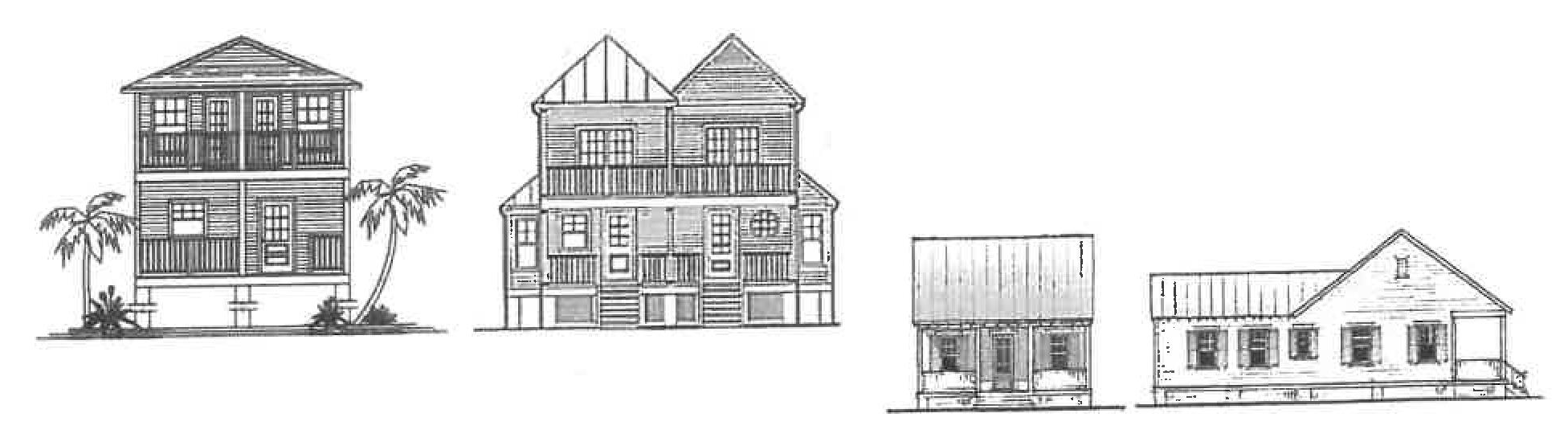
(Ord. No. 2020-16, § 2, 1-14-2021)
Sec. 34-1323.2. - Applicability.
Compliance with these regulations is applicable on an "opt in" basis to all development and redevelopment within the GRO. Development projects that elect to comply with the development standards outlined in section 34-1324 will become eligible for the density bonus outlined in section 34-1324.1. Development projects that do not comply with the standards set forth in section 34-1324 must comply with all other applicable development standards and will not be eligible for the density bonus.
In addition to the regulations specified herein for the GRO, all lot and building requirements of the underlying RM zoning district and all other applicable standards in these land development regulations shall apply. Where there is a conflict between the GRO standards and other land development regulations, the GRO standards shall apply.
(Ord. No. 2020-16, § 2, 1-14-2021)
Sec. 34-1323.3. - Permitted uses.
Permitted uses within the GRO shall be limited to the following:
(1)
Single-family detached dwellings.
(2)
Duplex dwellings, subject to compliance with the development standards below.
(3)
Multiple family dwellings, subject to compliance with the development standards below.
(4)
Residential planned developments, subject to compliance with the development standards below.
(5)
Minor community residential homes, subject to the provisions of subdivision XI of this division, and subject to compliance with the development standards below.
(6)
Home occupations, subject to the provisions set forth in section 34-890 of this Code.
(Ord. No. 2020-16, § 2, 1-14-2021)
Sec. 34-1323.4. - Accessory uses.
Accessory uses permitted in the GRO shall only include any accessory use customarily incidental and subordinate to the permitted uses, including private garages, swimming pools, cabanas, saunas, spas, gazebos, utility sheds and other similar uses.
(Ord. No. 2020-16, § 2, 1-14-2021)
Sec. 34-1323.5. - Special exceptions.
The following shall be permitted as special exception uses in the GRO, subject to compliance with the development standards specified in section 34-1324 and any applicable supplemental regulations specified in division 7:
(1)
Churches and places of worship.
(2)
Public uses and facilities.
(3)
Public utilities.
(4)
Recreation uses and facilities.
(5)
Child-care facilities.
(8)
Family day care homes.
(9)
Schools.
(Ord. No. 2020-16, § 2, 1-14-2021)
Sec. 34-1323.6. - Prohibited uses.
The following uses shall be specifically prohibited in the GRO:
(1)
Any use not specifically, provisionally or by reasonable implication permitted, or permitted by special exception.
(Ord. No. 2020-16, § 2, 1-14-2021)
Sec. 34-1324. - Development standards.
The following property development regulations shall be in effect for the GRO:
(1)
Architectural style. All new construction (and renovations utilizing the allowances of the GRO) shall incorporate the following design elements indicative of the Key West architectural style:
(a)
Roofing shall incorporate the following:
i.
Minimum pitched of 4:12 (rise to run).
ii.
Gable-ends.
iii.
Raised seam metal roofing material or dimensional shingles.
iv.
Minimum two-foot overhang with exposed or decorative truss-tails.
v.
Design to distinguish each unit. This may be accomplished by each unit having its own ridge, gable-ends, and truss ends resting on the exterior wall of that unit. Alternatively, the roof may be designed to encompass the entire multi-unit building with each unit being distinguished using dormers and or other similar features.
(b)
Windows shall incorporate the following:
i.
Single-hung or double-hung windows with mullions in at least one of the window frames.
ii.
Decorative or functional shutters mounted on the side of each window or utilizing a "Bahama" type shutter.
(c)
Exterior doors shall incorporate the following:
i.
The main exterior entry door shall be facing and be visible from the adjacent driveway or street frontage.
ii.
The main exterior entry door shall be a panel door with minimum of two panels and may be a solid or partial-light. If partial-light doors are used, there shall be mullions in a pattern consistent with the windows.
(d)
Exterior wall finish shall be comprised of the following:
i.
Clapboard appearance utilizing wood, vinyl or hardi-plank type of siding, or a stucco finish.
(e)
Front porch shall incorporate the following:
i.
Minimum five feet of usable depth not including walls, roof support structures or railings.
ii.
Porch roof sloped in a manner consistent with the main roof or incorporated into the main roof, with roof coverings to match the main roof.
iii.
Roof support posts and railings with a wood appearance.
(f)
Building color shall be as follows:
i.
The building base shall be a tropical light-color pastel, and all units shall include a complementary accent color and all trim shall be white.
(g)
Site improvements shall be as follows:
i.
Gulfstream Road frontage. Any fencing, walls or entry features, signage and or other site improvements along the Gulfstream roadway frontage shall be designed and constructed to be consistent with the color and materials used in the main buildings, with tropical landscaping. Fencing or perimeter walls on other parts of the site is exempt from this requirement.
ii.
Any community buildings and site amenities shall be consistent with the Key West style to the extent applicable.
(2)
Building height maximum 35 feet to the top of beam of the third floor. Three-stories maximum.
(3)
Building articulation. There shall be variation in the building façade of multi-unit buildings which may be accomplished by articulating individual units, using a different paint color for each unit, or other similar architectural treatment.
(4)
Maximum building width shall be 150 feet.
(5)
The site shall be designed utilizing the principals of Crime Prevention Through Environmental Design (CPTED) including:
(a)
Design site to increase pedestrian and bicycle traffic.
(b)
Windows overlooking walkways, driveways, and parking areas.
(c)
Design landscapes which enable site surveillance from adjacent rights-of-way.
(d)
Design perimeter fencing and walls to enable site surveillance from adjacent rights-of-way.
(e)
Design site lighting to ensure that potential problem areas well-lit such as pathways, entrances/exits, parking areas, public spaces, mailboxes, play areas, dumpsters, etc. Ensure that light levels are appropriate and are not too bright thus creating glare or deep shadows.
(6)
Sidewalks and concrete pathways shall connect all units to each other, and to community spaces as well as the public right-of-way for pedestrian safety.
(7)
A minimum of 20 percent of the project site shall be designed for active or passive recreation activities.
(8)
Minimum lot size is based on design and overall density of the project.
(9)
Property development regulations of the RM district contained in section 34-766 remain applicable except as provided herein.
(10)
Landscaping shall be in accordance with article III.
(11)
Supplemental regulations shall be as set forth in division 7 of this article.
(12)
Off-street parking and loading shall comply with division 8 of this article.
(Ord. No. 2020-16, § 2, 1-14-2021)
Sec. 34-1324.1. - Maximum residential density.
Residential projects in compliance with the development standards specified herein are eligible for and may be granted a density bonus by the village council, pursuant to the GRO provisions of the comprehensive plan. The maximum density of a GRO project shall not exceed ten dwelling units per gross acre.
(Ord. No. 2020-16, § 2, 1-14-2021)
Sec. 34-1325.- Shopping cart identification.
(a)
Shopping cart. As used in this section, a "shopping cart" is a basket mounted on wheels, or a similar device, which is generally used in a retail by a customer, or by an employee of such establishment, for the purpose of transporting goods of any kind.
(b)
Shopping cart identification sign required for retail establishments.
(1)
Every retail sales establishment which utilizes shopping carts in the operation of its business shall affix an identification sign on the shopping cart providing the name, address and phone number of the retail establishment.
(2)
Any establishment desiring an exemption from the requirements of subsection (b)(1) of this section shall file a petition for exemption with the director of land development and pay an application fee of $50.00.
a.
Upon such filing and payment, the director shall issue to the applicant an exemptionfrom the requirements of subsection (b)(1) if the retail establishment has:
1.
Constructed physical barriers to prevent the removal of its shopping carts from the establishment or the parking lot thereof, while permitting full wheelchair ingress and egress by disabled persons;
2.
Attached alarm mechanisms or other security devices (such as wheel locking mechanisms to be used in conjunction with an electronic barrier, or protruding arms or similar devices prohibiting the cart from being removed from the interior of the establishment) to its shopping carts to prevent their removal from the establishment or the parking lot thereof;
3.
Established a system, which may be mechanical in nature, requiring a deposit (in an amount which would not deter the use of the cart but would encourage the return of the cart) to use a shopping cart; or
4.
Adopted similar methods that would prevent the removal of its shopping carts from the establishment or its parking lot.
b.
Any exemption granted under this subsection shall expire if the establishment ceases to maintain the system upon which the exemption was granted.
(Ord. No. 2015-06, § 2, 6-11-2015)
Sec. 34-1325.1. - Loss prevention plan.
(a)
Each retail establishment that utilizes shopping carts in the operation of its business and that is not existing in the village upon the effective date of this ordinance, shall prepare a loss prevention plan, which shall be submitted to the village for review and approval as a component of site plan approval/amendment application or business registration and tax receipt application. The plan shall outline the businesses measures to prevent shopping cart removal from the premises. Loss prevention measures may include: electric barriers and wheel locks (preferred), alarm mechanisms, protruding arm or a device to prevent removal from the interior of the store, deposit system that encourages return of the shopping cart, and employee carry-out service.
(Ord. No. 2015-06, § 2, 6-11-2015)

