
Palm Springs City Zoning Code
DIVISION 8
OFF-STREET PARKING AND LOADING27
Note— See the editor's note to Div. 7, Subdiv. XXIV.
Cross reference— Stopping, standing and parking, § 74-31 et seq.
State Law reference— Mandatory that land development regulations contain provisions to ensure safe and convenient traffic flow, considering needed vehicle parking, F.S. § 163.3201(2)(h).
Sec. 34-1326.- Scope and intent of division.
It is the intent of this division that all uses permitted or allowed as special exceptions instituted after the effective date of the ordinance from which this division is derived shall be provided with adequate off-street parking facilities for the use of occupants, patrons, visitors and employees, and such uses shall be subject to the minimum requirements and regulations established in this division. It is also the intent of this division that certain uses provide off-street loading facilities. Such off-street parking and loading facilities shall be maintained as long as the main use is continued. This division applies to all zoning districts within the village.
(Code 1994, § 30-916; Ord. No. 2011-27, § 6, 12-8-2011)
Sec. 34-1327. - Off-street parking.
(a)
The definitions of section 1-2 apply to this section.
(b)
All off-street parking facilities shall be located on the same site as the use for which the parking is provided. Parking spaces shall be located so that no spaces are a greater distance than 300 feet closest straight-line distance from the building or use for which they are assigned.
(c)
No fewer than four parking spaces shall be provided for any nonresidential use.
(d)
Required yards and setbacks may be used for off-street parking, if driveways or aisles and turning spaces shall be located within the lot lines. In computing off-street parking requirements, streets or sidewalk areas shall not be used for off-street parking purposes. Driveways shall be setback a minimum of three feet from the property line to accommodate sodded or landscaped pervious area along the perimeter of each parcel between the driveway and the property line.
(e)
When off-street parking facilities for any type of building, other than a single-family detached dwelling, are situated beneath a portion of or all of a building, a plan shall be submitted to the village and is subject to site plan review for approval of interior traffic circulations, for parking stall and aisle dimensions, proper traffic control signs and pavement markings for safe and efficient vehicular and pedestrian movements for location of entrances and exits to and from public roads for approval of site distances at corners of intersecting public streets and ways, and/or approval of the effective screening of the motor vehicles located in or on the parking structures from adjoining properties, the same property and public streets.
(f)
Off-street parking spaces shall be paved with asphalt, or concrete, paver block, or pervious pavement. It shall be unlawful to obstruct or hinder the free use of the parking area.
(g)
For uses other than single-family detached dwellings, parking spaces for the handicapped shall be provided in all required parking areas, lots, garages or other similar facilities as required by applicable and current state statutes.
(h)
At the time a building is erected or when any main building or outdoor activity area is enlarged by more than 25 percent or any use is increased in capacity by adding dwelling units, guest rooms, floor area, seats or other factors requiring additional parking, minimum off-street parking spaces with adequate provisions for ingress and egress shall be provided in accordance with minimum off-street parking and off-street loading requirements set forth in this division.
(i)
Each parking space or stall shall have appropriate access to a street or alley, and maneuvering and access aisles shall be sufficient to permit motor vehicles to enter and exit the parking area in a forward motion, with the exception of egress from a single-family detached dwelling, or as otherwise approved by the village.
(j)
Each off-street parking area or lot shall be designed with reference to size, street pattern, adjacent properties, buildings and other improvements in the general area; number of motor vehicles to be accommodated; hours; types of use; and any other factors contributing to the uniqueness of its location and design.
(k)
Parking space requirements shall be computed based on the principal use of a building or premises.
(l)
Where several principal uses exist in one building, on one lot or on one site, off-street parking space requirements shall be computed separately for each principal use, unless otherwise stated in section 34-1324.
(m)
A use shall be considered a principal use, for purposes of this section, if it could exist separately from all other uses in the same building or on the same lot, and would, by itself, generate significant parking demand.
(n)
Where a use is located in a shopping center, office building or office-retail complex, the parking space requirements for the respective uses shall apply, except that, where a theater is located in any of such areas or buildings, the off-street parking requirement for theaters shall apply.
(o)
Where several principal uses exist in one building or part of a building and the gross floor area or the gross leasable area, whichever is applicable, of each principal use cannot be clarified, the off-street parking requirement for the use requiring the greatest number of parking spaces shall apply.
(p)
Where the number of required off-street parking spaces as computed includes a fraction, the number of required spaces shall be the computed number rounded up to the next whole number.
(q)
Two or more owners of buildings or uses that require off-street parking facilities may make joint provisions for such facilities, provided that the total of the parking spaces, when combined or used together, shall not be less than the sum of the requirements computed separately. No part of an off-street parking area for any building or use shall be included as a part of an off-street parking area similarly required for another building or use.
(r)
Off-site parking shall not be used to satisfy the off-street parking requirements for restaurants, bars, nightclubs or adult entertainment establishments.
(s)
Off-street parking spaces required by this division for one building or use may be allocated, in whole or in part, for the required parking spaces of another building or use if quantitative evidence is provided showing that parking demand for the different buildings or uses would occur on different days of the week or at different hours. Evidence for joint allocation of required parking spaces shall be submitted to the village for staff review and comment, and approval of the joint allocation of required spaces shall be made by the village council after review and comment of the land development board.
(t)
The following allowed modifications to off-street parking requirements are intended to permit and encourage the reduction of hard-surfaced parking areas to retain the maximum permeable soil surface and green area while still providing for adequate parking. It is not the intent of this subsection to define each site use where such modifications of off-street parking requirements may be feasible. The village may allow the use of such modifications in any instance where such a modification appears appropriate even though the specific site use may not be cited in the following subsections:
(1)
The use of a grass parking surface shall be permitted on certain site uses where parking is on an irregular, intermittent or part-time basis. The village may allow such modifications of the off-street parking requirements when such modifications appear appropriate, and if the use of the grass parking surfaces does not adversely affect the appearance or condition of the site use. Such grass parking surfaces shall conform to appropriate village-adopted construction specifications. All requirements for landscaping off-street parking areas shall be met. Such grass parking surfaces are primarily intended to be allowed for parking associated with places of public assembly, theaters for the performing arts, private clubs, churches, auditoriums, schools and similar uses.
(2)
For certain site uses, it shall be allowed for up to 25 percent of the required parking to be reserved in a grassed area. Such a reserved area shall be identified on the site plan and shall include space for all associated accessways, drives, aisles and landscaping. The reserved area may be used for temporary or overflow parking. All reserved area for temporary or overflow parking shall be designated on the plot it is to serve with a small permanent type sign. A reserved area, used for temporary or overflow parking, shall meet all landscaping requirements for an off-street parking area, except that the percentage for interior landscaping requirements for parking areas may also be used for parking. Conversion of a reserved area to hard-surfaced parking shall require compliance with all landscaping requirements for an off-street parking area. In no instance shall a reserved area be used to satisfy the landscaping requirements for a contiguous hard-surfaced vehicular use area or to satisfy requirements for open space.
(3)
The owner or his agent, if any, shall be jointly and severally responsible for the maintenance of all vehicle use areas, whether standard hard-surfaced or grass. Grass parking areas shall be maintained to present a neat appearance to ensure a viable and healthy grass surface. In the event of deterioration of a grass parking surface due to improper or inadequate maintenance or parking use too heavy to allow a healthy grass surface, the village may require the restoration of the grass surface or the hard surfacing of the area.
(Code 1994, § 30-917; Ord. No. 2007-08, § 8, 4-26-2007; Ord. No. 2010-05, § 17, 4-8-2010; Ord. No. 2011-27, § 6, 12-8-2011; Ord. No. 2019-12, § 5, 9-12-2019)
Cross reference— Definitions generally, § 1-2.
Sec. 34-1328. - Minimum off-street parking bay dimensions.
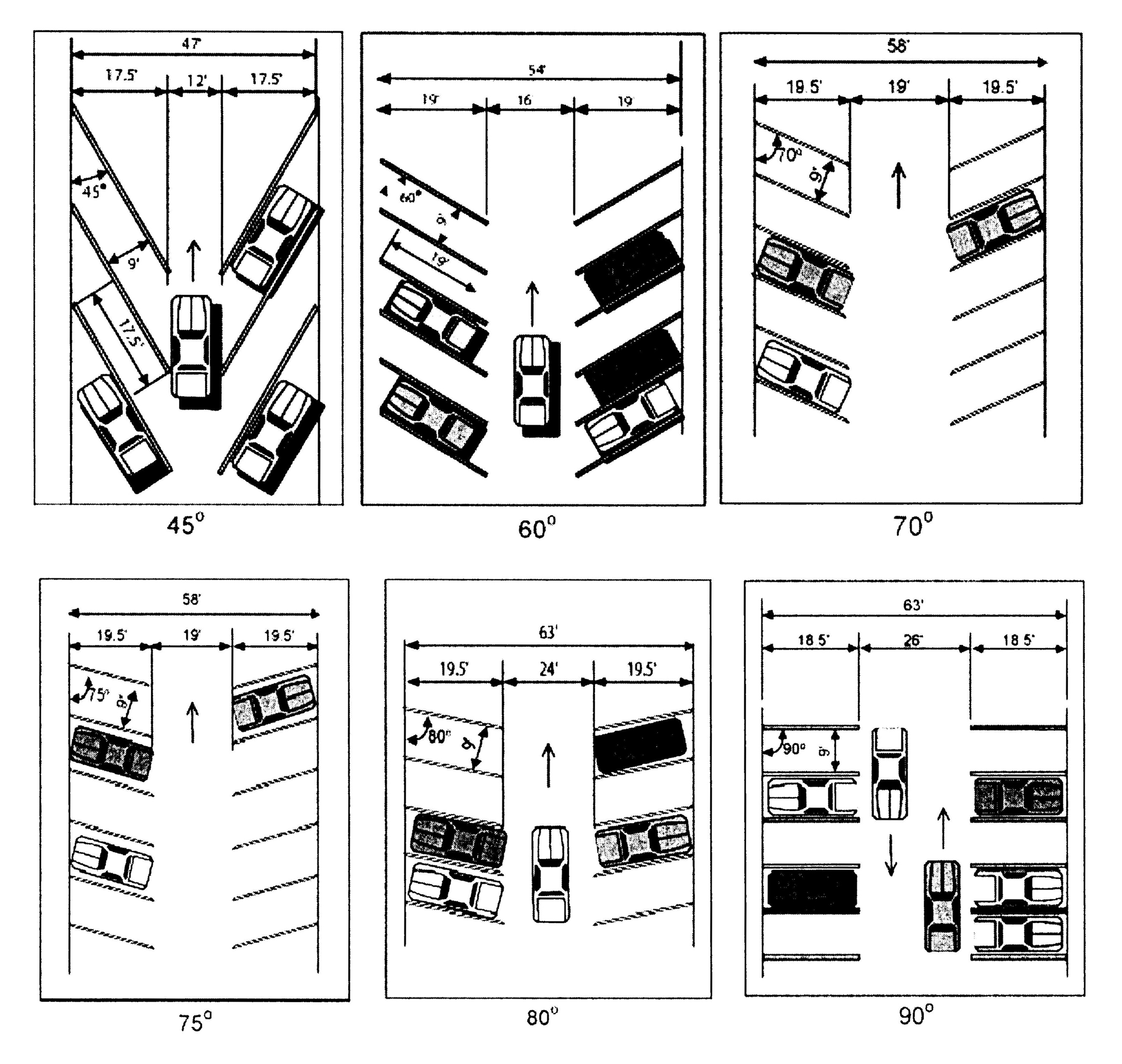
Minimum parking bay dimensions by parking angle and parking bay illustrations are as follows:
Parking Lot Schematic
(Code 1994, § 30-918; Ord. No. 2011-27, § 6, 12-8-2011)
Sec. 34-1329. - Minimum requirements by use.
The following minimum off-street parking requirements shall apply to the uses listed:
(1)
Dwellings and other buildings for habitation.
a.
Single-family dwellings. Two parking spaces per dwelling unit.
b.
Multiple-family dwellings. Two and one-half parking spaces per dwelling unit, an additional 25 percent of the total required parking shall be dedicated as guest parking spaces.
c.
Nursing and convalescent facilities. One parking space per four patient beds or tenants, plus one parking space per employee, including the nurses and staff doctor on the shift with the greatest employment.
d.
Assisted living facilities. One parking space per four patient of tenant beds, plus one parking space per employee, including the nurse and staff doctor on the shift with the greatest employment.
e.
Minor community residential homes. Two parking spaces per dwelling unit.
f.
Community residential homes. One parking space for every four persons occupying the home, plus one parking space per staff on the shift with the greatest employment.
g.
Residential planned developments. As well as the above requirements, an additional 25 percent of the total required parking shall be dedicated as guest parking spaces (if not already required).
h.
Special residential facilities. One parking space per four patient or tenant beds, plus one parking space per employee, including the nurse and staff doctor on the shift with the greatest employment.
(2)
Places of public assembly.
a.
Churches and places of worship. One parking space per four seats, but not less than one parking space per 100 square feet of gross floor area of the auditorium, plus required parking spaces for any other principal uses, including office, recreation facilities, educational or institutional facilities, meeting rooms and dwellings.
b.
Private clubs. One parking space per 100 square feet of gross floor area, or one parking space per three persons of maximum capacity of the facility, as determined by the fire occupancy rating.
c.
Museums, art galleries and fine art studios. One parking space per three seats in rooms for public assembly, or one parking space per 250 square feet of gross floor area, whichever is greater.
(3)
Governmental, institutional, educational, and public uses and facilities.
a.
Governmental uses. One parking space per 200 square feet of gross floor area.
b.
Libraries. One parking space per 300 square feet of gross floor area.
c.
Public safety facilities (police and fire stations). One parking space per 200 square feet of floor area.
d.
Schools.
1.
Colleges, universities, technical and vocational schools, and similar institutions. One parking space per two students, plus one parking space per employee and teacher, plus one parking space per six seats in the auditorium or other places of assembly.
2.
Secondary and senior high schools. One parking space per five students, plus one parking space per employee and teacher.
3.
Elementary and junior high schools. One parking space per classroom, plus one parking space per employee and teacher, plus one parking space per six seats in the auditorium or other places of assembly.
4.
Specialized instruction, including dance, art and self-defense instruction. One parking space per 200 square feet of gross floor area.
e.
Child care facilities. One parking space per employee and teacher normally engaged in or about the building or grounds, or one parking space per 200 square feet of gross floor area. One off-street loading/unloading space per eight pupils shall be provided for a convenient dropoff area, with clear, unobstructed ingress and egress.
f.
Family care center. Two parking spaces per residence.
g.
Public utilities. One parking space per 1,000 square feet of gross floor area, plus one parking space per 200 square feet of office or attendant area.
h.
Social service facilities. One parking space per 200 square feet of gross floor area.
(4)
Recreational uses and facilities.
a.
Bowling alleys. One parking space per 250 feet of gross floor area, including the floor area of all adjoining uses, such as restaurants, bars, pool rooms and amusements.
b.
Swimming pools. One parking space per 30 square feet of water area.
c.
Indoor athletic courts. One parking space per 1,800 square feet of gross floor area.
d.
Outdoor athletic courts. One parking space per 1,500 square feet of court area and adjoining paved area.
e.
Indoor amusements, not listed elsewhere in this section. One parking space per 100 square feet of gross area.
f.
Spas and health centers. One parking space per 300 square feet of gross floor area. Parking space requirements may be computed separately for floor area occupied by athletic courts, swimming pools or other principal uses for which parking space requirements are listed in this division.
g.
Recreational uses and facilities, as part of a residential development.
1.
No parking spaces are required for all dwelling units within a 500-foot radius.
2.
One parking space is required for every four dwelling units within a 500—800-foot radius.
3.
All other recreation facilities, including athletic courts and swimming pools, shall provide one-half of the parking spaces that would be required by this subsection (4)g., in addition to required parking spaces for recreational buildings.
(5)
Commercial/industrial uses and facilities.
a.
Business and professional offices, not listed elsewhere in this section. One parking space per 200 square feet of gross floor area. Financial institutions with drive-in facilities shall have the same parking space requirements as provided in this subsection for business and professional offices, plus five tandem waiting or loading spaces per drive-in lane.
b.
Retail sales and services, not listed elsewhere in this section. One parking space per 200 square feet of gross floor area.
c.
Shopping centers. One parking space per 200 square feet of gross leasable area.
d.
Restaurants (standard), lounges and other eating and drinking establishments. One parking space per three seating accommodations, or one parking space per 100 square feet of gross floor area, whichever is more restrictive.
e.
Restaurants (fast food). One parking space per three seating accommodations, or one parking space per 50 square feet of gross floor area, whichever is more restrictive. The stacking lane and bypass lane requirements for other drive-in, driveup and walkup facilities shall apply.
f.
Restaurants (drive-in). The off-street parking requirements shall be the same as for restaurants (standard). In addition, the stacking lane and bypass lane requirements for other drive-in, driveup, dropoff and walkup facilities shall apply.
g.
Restaurants (carryout). The off-street parking requirements shall be the same as for restaurants (fast food), including stacking lane and bypass lane requirements when a drive-in facility is provided.
h.
Convenience (food and beverage) stores. One parking space per 200 square feet of gross floor area. If a convenience store is combined with fuel sales and dispensing facilities, it shall be deferred, classified and regulated as a service station (full service).
i.
Service station (full service). Three parking spaces per bay, or one parking space per 100 square feet of gross floor area, whichever is greater.
j.
Automotive repairs (minor and major). One parking space per 200 square feet of gross floor area, plus one parking space per 5,000 square feet of the reserved parking area for vehicles waiting to be serviced or that have been serviced and are temporarily being stored.
k.
Personal services. One parking space per 200 square feet of gross floor area.
l.
Wholesale establishments. One parking space per 100 square feet of customer area, plus one parking space per 400 square feet of noncustomer area.
m.
Flex-units. One parking space per 200 square feet of office or retail space, plus one space per employee, plus one space per 2,000 square feet of warehouse area.
n.
Light industrial uses. One parking space per 500 square feet of gross floor area.
o.
Warehouse. One parking space per 2,000 square feet of warehouse area.
p.
Showroom/warehouse. One parking space per 200 square feet of showroom area, plus one parking space per 2,000 square feet of warehouse area.
(6)
Miscellaneous uses.
a.
Hospitals and full service medical facilities. Two and one-half parking spaces per bed in the facility, plus the requirement for medical clinics and laboratories or other related uses as provided, if applicable.
b.
Medical clinics and laboratories. One parking space per 200 square feet of gross floor area.
c.
Funeral homes. One parking space per 200 square feet of gross floor area.
d.
Kennels and animal hospitals. One parking space per 300 square feet of gross floor area, including the area of outdoor kennels.
e.
Laundromats and other self-service activities. One parking space per 50 square feet of gross floor area.
f.
All driveup, drive-in, drive-through and dropoff facilities. One stacking lane that shall be clearly defined and designed so as not to conflict or interfere with other traffic utilizing the site or area. A minimum of five stacking spaces per lane, including the vehicle being serviced, shall be provided. Each stacking space shall be a minimum of nine feet by 19 feet in size. A bypass lane must be provided if a one-way traffic flow pattern is utilized in the parking lot or driveway.
g.
Automated teller machines (ATMs). For ATMs that do not require leaving the vehicle to use such facility, the regulations established for all driveup, drive-in, drive-through and dropoff facilities shall apply. For ATMs that require leaving the vehicle for use thereof, a minimum of two parking spaces are to be allocated as part of the overall parking requirement of the site, and such parking spaces shall be located as close to the ATM facility as the site design can reasonably accommodate. The parking spaces shall be clearly identified, either by signage, pavement markings or other clearly identifiable method, and shall meet minimum size and other requirements established for off-street parking spaces.
h.
Vehicle sales. One parking space per 200 square feet of building area plus one parking space per 1,500 square feet of outdoor sales area open to the public, plus required parking spaces for any other principal or accessory uses.
(7)
Miscellaneous uses. For any use not specifically listed in this section, off-street parking requirements for a use which is mentioned and to which the use is similar shall apply.
(8)
Handicapped parking. All requirements regarding handicapped parking shall refer to F.S. § 553.501 et seq., or applicable state laws as revised from time to time.
(Code 1994, § 30-919; Ord. No. 2010-05, § 18, 4-8-2010; Ord. No. 2011-27, § 6, 12-8-2011; Ord. No. 2012-26, § 4, 10-11-2012; Ord. No. 2013-01, § 7, 2-14-2013; Ord. No. 2013-04, § 4, 2-14-2013; Ord. No. 2014-06, § 12, 5-8-2014; Ord. No. 2017-06, § 5, 5-11-2017)
Sec. 34-1330. - Off-street loading.
(a)
Off-street loading facilities are required by this division so that vehicles engaged in unloading will not encroach on or interfere with the public use of the streets and alleys by automotive and pedestrian traffic and so that adequate space is available for the unloading of goods, materials or things for delivery. Off-street loading facilities supplied to meet the needs of one use may not be considered as meeting the needs of another use.
(b)
At the time of the erection of any principal or accessory use, or at the time any principal or accessory use is altered, enlarged or increased in capacity by adding floor area, off-street loading space for the accommodation of vehicles servicing the use shall be provided in accordance with applicable regulations of this division.
(c)
Every commercial, institutional or similar type of building or use that requires the receipt of, or distribution by vehicle of, materials or merchandise shall have permanently maintained off-street loading spaces that do not hinder the free movement of vehicles and pedestrians, and which meet the following requirements:
(1)
Buildings or uses containing up to 10,000 square feet of gross floor area shall require one off-street loading space.
(2)
Buildings or uses containing between 10,000 square feet and 20,000 square feet of gross floor area shall require two off-street loading spaces.
(3)
Each additional 20,000 square feet of gross floor area shall require one additional off-street loading space.
(4)
Buildings or uses with a total of 65,000 square feet or more of gross floor area shall have a loading demand statement prepared, outlining the projected normal demands for loading and unloading.
(d)
An off-street loading space shall be an area at grade level, at least 12 feet wide by 40 feet long, with a 14-foot vertical clearance. Each such space shall be accessible from a street or alley without crossing or entering any other required off-street loading space. Such loading space shall be accessible from the interior of the building it serves and shall be arranged for convenient and safe ingress and egress by motor truck and/or trailer combination.
(e)
Collective, joint or combined provisions for off-street loading facilities for two or more buildings or uses may be made, provided, such off-street loading facilities are equal in size and capacity to the combined requirements of the several buildings or uses and are designed, located and arranged to be usable thereby.
(f)
No facility or area supplied to meet off-street parking requirements shall be utilized or deemed to meet requirements for off-street loading facilities.
(g)
All buildings or uses requiring the pickup of large quantities of garbage or trash shall provide an easily accessible area for the pickup and delivery of a dumpster or other trash receptacle. All such areas shall be designated so that garbage and trash pickup can be accomplished without excessive maneuvering, such as turning around and backing up.
(Code 1994, § 30-920; Ord. No. 2011-27, § 6, 12-8-2011)
Sec. 34-1331. - Marking and signs.
(a)
Except for single-family detached dwelling uses, each parking space shall be delineated by painted or printed lines, to indicate individual spaces.
(b)
Traffic control signs, directional arrows and other pavement markings shall be used as necessary to ensure safe and efficient internal traffic operation of the parking areas.
(Code 1994, § 30-921; Ord. No. 2011-27, § 6, 12-8-2011)
Sec. 34-1332. - Drainage; maintenance; restriction of use; pavement; additional application.
(a)
All off-street parking and loading facilities shall be drained and maintained so as not to cause nuisance or danger to the public, or to adjacent public or private property. Off-street parking areas shall also be maintained in a clear, orderly and dustfree condition, at the expense of the owner or operator of the area, and shall not be used for the sale, repair, dismantling or servicing of any vehicles, equipment, materials or supplies.
(b)
The proposed pavement of off-street parking and loading areas shall be paved with a minimum of six-inch shellrock or limerock base and one-inch hotplant mix asphalt, concrete or other acceptable base for a durable weatherproof surface pavement.
(c)
The off-street parking and loading regulations set forth in this division shall apply in addition to the applicable regulations established in article III of this chapter.
(Code 1994, § 30-922; Ord. No. 2011-27, § 6, 12-8-2011)
Sec. 34-1333. - Certificate of occupancy.
A certificate of occupancy for a building or premises shall not be issued until the required off-street parking and loading facilities or areas have been inspected and approved by the village land development department.
(Code 1994, § 30-923; Ord. No. 2011-27, § 6, 12-8-2011)
Sec. 34-1334. - On-street parking.
While on-street parking is not normally the responsibility of the owner of adjacent property, the development and use of land may sometimes affect the use of on-street parking spaces. All proposals for land development shall be reviewed to determine that off-street parking is adequate and is arranged to meet the needs of the uses proposed. The village council may require modifications to the size and/or design of any development project where it appears that there will be an adverse impact to on-street parking. If subsequent development of the land results in on-street parking patterns which create a nuisance or impede traffic flow and safety, the village council may require further modifications to on-site parking or other features of the use or development, and/or may require a contribution by the property owner to assist in the correction of on-street parking.
(Code 1994, § 30-924; Ord. No. 2011-27, § 6, 12-8-2011)
Sec. 34-1335. - Review of parking standards.
Whenever the building official, village manager, land development commission and/or village council determine that there are uses and activities in the village for which the parking standards in this division are inadequate, the village council may direct the village manager to undertake a review of such standards and propose revisions.
(Code 1994, § 30-925; Ord. No. 2011-27, § 6, 12-8-2011)
Sec. 34-1336. - Off-site parking.
(a)
General.
(1)
Off-site parking is permitted only in nonresidential zoning districts and shall not be allowed to count for required parking or off-street parking.
(2)
The approval of off-site parking shall be in conjunction with a site plan approval, or as a modification to an existing site plan approval.
(b)
Requirements for off-site parking.
(1)
The village may allow excess parking to be provided off-site. Off-site parking may be allowed only within a radius of 300 feet of the subject site (unless a greater distance is approved by the village council), provided that the proposed location of the off-site parking is zoned to permit such parking, as parking is not allowed as a standalone use by Code.
(2)
The owner of a property who proposes to use off-site parking shall prepare a written off-site parking agreement between the owner of the subject property and the owner of the site with the off-site parking. This agreement shall specify the terms of the off-site parking. The off-site parking agreement shall be subject to the approval of the village attorney before it is submitted to the village council or staff for its consideration. The owner who has applied for off-site parking shall be responsible for recording the off-site parking agreement in the county's official records and providing copies of the agreement with the recording information on it to all parties to the off-site parking agreement. At a minimum, the agreement shall:
a.
List the names and ownership interest of all parties to the agreement and contain the signature of those parties.
b.
Provide a survey and legal description of the property.
c.
Include a site plan showing the area of off-site parking.
d.
Describe the area of off-site parking, reserve it for such use, and leave it unencumbered by any conditions which would interfere with that use.
e.
Agree and expressly declare the intent of the covenant to run with the land and bind all successors in interest to the covenant.
f.
Describe the obligations of each party.
e.
Be made part of the site plan approval for the subject property.
g.
Describe the manner in which the agreement may be revised.
(3)
A paved sidewalk or other access way shall be provided from the off-site parking to the property for which it is approved, unless the village council approves a site plan where, based on the location of the property and the off-site parking area, the council does not require it. Such sidewalk or access way may be required to have pedestrian crosswalk flashers and/or pavement-embedded detectors (crosswalk nubs) as applicable for the conditions and location and as required by the village planning zoning and building director.
(4)
Signage that complies with the village's sign regulations shall be provided to indicate the location of all off-site parking.
(5)
All properties utilized for off-site parking must comply with the Village's Code as well as any other regulatory authority requirements regarding the construction, maintenance and use of such parking areas.
(Ord. No. 2017-28, § 3, 12-14-2017)

