
Palmetto City Zoning Code
ARTICLE IV
SCHEDULE OF DISTRICT REGULATIONS
Sec. 4.1.- Schedule of statements of purpose and intent.
The following array presents for the several districts the statements of purpose and intent applicable to each district.
(a)
Single-family residential districts: Single-family districts provide for detached residential housing development on a variety of lot sizes in accordance with the Palmetto Comprehensive Plan. Accessory uses and certain conditional uses are also permitted.
(1)
E-R Estate Residential District: The purpose of the E-R Estate Residential District is to serve as a transitional area between primarily agricultural areas and suburban developments. The transitional nature of this district is furthered by permitting general gardening and agricultural pursuits to such an extent as to supply the occupants' personal needs. In addition, maintaining bovine and equine animals for the occupants' use or need only, not exceeding two (2) farm animals per acre, is permitted. (1 du/ac.)
(2)
RS-1 Single-family residential: This district provides areas primarily for single-family detached dwellings on spacious lots (fifteen thousand (15,000) square feet or larger) wherein a property owner may obtain reasonable assurance of compatible development. For restrictions with respect to the keeping of cows and/or horses, refer to Section 6.19 Cows and horses in RS-1 District, requirements. (2.9 du/ac.)
(3)
RS-2 Single-family residential: This district provides areas primarily for single-family detached dwellings on ten thousand (10,000) square foot or larger lots. (4.36 du/ac.)
(4)
RS-3 Single-family residential: This district provides areas primarily for single-family detached dwellings similar to those provided in RS-1 and RS-2 but with smaller (seven thousand five hundred (7,500) square feet) lot size requirements. (5.8 du/ac.)
(5)
RS-4 Single-family residential: This district provides areas primarily for single-family detached dwellings similar to those provided in RS-1, RS-2, and RS-3 but with smaller (five thousand (5,000) square feet) lot size requirements. (8.7 du/ac.)
(6)
MHP-1 Mobile home park district: The intent of the MHP-1 Mobile Home Park District is to identify and stabilize those geographic areas within the City of Palmetto that are presently platted or developed as mobile home parks. The district is intended to be used primarily for mobile homes for residential occupancy upon lots owned by the resident or rented or leased by the designated tenant. Travel and transient trailers may be considered as conditional uses.
(b)
Multiple-family residential districts: Multiple-family districts provide for residential development at a variety of densities in accordance with the Palmetto Comprehensive Plan. Accessory uses and certain conditional uses are also permitted.
(1)
RM-5 Duplex and Single-family Residential: This district provides primarily medium density residential uses including single-family and two-family (duplex) developments. (10 du/ac.)
(2)
RM-6 Multiple family residential: This district provides for primarily medium density residential multifamily developments. (10 du/ac.)
(c)
Office district (GO): The office district is intended to provide for office uses and related support uses. Office uses permitted in this district are to be of an intensity and character so that they do not compete with office uses permitted in the core. All types of office uses are included in this zoning district: business, professional and health-related.
(d)
Commercial districts: The commercial districts provide for various retail sales, personal services, office and institutional uses, accessory uses as appropriate, compatible supporting uses. Commercial uses shall be at the appropriate locations as established in the Palmetto Comprehensive Plan.
(1)
CN Neighborhood Commercial: This district provides areas for limited retail and personal services. Neighborhood Commercial does not permit the manufacturing or treatment of products other than those products which are clearly incidental to the conduct of the business on the premises. Wholesaling and jobbing are prohibited.
(2)
CC Commercial Core: This district is only located in the redevelopment area and its purpose is to provide areas for general commercial/retail activities that are associated with a compact, pedestrian-oriented, downtown core.
(3)
CG Business and Light Commercial: This district provides areas where a variety of retail and commercial service activities can be conducted compatible with surrounding uses and residential districts.
(4)
CHI Heavy Commercial and Light Industrial: This district provides areas for intense commercial and light industrial activities permitting heavy commercial, light industrial, and service uses in appropriate locations.
(e)
Special purpose district:
(1)
P Public: The intent of the P Public District is to identify and stabilize those geographic areas within the City of Palmetto that are appropriate for the development and maintenance of public and semipublic facilities. Such uses are to be individually reviewed and approved by city commission to ensure design and use compatibility with the surrounding area.
(Ord. No. 535, § 1, 4-3-95; Ord. No. 2024-04, § 2, 11-18-24)
Sec. 4.2. - Schedule of permitted and conditional uses by district.
X=Permitted use
C=Conditional use (see Ordinance No. 196)
—=Prohibited use
Those existing farm worker housing uses located at the addresses listed below may apply by October 31, 2012 to be approved as a conditional use:
1.
1911 8th Ave W
2.
1000 1st Ave Ct W, # 1 - 37
3.
1001 1st Ave Ct W
4.
401, 403, 405, 407, 409, 411 and 413 6th St W
5.
804, 806 and 808 5th Ave W
6.
712 and 716 5th Ave W
7.
415 9th St W
8.
408 8th St W
9.
502A, 504, 506 and 506A, 512, 514 and 514A, 606, 608, 610 and 610A and 702A 14th St W (Oakridge Apartments)
If the application meets the criteria for a conditional use and is approved for a conditional use permit by the city commission, then such use shall be considered a nonconforming use and regulated under the nonconforming use provisions of the city zoning code, as may be amended except that facilities receiving a conditional use permit under this section shall not be subject to the cessation of use restrictions in subsection 7.7(c) of the city zoning code unless the farm worker housing ceases for two (2) consecutive years. If a complete application for a conditional use permit is not received by the city by October 31, 2012, or if the application for conditional use is denied, then such uses shall be subject to code enforcement in accordance with the requirements of the City Code.
Uses located within the downtown core may be further restricted as provided in the downtown core design code.
(Ord. No. 444, § 3, 11-19-90; Ord. No. 517, § 2, 6-20-94; Ord. No. 535, § 2, 4-3-95; Ord. No. 607, § 1.A, 12-15-97; Ord. No. 618, § 2, 8-3-98; Ord. No. 01-706, § 2, 4-16-01; Ord. No. 09-999, § 2, 9-28-09; Ord. No. 2011-10, § 2, 4-4-11; Ord. No. 2010-12, § 2, 11-15-10; Ord. No. 2012-07, §§ B—D, 8-6-12; Ord. No. 2013-03, § 2.B., 3-18-13; Ord. No. 2014-09, § 2e., 6-16-14; Ord. No. 2014-10, § 1.B.(Att. A), 9-22-14; Ord. No. 2014-11, § 1.B.(Att. A), 9-22-14; Ord. No. 2016-17, § 1.C., 1-23-17; Ord. No. 2017-12, § 1B., 11-6-17; Ord. No. 2023-15, § 2 (Exh. A), 3-4-24; Ord. No. 2024-04, § 3, 11-18-24)
Sec. 4.3. - Schedule of area, height, and placement regulations.
1 Corner lots shall be considered to have two (2) front yards where boundaries of such lots abut streets. All other boundaries shall be considered as side yards.
2 For those uses located within the flood hazard area, as defined in Ordinance No. 305, the maximum height of the structure shall be measured from the lowest measurable area as described in Ordinance No. 305 [Chapter 14].
3 Above thirty-five (35) feet, an additional three (3) feet for every one (1) foot of height over thirty-five (35) feet is required.
4 No side yard shall be required where nonresidential districts adjoin side by side. If a side yard is provided, the minimum separation between structures shall be eight (8) feet. Common structure walls shall not be permitted between properties of separate ownership. In the case of a series of adjoining structures on lots of single and separate ownership abutting and paralleling a public right-of-way, a passage of at least twenty (20) feet in width shall be provided at grade level at intervals not greater than four hundred (400) feet or as required for public access from adjacent residential areas or for the safety of the public.
5 When adjacent to commercial or industrial districts, no rear yard shall be required.
6 A minimum parcel size of ten (10) acres is required for a rezoning to this district.
7 Public uses, as defined herein, shall be reviewed by city commission on a case-by-case basis for minimum dimensional requirements.
8 Single-family detached units within the RM-5 and RM-6 zoning districts shall meet all of the dimensional regulations of the RS-4 district including the RS-4 minimum lot area, minimum lot width, required yards, and maximum height requirements.
9 A minimum parcel size of eight thousand seven hundred twelve (8,712) square feet is required for a rezoning to this district.
10 For lots abutting a public street, the setback shall be measured from the right-of-way line. For lots abutting a private street, the setback shall be measured from the edge of pavement.
(Ord. No. 419, § 2, 6-18-90; Ord. No. 444, § 4, 11-19-90; Ord. No. 516, § 1, 6-20-94; Ord. No. 06-877, § 2, 2-27-06; Ord. No. 2021-16, § 2, 3-7-22; Ord. No. 2024-04, § 2, 11-18-24)
Sec. 4.4. - Downtown core design code.
(a)
Definitions. For the purposes of this section, the following terms shall have the meanings identified below:
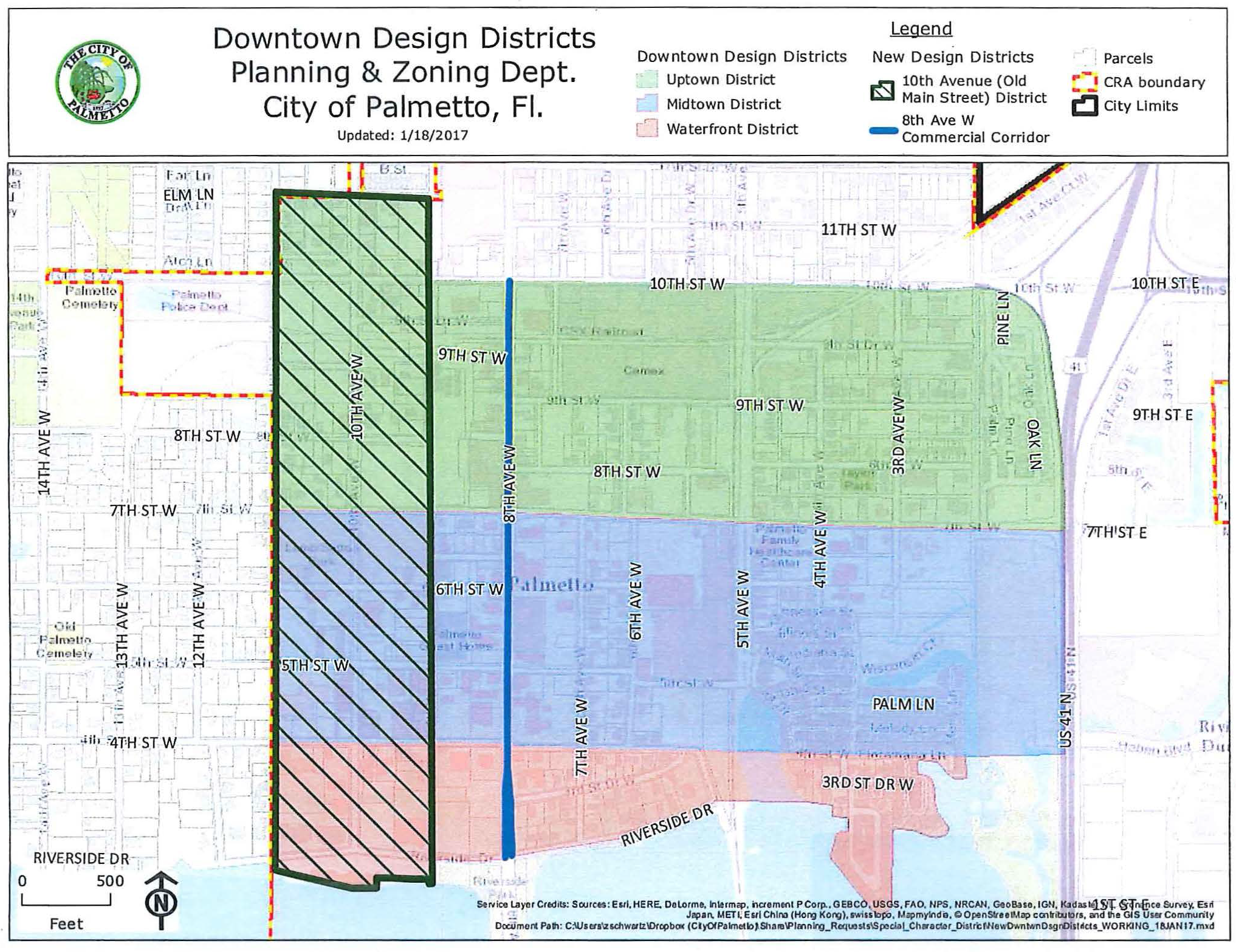
Character districts shall mean the downtown waterfront district, midtown district and uptown district, as those areas are geographically depicted on figure 4.4 herein, and further defined and regulated in the downtown core design code.
Development means any activity requiring issuance of a development permit.
Development permit means any building permit, zoning permit, subdivision approval, rezoning, certification, special exception, variance, or any other official action of local government having the effect of permitting the development of land.
Downtown core means the means the area geographically depicted on figure 4.4 herein, and further defined and regulated in the downtown core design code.
Downtown core design code means those provisions applicable to development within the downtown core, as adopted as the "downtown core design guidelines" adopted May 21, 2007, and references to the downtown core design code shall be amended to reflect the new title. A complete copy of the downtown core design code, as may be amended from time to time, are incorporated herein by reference and shall be kept on file in the building department, the planning department, the community redevelopment agency office and the office of the city clerk and made available to the general public.
Downtown waterfront district means the geographic area bounded by the southernmost boundary of Riverside Drive until its eastern terminus, the Manatee River, the easternmost boundary of 11th Avenue West, the southernmost boundary of 4th Street West and the westernmost boundary of U.S. 41/301.
Eighth Avenue West commercial corridor means the area geographically depicted on figure 4.4 herein, and further defined and regulated in the downtown core design code.
Midtown district means the geographic area bounded by the northernmost boundary of 4th Street West, the easternmost boundary of 11th Avenue West, the southernmost boundary of 7th Street West and the westernmost boundary of U.S. 41/301.
New construction means construction commencing after May 21, 2007, and requiring issuance of a development permit.
Tenth Avenue/Old Main overlay district means the area geographically depicted on figure 4.4 herein, and further defined and regulated in the downtown core design code.
Uptown district means the geographic area bounded by the northernmost boundary of 7th Street West, the easternmost boundary of 11th Avenue West, the southernmost boundary of 10th Street West and the westernmost boundary of U.S. 41/301.
(b)
Purpose and intent. It is intended that development within the downtown core be consistent with an urban theme, combining moderate residential density with commercial activities and recreational opportunities necessary for a vibrant downtown. It is further intended that development in the downtown core be designed with carefully located buildings, parking and service areas, open space and use mixtures which are scaled and balanced to reduce general traffic congestion, by providing interdependent uses and uses which are compatible and complimentary with adjacent and surrounding land uses. Design code for the downtown core and character districts are established to ensure that public and private development projects implement the goals, objectives, policies and visions of the city's comprehensive plan, community redevelopment plan, and waterfront development plan.
(1)
The code is to provide a means to:
a.
Enhancing the quality of the downtown core built environment;
b.
Achieving quality contextual design;
c.
Achieving design that implements the vision of the character district in which the property is located, thereby promoting an identity for Palmetto;
d.
Encouraging a diversity of architectural styles;
e.
Providing design flexibility instead of aesthetic control;
f.
Guiding the appropriate rehabilitation and preservation of designated historic structures;
g.
Creating a pedestrian-oriented environment built upon the city's history and activities; and
h.
Providing investor and property owner confidence through design continuity.
(2)
This section shall be liberally construed to effectively carry out its purpose in the interest of promoting and protecting the public health, safety and welfare.
(c)
Applicability and review.
(1)
Effective May 21, 2007, the downtown core design code shall apply to the following improvements within the downtown core:
a.
New construction;
b.
Additions to existing buildings requiring a development permit;
c.
The relocation of existing buildings; or
d.
Exterior modifications to existing buildings that require the issuance of a development permit.
(2)
Construction, relocation, or modification commencing on or before May 21, 2007, shall not be required to come into compliance with the downtown core design code.
(3)
A single-family home or duplex on a platted lot shall not be required to comply with the downtown core design code.
(4)
Development permit applications shall be reviewed by the public works director, or the director's designee, for compliance with the downtown core design code. The phrase "appropriate" in the downtown core design code shall mean compliance is required with the provision. The phrase "inappropriate" in the downtown core design code shall mean that such actions are prohibited. Except as specifically provided herein, compliance is a prerequisite to issuance of a development permit.
(5)
Applicants seeking height, density or a floor area ratio exceeding that provided in the applicable zoning regulations but permitted by the comprehensive plan and downtown core design code must rezone the subject property to planned development (PD). Site plans shall meet the PD criteria set forth in section 8.4 and be consistent with the downtown core design code.
(6)
Where implementation of downtown core design code is inconsistent with regulations provided in an underlying zoning district or other provisions of the Palmetto Code of Ordinances, the downtown core design code shall govern, except as provided in subsection 4.4(c)(5) herein.
(d)
Superior or equivalent alternative proposals. Where an applicant cannot or does not want to strictly comply with the requirements of the downtown core design code for improvements as required pursuant to subsection 4.4(c)(1), the applicant may propose an alternative proposal, which shall be superior or equivalent to the requirement as set forth in the downtown core design code. The applicant shall file such request with the director of public works, or the director's designee, with a copy to the community redevelopment agency director. The applicant shall identify the downtown core design code section to which the applicant proposes the alternative proposal and explain in detail how the alternative proposal is superior or equivalent to the provisions in question.
If the applicant is submitting the application as part of a planned development zoning application, then city may process the alternative proposal in conjunction with the PD application. If the applicant is proposing an alternative proposal in conjunction with the development that is not part of a planned development, then the matter shall be reviewed for consistency with the purpose and intent of the downtown core design code as set forth in subsection 4.4(b) of appendix B of the Palmetto Code of Ordinances. The public works director, or the director's designee, or the applicant may forward the alternative proposal to the planning and zoning board for review.
The planning and zoning board's decision may be appealed to the city commission as set forth in subsection 12.4(d) of the Palmetto Code of Ordinances.
At each level of review, if the alternative proposal is found to be consistent with the purpose and intent of the downtown core design code as set forth in subsection 4.4(b) then it may be approved, or approved with conditions. Otherwise, the alternative proposal shall be denied.
The following provisions of the downtown core design code are not subject to alternative proposals being proposed pursuant to this subsection 4.4(d):
Provisions related to signs.
(e)
Consistency with comprehensive plan. Notwithstanding the provisions of this code, construction and development within the downtown core must be consistent with all goals, policies and objectives of the city's comprehensive plan.
(f)
(Ord. No. 07-930, § 2, 5-21-07; Ord. No. 2013-05, § 2.A., 4-15-13; Ord. No. 2016-17, §§ 1.A., B., 1-23-17)

