
Palmetto City Zoning Code
ARTICLE V
- APPLICATION OF AREA, HEIGHT AND PLACEMENT REGULATIONS
Sec. 5.1.- Regulations encumbering land required to satisfy regulations.
No portion of a lot, used in connection with an existing or proposed building, structure or use, and necessary for compliance with the area, height, and placement regulations of this code, shall, through sale or otherwise, be used again as a part of the lot required in connection with any other building, structure, or use.
Sec. 5.2. - Height regulations generally.
(a)
Excluded portions of structures: Except as specifically provided herein, the height limitations of this code shall not apply to any roof structures for housing elevators, stairways, tanks, ventilating fans, solar energy collectors, or similar equipment required to operate and maintain the building, provided that such structures shall not cover more than twenty (20) percent of roof area or extend over ten (10) feet in height. Additionally, church spires, steeples, belfries, cupolas, domes, monuments, water towers, skylights, flag poles, vents, construction or mining cranes or draglines, or similar structures may be erected above the height limit. Fire or parapet walls shall not extend more than five (5) feet above the roof.
(b)
Exceptions to height regulations: Public, semipublic or public services buildings, hospitals, public institutions or schools, when permitted in a district, may be constructed in excess of district height limitations provided that the height does not exceed sixty (60) feet and provided that applicant can demonstrate that the proposed height does not affect adjoining and nearby properties.
Churches or temples may be constructed in excess of district height limitations, provided that the height does not exceed seventy-five (75) feet and provided that the applicant can demonstrate that the height of the church does not adversely affect adjoining and nearby properties.
In determining whether height has an adverse affect, the following shall be considered:
(1)
Relationship of structure to surrounding neighborhood, including yards, distance from existing residential dwellings and other structures; and
(2)
A guideline for additional building setback shall be an additional one (1) foot for every two (2) feet in height above the maximum height in the respective zoning district.
Sec. 5.3. - Permitted projections into required yards.
(a)
Certain architectural features, such as cornices, eaves, stairs, and gutters, may project no more than four (4) feet into the required front yard, five (5) feet into the required rear yard and two (2) feet into the required side yard.
(b)
Mechanical equipment, such as air conditioning units, pumps, heating and pool equipment, and similar installations may not project into the required front yard(s), but may project up to five (5) feet into required rear and side yard(s).
(Ord. No. 2019-04, § 1, 6-3-19)
Sec. 5.4. - Visibility at intersections.
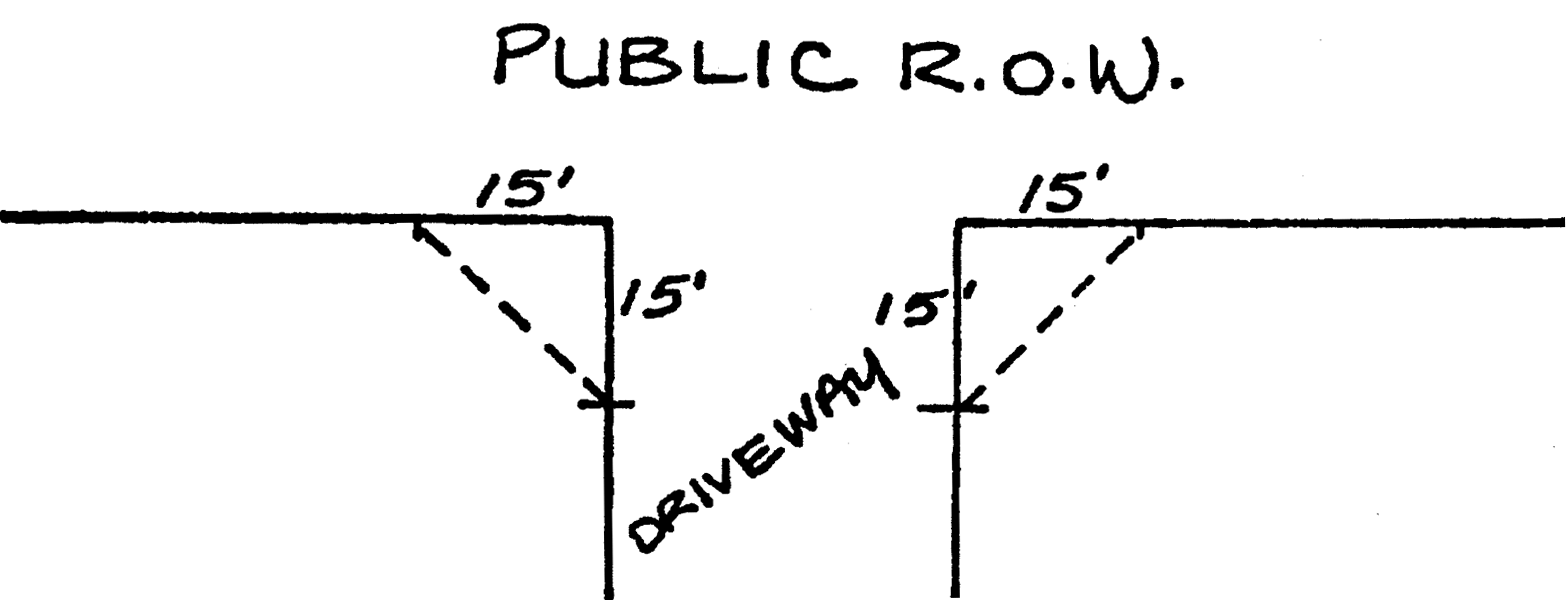
No structure or portion of any structure shall be placed or erected, no motor vehicle, trailer or equipment shall be allowed to park, stand, stop or be stored, and no vegetation shall be maintained, planted or allowed to grow in a manner which materially impedes the visibility from a street, alley or driveway of lawfully oncoming traffic. A visibility triangle shall be measured as described below:
(a)
The area of property on both sides of a driveway formed by the intersection of each side of the public right-of-way line for a distance of fifteen (15) feet in length along the driveway and fifteen (15) feet in length along the public right-of-way.
Public R.O.W.
(b)
The area of property, located at the intersection of two (2) streets, formed by a triangle constructed with two (2) thirty-foot lengths adjacent to the subject rights-of-way and the third side of the triangle formed by connecting the terminal points of the two (2) thirty-foot sides.
No structure, motor vehicle or vegetation, as described above, between the heights of two and one-half (2.5) feet and eight (8) feet shall be parked, stored, or located within said triangle.
Sec. 5.5. - Yards between residential buildings on the same lot or parcel.
The minimum distance between separate buildings shall be measured between the two (2) closest building lines. The requirements for the tallest building among adjacent buildings of varying heights shall govern and shall be as follows:
(a)
Ten (10) feet for buildings one (1) story or fifteen (15) feet in height.
(b)
Fifteen (15) feet for buildings two (2) stories or thirty (30) feet in height.
(c)
Twenty (20) feet for building two and one-half (2.5) stories or thirty-five (35) feet in height.
(d)
Twenty (20) feet, plus one (1) foot for each one (1) foot of building height above thirty-five (35) feet.
Sec. 5.6. - Average existing residential front setback line.
In a residential district where the average of the front yards for all adjacent lots which are located within two hundred (200) feet of either side of a lot is greater than the required front yard specified in this code, the required setback line shall be provided on the lot equal to this greater average depth but shall not exceed forty (40) feet. Where such average of the front yards is less than the minimum front yard required by this code, the required setback line may be reduced to this lesser average depth, but in no case shall the required front yard setback be less than ten (10) feet. For the purpose of computing these averages, an adjacent vacant lot shall be considered as having the minimum required front yard specified for the zoning district.
Sec. 5.7. - Reserved.
Editor's note— Section 3 of Ord. No. 419, adopted June 8, 1990, deleted § 5.7 of App. B, which pertained to setback requirements for construction in waterfront property and was derived from Ord. No. 387, adopted Nov. 20, 1989.

