
Palmetto Bay City Zoning Code
DIVISION 30-70
PARKING AND LOADING STANDARDS3
Editor's note— Ord. No. 2023-08, § 2, adopted April 17, 2023, repealed the former div. 30-70, §§ 30-70.1—30.70.16, and enacted a new div. 30-70 as set out herein. The former div. 30-70 pertained to similar subject matter and derived from Ord. No. 07-32, § 1, adopted Oct. 1, 2007; Ord. No. 2012-27, § 1, adopted Nov. 5, 2012; Ord. No. 2013-05, §§ 1, 2, adopted July 11, 2013.
Sec. 30-70.1.- General.
Permanently maintained parking for vehicles, bicycles, and loading facilities shall be provided in connection with any building or premises used or designed to be used for the purposes set forth in this division. Parking spaces on private roadways shall not be credited towards required parking, unless otherwise provided for in the land development code.
(Ord. No. 2023-08, § 2, 4-17-2023)
Sec. 30-70.2. - Location of required parking; exceptions.
(a)
Generally. Required parking spaces shall be located on the same parcel they are intended to serve and shall not be permitted within the required zoned right-of-way, unless otherwise provided for in the land development code.
(b)
Exceptions.
(1)
Required parking spaces for developments in mixed-use zoning districts, shall comply with the applicable sections of this Code.
(2)
If the use to be served is a governmental or commercial use, the required parking may be located on a parcel in a mixed-use or commercial zoning district within 300 feet from the site being served, unless otherwise provided for in the land development code. The owner (right, title or interest) of the use being served shall execute a covenant that shall be recorded in the public records and approved by the village attorney that the governmental or commercial use shall cease and terminate in the event the parking serving the use is eliminated. The owner of the use being served shall provide documentation to the village attorney evidencing a long-term lease agreement or ownership of the parking site being used to meet parking requirements.
(3)
If the use to be served is multi-family, required parking may be located on a parcel within the same zoning district or a more liberal district within 300 feet from the use being served. The distance shall be measured by the normal and legal way a pedestrian would travel. The owner (right, title or interest) of the use being served shall execute a covenant that runs with the land that shall be recorded in the public records and approved by the village attorney that the multi-family use shall cease and terminate in the event the parking serving the use is eliminated. The owner of the use being served shall provide documentation to the village attorney evidencing a long term lease agreement or ownership of the parking site being used to meet parking requirements.
(Ord. No. 2023-08, § 2, 4-17-2023)
Sec. 30-70.3. - Existing buildings.
(a)
Existing buildings which have received a certificate of use and occupancy prior to the effective date of this division may be:
(1)
Modernized, altered or repaired, provided there is no increase in floor area or capacity without providing the required parking and loading requirements identified in this division; however, drive-through service facility requirements shall be met.
(2)
Changed in use or occupancy that is allowed under the current zoning district without any special exception, without providing the required parking and loading requirements identified in this division; however, drive-through service facility, bicycle, landscaped street trees shall be met.
(3)
Changed or enlarged in floor area, volume, capacity or space occupied, will need to provide all parking, loading for the proportional share of new additional floor area, volume, capacity or space created or occupied and all drive-through service and landscape street trees shall be met.
(b)
It shall be unlawful for an owner or operator of any building, structure or use affected by this division to discontinue, change or dispense with, or to cause the discontinuance or reduction of the required parking facilities apart from the discontinuance, sale or transfer of such structure or use, without establishing alternative vehicle parking facilities which meet the requirements of this division. It shall be unlawful for any person to utilize such building, structure or use without providing the parking requirements of this division.
(Ord. No. 2023-08, § 2, 4-17-2023)
Sec. 30-70.4. - Parking plan required.
(a)
A separate parking plan shall be provided with all applications for development approval which shall clearly and accurately designate the parking spaces provided; indicate required parking by type of use; location and number of required handicapped spaces, child and baby stroller spaces, electric vehicle (EV), electric vehicle supply equipment ready (EVSE), and/or bicycle racks; required landscaped areas and low impact development (LID) techniques; planter islands; access aisles; driveways; loading zones and spaces; drive-through facilities, if any; parking area material; curb type; and, a description of the relationship between the parking facilities and the uses or structures the spaces are intended to serve.
(b)
Plans for buildings or uses requiring loading facilities under the provisions of this division shall clearly indicate the location, dimensions, clearances and access of all such required loading facilities.
(c)
The plan must meet with the approval of the planning and zoning department and the public works department. In making a determination, the departments shall consider the best interests of the community, volume of traffic to be generated, pattern of traffic, site circulation, conflicts with adjacent pedestrian, bicycle and road traffic; number, location, angle, elevation of and proximity of driveways, location and proximity of median cuts, visual clearances or obstructions, intersections with sidewalks roads, elevation of the driveways in reference to the road, and any other factors that may affect the safety and welfare of the public. In addition, all driveways extending into state roads shall meet with the approval of the state.
(d)
Applications for building or use permits shall indicate the quantity used for parking and permits shall be issued specifying quantity shall to be reserved and area developed. Recordable restrictions reserving specific areas may be required at the discretion of the community development director. The area reserved for parking area shall be marked on the zoning map and no permits for additional use of such area shall be issued.
(e)
Where a traffic study is required under the land development code, it shall be prepared by a certified traffic engineer, licensed in the State of Florida and paid for by the applicant, unless otherwise provided for in the land development code. The village may hire its own traffic engineer to evaluate applicant's traffic study recommendations.
(f)
The applicant shall be responsible for compliance with comprehensive plan relating to traffic concurrency requirements.
(Ord. No. 2023-08, § 2, 4-17-2023)
Sec. 30-70.5. - Size and character of parking spaces.
The following requirements shall be observed for parking:
(a)
Size. Each 90 degree parking space shall be not less than nine feet in width and 18 feet in length. Parallel parking space shall not be less than nine feet in width and 23 feet in length. Angled parking shall meet the requirements of the chart below.
(b)
Parking areas design standards.
(1)
Generally. Each required space shall be accessible without driving over or through another parking space. In all instances, adequate interior driveways, ingress and egress driveways shall be provided to connect all parking spaces with a public right-of-way or alley. Tandem parking is prohibited, unless provided under the valet parking in this Code. Parking stalls abutting the same continuous drive aisle shall have the same angle and orientation. Drive aisles shall be one-way only which are less than 22 feet wide or which abut parking stalls with angles less than 90 degrees. Parking stall angles and drive aisle direction of flow may change only when the drive aisle is interrupted by a circulation drive or structure. Backing out is prohibited into any public right-of-way, except for specified residential uses. Access drives between the paved portion of the right-of-way and the property line shall comply with the Miami-Dade County Public Works Manual.
(2)
Residential driveways. Residential access driveways shall conform with the following unless a specific provision is provided for in the specific residential zoning district.
a.
All residential driveway approaches. Residential driveway approaches shall be identified on the site plans and shall be constructed according to approved public work standards. Residential driveway approaches and access ways shall be 35 feet from street intersections and are subject to the required visibility triangle standards in section 30-60. All driveway approach dimensions except the flares at the roadway end shall be measured from any adjoining property at all points. Remaining pervious areas of the swale, less driveway approach(es) and sidewalks (where applicable) shall be landscaped in accordance with the provisions of division 30-100. Where sidewalks exist or are installed, the concrete shall continue at a uniform height across the driveway surfaces. These standards shall be applicable to any property under one ownership.
b.
Single family detached residential. A single family detached residential home shall be permitted to have up to three driveway approaches provided the total width of the combined approaches does not exceed 32 feet of linear driveway on any one frontage. Maximum permitted width of any single driveway approach shall not exceed 24 feet or be less than 10 feet in width. The driveway must be set back at least three feet from any adjoining properties at all points however, it may flare out on a three-foot radius on each side where the drive connects with the adjacent roadway. Corner and through lots are permitted to locate up to one of the three permitted driveway approaches along their secondary frontages provided it does not to exceed 12 feet in width. Any driveway configuration which dimensionally complies with this section, but results in a reduction of the pervious area of the swale below 58 percent shall be required to provide either storm water drainage infrastructure(s) or a study from a licensed engineer confirming the design of the swale is adequate to manage storm water runoff as approved by the village and detailed in the Miami-Dade County Public Works Manual for the length of the subject property adjacent to the road section.
c.
Other residential. The driveway approach shall be a minimum width of 12 feet but not be wider than 20 feet. The driveway must be set back at least five feet from any adjoining properties at all points provided, however, it may flare out on a five-foot radius on each side where the drive connects with the adjacent roadway. No more than one two-way access or two one-way access ways shall be permitted for any street frontage of up to 100 lineal feet. Where ownership involves over 100 feet of street frontage, one additional two-way or two additional one-way drives may be permitted for each additional 100 feet of frontage or major fraction thereof.
(3)
Commercial driveways. Commercial driveway entrances and approaches shall be paved and constructed according to approved village public works standards. The driveway and approach shall have a minimum width of 12 feet but not wider than 30 feet. The driveway and approach shall not encroach upon adjoining properties and shall be set back a minimum of five feet from adjoining properties. Commercial accessways shall be a minimum of 100 feet apart when located on properties under common ownership. No commercial driveway curb cut shall be located within 50 feet of a street intersection. Parking facilities on adjoining lots may share access points, driveways, and parking subject to a recorded covenant running with the property on which the facilities are located.
(4)
Where a business is adjacent to a park, neither the driveway nor the parking area shall be located between the business structure and the public park.
(c)
Parking stall and aisle dimensions shall conform to the chart below:
Minimum Parking Stall Dimensions
(in feet) at Various Angles
**See subsection (b) above for details as to driveway widths.
(d)
Striping and marking. For all occupancies other than single-family, duplex, and townhome residential, the parking spaces shall be marked with painted or thermoplastic white four-inch striping on each side of the space to identify and facilitate their use. The width of each space shall be measured to the center of the marking. Each parking stall shall be provided with a wheel stop or raised continuous curbing serving as a wheel stop. Where a parking space heads into and abuts a walkway, the paved 18-foot length shall be provided a wheel stop or curb at 16 feet in order to prevent extension of the vehicle over any portion of the provided walkway width. The back of the curb or wheel stop shall be located two feet from the end of each stall. The direction of aisles shall be marked with painted or thermoplastic white arrows to indicate the direction of traffic movements. In all instances, adequate interior driveways, ingress and egress driveways, and an ADA accessible pedestrian connection to the public right-of-way shall be provided to connect all off-street parking areas with a public right-of-way. Required and surplus parking shall comply with these provisions and the parking spaces shall not be placed in dedicated or official rights-of-way, unless otherwise provided for in the land development code.
(e)
Composition. In all zoning districts, parking facilities, including access aisles and driveways, shall be hard-surfaced with continuous brick, asphalt, pervious asphalt, concrete, stamped concrete, pervious concrete, concrete pavers, or stabilized alternative parking surfaces maintained in a smooth, well-graded condition. In commercial zoning districts, parking facilities shall be hard-surfaced with a minimum of a rolled six-inch rock base and a one-inch durable weatherproof asphaltic pavement, concrete, stamped concrete in accordance with the public works manual. Low impact development (LID) techniques and permeable surfaces are encouraged and will be considered on a case-by-case basis.
(f)
Drainage. All parking facilities may not drain onto adjacent parcels without the recordation of appropriate drainage easements and agreements. Sites are encouraged to use landscaped open space for stormwater retention and detention. Drainage facilities shall be arranged for convenient access and safety of pedestrians and vehicles. Drainage inlets cannot be located within, or cause, pedestrian pathways to be uneven. All parking facilities shall be properly drained so that no nuisance will be caused to adjacent or nearby properties and comply with division 30-30 requirements. The drainage plan for the premises shall meet with the approval of the public works department, in conjunction with the parking plan as provided for under section 30-70.4.
(g)
Lighting. Outdoor lighting, in accordance with standards set forth in division 30-60 of this Code entitled "General Regulations, Outdoor Lighting" , shall be provided for required parking facilities for multiple-family residential development and all nonresidential land uses. Light fixtures shall be installed as full cut off which project the light rays directly down onto the parking surface, and shall include shields which restrict projection or light rays outward to adjacent properties and also restrict the upward projection of light rays into the night sky. All lighting shall comply with minimum standards and shall not cast more than one-half footcandle at the property line. Any lighting adjacent to residential uses must keep all light from spillover thru shielding, walls and/or landscaping. Photometric drawings, by a certified engineer, shall be provided at time of site plan review and/or permitting and prior to final approval. Such calculations shall certify compliance with this division. Light fixture styles shall be in accordance with the village's street improvement standards. All on site lighting needs to be designed complementary with the landscape plan and building site plan to provide the minimum standards at maturity without extensive tree trimming and to emphasize areas of pedestrian activity.
(h)
Vertical clearance. All required and/or provided parking facilities shall have a minimum vertical clearance of seven feet. Where a facility is to be used by trucks and/or buses, the minimum vertical clearance shall be 15 feet. Vertical clearance shall be clearly marked on overhead structures having no less than 16 feet of clearance.
(i)
Ingress vehicular control devices. Parking ticket dispensers and other ingress vehicular control devices that require a vehicle to stop prior to entering a parking facility shall be located as to provide a minimum approach driveway of 20 feet in length between the base building line and the ticket dispenser. Additional driveway length shall be provided where waiting vehicles would otherwise infringe on any public street, alley, or sidewalk.
(j)
Valet parking. Valet parking may be permitted, on-site or off-site, to provide parking in excess of minimum parking requirements. For the village to consider approval of valet parking, a plan must be submitted and shall include the location of valet spaces, insurance requirements, staffing, hours of operation, and the traffic circulation pattern indicating all aspects of the valet operation to include drop-off and stacking areas. Tandem parking shall be permitted under a valet parking plan. Robotic parking in an internally enclosed parking garage shall be permitted.
(k)
Maintenance. All required parking areas shall be maintained in good repair and shall be kept clean and free from trash, weeds, overgrowth, cracked or broken surfaces.
(l)
Off-street parking or loading area shall not be used for the sale, repair, or dismantling of any vehicle or equipment, or for storage of materials or supplies.
(m)
Parking or storage of commercial trucks, buses, vans, sign trailers; trailers or semi-trailers for freight, cargo; non-recreational watercraft; motorhomes, construction equipment, semi tractors or trailers or the like shall not be permitted on any portion of parking facilities.
(Ord. No. 2023-08, § 2, 4-17-2023)
Sec. 30-70.6. - Parking setbacks.
(a)
The edge of all parking pavement and access roads (not including driveway connections to a street) shall be set back a minimum of 15 feet from the right-of-way of all major streets, and a minimum of ten feet from the right-of-way of all other streets.
(b)
Edge of all parking pavements for single family detached residential uses shall be setback a minimum of three feet from the interior line. Said area shall be pervious area.
(c)
The edge of all parking pavements for all other uses shall be setback a minimum of five feet from the interior property line. Said area shall be pervious area.
(Ord. No. 2023-08, § 2, 4-17-2023)
Sec. 30-70.7. - Landscaping.
Parking structures and surface parking lots shall be landscaped in accordance with the provisions of division 30-100.
(Ord. No. 2023-08, § 2, 4-17-2023)
Sec. 30-70.8. - Amount of parking.
The minimum number of parking spaces to be provided and maintained for each use or occupancy shall be as follows:
(a)
Residential uses:
(1)
Dwelling, one-family and duplex: Two parking spaces per dwelling unit, except dwelling units with four or more bedrooms shall provide three spaces. All one car garages shall provide a single parking space, free of obstructions. All two car garages shall provide two parking spaces, free of obstructions. Parking spaces provided within a garage shall not count towards the minimum required spaces.
(2)
Townhouse: Two parking spaces per townhouse unit. The spaces may be provided on the lot of the townhouse or in a commonly owned and maintained parking facility; provided, that no parking space shall be more than 150 feet, by the most direct pedestrian route, from the door of the townhouse to the parking space it is intended to serve. In addition, one visitor parking space for every four townhouses shall be provided in a convenient, commonly owned facility.
(3)
Zero lot line community: Two parking spaces shall be provided on each platted lot. In addition, one guest parking space for every four dwelling units shall be provided.
(4)
Dwelling, multi-family: One space per bedroom with a minimum of two spaces per dwelling unit. Visitor parking spaces shall be provided in an amount of five percent above the amount of all parking spaces required.
(5)
Tandem parking is permitted only on individual lots and in the driveways connecting such lots with adjacent roads; provided, said driveways are for the exclusive use of each individual lot. Tandem parking shall be limited to no more than one such tandem parking space for each individual lot.
(6)
Individual garages shall not be credited towards the parking requirement.
(b)
Commercial and public uses: Required parking shall be provided for each use contained within a site as follows:
(c)
Mixed-use districts: For calculating the minimum number of required parking spaces in mixed-use zoning districts, refer to applicable sections of this code. Mixed use districts may apply a shared parking ratio factor as outlined below:
(d)
Other uses:
(1)
Golf course: Golf courses shall provide three parking spaces per hole, plus three additional spaces and 20 percent of any associated retail or restaurant use parking calculation.
(2)
Hospitals: One parking space for each of the first 300 beds, one additional parking space for every two additional beds thereafter for patients contained in the building, plus one parking space for each three employees and resident staff members.
(3)
Hotels and motels, including clubs: One parking space per hotel unit for the first 40 hotel units, thereafter one parking space for every two hotel units or suites. In addition to hotel units, other uses operated in conjunction with and/or as part of the hotel/motel shall provide additional parking spaces for other uses as would be required for that use. Public meeting rooms in hotels shall be further controlled as to parking and restaurant parking standards for meeting rooms that do not contain permanent seats. In addition, one parking space shall be provided for every four employees.
(4)
Marina, non-live-aboard: Non-live-aboard marinas shall be provided one parking space for every two boat slips.
(5)
Outdoor recreational courts:
Basketball: Five spaces per court.
Volleyball: Five spaces per court.
Tennis: Two spaces per court.
Racquetball: Two spaces per court.
Soccer and other similar athletic fields: Ten spaces per field.
(6)
Plant nurseries: Plant nurseries shall provide eight parking spaces for the first acre and one parking space for each two acres thereafter up to ten acres. One additional parking space shall be provided for every five acres.
(7)
Sanitariums, convalescent homes, home-for the aged and similar institutions: One parking space for every two beds for patients contained in such buildings, plus one parking space for every two employees.
(8)
Schools.
a.
Public and private schools: Minimum of one parking space for each faculty or staff member, one visitor parking space per 100 students, one parking space per five students in grades 11 and 12 or college/university campuses.
b.
Non-campus schools, colleges, universities, higher educational facilities online or in person shall be as a "public assembly places".
c.
Childcare facilities: Minimum of one space for the owner/operator and one space for each employee, and one drop-off space for every ten clients cared for.
d.
Parking required for religious facilities use may be credited toward parking requirements for school use, where the religious facility use is operated under the same ownership and on the same property as the educational use.
e.
The applicant shall submit information substantiating the personnel and vehicle figures used for computing parking requirements.
f.
Sufficient drop-off and pick-up lanes shall be provided so not to interfere with the flow of traffic along the right-of-way. A traffic study may be required at the discretion of the public services director.
(9)
Stadiums, gymnasiums: Stadiums, gymnasiums, natatoriums, arenas, amphitheaters shall provide one parking space for every four seats.
(Ord. No. 2023-08, § 2, 4-17-2023)
Sec. 30-70.9. - Handicapped spaces.
(a)
Parking spaces for handicapped and/or disabled persons shall be provided in accordance with F.S. ch. 553, part V, as amended from time to time, shall comply with the requirements of the Florida Building Code:
(b)
Size. Where parking spaces for the handicapped are to be provided, each space shall be a minimum of 18 feet in length and 12 feet in width.
(c)
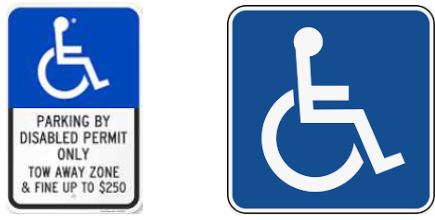
Signage and marking. All parking spaces designated for handicapped parking shall be marked with painted or thermoplastic blue double line four-inch striping on each side of the space to identify and facilitate their use. Access aisles shall be striped diagonally with white stripes. Spaces shall be posted with an approved permanent above-ground sign which shall state "Parking by Disabled Permit Only" and shall bear the international accessibility symbol. The center of the sign must be at least five feet above grade when attached to a building or seven feet above grade for a detached sign. An international accessibility symbol shall be painted on the ground with blue paint or thermoplastic stencil.
(Ord. No. 2023-08, § 2, 4-17-2023)
Sec. 30-70.10. - Child and baby stroller spaces.
(a)
Parking spaces specifically designed for persons transporting young children under the age of three and strollers, shall be required for all uses other than single family, duplex, townhouse, or multi-family sites. Child and baby stroller parking spaces shall be provided as follows:
(b)
Location of parking spaces. Such spaces shall be located as closely as possible to parking spaces designated for disabled persons; provided, however, parking spaces designated for the physically handicapped and/or disabled persons shall take precedence. Where no parking spaces designated for the physically handicapped and/or disabled persons have been provided, parking spaces for persons transporting young children and strollers shall be located on the shortest accessible route of travel from adjacent parking to an accessible entrance.
(c)
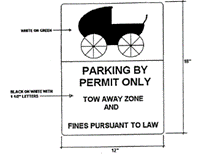
Signage and marking. All parking spaces for persons transporting young children and strollers shall be prominently outlined with green paint on a white background and posted with an approved permanent above-ground sign which shall state: "Baby Stroller Parking." The center of the sign must be at least five feet above grade when attached to a building or seven feet above grade for a detached sign. A child baby stroller parking symbol shall be painted on the ground with white paint or thermoplastic stencil.

(d)
In no event shall the number of parking spaces for the disabled persons be reduced below the quantity required by the Florida Building Code.
(Ord. No. 2023-08, § 2, 4-17-2023)
Sec. 30-70.11. - Bicycle parking.
(a)
Bicycle parking shall be required for all commercial and mixed uses with parking lots. Bicycle parking shall be provided by means of bicycle racks.
(b)
Bicycle parking spaces shall be provided as follows:
* Educational and recreational uses are required to provide two times the standard bicycle parking calculations.
** Bicycle parking for high parking usage sites shall be provided at multiple locations near multiple entries or athletic fields/ gathering places to be most convenient for users.
(c)
Other uses. All other uses, other than single family, duplex or townhouse which are exempt, shall provide racks where the total number of parking spaces in a lot exceeds 50 spaces.
(d)
Location and design of bicycle parking spaces; requirements:
(1)
The bicycle parking spaces shall be located near the entrances to buildings and be covered from natural elements, when feasible.
(2)
At commercial and mixed use buildings that have multiple parking lots, the bicycle parking spaces shall be installed near the entrances to the buildings served by the lots.
(3)
The bicycle parking spaces shall be in a highly visible, well lighted location that provides enough clear space to facilitate easy use and does not impede pedestrian traffic or handicapped accessibility.
(4)
The bicycle parking spaces may not be placed in the public right-of-way.
(5)
The design of the bicycle rack should permit the locking of the frame and at least one wheel with a standard size "U" lock and accommodate the typical range of bicycle sizes.
(6)
The bicycle rack must resist removal, resist rust, corrosion and vandalism, and must be properly maintained.
(7)
A standard bicycle rack is assumed to hold two bicycles.
(e)
Application to existing uses. All property owners of existing establishments that are required by this division to provide bicycle parking spaces shall comply within 18 months from the effective date of this division and shall be responsible to maintain such facilities. Existing multi-family uses are exempt from this subsection.
(Ord. No. 2023-08, § 2, 4-17-2023)
Sec. 30-70.12. - Calculating required parking spaces.
(a)
Uses not specifically mentioned. The requirements for parking for any unspecified uses in this division shall be determined by the community and economic development director. It is the intent to require all uses, except agricultural, to provide parking.
(b)
Fractional spaces. When units or measurements determining number of required parking spaces result in requirement of fractional space, any such fraction equal to or greater than one-half shall require a full parking space.
(c)
Mixed uses. In the case of mixed uses, the total requirements for parking shall be the sum of the requirements of the various uses computed separately, and parking spaces for one use shall not be considered as providing the required parking for any other use. In some mixed-use districts shared parking is allowed. For calculating required parking in mixed-used zoning districts, refer to applicable sections of this code.
(Ord. No. 2023-08, § 2, 4-17-2023)
Sec. 30-70.13. - Use of permitted facilities.
(a)
Permitted use. Parking spaces approved in accordance with this division may be used for the intermittent parking of licensed motor vehicles of employees, occupants, owners, tenants or customers utilizing the building or use served by said required parking spaces. Required parking spaces shall be non exclusive. Supplemental parking (parking facilities provided but not required) may be used for any purpose related to the use of the building it serves.
(b)
Limitations on use of required parking facilities. The following uses and activities shall not be permitted in required parking facilities:
(1)
Storage, solicitation or repair of any vehicle, trailer, watercraft, equipment or merchandise.
(2)
In commercial zoning districts, sale of any vehicle, equipment or merchandise without issuance of a special event permit.
(3)
Storage or parking of any vehicle intended for use as a portable sign used to advertise a place of business or activity as viewed from a public right-of-way. This shall not be interpreted to prohibit identification of commercial vehicles, provided such vehicles are operational, and are moved and used daily for delivery or service purposes.
(4)
Parking or storage of any vehicle, which, due to its size, shape, contents or location creates an obstruction or public safety hazard, visual obstruction from a place of residence or which cannot be contained within a single designated parking space.
(c)
Vehicles shall be required to park on paved or stabilized alternative parking surfaces. Parking shall be prohibited within setback areas, open space, landscaped or required yard areas.
(d)
Parking structures and parking garages are permitted. All parking structures and parking garages shall be above grade. Subterranean parking is prohibited.
(Ord. No. 2023-08, § 2, 4-17-2023)
Sec. 30-70.14. - Parking or storage of commercial vehicles in residential or agricultural zones.
(a)
In residential or agricultural zones commercial vehicles may be parked or stored as provided herein. Commercial vehicles (Categories 1, 2, and 3) are defined in division 30-40.
(b)
Parking or storage of certain commercial vehicles is allowed on private property as follows:
(1)
In agricultural zoned areas where a bona fide agricultural use, as defined in division 30-50, exists on private property, parking or storage of commercial vehicles in association with the onsite use and used for agricultural purposes or in the transport of agricultural products is allowed as otherwise provided in this division.
(2)
In residentially zoned districts, no more than two Category 1 vehicles may be parked or stored at each residence.
(3)
In residentially zoned districts, no more than one Category 2 vehicle may be parked or stored provided that it is kept within an enclosed garage or behind the front building line within a completely enclosed, opaque fence, screening wall or landscaping six feet in height at least ten feet from the rear property line. If a Category 2 vehicle is parked or stored as required under this subsection, then only one Category 1 vehicle may also be stored or parked at that residence.
(4)
For residential properties of four or more units, the parking or storage allowances provided for in this section shall be applied as to each unit.
(5)
Parking or storage of Category 3 vehicles is prohibited in all residentially zoned districts.
(6)
The temporary parking of a Category 2 or 3 vehicle in front of the building line or in front of the buffer screen shall only be permitted for the purpose of loading or unloading of materials or persons engaged in providing a commercial service at the premises, or for the purpose of the driver to make a temporary convenience stop at the residence. However, a temporary or convenience stop shall be limited to no more than one hour in any 24-hour period.
(c)
Parking of Category 2 or 3 commercial vehicles on the right-of-way is prohibited in residential zones unless actively engaged in the loading or unloading of materials or persons engaged in providing a commercial service.
(d)
Violations of these provisions are punishable as follows:
(1)
Any violation of this section is punishable by a civil fine of $250.00 for a first offense and $500.00 for a repeat violation. Upon a repeat violation of this section, in addition to civil penalties, such vehicle may be towed or immobilized until all outstanding violations and enforcement costs have been paid. After 35 days of storage or immobilization, the vehicle may be disposed of pursuant to the provisions contained in F.S. § 713.585. Any enforcement officer is hereby authorized to secure the assistance of the Village of Palmetto Bay Police Department to effect enforcement of these provisions.
(2)
Whoever opposes, obstructs or resists an enforcement officer in the discharge of duties as provided in this section, upon conviction, shall be guilty of a misdemeanor of the second degree and shall be subject to punishment as provided by law.
(Ord. No. 2023-08, § 2, 4-17-2023)
Sec. 30-70.15. - Loading.
(a)
General provisions. Adequate space for loading and unloading of materials, goods or things, and for delivery and shipping, shall be provided and maintained on the same plot as the building which it serves. Where any structure is enlarged or any use is extended so that the size of the resulting occupancy comes within the scope of this section, the full amount of loading spaces shall be supplied and maintained for the structure or use in its enlarged or extended size. Where the use of a structure or land or any part thereof is changed to a use requiring a loading space, such space shall be supplied and maintained to comply with this section.
(b)
Specifications. For the purposes of this section, a loading space shall be an area at the grade level at least 12 feet wide by 35 feet long with a 14-foot vertical clearance. Each loading space shall be directly accessible from a street or alley without crossing or entering any other required loading space, and shall be arranged for convenient and safe ingress and egress by motor truck and/or trailer combination. Such loading space shall also be accessible from the interior of any building it is intended to serve. One delivery parking space shall be reserved where vehicles can park close to the delivery door.
(c)
Minimum conditions. The following minimum conditions shall apply; additional conditions may be imposed as part of a conditional use or final site plan approval. Required loading spaces shall not be located in the required front yard. Loading spaces shall be located in such a manner to not create a disruption to the adjacent right-of-way. Loading spaces shall be provided and maintained in accordance with the following:
(1)
For every building or building group or part having 20 or more residential units or a gross floor area of 10,000 square feet or more, which is to be occupied by commercial uses or other uses similarly requiring the receipt of distribution by vehicles of material or merchandise, loading or unloading spaces shall be provided and maintained on the same lot with such building, as follows. Loading spaces and related loading facilities shall be provided as indicated below by gross building square feet:
(4)
No area or facilities supplied to meet the required parking facilities for a use shall be used to meet the requirements of this division for loading facilities.
(5)
Nothing in this section shall prevent the collective, joint or combined provision of loading facilities for two or more buildings or uses, provided that such loading facilities are equal in size and capacity to the combined requirements of the several buildings or uses and arranged as to be usable thereby.
(Ord. No. 2023-08, § 2, 4-17-2023)
Sec. 30-70.16. - Drive-through service.
(a)
Generally. Businesses that provide a drive-through service are required to provide drive-through service lane(s) to accommodate vehicular stacking as separate and distinct lanes from the circulation lanes necessary for entering or exiting the property. Each drive-through lane shall be separated from other on-site lanes. Each drive-through lane shall be curbed, striped, marked or otherwise distinctly delineated. A separate and distinct escape lane shall be provided. A lane necessary for site circulation, a public street or an alley shall not be counted as an escape lane. Drive-through lanes and escape lanes shall not conflict, or otherwise hamper access to or from any parking space. Pedestrian walkways shall be clearly separated from drive-through lanes.
(b)
Specifications. A stacking space in a drive-through service lane shall be a minimum length of 22 feet and a minimum width of ten feet, exclusive of additional length or width required for necessary turning and maneuvering. Inbound stacking requirements shall be counted from the first stopping point. Outbound stacking requirements shall be counted from the last stopping point.
(c)
Quantity. Stacking spaces necessary for the provision of drive-through lanes shall be determined for each service position according to the following table:
(Ord. No. 2023-08, § 2, 4-17-2023)
Sec. 30-70.17. - Sustainability Standards.
(a)
Electric vehicles.

(1)
Twenty percent of all newly constructed or renovated parking spaces must be electric vehicle supply equipment (EVSE) ready space. This shall mean a parking space with full circuity installed in accordance with the Florida Building Code and ready for a Level 2 charger to be connected capable. In no case will this be less than one required space and the calculated number shall always be rounded up for any fraction of a space.
(2)
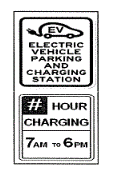
Five percent of all newly constructed or renovated parking spaces must be designated as EV spaces with a Class II electric vehicle charger installed and signage both vertical and marking on the pavement denoting the parking spaces. Signage shall be in accordance with Miami-Dade County standards.
(b)
Low impact development (LID) practices for parking areas. New buildings and redevelopment sites shall implement the following low impact development (LID) practices into project design, site and building plans.
(1)
Goals and practices of low impact development on parking facilities):
a.
Identify and preserve sensitive areas that affect site hydrology.
b.
Evaluate potential site development options to reduce, minimize and disconnect total impervious area.
c.
Employ integrated management practices (IMPs) to allow for distributed control of stormwater throughout entire site.
d.
First minimize and then mitigate the hydrologic impacts of land use activities at or close to the source of generation.
e.
Integrate stormwater controls into multifunctional landscape features such as bioretention cells where runoff can be micromanaged and controlled at the source.
f.
Limit clearing and grade selectively to minimize hydrologic impacts on existing site land cover.
g.
Use site drainage and hydrology as a design element.
h.
Modify and increase drainage flow path.
i.
Ensure the water quality and quantity requirements are met, per LID standards and the SFWMD ERP Applicant's Handbook Volume II.
j.
Ensure the post-development annual runoff volume does not exceed the pre-development runoff volume, per SFWMD ERP Applicant's Handbook Volume II.
k.
Implement erosion and sediment control best management practices during and after construction.
(2)
The following non-structural LID practices shall be implemented to the maximum extent practical:
a.
Prioritize placement of impervious surfaces on clays (if any) and disturbed soils, and placement of infiltration-requiring LID features on highly permeable soils.
b.
Retention of existing native vegetation and introduction of native vegetation appropriate to existing site conditions.
c.
Conservation of existing native tree canopy.
d.
Open space design and conservation.
e.
Maximize use of open swale systems.
f.
Maximize overland sheet flow.
g.
Avoid total site clearing.
h.
Minimization of total impervious areas.
i.
Reduction of directly connected impervious areas.
j.
Direct the site drainage to stabilized vegetated areas.
k.
Design site layout to break-up flow directions from large, paved surfaces.
l.
Design roof drains to drain to vegetated areas.
m.
Locate impervious areas so that they drain to permeable areas.
(3)
A minimum of two structural LID practices from the following list shall be implemented, where one meets the water quantity requirement and the other meets the water quality requirement, per the SFWMD ERP Applicant's Handbook Volume II.
a.
Bioretention basins or rain gardens.
b.
Tree box filters or infiltration planters.
c.
Vegetated swales.
d.
Filter strips or vegetated buffers.
e.
Infiltration trenches.
f.
Exfiltration trenches or French drains.
g.
Permeable pavement.
h.
Retention pond.
i.
Detention pond.
j.
Wet detention or retention pond with aquatic vegetation.
k.
Parking stormwater chambers.
(4)
Solar reflectance and shading.
a.
Shade from trees within ten years of occupancy (calculated as one-half of maturity).
b.
Parking spaces under cover (defined as underground, under deck, under roof, under building, under solar panels or another structure. Any roof used to shade or cover parking must have a solar reflectance of at least 0.30.
c.
Pervious pavement system must have a solar reflectance of at least 0.20.
d.
Any remaining paved surfaces must have a minimum solar reflectance of 0.20 as when (i) tested in accordance with ASTM E903 or ASTM E1918, (ii) tested with a portable reflectometer at near ambient conditions, or (iii) default values of solar reflectance for listed materials may be used as follows:
(Ord. No. 2023-08, § 2, 4-17-2023)

