
Pasadena City Zoning Code
ARTICLE 5
Standards for Specific Land Uses
17.50.010 - Purpose of Chapter
This Chapter provides site planning, development, and/or operating standards for certain land uses that are allowed by Article 2 (Zoning Districts and Allowable Land Uses) within individual or multiple zoning districts, and for activities that require special standards to mitigate their potential adverse impacts.
17.50.020 - Applicability
The land uses and activities covered by this Chapter shall comply with the provisions of the Sections applicable to the specific use, in addition to all other applicable provisions of this Zoning Code.
A.
Where allowed. The uses that are subject to the standards in this Chapter shall be located in compliance with the requirements of Article 2 (Zoning Districts and Allowable Land Uses) and Article 3 (Specific Plans).
B.
Land use permit requirements. The uses that are subject to the standards in the Chapter shall be authorized by the land use permit required by Article 2 and Article 3, except where a land use permit is established by this Chapter for a specific use.
C.
Development standards. The standards for specific uses in this Chapter supplement, and are required in addition to, those in Articles 2 (Zoning Districts and Allowable Land Uses), 3 (Specific Plans), and 4 (Site Planning and General Development Standards). In the event of any conflict between the requirements of this Chapter and those of Articles 2 or 4, the requirements of this Chapter shall control. Article 3 (Specific Plans) may include additional applicable development standards by use. Where Article 3 (Specific Plan) is silent the requirements of this Chapter shall control; where the provisions of this Section conflict with an adopted Specific Plan, the Specific Plan shall control.
(Ord. No. 7388, § 2(Exh. 1), 3-21-2022)
17.50.030 - Adaptive Reuse Projects
A.
Applicability.
1.
The development standards of this section shall apply to Adaptive Reuse Projects where there is a conversion from an existing nonresidential building (excluding buildings or portions of buildings used for Lodging - Hotels, Motels uses) to multi-family residential use or mixed-use. Where this section conflicts with Section 17.50.160 (Mixed-Use Projects), Section 17.50.350 (Urban Housing), or Article 3 (Specific Plan Standards), this section shall apply except as otherwise provided in this section.
2.
Adaptive reuse projects are eligible to use the standards of this section five years after a certificate of occupancy is issued for the non-residential building.
B.
Density.
1.
Adaptive Reuse Projects shall not be subject to dwelling unit per acre requirements.
2.
For Adaptive Reuse Projects, including new construction allowed by Section 17.50.030.B.3, the average unit size shall be a minimum of 450 square feet. No average unit size is required for projects that are 100 percent affordable or have less than 10 units.
3.
New Construction.
a.
New building construction, with units, is permitted subject to the following:
(1)
The new construction is in conjunction with an Adaptive Reuse Project and located on the same site; and
(2)
The construction of new units does not increase the number of units in the existing building, subject to adaptive reuse, by more than 50 percent, or up to the maximum density listed in the General Plan, whichever is less.
b.
New construction of units is subject to the underlying zoning district development standards except for car-sharing and open space standards, which is subject to the standards provided in this Section, and Design Review requirements, which shall be limited to those requirements for adaptive reuse provided in Section 17.61.30.
C.
Floor Area.
1.
Any additional floor area created within the existing building, including mezzanines, shall not count toward floor area ratio maximums.
2.
Any additional floor area created to comply with Building or Fire Codes shall not count toward floor area ratio maximums.
3.
To accommodate residential amenities, including but not limited to pools, fitness centers, laundry facilities, or lounge areas, the building's existing floor area may be increased by up to 10 percent. This additional floor area shall not count toward floor area ratio maximums.
D.
Height. To accommodate appurtenances or residential amenities, including but not limited to pools, fitness centers, laundry facilities, or lounge areas, the building's existing height may be exceeded by a maximum of 15 feet, and shall not count towards maximum height requirements.
E.
Setbacks. Any additions required to comply with Building or Fire Codes shall be exempt from any setback requirements.
F.
Open Space.
1.
A minimum of 150 square feet per dwelling unit is required and shall be provided in the form of common and/or private open space.
2.
The following may count towards common open space:
a.
Lobbies, provided they include residential amenities, including but not limited to work stations, lounge areas, or fitness centers;
b.
Existing or new publicly accessible open space and street setbacks, provided they include publicly accessible amenities including but not limited to landscaping, seating, fountains, and/or public art.
3.
Accessible rooftop areas may count toward common open space at a 1.5:1.0 ratio, provided they contain residential amenities such as pools, lounge areas, furniture, and/or landscaping.
4.
If located within one half mile walking distance to a public park, as designated in PMC Section 3.23.010, the open space requirement may be reduced by a maximum of 25 percent.
G.
Off-Street Parking.
1.
No new parking shall be required; the number of existing parking spaces may be reduced but not reduced below the minimum number of spaces required.
2.
Car-share. Code-required parking requirements for residential uses may be further reduced when on-site car sharing is provided for the shared use of vehicles by all residents.
a.
One car share space shall count for five required parking spaces, up to a maximum parking reduction of 20 percent and 10 car-share parking spaces, whichever is less.
b.
Car-share parking spaces shall be dedicated for the exclusive use of shared vehicles by building residents.
c.
A sign shall be placed, adjacent to each car-share parking space, stating that the parking space is for car-sharing and cannot be used for private automobile parking.
d.
Car-share vehicles shall be made available to the residents through an online or similarly accessed real-time appointment system for processing car share vehicles reservations.
e.
The car-share vehicle must be accessed where they are parked without requiring a person to go to a different physical location to execute a contract or pick up keys.
f.
Car-share parking spaces shall be maintained by a certified car-share organization, or similar organization, in perpetuity.
(Ord. No. 7443, § 3, 3-3-2025)
17.50.040 - Alcohol Sales
A.
Standards for all sales operations. Proposed on- and off-site alcoholic beverage sales operations shall be designed, constructed, and operated to:
1.
Avoid contributing to an undue proliferation of alcoholic beverage sales businesses in an area where additional ones would be undesirable, with enhanced consideration given to the area's function and character, problems of crime and loitering, and traffic problems and capacity;
2.
Avoid any adverse impact on adjacent or nearby parks (e.g., public parks or recreation centers), playgrounds (e.g., public or parochial), religious facilities, or schools (e.g., public, parochial, or private elementary, junior high, or high schools); and
B.
Additional standards for off-site sales. Off-site alcoholic beverage sales businesses shall comply with the following requirements in addition to those in Subsection A. above. Locations with off-site alcoholic beverage sales shall be designed, constructed, and operated to:
1.
Not interfere with the movement of people along any street; and
2.
Supply adequate, appropriately located litter and recycling receptacles as determined by the Director.
17.50.050 - Animal Hospitals
A.
Improvements required. All animal hospitals shall be entirely enclosed, soundproofed, and air conditioned.
B.
Incidental uses allowed. Grooming and temporary boarding of animals for a maximum of 30 days is allowed if incidental to the animal hospital use.
C.
Animal Hospitals Established After April 19, 2021. In addition to the standards specified in this section, the following standards shall also apply to animal hospital facilities established after April 19, 2021.
a.
Enclosures. All facilities shall be entirely enclosed and be fully covered by a permanent roof structure. Open air enclosures shall be prohibited.
b.
Soundproofing. In order to ensure noise from the facility does not cause a nuisance, there shall be a noise threshold of 5dB over ambient at any time, as measured at the property line of the animal hospital facility.
c.
Staff Availability. Hospital staff are required to be present and accessible via telephone at all times that animals are on the hospital premises.
(Ord. No. 7419, § 4, 2-26-2024; Ord. 7374, § 3 (Exh. 2), 2021)
17.50.060 - Automated Teller Machines (ATMs) and Walk-Up Bank Services
A.
Where allowed. ATM facilities may be located:
1.
On public streets; and
2.
At alley entries, but within 50 feet of the nearest public street.
B.
Development standards for ATM facilities. ATM facilities shall be installed and maintained in compliance with the following standards:
1.
Privacy area required.
a.
In order to provide an appropriate level of privacy and to reduce the potential for blocking the sidewalk for those users waiting in line, a five-foot deep privacy area shall be provided in front of the ATM. This would require an ATM to be set back in an alcove when located adjacent to the public sidewalk;
b.
The Director, while conducting Design Review, or the Zoning Administrator, if no Design Review is required, may reduce the privacy area down to three feet, while still meeting the intent identified in Subparagraph a., above.
2.
Review for impact on pedestrian and traffic circulation required. The Department of Public Works shall review and approve each proposed location to determine if on-street parking can be accommodated at the proposed site and if the ATM, or walk-up bank service window would likely have a major impact on pedestrian and traffic circulation in the immediate area;
3.
Lighting plan required. A lighting plan will be required with the intent to ensure that adequate lighting is provided;
4.
ATM to be handicap accessible. The ATM shall be handicap accessible;
5.
Trash receptacle required. A trash receptacle shall be immediately accessible to the ATM; and
6.
Appearance following removal. At the time that the ATM is removed, the structure's facade shall have a finished appearance consistent with the existing structure, and be subject to the approval of the Zoning Administrator.
17.50.065 - Boarding Houses
A.
500-foot separation required. A boarding house shall be a minimum of 500 feet from another boarding house.
B.
How to measure separation. The distance between any structure used as a boarding house and another structure used as a boarding house shall be measured in a straight line, without regard to intervening structures, from the closest property line of the structure used as a boarding house to the closest property line of another structure used as a boarding house.
(Ord. 7160, § 45, 2009)
17.50.066 - Cannabis Businesses.
A.
Purpose. It is the purpose of this chapter to regulate commercial cannabis businesses consistent with state law including, but not limited to, the Medicinal and Adult Use Cannabis Regulation and Safety Act ("MAUCRSA"), and furthermore, to protect the health, safety, and welfare of the residents of the City of Pasadena. Nothing in this chapter is intended to authorize the possession, use, or provision of cannabis for purposes which violate state or federal law. Medicinal and adult-use cannabis businesses shall comply with all provisions of the Pasadena Municipal Code, state law, and all other applicable local codes and regulations. The regulations in this chapter do not interfere with a person's right to obtain and use cannabis as authorized under state law; however, it is neither the intent nor the effect of this chapter to condone the use or consumption of cannabis.
B.
Legal Authority. Pursuant to Section 7 of Article XI of the California Constitution, the City of Pasadena is authorized to adopt ordinances that establish standards, requirements, and regulations for local licenses and permits for commercial cannabis businesses. Any standards, requirements, and regulations regarding health and safety, testing, security, and worker protections established by the State of California, or any of its departments or divisions, shall be the minimum standards applicable in the City of Pasadena to commercial cannabis businesses.
C.
Definitions. The technical terms and phrases used in this chapter are defined in Pasadena Municipal Code Section 5.78.050—Definitions (see PMC Chapter 5.78—Commercial Cannabis Activity).
D.
Retailer.
1.
Commercial Cannabis Permit Required. A cannabis retailer must obtain and maintain at all times a valid commercial cannabis permit as required by Chapter 5.78.
2.
Use Permit Required. A use permit is required to establish or operate as a cannabis retailer.
3.
Limitation on the Number of Retailers.
a.
No more than six (6) retailers may operate within the City of Pasadena at any one time and no more than six (6) permits shall be issued by the City of Pasadena for retailers to operate within the City of Pasadena; and
b.
No more than three (3) retailers may operate within a city council district at any one time.
4.
The maximum square footage of a retail use shall be 15,000 square feet.
5.
Location Requirements. Cannabis retailers shall be permitted in only the CO, CL, CG, CD, and IG zoning districts and shall be subject to the following requirements:
a.
No retailer shall be established or located within 450 feet, measured from the nearest property lines of each of the affected parcels, of any other cannabis retailer or within 1,000 feet of any cultivation site, or within 500 feet of any testing laboratory;
b.
No retailer shall be established or located within 600 feet, measured from the nearest property lines of each of the affected parcels, of any existing residential zone;
c.
No retailer shall be established or located within a mixed-use development project containing a residential use component;
d.
No retailer shall be established or located within 600 feet, measured from the nearest property lines of each of the affected parcels, of any childcare center, in-home (family day care home), youth-oriented facility, church or faith congregation, or substance abuse center;
e.
No retailer shall be established or located within 600 feet, measured from the nearest property lines of each of the affected parcels, of any park, library, or K-12 school;
f.
Retailers shall be required to comply with all zoning, land use, and development regulations applicable to the underlying zoning district in which they are permitted to establish and operate as set forth in the Pasadena Municipal Code.
6.
Operating Requirements. In addition to those operating requirements specifically set forth in Section 5.78.170, the following operating requirements shall apply to all cannabis retailers operating in the City of Pasadena:
a.
Hours of Operation. Retailers may be open for access to the public only between the hours of 7:00 a.m. and 10:00 p.m., Monday through Sunday.
b.
For medicinal cannabis, the retailer shall verify the age and all necessary documentation of each customer to ensure the customer is not under the age of eighteen (18) years and that the potential customer has a valid physician's recommendation. For adult-use cannabis, the retailer shall verify the age of each customer to ensure the customer is not under the age of twenty-one (21) years.
c.
Entrances into the retailer shall be locked at all times with entry strictly controlled. A "buzz-in" electronic/mechanical entry system shall be utilized to limit access and entry to the retailer to separate it from the reception/lobby area.
d.
Notwithstanding the requirements of Section 15.78.160, uniformed licensed security personnel shall be employed to monitor site activity, control loitering and site access, and to serve as a visual deterrent to unlawful activities.
e.
Retailers may have only that quantity of cannabis and cannabis products reasonably anticipated to meet the daily demand readily available for sale on-site in the retail sales area of the retail facility.
f.
All restroom facilities shall remain locked and under the control of management.
7.
Delivery Services. Permitted in association with retailer. Delivery of cannabis shall be permitted pursuant to this section. A delivery service may operate only as a part of and in conjunction with a retailer permitted pursuant to state law and pursuant to this section. Delivery of cannabis from a retailer permitted pursuant to this section can only be made in a city or county that does not expressly prohibit it by ordinance.
8.
Conditions of Approval. The planning commission may address development and operational standards through conditions on the use permit as it determines to be necessary or appropriate for the use permit under consideration; provided, that conditions shall not conflict with the provisions of Section 5.78.170 and Section 17.50.066(D)(5) relating to operating requirements of cannabis retailers, and shall be subordinate to conditions placed on the commercial cannabis permit issued under Chapter 5.78.
9.
Parking. Off-street parking shall be provided as required for retail stores under Chapter 17.46.
10.
Discontinuance. If a cannabis retailer authorized by a use permit approved under this section is discontinued for a continuous period of 12 months, the use permit expires for discontinuance of use and thereafter is void.
E.
Cultivation Sites.
1.
Commercial Cannabis Permit Required. A cannabis cultivation site must obtain and maintain at all times a valid commercial cannabis permit as required by Chapter 5.78.
2.
Use Permit Required. A use permit is required to establish or operate a cannabis cultivation site.
3.
Limitation on the Number of Cultivation Sites.
a.
No more than 4 cultivation sites may operate within the City of Pasadena at any one time and no more than 4 permits shall be issued by the City of Pasadena for cultivation sites to operate within the City of Pasadena.
b.
No more than one cultivation site may operate within a city council district at any time.
4.
The maximum square footage of a cultivation site shall be 30,000 square feet.
5.
Location Requirements. Cannabis cultivation sites shall be permitted in only the CG and IG zoning districts and shall be subject to the following conditions:
a.
No cultivation site shall be established or located within 600 feet, measured from the nearest property lines of each of the affected parcels, of any existing residential zone;
b.
No cultivation site shall be established or located within 600 feet, measured from the nearest property lines of each of the affected parcels, of any childcare center, in-home (family day care home), youth-oriented facility, church or faith congregation, or substance abuse center;
c.
No cultivation site shall be established or located within 600 feet, measured from the nearest property lines of each of the affected parcels, of any park, library, or K-12 school.
d.
Cultivation sites shall be required to comply with all zoning, land use, and development regulations applicable to the underlying zoning district in which they are permitted to establish and operate as set forth in the Pasadena Municipal Code.
e.
No cultivation site shall be established or located within 1,000 feet, measured from the nearest property line, of any other cultivation site or cannabis retailer, or within 500 feet of any testing laboratory.
6.
Operating Requirements. In addition to those operating requirements specifically set forth in Section 5.78.170, the following operating requirements shall apply to all cannabis cultivation sites operating in the City of Pasadena:
a.
All outdoor cultivation is prohibited. Commercial cannabis cultivation must occur indoors only.
b.
In no case shall cannabis plants be visible from a public or private road, sidewalk, park, or any common public viewing area.
c.
A cultivation site shall only be allowed to cultivate the square footage of canopy space permitted by state law under the type of cultivation license issued.
d.
Cannabis cultivation shall be conducted in accordance with state and local laws related to land conversion, grading, electricity, water usage, water quality, woodland and riparian habitat protection, agricultural discharges, and similar matters.
e.
Pesticides and fertilizers shall be properly labeled and stored to avoid contamination through erosion, leakage, or inadvertent damage from pests, rodents, or other wildlife.
f.
The cultivation of cannabis shall at all times be operated in such a way as to ensure the health, safety, and welfare of the public, the employees working at the commercial cannabis facility, visitors to the area, neighboring properties, and the end users of the cannabis being cultivated, to protect the environment from harm to streams, fish, and wildlife; to ensure the security of the cannabis being cultivated; and to safeguard against the diversion of cannabis.
g.
All applicants for a commercial cannabis permit to operate a cannabis cultivation site shall submit the following in addition to the information generally otherwise required for a commercial cannabis business:
(1)
A cultivation and operations plan that meets or exceeds minimum standards for water usage; drainage, runoff, and erosion control; watershed and habitat protection; and proper storage of fertilizers, pesticides, and other regulated products to be used on the premises, and a description of the cultivation activities (indoor, mixed-light) and schedule of activities during each month of growing and harvesting, or explanation of growth cycles and anticipated harvesting schedules for all-season harvesting (indoor, mixed-light).
(2)
A description of a legal water source, irrigation plan, and projected water use.
(3)
Identification of the source of electrical power and plan for compliance with applicable building codes and related codes.
(4)
Plan for addressing odor and other public nuisances which may derive from the cultivation site.
7.
Conditions of Approval. The planning commission may address development and operational standards through conditions on the use permit as it determines to be necessary or appropriate for the use permit under consideration; provided, that conditions shall not conflict with the provisions of Section 5.78.170 and Section 17.50.066(E)(5) relating to operating requirements of cannabis cultivation sites, and shall be subordinate to conditions placed on the commercial cannabis permit issued under Chapter 5.78.
8.
Parking. Off-street parking shall be provided as required for an "Industry, Standard" use under Chapter 17.46.
9.
Discontinuance. If a cannabis cultivation site authorized by a use permit approved under this section is discontinued for a continuous period of 12 months, the use permit expires for discontinuance of use and thereafter is void.
F.
Testing laboratory.
1.
Commercial Cannabis Permit Required. A testing laboratory must obtain and maintain at all times a valid commercial cannabis permit as required by Chapter 5.78.
2.
Use Permit Required. A use permit is required to establish or operate a testing laboratory.
3.
Limitation on the Number of Testing Laboratories.
a.
No more than four (4) testing laboratories may operate within the City of Pasadena at any one time and no more than four (4) permits shall be issued by the City of Pasadena for testing laboratories to operate within the City of Pasadena.
b.
No more than one testing laboratory may operate within a city council district at any time.
4.
Location Requirements.
a.
Cannabis testing laboratories shall be permitted in any zoning district where laboratories, medical or otherwise, are permitted and shall be required to comply with all zoning, land use, and development regulations applicable to the underlying zoning district in which they are permitted to establish and operate as set forth in the Pasadena Municipal Code.
b.
No testing laboratory site shall be established or located within 500 feet, measured from the nearest property line, of any other testing laboratory, or 500 feet of any cultivation site or cannabis retailer.
5.
Operating Requirements. In addition to those operating requirements specifically set forth in Section 5.78.170, the following operating requirements shall apply to all cannabis testing laboratories operating in the City of Pasadena:
a.
Testing laboratories shall be required to conduct all testing in a manner pursuant to Business and Professions Code 26100 and shall be subject to state and local law. Each testing laboratory shall be subject to additional regulations as determined from time to time as more regulations are developed under Chapter 5.78 and any subsequent State of California legislation or regulations regarding the same.
b.
Testing laboratories shall conduct all testing in a manner consistent with general requirements for the competence of testing and calibrations activities, including sampling using verified methods.
c.
All testing laboratories performing testing shall obtain and maintain ISO/IEC 17025 accreditation as required by the Bureau of Cannabis Control, as well as ELAP certification.
d.
Testing laboratories shall destroy any harvest batch whose testing sample indicates noncompliance with health and safety standards required by the bureau unless remedial measures can bring the cannabis or cannabis products into compliance with quality standards as specified by law and implemented by the bureau.
e.
Each operator shall ensure that a testing laboratory employee takes the sample of cannabis or cannabis products from the distributor's premises for testing required by state law and that the testing laboratory employee transports the sample to the testing laboratory.
f.
Except as provided by state law, a testing laboratory shall not acquire or receive cannabis or cannabis products except from a state licensee in accordance with state law, and shall not distribute, sell, or dispense cannabis, or cannabis products, from the state licensed premises from which the cannabis or cannabis products were acquired or received. All transfer or transportation shall be performed pursuant to a specified chain of custody protocol.
g.
A testing laboratory may receive and test samples of cannabis or cannabis products from a qualified patient or primary caregiver only if the qualified patient or primary caregiver presents the qualified patient's valid physician's recommendation for cannabis for medicinal purpose. A testing laboratories shall not certify samples from a qualified patient or primary caregiver for resale or transfer to another party or state licensee. All tests performed by a testing laboratory for a qualified patient or primary caregiver shall be recorded with the name of the qualified patient or primary caregiver and the amount of the cannabis or cannabis products received.
6.
Conditions of Approval. The planning commission may address development and operational standards through conditions on the use permit as it determines to be necessary or appropriate for the cannabis testing laboratory use permit under consideration; provided, that conditions shall not conflict with the provisions of Section 5.78.170 and Section 17.50.151(F)(5) relating to operating requirements of cannabis testing laboratories, and shall be subordinate to conditions placed on the cannabis business permit issued under Chapter 5.78.
7.
Parking. Off-street parking shall be provided as required for research and development offices under Chapter 17.46.
8.
Discontinuance. If a cannabis testing laboratory authorized by a use permit approved under this section is discontinued for a continuous period of 12 months, the use permit expires for discontinuance of use and thereafter is void.
(Ord. No. 7382, § 25, 11-1-2021; Ord. 7326 § 3, 6-5-2018)
17.50.070 - Conversion of a Residential Structure to a Commercial Use
A.
Applicability. The conversion of a residential structure to an allowed commercial use shall be in compliance with this Section and the applicable provisions of this Zoning Code.
B.
Location of off-street parking. Off-street parking shall only be located behind the structure.
C.
Maintenance of existing driveway. The existing driveway width shall not be widened to accommodate the new commercial use.
17.50.075 - Conversion of a Hotel or Motel to Affordable Housing
A.
Zoning districts. Notwithstanding the provisions of Chapters 17.22, 17.24, 17.30, 17.31, 17.32, 17.33, 17.34, 17.35, 17.36, and 17.37, existing hotels and motels in all zoning districts as well as those located in Specific Plan areas may be converted to supportive housing, transitional housing, single-room occupancy, multi-family housing, or combination thereof, provided that the converted units are rented or sold to persons of low or moderate income (as defined in Health and Safety Code Section 50093); the converted use complies with all of the provisions of this Section; and a Hotel Conversion Permit is granted pursuant to the provisions in Section 17.61.055.
B.
Minimum lot size. There shall be no applicable minimum lot width, depth, or total lot size for hotel and motel conversions.
C.
Number of rooms. Hotels and motels with more than 80 guest rooms shall not be eligible for the provisions of this Section or Section 17.61.055.
D.
Residential density. The resulting number of residential units after the conversion shall not be more than 110 percent of the number of guest rooms in the existing hotel or motel.
E.
Floor area ratio. The resulting floor area, as defined in 'Floor Area, Gross' for "all other districts" after conversion shall not be more than 110 percent of the existing floor area of the hotel or motel being converted. Floor area added solely for the purpose of complying with the Building Code and/or life safety requirements shall not be counted toward the 10 percent increase.
F.
Site coverage. There shall be no maximum site coverage applicable for hotel and motel conversions.
G.
Height. Any increase in height resulting from hotel and motel conversions shall comply with the maximum height set forth in the underlying zoning district. The conversion of any existing hotel or motel to affordable housing pursuant to this Section shall not result in loss of legally nonconforming status with regard to building height.
H.
Setbacks. Hotel and motel conversions shall not be subject to the setback requirements of the underlying zoning district.
I.
Unit size and occupancy. The minimum size of a residential unit resulting from a hotel or motel conversion shall be the same as the minimum size of a Single Room Occupancy facility as set forth in Section 17.50.300(C).
J.
Common area. All hotel and motels conversion shall include common areas with amenities such as seating, tables, kitchens, barbecues, and/or other amenities conducive to community-building activities. The size and nature of these common areas shall be approved by the reviewing authority pursuant to a Hotel Conversion Permit. Shared bathrooms shall not be considered as common areas.
K.
Management plan. A management plan shall be submitted to and reviewed by the Director of the Housing and Career Services Department, or designee, and approved by the reviewing authority for the Hotel Conversion Permit in conjunction with such Permit. The Housing and Career Services Department shall enforce the management plan, and shall have the authority to amend the management plan administratively as needed, provided that the management plan complies with all conditions of approval for the Hotel Conversion Permit. The management plan shall be comprehensive and contain management policies and operations, rental procedures and rates, maintenance plans, residency and guest rules and procedures, security procedures and staffing needs including job descriptions. The approved management plan shall be in recordable form as approved by the City Attorney and recorded before issuance of a Certificate of Occupancy or Final Building Inspection, as applicable.
L.
Parking. The required parking for hotels or motels converted to affordable housing shall be established by the review authority as part of the issuance of a Hotel Conversion Permit. In no case shall the required parking exceed one half space per residential unit.
M.
Landscaping. Minimum landscaped areas shall not be applicable to hotel and motel conversions.
N.
Signs. All hotel and motel conversions shall comply with the provisions of Chapter 17.48 (Signs).
O.
Lighting. All hotel and motel conversions shall comply with the provisions of Section 17.40.080 (Outdoor Lighting).
P.
Commercial frontage and facade standards. The provisions of Section 17.24.050 (Commercial Frontage and Facade Standards) shall not be applicable to hotel and motel conversions.
Q.
Walls and fences. Walls and fences for hotel and motel conversions shall comply with the provisions of Section 17.40.180. Notwithstanding the foregoing, the maximum height of walls and fences between the front property line and the occupancy frontage for hotel and motel conversions may be increased to six feet, provided that such walls and fences are at least 50 percent open and are set back a minimum of three feet from the front property line. The reviewing authority may approve deviations from any wall and fence requirements as part of the issuance of a Hotel Conversion Permit.
(Ord. No. 7333, § 2 (Exh. 1), 10-15-2018)
17.50.080 - Day-Care Facilities
A.
Large family day-care home. The establishment of a large family day-care home shall require that an application be filed with and approved by the Zoning Administrator. The application shall be approved if the Zoning Administrator determines that the application complies with the following regulations.
1.
Minimum separation between day-care homes. Within a residential district, there shall be no more than one large family day-care home allowed within 300 feet of another large family day-care home or child day-care center. If a large family day-care home is within 300 feet of another large family day-care home or child day-care center, then a Minor Conditional Use Permit shall be required.
2.
Plan for loading. The applicant shall submit a plan showing the location of a loading and unloading area for children.
3.
Noise standards. A large family day-care home shall comply with the noise regulations of Municipal Code Chapter 9.36.
4.
Parking. Off-street parking shall be provided at a ratio of one parking space for each employee other than the resident. Parking may be tandem and located on a driveway that leads to covered parking.
5.
Play equipment. Play equipment shall not be located within the front yard.
6.
Signs. Signs shall comply with the requirements of Chapter 17.48 (Signs).
B.
Child day-care centers. Each child day-care center shall comply with the following requirements.
1.
Outdoor play space. A child day-care center shall provide an outdoor play space as follows.
a.
Minimum size. The total area of the outdoor play space shall be a minimum of 75 square feet per child.
b.
Location on site. No outdoor play space shall be within 25 feet of a residential structure on an abutting lot in an RS or RM zoning district.
c.
Screening fence. A wall or fence shall surround the outdoor play area. The minimum height of the wall or fence shall be equivalent to the maximum height of a wall or fence in the zoning district in which the site is located or six feet, whichever is less. If a fence with perforations through more than 50 percent of the surface area is provided, vertical landscaping shall be provided to screen the outdoor play area from adjacent properties.
2.
Side and rear landscape buffers. Landscaping shall be used to buffer noise in side and rear setback areas adjacent to RS zoning districts. The following minimum density of plant materials shall be maintained in these areas: For each 100 square feet of yard area or fraction thereof, 0.10 canopy trees (24 inch box or larger), 0.20 under-story trees (15 gallon or larger), and 2.0 shrubs (five gallons or larger). Where an existing mature landscape element is retained on the site, it may be counted as double in meeting these minimum requirements (e.g., where two canopy trees are required, one existing canopy tree may be used to meet the guideline).
3.
Parking. See Chapter 17.56. Parking shall not be located in an existing front or corner side setback unless located on a driveway leading to a covered parking space.
4.
Loading area. The location and design of passenger loading and unloading areas shall be reviewed and approved by the Department of Public Works.
5.
Refuse storage. A refuse storage area shall be provided in compliance with Section 17.40.120 (Refuse Storage Facilities).
6.
Outdoor lighting. Outdoor lighting shall comply with Section 17.40.080 (Outdoor Lighting).
7.
Hours of operation.
a.
The allowable hours of operation in residential zoning districts shall be established by the Conditional Use Permit required for the use.
b.
Outdoor activities may only be conducted between the hours of 7:00 a.m. and 7:00 p.m. in residential zoning districts and 6:00 a.m. and 7:00 p.m. in non-residential zoning districts.
(Ord. 7169 § 19, 2009; Ord. 7160 § 46, 2009)
17.50.085 - Donation Collection Facilities
A.
Applicability. A Zoning Permit shall be required forexisting and proposed donation collection facilities. The Zoning Administrator shall review and approve an application if it is in compliance with these standards.
B.
Location. Only one facility per site is allowed. The facility shall be located:
1.
Only in a commercial, industrial, or PS district;
2.
Only as an accessory use to a commercial, industrial or public, semi-public use; and
3.
A minimum of 500 feet from a recycling facility or another donation collection facility. The separation between such facilities shall be measured in a straight line, without regard to intervening structures, from the closest part of one facility to the closest part of the other facility.
C.
Setbacks. The facility shall be setback a minimum of 150 feet from a residential district boundary and shall be located at least 25 feet from a street property line.
D.
Maintenance. The site shall be kept clean, maintained in a litter-free condition and checked daily. The property owner shall ensure that any graffiti or materials that are left outside of the facility are removed within 24 hours.
E.
Violations. A facility that does not comply with the ongoing requirements of this section shall be given notice of the violation, and ordered to comply with these standards within 10 days of the notice. If the facility does not come into compliance with these standards within the 10 day period, the Zoning Permit shall be revoked.
(Ord. 7159, § 1, 2009)
17.50.090 - Drive-Through Businesses
A.
Location requirements for restaurants with drive-through service. A fast food or formula fast food restaurant with drive-through service shall not be closer than 500 feet from the following uses: a park and recreation facility; a public or private school; or another fast food or formula fast food restaurant with drive-through service. The distance requirement shall be measured from site-to-site.
B.
Additional application materials. In addition to the standard application requirements for a Conditional Use Permit, an applicant for a restaurant with a drive-through business shall submit a litter clean-up plan, a parking and circulation plan, and a site plan that includes: driveway locations, placement of audible equipment (if this type of equipment will be used), landscaping, light standards, sign locations, and trash enclosures. A litter clean-up plan shall address litter clean-up on-site and off-site and shall include, but not be limited to, a litter pick-up schedule and a map of the clean-up area.
C.
Findings required for approval. The approval of a drive-through business shall require that the review authority first make all of the following findings, in addition to those required for a Conditional Use Permit by Section 17.61.050:
1.
The proposed parking and circulation plan will provide adequate area for safe queuing and maneuvering of vehicles, and the site design will provide adequate buffering of the use from adjoining land uses; and
2.
The proposed location of the drive-through business will not result in adverse impacts upon the vicinity after giving consideration to a litter clean-up plan, the hours of operation, and the site plan.
D.
Disposable containers. A fast food or formula fast food restaurant with drive-through service shall have the name of the business establishment printed on all disposable containers and napkins.
E.
Driveway cuts. The design and construction of the drive-through facilities shall minimize the number of driveway cuts.
17.50.100 - Electronic Game Arcades and Internet Access Studios
A.
Separation required.
1.
Measurable requirements. Each exterior wall of an electronic game arcade and/or Internet access studio shall be at least:
a.
500 feet from all boundaries of a site occupied by a day-care facility, park, public or private school, recreation facility, or religious facility that existed before the establishment of the electronic game arcade and/or Internet access studio; and
b.
1,000 feet from the exterior walls of another electronic game arcade and/or Internet access studio.
2.
How to measure separation. The distance between any structure used as an electronic game arcade and/or Internet access studio and another structure used as a day-care facility, park, public or private school, recreation facility, religious facility, or an electronic game arcade and/or Internet access studio shall be measured in a straight line, without regard to intervening structures, from the closest property line of the structure used as an electronic game arcade and/or Internet access studio to the closest property line of another structure used as a day-care facility, park, public or private school, recreation facility, religious facility, or an electronic game arcade and/or Internet access studio.
B.
Waiting areas.
1.
An interior waiting area for a minimum of eight persons shall be provided.
2.
Outdoor waiting areas are not allowed.
3.
Private rooms with doors or alcove areas are not allowed.
C.
No alcohol allowed. No alcohol shall be served.
D.
Transparent windows. The front windows shall be transparent.
E.
Bathroom for patrons use. The facility shall be equipped with a bathroom that shall be available to patrons during normal hours the facility is open to the public.
F.
Public telephone. Any public telephone shall be located within the structure.
G.
No violation of gambling/gaming laws. There shall be no activity that would violate City or State gambling/gaming laws.
H.
Monitoring of Internet sites.
1.
The computer screens shall be located so that anyone walking around the room(s) can clearly see the computer screens.
2.
The full time on-site manager shall monitor the use of Internet sites.
I.
No loitering signs. No loitering signs shall be posted on the premises.
J.
No live or amplified music. No live or amplified music is allowed; excluding music coming from the computers.
K.
Hours of operation. The hours of operation shall be established through the Conditional Use Permit, in compliance with Section 17.61.050.
17.50.105 - Emergency Shelters
A.
Applicability. The following standards apply to emergency shelters and emergency shelters, limited. Deviations from the following operational requirements for emergency shelters, limited shall require approval of a Minor Conditional Use Permit.
B.
Operational requirements.
1.
Emergency shelters and emergency shelters, limited shall be operated by a program operator. "Program Operator" means an agency or organization that facilitates, administers, oversees, and provides staffing for emergency shelter uses.
2.
Lodging and meals shall be provided only for clients, clients' pets if any, paid staff and volunteers.
3.
A minimum of one paid staff shall be present whenever clients are present.
4.
Storage area or locker of a minimum of eight square feet shall be provided for each bed.
5.
No outdoor waiting areas shall be allowed.
6.
Parking areas shall have lighting to provide security for clients, visitors and employees.
7.
Emergency shelters and emergency shelters, limited uses shall be available to clients for no more than twelve continuous months.
8.
The program operator shall provide a written management plan. It shall include provisions for staff training, neighborhood outreach, security, screening of clients to ensure compatibility with proposed services provided, counseling, particularly for assisting in finding permanent housing and a source of income, training and treatment programs for clients, drug and alcohol dependency referrals and an exit strategy.
9.
A refuse storage area shall be provided in accordance with Section 17.40.120 (Refuse Storage Facilities) and litter shall be removed daily along streets and alleys directly abutting the site.
10.
When a Minor Conditional Use Permit is required, emergency shelters proposed adjacent to an existing school shall provide an outreach and communication strategy plan to coordinate with adjacent schools.
(Ord. No. 7414, § 6, 9-11-2023; Ord. 7235 § 6, 2013)
17.50.110 - Home Occupations
A.
Purpose.
1.
The purpose of this Section is to allow for a home occupation business from a residential use while ensuring that the home occupation does not detract from nor is incompatible with the surrounding residential uses.
2.
The uses are intended to be clearly incidental to a residential use.
B.
Permit requirement. A Home Occupation Permit shall be required before the establishment of a home occupation use. After receiving an application, a permit shall be issued by the Director upon the determination that the proposed home occupation use complies with this Section.
C.
Permit is nontransferable. A Home Occupation Permit shall not be transferable.
D.
Property owner's authorization required. For rental property, the property owner's written authorization for the proposed use shall be obtained and submitted with the application for a Home Occupation Permit.
E.
Business License required.
1.
Upon approval of the Home Occupation Permit, a Business License shall be obtained.
2.
If a Business License is not renewed, the Home Occupation Permit shall become void.
F.
Location and size. A home occupation use shall be conducted entirely within a structure and shall occupy no more than 500 square feet of floor area. This maximum floor area shall include on-site storage areas and any portion of the home occupation that is located within an accessory structure.
G.
Limitation on activities.
1.
There shall be no items sold on-site other than products crafted on the premises. Items manufactured off-site may be sold through mail order or through the internet as long as the home occupation use (including storage area) does not exceed 500 square feet of floor area. This floor area maximum can be exceeded if the storage area is located off-site.
2.
Guns and ammunition shall not be sold as part of a Home Occupation Permit except that a home occupation for a gunsmith or firearms collector licensed by the Bureau of Alcohol, Tobacco, and Firearms as a gunsmith or firearm collector is allowed.
H.
Employees, volunteers or independent contractors. Only a resident of the dwelling unit shall be employed in the operation of a home occupation use. No volunteers, interns or independent contractors shall be part of a home occupation permit.
I.
Commercial vehicles.
1.
Not more than one truck, equivalent in size to a truck marketed by the major vehicle manufacturer's as a 350 or 3500 series, incidental to a home occupation use shall be kept on the site.
2.
The truck shall not exceed a height of seven feet nor larger than that able to easily fit within the universal stall dimension of eight and one-half feet wide by 18 feet long.
3.
The number of off-street parking spaces accessory to a dwelling unit housing a home occupation shall not be reduced to less than that required in compliance with Chapter 17.46 (Parking and Loading).
J.
Client/customer visits. A home occupation use shall not allow any clients or customers without prior appointments. Client/customer appointments are limited to the hours of 7 a.m. to 10 p.m., Monday through Friday.
K.
Changes to dwelling or premises prohibited.
1.
There shall be no alteration to the residential character of the premises as a result of the home occupation use.
2.
The existence of a home occupation use shall not be apparent beyond the boundaries of the subject site.
L.
Outdoor uses. No outdoor storage or display of equipment, appliances, materials, or supplies shall be allowed.
M.
Signs and advertising. On-site signs advertising a home occupation use shall not be allowed. Paper and electronic advertisements are allowed (including business cards) as long as they do not include the address of the home occupation permit.
N.
Additional standards. A home occupation use shall be in compliance with Section 17.40.090 (Performance Standards), Chapter 9.36 (Noise Restrictions) and Chapter 8.80 (Handling and Disclosure of Hazardous Materials).
O.
Revocation. The Zoning Administrator may revoke a Home Occupation Permit that is not in compliance with these regulations as provided by Section 17.78.090 (Permit Revocation or Modification) after 15 days= written notice, unless the home occupation is altered to comply with these standards.
(Ord. 7099, § 31, 2007)
17.50.120 - Life/Care Facilities
A.
Purpose. This Section establishes standards for the location, development, and operation of life/care facilities. These requirements are in addition to any applicable State and/or Federal requirements (for example, the Americans with Disabilities Act [ADA]).
B.
Definitions. Definitions of the technical terms used in this Section are in Article 8 (Glossary of Specialized Terms and Land Use Types) under "Life/Care Facilities (land use)."
C.
Maximum density. The number of residential dwelling units in a life/care facility shall not exceed the maximum density allowed by the applicable zoning district unless a density bonus is granted in compliance with Chapter 17.32 (Affordable Housing Incentives and Requirements). The allowable density of a life/care facility shall be determined by the review authority through the Conditional Use Permit process.
D.
Minimum number of residential dwelling units required. The minimum number of residential dwelling units required to be provided within a life/care facility shall be equal to at least 10 percent of the total number of living units provided in the facility, or the total square footage of all residential dwelling units shall equal a minimum of ten percent of the gross square footage of the structure, whichever option would result in the greatest number of residential dwelling units.
E.
Not allowed in Northwest Plan area. Life/care facilities are not allowed in the Northwest Plan area in compliance with the impaction policies of the General Plan (See Policies 14.5 and 14.6).
F.
Site layout and building standards.
1.
Setbacks.
a.
Except in the PS zoning district, each proposed structure shall comply with the multi-family development standards for the applicable zoning district (e.g., City of Gardens or Urban Housing.)
b.
If the proposed location is within the PS zoning district, the development standards shall be established through the Conditional Use Permit, in compliance with Section 17.61.050.
2.
Site coverage.
a.
Structures. The total ground floor area of all structures other than open carports shall comply with the site coverage limitations of the applicable zoning district.
b.
Landscaping and open space. A minimum of 30 percent of the total site shall be maintained as landscaping and open space.
3.
General design principles.
a.
Each structure shall be compatible in style, color, materials, height, and scale with the general character of the neighborhood.
b.
The building design and site layout shall define semi-public, semi-private, and private spaces; ensure a sense of protection and community identity; and minimize barriers to handicapped or elderly persons.
G.
Accessory retail and service uses. A life/care facility may include accessory and retail service uses (e.g., barber and/or beauty shop, pharmacy, etc.) as determined to be appropriate by the review authority, as long as the use is limited to the residents of that facility.
H.
Common facilities. The life/care facility shall be designed to provide common facilities (e.g., meeting rooms, recreation rooms and facilities, etc.) as required by applicable State and Federal regulations and licensing requirements, and as determined to be appropriate by the review authority.
I.
Security lighting plan required. A security lighting plan shall be submitted by the applicant and approved by the City.
J.
Safety equipment required. Indoor common areas and individual living units shall provide necessary safety equipment (e.g., safety bars) as well as emergency signal and intercom systems, subject to approval by the City.
K.
Transit. The following transit facilities and services shall be provided for the residents as determined to be appropriate by the review authority.
1.
A bus turnout and shelter along the street frontage; and/or
2.
A private dial a ride transportation shuttle.
17.50.130 - Live Entertainment
A.
Applicability. The following regulations apply to live entertainment when associated with a commercial entertainment, commercial recreational -indoor or a bar or tavern.
B.
Limitation on type of entertainment.
1.
The type of live entertainment provided shall only be that type approved under the Conditional Use Permit or Expressive Use Permit.
2.
If another type of entertainment is proposed, a new Conditional Use Permit or Expressive Use Permit shall first be obtained.
C.
Location of entrances and exits. No entrance or exit shall face a residential use.
D.
Litter control. Each disposable item provided by the establishment shall be printed with the name of the establishment. The applicable review authority may impose a condition requiring a litter cleanup program if it is determined that the proposed use may create a litter problem.
(Ord.7078 § 9, 2006; Ord. 7064, § 7 (a—c), 2006)
17.50.140 - Lodging - Bed and Breakfast Inns
A.
Purpose. The purpose of this Section is to ensure compatibility between the bed and breakfast inn and nearby residential uses and provide an incentive for designation as a landmark.
B.
Permit requirements. Minor Conditional Use Permit approval, in compliance with Section 17.61.050, shall be required to authorize the use of a structure in compliance with this Section.
C.
Eligibility criteria. In order for a structure to be eligible for a Minor Conditional Use Permit for use as a bed and breakfast inn, the following conditions shall be met:
1.
The structure shall be located in a RM-16, RM-16-1, RM-32, or RM-48 multi-family residential or a CO, CL or CD zoning district; and
2.
The structure shall be designated as a landmark.
D.
Exterior appearance. The exterior appearance of the structure housing the bed and breakfast inn in a residential zoning district shall not be altered from its original residential character except for allowed signs, and any structural modifications necessary to comply with Title 24 of the California Code of Regulations.
E.
Limitation on guest rooms. The bed and breakfast inn shall be limited to a maximum of five guest rooms.
F.
Limitation on services provided.
1.
Service shall be limited to the rental of bedrooms or suites; and meal/beverage service shall be provided for registered guests only.
2.
Separate/additional kitchens for guests are not allowed.
3.
A bed and breakfast inn within a residential zoning district shall not be used for private parties, receptions, or similar activities, unless the activities are specifically authorized by the Conditional Use Permit approval for the bed and breakfast inn, in compliance with Section 17.61.050.
G.
Off-street parking.
1.
Off-street parking shall be provided at a ratio of one space for each guest room, plus two covered spaces for the on-site owner/manager of the bed and breakfast inn.
2.
Parking shall not be located in a front and/or corner side yard setback, including yard areas that may exceed the minimum setback requirements.
3.
Any night lighting for the parking area shall be limited to the minimum number of fixtures and illumination levels determined to be necessary for safety, and shall comply with Section 17.40.080 (Outdoor Lighting).
H.
On-site management. A manager shall be present on the site at all times.
I.
Signs. See Chapter 17.48.
17.50.150 - Lodging - Hotels and Motels
A.
Minimum lot size outside the CD zoning district. The minimum lot size for hotels or motels located in the CG zoning district, the East Pasadena Specific Plan and the East Colorado Specific Plan, shall be 25,000 square feet.
B.
Parking in the CD zoning district. Parking for hotels or motels located in the CD zoning district shall only be within an underground facility or parking structure.
C.
Maximum number of kitchens allowed.
1.
A maximum of 60 percent of the guest rooms in a hotel or motel may contain a kitchen, as that term is defined in Article 8 (Glossary of Specialized Terms and Land Use Types).
2.
A Minor Conditional Use Permit may be approved to modify this provision in compliance with Section 17.61.050.
D.
Minimum stay required. Hotel and motel guest rooms shall not be provided on less than a daily basis. (See definition of "Lodging (land use)" in Article 8 [Glossary of Specialized Terms and Land Use Types]).
17.50.153 - Low Barrier Navigation Centers
A.
Applicability. The following standards apply to Low Barrier Navigation Centers.
B.
Allowed Zones.
1.
Low Barrier Navigation Centers shall be allowed as a permitted use in all zones permitting mixed-use development and commercial zones permitting multifamily development, subject to the operational requirements of this section. Low Barrier Navigation Centers that do not meet the operational requirements below shall be subject to a Minor Conditional Use Permit.
C.
Operational requirements.
1.
Low Barrier Navigation Centers shall be operated by a program operator. "Program Operator" means an agency or organization that facilitates, administers, oversees, and provides staffing for the Low Barrier Navigation Center.
2.
Low Barrier Navigation Centers shall allow individuals seeking shelter, their partners and family (if not a population-specific site, such as for survivors of domestic violence or sexual assault, women, or youth), each of whom shall be considered a "client", and pets belonging to the aforementioned individuals.
3.
Low Barrier Navigation Centers shall offer services to connect clients to permanent housing through a services plan that identifies services and staffing;
4.
Low Barrier Navigation Centers shall be linked to a coordinated entry system, allowing facility staff to conduct assessments and provide services to connect clients to permanent housing;
i.
"Coordinated entry system" is generally defined as a centralized or coordinated assessment system developed by the Continuum of Care that addresses the needs of individuals and families for housing and services, and any related requirements, designed to coordinate client intake, assessment, and referrals.
5.
Low Barrier Navigation Centers shall comply with Chapter 6.5 (commencing with Section 8255) of Division 8 of the Welfare and Institutions Code;
6.
Low Barrier Navigation Centers shall have a system for entering information regarding client stays, client demographics, client income, and exit destination through the local Homeless Management Information System, as defined by Section 578.3 of Title 24 of the Code of Federal Regulations.
7.
Low Barrier Navigation Centers shall be available to clients for no more than twelve continuous months.
8.
Lodging and meals shall be provided only for clients, clients' pets if any, paid staff and volunteers.
9.
A minimum of one paid staff shall be present whenever clients are present.
10.
A storage area or locker of at least eight square feet shall be provided for each bed.
11.
Parking areas shall have lighting to provide security for clients, visitors and employees.
12.
For dormitory-style areas and/or sleeping areas containing two or more beds, partitions for each bed shall be provided for privacy.
13.
A refuse storage area shall be provided in accordance with Section 17.40.120 (Refuse Storage Facilities) and litter shall be removed daily along streets and alleys directly abutting the site.
14.
The program operator shall have a written management plan subject to the review of the Zoning Administrator. It shall include provisions for staff training, neighborhood outreach, security, screening of clients to ensure compatibility with proposed services provided, counseling, particularly for assisting in finding permanent housing and a source of income, training and treatment programs for clients, drug and alcohol dependency referrals and an exit strategy. The written management plan shall additionally include a narrative section describing compliance with each of the above operational requirements.
(Ord. No. 7414, § 7, 9-11-2023)
17.50.155 - Massage Establishments
A.
500-foot separation required. A massage establishment shall be a minimum of 500 feet from another massage establishment, personal services restricted use, pawnshop or sexually oriented business.
B.
250-foot separation required. A massage establishment shall be a minimum of 250 feet from a residential district. This requirement shall not apply to Planned Development zoning districts.
C.
How to measure separation. The distance separation between the above identified uses shall be measured in a straight line, without regard to intervening structures, from the closest property line of the structure used as a massage establishments to the closest property line of another structure used as another massage establishments, personal services restricted use, pawnshop, sexually oriented business or residential district.
D.
Other permit requirements. A massage establishment shall comply with the permit requirements of Chapter 5.48 (Massage Establishments).
(Ord. 7135, § 8, 2008)
17.50.160 - Mixed-Use Projects
A.
Purpose and applicability. The purpose of this Section is to ensure compatibility between the different land uses (e.g., residential and commercial) operating within a mixed-use project. The requirements of this Chapter shall apply to mixed-use projects not regulated by Article 3 (Specific Plans). All standards for development of mixed-use projects in an adopted Specific Plan area shall be regulated by the applicable specific plan.
B.
Zoning district standards. The density, floor area ratio (FAR), height, and street setbacks for a mixed-use development project shall be determined by the underlying zoning district.
C.
Commercial structure required. When the residential units are located above the commercial uses, the structure shall be treated as a commercial type of structure for front and corner setbacks and no interior side setbacks shall be required. No rear yard setback is required unless specified for commercial uses.
D.
Hours of operation. Outside the Central District the commercial portion of projects shall comply with the Limited Hours of Operation requirements (Section 17.40.070), if applicable.
E.
Commercial uses along street frontages.
1.
Commercial uses shall be located along street frontages and have a minimum depth of 50 feet. The Zoning Administrator may reduce the commercial uses for a secondary street.
2.
On corner lots, the commercial space shall turn (wrap around) the corner for a minimum depth of 50 feet.
3.
The Zoning Administrator shall determine the primary frontage for purposes of compliance with this Subsection.
4.
On double-frontage lots, commercial uses shall be located along both street frontages.
5.
Projects within the Central District shall comply with Figure 3-4 (Ground Floor Concept).
F.
Ground floor residential units allowed. Ground floor residential dwelling units located along secondary streets are allowed only if the structure is located on a corner lot.
G.
Ground floor height. Projects located in the Central District shall comply with the minimum ground floor height requirements of Table 3-2.
H.
Community space requirements.
1.
Community space defined.
a.
Community space shall include both indoor/interior space and outdoor open space.
b.
Community space can be in the form of private open space (e.g., balconies) or common open space (e.g., pool or side or rear setback areas.)
c.
An indoor recreational room of up to 600 square feet may be credited toward fulfilling this community space requirement.
d.
A utility easement may be credited toward fulfilling this community space requirement if it is properly landscaped in compliance with Chapter 17.44 (Landscaping).
2.
Minimum space per unit. Each development project shall provide a minimum of 150 square feet of community space for each dwelling unit.
3.
Front and/or corner side setbacks do not count. Required front and/or corner side setbacks shall not be credited toward fulfilling this community space requirement.
4.
Private open space.
a.
The private open space shall not exceed 30 percent of the total requirement for community space.
b.
Each private open space shall have a minimum six-foot dimension.
c.
This maximum 30 percent requirement may be modified by not more than five percent if determined to be necessary during Design Review.
5.
Community open space. Each community open space shall have at least one minimum dimension of 15 feet and the other dimensions shall be at least six feet, except for private open space (e.g., balconies or patios).
I.
Balconies.
1.
Balconies may project no closer than six feet to an interior or rear property line and four feet into a front or corner side setback.
2.
Balconies shall have a minimum dimension of six feet in order to count as required open space.
3.
Balconies that are designed to project over the public right-of-way shall have prior approval from the Department of Public Works.
J.
Inclusionary housing requirements. Mixed-use projects shall be subject to the inclusionary housing requirements of Section 17.42.040 (Inclusionary Unit Requirements).
K.
Parking.
1.
Location. The mixed-use project may have parking located at grade level behind the ground floor commercial/residential uses on the street frontage.
2.
Number of parking spaces required. For new development projects, parking shall be provided in compliance with Table 4-6 for both the residential component and the commercial component. A minimum of one off-street parking space shall be located on-site for each residential unit in a new project.
3.
Guest parking required. Guest parking shall be provided for the residential units in compliance with Table 4-6 (Off-Street Parking Space Requirements — multi-family dwelling units).
4.
Off-site spaces. All other parking spaces designed to serve the residential units may be located off-site with a long-term parking lease agreement in compliance with Subparagraph 17.46.020 I. (Location and ownership).
5.
Distance requirements. Off-site parking for residential units shall meet the distance requirements for commercial customer/visitor spaces.
6.
Conversion of existing structures. Conversions of existing structures (including additions) may provide parking for the residential units off-site as long as they meet the distance requirements and there is a long term parking lease agreement all in compliance with Subparagraph 17.46.020 I. (Location and ownership).
7.
Overnight parking permits not allowed.
a.
Up to one overnight street permit may be issued for each approved off-street parking space converted to an accessory dwelling unit or junior accessory dwelling unit in compliance with Section 17.50.275. In all other instances, City Permits for overnight parking on City streets shall not be issued for residential development projects built in compliance with these regulations.
b.
Residential tenants shall be advised of the unavailability of on-street overnight parking permits.
L.
Lighting. Lighting for commercial uses shall be appropriately shielded to not negatively impact the residential units.
M.
Noise notification.
1.
Residents of a mixed-use development project shall be notified that they are living in an urban area and that the noise levels may be higher than in a typical residential area.
2.
The signature of the residents shall confirm receipt and understanding of this information.
N.
Loading.
1.
Off-street loading. Off-street loading areas shall be located as far as possible from the residential units and shall be completely screened from view from the residential portion of the project.
2.
Loading and unloading of household goods. If the loading of furniture and household goods for the residential units is to occur on the street, it shall be limited to the hours of 9:00 a.m. to 2:00 p.m. and 7:00 p.m. to 10:00 p.m. on weekdays and 9:00 a.m. to 10:00 p.m. on weekends.
O.
Refuse and recycling areas. Areas for the collection and storage of refuse and recyclable materials shall be located on the site in locations that are convenient for both the residential and nonresidential uses.
(Ord. No. 7420, § 5, 4-15-2024; Ord. No. 7388, § 2(Exh. 1), 3-21-2022; Ord. 7099, § 32, 2007)
17.50.165 - Objective Design Standards for High-Density Housing
A.
Purpose.
1.
Promote high-density residential and mixed-use development projects that are simple, orderly, and compatible with the traditional scale and character of neighborhoods in Pasadena where this type of development is permitted.
2.
Create two sets of standards that reflect organizing principles of traditional buildings between four and eight stories in height seen historically in Pasadena.
B.
Applicability.
1.
High-Density Housing. These standards are applicable to street-facing façades of residential and mixed-use development at proposed densities greater than 48 dwelling units per acre outside of RM Zoning Districts. Interior, side, and rear elevations that are visible from a public street or alley may also be subject to these standards, where explicitly specified in this section.
2.
Development Standards. The standards in this Section supplement, and are required in addition to, those in Articles 2 (Zoning Districts and Allowable Land Uses), 3 (Specific Plans), and 4 (Site Planning and General Development Standards), and Sections 17.50.160 (Mixed-Use Projects), and 17.50.350 (Urban Housing). In the event of any conflict between the requirements of this Section and those of Articles 2, 3, or 4, and Sections 17.50.160 or 17.50.350, the requirements of this Section shall control.
3.
Two Sets of Standards. Subsections D and E of this Section establish two sets of standards (Design Type 1 and Design Type 2) and applicants shall comply with one of the two sets of standards unless otherwise exempted by this Section. Projects requiring a complete physical building separation pursuant to Subsection D.1.e of this Section may use either set of standards for each separate building. Design Types 1 and 2 shall not be combined on an individual building. Applicants shall state on their development plans which set of standards they are using for their project, and the review authority shall utilize those standards to review the project for compliance with this Section.
4.
Design Review Process. Projects subject to these standards shall require Preliminary Consultation and Consolidated Design Review in accordance with Section 17.61.030. Projects on sites over two acres in size may choose not to comply with the standards in this Section and shall comply with all applicable Zoning Code requirements and require Preliminary Consultation, Concept Design Review and Final Design Review pursuant to the process outlined in Section 17.61.030.
5.
Administrative guidebook. The City Manager, or designee, shall create an administrative guidebook to assist applicants in the implementation of these standards following adoption of this ordinance.
C.
Definitions
1.
Arches.
a.
Rounded — A curved arch with a constant radius.
b.
Parabolic — An arch that is narrow at the top and wide at the bottom, forming the shape of a parabola.
c.
Draped — An arch with two inverted circles or ogee profiles at the corners and a flat top.
2.
Articulated subvolume. A distinct section or component of a building's overall mass that is defined by projecting or recessing from the primary building volume and/or having a different height than the main building volume.
3.
Brick coursing.
a.
Rowlock — A row of bricks laid on their long, narrow side so that only the short, square end is exposed on the face of the wall.
b.
Soldier — A row of bricks laid vertically, with the narrow edge of the brick exposed.
4.
Canopies. Rigid, horizontal roof-like structures attached to and projecting perpendicular from a building's exterior and placed at the top of openings.
5.
Chamfer. Cut off at a 45-degree angle.
6.
Clavos. Decorative metal nail-heads adorning doors or shutters.
7.
Cornice. A decorative, projecting molding that crowns the top of a building, wall, or structural element.
8.
Dentils. Repeating, rectangular blocks or projections arranged in a row, typically found under a building's cornice or as decorative trim on friezes.
9.
Engaged Pilasters. Flat, rectangular vertical projections attached to a wall, creating the appearance of a supporting column.
10.
Entablature. A horizontal band along a building façade that has a cornice at the top and a frieze below.
11.
Fenestration. The pattern of window and door openings on a building façade.
12.
Finials. Vertically oriented ornamental features at the top of a building.
13.
Fins. Rigid vertical structures attached to and projecting perpendicular from a building's exterior.
14.
Frieze. The flat portion of an entablature located below the cornice.
15.
Materiality. The exterior materials used on or applied to a building's façades.
16.
Muntin. A bar or rigid supporting strip between adjacent panes of glass.
17.
Mullion. A structural divider separating entire window units.
18.
Ogee. A double curve, resembling the letter S, formed by the union of a concave and a convex line.
19.
Openings. Gaps or voids in a building's exterior walls designed to allow the passage of people, air, or light including windows, doors and open-air passages. For the purposes of this section, openings separated by at least 12 inches of wall area shall be considered separate openings and those separated by less than 12 inches of wall area or by mullions shall be considered a single opening.
20.
Pillars. Vertical structural members such as piers, columns, or posts, narrower than their height, and used to support a structure.
21.
Siding. Exterior cladding material of overlapping or coplanar boards, or having the appearance of boards, either individually or panelized, in any material, including but not limited to wood, fiber-cement, metal or vinyl.
D.
Design Type 1 (Simple Form) Standards
1.
Massing & Articulation.
a.
The modulation requirements of Article 3 (Specific Plan Standards) shall not apply.
b.
All buildings shall have box massing without articulated subvolumes or projecting or recessed walls or features except as allowed or required in this section, including at building corners. Where plazas are required by the applicable Specific Plan, or where an open space area is proposed to adjoin the street, the building massing shall adjoin the edges of the plaza or open space area while retaining unarticulated massing.
c.
All roofs shall be flat except as necessary for drainage and as allowed in Subsection D.2.d.(3) of this Section.
d.
Any façade between 100 feet and 150 feet in width shall require a façade break from the ground to the top of the building that is between 8 feet and 16 feet in width and a minimum of 8 feet deep. No portion of a façade on either side of a façade break shall be less than 45 feet in width.
e.
Building façades over 150 feet in width shall require a complete physical building separation (i.e., a separate, detached building) in a manner that does not result in a total façade length that is less than 45 feet in width. The required separation between buildings shall be a minimum of 15 feet in width.
f.
Façades on either side of a required break shall be differentiated from each other in at least two of the following features:
(1)
Fenestration patterning
(2)
Materiality
(3)
Color
(4)
Building/Craftsmanship Elements or Projecting bands required in this section
(5)
Balcony design
(6)
Height by at least one floor
g.
If a project requires a physical separation based on Subsection D.1.e of this Section, height averaging, consistent with the methodology in Section 17.30.060 shall be required to achieve varied building heights between separated buildings along the streetscape. When using height averaging, the maximum height may be exceeded by 15 feet over the height allowed by the Zoning District of the property for a maximum of 30 percent of the total area of the proposed building footprints on the site, provided the average height over the entire combined footprints of the buildings on the site does not exceed the maximum allowable height for the property.
2.
Base, Middle, Top Design.
a.
All façades of the building (including portions of interior, side, and rear elevations) that are visible from a public street or alley shall be organized with a consistent Base, Middle and Top, as further outlined in this section.
b.
The Base of the building shall comply with the following standards:
(1)
The overall height of the Base shall be between 15' and 20' measured from the sidewalk elevation closest to the residential lobby entrance required in Subsection D.4.a of this Section to the top of the required banding required in Subsection D.2.b.(5) of this Section or the bottom of the second-floor windows.
(2)
The Base of all buildings shall include a residential lobby entry as required in Subsection D.4.a of this Section and shall also include at least one of the following:
(a)
Doors, entry structures such as porches or stoops, and windows for ground-floor residential units.
(b)
Storefronts and entries for residential amenity spaces.
(c)
An opening to a ground-level open space area.
(d)
Commercial storefronts and entries.
(e)
Entrances and/or ventilation openings for ground-level structured parking areas, which shall comply with Section 17.30.090.C.
(3)
All ground-floor openings shall have clear glazing, and the top of the ground-floor openings shall align horizontally along the façade plane.
(4)
Ground-floor commercial storefront or parking area openings shall be between 10 and 25 feet wide and shall be separated from each other and any other ground-floor openings by walls or pillars between one and three feet wide that are aligned with and no wider than solid wall areas of the Middle; residential amenity space openings shall be between six and 25 feet wide. Ground-level walls at building ends may be up to five feet wide. Doors within ground-level openings for commercial, amenity space and residential unit entries shall be recessed a minimum of 30 inches from the façade plane.
(5)
The Base shall be separated from the middle by an entablature of consistent height above the ground-level openings, or by differentiated second-floor windows required by Subsection D.3 of this Section. If an entablature is used to define the base, it shall be between three and four feet in height, of which the top 14 to 19 inches shall be a cornice that shall project from the façade plane of the base between six and ten inches and shall not be higher than the bottom of the second-floor windows. If window sills are used at second-floor openings, a cornice shall not be used.
(6)
Ground-floor courtyard openings may be taller than other ground-floor openings but shall not be taller than the top of the second-floor windows.
c.
The Middle of the building shall consist of solid walls and windows in compliance with Subsection D.3 Fenestration & Solid-to-Void, Subsection D.4. Building/Craftsmanship Elements, and Subsection D.5 Materials & Colors, of this Section.
d.
The Top of the building shall comply with the following standards:
(1)
Except at required façade breaks and set-back top floors as allowed in Subsection D.2.d.(3) of this Section, the top edge of the building shall have either a projecting cornice or decorative panels in compliance with the following standards:
(a)
The height of the cornice shall be a dimension equal to between 6% and 8% of the height of the building Middle. The building Middle shall be measured from the bottom of the second-story windows to the top of the top-floor windows or to the bottom of the cornice required in Subsections D.2.d.(2) of this Section. If the top floor is set back in accordance with Subsection D.2.d.(3), the floor below shall serve as the top for the purposes of measuring the building Middle. Cornices shall project from the façade plane a maximum dimension equal to between 50% and 133% of the height of the cornice and shall have an articulated design such that the maximum projection is at the top of the cornice and the remainder steps or angles back to the main façade.
(b)
Decorative panels shall be at least two feet in height and no taller than the overall building height and shall have a projecting band in compliance with Subsection D.2.b.(5) of this Section below and above the panels.
(2)
The fenestration pattern of the top floor may be differentiated from that of the middle. If differentiated, a projecting band in compliance with Subsection D.2.b.(5) of this Section shall be placed between the bottom of the top floor openings and the top of the openings of the floor below.
(3)
The top floor may be set back from the rest of the building below. If set back, the floor below the top floor shall have a projecting cornice in compliance with Subsection D.2.d.(1) of this Section and the set-back top floor may have any roof form, fenestration pattern, wall material and color. If a sloping roof is proposed, it may be any color.
e.
If a building step-back is required in Article 3 (Specific Plan Standards), the portion of the building that is not stepped back shall have a projecting cornice at the top that complies with subsection D.2.d.(1) of this Section and the stepped back portion shall comply with the middle and top standards of subsections D.2.c, D.2.d.(1), and D.2.d.(2) of this Section. The top-floor setback in subsection D.2.d.(3) shall not be allowed.
3.
Fenestration & Solid-to-Void.
a.
All buildings shall have a ratio of solid wall area to area of openings between 0.2 and 0.5 per street-facing façade. Interior, side, and rear façades that are visible from a public street or alley shall have a ratio of solid wall area to area of openings between 0.1 and 0.5. The ratio shall be calculated by dividing the total area of all street-visible openings on a façade by that façade's street-visible overall area. If allowed, façades that are set back more than 12 feet from the remainder of the façade shall count as a separate façade for purposes of this requirement.
b.
Openings above the base shall be aligned and stacked vertically and horizontally unless otherwise stated in this Section.
c.
Openings shall be distributed across all street-visible façades and shall be separated from each other and from building corners by solid wall area between 18 inches and eight feet horizontally and three and four feet vertically. Vertical solid wall area between the top of the ground-level openings and the bottom of the second-floor openings may be increased up to six feet. On corner lots, the corner side yard façade may have one vertical blank wall area that is a maximum of 15 feet wide to accommodate a stair or elevator. Window openings shall not extend vertically across multiple floors or horizontally across building corners, including at façade breaks.
d.
Individual openings shall be at least twelve inches taller than they are wide, except for openings connected to balconies, which may be a maximum of four feet wider than their height.
e.
Window jamb and header trim is prohibited. Projecting sills are permitted and may project between one-and-one-half and three inches from the façade plane.
f.
Ground-floor openings to access vehicular parking areas shall be divided into entrance and exit openings with a solid pillar between them, which shall be between one and three feet wide and placed to align with a solid wall area of the building façade above.
g.
Projecting vertical fins and/or horizontal canopies are permitted, subject to the following requirements:
(1)
Projecting vertical fins shall be placed only within and at one side edge of openings. Fins shall project a maximum of one foot from the façade plane and shall be a maximum of one inch thick.
(2)
Canopies shall be placed only at the top edge of openings. Canopies at openings above the ground floor shall project a maximum of three feet from the façade plane; canopies at ground-floor openings shall project a maximum of five feet from the façade plane. Canopies shall be a maximum of eight inches thick and may include tiebacks for structural stability.
h.
Windows shall be recessed by between two and four inches, measured from the outside wall plane to the frame of the window (mullion, muntin or similar element).
i.
All openings shall be rectangular with right angles.
4.
Entries.
a.
All buildings shall have a separate entrance from the sidewalk to a ground-floor residential lobby space, the opening to which shall be narrower than the ground-floor commercial, amenity space or parking openings and between four and twelve feet in width.
b.
Ground-floor residential unit entries shall be accessed directly from the sidewalk by at-grade paths or patios or raised stoops or terraces, which may project from or be recessed within the building façade plane.
c.
The residential lobby entrance opening shall be differentiated from other ground-floor openings by at least one of the following methods:
(1)
An awning or flat projecting canopy, which shall be placed above the entrance doors, below any transom, and span the width of the opening only.
(2)
A surround that projects beyond the building wall a maximum of six inches and/or extends above the opening no higher than the base of the second-floor windows.
(3)
Deeper recess by at least 12 inches than the other ground-floor entrances.
d.
No ground-floor entries or openings shall be lower than the grade of the existing sidewalk.
5.
Building/Craftsmanship Elements.
a.
All buildings shall include at least two of the following traditional building elements:
(1)
Cornices or banding
(2)
Dentils, incorporated into a roofline cornice only
(3)
Plaster relief panels or medallions
(4)
Building corner profiles such as recessed panels, chamfers or ogee profiles
(5)
Rooftop finials
(6)
Engaged pilasters
(7)
Balustrades at the roof edge only
(8)
Balconies/railings that comply with the following standards:
(a)
All balconies along a single façade shall have the same design, material, and color.
(b)
All balcony railings shall be an opaque material other than stucco and shall either incorporate a gap between the railing and the balcony surface for sheet-flow of drainage or, if no drainage gap is provided, both primary and overflow drainage shall be concealed within the building and/or balcony structure with no scuppers.
(c)
Balconies shall not extend beyond a façade break required by Subsection D.1.d of this Section.
(d)
Balconies may project a maximum of four feet in depth from a façade.
(e)
The fascia and soffit of all projecting balconies shall be clad in a matching material other than stucco.
6.
Materials & Colors.
a.
The exterior solid wall area of all buildings shall have no more than two materials, which shall be no more than two colors established in the Administrative Guidebook.
(1)
A variegated color mix of brick or stone material shall be considered one color.
(2)
If two materials are used on the building, slab stone, precast concrete, porcelain tile or brick shall be applied to the entire base and shall require at the top of the base a projecting band of the same material as the base and between six and ten inches in depth beyond the face of the ground-level material. Individual slab stones and porcelain tiles shall be at least 4 inches by 12 inches. Smooth or 20/30 sand-finish plaster/stucco shall be applied to the entire middle and top.
b.
Wall areas surrounding recessed openings at the middle or top of a building may extend no more than six inches beyond the window and may have an additional color applied consistently to all such areas, but shall be clad in the same material as the surrounding wall areas. In addition, a precast concrete foundational material of any color extending from the ground to a maximum height of 24 inches, and projecting beyond the base material by one inch, may be used at the base of the building and a solid bulkhead consisting of four-inch by four-inch ceramic tiles of any color or precast concrete of any color may be used below storefront windows, extending from the ground to a maximum height of 24 inches.
c.
All storefront frames, window frames and doors shall each be of the same material and color throughout the building exterior and may contrast with the exterior façade colors. Doors with specific building code ratings are not subject to this requirement (e.g., required fire-rated exit or mechanical doors).
d.
Cornices, banding and decorative features shall be cast stone or precast concrete (which may have a high-density foam interior) if the building is clad entirely in stucco. Brick-clad buildings shall incorporate traditional brick details including projecting rowlock coursing at parapets, banding, and window sills; soldier courses at window headers; and corner bricks wrapping into openings and at building corners.
e.
Stone and brick façade materials shall not be painted.
f.
The same exterior materials used on the building façade shall wrap corners into recessed openings.
g.
The following materials are prohibited:
(1)
Siding or shingles of any material
(2)
CMU blocks, split-face blocks or slumpstone
(3)
Glossy/reflective materials
(4)
Panelized/rainscreen systems
(5)
Faux materials (e.g., metal or composite materials with a faux wood appearance)
(6)
Corrugated metal
h.
Façade lighting and venting shall comply with Section 17.30.070.F.
E.
Design Type 2 (Articulated Form) Standards
1.
Massing & Articulation.
a.
The Modulation standards of Article 3 (Specific Plan Standards) shall not be required.
b.
Buildings shall have box massing with articulated subvolumes or projecting or recessed walls or features as permitted herein. The buildings are required to incorporate at least two of the following features per street elevation:
(1)
A tower at a street corner. If used, this feature satisfies an articulation requirement for both street façades. Towers shall be between 15 and 25 feet higher than the building volumes that flank it, as measured from the immediately adjacent volume's eave fascia or top of parapet to the top of the tower's roof and shall be between 15 and 25 feet in width on each side. Corner towers shall also project at least six inches beyond the wall planes of the immediately flanking volumes.
(2)
An uncovered outdoor staircase from the ground to a second-floor entrance, which shall have terra cotta treads and decorative tile risers.
(3)
A covered or uncovered rooftop deck or terrace. Uncovered roof terraces shall terminate a building volume that is lower in height by at least one floor from the main building roofline. Coverings shall comply with Subsection E.2.c.(2) of this Section except that they may be as deep as the terrace and may also have hipped roofs if they project beyond the exterior wall of the building by more than 24 inches. If railings are solid, both primary and overflow drainage shall be concealed within the balcony structure and building walls with no scuppers.
(4)
A change in height by at least one floor and at least 25 feet in width. Adjoining building volumes of different heights shall have wall planes offset from each other by at least two feet.
c.
Roofs shall be flat, sloping (gabled, hipped, mansard) or a combination. Changes in roof form shall only occur at towers or a change in height allowed in subsection E.1.b of this Section.
2.
Base, Middle, Top Design.
a.
The base of the building shall comply with the standards in subsection D.2.b of this Section, except as follows:
(1)
A minimum of 50% of ground-level openings shall be arched. Arches shall be rounded, parabolic or draped. Any ground-floor openings that are not arched shall be rectangular with right-angles.
(2)
Ground-floor openings shall be separated from each other by solid wall area between five and ten feet wide.
(3)
Ground-floor openings may have articulated cast stone or smooth plaster surrounds.
(4)
Ground-floor unit entry doors shall be a standard 36-inch width and shall have vertical v-groove panels. Entry doors may include a small window near the top, with or without metal grillework and may also include black metal clavos.
(5)
Exterior stairs allowed in Section E.1.a may result in greater opening separation than the maximum allowed in subsection E.2.a.(2) of this Section to accommodate the stair, to a maximum of 40 feet.
b.
The middle of the building shall consist of solid walls and windows arranged in a pattern in compliance with subsection E.3. Fenestration & Solid-to-Void, Subsection E.4. Building/Craftsmanship Elements, and Subsection E.5 Materials & Colors, of this Section.
c.
The top of the building shall comply with the following standards:
(1)
Flat roofs shall have clay barrel tile coping at the top of the parapet.
(2)
Sloping roofs shall have a maximum slope of 4:12 and shall be covered in clay barrel tiles and shall have eaves between six and 32 inches in depth beyond the building wall. Six-inch-deep eaves shall have an articulated ogee-profile cast stone or precast concrete cornice (which may have a high-density foam interior) along the base of the eave. Eaves deeper than six inches shall have wood or smooth (without faux-wood grain) fiber-cement tongue-and-groove sheathing under the eave and 4x6 wood rafter tails set between 16 and 32 inches on center.
3.
Fenestration & Solid-to-Void.
a.
All façades visible from a public street or alley shall have a ratio of solid wall area to area of openings between 0.2 and 0.3. The ratio shall be calculated by dividing the total area of all street-visible openings on a façade by that façade's street-visible area.
b.
Windows shall be distributed across all publicly visible façades and shall be separated by solid wall area between one and ten feet horizontally and three and five feet vertically. Windows shall not extend vertically across multiple floors or horizontally across building corners. Openings are not required to be aligned or stacked.
c.
Individual openings may be square or taller than they are wide, but may not be wider than their height.
d.
Fins and canopies are not permitted.
e.
All windows shall have square or rectangular divided lights with exterior, dimensional muntins.
f.
Windows shall be recessed by between three and six inches, measured from the outside wall plane to the frame of the window (mullion, muntin or similar element).
4.
Entries.
a.
The standards in Subsection D.4 of this Section shall apply except that, in lieu of a residential lobby entry, buildings may have an opening providing access to a ground-level courtyard in compliance with Subsection D.2.b.(6) of this Section. In addition, if a lobby entry is provided, the differentiation method of an articulated surround in Subsection D.4.c.(2) of this Section shall not be allowed.
5.
Building/Craftsmanship Elements.
a.
Each building shall incorporate at least two of the following building elements:
(1)
Balconies, which shall comply with the following standards.
(a)
Balconies may be used on a maximum 5% of a building's openings.
(b)
All balconies shall project at least two feet, but no more than four feet, from the building façade and may also be recessed behind the façade.
(c)
If roofed, balcony roofs shall be shed-style, covered in clay barrel tiles over wood sheathing and rafters in compliance with Subsection E.2.c.(2) of this Section and the roof shall be supported by minimum 6x6 wood posts. Railings may be vertical wood or metal pickets with flat top and bottom rails. The fasciae and soffits of covered balconies shall be either plaster matching the building or wood and shall have wood corbels or purlins at the underside of the balcony.
(d)
Uncovered balconies shall be either:
i.
Entirely metal (including soffits and fascia) with railings having vertical metal pickets with flat top and bottom rails and with scrolled metal brackets below, one at each end; or
ii.
Entirely plaster matching the building (including fascia and soffits) with scalloped or bracketed soffits, also coated in matching plaster. Railings shall be either solid and coated in matching plaster, a combination of plaster with panels of stacked terra cotta barrel tiles, or vertical metal pickets with flat top and bottom rails. If railings are solid, both primary and overflow drainage shall be concealed within the balcony structure and building walls with no scuppers.
(e)
Multiple balcony designs in compliance with these standards are permitted on a building.
(2)
Half-round gutters and exposed round downspouts, both copper and only at sloping roof forms.
(3)
Decorative metalwork.
(4)
Decorative tilework other than at exterior stairs.
6.
Materials & Colors.
a.
Building exterior walls shall be entirely coated in smooth or Santa Barbara finish stucco or Venetian plaster in a single white or beige color established in the Administrative Guidebook. Control joints, if required, shall be painted the same color as the stucco. Window frames shall be a contrasting color from the building walls and shall not be white or beige.
b.
All wood shall be solid dark walnut color, either painted or stained.
c.
All metal finishes shall be matte black.
d.
Façade lighting and venting shall comply with Section 17.30.070.F.
e.
Gable-ends shall have groupings of between three and six circular terra cotta pipe vents with a minimum four-inch diameter that project two inches from the façade.
f.
Rectangular inlays of decorative tile may be substituted for no more than 1% of the number of openings on a façade, shall be recessed at least two inches from the exterior wall, shall be square or no more than six inches taller than they are wide, and shall not be larger than the smallest windows on the façade.
g.
Gates shall be constructed of metal pickets and rails.
h.
No materials other than stucco, wood, metal, precast concrete, terra cotta or ceramic tile may be used.
(Ord. No. 7468, § 2, 3-30-2026)
17.50.170 - Office Uses in Designated Historic Resources
A.
Purpose. The provisions of this Section allow structures of historical significance that are located in specified residential zoning districts to be used for business and professional offices.
B.
Limitation on use. The reuse of structures in compliance with this Section shall be limited to those uses included under the definition of "Office, Administrative Business Professional (land use)" in Article 8 (Glossary of Specialized Terms and Land Use Types).
C.
Permit requirements. Minor Conditional Use Permit approval, in compliance with Section 17.61.050, shall be required to authorize the reuse of a structure in compliance with this Section.
D.
Eligibility criteria. In order for a structure to be eligible for a Minor Conditional Use Permit for the reuse of a designated historic resource, the following conditions shall be met:
1.
The structure shall be located in an FGSP-RM-12, RM-16, RM-16-1, RM-32, RM-48, WGSP-1 or WGSP-2 zoning district; and
2.
The structure shall be designated as a landmark or listed individually on the National Register of Historic Places.
E.
Conditions of approval. In granting a Minor Conditional Use Permit, the review authority shall, at a minimum, adopt the following conditions of approval.
1.
Any modifications to the exterior of the structure shall be subject to review and approval by the Historic Preservation Commission for consistency with the Secretary of the Interior's standards.
2.
The hours of operation of any business shall be limited to 7:00 a.m. through 8:00 p.m.
3.
Each structure may have one sign, not to exceed eight square feet in size. The sign may be freestanding or located on a building wall, and shall not exceed a height of four feet measured from existing grade. Any freestanding sign shall be located within five feet of the structure. The design and materials of any sign shall be compatible with the structure.
4.
Exterior lighting shall be designed to confine emitted light to the property, and the light source shall be visually screened from surrounding properties and streets in compliance with Section 17.40.080 (Outdoor Lighting).
5.
If a proposed use displaces residential households or tenants, the applicant or successor shall comply with Municipal Code Sections 16.46.050 and 16.46.060 relating to relocation financial assistance and counseling.
6.
Any structure with over 3,000 square feet of gross floor area shall provide at least one residential unit on the premises. Any bungalow court shall retain at least one bungalow as a residential unit.
F.
Parking. Parking shall be provided as required by Chapter 17.46 (Parking and Loading) except as follows.
1.
A minimum of 2.5 parking spaces shall be provided for each 1,000 square feet of gross floor area.
2.
Parking shall not be allowed in the front or corner side setback areas of a corner lot.
3.
No loading space shall be required.
G.
Expansion. The expansion of a use approved in compliance with this Section shall comply with the development standards of the CO (Commercial Office) zoning district.
(Ord. 7057, § 17 (a, b), 2006)
17.50.180 - Outdoor Display and Storage
A.
Outdoor display. The ongoing display of merchandise for sale shall be limited to the following land uses only: building materials and supplies sales, commercial growing grounds, commercial nurseries, food sales (with display limited to produce and flowers), and vehicle services - sales and leasing (with display limited to vehicles for sale or lease). Shall comply with the following:
1.
Where allowed:
a.
OS and PS zoning districts. Shall require a Conditional Use Permit, issued in compliance with Section 17.61.050.
b.
Nonresidential zoning districts. Shall be allowed by-right.
2.
Standards. Shall comply with the following:
a.
Items. The items shall be associated with a specific business located on the subject site.
b.
Location. Shall not occupy required access walkways, driveways, loading spaces, or customer or employee parking spaces. Shall not occupy landscaped areas.
B.
Outdoor storage. The ongoing storage of merchandise, equipment, and materials. Shall comply with the following:
1.
Where allowed:
a.
OS and PS. Shall require a Conditional Use Permit, issued in compliance with Section 17.61.050.
b.
CG, IG, CF and IF (zoning districts and specific plan zoning suffix). Shall be allowed by right.
c.
Other zones. Shall not be allowed.
2.
Standards:
a.
Items. The items shall be associated with a specific business located on the subject site. It shall not include junk or salvage items such as inoperable, damaged, discarded, obsolete, salvage, scrapped, or unusable items.
b.
Size. Shall not exceed 50 percent of the total area of the site.
c.
Location. Shall be located a minimum 100 feet from the street property line or in the rear 50 percent of the lot, whichever is less.
d.
Screening:
(1)
Shall be screened from view from the public right-of-way (not including freeways) and from adjacent residentially zoned property by a solid masonry wall or solid fence.
(2)
The height of the wall or fence shall be the maximum allowed in the underlying zoning district.
(3)
The height of the storage items shall not exceed the height of the wall or fence.
(Ord. No. 7464, § 10, 1-26-2026)
17.50.190 - Personal Property Sales in Residential Zones
A.
Personal Property Sales Permit required.
1.
No person may sell or dispose of personal property at a charity bazaar, garage sale, religious assembly use, yard sale, or similar event in an RS or RM zoning districts without first obtaining a Personal Property Sales Permit.
a.
The permit shall be obtained at least 24 hours before the proposed sale.
b.
Mailed applications shall be postmarked at least 72 hours before the proposed sale.
2.
The permit process is administered by the City's Code Enforcement Staff.
B.
Application requirements. An application for a Personal Property Sales Permit shall be filed in compliance with Chapter 17.60 (Application Filling and Processing). The application shall be accompanied by the information identified in the Department handout for Personal Property Sales Permit or as may be required by the Director.
C.
Standards. Personal property sales shall comply with the following standards:
1.
Personal property only. Items offered for sale for profit shall be limited to personal property not acquired for resale, owned by the applicant who shall be the resident of the dwelling where the sale is to be conducted.
2.
If nonprofit organization joins in application. Personal property from several donors may be sold only if a nonprofit organization joins in the application and states that it will receive the entire net proceeds from the sale.
3.
Signs. One temporary on-site sign advertising the sale, not exceeding four square feet in area, is allowed during a sale.
4.
Limitation on number and duration of sales. A Personal Property Sales Permit shall be issued for a maximum of two sales, each not exceeding three consecutive days, for each site within any 12-month period.
5.
Display of merchandise. Merchandise shall not be displayed on fences, walls, or the public right-of-way.
(Ord. 7169, § 20, 2009)
17.50.200 - Personal Services - Restricted and Pawnshops
A.
500-foot separation required. A personal services restricted use or pawnshop shall be a minimum of 500 feet from another personal services restricted use, pawnshop or massage establishment.
B.
How to measure separation. The distance between any structure used as a personal services restricted use or pawnshop and another structure used as a personal services restricted use or pawnshop shall be measured in a straight line, without regard to intervening structures, from the closest property line of the structure used as a personal services restricted use or pawnshop to the closest property line of another structure used as a personal services restricted use or pawnshop.
(Ord. 7135, § 9, 2008)
17.50.210 - Private Residential Recreational Facilities
A.
Allowed outdoor lighting. Golf facilities, sport courts, and other recreational facilities in conjunction with a single-family dwelling or residential project may have outdoor lighting only with a Minor Conditional Use Permit approved by the Hearing Officer in compliance with Section 17.61.050.
B.
Compliance with Section 17.40.080. Any approved lighting shall comply with the requirements of Section 17.40.080 (Outdoor Lighting).
C.
Allowed fences. Fences allowed in conjunction with the recreational facilities (e.g., tennis court), shall be reviewed through the Minor Conditional Use Permit required for the recreational facility, in compliance with Section 17.61.050. The Minor Conditional Use Permit shall determine the height, location, and materials of the fence.
(Ord. 7099, § 35, 2007)
17.50.220 - Recycling Facilities
A.
Small collection facilities.
1.
Applicable facilities. The facility shall only be established in conjunction with a commercial, community, or publicly owned facility.
2.
Permit requirements. The location and type of the facility on the site shall be subject to the approval of a Conditional Use Permit issued in compliance with Section 17.61.050.
3.
Location. The facility shall be located on a site that is a minimum of two acres and shall be:
a.
Within an enclosed structure;
b.
At least 200 feet from any residential use, child day-care centers, large and small family day-care homes, park and recreation facility, public or private school, or religious facility (excluding temporary uses), that existed before the establishment of the recycling facility; and
c.
At least 100 feet from any public right-of-way.
4.
Limitation on number. There shall be no more than one facility for each site.
5.
Size of facility. The maximum height of the bins, boxes, and/or containers shall be reviewed through the Conditional Use Permit process.
6.
Materials of construction. The facility shall be constructed and maintained with durable waterproof and rustproof material, and the bins, boxes, or containers shall be covered and contained in such a manner that they do not present a danger to the public health, safety or welfare.
7.
Site maintenance. The site shall be kept clean and maintained in a litter-free condition at all times.
8.
Identification of allowed materials. The facility shall be clearly marked to identify the type of materials to be deposited.
9.
Signs. Signs shall be reviewed during the Conditional Use Permit process and shall comply with Chapter 17.48 (Signs).
10.
Hours of operation. The hours of operation shall be limited to 9:00 a.m. to 4:00 p.m., Monday through Saturday. The hours may be extended to 7:00 p.m. during Daylights Saving Time through the Conditional Use Permit approval process.
B.
Large collection facilities.
1.
Permit requirements. The location and type of the facility on the site shall be subject to the approval of a Conditional Use Permit issued in compliance with Section 17.61.050.
2.
Location. The facility shall be located:
a.
Within an enclosed structure;
b.
At least 200 feet from any, residential use, child day-care centers, large and small family day-care homes, park and recreation facility, public or private school, or religious facility (excluding temporary uses), that existed before the establishment of the recycling facility; and
b.
At least 100 feet from the nearest residential use.
3.
Storage requirements.
a.
All storage of material shall be in sturdy containers or enclosures with tightfitting covers, which are secured and maintained in good condition, or shall be baled or pelletized.
b.
The depositing of materials on the ground is prohibited.
c.
Storage containers for flammable material shall be constructed of nonflammable material.
d.
Oil storage shall be in containers approved by the Fire and Health Departments.
4.
Performance standards. The facility shall comply with the environmental performance standards of Section 17.40.090.
5.
Identification and signs. The facility shall be clearly marked with the name and phone number of the facility operator and the hours of operation. Identification and information signs shall meet the sign standards for the zoning district in which the facility is located.
6.
Allowable materials. Recyclable materials shall be presorted and shall include no hazardous materials.
7.
Hours of operation. The hours of operation shall be limited to 9:00 a.m. to 4:00 p.m., Monday through Saturday. The hours may be extended to 7:00 p.m. during Daylights Saving Time through the Conditional Use Permit approval process.
8.
Maintenance. The site shall be maintained free of litter and any other unsanitary materials and shall be cleaned of debris on a daily basis. The facility shall be maintained free from rodents at all times.
C.
Standards for all recycling facilities.
1.
Sorting areas enclosed. Recycling facilities shall be located within the footprint of the host retailer or within an attached or freestanding enclosure to contain the sorting and weighing areas.
2.
Public Right-of-Way. Recycling facilities shall be no closer than 100 feet from the public right-of-way.
3.
Separation from sensitive uses. Each facility shall be a minimum of 200 feet from any residential use, child day-care centers, large and small family day-care homes, park and recreation facility, public or private school, or religious facility (excluding temporary uses), that existed before the establishment of the recycling facility.
4.
Obstructions to Vehicular or Pedestrian Circulation. Recycling facilities shall not obstruct pedestrian or vehicular circulation.
5.
Owner/Operator Identification. The recycling facility shall be clearly marked with the name and telephone number of the operator during business hours and when closed. No person shall install or maintain a recycling facility without first registering the facility with the City. Such registration shall be in writing by the owner of the recycling facility or his/her authorized agent, shall be filed with the Director of Planning & Community Development, and shall contain the name, address and telephone number to whom any notice should be given pursuant to this chapter.
6.
Materials of Collection Bins. The recycling facility shall use receptacles that are constructed and maintained with durable waterproof and rust proof material, covered when not attended, and secure from unauthorized entry.
7.
No Outside Storage. No materials shall be stored or placed in a manner so as to cause a public nuisance. All recyclable materials shall be stored in receptacles or in the mobile recycling unit vehicles, and shall not be left outside of receptacles when the attendant is not present.
8.
Refuse Bins Available. There shall be a minimum of one trash container (separate from the trash container required for the principal use) located within 10 feet of the facility.
9.
Identification of Allowed Materials. Small-collection facilities shall accept only CRV materials including glass, metals, plastic containers. Items shall be presorted and shall include non-hazardous materials. The operator shall post a notice to alert patrons of accepted materials and the presorting requirement.
10.
Water Quality. Recycling facilities shall provide containers without perforations, mesh, or holes for liquid disposal, and shall require customers to dispose of any residual liquids from CRV containers prior to placing in transferring and weighing area.
11.
Waste Management Plan. All applications to establish a Recycling Facility will require a Waste Management Plan describing how the facilities will reduce, collect and dispose of all liquid waste generated from the use. The plan must be reviewed and approved by the Director of the Department of Public Works. The Waste Management Plan shall include, but not limited to, the following: 1) storage and disposal methods for solid and liquid waste materials; 2) liquid waste spill response control measures, and 3) placement of solid and liquid waste receptacles. At all times while the facility is in existence, the applicant shall comply with the approved Waste Management Plan.
12.
Litter/Debris Removal Plan. A litter/debris removal plan is required to be submitted in conjunction with the CUP application and shall be incorporated into the conditions of approval. Applicants shall maintain the area within a 200 ft. radius of the recycling facility free of litter and debris. At all times while the facility is in existence, the applicant shall comply with the approved Litter/Debris Removal Plan. The Litter/Debris Removal Plan shall include, but not be limited to, the following: 1) litter/debris monitoring schedule; 2) storage and disposal methods for litter/debris; and 3) cleaning procedure (i.e. sweeping, pressure wash) and schedule. The plan must include the area within a 200 ft. radius of the recycling facility and be reviewed and approved by the Director of the Department of Public Works in order for the application to be considered complete.
13.
Screening/Landscaping. All operational aspects of Recycling Facilities shall be screened to the maximum extent feasible. A Screening Plan shall be submitted in conjunction with all applications for Recycling Facility Conditional Use Permits.
14.
Nonconforming Facilities. Small and large collection recycling facilities which are lawfully in existence as of March 1, 2015, and which are not in compliance with this chapter are considered non-conforming and shall be removed or brought into compliance with said regulations by receiving entitlements on or before September 1, 2015, and by implementing site plan modifications on or before November 1, 2015.
(Ord. 7255 § 12, 2015; Ord. 7099, § 33, 2007)
17.50.230 - Religious Facilities
A.
Development Standards. The following standards apply to the provision of off-street parking areas intended for unhoused individuals and families with vehicles. Such parking is intended to be a safe place for temporarily parking overnight to facilitate the transition to permanent housing.
1.
In residential zoning districts.
a.
The development standards for religious assembly uses located in residential zoning districts shall be as specified in the Conditional Use Permit, issued in compliance with Section 17.61.050, except that the interior side setback shall be a minimum of 15 feet and the rear setback shall be a minimum of 25 feet.
b.
The front and corner side setbacks shall be the same as that required for an allowed use.
2.
In commercial zoning districts. The development standards for religious assembly uses located in commercial zoning districts shall be in compliance with the subject zoning district.
B.
Storefront windows and doors. If the use is proposed to be located in an existing structure, any storefront windows and doors shall remain. All windows shall be transparent.
C.
Hours of operation for accessory uses. Uses accessory to a religious assembly use in an R district other than temporary homeless shelters and Safe Parking may only operate between 9:00 a.m. and 9:00 p.m. by right; and between 9:00 p.m. and 9:00 a.m. subject to a Conditional Use Permit issued in compliance with Section 17.61.050. Safe Parking uses are subject to the standards outlined in Section 17.50.265.
D.
Columbariums. A columbarium in conjunction with a religious facility shall comply with the following requirements.
1.
Location on site. The columbarium shall not project beyond the front foot of the building occupancy of the religious facility.
2.
Enclosure required within residential zoning districts. A columbarium within a residential zoning district shall be located only within a structure enclosed on all sides.
3.
Standards for outdoor facilities. A columbarium located outside of a structure shall comply with the following requirements.
a.
The columbarium shall be set back a minimum of 20 feet from each property line, but shall be set back 100 feet from any property line abutting a residential use or a residential zoning district.
b.
The height of the columbarium shall not exceed eight feet. A masonry wall with a minimum height of six feet shall screen the columbarium from streets and adjacent lots.
c.
Landscaping shall be provided at a ratio of two square feet of landscaping for each square foot of columbarium area.
4.
Parking requirements. The religious facility shall provide the minimum number of parking spaces required in Chapter 17.36 (Parking and Loading).
5.
Contact information. The name, address, and telephone number of the individual, owner, board of trustees, or designated caretaker responsible for the maintenance of the columbarium shall be kept on record in the office of the religious assembly use.
6.
Relocation after closure of religious facility. Upon discontinuance of the religious assembly use, the columbarium shall be relocated in compliance with all applicable State laws.
E.
Temporary homeless shelters. Where allowed by the applicable zoning district, a religious assembly use may use the site for a temporary homeless shelter without having to obtain a Conditional Use Permit if the following requirements are met:
1.
Within the residential zoning districts and the CO and PS zoning districts, the religious facility was authorized through Conditional Use Permit approval;
2.
No rent or fees of any kind are charged for the service offered to homeless persons;
3.
Except within commercial zoning districts, the facility that is used to house homeless persons accommodates a maximum of ten persons at any one time. Within commercial zoning districts, there is no limitation on the number of homeless persons that can be accommodated;
4.
Homeless persons reside at the facility a maximum of 60 days;
5.
Occupancy by homeless persons at the facility commences upon the religious facility receiving a Certificate of Occupancy; and
6.
The fee for a Certificate of Occupancy required by Municipal Code Chapters 14.37 and 17.16 shall not be required of a religious facility that seeks a Certificate of Occupancy for a temporary homeless shelter.
F.
Affordable Housing Units on Religious Facility sites. Where allowed by the applicable zoning district, a site owned and operated by a religious assembly may develop affordable housing units, subject to the following standards and consistent with Chapter 17.43 (Density Bonus) and state law. Where the development standards of the zoning district conflict with this subsection, the standards outlined in this subsection shall control.
1.
The religious facility is a nonprofit organization that has owned and operated all parcels proposed for development for a minimum of five years prior to the application date for a proposed affordable housing project. Eligible sites include:
a.
Parcels developed with an existing religious facility use on-site, or
b.
Parcels in commercial or RM zones that are adjacent to or contiguous with a parcel developed with an existing religious facility use.
2.
The maximum residential density is 36 dwelling units per acre.
a.
Affordable housing projects proposing no more than 75 total dwelling units are permitted.
b.
Projects exceeding 75 total dwelling units may be permitted with approval of a Minor Conditional Use Permit, consistent with Section 17.61.050.
3.
The development standards of the zoning district shall apply, with the following exceptions:
a.
Community space shall be provided consistent with Section 17.50.160.H (Mixed-Use Projects).
b.
Existing structures may be adaptively reused for affordable residential units without providing the required community space.
c.
All projects shall utilize the encroachment plane requirements of Section 17.40.160.D.3 when abutting an RS-zoned parcel.
d.
The number of existing parking spaces on-site for religious assembly use may be reduced by up to 50 percent to accommodate residential development. The remaining parking may be shared by the religious assembly use and residential use.
e.
The required parking for residential uses shall be one vehicle space per unit, unless the parcel is located within one-half mile walking distance of public transit. "Public transit" means either a high-quality transit corridor as defined in subdivision (b) of Section 21155 of the Public Resources Code, or a major transit stop as defined in Section 21064.3 of the Public Resources Code.
4.
Predevelopment Plan Review shall be required for all affordable housing projects proposed under this subsection, consistent with the requirements of Section 17.60.040.C.
5.
Rental housing units developed under these provisions shall be subject to the following affordability requirements:
a.
A minimum of 80 percent of the units shall be rented to low-income households; the remaining units shall be rented to workforce income households (earning up to 150% of AMI); and
b.
Income-restricted units for rent shall be subject to an affordability covenant for the time limits described in Section 17.42.070.C (Inclusionary Housing Requirements).
6.
For-sale housing units developed under these provisions shall be subject to the following affordability requirements:
a.
A minimum of 80 percent of the total number of units in the project shall be sold to moderate-income households; the remaining units shall be sold to workforce income households (earning up to 150% of AMI); or
b.
A minimum of SO percent of the units shall be sold to low-income households; the remaining units shall be sold to workforce income households (earning up to 150 percent of AMI); and
c.
Income-restricted units for sale shall be subject to an affordability covenant for the time limits described in Section 17.42.070.C (Inclusionary Housing Requirements).
d.
Projects shall be reviewed to determine historic eligibility and contributing/noncontributing status (if applicable), consistent with Chapter 17.62 (Historic Preservation) and the Secretary of the Interior standards.
(Ord. No. 7414, § 9, 9-11-2023; Ord. No. 7402, § 2, 9-19-2022)
17.50.240 - Research and Development Facilities
A.
Applicability. The following standards apply to Research and Development facilities, as defined in Article 8 (Glossary of Specialized Terms and Land Use Types).
B.
Height and appurtenance roof coverage provisions.
1.
Height limits. The height limit of the base zoning district may be exceeded by a maximum of 12 feet (excluding the appurtenance height) in order to accommodate additional mechanical equipment between floors.
2.
The height limit may exceed the maximum in Section 17.50.240.B.1 through the approval of a Minor Conditional Use Permit, granted in compliance with Section 17.61.050.
3.
Appurtenance roof coverage. The allowable appurtenance roof coverage for research and development facilities may exceed the height limit by a maximum of 18 feet, for a maximum of 75 percent of the roof area.
4.
The appurtenance roof coverage and height may exceed the maximums in Section 17.50.240.B.2 through the approval of a Minor Conditional Use Permit, granted in compliance with Section 17.61.050.
C.
Gross Floor Area. For the purpose of calculating floor area ratio (FAR), research and development facilities shall exclude mechanical space and appurtenances from gross floor area.
(Ord. No. 7418, § 5, 2-26-2024; Ord. 7160 § 47, 2009)
17.50.250 - Residential Uses - Accessory Uses and Structures
A.
Limitation on use. Accessory structures shall be limited to uses which are accessory to the main use, including but not limited to, cabana, garage or carport, gazebo, greenhouse, pergola, pool, or hot tub and related equipment, or workshop. An accessory structure shall not be used for sleeping quarters.
B.
Restricted items and facilities.
1.
Prohibited facilities. Bathtubs, fireplaces, and kitchens (full or partial) are prohibited within accessory structures.
2.
Allowed, but restricted facilities. Air conditioning, heating, shower, toilet, washtub, and/or washer and dryer facilities are allowed within accessory structures; however:
a.
When an accessory structure contains air conditioning, heating, shower, and/or toilet facilities, a covenant shall be required.
b.
The covenant shall state that the structure is an accessory structure and shall be maintained as an accessory structure and not be used for sleeping quarters or be converted to a residential use.
c.
The purpose of this covenant is to ensure that subsequent owners of the property are aware of the restrictions on the property.
3.
Attic area and stairs. The area above the ceiling joists may only be used as a storage area. This storage area shall be accessed only by a pull down stairs.
4.
Rooftop decks. Rooftop decks are prohibited.
5.
Other related items. Other related items not listed above may only be allowed if first approved by the Zoning Administrator.
C.
Timing of construction. An accessory structure shall not be constructed before the main structure.
D.
Limitation on location.
1.
An accessory structure shall not occupy a required front or corner side setback.
2.
An accessory structure may be located in a required side or rear setback; provided it is more than 100 feet from the front property line or in the rear 25 feet of the site.
3.
A lot abutting on the front 100 feet of a key lot shall maintain a minimum four-foot rear setback.
E.
Size, height, and setback requirements.
1.
Height limits.
a.
Nine-foot limit with two-foot setback. An accessory structure shall not exceed a height of nine feet, but only if located two feet from a property line.
b.
Nine-foot top plate. The height of the top plate of an accessory structure shall not exceed nine feet.
c.
Encroachment plane and setback. The overall height of an accessory structure (excluding the top plate height) may rise above the nine-foot height limit as it steps or slopes away from the two-foot initial setback, but shall not intercept an encroachment plane sloping inward from a point nine feet in height (beginning at the two-foot setback) and rising a maximum of one and one-half feet for each one foot of distance starting at the two-foot setback. See Figure 5-1.
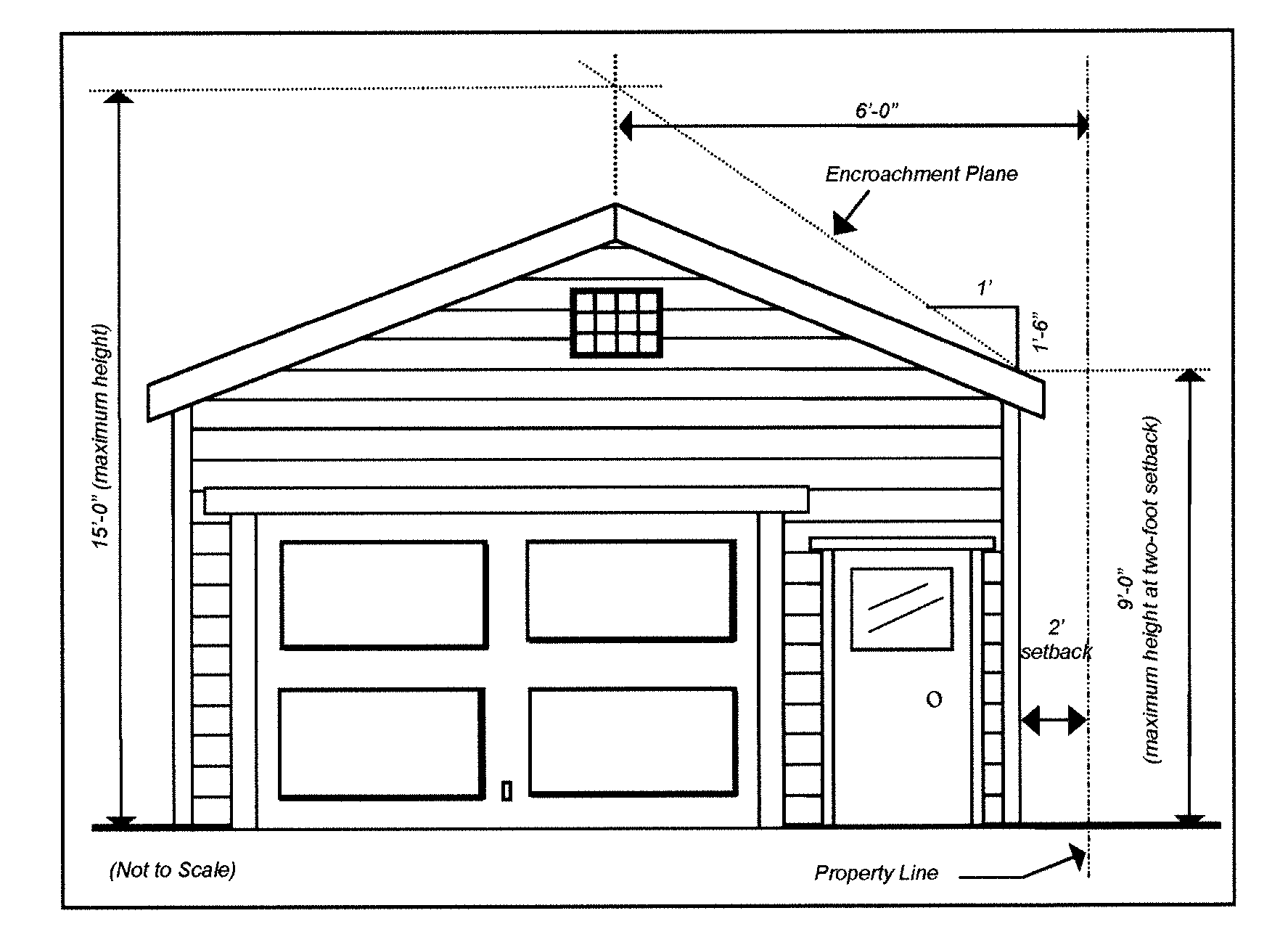
Figure 5-1 Encroachment Plane and Setbacks for Accessory Structures
d.
15-foot limit. An accessory structure may raise to, but shall not exceed, an overall height of 15 feet, but only in compliance with Subparagraph c., immediately above.
e.
Roof Pitch. Proposed accessory structures shall maintain a roof pitch equal to or within 1/12 of the predominant roof pitch of the existing primary dwelling. This requirement is not applicable to properties within an historic district, LD, HD, HD-1, or ND overlay zone.
f.
Materials. When visible from a public right-of-way, the exterior finish, trim, and roof materials shall be demonstrably similar to the finish, trim, and roof materials found on the primary structure or to materials found within properties along the blockface. This requirement is not applicable to properties within an historic district, LD, HD, HD-1, or ND overlay zone.
g.
Modification by Minor Conditional Use Permit. In order to achieve a design that is architecturally compatible with the main structure, the maximum height (including the top plate height) may be modified by a Minor Conditional Use Permit, granted in compliance with Section 17.61.050.
h.
Modification by Historic Preservation Commission. Modification for historic resources. For designated landmarks or structures in a designated landmark or historic district, the maximum height (including the top plate height) of an accessory structure may be exceeded without a Minor Conditional Use Permit, but only if approved by the Director, and only upon finding that the greater height is necessary in order to achieve a design that is architecturally compatible with the main structure.
2.
Length of structure walls.
a.
In order to prevent an excessive amount of structure located along a property line, the maximum horizontal length of an accessory structure that can be located less than five feet from the property line shall be limited to 22 feet.
b.
Any portion of the structure that exceeds 22 feet in length and is less than five feet from the property line, shall be required to be set back a minimum of five feet from the property line.
F.
Separations between structures.
1.
Utility pole. When a utility pole is located on the same site as a proposed accessory structure, a minimum separation of at least four feet shall be maintained between the pole and the accessory structure.
2.
Other structures. An accessory structure, other than mechanical equipment, a hot tub, or a swimming pool, shall maintain a minimum separation of six feet from any other structure (excluding walls and fences) on the site. The separation shall be clear and unobstructed by any encroachments.
3.
Pools and hot tubs. Pools, hot tubs, and related equipment, and all mechanical equipment shall not be closer than five feet from a property line. The Zoning Administrator may modify this requirement for pool equipment when adjacent to an alley.
G.
Maximum floor area of accessory structures.
1.
Maximum Size.
a.
Projects using the RS standards. The maximum size of all accessory structures on a site shall no exceed an aggregate of 600 square feet or six percent of the lot size, whichever is greater.
b.
Projects using the RM-12 standards. The maximum size of all accessory structures on a site shall not exceed an aggregate of 600 square feet or six percent of the lot size, whichever is greater. However, an additional 200 square feet is permitted if used for covered parking.
c.
Projects using other multi-family standards. The maximum size of all accessory structures on a site shall not exceed an aggregate of 600 square feet or six percent of the lot size, whichever is greater.
2.
An accessory structure (or portion of an accessory structure) with a roof that is at least 50 percent open shall not be included in the calculation of the maximum allowable size. All other accessory structures shall be counted in the calculation of the maximum allowable size including carports, gazebos, or covered patio or porches. A basement below an accessory structure or a stand alone subterranean structure shall be included in the calculation of the maximum allowable size.
H.
Garages and carports.
1.
Attached garages. On a lot 50 feet in width or wider, an attached garage that is visible from the street shall not occupy more than 50 percent of the structure frontage of the main structure.
2.
Carports. A carport shall only be located behind the main structure and not visible from a public right-of-way, and shall not be allowed on a corner lot.
(Ord. No. 7435, § 18, 10-28-2024; Ord. 7372, § 10, 2021; Ord. 7371 § 5, 2021; Ord. 7160, § 48, 2009; Ord. 7099, § 34 (Exh. 23), 2007; Ord. 7057, § 18 (a, b), 2006; Ord. 7009, § 22, 2005)
17.50.260 - Restaurants and Fast Food Restaurants
A.
Performance Standards.
1.
Lighting. All restaurants shall comply with Section 17.40.080 (Outdoor Lighting).
2.
Hours of Operation. All restaurants shall comply with Section 17.40.070 (Limited Hours of Operation).
3.
Noise standards. All restaurants shall comply with Municipal Code Chapter 9.36 (Noise Regulations).
4.
Disposable Containers and Napkins. Fast food restaurants and restaurants with walk-up windows shall have the business name printed on all disposable containers and napkins.
B.
Bars areas. Bar areas shall be defined by a barrier approved by the Zoning Administrator.
C.
Fast Food, Formula Fast Food, and Drive-through Restaurants. See Section 17.50.090 (Drive-Through Businesses).
D.
Restaurants with Walk-up Windows.
1.
Orientation. A Minor Conditional Use Permit shall be required when the walk-up window directly faces residential structure on an abutting lot.
a.
Exception: A Minor Conditional Use Permit shall not be required when located on properties within the Central District Specific Plan or South Fair Oaks Specific Plan.
E.
Restaurants with Outdoor Dining.
1.
Separation Requirement. Outdoor dining areas shall be located on the same site as the restaurant.
a.
A Minor Conditional Use Permit shall be required when the outdoor dining area is in a parking lot and is located within 50 feet of a residential structure on an abutting lot in an RS or RM zoning district.
i.
Exception: A Minor Conditional Use Permit shall not be required when located on properties within the Central District Specific Plan or South Fair Oaks Specific Plan.
2.
Barriers. Outdoor dining areas, including those in a parking lot, shall be defined by landscaping or other barriers approved by the Zoning Administrator.
3.
Accessibility.
a.
The construction and operation of outdoor dining areas shall comply with applicable Americans with Disabilities Act (ADA) requirements.
b.
Dining areas shall not obstruct vehicular traffic aisles, loading spaces, or pedestrian pathways.
4.
Entertainment. Entertainment that would otherwise be allowed indoors, including amplified music, shall not be permitted in parking lot dining areas.
5.
Parking. Parking shall be provided as required for applicable Zoning District, except no parking shall be required for the first 500 square feet of outdoor dining area, or 50 percent of the indoor dining area, including any bar area, whichever is greater.
a.
Parking lot dining. Parking spaces occupied by an outdoor dining area shall be replaced when the size of the outdoor dining area exceeds the exemption threshold in subsection 5 above, and only for the size above that threshold.
6.
Design Guidelines.
a.
Outdoor dining areas shall comply with the adopted Outdoor Dining on Private Property Design Guidelines, dated July 15, 2024, which is on file with the Department.
(Ord. No. 7435, § 18, 10-28-2024; Ord. 7099, § 36, 2007)
17.50.265 - Safe Parking
A.
Applicability. The following standards apply to the provision of off-street parking areas intended for unhoused individuals and families living in vehicles, including recreational vehicles. Such parking is intended to be a safe place for overnight shelter and services to facilitate the transition to permanent housing.
B.
Prohibited Locations. Safe Parking is prohibited on religious facility sites located in a RS or RM zone. On parcels with multiple zoning designations, Safe Parking is prohibited on any portion of the site zoned RS or RM.
C.
Application requirements.
1.
The program operator shall have a written management plan subject to the review and approval of the Zoning Administrator. The management plan shall include the following:
a.
Site plan indicating the location of trash and recycling facilities, water, restroom facilities, exterior lighting, location and distances to residential properties, location of nearest public transportation, and location of designated overnight parking spaces.
b.
Hours of operation.
c.
Total number of vehicles to be served on-site.
d.
Maximum size of vehicles to be served on-site.
e.
Monitoring and oversight program.
f.
Neighborhood communications strategy plan, including contact information for the facility.
g.
Any other information deemed necessary by the Zoning Administrator to ensure compliance with the requirements of this section.
D.
Performance Standards.
1.
Case Management. The safe parking use shall be managed by a program operator that participates or is willing to participate in the Pasadena Continuum of Care Program and Coordinated Entry System and provides access or linkage to the Coordinated Entry System.
2.
Sanitation. Restroom, Water, and Trash Facilities shall be provided, maintained, and accessible to clients during safe parking facility hours.
3.
Authorized Vehicles Only. The Program Operator shall ensure that only vehicles registered in the program are parked overnight during program hours. A parking permit shall be provided to all clients to be displayed in vehicle windows in a form approved by the Zoning Administrator.
4.
Written Agreement. Only clients who have entered into a written agreement with the Program Operator shall be allowed to use parking spaces overnight. The written agreement shall include, but is not limited to, the following terms and conditions:
a.
Only one vehicle allowed per individual or family.
b.
Vehicles may only be occupied by clients and household members. Guests shall not be allowed.
c.
Vehicles permitted on-site may include recreational vehicles, as defined in Section 14.50.020.J. Such vehicles are exempt from the provisions of Section 14.50.040.29 pertaining to prohibited activities or conditions.
d.
No fires of any kind shall be allowed.
e.
No music may be played that is audible outside of clients' vehicles.
f.
No cooking or food preparation shall be performed by clients outside of their vehicles. Cooking inside of client vehicles is prohibited unless the vehicle was manufactured with cooking appliances.
g.
Camping tarps, tents, or other related equipment attached to or beyond the clients' vehicles are prohibited.
h.
Clients shall maintain control of animals. Animals shall be kept on a leash at all times. Animal waste shall be picked up immediately and disposed of properly.
i.
Clients shall not dump sewage or other waste fluids or solids outside a vehicle.
(Ord. No. 7414, § 8, 9-11-2023)
17.50.270 - Schools, Private
A.
Indoor classroom area. Indoor classroom area (exclusive of bathrooms, hallways, kitchens, offices, and other nonclassroom space) shall be 24 square feet for each child enrolled.
B.
Outdoor play area.
1.
In residential zoning districts, a minimum of 125 square feet shall be provided for each child enrolled.
2.
In nonresidential zoning districts, a minimum of 75 square feet shall be provided for each child enrolled.
3.
No outdoor play area shall be located within a required front or corner side setback or within 25 feet of a residential use.
C.
Traffic control plan. The applicant shall submit a traffic control plan showing how loading and unloading of school children will occur with minimum disruption to traffic.
D.
Noise. Each school shall be designed and operated to comply with the noise regulations of Municipal Code Chapter 9.36.
17.50.275 - Accessory Dwelling Units and Junior Accessory Dwelling Units
A.
Applicability.
1.
Any construction, establishment, alteration, enlargement, or modification of an accessory dwelling unit (ADU) or junior accessory dwelling Unit (Junior ADU) shall comply with the requirements of this section. In the event of a conflict between this section and applicable state law, state law shall prevail.
2.
The Director or his designee shall review and approve, conditionally approve, or deny ministerial permits for accessory dwelling units conforming to the provisions of this section and any associated demolition permit within the time limits specified by Government Code Sections 66317, 66320, 66335 and successor provisions.
B.
Location standards and number of units.
1.
Permitted zones. ADUs are permitted in all zoning districts that permit single-family or multifamily dwelling residential uses on sites with at least one proposed or existing dwelling.
2.
Number of Units.
a.
For lots with an existing or proposed single-family dwelling:
(1)
One detached or attached new construction ADU, one detached or attached conversion ADU, and one Junior ADU, subject to the development standards set forth in 17.50.275 D and E.
(2)
Exemption ADUs include the following:
a)
A detached or attached new construction ADU with a maximum area of 800 square feet and minimum side and rear yard setbacks of four feet with a maximum height as set forth in 17.50.275 D.5.e.
b)
A detached or attached conversion ADU within an existing space. May include an expansion of not more than 150 square feet beyond the same physical dimensions as the structure limited to accommodating ingress and egress in compliance with 17.50.275 D.5. Side and rear setbacks must be sufficient for fire and safety. An attached conversion ADU must have separate exterior access from the existing single-family dwelling.
c)
A Junior ADU if all of the following apply:
i.
The Junior ADU is within the proposed space of a single-family dwelling or existing space of a single-family dwelling including, but not limited to, an attached garage and other non-habitable space.
ii.
The Junior ADU has a separate exterior access from the proposed or existing single-family dwelling.
iii.
The side and rear setbacks are sufficient for fire and safety.
b.
For lots with an existing or proposed multi-family dwelling structure:
(1)
Exemption ADUs, which include the following:
a)
Within an existing multifamily dwelling. At least one ADU and up to 25 percent of the existing multifamily dwelling units within the structure may be created within the portions of the existing multifamily dwelling structures that are not used as livable space, including, but not limited to, storage rooms, boiler rooms, passageways, attics, basements, or garages, if each unit complies with state building standards for dwellings. For mixed-use projects, areas used for non-residential uses and parking or storage for non-residential uses may not be converted to ADUs; and,
Detached new construction or conversion ADUs:
i.
On a lot with an existing multifamily dwelling, not more than eight detached ADUs. However, the number of ADUs shall not exceed the number of existing units on the lot.
ii.
On a lot with a proposed multifamily dwelling, not more than two detached ADUs.
iii.
All detached new construction ADUs, rear and side setbacks must equal at least four feet. Maximum height shall be 16 feet, however, maximum height shall be 18 feet if: (i) the existing or proposed multi-family dwelling structure is a multistory structure; or (ii) the lot is located within one-half mile walking distance to a Major Transit Stop or a High Quality Transit Corridor, as defined in state law, in which case an additional two feet may be added to match the roof pitch of the primary dwelling.
C.
Operational standards.
1.
Short-term rental prohibited. Any rental term of an ADU or Junior ADU that was legally created on or after January 1, 2017 shall be longer than 30 days.
2.
Sale of units. The ADU or Junior ADU may not be sold separately from the existing single-family home unless developed by a qualified nonprofit corporation in accordance with California Government Code Section 66341.
D.
Development standards applicable to ADUs. Except for Exemption ADUs, ADUs shall comply with all applicable development standards of the underlying zone (e.g., encroachment plane, floor area, lot coverage limits, setbacks, etc.) that apply to the primary residence and that do not conflict with this Section 17.50.275.
1.
Unit Size.
a.
Single-Family Sites.
(1)
Minimum unit size. The ADU shall be no less than 150 square feet in size.
(2)
Maximum unit size - Exemption ADUs. Exemption ADUs in single-family sites include those described in 17.50.275.B.2.a.2.
a)
Attached or detached new construction ADUs: Maximum area of 800 square feet.
b)
Attached or detached conversion ADUs: No size limit.
(3)
Maximum unit size - Non-Exemption ADUs. Non-exemption ADUs in single-family sites include all newly constructed attached or detached ADUs which exceed 800 square feet in size.
a)
New construction detached ADU: Maximum area of 1,200 square feet.
b)
New construction attached ADU: Maximum area of 850 square feet for a studio or one-bedroom, and 1,000 square feet for more than one bedroom.
b.
Hillside Overlay Districts (excluding properties in HD-1).
(1)
Properties in Hillside Overlay Districts served by private or public streets with a pavement width of up to 26 feet wide are allowed the following, subject to 17.50.275.B.2.a.2:
a)
Attached or detached conversion ADUs: No size limit.
b)
New construction attached or detached ADU: 800 square feet.
(2)
Other properties in Hillside Overlay Districts are limited to a maximum of:
a)
Attached or detached conversion ADUs: No size limit.
b)
New construction attached ADU: 850 square feet for a studio or one-bedroom ADU and 1,000 square feet for more than one bedroom.
c)
New construction detached ADU: Shall be limited to 1,000 square feet.
c.
Sites with Multi-Family Buildings.
(1)
Minimum unit size. ADUs shall be no less than 150 square feet in size.
(2)
Maximum unit size - Exemption ADUs. Exempt ADUs in sites with multi-family buildings include those described in 17.50.275.B.2.b.1 and have no size limit.
d.
Measuring Area. The gross floor area for ADUs may be measured as defined in Title 17, Article 8 or California Building Code, whichever method is preferred by the applicant.
2.
Historic Properties. Non-Exemption ADUs in individually designated historic properties, Landmark or Historic Districts shall not be visible from the public right-of-way, unless this requirement prevents the creation of the unit.
3.
Standards applicable to all ADUs.
a.
Setback requirements.
(1)
Front lot line. Attached and detached new construction ADUs greater than 800 square feet in size shall comply with the front-yard setback requirements of the underlying zone.
(2)
Side and Rear Lot Lines: Four feet for newly constructed ADUs and expansions to conversion ADUs. Any expansion of 150 square feet to accommodate ingress and egress shall have setbacks sufficient for fire and safety.
(3)
Conversions, attached and detached. No setbacks are required, except for fire safety, if:
a)
An existing structure is demolished and a new ADU is constructed in the same location and with the same dimensions and height as the existing structure.
b.
Building separation for non-exemption ADUs. A minimum building separation of six feet shall be maintained (eave to eave) between a newly constructed ADU from any other structure (excluding walls and fences) on the site.
c.
Maximum height.
(1)
Attached New Construction ADUs. Shall not exceed 25 feet in height or the maximum permitted in the underlying zone, whichever is less, when attached to an existing or proposed single-family dwelling. May be up to two stories in height.
(2)
Detached New Construction ADUs.
a)
A maximum of 16 feet and two stories in height for the following:
i.
ADUs within the Hillside Overlay Districts;
ii.
ADUs within Landmark or Historic Districts and visible from the street; or
iii.
Exemption ADUs located in the front-yard setback.
If any of the above ADUs are located: (i) on a site with proposed or existing multistory buildings; or (ii) within one-half mile walking distance of a Major Transit Stop or a High Quality Transit Corridor, as defined in state law, the maximum height shall be 18 feet. An additional two feet in height shall be permitted on sites within one-half mile walking distance of a Major Transit Stop or High Quality Transit Corridor if necessary to match the roof pitch of a primary dwelling on the same site.
b)
A maximum of 18 feet and two-stories in height for all other ADUs. ADUs located within one-half mile walking distance of a Major Transit Stop or a High Quality Transit Corridor, as defined in state law, shall be permitted an additional two feet in height if necessary to match the roof pitch of a primary dwelling on the same site.
(3)
Measuring Height. The height for new construction ADUs may be measured per 17.40.060 or the California Building Code, whichever method is preferred by the applicant.
d.
Entrance and Exterior Staircases for Non-Exemption ADUs:
(1)
For single-family sites, entrances for attached newly constructed ADUs shall not be visible from the public right-of-way, unless this requirement prevents the creation of the unit.
(2)
For single-family sites, exterior staircases for attached ADUs shall not be visible from the public right-of-way, unless this requirement prevents the creation of the unit.
e.
Structures Attached to ADUs:
(1)
Compliance with the development standards of the underlying zone is required for any new structures or expansions to existing structures that are attached to an ADU. This includes, but is not limited to, garages/carports, storage rooms, sheds, covered patios, balconies, rooftop decks, additions to the primary dwelling, etc. This does not include the 150 square foot expansion necessary to accommodate ingress and egress for the ADU, where allowed.
(2)
No portion of the walking surface of a projecting deck with visible underpinnings shall exceed a height of six feet above grade.
4.
Parking and circulation standards:
a.
Required parking. One parking space per unit on a single-family site shall be provided for the ADU. The on-site parking space may be provided as covered, uncovered, or as tandem parking on an existing driveway. No parking shall be required for ADUs on a multi-family site.
(1)
Exception. No parking space is required for an ADU on a single-family site if it meets any of the following conditions:
a)
The unit is an Exemption ADU;
b)
The site is located within one-half mile walking distance of a public transit stop;
c)
The ADU is contained within the proposed or existing space (i.e., all fully enclosed area, including a garage) of the primary dwelling or accessory structure;
d)
Property is within a historic district (which includes landmark and historic districts); or
e)
When there is a commercial car share vehicle pick-up and drop-off location located within one block of the ADU; or
f)
When a permit application for an ADU is submitted with an application to create a new single-family dwelling on the same lot, provided that the ADU satisfies any of the other criteria listed in (b)-(e) above.
b.
Replacement parking. Replacement parking is not required if an existing garage, carport or surface space serving as the required parking for the primary dwelling unit is demolished or converted in conjunction with the construction or conversion of an ADU.
c.
Driveway access. An ADU shall share the driveway with the existing primary residence on the site. A second driveway shall only be allowed from an alley when replacement parking is required, if there is an alley that serves the subject site.
E.
Standards Applicable to Junior ADUs.
1.
Zoning. Junior ADUs are permitted in zoning districts that permit residential uses on sites which contain at least one proposed or existing single-family dwelling.
2.
Development standards.
a.
A Junior ADU shall be located within the proposed space of a single-family dwelling or existing space of a single-family dwelling including, but not limited to, an attached garage and other non-habitable space.
b.
No setbacks are required, except for fire safety, if an existing structure, or a portion thereof, is converted into a Junior ADU.
c.
If an existing structure is demolished as part of the conversion of said structure to a Junior ADU, the Junior ADU shall be constructed in the same location and with the same dimensions and height as the existing structure.
d.
A Junior ADU shall have exterior access from the proposed or existing single-family dwelling.
e.
Maximum unit size for a Junior ADU is 500 square feet. The gross floor area may be measured as defined per Title 17, Article 8 of this Code or California Building Code, whichever method is preferred by the applicant.
f.
A Junior ADU is required to include an efficiency kitchen, which shall consist of a cooking facility with appliances, a food preparation counter and storage cabinets that are of reasonable size in relation to the size of the junior accessory dwelling unit, and a separate entrance, and may include separate sanitation facilities, or may share sanitation facilities with the existing structure. If the sanitation facilities are shared with the primary dwelling, the Junior ADU must include an interior entry to the main living area of the primary unit to access the shared sanitation facilities.
g.
Windows [on] Upper Floors for Non-Exempt ADUs: New second story windows shall be prohibited along the interior side and rear lot lines for all non-exemption Junior ADUs when the proposed setback is less than five feet, unless required by the Building Code for ingress or egress. When the Building Code requires windows, they shall be opaque or clerestory windows. If the side or rear lot lines abut an alley with a minimum width of 20 feet, second story windows may be allowed on the façade facing the alley.
3.
Owner Occupancy. For Junior ADUs which share a sanitation facility, either the primary unit or the Junior ADU shall be owner-occupied. Owner-occupancy shall not be required if the owner is another governmental agency, land trust, or housing organization.
4.
Short-term rental prohibited. Any rental term of a Junior ADU that was legally created on or after January 1, 2017 shall be longer than 30 days.
5.
Recorded covenant for Junior ADUs. Prior to issuance of a building permit for a Junior ADU which share a sanitation facility, the owner shall record a covenant in a form approved by the city to notify subsequent owners of the requirements of this Section.
6.
Sale of units. The Junior ADU may not be sold separately from the existing single-family home unless developed by a qualified nonprofit corporation in accordance with California Government Code Section 66341.
7.
Replacement parking. Replacement parking is not required if an existing garage, carport or surface space serving as the required parking for the primary dwelling unit is demolished or converted in conjunction with the construction or conversion of a Junior ADU.
8.
Driveway access. A Junior ADU unit shall share the driveway with the existing primary residence on the site. A second driveway shall only be allowed from an alley, if there is an alley that serves the subject site.
F.
Building and Zoning Enforcement:
1.
The correction of nonconforming zoning conditions on the property shall not be required as a condition for ministerial approval of a permit application for the creation of an ADU or a Junior ADU.
2.
ADUs or Junior ADUs constructed before January 1, 2020:
a.
The City shall not deny a permit if the ADU or Junior ADU is in violation of Division 13, Chapter 5, Article 1, commencing with Section 17960 of the Health and Safety Code, does not comply with Article 3, Section 66333 of the California Government Code or with any provision of this Title.
b.
The City may deny a permit if the City makes a finding that correcting the violation is necessary to comply with the standards specified in Section 17920.3 of the Health and Safety Code.
(Ord. No. 7464, § 11, 1-26-2026; Ord. No. 7420, § 2, 4-15-2024; Ord. 7321 § 4, 2018; Ord. 7295 § 4, 2017)
17.50.280 - Senior Affordable Housing Regulations
A.
Density. Density shall be a maximum of 48 units per acre. A maximum of 50 percent density bonus is allowed. Projects shall meet all other density bonus provisions under Section 17.42.100 (Density Bonus and Incentive Provisions) and are eligible for incentives.
B.
Development standards. Development standards including the number of parking spaces shall be prescribed and reviewed as part of the Conditional Use Permit, except that the front setback shall be a minimum of 20 feet, and the rear, side, and corner side yard setbacks shall be a minimum of 10 feet. Parking may be uncovered and located within the rear yard setback.
C.
Location. A Senior Affordable Housing project shall be located within 500 feet of a Medical Office or Medical Services - Hospital use. The Medical Office use or Medical Services - Hospital use shall be located within the PS district.
D.
Occupancy. Each unit shall be occupied by at least one senior citizen.
17.50.290 - Service Stations, Vehicle Washing, and Detailing
A.
Applicability. The following standards apply to the new construction, remodeling, or expansion of service stations and vehicle washing and detailing businesses.
B.
Application requirements. A lighting plan shall be submitted with the Conditional Use Permit application. Lighting requirements shall comply with the outdoor lighting requirements of Section 17.40.080.
C.
Minimum site area. A service station, vehicle washing and detailing business, or combination thereof shall be located on a site of at least 15,000 square feet, with a minimum of 125 feet of frontage on a public street. This requirement shall not apply to the remodeling or expansion of a preexisting service station or vehicle washing and detailing business.
D.
Site layout.
1.
Mobile recycling trucks, and temporary, nonpermanent structures may not be located on a service station or vehicle washing and detailing site without Conditional Use Permit approval.
2.
Ancillary services (e.g., air, water, telephone, and vending machines) shall be located in an area that does not impede vehicular traffic.
3.
A cashier kiosk shall be constructed to provide safe access for patrons. A minimum of three pedestrian queue spaces for each service station site shall be provided.
4.
The site plan/site layout shall be designed to ensure maximum security for employees and patrons.
E.
Planting areas. Perimeter planting areas shall be as required for parking lots by Chapter 17.36 (Parking and Loading), except where a structure adjoins an interior property line. Required interior planting areas may adjoin perimeter planting areas. The landscape plan shall comply with Chapter 17.34 (Landscaping) and all applicable design guidelines.
F.
Storage of materials and equipment.
1.
The provisions of Section 17.50.180 (Outdoor Display, Storage, and Seasonal Sales) shall apply, except that a display rack for motor vehicle products may be maintained at each pump island of a service station.
2.
If display racks are not located on pump islands, they shall be placed within three feet of the main structure, and shall be limited to one for each street frontage.
3.
Storage of inoperative vehicles is prohibited.
4.
The location of display racks and vending machines shall be specified by the Conditional Use Permit.
G.
Restrooms. All restroom entrances shall be screened from view from adjacent properties or street rights-of-way. Screening material may be partially open or perforated provided the openings or perforations do not constitute greater than 50 percent of the total screening surface area and are uniformly distributed throughout the screening material.
H.
Dispensing machines. The location of food, cigarette, and/or soft-drink vending machines and Automated Teller Machines (ATM's) shall be shown on the plans submitted and shall be reviewed as part of the Conditional Use Permit process. No game machines shall be allowed on a service station site.
I.
Equipment rental. Outdoor storage of, and sale, lease, or rental of trailers, trucks, or similar equipment shall be reviewed as part of the Conditional Use Permit process.
J.
Vehicle washing and detailing - Drainage. Each vehicle washing and detailing business (both large and small scale) shall provide evidence of compliance with the regulations of the Sanitation District of Los Angeles County related to drainage. Discharge into the storm drain system is not allowed without approval from the Los Angeles County Regional Water Quality Control Board.
K.
Vehicle washing and detailing - small-scale businesses. A small-scale vehicle washing and detailing business shall be located within a parking structure having a minimum of 500 vehicle parking spaces.
L.
Service stations - minimum number of fueling positions. A full-service station in the CL zoning district shall have a minimum of eight fueling positions.
M.
Site maintenance. All paved areas shall be maintained grease-free.
17.50.295 - Sexually Oriented Businesses
A.
Definitions. The technical terms and phrases used in this Section shall have the same meanings as set forth for those terms and phrases in Chapter 5.45 of the Pasadena Municipal Code.
B.
Purpose. It is the purpose of this Section to regulate sexually oriented businesses in order to promote the health, safety, moral, and general welfare of the citizens of the City, and to establish reasonable and uniform regulations to prevent the deleterious secondary effects of sexually oriented businesses within the City. The provisions of this Section have neither the purpose nor effect of imposing a limitation or restriction on the content or reasonable access to any communicative materials, including sexually oriented materials. Similarly, it is neither the intent nor effect of this Section to restrict or deny access by adults to sexually oriented materials protected by the First Amendment, or to deny access by the distributors and exhibitors of sexually oriented entertainment to their intended market. Neither is it the intent nor effect of this Section to condone or legitimize the distribution of obscene material. Findings and rationale supporting this purpose are set forth in the uncodified provisions of the ordinances adopted to implement and to amend this Section.
C.
Location requirements. Sexually oriented businesses shall be permitted in only the CG zoning district and shall be subject to the following conditions:
1.
No sexually oriented business is allowed in the Lincoln Corridor (CG-1).
2.
No sexually oriented business is allowed within 500 feet of any child day-care center (excluding large and small family day-care homes), park and recreation facility, public or private school, or religious facility (excluding temporary uses), that existed before the establishment of the sexually oriented business.
3.
No sexually oriented business is allowed within 250 feet of a RS or RM district. Measurements shall be made in a straight line in all directions without regard to intervening structures or objects, from the closest point on a lot line of the sexually oriented business premises to the closest point on a lot line of any child day-care center, park and recreation facility, public or private school, religious facility, or parcel in a RS or RM district.
4.
No more than two sexually oriented businesses are allowed within a 250-foot radius, drawn around the proposed use. Measurements shall be made in a straight line in all directions without regard to intervening structures or objects, from the closest point on the lot line of the proposed sexually oriented business premises to the closest point on the lot line of any other sexually oriented business.
5.
No location in the City shall be disqualified by virtue of its proximity to a land use located outside the jurisdictional boundaries of the City.
D.
Nonconforming sexually oriented businesses. Notwithstanding anything to the contrary in the Pasadena Municipal Code, any sexually oriented business located within the City of Pasadena that is lawfully operating in compliance with Pasadena Municipal Code Chapter 5.45 and the Pasadena Zoning Code on the date that an amendment to Section 17.50.295.C or to the definitions used in Chapter 5.45 and referenced in this Zoning Code becomes effective, which is made a nonconforming use by said amendment, shall be terminated within 12 months of the date that said amendment becomes effective.
(Ord. 734, § 2, 4-8-2019; Ord. 7078 § 6, 2006)
17.50.296 - Short-Term Rentals
A.
Applicability. The following standards apply to short-term housing rentals whereby a dwelling unit is shared, in whole or in part, for transient occupancy as a way of generating rental income.
B.
Definitions. For the purposes of this section, the following words or phrases shall have the following meanings:
1.
Home-sharing. An accessory use of a primary residence for the purposes of providing temporary lodging, for compensation, for periods of 30 consecutive days or less.
2.
Host. An occupier of a dwelling unit who rents his/her primary residence for home-sharing under this section.
3.
Hosted stay. A home-sharing activity whereby the host remains on-site throughout the guest's stay (except during daytime and/or work hours).
4.
Hosting platform. A marketplace in whatever form or format which facilitates the short-term rental activity, through advertising, match-making, or any other means, using any medium of facilitation, and from which the operator of the hosting platform derives revenues, including booking fees or advertising revenues, from providing or maintaining the marketplace.
5.
Primary residence. A host's permanent residence or usual place of return for housing as documented by at least two of the following and in the host's name: motor vehicle registration; driver's license; voter registration; tax documents showing the residential unit as the host's residence; or a utility or cellular phone bill. A person may have only one primary residence and must reside there for a minimum of 9 months per year.
6.
Un-hosted stay. A home-sharing activity whereby the host remains off-site during the guest's stay.
7.
Vacation rental. A dwelling unit that is not a primary residence and which is available for temporary lodging, for compensation. The term "vacation rental" shall not include: single-room occupancy buildings; bed and breakfast inns; hotels; a dwelling unit for which a tenant has a month-to-month rental agreement and the rental payments are paid on a monthly basis; or corporate housing.
C.
Eligible types of dwelling units. Short-term rentals shall be permitted in single-family residences, duplexes, condominiums, townhomes, and multi-family rental units, except covenant restricted (affordable) and Section 8 units.
D.
Vacation rentals prohibited. Vacation rentals, as defined in this section, are a prohibited use and shall not be operated in the city.
E.
Short-term rental permit. The host is required to obtain a short-term rental permit from the city, pursuant to the provisions of this section, before renting any primary residence to a transient occupant/guest.
1.
Application. To apply for a short-term rental permit, a host shall file an application with the planning and community development department on a form provided by the department, and shall include all information required by the instructions on the application and the guidelines necessary to implement this section, which guidelines may be approved by the city manager or his/her designee.
2.
Eligibility requirements. The following requirements must be met for approval of a short-term rental permit:
a.
The host shall obtain a transient occupancy registration certificate from the finance department.
b.
The host shall sign a notarized affidavit confirming that:
i.
The short-term rental unit is his/her primary residence and that the local responsible contact person or property management company will be available 24 hours per day.
ii.
The space used for short-term rental meets or exceeds fire and life safety requirements, including installation of smoke and carbon monoxide detectors, and adequate means of egress.
iii.
The abutting property owners and occupants will be notified prior to the start of activity that the host's primary residence will be used for short-term rental.
iv.
For tenants, renters, or lessees of residential units engaging in short-term rental, that he/she has notified their landlord/property owner of their intent to sublease their unit as a short-term rental.
c.
For properties with existing legally permitted accessory dwelling units or accessory structures constructed or issued building permits for prior to January 1, 2017, the term "primary residence" shall refer to the parcel of land and constitute both the main structure and the subordinate unit, both of which can be used for short-term rental activity provided the main structure is the host's permanent residence. An accessory dwelling unit or accessory structure permitted after January 1, 2017 shall not be used for short-term rental.
d.
The host shall demonstrate that an accessory structure is legally permitted and habitable based on building permit history. In the absence of a building permit record demonstrating such, the building official shall determine if the accessory structure is suitable for habitability and an inspection of the accessory structure may be required.
e.
Notwithstanding Section 17.50.296(E)(2)(b)(i), for owner-occupied properties with multiple dwelling units, including duplexes, triplexes, or apartment complexes, and generally containing rental units, the owner of such property may short-term rent his/her primary residence plus one additional dwelling unit on the property.
f.
If a primary residence is subject to the rules of a homeowners' or condominium association, allowance to engage in short-term rental through this section shall not be inferred to grant any permission that invalidates or supersedes provisions in those documents.
g.
The host shall sign an indemnification and hold harmless agreement in a form approved by the city attorney, agreeing to indemnify, save, protect, hold harmless, and defend the City of Pasadena, the City Council of the City of Pasadena, individually and collectively, and the City of Pasadena representatives, officers, officials, employees, agents, and volunteers from any and all claims, demands, damages, fines, obligations, suits, judgments, penalties, causes of action, losses, liabilities, or costs at any time received, incurred, or accrued as a result of, or arising out of host's actions or inaction in the operation, occupancy, use, and/or maintenance of the property.
3.
Expiration and renewal. A short-term rental permit is valid for one (1) year from the date of issuance. It may not be transferred, does not run with the land, and is valid only at the original short-term rental site. A short-term rental permit may be renewed if the host meets the renewal requirements including: (1) pays the renewal fee; (2) is deemed to have been in substantial conformance with the provisions of this section for the past year; (3) documents and provides any changes that have occurred to the information on the current short-term rental application; and 4) submits short-term rental records described in Section 17.50.296(G)(2) for the last year to demonstrate compliance with this section as part of the renewal. Without a renewal application submitted within one (1) year to the date of the issuance of the short-term rental permit, or prior renewal, a permit is considered null and void.
F.
Short-term rental regulations.
1.
Short-term rentals shall not adversely affect the residential character of the neighborhood nor shall the use generate noise, vibration, glare, odors, or other effects that unreasonably interfere with any person's reasonable enjoyment of his or her residence. To this effect, the short-term rental activity shall comply with all provisions of the Pasadena Municipal Code, including Chapter 9.36 (Noise Restrictions) and Chapter 8.64 (Litter Control).
2.
No person shall advertise, undertake, maintain, authorize, book, or facilitate any renting to transient guests in a manner that does not comply with this section.
3.
No person shall advertise any short-term rental without a city issued short-term rental permit number depicted in a visible location on the advertisement, including any listing on a hosting platform.
4.
Un-hosted stays shall be limited to a maximum of 90 days per year. There shall be no limit for hosted stays.
5.
Short-term rentals shall not be used by more than 2 guests per bedroom plus 2 additional guests at one time.
6.
Commercial events, commercial parties, or commercial group gatherings, including, but not limited to, weddings, banquets, and corporate events, are prohibited from occurring as part of the short-term rental use. The dwelling shall not be short-term rented for the sole purpose of accommodating such uses.
7.
Parking for the short-term rental use shall be provided on-site.
8.
No signs shall be posted on the exterior of the dwelling advertising the presence of the short-term rental use.
9.
No person shall offer or engage in short-term rental in any part of the property not approved for residential use, including, but not limited to, a vehicle parked on the property, a storage shed, trailer, garage, or any temporary structure like a tent.
G.
Host requirements.
1.
The host shall be responsible for any nuisance violations arising at a property during short-term rental activities.
2.
The host shall keep and preserve, for a period of three years, all records as may be necessary to determine the amount of such tax as he/she may have been liable for the collection of and payment to the city, including the number and length of each short-term rental stay, and the price paid for each stay. The planning and community development department and/or the finance department shall have the right to inspect these records at all reasonable times. Hosts shall provide a copy of the records from the last year to the planning and community development department at the time of renewing the short-term rental permit.
3.
The host shall fully comply with all the requirements of PMC Chapter 4.44 (Transient Occupancy Tax) and any successor sections.
4.
The host shall provide and maintain fire extinguishers, smoke detectors, carbon monoxide detectors, and information related to emergency exit routes and emergency contact information.
H.
Fees. The city council may establish and set by resolution all fees and charges as may be necessary to effectuate the purpose of this section.
I.
Enforcement.
1.
Enforcement of this chapter shall be subject to the processes and procedures in Chapters 1.24 and 1.25 of the Pasadena Municipal Code.
2.
Any person failing to comply with any provision of this section shall be deemed guilty of a violation of the Pasadena Municipal Code, which may be punishable as outlined in Chapter 1.24 (General Penalty) of the Pasadena Municipal Code, and may be subject to any other penalty or enforcement mechanism available to the city.
3.
Three violations against the same property being used for short-term rental may result in the automatic suspension of the permit. After notice and a hearing before the city manager or his/her designated administrator as provided in Chapter 1.25 (Administrative Penalties—Compliance Orders), the permit may be revoked. If a short-term rental permit is revoked, the host must wait at least one year before he/she can apply and register for short-term rental again.
4.
Any person convicted of violating any provision of this section in a criminal case or found to be in violation of this section in a civil case brought by a law enforcement agency shall be ordered to reimburse the city and other participating law enforcement agencies their full investigative costs, pay all back transient occupancy taxes, and remit all illegally obtained rental revenue to the city so that it may be returned to the short-term rental guests or used to compensate victims of illegal short-term rental activities.
5.
Any person who violates any provision of this section shall be subject to administrative fines and administrative penalties pursuant to PMC Section 1.25.160 and Section 1.25.170.
6.
The remedies provided in this section are not exclusive, and nothing in this section shall preclude the use or application of any other remedies, penalties, or procedures established by law.
(Ord. 7317, § 2, 2018)
17.50.300 - Single Room Occupancy (SRO) Facilities
A.
Limited Commercial (CL) district. Notwithstanding the provisions of Section 17.76.030, existing nonconforming single-room occupancy residential in the Limited Commercial (CL) zoning district may be altered to comply with the following single-room occupancy residential development standards without obtaining a Conditional Use Permit.
B.
Site area per unit. Site area per unit standards shall not apply to single-room occupancy facilities.
C.
Unit size and occupancy. The minimum size of a unit shall be 150 square feet and the maximum size shall be 375 square feet which may include bathroom and/or kitchen facilities.
D.
Common area. A minimum of 10 square feet for each unit or 250 square feet, whichever is greater, shall be provided for a common area. All common area shall be within the structure. Dining rooms, meeting rooms, recreational rooms, or other similar areas approved by the Zoning Administrator may be considered common areas. Shared bathrooms and kitchens shall not be considered as common areas.
E.
Management. A single-room occupancy management plan shall be submitted to, reviewed, approved and enforced by the Housing Administrator of the Housing and Development Department. The management plan shall be approved before issuance of a Certificate of Occupancy. The management plan shall be comprehensive and contain management policies and operations, rental procedures and rates, maintenance plans, residency and guest rules and procedures, security procedures and staffing needs including job descriptions. The approved management plan shall be in recordable form as approved by the City Attorney and recorded before issuance of a Certificate of Occupancy. A 24-hour resident manager shall be provided for any single-room occupancy use with 12 or more units.
F.
Development regulations. Each single-room occupancy facility shall comply with all applicable commercial development standards for the applicable zoning district.
G.
Parking. See Chapter 17.46 (Parking and Loading).
H.
Kitchen facilities. Each unit shall be provided a kitchen sink serviced with hot and cold water with a garbage disposal and a counter top measuring a minimum of 18 inches wide by 24 inches deep. A complete kitchen facility available for residents shall be provided on each floor of the structure, if each individual unit is not provided with a minimum of a refrigerator and a microwave oven.
I.
Bathroom facilities. For each unit a private toilet in an enclosed compartment with a door shall be provided. This compartment shall be a minimum of 15 square feet. If private bathing facilities are not provided for each unit, shared shower or bathtub facilities shall be provided at a ratio of one for every seven units or fraction thereof. The shared shower or bathtub facility shall be on the same floor as the units it is intended to serve and shall be accessible from a common area or hallway. Each shared shower or bathtub facility shall be provided with an interior lockable door.
(Ord. 7360 § 3 (Exh. 2), 2020)
17.50.310 - Telecommunications Facilities
A.
Applicability. Wireless telecommunications antenna facilities shall comply with the following requirements. The provisions of this Section do not apply to satellite earth station antennas due to preemption by Part 25 of Title 47 of the Code of Federal Regulations. The provisions of this Section also do not apply to wireless telecommunications antenna facilities in the public right-of-way, which are governed by Chapter 12.22 of the Municipal Code.
B.
Definitions. The Specialized terms and phrases used in this Section are defined under "Telecommunications Facility Definitions" in Article 8 (Glossary).
C.
Special notice. All notices required by this Subsection shall be provided in compliance with Chapter 17.76 (Public Hearings).
1.
Notices of public hearings for Wireless Telecommunications Antenna Facilities, Major, shall also be mailed to occupants of buildings and registered neighborhood associations within 1,000 feet of the primary use site boundary.
2.
Notices of public hearings for Wireless Telecommunications Antenna Facilities, Minor, shall also be mailed to occupants of buildings and registered neighborhood associations within 300 feet of the primary use site boundary.
3.
Notices of application submittal and comment periods for Wireless Telecommunications Antenna Facilities, SCL, shall be mailed as follows:
a.
In residential districts, to occupants of buildings and registered neighborhood associations within 300 feet of the primary use site boundary. The comment period is 30 days.
b.
In all other zoning districts, to abutting property owners, and posted as set forth in Section 17.76.020.B(2). The comment period is 30 days.
D.
Requirements for all facilities.
1.
Prohibited fencing materials. The use of chain-link fencing or razor wire in the design of a facility or related support facilities is prohibited.
2.
Screening required. Support facilities housed outside of structures shall be screened from public view by fences, landscaping, trellises, walls, and similar treatments.
3.
Design Guidelines. Facilities subject to this section shall comply with any design guidelines adopted by resolution of the Council.
4.
Illumination. Building-mounted facilities and support structures may not be illuminated unless specifically required by the Federal Aviation Administration or other governmental agencies.
5.
Signs. No off-premises or on-premises signs may be placed by a wireless telecommunications service provider on a building or support structure to which a facility is attached. Each facility shall be located a minimum of 25 feet from an existing off-premises sign or an on-premises freestanding sign.
6.
Site maintenance. The site of the facilities shall be maintained in a condition free of debris, refuse, and trash. All graffiti shall be removed within 48 hours.
7.
Radio Frequency Emissions Compliance. Upon installation of the facility, the applicant shall demonstrate that the project will not result in levels of radio frequency emissions that exceed Federal Communications Commission standards, including FCC Office of Engineering Technology (OET) Bulletin 65, Evaluating Compliance with FCC Guidelines for Human Exposure to Radiofrequency Electromagnetic Fields, as amended. Additionally, if the Director determines the wireless telecommunications facility, as constructed, may emit radio frequency emissions that are likely to exceed Federal Communications Commission uncontrolled/general population standards in the FCC Office of Engineering Technology (OET) Bulletin 65, Evaluating Compliance with FCC Guidelines for Human Exposure to Radiofrequency Electromagnetic Fields, as amended, in areas accessible by the general population, the Director may require post-installation testing to determine whether to require further mitigation of radio frequency emissions. The cost of any such testing and mitigation shall be borne by the applicant. Applications for amateur radio antennas or antennas installed for home entertainment purposes are exempt from this requirement.
8.
Posting of removal bond or security. Before the issuance of any permit under this section, the applicant shall post with the City a performance bond or other security in an amount rationally related to the cost of removal.
9.
City's use of consultant. The Director may require the applicant to provide an authorization to permit the City to hire an independent, qualified consultant to evaluate any technical aspect of the proposed use, including issues involving radio frequency emissions, alternative designs, and alternative sites. Any authorization for this purpose shall include an agreement by the applicant to reimburse the City for all reasonable costs associated with the consultation. Any proprietary information disclosed to the City or the consultant is deemed not to be a public record, and shall remain confidential and not to be disclosed to any third party without the express consent of the applicant, unless otherwise required by law.
10.
Inoperable or unused facilities.
a.
If a support structure, or an antenna array affixed to a building or support structure, becomes inoperable or ceases to be used for a period of 180 consecutive days:
(1)
The permittee shall give written notice of inoperability or nonuse to the Zoning Administrator; and
(2)
The antenna array and, if applicable, the support structure shall be removed within 90 days.
b.
If removal does not occur, the City may remove the antenna array and, if applicable, the support structure, at the permittee's expense; provided, however, that if other antenna arrays owned or operated by other service providers are affixed to the same support structure then only the antenna array that has become inoperable or has ceased to be used is required to be removed, and the support structure may remain in place until all service providers cease to use it.
11.
Existing agreements. This section does not apply to the terms and conditions of any agreement or permit (including an extension) pertaining to telecommunications facilities (issued by the City or of which the City is a party) that is already in existence at the effective date of this ordinance, provided that the agreement or permit does not result in a material change (including changes in size, shape, color, or exterior material) of the telecommunications facilities covered by such existing agreement.
12.
City-owned real property. Any wireless telecommunications antenna facility permitted to be located on City-owned real property shall comply with any of the conditions in Section 12.22.180 of the Municipal Code as determined applicable by the Director, in addition to the other requirements of this section. For purposes of this Subsection, all references in Section 12. 22.180 to "Director" shall mean the Director of Planning and Community Development.
E.
Requirements for new support structures. (Wireless Telecommunications Antenna Facilities, Major).
1.
Projection from roof prohibited. No new support structure may project from the roof of a building.
2.
Separation from buildings. A new support structure shall be a minimum of 10 feet from a building on the same site unless that building houses equipment accessory to the support structure.
3.
Setback from residential. Where permitted, a new, support structure, including any accessory structure, shall be located at a minimumdistance equal to butnot less than 100 feet from the site of any residential use or any residentially zoned land.
4.
Co-location. The co-location of antennas on a single support structure is encouraged. This includes co-location with other wireless telecommunications antenna facilities including thoseof public and quasi-public agencies using similar technology unless specific technicalconstraints preclude co-location.
5.
Camouflage. A new support structure that is designed to look like a faux tree or flag pole shall comply with the following requirements:
a.
Flag Poles. A flag shall be flown and properly maintained at all times, and the base of the pole shall be appropriately tapered to maintain the appearance of an actual flag pole.
b.
Faux Trees. If a faux tree is proposed, it shall be of a type of tree compatible with those existing in the immediate areas of the installation. If no trees exist within the immediate areas, the applicant shall create a landscape setting that integrates the faux tree with added species of a similar height and type. Additional camouflage of the faux tree may be required depending on the type and design of faux tree proposed.
6.
Height limit. Where allowed, support structuresshall not exceed a maximum height of 50feet above existing grade in any zoning district.
7.
Justification Study. The applicant shall submit a justification study indicating the rationale for selecting the proposed use, a detailed explanation of the coverage gap that the proposed use would serve, and how the proposed use is the least intrusive means for the applicant to provide wireless service.
8.
Location.
a.
A support structure and any related ground-mounted equipment cabinet shall not be located within an area devoted to a vehicle/pedestrian circulation area in such a manner that it interferes with or impairs the utility of intended function of such area.
b.
Where feasible, unutilized space should be made available for co-location with other wireless telecommunications antenna facilities, including space for entities providing competing services. Co-location of wireless telecommunications antenna facilities is not required in cases where the addition of new service of facilities would cause service impairment to an existing facility, or if it became necessary for the host facility to go off-line for a significant period of time.
c.
A support structure shall not be located within any designated historic district or landmark district.
d.
A support structure shall not be located within any City-owned library property.
9.
Distance Requirement. There shall be a 500-foot distance requirement between each site containing an individual support structure, measured from site to site.
10.
Finding required for approval.
a.
Required finding. No new support structure will be allowed unless the review authority, in addition to the findings required by Section 17.61.050.H, first finds that, based upon evidence submitted by the applicant, no existing building or support structure can reasonably accommodate the proposed wireless telecommunications antenna facility.
b.
Evidence to support finding. Evidence supporting the required finding will be reviewed by the Zoning Administrator and may consist of any of the following:
(1)
No existing buildings or support structures are located within the geographic area proposed to be served by the applicant's facility;
(2)
Existing buildings or support structures are not of sufficient height to meet the applicant's operational or engineering requirements; or
(3)
The applicant's proposed facility would create radio frequencyinterference with an existing structure, or the existing structure would create radio frequencyinterference with the applicant's proposed facility.
11.
Security. The support structure and support facilities shall be constructed so as to prevent unauthorized entry into the support facilities or onto the support structure.
F.
Requirements for co-located facilities (Wireless Telecommunications Antenna Facilities, Minor). Unless shielded from public view, the antenna array may not extend above the highest ridge line of the roof line or parapet of an existing structure. However, whip antennas and omni-directional antennas may extend up to 10 feet above the roof line or parapet of an existing structure. To the extent feasible, the antenna array shall be integrated into the design of the structure it is mounted to and be fully screened from public view.
1.
Screening. All screening shall be compatible with the architecture, color, texture, and materials of the building or other structure to which it is mounted.
2.
Concealed from public view. All sides of the project shall be concealed from public view. There shall be no visible transition between existing and new surfaces, no exposed cables, mounting apparatus or pipes permitted, and no interruption of horizontal or vertical reveals.
3.
Private light poles. If co-locating on a privately-owned light pole, the replacement pole shall match the color, height, and design of existing light poles on the site.
G.
Requirements for building-mounted facilities. Unless shielded from public view, the antenna array of a building-mounted facility may not extend above the highest ridge line of the roof line or parapet of an existing structure. However, whip antennas and omni-directional antennas may extend up to 10feet above the roof line or parapet of an existing structure.
H.
Requirements for Wireless Telecommunications Antenna Facilities, Specific Co-Located.
1.
Ministerial permit. The City shall not require a discretionary permit for a Wireless Telecommunications Antenna Facility. SCL, if it satisfies the requirements of California Government Code Section 65850.6(a), as amended.
2.
Application requirements. An application for a Wireless Telecommunications Antenna Facility, SCL, shall be filed in compliance with Chapter 17.60 (Application Filing and Processing). The application shall be accompanied by the information identified in the Department handout for Wireless Telecommunications Antenna Facility, SCL, applications and shall include payment of any application fee.
3.
Review authority. An application for a Wireless Telecommunications Antenna Facility, SCL, shall be reviewed by the Director.
4.
Required findings for approval.
The Director shall approve an application only after finding that:
a.
The proposed use is allowed within the zoning district and complies with all applicable provisions of this Code.
b.
The location of the proposed use complies with the special purposes of this Code and the applicable zoning district, and is in conformance with the goals, policies, and objectives of the General Plan.
c.
The proposed use does not increase the height of the existing wireless telecommunications antenna facility.
d.
The proposed use complies with all requirements for major wireless telecommunications antenna facilities within this section.
e.
The proposed use will not be detrimental to the health or general welfare of persons residing or working in the neighborhood of the proposed use.
f.
The proposed use will be compatible with the existing uses on the site and uses in the vicinity in terms of aesthetic values, character, scale, and view protection and will not interfere with the existing activities at the site.
5.
Decision. The Director shall prepare a written decision to approve, approve with conditions, or disapprove the application. The Director shall provide notice of the decision to the applicant, all persons who have filed a written request for notice of the decision, the Planning Commission, and the City Council.
(Ord. No. 7435, § 18, 10-28-2024; Ord. 7164 § 10, 2009)
17.50.320 - Temporary Uses
A.
Exempt Uses:
1.
City facilities. Temporary activities conducted at City Hall or other City facilities including the Rose Bowl and City parks.
2.
City authorized events. Temporary activities that have been granted a Special Events Permit or has been authorized by the Director of Public Works.
3.
Emergency facilities. Activities associated with emergency public health and safety needs.
4.
Filming Permits. Activities associated with a Filming Permit issued in compliance with Section 17.61.090.
B.
All Temporary Uses. Unless stated otherwise, all temporary uses listed shall comply with the following:
1.
Where allowed. Shall be limited to non-residentially zoned and used properties.
2.
Location. Shall not occupy any disabled parking spaces and access walkways, required landscaped areas and loading spaces.
3.
Duration. Shall be permitted on a per property or site basis, not on a per business basis.
4.
Site cleanup. All associated structures, equipment, materials, merchandise, trash, or any other evidence of the temporary use shall be removed from the site within 24 hours of the actual termination of the temporary use or as specified by a Temporary Use Permit.
5.
Amplified sound. A Temporary Use Permit, issued in compliance with Section 17.61.040, shall be required.
6.
Uses that do not fall within the categories defined below shall comply with the use and development regulations and land use permit review provisions that otherwise apply to the property.
7.
Other permits required. Temporary uses may be subject to additional licenses, inspections or permits required by applicable local, State, or Federal requirements.
C.
Car Washes. Shall comply with the following:
1.
Shall be conducted by a qualifying sponsoring organization including educational, fraternal, religious, or service organizations directly engaged in civic or charitable efforts, or to tax exempt organizations in compliance with 501(c) of the Federal Internal Revenue Code.
2.
Duration and Frequency. Shall not exceed 72 hours for each event and a maximum of four times per calendar year.
D.
Construction Yards. Shall be in conjunction with an approved construction project. Shall comply with the following:
1.
On site. Construction yard is located on the project site.
a.
Duration. Shall be removed immediately upon completion of the construction project, or the expiration of the companion Building Permit authorizing the construction project, whichever occurs first.
2.
Off site. Construction yard is located on a different site.
a.
Duration. Shall be removed within 24 months of issuance of a Temporary Use Permit, immediately upon completion of the construction project, or the expiration of the companion Building Permit authorizing the construction project, whichever occurs first.
b.
Temporary Use Permit. A Temporary Use Permit, issued in compliance with Section 17.61.040, shall be required.
E.
Model Homes or Real Estate Offices. Shall be in conjunction with an approved residential or non-residential construction project on the same site, solely for the sale of residential units. Shall comply with the following:
1.
Duration. Shall be removed within 24 months of issuance of a Temporary Use Permit or immediately after the sale of the final residential unit, whichever occurs first.
2.
Temporary Use Permit. A Temporary Use Permit, issued in compliance with Section 17.61.040, shall be required.
F.
Outdoor Events. Includes amusement rides, animal shows, arts and crafts exhibits, auctions, business celebrations, carnivals, car/vehicle shows, circuses, concerts, entertainment activities, fairs, farmers' markets, festivals, flea markets, food events, outdoor assembly, rodeos, sporting events, swap meets, and other similar events. Shall comply with the following:
1.
Duration:
a.
Flea markets and swap meets. A maximum of one day per month per calendar year.
b.
Farmers' markets. A maximum of one day per week per calendar year.
c.
All other events. A maximum of four events per calendar year, provided the cumulative number of days for all the events does not exceed 12 days per calendar year.
2.
Temporary Use Permit. A Temporary Use Permit, issued in compliance with Section 17.61.040, shall be required.
G.
Outdoor Sales. Includes the temporary sale and promotion of merchandise, products, or services associated with a specific business located on the subject site. Shall comply with the following:
1.
Authorization. For multitenant centers, if parking spaces are removed, all businesses sharing the parking lot shall consent to the sales event in writing.
2.
Size. Shall not exceed 25 percent of the parking lot. May also occupy other areas of the site.
3.
Location. For multitenant centers, the business shall have an exterior entrance and the area shall be adjacent to the business space.
4.
Duration. Shall not exceed four sales events per calendar year, provided the cumulative number of days for all the sales events does not exceed 12 days.
H.
Seasonal Merchandise Sales. Shall comply with the following:
1.
Small scale. Shall be limited to merchandise for holidays such as Valentine's Day, Easter Sunday, Mother's Day and New Year's Day.
a.
Size. Shall not exceed 200 square feet.
b.
Duration. Shall not exceed two, two-day sales events per calendar year. The hours of operation shall be limited to 7:00 a.m. to 10:00 p.m. daily.
c.
Temporary Use Permit. A Temporary Use Permit, issued in compliance with Section 17.61.040, shall be required.
2.
General. Includes Christmas tree lots, pumpkin patches, and sale of other seasonal merchandise.
a.
Duration. Shall not exceed 45 consecutive days; a maximum of two time per calendar year. The hours of operation shall be limited to 7:00 a.m. to 10:00 p.m. daily.
b.
Temporary Use Permit. A Temporary Use Permit, issued in compliance with Section 17.61.040, shall be required.
I.
Structures. Includes temporary classrooms, offices, work trailers, manufactured or mobile units, or similar portable structures as an accessory use with a proposed residential or non-residential construction project on the same site. Shall comply with the following:
1.
Duration. Shall be removed within 24 months or immediately upon completion of the construction project, or the expiration of the companion Building Permit authorizing the construction project, whichever occurs first.
2.
Temporary Use Permit. A Temporary Use Permit, issued in compliance with Section 17.61.040, shall be required.
J.
Tents. Shall comply with the following:
1.
Size. Shall not exceed 800 square feet.
2.
Duration. Shall not exceed 48 hours at a time. For residential uses, a maximum two times per calendar year. For non-residential uses, a maximum 12 times per calendar year.
3.
Temporary Use Permit. A Temporary Use Permit, issued in compliance with Section 17.61.040, shall be required if any of the above standards are not met.
K.
Other Temporary Uses. Similar temporary uses which, in the opinion of the Zoning Administrator, are compatible with the zoning district and surrounding land uses and are necessary because of unusual or unique circumstances beyond the control of the applicant. A Temporary Use Permit, issued in compliance with Section 17.61.040, shall be required.
(Ord. No. 7464, § 12, 1-26-2026; Ord. No. 7435, § 18, 10-28-2024)
17.50.330 - Tobacco Retail Sales
A.
1,000-foot separation required. No significant tobacco retailer shall be located within 1,000 feet of a sensitive land use (e.g., game arcade, Internet access studio, library, licensed child day-care facility [excluding a small or large family day-care use], park and recreation facility, public or private school, or theater, as any of those land use types may be defined in Article 8 (Glossary)).
B.
How to measure separation. The distance between any structure used as a significant tobacco retailer and another structure used as a sensitive land use shall be measured in a straight line, without regard to intervening structures, from the closest property line of the structure used as a significant tobacco retailer to the closest property line of another structure used as a sensitive land use.
C.
Operation standards.
1.
The tobacco retailer shall comply with all applicable local, State, and Federal laws regarding the advertising, display, or sales of tobacco products.
2.
Only store employees shall have immediate access to the tobacco products and/or tobacco paraphernalia.
(Ord. No. 7435, § 18, 10-28-2024)
17.50.340 - Transit-Oriented Development (TOD)
A.
Applicability.
1.
The standards of this Section provide for a mixture of commercial, high-density residential, mixed-use, public, and semi-public uses in close proximity to light rail stations, encouraging transit usage in conjunction with a safe and pleasant pedestrian-oriented environment.
2.
These standards emphasize intensification of development and reduced reliance on motor vehicles.
3.
These standards shall apply to new Projects located within a designated TOD area of a radius of 1,320 feet (¼ mile) from a light-rail station platform. Within the Central District, these standards shall also apply to the area identified on Figure 1 - Central District Transit-Oriented Area. A Project shall be subject to provisions of this Section if any portion of the Project's property boundary is within the specified distance indicated in this Section.
Figure 1 - Central District Transit-Oriented Area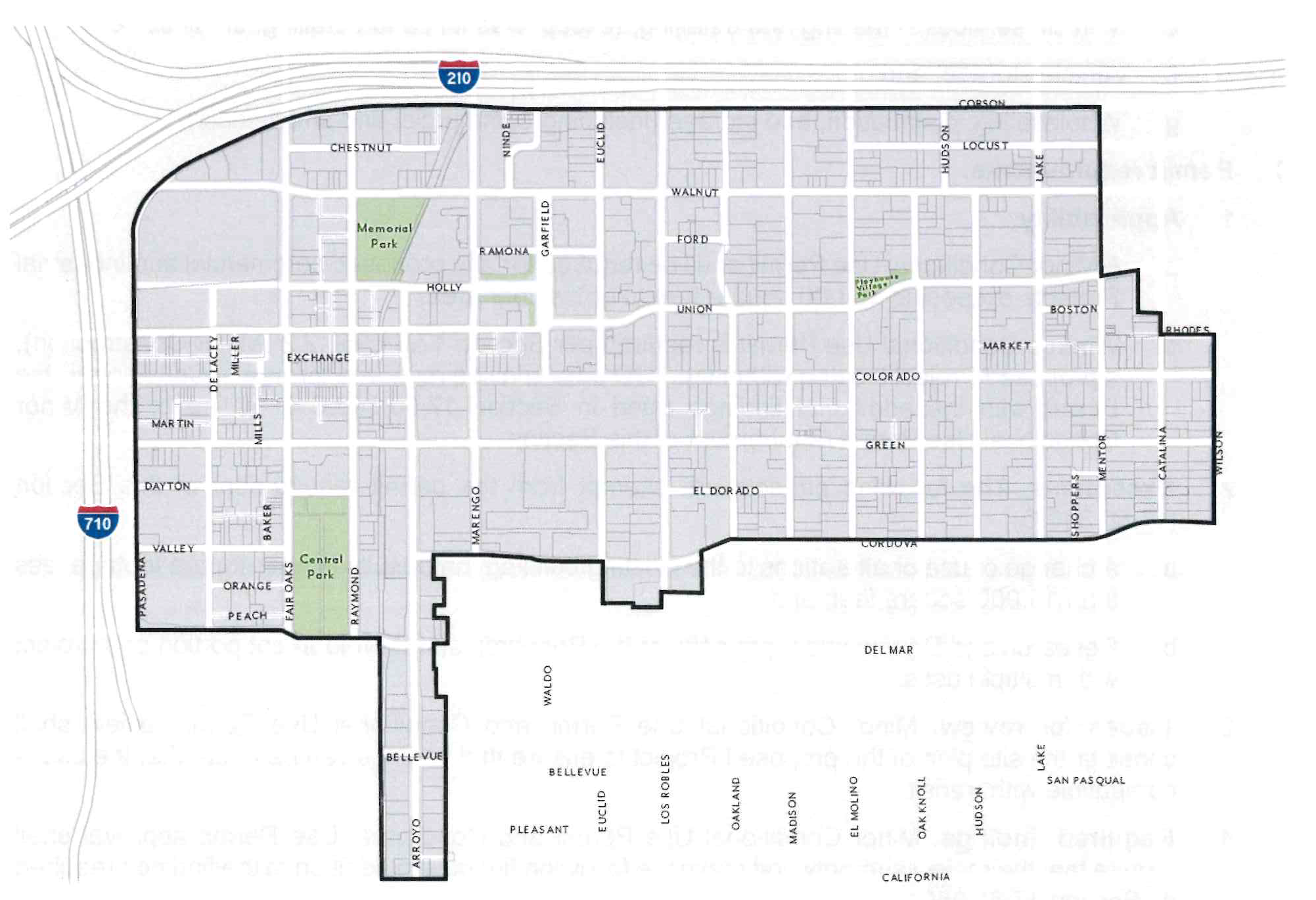
4.
When there is an overlap between TOD areas, the more restrictive standards of the respective TOD areas shall apply.
5.
Optional Half-Mile TOD Area.
a.
Projects located between 1,320 feet (quarter-mile) and 2,640 feet (half-mile) of a light-rail station platform may voluntarily make use of applicable TOD standards provided in this Section, unless:
(1)
The proposed Project is one of the prohibited land uses listed in Section 17.50.340.B; or
(2)
The proposed Project is located between 1,320 feet (quarter-mile) and 2,640 feet (half-mile) of the Sierra Madre Villa Gold Line station platform, where the optional half-mile TOD area shall not apply.
b.
If TOD standards are utilized, the Project must comply with all standards listed in this Section.
B.
Prohibited land uses.
1.
The following nontransit-oriented land uses, as these land uses are defined in Article 8 (Glossary of Technical Terms and Land Use Types), are prohibited within the designated TOD area as specified in Section 17.50.340.A.3:
a.
Drive-through businesses;
b.
Large recycling facilities;
c.
Vehicle services - sales and leasing; (except for sales and leasing - limited);
d.
Vehicle services - service stations;
e.
Vehicle services - washing and detailing; (except washing and detailing, small-scale);
f.
Vehicle storage; and
g.
Wholesaling, distribution, and storage (including commercial and small-scale).
C.
Permit requirements.
1.
Applicability.
a.
A Minor Conditional Use Permit shall be required for any proposed commercial and industrial Projects exceeding 15,000 square feet of gross floor area.
b.
When a Conditional Use Permit is required per Section 17.61.050.J.2 (Major Construction), a proposed Project located within the TOD area shall be reviewed through a Conditional Use Permit with the additional findings listed in Section 17.50.340.C.4, in lieu of the Minor Conditional Use Permit requirement of this Section.
2.
Exceptions. The following projects are exempt from the permit requirement of this Section (17.50.340.C):
a.
A change of use or alterations to the existing building that results in new square footage less than 15,000 square feet; and
b.
Research and Development projects, or the Research and Development portion of a project with multiple uses.
3.
Issues for review. Minor Conditional Use Permit and Conditional Use Permit review shall consider the site plan of the proposed Project to ensure that findings can be made that the use is compatible with transit.
4.
Required findings. Minor Conditional Use Permit and Conditional Use Permit approval shall require that the review authority first make the following findings in addition to the findings required by Section 17.61.050:
a.
The Project consists of a use, or mix of uses, that encourage transit use and is oriented toward the transit user.
b.
The Project is designed to enhance pedestrian access and/or other non-motor vehicle modes of transportation to public transit.
c.
The Project encourages pedestrian activity and/or other non-motor vehicle modes of transportation and reduces dependency on motor vehicles.
D.
Parking requirements.
1.
Nonresidential development Projects.
a.
Sierra Madre Villa Station TOD Area.
(1)
Office uses. For the uses Offices — Administrative, Business, Professional and Offices - Governmental, the minimum number of required off-street parking spaces shall be reduced by 25 percent, and this reduction shall be the maximum allowed number of parking spaces.
(2)
All other nonresidential uses. For all other nonresidential uses, the minimum number of required off-street parking spaces shall be reduced by 10 percent, and this reduction shall be the maximum allowed number of parking spaces.
b.
Allen, Lake, Memorial Park, Del Mar, and Fillmore Station TOD Areas and Central District Transit-Oriented Area.
(1)
Office uses. For the uses offices - administrative business professional and offices - governmental, the minimum number of required off-street parking shall be reduced by 25 percent, with an optional reduction up to 35 percent. The 25 percent reduction shall be the maximum allowed number of parking spaces.
(2)
All other nonresidential uses. For all other nonresidential uses, the minimum number of required off-street parking spaces shall be reduced by 10 percent, with an optional reduction up to 20 percent. The 10 percent reduction shall be the maximum allowed number of parking spaces.
c.
Further reduction with study. The parking requirements may be further reduced through a parking demand study and approval of a Minor Conditional Use Permit.
2.
Exceeding allowable parking requirements. A project site may exceed the maximum allowable parking requirements in compliance with the following conditions.
a.
Commercial Off-Street Parking. A site may exceed the maximum allowable number of parking spaces if the parking is approved to serve as Commercial Off-Street Parking. Approval of this parking shall require the granting of a Minor Conditional Use Permit in compliance with Section 17.61.050, and shall be subject to the following conditions:
(1)
All parking spaces in excess of the maximum allowable parking must be for public parking;
(2)
The site shall provide a minimum of 25 public parking spaces;
(3)
The site shall include pedestrian and automotive-oriented signs to advertise the availability and location of the public parking spaces on the property;
(4)
Public parking may not be located on more than two levels, and must be located in a contiguous manner starting on the ground floor;
(5)
Each public parking space shall have a sign noting that the parking space is available for public parking;
(6)
Parking facilities shall be designed to allow for automated operations unless a parking attendant can be assigned during public parking hours;
(7)
City shall be provided with monthly reports on monthly and transient usage;
(8)
The public parking spaces shall comply with Section 17.40.070 of the Zoning Code. At a minimum, the spaces shall be available from 7:00 a.m. to 10:00 p.m., Monday through Sunday;
(9)
If monthly passes are sold for the public parking spaces, sales shall not exceed 50 percent of the total public parking spaces;
(10)
Hourly, daily, monthly rates for the public spaces may not exceed the City's Old Pasadena public parking structures rates by more than 150 percent;
(11)
The parking area shall be managed to limit the use of public parking by tenants;
(12)
The City may post wayfinding signs directing motorists to the commercial public parking on the site; and
(13)
The City and/or other business districts may advertise the commercial public parking on site in written publications or on its website.
b.
Shared parking. A site may exceed the maximum allowable number of parking spaces if the parking is approved to serve as shared parking in compliance with Section 17.46.050.
c.
Joint parking. A site may exceed the maximum allowed number of parking spaces if the parking is approved to serve as joint parking.
(1)
Joint parking is a type of parking that is designed to serve uses on at least two different sites.
(2)
The joint parking provided shall not exceed the maximum required parking for the combined total parking requirements of the different individual sites.
d.
Sierra Madre Villa TOD Area. The maximum allowed parking requirements in Section 17.50.340.D may be increased through a parking demand study and approval of a Minor Conditional Use Permit, up to an amount that is consistent with the standards applicable to other areas outside of the TOD areas as specified by the Section 17.46.040.
e.
Existing Off-Street Parking Spaces. If a Project results in a condition where the number of existing off-street parking spaces is greater than the requirements for such development or uses established by this Section, the number of existing spaces in excess of the prescribed maximums may be maintained, but shall not be further exceeded except as allowed by the Section 17.50.340.D.2.
3.
Residential development Projects. The following requirements apply to multi-family residential and mixed-use development Projects proposing at least 48 dwelling units per acre.
a.
Sierra Madre Villa Station TOD Area.
(1)
Units less than 650 square feet. A limit of 1 space for each unit (no more or less); and
(2)
Units 650 square feet or more. A minimum of 1.5 spaces for each unit, to a maximum of 2 spaces per unit.
b.
Allen, Lake, Memorial Park, Del Mar, and Fillmore Station TOD Areas and Central District Transit-Oriented Area.
(1)
Units 1-bedroom or fewer. A limit of 1 parking space for each unit (no more or less); and
(2)
Units 2-bedrooms or more. A minimum of 1.5 parking spaces shall be required for each unit, to a maximum of 1.75 spaces per unit.
c.
The parking requirements may be further reduced through a parking demand study and approval of a Minor Conditional Use Permit in compliance with Section 17.61.050.
d.
City Permits for overnight parking shall not be allowed.
(1)
Up to one overnight street permit may be issued for each approved off-street parking space converted to an accessory dwelling unit or junior accessory dwelling unit in compliance with Section 17.50.275. In all other instances, City Permits for overnight parking on City streets shall not be issued for residential development Projects built in compliance with these regulations.
(2)
Residential tenants shall be advised of the unavailability of on-street overnight parking permits.
e.
Guest parking shall be provided as required by Table 4-6 (Off-Street Parking Space Requirements) of Section 17.46.040. The number of guest parking spaces provided shall not exceed the minimum number of guest parking spaces required by Table 4-6 of the Section 17.46.040.
4.
Modification. The Zoning Administrator may modify the required parking in a parking garage (including below grade and at or above grade garages) by allowing the total parking requirement to exceed or be reduced by five percent but not more than 10 spaces, only if it can be shown to the satisfaction of the Zoning Administrator that such modification is necessary to alleviate on-site limitations resulting from, but not limited to, the configuration of the parking garage and/or vehicle circulation.
E.
Development Projects within the CG zoning district.
1.
¼ mile of the Allen Street Station. For development Projects located within ¼ mile of the Allen Street Station, multi-family uses are conditionally permitted, shall contain a minimum of 50 dwelling units, and shall have a maximum allowable density of 48 units per acre. The Conditional Use Permit shall also establish the appropriate setbacks.
2.
Between ¼ and ½ mile of the Allen Street Station. For development Projects that are located between ¼ of a mile and ½ mile of the Allen Street Station that do not make use of applicable TOD standards as allowed by the Section 17.50.340.A.5, and require a Conditional Use Permit for a project over 25,000 square feet of gross floor area, the additional findings identified in Section 17.50.340.C.4., shall not be required, but shall be used to guide the review of the Project and the development of appropriate conditions.
3.
Further reductions. The parking requirements may be further reduced through a parking demand study and the issuance of a Minor Conditional Use Permit in compliance with Section 17.61.050.
(Ord. No. 7420, § 6, 4-15-2024; Ord. No. 7419, § 4, 2-26-2024; Ord. No. 7418, § 6, 2-26-2024; Ord. 7169 § 21, 2009; Ord. 7160 § 49, 2009; Ord. 7038 § 18, 2006; Ord. No. 7288, § 2, 11-21-2016)
17.50.350 - Urban Housing
A.
Applicability. The development standards of this Section shall apply to multi-family residential development projects utilizing a density greater than 48 dwelling units per acre located outside of a Residential zoning district or Specific Plan area.
B.
Density and height standards. The density and height standards for an urban housing development project shall be in compliance with the underlying zoning district.
C.
Setbacks required. In order to provide suitable amounts of air, light, and open space, the following setbacks shall be required:
1.
Front and corner side: In compliance with the underlying zoning district.
2.
Side and rear:
a.
Ten-foot minimum.
b.
Through the Design Review process, the side and rear setbacks may be reduced if the reduction results in a larger courtyard.
D.
Street entries required. Residential dwelling units located adjacent to the street shall have direct entries from the street.
E.
Open space required:
1.
A minimum of 30 percent of the net floor area of the structure shall be provided as open space.
2.
The minimum dimension of any open space shall be six feet in any direction. Private balconies, at-grade patios, rooftop gardens (including upper level terraces), and the portion of a front or corner side yard setback that is greater than the minimum requirement may be counted as open space.
3.
Not more than 35 percent of the total open space may be met by counting balconies.
4.
Planter balconies that are two feet or less in width shall not be counted as open space.
F.
Courtyard requirement. There shall be a ground-floor landscaped courtyard that shall be a minimum of 20 feet in any direction. Balconies may project up to four feet into the courtyard.
G.
Courtyard opening required.
1.
Opening required. For structures with 75 feet of street frontage or more, the street side of the structure shall have an opening into a landscaped courtyard.
2.
Minimum height of opening. This opening shall be a minimum of 50 percent of the overall height of the structure but not more than 25 feet.
3.
Minimum width of opening.
a.
The width of the opening shall be a minimum of 10 feet.
b.
If the depth of the structure opening is more than 30 feet, the minimum width of the opening shall be increased by one foot for every three feet of depth above 30 feet.
4.
Multiple frontages. For structures with multiple frontages, the Design Review process shall determine which frontages shall have an opening in compliance with Section 17.61.030.
5.
Gate transparency. Any gate placed across the courtyard opening shall have a minimum of 75 percent transparency.
6.
Modification through Design Review. The requirements of this Subsection may be modified through the Design Review process.
H.
Parking and Driveways.
1.
Location of parking.
a.
Parking areas shall be provided either at grade, semi-subterranean, or subterranean.
b.
Parking areas (e.g., provided at grade or semi-subterranean) shall not abut the front or corner side street elevations. Only completely subterranean parking facilities may be located within the front or corner side setbacks. All other parking areas shall be located behind the habitable living space required by Subparagraph c., immediately below.
c.
Each dwelling unit contiguous to a front or corner side street elevation shall have a habitable living space on the ground floor that is a minimum of 12 feet in depth, measured from the interior wall closest to the street.
2.
One space per unit on-site. For new development projects, parking shall be provided in compliance with Table 4-5 (Off-Street Parking Space Requirements — multi-family dwelling units) and there shall be a minimum of one off-street parking space for each residential unit located on the subject site.
3.
Guest parking required. Guest parking shall be provided for the residential units in compliance with Table 4-5 (Off-Street Parking Space Requirements — multi-family dwelling units).
4.
Other spaces may be located off-site. All other parking spaces designed to serve the residential units may be located off-site with a long-term parking lease agreement in compliance with Subsection 17.46.020 I. (Location and ownership).
5.
Distance requirements. Off-site parking for residential units shall meet the distance requirements for commercial customer/visitor spaces in compliance with Subsection 17.46.020.I (Location and ownership).
6.
Conversion of existing structures. Conversions of existing structures (including additions) may provide parking for residential units off-site as long as they meet the distance requirements and there is a long term parking lease agreement all in compliance with Subsection 17.46.020 I.(Location and ownership).
7.
Driveway location. Driveways shall be located not more than five feet from a side property line. The review authority (i.e., Design Commission, Planning Director) may modify the location of a driveway to preserve a street tree or tree located on the site.
I.
Landscaping required. All areas of the subject site not devoted to lot coverage, driveways, or walkways shall be properly landscaped and maintained in compliance with Chapter 17.44 (Landscaping).
J.
Balconies.
1.
Balconies may project no closer than six feet to an interior or rear property line and four feet into a front or corner side setback.
2.
Balconies shall have a minimum dimension of six feet in order to count as required open space.
3.
Balconies that are designed to project over the public right-of-way shall have prior approval from the Department of Public Works.
K.
Fences and walls.
1.
Fences and walls located along a street frontage are limited to four feet in height.
2.
Fences and walls located within rear and interior side setbacks are limited to six feet in height.
3.
Projects with rear and interior side yards located adjacent to commercial uses may have a fence or wall height up to eight feet.
4.
Fences located within front and corner side setbacks shall have a minimum of 50 percent transparency.
5.
Fence height shall be measure from the existing grade.
L.
Overnight parking permits not allowed.
1.
Up to one overnight street permit may be issued for each approved off-street parking space converted to an accessory dwelling unit or junior accessory dwelling unit in compliance with Section 17.50.275. In all other instances, City Permits for overnight parking on City streets shall not be issued for residential development projects built in compliance with this Section.
2.
Residential tenants shall be advised of the unavailability of on-street overnight parking permits.
M.
Urban noise levels.
1.
Residents of an urban housing development project shall be notified that they are living in an urban area and that the noise levels may be higher than in a typical residential area.
2.
The signature of the residents shall confirm receipt and understanding of this information.
N.
Loading and unloading of household goods. If the loading and unloading of furniture and household goods for residential dwelling units is to occur on the street, it shall be limited to the hours of 9:00 a.m. to 2:00 p.m. and 7:00 p.m. to 10:00 p.m. on weekdays and 9:00 a.m. to 10:00 p.m. on weekends.
(Ord. No. 7435, § 18, 10-28-2024; Ord. No. 7420, § 7, 4-15-2024; Ord. No. 7419, § 4, 2-26-2024; Ord. No. 7388, § 2(Exh. 1), 3-21-2022)
17.50.360 - Vehicle Sales and Repair Services
A.
Applicability. Vehicle repair, when it is the main use or is an accessory use to vehicle sales, shall meet the additional standards identified in this Section.
B.
Distance Requirement. In the CG-1 district, vehicle repair shall be located a minimum of 500 feet from another vehicle repair use. This requirement shall be measured from property line to property line.
C.
Lot size. In the CG-1 district, vehicle repair uses shall have a minimum lot size of 15,000 square feet.
D.
Maximum floor space. The floor space dedicated to vehicle repair shall be limited to a maximum of 40 percent of the lot area.
E.
Servicing of trucks and industrial equipment prohibited. No servicing of trucks in excess of one and one-half ton capacity or industrial equipment of any type or character shall be allowed.
F.
All repair activities located within an enclosed structure.
1.
All hydraulic hoists and pits, and all equipment for greasing, lubrication, and allowed repairs shall be enclosed entirely within a structure.
2.
All areas or structures used for vehicle repair shall be located or soundproofed to prevent annoyance or detriment to surrounding properties.
G.
Limited hours and days of operation.
1.
All vehicle/equipment repair uses and related activities shall be limited to between the hours of 7:00 a.m. and 7:00 p.m., Monday through Saturday.
2.
The hours of operation or allowed days shall not be modified through a Conditional Use Permit.
H.
Allowed on-site for repair only. Damaged or wrecked vehicles shall not be stored on-site for purposes other than repair.
I.
On-site parking requirements.
1.
In order to ensure that adequate parking is provided on-site and that the potential for parking in the public right-of-way is minimized, on-site parking shall be provided at a minimum ratio of four spaces per 1,000 square feet of gross floor area.
2.
Workstation/service bays used for the repair of vehicles shall not be credited toward meeting the on-site parking requirement.
3.
Queuing lanes to workstation/service bays shall not be credited toward meeting the on-site parking requirement.
J.
Parking only allowed on-site. All vehicles that are repaired and are waiting to be picked up by the owner of the vehicle shall be parked on-site and not in adjoining streets or alleys.
K.
Do not face abutting residential parcels. All new structures constructed for vehicle/equipment repair shall be constructed so that the entrances to individual workstation/service bays do not face abutting residential parcels or the public rights-of-way.
L.
Discarded vehicles and parts to be removed. All discarded vehicle parts or equipment, or permanently disabled, dismantled, or junked vehicles shall be removed from the premises within 30 days of arrival.
M.
Old tires to be stored in solid wall enclosure. Tires taken in on trade that have no more than salvage value shall be stored in a solid wall enclosure.
(Ord. 7160 § 50, 2009)
17.50.370 - Work/Live Units
A.
Applicability. This Section provides standards for work/live and artists lofts/studios, including the reuse of existing nonresidential structures to accommodate work/live opportunities. Work/live quarters are especially intended for the use and occupation of artisans, artists, and individuals practicing similar professions as well as their families. Where Article 3 (Specific Plan) is silent the requirements of this Chapter shall control; where the provisions of this Section conflict with an adopted Specific Plan, the Specific Plan shall control.
B.
Design standards.
1.
Floor area requirement.
a.
A work/live unit shall have a minimum floor area of least 1,250 square feet.
b.
The maximum size of the residential portion of the work/live unit shall be 30 percent of the unit or 400 square feet, whichever is less, in order to ensure that the residential portion remains an accessory to the primary commercial use.
c.
A ground-level work/live unit with street frontage shall devote the initial 25 feet of floor area depth to commercial activity.
2.
Unit access. Where there are multiple work/live units within a single structure, each unit shall be physically separated from other units and uses within the structure, and access to individual units shall be from a common open space, corridor, hallway, or other common access area.
3.
Internal integration of the work/live unit.
a.
There shall be direct access between the working and living spaces within the work/live unit.
b.
There shall be no separate entrance to the living space by a separate door. All access to the living space shall be from the working space.
c.
The working space shall not be leased separately from the living space; conversely the living space shall not be leased separately from the working space.
C.
Occupancy and employees.
1.
At least one full-time employee of business activity occupying the work/live unit shall also reside in the unit; conversely at least one of the persons living in the live portion shall work in the work portion.
2.
The business activity occupying the work/live unit may utilize nonresident employees, as necessary.
D.
Prohibited land uses. The following shall not be allowed in a work/live unit:
1.
Sexually oriented businesses;
2.
Motor vehicle maintenance and repair; and
3.
Welding and/or machining.
E.
Hazardous Materials. All uses with hazardous materials shall comply with the California Fire Codes and other applicable codes.
F.
Allowed uses. The uses in a work/live project are limited to those permitted by-right in the underlying zoning district.
G.
Compliance with City inspection program required.
1.
In order to ensure that a work/live unit continues to be operated as a bonafide work/live unit, all work/live units shall be subject to the City's quadrennial inspection program, if leased or rented, in compliance with Municipal Code Section 14.16.030.
2.
For a work/live unit that is owner-occupied or has been converted to a condominium, the units would be subject to the City's inspection program at the time each unit is resold.
H.
Business License required. The occupants of the work/live units shall maintain a valid City Business License in order to ensure that the primary use remains a commercial use.
I.
Inclusionary housing requirements. The construction of work/live units shall be subject to the inclusionary housing requirements of Section 17.42.040 (Inclusionary Unit Requirements).
J.
Environmental assessment required.
1.
Reuse of an existing structure shall require environmental assessment of the site.
2.
The written assessment report shall be submitted as part of the Conditional Use Permit application.
(Ord. No. 7435, § 18, 10-28-2024; Ord. No. 7388, § 2(Exh. 1), 3-21-2022; Ord. 7099, § 37, 2007)

