- DISTRICT REGULATIONS
Editor's note— Ord. No. 439, § 4, adopted March 26, 2012, amended the title of div. 3, from "R-2 Single Family and Two Family Residential District" to "R-2 Single-Family Residential District."
State Law reference— Mobile home commission act, MCL 125.2301 et seq.
The village is hereby divided into the following districts:
(Ord. No. 394, § 1.4, 7-14-2003)
(a)
Adopted by reference. The areas and boundaries of such districts noted in section 42-101 are hereby established to scale on a map entitled, "Zoning Map of the Village of Paw Paw," and referred to herein as the "zoning map." The zoning map, together with everything shown thereon, is hereby adopted by reference and declared to be a part of this chapter.
(b)
Amendment. Regardless of the existence of copies of the zoning map which may be made or published, the official zoning map shall be located at the village hall and shall be the final authority as to the current zoning status in the village. No amendment to this chapter that involves a change of a mapped zoning district, shall become effective until an entry has been made on the official zoning map. The official zoning map shall be identified by the signature of the president of the village council, and attested by the village clerk.
(Ord. No. 394, art. I, 7-14-2003)
When uncertainty exists as to the boundaries of districts as shown on the zoning map, the following rules shall apply:
(1)
Boundaries indicated as approximately following the centerlines of streets, highways, or alleys shall be construed to follow such centerlines.
(2)
Boundaries indicated as approximately following platted lot lines shall be construed to follow such lot lines.
(3)
Boundaries indicated as approximately following village boundaries shall be construed to follow village boundaries.
(4)
Boundaries indicated as approximately following property lines, section lines or other lines of a survey shall be construed to follow such chartered lines as of the effective date of the ordinance from which this chapter is derived, or affecting amendment.
(5)
Boundaries indicated as following railroads lines shall be construed to follow the centerline of the railroad right-of-way.
(6)
Boundaries indicated as parallel to or extensions of features indicated above, the building inspector shall interpret the district boundaries. Upon appeal, the board of zoning appeals reserves the right to over-ride the interpretation of the building inspector.
(Ord. No. 394, art. I, 7-14-2003)
When property not now in the village shall become annexed to the village, the existing zoning shall be retained for one year or until the planning commission shall have reviewed and recommended rezoning to the village council and the village acts upon the recommendation.
(Ord. No. 394, art. I, 7-14-2003)
The R-1 single-family residential zoning district is typically a single-family housing area. While most of the developed portion of the village is served by utilities, the low density status is designed to preserve those areas which have developed strictly as single-family detached units on separate lots. The dwelling unit density in the R-1 district shall still be at a sufficient scale to support utility system operation and maintenance costs.
(Ord. No. 394, § 2.1, 7-14-2003)
The following shall be principal permitted uses in the R-1 single-family residential district:
(1)
Single-family detached dwellings.
(2)
State licensed residential facilities as defined and required by Section 206 of Public Act No. 110 of 2006 (MCL 125.3206).
(3)
Publicly owned and operated parks, playfields, museums, libraries and other recreation facilities.
(4)
Public, parochial or private elementary, intermediate and/or high schools offering courses in general education, not operated for profit.
(5)
Home occupations in accordance with section 42-368.
(6)
Accessory buildings and uses customarily incidental to the above principal permitted uses.
(7)
Off-street parking in accordance with section 42-404.
(Ord. No. 394, § 2.2, 7-14-2003)
The following uses are subject to a special use permit in the R-1 district. All uses are subject to restrictions listed in article IV of this chapter.
(1)
Churches.
(2)
Bed and breakfast facilities.
(3)
Public utility buildings, telephone exchange buildings, electric transformer stations and substations, and gas regulator stations, but not including storage yards, when operating requirements necessitate locating within the district to serve the immediate vicinity, and such neighborhood.
(4)
Family and group day care homes.
(5)
Private roads and streets.
(6)
A handicapped ramp either permanently or temporarily attached to the dwelling, which encroaches into required yard requirements provided it is removed within 30 days after the documented need for such ramp has ceased.
(7)
Publicly owned buildings, including government facilities.
(Ord. No. 394, § 2.3, 7-14-2003; Ord. No. 457, §§ 4, 3-26-2017)
Area, height, bulk and placement requirements for the R-1 district, unless otherwise specified, are as provided in the schedule of regulations in article V of this chapter.
(Ord. No. 394, § 2.4, 7-14-2003)
(a)
The R-2 single-family residential district encompasses land primarily adjacent to the central business district, and some of the older localities of the village. The residential character of the R-2 district is mainly urban, single-family homes of earlier construction on small individual lots. Some of the older stately homes in the R-2 district are of particular vintage design.
(b)
On a limited basis, two-family homes are allowed within the R-2 district but are subject to special use permit with controls as to location, site and density. The basis for transition is the fact that because many of these older homes are larger and represent sizeable maintenance and energy costs for a single family, it is feared that restriction to single family use may foster inadequate maintenance, or even abandonment. The possible consequences can be a general appearance of blight, which (if allowed to proceed in a downward trend) can erode the social stability of any neighborhood, as well as adversely affect the appeal of the village core. Based upon the above, the R-2 district provides for limited conversions of older, larger single family homes on larger lots to two-family dwellings subject to compliance with the special use permit criteria and all applicable standards, and provided certain conditions for the health, safety and welfare of the neighborhood are met.
(Ord. No. 394, § 3.1, 7-14-2003; Ord. No. 439, § 4, 3-26-2012)
In the R-2 residential district, no uses shall be permitted unless otherwise specifically provided for in this chapter, except for the following uses:
(1)
Single-family detached dwellings.
(2)
State licensed residential facilities as defined and required by Section 206 of Public Act No. 110 of 2006 (MCL 125.3206).
(3)
Publicly owned and operated parks, playfields, museums, libraries and other recreation facilities.
(4)
Public, parochial or private elementary, intermediate and/or high schools offering courses in general education, not operated for a profit.
(5)
Accessory buildings and uses customarily incidental to the above principal permitted uses.
(6)
Off-street parking requirements in accordance with section 42-404.
(Ord. No. 394, § 3.2, 7-14-2003; Ord. No. 439, § 4, 3-26-2012)
The following uses are subject to a special use permit in the R-2 district. All uses are subject to restrictions listed in article IV of this chapter.
(1)
Churches.
(2)
Bed and breakfast facilities.
(3)
Public utility buildings, telephone exchange buildings, electric transformer stations and substations, and gas regulator stations, but not including storage yards, when operating requirements necessitate locating within the district to serve the immediate vicinity, and such use is not injurious to the surrounding neighborhood.
(4)
Family and group day care homes.
(5)
Private roads and streets.
(6)
Dwelling unit conversions for uses identified in subsections 42-142 (3), (4) or (5).
(7)
A handicapped ramp either permanently or temporarily attached to the dwelling which encroaches into required yards areas provided they are removed within 60 days after the documented need for such a ramp has ceased.
(8)
Home occupations in single-family dwellings and subject to the requirements listed in section 42-368.
(9)
Emergency/transitional residences.
(10)
Two-family dwellings on lots a minimum of 17,400 total square feet in area with 8,700 square feet per unit, subject to the following conditions and limitations:
a.
Compliance with section 42-401, Schedule of Regulations, including minimum floor area and maximum lot coverage requirements;
b.
Provision of adequate off-street parking in compliance with section 42-404;
c.
Compliance with the requirements for a special use permit set forth in section 42-366, including the submission and approval of a site plan.
(Ord. No. 394, § 3.3, 7-14-2003; Ord. No. 427, § 4, 4-7-2011; Ord. No. 439, § 4, 3-26-2012)
Area, height, bulk and placement requirements for the R-2 district, unless otherwise specified, are as provided in the schedule of regulations in article V of this chapter.
(Ord. No. 394, § 3.4, 7-14-2003)
The RM district is intended for lower density multiple-family residential uses (eight to 14 dwelling units per acre).
(Ord. No. 394, § 4.1, 7-14-2003)
In the RM district, no use shall be permitted unless otherwise provided in this chapter, except for the following:
(1)
Single-family detached dwellings.
(2)
Two-family and three-family dwellings.
(3)
Multiple-family dwellings.
(4)
State licensed residential facilities as defined and required by Section 206 of Public Act No. 110 of 2006 (MCL 125.3206).
(5)
Adult foster care facilities (medium and large) as regulated by the state.
(6)
Accessory buildings and uses customarily incidental to the above principal permitted uses.
(7)
Off-street parking and loading requirements in accordance with section 42-404.
(Ord. No. 394, § 4.2, 7-14-2003)
The following uses are subject to a special use permit in the RM district. All uses are subject to restrictions listed in article IV of this chapter.
(1)
All permitted uses subject to special use permit in the R-2 district.
(2)
Private clubs and lodges.
(3)
Convalescent and nursing homes.
(4)
Housing for the elderly.
(5)
Emergency/transitional residence.
(Ord. No. 394, § 4.3, 7-14-2003)
Area, height, bulk and placement requirements for the RM district, unless otherwise specified, are as provided in the schedule of regulations in article V of this chapter. For permitted uses and uses subject to a special use permit, a site plan shall be submitted in accordance with section 42-402.
(Ord. No. 394, § 4.4, 7-14-2003)
The RMH district is intended to house mobile home developments. Mobile home developments typically have a higher density impact than conventional single-family development. In order to avoid adverse impact upon other areas of the village, certain land areas are hereby recognized as appropriate for continued mobile home use provided that proper site design standards and requirements are met.
(Ord. No. 394, § 5.1, 7-14-2003)
In the RMH district, no use shall be permitted unless otherwise provided in this chapter, except for the following:
(1)
Mobile homes located in a mobile home park.
(2)
State licensed residential facilities as defined and required by Section 206 of Public Act No. 110 of 2006 (MCL 125.3206).
(3)
Mobile home parks.
(4)
Publicly owned and operated parks, playfields, museums, libraries and other recreation facilities.
(5)
Home occupations.
(6)
Accessory buildings and uses customarily incidental to the above principal permitted uses.
(7)
Off-street parking in accordance with section 42-404.
(Ord. No. 394, § 5.2, 7-14-2003)
The following uses are subject to a special use permit in the RMH district. All uses are subject to restrictions listed in article IV of this chapter.
(1)
Churches.
(2)
Nursery schools, day nurseries and child care centers
(Ord. No. 394, § 5.3, 7-14-2003)
Mobile home parks shall conform to the requirements as promulgated by the state mobile home commission rules as amended, and any other requirements of the state.
(Ord. No. 394, § 5.4, 7-14-2003)
Area, height, bulk and placement requirements for the RMH district, unless otherwise specified, are as provided in the schedule of regulations in article V of this chapter. For permitted uses and uses subject to a special use permit, a site plan shall be submitted in accordance with section 42-402.
(Ord. No. 394, § 5.5, 7-14-2003)
The B-1 local business district is intended to serve the convenience needs of neighborhood residents. The B-1 district typically does not contain comparison-shopping facilities or open-air businesses.
(Ord. No. 394, § 6.1, 7-14-2003)
In the B-1 district, no uses shall be permitted unless otherwise provided in this chapter except the following:
(1)
Museums and libraries.
(2)
Financial institutions.
(3)
Funeral parlors and mortuaries.
(4)
Barber and beauty shops.
(5)
Professional offices, except medical or dental clinics.
(6)
Retail shops and service establishments.
(7)
Public utilities.
(8)
Mixed commercial and residential uses.
(9)
Warehousing facilities, including mini-storage.
(10)
Accessory buildings and uses.
(11)
Off-street parking in accordance with the requirements of section 42-404.
(Ord. No. 394, § 6.2, 7-14-2003; Ord. No. 422, § 4, 3-22-2010)
The following uses are subject to a special use permit in the B-1 district. All uses are subject to restrictions listed in article IV of this chapter.
(1)
Medical or dental clinics.
(2)
Gasoline stations/fuel dispensing businesses.
(3)
Commercial and service establishments of an adult nature as defined herein and subject to the following conditions:
a.
In order to prevent an undesirable concentration of such uses and activities, such uses and activities shall not be located within 1,000 feet of two other such uses nor within 300 feet of any residentially zoned district as measured along a line forming the shortest distance between any portion of the respective properties of the following existing and proposed specified uses and activities and between such uses and the adjoining residentially zoned district.
1.
Adult book store;
2.
Adult motion picture theater;
3.
Adult mini motion picture theater;
4.
Adult smoking or sexual paraphernalia store;
5.
Massage parlor;
6.
Host or hostess establishments offering socialization with a host or hostess for consideration;
7.
Open dance hall;
8.
Pawnshop;
9.
Tavern or cabaret providing live or projected entertainment where intoxicating liquors may or may not be sold for consumption on the premises. The term "projected entertainment" shall not include standard television reception;
10.
Any combination of the foregoing.
b.
The village council may waive the foregoing spacing requirements if it finds the following conditions exist:
1.
The proposed use will not be contrary to the public interests or injurious to nearby properties in the proposed location and the spirit and intent of the purpose of the spacing regulations will still be observed; and
2.
The proposed use will not enhance or promote a deleterious effect upon adjacent areas through causing or encouraging blight, a chilling effect upon other businesses and occupants and a disruption in neighborhood development.
(4)
Churches.
(Ord. No. 394, § 6.3, 7-14-2003; Ord. No. 420, § 4, 7-13-2009)
Area, height, bulk and placement requirements for the B-1 district, unless otherwise specified, are as provided in the schedule of regulations in article V of this chapter. For permitted uses and uses subject to a special use permit, a site plan shall be submitted in accordance with section 42-402.
(Ord. No. 394, § 6.4, 7-14-2003)
(a)
A visual or physical break in the exterior face of the wall (for depth and/or dimension) shall be provided every 20 feet in length of the building wall. Elevation drawings shall be provided to demonstrate compliance.
(b)
At least 30 percent of the façade (front) of the first story shall be windows.
(c)
In the case of a corner lot, the building shall face the primary commercial street abutting the lot and/or be oriented on the site similar to adjacent buildings.
(Ord. No. 440, § 4, 3-26-2012)
The B-2 general business district is intended to serve the commercial needs of the residents of the greater village area as well as the passing motorist. It is characterized by businesses with large lot requirements, extended hours and major thoroughfare locations.
(Ord. No. 394, § 7.1, 7-14-2003)
In the B-2 business districts, no uses shall be permitted unless otherwise provided in this chapter, except the following:
(1)
All principal permitted uses in the B-1 local business district.
(2)
Combined retail-wholesale businesses, including minor assembly of merchandise or modification of articles, when conducted entirely within an enclosed building(s) and determined not to be objectionable to the surrounding commercial area.
(3)
Personal service establishments, including health spas.
(4)
Financial institutions, general and professional offices, not including medical and dental clinics.
(5)
Restaurants, not including a drive-in restaurant or drive-through restaurant.
(6)
Museums, libraries and art galleries.
(7)
Dry cleaning and laundry establishments not including central drycleaning or laundry plants.
(8)
Wineries, fruit juices processing and private cold storage, distilleries, lumber yards/home improvements stores.
(9)
Hotels and motels.
(10)
Accessory buildings and uses customarily incidental to the above principal permitted uses.
(11)
Off-street parking in accordance with the requirements in section 42-404.
(12)
Outdoor display of merchandise as an accessory use to the principal use of the parcel.
(Ord. No. 394, § 7.2, 7-14-2003; Ord. No. 422, § 4, 3-22-2010; Ord. No. 424, § 4, 9-27-2010; Ord. No. 463, § 4, 3-12-2018; Ord. No. 480, § 5, 8-10-2020)
The following uses are subject to a special use permit in the B-2 district. All uses are subject to restrictions listed in article IV of this chapter.
(1)
Drive-in restaurants and drive-through restaurants.
(2)
Car wash establishments.
(3)
Open-air businesses.
(4)
Medical or dental clinics.
(5)
Gasoline/fuel dispensing businesses, with or without convenience store, carwash, restaurant or similar uses.
(6)
Indoor or outdoor commercial recreation facility such as a bowling center, theater, skating rink, racquet club, miniature golf, video amusement establishment, pool and billiard establishment or similar uses.
(7)
An area used for display, sale or rental of new and used motor vehicles, boats, trailers or similar equipment.
(8)
Automotive repair, major or minor.
(9)
Pet sales store.
(10)
Veterinary hospital or clinic.
(11)
Churches.
(12)
Farmers' market.
(13)
Outdoor storage in connection with the principal use(s) located on the site pursuant to sections 42-222 and 42-223 may be allowed subject to the following:
a.
Outdoor storage shall be allowed only in the side and rear yard areas and may not be located within any required side or rear building setback.
b.
The total area of outdoor storage shall not exceed 30 percent of the footprint of the principal building(s) located upon the premises.
c.
An outdoor storage area shall be visually screened from persons standing at ground level on all abutting property. Required screening shall comply with section 42-405(b).
(Ord. No. 394, § 7.3, 7-14-2003; Ord. No. 420, § 4, 7-13-2009; Ord. No. 451, § 6, 8-10-2015; Ord. No. 463, § 4, 3-12-2018; Ord. No. 465, § 3, 12-10-2018; Ord. No. 480, § 6, 8-10-2020)
Area, height, bulk and placement requirements for the B-2 district, unless otherwise specified, are as provided in the schedule of regulations in article V of this chapter. For all permitted uses and uses subject to a special use permit, a site plan shall be submitted in accordance with section 42-402.
(Ord. No. 394, § 7.4, 7-14-2003)
(a)
A visual or physical break in the exterior face of the wall (for depth and/or dimension) shall be provided every 20 feet in length of the building wall. Elevation drawings shall be provided to demonstrate compliance.
Exception: For buildings over 30,000 square feet in area with walls over 100 feet in length, a visual or physical break in the exterior face of the wall (for depth and/or dimension) shall be provided every 60 feet in length of the building wall. Elevation drawings shall be provided to demonstrate compliance.
(b)
At least 30 percent of the façade (front) of the first story shall be windows.
Exception: For buildings over 30,000 square feet in area with walls over 100 feet in length, the façade must instead contain a prominent entry incorporating glass, changes in materials and/or colors, and changes in roofline. Elevation drawings shall be provided to demonstrate compliance.
(c)
The planning commission may authorize a deviation from the standards set forth in dubsections (a) and (b) above where it is determined that the alternate design(s) meets the purpose and intent of said subsections.
(d)
In the case of a corner lot, the building shall face the primary commercial street abutting the lot and/or be oriented on the site similar to adjacent buildings.
(Ord. No. 440, § 4, 3-26-2012)
The CBD central business district is intended to permit a variety of commercial, administrative, financial, civic, cultural, residential, entertainment and recreational uses in an effort to provide the harmonious mix of activities necessary to further enhance the central business district as a commercial and service center.
(Ord. No. 394, § 8.1, 7-14-2003)
The following are principal permitted uses in the CBD district:
(1)
Any retail business whose principal activity is the sale or rental of merchandise within a completely enclosed building, and combined retail-wholesale business when conducted entirely within a building.
(2)
Personal service establishments, including health/fitness centers, beauty and barber shops and similar uses.
(3)
Financial institutions and general and professional offices including medical and dental offices but not clinics.
(4)
Restaurants and taverns, including sidewalk and outdoor cafes, but not including drive-in restaurants or drive-through restaurants.
(5)
Museums, art galleries and similar cultural uses.
(6)
Theaters and concert halls.
(7)
Mixed use establishments, i.e. commercial and residential uses combined in one structure.
(8)
Funeral homes and mortuaries.
(9)
Other uses which are similar to the above and subject to the following restrictions:
a.
All business establishments shall be retail or service establishments dealing directly with consumers. All goods produced on the premises shall be sold at retail from premises where produced.
b.
All business, servicing or processing except for off-street parking or loading, shall be conducted within completely enclosed buildings.
c.
Storage of commodities shall be within buildings and shall not be visible to the public from a street or thoroughfare.
(10)
Accessory buildings and uses customarily incidental to the above principal permitted uses.
(11)
Off-street parking lots shall be in accordance with the requirements of section 42-404.
(12)
Pool or billiard halls, or pinball or video game arcades or establishments.
(13)
Public and/or municipal buildings.
(14)
Outdoor display of merchandise as an accessory use to the principal use of the parcel.
(Ord. No. 394, § 8.2, 7-14-2003; Ord. No. 463, § 4, 3-12-2018; Ord. No. 475, § 3, 10-14-2019; Ord. No. 480, § 7, 8-10-2020)
The following uses are subject to a special use permit in the CBD district. All uses are subject to restrictions listed in article IV of this chapter.
(1)
Housing for the elderly.
(2)
Sales of new and used cars, boats, campers and other recreational vehicles.
(3)
Churches.
(4)
Hotels and motels.
(5)
Establishments offering live entertainment not otherwise described in division 6 of this article, including musical entertainment and similar general entertainment uses.
(6)
Pet sales stores.
(7)
Farmers' market.
(Ord. No. 394, § 8.3, 7-14-2003; Ord. No. 451, § 7, 8-10-2015)
Area, height, bulk and placement requirements for the CBD district, unless otherwise specified, are as provided in the schedule of regulations in article V of this chapter. For permitted uses and uses subject to a special use permit that will alter the area of any structure or require a change in parking, access or drainage on the property, a site plan shall be submitted in accordance with section 42-402.
(Ord. No. 394, § 8.4, 7-14-2003)
(a)
A visual or physical break in the exterior face of the wall (for depth and/or dimension) shall be provided every 20 feet in length of the building wall. Elevation drawings shall be provided to demonstrate compliance.
(b)
At least 30 percent of the façade (front) of the first story shall be windows. Upper stories shall include windows consistent in design and general appearance with adjacent buildings.
(c)
In the case of a corner lot, the building shall face the primary commercial street abutting the lot and/or be oriented on the site similar to adjacent buildings.
(d)
Infill, reconstruction or new development which connects building on either or both sides shall be consistent in design, general appearance, and use of materials with adjacent buildings.
(Ord. No. 440, § 4, 3-26-2012)
Editor's note— Ord. No. 449, § 4, adopted Dec. 22, 2014, set out provisions intended for use as §§ 42-251—42-259. For purposes of classification, and at the editor's discretion, these provisions have been included as Subdivision A, Form Based Codes Overlay, §§ 42-251—42-259.
The P parking zoning district is intended to provide vehicular parking facilities that are associated with business or industrial districts. Such facilities are effective as buffer zones between such districts and residential districts.
(Ord. No. 394, § 9.1, 7-14-2003)
In the P district, no uses shall be permitted unless otherwise provided in this chapter, except the following: Premises in this district shall be used only for vehicular parking areas subject to all regulations hereinafter provided.
(Ord. No. 394, § 9.2, 7-14-2003)
Limitation of uses in the P district shall be as follows:
(1)
Parking areas shall be used for parking of private passenger vehicles only.
(2)
Parking may be with or without charge.
(3)
No business involving the repair of vehicles or services to vehicles permitted thereon or sale, or other storage, or display thereof, shall be conducted from or upon such premises.
(4)
All P districts shall be contiguous to a business district or industrial district; provided, however, that there may be a private drive, public alley or public street between such P district and such business or industrial district.
(5)
No sign shall be erected or placed on the premises except that not more than one directional sign at each point of ingress and egress may be erected or placed. Such signs may also contain information on parking price and duration and shall not exceed 12 square feet in area nor 15 in height.
(6)
Construction, lighting and screening requirements shall be in accordance with sections 42-404 and 42-405.
(7)
Every such parking area shall be surfaced with an asphalt, concrete or similar durable and dustless surface, and shall be graded and drained to dispose of all surface water to the nearest adjoining street and away from adjoining street and away from adjoining properties. Screening shall be provided per the requirements of this chapter.
(Ord. No. 394, § 9.3, 7-14-2003)
The following uses are subject to a special use permit in the P district.
(1)
Single-family dwellings.
(2)
Two-family dwellings.
(3)
Parking structures.
(Ord. No. 394, § 9.4, 7-14-2003)
Area, height, bulk and placement requirements for the P district, unless otherwise specified, are as provided in the schedule of regulations in article V of this chapter. For permitted uses and uses subject to a special use permit, a site plan shall be submitted in accordance with section 42-402.
(Ord. No. 394, § 9.5, 7-14-2003)
The RO restricted office zoning district is intended to accommodate various types of office uses performing administrative, professional and personal services. These uses can serve as a transitional use between more intensive land uses such as commercial districts or major thoroughfares and less intensive land uses such as single- and two-family districts. The RO district is also intended to allow for users that do not generate large volumes of traffic, traffic congestion or parking problems.
(Ord. No. 394, § 10.1, 7-14-2003)
In the RO district, no uses shall be permitted unless otherwise provided in this chapter except the following:
(1)
Two-family and three-family dwellings.
(2)
Office buildings and uses when goods or wares are not commercially created, exchanged or sold.
(3)
Public utility buildings but not including storage yards.
(4)
Business and private schools operated for a profit completely within an enclosed building.
(5)
Photographic studios.
(6)
Funeral homes and mortuaries.
(7)
Insurance offices, brokerage houses and real estate offices.
(8)
Accessory buildings and uses customarily incidental to the above principal permitted uses.
(9)
Off-street parking and loading in accordance with the requirements of article V of this chapter.
(10)
Museums, libraries, and art galleries.
(11)
Public and/or municipal buildings.
(Ord. No. 394, § 10.2, 7-14-2003; Ord. No. 434, § 4, 6-27-2011; Ord. No. 475, § 3, 10-14-2019)
The following uses are subject to a special use permit in the RO district. All uses are subject to restrictions listed in article IV of this chapter.
(1)
Commercial child care centers.
(2)
Office complexes (two or more structures).
(3)
Medical or dental clinics.
(4)
Pharmacy or apothecary ships; stores limited to corrective garments or bandages, optical stores or restaurants provided, however, they are located within the building to which they are an accessory and do not have a direct outside entrance for customer use.
(5)
Private service clubs, fraternal organizations and lodge halls.
(6)
Hospitals.
(7)
Personal service establishments.
(Ord. No. 394, § 10.3, 7-14-2003)
Area, height, bulk and placement requirements for the R-1 district, unless otherwise specified, are as provided in the schedule of regulations in article V of this chapter. For permitted use and use subject to a special use permit, a site plan shall be submitted in accordance with article V of this chapter.
(Ord. No. 394, § 10.4, 7-14-2003)
The purpose of the I-1 district is to establish a zone where designated industrial and commercial businesses may locate and intermingle, which produce a minimum amount of adverse effect on adjoining premises, are compatible with one another, and do not require large land or building areas for operation nor large yard areas for isolation or protection from adjoining premises or activities.
(Ord. No. 394, § 11.1, 7-14-2003)
In the I-1 district, no uses shall be permitted, unless otherwise provided in this chapter, except the following:
(1)
Wholesale and warehousing. The sale at wholesale or warehousing of automotive equipment, alcoholic beverages, dry goods and apparel, groceries and related products, raw farm products except livestock, electrical goods, hardware, plumbing, heating equipment and supplies, machinery and equipment, tobacco and tobacco products, paper and paper products, furniture and home furnishings, and any commodity the manufacture of which is permitted in this district, and truck terminals.
(2)
Testing and research laboratories.
(3)
Tool and die shops.
(4)
Facilities for the printing or forming of box, carton and cardboard products.
(5)
Electric transformer stations and substations, electric transmission towers, gas regulators and municipal utility pumping stations.
(6)
Indoor tennis, paddleball, or racquetball courts.
(7)
Bakeries.
(8)
Cold storage plants.
(9)
Bottling works, including milk bottling or distribution stations.
(10)
Manufacture of food products.
(11)
Tin shops or plumbing supply shops.
(12)
Coal or building materials storage yards.
(13)
Kennels.
(14)
Veterinary hospitals or clinics.
(15)
Contractors' storage yards.
(16)
Automobile storage and parking.
(17)
Accessory buildings and uses customarily incidental to the above principal permitted uses.
(18)
Off-street parking in accordance with article IV of this chapter.
(19)
Other uses similar to but not more objectionable than uses permitted in this district.
(20)
Public and/or municipal buildings.
(21)
Indoor or outdoor commercial recreation facility such as a bowling center, theater, skating rink, racquet club, miniature golf, video amusement establishment, pool and billiard establishment or similar uses.
(Ord. No. 394, § 11.2, 7-14-2003; Ord. No. 475, § 3, 10-14-2019; Ord. No. 480, § 8, 8-10-2020)
The following uses are subject to a special use permit in the I-1 district. All uses are subject to restrictions listed in article IV of this chapter.
(1)
Planned industrial parks.
(2)
Public garages, motor vehicle repair shops, automobile paint and bump shops or car washing establishments.
(3)
Telecommunications towers, per this chapter.
(4)
Hospitals.
(5)
Medical and dental clinics.
(6)
Open-air businesses.
(Ord. No. 394, § 11.3, 7-14-2003; Ord. No. 405, 7-11-2005; Ord. No. 480, § 9, 8-10-2020)
Area, height, bulk and placement requirements for the I-1 district, unless otherwise specified, are as provided in the schedule of regulations in article V of this chapter. Any use permitted in the I-1 district must comply with applicable county and state health and pollution laws and federal regulations. For all permitted uses and uses permitted by special use permit, a site plan shall be submitted in accordance with section 42-402.
(Ord. No. 394, § 11.4, 7-14-2003)
The RO restricted office zoning district is intended to accommodate various types of office uses performing administrative, professional and personal services. These uses can serve as a transitional use between more intensive land uses such as commercial districts or major thoroughfares and less intensive land uses such as single- and two-family districts. The RO district is also intended to allow for users that do not generate large volumes of traffic, traffic congestion or parking problems.
(Ord. No. 394, § 10.1, 7-14-2003)
In the RO district, no uses shall be permitted unless otherwise provided in this chapter except the following:
(1)
Two-family and three-family dwellings.
(2)
Office buildings and uses when goods or wares are not commercially created, exchanged or sold.
(3)
Public utility buildings but not including storage yards.
(4)
Business and private schools operated for a profit completely within an enclosed building.
(5)
Photographic studios.
(6)
Funeral homes and mortuaries.
(7)
Insurance offices, brokerage houses and real estate offices.
(8)
Accessory buildings and uses customarily incidental to the above principal permitted uses.
(9)
Off-street parking and loading in accordance with the requirements of article V of this chapter.
(10)
Museums, libraries, and art galleries.
(11)
Public and/or municipal buildings.
(Ord. No. 394, § 10.2, 7-14-2003; Ord. No. 434, § 4, 6-27-2011; Ord. No. 475, § 3, 10-14-2019)
The following uses are subject to a special use permit in the RO district. All uses are subject to restrictions listed in article IV of this chapter.
(1)
Commercial child care centers.
(2)
Office complexes (two or more structures).
(3)
Medical or dental clinics.
(4)
Pharmacy or apothecary ships; stores limited to corrective garments or bandages, optical stores or restaurants provided, however, they are located within the building to which they are an accessory and do not have a direct outside entrance for customer use.
(5)
Private service clubs, fraternal organizations and lodge halls.
(6)
Hospitals.
(7)
Personal service establishments.
(Ord. No. 394, § 10.3, 7-14-2003)
Area, height, bulk and placement requirements for the R-1 district, unless otherwise specified, are as provided in the schedule of regulations in article V of this chapter. For permitted use and use subject to a special use permit, a site plan shall be submitted in accordance with article V of this chapter.
(Ord. No. 394, § 10.4, 7-14-2003)
The purpose of the I-1 district is to establish a zone where designated industrial and commercial businesses may locate and intermingle, which produce a minimum amount of adverse effect on adjoining premises, are compatible with one another, and do not require large land or building areas for operation nor large yard areas for isolation or protection from adjoining premises or activities.
(Ord. No. 394, § 11.1, 7-14-2003)
In the I-1 district, no uses shall be permitted, unless otherwise provided in this chapter, except the following:
(1)
Wholesale and warehousing. The sale at wholesale or warehousing of automotive equipment, alcoholic beverages, dry goods and apparel, groceries and related products, raw farm products except livestock, electrical goods, hardware, plumbing, heating equipment and supplies, machinery and equipment, tobacco and tobacco products, paper and paper products, furniture and home furnishings, and any commodity the manufacture of which is permitted in this district, and truck terminals.
(2)
Testing and research laboratories.
(3)
Tool and die shops.
(4)
Facilities for the printing or forming of box, carton and cardboard products.
(5)
Electric transformer stations and substations, electric transmission towers, gas regulators and municipal utility pumping stations.
(6)
Indoor tennis, paddleball, or racquetball courts.
(7)
Bakeries.
(8)
Cold storage plants.
(9)
Bottling works, including milk bottling or distribution stations.
(10)
Manufacture of food products.
(11)
Tin shops or plumbing supply shops.
(12)
Coal or building materials storage yards.
(13)
Kennels.
(14)
Veterinary hospitals or clinics.
(15)
Contractors' storage yards.
(16)
Automobile storage and parking.
(17)
Accessory buildings and uses customarily incidental to the above principal permitted uses.
(18)
Off-street parking in accordance with article IV of this chapter.
(19)
Other uses similar to but not more objectionable than uses permitted in this district.
(20)
Public and/or municipal buildings.
(21)
Indoor or outdoor commercial recreation facility such as a bowling center, theater, skating rink, racquet club, miniature golf, video amusement establishment, pool and billiard establishment or similar uses.
(Ord. No. 394, § 11.2, 7-14-2003; Ord. No. 475, § 3, 10-14-2019; Ord. No. 480, § 8, 8-10-2020)
The following uses are subject to a special use permit in the I-1 district. All uses are subject to restrictions listed in article IV of this chapter.
(1)
Planned industrial parks.
(2)
Public garages, motor vehicle repair shops, automobile paint and bump shops or car washing establishments.
(3)
Telecommunications towers, per this chapter.
(4)
Hospitals.
(5)
Medical and dental clinics.
(6)
Open-air businesses.
(Ord. No. 394, § 11.3, 7-14-2003; Ord. No. 405, 7-11-2005; Ord. No. 480, § 9, 8-10-2020)
Area, height, bulk and placement requirements for the I-1 district, unless otherwise specified, are as provided in the schedule of regulations in article V of this chapter. Any use permitted in the I-1 district must comply with applicable county and state health and pollution laws and federal regulations. For all permitted uses and uses permitted by special use permit, a site plan shall be submitted in accordance with section 42-402.
(Ord. No. 394, § 11.4, 7-14-2003)
The purpose of the I-2 district is to provide areas where heavier types of industry may best utilize essential public and private facilities and utilities while minimizing the negative impacts typically associated with this kind of industry.
(Ord. No. 394, § 12.1, 7-14-2003)
Principal permitted uses in the I-2 district shall be as follows:
(1)
All permitted uses in the I-1 district.
(2)
Establishments which assemble and manufacture automobiles, automobile bodies, parts and accessories, electrical fixtures, batteries and other electrical apparatus and hardware.
(3)
Establishments that process, refine or store food and foodstuffs.
(4)
Breweries, wineries, bump shops, distilleries, machine shops, metal buffing shops, plastering and polishing shops, metal and plastic molding shops, extrusion shops, lumber and planing mills, painting and sheet metal shops, undercoating and rust proofing shops and welding shops.
(5)
Municipal sewage treatment plants.
(6)
Truck terminals.
(7)
Bulk storage of gasoline, fuel oil, fuel gas, propane, kerosene, diesel fuel or any flammable liquid.
(8)
Any uses similar to and not more objectionable than the above.
(9)
Accessory buildings and uses customarily incidental to the above principal permitted uses.
(10)
Off-street parking in accordance with section 42-404.
(Ord. No. 394, § 12.2, 7-14-2003)
The following uses are subject to a special use permit in the I-2 district. All uses are subject to restrictions listed in article IV of this chapter.
(1)
Automobile disposal and junkyards.
(2)
Central dry cleaning plants and laundries.
(3)
Open-air businesses.
(Ord. No. 394, § 12.3, 7-14-2003; Ord. No. 480, § 10, 8-10-2020)
All storage of building, contracting, or plumbing materials, sand, gravel, stone, lumber, equipment, and other supplies in the I-2 district, shall be located within an area not closer than 150 feet from any street right-of-way line. The storage of lumber, coal, or other combustible material in the I-2 district shall not be less than 20 feet from any interior lot line, and a roadway shall be provided, graded, surfaced, and maintained from the street to the rear of the property to permit free access of fire trucks at any time. All such open storage shall be screened from all streets, and on all sides which abut any residential or business district, by a solid six-foot wall or fence sufficient to serve as a permanent retaining wall or fence.
(Ord. No. 394, § 12.4, 7-14-2003)
Before the issuance of any building or occupancy permit in the I-2 district, the applicant shall sign an agreement that the use of the property will meet the following performance standards, or that any violation of these standards in subsequent operations will be corrected, the costs of inspection by experts for compliance to be borne by the applicant:
(1)
Fire and explosion hazards. All activities in the I-2 district shall be carried on only in buildings conforming to the single state construction code, and the operation shall be carried on in such a manner and with such precaution against fire and explosion hazards as to produce no explosion hazards to a use on an adjacent property as determined by the state. Flammable liquids other than fuels used for heating shall be stored in an entirely closed building which shall be used for no other purpose, or in underground tanks provided:
a.
Said storage building is not closer than 100 feet to any building occupied by one or more humans.
b.
Every factory or manufacturing building or other building permitted only in the industrial area shall be equipped with automatic sprinklers or other automatic fire extinguishers approved by the building inspector and the chief of the fire department as being sufficient in view of the nature and extent of the fire risk.
(2)
Smoke, fumes, gases, dust, odors. There shall be no emission of any smoke, atomic radiation, fumes, gas, dust, odors or any other atmospheric pollutant which will disseminate beyond the boundaries of the lot occupied by such use in such a manner as to create a public nuisance.
(3)
Liquid or solid waste. The discharge of untreated industrial waste into a reservoir, pond, lake or stream is prohibited. All methods of sewerage and industrial waste treatment and disposal shall be approved by the county health department and the state department of environmental quality.
(4)
Vibration. There shall be no vibration that is discernible to the human sense of feeling beyond the immediate site on which such use is conducted.
(5)
Noise. There shall be no noise emanating from the operation that will be more audible beyond the boundaries of the immediate site than 80 decibels.
(6)
Glare. There shall be no direct or sky-reflected glare exceeding 1.5 footcandles or which would be damaging to the human eye measured at the property line of the lot occupied by such use. This regulation shall not apply to lights used at the entrances or exits of service drives leading to a parking lot.
(Ord. No. 394, § 12.5, 7-14-2003)
Area, height, bulk and placement requirements for the I-2 district, unless otherwise specified, are as provided in the schedule of regulations in article V of this chapter. For all permitted uses and uses permitted subject to a special use permit, a site plan shall be submitted in accordance with section 42-402.
(Ord. No. 394, § 12.6, 7-14-2003)
The purposes of this district are to:
(1)
Permit greater flexibility in the regulation of land and encourage creative and imaginative design in development through the use of planned unit development legislation, as authorized by the Michigan Zoning Act (Public Act 110 of 2006, as amended).
(2)
Provide for a harmonious mixture of varied housing choices with the integration of small-scale, specialty retail/service establishments, civic and cultural facilities, and recreational opportunities.
(3)
Provide for pedestrian-friendly building and street design; common parking arrangements; active streetscapes; and, waterfront conservation design elements.
(4)
Provide useful and desirable open space along the waterfront as an integral part of the development;
(5)
Provide functional connectivity to the downtown through area-wide pedestrian routes and recreational assets.
(6)
Provide for redevelopment that facilitates the enhancement of the Kalamazoo Street corridor as a gateway into the community.
(7)
Further the vision and redevelopment strategies set forth in the Village Revitalization Area Subarea Plan of the Village of Paw Paw Master Plan.
(Ord. No. 453, § 4, 8-10-2015)
The PUD district is intended to apply to the area encompassed by the Village Revitalization Area Subarea Plan set forth in the Village of Paw Paw Master Plan.
The PUD district is designed to accomplish the overall land use pattern, building form, street system, and arrangement of open space networks envisioned by the Subarea Plan.
(Ord. No. 453, § 4, 8-10-2015)
(a)
Permitted Uses:
(1)
Single family, two-family, and multiple-family dwellings.
(2)
Nonresidential uses of an educational, cultural, or recreational character.
(3)
Retail shops and service establishments, including restaurants.
(4)
Professional office, such as legal, financial, medical and similar or allied profession.
(5)
Community center, conference center, performing arts/cultural center.
(6)
Mixed use establishment, allowing both permitted residential and nonresidential uses in the same building.
(7)
Housing for the elderly.
(8)
Home occupation.
(9)
State licensed residential facilities as defined and required by Section 206 of Public Act No 110 of 2006, as amended.
(10)
Family day care home.
(11)
Foster care (small group) facility.
(12)
Publicly owned and operated parks and recreational facilities.
(13)
Accessory uses or buildings customarily incidental to the above principal uses.
(14)
Public and/or municipal buildings.
(15)
Outdoor display of merchandise as an accessory use to the principal use of the parcel.
(b)
Special land uses:
(1)
Outdoor sales or outdoor activity accessory to a principal use.
(2)
Farmers' market.
(3)
Breweries, wineries, and distilleries.
(4)
Assembly of finished or semi-finished products; packaging of previously prepared material; and processing or compounding of commodities such as drugs, cosmetics, and food products when established within a building existing as of (date of adoption of PUD district).
(Ord. No. 453, § 4, 8-10-2015; Ord. No. 475, § 3, 10-14-2019; Ord. No. 480, § 11, 8-10-2020)
The requirements set forth below shall apply in determining development area within the District:
(1)
The total development area occupied by residential uses shall not exceed 50 percent of the planned unit development area as defined by the Village Revitalization Subarea Plan—Village of Paw Paw Master Plan.
(2)
The total development area occupied by nonresidential uses shall not exceed 25 percent of the planned unit development area as defined by the Village Revitalization Subarea Plan—Village of Paw Paw Master Plan.
(3)
Development area shall be determined using the total lot area less land area dedicated to designated green space, including waterfront and green space connections, and interior streets.
(Ord. No. 453, § 4, 8-10-2015)
Within the planned unit development there shall be designated an amount of green space not less than 15 percent of the total planned unit development area, subject to the following standards:
(1)
Designated green space shall be of functional value as it relates to opportunities for wildlife habitat, natural feature preservation, recreation, visual impact, and accessibility.
(2)
Designated green space shall be located along the waterfront and, where possible, along the interior street system of the planned unit development so as to be visible and accessible to the public. Designated green space shall be designed to effectively connect open spaces throughout the planned unit development.
(3)
Any significant and/or sensitive environmental resources shall be included within the designated green space.
(4)
The following land areas shall not be included as designated green space for purposes of meeting minimum green space requirements:
a.
The area of any road right-of-way or private road easement;
b.
Parking and loading areas;
c.
Storm water detention/retention basins, unless designed as a natural wetland;
(5)
Structures or buildings which are accessory to the designated green space may be allowed and shall be erected only in accordance with the approved site plan.
(6)
Designated green space shall be set aside through an irrevocable conveyance approved by the planning commission, such as recorded deed restrictions; covenants that run perpetually with the land; a conservation easement; or land trust.
Such conveyance shall assure that the green space is protected from development, except as approved by the planning commission. Such conveyance shall also:
a.
Indicate the proposed allowable uses(s) of the designated green space;
b.
Require that the designated green space be maintained by parties who have an ownership interest in the green space;
c.
Provide standards for scheduled maintenance of the green space;
d.
Provide for maintenance to be undertaken by the village in the event that the designated green space is inadequately maintained, or is determined by the village to be a nuisance, with the assessment of the costs for maintenance upon the green space ownership.
(Ord. No. 453, § 4, 8-10-2015)
(a)
Access. The planned unit development shall have direct access onto Commercial Avenue, Industrial Avenue, Gremps Street and/or Lake Street, as set forth in the Village Revitalization Area Subarea Plan—Village of Paw Paw Master Plan.
(b)
Interior street system. The planned unit development shall be served by an interior street system designed to facilitate the general development pattern set forth in the Village Revitalization Subarea Plan—Village of Paw Paw Master Plan.
Interior streets may be public and/or private subject to planning commission approval. All private interior streets within the planned unit development shall be subject to the village public street standards.
Interior streets shall be provided bike lanes as set forth in the Village of Paw Paw Complete Streets Resolution.
(c)
Building height and placement standards. The following tables set forth the height, bulk and setback standards applicable to buildings within the planned unit development.
(1)
Buildings within nonresidential use areas.
(2)
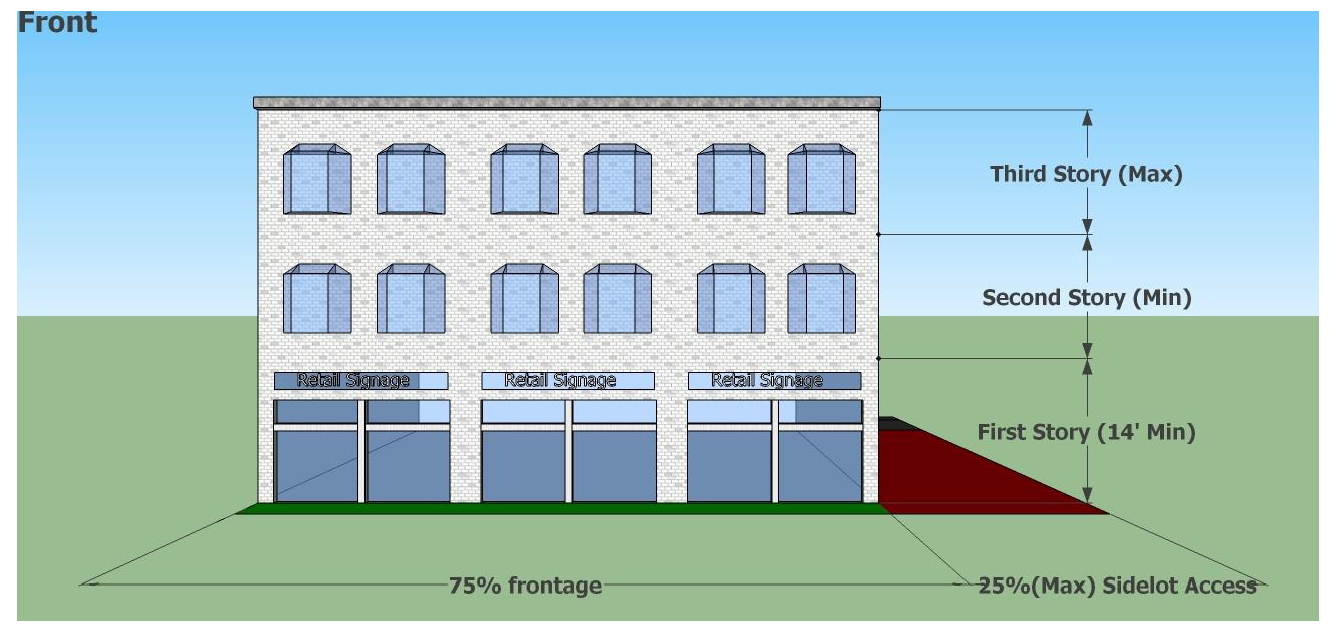
Nonresidential use area exceptions. For buildings within nonresidential use areas, 100 percent of the length of the ground level street-facing façade of the building must be built to the front lot line. The planning commission may grant exceptions to allow a greater building setback and/or a lesser building frontage requirement(s) where the front yard and/or side yard area(s) is used for one or more of the following:
a.
Providing a public gathering area or plaza that offers seating, landscape enhancements, public displays, fountains, or other pedestrian amenities.
b.
Providing outdoor seating for the proposed use.
c.
Providing pedestrian access to an off-street parking area.
The planning commission may also grant exceptions to the minimum building height requirement where the front façade design is determined to be adequately similar in appearance to buildings with two stories.
(3)
Buildings within residential use areas.
(4)
Residential use area exceptions. For buildings within residential use areas, 75 percent of the length of the ground level street-facing façade of the building must be built within six feet of the front lot line. The planning commission may grant exceptions to allow a greater building setback and/or a lesser building frontage requirement(s) in order to establish consistency in building placement with adjacent residential development or where the front yard and/or side yard area(s) is used for one or more of the following:
a.
Providing a public gathering area or plaza that offers seating, landscape enhancements, public displays, fountains, or other pedestrian amenities.
b.
Providing outdoor seating for the proposed use.
c.
Providing pedestrian access to an off-street parking area.
d.
Parking area. (See subsection (6))
(5)
Existing buildings. Buildings existing within the planned unit development prior to (date of adoption of pud district) shall not be subject to the height and placement standards set forth above.
Any expansion or modification of an existing building shall be subject to established building height and placement standards, unless specifically waived by the planning commission through a finding that the deviation meets the purpose of the planned unit development set forth in section 42-341.
(d)
Parking. Parking within the planned unit development shall be provided as follows:
(1)
Except as specified herein, parking shall be provided as set forth in section 42-404 and may be established through:
• On-site parking;
• Common parking facilities; and/or
• On-street parking.
The planning commission may approve reduced on-site parking, or the paving of only a portion of the parking area, leaving a portion as grass for overflow parking, if it is demonstrated that adequate parking otherwise exists in a shared and/or adjacent parking facility during the principal operating hours of all uses to share said parking and access is shared.
(2)
On-street parking shall be allowed on all interior streets within the planned unit development.
(3)
Off-street parking areas are permitted only in side and rear yards.
(4)
When parking is located within a side yard (behind the front building line) and has frontage on an interior street, no more than 25 percent of the total site frontage or 60 feet, whichever is less, shall be occupied by the parking area.
(5)
For a corner lot, no more than 25 percent of the cumulative site frontage or 60 feet, whichever is less, shall be occupied by a side yard parking area. The building shall be located at the corner of the lot adjacent to the intersection.
(6)
For a double frontage lot, no more than 35 percent of the cumulative site frontage or 60 feet, whichever is less, shall be occupied by a side yard parking area.
(7)
Where an off-street parking area is visible from a street, it shall be screened by a three-foot tall screen wall located between the parking lot and the sidewalk.
(8)
Driveway access to off-street parking areas shall be located to provide safe separation from the street intersections and shall be aligned with driveways on the opposite side of the street.
(e)
Dumpsters. Dumpster facilities are permitted only in rear yards and shall be subject to section 42-406 (d)(9).
(f)
Utilities. Public water and sanitary sewer facilities are required as part of the planned unit development. All utilities, including telephone, electric, and cable television, shall be placed underground.
(g)
Storm water management. Storm water management systems shall be designed to achieve compliance with zoning ordinance standards and are required to:
(1)
Incorporate and/or use natural drainage systems existing on the site.
(2)
Protect the surrounding natural environment.
(3)
Retain the natural retention and storage capacity of nearby wetlands or waterways.
(4)
Not increase flooding or the possibility of polluting surface water or groundwater.
(h)
Shoreline/waterfront preservation: In order to provide useful and desirable connectivity along the waterfront, protect the quality of Briggs Pond, and preserve natural storm water systems, development within this district shall be governed by the following:
(1)
A greenbelt, a minimum of 50 feet in depth and linear in character, shall be provided along the shoreline of Briggs Pond and shall be designed so as to:
a.
Be unoccupied by buildings/structures;
b.
Prevent water quality degradation;
c.
Retain natural vegetation;
d.
Decrease shoreline erosion;
e.
Provide visual access to the waterfront;
f.
Facilitate a public waterfront walkway;
g.
Allow for support of waterfront recreational opportunities.
(2)
A public walkway shall be provided along the waterfront of Briggs Pond within the planned unit development. The walkway shall be designed to facilitate extension beyond the boundaries of the planned unit development.
(3)
Waterfront property shall be developed in consideration of the following design features:
a.
Buildings should be oriented in consideration of the water frontage and consistent with the form-based standards set forth in subsection 6.
b.
Parking and loading areas shall be visually buffered from the abutting waterfront with landscaped areas of a mixture of trees and shrubs, primarily of naturally occurring species.
c.
On-site linkages to the abutting greenbelt/waterfront walkway are encouraged to support waterfront access.
(4)
Wetlands shall be retained as part of the natural storm water and green space system within the planned unit development to:
a.
Reduce infrastructure costs;
b.
Reduce frequency of flooding;
c.
Preserve green space and wildlife habitat.
(Ord. No. 453, § 4, 8-10-2015)
(a)
Nonresidential/mixed use buildings. Mixed-use buildings that contain nonresidential use on the ground floor and all nonresidential buildings shall meet the following architectural design requirements. It is not the intent of this section to regulate architectural style of buildings or limit creativity, but to ensure that the necessary functional and design elements to create and foster a mixed-use, pedestrian-oriented environment are incorporated into all building designs.
(1)
Front façade.
a.
Walls that face a street, plaza, green, park or off-street parking area shall include windows and architectural features customarily found on the front of a building, such as awnings, cornice work, edge detailing or decorative finish materials.
b.
Blank walls longer than 20 feet shall not face a street.
c.
All buildings shall have a main entrance located on the front façade. Main entrances shall have design details that enhance the appearance and prominence of the entrance so that it is recognizable from the street and parking areas.
d.
For buildings with a front façade of more than 100 feet in length, there shall be a minimum of one usable entrance every full 50 feet of frontage along the front public sidewalk and shall provide architectural variation to visually break up the building.
e.
Garage doors shall not be permitted on a front façade.
(2)
Windows and doors.
a.
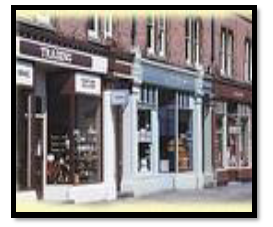
Storefront/ground floor. Ground floors shall be designed with storefronts that have windows, doorways and signage, which are integrally designed and painted. No less than 70 percent of the storefront/ground floor façade shall be clear glass panels and doorway. Glass areas on storefronts shall be clear, or lightly tinted. Mirrored glass is prohibited. Required window areas shall be either windows that allow views into retail space, working areas or lobbies, pedestrian entrances, or display windows set into the wall. Windows shall not be blocked with opaque materials or the back of shelving units or signs. The bottom of the window must be no more than 3 feet above the adjacent exterior grade.
b.
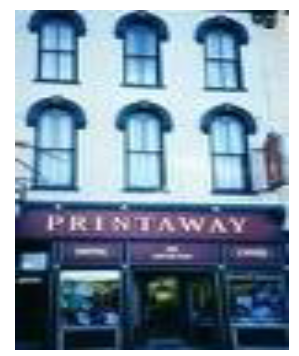
Upper stories. Openings above the first story shall be a maximum of 50 percent of the total façade area. Windows shall be vertical in proportion and shall be compatible with the rhythm and proportion of windows on other buildings along the block.
(3)
Building materials. The following exterior finish materials are required on the front façade and any wall facing a street, plaza, green, park or off-street parking area. These requirements do not include areas devoted to windows and doors.
a.
All walls exposed to public view from a street, plaza, green, park or off-street parking area shall be constructed of not less than 60 percent brick, stone or glass.
b.
The remaining façade or wall area may include wood siding or fiber cement siding. Exterior insulation finish systems (EFIS) may be used for architectural detailing above the first floor.
(4)
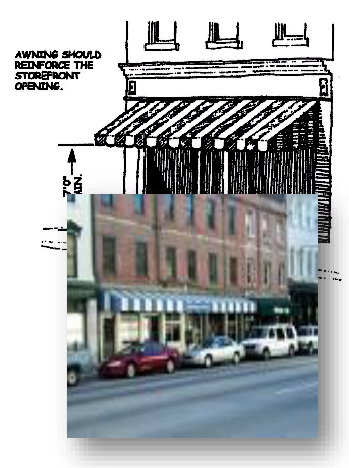
Awnings. An awning acts as a transition between the storefront and the upper story and can also be used as a location for building signage. Storefronts may be supplemented by awnings provided that the following conditions are met:
a.
Fabric awnings are encouraged. The traditional commercial awning material is canvas and its profile is the watershed design.
b.
Awnings shall fit storefront openings or individual window openings.
c.
The awning shall be positioned immediately above the first floor window area of the façade, attached below the storefront cornice or sign panel, and should not cover the piers on either side of the storefront.
d.
The awning should be mounted such that its valance is provided a minimum of eight foot clearance from the sidewalk.
e.
Awning color should be selected to insure compatibility with the building and with the color of adjacent buildings.
f.
Imitation mansard roofs made of metal, rough-sawn wood, plastic, shakes, or asphalt roofing are prohibited.
g.
Internally-illuminated or plastic awnings are prohibited, with or without signage.
(b)
Residential buildings. Attached and detached residential dwellings shall meet the following architectural design requirements:
(1)
Front façade.
a.
All residential units shall provide a pedestrian door facing the front lot line.
b.
All residential units shall include a front porch or landing with steps, with a sidewalk extending from the steps to the street sidewalk.
c.
The front façade of all residential units shall be at least 25 percent windows and doors.
d.
The requirement for a front porch or landing with steps and window/door requirements set forth in subsections b. and c. above shall not apply to live/work units where the first floor façade is designed as a storefront meeting the requirements of subsection (a) of this section.
(2)
Building Materials.
a.
All buildings shall utilize building materials that are in keeping with traditional architectural styles. Permitted wall materials include, brick, stone, wood, and siding.
(3)
Garages.
a.
Attached residential dwellings. Garages shall be located in the rear yard and may be accessed by a rear alley or from a side street.
b.
Detached residential dwellings. Garages shall be located in the rear yard and may be accessed from the frontage street by a single driveway.
(c)
Modifications to architectural requirements. The planning commission may approve modifications to the architectural requirements of subsections (a) and (b) in order to allow for creativity and flexibility in design. A front elevation drawing of the proposed building shall be provided superimposed on a color drawing or photograph of the entire block showing the relation of the proposed building design to other buildings along the block, which shall be utilized to evaluate the proposed building design based upon all of the following criteria:
(1)
Demonstrates innovation in architectural design, provided the building design shall be in keeping with the desired character of the area, as articulated in the Village Revitalization Area Subarea Plan—Village of Paw Paw Master Plan.
(2)
The building is oriented towards the front sidewalk with a functioning entrance and enhances the continuity of the pedestrian-oriented environment. A modification shall not result in an increased dominance of vehicular parking or garage doors along the front of the building.
(3)
The roof design shall not be out of character with other buildings along the block and shall be within the minimum and maximum height requirements of the district.
(4)
The exterior finish materials shall be of equal or better quality and durability as those permitted herein, with the intent to allow for new technologies in building material while maintaining the desired character of the area.
(5)
Ground floor windows shall be provided along the front sidewalk to maintain the pedestrian orientation of the streetscape and upper story windows shall not be incompatible with the rhythm and proportions of windows on other buildings along the block.
(Ord. No. 453, § 4, 8-10-2015)
(a)
Sidewalks. Sidewalks within the planned unit development shall be provided as set forth in the Village of Paw Paw Sidewalk Ordinance.
(b)
Street trees. One canopy tree shall be provided for every 40 feet of frontage planted within tree grates in the sidewalk.
(c)
Street lights. Pedestrian level street lighting of a decorative nature shall be installed along all sidewalks and shall be designed to promote the character of the area. Light fixtures shall meet the specifications of the village.
(d)
Alleys. Alleys shall be permitted in the planned unit development and shall be required where necessary to provide access to parking lots, loading areas and garages.
(1)
Alleys serving as access to residential garages shall be located within an easement with minimum pavement necessary for circulation and emergency vehicle access.
(2)
Alleys accessing nonresidential parking areas and loading areas in the rear of a site may be used as drive aisles in interior block parking lots with parking spaces along the alleys.
(e)
Street furniture. Benches and trash receptacles shall be provided by the developer in park and plaza areas and along adjoining sidewalks where the planning commission determines that pedestrian activity will benefit from these facilities.
(f)
Bicycle facilities. The planned unit development shall be designed to accommodate bicycle travel, including the provision of bike racks. All parking areas for nonresidential uses shall include sufficient bike racks to allow the parking of a minimum of one bike for every 10 automobiles or one bike for every 3,000 square feet of building floor area, whichever is greater.
(g)
Street cafés. Street cafés are allowed within the planned unit development, subject to the village street cafe standards.
(h)
Signs. Signage within the planned unit development shall be subject to the sign standards set forth in section 42-259 for the downtown overlay district, with the exception of the following:
(1)
Existing buildings. A building lawfully existing as of September 9, 2019 that does not meet the zero-foot maximum front yard setback requirement (i.e. is not built to the front lot line) is allowed one ground sign, subject to the following:
a.
The ground sign shall not exceed the sign area allowed by section 42-259(b)(2)a.—d.
b.
The number of signs allowed for the site by section 42-259(b)(2) shall include the ground sign.
c.
The ground sign shall not exceed five feet in height, and shall be located a minimum of five feet from all lot lines.
(2)
PUD district development sign. One ground sign shall be allowed at each entrance to the PUD district, not to exceed a total of two signs for the district. Each ground sign shall not exceed 75 square feet in area or five feet in height, and shall be located a minimum of ten feet from the abutting street right-of-way.
(Ord. No. 453, § 4, 8-10-2015; Ord. No. 473, § 3, 9-9-2019)
(a)
Application requirements. The application for development approval within the planned unit development district shall be made according to the development review process set forth in this section.
(b)
Effect of approval. After a site plan has been approved and construction of any part thereof commenced, no other type of development will be allowed on the site without further approval by the planning commission and after proceedings conducted as in the original application.
(c)
Conformity to approved plan. Property within the planned unit development district which is the subject of site plan approval must be developed in strict compliance with the approved site plan. If construction and development do not conform to same, the approval thereof shall be forthwith revoked by the village. Upon revocation of such approval, all further construction activities shall cease upon the site other than for the purpose of correcting the violation.
(d)
Amendment to approved plan. A proposed amendment or modification to a previously approved site plan within the planned unit development district shall be submitted for review in the same manner as the original application.
(e)
Project phasing. When proposed construction is to be phased, the project shall be designed in a manner that allows each phase to fully function on its own regarding services, utilities, circulation, facilities, and open space. Each phase shall contain the necessary components to ensure protection of natural resources and the health, safety, and welfare of the occupants and residents of the planned unit development and surrounding area.
Each phase of the development shall be commenced within one year of the schedule set forth on the approved site plan. If construction of any phase is not commenced within the approved time period, approval of the site plan shall become null and void.
(f)
Performance bond. The planning commission may require that a performance bond, bank letter of credit, or cash bond in such amounts as may be determined be deposited with the village to ensure completion of the site in accordance with the approved plans. The bond shall be for the purpose of securing the health, safety, and welfare of village residents and adjacent property owners.
Such bond or bank letter of credit, if required, shall be set at a minimum of 100 percent of the cost of the unfinished work for which the bond was required. The village shall provide for the rebate of any cash bond filed in reasonable proportion to the ratio of the work completed, provided the amount remaining on deposit still provides reasonable security for the completion of the unfinished improvements related to the deposit.
(g)
Development agreement. No building permit shall be issued for development and no construction activity commenced within the planned unit development until an affidavit containing the legal description of the planned unit development and the subject development site within the planned unit development; the date and terms of the site plan approval; and a declaration that all improvements will be carried out in accordance with the approved site plan is recorded with the register of deeds for VanBuren County.
All required public dedications for streets, utility easements or other public facilities, and deed restrictions shall be filed with the village and recorded at the register of deeds.
(h)
Revocation. In any case where construction of the approved site plan has not commenced within one year of the date of the final approval, all approvals shall be null and void.
(i)
Development review process.
(1)
Pre-application meeting. An applicant desiring to submit an application for site plan review within the planned unit development district is encouraged to attend a pre-application meeting with the planning commission. The purpose of the pre-application meeting is to determine general compliance with the planned unit development eligibility and design requirements, and to identify issues of significance regarding the proposed application.
The applicant shall present the following information for a pre-application meeting:
a.
Sketch plan of the proposed development site layout;
b.
Accurate legal description of the development site;
c.
Names and addresses of all current owners of the development site;
d.
Total site acreage;
e.
Number of acres to be developed by use;
f.
Number of acres of undeveloped land;
g.
Number of acres of designated open space;
h.
Number and type of residential units;
i.
Details of nonresidential use;
j.
Details of vehicular and pedestrian circulation system;
k.
Location and details of known natural features.
l.
Relationship of the development site design to the existing/planned layout of the planned unit development.
(2)
Preliminary plan review. An application for development approval within the planned unit development district shall be subject to mandatory preliminary plan review by the planning commission. The review is intended to provide an indication of the issues and concerns that must be resolved prior to site plan review.
Preliminary plan approval shall not constitute an approval of a detailed site plan but shall be deemed an expression of approval of the layout as a guide to the preparation of the site plan. A request for a modification to the approved preliminary plan shall be submitted for review in the same manner as the original preliminary plan was submitted and reviewed.
(3)
Preliminary plan requirements. Engineering details of a preliminary plan are not required to be developed beyond a level of detail required to determine the feasibility of the proposed layout. The preliminary plan, drawn to a reasonable scale, shall provide the following information:
a.
Boundaries of the planned unit development and the development site;
b.
General location map showing existing land use and ownership within the planned unit development and of adjacent land;
c.
Topography of the development site and its relationship to adjoining land;
d.
Location of existing/proposed streets adjacent to and within the planned unit development; proposed connection to and/or extension of existing streets within the planned unit development;
e.
Pedestrian and vehicular circulation systems and related parking facilities on the development site and their relationship to existing/planned systems within the planned unit development;
f.
Delineation of proposed residential and nonresidential areas on the development site, indicating for each area its size, number and composition of buildings, dwelling unit density, building envelopes, height and orientation of buildings;
g.
Designated open space system and recreation areas;
h.
Proposed landscaping, including greenbelts, berms, and/or screening;
i.
Storm water drainage system;
j.
Public facilities.
The following documentation shall accompany the preliminary plan:
a.
Name, address and telephone number of:
•
All persons with an ownership interest in the land within the planned unit development district, together with a description of the nature of each entity's interest;
•
All engineers, attorneys, architects or registered land surveyors associated with the development site;
•
The developer or proprietor of the development site;
•
Any person authorized to represent the owner in the review process.
b.
Accurate legal description of the planned unit development and development site;
c.
Total acreage of the planned unit development and development site;
d.
Number and type of units to be developed;
e.
General statement as to how open space and recreation areas are to be owned and maintained;
f.
General indication of the proposed sequence and approximate time frames of development phases;
g.
A narrative describing how the development site design is consistent with the village revitalization area subarea plan, the purposes of the planned unit development district, and the capacity and availability of necessary public facilities to the development; and, the impact the development will have on adjoining properties.
(4)
Additional information. During the preliminary plan review process, the planning commission may require additional information they determine is reasonably necessary to demonstrate compliance with the planned unit development standards. Such information may include, but not be limited to, hydrological tests, traffic studies, or wetland determinations.
(5)
Site plan review. The planning commission shall hold a public hearing on an application for development approval within the planned unit development district.
An application for development approval within the planned unit development district shall be subject to site plan review by the planning commission. The detailed site plan shall conform to the approved preliminary plan and incorporate any revisions or recommendations made by the planning commission at the preliminary plan review.
An application for development approval within the planned unit development district shall be subject to final approval by the village council.
If a detailed site plan is not submitted for review within six months of preliminary plan approval, the planning commission may require resubmission of the preliminary plan for further review and possible revision.
(6)
Site plan requirements. The following information shall be included on, or attached to, all site plans:
a.
An update of the approved preliminary plan pursuant to the site plan informational requirements set forth in section 42-402.
b.
Engineering plans presented in sufficient detail to indicate compliance with village standards.
c.
Easements, deed restrictions, and other documents pertaining to pedestrian and vehicular systems; the designated open space system; and recreation areas;
d.
If condominium ownership is proposed, all documentation required by the condominium regulations of the village.
(7)
Review criteria. Approval of a site plan within the planned unit development district shall be determined on the basis of the site plan review criteria set forth in section 42-402, as well as the following criteria:
a.
The overall design and land uses proposed in connection with the planned unit development shall be consistent with the purpose of the planned unit development concept and the specific design standards set forth herein.
b.
The proposed development site shall be serviced by the necessary public facilities to ensure the public health, safety, and welfare of the residents and users of the development.
c.
The proposed development site shall be designed to minimize the impact of traffic generated by the development on the surrounding land uses and road network.
d.
The proposed development site shall be designed so as to be in character with surrounding conditions as they relate to bulk and location of structures, pedestrian and vehicular circulation, landscaping, and amenities.
e.
The proposed development site shall be designed and constructed so as to preserve the integrity of the existing on- and off-site sensitive and natural environments, including wetlands, woodlands, hillsides, water bodies, and groundwater resources.
f.
The designated open space shall be of functional value as it relates to opportunities for wildlife habitat, woodland preservation, agricultural use, recreation, visual impact, and/or access.
g.
The proposed development site shall comply with all applicable federal, state, and local regulations.
(Ord. No. 453, § 4, 8-10-2015)
The purposes of this district are to:
(1)
Develop a fully integrated, mixed-use, pedestrian-oriented environment with buildings containing commercial, residential and office uses, similar to the downtown character at the intersection of Michigan and Kalamazoo Avenues.
(2)
Create a synergy of uses within the downtown overlay district to support economic development and redevelopment consistent with the recommendations of the Master Plan for the Village of Paw Paw.
(3)
Minimize traffic congestion, inefficient surface parking lots, infrastructure costs and environmental impacts by promoting a compact, mixed-use, pedestrian-friendly district.
(4)
Regulate building height and form to achieve appropriate scale along streetscapes and ensure proper transition to nearby residential neighborhoods.
(5)
Create a definable sense of place within the downtown overlay district with a pedestrian-oriented, traditional urban form that emphasizes historic building design common to the downtown area.
(Ord. No. 449, § 4, 12-22-2014)
(a)
The downtown overlay district shall be an overlay district that applies over the existing zoning districts. Use and development of land within the overlay district shall be regulated as follows:
(1)
Any existing use shall be permitted to continue and the use shall be subject to the requirements of the underlying zoning district and not the requirements of the downtown overlay district.
(2)
Where a new use is established within an existing building, the use shall be subject to the requirements of the downtown overlay district and the site shall be brought into compliance with the requirements of the overlay district to the maximum extent practical, as determined by the building official at the time of reviewing the application for a certificate of occupancy.
(3)
Any expansion or modification to an existing or approved use, building, or site that requires site plan approval from the planning commission shall be subject to the requirements of the downtown overlay district.
(4)
Any new development shall be subject to the requirements of the downtown overlay district.
(b)
A site plan shall be submitted in accordance with section 42-402 for all permitted uses. All special uses shall be subject to the special use permit requirements set forth in section 42-366.
(c)
The provisions of the downtown overlay district, when in conflict with other provisions of the zoning ordinance, shall take precedence.
(d)
A downtown overlay district regulating plan has been adopted that divides the district into two zones. Each zone designated on the regulating plan prescribes requirements for building form, height, setback, and use as follows:
MU-1: Mixed Use 1
MU-2: Mixed Use 2
(Ord. No. 449, § 4, 12-22-2014)
MU-1: Mixed Use 1
(1)
Principal permitted uses.
a.
All permitted uses in the CBD central business district, except section 42-242(7), Mixed use establishments.
b.
Mixed use establishments (ie. commercial and residential uses combined in a single building), provided that the ground floor is occupied solely by the commercial use.
c.
Parks/plazas/greens.
(2)
Uses subject to special use permit.
a.
All special land uses in the CBD central business district.
MU-2: Mixed use 2
(1)
Principal permitted uses.
a.
All permitted uses in the CBD central business district
b.
Dwellings—attached single family.
c.
Dwellings—multiple family.
d.
Parks/plazas/greens.
(2)
Uses subject to special use permit.
a.
All special land uses in the CBD central business district.
(Ord. No. 449, § 4, 12-22-2014)
The following tables set forth the height, bulk and setback standards of the MU-1 and MU-2 zones within the downtown overlay district.
(1)
MU-1 Zone development standards.
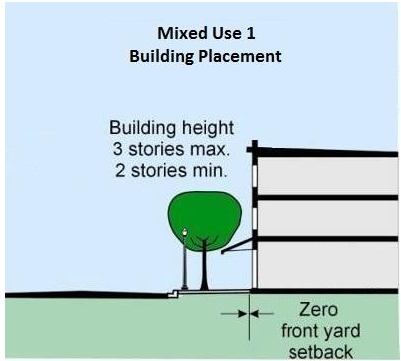
(2)
MU-1 front yard building setback and building frontage exceptions. In the MU-1 zone, 100 percent of the length of the ground level street-facing façade of the building must be built to the front lot line. The planning commission may grant exceptions to allow a greater building setback and/or a lesser building frontage requirement(s) where the front yard and/or side yard area(s) is used for one or more of the following:
a.
Widening the sidewalk along the frontage of the building.
b.
Providing a public gathering area or plaza that offers seating, landscape enhancements, public displays, fountains, or other pedestrian amenities.
c.
Providing outdoor seating for the proposed use.
d.
Providing pedestrian access to off-street parking areas.
(3)
MU-2 zone development standards.
(4)
MU-2 front yard building setback and building frontage exceptions. In the MU-2 zone, 75 percent of the length of the ground level street-facing façade of the building must be built within five feet of the front lot line. The planning commission may grant exceptions to allow a greater building setback and/or a lesser building frontage requirement(s) where the front yard and/or side yard area(s) is used for one or more of the following:
a.
Widening the sidewalk along the frontage of the building.
b.
Providing a public gathering area or plaza that offers seating, landscape enhancements, public displays, fountains, or other pedestrian amenities.
c.
Providing outdoor seating for the proposed use.
d.
Providing pedestrian access to off-street parking areas.
e.
Parking lot. (See subsection (5))
(5)
Parking. Parking within the downtown overlay district shall be provided as follows:
a.
Because this overlay district is intended to encourage pedestrian/transit friendly design and compact mixed-use development that requires less reliance on automobiles, land uses within the downtown overlay district shall be exempt from the table of parking requirements set forth in section 42-404 (8).
b.
On-street parking shall be allowed on all street frontages, as permitted by the downtown streetscape plan.
c.
Off-street parking lots (not located in the road right-of-way) are permitted only in side and rear yards.
1.
When parking is located within a side yard (behind the front building line) and has frontage on a public road right-of-way, no more than 25 percent of the total site frontage or 60 feet, whichever is less, shall be occupied by parking lot.
2.
For a corner lot, no more than 25 percent of the cumulative site frontage or 60 feet, whichever is less, shall be occupied by a side yard parking lot. The building shall be located at the corner of the lot adjacent to the intersection.
3.
For a double frontage lot or a lot that has frontage on three public road rights-of-way, no more than 35 percent of the cumulative site frontage or 60 feet, whichever is less, shall be occupied by a side yard parking lot. The building shall be located at the corner of the lot adjacent to the intersection.
d.
Where an off-street parking lot is visible from a street, it shall be screened by a three-foot tall screen wall located between the parking lot and the sidewalk.
e.
Driveway access to off-street parking lots shall be located to provide safe separation from the street intersections and shall be aligned with driveways on the opposite side of the street.
(6)
Fences. Fences are prohibited within the downtown overlay district, except as set forth in section 42-405(c).
(7)
Dumpsters. Dumpster facilities are permitted only in rear yards and shall be subject to section 42-406(d)(9).
(Ord. No. 449, § 4, 12-22-2014)
Mixed-use buildings that contain commercial use on the ground floor and all non-residential buildings shall meet the following architectural design requirements. It is not the intent of this section to regulate architectural style of buildings or limit creativity, but to ensure that the necessary functional and design elements to create and foster a mixed-use, pedestrian-oriented environment are incorporated into all building designs. Buildings should respect the existing architectural style of the area while advocating a more harmonious approach to contemporary design.
(1)
Front façade requirements. Walls that face a public street, plaza, green, park or off-street parking area shall include windows and architectural features customarily found on the front of a building, such as awnings, cornice work, edge detailing or decorative finish materials.
a.
Blank walls longer than 20 feet shall not face a public street.
b.
All buildings shall have a main entrance located on the front façade. Main entrances shall have design details that enhance the appearance and prominence of the entrance so that it is recognizable from the street and parking areas.
c.
For buildings with a front façade of more than 100 feet in length, there shall be a minimum of one usable entrance every full 50 feet of frontage along the front public sidewalk and shall provide architectural variation to visually break up the building.
d.
Garage doors shall not be permitted on a front façade.
(2)
Windows and doors.
a.
Storefront/ground floor. Ground floors shall be designed with storefronts that have windows, doorways and signage, which are integrally designed and painted. No less than 70 percent of the storefront/ground floor façade shall be clear glass panels and doorway. Glass areas on storefronts shall be clear, or lightly tinted. Mirrored glass is prohibited. Required window areas shall be either windows that allow views into retail space, working areas or lobbies, pedestrian entrances, or display windows set into the wall. Windows shall not be blocked with opaque materials or the back of shelving units or signs. The bottom of the window must be no more than three feet above the adjacent exterior grade.
b.
Upper stories. Openings above the first story shall be a maximum of 50 percent of the total façade area. Windows shall be vertical in proportion and shall be compatible with the rhythm and proportion of windows on other buildings along the block.
(3)
Roof design.
a.
Unless otherwise approved by the planning commission, buildings should have a flat roof appearance from the street with a decorative cornice that is designed proportionate to the size of the building and length of the wall.
b.
Flat roofs shall be enclosed by parapets. (Shown below)
c.
All rooftop mounted equipment shall be screened from view on street-facing sides of the building.
d.
Parapets and other screening treatment shall blend with the design of the building in terms of color, materials, scale and height.
Enclosed rooftop parapet
(4)
Building materials. The following exterior finish materials are required on the front façade and any wall facing a street, plaza, green, park or off-street parking area. These requirements do not include areas devoted to windows and doors.
a.
All walls exposed to public view from a street, plaza, green, park or off-street parking area shall be constructed of not less than 60 percent brick, stone or glass.
b.
The remaining façade or wall area may include wood siding or fiber cement siding. Exterior insulation finish systems (EFIS) may be used for architectural detailing above the first floor.
(5)
Awnings. The canvas awning was an important design element in the traditional storefront. It provided shelter for pedestrians from sun and rain, added color, and acted as a transition between the storefront and the upper story. The awning can also be used as a location for building signage. Storefronts may be supplemented by awnings provided that the following conditions are met:
a.
Awnings shall fit storefront openings or individual window openings.
b.
The awning shall be positioned immediately above the first floor window area of the façade, attached below the storefront cornice or sign panel, and should not cover the piers on either side of the storefront.
c.
The awning should be mounted such that its valance is provided a minimum of eight foot clearance from the sidewalk.
d.
Fabric awnings are encouraged. The traditional commercial awning material is canvas and its profile is the watershed design. Other profiles tend to be too contemporary when placed on a traditional façade.
e.
Awning color should be selected to insure compatibility with the building and with the color of adjacent buildings.
f.
Historically incompatible canopies, awnings, and imitation mansard roofs made of metal, rough-sawn wood, plastic, shakes, or asphalt roofing are prohibited.
g.
Internally-illuminated or plastic awnings are prohibited, with or without signs.
(6)
Corner buildings. Buildings situated at a corner shall possess a level of architectural design that incorporates accents and details that accentuate its prominent location. This can be accomplished through height projections incorporated into a design feature such as a building peak, tower, or similar accent with the highest point located at the intersecting corner, which may be up to an additional ten feet above the height limit. The building architecture can be designed to focus on accentuating the geometry of the corner location. A main entrance may be on a street-facing wall and either at the corner or within 25 feet of the corner.
(Ord. No. 449, § 4, 12-22-2014)
Attached single family residential dwellings shall meet the following architectural design requirements:
(1)
Front façade.
a.
All residential units shall provide a pedestrian door facing the front lot line.
b.
All dwellings shall include a front porch with steps. The porch shall have a minimum depth of four feet and a minimum area of 24 square feet.
c.
The front façade of all residential units shall be at least 25 percent windows or doors.
d.
The requirement for a front porch and window/door requirements in subsections b. and c. above shall not apply to live/work units where the first floor façade is designed as a storefront meeting the requirements of section 42-255(2). above.
(2)
Building materials. All buildings shall utilize building materials that are in keeping with traditional architectural styles. Permitted wall materials include, brick, stone, wood, and fiber cement siding. Vinyl siding is prohibited.
(3)
Garages. Garages shall be located in the rear yard and may be accessed by a rear alley or from a side street.
(Ord. No. 449, § 4, 12-22-2014)
The planning commission may approve modifications to the architectural requirements of sections 42-255 and 42-256 in order to allow for creativity and flexibility in design. A front elevation drawing of the proposed building shall be provided superimposed on a color drawing or photograph of the entire block showing the relation of the proposed building design to other buildings along the block, which shall be utilized to evaluate the proposed building design based upon all of the following criteria:
(1)
Demonstrates innovation in architectural design, provided the building design shall be in keeping with the desired character of the downtown, as articulated in the Downtown Design Guidelines Booklet—Village of Paw Paw.
(2)
The building is oriented towards the front sidewalk with a functioning entrance and enhances the continuity of the pedestrian-oriented environment. A modification shall not result in an increased dominance of vehicular parking or garage doors along the front of the building.
(3)
The roof design shall not be out of character with other buildings along the block and shall be within the minimum and maximum height requirements of the district.
(4)
The exterior finish materials shall be of equal or better quality and durability as those permitted herein, with the intent to allow for new technologies in building material while maintaining the desired character of the downtown.
(5)
Ground floor windows shall be provided along the front sidewalk to maintain the pedestrian orientation of the streetscape and upper story windows shall not be incompatible with the rhythm and proportions of windows on other buildings along the block.
(Ord. No. 449, § 4, 12-22-2014)
(a)
Street design standards. All streets shall be constructed to meet the requirements of the Village of Paw Paw. Modifications to existing streets shall be consistent with the Village of Paw Paw Master Plan to the maximum extent practical, as determined by the village council.
(b)
Sidewalks. Sidewalks in the downtown overlay district shall be provided as set forth in the Village of Paw Paw Sidewalk Ordinance.
(c)
Street trees. one canopy tree shall be provided for every 40 feet of frontage planted within tree grates in the sidewalk.
(d)
Street lights. Pedestrian level street lighting of a decorative nature shall be installed along all sidewalks and shall be designed to promote the traditional character of the area. Light fixtures shall meet the specifications of the Village of Paw Paw.
(e)
Alleys. Alleys shall be permitted in the downtown overlay district and shall be required where necessary to provide access to parking lots, loading areas and garages at the property.
(1)
Alleys serving as access to residential garages shall be located within an easement with minimum pavement necessary for circulation and emergency vehicle access.
(2)
Alleys accessing commercial parking lots and loading areas in the rear of a site may be used as drive aisles in interior block parking lots with parking spaces along the alleys.
(f)
Street furniture. Benches and trash receptacles shall be provided by the developer in park and plaza areas and along adjoining sidewalks where the planning commission determines that pedestrian activity will benefit from these facilities.
(g)
Bicycle facilities. All developments shall be designed to accommodate bicycle travel, including the provision of bike racks. All parking structures and parking lots for commercial, recreational and institutional uses shall include sufficient bike racks to allow the parking of a minimum of one bike for every ten automobiles or one bike for every 3,000 square feet of building floor area, whichever is greater.
(h)
Street cafés. Street cafés (or dining platforms) are allowed within the downtown overlay district, subject to the Village of Paw Paw street cafe standards.
(Ord. No. 449, § 4, 12-22-2014)
Because it is the purpose to catch people's eye, signage also has a major impact on the appearance of a façade and the streetscape. It is important that signage enhance, and not detract from, the building and streetscape.
When locating signage, work with the building's character and architectural composition. Design signage so that it is compatible with your building and not dominate or detract from the historic character of the building and clutter the streetscape.
(1)
Sign guidelines.
a.
Sign types. In the past, streetscapes had a variety of sign types that not only identified the business, but also the name of the buildings, dates of construction, etc. The signs were simple, bold and well crafted. Lettering was in clear, no-nonsense styles, maximizing the contrast between the background and the lettering.
b.
Varying sign types can be found in the historic streetscape including: (1) storefront (wall) signs, (2) projecting signs, (3) hanging signs, (4) awning signs, (5) window signs, and (6) architectural signs. Every building should select the most appropriate sign type for its architecture and location.
c.
Sidewalk signs are temporary signs used to attract customers but can add vibrancy to a streetscape and expand the presence of a business if the design is creative and thoughtful.
d.
Quantities and locations. Storefronts should be limited to two permanent signs—one primary and one secondary. The primary sign should be located above storefront display windows but below the sills of second floor windows. On many examples of turn-of-the-century buildings a continuous brick ledge or corbelling is used to separate the second floor and above from the storefront below. This space is ideal for sign placement, as it was often created for this purpose.
e.
Types of secondary signage include hanging, window, awning, or any sign that is located below the primary sign. If a projected sign is planned, placement will be critical to avoid interferences with adjacent signs and architecture of the storefront itself. These signs should be located below second story window sills and be no less than eight feet above the sidewalk. Window signs should consist of a material and color that contrasts with the display, while being small enough to not interfere with the display area. The use of awning valances for signs is encouraged and is often an integral part of the awning pattern and style.
f.
Size. Big does not necessarily mean powerful. Primary signs of proper size can combine with the entire storefront to become more meaningful than just the sign itself. The sign must be subordinate to the building, not the opposite. Actual size may vary, but signboards, if used, need not exceed two and a half feet high. This size is appropriate for distances the sign will be read from in a downtown setting. Letters should not be less than eight inches nor more than eighteen inches high. Lettering should account for at least 50 and no more than 60 percent of a signboard.
g.
Message. Messages should be kept simple in content. The major function of the sign is to introduce the storefront and its contents. Wording should be minimal and slogans avoided. Descriptive words should be used rather than providing listings of items to be sold. Simple wording is easily read by pedestrians and street traffic.
h.
General.
1.
The maintenance and restoration of any existing historic signs is encouraged in lieu of replacement.
2.
Signage for a business not located within the building is not acceptable.
3.
Signage should be located in such a way as to not obscure any architectural features of the building.
4.
Signs are important to the store owner for reasons of advertising, identity, and image. As they are an extremely visible element of the storefront, signs must be used carefully so as not to detract from facades. With a little forethought and careful planning, signage can embrace the store owner's needs as well as Paw Paw's image.
(2)
Sign standards.
a.
General.
1.
Permitted signs: storefront (wall), projecting, hanging, awning, window, architectural, and temporary sidewalk signs as defined by this article.
2.
Prohibited signs: roof, freestanding, animated, flashing, signs that obscure the unique or historically-significant architectural detail of a building façade, and temporary signs, as defined by section 42-3 (not including temporary sidewalk signs as defined by this article).
3.
Exempt signs: those signs identified by section 42-435 are exempt from the provisions of this article.
4.
Area/height: sign area and height shall be measured as established by the definitions of "sign area" and "sign height" set forth in section 42-3.
5.
Color: sign colors must relate to the paint scheme of the building. Bright white and intense background colors are discouraged. Fluorescent colors are prohibited.
6.
Lighting: signs can be illuminated with directional spotlights or indirect lighting. Signs may not be internally-illuminated.
7.
Design: sign construction and sign copy must be of professional quality. Primary signage should identify a business and not a brand-name product. If more than one sign is used, the signs must be compatible in style.
8.
Sign installation: all signs, except window signs, require a sign permit and building and electrical permits as required. All signs shall be installed avoiding visible guy wires or other stabling devices.
9.
Sign permits: no sign shall be erected constructed, relocated or altered until a sign permit has been obtained from the village in accordance with section 42-441.
10.
Signs established within the downtown overlay district are not subject to article VI — Signs, except as set forth in this article.
b.
Sign area and number.
1.
A maximum total sign area of one square foot per lineal foot of width of the storefront is permitted.
2.
For establishments with frontage on more than one street, additional sign area of ½ square foot per lineal foot of width of the establishment along the secondary frontage is permitted.
3.
No establishment shall be permitted more than 100 square feet of total sign area.
4.
Each storefront shall be entitled to a minimum of 30 square feet of sign area.
5.
A maximum of two signs is permitted per storefront.
6.
A maximum of four signs is permitted per establishment.
7.
Window and architectural signs are permitted in addition to these maximums.
c.
Storefront (wall) signs. Storefront signs are those which are located on the horizontal band dividing the storefront windows from the upper façade of the building.
1.
Storefront (wall) signs shall be located above storefront display windows but below the sills of second floor windows
2.
Signs shall be placed in traditional locations, such as above transoms; below storefront cornices; or within the sign panel area on the façade.
3.
Signs may not extend over the side piers, or beyond the parapet or building face.
4.
Guidelines:
• The storefront sign should be used to display primarily the name of the business only. Use only one line of lettering if possible, leaving out secondary information.
• Use simple, bold lettering with sufficient contrast between the lettering and the background.
• Graphics in the sign are included in the maximum allowable area.
d.
Projecting signs. Projecting signs are at right angles to the building face, either fixed to the wall or hanging from a bracket. The major advantage of projecting signs over storefront or window signs is their ability to be seen by pedestrians and motorists from a distance down the street. If they get too large, however, they can obscure each other, so it is important to keep them small and simple.
1.
Only one projecting sign per storefront is permitted.
2.
Projecting signs shall be located no higher than the cornice or parapet line, whichever is lower.
3.
Signs shall be located so as not to obscure any unique or historically-significant architectural detail of the façade.
4.
The sign shall not extend further than four and one-half feet from the face of the building and shall not exceed 20 square feet in area.
5.
Projecting signs shall not be less than eight feet from the grade beneath and shall not extend above the second story window sill or roof line, whichever is lower.
e.
Hanging signs.
1.
Small horizontal hanging signs suspended over the entry or from a canopy are encouraged.
2.
Hanging signs shall not exceed four square feet in area.
3.
Hanging signs shall be provided a minimum of eight foot clearance from the sidewalk.
f.
Awning signs. Another option for a primary sign location can be an awning, provided the awning is properly integrated with the building.
1.
The area of a ground floor awning sign shall not cover more than 30 percent of the total surface area of the awning.
2.
Signs on two side panels of an awning shall be considered as one sign for purposes of calculating total number of allowable signs.
3.
The use of awning valances for signs is encouraged. Six to eight inch letters are sufficient.
g.
Window signs. Window signs were historically applied on the inside of the glass, painted directly onto the storefront glass, upper floor windows and doorways. The main focus of this style of signage is to target and inform approaching pedestrians. Therefore, window lettering typically provides more detailed information about the business. Today, most window signs are made of vinyl and applied to the outside of the window.
1.
Permanent window signs may include graphics painted on glass, vinyl letters applied to glass, a clear acrylic panel behind the window, or small neon window signs.
2.
Permanent window signs may not occupy more than 1/3 of the total area of the window.
3.
Window signs shall not count toward total allowable sign area for the building.
4.
Lettering should be white or light in color since windows appear dark.
5.
Guidelines:
• It may often be desirable to keep the display space clear. In these cases, insert the sign at the base or the head of the window, or both.
• Keep the lettering small remembering that the reader will be in close proximity to the sign. Use several lines where necessary and consider curving the top line at the head of the window.
• Lettering formed with neon may be used in the inside of the window, provided the size, light intensity, color and style are consistent with the theme of the building.
• Total sign area in the window should not exceed one-third of the window area.
• Display street numbers on or directly above the door, and business hours on the inside of the door or in an adjacent window.
h.
Architectural signs: Architectural signs are integrated into the building fabric and are constructed of permanent materials such as stone or metal. Names and the dates of construction were common signs included on the façade. They were typically located in the roof parapet detailing or in a cornerstone detail. These add a sense of history and place to the character and fabric of the village.
1.
Guidelines:
• Preserve existing architectural signs.
• Promote the use of the original building names in new signage.
i.
Sidewalk signs. Sidewalk signs are portable signs of A-frame or swinging style construction used during hours a business is open and stored inside when not in use. According to the National Main Street Center, temporary sidewalk signs can add vibrancy to a streetscape and expand the presence of a business if the design is creative and thoughtful.
1.
Only one sidewalk sign per storefront is permitted.
2.
Sidewalk signs shall not occupy more than nine square feet of sidewalk and shall not exceed four feet in height.
3.
Sidewalk signs shall be subject to the following placement standards:
i.
Must be placed in front of the storefront holding the permit for the sign.
ii.
Shall be located a minimum of two feet from the curb and allow five feet of unobstructed sidewalk.
iii.
Shall not be located within 25 feet of an intersection (measured perpendicularly).
iv.
Shall be spaced a minimum of 20 feet from each other.
v.
Placement is permitted during business hours but not before 8 AM or after 9 PM.
vi.
The sidewalk shall be completely clear of snow prior to placement of the sign.
vii.
Shall not be placed on snow banks.
viii.
Sidewalk signs shall be of A-frame or swinging style construction and shall be sturdy and stable enough to withstand typical winds without flipping over or sliding.
ix.
The surface of a sidewalk sign shall be durable and weatherproof.
x.
Sidewalk sign copy shall be painted or printed on the sign surface. Loose paper faces are not permitted.
xi.
Sidewalk signs shall not be illuminated by any means except natural light and existing street lights.
(3)
Nonconforming signs.
a.
Lawful existing signs: A permanent sign lawfully existing on December 22, 2014 (Ordinance No. 449) which does not fully comply with the provisions of this article shall be deemed a lawful nonconforming sign and may be allowed to remain if the sign is properly maintained and if it has no serious adverse effects on the public health, safety and general welfare.
b.
Lawful nonconforming signs: Lawful nonconforming signs shall be subject to Section 42-439 (b) and (c).
(4)
Abandoned signs. Any sign that the village determines to be abandoned, as defined by section 42-3, shall be removed by the owner of the property on which the sign is located. If the property owner cannot be found, the village may remove the sign and recover from said owner the full costs of removing and disposing of the sign.
(5)
Violations.
a.
It is a violation of this article to install, create, erect or maintain any sign that does not full comply with the requirements of this article.
b.
Each sign installed, created, erected or maintained in violation of this article is considered a separate violation when applying the penalty portions of this Ordinance.
(Ord. No. 449, § 4, 12-22-2014; Ord. No. 462, § 6, 7, 10-23-2017)
- DISTRICT REGULATIONS
Editor's note— Ord. No. 439, § 4, adopted March 26, 2012, amended the title of div. 3, from "R-2 Single Family and Two Family Residential District" to "R-2 Single-Family Residential District."
State Law reference— Mobile home commission act, MCL 125.2301 et seq.
The village is hereby divided into the following districts:
(Ord. No. 394, § 1.4, 7-14-2003)
(a)
Adopted by reference. The areas and boundaries of such districts noted in section 42-101 are hereby established to scale on a map entitled, "Zoning Map of the Village of Paw Paw," and referred to herein as the "zoning map." The zoning map, together with everything shown thereon, is hereby adopted by reference and declared to be a part of this chapter.
(b)
Amendment. Regardless of the existence of copies of the zoning map which may be made or published, the official zoning map shall be located at the village hall and shall be the final authority as to the current zoning status in the village. No amendment to this chapter that involves a change of a mapped zoning district, shall become effective until an entry has been made on the official zoning map. The official zoning map shall be identified by the signature of the president of the village council, and attested by the village clerk.
(Ord. No. 394, art. I, 7-14-2003)
When uncertainty exists as to the boundaries of districts as shown on the zoning map, the following rules shall apply:
(1)
Boundaries indicated as approximately following the centerlines of streets, highways, or alleys shall be construed to follow such centerlines.
(2)
Boundaries indicated as approximately following platted lot lines shall be construed to follow such lot lines.
(3)
Boundaries indicated as approximately following village boundaries shall be construed to follow village boundaries.
(4)
Boundaries indicated as approximately following property lines, section lines or other lines of a survey shall be construed to follow such chartered lines as of the effective date of the ordinance from which this chapter is derived, or affecting amendment.
(5)
Boundaries indicated as following railroads lines shall be construed to follow the centerline of the railroad right-of-way.
(6)
Boundaries indicated as parallel to or extensions of features indicated above, the building inspector shall interpret the district boundaries. Upon appeal, the board of zoning appeals reserves the right to over-ride the interpretation of the building inspector.
(Ord. No. 394, art. I, 7-14-2003)
When property not now in the village shall become annexed to the village, the existing zoning shall be retained for one year or until the planning commission shall have reviewed and recommended rezoning to the village council and the village acts upon the recommendation.
(Ord. No. 394, art. I, 7-14-2003)
The R-1 single-family residential zoning district is typically a single-family housing area. While most of the developed portion of the village is served by utilities, the low density status is designed to preserve those areas which have developed strictly as single-family detached units on separate lots. The dwelling unit density in the R-1 district shall still be at a sufficient scale to support utility system operation and maintenance costs.
(Ord. No. 394, § 2.1, 7-14-2003)
The following shall be principal permitted uses in the R-1 single-family residential district:
(1)
Single-family detached dwellings.
(2)
State licensed residential facilities as defined and required by Section 206 of Public Act No. 110 of 2006 (MCL 125.3206).
(3)
Publicly owned and operated parks, playfields, museums, libraries and other recreation facilities.
(4)
Public, parochial or private elementary, intermediate and/or high schools offering courses in general education, not operated for profit.
(5)
Home occupations in accordance with section 42-368.
(6)
Accessory buildings and uses customarily incidental to the above principal permitted uses.
(7)
Off-street parking in accordance with section 42-404.
(Ord. No. 394, § 2.2, 7-14-2003)
The following uses are subject to a special use permit in the R-1 district. All uses are subject to restrictions listed in article IV of this chapter.
(1)
Churches.
(2)
Bed and breakfast facilities.
(3)
Public utility buildings, telephone exchange buildings, electric transformer stations and substations, and gas regulator stations, but not including storage yards, when operating requirements necessitate locating within the district to serve the immediate vicinity, and such neighborhood.
(4)
Family and group day care homes.
(5)
Private roads and streets.
(6)
A handicapped ramp either permanently or temporarily attached to the dwelling, which encroaches into required yard requirements provided it is removed within 30 days after the documented need for such ramp has ceased.
(7)
Publicly owned buildings, including government facilities.
(Ord. No. 394, § 2.3, 7-14-2003; Ord. No. 457, §§ 4, 3-26-2017)
Area, height, bulk and placement requirements for the R-1 district, unless otherwise specified, are as provided in the schedule of regulations in article V of this chapter.
(Ord. No. 394, § 2.4, 7-14-2003)
(a)
The R-2 single-family residential district encompasses land primarily adjacent to the central business district, and some of the older localities of the village. The residential character of the R-2 district is mainly urban, single-family homes of earlier construction on small individual lots. Some of the older stately homes in the R-2 district are of particular vintage design.
(b)
On a limited basis, two-family homes are allowed within the R-2 district but are subject to special use permit with controls as to location, site and density. The basis for transition is the fact that because many of these older homes are larger and represent sizeable maintenance and energy costs for a single family, it is feared that restriction to single family use may foster inadequate maintenance, or even abandonment. The possible consequences can be a general appearance of blight, which (if allowed to proceed in a downward trend) can erode the social stability of any neighborhood, as well as adversely affect the appeal of the village core. Based upon the above, the R-2 district provides for limited conversions of older, larger single family homes on larger lots to two-family dwellings subject to compliance with the special use permit criteria and all applicable standards, and provided certain conditions for the health, safety and welfare of the neighborhood are met.
(Ord. No. 394, § 3.1, 7-14-2003; Ord. No. 439, § 4, 3-26-2012)
In the R-2 residential district, no uses shall be permitted unless otherwise specifically provided for in this chapter, except for the following uses:
(1)
Single-family detached dwellings.
(2)
State licensed residential facilities as defined and required by Section 206 of Public Act No. 110 of 2006 (MCL 125.3206).
(3)
Publicly owned and operated parks, playfields, museums, libraries and other recreation facilities.
(4)
Public, parochial or private elementary, intermediate and/or high schools offering courses in general education, not operated for a profit.
(5)
Accessory buildings and uses customarily incidental to the above principal permitted uses.
(6)
Off-street parking requirements in accordance with section 42-404.
(Ord. No. 394, § 3.2, 7-14-2003; Ord. No. 439, § 4, 3-26-2012)
The following uses are subject to a special use permit in the R-2 district. All uses are subject to restrictions listed in article IV of this chapter.
(1)
Churches.
(2)
Bed and breakfast facilities.
(3)
Public utility buildings, telephone exchange buildings, electric transformer stations and substations, and gas regulator stations, but not including storage yards, when operating requirements necessitate locating within the district to serve the immediate vicinity, and such use is not injurious to the surrounding neighborhood.
(4)
Family and group day care homes.
(5)
Private roads and streets.
(6)
Dwelling unit conversions for uses identified in subsections 42-142 (3), (4) or (5).
(7)
A handicapped ramp either permanently or temporarily attached to the dwelling which encroaches into required yards areas provided they are removed within 60 days after the documented need for such a ramp has ceased.
(8)
Home occupations in single-family dwellings and subject to the requirements listed in section 42-368.
(9)
Emergency/transitional residences.
(10)
Two-family dwellings on lots a minimum of 17,400 total square feet in area with 8,700 square feet per unit, subject to the following conditions and limitations:
a.
Compliance with section 42-401, Schedule of Regulations, including minimum floor area and maximum lot coverage requirements;
b.
Provision of adequate off-street parking in compliance with section 42-404;
c.
Compliance with the requirements for a special use permit set forth in section 42-366, including the submission and approval of a site plan.
(Ord. No. 394, § 3.3, 7-14-2003; Ord. No. 427, § 4, 4-7-2011; Ord. No. 439, § 4, 3-26-2012)
Area, height, bulk and placement requirements for the R-2 district, unless otherwise specified, are as provided in the schedule of regulations in article V of this chapter.
(Ord. No. 394, § 3.4, 7-14-2003)
The RM district is intended for lower density multiple-family residential uses (eight to 14 dwelling units per acre).
(Ord. No. 394, § 4.1, 7-14-2003)
In the RM district, no use shall be permitted unless otherwise provided in this chapter, except for the following:
(1)
Single-family detached dwellings.
(2)
Two-family and three-family dwellings.
(3)
Multiple-family dwellings.
(4)
State licensed residential facilities as defined and required by Section 206 of Public Act No. 110 of 2006 (MCL 125.3206).
(5)
Adult foster care facilities (medium and large) as regulated by the state.
(6)
Accessory buildings and uses customarily incidental to the above principal permitted uses.
(7)
Off-street parking and loading requirements in accordance with section 42-404.
(Ord. No. 394, § 4.2, 7-14-2003)
The following uses are subject to a special use permit in the RM district. All uses are subject to restrictions listed in article IV of this chapter.
(1)
All permitted uses subject to special use permit in the R-2 district.
(2)
Private clubs and lodges.
(3)
Convalescent and nursing homes.
(4)
Housing for the elderly.
(5)
Emergency/transitional residence.
(Ord. No. 394, § 4.3, 7-14-2003)
Area, height, bulk and placement requirements for the RM district, unless otherwise specified, are as provided in the schedule of regulations in article V of this chapter. For permitted uses and uses subject to a special use permit, a site plan shall be submitted in accordance with section 42-402.
(Ord. No. 394, § 4.4, 7-14-2003)
The RMH district is intended to house mobile home developments. Mobile home developments typically have a higher density impact than conventional single-family development. In order to avoid adverse impact upon other areas of the village, certain land areas are hereby recognized as appropriate for continued mobile home use provided that proper site design standards and requirements are met.
(Ord. No. 394, § 5.1, 7-14-2003)
In the RMH district, no use shall be permitted unless otherwise provided in this chapter, except for the following:
(1)
Mobile homes located in a mobile home park.
(2)
State licensed residential facilities as defined and required by Section 206 of Public Act No. 110 of 2006 (MCL 125.3206).
(3)
Mobile home parks.
(4)
Publicly owned and operated parks, playfields, museums, libraries and other recreation facilities.
(5)
Home occupations.
(6)
Accessory buildings and uses customarily incidental to the above principal permitted uses.
(7)
Off-street parking in accordance with section 42-404.
(Ord. No. 394, § 5.2, 7-14-2003)
The following uses are subject to a special use permit in the RMH district. All uses are subject to restrictions listed in article IV of this chapter.
(1)
Churches.
(2)
Nursery schools, day nurseries and child care centers
(Ord. No. 394, § 5.3, 7-14-2003)
Mobile home parks shall conform to the requirements as promulgated by the state mobile home commission rules as amended, and any other requirements of the state.
(Ord. No. 394, § 5.4, 7-14-2003)
Area, height, bulk and placement requirements for the RMH district, unless otherwise specified, are as provided in the schedule of regulations in article V of this chapter. For permitted uses and uses subject to a special use permit, a site plan shall be submitted in accordance with section 42-402.
(Ord. No. 394, § 5.5, 7-14-2003)
The B-1 local business district is intended to serve the convenience needs of neighborhood residents. The B-1 district typically does not contain comparison-shopping facilities or open-air businesses.
(Ord. No. 394, § 6.1, 7-14-2003)
In the B-1 district, no uses shall be permitted unless otherwise provided in this chapter except the following:
(1)
Museums and libraries.
(2)
Financial institutions.
(3)
Funeral parlors and mortuaries.
(4)
Barber and beauty shops.
(5)
Professional offices, except medical or dental clinics.
(6)
Retail shops and service establishments.
(7)
Public utilities.
(8)
Mixed commercial and residential uses.
(9)
Warehousing facilities, including mini-storage.
(10)
Accessory buildings and uses.
(11)
Off-street parking in accordance with the requirements of section 42-404.
(Ord. No. 394, § 6.2, 7-14-2003; Ord. No. 422, § 4, 3-22-2010)
The following uses are subject to a special use permit in the B-1 district. All uses are subject to restrictions listed in article IV of this chapter.
(1)
Medical or dental clinics.
(2)
Gasoline stations/fuel dispensing businesses.
(3)
Commercial and service establishments of an adult nature as defined herein and subject to the following conditions:
a.
In order to prevent an undesirable concentration of such uses and activities, such uses and activities shall not be located within 1,000 feet of two other such uses nor within 300 feet of any residentially zoned district as measured along a line forming the shortest distance between any portion of the respective properties of the following existing and proposed specified uses and activities and between such uses and the adjoining residentially zoned district.
1.
Adult book store;
2.
Adult motion picture theater;
3.
Adult mini motion picture theater;
4.
Adult smoking or sexual paraphernalia store;
5.
Massage parlor;
6.
Host or hostess establishments offering socialization with a host or hostess for consideration;
7.
Open dance hall;
8.
Pawnshop;
9.
Tavern or cabaret providing live or projected entertainment where intoxicating liquors may or may not be sold for consumption on the premises. The term "projected entertainment" shall not include standard television reception;
10.
Any combination of the foregoing.
b.
The village council may waive the foregoing spacing requirements if it finds the following conditions exist:
1.
The proposed use will not be contrary to the public interests or injurious to nearby properties in the proposed location and the spirit and intent of the purpose of the spacing regulations will still be observed; and
2.
The proposed use will not enhance or promote a deleterious effect upon adjacent areas through causing or encouraging blight, a chilling effect upon other businesses and occupants and a disruption in neighborhood development.
(4)
Churches.
(Ord. No. 394, § 6.3, 7-14-2003; Ord. No. 420, § 4, 7-13-2009)
Area, height, bulk and placement requirements for the B-1 district, unless otherwise specified, are as provided in the schedule of regulations in article V of this chapter. For permitted uses and uses subject to a special use permit, a site plan shall be submitted in accordance with section 42-402.
(Ord. No. 394, § 6.4, 7-14-2003)
(a)
A visual or physical break in the exterior face of the wall (for depth and/or dimension) shall be provided every 20 feet in length of the building wall. Elevation drawings shall be provided to demonstrate compliance.
(b)
At least 30 percent of the façade (front) of the first story shall be windows.
(c)
In the case of a corner lot, the building shall face the primary commercial street abutting the lot and/or be oriented on the site similar to adjacent buildings.
(Ord. No. 440, § 4, 3-26-2012)
The B-2 general business district is intended to serve the commercial needs of the residents of the greater village area as well as the passing motorist. It is characterized by businesses with large lot requirements, extended hours and major thoroughfare locations.
(Ord. No. 394, § 7.1, 7-14-2003)
In the B-2 business districts, no uses shall be permitted unless otherwise provided in this chapter, except the following:
(1)
All principal permitted uses in the B-1 local business district.
(2)
Combined retail-wholesale businesses, including minor assembly of merchandise or modification of articles, when conducted entirely within an enclosed building(s) and determined not to be objectionable to the surrounding commercial area.
(3)
Personal service establishments, including health spas.
(4)
Financial institutions, general and professional offices, not including medical and dental clinics.
(5)
Restaurants, not including a drive-in restaurant or drive-through restaurant.
(6)
Museums, libraries and art galleries.
(7)
Dry cleaning and laundry establishments not including central drycleaning or laundry plants.
(8)
Wineries, fruit juices processing and private cold storage, distilleries, lumber yards/home improvements stores.
(9)
Hotels and motels.
(10)
Accessory buildings and uses customarily incidental to the above principal permitted uses.
(11)
Off-street parking in accordance with the requirements in section 42-404.
(12)
Outdoor display of merchandise as an accessory use to the principal use of the parcel.
(Ord. No. 394, § 7.2, 7-14-2003; Ord. No. 422, § 4, 3-22-2010; Ord. No. 424, § 4, 9-27-2010; Ord. No. 463, § 4, 3-12-2018; Ord. No. 480, § 5, 8-10-2020)
The following uses are subject to a special use permit in the B-2 district. All uses are subject to restrictions listed in article IV of this chapter.
(1)
Drive-in restaurants and drive-through restaurants.
(2)
Car wash establishments.
(3)
Open-air businesses.
(4)
Medical or dental clinics.
(5)
Gasoline/fuel dispensing businesses, with or without convenience store, carwash, restaurant or similar uses.
(6)
Indoor or outdoor commercial recreation facility such as a bowling center, theater, skating rink, racquet club, miniature golf, video amusement establishment, pool and billiard establishment or similar uses.
(7)
An area used for display, sale or rental of new and used motor vehicles, boats, trailers or similar equipment.
(8)
Automotive repair, major or minor.
(9)
Pet sales store.
(10)
Veterinary hospital or clinic.
(11)
Churches.
(12)
Farmers' market.
(13)
Outdoor storage in connection with the principal use(s) located on the site pursuant to sections 42-222 and 42-223 may be allowed subject to the following:
a.
Outdoor storage shall be allowed only in the side and rear yard areas and may not be located within any required side or rear building setback.
b.
The total area of outdoor storage shall not exceed 30 percent of the footprint of the principal building(s) located upon the premises.
c.
An outdoor storage area shall be visually screened from persons standing at ground level on all abutting property. Required screening shall comply with section 42-405(b).
(Ord. No. 394, § 7.3, 7-14-2003; Ord. No. 420, § 4, 7-13-2009; Ord. No. 451, § 6, 8-10-2015; Ord. No. 463, § 4, 3-12-2018; Ord. No. 465, § 3, 12-10-2018; Ord. No. 480, § 6, 8-10-2020)
Area, height, bulk and placement requirements for the B-2 district, unless otherwise specified, are as provided in the schedule of regulations in article V of this chapter. For all permitted uses and uses subject to a special use permit, a site plan shall be submitted in accordance with section 42-402.
(Ord. No. 394, § 7.4, 7-14-2003)
(a)
A visual or physical break in the exterior face of the wall (for depth and/or dimension) shall be provided every 20 feet in length of the building wall. Elevation drawings shall be provided to demonstrate compliance.
Exception: For buildings over 30,000 square feet in area with walls over 100 feet in length, a visual or physical break in the exterior face of the wall (for depth and/or dimension) shall be provided every 60 feet in length of the building wall. Elevation drawings shall be provided to demonstrate compliance.
(b)
At least 30 percent of the façade (front) of the first story shall be windows.
Exception: For buildings over 30,000 square feet in area with walls over 100 feet in length, the façade must instead contain a prominent entry incorporating glass, changes in materials and/or colors, and changes in roofline. Elevation drawings shall be provided to demonstrate compliance.
(c)
The planning commission may authorize a deviation from the standards set forth in dubsections (a) and (b) above where it is determined that the alternate design(s) meets the purpose and intent of said subsections.
(d)
In the case of a corner lot, the building shall face the primary commercial street abutting the lot and/or be oriented on the site similar to adjacent buildings.
(Ord. No. 440, § 4, 3-26-2012)
The CBD central business district is intended to permit a variety of commercial, administrative, financial, civic, cultural, residential, entertainment and recreational uses in an effort to provide the harmonious mix of activities necessary to further enhance the central business district as a commercial and service center.
(Ord. No. 394, § 8.1, 7-14-2003)
The following are principal permitted uses in the CBD district:
(1)
Any retail business whose principal activity is the sale or rental of merchandise within a completely enclosed building, and combined retail-wholesale business when conducted entirely within a building.
(2)
Personal service establishments, including health/fitness centers, beauty and barber shops and similar uses.
(3)
Financial institutions and general and professional offices including medical and dental offices but not clinics.
(4)
Restaurants and taverns, including sidewalk and outdoor cafes, but not including drive-in restaurants or drive-through restaurants.
(5)
Museums, art galleries and similar cultural uses.
(6)
Theaters and concert halls.
(7)
Mixed use establishments, i.e. commercial and residential uses combined in one structure.
(8)
Funeral homes and mortuaries.
(9)
Other uses which are similar to the above and subject to the following restrictions:
a.
All business establishments shall be retail or service establishments dealing directly with consumers. All goods produced on the premises shall be sold at retail from premises where produced.
b.
All business, servicing or processing except for off-street parking or loading, shall be conducted within completely enclosed buildings.
c.
Storage of commodities shall be within buildings and shall not be visible to the public from a street or thoroughfare.
(10)
Accessory buildings and uses customarily incidental to the above principal permitted uses.
(11)
Off-street parking lots shall be in accordance with the requirements of section 42-404.
(12)
Pool or billiard halls, or pinball or video game arcades or establishments.
(13)
Public and/or municipal buildings.
(14)
Outdoor display of merchandise as an accessory use to the principal use of the parcel.
(Ord. No. 394, § 8.2, 7-14-2003; Ord. No. 463, § 4, 3-12-2018; Ord. No. 475, § 3, 10-14-2019; Ord. No. 480, § 7, 8-10-2020)
The following uses are subject to a special use permit in the CBD district. All uses are subject to restrictions listed in article IV of this chapter.
(1)
Housing for the elderly.
(2)
Sales of new and used cars, boats, campers and other recreational vehicles.
(3)
Churches.
(4)
Hotels and motels.
(5)
Establishments offering live entertainment not otherwise described in division 6 of this article, including musical entertainment and similar general entertainment uses.
(6)
Pet sales stores.
(7)
Farmers' market.
(Ord. No. 394, § 8.3, 7-14-2003; Ord. No. 451, § 7, 8-10-2015)
Area, height, bulk and placement requirements for the CBD district, unless otherwise specified, are as provided in the schedule of regulations in article V of this chapter. For permitted uses and uses subject to a special use permit that will alter the area of any structure or require a change in parking, access or drainage on the property, a site plan shall be submitted in accordance with section 42-402.
(Ord. No. 394, § 8.4, 7-14-2003)
(a)
A visual or physical break in the exterior face of the wall (for depth and/or dimension) shall be provided every 20 feet in length of the building wall. Elevation drawings shall be provided to demonstrate compliance.
(b)
At least 30 percent of the façade (front) of the first story shall be windows. Upper stories shall include windows consistent in design and general appearance with adjacent buildings.
(c)
In the case of a corner lot, the building shall face the primary commercial street abutting the lot and/or be oriented on the site similar to adjacent buildings.
(d)
Infill, reconstruction or new development which connects building on either or both sides shall be consistent in design, general appearance, and use of materials with adjacent buildings.
(Ord. No. 440, § 4, 3-26-2012)
Editor's note— Ord. No. 449, § 4, adopted Dec. 22, 2014, set out provisions intended for use as §§ 42-251—42-259. For purposes of classification, and at the editor's discretion, these provisions have been included as Subdivision A, Form Based Codes Overlay, §§ 42-251—42-259.
The P parking zoning district is intended to provide vehicular parking facilities that are associated with business or industrial districts. Such facilities are effective as buffer zones between such districts and residential districts.
(Ord. No. 394, § 9.1, 7-14-2003)
In the P district, no uses shall be permitted unless otherwise provided in this chapter, except the following: Premises in this district shall be used only for vehicular parking areas subject to all regulations hereinafter provided.
(Ord. No. 394, § 9.2, 7-14-2003)
Limitation of uses in the P district shall be as follows:
(1)
Parking areas shall be used for parking of private passenger vehicles only.
(2)
Parking may be with or without charge.
(3)
No business involving the repair of vehicles or services to vehicles permitted thereon or sale, or other storage, or display thereof, shall be conducted from or upon such premises.
(4)
All P districts shall be contiguous to a business district or industrial district; provided, however, that there may be a private drive, public alley or public street between such P district and such business or industrial district.
(5)
No sign shall be erected or placed on the premises except that not more than one directional sign at each point of ingress and egress may be erected or placed. Such signs may also contain information on parking price and duration and shall not exceed 12 square feet in area nor 15 in height.
(6)
Construction, lighting and screening requirements shall be in accordance with sections 42-404 and 42-405.
(7)
Every such parking area shall be surfaced with an asphalt, concrete or similar durable and dustless surface, and shall be graded and drained to dispose of all surface water to the nearest adjoining street and away from adjoining street and away from adjoining properties. Screening shall be provided per the requirements of this chapter.
(Ord. No. 394, § 9.3, 7-14-2003)
The following uses are subject to a special use permit in the P district.
(1)
Single-family dwellings.
(2)
Two-family dwellings.
(3)
Parking structures.
(Ord. No. 394, § 9.4, 7-14-2003)
Area, height, bulk and placement requirements for the P district, unless otherwise specified, are as provided in the schedule of regulations in article V of this chapter. For permitted uses and uses subject to a special use permit, a site plan shall be submitted in accordance with section 42-402.
(Ord. No. 394, § 9.5, 7-14-2003)
The RO restricted office zoning district is intended to accommodate various types of office uses performing administrative, professional and personal services. These uses can serve as a transitional use between more intensive land uses such as commercial districts or major thoroughfares and less intensive land uses such as single- and two-family districts. The RO district is also intended to allow for users that do not generate large volumes of traffic, traffic congestion or parking problems.
(Ord. No. 394, § 10.1, 7-14-2003)
In the RO district, no uses shall be permitted unless otherwise provided in this chapter except the following:
(1)
Two-family and three-family dwellings.
(2)
Office buildings and uses when goods or wares are not commercially created, exchanged or sold.
(3)
Public utility buildings but not including storage yards.
(4)
Business and private schools operated for a profit completely within an enclosed building.
(5)
Photographic studios.
(6)
Funeral homes and mortuaries.
(7)
Insurance offices, brokerage houses and real estate offices.
(8)
Accessory buildings and uses customarily incidental to the above principal permitted uses.
(9)
Off-street parking and loading in accordance with the requirements of article V of this chapter.
(10)
Museums, libraries, and art galleries.
(11)
Public and/or municipal buildings.
(Ord. No. 394, § 10.2, 7-14-2003; Ord. No. 434, § 4, 6-27-2011; Ord. No. 475, § 3, 10-14-2019)
The following uses are subject to a special use permit in the RO district. All uses are subject to restrictions listed in article IV of this chapter.
(1)
Commercial child care centers.
(2)
Office complexes (two or more structures).
(3)
Medical or dental clinics.
(4)
Pharmacy or apothecary ships; stores limited to corrective garments or bandages, optical stores or restaurants provided, however, they are located within the building to which they are an accessory and do not have a direct outside entrance for customer use.
(5)
Private service clubs, fraternal organizations and lodge halls.
(6)
Hospitals.
(7)
Personal service establishments.
(Ord. No. 394, § 10.3, 7-14-2003)
Area, height, bulk and placement requirements for the R-1 district, unless otherwise specified, are as provided in the schedule of regulations in article V of this chapter. For permitted use and use subject to a special use permit, a site plan shall be submitted in accordance with article V of this chapter.
(Ord. No. 394, § 10.4, 7-14-2003)
The purpose of the I-1 district is to establish a zone where designated industrial and commercial businesses may locate and intermingle, which produce a minimum amount of adverse effect on adjoining premises, are compatible with one another, and do not require large land or building areas for operation nor large yard areas for isolation or protection from adjoining premises or activities.
(Ord. No. 394, § 11.1, 7-14-2003)
In the I-1 district, no uses shall be permitted, unless otherwise provided in this chapter, except the following:
(1)
Wholesale and warehousing. The sale at wholesale or warehousing of automotive equipment, alcoholic beverages, dry goods and apparel, groceries and related products, raw farm products except livestock, electrical goods, hardware, plumbing, heating equipment and supplies, machinery and equipment, tobacco and tobacco products, paper and paper products, furniture and home furnishings, and any commodity the manufacture of which is permitted in this district, and truck terminals.
(2)
Testing and research laboratories.
(3)
Tool and die shops.
(4)
Facilities for the printing or forming of box, carton and cardboard products.
(5)
Electric transformer stations and substations, electric transmission towers, gas regulators and municipal utility pumping stations.
(6)
Indoor tennis, paddleball, or racquetball courts.
(7)
Bakeries.
(8)
Cold storage plants.
(9)
Bottling works, including milk bottling or distribution stations.
(10)
Manufacture of food products.
(11)
Tin shops or plumbing supply shops.
(12)
Coal or building materials storage yards.
(13)
Kennels.
(14)
Veterinary hospitals or clinics.
(15)
Contractors' storage yards.
(16)
Automobile storage and parking.
(17)
Accessory buildings and uses customarily incidental to the above principal permitted uses.
(18)
Off-street parking in accordance with article IV of this chapter.
(19)
Other uses similar to but not more objectionable than uses permitted in this district.
(20)
Public and/or municipal buildings.
(21)
Indoor or outdoor commercial recreation facility such as a bowling center, theater, skating rink, racquet club, miniature golf, video amusement establishment, pool and billiard establishment or similar uses.
(Ord. No. 394, § 11.2, 7-14-2003; Ord. No. 475, § 3, 10-14-2019; Ord. No. 480, § 8, 8-10-2020)
The following uses are subject to a special use permit in the I-1 district. All uses are subject to restrictions listed in article IV of this chapter.
(1)
Planned industrial parks.
(2)
Public garages, motor vehicle repair shops, automobile paint and bump shops or car washing establishments.
(3)
Telecommunications towers, per this chapter.
(4)
Hospitals.
(5)
Medical and dental clinics.
(6)
Open-air businesses.
(Ord. No. 394, § 11.3, 7-14-2003; Ord. No. 405, 7-11-2005; Ord. No. 480, § 9, 8-10-2020)
Area, height, bulk and placement requirements for the I-1 district, unless otherwise specified, are as provided in the schedule of regulations in article V of this chapter. Any use permitted in the I-1 district must comply with applicable county and state health and pollution laws and federal regulations. For all permitted uses and uses permitted by special use permit, a site plan shall be submitted in accordance with section 42-402.
(Ord. No. 394, § 11.4, 7-14-2003)
The RO restricted office zoning district is intended to accommodate various types of office uses performing administrative, professional and personal services. These uses can serve as a transitional use between more intensive land uses such as commercial districts or major thoroughfares and less intensive land uses such as single- and two-family districts. The RO district is also intended to allow for users that do not generate large volumes of traffic, traffic congestion or parking problems.
(Ord. No. 394, § 10.1, 7-14-2003)
In the RO district, no uses shall be permitted unless otherwise provided in this chapter except the following:
(1)
Two-family and three-family dwellings.
(2)
Office buildings and uses when goods or wares are not commercially created, exchanged or sold.
(3)
Public utility buildings but not including storage yards.
(4)
Business and private schools operated for a profit completely within an enclosed building.
(5)
Photographic studios.
(6)
Funeral homes and mortuaries.
(7)
Insurance offices, brokerage houses and real estate offices.
(8)
Accessory buildings and uses customarily incidental to the above principal permitted uses.
(9)
Off-street parking and loading in accordance with the requirements of article V of this chapter.
(10)
Museums, libraries, and art galleries.
(11)
Public and/or municipal buildings.
(Ord. No. 394, § 10.2, 7-14-2003; Ord. No. 434, § 4, 6-27-2011; Ord. No. 475, § 3, 10-14-2019)
The following uses are subject to a special use permit in the RO district. All uses are subject to restrictions listed in article IV of this chapter.
(1)
Commercial child care centers.
(2)
Office complexes (two or more structures).
(3)
Medical or dental clinics.
(4)
Pharmacy or apothecary ships; stores limited to corrective garments or bandages, optical stores or restaurants provided, however, they are located within the building to which they are an accessory and do not have a direct outside entrance for customer use.
(5)
Private service clubs, fraternal organizations and lodge halls.
(6)
Hospitals.
(7)
Personal service establishments.
(Ord. No. 394, § 10.3, 7-14-2003)
Area, height, bulk and placement requirements for the R-1 district, unless otherwise specified, are as provided in the schedule of regulations in article V of this chapter. For permitted use and use subject to a special use permit, a site plan shall be submitted in accordance with article V of this chapter.
(Ord. No. 394, § 10.4, 7-14-2003)
The purpose of the I-1 district is to establish a zone where designated industrial and commercial businesses may locate and intermingle, which produce a minimum amount of adverse effect on adjoining premises, are compatible with one another, and do not require large land or building areas for operation nor large yard areas for isolation or protection from adjoining premises or activities.
(Ord. No. 394, § 11.1, 7-14-2003)
In the I-1 district, no uses shall be permitted, unless otherwise provided in this chapter, except the following:
(1)
Wholesale and warehousing. The sale at wholesale or warehousing of automotive equipment, alcoholic beverages, dry goods and apparel, groceries and related products, raw farm products except livestock, electrical goods, hardware, plumbing, heating equipment and supplies, machinery and equipment, tobacco and tobacco products, paper and paper products, furniture and home furnishings, and any commodity the manufacture of which is permitted in this district, and truck terminals.
(2)
Testing and research laboratories.
(3)
Tool and die shops.
(4)
Facilities for the printing or forming of box, carton and cardboard products.
(5)
Electric transformer stations and substations, electric transmission towers, gas regulators and municipal utility pumping stations.
(6)
Indoor tennis, paddleball, or racquetball courts.
(7)
Bakeries.
(8)
Cold storage plants.
(9)
Bottling works, including milk bottling or distribution stations.
(10)
Manufacture of food products.
(11)
Tin shops or plumbing supply shops.
(12)
Coal or building materials storage yards.
(13)
Kennels.
(14)
Veterinary hospitals or clinics.
(15)
Contractors' storage yards.
(16)
Automobile storage and parking.
(17)
Accessory buildings and uses customarily incidental to the above principal permitted uses.
(18)
Off-street parking in accordance with article IV of this chapter.
(19)
Other uses similar to but not more objectionable than uses permitted in this district.
(20)
Public and/or municipal buildings.
(21)
Indoor or outdoor commercial recreation facility such as a bowling center, theater, skating rink, racquet club, miniature golf, video amusement establishment, pool and billiard establishment or similar uses.
(Ord. No. 394, § 11.2, 7-14-2003; Ord. No. 475, § 3, 10-14-2019; Ord. No. 480, § 8, 8-10-2020)
The following uses are subject to a special use permit in the I-1 district. All uses are subject to restrictions listed in article IV of this chapter.
(1)
Planned industrial parks.
(2)
Public garages, motor vehicle repair shops, automobile paint and bump shops or car washing establishments.
(3)
Telecommunications towers, per this chapter.
(4)
Hospitals.
(5)
Medical and dental clinics.
(6)
Open-air businesses.
(Ord. No. 394, § 11.3, 7-14-2003; Ord. No. 405, 7-11-2005; Ord. No. 480, § 9, 8-10-2020)
Area, height, bulk and placement requirements for the I-1 district, unless otherwise specified, are as provided in the schedule of regulations in article V of this chapter. Any use permitted in the I-1 district must comply with applicable county and state health and pollution laws and federal regulations. For all permitted uses and uses permitted by special use permit, a site plan shall be submitted in accordance with section 42-402.
(Ord. No. 394, § 11.4, 7-14-2003)
The purpose of the I-2 district is to provide areas where heavier types of industry may best utilize essential public and private facilities and utilities while minimizing the negative impacts typically associated with this kind of industry.
(Ord. No. 394, § 12.1, 7-14-2003)
Principal permitted uses in the I-2 district shall be as follows:
(1)
All permitted uses in the I-1 district.
(2)
Establishments which assemble and manufacture automobiles, automobile bodies, parts and accessories, electrical fixtures, batteries and other electrical apparatus and hardware.
(3)
Establishments that process, refine or store food and foodstuffs.
(4)
Breweries, wineries, bump shops, distilleries, machine shops, metal buffing shops, plastering and polishing shops, metal and plastic molding shops, extrusion shops, lumber and planing mills, painting and sheet metal shops, undercoating and rust proofing shops and welding shops.
(5)
Municipal sewage treatment plants.
(6)
Truck terminals.
(7)
Bulk storage of gasoline, fuel oil, fuel gas, propane, kerosene, diesel fuel or any flammable liquid.
(8)
Any uses similar to and not more objectionable than the above.
(9)
Accessory buildings and uses customarily incidental to the above principal permitted uses.
(10)
Off-street parking in accordance with section 42-404.
(Ord. No. 394, § 12.2, 7-14-2003)
The following uses are subject to a special use permit in the I-2 district. All uses are subject to restrictions listed in article IV of this chapter.
(1)
Automobile disposal and junkyards.
(2)
Central dry cleaning plants and laundries.
(3)
Open-air businesses.
(Ord. No. 394, § 12.3, 7-14-2003; Ord. No. 480, § 10, 8-10-2020)
All storage of building, contracting, or plumbing materials, sand, gravel, stone, lumber, equipment, and other supplies in the I-2 district, shall be located within an area not closer than 150 feet from any street right-of-way line. The storage of lumber, coal, or other combustible material in the I-2 district shall not be less than 20 feet from any interior lot line, and a roadway shall be provided, graded, surfaced, and maintained from the street to the rear of the property to permit free access of fire trucks at any time. All such open storage shall be screened from all streets, and on all sides which abut any residential or business district, by a solid six-foot wall or fence sufficient to serve as a permanent retaining wall or fence.
(Ord. No. 394, § 12.4, 7-14-2003)
Before the issuance of any building or occupancy permit in the I-2 district, the applicant shall sign an agreement that the use of the property will meet the following performance standards, or that any violation of these standards in subsequent operations will be corrected, the costs of inspection by experts for compliance to be borne by the applicant:
(1)
Fire and explosion hazards. All activities in the I-2 district shall be carried on only in buildings conforming to the single state construction code, and the operation shall be carried on in such a manner and with such precaution against fire and explosion hazards as to produce no explosion hazards to a use on an adjacent property as determined by the state. Flammable liquids other than fuels used for heating shall be stored in an entirely closed building which shall be used for no other purpose, or in underground tanks provided:
a.
Said storage building is not closer than 100 feet to any building occupied by one or more humans.
b.
Every factory or manufacturing building or other building permitted only in the industrial area shall be equipped with automatic sprinklers or other automatic fire extinguishers approved by the building inspector and the chief of the fire department as being sufficient in view of the nature and extent of the fire risk.
(2)
Smoke, fumes, gases, dust, odors. There shall be no emission of any smoke, atomic radiation, fumes, gas, dust, odors or any other atmospheric pollutant which will disseminate beyond the boundaries of the lot occupied by such use in such a manner as to create a public nuisance.
(3)
Liquid or solid waste. The discharge of untreated industrial waste into a reservoir, pond, lake or stream is prohibited. All methods of sewerage and industrial waste treatment and disposal shall be approved by the county health department and the state department of environmental quality.
(4)
Vibration. There shall be no vibration that is discernible to the human sense of feeling beyond the immediate site on which such use is conducted.
(5)
Noise. There shall be no noise emanating from the operation that will be more audible beyond the boundaries of the immediate site than 80 decibels.
(6)
Glare. There shall be no direct or sky-reflected glare exceeding 1.5 footcandles or which would be damaging to the human eye measured at the property line of the lot occupied by such use. This regulation shall not apply to lights used at the entrances or exits of service drives leading to a parking lot.
(Ord. No. 394, § 12.5, 7-14-2003)
Area, height, bulk and placement requirements for the I-2 district, unless otherwise specified, are as provided in the schedule of regulations in article V of this chapter. For all permitted uses and uses permitted subject to a special use permit, a site plan shall be submitted in accordance with section 42-402.
(Ord. No. 394, § 12.6, 7-14-2003)
The purposes of this district are to:
(1)
Permit greater flexibility in the regulation of land and encourage creative and imaginative design in development through the use of planned unit development legislation, as authorized by the Michigan Zoning Act (Public Act 110 of 2006, as amended).
(2)
Provide for a harmonious mixture of varied housing choices with the integration of small-scale, specialty retail/service establishments, civic and cultural facilities, and recreational opportunities.
(3)
Provide for pedestrian-friendly building and street design; common parking arrangements; active streetscapes; and, waterfront conservation design elements.
(4)
Provide useful and desirable open space along the waterfront as an integral part of the development;
(5)
Provide functional connectivity to the downtown through area-wide pedestrian routes and recreational assets.
(6)
Provide for redevelopment that facilitates the enhancement of the Kalamazoo Street corridor as a gateway into the community.
(7)
Further the vision and redevelopment strategies set forth in the Village Revitalization Area Subarea Plan of the Village of Paw Paw Master Plan.
(Ord. No. 453, § 4, 8-10-2015)
The PUD district is intended to apply to the area encompassed by the Village Revitalization Area Subarea Plan set forth in the Village of Paw Paw Master Plan.
The PUD district is designed to accomplish the overall land use pattern, building form, street system, and arrangement of open space networks envisioned by the Subarea Plan.
(Ord. No. 453, § 4, 8-10-2015)
(a)
Permitted Uses:
(1)
Single family, two-family, and multiple-family dwellings.
(2)
Nonresidential uses of an educational, cultural, or recreational character.
(3)
Retail shops and service establishments, including restaurants.
(4)
Professional office, such as legal, financial, medical and similar or allied profession.
(5)
Community center, conference center, performing arts/cultural center.
(6)
Mixed use establishment, allowing both permitted residential and nonresidential uses in the same building.
(7)
Housing for the elderly.
(8)
Home occupation.
(9)
State licensed residential facilities as defined and required by Section 206 of Public Act No 110 of 2006, as amended.
(10)
Family day care home.
(11)
Foster care (small group) facility.
(12)
Publicly owned and operated parks and recreational facilities.
(13)
Accessory uses or buildings customarily incidental to the above principal uses.
(14)
Public and/or municipal buildings.
(15)
Outdoor display of merchandise as an accessory use to the principal use of the parcel.
(b)
Special land uses:
(1)
Outdoor sales or outdoor activity accessory to a principal use.
(2)
Farmers' market.
(3)
Breweries, wineries, and distilleries.
(4)
Assembly of finished or semi-finished products; packaging of previously prepared material; and processing or compounding of commodities such as drugs, cosmetics, and food products when established within a building existing as of (date of adoption of PUD district).
(Ord. No. 453, § 4, 8-10-2015; Ord. No. 475, § 3, 10-14-2019; Ord. No. 480, § 11, 8-10-2020)
The requirements set forth below shall apply in determining development area within the District:
(1)
The total development area occupied by residential uses shall not exceed 50 percent of the planned unit development area as defined by the Village Revitalization Subarea Plan—Village of Paw Paw Master Plan.
(2)
The total development area occupied by nonresidential uses shall not exceed 25 percent of the planned unit development area as defined by the Village Revitalization Subarea Plan—Village of Paw Paw Master Plan.
(3)
Development area shall be determined using the total lot area less land area dedicated to designated green space, including waterfront and green space connections, and interior streets.
(Ord. No. 453, § 4, 8-10-2015)
Within the planned unit development there shall be designated an amount of green space not less than 15 percent of the total planned unit development area, subject to the following standards:
(1)
Designated green space shall be of functional value as it relates to opportunities for wildlife habitat, natural feature preservation, recreation, visual impact, and accessibility.
(2)
Designated green space shall be located along the waterfront and, where possible, along the interior street system of the planned unit development so as to be visible and accessible to the public. Designated green space shall be designed to effectively connect open spaces throughout the planned unit development.
(3)
Any significant and/or sensitive environmental resources shall be included within the designated green space.
(4)
The following land areas shall not be included as designated green space for purposes of meeting minimum green space requirements:
a.
The area of any road right-of-way or private road easement;
b.
Parking and loading areas;
c.
Storm water detention/retention basins, unless designed as a natural wetland;
(5)
Structures or buildings which are accessory to the designated green space may be allowed and shall be erected only in accordance with the approved site plan.
(6)
Designated green space shall be set aside through an irrevocable conveyance approved by the planning commission, such as recorded deed restrictions; covenants that run perpetually with the land; a conservation easement; or land trust.
Such conveyance shall assure that the green space is protected from development, except as approved by the planning commission. Such conveyance shall also:
a.
Indicate the proposed allowable uses(s) of the designated green space;
b.
Require that the designated green space be maintained by parties who have an ownership interest in the green space;
c.
Provide standards for scheduled maintenance of the green space;
d.
Provide for maintenance to be undertaken by the village in the event that the designated green space is inadequately maintained, or is determined by the village to be a nuisance, with the assessment of the costs for maintenance upon the green space ownership.
(Ord. No. 453, § 4, 8-10-2015)
(a)
Access. The planned unit development shall have direct access onto Commercial Avenue, Industrial Avenue, Gremps Street and/or Lake Street, as set forth in the Village Revitalization Area Subarea Plan—Village of Paw Paw Master Plan.
(b)
Interior street system. The planned unit development shall be served by an interior street system designed to facilitate the general development pattern set forth in the Village Revitalization Subarea Plan—Village of Paw Paw Master Plan.
Interior streets may be public and/or private subject to planning commission approval. All private interior streets within the planned unit development shall be subject to the village public street standards.
Interior streets shall be provided bike lanes as set forth in the Village of Paw Paw Complete Streets Resolution.
(c)
Building height and placement standards. The following tables set forth the height, bulk and setback standards applicable to buildings within the planned unit development.
(1)
Buildings within nonresidential use areas.
(2)
Nonresidential use area exceptions. For buildings within nonresidential use areas, 100 percent of the length of the ground level street-facing façade of the building must be built to the front lot line. The planning commission may grant exceptions to allow a greater building setback and/or a lesser building frontage requirement(s) where the front yard and/or side yard area(s) is used for one or more of the following:
a.
Providing a public gathering area or plaza that offers seating, landscape enhancements, public displays, fountains, or other pedestrian amenities.
b.
Providing outdoor seating for the proposed use.
c.
Providing pedestrian access to an off-street parking area.
The planning commission may also grant exceptions to the minimum building height requirement where the front façade design is determined to be adequately similar in appearance to buildings with two stories.
(3)
Buildings within residential use areas.
(4)
Residential use area exceptions. For buildings within residential use areas, 75 percent of the length of the ground level street-facing façade of the building must be built within six feet of the front lot line. The planning commission may grant exceptions to allow a greater building setback and/or a lesser building frontage requirement(s) in order to establish consistency in building placement with adjacent residential development or where the front yard and/or side yard area(s) is used for one or more of the following:
a.
Providing a public gathering area or plaza that offers seating, landscape enhancements, public displays, fountains, or other pedestrian amenities.
b.
Providing outdoor seating for the proposed use.
c.
Providing pedestrian access to an off-street parking area.
d.
Parking area. (See subsection (6))
(5)
Existing buildings. Buildings existing within the planned unit development prior to (date of adoption of pud district) shall not be subject to the height and placement standards set forth above.
Any expansion or modification of an existing building shall be subject to established building height and placement standards, unless specifically waived by the planning commission through a finding that the deviation meets the purpose of the planned unit development set forth in section 42-341.
(d)
Parking. Parking within the planned unit development shall be provided as follows:
(1)
Except as specified herein, parking shall be provided as set forth in section 42-404 and may be established through:
• On-site parking;
• Common parking facilities; and/or
• On-street parking.
The planning commission may approve reduced on-site parking, or the paving of only a portion of the parking area, leaving a portion as grass for overflow parking, if it is demonstrated that adequate parking otherwise exists in a shared and/or adjacent parking facility during the principal operating hours of all uses to share said parking and access is shared.
(2)
On-street parking shall be allowed on all interior streets within the planned unit development.
(3)
Off-street parking areas are permitted only in side and rear yards.
(4)
When parking is located within a side yard (behind the front building line) and has frontage on an interior street, no more than 25 percent of the total site frontage or 60 feet, whichever is less, shall be occupied by the parking area.
(5)
For a corner lot, no more than 25 percent of the cumulative site frontage or 60 feet, whichever is less, shall be occupied by a side yard parking area. The building shall be located at the corner of the lot adjacent to the intersection.
(6)
For a double frontage lot, no more than 35 percent of the cumulative site frontage or 60 feet, whichever is less, shall be occupied by a side yard parking area.
(7)
Where an off-street parking area is visible from a street, it shall be screened by a three-foot tall screen wall located between the parking lot and the sidewalk.
(8)
Driveway access to off-street parking areas shall be located to provide safe separation from the street intersections and shall be aligned with driveways on the opposite side of the street.
(e)
Dumpsters. Dumpster facilities are permitted only in rear yards and shall be subject to section 42-406 (d)(9).
(f)
Utilities. Public water and sanitary sewer facilities are required as part of the planned unit development. All utilities, including telephone, electric, and cable television, shall be placed underground.
(g)
Storm water management. Storm water management systems shall be designed to achieve compliance with zoning ordinance standards and are required to:
(1)
Incorporate and/or use natural drainage systems existing on the site.
(2)
Protect the surrounding natural environment.
(3)
Retain the natural retention and storage capacity of nearby wetlands or waterways.
(4)
Not increase flooding or the possibility of polluting surface water or groundwater.
(h)
Shoreline/waterfront preservation: In order to provide useful and desirable connectivity along the waterfront, protect the quality of Briggs Pond, and preserve natural storm water systems, development within this district shall be governed by the following:
(1)
A greenbelt, a minimum of 50 feet in depth and linear in character, shall be provided along the shoreline of Briggs Pond and shall be designed so as to:
a.
Be unoccupied by buildings/structures;
b.
Prevent water quality degradation;
c.
Retain natural vegetation;
d.
Decrease shoreline erosion;
e.
Provide visual access to the waterfront;
f.
Facilitate a public waterfront walkway;
g.
Allow for support of waterfront recreational opportunities.
(2)
A public walkway shall be provided along the waterfront of Briggs Pond within the planned unit development. The walkway shall be designed to facilitate extension beyond the boundaries of the planned unit development.
(3)
Waterfront property shall be developed in consideration of the following design features:
a.
Buildings should be oriented in consideration of the water frontage and consistent with the form-based standards set forth in subsection 6.
b.
Parking and loading areas shall be visually buffered from the abutting waterfront with landscaped areas of a mixture of trees and shrubs, primarily of naturally occurring species.
c.
On-site linkages to the abutting greenbelt/waterfront walkway are encouraged to support waterfront access.
(4)
Wetlands shall be retained as part of the natural storm water and green space system within the planned unit development to:
a.
Reduce infrastructure costs;
b.
Reduce frequency of flooding;
c.
Preserve green space and wildlife habitat.
(Ord. No. 453, § 4, 8-10-2015)
(a)
Nonresidential/mixed use buildings. Mixed-use buildings that contain nonresidential use on the ground floor and all nonresidential buildings shall meet the following architectural design requirements. It is not the intent of this section to regulate architectural style of buildings or limit creativity, but to ensure that the necessary functional and design elements to create and foster a mixed-use, pedestrian-oriented environment are incorporated into all building designs.
(1)
Front façade.
a.
Walls that face a street, plaza, green, park or off-street parking area shall include windows and architectural features customarily found on the front of a building, such as awnings, cornice work, edge detailing or decorative finish materials.
b.
Blank walls longer than 20 feet shall not face a street.
c.
All buildings shall have a main entrance located on the front façade. Main entrances shall have design details that enhance the appearance and prominence of the entrance so that it is recognizable from the street and parking areas.
d.
For buildings with a front façade of more than 100 feet in length, there shall be a minimum of one usable entrance every full 50 feet of frontage along the front public sidewalk and shall provide architectural variation to visually break up the building.
e.
Garage doors shall not be permitted on a front façade.
(2)
Windows and doors.
a.
Storefront/ground floor. Ground floors shall be designed with storefronts that have windows, doorways and signage, which are integrally designed and painted. No less than 70 percent of the storefront/ground floor façade shall be clear glass panels and doorway. Glass areas on storefronts shall be clear, or lightly tinted. Mirrored glass is prohibited. Required window areas shall be either windows that allow views into retail space, working areas or lobbies, pedestrian entrances, or display windows set into the wall. Windows shall not be blocked with opaque materials or the back of shelving units or signs. The bottom of the window must be no more than 3 feet above the adjacent exterior grade.
b.
Upper stories. Openings above the first story shall be a maximum of 50 percent of the total façade area. Windows shall be vertical in proportion and shall be compatible with the rhythm and proportion of windows on other buildings along the block.
(3)
Building materials. The following exterior finish materials are required on the front façade and any wall facing a street, plaza, green, park or off-street parking area. These requirements do not include areas devoted to windows and doors.
a.
All walls exposed to public view from a street, plaza, green, park or off-street parking area shall be constructed of not less than 60 percent brick, stone or glass.
b.
The remaining façade or wall area may include wood siding or fiber cement siding. Exterior insulation finish systems (EFIS) may be used for architectural detailing above the first floor.
(4)
Awnings. An awning acts as a transition between the storefront and the upper story and can also be used as a location for building signage. Storefronts may be supplemented by awnings provided that the following conditions are met:
a.
Fabric awnings are encouraged. The traditional commercial awning material is canvas and its profile is the watershed design.
b.
Awnings shall fit storefront openings or individual window openings.
c.
The awning shall be positioned immediately above the first floor window area of the façade, attached below the storefront cornice or sign panel, and should not cover the piers on either side of the storefront.
d.
The awning should be mounted such that its valance is provided a minimum of eight foot clearance from the sidewalk.
e.
Awning color should be selected to insure compatibility with the building and with the color of adjacent buildings.
f.
Imitation mansard roofs made of metal, rough-sawn wood, plastic, shakes, or asphalt roofing are prohibited.
g.
Internally-illuminated or plastic awnings are prohibited, with or without signage.
(b)
Residential buildings. Attached and detached residential dwellings shall meet the following architectural design requirements:
(1)
Front façade.
a.
All residential units shall provide a pedestrian door facing the front lot line.
b.
All residential units shall include a front porch or landing with steps, with a sidewalk extending from the steps to the street sidewalk.
c.
The front façade of all residential units shall be at least 25 percent windows and doors.
d.
The requirement for a front porch or landing with steps and window/door requirements set forth in subsections b. and c. above shall not apply to live/work units where the first floor façade is designed as a storefront meeting the requirements of subsection (a) of this section.
(2)
Building Materials.
a.
All buildings shall utilize building materials that are in keeping with traditional architectural styles. Permitted wall materials include, brick, stone, wood, and siding.
(3)
Garages.
a.
Attached residential dwellings. Garages shall be located in the rear yard and may be accessed by a rear alley or from a side street.
b.
Detached residential dwellings. Garages shall be located in the rear yard and may be accessed from the frontage street by a single driveway.
(c)
Modifications to architectural requirements. The planning commission may approve modifications to the architectural requirements of subsections (a) and (b) in order to allow for creativity and flexibility in design. A front elevation drawing of the proposed building shall be provided superimposed on a color drawing or photograph of the entire block showing the relation of the proposed building design to other buildings along the block, which shall be utilized to evaluate the proposed building design based upon all of the following criteria:
(1)
Demonstrates innovation in architectural design, provided the building design shall be in keeping with the desired character of the area, as articulated in the Village Revitalization Area Subarea Plan—Village of Paw Paw Master Plan.
(2)
The building is oriented towards the front sidewalk with a functioning entrance and enhances the continuity of the pedestrian-oriented environment. A modification shall not result in an increased dominance of vehicular parking or garage doors along the front of the building.
(3)
The roof design shall not be out of character with other buildings along the block and shall be within the minimum and maximum height requirements of the district.
(4)
The exterior finish materials shall be of equal or better quality and durability as those permitted herein, with the intent to allow for new technologies in building material while maintaining the desired character of the area.
(5)
Ground floor windows shall be provided along the front sidewalk to maintain the pedestrian orientation of the streetscape and upper story windows shall not be incompatible with the rhythm and proportions of windows on other buildings along the block.
(Ord. No. 453, § 4, 8-10-2015)
(a)
Sidewalks. Sidewalks within the planned unit development shall be provided as set forth in the Village of Paw Paw Sidewalk Ordinance.
(b)
Street trees. One canopy tree shall be provided for every 40 feet of frontage planted within tree grates in the sidewalk.
(c)
Street lights. Pedestrian level street lighting of a decorative nature shall be installed along all sidewalks and shall be designed to promote the character of the area. Light fixtures shall meet the specifications of the village.
(d)
Alleys. Alleys shall be permitted in the planned unit development and shall be required where necessary to provide access to parking lots, loading areas and garages.
(1)
Alleys serving as access to residential garages shall be located within an easement with minimum pavement necessary for circulation and emergency vehicle access.
(2)
Alleys accessing nonresidential parking areas and loading areas in the rear of a site may be used as drive aisles in interior block parking lots with parking spaces along the alleys.
(e)
Street furniture. Benches and trash receptacles shall be provided by the developer in park and plaza areas and along adjoining sidewalks where the planning commission determines that pedestrian activity will benefit from these facilities.
(f)
Bicycle facilities. The planned unit development shall be designed to accommodate bicycle travel, including the provision of bike racks. All parking areas for nonresidential uses shall include sufficient bike racks to allow the parking of a minimum of one bike for every 10 automobiles or one bike for every 3,000 square feet of building floor area, whichever is greater.
(g)
Street cafés. Street cafés are allowed within the planned unit development, subject to the village street cafe standards.
(h)
Signs. Signage within the planned unit development shall be subject to the sign standards set forth in section 42-259 for the downtown overlay district, with the exception of the following:
(1)
Existing buildings. A building lawfully existing as of September 9, 2019 that does not meet the zero-foot maximum front yard setback requirement (i.e. is not built to the front lot line) is allowed one ground sign, subject to the following:
a.
The ground sign shall not exceed the sign area allowed by section 42-259(b)(2)a.—d.
b.
The number of signs allowed for the site by section 42-259(b)(2) shall include the ground sign.
c.
The ground sign shall not exceed five feet in height, and shall be located a minimum of five feet from all lot lines.
(2)
PUD district development sign. One ground sign shall be allowed at each entrance to the PUD district, not to exceed a total of two signs for the district. Each ground sign shall not exceed 75 square feet in area or five feet in height, and shall be located a minimum of ten feet from the abutting street right-of-way.
(Ord. No. 453, § 4, 8-10-2015; Ord. No. 473, § 3, 9-9-2019)
(a)
Application requirements. The application for development approval within the planned unit development district shall be made according to the development review process set forth in this section.
(b)
Effect of approval. After a site plan has been approved and construction of any part thereof commenced, no other type of development will be allowed on the site without further approval by the planning commission and after proceedings conducted as in the original application.
(c)
Conformity to approved plan. Property within the planned unit development district which is the subject of site plan approval must be developed in strict compliance with the approved site plan. If construction and development do not conform to same, the approval thereof shall be forthwith revoked by the village. Upon revocation of such approval, all further construction activities shall cease upon the site other than for the purpose of correcting the violation.
(d)
Amendment to approved plan. A proposed amendment or modification to a previously approved site plan within the planned unit development district shall be submitted for review in the same manner as the original application.
(e)
Project phasing. When proposed construction is to be phased, the project shall be designed in a manner that allows each phase to fully function on its own regarding services, utilities, circulation, facilities, and open space. Each phase shall contain the necessary components to ensure protection of natural resources and the health, safety, and welfare of the occupants and residents of the planned unit development and surrounding area.
Each phase of the development shall be commenced within one year of the schedule set forth on the approved site plan. If construction of any phase is not commenced within the approved time period, approval of the site plan shall become null and void.
(f)
Performance bond. The planning commission may require that a performance bond, bank letter of credit, or cash bond in such amounts as may be determined be deposited with the village to ensure completion of the site in accordance with the approved plans. The bond shall be for the purpose of securing the health, safety, and welfare of village residents and adjacent property owners.
Such bond or bank letter of credit, if required, shall be set at a minimum of 100 percent of the cost of the unfinished work for which the bond was required. The village shall provide for the rebate of any cash bond filed in reasonable proportion to the ratio of the work completed, provided the amount remaining on deposit still provides reasonable security for the completion of the unfinished improvements related to the deposit.
(g)
Development agreement. No building permit shall be issued for development and no construction activity commenced within the planned unit development until an affidavit containing the legal description of the planned unit development and the subject development site within the planned unit development; the date and terms of the site plan approval; and a declaration that all improvements will be carried out in accordance with the approved site plan is recorded with the register of deeds for VanBuren County.
All required public dedications for streets, utility easements or other public facilities, and deed restrictions shall be filed with the village and recorded at the register of deeds.
(h)
Revocation. In any case where construction of the approved site plan has not commenced within one year of the date of the final approval, all approvals shall be null and void.
(i)
Development review process.
(1)
Pre-application meeting. An applicant desiring to submit an application for site plan review within the planned unit development district is encouraged to attend a pre-application meeting with the planning commission. The purpose of the pre-application meeting is to determine general compliance with the planned unit development eligibility and design requirements, and to identify issues of significance regarding the proposed application.
The applicant shall present the following information for a pre-application meeting:
a.
Sketch plan of the proposed development site layout;
b.
Accurate legal description of the development site;
c.
Names and addresses of all current owners of the development site;
d.
Total site acreage;
e.
Number of acres to be developed by use;
f.
Number of acres of undeveloped land;
g.
Number of acres of designated open space;
h.
Number and type of residential units;
i.
Details of nonresidential use;
j.
Details of vehicular and pedestrian circulation system;
k.
Location and details of known natural features.
l.
Relationship of the development site design to the existing/planned layout of the planned unit development.
(2)
Preliminary plan review. An application for development approval within the planned unit development district shall be subject to mandatory preliminary plan review by the planning commission. The review is intended to provide an indication of the issues and concerns that must be resolved prior to site plan review.
Preliminary plan approval shall not constitute an approval of a detailed site plan but shall be deemed an expression of approval of the layout as a guide to the preparation of the site plan. A request for a modification to the approved preliminary plan shall be submitted for review in the same manner as the original preliminary plan was submitted and reviewed.
(3)
Preliminary plan requirements. Engineering details of a preliminary plan are not required to be developed beyond a level of detail required to determine the feasibility of the proposed layout. The preliminary plan, drawn to a reasonable scale, shall provide the following information:
a.
Boundaries of the planned unit development and the development site;
b.
General location map showing existing land use and ownership within the planned unit development and of adjacent land;
c.
Topography of the development site and its relationship to adjoining land;
d.
Location of existing/proposed streets adjacent to and within the planned unit development; proposed connection to and/or extension of existing streets within the planned unit development;
e.
Pedestrian and vehicular circulation systems and related parking facilities on the development site and their relationship to existing/planned systems within the planned unit development;
f.
Delineation of proposed residential and nonresidential areas on the development site, indicating for each area its size, number and composition of buildings, dwelling unit density, building envelopes, height and orientation of buildings;
g.
Designated open space system and recreation areas;
h.
Proposed landscaping, including greenbelts, berms, and/or screening;
i.
Storm water drainage system;
j.
Public facilities.
The following documentation shall accompany the preliminary plan:
a.
Name, address and telephone number of:
•
All persons with an ownership interest in the land within the planned unit development district, together with a description of the nature of each entity's interest;
•
All engineers, attorneys, architects or registered land surveyors associated with the development site;
•
The developer or proprietor of the development site;
•
Any person authorized to represent the owner in the review process.
b.
Accurate legal description of the planned unit development and development site;
c.
Total acreage of the planned unit development and development site;
d.
Number and type of units to be developed;
e.
General statement as to how open space and recreation areas are to be owned and maintained;
f.
General indication of the proposed sequence and approximate time frames of development phases;
g.
A narrative describing how the development site design is consistent with the village revitalization area subarea plan, the purposes of the planned unit development district, and the capacity and availability of necessary public facilities to the development; and, the impact the development will have on adjoining properties.
(4)
Additional information. During the preliminary plan review process, the planning commission may require additional information they determine is reasonably necessary to demonstrate compliance with the planned unit development standards. Such information may include, but not be limited to, hydrological tests, traffic studies, or wetland determinations.
(5)
Site plan review. The planning commission shall hold a public hearing on an application for development approval within the planned unit development district.
An application for development approval within the planned unit development district shall be subject to site plan review by the planning commission. The detailed site plan shall conform to the approved preliminary plan and incorporate any revisions or recommendations made by the planning commission at the preliminary plan review.
An application for development approval within the planned unit development district shall be subject to final approval by the village council.
If a detailed site plan is not submitted for review within six months of preliminary plan approval, the planning commission may require resubmission of the preliminary plan for further review and possible revision.
(6)
Site plan requirements. The following information shall be included on, or attached to, all site plans:
a.
An update of the approved preliminary plan pursuant to the site plan informational requirements set forth in section 42-402.
b.
Engineering plans presented in sufficient detail to indicate compliance with village standards.
c.
Easements, deed restrictions, and other documents pertaining to pedestrian and vehicular systems; the designated open space system; and recreation areas;
d.
If condominium ownership is proposed, all documentation required by the condominium regulations of the village.
(7)
Review criteria. Approval of a site plan within the planned unit development district shall be determined on the basis of the site plan review criteria set forth in section 42-402, as well as the following criteria:
a.
The overall design and land uses proposed in connection with the planned unit development shall be consistent with the purpose of the planned unit development concept and the specific design standards set forth herein.
b.
The proposed development site shall be serviced by the necessary public facilities to ensure the public health, safety, and welfare of the residents and users of the development.
c.
The proposed development site shall be designed to minimize the impact of traffic generated by the development on the surrounding land uses and road network.
d.
The proposed development site shall be designed so as to be in character with surrounding conditions as they relate to bulk and location of structures, pedestrian and vehicular circulation, landscaping, and amenities.
e.
The proposed development site shall be designed and constructed so as to preserve the integrity of the existing on- and off-site sensitive and natural environments, including wetlands, woodlands, hillsides, water bodies, and groundwater resources.
f.
The designated open space shall be of functional value as it relates to opportunities for wildlife habitat, woodland preservation, agricultural use, recreation, visual impact, and/or access.
g.
The proposed development site shall comply with all applicable federal, state, and local regulations.
(Ord. No. 453, § 4, 8-10-2015)
The purposes of this district are to:
(1)
Develop a fully integrated, mixed-use, pedestrian-oriented environment with buildings containing commercial, residential and office uses, similar to the downtown character at the intersection of Michigan and Kalamazoo Avenues.
(2)
Create a synergy of uses within the downtown overlay district to support economic development and redevelopment consistent with the recommendations of the Master Plan for the Village of Paw Paw.
(3)
Minimize traffic congestion, inefficient surface parking lots, infrastructure costs and environmental impacts by promoting a compact, mixed-use, pedestrian-friendly district.
(4)
Regulate building height and form to achieve appropriate scale along streetscapes and ensure proper transition to nearby residential neighborhoods.
(5)
Create a definable sense of place within the downtown overlay district with a pedestrian-oriented, traditional urban form that emphasizes historic building design common to the downtown area.
(Ord. No. 449, § 4, 12-22-2014)
(a)
The downtown overlay district shall be an overlay district that applies over the existing zoning districts. Use and development of land within the overlay district shall be regulated as follows:
(1)
Any existing use shall be permitted to continue and the use shall be subject to the requirements of the underlying zoning district and not the requirements of the downtown overlay district.
(2)
Where a new use is established within an existing building, the use shall be subject to the requirements of the downtown overlay district and the site shall be brought into compliance with the requirements of the overlay district to the maximum extent practical, as determined by the building official at the time of reviewing the application for a certificate of occupancy.
(3)
Any expansion or modification to an existing or approved use, building, or site that requires site plan approval from the planning commission shall be subject to the requirements of the downtown overlay district.
(4)
Any new development shall be subject to the requirements of the downtown overlay district.
(b)
A site plan shall be submitted in accordance with section 42-402 for all permitted uses. All special uses shall be subject to the special use permit requirements set forth in section 42-366.
(c)
The provisions of the downtown overlay district, when in conflict with other provisions of the zoning ordinance, shall take precedence.
(d)
A downtown overlay district regulating plan has been adopted that divides the district into two zones. Each zone designated on the regulating plan prescribes requirements for building form, height, setback, and use as follows:
MU-1: Mixed Use 1
MU-2: Mixed Use 2
(Ord. No. 449, § 4, 12-22-2014)
MU-1: Mixed Use 1
(1)
Principal permitted uses.
a.
All permitted uses in the CBD central business district, except section 42-242(7), Mixed use establishments.
b.
Mixed use establishments (ie. commercial and residential uses combined in a single building), provided that the ground floor is occupied solely by the commercial use.
c.
Parks/plazas/greens.
(2)
Uses subject to special use permit.
a.
All special land uses in the CBD central business district.
MU-2: Mixed use 2
(1)
Principal permitted uses.
a.
All permitted uses in the CBD central business district
b.
Dwellings—attached single family.
c.
Dwellings—multiple family.
d.
Parks/plazas/greens.
(2)
Uses subject to special use permit.
a.
All special land uses in the CBD central business district.
(Ord. No. 449, § 4, 12-22-2014)
The following tables set forth the height, bulk and setback standards of the MU-1 and MU-2 zones within the downtown overlay district.
(1)
MU-1 Zone development standards.
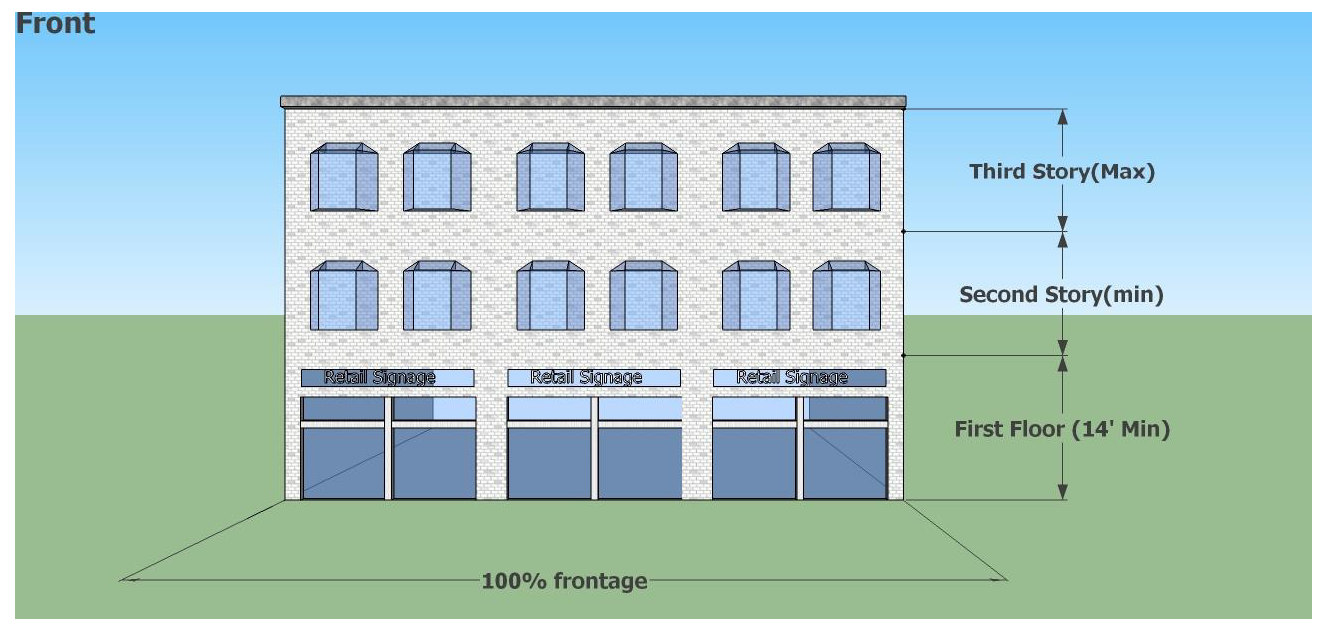
(2)
MU-1 front yard building setback and building frontage exceptions. In the MU-1 zone, 100 percent of the length of the ground level street-facing façade of the building must be built to the front lot line. The planning commission may grant exceptions to allow a greater building setback and/or a lesser building frontage requirement(s) where the front yard and/or side yard area(s) is used for one or more of the following:
a.
Widening the sidewalk along the frontage of the building.
b.
Providing a public gathering area or plaza that offers seating, landscape enhancements, public displays, fountains, or other pedestrian amenities.
c.
Providing outdoor seating for the proposed use.
d.
Providing pedestrian access to off-street parking areas.
(3)
MU-2 zone development standards.
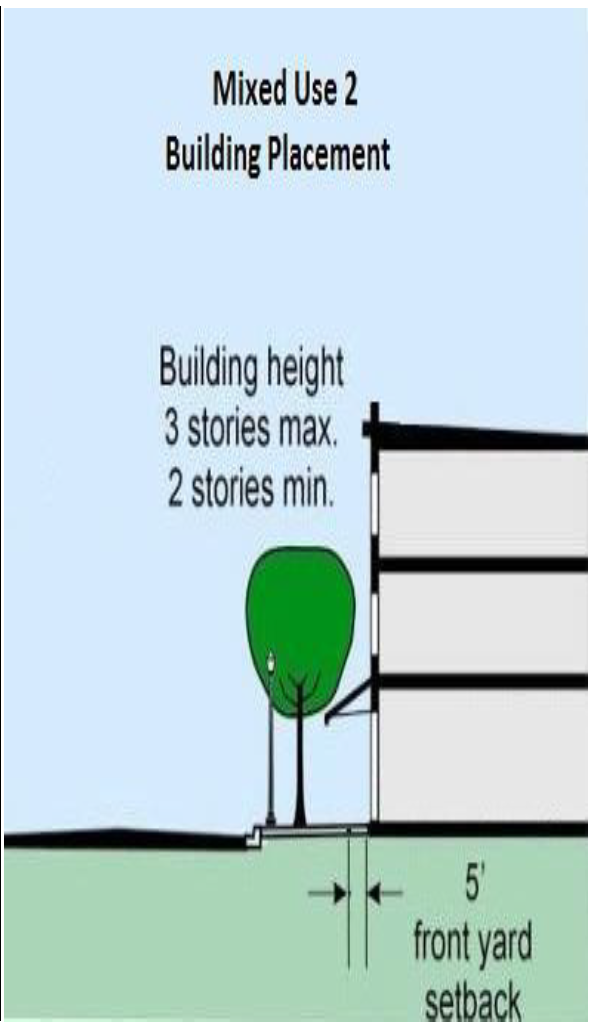
(4)
MU-2 front yard building setback and building frontage exceptions. In the MU-2 zone, 75 percent of the length of the ground level street-facing façade of the building must be built within five feet of the front lot line. The planning commission may grant exceptions to allow a greater building setback and/or a lesser building frontage requirement(s) where the front yard and/or side yard area(s) is used for one or more of the following:
a.
Widening the sidewalk along the frontage of the building.
b.
Providing a public gathering area or plaza that offers seating, landscape enhancements, public displays, fountains, or other pedestrian amenities.
c.
Providing outdoor seating for the proposed use.
d.
Providing pedestrian access to off-street parking areas.
e.
Parking lot. (See subsection (5))
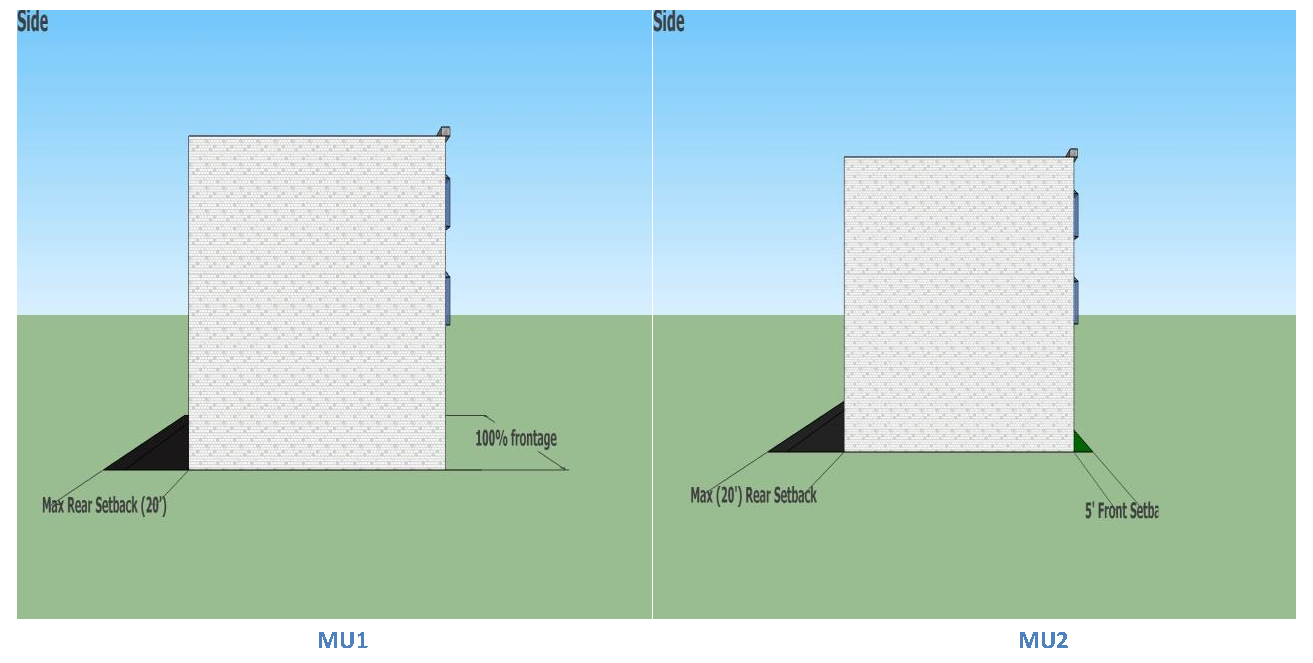
(5)
Parking. Parking within the downtown overlay district shall be provided as follows:
a.
Because this overlay district is intended to encourage pedestrian/transit friendly design and compact mixed-use development that requires less reliance on automobiles, land uses within the downtown overlay district shall be exempt from the table of parking requirements set forth in section 42-404 (8).
b.
On-street parking shall be allowed on all street frontages, as permitted by the downtown streetscape plan.
c.
Off-street parking lots (not located in the road right-of-way) are permitted only in side and rear yards.
1.
When parking is located within a side yard (behind the front building line) and has frontage on a public road right-of-way, no more than 25 percent of the total site frontage or 60 feet, whichever is less, shall be occupied by parking lot.
2.
For a corner lot, no more than 25 percent of the cumulative site frontage or 60 feet, whichever is less, shall be occupied by a side yard parking lot. The building shall be located at the corner of the lot adjacent to the intersection.
3.
For a double frontage lot or a lot that has frontage on three public road rights-of-way, no more than 35 percent of the cumulative site frontage or 60 feet, whichever is less, shall be occupied by a side yard parking lot. The building shall be located at the corner of the lot adjacent to the intersection.
d.
Where an off-street parking lot is visible from a street, it shall be screened by a three-foot tall screen wall located between the parking lot and the sidewalk.
e.
Driveway access to off-street parking lots shall be located to provide safe separation from the street intersections and shall be aligned with driveways on the opposite side of the street.
(6)
Fences. Fences are prohibited within the downtown overlay district, except as set forth in section 42-405(c).
(7)
Dumpsters. Dumpster facilities are permitted only in rear yards and shall be subject to section 42-406(d)(9).
(Ord. No. 449, § 4, 12-22-2014)
Mixed-use buildings that contain commercial use on the ground floor and all non-residential buildings shall meet the following architectural design requirements. It is not the intent of this section to regulate architectural style of buildings or limit creativity, but to ensure that the necessary functional and design elements to create and foster a mixed-use, pedestrian-oriented environment are incorporated into all building designs. Buildings should respect the existing architectural style of the area while advocating a more harmonious approach to contemporary design.
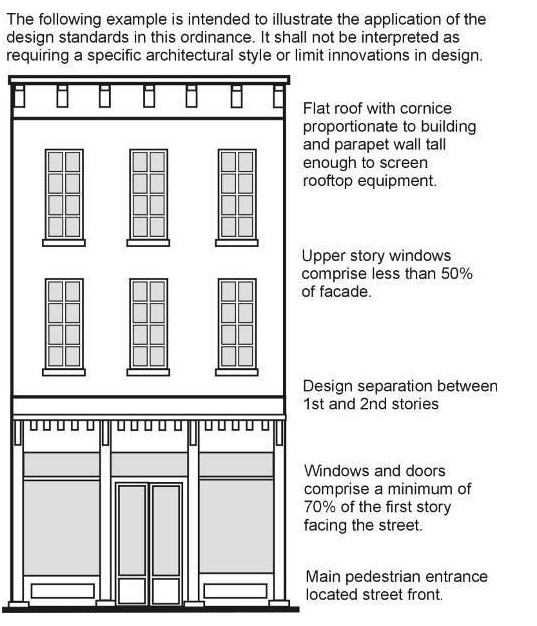
(1)
Front façade requirements. Walls that face a public street, plaza, green, park or off-street parking area shall include windows and architectural features customarily found on the front of a building, such as awnings, cornice work, edge detailing or decorative finish materials.
a.
Blank walls longer than 20 feet shall not face a public street.
b.
All buildings shall have a main entrance located on the front façade. Main entrances shall have design details that enhance the appearance and prominence of the entrance so that it is recognizable from the street and parking areas.
c.
For buildings with a front façade of more than 100 feet in length, there shall be a minimum of one usable entrance every full 50 feet of frontage along the front public sidewalk and shall provide architectural variation to visually break up the building.
d.
Garage doors shall not be permitted on a front façade.
(2)
Windows and doors.
a.
Storefront/ground floor. Ground floors shall be designed with storefronts that have windows, doorways and signage, which are integrally designed and painted. No less than 70 percent of the storefront/ground floor façade shall be clear glass panels and doorway. Glass areas on storefronts shall be clear, or lightly tinted. Mirrored glass is prohibited. Required window areas shall be either windows that allow views into retail space, working areas or lobbies, pedestrian entrances, or display windows set into the wall. Windows shall not be blocked with opaque materials or the back of shelving units or signs. The bottom of the window must be no more than three feet above the adjacent exterior grade.
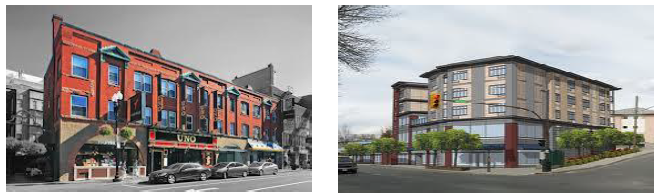
b.
Upper stories. Openings above the first story shall be a maximum of 50 percent of the total façade area. Windows shall be vertical in proportion and shall be compatible with the rhythm and proportion of windows on other buildings along the block.
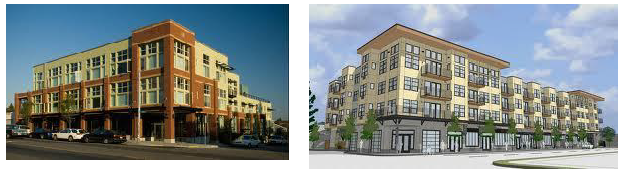
(3)
Roof design.
a.
Unless otherwise approved by the planning commission, buildings should have a flat roof appearance from the street with a decorative cornice that is designed proportionate to the size of the building and length of the wall.
b.
Flat roofs shall be enclosed by parapets. (Shown below)
c.
All rooftop mounted equipment shall be screened from view on street-facing sides of the building.
d.
Parapets and other screening treatment shall blend with the design of the building in terms of color, materials, scale and height.
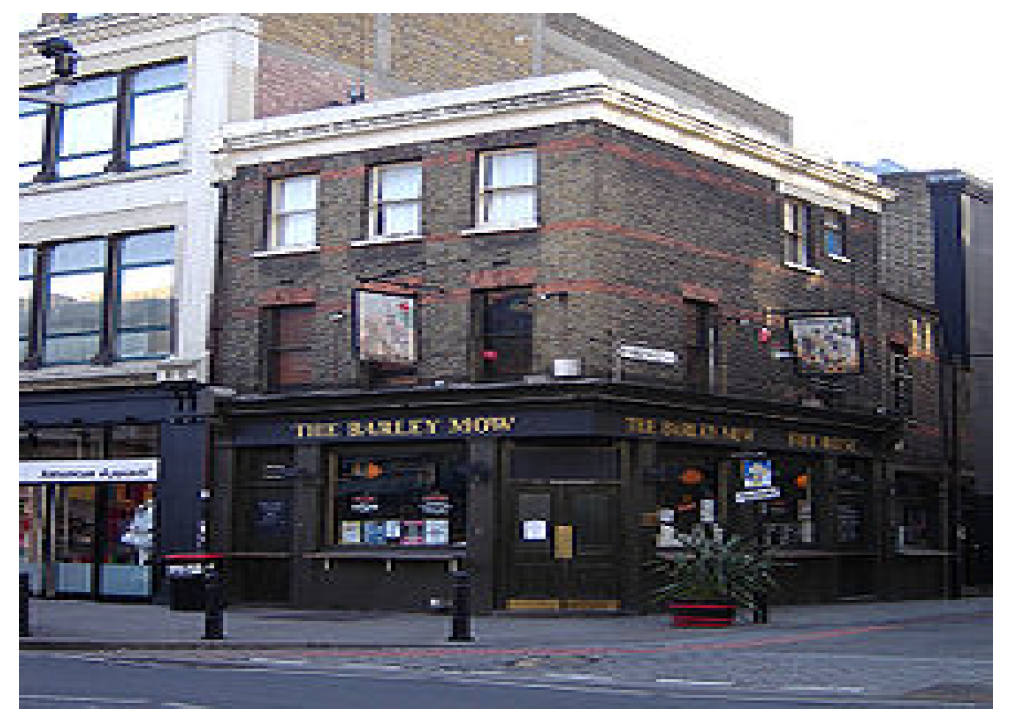
Enclosed rooftop parapet
(4)
Building materials. The following exterior finish materials are required on the front façade and any wall facing a street, plaza, green, park or off-street parking area. These requirements do not include areas devoted to windows and doors.
a.
All walls exposed to public view from a street, plaza, green, park or off-street parking area shall be constructed of not less than 60 percent brick, stone or glass.
b.
The remaining façade or wall area may include wood siding or fiber cement siding. Exterior insulation finish systems (EFIS) may be used for architectural detailing above the first floor.
(5)
Awnings. The canvas awning was an important design element in the traditional storefront. It provided shelter for pedestrians from sun and rain, added color, and acted as a transition between the storefront and the upper story. The awning can also be used as a location for building signage. Storefronts may be supplemented by awnings provided that the following conditions are met:
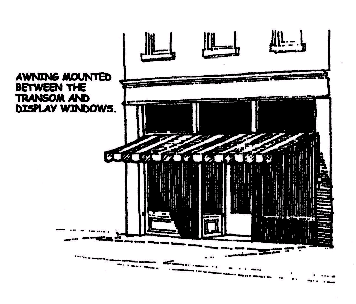
a.
Awnings shall fit storefront openings or individual window openings.
b.
The awning shall be positioned immediately above the first floor window area of the façade, attached below the storefront cornice or sign panel, and should not cover the piers on either side of the storefront.
c.
The awning should be mounted such that its valance is provided a minimum of eight foot clearance from the sidewalk.
d.
Fabric awnings are encouraged. The traditional commercial awning material is canvas and its profile is the watershed design. Other profiles tend to be too contemporary when placed on a traditional façade.
e.
Awning color should be selected to insure compatibility with the building and with the color of adjacent buildings.
f.
Historically incompatible canopies, awnings, and imitation mansard roofs made of metal, rough-sawn wood, plastic, shakes, or asphalt roofing are prohibited.
g.
Internally-illuminated or plastic awnings are prohibited, with or without signs.
(6)
Corner buildings. Buildings situated at a corner shall possess a level of architectural design that incorporates accents and details that accentuate its prominent location. This can be accomplished through height projections incorporated into a design feature such as a building peak, tower, or similar accent with the highest point located at the intersecting corner, which may be up to an additional ten feet above the height limit. The building architecture can be designed to focus on accentuating the geometry of the corner location. A main entrance may be on a street-facing wall and either at the corner or within 25 feet of the corner.
(Ord. No. 449, § 4, 12-22-2014)
Attached single family residential dwellings shall meet the following architectural design requirements:
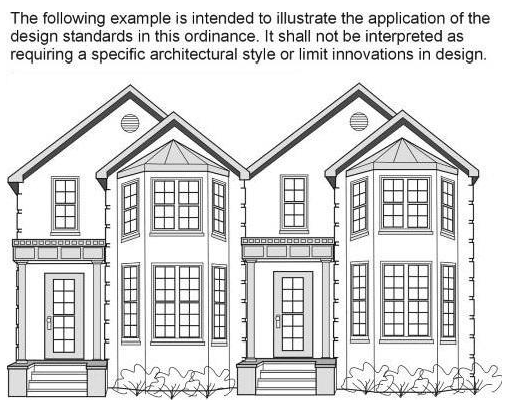
(1)
Front façade.
a.
All residential units shall provide a pedestrian door facing the front lot line.
b.
All dwellings shall include a front porch with steps. The porch shall have a minimum depth of four feet and a minimum area of 24 square feet.
c.
The front façade of all residential units shall be at least 25 percent windows or doors.
d.
The requirement for a front porch and window/door requirements in subsections b. and c. above shall not apply to live/work units where the first floor façade is designed as a storefront meeting the requirements of section 42-255(2). above.
(2)
Building materials. All buildings shall utilize building materials that are in keeping with traditional architectural styles. Permitted wall materials include, brick, stone, wood, and fiber cement siding. Vinyl siding is prohibited.
(3)
Garages. Garages shall be located in the rear yard and may be accessed by a rear alley or from a side street.
(Ord. No. 449, § 4, 12-22-2014)
The planning commission may approve modifications to the architectural requirements of sections 42-255 and 42-256 in order to allow for creativity and flexibility in design. A front elevation drawing of the proposed building shall be provided superimposed on a color drawing or photograph of the entire block showing the relation of the proposed building design to other buildings along the block, which shall be utilized to evaluate the proposed building design based upon all of the following criteria:
(1)
Demonstrates innovation in architectural design, provided the building design shall be in keeping with the desired character of the downtown, as articulated in the Downtown Design Guidelines Booklet—Village of Paw Paw.
(2)
The building is oriented towards the front sidewalk with a functioning entrance and enhances the continuity of the pedestrian-oriented environment. A modification shall not result in an increased dominance of vehicular parking or garage doors along the front of the building.
(3)
The roof design shall not be out of character with other buildings along the block and shall be within the minimum and maximum height requirements of the district.
(4)
The exterior finish materials shall be of equal or better quality and durability as those permitted herein, with the intent to allow for new technologies in building material while maintaining the desired character of the downtown.
(5)
Ground floor windows shall be provided along the front sidewalk to maintain the pedestrian orientation of the streetscape and upper story windows shall not be incompatible with the rhythm and proportions of windows on other buildings along the block.
(Ord. No. 449, § 4, 12-22-2014)
(a)
Street design standards. All streets shall be constructed to meet the requirements of the Village of Paw Paw. Modifications to existing streets shall be consistent with the Village of Paw Paw Master Plan to the maximum extent practical, as determined by the village council.
(b)
Sidewalks. Sidewalks in the downtown overlay district shall be provided as set forth in the Village of Paw Paw Sidewalk Ordinance.
(c)
Street trees. one canopy tree shall be provided for every 40 feet of frontage planted within tree grates in the sidewalk.
(d)
Street lights. Pedestrian level street lighting of a decorative nature shall be installed along all sidewalks and shall be designed to promote the traditional character of the area. Light fixtures shall meet the specifications of the Village of Paw Paw.
(e)
Alleys. Alleys shall be permitted in the downtown overlay district and shall be required where necessary to provide access to parking lots, loading areas and garages at the property.
(1)
Alleys serving as access to residential garages shall be located within an easement with minimum pavement necessary for circulation and emergency vehicle access.
(2)
Alleys accessing commercial parking lots and loading areas in the rear of a site may be used as drive aisles in interior block parking lots with parking spaces along the alleys.
(f)
Street furniture. Benches and trash receptacles shall be provided by the developer in park and plaza areas and along adjoining sidewalks where the planning commission determines that pedestrian activity will benefit from these facilities.
(g)
Bicycle facilities. All developments shall be designed to accommodate bicycle travel, including the provision of bike racks. All parking structures and parking lots for commercial, recreational and institutional uses shall include sufficient bike racks to allow the parking of a minimum of one bike for every ten automobiles or one bike for every 3,000 square feet of building floor area, whichever is greater.
(h)
Street cafés. Street cafés (or dining platforms) are allowed within the downtown overlay district, subject to the Village of Paw Paw street cafe standards.
(Ord. No. 449, § 4, 12-22-2014)
Because it is the purpose to catch people's eye, signage also has a major impact on the appearance of a façade and the streetscape. It is important that signage enhance, and not detract from, the building and streetscape.
When locating signage, work with the building's character and architectural composition. Design signage so that it is compatible with your building and not dominate or detract from the historic character of the building and clutter the streetscape.
(1)
Sign guidelines.
a.
Sign types. In the past, streetscapes had a variety of sign types that not only identified the business, but also the name of the buildings, dates of construction, etc. The signs were simple, bold and well crafted. Lettering was in clear, no-nonsense styles, maximizing the contrast between the background and the lettering.
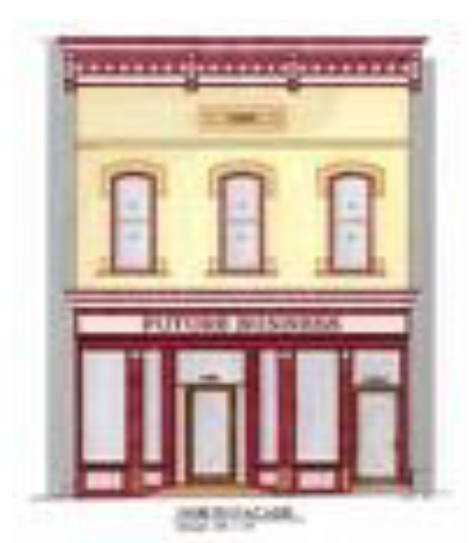
b.
Varying sign types can be found in the historic streetscape including: (1) storefront (wall) signs, (2) projecting signs, (3) hanging signs, (4) awning signs, (5) window signs, and (6) architectural signs. Every building should select the most appropriate sign type for its architecture and location.
c.
Sidewalk signs are temporary signs used to attract customers but can add vibrancy to a streetscape and expand the presence of a business if the design is creative and thoughtful.
d.
Quantities and locations. Storefronts should be limited to two permanent signs—one primary and one secondary. The primary sign should be located above storefront display windows but below the sills of second floor windows. On many examples of turn-of-the-century buildings a continuous brick ledge or corbelling is used to separate the second floor and above from the storefront below. This space is ideal for sign placement, as it was often created for this purpose.
e.
Types of secondary signage include hanging, window, awning, or any sign that is located below the primary sign. If a projected sign is planned, placement will be critical to avoid interferences with adjacent signs and architecture of the storefront itself. These signs should be located below second story window sills and be no less than eight feet above the sidewalk. Window signs should consist of a material and color that contrasts with the display, while being small enough to not interfere with the display area. The use of awning valances for signs is encouraged and is often an integral part of the awning pattern and style.
f.
Size. Big does not necessarily mean powerful. Primary signs of proper size can combine with the entire storefront to become more meaningful than just the sign itself. The sign must be subordinate to the building, not the opposite. Actual size may vary, but signboards, if used, need not exceed two and a half feet high. This size is appropriate for distances the sign will be read from in a downtown setting. Letters should not be less than eight inches nor more than eighteen inches high. Lettering should account for at least 50 and no more than 60 percent of a signboard.
g.
Message. Messages should be kept simple in content. The major function of the sign is to introduce the storefront and its contents. Wording should be minimal and slogans avoided. Descriptive words should be used rather than providing listings of items to be sold. Simple wording is easily read by pedestrians and street traffic.
h.
General.
1.
The maintenance and restoration of any existing historic signs is encouraged in lieu of replacement.
2.
Signage for a business not located within the building is not acceptable.
3.
Signage should be located in such a way as to not obscure any architectural features of the building.
4.
Signs are important to the store owner for reasons of advertising, identity, and image. As they are an extremely visible element of the storefront, signs must be used carefully so as not to detract from facades. With a little forethought and careful planning, signage can embrace the store owner's needs as well as Paw Paw's image.
(2)
Sign standards.
a.
General.
1.
Permitted signs: storefront (wall), projecting, hanging, awning, window, architectural, and temporary sidewalk signs as defined by this article.
2.
Prohibited signs: roof, freestanding, animated, flashing, signs that obscure the unique or historically-significant architectural detail of a building façade, and temporary signs, as defined by section 42-3 (not including temporary sidewalk signs as defined by this article).
3.
Exempt signs: those signs identified by section 42-435 are exempt from the provisions of this article.
4.
Area/height: sign area and height shall be measured as established by the definitions of "sign area" and "sign height" set forth in section 42-3.
5.
Color: sign colors must relate to the paint scheme of the building. Bright white and intense background colors are discouraged. Fluorescent colors are prohibited.
6.
Lighting: signs can be illuminated with directional spotlights or indirect lighting. Signs may not be internally-illuminated.
7.
Design: sign construction and sign copy must be of professional quality. Primary signage should identify a business and not a brand-name product. If more than one sign is used, the signs must be compatible in style.
8.
Sign installation: all signs, except window signs, require a sign permit and building and electrical permits as required. All signs shall be installed avoiding visible guy wires or other stabling devices.
9.
Sign permits: no sign shall be erected constructed, relocated or altered until a sign permit has been obtained from the village in accordance with section 42-441.
10.
Signs established within the downtown overlay district are not subject to article VI — Signs, except as set forth in this article.
b.
Sign area and number.
1.
A maximum total sign area of one square foot per lineal foot of width of the storefront is permitted.
2.
For establishments with frontage on more than one street, additional sign area of ½ square foot per lineal foot of width of the establishment along the secondary frontage is permitted.
3.
No establishment shall be permitted more than 100 square feet of total sign area.
4.
Each storefront shall be entitled to a minimum of 30 square feet of sign area.
5.
A maximum of two signs is permitted per storefront.
6.
A maximum of four signs is permitted per establishment.
7.
Window and architectural signs are permitted in addition to these maximums.
c.
Storefront (wall) signs. Storefront signs are those which are located on the horizontal band dividing the storefront windows from the upper façade of the building.
1.
Storefront (wall) signs shall be located above storefront display windows but below the sills of second floor windows
2.
Signs shall be placed in traditional locations, such as above transoms; below storefront cornices; or within the sign panel area on the façade.
3.
Signs may not extend over the side piers, or beyond the parapet or building face.
4.
Guidelines:
• The storefront sign should be used to display primarily the name of the business only. Use only one line of lettering if possible, leaving out secondary information.
• Use simple, bold lettering with sufficient contrast between the lettering and the background.
• Graphics in the sign are included in the maximum allowable area.
d.
Projecting signs. Projecting signs are at right angles to the building face, either fixed to the wall or hanging from a bracket. The major advantage of projecting signs over storefront or window signs is their ability to be seen by pedestrians and motorists from a distance down the street. If they get too large, however, they can obscure each other, so it is important to keep them small and simple.

1.
Only one projecting sign per storefront is permitted.
2.
Projecting signs shall be located no higher than the cornice or parapet line, whichever is lower.
3.
Signs shall be located so as not to obscure any unique or historically-significant architectural detail of the façade.
4.
The sign shall not extend further than four and one-half feet from the face of the building and shall not exceed 20 square feet in area.
5.
Projecting signs shall not be less than eight feet from the grade beneath and shall not extend above the second story window sill or roof line, whichever is lower.
e.
Hanging signs.
1.
Small horizontal hanging signs suspended over the entry or from a canopy are encouraged.
2.
Hanging signs shall not exceed four square feet in area.
3.
Hanging signs shall be provided a minimum of eight foot clearance from the sidewalk.
f.
Awning signs. Another option for a primary sign location can be an awning, provided the awning is properly integrated with the building.
1.
The area of a ground floor awning sign shall not cover more than 30 percent of the total surface area of the awning.
2.
Signs on two side panels of an awning shall be considered as one sign for purposes of calculating total number of allowable signs.
3.
The use of awning valances for signs is encouraged. Six to eight inch letters are sufficient.
g.
Window signs. Window signs were historically applied on the inside of the glass, painted directly onto the storefront glass, upper floor windows and doorways. The main focus of this style of signage is to target and inform approaching pedestrians. Therefore, window lettering typically provides more detailed information about the business. Today, most window signs are made of vinyl and applied to the outside of the window.

1.
Permanent window signs may include graphics painted on glass, vinyl letters applied to glass, a clear acrylic panel behind the window, or small neon window signs.
2.
Permanent window signs may not occupy more than 1/3 of the total area of the window.
3.
Window signs shall not count toward total allowable sign area for the building.
4.
Lettering should be white or light in color since windows appear dark.

5.
Guidelines:
• It may often be desirable to keep the display space clear. In these cases, insert the sign at the base or the head of the window, or both.
• Keep the lettering small remembering that the reader will be in close proximity to the sign. Use several lines where necessary and consider curving the top line at the head of the window.

• Lettering formed with neon may be used in the inside of the window, provided the size, light intensity, color and style are consistent with the theme of the building.
• Total sign area in the window should not exceed one-third of the window area.
• Display street numbers on or directly above the door, and business hours on the inside of the door or in an adjacent window.
h.
Architectural signs: Architectural signs are integrated into the building fabric and are constructed of permanent materials such as stone or metal. Names and the dates of construction were common signs included on the façade. They were typically located in the roof parapet detailing or in a cornerstone detail. These add a sense of history and place to the character and fabric of the village.
1.
Guidelines:
• Preserve existing architectural signs.
• Promote the use of the original building names in new signage.
i.
Sidewalk signs. Sidewalk signs are portable signs of A-frame or swinging style construction used during hours a business is open and stored inside when not in use. According to the National Main Street Center, temporary sidewalk signs can add vibrancy to a streetscape and expand the presence of a business if the design is creative and thoughtful.
1.
Only one sidewalk sign per storefront is permitted.
2.
Sidewalk signs shall not occupy more than nine square feet of sidewalk and shall not exceed four feet in height.
3.
Sidewalk signs shall be subject to the following placement standards:
i.
Must be placed in front of the storefront holding the permit for the sign.
ii.
Shall be located a minimum of two feet from the curb and allow five feet of unobstructed sidewalk.
iii.
Shall not be located within 25 feet of an intersection (measured perpendicularly).
iv.
Shall be spaced a minimum of 20 feet from each other.
v.
Placement is permitted during business hours but not before 8 AM or after 9 PM.
vi.
The sidewalk shall be completely clear of snow prior to placement of the sign.
vii.
Shall not be placed on snow banks.
viii.
Sidewalk signs shall be of A-frame or swinging style construction and shall be sturdy and stable enough to withstand typical winds without flipping over or sliding.
ix.
The surface of a sidewalk sign shall be durable and weatherproof.
x.
Sidewalk sign copy shall be painted or printed on the sign surface. Loose paper faces are not permitted.
xi.
Sidewalk signs shall not be illuminated by any means except natural light and existing street lights.
(3)
Nonconforming signs.
a.
Lawful existing signs: A permanent sign lawfully existing on December 22, 2014 (Ordinance No. 449) which does not fully comply with the provisions of this article shall be deemed a lawful nonconforming sign and may be allowed to remain if the sign is properly maintained and if it has no serious adverse effects on the public health, safety and general welfare.
b.
Lawful nonconforming signs: Lawful nonconforming signs shall be subject to Section 42-439 (b) and (c).
(4)
Abandoned signs. Any sign that the village determines to be abandoned, as defined by section 42-3, shall be removed by the owner of the property on which the sign is located. If the property owner cannot be found, the village may remove the sign and recover from said owner the full costs of removing and disposing of the sign.
(5)
Violations.
a.
It is a violation of this article to install, create, erect or maintain any sign that does not full comply with the requirements of this article.
b.
Each sign installed, created, erected or maintained in violation of this article is considered a separate violation when applying the penalty portions of this Ordinance.
(Ord. No. 449, § 4, 12-22-2014; Ord. No. 462, § 6, 7, 10-23-2017)