
Peabody City Zoning Code
SECTION 5
- BC/GBD DOWNTOWN DISTRICTS
5.1 - Purpose of site design criteria.
A.
Encourage a diverse mix of business, commercial, office, residential (in BC district only), governmental, institutional and entertainment uses for workers, visitors, and residents. Note that residential use is not allowed in the GBD district.
B.
Limit and discourage development of highway-oriented strip commercial uses that create traffic hazards and congestion because they require numerous individual curb cuts and generally higher traffic volumes.
C.
Encourage pedestrian friendly environment and pedestrian-oriented commercial enterprises and consumer services that do not rely on automobile traffic to bring consumers into the area.
D.
Permit uses that promote conversion of existing buildings in a matter that maintains the visual character and architectural scale of existing development within the district.
E.
Minimize visual and functional conflicts between residential and nonresidential uses within and abutting the district.
F.
Allow for more compact development than may be permitted in other zoning districts to reduce the impacts of sprawl.
G.
Encourage mixed uses within the same structure.
H.
Encourage consolidation of curb cuts for vehicular access and promote more efficient and economical parking facilities.
I.
Promote pedestrian and bicycle circulation and safety.
J.
Encourage uses that minimize noise and congestion.
K.
Encourage live/work or work/live space.
L.
Encourage first floor retail space.
5.2 - Site and design criteria.
5.2.1 Purpose. The site and design review process for the B-C district seeks to encourage visual harmony, respect historic integrity, and encourage creative design solutions. These guidelines are not intended to dictate style but rather to provide a framework of common principles that foster design compatibility within the district. This section supplements the existing site plan review and applies only to the B-C district.
5.2.2 Applicability. The site and design guideline criteria within this section shall be applicable to all residential buildings, mixed use projects and non-residential developments within the district. The Peabody Downtown Design Standards, created in January 2016 and as may be modified, shall apply to any new construction, exterior renovation, signage or site improvements in the BC zoning district and portions of the GB, GBD, BN, BN2, R2 and R4 zoning districts in the vicinity of the Downtown as set forth in the Main Street Subdistrict, Walnut/Foster Street Subdistrict and Washington Street Subdistrict versions of said standards. The Community Development & Planning Department, in conjunction with the Building Department, will apply said standards, and the Building Commissioner shall enforce said standards. This includes any new building construction; a change in building use (adaptive reuse of an existing building) or a significant alteration of the existing building facades; work which results in the increase or decrease of floor area through improvements to the principal structure; addition of a new accessory structure, or significant change to an existing accessory structure; or any activity requiring a new curb cut or the addition of three or more parking spaces. This section is part of the site plan review process (see Section 12) specifically for the BC district.
(Amended 12/08/2016)
5.2.3 Framework for review process. The site design review process will use the following as a framework for consideration:
A.
Architectural character.
1.
Building façade and exterior architectural features.
2.
Building height and setbacks.
3.
Rooftop features and cornice lines.
4.
Exterior materials and colors.
5.
Exterior illumination.
B.
Urban design considerations.
1.
Building placement and orientation
2.
Relationship to parking and adjacent uses.
3.
Relationship of building to sidewalk, public ways and open space.
4.
Storage and loading.
C.
Site improvements.
1.
Fences, walls and raised planters.
2.
Street and parking lot lighting.
3.
Street furniture-benches, trash containers, news racks, kiosks etc.
4.
Plazas, squares and public spaces.
5.
Site landscaping and parking lot screening.
6.
Safety issues.
5.2.4 Access. New curb cuts on existing public ways should be minimized. To the extent feasible, access to businesses shall be provided through one of the following methods: (a) from an existing side or rear street or public alley thus avoiding the principal thoroughfare or (b) from a common driveway serving one or more adjacent properties. Applicable projects should seek an ingress/egress easement for shared driveway use wherever feasible.
Garage doors and loading spaces are prohibited on the front façade of any building unless no other location is feasible. Loading areas shall be subject to screening requirements stated herein.
5.2.5 Parking. The following guidelines are included to ensure that new and renovated off-street parking areas are constructed in accordance with the district's desired design character, the provisions of this ordinance, and other city ordinances pertaining to parking.
A.
Parking lots for new construction shall be located to the side and rear of the lot unless no other location is feasible. Parking is prohibited within the front yard setback. Parking lots that abut public rights of way or grade parking under the building shall be screened with one or a combination of the following:
1.
A low wall made of concrete, masonry or other suitable material not exceeding a height of three feet.
2.
Raised planters planted with a minimum of 80% evergreen shrubs not to exceed a total height of three feet (including planter).
3.
Landscaping consisting of a mix of trees and shrubs provided that 80% of the shrub plantings are evergreen.
B.
Walls, fencing and architectural details shall compliment the materials of adjacent architectural styles.
C.
Where walls are provided planting areas shall be a minimum width of four feet and should be located adjacent to the public right-of-way.
D.
Where possible, parking areas shall be interconnected in a manner that allows the unobstructed flow of pedestrians between uses and parking areas.
E.
In large parking lots (20 or more spaces) provision for bicycle racks shall be provided in locations that are safely segregated from automobile traffic and parking.
5.2.6 Curb cuts. Developments shall be designed in a manner that minimizes the number of curb cuts on primary streets. The planning board may deny a curb cut if the proposed development inconsistent with the following guidelines:
A.
Curb cuts shall be limited to one unless the board feels that due to large parcel size an additional cut is justified.
B.
When access is available from a public alley the board may deny a curb cut from a primary street.
C.
Shared drives are encouraged between adjacent parcels when appropriate.
D.
Curb cuts within 200 feet of an intersection are discouraged and subject to site plan review.
E.
Curb cuts greater than 30 feet (for commercial properties) and 22 feet (for residential properties) are subject to site plan review. In no case shall a curb cut be the full length of the property.
5.2.7 Pedestrian and bicycle access. Provision for safe and convenient pedestrian access shall be incorporated into plans for new construction of buildings and parking areas and should be designed in concert with landscaping plans noted below. New construction should improve pedestrian access to buildings, sidewalks and parking areas and should be completed with consideration of pedestrian safety, handicapped access and visual quality. Where appropriate, applicants are encouraged to provide pedestrian and/or bicycle paths connecting their site with abutting areas in order to promote pedestrian and bicycle circulation and safety in the village. When parking is located in the rear, pedestrian access via a pedestrian-oriented alley or walkway through to the primary street is encouraged.
5.2.8 Landscaping. Landscaping shall be incorporated into new and redeveloped properties in such a way as to create visual relief and interest, provide shade for pedestrian areas and to screen parking and loading areas. Landscape plans shall be prepared by a design professional or, if in the board's discretion the plans submitted are consistent with the intent of this regulation and meet the specific guidelines as set forth herein. Landscape plans shall show the location, type, and size of all proposed plantings as well as enough of the surrounding context such that the Board may determine the plan's appropriateness.
A.
Side yard treatment.
1.
Where the distance between structures on adjacent lots is ten feet or less the side yard shall be screened by a solid fence, wall or landscape treatment of evergreen plantings at a height not to exceed three feet.
2.
Where the distance between structures on adjacent lots is greater than ten feet landscaping shall consist of a combination of materials sufficient to break up the view into the side yard but, for safety reasons, in no case should this planting be impermeable.
3.
Side yards may, in the alternative, be established as pedestrian walkways to access parking areas to the rear of the building. Such walkways shall be landscaped and lighted for safety.
B.
Parking areas.
1.
Large parking areas shall be relieved by landscaped islands of a minimum of eight feet in width, equal in depth to the depth of a typical parking space and located such that there is one island per ten continuous spaces.
2.
Alternatively, at least five percent of the interior area of the lot shall be devoted to landscaping. Areas described in the above shall have at a minimum one shade tree with a minimum caliper of 2½ inches diameter breast height (DBH). Trees planted in such locations shall be planted in protected pervious areas which have a minimum dimension of five feet.
3.
Where lots abut public rights of way, shade trees with a minimum caliper DBH of 2½ inches, shall be provided within a planting strip no less than four feet in width and at a rate of one tree per every six continuous spaces.
C.
Trash and service areas.
1.
All service, loading and trash storage areas viewable from a public right of way or from an adjacent residential area shall be screened by one or a combination of masonry, wood or evergreen plantings to reduce their visual impact.
2.
Loading and service areas shall not face any residential area unless no other location is possible.
5.3 - Intensity of use within the B-C district.
5.3.1 Location and distribution of uses. The ground floor of a commercial building or mixed use building (any combination of retail, office, and residential) shall be occupied by commercial uses only.
5.4 - Design guidelines.
5.4.1 Orientation. Buildings shall be oriented parallel to the front setback line to preserve a consistent façade line with the street. Primary building entrances should easily identified and be oriented to the street. The primary entry should be clearly visible from the public street which provides the building's main orientation. The building's address is where orientation shall apply.
5.4.2 Articulation. New and redeveloped buildings should reinforce the character of the existing streetscape by creating visual interest and reinforcing pedestrian scale. The apparent bulk and large wall expanses of multi-story buildings as well as single story buildings of 15' height or more should be minimized by incorporating one or preferably a combination of the following:
1.
Windows.
2.
Architectural details.
3.
Canopies.
4.
Overhangs.
5.
Indented bays.
6.
Change of building materials
The top of such buildings should display a distinct profile or outline incorporating such elements as a projecting parapet, cornice, upper level setback or pitched roofline. When immediately adjacent a building with such articulation, new and redeveloped buildings should provide a treatment that is respectful, such as providing a consistent cornice line where possible.
Large expanses of blank walls are prohibited for commercial and mixed-use buildings.
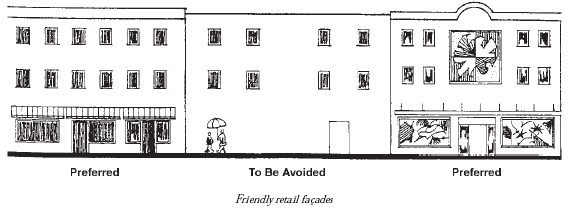
5.4.3 Transparency. For commercial and mixed- use buildings, a minimum of 60% of the building façade oriented to the street must be comprised of clear windows that provide views to indoor retail space, dining space or product areas when applicable. Where parking occupies the ground floor the same solid to void ratio must be achieved utilizing techniques such as half-walls, grillwork, or landscaped trelliswork or their equal.
5.4.4 Doors and entrances.
A.
Buildings must have a primary entrance facing a public street or way and should be visually prominent.
B.
In buildings with multiple ground floor tenants entries should provide a coordinated design theme i.e. a common canopy, architectural projection or awning design.
5.4.5 Pedestrian spaces and comfort. For the purpose of providing a pedestrian friendly environment in the B-C district, new and redeveloped buildings should provide for outdoor seating areas, scaled to the size and demands of the proposed use, where feasible. For example, a large, multi-story project should provide a patio or small plaza area located near the front entry with multiple benches and landscaping. A mixed-use project with ground floor retail such as a restaurant may provide an area for outdoor dining which extends the indoor dining space for seasonal use. A ground floor use may provide a sidewalk bench where there is sufficient width.
Such pedestrian areas are best located when they take advantage of southern exposure and provide space that affords visual connectivity but is setback from major pedestrian flow and vehicular ways and is appropriate to the location.
Outdoor sales and display areas should be well organized and located such as not to impede pedestrian circulation if located on a public walk or way.
The following guidelines should be considered in the design and location of pedestrian spaces:
1.
Flexible design to allow for flexible use.
2.
Buffering from major vehicular areas such as parking lots or main traffic ways.
3.
Lighting for nighttime comfort and safety.
4.
Appropriate street furnishing…i.e. benches, trash receptacles.
5.
A focal element where appropriate such as a water feature, special landscape feature or public art installation.
6.
Decorative paving and seasonal planting.
7.
South facing locations.
8.
Visual connectivity, especially to important views such as an historic structure.
9
Appropriately scaled to the development.
10.
Must maintain adequate width access as required by the Americans with Disabilities Act.
5.4.6 Outdoor dining. The purpose of this section is to provide for the licensing of outdoor dining areas of appropriate design, configuration and appearance that will serve as an amenity to the city during the spring, summer and fall. The city council may issue annual outdoor dining area licenses which shall be for the period from April 1 through October 31. Licenses shall be valid for one season, and must be reapplied for annually. The city council shall impose such conditions on each license as it determines to be appropriate and in the best interest of the city. License fees shall be established by the city council. The city council may also make such regulations governing such licenses as it deems necessary or appropriate to carry out the purposes of this section.
A.
Outdoor dining areas containing nine or more seats shall be separated from their surroundings by a perimeter fence or barrier. No such fences or barriers may damage the public sidewalk. Perimeter treatments, umbrellas, furniture and trash receptacles shall be supplied by the applicant and shall be maintained in a safe and sanitary manner by the applicant. All trash receptacles shall be covered and trash removed nightly. All perimeter treatments, umbrellas, furniture and trash receptacles must be removed at the end of each season. All furniture must be secured during the hours not in use.
B.
In no event shall the placement of outdoor dining furniture, umbrellas, perimeter fences or barriers create a pedestrian or wheelchair passage width of less than four feet. Restaurants shall have an accessible path of travel through the dining area at least 36 inches wide.
C.
Outdoor food preparation shall not be allowed unless approved by the board of health in accordance with their procedures and regulations.
D.
Approval of an outdoor dining area license shall not be construed as an approval of any other license or an approval for the alteration or extension of premises where alcoholic beverages are served. The serving or consumption of alcohol outside of premises duly licensed to serve alcohol is expressly prohibited unless approved by the city council.
E.
Due to the seasonal and temporary nature of an outdoor dining area, the seating within an outdoor dining area will not be considered an increase in the number of seats serving a restaurant and will not be counted toward any off-street parking requirement.
F.
Application for outdoor dining area licenses shall be made to the city council, with copies required to be submitted to the building inspector, board of health, fire department and police department for their review. Each application will include the name, address and telephone number of the restaurant owner, the proposed dates and times of operation, and a plan meeting the following requirements: a neatly drawn scaled plan and 12 copies depicting the precise dimensions and location of the outdoor dining area; the arrangement of outdoor dining furniture, perimeter fencing, umbrellas and any other obstruction; and the width of sidewalk available for pedestrian and wheelchair passage. The plan shall also include a written description of the colors and materials to be used in the outdoor dining area. Photographs or samples of proposed furniture and materials shall be provided upon request of the city council.
G.
The licensee shall carry or require that there be carried workers' compensation insurance for all employees and those of its contractors and/or subcontractors engaged in work at the dining facility, in accordance with the state workers' compensation laws. The licensee shall, prior to the issuance of the license, furnish a certificate of insurance to the city evidencing coverage for workers' compensation insurance. In addition, the licensee shall carry comprehensive public liability and property damage liability insurance and, if applicable, liquor liability insurance, to cover the licensee and its contractors and subcontractors against claims due to accidents which may occur or result from operations under the license. Such insurance shall cover the use of all equipment related to the provision of sidewalk dining services. The comprehensive general liability policy shall insure against all claims and demands for bodily injury and property damage with respect to the sidewalk dining facilities and services and shall be in such form and amount as determined by the city council. The city shall be named as an >additional insured" in all policies for such insurance. The licensee (and their heirs, successors and assigns in interest) shall also agree to hold harmless, defend and indemnify the City of Peabody and its employees and agents from any responsibility, liability and claims arising out of or related to the operations under the license. Where such insurance is renewed or replaced, the licensee shall furnish the city with a certificate of insurance evidencing same.
5.4.7 Utilities. Underground utilities for new and redeveloped building are required unless physically restricted or blocked by existing underground obstructions.
5.4.8 Lighting. Site lighting, security lighting and architectural/landscape lighting should provide the user with illumination levels appropriate for the designed activity (i.e. parking, walking, outdoor dining) while meeting minimum requirements. Illumination levels should also be reasonably uniform throughout the site and strive to minimize glare.
Provide adequate lighting levels in all pedestrian areas, including building entries, along walkways, parking areas, and other public areas. Provide the following in lighting plans:
A.
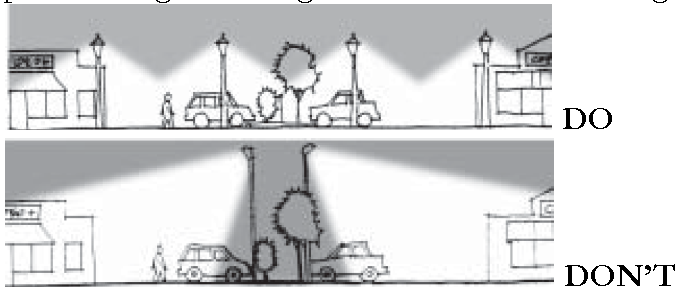
An overlapping pattern of light at a heightof about 10—15 feet in lighted areas.
B.
Lighting at consistent lumens with a gradual transition to unlighted areas. Highly contrasting pools of light and dark can be temporarily blinding and should be avoided.
C.
In each lighted area, design lighting levels that will allow pedestrians to identify a face 15 yards away (generally, a minimum of 4 foot-candles). Adequate lighting reduces anonymity and gives pedestrians an opportunity to choose another route.
D.
Adequate lighting at all building entrances, exits and corridors between buildings, at least four foot candles during active use, especially where doors are recessed.
E.
Confine site lighting to the project site; use shields or other methods to eliminate glare on adjacent properties.
F.
Place light posts and standards so that they do not create hazards for pedestrians or vehicles.
G.
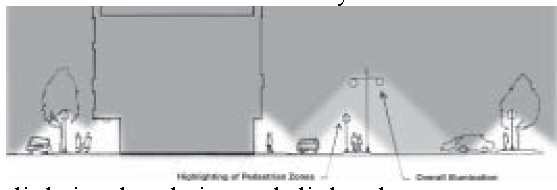
Indicate specific lighting levels in each lighted area.
5.4.9 Quality of site furnishings. Provide for the following site plan elements:
A.
High-quality materials in site furnishings and features, such as durable and easily maintained walls and paving.
B.
Site features and furnishings that discourage vandalism. Furnishings that are easily removed or do not convey an image of care invite misuse.
C.
Safety materials, such as non-slip walkway surfaces
D.
Recycled plastics or similar material are encouraged.

