
Peachtree Corners City Zoning Code
ARTICLE XIII
USE PROVISIONS
Sec. 1300.- RA-200 Agriculture-Residence District.
This district is comprised of land having a predominantly rural character. It is the intent of the regulations of this zoning district to discourage the subdivision of land for urban development requiring such urban services as a public water supply, sanitary sewers and fire protection.
Within the RA-200 Agriculture-Residence District, the following uses are permitted:
1.
Single-Family Dwellings.
2.
Customary Accessory Buildings and Uses.
3.
Customary Home Occupations.
4.
Customary Agricultural Uses including forestry, commercial greenhouses, plant nurseries and the raising and keeping of livestock, provided that no animal quarters are located closer than 100 feet to any property line.
5.
Customary Agricultural Buildings and Uses including farm ponds and fishing lakes and one and two-family tenant houses, subject to all of the yard requirements of the zoning district.
6.
Parks and other similar public and semi-public buildings and land uses.
7.
Kennel - provided than no animal quarters are located closer than 200 feet to any property line.
Fur Farm - provided that no animal quarters are located closer than 200 feet to any property line.
Cattery - provided that no animal quarters are located closer than 100 feet to any property line.
8.
Livestock sales pavilions or auction facilities, show rings or other arenas for the display, exhibition, training or sale of livestock, provided that no animal quarters are located closer than 100 feet to any property line. Adequate off-street parking shall be provided for livestock trailers, recreation vehicles, etc., associated with the proposed use in addition to the minimum requirements of the 2012 Zoning Resolution
If the above uses meet any of the following criteria, a Special Use Permit would be required and all provisions for approval would be established as part of the granting of the Special Use Permit:
a.
The event is held more than three (3) days per month.
b.
Operation of the use beyond 6:00 p.m.
c.
A public address system is provided.
d.
Permanent concession facilities are provided.
e.
Portable restroom facilities are provided.
f.
Seating facilities for more than 100 people are provided.
g.
Parking facilities for more than 50 vehicles are provided.
h.
Admission fee is charged.
9.
Public, semi-public and private golf and country clubs, golf driving ranges and fishing clubs.
10.
Public utilities.
11.
Riding stables and academies, including any place that regularly breeds, boards, trains, buys, sells, trades or lets for hire any horse, donkey, burro or mule, provided that no animal quarters are located closer than 100 feet to any property line.
12.
Farmers' Markets for the sale of products and commodities produced on the premises provided that any structure for such sales shall be located no closer than 35 feet to any property line.
13.
Temporary or portable saw mills provided no machine operation is located closer than 200 feet to any property line.
14.
The raising and keeping of household pets.
15.
The raising and keeping of wild animals, provided that the owner or custodian of such wild animals has received an appropriate permit and meets all the requirements of the State of Georgia, and further provided that no animal quarters are located closer than 200 feet to any property line.
16.
Facilities for use in the conduct of religious services and ceremonies provided:
a.
They are located on a Principal Arterial, Major Arterial, Minor Arterial, Major Collector Street or State Highway on a site of not less than five (5) acres with 250 feet of road frontage.
b.
The buildings are located not less than 50 feet from any street and not less than 30 feet from any side or rear property line.
c.
Parking is not provided in the front yard setback area.
d.
If adjacent to residentially-zoned property, a buffer of at least 50 feet wide shall be provided along the property lines adjacent to said zoning, provided, however, that this buffer may be reduced to no less than 20 feet in width adjacent to the sanctuary building or "Sunday School" educational building and parking related to these buildings.
e.
Facilities for use in the conduct of religious services and ceremonies located in a manufactured building may be erected on the property for a period not to exceed three (3) years.
Within the RA-200 Agriculture-Residence District, the following uses may be permitted provided the applicant for such a development is granted a Special Use Permit by the City Council after receiving recommendations from the Director of Planning and Development and Planning Commission and after a public hearing:
1.
Private Schools
2.
A cemetery, or family cemetery, provided the following conditions are met:
a.
The cemetery may front only on a street classified as a Collector or Arterial roadway or along a State Highway, and the entrance and exits to the cemetery shall only be from the classified street on which it fronts.
b.
The cemetery shall be bordered by a ten-(10)-foot wide buffer strip and a minimum six (6) foot high decorative fence along all of its exterior property lines not bordering the frontage street and not extending into the required front yard. The buffer strip shall be planted with evergreen trees or shrubs that grow at least eight (8) feet tall and provide an effective visual screen.
c.
Prior to the approval of a request to use property as a cemetery, a site plan and a covenant for perpetual care shall be submitted to the Department of Planning and Development. The covenant for perpetual care shall include measures to be undertaken to preserve, protect, and provide for ongoing maintenance including the fencing, landscaping, and gravesites.
d.
The covenant for perpetual care and a plat of survey delineating the limits of the cemetery shall be recorded in the Gwinnett County Clerk of Superior Court (Deeds and Records).
3.
Manufactured Homes.
4.
Group Day Care Homes.
5.
Veterinary Clinic or Hospital provided that no portion of a building, structure, outdoor run or pen used to house or exercise animals is located closer than 200 feet to any property line.
6.
Facilities for the conduct of religious services and ceremonies not meeting the minimum requirements for a permitted facility for the conduct of religious services and ceremonies.
7.
Residential or community shelters as an accessory use to a facility for the conduct of religious services and ceremonies meeting the minimum requirements for a permitted facility for the conduct of religious services and ceremonies. All shelters must meet the provisions of Rules for Shelters in City of Peachtree Corners.
8.
Funeral homes as an accessory use to a new or existing cemetery.
9.
Group Homes.
10.
Family Personal Care Home (minimum one-(1)-acre lot size).
(Ord. No. 2016-02-69, Exh. A, 2-28-2016)
Sec. 1300A. - Reserved.
Editor's note— Ord. No. 2021-10-220, § 1, adopted November 16, 2021, repealed § 1300A which pertained to the R-140 single-family residence district and derived from Ord. No. 2016-02-69, adopted February 28, 2016.
Sec. 1300B. - Reserved.
Editor's note— Ord. No. 2021-10-220, § 1, adopted November 16, 2021, repealed § 1300B which pertained to the R-LL single-family residence-large lot district and derived from Ord. No. 2016-02-69, adopted February 28, 2016.
Sec. 1301. - R-100 Single-Family Residence District.
This zoning district is intended primarily for one (1) family residences and related uses.
Within the R-100 Single-Family Residence District, the following uses are permitted:
1.
Single-Family Dwellings, except Manufactured Homes.
2.
Customary accessory buildings and uses.
3.
Customary Home Occupations.
4.
Existing Cemeteries.
5.
Public buildings and land uses.
6.
Electric substations or gas regulator stations, if essential for service to this zoning district, provided:
a.
The structures are placed not less than 50 feet from any property line.
b.
The structures are enclosed by a woven wire fence at least eight (8) feet high.
c.
The lot is suitably landscaped, including a buffer strip at least 25 feet wide along the side and rear property lines but not extending into the required front yard, planted with evergreen trees and shrubs that grow at least eight (8) feet tall and provide an effective visual screen.
d.
No vehicles or equipment are stored on the premises.
7.
The raising and keeping of livestock for personal pleasure or utility on a lot which contains the dwelling of the owner of the livestock, provided that the lot is at least three (3) acres in area and that no animal quarters are located closer than 100 feet to any property line.
8.
Lots located on culs-de-sac or half culs-de-sac shall have a minimum of eighty-five (85) feet at the building line.
9.
The raising and keeping of household pets. A purebred Vietnamese pot-bellied pig is allowed provided that the lot is at least one-half (½) acre in size, no hobby breeding, and only one (1) pig shall be allowed per lot. The raising and keeping of rabbits shall be allowed provided that the number of rabbits does not exceed eight (8) and any animal quarters are located in the rear yard and set back at least 30 feet from all property lines.
10.
Facilities for the conduct of religious services and ceremonies provided:
a.
They are located on a Principal Arterial, Major Arterial, Minor Arterial, Major Collector Street, or State Highway on a site of not less than five acres with 250 feet of road frontage.
b.
The buildings are located not less than 50 feet from any street and not less than 30 feet from any side or rear property line.
c.
Parking is not provided in the front yard setback area.
d.
If adjacent to residentially-zoned property, a buffer of at least 50 feet wide shall be provided along the property lines adjacent to said zoning; provided, however, that this buffer may be reduced to no less than 20 feet in width adjacent to the sanctuary building or "Sunday School" educational building and parking related to these buildings.
e.
A facility for the conduct of religious services and ceremonies located in a manufactured building may be erected on the property for a period not to exceed three (3) years.
Within the R-100 Single-Family Residence District, the following uses may be permitted provided the applicant for such a development is granted a Special Use Permit by the City Council after receiving recommendations from the Director of Planning and Development and Planning Commission and after a Public Hearing:
1.
Facilities for the conduct of religious services and ceremonies not meeting the minimum requirements for a permitted facility for the conduct of religious services and ceremonies within the district
2.
Private schools offering general education courses.
3.
A beauty parlor or barber shop in a one (1) family residence.
4.
Single family dwellings with a floor area of 1,000 square feet or greater but less than 1,400 square feet.
5.
Group day care homes.
6.
Day care facilities located in a church.
7.
Private not-for-profit recreation facilities; provided, however, that a Special Use Permit shall not be required for such facilities if they are to be located on an area reserved or dedicated for such use on a final recorded subdivision plat.
8.
The development of equestrian-oriented subdivisions on tracts of 15 acres or more, provided that no lot is less than one (1) acre and that all provisions for community and/or individual lot animal quarters shall be established as part of the approval of granting a Special Use Permit. Such provisions as approved and a restriction prohibiting the further subdivision of any lots shall be recorded as Protective Covenants for the subdivision.
9.
Metal buildings in excess of 550 square feet in size.
10.
Group Homes.
11.
Family Personal Care Home (minimum one-acre lot size).
(Ord. No. 2016-02-69, Exh. A, 2-28-2016)
Sec. 1302. - R-75 Single-Family Residence District.
This zoning district is intended primarily for moderate-cost, one family residences and related uses on land served by a central sewerage system. The development of lots in this district is permitted with septic tanks, provided lot sizes correspond to the area in square feet in the R-100 district. All septic tank installations are subject to the approval of the Gwinnett County Environmental Health Department.
Within the R-75 Single-Family Residence District, the following uses are permitted:
1.
All uses permitted in the R-100 Single-Family Residence District, including special uses, provided, however, that only those single-family dwellings with a floor area of 1,000 square feet or greater but less than 1,200 square feet shall be required to have obtained a Special Use Permit prior to being permitted. Single family dwellings with less than 1,000 square feet in floor area shall not be permitted.
(Ord. No. 2016-02-69, Exh. A, 2-28-2016)
Sec. 1302A. - R-60 Single-Family Residence District.
This zoning district is intended primarily for single-family detached residences and accessory uses on land served by a central sewerage system.
A.
Within the R-60 Single-Family Detached Residence District, the following uses are permitted:
1.
All uses permitted in the R-75 Single-Family Residence District, including special uses, except Group Day Care Homes, Family Group or Congregate Personal Care Homes.
2.
Subdivision development provided the following guidelines are met:
a.
Maximum density shall not exceed four (4) units per acre.
b.
The subdivision development shall have a minimum land area of at least five (5) contiguous acres.
c.
Dwellings shall include double-car garages and where garages are front entry, driveways shall be sixteen (16) feet in width. On cul-de-sac lots driveways may taper from 16 feet at the right-of-way line to the street pavement, but a minimum 16' × 35' paved parking pad must be provided.
d.
Provide sidewalks adjacent to interior streets, excluding cul-de-sac turnarounds.
e.
Provide a minimum 40-foot building setback adjacent to exterior streets. The setback may be reduced to 30 feet if a berm, landscaping, fence, or wall is provided adjacent to the exterior street(s).
(Ord. No. 2016-02-69, Exh. A, 2-28-2016)
Sec. 1302B. - R-TH Single-Family Residence Townhouse District.
This zoning district is intended exclusively for townhouse dwelling units, villas, residential dormitories, customary accessory uses and structures for development after January 2005. For developments prior to January 2005, refer to Article XIX: Appendix of Inactive Zoning Districts.
A.
Requirements. Within the R-TH Single-Family Residence Townhouse District, the following requirements shall be met:
1.
Maximum density: Ten (10) units per acre; Residential dormitories shall be limited to a maximum of 90 beds per acre.
2.
Lot Area: No Minimum for townhomes or villas; Minimum 3 acres for residential dormitories.
3.
Lot Width: No Minimum for townhomes or villas; Minimum 100 feet for residential dormitories.
4.
Internal Road Frontage: No Minimum.
5.
External Road Frontage For Overall Development: 50-feet.
6.
Minimum unit width: Twenty-two (22) feet for double-car garage townhomes. Eighteen (18) feet for single-car garage townhomes. Forty (40) feet for villas.
7.
Maximum height: 35 feet for townhomes or villas; Four (4) stories for residential dormitories.
8.
Internal yard requirements: A 20-foot grassed or landscaped strip shall be provided between all buildings and interior driveways/streets.
9.
External yard requirements: Front yard: 50-Feet. Side yard: 40-Feet. Rear yard: 40-Feet.
10.
Provide three (3) or more off-street parking spaces per dwelling unit for townhomes and villas. At least 80 percent of required parking areas for overall development must be located directly in the front or rear of the dwelling units. The balance of the parking spaces may be located in a parking facility separated from the units. All townhome and villas units shall require at least single-car garages.
Residential Dormitories shall have a minimum of one (1) parking space per bed and a maximum of 1.5 parking spaces per bed. Parking decks shall be allowed for residential dormitories. The maximum parking space allowance may be exceeded in any amount when a parking deck and/or underground parking structure is constructed to accommodate at least 50 percent of the maximum parking allowance. Excess parking may be shared with the adjacent school facilities.
11.
All grassed areas shall be sodded.
12.
Provide sidewalks adjacent to both sides of interior streets or private driveways. Design shall be per Development Regulations.
13.
A minimum of three (3) and maximum of eight (8) dwelling units shall be allowed in each row of townhouses. Villas shall have a minimum of three (3) units and a maximum of four (4) units per building.
14.
A minimum of a two-(2)-hour rated firewall shall be required between each attached dwelling unit. A four-(4)-hour rated firewall shall be required between every fourth (4th) attached dwelling unit. The four-(4)-hour firewall may be reduced to a two-(2)-hour firewall, if approved residential sprinkler systems, or similar fire prevention measures as approved by the Fire Marshal, are installed in each unit. Firewalls shall be constructed in accordance with applicable building codes of City of Peachtree Corners.
15.
All utilities shall be placed under-ground.
16.
A 50-foot wide landscaped setback shall be provided along all exterior street frontages. The landscaped setback may incorporate natural vegetation and shall include a decorative fence/wall and entrance monument. The fence may be constructed as a solid brick or stacked stone wall, or as a wrought iron-style fence with brick or stacked stone columns (maximum 30-feet on-center).
B.
Concept Plan Review. The purpose of the concept plan review is to encourage logic, imagination, innovation, and variety in the design process and ensure the soundness of the proposed development and its compatibility with the surrounding area. The Director of Planning and Development shall review plans for compliance with concept plan review criteria. The recommendations of both the Director of Planning and Development and the Planning Commission shall be transmitted to the City Council. Through the rezoning process, the City Council may condition approval of an R-TH request to a specific concept plan, or require a future site plan review by the Planning Commission.
The following exhibits shall be prepared by design professionals, such as planners, engineers, architects, or landscape architects, and submitted to the Department of Planning and Development. No application for an R-TH district shall be accepted for processing without these required exhibits.
1.
A location map indicating existing zoning on the site and the adjacent areas.
2.
A concept plan drawn no smaller than one (1) inch equals 100 feet, including the following information:
a.
Lot lines and setbacks;
b.
Topography with contour intervals no greater than 20 feet;
c.
Lakes, ponds and floodplains and the sources of floodplain data;
d.
Stormwater detention areas;
e.
Recreation facilities (if applicable);
f.
Location of typical off-street parking.
3.
Color elevations of front, sides and rear of all typical units, including proposed building material, and any other structures such as recreation buildings.
4.
Information indicating the following:
a.
Gross and net acreage (see definition of net density);
b.
Lot sizes (typical dimensions and square footage);
c.
Amount of common open space in square feet (if applicable).
5.
Such other architectural and engineering data as may be required to evaluate the project.
(Ord. No. 2016-02-69, Exh. A, 2-28-2016; Ord. No. 2024-08-291, § 1, 9-24-2024)
Sec. 1302B.1. - Single-Family Residence Stacked Townhouse (R-STH) District.
This zoning district is intended exclusively for stacked, back-to-back, and/or a hybrid of townhouse dwelling units, customary accessory uses and structures for development.
A.
Requirements.
1.
Maximum density: Eighteen (18) units per acre.
2.
Lot area: No Minimum.
3.
Lot width: No Minimum.
4.
Internal road frontage: No Minimum.
5.
External road frontage for overall development: 50 feet.
6.
Minimum unit width: Twenty-two (22) feet for double-car garage townhomes. Eighteen (18) feet for single-car garage townhomes.
7.
Maximum height: 35 feet.
8.
Internal yard requirements: A 20-foot grassed or landscaped strip shall be provided between all buildings and interior driveways/streets.
9.
External yard requirements:
a.
Front yard: 50 feet.
b.
Side yard: 40 feet.
c.
Rear yard: 40 feet.
10.
All townhouse units shall require at least a single-car garage. Garage doors shall be set back at least 18 ft. from the adjacent sidewalk or alley so that a parked vehicle in the driveway will not obstruct the sidewalk or alley.
11.
Provide two (2) or more off-street parking spaces per dwelling unit for townhouses and villas. The balance of the parking spaces may be located in a parking facility separated from the units.
12.
Guest parking shall be provided at a ratio of 0.25 spaces per dwelling unit.
a.
Guest parking may either be provided as on-street parallel parking or with separate off-street parking lots.
b.
Guest parking may be distributed throughout the development or centrally located.
13.
All grassed areas shall be sodded.
14.
Provide sidewalks adjacent to both sides of interior streets or private driveways. Design shall be per Development Regulations.
15.
A minimum of three (3) and maximum of eight (8) dwelling units shall be allowed in each row of townhouses.
16.
Stacked townhouse developments over two stories high should incorporate appropriate fire and life safety requirements for their height based on requirements for multifamily units. Firewalls shall be constructed in accordance with applicable building codes of City of Peachtree Corners.
17.
A minimum of a two-(2)-hour rated firewall shall be required between each attached dwelling unit. A four-(4)-hour rated firewall shall be required between every fourth (4th) attached dwelling unit. The four-(4)-hour firewall may be reduced to a two-(2)-hour firewall, if approved residential sprinkler systems, or similar fire prevention measures as approved by the Fire Marshal, are installed in each unit.
18.
All utilities shall be placed underground.
19.
A 50-foot wide landscaped setback shall be provided along all exterior street frontages. The landscaped setback may incorporate natural vegetation and shall include a decorative fence/wall and entrance monument. The fence may be constructed as a solid brick or stacked stone wall, or as a wrought iron-style fence with brick or stacked stone columns (maximum 30-feet on-center).
(Ord. No. 2025-01-309, § 1, 2-25-2025)
Sec. 1302C. - R-ZT Single-Family Residence District.
This district is intended for single-family detached residences and accessory uses of a medium density on land served by a sanitary sewerage system.
A.
Within the R-ZT Single-Family Residence District, the following uses are permitted:
1.
Single-family detached dwellings.
2.
Customary Home Occupations (provided the building lot is a minimum of 60 feet in width and 7,200 square feet in area).
B.
Within the R-ZT Single-Family Residence District, the following requirements shall be met:
1.
Maximum density shall not exceed six (6) units per acre.
2.
Minimum lot area shall be 4,000 square feet.
3.
Minimum lot width - 40-feet.
4.
Minimum front yard depth shall be 20 feet.
5.
Minimum side yard - five (5) foot side yard on each side.
6.
Minimum rear yard depth - When abutting an R-75 or less intense district, the rear yard shall be equal to the required buffer plus an additional five (5) feet. However, the rear yard setback shall not be less than 25 feet.
7.
Provide a minimum 40-foot landscaped building setback adjacent to exterior streets. The landscaped setback may incorporate natural vegetation and may be reduced to 30 feet if a berm and landscaping, fence or wall is provided adjacent to the exterior street(s).
Sec. 1302C.1. - Concept Plan Review.
The purpose of the concept plan review is to encourage logic, imagination, innovation, and variety in the design process and ensure the soundness of the proposed development and its compatibility with the surrounding area. The Director of Planning and Development shall review plans for compliance with concept plan review criteria. The recommendations of both the Director of Planning and Development and the Planning Commission shall be transmitted to the City Council. Through the rezoning process, the City Council may condition approval of an R-ZT request to a specific concept plan, or require a future site plan review by the Planning Commission.
A.
Required Exhibits. The following exhibits shall be prepared by design professionals, such as planners, engineers, architects or landscape architects, and submitted to the Department of Planning and Development. No application for an R-ZT district shall be accepted for processing without these required exhibits.
1.
A location map indicating existing zoning on the site and the adjacent areas.
2.
A concept plan drawn no smaller than one (1) inch equals 100 feet, including the following information:
a.
Lot lines and setbacks;
b.
Topography with contour intervals no greater than 20 feet;
c.
Lakes, ponds and floodplains and the sources of floodplain data;
d.
Stormwater detention areas;
e.
Recreation facilities (if applicable);
f.
Location of typical off-street parking.
3.
Elevations of all typical units and any other structures such as recreation buildings.
4.
Information indicating the following:
a.
Gross and net acreage (see definition of net density);
b.
Lot sizes (typical dimensions and square footage);
c.
Amount of common open space in square feet (if applicable);
d.
Such other architectural and engineering data as may be required to evaluate the project.
(Ord. No. 2016-02-69, Exh. A, 2-28-2016)
Sec. 1302D. - R-SR Senior Oriented Residence District.
This district is intended for single-family detached and/or villas-style attached residence and accessory uses of a medium density on land served by a sanitary sewerage system. The R-SR district is designed to serve the housing needs of senior residents. It is recommended that this district be located in areas that facilitate pedestrian access to nearby commercial goods and services, and/or amenities/cultural facilities such as public parks or libraries. The R-SR zoning shall not serve as a precedent for medium density zoning in an otherwise low density residential area.
R-SR developments shall be intended and operated for occupancy by persons 55 years of age and older. At least 80 percent of the occupied units shall be occupied by at least one (1) person who is 55 or older.
Permitted Uses:
1.
Detached single-family homes.
2.
Villas attached residences.
Building Design Standards:
A.
Architectural treatments shall be primarily of brick, or stone, with minor treatments of low or no-maintenance siding materials.
B.
All dwellings shall have a minimum 1,600 square feet for two bedroom homes, and 1,800 square feet for three (3) or more bedroom homes.
C.
All dwellings shall be limited to single-story, however, bonus rooms over garages shall be allowed.
D.
All dwellings shall contain double-car garages.
E.
All dwellings shall incorporate accessibility standards which shall include the following:
1)
Easy access step free feature at entrances to the unit.
2)
Easy passage feature requiring 32-inch wide, clear passage doorways throughout the unit.
3)
Easy use feature requiring wheelchair accessible bedroom(s), kitchen, entertainment area and bathroom(s), via step-free entrance.
F.
Attached villas shall generally have a minimum of three (3) units and a maximum of four (4) units per building. A minimum number of two (2) unit villas may be approved by the Director to address specific topographic issues.
G.
Attached villas shall include a minimum two-(2)-hour rated firewall between each attached dwelling unit. Firewalls shall be constructed in accordance with applicable building codes of Gwinnett County.
Site Design Standards for R-SR detached homes.
Within the R-SR Senior Oriented Residence District, the following requirements shall be met:
A.
Maximum density: Four (4) units per acre.
B.
Minimum lot area: 5,000 square feet.
C.
Average lot width: 50 feet.
D.
Minimum front yard: 20 feet.
E.
Minimum side yard: Five (5) feet.
F.
Minimum rear yard: 15 feet.
G.
Provide sidewalks adjacent to both sides of interior street.
Site Design Standards for R-SR attached villas:
Within the R-SR Senior Oriented Residence District, the following requirements shall be met:
A.
Maximum density: Six (6) units per acre.
B.
Lot Area: No Minimum.
C.
Lot Width: No Minimum.
D.
Internal Road Frontage: No Minimum.
E.
External Road Frontage For Overall Development: 50 feet.
F.
Minimum unit width: Forty (40) feet.
G.
Internal yard requirements: A 20-foot grassed or landscaped strip shall be provided between all buildings; and a 10-foot grassed or landscaped strip shall be provided between all buildings and interior driveways/streets.
H.
External yard requirements:
a.
Front yard: 50-Feet.
b.
Side yard: 20-Feet.
c.
Rear yard: 20-Feet.
I.
Provide sidewalks adjacent to both sides of interior streets or private driveways. Design shall be per Development Regulations.
Landscape Requirements:
A.
A minimum of 50-foot landscaped building setback shall be provided adjacent to abutting exterior streets. The landscaped setback may incorporate natural vegetation and shall be supplemented with either a landscaped berm, wrought-iron style fence with brick or stone columns (30 feet on-center), or a decorative brick wall. Alternate decorative fence materials may be utilized, subject to review and approval of the Director.
B.
At least one (1) 3-inch caliper street tree shall be planted at least every 35-feet along both sides of internal street(s).
C.
All grassed areas shall be sodded.
Mandatory Homeowner's Association Required.
A mandatory homeowners association shall be incorporated which provides for building and grounds maintenance and repair, insurance and working capital. Said association shall publish and adhere to policies and procedures that demonstrate that the community is intended to provide housing for persons 55 and over including maintaining surveys or affidavits verifying compliance with 55 and older occupancy requirements as permitted by 42 U.S.C. Section 3607, (b)(2)(c) of the Federal Fair Housing Act. Said association shall also include declarations and bylaws including rules and regulations, which shall at a minimum regulate and control the following:
A.
Restriction on homes being occupied, with at least 80 percent of the occupied units occupied by at least one resident who is age 55 or older.
B.
Restrictions on single-family residential use only and leasing of units. No more than ten percent of the total units may be leased by individual owners at any one time.
C.
Exterior items such as fences, lawn ornaments and restrictions on removal of landscaped areas and buffers.
D.
Exterior fence maintenance shall include a requirement that any graffiti shall be repaired and/or repainted within 72 hours.
E.
Except for a central amenity package, prohibit playground equipment, swing sets, trampolines or like fixtures.
F.
Maintenance of detention ponds, common areas and entrance features.
Concept Plan Review Required.
The purpose of the concept plan review is to ensure that soundness of the proposed development and its compatibility with the surrounding area. The Department of Planning and Development shall review plans for compliance with concept plan review criteria. The recommendations of both the Department of Planning and Development and the Planning Commission shall be transmitted to the City Council. Through the rezoning process, the City Council may condition approval of an R-SR request to a specific concept plan, or require a future site plan review by the Department of Planning and Development or Planning Commission.
A.
Required Exhibits.
The following exhibits shall be prepared by design professionals, such as planners, engineers, architects or landscape architects, and submitted to the Department of Planning and Development. No application for an R-SR district shall be accepted for processing without these required exhibits.
1.
A location map indicating existing zoning on the site and the adjacent areas.
2.
A concept plan drawn no smaller than one inch equals 100 feet, which includes the following information:
a.
Lot lines and setbacks;
b.
Topography with contour intervals no greater than 20 feet;
c.
Lakes, ponds and floodplains and the source of floodplain data;
d.
Stormwater detention areas;
e.
Recreation facilities (if applicable);
f.
Location of typical off-street parking.
3.
Color elevations of front, sides and rear of all typical units, including proposed building materials, and any other structures such as recreation buildings.
4.
Information indicating the following:
a.
Gross and net acreage (see definition of net density);
b.
Lot sizes (typical dimensions and square footage);
c.
Amount of common/open space in square feet (if applicable);
d.
Such other architectural and engineering data as may be required to evaluate the project.
(Ord. No. 2016-02-69, Exh. A, 2-28-2016)
Sec. 1303. - RM Multi-Family Residence District.
The following districts are intended for duplex and multi-family dwellings. These zoning districts are to be located where public water supply and sewerage facilities are available or can be obtained and where there is convenient access to collector streets, major thoroughfares or state or interstate highways. The purpose of the following zoning districts is to promote better utilization of land and freedom of architectural and engineering design without maximizing density. On any tract of land zoned for RMD, RM-6, RM-8, RM-10, RM-13 or RM the entire tract must be developed as the same type of use. No combinations of allowed uses are permitted on any one (1) tract of land. Townhomes are not permitted in these districts.
RMD Multi-Family Residence District (Duplexes).
This zoning district is intended primarily for duplexes provided only one duplex is constructed on each lot of record. Within the RMD Multi-Family Residence District (Duplexes), the following uses are permitted:
1.
All uses permitted in the R-75 Single-Family Residence District, including special uses, except single-family dwellings, group day care homes, personal care homes, group homes, and the raising and keeping of livestock, and pot-bellied pigs.
2.
Duplexes.
RM-6 Multi-Family Residence District (Maximum Density Six (6) Units Per Acre).
This zoning district is intended primarily for multi-family dwellings with a maximum density of six (6) units per acre. Within the RM-6 Multi-Family Residence District (maximum density six (6) units per acre) the following uses are permitted:
1.
All uses permitted in the RMD Multi-Family Residence District (Duplexes).
2.
Multi-family dwellings.
3.
A quadraplex apartment development on individual subdivision lots (four [4] units per lot) provided the following conditions are met:
a.
Served by a wastewater treatment facility.
b.
The minimum side yard setback shall be 15 feet on each side; all other setbacks shall apply as required in Article XIV.
Within the RM-6 Multi-Family Residence District, the following uses may be permitted provided the applicant for such a development is granted a Special Use Permit by the City Council after receiving recommendations from the Director of Planning and Development and Planning Commission and after a public hearing:
1.
Residential or Community Shelters, subject to the provisions of Rules for Shelters in City of Peachtree Corners.
RM-8 Multi-Family Residence District (Maximum Density Eight (8) Units Per Acre).
This zoning district is intended primarily for two-(2)-family and multi-family dwellings.
[Within the RM-8 Multi-Family Residence District, the following uses are permitted:]
1.
All uses permitted in the RM-6 Multi-Family Residence District, including special uses.
RM-10 Multi-Family Residence District (Maximum Density Ten (10) Units Per Acre).
This zoning district is intended primarily for two-(2)-family and multi-family dwellings.
Within the RM-10 Multi-Family Residence District (maximum density ten (10) units per acre), the following uses are permitted:
1.
All uses permitted within the RM-8 Multi-Family Residence District, including special uses.
2.
Residential and community shelters subject to the provisions of Rules for Shelters in City of Peachtree Corners. If previously developed as a single-family residence detached development, a Special Use Permit shall be required.
RM-13 Multi-Family Residence District (Maximum Density 13 Units Per Acre).
This zoning district is intended primarily for two-(2)-family and multi-family dwellings.
This zoning district includes all old RM districts which have no density designated. Within the RM-13 Multi-Family Residence District (maximum density 13 units per acre), the following uses are permitted:
1.
All uses permitted within the RM-10 Multi-Family Residence District.
2.
Boarding and rooming houses.
3.
Fraternal organizations and clubs not operated for profit.
4.
Retirement communities, which may include a nursing home, cafeteria and care facilities and accessory uses.
5.
Residential and community shelters subject to the provisions of Rules for Shelters in City of Peachtree Corners. If previously developed as a single-family residence detached development, a Special Use Permit shall be required.
Within the RM-13 Multi-Family Residence District, the following uses may be permitted provided that the applicant for such a development is granted a Special Use Permit by the City Council after receiving recommendations from the Director of Planning and Development and the Planning Commission and after a Public Hearing:
1.
Day Care Facilities
(Ord. No. 2016-02-69, Exh. A, 2-28-2016; Ord. No. 2021-10-220, § 1, 11-16-2021)
Sec. 1304. - Infill Residential Development (IRD) District.
1.
Purpose and Intent. This residential zoning district is intended to allow for and encourage a diversity of lot sizes, housing types and sizes within new infill development that is well integrated with the city's neighborhoods, parks, civic spaces, and supportive services. Areas of IRD zones close to other uses, particularly traditional single-family home uses shall consist of Zero Lot Line/Zero Setback Single-Family Detached development or Cottage Court development.
2.
Applicability. Application for such a development is contingent upon being granted rezoning approval by the City Council after receiving a recommendation from the City Manager or his/her designee and pursuant to Public Hearings before the Planning Commission and the City Council.
3.
Permitted Uses. The following uses are allowed within the IRD zoning district:
a.
Dwelling, Cottage Court.
b.
Dwelling, Duplex.
c.
Dwelling, Zero Lot Line Single-Family Detached.
d.
Dwelling, Townhouse.
e.
Dwelling, Stacked Townhouse.
f.
Dwelling, Single-Family Detached.
4.
Overall Development Standards.
a.
Lot size:
i.
Lots adjacent to detached single-family residential zoning districts: 4,000 square feet.
ii.
Lots adjacent to non-residential zoning districts and/or multifamily zoning districts and/or attached single-family residential zoning districts: None.
iii.
Cottage Court developments, if subdivided into individual lots: None.
iv.
Duplex: 5,000 square feet.
b.
Undisturbed Buffers between dissimilar districts:
i.
Lots adjacent to detached single-family residential zoning districts: 40 feet.
ii.
Lots adjacent to non-residential zoning districts and/or multifamily zoning districts and/or attached single-family residential zoning districts: None.
c.
Parking.
i.
Provide two (2) or more off-street parking spaces per dwelling unit. Parking spaces may be provided within garages or driveways connected to the dwelling.
1.
Garage doors shall be set back at least 20 ft. from the adjacent sidewalk or alley so that a parked vehicle in the driveway will not obstruct the sidewalk or alley.
ii.
Guest parking shall be provided at a ratio of 0.25 spaces per dwelling unit.
1.
Guest parking may either be provided as on-street parallel parking or within separate off-street parking lots distributed appropriately throughout the development or centrally located.
d.
All utilities shall be placed underground.
e.
Provide sidewalks adjacent to both sides of interior streets, subject to Chapter 34, Land Development Regulations.
f.
Provide landscape strips subject to Chapter 50, Division 3, Landscape Regulations.
g.
Provide for and maintain landscape plantings on-site as follows:
i.
In a landscape strip at least ten feet in width adjacent to any street right-of-way abutting the property and running the length of the entire property frontage, except in Technology Park.
5.
Additional Development Standards.
a.
Dwelling, Cottage Court.
i.
A minimum of four (4) and a maximum of twelve (12) detached dwelling units shall surround an internal courtyard.
ii.
Maximum heated floor area: 1,500 square feet.
iii.
Maximum height: 24 feet/1.5 stories.
iv.
Courtyards.
1.
Minimum courtyard size: 3,000 square feet or 600 square feet per unit, whichever is greater.
a.
70 percent of the courtyard shall consist of pervious material, of which a minimum of 50 percent of the courtyard shall be landscaped.
2.
Courtyards shall not be parked or driven upon except for emergency access and permitted temporary events.
3.
Each unit shall have a front porch with direct access to the courtyard.
a.
Front porches may encroach up to 6 feet into the courtyard.
v.
Development may be treated as fee-simple or condominium lots (if subdivided into individual lots).
b.
Dwelling, Duplex.
i.
Dwellings shall be located on individual lots.
ii.
Dwellings shall be oriented toward abutting external streets.
iii.
Dwellings shall be designed to have the external appearance of one (1) single-family detached home.
iv.
Units may be side by side or stacked.
v.
Each unit shall have a full kitchen and at least one full bathroom and bedroom.
vi.
Each unit shall have a porch with minimum dimensions of four feet by eight feet.
c.
Dwelling, Zero Lot Line/Zero Setback Single-Family Detached.
i.
Maximum height: 35 feet/2.5 stories.
ii.
Minimum distance between dwellings: 5 feet or as required by the City of Peachtree Corners Building Code, whichever is greater.
iii.
[Reserved.]
iv.
[Reserved.]
v.
Zero Lot Line dwellings may be constructed against the lot line on one (1) side of a lot, and no windows, doors, or other openings shall be permitted on this side.
vi.
Access for exterior maintenance shall be assured through a perpetual wall maintenance easement of five (5) feet in width, as necessary.
d.
Dwelling, Townhouse.
i.
A minimum of three (3) and maximum of eight (8) dwelling units shall be allowed in each row of townhouses.
ii.
Internal yard requirements: A 20-foot grassed or landscaped strip shall be provided between all buildings and interior alleys/streets.
iii.
A minimum of a two-(2)-hour rated firewall shall be required between each attached dwelling unit. A four-(4)-hour rated firewall shall be required between every fourth (4th) attached dwelling unit. The four-(4)-hour firewall may be reduced to a two-(2)-hour firewall, if approved residential sprinkler systems, or similar fire prevention measures as approved by the Fire Marshal, are installed in each unit.
e.
Dwelling, Stacked Townhouse.
i.
Stacked townhouse developments over two stories high should incorporate appropriate fire and life safety requirements for their height based on requirements for multifamily units.
ii.
A minimum of a two-(2)-hour rated firewall shall be required between each attached dwelling unit. A four-(4)-hour rated firewall shall be required between every fourth (4th) attached dwelling unit. The four-(4)-hour firewall may be reduced to a two-(2)-hour firewall, if approved residential sprinkler systems, or similar fire prevention measures as approved by the Fire Marshal, are installed in each unit.
(Ord. No. 2025-01-308, § 1, 3-25-2025; Ord. No. 2025-01-309, § 1, 2-25-2025)
Editor's note— Ord. No. 2021-10-220, § 1, adopted November 16, 2021, repealed § 1304 which pertained to the RL lakeside residence district and derived from Ord. No. 2016-02-69, adopted February 28, 2016. Subsequently, Ord. No. 2025-01-308, § 1, adopted March 25, 2025, enacted a new § 1304 as set out herein.
Sec. 1305. - MH Mobile Home Park District.
This zoning district is intended exclusively for the placement of mobile homes in an environment that will provide pleasant and otherwise satisfactory living conditions and, at the same time, will not produce adverse effects upon neighboring properties.
Within this district are permitted Mobile Home Parks in which lots are leased.
A Mobile Home District development shall meet the following requirements:
1.
Location. A Mobile Home District development shall front for a sufficient distance to provide safe access upon a State Highway, a Major Thoroughfare, a Collector Street or a local access road paralleling an expressway and shall have access and egress only on such road.
2.
Street Access Requirements. The entrance road to a Mobile Home District development shall have a minimum right-of-way width of 60 feet with a minimum pavement width of 28 feet. The entrance road shall have a turning radius from the highway of at least 30 feet and the entrance road shall extend at least 100 feet into the Mobile Home District development.
3.
Size. A Mobile Home District development shall have a minimum buildable area of at least 15 contiguous acres.
4.
Density. A Mobile Home District development shall have a density of not more than six (6) mobile home lots per buildable acre.
5.
Mobile Home Lots. Each mobile home shall be located on a separate mobile home lot in accordance with the Mobile Home Subdivision Regulations of Gwinnett County.
6.
Recreation and Other Community Facilities. Not less than eight (8) percent of the gross area of the Mobile Home District development shall be devoted to recreation and other community use facilities. Each recreation space shall have a minimum area of 10,000 square feet.
7.
HUD Mobile Home Court Development Guide. The Mobile Home District development shall meet the standards of the "Mobile Home Court Development Guide," as set forth in the above-titled pamphlet, FHA G4200.7, published January, 1970, which is hereby made a part of this Resolution, as well as the requirements of the City of Peachtree Corners Zoning Resolution and the Standard Building Code. If there are any differences in the above two (2) sets of requirements, the most stringent shall apply.
8.
No Site Construction Until Preliminary Subdivision Plat Approved. No site construction shall be undertaken and no permits shall be issued until a Preliminary Subdivision Plat that meets the requirements of the Development Regulations of City of Peachtree Corners and the requirements of this Zoning Resolution has been given tentative approval.
9.
Certificates of Occupancy. No Certificate of Occupancy for the placing of a mobile home in a Mobile Home District development shall be issued until at least 50 mobile home lots have been developed in accordance with an officially approved and recorded Final Subdivision Plat and are ready for occupancy.
10.
Skirting or Underpinning. All mobile homes shall be skirted or similar measures must be provided for on the mobile home.
(Ord. No. 2016-02-69, Exh. A, 2-28-2016)
Sec. 1305A. - Reserved.
Editor's note— Ord. No. 2021-10-220, § 1, adopted November 16, 2021, repealed § 1305A which pertained to the MHS manufactured housing subdivision district and derived from Ord. No. 2016-02-69, adopted February 28, 2016.
Sec. 1306. - Reserved.
Editor's note— Ord. No. 2021-10-220, § 1, adopted November 16, 2021, repealed § 1306 which pertained to the HS hospital service district and derived from Ord. No. 2016-02-69, adopted February 28, 2016.
Sec. 1306A. - Reserved.
Editor's note— Ord. No. 2021-10-220, § 1, adopted November 16, 2021, repealed § 1306A which pertained to the NS neighborhood shopping district and derived from Ord. No. 2016-02-69, adopted February 28, 2016.
Sec. 1307. - C-1 Neighborhood Business District.
Purposes. The C-1 Neighborhood Business District is intended to provide for commercial uses of a convenience nature for nearby residential neighborhoods. These uses are intended to be facilities serving the everyday needs of these nearby neighborhoods rather than the larger community. The residential character of the area surrounding this district shall be of primary consideration when Special Use Permits or Variances to these regulations are reviewed.
Permitted Uses. Only the following permitted uses shall be allowed in the C-1 Neighborhood Business District and no structures shall be erected, structurally altered or enlarged for any use other than a use permitted hereunder with the exception of a) uses lawfully established prior to the effective date of this amendment; b) special uses as listed hereunder; c) accessory uses as defined in Article III, Definitions; d) other uses which are clearly similar to and consistent with the purpose of this district.
A.
Retail and Service Uses.
1.
Antique Shops.
2.
Art and school supply stores.
3.
Art Galleries.
4.
Bakeries.
5.
Banks or financial institutions, and automatic teller machines.
6.
Barber and beauty shops.
7.
Book or stationery stores.
8.
Reserved.
9.
Custom dressmaking and sewing shops.
10.
Dance studios.
11.
Day care centers, provided the following conditions are met:
a.
At least 100 square feet of outdoor recreation area per child, and the outdoor play area is enclosed with a six-(6)-foot high fence.
b.
Comply with all State of Georgia Day Care requirements.
c.
Comply with all Gwinnett County and State of Georgia Health Regulations.
12.
Drug Stores.
13.
Dry cleaning establishments including dry cleaning pick-up and delivery stations, not to exceed 2,500 square feet of total floor area.
13a.
Fitness Studio.
14.
Florists.
15.
Garden supply centers and greenhouses.
16.
Gift shops.
17.
Group and congregate personal care homes.
18.
Hardware stores.
19.
Hobby shops.
20.
Ice cream shops.
21.
Interior decorating shops.
22.
Jewelry stores.
22a.
Learning Pods.
23.
Medical Cannabis Dispensary, provided that the following conditions are met:
a.
A dispensing license has been obtained pursuant to O.C.G.A. § 16-12-206(b)
b.
No medical cannabis dispensaries shall be located within 1,000-feet from any places of worship, public or private schools, daycare facilities, and daycare centers as measured by the most direct route of travel on the ground from the main entrance of the establishment to the main entrance or front door of the protected building.
c.
No medical cannabis dispensaries shall be within 3 miles of each other.
d.
No more than 2 medical cannabis dispensaries shall be allowed in the City.
24.
Museums.
25.
Music studios.
26.
Photography shops and studios.
27.
Radio and television repair shops.
28.
Shoe stores and shoe repair shops.
29.
Small appliance repair shops.
30.
Tailor shops.
31.
Toy stores.
32.
Travel agencies.
33.
Watch and clock repair shops.
34.
Weaving apparel shops.
B.
Office Uses.
1.
Accounting offices.
2.
Architecture of engineering offices.
3.
Medical office.
4.
Insurance offices.
5.
Law offices.
6.
Other public or professional offices.
7.
Real estate offices.
C.
Public and Semi-Public Uses.
1.
Facilities for the conduct of religious services and ceremonies.
2.
Public or semi-public buildings and land uses, parks, playgrounds or community centers.
3.
Utility offices.
D.
Special Uses. Within the C-1 Neighborhood Business District, the following uses may be permitted provided the applicant for such a development is granted a Special Use Permit by the City Council after receiving recommendations from the Director of Planning and Development and Planning Commission and after a Public Hearing:
1.
Reserved.
2.
Bicycle shops.
3.
Camera/photographic supply stores.
4.
Clothing sales or apparel shops.
5.
Reserved.
6.
Electronic equipment sales (TV, VCR, stereo equipment).
7.
Food stores/grocery stores.
8.
Group Homes.
9.
Music stores.
10.
Pet shops.
11.
Photocopying/reproduction services.
12.
Precious Metals Dealers.
13.
Record/video sales and rental stores.
14.
Residential or community shelter, subject to the provisions of Rules for Shelters in City of Peachtree Corners.
15.
Restaurants.
16.
Sporting goods stores.
17.
Veterinary clinics.
18.
Animal hospitals provided they are located not less than 300 feet from any residential zoning district or use as measured from property line to property line.
Other Provisions.
1.
Within the C-1 Neighborhood Business District, automobile parking is permitted within the front yard setback provided a minimum ten-(10)-foot landscaped strip and curb is provided adjacent to the right-of-way so that no automobile can back into the bordering street.
2.
Reserved.
3.
No outdoor storage is permitted within the C-1 Neighborhood Business District.
4.
Indoor storage shall not exceed 25 percent of gross floor area.
(Ord. No. 2016-02-69, Exh. A, 2-28-2016; Ord. No. 2019-01-140, § 1, 2-26-2019; Ord. No. 2021-03-193, § 1, 4-27-2021; Ord. No. 2024-03-276, § 1, 5-21-2024; Ord. No. 2024-07-288, § 1, 8-27-2024; Ord. No. 2024-07-289, § 1, 8-27-2024; Ord. No. 2024-11-299, § 1, 12-17-2024)
Sec. 1308. - C-2 General Business District.
Purposes. The C-2 General Business District is intended to provide adequate space in appropriate locations along major streets, thoroughfares and at intersections for various types of business use. These uses should include the retailing of major goods and services, general office facilities and public functions that would serve a community area of several neighborhoods. Development of uses in the district characteristically occupies a larger area than in the C-1 Neighborhood Business District, because it is intended to serve a greater population and to offer a wider range of services. Orientation and expansion of this district should occur as an increase in depth at major intersections rather than as a strip-like extension along the street or thoroughfare.
Permitted Uses. Only the following permitted uses shall be allowed in the C-2 General Business District and no structure shall be erected, structurally altered or enlarged for any use other than a use permitted herein with the exception of a) uses lawfully established prior to the effective date of the amendment; b) special uses as permitted herein; or c) accessory uses defined in Article III, Definitions; or [d)] other uses which are clearly similar to and consistent with the purpose of this District.
A.
Retail and Service Uses.
1.
Antique shops.
2.
Animal hospitals or veterinary clinics.
2a.
Apartment-hotels, provided the following standards are met:
i.
This use can only be applied to hotels in existence on May 25, 2021.
ii.
This use can only be applied to underperforming hotels as demonstrated by a measurable indicator such as occupancy levels below 50%; downgrading of the hotel brand; or the conducting of business as an extended stay hotel.
iii.
No hotel structure can be converted to an apartment-hotel without first obtaining a Special Use Permit after demonstrating that the following have been (or will be) met:
a.
The property maintains the same number of units with no increase in density.
b.
The property participates in multi-family crime-free housing programs, which include, but are not limited to, background and credit checks for tenants.
c.
All outstanding code enforcement issues are addressed.
d.
The existing landscaping is refreshed and enhanced.
e.
All common amenities are brought into good repair and thoroughly cleaned.
f.
The exterior of the building is brought into good repair and completely repainted.
g.
The exterior lighting is brought into good repair and enhanced where necessary.
h.
Existing signage is updated.
i.
Interiors of the units are improved with updated lighting, all new paint, new flooring, the provision of in-unit washers and dryers, and updated kitchen cabinets and appliances.
3.
Art and school supply stores.
4.
Art galleries.
5.
Automotive car wash (accessory only).
6.
Automotive parts stores (no on-premises installation).
7.
Bakeries.
8.
Banks or financial institutions. Automatic tellers as accessory or free-standing use.
9.
Barber and beauty shops.
10.
Bicycle shops.
11.
Billboards or Oversized Signs, as provided in the Sign Ordinance of City of Peachtree Corners.
12.
Blueprinting establishments.
13.
Book or stationary stores.
14.
Building, electrical or plumbing contractors (provided no equipment or materials are stored outside).
15.
Business college or business schools operated as a business enterprise.
16.
Clothing sales or rental stores.
17.
Reserved.
18.
Custom dressmaking and sewing shops.
19.
Dance studios.
20.
Day Care centers, provided the following conditions are met:
a.
At least 100 square feet of outdoor recreation area per child, and the outdoor play area is enclosed with a six-foot high fence.
b.
Comply with all Gwinnett County and State of Georgia Day Care Center requirements.
c.
Comply with all Gwinnett County Environmental Health Department and State of Georgia Health Department regulations.
21.
Department stores.
22.
Drive-In restaurants.
23.
Drug stores.
24.
Dry Cleaning pick-up and delivery stations.
25.
Electronic sales and service establishments.
26.
Emission Inspection Stations, provided the following design standards are met:
a.
The facility shall be located in a permanent non-combustible structure.
b.
The structure shall include a designated indoor public waiting area (minimum six (6) fixed seats) with restrooms; or as an alternative, shall provide the required designated indoor waiting area and restrooms upon the same lot, within 500 feet of the testing facility.
c.
The facility shall provide a minimum of four (4) paved parking spaces. Drive-through facilities shall also provide a paved stacking lane for a minimum of four (4) vehicles. Parking spaces and stacking lane shall be striped.
d.
If constructed in an existing parking lot, the facility and stacking lane(s) shall not occupy any required on-site parking space or encroach into any minimum required driveway width.
27.
Fireworks—Retail sales of consumer fireworks within a permanent building shall meet the following requirements:
a.
Building must meet overlay design standards, be free-standing, and be at least 2,500 sq. ft. in size, but no greater than 10,000 sq. ft. in size.
b.
Must meet Gwinnett County Fire Dept. regulations, be built to ICC H3 building code requirements, and have two functioning fire extinguishers within proximity of where fireworks are stored.
c.
Must be located at least 300 feet from a facility that sells, stores, or processes gasoline.
d.
No Smoking signs shall be displayed at building entrance.
e.
All product storage shall be contained within the building.
27a.
Fitness Studio.
28.
Florists.
29.
Food Catering establishments.
30.
Food stores or grocery stores.
31.
Funeral homes and mausoleums.
32.
Furniture rental or sales establishments.
33.
Equipment rental (excluding heavy equipment, bull-dozers, backhoes, forklifts, cranes, etc., and provided there is no outside storage associated with the use).
34.
Garden supply centers and greenhouses (including accessory outdoor storage).
35.
Gift shops.
36.
Group Homes.
37.
Group and congregate personal care homes.
38.
Hardware stores.
39.
[Reserved].
40.
Hobby shops.
41.
Hotels and Motels provided the following minimum standards are met:
a.
Guest rooms shall be accessed internally to the building with no direct room access to the outside. The lobby shall be a minimum of 700 square feet in size.
b.
Each hotel/motel site shall be a minimum of two (2) acres.
c.
Each hotel/motel must provide management on-duty twenty-four (24) hours a day.
d.
Each guest room shall have a minimum of three hundred (300) square feet and shall be accessed with a magnetic keycard entry-locking device.
e.
For buildings three (3) stories or less or containing no more than 130 rooms, each motel/hotel building shall have a minimum roof pitch of four (4) in twelve (12).
f.
Outside storage of commercial equipment is prohibited.
g.
No business license shall be issued for any business operating from any guestroom of the facility.
h.
Provide a 75-foot natural buffer, enhanced with an additional 25-foot landscaped buffer (total 100 feet) adjacent to residentially zoned property.
42.
Ice cream shops.
43.
Instruction of fine arts.
44.
Interior decorating shops.
45.
Jewelry stores.
46.
Laundries and dry cleaning establishments, including self-service laundries.
46a.
Learning Pods.
47.
Locksmith shops.
47a.
Micro-brewery and Micro-distillery (pursuant to the requirements of O.C.G.A 3-4-24.2 and 3-5-24.1)
48.
Medical Cannabis Dispensary, provided that the following conditions are met:
a.
A dispensing license has been obtained pursuant to O.C.G.A. § 16-12-206(b)
b.
No medical cannabis dispensaries shall be located within 1,000 feet from any places of worship, public or private schools, daycare facilities, and daycare centers as measured by the most direct route of travel on the ground from the main entrance of the establishment to the main entrance or front door of the protected building.
c.
No medical cannabis dispensaries shall be within 3 miles of each other.
d.
No more than 2 medical cannabis dispensaries shall be allowed in the City.
49.
Mobile Buildings (temporary, while any of the permitted or special uses are under construction, but not to exceed six (6) months).
50.
Museums and libraries.
51.
Music stores or studios.
52.
Office/showroom facilities.
53.
Parking lots and garages.
54.
Pest control businesses.
54a.
Pet boarding or pet day care facility, indoor, provided the following standards are met:
a.
All boarding facilities and activities shall occur indoors, including, but not limited to, kennels and crates, exercise and play areas, walking areas and relief stations.
b.
When located in a multi-tenant center, the use must be adequately soundproofed and odor-proofed, and pet food must be secured to avoid rodents and other pests.
c.
The applicant shall submit for approval a detailed Sanitation and Maintenance Manual detailing tasks such as animal waste clean-up and sanitization to be used in the day-to-day operation of the facility.
55.
Pet shops or grooming establishments.
56.
Photocopying and reproduction services.
57.
Photography shops and studios.
58.
Plant nursery sales facilities.
59.
Plumbing, electrical, pool and home building supply showrooms and sales centers (provided there is no outdoor storage associated with the use).
60.
Precious metals dealers.
61.
Radio, recording or television studios and broadcasting stations.
62.
Radio and television repair shops.
63.
Record/video sales and rental stores.
64.
Recreation facilities (indoor, such as bowling alleys, skating rinks, shooting ranges and movie theaters).
65.
Recovered Materials Processing Facility, Principal provided the following standards are met:
a.
Activities shall be limited to collection, sorting, compaction and shipping.
b.
Along the entire road frontage (except for approved access crossings), provide a three-(3)-foot high landscaped earthen berm with a maximum slope of 3 to 1 and/or a minimum six-(6)-foot high, 100 percent opaque, solid wooden fence or masonry wall. The fence/wall or berm must be located outside of any public right-of-way and interior to any landscaped strip. The finished side of a fence/wall shall face the exterior property lines.
c.
The facility shall not be located adjacent to or across the street from any property used for or zoned for single-family residential use.
d.
Lighting for such facilities shall be placed in such a fashion as to be directed away from any nearby residential areas.
e.
Materials collected shall not be visible and deposited in a bin or bunker. All sorting and collection bins shall either be enclosed and have chutes available to the public or be located inside a fully-enclosed building.
f.
No outdoor storage of uncontainerized materials shall be allowed.
66.
Restaurants.
67.
Shoe stores and shoe repair shops.
68.
Small appliance repair shops.
68a.
Spa/Spa establishment, provided the following standards are met if massage is offered as a service:
a.
A Special Use Permit shall be required.
b.
Compliance with all regulations and standards related to massage in Chapter 14, Business, Article V—Massage Establishments and Spas.
69.
Sporting goods stores.
70.
Tailor shops.
71.
Taxidermist.
72.
Toy stores.
73.
Travel agencies.
74.
Watch and clock repair shops.
75.
Weaving apparel shops.
76.
Yard Trimmings Composting Facility provided the following conditions are met:
a.
Composting materials shall be limited to tree stumps, branches, leaves, and grass clippings or similar putrescent vegetative materials, not including animal products, inorganic materials such as bottles, cans, plastics, metals, or similar materials.
b.
Along the entire road frontage (except for approved access crossings), and along the side and rear property lines, provide a three-foot high landscape earthen berm with a maximum slope of three (3) to one (1) and/or a minimum six-(6)-foot high, 100 percent opaque, solid wooden fence or masonry wall. The fence/wall or berm must be located outside of any public right-of-way and interior to any landscape strip. The finished side of a fence/wall shall face the exterior property lines.
B.
Office Uses.
1.
Accounting offices.
2.
Architecture or engineering offices.
3.
Medical office.
4.
Insurance offices.
5.
Law offices.
6.
Medical clinics.
7.
Other public or professional offices.
8.
Real estate offices.
C.
Public and Semi-Public Uses.
1.
Facilities for the conduct of religious services and ceremonies.
2.
Reserved.
3.
Government offices.
4.
Post offices.
5.
Public or semi-public buildings and land uses, parks, playgrounds or community centers.
6.
Utility offices.
D.
Residential.
1.
Caretaker or watchman quarters as an accessory use.
E.
Special Uses. Within the C-2 General Business District, the following uses may be permitted provided the applicant for such a development is granted a Special Use Permit by the City Council after receiving recommendations from the Director of Planning and Development and Planning Commission and after a Public Hearing:
1.
Auto body repair shops.
2.
Automotive car wash (full service or self service).
3.
Auto repair shops or tire stores including lubrication or tune-up centers (full service and self service).
4.
Automotive service stations, with or without fuel pumps.
5.
Building materials sales with outdoor storage.
6.
Contractor's offices or the outside storage of equipment or materials.
7.
Convenience stores with or without fuel pumps, provided that all convenience stores shall be subject to the following requirements:
(1)
Minimum lot size shall be one (1) acre.
(2)
Storefronts along a public street shall allow views into the building interior for a depth of at least five feet.
8.
Crematories, as an accessory to a funeral home.
8b.
Health clubs/fitness centers.
9.
Heavy equipment and farm equipment sales and service, and truck rental.
9a.
Hookah and/or Vapor Bar or Lounge, subject to the following:
a.
Hours of operation. No hookah and/or vapor bar or lounge shall remain open past 12:30 a.m.
b.
The smoking of hookah or vapor in any establishment that serves alcohol or food shall be prohibited.
c.
The sale of tobacco, tobacco related objects, alternative nicotine products or vapor products to anyone under the age of 21 is illegal.
d.
No Hookah and/or Vapor Bar or Lounge shall be within 3,000 feet of any parcel upon which another hookah and/or vapor bar or lounge is located.
9b.
Hotel/Motel, Extended Stay, provided the following standards are met:
a.
Guest rooms shall be accessed internally to the building with no direct room access to the outside. The lobby shall be a minimum of 700 square feet in size.
b.
Each hotel/motel must provide management on-duty twenty-four (24) hours a day.
c.
Each guest room shall have a minimum of three hundred (300) square feet and shall be accessed with a magnetic keycard entry-locking device. All guest rooms which have facilities for both the storage and preparation of food and have 300 square feet of floor area are limited to a maximum of 2 persons per such room; however, for all such guest rooms greater than 300 square feet, one additional person shall be allowable per each additional 75 square feet of floor area up to and including a maximum of 4 persons.
d.
No more than 10 percent of individual guests shall register, reside in, or occupy any room or rooms within the same licensed facility for more than a 90-day period.
e.
An indoor or fenced outdoor active recreation area shall be provided. The size of each recreation area shall be calculated at a ratio of 5 square feet per room with a minimum provision of 750 square feet. All recreation areas must be approved by the City Manager or his/her designee prior to development to ensure that all applicable safety specifications and standards are met.
f.
Outside storage of commercial equipment is prohibited.
g.
No business license shall be issued for any business operating from any guestroom of the facility.
h.
No hotel or motel or other structure can be converted to an extended stay facility without meeting all of the rules and regulations contained herein and must obtain a Special Use Permit from City Council.
i.
No hotel or motel under this section may be converted or used as an apartment or condominium without prior approval of City Council. Any hotel or motel converted to such use must meet all applicable state and local codes.
j.
A hard-wired smoke detector shall be provided and installed in each guest room.
k.
Each guest room must be protected with a sprinkler system approved by the fire marshal or their designee.
l.
Each guest room having a stove-top unit or other type burner unit shall be required to also include a maximum 60-minute automatic power off timer for each such unit.
10.
Lawn mower repair shops.
11.
Liquor store, subject to the following:
a.
Liquor stores must be located at least 300 ft. from churches and 600 ft. from schools. This distance shall be measured from the front door of the liquor store to the front door of the church or front door of the nearest school building as measured along pedestrian walkways.
b.
Liquor stores must be located at least 300 ft. from parks. This distance shall be measured from the front door of the liquor store to the nearest portion of the park property.
c.
Liquor stores must operate as sole tenants in free standing buildings of at least 5,000 sq. ft. in size and no greater than 10,000 sq. ft. in size.
d.
Liquor stores must be located on property that is a minimum of one-half acre in size with a minimum of 100 ft. of frontage on a state highway or major street.
e.
A liquor store shall not be located closer than 3,000 ft. to another liquor store, regardless of jurisdiction.
f.
Liquor store buildings shall comply with Overlay Design regulations.
g.
Liquor store deliveries shall be made at the rear of the store building and all loading areas, dumpsters, recycling bins, and compactors shall be screened from ground view.
h.
Liquor store properties shall have no outdoor storage including the storage of shopping carts.
i.
Liquor stores shall not sell lottery tickets, magazines, or tobacco products (except quality cigars).
11a.
Lounges/Clubs.
12.
Machine or welding shops.
12a.
Massage establishments.
13.
Mini-warehouse storage facilities.
14.
Mobile home or mobile building leasing or sales lots (new or used).
15.
Pawn shops, title loan and check cashing facilities.
15a.
Pet boarding or pet day care facility, outdoor, provided the following standards are met:
a.
All outdoor activity areas, including, but not limited to, kennels and crates, exercise and play areas, walking areas and relief stations must be set back at least 200 feet from any residentially-zoned property.
b.
All outdoor activity areas shall be located to the side or rear of the building housing the use and shall be surrounded by a continuous opaque fence which is 8 feet in height.
c.
No outdoor activities shall occur between the hours of 8:00 PM and 7:00 AM on weekdays nor between 8:00 PM and 8:00 AM on weekends.
d.
When located in a multi-tenant center, the use must be adequately soundproofed and odor-proofed, and pet food must be secured to avoid rodents and other pests.
e.
The applicant shall submit for approval a detailed Sanitation and Maintenance Manual detailing tasks such as animal waste clean-up and sanitization to be used in the day-to-day operation of the facility.
f.
If three (3) or more complaints are received regarding a specific business within a six (6) month time period, the special use approval granted to that business may be subject to reconsideration.
16.
Pool halls or billiard halls (three or more tables).
17.
Recreation facilities (commercial outdoor, such as miniature golf courses, driving ranges, water slides or drive-in theaters).
18.
Residential or community shelters, subject to the provisions of the Rules for Shelters in City of Peachtree Corners.
19.
Tattoo and body piercing parlors.
20.
Taxi cab or limousine services.
20a.
Vape/CBD Shops, subject to the following:
a.
A Vape/CBD shop shall not be located within 1,000 feet of any parcel upon which a religious facility, public or private elementary or secondary school, college campus, day care facility, library, public building, fitness facility, public park, or any residence is located; or
b.
A Vape/CBD shop shall not be located within 3,000 feet of any parcel upon which another vape shop is located; or
c.
A Vape/CBD shop shall not be located within 200 feet of the right-of-way of Peachtree Industrial Boulevard.
d.
For the purpose of this section, measurements shall be made in a straight line from the closest part of any structure occupied by the Vape/CBD shop to the closest property line of a parcel containing a use listed in subsection (a), above. Where a use listed in subsection (a) is located in a multi-tenant development, the distance shall be measured to the closest part of the tenant space occupied by that use rather than the property line of the entire development. The use of land in adjacent jurisdictions shall not disqualify a location within the City of Peachtree Corners from being available to a Vape/CBD shop.
21.
Vehicle rental establishments.
F.
Other Provisions.
1.
No outdoor sales and/or storage except as otherwise provided herein.
(Ord. No. 2016-02-69, Exh. A, 2-28-2016; Ord. No. 2017-10-102, § 1, 11-20-2017; Ord. No. 2018-04-122, § 3, 5-22-2018; Ord. No. 2019-01-140, § 1, 2-26-2019; Ord. No. 2021-02-192, § 1, 3-23-2021; Ord. No. 2021-03-193, § 1, 4-27-2021; Ord. No. 2021-04-195, § 1, 5-25-2021; Ord. No. 2024-03-276, § 1, 5-21-2024; Ord. No. 2024-07-288, § 1, 8-27-2024; Ord. No. 2024-07-289, § 1, 8-27-2024; Ord. No. 2024-11-299, § 1, 12-17-2024; Ord. No. 2024-11-300, § 1, 12-17-2024; Ord. No. 2024-11-301, § 1, 12-17-2024; Ord. No. 2024-11-302, § 1, 12-17-2024; Ord. No. 2025-03-312, § 1, 4-22-2025)
Sec. 1308A. - C-3 Highway Business District
Purpose. The purpose of the C-3 Highway Business District is intended for business uses which require a location accessible to major highways and arterials that serve significant portions of the community. It is also the intent of this district to provide areas for businesses which, because of their intensity, outside storage area or hours of operations, would have significant negative impacts on adjoining properties. Due to the nature of the businesses permitted within the C-3 District, the zoning district should be limited to property fronting on principal arterials, major arterials or minor arterials, not indicated as residential arterials, as shown on the Gwinnett County Long Range Road Classification Map.
Permitted Uses. Only the following uses shall be permitted in the C-3 Highway Business District and no structure shall be erected, structurally altered or enlarged for any use other than a use permitted herein with the exception of a) uses lawfully established prior to the effective date of this amendment; b) special uses as permitted herein; or c) accessory uses as defined in Article III, Definitions; or d) other uses which are clearly similar to and consistent with the purpose of this district.
A.
Retail and Service Uses.
1.
Antique shops.
2.
Animal hospitals or veterinary clinics.
3.
Art and school supply stores.
4.
Art galleries.
5.
Automotive body repair shops.
6.
Automotive car wash (full service or self service).
7.
Automotive parts stores.
8.
Auto repair shops or tire stores including lubrication or tune-up centers (full service and self service).
9.
Automotive sales lots (new or used) and associated service facilities. (Minimum lot size 1.5 acres for used.)
10.
Automotive service stations, with or without fuel pumps.
11.
Bakeries.
12.
Banks or financial institutions. Automatic teller as accessory or free-standing use.
13.
Barber and beauty shops.
14.
Bicycle shops.
15.
Billboards or Oversized Signs, as provided in the Sign Ordinance of City of Peachtree Corners.
16.
Blueprinting establishments.
17.
Boat sales establishments (new or used).
18.
Book or stationery stores.
19.
Building supply centers with outdoor lumber yards or storage areas, provided these areas are screened with a six-foot high, 100 percent opaque fence.
20.
Business colleges or business schools operated as a business enterprise.
21.
Clothing sales or rental stores.
22.
Contractor's offices with outdoor storage of equipment or materials, provided the storage or equipment areas are screened with a six-foot high, 100 percent opaque fence.
23.
Convenience stores with or without fuel pumps, provided that all convenience stores shall be subject to the following requirements:
(1)
Minimum lot size shall be one (1) acre.
(2)
Storefronts along a public street shall allow views into the building interior for a depth of at least five feet.
24.
Custom dressmaking and sewing shops.
25.
Dance studios.
26.
Day care centers, provided the following conditions are met:
a.
At least 100 square feet of outdoor recreation area per child, and the outdoor play area is enclosed with a six-foot high fence.
b.
Comply with all State of Georgia Day Care Facility requirements.
c.
Comply with all State of Georgia and Gwinnett County Environmental Health Department regulations.
27.
Department stores.
28.
Drive-in restaurants.
29.
Drug stores.
30.
Dry Cleaning pick-up and delivery stations.
31.
Electronic sales and service establishments.
32.
Emission Inspection Stations, provided the following design standards are met:
a.
The facility shall be located in a permanent non-combustible structure.
b.
The structure shall include a designated indoor public waiting area (minimum six (6) fixed seats) with restrooms; or as an alternative, shall provide the required designated indoor waiting area and restrooms upon the same lot, within 500 feet of the testing facility.
c.
The facility shall provide a minimum of four (4) paved parking spaces. Drive-through facilities shall also provide a paved stacking lane for a minimum of four (4) vehicles. Parking spaces and stacking lane shall be striped.
d.
If constructed in an existing parking lot, the facility and stacking lane(s) shall not occupy any required on-site parking space or encroach into any minimum required driveway width.
33.
Florists.
34.
Food catering establishments.
35.
Food stores or grocery stores.
36.
Funeral homes and mausoleums.
37.
Furniture rental, sales or service establishments.
38.
Equipment rental, sales or service (including heavy equipment, farm equipment, bulldozers, backhoes, forklifts, cranes, etc.).
39.
Garden supply centers and greenhouses (including accessory outdoor storage).
40.
Gift shops.
41.
Group Homes.
42.
Group or congregate personal care homes.
43.
Hardware stores.
44.
Health clubs/fitness centers.
45.
Hobby shops.
46.
Hotels or Motels provided the minimum standards are met as specified in the C-2 Zoning District, Section 1308.
47.
Ice cream shops.
48.
Instruction of fine arts.
49.
Interior decorating shops.
50.
Jewelry stores.
51.
Laundries and dry cleaning establishments including self-service laundries.
52.
Lawnmower repair shops.
53.
Reserved.
54.
Locksmith shops.
55.
Log splitting and storage lots, provided splitting and storage areas are screened with a six-(6)-foot high, 100 percent opaque fence.
56.
Machine, welding, radiator or muffler repair shops.
56a.
Micro-brewery and Micro-distillery (pursuant to the requirements of O.C.G.A 3-4-24.2 and 3-5-24.1).
57.
Mini-warehouse storage facilities.
58.
Mobile buildings (temporary, while any of the permitted or special uses are under construction, but not to exceed six (6) months).
59.
Mobile home or mobile building leasing or sales lots (new or used).
60.
Museums and libraries.
61.
Music stores or studios.
62.
Office/showroom facilities.
63.
Parking lots and garages.
64.
Pest control businesses.
64a.
Pet boarding or pet day care facility, indoor, provided the following standards are met:
a.
All boarding facilities and activities shall occur indoors, including, but not limited to, kennels and crates, exercise and play areas, walking areas and relief stations.
b.
When located in a multi-tenant center, the use must be adequately soundproofed and odor-proofed, and pet food must be secured to avoid rodents and other pests.
c.
The applicant shall submit for approval a detailed Sanitation and Maintenance Manual detailing tasks such as animal waste clean-up and sanitization to be used in the day-to-day operation of the facility.
65.
Pet shops or grooming establishments.
66.
Photocopying and reproduction services.
67.
Photography shops and studios.
68.
Plant nursery sales facilities.
69.
Plumbing, electrical, pool and home building supply showrooms and sales centers.
70.
Precious metals dealers.
71.
Radio, recording or television studios and broadcasting stations.
72.
Radio and television repair shops.
73.
Record/video sales and rental stores.
74.
Recreation facilities (indoor, such as bowling alleys, skating rinks, and movie theaters and commercial outdoor, such as miniature golf courses, driving ranges, water slides or drive-in theaters).
75.
Recovered Materials Processing Facility, Principal provided the following standards are met:
a.
Activities shall be limited to collection, sorting, compaction, and shipping.
b.
Along the entire road frontage (except for approved access crossings), provide a three-(3)-foot high landscape earthen berm with a maximum slope of three (3) to one (1) and/or a minimum six-(6)-foot high, 100 percent opaque, solid wooden fence or masonry wall. The fence/wall or berm must be located outside of any public right-of-way and interior to any landscaped strip. The finished side of a fence/wall shall face the exterior property lines.
c.
No such facility shall be located adjacent to or across the street from any property used for or zoned for residential use.
d.
Lighting for such facilities shall be placed in such a fashion as to be directed away from any nearby residential areas.
e.
All materials collected shall not be visible once deposited in a bin or bunker. All sorting and collection bins shall either be enclosed and have chutes available to the public or be located inside a fully-enclosed building.
f.
Any outside storage areas shall be screened by a minimum six-(6)-foot high, opaque fence.
76.
Restaurants.
77.
Shoe stores and shoe repair shops.
78.
Small appliance repair shops.
78a.
Spa/Spa establishments.
79.
Sporting goods stores.
80.
Tailor shops.
81.
Taxidermists.
82.
Taxi cab or limousine services.
83.
Toy shops.
84.
Travel agencies.
85.
Vehicle rental establishments.
86.
Watch and clock repair shops.
87.
Weaving apparel shops.
88.
Yard Trimmings Composting Facility provided the following conditions are met:
a.
Composting materials shall be limited to tree stumps, branches, leaves, and grass clippings or similar putrescent vegetative materials, not including animal products, inorganic materials such as bottles, cans, plastics, metals, or similar materials.
b.
Along the entire road frontage (except for approved access crossings), and along the side and rear property lines, provide a three-(3)-foot high landscape earthen berm with a maximum slope of three (3) to one (1) and/or a minimum six-(6)-foot high, 100 percent opaque, solid wooden fence or masonry wall. The fence/wall or berm must be located outside of any public right-of-way and interior to any landscape strip. The finished side of a fence/wall shall face the exterior property lines.
B.
Office Uses.
1.
Accounting offices.
2.
Architecture or engineering offices.
3.
Medical office.
4.
Insurance offices.
5.
Law offices.
6.
Medical clinics.
7.
Other public or professional offices.
8.
Real estate offices.
C.
Public and Semi-Public Uses.
1.
Facilities for the conduct of religious services and ceremonies.
2.
Reserved.
3.
Government offices.
4.
Post offices.
5.
Public or semi-public buildings and land uses, parks, playgrounds or community centers.
6.
Utility offices.
D.
Residential.
[1.]
Caretaker or watchman quarters as an accessory use.
E.
Special Uses. Within the C-3 Highway Business District, the following uses may be permitted provided the applicant for such a development is granted a Special Use Permit by the City Council after receiving recommendations from the Director Planning and Development and Planning Commission and after a Public Hearing:
1.
Any retail or service establishment not specifically permitted herein, but which is similar to the listed uses, compatible with uses on adjoining property and which meets the intent and purpose of the district.
2.
Crematories, as an accessory to a funeral home.
2a.
Hookah and/or Vapor Bar or Lounge, subject to the following:
a.
Hours of operation No hookah and/or vapor bar or lounge shall remain open past 12:30 a.m.
b.
The smoking of hookah or vapor in any establishment that serves alcohol or food shall be prohibited.
c.
The sale of tobacco, tobacco related objects, alternative nicotine products or vapor products to anyone under the age of 21 is illegal.
d.
No Hookah and/or Vapor Bar or Lounge shall be within 3,000 feet of any parcel upon which another hookah and/or vapor bar or lounge is located.
2b.
Hotel/Motel, Extended Stay, provided the following standards are met:
a.
Guest rooms shall be accessed internally to the building with no direct room access to the outside. The lobby shall be a minimum of 700 square feet in size.
b.
Each hotel/motel must provide management on-duty twenty-four (24) hours a day.
c.
Each guest room shall have a minimum of three hundred (300) square feet and shall be accessed with a magnetic keycard entry-locking device. All guest rooms which have facilities for both the storage and preparation of food and have 300 square feet of floor area are limited to a maximum of 2 persons per such room; however, for all such guest rooms greater than 300 square feet, one additional person shall be allowable per each additional 75 square feet of floor area up to and including a maximum of 4 persons.
d.
No more than 10 percent of individual guests shall register, reside in, or occupy any room or rooms within the same licensed facility for more than a 90-day period.
e.
An indoor or fenced outdoor active recreation area shall be provided. The size of each recreation area shall be calculated at a ratio of 5 square feet per room with a minimum provision of 750 square feet. All recreation areas must be approved by the City Manager or his/her designee prior to development to ensure that all applicable safety specifications and standards are met.
f.
Outside storage of commercial equipment is prohibited.
g.
No business license shall be issued for any business operating from any guestroom of the facility.
h.
No hotel or motel or other structure can be converted to an extended stay facility without meeting all of the rules and regulations contained herein and must obtain a Special Use Permit from City Council.
i.
No hotel or motel under this section is to be converted to or used as an apartment or condominium without prior approval of City Council. Any hotel or motel converted to such use must meet all applicable state and local codes.
j.
A hard-wired smoke detector shall be provided and installed in each guest room.
k.
Each guest room must be protected with a sprinkler system approved by the fire marshal or their designee.
l.
Each guest room having a stove-top unit or other type burner unit shall be required to also include a maximum 60-minute automatic power off timer for each such unit.
2b.
Lounges/Clubs.
2c.
Pet boarding or pet day care facility, outdoor, provided the following standards are met:
a.
All outdoor activity areas, including, but not limited to, kennels and crates, exercise and play areas, walking areas and relief stations must be set back at least 200 feet from any residentially-zoned property.
b.
All outdoor activity areas shall be located to the side or rear of the building housing the use and shall be surrounded by a continuous opaque fence which is 8 feet in height.
c.
No outdoor activities shall occur between the hours of 8:00 PM and 7:00 AM on weekdays nor between 8:00 PM and 8:00 AM on weekends.
d.
When located in a multi-tenant center, the use must be adequately soundproofed and odor-proofed, and pet food must be secured to avoid rodents and other pests.
e.
The applicant shall submit for approval a detailed Sanitation and Maintenance Manual detailing tasks such as animal waste clean-up and sanitization to be used in the day-to-day operation of the facility.
f.
If three (3) or more complaints are received regarding a specific business within a six (6) month time period, the special use approval granted to that business may be subject to reconsideration.
3.
Residential or community shelters, subject to the provisions of Rules for Shelters in City of Peachtree Corners.
4.
Massage establishments.
5.
Liquor store, subject to the following:
a.
Liquor stores must be located at least 300 ft. from churches and 600 ft. from schools. This distance shall be measured from the front door of the liquor store to the front door of the church or front door of the nearest school building as measured along pedestrian walkways.
b.
Liquor stores must be located at least 300 ft. from parks. This distance shall be measured from the front door of the liquor store to the nearest portion of the park property.
c.
Liquor stores must operate as sole tenants in free standing buildings of at least 5,000 sq. ft. in size and no greater than 10,000 sq. ft. in size.
d.
Liquor stores must be located on property that is a minimum of one-half acre in size with a minimum of 100 ft. of frontage on a state highway or major street.
e.
A liquor store shall not be located closer than 3,000 ft. to another liquor store, regardless of jurisdiction.
f.
Liquor store buildings shall comply with Overlay Design regulations.
g.
Liquor store deliveries shall be made at the rear of the store building and all loading areas, dumpsters, recycling bins, and compactors shall be screened from ground view.
h.
Liquor store properties shall have no outdoor storage including the storage of shopping carts.
i.
Liquor stores shall not sell lottery tickets, magazines, or tobacco products (except quality cigars).
6.
Vape/CBD Shops, subject to the following:
a.
A Vape/CBD shop shall not be located within 1,000 feet of any parcel upon which a religious facility, public or private elementary or secondary school, college campus, day care facility, library, public building, fitness facility, public park, or any residence is located; or
b.
A Vape/CBD shop shall not be located within 3,000 feet of any parcel upon which another vape shop is located; or
c.
A Vape/CBD shop shall not be located within 200 feet of the right-of-way of Peachtree Industrial Boulevard.
d.
For the purpose of this section, measurements shall be made in a straight line from the closest part of any structure occupied by the Vape/CBD shop to the closest property line of a parcel containing a use listed in subsection (a), above. Where a use listed in subsection (a) is located in a multi-tenant development, the distance shall be measured to the closest part of the tenant space occupied by that use rather than the property line of the entire development. The use of land in adjacent jurisdictions shall not disqualify a location within the City of Peachtree Corners from being available to a Vape/CBD shop.
(Ord. No. 2016-02-69, Exh. A, 2-28-2016; Ord. No. 2018-04-122, § 3, 5-22-2018; Ord. No. 2019-01-140, § 1, 2-26-2019; Ord. No. 2021-02-192, § 1, 3-23-2021; Ord. No. 2021-03-193, § 1, 4-27-2021; Ord. No. 2024-11-299, § 1, 12-17-2024; Ord. No. 2024-11-300, § 1, 12-17-2024; Ord. No. 2024-11-301, § 1, 12-17-2024; Ord. No. 2024-11-302, § 1, 12-17-2024)
Sec. 1309. - O-I Office-Institutional District.
This zoning district is established to provide a location for offices, institutions and limited related retail business and service activities in buildings of high character in attractive surroundings.
1.
Permitted Uses. A building or land may be used for the following purposes:
a.
Accessory parking garages and parking lots.
b.
Accessory uses such as retail business and service establishments. In addition to the limitations on "accessory use" imposed under "Article III, Definitions," such permitted accessory uses specifically exclude retail business and service establishments that could be construed as principal uses and include only those uses that are primarily intended for and used by patrons or occupants of the principal use to which said establishment is accessory.
c.
Cultural facilities.
d.
Financial services/institutions without drive-in or drive-through facilities.
e.
Professional and business offices.
f.
Public offices.
g.
Facilities for the conduct of religious services and ceremonies.
h.
Medical office.
i.
Learning Pods.
j.
Fitness Studio.
2.
Limit on Distributive Functions. Distributive functions such as loading, unloading, storage, packaging and unpackaging shall be limited to ten (10) percent of the total building area and five (5) percent of the total lot area.
Within the O-I Office-Institutional District, the following uses may be permitted provided that the applicant for such a development is granted a Special Use Permit by the City Council after receiving recommendations from the Director of Planning and Development and Planning Commission and after a public hearing:
1.
Animal hospitals provided they are located not less than 300 feet from any residential zoning district or use as measured from property line to property line.
1a.
Apartment-hotels, provided the following standards are met:
i.
This use can only be applied to hotels in existence on May 25, 2021.
ii.
This use can only be applied to underperforming hotels as demonstrated by a measurable indicator such as occupancy levels below 50%; downgrading of the hotel brand; or the conducting of business as an extended stay hotel.
iii.
No hotel structure can be converted to an apartment-hotel without first obtaining a Special Use Permit after demonstrating that the following have been (or will be) met:
a.
The property maintains the same number of units with no increase in density.
b.
The property participates in multi-family crime-free housing programs, which include, but are not limited to, background and credit checks for tenants.
c.
All outstanding code enforcement issues are addressed.
d.
The existing landscaping is refreshed and enhanced.
e.
All common amenities are brought into good repair and thoroughly cleaned.
f.
The exterior of the building is brought into good repair and completely repainted.
g.
The exterior lighting is brought into good repair and enhanced where necessary.
h.
Existing signage is updated.
i.
Interiors of the units are improved with updated lighting, all new paint, new flooring, the provision of in-unit washers and dryers, and updated kitchen cabinets and appliances.
2.
Day care facilities.
3.
Financial services/institutions with drive-in or drive-through facilities.
4.
Group Homes.
5.
Group or congregate personal care homes. Personal care homes shall be licensed by the State of Georgia.
6.
Hotels and Motels provided the minimum standards are met as specified in the C-2 Zoning District, Section 1308.
7.
Residential or community shelters. These shelters must meet the provisions of Rules for Shelters in City of Peachtree Corners.
8.
Restaurants, provided the following minimum standards are met:
a.
The proposed site shall be located within a recorded concept plan or subdivision plat for a business or office park which:
1.
Has an overall area of not less than 50 acres. Office/business park.
2.
Has existing principal use structures already developed within the office/business park.
3.
Has controls in place through protective covenants which will ensure building appearance and landscaping compatible with the remainder of the business or office park and which will ensure compliance with the requirements of this section.
b.
No more than 10 percent of the acreage within the recorded concept plan or subdivision plat for the business or office park may be occupied by uses requiring a Special Use Permit.
c.
The proposed restaurant:
1.
Shall have a minimum of 2,000 square feet of seating area excluding kitchen facilities.
2.
Shall have sit-down waiter or waitress service.
3.
Shall not have drive-thru or pick-up windows.
4
Shall not be adjacent to or across a public street from residentially zoned property.
d.
Restaurant appearance shall blend with campus-type office/warehouse development. Application must include landscape plan, building elevations, and signage plans.
9.
Retirement communities.
10.
Veterinary clinics.
(Ord. No. 2016-02-69, Exh. A, 2-28-2016; Ord. No. 2019-01-140, § 1, 2-26-2019; Ord. No. 2021-03-193, § 1, 4-27-2021; Ord. No. 2021-04-195, § 1, 5-25-2021; Ord. No. 2024-07-288, § 1, 8-27-2024; Ord. No. 2024-07-289, § 1, 8-27-2024)
Sec. 1309A. - OBP Office-Business Park District.
This district is established to provide a location or offices, institutions, limited related business and service activities and limited industrial operations and processes in buildings of high character in attractive surroundings.
Within the OBP Office-Business Park Zoning District, a building or land may be used for the following purposes:
1.
Professional and Business Offices.
1a.
Medical office.
2.
Public Offices.
3.
Cultural Facilities.
4.
Clinics, Cafeterias and Employee credit unions for Employees Only.
5.
Education and Training Facilities.
6.
Electronic Equipment Manufacturing and Assembly Plants that are not objectionable by reason of the emission of noise, vibration, smoke, dust, gas, fumes, odors or radiation and that do not create fire or explosion hazards and that do not require any outdoor storage.
7.
Printing, Publishing and Reproduction Services establishments that do not require any outdoor storage.
8.
Research, Testing and Laboratory Facilities including the Production of Prototype Products provided they are not objectionable by reason of emission of noise, vibration, smoke, dust, gas, fumes, odors or radiation and that do not create fire or explosion hazards and that do not require any outdoor storage.
9.
Wholesaling and Warehousing with Offices, provided that they do not require any outdoor storage, and provided that at least 40 percent of the use be office space.
10.
Similar Industries and Uses that meet the standards of this 2012 Zoning Resolution.
11.
Accessory Uses Such as Retail Business and Service Establishments. In addition to the limitations on "accessory use" imposed under "Article III, Definitions," such permitted accessory uses specifically exclude retail business and service establishments that could be construed as principal uses and include only those uses that are primarily intended for and used by patrons or occupants of the principal use to which said establishment is accessory.
12.
Accessory Parking Garages and Parking Lots. Within the OBP Office-Business Park District, the following uses may be permitted provided the applicant for such a development is granted a Special Use Permit by the City Council after receiving recommendations from the Director of Planning and Development and the Planning Commission and after a public hearing:
1.
Day Care Facilities.
2.
Wholesaling and Warehousing with less than 40 percent of the floor area in offices, provided that no outdoor storage is required.
3.
Hotels and Motels provided the minimum standards are met as specified in the C-2 Zoning District, Section 1308.
4.
Financial Services/Institutions.
5.
Restaurants, provided the following minimum standards are met:
a.
The proposed site shall be located within a recorded concept plan or subdivision plat for a business or office park which:
(1)
Has an overall area of not less than 50 acres.
(2)
Has existing principal use structures already developed within the office/business park.
(3)
Has controls in place through protective covenants which will ensure building appearance and landscaping compatible with the remainder of the business or office park and which will ensure compliance with the requirements of this section.
b.
No more than 10 percent of the acreage within the recorded concept plan or subdivision plat for the business or office park may be occupied by uses requiring a Special Use Permit.
c.
The proposed restaurant:
(1)
Shall have a minimum of 2,000 square feet of seating area excluding kitchen facilities.
(2)
Shall have sit-down waiter or waitress service.
(3)
Shall not have drive-thru or pick-up windows.
(4)
Shall not be adjacent to or across a public street from residentially zoned property.
d.
Restaurant appearance shall blend with campus-type office/warehouse development. Application must include landscape plan, building elevations, and signage plans.
(Ord. No. 2016-02-69, Exh. A, 2-28-2016; Ord. No. 2019-01-140, § 1, 2-26-2019)
Sec. 1309A.1. - All OBP Amendments to be Conditional Zoning Amendments.
All OBP Office-Business Park District Amendments to the Official Zoning Map shall be conditional amendments. In addition to any other conditions that may be imposed by the City Council pursuant to the provision for conditional zoning in this 2012 Zoning Resolution, a concept plan showing the approximate location of all buildings, walls, fences, property lines, landscaping, parking areas, land uses and any other features deemed appropriate by the City Council as a result of the above Concept Plan Review and Public Hearing shall be included as part of the amendment, and the use of the property for its zoned purposes shall be conditioned to said concept plan.
(Ord. No. 2016-02-69, Exh. A, 2-28-2016)
Sec. 1309A.2. - Concept Plan Review.
The purpose of the site plan review is to encourage logic, imagination, innovation, and variety in the design process and ensure the soundness of the proposed development and its compatibility with the surrounding area. The Director of Planning and Development shall review plans for compliance with the zoning regulations and for compliance with Concept Plan Review criteria. The recommendations of both the Director of Planning and Development and the Planning Commission shall be transmitted to the City Council.
Concept Plan.
1.
The concept plan shall be prepared by design professionals such as planners, engineers, architects or landscape architects and shall be drawn in accordance with the following basic criteria:
a.
Scale: Generally, one (1) inch equals 100 feet;
b.
Sheet Size: Generally 24 inches by 36 inches with appropriate match lines provided if more than one (1) sheet is necessary;
c.
Vicinity Map: Drawn at a scale of not less than one (1) inch equals 2,000 feet and showing adjoining roads, subdivisions and other landmarks;
d.
Existing Topography: Shown with a maximum contour interval of 20 feet;
e.
Boundary Survey: Shown and described by metes and bounds;
f.
Adjacent Properties: Names of adjacent property owners to be indicated on plan;
g.
Title Block: Indicating the name of the development, the owner, the developer, and the person or firm preparing the plan.
2.
The Concept Plan shall include the following information:
a.
A proposed land use plan for the site and including the acreage to be devoted to each land use category;
b.
The proposed location of streets, bikeways, pedestrian ways, parking area, drainage and stormwater detention facilities, utilities, public facilities, parks, recreation areas, tree areas to be retained or added and other open spaces, and including notations as to existing or proposed dimensions, capacities and/or volumes;
c.
Representative architectural sketches or renderings of typical proposed structures, signs, landscaping, screening and/or fencing;
d.
Statistical or technical data as necessary to accurately describe the proposed development including, but not limited to, the following:
i)
Total land area;
ii)
Amount of land to be used for public or semi-public uses;
iii)
Amount of land to be used for recreational or open space purposes;
iv)
Amount of land to be occupied by streets and parking areas;
v)
Amount of any submerged land within the project boundary;
vi)
The total ground coverage and floor area of all buildings;
vii)
A breakdown of the number and kinds of proposed buildings, including square footage, and the number and range of lot sizes and proposed setback and yard dimensions for typical lots and/or building types.
e.
As an attachment, a report setting forth the proposed development schedule, indicating the sequence of development of the various sections thereof, and the approximate time period required for completion of each phase;
f.
As an attachment, an outline of the proposed methods for controlling and maintaining any common open space or community facilities;
g.
Such other submissions/plans as may be required to evaluate the project.
(Ord. No. 2016-02-69, Exh. A, 2-28-2016)
Sec. 1310. - M-1 Light Industry District.
Purpose. The M-1 Light Industry District is comprised of lands that are located on or have ready access to a Major Street or State Highway and are well adapted to industrial development but whose proximity to residential or commercial districts makes it desirable to limit the intensity of industrial operations and processes. This district limits industrial, manufacturing and warehousing uses to those which are wholly conducted indoors, with the exception of outdoor storage which is screened and situated in a side or rear yard.
Permitted Uses. Only the following uses shall be permitted within the M-1 Light Industry District and no structure shall be erected, structurally altered or enlarged for any use other than as permitted herein with the exception of a) uses lawfully established prior to the effective date of this amendment, b) special uses as permitted herein, c) accessory uses as defined in Article III, Definitions, d) other uses which are clearly similar to and consistent with the purpose of this district, or e) uses (listed at the end of this section) for property located within the Central Business District (see CBD boundary map).
Uses within the Central Business District (see CBD boundary map).
a)
The following uses shall be prohibited on M-1 zoned property in the Central Business District:
Automobile Body Repair Shop.
Automobile Repair Shop.
Baking Plant.
Cold Storage Plant.
Data Processing.
Funeral Homes and Crematories.
Ice Manufacturing/Packing Plant.
Laundry / Dry Cleaning Plant (does not apply to retail pick-up facility).
Maintenance Shop (automobile fleet vehicles).
Mini-Warehouse or Self-Storage facility.
Outdoor Storage, except that the outdoor storage of commercial vehicles that are necessary and incidental to the primary business office use shall be permitted subject to the following screening requirements:
1.
It shall not be located within a required front yard or adjacent to public right-of-way.
2.
It shall be screened by either a masonry wall, simulated stone privacy fence, solid wood privacy fence, or a combination thereof.
3.
Screening shall be at least eight (8) feet in height or the minimum height needed to fully screen the commercial vehicles from view of the public right-of-way, whichever is greater.
4.
The final materials, design, and required height shall be subject to the review and approval of the City Manager or his/her designee.
Oversized Signs and Billboards.
Plastics Extrusion Plant.
Recovered Materials Processing Facility.
Sexually Oriented Businesses.
Soft Drink Bottling/ Distribution Plant.
Truck Rental or Leasing.
Truck Fleet Maintenance Shop.
b)
In addition to the restrictions described in subsection a) above, the following uses are also prohibited within the Technology Park subdistrict of the Central Business District (see Technology Park boundary map):
Group Homes
Nursing Home, Personal Care Home or Assisted Living Facility
Residential or Community Shelter
Facilities for the Conduct of Religious Services and Ceremonies
c)
Businesses with an active business license that operate a use listed in a) shall be considered a legal, non-conforming use and may continue to operate for as long as the business license stays active and the business is not discontinued for six months or longer.
d)
Uses listed in a) that were authorized by zoning hearing, building permit, land disturbance permit or other similar approval, shall be void if the use did not become operational as evidenced by the issuance of a sign permit or business license by 12/31/19.
e)
In addition to all otherwise permitted M-1 uses, the following additional use shall also be permitted on M-1 zoned property in the Central Business District:
1.
Restaurants, without drive-throughs, when integrated into a building housing other permitted uses and when such restaurant comprises no more than 25% of the overall floor area of the building.
2.
Mobile restaurants, provided the following conditions are met:
A.
The property is zoned M-1 and is located within Technology Park (see Technology Park boundary map).
B.
No property shall have more than three mobile restaurants at any one time.
C.
The mobile restaurants shall be readily moveable and not affixed to the ground.
Permitted Uses.
Animal Hospital or Veterinary Clinic.
Appliance Repair Shop.
Automatic Teller Machine.
Automobile Rental.
Baking Plant.
Bank/Financial Services Institution.
Building Material Sales (wholesale).
Cabinet Shop.
Cafeteria (employee/accessory only).
Catering Service (no retail sales).
Clothing and Apparel Manufacturing.
Cold Storage Plant.
Contractor's Office, with accessory vehicle maintenance. (Subject to screening requirements for Outdoor Storage.)
Convention Facility.
Depot/Passenger Terminal (bus, rail).
Distribution Facility.
Fitness Studio.
Food Processing/Packaging/Canning Plant (other than poultry/meat processing).
Funeral Home.
Hospital.
Hotel or Motel provided the minimum standards are met as specified in the C-2 Zoning District, Section 1308.
HVAC Equipment Dealer.
Ice Manufacturing/Packing Plant.
Laboratory.
Laundry/Dry Cleaning Plant.
Lawn Treatment Service.
Learning Pods.
Machine Shop (not including on-site automotive/truck repair).
Maintenance Shop (automobile fleet vehicles).
Manufacturing or Assembly Plant, Light (electronic equipment, furniture, small appliances, consumer products, etc.).
Mechanical Contractor's Office.
Medical clinic.
Medical/Dental Laboratory.
Medical office.
Micro-brewery and Micro-distillery (pursuant to the requirements of O.C.G.A 3-4-24.2 and 3-5-24.1).
Mini-Warehouse or Self-Service Storage Facility.
Movie Studio.
Museum.
Office Park.
Offices, professional/business.
Outdoor Storage, other than Junk/Salvage Yards, meeting the following requirements:
a.
It shall not be located within a required front yard.
b.
It shall be screened by a solid wood fence, masonry wall or slatted chain-link fence at least eight (8) feet high.
c.
Materials stored outdoors shall not be placed or stacked at a height exceeding that of the screening fence.
Parking Garage.
Pest Control/Extermination Business.
Pharmaceutical Manufacturing Plant.
Photo Processing Plant.
Plant Nursery (wholesale).
Plastics Extrusion Plant.
Plumbing Equipment Dealer.
Printing/Bookbinding/Publishing Plant.
Radio/Television Station.
Recording/Rehearsal Studio.
Recovered Materials Processing Facility, Wood Chipping and Shredding, Yard Trimmings Composting Facility, provided the following conditions are met:
a.
Recovered materials processing activities shall be limited to collection, sorting, compaction, and shipping. Composting materials shall be limited to tree stumps, branches, leaves, and grass clippings or similar putrescent vegetative materials, not including animal products, inorganic materials such as bottles, cans, plastics, metals, or similar materials.
b.
During the preceding 90 days of operation, the amount of material that is recycled, sold, used, or reused shall equal at least sixty percent (60%) by weight or volume of the material received during that 90 day period and sixty percent (60%) by weight or volume of all material previously received and not recycled, sold, used, or reused and carried forward into that 90 day period.
c.
Along the entire road frontage (except for approved access crossings), and along the side and rear property lines, provide a three-(3)-foot high landscaped earthen berm with a maximum slope of three (3) to one (1) and/or a minimum eight (8) foot high, 100 percent opaque, solid wooden fence or masonry wall. The fence/wall or berm must be located outside of any public right-of-way and interior to any landscaped strip or buffer. The finished side of a fence/wall shall face the exterior property lines.
d.
No such facility shall be located adjacent to or across the street from any property used for or zoned for residential use.
e.
Lighting for such facilities shall be placed in such a fashion as to be directed away from any nearby residential areas.
f.
Materials collected shall not be visible once deposited in a bin. All sorting and collection bins shall either be enclosed and have chutes available to the public or be located inside a fully-enclosed building.
g.
Any outside storage areas shall be screened by a minimum eight (8) foot high, solid wood fence, masonry wall or slatted chain-link fence. Materials stored outdoors shall not be placed or stacked at a height exceeding that of the screening fence.
Recreation Facility/Training Center, Indoor (gymnastics schools, baseball academies, etc.).
Research and Testing Facility.
Residential treatment facility.
Sexually Oriented Businesses, subject to the terms of the Peachtree Corners Sexually Oriented Business Ordinance (City Code Chapter 14, Article XIV).
Soft Drink Bottling/Distribution Plant.
Textile/Carpeting Factory.
Trade/Vocational School.
Upholstery Shop.
Wholesaling and Warehousing (accessory retail sales are permitted, not to exceed 15 percent of gross floor area).
Public and Semi-Public Uses.
Electrical, Telephone or other Public or Semi-public Utility Station.
Caretaker or Watchman Quarters as an accessory use.
Special Uses. Within the M-1 Light Industry District, the following uses may be permitted as a Special Use, subject to the approval of the City Council after receiving recommendations from the Director of Planning and Development and Planning Commission and after a public hearing, if the conditions, including a site plan, and such other appropriate stipulated conditions that the City Council may require are met:
Aircraft Hanger/Maintenance.
Aircraft Landing Field.
Apartment-hotels, provided the following standards are met:
a.
This use can only be applied to hotels in existence on May 25, 2021
b.
This use can only be applied to underperforming hotels as demonstrated by a measurable indicator such as occupancy levels below 50%; downgrading of the hotel brand; or the conducting of business as an extended stay hotel.
c.
No hotel structure can be converted to an apartment-hotel without first obtaining a Special Use Permit after demonstrating that the following have been (or will be) met:
i.
The property maintains the same number of units with no increase in density.
ii.
The property participates in multi-family crime-free housing programs, which include, but are not limited to, background and credit checks for tenants.
iii.
All outstanding code enforcement issues are addressed.
iv.
The existing landscaping is refreshed and enhanced.
v.
All common amenities are brought into good repair and thoroughly cleaned.
vi.
The exterior of the building is brought into good repair and completely repainted.
vii.
The exterior lighting is brought into good repair and enhanced where necessary.
viii.
Existing signage is updated.
ix.
Interiors of the units are improved with updated lighting, all new paint, new flooring, the provision of in-unit washers and dryers, and updated kitchen cabinets and appliances.
Automobile body repair shops.
Automobile service/repair shops and tire stores (including lubrication and tune-up centers)
Billboards or Oversized Signs, as provided in the Sign Ordinance of City of Peachtree Corners.
Facilities for the conduct of religious services and ceremonies.
Crematories, as an accessory to a funeral home.
Data Processing.
A.
Applicability. The following supplemental regulations shall apply to all data processing use(s) meeting one or more of the following criteria:
i.
Location of a new data processing use;
ii.
Expansion of an existing data processing use within a building or site;
iii.
Expansion of a building or site containing an existing data processing use.
B.
Development standards.
i.
Location. All equipment and structures associated with data processing uses shall be a minimum of fifty (50) feet from the property line.
ii.
Stream buffer. Structures associated with use shall be prohibited within 200-feet of a state waters feature. The 200-foot distance threshold shall be measured from the point of wrested vegetation or the outer edge of a seawall adjoining a state waters feature.
iii.
Design.
a.
Transparency.
1.
At minimum, 35 percent of each exterior building façade shall be covered by windows or transparent, glazed elements.
b.
Materials.
1.
Exterior building materials excluding architectural accents, roofing, or windows and other glazed elements, shall be primarily brick, wood, stucco, stone, glass, and/or other innovative materials as approved by the Community Development Director.
2.
Architectural metals, including architectural metal panels, architectural metal cladding, metal mesh, and perforated metal, textured concrete masonry, cementitious fiberboard, or EIFS may be used as exterior building materials, but shall not constitute the majority of any side of a building or be seen from any public right-of-way, and are subject to review and approval by the Community Development Director.
c.
Building massing. Every building shall reduce its perceived height and bulk by dividing the building mass into smaller scale components. Building walls exceeding 100 continuous linear feet shall utilize offsets, such as projections, recesses, changes in floor level/roof line, or other distinctive changes in the building façade.
d.
Screening.
1.
To provide visual screening and reduce noise levels, all equipment necessary for cooling, ventilation, or otherwise operating the facility, including power generators and/or other power supply equipment, shall be screened from view from all streets, public rights-of-way, and adjacent properties. Equipment shall be screened on all sides by an opaque wall of brick, stucco, split-faced block, or a similar material approved by the Community Development Director, and shall be consistent with the primary building material.
2.
Loading areas for new buildings shall not be located along a street-facing façade.
3.
If an existing or new loading area is provided along a street-facing façade, the entire loading area, including any loading docks and vehicular loading areas, shall be screened with one of the following:
a.
An 8-foot high wall or fence compatible with the principal building in terms of texture, quality, material, and color; or
b.
Evergreen plant material that can be expected to reach a height of 8 feet with a spread of 4 feet within three (3) years of planting to provide continuous visual screening.
Day Care Facility.
Group Homes.
Health Club or Fitness Center.
Nursing Home, Personal Care Home or Assisted Living Facility.
Private School.
Residential or Community Shelter, subject to the provisions of Rules for Shelters in [the] City of Peachtree Corners.
Restaurant, provided the following minimum standards are met:
a.
The proposed site shall be located within a recorded concept plan or subdivision plat for a business or office park which:
(1)
Has an overall area of not less than 50 acres.
(2)
Has existing principal use structures already developed within the office/business park.
(3)
Has controls in place through protective covenants which will ensure building appearance and landscaping compatible with the remainder of the business or office park and which will ensure compliance with the requirements of this section.
b.
No more than 10 percent of the acreage within the recorded concept plan or subdivision plat for the business or office park may be occupied by uses requiring a Special Use Permit.
c.
The proposed restaurant:
(1)
Shall have a minimum of 2,000 square feet of seating area excluding kitchen facilities.
(2)
Shall have sit-down waiter or waitress service.
(3)
Shall not have drive-thru or pick-up windows.
(4)
Shall not be adjacent to or across a public street from residentially zoned property.
d.
Restaurant appearance shall blend with campus-type office/warehouse development. Application must include landscape plan, building elevations, and signage plans.
Self-Service Ice Manufacturing/Vending Machines (metal buildings shall be prohibited).
Stadium/Concert Hall/Amphitheater.
Taxi/Limousine Service.
Truck Rental or Leasing
Truck Fleet Maintenance Shop, principal use.
Wholesale Membership Club.
(Ord. No. 2016-02-69, Exh. A, 2-28-2016; Ord. No. 2018-04-122, § 3, 5-22-2018; Ord. No. 2018-08-131, § 1, 9-25-2018; Ord. No. 2019-01-140, § 1, 2-26-2019; Ord. No. 2019-10-153, § 1, 11-19-2019; Ord. No. 2019-11-154, § 1, 12-17-2019; Ord. No. 2021-03-193, § 1, 4-27-2021; Ord. No. 2021-04-195, § 1, 5-25-2021; Ord. No. 2021-06-202, § 2, 6-22-2021; Ord. No. 2021-09-216, § 1, 10-26-2021; Ord. No. 2024-05-281, § 1, 6-25-2024; Ord. No. 2024-07-288, § 1, 8-27-2024; Ord. No. 2024-07-289, § 1, 8-27-2024; Ord. No. 2025-03-314, § 1, 4-22-2025)
Sec. 1311. - M-2 Heavy Industry District.
Purpose. The M-2 Heavy Industry District provides a location for industrial operations and processes conducted both indoors and outdoors, and which due to their intensity of use, should be located on or have ready access to a major thoroughfare or State Highway.
Permitted Uses. Only the following uses shall be permitted within the M-2 Heavy Industry District and no structure shall be erected, structurally altered or enlarged for any use other than a use permitted herein with the exception of a) uses lawfully established prior to the effective date of this amendment; b) special uses as permitted herein; c) accessory uses as defined in Article III, Definitions; or d) other uses which are clearly similar to and consistent with the purpose of this district.
1.
Accessory Uses Such as Retail Business and Service Establishments. In addition to the limitations on "accessory use" imposed under "Article III, Definitions," such permitted accessory uses specifically exclude retail business, office, and service establishments that could be construed as principal uses except as provided herein, and include only those uses that are primarily intended for and used by patrons or occupants of the principal use to which said establishment is accessory.
Aircraft Factory.
Aircraft Hanger/Maintenance.
Aircraft Landing Field.
Alcoholic Beverage Plant/Distillery.
Animal Hospital or Veterinary Clinic.
Appliance Repair Shop.
Automatic Teller Machine.
Automobile or Truck Storage Lot, excluding junk or wrecked vehicles (subject to screening requirements for outdoor storage).
Automobile Rental.
Baking Plant.
Bank/Financial Services Institution.
Billboards or Oversized Signs, as provided in the Sign Ordinance of Gwinnett County.
Building Material Sales (wholesale).
Cabinet Shop.
Cafeteria (employee/accessory only).
Catering Service (no retail sales).
Cement, Concrete, Masonry Plant.
Clothing and Apparel Manufacturing.
Cold Storage Plant.
Contractor's Office, with accessory vehicle maintenance. (Subject to screening requirements for Outdoor Storage.)
Convention Facility.
Crematory.
Data Processing.
A.
Applicability. The following supplemental regulations shall apply to all data processing use(s) meeting one or more of the following criteria:
i.
Location of a new data processing use;
ii.
Expansion of an existing data processing use within a building or site;
iii.
Expansion of a building or site containing an existing data processing use.
B.
Development standards.
i.
Location. All equipment and structures associated with data processing uses shall be a minimum of fifty (50) feet from the property line.
ii.
Stream buffer. Structures associated with use shall be prohibited within 200-feet of a state waters feature. The 200-foot distance threshold shall be measured from the point of wrested vegetation or the outer edge of a seawall adjoining a state waters feature.
iii.
Design.
a.
Transparency.
1.
At minimum. 35 percent of each exterior building façade shall be covered by windows or transparent, glazed elements.
b.
Materials.
1.
Exterior building materials excluding architectural accents, roofing, or windows and other glazed elements, shall be primarily brick, wood, stucco, stone, glass, and/or other innovative materials as approved by the Community Development Director.
2.
Architectural metals, including architectural metal panels, architectural metal cladding, metal mesh, and perforated metal, textured concrete masonry, cementitious fiberboard, or EIFS may be used as exterior building materials, but shall not constitute the majority of any side of a building or be seen from any public right-of-way, and are subject to review and approval by the Community Development Director.
c.
Building massing. Every building shall reduce its perceived height and bulk by dividing the building mass into smaller scale components. Building walls exceeding 100 continuous linear feet shall utilize offsets, such as projections, recesses, changes in floor level/roof line, or other distinctive changes in the building façade.
d.
Screening.
1.
To provide visual screening and reduce noise levels, all equipment necessary for cooling, ventilation, or otherwise operating the facility, including power generators and/or other power supply equipment, shall be screened from view from all streets, public rights-of-way, and adjacent properties. Equipment shall be screened on all sides by an opaque wall of brick, stucco, split-faced block, or a similar material approved by the Community Development Director, and shall be consistent with the primary building material.
2.
Loading areas for new buildings shall not be located along a street-facing façade.
3.
If an existing or new loading area is provided along a street-facing façade, the entire loading area, including any loading docks and vehicular loading areas, shall be screened with one of the following:
a.
An 8-foot high wall or fence compatible with the principal building in terms of texture, quality, material, and color; or
b.
Evergreen plant material that can be expected to reach a height of 8 feet with a spread of 4 feet within three (3) years of planting to provide continuous visual screening.
Depot/Passenger Terminal (bus, rail).
Distribution Facility.
Dye Casting Works.
Food Processing/Packaging/Canning Plant (other than poultry/meat processing).
Funeral Home and/or Crematory.
Heavy Equipment and Farm Equipment Rental or Sales and Service.
Hospital.
Hotel or Motel provided the minimum standards are met as specified in the C-2 Zoning District, Section 1308.
HVAC Equipment Dealer.
Ice Manufacturing/Packing Plant.
Laboratory.
Laundry/Dry Cleaning Plant.
Lawn Treatment Service.
Learning Pods.
Liquid Wastes Treatment/Recycling (paint, oil, grease, etc.).
Machine Shop (not including on-site automotive repair).
Maintenance Shop (automobile or truck fleet vehicles).
Manufacturing or Assembly Plant, General (including outdoor activities subject to screening requirements).
Mechanical Contractor's Office.
Medical Clinic.
Medical/Dental Laboratory.
Medical Office.
Mini-Warehouses or Self-Service Storage Facility.
Movie Studio.
Museum.
Office Park.
Offices, professional/business.
Outdoor Storage, other than Junk/Salvage Yards, meeting the following requirements:
a.
It shall not be located within a required front yard.
b.
It shall be screened by a solid wood fence, masonry wall or slatted chain-link fence at least eight (8) feet high.
c.
Materials stored outdoors shall not be placed or stacked at a height exceeding that of the screening fence.
Parking Garage.
Pest Control/Extermination Business.
Pharmaceutical manufacturing plant.
Photo Processing Plant.
Plant Nursery (wholesale).
Plastics Extrusion Plant.
Plumbing Equipment Dealer.
Printing/Bookbinding/Publishing Plant.
Radio/Television Station.
Railroad Repair/Storage Yard.
Recording/Rehearsal Studio.
Recovered Materials Processing Facility, Wood Chipping and Shredding, Yard Trimmings Composting Facility, provided the following conditions are met:
a.
Recovered materials processing activities shall be limited to collection, sorting, compaction, and shipping. Composting materials shall be limited to tree stumps, branches, leaves, and grass clippings or similar putrescent vegetative materials, not including animal products, inorganic materials such as bottles, cans, plastics, metals, or similar materials.
b.
During the preceding 90 days of operation, the amount of material that is recycled, sold, used, or reused shall equal at least sixty percent (60%) by weight or volume of the material received during that 90 day period and sixty percent (60%) by weight or volume of all material previously received and not recycled, sold, used, or reused and carried forward into that 90 day period.
c.
Along the entire road frontage (except for approved access crossings), and along the side and rear property lines, provide a three-(3)-foot high landscaped earthen berm with a maximum slope of three (3) to one (1) and/or a minimum eight (8) foot high, 100 percent opaque, solid wooden fence or masonry wall. The fence/wall or berm must be located outside of any public right-of-way and interior to any landscaped strip or buffer. The finished side of a fence/wall shall face the exterior property lines.
d.
No such facility shall be located adjacent to or across the street from any property used for or zoned for residential use.
e.
Lighting for such facilities shall be placed in such a fashion as to be directed away from any nearby residential areas.
f.
Materials collected shall not be visible once deposited in a bin. All sorting and collection bins shall either be enclosed and have chutes available to the public or be located inside a fully-enclosed building.
g.
Any outside storage areas shall be screened by a minimum eight (8) foot high, solid wood fence, masonry wall or slatted chain-link fence. Materials stored outdoors shall not be placed or stacked at a height exceeding that of the screening fence.
Recreation Facility/Training Center, Indoor (gymnastics schools, baseball academies, etc.).
Research and Testing Facility.
Residential Treatment Facility.
Sexually Oriented Businesses, subject to the terms of the Peachtree Corners Sexually Oriented Business Ordinance (City Code Chapter 14, Article XIV).
Soft Drink Bottling/Distribution Plant.
Stadium/Concert Hall/Amphitheater.
Taxi/Limousine Service.
Textile/Carpeting Factory.
Trade/Vocational School.
Truck Rental or Leasing.
Truck Fleet Maintenance Shop, principal use.
Truck Terminal.
Upholstery Shop.
Welding Shop.
Wholesaling and Warehousing (accessory retail sales are permitted, not to exceed 15 percent of gross floor area).
Wholesale Membership Club.
[2.]
Public and Semi-Public Uses.
Electrical, Telephone or other Public or Semi-public Utility Station.
[3.]
Residential Uses.
Caretaker or Watchman Quarters as an accessory use.
[4.]
Special Uses. Within the M-2 Heavy Industry District the following uses may be permitted provided the applicant for such a development is granted a Special Use Permit by the City Council after receiving recommendations from the Director of Planning and Development and Planning Commission and after a Public Hearing:
Asphalt Plant.
Bulk Storage Tanks including natural gas, chemical and petroleum and excluding accessory fuel dispensing/storage tanks or stations. No above ground storage facilities may be located closer than 500 feet to a Residential District. All storage is to be subject to approval of the Gwinnett County Fire and Emergency Services Department.
Chemical Plant.
Composting Facility, Municipal Solid Waste.
Day Care Facility.
Explosives Plant/Storage.
Fat and Bone Rendering Plant.
Feed Processing Facility.
Fertilizer Plant.
Group Homes.
Health Club or Fitness Center.
Metal Smelting/Forging Works.
Nursing Home, Personal Care Home or Assisted Living Facility.
Paper/Pulp Mill.
Petroleum Refinery/Processing Plant.
Poultry/Meat Processing Plant.
Private School.
Quarry for the removal of minerals and other natural materials, together with the necessary accessory asphalt plant, buildings, machinery, and appurtenances thereto, provided that:
a.
Quarry areas being excavated shall be entirely enclosed within a fence located at least ten (10) feet back from the edge of any excavation and of such construction and height as to be demonstrably able to exclude children and animals from the quarry area.
b.
The operators and owners of the quarry present to the City of Peachtree Corners Planning Commission and to the City of Peachtree Corners City Council an acceptable comprehensive plan for the re-use of the property at the cessation of the quarry operation.
c.
In case of an existing quarry, any extension of the quarrying operations beyond the areas being quarried or approved for quarrying at the effective date of this amendment to the Resolution, shall be permitted and shall not be considered a new operation nor require the approval of the City Council as a Special Use Permit, provided that said extension does not extend to within three hundred (300) feet of a residential district boundary line.
Residential or Community Shelter, subject to the provisions of Rules for Shelters in [the] City of Peachtree Corners.
Restaurant, provided the following minimum standards are met:
a.
The proposed site shall be located within a recorded concept plan or subdivision plat for a business or office park which:
(1)
Has an overall area of not less than 50 acres.
(2)
Has existing principal use structures already developed within the office/business park.
(3)
Has controls in place through protective covenants which will ensure building appearance and landscaping compatible with the remainder of the business or office park and which will ensure compliance with the requirements of this section.
b.
No more than 10 percent of the acreage within the recorded concept plan or subdivision plat for the business or office park may be occupied by uses requiring a Special Use Permit.
c.
The proposed restaurant:
(1)
Shall have a minimum of 2,000 square feet of seating area excluding kitchen facilities.
(2)
Shall have sit-down waiter or waitress service.
(3)
Shall not have drive-thru or pick-up windows.
(4)
Shall not be adjacent to or across a public street from residentially zoned property.
d.
Restaurant appearance shall blend with campus-type office/warehouse development. Application must include landscape plan, building elevations, and signage plans.
Rubber/Tire/Retreading Plant.
Salvage Operation, Junk Yard, Impound Lot (subject to screening requirements for outdoor storage).
Scrap Tire Processing Plant.
Self-Service Ice Manufacturing/Vending Machines (metal buildings shall be prohibited).
Slaughter House.
Solid Waste Transfer Station.
Sugar Refinery.
Tannery/Leather Processing.
Towing/Wrecker Service.
Waste Incineration Facility.
(Ord. No. 2016-02-69, Exh. A, 2-28-2016; Ord. No. 2019-01-140, § 1, 2-26-2019; Ord. No. 2021-03-193, § 1, 4-27-2021; Ord. No. 2021-06-202, § 3, 6-22-2021; Ord. No. 2024-05-281, § 1, 6-25-2024; Ord. No. 2024-07-288, § 1, 8-27-2024; Ord. No. 2025-03-314, § 1, 4-22-2025)
Sec. 1312. - Floodplain General Provisions.
These regulations pertain only to the use of lands contained within a floodplain as defined by the City of Peachtree Corners Floodplain Management Ordinance. For the purposes of this Section, all terms shall be as defined in Ch. 26, Art. II of the Floodplain Management Ordinance, and as may be defined in the Development Regulations of City of Peachtree Corners, whichever definition is more restrictive.
(Ord. No. 2016-02-69, Exh. A, 2-28-2016)
Sec. 1312.1. - Use Provisions.
The intent of the regulations within this Section is to limit the use of land contained within a floodplain. Notwithstanding the uses permitted for any applicable zoning district which apply to the property, no building or structure or land shall hereafter be used or occupied other than as herein provided, and no building or structure or part thereof shall be erected, constructed, reconstructed, moved or altered except in conformity with the requirements of this regulation when such lands fall within, or are affected by, a floodplain.
1.
Uses permitted in the floodplain. Within a floodplain, the following uses may be permitted subject to the requirements of the Floodplain Management Ordinance and the requirements of the Development Regulations:
a.
Agriculture, including forestry and livestock raising, requiring no structure within the flood way except structures for temporary shelter or accessory buildings not exceeding 550 square feet and including agriculture and forestry access roads.
b.
Dams, provided they are designed and constructed in accordance with specifications of the State of Georgia Safe Dam Act (latest revision) and the City of Peachtree Corners Development Regulations.
c.
Public parks and recreation areas and facilities requiring no structures within the floodplain, except structures for temporary shelter, including, but not limited to, boat ramps, docks, parking areas, and recreation facilities; private and commercial recreation developments and campgrounds.
d.
Bridges, culverts and the roadway fill related to these structures.
e.
Parking areas. All required parking area shall be located at an elevation higher than the calculated five-(5)-year storm, and shall not be located within any floodway.
f.
Outdoor storage; and/or accessory buildings not exceeding 550 square feet.
g.
Fences having sufficient open area to permit the free flow of water and debris.
h.
Public utility poles, towers, pipelines, sewer, and other similar public and semi-public utilities and facilities.
i.
Signs and sign structures, provided they permit the free flow of water and debris.
j.
Swimming pools and tennis courts, provided that fences around such structures have sufficient open area to permit the free flow of water and debris.
2.
Lot Area Restrictions. All concept plans, site plans, preliminary plats, and final subdivision plats with all or portions of the land area contained within the floodplain, or contiguous to the floodplain, shall comply with the following requirements, as applicable:
a.
In all residential zoning districts, up to 50 percent of the area located at or below the base flood elevation may be used in computations for meeting the density requirements in accordance with the provisions of this Resolution.
b.
In the RA-200, R-140, R-100 and R-75 zoning districts, no lot shall contain less than 8,000 square feet of land area above the base flood elevation. In the R-60 zoning district, no lot shall contain less than 7,000 square feet of land area above the base flood elevation. Subdivisions zoned R-ZT shall comply with all the requirements of this Resolution; however, each lot within this zoning classification shall have a minimum of 4,000 square feet above the base flood elevation.
c.
No subdivision lot shall be approved which, has less than 50 percent of the minimum lot area required by the applicable zoning district located above the base flood elevation.
d.
Each plat or site plan submitted for rezoning, Special Use Permit or Moved-In-House Permit shall contain a readily identifiable line indicating the limits of the Base Flood Elevation, if any portion of the property lies within the floodplain. This line shall be clearly labeled and the Base Flood Elevation above Mean Sea Level stated. The plat or site plan shall indicate where the Base Flood Elevation has been established by the Federal Emergency Management Agency or where the Base Flood Elevation has been calculated by a registered professional engineer using the best available information.
(Ord. No. 2016-02-69, Exh. A, 2-28-2016)
Sec. 1314. - Holcomb Bridge Corridor Overlay District.
1.
Purpose.
A.
To promote high quality architectural features and design that complement the natural assets within the corridor.
B.
To highlight and improve the Holcomb Bridge gateway into the City of Peachtree Corners.
C.
To provide the community with additional amenities and employment opportunities.
D.
To enhance the pedestrian experience within the corridor.
2.
Applicability. This overlay district may be applied to parcels within the boundary in Exhibit A.
3.
Concept Plan Required. All Holcomb Bridge Overlay ("HBO") projects shall be governed by an approved Concept Plan. The Concept Plan shall be submitted, reviewed, and approved in accordance with applicable Zoning Resolution and Development Regulation requirements. Upon approval HBO projects may be constructed as a single phase, or may be constructed in multiple phases, in accordance with the approved Concept Plan.
4.
Site Design.
A.
Blocks and lots. Block and lot configuration shall respect adjacent buildings and shall result in a cohesive pedestrian realm along streets and alleys.
1)
New developments over four acres in size in the Holcomb Bridge Overlay must incorporate existing or new streets that result in the following block sizes:
a.
Along Holcomb Bridge Road, a maximum block length of 700 feet.
b.
Along all other streets, a maximum block length of 300 feet.
B.
Setbacks. Setbacks in the Holcomb Bridge overlay are flexible as shown on Table 13.1, however portions of the building not aligned with the right-of-way line should be related to building uses that complement pedestrian activities along the street, such as plazas, patios and building entries. Mechanical equipment and other building service items may not be located within the setback area between the public sidewalk and building façade.
C.
Mid-block connections. All proposed developments shall evaluate the potential to increase pedestrian connectivity through sites.
1)
Connections across blocks and to alleys are encouraged on all sites to increase the pedestrianization of the overlay district.
2)
Mid-block connections should utilize entrances, active uses, seating, and landscape as allowable to enhance the use and aesthetic of the space.
3)
Introduction of daylight into the midblock connections is desirable.
D.
Inter-parcel access. Inter-parcel access for vehicles between abutting and nearby properties must be provided in all new developments so that access to individual properties can be achieved between abutting and nearby developments as an alternative to forcing all movement onto public roads.
1)
An administrative variance may be approved to waive this requirement if the community development director deems it unnecessary to provide inter-parcel access due to the unlikelihood of patrons traveling among abutting or nearby sites, or due to inability after reasonable efforts by the property owner to obtain legal permission.
E.
Streets and curb cuts. Public and private streets shall comply with the requirements of public streets found in Chapter 34 and other applicable sections of this Code.
1)
New streets shall enhance connectivity within the Holcomb Bridge Overlay district.
2)
Vehicular access points into a development should consider adjacent uses and circulation patterns; aligning access points is encouraged.
3)
The number of curb cuts should be minimized to reduce conflicts between pedestrians and automobiles. Multiple vehicular ingress points across sidewalks are discouraged.
F.
Required Streetscape.
1)
Sidewalks.
a.
Sidewalks shall be provided on all new streets and on existing streets where sidewalks do not already exist.
b.
Sidewalks shall be paved in concrete, made of brick pavers, concrete pavers, or granite pavers, and kept clear and unobstructed for the safe and convenient use of pedestrians.
c.
All sidewalk paving materials shall be continued across any intervening driveway at the same prevailing grade and cross slope as on the adjacent pedestrian sidewalk area.
d.
Internal sidewalks inside a development shall provide pathways from parking areas to the street and to entrances of the building(s). The sidewalks should have a purpose, be safe, and be visually interesting.
e.
In cases where the lack of need for new sidewalk construction has been established, developers shall have the option of contributing the equivalent monetary value of those sidewalk improvements into the City of Peachtree Corners Sidewalk Bank; see Sec. 34-129.
2)
Landscape zone.
a.
Landscape zones shall be measured from the back of the curb.
b.
Trees and shrubs required herein may be planted and spaced singly or in groups as authorized by the director so long as the total number of plantings is achieved.
c.
The ground area shall be planted with grass, ground cover, street trees or flowering plants. The landscape zone can include brick pavers, concrete pavers, or granite pavers where on-street parking is provided or pedestrian crossing and/or congregation is likely.
d.
Street trees shall be required according to table 13.2.
3)
Dimensional standards.
4)
Street furniture.
a.
Streetlights, benches, trash receptacles, and bike racks shall be placed within the landscape zones.
G.
Open Space and green space.
1)
Defined.
a.
Greenspace. Undeveloped land that has been designated, dedicated, reserved, or restricted in perpetuity from further development, which is not a part of an individual residential lot.
b.
Open Space. A common area designated on the final plans of the development, permanently set aside for the common use of the residents of the development and, if so designated, for the use of the community as a whole.
2)
Open Space.
a.
Publicly accessible open spaces include fountains, parks, plazas, trails and paths, hardscape elements related to sidewalks and plazas, and similar features which are located on private property and accessible to the general public; natural stream buffers do not count towards open space requirements.
b.
Private courtyards and other private outdoor amenities shall be located at the interior of the block, behind buildings or on rooftops. Private courtyards and outdoor amenities shall be prohibited from being counted toward the open space requirement.
c.
A minimum of twenty percent (20%) of the total development parcel, shall be designated open space for each new development.
d.
Building massing and form should be modulated so as to minimize the impact of shadows on plazas and other open spaces.
e.
Open spaces shall be located in mid-block conditions and not at corners within the overlay.
f.
The open space shall provide active or passive recreational amenities and shall be landscaped and activated with seating, tables, fountains, public art, or other installations that promote the usability of the space.
g.
The open space shall be no greater than twenty-four (24) inches above or below the adjacent public sidewalk for a minimum distance of fifteen (15) feet from the beginning of the adjacent sidewalk.
3)
Green space.
a.
5% of the required open space shall be greenspace and left natural and undeveloped. This requirement can include a natural stream buffer.
H.
Parking.
1)
Design of parking structures.
a.
Parking structures must be underground or be screened by an active ground use as outlined in this section.
b.
The maximum height for a parking structure shall be 4 stories.
c.
Above ground parking decks shall be screened by the active ground use.
d.
Façades of a parking structure shall be masked in such a way as to maintain a high level of architectural design and finish. Expanses of blank walls shall not be allowed.
e.
All surface parking lots of 20 parking spaces or more must meet the off-street surface parking lot planting requirements in Chapter 50.
2)
Location of surface parking.
a.
Parking not located in a parking structure shall not be located between the building and the right-of-way.
b.
One exception to this standard shall be along Holcomb Bridge Road where 5% of the required parking may be permitted between the building and the right-of-way. This parking area shall be designated for short-term (no longer than 2 hours) parking and shall be 'nose in' toward the building, not the road.
c.
Screening of surface parking shall meet the standards of Sec. 6.3.b.
3)
Shared parking.
a.
Shared parking is encouraged and may result in permitted reductions of off-street parking requirements. Parking facilities within a parcel may be shared if multiple uses cooperatively establish and operate parking facilities and if these uses generate parking demands primarily when the remaining uses are not in operation. Applicants shall make an application to the Planning and Zoning Administrator for authorization for shared parking.
b.
Applicants shall include proof of a written formal shared-parking agreement between the applicant and all affected property owners. Required parking for residential units shall be prohibited from being shared.
4)
Electric vehicle charging infrastructure.
a.
5% of all parking spaces in any parking structure or surface parking constructed in the HBO must be electric-vehicle (EV) ready, with a minimum of 2 EV-ready spaces for all parking lots over 20 spaces. Electric-vehicle ready means conduit or other means to connect power to each space is installed in advance.
b.
Electric-vehicle ready spaces may not be located between the right-of-way and the building.
5)
Bicycle Parking.
a.
New development which provides automobile parking facilities shall provide bicycle parking facilities in adjacent parking structures, parking lots or the landscape zone of the adjoining sidewalk. No development shall have fewer than three (3) bicycle parking spaces nor be required to exceed a maximum of fifty (50) bicycle parking spaces.
6)
Maximum permitted vehicular spaces.
7)
Parking Reductions.
a.
Parking requirements may be reduced based on the following table:
I.
Screening and buffers.
1)
Buffers.
a.
Where a lot within the Holcomb Bridge Overlay District directly abuts a parcel outside of the overlay that is used for single-family homes, a transitional buffer of 30 feet shall be provided. The buffer shall be left natural or heavily planted to provide screening.
2)
Mechanical equipment screening.
a.
Service areas, trash dumpsters, trash compaction and all other mechanical areas and equipment shall be screened from view from all streets and public rights-of-way. Screening shall be permitted to include landscaping, or architectural treatment or color similar to the building to screen the equipment.
3)
Parking Screening.
a.
Off-street parking shall be screened from view from any public street using buildings and/or landscaping.
b.
Surface parking as permitted in Sec. 5.2.b must be buffered from the public street and sidewalk with a landscape strip at least 6 feet wide.
4)
Fences.
a.
Any decorative fencing shall be comprised of brick, stone, or wrought iron. Fencing shall not block sidewalks or create a barrier from the sidewalk to the entrance or patio of a commercial use.
b.
Fencing in the front yard of any property shall not be higher than four (4) feet. Fencing to the rear or side of a building shall not be higher than six (6) feet.
5.
Building Design. Buildings should line the sidewalk and frame the public realm while parking areas should be screened by architectural and landscape treatments.
A.
Architectural variability.
1)
Façades greater than 100 feet in length must be modulated with breaks in wall surfaces, materials, and rooflines at intervals not to exceed 30 feet (measured parallel to the street).
2)
Stories on street-facing building façades must be delineated through the use of windows, belt courses, cornice lines, or similar architectural detailing.
B.
Building height.
1)
The maximum height in the Holcomb Bridge Overlay District is shown on Table 13.3.
2)
To promote a positive pedestrian experience along Holcomb Bridge Road, buildings directly adjacent to sidewalks along that right-of-way shall incorporate a 'step back' that meets the following:
a.
The building can be a maximum of 3 stories before the step back must be implemented, or
b.
At least 2 stories must be setback
3)
Where a lot on the external boundary of the overlay abuts a property outside of the overlay that is zoned for single-family detached housing, a transitional height plane shall apply. No portion of any structure within the overlay shall protrude through such transitional height plane beginning forty-five (45) feet above the property line between the district and the adjacent property outside the district and extending parallel to the ground inward thirty (30) feet over the required buffer zone and then at an upward angle of forty-five (45) degrees over the overlay district.
C.
Materials.
1)
Allowable building materials shall include brick, stone, wood, architectural metal siding, and fiber cement siding. Building façades that are visible from Holcomb Bridge should predominantly use brick and stone. Other innovative materials may be approved by the Community Development Director during the concept plan approval process.
D.
Townhomes.
1)
Townhome developments must be rear and alley loaded.
2)
Minimum townhome width shall be 20 feet.
3)
Each individual townhome shall have either a front porch or a front stoop between the front façade and the sidewalk.
4)
The front entrance of each townhome unit shall be above the average grade of the sidewalk directly in front of it to a maximum of six (6) feet above grade.
5)
Townhomes shall not be permitted fronting Holcomb Bridge Road.
E.
Storefronts.
1)
A non-glass bulkhead of 12 to 24 inches in height directly above the finished floor.
2)
A glass display window directly above the bulkhead and extending to at least ten feet above the finished floor.
3)
An awning or canopy installed directly above the storefront window that is at least as wide as the display window.
F.
Fenestration.
1)
All uses except single-family homes: 65% of façade facing a public street shall consist of openings including windows and doorways.
2)
Variations in fenestration patterns should be used to emphasize building features such as entries, shifts in building form or differences in function and use.
G.
Active Ground Floor Uses. At least 50% of the ground floor street frontage or 30% of the entire ground floor of each building adjacent to a public street, including parking decks, must incorporate active ground floor uses in one of the following ways:
1)
Storefront active ground floor uses.
a.
The space must contain retail, restaurant/food establishment, or service uses for a minimum depth of 20 feet, except at breaks for pedestrian pathways or parking access.
b.
The minimum floor to ceiling height is 14 feet.
c.
The space must be equipped with utilities.
d.
The space's primary use may not be storage, vehicular uses, equipment, coolers, computer servers, or computer/telecommunication exchanges.
e.
The space must have at least 60 percent fenestration and may not provide more than 30 linear feet without fenestration.
2)
Non-residential active ground floor uses.
a.
Provide other non-residential uses not included in subsection (1) above for a minimum depth of 30 feet, except at breaks for pedestrian pathways or parking access.
b.
The minimum floor to ceiling height is 14 feet.
c.
The space must be equipped with utilities.
d.
The space's primary use may not be storage, vehicular uses, equipment, coolers, computer servers or exchanges.
e.
The space must have at least 60 percent fenestration and may not provide more than 30 linear feet without fenestration.
3)
Residential active ground floor uses.
a.
The space must contain residential uses for a minimum depth of 20 feet, except at breaks for pedestrian pathways or parking access.
b.
The minimum floor to ceiling height is 12 feet.
c.
The space must be equipped with utilities.
d.
The space must have at least 20 percent fenestration.
e.
This active ground floor use is not permitted directly fronting Holcomb Bridge Road.
6.
Permitted Density.
A.
Maximum Permitted Density. Residential density shall be based upon total gross project acreage and may be developed up to 32 units per acre, except, that bonus density credit may be earned in accordance with the Incentive Table below and added to the total permitted residential density as a condition of the rezoning. However, regardless of the amount of bonus density accumulated, in no case shall the total maximum residential density exceed 45 units per acre. Compliance with bonus incentives and final density shall be determined by the Community Development Director.
B.
Density Bonuses. Additional residential density can be based on the Incentive Table below:
7.
Primary Uses.
A.
Dwellings.
1)
Multi-family.
2)
Single-Family attached.
B.
Commercial and Office Uses.
1)
All uses permitted in the O-I, Office-Institutional District.
2)
All uses permitted in the C-1, Neighborhood Business District.
3)
All uses permitted in the C-2, General Business District, including temporary uses.
4)
No individual space or tenant shall exceed 25,000 square feet in total floor area.
C.
Mixed Use.
D.
Electric vehicle charging parking spaces.
E.
Open Space.
F.
Green space.
G.
Hotel.
H.
Accessory uses.
1)
Parking decks and garages shall be considered accessory structures.
8.
Prohibited Uses.
A.
Adult entertainment establishment.
B.
Adult service facility.
C.
Vape or CBD shop.
D.
Extended Stay Hotels.
E.
Massage establishment.
F.
Auto-oriented business, including but not limited to:
1)
Auto repair.
2)
Car washes.
3)
Car sales.
G.
Convenience stores with or without fuel pumps.
H.
Event Halls.
I.
Hookah/Vapor Bar or Lounge.
J.
Lounge/Club.
9.
Administrative Variations.
A.
The community development director may grant administrative variances in addition to those allowed by article XVI, of this chapter when the variance is used to permit a practice that is not consistent with a specific provision but is justified by the division's purpose and intent.
B.
Administrative variances may not be used to:
1)
Increase the allowed number of stories in a building or the maximum density.
2)
Permit a use that is not allowed by district regulations.
Exhibit A — Holcomb Bridge Corridor Overlay District Boundary
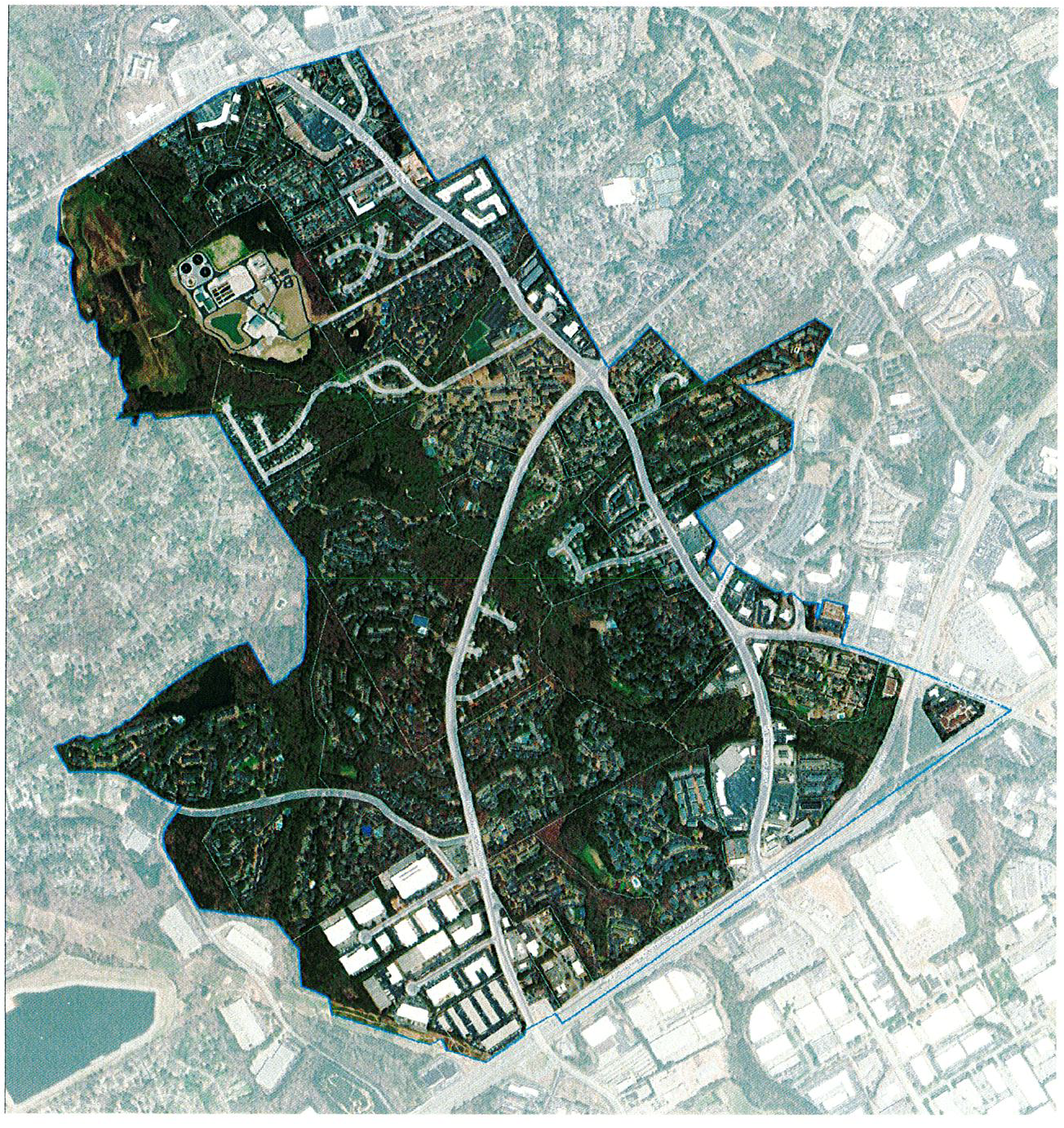
(Ord. No. 2023-05-255, § 1, 7-25-2023; Ord. No. 2024-11-298, § 1, 12-17-2024)
Sec. 1315. - Activity Center/Corridor Overlay District Requirements.
Sec. 1315.1.1.
Findings and Purposes.
The Activity Center/Corridor Overlay District is intended to enhance the viability and livability of the area surrounding major activity centers in City of Peachtree Corners as designated by the City Council. The purpose of the Overlay District is to achieve and maintain a unified and pleasing aesthetic/visual quality in landscaping, architecture and signage; and to promote alternative modes of transportation within the district through the provision of pedestrian and local public transit.
Sec. 1315.1.2.
Applicability.
The requirements of the Overlay District shall apply to all non-residential and attached residential properties within the designated geographic areas of Peachtree Corners.
Whenever the requirements of the Overlay District impose a more or less restrictive standard than the provisions of any other statute or covenant, the requirements of the Overlay District shall govern.
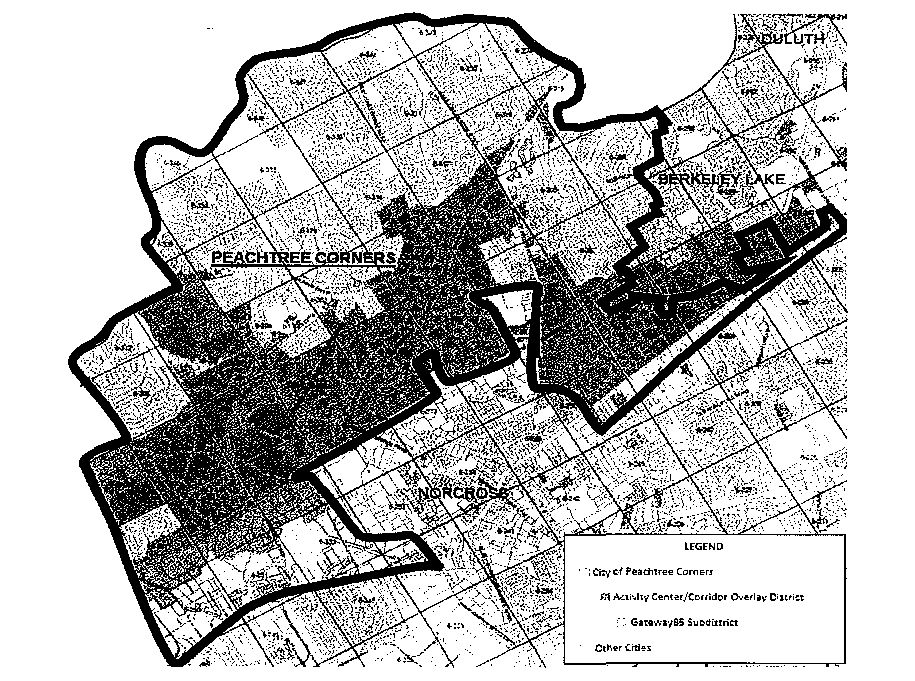
Sec. 1315.2.
Design Requirements.
1.
Transportation/Infrastructure.
1.A.
Provide inter-parcel vehicle access points between all contiguous commercial, office, industrial or attached residential tracts. This requirement may be waived by the Director of Planning and Development only if it is demonstrated that an inter-parcel connection is not feasible due to traffic safety or topographic concerns.
1.B.
All new utility lines shall be located underground.
1.C.
Sidewalks shall be required adjacent to all public rights-of-way and into and throughout attached residential developments. The location of sidewalks shall be reviewed and approved by the Gwinnett County or Georgia Department of Transportation. It is encouraged that a minimum 3-foot wide sidewalk connection be provided from public rights-of-way to the entrance(s) of buildings.
1.D.
Sidewalks shall be constructed with an additional 2-foot by 8-foot pad approximately every 300 linear feet to accommodate future pedestrian amenities such as benches, planters, and trash containers. All such required amenities shall be decorative, commercial-quality fixtures. Sidewalk design and placement of any of these amenities shall be reviewed and approved by the Gwinnett County or Georgia Department of Transportation.
1.E.
Provide streetlights along all public rights-of-way utilizing decorative light poles/fixtures. Light source shall be high-pressure sodium. Streets lights shall be staggered, 150 feet on-center, along both sides of the roadway. All street lighting shall be subject to review and approval of the Gwinnett County Department of Transportation. Where applicable, streetlights shall be placed adjacent to required pedestrian amenity sidewalk pads.
Peachtree Corners Overlay District shall utilize Cobrahead light fixture heads. Pole type design is Fluted Black and the maximum pole height is 40-feet.
_____
Light fixtures which are utilized shall be as follows:
1.F.
Provide lighting throughout all parking areas utilizing decorative light poles/fixtures. Light source shall be metal halide, not exceeding an average of 4.5 foot-candles of light output throughout the parking area. Other than pedestrian light fixtures which will be less than 14-feet tall, light fixtures shall be hooded. All lighting will be metal halide. Lighting shall be directed to avoid intrusion on adjacent properties and away from adjacent thoroughfares.
Light fixtures which are utilized shall be as follows:
_____
2.
Landscaping Requirements.
2.A.
Provide, at a minimum, 20 Tree Density Units per acre for all non-residential development. Type and size of plantings shall be in compliance with City of Peachtree Corners Buffer, Landscape and Tree Ordinance. At least 50 percent of plantings shall consist of trees 3-inches in caliper (dbh) or greater.
2.B.
Provide landscaped islands throughout all surface parking areas as required by the City of Peachtree Corners Buffer, Landscape and Tree Ordinance. Provide a minimum of one shade tree at the end of each parking bay.
2.C.
Provide a minimum ten-foot wide landscaped strip between all road rights-of-way and the back-of-curb of abutting off-street paved parking lots. Landscaped strips between road rights-of-way and the edge of abutting off-street grassed parking areas shall be five-feet in width. At a minimum, landscaped strips shall be planted with two rows of shrubs of sufficient height to screen parking lot cars from roadway views. Grass installed in areas which are visible from public streets shall be sodded, including the right-of-way.
2.D.
Provide non-ornamental shade trees spaced 50-feet on-center or grouped at 120-feet on-center along the right of way on the following roads:
[1.]
Peachtree Corners Overlay.
a.
Peachtree Industrial Boulevard.
b.
Peachtree Parkway.
c.
Peachtree Corners Circle.
d.
Holcomb Bridge Road.
e.
Jimmy Carter Boulevard.
All street trees shall be a minimum 4-inch caliper (dbh) at the time of planting. Street trees shall be planted 6-feet from back-of-curb subject to review and approval of the Georgia Department of Transportation or Gwinnett County Department of Transportation.
Street trees shall be of one (1) or a combination of the following species:
1.
Willow Oak.
2.
Overcup Oak.
3.
Nuttal Oak.
4.
Pin Oak.
5.
Shumard Oak.
6.
Lacebark Elm.
2.E.
Dumpsters which may be seen from adjacent properties or public parking lots shall be screened from view on all four (4) sides. Screening shall consist of three (3) solid walls of brick, stucco or split-face block construction, to be consistent with the primary building material, at least 6-feet in height, with 100 percent solid metal gates. Dumpsters shall be placed in the rear yard and may be located 0 feet from the property line, if the adjoining property is zoned non-residential and 0 feet from all applicable buffers, if the adjoining property is zoned residential. Generators shall be visually screened from adjacent properties.
2.F.
Natural vegetation shall remain on the property until issuance of a development permit.
3.
Parking/Yard, Height and Setback.
3.A.
For retail developments exceeding 125,000 square feet of gross floor area, at least ten percent of all required parking spaces shall be provided in parking areas of porous paving or grass paving systems, such as "Grasscrete" or "Grasspave," not to exceed 1,000 parking spaces or as approved by the Director of Planning and Development.
3.B.
Up to 25 percent of the required parking spaces for any development may be reduced in total area, width or depth for designated small vehicle parking. Each small vehicle parking space shall not be less than 8-feet in width and 17-feet in depth.
3.C.
Freestanding buildings or shopping center developments containing 7,500 gross square feet of space or less shall provide no more than 20 percent of parking areas in the front of building(s) and be limited to no more than one double row of parking. No more than 20 percent of off-street parking areas may be located to the sides of building(s), with the balance of parking located to the rear the building(s).
3.D.
For developments exceeding 7,500 square feet, building placement is encouraged to be close to, and oriented towards, the public right-of-way with the majority of parking to the sides and rear, where possible.
3.E.
Decorative, commercial-quality, bicycle racks, benches and trash receptacles shall be required for all retail and office developments.
4.
Signage; Temporary Uses; Peddling.
4.A.
Except as contained herein, sizes and amount of signage shall not exceed the requirements of the Sign Ordinance.
4.B.
Oversized Signs or Billboards shall not be permitted.
4.C.
Ground signs shall be limited to monument-type signs. Base and sign structure shall be constructed of materials such as brick, stone, stucco, wood or metal consistent with the architecture and exterior treatment of the building.
4.D.
Blinking, exposed neon, portable, and inflatable signage shall be prohibited.
4.E.
Peddlers shall be prohibited.
4.F.
Flexible tube lighting or any form of strip lighting around commercial windows, store fronts, or commercial signage shall be prohibited. Usage of existing tube/strip lighting shall be discontinued (and such lighting shall be removed) by 12/31/16.
4.G.
Backlighting of signage shall be permitted only with white light.
5.
Architectural Design.
5.A.
Architectural design of all non-residential buildings should comply with the following performance guidelines:
(1)
Building façades shall be of architectural treatments of glass and/or brick, stone or stucco. Tilt-up or pre-cast concrete or alternate material may be used for industrial, multi-story office (3-stories or greater) or hotel development subject to review and approval of the Director of Planning and Development.
(2)
Contrasting accent colors of any wall, awning or other feature shall be limited to no more than 15 percent of the total area for any single façade.
(3)
Metal sided or portable buildings shall be prohibited.
(4)
Buildings shall incorporate live plant material growing immediately in front of or on the building.
(5)
Except for restaurants, as noted in (6) below, buildings of less than 5,000 square feet of gross floor area shall be designed with pitched roofs, minimum pitch of 4 in 12.
(6)
Restaurants of less than 5,000 square feet of gross floor area may have flat roofs under the following conditions: all HVAC equipment shall be screened from all sides; the exterior architectural treatment of the building shall consist of the same materials and detail for all of the building elevations; and, excluding fenestrations, the primary facing material shall be a minimum of 75 percent brick or stone. Buildings located on outparcels, or as part of a larger development, shall have similar materials and colors as the primary building. Alternate colors and materials may be approved by the Director.
(7)
Roofing materials for pitched or mansard roofs shall be limited to the following:
a.
Metal standing seam of earth tone or neutral color.
b.
Tile, slate or stone.
c.
[Reserved.]
d.
Architectural dimensional shingles having two or more layers with a slate, or tile appearance.
(8)
All mechanical, HVAC and like systems shall be screened from street level view on all sides by an opaque wall or fence of brick, stucco, split-faced block, and shall be consistent with the primary building material.
(9)
Any accessories provided such as railings, benches, trash receptacles and/or bicycle racks shall complement the building design and style.
5.B.
Architectural design of all commercial/retail buildings should comply with the following additional performance guidelines:
(1)
To lend the appearance of multi-tenant occupancy, façades of multi-tenant buildings shall be varied in depth or parapet height.
(2)
Within Planned Shopping Centers, distinct architectural entry identity for individual tenants' entrances shall be provided for suites exceeding 10,000 square feet of leasable area.
(3)
Walls visible from roadways or parking areas shall incorporate changes in building material/color or varying edifice detail such as trellises, false windows or recessed panels reminiscent of window, door or colonnade openings, landscaping or storefront every 150 linear feet.
(4)
Roof parapets shall be articulated to provide visual diversity. Parapets shall include articulations or architectural features at least every 100 linear feet. The minimum height of articulations or features shall be 1-foot, and may be provided in height offset or façade projections such as porticoes or towers.
(5)
Building design shall include minimum 1-foot deep cornices, extending along the entire building.
(6)
Building design shall include a minimum 1-foot high contrasting base, extending along the entire front of buildings and the sides of building.
(7)
All support columns for gas station canopy structures shall be fully finished on all sides with brick or stone.
5.C.
Architectural design of all attached residential buildings shall comply with the following performance guidelines:
(1)
Architectural treatments of each building elevation shall be a minimum 50 percent brick, stone or stucco. The balance of each building elevation may be wood, wood shake or fiber cement-type siding.
Building plans shall be subject to review and approval of the Community Development Director, or his/her designee, prior to the issuance of a building permit. Designs which are inconsistent with these performance guidelines may be denied. Alternate designs which have been denied by the Director, may be submitted for review and approval by the City Council or Planning Commission.
Sec. 1315.3.1.
Gateway85 Subdistrict Findings and Purposes.
The Gateway85 portion of the Activity Center/Corridor Overlay District is intended to enhance the economic vitality of the area of the city covered by the larger Gateway85 Community Improvement District. The purpose of the district is to achieve and maintain a unified and pleasing aesthetic/visual quality in landscaping, architecture and signage; and to promote alternative modes of transportation within the district through the provision of pedestrian and local public transit.
Sec. 1315.3.2.
Applicability.
The requirements of the Gateway85 Subdistrict shall apply to all non-residential and attached residential properties within the geographic areas shown on the Peachtree Corners Activity Center/Corridor Overlay District Map in Sec. 1315.1.2 (above).
Whenever the requirements of the district impose a more or less restrictive standard than the provisions of any other statute or covenant, the requirements of the district shall govern.
All buildings, structures, or land, in whole or in part, shall be used, occupied, erected, constructed, moved, enlarged, or structurally altered, in conformance with this overlay.
Nothing in this overlay shall require any change in the plans, construction or intended use of a building or structure for which a lawful permit has been issued or a lawful permit application has been accepted before the effective date of this overlay, provided that the construction under the terms of such permit is diligently followed until its completion.
It is not the intent of this overlay to interfere with or abrogate or annul any easements, covenants or other agreements between parties; provided, however, that where this overlay imposes a greater restriction upon the use of property, or requires more space than is imposed or required by other resolutions, rules or regulations, or by easements, covenants or agreements, the provisions of this overlay shall govern.
Sec. 1315.3.3
Non-Conformities and Redevelopment Thresholds.
1.
Non-conforming signs. Non-conforming signs (including sign structures) related to a business, service, commercial transaction, or other use that has been discontinued for 90 calendar days or more shall be removed within 120 calendar days of the date of discontinuance.
2.
Redevelopment thresholds.
2.A.
Renovations. Renovations, alterations, adaptations, restorations, repairs, or other physical modification to a structure or portion of a structure that existed before adoption of this overlay, shall be subject to the provisions of Article XIII, unless the requirements of "B" through "D" immediately below otherwise apply.
2.B.
Fifty percent or more destruction. Destruction of a non-conforming building or structure by any means to an extent of more than 50 percent of its replacement cost at time of destruction.
2.C.
Expansion. Expansions to any building, use, or improved site area beyond 50 percent cumulatively of what existed before adoption of this overlay shall be subject to the provisions of this overlay.
2.D.
Site Disturbance. Site disturbance or modifications greater than 50 percent cumulatively of the improved site area in existence before adoption of this overlay shall be subject to the provisions of this overlay.
Sec. 1315.3.4
Definitions.
The following words, terms, and phrases shall have the following meanings when used in this overlay:
Improved site area. The portion of a parcel or lot that is not in its natural, undisturbed state.
Priority corridor. High visibility corridors that are held to a higher design standard, including:
A.
Amwiler Road;
C.
Buford Highway; and
G.
Jimmy Carter Boulevard.
Underlying zoning district. The base zoning district applicable to a parcel shown on the official zoning map.
Sec. 1315.3.5
Use Provisions.
1.
General. Uses shall be in accordance with the underlying zoning district.
2.
Vehicle repairs. All vehicle repairs shall be fully conducted indoors, regardless of whether the vehicle repairs are a principal or accessory use.
3.
Used vehicle sales. Used vehicles shall not be displayed for sale on any premises unless associated with a conforming Automotive Sales Lot.
4.
Outdoor display standards.
4.A.
Prohibited outdoor displays. The following types of outdoor displays of merchandise and materials for sale, rental, or storage are prohibited:
(1)
Outdoor display when accessory to a pawn shop;
(2)
Outdoor display when accessory to a second-hand shop;
(3)
Outdoor display of any used merchandise when accessory to any use; and
(4)
Outdoor display of appliances when accessory to any use.
4.B.
Tire outdoor display. The outdoor display of tires for sale, rental, or storage require a special use permit in accordance with Sec. 1705.
Sec. 1315.3.6.
Design Requirements.
1.
Streetscape Standards.
1.A.
Streetscapes shall be installed along public rights-of-way as specified in Table 1315.2.1.1:
Streetscape Standards, except as provided in "B" immediately below for an alternative
multi-use trail.
Streetscapes shall include a sidewalk landscape strip adjacent to the roadway, a sidewalk,
and a landscape strip at the back of the sidewalk on private property.
_____
Table 1315.3.6.1 Streetscape Table
_____
1.B.
A multi-use trail may be required instead of a sidewalk landscape strip and sidewalk where identified as a multi-use trail in any plan that has been adopted by the City.
1.C.
Sidewalks shall be constructed with an additional 2-foot by 8-foot concrete pad, located outside of the right-of-way, designed to accommodate existing or future pedestrian amenities such as benches, planters, and trash containers, at the following locations:
(1)
At intersections of Priority Corridors with an arterial, major collector or minor collector identified on the Gwinnett County Long Range Road Classification Map.
(2)
At locations along Priority Corridors designated for a transit stop or future transit stop by Gwinnett County Department of Transportation.
(3)
At locations along Priority Corridors corridor designated for a school bus stop by the Gwinnett County Board of Education.
(4)
Such pedestrian amenity sidewalk pads shall not be required closer than 300 feet from another such pad on the same side of the Priority Corridor.
1.D.
All amenities required and listed above shall be decorative, commercial-quality fixtures. Sidewalk design and placement of any of these amenities shall be reviewed and approved by the Gwinnett or Georgia Department of Transportation. Locations of pedestrian amenity sidewalk pads shall be coordinated to avoid locations of curb inlets, guardrails, and bridges.
1.E.
All new utility lines shall be located underground. Provide streetlights along all public rights-of-way utilizing decorative light poles/fixtures. Light source shall be Light Emitting Diodes (LED), Metal Halide, or Color Corrected High-pressure Sodium. Streets lights shall be staggered, 150 feet on-center, along both sides of the roadway. All street lighting shall be subject to review and approval of the Gwinnett County Department of Transportation. Where applicable, streetlights shall be placed adjacent to required pedestrian amenity sidewalk pads.
The District shall utilize Cobrahead light fixture heads. Pole type design is Fluted Black and the maximum pole height is 40 feet.
1.F.
Provide lighting throughout all parking areas utilizing decorative light poles/fixtures. Light source shall be Light Emitting Diodes (LED), Metal Halide, or Color Corrected High-pressure Sodium, not exceeding an average of 4.5 foot-candles of light output throughout the parking area. Other than pedestrian light fixtures which will be less than 14-feet tall, light fixtures shall be hooded. All lighting will be Light Emitting Diodes (LED), Metal Halide, or Color Corrected High-pressure Sodium. Lighting shall be directed to avoid intrusion on adjacent properties and away from adjacent thoroughfares.
Parking lot light fixtures which are utilized shall be as follows: The District shall utilize boxhead light fixture. Pole type design is Fluted Black and the maximum pole height is 35 feet.
1.G.
Rope lighting. Rope lighting is prohibited, including on the interior of a building when visible from the exterior.
2.
Pedestrian Access shall be provided by means of a walkway that connects the public sidewalk to the front of the building.
2.A.
Parcels shall provide a walkway with a minimum width of 5 feet, except as specified in "B" immediately below.
2.B.
Walkways and landscape strips that create a direct access from the front of the building to a public sidewalk are not required for existing buildings or uses when the applicant demonstrates that their installation would do any of the following:
(1)
Render the parcel non-conforming with regards to parking; or
(2)
Result in a 10 percent or more reduction in the number of parking spaces on the parcel; or
(3)
Require the construction of retaining walls, site grading, site excavation, or site fill; or
(4)
Is determined by the Director of Community Development to be infeasible because of topographic or other site-specific constraints.
2.C.
The required or provided walkway surface shall be hardscape but may not be asphalt.
3.
Access Management.
3.A.
Driveways.
(1)
The maximum number of driveways serving a single project shall not exceed one per 400 feet of property frontage, or fraction thereof per street, along a Priority Corridor. This is not meant to be a spacing standard but only an expression of the total number of driveways permitted for a single project.
(2)
Wherever feasible for new development, driveways shall not be located on a Priority Corridor when vehicular access is available from a right-of-way that is not classified as a Priority Corridor.
3.B.
Inter-parcel access. Inter-parcel access, joint driveways, cross-access drives, and access easements shall be provided, as follows, except where the Director of Community Development determines that they are infeasible because of topographic or other site-specific constraints:
(1)
Inter-parcel vehicular connections or provision of a future inter-parcel driveway stub (with appropriate cross-access easements) shall be required between abutting commercial, office, industrial, or attached residential parcels;
(2)
Joint driveways and cross-access easements shall be established between abutting commercial, office, industrial, or attached residential parcels;
(3)
Driveways providing inter-parcel access shall be designed with a design speed of 25 mph and a two-way travel aisle, with a minimum of 20 feet to accommodate automobiles, service vehicles, and loading vehicles; and
(4)
Required inter-parcel access shall not be gated or otherwise access controlled.
4.
Landscaping Requirements.
4.A.
Provide, at a minimum, 20 Tree Density Units per acre for all non-residential development. Type and size of plantings shall be in compliance with City of Peachtree Corners Buffer, Landscape and Tree Ordinance. At least 50 percent of plantings shall consist of trees 3-inches in caliper (dbh) or greater.
4.B.
Provide landscaped islands throughout all surface parking areas as required by the City of Peachtree Corners Buffer, Landscape and Tree Ordinance.
4.C.
Provide non-ornamental shade trees spaced 50-feet on-center or grouped at 120-feet on-center along the right-of-way on the following roads:
(1)
Peachtree Industrial Boulevard.
(2)
Peachtree Parkway.
(3)
Peachtree Corners Circle/Jones Mill Road.
(4)
Holcomb Bridge Road.
(5)
Jimmy Carter Boulevard.
All street trees shall be a minimum 4-inch caliper (dbh) at the time of planting. Street trees shall be planted 6-feet from back-of-curb subject to review and approval of the Georgia Department of Transportation or Gwinnett County Department of Transportation.
Street trees shall be of one (1) or a combination of the following species:
1.
Willow Oak.
2.
Overcup Oak.
3.
Nuttal Oak.
4.
Pin Oak.
5.
Shumard Oak.
6.
Lacebark.
7.
Japanese Zelkova.
4.D.
Natural vegetation shall remain on the property until issuance of a land disturbance permit.
5.
Parking/Yard, Height and Setback.
5.A.
For retail developments exceeding 125,000 square feet of gross floor area, at least ten percent of all required parking spaces shall be provided in parking areas of porous paving or grass paving systems, such as "Grasscrete" or "Grasspave," not to exceed 1,000 parking spaces or as approved by the Community Development Director.
5.B.
Up to 25 percent of the required parking spaces for any development may be reduced in total area, width or depth for designated small vehicle parking. Each small vehicle parking space shall not be less than 8-feet in width and 17-feet in depth.
5.C.
Freestanding buildings or shopping center developments containing 7,500 gross square feet of space or less shall provide no more than 20 percent of parking areas in the front of building(s) and be limited to no more than one double row of parking. No more than 20 percent of off-street parking areas may be located to the sides of building(s), with the balance of parking located to the rear the building(s).
5.D.
For developments exceeding 7,500 square feet, building placement is encouraged to be close to, and oriented towards, the public right-of-way with the majority of parking to the sides and rear, where possible.
5.E.
Decorative, commercial-quality, bicycle racks, benches and trash receptacles shall be required for all retail and office developments.
6.
Signage; Temporary Uses; Peddling.
6.A.
Except as contained herein, sizes and amount of signage shall not exceed the requirements of the Sign Ordinance.
6.B.
Oversized signs or billboards shall not be permitted.
6.C.
Ground signs shall be limited to monument-type signs. Base and sign structure shall be constructed of materials such as brick, stone, stucco, wood or metal consistent with the architecture and exterior treatment of the building.
6.D.
Blinking, exposed neon, portable, inflatable, and hand-held moving signs shall be prohibited.
6.E.
Peddlers shall be prohibited.
6.F.
Flexible tube lighting or any form of strip lighting around commercial windows, store fronts, or commercial signage shall be prohibited.
7.
Architectural Design.
7.A.
Architectural design of all non-residential buildings should comply with the following performance guidelines:
(1)
Building façades shall be of architectural treatments of glass and/or brick, stone or stucco. Tilt-up or pre-cast concrete or alternate material may be used for industrial, multi-story office (3-stories or greater) or hotel development subject to review and approval of the Community Development Director.
(2)
Contrasting accent colors of any wall, awning or other feature (other than earth tones) shall be limited to no more than 15 percent of the total area for any single façade.
(3)
Metal sided buildings visible from a roadway or portable buildings shall be prohibited.
(4)
Foundation plantings. All building foundations along a Priority Corridor shall conform to these standards, except as provided for in "c" immediately below:
a.
All portions foundations that extend more than 12 inches above finished grade shall be screened from Priority Corridors with continuous evergreen or semi-evergreen shrubs.
b.
At the time of installation, the screening shall be at least 1-foot in height and reach a height of 3-feet within three (3) years of planting.
c.
Foundation plantings are not required adjacent to ground floor commercial storefronts when said plantings would obstruct views into the commercial establishments, subject to approval of the Community Development Director.
(5)
Roofing materials for pitched or mansard roofs shall be limited to the following:
a.
Metal standing seam of earth tone, gray, green or silver in color.
b.
Tile, slate or stone.
c.
Shingles with a slate, tile or metal appearance.
(6)
Any accessories provided such as railings, benches, trash receptacles and/or bicycle racks shall complement the building design and style.
7.B.
Architectural design of all commercial/retail buildings should comply with the following additional performance guidelines:
(1)
To lend the appearance of multi-tenant occupancy, façades of multi-tenant buildings shall be varied in depth or parapet height.
(2)
Within Planned Shopping Centers, distinct architectural entry identity for individual tenants' entrances shall be provided for suites exceeding 10,000 square feet of leasable area.
(3)
Walls visible from roadways or parking areas shall incorporate changes in building material/color or varying edifice detail such as trellises, false windows or recessed panels reminiscent of window, door or colonnade openings, landscaping or storefront every 150 linear feet.
(4)
Roof parapets shall be articulated to provide visual diversity. Parapets shall include articulations or architectural features at least every 100 linear feet. The minimum height of articulations or features shall be 1-foot and may be provided in height offset or façade projections such as porticoes or towers.
(5)
Building design shall include minimum 1-foot deep cornices, extending along the entire front of buildings and the sides of buildings at least ten (10) feet.
(6)
Building design shall include a minimum 1-foot high contrasting base, extending along the entire front of buildings and the sides of buildings at least ten (10) feet.
7.C.
Architectural design of all attached residential buildings shall comply with the following performance guidelines:
(1)
Architectural treatments of each building elevation shall be a minimum 50 percent brick, stone or stucco. The balance of each building elevation may be wood, wood shake or fiber cement-type siding.
Building plans shall be subject to review and approval of the Community Development Director or her designee, prior to the issuance of a Building Permit. Designs which are inconsistent with these performance guidelines may be denied. Alternate designs which have been denied by the Director, may be submitted for review and approval by the Zoning Board of Appeals.
8.
Screening.
8.A.
General. Walls and fences required by this section shall conform to the following:
(1)
Walls and fences shall be faced in of one or more of the following: stained poured-in place concrete, architectural block, brick, stone, cast-stone, stucco, prefinished metal, or painted wood.
(2)
Walls and fences may not be faced in any of the following: chain link fencing (with or without slats), unfinished concrete masonry units, unpainted wood, repurposed pallets, garbage, repurposed vehicles, plastic, canvas, netting, or corrugated metal.
8.B.
Outdoor storage, vehicular fleet storage. Outdoor storage and vehicular fleet storage areas shall be screened from Priority Corridors as follows:
(1)
Outdoor storage and vehicular fleet storage areas shall be screened from Priority Corridors by an opaque wall or fence.
(2)
The screening design shall be compatible with the principal building in terms of texture, quality, material, and color.
(3)
Screening shall be of a height equal to or greater than the height of the materials or merchandize being screening, but not less than 6-feet high.
8.C.
Loading areas. Loading areas shall be screened from Priority Corridors as follows:
(1)
Loading areas for new buildings shall not be located along a street-facing façade.
(2)
If an existing or new loading area is provided along a street-facing façade, the entire loading area, including any loading docks and vehicular loading areas, shall be screened from Priority Corridors with one of the following:
a.
An 8-foot high wall or fence compatible with the principal building in terms of texture, quality, material, and color; or
b.
Evergreen plant material that can be expected to reach a height of 8 feet with a spread of 4 feet within three (3) years of planting to provide continuous visual screening.
8.D.
Service areas. Service areas shall be screened in all locations as follows:
(1)
Trash and recycling collection, and similar service areas shall be located to the side or rear of buildings and shall not be between a building and the street.
(2)
Trash and recycling collection and other similar service areas shall be screened on three (3) sides by an opaque wall or fence and on the fourth side by an opaque gate.
(3)
Screening, including the gate, shall be at least 6-feet high.
(4)
The gate shall be self-locking and maintained in good working order.
(5)
The screening design shall be compatible with the principal building in terms of texture, quality, material, and color.
8.E.
Ground-mounted equipment. Ground-mounted equipment shall be screened from Priority Corridors as follows:
(1)
Ground-mounted mechanical equipment shall be screened from Priority Corridors by an opaque fence or wall, berm, or landscaping.
(2)
Screening fence or wall design shall be compatible with the principal building in terms of texture, quality, material, and color.
(3)
Screening shall be of a height equal to or greater than the height of the equipment being screened.
8.F.
Roof-mounted equipment. Roof-mounted equipment shall be screened from Priority Corridors as follows:
(1)
Roof-mounted equipment shall be set back at least 10-feet from the edge of the roof and screened from Priority Corridors.
(2)
New buildings shall provide a parapet wall or other architectural element that is compatible with the principal building in terms of texture, quality, material, and color that fully screens roof-mounted equipment from ground level view.
(3)
For buildings with no or low parapet walls, roof mounted equipment shall be screened on all sides by an opaque screen compatible with the principal building in terms of texture, quality, material, and color.
8.G.
Wall-mounted equipment. Wall-mounted equipment shall be screened from Priority Corridors as follows:
(1)
Wall-mounted equipment located on any surface shall be screened from Priority Corridors by an opaque fence or wall, or landscaping.
(2)
The screening design shall be compatible with the principal building in terms of texture, quality, material, and color.
(3)
Screening shall be of a height equal to or greater than the height of the mechanical equipment being screened.
8.H.
Off-street parking areas. For new development or when modifications to a property or building exceed 50 percent, off-street parking areas shall incorporate screening as follows:
(1)
Off-street parking areas shall be screened from streets by a fence, wall, berm, or a heavily planted minimum 10-foot wide landscaped strip between all road rights-of-way and the back-of-curb of abutting off-street paved parking lots.
(2)
Screening fence or wall design shall be compatible with the principal building in terms of texture, quality, material, and color.
(3)
Landscaping shall be sufficiently dense at installation to obscure visibility of the parking area after three (3) growing seasons.
(4)
Screening shall be installed between the parking area and the sidewalks. Perpendicular driveway crossings and walkways are allowed through the screening.
9.
Site Accessories.
9.A.
Fences and walls.
(1)
Chain link fencing is prohibited, except in M-1 and M-2 zoning districts and only when that fencing is not visible from a Priority Corridor.
(2)
Barbed wire, razor wire, or similar elements are prohibited, except in M-1 and M-2 zoning districts and only when that fencing is not visible from any street.
(3)
Any wall or fence which extends into the required front yard shall be ornamental or decorative and either constructed as:
a.
A solid wall faced in brick, stucco, or stacked stone wall; or
b.
As a wrought iron-style fence with brick or stacked stone columns (maximum 30-feet on-center).
(4)
When fences or walls are located within the streetscape landscape strip listed in Sec. 1315.2.8, they shall be set back at least 5-feet from the public right-of-way in order to provide landscaping between the fence and the sidewalk.
9.B.
Shopping cart corrals. Shopping cart corrals located in the parking areas of retail developments shall be of decorative quality. Shopping cart storage within 50-feet of the store entrance shall be screened from view from the parking lot.
10.
Amenity Space.
10.A.
At least 5 percent of the net project acreage (total acreage of the project excluding 100-year floodplain and wetland areas) of all new non-industrial developments over 10 acres in size shall be provided as Amenity Space as required by this section.
10.B.
Required Amenity Space shall be available as exterior space appropriately improved for pedestrian amenity or for aesthetic appeal.
10.C.
Amenity Space shall be met in one contiguous open area or in multiple open areas on a parcel; however, to receive credit, the area shall be at least 10-feet in width and length, and at least 50 percent of the required amenity space shall be located in one contiguous open area.
10.D.
All Amenity Space, other than rooftop areas shall be located at grade.
10.E.
Amenity Space may be roofed provided it is part of the common area facilities and it is not enclosed.
10.F.
Amenity Space shall not be parked or driven upon, except for emergency access and permitted temporary events.
10.G.
In calculating the minimum amenity space requirement, the following or similar facilities may be included:
(1)
Ground-level common area facilities such as sidewalks/walkways, swimming pool, playground, sport court, dog park, garden, community garden, park, green pavilion, seating area or plaza, landscape areas, bio-retention areas (when designed as an amenity), pond/lakes, and water features.
(2)
Upper level common area facilities such as a common balcony, rooftop deck or rooftop garden.
(3)
Required buffers and/or State stream buffer may not be considered amenity space.
(Ord. No. 2014-07-29, § 1, 8-19-2014; Ord. No. 2020-11-185, 12-15-2020; Ord. No. 2021-03-193, § 1, 4-27-2021; Ord. No. 2021-08-212, § 1, 9-28-2021)
Sec. 1316. - CSO Conservation Subdivision Overlay District.
1.
Purposes. The purposes of this overlay district are as follows:
a.
To encourage the development of residential communities, that are density neutral based upon the Comprehensive Plan, designed to preserve and protect environmental resources, scenic vistas, and natural and cultivated landscapes.
b.
To enhance land, water, air and tree resources by minimizing the area of land disturbance, reducing impervious surface, optimizing stream buffers, preserving tree cover and encouraging retention and protection of Conservation Space.
c.
To reduce infrastructure maintenance costs as a result of efficient community design.
d.
To provide conservation space and pedestrian linkages and wildlife corridors among residential communities and to encourage recreation opportunities.
e.
To preserve significant historical and archeological features.
f.
To preserve and protect contiguous undeveloped areas within the development.
2.
Applicability. This overlay district may be overlaid only upon the R-100 and R-75 districts utilizing the public sanitary sewer system. The overlay district shall require approval of a Special Use Permit at a public hearing as of the effective date of the adoption of this overlay district. Any conditions of zoning or special use approval of the underlying district shall also be observed (exception: lot area, width or quantity). For properties which are submitted for rezoning to R-100 or R-75, the applicant shall declare the intent to utilize this Overlay District at the time of application and the application shall be accompanied by an Existing Features Site Analysis Plan, and Environmental Site Assessment (Phase One) report, and a Concept Plan meeting the requirements of this section. The Overlay District shall not be used on property that has been timber harvested within 24 months prior to adoption of a zoning change or approval of a Concept Plan.
3.
Permitted Uses. Those uses permitted in the underlying district are permitted.
4.
Existing Features Site Analysis Plan. At time of development, or if a zoning action is proposed, and prior to preparing the Concept Plan, an Existing Features Site Analysis Plan, sealed by a registered engineer or landscape architect, and an Environmental Site Assessment (Phase One) report, shall be prepared and submitted by the applicant or developer.
a.
The purposes of the Site Analysis Plan are to:
(1)
Delineation areas that have been identified as worthy of permanent protection in Conservation Space because of their environmental values. This delineation shall include, but shall not be limited to, the information and steps listed in Paragraph 4.
(2)
Set forth the particulars of the site, including boundary, topographic data (minimum 4-foot contour intervals), existing structures and utility easements.
(3)
Together with the Environmental Site Assessment (Phase One) report, provide the starting point for design of the Conservation Subdivision with built areas being designed as separate from the areas delineated as worthy of permanent protection.
b.
The Existing Features Site Analysis Plan shall include at least the following information:
(1)
Perennial and intermittent streams, FEMA designed 100-Year Flood Hazard Zones and Wetlands. The source of this information shall also be indicated.
(2)
Identification of tree lines, native woodlands, open fields or meadows, peaks or rock outcroppings, and prime agricultural land.
(3)
Delineation of tree resource areas by type such as hardwoods, pines or mixed; and old or new growth.
(4)
Delineation of steep slope areas (25 percent or greater). The designer shall endeavor to preserve slopes greater than 40 percent.
(5)
Identification of historical, archeological or other significant features identified in the Environmental Site Assessment (Phase One) report.
(6)
Identification of scenic vistas as listed in the Comprehensive Plan.
(7)
Identification of Conservation Space, Open Space or common areas adjacent to the project.
(8)
Identification of protected plant species as listed by the Georgia Department of Natural Resources, to be certified by a registered landscape architect, forester, arborist, biologist, botanist or horticulturist.
(9)
The plan also shall include certification that Timber Harvesting activity has not occurred on the property in the previous 24 months prior to the approval of a rezoning application or the approval of a Concept Plan.
5.
Concept plan. At time of development, a concept plan shall be submitted by the developer for review and approval in accordance with the requirements and procedures of the development regulations. If a zoning action or special use permit is requested, the rezoning sit plan shall include the following information:
a.
Delineation and specifications of Conservation Space including calculations and exclusions (see section 1316.6.c.); and any "Pocket Parks," "Neighborhood Greens," play areas, or trail system to be constructed.
b.
A typical detail on the plan indicating dwelling size, lot width, building setback lines, off-street parking, street trees, sidewalks, and street pavement and right-of-way width.
c.
Lot width average, area and percent of floodplain specifications in tabular form; and density calculations (gross and net).
6.
Conservation Space Requirements. In order to qualify for this overlay district, Conservation Space shall meet the following requirements:
A.
Delineation. Priority shall be given in delineating Conservation Space areas as those areas of significance identified in the Existing Features Site Analysis Plan, around which the built areas are designed.
B.
Undeveloped and Natural. Conservation Space shall remain undeveloped and natural except for the provision of non-motorized passive recreation opportunities such as running, walking, biking, and similar outdoor activities. Wetland and stream bank mitigation projects also are permitted.
Primary Conservation Areas are required to be included in the Conservation Space. These areas shall be covered by a provision for permanent protection and shall include 100-Year floodplains, stream buffer zones, slopes greater than 40 percent, consisting of a contiguous area of at least 5,000 square feet, wetlands, endangered or threatened species or their habitat, archeological sites, cemeteries or burial grounds.
Secondary Conservation Areas are features and areas recommended and desirable for Conservation Space designation and may be covered by the provisions for permanent protection. These include important historic sites, existing healthy, native forests of at least one contiguous acre, scenic viewsheds, peaks and rock outcroppings, prime agriculture lands consisting of at least 5 contiguous acres, and existing trails that connect the tract to neighboring areas. Also considered Secondary Conversation Areas are "Pocket Parks," "Neighborhood Greens" and stormwater management facilities and practices and may be constructed and maintained in Conservation space. However, "Pocket Parks" and "Neighborhood Greens" shall not exceed 20 percent of the total required Conservation Space.
C.
Exclusions. Excluded from meeting the minimum amount of Conservation Space are the following (also, see the definition of Primary Conservation Areas):
(1)
Residential yards.
(2)
Proposed Permanent Lakes that may be used for wet detention. No more than 50 percent of land area located within a proposed Permanent Lake may be credited.
(3)
Recreation Area Improvements. Impervious surfaces in recreation areas shall not be credited.
(4)
Easements. Land area within power, gas pipeline easements, sewer line easements or pump stations shall not be credited.
(5)
Other. Land area devoted to public or private streets or any land that has been, or is to be, conveyed to a public agency via a purchase agreement for such uses as parks, schools, or other public facilities shall not be credited.
D.
Ownership. Conservation space shall be owned in fee-simple by a mandatory property owner's association; or other entity approved in advance by the City Council during their normal course of business. The developer shall record the deed to the Conservation Space prior to, or concurrent with, the recording of the first final subdivision plat. An access easement following the alignment of future public streets is acceptable. However, "Pocket Parks" or "Neighborhood Greens" may be deeded concurrent with the unit or phase of the Final Subdivision Plat of which it is a part.
E.
Property Owner's Association. The property owner's association bylaws or covenants, at a minimum, shall contain the following provisions:
(1)
Governance of the association by the Georgia Property Owner's Association Act (O.C.G.A. Section 44-3-220 et seq.) or a successor to that Act that grants lien rights to the association for maintenance expenses and tax obligations.
(2)
Responsibility for maintenance of the open space.
(3)
Responsibility for insurance and taxes.
(4)
Automatic compulsory membership of all lot purchasers and their successors; and compulsory assessments.
(5)
Conditions and timing of transferring control of the association from the developer to the lot owners.
(6)
Guarantee that the association will not be dissolved without the advance approval of the City Council.
F.
Maintenance. The property owner's association, or other entity approved in advance by the City Council, shall be responsible for the continuous maintenance of buffers, Conservation Space and recreation areas.
G.
Conservation Surety. Conservation Space delineated on the Final Plat and required to be in a Primary Conservation Area shall be permanently protected by either one (1) or both of the following options:
(1)
Option 1. Conveyance to the Public and Subdivision Lot Owners.
A deed conveying ownership of the Conservation Space to the mandatory property owner's association shall be recorded and delivered prior to, or concurrent with, the approval of the Final Plat for the first phase of the subdivision. Both the deed and the Final Plat shall contain, at a minimum, the following covenant:
"The Conservation Space conveyed by deed and shown on the Final Plat shall remain permanently protected and shall not be disturbed, cleared or developed except in accordance with Section 1316.6.b. of the 2012 Zoning Resolution of City of Peachtree Corners and with Georgia Law O.C.G.A. 36-22-1 et seq., having the following Greenspace goals: protection of streams, floodplains and wetlands; steep slopes; woodlands, open fields and meadows; historical and archeological features; significant wildlife habitats; scenic vistas; passive recreation and connectivity with nearby open spaces. The following uses may be allowed: passive recreational amenities, such as pervious-surface paths and minimal parking spaces; picnic and restroom facilities (constructed facilities shall not exceed 15 percent of the Conservation Space). This covenant is intended to benefit said area to the public and the use of same to the subdivision lot owners and residents, and it shall run in perpetuity as provided by Georgia Law O.C.G.A. 44-5-60(c)."
(2)
Option 2. Conveyance to Other Qualified Organizations or Entities.
Except for "pocket Parks" or "Neighborhood Greens," developed recreation areas or Secondary Conservation Areas not desired for permanent protection, Conservation Space shall be permanently protected by the (i) recording of a covenant or conveyance of an easement which runs in perpetuity under Georgia Law O.C.G.A. 44-5-60 in favor of any corporation, trust, or other organization holding land for the use of the public or certain governmental entities; or (ii) conveyance of a conservation easement running in perpetuity to a third party "qualified organization" recognized by Federal Treasury Regulation Section 1.170A-14(c)(1). Qualified organizations recognized by this Treasury Regulation include, but may not be limited to, governmental entities, certain publicly supported charities, local and national land trusts, or other conservation groups that are organized or operated primarily or substantially for one of the conversation purposes specified in the Internal Revenue Code. Governmental entities that qualify to be named in covenants under Georgia Law O.C.G.A. 44-5-60 or to receive conservation easements under the Treasury Regulation referred to above for purposes of this section shall include the Federal government, the State of Georgia, Gwinnett County, or authorities of the State of Georgia or Gwinnett County. If a covenant is recorded or an easement conveyed in favor of a governmental entity, formal acceptance by the governmental entity or qualified conservation organization shall be obtained prior to the recording of the covenant or conveyance of the easement. The developer shall record the necessary legal instrument to accomplish protection of the Conversation Space prior to, or concurrent with, the recording of the Final Plat. The legal instrument shall contain, at a minimum, the same language required to be placed on a deed as stated in Option 1 of this Section.
Secondary Conservation Areas may also be covered by the same permanent protection options.
7.
Density. The Gwinnett County Comprehensive Plan establishes recommended residential density not to exceed 3 units per acre in many areas of the City. Consequently, subdivisions in the Overlay District shall not exceed a maximum net density in the underlying district, and shall provide at least the percent of Conservation Space as stated below:
a.
R-100: 2.3 units per acre with 40 percent Conservation Space; or units per acre with 50 percent Conservation Space.
b.
R-75: 3.0 units per acre with 40 percent Conservation Space.
8.
Development Requirements. Subdivisions in this Overlay District shall meet the following requirements unless a Special Use Permit is submitted and approved by the City Council:
A.
Minimum Subdivision Size: 10 contiguous acres.
B.
Lot Area: No minimum.
C.
Average Lot Width: The average width of all building lots shall be at least 60 feet. Exception: Any lot located less than 50 feet from adjacent property lines zoned RA-200, R-140, R-100 and R-75 (except modified and cluster subdivisions) shall meet the lot width (for the entire depth of the lot) and the rear setback of the underlying zoning district.
D.
Minimum Road Frontage per Lot: 40 feet. Exception: Road frontage may be reduced to 20 feet for lots with frontage upon cul-de-sac or "eyebrow cul-de-sac" turnarounds.
E.
Minimum Yard Areas (Setbacks):
Front: 20 feet. Exception: The front yard setback may be reduced to 5 feet, if dwellings are provided side or rear entry garages. To qualify for the reduced setback on a corner lot, side entry garages must be located to the side adjacent to an abutting lot.
Rear: 20 feet.
Side: 5 feet.
F.
Street Frontage Buffer: 50 feet in width (not part of any building lot). The street frontage buffer shall remain undisturbed and natural, except for entrance features, necessary street construction activities, right-of-way crossings and corner right-of-way miters or radii. If the required street frontage buffer is void of vegetation, it shall be replanted to provide an effective visual screen, which may include landscaped berms and decorative fences. The street frontage buffer may be counted towards Conservation Space calculations.
G.
Maximum Height: 35 feet.
H.
Minimum Floor Area: Each dwelling unit shall have a minimum heated finished living area, excluding a basement, attic, carport or garage, as follows:
One Story: 1,600 square feet.
Two Story: 1,800 square feet.
I.
[Siding] Homes shall be constructed of brick, stacked stone, cedar shake, stucco, or fiber cement siding on four sides. Soffits may be constructed of vinyl.
J.
Sodded Yards: All grassed areas on dwelling lots shall be sodded.
K.
Garages: Dwellings shall have two-(2)-car garages.
L.
Street Trees: Street trees, in accordance with the requirements of the Buffer, Landscape and Tree Ordinance, shall be provided.
M.
Underground Utilities: Utilities shall be located underground.
(Ord. No. 2016-02-69, Exh. A, 2-28-2016)
Sec. 1317. - Mixed-Use Overlay (MUO) District.
1.
Purpose. The purpose of the Mixed-Use Overlay District is to promote new mixed-use developments, or the redevelopment of existing properties in a manner that integrates commercial and/or office with residential land uses, promotes pedestrian accessibility among uses, reduces automobile trips, provides a livable environment for project residents, and enhances the value and aesthetics of the surrounding community. MUOs utilize connective streetscapes to promote an environment conducive to human activity through the provision of landscaping, street/shade trees, street furniture and sidewalks to unify and interconnect varying uses.
2.
Applicability. The Mixed-Use Overlay District may only be implemented within specific geographic areas or developed corridors within incorporated City of Peachtree Corners as designated by the City Council.
The MUO District shall be restricted to the redevelopment of existing office, institutional, residential, commercial and/or industrial sites; or to undeveloped or partially developed properties as deemed desirable by the City Council. Mixed-use Overlay sites should be located on major thoroughfare's where infrastructure is available to support such a use.
Existing conditions of zoning which apply to MUO properties shall remain in effect. Where such conditions conflict with any requirement of this Section, the more restrictive requirement shall take precedence. Notwithstanding the above, the City Council may modify or dissolve pre-existing conditions of zoning upon official designation of the Overlay District.
3.
Concept Plan (CPL) Required. All MUO projects shall be governed by an approved Concept Plan. The Concept Plan shall be submitted, reviewed and approved in accordance with applicable Zoning Resolution and Development Regulation requirements. Upon approval of the Concept Plan, individual pods of the project may be undertaken through the Development Permit and Subdivision Platting process contained in the Development Regulations. MUO projects may be constructed as a single phase, or may be constructed in multiple phases, in accordance with the approved Concept Plan. Notwithstanding the forgoing, the City Council may require the Concept Plan to be submitted to the City Council for review and approval. Such requirement for the City Council review shall be established at the time the Overlay District is designated.
4.
Density, Building Height, and Minimum Project Size. Residential density shall be based upon gross project acreage, and may be developed up to a maximum of 32 units per acre. Maximum building height shall be governed by the underlying zoning district. The City Council may reduce maximum project density and/or establish increased building heights on a case-by-case basis at the time an Overlay District is established.
MUO projects shall contain a minimum of ten (10) contiguous acres of land area; except that expansion of an existing or approved MUO project may contain less land area. Residential uses may occupy no more than 70 percent of the gross site acreage (exclusive of required common area).
5.
Permitted Uses and Structures. MUO projects shall incorporate residential uses with office and/or commercial uses and shared common area(s). Residential uses may include single-family detached, single-family attached, multifamily, and residential/business dwellings.
The Mixed-Use Overlay District encourages the mixing of uses both horizontally and vertically. Within the Overlay district, the permitted uses of the R-100 (Single-Family Residence District); R-75 (Single-Family Residence District); R-60 (Single-Family Residence District); R-ZT (Single-Family Residence Zero Lot Line/Townhouse District); RM-6, RM-8, RM-10, and RM-13 (Multifamily Residence Districts) are allowed as specified below. Uses subject to approval of a Special Use Permit in the underlying district shall continue to require approval of said permit.
A.
Single-Family Detached Pods (Individual Lots).
(1)
Single-Family Detached Dwellings, except Manufactured Homes.
(2)
Zero Lot Line Single-Family Detached Dwellings.
B.
Single-Family Attached Pods (Individual Lots).
(1)
Townhouses.
C.
Residential/Business Dwelling Pods.
(1)
Residential/Business Dwellings.
(2)
Business activities shall be limited to those allowed within the C-1 or O-I Zoning Districts provided:
(a)
Only one (1) business may be operated from the residence.
(b)
No more than 50 percent of the dwelling unit may be used for conducting the business.
D.
Multifamily Residence Pods.
(1)
Multifamily Dwellings, Lofts, Condominiums.
E.
Commercial/Office/Residential Pods.
(1)
All uses permitted in the O-I, Office-Institutional District.
(2)
All uses permitted in the C-1, Neighborhood Business District.
(3)
All uses permitted in the C-2, General Business District, including temporary uses. Recovered Materials Processing and Yard Trimmings Composting are not permitted.
(4)
Mixed-Use Commercial Buildings which include Multifamily Dwellings, Lofts or Condominiums.
(5)
Residential/Business Dwellings.
6.
Development Requirements.
A.
Single-Family Detached on Individual Lots:
(1)
Minimum lot area: No minimum, except that each building envelope shall contain at least 1,000 square feet outside the 100-year floodplain elevation.
(2)
Minimum lot width: The minimum lot width of all building lots shall be at least 40 feet.
(3)
Minimum Road Frontage per lot: 40 feet. Exception: Road frontage may be reduced to 20 feet for lots with frontage upon cul-de-sac turnarounds or "eyebrow" culs-de-sac.
(4)
Minimum front yard (from streets interior to the development): 5 feet.
(5)
Minimum side yard: 5 feet per side (single-family detached); or 10 ft. one side/0 ft. opposite side (zero lot-line).
Note: (zero lot-line will require 8-ft. access/ maintenance easement on the adjoining lot).
(6)
Minimum rear yard: 5 feet.
(7)
Where adjacent to a required buffer, the minimum required side or rear yard setback(s) shall increase an additional 5-feet for every 10-foot incremental increase in building height above 35-feet.
(8)
Sodded yards: All grassed areas shall be sodded.
(9)
Minimum Garage Required: Two-(2)-car garage.
(10)
The required garage and off-street parking must be located to the rear of at least 50 percent of all dwelling units. Where garages are front entry, the garage façade shall be recessed a minimum of four additional feet from the building line.
(11)
All new or relocated utilities shall be placed underground.
B.
Single-Family Attached on Individual Lots:
(1)
Minimum lot area: None.
(2)
Minimum lot width: 18 feet.
(3)
Minimum Road Frontage per lot: 0 feet.
(4)
Minimum front yard (from streets interior to the development): 0 feet.
(5)
Minimum side yard: 5 feet on non-attached side.
(6)
Minimum rear yard: 5 feet.
(7)
Where adjacent to a required buffer, the minimum required side or rear yard setback(s) shall increase an additional 5-feet for every 10-foot incremental increase in building height above 35-feet.
(8)
Sodded yards: All grassed areas shall be sodded.
(9)
Minimum garage required: One-(1)-car garage.
(10)
The required garage and off-street parking must be located to the rear of at least 50 percent of all dwelling units.
(11)
Firewalls: A minimum of a two-(2)-hour rated firewall shall be required between each attached dwelling unit. A four-(4)-hour rated firewall shall be required between every fourth (4th) attached dwelling unit. Firewalls shall be constructed in accordance with applicable building codes of Peachtree Corners.
(12)
All new or relocated utilities shall be placed underground.
C.
Residential/Business Dwellings:
(1)
Minimum lot area: None.
(2)
Minimum unit width: 18 feet.
(3)
Minimum Road Frontage per lot: 0 feet.
(4)
Minimum front yard (from streets interior to the development): 0 feet.
(5)
Minimum side yard: 0 feet on non-attached side.
(6)
Minimum rear yard: 0 feet.
(7)
Where adjacent to a required buffer, the minimum required side or rear yard setback(s) shall increase an additional 5-feet for every 10-foot incremental increase in building height above 35-feet.
(8)
Sodded yards: All grassed areas shall be sodded.
(9)
Minimum garage required: One-(1)-car garage.
(10)
The required garage and off-street parking must be located to the rear of at least 50 percent of all dwelling units.
(11)
The businesses shall have direct entry from the street frontage sidewalk.
(12)
All new or relocated utilities shall be placed underground.
(13)
Dumpsters must be screened on all sides by a minimum six-(6)-foot high brick or masonry wall with access via an opaque metal gate.
D.
Multifamily Residences:
(1)
Minimum lot area: None.
(2)
Minimum lot width: None.
(3)
Minimum Road Frontage: 40 feet.
(4)
Minimum front yard: 0 feet.
(5)
Maximum front yard: 15 feet, except when common area is provided between the street and building.
(6)
Minimum side yard: 0 feet.
(7)
Minimum rear yard: 0 feet.
(8)
Where adjacent to a required buffer, the minimum required side or rear yard setback(s) shall increase an additional 5-feet for every 10-foot incremental increase in building height above 35-feet.
(9)
Minimum building height: 2 floors/stories.
(10)
Sodded yards: All grassed areas shall be sodded.
(11)
Parking shall be provided in designated lots/ decks subject to review and approval of the Director of Planning and Development.
(12)
All new or relocated utilities shall be placed underground.
(13)
Dumpsters must be screened on all sides by a minimum six-(6)-foot high brick or masonry wall with access via an opaque metal gate.
E.
Commercial/Office/Residences:
(1)
Minimum lot area: None.
(2)
Minimum lot width: None.
(3)
Minimum Road Frontage: 40 feet.
(4)
Minimum front yard: 0 feet.
(5)
Maximum front yard: 15 feet except when common area is provided between the street and building.
(6)
Minimum side yard: 0 feet.
(7)
Minimum rear yard: 0 feet.
(8)
Where adjacent to a required buffer, the minimum required side or rear yard setback(s) shall increase an additional 5-feet for every 10-foot incremental increase in building height above 35-feet.
(9)
Sodded yards: All grassed areas shall be sodded.
(10)
Dwellings may be constructed on floors/stories above first floor non-residential uses.
(11)
All new or relocated utilities shall be placed underground.
(12)
Dumpsters must be screened on all sides by a minimum six-(6)-foot high brick or masonry wall with access via an opaque metal gate.
7.
Common Area. Common Area shall be provided according to the following standards:
A.
At least twenty percent (20%) of the gross project acreage (excluding 100-year floodplain and wetland areas) shall be designated on a recorded plat as Permanent Common Area for the use of the residents and visitors to the development.
B.
Sidewalks and associated amenities may be credited toward Common Area calculations, if the sidewalk is constructed at a width of 8-feet or greater and the streetscape is enhanced with decorative, commercial quality street furniture, fountains, planters, public seating and/or similar improvements (subject to review of streetscape design by the Department of Planning and Development).
C.
Landscaped strips along internal or external streets may be credited toward common area calculations, if the landscaped strip is constructed at a continuous width of 25-feet or greater.
D.
Wetland and floodplain areas shall be preserved in their natural state except for the installation of required detention facilities and stormwater BMP's.
E.
Stormwater facilities may be located within common area, if designed and improved as an amenity, subject to review and approval of the Director of Planning and Development.
F.
Common areas shall be distributed throughout the project to provide linkages, amenities and visual appeal for the development. Final common area design shall include provision of at least one (1) centrally located public gathering area (with related amenities and improvements) in the form of a town green, amphitheater, landscaped plaza, or similar approved element.
G.
Common Area Ownership. Common Areas, stormwater facilities, floodplain and wetland areas shall be owned in fee-simple by a mandatory property owner's association or approved entity which administers a reciprocal access and maintenance agreement for the project; or other entity approved in advance by the City Council during the normal course of business. The developer shall record the deed to the Common Area prior to, or concurrent with, the recording of the first Final Subdivision Plat or Certificate of Occupancy. An Access Easement following the alignment of future public streets is acceptable. However, "pocket parks" or "greens" may be deeded concurrent with the unit or phase of the final subdivision plat of which it is a part.
H.
Property Owner's Association. The property owner's association bylaws or covenants, at a minimum, shall contain the following provisions:
1.
Governance of the association by the Georgia Property Owner's Association Act (O.C.G.A. § 44-3-220 et seq.) or a successor to that Act that grants lien rights to the association for maintenance expenses and tax obligations.
2.
Responsibility for maintenance of common areas.
3.
Responsibility for insurance and taxes.
4.
Automatic compulsory membership of all property owners and subsequent lot purchasers and their successors; and compulsory assessments.
5.
Conditions and timing of transferring control of the association from the developer to the property owners.
6.
Guarantee that the association will not be dissolved without the advance approval of the City Council.
7.
Restrict the time of deliveries to commercial businesses and dumpster pick-up to between 7:00 a.m. and 9:00 p.m.
I.
Maintenance. The property owner's association, or other entity approved in advance by the City Council, shall be responsible for the continuous maintenance of buffers, common areas and recreation areas.
8.
Buffer and Landscaping Requirements.
A.
A naturally vegetated, undisturbed buffer, replanted where sparsely vegetated and supplemented by an eight-foot (8') high solid opaque wall or fence along the interior of the buffer, shall be provided adjacent to external residential properties. Where adjacent properties are zoned or developed for single-family residential uses a buffer of 75-feet in width shall be provided, and where adjacent properties are zoned or developed for fee-simple townhouse/condominium uses a buffer of 50-feet in width shall be provided. These minimum buffer widths may be adjusted by the City Council at the time an Overlay District is established. Buffers shall not be required adjacent to adjoining property zoned for or developed as office, institutional, commercial, industrial or multifamily uses. Ordinance (BLT) with the following exceptions:
B.
The development shall comply with the requirements of the Buffer, Landscape and Tree [Ordinance].
(1)
Buffers shall not be required between nonresidential uses and residential uses internal to the Mixed-Use Development.
(2)
The ten (10) foot wide landscape strip shall only be required on external roadways, and planted with approved understory trees.
(3)
All required parking lot trees shall be native straight-trunked hardwood shade trees.
(4)
Mixed-Use Overlay projects shall provide, at a minimum, 20 Tree Density Units per acre for the entire development.
(5)
Street trees shall be required along both sides of all internal and external streets spaced every 50 feet on center. Each tree shall be a minimum 4-inch caliper (dbh) at time of planting and shall be a native straight-trunked hardwood shade tree species or similar tree suitable to this region.
C.
Above-ground planters may not be used to fulfill tree planting or tree density requirements.
9.
Parking. Parking for single-family detached or attached uses shall be on a per lot basis. Parking for both multi-family and non-residential uses may be provided through a combination of on-street parking and off-street parking in surface parking lots and above and/or below ground parking structures.
A.
Parking spaces shall be as required by the 2012 Zoning Resolution for each use, per Section 1002.
B.
Parking for non-residential or multi-family uses may be granted a 20 percent reduction in required parking, when parking is shared between adjacent uses within the project. An additional ten percent reduction may be administratively approved by the Director. Final parking design plans shall be subject to review and approval by the Director of Planning and Development. and approval of the Development Division.
C.
Up to 50 percent of multi-family and non-residential parking may be provided by on-street parking spaces internal to the development. Designated on-street parking spaces shall not be allowed on external streets.
D.
Parking structures must be designed so that the only openings at street-level are those to accommodate vehicle entrances and pedestrian access to the structure, as follows:
(1)
Any openings for ventilation, service or emergency access located on the first-(1st)-floor level, where the building façade must be decorative and must be an integral part of the overall building design.
(2)
The balance of the street frontage of a parking structure must be either occupied retail/office space or designed to screen the parking areas utilizing decorative elements such as grill-work, brick, louvers, or a vegetative screen.
(3)
Deck floors located above the first-floor level of a parking structure must be screened from view from the street utilizing decorative elements such as grill-work, brick or louvers (minimum 42" in height). In no instance, will cabling alone be sufficient to meet this screening requirement.
E.
Off-street parking areas shall be screened from adjacent roadways and sidewalks by an opaque decorative fence or wall, berm, or vegetative screen at least 30-inches in height. Fence or wall shall be of similar design and materials to the surrounding buildings. Screening shall be installed between the parking area and the sidewalks. Perpendicular driveway crossings and pedestrian paths are allowed through the screening.
10.
Signage. A Unified Signage Plan shall govern all signage within the development. Signs and the amount of signage shall be subject to the requirements of the Sign Ordinance with the following exceptions:
A.
Oversized or billboard signs shall be prohibited.
B.
Ground signs shall be limited to monument-type signs. Base and sign structure shall be constructed of materials such as brick, stone, stucco, wood or metal consistent with the architecture and exterior treatment of the building.
C.
Blinking, exposed neon, portable, inflatable and temporary signage shall be prohibited.
D.
Internally illuminated wall signs may not be located within 150-feet of adjacent property developed for single-family residential uses.
11.
Street/Pedestrian Lighting and Street Furniture.
A.
Streetlights utilizing decorative fixtures and poles shall be provided along all internal streets and along all public rights-of-way. Streetlights shall be staggered, 150 feet on center, along both sides of the street. Pedestrian-scale lighting shall be provided every 50 feet along both sides of the street. The lamps of streetlights shall be directed down and capped. Pedestrian lighting shall utilize fixtures designed to accommodate a shielding plate.
B.
Decorative, commercial-quality bike racks, benches, and trash receptacles shall be provided throughout the development in accordance with the approved pedestrian access plan.
12.
Architectural Design. Architectural design of all buildings shall comply with the following:
A.
For single-family detached residences: front façades shall have architectural treatments of brick, stone, stucco or wood shake. The balance of each elevation may be wood, wood shake or fiber-cement siding.
B.
For attached townhouses and residential/business dwellings: front façades shall have architectural treatments of brick, stone or stucco. The balance of each elevation may be wood, wood shake or fiber-cement siding.
C.
For multifamily residential buildings: architectural treatments of each building elevation shall be a minimum 50 percent brick, stone or stucco. The balance of each elevation may be wood, wood shake, or fiber-cement siding.
D.
For non-residential and mixed use buildings: architectural treatments shall be of glass and/or brick, stone or stucco. Tilt-up or pre-cast concrete, wood, wood shake, fiber-cement siding or architectural metal may be used subject to review and approval of the Director of Planning and Development.
Additionally:
(1)
In order to encourage and complement street-level pedestrian activity, the street-level façade of non-residential buildings facing public or private streets shall incorporate varying edifice details such as trellises, windows or recessed panels suggestive of windows, door or colonnade openings, or storefronts every 20-30 linear feet.
(2)
Contrasting accent colors of any wall, awning or other feature (other than a neutral color) shall be limited to no more than 15 percent of the total area for any single façade.
(3)
Metal or portable buildings shall be prohibited.
(4)
Buildings shall incorporate live plant material growing immediately in front of or on the building.
(5)
Non-residential buildings of less than 5,000 square feet of gross floor area shall be designed with pitched roofs, minimum pitch of 4:12. Portions of the roof structure may be flat to accommodate vents, mechanical systems or similar appurtenances, if the adequately screened subject to review and approval of the Director.
(6)
Roofing materials for pitched or mansard roofs shall be limited to the following:
Metal standing seam of red, green or silver in color.
Tile, slate or stone.
Wood shake.
Architectural shingles with a slate, tile or metal appearance.
(7)
Parapets of flat-roofed buildings shall be articulated to provide visual diversity. Parapets shall include articulations or architectural features at least every 100 linear feet. The minimum height of articulations or features shall be one (1) foot, and may be provided in height offset or façade projections such as porticoes or towers. The rear of parapet articulations visible from street-level view (within 300 feet) shall be finished to match the exterior architectural treatment.
(8)
Design of flat-roofed buildings shall include minimum one-(1)-foot deep cornices, extending along the entire front of the building and the sides of the building for a depth of at least ten (10) feet.
(9)
Building design shall include a minimum one-(1)-foot high contrasting base, extending along the entire front of buildings and the sides of buildings for a depth of at least ten (10) feet.
(10)
All mechanical, HVAC and like systems shall be screened from street level view (within 300 feet) on all sides by an opaque wall or fence of brick, stucco, split-faced block or wood.
(11)
Accessories provided such as railings, benches, trash receptacles and/or bicycle racks shall be of commercial quality, and complement the building design and style.
E.
Building plans shall be subject to review and approval of the Director of Planning and Development, or his/her designee, prior to the issuance of a Building Permit. Designs which are inconsistent with these performance guidelines may be denied. Alternate designs which have been denied by the Director may be submitted for review and approval of the City Council.
(Ord. No. 2016-02-69, Exh. A, 2-28-2016)
Sec. 1318. - Mixed-Use Development (MUD) District.
1.
Purpose. The purpose of the Mixed-Use Development District is to promote the development of properties in a manner that integrates commercial and/or office with residential land uses, promotes pedestrian accessibility among uses, reduces automobile trips, provides a livable environment for project residents, and enhances the value and aesthetics of the surrounding community. MUD's utilize connective streetscapes to promote an environment conducive to human activity through the provision of landscaping, street/shade trees, street furniture and sidewalks to unify and interconnect varying uses.
2.
Applicability. A Mixed-Use Development may only be permitted on tracts of land or assemblages of land located adjacent to or having immediate access to major thoroughfares where infrastructure is available to support the intensity of such a use. Applications for rezoning not located within such areas shall not be accepted for processing by the Community Development Department.
Application for such a development is contingent upon being granted rezoning approval by the City Council after receiving a recommendation from the City Manager or his/her designee and pursuant to Public Hearings before the Planning Commission and the City Council.
3.
Rezoning Site Plan Requirements and Design Criteria. All MUD projects shall be governed by an approved Concept Plan. The Concept Plan shall be submitted, reviewed and approved in accordance with applicable 2012 Zoning Resolution and Development Regulation requirements. Upon approval of the Concept Plan, individual pods of the development project may be undertaken through the Development Permit and Subdivision Platting process contained in the Development Regulations. MUD projects may be constructed as a single phase, or may be constructed in multiple phases, in accordance with the approved Concept Plan.
Notwithstanding the forgoing, the City Council may require the Concept Plan to be submitted to the City Council for review and approval. Such requirements shall be established at the time of the rezoning.
4.
Required Exhibits. As part of the application for rezoning, exhibits shall be prepared by design professionals, such as planners, engineers, architects or landscape architects and submitted to the Community Development Department. All exhibits shall be submitted with the Public Hearing Application form in accordance with the requirements in Sec. 1708.
A.
A location map indicating the existing zoning on the site and the adjacent areas and the site's proximity to major thoroughfares.
B.
A Concept plan drawn no smaller than one (1) inch equals 100 feet showing the proposed mix of uses, pods and phases of development, and including the following information:
• Lot lines and setbacks;
• Location, shape, size and height of proposed buildings, common areas, plazas, and other amenities;
• Lakes, ponds and floodplains and the source of floodplain data;
• Stormwater detention areas;
• Proposed landscaping;
• Recreation facilities (if applicable);
• Location of off-street parking.
C.
A design palette governing, pedestrian amenities, and building architecture.
D.
Architectural elevations of proposed buildings, indicating exterior treatments.
E.
Information indicating the following:
• Gross and net acreage, and density (see definition of density);
• Lot sizes, if applicable (dimensions and square footage);
• Building heights and stories;
• Amount of common open space in square feet;
• Tree areas to be retained and street trees and landscape features to be added;
• Such other architectural and engineering data as may be required to evaluate the project.
5.
Density, Building Height, and Minimum Land Area.
a.
Density.
i.
Residential density shall be based upon total gross project acreage and may be developed up to 32 units per acre, except, that bonus density credit may be earned in accordance with the Incentive Table below and added to the total permitted residential density as a condition of the rezoning. However, regardless of the amount of bonus density accumulated, in no case shall the total maximum residential density exceed 45 units per acre. Variances for greater density shall not be permitted. Compliance with bonus incentives and final density shall be determined by the City Council.
ii.
Commercial density shall be based upon gross project acreage and may be developed up to a maximum of 12,000 square feet per acre or the amounted required by Sec. 1318.6 below, whichever is greater.
iii.
The City Council may reduce maximum project density on a case-by-case basis at the time of rezoning. The City Council shall establish maximum project density on a case-by-case basis at the time of rezoning.
b.
Building Height - Building height shall be limited to 10 stories, not to exceed 120 feet. The City Council may increase maximum building height on a case-by-case basis by Special Use Permit. The City Council may reduce maximum building height on a case-by-case basis at the time of rezoning.
c.
MUD projects within Technology Park shall contain a minimum of five (5) contiguous acres of land area. MUD projects within other areas of the city shall contain a minimum of eight (8) contiguous acres of land; except that expansion of an existing or approved MUD project may contain less land area.
6.
Permitted Uses and Structures and Required Mixture of Uses. MUD projects shall incorporate at least three different types of uses: at least one type of residential, office, and/or commercial, retail, or restaurant use accompanied by shared common area(s). Residential uses may include, single-family attached, townhouses, multi-family, and residential/business dwellings.
MUD requires the mixing of uses horizontally and/or vertically in one of the following ways:
Permitted uses shall be as follows:
A.
Single-Family Attached Pods.
1.
Townhouses.
2.
Stacked Townhouses.
B.
Residential/Business Dwelling Pods.
1.
Residential/Business Dwellings. Business activities shall be limited to those allowed within the C-1 or O-1 Zoning District provided:
a)
Only one (1) business may be operated from the residence.
b)
No more than 50 percent of the dwelling unit may be used for conducting the business.
C.
Multi-family Residence Pods.
1.
Multi-family Dwellings, Lofts, Condominiums.
D.
Commercial/Office/Residential Pods.
1.
All uses permitted in the O-1, Office-Institutional District.
2.
All uses permitted in the C-1, Neighborhood Business District.
3.
All uses permitted in the C-2, General Business District, including temporary uses. Recovered Materials Processing and Yard Trimmings Composting are not permitted.
4.
Mixed-Use Commercial/Office Buildings, which also include Multi-family Dwellings, Lofts or Condominiums.
5.
Residential/Business Dwellings.
7.
Design Criteria.
A.
Reserved.
B.
Attached Townhomes:
1.
Minimum lot area: None.
2.
Minimum lot width: None.
3.
Minimum unit width: 22 ft.
4.
Minimum Road Frontage per lot: 0 feet.
5.
Minimum front yard (from streets interior to the development): 0 feet. (from external roadways): 50 ft.
6.
Minimum side yard: None.
7.
Minimum rear yard: None.
8.
Sodded yards: All grassed areas shall be sodded.
9.
Minimum garage required: Townhomes: Two-(2)-car garage.
10.
The required garage and off-street parking for townhomes must be located to the rear of at least 50 percent of all dwelling units.
11.
Firewalls: A minimum of a two-(2)-hour rated firewall shall be required between each attached dwelling unit. A four-(4)-hour rated firewall shall be required between every fourth (4th) attached dwelling unit. Firewalls shall be constructed in accordance with applicable building codes of Peachtree Corners.
12.
All new or relocated utilities shall be placed underground.
C.
Residential/Business Dwellings:
1.
Minimum lot area: None.
2.
Minimum unit width: None.
3.
Minimum Road Frontage per lot: 0 feet.
4.
Minimum front yard (from streets interior to the development): 0 feet.
5.
Minimum side yard: 0 feet.
6.
Minimum rear yard: 0 feet.
7.
Reserved.
8.
Sodded yards: All grassed areas shall be sodded.
9.
Minimum garage required: Two (2) car garage.
10.
The required garage and off-street parking must be located to the rear of at least 50 percent of all dwelling units.
11.
The businesses shall have direct entry from the street frontage sidewalk.
12.
All new or relocated utilities shall be placed underground.
13.
Dumpsters must be screened on all sides by a minimum six-(6)-foot high brick or masonry wall with access via an opaque metal gate.
D.
Multi-family Residences:
1.
Minimum lot area: None.
2.
Minimum lot width: None.
3.
Minimum Road Frontage: 40 feet.
4.
Minimum front yard (from streets interior to the development): 0 feet. (from external roadways): 25 ft.
5.
Minimum side yard: 0 feet.
6.
Minimum rear yard: 0 feet.
7.
Minimum building height: 2 floors/stories.
8.
Sodded yards: All grassed areas shall be sodded.
9.
Parking shall be provided in designated lots/ decks subject to review and approval of the City Manager or his/her designee.
10.
All new or relocated utilities shall be placed underground.
11.
Dumpsters must be screened on all sides by a minimum six-(6)-foot high brick or masonry wall with access via an opaque metal gate.
E.
Commercial/Office/Residences:
1.
Minimum lot area: None.
2.
Minimum lot width: None.
3.
Minimum Road Frontage: 40 feet.
4.
Minimum front yard (from streets interior to the development): 0 feet. (from external roadways): 25 ft.
5.
Minimum side yard: 0 feet.
6.
Minimum rear yard: 0 feet.
7.
Sodded yards: All grassed areas shall be sodded.
8.
Dwellings may be constructed on floors/stories above first (1st) floor non-residential uses.
9.
All new or relocated utilities shall be placed underground.
10.
Dumpsters must be screened on all sides by a minimum six-(6)-foot high brick or masonry wall with access via an opaque metal gate.
8.
Common Area. Common area shall be provided according to the following standards:
A.
At least twenty percent (20%) of the gross project acreage (excluding 100-year floodplain and wetland areas) shall be designated on a recorded plat as Permanent Common Area for the use of the residents and visitors to the development.
B.
Sidewalks and associated amenities may be credited toward Common Area calculations, if the sidewalk is constructed at a width of 8-feet or greater and the streetscape is enhanced with decorative, commercial quality street furniture, fountains, planters, public seating, amenities within the project that encourage pedestrian connectivity between uses such as plazas, arcades, greenways and/or similar improvements that are clearly intended as gathering spaces or that act as connectors to adjacent buildings or uses may be counted toward the twenty (20) percent common area requirement (subject to review of streetscape design or other required submittals by the Community Development Department
C.
Landscaped strips along internal or external streets may be credited toward Common Area calculations, if the landscaped strip is constructed at a continuous width of 25 feet or greater.
D.
Offsite sidewalks, greenways, bike trails, and similar improvements providing inter-parcel access along with associated landscape strips constructed as part of the Mixed-Use Development may be counted toward the twenty (20) percent Common Area requirement, subject to the filing of appropriate reciprocal access agreements between property owners.
E.
Wetland and floodplain areas shall be preserved in their natural state except for the installation of required detention facilities and stormwater BMP's. However, these areas do not count toward the Common Area requirement.
F.
Stormwater facilities may be located within Common Area, if designed and improved as an amenity, subject to review and approval of the City Manager or his/her designee.
G.
Common areas shall be distributed throughout the project to provide linkages, amenities and visual appeal for the development. Final Common Area design shall include provision of at least one (1) centrally located public gathering area (with related amenities and improvements) in the form of a town green, amphitheater, landscaped plaza, or similar approved element.
H.
Common Area Ownership. Common areas, stormwater facilities, floodplain and wetland areas shall be owned in fee-simple by a mandatory property owner's association or approved entity, which administers a reciprocal access and maintenance agreement for the project; or other entity approved in advance by the City Council, during their normal course of business. The developer shall record the deed to the Common Area prior to, or concurrent with, the recording of the first Final Subdivision Plat or Certificate of Occupancy. An access easement following the alignment of future public streets is acceptable. However, "pocket parks" or "greens" may be deeded concurrent with the unit or phase of the Final Subdivision Plat of which it is a part.
I.
Property Owner's Association. The property owner's association bylaws or covenants, at a minimum, shall contain the following provisions:
1.
Governance of the association by the Georgia Property Owner's Association Act (O.C.G.A. § 44-3-220 et seq.) or a successor to that Act that grants lien rights to the association for maintenance expenses and tax obligations.
2.
Responsibility for maintenance of common areas.
3.
Responsibility for insurance and taxes.
4.
Automatic compulsory membership of all property owners and subsequent lot purchasers and their successors; and compulsory assessments.
5.
Conditions and timing of transferring control of the association from the developer to the property owners.
6.
Guarantee that the association will not be dissolved without the advance approval of the City Council.
7.
Restrict the time of deliveries to commercial businesses and dumpster pick-up to between 7:00 a.m. and 9:00 p.m.
J.
Maintenance. The property owner's association, or other entity approved in advance by the City Council, shall be responsible for the continuous maintenance of buffers, common areas and recreation areas.
9.
Buffer and Landscaping Requirements.
A.
A naturally vegetated, undisturbed buffer, replanted where sparsely vegetated and supplemented by an eight-foot (8') high solid opaque wall or fence along the interior of the buffer, shall be provided adjacent to external residential properties. Where adjacent properties are zoned or developed for single-family residential uses a buffer of 75-feet in width shall be provided, and where adjacent properties are zoned or developed for fee-simple townhouse/condominium uses a buffer of 50-feet in width shall be provided. These minimum buffer widths may be adjusted by the City Council at the time of rezoning. Buffers shall not be required adjacent to adjoining property zoned for or developed as office, institutional, commercial, industrial or multifamily uses.
B.
The development shall comply with the requirements of the Buffer, Landscape and Tree Ordinance (BLT) with the following exceptions:
1.
Buffers shall not be required between nonresidential uses and residential uses internal to the mixed-use development.
2.
The ten (10) foot wide landscape strip shall only be required on external roadways, and planted with approved understory trees.
3.
All required parking lot trees shall be native straight-trunked hardwood shade trees.
4.
Each phase or Pod within the Mixed-Use District shall provide, at a minimum, 20 Tree Density Units per acre for the entire development.
5.
Street trees shall be required along both sides of all internal and external streets spaced every 50 feet on center. Each tree shall be a minimum 4-inch caliper (dbh) at time of planting and shall be a native straight-trunked hardwood shade tree species or similar tree suitable to this region.
C.
Above ground planters may not be used to fulfill tree planting or tree density requirements.
10.
Parking Structures.
A.
Parking structures must be designed so that the only openings at street-level are those to accommodate vehicle entrances and pedestrian access to the structure, as follows:
1.
Any openings for ventilation, service or emergency access located on the first (1st) floor-level in the building façade must be decorative and must be an integral part of the overall building design.
2.
The balance of the street frontage of a parking structure must be either occupied residential, retail/office space or designed to screen the parking areas utilizing decorative elements such as grill-work, brick, louvers, or a vegetative screen.
3.
Deck floors located above the first (1st) floor-level of a parking structure must be screened from view from the street utilizing decorative elements such as grill-work, brick or louvers (minimum 42" in height). In no instance will cabling alone be sufficient to meet this screening requirement.
B.
Off-street parking areas shall be screened from adjacent roadways and sidewalks by an opaque decorative fence or wall, berm or vegetative screen at least 30-inches in height. Fence or wall shall be of similar design and materials to the surrounding buildings. Screening shall be installed between the parking area and the sidewalks. Perpendicular driveway crossings and pedestrian paths are allowed through the screening.
11.
Signage. A Unified Signage Plan shall govern all signage within the development. Signs and the amount of signage shall be subject to the requirements of the Sign Ordinance with the following exceptions:
A.
Oversized or billboard signs shall be prohibited.
B.
Ground signs shall be limited to monument-type signs. Base and sign structure shall be constructed of materials such as brick, stone, stucco, wood or metal consistent with the architecture and exterior treatment of the building.
C.
Blinking, exposed neon, portable, and inflatable signage shall be prohibited.
D.
Internally illuminated wall signs may not be located within 150-feet of adjacent property developed for single-family residential uses.
12.
Street/Pedestrian Lighting and Street Furniture.
A.
Streetlights utilizing decorative fixtures and poles shall be provided along all internal streets and along all public rights-of-way. Streetlights shall be staggered, 150 feet on center, along both sides of the street. Pedestrian scale lighting shall be provided every 50 feet along both sides of the street. The lamps of streetlights shall be directed down and capped. Pedestrian lighting shall utilize fixtures designed to accommodate a shielding plate.
B.
Decorative, commercial-quality bike racks, benches, and trash receptacles shall be provided throughout the development, in accordance with the approved Pedestrian Access Plan.
13.
Architectural Design. Architectural design of all buildings shall comply with the following:
A.
Reserved.
B.
For attached townhouses, and residential/business dwellings: front façades and façades facing external streets shall have architectural treatments of brick, stone, glass and/or stucco. The balance of each elevation may be wood or fiber-cement siding.
C.
For multifamily residential buildings: architectural treatments of each building elevation shall be a minimum 50 percent brick, stone, glass and/or stucco. The balance of each elevation may be wood, or fiber-cement siding.
D.
For Non-Residential and Mixed-Use buildings: architectural treatments shall be of glass and/or brick, stone or stucco. Tilt-up or pre-cast concrete, wood, fiber-cement siding or architectural metal may be used subject to review and approval of the City Manager or his/her designee.
Additionally:
1.
In order to encourage and complement street level pedestrian activity, the street-level façade of non-residential buildings facing public or private streets shall incorporate varying edifice details such as trellises, planter boxes, windows or recessed panels suggestive of windows, door or colonnade openings, or storefronts every 20—30 linear feet.
2.
Contrasting accent colors of any wall, awning or other feature (other than a neutral color) shall be limited to no more than 15 percent of the total area for any single façade.
3.
Metal or portable buildings shall be prohibited.
4.
Buildings shall incorporate live plant material growing immediately in front of or on the building.
5.
Reserved.
6.
Roofing materials for pitched or mansard roofs shall be limited to the following: Metal standing seam of earth tone, gray, or silver in color. Tile, slate or stone. Architectural shingles with a slate, tile or metal appearance.
7.
Parapets of flat-roofed buildings shall be articulated to provide visual diversity. Parapets shall include articulations or architectural features at least every 100 linear feet. The minimum height of articulations or features shall be one (1) foot, and may be provided in height offset or façade projections such as porticoes or towers. The rear of parapet articulations visible from street level view (within 300 feet) shall be finished to match the exterior architectural treatment.
8.
Design of flat-roofed buildings shall include minimum one-(1)-foot deep cornices, extending along the entire front of the building and the sides of the building for a depth of at least ten (10) feet.
9.
Building design shall include a minimum one-(1)-foot high contrasting base, extending along the entire front of buildings and the sides of buildings for a depth of at least ten (10) feet.
10.
All ground mounted mechanical, HVAC and like systems shall be screened from street level view (within 300 feet) on all sides by an opaque wall or fence of brick, stucco, split-faced block or wood. All roof-top mechanical equipment shall be screened from street level views (within 300 feet) by an opaque enclosure that matches the main color of the building.
11.
Accessories provided such as railings, benches, trash receptacles and/or bicycle racks shall be of commercial quality, and complement the building design and style.
E.
Building plans shall be subject to review and approval of the City Manager, or his/her designee, prior to the issuance of a Building Permit. Designs which are inconsistent with these performance guidelines may be denied. Alternate designs which have been denied by the City Manager may be submitted for review and approval of the City Council.
(Ord. No. 2016-02-69, Exh. A, 2-28-2016; Ord. No. 2021-01-188, § 1, 2-23-2021; Ord. No. 2022-02-225, § 1, 3-22-2022; Ord. No. 2022-06-235, § 1, 7-26-2022; Ord. No. 2025-01-309, § 1, 2-25-2025)
Sec. 1319. - T-O. Trails and Open Space.
1.
Purpose: The purpose of the Trails and Open Space, T-O, zoning classification is to accommodate a multi-use trail system through Peachtree Corners along with the development of one or more multi-use trails and associated trail components. T-O lands are intended to serve passive recreational uses and as an alternative transportation corridor. T-O land is not intended to be used for sports facility buildings or athletic fields.
2.
Permitted Uses and Facilities:
A.
Paved and soft paths to accommodate pedestrians, bicycles, skateboards, rollerblades and other people-powered vehicles
B.
Trail hubs to accommodate:
1.
Vehicular parking lots at trail access points
2.
Restroom facilities
3.
Fitness related activities
C.
Active Recreation including:
1.
Boating (ramps, docks, etc.)
2.
Disc golf (course baskets)
3.
Exercise course (equipment at stations)
4.
Bicycling (lockers and bike racks)
D.
Passive Recreation including:
1.
Picnic (tables and shelters)
2.
Photography (decks and overlooks)
3.
Nature hikes (boardwalks)
3.
Definitions:
A.
Trail Segment - Land located within an adopted multi-use trail system that is rezoned T-O and contributed to that trail system
B.
Density Credit - A development allocation awarded in exchange for land contributed to a trail system
C.
Density Account - A record established to keep track of Density Credits awarded to a specific recipient.
4.
Applicability:
A.
Lands located along the Peachtree Corners Beltline and contributed to that multi-use trail will be reimbursed with Density Credits that can be utilized within the boundaries of the Central Business District, (as shown on CBD boundary map, 'Exhibit A' page CDA:122).
B.
Lands located along the Crooked Creek Trail and contributed to that multi-use trail will be reimbursed with Density Credits that can be utilized within the boundaries of the Holcomb Bridge Road Corridor Study area, (as shown on Holcomb Bridge Road Corridor boundary map, 'Exhibit B' page CDA:123).
5.
Provisions:
A.
Trail Segments shall be contributed to the trail system through land donation, conservation easement, or other acceptable mechanism that preserves public access to the contributed land in perpetuity.
B.
Individuals who contribute Trail Segments shall be reimbursed with Density Credits that can only be used within the boundary of the area associated with that trail.
C.
Density Credits shall be granted at the rate of thirteen (13) multi-family units per acre of land contributed to a trail (or prorated portion thereof).
D.
The City shall establish a Density Account for each individual that makes a Trail Segment contribution.
E.
A Density Account holder may sell, assign, or convey his/her Density Credits in part or in total to one or more properties within the area associated with that trail (i.e. Beltline contribution can be utilized within the Central Business District; Crooked Creek Trail contribution can be utilized within the Holcomb Bridge Road Corridor Study area).
F.
The use of Density Credits shall be approved by the City Council.
(Ord. No. 2016-02-69, Exh. A, 2-28-2016)
Sec. 1320. - Holcomb Bridge Road Corridor Redevelopment Overlay.
1.
Purpose. The purpose of these overlay standards is to encourage the redevelopment of outdated multi-family residential buildings, retail centers, and office buildings within the Holcomb Bridge Road corridor.
2.
Applicability. These overlay standards apply to an area generally bounded by Spalding Drive to the north, Peachtree Industrial Boulevard to the south, Holcomb Bridge Road to the east, multi-family zoned property to the west, and more specifically identified on the map entitled, Exhibit 'B', the Holcomb Bridge Road Corridor boundary map.
3.
Zoning. When property is redeveloped in accordance with the standards contained herein, the underlying zoning is retained and no rezoning or special use approval is required.
4.
Standards.
A.
For property currently zoned for multi-family use (RM through RM-13) and intended to be redeveloped solely or primarily (at least 51% of the developed square footage) for multi-family use, the following shall apply:
1.
The ground area coverage of the new development (buildings and parking areas) shall not exceed the ground area coverage of the existing development so that the same amount of impervious surface on the site is retained.
2.
Building heights shall not exceed 6 stories or 85 ft., whichever is less.
3.
Setbacks shall comply with existing zoning code regulations.
4.
Density shall be calculated as follows: density allowed by underlying zoning district + [.6 units x age of buildings replaced] + [13 units/acre of land donated to the multi-use trail system]. Maximum density shall not exceed 35 units/acre. (Excess density credits can be accumulated pursuant to the T-O zoning district regulations, Zoning Code Sec. 1319.)
5.
Up to 30% of the redevelopment acreage may be developed as townhomes at a maximum density of 8 units/acre.
6.
Retail and restaurant uses may only be located on the ground floor of a building provided that they are not developed in stand-alone, (detached) buildings and provided that the building in which they are located faces Holcomb Bridge Road, Peachtree Industrial Boulevard, Spalding Drive, Jimmy Carter Blvd., Jones Mill Rd, Green Pointe Pkwy., or Peachtree Corners Circle.
7.
When retail uses are located on the ground floor, the maximum building height shall be increased by one floor and shall not exceed 7 stories or 100 ft.
8.
Office uses at a density of 10,000 sq. ft. per acre may be added provided the office uses do not comprise more than 30% of the total development square footage on the entire site.
9.
Common open space shall be provided at the rate of 100 sq. ft. per residential (for sale and for rent) unit. (The open space may not include required landscape strips, setbacks, or parking lot islands.)
10.
Site amenities shall include:
1.
Connectivity to sidewalks and any existing or planned trail.
2.
Common open space.
3.
Electric vehicle charging stations at the rate of 1 charging station per 100 parking spaces.
4.
Bicycle racks.
11.
Building design shall incorporate:
1.
Brick, stone, or masonry siding material on at least 60% of all building elevations.
2.
Functional balconies (for at least 50% of the residential units).
12.
Multi-family (rental) housing shall have a maximum of two bedrooms per unit.
13.
Sites with multiple uses shall be designed and built as one development.
14.
Multi-family developments shall participate in Gwinnett County's Crime-free Multi-family Housing Program.
B.
For property currently zoned for commercial, office, or light industrial use (C-1, C-2, M-1, and O-1) and intended to be redeveloped solely or primarily (at least 51% of the developed square footage) for commercial (office and retail) use, the following shall apply:
1.
Property size shall be a minimum of five (5) acres.
2.
Building heights shall not exceed 7 stories or 100 ft., whichever is less.
3.
Setbacks shall comply with existing zoning code regulations.
4.
Multifamily may be developed at a density of up to 35 units/acre provided that the multifamily does not comprise more than 30% of the total development square footage on the entire site. (This provision applies only to for-sale condominium units. Rental units require rezoning.)
5.
Townhomes may be developed at a density of 8 units/acre provided the townhomes do not comprise more than 15% of the total development square footage on the entire site.
6.
All residential combined cannot exceed 45% of the land area of the development site.
7.
Common open space shall be provided at the rate of 100 sq. ft. per residential unit. (The open space may not include required landscape strips, setbacks, or parking lot islands.)
8.
Site amenities shall include:
1.
Connectivity to sidewalks and any existing or planned trail.
2.
Electric vehicle charging stations at the rate of 1 charging station per 100 parking spaces.
3.
Bicycle racks.
9.
Sites with multiple uses shall be designed and built as one development.
10.
Multi-family developments shall participate in Gwinnett County's Crime-free Multi-family Housing Program.
5.
Administrative Variance. The Community Development Director may authorize variances of up to 20% of any provision of these regulations except density.
6.
Expiration. These overlay regulations shall expire after building permits for 1500 new multi-family units have been issued.
(Ord. No. 2017-01-84, § 1, 2-27-2017)
_____

