
Peninsula City Zoning Code
CHAPTER 1115
Historic Preservation Overlay District
1115.01 HISTORIC PRESERVATION OVERLAY DISTRICT.
Purpose and Intent. In order to promote the economic and general welfare of the people of the Village of Peninsula and of the public generally and ensure the harmonious, orderly, and efficient growth and development of the municipality; it is deemed essential by the Village Council that the qualities relating to the history of the Village and a harmonious outward appearance of structures which preserve property values and attract tourists and residents alike be preserved. Qualities related to the above-stated purpose include: the continued existence and preservation of historic areas and buildings; the continued construction of buildings in historic styles; and a general harmony as to style, form, proportion, texture, and material between buildings of historic design and those of more modern design. Such purpose is advanced through the preservation and protection of the old historic or architecturally worthy structures and quaint neighborhoods that impart a distinct aspect to the Village and serve as visible reminders of the historical and cultural heritage of the Village, the State, and the nation.
(Ord. 21-2020. Passed 12-14-20.)
1115.02 HISTORIC PRESERVATION OVERLAY DISTRICT DEFINED.
The Historic Preservation Overlay District shall have the boundary as outlined in Exhibit A attached to this Chapter. As an overlay district, it shall not restrict any uses or requirements of the underlying zoning district but shall establish requirements in addition to the district regulations relating to building and site changes.
(Ord. 21-2020. Passed 12-14-20.)
1115.03 HISTORIC PRESERVATION OVERLAY DISTRICT REVIEW BOARD.
(a) Appointment. The Planning Commission shall be the Historic Preservation Overlay Review Board of the Village and shall operate in accordance with any rules of procedure adopted by the Commission.
(1) The Historic Preservation Overlay Review Board shall have the following duties and powers with regard to the Historic Preservation Overlay District:
A. Issue Certificates of Appropriateness; and
B. Hear requests for and approve or deny the demolition of buildings, structures, or parts of buildings or structures in the Historic Preservation Overlay District.
(2) In order to obtain necessary technical assistance, the Historic Preservation Overlay Review Board shall be authorized to retain Architects, Engineers, Historians, or other professionals to assist with and provide guidance in the decision-making process of the Board. When the Board determines expert advice is necessary to evaluate a proposed application relative to the requirements of this ordinance, the Board shall advise the applicant that such assistance is required. Fees for such outside consultants and all administrative and legal costs pertaining to the review and processing of any application shall be collected in advance of any reviews, inspections, or issuance of any permits or approvals.
(3) Interpretation. The Board shall have the power to interpret the design criteria as outlined in the Chapter for the district. The interpretation of the Board, as it relates to the design criteria, shall be final. Where questions occur as to the location of any boundary line of a Historic Preservation Overlay District, the Board shall interpret the map in such a way as to carry out the purpose and intent of this chapter.
(Ord. 21-2020. Passed 12-14-20.)
1115.04 HISTORIC PRESERVATION OVERLAY DISTRICT CERTIFICATE OF APPROPRIATENESS REQUIRED.
(a) Within the boundaries of the Historic Preservation Overlay District, new structures or major additions or alterations to existing structures shall not be constructed, nor shall existing structures or portions thereof be demolished, until a certificate of appropriateness has been issued. For purposes of this chapter, major additions or alterations shall be defined as any construction that increases or decreases the square footage of the principal structure by at least 400 sq. ft. or 25% or more of the structure, whichever is less.
(b) However, a certificate of appropriateness shall not be required for:
(1) Accessory structures such as garages, sheds, fences, or signs.
(2) Ordinary maintenance and repair where the purpose of the work is to correct deterioration to the structure or where no change is made to the appearance of a building or grounds. Ordinary maintenance and repair include, but is not limited to:
A. Repainting a building in the existing color palette;
B. Replacement of windows and/or glass but not the style the of windows;
C. Caulking and weather-stripping;
D. Landscaping;
E. Repairs to walks, patios, fences, and driveways;
F. Replacement of small amounts of missing or deteriorated original or existing trim, roof coverings, porch flooring, steps, etc.;
G. Replacement of gutters and downspouts, roof ventilators on rear slopes, and chimney caps;
H. Installation of house numbers and mailboxes;
I. Repair of existing street or yard lighting; and
J. Similar maintenance items.
(3) Any construction, alteration, or demolition duly approved prior to the effective date of this chapter.
(4) Any construction, alteration, or demolition which only affects the interior of the structure.
(5) Any alteration or demolition that is necessary to correct or abate a condition which has been declared unsafe by the Building Official or the Fire Chief after notification to the Historic Preservation Overlay Review Board and Zoning Officer and consultation with the Village staff and where emergency measures have been declared necessary by such departments.
(Ord. 21-2020. Passed 12-14-20.)
1115.05 HISTORIC PRESERVATION OVERLAY DISTRICT PROCEDURES FOR ISSUANCE OF A CERTIFICATE OF APPROPRIATENESS BY THE HISTORIC PRESERVATION OVERLAY REVIEW BOARD.
(a) An application for a certificate of appropriateness shall be made on a form provided by the Zoning Officer. New construction and major additions or alterations and/or demolitions shall be reviewed by the Historic Preservation Overlay Review Board. The Historic Preservation Overlay Review Board shall meet as necessary on the dates of regularly scheduled Planning Commission Meetings to review applications that have been received by the Village at least ten working days prior to each regularly scheduled meeting. The Chairperson may call additional meetings from time to time on dates other than regularly scheduled Planning Commission meeting dates. The applicant shall be informed of the time and place at which the Historic Preservation Overlay Review Board will consider the application, and the applicant shall be permitted to be heard at that meeting.
(b) An application for a certificate of appropriateness is not considered complete until all illustrative material necessary to adequately describe the proposed project has been submitted. The Historic Preservation Overlay Review Board may refuse to consider an application for a certificate of appropriateness if it determines that insufficient information has been provided by the applicant.
(c) Every application or review involving new construction of buildings and other site improvements or major alterations or additions to existing structures in the Historic Preservation Overlay District falling within the scope of this ordinance shall be accompanied by drawings of the proposed structures, site improvements, or alterations. Such drawings shall comply with the standards of Section 1149.04 of this Zoning Code. In addition, such plans shall be accompanied by samples of materials for review and clarification. Such documents shall be filed with the Village, in sufficient number for the Historic Preservation Overlay Review Board, with the appropriate fees and deposit, if required.
(d) Prior to either the preparation of working drawings and specifications or calling for proposals or bids from contractors, applicants are encouraged to prepare preliminary scale drawings and outline specifications, including samples, for review and informal discussion with the Historic Preservation Overlay Review Board. The purpose of this review shall be to identify any inconsistencies between the proposed work and the design guidelines and allow for discussion of alternate treatments.
(e) In reviewing an application for a certificate of appropriateness, the Historic Preservation Overlay Review Board shall follow the following procedures and criteria.
(1) The Historic Preservation Overlay Review Board shall state the basis for its determination and evaluate whether:
A. The building, structure, appurtenance, or site will be properly preserved.
B. The proposed work is consistent with the historic and architectural character of the building, structure, appurtenance, or site and complies with the standards established by Section 6.
C. The project will have a negative impact on the historical or architectural character of the property or site.
(2) If the structure does not receive a positive review from the Historic Preservation Overlay Review Board, then a certificate of appropriateness shall not be issued, unless:
A. The proposed alterations are necessary for the continued viability of the structure, and the costs of making the improvements in such a manner to meet the above findings render the building incapable of earning an economic return upon its value at the time or upon future sale of the property.
B. The proposed project is required for the physical functioning of the building or health or safety reasons, with no reasonable alternative available.
C. If the Historic Preservation Overlay Review Board finds that either of the latter two circumstances exists, every effort shall be made to minimize the adverse impact of the work and allow for the work to be reversed in the future.
(3) Requests for approval of demolition shall follow the procedures established in Section 7.
(f) In reviewing an application for a certificate of appropriateness, the Historic Preservation Overlay Review Board shall not consider interior arrangements, detailed designs, or features not subject to public view and/or view from surrounding properties. The Board shall not impose any requirements except for the purpose of preventing developments that are architecturally incompatible with the historic aspects of the Historic Preservation Overlay District.
(g) If the Historic Preservation Overlay Review Board approves an application, it shall issue a certificate of appropriateness which shall be signed by the Chairperson or Vice Chairperson and be attached to the application and transferred to the office of the Zoning Officer. All prints approved by the Historic Preservation Overlay Review Board shall be stamped accordingly. The Zoning Officer shall thereupon process the application in the usual manner.
(h) If the Historic Preservation Overlay Review Board disapproves such plans, it shall state its reason for doing so and transmit a record of such action and reason to the Zoning Officer and the applicant. At that point, no further action shall be taken by the Zoning Officer on the application. The applicant may modify the application to make it acceptable to the Zoning Officer or Historic Preservation Overlay Review Board and shall have the right to resubmit the application at any time. In the alternative, the applicant may appeal the decision to the Board of Zoning Appeals. The appeal shall be filed on the appropriate forms within thirty (30) days of receipt of the decision of the Historic Preservation Overlay Review Board.
(i) The Historic Preservation Overlay Review Board shall act within 60 days of receipt of a complete application. The failure of the Historic Preservation Overlay Review Board to approve or disapprove such application within such time, unless mutually agreed upon by the applicant and the Historic Preservation Overlay Review Board, shall be deemed to constitute approval, and the Zoning Officer shall thereupon process the application without regard to the certificate of appropriateness.
(j) After the permit has been processed by the Zoning Officer in accordance with these procedures, the project shall, from time to time, be inspected in the field to review the construction, reconstruction, alteration, maintenance, or repair. Necessary action shall be taken to assure compliance with the approved application.
(Ord. 21-2020. Passed 12-14-20.)
1115.06 HISTORIC PRESERVATION OVERLAY DISTRICT DESIGN CRITERIA.
The United States Secretary of the Interior Standards for the Treatment of Historic Properties may be used as a guide to assist the Historic Preservation Overlay Review Board in the issuance of certificates of appropriateness.
(a) General Standards.
(1) Building proportion (height, depth, and width) for new construction shall be such that it is similar to any immediately adjacent structures on the same street, or streets of a corner lot. Any exterior modifications or additions to existing structures shall maintain the proportions of wall height and length, window and door opening sizes, and roof height and slope as the original structure. New principal structures shall conform in these regards to the proportions of adjoining structures. All existing and new principal structures shall maintain a rhythm of the masses to openings.
(2) Materials utilized in exterior renovations, additions, and construction of new principal structures shall either match the appearance of the materials used in construction of the original buildings or shall be modern construction materials which create the same effect. Such materials shall not be a cosmetic treatment which simulates original fabric.
(3) All exterior colors shall be appropriate to the architectural style and time period in which the structure was built. Visual relationships of the streetscape shall be maintained.
(4) Decorative detail items of new construction or major additions or alterations such as chimneys, gutters, downspouts, gables, soffits, hardware, light fixtures, and shutters shall be compatible with the architectural style of the principal structure. Materials used for and design of decorative details may be modern reproductions, which create the same effect.
(5) Techniques utilized in the rehabilitation of existing exterior surfaces shall be sympathetic to the surface materials.
(b) Standards for Major Additions or Alterations.
(1) Every reasonable effort shall be made to use the property for its originally intended purpose or to provide a compatible use requiring minimal alteration.
(2) Each property shall be recognized as a product of its own time. Alterations that have no historical basis and which seek to create an earlier appearance shall be discouraged.
(3) Deteriorated architectural features shall be repaired rather than replaced whenever possible, substantiated by historic, physical, or pictorial evidence.
(4) The gentlest means possible shall be used to clean the property's surface if necessary. Sandblasting and other cleaning methods that will damage the historic building material are prohibited unless specifically approved by the Historic Preservation Overlay Review Board.
(5) Archaeological resources affected by or adjacent to any alteration shall be protected and preserved.
(6) Contemporary design for alteration to a property shall not be discouraged when such alteration does not destroy significant, historical, architectural, or cultural material and character of the property, its environment, and surrounding contributing properties.
(7) Whenever possible, a new major addition or alteration shall be accomplished so that its future removal will not impair the essential form and integrity of the structure.
(8) Materials utilized in exterior renovations and additions to the principal structures shall either match the appearance of that used in construction of the original buildings or shall be modern construction materials which create the same effect. The materials shall not be a cosmetic treatment which simulates original fabric. Decorative detail items such as chimneys, gutters, downspouts, gables, soffits, hardware, light fixtures, signs, and shutters shall be compatible with the architectural style of the principal structure.
(9) In passing upon appropriateness, the Historic Preservation Overlay Review Board shall consider, in addition to any other pertinent factor, the architectural characteristics typical of structures in the District; and the historical and architectural value and significance, architectural style, general design, arrangement, texture, material, and color of the architectural feature involved and its relation to the architectural features of other contributing properties in the immediate neighborhood.
(c) Standards for New Construction.
(1) New structures should look new, but relate to existing contributing properties surrounding the new structure. Building height, width, mass, and proportion affect the degree of compatibility between the old and the new.
(2) Physical size and scale shall be compatible to existing contributing properties without overwhelming them.
(3) The proportion of openings, width, and height of windows, doors, and entries, shall be visually compatible with adjacent contributing properties and open space.
(4) The rhythm or relationship of solid spaces to voids (i.e., walls to windows and doors) in the facade of a structure shall be visually compatible with adjacent contributing properties and open spaces in its environment.
(5) The rhythm of spacing, the relationship of a structure to the open space between it and adjoining structures, shall respect the surrounding environment.
(6) The rhythm of projections, the relationship of entrances, porches, and other projections to sidewalks or streets, shall be guided by the streetscape provided by adjacent and visually related structures and open spaces.
(7) The choice of material, texture, and color for the facade of the structure should relate attractively to and be tempered by the predominant material, texture, and color of adjacent and visually related structures.
(8) Preservation and allocation of appropriate green spaces shall be encouraged and respective of the rhythm or relationship of solid spaces to voids.
(9) The scale, size, and mass of structures in relation to open spaces, openings, and projections shall be compatible with adjacent, visually related structures and open spaces.
(10) A structure that has frontage on more than one street or alley resulting in multiple facades shall require application of compatibility standards to each facade.
(11) The Historic Preservation Overlay Review Board shall consider, in addition to any other pertinent factor, the architectural characteristics typical of structures in the district and the historical and architectural value and significance, architectural style, general design, arrangement, texture, material, and color of the architectural feature involved and its relation to the architectural features of other structures in the immediate neighborhood.
(Ord. 21-2020. Passed 12-14-20.)
1115.07 HISTORIC PRESERVATION OVERLAY DISTRICT DEMOLITION AND MOVING OF STRUCTURES.
(a) The demolition of all or part of a designated historic structure or of an existing building within a designated Historic Preservation Overlay District shall require the approval of the Historic Preservation Overlay Review Board, in accordance with the following procedures, upon application by a property owner.
(b) The Historic Review Board shall then have up to 60 days from the date of the referral to determine whether the structure is historically significant. The Historic Review Board may engage the assistance of organizations with expertise in this area to assist it in making its determination.
(c) If the Planning Commission finds that the structure or part of the structure requested to be demolished is not historically significant, and the demolition will not adversely affect the character of the area, including the appearance of the streetscape in terms of the overall scale, rhythm, design, or unity, then a Certificate of Appropriateness may be issued and the demolition permit may be granted.
(d) In the event the Planning Commission finds the structure is historically significant, the Planning Commission may issue a determination that the demolition of the structure be delayed for up to an additional 180 days, or a longer period with the agreement of the property owner, to permit the exploration of preservation alternatives, such as: designating the structure as a historic landmark, finding a purchaser who may be interested in rehabilitating the structure, raising money to rehabilitate the structure, or finding alternate sites for the proposed post-demolition project.
(e) In making its determination that the structure is historically significant, the Planning Commission shall consider the following factors:
(1) The structure's architectural and design significance;
(2) Whether the building is one of the last remaining examples of its kind in the neighborhood, Village, or region;
(3) Whether the structure has historical events or persons associated with it, and
(4) The condition of the structure.
(f) The structure may be demolished at any time within or after the additional 180-day period specified in paragraph (d) hereof if the Planning Commission determines that, despite the structure's historical significance, there are no feasible alternatives to demolition. Factors to be considered in making a no feasible alternatives determination are the following:
(1) Realistic alternatives (including adaptive uses) are not likely because of the nature or cost of the work necessary to preserve the structure;
(2) After a bona fide, reasonable effort, a purchaser for the structure or rehabilitation solution that will result in the preservation, rehabilitation, or restoration of the structure cannot be found;
(3) Economic hardship on the part of the property owner, making delaying the demolition request unreasonable;
(4) The property is an imminent and substantial danger to the health and/or safety of the public due to its deteriorating condition;
(5) The structure has been burned or damaged by an event beyond the property owner's control with more than 50% of the structure affected;
(6) The applicant has submitted a rescue plan that mitigates any adverse effects of the proposed removal upon the property, the streetscape, and the historic district through:
A. New construction that is consistent with the design standards and which contributes to the architectural or historic integrity of the historic district;
B. Exterior rehabilitation or restoration of the remaining structure that is consistent with the architectural design standards and which contributes to the architectural or historic integrity of the streetscape;
C. Landscaping the parcel consistent with the design standards, providing for its care as common space for the benefit of the general public and relocating the remaining structure in an appropriate setting or preserving of the salvageable architectural materials.
(g) As an alternative to demolition which has been approved pursuant to this section, the Historic Preservation Overlay Review Board may approve the moving of an existing building where:
(1) The new surroundings would be harmonious with the historical and architectural character of the building; and
(2) The relocation would help preserve and protect a building of historical interest. (Ord. 21-2020. Passed 12-14-20.)
1115.08 HISTORIC PRESERVATION OVERLAY DISTRICT PROTECTIVE MAINTENANCE REQUIRED; EMERGENCY CONDITIONS.
All contributing buildings and structures in the Historic Preservation Overlay District shall be properly maintained and repaired at the same level required elsewhere in the Village. Should an owner deliberately omit essential maintenance and repairs, which would eventually result in the building becoming so run down that it would be constitutionally unreasonable for the Village to refuse to allow the owner to demolish the building, the Historic Preservation Overlay Review Board shall bring this matter to the attention of the Zoning Officer, who shall immediately require of the owner or agent to undertake protective maintenance and repair to further the economic, health, safety, and general welfare of the Village. Nothing in this chapter shall be construed to prevent ordinary maintenance or repairs of any structures.
(Ord. 21-2020. Passed 12-14-20.)
1115.09 FEES.
All applications for certificates of appropriateness and appeals shall be accompanied by the following fees:
Certificate of Appropriateness: $25
Deposit for Technical Assistance: As determined by the Historic Preservation Overlay Review Board. (Ord. 21-2020. Passed 12-14-20.)
EXHIBIT A
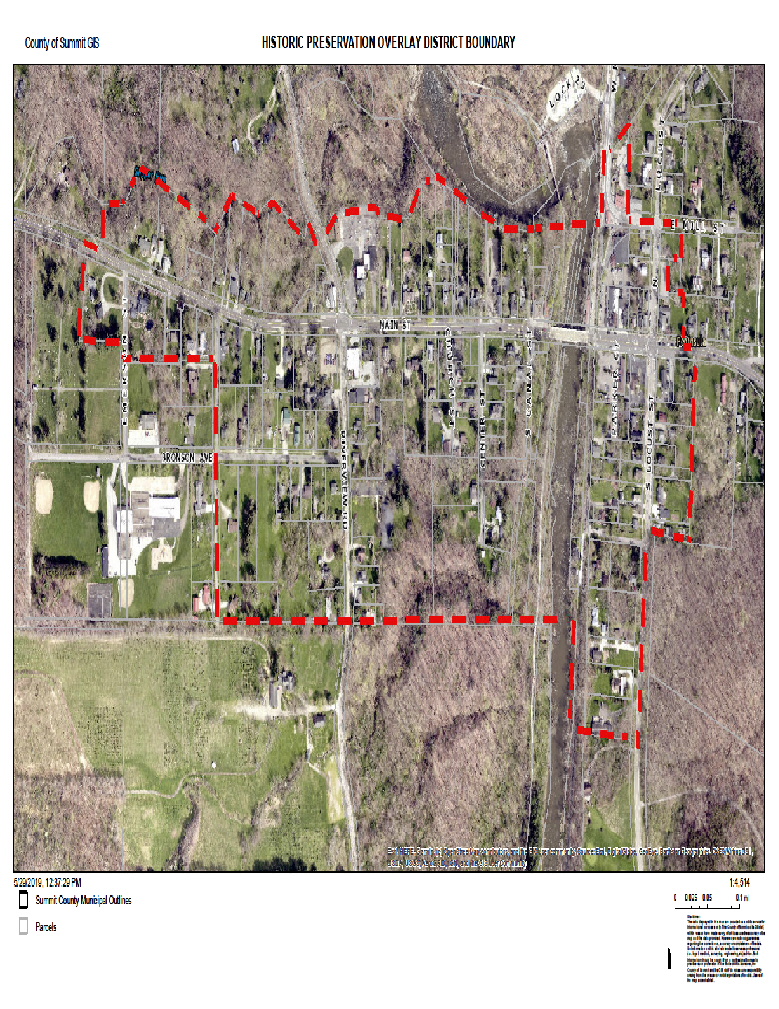 |
(Ord. 21-2020. Passed 12-14-20.)

