
Perris City Zoning Code
CHAPTER 19
51.- MARCH ARB/IP AIRPORT OVERLAY ZONE MAOZ
Sec. 19.51.010.- Purpose and intent.
The purpose and intent of the Airport Overlay Zoning District is to:
(1)
Implement the city's general plan policies to ensure that all land uses within the Airport Overlay Zone (AOZ) are consistent with the State Aeronautics Act, State Law, Federal Aviation Administration (FAA) Regulations, and guidance of the California Airport Land Use Planning Handbook.
(2)
Ensure that land uses and development within the Airport Overlay Zone (AOZ) are compatible with the March Air Reserve Base/Inland Port Airport Land Use Compatibility Plan (ALUCP), adopted in 2014.
(3)
Prohibit the establishment of incompatible land uses and further expansion of incompatible land uses to avoid or minimize exposure of persons to potential hazards associated with current and future airport operations.
(4)
Prohibit development, uses, or any installations or activities that could represent a hazard to existing and future flight operations.
(5)
Recognize unique constraints and considerations that apply to properties potentially affected by airport operations by establishing regulations and review criteria for land use and development within the Airport Overlay Zone (AOZ).
(6)
Recognize the boundary of the Riverside County Airport Land Use Compatibility Plan (ALUCP) within the Perris City limits and Perris Commerce Center Specific Plan (PVCC SP) area by establishment of an Airport Overlay Zone (AOZ).
(Ord. No. 1332, § 4(Exh.), 8-13-2016)
Sec. 19.51.020. - March ARB/IP ALUCP definitions.
Airport Influence Area (AIA) An area in which current or future airport-related noise, overflight, safety, or airspace protection factors may significantly affect land uses or necessitate restrictions on those uses. The airport influence area constitutes the area within which certain land use actions are subject to Riverside Airport Land Use Commission (ALUC) review. The term airport influence area is synonymous with the term airport referral area as well as the term planning area as referred to in the Public Utilities Code Section 21675.
Zone M (Military) includes all lands owned by the U.S. Air Force. By law, neither local governments nor the Riverside Airport Land Use Commission (ALUC) have jurisdiction over federal lands.
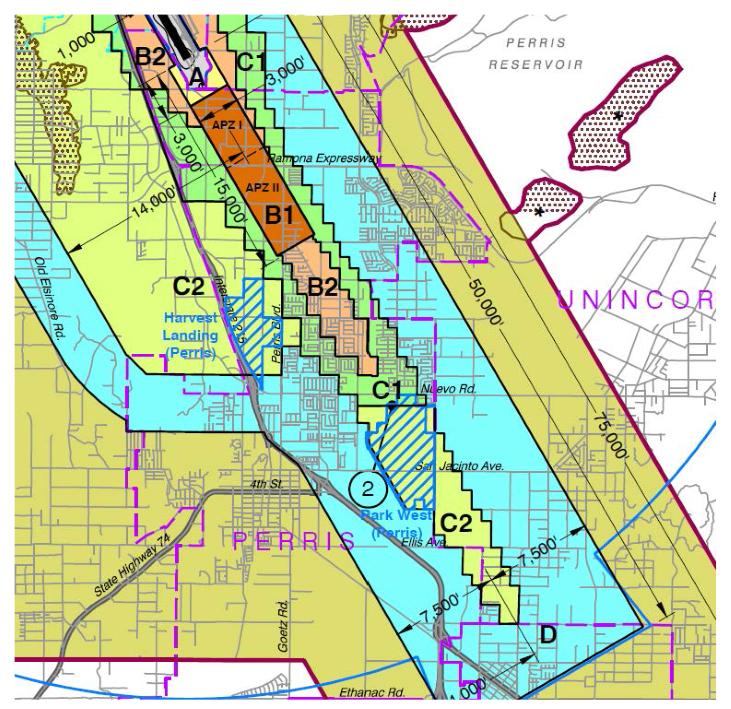
Zone A (Clear Zone) contains lands within the Clear Zone (CZ) at each end of the runway, but not on the base property. As defined by the 2005 Air Installation Compatible Use Zone (AICUZ), the clear zones are 3,000 feet wide and 3,000 feet long beginning at the runway ends. Zone A at the south end of the runway includes privately owned land. The U.S. Air Force has acquired restrictive use easements preventing the development of this property.
Zone B1 (Inner Approach/Departure Zone) encompasses areas of high noise and high accident potential risk within the inner portion of the runway approach and departure corridors. The zone is defined by the boundaries of Accident Potential Zones (APZs) I and II, adjusted on the north to take into account the turning departure flight tracks. The majority of the zone is exposed to projected noise levels in excess of 65 dB CNEL.
Zone B2 (High Noise Zone) is similar to Zone B1 in terms of noise impact, but is subject to less accident potential risk. The projected 65 dB CNEL contour forms the basis for the zone boundary. The actual boundary follows roads, parcel lines or other geographic features that lie generally just beyond the contour line. Lands within the APZs are excluded from Zone B2. Most of the zone lies adjacent to the runway. To the north, portions extend along the sides of Zone B1. To the south, a small area borders the sides of Zones A and B1 and a larger area extends two miles beyond the south end of Zone B1.
Zone C1 (Primary Approach/Departure Zone) encompasses most of the projected 60 dB CNEL contour plus immediately adjoining areas. The zone boundary follows geographic features. Accident potential risks are moderate in that aircraft fly at low altitudes over or near the zone. To the south, an area beginning just beyond Nuevo Road—approximately five miles from the runway end—is excluded from the zone. Exposure to noise in this area is greater (above 60 dB CNEL), however, the accident potential risks at this distance from the runway are reduced by the altitude at which aircraft typically fly over the area. Single-event noise levels are potentially disruptive in this zone.
Zone C2 (Flight Corridor Zone) contains the remainder of the lands within the 60 dB CNEL contour to the south. Although aircraft overflying this area are at 2,000 feet or more above the runway on descent and generally 3,000 feet or more on takeoff, single-event noise levels combined with the frequency of overflights, including at night, make noise a moderate compatibility concern. A larger portion of Zone C2 is situated to the west of the airport and includes locations above which most of the military closed-circuit flight training aircraft activity takes place. Aircraft overfly this area at circuit altitude (3,000 feet) or higher (similar to the south portion of Zone C2), but high terrain in some locations makes the flight altitude above ground level comparatively lower. Single-event noise levels in this area can be intrusive. However, at present, nearly all of the flight training activity takes place on weekdays during daylight hours, thus reducing the significance of the noise impact on residential land uses. Accident potential risk levels in both portions of Zone C2 are judged to be moderate to low with flight training aircraft activity being the primary concerns
Zone D (Flight Corridor Buffer) is intended to encompass other places where aircraft may fly at or below 3,000 feet above the airport elevation either on arrival or departure. Additionally, it includes locations near the primary flight paths where aircraft noise may be loud enough to be disruptive. Direct overflights of these areas may occur occasionally. Accident potential risk levels in this zone are low.
Zone E (Other Airport Environs) contains the remainder of the Airport Influence Area (AIA). Noise impacts are low (this area is beyond the 55-CNEL noise contour), and risk of accidents is low. Airspace protection is the major concern in that aircraft pass over these areas while flying to, from, or around March ARB/IPA.
The High Terrain Zone serves a more focused purpose than the preceding eight zones. It is intended to identify locations where objects may be hazards to the aircraft operating in the airport's airspace and require careful review. This zone is within the FAR Part 77 surfaces for March ARB/IPA.
(Ord. No. 1332, § 4(Exh.), 8-13-2016)
Sec. 19.51.030. - Applicability.
Regulations in this chapter shall apply to all uses, activities, and existing and proposed development project on properties within the March ARB/IP ALUCP Zone A (Clear Zone), Zone B1 (Inner Approach Departure Zone), Zone B2 (High Noise Zone), Zone C1 (Primary Approach/Departure Zone), Zone C2 (Flight Corridor Zone), Zone D (Flight Corridor Buffer), and Zone E (Other Airport Environs) designated in the ALUCP. Should an override action be taken, the City of Perris shall ensure that development is consistent with direction in the State Aeronautics Act, the FAA regulations, and guidance provided in the Caltrans Division of Aeronautics Airport Land Use Planning Handbook.
(1)
Specific Plans. For properties located within the AOZ, which also are located within specific plans, development regulations, standards, and policies shall be followed per respective specific plans. In cases where policies or standards are not provided within the specific plan, the policies and standards within this Chapter will apply in addition to other applicable zoning regulations, the General Plan, or other standards and regulations that apply to the project or land use. In no case will a land use, activity, or development be allowed to violate Airspace Protection Standards of 19.51.070.
(2)
Existing Development and Land Uses. Non-conforming uses and structures shall comply with the Airspace Protection Standards of [section] 19.51.070, which prohibit any activities that pose a risk to flight operations within the AOZ. Existing land uses that are not consistent with the AOZ are non-conforming uses and may continue. No increase in density for non-conforming residential land uses is permitted. Non-conforming buildings and uses shall comply with Perris Municipal Code Chapter 19.80 (Nonconforming Building and Uses) provisions for expiration of nonconforming status and proposed changes to land use that does not conform to the AOZ.
Development or land uses shall be considered "existing" if one of the following conditions are met:
a.
A vesting tentative map has been approved and has not expired or all discretionary approvals have been obtained and have not expired.
b.
Building permits have been issued and have not expired.
c.
The structures and site development have been legally established and physically exist.
(Ord. No. 1332, § 4(Exh.), 8-13-2016)
Sec. 19.51.040. - Procedures.
(a)
Approval. All ministerial and discretionary actions within the Airport Overlay Zoning District (AOZ) shall be reviewed for consistency with this chapter prior to approval.
(b)
Mandatory findings for approval. When a project, use or activity is subject to discretionary actions requiring a public hearing or notice, the applicable review authority shall make all of the following findings, as applicable:
(1)
The project, use or activity complies with the noise compatibility policies of the AOZ.
(2)
The project, use or activity complies with residential and non-residential density standards and other development conditions as mentioned in the Basic Compatibility Criteria Table (Table 1) of the AOZ.
(3)
The project, use or activity complies with the Basic Compatibility Criteria Table (Table 1) and Compatibility Map (Figure 1) of the AOZ.
(4)
The project, use or activity complies with the airspace protection policies of the AOZ.
(5)
The project or use complies with the overflight policies of the AOZ.
(c)
Amendments. Other than the General Plan, a Specific Plan, or Zoning Code changes addressed through a previous referral to the Riverside County Airport Land Use Commission (RCALUC), or any action to overrule any determination of the March ARB/IP ALUCP, proposed general plan land use amendments, zoning amendments, and specific plan amendments that impact density or intensity of development within the AOZ shall be referred to the RCALUC for a determination of compatibility with the adopted March ARB/IP ALUCP.
(d)
Overrule Procedures. ALUC consistency determinations for local agency plans and projects, are subject to overrule by the local agency. The overrule process preserves local government's constitutional land use authority and local government's ability to implement its plans and projects. When a plan or project is found inconsistent by the ALUC, the City of Perris has a choice to stop or amend the plan or project, and thereby accept the ALUCs inconsistency determination, or to overrule the ALUC with a two-thirds "supermajority" vote of the City of Perris City Council.
The local agency must notify both the ALUC and the California Division of Aeronautics at least 45 days in advance of its decision to overrule and must hold a public hearing on the proposed overruling (Public Utilities Code Section 21676(a) and (b)). While the ALUC and Division comments are advisory, they must be included in the public record of any decision to overrule the ALUC.
(Ord. No. 1332, § 4(Exh.), 8-13-2016)
Sec. 19.51.050. - March ARB/IP Airport Land Use Compatibility Map.
The safety zone boundaries, shown in the map below and described within the Airport Overlay Zone (AOZ) are consistent with the adopted 2014 Riverside County Airport Land Use Compatibility Plan and 2014 March Air Reserve Base/Inland Port Airport Land Use Compatibility Plan.
Figure 1
(Ord. No. 1332, § 4(Exh.), 8-13-2016)
Sec. 19.51.060. - Basic compatibility criteria and notes.
Land use compatibility criteria are intended to minimize the risk to people and property on the ground as well as to people in an aircraft in the event of an accident or emergency landing occurring outside the airport boundary.
NOTES:
Policies referenced here are from the Riverside County Airport Land Use Compatibility Plan adopted by the Riverside County ALUC for other airports beginning in October 2004. A complete copy of the Riverside County Airport Land Use Compatibility Plan is available on the Riverside County Airport Land Use Commission website at www.rcaluc.org.
1. Residential development must not contain more than the indicated number of dwelling units (excluding secondary units) per gross acre. Clustering of units is encouraged provided that the density is limited to no more than 4.0 times the allowable average density for the zone in which the development is proposed. Gross acreage includes the property at issue plus a share of adjacent roads and any adjacent, permanently dedicated, open lands. Mixed-use development in which residential uses are proposed to be located in conjunction with nonresidential uses in the same or adjoining buildings on the same site shall be treated as nonresidential development for the purposes of usage intensity calculations; that is, the occupants of the residential component must be included in calculating the overall number of occupants on the site. A residential component shall not be permitted as part of a mixed use development in zones where residential uses are indicated as incompatible. See Countywide Policy 3.1.3(d). All existing residential development, regardless of densities, is not subject to ALUC authority.
2. Usage intensity calculations shall include all people (e.g., employees, customers/visitors, etc.) who may be on the property at a single point in time, whether indoors or outside.
3. The uses listed here are ones that are explicitly prohibited regardless of whether they meet the intensity criteria. In addition to these explicitly prohibited uses, other uses will normally not be permitted in the respective compatibility zones because they do not meet the usage intensity criteria. See Riverside County Airport Land Use Compatibility Plan, Volume 1, Appendix D for a full list of compatibility designations for specific land uses.
4. As part of certain real estate transactions involving residential property within any compatibility zone (that is, anywhere within an airport influence area), information regarding airport proximity and the existence of aircraft overflights must be disclosed. This requirement is set by state law. See Countywide Policy 4.4.2 for details. Easement dedication and deed notice requirements indicated for specific compatibility zones apply only to new development and to reuse if discretionary approval is required. Avigation easements are to be dedicated to the March Inland Port Airport Authority; the federal government is precluded from receiving easement dedications. See sample language in www.marchjpa.com/docs_forms/avigationeasement.pdf.
5. The total number of people permitted on a project site at any time, except rare special events, must not exceed the indicated usage intensity times the gross acreage of the site. Rare special events are ones (such as an air show at the airport) for which a facility is not designed and normally not used and for which extra safety precautions can be taken as appropriate.
6. Clustering of nonresidential development is permitted. However, no single acre of a project site shall exceed the indicated number of people per acre. See Countywide Policy 4.2.5 for details.
7. Clear zone (equivalent to runway protection zone at civilian airports) limits that delineate Zone A are derived from locations indicated in the March Air Reserve Base AICUZ study. Zone A is on Air Base property or otherwise under military control.
8. Hazards to flight include physical (e.g., tall objects), visual, and electronic forms of interference with the safety of aircraft operations. Land use development that may cause the attraction of birds to increase is also prohibited. Man-made features must be designed to avoid heightened attraction of birds. In Zones A, B1, and B2, flood control facilities should be designed to hold water for no more than 48 hours following a storm and be completely dry between storms (see FAA Advisory Circular 150/5200-33B). Additionally, certain farm crops and farming practices that tend to attract birds are strongly discouraged. These include: certain crops (e.g., rice, barley, oats, wheat - particularly durum - corn, sunflower, clover, berries, cherries, grapes, and apples); farming activities (e.g., tilling and harvesting); confined livestock operations (i.e., feedlots, dairy operations, hog or chicken production facilities, or egg-laying operations); and various farming practices (e.g., livestock feed, water, and manure). Fish production (i.e., catfish, trout) conducted outside of fully enclosed buildings may require mitigation measures (e.g., netting of outdoor ponds, providing covered structures) to prevent bird attraction. Also see Countywide Policy 4.3.7.
9. March ARB must be notified of any land use having an electromagnetic radiation component to assess whether a potential conflict with Air Base radio communications could result. Sources of electromagnetic radiation include microwave transmission in conjunction with a cellular tower, radio wave transmission in conjunction with remote equipment inclusive of irrigation controllers and other similar EMR emissions.
10. Other than in Zone A, construction of a single-family home, including a second unit as defined by state law, on a legal lot of record is exempted from this restriction where such use is permitted by local land use regulations. Interior noise level standards and avigation easement requirements for the compatibility zone in which the dwelling is to be located are to be applied.
11. Non-residential uses are limited to 25 people per gross acre in Accident Potential Zone (APZ) I and 50 people per acre in APZ II and elsewhere in Zone B1. Single-acre intensity limits are 100 people/acre throughout Zone B1.
12. In APZ I, any proposed development having more than 20% lot coverage must not provide on-site services to the public. Zoned fire sprinklers are required. Also, in APZ I, site design of proposed development should to the extent possible avoid placement of buildings within 100 feet of the extended runway centerline; this center strip should be devoted to parking, landscaping, and outdoor storage. Maximum lot coverage is not limited outside the APZs.
13. Within APZ II and outside APZs, two-story buildings are allowed.
14. Storage of aviation fuel and other aviation-related flammable materials on the airport is exempted from this criterion. In APZ I, manufacture or bulk storage of hazardous materials (toxic, explosive, corrosive) is prohibited unless storage is underground; small quantities of materials may be stored for use on site. In APZ II and elsewhere within Zone B1, aboveground storage of more than 6,000 gallons of nonaviation flammable materials per tank is prohibited.
15. Examples of noise-sensitive outdoor nonresidential uses that should be prohibited include major spectator-oriented sports stadiums, amphitheaters, concert halls and drive-in theaters. Caution should be exercised with respect to uses such as poultry farms and nature preserves.
16. Critical community facilities include power plants, electrical substations, and public communications facilities. See Countywide Policy 4.2.3(d).
17. For properties in either APZ I or II, any use listed as — N — not compatible? for that particular APZ in Table 3-1 of the 2005 Air Installation Compatible Use Zone Study for March Air Reserve Base. Beyond the boundaries of the APZs in Zone B1, such uses are discouraged, but not necessarily prohibited unless otherwise specified herein.
18. All new residences, schools, libraries, museums, hotels and motels, hospitals and nursing homes, places of worship, and other noise-sensitive uses must have sound attenuation features incorporated into the structures sufficient to reduce interior noise levels from exterior aviation-related sources to no more than CNEL 40 dB. This requirement is intended to reduce the disruptiveness of loud individual aircraft noise events upon uses in this zone and represents a higher standard than the CNEL 45 dB standard set by state and local regulations and countywide ALUC policy. Office space must have sound attenuation features sufficient to reduce the exterior aviation-related noise level to no more than CNEL 45 dB. To ensure compliance with these criteria, an acoustical study shall be required to be completed for any development proposed to be situated where the aviation-related noise exposure is more than 20 dB above the interior standard (e.g., within the CNEL 60 dB contour where the interior standard is CNEL 40 dB). Standard building construction is presumed to provide adequate sound attenuation where the difference between the exterior noise exposure and the interior standard is 20 dB or less.
19. This height criterion is for general guidance. Shorter objects normally will not be airspace obstructions unless situated at a ground elevation well above that of the airport. Taller objects may be acceptable if determined not to be obstructions. See Countywide Policies 4.3.3 and 4.3.4. Objects up to 35 feet in height are permitted. However, the Federal Aviation Administration or California Department of Transportation Division of Aeronautics may require marking and lighting of certain objects. See Countywide Policy 4.3.6 for details.
20. Discouraged uses should generally not be permitted unless no feasible alternative is available.
21. Although no explicit upper limit on usage intensity is defined for Zone D and E, land uses of the types listed—uses that attract very high concentrations of people in confined areas—are discouraged in locations below or near the principal arrival and departure flight tracks.
(Ord. No. 1332, § 4(Exh.), 8-13-2016)
Sec. 19.51.070. - Airspace protection standards.
Airspace protection. Airspace protection standards are intended to reduce the risk of harm to people and property resulting from an aircraft accident by preventing the creation of incompatible land use features and prohibiting activities that can pose hazards to the airspace used by aircraft in flight. Airspace protection standards regarding obstructions and hazards to air navigation are defined in the March ARB/IP ALUCP and apply to land uses and development within the Airport Overlay Zone (AOZ) as summarized below:
(1)
Objects affecting navigable airspace. Federal Aviation Regulation (FAR) Part 77 and Public Utility Code (PUC) Section 21659 require that structures not penetrate the airspace protection surfaces of the airport without a permit from the California Department of Transportation or a determination by the Federal Aviation Administration (FAA) that the object does not constitute a hazard to air navigation or would not create an unsafe condition for air navigation. The airspace surrounding an airport is divided into segments called "imaginary surfaces," which identify height limits for objects that require further study by the FAA to avoid creating hazards to air navigation. Structures that have the potential to be considered an obstruction by the FAA shall be subject to the provisions listed in a—c below:
a.
Proponents of a project shall file a Notice of Construction or Alteration (FAA Form 7460-1) with the FAA if a proposed structure is more than 200 feet above ground level or may exceed one foot in height for every 100 feet from the edge of the nearest point on the runway for a distance up to 20,000 feet. Filing FAA Form 7460-1 with the FAA will initiate an aeronautical study that will ensure a proposed structure does not constitute a hazard to air navigation or would not create an unsafe condition for air navigation, including impeding any en route or terminal (airport) instrument procedures as per the United States Standard for Terminal Instrument Procedures (TERPS) described in FAA Order 8260.3B (Code of Federal Regulations § 77.29 Evaluating Aeronautical Effect).
b.
Approvals for such projects may include the requirement for an avigation easement, marking or lighting of the structure, or modifications to the structure. The avigation easement shall be consistent with the form and content of Exhibit H1 in Appendix H of the California Airport Land Use Planning Handbook.
c.
Building permits shall not be issued for a project until a Determination of No Hazard has been issued by the FAA and any conditions in that Determination are met.
(2)
Flight hazards prohibited. Any activities within the AOZ that could pose a hazard to flight operations including but not limited to the following:
a.
Glare or distracting lights that could be mistaken for airport lights;
b.
Sources of dust, steam, or smoke that may impair pilot visibility;
c.
Sources of electrical interference with aircraft communications or navigation; and
d.
Features that create an increased attraction for wildlife (large flock of birds) that may be hazardous to airport operations such as attraction of birds to the extent of creating a significant hazard of bird strikes (examples are outdoor storage or disposal of food or grain, or large, artificial water features, or landfills).
(Ord. No. 1332, § 4(Exh.), 8-13-2016)
Sec. 19.51.080. - Noise.
Airport Related Noise. Noise compatibility standards are intended to prevent the establishment of noise-sensitive land uses in portions of the airport environ that are exposed to significant levels of aircraft noise. Where permitted within the Airport Overlay Zone (AOZ), the following noise-sensitive land uses shall comply with applicable noise exposure criteria:
(1)
All new residences, schools, libraries, museums, hotels and motels, hospitals and nursing homes, places of worship, and other noise-sensitive uses must have sound attenuation features incorporated into the structures sufficient to reduce interior noise levels from exterior aviation-related sources to no more than CNEL 40 dB. This requirement is intended to reduce the disruptiveness of loud individual aircraft noise events upon uses in this zone and represents a higher standard than the CNEL 45 dB standard set by state and local regulations and the Riverside County ALUC policy.
(2)
Office space must have sound attenuation features sufficient to reduce the exterior aviation-related noise level to no more than CNEL 45 dB. To ensure compliance with these criteria, an acoustical study shall be required to be completed for any development proposed to be situated where the aviation-related noise exposure is more than 20 dB above the interior standard (e.g., within the CNEL 60 dB contour where the interior standard is CNEL 40 dB).
(3)
Standard building construction is presumed to provide adequate sound attenuation where the difference between the exterior noise exposure and the interior standard is 20 dB or less.
(Ord. No. 1332, § 4(Exh.), 8-13-2016)
Sec. 19.51.090. - Notice of airport vicinity.
Notice of Airport in the Vicinity: Prior to approval of new development projects, all applicants shall prepare an aerial photograph identifying the location of the March ARB/IP in relationship to the project site, and a Notice of Airport in the Vicinity. The notice must be provided to all potential purchasers or tenants and shall consist of the following:
NOTICE OF AIRPORT IN VICINITY
This property is presently located in the vicinity of an airport, within what is known as an airport influence area. For that reason, the property may be subject to some of the annoyances or inconveniences associated with proximity to airport operations (for example: noise, vibration or odors). Individual sensitivities to those annoyances can vary from person to person. You may wish to consider what airport annoyances, if any, are associated with the property before you complete your purchase and determine whether they are acceptable to you. Business & Professions Code Section 11010 (b)(13)(A)
Disclosure: The applicant shall provide full disclosure of the avigation easement and Notice of Airport in the Vicinity to all prospective purchasers or tenants.
(Ord. No. 1332, § 4(Exh.), 8-13-2016)
Sec. 19.51.100. - Avigation easement.
Avigation Easement: Development projects shall provide an executed avigation easement to the March Joint Powers Authority (MJPA).
(Ord. No. 1332, § 4(Exh.), 8-13-2016)
Sec. 19.51.110. - Other.
Any project, development, or land use not mentioned in this section shall be subject to 2014 March Air Reserve Base/Inland Port Airport land Use Compatibility Plan (March ARB/IP ALUCP).
(Ord. No. 1332, § 4(Exh.), 8-13-2016)
Sec. 19.51.120. - Infill.
Infill: Where development not in conformance with the criteria set forth in the March ARB/IP ALUCP already exists, additional infill development of similar lands uses may be allowed to occur even if such lands uses are to be prohibited elsewhere in the zone. This exception does not apply within Compatibility Zones A or B1.
(1)
A parcel can be considered for infill development if it meets all of the following criteria plus the applicable provisions of either sub-policy (b) or (c) below:
a.
The parcel size is no larger than 20.0 acres.
b.
At least 50% of the site's perimeter is bounded (disregarding roads) by existing uses similar to, or more intensive than, those proposed.
c.
The proposed project would not extend the perimeter of the area defined by the surrounding, already developed, incompatible uses.
d.
Further increases in the residential density, nonresidential usage intensity, and/or other incompatible design or usage characteristics (e.g., through use permits, density transfers, addition of second units on the same parcel, height variance, or other strategy) are prohibited.
e.
The area to be developed cannot previously have been set aside as open land in accordance with policies contained in the March ARB/IP ALUCP unless replacement open land is provided within the same compatibility zone.
(2)
For residential development, the average development density (dwelling units per gross acre) of the site shall not exceed the lesser of:
a.
The average density represented by all existing lots that lie fully or partially within a distance of 300 feet from the boundary of the parcel to be divided; or
b.
Double the density permitted in accordance with the criteria for that location as indicated in the Compatibility Criteria Table 1.
(3)
For nonresidential development, the average usage intensity (the number of people per gross acre) of the site's proposed use shall not exceed the lesser of:
a.
The average intensity of all existing uses that lie fully or partially within a distance of 300 feet from the boundary of the proposed development; or
b.
Double the intensity permitted in accordance with the criteria for that location as indicated in the Compatibility Criteria Table 1.
(4)
The single-acre and risk-reduction design density and intensity multipliers listed in Table 1 are applicable to infill development
(5)
Infill development on some parcels should not enable additional parcels to then meet the qualifications for infill. The intent is that parcels eligible for infill be determined just once. The burden for demonstrating that a proposed development qualifies as infill rests with the City of Perris and/or project proponent.
(Ord. No. 1332, § 4(Exh.), 8-13-2016)
Sec. 19.51.130. - Site-specific exemptions.
The following specific plans are exempt:
Harvest Landing Specific Plan — Situated in March ARB/IP ALUCP Compatibility Zone C2. A 341-acre mixed-use Specific Plan located south of Placentia Avenue and east of Interstate 215 within the City of Perris, which includes 1,860 residential units and 1,306,582 square feet of business/commercial uses. The Specific Plan and associated Development Agreement were adopted in May 2011. The Development Agreement will expire 15 years from the approval date plus extensions in 5-year increments subject to City Council Approval.
Park West Specific Plan — Situated in March ARB/IP ALUCP Compatibility Zones C1 and C2. A 534.3-acre residential Specific Plan located south of Nuevo Road and east of the Perris Valley Storm Channel within the City of Perris and authorized for a maximum of 2,027 residential units as identified in the Specific Plan and Development Agreement approval by the Perris City Council on January 30, 2007. The Development Agreement for Phase I expires 10 years from the approval date. Phases II and III extend the agreement to 2027 or 10 years after the developer submits an application for approval of a Tentative Tract Map for any portion of these phases.
(Ord. No. 1332, § 4(Exh.), 8-13-2016)

