
Pilot Mountain City Zoning Code
ARTICLE 10
SIGN REGULATIONS
10.1 Purpose
The purpose of this Article is to promote the effective and compatible use of signage within the Town of Pilot Mountain.
10.2 Applicability
Except as otherwise provided in this Article, it shall be unlawful for any person to place, erect, construct, enlarge, move, or replace any sign, without first having obtained a permit for such sign from the Ordinance Administrator.
10.3 General Sign Standards
- Alteration of Signs. The replacement of sign faces, lettering, or other features of a sign shall be considered maintenance and shall not require a permit. No alteration that modifies the area, height, or illumination of a sign, or alters its location shall be permitted under this provision.
- Signs on Public Property Forfeited. Any sign installed or placed on public property or within a public right-of-way, except in conformance with the requirements of this Article shall be forfeited to the public and is subject to confiscation. In addition to other remedies hereunder, the Ordinance Administrator shall have the right to recover from the owner or person placing such a sign the full costs of removal and disposal of such sign.
- Sign Permits. To ensure compliance with the provisions of this Article, all persons proposing to display a sign shall obtain a sign permit, in accordance with the general procedure established for the issuance of permits in this Ordinance, unless otherwise expressly exempted from such requirement. When a permit is required, a permit shall be issued prior to the installation or placement of such sign.
- Permanent Signs Requiring a Permit. The types of permanent signs listed below shall be required to receive a permit:
- Wall Signs (Section 10.6(2))
- Freestanding Ground Signs (Section 10.6(3))
- Awning Signs (Section 10.6(4))
- Projecting Signs (Section 10.6(5))
- Canopy Signs (Section 10.6(6))
- Incidental Signs (Section 10.6(7)(a))
- Off-Premise Directory Signs (Section 10.6(8))
- Signage Plan Required. For any lot on which the owner proposes to erect one (1) or more signs requiring a permit or for a combined development or other multi-tenant development, a signage plan shall be required, which includes the following information:
- An accurate plot plan of the lot or parcel, at such scale as the Ordinance Administrator may reasonably require;
- Location of buildings, parking lots, driveways, and landscaped areas on such lot or parcel;
- Computation of the maximum total sign area, the maximum area for individual signs, the height of signs, and the number of signs of each type allowed on the lot(s) or parcel(s) included in the plan under this Article; and
- An accurate indication on the plot plan of the proposed location of each present and future sign of any type.
- Temporary Signs Requiring a Permit. The display of certain temporary signs, including the recurring placement of certain signs where permitted, shall require a permit for such temporary sign prior to its display.
- Temporary Signs Requiring a Permit
- Type 3 Freestanding Temporary Signs (Section 10.5(3)(d))
- Temporary Signs Requiring a Permit
- Permit Procedure and Standards
- Persons submitting an application for a temporary sign permit shall provide sufficient information, including the physical characteristics, display location, and proposed period of display (if applicable), in order to determine its compliance with the applicable regulations.
- Only those signs, which meet all of the requirements established by Section 10.3 for the particular type of sign, may be permitted. Signs not meeting those regulations will be denied a permit.
- Failure to obtain a permit for a temporary sign that is required to be permitted prior to displaying it is a violation of this Ordinance.
- Permanent Signs Requiring a Permit. The types of permanent signs listed below shall be required to receive a permit:
- Sign Area Computations. The following principles shall control the computation of sign area and sign height:
- Computation of Area of Single-faced Signs. The area of a sign face shall be computed by means of the smallest square or rectangle, that will encompass the extreme limits of the writing, representation, emblem, or other display, together with any material or color forming an integral part of the background of the display or used to differentiate the sign from the backdrop or structure against which it is placed, but not including any supporting framework, bracing, or decorative fence or wall when such fence or wall otherwise meets zoning ordinance regulations and is clearly incidental to the display itself.
- Computation of Area of Multi-Faced Signs. The sign area for a sign with more than one face shall be computed by adding together the area of all sign faces visible from any one point. When two (2) identical sign faces are placed back to back, so that both faces cannot be viewed from any point at the same time, and when such sign faces are part of the same sign structure and not more than forty-two (42”) inches apart, the sign area shall be computed by the measurement of one (1) of the faces.
Figure 10-1: Measurement of a Sign Face
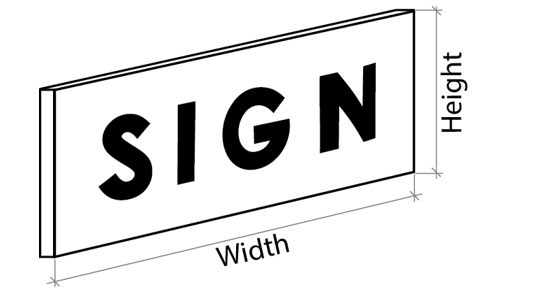
- Computation of Height. The height of a freestanding sign shall be computed as the vertical distance from the point of the sign that is level with the highest paved portion of the street right-of-way or recorded access easement to the top of the highest attached component of the sign. The highest paved portion of the street right-of-way or recorded access easement shall be measured along the frontage of the property where the sign will be located at the point nearest the sign location. The design, colors, and/or materials of the base or supports of any sign that is below the paved portion of the street right-of-way or recorded access easement shall be consistent with, or complimentary to, the portions of the sign above that point.
Figure 10-2: Measurement of Sign Height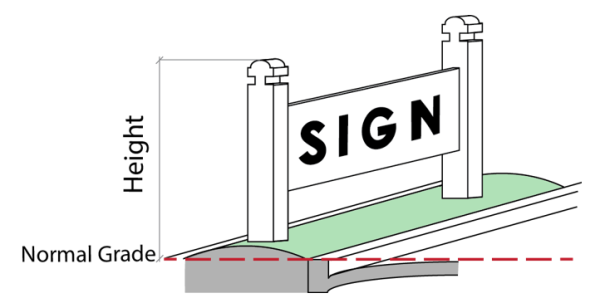
- Clear Site Distance Required. Clear site distance at street intersections is required. Signs shall be located outside of the required sight triangle as detailed in Table 10-1 and Figure 10-3. Site triangles are required in every zoning district except for the CB District. Sight triangles must be shown on all submitted plans depicting the location of signage for sign permit applications.
Table 10-1: Sight Triangle Leg Length along a Right-of-Way Measured from the Point of IntersectionFigure 10-3: Sight Triangle Sample IllustrationRight-of-Way Width (feet) Length (feet) 50 25 60 30 70 35 80 40 90 45 ≥100 50 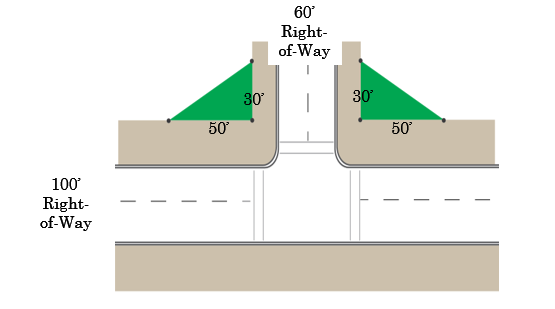
- Design, Construction, and Maintenance. All signs shall be designed, constructed, and maintained, in accordance with the following standards:
- All signs shall be constructed and maintained to retain sound structural condition, and shall comply with all applicable provision of the State Building Code, all applicable electrical codes, and this Ordinance, at all times.
- Except for flags, certain temporary signs, and window signs conforming in all respects with the requirements of this Ordinance, all signs shall be constructed of rigid all weather materials and shall be permanently attached to the ground, a building, or another structure by direct attachment to a rigid wall, frame, or structure.
- Certain Government Signs Exempt. Official signs installed by units of local government having jurisdiction within the Town of Pilot Mountain, agencies of the State of North Carolina, and federal government agencies are exempt from the regulations established by this Ordinance, provided that such signs are installed upon public property or within a right-of-way owned or maintained by said governmental agency and fully conform to all safety provisions established by this Ordinance. For the purposes of this section, official signs shall include any sign erected by the Town of Pilot Mountain.
- Nonconforming Signs. In the interest of encouraging the eventual removal of signs that do not meet the current standards of the UDO, the following standards are established to require the removal of nonconforming signs under certain circumstances.
- Discontinuance of Occupancy and/or Use. Where one (1) or more nonconforming signs are located on a parcel of land or building whose occupancy or use has been discontinued for a period of 180 days, such nonconforming sign(s) shall be removed, replaced, or otherwise brought into conformance with the current standards of this Article.
- Removal or Damage. Nonconforming signs that are voluntarily removed or which are damaged to an extent greater than or equal to sixty percent (60%) of their replacement value shall not be reestablished or repaired except in full conformance with the current standards of this Article. The removal of a sign shall include situations in which the face or faces are removed from a nonconforming sign structure and not replaced within ninety (90) days of the date of their removal.
10.4 Prohibited Signs
- Applicability. The following signs are expressly prohibited within the Town of Pilot Mountain and its extraterritorial jurisdiction:
- Animated signs as defined by this Ordinance.
- Electronic Message Boards, Dynamic Signs, and Electronic Time and Temperature Displays - displaying blinking, flashing or intermittent lights, animation, and moving parts, unless otherwise expressly permitted.
- Glaring signs as defined by this Ordinance.
- Running signs as defined by this Ordinance.
- Portable signs, unless otherwise expressly permitted.
- Signs, which approximate official highway signs, warning signs, or regulatory devices.
- “Wrap-around” signs or other continuous wall signs that extend around building corners or radii.
- Signs placed within any required sight triangle.
- Signs attached to or painted on utility poles, telephone poles, trees, parking meters, bridges, overpasses, rocks, other signs, benches, and refuse containers, except that the latter two may contain a logotype.
- Roof signs.
- Signs placed within or extending into the right-of-way of city and state maintained streets and roads, except those signs erected by a duly constituted government body or which are expressly permitted to be placed within a right-of-way by this Ordinance or the North Carolina General Statutes.
- Signs that contain language and/or pictures obscene to the general public in accordance with NCGS 14-190.1.
- Indirect illumination for signs, such as floodlights, erected in such a manner as to cause glare that impairs driver vision on streets or roadways, or that causes a nuisance to adjoining property.
- Signs that obstruct fire escapes, windows, doors, or other openings used as means of egress or as required legal ventilation.
- Signs containing or consisting of pennants, ribbons, streamers, festoon lighting, balloons (or inflatable signs), spinners, or windblown devices.
- Signs that do not conform to the provisions of these regulations, except as otherwise provided in this Article.
10.5 Temporary Signs
- Applicability. The provisions of this section shall apply to the placement and display of temporary signage within the Town’s jurisdiction. Any temporary sign that does not comply with the provisions of this Section is prohibited. Any sign, which is permanently displayed, shall comply with the provisions of Section 10.4, Permanent Signs.
- Common Standards. All temporary signs shall comply with the following common standards:
- Temporary signs shall not be illuminated or be provided with any electric service.
- Temporary signs shall not be placed within any public street right-of-way, including within medians, unless expressly permitted by this Article or the North Carolina General Statutes.
- Temporary signs attached to building walls (other than permitted temporary window signs) shall not be placed in a manner that obstructs any window, door, fire department sprinkler connection, or street number sign.
- Temporary signs shall not be affixed to a permanent sign or its supporting structure, including both building mounted and freestanding permanent signs.
- Temporary signs shall not be placed in a manner that obstructs clear site distance (within the required sight triangle) for motorists at street intersections or driveways.
- Temporary signs, other than Type 4 Freestanding Temporary Signs, shall not be placed upon any sidewalk or other pedestrian walkway.
- Temporary signs shall not be placed on the roof of a building, or affixed to a motor vehicle, tree, utility pole, or street sign.
- Where temporary signs are limited in the duration of their display and limited in the total number of displays per calendar year, any required period of separation between such displays shall carry through to the following calendar year, and shall be observed prior to initiating the first allowed display during the new calendar year.
- Freestanding Temporary Signs.
- General Provisions, The following standards apply to all Freestanding Temporary Signs:
- Signs shall not be affixed to poles, posts, stakes or other supporting structures that are permanently installed or anchored into the ground with concrete foundations or similar anchoring techniques.
- Signs, other than Type 4 Freestanding Temporary signs, shall be not be set in the right-of-way.
- No more than one (1) Freestanding Temporary Sign may be displayed on a parcel or group of adjacent parcels under common ownership or tenancy at any given time, regardless of type, unless otherwise expressly permitted.
- Type 1 Freestanding Temporary Signs. Signs in this category consist of small, temporary yard signs that are typically associated with (but not limited to) the advertisement of real estate, political campaigns and meeting announcements. For examples of Type 1 Temporary Freestanding Signs, see Figure 10-4.
- Where Permitted. Type 1 Freestanding Temporary signs may be displayed in any zoning district and may be associated with any use, including parcels containing vacant or undeveloped land.
- Permitted Size. The maximum sign display area is limited to six square feet (6ft2) (per side if dual sided).
- Permitted Height. The maximum height of the sign, including any supporting posts or stakes, is limited to four (4) feet above the adjacent grade.
- Number Permitted. One (1) Type 1 Freestanding Temporary Sign per street frontage may be displayed on a parcel or group of adjacent parcels under common ownership or tenancy.
- Sign Material. The display area (sign face) shall be composed of a rigid material.
- Mounting Standard. Signs may only be mounted and supported by posts or stakes.
- Number of Sides. The display area may be either single or dual sided.
- Permitted Duration of Display. There is no limit to the duration of the display of a Type 1 sign.
- Type 2 Freestanding Temporary Signs. Signs in this category are typically referred to as “banners” that are typically associated with (but not limited to) the announcement of community, sporting and similar special events. For examples of Type 2 Temporary Freestanding Signs, see Figure 10-4.
- Where Permitted. Type 2 signs are permitted only on parcels or groups of adjacent parcels under common ownership, which contain a use in the Recreational & Entertainment, Civic, Government & Institutional, Office & Service, and Retail & Wholesale use categories.
- Permitted Size. The maximum sign display area is limited to eighteen square feet (18ft2) (per side if dual sided).
- Permitted Height. The maximum height of the sign, including any supporting posts or stakes, is limited to four (4) feet above the adjacent grade.
- Number Permitted. One (1) Type 2 Freestanding Temporary Sign may be displayed on a parcel or group of adjacent parcels under common ownership or tenancy.
- Sign Material. The display area (sign face) shall be composed of flexible material.
- Mounting Standard. Signs may only be mounted and supported by posts or stakes.
- Number of Sides. The display area may be either single or dual sided.
- Permitted Duration of Display. Type 2 signs are permitted to be displayed for a maximum period of fourteen (14) calendar days. A maximum of six (6) separate displays are permitted during each calendar year with a minimum of ten (10) days of separation between displays.
- Type 3 Freestanding Temporary Signs. Signs in this category are large temporary signs typically associated with (but not limited to) the advertisement of large tracts of land for sale, construction and development activity or the advertisement of commercial or industrial buildings for sale or lease. For examples of Type 3 Temporary Freestanding Signs, see Figure 10-4.
- Where Permitted. Type 3 signs are permitted only on parcels or groups of adjacent parcels under common ownership, which contain either:
- A use in the Residential Uses group where the size of the parcel or group of adjacent parcels under common ownership is a minimum of three (3) acres in size; or
- Vacant or undeveloped land where the parcel or group of adjacent parcels under common ownership is a minimum of one (1) acre in size; or
- A use in any other category or use group, provided that the parcel upon which the sign is displayed has a minimum of one-hundred (100’) feet of frontage on a public street, as measured at the right-of-way.
- Simultaneous Display Prohibited. A Type 3 sign shall not be displayed upon a parcel that contains a permanent freestanding sign, including a sign structure that has had its display area removed.
- Permitted Size. The maximum display area is limited to thirty-two square feet (32ft2) (per side if dual sided).
- Permitted Height. The maximum height of the sign, including any supporting posts or stakes, is limited to eight (8’) feet above the adjacent grade.
- Number Permitted. One (1) Type 3 Freestanding Temporary Sign maybe displayed on a parcel or group of adjacent parcels under common ownership or tenancy.
- Sign Material. The display area (sign face) shall be composed of a rigid material.
- Mounting Standard. Signs shall be mounted to and supported by a minimum of two (2) separate posts or stakes.
- Number of Sides. The display area may be either single or dual sided.
- Permitted Duration of Display
- Type 3 signs may be displayed without limit to duration upon any parcel or group of adjacent parcels under common ownership, which contain only vacant or undeveloped land, including land whose principal use is the production of agricultural commodities or forestry.
- In all other cases, the duration of display shall be limited to two (2) years, provided that this limit shall not apply if the land, and any building(s) and/or structure(s) upon such parcel or group of parcels is not occupied or in active use for purposes other than a use in the Residential Uses group at any time during the period of display.
- Where the display of a Type 3 sign is subject to a limit on the duration of display, there shall be a minimum period of separation of sixty (60) days between the removal of the previously permitted sign and the display of a new sign. Such period of separation shall apply in all cases where a sign subject to a limit on the duration of its display is removed, regardless of whether the maximum allowed duration for its display has been reached at the time of its removal.
- Where Permitted. Type 3 signs are permitted only on parcels or groups of adjacent parcels under common ownership, which contain either:
- Type 4 Freestanding Temporary Signs. The category of signs defined as Type 4 Freestanding Temporary Signs shall include only those signs, which are constructed in a manner that is commonly referred to as an “A-frame” or “sandwich board” sign. The faces of the sign shall be connected at the top by hinges or similar mechanisms and the sign shall be self-supporting when placed in its display position.
- Where Permitted. Type 4 signs may only be displayed by a use that is included in the Retail & Wholesale use category.
- Permitted Size. The maximum sign display area is limited to six square feet (6ft2) per sign face.
- Permitted Height. The maximum height of the sign is limited to four (4’) feet above the grade of the surface upon which it is displayed when placed in its display position.
- Number Permitted. One (1) Type 4 Freestanding Temporary Sign may be displayed per customer entrance, provided that no more than two (2) Type 4 signs may be displayed per tenant space along the same building frontage.
- Sign Material Standard. The display areas (sign faces) shall be composed of rigid material.
- Placement Standards
- Type 4 signs may be placed upon a public sidewalk or other pedestrian walkway, provided that a minimum of five (5’) feet of unobstructed clearance is maintained along the directional path of the walkway.
- In no case shall a Type 4 sign be placed in a manner that obstructs vehicular access and movement.
- Permitted Duration of Display. Type 4 signs may only be displayed during the period beginning thirty (30) minutes prior to the daily opening and ending thirty (30) minutes following the daily closing of the business displaying the sign.
Figure 10-4: Temporary Freestanding Sign Examples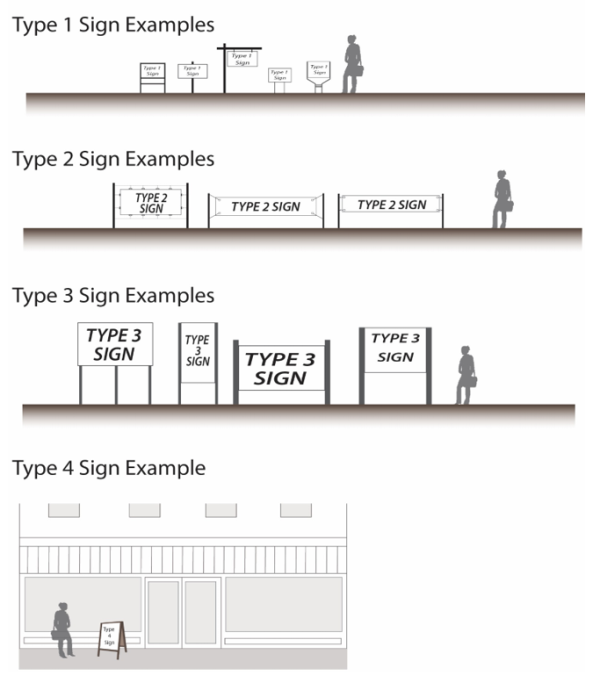
- General Provisions, The following standards apply to all Freestanding Temporary Signs:
- Wall Mounted Temporary Signs. Temporary signs mounted to building walls may be displayed subject to the following provisions:
- Wall mounted temporary signs are only permitted on buildings housing a use within the Office & Service, Retail & Wholesale, and Industrial, Warehousing, Transportation & Utility use categories.
- One (1) temporary wall sign may be displayed per building occupied by a single tenant. Buildings designed for occupancy by multiple tenants where each tenant has a separate entrance may display one (1) temporary wall sign per tenant space. Buildings occupied by multiple tenants that share a common entrance may not display more than one (1) temporary wall sign at any given time.
- Temporary wall signs shall be mounted flush against the building wall and secured by fasteners or other anchors at each corner.
- The maximum display area for temporary wall signs shall be the greater of eighteen square feet (18ft2) or twenty-five percent (25%) of the maximum permitted permanent wall signage, not to exceed thirty-six square feet (36ft2).
- Temporary wall signs may be displayed for a maximum of thirty (30) consecutive calendar days.
- Temporary wall signs may be displayed a maximum of four (4) times per calendar year, with a minimum of thirty (30) days of separation between removing a temporary wall sign and displaying a new temporary wall sign. The minimum time period between temporary sign displays for buildings housing multiple uses that share a common entrance is ten (10) days.
- Temporary Use Signage. The issuance of a Temporary Use Permit allows the display of one (1) temporary sign per street frontage at the permitted location of the Temporary Use for the period of operation as specified in the Temporary Use Permit.
- Suspension of Type 1 Freestanding Sign Regulations. Beginning on the 30th day prior to the beginning of early voting for any scheduled primary or election, as established by the North Carolina Board of Elections, and ending the 10th day following the primary or election, the limit on the number of Type 1 Freestanding Temporary Signs that may be displayed on a parcel containing a use in the Residential Uses group is suspended. All other regulations associated with such signage shall remain in effect during such period of suspension. Following the end of such period of suspension of this regulation, the limit on the number of permitted Type 1 Freestanding Temporary Signs shall be in force until the following period of suspension.
10.6 Permanent Signs
- Applicability. The following regulations govern the installation and display of permanent signage within the jurisdiction of this Ordinance. All permanently installed signage shall comply with these regulations unless otherwise explicitly exempted by the provisions of this Article.
- Wall Signs
- Where Permitted. Wall signs shall be permitted to be displayed in association with any non-residential use in any zoning district subject to such additional limitations and conditions as included herein.
- Permitted Sign Location. Wall signs may be displayed on any building wall that includes a customer or public entrance or faces a parking area.
- Number of Signs Permitted. No limit of wall signs per building wall.
- Permitted Sign Area (Excluding CB District). The maximum permitted area of wall signs shall be twenty-five percent (25%) of the area of the building wall for single tenant buildings. The maximum permitted area of wall signs shall be fifteen percent (15%) of the building wall for multi-tenant buildings. The area of the building wall shall be measured along its entire width from the base of the building wall to the top of the parapet wall or point at which the roof begins. Areas of projection or other change in wall plane along a building wall that are not parallel to the primary (longest) wall plane shall not be included in such calculation.
- Changeable Copy. Wall signs may not include any changeable copy features, including manually changeable copy, electronic changeable copy, or similar features. This shall not apply to wall signs displayed on buildings designed for and in use as places of assembly such as churches, theaters, and events centers.
Figure 10-5: Measurement of Building Wall Area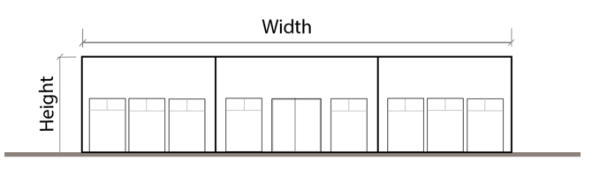
Figure 10-6: Measurement of Building Walls with Projections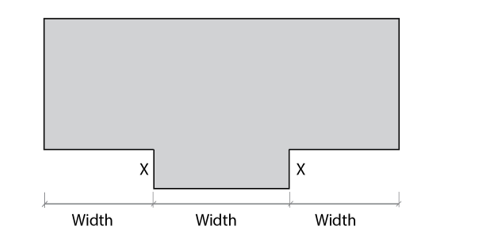
- Illumination. Wall signs may be illuminated either internally or externally. Illumination levels shall be in compliance with all other applicable standards of the Outdoor Lighting provisions of the UDO as established in Section 8.10.
- Mounting Requirements. Wall signs may not project more than twelve (12”) inches from the building wall to which they are mounted and shall not be mounted in a manner where any part of the sign extends past the top of the building wall.
- Wall Signs in CB District. The maximum permitted area of wall signs shall be fifteen percent (15%) of the area of the building wall, not to exceed sixty square feet (60ft2). The area of the building wall shall be measured along its entire width from the base of the building wall to the top of the parapet wall or point at which the roof begins. Areas of projection or other change in wall plane along a building wall that are not parallel to the primary (longest) wall plane shall not be included in such calculation.
- Freestanding Ground Signs
- Where Permitted. Freestanding ground signs are permitted in association with any principal non-residential use in any zoning district. Freestanding ground signs may also be established in association with residential subdivisions, multi-family developments, nursing homes and mobile home parks. In the CB district, freestanding ground signs shall only be permitted where the principal building, along with any canopy or awning, is setback a minimum of twenty (20’) feet from the street right-of-way.
- Permitted Sign Location. Freestanding ground signs shall not be located within fifty (50’) feet of any other freestanding ground sign unless the signs are separated by a street right-of-way. Freestanding ground signs shall not encroach into a street right-of-way or be located in any required sight triangle.
- Number of Signs Permitted
- Non-Residential Uses on Individual Parcels. One (1) freestanding ground sign may be displayed per street frontage, provided that where there are multiple street frontages, signs on the subject parcel may not be placed within one-hundred (100’) feet of each other as measured in a straight line.
Figure 10-7: Minimum Separation for Signs on Separate Frontages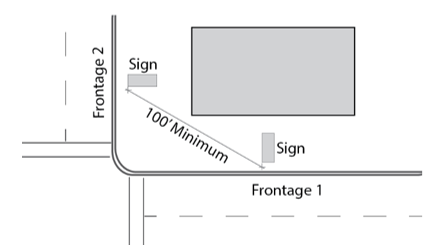
- Non-Residential Uses in Combined Developments. One (1) freestanding ground sign may be displayed per entrance drive to a combined development. Signs may not be placed any closer than five-hundred (500’) feet from each other when located on the same street frontage.
- Residential Subdivisions, Multi-Family Developments, Nursing Homes, and Mobile Home Parks. One (1) freestanding ground sign may be displayed per entrance.
- Non-Residential Uses on Individual Parcels. One (1) freestanding ground sign may be displayed per street frontage, provided that where there are multiple street frontages, signs on the subject parcel may not be placed within one-hundred (100’) feet of each other as measured in a straight line.
- Permitted Sign Height and Area. The permitted maximum height and area for ground mounted freestanding signs shall be as follows:
- GB, GM and LI Districts. The maximum permitted area for signs is based upon the gross floor area of the building or combination of buildings located on the subject parcel. For parcels with buildings containing up to twenty-thousand square feet (20,000ft2) of gross floor area, the maximum sign area shall be thirty-two square feet (32ft2). For each additional ten-thousand square feet (10,000ft2) of gross floor area, a further four square feet (4ft2) of sign area is permitted, up to a maximum of forty-eight square feet (48ft2) of sign area.
The maximum permitted height of signs in these districts shall be eight (8’) feet for signs up to thirty-two square feet (32ft2) in area and ten (10’) feet for signs with an area exceeding thirty-two square feet (32ft2). - HB District. The maximum permitted area for signs is based upon the gross floor area of the building or combination of buildings located on the subject parcel. For parcels with buildings containing up to twenty-thousand square feet (20,000ft2) of gross floor area, the maximum sign area shall be forty-eight square feet (48ft2). For each additional ten-thousand square feet (10,000ft2) of gross floor area, a further four square feet (4ft2) of sign area is permitted, up to a maximum of sixty-four square feet (64ft2) of sign area. The maximum permitted height of signs in these districts shall be fifteen (15’) feet.
- OI and CB Districts. The maximum permitted area for signs is based upon the gross floor area of the building on the subject parcel. For parcels with buildings containing up to five-thousand square feet (5,000ft2) of gross floor area, the maximum sign area shall be twenty-four square feet (24ft2). For each additional two-thousand square feet (2,000ft2) of gross floor area, a further four square feet (4ft2) of sign area is permitted, up to a maximum of thirty-two square feet (32ft2) of sign area.
The maximum permitted height of signs in this district shall be six (6’) feet. - All Other R Districts. The maximum sign area shall be twenty-four square feet (24ft2), with the exception of signs associated with uses that fall into the Civic, Government & Institutional use group, which shall be permitted to have signs with an area of up to thirty-two square feet (32ft2).
The maximum permitted height of signs in this district shall be six (6’) feet.
- GB, GM and LI Districts. The maximum permitted area for signs is based upon the gross floor area of the building or combination of buildings located on the subject parcel. For parcels with buildings containing up to twenty-thousand square feet (20,000ft2) of gross floor area, the maximum sign area shall be thirty-two square feet (32ft2). For each additional ten-thousand square feet (10,000ft2) of gross floor area, a further four square feet (4ft2) of sign area is permitted, up to a maximum of forty-eight square feet (48ft2) of sign area.
- Changeable Copy. Additional freestanding signage may be displayed subject to the following conditions:
- Manual / Analog Changeable Copy. Manual or analog changeable copy area may be included on any freestanding sign. The area devoted to changeable copy shall be limited to seventy percent (70%) of the total area of the sign face.
- Electronic Changeable Copy (LED Displays, Electronic Message Boards, Time and Temperature Displays). Electronic changeable copy area may be included on any conforming freestanding sign in the GB and HB districts. The area devoted to electronic changeable copy shall be limited to seventy percent (70%) of the total area of the sign face. Electronic changeable copy displays shall not be illuminated between the hours of 11:00PM and 5:00AM. Electronic changeable copy displays with only time and temperature capabilities shall not be subject to limited hours of operation. All signs that include an electronic changeable copy feature shall meet the minimum North Carolina Department of Transportation requirements for lighting and message duration contained in NC Administrative Code 2E.0203(3a-c & 4a (i-iii)).
- Illumination. Freestanding ground signs for non-residential uses may be illuminated either internally or externally. Freestanding signs at the entrance to a residential subdivision, multi-family development, nursing home, or mobile home shall only be illuminated externally. Illumination levels shall be in compliance with all other applicable standards of the Outdoor Lighting provisions of the UDO as established in Section 8.10.
- Sign Design. Freestanding ground signs in all zoning districts (except in the HB district) shall be mounted on supporting elements consisting of brick, stone, or split-faced block with the base of the sign being no more than twenty-four (24”) inches above the adjacent grade. Except in the HB district, freestanding ground signs shall not be attached to a pole or pylon nor raised by mounting on a man-made berm, wall, or similar structure.
- Base Landscaping Required. All freestanding ground signs in parking areas shall stand in a bed of landscaping at least thirty square feet (30ft2) in area. This area shall contain low growing materials such as ground covers, perennials, and shrubs.
- Awning Signs
- Where Permitted. Awning signs shall be permitted to be displayed on awnings associated with any non-residential use in any zoning district subject to such additional limitations and conditions as included herein.
- Permitted Sign Location. Awning signs may only be displayed on awnings, which are installed to cover a customer entrance.
- Number of Signs Permitted. One (1) sign may be displayed per awning installed to cover a customer entrance.
- Permitted Sign Area. Awning signs may be displayed across up to eighty percent (80%) of the width of the valance of an awning.
- Illumination. Awning signs shall not be illuminated.
- Multi-Tenant and Combined Developments. Each tenant space within a multi-tenant building or building within a combined development shall utilize either awning signs exclusively in place of wall signage or may combine awning signs with wall signage, provided that each tenant space or building within the development shall utilize the same choice in sign type or combination of sign type.
Figure 10-8: Permitted Sign Area for Awning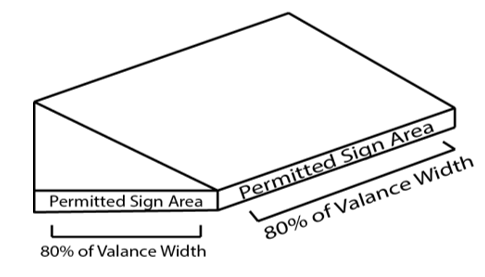
- Projecting Signs
- Where Permitted. Projecting signs shall be permitted to be displayed in association with any non-residential use in any zoning district subject to such additional limitations and conditions as included herein.
- Permitted Sign Location. Projecting signs may be displayed on any building wall where a wall sign is permitted to be displayed. When projecting signs are displayed on the same building wall as a wall sign, the projecting sign shall be mounted in a location that is either directly above or below the wall sign (the primary sign where multiple wall signs are displayed) and centered on the midpoint of such sign. Alternatively, a projecting sign may be displayed at the intersection (corner) of two building walls.
Figure 10-9: Permitted Location of Projecting Signs When Displayed with Wall Signs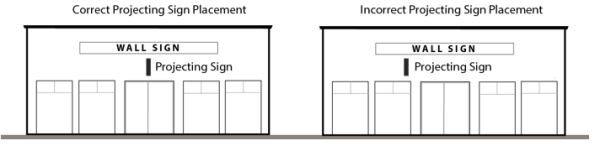
- Number of Signs Permitted. One (1) projecting sign is permitted per building wall where a wall sign is permitted to be displayed. Where a projecting sign is displayed on the corner of a building, no other projecting sign may be displayed on either intersecting building wall.
Figure 10-10: Projecting Sign Building Corner Placement Restrictions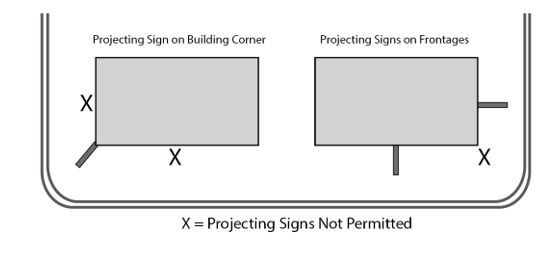
- Permitted Sign Area. Projecting signs may have an area of up to sixteen square feet (16ft2).
- Design and Mounting Requirements. Projecting signs shall be designed so that each face of the sign is parallel to the other face. When mounted at a location other than the corner of a building, the faces of the projecting sign shall be aligned so that they are perpendicular to the building wall.
- Minimum Clearance Required. Projecting signs shall be installed in such a manner as to provide a minimum of seven (7’) feet of clearance above pedestrian walkways.
- Maximum Projection. Projecting signs shall not project greater than five (5’) feet from the building wall to which they are attached. Projecting signs shall be installed so that the edge of the sign closest to the building wall is no greater than twelve (12”) inches from such wall.
- Illumination. Projecting signs may be illuminated either internally or externally. When illuminated externally, the light source shall be mounted directly to the sign.
- Changeable Copy. No changeable copy feature, either manual or electronic, is permitted to be included on a projecting sign.
- Canopy Signs
- Where Permitted. Canopy signs shall be permitted to be displayed in association with any non-residential use in any zoning district subject to such additional limitations and conditions as included herein.
- Permitted Sign Location. Canopy signs may be displayed on any freestanding or attached canopy covering a vehicular use area, such as an automobile fueling area or passenger drop-off area.
- Number of Signs Permitted. One (1) sign may be displayed per side of the canopy.
- Permitted Sign Area. Signs may occupy up to twenty percent (20%) of the area of the valance of the canopy, up to a maximum of twenty-four square feet (24ft2).
- Illumination. Signs on canopies may be internally or externally illuminated.
- Changeable Copy. No changeable copy feature, either manual or electronic, is permitted to be included on a canopy sign.
- Incidental Signs
- Suspended Pedestrian Signs. One (1) sign no larger than six square feet (6ft2) in area may be suspended from an awning, canopy, or other pedestrian cover directly in front of a customer entrance for a non-residential use. Such signs shall be mounted perpendicularly to the customer entrance and maintain a minimum of seven (7’) feet of clearance above the pedestrian walkway. Such signs may not be illuminated.
Figure 10-11: Suspended Pedestrian Sign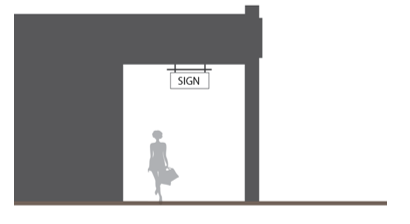
- Pedestrian Wall Signs. Non-residential uses may display one (1) sign, not to exceed four square feet (4ft2) in area, on a building wall immediately adjacent to each customer entrance. No more than one (1) sign per entrance is permitted. Signs shall be mounted within four (4’) feet of the customer entrance with which they are associated and the top of such signs shall not exceed seven (7’) feet above the grade of the adjacent pedestrian walkway.
Figure 10-12: Pedestrian Wall Sign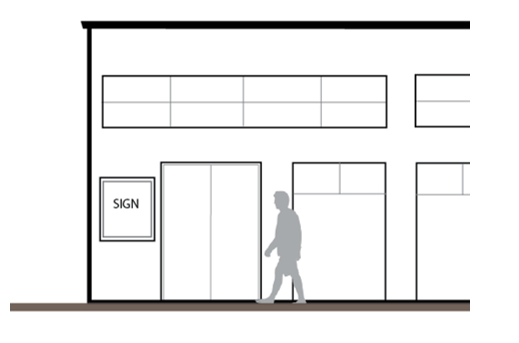
- Window Signs. Non-residential uses may display signs on windows and doors located on the street level floor of a building frontage. Window signs may cover, in total, up to fifty percent (50%) of the nearest window or door on the same building or façade. Window signs shall not be illuminated.
- Drive Entrance Signs. One (1) sign, not exceeding four square feet (4ft2) in area, may be displayed on each side of the street entrance to the parking area or internal driveway network of a non-residential use. Such signs shall not exceed three (3’) feet in height, and shall be located within fifteen (15’) feet of the intersection of the driveway and the street right-of-way.
- On-Premise Directional Signs. Signs shall not exceed three (3’) feet in height not two square (2ft2) in area.
- Ghost Signs. Existing sign on an exterior building wall that has been weathered and faded to the extent that it has lost its original brightness of color and visibility shall be restored to its original condition.
- Miscellaneous Signs. Signs in conjunction with the operation of equipment or other functional elements such as a drive thru, automatic teller machines, gas pumps, vending machines, or similar uses and memorial signs, monuments, plaques, or grave markers which are non-commercial in nature may be displayed.
- Regulatory Signs. Signs required to be installed by any local, state, or federal rule, regulation or ordinance may be displayed in accordance with the standard establishing their size and placement. Examples of such signs include required building address signs and fire safety signage.
- Suspended Pedestrian Signs. One (1) sign no larger than six square feet (6ft2) in area may be suspended from an awning, canopy, or other pedestrian cover directly in front of a customer entrance for a non-residential use. Such signs shall be mounted perpendicularly to the customer entrance and maintain a minimum of seven (7’) feet of clearance above the pedestrian walkway. Such signs may not be illuminated.
- Off-Premise Directory Signs. Off-premise directory signs that provide a directory to businesses, uses or attractions not on immediate property but at nearby sites may be constructed provided that:
- Sign shall serve to direct the public to a single development site or contiguous development sites;
- The property on which the sign is located is immediately adjacent to the businesses, uses or attractions advertised;
- The sign does not exceed five (5’) feet in height nor twenty-four square feet (24ft2) in area;
- The property on which the sign is located does not contain another directory sign;
- The sign is not located within fifty (50’) feet of a permanent freestanding ground sign;
- No more than one (1) such sign is erected to direct the public to the development site(s); and
- The sign shall not be illuminated.

