
Platteville City Zoning Code
ARTICLE III
GENERAL REGULATIONS AND DEVELOPMENT STANDARDS
Sec. 16-3-05. - Application Of General Regulations And Development Standards.
(a)
Purpose. In addition to the requirements contained elsewhere in this Code, all uses of land and structures shall be governed by the General Regulations and Development Standards contained in this Article to promote the general health, safety, and welfare of Platteville residents.
(b)
Intent. The intent of this Article is to encourage the creation of safe, adequate, and attractive facilities and to minimize views of unattractive uses or activities through use of sound site design standards and the establishment of minimum requirements. The standards set forth herein are recognized as enhancing the compatibility of dissimilar uses and promoting stable property values.
(c)
Application. The General Regulations and Development Standards of this Article shall not be retroactive on uses existing as of July 23, 2011, except as set forth in Section 16-1-50 of this Chapter. These standards shall apply to all uses in all zoning districts pursuant to Section 16-1-50.
(d)
Land Dedications. Land designated as flood plain, open space or oil and gas safety zones through dedication or reservation for any reason shall be indicated as such on any land development application. Such land and facilities shall be built and maintained by a unit of government, by a nonprofit corporation or by private interests as part of a subdivision or development of land for use either by the inhabitants or general public thereof. Ownership of the land may be deeded or reserved to a property owner's association or it may be dedicated to the public; or as required by any condition for granting of a subdivision plat, zone district or Planned Development district including designation of a park, trail, or other open recreation use.
(Ord. 667 §1, 2011)
Sec. 16-3-10. - Building Permit; Certificate Of Occupancy Required.
(a)
Any person who intends to construct, enlarge, alter, repair, move, demolish or change the occupancy of a building or structure, or to erect, install, enlarge, alter, repair, remove, convert or replace any electrical, gas, mechanical or plumbing system, or install or modify any water or sewer line, service or meter on private property, the installation of which is regulated by Chapter 18 and Chapter 13 of this Code, or to cause any such work to be done, shall first make application to the Building Official and obtain the required permits.
(b)
Building permits are not required for a number of structures as more specifically addressed in the Town's adopted building codes (Chapter 18 of this Code). Examples of structures that are typically exempt include, but are not limited to, the following structures:
(1)
One-story detached accessory structures used as tool and storage sheds, playhouses and similar uses, provided the floor area does not exceed one hundred twenty (120) square feet.
(2)
Fences that are not over six (6) feet high.
(3)
Oil and gas wells including oil derricks. While no building permit is required for oil and gas facilities, all oil and gas facilities are required to have either an existing use site plan permit or special use permit.
(4)
Retaining walls that are not over four (4) feet in height measured from the bottom of the footing to the top of the wall.
(5)
Water tanks supported directly on grade if the capacity does not exceed five thousand (5,000) gallons and the ratio of height to diameter or width does not exceed two to one (2:1).
(6)
Sidewalks and driveways not more than thirty (30) inches above adjacent grade, and not over any basement or story below and are not part of an accessible route.
(7)
Swings and other playground equipment accessory to detached one-family and two-family dwellings.
(c)
Criteria for Building Permit. The Building Official shall issue a building permit if all of the following conditions exist or are met:
(1)
The building and the building site shall conform to all applicable requirements imposed by this Chapter and any site plan required by Section 16-5-40. No building permit application shall be accepted by the Town for any structure other than a single-family residence or duplex without a signed site plan order.
(2)
The building site has been divided or subdivided by lawful order of the authority having jurisdiction.
(3)
The building site abuts or fronts on and has legal access to a dedicated right-of-way which has been accepted by the Town, the County or the State.
(4)
The requirements of Chapter 13 of this Code regarding connection to the Town water and sanitary sewer systems have been or will be complied with.
(5)
Any and all additional requirements imposed by all building codes then effective in the Town are or will be met upon completion of the structure.
(6)
No building permit shall be issued until all required fees have been paid pursuant to Appendix A to this Code.
(d)
Certificate of Occupancy Required. No building or structure shall be used or occupied, and no change in the existing occupancy classification of a building or structure or portion thereof shall be made until the Building Official has issued a Certificate of Occupancy provided herein. Issuance of a Certificate of Occupancy shall not be construed as an approval of a violation of the provisions of the adopted building code or of other ordinances of the Town.
(Ord. 667 §1, 2011; Ord. 744, 5-16-2017)
Sec. 16-3-20. - Accessory Dwelling Units.
(a)
Purpose. The purpose of this Section is to establish standards for ADUs to allow for the creation of new housing dwelling units while respecting the look and scale of single-family detached neighborhoods. ADUs provide a broader range of accessible and more affordable housing, and provide a means for residents, seniors, single parents and families with grown children to remain in their homes and neighborhoods, obtain extra income, security, companionship and services.
(b)
Permitted Use. On any residential lot where a single-family detached dwelling unit is a permitted use, an ADU shall also be a permitted use.
(c)
Standards.
(1)
Each ADU shall comply with all applicable accessory structure standards and underlying development standards for the applicable zone district. If the accessory structure standards are stricter than the standards for principal structures, the ADU shall comply with the principal structure standards, except that each ADU shall be subordinate to and no larger than seventy-five percent (75%) of the square feet of the principal dwelling unit on the lot on which it is located.
(2)
Only one (1) ADU is permitted per lot. An ADU shall not count toward the total number of accessory buildings or structures allowed on a lot in the applicable zone district.
(3)
The property owner shall reside on the property on the date a building permit application is filed for the ADU.
(4)
Each ADU shall be connected to the water and wastewater utilities of the principal dwelling unit and may not have separate connections, unless the Town or applicable water or waste water utility provider determines it has the capacity to service the ADU and approves of separate connections in writing.
(5)
No portion of a lot on which an ADU is located may be subdivided from or legally described differently than the lot containing the principal dwelling unit, and no portion of a structure containing an ADU may have ownership different from the ownership of the principal dwelling unit.
(6)
Each ADU shall have one (1) designated off-street parking space, which may include an existing driveway, garage or tandem parking space.
(d)
Prohibitions. A mobile home, recreational vehicle, travel trailer, camper, or similar vehicle shall not be used as an ADU.
(Ord. 849 §1, 11-18-2025)
Sec. 16-3-30. - Reserved.
Editor's note— Ord. No. 744, § 21, adopted May 16, 2017, repealed § 16-3-30, which pertained to plot plan requirements and derived from Ord. 667 §1, 2011.
Sec. 16-3-40. - Home Occupations.
(a)
Purpose. The purpose of this Section is to provide for limited business uses within all residential districts when such uses will clearly not alter the character or appearance of any residential zone district and are of a nature that will have little or no effect on the surrounding residential neighborhood. The regulations require that home occupations (an accessory use) remain subordinate to the allowed principal use (household living), and that the residential viability of the dwelling unit/structure and accessory structure is maintained.
(b)
Standards. Home occupations shall be conducted entirely within a dwelling, garage or other allowable accessory structure. No license for a home occupation shall be issued without adherence to the following performance standards:
(1)
Such use shall be clearly incidental and secondary to the use of the dwelling, garage or accessory structure and shall not materially change the character of any structure on the lot. There shall be no visible evidence of the conduct of a home occupation when viewed from the street right-of-way or from an adjacent lot.
(2)
The total area used for such purposes shall not exceed thirty-five percent (35%) of a dwelling unit/structure, but may occupy the entirety of any accessory structure so long as the overall appearance of the residential area is maintained and all setback requirements are met for the applicable zone district.
(3)
There shall be no outdoor storage of merchandise, goods, supplies or materials associated with the home occupation.
(4)
There shall be no offensive noise, vibration, smoke, dust, odors, heat, glare, electrical interference or any other nuisance or hazard noticeable at or beyond the property line.
(5)
The delivery of merchandise, goods or supplies, or the storage or parking of vehicles for use in a home occupation shall be limited to what is typical in a residential neighborhood. United States Mail, similar parcel delivery services or private vehicles with a gross vehicle weight rating (GVWR) of twenty-six thousand (26,000) pounds or less is permissible, except as otherwise allowed by Section 16-3-130; and utility trailers pursuant Section to 16-3-140.
(6)
All home occupations must be conducted exclusively by the resident with no more than one (1) employee.
(7)
Retail sales of goods is prohibited except for products handcrafted by the occupants, or products which are related and incidental to a service provided when conducted entirely as an accessory activity to any services provided on the site (e.g., hair care products sold to hair style customers). Sales conducted in conjunction with the home occupation shall be primarily by telephone, direct mail or other telecommuting means. Incidental pick-up of goods is permitted. The business of selling goods, supplies or products not handcrafted on site and sold on the premises is strictly prohibited.
(8)
No home occupation shall generate an amount of traffic that alters the average residential traffic volumes of the neighborhood. Determination shall be measured using the most current version of the ITE Trip Generation Manual.
(9)
No home occupation, including studios or rooms for instruction, shall create the need for any additional off-street parking. All required parking to accommodate the need created by the home occupation shall occur on site and within the established paved driveway and garage.
(10)
The production and sale of agricultural produce within a residential zone district, whereby all produce for sale has been grown on the residential lot, shall be permitted within any accessory structure on the lot.
(11)
The use of utilities shall be limited to that normally associated with the use of the property for residential purposes. Electrical or mechanical equipment which creates audible interference in radio receivers or visual or audible interference in television receivers, or causes fluctuations in line voltage outside the dwelling unit/structure, garage or accessory structure shall be prohibited.
(12)
Home occupations shall not be transferable to alternate locations or persons.
(13)
If a home occupation is to be conducted on rental property, the property owner's authorization for the proposed use shall be obtained prior to the issuance of any home occupation business license.
(14)
Activities conducted and equipment and material used or stored within any structure shall comply with the Building Code. No outside storage is allowed.
(c)
Prohibited Home Occupations. Certain types of home occupations by nature of their investment or business activity have a pronounced tendency, once started, to generate impacts beyond the standards permitted for home occupations in residential zone districts. Such uses are considered inconsistent with the purpose and intent of residential zone districts. The following uses shall not be permitted as home occupations:
(1)
Automobile body or repair shop including any type of repair or assembly of vehicles or equipment with internal combustion engines (such as autos, motorcycles, scooters, snowmobiles, outboard marine engines, lawn mowers, chain saws and other small engines), or of large appliances (such as washing machines, dryers and refrigerators) or any other work related to automobiles and their parts for commercial purposes.
(2)
Animal care, hospital or kennel. This includes animal hospitals, veterinarian's offices, kennels, stables and all other types of animal boarding and care facilities, but excludes the grooming of domestic household pets.
(3)
Restaurant or commercial catering business (except preserving and home cooking for sale off-site, provided that any necessary building and health permits have been obtained).
(4)
Barber shop or beauty shop that has more than two (2) chairs.
(5)
Private instruction or teaching more than three (3) persons at a time.
(6)
Dispatch centers, where employees come to the site to be dispatched to other locations.
(7)
Medical offices and medical clinics. This includes doctors' offices, dentists' offices, hospitals and all other medical care facilities. A mental health counselor (such as a psychologist's office) is allowed but shall be limited to one (1) licensed mental health professional and one (1) employee. The prohibition will not be interpreted as preventing medical practitioners from seeing patients in their home on an emergency basis.
(8)
Real estate offices.
(9)
Any home occupation that requires the outside storage or use of large equipment or materials, except that, pursuant to Section 16-3-130, certain commercial vehicles and utility trailers are allowed to park overnight in residential districts.
(10)
Other uses which do not comply with the standards set forth in Subsection (b) above.
(d)
Business License Required.
(1)
An application for a home occupation business license (this also serves as the required annual business license pursuant to Chapter 6, Article I, of this Code) shall be made to the Town Clerk or designee for all home occupations except the following home occupations are exempt from the home occupation license but are still required to obtain an annual business license:
a.
Family child care home.
b.
Group home.
c.
Any home occupation often referred to as a home office that meets the following criteria:
1.
Does not require clients to come to the residence.
2.
Relies solely on the use of telecommunications.
3.
Occurs solely within the principal dwelling unit/structure.
4.
Does not generate any additional traffic nor need for additional parking or deliveries beyond what is typical in any residential dwelling unit/structure.
Examples of such home office occupations include but are not limited to: professional consultants and service providers such as architects, engineers, attorneys, graphic designers or web-based businesses.
(2)
All home occupations shall be subject, at any time, to review and investigation by the Platteville Code Enforcement Division or designee.
(3)
Each application for a home occupation business license shall be reviewed for overall compliance with all other aspects of this Article as well as this Code, with particular attention to Chapter 13, Chapter 16, Chapter 17 and Chapter 18, prior to the issuance of such home occupation business license, and shall be denied by the Town if all aspects of this Code are not met.
(4)
Upon completion of an application provided to the Town Clerk and upon verification by Town staff that said home occupation meets the provisions of this Section, the Town Clerk or designee shall issue a home occupation business license, which shall require a fee as provided for in Appendix A. The home occupation business license shall also serve as the required business license for said business pursuant to Chapter 6, Article I of this Code and shall be renewed annually.
(5)
Any home occupation which sells retail goods is also required to obtain a sales tax license as provided for in Section 4-4-30 of this Code.
(6)
In accordance with the provisions of this Section, no use of the dwelling, garage or accessory structure shall be made other than residential use and that use as specified on the home occupation business license.
(7)
The approved home occupation business license shall be kept on file with the Town Clerk and a copy of said license shall be kept on the premises of the home occupation at all times.
(8)
If the Town determines that the use does not meet all of the requirements for a home occupation, then the home occupation business license shall not be issued and the use shall either be brought into full compliance with the provisions of this Chapter and other relevant sections of this Code, or the use shall be abandoned and all operations ceased.
(9)
It is the responsibility of the owner to ensure that all necessary building permits, sewer, water and related utility service permits are obtained and related fees paid.
(e)
Revocation/Termination. A home occupation business license may be revoked or modified by the Town Manager or designee if one (1) or more of the following conditions exist:
(1)
The use has become detrimental to the public health, safety or welfare, or constitutes a nuisance.
(2)
The license was obtained by misrepresentation or fraud.
(3)
The use for which the license was granted has ceased or was suspended for six (6) or more consecutive months.
(4)
The condition of the dwelling unit/structure, accessory structure and lot has changed negatively as a result of the home occupation.
(5)
The home occupation business license has ceased to abide by the standards in Subsection (b) or have been violated.
(6)
The use is in violation of any statute, ordinance, law or regulation.
(7)
A valid home occupation business license which may require a building permit or other required county or state permits (for example a permit from the Weld County Department of Health and Environment) has not been obtained from the Town as required by this Section and this Code.
(8)
If the home occupation business license renewal application is not renewed prior to expiration of the current license, the home occupation business license shall become null and void sixty (60) days after expiration.
(f)
Appeal of Action.
(1)
Any person aggrieved by any determination, interpretation, decision, judgment or similar action taken by the Town Manager or designee under the provisions of this Section may appeal such action to the Planning Commission pursuant to Section 16-5-60 of this Article; provided, however, that the decision of the Planning Commission shall be final.
(2)
Filing of appeals. Appeals shall be addressed to the appellate body on a form prescribed by that body, and shall be filed with the Town Clerk by filing an application for appeal within seven (7) days of the determination to revoke or modify the home occupation business license.
(3)
Effective date of appealed action. An action of the Town Manager or designee appealed to the Planning Commission shall not become effective unless and until resolved by the Planning Commission.
(4)
Resubmittal after denial. An application of appeal may be denied with prejudice. If such denial becomes final, no further application for the denied request shall be filed in the ensuing twelve (12) months, except as otherwise specified at the time of denial. An application may be denied with prejudice on the grounds that two (2) or more similar applications have been denied in the past two (2) years, or, that another good cause exists for limiting the resubmittal of the application.
(Ord. 667 §1, 2011; Ord. 744, 5-16-2017)
Sec. 16-3-50. - Fences, Hedges And Walls.
(a)
Purpose. The purpose of this Section is to promote the health, safety and welfare of the public, to protect the economic and aesthetic value of the Town and to prevent traffic hazards and creation of nuisances.
(b)
Applicability. Fences, hedges serving as fences and walls are permitted in the various zoning districts as accessory uses in accordance with the limitations provided in this Section. Fences on land zoned Agricultural/Holding (A-H) are excluded from the requirements of this Section. For the purposes of this Section, the term fence shall include fences, hedges serving as fences and/or walls.
(c)
Location.
(1)
Fences, hedges and walls may be located within the property lines of the property being served by the fence. Fences, hedges and walls located on property lines require consent of all adjacent property owners sharing the property line on which the fence is situated.
(2)
No fence, hedge or wall shall encroach upon any public right-of-way. Gates adjacent to sidewalks shall open inward to the property.
(3)
Construction on Town-owned property prohibited. No privately owned fence shall be installed or erected within any easement, right-of-way or land owned by the Town without a signed revocable ROW license from the Town.
(4)
No fence shall be placed closer than thirty-six (36) inches to a fire hydrant, and it shall not restrict the operation or use of the fire hydrant. Shrubs or bushes that restrict access to the fire hydrant are subject to removal by the Fire District.
(5)
Sight distance at intersections. No fence, hedge or wall shall be allowed that will inhibit visibility at street intersections that could cause a safety hazard. In order to ensure sight visibility at intersections, the following visibility triangle requirements apply:
a.
No substantial impediment to visibility between the heights of three (3) feet and ten (10) feet shall be erected, planted or maintained at street intersections or access points with streets within a triangular area described as follows: Beginning at the edge of the driving surface of two (2) adjoining street/roadways then to points thirty-five (35) feet along both intersection edges and then along a transverse line connecting these points. (See sketch).
Platteville's Site Visibility Diagram Fence Ordinance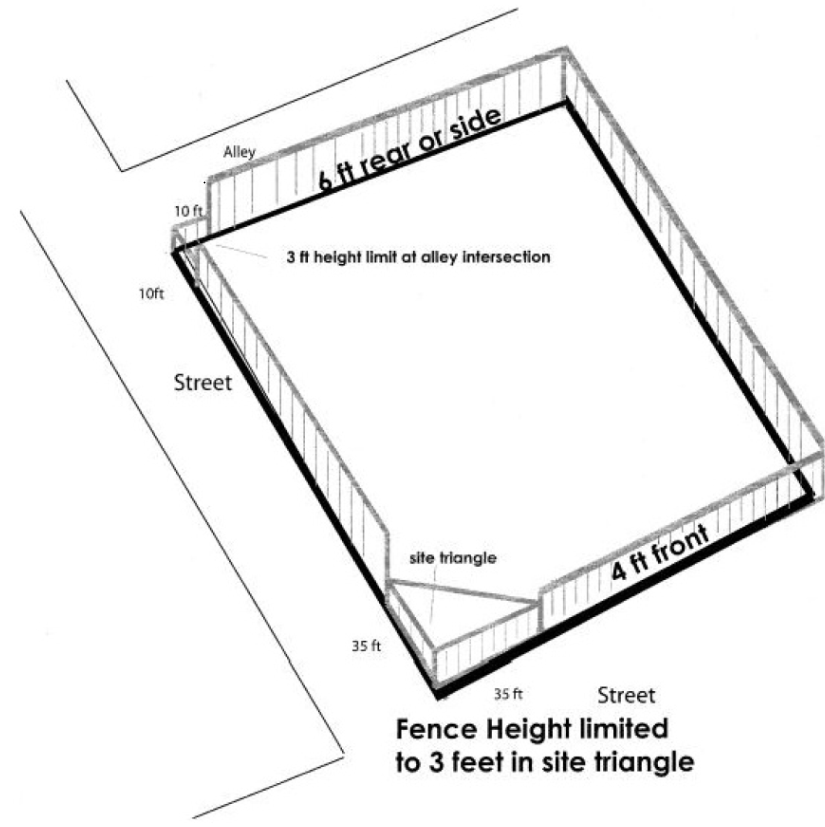
b.
Within ten (10) feet of any driveway, a fence, hedge or wall shall be limited to three (3) feet in height from the edge of the driveway to ensure adequate visibility.
c.
Within ten (10) feet of the intersection of the paved surface of an alley and street, a fence, hedge or wall shall be limited to three (3) feet in height to ensure adequate visibility.
(d)
Height and Construction Restrictions. Fences, hedges and walls shall conform to the following height and construction restrictions:
(1)
Front yards: Maximum height four (4) feet.
(2)
Side yards: Maximum height six (6) feet.
(3)
Rear yards: Maximum height six (6) feet.
(4)
No fence shall be higher than six (6) feet, unless it can be shown to the satisfaction of the Board of Trustees that adjacent use, views and vistas are not obstructed and there are compelling safety reasons for allowing a higher fence. Exceptions to this standard are as follows
a.
Fences adjacent to state-controlled roadways may be up to eight (8) feet in height. Additionally, any sound-barrier walls adjacent to state-controlled roadways shall be designed in accordance with Department of Transportation criteria.
b.
Fences surrounding oil and gas wells and production facilities. Fences surrounding oil and gas wells and production facilities in any zone district may be up to eight (8) feet in height.
c.
Fences surrounding recreational courts (e.g., tennis, squash racquet, squash tennis or badminton) or around a publicly owned recreation area may exceed six (6) feet in height if constructed of material of which at least fifty percent (50%) of the surface is open.
d.
Fencing of swimming pools. In all zone districts, all swimming and wading pools with a depth greater than eighteen (18) inches, measured from rim to lowest point, shall be fully enclosed by a fence of not less than sixty (60) inches in height and constructed in a manner to prohibit entry. Such fence shall be equipped with a self-closing and latching gate.
e.
Construction fencing. A temporary fence enclosing a construction site shall not exceed eight (8) feet in height. A construction fence may be placed in a public right-of-way, provided that such fence is approved by the Building Official. Such fencing is further controlled by the Town's adopted building codes.
(e)
Fence Height Measurement. Fence height shall be measured from the top of the fence to the natural grade on both sides. If the height on the two (2) sides varies, then the higher of the two (2) measurements shall be used in determining the height of the fence.
(f)
Retaining Walls. Retaining walls exceeding a height of four (4) feet from finished grade on the low side of the wall shall be designed to be structurally sound, and plans submitted for a building permit shall show in sufficient detail the construction techniques and materials to be used.
(g)
Building Permit Required. As required by the Town's building codes, construction of a fence over six (6) feet requires a building permit. A building permit is also required for retaining walls exceeding a height of four (4) feet from finished grade on the low side of the wall. A fence permit is required for all other fences. Building and fence permits may be obtained from the office of the Town Clerk.
(h)
Acceptable Materials.
(1)
All fences shall be constructed in a substantial workmanlike manner and shall be constructed of standard materials customarily used for permanent fencing. The following materials shall be prohibited: creosote or (CCA) chromated copper arsenate treated wood products, utility poles, railroad ties, plywood, fiberboard, salvage wood, corrugated metal, sheet metal, scrap or salvage metal, PVC pipe, chicken wire, pallets, snow fences, construction fencing made of plastic, t-posts, open-wired agricultural or livestock fencing.
(2)
Fences and walls shall be constructed from durable materials suited to the Town's climate and require low maintenance.
(3)
Fences and walls shall consist of materials which are architecturally compatible with the primary building on the site or with the streetscape, or landscaping of the site shall be used.
(4)
Fences and walls, particularly those used as a screening device, shall blend into the landscaping and not be so colored as to attract attention to the fence itself. Muted earth tones shall be used as opposed to bright colors.
(5)
All fences and walls shall be constructed of nonhazardous material. Barbed wire and electric fences shall not be used in the construction of any fence in a residential zone district or business zone district. A chain link fence with one (1) strand of barbed wire is permitted in the BP/PI zone district or surrounding any oil and gas facility.
(6)
Barbed wire and electric fences may be allowed for an agricultural or industrial use only upon approval from the Town Manager upon a finding that use of this material is in the best interest of the general health, welfare and safety of the public.
(i)
Maintenance and Repair.
(1)
All fences shall be maintained in a condition of reasonable repair and shall not be allowed to become and remain in a condition of disrepair, a threat to public safety or constitute a nuisance.
(2)
All walls, fences or screening structures shall be maintained in good condition, or they shall be in violation of this Chapter. The owner of such fence, wall or screening structure may be cited for such violation and penalties may be enforced.
(j)
Nonconforming Fences, Hedges and Walls. All fences, hedges and walls in existence on the effective date hereof may continue to exist until such time as they are removed, or damaged such that the cost of repairs is greater than fifty percent (50%) of their value, at which time the fence, hedge or wall must be brought into full compliance with this Chapter.
(k)
Permit Required, Administration and Enforcement.
(1)
Fence permit required. No person shall construct or rebuild any fence, retaining or freestanding wall or hedge without obtaining a fence permit through the Town Clerk's office. Building permits are required as set forth in Paragraph (2) below.
(2)
Application. An application for a fence permit shall be made upon forms provided by the Town Clerk's office. Required information shall include an accurate drawing showing all property lines, sidewalks, streets, alleys, easements and improvements, as well as including a letter of consent from adjacent property owners if said fence, wall or hedge is placed on the property line. The drawing should also include a sketch of the proposed fence, wall or hedge and a description of the materials to be used. No building permit is required for a fence, hedge or wall that is six (6) feet or less in height. The fence permit fee shall be determined and set forth in Appendix A to this Code, as the same may be amended from time to time by resolution of the Board of Trustees.
(3)
Administration and enforcement of this Section shall be governed in accordance with the general administration and enforcement provisions as applicable and as set forth in this Chapter.
(4)
Conflict of provisions. Where the provisions of any approved planned development, oil and gas regulation or floodplain ordinance are different from or in conflict with any of the provisions of this Section, the provisions of such planned development, oil and gas regulations or floodplain ordinance shall supersede any different or conflicting provisions of this Section.
(Ord. 667 §1, 2011; Ord. 744, 5-16-2017)
Sec. 16-3-60. - Residential And Nonresidential Design Standards.
(a)
Applicability. The following standards and requirements apply to all lots and dwelling units/structures in any residential zone district:
(1)
Clustering: The strict requirements set forth in Article II concerning dimensional requirements for each zone district which address minimum lot size, coverage, frontage and setback may be relaxed to permit appropriate grouping or clustering of residences to protect open space or sensitive natural features, provided that in no case shall the average density for the entire development exceed the requirement imposed in each zone district.
(2)
Change in plane: Every dwelling unit/structure must have a change in plane on two (2) sides of the dwelling unit/structure through the use of one (1) or more of the following: porches, bay windows, offset garages or additions.
(3)
Articulation of exterior walls: Every dwelling unit/structure shall be comprised of two (2) or more sections or modules so that the size, shape and degree of articulation of the exterior wall form is similar to and compatible with that of nearby dwelling units/structures or, if none, similar to those elsewhere within the subdivision or neighborhood.
(4)
Permanent ground set foundation: Every dwelling unit/structure shall be set on a permanent ground set foundation which shall include an exterior wall of stone, concrete, brick or masonry product. Every dwelling unit/structure must be fixed to its permanent ground set foundation within sixty (60) days from the date of foundation inspection and approval. Treated wood foundation systems are not permitted for principal structures. Pile, caisson and pier foundations may be used only when a qualified professional engineer registered in the State certifies in writing that because of soil or other physical conditions at the site, a perimeter type wall will not function properly and a pile, caisson or pier foundation is necessary to support the unit. Use of a pile, caisson or pier foundation shall not relieve the owner of the obligation to construct the exterior wall around the entire visible perimeter of the foundation structure as required above.
(5)
Porches: Open, unenclosed porches at ground level may extend into a required setback not more than six (6) feet.
(6)
Storage on site: Every dwelling unit/structure must have adequate storage on site in the form of one (1) or more of the following storage facilities: basement, carport with storage shed or garage.
(7)
Roof form: The size, shape and type of roof form shall be similar to and compatible with that of nearby dwelling units/structures or, if none, similar to those elsewhere within the subdivision or neighborhood. Consideration of environmental and climatic determinants such as snow shedding, drainage and solar exposure shall be integral to the roof design.
(8)
Ratio of open surfaces to enclosed surfaces: The ratio of open surfaces (windows, doors) to enclosed surfaces (walls, roofs) of the building exterior shall be similar to and compatible with that of nearby dwelling units/structures or, if none, similar to those elsewhere within the subdivision or neighborhood.
(b)
Transition Required. When a nonresidential use shares a common lot line with a residential use, or the nonresidential use is adjacent to a public street that abuts residential uses, the required buffer for the nonresidential use shall be twenty-five (25) feet and shall provide adequate screening to a combination of walls, fences, berms and landscaped plant material to include trees, shrubs, grasses and low-water plant material.
(c)
Features Allowed Within Setbacks. The following structures and design features may be located within required setbacks.
(1)
Landscaping including trees, shrubs, berms and other vegetation, except within five (5) feet of a sidewalk.
(2)
Fences or walls, subject to permit approval, that do not exceed the standards established in this Article.
(3)
Drive aisles, sidewalks, and loading spaces or bays.
(4)
Signs, if permitted by the sign regulations of this Article.
(5)
Bay windows, architectural design embellishments and cantilevered floor areas that do not project more than two (2) feet into the required setback provided they do not encroach on public easements. Window wells may not be located within the required setback.
(6)
Eaves that do not project more than two and one half (2½) feet into the required setback.
(7)
Open outside stairways, entrance hoods, terraces, canopies and balconies that do not project more than five (5) feet into a required front or rear setback and/or not more than two (2) feet into a required side setback, provided they do not encroach on public easements.
(8)
Chimneys, flues and ventilating ducts that do not project more than two (2) feet into a required setback, and when placed so as not to obstruct light and ventilation, provided they do not encroach on public easements.
(9)
Utility lines, wires, and associated structures, such as power poles and fire hydrants.
(d)
Building Height Allowances. Chimneys, not exceeding twelve (12) square feet on the largest face, shall be permitted to extend up to three (3) feet above the maximum building height. Ornamental rooftop appurtenances such as weathervanes may project five (5) feet above the maximum building height.
(Ord. 667 §1, 2011; Ord. 731 §5, 2016; Ord. 744, 5-16-2017)
Sec. 16-3-70. - Lighting Standards.
(a)
Purpose of Lighting Standards. All new development shall utilize lighting techniques that minimize the impact of lighting on the night sky. Exterior lighting shall be used for purposes of identification, security and safety, and illumination in areas of pedestrian circulation and vehicular traffic. These standards apply to all development within the Town. The purposes of the lighting standards are as follows:
(1)
Promote safety and security.
(2)
Reduce the escalation of nighttime light pollution.
(3)
Reduce glaring and offensive light sources.
(4)
Provide clear guidance to builders and developers.
(5)
Encourage the use of improved technologies for lighting.
(6)
Conserve energy.
(7)
Prevent inappropriate and poorly designed or installed exterior lighting.
(8)
Minimize interference with use or enjoyment of property through unnecessary night-time illumination and the loss of scenic night sky views due to increased urban sky-glow.
(b)
General Standards.
(1)
Neither the direct nor reflected light from any light source may create a traffic hazard to operators of motor vehicles on public roads, nor may colored lights be used in such a way as to be confused or construed as traffic control devices. Background spaces, such as parking lots and circulation drives, shall be illuminated to be as unobtrusive as reasonably possible while meeting the functional needs of safe circulation and of protecting people and property.
(2)
Light sources must minimize contrast with the light produced by surrounding uses, and must produce an unobtrusive degree of brightness in both illumination levels and color rendition.
(3)
Light sources shall be downcast, concealed and shielded, and shall feature sharp cut-off capability to minimize up-lighting, spill-lighting, glare and unnecessary diffusion onto adjacent property.
(4)
Except as otherwise allowed for herein, all lighting (including without limitation street, parking lot, security, walkway and building) shall conform with the Illuminating Engineers Society (IES) criteria for true cut-off fixtures (ninety (90) percent of fixture light output within the zero to sixty degree (0—60°) range from vertical). If the bulb position within a fixture is vertical, all lights must be retrofitted with shielding in a manner such that the light conforms to IES criteria for true cut-off fixtures as defined herein. Any or all of the following may be required:
a.
A high socket mount.
b.
A translucent fixture lens.
c.
An opaque coating or shield on a portion of the perimeter of the lens, or other industry accepted measures to ensure that the fixture IES Classification as a true cut-off is not compromised.
d.
No casting of light outside the property boundary.
(5)
Maximum on-site lighting levels shall not exceed ten (10) foot-candles, except for loading and unloading platforms. For reasons of security, a maximum of one and one-half (1.5) foot-candles at entrances, stairways and loading docks is permitted unless required by any federal, state or local jurisdiction.
(6)
All lights except those required for security must be extinguished within one (1) hour after the end of business hours and remain extinguished until one (1) hour prior to the commencement of business hours.
(7)
Light levels measured at twenty (20) feet beyond the property line of the development site onto adjacent residential uses or public rights-of-way shall not exceed one-tenth (0.1) foot-candle as a direct result of on-site lighting.
(8)
Blinking, flashing or changing intensity lights are prohibited; except for temporary holiday displays or lighting required by the FAA.
(9)
Up-lighting is prohibited except for the up-lighting of flags within nonresidential projects and with a limit of two (2) fixtures per flagpole with a maximum of one hundred fifty (150) watts each. The fixtures must be shielded.
(Ord. 667 §1, 2011; Ord. 744, 5-16-2017)
Sec. 16-3-80. - Cottage Industries.
(a)
Purpose. The purpose of this Section is to provide for certain types of home-based businesses that by nature of their investment or business activity have a pronounced tendency, once started, to generate impacts beyond the standards permitted for home occupations. Such uses may be inconsistent with the purpose and intent of residential zone districts unless potential impacts are mitigated.
(b)
Standards. Cottage industries shall comply with the following standards:
(1)
Cottage industries shall be conducted entirely within a dwelling or permitted accessory structure.
(2)
There shall be no visible evidence of the conduct of a cottage industry when viewed from the street right-of-way or from an adjacent lot.
(3)
The total area used for a cottage industry shall not exceed fifty percent (50%) of a dwelling unit/structure, but may occupy the entirety of any accessory structure so long as the residential character of the lot is maintained and all applicable setback requirements are met.
(4)
There shall be no visible advertising of the cottage industry on the premises except as allowed by Section 16-6-80.
(5)
Any outdoor storage of merchandise, goods, supplies or materials associated with the cottage industry shall be screened or fenced from view.
(6)
There shall be no offensive noise, vibration, smoke, dust, odors, heat, glare, electrical interference or any other nuisance or hazard noticeable at or beyond the property line.
(7)
The delivery of merchandise, goods or supplies, or the storage or parking of vehicles for use in a cottage industry shall be limited to what is typical in a residential neighborhood. United States Mail, similar parcel delivery services or private vehicles with a gross vehicle weight rating (GVWR) of twenty-six thousand (26,000) pounds or less is permissible, except as otherwise allowed by Section 16-3-130; and utility trailers pursuant to Section 16-3-140.
(8)
Cottage industries must be conducted exclusively by the resident with no more than five (5) employees.
(9)
Retail sales of goods is prohibited except for products handcrafted by the occupants, or products which are related and incidental to a service provided when conducted entirely as an accessory activity to any services provided on the site (e.g., hair care products sold to hair style customers). Sales conducted in conjunction with the cottage industry shall be primarily by telephone, direct mail or other telecommuting means. Incidental pick-up of goods is permitted.
(10)
No cottage industry shall generate an amount of traffic that alters the average residential traffic volumes of the neighborhood. Determination shall be measured using the most current version of the ITE Trip Generation Manual.
(11)
No cottage industry shall create the need for more than five (5) additional off-street parking spaces. All required parking to accommodate the need created by the cottage industry shall occur on site and within the established driveway and garage.
(12)
Electrical or mechanical equipment which creates audible interference in radio receivers or visual or audible interference in television receivers, or causes fluctuations in line voltage outside the dwelling unit/structure, garage or accessory structure shall be prohibited.
(13)
If a cottage industry is to be conducted on rental property, the property owner's authorization for the proposed use shall be obtained at the time a conditional review use application is filed.
(14)
Activities conducted and equipment and material used or stored within any structure shall comply with the Building Code.
(c)
Permitted Cottage Industries, Subject to Conditional Use Review.
(1)
Automobile body or repair shop, including any type of repair or assembly of vehicles or equipment with internal combustion engines (such as autos, motorcycles, scooters, snowmobiles, outboard marine engines, lawn mowers, chain saws and other small engines), or of large appliances (such as washing machines, dryers and refrigerators) or any other work related to automobiles and their parts for commercial purposes.
(2)
Animal care, hospital or kennel. This includes animal hospitals, veterinarian's offices, kennels, stables and all other types of animal boarding and care facilities.
(3)
Restaurant or commercial catering business, provided that any necessary building and health permits have been obtained.
(4)
Barber shop or beauty shop.
(5)
Private instruction or teaching.
(6)
The business of selling goods, supplies or products online.
(7)
Welding machine shops using industrial or heavy machinery and welding fabrication shops.
(d)
License Required. A business license is required for all cottage industries, and a cottage industry which sells retail goods is also required to obtain a sales tax license pursuant to Section 4-4-30.
(e)
Permits. It is the responsibility of the owner to ensure that all necessary building permits, sewer, water and related utility service permits are obtained and related fees paid.
(Ord. 744, 5-16-2017)
Editor's note— Ord. No. 744, § 26, adopted May 16, 2017, repealed and reenacted § 16-3-80 to read as herein set out. Former § 16-3-80 pertained to sign standards and derived from Ord. 667 §1, 2011.
Sec. 16-3-90. - Landscape Standards.
(a)
Purpose. The purpose of this Section is to ensure that new landscaping and the retention of existing vegetation is an integral part of all development and that it contributes added high quality to development, retains and increases property values, conserves water, and improves the environmental and aesthetic character of the community. This Section is also intended to provide flexible requirements that encourage and allow for creativity in landscape design, while encouraging water conservation and the use of plants with low water requirements, and efficient irrigation systems zoned so that similar exposures and plants are grouped together and avoiding over-spraying walks, drives and buildings.
(b)
Landscape Plan.
(1)
A landscape plan is required for any proposed development requiring approval of a site plan or final development plan prior to the issuance of a building permit. The landscape plan shall comply with this Section.
(2)
For single-family residential developments, the landscape plan shall cover common open space areas, adjacent public rights-of-way and parks, but shall not include individual lots.
(3)
Each landscape plan shall be prepared by a Colorado licensed Landscape Architect and shall be stamped and signed, except this requirement does not apply to single-family, two-family and multi-family dwellings having up to four (4) units. The Town Manager may waive this requirement in their discretion.
(4)
Each landscape plan shall be a minimum scale of thirty (30), and shall include a north arrow, scale, landscape notes, planting details, seed mixes (if applicable), and a plant schedule with common name, scientific name, size and quantity and plant symbols.
(c)
Landscaping Requirements.
(1)
Timing. Installation of approved landscaping shall occur prior to issuance of a certificate of occupancy, or during the first month of the planting season, whichever is sooner. If the landscaping installation does not occur before issuance of a certificate of occupancy, then the Town may require a letter of credit or other guarantee pursuant to Section 17-4-30.
(2)
Location.
a.
All portions of a site not occupied by structures, water bodies, streets, roads, driveways, sidewalks, plazas, patios, parking areas and other vehicle use areas shall be landscaped.
b.
No trees shall be planted within ten (10) feet of a sewer or water mainline or within six (6) feet of a sewer or water service line.
c.
Landscaping in a sight visibility triangle shall be limited to vegetation no more than twenty-four (24) inches in height. Trees are exempt from this but must be limbed so that no branch in the visibility triangle is lower than six (6) feet in height.
(3)
Buffers. Buffers shall be required for commercial and industrial uses, and shall be of sufficient width and height and of adequate design to mitigate the adverse impacts produced by the commercial or industrial use.
(4)
Screening. All service areas or mechanical equipment areas shall be fenced or screened from view.
(5)
Grading. Landscaped areas shall not exceed slopes greater than: four (4) to one (1) where mowing is required; six (6) to one (1) for common open space and pocket park areas; and three (3) to one (1) where shrub beds or native grasses are provided.
(6)
Minimum sizes. Trees and shrubs shall at a minimum be the following sizes at the time of planting:
a.
Large deciduous trees (shade trees): Two (2) inch in caliper.
b.
Ornamental deciduous trees: One and one half (1½) inches in caliper.
c.
Coniferous (evergreen) trees: Five (5) feet in height.
d.
Shrubs (evergreen and deciduous): Five (5) gallon container.
e.
Ornamental Grasses: One (1) gallon container.
f.
Perennials: One (1) gallon container.
(7)
Mulch. All crushed rock and stone or wood mulch shall be installed to a minimum depth of two (3) inches over water-permeable landscape fabric. No fabric shall be visible after placement of mulch. Trees planted in sod, beds of rock or gravel shall be surrounded by a ring of wood mulch at least three (3) feet in diameter.
(8)
Coverage. Fifty (50) percent of all required landscape areas shall be covered with living ground cover at maturity, which includes sod, shrubs, ornamental grasses and perennials. The remainder may be non-living ground cover, such as rocks, gravel and bark. Bare soil areas are prohibited.
(9)
Soil. Organic soil amendments are required for all sodded areas and planting beds at a minimum rate of four (4) cubic yards per one thousand (1,000) square feet, tilled into the soil a minimum depth of six (6) inches.
(10)
Materials. The use of native grass is encouraged, especially in landscaping areas that border open space areas, parks or other properties with native grass. Native grass areas shall be established and maintained so that invasive weed species are controlled and native grasses achieve full coverage.
(11)
Maintenance, Removal, and Replacement. All property owners/occupants shall be responsible for maintenance, removal and replacement of trees and landscaping within the portion of the public right-of-way between the back of the curb or street pavement and the adjacent property. All property owners/occupants of mixed use, commercial or industrial property with an approved Final Development Plan or Site Plan are responsible for the maintenance and replacement of landscaping as shown on that approved plan.
(12)
The installation of nonfunctional turf, nonfunctional artificial turf, and invasive plant species shall be prohibited except that nonfunctional turf shall be permitted for single-family and two-family dwellings.
(13)
All new turf installed shall either be comprised of grass seed or sod that is native, has been hybridized for arid conditions, or is low water.
(d)
Zone District Requirements.
(1)
Low Density Residential (R-1), Residential Estate (RE):
a.
A minimum of fifteen (15) percent of the gross site area shall be landscaped.
b.
Single-family residential lots shall have a minimum of one (1) tree and ten (10) shrubs in the front yard.
c.
Trees may be substituted for the required shrubs at the rate of one (1) tree for ten (10) shrubs and vice-versa, subject to Town approval. Ornamental grasses may be substituted for shrubs at a rate of two (2) ornamental grasses for one (1) shrub. Perennials may be substituted for shrubs at a rate of three (3) perennials for one (1) shrub.
(2)
Regional Commercial (RC), Community Commercial (CC), Small Office (SO), Multi-Family (MF):
a.
A minimum of fifteen (15) percent of the gross site area shall be landscaped area.
b.
The landscaping shall include a minimum of one (1) tree per one thousand (1,000) square feet of landscaped area, distributed on the site, and a minimum of one (1) shrub per one-hundred fifty (150) square feet of landscaped area. Shrubs shall be distributed into groupings throughout the site and located within planting beds.
c.
Trees may be substituted for up to one-half (½) of the required shrubs at the rate of one (1) tree for ten (10) shrubs and vice-versa, subject to Town approval. Ornamental grasses may be substituted for shrubs at a rate of two (2) ornamental grasses for one (1) shrub. Perennials may be substituted for shrubs at a rate of three (3) perennials for one (1) shrub.
d.
Street trees are required at a rate of one (1) tree per forty (40) linear feet of public right-of-way.
e.
Parking lots shall be screened from the public rights-of-way, with berms, low walls, tree and shrub plantings, or a combination of these items. Screening plants shall be forty (40) percent evergreen species, and the minimum height shall be thirty-six (36) inches.
(3)
Light Industrial (LI):
a.
Screening of industrial uses is required when adjacent to public rights-of-way or when adjacent to property zoned R-1, RE, CC, SO, MF, PD, or ECRR. Screening can be achieved through the use of screening fences, berming, tree and shrub plantings or a combination of these items. Screening plants shall be at least fifty (50) percent evergreen species. Screening shall be sufficient to block views of storage yards, equipment and vehicles and any other objectionable views on the property.
b.
A minimum of ten (10) percent of the gross site area shall be landscaped area.
c.
A minimum landscape setback of ten (10) feet is required from all public rights-of-way.
d.
Street trees are required at a rate of one (1) tree per forty (40) linear feet of public rights-of-way.
e.
Industrial properties are encouraged to utilize native grass in landscape areas and limit the use of sod.
f.
The Town may waive any of these requirements if the Town determines that the landscape plan provides similar benefits without achieving technical compliance.
(4)
Park (P): Determined by the Town on a case by case basis with direction and input from neighborhood meetings.
(5)
Planned Development (PD): Determined by the Town on a case by case basis with direction and input from neighborhood meetings.
(e)
Prohibited Species. The following are prohibited for any new planting in the Town:
(1)
Any trees of the ash species (Fraxinus spp.) including without limitation green, white, purple and blue.
(2)
Trees of the poplar species (Populus spp.), including without limitation cottonwood, silver poplar, Lombardy poplar, if they produce cotton (seeds).
(3)
Siberian (Chinese) elm trees (Ulmus pumila).
(4)
Any honey locust (Gleditsia triacanthos) tree that bears either seed pods or thorns.
(5)
Any purple locust, black locust, mulberry, Bradford pear, black walnut, Russian olive, tree of heaven, tamarisk, or choke cherry tree.
(6)
Any shrub or hedge which by its habit of growth would obstruct, restrict, or conflict with necessary and safe use of the public rights-of-way.
(7)
Any conifer or evergreen that would eventually grow over the sidewalks or streets or that will cause icy conditions on sidewalks or roads.
(8)
Invasive plant species as that term is defined in Section 16-7-10.
(f)
Recommended Species. Recommended tree species are those with an "A" rating as listed on the Front Range Tree Recommendation List: https://extension.colostate.edu/docs/pubs/garden/treereclist.pdf.
(g)
Irrigation.
(1)
Underground automatic irrigation systems are required for all permanent landscaping which cannot survive on natural precipitation. The use of drip, trickle, subterranean and other water-conserving irrigation methods is encouraged, as is the use of organic mulches and other water-conserving design features. The overall irrigation system design should emphasize efficient water use and conservation.
(2)
All irrigation systems shall utilize an appropriately sized backflow prevention assembly. Reduced pressure principle assemblies are the minimum irrigation backflow prevention assembly for this system.
(3)
Irrigation service connections (taps) shall not interconnect downstream of the meter. Irrigation mains shall not intersect with other irrigation mains serviced off another service connection. A resilient wedge shut-off valve with drain, or stop and waste, is required downstream of the meter. Master valves are required.
(4)
Smart irrigation controllers (as defined by the Irrigation Association) are required for all irrigation systems that require a dedicated tap.
(5)
All irrigation system other than those for single-family dwellings shall have an operable rain sensor shut-off device.
(6)
Irrigation systems shall not be run between 10:00 a.m. and 6:00 p.m. with the exception of maintenance operations testing and repairing systems.
(7)
Irrigation shall be hydro-zoned, grouping similar water demands by irrigation zone, and zones utilizing spray heads and rotors shall have head-to-head coverage with minimal overspray on surrounding hardscapes or structures.
(8)
Maximum velocity shall not exceed seven and one half (7.5) feet per second through the service connection.
(9)
In planting areas less than six (6) feet in width or smaller, only drip and sub-surface irrigation systems shall be used.
(10)
Pop-up spray heads shall be equipped with internal check valves, internal pressure regulator, and matched precipitation rate spray or rotor nozzle. Pop-up height shall be six (6) inches for sod areas and twelve (12) inch for native grass areas.
(11)
Rotors, drip emitters and sub-surface drips shall be equipped with internal check valves.
(12)
A passing backflow prevention assembly test is required prior to the issuance of a certificate of occupancy. This shall include a mechanical test of the assembly, validation of protection for degree of the hazard present, and proper installation according to manufacturer's recommendations.
(13)
Irrigation systems shall be designed by a certified irrigation designer or a Colorado licensed landscape architect.
(Ord. 667 §1, 2011; Ord. 720 §6, 2015; Ord. 731 §6, 2016; Ord. 744, 5-16-2017; Ord. 2023-827, 5-16-2023; Ord. 851 §§2, 3, 12-16-2025)
Editor's note— Repealed & Replaced by Ord. 2023-827 on 5/16/2023.
Sec. 16-3-100. - Parking, Stacking And Loading.
(a)
Intent. Off-street parking, stacking and loading requirements lessen congestion upon the public streets of the Town by requiring the owners and operators of land, structures and uses to provide parking on their own premises in accordance with the demand generated by such land, structure or use.
(b)
General. For every building hereafter erected or structurally altered, off-street parking spaces, spaces for loading and unloading, vehicle stacking and proper ingress and egress shall be provided. Parking requirements shall apply to all districts unless specifically exempt and are considered a required use associated with a principal use. All required off-street parking, stacking and loading spaces shall be maintained in the manner herein set forth.
(c)
Location. The off-street parking area shall be located on the same legal lot as the principal use.
(d)
Minimum Parking Requirements. The minimum off-street parking requirements for all uses in all districts are enumerated in the following table. In no instance shall a parking space be used for the storage of vehicles. All parking spaces must be used for vehicles that can be driven unless otherwise noted in this Article. Additional stacking space requirements can be found in Subsection (i) below.
(e)
Calculation of Parking Space Requirements.
(1)
Number of spaces. Separate off-site parking space shall be provided for each use.
a.
Where parking facilities are combined and shared by two (2) or more uses, the off-street parking space required for two (2) or more uses having the same or different standards for determining the amount of required off-street parking space shall be the sum of the standards of all the various uses.
b.
When any parking calculation results in a required fractional space, such fraction shall be rounded up to the next whole number.
(2)
Measurement of floor area. Floor areas used in calculating the required number of parking spaces shall be the gross floor area of the building calculated from the exterior outside wall without regard to a specific inside use unless specifically exempt. In mixed-use facilities:
a.
Calculations shall be based on gross square footage of each identifiable use within the building, and the total square footage of each identifiable use shall be the same as the gross floor area calculated from outside wall to outside wall.
b.
Uses which serve more than one (1) of the uses, such as bathrooms, mechanical rooms, stairwells, circulation, airshafts, storage areas and elevators, shall be prorated based on the area of each identifiable use.
(f)
Joint Use of Parking Facilities or Shared Parking. When two (2) or more businesses, structures and/or uses are served by the same parking area, the applicant may apply for special parking approval. The off-street parking area or shared parking facilities shall not exceed twenty percent (20%) of the required parking. Applicants wishing to utilize joint or shared parking facilities or areas shall provide satisfactory legal evidence to the Town Manager in the form of deeds, leases or contracts to establish joint use or shared parking. Upon submission of documentation by the applicant of how the project meets the following criteria, the Town Manager may approve reductions of up to and including twenty percent (20%) of the parking requirements upon approval of the Planning Commission, if the Planning Commission finds that:
(1)
The parking needs of the use will be adequately served.
(2)
If a mix of residential uses with nonresidential is proposed, the parking needs of all uses will be accommodated through shared parking.
(3)
If joint use of common parking areas is proposed, varying time periods of use will accommodate proposed parking needs.
(4)
The applicant provides an acceptable proposal for a transportation demand management program, including a description of existing and proposed facilities and assurances that the use of alternate modes of transportation will continue to reduce the need for on-site parking on an ongoing basis.
(g)
Determination of Requirements for Uses Not Listed. Requirements for types of buildings and uses not specifically listed in this Chapter shall be determined by the Town Manager, after study and recommendation, which should include all relevant factors, including but not limited to:
(1)
Vehicle occupancy studies.
(2)
Comparable requirements from other relevant municipalities.
(3)
Requirements of comparable uses listed in this Chapter.
(4)
Suitable and adequate means will exist for provision of public, community, group or common facilities.
(5)
Provision of adequate loading facilities and for a system for distribution and pickup of goods.
(6)
The use is in the interest of the area to be affected and in the interests of the Town at large.
(7)
The use will not be detrimental to adjacent properties or improvements in the vicinity of the area.
(8)
The proposed use will not confer any special privilege or benefit on the properties or improvements in the area, which privilege or benefit is not conferred upon similarly situated properties elsewhere in the Town.
(h)
Handicap Parking Requirements. The required number of parking spaces for the disabled for all land uses shall be provided in accordance with federal and state law. Each parking space for the disabled shall be in conformance with applicable requirements of the Americans with Disabilities Act (ADA).
(1)
The required spaces shall be located to provide the least travel distance to accessible facilities served. They shall be located, where feasible, to allow those parking in the spaces to access the associated building without crossing vehicle traffic area. The distance between the most remote principal entrance of a building and any one (1) space shall not exceed two hundred (200) feet.
(2)
Size. Required spaces shall be not less than eight (8) feet wide and shall have an adjacent access aisle not less than five (5) feet wide. Two (2) adjacent spaces may share a common access aisle. Such aisles shall provide an accessible route of travel to the building or facility entrance. Boundaries of the required parking spaces and aisles shall be marked to identify the use of such spaces.
(3)
Identification sign. Every parking space required by this Section shall be identified by a sign centered from three (3) feet to five (5) feet above the ground at the head of the required space. The sign shall be marked with the international symbol of access and shall bear the words, "Reserved, Tow Away Zone." Such signage shall not be less than twelve (12) inches in height. The lettering shall be not less than one (1) inch or more than two (2) inches in height and shall be on a background of contrasting color.

(4)
Surface. Parking spaces and access aisles shall slope not more than one (1) inch in forty-eight (48) inches and shall be firm, stable, smooth and slip-resistant.
(i)
Stacking Space Requirements.
(1)
Intent of stacking space. A stacking space is an area for motor vehicles to line up in while waiting to go through a drive-through facility, or within a designated drop-off or pickup zone. The purpose of stacking space requirements is to promote public safety by alleviating on-site and off-site traffic congestion that might otherwise result from the operation of such a facility.
(2)
Submittal of plans. The applicant's plan shall show the location, size and dimensions of all facilities listed in Paragraph (3) below. The plan shall follow the stacking space schedule and shall demonstrate that such facilities will not result in the stacking of vehicles on public rights-of-way and that an adequate area is reserved for the safe transfer of the motor vehicle between any parking attendant or valet and the driver of the vehicle. In no event shall drive-throughs, parking attendants, paid parking collection devices or areas associated with such uses be located in a public street or right-of-way, or interfere with vehicular or pedestrian traffic on a public street, sidewalk or other right-of-way.
(3)
Stacking space schedule:
(j)
Off-Street Loading Requirements. Whenever the normal operation of any development requires that goods, merchandise or equipment be routinely delivered to or shipped from that development, a sufficient off-street loading and unloading area must be provided in accordance with this Section to accommodate the delivery or shipment operation in a safe and convenient manner.
(1)
Space requirements and standards for loading berths.
a.
Width and clearance: Each loading berth shall not be less than ten (10) feet in width and shall provide not less than fourteen (14) feet of vertical clearance.
b.
Length: Each loading berth shall be at least forty-five (45) feet in length or shall not extend beyond the property line. The greater of the two (2) standards shall apply.
c.
The loading and unloading area must be of sufficient size to accommodate the numbers and types of vehicles that are likely to use this area, given the nature of the development.
(2)
Number of loading spaces required for nonresidential uses:
(3)
Location. Loading and unloading areas shall be located and designed so vehicles intended to use them can maneuver safely and conveniently to and from the street right-of-way and complete their operations without interfering with any public rights-of-way, parking space or parking lot aisle.
(Ord. 667 §1, 2011; Ord. 720 §7, 2015; Ord. 744, 5-16-2017; Ord. 849 §2, 11-18-2025)
Editor's note— Ord. No. 744, § 28, adopted May 16, 2017, amended the catchline of § 16-3-100 to read as herein set out. Said catchline formerly read "Parking, Stacking and Loading Requirements."
Sec. 16-3-110. - Parking Lot Requirements.
(a)
Parking Space and Access Drive Requirements. Except as may be provided for compact cars elsewhere in this Section, the minimum size of off-street parking space and parking lot drives shall be in accordance with the following:
(1)
Minimum stall size: Nine (9) feet by nineteen (19) feet.
(2)
Minimum access drive width: Twelve (12) feet per lane.
(3)
Minimum backing area width: Twelve (12) feet to twenty-four (24) feet (two (2) drive lanes).
(4)
Angled parking spaces: Per the Town Engineer.
(b)
Location and Design of Parking Areas.
(1)
All parking areas shall be set back a minimum of five (5) feet from any public rights-of-way.
(2)
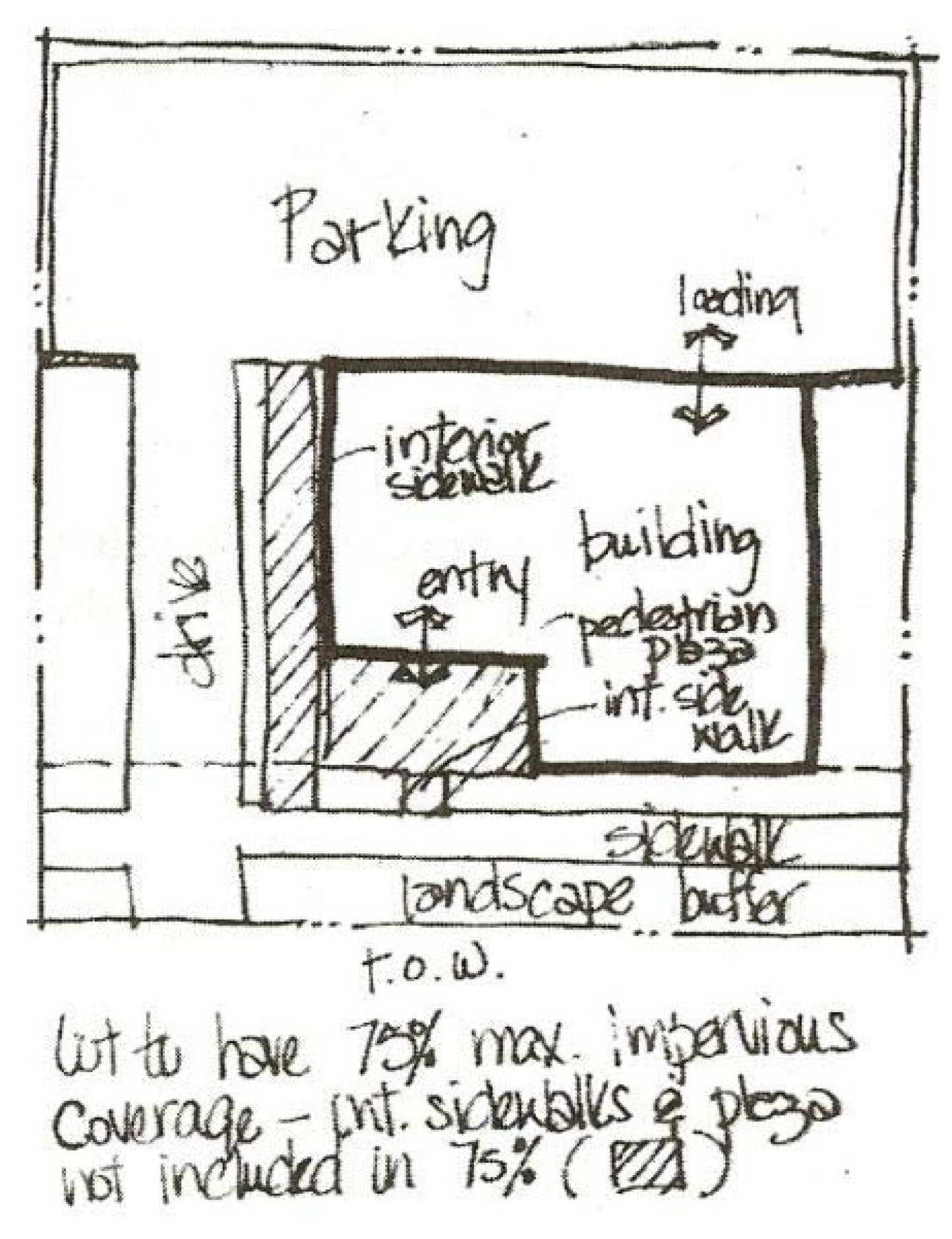
Parking lots shall be so designed as to appear as an accessory use to the principal use. If a parking lot faces an arterial or collector street, parking lots shall be screened from the street by low walls, landscaping and/or railings that effectively conceal parked cars.
(3)
In all nonresidential areas and multi-family residential developments, all off-street parking areas must be accessed by a defined access lane off of the main public right-of-way. This access lane must be separated from the traveled portion of the roadway by at least a seven-foot setback. Backing of parked cars into public road drive lanes from off-street parking areas is not allowed.
(4)
Required parking spaces must be provided on the same property as the principal building or use. Parking areas shall be owned by the owner of the principal use for which parking spaces are provided.
(5)
All parking and drive lane areas shall be surfaced with asphalt or concrete.
(6)
All parking areas shall be provided with adequate drainage to accommodate increased runoff from the site and shall be designed with catchment basins or other similar structures so as to prevent non-point-source pollution of the South Platte River and its tributaries.
(7)
Access drives shall be perpendicular to the traveled right-of-way and shall not exceed a five percent (5%) grade within fifty (50) feet of their entrance to a public or private road right-of-way.
(8)
A twenty-five (25) percent allowance for compact cars may be applied to commercial, cultural and civic uses in any district. These spaces shall be properly marked and grouped within the overall parking plan. Space size shall be a minimum of eight (8) feet by sixteen (16) feet.
(9)
In nonresidential zone districts, no parking area will be allowed in side yard setbacks; driveways may be all or partially in side yard setbacks.
(10)
All parking areas shall be properly maintained.
(11)
Parking lot setbacks, islands and other open spaces shall be landscaped to the greatest extent possible. Landscaped areas may also be used for snow storage as long as they are maintained properly and vegetation replaced when necessary.
(12)
Parking areas may not be used for the dismantling of vehicles, storage of nonworking vehicles or storage of commodities. Sales of commodities from parking lots are not allowed except with a valid peddler's license issued by the Town Clerk or for special events which are approved by the Town.
(13)
Access and circulation. Curb cuts should be limited to the fewest number necessary to provide workable access. In general, curb cuts should be placed at intervals greater than one hundred (100) feet, unless this would preclude access to an independent property.
(14)
Layout. Parking lots should provide well-defined circulation for both vehicles and pedestrians.
(15)
Vehicles shall not overhang any public property, pedestrian access including sidewalks, or landscaped area. A concrete or otherwise permanent curb, bumper or wheel stop shall be installed to adequately protect public right-of-way, sidewalks and/or landscaped areas and islands.
(16)
Standard traffic control signs and devices shall be used to direct traffic where necessary within a parking lot.
(17)
Entrance drives shall be readily observable to the first-time visitor. Parking lot entrances, the ends of parking aisles and the location and pattern of primary internal access drives should be well-marked by signs or landscaped islands with raised curbs.
(18)
Parking spaces shall be marked and maintained on the pavement, and any other directional markings or signs shall be installed as permitted or required by the Town to ensure the approved utilization of space, direction of traffic flow and general safety.
(19)
All off-street parking spaces shall be unobstructed and free of other uses.
(20)
The layout should specifically address the interrelation of pedestrian and vehicular circulation and provide specific treatment at points of conflict, such as signs, painted crosswalks and raised pedestrian walks or landings.
(21)
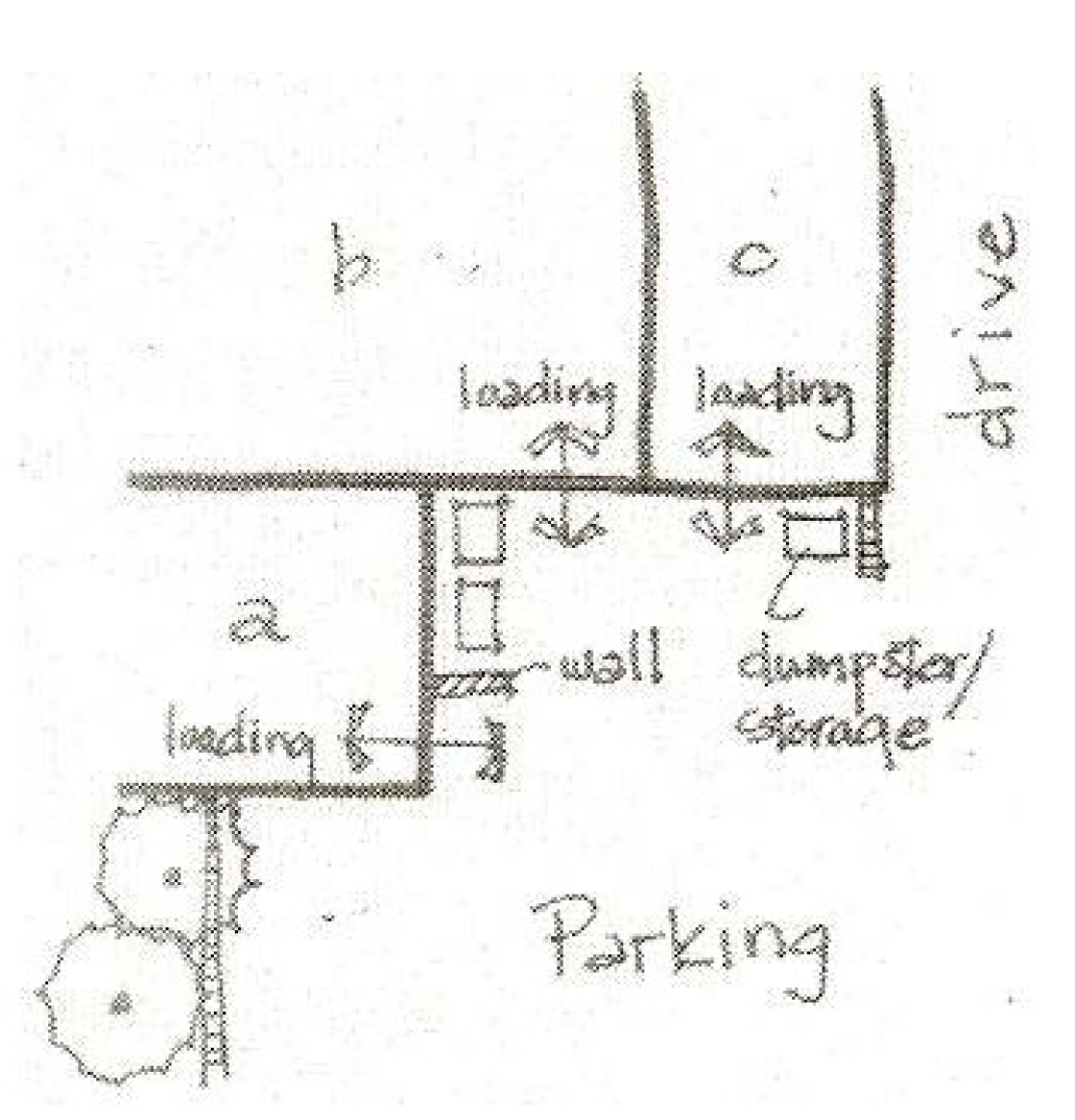
Loading and unloading facilities shall be located in the rear or side of buildings and shall be screened from public view.
(22)
Storage and refuse containers must be screened with impervious fencing or plantings and shall not front on to any street. Refuse storage and pickup areas shall be combined with other service and loading areas.
(23)
Vehicles parked on private property shall be parked within or upon a paved or graveled driveway. The parking of vehicles within required front or side yard setbacks, yards or grass is prohibited. This requirement shall apply to all zone districts of the Town.
(24)
Garage doors that face toward the street must be located a minimum of eighteen (18) feet from the lot line adjacent to the driveway accessing a public right-of-way. Garages shall not be located in the front yard setback.
(c)
Landscaping and Lighting.
(1)
Minimum landscaped area for any parking lot accommodating ten (10) or more spaces: fifteen percent (15%), of which at least ten (10) feet in depth must be placed along the front edge of an arterial or collector. On corner lots, landscaping of at least ten (10) feet in depth must be placed on both public streets.
(2)
All parking lots shall be landscaped with indigenous vegetation and include both trees and shrubs. The pedestrian crossings shall be clearly differentiated from the rest of the parking surface. A minimum of five percent (5%) of the interior area of a parking lot accommodating ten (10) or more spaces must be planted. The interior of a parking lot is considered to be the traffic islands and areas around the actual parking spaces; it does not include the required perimeter treatment.
(3)
Parking lots shall be screened from the street by low walls, landscaping and/or railings that effectively conceal parked cars.
(4)
Parking and loading areas for all nonresidential uses must be paved and, if located adjacent to residential and educational properties, screened from view.
(5)
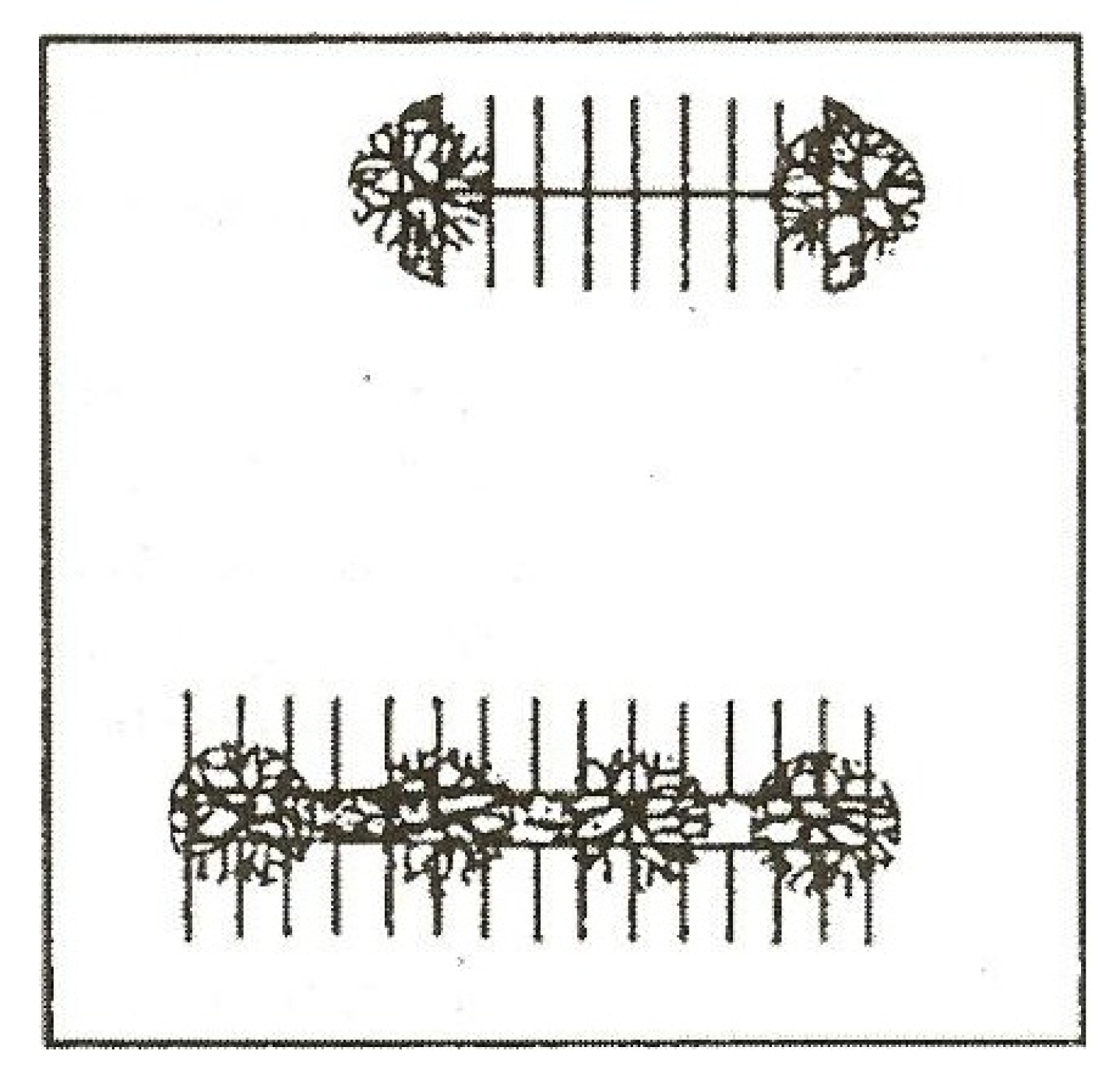
Landscaped areas within parking lot interiors shall be located in such a manner as to divide and break up the expanse of paving. There shall be no more than fifteen (15) parking spaces in a continuous row on one (1) side without being broken by a landscape island. Landscaping aisles which have parking on both sides may be permitted as an alternative to individual landscape islands as long as no more than fifty percent (50%) of the required islands and the equivalent area of said islands are incorporated into landscaping aisles.
(6)
Landscaping shall be designed to meet the minimum sight visibility triangle requirements.
(7)
All lights used to illuminate parking spaces, driveways or maneuvering areas shall be so designed, arranged and screened so as to minimize light spillage on adjoining lots or streets. All lighting fixtures shall meet the IES requirement for a full cut off fixture.
(8)
All lighting fixtures, including security lighting facilities, shall be directed away from adjacent residential uses and public streets, shall not be of an intensity which unreasonably disturbs adjacent residential users or users of public streets and shall not be installed above a maximum height of sixteen (16) feet.
(9)
All lighting shall comply with Section 16-3-70.
(Ord. 667 §1, 2011; Ord. 744, 5-16-2017)
Sec. 16-3-120. - Storage And Parking Of Recreational Vehicles, Boats And Trailers.
(a)
In all residential and commercial districts, the parking or storage of a recreational vehicle, boat or trailer is permitted only in the following manner:
(1)
Parking or storage is permitted inside any lawful enclosed structure.
(2)
If there is no suitable enclosed structure, parking or storage is permitted outside in the driveway, in the side yard or in the rear yard as long as the recreational vehicle, boat or trailer does not impede safe entry to or exit from any house or inhibit emergency access to or from any structure or the side or rear yard. For purposes of this Section, access of less than two (2) feet in width shall be presumed unsafe. No recreational vehicle, boat or trailer shall be parked or stored in the front yard.
(3)
All parts of the recreational vehicle, boat or trailer shall be located on a hard-surfaced area. The entire surface area of the ground beneath the recreational vehicle, boat or trailer shall be hard-surfaced. For purposes of this Section, hard-surfaced areas shall include asphalt, stone, brick, concrete, gravel, and landscape rock. Hard-surfaced areas shall not include grass, dirt or wood chips.
(4)
The recreational vehicle, boat or trailer must be a minimum of ten (10) feet from any street, curb or sidewalk and a minimum of five (5) feet from any alley.
(5)
No part of the recreational vehicle, boat or trailer may extend over any portion of a public sidewalk or other public right-of-way.
(6)
In any residential zone district, parking is permitted only for storage purposes. Recreational vehicles, boats or trailers shall not be:
a.
Used for dwelling purposes, except that incidental overnight sleeping for periods not exceeding seven (7) consecutive nights and not more than twenty-one (21) nights in any one (1) calendar year is permitted when the recreational vehicle, boat or trailer is stored on the private property, with permission of the property owner;
b.
Permanently connected to sewer lines, water lines or electric service, other than temporary connection to electric service for charging batteries, maintenance and similar purposes; or
c.
Used for storage of goods, materials or equipment other than those items considered to be part of the unit or integral to the use of the recreational vehicle, boat or trailer as intended by the manufacturer.
(7)
The owner of a recreational vehicle, boat or trailer may park the recreational vehicle, boat or trailer on the street immediately in front of the owner's house for not more than seventy-two (72) consecutive hours. At least seventy-two (72) hours must pass before the recreational vehicle, boat or trailer may be parked in the same or similar location again.
(8)
In a Residential Estate (RE) District, no more than four (4) recreational vehicles, boats or trailers may be stored or parked on private property outside of an enclosed structure at one (1) time, and the number allowed is reduced equally by the number of commercial vehicles parked or stored on such property. In all other zoning districts, no more than two (2) recreational vehicles, boats or trailers may be stored or parked on private property outside of an enclosed structure at one (1) time; provided that, if a commercial vehicle is also parked and stored on such private property outside of an enclosed structure, no more than one (1) recreational vehicle, trailer or boat may be stored or parked on the same private property outside of an enclosed structure.
(b)
Nothing in this Section is intended to prohibit the storage, parking or use of recreational vehicles, boats or trailers in nonresidential zone districts if such use is a permitted use or accessory use under this Chapter.
(Ord. 667 §1, 2011; Ord. 696 §2, 2013; Ord. 782, 7-2-2019)
Sec. 16-3-130. - Storage And Parking Of Commercial Vehicles In Residential Zone Districts.
(a)
Registered commercial vehicles, excluding trailers, may be parked or stored on private property in any residential zone district, provided that they meet the following guidelines:
(1)
Parking or storage is permitted inside any lawful enclosed structure.
(2)
If there is no suitable enclosed structure, parking or storage is permitted outside in the driveway, side yard or rear yard, as long as the commercial vehicle does not impede safe entry to or exit from any house or inhibit emergency access to and from any structure. For purposes of this Section, access of less than two (2) feet in width shall be presumed unsafe.
(3)
All parts of the commercial vehicle shall be located on a hard-surfaced or gravel area.
(4)
The commercial vehicle must be a minimum of ten (10) feet from any street and a minimum of five (5) feet from any alley.
(5)
No part of the commercial vehicle may extend over any portion of a public sidewalk or other public right-of-way.
(6)
No more than two (2) commercial vehicles may be stored or parked on private property outside of an enclosed structure at one (1) time; provided that, if a recreational vehicle, trailer or boat is also parked or stored on such private property outside of an enclosed structure, no more than one (1) commercial vehicle may be stored or parked on the same private property outside of an enclosed structure.
(Ord. 667 §1, 2011; Ord. 696 §2, 2013)
Sec. 16-3-140. - Temporary Use Permits.
(a)
General. Upon application to the Town Manager or designee, and after filing an application for a temporary use permit, a temporary use permit may be issued for the uses specified below in any zone district. Such permits shall be valid only for the period of time specified in the permit, as determined by the maximum time periods set forth in Subsection (g) below, and only two (2) renewals of the permit may be granted. Failure to terminate such temporary use by the specified time shall be considered a violation of this Code. Uses may be added to the list set forth below from time to time by the Board of Trustees by ordinance.
(b)
All temporary uses involved in the sale of goods require a sales tax license. All other applicable license provisions of this Code shall apply.
(c)
No temporary use shall be approved until the applicable permit fee is received by the Town Clerk as set forth in Appendix A to this Code and the applicant signs a cost reimbursement agreement pursuant to Section 16-1-100. The Town may waive the permit fee if charitable/nonprofit status is provided.
(d)
Stipulations and Conditions. Permits are subject to reasonable stipulations and conditions established at the time of application and review, including but not limited to requirements for safe and adequate access; sufficient parking without interfering with public rights-of-way, streets and sidewalks; adequate sanitation facilities; provision for collection, recycling and disposal of all waste; and compliance with all zoning, building, construction and fire codes.
(e)
Exceptions. Nothing in this Section shall be construed so as to prohibit persons from conducting garage or yard sales or children's beverage and snack stands in the residential zone districts of the Town, subject to all applicable rules and regulations.
(f)
Uses and Permitted Time Periods. The following chart sets forth temporary uses which may be permitted and the maximum time periods for which the uses may be allowed prior to renewal:
*Stationary food stands, including vending machines.
a.
Notwithstanding any provisions of this Section to the contrary, food stands shall be permitted in all zone districts of the Town so long as the location of the food stand is not three hundred (300) feet of an occupied dwelling or of property upon which a public or private school is located unless said food stand is authorized by the school.
b.
No food stand shall be located so as to obstruct a public sidewalk or the traveled portion of the public right-of-way.
** Mobile food service — Permit required.
a.
No person shall conduct a food stand business within the Town unless said person has first obtained a peddlers and solicitors license from the Town as required by Chapter 6, Article VII of this Code for each location within the Town at which the food stand business is to be conducted.
b.
Every applicant for a food stand permit shall submit a completed application to the Town Manager or designee. Said application shall be accompanied by the permit fee and shall contain the following information:
1.
Name and address of the applicant;
2.
A written description of the nature of the food stand service to be conducted by the applicant, including the type of food or beverages to be served;
3.
A valid copy of the sales tax license issued by the Town;
4.
A description of the cart or other vending device from which food or beverages are to be served;
5.
A plot plan showing the proposed location of the food stand in relation to the Town rights-of-way and the traveled portion in any Town street or sidewalk;
6.
A statement indicating the distance of the proposed mobile food stand location from the nearest occupied dwelling and public or private school property;
7.
Evidence of compliance with any regulations of the Department of Public Health and Environment; and
8.
In the event the food stand is to be conducted on private property, the application shall be accompanied by a written statement signed by the owner of said property granting the operator of the proposed food stand the right to conduct business on said property.
c.
Before issuing a food stand permit, the Town Manager or designee shall first determine whether the vending device to be used complies with all applicable standards established by the Town and whether the proposed location of the food stand is compatible with the public interest in the use of the public right-of-way. In making the determination as to the compatibility with the use of the public right-of-way, the Town Manager or designee shall consider the width of the sidewalk or right-of-way at or adjacent to the proposed food stand location, the location of adjacent buildings, the availability of adequate parking areas, the proximity of loading zones or the presence of other characteristics which may result in obstruction of the sidewalk or right-of-way or in pedestrian or street congestion.
d.
The food stand permit shall be valid for a period of twelve (12) months from the date of issuance. In the event a food stand operator wishes to renew the permit, he or she shall first submit to the Town an application updating all information contained in the initial application, along with the annual permit fee.
e.
Each permit shall be valid for not more than one (1) location.
f.
A person to whom a food stand permit has been issued shall pick up and remove any paper, cardboard, wood or plastic containers, wrappers or any similar litter which is deposited by any person within twenty-five (25) feet of the approved location designated on the permit, and the permittee shall carry a suitable container for placement of such litter by customers or other persons.
*** Temporary roll-off dumpsters—Permit required.
a.
A temporary use permit shall be obtained prior to the placement of a roll-off dumpster on private property.
b.
A temporary roll-off dumpster in a public right-of-way shall be stored in a manner consistent with all applicable provisions of the Code concerning uses in a public right-of-way, including without limitation provisions relating to safety and emergency vehicle access.
(Ord. 667 §1, 2011; Ord. 744, 5-16-2017; Ord. 765, 4-17-2018)
Sec. 16-3-150. - Nonconforming Uses, Structures And Lots Of Record.
(a)
Purpose. Except as provided in this Section, the lawful use of any building or land existing on the effective date of any amendments to this Chapter may be continued as a legally nonconforming use, structure or lot, even though such use does not conform to the requirements of this Chapter, so long as they are not expanded or extended.
(b)
Nonconforming Uses.
(1)
Any use of a building, sign or land lawfully existing on the effective date of any amendments to this Chapter, which does not conform to the regulations of the zone district in which it is located or with the applicable development standards of this Chapter is a nonconforming use.
(2)
The continuance, modification, expansion, improvement or abandonment of all nonconforming uses shall strictly comply with the regulations set forth in this Section, in addition to all other applicable regulations of this Chapter and Chapter 18 of this Code.
(3)
Existing legal nonconforming uses may be continued in accordance with this Section.
(4)
Any expansion of a nonconforming use in a conforming structure requires a conditional review use permit and shall meet the following additional criteria:
a.
The expansion shall be confined to and conducted wholly within the structure or portion thereof.
(c)
Nonconforming Structures.
(1)
All nonconforming structures shall comply with Chapter 18 of this Code.
(2)
If use of a nonconforming structure is ancillary to the primary use on the site, changing the use in the nonconforming structure to any principal use allowed in the zone district will be considered an increase in intensity of the nonconformance and is not allowed unless a variance is granted by the Board of Adjustment pursuant to this Chapter.
(Ord. 744, 5-16-2017)

