
Platteville City Zoning Code
ARTICLE VI
SIGNS
Sec. 16-6-10. - Purpose And Intent.
(a)
Purpose. The purpose of this Article is:
(1)
To establish regulations for the systematic control of signs within the Town;
(2)
To promote the safety of persons and property by ensuring that signs do not create a hazard by: confusing or distracting motorists; or impairing drivers' ability to see pedestrians, obstacles or other vehicles, or to read traffic signs;
(3)
To protect the public welfare and enhance the appearance and economic value of the landscape by avoiding sign clutter that can compromise the character, quality, and viability of commercial corridors;
(4)
To promote the efficient communication of messages, and ensure that persons exposed to signs are not overwhelmed by the number of messages presented; and
(5)
To ensure that signs are compatible with their surroundings, and prevent the construction of signs that are a nuisance to occupants of adjacent and contiguous property due to brightness, reflectivity, bulk, or height.
(b)
Intent. It is the intent of this Article:
(1)
To establish a permit system to allow a variety of types of signs in commercial, industrial and residential zones;
(2)
To encourage signs which are compatible with adjacent land uses;
(3)
To promote the public welfare by reducing visual clutter; and
(4)
To assist in wayfinding.
(Ord. 744 §43, 2017)
Sec. 16-6-20. - Applicability.
This Article shall apply to the display, construction, erection, alteration, use, location and maintenance of all signs in the Town.
(Ord. 744 §43, 2017)
Sec. 16-6-30. - General Standards.
(a)
Signs and sign structures shall be maintained at all times in a state of good repair, and free from deterioration including loosening of the sign from its support structure, rot or rust.
(b)
Signs shall be constructed so that they are able to withstand the maximum wind pressure for the area in which they are located.
(Ord. 744 §43, 2017)
Sec. 16-6-40. - Signs Allowed Without A Sign Permit.
(a)
The following signs are allowed without a sign permit, provided that they comply with all applicable requirements of this Article:
(1)
Signs erected by the Town or by any federal, State or county government agency.
(2)
Signs erected by or for utilities or oil and gas operators to warn of danger or hazardous conditions, including signs indicating the presence of underground cables, gas lines and similar lines and devices.
(3)
Signs required or specifically authorized for a public purpose by any law, statute or ordinance. No such sign shall be placed in the public right-of-way unless specifically authorized or required by law, statute or ordinance.
(4)
Traffic control signs that conform to the standards of the Colorado Manual of Uniform Traffic Control Devices.
(5)
Incidental signs not exceeding two (2) square feet in area.
(6)
Window signs.
(7)
One (1) flag per lot, if affixed to a permanent flagpole.
(8)
One (1) banner not exceeding eight (8) square feet in area located on a residential building.
(9)
Wave banners.
(10)
Temporary decorations or displays of any type, number, area, height, location, illumination or animation, if they are clearly incidental to, customarily, or commonly associated with any national, State, or local holiday or religious celebration.
(11)
Site signs.
(12)
Swing signs.
(13)
Yard signs.
(14)
Directional signs.
(15)
Inflatable signs, limited to one (1) per lot in a nonresidential district as defined in this Article, and no greater than forty (40) feet in height.
(16)
Sidewalk signs.
(17)
Signs that are being carried by people while being so carried.
(18)
Murals and works of art.
(b)
Substitution. Sign content of an existing sign may be substituted without any additional approval or permitting, provided that the sign complies with all provisions of this Article.
(Ord. 744 §43, 2017)
Sec. 16-6-50. - Prohibited Signs.
The following signs are prohibited:
(a)
Any sign which in any way obstructs the view of, may be confused with or purports to be an official traffic control sign, signal or device, creates an unsafe distraction for vehicle operators, or obstructs the view of vehicle operators entering a public roadway from any parking area, service drive, private driveway, alley or other thoroughfare.
(b)
Signs located in a street intersection sight triangle and exceeding three (3) feet in height.
(c)
Signs that obstruct ingress to or egress from a required door, window, fire escape or other required exit.
(d)
Signs which are structurally unsafe or constitute a health or safety hazard.
(e)
A sign located in a utility easement, on public property or public rights-of-way, except expressly provided in this Article.
(f)
Signs painted or affixed to benches.
(g)
Roof signs.
(h)
Animated signs.
(i)
Flashing signs, other than as part of an incidental sign.
(j)
Revolving beacons and searchlights.
(k)
Signs, other than flags and wave banners, designed or allowed to flap or rotate with the wind.
(l)
Signs emitting sound.
(m)
Off-premises signs.
(n)
Signs attached to trees or other plant materials.
(Ord. 744 §43, 2017)
Sec. 16-6-60. - Sign Permits.
(a)
Application. An application for a sign permit shall be submitted to the Town on forms provided by the Town. The application shall be accompanied by a drawing, fully dimensioned, showing the sign construction specifications, color, method and intensity of illumination and site plan showing the location, setback, height and sign area. If the sign is to be placed on an existing building in a nonresidential zone district or nonresidential planned development, a photo simulation of the sign on the wall on which it is to be placed shall be included. If the sign is a pole or monument sign in a nonresidential district or in a nonresidential planned development, a stamped structural drawing of the sign shall be included.
(b)
Fee. A sign permit application fee shall be collected by the Town at the time the permit request is submitted.
(c)
Decision. The Town Manager shall have the authority to approve, deny or approve with conditions on any sign permit application, subject to the applicant's right to appeal to the Board of Adjustment.
(d)
Building Permit. Following approval by the Town of a sign permit, a building permit shall be obtained for the sign.
(e)
Expiration. All signs shall be installed within one hundred eighty (180) days of issuance of the sign permit, or the sign permit shall expire.
(Ord. 744 §43, 2017)
Sec. 16-6-70. - Measurement.
(a)
Sign Area.
(1)
The area of a sign face shall be computed by means of the smallest square, circle, rectangle, triangle, or combination thereof that will encompass the extreme limits of the message, logo, symbol, name, photograph, writing, representation, emblem, artwork, figure or other display used to differentiate the sign from the backdrop or structure against which it is placed (see Figure 16-1).
(2)
All sign faces visible from one point shall be counted and considered part of the maximum total sign area allowance for a sign. When two (2) identical sign faces are placed back to back so that both faces cannot be viewed from any point at the same time, and are part of the same sign structure, the sign area shall be computed by the measurement of one (1) of the two (2) sign faces. When the sign has more than two (2) display surfaces, the area of the sign shall be the area of largest display surfaces that are visible from any one (1) point.
(3)
For signs with multiple individual cabinets: If a sign is composed of more than one (1) individual cabinets or modules, the area around and enclosing the perimeter of each cabinet or module shall be summed and then totaled to determine total area. If a sign is composed of more than two (2) sign cabinets or modules, the area enclosing the entire perimeter of all cabinets and modules within a single, continuous geometric figure shall be the area of the sign.
(4)
Any supporting framework, bracing, poles, fence, wall or architectural feature or landscape element that is clearly incidental to the sign display shall not be computed as sign area.
(5)
For the purpose of determining sign area and the allowable number of wall signs, a wall shall be considered the entire building side or elevation, and not each articulated wall face per building side or elevation.
Figure 16-1 Sign Measurement Detail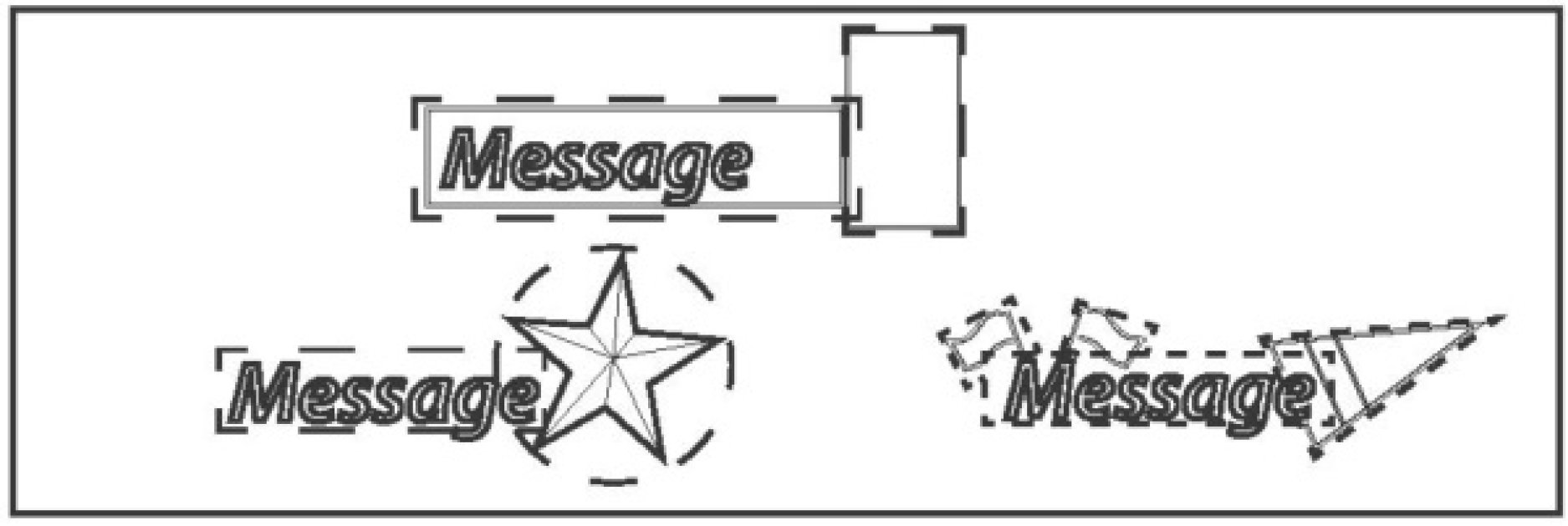
(b)
Setbacks. For the purpose of determining setback distances, measurements shall be taken from the edge or surface of the sign or sign structure which is closest to the street, or property line from which the sign is to be setback.
(1)
Freestanding signs shall be set back ten (10) feet from any property line adjacent to a street.
(2)
Signs in a nonresidential zone district shall be located not less than twenty (20) feet from an adjacent residential zone district boundary.
(c)
Height.
(1)
Wall Signs. For the purpose of determining the height of any wall sign, height shall be measured from the finished grade along the building frontage to the highest point of the sign. No portion of a sign may exceed the height of the wall to which it is attached nor extend over windows.
(2)
Freestanding Signs. The height of any freestanding sign shall be determined by the distance between the topmost portion of the sign structure and the finished grade at the base of the sign (see Figure 16-2). The grade shall not be artificially changed solely to affect the sign height measurement.
Figure 16-2 Sign Height Calculation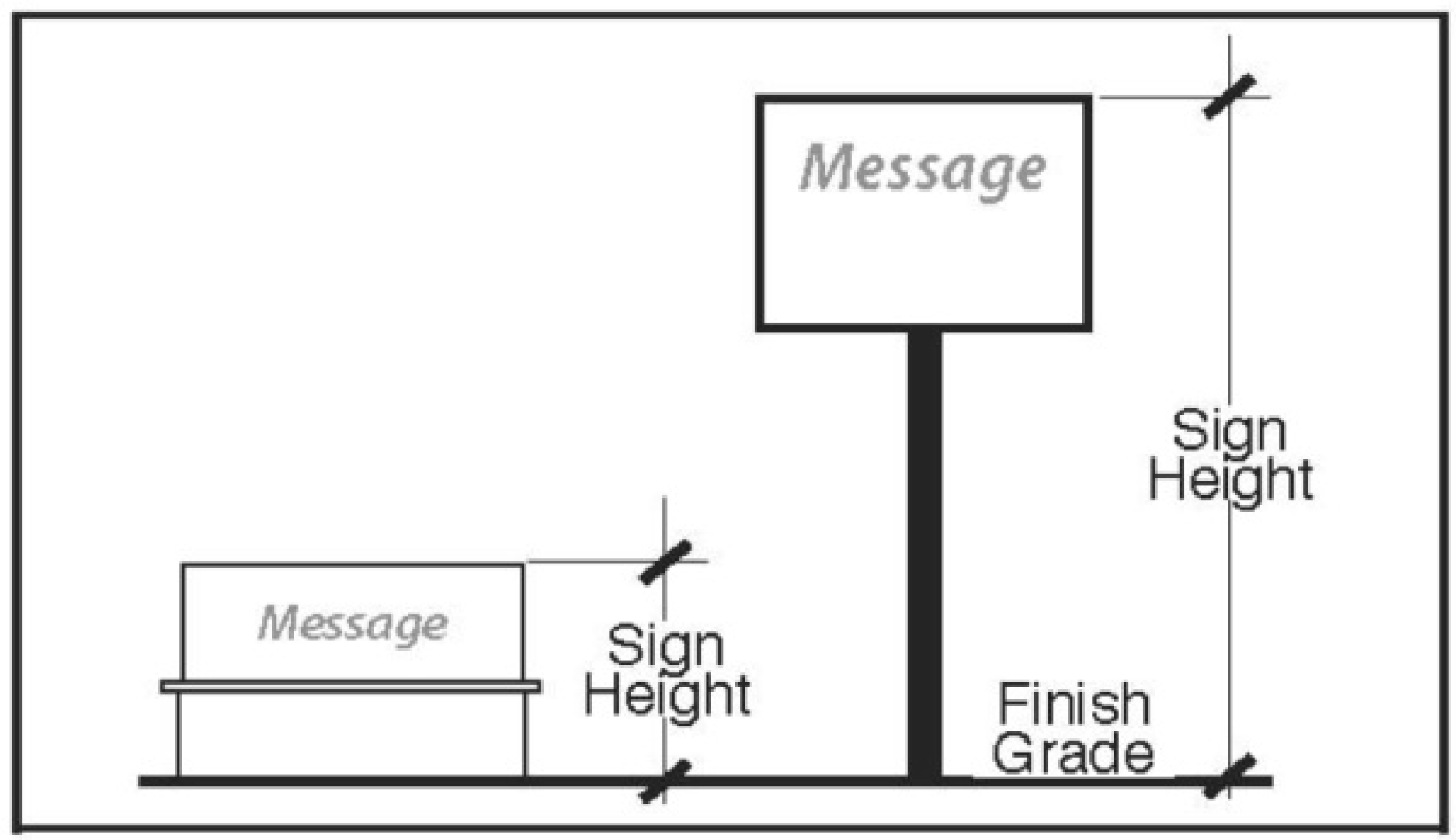
(Ord. 744 §43, 2017)
Sec. 16-6-80. - Signs In Residential Areas.
The following signs are allowed in the ECRR, RE, R-1, MF and NR-MU Districts, and on residential lots in a planned development, provided that they comply with the following standards:
Table 16-1
(Ord. 744 §43, 2017)
Sec. 16-6-90. - Signs In Nonresidential Areas.
The following signs are allowed in the A-H, CBD, CC, RC, LI, SO, and P districts and signs on nonresidential lots in a planned development, in compliance with the following standards:
Table 16-2
(Ord. 744 §43, 2017)
Sec. 16-6-100. - Sign Standards.
(a)
Awning Signs. Awning signs shall comply with Table 16-2 and the following:
(1)
Awning signs may only be located on first- and second-story building façades fronting a street, parking lot or pedestrian way.
(2)
No awning sign shall project beyond, above or below the face of an awning.
(3)
Awning signs shall not extend over a public right-of-way more than five (5) feet from the face of a supporting building.
(4)
Awning signs may only be internally illuminated.
Figure 16-3 Awning Signs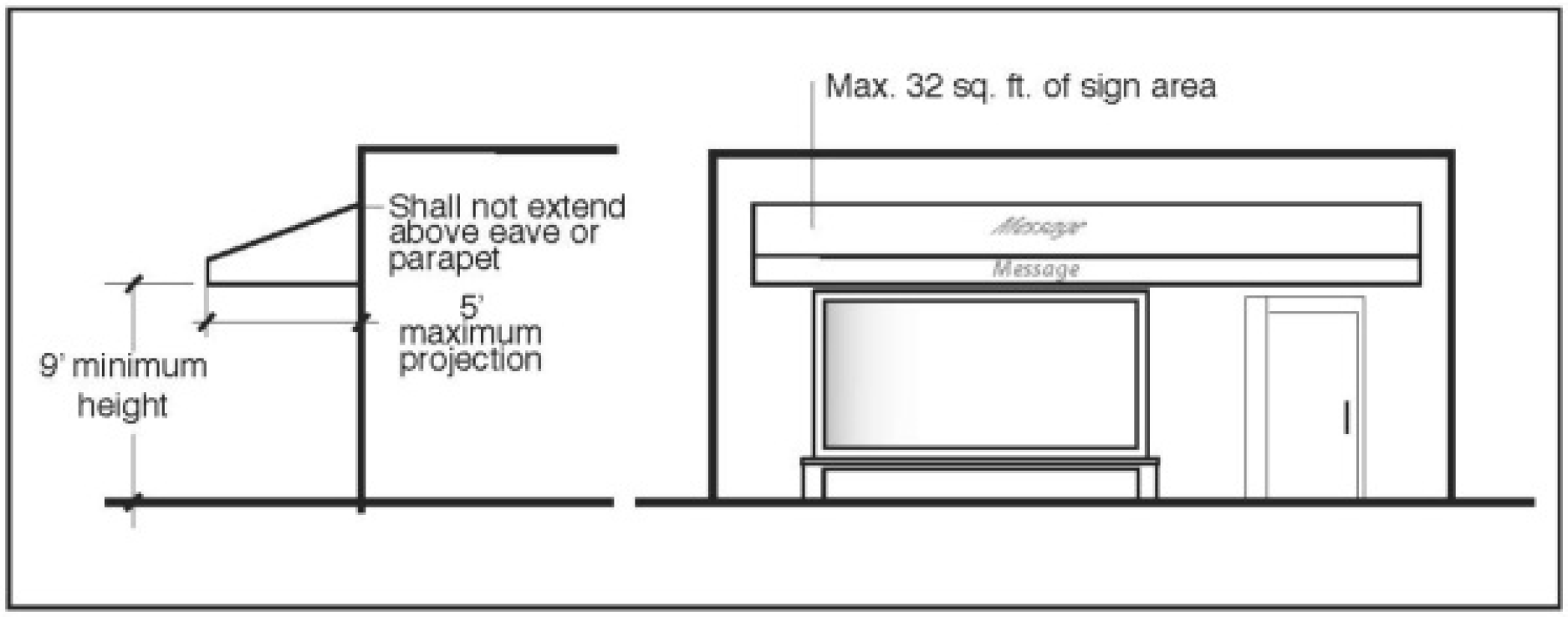
(b)
Banners. Banners shall comply with Table 16-2 and the following:
(1)
Wave Banners.
a.
Wave banners shall not be illuminated.
b.
Wave banners shall not obstruct any vehicle or pedestrian movement.
c.
Wave banners shall be displayed for not more than thirty (30) consecutive days, or more than a total of sixty (60) days per year.
Figure 16-4 Wave Banner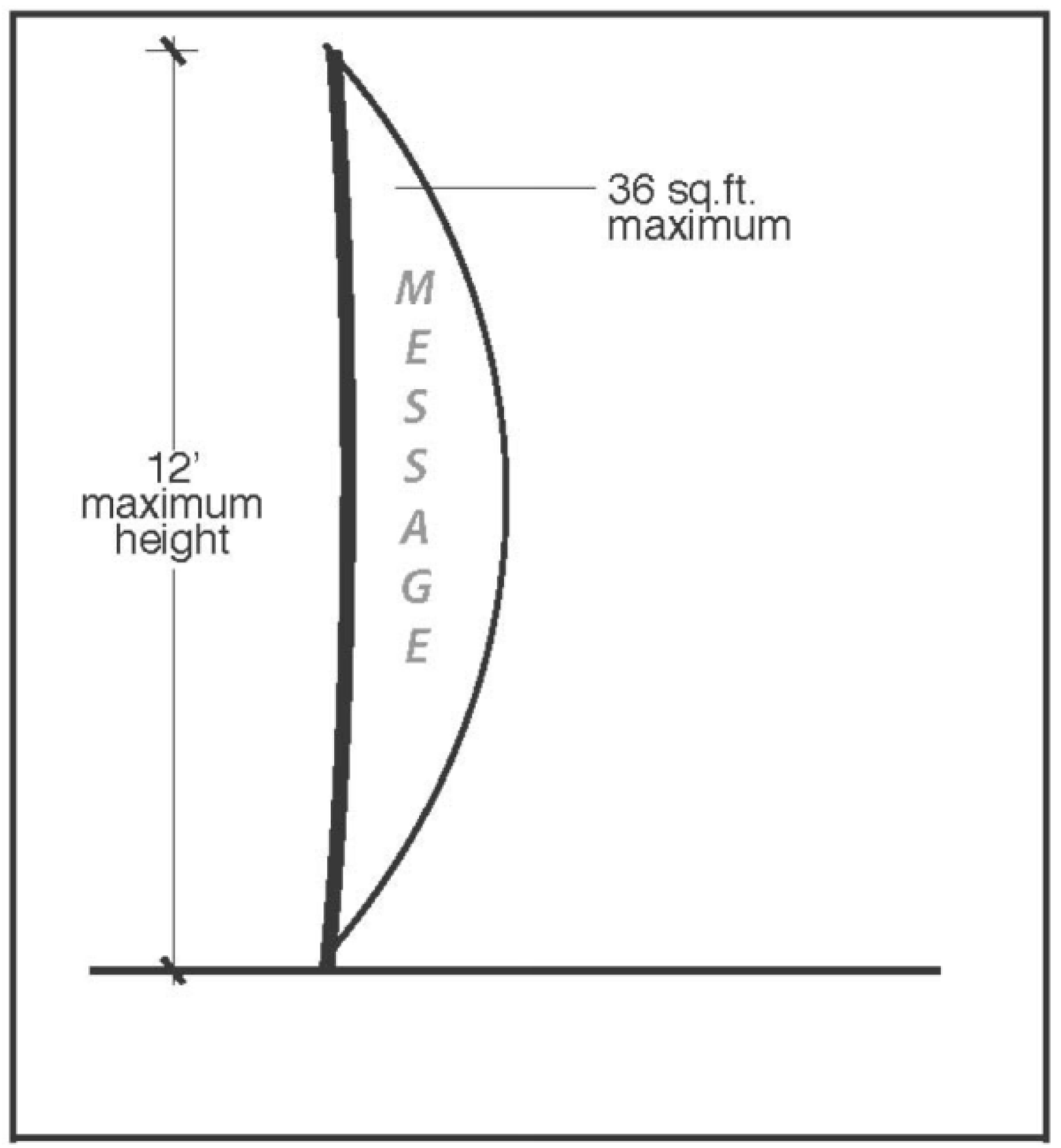
(2)
Wall Banners.
a.
Wall banners shall be not be illuminated.
b.
Wall banners shall be securely attached to a building and shall not be freestanding.
c.
Wall banners shall not be placed above the first story of any multi-story building.
d.
Wall banners shall be displayed for no more than thirty (30) consecutive days, or more than a total of sixty (60) days per year.
Figure 16-5 Wall Banner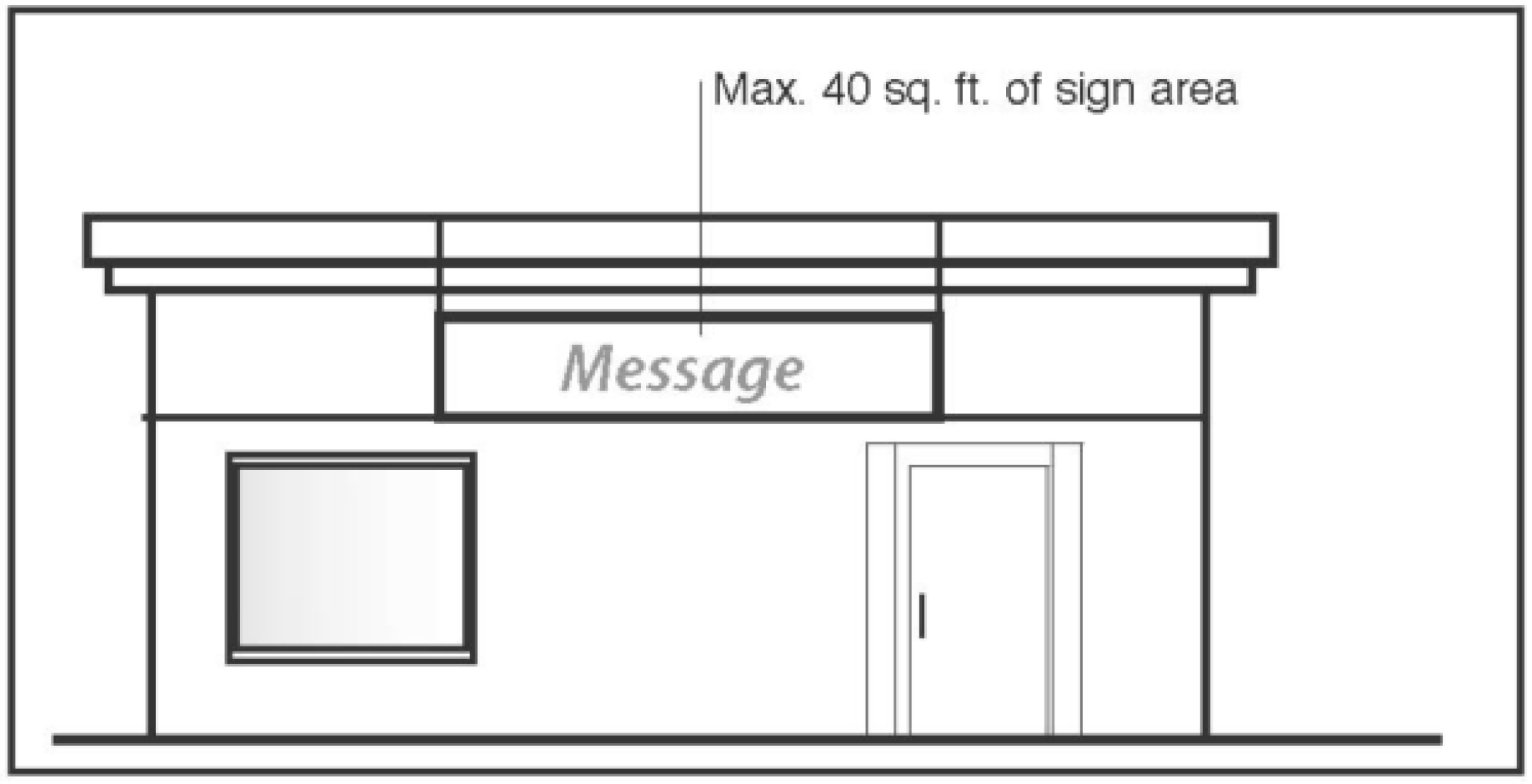
(c)
Canopy Signs. Canopy signs shall comply with Table 16-2 and the following:
(1)
No canopy sign shall project beyond, above or below the face of the canopy. However, a sign may project horizontally from the face of a canopy the distance necessary to accommodate the letter thickness and required electrical equipment, but not more than twelve (12) inches.
(2)
Canopy signs shall not extend over a public right-of-way more than seven (7) feet from the face of a supporting building,
(3)
Canopy signs shall be no closer than two (2) feet to a curb line.
(4)
Canopy signs may only be internally illuminated.
Figure 16-6 Canopy Sign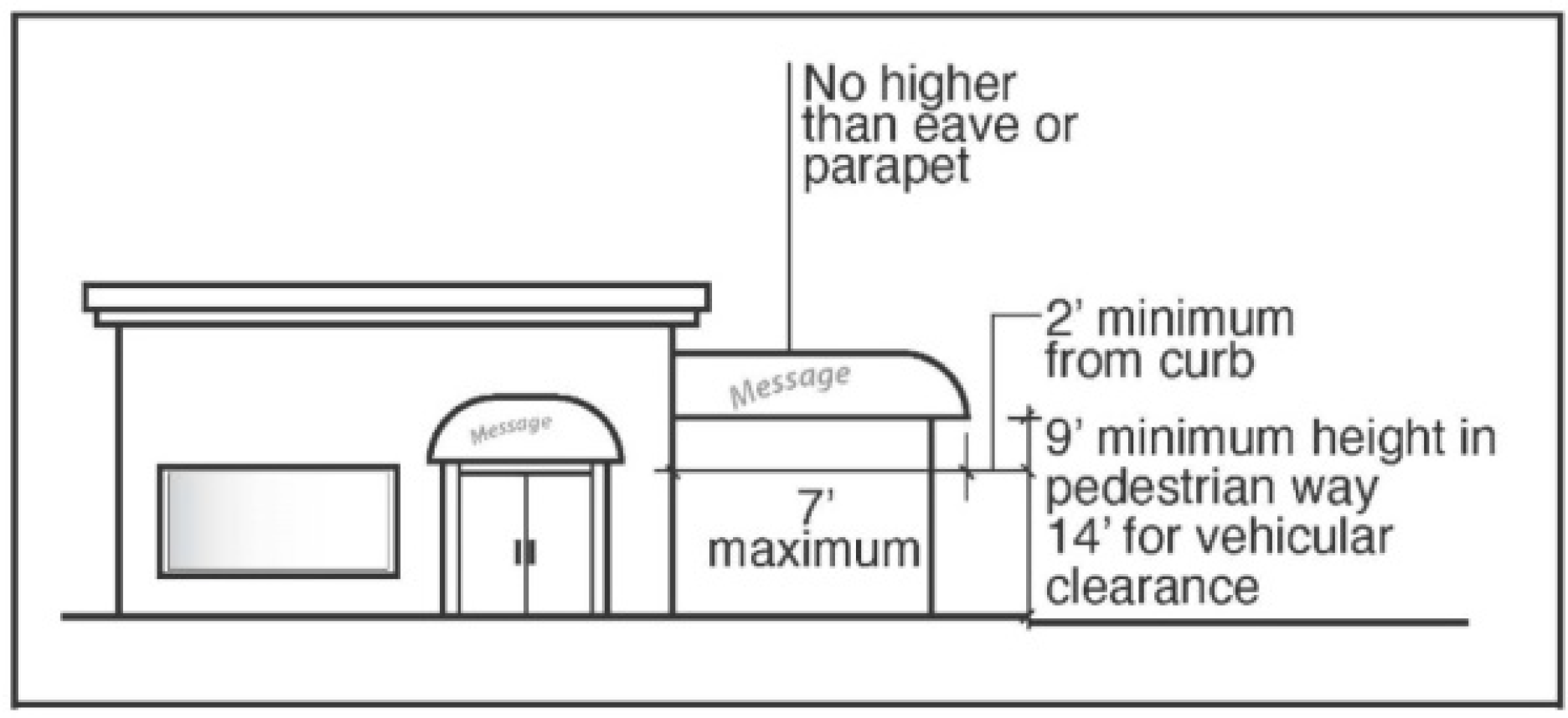
(d)
Directional Signs. Directional signs shall comply with Table 16-2 and the following:
(1)
Directional signs shall comply with the Manual of Uniform Traffic Control Devices.
(2)
Directional signs may be internally or externally illuminated.
(e)
Electronic Message Centers. Up to fifty percent (50%) of the allowed sign area of a pole sign or monument sign in a nonresidential district may be occupied by an electronic message center.
(1)
Lighting from the electronic message center shall not exceed three-tenths (0.3) foot-candles between dusk to dawn as measured from the sign face. The electronic message center shall have automatic dimmer software or solar sensors to control brightness for nighttime viewing. The intensity of the light source shall not produce glare that would constitutes a traffic hazard. Documentation shall be provided from the sign manufacturer to verify compliance with automatic dimming and brightness requirements.
(2)
The electronic message center shall be limited to static messages, changed only through either dissolve or fade transitions, which may otherwise not have movement, or the appearance or optical illusion of movement, of any part of the sign structure, design, or pictorial segment of the sign, including the movement of any illumination or the flashing, scintillating or varying of light intensity.
(3)
The transition duration between messages shall not exceed one (1) second.
(4)
The message hold time shall be a minimum of three (3) seconds.
Figure 16-7 Electronic Message Center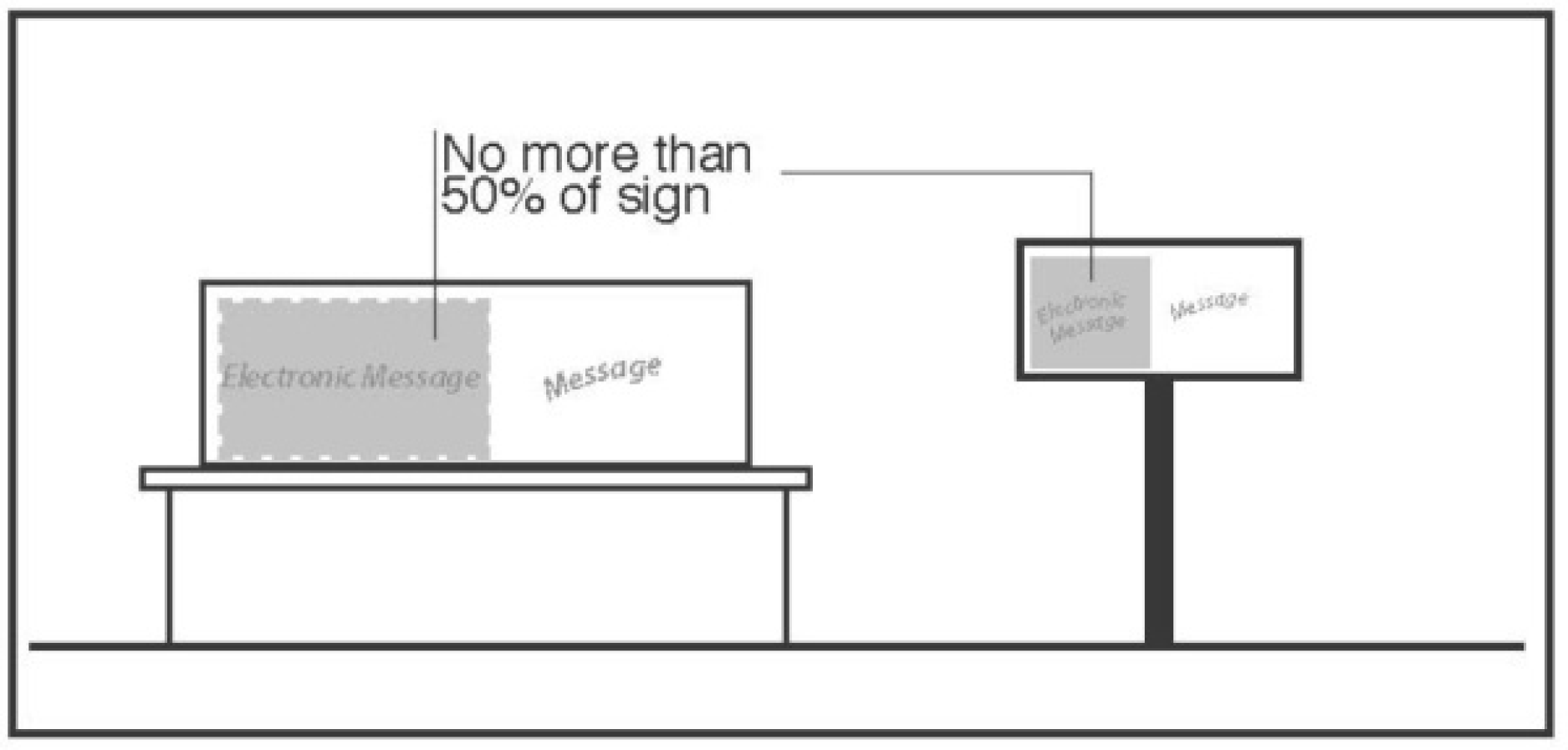
(f)
Flags and Flagpoles. Flags and flagpoles shall comply with the following:
(1)
Flagpoles shall not exceed twenty-five (25) feet in height.
(2)
Flags shall not exceed four (4) feet by six (6) feet in dimension.
(3)
No more than two (2) flags of any size shall be permitted upon any single pole.
(4)
No flag shall be mounted higher than fifteen (15) feet above the maximum height of the building or structure on the property on which the flag will be flown.
a.
No flag shall, when fully unfurled, extend onto any adjoining property or public right-of-way.
b.
No flag shall be erected or maintained so as to allow a flag at rest to reach a height less than ten (10) feet above the ground.
Figure 16-8 Flags and Flagpoles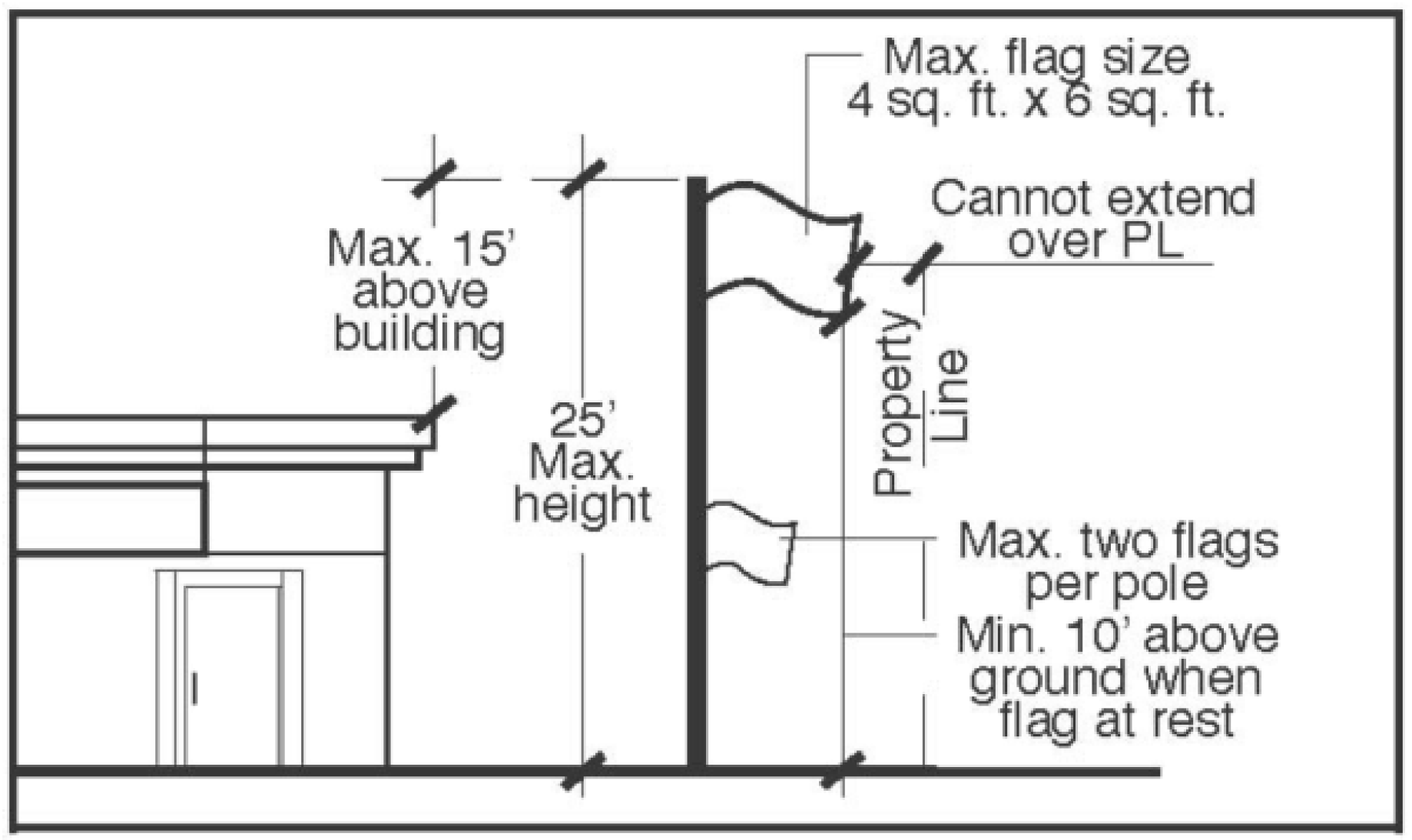
(g)
Marquee Signs. Marquee signs shall comply with Table 16-2 and the following:
(1)
Marquee signs shall be placed on a ground floor façade of a building.
(2)
Marquee signs shall not extend over a public right-of-way more than ten (10) feet from the face of a supporting building, and be no closer than two (2) feet to a curb line.
(3)
No marquee sign shall extend above the eave or parapet line of any building.
(4)
Marquee signs may only be internally illuminated.
Figure 16-9 Marquee Sign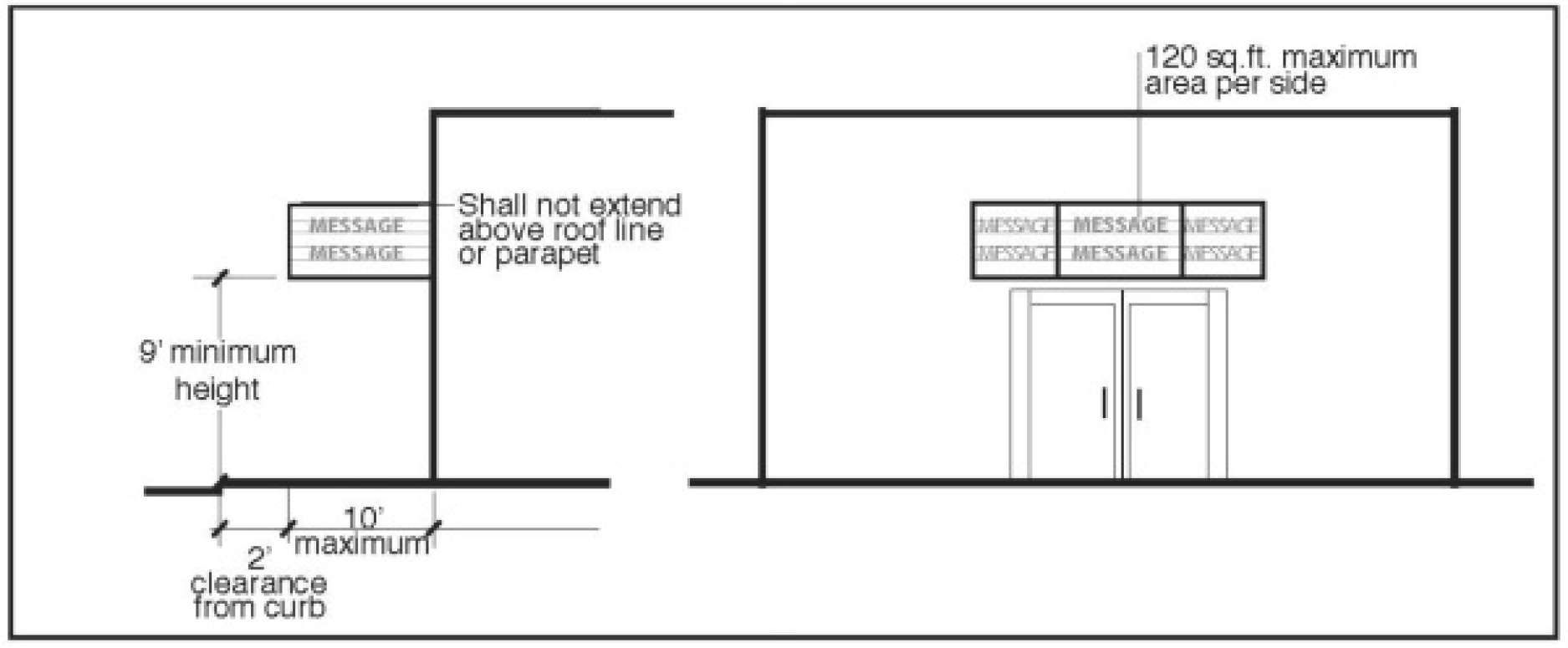
(h)
Monument Signs. A monument sign shall comply with either Table 16-1 or 16-2 and the following:
(1)
Monument signs shall be located on a site frontage adjoining a public or private street, easement or right-of-way, with a minimum setback from any property line of five (5) feet.
(2)
Monument signs shall be located in a landscaped area which is of a shape, design and size (equal to at least twice the total sign area of all faces) that will provide a compatible setting for the sign.
(3)
Monument signs may be internally or externally illuminated.
Figure 16-10 Monument Sign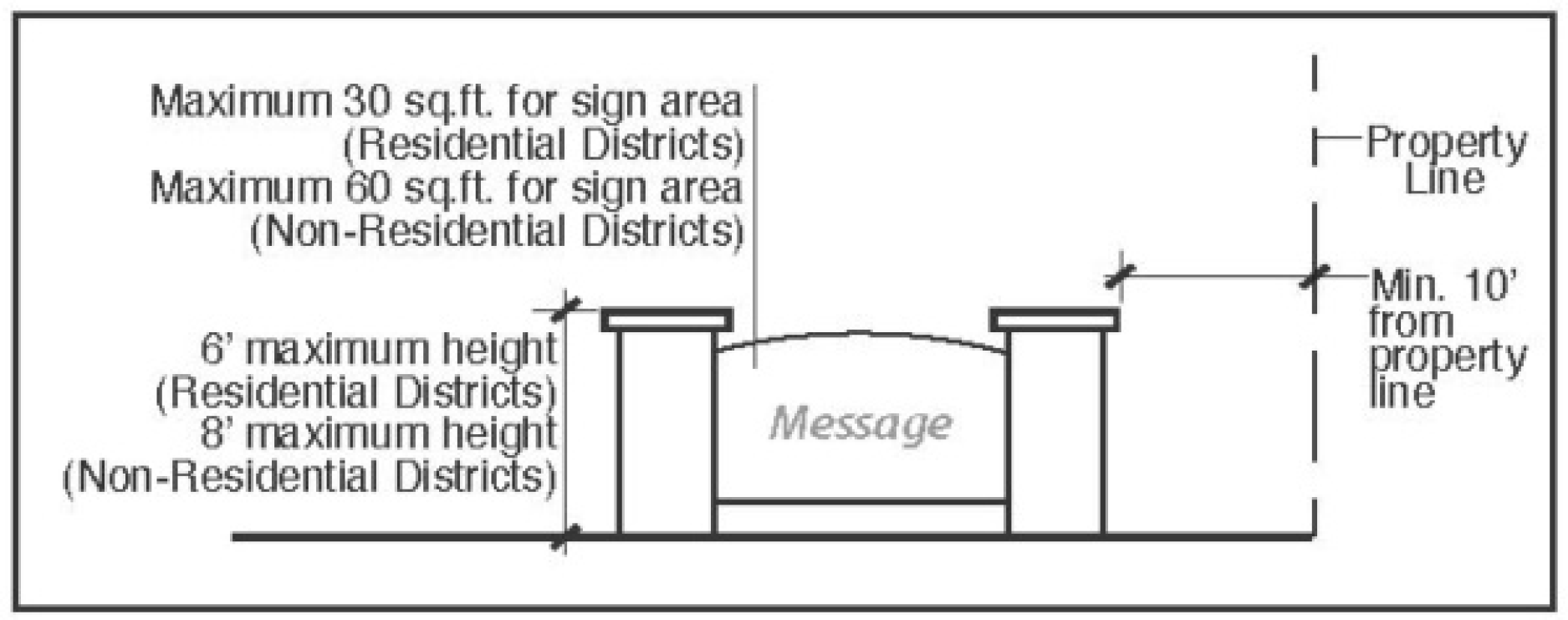
(i)
Pole Signs. Pole signs shall comply with Table 16-2 and the following:
(1)
Pole signs shall be located on a site frontage adjoining a public or private street, easement or right-of-way.
(2)
No portion of a pole sign shall encroach or project into a public right-of-way.
(3)
Pole signs may only be internally illuminated.
Figure 16-11 Pole Sign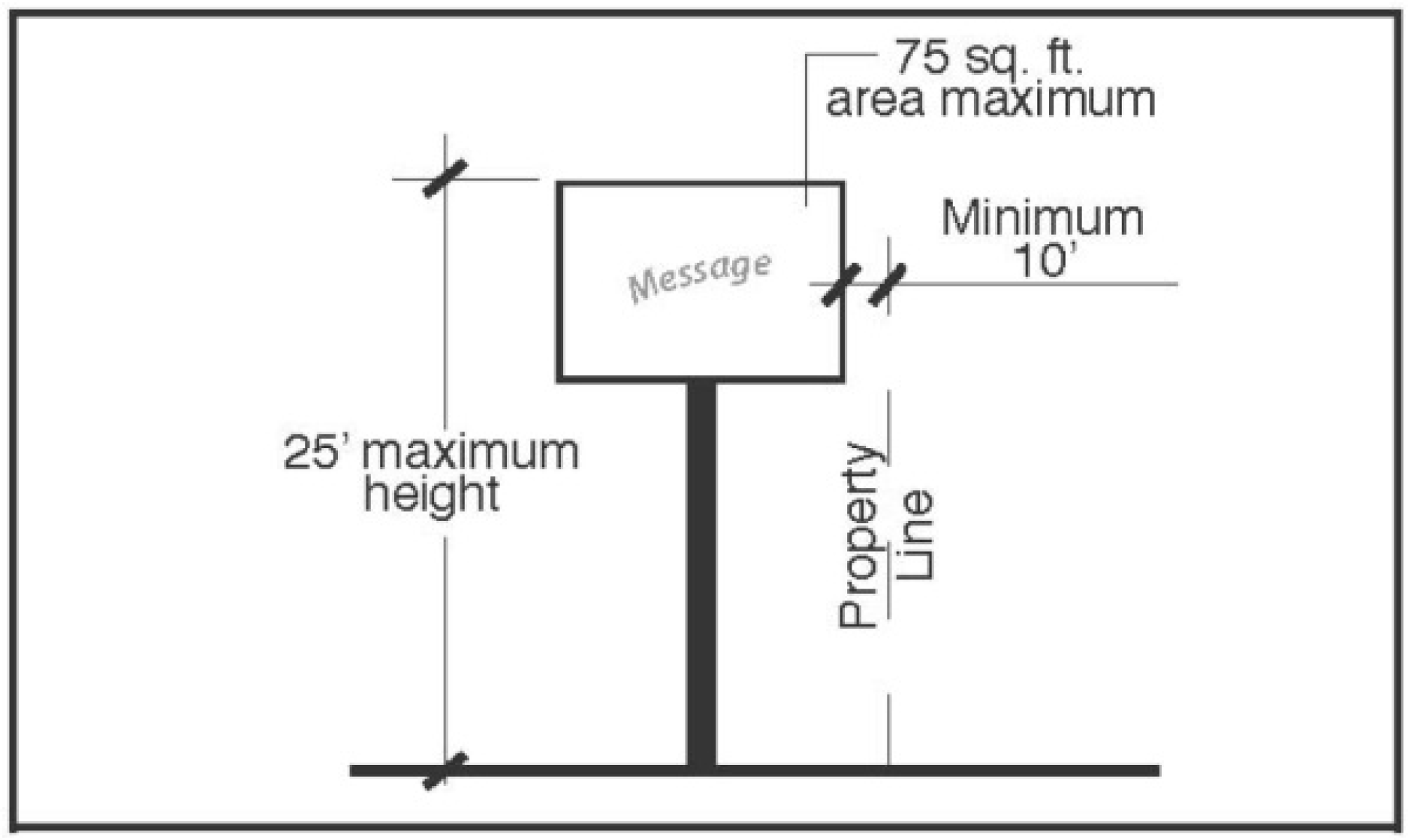
(j)
Projecting Signs. Projecting signs shall comply with Table 16-2 and the following
(1)
Projecting signs shall be placed on a ground floor façade, except for businesses located above the ground level with direct exterior pedestrian access.
(2)
Projecting signs shall not be higher than the wall from which the sign projects if attached to a single story building, or the height of the bottom of any second story window if attached to a multi-story building. Projecting signs shall not extend more than four (4) feet from the face of a supporting building, and be no closer than two (2) feet to a curb line.
(3)
Projecting signs shall not be illuminated.
Figure 16-12 Projecting Sign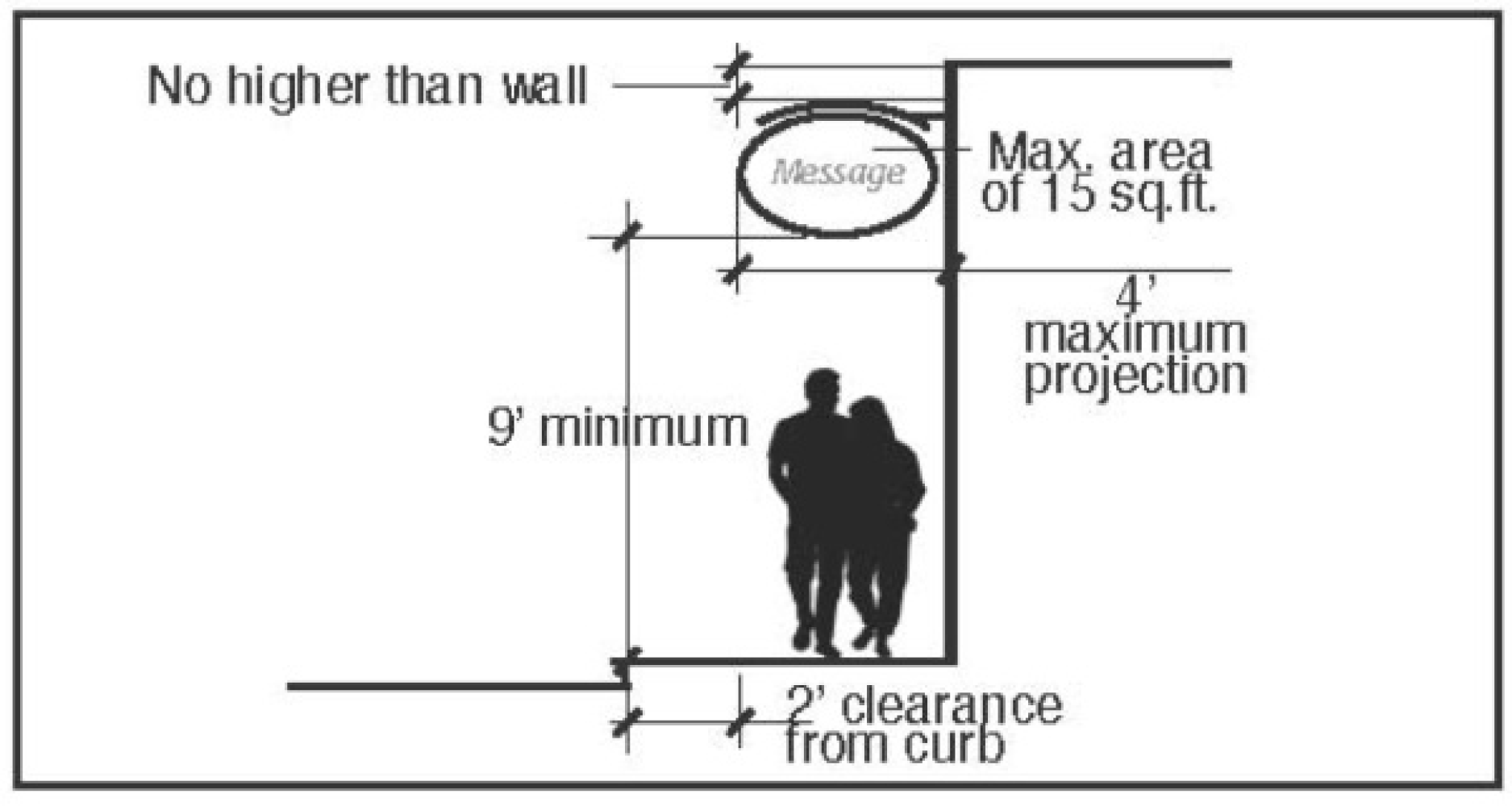
(k)
Site Signs. Site signs shall comply with Table 16-2 and the following:
Figure 16-13 Site Sign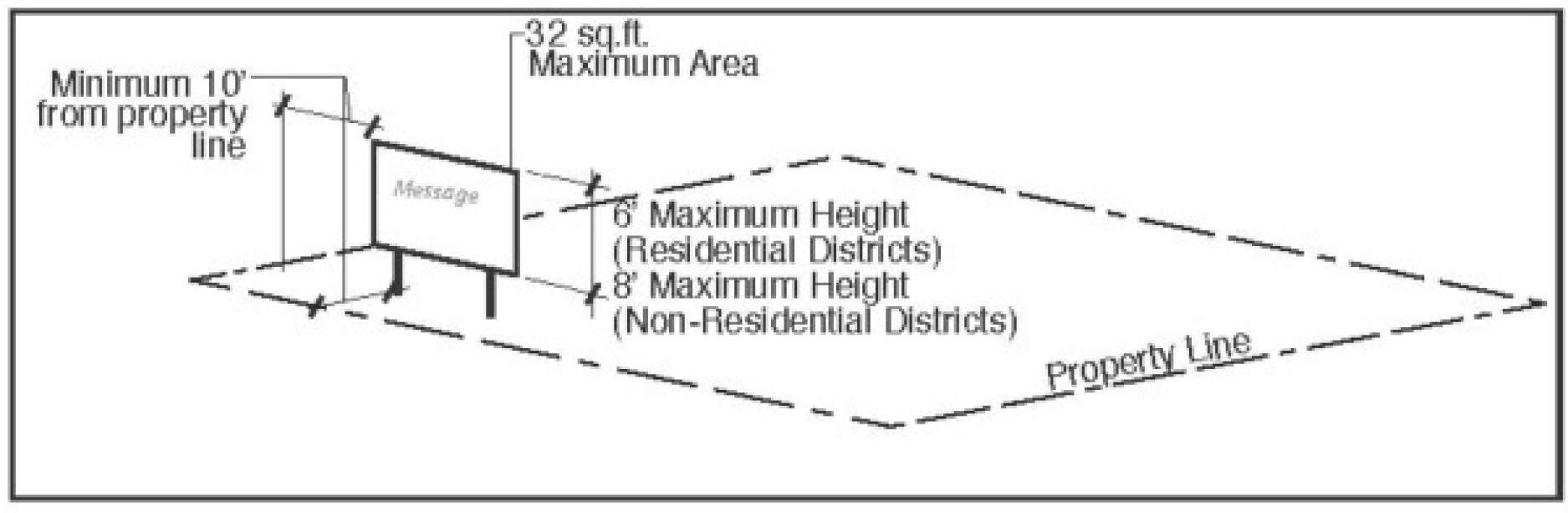
(l)
Swing Signs. Swing signs shall comply with either Table 16-1 or 16-2 and the following:
Figure 16-14 Swing Sign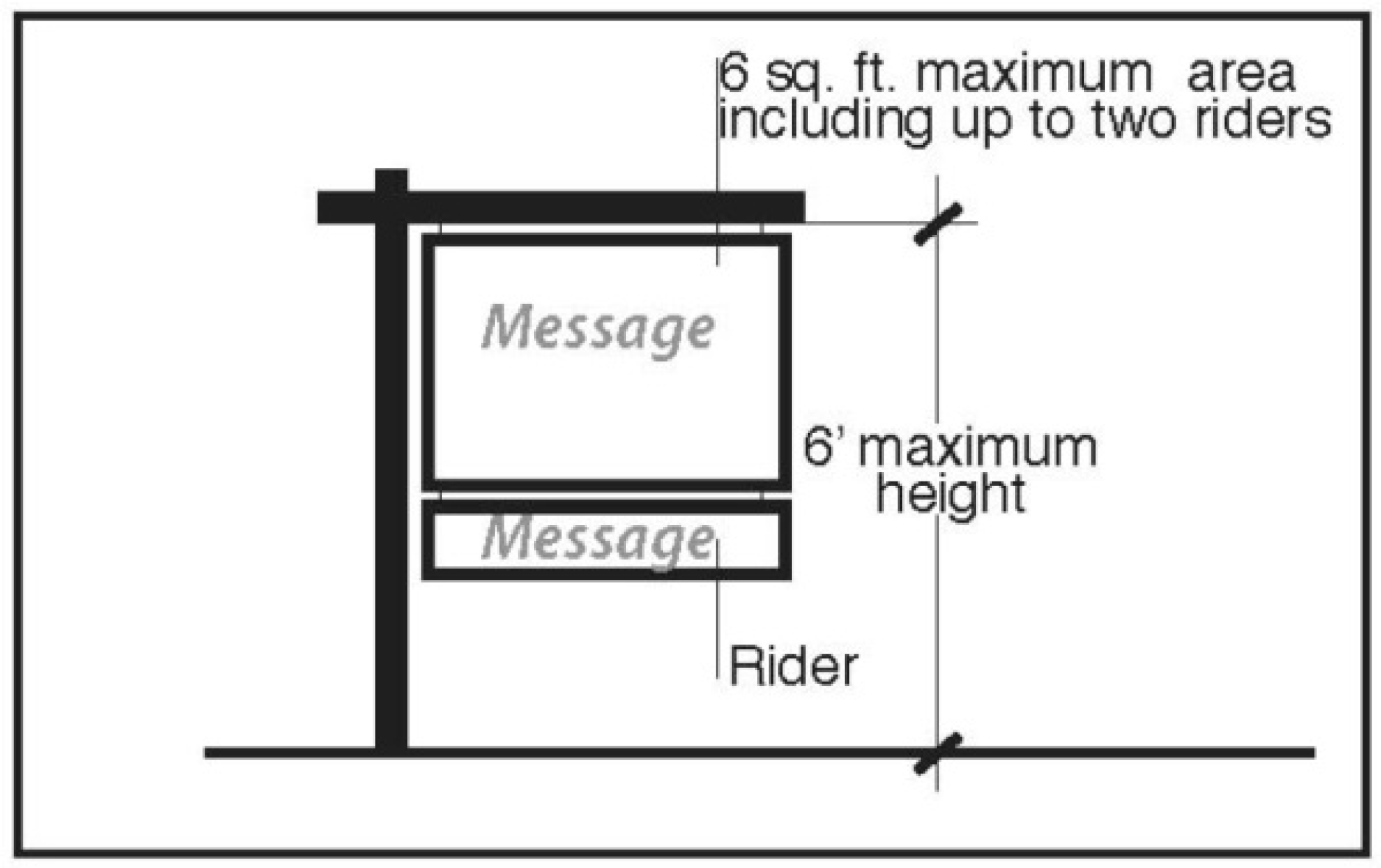
(m)
Wall Signs. Wall signs shall comply with either Table 16-1 or 16-2 and the following:
(1)
Wall signs shall be parallel to the wall and project no more than eighteen (18) inches horizontally, in whole or in part, from the wall to which they are attached.
(2)
Wall signs shall not obstruct any portion of a window, doorway or other architectural detail.
(3)
Wall signs may be illuminated only in nonresidential zone districts.
(4)
Wall signs shall be architecturally integrated into the structure to which they are attached.
(5)
One (1) of the building sides containing a wall sign must be the main entrance to the property.
Figure 16-15 Wall Sign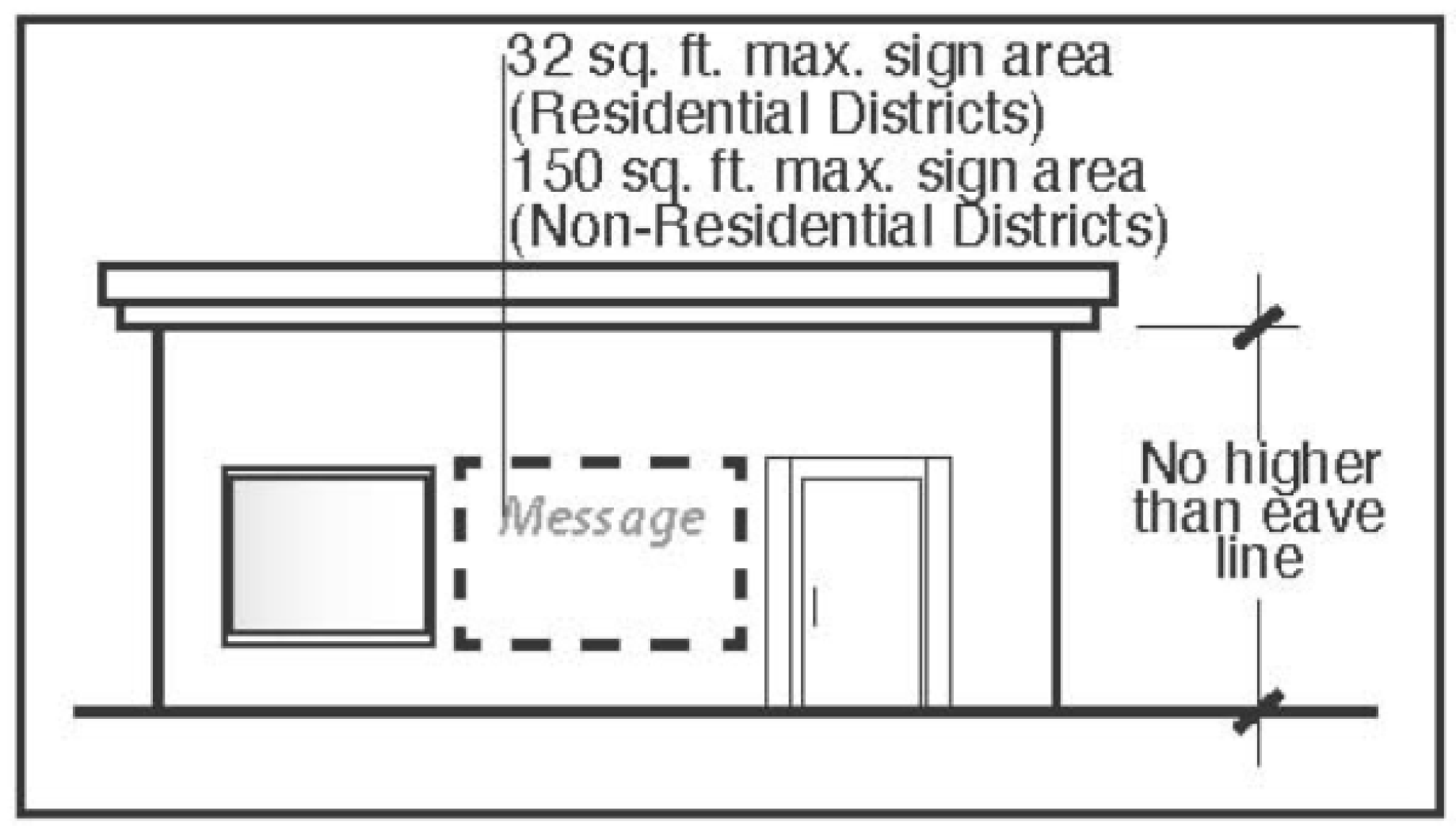
(n)
Window Signs. Window signs shall comply with either Table 16-1 or 16-2 and the following:
(1)
Window signs may be internally illuminated only in nonresidential zone districts.
Figure 16-16 Window Sign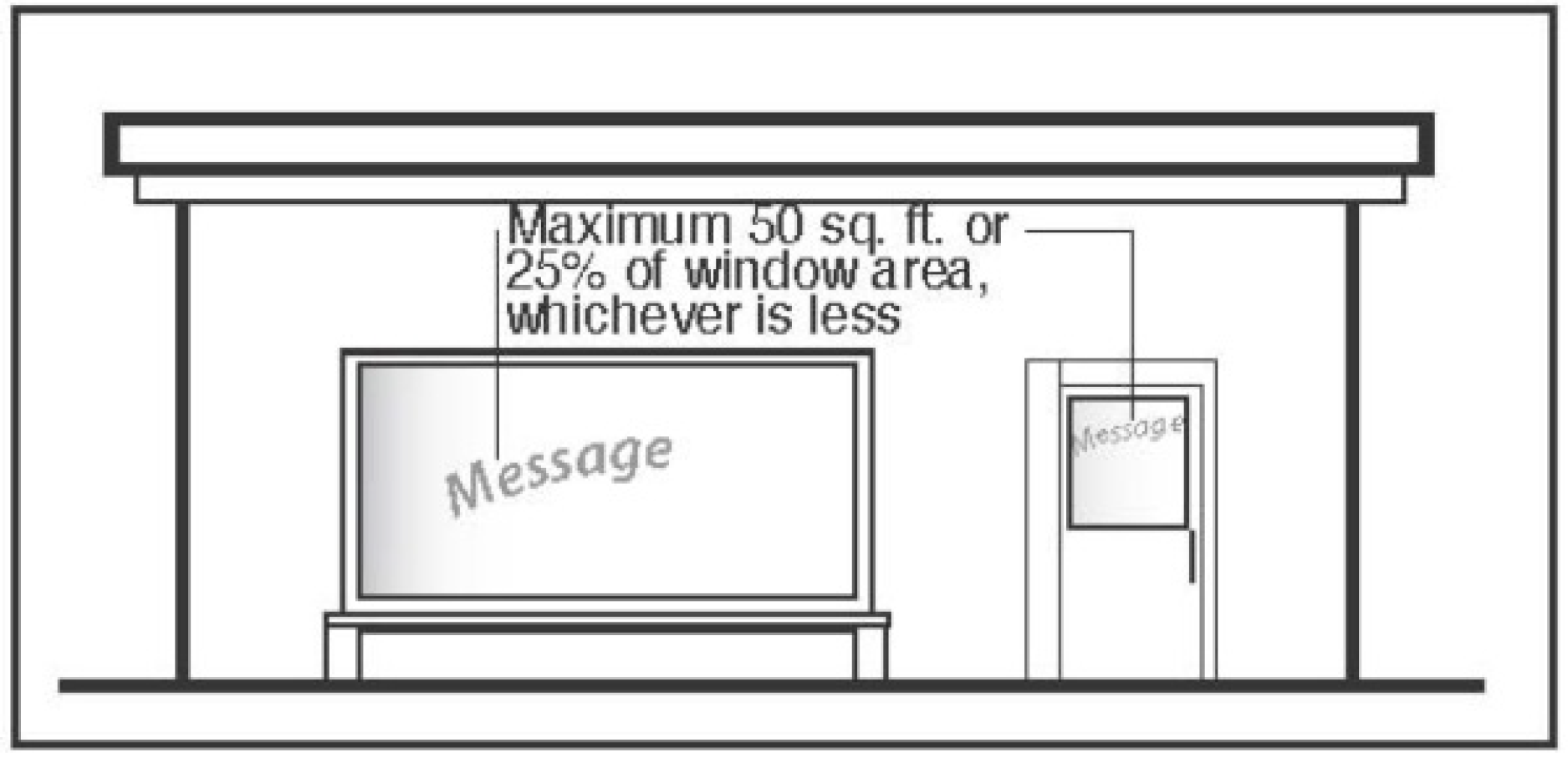
(o)
Yard Signs. Yard signs shall comply with Table 16-1 or 16-2 and the following:
Figure 16-17 Yard Sign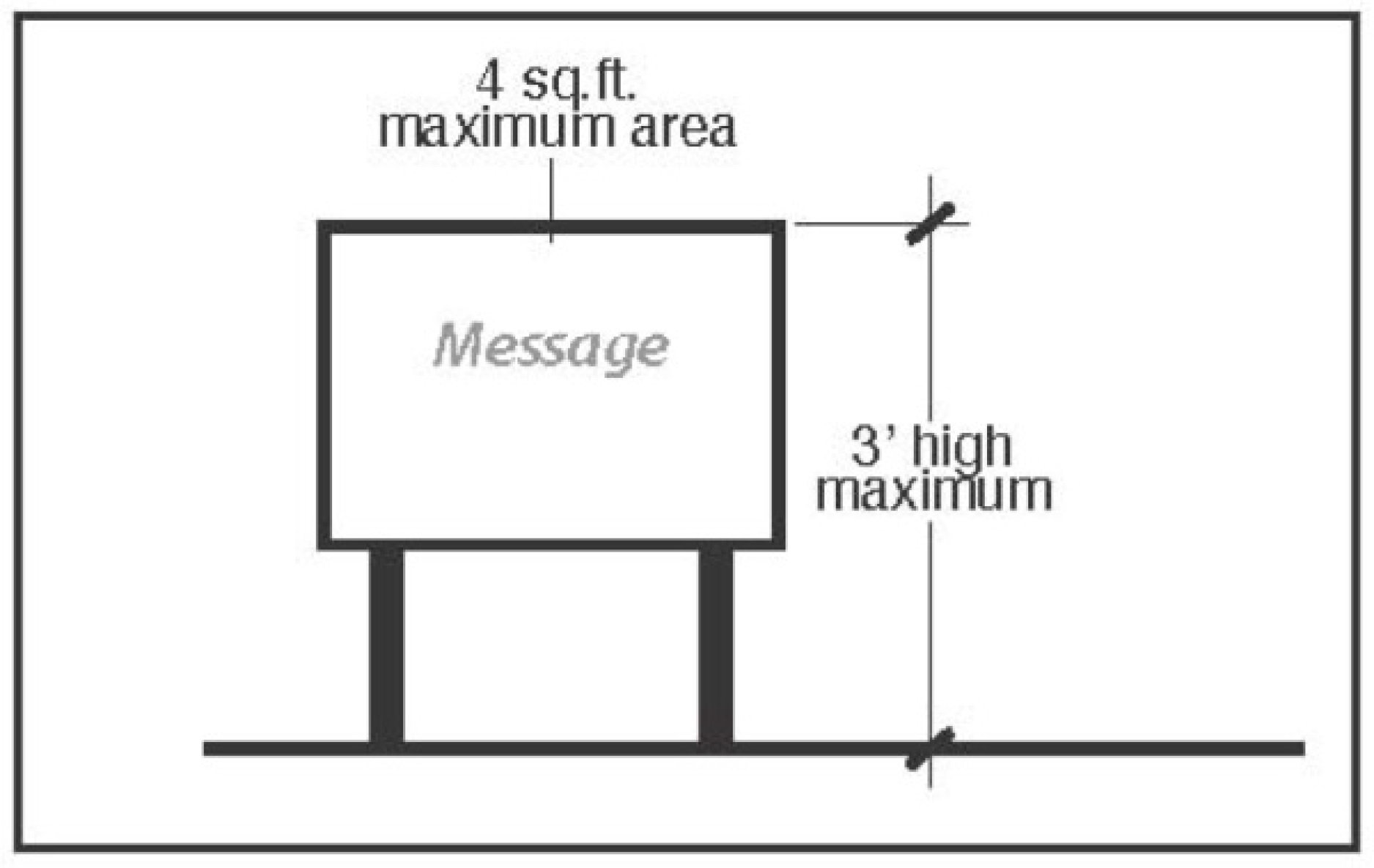
(p)
Sidewalk Signs. Sidewalk signs are allowed in public rights-of-way in nonresidential districts, provided that they comply with Table 16-2 and the following:
(1)
Placement of a sidewalk sign must be within one (1) foot of a building wall.
(2)
Sidewalk signs shall not impede pedestrian movement and shall be removed immediately upon the Town's determination of an unsafe condition.
Figure 16-18 Sidewalk Sign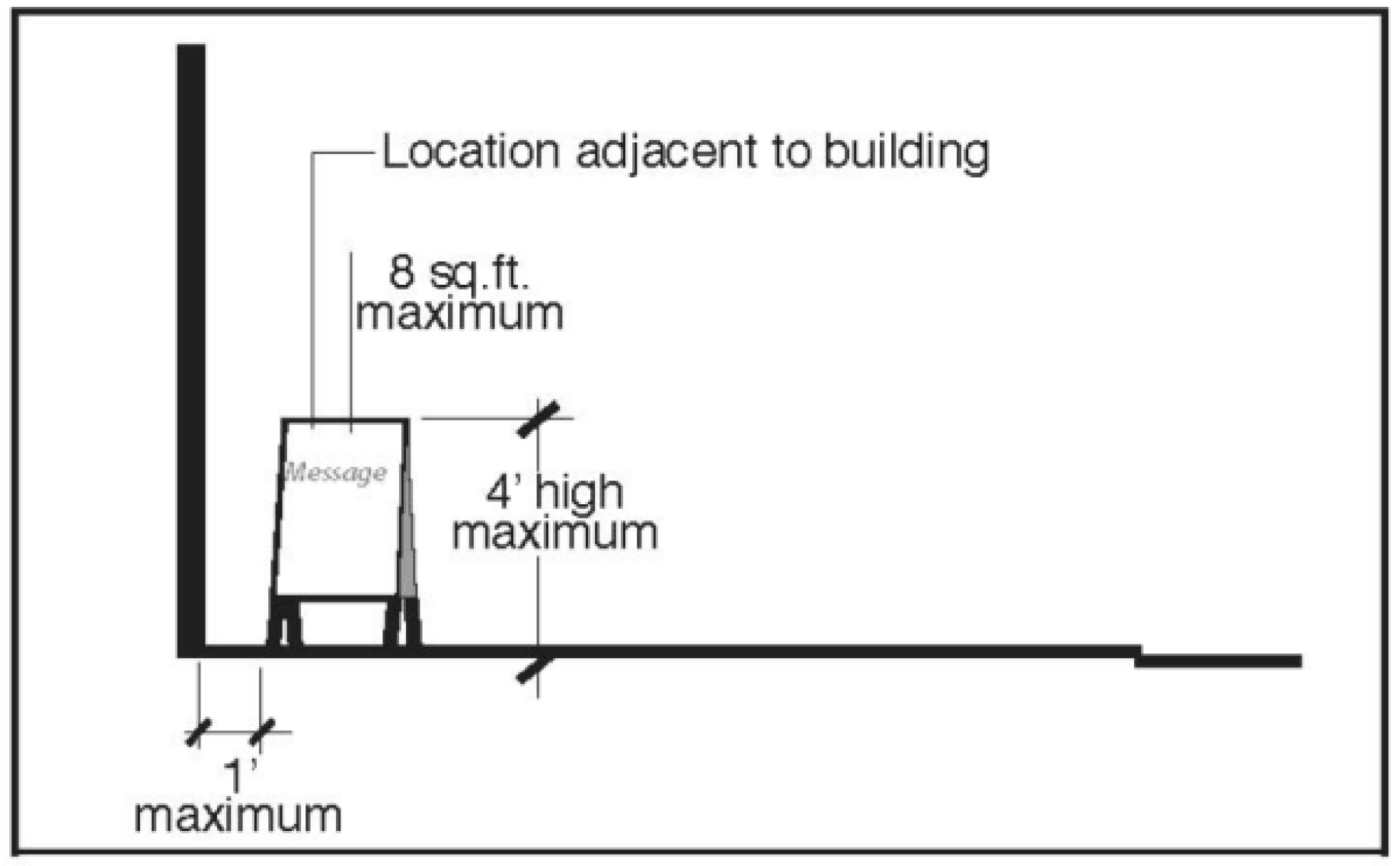
(q)
Temporary Signs in Public Rights-of-Way. Temporary signs are allowed in public rights-of-way in residential districts provided that they comply with Table 16-1 and the following:
(1)
The sign shall not be illuminated.
(2)
The sign shall be designed to easily break away if hit by a vehicle.
(3)
The sign shall be located a minimum of ten (10) feet from the edge of the roadway.
(4)
The person responsible for the placement of the sign shall be remove such sign within seven (7) days of the initial placement of the sign.
Figure 16-19 Temporary ROW Sign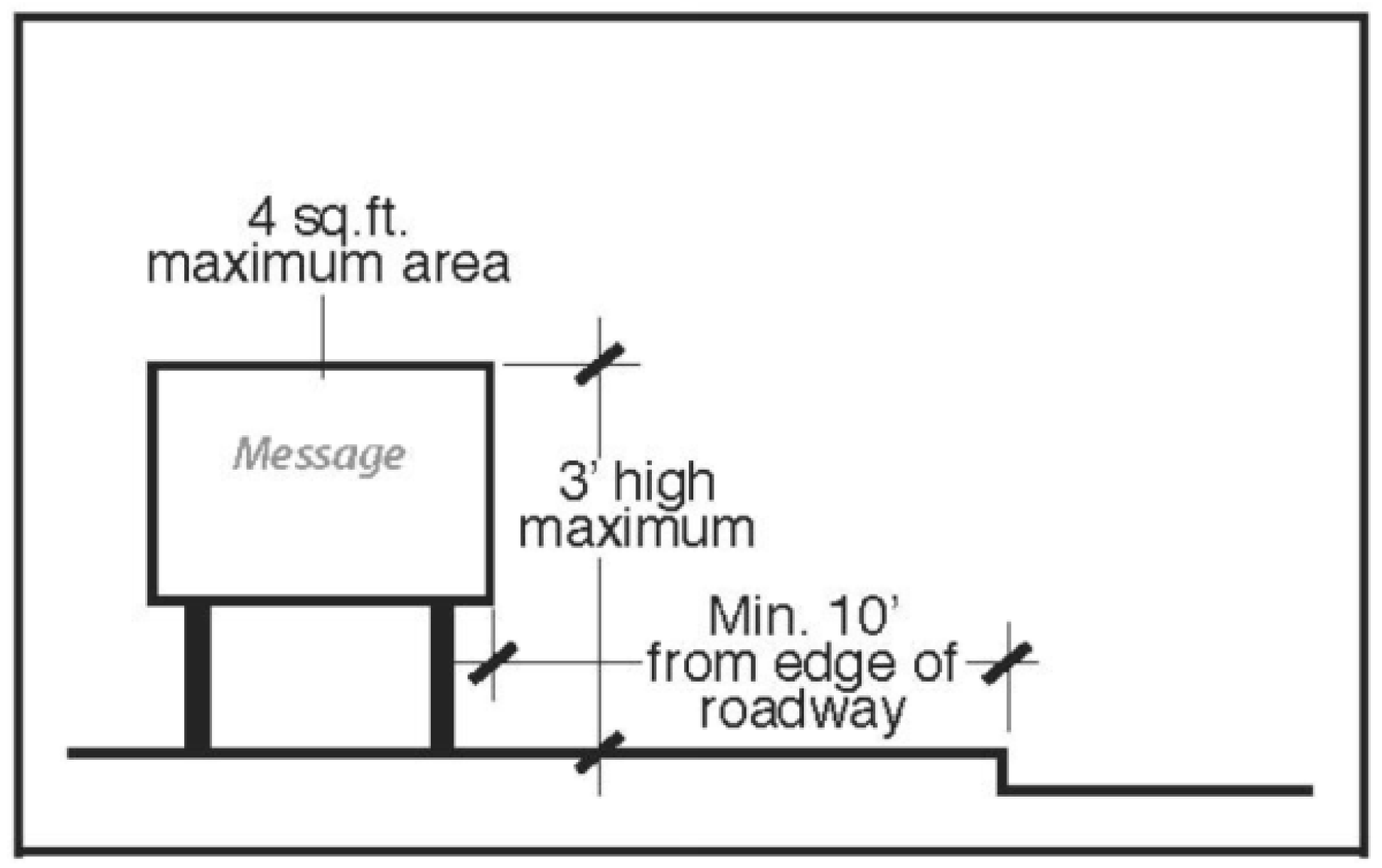
(Ord. 744 §43, 2017)
Sec. 16-6-110. - Master Sign Plan.
(a)
Incentive. For any multi-tenant retail center, industrial park, planned development or other unified form of site development or redevelopment, a master plan may be proposed for coordinated or shared signage. In exchange for voluntary submittal of a master plan, one (1) or more of the following standards may be varied up to twenty-five percent (25%):
(1)
Sign area for individual signs, and maximum aggregate sign area for all allowable signs;
(2)
Sign height for individual signs;
(3)
Sign setback or separation between freestanding pole or monument signs; and
(4)
Maximum number of signs, types of signs, or approved wall areas for purposes of sign location.
(b)
Application. An application for a master sign plan shall be filed with the Town Clerk. The application shall include all applicable fees, a signed reimbursement agreement, and the following:
(1)
A copy of the approved site plan showing all existing or approved buildings with the dimensions of building frontage and square footage for each building on site;
(2)
Building elevation drawings or sketches indicating the exterior surface design details of all buildings on the site;
(3)
Drawings or photo simulations, to scale, indicating the size, materials, method and intensity of illumination, height, color, sign area and general location of all signs in the master sign plan; and
(4)
For buildings whose tenants have not been determined, the location, materials, method and intensity of illumination and maximum area for each sign that an individual business will be allowed to display.
(c)
Criteria. The Town Manager shall have the authority to approve, approve with conditions or deny an application for a master sign plan based upon one (1) or more of the following:
(1)
Quality. In general, signs shall have mutually unifying elements which may include uniformity in materials, color, size, height, letter style, sign type, shape, lighting, location on buildings, and design motif.
(2)
Visual Impact. Where possible, freestanding pole and monument signs shall integrate tenant signs into a single sign structure. Directional signage systems shall be placed in consistent locations near site entries, key points on the internal automobile and pedestrian circulation system, building entries, seating areas, and sidewalk intersections.
(3)
Compatibility. Materials and textures of signs shall be compatible with the architectural character of the site and building. Supporting sign structures of freestanding pole and monument signs shall match the primary finish and colors of the associated building(s).
(d)
Planning Commission Review. The Town Manager may refer a master sign plan to the Planning Commission for its recommendation and the Board of Trustees for its approval.
(e)
Compliance. A master sign plan shall be approved prior to the erection of any signs subject to the master sign plan. All signs shall conform at all times to the master sign plan. Any deviations from an approved master sign plan shall be unlawful unless and until a revised master sign plan is approved by the Town Manager.
(Ord. 744 §43, 2017)
Sec. 16-6-120. - Nonconforming Signs.
A nonconforming sign located on private property may be continued in operation and maintained after the effective date of the ordinance codified in this Article, except:
(a)
Upon expiration of a lease agreement for said sign, unless extended by the Town.
(b)
Upon abandonment.
(c)
Upon application to change any zoning or use of the property on which the nonconforming sign is located.
(d)
Upon destruction, damage or obsolescence.
(e)
When the size, configuration, height, setback or other attribute of the sign, other than content, is altered in any manner.
(Ord. 744 §43, 2017)
Sec. 16-6-130. - Violation, Penalty.
(a)
Any sign not expressly allowed by this Article is prohibited.
(b)
Violations of this Article shall be punished as set forth in Section 16-1-80.
(c)
In addition to any other available remedies, the Town is authorized to immediately remove any signs on Town property.
(Ord. 744 §43, 2017)

