
Point Venture City Zoning Code
CHAPTER 4
BUILDING REGULATIONS
ARTICLE 4.01 GENERAL PROVISIONS (RESERVED)
2022-11-16
2023-03-15
2025-05-21
2022-07-20
2021-12-08
2025-06-18D
2021-02-17
2025-05-21A
4.02.001 Purpose
The purpose of this article is to abolish the building commission and to transfer the powers granted to that body to the building official. The purpose of this article is also to further provide for orderly and safe development within the village’s corporate boundaries (i.e., village limits). This article is adopted so that the building official may advise and assist the village council so to promote the public health, safety morals and general welfare, and protect the public interest and preserve the safety of village residents and guests. (Ordinance 2008-08-04, sec. 2, adopted 8/4/08; Ordinance 2015-03-01, sec. 2, adopted 3/4/15)
4.02.002 Powers And Duties
- Building commission abolished; powers transferred to building official. The building commission for the village is hereby abolished and its powers transferred to the building official.
- Assistant building official. The mayor shall designate a village employee to serve as assistant building official. The assistant building official shall have all the powers and duties of the building official and may take any action available to the building official if for any reason the building official is absent or unable or unwilling to serve.
- Advisory duties; administration and enforcement of construction codes. The building official shall recommend building codes, electrical codes, plumbing codes, mechanical codes, energy conservation codes, and other development standards and regulations for consideration by the village council. The building official shall also recommend amendments as needed. As directed by the village council, the building official shall also assist with the administration and enforcement of the construction codes adopted by the village council.
- Permitting functions. The building official will review applications for building permits and other permits designated by the village council. The building official will confer with applicants regarding the village’s permitting procedures and regulations. The building official will approve or deny all applications for building permits.
- Variances.
- The building official may grant variances for those regulations over which the building official has express authority. Variances may only be granted following a public meeting and in instances where the building official makes written findings regarding the following:
- The variance is not contrary to the public interest;
- Due to special conditions, a literal enforcement of the regulation would result in an unnecessary hardship; and
- The spirit of the ordinance is observed and substantial justice is done.
- Financial hardship alone does not necessarily qualify as undue hardship for purposes of granting a variance.
- The building official may grant variances for those regulations over which the building official has express authority. Variances may only be granted following a public meeting and in instances where the building official makes written findings regarding the following:
(Ordinance 2008-08-04, sec. 3, adopted 8/4/08; Ordinance 2015-03-01, sec. 3, adopted 3/4/15)
4.02.003 Qualifications
- Building official. The building official shall be an independent advisor to the village council, and shall be appointed by the majority vote of the village council. To the extent reasonably possible, the building official is required to have experience or education in the area of construction or land development.
- Assistant building official. The assistant building official shall be a member of the village staff. The assistant building official must be in a position to advise the building official and provide necessary institutional support for the position.
(Ordinance 2008-08-04, sec. 4, adopted 8/4/08; Ordinance 2015-03-01, sec. 4, adopted 3/4/15)
4.02.004 Appointment
The building official shall be appointed by majority vote of the council. If a vacancy occurs, the village council may appoint a person to fill the unexpired term. The assistant shall be designated by the mayor. (Ordinance 2008-08-04, sec. 5, adopted 8/4/08; Ordinance 2015-03-01, sec. 5, adopted 3/4/15)
4.02.005 Term
- Building official. The building official’s term shall be two (2) years commencing and ending on a date specified by the council. In the event the council fails to reappoint the building official to a new term and he or she holds over and continues to serve in the same position, his or her acts shall be presumed valid as the acts of an officer de facto. If he or she continues to hold over for ninety (90) days without action of the council to reappoint or replace him or her, he or she shall be considered to be an officer de jure for the remainder of the applicable term as though reappointed by the council.
- Assistant building official. The assistant building official will serve at the pleasure of the mayor and the building official, or as long as he or she continues to be a part of the village staff.
(Ordinance 2008-08-04, sec. 6, adopted 8/4/08; Ordinance 2015-03-01, sec. 6, adopted 3/4/15)
4.02.006 Removal
The village council may by majority vote remove either the building official or the assistant building official, with or without cause, including but not limited to lack of confidence, incompetence, corruption, misconduct, or malfeasance. (Ordinance 2008-08-04, sec. 7, adopted 8/4/08; Ordinance 2015-03-01, sec. 7, adopted 3/4/15)
4.02.007 Appeal Of Decisions
Decisions of the building official or the assistant may be appealed in writing to the village council. All such appeals must be submitted in writing to the village secretary no later than ten (10) business days following the contested action. (Ordinance 2008-08-04, sec. 8, adopted 8/4/08; Ordinance 2015-03-01, sec. 8, adopted 3/4/15)
4.03.001 Statement Of Purpose; Enforcement; Penalty
- All village ordinances relating to construction and building structures are administered and enforced by the village building official/assistant building official. In order to facilitate an orderly and efficient process for the review of permit applications and inspections of permitted construction, the building official/assistant building official has promulgated these building guidelines, which summarize the village’s ordinances related to construction and building structures.
- Violation of article; penalty.
- It shall be unlawful for any builder, person or company to perform any work in violation of any building code within the village.
- It shall be unlawful for any builder, person or company to alter a lot, begin construction or perform any work not in accordance with a set of plans approved by the village.
- It shall be unlawful for any builder, person or company to fail to follow any directive or order issued by the building official/assistant building official of the village.
- It shall be unlawful for any builder, person or company to perform any work or allow any work to be performed or allow any activities on any lot where a stop work order has been issued by the building official/assistant building official until such time as the same the building official/assistant building official has rescinded the stop work order. The building official/assistant building official may, by written order, approve limited work be performed for safety purposes or in the furtherance of rescinding the stop work order, without first rescinding said order.
- It shall be unlawful for any builder, person or company to remove, move, alter, deface or obstruct any sign, letter, memo or other notice posted by the building official/assistant building official of the village.
- Notice of noncompliance will be conveyed to the owner by certified mail and a stop work order will be posted at the construction site. Failure to comply with the village’s ordinances and/or failure to cease all construction upon posting of a stop work order is a violation of the village’s ordinances and may subject the violator to criminal prosecution and/or civil liability.
- Any person violating any provision of this article shall, upon conviction, be fined in an amount not to exceed two thousand dollars ($2000.00), plus court costs and administration fees, as applicable. Each day that a provision of this article is violated shall constitute a separate offense. An offense under this article is a class C misdemeanor. Repeat violations may be subject to enhanced penalties.
(Ordinance 2017-12-02, sec. 1.01, adopted 12/13/17; Ordinance adopting Code; Ordinance 2020-11-18, sec. 2.1, adopted 11/18/20)
4.03.002 Codes Adopted
- All construction and improvements made within the village shall strictly adhere to the following International Codes, as adopted by the International Code Council and/or the state, and the National Electric Code, except as otherwise provided immediately below:
- International Building Code (2012 ed.);
- International Residential Code (2012 ed.);
- National Electrical Code (2011 ed.);
- International Plumbing Code (2012 ed.);
- International Mechanical Code (2012 ed.);
- International Energy Conservation Code (2012 ed.), except that subsection R402.4.1.2, “Testing” shall not apply;
- International Fuel Gas Code (2012 ed.); and
- International Fire Code (2012 ed.)
- In the event of conflict between the provisions of this section and other ordinances of the village, the more stringent provision shall apply.
- Only the provisions of this article that are not expressly prohibited by state or other law are intended to be adopted. In the event that the state, by statute, has adopted an edition of the forgoing codes that is older than the most recent edition, the edition adopted by the state shall be enforced.
(Ordinance 2017-12-02, sec. 1.02, adopted 12/13/17)
4.03.003 General Provisions Applicable To All Construction And Improvement Activity
- Each proposed building, dwelling or other structure within the village must have a building permit issued by the village before any construction work is done on site. In order to obtain a building permit, the property owner must submit the items required under section 4.03.004 below to the building official/assistant building official.
- Maximum height for any new building or other structure, or the modification of any building or other structure that increases the existing height of such building or other structure, may not exceed the maximum height allowed under the zoning ordinance, as amended.
- A building permit and a builder’s bond are required, reference section 4.03.011 below. It is valid for one year, then must be extended or reapplied for.
- All construction sites must be adequately surrounded by silt fencing to control runoff from the construction site. Silt fencing installations shall strictly adhere to the standards provided by the Lower Colorado River Authority (LCRA) publication “Erosion and Sediment Control: A Guide for Individual Building Sites”, as may be amended from time to time.
- The installation and/or use of water wells and/or septic systems is prohibited. Applicants shall comply with the water and sewer connection regulations provided by Travis County Water Control Improvements District (WCID).
- No structure, nor appurtenance thereof, may be built, or relocated below 723' MSL without the permittee having first received a floodplain development permit, as required under Ordinance 2009-11-01 [codified as article 4.05], or a variance as provided therein.
- Construction, construction materials, and all related activity, materials, and items of any nature, are strictly prohibited from being placed or stored in roadway or ribbon curb. Construction, construction materials, and all related activity, materials, and items of any nature, must not impede the natural drainage flow of the ditch or drainage easement. The building official or assistant building official reserves the right to have material moved from utility easement whenever it is deemed necessary at the owner’s sole expense.
- Underground springs may be present in the type of subsurface formations which underlie the village. State law requires an engineering study of the site prior to construction in order to assure protection of the foundation from the deteriorating effects of this natural erosion element.
- A permit is required from the village building official/assistant building official for the construction of swimming and boat docks. The permit is valid for one year. If construction is not completed within one year from the date of permit issuance, a new permit is required. No boat dock will be approved for installation at/on an unimproved property (i.e., no vacant lots). Storage areas, restrooms, and installed air conditioning are prohibited on boat docks. Use of a boat dock for sleeping or camping is prohibited. Boat docks exceeding 1,499 sq. ft. are required to have additional permits from the LCRA. All applications for boat docks must be accompanied by evidence of consent of each property owner, according to the official public records, on which the boat dock is to be located.
- Abandonment of a project shall be deemed to occur if either:
- There is no construction activity within a consecutive 90-day period; or
- The project has not been completed within 365 days, and no application for an extension of time has been submitted to the village building official/assistant building official.
- No decks or patios may be constructed without a permit. Applicants shall submit to the village plans as to material to be used, location on property and type of deck. “Proposed” or “future” decks described on original building plans will not be approved; and applications for such must be submitted at the time the owner intends to commence construction on such decks, in the manner provided in this article.
(Ordinance 2017-12-02, sec. 1.03, adopted 12/13/17; Ordinance 2020-11-18, sec. 2.2, adopted 11/18/20)
Amended by Ord. 2022-11-16 Amend reference to PVACC and PVTHI on 11/16/2022
Amended by Ord. 2023-03-15 Roof Top Decks on 3/15/2023
4.03.004 Application Requirements
- Quick permitting. Permits issued for qualifying minor and limited scope projects that do not require items from subsection (b). The following improvements may require the submittal of an application, drawings and specifications, all required fees, and acquisition of appropriate permitting, prior to commencement of work (this is not an exhaustive listing of all projects that may require a permit):
- Water heater replacement.
- Roof replacement.
- Solar panels installation.
- Deck, pergola and carport additions.
- Boat docks.
- Swimming pools, hot tubs, and fountains deeper than 24".
- Driveways and driveway extensions.
- Regular, full permitting. For new construction and major remodeling projects, applicants shall submit one full set and a digital set of certified working drawings and specifications, with each page signed and dated by a licensed architect, designer or engineer, plus:
- All required site elevations (see section 4.03.007(b), below);
- Details of all exterior materials;
- All protrusions beyond the building envelope, including patios, decks, swimming pools, antennae;
- Inspection fees, plan reviews, general contractors cash bond, and building permit fees for lots upon which construction will occur; (please see fee schedule);
- Most recent registered survey by a licensed surveyor showing required elevations (refer to survey, section 4.03.007(a) below), including a plot plan, (footprint);
- A foundation plan, certified by a registered professional engineer, and a culvert design;
- Floor plans;
- Electrical plan;
- Roof and ceiling framing plans;
- Typical cross section;
- Drainage plan for all construction, landscaping and clearing in compliance with the standards set forth in Subsection 9.02.006(d) of this Code;
- A no adverse impact letter with all required attachments, signed by all property owners. The form for such letter shall be available from the office of the village secretary;
- For projects other than construction of single-family structures and single-family accessory structures, a drainage study, in conformance with the village's drainage criteria, prepared under the supervision of a registered professional engineer licensed to practice in the State of Texas, showing the completed construction will have no adverse impact attributable to drainage or soil erosion on other lots;
- ResCheck energy calculations in accordance with IECC;
- A profile of any excavation or cut-in work, including dimensions and specifications of the required retaining wall(s), including material to be used, with adequate drainage plan and proper safety/barrier fence(s) on top. Any retaining wall 4 ft. and higher must have an engineer design/and completion letter;
- A copy of occupational licenses/certifications, issued by the state, for all electricians, plumbers and HVAC mechanical contractors;
- Verification of electrical hook-ups from PEC and water/sewer hook-ups from WCID-Point Venture, or verification that generators and water tanks will be on site;
- If any portion of the property is located in the floodplain, a floodplain development permit application must be submitted for approval before work is begun. It is valid for one year. An elevation certificate is required before, during and at the final inspection, when construction is complete.
- Major remodeling projects. Any remodeling, repairs, or additions that do not qualify for the quick permit are considered major remodeling. Major remodeling projects may or may not involve changes to the electrical, plumbing, mechanical or structural elements. Inspection fees may be required depending on type of work to be performed. Submitted documentation and inspection schedules may be modified by the building official/assistant building official or approved representative.
- Resubmittal fee. If there are any changes to an originally approved new construction or major remodeling plan involving electrical, plumbing or structural changes, there will be a resubmittal fee, depending upon the scope of the change (to be determined by the building official/assistant building official), and possible corresponding additional inspection fees.
(Ordinance 2017-12-02, sec. 1.04, adopted 12/13/17; Ordinance 2020-11-18, sec. 2.3, adopted 11/18/20)
Adopted by Ord. 2022-11-16 on 11/16/2022
Amended by Ord. 2025-05-21 Address drainage and adopt drainage criteia on 5/21/2025
4.03.005 Approval Process
- Submittal of plans and specifications to building official/assistant building official. All required documents and information identified in section 4.03.004(b), above, shall be submitted to the village no later than thirty (30) days prior to the date construction commences.
- Plans; approval and rejection.
- Approval of applications shall be based on the village’s findings of strict compliance with all applicable ordinances and building codes. Reason(s) for rejection of a submittal will be given in writing.
- Rejection. In the event the building official/assistant building official rejects an application, disapproved plans will be returned to the applicant.
- Approval. Upon approval of an application, plans will be kept in the permanent files of the village for inspection purposes. Applicants will be notified of the approval, and building permits will be available for pick up from the village office.
- Upon approval of a building permit, such building permit shall expire if commencement of approved construction has not begun within ninety (90) days of issuance of such permit or if approved construction has not been completed within one (1) year. Additionally, an approved building permit shall expire if, following commencement of construction and prior to completion of construction, construction ceases for a period of ninety (90) consecutive days. No construction on a project for which a building permit has expired may be conducted or continued unless a new permit is applied for and issued by the village for that project.
- If, for whatever reason, an application is rejected and an applicant fails to make necessary corrections for re-review and approval, or if a permit is issued and subsequently expires, applicants shall forfeit any permit fees paid. At that time, the village will retain any inspection fees incurred, plus an administrative fee, and a plan review fee, and refund the remainder to the applicant. The village will retain materials submitted in connection with an application for thirty (30) days following a rejection. Thereafter, the village may retain or destroy said materials.
(Ordinance 2017-12-02, sec. 1.05, adopted 12/13/17; Ordinance 2020-11-18, sec. 2.4, adopted 11/18/20)
4.03.006 Construction
- Site clearing. No digging or site clearing is allowed other than core samples for the foundation engineering. If any portion of the subject property lies within the floodplain, a floodplain permit application must be submitted for any alterations to the property. Burning brush or trash is strictly prohibited, and is a violation of Ordinance 2012-08-01 [codified as article 7.04]. Burning any material of any nature constitutes grounds for prosecution and revocation of all permits held by the violator and/or his/her supervisors or assignees.
- Commencement and completion of construction.
- Completion. Construction may begin immediately upon issuance of applicable permits. Each project must be completed within twelve (12) months from the start of the project.
- Sanitary facilities. Portable toilet facilities and construction trash containers must be in place on the site at the time construction work is commenced, and must be removed when construction is completed. Such facilities shall not be placed in the right-of-way. Permittees shall make a good faith effort to screen sanitary facilities from public view, to the extent practicable, provided that the building official/assistant may direct permittees to relocate such facilities to a location the building official/assistant finds appropriate on the project site.
- Safety fence. A “safety fence” must be erected around the perimeter of the lot during construction, with one opening sufficient in size for safe ingress and egress of personnel and vehicles. “Safety fence” means a lightweight, strong, mesh, highly visible barrier, typically orange in color, typically of polyethylene or plastic material, commonly used for construction sites, delineation, and crowd control or as a visual barrier, capable of containing litter within its interior.
- Noise control. Construction starting and ending times are as follows: Monday through Friday starting at 7:00 a.m. and ending no later than 6:00 p.m. On Saturday work shall not start until 9:00 a.m. and must end no later than 6:00 p.m. Construction is not allowed on Sunday or any observed holiday.
- Premises during construction.
- During the period of construction, the premises of the building site shall be kept free of trash and debris in as orderly and neat a condition as possible, using trash receptacles provided by owner or owner’s contractor. Site condition is subject to periodic inspection by the building official/assistant building official. It is the responsibility of the owner/builder to see that roads and streets adjoining the building site are maintained free of debris (e.g. wood scraps, gravel, trash, rock and mud) originating from the construction site property. No construction vehicles, supply vehicles or other vehicles associated with construction site shall be parked in front of or block any neighboring property; loading and unloading on short term basis only allowed but in no instance shall such loading or unloading parking exceed 30 minutes.
- No equipment, trailers or vehicles shall be placed or stored on the building site overnight, unless screened from public view.
- No equipment or materials shall be placed, stored or housed on vacant lots or lots adjoining the building site, nor may roads be made through any lots to obtain ingress or egress to or from the building site, nor may vehicles be parked on adjoining lots. Storing, placing, or in any way intruding on neighboring properties shall constitute an offense under this article.
- During construction, where topography requires it, a stabilized driveway, including a culvert approved as to size, and a suitable road base, is required for vehicular access to the property.
- Certificate of occupancy. No building shall be occupied until a certificate of occupancy is issued by the village and the permittee has remedied (i.e., paid) any and all outstanding penalties, fines, and/or outstanding administrative matters. Upon completion of construction of a building, and upon receipt of documentation (approved final inspection report from the inspection company) showing that the building was constructed in compliance with all applicable codes and ordinances, the village building official/assistant building official may issue a certificate of occupancy. The certificate of occupancy will be issued after the project has passed the village’s site inspection, conducted by the building official/assistant building official, to ensure that:
- Constructed as approved on the applicant’s permit;
- The exterior is completed which means that the yard has to be stabilized either with rock, grass, and comply with village landscaping requirements and standards (see zoning ordinance, chapter 9) prior to receiving a certificate of occupancy;
- There was no damage done to the right-of-way or adjacent property;
- All construction materials have been removed (i.e. debris, dumpster, port-acan, silt fences, etc.);
- All structures were built in compliance with all applicable codes and ordinances of the village, and all reinspections have been paid in full to the inspection company;
- House address numbers are clearly marked on the curb of the property, as well as the main structure.
(Ordinance 2017-12-02, sec. 1.06, adopted 12/13/17; Ordinance 2020-11-18, sec. 2.5, adopted 11/18/20)
4.03.007 House Elevation And Location, Survey, Building Codes
- Survey. Most recent survey of the lot must accompany the plans submitted for building official/assistant building official approval. The survey shall be made by a registered land surveyor, who shall prepare and certify a drawing showing:
- Key lot elevations, including the major comers of the lot;
- Any portion of lot in the 723' floodplain;
- Front building line and all side and rear setbacks;
- A reference benchmark (“RB”) in the center of the street in front of the house; the RB shall be tied into a permanent benchmark in order to establish true elevations for the property.
- Elevations and location. All permittees shall obtain an elevation certificate prior to receiving a certificate of occupancy. The submitted plans shall show the highest elevation of the roof, exclusive of the chimney, and lowest finished floor elevation, based on the reference benchmark. The building official/assistant building official will use this data to:
- Determine whether any portion of the structure is in the floodplain; and, if so, whether the permittee has obtained a floodplain development permit, or variance, as described in section 4.03.003(f), of this article; and
- Ensure the maximum height for any new building or other structure, or for the modification of any building or other structure in the village that increases the existing height of such building or other structure, does not exceed the maximum height allowed in the zoning ordinance, as amended.
- Easements, setbacks and rights-of-way.
- No permanent portion of a dwelling (including driveway), except eaves, may be placed over easements and within setbacks.
- Building official approval of an installation over an easement or setback may be issued:
- If the terrain of the lot does not permit building without encroachment;
- With the proviso that any utility companies, cable companies, city property owners association, the village, and/or the WCID will have full access as required; and
- That removal or replacement of any improvement within an easement or setback will be at the owner’s expense.
(Ordinance 2017-12-02, sec. 1.07, adopted 12/13/17; Ordinance 2020-11-18, sec. 2.6, adopted 11/18/20)
Amended by Ord. 2022-07-20 on 7/20/2022
4.03.008 Plans And Specifications
- Site plan. All site plans shall show:
- The location of any buildings on the lot;
- The distances measured from the extremity of the roof overhang of any buildings to the property lines;
- The distances from the foundation of any buildings to the property lines;
- All easements and building setback lines;
- The location of all other permanent improvements on the property, such as driveways, walls, fences, swimming pools, ponds, yard lights, solar systems, air conditioning unit(s), and sewer pump(s).
- Design.
- Final grading of the site shall insure that natural flow of surface runoff is into the proper channels, and not onto adjacent properties; installation of culverts, berms and swales, as required, to reach this result is necessary, and shall be shown on construction drawings.
- Where any excavation or “cut-in” is to be made, it shall be retained, with proper drainage and safety/barrier fences installed on top. The dimensions and specifications of the retaining wall(s) and safety fence(s), including material to be used, shall be indicated on the plans, including a profile view of the cut.
- Drainage study criteria. The village hereby adopts the village drainage study criteria which sets forth the technical requirements for any drainage study required under any village ordinance. In the event of any conflict between the village code of ordinances and the village drainage study criteria, the village code of ordinances shall prevail. The village drainage study criteria shall be maintained in the office of the village secretary.
(Ordinance 2017-12-02, sec. 1.08, adopted 12/13/17)
Amended by Ord. 2025-05-21 Address drainage and adopt drainage criteia on 5/21/2025
4.03.009 Utilities; Inspections; And Occupancy
- Electric service.
- All new home building plan submittals must include the water/sewer hook-up verification and the PEC hook-up verification, or verification that water and electricity will be provided in another manner (i.e. on-site generators and water tanks). Under no circumstances will an owner or builder use any water/sewer or electricity from any other property. Noncompliance will result in an immediate stop work order.
- Prior to issuance of a certificate of occupancy, permittees shall provide the village verification of electric service from Pedernales Electric Cooperative.
- During construction, a temporary construction drop may be connected upon plan submittal and approval. Temporary power must be GFCI protected, and must be inspected.
- Water and sewer service.
- Construction water service must be provided upon plan submittal, or stated on the plans that water tanks will be used.
- Full service from Travis County W.C.I.D. must be provided prior to issuance of certificate of occupancy by the building official/assistant building official.
- A device to prevent backflow into the main water shall be installed and operational.
- A line is required at every water meter (equivalent to a Watts #7 dual check).
- Inspections. The following inspections are required, and must be approved, prior to the issuance of a certificate of occupancy. If a building fails an inspection, permittee shall obtain and pass a reinspection prior to proceeding to the next inspection. Several of the inspections may be performed during the same inspection visit. A schedule of required inspections and information regarding which inspections may, and should, be grouped together, is available at the village office. Obscuring or otherwise covering up work that would keep the inspection company from performing a required inspection shall constitute a violation of this article, and subject the permittee to all applicable penalties.
- Temporary meter loop inspection. If a site has temporary power already hooked up through PEC, it must be inspected. Temporary power must be GFCI protected.
- Layout. Foundation form boards shall be installed and the building permit posted.
- Verify finish floor elevations. Portable toilet, temporary trash receptacle, silt fence and safety fences shall be installed. A form survey will be required on site upon completion of form set-up and must be provided to the inspector. The approved building plans must be on site for inspection. Form survey approval will be required at inspection.
- Plumbing rough. To be completed after layout is approved and requested when drain waste, vents, and supports are in place and tested prior to concrete placement. Ten (10) foot head of water pressure or 5-PSI air pressure is required on DWV piping. All pipes and fittings must be exposed for visual inspection.
- Copper or supply piping. To be requested when all water supply lines are in place and protected with no joints in the slab. All lines must be sleeved to protect pipes. 50-PSI is required on copper lines. Hot water lines must be insulated. This inspection is required prior to foundation inspection.
- Foundation. To be performed by the professional engineer or architect that designed the foundation. Permittees shall submit engineer’s letter of certification prior to final inspection. Additionally, permittees shall obtain, and submit to the village, a pre-pour foundation inspection by ATS.
- Electrical rough inspection. To be requested when all wiring, boxes, piping load centers (service and sub panels), service drop, and all work to be covered are installed, but prior to frame inspection. This inspection must be cleared before moving to next inspection.
- Mechanical rough inspection. To be requested when all duct systems and vents are in place, but prior to frame inspection.
- Frame inspection. Electrical rough, mechanical rough and plumbing top out are to be completed and inspected prior to framing inspection. Frame inspection shall be requested after all framing, fire-blocking, fastening, and bracing are in place, roof is dried in, materials are loaded, and pipes and vents and wiring installed; after fireplaces are installed; and all windows and exterior doors are in place and flashed. This is not to be used by permittee as a punch out inspection. Permittee shall complete punch out and corrections prior to frame inspection.
- Exterior sheathing inspection. Is required prior to start of masonry work and/or house wrap. Sheathing inspection must be done before house wrap or felt is installed over sheathing. Exterior sheathing inspection may be performed prior to fourth inspection at the builder’s request.
- Insulation inspection. To be requested after framing, electrical, plumbing, and mechanical are approved and when all insulation is installed and all joints and penetrations are sealed. Under some circumstances, partial insulation inspections may be needed.
- Wallboard inspection. To be requested after insulation and frame group are approved and when all wallboard is in place and fastened properly according to code schedule, but prior to taping and floating any walls and ceilings.
- Electrical final inspection. To be requested when all fixtures, switches, receptacles, grounds, appliances, smoke detectors and equipment are installed as per code and ready for use with meter loop, but prior to final building inspections. Reinspections may be inspected at final building inspections.
- Mechanical final inspection. To be requested when all equipment has been installed and ready for use; including dryer vents, exhaust hoods, furnace and water heater vents, and all distribution and return air grilles installed. Combustion air supplies and gas line sediment traps installed. Mechanical final inspection shall be completed and approved prior to final building inspection.
- Plumbing final inspection. To be requested when all valves and fixtures are installed and all vents are completed. Water systems to be tested. Gas pipes to be connected and final tested. Septic or sewer connected and approved by village sanitarian. Approved backflow devices at water meter, hose bibs, sprinkler systems, pools, and dishwashers properly installed. Plumbing final inspection shall be completed and approved prior to final building inspection.
- Final building inspection. Permittees shall request final building inspection when the construction of the applicable building is complete, all other inspections have been completed and approved, and the building is ready for occupancy. The inspector will take the final inspection report to the building official/assistant building official for the issuance of a certificate of occupancy, which will be issued if the project has passed the village’s site inspection, conducted by the field maintenance supervisor. The field maintenance supervisor’s inspection will ensure that:
- The building was constructed in conformity with the submitted and approved plans, the exterior is completed;
- There was no damage done to the right-of-way or adjacent property;
- All construction items have been removed (i.e. debris, dumpster, port-a-can, silt fences, etc.);
- That the building was constructed in compliance with all applicable codes and village ordinances; and
- All reinspections have been paid in full.
- Customer service inspection certificate. After the final plumbing has passed, the inspector will certify that the water service connection does not have potential to contaminate the village’s water supply.
- Water yard line inspection. Required after properly sized water line (based on fixture count) is installed in open trench at least twelve inches (12") deep and bedded in sand. An A.W.W.A. approved owners shut-off valve same size as water line and a pressure reducer valve, (PRV) required on the yard-line in a service box. Full village water pressure or 60-PSI test required. If water line is run under flatwork or drive, it must be sleeved (2 pipe sizes larger). The sewer yard-line installed in open trench per code four inches (4") diameter Schedule 40 clean outs required at house and sewer tap. Line to be bedded in sand with a minimum fall not less than one-quarter inch (1/4") per foot. Sewer yard-line must have flood test in place.
- Electric service. Underground conduit lain in open trench as per code twenty-six inches (26") deep for primary, twenty inches (20") deep for secondary.
- Driveway/flatwork inspection. To be requested when forms and reinforcements are in place. Minimum 6-inch, by 6-inch, by 10-inch (6" x 6" x 10") wire mesh and expansion joints fifteen feet (15') on center required. Treated expansion joints or cold joint required where flatwork or drive meets foundation. Dowel into slab where any flatwork or drive meets foundation. Drives and flatwork must be to plan.
(Ordinance 2017-12-02, sec. 1.09, adopted 12/13/17)
4.03.010 Inspection Fees
- All first-time building inspection fees shall be paid to the village at the time of submittal, in accordance with the fee schedule. Payment will cover the cost of the building permit, all of the required inspections, plus administrative costs and the plan review.
- If a permittee makes a change in an originally approved/permitted plan, a resubmittal fee, as well as any corresponding inspection fee, will be charged to the permittee if the changes involve any modification to electrical, plumbing, or structural plans.
- The permittee is responsible for payment of all other additional inspection fees, including all reinspection fees, which are to be paid directly to the inspection company.
- All accounts with the inspection company and/or the village that are not kept current will have inspections halted and certificates of occupancy withheld.
- For remodeling, alterations, and minor changes, requirements will be specified by the building official/assistant building official based on the scope of the project. For major remodeling projects and swimming pool, spa or hot tub additions (projects that involve changes to the electrical, plumbing, or structural changes), inspections will be required. (See section 4.03.012, below.) The cost of the inspections will be determined by the number of inspections that will be required, which is determined by the building official/assistant building official and/or the inspection company. In addition to any inspection fees, a permit fee and administrative fee must be paid to the village at the time of submittal.
(Ordinance 2017-12-02, sec. 1.10, adopted 12/13/17)
4.03.011 General Contractor Cash Bond
Any person who applies for and obtains a building permit or other permit to authorize the construction of a structure or a similar project shall post a cash bond with the village to cover the costs of cleanup of litter and trash at the construction site, and/or the repair or restoration of village streets, curbs, sidewalks, alleys, bridges, utilities, or other infrastructure caused by the work and activities associated with the construction, reconstruction, or remodeling of the project. (Ordinance 2017-12-02, sec. 1.11, adopted 12/13/17)
4.03.012 Swimming Pools, Spas, And Hot Tubs
The following inspections shall be completed and approved for the installation and/or construction of any swimming pool, spa, or hot tub. If one of the above inspections fails, a reinspection shall be completed prior to proceeding to the following inspection.
- Plan review. Applicants shall submit one (1) certified and one (1) digital set of plans to the building official/assistant building official for permit approval. All proposed construction shall be performed and completed in accordance with the plans and specifications approved by the building official/assistant building official and other applicable ordinances and code requirements.
- Layout inspection. To be requested after pool system is laid out, marked on the ground, with paint or string lines and property lines located.
- Silt fence. Silt fence shall be installed on run off sides of construction.
- Foundation. Inspections may be required, as determined by the village.
- Electrical rough inspection. To be requested after excavation is completed, with all rough plumbing, reinforcement, electrical wiring with grounding, and bonding is completed.
- Plumbing rough inspection. To be requested after excavation is completed, with all rough plumbing gas lines to be in place and tests on pressure to be verified. Minimum test pressure for P.V.C. recirculation lines is 35 PSI.
- Final plumbing inspection. To be requested after all equipment (pump, filters, heaters, etc.) is in place and ready for use. Proper backflow protection devices are required at all new or existing hose bibs and pool fill lines.
- Final inspection. To be requested after all equipment (pumps, filters, heaters, etc.) and fixtures are in place and ready for use. At this time, all decks and fences shall be completed in accordance with applicable building codes and ordinances. All electrical bonding for motors, lights, heaters, or other equipment shall be properly installed and completed. Ground fault protection at all exterior outlets, pool lights, or other required locations shall be completed in accordance with applicable building codes and ordinances.
(Ordinance 2017-12-02, sec. 1.12, adopted 12/13/17; Ordinance 2020-11-18, sec. 2.7, adopted 11/18/20)
4.04.001 Title
This article shall be commonly referred to as the village’s substandard building ordinance.
4.04.002 Purpose
This article is adopted so that the village council may promote the public health, safety, and general welfare within the village through the regulation of substandard and dangerous buildings or structures. By requiring the repair and/or demolition of substandard and dangerous buildings and structures, the village council seeks to protect property values and prevent bodily injury, death, and property damage within the village limits.
4.04.003 Definitions
Words and phrases used in this article shall have the meanings set forth in this section. Words and phrases which are not defined in this article but are defined in other ordinances of the village shall be given the meanings set forth in those ordinances. Other words and phrases shall be given their common, ordinary meaning unless the context clearly requires otherwise. Headings and captions are for reference purposes only, and shall not be used in the interpretation of this article.
Appraised value means the value given the structure by the county tax assessor’s office.
Building means any structure of any kind, or any part thereof, erected for the support, shelter or enclosure of persons, animals, chattel or property of any kind.
Building inspector means the person appointed by the village to conduct periodic inspections of buildings and structures to insure that the same are being maintained in a manner consistent with prescribed building codes of the village and not in violation of this article.
Diligent effort means best or reasonable effort to determine the identity and address of an owner, a lienholder, or a mortgagee including a search of the following records:
- County real property records of the county in which the building is located;
- Appraisal district records of the appraisal district in which the building is located;
- Records of the secretary of state;
- Assumed name records of the county in which the building is located;
- Village tax records; and
- Village utility records.
Minimum housing standards means those standards adopted by the village, including, if applicable, building, electrical, plumbing, gas, mechanical, existing building and fire prevention codes and any other housing and structure regulations adopted under chapter 214, Local Government Code.
Owner means any person, agent, firm, corporation, or other entity named in the real property records of the county where the building is located as owning the property.
Structure means that which is built or constructed, an edifice or building of any kind, or any piece of work artificially built or composed of parts joined together in some definite manner, or any part thereof.
Village council means the governing body of the village.
4.04.004 Declaration Of Nuisance
Any building or structure requiring vacation, repair, removal or demolition, as described and defined herein, and all buildings or structures within the village which are unsafe, unsanitary or otherwise dangerous to the health, safety and general welfare of the citizens of the village, are hereby declared to be a public nuisance and unlawful and subject to the provisions of this article regarding repair, removal or demolition.
4.04.005 Inspections
An inspection shall be made of every building located within the village which is suspected of being in violation of this article. The building inspector, or his/her official designee, is hereby authorized to conduct inspections of buildings suspected of being in violation of this article and take such actions as may be required to enforce the provisions of this article.
4.04.006 Notice Of Violation
- Whenever a violation of this article has been discovered and reported by the building inspector, or his/her designee, a public hearing shall be held by the village council to determine whether a building complies with the standards set out in this article.
- A notice of the hearing shall be sent to the occupant, if any, and record owner, lienholder or mortgagee. Such notice shall be in writing and shall be served by personal delivery or by certified mail return receipt requested. Additionally, a copy of the notice shall be posted on the front door of each affected structure situated on the property or as close to the front door as practicable. It is not necessary that the notice to the occupant of the property list an occupant by name. Service of the notice may be accomplished by first class U.S. mail or by personal delivery to any occupant of the property who is above the age of eighteen (18) years.
- The notice shall contain:
- The names of all persons to whom notice is being served;
- The street address or legal description of the premises;
- The date of inspection;
- The nature of the violation;
- The date, time and location of the hearing; and
- A statement that the owner, lienholder, or mortgagee will be required to submit at the hearing proof of the scope of any work that may be required to comply with this article and the time it will take to reasonably perform the work.
4.04.007 Standards
The following standards shall be utilized in determining whether a building should be ordered vacated, repaired, removed or demolished:
- The building or structure is liable to partially or fully collapse.
- The building or structure was constructed or maintained in violation of any provision of the village’s building code, or any other applicable ordinance or law of the village, county, state, or federal government.
- Any wall or other vertical structural members list, lean or buckle to such an extent that a plumb line passing through the center of gravity falls outside of the middle one-third (1/3) of its base.
- The foundation or the vertical or horizontal supporting members are twenty-five (25) percent or more damaged or deteriorated.
- The nonsupporting coverings of walls, ceilings, roofs, or floors are fifty (50) percent or more damaged or deteriorated.
- The structure has improperly distributed loads upon the structural members, or the structural members have insufficient strength to be reasonably safe for the purpose used.
- The structure or any part thereof has been damaged by fire, water, earthquake, wind, vandalism, or other cause to such an extent that it has become dangerous to the public health, safety and welfare.
- The structure does not have adequate light, ventilation, or sanitation facilities as required by the village.
- The structure has inadequate facilities for egress in case of fire or other emergency or has insufficient stairways, elevators, fire escapes or other means of ingress or egress.
- The structure, because of its condition, is unsafe, unsanitary, or dangerous to the health, safety or general welfare of the village’s citizens, including all conditions conducive to the harboring of rats or mice or other disease-carrying animals or insects reasonably calculated to spread disease.
4.04.008 Hearing
- The date of the hearing shall not be less than ten (10) days after notice is made (as described in section 4.04.006).
- If a building is found to be in violation of this article, the village shall require the owner, lienholder, or mortgagee of the building to within thirty (30) days vacate, repair, remove or demolish the building, unless it is proven at the hearing that the work cannot reasonably be done in thirty (30) days.
- If the village allows more than thirty (30) days for the building to be vacated, repaired, removed or demolished, the village shall establish specific time schedules for the work to be commenced and performed and shall require the owner, lienholder, or mortgagee to secure the property in a reasonable manner from unauthorized entry while the work is being performed, as determined by the hearing official.
- The village shall not allow the owner, lienholder or mortgagee more than ninety (90) days to vacate, repair, remove or demolish the building or fully perform all work required to comply with the order unless a detailed plan and time schedule for the work are submitted at the hearing and it is proven at the hearing that the work cannot reasonably be completed within ninety (90) days because of the scope and complexity of the work. Additionally, the owner, lienholder, or mortgagee must submit work progress reports to demonstrate compliance with the time schedule established.
- In any case where repairs are estimated to cost fifty (50) percent or more of the appraised value, a building shall be demolished or removed, and in all cases where a structure cannot be repaired so that it will no longer exist in violation of the provisions of this article, it shall be demolished or removed.
4.04.009 Issuance Of Order
- After the public hearing, if a building is found to be in violation of the standards set out in this article, the village may order that the building be repaired, removed or demolished within a reasonable time, as established under section 4.04.008.
- If the building is ordered to be vacated, repaired, removed or demolished, the village shall promptly mail by certified mail, return receipt requested, or personally deliver a copy of the order to the owner of the building and to any lienholder or mortgagee of the building. The village shall make a diligent effort to discover each owner, mortgagee and lienholder having an interest in the building or property on which the building is located.
- If the ordered action is demolition of the building or structure, demolition shall not occur until either:
- The order by the village ordering the demolition has been appealed to the district court, or a court of proper jurisdiction, and the appeal has been finally resolved in a manner that does not prevent the village from proceeding with demolition; or
- The property owner has failed to appeal the order to the district court, or a court of proper jurisdiction, within thirty (30) days of the village’s issuance of the order.
4.04.010 Additional Notice Requirements
- In addition to the order, each identified mortgagee or lienholder shall be sent a notice containing:
- An identification of the building and the property on which it is located (this does not have to be a legal description);
- A description of the violation of this article; and
- A statement that the municipality may demolish the building if the ordered action is not taken.
- If the notice is returned “refused” or “unclaimed,” the validity of the notice is not affected and the notice shall be deemed delivered.
- Within ten (10) days after the date that the order is issued, the village shall:
- File a copy of the order in the office of the village secretary; and
- Publish a notice in a newspaper of general circulation in the village (and where the building is located) stating:
- The street address or legal description of the property;
- The date of the hearing;
- A brief statement indicating the results of the order; and
- Instructions as to where a complete copy of the order may be obtained.
4.04.011 Appeals
The owner, lienholder, or mortgagee shall have the right to appeal the decision made at the hearing to a district court, provided that the notice of appeal must be filed with the district court within thirty (30) calendar days from the date the order is mailed to the owner, lienholder or mortgagee, as provided herein.
4.04.012 Failure To Comply With Order; Performance Of Work By Village
- Whenever it is discovered upon reinspection that the owner, mortgagee or lienholder has failed to repair, remove or demolish the building or take other ordered action within the allotted time, the village shall make a diligent effort to discover each mortgagee and lienholder having an interest in the building or in the property on which the building is located and shall personally deliver or send by certified mail, return receipt requested, to each a notice containing:
- An identification of the building and the property on which it is located (this does not have to be a legal description);
- A description of the violation of this article; and
- A statement that the municipality will remove or demolish the building if the ordered action is not taken.
- Whenever it is discovered upon reinspection that the owner, mortgagee or lienholder has failed to repair, remove or demolish the building or take other ordered action within the allotted time, the village, or its authorized agent, may repair, remove or demolish and remove said building or cause the same to be done and charge the expenses incurred in doing such work or having the same done to the owner, mortgagee or lienholder of said land or otherwise assess the expenses against the property on which the building is located.
- If such work is done at the expense of the village, then said expense shall be assessed against any salvage resulting from the demolition of the building and against the lot, tract, or parcel of land, or the premises, upon which such expense was incurred.
- For the purposes of this section, any repair, alteration or improvement made to a building by the village will only be to the extent necessary to bring the building into compliance with the minimum housing standards and only if the building is a residential building with ten (10) or fewer dwelling units; provided, however, the village may elect to obtain a judicial determination by a decree of a court of competent jurisdiction of the existence, in fact, of a public nuisance in cases contemplated by this article. Such judicial determination may include any available remedy for the abatement of such a nuisance.
4.04.013 Lien For Expenses Incurred By Village
- When the village incurs expenses to repair, remove or demolish a building, the village may assess the expenses on and obtain a lien against the property on which the building is located, unless it is a homestead as protected by the state constitution. The lien arises and attaches to the property when the village has the lien recorded and indexed with the county clerk of the county in which the property is located. The notice shall contain:
- The name and address of the owner, if that information can be determined with a reasonable effort;
- A legal description of the real property on which the building was located;
- The amount of expense incurred by the village;
- The balance due; and
- The date on which said work was done or improvements made.
- The village shall have a privileged lien on such lot, lots, or other premises or real estate upon which said building was located, to secure the expenditure so made, second only to other liens as provided by law. It is further provided that for any such expenditure suit may be instituted and foreclosure of said lien may be made in the name of the village, and the statement of expenses so made, as aforesaid, or a certified copy thereof, shall be prima facie proof of the amount expended for such work or expense.
- The lien is extinguished if the property owner or another person having an interest in the legal title to the property reimburses the village for the expenses.
4.04.014 Enforcement; Penalties
- Enforcement. The village shall have the power to administer and enforce the provisions of this article as may be required by governing law.
- Civil remedies.
- A property owner violating any provision of this article shall, upon being found liable, be fined a sum not exceeding one thousand dollars ($1,000.00) for each and every day of violation, or, if the owner shows the property is the owner’s lawful homestead, in an amount not to exceed ten dollars ($10.00) per day for each violation, provided that:
- The owner was notified of the requirements of this article and the owner’s need to comply with the requirements; and
- After notification, the owner committed an act in violation of this article or failed to take action necessary for compliance with this article.
- If such a civil penalty is assessed, the village secretary shall file a certified copy of the order containing such amount and duration of the penalty with the county district clerk’s office no later than three (3) working days after such order.
- A property owner violating any provision of this article shall, upon being found liable, be fined a sum not exceeding one thousand dollars ($1,000.00) for each and every day of violation, or, if the owner shows the property is the owner’s lawful homestead, in an amount not to exceed ten dollars ($10.00) per day for each violation, provided that:
- Criminal penalties. A property owner violating any provision of this article shall, upon conviction, be fined a sum in accordance with the general penalty provided in section 1.01.009 of this code for each and every day a violation occurs.
- Other remedies.
- The remedies provided herein shall be available to the village in addition to any penal or other remedy provided by law or equity which the village, state, or any other person may provide to remedy the unsafe building condition.
- The village may bring a civil action in a court of competent jurisdiction to collect the amount due plus all associated costs and fees.
4.04.015 Liability
Neither the village nor any authorized agent acting under the terms of this article shall be liable or have any liability by reason of orders issued or work done in compliance with the terms of this article.
(Ordinance 2012-10-01 adopted 10/1/12; Ordinance 2015-03-02 adopted 3/4/15; Ordinance adopting Code)
4.06.001 Definition
For the purposes of this article an “outbuilding” shall mean a structure other than a primary residence or garage that is detached from the primary residence and is constructed or placed on a lot in the village, including but not limited to a storage shed, greenhouse, or a similar structure. (Ordinance 2020-01-01 adopted 1/16/20. See end of article for full history of this article.)
4.06.002 Permit Required
- Before a person may construct or place an outbuilding on a lot containing a primary residence within the village, he or she must submit an application provided by the village and must receive a permit authorizing construction of the outbuilding.
- The application will describe or depict the proposed outbuilding sufficiently to allow the village to determine if it will comply with the standards contained in this article. Detailed construction drawings, exterior elevation drawings and specifications for color and materials must accompany the completed application. The drawings must indicate how the proposed improvement will relate architecturally to the existing residence. Inspections and a refundable compliance deposit may also be required.
(Ordinance 2020-01-01 adopted 1/16/20. See end of article for full history of this article.)
4.06.003 Permit Not Required
A permit is not required by the Village for one (1) prefabricated small vertical heavy-duty plastic resin storage shed (i.e. heavy-duty plastic resin vertical sheds made by Rubbermaid, US Leisure, Suncast, Lifetime, Duramax, etc.). These structures are not allowed in the front yard, shall be smaller than twenty-five (25) square feet, and shall not be visible from any public street, right-of-way or golf course. To the extent possible, the color and roofing material of storage sheds shall match that of the principal building on the lot. (Ordinance 2020-01-01 adopted 1/16/20. See end of article for full history of this article.)
4.06.004 Village May Contract
The village may contract with the Point Venture Architectural Control Committee or another qualified entity to process applications for and to issue permits for the construction of outbuildings in a manner consistent with the requirements of this article. (Ordinance 2020-01-01 adopted 1/16/20. See end of article for full history of this article.)
4.06.005 Outbuilding Standards
Outbuildings other than greenhouses shall be constructed to conform to the general appearance, coloration, and construction material of the primary residence located on the lot or lots where the outbuilding will be located. Exterior walls should be constructed of the same material or materials used in the construction of the exterior of the primary residence or should be painted or stained to assume the same appearance as the primary residence. The detailed standards for the outbuilding are as follows:
- Detailed outbuilding (non-greenhouse) standards.
- Outbuildings shall be constructed of materials similar in appearance and color (the outbuilding standards section includes a reference to coloration) to the main dwelling. Corrugated sheet metal siding and roofing are expressly prohibited.
- The floor area of an outbuilding shall not exceed the lesser of 200 sq. feet or 10% of the main structure area.
- All construction of outbuildings require the issuance of a building permit from the village. All construction shall meet the building code requirements of the village.
- Outbuildings shall be located according to the most restrictive of the following:
- In a rear portion of the lot, behind the rear building line of the main dwelling.
- If on a corner, no closer to a street than the main dwelling.
- In compliance with the setbacks requirement required by the deed restrictions of the lot.
- Maximum height:
- The maximum height of the outbuilding is measured from the peak of the roof of the outbuilding to grade level.
- The maximum height shall be 10 feet, or 50 percent of the height of the peak of the roof of the main dwelling, whichever is lower.
- The maximum height of the sidewall of an outbuilding shall not exceed 8 feet.
- Additional requirements:
- The building area of an outbuilding shall not exceed the lesser of 200 square feet or 10% of the main structure area.
- The applicant shall submit a fully dimensioned site plan, showing the location and the dimensions of the outbuilding. The property lines, easements and all structures within 100 feet of the property line. The sketch shall include a depiction of the size and location of all doors in the outbuilding.
- The eaves shall overhang the exterior walls by no less than 4 inches and no more than 3 feet.
- Usage and occupancy: Outbuildings shall not be used for accessory dwellings; they should be for personal storage purposes only.
(Ordinance 2020-01-01 adopted 1/16/20. See end of article for full history of this article.)
Amended by Ord. 2021-12-08 on 12/8/2021
4.06.006 Appeals
A person whose application for an outbuilding permit is denied by the entity with which the village contracts to process applications and issue permits under this article may appeal the denial to the village council by asking that the appeal be placed upon the agenda for a regular village council meeting occurring within thirty (30) days of the date the PVACC denied the application. The ruling of the village council on denial or issuance of the permit shall be final. (Ordinance 2020-01-01 adopted 1/16/20. See end of article for full history of this article.)
4.06.007 Enforcement
The village shall have the power to administer and enforce the provisions of this article and the codes adopted by this article as may be required by governing law. Any person violating any provision of this article or the codes herein adopted is subject to suit for injunctive relief as well as prosecution for criminal violations. Any violation of this article is hereby declared to be a nuisance. (Ordinance 2020-01-01 adopted 1/16/20. See end of article for full history of this article.)
4.06.008 Criminal Prosecution
Any person violating any provision of this article or the codes herein adopted shall, upon conviction, be fined a sum not exceeding $500.00. Each day that a provision of this article is violated shall constitute a separate offense. An offense under this article is a class C misdemeanor. (Ordinance 2020-01-01 adopted 1/16/20. See end of article for full history of this article.)
4.06.009 Civil Remedies
Nothing in this article shall be construed as a waiver of the village’s right to bring a civil action to enforce the provisions of this article and the codes herein adopted, and to seek remedies as allowed by law, including, but not limited to the following:
- Injunctive relief to prevent specific conduct that violates this article or to require specific conduct that is necessary for compliance with this article;
- A civil penalty up to $100.00 a day when it is shown that the defendant was actually notified of the provisions of this article and after receiving notice committed acts in violation of this article or failed to take action necessary for compliance with this article; and
- Other available relief.
(Ordinance 2020-01-01 adopted 1/16/20. See end of article for full history of this article.)
(Ordinance 2007-05-01 adopted 5/7/07; Ordinance adopting Code; Ordinance 2019-08-02 adopted 8/21/19)
4.07.001 Title
This article may commonly be referred to as the village’s building height and antenna facilities ordinance. (Ordinance 2003-07-01, sec. 2, adopted 7/1/03)
4.07.002 Purpose
This article is adopted so that the village council may promote the public health, safety, morals and general welfare within the village through the regulation of the height of buildings and other structures and the regulation of antenna facilities. The purpose of this article is to provide for a limitation on the maximum height of new and modified buildings and other structures and the orderly siting, placement, construction and modification of antenna facilities within the incorporated municipal boundaries (i.e., city limits) of the village. This article is intended to serve as a comprehensive ordinance that will adequately and equitably regulate the height of buildings and other structures and will regulate antenna facilities. The village seeks to deter the proliferation of overly tall buildings and other structures in the scenic lakeside community and encourage co-location or stealth towers when new antenna facilities are necessary. (Ordinance 2003-07-01, sec. 3, adopted 7/1/03)
4.07.003 Applicability
- New antenna facilities. All antenna facilities constructed or erected after the effective date of this article within the corporate limits of the village are subject to these regulations, except as provided in section (b) below.
- Pre-existing antenna facilities. Antenna facilities lawfully constructed prior to the effective date of this article shall not be required to meet the requirements of this article unless they become more than sixty percent (60%) damaged or modifications exceed sixty percent (60%) of the value of the antenna or tower. Pre-existing towers or antennas that do not comply with this article shall be regarded as nonconforming uses. Co-locations are included under this exception.
- New and modified buildings and other structures. Buildings and other structures constructed, erected, or modified after the effective date of this article within the corporate limits of the village.
(Ordinance 2003-07-01, sec. 4, adopted 7/1/03)
4.07.004 Definitions
- General provisions. Words and phrases used in this article shall have the meanings set forth in this section. Words and phrases which are not defined in this article but are defined in other ordinances of the village shall be given the meanings set forth in those ordinances. Other words and phrases shall be given their common, ordinary meaning unless the context clearly requires otherwise. Headings and captions are for reference purposes only, and shall not be used in the interpretation of this article.
- Specific definitions.
Accessory building (business or industry). In the nonresidential districts, a subordinate building to the main building that does not exceed the height of the main building and does not exceed fifty percent (50%) of the floor area of the main building, and that is used for purposes accessory and incidental to the main use (see “Accessory use”).
Accessory building (residential). In a residential district, a subordinate building that is attached or detached and is used for a purpose that is customarily incidental to the main structure but not involving the conduct of a business. The building area must be significantly less than that of the main structure. Examples may include, but are not limited to, the following: a private garage for automobile storage, tool shed, greenhouse as a hobby, home workshop, children’s playhouse, storage building or garden shelter.
Accessory use. A use that is customarily incidental, appropriate and subordinate to the principal use of land or building(s) and that is located upon the same lot therewith. The land and building area that is used for the accessory use must be significantly less than that used for the primary use, and the gross receipts that are derived from the accessory use must be significantly less than that derived from the primary use.
Antenna. Any apparatus designed for the transmitting and/or receiving of electromagnetic waves that includes but is not limited to telephonic, radio, or television communications. Types of antennas include, but are not limited to, omni-directional antennas; personal wireless service facilities; sectorized or panel antennas; multi or single bay antennas; and yagi, dipole, or parabolic antennas.
Antenna array. A single or group of antennas and their associated mounting hardware, transmission lines, or other appurtenances that share a common attachment device such as a mounting frame or mounting support.
Antenna facilities. Any antenna and antenna-supporting structure, personal wireless service facilities, tower, or other vertical projection composed of metal or other substances, with or without foundation, that is for the express purpose of accommodating antennas at a desired height above grade, or related unmanned equipment building. This term includes amateur radio antennas and receive-only antennas over twenty-five (25) feet in height.
Building. A roofed, walled, or roofed and walled structure intended for human or animal occupation or for decorative purposes, including but not limited to a house, office, warehouse, store, shop, garage, carport, school, factory, apartment complex, church, steeple, monument, or similar edifice, whether intended to be permanent or temporary, regardless of construction material.
Commercial mobile service. Any mobile service (as defined by 47 U.S.C. section 153) that is provided for profit and makes interconnected service available:- To the public; or
- To such classes of eligible users as to be effectively available to a substantial portion of the public, as specified by regulation by the FCC.
FCC. The Federal Communications Commission, or a successor agency having jurisdiction over antenna facilities.
Height.- When referring to an antenna facility regulated by this article, the distance measured from the natural or finish grade (ground) to the highest point on the tower or structure, including the base pad and any antenna facilities.
- When referring to a structure regulated by this article, the distance measured from the highest parapet or roof ridge to the natural or finish grade (ground) at the lowest point adjacent to the building exterior, whichever yields the greatest height.
OSHA. The federal Occupational Safety and Health Administration, or a successor agency having comparable jurisdiction.
Person. Any human individual or corporation, organization, government or governmental subdivision or agency, business trust, estate, trust, partnership, association, and any other legal entity.
Personal wireless services. Commercial mobile services, unlicensed wireless services, and common carrier wireless exchange access services.
Personal wireless service facilities. Facilities for the provision of personal wireless services.
Receive-only antenna. Any tower or antenna that is used exclusively for reception only, including local television broadcast reception antennas, direct satellite antennas, or multi-channel multipoint distribution services.
Stealth antenna facility. An antenna facility that is not readily visible or identifiable as such, and is designed to be aesthetically compatible with existing and proposed uses on a site. A stealth antenna facility may have a secondary function such as a church steeple, bell tower, spire, clock tower, water tower, utility pole, light standard, flagpole or tree, for example.
Structure. Any man-made edifice that does not meet the definition of building, tower, or antenna facility contained herein but which is otherwise determined by the village council to be of a character or height that this article was designed and intended to regulate.
Tower. Any structure that is designed and constructed primarily for the purpose of supporting one or more antennas, including the following:- Monopole antenna. A self-supporting pole type structure with no guy wire support, tapering from base to top and so designed to support fixtures which hold one or more antennas and related equipment for wireless telecommunication transmission;
- Lattice antenna. A steel lattice, self-supporting structure with no guy wire support, so designed to support fixtures which hold one or more antennas and related equipment for wireless communication transmission; or
- Guyed lattice antenna. A steel lattice, guy wire supported structure, so designed to support fixtures which hold one or more antennas and related equipment for wireless communication transmission.
Unmanned equipment building. An accessory building housing electronic and communication equipment as an associated and permitted part of an antenna facility.
Village. The Village of Point Venture. The term may also refer to employees, agents or other designees of the village council.
Village council or council. The governing body (i.e., board of aldermen) of the village.
(Ordinance 2003-07-01, sec. 5, adopted 7/1/03)
4.07.005 Provisions Cumulative
The provisions of this article are to be cumulative of all other ordinances or parts of ordinances; provided, however, that all prior ordinances or parts of ordinances inconsistent with or in conflict with any of the provisions of this article are hereby expressly repealed to the extent of any such inconsistency or conflict. (Ordinance 2003-07-01, sec. 12, adopted 7/1/03)
4.07.006 Enforcement; Penalties
- Civil and criminal penalties. The village shall have the power to administer and enforce the provisions of this article as may be required by governing law. Any person violating any provision of this article is subject to suit for injunctive relief as well as prosecution for criminal violations. Any violation of this article is hereby declared to be a nuisance.
- Criminal prosecution. Any person violating any provision of this article shall, upon conviction, be fined a sum in accordance with the general penalty provided in section 1.01.009 of this code. Each day that a provision of this article is violated shall constitute a separate offense. An offense under this article is a misdemeanor.
- Civil remedies. Nothing in this article shall be construed as a waiver of the village’s right to bring a civil action to enforce the provisions of this article and to seek remedies as allowed by law, including but not limited to the following:
- Injunctive relief to prevent specific conduct that violates this article or to require specific conduct that is necessary for compliance with this article;
- A civil penalty up to one thousand dollars ($1,000.00) a day when it is shown that the defendant was actually notified of the provisions of this article and, after receiving notice, committed acts in violation of this article or failed to take action necessary for compliance with this article; and
- Other available relief.
(Ordinance 2003-07-01, sec. 14, adopted 7/1/03; Ordinance adopting Code)
4.07.007 Conditional Use Permit For Antenna Facilities
- Conditional use permit required. It shall be unlawful for any person to erect, construct in place, place or re-erect, or replace any antenna facility without first making application to and securing a conditional use permit from the village, as hereinafter provided.
- Exceptions. Conditional use permits are not required for:
- Adjustment, replacement or repair of the elements of an antenna array affixed to an antenna facility, provided that replacement does not reduce the safety factor.
- Antenna facilities erected temporarily for test purposes, for emergency communication, or for broadcast remote pickup operations. Temporary antennas shall be removed within seventy-two (72) hours following installation.
- The installation of receive-only or amateur radio antennas less than twelve (12) feet above the peak of the roof of a building.
- Any ground-mounted receive-only or amateur radio antennas less than twenty-five (25) feet in height.
- Co-location of additional antennas on existing antenna facilities that have obtained the necessary village permits or are nonconforming uses.
- Application. The applicant shall provide at the time of application sufficient information to indicate that construction, installation, and maintenance of the antenna facility will not create a safety hazard or damage to the property of other persons. In addition to the information required elsewhere in this article, conditional use permit applications for antenna facilities shall include the following information:
- A report from a qualified and licensed professional engineer which:
- Describes the antenna facility height and design, including a cross-section and elevation;
- Documents the height above grade for all potential mounting positions for co-located antenna facilities and the minimum separation distances between antenna facilities;
- Describes the antenna facility’s capacity, including the number and type of antennas that it can accommodate;
- Documents what steps the applicant will take to avoid interference with established public safety telecommunications;
- Includes an engineer’s stamp and registration number;
- Includes other information necessary to evaluate the request; and
- Prior to the installation of a roof-mounted antenna, the village shall be provided with an engineer’s certification that the roof will support the proposed antenna facility and associated roof-mounted equipment or that adequate modifications will be made to reinforce the roof.
- For all antenna facilities, a letter of intent committing the owner and his or her successors to allow the shared use of the facility if an additional user agrees in writing to meet reasonable terms and conditions for shared use and shared use will not unreasonably interfere with use by the existing user.
- Before the issuance of a conditional use permit, the following supplemental information shall be submitted:
- Proof that the applicant has sought the necessary authorization from the FAA and FCC, as applicable.
- A report from a qualified and licensed professional engineer which demonstrates the antenna facility’s compliance with structural and electrical standards.
- Documentation of the applicant’s mitigation plan, which at a minimum shall include proposed landscaping, screening and security measures.
- Lists of other tower facilities owned or operated by the applicant within the village and Travis County.
- A report from a qualified and licensed professional engineer which:
- Fees.
- The fee to be paid for conditional use permit applications and inspections is that prescribed by the village council.
- In addition to the fee specified above, the applicant shall reimburse the village for the actual cost to the village for the services of an engineer should an engineer be required to review the application and provide engineering expertise to the village, up to a maximum of five thousand dollars ($5,000.00).
- Review schedule. The village shall review, consider, and take action upon an application for a conditional use permit within sixty (60) days of receipt of a complete application unless postponement is requested by the applicant.
- Expiration of permits. Conditional use permits issued under this section shall expire in twelve (12) months if the project is not completed. In determining whether the facility is complete, the opinion of the village’s engineer shall be definitive. It shall be unlawful for a person to continue construction on an antenna facility after the applicable permit has expired. Applicants may request in writing that the village grant an extension for no more than six (6) months.
(Ordinance 2003-07-01, sec. 7, adopted 7/1/03)
4.07.008 Standards For Antenna Facilities
- General standards. All antenna facilities erected, constructed, placed or sited within the village, and all wiring therefor, shall comply with the following requirements:
- All applicable provisions of this article.
- Antenna facilities shall be certified by a qualified and licensed professional engineer to conform to the latest structural standards and wind loading requirements of the village commercial building code.
- Antenna facilities shall be designed to conform to accepted electrical engineering methods and practices and to comply with the provisions of the National Electrical Code.
- All signal and remote control conductors of low energy extending substantially above the ground, between an antenna facility and a structure, or between towers, shall be at least eight (8) feet above the ground at all points, unless buried underground.
- Every tower affixed to the ground shall be protected to discourage climbing of the antenna facility by unauthorized persons. Such protection may include but is not limited to signage and security fencing.
- All antenna facilities shall be constructed to conform to requirements of OSHA.
- Number of antenna facilities. Only one (1) antenna facility shall exist at any one time on any one lot or parcel located in a residential area, as established by village regulations or by the Point Venture Property Owners Association and related restrictive covenants and/or deed restrictions.
- Design requirements. Proposed or modified antenna facilities shall meet the following design requirements:
- A site plan demonstrating the surrounding topography and existing structures, tree cover, and vegetation. The site plan shall also include proposed landscaping and screening measures designed to minimize the adverse impacts of the antenna facility on adjacent properties and scenic views.
- Design plans explaining the applicant’s plans to construct, paint, or architecturally camouflage the antenna facility so to minimize the adverse impacts of the antenna facility on adjacent properties and scenic views.
- Setbacks. Antenna facilities shall conform with each of the following minimum setback requirements:
- The required setback for antenna facilities not rigidly attached to a building shall be equal to the cumulative height of the antenna and tower.
- No antenna facilities shall be in excess of a height equal to the distance from the base of the antenna and tower to the nearest overhead electrical power line which serves more than one dwelling or place of business, less five (5) feet.
- At a minimum, antenna facilities shall meet the setbacks of the underlying zoning district.
- Antenna facilities shall be set back from the planned public rights-of-way as shown on applicable deeds or survey by a minimum distance equal to one-half of the height of the tower including all antennas and attachments.
- Antenna facilities shall not be located between a principal structure and a public street, with the following exceptions:
- On sites adjacent to public streets on all sides, antenna facilities may be placed within a side yard abutting a local street.
- An antenna facility’s setback may be reduced or its location in relation to a public street varied, at the sole discretion of the village, to allow the integration of a tower into an existing or proposed structure such as a church steeple, light standard, power line support device, or similar structure.
- Height. All proposed antenna facilities shall comply with the following height restrictions:
- In general, the maximum height of any antenna facility, including all attachments, shall be seventy-five (75) feet;
- In residential areas and upon those lots immediately adjacent to residences, the maximum height of any antenna facility, including all antennas and other attachments, shall not exceed one (1) foot for each four (4) feet the tower is set back from adjoining residential property up to a maximum height of sixty (60) feet.
- In all other areas, the maximum height of any antenna facility, including all attachments, shall not exceed one (1) foot for each two (2) feet the tower is set back from residential property up to a maximum height of one hundred fifty (150) feet.
- Illumination; platforms or similar structures. No antenna facilities in any residential zoning district shall have affixed or attached in any way except during times of repair or installation any lights, reflectors, flashers, or other illuminating device, except as required by the FAA, nor shall any tower have constructed thereon, or attached thereto, in any way, any platform, catwalk, crow’s nest, or like structure, except during periods of construction or repair.
- Signs and advertising.
- Prohibited signs. The use of any portion of an antenna facility for signs other than identification, warning or equipment information signs is prohibited.
- Identification sign. An antenna facility must bear a sign identifying the owner of the antenna facility and providing an emergency telephone number. The sign must be no smaller than one (1) square foot and must be located outside the facility in a location clearly visible from the adjacent public right-of-way.
- Accessory utility buildings. All utility buildings and structures necessary to an antenna facility shall be architecturally designed to blend in with the surrounding environment and shall meet the minimum setback requirements of all deed restrictions. Ground-mounted equipment shall be screened from view by suitable vegetation, except where a design of non-vegetative screening better reflects and complements the architectural character of the surrounding neighborhood.
- Abandoned or unused towers or portions of antenna facilities. All abandoned or unused antenna facilities and associated facilities shall be removed within twelve (12) months of the cessation of operations at the site unless a time extension is approved by the village. A copy of the relevant portions of a signed lease which requires the applicant to remove the tower and associated facilities upon cessation of operations at the site shall be submitted at the time of application for a conditional use permit. In the event that an antenna facility is not removed within twelve (12) months of the cessation of operations at a site, the antenna facility and associated structures may be removed by the village and the costs of removal assessed against the property.
- Antennas mounted on roofs, walls and existing towers. The placement of wireless telecommunication antennas or antenna facilities on roofs, walls, and existing towers may be approved by the village, provided the antenna facilities meet the requirements of this article and any applicable deed restrictions or restrictive covenants.
- Interference with public safety telecommunications. No new or existing telecommunications service shall interfere with public safety telecommunications. All applications for new service shall be accompanied by an intermodulation study which provides a technical evaluation of existing and proposed transmissions and indicates all potential interference problems. Before the introduction of new service or changes in existing service, telecommunication providers shall notify the village at least ten calendar days in advance of such changes and allow the village to monitor interference levels during the testing process.
- Inspections. At the village’s option, all antenna facilities may be inspected at least once each year by a designated official of the village to determine compliance with original construction standards. Deviation from original construction for which a permit is obtained constitutes a violation of this article.
(Ordinance 2003-07-01, sec. 8, adopted 7/1/03)
Amended by Ord. 2025-06-18D Eliminate regulations related to Industrial District on 6/18/2025
4.07.009 Co-Location Requirements For Antenna Facilities; Stealth Facilities
- Co-location required. All antenna facilities erected, constructed, or located within the village shall comply with the following requirements:
- An application for a conditional use permit for a new antenna facility shall not be approved unless the village finds that the equipment planned for the proposed antenna facility cannot be accommodated on an existing or approved tower or building within a one mile search radius (one-half mile search radius for towers under one hundred twenty (120) feet in height, one-quarter mile search radius for towers under eighty (80) feet in height) of the proposed tower due to one or more of the following reasons:
- The planned equipment would exceed the structural capacity of the existing or approved antenna facility or building, as documented by a qualified and licensed professional engineer, and the existing or approved antenna facility cannot be reinforced, modified, or replaced to accommodate planned or equivalent equipment at a reasonable cost.
- The planned equipment would cause interference with or would materially impact the usability of other existing or planned equipment at the existing antenna facility or building as documented by a qualified and licensed professional engineer, and the interference or material impact cannot be prevented at a reasonable cost.
- Existing or approved towers and buildings within the search radius cannot accommodate the planned equipment at a height necessary to function reasonably as documented by a qualified and licensed professional engineer.
- Other unforeseen reasons that make it unfeasible to locate the planned equipment upon an existing or approved tower or building.
- An application for a conditional use permit for a new antenna facility shall not be approved unless the village finds that the equipment planned for the proposed antenna facility cannot be accommodated on an existing or approved tower or building within a one mile search radius (one-half mile search radius for towers under one hundred twenty (120) feet in height, one-quarter mile search radius for towers under eighty (80) feet in height) of the proposed tower due to one or more of the following reasons:
- Additional capacity required. Any proposed antenna facility must be designed, structurally, electrically, and in all respects, to accommodate both the applicant’s antennas and comparable antennas for at least two (2) additional users if the tower is over one hundred (100) feet in height or for at least one (1) additional user if the tower is over sixty (60) feet in height. Towers must be designed to allow for future rearrangement of antennas upon the tower and to accept antennas mounted at varying heights.
- Stealth antenna facilities encouraged. CUP applications requesting authorization for stealth antenna facilities will be given expedited consideration by the village because of the reduced impact of such structures on the community.
(Ordinance 2003-07-01, sec. 9, adopted 7/1/03)
4.07.010 Receive-Only Antenna Facilities
Receive-only antennas shall be considered as permissible accessory uses in all areas of the village and shall be permitted in accordance with the regulations for detached accessory structures, provided that the proposed antenna conforms to applicable deed restrictions and restrictive covenants. (Ordinance 2003-07-01, sec. 10, adopted 7/1/03)
4.07.011 Variances
- In order to reasonably accommodate new buildings, structures, and antenna facilities, the village council is authorized in specific cases to issue a variance from the strict and literal terms of this article if the council makes specific written findings as follows:
- The variance is not contrary to the public interest;
- Due to special conditions, a literal enforcement of this article would result in unnecessary hardship; and
- The spirit of this article will be observed and substantial justice will be done.
- Any entity that desires to construct, erect, or modify a building or other structure or to erect or utilize antenna facilities that would otherwise be prohibited by this article or other regulations of the village may apply for a variance under this section. The village council, upon making the written findings described in subsection (a) above, or upon a showing that strict application of the regulation would prohibit or have the effect of prohibiting personal wireless services as defined by federal law, or upon finding that failure to grant the variance would unreasonably fail to accommodate amateur radio communications, may vary the subject regulation, consistent with the spirit and intent of this article, to the extent necessary to relieve the unnecessary hardship or prevent the prohibition.
- Expiration of variances. Variances granted under this section shall expire in twelve (12) months if the project is not at least fifty percent (50%) completed. In determining the level of completion, the opinion of the village’s engineer shall be definitive. It shall be unlawful for a person to continue construction on an antenna facility after the applicable variance has expired. Applicants may request in writing that the village grant an extension for no more than six (6) months.
(Ordinance 2003-07-01, sec. 11, adopted 7/1/03)
4.08.001 Purpose
The regulation and limitation of outdoor or exterior lighting is intended to reduce or prevent light pollution. While effective outdoor lighting is necessary for safety and security, ill-advised exterior lighting can contribute to unwarranted glare and light trespass while failing to maintain desirable levels of energy efficiency. In addition to more energy efficient and cost-effective lighting, a dark and visible night sky has potential aesthetic, ecological and economic benefits.
Adopted by Ord. 2021-02-17 on 2/24/2021
4.08.002 Definitions
Words and phrases used in this article shall have the meanings set forth in this section. Terms that are not defined below, but are defined elsewhere in the Code of Ordinances, shall be given the meanings set forth therein. Words and phrases not defined in the Code of Ordinances shall be given their common, ordinary meaning unless the context clearly requires otherwise. Applicant means a person or entity who submits an application for a required approval. To be qualified as an applicant, the person or entity must have sufficiently documented legal authority or proprietary interests in the land to commence and maintain proceedings. To avoid confusion, the term will not include anyone other than the property owner(s) or a duly authorized agent and representative of the property owner. City means the Village of Point Venture, an incorporated municipality located in Travis County, Texas. Full cutoff fixture means a fixture, as installed, that is designed or shielded in such a manner that all light emitted by the fixture, either directly from the luminaires or indirectly from the fixture, is prevented above a horizontal plane running through the lowest point on the fixture where light is emitted. Holiday lighting means temporary lighting used for a specific celebration of one of the following types: festoon type low output lamps, limited to small individual bulbs on a string; lowoutput lamps used to internally illuminate yard art; or flood or spot lights producing less than 2,000 lumens each. Initial lamp lumen means the product of the initial number of lumens produced by the light emitting elements of an individual luminaire, multiplied by the luminaire efficiency. If the efficiency is not known, assume 100 percent for a multifamily or commercial luminaire.
Lamp or bulb means the light-producing source installed in a luminaire.
Light Pollution means any adverse impact of artificial light including, but not limited to: light trespass, uplighting, uncomfortable distractions to the eye, or any artificial light that diminishes the ability to view the night sky. The term is often used to denote urban sky glow.
Light trespass means light emitted from fixtures that causes light to be cast on a property other than the one where it is installed, upwards toward the sky or any other location where it is not wanted or needed.
Lighting means any source of light other than natural light emitted from celestial objects or fire. The term includes any type of lighting, fixed or movable, and designed or used for illumination of buildings or homes, including but not limited to: streetlights, canopies, searchlights, externally or internally on signs, and luminous elements and fixtures attached to buildings, structures, poles, ground mounted or any other location.
Logo means a representation or symbol adopted by a business, organization, or an individual that is used to promote instant public recognition.
Lumen means a unit of measurement that quantifies the amount of light produced by a lamp or bulb or emitted from a fixture (as distinct from "watt," a measure of power consumption). The lumen rating associated with a given lamp is typically indicated on its packaging or available from the manufacturer.
Lumens per acre means the total number of initial lamp lumens produced by all fixtures utilized in outdoor lighting on a property divided by the total area of the property in acres, or part of an acre.
Luminaire means the complete lighting unit, including the lamp, the fixture and other parts or components.
Outdoor or Exterior lighting means temporary or permanent lighting that is installed, located or used in such a manner to cause light to be cast outdoors. Any multifamily or commercial fixture that is installed indoors but causes light to shine outside is considered outdoor lighting for the purpose of administering these regulations (See figure A).
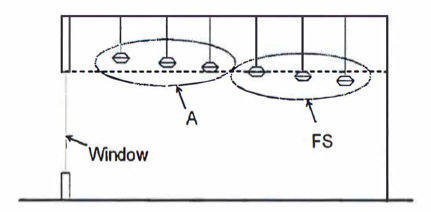 Figure A: Elevation view showing an application of indoor lighting, labeled 'FS,' which is subject to these requirements and indoor lighting, labeled 'A,' which is installed so that it is typically not subject to these requirements.
Temporary lighting means lighting intended for uses of a limited duration; such as holiday decorations, civic events or construction projects.
Total outdoor light output means the total amount of light, as determined by the sum of the initial lamp lumens attributed to each outdoor or exterior light fixture located on the property.
Uplighting means lighting that causes light rays to project above a horizontal plane running through the lowest point on the fixture where light is emitted.
Figure A: Elevation view showing an application of indoor lighting, labeled 'FS,' which is subject to these requirements and indoor lighting, labeled 'A,' which is installed so that it is typically not subject to these requirements.
Temporary lighting means lighting intended for uses of a limited duration; such as holiday decorations, civic events or construction projects.
Total outdoor light output means the total amount of light, as determined by the sum of the initial lamp lumens attributed to each outdoor or exterior light fixture located on the property.
Uplighting means lighting that causes light rays to project above a horizontal plane running through the lowest point on the fixture where light is emitted.
Adopted by Ord. 2021-02-17 on 2/24/2021
Amended by Ord. 2025-05-21A Amend regulations for outdoor/exterior lighting on 5/21/2025
4.08.003 Scope And Applicability
All outdoor or exterior lighting for multifamily and commercial structures shall be installed in conformance with the provisions of this article, applicable electrical codes, energy codes, and building codes, except as provided herein.
- New Construction. All outdoor or exterior lighting associated with newly constructed multifamily and commercial structures permitted after the effective date of this article shall comply with these requirements and other applicable regulations unless otherwise exempted.
- Renovations and Repairs. All multifamily and commercial renovations or repairs requiring a permit after the effective date of this article shall comply with these requirements and other applicable regulations unless otherwise exempted. All renovations or repairs that include installation or replacement of exterior or outdoor lighting in excess of 6,200 lumens within any 90-day period shall require a permit.
- Nonconforming Existing Lighting. All luminaries lawfully in place prior to the date of the ordinance from which this division is derived shall be considered as having legal nonconforming status. However, any luminary that replaces a legal nonconforming luminary, or any legal nonconforming luminary that is moved, must meet the standards of this division, subject to the following conditions.
- If a person makes any change or addition to an existing lighting system, the change or additional shall conform to the provisions for this division.
- If a person makes any change or addition to an existing building which results in an increase in the size of the building by more than twenty percent (20%), the person shall ensure that all existing outdoor lighting shall conform to the provisions of this division.
- Street Lighting. Non-conforming street lights shall be allowed to remain until replacement is otherwise required. Replacement fixtures and lamps shall comply with the requirements of this article as specified below.
- Exemptions and Exceptions.
- Outdoor or exterior lighting fixtures, including landscape lighting with a maximum output (regardless of the number of lamps) of 800 lumens per fixture for shielded fixtures, and 450 lumens per fixture for unshielded fixtures. However, the collective output from these fixtures shall be included in the total output limitation specified below.
- Lighting produced directly or indirectly by the combustion of natural gas, liquid propane or other fossil fuels.
- Nonconforming sports facility lighting prior to 11:00 p.m. or later if required to complete an event in progress prior to that time.
- Flag or flag pole lighting.
- Holiday lights from November 15th to January 15th between 6:00 a.m. and midnight, except that flashing holiday lights are prohibited on commercial properties and discouraged on multifamily properties.
- Temporary lighting for events or construction areas provided the lights do not present a traffic hazard.
- Traffic control signals or devices and specialized or temporary lighting needed for safety, during emergency repairs or by law enforcement, fire and emergency services.
- Lighting required by federal or state laws or regulations, including those required to be installed on motor vehicles or for the safe operation of aircraft.
- Security lighting that is motion sensor activated and remains active no longer than five minutes after motion on the property has ceased.
Adopted by Ord. 2021-02-17 on 2/24/2021
Amended by Ord. 2025-05-21A Amend regulations for outdoor/exterior lighting on 5/21/2025
4.08.004 Procedures And Compliance
- All applications for multifamily and commercial building permits or land use planning review, including subdivision construction plans, which include installation of outdoor lighting fixtures shall include lighting plans conforming to the provisions of these regulations. Submittals shall include the following information as applicable to each specific project:
- Plans indicating the location, type, intensity, and height of all existing and proposed outdoor light fixtures, including those indoor fixtures defined as outdoor or exterior lighting by these provisions;
- Specifications and descriptions of all fixtures, including lamps, photometric data showing the pattern of light emission and intensity, shielding devices, light standards or other supports, which may be provided as manufacturer's standard literature;
- Calculations of the total outdoor light output, the total outdoor light output per acre, the total illuminated property area and both the fixture and lamp data used in the calculations; and
- Additional information requested by P&Z Commission and Assistant Building Official and required to verify compliance.
- Compliance.
- These regulations are not intended to prohibit the use of any design, materials, methods or operation not specifically prescribed herein, provided such alternative has been approved by Assistant Building Official, upon a finding that:
- The alternative meets or exceeds the applicable standard, and
- The alternative is otherwise satisfactory and consistent with the legislative intent of these regulations.
- These regulations are not intended to prohibit the use of any design, materials, methods or operation not specifically prescribed herein, provided such alternative has been approved by Assistant Building Official, upon a finding that:
- Enforcement.
- The city shall have the power to administer and enforce the provisions of this article as specified in Sec. 1.01.009 of the Point Venture Code of Ordinances.
- In case any lighting fixture or structure is erected, constructed or reconstructed, altered, repaired or converted is found to be in violation of this ordinance, the Building Official or designated city official shall institute any appropriate action to put an end to such violation.
- Right of Entry. Upon presentation of proper credentials at the request of the land occupier or owner, the Building Official or designated city official may enter upon any property, vacant lots, or premises in the City to perform any duty imposed by this article.
- Stop Work. The Building Official or designated city official may issue a Stop Work Order to immediately halt work on a property that is in violation of this article. Such order may permit limited work to occur that is necessary to stabilize and secure the site.
- Notice of Violation.
- If the Building Official or designated city official has reason to believe that any of the provisions of this article are being violated, he/she shall provide or send a written Notice of Violation to the person responsible for such violation(s). Such notice shall state the nature of the violation(s) and provide a thirty (30) day grace period to correct the violation(s).
- Notice of violation shall be given by certified mail addressed to the owner at the owner's address as recorded in the appraisal district records of the appraisal district in which the property is located. A notice returned "refused" or "unclaimed" does not affect the validity of the notice and notice is considered delivered.
- If at the end of the 30-day grace period the violation has not, in the judgment of the Building Official or designated city official, been satisfactorily corrected, then civil and/or criminal penalties and other remedies available by law shall be sought.
- Violation; Penalties.
- Any violation of this article is hereby declared to be a public nuisance, justifying the use of any or all remedies available for abatement as specified in those provisions.
- It shall be unlawful for a person, firm or corporation to locate, erect, construct, reconstruct, enlarge, change, maintain, or use any light structure or fixture which emits light onto the property of another in violation of this article.
- Any person, firm or corporation who violates any provision of this article shall be deemed guilty of a misdemeanor, and upon conviction therefore, shall be subject to a fine not to exceed the sum of five hundred dollars ($500.00) for each offense, and each and every day any such offense shall continue shall be deemed to constitute a separate offense.
- The penal provisions imposed under this Ordinance shall not preclude Point Venture from filing suit to enjoin the violation. Point Venture retains all legal rights and remedies available to it pursuant to local, state and federal law.
Adopted by Ord. 2021-02-17 on 2/24/2021
Amended by Ord. 2025-05-21A Amend regulations for outdoor/exterior lighting on 5/21/2025
4.08.005 Lamps, Fixtures, Shielding And Output Limits
- Governmental Owned Street Lights.
- Governmental owned streetlights shall be full cut-off fixtures in order to limit light trespass (see Figure B). To the extent government owned streetlights are replaced or repaired with a light emitting diode (LED) luminaire, the LED luminaire shall have a correlated color temperature not to exceed 3,000 Kelvin. Streetlights associated with new development shall comply with additional requirements contained in the Village’s Code of Ordinances.
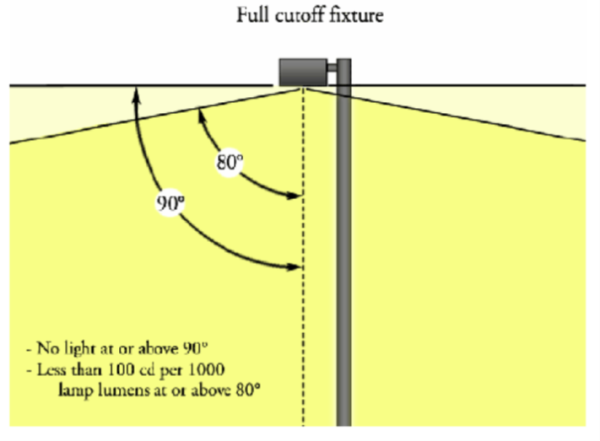 Figure B: Full cutoff fixtures do not allow any light to be emitted above the fixture.
- Governmental owned streetlights shall be full cut-off fixtures in order to limit light trespass (see Figure B). To the extent government owned streetlights are replaced or repaired with a light emitting diode (LED) luminaire, the LED luminaire shall have a correlated color temperature not to exceed 3,000 Kelvin. Streetlights associated with new development shall comply with additional requirements contained in the Village’s Code of Ordinances.
- Shielding.
- All outdoor lighting, except governmental owned streetlights, shall be shielded (see Figures C and D).
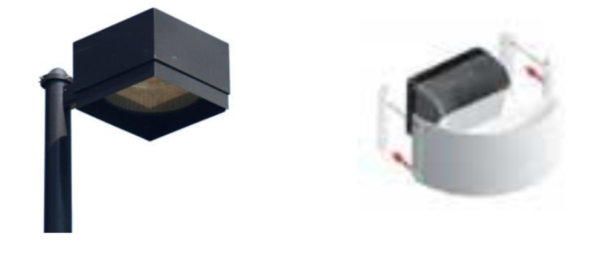 Figure C: Mounting height or proximity to property lines may cause the lamp. Above are two examples of shielding.
Examples of Acceptable / Unacceptable Lighting Fixtures
Figure C: Mounting height or proximity to property lines may cause the lamp. Above are two examples of shielding.
Examples of Acceptable / Unacceptable Lighting Fixtures
 Figure D: The lights on the left are nonconforming due to inadequate shielding. Those on the right can be used in most cases. However, the mounting height and proximity to the property line may require additional shielding to prevent the lamp from being visible from other property.
- AU outdoor light fixtures shall be full cutoff fixtures, except as otherwise permitted by this article (see Figure E for acceptable fixtures and F for unacceptable fixtures).
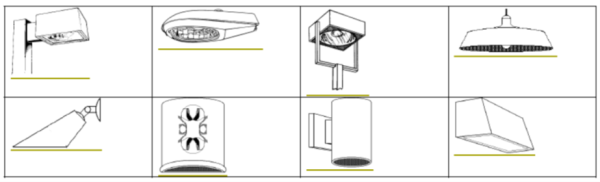 Figure E: Full cutoff fixtures are closed on top and mounted such that the bottom opening is horizontal. The mounting height and location may require additional shielding to prevent the lamp from being visible from any other property. A practical way to determine if a light fixture is a full cutoff fixture is that the lamp, any reflective surface or lens cover (clear or prismatic) is NOT visible when viewed from above or the side.
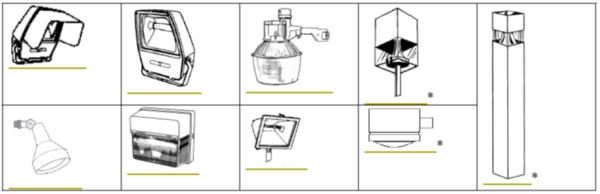 Figure F: This figure illustrates examples of fixtures that are NOT full cutoff fixtures. Note: Even though the lamps in these fixtures are shielded when viewed from the side or above, reflective surfaces within the fixtures or lens covers are directly visible from the side.
- All outdoor lighting, except governmental owned streetlights, shall be shielded (see Figures C and D).
- Output Limits.
- Total outdoor light output (excluding governmental owned street lights used for illumination of public rights-of-way and outdoor recreation facilities) of any commercial property shall not exceed 100,000 lumens per acre in any contiguous illuminated area.
- Total outdoor light output (excluding governmental owned street lights used for illumination of public rights-of-way and outdoor recreation facilities) of any multifamily property shall not exceed 25,000 lumens per acre in any contiguous illuminated area.
- Outdoor Recreation Facilities. Outdoor recreation facilities are not subject to output limits. However, outdoor recreational facilities constructed after the effective date of this article are subject to the shielding requirements above. Where fully shielded fixtures are not available, lighting fixtures using external louvers or shields that, in the final installed configuration, extend to within three inches on the lowest portion of the light fixture opening are required (see Figure G). The fixtures shall be installed and maintained with aiming angles that permit no greater than one percent of the light emitted by each fixture to project above the horizontal.
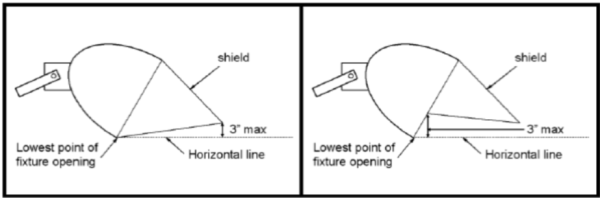 Figure G: Sports lighting where folly shielded fixtures are not available.
 - Prohibitions.
- Outdoor uplighting is prohibited, except in cases where the fixture is shielded by a roof overhang or similar structural shield and a licensed architect or engineer has certified and stamped a prepared lighting plan that ensures that the light fixtures will not cause light to extend beyond the structural shield, except as otherwise permitted elsewhere herein.
- The installation of any mercury vapor fixture or lamp for use as outdoor lighting is prohibited.
- The installation or use of any form of outdoor laser light projection is prohibited.
- The operation of searchlights for advertising purposes is prohibited except when associated with a special event lasting no longer than one night.
- The installation of any wall pack style fixture for use as outdoor lighting is prohibited unless the fixture is rated by the manufacturer as full cut-off and otherwise complies with the shielding requirements of this article. Examples of acceptable wall packs, when mounted with light directed downward only are shown in Figure H.
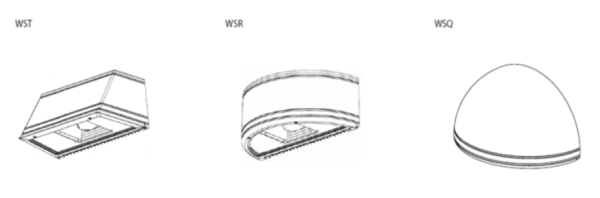 Figure H: Examples of acceptable wall packs.
- The installation of any barn-light style fixture for use as outdoor lighting is prohibited unless the fixture includes a full opaque reflector instead of the standard translucent lens and otherwise complies with the shielding requirements of this article. An example of barn-light style with and without the required opaque reflector is shown in Figure I.
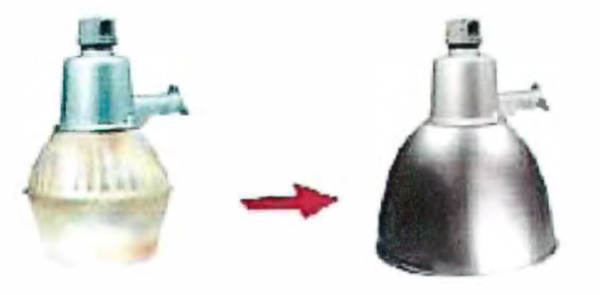 Figure I: Examples of unacceptable and acceptable barn-style light fixture shielding.
Adopted by Ord. 2021-02-17 on 2/24/2021
Amended by Ord. 2025-05-21A Amend regulations for outdoor/exterior lighting on 5/21/2025
4.08.006 Lighting Under Canopies, Building Overhangs Or Roof Eaves
All outdoor or exterior lighting fixtures located under canopies, under building overhangs, or under roof eaves shall conform to all provisions of this article, including the following (see Figures J and K):
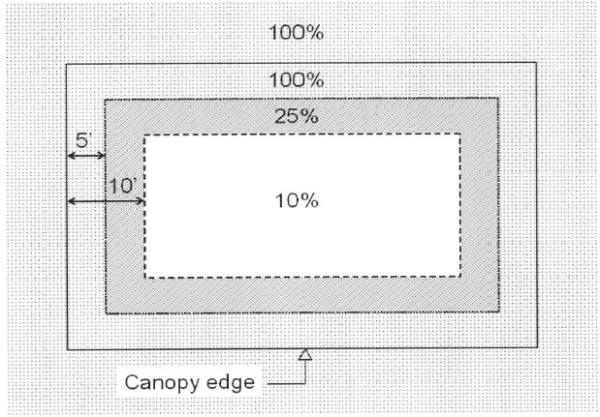 Figure J: Plan view of a canopy, showing fixture location and lumen lamp output percentage counted toward total lumens.
Overhang
Figure J: Plan view of a canopy, showing fixture location and lumen lamp output percentage counted toward total lumens.
Overhang
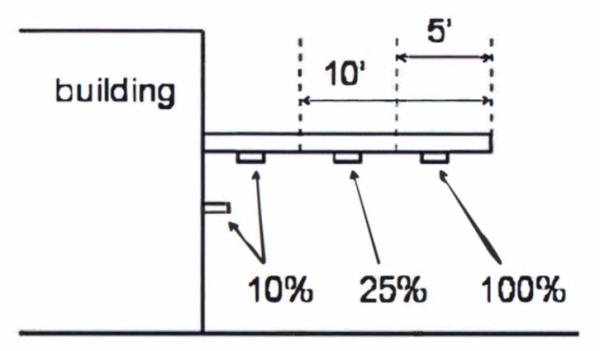 Figure K: Elevation view of a canopy or overhang attached to a building, showing location of shielded fixtures and the initial lamp output percentage to be used in calculating total output lumens.
- Outdoor lighting fixtures located under canopies, under building overhangs, or under roof eaves where the nearest edge of the lamp or fixture is located at five or more feet, but less than ten feet from the nearest edge of a canopy, overhang or eave are to be included in the calculation of total outdoor light output as though they produced only one-quarter of the lamp's rated lumen output.
- Outdoor lighting fixtures located under canopies, under building overhangs, or under roof eaves where the nearest edge of the lamp or fixture is located ten or more feet from the nearest edge of a canopy, building overhang, or eave are to be included in the total outdoor light output as though they produce only one-tenth of the lamp's rated lumen output.
- The total light output used for illuminating under canopies or building overhangs, defined as the sum of all under canopy initial lamp lumen outputs, shall not exceed 20 lumens per square foot under the canopy area. All lighting mounted wider the canopy, including but not limited to, lighting fixtures mounted on the lower surface of the canopy and auxiliary lighting within signage or illuminated panels under the canopy, is to be included in the total.
Adopted by Ord. 2021-02-17 on 2/24/2021
4.08.007 Lighting For Outdoor Signs And Decorative Lighting
- External Sign Lighting. Outdoor externally illuminated signs shall conform to all provisions of this article sign regulations contained in Sec 11.02.005 Point Venture Code of Ordinances and also signage/illumination requirements contained in Zoning Ordinance 2020-06-18 Sec 1.1.7.3. In particular, such lighting shall conform to the lamp source, shielding restrictions and be included in the output limit calculation. All upward-directed sign lighting is prohibited except as expressly stated otherwise herein.
- Internal Sign Lighting and Neon Signs.
- Outdoor internally illuminated signs (backlit), whether freestanding or building-mounted, shall be constructed with an opaque background and translucent letters and symbols or with a colored background and lighter letters and symbols (see Figure L). The internally illuminated or backlit portion of the sign cannot be white, cream, off-white, or yellow unless it is part of a registered logo. White, cream, off-white or yellow are permitted in the logo only, provided that such colors in the logo shall represent not more than one-third of the total sign area permitted.
 Figure L: Internally illuminated Signs
- Lamps used for internal illumination shall not be included in the total outdoor light output calculation.
- Neon signs shall be treated as internally illuminated signs for the purposes of these regulations and shall not be included in the total outdoor light output calculation. However, neon lighting extending beyond the "sign area" as defined in Section 4.801 below, shall be considered decorative lighting as described below.
- Outdoor internally illuminated signs (backlit), whether freestanding or building-mounted, shall be constructed with an opaque background and translucent letters and symbols or with a colored background and lighter letters and symbols (see Figure L). The internally illuminated or backlit portion of the sign cannot be white, cream, off-white, or yellow unless it is part of a registered logo. White, cream, off-white or yellow are permitted in the logo only, provided that such colors in the logo shall represent not more than one-third of the total sign area permitted.
- Decorative (non-sign) Lighting. Other internally illuminated panels or decorations not considered signage (such as illuminated canopy margins or building panels), shall be considered decorative lighting, and shall be subject to the standards applicable to outdoor or exterior lighting, including but not limited to lamp source, shielding standards and total outdoor light output limits.
- Destination Wayfinding Sign Lighting. Lighting for destination wayfinding signs shall be provided by ground mounted fixtures directly in front of the sign faces, with light sources shielded from public right-of-ways and limited to arterial street locations. Destination wayfinding signs on other streets shall include reflective surfaces and may not be illuminated.
Adopted by Ord. 2021-02-17 on 2/24/2021
4.08.008 Lighting Curfews
- Commercial outdoor or exterior lighting shall not be energized more than 30 minutes after closing or the completion of activities, unless reduced to 25% or less of the total light output allowed.
- Motion sensor activation is allowed to cause the light to resume total outdoor light output but shall be reduced back to 25% or less of total outdoor light output allowed within 5 minutes after activation motion has ceased. Light output increases shall not be triggered by activity that occurs on other property.
- The required reduction in illumination may be accomplished by dimming, by turning off a certain number of light fixtures, by a combination of the two methods, or by any other action that yields the specified results.
- Motion sensor activation is allowed to cause the light to resume total outdoor light output but shall be reduced back to 25% or less of total outdoor light output allowed within 5 minutes after activation motion has ceased. Light output increases shall not be triggered by activity that occurs on other property.
- Illumination for all advertising signs, both externally and internally illuminated, shall be turned-off by the later of closing time or 10:00 p.m. Illumination for advertising signs may be energized prior to sunrise, but no more than one hour prior to opening.
- Street lighting, other than at the intersection of roadways, shall utilize half night photocells or timers to turn off the lights halfway between dusk and dawn.
Adopted by Ord. 2021-02-17 on 2/24/2021
Amended by Ord. 2025-05-21A Amend regulations for outdoor/exterior lighting on 5/21/2025
4.05.001 Findings Of Fact
- The recitals in Ordinance 2009-11-01 are incorporated into this article by reference as findings of fact as if expressly set forth herein.
- The flood hazard areas of the village are subject to periodic inundation, which results in loss of life and property, health and safety hazards, disruption of commerce and governmental services, and extraordinary public expenditures for flood protection and relief, all of which adversely affect the public health, safety and general welfare.
- These flood losses are created by the cumulative effect of obstructions in floodplains which cause an increase in flood heights and velocities, and by the occupancy of flood hazard areas by uses vulnerable to floods and hazardous to other lands because they are inadequately elevated, flood-proofed or otherwise protected from flood damage.
4.05.002 Statutory Authorization
The legislature of the state has, in Texas Water Code section 16.315, delegated the responsibility to local governmental units to adopt regulations designed to minimize flood losses.
4.05.003 Statement Of Purpose
It is the purpose of this article to promote the public health, safety and general welfare and to minimize public and private losses due to flood conditions in specific areas by provisions designed to:
- Protect human life and health;
- Minimize expenditure of public money for costly flood control projects;
- Minimize the need for rescue and relief efforts associated with flooding and generally undertaken at the expense of the general public;
- Minimize prolonged business interruptions;
- Minimize damage to public facilities and utilities such as water and gas mains, electric, telephone and sewer lines, streets and bridges located in floodplains;
- Help maintain a stable tax base by providing for the sound use and development of floodprone areas in such a manner as to minimize future flood blight areas; and
- Insure that potential buyers are notified that property is in a flood area.
4.05.004 Methods Of Reducing Flood Losses
In order to accomplish its purposes, this article uses the following methods:
- Restrict or prohibit uses that are dangerous to health, safety or property in times of flood, or cause excessive increases in flood heights or velocities;
- Require that uses vulnerable to floods, including facilities which serve such uses, be protected against flood damage at the time of initial construction;
- Control the alteration of natural floodplains, stream channels, and natural protective barriers, which are involved in the accommodation of floodwaters;
- Control filling, grading, dredging and other development which may increase flood damage;
- Prevent or regulate the construction of flood barriers which will unnaturally divert floodwaters or which may increase flood hazards to other lands.
4.05.005 Definitions
Unless specifically defined below, words or phrases used in this article shall be interpreted to give them the meaning they have in common usage and to give this article its most reasonable application.
Alluvial fan flooding means flooding occurring on the surface of an alluvial fan or similar landform which originates at the apex and is characterized by high-velocity flows; active processes of erosion, sediment transport, and deposition; and unpredictable flow paths.
Apex means a point on an alluvial fan or similar landform below which the flow path of the major stream that formed the fan becomes unpredictable and alluvial fan flooding can occur.
Appurtenant structure means a structure which is on the same parcel of property as the principal structure to be insured and the use of which is incidental to the use of the principal structure.
Area of future conditions flood hazard means the land area that would be inundated by the 1 percent annual chance (100-year) flood based on future conditions hydrology.
Area of shallow flooding means a designated AO, AH, AR/AO, AR/AH, or VO zone on a community’s flood insurance rate map (FIRM) with a 1 percent or greater annual chance of flooding to an average depth of 1 to 3 feet where a clearly defined channel does not exist, where the path of flooding is unpredictable and where velocity flow may be evident. Such flooding is characterized by ponding or sheet flow.
Area of special flood hazard is the land in the floodplain within a community subject to a 1 percent or greater chance of flooding in any given year. The area may be designated as zone A on the flood hazard boundary map (FHBM). After detailed rate-making has been completed in preparation for publication of the FIRM, zone A usually is refined into zones A, AO, AH, A1-30, AE, A99, AR, AR/A1-30, AR/AE, AR/AO, AR/AH, AR/A, VO, V1-30, VE or V.
Base flood means the flood having a 1 percent chance of being equaled or exceeded in any given year.
Basement means any area of the building having its floor subgrade (below ground level) on all sides.
Breakaway wall means a wall that is not part of the structural support of the building and is intended through its design and construction to collapse under specific lateral loading forces, without causing damage to the elevated portion of the building or supporting foundation system.
Critical feature means an integral and readily identifiable part of a flood protection system, without which the flood protection provided by the entire system would be compromised.
Development means any man-made change to improved and unimproved real estate, including but not limited to buildings or other structures, mining, dredging, filling, grading, paving, excavation or drilling operations or storage of equipment or materials.
Elevated building means, for insurance purposes, a non-basement building which has its lowest elevated floor raised above ground level by foundation walls, shear walls, posts, piers, pilings, or columns.
Existing construction means, for the purposes of determining rates, structures for which the “start of construction” commenced before the effective date of the FIRM or before January 1, 1975, for FIRMs effective before that date. “Existing construction” may also be referred to as “existing structures.”
Existing manufactured home park or subdivision means a manufactured home park or subdivision for which the construction of facilities for servicing the lots on which the manufactured homes are to be affixed (including, at a minimum, the installation of utilities, the construction of streets, and either final site grading or the pouring of concrete pads) is completed before the effective date of the floodplain management regulations adopted by a community.
Expansion to an existing manufactured home park or subdivision means the preparation of additional sites by the construction of facilities for servicing the lots on which the manufactured homes are to be affixed (including the installation of utilities, the construction of streets, and either final site grading or the pouring of concrete pads).
Flood or flooding means a general and temporary condition of partial or complete inundation of normally dry land areas from:
- The overflow of inland or tidal waters; or
- The unusual and rapid accumulation or runoff of surface waters from any source.
Flood elevation study means an examination, evaluation and determination of flood hazards and, if appropriate, corresponding water surface elevations, or an examination, evaluation and determination of mudslide (i.e., mudflow) and/or flood-related erosion hazards.
Flood insurance rate map (FIRM) means an official map of a community, on which the Federal Emergency Management Agency has delineated both the special flood hazard areas and the risk premium zones applicable to the community.
Flood insurance study (FIS). See “Flood elevation study.”
Floodplain or floodprone area means any land area susceptible to being inundated by water from any source (see definition of flooding).
Floodplain management means the operation of an overall program of corrective and preventive measures for reducing flood damage, including but not limited to emergency preparedness plans, flood control works and floodplain management regulations.
Floodplain management regulations means zoning ordinances, subdivision regulations, building codes, health regulations, special purpose ordinances (such as a floodplain ordinance, grading ordinance and erosion control ordinance) and other applications of police power. The term describes such state or local regulations, in any combination thereof, which provide standards for the purpose of flood damage prevention and reduction.
Flood protection system means those physical structural works for which funds have been authorized, appropriated, and expended and which have been constructed specifically to modify flooding in order to reduce the extent of the area within a community subject to a “special flood hazard” and the extent of the depths of associated flooding. Such a system typically includes hurricane tidal barriers, dams, reservoirs, levees or dikes. These specialized flood-modifying works are those constructed in conformance with sound engineering standards.
Floodproofing means any combination of structural and nonstructural additions, changes, or adjustments to structures which reduce or eliminate flood damage to real estate or improved real property, water and sanitary facilities, structures and their contents.
Floodway. See “Regulatory floodway.”
Functionally dependent use means a use which cannot perform its intended purpose unless it is located or carried out in close proximity to water. The term includes only docking facilities or port facilities that are necessary for the loading and unloading of cargo or passengers, and ship building and ship repair facilities, but does not include long-term storage or related manufacturing facilities.
Highest adjacent grade means the highest natural elevation of the ground surface prior to construction next to the proposed walls of a structure.
Historic structure means any structure that is:
- Listed individually in the National Register of Historic Places (a listing maintained by the Department of the Interior) or preliminarily determined by the Secretary of the Interior as meeting the requirements for individual listing on the National Register;
- Certified or preliminarily determined by the Secretary of the Interior as contributing to the historical significance of a registered historic district or a district preliminarily determined by the Secretary to qualify as a registered historic district;
- Individually listed on a state inventory of historic places in states with historic preservation programs which have been approved by the Secretary of the Interior; or
- Individually listed on a local inventory of historic places in communities with historic preservation programs that have been certified either:
- By an approved state program as determined by the Secretary of the Interior; or
- Directly by the Secretary of the Interior in states without approved programs.
Levee means a man-made structure, usually an earthen embankment, designed and constructed in accordance with sound engineering practices to contain, control, or divert the flow of water so as to provide protection from temporary flooding.
Levee system means a flood protection system which consists of a levee, or levees, and associated structures, such as closure and drainage devices, which are constructed and operated in accordance with sound engineering practices.
Lowest floor means the lowest floor of the lowest enclosed area (including basement). An unfinished or flood-resistant enclosure, usable solely for parking of vehicles, building access or storage in an area other than a basement area is not considered a building’s lowest floor, provided that such enclosure is not built so as to render the structure in violation of the applicable non-elevation design requirement of section 60.3 of the National Flood Insurance Program regulations.
Manufactured home means a structure transportable in one or more sections, which is built on a permanent chassis and is designed for use with or without a permanent foundation when connected to the required utilities. The term “manufactured home” does not include a “recreational vehicle.”
Manufactured home park or subdivision means a parcel (or contiguous parcels) of land divided into two or more manufactured home lots for rent or sale.
Mean sea level means, for purposes of the National Flood Insurance Program, the National Geodetic Vertical Datum (NGVD) of 1929 or other datum, to which base flood elevations shown on a community’s flood insurance rate map are referenced.
New construction means, for the purpose of determining insurance rates, structures for which the “start of construction” commenced on or after the effective date of an initial FIRM or after December 31, 1974, whichever is later, and includes any subsequent improvements to such structures. For floodplain management purposes, “new construction” means structures for which the “start of construction” commenced on or after the effective date of a floodplain management regulation adopted by a community and includes any subsequent improvements to such structures.
New manufactured home park or subdivision means a manufactured home park or subdivision for which the construction of facilities for servicing the lots on which the manufactured homes are to be affixed (including, at a minimum, the installation of utilities, the construction of streets, and either final site grading or the pouring of concrete pads) is completed on or after the effective date of floodplain management regulations adopted by a community.
Recreational vehicle means a vehicle which is:
- Built on a single chassis;
- 400 square feet or less when measured at the largest horizontal projections;
- Designed to be self-propelled or permanently towable by a light duty truck; and
- Designed primarily not for use as a permanent dwelling but as temporary living quarters for recreational, camping, travel, or seasonal use.
Regulatory floodway means the channel of a river or other watercourse and the adjacent land areas that must be reserved in order to discharge the base flood without cumulatively increasing the water surface elevation more than a designated height.
Riverine means relating to, formed by, or resembling a river (including tributaries), stream, brook, etc.
Special flood hazard area. See “Area of special flood hazard.”
Start of construction, for other than new construction or substantial improvements under the Coastal Barrier Resources Act (Pub. L. 97-348), includes substantial improvement and means the date the building permit was issued, provided the actual start of construction, repair, reconstruction, rehabilitation, addition, placement, or other improvement was within 180 days of the permit date. The actual start means either the first placement of permanent construction of a structure on a site, such as the pouring of slab or footings, the installation of piles, the construction of columns, or any work beyond the stage of excavation; or the placement of a manufactured home on a foundation. Permanent construction does not include land preparation, such as clearing, grading and filling; nor does it include the installation of streets and/or walkways; nor does it include excavation for basement, footings, piers or foundations or the erection of temporary forms; nor does it include the installation on the property of accessory buildings, such as garages or sheds not occupied as dwelling units or not part of the main structure. For a substantial improvement, the actual start of construction means the first alteration of any wall, ceiling, floor, or other structural part of a building, whether or not that alteration affects the external dimensions of the building.
Structure means, for floodplain management purposes, a walled and roofed building, including a gas or liquid storage tank, that is principally above ground, as well as a manufactured home.
Substantial damage means damage of any origin sustained by a structure whereby the cost of restoring the structure to its before-damaged condition would equal or exceed 50 percent of the market value of the structure before the damage occurred.
Substantial improvement means any reconstruction, rehabilitation, addition, or other improvement of a structure, the cost of which equals or exceeds 50 percent of the market value of the structure before “start of construction” of the improvement. This term includes structures which have incurred “substantial damage,” regardless of the actual repair work performed. The term does not, however, include either:
- Any project for improvement of a structure to correct existing violations of state or local health, sanitary, or safety code specifications which have been identified by the local code enforcement official and which are the minimum necessary to assure safe living conditions; or
- Any alteration of a “historic structure,” provided that the alteration will not preclude the structure’s continued designation as a “historic structure.”
Variance means a grant of relief by a community from the terms of a floodplain management regulation. (For full requirements see section 60.6 of the National Flood Insurance Program regulations.)
Violation means the failure of a structure or other development to be fully compliant with the community’s floodplain management regulations. A structure or other development without the elevation certificate, other certifications, or other evidence of compliance required in section 60.3(b)(5), (c)(4), (c)(10), (d)(3), (e)(2), (e)(4), or (e)(5) of the National Flood Insurance Program regulations is presumed to be in violation until such time as that documentation is provided.
Water surface elevation means the height, in relation to the National Geodetic Vertical Datum (NGVD) of 1929 (or other datum, where specified), of floods of various magnitudes and frequencies in the floodplains of coastal or riverine areas.
4.05.006 Lands To Which This Article Applies
This article shall apply to all areas of special flood hazard within the corporate limits of the village.
4.05.007 Basis For Establishing Areas Of Special Flood Hazard
The areas of special flood hazard identified by the Federal Emergency Management Agency in the current scientific and engineering report entitled, “The Flood Insurance Study (FIS) for Travis County and Incorporated Areas,” dated September 26, 2008, with accompanying flood insurance rate maps and/or flood boundary-floodway maps (FIRM and/or FBFM), index panels 48453C0195H and 48453C0215H, dated September 26, 2008 and September 26, 2008 respectively, and any revisions thereto are hereby adopted by reference and declared to be a part of this article.
4.05.008 Establishment Of Development Permit
A floodplain development permit shall be required to ensure conformance with the provisions of this article.
4.05.009 Compliance
No structure or land shall hereafter be located, altered, or have its use changed without full compliance with the terms of this article and other applicable regulations.
4.05.010 Abrogation And Greater Restrictions
This article is not intended to repeal, abrogate, or impair any existing easements, covenants, or deed restrictions. However, where this article and another ordinance, easement, covenant, or deed restriction conflict or overlap, whichever imposes the more stringent restrictions shall prevail.
4.05.011 Interpretation
In the interpretation and application of this article, all provisions shall be:
- Considered as minimum requirements;
- Liberally construed in favor of the governing body; and
- Deemed neither to limit nor repeal any other powers granted under state statutes.
4.05.012 Warning And Disclaimer Of Liability
The degree of flood protection required by this article is considered reasonable for regulatory purposes and is based on scientific and engineering considerations. On rare occasions greater floods can and will occur and flood heights may be increased by man-made or natural causes. This article does not imply that land outside the areas of special flood hazards or uses permitted within such areas will be free from flooding or flood damages. This article shall not create liability on the part of the community or any official or employee thereof for any flood damages that result from reliance on this article or any administrative decision lawfully made hereunder.
4.05.013 Enforcement; Penalties
Any person violating this article, upon conviction, is punishable by a fine in accordance with the following:
- Civil and criminal penalties. The village shall have the power to administer and enforce the provisions of this article as may be required by governing law. Any person violating any provision of this article is subject to suit for injunctive relief as well as prosecution for criminal violations.
- Criminal prosecution. Any person violating any provision of this article shall, upon conviction, be fined a sum in accordance with the general penalty provided in section 1.01.009 of this code. Each day that a provision of this article is violated shall constitute a separate offense. An offense under this article is a misdemeanor.
- Civil remedies. Nothing in this article shall be construed as a waiver of the village’s right to bring a civil action to enforce the provisions of this article and to seek remedies as allowed by law, including but not limited to the following:
- Injunctive relief to prevent specific conduct that violates this article or to require specific conduct that is necessary for compliance with this article;
- A civil penalty up to one thousand dollars ($1,000.00) a day (with each day constituting a separate offense and separate violation) when it is shown that the defendant was actually notified of the provisions of this article and after receiving notice committed acts in violation of this article or failed to take action necessary for compliance with this article; and
- Other available relief.
4.05.041 Designation Of Floodplain Administrator
The mayor of the village, or the mayor’s designee, is hereby appointed as the floodplain administrator to administer and implement the provisions of this article and other appropriate sections of 44 CFR (Emergency Management and Assistance, National Flood Insurance Program Regulations) pertaining to floodplain management.
4.05.042 Duties And Responsibilities Of Floodplain Administrator
Duties and responsibilities of the floodplain administrator shall include, but not be limited to, the following:
- Maintain and hold open for public inspection all records pertaining to the provisions of this article.
- Review permit applications to determine whether to ensure that the proposed building site project, including the placement of manufactured homes, will be reasonably safe from flooding.
- Review, approve, or deny all applications for development permits required by adoption of this article.
- Review permits for proposed development to assure that all necessary permits have been obtained from those federal, state, or local governmental agencies (including section 404 of the Federal Water Pollution Control Act Amendments of 1972, 33 U.S.C. 1344) from which prior approval is required.
- Where interpretation is needed as to the exact location of the boundaries of the areas of special flood hazards (for example, where there appears to be a conflict between a mapped boundary and actual field conditions), the floodplain administrator shall make the necessary interpretation.
- Notify, in riverine situations, adjacent communities and the state coordinating agency, which is the state commission on environmental quality (TCEQ), prior to any alteration or relocation of a watercourse, and submit evidence of such notification to the Federal Emergency Management Agency.
- Assure that the flood-carrying capacity within the altered or relocated portion of any watercourse is maintained.
- When base flood elevation data has not been provided in accordance with section 4.05.007, the floodplain administrator shall obtain, review and reasonably utilize any base flood elevation data and floodway data available from a federal, state or other source, in order to administer the provisions of division 3 of this article.
- When a regulatory floodway has not been designated, the floodplain administrator must require that no new construction, substantial improvements, or other development (including fill) be permitted within zones A1-30 and AE on the community’s FIRM, unless it is demonstrated that the cumulative effect of the proposed development, when combined with all other existing and anticipated development, will not increase the water surface elevation of the base flood more than one foot at any point within the community.
- Under the provisions of 44 CFR section 65.12, of the National Flood Insurance Program regulations, a community may approve certain development in zones A1-30, AE, and AH on the community’s FIRM which increases the water surface elevation of the base flood by more than 1 foot, provided that the community first completes all of the provisions required by section 65.12.
4.05.043 Permit Procedures
- Application for a floodplain development permit shall be presented to the floodplain administrator on forms furnished by him/her and shall include, but not be limited to, plans in triplicate drawn to scale showing the location, dimensions, and elevation of proposed landscape alterations, existing and proposed structures, including the placement of manufactured homes, and the location of the foregoing in relation to areas of special flood hazard. Additionally, the following information is required:
- Elevation (in relation to mean sea level) of the lowest floor (including basement) of all new and substantially improved structures;
- Elevation in relation to mean sea level to which any nonresidential structure shall be floodproofed;
- A certificate from a registered professional engineer or architect that the nonresidential floodproofed structure shall meet the floodproofing criteria of section 4.05.072(b);
- Description of the extent to which any watercourse or natural drainage will be altered or relocated as a result of proposed development; and
- Maintain a record of all such information in accordance with section 4.05.042(a).
- Approval or denial of a floodplain development permit by the floodplain administrator shall be based on all of the provisions of this article and the following relevant factors:
- The danger to life and property due to flooding or erosion damage;
- The susceptibility of the proposed facility and its contents to flood damage and the effect of such damage on the individual owner;
- The danger that materials may be swept onto other lands to the injury of others;
- The compatibility of the proposed use with existing and anticipated development;
- The safety of access to the property in times of flood for ordinary and emergency vehicles;
- The costs of providing governmental services during and after flood conditions, including maintenance and repair of streets and bridges, and public utilities and facilities such as sewer, gas, electrical and water systems;
- The expected heights, velocity, duration, rate of rise and sediment transport of the floodwaters and the effects of wave action, if applicable, expected at the site;
- The necessity to the facility of a waterfront location, where applicable; and
- The availability of alternative locations, not subject to flooding or erosion damage, for the proposed use.
4.05.044 Variance Procedures
- The village council shall hear and render judgment on requests for variances from the requirements of this article.
- The village council shall hear and render judgment on an appeal only when it is alleged there is an error in any requirement, decision, or determination made by the floodplain administrator in the enforcement or administration of this article.
- Any person or persons aggrieved by the decision of the village council may appeal such decision in the courts of competent jurisdiction.
- The floodplain administrator shall maintain a record of all actions involving an appeal and shall report variances to the Federal Emergency Management Agency upon request.
- Variances may be issued for the reconstruction, rehabilitation, or restoration of structures listed on the National Register of Historic Places or the state inventory of historic places, without regard to the procedures set forth in the remainder of this article.
- Variances may be issued for new construction and substantial improvements to be erected on a lot of 1/2 acre or less in size contiguous to and surrounded by lots with existing structures constructed below the base flood level, providing the relevant factors in section 4.05.043(b) of this article have been fully considered. As the lot size increases beyond the 1/2 acre, the technical justification required for issuing the variance increases.
- Upon consideration of the factors noted above and the intent of this article, the village council may attach such conditions to the granting of variances as it deems necessary to further the purpose and objectives of this article (section 4.05.003).
- Variances shall not be issued within any designated floodway if any increase in flood levels during the base flood discharge would result.
- Variances may be issued for the repair or rehabilitation of historic structures upon a determination that the proposed repair or rehabilitation will not preclude the structure’s continued designation as a historic structure and the variance is the minimum necessary to preserve the historic character and design of the structure.
- Prerequisites for granting variances:
- Variances shall only be issued upon a determination that the variance is the minimum necessary, considering the flood hazard, to afford relief.
- Variances shall only be issued upon:
- Showing a good and sufficient cause;
- A determination that failure to grant the variance would result in exceptional hardship to the applicant; and
- A determination that the granting of a variance will not result in increased flood heights, additional threats to public safety, or extraordinary public expense, create nuisances, cause fraud on or victimization of the public, or conflict with existing local laws or ordinances.
- Any applicant to which a variance is granted shall be given written notice that the structure will be permitted to be built with the lowest floor elevation below the base flood elevation, and that the cost of flood insurance will be commensurate with the increased risk resulting from the reduced lowest floor elevation.
- Variances may be issued by a community for new construction and substantial improvements and for other development necessary for the conduct of a functionally dependent use provided that:
- The criteria outlined in subsections (a) through (i) of this section are met; and
- The structure or other development is protected by methods that minimize flood damages during the base flood and create no additional threats to public safety.
4.05.071 General Standards
In all areas of special flood hazards the following provisions are required for all new construction and substantial improvements:
- All new construction or substantial improvements shall be designed (or modified) and adequately anchored to prevent flotation, collapse or lateral movement of the structure resulting from hydrodynamic and hydrostatic loads, including the effects of buoyancy;
- All new construction or substantial improvements shall be constructed by methods and practices that minimize flood damage;
- All new construction or substantial improvements shall be constructed with materials resistant to flood damage;
- All new construction or substantial improvements shall be constructed with electrical, heating, ventilation, plumbing, and air conditioning equipment and other service facilities that are designed and/or located so as to prevent water from entering or accumulating within the components during conditions of flooding;
- All new and replacement water supply systems shall be designed to minimize or eliminate infiltration of floodwaters into the system;
- New and replacement sanitary sewage systems shall be designed to minimize or eliminate infiltration of floodwaters into the system and discharge from the systems into floodwaters; and
- On-site waste disposal systems shall be located to avoid impairment to them or contamination from them during flooding.
4.05.072 Specific Standards
In all areas of special flood hazards where base flood elevation data has been provided as set forth in section 4.05.007, section 4.05.042(8), or section 4.05.073(c), the following provisions are required:
- Residential construction. New construction and substantial improvement of any residential structure shall have the lowest floor (including basement) elevated to or above the base flood elevation plus 1 foot. A registered professional engineer, architect, or land surveyor shall submit a certification to the floodplain administrator that the standard of this subsection, as proposed in section 4.05.043(a)(1), is satisfied.
- Nonresidential construction. New construction and substantial improvements of any commercial, industrial or other nonresidential structure shall either have the lowest floor (including basement) elevated to or above the base flood elevation plus 1 foot or, together with attendant utility and sanitary facilities, be designed so that below the base flood elevation plus 1 foot the structure is watertight with walls substantially impermeable to the passage of water and with structural components having the capability of resisting hydrostatic and hydrodynamic loads and effects of buoyancy. A registered professional engineer or architect shall develop and/or review structural design, specifications, and plans for the construction, and shall certify that the design and methods of construction are in accordance with accepted standards of practice as outlined in this subsection. A record of such certification which includes the specific elevation (in relation to mean sea level) to which such structures are floodproofed shall be maintained by the floodplain administrator.
- Enclosures. New construction and substantial improvements with fully enclosed areas below the lowest floor that are usable solely for parking of vehicles, building access or storage in an area other than a basement and which are subject to flooding shall be designed to automatically equalize hydrostatic flood forces on exterior walls by allowing for the entry and exit of floodwaters. Designs for meeting this requirement must either be certified by a registered professional engineer or architect or meet or exceed the following minimum criteria:
- A minimum of two openings on separate walls having a total net area of not less than one square inch for every square foot of enclosed area subject to flooding shall be provided.
- The bottom of all openings shall be no higher than 1 foot above grade.
- Openings may be equipped with screens, louvers, valves, or other coverings or devices provided that they permit the automatic entry and exit of floodwaters.
- Manufactured homes.
- Require that all manufactured homes to be placed within zone A on a community’s FHBM or FIRM shall be installed using methods and practices which minimize flood damage. For the purposes of this requirement, manufactured homes must be elevated and anchored to resist flotation, collapse, or lateral movement. Methods of anchoring may include, but are not limited to, use of over-the-top or frame ties to ground anchors. This requirement is in addition to applicable state and local anchoring requirements for resisting wind forces.
- Require that manufactured homes that are placed or substantially improved within zones A1-30, AH, and AR on the community’s FIRM on sites:
- Outside of a manufactured home park or subdivision;
- In a new manufactured home park or subdivision;
- In an expansion to an existing manufactured home park or subdivision; or
- In an existing manufactured home park or subdivision on which a manufactured home has incurred “substantial damage” as a result of a flood;
- Require that manufactured homes being placed or substantially improved on sites in an existing manufactured home park or subdivision within zones A1-30, AH and AE on the community’s FIRM that are not subject to the provisions of subsection (4) of this section be elevated so that either:
- The lowest floor of the manufactured home is at or above the base flood elevation plus 1 foot; or
- The manufactured home chassis is supported by reinforced piers or other foundation elements of at least equivalent strength that are no less than 36 inches in height above grade and be securely anchored to an adequately anchored foundation system to resist flotation, collapse, and lateral movement.
- Recreational vehicles. Require that recreational vehicles placed on sites within zones A1-30, AH, and AR on the community’s FIRM either:
- Be on the site for fewer than 180 consecutive days;
- Be fully licensed and ready for highway use; or
- Meet the permit requirements of section 4.05.043(a), and the elevation and anchoring requirements for “manufactured homes” in subsection (4) of this section.
4.05.073 Standards For Subdivision Proposals
- All subdivision proposals, including the placement of manufactured home parks and subdivisions, shall be consistent with sections 4.05.002, 4.05.003, and 4.05.004 of this article.
- All proposals for the development of subdivisions, including the placement of manufactured home parks and subdivisions, shall meet the floodplain development permit requirements of section 4.05.008 and section 4.05.043, and the provisions of division 3 of this article.
- Base flood elevation data shall be generated for subdivision proposals and other proposed development, including the placement of manufactured home parks and subdivisions, which is greater than 50 lots or 5 acres, whichever is lesser, if not otherwise provided pursuant to section 4.05.007 or section 4.05.042(h) of this article.
- All subdivision proposals, including the placement of manufactured home parks and subdivisions, shall have adequate drainage provided to reduce exposure to flood hazards.
- All subdivision proposals, including the placement of manufactured home parks and subdivisions, shall have public utilities and facilities such as sewer, gas, electrical and water systems located and constructed to minimize or eliminate flood damage.
4.05.074 Standards For Areas Of Shallow Flooding (AO/AH Zones)
Located within the areas of special flood hazard established in section 4.05.007 are areas designated as shallow flooding. These areas have special flood hazards associated with flood depths of 1 to 3 feet where a clearly defined channel does not exist, where the path of flooding is unpredictable, and where velocity flow may be evident. Such flooding is characterized by ponding or sheet flow; therefore, the following provisions apply:
- All new construction and substantial improvements of residential structures have the lowest floor (including basement) elevated to or above the base flood elevation or the highest adjacent grade at least as high as the depth number specified in feet on the community’s FIRM (at least 2 feet if no depth number is specified); or
- All new construction and substantial improvements of nonresidential structures:
- Have the lowest floor (including basement) elevated to or above the base flood elevation or the highest adjacent grade at least as high as the depth number specified in feet on the community’s FIRM (at least two feet if no depth number is specified); or
- Together with attendant utility and sanitary facilities be designed so that below the base specified flood depth in an AO zone, or below the base flood elevation in an AH zone, level the structure is watertight with walls substantially impermeable to the passage of water and with structural components having the capability of resisting hydrostatic and hydrodynamic loads of and effects of buoyancy.
- A registered professional engineer or architect shall submit a certification to the floodplain administrator that the standards of this section, as proposed in section 4.05.043, are satisfied.
- Require within zone AH or AO adequate drainage paths around structures on slopes, to guide floodwaters around and away from proposed structures.
(Ordinance 2003-12-01 adopted 12/1/03; Ordinance 2009-11-01 adopted 11/2/09; Ordinance adopting Code)

