
Point Venture City Zoning Code
CHAPTER 9
PLANNING AND DEVELOPMENT REGULATIONS
ARTICLE 9.01 GENERAL PROVISIONS (RESERVED)
State law references–Planning and zoning generally, V.T.C.A., Local Government Code, chs. 211, 212, 371.
EXHIBIT B ZONING MAP
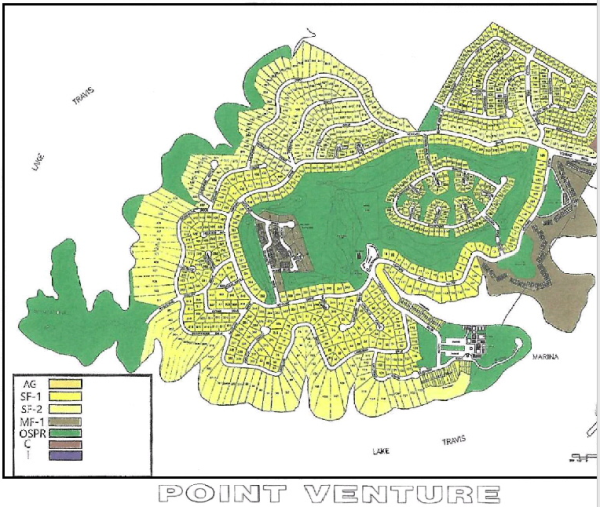
(Ordinance 2020-06-18, ex. B, adopted 6/17/20)
2021-09-15
2025-06-18C
2023-07-19
2025-06-18
2025-06-18A
2025-06-18B
2025-11-19A
9.02.001 Title
This article shall be commonly known and cited as the lot clearing ordinance. (Ordinance 2009-06-01, sec. 1, adopted 6/1/09)
9.02.002 Purpose
This article is adopted so that the village council may promote the public health, safety, and general welfare within the village through the establishment of standards of practice for the preservation of trees and native landscaping in development areas in order to better control soil erosion and the transport of sediment, preserve the environmental quality of surface and ground waters, screen noise, and protect and enhance scenic vistas and wildlife habitat. By and through this article, the village council seeks to allow construction while minimizing the impact to woodland areas and encouraging reforestation within the corporate boundaries of the village. (Ordinance 2009-06-01, sec. 2, adopted 6/1/09)
9.02.003 Scope
This article shall only apply to vacant lots within the village limits. (Ordinance 2009-06-01, sec. 3, adopted 6/1/09)
9.02.004 Definitions
- General provisions. Words and phrases used in this article shall have the meanings set forth in this section. Words and phrases that are not defined in this article but are defined in other ordinances of the village shall be given the meanings set forth in those ordinances. Other words and phrases shall be given their common, ordinary meaning unless the context clearly requires otherwise. Headings and captions are for reference purposes only, and shall not be used in the interpretation of this article.
- Specific definitions.
Applicant means the person seeking approval from the village. The applicant may be the property owner, or an authorized agent/representative of the property owners.
Building official means the person appointed by the village council to advise the village council and administer the village’s construction codes and building regulations, including but not limited to lot clearing, tree trimming, landscaping, and drainage regulations. The building official serves as the administrative enforcer of this article.
Clear means to make a material change in the character of the land, including but not limited to the mechanical extraction of vegetation, removal of brush, cutting of protected trees, or modification of the natural grade or slope of the land.
Emergency means situations in which the grade of the land or conditions of the trees pose an imminent threat to public health, safety or welfare; are an immediate hindrance to vehicular or pedestrian traffic; block public access to roadways or driveways; or endanger public utility facilities.
Flood hazard boundary map (FHBM) means an official map of a community, issued by the administrator, where the boundaries of the flood, and mudslide (i.e., mudflow) related erosion areas having special hazards have been designated.
Flood insurance rate map (FIRM) means an official map of a community, on which the Federal Emergency Management Agency has delineated both the special flood hazard areas and the risk premium zones applicable to the community.
Floodplain means the areas of special flood hazard identified by the Federal Emergency Management Agency in the flood insurance rate map (FIRM) or flood hazard boundary map (FHBM).
Person means any human individual or corporation, organization, government or governmental subdivision or agency, business trust, estate, trust, partnership, association, and any other legal entity.
Protected tree means a tree that warrants special consideration due to its environmental and aesthetic significance to the Lake Travis region. Specifically, the term includes any tree with a trunk having a diameter greater than four (4) inches measured one (1) foot above the base (ground elevation) of the tree. All trees of the species Juniperus ashei, also known as the “Ashe Juniper” or “Mountain Cedar,” are not deemed to be protected trees regardless of size.
Silt fence means a temporary sediment barrier made of woven, synthetic filtration fabric supported by wood or steel posts.
Vacant lot means land that is undeveloped and unused. The term includes any area with significant amounts of land not covered by impervious surfaces, which is suitable for development or infill.
Village means the Village of Point Venture and its agents and employees.
Village limits means the incorporated municipal boundary of the village.
(Ordinance 2009-06-01, sec. 4, adopted 6/1/09)
9.02.005 Enforcement; Penalties
- Civil, criminal and administrative penalties. The village shall have the power to administer and enforce the provisions of this article as may be required by governing law. Any person violating any provision of this article is subject to a suit for injunctive relief as well as prosecution for criminal violations. Any violation of this article is hereby declared to be a nuisance.
- Criminal prosecution. Any person violating any provision of this article shall, upon conviction, be fined a sum not exceeding $500.00. Each day that a provision of this article is violated shall constitute a separate offense. An offense under this article is a misdemeanor.
- Civil remedies. Nothing in this article shall be construed as a waiver of the village’s right to bring a civil action to enforce the provisions of this article and to seek remedies as allowed by law, including but not limited to the following:
- Injunctive relief to prevent specific conduct that violates this article or to require specific conduct that is necessary for compliance with this article, including but not limited to remediation and/or mitigation;
- A civil penalty up to $1,000.00 a day when it is shown that the defendant was actually notified of the provisions of this article and after receiving notice committed acts in violation of this article or failed to take action necessary for compliance with this article; and
- Other available relief.
- Administrative actions.
- Stop work orders. If the building official determines that there has been noncompliance with any material term, condition, requirement or agreement under this article, the building official may order the person violating this article to cease and desist from further development or construction material to the alleged noncompliance until corrected by compliance.
- Withholding of other authorizations. The village may refuse to grant development, construction, or occupancy approvals for improvements for a property that does not fully and completely comply with all terms and conditions of this article.
- Administrative penalty. The building official may assess, and a person alleged to have violated this article may pay, an administrative penalty in lieu of the village initiating formal court action to recover the civil or criminal fines provided for herein.
- Restoration of site.
- Persons who clear a lot in violation of this article shall restore the site after submitting a restoration plan to the building official and receiving approval.
- Remedial measures may include (but are not necessarily limited to) grading, replenishing soil, planting vegetation and replacing trees, as determined necessary by the building official.
- The village may assess an administrative fee upon the person performing the restoration, in an amount set by ordinance and reasonably adequate to cover the costs of overseeing the restoration.
- Any restoration activities imposed by the village pursuant to this subsection shall be in addition to the criminal and civil remedies provided for in this article.
(Ordinance 2009-06-01, sec. 7, adopted 6/1/09; Ordinance adopting Code)
9.02.006 Permit
- Required.
- It shall be unlawful for any person to clear any vacant lot without first securing a lot clearing permit issued by the building official.
- It shall be unlawful for any person to burn, cut, poison, or otherwise remove protected trees on any lot without first securing a lot clearing permit issued by the building official.
- Regarding property located upon a floodplain, it shall be unlawful for any person to remove trees, perform landscaping, or otherwise move or place dirt for the purpose of landscaping or grading without first securing a lot clearing permit issued by the building official. The exemptions listed in subsection (b) of this section do not apply to this subsection.
- Exemptions.
- Nothing in this article shall be construed as to prohibit owners of vacant lots from making their lot(s) more attractive for aesthetic purposes or for preparation for the showing and sale. However, vacant lots cannot be totally cleared of all vegetation.
- Nothing in this article shall be construed as to prohibit owners of vacant lots from maintaining their lot(s) for fire safety purposes of the lot.
- For the limited purposes of the exemptions recognized by this subsection, the following activities are allowed without a permit:
- Pruning live and dead tree limbs;
- Removing dead brush;
- Removing excessive rocks or trash; and/or
- Removal of anything deemed hazardous by the building official/assistant building official or his/her designee.
- The limited exceptions provided by this subsection do not constitute permission to clean a lot up by use of a dozer or other heavy equipment.
- A lot clearing permit is not required for routine trimming of trees or tree branches.
- A lot clearing permit is not required in emergency situations. Emergency actions conducted without a permit must be reported to the village within seven (7) calendar days.
- Application. Lot clearing permit applications must be submitted to the building official. Each application for a lot clearing permit shall include a landscape and grading plan that at a minimum shall include:
- A graphic and textual description of all vegetation and trees, regardless of size, currently located within the legal boundaries of the property, noting all drip lines.
- Designation of which protected trees are proposed for removal due to construction activities.
- A topographical description of the lot indicating the natural drainage patterns and waterways.
- A graphic and textual description of the proposed final elevations and slopes of the property and the location of all vegetation and trees to be replaced under this article and areas proposed for landscaping.
- The layout of proposed buffer areas (if any).
- Documentation demonstrating that the applicant has the financial means to execute the construction plans.
- Other relevant information as may be required by other village regulations.
- Standards for approval. Approval or denial of a lot clearing permit by the building official will be based on all of the provisions of this article and the following relevant factors:
- The danger to life and property due to the potential flooding or erosion damage reasonably expected to be caused by the proposed landscape and grading plan;
- The need for physical separation between buildings and cedar trees for fire protection purposes;
- The compatibility of the proposed landscape and grading plan with existing and anticipated land development;
- The anticipated impact of the proposed landscape and grading plan on the maintenance and repair of streets, drainage facilities, and public utilities such as sewer, gas, electrical water, and wastewater systems;
- Whether the landscape and grading plan will materially comply with the comprehensive plan, landscaping scheme and aesthetic theme of the village;
- Whether the landscape and grading plan will materially interfere with natural drainage patterns or the migratory patterns of native wildlife;
- Whether the proposed landscape and grading plan will divert water across the property of the village or another person in a manner or place or greater velocity than the ordinary and natural flow of such water;
- Whether the landscape and grading plan would negatively impact any protected trees;
- The availability of reasonable alternatives to the proposed landscape and grading plan;
- The need to remove damaged or diseased trees; and
- The applicability of other village, county, state and federal regulations.
- Duration.
- The building official may only issue a lot clearing permit 30 days prior to the commencement of construction of a residential structure on the site.
- A lot clearing permit is valid for 30 days.
- Fees. The village council may by ordinance establish reasonable permit fees to cover the costs of administration of this article.
(Ordinance 2009-06-01, sec. 4, adopted 6/1/09; Ordinance adopting Code)
9.02.007 Variances
- Authorized.
- The building official may grant variances to the specific terms of this article by issuing a permit pursuant to this section. Variances may only be granted in instances where the building official makes written findings regarding the following:
- The variance is not contrary to the public interest;
- Due to special conditions, a literal enforcement of the regulation would result in an unnecessary hardship; and
- The spirit of this article is observed and substantial justice is done.
- Financial hardship alone does not necessarily qualify as undue hardship for purposes of granting a variance.
- The building official may grant variances to the specific terms of this article by issuing a permit pursuant to this section. Variances may only be granted in instances where the building official makes written findings regarding the following:
- Remediation or mitigation plan. As a specific condition of receiving a variance, the applicant must submit for approval a remediation or mitigation plan for addressing any damage to the native vegetation or trees impacted by the variance. The plan is to be submitted to the building official.
(Ordinance 2009-06-01, sec. 6, adopted 6/1/09)
9.02.008 Protection During Construction And Grading
- Protection of vegetation. During construction and grading, reasonable steps should be taken to protect all vegetation and trees.
- Silt fences. Any construction or other work done in a floodplain may only be performed after sufficient silt fences have been erected so as to prevent erosion from occurring due to such activities. The building official is empowered to rescind or otherwise cancel a permit issued under this article if silt fences are not properly placed on the work site. The building official shall use his discretion to determine what amount of silt fencing is sufficient for each permit, based upon the topographic features of the land, and the work to be performed.
(Ordinance 2009-06-01, sec. 5, adopted 6/1/09; Ordinance adopting Code)
CHAPTER 3 DEFINITIONS
Definitions not expressly described herein are to be construed in accordance with customary usage in municipal planning and engineering practices. Words used in the masculine or feminine shall also be construed to mean the other.
- Abutting or Adjacent Property Lines: Property lines adjacent and in common for a minimum distance of twenty-four (24) feet or district lines.
- Accessory Use, Unit, Structure, or Building:
- A building, structure, or use which is subordinate to and serves a primary use or principal structure;
- A building, structure, or use which is subordinate in footprint on the lot, subordinate in area, extent, use or purpose to the primary use, building or structure served;
- A building, structure, or use which contributes to the comfort, convenience, or necessity of occupants of the primary use served;
- A building, structure, or use which is located within the same zoning district as the primary use; or
- A building, structure, or use which in residential districts is not used for commercial purposes other than legitimate home occupations/home based business, and is not rented to or utilized by other than bona fide servants employed on the premises or members of the family of the occupant(s) of the principal structure. Examples of accessory buildings, structures, or uses include, but are not limited to private garages, greenhouses, servant’s quarters, tool sheds, hobby shed, outbuilding, storage buildings, greenhouses, or bathhouses adjoining a swimming pool, swimming pool, sports court and tennis court. Persons are related within the meaning of this provision if they are related within the first or second degree of consanguinity or affinity.
- Attached accessory structure - a structure that shares an attached or common roof with the primary structure.
- Detached accessory structure - a structure that does not share an attached or common roof with the primary structure.
- Single-family detached dwelling.
- Agricultural uses: Agricultural uses include activities that raise, produce or keep plants or animals, including structures related to this use. Examples include but are not limited to breeding or raising of fowl or other livestock animals, including horses and equestrian events and activities; dairy farms; stables; riding academies; equestrian boarding facilities; farming, truck gardening, forestry, tree farming; wholesale plant nurseries, and uses customarily used in conjunction with agricultural uses such as home-based businesses, guest houses or bunk houses, kennels, pens, corrals, barns, equipment storage, and silos.
- Alley: An “alley” is a public right-of-way or thoroughfare which is not less than Eighteen Feet (18') wide and affords only a secondary means of access to abutting property.
- Alter: To change the size, shape or physical outline, copy, nature of message, intent or type of an entity including signs and buildings.
- Animal Boarding: See Kennel.
- Apartment: An “apartment” is a room or group of rooms used as a dwelling for one family or household being one (1) dwelling unit, said unit being equipped for the preparation of food.
- Apartment Building: A building or portion of a building used or intended to be used as a dwelling for three (3) or more families or households, each household living independently of each other, with each unit equipped for preparation of food.
- Barn, Commercial or Private: See Stable, Commercial or Private.
- Billboard. A sign advertising products not made, sold, used or served on the premises displaying such sign, or a sign having a height greater than 12 feet and a surface area greater than four hundred square feet.
- Basement: A story (or portion of a story) partly or totally below ground level, with less than one-half of its height (measured from floor to ceiling) above ground level.
- Bed and Breakfast Inn:
- Traditional. A residential structure where three (3) or fewer rooms are rented to transient paying guests on an overnight basis with no more than one meal served daily, where no cooking facilities are provided in the rooms and where the total number of permanent and transient occupants does not exceed six (6) at any one time. The owner-operator of a traditional Bed and Breakfast resides at that place. This is classified as a normal home occupation.
- Non-traditional. A residential structure where more than two (2) rooms are rented to transient paying guests on an overnight basis with no more than one (1) meal served daily, where no cooking facilities are provided in the rooms and where the total number of permanent and transient occupants does not exceed four (4) at any one time. The owner-operator may or may not reside there.
- Block: A tract of land bounded by streets (or street rights-of-way) or a combination of streets and public parks.
- Brick: Includes kiln fired clay or shale brick manufactured to ASTM C216 or C652, Grade SW, can include concrete brick if the coloration is integral, shall not be painted, and it is manufactured to ASTM C1634; minimum thickness of two and one quarter inches when applied as a veneer, and shall not include unfired clay or shale brick.
- Building: Any structure which is affixed to the land, has one (1) or more floors and a roof, and is bounded by either open area or the lot lines, and is designed for human use or habitation, shelter for animals, chattels, records or other moveable property. A building shall not include such structures as billboards, fences or communication towers or structures with interior surfaces not normally accessible for human use, such as tanks, smoke stacks, grain elevators, and oil cracking towers or similar structures.
- Building Line: The line established by the required yard.
- Building Official: Is the officer or other designated authority charged with the administration and enforcement of the Village’s building codes, or the duly authorized representative.
- Building Setback Line: The line defining an area on the lot between the street right-of-way and all other property lines and the building line within which no building or structure shall be constructed, encroach or project except:
- Sidewalks;
- Fences that conform to the Fence Ordinance regulations;
- Driveways;
- Retaining walls;
- Fountains and other landscaping elements;
- Light poles if fed from underground utilities;
- Flag poles;
- Mail boxes; and
- Signs that conform to the Village’s ordinances and regulations on signs.
- Building Front Setback Line: A line parallel to the street right-of-way line, which the building faces and from which it takes its primary access.
- Building Rear Setback Line: A line parallel to an adjacent lot, alley or street in the case of double frontage lots, which the building backs up to and from which it has its rear or secondary access.
- Building Side Setback Line: A line parallel to an adjacent lot or street right-of-way on a corner lot, up to which the building sides.
- Cemetery or Mausoleum: A use, structure or place designated for burial of the dead.
- Civic Center: A use, building or structure that is owned, managed or operated in whole or in part by a public governmental agency for governmental, cultural, recreational, athletic, convention or entertainment uses and activities.
- Common Area or Common Property: A parcel or parcels of land, together with the improvements to the land, the use and enjoyment of which are shared by the owners and occupants of the individual building sites in a subdivision.
- Community Home: A building, structure or use providing food and shelter, personal guidance, care, rehabilitation services or supervision for not more than 6 disabled persons, regardless of their legal relationship to one another and 2 supervisory personnel. A group home is a community-based residential home operated in accordance with the Texas Human Resource Code Chapter 123 and the Texas Department of Mental Health and Mental Retardation Act. A group home is a use by right that is authorized in any district zoned residential.
- Conditional Use: A use, building and structure allowed upon issuance of a permit after additional review to ensure compatibility with existing zoning restrictions and adjacent land uses. A Conditional Use permit shall contain such terms and conditions as may be necessary to mitigate the impact of the proposed use. Issuance of a Conditional Use permit is at the discretion of the Village Council.
- Court (for building purposes): An open, unoccupied space bounded on more than two (2) sides by the walls of a building.
- Church: A use, building or structure used for religious activities, education and worship.
- Day Care - Commercial: Any facility or premises where a total of seven (7) or more children under fourteen (14) years of age, and/or elderly adults, regularly attend for all or a portion of the twenty-four (24) hour day for purposes of custody, care, or instruction; and which children or elderly adults are not members of the immediate nuclear family of any natural person actually operating the facility or premises.
- Day Care - In-Home: Any occupied private residence utilized for purposes of custody, care, or instruction; and which persons are not members of the immediate nuclear family living in the residence, pursuant to and as further defined by Chapter 42 of the Texas Human Resources Code.
- District: Any section or area of the Village of Point Venture for which the Village Council has adopted zoning regulations governing the use of buildings and premises, the height of buildings, the size of yards, the intensity of use, and other land use matters.
- Drive-In or Drive-Through Service or Sales: A retail transaction or the serving of a patron while in a motor vehicle or the permitting of consumption of food or drink while in a motor vehicle parked on the premises.
- Duplex Dwelling Unit: A residential structure providing complete, independent living facilities for two (2) separate families, including permanent provisions for living, sleeping, cooking, eating, and sanitation in each unit.
- Dwelling: Any building or portion of a building constructed for use by or occupied exclusively by one (1) family with culinary and sanitary conveniences provided for their use.
- Dwelling Unit (DUs): A structure, constructed on the site of its location, designed for a person or family to live in, in an individual or private state, and to be occupied as a home for an occupant, or the occupant and the family, if any, and not designed to be occupied by more than one (1) family.
- Equestrian activity: The breeding, boarding, rental, riding or training of horses or the teaching of equestrian skills for private personal use by a property owner.
- Erect: To build, construct, attach, hang, place, suspend or affix, and when used in reference to signs, such term shall also include the painting of signs on the exterior surface of a building or structure, and shall also include the painting or affixing of signs to the exterior or interior surface of windows and shall include signs located interior to a building but readily visible from the exterior.
- Exterior Architectural Feature: Any building or portion of a building that, due to its design, adornment, decoration or unique features, is of interest to the general public as an important asset to the community.
- Family: Any number of individuals occupying a dwelling unit and living together as a single housekeeping unit, in which not more than three (3) individuals are unrelated by blood, marriage, adoption, or guardianship; the term includes a single individual.
- Farm Animals: Domestic animals generally used or raised on a farm for profit, including but not limited to cattle, horses, cows, sheep, bulls, stallions, jacks, swine, goats and all domesticated fowl used for eggs or food.
- Floodplain: Property that has a history of inundation or is determined to be subject to flood hazard, specifically identified by the Federal Emergency Management Agency on its flood hazard boundary maps (FHBM) for the Village of Point Venture. Within the floodplain, no development or alteration of the floodplain due to dumping, excavation, storage, filling or mining operations shall be conducted without a development permit approved by the Village of Point Venture. Note that the fact that land may not be classified as floodplain shall not be interpreted as assurance that such land or area is not subject to periodic local flooding.
- Floor Area Ratio: The ratio of the gross floor area of a building or buildings in relations to the required lot area. The floor area ratio (FAR) may be expressed as a percent of the lot area.
- Frontage: All of the property on one side of a street between two intersecting streets (crossing or terminating) measured parallel along the line of the street, or if the street is a dead-end, then such term shall mean all of the property abutting on one side between an intersecting street and the dead-end of the street; additionally, “frontage” shall mean all of the property on one side of a street between two lot lines.
- Garage, Private: An accessory building designed or used for the storage of not more than four (4) motor-driven vehicles owned by the occupants of the building to which it is accessory. Not more than one (1) of the vehicles may be a commercial vehicle of not more than a two (2) ton capacity.
- Garage, Public: A building or portion thereof, other than a private garage, designed or used for equipping, servicing, repairing, hiring, selling, or storing motor-driven vehicles.
- Height: The vertical distance of a building, structure or portion thereof, measured from the mean level of the ground surrounding the building to the highest point of the coping of a flat roof, or to the deck line of a mansard roof, or to the mean height level between eaves and ridge for gable, hip or gambrel roofs.
- Hobby Shed: An accessory use and structure not used for commercial purposes nor rented to others as defined under Accessory Use item (5).
- Home Based Business: A home occupation or use for profit or non-profit involving business, art or hobby activities including the selling to, production of, and provision of services to others not part of the on-site single-family residential use.
- Home Occupation: Any occupation or activity carried on or occurring in a Dwelling Unit by a member of the immediate family, residing on the premises, in connection with which there is used no sign other than a name plate as allowed by the Village’s ordinances and regulations on signs attached to the building, and no display that will indicate from the exterior that the building is being utilized in part for any purpose other than that of a dwelling; and, no mechanical equipment is used except that which is of a type similar in character to that normally used for purely domestic or household purposes. Retail sales from the home to walk up or drive up customers, cafes, or diners and barber or beauty shops are not considered a home occupation. Examples of home occupations include crafts; woodworking; dressmaking; custom cakes or other small scale catering that uses no commercial type or size equipment; professional services such as bookkeeping, handling of telephone orders, technology or electronic communication; Traditional Bed and Breakfasts limited to three (3) rooms for rent, and day care for six (6) or fewer persons.
- Hotel: A structure or building or group of structures or buildings whose principal function or use is to provide rooms for temporary lodging where entrance to reach room is from a completely enclosed area and which structure may also contain a restaurant, conference rooms and retail uses or personal service uses.
- Impervious Coverage: Any type of human-made surface that prevents the infiltration of water into the natural ground, including but not limited to rooftops, patios, driveways, sidewalks, roadways, parking lots, paved parking areas, and decks, but excluding approved drainage structures, permeable pavers, pervious concrete and water surface areas of any human-made swimming pool, spa, pond, or water reservoir.
- Kennel: Any location where four (4) or more dogs or cats aged six (6) months or older and other household pets are groomed, bred, boarded, trained or sold. Pet retail stores where animals are offered for sale as a secondary use, and where grooming, small animal medicine, surgery and/or training is conducted as secondary to the retail selling of pet goods and supplies are not included within the definition of kennel.
- Low Speed Vehicle: Four-wheeled vehicles with electrical, combustion, or combination electrical and combustion engines meeting National Highway Safety Administration Standards for low-speed vehicles as outlined in 49 CFR 571.500.
- Loading Space: A paved all weather impervious surface area, enclosed or unenclosed, sufficient in size to store a one (1) ton truck or larger truck and a passenger bus, with a paved surface driveway connecting the loading space with the public street or alley and permitting ingress and egress.
- Lot: A lot is the smallest physical and undivided tract or portion of land as shown on a duly recorded plat, having frontage on a public street.
- Lot, Corner: A lot that has an interior angle of less than one hundred and thirty-five (135) degrees at the intersection of two (2) street lines. A lot abutting upon a curved street shall be considered a corner lot if the tangents of the curbs at the points of intersection of the side lot lines intersect at an interior angle of less than one hundred and thirty-five (135) degrees.
- Lot Coverage: The percent of the lot covered with structures as compared to open space. Structures include all buildings, parking lots and driveways. See definition of open space.
- Lot, Double Frontage: A lot having a frontage on two (2) parallel streets.
- Lot, Interior: A building lot other than a corner lot.
- Lot Area: The area of a lot between lines, including any portion of an easement that may exist within such lot lines.
- Lot of Record: A lot which is part of a subdivision, the map or plat of which has been recorded in the office of the County Clerk of Travis County; or a parcel of land, the deed of which was recorded in the office of the County Clerk of Travis County.
- Manufactured Home: A structure constructed on or after June 15, 1976, according to the rules of the United States Department of Housing and Urban Development, transportable in one or more sections, which, in the traveling mode, is eight (8) body feet or more in width or forty (40) body feet or more in length, or, when erected on site, and which is built on a permanent chassis and designed to be used as a dwelling and shall have a permanent concrete foundation, connected to public water and sanitary sewer utilities, and includes plumbing, heating, air-conditioning, and electrical systems. The term does not include a recreational vehicle as that term is defined by 24 Code of Federal Regulations, Section 3282.8(g). The manufactured home is not constructed with a permanent hitch or other device allowing transport of the unit other than for the purpose of delivery to a permanent site and which does not have wheels or axles permanently attached to its body or frame.
- Manufactured Home Lot: A parcel of land in a manufactured home park for the placement of a single HUD-code manufactured home and the exclusive use of its single-family occupants.
- Manufactured Home Park: A parcel of land designed as an area for manufactured homes to be installed as residences containing individual lots of record for the permanent placement of a manufactured home on an individual lot of record with roads, utilities, and drainage in accordance with all applicable provisions of the Village’s Code of Ordinances and other regulations governing a manufactured home park.
- Model Home: A dwelling unit within a residential development used for the purpose of display of amenities and marketing the sale of homes within the residential development and functioning as a sales office until sold to a third-party buyer.
- Motel: A structure or building or group of structures or buildings whose principal function or use is to provide rooms for temporary lodging in which the rooms are directly accessible from an outdoor parking area.
- Multi-Unit Dwelling: A residential structure providing complete, independent living facilities for three (3) or more families or households living independently of each other and including permanent provisions for living, sleeping, cooking, eating, and sanitation in each unit. Condominiums are included in this definition.
- Nonconforming Use: The use of land or a building, or portion thereof, which does not conform with the use regulations of the district in which it is situated, and which use was legally in existence prior to the effective date of this Ordinance and any subsequent amendments.
- Nursing Home: A building, or portion thereof, used or designed for medical services for the housing of the aged, and/or mentally or physically challenged persons who are under daily medical, psychological, or therapeutic care; including assisted living centers; provided that this definition shall not include rooms in any residential dwelling, hotel, or apartment hotel not ordinarily intended to be occupied by said persons.
- Occupancy: The use or intended use of land or buildings by owners, occupants, proprietors or tenants.
- Off-premises sign. A sign referring to goods, products or services provided at a location other than that which the sign occupies.
- Off-Street Parking: An area for storage of an automobile that is entirely on private property.
- On-premises sign. A sign identifying or advertising the business, person, activity, goods, products, or services located on the site where the sign is installed, or that directs persons to a location on that site.
- Open Space: The part of a building lot, including courts or yards, which are open and unobstructed from its lowest level to the sky, which is accessible to all residents or users upon a building lot, which is not part of a roof, driveway, parking area, and which does not include any structures.
- Open Space Reserve: Open space reserve shall mean an open area, a minimum size of five (5) acres, which is designed and intended to be used for outdoor recreation. An area of usable open space reserve shall include Texas native or natural landscaping, walks, water features and decorative objects such as artwork or fountains. Open space reserves shall not include recreational equipment or recreational sports fields, or buildings, except those buildings designed specifically for maintenance of the open space reserve. Open space reserves may include parking areas and driveways.
- Outdoor Storage: The keeping, in an unenclosed area, of any goods, items, material or merchandise in the same place for more than twenty-four (24) hours and not actively being sold.
- Parapet. The extension of a false front or wall above a roofline.
- Parking Space: A paved all weather impervious surface area, enclosed or unenclosed, sufficient in size to store one (1) automobile, with a paved surface driveway connecting the parking space with the public street or alley and permitting ingress and egress of an automobile.
- Place of Worship: A building or structure, or group of buildings or structures that by design and construction are primarily intended for conducting organized religious services and associated accessory uses.
- Planned Unit: A land area, which (1) has individual building sites and common property such as a park and (2) is designed to be capable of satisfactory use and operation as a separate entity without necessarily having the participation of other building sites or other common property. The ownership of the common property may either be public or private.
- Planned Unit Development: A single planned unit as initially designed; or such a unit as expanded by annexation of additional land areas; or a group of continuous planned units, whether as separate entities or merged into a single consolidated entity.
- Planning Commission: The Planning and Zoning Commission of the Village of Point Venture, Texas, or when no commission is appointed then the Village Council shall serve as such body.
- Recreation Vehicle: A vehicle designed for human habitation for recreational purposes and capable of being used on a highway. Recreational vehicles shall include a motor home, travel trailer, and camping trailer, but shall not include a mobile home or manufactured home.
- Recreational Vehicle Park: Any area or tract of land where two or more recreational vehicle lots or spaces are rented or held for rent.
- Repair: The reconstruction or renewal of any part of an existing building for the purposes of maintenance. The word repair shall not apply to structural alterations.
- Right-of-Way: The area on, below, or above a public or private roadway, highway, street, public sidewalk, alley, waterway, or utility easement.
- Roof Line: The height which is defined by the intersection of the roof of the building and the wall of the building. For mansard-type roofs, the roof line shall be defined as the top of the lower slope of the roof. Roofs with parapet walls completely around the building and not exceeding four (4) feet in height may be considered as the roof line.
- Sign. Any surface, display, design, light device, painting, drawing, message, plaque, poster, billboard or other device visible from the public right-of-way on which letters, illustrations, designs, figures, or symbols are painted, printed, stamped, raised, projected, outlined or attached in any manner whatsoever that are intended or used to advertise, inform, or attract the attention of persons both on and not on that premise, excluding those lights and landscape features which display words or symbols as holiday decorations. The term “sign” also includes the supporting structure of the sign.
- Site Plan: A Plan approved by the Village prior to commencement of any development within commercial or multifamily districts showing use of the land, to include locations of buildings, drives, sidewalks, parking areas, drainage facilities, and other structures to be constructed and demonstrating compliance with the requirements of this ordinance.
- Servants Quarters: Living spaces for domestic servants, gardeners or childcare, adult /elder care or health specialists that have the same utility connections as the main house.
- Setback or Building Line: A line, which marks the setback distance from the property line and establishes the minimum required front, side, or rear yard space of a lot.
- Stable, Commercial: Commercial barn or stable shall mean a boarding facility used for the rental of stall space or for the sale or rental of horses, mules or similar large animals.
- Stable, Private: Private barn or stable shall mean a facility used solely for the owner’s private purposes for the boarding, sale or keeping of horses, mules or ponies, and not kept for remuneration, hire or sale.
- Storage, Self Service: A structure containing separate, individual, and private storage spaces of varying sizes.
- Storage Garage: A “storage garage” is any premises and structure used exclusively for storage of more than five (5) automobiles.
- Story: That portion of a building, other than a basement, included between the surface of any floor and the surface of the floor next above it or, if there be no floor above it, the space between the floor and the ceiling next above it.
- Street: A way for vehicular traffic or parking, whether designated as a highway or as any of the following types:
- Residential Street: serves a residential neighborhood and may be a cul-de-sac, loop or short street.
- Collector Street: serves to collect traffic from multiple residential streets.
- Arterial Street: a through traffic street, generally aligned in the direction of major traffic movement carrying such traffic into or out of the Village.
- Parkways and Boulevards: across-Village traffic thoroughfares, for movement of great amounts of traffic.
- Commercial Streets: serve both business and industrial areas.
- Structural Alterations: Any change which would tend to modify the life of a supporting member of a structure such as bearing walls, columns, beams, or girders.
- Structure: Anything constructed, the use of which requires permanent location on the ground or attachment to something having a permanent location on the ground.
- Temporary Sign: A temporary sign is any outdoor device not permanently affixed to a building, wall, or structure, displayed to convey messages through visual communication or attract the attention of the public. Temporary signs include but are not limited to banners, posters, inflatable tube signs, feather signs, A-frame/sandwich boars, portable signs, and bandit signs.
- Townhouse: A single-family dwelling unit constructed in a series or a group of attached units with property lines separating such units, usually with the dividing wall between units falling on the property line.
- Transmission Tower: A wireless telecommunications support structure designed primarily of the support and attachment of a wireless telecommunications facility. Transmission towers include:
- Monopole Tower - A self-supporting structure composed of a single spire used to support telecommunications antenna and/or related equipment.
- Lattice Tower - A self-supporting three (3) or four (4) sided, open, steel frame structure used to support telecommunications antenna and/or related equipment;
- Guyed Tower - An open, steel frame structure that requires wires and anchor bolts for support.
- Stealth Tower - A manmade tree, clock tower, church steeple, bell tower, utility pole, light standard, identification pylon, flagpole, or similar structure, that is camouflaged to be unrecognizable as a telecommunications facility, designed to support or conceal the presence of telecommunication antennas and blends into the surrounding environment.
- Use: The purpose or activity for which the land or building thereon is designed, arranged, or intended, or for which it is occupied or maintained, and shall include any manner or performance of such activity with respect to the performance standards of this Ordinance.
- Use Permits: Permits authorized by the Village Council upon recommendation of the Planning and Zoning Commission allowing certain uses in zoning districts.
- Conditional Uses are uses which are generally compatible with those uses permitted by right in a zoning district, but which require individual review of their location, design, configuration, density and intensity. These are granted to the land and will continue to be valid with sale or transfer of property.
- Restricted Uses are uses located in the Nonresidential District which are necessary to mitigate the impact of Industrial uses adjacent to Residential Districts.
- Utility Facility: Infrastructure services and structures necessary to deliver basic utilities essential to the public health, safety, and welfare. This includes all lines and facilities provided by a public or private agency and related to the provision, distribution, collection, transmission or disposal of water, storm and sanitary sewage, oil, gas, power, information, telephone cable, electricity and other services provided by the utility. This does not include Wireless Telecommunication Facilities.
- Variance: A legal modification in the application of specific Zoning District regulations such as yard, lot width and yard depth, signs, set back and off-street parking, and loading regulations granted due to the special conditions or circumstances peculiar to a particular parcel of property.
- Village. The Village of Point Venture, Texas, together with all its governing and operating bodies.
- Village Council. The governing and legislative body of the Village of Point Venture, Texas.
- Village Engineer. The duly authorized Engineer of the Village of Point Venture.
- Village Mayor; mayor. The duly elected or appointed, as the case may be, mayor for the Village of Point Venture, Texas.
- Village Zoning Administrator; zoning administrator. That person appointed by the Mayor and Village Council to manage Village Planning, Zoning and Subdivision reviews.
- Wireless Telecommunication Facility: An unstaffed facility operating for the transmission and reception of low-power radio signals consisting of an equipment shelter or cabinet, a support structure, antennas, and related equipment.
- Yard: An open space open from its lowest point to the sky unobstructed at grade between a building and the adjoining lot lines, unoccupied and unobstructed by any portion of a structure from the ground upward, except for the ordinary projection of sills, belt courses, cornices, chimneys, buttresses, ornamental features and eaves and as otherwise provided herein.
- Yard, Front: A yard extending across the front of a lot between the side lot lines and being the minimum horizontal distance between the street line and the main building including any projections of the usual uncovered steps, uncovered balconies, or uncovered porches. On corner lots, the lot may front on either street.
- Yard, Rear: A yard extending across the rear of a lot and being the required minimum horizontal distance between the rear lot line and the rear of the main building including any projections thereof other than the projections of uncovered steps, unenclosed balconies, or unenclosed porches. On all lots, the rear yard shall be in the rear of the front yard.
- Yard, Side: A yard between the main building and side line of the lot, and extending from the required front yard to the required rear yard, and being the minimum horizontal distance between a side lot line and the side of the main buildings or any projections thereof.
- Zoning Application. An application for a tentative or final development plan, site development plan or site plan.
- Zoning Regulations. The Village of Point Venture Zoning Ordinance, as amended.
(Ordinance 2020-06-18, ex. A, adopted 6/17/20)
Amended by Ord. 2025-06-18 Define low-speed vehicles on 6/18/2025
Amended by Ord. 2025-06-18A Define and prohibit temporary signs in commercial district on 6/18/2025
Amended by Ord. 2025-06-18B Definition for impervious cover on 6/18/2025
Amended by Ord. 2025-06-18C Remove Industrial District on 6/18/2025
1.1.1.1 ENACTING CLAUSE
This ordinance shall be known, cited and referred to as the Zoning Ordinance of the Village of Point Venture, and may be referred to herein as the “Zoning Ordinance.” (Ordinance 2020-06-18, ex. A, adopted 6/17/20)
1.1.1.2 PURPOSE
Regulations in this Zoning Ordinance are established in accordance with the Village’s Comprehensive Plan for the purpose of promoting the health, safety, morals, and general welfare and protecting and preserving places and areas of historical, cultural or architectural importance and significances for and of the citizens of the Village of Point Venture. All of the zoning regulations are designed to:
- Lessen congestion on streets, roads and highways;
- [Reserved]
- Secure safety from fire, panic and other dangers;
- Promote health and the general welfare;
- Provide adequate light and air;
- Prevent the overcrowding of land;
- Avoid undue concentration of population; and
- Facilitate adequate provision of transportation, water, sanitary and storm sewers, schools, parks and other public requirements facilities.
(Ordinance 2020-06-18, ex. A, adopted 6/17/20)
1.1.1.3 RELATIONSHIP TO OTHER PLANS
It is the intention of the Village that these regulations are adopted in accordance with and to implement the Comprehensive Plan and the Village’s land use and development policies. (Ordinance 2020-06-18, ex. A, adopted 6/17/20)
1.1.1.4 RELATIONSHIP TO PRIVATE RESTRICTIONS
The provisions of this Ordinance are not intended to abrogate any deed restrictions, covenants, easements or any other private agreement or restriction on the use of land. Provided, that where the provisions of this Ordinance are more restrictive or impose higher standards than a private restriction, the requirements of this Ordinance shall control. Private restrictions shall not be enforced by the Village. (Ordinance 2020-06-18, ex. A, adopted 6/17/20)
1.1.1.5 EFFECTIVE DATE
This Ordinance shall become effective from and after its adoption and publication as required by law, subject to the following: Any project vested under Chapter 245 of the Texas Local Government Code (“LGC”) prior to the effective date of this Ordinance shall be allowed to construct under the regulations in effect at the time of vesting of the project. However, such uses and structures upon completion shall be considered as non-conforming uses and structures if they do not comply with the Ordinance. (Ordinance 2020-06-18, ex. A, adopted 6/17/20)
1.1.1.6 ENFORCEMENT
- It shall be unlawful to intentionally, knowingly or recklessly erect, construct, reconstruct, alter, maintain or use any building or land area in violation of any provision of this Ordinance.
- No permit, certificate, license or other document or verbal approval, subject to the provisions of this Ordinance shall be issued by any department, agency, or board until it has been determined that all substantive requirements have been met and all procedures have been followed.
- Offenses committed and all liabilities incurred prior to the effective date of any subsequent amendments to this Ordinance shall be treated as though all prior applicable regulations were in full force and effect for the purpose of sustaining any suit, action or prosecution with respect to such offenses and liabilities.
(Ordinance 2020-06-18, ex. A, adopted 6/17/20)
1.1.1.7 PENALTY FOR VIOLATION
- Except as provided herein, any person or entity who violates any of the provisions of this Ordinance, fails to comply with any of the requirements of this Ordinance, or builds, alters or uses any structure or property in violation of this Ordinance or of any permit or approval issued by the Village pursuant to this Ordinance is guilty of a misdemeanor and upon conviction shall be punished by a fine of not more than two thousand dollars ($2,000.00) per violation and each day such violation exists shall constitute a separate offense.
- The owner or owners of any building, structure, or premises or part thereof, where anything in violation of this Ordinance is placed, and any architect, builder, contractor, agent, person or corporation employed in connection therewith and who may have assisted in the commission of any such violation shall be guilty of a separate offense and upon conviction shall be fined as provided above.
- A person or entity commits an offense if the person or entity that owns, uses or controls a premise, or structure fails to comply with any of the provisions of this ordinance.
- It is a defense to prosecution under this Ordinance that a person is in compliance with an order of the Board of Adjustment that specifically authorizes otherwise unlawful conduct under this ordinance.
(Ordinance 2020-06-18, ex. A, adopted 6/17/20)
Adopted by Ord. 2021-09-15 Amend regulations for short term rentals on 9/15/2021
1.1.1.8 CIVIL ACTION
This Ordinance may be enforced through civil or criminal court action as provided by State law. (Ordinance 2020-06-18, ex. A, adopted 6/17/20)
1.1.1.9 ADMINISTRATIVE ENFORCEMENT
- Generally. The Village may use one or a combination of administrative enforcement efforts prior to and without judicial process to enforce these regulations.
- Withholding or Denying Permits and Approvals. The Village may withhold, revoke, or deny all permits, approvals, or other authorizations on any land, building, or structure for which there is an uncorrected violation.
- Suspension of Permits. The Village may suspend permits, including Conditional Use Permits, for a period of up to sixty (60) days to allow for the correction of the violation or the judgment of a court of competent jurisdiction.
- Stopping Work. The Village may stop work on any site, building, or structure on such property where an uncorrected violation exists. The Mayor or his/her designee shall order the work stopped by notice in writing (referred to as a “stop-work order”) served on any persons engaged in the doing or causing such work to be done. The stop-work order shall be posted on the property adjacent to the activity in question, and any such person shall stop work accordingly until authorized by the Village to proceed with the work. The Village may revoke permits as part of its effort to stop work pursuant to Subsection 1.1.1.9(E), Revocation of Permits and Approvals, below.
- Revocation of Permits and Approvals.
- Revocation. Any permit, Certificate of Occupancy, or other permit or approval required under these regulations shall be revoked when it is determined that:
- There is a departure from the approved plans, specifications, limitations, or conditions as required under the permit or approval;
- The permit or approval was procured by false representation;
- The permit or approval was issued in error; or
- There is a violation of any provision of these regulations.
- Written Notice. When revoking a permit, the Village shall provide written notice of such revocation to the permit holder, stating that the subject violation shall be corrected in no less than ten (10) days.
- Effect of Notice. No work or construction may proceed after service of the revocation notice unless such work is to correct a violation.
- Revocation. Any permit, Certificate of Occupancy, or other permit or approval required under these regulations shall be revoked when it is determined that:
(Ordinance 2020-06-18, ex. A, adopted 6/17/20)
1.1.1.10 CERTIFICATE OF OCCUPANCY
No building hereafter erected or structurally altered for which a building permit is required shall be used, occupied or changed in use until a certificate of occupancy has been issued by the Village of Point Venture, stating that the building or proposed use of the building or premises complies with this Ordinance and the adopted building and related codes and the provisions of these regulations. A change in use shall be construed to mean any change in the occupancy of the building or premises; except for single-family residential buildings, structures or uses that continue to be used for residential purposes which shall not require a Certificate of Occupancy. If provisions of this Ordinance are violated, the Building Official or their designee is authorized to revoke a certificate of occupancy until such time as the property is brought into full compliance with all applicable ordinances of the Village. (Ordinance 2020-06-18, ex. A, adopted 6/17/20)
1.1.1.11 ENFORCEMENT PROCEDURES
- Generally. This Section establishes the authorities of the Village and procedures to monitor, investigate, and enforce the provisions of these regulations.
- Administration. The provisions of this Article shall be administered and enforced by the Mayor or designee, in consultation with the Village Attorney as may be necessary, or other officials in the exercise of this duty.
- Filing a Complaint. Any person may allege a violation of these regulations by written and signed complaint that is filed with the Village. Such complaint shall state the factual basis for the alleged violation along with the complainant’s contact information.
- Right to Enter. The designated Village official shall have the right to enter upon any premises at any reasonable time for the purposes of making periodic inspection of a building’s exterior and/or premises or investigating alleged violations as are necessary to enforce these regulations.
- Compliance Information Required. Whenever the designated Village official, on the basis of a sworn complaint from any person or on the basis of other information available to the official, has reason to believe that a violation of these regulations exists, they may require an owner/operator to provide information as may be necessary to determine the existence or extent of any violation.
- Notice of Violation. Upon determining a violation, the Village shall issue a written notice of violation to the owner/operator of property upon which a violation of these regulations exists. Such notice shall set out the grounds upon which the notice is based, including the specific code section or sections at issue. Notices shall conform to the requirements of Section 54.005, Notices to Certain Property Owners, of the LGC.
- Correction of Violation. Upon notification of a violation, the person responsible for the violation shall correct the violation immediately.
(Ordinance 2020-06-18, ex. A, adopted 6/17/20)
1.1.1.12 INTERPRETATIONS
Unless the context clearly indicates otherwise, the following rules apply in interpreting this Ordinance:
- Words used in the present tense include the future tense.
- Words in the singular include the plural, and words in the plural include the singular.
- The word “lot” includes the words “building site,” “site,” “plot” or “tract.”
- The word “shall” is mandatory and not discretionary.
- The word “may” is optional and discretionary.
- The words “used” or “occupied” as applied to any land or building shall be construed to include the words “intended, arranged or designed to be used or occupied.”
(Ordinance 2020-06-18, ex. A, adopted 6/17/20)
1.1.1.13 EFFECT ON EXISTING PERMITS AND LITIGATION
- Existing permits. This Ordinance is not intended to abrogate or annul any permits issued before the effective date of the provisions of this Ordinance.
- Preserving rights in pending litigation and violations under existing ordinances. By the passage of this Ordinance, no presently illegal use shall be deemed to have been legalized unless such use falls within a use district where the actual use is a conforming use. Otherwise, such uses shall remain nonconforming uses where recognized, or an illegal use, as the case may be. It is further the intent and declared purpose of this Ordinance that no offense committed, and no liability, penalty or forfeiture, either civil or criminal, shall be discharged or affected by the adoption of this Ordinance; but prosecutions and suits for such offenses, liabilities, penalties or forfeitures may be instituted or causes presently pending may proceed in all respects.
- Completion of existing buildings. Nothing in these regulations nor in any amendments hereto shall require any change in the plans, construction or designated use of a building which shall be completed in its entirety within one (1) year from the effective date of the provisions of this Ordinance, provided such building either was legally under construction at the time of the effective date of the provisions of this Ordinance or was authorized by building permit before the effective date of the provisions of this Ordinance, and further provided construction shall have been started within ninety (90) days from the effective date of the provisions of this Ordinance.
(Ordinance 2020-06-18, ex. A, adopted 6/17/20)
1.1.1.14 ESTOPPEL/WAIVER
The failure of the Village of Point Venture to enforce any term or condition of this Ordinance shall not constitute a waiver or estoppel of any subsequent violation of this Ordinance. (Ordinance 2020-06-18, ex. A, adopted 6/17/20)
1.1.2.1 ZONING DISTRICTS ESTABLISHED
In order to regulate the use of land and buildings, and to regulate the location, height, bulk and size of buildings and other structures built on the land, the following districts are hereby created:
Figure 1.1.2.1
| ABBREVIATED DESIGNATION | ZONING DISTRICT NAME |
| A | Agricultural |
| SF-1 | Single-Family 1 |
| SF-2 | Single-Family 2 |
| MF-1 | Multifamily 1 |
| OS/P/R | Open Space/Parks/Recreational |
| C | Commercial District |
(Ordinance 2020-06-18, ex. A, adopted 6/17/20)
Amended by Ord. 2025-06-18C Remove Industrial District on 6/18/2025
1.1.2.2 ZONING USE SUMMARY TABLE
The following table presents the zoning district classifications and a summary of the permitted and conditional uses within those classifications. Uses are listed as being permitted (P), permitted by conditional use permit (C), Restricted (R) and not permitted (as signified by “--”).
If a use is not listed in the Zoning Use Summary Table, the use is prohibited. An applicant may request an amendment to the Zoning Ordinance to request the addition of an unlisted use.
Figure 1.1.2.2
ZONING USE SUMMARY TABLE
P = Permitted Use
C = Conditional Use
-- = Not Permitted
* = Special Regulations - See District Regulations
| RESIDENTIAL DISTRICTS | NON- | |||||
| RESIDENTIAL USES | A | SF-1 | SF-2 | MF-1 | OSPR | C |
| Single-family (SF) detached dwelling | P | P | P | -- | -- | -- |
| Home based business within a SF dwelling | P | P | P | -- | -- | -- |
| Single-family attached - townhomes | -- | -- | -- | P | -- | -- |
| Duplex | -- | -- | -- | P | -- | -- |
| Multifamily dwelling | -- | -- | -- | P | -- | -- |
| Real estate model home | -- | C | C | -- | -- | -- |
| Vertically mixed use multifamily residential and retail | -- | -- | -- | C | -- | -- |
| Bed and Breakfast | -- | -- | -- | C | -- | -- |
| Manufactured home detached dwelling park | -- | -- | -- | C | -- | -- |
| Guest house, caretaker or security quarters for SF dwelling | P | P | P | -- | -- | -- |
| Accessory structure with restrictions | P | P | P | -- | -- | -- |
| SF parking garage | P | P | P | -- | -- | -- |
| SF swimming pool | P | P | P | -- | -- | -- |
| SF hobby shed | P | P | P | -- | -- | -- |
| SF horse stable, private | P | P | P | -- | -- | -- |
| SF tennis court | P | P | P | -- | -- | -- |
| RESIDENTIAL DISTRICTS | NON- | |||||
| RETAIL, COMMERCIAL, PERSONAL SERVICE USES | A | SF-1 | SF-2 | MF-1 | OSPR | C |
| Amusement establishment | -- | -- | -- | -- | -- | C |
| Animal boarding, kennel or shelter | C | -- | -- | -- | -- | -- |
| Automobile fueling station | -- | -- | -- | -- | -- | C |
| Automobile parts sales | -- | -- | -- | -- | -- | C |
| Automobile service establishment | -- | -- | -- | -- | -- | C |
| Bakery/confectionery retail establishment | -- | -- | -- | -- | -- | C |
| Business service and sales | -- | -- | -- | -- | -- | P |
| Carwash | -- | -- | -- | -- | -- | C |
| Commercial greenhouse or nursery | C | -- | -- | -- | -- | -- |
| Dry-cleaning retail establishment | -- | -- | -- | -- | -- | C |
| Establishments > 75% revenue from alcohol sales | -- | -- | -- | -- | -- | C |
| Exercise and sports establishment | -- | -- | -- | -- | -- | C |
| Financial institution | -- | -- | -- | -- | -- | P |
| Home and residence services | -- | -- | -- | -- | -- | P |
| Hotel | -- | -- | -- | C | -- | C |
| Insurance | -- | -- | -- | -- | -- | P |
| Low speed vehicles and golf cart rentals and sales | -- | -- | -- | -- | -- | P* |
| Medical and state licensed health services | -- | -- | -- | -- | -- | P |
| Merchandise rental | -- | -- | -- | -- | -- | C |
| Nursery, garden, landscape material sales | P | -- | -- | -- | -- | C |
| Outdoor or drive-thru sales or service | -- | -- | -- | -- | -- | C |
| Personal services | -- | -- | -- | -- | -- | P |
| Pet grooming and care services | P | -- | -- | -- | -- | C |
| Pharmacy | -- | -- | -- | -- | -- | P |
| Private clubs and organizations (indoor) | -- | -- | -- | C | -- | C |
| Professional service and sales | -- | -- | -- | -- | -- | P |
| Recreational vehicle park | C | -- | -- | -- | -- | -- |
| Real estate | -- | -- | -- | -- | -- | P |
| Restaurant | -- | -- | -- | -- | C | P |
| Retail sales | -- | -- | -- | -- | -- | P |
| Retail storage facilities | -- | -- | -- | -- | -- | C |
| Second-hand/used goods/pawn shop Provided the lot on which a similar establishment is located is more than one thousand (1,000) feet from the location of the proposed use; the one thousand (1,000) foot distance shall be measured between the lots and along the public street | -- | -- | -- | -- | -- | C |
| Tattoo service and similar body artwork Tattoo service and similar body artwork establishment provided the lot on which a similar establishment is located is more than one thousand (1,000) feet from the location of the proposed use; the one thousand (1,000) foot distance shall be measured between the lots and along the public street | -- | -- | -- | -- | -- | C |
| Technical service and sales | -- | -- | -- | -- | -- | P |
| Vapor smoking services | -- | -- | -- | -- | -- | C |
| Vehicle display and sales | -- | -- | -- | -- | -- | C |
Veterinarian service, animal clinic Veterinary clinics and kennels without outdoor runs, provided that no kennel or building shall be closer than fifty (50) feet to any residential district | C | -- | -- | -- | -- | C |
| RESIDENTIAL DISTRICTS | NON- RESIDENTIAL | |||||
| INSTITUTIONAL & CIVIC USES | A | SF-1 | SF-2 | MF-1 | OSPR | C |
| Cemetery or mausoleum | P | -- | -- | -- | -- | -- |
| Church or place of worship | P | P | P | P | -- | C |
| Community recreational use | -- | C | C | C | P | -- |
| Community swimming pool | -- | -- | -- | -- | P | -- |
| Country club | -- | -- | -- | -- | C | -- |
| Day care and educational facility - privately-owned | C | -- | -- | C | -- | P |
| Educational facility - public | P | P | P | - | -- | -- |
| Federal, State or Village owned or controlled facilities | P | P | P | P | P | P |
| Franchise-holding facilities and utilities | P | P | P | P | P | P |
| Golf course | -- | C | C | -- | C | -- |
| Municipal uses | P | P | P | P | P | P |
| Nursing home or assisted living facility | P | -- | -- | P | -- | -- |
| Open Space Preserves | P | P | P | P | P | P |
| Public parks and playgrounds | P | P | P | P | P | P |
| Public recreational facilities | P | P | P | P | P | P |
| Wind energy, utility or telecommunication tower | C | -- | -- | -- | -- | -- |
| RESIDENTIAL DISTRICTS | NON- RESIDENTIAL | |||||
| AGRICULTURAL USES | A | SF-1 | SF-2 | MF-1 | OSPR | C |
| Animal husbandry, livestock | P | -- | -- | -- | -- | -- |
| Crop cultivation, forestry, farming | P | -- | -- | -- | -- | -- |
| Dairy farm | P | -- | -- | -- | -- | -- |
| Wholesale plant nursery | P | -- | -- | -- | -- | -- |
| Horse stables, riding academies and equestrian boarding | P | -- | -- | -- | -- | -- |
| RESIDENTIAL DISTRICTS | NON- RESIDENTIAL | |||||
| INDUSTRIAL USES | A | SF-1 | SF-2 | MF-1 | OSPR | C |
| Auto, tool or equipment rental | -- | -- | -- | -- | -- | C |
| Boat/RV Storage | -- | -- | -- | -- | -- | C |
| Broadcasting stations and studios, radio and television | -- | -- | -- | -- | -- | C |
| Commercial cleaning or laundry plant | -- | -- | -- | -- | -- | -- |
| Data center and software design | -- | -- | -- | -- | -- | P |
| Information assembly, broadcasting, carriers | -- | -- | -- | -- | -- | C |
| Information data processing | -- | -- | -- | -- | -- | P |
| Information distribution, publication, production | -- | -- | -- | -- | -- | C |
| Information telecommunication, sellers | -- | -- | -- | -- | -- | P |
| Machinery, heavy equipment, truck sales and service | -- | -- | -- | -- | -- | -- |
| Manufacturing - die, tooling, equipment, machinery | -- | -- | -- | -- | -- | C |
| Materials bending, cutting, machining, molding, welding | -- | -- | -- | -- | -- | C |
| Medical or scientific laboratory | -- | -- | -- | -- | -- | C |
| Outside sales and storage | -- | -- | -- | -- | -- | C |
| Printing and publishing industries | -- | -- | -- | -- | -- | C |
| Professional, scientific and technical services | -- | -- | -- | -- | -- | P |
| Storage of flammable liquids and materials | -- | -- | -- | -- | -- | C |
| Trade contractor office and dispatch | -- | -- | -- | -- | -- | C |
| Truck repairs and service | -- | -- | -- | -- | -- | C |
| Trucking and other courier services | -- | -- | -- | -- | -- | C |
| Warehousing and distribution facilities | -- | -- | -- | -- | -- | C |
| Wholesale enterprises w/o materials storage and distribution | -- | -- | -- | -- | -- | C |
The table does not supersede the zoning ordinance. There may be restrictions for permitted and conditional uses.
(Ordinance 2020-06-18, ex. A, adopted 6/17/20)
Amended by Ord. 2023-07-19 Add restaurant as conditional to OSPR on 7/19/2023
Amended by Ord. 2025-06-18 Use by right for rental and sale of low speed vehicle and golf cart on 6/18/2025
Amended by Ord. 2025-06-18C Remove Industrial District on 6/18/2025
1.1.2.3 ADOPTION OF THE OFFICIAL ZONING MAP
- The boundaries of each zoning district are delineated and shown on the official Zoning Map of the Village of Point Venture, as amended from time to time. The official Zoning Map, together with all notations, references, dimensions, designations and other information shown on the map, is adopted and made part of this Ordinance, as amended, by reference.
- The official Zoning Map shall be stored, maintained, and kept current by the Village Secretary.
(Ordinance 2020-06-18, ex. A, adopted 6/17/20)
1.1.2.4 AMENDMENTS TO THE OFFICIAL ZONING ORDINANCE AND ZONING MAP
- No change or amendment to the official Zoning Map shall be authorized without the approval of a zoning application.
- The application shall be processed in accordance with the requirements of this Ordinance, as amended. Each application for amendment, supplement or change to the provisions of this Ordinance shall be made in writing on the Village’s required form and shall be filed with the Village Secretary along with the appropriate fee in accordance with the Annual Fee Schedule for administration of the Zoning Application. An applicant may withdraw an application, without prejudice, up until the item is posted for a public meeting or hearing before the Planning and Zoning Commission or Village Council. Once posted for a public meeting or hearing, an applicant does not have any right or entitlement to withdraw or table an application.
- No change to the official Zoning Map shall be authorized or become effective without final action of the Village Council or by order of a court of competent jurisdiction.
- No zoning shall be finalized unless annexation of the property for which the zoning is sought has been completed.
- The Village Council may from time to time amend, supplement or change by Ordinance the boundaries or the Zoning Map or of the land use regulations and restrictions of this district or any other regulation or provision of this Ordinance.
- The Planning and Zoning Commission shall hold a public hearing on a proposed adoption of or amendment to a zoning regulation or zoning district boundary before submitting a report to the Village Council. Additionally, upon compliance with all applicable notice requirements, the Planning and Zoning Commission and the Village Council may hold a joint public hearing.
- Before the fifteenth (15th) day before the date of the hearing, notice of the time and place of the public hearing shall be published in an official newspaper or a newspaper of general circulation in the Village of Point Venture.
- In addition to the general notice above, at least ten (10) days before the hearing date, written notice of each public hearing before the Planning and Zoning Commission on a proposed change in a zoning classification shall be sent to each owner, as indicated by the most recently approved municipal tax roll, of real property within two hundred (200) feet of the property on which the change in zoning classification is proposed.
- In addition, one (1) sign shall be posted on the property, at each public or private road frontage of the property, notifying the public that a proposed change is pending and more information is available by contacting the Village of Point Venture.
- A written recommendation of the Planning and Zoning Commission shall be forwarded to the Village Council. In the event that the Planning and Zoning Commission recommends that a proposed change to a regulation or boundary be denied, a vote of at least three-fourths (3/4) of all of the members of the Village Council shall be required to overrule such recommendation.
- After public notice and after receipt of the Planning and Zoning Commission recommendation, the Village Council shall hold a public hearing in regard to the proposed application, consider such application, and may take such action as determined appropriate with regard to the application.
- An application that has been denied, without prejudice, by the Village Council may be resubmitted at any time for reconsideration by the Village Council. A new filing fee must accompany the request. The Village Council may deny any application with prejudice. If an application has been denied with prejudice the application may not be resubmitted to the Village for one (1) year from the original date of denial. However, a changed application may be submitted at any time.
(Ordinance 2020-06-18, ex. A, adopted 6/17/20)
1.1.2.5 ZONING DISTRICT BOUNDARY RULES
- The following rules shall apply in determining uncertain boundaries of a district as shown on the official Zoning Map:
- Where a boundary follows a public street or alley, the centerline of the street shall be the boundary.
- Where a boundary follows a platted lot line, the lot line shall be the boundary.
- Where a boundary follows a Village limit line, the Village limit line shall be the boundary.
- Where a boundary follows a railroad or utility line, the boundary is the established center line of the railroad or utility right-of-way. If no centerline is established, the boundary is midway between the right-of-way lines.
- Where a boundary follows the centerline of streams, rivers, canals, lakes or other bodies of water, the boundary is the centerline. The centerline is interpreted as being midway between the shorelines of the body of water. If the centerline changes, the boundaries are construed as moving with the centerline.
- In cases where district boundary lines are indicated as approximately paralleling a street, alley, right-of-way, easement line or other feature existing at the time of the enactment of this Ordinance, as amended, they shall be construed as parallel to or extensions of the street, alley, right-of-way, easement line, or other feature, unless otherwise specifically dimensioned on the official Zoning Map.
- In instances where district boundary lines divide a parcel of non-subdivided property, the precise location of the district boundary shall be determined by the use of the scale appearing on the official Zoning Map, unless the boundary is indicated by a specific dimension on the official Zoning Map.
- Where any public right-of-way is officially vacated or abandoned, the land use district regulations applied to abutting property shall extend to the former centerline of the vacated or abandoned right-of-way.
- The Planning and Zoning Commission shall determine the location of the district boundary when uncertainty of boundaries exist that cannot be resolved by referencing section 1.1.2.5(a) above. Any person who is aggrieved by that determination may appeal to the Village Council. Appeals shall be made in writing to the Village Council within ten (10) days of the decision.
(Ordinance 2020-06-18, ex. A, adopted 6/17/20)
1.1.2.6 ZONING ANNEXED TERRITORY
- All territory annexed into the Village shall be classified as A (Agricultural District), until zoning is established by the Village Council. The procedure for establishing zoning on annexed territory shall conform to the procedure established by law for the adoption of original zoning regulations.
- In an area classified as A (Agricultural District) upon annexation:
- No person shall erect or construct any building or structure in any newly annexed territory without first applying for and obtaining a building permit or certificate of occupancy from the Building Official.
- No permit for the construction of a building or use of land shall be issued by the Building Official other than a permit which will allow the construction of a building permitted in the A (Agricultural District).
(Ordinance 2020-06-18, ex. A, adopted 6/17/20)
1.1.4.1 APPLICABILITY
The regulations in this Chapter shall apply to all zoning districts in this Ordinance, as amended. (Ordinance 2020-06-18, ex. A, adopted 6/17/20)
1.1.4.2 GENERAL
- No land or structure shall be used, nor intended for any use, other than those uses permitted in the district where the land or structure is located.
- No structure shall be erected, reconstructed, enlarged, structurally altered, or moved in such a manner as to evade conformity with height, bulk, lot area, use and other regulations for the district where the structure is located.
- No yard provided adjacent to a structure for the purpose of complying with provisions of this Ordinance, as amended, shall be considered as providing any part of a yard for another building on the same lot or on an adjacent lot.
- Any use that is not expressly permitted or allowed in this Ordinance shall be prohibited.
- No sign or billboard shall be erected, moved, altered, added to, enlarged, painted, or modified unless it shall conform to the provisions of this chapter and all applicable city ordinances governing the placement, location, permitting, construction and maintenance of signs. Except as otherwise expressly authorized by ordinance, all off-premises signs and billboards are expressly prohibited.
- No sign shall be located on or project over public property or a street right-of-way except governmental signs, except with the approval by the city council of a license agreement. No portion of a freestanding sign shall be permitted to extend into the public right-of-way.
Editor’s note–The subsection letters as follows are exactly as lettered by the city. - Signs (advertising) must be in compliance with all applicable ordinances.
- In measuring a yard for the purpose of determining the width of a side yard, the depth of a front yard or the depth of the rear yard, the minimum horizontal distance between the lot line and the main building shall be used.
- Double frontage lots shall not be permitted.
- Both private and common ownership property designated for outdoor living and/or recreation may be designated as open space.
(Ordinance 2020-06-18, ex. A, adopted 6/17/20)
1.1.4.3 ACCESSORY STRUCTURES- RESIDENTIAL
- Attached accessory buildings shall conform to the regulations applicable to the main building to which they are attached.
- Before a person may construct or place an out accessory building on a residential lot within the village, he or she must submit an application provided by the village and must receive a permit authorizing construction of the accessory building.
- The application will describe or depict the proposed accessory building sufficiently to allow the village to determine if it will comply with the standards contained in this Ordinance. Detailed construction drawings, exterior elevation drawings and specifications for color and materials must accompany the completed application. The drawings must indicate how the proposed improvement will relate architecturally to the existing residence. Inspections and a refundable compliance deposit may also be required.
- A permit is not required by the Village for one (1) prefabricated small vertical heavy-duty plastic resin storage shed (i.e. heavy-duty plastic resin vertical sheds made by Rubbermaid, US Leisure, Suncast, Lifetime, Duramax, etc.). These structures are not allowed in the front yard, shall be smaller than twenty-five (25) square feet, and shall not be visible from any public street, right-of-way or golf course. To the extent possible, the color and roofing material of storage sheds shall match that of the principal building on the lot.
- The village may contract with the Point Venture Architectural Control Committee or another qualified entity to process applications for and to issue permits for the construction of outbuildings in a manner consistent with the requirements of this Ordinance.
- Detached accessory buildings shall be subject to all of the following regulations, in addition to any other applicable regulations:
- Number of Buildings:
- No more than two (2) detached accessory structures may be placed on any lot of one (1) acre or less.
- The number of detached accessory structures that may be placed on an Agricultural zoned lot is limited by lot coverage.
- Lot coverage:
- The combined floor area of all accessory buildings shall not exceed ten (10) percent of lot coverage or sixty (60) percent of the primary structure, whichever is less. In no case shall the combined area of the primary structure and accessory building(s) exceed the maximum percentage of lot coverage allowed for the zoning district on which the structures are placed.
- Stables shall be limited in area to ten (10) percent of lot coverage.
- Setback and Building Line Requirements:
- Street: Accessory buildings shall not extend beyond a front, side or rear building line adjacent to a street. Provided however, for a lot utilized by a single detached dwelling, a gazebo or similar open-air landscape structure may be located beyond the building line and within the front yard setback but shall not be larger than one hundred (100) square feet.
- Easement: No accessory structure shall be located within any easement.
- Side: Accessory buildings shall not be located closer than five (5) feet to the side property line when the accessory building is located behind the main building.
- Rear: When the accessory building is a garage or carport with rear access, the rear setback shall be a minimum of twenty (20) feet from the property line. All other accessory buildings shall not be located closer than five (5) feet to the rear property line.
- Other Structures - Accessory buildings, other than carports, shall not be located within five (5) feet of any other structure.
- Stables (private) shall not be located within fifty (50) feet of any property line or dwelling. A resident of a lot or parcel at least 2 acres in size may raise ride, and board horses for personal use. Up to two horses are permitted for every lot or parcel. A variance be filed with the Board of Adjustment to deviate from the required setbacks.
- [Reserved]
- [Reserved]
- Height: Accessory structures shall be limited to a height of not more than ten (10) feet, or 50 percent of the height of the peak of the roof of the main dwelling, whichever is lowest. The maximum height of the accessory building is measured from the peak of the roof of the accessory building to grade level. The maximum height of the sidewall of an accessory building shall not exceed 8 feet.
- Conditional Use Permit: Commercial equestrian or rodeo arenas whether enclosed, partially enclosed, or open air require a Conditional Use Permit.
- Fences: Regulation of fences is controlled by separate Village Ordinance except as otherwise stated herein.
- Outbuilding: Outbuildings shall be constructed of materials similar in appearance and color to the main dwelling. Corrugated sheet metal siding and roofing are expressly prohibited. The floor area of an outbuilding shall not exceed the lesser of 200 sq. feet or 10% of the main structure area. All construction of outbuildings requires the issuance of a building permit from the village. All construction shall meet the building code requirements of the village. Outbuildings shall be located according to the most restrictive of the following:
- In a rear portion of the lot, behind the rear building line of the main dwelling.
- If on a corner, no closer to a street than the main dwelling.
- In compliance with the setbacks requirement required by the deed restrictions of the lot.
- Number of Buildings:
(Ordinance 2020-06-18, ex. A, adopted 6/17/20)
1.1.4.5 HOME OCCUPATION/HOME BASED BUSINESS
- Home based business and/or home occupation means business activities and uses that are incidental to the primary use of the premises as a residence and conducted on the residential premises by a resident of the premises.
- The following regulations shall apply to a home-based business or home occupation.
- On-premises advertisements or signage is prohibited.
- No display of goods or materials or signage shall be allowed.
- Alteration of the exterior appearance of the residential structure or its accessory structure(s) shall not be permitted, nor shall the business occupation or use within the dwelling be conducted in a manner which would cause the premises to differ from its residential character either by the use of colors, materials, construction, lighting, or by signs, or the emission of sounds, noises, dust, odors, fumes, smoke, or vibrations.
- There shall be no more than two (2) employees who do not reside on the premises and who perform work on the premises.
- Pedestrian and vehicular traffic shall be limited to that normally associated with residential districts.
- There shall be no outdoor storage of materials or equipment. There shall be no merchandise visible from outside the dwelling.
- The use of utilities and community facilities shall be limited to that normally associated with the use of the property for residential purposes.
- No use or storage of mechanical equipment not recognized as being part of normal household or hobby use shall be visible from the public street or neighboring residential use(s).
- All parking shall be on premises with no on-street parking allowed for a home-based business or home occupation.
- As defined by the Human Resource Code, Chapter 42 an “In-home Day Care” or a “Family home” that is certified, listed or registered with the State of Texas is exempt from this Ordinance, and governed by the rules and regulations of the State of Texas.
(Ordinance 2020-06-18, ex. A, adopted 6/17/20)
1.1.4.6 FLOODPLAIN AREA
- Land that is classified by FEMA as located within the one hundred (100) year flood plan shall be conserved or reclaimed as natural undeveloped lands unless in conformance with the FEMA and U.S. Army Corp of Engineers regulations.
- Except as otherwise expressly provided by Ordinance, within the floodplain, no development or alteration of the floodplain due to dumping, excavation, storage, filling or mining operations shall be conducted without a development permit approved by the Village of Point Venture.
- Note that the fact that land may not be classified as floodplain shall not be interpreted as assurance that such land or area is not subject to periodic local flooding.
(Ordinance 2020-06-18, ex. A, adopted 6/17/20)
1.1.4.7 TELEPHONE AND TELECOMMUNICATION EXCHANGE OR FACILITIES BUILDINGS WITHOUT SHOPS OR OFFICES
- Definition: Telephone exchange without shops or offices means a facility for the switching and routing of telephone transmissions.
- Required Parking: One (1) space for every one thousand (1,000) square feet of floor area.
- Site Plan review and approval is required.
(Ordinance 2020-06-18, ex. A, adopted 6/17/20)
1.1.4.8 UTILITY OR GOVERNMENT INSTALLATION OTHER THAN LISTED
- Definition. Utility or government installation other than listed means:
- A “utility other than listed” is a public or private facility franchised or operated by a Governmental unit as a utility, and which is not specifically covered by the use regulations in this chapter.
- A “government installation other than listed” is an installation owned or leased by a government or quasi-public agency and which is not specifically covered by the use regulations in this chapter.
- Required Parking. As determined at the time of site plan review based on the standard for the use that is most equivalent to the proposed use in terms of function and operation.
- Required Loading. As determined at the time of site plan review based on the standard for the use that is most equivalent to the proposed use in terms of function and operation.
- Site Plan review and approval is required.
(Ordinance 2020-06-18, ex. A, adopted 6/17/20)
1.1.5.1 AGRICULTURAL DISTRICT (A)
- Purpose. Agricultural District is a district within the Village of Point Venture which is used for agricultural purposes. Newly annexed land will become Agricultural District initially for which urban services may not yet be available until needed for urban purposes in conformity with the Village’s Comprehensive Plan. Livestock may be maintained indoors and outdoors within the Agricultural District.
- Area Requirements.
- Lot Size.
- Minimum Lot Area (square feet): 5 acres
- Minimum Lot Width (feet): 200
- Minimum Lot width of corner Lots (feet): 230
- Minimum Lot Depth (feet): 300
- Dwelling Regulations.
- Minimum Square Footage: (exclusive of porches, whether open or screened, garage or other car parking facility, terraces, driveways and servants’ quarters) shall be 1,200 sq. ft. for a one-story building and 1,500 sq. ft. for a two-story building
- Maximum number of single-family detached dwellings units per lot: one
- Yard Requirements - Main Structures Setback.
- Minimum Front Yard (feet): None
- Minimum Side Yard (feet): None
- Minimum Side Yard of Corner Lots (feet): None
- Minimum Side Yard of permitted nonresidential use (feet): 50
- Minimum Rear Yard (feet): None
- Maximum Lot Coverage: None
- Height of Structures.
- Maximum Main Structure (feet): May not exceed 28 feet when measured from the highest parapet or roof ridge to highest point on the lot.
- Maximum Accessory Structure (feet): Accessory structures shall be limited to a height of not more than ten (10) feet, or 50 percent of the height of the peak of the roof of the main dwelling, whichever is lowest. The maximum height of the accessory building is measured from the peak of the roof of the accessory building to grade level. The maximum height of the sidewall of an accessory building shall not exceed eight (8) feet.
- Lot Size.
- Additional Provisions.
- A minimum separation of one hundred (100) feet between agricultural buildings and dwelling units on the same lot shall be maintained. Agricultural buildings for the purpose of this provision means those buildings used for the raising of crops or animals, or for the storage of agricultural equipment, supplies, or products with a minimum separation of twelve (12) feet between such buildings.
- A minimum setback of fifty (50) feet from the property line shall be provided for any agricultural building.
- Non-Enclosed attached patio covers, although an addition to and part of the main structure shall be exempt from the rear yard setback requirements above. Patio covers shall be allowed to extend into the rear setback no closer than ten (10) feet from the rear property line provided maximum lot coverage is not exceeded.
(Ordinance 2020-06-18, ex. A, adopted 6/17/20)
1.1.5.2 SINGLE-FAMILY - 1 (SF-1)
- Purpose. The Single-Family - 1 Residential District (SF-1) is for detached dwelling units on individual lots, along with accessory buildings appropriate to single-family occupancy.
- Area Requirements.
- Density - Maximum: one unit per gross acre
- Lot Size.
- Minimum Lot Area:.2 acre or as originally platted in Point Venture plat map
- Minimum Lot Width (feet): 60 or as originally platted in Point Venture plat map
- Minimum Lot Depth (feet): 100 or as originally platted in Point Venture plat map
- Dwelling Regulations.
- Minimum Square Footage: (exclusive of porches, whether open or screened, garage or other car parking facility, terraces, driveways and servants’ quarters) shall be 800 sq. ft. for cottage lots, 1,200 sq. ft. for a one-story building and 1,500 sq. ft. for a two-story building
- Maximum number of single-family detached dwellings units per lot: one
- Yard Requirements.
- Minimum Front Yard (feet): 25
- Minimum Side Yard and Rear Yard: The equivalent of any existing deed restrictions or easements but in no circumstances less than 7.5 feet.
- Maximum Impervious Coverage per lot: 50%
- Height of Structures.
- Maximum Main Structure (feet): May not exceed 28 feet when measured from the highest parapet or roof ridge to highest point on the lot.
- Maximum Accessory Structure (feet): Accessory structures shall be limited to a height of not more than ten (10) feet, or 50 percent of the height of the peak of the roof of the main dwelling, whichever is lowest. The maximum height of the accessory building is measured from the peak of the roof of the accessory building to grade level. The maximum height of the sidewall of an accessory building shall not exceed eight (8) feet.
- Additional Provisions.
- Patio covers shall be allowed to extend into the rear setback no closer than ten (10) feet from the rear property line provided maximum lot coverage is not exceeded.
(Ordinance 2020-06-18, ex. A, adopted 6/17/20)
Amended by Ord. 2025-06-18B Revise side and rear yard setbacks and impervious cover per lot on 6/18/2025
Amended by Ord. 2025-11-19A Amend regulations for single family lot sizes on 12/16/2025
1.1.5.2.1 SINGLE-FAMILY - 2 (SF-2)
- Purpose. The Single-Family - 1 Residential District (SF-2) is for detached dwelling units on individual lots, along with accessory buildings appropriate to single-family occupancy.
- Area Requirements.
- Density - Maximum: one unit per gross acre
- Lot Size.
- Minimum Lot Area: .2 acre or as originally platted in Point Venture plat map
- Minimum Lot Width (feet): 60 or as originally platted in Point Venture plat map
- Minimum Lot Depth (feet): 100 or as originally platted in Point Venture plat map
- Dwelling Regulations.
- Minimum Square Footage: (exclusive of porches, whether open or screened, garage or other car parking facility, terraces, driveways and servants’ quarters) shall be 800 sq ft for cottage lots, 1,200 sq. ft. for a one-story building and 1,500 sq. ft. for a two-story building
- Maximum number of single-family detached dwellings units per lot: one
- Yard Requirements.
- Minimum Front Yard (feet): 25
- Minimum Side Yard and Rear Yard: The equivalent of any existing deed restrictions or easements but in no circumstances less than 7.5 feet.
- Maximum Impervious Coverage per lot: 50%
- Height of Structures.
- Maximum Main Structure (feet): May not exceed 28 feet when measured from the highest parapet or roof ridge to highest point on the lot.
- Maximum Accessory Structure (feet): Accessory structures shall be limited to a height of not more than ten (10) feet, or 50 percent of the height of the peak of the roof of the main dwelling, whichever is lowest. The maximum height of the accessory building is measured from the peak of the roof of the accessory building to grade level. The maximum height of the sidewall of an accessory building shall not exceed eight (8) feet.
- Additional Provisions.
- Patio covers shall be allowed to extend into the rear setback no closer than ten (10) feet from the rear property line provided maximum lot coverage is not exceeded.
(Ordinance 2020-06-18 adopted 6/17/20)
Amended by Ord. 2025-06-18B Revise side and rear yard setbacks and impervious cover per lot on 6/18/2025
Amended by Ord. 2025-11-19A Amend regulations for single family lot sizes on 12/16/2025
1.1.5.3 MULTIFAMILY - 1 (MF-1)
- Purpose. The Multifamily-I (MF-1) District is to provide for low density multiple-family residential development characterized by smaller scale buildings and extensive open space and landscaping. This district should not be located with frontage or direct access on major thoroughfares or with principal access to local residential streets. This district permits multi story townhouses.
- Area Requirements.
- Lot Size.
- Minimum Lot Area: No lot containing multifamily units shall contain less than 10,000 square feet or 1,000 square feet per dwelling unit, whichever is greater
- Minimum Lot Width (feet): 60
- Minimum Lot width of comer Lots (feet): 125
- Minimum Lot Depth (feet): 100
- [Reserved]
- Dwelling Regulations.
- Minimum Square Footage: 1,000 square feet per dwelling unit. This section does not apply to existing buildings needing to be renovated or rebuilt.
- Maximum number of single-family detached dwellings units per lot: one
- Yard Requirements - Main Structures.
- Minimum Front Yard (feet): 12
- Minimum Side Yard (feet): 15
- Minimum Side Yard of Comer Lots (feet): 15
- Minimum Side Yard of allowable nonresidential use (feet): 30
- Minimum Rear Yard (feet): 7.5
- Maximum Lot Coverage: 40%
- Height of Structures.
- Maximum Main Structure (feet): May not exceed 28 feet when measured from the highest parapet or roof ridge to highest point on the lot.
- Maximum Accessory Structure (feet): Accessory structures shall be limited to a height of not more than ten (10) feet, or 50 percent of the height of the peak of the roof of the main dwelling, whichever is lowest. The maximum height of the accessory building is measured from the peak of the roof of the accessory building to grade level. The maximum height of the sidewall of an accessory building shall not exceed eight (8) feet.
- Lot Size.
- Additional Provisions.
- The maximum density in this district shall be 16 units per acre. This section does not apply to existing buildings needing to be renovated or rebuilt.
- If more than one building is located on the same lot, there shall be a ten-foot separation between buildings without openings (windows) and 15 feet between buildings with openings. This section does not apply to existing buildings needing to be renovated or rebuilt.
- If a side yard or rear yard is adjacent to a single-family residential district, there shall be a 25-foot setback and a 60-foot setback from the adjacent property line for buildings in excess of one story in height. This section does not apply to existing buildings needing to be renovated or rebuilt.
- No structure shall be placed on any lot which (by reason of high walls or fences, excessive height, specially peaked roof design, etc.) unreasonably will obscure the view of Lake Travis from a dwelling located or reasonably to be located upon an abutting lot (and, for this purpose “abutting lot” includes a lot separated only by a street).
(Ordinance 2020-06-18 adopted 6/17/20; Ordinance 2020-06-18-A-1 adopted 12/16/20)
1.1.6.1 COMMERCIAL DISTRICT (C)
- Purpose. The Commercial District (C) is to establish business areas for sales tax generating retail, business and personal service enterprises. Site planning controls shall limit sales and services to the interior of building and structures. Where exterior sales and services are necessary, buffering and landscaping shall be required adjacent to residential uses and zones.
- Area Requirements.
- Lot Size:
- Minimum Lot Area: 1.0 acre (43,560 sq. ft.)
- Minimum Lot Width (feet): 100
- Minimum Lot width of corner Lots (feet): 125
- Minimum Lot Depth (feet): 100
- Minimum Building Size: 1,500 square feet
- Maximum Building Size: The maximum lot coverage shall be no more than 60%. This is inclusive of all structures.
- Yard Requirements - Main Structures.
- Minimum Front Yard (feet): 25
- Minimum Side Yard (feet): 10 except adjoining residential where the side yard shall be 15 (feet)
- Minimum Side Yard of Corner Lots (feet): 15
- Minimum Rear Yard (feet): 10 except adjoining residential where the rear yard shall be 15 (feet)
- Minimum Rear Yard Double Front Lots (feet): 25
- Maximum Lot Coverage: 70%
- Height of Structures.
- Maximum Main Structure (feet): May not exceed 20 feet when measured from street level.
- Maximum Accessory Structure (feet): Accessory structures shall be limited to a height of not more than ten (10) feet when measured from street level. The maximum height of the sidewall of an accessory building shall not exceed eight (8) feet. Notwithstanding the foregoing, no structure shall be placed on any lot which (by reason of high walls or fences, excessive height, specially peaked roof design, etc.) unreasonably will obscure the view of Lake Travis from a dwelling located or reasonably to be located upon an abutting lot (and, for this purpose “abutting lot” includes a lot separated only by a street).
- Lot Size:
- Building Placement, Orientation and Site Design.
- No service canopies, drive-thru lanes, service doors for auto or similar service shall face the public or residential street nor a residential lot or residential zoning district.
- All utility lines (power, phone, cable, etc.) shall be placed underground.
- Sidewalks (eight (8) foot minimum width) shall be provided along lot lines adjoining the public streets. Interior walkways are required and shall be connected to adjoining public sidewalks.
- Marked pedestrian crosswalks shall be provided at all public street intersections adjoining the development.
- Architectural and/or landscape elements shall be designed to provide shade on the south and west exposures to protect patrons in plazas, patios and other public spaces.
- Shopping cart areas, within the tenant space shall be screened from view with decorative screening or landscaping as high as the carts.
- Exterior display of retail sales, vending, amusements and seasonal sales shall be pre- planned and proposed locations for such activities shall be depicted on the site plan for approval by Village.
- Accessory structures such as trash enclosures, utility services, telecommunication equipment and heating/cooling systems shall be screened from view of neighboring buildings, sites and roadways. Materials to screen around these systems shall match or compliment adjacent building materials. Gates shall not allow for view of the contents of the enclosure.
- Highly visible detention basins for storm drainage shall be contoured, use curvilinear design forms and shall be aesthetically landscaped and maintained.
- No structure shall be placed on any lot which (by reason of high walls or fences, excessive height, specially peaked roof design, etc.) unreasonably will obscure the view of Lake Travis from a dwelling located or reasonably to be located upon an abutting lot (and, for this purpose “abutting lot” includes a lot separated only by a street).
- Supplemental Use Regulations.
- Low speed vehicle and golf cart rentals and sales must comply with the following:
- No more than a total of ten low speed vehicles and golf carts stored or offered for rental or sale shall be allowed on a lot: and
- Provided that temporary signs do not exceed the total number of low speed vehicles and golf carts, temporary signs are prohibited on the lot on which low speed vehicles and golf carts are stored or offered for rental or sale, except each low speed vehicle and golf cart may (1) have attached one sign, or (2) be accompanied by an A-frame sign, neither of which may exceed 14" by 10" in size; and
- No low speed vehicle or golf cart stored or offered for rental or sale may be located in a parking space required to serve a commercial establishment.
- No more than a total of ten low speed vehicles and golf carts stored or offered for rental or sale shall be allowed on a lot: and
- Low speed vehicle and golf cart rentals and sales must comply with the following:
- Temporary Signs. Temporary signs are prohibited, except as otherwise explicitly authorized by this Zoning Ordinance.
(Ordinance 2020-06-18, ex. A, adopted 6/17/20)
Amended by Ord. 2025-06-18 Special regulations low speed vehicles and golf carts rental and sales on 6/18/2025
Amended by Ord. 2025-06-18A Temporary signs prohibited commercial district on 6/18/2025
1.1.6.3 PLANNED DEVELOPMENT DISTRICT (PD)
- Purpose. The (PD) Planned Development District is intended to provide for combining and mixing uses into integral land use units such as industrial parks, industrial, office and commercial centers; residential development with multiple or mixed housing types; or any appropriate combination of uses which may be planned, developed or operated as integral land use units, whether by a single owner or a combination of owners.
- Description. After a public hearing has been convened and proper notice to all affected property owners has been made in accordance with this Ordinance and after a recommendation by the Planning and Zoning Commission has been submitted to the Village Council, the Village Council may authorize the creation of a (PD) Planned Development District.
- Permitted Uses. The uses to be permitted in any (PD) Planned Development District shall be enumerated in the ordinance which creates such district. Any proposed amendment to the uses permitted within a (PD) Planned Development District shall be submitted and processed in accordance with this Ordinance.
- Procedures.
- The steps necessary to request creation of a (PD) Planned Development District shall be as follows:
- Preapplication conference for presentation and discussion of a preliminary drawing in a form for a change of zoning with all required supporting materials.
- Every (PD) Planned Development District approved under the provisions of this Ordinance shall be considered an amendment to the Zoning Ordinance and Zoning Map and applicable only to the property described in the legal description of the property;
- In carrying out the development of a (PD) Planned Development District, compliance with the applicable development conditions and development schedule shall be required. Such conditions as are specified for the development of a (PD) Planned Development District shall not be construed as conditions precedent to the approval of the zoning amendment, but shall be construed as conditions precedent to the granting of a Certificate of Occupancy by the Village of Point Venture.
- Pre-application Requirements.
- Pre-application Conference: An applicant for a (PD) Planned Development District shall schedule a pre-application conference prior to the formal submission of the application materials. At the pre-application conference, the applicant shall provide a preliminary drawing, Concept Plan that includes, but is not limited to, the following:
- A statement of completion of the Pre-Application Checklist requirements. The Pre-Application Checklist will be available from the Village Secretary’s office.
- Delineation of site boundaries;
- General site layout indicating relationship of the proposed land uses, parking, and street layouts(s);
- Proposed residential development densities;
- Approximate gross square footage of non-residential uses where applicable;
- Projected building heights;
- General topographic conditions;
- A table identifying the Zoning District and the associated Area Requirements to which the proposed Planned Development District (PD) is most closely aligned and to which the PD will conform unless otherwise identified; and
- Significant environmental features, including flood plains and water course; and delineation of approximate acreage for each land use specified.
- Comments: Based on the information provided by the applicant, initial comments concerning the merits of the proposed development and provide any other information necessary to aid the applicant in the preparation of the formal application.
- Application Submission: Any person, group of persons, or Corporation having a proprietary interest in any property may file an application for a (PD) Planned Development District. Such application shall be submitted and processed in accordance with Point Venture, Texas, Zoning Ordinance.
- Formal Public Hearing: The Planning and Zoning Commission shall hold an advertised public hearing in accordance with the procedures set forth herein. The Planning and Zoning Commission shall make its recommendation to the Village Council in accordance with the standard procedures for a change in zoning classification in the Village of Point Venture. The Planning and Zoning Commission may recommend, and the Village Council may approve the request for a (PD) Planned Development District as submitted or may make any modifications thereto as may be appropriate.
- In approving an ordinance establishing the (PD) Planned Development District, the Village Council shall, after recommendation of the Planning and Zoning Commission, specify such height density, site coverage, setback, landscaping, off-street parking and all other standards as are appropriate for the development which are considered necessary to protect the health, safety, and general welfare, and to create a reasonable transition to, and protection from, property adjacent to the (PD) Planned Development District.
- Pre-application Conference: An applicant for a (PD) Planned Development District shall schedule a pre-application conference prior to the formal submission of the application materials. At the pre-application conference, the applicant shall provide a preliminary drawing, Concept Plan that includes, but is not limited to, the following:
- Development Schedule.
- If the applicant desires, or the Planning and Zoning Commission or the Village Council requires, a development schedule shall be submitted indicating the approximate date on which construction is expected to begin and the rate of anticipated development to completion. The development schedule shall, if adopted by the Village Council, become part of the ordinance creating such (PD) Planned Development District, and shall be adhered to by the owner, developer, and successors in interest.
- If in the opinion of the Planning and Zoning Commission and/or Village Council the owner or owners of the property are failing or have failed to meet the approved schedule, the Planning and Zoning Commission and/or Village Council may initiate proceeding to amend the ordinance of the (PD) Planned Development District, or remove all or part of the (PD) Planned Development District from the Official Zoning Map and place the area involved in another appropriate zoning district. Such action shall occur in accordance with this Ordinance. Upon the recommendation of the Planning and Zoning Commission, and for good cause shown by the owner or developer, the Village Council may extend the development schedule or adopt such new development schedule as may be indicated by the facts and conditions of the case.
- Amendment to (PD) Planned Development District.
- Any major amendment, supplement, deletion or modification to the (PD) Planned Development District may be granted upon application by any person, group of persons or corporation having a proprietary interest herein. Any application for such amendment, supplement, deletion or modification shall contain the information specified in this Ordinance and shall be processed in accordance with the procedures set forth in this Ordinance.
- The Mayor or designee may authorize minor amendments that:
- Do not alter the basic relationship of the proposed development to adjacent property;
- Do not alter the permitted uses;
- Do not increase the maximum density, floor area, height, or site coverage;
- Do not decrease the amount of required off-street parking; and
- Do not reduce the required minimum yards or setbacks.
- An applicant may appeal the decision of the Mayor or Designee to the Planning and Zoning Commission for review and decision as to whether a formal amendment to the (PD) Planned Development District shall be required.
- Coordination with Subdivision Ordinance.
- It is the intent of this section that subdivision review under the subdivision regulation of the Village of Point Venture is carried out simultaneously with the review of a (PD) Planned Development District under the provisions of this Ordinance.
- Both this Ordinance and the Point Venture, Texas Subdivision Regulations contain regulations which apply to the design of a Planned Development District, including such matters as streets, utilities, and open spaces. In any (PD) Planned Development District for which the provision of the two (2) ordinances are in conflict, the Mayor or Designee shall submit a recommendation to the Planning and Zoning Commission, which shall determine which standard shall prevail. Appeal from such decision shall be in accordance with this Ordinance.
(Ordinance 2020-06-18, ex. A, adopted 6/17/20)
1.1.7.1 PURPOSE
The purpose of this Section is to regulate the manner in which land in the Village of Point Venture is used and developed, minimize adverse effects on surrounding property or the general public, protection from fire, protection of adjacent uses from obstructions to light, air and visibility plus provision of adequate storm water drainage facilities, transportation, water and sanitary sewage facilities. (Ordinance 2020-06-18, ex. A, adopted 6/17/20)
1.1.7.2 SITE PLAN APPLICATION AND APPROVAL
- A site plan application drawn to scale, and approval of such site plan shall be required prior to any site development other than construction of one (1) single-family detached dwelling.
- The Village Council shall consider approval of the site plan after review by the zoning administrator and receipt of recommendations from the Planning and Zoning Commission.
(Ordinance 2020-06-18, ex. A, adopted 6/17/20)
1.1.7.3 SITE PLAN REQUIREMENTS
Each site plan drawing submitted with an application for review and approval shall contain the following information:
- Project Name.
- Vicinity Map at a scale of less than 1":1,000'.
- Scale of the site plan drawing shall be no less than 1":50'.
- North Arrow.
- Date.
- Aerial Photography upon which the proposed development features shall be placed.
- Public Street Names and locations for all existing and proposed streets rights-of-way, within or on the boundary of the proposed development, pavement widths, sidewalks and bikeways.
- Lot layout with dimensions for all lot lines, all yards and building site(s).
- Zoning designations of proposed development and all adjoining lots and development.
- Location of all existing and proposed fences, structures, and buildings on the development site as well as within two hundred (200) feet of the proposed site.
- Show feasibility of being serviced by Lower Colorado River Authority (LCRA) and Travis County WCID Point Venture/AWR, including site plan showing location and sizes of all existing and proposed easements for public utilities in and adjacent to the proposed development including:
- Water lines and diameter, fire hydrants, connections to water.
- Sanitary sewer lines, diameters, manholes, connections to Village Sewer Line.
- Storm water detention/retention facilities, outlets and inlets with pre and post detention facilities for five (5) to one hundred (100) year storms in five (5) year increments.
- Electric and gas facilities and easements.
- Telecommunication facilities and easements.
- Show existing land topography at contour interval of not more than two (2) feet, floodplains and proposed grading and changes to topography.
- Proposed open space reserves, park lands and recreation lands.
- Proposed location of all proposed parking and loading areas and parking and loading spaces, ingress and egress on the site, fire lanes, required site triangles, curb radius and on-site circulation. A loading space shall be not less than twelve (12) feet by fifty (50) feet with a vertical clearance of at least fourteen (14) feet. The exterior loading space shall be located to the rear or side of the principal use and not within the front yard or required side yard. A minimum ten (10) foot screening wall of masonry or dense landscaping shall be required to screen views of loading docks and loading spaces from any public right-of-way or adjoining residential zone or residentially used property.
- Location of existing landscaping features including, but not limited to existing trees greater than six inches (6"), creeks, wetlands, FEMA flood plains or ponds existing on the site and within fifty (50) feet of the site boundary. Also, any planned modifications of a natural landscape feature shall be noted.
- Landscape Plan showing detail of the location, type and size of the proposed landscaping and plantings as required by this Ordinance.
- Architectural elevations for all buildings on all sides of the building proposed on the site. Plans to include material, color, texture, windows, doors and other design features of the building, including screening for mechanical equipment on roof or visible at site. Elevations shall be submitted drawn to scale of 1":10' or greater.
- Signage plans shall include signs drawn to scale, illumination type, height and construction (material and style) and location for all proposed and existing signs.
- Illumination plans shall be provided that show the illumination of the building and structures and the lighting levels within the site and within twenty (20) feet of the site, including foot candle site plan showing no light trespass to surrounding homes and compliance with outdoor/exterior lighting ordinances.
- Parkland, Recreation Land and Open space Reserve Plan showing detail of the location, type and size of proposed development features, recreational features, access and egress, parking, trails and sidewalks and plantings as required by this Ordinance.
- Data to be provided include: Gross area of site, number of dwelling units, percent of lot coverage, percentage of lot covered by impervious surfaces, percent of landscaping, total number of parking and loading spaces.
- Drainage plan and form survey showing mitigation to flood prone areas and adjacent properties. If applicable, documents indicating approval from TCEQ and U.S. Army Corps of Engineers is required.
- Documentation and demonstration of compliance with the specific development standards applicable to the commercial and multifamily districts.
(Ordinance 2020-06-18, ex. A, adopted 6/17/20)
Amended by Ord. 2025-06-18C Remove Industrial District on 6/18/2025
1.1.7.4 CRITERIA FOR APPROVAL
- All applicable Village of Point Venture Comprehensive Plan and Ordinance requirements shall have been met as a condition of site plan approval.
- All applicable Site Plan requirements of this Ordinance shall have been met as a condition of site plan approval.
- The adequate capacity of public or private facilities for water, sewer and access to, from and through the development shall be met as a condition of site plan approval. Village reserves the right to deny approval of a site plan based upon insufficient capacity of any public facility or facilities.
(Ordinance 2020-06-18, ex. A, adopted 6/17/20)
1.1.7.5 POWER TO AMEND PLANS
When considering approval of Site Plan, the Planning and Zoning Commission and/or Village Council may include any or all of the following conditions as they deem necessary to achieve compliance with the intent and purpose of this Ordinance and the Comprehensive Master Plan.
- Require a traffic study.
- Require modifications in the landscaping plan to ensure proper screening and aesthetic appearance.
- Require the modification or revision of the placement, design or remodeling of structures, signs, accessory buildings, etc., to be consistent with the standards.
- Require the type and placement of shielding of lights for outdoor circulation and parking.
- Require any new development which produces more than one thousand (1,000) vehicle trips per day to provide traffic mitigation by means of traffic signals, controls and turning islands, landscaping or any other means necessary to insure the viability, safety and integrity of the major street as a through corridor.
- Require pedestrian access, separate pedestrian access ways and sidewalks.
- Require open space reserves, park land, recreational lands and development or a fee in lieu of land dedication or park land development.
(Ordinance 2020-06-18, ex. A, adopted 6/17/20)
1.1.7.6 TERM OF THE APPROVED SITE PLAN
An approved Site Plan shall be effective for a period of two (2) years from the date of approval by Village Council; at the end the two (2) year period, the Site Plan shall automatically expire without the requirement of further action by the Village unless the development has received a Certificate of Occupancy. (Ordinance 2020-06-18, ex. A, adopted 6/17/20)
1.1.8.1 PURPOSE
To secure safety from fire, panic and other dangers; to lessen congestion in the streets; to facilitate the adequate provisions of transportation; to conserve the value of buildings; and to encourage the most appropriate use of land, minimum off-street parking and loading shall be provided as set forth in the following tables and provisions. (Ordinance 2020-06-18, ex. A, adopted 6/17/20)
1.1.8.2 OFF-STREET PARKING SITE DESIGN REQUIREMENTS
- Required off-street parking shall be provided on the same site as the use it serves.
- No parking shall be allowed except on a No. 2 base rock or higher quality surface or a paved concrete or asphalt parking space surface.
- No parking structure, including garages, carports, or similar structures, shall be located within the required front, side, or rear yards of a lot or tract.
- Each standard off-street surface parking space shall measure not less than nine feet by 20 feet, exclusive of access drives and aisles, and shall be of usable shape and condition. Where it is possible for a vehicle to overhang the front of a parking space above a paved, stoned, mulched, or grassed area other than a sidewalk, street right-of-way, or adjacent property, the length of the standard space may be reduced to 18 feet.
- Each parking space (on-street or off-street) designed for parallel parking shall have a minimum dimension of eight feet by 22 feet.
- Each standard parking space located in a parking garage shall measure not less than nine feet by 18 feet, exclusive of access drives or aisles.
- Parking lots shall be adequately lit and shall include pedestrian amenities such as sidewalks and pedestrian ways perpendicular to the main building. Trash receptacles shall be provided. Grocery cart parking shall be placed in controlled areas throughout the parking lots when carts are provided.
- Minimum one (1) pedestrian walkway (minimum five (5) foot wide (beyond the bumper overhang) through the parking lot to the building shall be provided.
- Parking lots shall be screened from view along sidewalks and roadways through the combined use of free forming berms, low masonry walls and plantings.
- Trees shall be placed in islands, medians, and perimeter areas adjacent to the parking lots (excluding street trees).
- No landscaped area within the parking lot shall be less than one hundred (100) square feet.
- Landscape islands, medians, perimeter curbs and sidewalks shall contain an eighteen (18) inch wide concrete or decorative paver curb along the inside of the feature that abuts parking stalls to allow patrons to avoid treading over landscaping.
- To prevent nuisance situations, all parking area lighting shall be designed and operated so as not to reflect or shine on adjacent properties. For safety and firefighting purposes, free access through to adjacent parking areas shall be provided where practical.
(Ordinance 2020-06-18, ex. A, adopted 6/17/20)
1.1.8.3 OFF STREET PARKING REQUIREMENTS
Off street parking spaces shall be provided in accordance with the following table:
| General Use Category | Parking Space Requirements |
| Educational, institutional, and special uses | One space per employee |
| Transportation, utility and communications uses | One space per employee plus one space per stored vehicle |
| Accessory and incidental uses | One space per employee |
| Office and professional uses | One space per 300 square feet of gross floor area |
| Automobile and related uses | One space per employee plus one space per stored vehicle |
| Retail uses | One space per 200 square feet of gross floor area |
| Service uses | One space per 200 square feet of gross floor area |
| Special events center | One space for each 50 square feet of floor area used |
| Wholesale uses | Same as for “Storage or warehousing” |
| Contract construction uses | One space per employee |
| Commercial, manufacturing, and industrial uses | Same as for “Manufacturing, processing, or repairing” |
(Ordinance 2020-06-18, ex. A, adopted 6/17/20)
1.1.8.4 OFF-STREET LOADING SITE DESIGN REQUIREMENTS
- Exterior loading space(s) shall be located to the rear or side of the principal use and not within the front yard or side yard. A minimum ten (10) foot screening wall of masonry or dense landscaping shall be required to screen views of loading docks and loading spaces from any public right-of-way or adjoining residential zone or residential use. If masonry is utilized said masonry shall match the masonry used on the principal building.
- Driveways from the public street to the loading space shall be constructed of reinforced concrete.
- Drive through service bays shall not be located adjacent to a residential zone or residential property.
(Ordinance 2020-06-18, ex. A, adopted 6/17/20)
1.1.8.5 OFF-STREET LOADING SPACE REQUIREMENTS
- Loading spaces shall be provided in accordance with the following table:
For All Retail, Commercial and Industrial Uses Square Feet of Gross Floor Area in Structure Minimum Required Spaces or Berths 0 to 10,000 1 10,000 to 50,000 1 50,000 to 100,000 2 100,000 to 200,000 3 Each additional 100,000 1 additional For All Hotels, Office Buildings, Restaurants, Similar Establishments Square Feet of Gross Floor Area in Structure Minimum Required Spaces or Berths 0 to 50,000 1 50,000 to 150,000 1 150,000 to 300,000 2 300,000 to 500,000 3 500,000 to 1,000,000 4 Each additional 500,000 1 additional
(Ordinance 2020-06-18, ex. A, adopted 6/17/20)
1.1.9.1 PURPOSE
The purpose of these landscape requirements is to protect the public health, safety and welfare by requiring that new development be adaptive to the existing natural areas and sensitive to sustaining the existing tree canopy and Texas native landscape thereby reducing heat build-up, air pollution, soil erosion and reduction of the rate of storm water drainage as well as providing for the control of the density of development.
- Landscape Plan Requirements.
- As part of the Site Plan approval a landscape plan shall be prepared and submitted.
- The Landscape Plan shall be prepared by a person knowledgeable in Plan material usage, irrigation and landscape design (e.g. a landscape architect is recommended as well as an irrigation specialist).
- A minimum of twenty (20) percent of the property shall be landscaped and ten (10) percent of existing trees over six (6) inches shall be preserved.
- The landscape plan, drawn to a minimum scale of one (1) inch equals fifty (50) feet, shall provide, at a minimum, the following:
- Property limits, topography of the site, north arrow, date and name (seal if applicable) of preparer.
- Location, size and species of all trees to be preserved indicating size measured at twenty-four (24) inches above ground level, location size and species of Texas native landscape materials to be maintained.
- Location and spacing of all plants and landscaping materials to be proposed, including plants, paving, benches, screens, fountains, statues, earthen berms, ponds (include depth of water).
- Species of all plant materials to be proposed include common names as well as scientific names. Texas native plants species are preferred.
- Size of all plant materials at time of planting and size of plant at maturity. Texas native plant materials are preferred.
- Layout of irrigation, sprinkler or water systems including water source.
- Description of landscape maintenance requirements and responsibility for all landscape features and plans.
- Required Landscaping Standards.
- For all single detached residential development lots, a minimum of one (1) tree shall be located in the front yard of each lot and one (1) tree in the rear yard of each lot.
- For multifamily residential development, a minimum of one (1) tree shall be planted for each dwelling unit on the development property.
- For development within the Commercial District a minimum of one (1) tree shall be planted for every fifteen hundred (1,500) square feet of floor area with the site.
- Planting strips less than six (6) feet wide are prohibited.
- Where landscaping is intended to provide a visual screen, the species, quantity, maturity (size), and spacing of the initial plantings shall be sufficient to provide a functional screen within a single growing season.
- [Reserved]
- [Reserved]
- Planters shall be guarded from automobiles by raised curbs or wheel stops.
- Vegetative matter shall cover seventy-five (75) percent of any landscape area.
- Storm water detention facilities do not meet the landscape requirements.
(Ordinance 2020-06-18, ex. A, adopted 6/17/20)
Amended by Ord. 2025-06-18C Remove Industrial District on 6/18/2025
1.1.9.2 APPLICABILITY
The standards and criteria contained within this division are deemed to be minimum standards and shall apply to all new, or altered (i.e., exceeding 30% of the original floor area), construction occurring within the Village. Additionally, any use requiring a conditional use permit zoning designation must comply with these landscape standards unless special landscaping standards are otherwise provided for in the ordinance establishing the CUP. (Ordinance 2020-06-18, ex. A, adopted 6/17/20)
1.1.9.3 GENERAL STANDARDS
The following criteria and standards shall apply to landscape materials and installation.
- Quality.
- Conformance. Plant materials used in conformance with the provisions of this chapter shall conform to the standards of the American Standard for Nursery Stock, or equal thereto.
- Approved plant list. Plant materials shall be from the Village’s approved plant list. The mayor/Village secretary or his or her designee may approve the use of other plant materials when requested by an applicant/property owner. Plant materials should generally be selected for landscaping materials based on ability to flourish in the Central Texas climate. Specifically, plant materials should have high heat tolerance and lower water consumption, where possible.
- Material. Grass seed, sod and other material shall be clean and reasonably free of weeds and noxious pests and insects.
- Trees.
- Minimum caliper size. Trees, unless otherwise noted, shall be of a minimum of three caliper inches when measured 12 inches above ground, and shall be selected from the list of approved trees, maintained by the Village Secretary or his or her designee as approved by the planning and zoning commission.
- Crown. Trees shall have an average spread of crown of greater than 15 feet at maturity.
- Grouping. Trees having a lesser average mature crown of 15 feet may be substituted by grouping the same to create the equivalent of a 15 feet crown of spread.
- Shrubs and hedges.
- Shrubs shall be a minimum of three gallons.
- Hedges, where installed, shall be planted and maintained so as to form a continuous, unbroken, solid, visual screen which will be three feet high within one year after time of planting.
- Vines. Vines shall be a minimum of two feet in height immediately after planting and may be used in conjunction with fences, screens, or walls to meet screening requirements as specified.
- Ground cover. Ground covers used in lieu of grass in whole and in part shall be planted in such a manner as to present a finished appearance and reasonably complete coverage within one year of planting.
- Lawn grass. Grass areas may be sodded, plugged, sprigged or seeded.
(Ordinance 2020-06-18, ex. A, adopted 6/17/20)
1.1.10.1 CONDITIONAL USE
- The purpose of a Conditional Use Permit provides a means for developing certain uses in a manner in which the proposed use will be compatible with adjacent property and consistent with the character of the neighborhood.
- The uses listed in each district as “Conditional Use” are prohibited in the district unless and until a Conditional Use Permit is granted for such use by the Village Council in accordance with the requirements and procedures set forth in this section. Conditional Use requirements as to number, area, location, duration or relationship to the neighborhood and adequate development standards and safeguards established for such use are intended to promote the health, safety and welfare of the neighborhood and the Village.
- Each Conditional Use Permit shall be evaluated as to its probable effect on the adjacent property and the community welfare and may be approved or denied as the findings indicate appropriate in the discretion of the Village Council.
- Conditional Use Permit Application. An application for a Conditional Use Permit shall be submitted to the Planning and Zoning Commission and shall include the following:
- A written description of the proposed use.
- A plan showing the location of the proposed use on the site.
- Any additional information required by the Zoning Administrator.
- Review by the Planning and Zoning Commission and the Village Council of a Conditional Use Permit Application.
- The Planning and Zoning Commission shall hold a public hearing after proper advertisement and make a recommendation to the Village Council.
- The Village Council shall hold a public hearing and approve, approve with conditions, or deny the Conditional Use Permit based on the review criteria below.
- Conditional Use Permit Review Criteria. In evaluating a Conditional Use Permit application, the Planning and Zoning Commission and the Village Council shall consider whether the proposed use:
- Compliments or is compatible with the surrounding uses and community facilities;
- Contributes to, enhances, or promotes the welfare of the area of request and adjacent properties;
- Is not detrimental to the public health, safety, or general welfare;
- Conforms in all other respects to all applicable zoning regulations and standards; and
- Is in conformance with the Comprehensive Plan.
- Additional Conditions on a Conditional Use Permit.
- As a condition of approval, the Planning and Zoning Commission and Village Council may impose reasonable conditions upon the Conditional Use Permit consistent with the Comprehensive Plan, other stated development goals and objectives of the Village and the requirements of other Village regulations.
- Such conditions may include, but are not limited to the location, health, safety, arrangement, operation, duration, traffic, parking, and type and manner of construction of any use for which a Conditional Use Permit is requested.
- Effect of Conditional Use Permit.
- The granting of a Conditional Use Permit has no effect on the uses permitted by right and does not waive the regulations of the underlying zoning district.
- A Conditional Use Permit runs with the land; therefore, a new owner is not required to reapply for a Conditional Use Permit unless a time limit that has been established terminates.
- Conditional Use Permit and the Zoning Map.
- When the Village Council authorizes granting of a Conditional Use Permit, the zoning map shall be amended according to its legend to indicate that the affected area has conditional and limited uses.
- The amendment is to indicate the appropriate zoning district for the approved use and shall be suffixed by a “C” designation.
(Ordinance 2020-06-18, ex. A, adopted 6/17/20)
1.1.10.2 TEMPORARY USE
- Temporary uses operating for less than ninety (90) days within a one (1) year time period shall obtain a Temporary Use Permit from the zoning administrator. Temporary Use Permits shall specify conditions of operation with the objective being to allow the use subject to conditions determined appropriate to protect the public health, safety, and welfare.
- Temporary Use shall include short-term or seasonal uses that would not be appropriate on a permanent basis. The following uses and activities shall be considered temporary uses and no other temporary uses shall be allowed:
- Fundraising Activities by Not-for-Profit Agencies. Fundraising or Non-commercial events for nonprofit educational, community service or religious organizations where the public is invited to participate in the activities, and which last longer than forty-eight (48) consecutive hours.
- Special and Seasonal Sales Events. Significant commercial activities lasting not longer than ninety (90) consecutive days and which are intended to sell, lease, rent or promote specific merchandise, services or product lines, including but not limited to warehouse sales, tent sales, trade shows, flea markets, farmer’s markets, Christmas tree lot sales, product demonstrations or parking lot sales of food, art work or other goods.
- Entertainment or Amusement Events. Short-term cultural and entertainment events including public or private events lasting not longer than ninety (90) consecutive days and which are intended primarily for entertainment or amusement, such as concerts, plays or other theatrical productions, circuses, fairs, carnivals or festivals.
- Temporary Use Permit Applications. An application for a Temporary Use Permit shall be submitted to the Zoning Administrator at least ten (10) working days before the requested start date for a temporary use and shall include the following:
- A written description of the proposed use or event, the duration of the use or event, the hours of operation, anticipated attendance, and any building or structures, signs or attention-attracting devices used in conjunction with the use or event.
- A written description of how the temporary use complies with the review criteria below.
- A plan showing the location of proposed structures, including on-site restrooms and trash receptacles, parking areas, activities, signs and attention attracting devices in relation to existing buildings, parking areas, streets and property lines.
- A letter from the property owner agreeing to the temporary use if the applicant is not the property owner.
- Any additional information required by the Zoning Administrator as he/she determines necessary to evaluate the permit request.
- Appeal of Denied Temporary Use Permit by the P&Z.
- The Zoning Administrator shall make a determination whether to approve, approve with conditions, or deny the permit within five (5) working days after the date of submission of a complete application for a temporary use permit.
- Any applicant denied a permit by the Zoning Administrator shall be notified in writing of the reasons for the denial and of the opportunity to appeal to the Commission.
- A denial of a temporary use permit may be appealed to the Commission within ten (10) days of the Zoning Administrator’s action. The appeal shall be made in writing to the Village Secretary and a copy shall be provided to the Zoning Administrator.
- Review Criteria for Temporary Use Permits:
- The temporary use must be compatible with the purpose and intent of this Ordinance.
- The temporary use shall not impair the normal, safe and effective operation of a permanent use on the same site or adjacent sites.
- The temporary use shall not endanger or be detrimental to the public health, safety or welfare, or injurious to property or improvements in the immediate vicinity of the temporary use, given the type of activity, its location on the site, and its relationship to parking and access points.
- The temporary use shall conform in all respects to all other applicable Village regulations and standards.
- Restoration of Site. Upon cessation of the event or use, the site shall be returned to its previous condition, including the removal of all trash, debris, signage, attention-attracting devices or other evidence of the special event or use. The applicant shall be responsible for ensuring the restoration of the site.
- Hours of Operation and Duration: The hours of operation and duration of the temporary use shall be consistent with the intent of the event or use and compatible with the surrounding land uses and shall be established by the Zoning Administrator at the time of approval of the temporary use permit.
- Traffic Circulation: The temporary use shall not cause undue traffic congestion given anticipated attendance and the capacity of adjacent streets, intersections and traffic controls.
- Off-street Parking: Adequate off-street parking shall be provided for the temporary use, and it shall not create a parking shortage for any of the other existing uses on the site(s).
- Public Conveniences and Litter Control: Adequate on-site rest room facilities and litter control may be required as condition of the permit.
- The applicant shall provide a written guarantee that all litter generated by the event or use shall be removed at no expense to the Village, and Village may require applicant to provide a financial guarantee of compliance.
- Appearance and Nuisances: The temporary use shall be compatible in intensity, appearance and operation with surrounding land uses in the area, and it shall not impair the usefulness, enjoyment or value of adjacent property due to the generation of excessive noise, dust, smoke, glare, spillover lighting, or other forms of environmental or visual pollution.
- Signs: The Zoning Administrator shall review all signage. The Zoning Administrator may approve the temporary use of attention attracting devices that comply with the Village’s Sign regulations.
- Additional Conditions for Temporary Use Permits. The Zoning Administrator may establish additional conditions to ensure land use compatibility and to minimize potential adverse impacts on nearby uses, including, but not limited to, time and frequency of operation, temporary arrangements for parking and traffic circulation, requirements for screening or buffering, guarantees for site restoration and cleanup following the temporary use and other conditions determined necessary for compliance with Village’s ordinances and the protection of public health, safety and welfare.
1.1.10.3 CLASSIFICATION OF NEW AND UNLISTED USE
- Unlisted Uses: The uses permitted are classified on the basis of common operational characteristics and land use compatibility. Uses not specifically listed are hereby prohibited. However, additional new and unlisted uses may be permitted by the Commission, subject to Village Council approval, if the use is similar to other uses listed in the same Zoning District.
- Conditions on New Land Uses: When considering requests for a new land use, the Commission shall consider the potential effects of the use on adjacent properties in terms of requirements for services, compatibility, visual impact, traffic generation, the extent to which the use is consistent with other uses allowed in the district, consistency with the comprehensive master plan and other issues they deem appropriate.
- Authorization of New Uses: If after public hearing, a new use is authorized by the Commission, a text amendment shall be sent to the Village Council for public hearing and action.
(Ordinance 2020-06-18, ex. A, adopted 6/17/20)
1.1.10.5 NON-CONFORMING USE
A lawful use of property existing at the time of the passage of this Ordinance, as amended that does not conform with the regulations of this Ordinance shall be deemed a “non-conforming use,” except that any residential use existing at the time of passage of this Ordinance shall be deemed a conforming use.
- If a non-conforming use of a property is discontinued and not occupied for more than ninety (90) days, the non-conforming use status of the property is automatically deemed to be discontinued and any future use of said property shall be in conformity with the provisions of this Zoning Ordinance.
- A non-conforming use of a building may be continued and may be changed to another non-conforming use of the same or more restricted classification. A non-conforming use existing in a portion of a building may be extended to other portions of the building provided that no structural alterations, except those required by law or ordinance, are made therein. Notwithstanding the foregoing, in the event that a non-conforming use of all or a portion of the building is changed to a non-conforming use of a more restricted classification in all or a portion of the building, such non-conforming use shall not later revert to a less restricted classification in any portion of the building for which the change to a more restricted classification was made.
- The non-conforming use shall not be continued in case of total destruction of the building by fire, wind or other cause. In the case of partial destruction, defined as destruction not exceeding fifty (50) percent of a building’s value, the Zoning Administrator shall issue a permit for reconstruction. If partial destruction is greater than fifty (50) percent, the Village Council, in its discretion, may grant a permit for repair or reconstruction after conducting a public hearing at which the Village Council considers the interests of the persons affected, the public welfare, the character of the area surrounding the non-conforming use, and the conservation and preservation of property.
(Ordinance 2020-06-18, ex. A, adopted 6/17/20)
1.1.11.1 PLANNING AND ZONING COMMISSION
- Organization and appointment. There is hereby created a planning and zoning commission which shall be organized, appointed, and function as follows:
- Membership. The planning and zoning commission shall consist of five members and up to two alternate members who are residents of the Village or its extraterritorial jurisdiction, each to be appointed by the Village Council to serve at the pleasure of the Village Council for a term of two years until a successor is appointed. Appointees shall fill positions which shall be designated by place numbers (e.g., place 1, place 2, etc.). Vacancies shall be filled for the unexpired term of any member whose place becomes vacant for any cause in the same manner as the original appointment was made. The Village Council may appoint two alternate members of the planning and zoning commission who shall serve in the absence of one or more of the regular members when requested to do so by the chairman of the planning and zoning commission. In the absence of an appointed planning and zoning commission, the Village Council shall serve as the planning and zoning commission.
- Terms. The terms of members filling places 1, 3, 5, and Alternate 1 shall expire on June 30th of each odd-numbered year and terms of members filling places 2, 4, and Alternate 2 shall expire on June 30 of each even-numbered year. Commission members may be appointed to succeed themselves. Vacancies shall be filled for unexpired terms, but no member or alternate member shall be appointed for a term in excess of two years. Newly appointed members and alternate members shall be installed at the first regular commission meeting after their appointment.
- Organization. The commission shall hold an organizational meeting in July of each year. The commission shall meet regularly and shall designate the time and place of its meetings. The commission shall adopt its own rules of procedure and keep a record of its proceedings consistent with the provisions of this ordinance and the requirements of law. The planning and zoning commission shall elect a chairman from its own membership at its annual organizational meeting.
- Quorum and compensation. A quorum for the conduct of business shall consist of three members or alternate members of the commission. The members shall serve without compensation, except for reimbursement of authorized expenses attendant to the performance of their duties.
- Duties and authority. The planning and zoning commission is hereby charged with the duty and invested with the authority to:
- Formulate and recommend to the Village Council for its adoption a Village plan for the orderly growth and development of the Village and its environs and from time to time recommend such changes in the plan as it finds will facilitate the movement of people and goods, and the health, recreation, safety, and general welfare of the citizens of the Village.
- Formulate a zoning plan as may be deemed best to carry out the goals of the Village plan; hold public hearings and make recommendations to the Village Council relating to the creation, amendment, and implementation of Village zoning regulations and districts as authorized under state law.
- Exercise all powers of a commission as to approval or disapproval of plans, plats, or replats as authorized under state law.
- Study and recommend the location, extension, and planning of public rights-of-way, parks, or other public places, and on the vacating or closing of same.
- Study and make recommendations regarding the general design and location of public buildings, bridges, viaducts, street fixtures, and other structures and appurtenances.
- Initiate, in the name of the Village, proposals for the opening, vacating, or closing of public rights-of-way, parks, or other public places and for the change of zoning district boundaries on an area-wide basis.
- Formulate and recommend to the Village Council for its adoption policies and regulations consistent with the adopted Village plan governing the location or operation of utilities, public facilities, and services owned or under the control of the Village.
- Submit each May a progress report to the Village Council summarizing its activities for the past year and a proposed work program for the coming year.
- Public hearing and notice.
- Upon filing of an application for an amendment to the Village zoning regulations or map, the planning and zoning commission shall call a public hearing on the application.
- Written notice of hearing shall be sent to the owner of the property or his agent and to all owners of real property lying within 200 feet of the property on which the change in classification is proposed. The notice shall be given not less than ten days before the date of such hearing, to all such owners as the ownership appears on the last approved Village tax roll. The notice may be served by depositing the same, properly addressed and postage paid, in the Village post office. Where property lying within 200 feet of the property proposed to be changed is located in territory which was annexed to the Village after the final date for making the renditions which are included on the last approved Village tax roll, notice to such owners shall be given by one publication in the official newspaper at least 15 days before the time of hearing. Failure of owners to receive notice of hearing shall in no way affect the validity of action taken.
- If, at the conclusion of the hearing, the planning and zoning commission recommends amendment of this ordinance to the Village Council, the recommendation shall be by resolution of the planning and zoning commission carried by the affirmative votes of not less than a majority of its total membership present and voting. A copy of any recommended amendment shall be submitted to the Village Council and shall be accompanied by a report of findings, summary of hearing and any other pertinent data.
- If, after public hearing, the planning and zoning commission recommends denial of an application, the applicant may appeal the determination to the Village Council by filing a written notice of appeal with the Village secretary within ten days after the determination of the planning and zoning commission.
- Action of the Village Council.
- If the planning and zoning commission has recommended approval of an application or if the planning and zoning commission has recommended denial of an application and a notice of appeal has been filed pursuant to subsection (c) of this section, the Village Council shall set the application for public hearing and shall give notice of the time and place of the hearing by one publication in the official newspaper at least 15 days prior to such hearing, and in addition shall send written notices to the owner of the property or his agent, and to all owners of real property lying within 200 feet of the subject property pursuant to subsection (c) of this section.
- If the planning and zoning commission has recommended to the Village Council that a proposed amendment be disapproved, the Village Council may refuse to adopt the amendment by a simple majority vote of the council members present and voting. However, in order to adopt the amendment which has been recommended for disapproval by the planning and zoning commission, the amendment shall not become effective except by the favorable vote of three-fourths of all members of the Village Council present and voting.
- When the planning and zoning commission has recommended to the Village Council that a proposed amendment be approved, the Village Council may disapprove the petition or application for amendment by a simple majority vote of the Village Councilmembers present and voting. In the event of a tie vote of the Village Councilmembers present and voting, the mayor may cast the deciding vote.
- In the case of a protest against an amendment to the ordinance signed by the owners of 20 percent or more either of the area of the lots or land included in such proposed change, or of the area of the lots or land immediately adjoining the area included in the proposed change and extending 200 feet from that area, such amendment shall not become effective except by the favorable vote of three-fourths of all members of the Village Council.
- In making its determination, the Village Council shall consider the following factors:
- Whether the uses permitted by the proposed change will be appropriate in the immediate area concerned and their relationship to the general area and the Village as a whole.
- Whether the proposed change is in accord with any existing or proposed plans for providing public schools, streets, water supply, sanitary sewers and other utilities to the area and shall note the findings.
- The amount of vacant land currently classified for similar development in the vicinity and elsewhere in the Village, and any special circumstances which may make a substantial part of such vacant land unsuitable for development.
- The recent rate at which land is being developed in the same zoning classification as the request, particularly in the vicinity of the proposed change.
- The manner in which other areas designated for similar development will be, or are likely to be, affected if the proposed amendment is approved, and whether such designation for other areas should also be modified.
- Any other factors which will substantially affect the public health, safety, morals or general welfare.
- Effect of denial of petition.
- In case an application for an amendment to this ordinance is denied by the planning and zoning commission, and no appeal therefrom is taken to the Village Council, or in case an application for an amendment to this ordinance is denied by the Village Council (in either of the events), the application shall not be eligible for reconsideration for one year subsequent to such denial. A new application affecting or including all or part of the same property must be substantially different from the application denied, in the opinion of the planning and zoning commission, to be eligible for consideration within one year of the denial of the original application.
- In the event a reapplication affecting the same land is for a zone that will permit the same use of the property as that which would have been permitted under the denied application, the same shall not be considered as being substantially different from the application denied.
- Final approval and ordinance adoption. If the amending ordinance is not approved within six months from the time of its original consideration, the zoning request, at the option of the Village Council, may be recalled for a new public hearing.
- Changes in Village zoning regulations. Amendments to this ordinance not involving a particular property but involving a change in the Village zoning regulations generally do not require notice to individual property owners. In such cases, notice of the required public hearing shall be given by publication in the official newspaper of the Village, stating the time and location of the public hearing, which time shall not be earlier than 15 days from the date of such publication.
(Ordinance 2020-06-18, ex. A, adopted 6/17/20)
1.1.12.1 BOARD OF ADJUSTMENT
- Village Council to act as zoning board of adjustment. The Village Council shall act as the zoning board of adjustment of the Village.
- Powers and duties of board.
- Appeals based on error. Acting as the zoning board of adjustment, the Village Council shall have the power to hear and decide:
- Appeals where it is alleged there is error of law in any order, requirement, decision or determination made by an administrative official of the Village in the enforcement of this chapter;
- Special exceptions to the terms of this chapter when the ordinance requires the board of adjustment to do so;
- Authorize a variance from the terms of this chapter as allowed by state law; and
- Other matters authorized by ordinance.
- Limitation on reapplications. When the Village Council acting as the zoning board of adjustment has denied a proposal, no new applications of similar nature shall be accepted by the council or scheduled for 12 months after the date of council denial. Applications which have been withdrawn at or before the council meeting may be resubmitted at any time for hearing before the council.
- Vote of 75% of the members required. The concurring vote of 75% of the members of the Village Council acting as the zoning board of adjustment is necessary to:
- Reverse an order, requirement, decision or determination of an administrative official;
- Decide in favor of an applicant on a matter on which the board is required to pass; or
- Authorize a variation from the terms of a Village zoning regulations.
- Appeals based on error. Acting as the zoning board of adjustment, the Village Council shall have the power to hear and decide:
- Appeals to the Board of Adjustment.
- Procedure. Appeals may be taken to and before Village Council acting as the zoning board of adjustment by any person aggrieved, or by any officer, department, board or bureau in the Village. Such appeal shall be made by filing in the office of the Village secretary a notice of appeal and specifying the grounds thereof. The office or department from which the appeal is taken shall forthwith transmit to the council all of the papers constituting the record from which the action appealed was taken.
- Stay of proceedings. An appeal shall stay all proceedings in furtherance of the action appealed from unless the building official shall certify to the Village Council acting as the zoning board of adjustment that, by reason of facts in the certificate, a stay would cause imminent peril to life or property, in which case proceedings shall not be stayed otherwise than by a restraining order which may be granted or by a court of equity, after notice to the office from whom the appeal is taken.
- Notice of hearing on appeal. The council shall fix a reasonable time for the hearing of the appeal or other matter referred to it. At least ten days prior to the public hearing, notices of such hearing shall be mailed to the petitioner and to the owners of property lying within 200 feet of any point of the lot or portion thereof on which a variation is desired, such owners being determined according to the last approved Village tax roll. Depositing of such written notice in the mail shall be deemed sufficient compliance therewith.
- Decision by board. The council shall decide the appeal within a reasonable time upon the hearing. Any party may appear in person or by agent or attorney. The council may reverse or affirm wholly or partly or may modify the order, requirements, decision, or determination as in its opinion ought to be made in the premises, and to that end, shall have all powers of the officer or department from whom the appeal is taken.
- Variances. The Village Council acting as the zoning board adjustment shall have the power to authorize upon appeal in specific cases such variance from the terms of this chapter as will not be contrary to the public interest where, owing to special conditions, a literal enforcement of the provisions of this chapter will result in unnecessary hardship and so that the spirit of this chapter shall be observed and substantial justice done, including the following:
- Permit a variance in the yard requirements of any district where there are unusual and practical difficulties or unnecessary hardships in the carrying out of the provisions due to an irregular shape of the lot or topographical or other conditions, provided such variance will not seriously affect any adjoining property or the general welfare.
- Authorize, upon appeal, whenever a property owner can show that a strict application of the terms of this chapter relating to the construction or alterations of buildings or structures will impose upon him unusual and practical difficulties or particular hardship, such variances from the strict application of the terms of this chapter as are in harmony with its own general purpose and intent, but only when the council is satisfied that granting of such variation will not merely serve as a convenience to the applicant, but will alleviate some demonstrable and unusual hardship or difficulty so great as to warrant a variance from the comprehensive plan as established by this chapter and at the same time, the surrounding property will be properly protected.
- The Village Council acting as the zoning board of adjustment shall have the power to hear and decide appeals where it is alleged there is error of law in any order, requirements, decision or determination made by the zoning administrator in the enforcement of this chapter. Except as otherwise provided herein, the council shall have, in addition, the following specific powers:
- To permit the erection and use of a building or the use of premises for railroads if such uses are in general conformance with the master plan and present no conflict or nuisance to adjacent properties.
- To permit a public utility or public service or structure in any district, or a public utility or public service building of a ground area and of a height at variance with those provided for in the district in which such public utility or public service building is permitted to be located, when found reasonably necessary for the public health, convenience, safety, or general welfare.
- To grant a permit for the extension of a use, height or area regulation into an adjoining district, where the boundary line of the district divides a lot in a single ownership on the effective date of the ordinance from which this chapter is derived.
- To waive or reduce the parking and loading requirements in any of the districts, when:
- The character or use of the building is such as to make unnecessary the full provision of parking or loading facilities; or
- Such regulations would impose an unreasonable hardship upon the use of the lot.
- A written application for variance shall be submitted together with the required fee, accompanied by an accurate legal description, maps, site plans, drawings and any necessary data, demonstrating:
- That special conditions and circumstances exist which are peculiar to the land, structure or building involved and which are not applicable to other lands, structures, or buildings in the same district;
- That literal interpretation of the provisions of this chapter would deprive the applicant of rights commonly enjoyed by other properties in the same district under the terms of this chapter;
- That the special conditions and circumstances do not result from the actions of the applicant;
- That granting the variance requested will not confer on the applicant any special privilege that is denied by this chapter to other lands, structures or buildings in the same district; and
- No nonconforming use of neighboring lands, structures, or buildings in the same district and no permitted use of lands, structures, or buildings in other districts shall be considered grounds for the issuance of a variance.
- In addition to the requirements provided in subsection 1.1.12.1(d)(4), an application for a variance to subsection 1.1.5.2(b)(4)(C) or subsection 1.1.5.2.1(b)(4)(C) shall require the submission of (1) a drainage study, in conformance with the Village's drainage study criteria, prepared under the supervision of a registered professional engineer licensed to practice in the State of Texas, showing that the proposed variance will have no adverse impact attributable to drainage or soil erosion on other lots, and (2) a no adverse drainage impact letter with all required attachments, signed by all property owners. The form for such letter shall be available from the office of the village secretary.
- Changes.
- The Village Council acting as the zoning board of adjustment shall have no authority to change any provisions of this chapter and its jurisdiction is limited to hardship and borderline cases which may arise from time to time. The council may not change the district designation of any land either to a more or less restrictive zone nor may the council authorize a use that is not authorized in the zoning district.
- It is the intent of this section that all questions of interpretation and enforcement shall be first presented to the zoning administrator, that such questions shall be presented to the Village Council acting as the zoning board of adjustment only on appeal from the decision of the zoning administrator and that recourse from the decisions of the Village Council acting as the zoning board of adjustment shall be to the courts as provided by the laws of the state.
(Ordinance 2020-06-18, ex. A, adopted 6/17/20)
Amended by Ord. 2025-06-18B Specified requirements to apply for variance on 6/18/2025

