
Ponder City Zoning Code
ADDITIONAL REGULATIONS
§ 154.35 - Supplemental district regulations.
(A)
Childcare centers.
(1)
No portion of a childcare center site may be located within 300 feet of gasoline pumps or underground gasoline storage tanks or any other storage area for explosive or highly combustible materials.
(2)
Childcare centers shall be located adjacent to a street having a pavement width of 27 feet or greater.
(3)
Site plan approval by the planning and zoning commission shall be required for all childcare center sites, whether or not a specific use permit is required.
(4)
Childcare centers located within any single-family or two-family residential districts shall be required to plat in multiples of the minimum lot width of the district classification requirements. The lot depth shall meet the minimum district requirements and must be platted in a configuration that can be converted into standard lots for residential development.
(5)
All childcare centers shall comply with the following standards:
(a)
All vehicular entrances and exits shall be clearly visible from the street;
(b)
All passenger loading and unloading areas shall be located so as to avoid safety hazards from vehicular traffic and adequate walkways shall be provided;
(c)
Outdoor play areas shall be provided at a rate of 65 square feet per child based on maximum design capacity of the center. The planning and zoning commission may waive this requirement if the childcare is provided for less than four hours per day for an individual person;
(d)
In residential districts, a maximum of one-half of the required outdoor play space may be provided off-site; and
(e)
No childcare center shall be part of a one-family or two-family dwelling.
(B)
Construction yards, field offices and other temporary buildings. Temporary permits for construction yards and field offices and special use permits or variances regulating temporary buildings shall be issued for a period of time not to exceed 18 months. Extensions may be granted by the town council. Upon due notice and hearing before the town council, any such permit may be revoked if the town council finds the use of the building or structure is contrary to the intent of this chapter or results in increased noise, traffic or other conditions considered to be a nuisance or hazard.
(C)
Fences.
(1)
Unless otherwise approved by the town council, metal fences shall not be allowed in the required front yard in any district.
(2)
No fence or hedge shall exceed three feet in height in the required front yard in any district.
(3)
No fence shall exceed eight feet in height.
(4)
Fences shall be constructed of customary urban fencing materials and shall be aesthetically consistent with buildings and fences in the area.
(D)
Manufactured home parks.
(1)
General purpose and description. The purpose of these regulations is to provide for HUD-Code manufactured homes. Every manufactured home community, whether consisting of a manufactured home development, park or subdivision, hereafter created, constructed, enlarged or extended within the town shall comply with the standards of this section governing design and construction of improvements and the placement of manufactured homes.
(2)
Type of manufactured home development. A manufactured home subdivision shown on a land subdivision plat approved by the town council and filed for record and designed specifically for manufactured home development. The manufactured home park or subdivision shall not have a density of more than seven dwelling units per acre.
(3)
Height regulations.
(a)
Principal structure. One story not to exceed 15 feet.
(b)
Accessory structure. One story not to exceed 15 feet, except storage buildings that shall not exceed ten feet in height.
(4)
Area regulations.
(a)
Setback. Maximum front setback is 25 feet.
1.
However, if the side yard abuts a dedicated street or highway right-of-way, the setback shall be 30 feet from the right-of-way of the dedicated street.
2.
Whenever a manufactured home development, park or subdivision is located adjacent to an existing or zoned residential district without any subdivision such as dedicated public street, park or permanent open space, all principal building or structures shall be set back a minimum of 40 feet from the adjoining property line. The setback area shall contain appropriate landscape improvements, fencing, berms or trees to adequately buffer adjoining uses.
(b)
Yard. Minimum rear yard is 25 feet.
(c)
Size of lots.
1.
Only one single-family manufactured home shall be permitted on each lot or lot of record or each plot within a manufactured home subdivision. Each lot of record within a manufactured home subdivision shall contain a minimum of 6,000 square feet.
2.
The minimum site area which may be developed or used for manufactured home purposes shall be ten acres.
(d)
Parking regulations.
1.
Two covered spaces per dwelling unit.
2.
Any accessory uses such as a clubhouse, common recreational center or office shall be required to provide parking according to § 154.38.
3.
Adequate guest and visitor parking shall be provided.
4.
a.
No manufactured home space shall have direct access to a major or collector street (60 feet width or larger). Each manufactured home space shall have direct access to an internal residential street. Internal streets shall be provided to allow access to public streets to allow for the rapid and safe movement of vehicles used for emergency purposes of providing health and public safety services. Each emergency access or internal street shall have a clear unobstructed width of 34 feet and shall have a turnaround of 80 feet diameter, corners of intersecting streets shall have sufficient turning area to permit free movement of emergency vehicles.
b.
All streets within a manufactured home development, park or subdivision shall be constructed to meet town standards and shall include curb and gutter.
(e)
Other regulations.
1.
Development standards.
a.
All manufactured home developments, parks or subdivisions shall be constructed in accordance with the town subdivision ordinance except as otherwise specified within this section of this chapter.
b.
All manufactured home structures located within a manufactured home development, park or subdivision shall be manufactured to either meet or exceed the current housing and urban development manufactured home manufacturing standards as well as any additional standards as required by the town.
c.
No manufactured home, house trailer, dwelling or other structure permitted in the manufactured home special use may be erected, altered, placed, moved or converted on any lot or tract unless it is in conformity with all minimum area regulations specified in this section of this chapter.
2.
Accessory uses. The following uses shall be permitted as accessory uses of a manufactured home subdivision. When any of the following permitted accessory uses are detached from the principal single-family dwelling, the uses shall be located not less than 45 feet from the front line, 20 feet from any street right-of-way and six feet from rear and side lot lines:
a.
Manufactured home space rental office;
b.
Common swimming pool no nearer than 120 feet to any residentially zoned district;
c.
Laundry room for the use of residents;
d.
Garbage storage on a concrete pad, no nearer than 120 feet to any residentially zoned district or 50 feet to any residence within the manufactured home subdivision, and not within the front setback. Garbage storage shall be screened by a masonry fence at least six feet in height;
e.
Toilet and shower facilities when used in conjunction with a swimming pool or a community or recreational building. These facilities shall not otherwise be permitted;
f.
Community or recreational building; and
g.
One storage building per lot 120 square feet or less, and having no plumbing.
3.
Accessory building.
a.
Storage facilities shall not be within any required front, side or rear yard and shall have a minimum capacity of 200 cubic feet per manufactured home space. These shall be provided for each space or in compounds located within 100 feet of each space. Wherever provided, storage facilities shall be constructed of noncombustible materials.
b.
Additional accessory buildings, including office for the park, community facilities, house for owner or manager, not exceeding ten percent of the lot area shall be permitted behind any building line; provided, however, such accessory buildings shall be solely for the convenience and necessity of the inhabitants of the park.
4.
Manufactured home space improvements.
a.
Paving. Each manufactured home space shall have a five-inch thick reinforced concrete pad for the purpose of placing the manufactured home and shall be of at least the same length and width of the manufactured home placed upon it.
b.
Sanitary facilities. Each manufactured home space shall contain underground water and sewer connections to the town water system.
c.
Anchoring devices. Each manufactured home space shall be provided with tie-down anchors as provided by state and federal regulations.
d.
Utilities. All utility service shall be underground.
e.
Skirting. All skirting shall be of brick, stone or other masonry or material of equal characteristics or comparable and matching extruded metal material to exterior siding of the manufactured home with the necessary vents, screens and/or openings, and shall be installed prior to occupancy of the manufactured home.
f.
Refuse containers. All refuse and refuse containers shall be screened from view of all public streets adjacent to the property.
5.
Fencing. A permanent privacy screen of masonry or natural stone construction shall be constructed around the perimeter of the manufactured home subdivision. The screening fence shall be at least six feet in height and shall be erected along the entire length of the perimeter of the property and it shall be permanently and adequately maintained by the owner of the property. This screening shall be erected prior to occupancy of the manufactured home development, park or subdivision.
6.
Landscaping. Landscaping shall be provided in accordance with the provisions of this chapter.
7.
Minimum usable open space.
a.
Not less than 25% of the gross site area shall be devoted to open space, including required yards and buffer areas. Open space shall not include areas covered by structures, parking areas, driveways and internal streets.
b.
A portion of the minimum open space equivalent to 250 square feet per dwelling unit or a minimum of one-half acre, whichever is greater, shall be devoted to planned and permanent usable recreation areas. The amount, location, and type of usable recreation space shall be shown on the site plan.
8.
Buffer area regulations. Whenever a manufactured home subdivision is located adjacent to an existing or zoned residential district or lower density development, without any division such as a dedicated public street, park or permanent open space, all principal buildings or structures shall be set back a minimum of 40 feet from the adjoining property line. The setback area shall contain appropriate landscape improvements, fencing, berms or trees to adequately buffer adjoining uses.
(E)
Multi-family residence.
(1)
Purpose.
(a)
The purpose of the MF Multi-Family Residential District is to provide for compatible land, building and structure uses primarily oriented to high-density multi-family residential purposes, open space uses and associated uses. The MF District is intended to serve as a transitional element between lower-density and more intense nonresidential land uses, and is most appropriately located near the intersections of major thoroughfares.
(b)
Apartment buildings and condominiums comprise the principal elements of the MF District, duplexes and single-family homes are excluded. They shall have paved concrete drive aisles with logical and efficient vehicular circulation patterns; they shall be properly buffered from nonresidential uses; and they shall be protected from pollution and undesirable environmental and noise impacts. All walkways shall be well lit for security and safety. The owners of the multi-family complex will be responsible for keeping up the amenities offered by the apartments or condominiums.
(2)
Permitted uses. Uses permitted in the MF Multi-Family District shall be in accordance with the schedule of uses, appendix B, Table 1.
(3)
Density, area, yard, height and lot coverage requirements.
(4)
Site plan. A site plan shall be required as in accordance with § 154.37. The project may be phased however; the entire project must be site planned and the phase lines indicated.
(5)
Off-street parking and loading requirements. Off-street parking and loading requirements pertaining to uses allowed in the MF District shall conform with the provisions of § 154.38; in addition the following shall apply:
(a)
All parking shall meet the requirements of the Americans with Disabilities Act. (ADA).
(b)
Parking of recreational vehicles of any type shall be parked in a designated area.
(c)
One and one-half parking spaces for each efficiency or one-bedroom unit.
(d)
Two parking spaces for each two-bedroom unit.
(e)
Two and one-half parking spaces for each three-bedroom unit.
(f)
Three spaces for each four or more bedroom unit.
(g)
Semi-tractor trucks are prohibited from parking overnight.
(h)
All parking areas adjacent to public streets shall be screened from view. Screening may be in the form of live plant materials, berms, low masonry walls that match the exterior finish of main building or any combination of the above and shall also conform to the landscaping standards specified in § 154.41.
(i)
It is recommended that 50% of parking be located in lighted carports. The roofing material must be constructed of metal, tile or other approved similar durable material. The other 50% of parking will be open parking.
(j)
All driveways and parking areas shall be either asphalt or concrete and graded to drain appropriately.
(k)
A minimum of ten percent of all required parking shall be designated as guest parking and shall be clearly marked as reserved for guests and shall be in an area providing guests with unrestricted access to the guest parking spaces.
(l)
Runs of parking spaces shall be limited to a maximum of 12 spaces without a landscaped island.
(6)
Architectural features.
(a)
Techniques, such as varied set-backs, bay windows, balconies and changes in material, color and texture, shall be used to articulate façades and side wall elevations. Where rear walls are visible from a public street, similar techniques shall be used.
(b)
Gabled or hipped roofs with a minimum pitch of 5:12 are recommended.
(7)
Security. There shall be an automated security gate.
(8)
Privacy. Privacy features between buildings shall include the following:
(a)
Windows, balconies or similar openings above the first story shall be oriented so as not to have a direct line of sight into adjacent units within the project.
(b)
Units above the first story shall be designed so that they do not look directly onto private patios or backyards of adjoining residential property.
(c)
Landscaping shall be used to aid in privacy screening.
(9)
Landscaping and screening. Landscaping and screening shall be in compliance with § 154.41.
(10)
Required open space.
(a)
The minimum amount of required open space for any multi-family lot shall be 20% of the area of the lot, net of floodplain and adjacent right-of-way.
(b)
A portion of the open space will be improved for the recreational use of the residents. These improvements may include, but are not limited to, jogging trails, picnic areas, children's play areas and athletic areas. Configuration of the recreational area shall be subject to site plan approval. The improved recreational area will be maintained by a property management or the owner of the multi-family project. Swimming pools, basketball courts and other hard surface recreational areas shall not count to more than 50% of the open space requirement.
(11)
Entry feature. A main entrance feature, which may consist of a combination of landscaping, aesthetic features such as rocks, sculptures, water and street pavers shall be provided. The entrance feature shall be consistent with the basic theme of the development. Entryways that join a concrete street shall be concrete.
(12)
Trash receptacles. Every multi-family dwelling unit shall be located within 150 feet of a refuse facility, measured along the designated pedestrian travel way. A refuse facility shall be a dumpster or other similar container designed for receiving garbage in bulk for more than one dwelling. No trash collection point shall be located within 25 feet of the front or side property line.
(13)
Traffic. A traffic impact analysis may be required by the town engineer.
(14)
Miscellaneous multi-family residence provisions.
(a)
All private balconies shall have lockable, enclosed storage areas.
(b)
Open storage is prohibited.
(c)
A four-foot wide paved walkway shall connect the front door of each ground unit to a parking area. The minimum width of any sidewalk adjacent to head-in parking spaces shall be six feet to accommodate a two-foot bumper overhang for vehicles.
(d)
Boats, campers, trailers and other recreational vehicles shall be parked in a specifically designated area for that purpose and shall be separated from the living units and screened from adjacent property in accordance with § 154.41.
(e)
All buildings containing residential units shall provide signage that clearly identifies the numbers and/or addresses of the units within each building. Signage shall be visible from entrances into the complex and/or vehicular drive aisles within the complex such that each individual unit is easy to locate by visitors, delivery persons and/or emergency personnel.
(f)
All parking areas shall have appropriate lighting and shall be positioned such that no light adversely impacts adjacent residential areas.
(F)
Patio homes.
(1)
General purpose and description. Patio homes allow for development of detached zero lot line homes in a modified residential district that encourages greater use of the side yard areas. Clustered lot patterns with a common usable open space system can be incorporated as an integral part of the development.
(2)
Location on lot. Garden (patio) home developments shall be developed as zero lot line homes. One side yard shall be reduced to zero feet, while the other side yard shall be increased to a minimum of ten feet. A minimum three-foot wide maintenance easement shall be placed on the adjacent lot to enable the property owner to maintain his or her house. Side yards and maintenance easements shall be placed on the subdivision plat. A minimum separation between patio homes of ten feet shall be provided. The combined area of all structures shall not exceed 65% of the lot area.
(3)
Front yard setback. The minimum front yard shall be 15 feet, provided that in no case shall a garage or carport fronting onto a street be less than 20 feet from the property line adjacent to the street. The front yard setback may be staggered, varied, or reduced to a minimum setback of ten feet for lots facing cul-de-sac or loop streets not exceeding 400 feet in length, with the approval of a site plan or subdivision plat. Under this provision the maximum setback shall be 25 feet. A minimum lot depth of 65 feet, as measured from front building line to rear lot line, shall be maintained.
(4)
Rear yard setback. The minimum rear yard shall be five feet for a single-story structure and 15 feet for any two-story structure. If access is from an alley, the minimum setback will be 20 feet for garages or carports.
(5)
Side yard setback. The minimum side yard shall be zero feet except that there shall be at least ten feet of separation between structures. When garden (patio) homes are constructed with a zero side yard, five feet on the lot adjacent to the zero setback shall be dedicated as an access easement for the zero setback garden (patio) home. There shall be a minimum of 20 feet from any property line adjacent to a street.
(6)
Lot frontage. The minimum frontage of any garden (patio) home shall be 25 feet on residential streets and 35 feet on collector and thoroughfare streets.
(7)
Lot area. The minimum lot area for any development lot for garden (patio) homes shall be 2,800 feet.
(8)
Maximum length of structures. No zero lot line structure shall have an overall length exceeding 250 feet.
(9)
Maximum height of structures. No structure shall exceed two stories or 35 feet in height.
(10)
Parking. Two off-street spaces per dwelling unit plus one-half space per dwelling unit for visitor parking within 600 feet of each dwelling unit. The visitor parking requirements may be eliminated or reduced at the time of site plan or subdivision plat approval with a finding that there is adequate on-street parking for visitors.
(11)
Common area maintenance. To ensure the long-term maintenance of common land and facilities in patio home developments, the following shall be required:
(a)
Plats and site plans shall be approved subject to the submission of a legal instrument setting forth a plan or manner of permanent care and maintenance of open spaces, recreational areas and other communally owned facilities. No such instrument shall be acceptable until approved by the town attorney as to legal form and effect. A homeowners association (HOA) is the most widely accepted technique for managing communally owned property. Such association shall provide proof of incorporation prior to issuance of a construction permit.
(b)
The HOA or other similar management entity shall be organized as a nonprofit corporation with automatic membership in the management entity when property is purchased. This shall be specified in the covenants which run with the land and which bind all subsequent owners. Covenants for maintenance assessments shall also run with the land. Included in the maintenance covenants shall be procedures for changing them at stated intervals. Deeds shall also reference the rights and responsibilities of property owners to the management entity. The management entity shall also be responsible for the liability insurance, local taxes, and the maintenance of all commonly held facilities through the use of a prorata formula for all property owners.
(12)
Usable open space requirement. Each parcel of land developed under patio home standards shall provide usable open space totaling 15% of the area of a patio home development. This open space hall have a maximum slope of ten percent and shall be exclusive of street and alley rights-of-way and/or easements, individually platted lots without open space easements, private yards and patios. The 15% shall be computed on the percentage of total platted area in a patio home subdivision, excluding right-of-way for major and secondary thoroughfares (as described in the current comprehensive plan). At the time of site plan and/or subdivision plat approval, the town council may give full or partial credit for open areas that exceed the maximum slope or which are otherwise unusable if it is determined that the areas are environmentally or aesthetically significant and that their existence enhances the development.
(13)
Additional landscaping. In addition to any required landscaping for common areas, the front yard and parkway areas shall be landscaped and permanently maintained.
(G)
Radio, television and microwave towers.
(1)
No radio, television or microwave tower shall be located within a distance equal to at least the height of the tower from any residential structure or from any area zoned residential or shown as residential on the current comprehensive plan. This distance shall be measured as the shortest possible distance in a straight line from the closest point of the tower to the closest point of the area of residence.
(2)
No commercial, radio, television or microwave reflector antenna support structure shall be closer to any residential district boundary line or any area shown as residential on the current comprehensive plan than a distance equal to the sum of the required yard specified for the zoning district in which the building or structure is located, plus 25 feet, plus twice the height of the portion of the structure above two stories. This distance shall be measured as the shortest possible distance in a straight line from the structure to the closest point of the area or residence.
(3)
All commercial communication operations or radio, television or microwave reflectors, antennae or structures shall be prohibited in residential districts.
(4)
All commercial signs, flags, lights and attachments other than those required for communications operations, structural stability, or as required for flight visibility by the Federal Aviation Administration (FAA) and the Federal Communications Commission (FCC) shall be prohibited.
(5)
Telecommunications towers. The town has a goal of minimizing the number of new telecommunications towers and antennae, while balancing the needs of telecommunication providers to establish a reasonable network to provide quality service.
(a)
Antennae and towers are permitted in any district so long as they do not exceed the maximum height allowed in the zoning district (see appendix B, Table 2), the antennae are attached to existing structures and do not increase the overall height of the existing structure by more than ten feet, and dish antennae do not exceed one meter in diameter in residential areas and two meters in nonresidential areas.
(b)
Except for satellite dish antennae, no antennae or support structure shall be located within the required front, side or rear yard setback. To protect traffic safety and community appearance, no satellite dish antennae or support structure shall be located within the required front or second front yard setback, unless the zoning board of adjustment finds that such an encroachment is necessary to prevent impairment of installation, maintenance or reception and that a traffic sight restriction is not created.
(c)
Before a specific use permit is granted for a new telecommunications tower, the applicant must demonstrate a good-faith effort to locate on an existing tower or other structure. Such effort shall be demonstrated by providing evidence that all potential existing structures were contacted and ere determined unavailable, or engineering data showing that there were no acceptable existing structures that met the grid requirements.
(d)
Any new telecommunications tower shall be designed to accommodate at least one additional antenna.
(e)
Any antenna or tower that is not operated for a continuous period of 12 months shall be considered abandoned, and the owner of the antenna or tower shall remove same within 90 days of receipt of notice from the town notifying the owner of the abandonment. If the antenna or tower is not removed within 90 days, the town may remove the antenna or tower at the owner's expense. If there are two or more users of a single tower, this provision shall not become effective until all users cease using the tower.
(H)
Residence hotels. Residential hotels shall be designed to allow for their potential conversion to multi-family residences and as such shall comply with all minimum standards set forth in this section. Residence hotels constructed in the MF District shall comply with the MF District requirements. Open space shall be provided in sufficient quantity and locations to allow for required additional parking should the residence hotel convert to multi-family residences.
(I)
Service stations. Gasoline service station pump islands may not be located nearer than 18 feet to the front property line. An unenclosed canopy for a gasoline filling station may extend beyond the front building line but shall not be closer than ten feet to the property line.
(J)
Sexually-oriented businesses. The location of sexually oriented businesses shall be subject to the following supplemental standards and requirements:
(1)
A person commits an offense if he or she operates or causes to be operated a sexually oriented business within 1,000 feet of:
(a)
A church;
(b)
Business, commercial trade or public school;
(c)
Residentially-zoned property;
(d)
Park;
(e)
A lot devoted to residential use;
(f)
Acute care or institutional hospital;
(g)
Childcare facility;
(h)
Another sexually-oriented business; or
(i)
Public building or facility of any governmental entity.
(2)
A person commits an offense if he or she operates or causes to be operated a sexually oriented business within 1,000 feet of another sexually oriented business.
(3)
A person commits an offense if he or she causes or permits the operation, establishment or maintenance of more than one sexually-oriented business in the same building, structure or portion thereof, or the increase of floor area of any sexually oriented business in any building, structure or portion thereof containing another sexually-oriented business.
(4)
For the purposes of subsection (J)(1) above, measurement shall be made in a straight line from the nearest portion of the building or appurtenances used by the sexually oriented business to the nearest portion of the building or appurtenances that are used for the purposes identified in subsection (J)(1). These distance restrictions apply to an identified purpose whether or not the building or appurtenances used for the identified purpose is located within the town.
(5)
For purposes of subsection (J)(2) above, the distance between any two sexually oriented businesses shall be measured in a straight line, without egard to intervening structures or objects, from the closest exterior wall of the structure in which each business is located.
(6)
A sexually oriented business lawfully operating as a conforming use after the effective date of this chapter is not rendered a nonconforming use by the location, subsequent to the operation of the sexually oriented business, of a church, public or private elementary or secondary school, public park, residential district, or residential lot within 1,000 feet of the sexually oriented business.
(7)
Supplemental use regulations for adult motels are as follows:
(a)
Evidence that a sleeping room in a hotel, motel or similar commercial establishment has been rented and vacated two or more times in a period of time less than ten hours creates a rebuttable assumption that the establishment is an adult motel, as that term is defined in this section.
(b)
A person commits an offense if, as the person in control of a sleeping room in a hotel, motel, or similar commercial establishment, he or she rents or subleases a sleeping room to a person and, within ten hours from the time the room is rented, he or she rents or subleases the same sleeping room again.
(c)
For purposes of subsection (J)(2) of this section, the terms "rent" or "sublease" mean the act of permitting a room to be occupied for any form of consideration.
(8)
Additional regulations for adult theaters and adult motion picture theaters include the following:
(a)
A person commits an offense if he or she knowingly allows a person under the age of 18 years to appear in a state of nudity in or on the premises of an adult theater or adult motion picture theater.
(b)
A person under the age of 18 years commits an offense if he or she knowingly appears in a state of nudity in or on the premises of an adult theater or adult motion picture theater.
(c)
It is a defense to the prosecution under subsections (A) and (B) of this section if the person under 18 years was in a restroom not open to public view or persons of the opposite sex.
(9)
Operating requirements for sexually oriented businesses are as follows. The following shall be a violation of this chapter punishable as authorized in Tex. Loc. Gov't Code § 243.010(b). Each day a violation continues constitutes and is punishable as a separate offense:
(a)
For any employee, owner or operator of a sexually oriented business to allow any patron to become totally nude, nude or in a state of nudity at the premises of the business; private rooms, adult motels and public restrooms are excepted from this prohibition;
(b)
For any person to engage in, or any employee, owner or operator of a sexually-oriented business to allow another person to engage in sexual intercourse, masturbation, sodomy, bestiality, oral copulation, flagellation or any other public sexual acts prohibited by law, at or in the permitted premises;
(c)
For any sexually oriented business to exhibit advertisement, displays or other promotional material at the premises that are characterized by specific sexual activities or specified anatomical areas and are visible from a public road, sidewalk or other public place;
(d)
For any live exhibition at a sexually oriented business to be performed less than six feet from the nearest patron and on a stage less than 18 inches above the floor level;
(e)
For the owner or operator of a sexually oriented business to allow any location within the establishment to be used for the purpose of live exhibitions unless it is marked with clear indications of the six-foot zone. The absence of the demarcation will create a presumption that there have been violations of these regulations during performances in unmarked areas;
(f)
For any person to possess or consume any alcoholic beverages on the premises of any sexually oriented business unless such possession and/or consumption is authorized by a permit and license issued pursuant to the Texas Alcohol and Beverage Code.
(K)
Single-family attached dwelling (town-house).
(1)
General purpose and description. Single-family attached homes or townhomes allow for the development of attached-zero lot line units on individually platted lots.
(2)
Height regulations. Maximum height is 2-½ stories for the main structures, one story for accessory buildings.
(3)
Area regulations.
(a)
Minimum front yard. Twenty feet.
(b)
Minimum rear yard. Twenty feet.
(c)
Side yard regulations.
1.
Single-family attached dwellings need not have a side yard except that a minimum 15-foot side yard is required adjacent to a street. The ends of any two adjacent building complexes or row of buildings shall be at least 20 feet apart. The required side yards shall be designated upon a plat approved by the town council.
2.
A complex of attached single-family dwellings shall have a minimum length of three dwelling units and shall not exceed 150 feet in length or the width of six attached units.
(4)
Size of lots.
(a)
Minimum lot area: Two thousand seven hundred square feet.
(b)
Minimum lot width: Twenty-five feet.
(c)
Minimum lot depth: Ninety feet.
(d)
Maximum lot coverage: Eighty-five percent total, including main and accessory buildings.
(e)
Minimum dwelling unit size: One thousand two hundred square feet per unit.
(5)
Parking regulations.
(a)
Two enclosed spaces on the same lot as the main structure (see § 154.38).
(b)
In addition to subsection (5)(a) above, parking shall be required for any recreational uses, clubhouse, sales offices and visitors. Designated visitor parking spaces shall be provided in common areas at a ratio of one guest/visitor space per four units.
(L)
Swimming pools. It is the purpose of the following provisions to recognize an outdoor swimming pool as a potentially attractive nuisance and to promote the safety and enjoyment of property rights by establishing rules and regulations governing the location and improvement of swimming pools whether privately, publicly or commercially owned or operated.
(1)
No swimming pool shall be constructed or used until a swimming pool building permit has been issued. No building permit shall be issued unless the proposed sanitary facilities and water supply comply with applicable local and state health department regulations.
(2)
A swimming pool may be constructed and operated when:
(a)
The pool is not located in any required front or side yard abutting a street;
(b)
A wall or fence, not less than four feet in height, with self-enclosing and self-latching gates at all entrances, completely encloses either the pool area or the surrounding yard area;
(c)
All lighting of the pool is shielded or directed to face away from adjoining residences. If lights are not individually shielded, they shall be so placed, or the enclosing wall or fence shall be so designed, that direct rays from the lights shall not be visible from adjacent properties;
(d)
No broadcasting system is used for the purpose of advertising the operation of the pool or for the attraction of persons to the premises. This shall not prevent a public address system necessary or useful to the supervision of the pool and the safety of swimmers; and
(e)
The swimming pool is no closer than five feet from any property line. A three-foot setback may be accepted with an engineered drainage plan, at the discretion of the planning and zoning director.
(3)
On sites of less than one acre, cartridge filters are required.
(M)
Shopping center. A shopping center use is allowed with the following limitations:
(1)
Limit entire footprint to 15,000 square feet per building;
(2)
Require a minimum of 40% of the building facade along the ground floor and adjacent to a public street shall consist of display areas, windows or doorways;
(3)
Total exterior building shall be 75% masonry material. The town council may approve other materials or building techniques, subject to the recommendation from the planning and zoning commission;
(4)
Building walls shall extend to parapets that enclose the roof area for flat roofs. These parapets shall be of a sufficient height fully to screen the roof and any mechanical equipment located on the roof; and
(5)
All architectural features and design must comply with this chapter, as amended.
(N)
Commercial C-1 and C-2 building materials. Any C-1 or C-2 property that fronts on a public right-of-way or the building face is bordering residential use shall be 80% masonry, not including doors and windows. Masonry material shall be defined as that form of construction composed of brick, stone, concrete, gypsum, hollow clay tile, glass block, stucco, hardiplank/hardipanel or similar building materials or combination of these materials laid up unit by unit and set in mortar. (Masonry does not include exterior insulated finish systems (EIFS) or other similar sheet masonry products.) Metal buildings used as a main structure without masonry or wood exterior surface shall be prohibited. The town council may approve other materials or building techniques, subject to recommendations of the planning and zoning commission.
(O)
Lighting regulations.
(1)
Applicability. All outdoor electrically powered illuminating devices shall be installed in conformance with the provisions of this section, the building code and the electrical code of the town as applicable and under appropriate permit and inspection. Unless otherwise stated, this chapter does not regulate lighting in public road rights-of-way.
(2)
Definitions. For the purpose of this section, the following definitions shall apply unless the context clearly indicates or requires a different meaning:
Building official. Town council or its designee.
Fixture. The assembly that holds the lamp in a lighting system. It includes the elements designed to give light output control, such as a reflector (mirror) or defractor (lens), the ballast, housing and attachment parts.
Foot-candle. A unit of illuminance amounting to one lumen per square foot.
Full cutoff fixture. A fixture that allows no emission above a horizontal plane through the fixture.
Fully shielded. A luminaire constructed or shielded in such a manner that all light emitted by the luminaire, either directly from the lamp or indirectly from the luminaire, is projected below the horizontal plane through the luminaries' lowest light emitting part as determined by photometric test or certified by the manufacturer.
Glare. Direct lighting emitted from a luminary that causes reduced vision or temporary blindness.
High pressure sodium (HPS). A high-intensity discharge lamp where radiation is produced from sodium vapor at relatively high partial pressures (100 tore). HPS is essentially point source light.
Horizontal plane. A line horizontal to the lowest point on the fixture from which light is emitted.
IESNA. Illuminating Engineering Society of North America.
Incandescent lamp. Any lamp that produces light by heating a filament through use of an electric current.
Light source. A device (such as a lamp) which produces visible energy as distinguished from devices or bodies which reflect or transmit light such as a luminary.
Light trespass. Light from an artificial light source that is intruding into an area where it is not wanted or does not belong.
Low pressure sodium (LPS). A discharge lamp where the light is produced by radiation from sodium vapor at a relatively low partial pressure (about 0.001 tore). LPS is a tube source monochromatic light.
Luminaire. A device or fixture containing a light source and means for directing and controlling the distribution of light from the source.
Luminance. The physical quantity corresponding to the brightness of a surface (e.g., lamp, luminaire, sky or reflecting material) in a specified direction. It is the luminous intensity of an area of the surface divided by that area. The unit is a candela per square meter.
Mercury lamp. A high intensity discharge lamp where light is produced by radiation from mercury vapor.
Metal halide lamp. A high intensity discharge lamp where light is produced by radiation from metal halide vapor.
Nonessential lighting. Lighting that is not required to ensure the security, safety and the general welfare of the public and the premises.
Partially shielded. Shielding so that the lower edge of the shield is at or below the centerline of the light source or lamp so as to minimize light transmission above the horizontal plane, or at least 90% of the emitted light projects below the horizontal plane as evidenced by the manufacturer's photometric data.
Photometric. Quantitative measurements of light levels and distribution.
Shielding. A physical structure intended to restrict emitted light.
Spill light. Light emitted by the lighting installation that falls outside the boundaries of the property on which the installation is sited.
(3)
Outdoor lighting plan. An outdoor lighting plan must be submitted separately from any required site plan or landscape plan on all multi-family and nonresidential public or private properties, including rights-of-way, public easements, franchises and utility easements for approval by the building official. An outdoor lighting plan shall be submitted prior to issuing a building permit. Plans shall include the following:
(a)
A layout of the proposed fixture locations;
(b)
The light source;
(c)
The luminous area for each proposed light source with proposed foot-candle measurements;
(d)
The type and height of the light fixture or of the light source above grade;
(e)
The type of illumination; and
(f)
At the discretion of the town, a photometric plan may be needed.
(4)
General.
(a)
Unless otherwise provided herein, illumination, where required by this section, shall have intensities and uniformity ratios in accordance with the current recommended practices of the Illuminating Engineering Society of North America (IESNA), as from time to time amended.
(b)
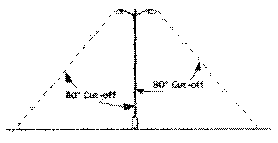
Unless otherwise provided herein, all building lighting for security or aesthetics will be fully-shielded type. Wall pack type fixtures are acceptable only if they are fully-shielded with 80° cut-off.
(c)
No use or operation in any multi-family or nonresidential district shall be located or conducted so as to produce glare, or either direct or indirect illumination across the bounding property line from a source of illumination into a residentially zoned property, nor shall any such light be of such intensity as to create a nuisance or detract from the use and enjoyment of adjacent property. For the purposes of this section, a nuisance shall be defined as more than 0.5 of one foot-candle of light measured at the residential property line, or 2.25 of one foot-candle of light measured at any adjoining nonresidential property line, unless the nonresidential property is of a similar use and utilizes similar lighting parameters.
(d)
Halogen lights are prohibited; and
(e)
Shielding shall be required in all outdoor lighting installations as specified below.
(5)
Illumination.
(a)
Measurement. Illumination levels of outdoor lighting shall be measured by a qualified professional, or other reliable authority satisfactory to the town, according to generally accepted IESNA methods, or using commercially available light measuring devices.
(1)
Should need arise, illumination level measurements made by the Town of Ponder or contracted professional under the direction of the Town of Ponder may be challenged. This challenge shall be at sole financial burden of the challenger without recourse, compensation, or any restitution, implied or otherwise. Illumination level measurement services obtained by the challenger must comply with § 154.35(O)(5)(a) above.
(b)
Computation of illumination. Illumination at a point may be computed in lieu of measurement. Computation methods shall consist of a generally accepted IESNA method, using certified photometric data furnished by the fixture manufacturer, lamp manufacturer, photometric laboratory, or other reliable authority satisfactory to the town. Computations shall be based on new, properly seasoned lamps, diffusers and other appurtenances in place, and with proper regard taken for mounting height, relative elevation, natural and manmade objects.
(c)
Limitations on neighboring property. The limit of illumination on neighboring property from one establishment shall be by zoning of the neighboring property. Maximum computed or measured foot-candles at the neighboring property line shall not exceed:
(6)
Multi-family and nonresidential illumination.
(a)
All nonessential lighting shall be turned off after business hours, leaving only necessary lighting for site security.
(b)
Security lights must be fully shielded.
(c)
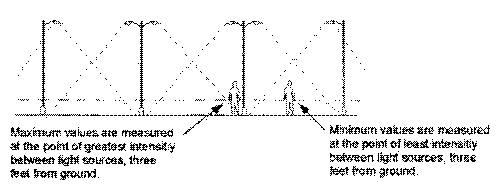
Parking lots and vehicle movement areas shall not exceed a maximum illumination value of ten foot-candles nor a minimum illumination value of 1.0 foot-candles. Lamps in decorative lantern type fixtures shall not exceed a maximum of 100 watts. Total pole and fixture height shall not exceed a maximum of 32 feet, measured from grade at the base. Taller poles may be considered in some situations upon approval of the zoning board of adjustments.
(d)
The lighting must be fully-shielded to prevent direct glare and/or light trespass. The lighting must also be substantially contained to the target area.
(e)
The maximum outdoor initial computed or measured illuminant level on the establishment property shall not exceed 20 foot-candles outdoors at any point, except that lighting under canopies (such as service stations) shall not exceed 40 foot-candles.
(f)
Illumination levels exceeding the maximum permitted must receive prior approval by the zoning board of adjustment.
(7)
Public and semi-public recreational facilities.
(a)
Any light source permitted by this section may be used for lighting of outdoor recreational facilities (public or private), such as, but not limited to, football fields, soccer fields, baseball fields, softball fields, tennis courts, or show areas, provided all of the following conditions are met:
1.
Any illumination level exceeding a maximum of 20 foot-candles must receive prior approval by the zoning board of adjustments;
2.
All fixtures used for event lighting shall be fully shielded, or be designed or provided with sharp cut-off capability, so as to minimize up-light, spill-light, and glare; and
3.
All events shall be scheduled so as to complete all activity before or as near to 10:30 p.m. as practical, but under no circumstances shall any illumination of the playing field, court or track be permitted after 11:00 p.m. except to conclude a scheduled event that was in progress before 11:00 p.m. and circumstances prevented concluding before 11:00 p.m.
(8)
Prohibited. Unless otherwise authorized, the following shall be prohibited except upon prior approval by the zoning board of adjustments.
(a)
The use of laser source light or any similar high intensity light for outdoor advertising or entertainment, when projected above the horizontal, is prohibited.
(b)
The operation of searchlights for advertising purposes is prohibited.
(c)
Halogen lights are prohibited.
(9)
Exemptions. The following are exempt from the outdoor lighting requirements of this chapter:
(a)
All temporary emergency lighting needed by the police or fire departments or other emergency services, as well as all vehicular luminaries;
(b)
All hazard warning luminaries required by federal regulatory agencies, except that all luminaries used must be red and must be shown to be as close as possible to the federally required minimum lumen output requirement for the specific task;
(c)
Any luminaries of 75 watts or less, provided the accumulated illumination does not exceed 75 watts; and
(d)
Seasonal decorative lighting.
(10)
Temporary exemptions.
(a)
Upon approval by the building official, temporary exemptions from the requirements of this subsection (O) for a period not to exceed 30 days may be approved.
(b)
Any person may submit a written request for a temporary exemption request. The request shall contain the following information:
1.
Specific exemption(s) requested;
2.
Type/use of outdoor lighting fixture involved;
3.
Duration of time requested;
4.
Type of lamp and calculated foot-candles;
5.
Total wattage of lamp(s);
6.
Proposed location of fixtures;
7.
Previous temporary exemption requests;
8.
Physical side of fixtures and type of shielding provided; and
9.
Such other data or information as may be required by the Building official.
(c)
Requests for renewal of exemptions shall be processed in the same way as the original request. Each renewal shall be valid for not more than 14 days or a time period designated by the building official.
(d)
Approval for temporary exemptions will be based on the effect of location and use of outdoor lighting fixture.
(11)
Nonconforming lighting. All luminaries lawfully in place prior to the date of this section shall be considered as having legal nonconforming status. However, any luminary that replaces a legal nonconforming luminary, or any legal nonconforming luminary that is moved, must meet the standards of this section.
(12)
Authorized special exceptions. A special exception may be granted by the zoning board of adjustments, subject to compliance with any and all conditions as the zoning board of adjustments may impose for the protections of public health or safety.
(13)
Penalty. Any person, firm or corporation violating any of the provisions of § 154.35(O) shall be deemed guilty of a misdemeanor; and any person, firm or corporation found guilty thereof shall be fined in accordance with the general penalty provision found in § 10.99 of this Code for each such conviction. Each and every day such violation continues shall constitute a separate offense.
(Ord. 00-20 § 13, passed 9-6-2000; Am. Ord. 04-29, passed 12-13-2004; Am. Ord. 04-30, passed 7-12-2004; Am. Ord. 05-18, passed 6-13-2005; Am. Ord. 06-15, passed 6-12-2006; Am. Ord. 20-15, passed 10-5-2020; Am. Ord. 23-08 , passed 6-12-2023)
§ 154.36 - Specific use permits.
(A)
Specific uses.
(1)
The purpose of a specific use permit is to allow for certain uses in districts, which under most circumstances would not be compatible with other permitted uses but with certain conditions and development restrictions may be compatible.
(2)
The town council by an affirmative vote may, after a public hearing and proper notice to all parties affected, and after recommendations from the planning and zoning commission that the uses are in general conformance with the master plan and general objectives of the town and containing such requirements and safeguards as are necessary to protect adjoining property, authorize certain uses by a specific use permit.
(3)
Application must be accompanied by a site plan prepared in accordance with § 154.37.
(4)
The town shall make available application forms for site plans, which provide pertinent information from the applicant and provide information for preparation of the site plan. However, in all cases it is the responsibility of the applicant to prepare the site plan in accordance with the requirements contained in § 154.37, regardless of the content of any form for application.
(B)
General provision.
(1)
As permitted under the provisions of this chapter, a property owner may petition the town for a specific use of property, as authorized by the zoning district in which the property is located. The petition shall be considered by the planning and zoning commission. After proper notice and a public hearing, the planning and zoning commission shall make a recommendation to the town council regarding any application for a specific use permit. The planning and zoning commission may require information, operating data and expert evaluation concerning the location and function and characteristics of any building or use proposed.
(2)
An application for a specific use permit (SUP) shall be accompanied by a site plan drawn to scale and showing the general arrangements of the project, together with essential requirements such as off-street parking facilities; size, height, construction materials and locations of buildings; the uses to be permitted; location and construction of signs; means of ingress and egress to public streets; visual screening such as walls, landscaping and fences; and the relationship of the intended use to all existing properties and land uses in all directions to minimum distance of 200 feet.
(3)
After proper notice and a public hearing, the town council may grant a permit for a specific use of property as authorized by the zoning district in which the property is situated. The town council may require information, operating data and expert evaluation concerning the location and function and characteristics of any building or use proposed.
(C)
Specific use permit regulations.
(1)
In recommending that a specific use permit for the premises under consideration be granted, the planning and zoning commission shall determine that the use or uses are harmonious and adaptable to building structures and uses of adjacent property and other property in the vicinity of the premises under consideration, and shall make recommendations as to requirements for the paving of streets, alleys and sidewalks, means of access to public streets, provisions for drainage, adequate off-street parking, protective screening and open space, heights of structures and compatibility of buildings.
(2)
The town council shall authorize issuance of a specific use permit only after determining that the proposed use or uses are harmonious and adaptable to building structures and uses of adjacent property and other property in the vicinity of the premises under consideration.
(3)
The town council shall authorize issuance of a specific use permit only after determining that adequate provisions have been made for the paving of streets, alleys and sidewalks, means of access to public streets, provisions for drainage, adequate off-street parking, protective screening and open space, heights of structures and compatibility of buildings.
(4)
No specific use permit shall be granted unless the applicant, owner and grantee of the specific use permit shall be willing to accept and agree to be bound by and comply with the written requirements of the permit, as attached to the site plan drawing (or drawings) and approved by the town council. No public hearing is necessary for site plan approval.
(5)
Whenever regulations or restrictions imposed by this chapter are either more or less restrictive than regulations imposed by any governmental authority through legislation, rule or regulation, the regulations, rules or restrictions that are more restrictive or impose higher standards or requirements shall govern. Regardless of any other provision of this chapter, no land shall be used and no structure erected or maintained in violation of any state or federal pollution control or environmental protection law or regulation.
(6)
When the town council authorizes granting of a specific use permit, the zoning map shall be amended according to its legend to indicate that the affected area has conditional and limited uses.
(7)
Uses permitted by specific use permit are specified in § 154.20.
(8)
Manufactured homes shall be permitted only in existing manufactured home parks designated by specific use permit. Existing manufactured home parks shall be permitted to develop or add units to the designated boundaries identified by the specific use permit. All new units shall be H.U.D. Code manufactured homes, provide paved parking areas for two vehicles, and provide skirting at the base of the unit.
(Ord. 00-20 § 14, passed 9-6-2000; Am. Ord. 02-45, passed 12-9-2002)
§ 154.37 - Site plan requirements.
(A)
Purpose. The purpose of a site plan is to coordinate improvements to properties other than single- or two-family use. Through site plan approval, zoning standards and other applicable municipal standards or ordinances, which may apply to specific site development, can be uniformly implemented by the planning and zoning commission and town council for multi-family and nonresidential zoned properties. This procedure is intended to promote, among other items, the efficient and harmonious use of land, safe and efficient vehicular and pedestrian circulation, parking and loading, lighting, screening, and landscaping.
(B)
Procedure for approval. When required by this section, a site plan must be approved prior to the issuance of a building permit by the town.
(1)
A site plan shall be approved by the planning and zoning commission and town council unless the town council designates the commission to administer site plan review and approval.
(2)
A certificate of occupancy shall not be issued by the building official until all provisions of the approved site plan are complied with by the applicant for the building permit.
(C)
Changes to the site plan. Changes to the site plan shall be processed in the same manner as the original approval of the site plan.
(1)
Except as otherwise provided in subsection (C)(3) below, any site plan that is amended shall require approval of the town council, upon recommendation of the planning and zoning commission.
(2)
Changes to the site plan which will affect the use of the land may require either an amendment to a planned development or a rezoning of property, whichever applies.
(3)
Changes of details within a site plan which do not alter the basic physical relationship of the property to adjacent properties; do not alter the use permitted; and do not increase the density, floor area, height, or reduce the yards provided at the boundary of the site as indicated on the approved site plan, may be authorized by the administrative official or his or her designee. An aggrieved party may appeal the decision of the administrative official or his or her designee to the zoning board of adjustment in accordance with the provisions of this section.
(D)
Site plan elements. A site plan shall be accurately and legibly drawn to scale with dimensions and shall show:
(1)
Vicinity map, north arrow, scale, name of development, name of owner, name of planner, total acreage of project, and street address or common description of the property;
(2)
Legal description of the total site area proposed for rezoning, development or specific use permit and the boundary lines and dimensions of the existing property shown on the drawing;
(3)
Topography of the property proposed for development in contours of not less than two feet, together with any proposed grade elevations, if different from existing elevations;
(4)
Floodplains, watercourses, marshes, drainage areas and other significant environmental features, including, but not limited to, rock outcroppings and major tree groupings. Topographic and drainage map information provisions may be waived by the reviewing body when the inclusion of this data would not materially contribute to the necessary evaluation of the project;
(5)
Existing subdivision lots;
(6)
Setbacks, lot coverage and, when relevant, the relationship of the setbacks provided and the height of any existing or proposed building or structure;
(7)
Existing and/or proposed buildings including minimum distance between buildings. Where building complexes are proposed, the location of each building and the minimum distances between buildings, and between buildings and property line, street line and/or alley;
(8)
If multiple types of uses are proposed, a delineation of the specific areas to be devoted to various land uses;
(9)
Off-street parking and loading area layouts and driveway locations;
(10)
Means of vehicular ingress and egress and circulation within the property and all special traffic regulation facilities proposed or required to assure the safe function of the circulation plan, including the location of all fire lanes;
(11)
Areas to be landscaped including type, location and quantity of all plant material used for landscaping, and the type, location and height of fences or screening and the plantings around them;
(12)
Public and private sidewalks;
(13)
Refuse facilities with screening;
(14)
Adjoining streets and alleys, including curbs, medians and storm drains;
(15)
The location and size of existing and proposed surface and subsurface, electric, telephone, gas, cable television or other utility easements;
(16)
Location and size of existing and proposed surface and subsurface drainage facilities, including culverts, drains and detention ponds, showing size and direction of flow;
(17)
Square footage of the property that will constitute impervious area or impervious surface and vegetated areas after construction;
(18)
Architectural drawings, such as elevations, concept sketches or renderings depicting building types and other significant proposed improvements, including the treatment and use of open spaces and the like, where the submission of such drawings would more clearly portray the nature and character of the applicant's land use and development proposals;
(19)
Signature, title and date of the applicant, at the conclusion of the written documents, certifying that the information presented in the plans, and supporting documents, reflect a reasonably accurate portrayal of the general nature and character of the applicant's proposals;
(20)
Emergency access easements;
(21)
Current zoning and land uses of the property and contiguous properties;
(22)
Size and location of all existing and proposed buildings on the site and within 25 feet of the property boundaries with computations of building area for each occupancy, site area and parking ratio;
(23)
Existing or proposed water and sanitary sewer lines;
(24)
Existing or proposed easements;
(25)
Location of all signs, auditory speakers and lighting; and
(26)
Other information considered essential by the planning and zoning commission or town council.
(E)
All site plans are subject to engineering and planning review and all fees charged by these outside contractors retained by the town are the sole responsibility of the applicant and/or builder. No building permit will be issued by the town until all fees have been paid.
(Ord. 02-45, passed 12-9-2002)
§ 154.38 - Off-street parking and loading requirements.
(A)
Purposes. To secure safety from fire, panic and other dangers; to lessen congestion in the streets; to facilitate the adequate provisions of transportation; to conserve the value of buildings; and to encourage the most appropriate use of land, minimum off-street parking and loading shall be provided as set forth in the following schedules and provisions.
(B)
Special off-street parking provisions; residential and commercial districts.
(1)
Required off-street parking shall be provided on the same side as the use it serves.
(2)
No parking shall be allowed except on a paved concrete or asphalt parking space surface.
(3)
No parking structure, including garages, carports or similar structures, shall be located within the required front, side or rear yards of a lot or tract.
(C)
Size of space.
(1)
Each standard off-street surface parking space shall measure not less than nine feet by 18 feet, exclusive of access drives and aisles, and shall be of usable shape and condition. (See appendix A, Figure 4.)
(2)
Each parking space (on-street or off-street) designed for parallel parking shall have a minimum dimension of nine feet by 22 feet. (See appendix A, Figure 5.)
(3)
Each standard parking space located in a parking garage shall measure not less than nine feet by 18 feet, exclusive of access drives or aisles.
(D)
Parking area standards.
(1)
To prevent nuisance situations, all parking area lighting shall be designed and operated so as not to reflect or shine on adjacent properties. For safety and firefighting purposes free access through to adjacent parking areas shall be provided where practical.
(2)
Except for single-family and duplex uses, parking spaces shall be permanently and clearly identified by stripes, buttons, tiles, curbs, barriers or other approved methods. Nonpermanent type marking, such as paint, shall be regularly maintained to ensure continuous clear identification of the space.
(E)
Off-street parking incidental to main use. Off-street parking shall be provided in accordance with the requirements specified by this chapter and located on the lot or tract occupied by the main use or in accordance with subsection (I) of this section and located within the same zoning district as the main use.
(F)
Schedule of parking requirements based on use. Off-street parking shall be provided in sufficient quantities to provide the following ration of vehicle spaces for the uses specified in the districts designated. (Where a calculation results in requiring a fractional space, one additional space shall be required.)
(1)
Bank, saving and loan or similar financial establishment: One space for each 200 square feet of total floor area.
(2)
Business office, professional office, or studio: Three parking spaces plus one additional parking space for each 200 square feet of floor area over 500 feet.
(3)
Church or other place of worship: One parking space for each four seats in the main auditorium.
(4)
Community center, library, museum or art gallery: Ten parking spaces plus one additional space for each 300 square feet of floor area in excess of 2,000 square feet. If an auditorium is included as a part of the building, its floor area shall be deducted from the total and additional parking provided as the basis of one space for each four seats that it contains.
(5)
College or university: One space for each two students, plus one space for each classroom, laboratory or instruction area.
(6)
Commercial amusement (indoor):
(a)
Bowling alley: Six spaces for each lane;
(b)
Racquetball or handball courts: Four spaces for each court;
(c)
Indoor tennis courts: Six spaces for each court;
(d)
Gymnasium, skating rinks, and martial arts schools or areas: One space for each three seats at maximum seating capacity, plus one space for each 200 square feet;
(e)
Swimming pool: One space for each 100 square feet of gross water surface and deck area;
(f)
Weight lifting or exercise areas: One space for each 100 square feet;
(g)
Bingo parlors: One space for three seats (design capacity) or one per 100 square feet of total floor area, whichever is greater;
(h)
Indoor jogging or running tracks: One space for each 100 linear feet;
(i)
All areas for subsidiary uses not listed above or in other parts of this section (those uses such as restaurants, offices and the like shall be calculated with the minimum specified for those individual uses): One space for each 1,000 square feet; and
(j)
Other one space for each three persons accommodated (design capacity).
(7)
Dance hall, assembly or exhibition hall (without fixed seats): One parking space for each 100 square feet of floor area used thereof;
(8)
Day nursery, daycare, kindergarten school: One space per ten pupils/clients (design capacity);
(9)
Dwellings, single-family attached or detached: Two enclosed parking spaces for each dwelling unit in the A, SF-E, SF-1 and SF-2 zoning districts. One enclosed space for each dwelling unit in the SF-3 zoning district;
(10)
Dwellings multi-family: One parking space for each dwelling unit plus 0.5 space for each individual bedroom in all dwelling units;
(11)
Flea markets: One and one-half spaces for each 200 square feet of floor area or market area;
(12)
Fraternity, sorority or dormitory: One parking space for each two beds;
(13)
Furniture or appliance store, hardware store, wholesale establishments, machinery or equipment sales and service, clothing or shoe repair or service: Two parking spaces plus one additional parking space for each 500 square feet of floor area over 1,000 square feet;
(14)
Gasoline service station: Minimum of ten spaces;
(15)
Golf course: Minimum of 30 spaces;
(16)
Health care facilities: One space for each four rooms or beds, whichever is greater;
(17)
Hospital: One space for each two beds;
(18)
Hotel or motel: One parking space for each sleeping room, unit, or guest accommodation plus one space for each 300 square feet of commercial floor area contained therein;
(19)
Lodge or fraternal organization: One and one-fourth spaces per 200 square feet;
(20)
Manufacturing, processing or repairing: One parking space for each two employees on the maximum working shift, plus space to accommodate all vehicles used in connection therewith, but not less than one parking space for each 1,000 square feet of floor area, whichever is greater;
(21)
Massage establishment: One space for each 200 square feet of floor area;
(22)
Mini-warehouse: Four spaces per complex plus one space per 5,000 square feet of storage area;
(23)
Mortuary or funeral home: One parking space for each 50 square feet of floor space in slumber rooms, parlors or individual funeral service rooms;
(24)
Motor vehicle salesrooms and used car lots: One parking space for each 500 square feet of sales floor for indoor uses, or one parking space for each 1,000 square feet of lot area for outdoor uses;
(25)
Office, general: One space for each 300 square feet of total floor area;
(26)
Office, medical: One space for each 175 square feet of floor area;
(27)
Office-showroom or office-warehouse: One space for each 1,000 square feet of floor area for storage and warehousing, plus one space for each 100 square feet of office, sales or display area;
(28)
Private club:
(a)
If freestanding or located in a shopping center of 150,000 square feet or less, one space for each ten square feet of bar, lounge and waiting areas, plus one space for each 100 square feet of remaining floor area; or
(b)
If located in a shopping center of greater than 150,000 square feet, one space for each 100 square feet of gross floor area.
(29)
Private country club or golf club: One parking space for each 250 square feet of floor area or for every five members, whichever is greater;
(30)
Recreational area or building (other than listed): One space for each two persons to be normally accommodated in the establishment;
(31)
Restaurant, cafeteria, cafe or similar establishment: One parking space for every 100 square feet of floor area;
(32)
Retail store or personal service establishment, except as otherwise specified herein: One parking space for each 200 square feet of floor area;
(33)
Sanitarium, convalescent home, home for the aged or similar institutions: One parking space for each six beds;
(34)
(a)
School, elementary and middle: Two and one-half parking spaces for each classroom; and
(b)
School, secondary (grades nine - 12): One parking space for each four seats in the main auditorium, or one space for each classroom plus one space for each two students accommodated in the institution, whichever is greater.
(35)
Shopping center: One space for each 200 square feet of floor area. The total floor area used for restaurants and cafeterias (but not including private clubs) which exceeds ten percent of the shopping center floor area, shall require additional parking to be provided in accordance with the requirements for restaurants;
(36)
Storage or warehousing: One space for each two employees, or one space for each 1,000 square feet of total floor area, whichever is greater;
(37)
Theater, auditorium (except school, meeting room, sports arena, stadium or other places of public assembly: One parking space for each four seats or bench seating spaces; and
(38)
Vehicle repair garage: Three spaces per service bay, plus one space per employee (maximum shift), plus one space per two trucks or other service vehicle.
(G)
Off-street parking requirements for uses not listed. For those uses which are not matched with a parking requirement in subsection (F) above, the following standards shall apply:
(H)
Rules for computing number of parking spaces. In computing the number of parking spaces required for each of the uses in subsections (F) and (G) of this section, the following rules shall govern:
(1)
Floor area shall mean the gross floor area of the specific use.
(2)
Where fractional spaces result, the parking spaces required shall be rounded to the nearest whole number.
(3)
The parking space requirement for a use not specifically mentioned herein shall be the same as required for a use of similar nature.
(4)
In the case of mixed uses, the parking spaces required shall equal the sum of the requirements of the various uses computed separately.
(I)
Location of parking space. All parking spaces required herein shall be located on the same lot with the building or use served, except as follows:
(1)
Where an increase in the number of spaces is required by a change or enlargement of use, or where the spaces are provided collectively or used jointly by two or more buildings or establishments, the required spaces may be located not more than 300 feet from an institutional building served and not more than 300 feet from any other nonresidential building served.
(2)
Not more than 50% of the parking spaces required for theaters, bowling alleys, cafes or similar uses, and not more than 80% of the parking spaces required for a church or school auditorium or similar uses may be provided and used jointly by similar uses not normally open, used or operated during the same hours as those listed; provided, however, that written agreement thereto is properly executed and filed as specified below.
(3)
In any case where the required parking spaces are not located on the same lot with the building or use served, or where the spaces are collectively or jointly provided and used, a written agreement thereby assuring their retention for such purposes shall be properly drawn and executed by the parties concerned, approved as to form by the town and executed by the parties concerned, and shall be filed with the application for a building permit.
(J)
Use of parking spaces—All districts. Required off-street parking and loading spaces shall be used only for these respective purposes and shall not be used for storage or display of boats, trailers, campers, motor vehicles or other goods, materials and products for sale.
(K)
Special off-street parking regulations. In computing the parking requirements for any development, the total parking requirements shall be the sum of the specific parking space requirements for each use included in the development. Where multiple uses are proposed for a building, the parking requirements shall be calculated on the basis of the most restrictive requirements unless specific areas of different uses are delineated by floor or building segment.
(1)
Wherever a parking lot is located across the street from or adjacent to residentially zoned property, and is designed so that headlight beams will shine into residences (whether or not the residences have been built at the time the parking lot is constructed), an irrigated earthen berm or a solid masonry wall or reinforced concrete fence of not less than three nor more than four feet in height above the finished grade of the off-street parking area shall be erected and maintained so as to provide a headlight screen for the residential district.
(2)
The off-street parking spaces designated for each apartment (multi-family) dwelling unit shall be located within 100 feet of the dwelling unit served by the spaces.
(3)
In all residential district, no heavy load vehicle, truck trailer, truck tractor, mobile home, motor home, camper, trailer, boat, machinery, farm equipment or machinery or any other similar equipment or machinery (called collectively equipment) shall be parked or left standing for more than two days out of any consecutive seven-day period within the required front yard or within the side yard of a corner lot between the side building line and side property line on the side of the lot abutting a street or public right-of-way.
(a)
In no event shall equipment, including motor vehicles, trucks and vans be parked or left standing at any time on a surface other than a paved or gravel driveway or paved parking lot. The driveway shall be located either between the street or alley on the one hand, and on the other a garage or carport; and the side yard adjacent to the main building; or as a circular driveway serving the main entrance of the premises.
(b)
The driveway shall be no wider than the width of the garage, carport (or 20 feet whichever is greater) or parking space which it serves. No more than 50% of the front yard shall be a driveway. In no event shall vehicles or equipment be parked or left standing closer than five feet from the front property line.
(4)
Parking spaces in nonresidential districts shall be provided with sufficient space for entering and exiting without backing onto a public street. Parking spaces on the perimeter of the parking lot and abutting a property line shall have a wheel stop barrier two feet from the end of the parking space.
(L)
Design standards for parking structure.
(1)
In all districts, above-grade parking structures shall conform to height restrictions for zoning districts in which they are located.
(2)
The distance from parking structure entry and exit points to a corner of a street intersection shall conform to standards contained in the subdivision ordinance.
(3)
Ramps shall not be constructed with slopes exceeding 15% and single lane entrances shall not be less than 12 feet wide at the street.
(4)
A minimum of one car length shall be provided between an exit control gate and the inside edge of a sidewalk to minimize conflicts between exiting cars and pedestrians.
(5)
Parking structure facades shall be left 50% open and interior light levels shall be maintained at ten foot-candles to enhance security and safety. All parking structure lighting shall be designed so as not to reflect or shine on adjacent properties.
(6)
Full enclosure of any level of a parking structure may be permitted only if the structure is mechanically ventilated and has a sprinkler system.
(M)
Off-street loading.
(1)
(a)
All retail, commercial and industrial structures shall provide and maintain off-street facilities for the loading and unloading of merchandise and goods within the building or on the lot adjacent to a private service drive.
(b)
At least one-half of the loading spaces shall have a minimum dimension of ten feet by 40 feet, and the remaining spaces shall have a minimum dimension of ten feet by 20 feet.
(c)
Where the loading spaces are located adjacent to a residential district, the space shall be enclosed on three sides.
(d)
Loading spaces shall be provided in accordance with the following schedule:
(2)
Kindergartens, day schools and similar child training and care establishments shall provide loading and unloading space on a private drive, off-street, to accommodate one motor vehicle for each ten students or children cared for by the establishment.
(3)
Loading docks for any establishment which customarily receives goods between the hours of 9:00 p.m. and 8:00 a.m., and is adjacent to a residential use or district, shall be designed and constructed so as to fully enclose the loading operation in order to reduce the effects of the noise of the operation on adjacent residences.
(4)
Where adjacent to residential uses or district, off-street loading areas shall be screened from view of the residential use or district.
(N)
Stacking requirements for drive-through facilities.
(1)
A stacking space shall be an area on a site measuring eight feet by 20 feet with direct forward access to a service window or station of a drive-through facility which does not constitute space for any other circulation driveway, parking space or maneuvering area.
(2)
For financial institutions with drive-through facilities, each teller window or station, human or mechanical, shall be provided with a minimum of five stacking spaces (from the right-of-way line).
(3)
For each service window of a drive-through restaurant, a minimum of seven stacking spaces (from the right-of-way-line) shall be provided.
(4)
For kiosks, a minimum of two stacking spaces (from the right-of-way) for each service window shall be provided.
(O)
[Off-street parking definitions, prohibited parking, defenses.]
(1)
Definitions.
(a)
"Vehicle" has the same meaning as the definition in Section 502.001(45) of the Texas Transportation Code, as amended.
(b)
"Trailer" has the same meaning as the definition in Section 502.001(42) of the Texas Transportation Code, as amended.
(c)
"Distinguishable border" means permanent curbing of concrete, wood, brick, or stone that forms a perimeter at least a foot away from any vehicle or trailer that is parked within said curbing.
(d)
"Improved driveway" means a surface made of concrete or asphalt in a front yard.
(e)
"Parking surface" or "PAD" means a surface that is constructed of concrete, asphalt, paving stones, brick, gravel, or crushed rock with a distinguishable border. PADs shall not be located in front yards or side yards of districts zoned single-family or two-family. PADs shall not be located in front yards of districts zoned multi-family.
(2)
Prohibited Off-Street Parking.
(a)
Vehicles and trailers shall not be parked in the front yard or side yard of any lot in a district zoned single-family or two-family that is less than one-half acre.
(b)
Vehicles and trailers shall not be parked in the front yard of any lot in a district zoned multi-family.
(c)
Vehicles and trailers in the back yard of any lot in a district zoned single-family or two-family that is less than one-half acre must be parked on a PAD with a distinguishable border.
(d)
Vehicles and trailers in the back yard or side yard of any lot in a district zoned multi-family must be parked on a PAD with a distinguishable border.
(e)
Vehicles and trailers shall be maintained so as not to endanger the public health and safety.
(f)
Parked vehicles or trailers longer than 19 feet, excluding the length of a trailer hitch or goose neck, shall have wheel blocks in front of and behind at least one set of wheels on said vehicle or trailer.
(g)
Junked motor vehicles. See sections 92.30 to 92.38 of the Code of Ponder.
(h)
Vehicles and trailers shall not be parked on unimproved lots in districts zoned single-family, two-family, or multi-family.
(3)
Defenses.
(a)
It shall be a defense to prosecution that a vehicle or trailer was parked on an unimproved lot while there was a valid building permit for said lot and the owner of said vehicle or trailer owned said lot or was under contract to improve said lot.
(b)
It shall be an affirmative defense to prosecution that a vehicle or trailer was parked in districts zoned as HO (Historic Overlay District).
(4)
Defenses excluded.
(a)
It shall not be a defense to prosecution that a vehicle or trailer was intended for use as or used as a dwelling for human beings or animals, regardless of whether or not said vehicle or trailer was fit for human or animal habitation.
(b)
It shall not be a defense to prosecution that a lot had no front, side, or back yard because the lot was unimproved.
(Ord. 00-20 § 15, passed 9-6-2000; Am. Ord. 02-47, passed 12-9-2002; Ord. 21-04 , passed 2-8-2021)
§ 154.39 - Accessory building regulations.
(A)
Height. No accessory building shall exceed 25 feet in height, nor shall it be greater in height than the main structure.
(B)
Area regulations for accessory buildings or structures in residential and apartment districts.
(1)
Front yards. Attached accessory buildings, including garages and carports, shall have a front yard not less than the main building, or as specified in the particular district. Detached accessory buildings shall be located in the area defined as the side yard or rear yard.
(2)
Side yards. There shall be a side yard not less than four feet from any side lot line, alley line or easement line, except that adjacent to a side street, the side yard shall never be less than 20 feet.
(3)
Rear yards. There shall be a rear yard not less than four feet from any lot line, alley line or easement line. Carports garages or other accessory buildings located within the rear portion of a lot, as hereto described, shall not be located closer than 15 feet to the main building nor nearer than four feet to any side lot.
(Ord. 00-20 § 16, passed 9-6-2000; Am. Ord. 21-24 , passed 9-13-2021)
§ 154.40 - Sign regulations.
(A)
Purpose. The regulations established in this section are intended to provide minimum standards to safeguard life, property, and public welfare regulating and controlling the use, materials, construction, location, number, maintenance, and the permitting of certain signs and sign structures. In addition, this chapter is intended to enhance the beauty of the town by limiting visual clutter. The provisions of this section are not intended to permit a violation of any provision of any other ordinance or federal or state law.
(B)
Definitions. For the purpose of this section, the following definitions shall apply unless the context clearly indicates or requires a different meaning:
Abandoned sign. A sign which, for at least six contiguous months, does not identify or advertise a bona fide business, lessor, service, owner, product or activity, for which no legal owner can be found; or which pertains to a time or event or purpose which no longer applies.
Attached sign. Any sign attached to, applied on, or supported by, any part of a building which encloses or covers usable space.
Awning. An architectural projection which provides weather protection, identity or decoration, and is supported by the building to which it is attached. It is composed of a lightweight rigid or retractable skeleton structure over which another cover is attached, which may be of fabric or other material. This sign may be raised or retracted to a position against the building and may be illuminated.
Balloon. See definition of Inflatable sign.
Banner. A sign made of paper, plastic or fabric with or without a frame, containing characters, letters, illustrations or ornamentations applied to paper, plastic or fabric. Banner does not include a flag.
Billboard. A sign which directs attention to a business, person, organization, activity, event, place, commodity, product, or service conducted, sold or offered at a location other than the premises on which the sign is located. (See definition of Off-premises sign.)
Builders directional sign. A temporary sign which provides direction or instruction to guide persons to sites where new homes are under construction, usually off-premises.
Building identification sign. A sign displaying the name and/or address of a building, which sign is located on the same site as the building.
Canopy. A structure made of metal or other material with a frame supported by either one or more columns or the building to which it is accessory, and is open on two or more sides.
Commercial message. Any message contained on any sign that advertises, promotes, solicits or endorses a product or service of an establishment, organization, corporation, company or individual for the purpose of encouraging a consumer to purchase the product or service. This does not apply to messages that contain a specific public or civic announcement and does not advertise, endorse, display or encourage any purchase of a service or product offered by any establishment, corporation, company or individual.
Construction sign. A temporary sign identifying individuals or companies involved in design, construction, wrecking, financing or improvements of the premises where work is under construction.
Development/developer sign. Outdoor advertising display announcing or promoting subdivisions or developments and/or their construction within the town.
Dilapidated or deteriorated sign. A sign where any portion of the finished material, surface or message portion of the sign is visibly faded, deteriorated or in a state of disrepair so as not to substantially appear as it was intended or designed to appear when originally constructed, or whose elements or the structural support of frame members are visibly bent, broken, dented, torn, twisted, leaning or at angles other than those at which it was originally erected.
Directional signs. An on-premises sign which directs vehicles and pedestrian traffic though parking lots and campus settings. They display arrows, words or other symbols to indicate directions to and though the site. These signs may contain a logo, but no other commercial message or advertisement of any kind is provided on the sign.

DIRECTORY SIGN. A sign which indicates the name and/or address of the tenants or occupants, the address of the premises and/or identification of any business or occupation which may exist on the premises.
DOUBLE-FACED SIGN. A sign with two faces, back to back.
EXTERNAL ILLUMINATION. Illumination of a sign by an artificial source of light which is not contained within the sign itself.
FLAG. Any fabric containing distinctive color, pattern or symbols used as a symbol of a government, political subdivision or corporation that is flown from flagpoles.
FLASHING SIGN. An illuminated sign on which the artificial source of light is not maintained stationary or constant in intensity and color at all times when the sign is illuminated. For the purpose of this chapter, any moving illuminated sign affected by intermittent lighting shall be deemed to be a flashing sign.
GROSS SURFACE AREA. The area of the smallest rectangle enclosing the extreme limits of characters, lettering, illustrations, ornamentation or other fixtures, material or color forming part of the sign. Structural supports bearing no sign copy shall not be included in gross surface area; however, if any portion of the required structural supports becomes enclosed for decorative or architectural purposes, that portion will be included in the total gross surface area of the sign. Gross surface area shall be measured on one side only of a two-faced (back to back) sign carrying the same image and message on both faces. Two-faced signs carrying different messages and images on each side shall be considered as separate signs.
GROUND SIGN. A sign not wholly supported on a building or which has its main supporting structure depending on the ground for attachment.
ILLUMINATED SIGN. A sign which has characters, letters, figures or designs illuminated by electric lights, luminous tubes or other means that are specifically placed to draw attention to, or provide night-time viewing of the subject matter on the sign face.
INCIDENTAL SIGNS. Small signs of a noncommercial nature, intended primarily for convenience of the public. Included are signs designating restrooms, address numbers, hours of operation, entrances to buildings, directions, help wanted, public telephones and so forth.
INFLATABLE SIGN. Any display capable of being expanded by air or other gas and used on a permanent or temporary basis to advertise a product or event.
INSTRUCTIONAL SIGN. A sign limited to directional messages, principally for pedestrian and vehicular traffic, such as one-way, entrance and exit.
LOGO. Any design or insignia of an organization, individual, company or product which is commonly used in advertising to identify that organization, individual, company or product.
MANSARD. An inclined decorative roof-like projection that is attached to an exterior building facade.
MARQUEE. Any hood or awning or permanent construction projecting from the wall of a building or other structure containing either permanent or changeable advertising.
MENU BOARD. A sign displaying the menu for a drive-up window for a food establishment.
MONUMENT SIGN. A permanent ground sign generally constructed out of brick, stone or cast concrete supported on a concrete foundation across the entire base of the structure.
MOVING SIGN. A sign which revolves, rotates, swings, undulates or otherwise attracts attention through the movement of parts or through the impression of movement, including automatic electronically controlled copy changes, but not including flags, banners or pennants.
MURAL. Painting done directly on the wall without logos or advertising message.
NAMEPLATE SIGN. An on-premises non-illuminated sign identifying only the name, address, and/or profession of the occupant of the premises on which the sign is located.
OFF-PREMISES SIGN. A sign which directs attention to a business, person, organization, activity, event, place, commodity, product or service not conducted, sold or offered upon the premise on which the sign is located. (See definition of Billboard.)
ON-PREMISES SIGN. A sign which promotes or advertises a business, person, organization, activity, event, place, commodity, product or service which is conducted, sold or offered upon the premises where the sign is located.
PARAPET. The extension of a building façade above the line of the structural roof.
PENNANT. A wind device usually made of lightweight plastic, fabric or other material whether or not containing a message of any kind, usually triangular in shape and attached to a single cord.
PERMANENT SIGN. A sign which is fixed in nature that is erected, affixed or maintained on a premises for a period of time which is regulated.
Pole sign (also called pylon sign). A freestanding ground sign supported by one or more poles, columns, uprights or braces placed in or upon the ground and having no guys or braces to the ground or to any other structure.
Political sign. A temporary sign pertaining to any national, state, county or local election that supports or opposes an announced candidate, political party or issue of political significance.
Portable sign. Any temporary sign supported by the ground but not attached to the ground, which can be regularly moved from a location at periodic intervals and which is located upon the premises where the business, profession, activity, commodity, service or entertainment referred to by the sign is located. The term portable sign shall include the following:
(a)
A sign which is mounted on a trailer or wheels or is part of a trailer and by its design can be towed from one location to another by the use of attached wheels or by attaching an axle to existing mounts;
(b)
An A-frame type sign;
(c)
A sign affixed by pole or poles to a portable base made of wood, metal or concrete;
(d)
A sign suspended or attached to a stand with an inverted "T" base; and
(e)
Any sign that the base is inserted into a sleeve mounted or driven into the ground which can be easily extracted from the sleeve by simply lifting or removing bolts.
Premises. A lot or tract or a combination of contiguous lots or unplatted tracts if the lots or tracts or combination are under a single ownership and are reflected in the plat or deed records of Denton County. Multi-tenant location shall be considered as being one premises.
Projecting sign. A sign suspended from a building or structure and projecting out there from more than one foot.
Protective sign. Any sign which is commonly associated with safeguarding the permitted uses of the occupancy, including but not limited to, "Bad Dog," "No Trespassing" and "No Solicitors."
Pylon sign. See definition of Pole sign.
Qualified street frontage. The width of property along the street of a commercial or industrial development which bears the address of the property.
Reader board sign. A sign comprised of nonpermanent letters, numerals or symbols which may be changed by adding, removing or rearranging the letters, numerals or symbols either manually or electronically.
Real estate sign. A sign relating to the sale, lease or rental of the premises upon which the sign is placed.
Roof sign. A sign mounted upon, against or directly above the roof or parapet line of a building or structure, or that is wholly dependent upon a building for support and that projects above the top walk or edge of a building with a flat roof, the eave line of a building with a gambrel, gable or hip room, or the deck line of a building with a mansard roof.
Search light. A large outdoor lighting apparatus used to attract attention to a business or a specific location.
Secondary sign. A sign located on-premises identifying individual uses in a mixed use multi-tenant commercial shopping center.
Sight triangle. An area of unobstructed visibility on either corner of a street and/or driveway of at least 25 feet in any direction.
Sign. Any name, number, identification, description, announcement, declaration, demonstration, device, display, flag, banner, pennant, illustration, logo, balloon, streamer, valance, advertising display, poster, beacon, light, or insignia, illuminated or nonilluminated, affixed directly or indirectly to or upon any building, window, door or outdoor structure, which is visible to the general public and calls attention any business, person, organization, event, commodity, object, product, service, place or activity, including any permanently installed or situated merchandise or facsimile.
Street frontage. The length of the wall of the building facing the street upon which it fronts. A building shall face only one street. Additionally, a building or business shall be considered as fronting on the street upon which the main entrance or address of the building or business is located, unless the business shall be located within a courtyard or facing a parking area with its main public entrance fronting on the courtyard or parking area, in which case the business shall be considered as fronting on the courtyard or parking area.
Street grade. The average elevation of the projected corners of a property, adjacent to a dedicated street right-of-way or roadway easement, the elevation of the corners being measured at the top of the curb, or the centerline of the street if no curb is present.
Temporary event. An event such as a grand opening or a going out of business sale which lasts for a period of time not to exceed 60 days.
Temporary sign. A nonpermanent sign designed or intended to be displayed for a short period of time erected, affixed or maintained on a premises. Trailer and portable signs are classified as temporary signs.
Town. The Town of Ponder.
Vehicular sign. Any sign, not including bumper stickers, on or in a vehicle moving along the ground or on any vehicle parked temporarily, incidental to its principal use for transportation. This definition shall not include signs which are being transported to a site of permanent erection or lettering of company vehicle that advertises only the company name, address and/or logo, or temporary signs (with an area less than three feet) attached to vehicles which may be removed daily.
Wall sign. A sign attached or affixed to an exterior wall of a building or structure or dependent upon a building for support with the exposed face of the sign located in a place substantially parallel to the exterior building wall to which it is attached or by which it is supported and not extending more than 12 inches from the wall. A wall sign shall not extend above the wall or parapet to which the sign is attached. For the purpose of this section, awnings, canopy fascias, mansards extending along a building side shall be considered a part of the wall.
Warning sign. A sign containing no advertising material, warning the public of the existence of danger.
Window sign. A sign attached to, placed upon or painted on the exterior of a window or door of a building, which is intended for public viewing from the exterior of the building.
Yard sign. Any sign of a temporary nature other than a development, real estate, builders or construction sign, which includes the advertisement of a service which has been performed on premises, or construction/repair that has been performed on premises.
(C)
General standards.
(1)
Applicability. The standards and regulations specified in this section shall apply to all signs displayed in the town.
(2)
Height of signs. Sign height shall be measured from ground level at the base of the sign to the highest part of the sign.
(3)
Building and electrical codes applicable. All signs must conform to the regulations and design standards of the building code and other ordinances of the town.
(4)
Wiring. Wiring of all electrical signs must conform to the International Building Codes.
(5)
Illumination of signs. Signs shall be designed, located, shielded and directed to prevent the casting of glare or direct light from artificial illumination upon adjacent public right-of-way and surrounding property.
(6)
Requirement to repair. Whenever a sign is damaged by wind, is inadequately maintained, is of faulty construction, or is damaged by any other cause, it shall be considered a public nuisance and the owner shall repair the sign substantially to its original condition as determined by the designated official, or at the owner's election the sign shall be removed. A sign which has been permitted to remain in place as a nonconforming use shall be removed when the sign, or a substantial part of it, is blown down or otherwise destroyed or dismantled for any purpose other than maintenance operation or for changing the letters, symbols, or other material on the sign. For purposes of this chapter, a sign or a substantial part of it is considered to have been destroyed if the cost of repairing the sign is more than 60% of the cost of erecting a new sign of the same type at the same location.
(7)
Placement of signs. No sign may be erected or placed on public right-of-way. Any signs so erected or placed may be removed by the designated official without notice. No sign may be erected or placed on vacant lots or tracts unless written permission has been given by the property owner and the documentation is provided to the designated official upon the official's request.
(8)
Prohibitions. No sign shall be erected or maintained in such a manner as to obstruct free and clear vision, or at any location whereby reasons of position, shape, color, degree, manner or intensity of illumination may interfere with vehicular or pedestrian traffic. No sign shall be erected or maintained in such a manner as to be likely to interfere with, obstruct the view or be confused with any authorized traffic sign, signal or device. No sign shall make use of words, phrases, symbols or characters or employ any lamp or light in such a manner as to interfere with, mislead or confuse traffic.
(9)
No sign shall be erected, relocated or maintained so as to prevent free ingress to or egress from any door, window or fire escape. No sign of any kind shall be attached to a standpipe or fire escape.
(10)
All signs shall be designed and constructed so as not to require any external bracing, cables, stays or guy wires for support or to prevent swaying or sagging and shall comply with the International Building Code as adopted and amended from time to time by the town.
(11)
The supports for all signs or sign structures shall be placed in or upon private property and shall be securely built, constructed and erected.
(12)
All permanent signs shall be constructed of wood, brick, stone, metal or fiberglass unless otherwise specified.
(D)
Prohibited signs.
(1)
Signs attached to utility poles, trees or other surfaces which are not the property of the utility or serve a public purpose located within a public right-of-way or easement;
(2)
No sign shall be erected in the right-of-way except movement control traffic control devices, street signs or direction signs placed by the town or state;
(3)
No person shall attach any sign, paper, material, paint, stencil or write any name, number (except house or street address numbers) or otherwise mark on any sidewalk, curb, gutter or street;
(4)
Sign on fence or wall and the like. No person shall paint a sign or attach a sign other than a nameplate and address (showing a street number) to the outside of a fence, railing or a wall which is not a structural part of a building in or facing a residential zoning district, whether or not on the property line. The name of the company which constructed the fence is also permitted but not exceeding one square foot in size;
(5)
Restricted language or wording. Signs shall not display gestures or words that are obscene, profane or pornographic in nature; and
(6)
A-frame or sandwich board, and sidewalk or curb signs, except as temporary signs (allowed only in Historic District).
(E)
Signs exempt from regulation.
(1)
Public signs. Signs required by governmental bodies or specifically authorized for a public purpose by any law, statute or ordinance. The public signs may be of any type, number, area, height, location or illumination as required by law, statute or ordinance;
(2)
Sale or lease of real estate property; location. Signs advertising the sale or lease of real estate property on which they are located;
(3)
Protective sign. A protective sign that has as its purpose the protection of life and property;
(4)
Informational sign; underground lines. A sign or marker giving information about the location of underground electric transmission lines, telegraph or telephone properties and facilities, pipelines, public sewers or water lines or other public facilities;
(5)
Signs on vehicles. Signs placed on or affixed to vehicles and/or trailers where the sign is incidental to the primary use of the vehicle or trailer as transportation;
(6)
Warning signs. Signs warning the public of the existence of danger but containing no advertising material; to be removed within three days upon the subsidence of danger. These warning signs may be of any type, number, area, height, location or illumination as deemed necessary to warn the public of the existence of danger;
(7)
Governmental flags. Nothing in this chapter shall be construed to prevent the display of a national or state flag;
(8)
Governmental signs. Signs of a duly constituted governmental body, including traffic or similar regulatory devices, legal notices, warnings at railroad crossings and other instructional or regulatory signs having to do with health, hazards, parking, swimming, dumping and the like;
(9)
Bulletin boards. Bulletin boards not over 16 square feet in area for public, charitable or religious institutions when the same are located on the premises of those institutions;
(10)
Address numerals. Address numerals and other signs required to be maintained by law or governmental order, rule or regulation are allowed, provided that the content and size of the sign does not exceed the requirements of such law, rule, order or regulation;
(11)
Athletic signs. Signs used as scoreboards in athletic stadiums;
(12)
Directional signs. Signs which direct vehicles and pedestrian traffic, which may display arrows, words or other symbols to indicate direction of facility. They are not to contain any advertising;
(13)
Directory signs. Signs which are located in or adjacent to entrances or foyers;
(14)
Political signs;
(15)
Memorials. Memorial signs or tables, names of buildings and date of erections when cut into any masonry surface or when constructed of bronze or other noncombustible materials;
(16)
Instructional signs. Signs providing no advertising of any kind, which provide directions or instruction to guide persons to facilities intended to serve the public, including but not specifically limited to the signs identifying restrooms, public telephones, public walkways, parking areas and other similar facilities;
(17)
Seasonal; special events. Public seasonal decorations or special public events;
(18)
Temporary. Temporary real estate directional signs;
(19)
Garage sale signs; and
(20)
Lost pet signs.
(F)
Reserved.
(G)
Provisions for all zoning districts.
(1)
Development signs. One temporary on-site development sign per development phase is allowed. These signs shall not be erected prior to commencement of construction on the project to which the sign pertains, and must be removed at 100% first time lot sales or a maximum of two years. The builder/developer may ask the planning and zoning commission to make a recommendation to the town council to allow an extension on the sign for a period of time at the town's discretion. No sign shall contain more than 50 square feet or exceed 15 feet in height.
(a)
Two temporary off-site development signs shall be permitted for residential subdivisions and must be removed at the direction of the building inspector.
(b)
Developers may have the temporary off-site development signs until 80% of the lots in the advertised subdivision are built on. Off-site signs shall not exceed eight feet in height or 32 square feet.
(2)
Hazardous or nuisance signs. No sign shall be illuminated to an intensity to cause glare or brightness to a degree that could constitute a hazard or nuisance. Moving, flashing, intermittently lighted, changing color, beacons, revolving or similarly constructed signs are not allowed. Under no circumstance shall a sign constitute a traffic hazard.
(3)
Luminance (or brightness). No sign shall be illuminated to such an intensity or in such a manner as to cause a glare or brightness to a degree that it constitutes a hazard or nuisance. Alternating electronic data control components showing time and temperature are allowed.
(4)
Shielding. Lighted signs shall be shielded from view of the residential development.
(5)
Moving or flashing signs. Strobe lights and rotating beacons are prohibited. Signs that show time and temperature are allowed.
(6)
Portable signs.
(a)
Portable signs for business. Portable signs shall be permitted on a temporary basis one time per certificate of occupancy for the initial opening of a business for 15 days. The portable sign shall be removed in its entirety and no new permit for a portable sign will be issued for that premises for a minimum of 30 days. No more than one portable or temporary sign per premises will be allowed at any time. Portable sign location must be approved and may not constitute a traffic hazard. Portable signs shall not be allowed in residential subdivisions or areas. The maximum area shall be 40 square feet.
(b)
Portable signs for nonprofit organizations. Portable signs shall be permitted on a temporary basis up to two times a calendar year for 15 days per period or once a year up to 30 days. The portable sign shall be removed in its entirety and no new permit for a portable sign will be issued for that premises for a minimum of 30 days. No more than one portable or temporary sign per premises lot will be allowed at any time. Portable sign location must be approved and may not constitute a traffic hazard. Portable signs shall not be allowed in residentially developed areas. The maximum area shall be 40 square feet.
(7)
Protective signs. The occupant of a premises may erect protective signs in accordance with the following provision:
(a)
Each sign must not exceed one square foot in effective area;
(b)
Detached signs must not exceed two feet in height; and
(c)
Letters must not exceed four inches in height.
(8)
Temporary signs (general). Temporary signs such as nongovernmental flags, banners, pennants or inflatables are permitted on a temporary basis up to four times a calendar year for 15 days per period. The temporary signs shall be removed in their entirety and no permit will be issued for that premises for a minimum of 60 days.
(9)
Vehicular signs. Vehicular signs shall conform to the following restrictions: other than the name of a company and the service it provides, it shall be unlawful to attach any sign advertising anything, to a trailer, skid or similar mobile structure or vehicle, where the primary use of the structure is to provide a base for the sign or constitute the sign itself. This provision does not restrict the identification signs on vehicles used for any bona fide business activity.
(10)
Temporary real estate directional signs. Off-premises signs are permitted in any district provided each sign does not exceed six square feet according to the following standards:
(a)
Signs are placed after 5:00 p.m. Friday and recovered or picked up by 8:00 a.m. Monday.
(b)
Signs do not constitute hazard or impair visibility.
(c)
Signs left after Monday 8:00 a.m. are subject to impoundment by the town and a recovery fee will be charged for each sign.
(d)
No sign may be placed in the public right-of-way.
(H)
Multi-tenant directory signs. Primary and secondary permanent signs shall be permitted on commercial shopping center sites that have multi-tenants. These signs shall be governed by the following regulations. Signs that are not multi-tenant directory signs shall be governed by the regulations established in previous sections of this chapter.
(1)
Premises. A multi-center shopping center site shall be considered as being one premises. For the purpose of this section, a premises shall consist of a lot or tract, or combination of lots or tracts, which abut each other or would abut each other if not for a bisecting street, and are recognized and identified under a single development concept.
(2)
Number of signs. One primary detached sign is permitted per premises along each perimeter street frontage. Primary signs may not be located closer than 300 feet to other multi-tenant signs; but may consist of any type of sign as permitted.
(3)
Shopping center out parcels. Out parcels, that are separately platted lots and lie along the perimeter within a multi-tenant shopping center, may be considered either as stand-alone parcels or as a part of the premise of the shopping center. In the event that they are designated as stand-alone parcels, they may not be included in the calculations of the area of the shopping center and are not subject to subsection (I) of this section. However, out parcels that are not adjacent to public dedicated rights-of-way must be included in the shopping center premises area and must be subject to subsection (I) of this section.
(4)
Design approval. The location and design of all multi-tenant signs shall be approved by the town council upon recommendation by the planning and zoning commission.
(5)
Obstruction of visibility. All signs within a multi-tenant development shall be constructed such that traffic visibility is not obstructed.
(6)
Sign width. In no case shall a secondary sign be wider than 24 feet.
(I)
Multi-family zoning district requirements.
(1)
Detached on-premises signs. Multi-family developments may have detached on-premises monument signs subject to the following restrictions:
(a)
Number of signs. Each premises may have no more than one detached premises sign per street frontage provided, however, lots with more than 750 feet frontage along a public street, other than an alley may have one additional detached sign.
(b)
Setback, area and height. No detached monument sign shall exceed 32 square feet per side or eight feet in height. The monument sign must set back at least three feet from the street right-of-way or property line.
(2)
Attached on-premises signs. Attached signs are permitted for multi-family developments subject to the following restrictions:
(a)
All attached signs shall be for building identification only (address or building numbers);
(b)
All signs pursuant to this section shall be limited to two per building;
(c)
All signs and their words shall be mounted parallel to the building surface to which they are attached. No signs or words shall be over 18 inches in height. No signs shall be mounted on roofs and shall not project above the roof; and
(d)
Temporary signs (such as "For Lease" banners) are permitted.
(J)
Sign types. Sign types are shown below.
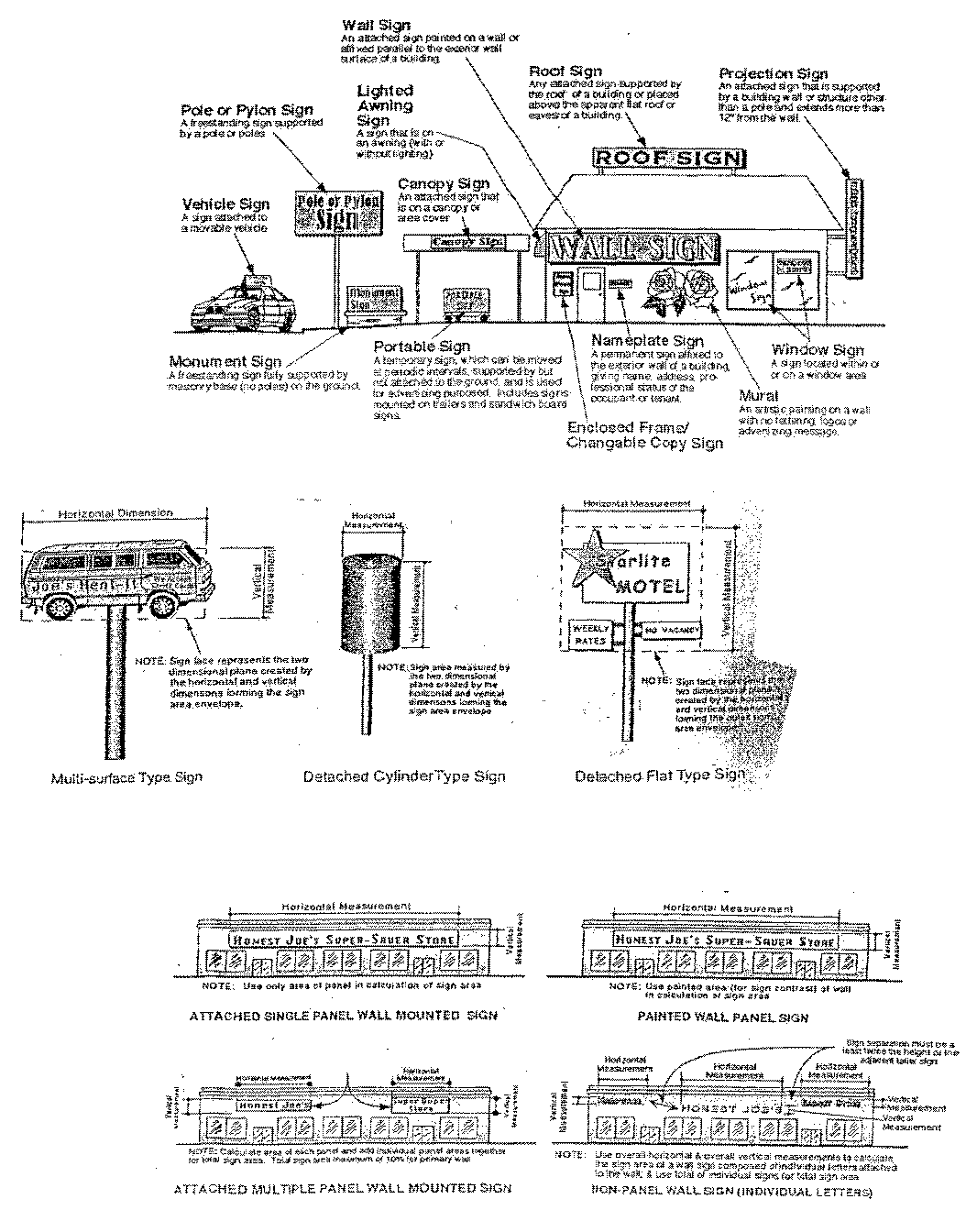
(K)
Regulations governing sign measurement.
(1)
Measurement of detached signs. The sign area for a detached on-premises sign shall be the area included within vertical and horizontal line projections of the furthermost points of any logo, letters or other symbols composed of the total area of the message and any border trim or surface upon which the message is displayed. One sign area will be calculated for a detached sign no matter how the message is displayed. The sign structure shall not be included in the sign area unless there is a sign displayed thereon.
(2)
Measurement of attached signs. The sign area for an attached on-premises sign shall be the area included within the vertical and horizontal line projection of any logo, letters or other symbols intended to be read together, composed of the total area of the message and any border, trim or surface upon which the message is displayed. There may be several sign areas on the wall of a building depending upon how a sign is displayed.
(L)
Permit requirements. Except as herein provided, no permanent sign shall be erected, placed, displayed or located without first obtaining a sign permit from the town.
(1)
Application for permit. Application for a permit for a permanent sign shall be made in writing upon forms furnished by the town. The application shall contain the location by street and address number of the proposed sign structure, height, area, sign function, as well as the name, address and phone number of the owner and sign contractor or erector. The town may require the filing of plans or other pertinent information which, in the town's opinion, is necessary to ensure compliance with this section.
(2)
Termination of permit. A sign permit may be terminated in accordance with the following provisions:
(a)
A permit shall be active for the life of the sign, as long as it is in compliance with this section;
(b)
A permit shall be terminated if the sign for which it has been issued has not been constructed within one year from the date of issuance; and
(c)
A permit issued for any sign including its supporting structure shall automatically terminate in the event the sign shall fail and not be corrected within 60 days.
(3)
Permit fees. A sign permit fee shall be paid to the town in accordance with the most current fee schedule adopted by the town.
(M)
Meritorious exceptions and appeals.
(1)
It is not the intention of these criteria to discourage innovation. It is entirely conceivable that signage proposals could be made that, while clearly nonconforming to this section and thus not allowable under these criteria, have obvious merit in not only being appropriate to the particular site or location, but also in making a positive contribution to the visual environment.
(2)
Upon request of any interested party, the town council, upon recommendation by the planning and zoning commission, shall hear and shall seriously and fairly consider a request for a meritorious exception under this section.
(N)
Prohibition. All signs not specifically authorized herein are prohibited.
(Ord. 04-35, passed 7-12-2004)
§ 154.41 - Landscape and buffer requirements.
(A)
Purpose.
(1)
It is the purpose of this section to establish certain regulations pertaining to landscaping within the town. It is the intent of this section to establish minimum requirements for the installation and maintenance of landscaping and buffering elements and other means of site improvements on developed property to enhance the community's ecological, environmental and aesthetic qualities, while at the same time allowing for design flexibility;
(2)
To reduce the negative effects caused by expanses of impervious and unvegetated surfaces within the urban environment, such as an increase in noise, heat, glare and the spread of dust and debris;
(3)
To protect and conserve the communities' soils and prevent soil erosion and silting of drainage structures and water bodies, as well as reducing the impact of development on the community's storm drainage system;
(4)
To preserve and improve the natural and urban environment by recognizing that the use of landscaping elements can contribute to the processes of air purification, oxygen regeneration, groundwater recharge, provision of habitats for wildlife, and enhance the aesthetic qualities of the town; and
(5)
To assure an acceptable degree of transition and reduce incompatibility between abutting or nearby uses by providing visual buffering between land uses of different character.
(B)
Scope. The standards and criteria contained within the section are deemed to be minimum standards and shall apply to all new commercial and manufacturing/industrial construction within the town.
(C)
Enforcement. If at any time after the issuance of a certificate of occupancy, the approved landscaping is found to be in nonconformance with standards and criteria of this section, notice by the town may be issued to the owner, citing the violation and describing what action is required to comply with this section. The owner, tenant or agent shall have 45 days from the date of the notice to restore landscaping as required. The building official may extend the time of compliance based on weather conditions. If the landscaping is not restored within the allotted time, the person shall be in violation of this chapter.
(D)
Permits. No permits shall be issued for building, paving, grading or construction until a landscape plan is submitted and approved by the building official. In the event that the proposed development requires an approved subdivision plat, site plan or master development plan, no such final approval shall be granted unless a landscape plan is submitted and approved.
(1)
Prior to issuance of a certificate of occupancy for any building or structure, all screening and landscaping shall be in place in accordance with the landscape plan as required in subsection (H) below.
(2)
In any case in which a certificate of occupancy is sought at a season of the year in which the building official determines that it would be impractical to plant trees, shrubs or grass, or to lay turf, a certificate of occupancy may be issued notwithstanding the fact that the landscaping required by the landscape plan has not been completed provided the applicant posts a letter of credit or deposits cash in an escrow account of the estimated cost of the landscaping. This letter of credit of escrow account shall be conditioned upon the installation of all landscaping required by the landscape plan within six months of the date of the application and shall give the town the right to draw upon the letter of credit or escrow deposit to complete the landscaping if the applicant fails to do so.
(E)
Installation and maintenance.
(1)
The owner, tenant and his or her agent, if any, shall be jointly responsible for the installation and maintenance of all landscaping. All required landscaping shall be maintained in a neat and orderly manner at all times. This shall include mowing, edging, pruning, fertilizing, watering, weeding, and other such activities common to the maintenance of landscaping. Landscaped are as shall be kept free of trash, litter, weeds and other such material or plants not a part of the landscaping. All plant materials shall be maintained in a healthy and growing condition as is appropriate for the season of the year. Plant materials that die shall be replaced with plant material of similar variety and size.
(2)
Landscape material located at the intersection of maneuvering aisles and any public street shall comply with the provisions of subsection (J) of this section.
(F)
General standards.
(1)
Quality. Plant materials used in conformance with provisions of this section shall conform to the standards of the American Standard for Nursery Stock, or equal thereto. Grass seed, sod and other material shall be clean and reasonably free of weeds and noxious pests and insects.
(2)
Trees. Trees referred to in this section shall be of a species common to this area of Texas and shall have an average spread of crown of greater than 15 feet at maturity. Trees having a lesser average mature crown of 15 feet may be substituted by grouping the same so as to create the equivalent of a 15 feet crown of spread. Trees shall be of minimum of three caliper inches when measured six inches above the ground.
(3)
Shrubs and hedges. Shrubs shall be a minimum of two feet in height when measured immediately after planting. Hedges, where installed, shall be planted and maintained so as to form a continuous, unbroken, solid, visual screen that will be three feet high within one year after time of planting.
(4)
Vines. Vines shall be a minimum of two feet in height when measured immediately after planting and may be used in conjunction with fences, screens, or walls to meet screening requirements as specified.
(5)
Ground cover. Ground covers used in lieu of grass in whole or in part shall be planted in such a manner as to present a finished appearance and reasonably complete within one year of planting.
(6)
Lawn grass. Grass areas may be sodden, plugged, sprigged or seeded except that solid sod shall be used in swales, berms or other areas subject to erosion.
(7)
Credit for existing trees. Any trees preserved on a site meeting the herein specifications shall be credited toward meeting the tree requirement of any landscaping provision of this section. Trees of exceptional quality due to size, large canopy cover, trunk diameter, rareness, age or species, may, at the discretion of the building official, be credited as two trees for the herein minimum requirements.
(G)
Landscaping of large tracts. The minimum landscaping standard established by subsection (K) of this section shall be required only on that portion of the tract that is being developed. The area of a tract subject to the provisions of this section, for the purposes of establishing the minimum percentage of landscaping in accordance with the required landscaping schedule, shall be determined by the building official.
(H)
Landscape plans.
(1)
Prior to the issuance of a building, paving, grading or construction permit for any use other than single-family dwellings, a landscape plan shall be submitted to the building official. The building official, or a designee, shall review such plans and shall approve same if the plan is in accordance with the criteria of these regulations. If the plans are not in accord, they shall be disapproved and shall be accompanied by a written statement setting forth the changes necessary for compliance.
(2)
Landscape plans shall contain the following information:
(a)
Minimum scale of one inch equals 50 feet;
(b)
Location of all trees to be preserved;
(c)
Location of all plant and landscaping material to be used including plants, paving, benches, screens, fountains, statues or other landscape features;
(d)
Species of all plant material to be used;
(e)
Size of all plant material where appropriate;
(f)
Spacing of plant material where appropriate;
(g)
Layout and description of irrigation, sprinkler or water systems including placement of water sources;
(h)
Description of maintenance provision for the landscape plan; and
(i)
Person(s) responsible for the preparation of landscape plan.
(I)
Alternative landscape plans.
(1)
The planning and zoning commission may approve a modification of the landscape requirements of this section in conjunction with a technical site plan, or may recommend for such approval to the town council, who may approve the modification in conjunction with a special use permit request only if:
(a)
The proposed landscaping requirements represent superior result than that which could be achieved by strictly following the requirements of this section; and
(b)
The proposed landscaping complies with the stated purpose of this section; and
(c)
The proposed landscaping either:
1.
Incorporates the retention of significant trees and naturally occurring undergrowth; or
2.
Better accommodates or improves the existing physical conditions of the subject property.
(2)
A landscape plan depicting a reduced with landscaped buffer or one which shows a lesser percentage of the site landscaped may be approved with a technical site plan by the planning and zoning commission or approved by the town council in conjunction with a special use permit when it is shown that the physical constraints of the property preclude strict compliance with this section.
(3)
The alternative landscape plan shall be submitted in the same form as required by subsection (H) of this section, and shall be subject to the same enforcement requirements established in the section.
(4)
The alternative landscape plan shall clearly delineate and identify the deviations from the provisions of this section, and shall be clearly labeled as "Alternative Landscape Plan."
(J)
Sight distance and visibility. Rigid compliance with these landscaping requirements shall not be as such as to cause visibility obstructions and/or blind corners at intersections. Whenever an access way intersects a right-of-way or when the subject property abuts the intersection of two or more public rights-of-way, a triangular visibility area, as described below, shall be created. Landscaping within the triangular visibility area shall be designed to provide unobstructed cross visibility at a level between three and six feet. Trees may be permitted in this area provided they are trimmed in such a manner that no limbs or foliage extend into the cross visibility area.
(1)
The triangular areas are:
(a)
The areas of property on both sides of the intersection of an access way and public right-of-way shall have a triangular area with two sides of each triangle being ten feet in length from the point of the intersection and the third side being a line connecting the ends of the other two sides.
(b)
The areas of property formed at a corner formed by the intersection of two or more public rights-of-way shall have a triangular visibility with two sides of each triangle being 20 feet in length from the point of the intersection and the third side being a line connecting the ends of the other two sides.
(2)
Landscaping, except required grass and low ground covers, shall not be located closer than three feet from the edge of any access way pavement.
(3)
In the event other visibility obstructions are apparent in the proposed landscape plan, as determined by the building official, the requirements set forth may be reduced to the extent to remove the conflict.
(K)
Minimum landscaping standard for off-street parking and vehicular use areas. Parking lots, vehicular use areas and parked vehicles are to be effectively screened from the public view and adjacent property. Both the interior and perimeter of the areas shall be landscaped in accordance with the following criteria. Areas used for parking or vehicle storage that are under, on or within buildings are exempt from these standards.
(1)
Interior landscaping. A minimum of ten percent of the gross parking areas shall be devoted to living landscaping which includes grass, ground covers, plants, shrubs and trees. Gross parking area is to be measured from the edge of the parking and/or driveway and sidewalks. The following additional criteria shall apply to the interior of parking lots:
(a)
Interior landscape areas shall be protected from vehicular encroachment of overhang through appropriate wheel stops or curbs.
(b)
There shall be a minimum of one tree planted for each 400 square feet or fraction thereof of required interior landscape area.
(c)
Interior areas of parking lots shall contain planting islands located so as to best relieve the expanse of paving. Planter islands must be located no further apart than every 12 parking spaces and at the terminus of all rows of parking. These islands shall contain less than 35,000 square feet. The remainder shall be landscaped with shrubs, lawn, ground cover, and other appropriate material not to exceed three feet in height. Interior planter islands shall have a minimum size of nine by 18 feet.
(d)
The building official may approve planter islands required by subsection (K)(1)(c) above to be located further apart than 12 parking spaces in order to preserve existing trees in interior parking areas. Off-street parking and drive areas located within the drip line of a tree shall be paved with permeable material approved by the building official when the drip line of an existing tree is larger than planter islands required by subsection (K)(1)(c) above.
(2)
Perimeter landscaping.
(a)
All parking lots and vehicular use areas shall be screened from all abutting properties and/or public rights-of-way with wall, fence, hedge, berm or other durable landscape barrier. Any living barrier shall be established in a two-foot minimum width-planting strip. Plants and materials used in living barrier shall be at least 30 inches high at the time of planting and shall be of a type and species that will attain a minimum height of three feet one year after planting.
(b)
Any landscape barrier not containing live plants of trees shall be a minimum of three feet high at time of installation. Perimeter landscaping shall be designed to screen off-street parking lots and other vehicular use areas from public rights-of-way and adjacent properties.
1.
Whenever an off-street parking or vehicular use area abuts a public right-of-way, except a public alley, a perimeter landscape area of at least 15 feet in depth shall be maintained between the abutting right-of-way and the off-street parking or vehicular area. An appropriate landscape screen or barrier shall be installed in this area and the remaining area shall be landscaped with at least grass or other ground cover. Necessary access ways from the public right-of-way shall be permitted through all the landscaping. The maximum width for access ways shall be 50 feet for nonresidential two-way movements; 30 feet for nonresidential two-way movements; 20 feet for nonresidential one-way movement.
2.
Whenever an off-street parking or vehicular use area abuts an adjacent property line, a perimeter landscape area of at least ten feet in width shall be maintained between the edge of the parking area and the adjacent property line. Access ways between lots may be permitted through all perimeter landscape areas. Maximum width for access ways shall be 25 feet. Landscaping shall be designed to visually screen the parking area. Whenever the property is zoned or used for residential purposes, a landscape buffer shall include a wall, hedge or berm not greater than eight feet in height nor less than three feet in height.
(c)
Perimeter landscape areas shall contain at least one tree for each 50 lineal feet or fraction thereof of perimeter area.
(L)
Plant listings.
(1)
Required plant list. The plant materials listed below shall be used to meet the minimum landscape requirements established in subsection (K) above. The use of these is not intended to reduce plant species from which to select from or inhibit creativity but rather ensure plant performance. Plants not listed below or in subsection (L)(2) below, Prohibited plant list, may be used to provide landscaping in excess of the minimum requirements of this section.
(2)
Prohibited plant list. The following plant materials are prohibited. Due to their detrimental impact on foundations, sidewalks and other impervious areas, their negative impact on the built environment, and/or their intolerance to natural conditions, these plants shall not be used. If these materials exist, they do not have to be removed from the site. They may not, however, be counted towards meeting any landscaping required by this section.
(3)
Drip line area calculations.
(M)
Buffer yards.
(1)
Definition. A buffer yard is a portion of a yard, which contains fences, walls, berms and plantings located along the perimeter of a parcel of land to lessen the impact of noise, land use intensity and light on adjoining property.
(2)
Screening requirements. The intent of this section is to provide for visual screening between land uses of different character and to establish requirements for the installation and maintenance of screening devices to enhance the community's aesthetic qualities. A screening device shall be a solid, opaque, brick, stone or decorative block masonry wall, not less than six feet in height, measured at the highest finished grade, and designed by a professional civil engineer registered in the State of Texas. A combination of masonry and wrought iron design may be considered with the wrought iron having four-inch centers and being powder coated and the masonry pillars having 50-foot centers. If using a combination of wrought iron and masonry, evergreen shrubbery with the spacing to provide a solid line barrier at maturity and achieving a six-foot height within one year of planting shall be planted on the interior side of the wrought iron portion of the wall. Construction and location details of the required screening devices shall be shown as part of the engineering site plan for all multi-family and nonresidential uses and as part of the final plat construction plans for all single-family residential uses. The screening wall shall be compatible in color and finish with the principal building(s) and or existing screening walls. The required screening wall shall be constructed prior to any building permits being issued for single-family residential subdivisions and before issuance of a certificate of occupancy for non-single-family developments. For the purpose of this subsection (M), single-family residential subdivision shall be defined as a subdivision containing two or more lots. Plant materials that die shall be replaced with plant material of similar variety and size. The town staff is authorized to approve alternate plant material if needed.
(3)
Screening wall between single-family and multi-family zoning districts.
(a)
There shall be constructed a structural screening wall of not less than eight feet in height along any portion of multi-family residential zoning districts, which adjoins any single-family detached and attached zoning district, mobile home park or mobile home subdivision.
(b)
The construction of the screening wall is the responsibility of the multi-family property owner. However, if a single-family residential subdivision is being constructed adjacent to an existing multi-family use, with no screening in place, the construction responsibility will shift to the single-family residential developer/owner.
(4)
Screening wall between commercial and residential uses.
(a)
There shall be constructed a screening wall of not less than six feet along any portion of commercial use (C-1, C-2) which adjoins any portion of a single-family detached or attached residential, multi-family residential, mobile home park or mobile home subdivision zoning district.
(b)
The construction of the screening wall is the responsibility of the commercial property owner. However, if a single-family residential subdivision or a multi-family residential use is being constructed adjacent to an existing commercial use with no screening wall in place, the construction responsibility will shift to the residential developer/owner.
(c)
Screening requirement for institutional uses (schools and churches, and the like) in commercial zoning will be considered on a case-by-case basis.
(5)
Screening wall between industrial and residential uses.
(a)
There shall be constructed a screening wall of not less than eight feet along any portion of industrial use (M-1, M-2) which adjoins any portion of a single-family detached or attached residential, multi-family residential, mobile home park or mobile home subdivision zoning district.
(b)
The construction of the screening wall is the responsibility of the industrial property owner. However, if a single-family residential subdivision or a multi-family residential use is being constructed adjacent to an existing industrial use with no screening wall in place, the construction responsibility will shift to the residential developer/owner.
(6)
Screening wall requirement for manufactured housing parks and subdivisions.
(a)
All manufactured housing parks and subdivisions shall be screened by a screening wall of not less than six feet in height on all sides.
(b)
The construction of the screening wall is the responsibility of the mobile home park or subdivision owner. However, if a single-family residential subdivision is being constructed adjacent to an existing manufactured housing park or subdivision with no screening wall in place, the construction responsibility will shift to the single-family residential developer/owner.
(7)
Screening requirement for outside storage.
(a)
In all zoning districts where outside storage of equipment, material, goods and supplies is allowed, all outside storage shall be screened from the view of any adjacent public street by a screening wall not less than eight feet in height.
(b)
Any portion of the storage yard adjacent to or fronting a street shall be screened with an eight-foot decorative fence.
(c)
Materials and supplies may not be stacked higher than the height of the fence.
(d)
Other portions of the storage yard not adjacent to or fronting a street may be fenced with a solid, opaque fence.
(e)
This provision does not apply to display of goods for sale incidental to a retail use, plant nursery, sales and rental of motor vehicles, mobile homes, boats or trailer.
(8)
Fencing requirements.
(a)
No screening element comprised of brick, masonry, stone, wrought iron or concrete shall be erected or placed which would interfere with the installation or maintenance of any public utility line, service or drainage way, within the easements reserved therefor.
(b)
Garbage, refuse and trash collection and storage areas in nonresidential districts shall be fully enclosed by a suitable screening element of not less than six feet in height.
(c)
Garbage, refuse and trash collection and storage areas in any multi-family development, mobile home development or other nonresidential use permitted in a residential district shall be fully enclosed on three sides by a dense screening element to adequately screen the area from view of the surrounding area.
(d)
Every single-family subdivision shall have a fence combination of masonry and wrought iron design with the wrought iron having four-inch centers and being powder coated and the masonry pillars having 50-foot centers. Evergreen shrubs, achieving a six-foot height within one year of planting with spacing to provide a solid line barrier at maturity shall be planted on the interior side of the wrought iron portion of the wall.
(N)
Landscape requirements for single- and two-family residences.
(1)
Purpose and intent. The purpose of this subsection (N) is to provide orderly and aesthetic development of the town and to promote the health, safety and general welfare of the community by establishing certain regulations pertaining to landscaping within the town. To aid in stabilizing the environment's ecological balance by contributing to the processes of air purification, oxygen regeneration, ground water recharge, stormwater runoff retardation and erosion control.
(2)
Definitions. For the purpose of this chapter, the following definitions shall apply unless the context clearly indicates or requires a different meaning:
Caliper. Diameter of the trunk measured one foot above ground level.
Landscape administrator. Person or department as appointed by the mayor or town council.
Lawn grasses. Thin-bladed surface growing plants typically planted from seed, sprigs or plugs.
Shrubs. Plants which grow vertically in a multi-branched growth pattern.
Tree. Any self-supporting woody perennial plant usually having a main stem or trunk and many branches.
(3)
Landscaping generally. All landscaping shall be from the approved landscaping plant list in subsection (L) of this section.
(a)
The front yard shall have grass;
(b)
There shall be a minimum of six shrubs planted in the front of the house;
(c)
In zoning districts SF-2 and SF-3 there shall be a minimum of one tree with a two-inch caliper planted in the front yard; and
(d)
In zoning districts SF-1 and SF-E there shall be a minimum of two trees with a two-inch caliper planted in the front yard.
(4)
Deferral of required landscape installation. In any case in which the final inspections are sought or plant replacement is required at a season of the year in which the landscape administrator determines that it would be impractical to install plantings as required herein, a temporary certificate of occupancy or a deferral of the required plant replacement may be given for a period not to exceed six months. The applicant shall be required to provide a letter of credit, or escrow deposit in an amount sufficient to cover the installation of the landscape requirements herein, plus a ten percent contingency. This amount shall be evidenced by an itemized bid prepared by a qualified contractor. Upon the failure of the applicant to complete the installation requirements, the town shall have the right to draw upon the letter of credit or escrow deposit to complete the installation of the requirements herein. Any funds in excess of those required to complete the installation shall be retained by the town to offset administrative costs.
(5)
Modifications. Whenever there are practical difficulties involved in complying with the provisions of this subsection (N), the landscape administrator may grant modifications in individual cases provided he or she shall first find that a special individual reason makes strict compliance with this chapter impractical; that the modification is in conformity with the intent and purpose of this section; and that the proposed modification is at least the equivalent of the requirements prescribed by this division. The modification may only be made upon written application filed with the landscape administrator and the details of any action granting a modification shall be recorded and entered into the files of the town.
(Ord. 00-20 § 18, passed 9-6-2000; Ord. 03-59, passed 10-13-2003; Ord. 05-33, passed 11-14-2005)
Cross reference— Penalty, § 154.99.
§ 154.42 - Nonconforming uses and structures.
(A)
Uses in existence at time of adoption of chapter. A nonconforming status shall exist when a use or structure which does not conform to the regulations prescribed in the district in which the use or structure is located was in existence and lawfully operating prior to the adoption of this chapter.
(B)
Expansion of nonconforming use prohibited. No nonconforming use or structure may be expanded or increased beyond the lot or tract upon which the nonconforming use is located as of the effective date of this chapter.
(C)
Repairs/normal maintenance on nonconforming uses permitted. Repairs and normal maintenance may be made to a nonconforming building provided that no structural alterations or extensions shall be made except those required by law or ordinance, unless the building is changed to a conforming use.
(D)
Change of nonconforming to conforming use. Any nonconforming use may be changed to a conforming use and once the change is made, the use shall not thereafter be changed back to a nonconforming use.
(E)
Abandonment/discontinuation of nonconforming use. Whenever a nonconforming use is abandoned, all nonconforming rights shall cease, and the use of the premises shall thenceforth be in conformity with this chapter. Abandonment shall involve the intent of the user or owner to discontinue a nonconforming operation and the actual act of discontinuance. Discontinuance of a business or the vacancy of a building or premises occupied by a nonconforming use for a period of six months shall be construed as conclusive proof of intent to abandon the nonconforming use. Any nonconforming use not involving a permanent type of structure that is moved from the premises shall be considered to have been abandoned.
(F)
Accidental destruction of nonconforming use. If a nonconforming structure or a structure occupied by a nonconforming use is destroyed by fire, act of God or other cause, it may not be rebuilt except to the provisions of this chapter. In the case of partial destruction of a nonconforming use not exceeding 50% of its reasonable value, reconstruction may be permitted after a hearing and a favorable action by the town council, but the size and function of the nonconforming use shall not be expanded.
(G)
Replacement of nonconforming HUD-Code manufactured home. Notwithstanding any of the provisions of this section, a nonconforming HUD-Code manufactured home may be exchanged or replaced by another HUD-Code manufactured home, provided the newly located residential unit is owner-occupied.
(Ord. 00-20 § 19, passed 9-6-2000)
§ 154.43 - Fencing requirements.
(A)
Purpose.
(1)
The purpose of this section is to regulate the construction, erection, enlargement, alteration, and maintenance of all fences within the boundaries of the town in order to provide a practical safeguarding of life, health, and property from hazards that may arise from improper construction of such installations.
(2)
This section shall not apply to fences erected or maintained on property within the town which have agricultural tax exemption status approved by the Denton County Appraisal District.
(B)
Permit to install or alter.
(1)
(a)
It shall be unlawful for any person to install or cause to be installed, or to permit any person to install a fence, or to make any alterations, additions or changes to a fence, without first having procured a permit to do so from the building official.
(b)
Notwithstanding the foregoing, a permit shall not be required for alterations, additions or changes if repairs do not exceed 25% of the area of the fence over a 12-month period.
(2)
When installing a new fence parallel to and within three feet of an existing fence on the same lot, the existing fence shall be removed. For the purpose of this section, the term parallel is defined as a corresponding fence that runs in the same direction as the existing fence but does not have to maintain a precise constant distance from it.
(3)
The fee for permit required by this section shall be established by fee schedule and shall be paid prior to the issuance of the permit.
(C)
Electric fences.
(1)
No fence constructed in such a manner that it may continuously conduct electrical current may be allowed in any zoning district wherein farm animals are not allowed.
(2)
Single-strand wires designed to conduct electricity through an approved low-voltage regulator shall be allowed only along the interior base line of an otherwise permitted fence. No permit shall be required for the erection and maintenance of such single-strand electric wires.
(D)
Compliance with other provisions. All fences and fence locations shall conform to the requirements of the zoning ordinance of the town, and nothing in this section shall be construed as permitting construction of a fence which would violate the provisions of the zoning, swimming pool, or FEMA flood ordinances as the same now exist or may be hereafter amended.
(E)
Location on or protrusion over town property. No privately owned fence or guy wires, braces or any other part of a privately owned fence shall be constructed upon or caused to protrude over property owned by the town.
(F)
Fence arms. Fence arms shall not be permitted in residential zoning districts.
(G)
Barbed wire. Barbed wire shall not be permitted except in agricultural pastures for fencing of livestock.
(H)
Inspection of new fences.
(1)
Any fence for which a permit has been issued under this section must be inspected.
(2)
The chief building official's office shall be notified by the property owner within 72 hours of completion of the fence.
(3)
The chief building official will issue a card of acceptance if the fence complies with the provisions of this section or reject the fence if it does not so comply.
(4)
A fence that is rejected shall be removed or reconstructed in compliance with this section within the time permitted by the town inspector, to be determined at the time of rejection.
(I)
Maintenance. All fences constructed under the provisions of this section shall be maintained to comply with the requirements of this section at all times. Such requirements include, but are not necessarily limited to, the following maintenance standards:
(1)
The fence shall not be out of vertical alignment more than one foot from the vertical measure at the top of the fence. Except, however, for fencing four feet or less in height, the vertical alignment shall not be more than six inches from the vertical measure at the top of the fence.
(2)
Any and all broken, loose, damaged, insect damaged, or missing parts (for example, slats, posts, wood rails, bricks, panels) having a combined total area of 20 square feet or more of said fences shall be replaced or repaired within 60 days of notification of noncompliance.
(a)
Fences enclosing swimming pools or spas must be repaired immediately.
(b)
Repairs of any nature shall be made with materials of comparable composition, color, size, shape, and quality of the original fence to which the repair is being made.
(c)
Products manufactured for other uses, such as plywood, corrugated steel, or fiberglass panels, are prohibited as fencing materials.
(d)
Nothing herein shall be construed so as to prohibit the complete removal of a fence, unless such fence encloses a swimming pool or spa.
(3)
Fences shall be constructed of customary urban fencing materials and shall be aesthetically consistent with buildings and fences in the area.
(4)
No fencing material and/or supports shall be located within a street or alley right-of-way.
(J)
Residential districts—Rear yard or alley line. No fence shall be constructed at a height exceeding eight feet along the rear yard or alley line in residential districts.
(K)
Vertical fences on side yard line. No fence shall be constructed at a height exceeding eight feet on any side yard line in residential districts up to the building line of the house proper. All such fences constructed on side yard lines in residential districts must be vertical.
(L)
Vertical fences—Front yard. No fence or hedge shall exceed three feet in height in the required front yard in any district.
(M)
Penalty. Any person violating any of the provisions of this section shall be deemed guilty of a misdemeanor and upon conviction thereof shall be fined in any sum not to exceed $500.00, plus cost of court.
(Ord. 20-16, passed 11-9-2020)

