
Pooler City Zoning Code
ARTICLE II
- DEFINITIONS
Definitions related to land use are:
Accessory building. A subordinate building or use which is incidental to the primary use of the main building or land. An accessory use is one which supports the main use of the building.
Accessory use. A use customarily incidental, appropriate and subordinate to the principal use of land or buildings located upon the same premises.
Administrative office. Building or space to conduct the management and business affairs of a commercial enterprise including order taking, payroll, accounts payable, accounts receivable, tax preparation, and advertising functions only.
Adult gift shop. An establishment that sells products related to adult sexual or erotic entertainment, such as vibrators, lingerie, clothing, pornography, and other related products.
Adult media store. An establishment having more than ten percent of its stock-in-trade books, magazines, publications, video tapes, or film that are distinguished or characterized by their emphasis on matter depicting, describing, or relating to sexual activities or anatomical genital areas.
Adult movie theater. An enclosed building used for presenting film or video material distinguished or characterized by an emphasis on matter depicting, describing, or relating to sexual activities or anatomical genital areas.
Agriculture. The production, keeping, or maintenance, for sale, lease, or personal use, of plants and animals useful to man, including but not limited to: forages and sod crops; grains and seed crops; dairy animals and dairy products, poultry and poultry products; livestock, including beef cattle, sheep, swine, horses, ponies, mules, or goats or any mutations or hybrids thereof, including the breeding and grazing of any or all of such animals; bees and apiary products; fur animals; trees and forest products; fruits of all kinds, including grapes, nut, and berries; vegetables; nursery, floral, ornamental, and greenhouse products; or lands devoted to a soil conservation or forestry management program.
Aisle. The traveled way, which is not the public right-of-way, by which cars directly enter and depart parking spaces.
Alley. A public thoroughfare or way, not more than 30 feet in width except for necessary turnarounds, and which normally provides a secondary means of access to abutting property.
Alteration. Any change in size, shape, character, occupancy or use of a building or structure.
Alteration of structure. Any change in the support members of the building, such as bearing walls, columns, beams or girders.
Assisted living care. Personal services, which includes, but is not limited to, individual assistance with or supervision of self-administered medication and essential activities of daily living such as eating, bathing, grooming, dressing, and toileting. O.C.G.A. § 31-7-12.2.
Assisted living community. A personal care home with a minimum of 25 beds that is licensed as an assisted living community pursuant to Code Section 31-7-3.
Average natural grade. The average natural elevation of the ground surface prior to filling or construction. (See building height.)
Bar. Any place devoted primarily to the retailing and drinking of malt, vinous, or other alcoholic beverages, or any place where any sign is exhibited or displayed indicating that alcoholic beverages are obtainable for consumption on the premises.
Bay. Three or more parking spaces adjacent to one another and aligned side-by-side.
Bed and breakfast inn. A business establishment operated within a dwelling by the owner or occupant, offering temporary lodging and one or more meals to guests while away from their normal places of residence.
Blighted area. An area characterized by deteriorating and/or abandoned buildings; inadequate or missing public or community services; and vacant land with debris, litter, lack of sanitation facilities, trash and junk accumulation, and impacted by adverse environmental nuisances, such as noise, heavy traffic, and odors.
Boardinghouse. A building other than a hotel or motel where for compensation and by arrangement for a definite period of time, meals or lodging or both are provided for three or more persons. (See convalescent home, family care home.)
Build-For-Rent community. A residential single-family subdivision with more than ten percent of the dwellings therein occupied, or intended to be occupied, by tenants rather than owners.
Buffer. Open spaces, landscaped areas, fences, walls, berms, or any combination thereof used to physically separate or screen one use of property from another so as to visually shield or physically block noise, lights, or other nuisances.
Building. Any structure except a trailer, which has a roof, designed or built for the support, enclosure, shelter, or protection of persons, animals, possessions, or property of any kind.
Building height. The vertical distance from the average natural grade of the building footprint or from the base flood elevation established by FEMA, whichever is higher above mean sea level, to the highest point of the roof or other structure of the building not otherwise exempted from height regulations.
Building official. The person or persons designated by the city council to enforce the provisions of this ordinance and charged with the responsibility for building inspection and construction permitting.
Building setback line (front yard). A line extending across the front of the lot from side lot line to side lot line and lying between the property line and vertical wall of the structure or vertical plate line of porches or carports. (See illustration figures 2 and 3.)
Business services. Any activity where the primary function is to support commercial office uses, such as secretarial, graphics, advertising, accounting and similar services.
Caretakers dwelling. An accessory building or portion of a primary structure used or designed for use as a residence, specifically, as an accessory use to the principle structure. By no means shall such a use be considered a separate primary structure, eligible for a minor subdivision if either resulting lot created will be substandard in size.
Carports. A structure intended for vehicle storage not completely enclosed by walls and doors.
Church. A building or structure, or groups of buildings or structures, that by design and construction are primarily intended for conducting organized religious services and associated accessory uses that are non-commercial in nature.
Commercial use. Activity involving the sale of goods or services carried out for profit.
Condition of fact. Statement of [or] presentation including but not limited to drawings, planning data, and engineering data that the proposed use of land meets the intent of the zoning district for which it is proposed.
Conditional use. A use permitted in a particular zoning district upon showing that such use in a specified location will comply with all the conditions and standards for the location or operation of the use as specified in the zoning ordinance and authorized by the approving agency.
Condominium. A building, or group of buildings, in which dwelling units, or floor area, are owned individually, and the structure, common areas, and facilities are owned by all the owners on a proportional, undivided basis.
Convalescent home. A building, or portion thereof, wherein for compensation, living accommodation and care are provided for persons suffering from illness, other than mental or contagious, which is not of sufficient severity to require hospitalization, or for persons requiring further institutional care after being discharged from a hospital other than a mental hospital. (See boardinghouse, family care home.)
Convenience store. Any retail establishment offering for sale prepackaged food products, household items, newspapers and magazines, and sandwiches other than freshly prepared foods, such as salads, for off-site consumption.
Drive. Short private access that leads to a home or business.
Drive-through. A facility designed to accommodate pickup of food, merchandise or services by motor vehicle momentarily at rest in a driveway expressly designed for that purpose.
Driveway. Paved portion of a public street providing an unobstructed passage from the roadway to an off-street area used for driving, servicing, parking, or otherwise accommodating motor vehicles.
Drug dependence center. A drug dependenw center includes any facility for the treatment of drug dependency, including a substance abuse center, halfway house, or drug rehabilitation center.
Duplex. A building containing two single-family dwelling units totally separated from each other by an unpierced wall extending from ground to roof. A duplex can be located on an individual lot with a property line along the common wall between units.
Dust-free parking. An area with a constructed surface designed to support automobiles and trucks in a manner by which the surface material will not be carried away by wind, storm water, or normal use. Asphalt and cement serve as ideal materials for dust-free parking surfaces.
Dwelling. Any building or portion thereof which is designed for or used for residential purposes.
Dwelling, multi-family. A building designed for three or more families living independently from one another.
Dwelling, one-family. A building, designed for one family, not containing more than one dwelling unit intended for residential use. Dwelling unit may be attached (zero lot line) or detached as required by the zoning for the district which it is located.
Dwelling, two-family. A building designed for two families living independently from one another. Dwelling units can be attached. (See duplex.)
Dwelling unit. A space, area or portion of a building designed for and occupied by one family as a dwelling unit, with cooking, bathing, and sleeping facilities for the exclusive use of such family.
Dwelling unit, single-family attached townhome. Three or more dwelling units for families living independently from each other built on separate fee simple parcels attached by a common wall from ground to roof.
Easement. A grant of one or more property rights by the property owner to and/or for the use by the public, a corporation, or another person or entity.
Energy conservation device. Any device, such as a solar heating unit, which is designed to alter energy use patterns so as to provide the same level of services while requiring less total energy expenditures.
Erected. Built, constructed, reconstructed, moved upon or any physical operations on the premises required in building. Excavation, fill, drainage, and the like shall be considered a part of erection.
Essential services. Any structure, or facility (not including buildings over 200 square feet in interior area) required by a utility owned by the city or franchised to operate within the city limits, which by its nature, is customarily required to be located in a specific proximity to the area it services, as determined by the City Engineer.
Expressway. See street, expressway.
Family. One or more persons occupying a dwelling unit, living as a single, nonprofit housekeeping unit; provided that a group of four or more persons who are not within the second degree of kinship shall not be deemed to constitute a family.
Family day care home. A private residence operated by any person paid to supervise and care for three but not more than six children under 18 years of age who are not related to such persons and whose parents or guardians are not residents in the same private residence. This service may be provided for a duration of less than 24 hours per day. A certificate of registration for such activity issued by the Georgia Department of Human Resources is required. (See convalescent home, boardinghouse.)
Farmer's market. A place where farmers sell their products directly to consumers.
Fences. An artificially constructed barrier of any material or combination of materials erected to enclose, screen, or separate areas.
Floor area. The area within the perimeter of the outside walls of the building with no deduction for corridors, stairs, closets, thickness of wall, columns or other features but excluding utility rooms not accessible from the interior of a dwelling, unenclosed porches, terraces or breezeways and carports or garages.
For-rent. Constructed under single ownership and management for the express purpose and intent of offering to the general public for lease and not intended for sale.
For-sale. Constructed for the express purpose and intent of offering to the general public for fee simple purchase.
Frontage of a building. The length of the side of a wall of a building approximately parallel to and nearest to a street.
Garage apartments. An accessory building or portion of a primary structure used or designed for use as a residence, specifically, as an accessory use to the principle structure. Such use may be rented where permitted if it meets occupancy standards of a dwelling unit.
Governing body. The Pooler City Council.
Greenhouses. A building whose roof and sides are made largely of glass or other transparent or translucent material and in which the temperature and humidity can be regulated for the cultivation of delicate or out-of-season plants for subsequent sale or for personal enjoyment.
Guest home. Living quarters within a detached accessory building located on the same lot or parcel of land as the primary structure, used exclusively for housing members of the family occupying the main building and their non-paying guests. Such quarters shall not be rented or otherwise used as a separate dwelling. By no means shall such a use be considered a separate primary structure and eligible for a minor subdivision if either resulting lot created will be substandard in size.
Hazardous substance. A substance which, by reason of being explosive, flammable, poisonous, corrosive, oxidizing, irritating, or otherwise harmful, is likely to cause death or injury. Such substance is regulated by the federal government under the Resource Conservation and Recovery Act.
Hardship. See variance, hardship.
Height of building. See building height.
Home business office. An office within a dwelling which is secondary to the use of the structure for dwelling purposes. The office may be for service or trade workers who customarily work at different locations, such as electricians, plumbers, appraisers, or individuals who work at home, such as writers or computer programmers. Home business (telephone use only) offices are not offices for customer servicing. Customers are prohibited from visiting the office and there may be no signs indicating the presence of such office on the premises.
Home occupations. An occupation customarily carried on within a home by the owner or spouse of the owner for gain or support, involving the sale of only those articles, products, or services produced on the premises, conducted entirely within a dwelling unit and conducted entirely by persons residing in that dwelling unit, using only that equipment as is customarily found in a home and involving no display of articles or products.
Hotel. A lodging establishment for transient guests which is open to the public, for compensation, providing lodging or board, or both, and in which ingress and egress to and from all rooms are made through an inside lobby or office supervised by a person in charge at all times. Any on-premises use that is accessible by the general public, such as a restaurant, bar or event/assembly space, is a separate principal use and must be an allowed use in the base zoning district. Any on-premises use that is accessible only by hotel guests is an accessory use.
Impervious surface. Any permanent material that prevents or significantly limits the absorption of stormwater into the ground. This includes but is not limited to buildings, swimming pools, decks, patios, accessory structures, and asphalt, brick, or concrete surfaces.
Injunction. A writ granted by a court of equity whereby one is required to do or refrain from doing a specified act.
Kennel. Any place or premises where four or more dogs or cats over four months of age are kept.
Land, developed. A lot for which building plans have been reviewed and approved by the city administration and physical construction has begun.
Land, improved. A lot which has usable water and sewer service immediately accessible to the site as determined by the City Engineer.
Lodging establishment. An establishment where a room, camp site or dwelling unit is provided for overnight stay, in exchange for compensation, to one or more transient guests whose usual place of residence is elsewhere. Lodging establishments include the following: Bed and breakfast homestays, bed and breakfast, inns, hotels, motels, short-term vacation rentals, recreational vehicle parks and campgrounds. If a lodging operation or a proposed lodging use does not meet the definition of any of the lodging uses listed above, it shall not be permitted.
Lot. A developed or undeveloped parcel or tract of land in one ownership, legally transferable as a single unit of land. The following provides a list of various lot descriptions:
1.
Corner lot. A lot abutting upon two or more streets at their intersection.
2.
Interior lot. A lot, the side lines of which do not abut on a street.
3.
Through lot. An interior lot having frontage on two or more streets, not at their intersection.
4.
Flag lot. A lot with access provided to the bulk of the lot by means of a narrow corridor. (See figure 1.)
Lot area, usable. The lot area less easements, setbacks, and areas not suitable for construction (e.g. wetland and floodways).
Lot, business. Front line of business lots shall have a five-foot plot provided for the purpose of beautification. This shall consist of plantings of shrubbery and grass for the enhancement of the location.
Lot depth. The average distance between the front and rear lot lines.
Lot line, front. The lot line that abuts a street. A lot adjacent to more than one street will have more than one front lot line.
Lot line, rear. The lot line that does not intersect with a street or is not a front lot line.
Lot line, side. Any lot line other than a front or rear lot line. A side lot line separating a lot from a street is a side lot line. A side lot line separating a lot from another lot or plots is an interior or side lot line.
Lot width. The horizontal distance between the side lot lines of a lot measured at the front yard building setback line.
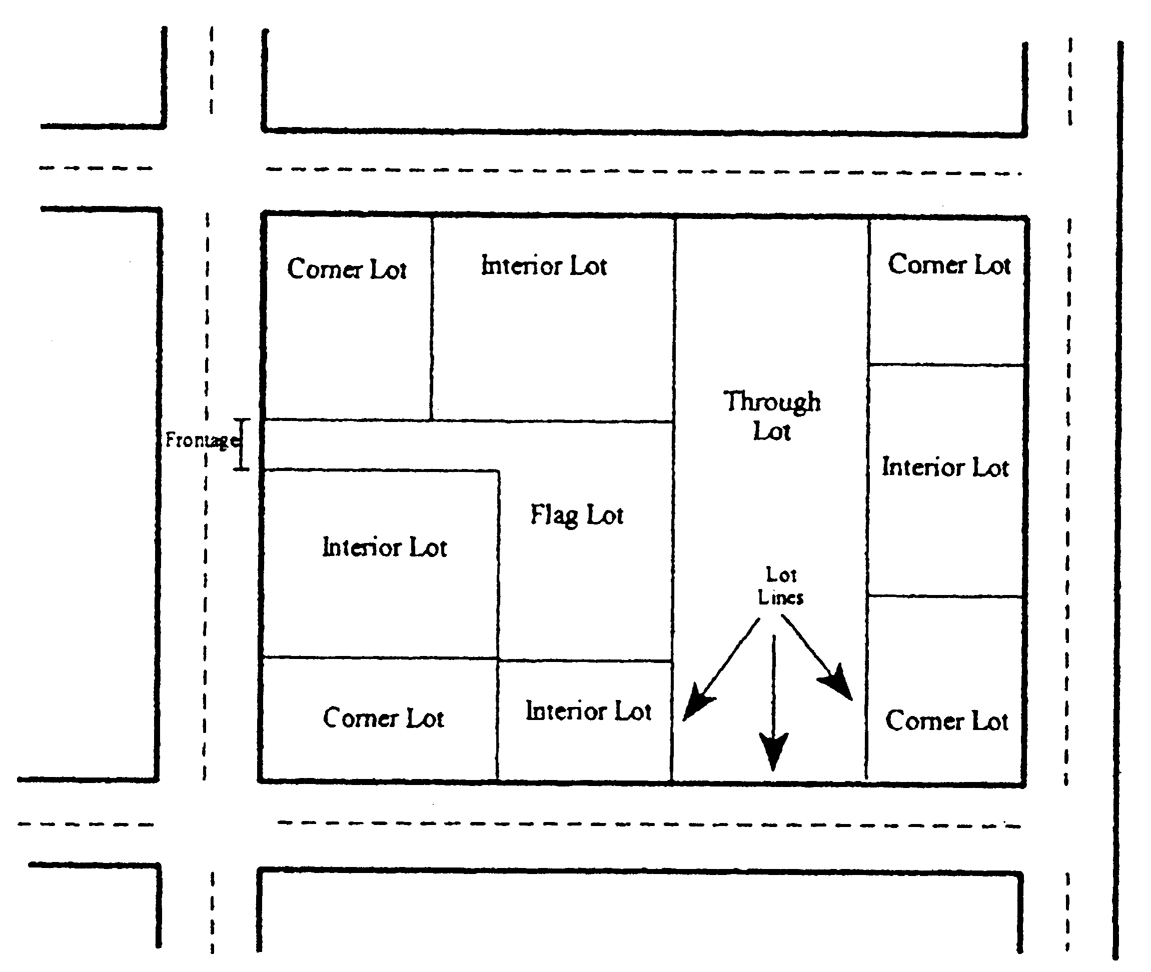
Lots and their Frontage
Live adult entertainment. An establishment devoted to adult entertainment, either with or without a liquor license, presenting distinguished and characterized by an emphasis on matter depicting, describing, or relating to sexual activities or anatomical genital areas. Such entertainment includes but is not limited to wet T-shirt contests, bikini mudwrestling, topless dancers, go-go dancers, strippers, male or female impersonators, or similar entertainment for observation by patrons.
Mandamus (writ of). A writ issued by a superior court commanding the performance of a specified official act or duty.
Marquee. A canopy or covered structure projecting from and supported by a building when such canopy or covered structure extends beyond the building, building line, or property line.
Manufactured housing. A factory-built, single-family structure that is manufactured under the authority of 42 USC Sec. 5401, the National Manufactured Home Construction and Safety Standards Act, is transportable in one or more sections, is built on a permanent chassis, and is designed to be used as a place of human habitation with or without a permanent foundation when connected to the required utilities. It is not constructed with a permanent hitch or other device allowing transportation of the unit other than for the purpose of delivery to a permanent site, and which does not have wheels or axles permanently attached to its body or frame.
Mixed-use development. A development site consisting of one or more multi-story buildings that include both residential and non-residential principal uses. Mixed-use development typically has non-residential uses on the first floor with upper story residential uses.
Mobile home. A form of manufactured housing, transportable in one or more sections, which, in the traveling mode, is eight body feet or more in width and 40 body feet or more in length. When erected on site, a mobile home is 320 or more square feet and is built on a permanent chassis. The finished structure is designed to be used as a dwelling with or without a permanent foundation when connected to the required utilities. Mobile home structures include plumbing, heating, air-conditioning, and electrical systems contained therein and were manufactured prior to June 15, 1976.
Modular home. A factory fabricated transportable building consisting of units designed to be incorporated at a building site on a permanent foundation into a permanent structure to be used for residential purposes and which bears a seal of compliance with regulations of the International Building Code, or the National Manufactured Housing Construction Act as amended. For the purposes of this ordinance, modular home shall be construed to be a single-family dwelling.
Motel. A lodging establishment for transient guests containing sleeping accommodations and customary accessory uses for rental primarily to automobile transients with exterior access to rooms. Any on-premises use that is accessible by the general public, such as a restaurant, bar or event/assembly space, is a separate principal use and must be an allowed use in the base zoning district. Any on-premises use that is accessible only by hotel guests is an accessory use.
Multi-use development. A development site consisting of multiple detached buildings with differing land uses including both residential and non-residential components.
Museum. A building in which objects of historical, scientific, artistic, or cultural interest are stored and exhibited.
Neighborhood. An area of a community with characteristics that distinguish it from other areas and that may include distinct ethnic or economic characteristics, development history, design and construction standards, housing types, schools, or boundaries defined by physical barriers, such as major highways and railroads or natural features, such as rivers.
Net acre of residential land. Net acre of residential land shall be defined as any portion of lot area reserved for, or intended to be used for, residential buildings, open space, recreation space, and similar accessory uses, excluding areas devoted to streets, driveways, parking and loading facilities, and similar uses or structures. Net residential land shall further be fined as the difference between "gross land area" less "car area" and any area devoted to non-residential uses of structures, offices, institutional uses, commercial uses, and similar uses.
Nonconforming use. A structure or land lawfully occupied by a use at the time of the adoption or subsequent amendment of this ordinance which is not permitted in the district in which such structure or land is located.
Non-profit military museum. A museum complex which is organized and operated by a 501(c)(3) non-profit corporation for the purpose of commemorating military service and educating.
Nursing home. A freestanding facility or distinct part or unit of a hospital required to be licensed or permitted as a nursing home under the provisions of Chapter 7 of this title which is not owned or operated by the state or federal government. O.C.G.A. § 31-8-162.
Occupied. Arranged, designed, built, altered, converted, rented or leased, or intended to be occupied.
Off-site parking. Any vehicular parking area located on a lot other than that which the parking serves.
Park. A tract of land designated and used by the public for active and passive recreation.
Parking. The temporary, transient storage of motor vehicles used for transportation. It shall not include storage of new or used motor vehicles for sale, services, rental or any other purpose other than specified above. "Parking" as defined herein shall apply only to storage of motor vehicles.
Parking space. The space required to park one automobile, which shall be a minimum of nine feet wide and 20 feet long, exclusive of passageways.
Person. Individual, association, firm, partnership, or corporation.
Personal care home. A building or group of buildings, a facility or place in which is provided two or more beds and other facilities and services, including room, meals, and personal care for nonfamily ambulatory adults for compensation. O.C.G.A. § 31-7-12.
Planned Unit Development (PUD). Land under unified control to be planned and developed in single development operation or a definitely programmed series of development operations; such development may include a program for establishment, operation, and maintenance of common open spaces, areas, facilities, and improvements available for common use by occupants of the district; and a development consisting of principal and accessory structures and uses substantially related to the character of the district, which will be developed according to comprehensive and detailed plans for streets, utilities, lots, or building sites, and the like.
Porch. A roofed-over space attached to the outside of an exterior wall of building, which has no enclosure other than exterior walls of such building.
Public use. Buildings, structures and uses of land owned, operated, or maintained by a government unit or government agency, including but not restricted to public easements, public schools, fire stations, recreation sites and facilities and water treatment facilities.
Recreational vehicle. A vehicular type structure, primarily designed as temporary living quarters for recreation, camping, or travel use which either has its own power or is mounted on or drawn by another vehicle which is self-powered.
Refuse. See Solid waste.
Remodeling, redecorating, or refinishing. Any change, removal, replacement or addition to walls, floors, ceilings, and roof surfaces or coverings which do not support any beam, ceiling, floor, load-bearing partition, columns, exterior walls, stairways, roofs or other structural elements of a building or a structure.
Restaurant. A building or part of a building where food is prepared and served for compensation for consumption on the premises.
Retreat. A facility owned and operated for the purpose of providing a peaceful or rural setting in which temporary lodging and/or conferences, meeting, educational and event facilities are provided with or without compensation. The following activities are specifically excluded from this definition: 1) Uses approved with a temporary use permit (i.e. seasonal outdoor events or temporary entertainment events); 2) Uses classified as recreation centers, outdoor based recreation, hotels, motels, overnight recreational and vacation camps, civil and social organizations, outdoor based recreation.
Roof. Any structure or material serving as the top of an enclosure or protective of an area intended for occupancy by people or animals, or storage of goods or materials. A roof may be a permanent impervious structure or may be porous, such as screening or canvas.
Room. For the purpose of determining the required plot area, room shall mean an unsubdivided portion of the interior of a dwelling, having a floor area of 80 square feet or more intended or adaptable for living and/or sleeping purposes. Space in a dwelling used only for bathroom, storage, hallway, utilities or similar purposes shall not be included as a room under this definition.
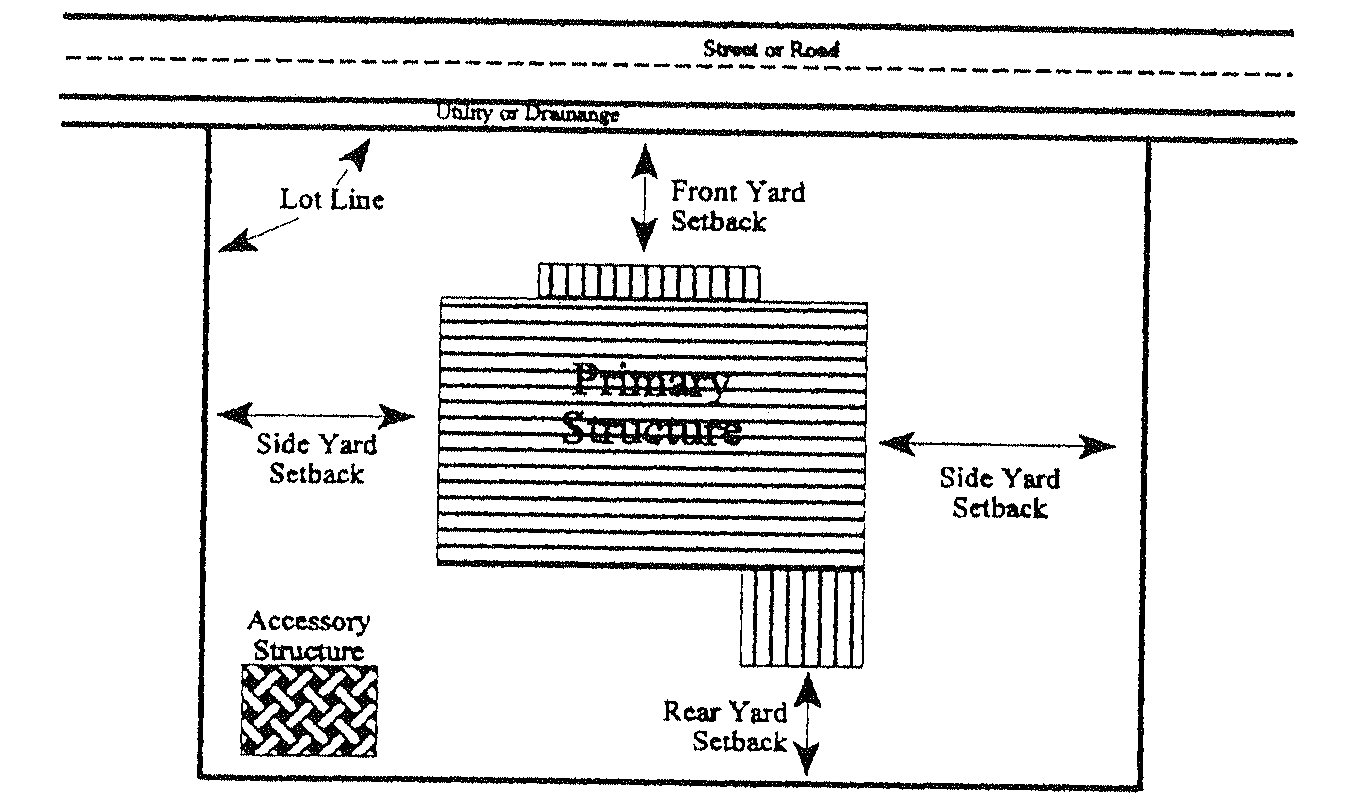
How to Measure Setback Distance
(top view)
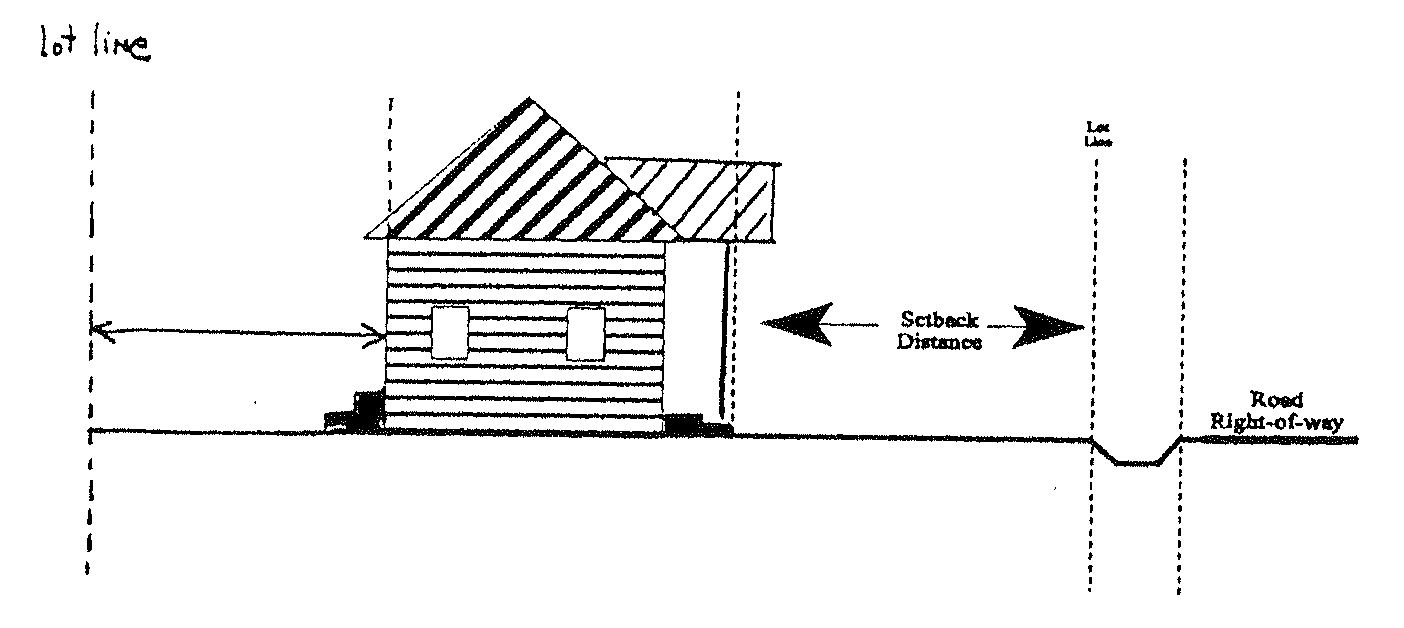
How to Measure Setback Distance
(sideview)
Setback. The minimum horizontal distance between the line of the building or structure measured perpendicular to the building at its closest point (including walls, balconies, car ports, and awnings) and the property line from which the setback distance is required.
Sewage. The total organic waste and wastewater generated by residential, industrial, and commercial establishments.
Shipping container. A reusable steel container having suitable strength to withstand shipment, storage, and handling of intermodal freight.
Shopping center. A group of commercial establishments, built on a site that is planned, developed, owned or managed as an operating unit and provides off street parking as required in this ordinance.
Sign, principal use. A sign which directs attention to a business, commodity, service, or other activity, conducted upon the premises upon which such sign is located. (See Chapter 66 Sign Regulations.)
Site-built dwelling. A residential structure built completely, at its original location, from issuance of permit to certificate of occupancy.
Site development plan. A detailed plan showing proposed buildings, uses or reuses of all land, open space, location of major structures, recreation areas, schools and public facilities and such other planning elements and reasonable design criteria as may be deemed necessary by the Planning Commission and the City Council.
Solid waste. Unwanted or discarded material, including waste material with insufficient liquid content to be free flowing.
Story. The portion of the building included between the surface of any floor and the surface of the floor next above, or, if there is no floor above, the space between the floor and the ceiling next above.
Street. A public or private vehicular way, open to the general public use and having a pavement or roadbed width of not less than 24 feet, which affords the principal means of access to abutting property. Streets are divided into four classes: major arteries, collector streets, minor streets and expressways.
a.
Major arteries. Those streets which are designated as arterials on the major thoroughfare plan and which are used or intended primarily for fast or heavy traffic. Street with 10,000 or more average daily trips with a minimum right-of-way width of 150 feet and a minimum pavement width of 48 feet.
b.
Major collector. Those streets which carry traffic from minor streets to the major system of arterial streets and highways. Street with 2,501—9,999 average daily trips with a minimum right-of-way width of 80 feet and a minimum pavement width of 48 feet.
c.
Minor collector. Those streets which carry traffic from minor streets to the major system of arterial streets and highways, including the principle entrance streets of a residential development and streets for circulation within such a development. Street with 251—2,500 average daily trips with a minimum right-of-way of 60—80 feet (as determined by public works director) and a minimum pavement width of 24 feet.
d.
Minor streets. All other public ways which provide a means of vehicular access to abutting properties. Street with 250 or less average daily trips with a minimum right-of-way of 60 feet and a minimum pavement width of 24 feet.
e.
Streets, marginal access. Those minor streets which are parallel to and adjacent to arterial streets and highways; and which provide access to abutting properties, and protection from through traffic.
f.
Expressway. A divided multi-lane major arterial street for through traffic with partial control of access and with grade separations at major intersections.
Structure. Anything constructed or erected, which requires location on the ground or attached to something having a location on the ground. Among other things, structures include buildings, industrialized buildings, manufactured homes, billboards, swimming pools, advertising signs, satellite dishes, and fall-out shelters but does not include walls or fences.
Structural alteration. Any change in supporting members of a building or structure, such as bearing walls, columns, beams, or girders.
Swimming pool. A water filled enclosure, permanently constructed or portable, having a depth of more than 18 inches below the level of the surrounding land, or an above surface pool having a depth of more than 30 inches, designed, used, and maintained for swimming and bathing.
Townhouse. A dwelling unit located in a row of three or more attached dwelling units with no other dwelling unit located above or below another, and with each dwelling unit having at least one interior party wall and a private exterior entrance.
Transient guest. A person who lodges at a place other than his usual place of residence for no more than 30 consecutive days in exchange for compensation. The lodging period may extend beyond 30 consecutive days if the guest maintains a usual place of residence elsewhere.
Use, principal. The principal purpose of which a lot or the main building may be used.
Use, temporary. A temporary use of building established in connection with a construction project or real estate development, excluding facilities for sleeping or cooking.
Variance. An authorization by the city council granting relief and doing substantial justice in the use of property, where literal enforcement of this ordinance will result in an unnecessary hardship upon the use of such property.
Variance, hardship. A departure from the provisions of a zoning ordinance relating but not limited to setbacks, side yards, frontage requirements, and lot size that, if applied to a specific lot, will significantly interfere with the permitted use of the property.
Vehicle. Any automobile, truck, bus, trailer, camper, motorcycle or motor home used to transport people or goods.
Warehouse. A building used primarily for the storage of goods and materials.
Water supply system. The system for the collection, treatment, storage, and distribution of potable water from the source of supply to the consumer.
Yard. An open space at grade between a building and the adjoining lot lines or road right-of-way, unoccupied and unobstructed by any portion of a structure from the ground upward.
Yard, front. A space extending the full width of the lot between any building and the front lot line and measured perpendicular to the building at its closest point (including walls, balconies, car ports, and awnings) to the front lot line.
Yard, rear. A space extending the full width of the lot between any building and the rear lot line and measured perpendicular to the building at its closest point (including walls, balconies, car ports, and awnings) to the rear lot line.
Yard, side. A space extending from the front yard to the rear yard between the principle building and the side lot line and measured perpendicular from the side lot line to the closest point of the principle building (including walls, balconies, car ports, and awnings).
Zoning action. For the purpose of this ordinance, a zoning action includes those actions defined by the Zoning Procedures Law as a zoning decision; such as final legislative action by a local government that results in a zoning text amendment, a zoning map amendment, variance, conditional use permit, or zoning conditions related to a map amendment or conditional use permit, etc.
Zoning Procedures Law. Official Code of Georgia annotated (O.C.G.A.) § 36-66-l, et seq., as amended.
(Ord. No. O2022-01.A, § I, II, 1-22-2022; Ord. No. O2022-03.A, § I, 4-4-2022; Ord. No. O2023-04.B, § I, II, 5-1-2023; Ord. No. O2024-02.B, § I, 2-20-2024; Ord. No. O2024-09.C, § I, 11-4-2024)

