
Pooler City Zoning Code
ARTICLE III
- GENERAL PROVISIONS
Section 1. - Nonconforming uses.
(A)
Purpose and intent. The purpose of a zoning ordinance is to have orderly use of property. Nonconforming uses that existed legally prior to the adoption or change of a zoning ordinance create land uses that do not conform to the zoning ordinance. It is the purpose of this nonconforming use provision to allow legally existing nonconforming uses to be retained with certain limitations to protect adjacent property owners and the public from inconsistencies created by nonconforming uses. It is the intent that over time all nonconforming uses will be eliminated. Any request for a continuance of a nonconforming use or any change in an existing nonconforming use needs the approval of the building official and the zoning administrator. An expansion of a nonconforming use would also need the approval of the city council. Any decision of the building official and the zoning administrator may be appealed to the city council.
(B)
Continuance of nonconforming uses. A nonconforming use of a building, structure or land that was legal prior to enactment of an amendment or adoption of the zoning ordinances shall be allowed to legally continue even though such use does not conform with the provisions of the chapter, subject to the following:
(1)
The nonconforming use cannot be expanded to occupy a greater area of land or building area;
(2)
A nonconforming use cannot be changed to another nonconforming use;
(3)
A nonconforming use, which is changed to a conforming use, shall not be permitted to revert to the original nonconforming use;
(4)
The nonconforming use of the building, structure or land cannot be intensified or escalated, for example, by increasing the number of deliveries, employees or customers coming to the nonconforming use, or by an increase in noise, dust, fumes, or other pollutants emanating from the nonconforming use; or
(5)
A nonconforming use cannot be reinstated after it has been abandoned. It shall be prima facie evidence of abandonment for the owner and/or operator of the nonconforming use to discontinue the nonconforming use for six months, or fail to obtain a new or renew an existing business license as required under the City of Pooler Code of Ordinances.
(C)
Continuance of nonconforming structure or building. A building or structure that is nonconforming or that contains a nonconforming use at the time of enactment of the ordinance from which this chapter is derived or at the time of enactment of an amendment to this chapter may be retained, except that it shall not be:
(1)
Enlarged, altered or rebuilt, except for repairs necessary to maintain the structure or building in a safe and sanitary condition; or
(2)
Rebuilt, altered or repaired after damage or deterioration exceeding 75 percent of its replacement cost at the time of destruction, except in conformity with this chapter.
(D)
Restoration to a safe condition. Nothing in this ordinance shall prevent the restoration of any building or structure to a safe or sanitary condition when required by the proper authorities.
(E)
Errors and violations. The issuance or granting of a permit or approval of plans and/or specifications shall not be deemed or construed to be approval for any violation of any provision in this ordinance. No permit presuming to give the authority to violate or cancel the provisions of this ordinance shall be valid except insofar as the work or such which it authorizes is lawful.
Section 2. - Access to public street required.
No building shall be constructed or erected upon a lot, or parcel of land, which does not have direct vehicular access to a public or privately owned street or a permanent access easement to a public or privately owned street. Any street or easement that provides direct access to a new development shall meet the street standards provided in the City of Pooler's Standard Specifications and Details. Easements providing access to a public or privately owned street for residential development shall serve no more than two lots and shall have a minimum width of 25 feet unless an easement of lesser width was of record prior to the adoption of this ordinance; easements providing access to a public or privately owned street for non-residential development may serve two or more lots, as long as it meets the minimum standards for a marginal access or minor street. The city may require any existing access easement or street to be brought up to city standards, in whole or in part, as part of a development approval.
(Ord. No. O2023-05.A, § II, 6-5-2023)
Section 3. - Preexisting substandard lots.
The purpose of this article is to grant relief to preexisting substandard lots that would create undue hardship to an individual case and allow the issuance of the building permits upon the said substandard lots. In order to qualify for relief under this article, the applicant must demonstrate the following:
(A)
Failure to grant a building permit on this substandard lot would create a real, undue hardship;
(B)
Demonstrate that at the time of the adoption of the zoning ordinance enacted on October 5, 2020, or at any date subsequent to its adoption, including the time which application for relief under this article has been requested, the applicant did not own any contiguous property to said lot;
When applicant has demonstrated all of the above requirements of this article to the satisfaction of the City Council for the City of Pooler, then the building official shall issue a building permit for said substandard lot.
Section 4. - Buildings to be moved.
Any building or structure which has been wholly or partially erected on any premises located within the city shall not be moved to any other premises in the city until a permit for such removal is secured from the building and zoning department. Any such building or structure shall conform to all the provisions of this ordinance in the same manner as a new building or structure. No building or structure shall be moved into the city from outside the city until such compliance has been shown and such permit has been secured. Before a permit may be issued for moving a building or structure, the building official shall inspect the same and shall determine if it is in compliance with all city and state regulations.
Section 5. - Off-street parking and unloading.
(A)
Single-family residential districts. Off-street parking spaces shall be provided on every lot on which any of the following uses are hereby established. Driveways must serve only one lot. Common driveways are not permitted in this district. Off-street parking spaces shall include adequate maneuvering areas and shall be provided with vehicular access to a street or lane. All parking spaces shall be:
(1)
Made of a dust-free material;
(2)
Have a minimum width of eight feet and an area no less than 160 square feet exclusive of passageways; and,
(3)
Equal in number to at least the minimum requirements for the specific use set forth below:
a.
Number of spaces. A minimum of one and three-fourths spaces per dwelling. Non-residential uses require additional parking spaces.
b.
Recreational vehicles. If the camping and recreational equipment is parked or stored outside of a garage, it shall be parked or stored to the rear of the front building line of the lot.
c.
Nursing homes, hospitals. One parking space for each five patient beds plus one space for each staff doctor, plus one space for each employee on the largest shift.
d.
Theaters, auditoriums, churches, gymnasiums and other places of assembly. One parking space for each four seats provided in the main auditorium or for each 50 square feet of floor area available for the accommodation of movable seats in the largest assembly room or area.
e.
Public and private elementary and secondary schools (except assembly halls, auditoriums and gymnasiums used in conjunction therewith). One parking space for each 200 square feet of gross floor area devoted to such use.
f.
Retreat. Minimum number of parking spaces:
• 0.75 spaces for each four seats in the main auditorium, or 0.75 spaces for each 50 square feet of total useable floor area in the largest assembly room.
• Additional parking may be required for employees (if applicable), one space for each employee.
(4)
Residential curb cuts. Paving of driveways is not required for property that fronts exclusively on unpaved city-maintained roads, otherwise, the property owner shall pave all driveways from the right-of-way line to the edge of the paving.
a.
No more than two combined entrances and exits shall be allowed for any parcel of property, having a frontage less than 200 feet on any one street. Additional entrances or exits for parcels having a frontage in excess of 200 feet may be permitted at the rate of one entrance/exit for each additional 100 feet of frontage.
b.
The distance between any two curb cuts on the same side of the street shall be more than ten feet on local roads, 25 feet on collector, and 35 feet on arterial.
c.
The width of any driveway shall not exceed 18 feet at the right-of-way line and 24 feet measured at the edge of pavement.
(B)
Two-family residential districts. Off-street parking shall be provided for each dwelling unit in a manner that does not require backing out onto the street and meets the requirements for residential curb cuts. A parking plan shall be submitted and approved by the city planner and all parking spaces must conform to all requirements listed above for single family districts.
(C)
Multifamily residential districts. A minimum of one and three-fourths parking spaces per unit shall be required. Additional parking shall be required for clubhouse and other non-residential uses. A parking plan shall be submitted and approved by the city planner and all parking spaces must conform to all requirements listed above for single family districts. A common parking area shall be designated for the storage of campers, boats, or other recreational equipment. Curb cuts for multifamily residential dwellings shall meet the following requirements:
(1)
No more than two combined entrances and exits shall be allowed for any parcel where the frontage is less than 300 feet on any one street. On parcels with less than 150 feet of frontage, only one combined entrance and exit shall be allowed (two one-way driveways shall be allowed in lieu of the one two-way). Additional entrances or exits for parcels of property having a frontage in excess of 300 feet may be permitted at the rate of one entrance/exit for each additional 150 feet of frontage;
(2)
All driveways shall be constructed so as to be at least 12½ feet from any side of the property line; and
(3)
Maximum width of any driveway shall not exceed 35 feet measured at the end of the radii (minimum 12½-foot radius).
(D)
Commercial districts. Off-street parking spaces shall be provided on every lot on which any of the following uses are hereby established. Such spaces shall include adequate maneuvering areas and shall be provided with vehicular access to a street or lane. All parking facilities shall have a base of either concrete or asphalt; pervious concrete, porous asphalt, and permeable pavers (with or without an underdrain) shall be used to the greatest extent possible. Parking lot bioswales, bioretention, and other low impact development (LID) practices shall be integrated into the parking lot design to the greatest extent possible. Parking shall be no closer than ten feet to the street, road, or rights-of-way. The parking plan including the design detail for LID practices, shall be submitted and approved by the city planner and city engineer prior to the issuance of a permit.
(1)
Number of spaces:
(a)
Motels and hotels. Four-fifths of one space for each room, and one space for each employee. Additional parking spaces may be provided in such a manner to accommodate parking of trucks, buses, campers, etc.
(b)
Retail businesses. Except as provided below, one space for each 250 square feet of total floor area.
(c)
Offices, including banks. One space for each 300 square feet of total floor area.
(d)
Filling and gas station. One-half space for each gas pump, plus one space for each service bay or similar facility.
(e)
Grocery stores (not in a shopping center). If 10,000 square feet or less, five spaces per 1,000 square feet of total floor area; and if greater than 10,000 square feet of total floor area, 4.0 spaces per 1,000 square feet of total floor area.
(f)
Shopping centers. If 10,000 square feet or less, five spaces per 1,000 square feet of total floor area; and if greater than 10,000 square feet of total floor area, four and one-half spaces per 1,000 square feet of total floor area.
(g)
Business not covered. Any use not listed above shall meet the requirements of the most similar use as determined by city council.
(2)
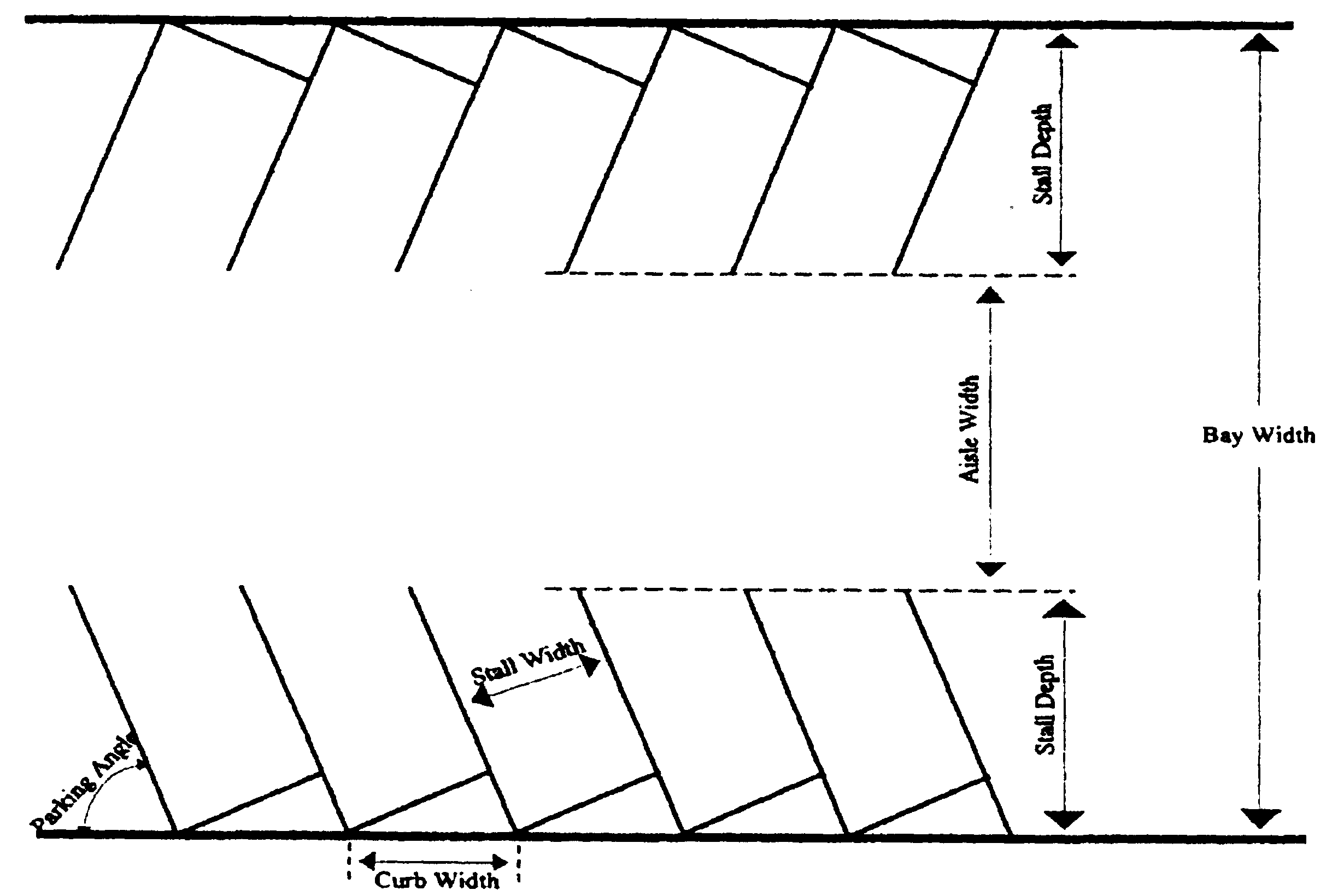
Parking lot dimensions. Each automobile parking space shall be not less than 180 square feet, nor less than nine feet wide, nor less than 20 feet deep, exclusive of passageways. In addition, there shall be provided adequate interior driveways to connect each parking space with a public right-of-way.
a.
Exemptions. The provision of this subsection shall be waived upon the determination by the Zoning Administrator that the parking lot does not serve more than ten vehicles and is not available for visitor or customer use.
b.
Angled parking. Aisle width and stall depth may vary based on parking angle. The following table provides the minimum standards:
c.
Handicapped parking spaces. All spaces required and designated for handicapped accessible parking must meet all guidelines associated with the Americans with Disabilities Act. Handicap accessible parking spaces shall be counted as part of the total number of parking spaces required under this Article.
(3)
Commercial delivery to businesses and industrially zoned establishments.
a.
All deliveries to businesses and industrially zoned establishments shall be made, when physically possible, by rear door only.
Figure 1
b.
This section shall not apply where no rear entry presently exists or where the delivery of a specific item by rear entry is physically impossible; however, no building plans shall be approved by the building department from the effective date of this chapter when said plans do not provide access for commercial deliveries to the rear of retail business establishments.
c.
No area designated or used for commercial deliveries may extend or result in the extension of vehicles onto a public right-of-way.
(4)
Curb cuts for commercial land uses shall meet the following requirements:
a.
No more than two combined entrances and exits shall be allowed for any parcel where the frontage is less than 300 feet on any one street. On parcels with less than 150 feet of frontage, only one combined entrance and exit shall be allowed (two one-way driveways shall be allowed in lieu of the one two-way). Additional entrances or exits for parcels of property having a frontage in excess of 300 feet may be permitted at the rate of one entrance/exit for each additional 150 feet of frontage; (as mentioned above)
b.
All driveways shall be constructed so as to be at least 12½ feet from any side of the property line; and,
c.
Maximum width of any driveway shall not exceed 35 feet measured at the end of the radii (minimum 12½-foot radius);
(E)
Industrial district: Off-street parking spaces shall be provided on every lot on which any of the following uses are hereby established. Such spaces shall include adequate maneuvering areas, shall be provided with vehicular access to a street or lane and meet all parking surface material and lot dimensional standards set forth for commercial districts. All parking plans utilizing parking in any setback must be referred to planning and zoning for review with final approval by Mayor and Council as part of the site plan approval. No parking, except herein authorized, shall be provided within any required front setback with the exception that in planned industrial parks, two-axle vehicles shall be allowed to park within said setback so long as no parking shall occur within 20 feet of the right-of-way. Under no circumstances shall any vehicle over two axles be allowed in the front setback. Parking shall be equal in number to at least the minimum requirements for the specific use set forth below:
(1)
Number of spaces:
a.
Manufacturing. One space for each two employees at maximum employment on a single shift.
b.
Other uses. Shall meet requirements set forth in subsection (D) commercial districts.
(2)
Commercial delivery to businesses and industrially zoned establishments:
a.
All deliveries to businesses and industrially zoned establishments shall be made, when physically possible, by rear door only.
b.
This section shall not apply where no rear entry presently exists or where the delivery of a specific item by rear entry is physically impossible; however, no building plans shall be approved by the building department from the effective date of this chapter when said plans do not provide access for commercial deliveries to the rear of retail business establishments.
c.
No area designated or used for commercial deliveries may extend or result in the extension of vehicles onto a public right-of-way.
(3)
Curb cuts for industrial land uses shall meet the following requirements:
a.
No more than two combined entrances and exits shall be allowed for any parcel where the frontage is less than 300 feet on any one street. On parcels with less than 150 feet of frontage, only one combined entrance and exit shall be allowed (two one-way driveways shall be allowed in lieu of the one two-way). Additional entrances or exits for parcels of property having a frontage in excess of 300 feet may be permitted at the rate of one entrance/exit for each additional 150 feet of frontage; (as mentioned above)
b.
All driveways shall be constructed so as to be at least 12½ feet from any side of the property line; and,
c.
Maximum width of any driveway shall not exceed 35 feet measured at the end of the radii (minimum 12½-foot radius).
(Ord. No. O2022-03.A, § I, 4-4-2022)
Section 6. - Schedule of development regulations.
Structure placement, lot size, number of structures, impervious surface, and building height vary by zoning district. Two tables are provided, on the pages to follow, that list these requirements by zoning district. An application for permit that cannot meet these requirements has two options. One is to apply for a variance and the other is to apply for a rezoning of the subject property to a zone with less restrictive requirements. These procedures are found in article V, administration and enforcement procedures.
(A)
Schedule of residential district dimensional requirements.
*At least 20 feet on one side with an allowable zero lot line on the other side.
**As long as there is at least 20 feet between each manufactured home.
***4,000 square feet refers to stand size. A minimum of five acres of land is required for a mobile home park in MH-3.
**** 60% max impervious surface for first 44,000 sq/ft, 8% max impervious surface on each acre hereafter.
(B)
Schedule of commercial and industrial zoning district minimum yard requirements.
*Corner and through lots must meet front yard setbacks on each side that fronts a street right-of-way.
**Through lots do not have a rear yard.
***In the C-1 and C-2 districts, corner and through lots are only required to have the required minimum front yard setback along a designated primary frontage. Other yards with road frontage shall be designated as secondary frontages or non-access frontages, where applicable. Secondary frontages shall include frontages that provide access to the site and non-access frontages shall be frontages that do not provide access to the site. For the C-1 district, secondary frontages shall have a minimum 25-foot setback and non-access frontages shall have a 15-foot setback. For the C-2 district, secondary frontages shall have a minimum 35-foot setback and non-access frontages shall have a 20-foot setback.
(C)
Buildings above 35 feet. For a building height in excess of 35 feet, in no event shall a building permit be granted without the following restrictions:
(1)
Structure beyond 35 feet in height shall have safe-guards consisting of fire escapes, sprinkler systems, smoke detectors and non-combustible materials and any other fire protection equipment deemed necessary at the time by the city council.
(2)
Before a permit can be granted on said request, an affidavit of the builder and owner must be executed agreeing to same to be completed within an agreed upon reasonable time.
(3)
Federal Aeronautics [Aviation] Administration (FAA) approval must be granted in certain areas of the city prior to requesting permission to construct structures above 35 feet. See city planner for distinction.
(Ord. No. 2021-08.B, § I, 9-20-2021; Ord. No. O2023-04.A, § I, 4-17-2023)
Section 7. - Obstruction to vision at street intersections.
Intersection requirements are intended to ensure better vehicle safety on the public roads of the city. A clear sight triangle gives motorists a view of other oncoming motorists when approaching a road intersection.
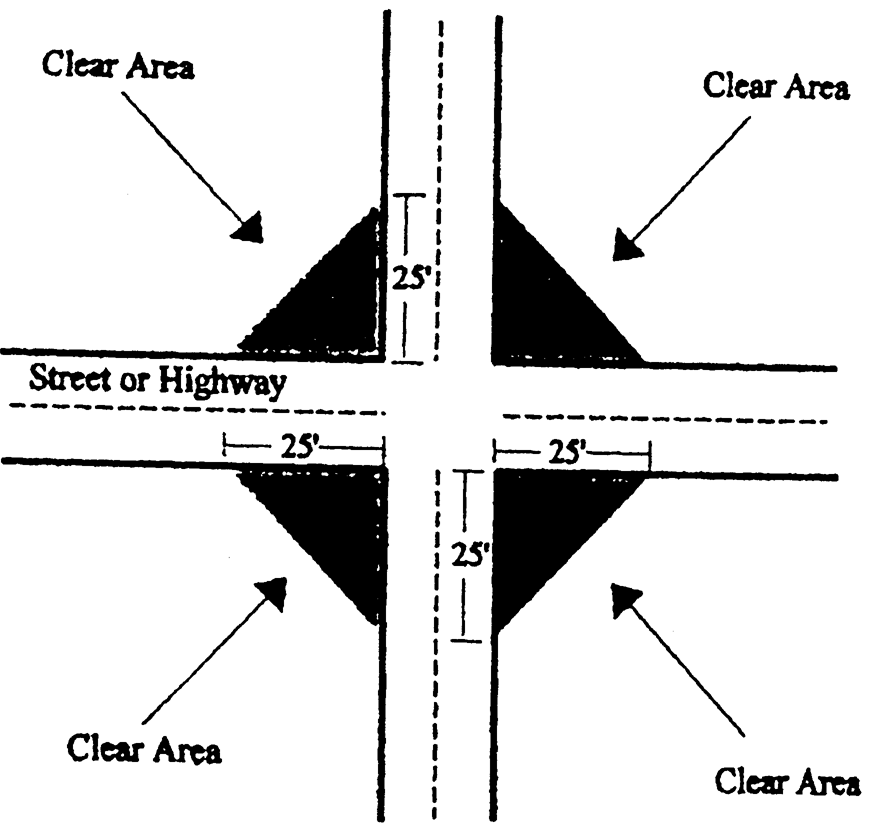
Sight Triangles at an Intersection
On corner lots within all zoning districts no parking lot, fence, shrubbery, or other obstruction to the traffic sight vision, utility poles, light poles, or sign standards, shall exceed a height of three feet within a triangular area formed by the intersection of the right-of-way lines of two streets and a diagonal line which intersects the right-of-way lines at two points, each 25 feet from the intersection of the right-of-way lines. In the case of a rounded corner 25 feet from the point of intersection of their tangents; provided however, signs, lights, or similar objects which located at least 12 feet above the finished grade shall be permitted.
Section 8. - Prohibited uses in residential districts.
Under no circumstances shall the following be permitted in any residential zoning district:
(A)
In open areas, the parking or storing of unoccupied house trailers or converted buses in excess of 24 feet shall not be permitted.
(B)
Commercial tractor trailers or rigs shall not be parked or stored on residentially zoned property at any time with the exception of trailers used for supply and equipment storage at a properly permitted construction site.
(C)
It shall be a prohibited use in all residentially zoned districts to park or store power driven construction equipment, used lumber or metal, or any other miscellaneous scrap or savable material in quantity.
(D)
Temporary use of recreational vehicles on private property for dwelling purposes. No recreational vehicle shall be used for dwelling purposes on any lot in a residential district unless the lot is permitted as an RV park.
Section 9. - Single-family residential standards.
All single-family residences, whether site built or manufactured housing, must meet the following standards:
(A)
Structure and design standards:
(1)
Corrugated metal or plastic panels are prohibited as roofing materials with the exception of being used as materials for skylights or patio covers.
(2)
The exterior wall shall be material similar to traditional site-built housing. These materials may include clapboards, simulated clapboards such as conventional vinyl or metal siding over a minimum covering of one-half inch exterior wood sheathing, wood shingles, shakes, stucco, brick, brick veneer, concrete block, or similar materials, but shall not include smooth, ribbed, or corrugated metal or plastic panels.
(3)
The minimum horizontal dimension of the unit as installed on the site shall be 24 feet in all districts except MH-3 mobile home park district.
(4)
All principal structures shall be placed on a permanent foundation. For the purposes of this section, a permanent foundation shall mean a concrete slab, concrete footers, foundation wall, pilings or post construction which complies with the city building code.
(5)
In no case shall wheels, any undercarriage or transporter unit be left on any structure.
(6)
All units must meet wind loading requirements of Federal Emergency Management Administrator and the International Building Code.
(B)
Manufactured home safety standards. For the purposes of public safety, all manufactured homes or other such forms of mobile, modular, or manufactured housing are subject to the following requirements:
(1)
Manufactured home stand requirements. Prior to the issuance of a manufactured home relocation permit the owner of the parcel or lot for which the manufactured home is to be placed must have an approved mobile home stand. Such stand must have the following:
a.
Street access. Each manufactured home stand shall be provided with access frontage to a width of at least 30 feet to a public or private street or road.
b.
Electric power supply. Each manufactured home stand shall be provided with an adequate, properly grounded, waterproofed electrical receptacle with a minimum rated capacity of 100 amps. A properly sized over current device shall be installed as a part of each power outlet as per the International Building Code.
c.
Sewerage disposal. Each manufactured home stand shall be provided with the means of disposing of kitchen, bath, and putrescible waste directly into a properly installed and inspected septic tank system or an approved community sewerage collection system.
(2)
Manufactured home tie down requirements. All manufactured homes shall be tied down in accordance to this table below unless the manufacturer's installation requirements call for more or the home is to be placed on a lot that is in or adjacent to a flood hazard area.
This table is based on a minimum working load per tie of 3,150 pounds with a 50 percent overload (4,725 pounds total).
a.
Multiple-wide manufactured homes shall only be required to have diagonal ties and anchors in accordance with the chart above unless the manufacturer's installation instructions require more.
b.
Single section manufactured homes shall have diagonal and vertical ties and anchors in accordance with the chart above unless manufacturer's instructions require more.
(3)
Manufactured home siding, stairs, and foundation requirements:
a.
All manufactured homes shall have siding materials consisting of either wood, masonry, concrete, stucco, masonite, or metal lap. The exterior siding material shall extend to ground level except that when a solid concrete or masonry perimeter foundation is used, the siding material need not extend below the top of the foundation.
b.
Skirting and/or siding must be in place within 30 days from the date the re-location permit is issued.
c.
Stairs and landings shall comply with Section 112 - Stairway Construction of the Georgia Building Code and must adhere to the following:
1.
The height of the riser shall not exceed 7¾ inches, and treads, exclusive of nosing shall not be less than nine inches wide.
2.
Every tread less than ten inches wide shall have a nosing, or effective protection, of approximately one inch over the level immediately below that tread.
3.
The width of the landing shall not be less than the width of the stairways they serve.
4.
Every landing shall have a minimum dimension measured in the direction of travel equal to the width of the stairway. Such dimension need not exceed four feet when the stair has a straight run.
5.
All stairways having treads located more than three risers above a floor or grade shall be equipped with a handrail not less than 30 nor more than 34 inches above the leading edge of the tread.
6.
The minimum width of any stair serving as a means of egress shall be a minimum of 36 inches.
7.
If handicapped ramps are added, they must be at least three feet wide and the slope of the ramp shall not exceed one foot for every 12 feet.
(4)
Foundation requirements on all manufactured homes are as follows:
a.
Supports or piers shall not be more than two feet from the exterior end wall.
b.
All grass and organic material shall be removed and the foundation must be placed on stable soil.
c.
Cross over wires must be placed between the two halves.
d.
All nails or staples shall be removed or sealed.
e.
Dryer vents must be vented to the exterior of the manufactured home; not underneath.
(5)
Manufactured home development in flood hazard areas. Due to the danger of placing a mobile home in a flood hazard area the following anchor requirements are required if a mobile home is placed on a lot which is located in or adjacent to a flood hazard area as described by the Federal Emergency Management Association [Agency].
This table is based on a minimum working load per tie of 3,150 pounds with a 50 percent overload (4,725 pounds total).
(6)
Manufactured home additions and auxiliary structures. Any significant feature added to a manufactured home that was not part of the manufactures' original design is considered to be either an addition or an auxiliary structure.
a.
All habitable spaces added to the manufactured home shall be constructed in accordance with the National Manufactured Housing Construction and Safety Standards Act or within the provisions of the Georgia State Building Codes.
b.
All auxiliary structures (such as porches, decks, awnings, cabanas, stairs, etc. unless provided and approved by the manufacturer) shall be entirely self-supporting, unless designed and approved by a professional engineer or registered architect. All such structures shall be constructed in accordance with the Georgia State Building Codes.
(C)
Temporary use of recreational vehicles on private property for dwelling purposes. No recreational vehicle shall be used for dwelling purposes on any lot in a residential district unless the lot in question is permitted as an RV park.
(D)
Build-for-rent communities.
(1)
Build-for-rent communities may be permitted in all residential and planned unit development districts upon application for and receipt of a conditional use permit.
(2)
Short term rentals shall not be permitted in any residence in a build-for-rent community therein occupied or intended to be occupied by a long-term tenant.
(3)
Build-for-rent communities must be managed by a single management company that maintains the development and property in good order with an on-site and staffed office with standard business hours of 9:00 a.m.—5:00 p.m., Monday through Friday. The on-site office shall be a stand-alone building that shall be similar in design and appearance to other buildings within the development.
(Ord. No. O2024-09.C, § II, 11-4-2024)
Section 10. - Manufactured home park requirements.
All manufactured home parks located in the city limits of Pooler must meet the following requirements:
(A)
Dimensional requirements:
(1)
The tract of land for a manufactured home park shall comprise an area of not less than four acres (gross minimum). The tract of land shall consist of a single plot so dimensioned and related as to facilitate efficient design and management of not less than a minimum of 12 manufactured home units.
(2)
Manufactured home lots (spaces) shall be a minimum of 40 by 100 feet and a minimum area of 4,000 square feet.
(3)
The lot (space) coverage in a manufactured home park shall not be more than 60 percent.
(B)
Setback requirements:
(1)
Front. At least 20 feet from front lot line, or 35 feet from center of road.
(2)
Side. At least five feet, with a 20-foot minimum between manufactured homes.
(3)
Rear. At least five feet from the rear adjoining lot line, with a minimum of 20 feet between manufactured homes.
(C)
Parking requirements. A minimum of two paved off-street parking spaces shall be provided for each manufactured home lot.
(D)
Water supply. Where the public water supply is available, it shall be used exclusively. The development of an independent water supply to serve the manufactured home park shall be made only after written approval of plans and specifications has been granted by the county health officer.
(E)
Sewerage disposal. Where the city sewerage system is available, it shall be used exclusively. In lieu of this, an adequate sewerage disposal system must be provided and be approved in writing by the county health officer.
(F)
Refuse. A proposal for refuse collection, storage and disposal shall be submitted, and approved by the city, along with the manufactured home park site plans.
(G)
Utilities. Underground utilities shall be provided within the manufactured home park and shall meet all applicable codes and ordinances.
(H)
Lighting. Street lighting shall be provided, not to exceed 200 feet separation, including park entrance.
(I)
Streets. Streets shall be two-way and a minimum of 20 feet of pavement. On-street parking shall be prohibited. All manufactured home spaces shall abut upon an interior drive, which shall have unobstructed access to a public street or highway, when a manufactured home park consists of more than 25 units.
(J)
Recreation. When manufactured home park consists of less than 25 units, a minimum of 5,000 square feet shall be reserved for recreation. When manufactured home park consists of 25 or more units, a minimum of ten percent of the total area reserved for manufactured homes shall be set aside as a recreation area. (This ten percent shall not include bodies of water.) Such recreation areas shall be made safe from traffic by an enclosure or other device.
(K)
Buffers. Manufactured home parks shall have visual buffers such as shrubbery and/or fencing six feet in height with 80 percent visual density between the park and adjacent nonmanufactured home residential uses. Said buffers must be properly maintained at all times.
(L)
Fire hydrants. Manufactured home parks shall have an acceptable fire protection system with a suitable number of fire hydrants to cover the entire area of the park. Each fire hydrant must be placed and connected to lines necessary to provide ample fire protection to a radius of 250 feet. Such system must be approved by the City Planner prior to plan submittal.
Section 12. - Accessory structures.
(A)
Principal structure on lot. Only one principal building and its customary accessory buildings may be designated per lot, except for R-A zone (See schedule of residential dimensional requirements table).
(B)
Location of detached accessory structures on residential lots. A detached accessory structure in either a residential district or on any lot containing a principal building whose first floor is used for residential purposes are exempted from the schedule of regulations in section 4 of this article, but, shall conform to the following regulations:
(1)
Must be located behind the front of the primary structure,
(2)
Must be located at least 30 feet from any public or private street,
(3)
In specific zoning districts certain setbacks apply and are listed in the table below.
(4)
No detached accessory building shall be more than two stories in height.
(5)
No detached accessory building shall be located nearer than six feet to the principal building.
(C)
Location of attached accessory structures on residential lots. An attached accessory structure in either a residential district or on any lot containing a principal building, the ground floor of which is used for residential purposes shall be considered as an integral part of the principal building and shall be constructed, altered or otherwise be developed in accordance with the regulations governing side yard, rear yard and front yard setbacks for principal buildings in the district.
(D)
Temporary use of accessory structures. An approved relocatable trailer may be used as a temporary office for use on a commercial or industrial construction site provided the following criteria are met and a permit is issued by the city manager.
(1)
At no time shall the relocatable trailer be used for living purposes.
(2)
The relocatable office trailer must connect to the city's water and sewer system if the trailer has restroom and/or water facilities installed. Also, plumbing and electrical services must be approved by the building official prior to occupying the premises.
(3)
Said relocatable office trailer shall be removed from the construction site within 15 days after completion of the project.
(4)
If work stops on said project for more than 60 days, trailer shall be removed within 15 days.
(E)
Temporary use of accessory structures in residential developments. One relocatable trailer is permitted as a temporary sales office, for use in a major residential subdivision of 20 lots or more as long as the following criteria is [are] met and permit is issued by the city manager.
(1)
Permit is issued in developer's name.
(2)
At no time shall the temporary office trailer be used for living purposes.
(3)
Must be set up on a lot of record within the setbacks specified by the zoning ordinances applicable to that development.
(4)
The relocatable office trailer must connect to the city's water and sewer. Also, plumbing and electrical services must be approved by the building official prior to occupying the premises.
(5)
Sales office meets the requirements of the latest edition of the Georgia Accessibility Code.
(6)
Sales office must be removed within six months of the date the approved plat for the residential subdivision is recorded or until a model home is completed, whichever comes first.
(F)
Temporary use of dwelling unit or manufactured home as a model home. New dwelling units or manufactured homes completely constructed or installed in accordance with all the provisions of the Code of Ordinances of the city may be used as temporary sales offices/model homes as long as the following criteria are met and a permit is issued by the city manager:
(1)
Permit is issued in developer or general contractor's name who owns such model or manufactured home.
(2)
Dwelling unit may only be used by sales personnel and may not be occupied as a dwelling unit while being used as a temporary sales office/model home.
(3)
Each temporary sales office/model home must have at least six off-street parking spaces available for use by sales personnel or customers.
(4)
Use as a temporary sales office/model home must terminate upon the later of the expiration of 18 months from the date the permit is issued or the date on which more than 90 percent of the platted and recorded lots or spaces in that residential subdivision or mobile home dwelling district have completed residential structures located thereon which have been sold or leased by the developer or general contractor.
(5)
For good cause shown, the city council of the city may, by resolution, extend the termination date for a temporary sales office/model home.
Section 14. - Swimming pool requirements and placement.
All swimming pools shall comply with the following requirements:
(A)
Application for permit to construct a swimming pool must be submitted to the Building Official. The structural plans must be approved by the Building Official prior to the issuance of a permit and the beginning of construction and/or excavation,
(B)
Swimming pools may only be located in either the side or rear yard and must be at least ten feet from any property line,
(C)
Swimming pool construction must meet all requirements of the Chatham County Public Health design standards,
(D)
All swimming pools must be confined within a fenced area. The fence must be a minimum of four feet in height and all gates must be lockable, self closing, and self latching. Fencing material shall have no opening larger than six inches in diameter,
(E)
No swimming pools shall be placed across, on, or beneath any easements nor shall any utility easement be granted which bisects a swimming pool and,
(F)
Must have a plan to contain all water run-off. Drainage must be contained on site or diverted to an existing drainage handling facility.
Section 15. - Decks and patios.
Patios, as defined in this ordinance, no higher than one foot above the average natural grade may be placed anywhere within the property boundaries. Decks, as defined in this ordinance, and patios that extend beyond one foot of [above] the average natural grade shall be required to be setback at least five feet from any property line.
Section 16. - Communication equipment.
(A)
Structural plans for all commercial radio, television, cellular and other transmitting or relay antenna towers must be approved by an engineer licensed to practice in the State of Georgia and a permit issued by the building official.
(B)
Only communication equipment located on public property may exceed 35 feet above the average natural grade.
(C)
Communication towers must meet all front, rear, and side yard setbacks.
(D)
All towers shall be designed and constructed to withstand a wind velocity of not less than 125 miles per hour.
Section 17. - Secondary dwelling structures.
Where permitted, secondary dwelling structures must adhere to the following requirements as per their respective category:
(A)
Garage apartments. Garage apartments may only be permitted on a lot with a single family dwelling and provided that such shall only be permitted in a rear yard, there is adequate parking for two single-family dwelling units, and the lot on which such use is to be established meets 1½ of the minimum lot area requirements for the zoning district. Garage apartments may not have a living area greater than one-half of the primary structure's total living area. Garage apartments may be rented for compensation as long as the owner resides in the primary structure.
(B)
Caretakers dwelling. Caretakers dwellings may only be permitted in commercial and industrial zones and intended to house only persons employed by the permitted commercial or industrial use.
(C)
Guest home. Guest homes may only be permitted on a lot with a single family dwelling and provided that such shall only be permitted in a rear yard, there is adequate parking for two single-family dwelling units, and the lot on which such use is to be established meets 1½ of the minimum lot area requirements for the zoning district. Guest homes may not have a living area greater than one-third of the primary structure's total living area. Guest homes are intended for housing members of the family occupying the main building and their non-paying guests and shall not be rented, sold or otherwise used as a separate dwelling.
(D)
Non-residential mobile structures as temporary use. The City of Pooler Zoning Administrator shall have the authority to issue a permit subject to the following conditions. Upon a finding by the zoning administrator that such action may be detrimental to the surrounding neighborhood, the zoning administrator shall deny the petition. Such use shall be permitted subject to the following conditions:
(1)
Such mobile home units shall be allowed only for use by schools or churches, where permitted.
(2)
Any permit issued under these conditions shall be valid for only 12 months with option to renew for an additional 12 months and the residents adjacent to property be notified that a mobile structure would be located in their neighborhood; a "B" would be placed by the zone to indicate that the petition would go before the Mayor and Council.
(3)
Placement of the mobile unit must be compatible with the established development pattern so as not to adversely affect the adjoining and surrounding properties.
(4)
The mobile unit must be placed on a tract of land at least 20,000 square feet in size.
(5)
When a mobile unit is placed upon an occupied lot, it shall be considered the principal use upon such lot and shall comply with all regulations established for the district and for the use to be placed within the unit.
(6)
The mobile unit shall be provided with skirting completely enclosing any open space that exists between the ground and the bottom of the mobile unit. Such enclosure shall be visually compatible with the neighborhood.
(7)
The mobile unit shall be provided with a foundation designed to support the maximum load during all seasons and approved by the Building Official.
(8)
No additions shall be made to the mobile unit.
(9)
Steps that are compatible with conventional residential construction shall be provided to all exterior entrances.
(10)
The mobile unit shall be located on the tract of land in a manner consistent with the location of building on adjoining lots.
There may be no more than one secondary dwelling allowed per lot and it may only be placed in a manner which meets the schedule of development regulations listed in section 6 of this article.
Section 18. - Home occupations.
Application for a home occupation shall be filed with the Occupational Tax Clerk upon forms furnished by the City of Pooler. Home occupations require an annual fee and subject to inspection if necessary. There is no fee or annual inspection for home business offices as long as its operation meets the home business office parameters. Home occupation permits may be renewed as long as the operation follows the home occupation parameters. The parameters for each of these uses are listed as follows:
(A)
Home occupation. If permitted in a zoning district, a home occupation must comply with the following requirements:
(1)
Is carried on by either the owner of the dwelling, his/her spouse, or primary occupant;
(2)
Is conducted entirely within the principal building;
(3)
Utilizes not more than 20 percent of the total floor area of the principal building;
(4)
Produces no alteration or change in the character or exterior or change in the principal building from that of a residential dwelling;
(5)
Involves the sale or offering for sale of articles produced or assembled on the premises or products not produced on site, but, related and accessory to the service provided;
(6)
Does not generate pedestrian or vehicular traffic or demand for parking, beyond that which is normal to the particular neighborhood;
(7)
Creates no disturbing or offensive noise, vibration, smoke, dust, odor, heat, glare, traffic hazard, unhealthy or unsightly condition;
(8)
Only operates between 7:00 a.m. and 7:00 p.m.; and,
(9)
Displays no sign or external indication of the home occupation.
(10)
No more than one vehicle used in the conduction of the business may be parked at the home location;
Deviation from the parameters of a permitted home occupation will result in the revocation of all applicable permits associated with the use and its operation.
Section 19. - Child-care facilities.
Where permitted, child-care facilities must adhere to the following requirements as per their respective category:
(A)
Family day care home. Such facilities, when located in a district as a permitted use, shall have a minimum of 100 square feet of outdoor play area for each child. Such outdoor play area shall be enclosed by a fence not less than four feet in height.
(B)
Child-care center. Such facilities, when located in a district as a permitted use, shall comply with the following minimum regulations:
(1)
A minimum of 100 square feet of outdoor play area shall be provided for each child. Such outdoor play area shall be enclosed by a fence not less than four feet in height.
(2)
Such uses shall only be permitted on a lot or plot of ground which abuts a collector street, major arterial or secondary arterial. The city council shall be authorized to waive this requirement, if on the basis of evidence presented, it finds that the traffic to be generated by a particular use can be accommodated on other streets without creating traffic congestion and traffic hazards on such streets which would be detrimental to the neighborhood served by such other streets. Provided that approval for any center established requiring access along residential or lesser classified street shall be limited to a maximum of 75 children during the daytime hours and no greater than 50 children between the hours of 9:00 p.m. and 6:00 a.m.
(3)
The architectural character including the orientation and exterior appearance of any structure shall be characteristic of the neighborhood within which such structure is located.
(4)
Such use shall provide the number of off-street parking spaces required for educational and institutional uses as set forth in section 5, off street parking and unloading, plus safe and functional off-street patron pick-up and delivery spaces.
(5)
There shall be no on-site outdoor recreation activities after 9:00 p.m.
(6)
Where an abutting use is residential, visual buffers shall be provided so as to shield all parking areas and play areas, and outdoor activity areas from the abutting property. Such buffer shall consist of trees or of the vegetation of such height and depth as determined by the city council of an appropriately designed fence, wall or a combination thereof.
(C)
Nursery school. This type of establishment is secondary use to a church or large business intended only for patrons or employees of such primary establishment. Such facilities, when located in a district as a permitted use, shall comply with the following minimum regulations:
(1)
A minimum of 100 square feet of outdoor play area shall be provided for each child. Such outdoor play area shall be enclosed by a fence not less than four feet in height.
(2)
Such use shall provide the number of off-street parking spaces required for educational and institutional uses as set forth in section 5, off street parking and unloading, plus safe and functional off-street patron pick-up and delivery spaces.
(3)
There shall be no on-site outdoor recreation activities after 9:00 p.m.
(D)
Preschool. This type of child care establishment is specifically dedicated to providing a structured educational format. Hours of operation shall be limited to those customary of public schools. Such use shall provide the number of off-street parking spaces required for educational and institutional uses as set forth in section 5, off street parking and unloading, plus safe and functional off-street patron pick-up and delivery spaces.
Section 20. - Adult care facilities.
Adult care facilities in Pooler are listed and defined into three major classes: family personal care homes, group personal care homes, and congregate personal care homes. The requirements for these uses are as follows:
(A)
Family personal care home. This use is limited to six or fewer persons including supervisory personnel and staff and must meet the following requirements:
(1)
Such use shall comply with the Georgia Department of Human Resources, "Standards for Adult Daycare" as amended.
(2)
The parking layout and design shall be characteristic of the neighborhood within which such use is located.
(3)
When the building housing such use is located within 150 feet of a dwelling unit, the use shall operate only between the hours of 6:30 a.m. and 7:00 p.m.
(4)
The use shall only be established in a building designed as and occupied as a one- or two-family dwelling structure.
(B)
Group and congregate personal care homes. This use allows around the clock operation and the following requirements apply to all personal care home regardless of the zoning district for which they are located:
(1)
Such use shall provide the number of off-street parking spaces required for nursing homes and hospitals as set forth in section 5(A)(3), off street parking and unloading, plus safe and functional off-street patron pick-up and delivery spaces.
(2)
At least one staff person must reside in the home.
(3)
Visiting hours must be limited to hours of 6:30 a.m. and 7:00 p.m. when such use is located in a residential neighborhood.
(4)
Such use shall only be permitted on a lot which abuts and has vehicular access to a collector street, major arterial or secondary arterial. The city council may waive this requirement if, on the basis of evidence presented, it finds that the traffic to be generated by a particular use can be accommodated on other streets without creating traffic congestion and traffic hazards to the neighborhood served by such streets.
(5)
Such use shall comply with the Georgia Department of Human Resources, "Standards for Adult Daycare" as amended.
(6)
The parking layout and design shall be characteristic of the neighborhood within which such use is located.
(7)
When the building housing such use is located within 150 feet of a dwelling unit, the use shall operate only between the hours of 6:30 a.m. and 7:00 p.m.
(8)
Where the use abuts a lot occupied by a one or two-family dwelling, visual buffers shall be provided so as to shield all parking areas and outdoor activity areas from the abutting property. Such buffer shall consist of trees or other vegetation of such height and depth as determined by the planning commission or of an appropriately designed fence or wall or a combination thereof as approved by the planning and zoning commission.
(9)
Only one non-illuminated or indirectly illuminated sign not to exceed three square feet in area shall be permitted. Provided that where such use is adjacent to or directly across from a non-residential use or district, the city council may allow a principal use sign of up to 12 square feet in area when it is to be located on the side of the property facing the non-residential use or district and where the sign design is found to be in keeping with the character of the neighborhood.
(10)
A site plan shall be submitted to the planning commission and city council for review and approval prior to issuance of either a building permit or an occupancy permit.
Section 21. - Country clubs.
Wherever permitted, country clubs must meet the following requirements:
(A)
Such clubs shall be non-profit and shall not be open to the general public but shall be operated only for the benefit of dues-paying members.
(B)
Any building or structure established in connection with such uses shall be set back not less than 100 feet from any property line, except where such property line is a street line, in which the front yard setback established for this district shall apply.
(C)
A site development plan shall be submitted to the planning commission and city council for review and approval prior to the issuance of a building permit.
(D)
The site on which such uses are to be established shall be not less than five acres in size.
Section 22. - Animal hospitals.
The following regulations shall apply to development of all animal hospitals, veterinary clinics, and animal boarding places.
(A)
The use shall front a major arterial street, provided that where all pens, runs or buildings housing such animals are located at least 100 feet from any property line, such use may be located on a lesser classified street.
(B)
All buildings housing animals shall be designed and constructed with a Sound Transmission Class Rate (STC) as set forth in Architectural Graphic Standards of at least 52, if located within 100 feet of any property line.
(C)
All outdoor runs, pens and animal sheds housing more than five animals shall be located at least 100 feet from any other residential district property.
(D)
No animals shall be allowed in any outdoor run located within 100 feet of a property line between the hours of 6:00 p.m. and 7:00 a.m.
(E)
A site development plan shall be submitted to the Planning Commission and governing body for review and approval.
(F)
All runs or pens located within 100 feet from any property line or street right-of-way shall be screened by an architecturally designed solid fence with landscaping.
(G)
All parking areas shall be screened by a minimum three-foot high hedge or solid fence.
Section 23. - Drive-in theaters.
Where permitted, shall meet the following requirements:
(A)
A site development plan shall be submitted to the planning commission and governing body for review and approval.
(B)
The theater screen, projection booth or other building shall be set back not less than 50 feet from any property line.
(C)
Driving and parking areas shall be treated with a suitable material to prevent dust.
(D)
Ingress and egress from a public street shall be so designed and constructed as to provide for safe traffic movement.
(E)
Central loudspeakers shall be prohibited.
(F)
The theater screen shall not face an expressway, major arterial or secondary arterial.
(G)
The theater sign [site] shall be enclosed by a wall or fence of adequate height to screen the parking area from view of surrounding property. Such fence shall be separated from adjoining property by shrubbery and landscaping.
Section 24. - Churches and other places of worship.
Where permitted, shall meet the following requirements:
(A)
Any building or structure established in connection with such use shall be set back not less than 50 feet from any property lines, except where a property line is the right-of-way of a street, in which case the setback established for the particular class of street in the zoning district the building or structure is located shall apply. The city council shall be authorized to reduce the setback requirements of this section in the case of a particular church or place of worship if on the basis of evidence presented, it finds that a reduction in the setback would be in keeping with the purposes of this ordinance, and would not create conditions which would be detrimental to the adjoining properties or the neighborhood.
(B)
Such uses shall only be permitted on a lot or plot of ground which abuts a collector street, major arterial or secondary arterial. The city council shall be authorized to waive this requirement, if on the basis of evidence presented, it finds that the traffic to be generated by a particular church or place of worship can be accommodated on other streets without creating traffic congestion and traffic hazards on such streets which would be detrimental to the neighborhood served by such other streets.
Section 25. - Adult entertainment establishments.
Adult entertainment establishments are classified into three categories; (1) adult media store, (2) adult movie theater, (3) live adult entertainment, and adult gift shops. Where permitted each use shall meet the following requirements respectively:
(A)
Regulations for all adult entertainment establishments:
(1)
In no case shall alcohol be served or allowed on the premises of any adult entertainment establishment,
(2)
No minors shall be allowed on the premises of an adult entertainment establishment at any time,
(3)
Suitable exterior lighting is required for all off-street parking and loading areas,
(4)
An adult entertainment establishment shall not be located within one mile of an existing adult entertainment establishment, establishment serving alcoholic beverages, school, church or public park, and
(5)
May only be open to the public between the hours of 7:00 p.m. and 11:00 p.m. Monday through Saturday.
(B)
Regulations for adult media stores:
(1)
Required parking and all public entrances shall be limited to the front yard and front of the structure,
(2)
Product advertisements, displays, or other promotional material shall not be shown or exhibited so as to be visible to the public from the exterior of the structure, and
(3)
The interior of the store shall be adequately lighted so that every portion thereof is readily visible to the clerk or other supervisory personnel from the counter or other regular station.
(C)
Regulations for adult movie theaters:
(1)
Required parking and all public entrances shall be limited to the front yard and front of the structure,
(2)
Product advertisements, displays, or other promotional material shall not be shown or exhibited so as to be visible to the public from the exterior of the structure,
(3)
All building openings, entries, windows, etc., shall be located, covered, or screened in such a manner as to prevent a view into the interior from any public or semi-public area, and
(4)
No loudspeakers or sound equipment shall be used in a way that can be discerned by the public from public or semi-public areas.
(D)
Regulations for live adult entertainment establishments:
(1)
All patrons must use valet parking provided by the owner,
(2)
All patrons must follow a dress code created by the owner and approved by the city council,
(3)
Must have one security person per every 20 patrons, and
(4)
All entertainment shall be limited to one room in the structure.
(E)
Regulations for adult gift shop:
Product
advertisements, displays, or other promotional material shall not be shown or exhibited so as to be visible to the public from the exterior of the structure.
Section 26. - Recreational vehicle park.
(A)
Definitions.
(1)
Recreational vehicle park means any facility consisting of two or more spaces for motor homes or recreational vehicles providing lodging and other accommodations for tourists and travelers, and includes recreational vehicle courts, recreational vehicle parks, and any similar place by whatever name called, and any facility or establishment operated in conjunction with a recreational vehicle court as described herein.
(2)
Independent trailer means a trailer which has its own holding tank for waste and/or can be connected directly to a sewer connection.
(B)
A recreational vehicle park is subject to the following:
(1)
General requirements. A recreational vehicle park shall meet the following general requirements:
a.
The park shall be primarily for recreational use by persons with independent transportable recreational housing. Each unit shall be required to use city water and sewage where available and in accordance with all other city ordinances.
b.
The land on which the park is developed shall be under unified control and shall be planned and developed as a whole in a single development operation or programmed series of development operations for recreational vehicles. Subsequent subdivision of lots or conveyance of sites to individual owners by any means is prohibited.
c.
The principal and accessory uses and structures shall be substantially related to the character of the development in the context of the district of which it is a part.
d.
The park shall be developed according to comprehensive and detailed plans that include streets, utilities, lots, and building sites, and approved by the City of Pooler site plan approval process.
e.
The park shall have a program for provision, maintenance and operation of all areas, improvements, and facilities for the common use of all or some of the occupants of the park, but will not be provided, operated, or maintained at general public expense.
f.
A 20-foot buffer shall be maintained along the perimeter of the park along with a six-foot privacy fence.
g.
Continuous parking for any recreational vehicle shall be restricted to a period of no more than 180 days in any 120-month period. (See subsection (B)(5)c.) No person shall reside in said park for more than 180 continuous days.
(2)
Allowable uses. The allowable uses in a recreational vehicle park include the following:
a.
Recreational vehicles.
b.
No tents or any other dependent units shall be allowed.
c.
Convenience establishments for the sale or rental of supplies or for provision of services, for the satisfaction of daily or frequent needs of occupants, within the park may be permitted. These establishments may provide groceries, ice, sundries, bait, fishing equipment, self-service laundry equipment, bottled gas, and other similar items needed by users of the park. These establishments shall be designed to serve only the needs of the occupants within the park and shall not, including their parking areas, occupy more than five percent of the area of the park, and shall not be located as to attract patronage from outside the grounds, nor have the adverse effects on surrounding land uses.
(3)
Site design requirements for site plan approval. The following site design requirements shall be met:
a.
The minimum land area for a recreational vehicle park shall be six acres.
b.
The maximum density for a recreational vehicle park shall be nine spaces per gross acre. Storage spaces shall be included in the density calculation.
c.
Individual spaces shall take access to internal streets and shall not take direct access to adjoining public rights-of-way.
d.
Access to the recreational vehicle park shall be from a collector or arterial roadway.
e.
Internal streets (minimum 20 feet) shall provide safe and convenient access to spaces and appropriate park facilities. Alignment and gradient shall be properly adapted to topography. Construction and maintenance shall provide a well-drained surface that is of adequate width to accommodate anticipated traffic.
f.
Recreational vehicle spaces shall be so located in relation to internal streets as to provide for convenient vehicular ingress and egress if the space is intended for use by wheeled units. Where back-in or back-out spaces are used, appropriate maneuvering rooms shall be provided in the adjacent internal street and within the space.
g.
Spaces shall be so related to pedestrian ways and principal destinations within the park as to provide for convenient pedestrian access to such destinations by the pedestrian systems.
h.
Minimum dimensions are specified for spaces, and each must be at least 25 feet by 60 feet except that no more than ten percent of total spaces may be 25 feet by 50 feet.
i.
Recreational vehicle sites shall be at least 15 feet apart, edge to edge, and the center of all camping units shall be at least 30 feet from the edge of the campground road, and the separation from the edge of the campground road and the independent recreation vehicle shall be a minimum of ten feet.
j.
A lighting plan shall be required to include cut-off type lamp fixtures with the following illumination: minimum of four foot candle (average) at all intersections; minimum of two foot candle (average) throughout the remainder of the park.
k.
A detailed landscape plan must be submitted and approved by the planning and zoning commission.
l.
Each recreational vehicle site shall contain at least one reinforced surface parking space incorporated into the site itself and shall be level from side to side with sufficient crown to provide adequate drainage.
m.
All sites must conform to the National Fire Protection Association 1194 Standard for Recreational Vehicle Parks and Campgrounds, and Fire Safety Rules and Regulations shall be conspicuously posted by management (NFPA 1194-9).
n.
Emergency vehicles shall have ready access to locking mechanisms on any gate that restricts access.
o.
Each recreational vehicle park shall have a written evacuation plan approved by the City of Pooler.
(4)
Solid waste disposal.
a.
All parks shall provide fly-proof, watertight, rodent-proof containers for the disposal of refuse. Containers shall be provided in sufficient number and capacity to properly store all refuse. Refuse for recreational vehicle areas shall be collected at least once a week, and the developer shall provide the waste collection services. No other waste collection service shall be used by any recreational vehicle other than the waste collection service provided by the developer.
b.
No garbage cans, service yards, wood piles, or storage piles shall be allowed. All rubbish, trash, and garbage shall be regularly removed from recreational vehicles and shall not be allowed to accumulate in the recreational vehicle or on the recreational vehicle site. No rubbish, garbage or trash shall be placed on the common area outside the recreational vehicle, temporary or otherwise. All trash receptacles and trash bins shall be kept within the individual recreational vehicles or disposed of in the designated trash receptacles provided by the developer.
(5)
Regulations.
a.
Animals and pets. No animals, livestock, or poultry of any kind shall be raised, bred, or kept on any part of the recreational vehicle park, except that dogs, cats, birds and fish may be kept by the respective tenants in their respective recreational vehicles, provided that they are not kept, bred, or maintained for any commercial purpose and do not endanger the health of the general population. No chained animals, kennels, fences or invisible fences for animals are allowed. No more than two dogs or cats may be kept by the respective tenants in their respective recreational vehicles. No potbellied pigs, venomous snakes, or any dog deemed dangerous or vicious by any governmental authority may be brought onto or kept on the property at any time. All animals in the recreational vehicle park shall be under the direct and immediate control of a person either by leash or other restraint. Pet owners shall be responsible for the removal of all animal waste from the recreational vehicle park.
b.
Patios and common area. No planting or gardening shall be done, no fences, hedges or walls shall be erected or maintained upon the property except such as are installed in accordance with the initial construction of the property or approved by the City of Pooler and no exterior clothesline shall be permitted upon the property.
c.
Leasing of parking spaces. Parking spaces may be leased to individuals or entities provided the occupancy is for no more than six months during any 12-month period, and such occupancy is only for the lessee and his immediate family. No recreational vehicle may be rented to a person other than tenant of the parking space. No person shall reside in the recreational vehicle park for no more than 180 continuous days regardless of which vehicle they are residing in.
d.
Nuisances. No noxious or offensive activity shall be carried on upon any lot, nor shall anything be done thereon which may be or become an annoyance or nuisance to the property and development. No immoral, improper, offensive or unlawful use shall be made of any portion of the property, and all vivid laws, ordinances and regulations of all governmental agencies having jurisdiction shall be observed. No tenant shall do or keep anything or cause or allow anything to be done or kept in his recreational vehicle or on the common area which would result in an increased risk or hazard to the property or the City of Pooler. All recreational vehicles shall meet the National Fire Protection Association 1192 Standard in effect. All recreational vehicles must be operational at all times. No major repairs may be performed within the recreational vehicle park.
e.
Home occupations. No home occupation, industry, business, trade or profession or any kind, whether commercial or otherwise, shall be conducted, maintained or permitted on any part of the properties. The use for habitual parking for commercial vehicles in any parking area or portion of the common area is prohibited. The term "commercial vehicle" includes all trucks and vehicular equipment of a commercial nature that are larger than a standard passenger vehicle.
f.
Parking. All vehicles shall be parked in each respective recreational vehicle's designated parking area. Any vehicle parked on the street or common areas shall be towed at the vehicle owner's expense. Additional parking spaces shall be provided for visitors and guests. The parking of commercial vehicles, trucks with a load capacity of one ton or more, boats, or buses is prohibited. No disabled vehicle shall be parked on any parking space for more than 24 hours. Any vehicle or trailer parked on any portion of the property in violation of this paragraph or any of the property's rules and regulations, the developer or the City of Pooler may place notice on the vehicles specifying the nature of the violation and stating after 24 hours, the vehicle may be towed. Said notice shall conform to all requirements of state law and local ordinances.
g.
Signs and business activities. No advertising, signs, billboards, unsightly objects, or nuisance shall be erected, placed, or permitted on the property, nor shall any business activity be allowed. However, this shall not apply to the business activities or signs of the developer, his agents, or assigns during the construction and leasing period. All such activities and signage must comply with all provisions of the City of Pooler's ordinances.
h.
Campfires are prohibited. Outdoor cooking is allowed on grills equipped with legs.
i.
Maximum occupancy of any recreational vehicle site will be limited to the sleeping occupancy rating, as rated by the manufacturer, for the recreational vehicle on site. Exception to the occupancy rating will apply to day use only and will be allowed only as it does not interfere with the quiet enjoyment of all surrounding recreational vehicle sites.
(6)
Violation of any of the provisions of this section shall be punishable by up to six months in jail and/or a $1,000.00 fine per violation.
(C)
Issuance of permits. It shall be unlawful for any person, firm, or corporation to operate a recreational vehicle court without having first obtained a valid permit and occupational tax certificate. Such permit shall be issued by the City of Pooler or its duly authorized representative, subject to supervision and direction by the City of Pooler. Further, all provisions of O.C.G.A. § 31-28-2 must be met.
(D)
Denial, suspension, and revocation of permits. The City of Pooler may suspend or revoke permits where the health, sanitation, and safety of the public require such action. When, in the judgment of the City of Pooler or its duly authorized agents, it is necessary and proper that such application for a permit be denied or that a permit previously granted be suspended or revoked, the applicant or holder of the permit shall be notified thereof in writing and shall be afforded an opportunity for hearing as for the appeal of denial of a business registration certificate. In the event that such application is finally denied or such permit finally suspended or revoked, the applicant or holder thereof shall be given notice in writing, which notice shall specifically state the reasons why the application or permit has been suspended, revoked, or denied.
(E)
Administrative review of local government order. Any person substantially affected by any final order of the City of Pooler denying, suspending, revoking, or refusing to renew any permit provided under this chapter may secure review thereof by appeal to the Mayor and Council of the City of Pooler.
(F)
Standards for health, sanitation, and safety.
(1)
The City of Pooler shall have the power to adopt and promulgate rules and regulations to ensure the protection of the public health. Such rules and regulations shall prescribe reasonable standards for health, sanitation, and safety of recreational vehicle courts with regard to:
a.
Location, drainage, and maintenance of grounds;
b.
Size, ventilation and maintenance of laundry rooms, where provided;
c.
Installation of all electrical equipment and exposed wiring;
d.
Heating appliances and equipment, and installation thereof;
e.
Water supply, plumbing fixtures, and installations;
f.
Sewage disposal;
g.
Garbage and refuse disposal;
h.
Control of vermin;
i.
Accident prevention; and
j.
Spacing of recreational vehicles and lighting of recreational vehicle parks.
(2)
The City of Pooler is empowered to adopt and promulgate supplementary rules and regulations consistent with those adopted and promulgated by the City of Pooler.
(G)
Inspection of premises. The City of Pooler and its duly authorized agents are authorized and empowered to enforce compliance with this chapter and the rules and regulations adopted and promulgated under this chapter and, in conjunction therewith, to enter upon and inspect the premises of a recreational vehicle court at any reasonable time and in a reasonable manner.
(H)
Penalty. Any person, firm, or corporation operating a recreational vehicle court without a valid permit shall be guilty of a City of Pooler ordinance violation.
(Ord. of 6-15-2009, § I)
Editor's note— Ord. of June 15, 2009, § I, changed the title of § 26 from campsites and RV parks to recreational vehicle court.
Section 27. - Zoning buffer requirements.
(A)
Zoning buffers; where required.
(1)
On a property to be used for any multi-family use (duplexes, townhouses, apartments or mobile home park), a buffer must be provided along a side or rear lot line that abuts any agricultural zoning district or agricultural use; any single-family use or zoning district; any single-family, recreational or open space area.
(2)
On a property to be used for any office, institutional or commercial use, a buffer must be provided along a side or rear lot line that abuts any agricultural zoning district or agricultural use; any single-family or multi-family use or zoning district; any single-family, multi-family, recreational or open space area.
(3)
On a property to be used for any industrial use, a buffer must be provided along a side or rear lot line that abuts any agricultural zoning district or agricultural use; any single-family or multi-family use or zoning district; any single-family, multi-family, recreational or open space area.
(4)
Where multiple uses or uncertainty exist, the buffer requiring the greatest width shall apply.
(B)
Zoning buffers; timing of installation. Buffers are required to be created at the time of construction of any infrastructure or new development of a building or site.
(C)
Zoning buffer standards.
(1)
Buffer areas shall contain no driveways, access easements, parking areas, patios, storm water detention facilities, or any other structures or accessory uses except for a fence, wall or earthen berm constructed to provide the visual screening required to meet the standards of this Zoning Code.
(2)
Underground utilities including closed storm drains may be permitted to cross perpendicular to a buffer if the screening standards of this Zoning Code will be subsequently achieved.
(3)
Vehicular access through a buffer may be allowed only as a condition of rezoning, conditional use application or planned development zoning approval by the city council.
(D)
Width of buffer.
(E)
Minimum required screening. A required zoning buffer must create a barrier that substantially blocks the sight lines, noise transmission, and the transfer of artificial light and reflected light up to a height of no less than six feet at the property line (or such greater height as required by conditions of zoning approval on a particular property).
(F)
Natural buffers. Natural buffers shall be composed of healthy plants which possess growth characteristics of such a nature as to produce a dense, compact visual screen not less than six feet in height. Natural buffers may contain deciduous or perennial vegetation but shall contain existing or planted evergreen shrubs and trees suitable to local growing conditions that will provide an opaque visual screen during all seasons of the year.
(G)
Structural buffers. A structural buffer shall provide a continuous visual screen throughout its entire length, and may consist of any combination of the following, as approved by the city planner: Opaque fencing constructed of cedar, redwood, treated and stained or painted wood, vinyl replicating wood, or other suitable all-weather material; masonry walls of brick or stone; concrete block walls treated with a decorative finish; planted or natural vegetation; or earthen berms. Structural buffers shall meet the following criteria:
(1)
Structural buffers shall be vegetated throughout the minimum area required for the buffer around any fences or walls and upon any earthen berms, which may include ground covers, shrubs and trees.
(2)
All earthen berms shall have a maximum side slope of 50 percent (one foot of vertical rise to two feet of horizontal run). Earthen berms shall not be constructed within the drip line of any existing trees that will remain on the property; new trees that overhang the berm may be planted after the berm is constructed.
(3)
Trees shall be located or planted within any structural buffer at a density of no less than one tree for each 25 feet of buffer length or portion thereof. New deciduous trees shall have a caliper of no less than two inches upon planting, and new evergreens shall be at least six feet tall when planted.
(4)
Fences and freestanding walls shall present a finished and decorative appearance to the abutting property and shall be located no closer to the property line than two feet. Shrubs, ground covers, or other vegetation shall be provided between the fence or wall and the property line so as to provide a decorative effect, following professional landscaping standards for spacing, location and design
(H)
Buffers for trash receptacles in all districts. All exterior non-residential trash receptacles and multifamily residential with common trash receptacles shall be screened from public view on three sides and on the fourth side by a gate that screens the receptacles from view. The enclosure and gate should be a minimum of six feet in height and shall be made of a solid material such as block or a solid panel fence.
Sec. 28. - Independent senior housing.
(A)
Definition. "Independent senior housing" is defined as a residential facility that: (i) is designed and constructed for the specific purpose of housing senior citizens aged 62 or older who are independent and do not require assistance with daily living activities; (ii) is designed to enable seniors to live on their own, but with the security and convenience of community living, including recreational, educational and social activities; and (iii) contains individual residential housing units that do not include or provide supportive services such as medical care, assisted living or food preparation.
(B)
Purpose. The independent senior housing use is established to provide locations for the development of dwelling units limited to those persons aged 62 and older, pursuant to standards that reflect the unique character of independent senior residential occupancy. The use is further established in recognition of the significant differences between independent senior citizen housing and traditional multi-family developments, specifically:
(1)
the unique needs of independent senior citizens warrant certain architectural features that are not typically seen in traditional, non-age-restricted multi-family residential developments; and
(2)
the impacts of independent senior citizen housing developments are lower than those of traditional, non-age-restricted multi-family residential developments. Independent senior housing developments, by nature and design, minimize impact to traffic, schools, and other elements that require municipal resources to manage and maintain.
(C)
General requirements. All independent senior housing developments shall meet the following general requirements:
(1)
All units within an independent senior housing development shall be restricted to occupancy by persons 62 years of age or older, as defined by the Fair Housing Act, as may be amended from time to time.
(2)
An independent senior housing use shall be permitted only as a conditional use, and only in those zoning districts set forth in Table 4.1 which allow independent senior housing as a conditional use. Accordingly, the development of an independent senior housing development shall require a conditional use permit (issued pursuant to Article V, Section 7 of this ordinance).
(3)
A site development plan shall be submitted to and approved by the Mayor and Council of the City of Pooler for all independent senior housing developments. The approved plan shall constitute the approved use for the site and any subsequent change in land use for the property that is not consistent with the approved plan shall be resubmitted in the same manner and shall require review and a recommendation by the Pooler Planning and Zoning Commission and review and approval by the mayor and council.
(4)
Prior to occupancy of any independent senior housing project developed pursuant to this section, the project proponent shall provide documentation limiting the use of the project to an independent senior housing use, and vesting the right to enforce such limitation in the city. Such documentation shall be in a form satisfactory to the city attorney and shall be recorded against the property in the county real estate records.
(D)
Development standards. Specific standards must be set forth in the site development plan which shall include, at a minimum:
(1)
Density. The density for an independent senior housing development shall be governed by the density established in the approved site development plan, but in no event shall the density exceed 25 units per net acre.
(2)
Unit mix. The permissible dwelling units within an independent senior housing development shall be studios, one-bedroom and two-bedroom units only. No dwelling units with greater than two bedrooms shall be allowed.
(3)
Parking. Subject to the terms of the approved site development plan, an independent senior housing development shall be required to provide a minimum and maximum number of parking spaces for the following categories of dwelling units within the development:
(4)
Height. Subject to the terms of the approved site development plan, the maximum height of the independent senior housing development shall be 55 feet.
(5)
Architectural features. All independent senior housing developments shall include the features set forth below:
a.
Entryways, walkways and hallways in the common areas of the development, and doorways and paths of access to and within the residential units, shall be as wide as required by laws applicable to new multi-family housing construction for provision of access to persons using a standard-width wheelchair.
b.
Walkways and hallways in the common areas of the development shall be equipped with standard height railings or grab bars to assist persons who have difficulty walking.
c.
Walkways and hallways in the common areas shall have lighting conditions which are of sufficient brightness to assist persons who have difficulty seeing.
d.
Access to all common areas and residential units within the development shall be provided without use of stairs, either by means of an elevator or sloped walking ramps.
e.
The development shall be designed to encourage social contact by providing at least one common room and outdoor common open space.
f.
Refuse collection shall be provided in a manner that requires a minimum of physical exertion by residents.
g.
The development shall comply with all other applicable requirements for access and design imposed by law, including, but not limited to, the Fair Housing Act (42 U.S.C. Sec. 3601 et seq.).
(6)
Universal design features. All independent senior housing projects shall implement, at minimum, the following universal design principles (universal design is a method of design that allows aging in place by creating an environment that can be used by everyone, regardless of age or physical condition):
a.
No-step entries.
b.
One-story living such that an eating area, bathroom, and sleeping area are available on the same floor.
c.
Front doors with a minimum width of 36 inches to accommodate the use of wheelchairs and 32-inch free-swing doors (34-inch door) on all interior doors.
d.
Hallway minimum width of 42 inches to accommodate the use of wheelchairs.
e.
Room thresholds that are flush.
f.
Adequate lighting throughout the dwelling unit.
g.
Lever door handles and rocker light switches.
h.
Additional closet rod brackets to allow potential access from a wheelchair.
i.
Adequate space for maneuverability and access to facilities to those using wheelchairs.
(Ord. No. 2021-03.A, § I, 6-7-2021)
Section 29. - Retreat.
Where permitted, shall meet the following requirements:
(A)
Any building or structure established in connection with such use shall be set back not less than 50 feet from any property lines, except where a property line is the right-of-way of a street, in which case the setback established for the particular class of street in the zoning district the building or structure is located shall apply. The city council shall be authorized to reduce the setback requirements of this section in the case of a particular retreat, if on the basis of evidence presented, it finds that a reduction in the setback would be in keeping with the purposes of this ordinance, and would not create conditions which would be detrimental to the adjoining properties or the neighborhood.
(B)
Multiple accessory structures and buildings may be placed on any property in connection with such retreat use.
(C)
A site development plan shall be submitted to the planning commission and city council for review and approval prior to the issuance of a building permit.
(D)
The site on which such uses are to be established shall be not less than five acres in size.
(Ord. No. O2022-03.A, § I, 4-4-2022)
Section 30. - Trailer parking yard.
(A)
Applicability. The provisions of this section shall apply to any use within the transportation and warehousing category. Trailer parking yards shall only be allowed as part of an approved site plan.
(B)
Definitions.
(1)
Outdoor storage. Outdoor storage shall include the storage of goods, products, materials, merchandise, equipment, trailers, or any other items not enclosed within a structure.
(2)
Security fence. A security fence shall be a fence that meets the minimum standards found in chapter 22, article IV. Fences, of the City of Pooler Code of Ordinances.
(3)
Trailer. A trailer shall include any non-powered transportation support vehicle designed for the movement and transport of cargo, goods, or other materials that is towed behind or attached to a powered vehicle. This definition includes dry van trailers, flatbed trailers, refrigerated trailers, drop-deck trailers, double drop trailers, hot shot trailers, Conestoga trailers, curtainside trailers, RGN trailers, etc. Containers stored on a chassis are included in this definition.
(4)
Trailer parking space. Trailer parking space shall be a parking space that is a minimum of 30 feet long by 12 and a half feet wide and a maximum of 70 feet long by 20 feet wide for the parking of trailers.
(5)
Use area. Use areas shall entail any developed or improved portions of the site related to the use of truck transportation, such as parking or storage yards.
(C)
General requirements. Where permitted, any trailer parking yard shall comply with the following requirements:
(1)
A security fence shall be provided around the perimeter of any use areas, along with a maintenance plan for the upkeep of the fence.
(2)
The property shall be completely screened from adjacent roadways per the screening requirements of section 27(E) found in this article.
(3)
Access or ingress to the site or any use areas shall be setback from any street, right-of-way, or access drive to ensure proper stacking of vehicles and not impede the flow of traffic.
(4)
Emergency access to the site shall be provided in accordance with the requirements of chapter 46 of the City of Pooler Code of Ordinances and any other requirements deemed necessary by the City of Pooler Fire Chief.
(5)
The site shall have an administrative or security office that meets the current state minimum standard codes for construction as adopted by the Georgia Board of Community Affairs, as amended, unless an office under the same management as the site is located on an adjacent or abutting property with a shared road frontage or access.
(6)
All outdoor storage areas shall be designated on the site plan for approval. Outdoor storage shall not be permitted within 20 feet of any property line.
(7)
Any proposed trailer parking spaces shall be designated on the site plan. Trailer parking spaces and any associated drive aisles shall include adequate maneuvering area so as not to impede circulation, parking, or ingress/egress for the site.
(8)
Any containers shall remain on chassis while on the site and no stacking shall be allowed.
(9)
All surface areas shall be dust-free in nature and shall be maintained so as not to cause the creation of dust on site.
(10)
No overnight parking of commercial vehicles, except those utilized for or in conjunction with the operation or management of the site or company, shall be permitted.
(11)
The site plan shall denote differences between any regular, non-trailer parking areas and use areas for trailer parking.
(D)
Violations. Any violation of the requirements of this section shall be subject to the provisions set forth within article V, section 12 of appendix A, along with any and all applicable enforcement procedures, including section 1-12 of City Code.
(Ord. No. O2022-10.A, § I, 11-7-2022)
Section 31. - Container storage yard.
(A)
Applicability.
(1)
The provisions of this section shall apply to the container storage yard use.
(2)
Within the 1-2, Heavy Industrial District, and as a conditional use within the I-1, Light Industrial District, the keeping of storage containers as an accessory use is allowed for the following uses:
a.
Rail transportation company (482)
b.
Support activities for rail transportation (4882)
c.
Support activities for water transportation (4883)
d.
Warehousing and storage (493)
(3)
Container storage yards shall only be allowed as part of an approved site plan, whether as a principal or accessory use.
(B)
Definitions.
(1)
Container storage yard. Container storage yard shall include a site or location where freight containers with or without materials, which are not located on a chassis and not used for personal storage, are kept.
(2)
Security fence. A security fence shall be a fence that meets the minimum standards found in chapter 22, article IV. fences, of the City of Pooler Code of Ordinances, except where otherwise noted.
(3)
Stacking plan. A stacking plan shall be a plan that, at a minimum, shows the location of all abutting streets, sidewalks, drive-aisles, proposed stacking zones, a stacking schedule, the proposed stacking configuration and height, and indicates how all requirements for a container storage yard are met.
(4)
Use area. Use areas shall entail any developed or improved portions of the site related to the use itself, such as storage areas or stacking zones.
(C)
General requirements. Where permitted, any container storage yard shall comply with the following requirements:
(1)
Containers shall not be stored within 50 feet of any property line, nor within 25 feet of a structure.
(2)
Container stacking may be allowed pursuant to a stacking plan approved by the city planner.
a.
Containers shall not be stacked more than three containers high or 30 feet, whichever is less.
b.
No stacking of containers shall occur within 300 feet of any residential zoned property or 150 feet of any other property. Containers shall not be stacked within 75 feet of any powerline or road.
c.
Containers shall be stacked in a pyramid style at the long ends of a row.
d.
Containers, when stacked, shall comply with all wind load requirements.
(3)
A security fence shall be provided around the perimeter of any use areas, along with a maintenance plan for the upkeep of the fence.
(4)
The property shall be completely screened from adjacent roadways and properties per the screening requirements of section 27(E) found in this article, except that the height of such screening along property lines shall be 20 feet in height.
(5)
Access or ingress to the site or any use areas shall be setback from any street, right-of-way, or access drive to ensure proper stacking of vehicles and not impede the flow of traffic.
(6)
Emergency access to the site shall be provided in accordance with the requirements of chapter 46 of the City of Pooler Code of Ordinances and any other requirements deemed necessary by the City of Pooler Fire Chief.
(7)
The site shall have an administrative or security office that meets the current state minimum standard codes for construction as adopted by the Georgia Board of Community Affairs, as amended, unless an office under the same management as the site is located on an adjacent or abutting property with a shared road frontage or access.
(8)
All surface areas shall be dust-free in nature and shall be maintained so as not to cause the creation of dust on site.
(9)
No overnight parking of commercial vehicles, except those utilized for or in conjunction with the operation or management of the site or company, shall be permitted.
(10)
No shipping container kept on site shall be available or utilized by the public or an external business to store goods or items.
(D)
Violations. Any violation of the requirements of this section shall be subject to the provisions set forth within article V, section 12 of appendix A, along with any and all applicable enforcement procedures, including section 1-12 of the City of Pooler Code of Ordinances.
(Ord. No. O2022-10.B, § I, 11-7-2022)
Section 33. - Short-term rentals.
(A)
Purpose.
(B)
Definitions.
(1)
Home-based lodging. A short-term rental whereby the whole unit is provided as accommodation for a fee. This definition includes both a primary and an accessory structure when the unit is a detached secondary dwelling.
(2)
Home-based lodging, hosted. A short-term rental whereby a portion of the dwelling unit is provided as accommodation for a fee, as an accessory use to a residence, and where the owner of the property resides there.
(3)
Short-term rental. An accommodation where, in exchange for compensation, a residential dwelling unit, or a portion thereof, is provided for transient lodging for a period of time not exceeding 27 consecutive days. Abbreviated as "STR."
(C)
Applicability.
(1)
This section shall only apply to home-based lodging and home-based lodging, hosted, uses.
(2)
The provisions of this section shall not apply to hotels, motels, bed and breakfasts inns, or any other accommodations and lodging uses.
(D)
General requirements.
(1)
For home-based lodging the following requirements shall apply:
a.
No external signage, except signage typically associated with residential dwellings, shall be allowed.
b.
Street address numbers shall be posted in a conspicuous location and of significant size that is visible and legible from the street.
c.
Adequate off-street parking spaces shall be provided. There shall be one parking space for every three adult occupants. There shall be no parking of vehicles on grass surfaces or along rights-of-ways unless otherwise allowed.
d.
The number of guests per night shall not exceed the number of occupants allowed by the building code, which varies according to the size of the home and number of bedrooms.
e.
Events and activities, including luncheons, banquets, parties, weddings, meetings, fundraisers, commercial or advertising activities, and any other gatherings of persons in association with the home-based lodging other than the authorized guests, whether for direct or indirect compensation, is prohibited.
(2)
For home-based lodging, hosted, the following requirements shall apply:
a.
The owner of the short-term rental must reside in the dwelling used for the short-term rental. The property must be the primary residence of the owner in order to be utilized.
b.
The number of guests per night shall not exceed the number of occupants allowed by the building code, which varies according to the size of the home and number of bedrooms.
c.
No external signage, except signage typically associated with residential dwellings, shall be allowed.
d.
Street address numbers shall be posted in a conspicuous location and of significant size that is visible and legible from the street.
e.
A minimum of one off-street parking space shall be provided for guests in addition to the minimum off-street parking spaces required for the dwelling.
f.
Events and activities, including luncheons, banquets, parties, weddings, meetings, fundraisers, commercial or advertising activities, and any other gatherings of persons in association with the home-based lodging other than the authorized guests, whether for direct or indirect compensation, is prohibited.
(Ord. No. O2024-03.A, § II, 3-3-2025)
Editor's note— Ord. No. O2025-09.A, § V, adopted Nov. 3, 2025, renumbered the former § 32 as § 33. The historical notation has been retained with the amended provisions for reference purposes.
Section 34. - Multi-use development.
(A)
Applicability.
(1)
The provisions of this section shall apply to any new multi-use development as defined in this ordinance.
(2)
Any new multi-use development shall only be allowed as part of an approved site plan.
(3)
Any multi-use development existing prior to the adoption of this ordinance shall be allowed to continue to exist without express compliance with these requirements. Any redevelopment, alteration, expansion, or extension of at least 50 percent of an existing multi-use development shall be required to comply with these requirements.
(B)
Definitions.
(1)
Nonresidential component. The minimum required nonresidential use portion related to a multi-use development.
(2)
Open space set-aside. Portion of the site that is not occupied by buildings, structures, impermeable areas, or driveways, which are intended for the use and enjoyment of the development's residents, employees, and users and is at least 500 square feet in size and consisting of primarily pervious or semi-pervious surfaces. Open space set-aside is meant to serve as an amenity and includes features such as:
a.
Natural features, such as groupings of trees and areas of preserved vegetation;
b.
Recreation areas, such as gazebo and picnic areas, playgrounds or courts, parks, or other like features;
c.
Any vegetation, tree plantings, or landscape areas not part of parking lots or other hardscapes (unless part of another identified open space set-aside); or
d.
Squares, forecourts, or plazas, which are framed and oriented by buildings or streets to provide gathering spaces that are not ancillary or allocated to a residential or non-residential use component, i.e., outdoor dining area or hang-out pad, unless accessible to all users of the site.
(3)
Phasing plan. A general development plan that identifies the sequence or phases in which the development is proposed to be accomplished, including the timing of construction of residential and nonresidential components, along with all infrastructure, open space, amenities, or other proposed features associated with such.
(4)
Residential component. The minimum required residential use portion related to a multi-use development. The residential component shall include apartments, condominiums, or townhouses.
(C)
General requirements. Where permitted, any multi-use development shall comply with the following requirements:
(1)
A minimum size requirement of at least five acres and a maximum size requirement of no more than 50 acres.
(2)
At least 15 percent of the development shall be designated as open space set-aside as defined in this section. Open space set-aside shall be parceled out and labeled as open space on the plat.
(3)
A phasing plan shall be submitted as part of any application for the development. A certificate of occupancy for at least one non-residential building shall be required prior to or simultaneously with the issuance of any certificate of occupancy for a residential building.
(4)
A minimum of three distinct use categories shall be required for the development, with at least one comprising the residential component and two comprising the non-residential component. Staff shall review and determine if the proposed uses within each component are satisfied during a pre-application meeting, prior to site plan submittal.
(5)
No use component shall exceed 75 percent of the uses by acreage within the development.
(6)
No use category, except for residential, shall exceed 65 percent of the total acreage of the site.
(7)
Each use category shall comprise at least ten percent of the gross floor area of all uses.
(8)
Any use proposed for inclusion within the development shall comply with all use permissions and use requirements related to such use for the zoning district.
(9)
The development may receive a reduction in the minimum number of required parking spaces by submitting a parking demand study demonstrating that there is reasonable probability the number of parking spaces needed to serve the development is less than what would otherwise be required because of the location, nature, and mixture of uses. An alternative parking or shared parking plan shall be provided with the parking demand study.
(10)
The land comprising the site shall not be subdivided into separate, individual parcels, except through a horizontal property regime, condominium, land or ground lease, HOA or POA, or other similar property framework.
(D)
Violations. Any violation of the requirements of this section shall be subject to the provisions set forth within article V, section 12 of appendix A, along with any and all applicable enforcement procedures, including section 1-12 of the City of Pooler Code of Ordinances.
(Ord. No. O2024-02.B, § I, 2-20-2024; Ord. No. O2024-03.A, § II, 3-3-2025; Ord. No. O2025-09.A, § V, 11-3-2025)
Editor's note— Ord. No. O2025-09.A, § V, adopted Nov. 3, 2025, renumbered the former § 32 as § 33. The former § 33 was subsequently renumbered as § 34. The historical notation has been retained with the amended provisions for reference purposes.

