
Port Arthur City Zoning Code
SECTION 4
- SITE DEVELOPMENT REQUIREMENTS
4.01. - Landscaping.
A.
Applicability.
1.
All building permits for new construction or expansion (in districts with established minimum permeable surface requirements) must be accompanied by a landscape plan.
a.
Refer to section 4.12, residential development for applicable residential landscape requirements for developments in the LDR low density residential district or MDR medium density residential district.
b.
Development in the AG agricultural district is exempt from these regulations.
2.
The landscape plan may be a separate site plan containing all landscape plan information to be approved by the director of planning.
3.
All information required by the landscape plan as maintained by the director of planning must be provided.
B.
Purpose. These requirements determine the process, guidelines, content, and criteria by which landscape plans are evaluated by the city for compliance with this Code. The requirements are intended to:
1.
Protect the character and stability of residential, commercial, and industrial areas;
2.
Improve the appearance and character of required yards in commercial areas, including off-street parking lots and open lots sales and services areas;
3.
Conserve the value of buildings and surrounding properties and neighborhoods;
4.
Create sound and visual buffers between adjoining land uses, in particular between residential and nonresidential areas;
5.
Protect healthy trees and promote the natural ecological, environmental and aesthetic qualities of the city;
6.
Enhance the aesthetic and visual image of the community;
7.
Protect and increase property values within the city;
8.
Maintain and enhance a positive image of Port Arthur for the attraction of new businesses and residents to the city;
9.
Prohibit the indiscriminate clearing of both residential and nonresidential property;
10.
Protect trees during construction; and
11.
Encourage site design and construction that contributes to the long-term viability of existing trees.
C.
Plan revisions. Minor revisions to landscape plans are acceptable if there is no reduction in the quality of plant material or no significant change in size or location of plant materials, and if the new plants are of the same general category (i.e. shade, ornamental, or evergreen trees) and have the same general characteristics (mature height, crown spread) as the materials being replaced. Proposed materials must also be compatible with the area to ensure healthy plant growth. If these criteria are not fulfilled, changes to approved plans must be resubmitted and reviewed for approval.
D.
Reduction in required landscape area. The required landscape area may be reduced through the following techniques:
1.
Phased development. Each phase of a phased project must comply with this Code. Phase lines must be drawn 20 feet or more from developed site elements (parking, buildings, ponds, etc.). The portion left for subsequent phases must remain of developable size and quality. No building permit will be issued for a subsequent phase of a project until all requirements of this Code have been met.
2.
Floodway. On sites where a floodway exists, the floodway area will be subtracted from the total lot area when calculating landscape requirements. Therefore, trees, shrubs, or groundcover in this area will not be applicable in meeting the landscape requirements for the development of the property.
3.
Undisturbed area. On sites where the director of planning has determined that undisturbed area exists, that area will be subtracted from the total lot area when calculating landscape requirements. Therefore, trees, shrubs, or groundcover in this area will not be applicable in meeting the landscape requirements for development of the property. No building permit will be issued for the development within the undisturbed area until all requirements of this Code have been met.
E.
Irrigation required.
1.
All buildings greater than 3,000 square feet shall require an automatic irrigation system sufficient to provide complete coverage of required screening and landscaped areas.
2.
An irrigation system shall be installed and operational prior to issuance of a certificate of occupancy or final building inspection.
3.
State law requires installation by licensed landscape irrigators.
4.
Irrigation systems shall be maintained in good and operating condition.
5.
For buildings 3,000 square feet or less, hose bibs may be used for irrigation purposes.
F.
Landscape area requirements.
1.
Landscape requirements are determined by the total square footage of the lot less any areas exempted by phased development or classification as floodway or undisturbed area.
2.
The minimum required area of landscape is 15 percent of the total lot area.
G.
Landscape location requirements.
1.
For a lot abutting one street, a minimum of 30 percent of the landscape area must be located in the front yard. The remaining percentage of landscape must be reasonably dispersed throughout the lot. The distribution of landscape will be per regulations and may be amended at the discretion of the director of planning in order to ensure the maximum benefit of the required landscape.
2.
For a corner lot, a minimum of 45 percent of the landscape area must be located in the front and exterior side yards. The remaining percentage of landscape must be reasonably dispersed throughout the lot. The distribution of landscape will be per regulations and may be amended at the discretion of the director of planning in order to ensure the maximum benefit of the required landscape.
3.
Trees must be planted, on average, every 40 linear feet, but may be grouped in in such a way that:
a.
They will not block the view of traffic at street intersections, and entering or existing the property;
b.
The main building entrance, or indication thereof, is visible from the roadway; and
c.
The species of trees selected does not crowd or otherwise inhibit the growth of other trees in the same grouping.
4.
For a lot abutting three or more streets, landscape must be reasonably dispersed so that each yard has some landscape.
5.
All existing undergrowth in a protected area must remain until construction is complete and may be removed at that time.
6.
Any surface of the yard not occupied by trees, shrubs, planting beds, signs, or other permitted fixtures must be planted with sod or other suitable groundcover.
7.
In an open space buffer zone planting strip, a minimum of one class A tree or two class B trees shall be planted and maintained for every seven linear feet or portion thereof. Provided the following exceptions apply.
a.
A turf area is to be maintained by the owner or developer between the paved or curbed portion or sidewalk of the adjacent street right-of-way.
b.
The landscape planting strip shall not be used for parking but, where approved, may be crossed with driveways providing direct ingress and egress to the development.
c.
Three feet of public right-of-way may be used with written permission from the director of planning.
d.
Box planters laid out as perimeter screening may be allowed on exceptional basis as approved by the director of planning where there is not turf area on existing paved, curbed portion of sidewalk on the adjacent street right-of-way.
e.
No trees may be located within ten feet of a fire hydrant.
f.
Any backflow prevention device required by city utilities and/or the adopted plumbing code, be it commercial or residential use, shall be completely screened from the street via landscape or a solid opaque fence.
g.
The minimum width of required landscape buffer in the street right-of-way yard is ten feet and a ten-foot width of landscape open space strip shall be installed and maintained by the owner, developer, or operator of the commercial on industrial property between the adjacent residentially zoned property for properties abutting major arterial streets.
H.
Landscape bonus provisions. Each existing tree that is maintained in a living and growing condition may be credited towards the required landscaped area.
1.
Tree preservation plan required. In order to receive credit for preserved trees, the owner must include as part of the landscape plan submittal a tree preservation plan, which must be approved by the director of planning.
a.
The tree preservation plan shall include the name, location, size, and condition of each tree to be preserved, along with an indication of proposed development features that may impact such trees, and any other pertinent information as required to evaluate existing and proposed conditions.
b.
The tree preservation plan shall include a detailed description of all methods to be used to ensure the survival of all trees scheduled for preservation credit, including information that may be required to interpret the intent and methodology proposed.
c.
Any tree to be preserved for credit shall be protected from excavation and all construction by fencing off the area that constitutes the critical root zone.
d.
All building material, dirt, debris, and equipment shall be kept outside the fenced area.
e.
All tree preservation methodology shall conform to the standards of the state department of agriculture and forestry, the state forest service, and the International Society of Arboriculture.
f.
If a preserved tree dies within five years, it is the responsibility of the owner to replace that tree in accordance with table 4-1 within six months.
2.
Existing tree credit. Credit may be received for preservation of existing trees as follows:
a.
For each existing tree of a certain caliper, a tree credit is allowed as shown in table 4-1.
Table 4-1. Tree Credit Equivalency Table
I.
Parking lot landscape requirements.
1.
Landscape island, median, and/or peninsula requirements. In all parking lots consisting of 20 or more parking spaces, the lot is required to contain permanently landscaped areas consisting of islands, peninsulas, or medians within the parking area and shall be provided as follows:
a.
One landscaped island, peninsula, or median per 15 parking spaces is required.
b.
Each island or peninsula required herein shall at minimum contain one class A tree or two class B trees.
c.
All such landscaped areas shall be protected from vehicular access to these areas by curbing or other protective devices. No automobile or other type of vehicle shall be driven on any required landscaped area.
2.
Boundary conditions.
a.
A landscape edge or buffer shall be required along each side of a parking lot that adjoins a public right-of-way. The required three feet high screen, shall be maintained at no less than three feet high.
b.
The landscape edge shall be no less than six feet wide and may use up to three feet of the public right-of-way, if unused and available at the time of permitting and with approval of the director of planning.
c.
The landscape edge shall be the entire length of the parking lot excluding ingress/egress points.
d.
The landscape edge shall contain no less than one class A tree or two class B trees for each 25 linear feet or fraction thereof.
e.
The required trees may be located anywhere within the six-foot landscape edge with a minimum of ten feet separation for class A trees and a minimum of five feet separation for class B trees. Refer to definitions on tree size.
J.
Approved plant lists.
1.
A class A tree shall have a mature height of 30 feet or more and must be two inches caliper or greater.
2.
A class B tree shall have a mature height of less than 30 feet and if multi-trunked, must have a minimum of three trunks of one inch caliper each.
3.
Plants used for landscaping shall be included in the approved plant lists shown in table 4-2, table 4-3, and table 4-4.
Table 4-2. Class A Tree
Table 4-3. Class B Trees
Table 4-4. Shrubs
4.02. - Tree preservation.
A.
Applicability.
1.
The requirements of this Code regarding clearing of land without a building permit will apply to all land within the city limits, as now or hereafter set, in all HDR high density residential district, MH manufactured home district, nonresidential zoning districts, and special zoning district.
2.
Refer to section 4.12, residential development, for applicable residential landscape requirements for developments in the LDR low density residential district or MDR medium density residential district.
B.
General.
1.
Trees in agricultural district. There is no tree preservation in the AG agricultural district.
2.
Existing and approved right-of-way, shared access easements, and public easements. All construction and maintenance activity within existing or approved (as shown on an approved preliminary plat) public right-of-way, shared access easements, or public easements are exempt from the requirements for tree protection and replacement specified herein.
3.
Other governmental entities. The tree preservation requirements apply to all private and institutional developments and all development on city property. The requirements do not apply to property owned by other governmental entities or taxing entities. However, voluntary compliance is encouraged.
4.
Franchise and other utility companies. All utility company projects are exempt from the requirements for tree protection and replacement specified herein when clearing public easements and existing right-of-way.
5.
Public tree care.
a.
The city will have the right to plant, prune, and maintain trees, street trees, and park trees within the lines of all streets, alleys avenues, lanes, squares, and public grounds, as may be necessary to ensure public safety or to preserve or enhance the symmetry and beauty of such public grounds.
b.
The city may remove or cause or order to be removed, any tree or part thereof that is in an unsafe condition or that by reason of its nature is injurious to sewers, electric power lines, gas lines, water lines, or other public improvements, or is affected with any injurious fungus, insect, or other pest. The management of trees on city property shall be the responsibility of the city's parks and recreation department. The city's parks and recreation department should be responsible for the creation and implementation of a management plan for the planting, maintenance, and removal of trees on city property. This management plan should be updated annually. The city's parks and recreation department shall be responsible for reporting the accomplishments of the plan to the city council on an annual basis. City-owned property does not include publicly dedicated rights-of-way until the city accepts the improvements for maintenance.
C.
Pre-development restrictions on land clearing. It is the intent of ordinance to minimize the visual impact of tree removal by retaining or replanting tree buffers around property boundaries. A property owner, developer, or contractor must obtain a clearing and grading permit prior to any agricultural timbering, predevelopment clearing, or depositing of fill on an underdeveloped site. Properties, other than protected areas, may be underbrushed without obtaining a grading permit. For the protected areas, underbrushing may be undertaken as long as no mechanized equipment, other than a chainsaw, is used in the underbrush clearing. In no case may living and healthy trees six-inch diameter at breast height (DBH) or larger be removed without a permit.
D.
Clearing and grading permit required. A clearing and grading permit must be obtained from the director of planning prior to the commencement of any development, excavation, grading, regrading, landfilling, beaming, paving, diking, clearing and grubbing, or other earth changes made to any property within the city. A separate permit is required for each separate, non-contiguous site or lot.
1.
Tree inventory. Accompanying the permit application, a six-inch DBH or larger tree inventory shall be submitted according to the following:
a.
The approximate location and DBH of all living trees, which are six inches in DBH in size or larger when measured at four and one-half feet above the ground within a 40-foot buffer area along any street frontage, and 25-foot buffer area on all other property boundaries.
b.
A tree clearing/planting plan shall also be provided detailing the proposed site buffers and remaining trees after clearing. The plan will also list the total number of existing six-inch DBH or larger trees and the proposed number of remaining six-foot DBH and/or two-foot DBH replanted trees after clearing within buffer areas.
2.
Approval criteria for zoning requiring tree preservation. The director of planning will approve a clearing and grading permit of the application demonstrates that the following conditions in this subsection will be met:
a.
A 40-foot wide undisturbed area is left in place along 75 percent of the street frontage, a 25-foot wide undisturbed area is left in place along 75 percent of the rear property line, and a 25-foot wide undisturbed area is left along 75 percent of the side property lines.
b.
The undergrowth is to be left intact to enhance the tree buffer. Each undisturbed area must contain an average of one tree per 314 square feet. Where trees do not exist to meet this standard, two-foot DBH replacement trees of a medium or large size and species from the approved tree list that are highly drought tolerant are to be placed within the buffer within 12 months from permit date.
c.
In no event shall the number of tree plantings required within the buffers be greater than the total number of six-foot DBH trees removed within the entire property as the applicant may choose to demonstrate by a tree inventory of the remainder of the property.
d.
If new plantings are required, the applicant must demonstrate adequate watering methods to ensure survivability. The applicant must replace and ensure survival of any replanted trees that may die within a one-year period from the date replanting the buffer takes place.
E.
Exceptions and tree removal without a permit.
1.
Exceptions. If a property owner, developer, or contractor determines that the restrictions set forth in subsection 4.02.D.2.a and subsection 4.02.D.2.b above cannot be met, the director of planning may grant a variance for the pre-development clearing of land if the property owner agrees to mitigate the clearing of land by replanting the buffer area as specified above.
2.
Tree removal without a permit. It is unlawful to conduct a tree clearing without a valid clearing and grading permit when required by the city. Where tree clearing takes place in advance of a clearing and grading permit, the owner shall mitigate all tree removal in accordance with this section. Tree planting must occur within six months of any such violation. Additionally, failure to obtain a clearing and grading permit when required my result in a fine.
F.
Tree planting standards and specifications.
1.
Plant criteria.
a.
All plant materials planted in order to satisfy this Code must be of a species that conforms to the selection criteria of this Code.
i.
Plant materials must be either acceptable native plants to the Port Arthur area, or plants that are known to be acclimated to the Southeast Texas region.
ii.
The species of plant chosen must be adaptable to the specific environment and conditions in which it will be planted (i.e. soils water availability, height limitations, and shade).
b.
Trees and shrubs planted in order to satisfy this Code must conform to the minimum size specified.
i.
All trees must be a minimum two inches in DBH; a minimum branching height of six feet; and a minimum overall height of eight feet at the time of planting.
ii.
Shrubs must be a minimum size of two gallons.
c.
Trees must be selected so as to avoid those species known to cause damage to public improvements.
d.
Trees selected for planting must be on the list of approved trees in subsection 4.01.J, approved plant lists.
e.
Artificial plants are not acceptable in satisfying this Code.
2.
Planting requirements.
a.
The owner should consult with a professional horticulturist/nurseryman to determine the proper time to move and install plant material so that stress to the plant is minimized. In the event weather conditions are not suitable for planting, with the approval of the director of planning, and prior to issuance of a certificate of occupancy, an irrevocable letter of credit assigned to the city must be provided to cover the cost of postponed planting.
b.
The property owner, developer, or contractor must furnish and install and/or dig, ball, burlap, and transplant all plant materials listed on the plant schedule.
c.
Trees must not be planted so near to sewers, sidewalks, or other public improvements as to cause damage to such improvements.
i.
Root barriers shall be installed as to not interfere with sewers, sidewalks, or other public improvements.
d.
The property owner, developer, or contractor must excavate all plant pits, vine pits, hedge trenches, and shrub beds as follows:
i.
All pits must be generally circular in outline, with vertical sides. The tree pit must be deep enough to allow one-eighth of the ball to be above the existing grade. Plants must rest on undisturbed existing soil or well-compacted backfill. The tree pit must be a minimum of nine inches larger on every side than the ball of the tree.
ii.
If areas are designated as shrub beds or hedge trenches, they must be cultivated to at least 18 inches in depth. Areas designated for ground covers and vines must be cultivated to at least 12 inches in depth.
e.
Each tree, shrub, or vine must be pruned in an appropriate manner, in accordance with accepted standard practice. Broken or bruised branches must be removed with clean cuts made on an angle from the bark ridge to the branch collar, no flush cuts, to minimize the area cut. All cuts must be made with sharp tools and all edges should be trimmed smooth.
f.
In nonresidential districts, where newly planted trees are not able to stand up on their own, trees shall be staked with an at-grade root ball securing system. "The system shall securely anchor the root ball, while allowing the trunk and the crown to move naturally. The system shall not use materials and methods that penetrate or damage the root ball. Above grade staking systems such as "T" post with wires, hoses straps, or guy wires wrapped around the tree trunk, shall not be allowed unless authorized by the director of planning in consultation with the urban forester.
4.03. - Fences, walls, and screening.
A.
Applicability. The requirements of this section shall apply to all residential, nonresidential, and special zoning districts.
B.
Materials.
1.
All screening materials must be constructed using high quality materials.
2.
The screening wall shall be similar to or extensions of the development's architectural design.
3.
Fences shall not be constructed of sheet metal, metal roofing or other similar materials.
4.
Evergreen shrubs used for a landscape screen shall be placed so as to create at least a six-foot tall solid screen within two years of their installation. All landscape shall be irrigated with an automatic sprinkler system and maintained in a healthy and growing condition.
5.
Barbed wire, razor wire, and concertina wire.
a.
Barbed wire, razor wire, and concertina wire fences are prohibited for nonresidential purposes except for in the LI light industrial district or HI heavy industrial district.
b.
Barbed wire, razor wire, and concertina wire fences are prohibited in residential areas, except as used for farm or ranching purposes on lots over one acre in size.
C.
Height and location.
1.
Any fence or wall located along the side property line and behind the minimum required front yard or in the rear yard shall not exceed a height of eight feet above the adjacent grade.
2.
On a residential lot, any fence or wall located along the side property line and in front of the minimum required front yard or across the front of the lot shall not exceed four feet in height above the adjacent grade.
3.
On a nonresidential lot, fences shall not be located in the required front yard.
D.
Screening.
1.
Residential subdivisions backing to major roadways. A solid screening wall between six and eight feet in height and constructed of masonry materials is required when a residential subdivision backs to a collector street or larger thoroughfare.
2.
Nonresidential loading and service areas.
a.
Loading and service areas shall be located at the side or rear of buildings.
b.
Where visible from other properties or the public right-of-way, a solid screening wall at least ten feet in height shall be required to screen views of loading docks and loading spaces used for tractor/semi-trailer delivery. This wall must screen the entire loading dock or space.
c.
Screening walls shall utilize masonry materials.
3.
Refuse and recycling containers and compactors. Refuse and recycling containers and compactors for multifamily and nonresidential development shall comply with the following standards:
a.
Refuse, recycling, and compactor enclosures shall be placed behind the front building setback line. Compactor enclosures shall not be located between the front building setback line and the front facade of the building. The truck collection side of enclosures shall be oriented away from public streets unless metal swinging gates of a height equal to the enclosure height are provided.
b.
Refuse and recycling containers shall be screened from view of adjacent streets and properties. Screening shall be accomplished by one of the following methods:
i.
Screening by enclosure. Refuse and recycling containers shall be enclosed on three sides with screening material with construction finished to match the primary building with a gate on the fourth side. The minimum height of the enclosure shall be six feet.
ii.
Screening by concealed placement. Refuse and recycling containers shall be placed in service areas that are screened from view by buildings, wing walls, and/or required screening walls.
4.
Rooftop equipment.
a.
Any rooftop mechanical or utility equipment shall be screened from view by the public or residential property, by means such as a parapet wall or similar structure.
b.
Such screening wall must be present on all façades visible by the public or from adjacent residential property.
c.
Any parapet walls shall be constructed of the same building material as the façades and shall be undistinguishable from the remainder of the façade.
5.
Ground-mounted equipment.
a.
Mechanical or utility box equipment shall be located out of public view to the extent practicable, as determined by the director of planning.
b.
Mechanical or utility box equipment visible to the public or from any right-of-way shall be screened by either a vegetative screening or a solid screening wall that is tall enough to screen the equipment from view.
6.
Outdoor storage.
a.
Outdoor storage shall be screened with a minimum six-foot screening fence or wall, and shall not be visible from the right-of-way or adjacent property. If a fence or wall taller than eight feet is required to screen the storage from view, a specific use permit shall be required for the fence or wall.
b.
Outdoor storage may not exceed the height of screening, unless evergreen shrubs used for a landscape screen are placed to create at least a six-foot tall solid screen within two years of their installation along the length of the stored material. The outdoor storage of living plants and trees as inventory for freestanding garden center uses may exceed the height of screening, when the garden center is developed as the primary use of a lot.
c.
Exemptions.
i.
No screening is required for outdoor storage and outside display of goods, materials, merchandise, or equipment as an accessory use if placed in an area not more than five feet from the front building face, as designated by the primary entrance and not stacked to exceed four feet in height.
ii.
Screening is not required for items placed on a gasoline pump island that do not exceed three feet in height.
iii.
Parked self-propelled vehicles or trailers shall not constitute outdoor storage, except when staged, parked, or stored at as part of an automobile repair, minor, automobile repair, major, wrecking storage or salvage yard, mini-warehouse/self-storage, or auto storage or wrecker service use.
7.
Parking screening.
a.
Where a parking lot used in connection with a nonresidential use is adjacent to or across the street from any residential district, the parking shall be screened from view with a solid screen as provided in subsection 4.03.D.7.b below.
b.
Where a parking screen is required, a four-foot high solid screen shall be provided along the perimeter of the parking area to screen the view of the parking and to shield from headlight glare. A solid screen shall mean a long-span precast concrete decorative screening wall, landscaped hedgerow, berm or other alternative approved by the director of planning.
4.04. - Off-street parking and loading.
A.
Applicability. The requirements of this section shall apply to all residential, nonresidential, and special zoning districts.
B.
Off-street parking requirements.
1.
Number of spaces. The number of off-street parking spaces shall be provided for the corresponding use as indicated in section 3.03, land use table.
2.
Multiple uses. In computing the parking requirements for any building or development, the total parking requirements shall be the sum of the specific parking space requirements for each class of use included in the building for development.
3.
Parking requirements for new or unlisted use. Where questions arise concerning the minimum off-street parking requirements for any use not specifically listed, the requirements may be determined by the director of planning as those of a listed similar use.
4.
On-site maneuvering. All vehicle maneuvering shall take place on-site and shall not encroach into the right-of-way.
5.
ADA-accessible spaces. All required ADA-accessible spaces shall be provided in the on-site parking area.
6.
Designated location for required off-street parking spaces. All required off-street parking spaces shall be located behind the minimum required front setback line (building line) as established for the applicable zoning district.
7.
Off-site parking.
a.
All off-street parking must be provided on the lot occupied by the primary use, except as provided in subsection 4.04.B.7.b.
b.
Off-site parking may be provided on a separate lot subject to the following conditions:
i.
The off-site area is dedicated for parking by an instrument filed with the building official and consolidated with the primary use under one certificate of occupancy with primary use;
ii.
The off-site parking area shall be located within 300 feet measured by the shortest legal walking route from an entrance to the primary use; and
iii.
The off-site parking area is located in a nonresidential zoning district.
8.
Shared parking.
a.
The purpose of shared parking is to allow two or more adjacent land uses that have different peak use periods to share a parking area and reduce the number of required spaces.
b.
Shared parking facilities for different buildings, structures, or uses, may be provided and used collectively or jointly where separate off-street parking facilities for each use would be permitted, subject to the following provisions:
i.
A shared parking agreement shall be recorded prior to issuance of a building permit or a certificate of occupancy. If such agreement is revoked by any entity, then the required off-street parking spaces shall be provided according to the standard parking requirements.
ii.
A shared parking calculation, using the format provided in table 4-5, shall be required to determine the minimum number of spaces.
iii.
The minimum parking required shall be the highest adjusted total parking for any time period.
iv.
The percentage of parking used during each time period shall be provided by the applicant and subject to approval by the director of planning.
v.
All shared parking spaces must be located within 300 feet of all shared uses, measured by the shortest legal walking route.
vi.
Handicapped spaces required by ADA shall be calculated by individual use and not be shared.
c.
Additional parking shall be obtained by the owners in the event that the director of planning determines that such joint use is resulting in a public nuisance by providing an inadequate number of parking spaces.
d.
An off-site location proposed for shared parking meets the requirements under subsection 4.04.B.7.
Table 4-5. Share Parking Example
9.
Residential enclosed parking requirement. For the single family dwelling, single family attached—townhome, and single family attached—two-family dwelling land uses, required parking shall be located within an enclosed garage.
10.
Parking limited to cars, pickup trucks and vans. In residential districts, no truck, dump truck, wrecker, tractor or trailer, buses or panel trucks (except pickup trucks, family-type passenger vans and similar vehicles) are allowed to be parked overnight in any open parking space, garage, carport or similar parking facility. Trucks, dump trucks, wreckers, tractors or trailers, boats over 18 feet long, buses or panel trucks (except pickup trucks, family-type passenger vans and similar vehicles), travel trailers or campers, and any vehicle, regardless of type, over 18 feet long are expressly prohibited from overnight parking within the area designated as the front yard in any residential district.
C.
Off-street loading.
1.
All new or expanded nonresidential buildings shall provide space for loading and unloading of vehicles according to subsection 4.04.B.7.b.
a.
The owner/applicant shall evaluate the use's needs to determine the number of loading spaces needed.
2.
The loading space requirement may be increased or reduced if the director of planning determines the number should be changed due to other factors such as railroad access, air freight storage, etc.
3.
All loading spaces shall be at least 12 feet by 60 feet with 15 feet overhead clearance.
4.
Loading areas shall not encroach upon required off-street parking areas or into the right-of-way.
5.
No storage of commodities, materials or equipment shall be permitted in any required off-street loading space.
D.
Parking design requirements.
1.
Aisles, parking spaces, and circulation shall be provided in accordance with figure 4-1 and table 4-6.
2.
All parking and loading areas shall be paved with concrete or asphalt installed prior to receiving a certificate of occupancy unless otherwise approved by the director of planning.
3.
All off-street parking spaces and means of ingress and egress shall be laid out on the parking surface with paint or plastic striping that provides a permanent delineation between spaces and aisles.
a.
No striping shall be required on lots having only single family, townhome, duplex, triplex, or fourplex residential structures.
Figure 4-1. Parking Dimensions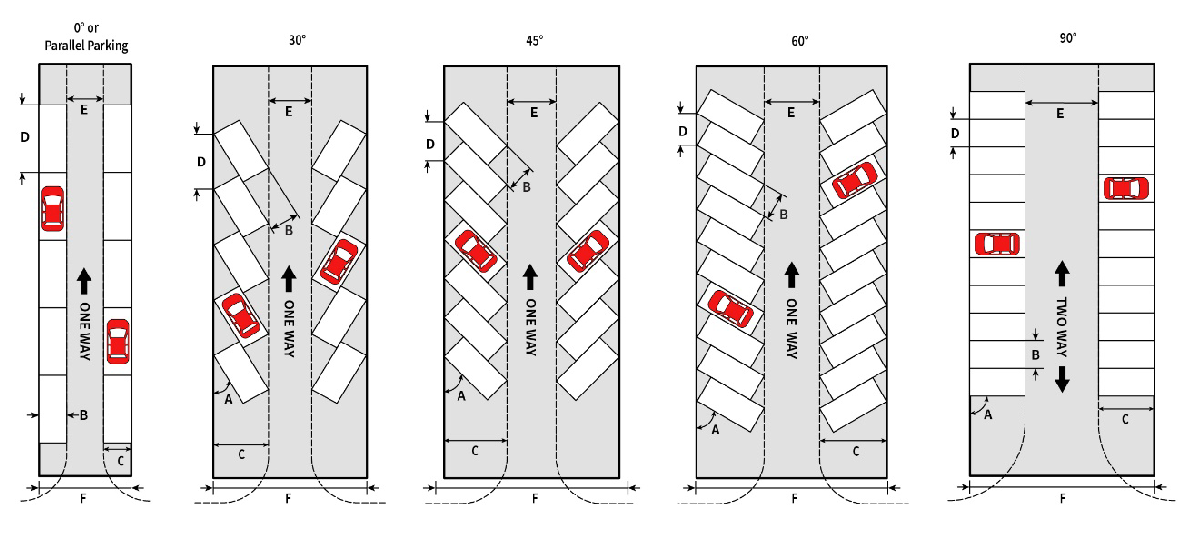
Table 4-6. Parking Dimensions
E.
Stacking requirements.
1.
The purpose of stacking spaces is to provide the ability for vehicles to queue on-site prior to receiving a service.
2.
Stacking spaces are required in all districts any time a use is constructed or expanded in accordance with table 4-7.
3.
The number of spaces refers to the queuing line and does not include the space at a drive-up window, inside a car wash or repair bay, or similar location.
4.
Each stacking space shall be a minimum of ten feet in width and 20 feet in length and shall not be located within or interfere with any other circulation driveway, parking space, fire lane, or maneuvering area.
Table 4-7. Stacking Requirements
4.05. - Lighting.
A.
Applicability. The requirements of this section shall apply to new development or expansion in all residential, nonresidential, and special zoning districts.
B.
Purpose. Standards for controlling lighting and glare are set forth to reduce annoyance and inconvenience to property owners and reduce traffic hazards to motorists.
C.
Regulations for all developments.
1.
Light sources shall be of a down-light, indirect, diffused, or shield type or so installed and maintained as to reduce glare effect and consequent interference with the use of adjacent properties and boundary streets.
2.
All lighting fixtures shall be restricted to full cutoff types (see figure 4-2) so that no light is emitted above the lowest light emitting part of the fixture.
Figure 4-2. Examples of Lighting Fixtures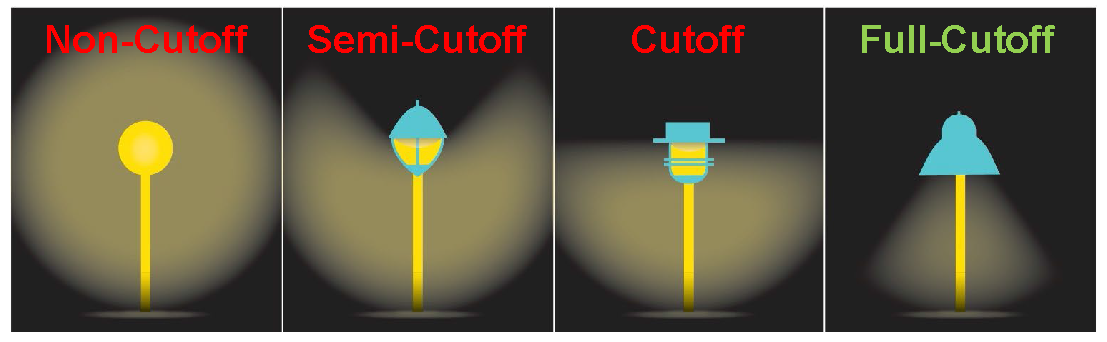
D.
Regulations for nonresidential, multifamily, and mixed-use developments.
1.
Site, parking, and loading lighting.
a.
Sufficient lighting of parking areas. Illumination of parking areas shall be sufficient to ensure the visibility of pedestrians and the safe movement of traffic within the site.
b.
Lighting only during hours of use. Nonresidential uses that abut residential zoning districts shall be required to cease illumination of parking areas at the termination of hours of use.
c.
Maximum intensity. The allowable maximum intensity measured at the property line of a retail, office, or commercial, or multifamily developments use shall be 3.0 foot-candles and 5.0 foot-candles for an industrial use. When located adjacent to a residential zoning district, the intensity shall be no greater than 0.25 foot-candles at the property line.
d.
Mounting height within parking areas. The mounting height of lighting fixtures shall not exceed the heights specified in table 4-8.
Table 4-8. Mounting Heights for Lights in
Parking Areas
2.
Accent and security lighting.
a.
Accent lighting.
i.
Accent lighting shall not exceed 5.0 foot-candles.
ii.
Lighting shall be shielded to prevent light pollution or glare beyond the element intended for accent illumination.
b.
Security lighting.
i.
Pole-mounted and wall-mounted fixtures mounted above six feet shall be of a full cutoff type.
ii.
If a rear yard security light is mounted higher than ten feet, it shall be directed away from adjacent properties.
c.
Lighting plan required.
i.
All nonresidential, multifamily, and mixed-use developments shall submit a lighting plan with a site plan. The lighting plan shall show how the proposed development will comply with the regulations within this section.
ii.
Lighting plan shall include, at a minimum, the following information:
a)
The type of illuminating devices, fixtures, lamps, supports, reflectors, and other devices, and their respective location on the site;
b)
A description of the illuminating devices, fixtures, lamps, supports, reflectors, and other devices (such as catalog cuts by manufactures and drawings); and
c)
Photometric data, such as furnished by manufactures, or similar data showing the angle of cut off or light emissions.
3.
Maintenance.
a.
Piers for light poles taller than eight feet shall be designed by a professional engineer competent in structural engineering. Soil condition and wind loading shall be accounted for in the pier design.
b.
All fixtures and supports shall be painted or otherwise treated to resist rust and corrosion and shall be maintained in an attractive condition and in a manner consistent with the surrounding architecture.
c.
All fixtures and lamps shall be maintained in a working, serviceable condition at all times.
4.06. - Accessory buildings.
A.
Applicability. The regulations of this section apply to all new or expanded accessory buildings.
B.
Requirements. Accessory buildings are prohibited within easements.
C.
Accessory building on residential lots.
1.
The maximum floor area of all accessory buildings combined shall be 1,000 square feet.
2.
There shall be no maximum floor area for accessory buildings in the AG agricultural district.
3.
Setbacks.
a.
Front yard.
i.
Attached accessory buildings shall have a front yard not less than the primary building.
ii.
Detached accessory buildings shall be located in the area defined as the rear yard.
b.
Side yard.
i.
Attached accessory buildings shall have the same side yard as the primary building in any district.
ii.
Detached accessory buildings shall have a minimum side yard shall have the same side yard as the primary building.
iii.
If the side wall of a detached accessory building is a one-hour fire wall, no side yard is required when located on the rear half of the lot.
iv.
Where a garage or carport is to be entered from a side street, it shall be set back from the side property line a minimum distance of ten feet.
c.
Rear yard.
i.
There need be no rear yard for accessory buildings except that if no alley exists, the rear yard shall be not less than five feet.
ii.
Detached accessory buildings shall be located no closer than ten feet to the primary building.
4.
Other regulations.
a.
Accessory buildings may only be used as an accessory dwelling unit as permitted by section 3.03, land use table.
i.
No more than one accessory building for the purpose of a living quarters shall be permitted on a lot.
b.
Accessory buildings associated with a multifamily use and used to store equipment or provide a service function shall not be occupied as a dwelling.
c.
Accessory buildings containing livestock (e.g. chickens, hogs, horses, etc.) shall be located at least 50 feet from any existing dwelling on a neighboring property.
D.
Accessory buildings on nonresidential lots.
1.
No more than three accessory buildings shall be permitted on a lot.
2.
The maximum floor area of all accessory buildings combined shall be 3,000 square feet or ten percent of the primary building, whichever is smaller.
3.
Setbacks.
a.
Attached accessory buildings or structures shall have a front, side and rear yard not less than the primary building.
b.
Detached accessory buildings or structures shall be located in the area defined as the rear yard.
4.07. - Residential adjacency.
A.
Applicability.
1.
This section applies when a new or expanded nonresidential building or site is adjacent to a residential district and an existing or proposed building, structure, or device on the lot is within 150 feet of a district boundary for any residential district.
2.
The regulations of this section shall not apply where a proposed nonresidential use is separated from the adjacent residential district by a thoroughfare.
B.
Standards.
1.
Noise.
a.
Any use containing individual service speakers shall not be permitted within 150 feet of any residential district unless the speaker is appropriately screened per section 4.03, fences, walls, and screening.
b.
Any use containing public address/paging systems shall not be permitted within 1,000 feet of any residential district unless separated by a thoroughfare.
2.
Loading spaces. Where adjacent to a residential district, off-street loading areas shall be fully screened from view of the residential district using an approved screening per section 4.03, fences, walls, and screening.
3.
Vehicular service bays.
a.
All vehicular service bays within 150 feet of a residential district shall face away from adjacent residential districts unless separated by a building or permanent architectural feature of minimum height matching the height of the service bays.
b.
Walls separating service bays from a residential district shall be of a material with no visibility.
c.
No use including outdoor vehicular repair, servicing, or testing shall be permitted within 150 feet of a residential district.
4.
Small engine repair shops. Small engine repair shops shall not be permitted within 150 feet of a residential district unless all repair, service, and testing activities are done in a fully enclosed building.
5.
Motorcycle sales/service. Motorcycle sales/service facilities shall not be permitted within 150 feet of a residential district unless all repair, service, and testing activities are done in a fully enclosed building.
6.
Car wash and fuel dispensing facilities. Car wash and fuel dispensing facilities shall not be permitted within 150 feet of a residential district.
7.
Industrial districts. Where an industrial district is adjacent to a residential district, a buffer of at least 50 feet must be located on the industrial property along the property line adjoining the residential district.
4.08. - Outdoor storage and display.
A.
Applicability. The requirements of this section shall apply outdoor storage and display in all nonresidential and special zoning districts in addition to the AG agricultural district.
B.
Outdoor storage. Outdoor storage of goods, materials, merchandise, or equipment shall:
1.
Be screened as required in section 4.03, fences, walls, and screening.
2.
Not be located within any required front, side, or rear yard.
3.
Not be located within required parking spaces, fire lanes, maneuvering aisles, or customer pick-up lanes.
4.
Not obstruct visibility or interfere with pedestrian or vehicular circulation.
a.
The pedestrian path must be concrete or asphalt and may not be located within off-street parking areas, including parking spaces, fire lanes, maneuvering aisles, and customer pick-up lanes.
5.
Be placed on an asphalt or concrete surface.
a.
In an industrial district, outdoor storage items, except vehicles, may be placed on a gravel surface.
6.
Not exceed 50 percent of the lot area.
C.
Outdoor display. Outdoor display of goods, materials, merchandise, or equipment shall:
1.
Not be placed or located more than 30 feet from the primary building and shall not exceed 50 percent of the linear frontage of the building.
2.
Not occupy any required parking spaces for the primary use(s) of the property.
3.
Not pose a safety or visibility hazard, nor impede public vehicular or pedestrian circulation, either on-site or off-site, in any way. At least 60 inches of pedestrian clear zone shall be provided to allow for circulation.
a.
For outdoor display areas located on a sidewalk, a four-foot wide clearance shall be provided along the public sidewalk and a six-foot wide clearance shall be provided on the sidewalk around the building.
4.
Be displayed in a neat, orderly manner, and the display area shall be maintained in a clean, litter-free manner.
4.09. - Nonresidential and multifamily façades.
A.
Applicability.
1.
This section applies to all new or expanded nonresidential and multifamily buildings.
2.
Exemptions.
a.
Civic and municipal buildings. These buildings are signature elements within a community; as such, they may intentionally be made exceptions to the more regulated patterns of private development. While these buildings are not required to meet the façade principles in this section, compliance is encouraged.
b.
Historic districts. New construction, redevelopment, and major rehabilitation in these districts shall comply with the façade principles in this section, provided that design standards are not specified within the historic district. Any design standards written for a historic district shall supersede the principles in this section.
B.
Façade to be reviewed.
1.
Elevation types.
a.
A primary façade is an elevation of the building that faces a street frontage.
b.
A secondary façade is an elevation of the building that does not face a street frontage.
2.
Where a building has more than two façades fronting a street, the requirements of this section 4.09, nonresidential and multifamily façades, shall only be required on the two façades with the highest pedestrian traffic and vehicular visibility as determined by the director of planning.
C.
Design elements.
1.
Elements within each segment of a building façade, defined by a different roof height, shall be required to be symmetrical. A symmetrical condition is achieved when façade elements and openings are repeated in the same positions on either side of a central vertical line for that segment of façade.
2.
The frontage of buildings shall be divided into visually distinct sections no more than 60 feet in width with each section taller than it is wide.
3.
A minimum of one significant detail or massing component shall be repeated no less than three times along each elevation.
4.
The building façade shall have a clearly identifiable base, body, and cap with horizontal elements separating these components.
5.
Transparency.
a.
Façades of new development, reconstruction, and major rehabilitation shall incorporate transparent features (windows and doors) over a minimum percentage of the surface area of street fronting facades. Minimum percentages for different levels shall be outlined as follows:
i.
Ground level of nonresidential uses under 25,000 square feet: 35 percent of surface area.
ii.
Ground level of nonresidential uses over 25,000 square feet: 25 percent of surface area.
iii.
Upper levels of all uses: 20 percent surface area.
iv.
Multifamily use: 20 percent surface area of the entire façade.
b.
Ground level shall be calculated within the first 15 feet of the building wall, measured vertically at street level.
c.
Where a building has more than two façades fronting a street, the transparency requirement shall only be required on the primary facades.
4.10. - Infill accommodations.
A.
Applicability. Where 50 percent or more of the existing lots within the same block face are occupied by primary structures that do not meet the dimensional standards of the base zoning district, the following infill standards shall apply to proposed buildings and additions to existing buildings rather than the dimensional standards listed in the applicable base zoning district.
Figure 4-3. Block Face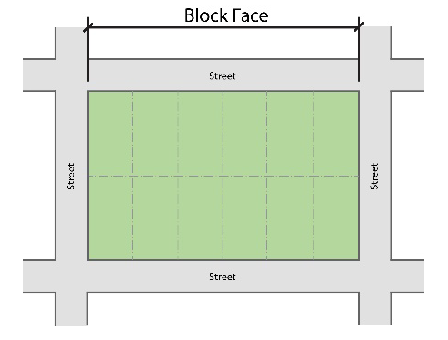
B.
Structure modifications. These regulations shall be applicable in the LDR low density residential district or MDR medium density residential district.
a.
Front yard setback. The front yard setback line shall fall within the range of the front yard setbacks of the two nearest lots containing primary structures within the same block face. A proposed building on an infill lot must be constructed within this established front yard setback range.
b.
Building height. The building height shall fall within the range of building heights of existing structures within same block face. A proposed building on an infill lot must be constructed within this established height range. In cases where the maximum building height allowed within the applicable district is greater than the established range within a block face, the maximum building height within the range may be exceeded by up to 25 percent, but may not exceed the maximum building height allowed within the particular base zoning district.
c.
Lot width. The minimum lot width may be reduced to 40 feet when one or more adjacent properties have an existing, platted lot width of 40 feet or less.
4.11. - Modified dimensional standards.
A.
Applicability. The regulations of this section are applicable to single family dwelling and single family attached—townhome structures located in the MDR medium density residential district and DT downtown core district when developed with a zero lot line.
B.
Zero lot line development.
1.
Zero lot line dwellings shall be constructed within one foot of the lot line on one side of a lot, save and except easements and required building separation. No windows, doors, or other openings shall be permitted on this side.
2.
The wall of the structure within one foot of the zero setback (side lot) line shall be constructed of maintenance free solid material and no portion of said wall or attached roof shall project over any property line.
3.
Separation between buildings shall be no less than ten feet.
4.
A five-foot wide access easement for exterior wall maintenance shall be provided on the lot adjoining a zero setback wall. Said easement shall be kept free of permanent obstructions (such as a tool shed or fence without a gate).
C.
Single family attached—townhomes on individual lots.
1.
This section addresses townhomes where multiple units are adjoined across property lines. This section does not apply to townhomes located on a single lot.
2.
The interior side yard setback regulations in section 2, zoning districts shall not apply to the interior sides of townhomes on separate lots. The exemption does not apply to the end units.
3.
Minimum lot frontage shall be 25 feet.
4.
Minimum lot size shall be 3,000 square feet.
5.
No single family attached—townhomes shall exceed 300 feet in length. A minimum required street side setback shall be provided at the end of each structure so that the end of any two adjacent buildings shall be the minimum required building separation.
4.12. - Residential development.
A.
Applicability. The following requirements shall apply to single family dwelling, single family attached—two-family dwelling, single family attached—townhome developments.
B.
Residential landscaping.
1.
Minimum residential tree requirements.
a.
One class A tree or an approved class B tree shall be provided on each single family lot.
b.
All required trees must be planted prior to request for final building inspection of the dwelling unit.
C.
Residential cluster development option.
1.
Purpose.
a.
Cluster development is intended to provide open space, accessible to the public, for residential development by allowing reductions to the minimum lot size to either maintain or increase overall density.
b.
Cluster developments can concentrate dwelling units on a site's prime developable areas and thus can provide more land for preserving drainage areas, slopes, soils, and natural vegetation to help manage stormwater runoff and soil erosion. Additionally, development costs can be decreased by reducing the amount of roadway and utility infrastructure needed to service the neighborhood.
c.
Cluster development is an incentive-based approach to encourage livable neighborhoods and is not a requirement. This approach promotes the creation or preservation of open space in exchange for increasing the amount design options through reduced or eliminated minimum lot sizes. Cluster development can either be designed to maintain the original development density or to increase development density. An example of how cluster developments differ from conventional development is shown in figure 4-4.
Figure 4-4. Example of Conventional and Cluster Development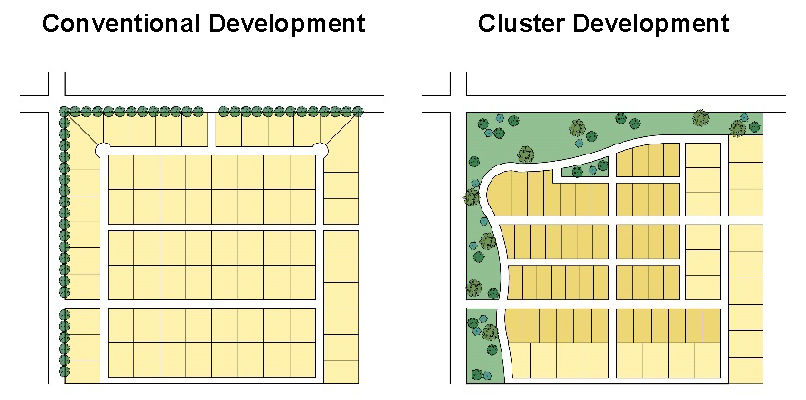
2.
Applicability. All new single family residential developments may utilize a cluster development option, excluding developments located in the AG agricultural district.
3.
Development requirements.
a.
Minimum required area for a cluster development. The minimum area of a cluster development shall be five acres.
b.
Primary and accessory uses. All primary and accessory uses authorized with the applicable zoning district shall be allowed in the cluster development.
c.
Modified minimum dimensional standards and development requirements. The following modifications to minimum dimensional standards and development requirements for a single family residential development as shown in table 4-9 may be utilized when developed as a cluster development.
Table 4-9. Modified Minimum Dimensional Standards and Development Requirements
4.
Preliminary plat requirements.
a.
Additional information requirement. The following information shall be included with a preliminary plat.
i.
The maximum number and type of dwelling units proposed.
ii.
The area of the site on which dwelling units will be constructed.
iii.
The area of the site on which other primary or accessory uses will be constructed.
iv.
The areas of the site designated for open space and their size.
v.
The number of acres proposed to be conveyed as open space.
5.
Amount of open space required for cluster development. A cluster development shall have at least ten percent of the site conveyed as open space. The riparian buffer may be included in the amount of open space, provided that homes do not back onto the open space.
6.
Base zoning district's net dwelling unit per acre (DUA). The following maximum dwelling units per table 4-10 for cluster developments shall apply per each base zoning district.
Table 4-10. Maximum DUA for
Cluster Developments
7.
Calculating the permitted number of dwelling units.
a.
Measure the net area of the development site. The net area of the entire site shall be measured to the tenth of an acre with all land dedicated to streets within the site being subtracted.
b.
Apply base zoning districts net dwelling unit per acre (DUA). The net acreage of land area shall be multiplied by the number of dwelling units per acre permitted within subsection 4.12.C.6. The resulting number of dwelling units shall be rounded to the nearest whole number.
8.
Director review criteria.
a.
Fulfilled the requirement of this section. The requirements of this subsection 4.12.C are fulfilled.
b.
Ten percent open space requirement is met. Buildings and structures are adequately grouped so at least ten percent of the total area of the site is set aside as open space. To the greatest degree practicable, common open space shall be designated as a single block and not divided into unconnected small parcels located in various parts of the development, unless otherwise approved by the director of planning.
c.
Pedestrian access. Pedestrians can access common open space.
d.
Minimization of land alteration. Individual lots, buildings, structures, streets, and parking areas are situated to minimize the alteration of natural features, natural vegetation, and topography.
e.
Scenic views. Existing scenic views or vistas are permitted to remain unobstructed, especially from public streets.
f.
Historic preservation. The site plan accommodates and preserves any features of historic, cultural, or archaeological value.
g.
Preserving environmentally sensitive areas. Floodplains, wetlands, and areas with slopes in excess of ten percent are protected from development.
h.
Consistent with intent of this ordinance and the comprehensive plan. The cluster development advances the purposes of this zoning ordinance and the comprehensive plan.
9.
Approval of a residential cluster development. The planning and zoning commission shall approve or deny residential cluster developments requests.
4.13. - Performance standards.
A.
Applicability. The requirements of this section shall apply to all land within city limits.
B.
Compliance required.
1.
All uses in all districts shall conform in operations, location and construction to the performance standards herein specified for odorous matter, toxic and noxious matter, smoke, particulate matter and other air contaminants, fire and explosive or hazardous matter, glare and outdoor storage.
2.
Prior to the issuance of a building permit and/or a certificate of occupancy and compliance, the building official may require any person, firm or corporation to retain an expert consultant or consultants to certify the compliance of the proposed use with the performance standards. Such consultants shall be persons or firms mutually agreeable to the building official and to the owner or operator of the proposed use. The cost of the consultant's services shall be borne by the owner or operator of said use.
C.
Smoke and particulate matter.
1.
No operation or use shall cause, create or allow the emission of air contaminants which are in violation of the Air Quality Standards, Rules and Regulations of the Texas Air Control Board as provided for in the Texas Clean Air Act, V.T.C.A., Health and Safety Code ch. 382 et seq., as now existing or as later modified or amended.
2.
Outdoor storage and open processing operations, including on-site transportation movements which are a source of wind or airborne dust or other particulate matter, shall be subject to the standards and regulations specified in subsection 1 above.
D.
Odorous matter.
1.
No use shall be located or operated which involves the emission of odorous matter from a source of operation where the odorous matter exceeds the odor threshold at the bounding property line or any point beyond the tract on which such use or operation is located.
2.
The odor threshold as herein set forth shall be determined by observation by a person or persons. In any case where uncertainty may arise or where the operator or owner of an odor emitting use may disagree with the enforcing officer or where specific measurement of odor concentration is required, the method and procedures as specified by American Society for Testing Materials, A.S.T.M.D. 1391-57, entitled "Standard Method for Measurement of Odor in Atmospheres" shall be used and a copy of A.S.T.M.D. 1391-57 is hereby incorporated by reference.
E.
Fire and explosive hazard material.
1.
No use involving the manufacture or storage of compounds which decompose by detonation shall be permitted. However, chlorites, nitrates, percolates, phosphorus and similar substances and compounds in small quantities for use by industry, school laboratories, druggists or wholesalers may be permitted when approved by the fire marshal of the city as not presenting a fire or explosive hazard.
2.
The storage and use of all flammable liquids and materials such as pyroxylin plastics, nitrocellulose film, solvents and petroleum products shall be permitted only when such storage or use conforms to the standards and regulations of the city fire code.
F.
Toxic and noxious matter. No operation or use shall emit toxic or noxious matter across the property line in a concentration which exceeds the threshold for an industrial worker. The standard for this threshold shall be as set by the Texas State Department of Health in Threshold Limit Values Occupational Health Regulation No. 3, and any of its subsequent amendments.
G.
Glare. Intense glare from electric arc welding or other similar activities must be screened from public view.
4.14. - Downtown district regulations.
A.
Applicability. The requirements of this section shall apply to all development within the DT downtown core district.
B.
Sub-districts. Within the DT downtown core district, there are two sub-districts that identify compatible development types for the dense development style of the downtown core and the surrounding downtown edge that provides a transition to the lower density areas outside the downtown area. The sub-districts are as follows:
1.
DT1 downtown core. The downtown core is intended for development that is walkable and encourages activity. Structures in this area should promote a variety of uses traditionally located in a downtown core area.
2.
DT2 downtown edge. The downtown edge represents an area that is complementary to the downtown core and consisting of less intense uses. Residential uses such as patio homes and townhomes are encouraged in this area.
C.
Regulating plan. The regulating plan serves at the zoning map for development within the DT downtown core district. The regulating plan for this district is depicted in figure 4-5 and is formally adopted as a part of the city's official zoning map.
Figure 4-5. DT Downtown Core District Regulating Plan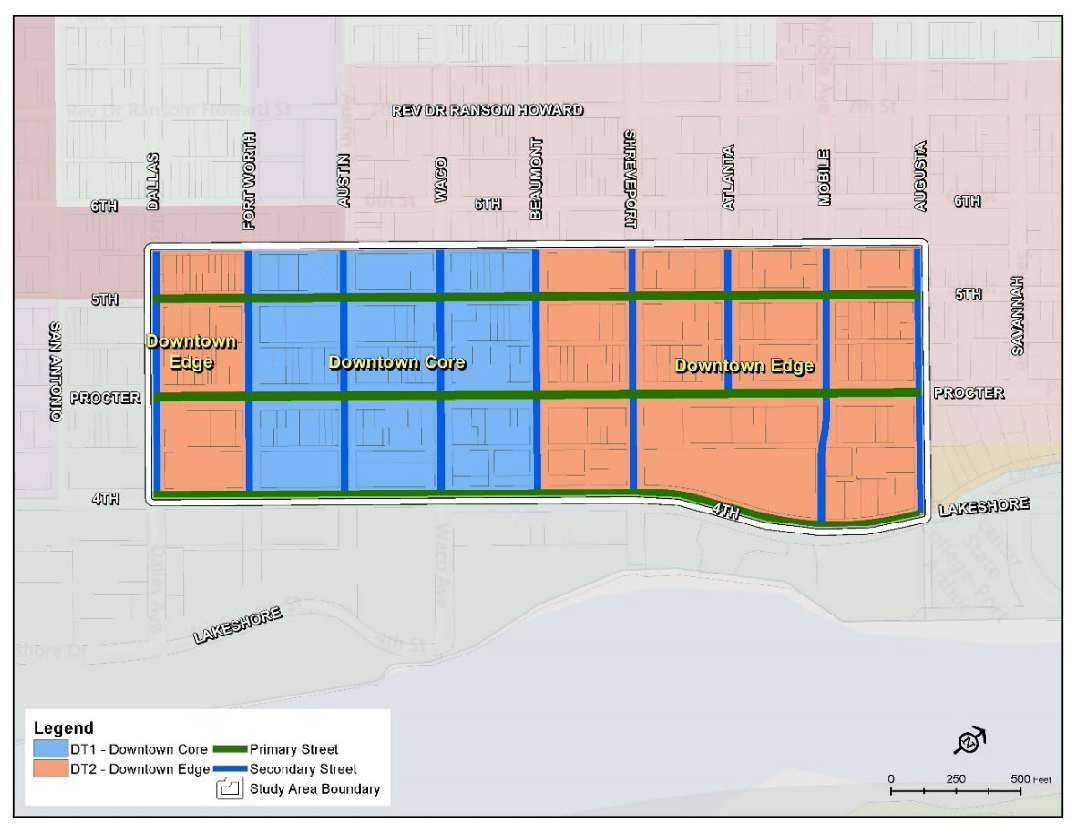
D.
Street designations.
1.
Street types are designated on the regulating plan and shall be established as follows:
a.
Primary streets. Primary streets are intended to be the primary streets for pedestrian circulation and buildings along primary streets shall be held to the highest standard of pedestrian-oriented design.
b.
Secondary streets. Secondary streets are intended to balance pedestrian and automobile-oriented activities. Buildings along secondary streets may be permitted to accommodate some service and auto-related functions such as driveway access and service entrances.
E.
Permitted uses.
1.
Land uses in the DT downtown core district shall be permitted as identified in section 3, land uses.
2.
Additional use regulations.
a.
Multiple-family dwelling use. A multiple-family dwelling use shall only be permitted when incorporated as part of a mixed use development.
b.
Mixed used building. In the DT1 downtown core sub-district, no more than 40 percent of the total ground floor area of the building may be occupied by a residential use.
F.
Dimensional standards. Table 4-11 establishes the standards that apply to development within each sub-district.
1.
The maximum front yard setback may be increased to accommodate existing utility easements as determined by the director of planning.
Figure 4-6. DT Downtown Core District Dimensional Standards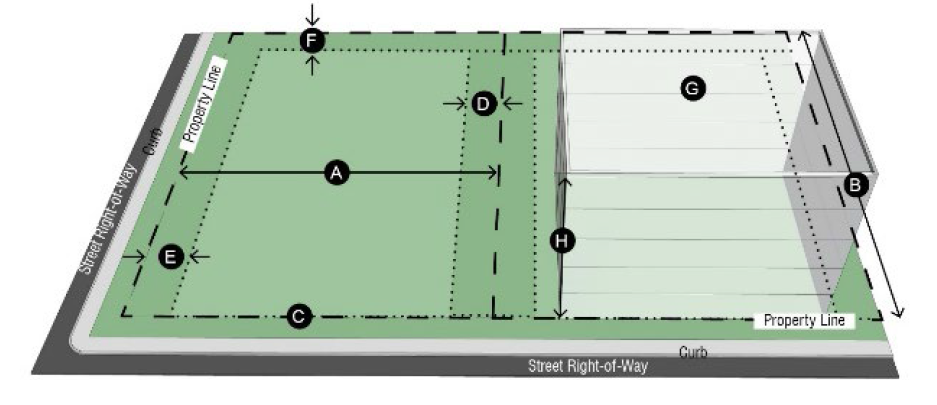
Table 4-11. DT Downtown Core District Dimensional Standards
G.
Building design.
1.
Building location.
a.
Main buildings shall be oriented towards the more major street, where the lot has frontage. All accessory buildings shall not be located along primary streets and shall be oriented towards secondary streets, alleys, or into the lot.
b.
At least one primary pedestrian entrance to each building shall be located on the street along which the building is oriented and be connected to a public sidewalk. At intersections, corner buildings may have their primary entrances oriented at an angle facing the intersection.
c.
All primary entrances shall be oriented to the public sidewalk for ease of pedestrian access. Secondary and service entrances may be accessed from internal parking areas or alleys.
2.
Building layout.
a.
Structures with loading areas and/or service bays. The loading areas and/or service bays of a structure shall be located to the side of the structure that does not face the roadway, with the following exception:
i.
When any structure with loading areas and/or service bays is on a lot that occupies an entire block, bays that face the street must not face the more major roadway. Major and minor roadways shall be identified on the site plan for the tract to be developed.
3.
Encroachment.
a.
Canopies, signs, awnings and balconies may encroach over the sidewalk as long as the vertical clearance is a minimum of eight feet.
b.
In no case shall an encroachment be located over a vehicular travel lane.
4.
Façade requirements.
a.
All development shall meet the requirements of section 4.09, nonresidential and multifamily façades.
b.
The following requirements are applicable in the DT downtown core district.
i.
Arcades. Arcades shall:
a)
Have a minimum depth of ten feet;
b)
Be supported by columns clad with the same material as the dominant exterior material of the use behind; and
c)
Be an extension of the architectural character of the building by having architectural tie-ins such as bands, opening articulation, and/or rhythmic modulation of openings.
Figure 4-7. Example of Arcade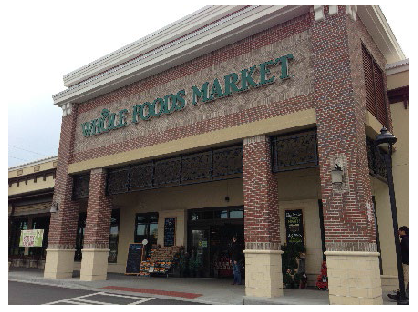
ii.
Canopies. Canopies shall maintain a pitched or curved roof form, have the same depth dimension as an arcade, and be supported by supports clad with the dominant exterior material of the retail use.
Figure 4-8. Example of Canopies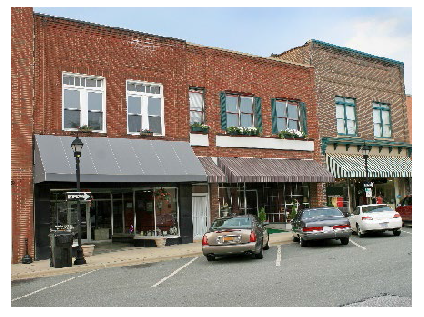
iii.
Building entrances.
a)
Recesses, projected doorway. The door for public access into the structure shall be architecturally projected (or recessed) from the structure within an architectural expression of entry.
Figure 4-9. Example of Recessed Doorway
b)
Pedestrian relationship. Architectural devices such as decorative paving, banners, flags, sculptures, decorative walls, or other special architectural details of the building meant for the close view of the entry participant shall be used to enhance entrances.
H.
Site access.
1.
Access to the site.
a.
Vehicular driveways and parking lot access shall be located along the secondary street.
b.
Shared driveways and cross access easements are encouraged between lots to minimize curb cuts.
c.
Access to a site from the primary frontage shall require the approval of a variance.
i.
If a driveway and/or off-street service loading and unloading access is provided from a primary street, cross access easements along the rear of the property shall be required.
2.
Cross access.
a.
Internal circulation on individual lots as well as cross access between adjoining lots shall be provided to reduce curb cuts, obstructions of sidewalks and traffic conflicts.
3.
Access shall be provided in accordance with the city's engineering design criteria manual.
I.
Landscape.
1.
Street trees shall be required on all roadways, except alleys.
2.
Street trees shall be planted in or adjacent to the right-of-way.
3.
Spacing shall be an average of 40 feet on center (measured per block face) along all streets.
4.
The minimum caliper size for each tree shall be two inches and shall be a minimum of 12 feet in height at planting.
5.
Each tree shall be planted in a planting area no less than 36 square feet.
6.
When clearly visible from the street and alleys, all unpaved ground areas shall be planted with low growing shrubs or ground cover, ornamental grasses, or a combination thereof. Turf grass must be installed as solid sod and not seeded on.
7.
Species shall be selected from the approved list of trees and shrubs.
J.
Parking.
1.
General.
a.
Parking shall be provided as provided in section 3, land uses.
b.
On-street parking spaces and public parking areas may count towards to total amount of required parking spaces based on shared parking requirements.
2.
Location.
a.
Surface parking.
i.
Parking must be located behind the building.
ii.
Along the secondary street frontage, parking must be set back in accordance with building setback lines.
b.
Structured parking. Structured parking must meet building setbacks.
3.
Design of parking structures.
a.
All frontages of parking structures located on primary streets shall not have parking uses on the ground floor less than a depth of 30 feet along the primary street frontage.
b.
The amount of primary street frontage devoted to a parking structure shall be minimized by placing the shortest dimension(s) of the parking structure along the primary street edge(s).
c.
Parking structure facades on all primary streets shall be designed with the same façade requirements in section 4.09, nonresidential and multifamily façades.
d.
Parking screening.
i.
Exterior walls shall be screened in such a way that cars on all parking levels are completely hidden from view from all adjacent public streets.
ii.
Architectural screens shall be used to articulate the façade, hide parked vehicles, and shield lighting. In addition, the ground floor façade treatment (building materials, windows, and architectural detailing) shall be continued to the second floor of a parking structure along all primary streets.
e.
When parking structures are located at street intersections, corner architectural elements shall be incorporated such as corner entrance, signage and glazing.
f.
Parking structures and adjacent sidewalks shall be designed so pedestrians and bicyclists are clearly visible to entering and exiting automobiles. Distinguishing between vehicular lanes and pedestrian areas by changes in grade, color, texture, and/or material are ways to achieve this.
4.
Bicycle parking.
a.
Bicycle parking spaces shall be provided at an amount equal to a minimum of five percent of the required vehicular parking spaces.
b.
Each required bicycle parking space shall include a means to secure individual bicycles to a designated structure.
K.
Lighting.
1.
Uniformity. Standards, poles, and fixtures shall be a single color, uniform in design throughout the site. When development is adjacent to primary or secondary streets, lighting shall be uniform along the roadway(s).
2.
Prohibited poles. Wooden poles are prohibited, except on a temporary basis during construction and only until a certificate of occupancy is issued.
3.
Height. Standards, poles, and fixtures shall be no taller than the height of the building being served.
4.
Walkway lighting. Walkway lighting comprised of standard, pole, bollard and wall-mounted fixtures shall be no greater than 12 feet above grade.
5.
Accent lighting.
a.
Uplighting or downlighting shall be concealed or positioned to screen the light source from adjacent property.
b.
Floodlighting or spotlighting of architecture, graphics, or natural features shall not create spillage of light onto adjacent property or public streets.
L.
Utilities.
1.
All utilities lines shall be placed underground.
2.
Where the underground placement of facilities is not a standard practice of the utility, the utility's customer shall make arrangements with the utility for payment of all costs associated with the non-standard installation if so.
3.
With the exception of the customer responsible for the non-standard installation, neither the utility nor the utility's other customers shall be responsible for any costs of non-standard installation of utilities.
4.
Notwithstanding the requirements of this section, nothing in this ordinance shall be interpreted in a manner that conflicts with a utility's state-approved tariff.
5.
Above-ground lines may be permitted by special exception.
6.
Transformers, service or meter pedestals and similar accessory installations, including any aboveground utility lines necessarily or customarily extending above grade in an underground utility line system shall be located at or above grade.
7.
All electrical transformers shall be pad mounted.
8.
Utility equipment shall not be installed with frontage on primary streets.
9.
On all other frontages, they shall be fully screened from public view at least as high as the equipment being screened.

