
Port Richey City Zoning Code
ARTICLE III
- SCHEDULE OF DISTRICT REGULATIONS
Sec. 127-47. - Agricultural Zoning District (A-1).
(a)
Purpose. The purpose of the A-1 Agricultural Zoning District shall be to locate and establish areas within the city which are deemed to be suited for the conservation of open space and the natural environment, and for limited agricultural usage compatible with existing and future urban development, to designate those uses and services deemed appropriate for location and development within said zoning district, and to establish such development standards and provisions as are necessary to ensure proper development and the maintenance of open space characteristics.
(b)
Permitted principal uses and structures. The following principal uses and structures are permitted within the A-1 district:
(1)
Essential services establishment.
(2)
General farming, citrus groves and truck gardening, including domestic animal raising, but specifically excluding feed lots and the raising of hogs, pigs, or goats, and including accessory uses or structures and a dwelling occupied only by the owner or tenant and his immediate family.
(3)
Park or playground, or other recreation or cultural facility (public).
(4)
School (public or private) meeting the requirements of the state board of education.
(5)
Single-family dwelling.
(6)
Community residential home with six or fewer residents.
(7)
Family day care home.
(c)
Special exception uses. The following uses may be permitted only upon review and specific approval thereof by the board of adjustment:
(1)
Cemetery, including mausoleum, following site approval by the county health department.
(2)
Church or other place of worship, including related educational and training facilities.
(3)
Club or lodge (private).
(4)
Establishment for the retail sale of products raised on the premises, with sales limited only to said products.
(5)
Veterinary hospital of clinic.
(d)
Accessory uses. Accessory uses allowable in the A-1 district are as set forth within section 127-92 of this LDC.
(e)
Minimum lot requirements. The minimum lot size requirements in the A-1 district are one acre and a minimum lot width of 100 feet.
(f)
Maximum building coverage. The maximum building coverage allowable in the A-1 district is ten percent.
(g)
Maximum building height. The maximum building height allowable in the A-1 district is 32 feet.
(h)
Minimum living area. The minimum living area allowable in the A-1 district is 1,000 square feet.
(i)
Minimum yard requirements and buffering.
(1)
Front yard. The minimum front yard setback requirement is 30 feet.
(2)
Side yard. The minimum side yard setback requirement is ten feet.
(3)
Rear yard. The minimum rear yard setback requirement is 35 feet.
(4)
Buffering. Where applicable, buffering shall be as provided in accordance with the provisions of section 127-95.
(j)
Off-street parking and service requirements. Off-street parking required in the A-1 district shall be as set forth in section 127-94.
(LDC 2008, § 22-47; Ord. No. 05-536, § 302.03A, 12-20-2005)
Sec. 127-48. - Single-Family Residential Zoning District (R-1).
(a)
Purpose. The purpose of the R-1 Single-Family Residential Zoning District shall be to locate and establish areas within the city which are deemed to be suited for the development and maintenance of low-density residential living of an urban character, to designate those uses and services deemed appropriate for location and development within said zoning district, and to establish such development standards and provisions as are necessary to ensure proper development in a low-density residential environment.
(b)
Permitted principal uses and structures. The following principal uses and structures are permitted within the R-1 district:
(1)
Essential services establishment.
(2)
Park or playground, or other recreation or cultural facility (public).
(3)
Single-family dwelling.
(4)
Community residential home with six or fewer residents.
(5)
Family day care home.
(c)
Special exception uses. No special exception uses may be permitted within this district.
(d)
Accessory uses. Accessory uses in the Single-Family Residential Zoning District shall be as set forth within section 127-92.
(e)
Minimum lot requirements. The minimum lot size required in the Single-Family Residential Zoning District is 6,000 square feet and a minimum lot width of 60 feet. For lots created after the adoption of the ordinance from which this chapter is derived, the minimum lot size is 9,500 square feet and a minimum width of 80 feet.
(f)
Maximum building coverage. The maximum building coverage allowable in the Single-Family Residential Zoning District is 40 percent.
(g)
Maximum building height. The maximum building height allowable in the Single-Family Residential Zoning District is 32 feet.
(h)
Minimum living area. The minimum living area allowable in the Single-Family Residential Zoning District is 1,000 square feet.
(i)
Minimum yards and buffering. The minimum yard and buffering requirements are as follows:
(1)
Front yard. The minimum front yard setback is 25 feet.
(2)
Side yard. A minimum of five feet for one yard setback and a combined minimum width of 15 feet for both side yards.
(3)
Rear yard. The minimum rear yard setback is 25 feet.
(4)
Buffering. Where applicable, buffering shall be provided in accordance with the provisions of section 127-95 of this LDC.
(j)
Off-street parking and service requirements. The off-street parking required in single-family residential zoning is as set forth in section 127-94 of this LDC.
(LDC 2008, § 22-48; Ord. No. 05-536, § 302.03B, 12-20-2005)
Sec. 127-49. - Two-Family Residential Zoning District (R-2).
(a)
Purpose. The purpose of the R-2 Two-Family Residential Zoning District shall be to locate and establish areas within the city which are suited for the development and maintenance of moderately low-density residential living of an urban character, to designate those uses and services appropriate for location and development within said zoning district and to establish such development standards and provisions as are necessary to ensure proper development in a moderately low-density residential environment.
(b)
Permitted principal uses and structures. The following principal uses and structures are permitted within the R-2 district:
(1)
Essential services establishment.
(2)
Park or playground (public), or other public recreation or cultural facility.
(3)
Single-family dwelling.
(4)
Two-family dwelling (duplex).
(5)
Community residential home with six or fewer residents.
(6)
Family day care home.
(c)
Special exception uses. The following uses may be permitted within the R-2 district only upon review and specific approval thereof by the board of adjustment:
(1)
Church or other place of worship, including related educational and training facilities.
(2)
Civic or community organization (private or nonprofit).
(3)
Clinic, medical or dental.
(4)
Day care center.
(5)
Hospital.
(6)
Office, professional.
(7)
School (public or private) meeting the requirements of the state board of education.
(d)
Accessory uses. Accessory uses allowable in a two-family residential zoning district shall be as set forth within section 127-92.
(e)
Minimum lot requirements.
(1)
Single-family dwelling. The minimum lot size for single-family dwellings is 6,000 square feet and width of 60 feet. For lots created after the adoption of the ordinance from which this chapter is derived, the minimum lot size shall be 7,500 square feet and a minimum width of 75 feet.
(2)
Two-family dwelling. The minimum lot size for two-family dwellings is 9,000 square feet and width of 90 feet.
(3)
All other uses. The minimum lot size for other uses is 10,000 square feet and width of 100 feet, provided that all additional site development requirements are met.
(f)
Maximum building coverage. The maximum building coverage allowable in a Two-Family Residential Zoning District is 40 percent.
(g)
Maximum building height. The maximum building height allowable in a Two-Family Residential Zoning District is 32 feet.
(h)
Minimum living area.
(1)
Single-family dwelling. The minimum living area for single-family dwellings is 1,000 square feet.
(2)
Two-family dwelling. The minimum living area for two-family dwellings is 800 square feet per dwelling unit.
(i)
Minimum yard requirements and buffering.
(1)
Front yard. The minimum front yard setback requirement in a Two-Family Residential Zoning District is 25 feet.
(2)
Side yard. The minimum side yard setback requirement in a Two-Family Residential Zoning District is five feet for one side yard setback and a combined minimum width of 15 feet for both yards.
(3)
Rear yard. The minimum rear yard setback requirement in a Two-Family Residential Zoning District is 25 feet.
(4)
Buffering. Where applicable, buffering shall be provided in accordance with the provisions of section 127-95.
(j)
Off-street parking and service requirements. Off-street parking required in a two-family residential zoning district is as set forth in section 127-94.
(LDC 2008, § 22-49; Ord. No. 05-536, § 302.03C, 12-20-2005)
Sec. 127-50. - Multiple-Family Residential Zoning District (R-3).
(a)
Purpose. The purpose of the R-3 Multiple-Family Residential Zoning District shall be to locate and establish areas within the city which are suited for the development and maintenance of medium-density multiple-family residential areas properly served by community facilities and commercial service areas, to designate those uses and services appropriate for location and development within said zoning district, and to establish such development standards and provisions as are necessary to ensure proper development in a medium-density residential environment.
(b)
Permitted principal uses and structures. The following principal uses and structures are permitted within the R-3 district:
(1)
Essential services establishment.
(2)
Multiple-family dwelling.
(3)
Park or playground (public), or other public recreation or cultural facility.
(4)
Single-family dwelling.
(5)
Two-family dwelling (duplex).
(6)
Community residential home if required by F.S. § 419.001.
(7)
Family day care home.
(c)
Special exception uses. The following uses may be permitted within the R-3 district only upon review and specific approval thereof by the board of adjustment:
(1)
Church or other place of worship, including related educational and training facilities.
(2)
Civic or community organization (private or nonprofit).
(3)
Clinic, medical or dental.
(4)
Club or lodge (private).
(5)
Congregate care facility.
(6)
Day care center.
(7)
Foster care facility.
(8)
Hospital.
(9)
Nursing or convalescent home.
(10)
Office, professional.
(11)
School (public or private) meeting the requirements of the state board of education.
(d)
Accessory uses. Accessory uses allowable in a multiple-family residential zoning district are as set forth within section 127-92.
(e)
Minimum lot requirements.
(1)
Multiple-family dwelling. The minimum lot requirement for a multiple-family dwelling is 14,500 square feet, with an additional 2,900 square feet for each dwelling unit in excess of five, and minimum width of 100 feet (maximum density shall be 15 dwelling units/acre).
(2)
Single-family dwelling. The minimum lot requirement for a single-family dwelling is 6,000 square feet and minimum width of 60 feet.
(3)
Two-family dwelling. The minimum lot requirement for a two-family dwelling is 9,000 square feet and minimum width of 90 feet.
(4)
All other uses. The minimum lot requirement for all other uses in a multiple-family residential district is 10,000 square feet and minimum width of 100 feet, provided that all additional site development requirements are met.
(f)
Maximum building coverage. The maximum building coverage allowable in a multiple-family residential district is 40 percent.
(g)
Maximum building height.
(1)
Multiple-family dwelling. The maximum building height allowable for a multiple-family dwelling is 72 feet, provided that any building exceeding 32 feet in height shall be set back a minimum distance equal to one-half its height from any property line.
(2)
All other uses. The maximum building height for all other uses in a multiple-family residential district is 35 feet.
(h)
Minimum living area.
(1)
Multiple-family dwelling. The minimum living area for a multiple-family dwelling is 500 square feet per dwelling unit.
(2)
Single-family dwelling. The minimum living area for a single-family dwelling is 1,000 square feet.
(3)
Two-family dwelling. The minimum living area for a two-family dwelling is 800 square feet per dwelling unit.
(i)
Minimum yard requirements and buffering.
(1)
Front yard.
a.
Multiple-family dwelling. The minimum front yard setback requirement for a multiple-family dwelling is 30 feet.
b.
All other uses. The minimum front yard setback requirement for all other uses is 25 feet.
(2)
Side yard.
a.
Multiple-family dwelling. The minimum side yard setback for a multiple-family dwelling is 15 feet for one side yard setback and a combined minimum width of 35 feet for both side yards.
b.
All other uses. The minimum side yard setback for all other uses is five feet for one side yard setback and a combined width of 15 feet for both side yards.
(3)
Rear yard.
a.
Multiple-family dwelling. The minimum rear yard setback for a multiple-family dwelling is 30 feet.
b.
All other uses. The minimum rear yard setback for all other uses is 25 feet.
(4)
Buffering. Where applicable, buffering shall be provided in accordance with the provisions of section 127-95.
(j)
Off-street parking and service requirements. Off-street parking required in a multiple-family residential district is as set forth in section 127-94.
(LDC 2008, § 22-50; Ord. No. 05-536, § 302.03D, 12-20-2005)
Sec. 127-51. - Mobile Home and Manufactured Housing Residential Zoning District (R-MH).
(a)
Purpose. The purpose of the R-MH mobile home residential zoning district shall be to locate and establish areas within the city which are suited for the development and maintenance of mobile home and manufactured housing residential areas of an urban character adequately served by community facilities and commercial service areas; to designate those uses and services appropriate for location and development within said zoning district; and to establish such development standards and provisions as are necessary to ensure proper development in a mobile home residential environment.
(b)
Permitted principal uses and structures. The following principal uses and structures are permitted within the R-MH district:
(1)
Essential services establishment.
(2)
Mobile home park, subject to the provisions of section 127-93 of this LDC.
(3)
Park or playground (public), or other public recreation or cultural facility.
(c)
Special exception uses. The following uses may be permitted only upon review and specific approval thereof by the board of adjustment:
(1)
Church or other place of worship, including related educational and training facilities.
(2)
Civic or community organization (private or nonprofit).
(3)
School (public or private) meeting the requirements of the state board of education.
(d)
Accessory uses. Accessory uses within the R-MH district shall be permitted as set forth within section 127-92.
(e)
Minimum lot requirements.
(1)
Mobile home park. The minimum lot requirement in mobile home parks is 15 acres and a minimum lot width of 165 feet adjoining a public street or highway.
(2)
All other uses. The minimum lot requirement for all other uses in the mobile home and manufactured housing residential districts is 10,000 square feet and a minimum lot width of 100 feet, provided that all additional site development requirements are met.
(f)
Maximum building coverage. The maximum building coverage within the R-MH district is 40 percent.
(g)
Maximum building height. The maximum building height within the R-MH district is 32 feet.
(h)
Minimum living area. The minimum living area for mobile homes within the R-MH district is 800 square feet.
(i)
Minimum yard requirements and buffering.
(1)
Front yard. The minimum front yard setback within the R-MH district is 25 feet.
(2)
Side yard. The minimum side yard setback within the R-MH district is five feet for one side yard setback and a combined width of 15 feet for both side yards.
(3)
Rear yard. The minimum rear yard setback within the R-MH district is 25 feet.
(4)
Buffering. Where applicable, buffering shall be provided in accordance with the provisions of section 127-95.
(j)
Off-street parking and service requirements. Off-street parking required in mobile home and manufactured housing residential districts shall be as set forth in section 127-94.
(LDC 2008, § 22-51; Ord. No. 05-536, § 302.03E, 12-20-2005)
Sec. 127-52. - Institutional-Professional Zoning District (I-P).
(a)
Purpose. The purpose of the I-P Institutional-Professional Zoning District shall be to locate and establish areas within the city which are suited for the development and maintenance of uses of an institutional or professional nature to serve the residents of the city and surrounding areas, to designate those uses and services appropriate for location and development within said zoning district, and to establish such development standards and provisions as are necessary to ensure proper development and functioning of uses within the district.
(b)
Permitted principal uses and structures. The following principal uses and structures are permitted within the I-P district:
(1)
Church or other place of worship, including related education and training facilities.
(2)
Civic or community organization (private or nonprofit).
(3)
Clinic, medical or dental.
(4)
Club or lodge (private).
(5)
Office for administrative, business or professional use, but not including the sale or storage of merchandise except where clearly incidental to and an accessory component of the rendering of personal services.
(c)
Special exception uses. The following uses may be permitted within the I-P district only upon review and specific approval thereof by the board of adjustment:
(1)
Day care center.
(2)
Funeral home.
(3)
Hospital.
(4)
Nursing or convalescent home.
(5)
School (public or private) meeting the requirements of the state board of education.
(d)
Accessory uses. Accessory uses allowable within the I-P district are as set forth within section 127-92.
(e)
Minimum lot requirements. The minimum lot requirement within the I-P district is 10,000 square feet and a minimum lot width of 100 feet, provided that all additional site development requirements are met.
(f)
Maximum building coverage. The maximum building coverage within the I-P district is 40 percent.
(g)
Maximum building height. The maximum building height within the I-P district is 32 feet.
(h)
Minimum living area. Minimum living area requirements are not applicable in this district.
(i)
Minimum yard requirements and buffering.
(1)
Front yard. The front yard requirement within the I-P district is 25 feet.
(2)
Side yard. The minimum side yard requirement within the I-P district is five feet for one side yard and a combined minimum width of 15 feet for both side yards.
(3)
Rear yard. The rear yard requirement is 25 feet.
(4)
Buffering. Where applicable, buffering shall be provided in accordance with the provisions of section 127-95.
(j)
Off-street parking and service requirements. Off-street parking required in institutional-professional zoning residential districts is as set forth in section 127-94.
(LDC 2008, § 22-52; Ord. No. 05-536, § 302.03F, 12-20-2005)
Sec. 127-53. - Community Commercial Zoning District (C-1).
(a)
Purpose. The purpose of the C-1 Community Commercial Zoning District shall be to locate and establish areas within the city which are suited for the development and maintenance of general retail, business and personal service uses intended to serve the daily shopping and business needs of community residents, to designate those uses and services appropriate for location and development within said zoning district, and to establish such development standards and provisions as are necessary to ensure proper development and functioning of uses within the district.
(b)
Permitted principal uses and structures. The following principal uses and structures are permitted within the C-1 district:
(1)
Any retail, business, office, professional or personal service use (including repair of personal articles, furniture, and household appliances) conducted wholly within an enclosed building or covered structure, where repair, processing or fabrication of products is clearly incidental to and restricted to on-premises sales.
(2)
Building supplies establishment.
(3)
Clinic, medical or dental.
(4)
Club or lodge (private).
(5)
Cocktail lounge and/or package store.
(6)
Essential services establishment.
(7)
Laundromat, dry cleaning and/or laundry pickup station for work to be done elsewhere.
(8)
Letter shop or printing establishment, but specifically excluding lineal type or large-scale typesetting.
(9)
Park (public) or other public recreation or cultural facility.
(10)
Postal service establishment.
(11)
Produce or fruit stand, Christmas tree sales establishment or lot, or like business, which shall not be required to be within an enclosed building or covered structure.
(12)
Public administrative or personal service building.
(13)
Public safety facility, including a police or fire station.
(14)
Restaurant, cafe or sandwich shop.
(15)
Telephone exchange station.
(16)
Theater (indoor) or other commercial entertainment use and/or recreation use conducted entirely within an enclosed building.
(17)
Other uses which are similar and compatible to the permitted uses.
(c)
Special exception uses. The following uses may be permitted within the C-1 district only upon review and specific approval thereof by the board of adjustment:
(1)
Automotive service station.
(2)
College or technical school.
(3)
Commercial parking lot or structure.
(4)
Day care center.
(5)
Drive-in establishment directly related to a use otherwise permitted within the district.
(6)
Funeral home.
(7)
Hospital.
(8)
Hotel, motel or tourist court.
(9)
Multiple-family dwelling (apartments).
(10)
Modular structures and trailers permanently sited and affixed to the ground.
(d)
Accessory uses. Accessory uses allowable in the Community Commercial Zoning District are as set forth within section 127-92.
(e)
Minimum lot requirements. Within the C-1 district, there shall be no minimum lot requirements, provided that all additional site development requirements are met.
(f)
Maximum building height. The maximum building height within the C-1 district is 72 feet, provided that any building exceeding 35 feet in height shall be set back a minimum distance equal to one-half its height, from any property line.
(g)
Minimum living area. The minimum living area of a multiple-family dwelling (apartments) is 500 square feet per dwelling unit.
(h)
Minimum yard requirements and buffering.
(1)
Front yard. The minimum front yard setback required within the C-1 district is 25 feet.
(2)
Side yard. The minimum side yard setback within the C-1 district is five feet for each side yard, provided that no side yard shall be required where a firewall meeting all code requirements is provided.
(3)
Rear yard. The minimum rear yard setback required within the C-1 district is 20 feet.
(4)
Buffering. Where applicable, buffering within the C-1 district shall be provided in accordance with the provisions of section 127-95.
(i)
Off-street parking and service requirements. Off-street parking and service requirements within the C-1 district shall be as set forth in section 127-94.
(LDC 2008, § 22-53; Ord. No. 05-536, § 302.03G, 12-20-2005; Ord. No. 11-627, § 1, 12-13-2011)
Sec. 127-54. - Waterfront Commercial Zoning District (C-2).
(a)
Purpose. The purpose of the C-2 Waterfront Commercial Zoning District shall be to locate and establish areas within the city which are suited for the development and maintenance of commercial uses and other uses directly related to marine and water-oriented activities, to designate those uses and services appropriate for location and development within said zoning district, and to establish such development standards and provisions as are necessary to ensure proper development and functioning of uses within the district.
(b)
Permitted principal uses and structures. The following principal uses and structures are permitted within the C-2 district:
(1)
Club or lodge (private).
(2)
Cocktail lounge and/or package stores.
(3)
Commercial fishing activity and use.
(4)
Commercial recreation or entertainment facility.
(5)
Essential services establishment.
(6)
Hotel, motel or tourist court.
(7)
Marina.
(8)
Office, professional.
(9)
Park (public) or other public recreation or cultural facility.
(10)
Restaurant, cafe or sandwich shop.
(11)
Other uses which are similar or compatible to the permitted uses.
(c)
Special exception uses. The following uses may be permitted within the C-2 district only upon review and specific approval thereof by the board of adjustment:
(1)
Clinic, medical or dental.
(2)
Day care center.
(3)
Commercial parking lot.
(4)
Hospital.
(5)
Multiple-family dwelling (apartments).
(6)
Modular structures and trailers permanently sited and affixed to the ground.
(d)
Accessory uses. Accessory uses permitted within the C-2 district shall be as set forth within section 127-92.
(e)
Minimum lot requirements.
(1)
Multiple-family dwelling. The minimum lot required for a multiple-family dwelling is 14,500 square feet, with an additional 2,900 square feet for each dwelling unit in excess of five, and a minimum lot width of 100 feet (maximum density shall be 15 dwelling units/acre).
(2)
All other uses. There shall be no minimum requirements for all other uses within the C-2 district, provided that all additional site development requirements are met.
(f)
Maximum building coverage. The maximum building coverage required within the C-2 district is 50 percent.
(g)
Maximum building height. The maximum building height within the C-2 district is 72 feet; provided that any building exceeding 35 feet in height shall be set back a minimum distance equal to one-half its height, from any property line.
(h)
Minimum living area. The minimum living area of multiple-family dwelling (apartments) is 500 square feet per dwelling unit.
(i)
Minimum yard requirements and buffering.
(1)
Front yard. The minimum front yard setback within the C-2 district is 20 feet, except for properties which front on U.S. Highway 19 (S.R. 55), which shall have a 25-foot setback.
(2)
Side yard. The minimum side yard setback within the C-2 district shall be five feet for each side yard; provided that no side yard shall be required where a firewall meeting all code requirements is provided.
(3)
Rear yard. The minimum rear yard setback is 20 feet.
(4)
Buffering. Where applicable, buffering shall be provided in accordance with the provisions of section 127-95.
(j)
Off-street parking and service requirements. Off-street parking and service requirements within the C-2 district shall be as set forth in section 127-94.
(LDC 2008, § 22-54; Ord. No. 05-536, § 302.03H, 12-20-2005; Ord. No. 11-627, § 2, 12-13-2011)
Sec. 127-55. - Waterfront Overlay District (WOD).
(a)
Purpose. The intent of the Waterfront Overlay District (WOD) is to improve the physical image of the waterfront community, to protect the environmental sensitivity of the river, to enhance and revitalize the area into an economic focal point within the city by providing for land uses and development that employ the highest and best use of the waterfront properties, and to expand the city's tax base. The district will allow for a variety of commercial uses, including recreational aquatic activities, eating establishments and specialty retail uses. The overlay district is intended to allow for the conversion of the waterfront area into an attractive destination within the community, to improve the image and function of the area, and to apply a more appropriate level of land use compatibility. The district requirements include provisions for buffering, parking, signage and landscaping. New construction within the overlay district must meet all the provisions contained herein. Any new construction or remodeling of existing structures shall be in keeping with the character of the area and the provisions of the overlay district. All existing nonconforming uses shall be brought into conformance with the overlay district and the underlying zoning and future land use, as defined in this Land Development Code and the comprehensive plan, in a period of two years or less. If such nonconforming uses are not brought into conformance within a two-year period, the building department's code enforcement officers shall levy fines, as established in the Code of Ordinances, for each instance of violation. Where requirements contained in this document create a conflict with other regulations in either the zoning code or the comprehensive plan, the more stringent requirement shall apply.
(b)
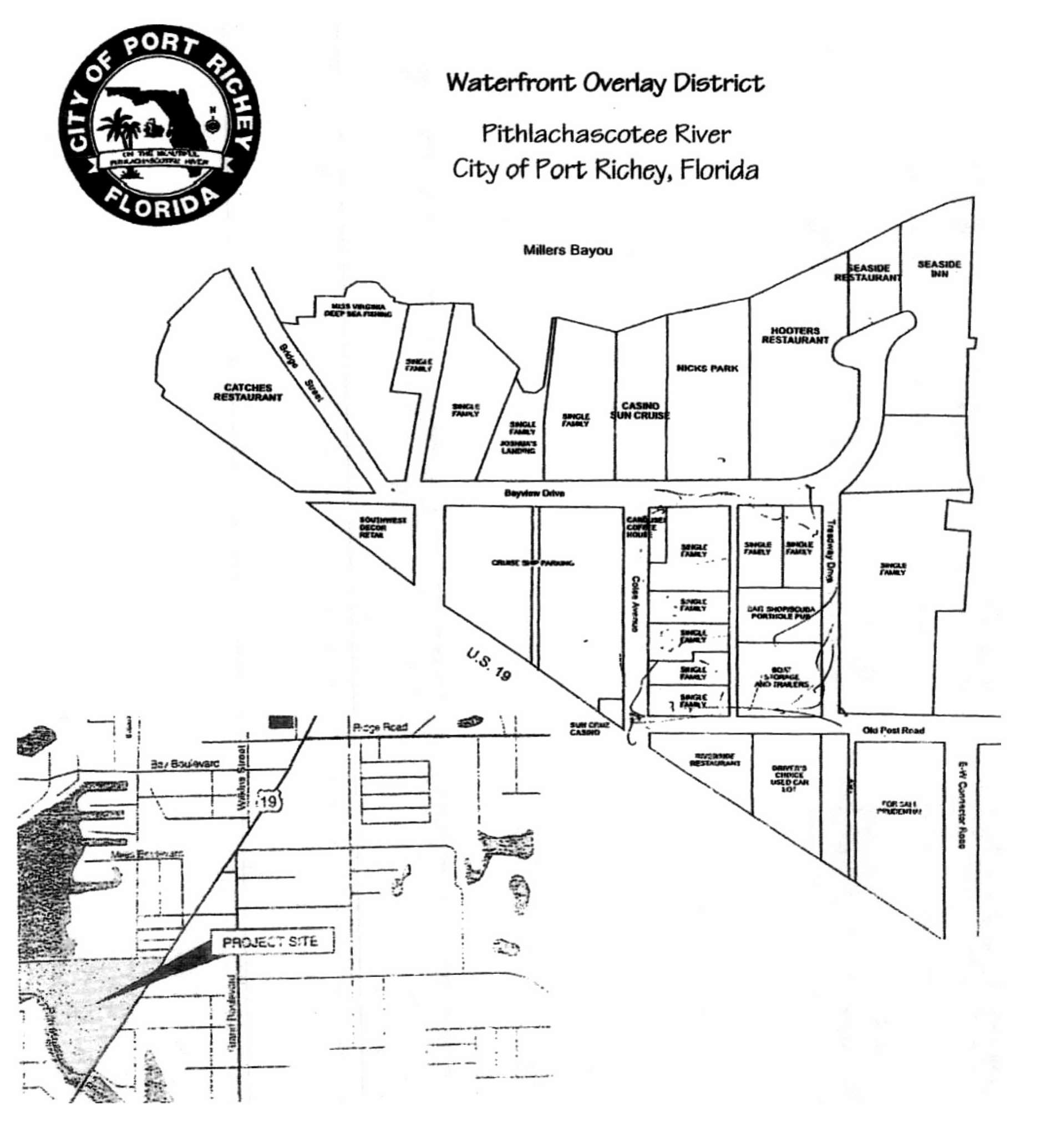
Definition of the waterfront overlay district. The Waterfront Overlay District, as exhibited in figure 1 in this section, encompasses the 19.74-acre area north of the Pithlachascotee River, west of U.S. Highway 19 and south of the southernmost boundary of the city's waterfront park.
(c)
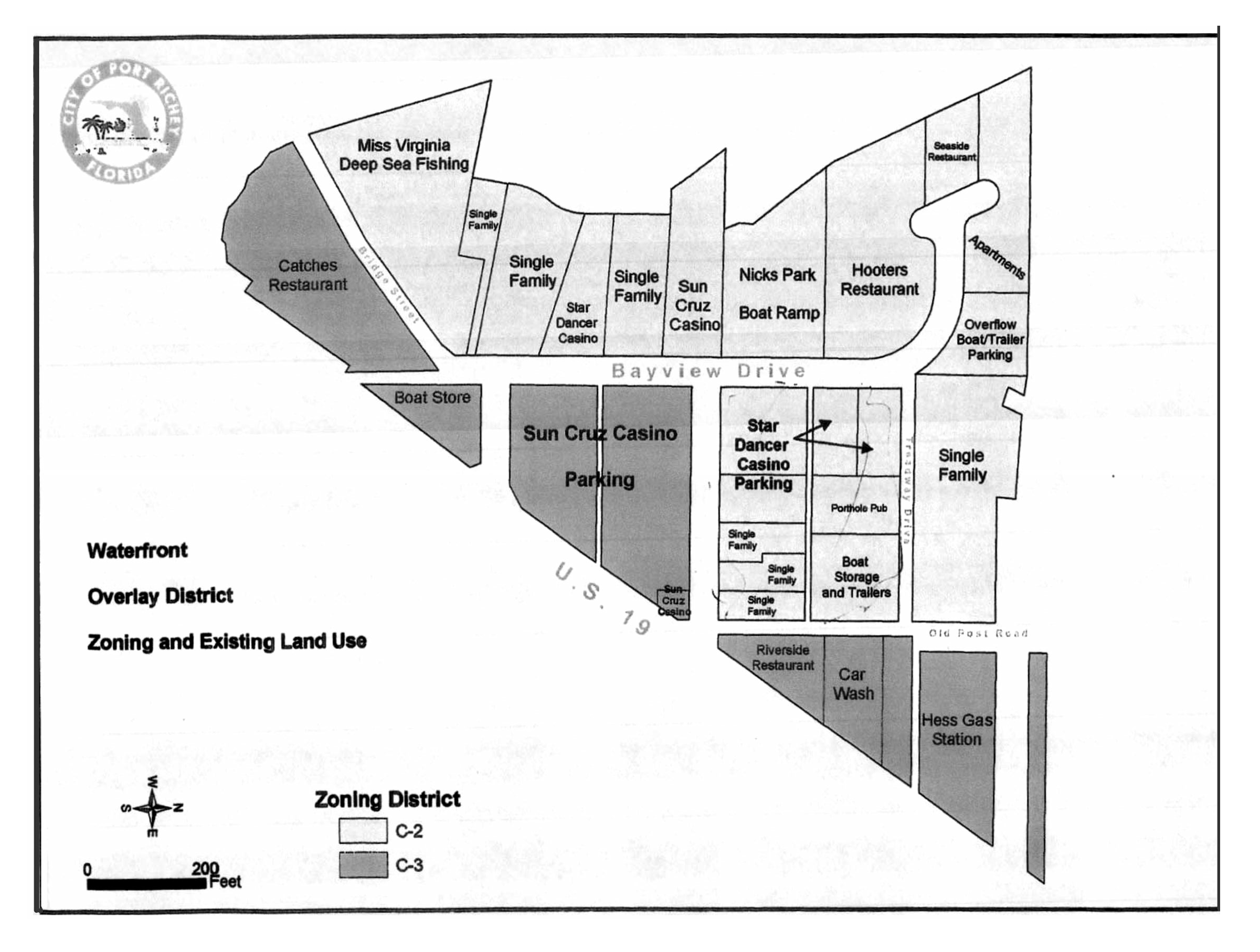
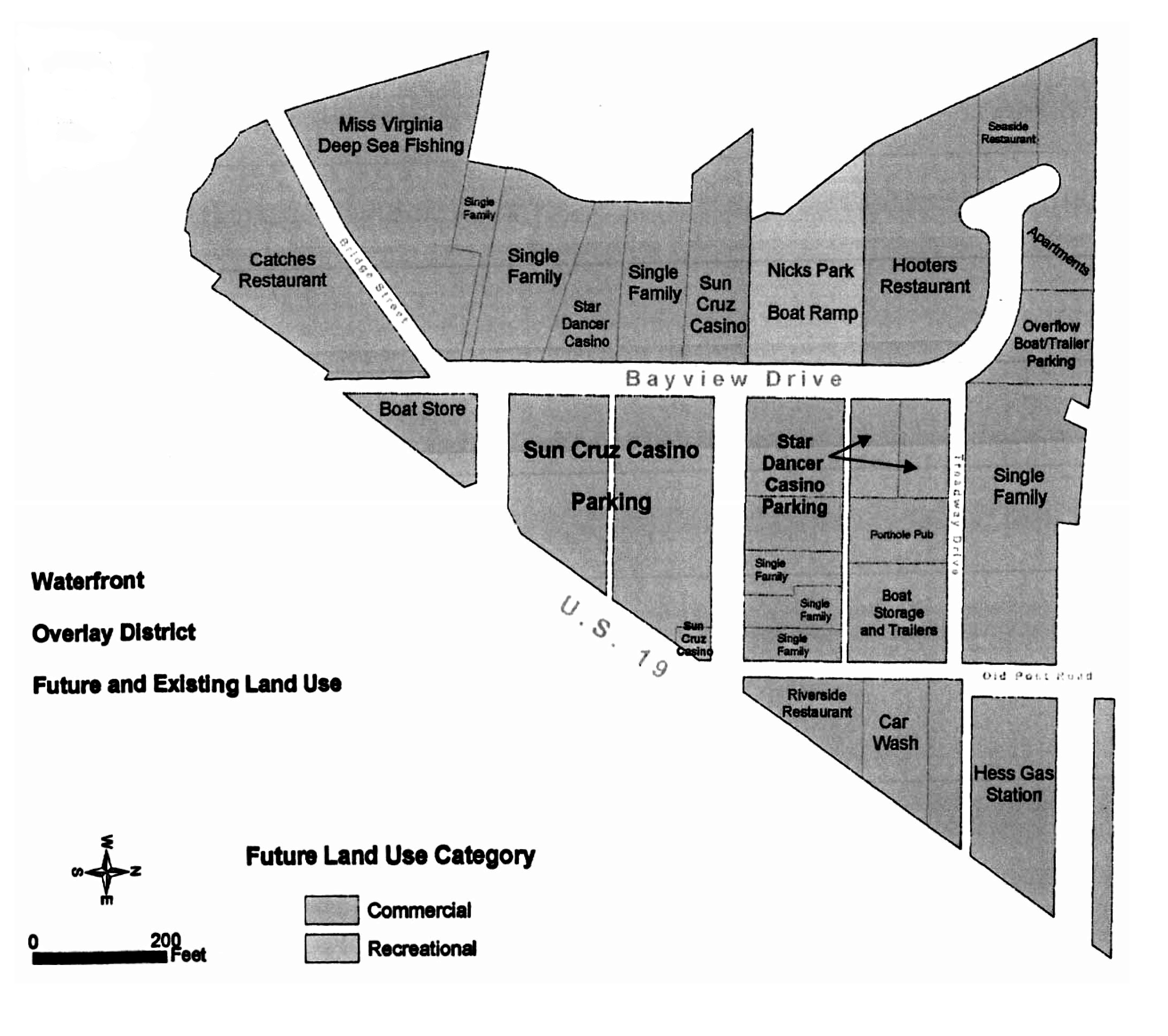
Current zoning and land use for the waterfront district. The waterfront district is zoned commercial. The two categories of commercial zoning include waterfront commercial (C-2) and community commercial (C-1). The future land use for the area is also commercial, with the one exception of Nick's Park, which carries a future land use designation of recreational. These districts will remain intact under the overlay district, but will be enhanced by the site regulations contained within this document.
(d)
Permitted uses. Permitted uses within the WOD will be activity generators. However, because of the surrounding residences in the area, provisions to minimize intrusion of the commercial activity on the area homes will be made. The delivery or pick up of goods by trucks will be low volume in order to minimize truck traffic in the area. No more than two pickups or deliveries of goods shall occur on the weekends. No more than four pickups or deliveries of goods shall occur on weekdays. The permitted uses shall include:
(1)
Professional office (e.g., law, accountant, architectural, planning, engineering, brokerage services and similar uses).
(2)
Multifamily residence.
(3)
Specialty retail shop (boating accessories, dive shop, bait and tackle, seafood market).
(4)
Hotel or motel.
(5)
Neighborhood scale retail establishment.
(6)
Restaurant or cafe (no drive-through).
(7)
Coffee/ice cream shop.
(8)
Recreational aquatic activities establishment (fishing charter, watercraft rentals, and tour-boat charters).
(9)
Entertainment theatre of a nonadult nature.
(10)
Art gallery/studio.
(11)
Antique shops.
(e)
Nonpermitted activities and uses. Activities and uses that will not be permitted within the WOD include the following:
(1)
Activities and uses that are not specifically addressed in subsection (d) of this section or those inconsistent with the applicable and underlying zoning districts and future land use classifications in this chapter and comprehensive plan shall be prohibited.
(2)
Additionally, the following uses, which are permitted in the underlying zoning districts, shall be prohibited:
a.
Automobile repair and body shop.
b.
Automobile sales establishment.
c.
Any structures in excess of forty (40) feet above grade.
d.
Drycleaning establishment.
e.
Miniwarehousing or personal storage center.
f.
Day care facility or nursery.
g.
Off-site signage.
h.
Amplified music in unenclosed structures such as parches, gazebos, decks verandas or other partially enclosed or open-air areas, unless otherwise permitted by applicable city ordinances.
i.
Unimproved parking areas, such as grass, gravel or dirt lots, for on-site and off-site parking, which are legally or illegally nonconforming or would otherwise not be permitted under current parking standards shall not be permitted to be expanded or extended. Such existing lots shall be brought into conformance as to the period specified in subsection (a) of this section.
j.
Adult entertainment shops, nightclubs or other facilities shall not be permitted under the overlay district as an entertainment facility in accordance with section 127-97 of this LDC unless otherwise approved under the provisions of this Land Development Code.
(3)
Hours of operation for commercial businesses shall begin no earlier than 6:00 a.m. and shall cease prior to 12:00 midnight on weekdays and 2:00 a.m. on weekends.
(f)
Existing lots and structures. All lots and structures existing at the time the Waterfront Overlay District is first applied to the property shall not be deemed a zoning nonconformity solely because of this overlay district. For example, replacement of existing structures with like structures that otherwise conform to the requirements of the underlying district are allowed. All additions, changes, expansions, and alterations to such existing structures must comply with the regulations of the waterfront overlay district unless the board of adjustment, in accordance with section 103-110, approves the addition, change, expansion or alteration as if the existing structure were made nonconforming by the overlay district.
(g)
Site regulations. Development regulations within the Waterfront Overlay District shall be the same as those found in the underlying zoning districts. However, in addition to the regulations dictated in this chapter, the following site regulations and requirements shall apply:
(1)
Lot area. The minimum lot area for properties fronting the waterfront shall be the same as in the underlying zoning district (e.g., C-1, C-2). All other properties located within the district shall maintain a minimum lot area of 5,000 square feet with a minimum width of 50 feet and a minimum length of 100 feet.
(2)
Height. The maximum height of any converted or newly constructed structure shall be the same as in the underlying zoning district (e.g., C-1, C-2). However, for those properties located within 100 feet of the right-of-way line for U.S. Hwy. 19, a maximum height of 45 feet shall be allowed within the overlay district without additional setback requirements as prescribed in this chapter.
(3)
Setbacks. The front, side and rear setbacks for any structure shall be the same as in the underlying zoning district (e.g., C-1, C-2), except where the property's rear lot line lies along the waterfront. Converted or newly constructed structures shall maintain a minimum front setback of 15 feet and a minimum rear setback of ten feet along the waterfront and 15 feet when abutting a seawall or dock facility. Nonconforming structures shall not be enlarged, enhanced or in other ways altered so as to further encroach into the front, rear or waterfront rear setback.
(4)
Parking.
a.
The number of parking spaces required for on-site parking shall be the same as in the underlying zoning district until such time as public owned or leased off-site parking becomes reasonably available. At such time as the city council, in its sole discretion, determines that publicly owned or leased off-site parking is reasonably available, parking requirements shall revert to a maximum of four parking spaces per 1,000 square feet of building area and shall be provided on-site.
b.
Parking shall be off-site in the proposed parking facility to the greatest extent possible, except in the provision of required handicapped parking and access, which shall be provided and marked to the appropriate standard.
c.
All on-site parking shall be composed of either impervious pavement surface or turf-block, or a combination of the two. Turf-block material must be maintained to prevent the growth of any and all vegetation. Existing unpaved driveways and parking surfaces may be utilized until such improvements can be made. However, no new pervious material will be allowed for parking spaces. Handicapped parking shall be entirely composed of impervious surface materials.
(5)
Buildings. No buildings utilized for commercial purposes in this district shall exceed 50,000 square feet in size. Buildings one story in height shall not exceed 75 percent lot coverage. Buildings two stories in height shall not exceed 70 percent lot coverage. Buildings three stories in height shall not exceed 65 percent lot coverage. The height of the structure is determined by the underlying zoning district of the property (e.g., C-1, C-2) or as stated under subsection (g)(2) of this section.
(6)
Storage. All storage of equipment or supplies shall be enclosed within the roofline of the principle structure. Storage shall not be permitted on porches, decks or other semi-enclosed areas. Storage sheds, exterior refrigeration units and detached utility structures are strictly prohibited.
(h)
Signage.
(1)
Only one wall sign shall be permitted on the front facade of the building. The wall sign shall not project outward from the wall to which it is attached more than six inches.
(2)
The area of the signboard shall not exceed 25 square feet, nor shall it exceed ten feet in height. Pole supports for signage should be as decorative as possible, composed of materials consistent with the design of the principal structure and have a landscaping base at the foot of the pole, a minimum of five feet wide and five feet deep with an area not less than 25 square feet.
(3)
One secondary wall mounted sign not exceeding 25 square feet in area shall be permitted on any side entrance open to the public.
(4)
Signs shall be made of natural wood material, painted wood, or synthetic material with a natural wood appearance. No banners, plywood, wallboard, particleboard, etc., shall be used for signage.
(5)
Neon, electronic message board, variable lighting system and other illuminated signs shall be prohibited except where a variance has been granted. Such a variance shall require a special permit from the building department, which shall be subject to approval of a variance from the board of adjustment subject to the city's standards of variance exception.
(i)
Landscaping.
(1)
All new construction or alterations within the overlay district shall include perimeter landscaping a minimum of five feet in width along the front and sides of the property line. This landscaping buffer shall be maintained to a height no greater than three feet and no less than one foot in height. Where this requirement creates a conflict with other regulations, the more stringent requirement shall apply.
(2)
Where a nonresidential use abuts a residential use, there shall be a continuous landscape screening buffer, a minimum of ten feet wide with a minimum height of four feet within one year from time of planting. This buffer shall not extend nearer to a street right-of-way line than the established building line of the adjoining residential lot. The buffer shall be an evergreen hedge or other similar foliage and shall be maintained to a maximum height of six feet.
(3)
Recommended materials include, but are not limited to, Viburnum, Ligustrum, Burford Holly and Wax Myrtle. Landscape plants must be Florida Grade No. 1 quality or better according to the most recent edition of the Florida Department of Agriculture and Consumer Services Grades and Standards for Nursery Plants, parts I and II.
(j)
Appearance.
(1)
The appearance of any structure used for commercial purposes in the WOD shall portray an "old Florida nautical or fishing village" theme.
(2)
There shall be no outdoor storage of equipment and vehicles or any accessory structures not contained under the roofline of the principal structure.
(3)
Outdoor seating areas, specifically along the waterfront, are encouraged for eating establishments.
(k)
Plan submittal. A set of plans addressing subsections (g) through (j) of this section shall be submitted to the board of adjustment for their approval. Any issues not specifically addressed within this chapter shall be reviewed on a case-by-case basis by the board of adjustment for consistency with the intent of this chapter.
(LDC 2008, § 22-55; Ord. No. 05-536, § 302.03I, 12-20-2005; Ord. No. 13-536B, §§ 1, 2, 1-22-2013; Ord. No. 19-668, § 1, 5-28-2019; Ord. No. 24-700, § 1, 4-23-2024)
Sec. 127-56. - General Commercial Zoning District (C-3).
(a)
Purpose. The purpose of the C-3 General Commercial Zoning District shall be to locate and establish areas within the city which are suited for the development and maintenance of general commercial facilities, said areas to be primarily located along established highways where a mixed pattern of commercial usage is substantially established, to designate those uses and services appropriate for location and development within said zoning district, and to establish such development standards and provisions as are necessary to ensure proper development and functioning of uses within the district.
(b)
Permitted principal uses and structures. The following principal uses and structures are permitted within the C-3 district:
(1)
Any use listed or described as being permitted within the C-1 zoning district.
(2)
Automotive sales, new car and/or used car lot, including related repairs conducted entirely within an enclosed building.
(3)
Automobile washing establishment.
(4)
Boat sales and marine supplies establishment.
(5)
Building supplies establishment.
(6)
Hotel, motel or tourist court.
(7)
Marina.
(8)
Mobile home sales establishment.
(9)
Commercial parking lots.
(10)
Amusement facility.
(11)
Automobile service station.
(12)
Automobile repair garage, all work within an enclosed building.
(13)
Automobile body and fender shop, all painting to be done inside a building.
(14)
Automobile lube and muffler shop, all work done within an enclosed building.
(15)
Secondhand store, all sales and display inside an enclosed building.
(16)
Bicycle sales and repair establishment.
(17)
Sign painting shop, all work to be done inside an enclosed building.
(18)
Electrical appliance store, sales and repair.
(19)
Pet shop.
(20)
Motorcycle sale and repair shop, all repair work to be done inside an enclosed building.
(21)
Shooting and archery range, indoors only.
(22)
Warehousing and general storage establishment.
(23)
Outdoor storage yard and lot is a designated area of land used for the storage of materials, goods, vehicles, or equipment that are not housed within a building or enclosed structure. The primary use is the storage of items outdoors. This can include vehicles, such as trucks, trailers, recreational vehicles, watercraft, and construction equipment. Any such outdoor storage yard shall be completely enclosed, except for necessary ingress and egress, by a solid fence or wall not less than six feet high. This provision shall not permit wrecking yards (including automobile wrecking yards), junkyards or yards used in whole or in part for scrap or salvage operations or for the processing, storage, display or sales of any scrap, salvage or secondhand of the items permitted to be stored within this provision.
(24)
Other uses which are similar or compatible to the permitted uses.
(c)
Special exception uses. The following uses may be permitted only upon review and specific approval thereof by the board of adjustment:
(1)
College or technical school.
(2)
Commercial recreation or entertainment facility.
(3)
Funeral home.
(4)
Hospital.
(5)
Light industry establishment involving product assembly, storage or distribution, but excluding manufacturing, when conducted within a completely enclosed building.
(6)
Multiple-family dwelling (apartments).
(7)
Modular structures and trailers permanently sited and affixed to the ground.
(d)
Accessory uses. Accessory uses permitted within the C-3 district shall be as set forth within section 127-92.
(e)
Minimum lot requirements. There shall be no minimum lot requirements within the C-3 district, provided that all additional site development requirements are met.
(f)
Maximum building coverage. The maximum building coverage is 50 percent.
(g)
Maximum building height. The maximum building height is 72 feet; provided that any building exceeding 35 feet in height shall be set back a minimum distance equal to one-half its height from any property line.
(h)
Minimum living area. The minimum living area for multiple-family dwelling (apartments) is 500 square feet per dwelling unit.
(i)
Minimum yard requirements and buffering.
(1)
Front yard. The minimum front yard setback is 20 feet, except properties which front on U.S. Highway 19 (S.R. 55) which shall have a 25-foot setback.
(2)
Side yard. The minimum side yard setback is five feet for each side yard; provided that no side yard shall be required where a firewall meeting all code requirements is provided.
(3)
Rear yard. The minimum rear yard setback is 20 feet.
(4)
Buffering. Where applicable, buffering shall be provided in accordance with the provisions of section 127-95.
(j)
Off-street parking and service requirements. Off-street parking and service requirements within the C-3 district shall be as set forth in section 127-94.
(LDC 2008, § 22-56; Ord. No. 05-536, § 302.03J, 12-20-2005; Ord. No. 11-627, § 3, 12-13-2011; Ord. No. 24-707, § I, 8-27-2024)
Sec. 127-57. - Light Industrial Zoning District (I-1).
(a)
Purpose. The purpose of the I-1 Light Industrial Zoning District shall be to locate and establish areas within the city which are suited for the development and maintenance of limited industrial activities of light intensity, to designate those uses and services deemed appropriate for location and development within said zoning district, and to establish such development standards as are necessary to ensure proper development and functioning of uses within the district.
(b)
Permitted principal uses and structures.
(1)
Light manufacturing, processing (including food processing, but not slaughterhouse) and/or packaging or fabricating of wood, metal, fiberglass, masonry or chemical products; provided, however, that no use shall be permitted which represents a health or safety hazard to the community through air, water or noise pollution, including the production or emission of dust, smoke, refuse matter, toxic or noxious odors, explosives, gas and fumes, excessive noise or vibration, or similar substances and conditions; and further provided that all industrial activities shall be in conformance with standards established by any city, county, state or federal pollution control authority having jurisdiction within the city.
(2)
Outdoor storage yard and lot; provided that such outdoor storage yard shall not be located closer than 25 feet to any public street or closer than 75 feet to any portion of a lot located within a residential district. Any such yard shall be completely enclosed, except for necessary ingress and egress, by a solid fence or wall not less than six feet high. This provision shall not permit wrecking yards (including automobile wrecking yards), junkyards or yards used in whole or in part for scrap or salvage operations or for processing, storage, display or sales of any scrap, salvage or secondhand building materials, junk automotive vehicles or secondhand automotive vehicle parts.
(3)
Printing, lithographing, publishing or similar establishment.
(4)
Service establishment catering to commerce and industry, including linen supply, freight mover, communication service, business machine service, canteen service, sign company, and similar uses.
(5)
Storage, warehousing or distribution facility.
(6)
Vocational, technical, trade or industrial school, and similar uses.
(7)
Other uses which are similar or compatible to the permitted uses.
(c)
Special exception uses. The following uses may be permitted only following the review and specific approval thereof by the board of adjustment:
(1)
Bulk storage yard, including bulk storage of flammable liquids.
(2)
Machine shop, welding shop.
(3)
Motorbus or truck or other transportation terminal.
(d)
Accessory uses. Accessory uses within the I-1 district shall be as set forth in section 127-92.
(e)
Minimum lot requirements. There shall be no minimum lot requirements within the I-1 district; provided that any lot shall be of adequate size and proportions to meet all applicable requirements of this chapter.
(f)
Maximum building coverage. The maximum building coverage is 50 percent.
(g)
Maximum building height. The maximum building height is 35 feet.
(h)
Minimum living area. Not applicable in this district.
(i)
Setback requirements and buffering. No building, structure, or land shall be located or used in connection with the operation of any establishment within 75 feet of any portion of a lot within a residential district; provided, however, that off-street parking and off-street loading spaces may be located within said setback area. In addition, the following requirements shall apply:
(1)
Front yard. The front yard setback minimum is 25 feet.
(2)
Side yard. The minimum side yard setback is a combined total of 25 feet for both side yards and a minimum width of ten feet for one yard.
(3)
Rear yard. The rear yard setback minimum is 25 feet.
(4)
Buffering. Where applicable, buffering shall be provided in accordance with the provisions of section 127-95.
(j)
Off-street parking and service requirements. As set forth in section 127-94.
(LDC 2008, § 22-57; Ord. No. 05-536, § 302.03K, 12-20-2005)
Sec. 127-58. - Planned Unit Development Zoning District (PUD).
(a)
Purpose. The purpose of the PUD Planned Unit Development Zoning District shall be to provide opportunity, upon application and through the process of unified planning and coordinated development, for the creation of new neighborhood or community areas which, by virtue of their specialized nature and unique design, are not adaptable to regulation by the requirements of other zoning district classifications within this chapter. It is intended that the regulations and requirements applying to a PUD zoning district shall be sufficiently flexible in structure so as to encourage creative and imaginative design in planning and development. Where there are conflicts between the requirements set forth herein for a PUD zoning district and the general provisions of this chapter or other applicable codes of the city, the requirements herein shall govern; provided, however, that development within a PUD zoning district shall be in accordance with standards which equal or exceed those embodied within other such applicable codes.
(b)
Permitted principal uses and structures. No specific uses are designated herein; provided, however, that mobile homes shall be specifically prohibited. Uses permitted within a particular PUD zoning district shall be only those uses deemed by the city council to be fully compatible with each other, within the context of the proposed development as a whole, and with the zoning and land use patterns of surrounding areas. The type, general location and extent of all proposed uses shall be clearly designated as part of the general concept plan, and approval of said uses or types of uses as part of a rezoning amendment shall constitute the permitted land use requirements of a particular PUD zoning district to the same extent and degree as were said permitted uses specifically set forth within this chapter. Any proposed change of approved land usage, other than necessary refinements in size, configuration or location, as may be required in the preparation of detailed plans, shall require a rehearing and approval in accordance with the procedures herein established.
(c)
Special exception uses. No special exception uses shall be permitted within a PUD zoning district.
(d)
Accessory uses. Accessory uses permitted within the PUD district shall be as set forth within section 127-92.
(e)
Minimum lot requirements. A PUD zoning district shall include no less than five acres of contiguous land and shall be of such proportions as to properly accommodate all proposed uses in keeping with the general requirements of the city and the established policies and objectives of the comprehensive plan. There shall be no specific lot requirements for individual uses; provided, however, that the area designated for any particular use shall be of sufficient size and proportions so as to properly accommodate said use and to provide for adequate open area between it and an adjacent use. The maximum residential density shall be 18 dwelling units per acre. A minimum of 20 percent of the total site area, less any areas devoted exclusively to nonresidential uses, shall be devoted to common open space and recreation areas. Said areas shall be exclusive of areas required for streets, off-street parking, setbacks at the periphery of the development, and necessary open spaces between buildings and/or uses.
(f)
Maximum building coverage. The maximum combined area of building coverage by all residential, community and recreation structures shall not exceed 30 percent of the gross site area, excluding any portion of the site devoted exclusively to nonresidential uses. Where residential and nonresidential uses are combined within a structure, the site area of said structure shall be included as part of the gross site area for purposes of calculating residential land coverage. Maximum building coverage for structures devoted to nonresidential usage shall be 50 percent of that portion of the gross site area devoted to said nonresidential usage.
(g)
Maximum building height. The maximum height of any structure within the development shall be 72 feet.
(h)
Minimum living area. The minimum living area for any dwelling unit shall be the minimum prescribed for the type of dwelling unit within other zoning classifications of this chapter.
(i)
Minimum yard requirements and buffering.
(1)
Where the proposed PUD district adjoins any residential district, all portions of a structure shall be set back a distance equal to its total height, from any private property within said residential district, or a distance equal to one-half its height, from any property line adjoining a street, right-of-way, or waterway; provided that in no case shall said setback distance be less than 35 feet.
(2)
Buffering shall be provided in accordance with the provisions of section 127-95 or as specifically required by the city council in its approval action.
(j)
Off-street parking and service requirements. Off-street parking and service requirements within the PUD district shall be as set forth in section 127-94.
(k)
Compliance with the comprehensive plan and other city regulations. Development proposed within a PUD district shall be compatible with the city's comprehensive plan and with the requirements of all other ordinances and regulations not specifically superseded by virtue of the amending action of the city council.
(l)
General guides and standards. In addition to the specific requirements set forth herein, the city council may, from time to time, adopt general guidelines and standards to guide the planning and development of all PUD districts.
(m)
Recreational vehicle parks in a PUD district.
(1)
Purpose and intent.
a.
Recreational vehicle parks shall be exclusively for commercial, transient guest lodging by persons with recreational vehicle-type units designed as temporary living quarters for recreational, camping, or travel use. Mobile homes are not permitted. Recreational vehicles shall not be used as permanent dwellings. The intent of this section is to provide standards that result in the following:
1.
The entire recreational vehicle park shall be designed and laid out in a detailed master plan.
2.
The land on which it is developed shall be under a unified control and shall be planned and developed as a whole, single development operation or in a phased series of development operations for recreational vehicles and related uses and facilities within an approved PUD District.
3.
These standards are not intended to be all inclusive. Alternate designs may be considered that meet the intent of well-organized recreational vehicle parks.
(2)
Applicability.
a.
These standards shall apply to all new recreational vehicle parks.
b.
Review and compliance with the standards of this section shall be considered subject to the submittal requirements for PUD of this LDC.
c.
Recreational vehicle parks shall only be permitted where allowed by PUD classification and shall not be permitted in any area found unsuitable for such development because of poor or undesirable drainage, physical topography soil characteristics, public access or other features that may be harmful to the public health, safety, and general welfare. Parks should be located where proper sewer and water systems can be developed and approval obtained for such systems from the jurisdictional regulated utility.
d.
Compliance. The development of the recreational vehicle park shall be in conformance with the binding PUD master plan as finally approved and filed with the city. Any development, use, or density which fails to substantially conform shall constitute a violation of this section as well as other applicable city ordinances as may pertain.
e.
The PUD master plan may be subject to conditions of approval as determined by city council.
(3)
Standards.
a.
Minimum lot requirements. A PUD zoning district shall include no less than five acres of contiguous land and shall be of such proportions as to properly accommodate all proposed uses in keeping with the general requirements for the city and the established policies and objective of the comprehensive plan. A minimum of 20 percent of total site area, less any areas devoted exclusively to nonresidential units, shall be devoted to common open space and recreation areas. Said areas shall be exclusive of areas required for streets, off-street parking, setbacks at the periphery of the development, and necessary open spaces between buildings and/or uses.
b.
Maximum density and layout.
1.
Recreational vehicle parks shall have a maximum density of 15 recreational vehicle spaces per gross acre. The number of recreational vehicle units does not confer any vested residential development rights whatsoever.
2.
Park models (also known as park trailers defined as set forth in F.S. § 320.01(1)(b)7) are expressly prohibited.
3.
All recreational vehicle spaces shall have a concrete pad or constructed of an adequate base, graded and surfaced to facilitate drainage and to reduce dust, as approved by the city.
4.
Individual recreational vehicle spaces shall have access from internal roadways and shall not have direct access from adjoining public rights-of-way.
5.
Each recreational vehicle space shall be marked and numbered for identification.
6.
Dimensional standards. Each recreational vehicle space shall be of a minimum width and depth to accommodate both recreational vehicle unit and the tow vehicle. Where dimensional standards are not specified on the approved PUD master plan, recreational vehicle spaces and other amenity areas shall be designed to meet the following minimum setback standards:
* Setbacks for RV units/other buildings shall not be less than the minimum setback above.
7.
Temporary structures such as canvas awnings, screened enclosures, or platforms, which are normal camping equipment, may be erected but must be removed when the recreational vehicle space is vacated. No other structural additions shall be built or become a part of any recreational vehicle.
8.
Unless otherwise indicated on an approved PUD master plan, tent camping shall be limited to one camp site per designated recreational vehicle space and shall not be allowed in any other designated area.
9.
Fires shall be made only in stoves and other equipment, or structures intended for such purposes and placed in safe and convenient locations, where they will not constitute fire hazards to vegetation, undergrowth, trees, and recreational vehicles.
c.
Landscape and buffering.
1.
Recreational vehicle parks shall have buffering in accordance with the provisions of section 127-95 or as specifically required by the city council in its approval action.
2.
All existing trees having five inches DBH or more that are located within the designated buffers shall be maintained and must be protected by establishing a tree protection zone pursuant to requirements for trees and tree protection of this LDC. These may be counted as contributing to the total tree requirement. No site grading shall be allowed within the buffer.
3.
Landscaping shall be consistent with the requirements standards for buffers, landscaping, and tree protection, of this LDC. Fencing may be required as part of the buffering requirements where it is desirable to protect public safety, neighboring property, or aesthetics.
4.
Recreational vehicle spaces and designated amenity and service areas shall not be located within buffers required along the property boundaries.
5.
Buffering and landscaping shall be continually and properly maintained.
d.
Internal roadways and circulation.
1.
The primary entrance and exit for the recreational vehicle park shall be from a collector or arterial classified roadway.
2.
Parking spaces for ancillary uses associated with the recreational vehicle park shall meet the minimum standards for parking space requirements of this LDC.
3.
The entrance of the internal private roadway shall be constructed of concrete or asphalt for the first 50 feet and have a pavement width of 30 feet with a 30-foot curb radius. The internal private roadway shall have at least one direct connection to a paved public street, have a pavement width of 24 feet in accordance with city specifications, and shall consist of concrete, asphalt, or crushed limestone. The roadway may be 15 feet in width if it is designed for one way as long as there is a minimum of 24 feet of unobstructed clearance, and a minimum of 60 feet in turning area and radii, to permit the free movement of emergency vehicles.
4.
All internal roadways shall be privately owned and maintained.
5.
Unless a different roadway configuration is approved by city council the recreational vehicle park shall have a continuous path of travel throughout the recreational vehicle park with no dead-end roadways unless a cul-de-sac is installed in accordance with city specifications.
6.
Roadways must meet the Florida Fire Prevention Code, the Life Safety Code and Current NFPA Standards.
e.
Signage.
1.
One identification sign shall be allowed at the recreational vehicle park's primary entry and exit. Said sign shall comply with applicable city sign regulations.
2.
Traffic direction shall be clearly visible at all internal roadways.
3.
Other internal, directional and information signs for the convenience of the park are permitted.
f.
Utilities and refuse disposal.
1.
Recreational vehicle parks shall be required to be connected to public water and sewer.
2.
Electricity may be provided to each recreational vehicle space (vehicle parking pad). If provided, all electrical utility lines in the park shall be underground.
3.
All internal water and sewer infrastructure shall be privately owned and maintained.
4.
All solid waste shall be contained and stored in a sanitary and nuisance free manner. Dumpster and/or trash receptacles shall be provided and located in a central location easily accessible to all recreational vehicle spaces.
g.
Common facilities and recreation areas.
1.
Open space for common areas, playgrounds and other recreational uses shall be provided at the rate of at least 20 percent of the gross area of the recreational vehicle park. The recreation area may include space for common walkways in related interior landscape areas. A recreation area may be comprised of facilities for active recreation, such as swimming pools or beaches, shuffleboard courts, or play lots for children. These facilities shall be located and interconnected by defined walkways to be readily available from all recreational vehicle spaces and separate from vehicular traffic flow.
2.
Restrooms and bath facilities shall comply with state and federal laws.
3.
The developer is responsible for obtaining any and all permits and approvals required by the city and all other federal, state, and local government permits to operate the recreational vehicle park as provided by the approved PUD master plan.
4.
The developer of a recreational vehicle park which is in a fully, or partially designated special flood hazard area (SFHA) shall provide the city with a site plan delineating the SFHA and which shall include a statement attesting to the base flood elevation as has been established by FEMA and certified by a licensed professional engineer registered in the State of Florida.
5.
Lighting. All common access routes, driveways, internal streets, off-street parking areas, and service buildings within the RV park shall have adequate lighting to ensure visibility within such areas at night by park resident, guests, and public safety personnel who might be called to the park at night.
(n)
Procedures on PUD amendments. The following steps shall be utilized in the application, review, and approval of a PUD rezoning petition:
(1)
Preapplication conference. The applicant or his authorized representatives shall confer with the building and zoning official or the council's designee and such other city officials as may be requested to participate by the building and zoning official or the council's designee of the city, prior to filing an application for a change of zone to the PUD district. The purpose of said conferences shall be to permit the applicant to present the applicant's initial concepts of the proposed development, to benefit from comment by the building and zoning official or the council's designee and other officials, and to receive any appropriate clarification concerning application requirements and review procedures to be followed.
(2)
Petition for rezoning; materials to be submitted. A petition for PUD rezoning shall be submitted in accordance with the general rezoning requirements of this chapter. In addition, the materials submitted with the petition, or upon subsequent request by the building and zoning official or the council's designee, the planning and zoning board, or the city council, shall include all plans, maps, studies, and reports which may reasonably be required in order to make the findings and determinations called for in the particular case, with sufficient copies for necessary referrals and records. Minimum initial materials to be submitted shall include the following:
a.
A statement identifying the owners of all property within the area of the proposed district, together with evidence of the unified control of said entire area. If submitted by other than the current owners of the property, the statement shall be accompanied by satisfactory evidence of the existence of purchase or lease agreements or other appropriate instruments to indicate current or future unified control of the property. The statement shall include agreement:
1.
To proceed with the proposed development according to the provisions of this chapter and such conditions as may be set by the city council upon rezoning of the property;
2.
To provide future agreements, contracts, deed restrictions and sureties acceptable to the city for completion of each proposed phase of the development according to approved plans, and for continuing operation and maintenance of such areas, functions and facilities as are not to be provided, operated, or maintained by the city pursuant to written agreement; and
3.
To bind all successors in title with any commitments made under subsections (n)(2)a.1 and (n)(2)a.2 of this section.
b.
A vicinity map at an appropriate scale showing the relationship of the property to the surrounding property and the street network;
c.
A written legal description and map for advertising of public hearing. The legal description shall contain the name, plat book and page numbers of any recorded subdivision comprising all or part of the property. The map shall be of suitable size for newspaper reproduction and shall clearly show the boundaries of the property, the existing zoning districts applying to the property, and the zoning districts applying to all adjacent properties;
d.
A survey map, at an appropriate scale, indicating boundaries, including dimensions, total area of all properties involved, ownership of all properties involved, ownership of adjacent properties, identification and location of all existing structures upon the property, and identification and location of all rights-of-way, easements, utility lines, drainage or other public or private service structures existing upon or adjacent to the property;
e.
A general concept plan, at appropriate scale, showing the types, general grouping and massing arrangement of all proposed buildings; the uses or types of uses intended for each general grouping of buildings; the approximate total floor area and residential floor area of each general building grouping and of the total development; the total number of dwelling units proposed for each general building grouping and for the total development; the approximate location of all proposed streets, driveways, and parking and service areas (indicating number of parking spaces to be provided); and the location, size and character of proposed open spaces and recreation areas;
f.
A schematic traffic flow plan showing by approximate location the estimated volumes of peak-hour vehicular traffic movement throughout the property, and indicating its points of access to, or egress from, the property. This requirement may be waived by the building and zoning official or the council's designee when it is determined that the proposed development is of such limited size so as to create no undue volumes of vehicular traffic movement;
g.
A supportive report indicating the degree of compliance of the proposal with the city's comprehensive plan and including all other data, descriptions or illustrative material necessary to supplement the required graphic materials. Any prepared market analysis or feasibility study shall be submitted as part of the supportive material. If applicable, a description of the proposed staging plan shall also be submitted describing the general geographic area and development components proposed for each project stage, and setting forth anticipated starting and completion dates for each project stage.
(3)
Review by planning and zoning board. All application materials shall be submitted to the planning and zoning board for its review at least 30 calendar days prior to the date set for public hearing in accordance with the requirements of this chapter. The planning and zoning board may request the applicant to submit additional materials or data deemed reasonably necessary to its review of the proposed rezoning. Following its review and the holding of the required public hearing, the planning and zoning board shall submit its recommendations upon the proposed rezoning to the city council, including any additional requirements deemed necessary to ensure a proper development of the project.
(4)
Action by city council. Upon receipt of the recommendation of the planning and zoning board, the city council shall hold a public hearing on the petition in accordance with the requirements for rezoning generally, as set forth in this chapter.
a.
Following the hearing, the city council shall:
1.
Grant the amendment as proposed;
2.
Grant with specific modifications agreed to by the petitioner; or
3.
Deny the amendment.
b.
Such action shall include the plan and all instruments related thereto, in the form and degree of completion reached at the time of announcement of the public hearing before the city council.
c.
If the city council grants the amendment, the development shall be in accordance therewith and with general PUD requirements existing at the time of amendment, except as such requirements are modified in their application in the amending action. Said development shall conform to any order of priority or time limitations established by the city council in the amendment as to beginning and completion of the development as a whole or of specified stages. Before development may proceed, agreements, contract deed restrictions, and sureties required but not approved at the time of the amending action shall be approved by appropriate officers or agencies of the city. If the city council grants the amendment, the subject property shall be designated PUD on the official zoning map.
(5)
Action following PUD rezoning. Following PUD rezoning, no building permit or certificate of occupancy shall be issued in the district until and unless final plans and reports have been submitted in such detail as necessary for determination of compliance with PUD regulations and with requirements of other applicable city regulations and/or ordinances, and have been approved by the appropriate officer or agency as complying with all said regulations, requirements and ordinances as applying generally at the time of the amendment or as modified by the city council in its amending actions. The applicant shall confer with the building and zoning official or the council's designee prior to final plan submittal to determine the specific submittal requirements for the particular project involved. With respect to the general regulations and requirements of the PUD zoning district, as originally set forth or as modified by the city council in its rezoning action, the compliance therewith of final plans and reports shall be approved in writing by the city council. All such final plans and reports shall be for the development as a whole or for stages and priorities approved by the city council. No structure or use other than as indicated in approved final plans and reports shall be permitted.
(6)
Changes in development plans. Nonsubstantial modification of the concept plan may be approved by the building and zoning official, or the council's designee. A substantial modification of the concept plan may be approved by the city council. For the purposes of this subsection, a substantial modification shall be deemed to exist where:
a.
There is a proposed increase of five percent or greater in the total number of dwelling units proposed on the PUD concept plan approved by the city council.
b.
There is a proposed 20 percent or greater redistribution of density within individual phases of the PUD concept plan approved by the city council.
c.
There is a decrease of proposed preservation, conservation or open space areas involving five percent or greater of the original area set forth in the PUD concept plan approved by the city.
d.
There is an increase in the size of areas set forth in the PUD concept approved by the city for nonresidential uses by five percent or greater.
e.
There is a substantial increase in the adverse impact of the development due to modifications or failure to comply with conditions or stipulations authorized in the original approval by the city council.
(7)
Expiration of time limits of PUD development. If development actions required in the rezoning amendment are not taken within three years, the planning and zoning board shall review the circumstances and recommend to the city council that:
a.
PUD zoning for the entire area be continued with revised time limits;
b.
PUD zoning be continued for part of the area with revised time limits, and the remainder be rezoned to an appropriate classification; or
c.
The entire area be rezoned from PUD to an appropriate classification.
Said recommendation shall include proposals for appropriate action in respect to any legal instruments involved in the case.
(8)
Status of a PUD approved under prior ordinance. Except as may be specifically set forth herein, any PUD approved under Ord. No. 153 prior to its revocation shall not be subject to the provisions of this section but shall continue to be subject to the specific development plan approved and to all applicable stipulations attached to said approval. However, should any stipulated time limits for development actions expire without said actions having been taken, the PUD shall be fully subject to the provisions of subsection (n)(7) of this section.
(LDC 2008, § 22-58; Ord. No. 05-536, § 302.03L, 12-20-2005; Ord. No. 24-696, § 1, 3-26-2024)

