
Port Richey City Zoning Code
ARTICLE IV
- SUPPLEMENTARY DISTRICT REGULATIONS
Sec. 127-90. - General provisions.
(a)
Division of lots. It shall be prohibited to divide any lot for new use or ownership which would result in any portion of said lot failing to meet the requirements herein established for the zoning district in which said lot is located.
(b)
Base building line requirements. In order to provide for necessary street improvements and extensions to streets, certain base building lines may be established from time to time as part of the comprehensive plan. Where any base building line has been so established, all required setbacks shall be measured from said line, and in no case shall any part of a building, structure, parking area or other site improvement of a permanent nature be constructed or extended streetward beyond said line.
(c)
Setback required from natural or manmade body of water. The full extent of all required yards and setback areas shall be maintained landward from the mean high-water line of any natural or manmade body of water, irrespective of whether the parcel ownership involved may include all or part of said body of water; provided that an exception may be applied as part of a marina or marina-associated structure. This requirement shall not preclude the construction of a seawall on any property, in conformance with all applicable requirements of law.
(d)
Special yard requirement for a corner lot. For any corner lot, the full front yard depth requirement shall also apply to the side yard facing the secondary street, wherever said corner lot adjoins or faces a lot having its principal frontage upon said secondary street; provided, however, that no setback shall be required along a secondary street which exceeds the established setback of a building upon said adjoining or facing lot.
(e)
Visibility at intersections in all zoning districts. No fence, wall, hedge or shrub planting which obstructs sight lines and elevations between two feet and six feet above the roadways shall be placed or permitted to remain on any corner lot in any zoning district within the triangular area formed by the street property lines and a line connecting them at points 25 feet from the intersection of the street lines, or in the case of a rounded property corner, from the intersection of the street property lines extended. The same sight line limitations shall apply on any lot within ten feet from the edge of a driveway or alley. No tree shall be permitted to remain within the above-described limits of intersections unless the foliage line is maintained at or above six feet above the roadway intersection elevation, to prevent obstruction of sight lines.
(f)
Fences, walls, shrub plantings and hedges. Except as otherwise provided herein, fences, walls, shrub plantings and hedges may be located within any property, subject to the provisions of subsections (b) and (e) of this section.
(1)
No fence or wall shall exceed four feet in height beyond the front of any building. Except as otherwise provided herein for property located on a canal or a natural body of water, no fence or wall shall exceed six feet in height from the front of any building to the rear property line.
(2)
No fence shall be erected at a height greater than four feet on residential property, along a canal or on any natural body of water. The limitation on the height of any such fence shall apply to fences constructed along and from the waterfront property line to the nearest building line on the property. It is further provided that any such fence shall be constructed with traditional building materials, including metal, vinyl, wood (natural, stained, or painted), and composite products manufactured specifically for fences, and so as not to obstruct the view of the waterway by adjacent property owners the fence should have at least 50 percent open space and in no case shall any fence have an open area between planks or other construction material greater than four inches.
(3)
No natural fences (plantings, shrubs or hedges) established after the effective date of the ordinance from which this chapter is derived shall be planted and maintained at a height greater than four feet along and from the waterfront property line to the nearest building line on residential property.
(4)
No fence, wall or natural fence may be erected in any recorded easement unless verification that all utility users have no objection to its construction and that the fence will not impede the functioning of drainage systems. No fence may be allowed in an easement recorded for ingress/egress access purposes. Maintenance of easements and replacement of any fence removed, by any utility, shall be the responsibility of the property owner.
(5)
Any conflict between the provisions of this section and any laws pertaining to the erection of a fence around any swimming pool, the requirements for erection of a fence for a swimming pool shall prevail, except that any such swimming pool fence erected on waterfront property shall be constructed so as not to obstruct vision from the waterfront property line to the nearest property line.
(6)
Upon a demonstration and written request by any property owner that compliance with the provisions of this section could create a potential health, safety or welfare hazard, the city manager is authorized to waive the height requirements of the erection of a fence, but in no event to exceed six feet in height. Further, the city manager may authorize the construction of a privacy fence, not to exceed six feet, along any residential property line which abuts a public park or trail.
(7)
In the event 50 percent or more of a nonconforming fence is destroyed or removed, whether by natural causes or otherwise, then such replacement fence shall be erected in conformance with the requirements of section 127-95.
(8)
No fence made with barbed wire, corrugated metal, or sheet aluminum or similar materials shall be permitted on any residential property. Barbed wire may be permitted when attached to fences around designated community facilities when used for security purposes. All barbed wire must be a minimum of six feet aboveground, and no more than eight feet as measured from the ground and shall not be included as part of the height of the fence.
(9)
In any zoning district, no fence, wall or hedge shall be installed on any public or private right-of-way used as a street, road, or highway.
(10)
All fences constructed with posts or other supporting structures shall be placed on the property so that the finished side of the fence without posts or supporting structures faces the adjacent property owner.
(g)
Buildings, structures and uses to have access. Every building, structure, or use hereafter erected, moved or established shall be on a lot adjacent to a public street or with access to a public street by means of an approved private street, and all buildings, structures and uses shall be so located on lots so as to provide safe and convenient access for servicing, fire protection and required off-street parking and loading. No building, structure or use shall be erected on, moved onto, or established upon, a lot which does not abut on at least one public street or approved private street for a distance of at least 20 feet.
(h)
Use of residentially zoned lot for access. No lot which is residentially zoned shall be used for driveway, walkway or access purposes to any lot which is nonresidentially zoned, or used for any purpose not permitted within the applicable residential zoning district, except for ingress and egress to and from an existing use which does not abut on a street.
(i)
Moving of buildings or structures. No building or structure shall be moved from one lot to another lot or moved to another location on the same lot unless such building or structure shall thereafter conform to all applicable provisions of this chapter and all other applicable requirements of the city.
(j)
Essential services. Essential services shall be permitted in any zoning district.
(k)
Temporary buildings and structures. Temporary buildings and structures in connection with land development, sales or construction projects, may be erected or placed within any zoning district for occupancy other than as dwelling or lodging units, provided that any said temporary building or structure shall be located only upon the actual site of development, sales or construction. Any such building or structure shall require a permit from the building and zoning official or the council's designee such permit to specify location, type of construction, maintenance requirements, and time period of utilization of said building or structure. No permit shall be for a period of more than six months, subject to renewal upon approval of the building and zoning official or the council's designee. Failure to obtain a permit or violation of any condition or requirement specified therein shall be a violation of this chapter.
(l)
Storage and/or accumulation of materials, refuse and waste materials prohibited. Except as may be expressly permitted within this chapter, no materials, refuse and waste materials, including inoperative equipment and vehicles, shall be stored or accumulated outside of a building within any zoning district.
(LDC 2008, § 22-90; Ord. No. 05-536, § 302.04A, 12-20-2005; Ord. No. 11-628, § 1, 12-13-2011; Ord. No. 23-693, § 1, 12-12-2023)
Sec. 127-91. - Permitted yard encroachments and height exclusions.
(a)
Yard encroachments. Every part of a required yard shall be open and unobstructed from the ground to the sky, except as hereinafter provided or as otherwise permitted by this chapter:
(1)
Sills or belt courses may project not over 12 inches into a required yard.
(2)
Steps, porches, decks, balconies, and stoops may project four feet into a required yard.
(3)
Cornices, eaves, gutters or movable awnings may project not over three feet into a required yard.
(4)
Chimneys, fireplaces or pilasters may project not over two feet into a required yard.
(5)
Hoods, canopies or marquees may project not over three feet into a required yard, but shall not extend closer than one foot to any lot line.
(6)
Air conditioning units, ground mounted or elevated, may not extend closer than one foot to any lot line.
(b)
Exclusions from height limits. Utility penthouses, scenery lofts, towers, cupolas, steeples and domes, not exceeding in gross area at maximum horizontal section of 30 percent of the roof area, and flagpoles, airplane beacons, broadcasting towers, antenna, chimneys, stacks, tanks and roof structures used only for ornamental or mechanical purposes may exceed the permissible height limit in any district by not more than 25 percent. Radio and television antennas for private receiving purposes only shall not be subject to height limits. Parapet walls may extend not more than five feet above the allowable height of a building. Air conditioning units may be located on any structure.
(LDC 2008, § 22-91; Ord. No. 05-536, § 302.04B, 12-20-2005)
Sec. 127-92. - Accessory uses and structures.
(a)
General provisions. Only principal uses are listed as being permitted or permissible uses within each zoning district. In addition, accessory uses, buildings, or structures may be located upon any lot, provided there is full compliance with all setback, height, building coverage and off-street parking and loading requirements. Accessory uses, buildings or structures may only be located within required side and rear yards, subject to the following limitations:
(1)
Swimming pools, screened pool enclosures and related decks and patios shall be located a minimum distance of five feet from a rear or side property line. This limitation shall not apply to any swimming pool and related deck and patio which was constructed or installed in accordance with applicable city code provisions at the time of construction.
(2)
Other accessory buildings and structures shall be located a minimum distance of five feet from a side or rear property line and shall not exceed 15 feet in height. No accessory buildings or structures shall occupy more than 200 square feet of area. No more than two accessory buildings or structures shall be permitted per lot in R-1 and R-2 zoning. This limitation shall not apply to any swimming pool and related deck and patio which was constructed or installed in accordance with applicable city code provisions at the time of construction.
(3)
Notwithstanding the provisions of subsections (a)(1) and (2) of this section, docks with or without hoist facilities and meeting all applicable city, state and federal regulations, may be constructed along canals and waterways.
(4)
On corner lots the minimum setback from the side street shall be the same for accessory buildings, structures and uses as for principal buildings, structures and uses.
(5)
If the accessory building or structure is located in a flood zone, a permit application for tie-down, flood proofing, and drainage plans must be submitted. The structure must pass inspection to comply with this section.
(b)
Attached accessory structure. Attached accessory structure is considered part of a principal building.
(1)
Whenever an accessory structure, including a screened pool enclosure, is attached to the principal building, it shall cease to be considered an accessory structure for the purpose of this chapter and shall be considered as a part of the principal building. It shall be unlawful to attach an accessory structure to a principal building, except as otherwise provided herein, which does not comply in all respects with the requirements of this chapter applicable to the principal building.
(2)
For the purpose of this section, the term "screened pool enclosure" is defined as meaning an enclosure comprising mesh screening, on all sides and the top, supported by aluminum framing and constructed in accordance with the specifications set forth in the Florida Building Code. The height of the enclosure shall be consistent with and shall not exceed the height of the primary structure on the property. The use of 20/20 gauge or higher mesh screening in any enclosure is strictly prohibited.
(c)
Parking or storage of commercial equipment or vehicles in a residential district. The parking or storage of any commercial equipment or commercial vehicle exceeding a net weight of 6,000 pounds or a width of more than 80 inches within any residential district is expressly prohibited, unless any such commercial vehicle or equipment is parked or stored in an enclosed garage. This restriction shall not apply to commercial vehicles or equipment in construction, repair or maintenance operations within a residential district, provided any such commercial vehicle or truck is removed from the residential property on a daily basis, nor any commercial vehicles used for deliveries or pickups while conducting business within a residential district.
(d)
Commercial fishing activities prohibited in residential districts. The use of docks or other waterfront facilities within any residential zoning district for any commercial fishing activity, including, but not limited to, the unloading or transfer of fish or other marine products, the drying or repairing of nets or other equipment, or the mooring or repairing of commercial boats, is expressly prohibited.
(e)
Dumpsters in residential, commercial and industrial districts restricted as to location. Dumpsters or waste disposal containers for the collective disposal, storage and removal of solid waste materials from multiple-family dwellings, condominiums, office buildings, commercial or industrial businesses or similar uses within residential, commercial and industrial zoning districts shall be located no closer to a public right-of-way than the nearest building within the property being served. Any such dumpster or waste disposal container shall be adequately screened from view from any public right-of-way or adjacent property by the use of shrubbery or fencing. In no case shall any such dumpster or waste disposal container be located within a public right-of-way.
(f)
Parking and storage of boats, watercraft, trailers and major recreation equipment within a residential district.
(1)
No boats, watercraft, trailers or major recreation equipment shall be permitted to be parked or stored in any residential driveway or yard forward of a dwelling, or on any vacant lot zoned for residential use. Boats, watercraft, trailers or major recreation equipment may be parked or stored on the side or rear yard of residential property; provided, however, that the parking or storage of boats or watercraft, trailers or major recreation equipment shall be no closer to a street or road than the front of a dwelling.
(2)
No boat, watercraft, trailer or major recreation equipment shall be parked or stored on a partial lot or noncontinuous segment of a residential lot situated between a public right-of-way and a body of water.
(3)
All boat, watercraft, trailer or major recreation equipment parked or stored on residential property shall comply with all applicable Florida Statutes and department of transportation requirements including, but not limited to, F.S. § 316.515, maximum width, height, length requirements.
(4)
Major recreation equipment is hereby defined as items such as, but not limited to, travel trailers, pickup campers or coaches designed to be mounted on automotive vehicles, motorized dwellings, tent trailers, houseboats and the like.
(5)
No boats, watercraft, trailers or major recreation equipment shall be used for living, sleeping or housekeeping purposes, when parked or stored in a residential district or in any other location not approved for such use.
(6)
No boats, watercraft, trailers or major recreation equipment shall be parked or stored on any lot in a residential district within a required front yard; provided, however, that such boats, watercraft, trailers or major recreation equipment may be parked anywhere on residential premises, for a period not to exceed 24 hours, during loading or unloading.
(g)
Reserved.
(h)
Home occupations. Home occupations as defined herein shall be permitted in any residential district subject to the following provisions:
(1)
No persons except members of the immediate family of the proprietor and who reside on the premises shall be employed in any home occupation.
(2)
The use of the dwelling unit for the home occupation shall be clearly incidental to and subordinate to its use for residential purposes and not more than 25 percent of the living area of the dwelling unit shall be used in the conduct of the home occupation.
(3)
There shall be no change in the outside appearance of the building or premises, and no sign shall be posted thereon.
(4)
No traffic shall be generated by such home occupation in greater volume than would normally be expected in a residential neighborhood, and any need for parking generated by the conduct of such home occupation shall meet the off-street parking requirements as set forth in this chapter and shall not be located in a required front or side yard.
(5)
No congestion or nuisance shall be generated by the parking or storage of commercial vehicles, and any need for the parking or storage of said vehicles shall be satisfied by meeting all off-street parking requirements of this chapter.
(6)
No equipment or process shall be used in such home occupation which creates noise, vibration, glare, fumes, odors or electrical interference, detectable to the normal senses, off the lot. In the case of electrical interference, no equipment or process shall be used which creates visual or audible interference in any radio or television receiver off the premises, or causes fluctuations in line voltage off the premises.
(7)
Unless specifically exempted by city ordinance, any person desiring to establish, operate, or continue to operate a home occupation shall be required to obtain a local business tax receipt.
(i)
Garage or yard sales. A garage or yard sale of used personal and/or household belongings may be conducted within any residential district, subject to the following rules, regulations and definitions:
(1)
Definition. The term "yard sale," as used in this subsection, shall be construed as the layout, display and sale of articles or new or used items of personal property in a yard, garage, driveway, porch, patio or real estate lot in such a manner that the articles are visible to the general public, where such sale is not subject to the provisions of the occupational license ordinance.
(2)
Permit requirement. It shall be unlawful for any person to conduct a yard sale within the city without first securing a yard sale permit to do so.
(3)
Permit application. The application form for the yard sale permit shall contain the following information:
a.
The date of the application.
b.
The name and residence address of the applicant.
c.
The site by street address number where the yard sale is to be conducted by the applicant.
d.
The date of the Friday on which the yard sale will commence.
e.
A statement by the applicant that he understands that the yard sale permit will expire at 9:00 p.m. on the Sunday following the date of commencement, that the permittee understands that he is entitled to conduct only one yard sale pursuant to any such permit within any such four-month duration, and that only one yard sale shall be conducted at the same yard sale site during any such four-month duration.
f.
A signature line for the applicant.
(4)
Fee for permit. The code enforcement official shall charge a fee as currently established or as hereafter adopted by resolution of the city council from time to time and kept on file in the office of the city clerk for the issuance of each such yard sale permit which shall be paid by the applicant to the city.
(5)
Issuance of permit. A yard sale permit shall be issued by the code enforcement official in the name of the permittee and shall designate the site by street address where the yard sale shall be authorized to be conducted by such permittee and the expiration date of said permit.
(6)
Limitation on number of permits. No more than one yard sale permit shall be issued to any permittee to conduct a yard sale at any site within this city during any four-month duration and not more than one yard sale shall be conducted at the same site within this city during any such four-month duration.
(7)
Duration of permit. A yard sale permit as authorized by this subsection shall be limited to a three-day period, commencing on a Friday. The dates shall be specified on the permit issued by the code enforcement official and shall only be conducted during the hours between 7:00 a.m. and 9:00 p.m. daily on those days specified.
(8)
Additional conditions of permit. During the nonoperational hours of the permitted yard sale period, the items for sale shall be placed inside or under cover or neatly stacked against the structure. Additional time for the yard sale may be granted in writing by the code enforcement official if a definite hardship can be proven by the permittee (e.g., sold home and leaving area); provided, however, that there shall be no more than one extension for no longer than two days given to any permittee during a four-month duration. The yard sale items must be removed and/or stored inside within a 24-hour period after the expiration of the permit.
(j)
Penalty for violation. Any person who violates any of the provisions of this section shall be deemed guilty of a violation of this chapter and shall be punishable as a class III violation as provided in the section 1-45 of the Code of Ordinances; provided, however, that the violation shall have an opportunity to cure any defect or correct any violation within the time designated by the citing officer, but not to exceed 14 days. Failure to cure any defect or correct any violation within the time prescribed by the officer shall result in the issuance of a citation as provided for in section 1-43 of the Code of Ordinances.
(LDC 2008, § 22-92; Ord. No. 05-536, § 302.04C, 12-20-2005; Ord. No. 10-536A, §§ 1, 2, 1-11-2010; Ord. No. 14-640 , § 1, 5-27-2014; Ord. No. 23-687, § 1, 6-13-2023)
Sec. 127-93. - Special requirements for mobile home parks.
(a)
Application requirements. Any person proposing the development and operation of a mobile home park shall be required to submit a site plan of the proposed development for review and consideration by the planning and zoning board. Said site plan shall be submitted in such number of copies as may be required and shall contain the following information:
(1)
The legal description and boundary data of the entire area for which approval is sought.
(2)
A scaled designed drawing of the entire park as proposed, showing the location, size and configuration of all proposed mobile home sites, including the size and configuration of all concrete slabs, vehicular parking spaces, utility connections and such other improvements as may be proposed for individual sites; the driveway or road system, showing access to all mobile home sites and activity areas within the proposed park; the type and location of all proposed community facilities and/or services proposed; the location and proposed development of all recreation and open space areas proposed; the location, type, and extent of all proposed buffering and landscaping; the location and type of all other buildings and/or structures proposed, such as owner's residence, office and storage buildings; the location and nature of facilities for the collection and removal of garbage and trash from the park; and the location and nature of any special facilities or improvements which may be required, such as drainage retention areas, water treatment and distribution facilities, and sewage disposal facilities.
(3)
The name, address, and telephone number of the owner and/or his agent, who may be contacted concerning information relative to the proposed application and operation of the mobile home park.
(b)
Minimum site requirements.
(1)
Each mobile home park shall be located upon a lot having an area of not less than 15 acres.
(2)
All entrance and exit roadways serving a mobile home park shall be spaced a minimum distance of 50 feet apart, as measured between centerlines of said roadways, and no such roadway shall be nearer than 125 feet to the intersection of two public streets or highways, as measured between the centerlines of the roadway and the intersecting street or highway.
(3)
Each mobile home site shall have a minimum area of 5,000 square feet and a minimum width of 50 feet.
(4)
Each mobile home site shall contain a designated area for the parking of one automobile.
(5)
Each mobile home site shall have a proper connection for water, sewerage and electrical service.
(6)
All mobile home sites shall be directly served by paved or compacted roadway acceptable to the city and having a minimum width of 20 feet. The planning and zoning board may permit or require variations from this width requirement based upon the particular design and means of vehicular circulation proposed. An additional vehicular parking area shall be required and provided for guest parking at a convenient location within the park, providing parking facilities at a ratio of one parking space for each two mobile home sites to be developed.
(7)
A minimum of one acre or six percent of the gross land area of the park, whichever is greater, shall be developed for recreation purposes. No mobile home site required buffer strip or utility easement shall be counted as recreation area in meeting this requirement. Recreation areas and facilities shall be properly maintained and operated by the park management.
(8)
Where appropriate, a utility easement shall be provided along the rear of each mobile home site. Such easement shall not be less than ten feet in width. No permanent structures other than pedestrian walks, benches, recreation facilities, picnic areas and lighting systems shall be located in such utility easement, and permitted structures shall be located so as not to impede maintenance of underground utility facilities. All utilities shall be located within such easements, if provided, in easements adjacent to roadway pavements, or in buffer areas.
(9)
Each mobile home park shall be provided with central facilities for washing and drying of clothes, unless otherwise provided by the planning and zoning board.
(10)
A landscape buffer not less than 20 feet in depth shall be provided along public streets or highways and along all boundaries of a mobile home park. Said buffer strip may be used for drainage structures and utility easements, but shall not be used for any other purpose.
(c)
Sanitation requirements. Each mobile home site shall be provided with at least one garbage container of not less than 20-gallon capacity, so located as to be obstructed from view from the roadways within and without the park. Park management shall be strictly responsible for internal trash and garbage collection. Central park collection points shall be completely screened from public view from within the park.
(d)
Park design. Designers of mobile home parks shall utilize contemporary design practices and shall avoid monotonous and obsolete rectilinear or herringbone design for layout of mobile home sites.
(e)
Procedure for development and operation. Upon receiving approval of site plan, the applicant or owner may proceed with development of the mobile home park subject to all permit requirements of the city and other governmental units having jurisdiction. After all required improvements have been completed for a park or an approved construction unit of a park the building and zoning official or the council's designee shall conduct a final inspection and confirm in writing that said improvements have been completed. He shall then approve the mobile home park for occupancy and issue an appropriate occupancy permit to the owner or operator. Until a park has received an occupancy permit, no mobile home shall be placed therein.
(f)
Installation and occupancy of mobile homes. No mobile home shall be installed or occupied within a mobile home park until and unless there has been full compliance with the provisions of all applicable ordinances and regulations of the city.
(g)
Compliance with requirements of other jurisdictions. In addition to the requirements of this chapter, mobile home parks shall meet the requirements of all other jurisdictions having control over park development and operation, including, but not limited to, the division of health of the state department of health and the state department of highway safety and motor vehicles. To the fullest extent possible, the review of mobile home park proposals under this chapter will be coordinated with similar review of other jurisdictions, but it shall remain the responsibility of the applicants to obtain all necessary approvals and permits from said jurisdictions.
(LDC 2008, § 22-93; Ord. No. 05-536, § 302.04D, 12-20-2005)
Sec. 127-94. - Off-street parking.
(a)
General requirements.
(1)
Each building, use, or structure instituted or erected after the effective date of the ordinance from which this chapter is derived shall be provided with off-street parking and service facilities, consistent with state stormwater runoff regulations and in accordance with the provisions set forth herein, for use of occupants, employees, visitors or patrons. Prior to the issuance of a construction permit by the city, the applicant shall obtain from the South West Florida Water Management District all required permits or a written document from the district reflecting that no permit is required for the project. Such off-street parking and service facilities shall be maintained and continued as an accessory use as long as the principal use is continued.
(2)
Where a building or use existed at the effective date of the ordinance from which this chapter is derived, said building may be modernized, altered or repaired without providing additional off-street parking or service facilities, provided there is no increase in floor area or capacity and there is no change in use.
(3)
Where a building or use which existed at the effective date of the ordinance from which this chapter is derived is enlarged in floor area, volume, capacity or space occupied, off-street parking and service facilities as set forth herein shall be provided for the additional floor area, volume, capacity or space so created or occupied. A nonconforming use shall not be enlarged, extended, intensified, expanded or moved so as to utilize any other portion of the lot or parcel it occupies nor shall any nonconforming characteristic of use be changed so as to increase the degree of nonconformity with the applicable requirements of this chapter.
(4)
Where a building or use which existed at the effective date of the ordinance from which this chapter is derived is changed in use or intensity, additional off-street parking as may be required by this section for the use or intensity shall be provided.
(5)
It shall be unlawful for an owner or occupant of any building, structure or use affected by this section to discontinue, change or dispense with, or to cause the discontinuance of or reduction of the required parking and service facilities, other than through a corresponding discontinuance or reduction in size of building, structure or use, without establishing alternative parking or service facilities which meet the requirements of this section. It shall be unlawful for any person thereafter to utilize such building, structure or use without providing the off-street parking and service facilities to meet the requirements of this section.
(b)
Design and use requirements. Wherever, in any zoning district, off street facilities are provided for the parking of any and all types of vehicles, boats or heavy construction equipment, whether such vehicles, boats or equipment are self-propelled or not, and wherever land is utilized for the movement of vehicles as a function of the primary use of said land, such off-street facilities and land shall conform to the following design and use requirements.
(1)
The building and zoning department shall hold a presubmittal meeting with the applicant to provide input during the conceptual formation of a parking area and encourage innovative land development techniques.
(2)
All off-street facilities for vehicular uses shall be paved so as to be permanently dust free. If such area is developed for vehicular parking, each parking space shall have a minimum width of nine feet and a minimum length of 18 feet. Off-street parking areas in excess of five spaces shall have individual spaces marked and shall have curb or motor vehicle stops or similar devices so as to prevent vehicles from overhanging into public rights-of-way or adjacent property. For the purpose of this subsection, the term "paved area" means an improved area consisting of asphalt, concrete, brick or similar material that is intended or designated for parking, maneuvering and/or vehicular movement, including pedestrian access ways immediately adjacent to such areas.
(3)
The following enumerated parking facilities may be non-hard-surfaced, provided such facilities are approved by the building and zoning official, or the council's designee. All non-hard-surfaced off-street facilities for vehicular uses shall be covered so as to be permanently dust free. For the purpose of this subsection, the term "dust free" means noncompactable rock, geoweb, turf block, geoblocks or similar material. Other organic materials such as mulch, wood chips, or processed organic materials shall not be permitted:
a.
Up to 70 percent of the required vehicle parking spaces for places of religious assembly provided that such non-hard-surfaced parking spaces shall not be used as joint parking by any nonplace of religious assembly use.
b.
Parking spaces provided in excess of the minimum number required by this section, or for uses not required by this section to provide parking spaces.
c.
Parking area in which the required parking spaces and required drainage would be an undue hardship to construct; provided that board of adjustment/city council variance procedures must be followed to determine whether a hardship exists.
d.
At least one bicycle parking spaces must be provided for each ten automobile parking spaces in a parking area. The bicycle space will provide a rack with bicycle locking capabilities. All bicycle parking facilities required by this subsection shall be located on the same area or parcel of land as the use for which such facilities are required and as close to the building entrance as possible without interfering with the flow of pedestrian traffic.
e.
Administered parking service means a procedure where the parking of patron or employee vehicles is conducted by, and is the responsibility of, the owner or operator of the subject establishment. Administered parking, and designated drop off areas must meet all vehicle circulation requirements of the city. The acceptable procedure for administered parking requires the patron to leave the vehicle with the owner, operator or representative of the establishment who then moves the patron's vehicle to a designated area and returns the vehicle to the original location for vehicle pickup at the time the owner of the vehicle needs to depart. Designated arrival and departure areas and the location for storing vehicles must be clearly marked in accordance with all city requirements.
f.
Stacked parking may be permitted for administered parking areas under the following conditions:
1.
An application and site plan shall be submitted to the planning and zoning board for approval.
2.
The application shall reflect that all parties acknowledge that the stacked parking facility is to be used only by the permitted business and is not currently required parking for any other use.
3.
The site plan shall reflect that the area is closed and secured when the business for which it is approved is not in operation (e.g., fences, gates, hedges, etc.).
4.
Area approved for stacked parking shall not be required to have each parking space and aisle marked unless such area will be used for other than stacked parking.
g.
A credit of up to 25 percent of the required parking may be allowed by the city for walk-in traffic, based upon the applicants analysis and studies and the recommendations of the city staff. The city council may allow a credit of zero to 25 percent for walk-in traffic of the otherwise required parking.
h.
Regular car parking shall meet the following minimum dimensions including the requirements of the Florida Accessibility Code must be met:
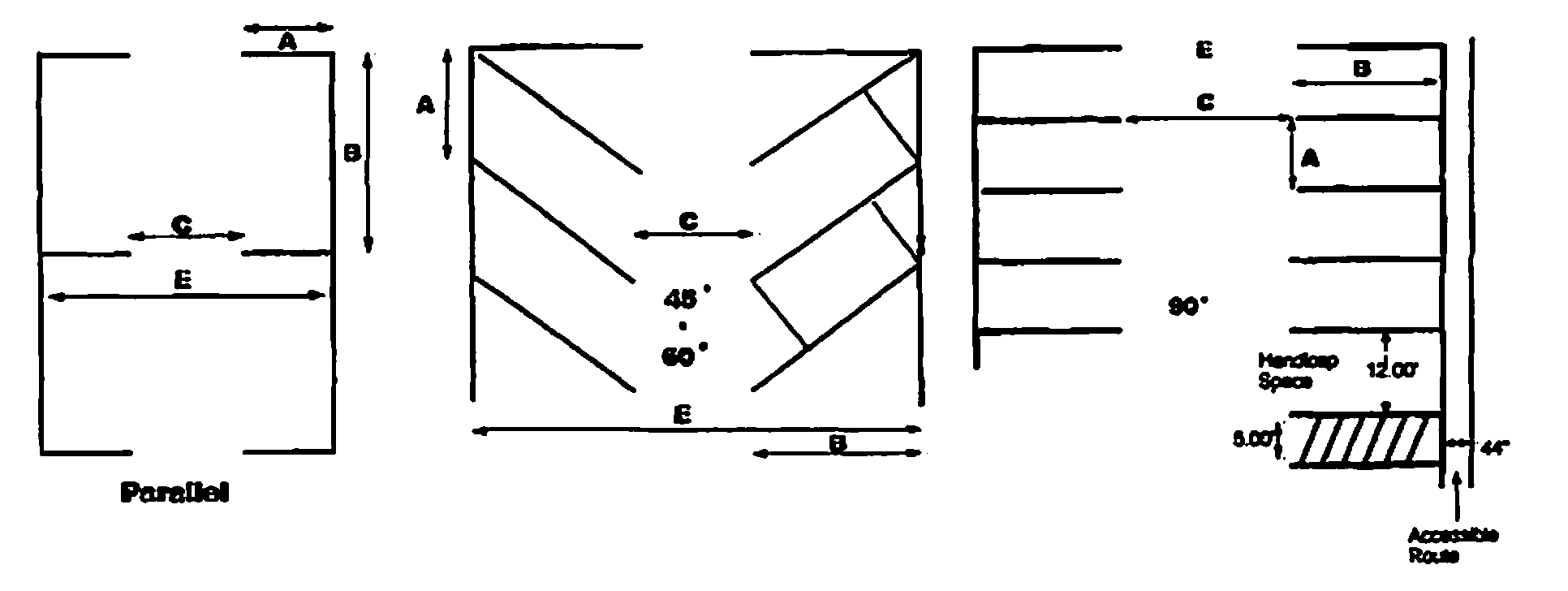
Off-Street Parking Dimensional Table
i.
Commercial automobile garages.
1.
Automobile parking garages shall be classified as either open or enclosed.
2.
The clear height of each floor level in vehicle and pedestrian traffic areas shall not be less than seven feet (2,134 millimeters).
3.
Pedestrian guardrails shall be provided at all exterior and interior vertical openings on all floor and roof areas where automobiles are parked or moved and when the vertical distance to the ground or surface directly below exceeds three feet (914 millimeters). Such parking areas shall also be provided with exterior or interior walls or impact guardrails, except at pedestrian or vehicular accesses. Impact guardrails not less than two feet (607 millimeters) high shall be placed at the ends of drive lanes, at the ends of parking spaces at the perimeter of the structure, and at the ends of parking spaces where the difference in adjacent floor elevation is greater than one foot (305 millimeters).
4.
Automobile ramps shall not be considered as providing required exit facilities
5.
Parking surfaces shall be of concrete or similar noncombustible and nonabsorbent materials, except for asphalt parking surfaces are permitted at ground level.
6.
Automobile parking garages shall be separated from other occupancies.
7.
Connection of an automobile parking garage with any room in which there is a fuel-fired appliance shall be by means of a doorway with a raised sill at least eight inches (203 millimeters) above the garage floor or through a vestibule providing two-door separation.
8.
Openings from a parking garage directly into a room used for sleeping purposes shall not be permitted.
j.
Compact car parking may be provided for up to 15 percent of the required parking and shall meet the following minimum requirements and dimensions:
1.
Compact car parking may be provided only for parking areas that have ten or more spaces.
2.
Compact car parking may be provided for only nonresidential land uses.
3.
Compact parking spaces must be designated as being for the exclusive use of compact cars through the use of signs or pavement marking.
4.
The overall design must be reviewed and approved by the city.
k.
All off-street facilities shall be designed so as to have adequate access to a public street or alley and, in the case of parking facilities, adequate access to interior maneuvering areas. Except for parking serving one-family and two-family residences, parking facilities shall be arranged so that no vehicle shall be required to back from such facilities directly onto public streets. Wherever vehicular entrances and exits are involved, the number, size, curb cuts, distance apart and general design of any such entrances and exits shall comply with the established standards and requirements of the state department of transportation where a state or federal highway is affected and with such standards as may be required by the building and zoning official or the council's designee, in the case of the other streets and roadways within the city.
l.
Where off-street parking is required, such parking areas shall be used for vehicular parking only, with no sales, dead storage, repair work, dismantling or servicing of any kind, and the required areas in the various zoning districts shall be in addition to the loading and service spaces normally required for the business or office served.
m.
Where off-street parking is required, such parking shall be provided on the same area or premises with the business or office which is being served, unless otherwise specifically approved by the board of adjustment/city council.
n.
Within commercial or industrial zoning districts, no vehicular parking shall be provided or permitted within any public right-of-way. In addition, no parking shall be provided or permitted which creates a safety hazard, as inspected and determined by the building and zoning official or the council's designee upon adjacent streets or which obstructs visibility at intersections, driveways or alleys within the applicable areas described in section 127-90.
o.
Within residential zoning districts, required parking for permitted uses other than one-family and two-family dwellings may be provided within a required rear yard, except waterfront property, and, if properly screened from adjacent property, per buffering requirements of section 127-95, within a required side yard, but shall not be permitted within a required front yard.
p.
Where artificial lighting is provided, it shall be designed and arranged so that no source of such lighting will be a visible nuisance to adjoining property used or zoned for a residential purpose. In addition, such lighting shall be designed and arranged so as to shield public streets and highways and all adjacent properties from direct glare or hazardous interference of any kind. All parking area lighting installed after the effective date of the ordinance from which this chapter is derived shall use the most advanced technology available.
q.
The provisions of this subsection shall apply to all new off-street parking or other vehicular use areas. At such time as existing off-street parking or other vehicular use areas are enlarged, expanded or modified, such provisions shall apply to the previous existing areas as well as the new areas.
r.
When units or measurements determining the number of off-street parking spaces result in the requirement of a fractional space, any such fractional space shall require a full off-street parking space.
s.
In the case where two or more uses occupy or are proposed to occupy a land parcel, the total requirements for off-street parking shall be the same as the requirements of the individual uses computed separately, and off-street parking space for one such use shall not be considered as providing the required off-street parking space for any other use.
t.
Irrespective of any other requirements of this section, each and every separate and individual store, office or other business shall be provided with at least one off-street parking space.
u.
Off-street parking areas in excess of 12 parking spaces shall have at least ten square feet of interior landscaping for each parking space; excluding those spaces abutting a perimeter for which landscaping is utilized to satisfy buffering requirements within this chapter. Each separate landscaped area shall contain a minimum width dimension of at least five feet and shall include at least one tree having a clear trunk of at least three inches, with the remaining area adequately landscaped with shrubs, ground cover or other appropriate landscaping material, not to exceed three feet in height. Such landscaped areas shall be located in such manner as to divide and break up the expanse of paving and to guide traffic flow and direction.
(c)
Amount of off-street parking required. Off-street parking shall be provided and maintained on the basis of the following minimum requirements including additional requirements of the Florida Accessibility Code:
(1)
Animal hospital or veterinary clinic: one space for each 500 square feet of gross floor area, plus one space for each doctor and employee.
(2)
Assisted living facility (including memory care pursuant to F.S. § 429.178): one space per two dwelling units or one space per three beds, plus one space per employee on the largest shift and one space per facility vehicle.
(3)
Community residential home: one space per four residents plus one space per two non-residential staff.
(4)
Church or other place of worship: one space for each three seats in auditorium or chapel area, not including Sunday school classrooms.
(5)
Club or recreation facility: one space for each 120 square feet of assembly hall and auditorium, or one space for each 200 square feet of gross floor area, whichever requirement may be greater.
(6)
Continuing care retirement community: supply parking as the sum of the applicable components (independent senior living, assisted living facility, nursing home). The city may approve shared-parking reductions supported by a study and operational plan showing offsetting peak amount components.
(7)
Dwelling, multiple-family: two spaces per dwelling unit, including carports and garages.
(8)
Dwelling, single-family: two spaces per dwelling unit, including carport and garage.
(9)
Dwelling, townhouse: two spaces per dwelling unit, including carport and garage.
(10)
Dwelling, two-family: two spaces per dwelling unit, including carport and garage.
(11)
Financial institution: one space for each 200 square feet of gross floor area.
(12)
Food store: one space for each 150 square feet of retail floor area.
(13)
Furniture or appliance store: one space for each 400 square feet of retail floor space.
(14)
Hotel or motel: one space for each guest room or rental unit, plus one additional space for each five units or portion thereof.
(15)
Independent senior living (unlicensed congregate): 0.60 spaces per dwelling unit, plus one space per employee on the largest shift.
(16)
Manufacturing and industrial activities: one space for each two employees on the largest shift.
(17)
Medical or dental offices and clinics: one space for each 150 square feet of gross floor area.
(18)
Mobile home: two spaces per mobile home.
(19)
Nursing home (licensed skilled nursing facility): one space per four beds, plus one space per employee of largest shift.
(20)
Office (administrative, business, or professional): one space for each 300 square feet of gross floor area.
(21)
Place of public assembly, including an assembly hall, exhibition hall, convention hall, entertainment center, community center, library and museum: one space for each three seats, or one space for each 200 square feet of gross floor area, whichever requirement may be greater.
(22)
Restaurant: one space for each 50 square feet of net floor area.
(23)
Retail store or shop, personal service establishment, household repair or equipment shop: one space for each 200 square feet of gross floor area.
(24)
School, elementary (public, private or parochial): one space for each classroom or office room, plus one space for each 150 square feet of seating area, including aisles, in any auditorium or gymnasium or cafeteria intended to be used as an auditorium.
(25)
School, junior or senior high school or college (public, private or parochial): four spaces for each classroom or office room, plus one space for each 150 square feet of seating area, including aisles, in any auditorium or gymnasium or cafeteria intended to be used as an auditorium.
(26)
Theater or other place of assembly having fixed seating: one space for each three seats, plus one space for each two employees.
(27)
Warehousing or wholesaling establishment: one space for each 1,000 square feet of gross floor area up to 10,000 square feet, and one additional space for each additional 2,000 square feet.
(28)
Watercraft, vessels and marinas:
a.
Cruise ships/party boats: one per three passengers, including crew, as licensed by the U.S. Coast Guard.
b.
Charter boats: three per vessel.
c.
Boat rental: one per rental boat.
d.
Personal watercraft: one for every two personal watercraft.
e.
Marinas: one per each four-rack storage slips.
f.
Boat slips as required parking: such boat slips may be counted as required parking if the slip is properly signed "for patrons only" and is not used for any other purpose.
(29)
Use not specifically mentioned: as determined and fixed by the board of adjustment and city council, where there is any question regarding the number of off-street parking spaces to be provided.
(d)
Determination of requirements involving multiple seating facilities. For uses having multiple seating facilities, such as pews, booths, benches and the like, the term "seat" shall be considered as comprising each 24 linear inches of seating space, or major fraction thereof.
(e)
Combined off-street parking. Nothing in this section shall be construed to prevent collective provision for or joint use of off-street parking facilities for two or more buildings or use by two or more owners or occupants, provided that the total of such parking spaces when combined or used together shall not be less than the sum of the requirements for the several individual uses computed separately in accordance with the requirements of this section.
(f)
Requirements for nonconforming use. In the case of a building occupied by a use which is not permitted as a new use in the zoning district in which such building is located, where major repairs or substantial alterations are to be made, no such major repairs or substantial alterations shall be permitted unless and until the off-street parking requirements of this section for a new use of the type involved are applied to such existing use and are fully provided.
(g)
Use of required off-street parking for another building or use. No part of an off-street parking area required for any building or use shall be included as a part of an off-street parking area similarly required for another building or use, unless the type of use indicates that the periods of usage will not overlap or be concurrent with each other, as determined and approved by the board of adjustment and city council.
(h)
Maintenance of parking lots. These provisions shall govern the minimum conditions and the responsibilities of persons for maintenance of parking areas. A person shall not occupy as owner-occupant or permit another person to occupy premises which are not in a sanitary and safe condition and which do not comply with the requirements of this section. All premises shall be graded and maintained to prevent the erosion of soil and to prevent the accumulation of stagnant water thereon, including potholes, rutted drives, erosion, etc., with the exception of approved retention areas and reservoirs. All premises shall be maintained to prevent dust that remains visible in the air for more than 15 seconds. All required buffers, wheel stops, space markings and landscaping shall be maintained as indicated in the site plan for location, size density and height, or, if no site plan is available, buffers, wheel stops, space markings and landscaping shall be maintained to the minimum code requirements. All sidewalks, walkways, stairs, driveways, parking spaces and similar areas shall be kept in a proper state of repair, and maintained free from hazardous conditions. All premises shall be maintained free from weeds or plant growth, other than landscaping delineated on the site plan, in excess of 12 inches (254 millimeters). Each parking area must pass an annual inspection prior to the issuance of any business tax receipt.
(i)
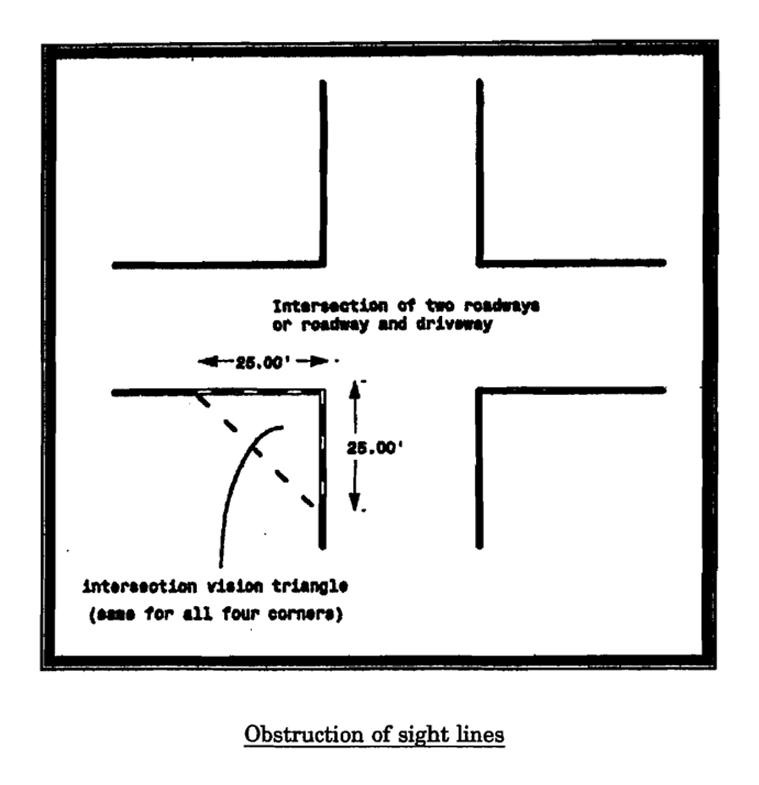
Obstruction of sight lines. No fence, wall, hedge, sign or shrub planting which obstructs sight lines and elevations between two feet and six feet above the roadways shall be placed or permitted to remain on any parking area in any zoning district within the triangular area formed by the street property lines and the parking area entrance or exit and a line connecting them at points 25 feet from the intersection of the street lines. No tree shall be permitted to remain within the such limits of intersections unless the foliage line is maintained at or above six feet above the roadway intersection elevation, to prevent obstruction of sight lines.
(j)
Phase-in provision. All new parking areas with any permit applications made on or after the date of enactment of the ordinance from which this chapter is derived shall comply with this section. All existing parking areas shall comply with subsection (h) of this section, pertaining to maintenance, after the date of enactment of the ordinance from which this chapter is derived and shall come into complete compliance with this section within five years thereof.
(k)
Off-street loading and service facilities. Off-street loading and services facilities shall be provided in accordance with the following standards and specifications:
(1)
On the same lot with every structure or use hereinafter erected or created, there shall be provided and maintained adequate space for loading and unloading of materials goods or things and for delivery and shipment, so that vehicles for the service may use such space without encroaching upon or interfering with the public use of sidewalks, streets and alleys by pedestrians and vehicles.
(2)
Where any structure is enlarged or any use is extended so that the size of the resultant occupancy comes within the scope of this subsection, the full amount of off-street loading space shall be supplied and maintained for the structure or use in its enlarged or extended size. Where the use of a structure or land or any part thereof is changed to a use requiring off-street loading space under this subsection, the full amount of off-street space shall be supplied and maintained to comply with this subsection.
(3)
For the purposes of this subsection, an off-street loading space shall be an area at the grade level at least ten feet wide, 25 feet long, and having ten feet of vertical clearance. Each off-street loading space shall be accessible from a public street or alley without crossing or entering any other required off-street loading space, and shall be arranged for convenient and safe ingress and egress by motor truck and/or truck-trailer combinations. Such loading space shall be accessible from the interior of any building it is intended to serve.
(4)
Off-street loading spaces shall be provided and maintained in accordance with the following schedule:
a.
For each store, market, restaurant, laundry, dry cleaning establishment or similar use which has an aggregate gross floor area of:
1.
Over 5,000 square feet, but not over 25,000 square feet: one space;
2.
Over 25,000 square feet, but not over 60,000 square feet: two spaces;
3.
Over 60,000 square feet, but not over 120,000 square feet: three spaces;
4.
Over 120,000 square feet, but not over 200,000 square feet: four spaces;
5.
Over 200,000 square feet, but not over 290,000 square feet: one space for each 50,000 square feet or major faction thereof.
b.
For each auditorium, exhibition hall, museum, hotel or motel, office building, or similar use which has an aggregate gross floor area of over 10,000 square feet but not over 40,000 square feet: one space, plus one space for each additional 60,000 square feet over 40,000 square feet, or major faction thereof.
c.
For any use not specifically mentioned within this section, the requirements for off-street loading for a use which is mentioned and to which the unmentioned use is similar shall apply. Where there is any question as to the off-street loading requirements, the same shall be determined and fixed by the board of adjustment.
(5)
Off-street loading facilities supplied to meet the needs of one use shall not be considered as meeting the off-street loading needs of any other use.
(6)
No area or facilities supplied to meet the required off-street parking facilities for a use shall be utilized for or be deemed to meet the requirements of this subsection for off-street loading facilities.
(7)
Nothing in this subsection shall prevent the collective, joint or combined provision of off-street loading facilities for two or more buildings or uses, provided that such off-street loading facilities are equal in size and capacity to the combined requirements of the several buildings or uses and are so located and arranged as to be usable thereby.
(8)
Plans for buildings or uses requiring off-street loading facilities under the provisions of this subsection shall clearly indicate the location, dimensions, clearance and access of all such required off-street loading facilities.
(LDC 2008, § 22-94; Ord. No. 05-536, § 302.04E, 12-20-2005; Ord. No. 19-676, § 1, 1-14-2019; Ord. No. 25-737, § II, 12-9-2025)
Sec. 127-95. - Buffering requirements.
Where the rear or side property line of a lot developed or proposed to be developed for nonresidential use within a residential district, or, where the rear or side property line of a lot developed or proposed to be developed for nonresidential use adjoins a residential zoning district, residentially developed area, or public street adjoining any residential district or residentially developed area suitable, buffering in the form of a solid fence, masonry wall or plant materials shall be provided along the entire length of the property line, unless this requirement is waived by the board of adjustment upon specific appeal. Said buffering shall be at least six feet in height; fences and masonry walls shall not exceed eight feet in height. Should a landscape buffer be provided, the plant materials should be of an evergreen variety capable of obtaining the required minimum height and shall be properly maintained. No buffering shall extend into an area required for site line visibility in accordance with the provisions of section 127-90(e). Any garbage dumpster located on property abutting a residential zoning district, a residentially developed area, or a public street adjoining any residential district or residentially developed area shall be buffered with the materials in accordance with the standards set forth in this section. Such buffering shall be designed or installed in such a manner that the dumpster shall not be visible from the abutting residentially zoned or developed property, unless such visibility is necessary on one side of the dumpster in order to provide access for sanitation vehicles. If such access is required, the access shall be designed in such a manner as to be located in a position which is the least visible from abutting residentially zoned or residentially developed property.
(LDC 2008, § 22-95; Ord. No. 05-536, § 302.04F, 12-20-2005)
Sec. 127-96. - Satellite antennas.
(a)
Definitions. The following words, terms and phrases, when used in this section, shall have the meanings ascribed to them in this subsection, except where the context clearly indicates a different meaning:
Satellite antenna or dish means any parabolic or spherical antenna whose purpose is to receive and/or transmit satellite signals of both audio and video transmission that is greater than eight feet in diameter. A satellite antenna shall be considered as an accessory structure. This definition shall not apply to licensed amateur radio operators.
(b)
General regulations.
(1)
It shall be unlawful for any person to erect or cause to be erected within the city any satellite dish without a permit from the city.
(2)
Application for such permit shall be made through the building department in compliance with the Florida Building Code regulations.
(3)
All applications and installations shall be reviewed by the building and zoning official or the council's designee.
(4)
All dish installations shall be constructed in a workmanlike manner, and shall meet or exceed all applicable requirements of this LDC, the Florida Building Code, and any other federal, state, county, municipal or regional code, and:
a.
All dishes shall be nonreflective, and their color shall blend in with the surroundings.
b.
No advertising or signage of any type is permitted on a satellite dish or appurtenant structures.
c.
All dishes shall be permanently affixed to the ground, unless specifically permitted to be attached to a roof, as provided in this subsection (b)(4). Notwithstanding any provision to the contrary, as provided herein, any satellite dish with a diameter of three feet or less may be affixed to the roof or the side of any residential or commercial structure.
d.
All roof-mounted dishes shall be permanently affixed and shall be subject to all applicable building codes using a 110-mph wind stress in the structural design.
e.
All applications for a roof-mounted dish permit, except a satellite dish with a diameter of three feet or less, shall be accompanied by construction plans which shall contain the certification of a state licensed professional engineer that the plans meets the structural design requirements of this chapter.
(c)
Regulations by zoning district.
(1)
Residential.
a.
The regulations in this subsection apply to the installation of satellite dishes in the following residential zoning districts:
1.
Single-family (R-1).
2.
Two-family (R-2).
3.
Multiple-family (R-3).
4.
Mobile home (R-MH).
b.
Satellite dishes may not be used for any commercial purpose and may only be used by the occupants of the residence for their personal enjoyment.
c.
Only one dish per lot shall be permitted.
d.
Maximum size of any dish shall not exceed ten feet in diameter.
e.
Maximum height shall not exceed 18 feet from the ground to the top of the dish structure.
f.
No dish shall be permitted on the roof of any structure; provided, however, that dishes may be located on the roof of any multifamily structure of three or more stories.
g.
Dishes may only be located between the rear main building wall of the principal structure and the rear property line.
h.
Dishes shall be deemed accessory structures and shall comply with all provisions of section 127-92. To the extent that any provision contained in section 127-92 is inconsistent herewith, the provisions of this section shall govern.
i.
All dishes shall be shielded on three sides by a solid wall, fence or by natural plants or trees of maximum allowable height in the zoning district so as to provide maximum opacity.
j.
All general regulations contained in subsection (b) of this section shall apply.
(2)
Nonresidential.
a.
The regulations in this subsection shall apply to the installation of satellite dishes in the following nonresidential zoning districts:
1.
Institutional-professional (I-P).
2.
Community commercial (C-1).
3.
Waterfront commercial (C-2).
4.
General commercial (C-3).
5.
Light industrial (I-1).
6.
Agricultural (A-1).
b.
Only one dish per lot shall be permitted.
c.
Maximum size of any dish shall not exceed ten feet in diameter.
d.
Maximum height shall not exceed 18 feet from the ground to the top of the dish structure.
e.
Dishes may be located anywhere on a lot, subject to applicable setbacks and other requirements of section 127-92. To the extent that any provisions contained in section 127-92 is inconsistent herewith, the provisions of this section shall govern.
f.
All general regulations contained in subsection (b) of this section shall apply.
(3)
Planned unit development (PUD). All applications for dishes in PUD zoning districts shall be decided by the building and zoning official or the council's designee on a case-by-case basis taking into consideration that only those uses shall be permitted which are fully compatible with each other within the context of the development as a whole and with zoning and land use patterns of surrounding areas; provided, however, that all general regulations contained herein shall apply to any dish installation in a PUD zoning district.
(d)
Variances. Variances from any of the criteria set forth herein may be applied for in the manner set forth in this chapter.
(LDC 2008, § 22-96; Ord. No. 05-536, § 302.04G, 12-20-2005)
Sec. 127-97. - Adult entertainment facilities and massage parlors.
(a)
General provisions.
(1)
For the purpose of this section, the term "adult entertainment facilities" means as defined in chapter 6 of the Code of Ordinances.
(2)
It shall be unlawful for any person to establish any adult entertainment facility within 500 feet of any building containing a residential dwelling or rooming unit or within 500 feet of any property zoned for residential uses.
(3)
No adult entertainment facility may be established or located within 1,000 feet of any other such facility.
(4)
All adult entertainment facilities may only be located on property zoned for industrial purposes and such facilities must comply with all requirements set forth in the industrial zoning classification.
(5)
Adult entertainment facilities may not be located within 1,500 feet from the property line of any residential use, church, public or private school, child care facility, public recreation area or public park.
(6)
Adult entertainment facilities at which alcohol is consumed, sold, purchased, or stored shall be prohibited in any zoning district within the city.
(b)
Massage parlors.
(1)
No person may maintain or operate a massage parlor within any zoning district in the city.
(2)
No permitted use or special exception specified in any zoning classification set forth in this chapter shall be construed as allowing a massage parlor as a permitted or special exception use.
(c)
Adjacent jurisdiction. The provisions of subsection (a) of this section shall apply regardless of whether the area zoned is within the city or in an adjacent jurisdiction.
(LDC 2008, § 22-97; Ord. No. 05-536, § 302.04H, 12-20-2005)
Sec. 127-98. - Telecommunication towers and antennas.
(a)
Definitions. The following words, terms and phrases, when used in this section, shall have the meanings ascribed to them in this subsection, except where the context clearly indicates a different meaning:
Abandonment means any tower where a FCC licensed station or antenna no longer exists.
Antenna means any exterior apparatus designed for telephonic, radio, or television communications, through the sending or receiving of electromagnetic waves.
FAA means the Federal Aviation Administration.
FCC means the Federal Communications Commission.
Height means the distance measured from ground level to the highest point on the tower or other structure, even if the highest point on the tower or structure is an antenna.
Satellite dish antennas means a device used to receive satellite broadcast signals, usually a parabolic-dish shaped antenna.
Tower means any structure that is designed and constructed primarily for the purpose of supporting one or more antennas, including self-supporting lattice towers, guy towers, or monopole towers. The term "tower" includes radio and television transmission towers, microwave towers, common carrier towers, cellular telephone towers, alternative tower structures and the like.
User means any independent entity which is marketing a service to retail customers in city. For the purposes of determining the number of user collocators, no two users shall have any common ownership ties.
(b)
Purpose. The purpose of this section is to establish general guidelines for the erection of towers and antennas. The goals of this section are to encourage the location of towers in nonresidential areas, to minimize the total number of towers in the city, to encourage the use of existing structures as an alternative to new tower construction, to encourage the joint use of new towers, to encourage the design and construction of towers and antennas which minimize the adverse visual impacts, and to enhance the ability of providers of telecommunications services to provide such services within the city quickly, effectively, and efficiently.
(c)
Applicability. Towers and antennas installed and maintained in accordance with this section are exempt from the height limitations for buildings and structures set forth elsewhere in the Code of Ordinances. The requirements set forth in this section shall govern the height of towers and antennas. The installation of an antenna on a building which is nonconforming in terms of current height limitations shall not be deemed to constitute the expansion of a nonconforming use. Amateur radio antennas operated by a federally licensed amateur radio station operator are exempt from the provisions of this section. Towers and antennas located on city property are exempt from height limitations set forth elsewhere in this Land Development Code and are exempt from the requirements of this section, provided a lease or franchise agreements authorizing such tower or antenna has been approved by the city or the tower or antenna is city owned. Satellite dish antennas considered generally as a residential accessory use are exempt from the requirements of this section and are governed by section 127-96.
(d)
Antenna construction. Antennas may be installed in all land use and zoning categories on existing structures such as a buildings, light poles or other free-standing structures, provided the antenna adds no more than six feet to the height of said existing structure and the antenna and supporting electrical and mechanical equipment are of neutral color that is identical to or closely compatible with the color of the supporting structure so as to make the antenna and related equipment as visually unobtrusive as possible. No lighting shall be permitted unless required by the Federal Aviation Administration (FAA).
(e)
Tower construction. In order to be eligible to obtain a permit to construct a tower, the proposed location must have an I-1 zoning classification. In addition, the applicant must demonstrate to the reasonable satisfaction of the building and zoning official or the council's designee that no existing tower or structure can accommodate the applicant's proposed antenna. Evidence submitted to demonstrate that no existing structure or tower can accommodate the applicant's proposed antenna may consist of any of the following:
(1)
No existing tower or structures are located within the geographic area required to meet the applicant's engineering requirements.
(2)
Existing towers or structures are not of sufficient height to meet the applicant's engineering requirements.
(3)
Existing towers or structures do not have sufficient structural strength to support the applicant's proposed antenna and related equipment.
(4)
The applicant's proposed antenna would cause electromagnetic interference with or would be interfered with by other antennas if placed on an existing tower or structure.
(5)
The fees, costs or contractual provisions required by the owner in order to share an existing tower or structure for a time period of 25 years exceed the cost of development of a new tower.
(6)
It is not financially feasible to modify or replace an existing tower to accommodate the proposed antenna.
(7)
The applicant demonstrates that there are other limiting factors that render existing towers and structures unsuitable.
(f)
Surety bond. The applicant and property owner shall post a surety bond in the amount equal to one-third of the total construction cost of the tower or antenna for the faithful performance of the provisions of this section, and such surety bond shall be payable to the city for as long as a tower shall exist on the property.
(g)
Height restrictions and design criteria for towers. Upon receipt of a complete application, the building and zoning official or the council's designee shall render a written decision regarding the applicant's need. Once the building and zoning official or the council's designee has recognized the need for a tower, the plans for the tower and tower site shall comply with the following:
(1)
Single use towers shall not exceed 90 feet in height. Towers designed for two users shall not exceed 110 feet in height. Towers designed for three or more users shall not exceed 200 feet in height.
(2)
Towers and supporting structures shall be a neutral, nonglare color or finish, so as to reduce visual obtrusiveness, and shall meet applicable standards of the FAA.
(3)
Towers shall be set back from existing residential or commercial uses a distance equal to twice the height of the tower. The distance shall be measured from the base of the tower to the residential or commercial properly line.
(4)
Towers guys and accessory facilities must satisfy the minimum setback requirements as set forth in this Land Development Code for the Light Industrial Zoning District.
(5)
Towers shall be enclosed by security fencing not less than eight feet in height and shall also be equipped with an appropriate anticlimbing device.
(6)
No tower shall be used for advertising of any type, and the placement of signs, other than warning signs, is strictly prohibited.
(7)
All applicants shall provide proof that the proposed tower and associated antennas do not exceed radiation standards of the Federal Communications Commission (FCC).
(8)
All applicants shall include a description of the geographic service area of each antenna on the tower.
(9)
No fence shall be erected around a tower site beyond (forward of) the front and back setbacks of 25 feet and side set back of 25 feet.
(10)
Any structure required to house electronic equipment or for other purposes shall not exceed 750 square feet and shall be subject to appropriate building codes.
(h)
Federal requirements and safety standards.
(1)
All towers and antennas must meet or exceed current standards and regulations of the FAA, and FCC, and any other agency of the federal government with authority to regulate towers and antennas. If such standards are changed, the owners of the towers and antennas governed by this section shall bring such towers and antennas into compliance with the revised standards and regulations within six months of the effective date of such standards and regulations, unless a more stringent compliance schedule is mandated by the controlling federal agency. Failure to bring towers and antennas into compliance with such revised standards and regulations shall constitute grounds for removal of the tower or antenna at the owner's expense, and such removal shall commence within 90 days and shall constitute a forfeiture of the surety bond.
(2)
Towers and antennas must be constructed, installed, and maintained in accordance with the Florida Building Code and, in addition, must meet the standards set forth by the electronic industries association.
(i)
Landscaping. Landscaping shall be required pursuant to the requirements of the I-1 industrial zoning district. Further, the perimeter of the tower site shall be buffered with shrubs selected and placed to screen the base of the tower and, to the extent possible, with trees selected and placed to minimize the vertical scale of the tower. Shrubs shall be a minimum of three feet at the time of planting, placed three feet on center. A minimum of ten feet of landscaping buffer shall be provided around the outside of the required fencing if the area fronts residential, commercial properties or a public street. Within the landscaping buffer, one six-foot tree shall be planted for every 40 feet of frontage. An irrigation system and routine maintenance shall be provided to ensure the survival of landscaped areas.
(j)
Removal of abandoned antennas and towers.
(1)
Any antenna or tower which is not operated for a period of one year shall be considered abandoned. Upon written demand by the city, the owner of an abandoned antenna or tower or the properly owner, if different from the owner of the tower, shall commence removal of the same within 90 days. Failure to do so shall constitute a violation of this section. Upon notification to remove an antenna or tower, any previously granted variances shall terminate and shall constitute a forfeiture of the surety bond.
(2)
In addition to any other penalty imposed by this section, failure on the part of a tower owner or property owner to remove an abandoned tower or antenna, as set forth herein, may result in an action in the circuit court of the county to enforce the provisions of this section, to include attorney's fees and costs. Any judgment issued by a circuit court judge against a tower owner or property owner shall constitute a lien against the real property in addition to other procedural means of enforcing a civil judgment.
(k)
Maintenance and inspection. All towers and antennas erected within the corporate limits of the city shall be inspected by a certified structural engineer no less frequently than every ten years for monopoles and every three years for all other structures. In the event the tower or antenna is subject to a category 1 through category 5 hurricane, as defined by the U.S. Weather Service, or major tropical storm with winds in excess of 75 miles per hour, each tower or antenna so affected shall be immediately inspected by a structural engineer for any structural damage, and a report of such inspection shall be filed with the city within 30 days.
(l)
Variance procedures. In the event an applicant for a tower is required to apply for a variance to this section or another related section of the Code of Ordinances, in addition to the variance criteria set forth in this chapter, the following additional criteria shall be used:
(1)
The variance, if granted, will result in an opportunity for collocation and thereby ultimately reduce the number of towers necessary to provide telecommunication service within the city.
(2)
A survey of the property and proposed antenna site, stamped and certified by a state certified surveyor.
(m)
Appeals. Notwithstanding any provision, procedure or requirement to the contrary, the applicant may appeal a decision by the building and zoning official or the council's designee directly to the city council that a tower is not necessary. The applicant shall notify the city clerk in writing of the appeal, and a hearing by the city council shall be held within 30 days after the notice of appeal has been filed with the city clerk. The city council shall conduct a quasi-judicial de novo hearing and base its decision upon competent and substantial evidence. The criteria for the decision shall be the criteria set forth in subsection (f) of this section.
(LDC 2008, § 22-98; Ord. No. 05-536, § 302.04I, 12-20-2005)

