
Port St Joe City Zoning Code
ARTICLE II
ADMINISTRATION AND ENFORCEMENT
Sec. 2.00.- General provisions—Purpose.
The purpose of this article is to describe the procedures administration and enforcement of land development regulations. This article contains procedures for review of development plans, requirements for development application submittals, responsibilities of individuals, boards and city commission, procedures for special exceptions, variances and appeals.
Sec. 2.01. - Required authorization.
No development activity may be undertaken unless the activity is authorized by a development permit or order or is specifically exempted by other provisions of this Code.
Sec. 2.02. - Procedure for review—Review of development plans for minor developments, illustrated on Appendix II-1.
(a)
General procedures: The developer of a proposed minor development shall submit a development plan and an appropriate application fee to the building inspector.
(b)
Within five working days of receipt of a plan, the building inspector shall determine that the:
(1)
The proposed development meets the definition of a minor development;
(2)
Development plan is complete and proceed with the following procedures; or
(3)
Information is incomplete and inform the developer of deficiency. The developer may submit an amended development plan with 30 working days without payment of the reapplication fee, but if more than 30 days have elapsed, the developer must reinitiate the review process and pay an additional fee.
(c)
Within 20 working days of a determination that the plan is complete, the building inspector shall:
(1)
Issue a development order in accordance with section 2.05 below; or
(2)
Deny the issuance of a development order based on the failure of the development to meet the requirements of this Code.
(d)
The developer or any adversely affected person, may appeal any decision of the building inspector by filing an appeal with the planning and development review board. The PDRB shall make the final decision regarding any appeals related to the minor development.
Sec. 2.03. - Same—Review of development plans for major developments, illustrated on Appendix II-2.
(a)
Determination of level of proposed major development. The technical advisory committee (TAC) shall review all submittals related to a major development proposal and shall determine whether the proposal is a level 1 or level 2 major development, based on overall size, anticipated impacts, and the complexity, location, or potential for hazardousness. All proposed developments which involved the subdivision of land shall be considered level 2 major developments. If the proposal is determined to be a level 1 major development, the technical advisory committee shall be the approval authority, i.e., the entity with responsibility for approving or denying the development plan, as outlined in subsection (b) below. If the development is a level 2 major development, the TAC shall review the preliminary development plan and make recommendations to the planning and development review board (PDRB). The PDRB shall review and make findings and recommendations to the board of city commissioners for review. Approval of level 2 major development plans shall be the responsibility of the board of city commissioners, as outlined in subsection (c) below.
(b)
Review of level 1 major development plans.
(1)
The developer shall submit a development plan and appropriate application fees to the building inspector.
(2)
Within ten working days of receipt of a development plan, the building inspector shall:
a.
Determine that the information is incomplete and inform the developer in writing of the deficiencies. The developer may submit an amended plan within 30 days without payment of an additional fee, but, if more than 30 days have elapsed, must thereafter initiate a new application and pay a new fee; or
b.
Determine that the plan is complete and proceed with the following procedures.
(3)
The building inspector shall send a copy of the development plan to each member of the technical advisory committee (TAC) and set a meeting date that allows for an adequate review and sufficient time for discussion.
(4)
The technical advisory committee may determine that the proposed development plan is a level 2 major development and subject to the review process outlined in subsection (c) below.
(5)
The technical advisory committee shall:
a.
Issue a development order complying with section 2.05 below; or
b.
Deny the issuance of a development order based on it being impossible for the proposed development, even with reasonable modifications, to meet the requirements of this Code.
(c)
Review of development plans for level 2 major development.
(1)
The developer shall submit a development plan and appropriate application fees to the building inspector.
(2)
Within ten working days of receipt of a development plan, the building inspector shall determine that the:
a.
Information is incomplete and inform the developer in writing of the deficiencies. The developer may submit an amended plan within 180 days without payment of an additional fee, but, if more than 180 days have elapsed, must thereafter initiate a new application and pay a new fee; or
b.
Plan is complete and proceed with the following procedures.
(3)
The building inspector shall send a copy of the development plan to each member of the technical advisory committee (TAC) and set a meeting date that allows for an adequate review and sufficient time for discussion.
(4)
The technical advisory committee shall review the development plan and make recommendations to the planning and development review board (PDRB).
(5)
The planning and development review board shall review and make findings and recommendations to the board of city commissioners that they:
a.
Issue a development order complying with section 2.05 below; or
b.
Deny the issuance of a development order based on it being impossible for the proposed development, even with reasonable modification, to meet the requirements of this Code.
(6)
Upon review by the TAC and PDRB, the building inspector shall place the proposed development plan on the agenda of the next board of city commissioners meeting that allows for adequate public notice.
(7)
If the proposed development includes the subdivision of land, issuance of a development order by the board of city commissioners shall constitute preliminary plat approval.
(d)
Time extension. Nothing herein shall prohibit the city and a developer from entering into a written agreement to extend any timeframe set forth herein for purposes of allowing the developer to amend or modify any required submittal.
Sec. 2.04. - Same—Project phasing.
A master plan for an entire development site must be approved for a major development that is to be developed in phases. The master plan shall be submitted simultaneously with an application for the review of the development plan for the first phase of the development and must be approved as a condition of approval of the development plan for the first phase. A development plan must be approved for each phase of the development under the procedures for development and review described above. Each phase shall include a proportionate share of the proposed recreational and open space and other site and building amenities of the entire development, except that more than a proportionate share of the total amenities may be included in the earlier phases with corresponding reductions in the later phases.
Sec. 2.05. - Required and optional contents of development order.
(a)
Required contents. A development order shall contain the following:
(1)
A specific time period during which the development order is valid and during which time development shall commence. A development order shall remain valid only if development commences and continues in good faith according to the terms and conditions of approval.
(2)
Notice that a final concurrency determination will be required prior to the issuance of a building permit.
(3)
A commitment by the city to the following:
a.
The necessary facilities shall not be deferred or deleted from the capital improvements element or the adopted one-year capital budget unless the subject development order expires or is rescinded prior to the issuance of a certificate of occupancy.
b.
Contracts shall provide that construction of necessary facilities must proceed to completion with no unreasonable delay or interruption.
(b)
Optional contents. A development order may contain:
(1)
A schedule of construction phasing consistent with availability of capacity of one or more services and/or facilities.
(2)
A schedule of services or facilities to be provided or contracted for construction by the applicant prior to the issuance of any certificate of occupancy or within specified time periods.
(3)
Any alternate service impact mitigation measure to which the applicant has committed in a recordable written instrument.
(4)
Sureties and guarantees as well as agreements related to maintenance of public facilities, as required by section 2.07, Guarantees and sureties.
(5)
Such other conditions as may be required to ensure compliance with the concurrency requirement.
Sec. 2.06. - Submittals.
(a)
Application. An application for development review shall be available from the building inspector. A completed application shall be signed by all owners or their agents, of the property subject to the proposal and notarized. Signatures by other parties will be accepted only with notarized proof of authorization by the owners. In a case of corporate ownership, the authorized signature shall be accompanied by a notation of the signer's office in the corporation.
(b)
General development plan requirements. All development plans submitted pursuant to this Code shall conform to the following standards:
(1)
All site plans shall be drawn to a scale of one inch equals 30 feet, showing site boundary, building footprint and location, drives, parking, accessory structures, walls or fences, walkways, site signage and site lighting locations, unless the building inspector determines that a different scale is sufficient or necessary for proper review of the proposal.
(2)
The trim line sheet size shall be 24 inches by 36 inches. A three-quarter-inch margin shall be provided on all sides, except for the left binding side where a two-inch margin shall be provided.
(3)
If multiple sheets are used, the sheet number and total number of sheets must be clearly indicated on each sheet.
(4)
The front cover sheet of each plan shall include:
a.
A general vicinity and/or location map showing the position of the proposed development in the section(s), township and range, together with the principal roads, city limits and/or other pertinent orientation information.
b.
A complete legal description of the property including tax reference number.
c.
The name, address and telephone number of the owner(s) of the property. When a corporation or company is the owner of the property, the name and address of the president of the entity shall be shown.
d.
The name, business address and telephone number of those individuals responsible for the preparation of the drawing(s). If applicable, each sheet shall be signed, have an original seal and professional license number of the person who prepared it.
e.
Each sheet shall contain a title block with the name of the development, a stated and graphic scale, a north arrow and date.
f.
The plan shall show the boundaries of the property with a metes and bounds description reference to section, township and range, tied to a section or quarter-section or subdivision name and lot number(s).
g.
The area of the property shown in square feet and/or acres.
(5)
All applications must include authorization for reviewing entities to have reasonable access to the site.
(6)
The following number of copies shall be submitted based on the required level of review:
Three sets for any proposed minor development activity (to be reviewed by the building inspector).
Five sets for any proposed level 1 major development activity (to be reviewed by the technical advisory committee (TAC)).
Seven sets for any proposed level 2 major development activity (to be reviewed by the planning and development review board (PDRB) and the board of city commissioners).
(7)
Unless a format is specifically called for below, the information required may be presented textually, graphically, or on a map, plan, aerial photograph or by other means, whichever most clearly conveys the required information. It is the responsibility of the developer to submit the information in a form that allows ready determination of whether the requirements of this Code have been met.
(c)
Development plan. In addition to the general development plan requirements, a development plan shall include or provide the following information where determined applicable by building inspector or the technical advisory committee.
(1)
Existing conditions.
a.
A recent aerial photograph encompassing the project area and identifying the project area and total land area. The scale shall be no smaller than one inch equals 800 feet and the source and date of the aerial shall be identified.
b.
A soils map of the site (existing U.S. Soil Conservation Service Maps are acceptable).
c.
A generalized map of vegetative cover including the location, height and identity by common name of all trees. Groups of trees may be designated as "clusters" with the estimated total number height and identity noted.
d.
A topographic map of the site clearly showing the location, identification and elevation of bench marks, including at least one bench mark for each major water control structure.
e.
Existing surface water bodies, wetlands, streams and canals within the proposed development site.
f.
A detailed overall project area map showing existing hydrology and runoff patterns, to include drainage basins and/or watershed boundaries.
g.
A depiction of the site, and all land within 200 feet of any property line of the site, showing the locations of protected environmentally sensitive zones and wellhead protection zones.
h.
The location of any underground or overhead utilities, culverts and drains on the property and within 100 feet of the proposed development boundary.
i.
Location, names and widths of existing and proposed streets, highways, easements, building lines, alleys, parks and other public spaces and similar facts regarding adjacent property.
j.
The 100-year flood elevation, minimum required floor elevation and boundaries of the 100-year floodplain for all parts of the proposed development.
k.
The location of any known state or federally listed plant or animal species and their habitat on the site. State or federally listed shall mean any plant or animal species listed as threatened, endangered or a species of special concern by the state or any agency of the United States of America.
l.
The location of any know historical or archaeological site.
m.
The location of the site within the Coastal High Hazard Area, if applicable.
n.
The location of the site within the St. Joseph Bay Shoreline Protection Zone, if applicable.
(2)
Proposed development activities and design.
a.
Generally.
1.
Area and percentage of total site area to be covered by an impervious surface.
2.
Grading plans specifically including perimeter grading.
3.
Construction phase lines.
4.
A detailed description of the project including number and type of units or gross square feet of nonresidential use and acreage.
b.
Building and other structures.
1.
Floor plans and roof plans at a scale no smaller than one-eighth inch = one foot.
2.
Elevations of all exterior facades, indicating existing and proposed guidelines at the same scale as the required floor plans. At least a portion of the elevations shall indicate the proposed colors of the building.
3.
Full color or color indexed elevations of proposed site signage (tenant/building signs, if any, shall be indicated on the architectural elevations).
4.
Landscape plan indicating caliper at breast height of existing trees to remain and existing trees to be removed as well as all proposed plant material listed by botanical and common name, quantities and sized to be installed.
5.
Proposed irrigation system layout, if applicable.
6.
Grading and drainage plan with final elevations and storm water drainage calculations, at the same scale as the site development plan.
7.
Utility plan including site electrical, water and wastewater, at the same scale as the site development plan.
8.
Copies of any proposed agreements between adjacent property owners including agreements for joint use and access easements.
9.
A five-year maintenance plan covering landscaping, irrigation, parking areas, building exterior and any other element of the development which the building inspector feels is appropriate.
c.
Potable water, wastewater and solid waste systems.
1.
Proposed location and sizing of potable water and wastewater facilities to serve the proposed development, including required improvements or extensions of existing off-site facilities.
2.
The boundaries of proposed utility easements.
3.
Location of the nearest available public water supply and wastewater disposal system and the proposed tie-in points, or an explanation of alternative systems to be used.
4.
Exact locations of on-site and nearby existing and proposed fire hydrants.
5.
Projected demand for potable water, wastewater treatment and solid waste to be generated by the proposed development, availability of capacity to serve the proposed development and the manner in which the adopted levels of service will be maintained.
d.
Streets, parking and loading.
1.
All street-related submittal requirements listed in article VIII, subdivision regulations.
2.
A parking and loading plan showing the total number and dimensions of proposed parking spaces, spaces reserved for handicapped parking, loading areas, proposed ingress and egress (including proposed public street modifications), and projected on-site traffic flow.
3.
For all major developments, a traffic impact study which includes, at a minimum, the area of impact, the projected demand (based on the most recent edition of Trip Generation, Institute of Transportation Engineers), a projection of background traffic at buildout, the distribution of project trips onto the impacted roadways, and the resulting level of service on each impacted roadway and intersection. The traffic study must clearly identify all assumptions and sources utilized and the manner in which the adopted level of service will be maintained.
e.
Vegetated buffer zones.
1.
Location and dimensions of proposed buffer zones and vegetated areas.
2.
Description of plant materials existing and to be planted in buffer zones.
f.
Stormwater management.
1.
An erosion and sedimentation control plan that describes the type and location of control measures including construction best management practices, the stage of development at which they will be put into place or used, and maintenance provisions.
2.
A description of the proposed stormwater management system, including:
i.
Channel, direction, flow rate and volume of stormwater that will be conveyed from the site, with a comparison to natural or existing conditions.
ii.
Detention and retention areas, including plans for the discharge of contained waters, maintenance plans and predictions of surface water quality changes.
iii.
Areas of the site to be used or reserved for percolation including an assessment of the impact of groundwater quality.
iv.
Location of all water bodies to be included in the surface water management system (natural and artificial) with details of hydrography, side slopes, depths and water-surface elevations or hydrographs.
v.
Linkages with existing or planned stormwater management systems.
vi.
On- and off-site rights-of-way and easements for the system including locations and a statement of the nature of the reservation for all areas to be reserved as part of the stormwater management system.
vii.
The entity or agency responsible for the operation and maintenance of the stormwater management system.
3.
The location of off-site water resource facilities such as water works, surface water management systems, wells or well fields, that will be incorporated into or used by the proposed project, showing the names and addresses of the owners of the facilities.
4.
Runoff calculations shall be in accord with standard engineering practices.
g.
Environmentally sensitive lands.
1.
The exact sites and specifications for all proposed drainage, filling, grading, dredging and vegetation removal activities, including estimated quantities of excavation or fill materials computed from cross sections, proposed within a protected environmentally sensitive zone.
2.
Detailed statement or other materials showing the following:
i.
The percentage of the land surface of the site that is covered with natural vegetation and the percentage of natural vegetation that will be removed by development.
ii.
The distances between development activities and the boundaries of the protected environmentally sensitive zones.
3.
The manner in which state or federally listed plan or animal species and their habitats shall be protected.
4.
Identify the type, size and location of wetlands on the site based on the definitions of high and low quality wetlands in the comprehensive plan.
h.
Signs.
1.
For regulated ground signs, a plan, sketch, blueprint, blue line print or similar presentation drawn to scale which indicates clearly the location of the sign relative to property lines, rights-of-way, streets, alleys, sidewalks, vehicular access and parking areas and other existing ground signs on the parcel.
2.
For regulated building signs, a plan, sketch, blueprint, blue line print or similar presentation drawn to scale which indicates clearly:
i.
The location of the sign relative to property lines, right-of-way, streets, alleys, sidewalks, vehicular access and parking areas, buildings and structures on the parcel.
ii.
The number, size, type and location of all existing signs on the same parcel, except a single business unit in a multiple occupancy complex shall not be required to delineate the signs of other business units.
i.
Subdivision. Proposed number, minimum area and location of lots, if development involves subdivision of land. Additional submittals related to subdivisions are contained in article VIII, subdivision regulations.
j.
Land use and dedications.
1.
Location of all land to be dedicated or reserved for all public and private uses including rights-of-way, easements, special reservations, and the like.
2.
The total number, type and density of residential units.
3.
The total gross square feet, type and intensity of nonresidential uses.
k.
Wellfield protection. Location of on-site wells, and wells within 500 feet of any property line, supplying water for public consumption.
l.
Historical and archaeological sites. The manner in which an historic and/or archaeological site, identified on the Florida Master Site File, located on the site will be protected.
m.
Hurricane evacuation. Impacts of the proposed development on Category 5 hurricane evacuation clearance time and the manner in which the adopted level of service will be maintained.
n.
Public school capacity. Projected student population generated by the proposed development and availability of public schools capacity to accommodate projected demand and the manner in which the adopted level of service will be maintained.
o.
Air quality. Proposed developments which have the potential to lessen ambient air quality will be required to obtain state and federal permits before review of local development application can proceed.
p.
Hazardous wastes. Proposed developments which have the potential to generate hazardous waste shall obtain regional approval from the Apalachee Regional Planning Council before review of local application can proceed.
(d)
Master plan. A master plan is required for a major development which is developed in phases. A master plan shall provide the following information for the entire development:
(1)
A concept plan for the entire master plan area.
(2)
Existing environmental conditions for overall site.
(3)
A development plan for the first phase or phases for which approval is sought.
(4)
A development phasing schedule including the sequence for each phase, approximate size of the area in each phase, and proposed phasing of construction of public recreation and common open space areas and facilities.
(5)
Total acreage in each phase and gross intensity (nonresidential) and gross density (residential) of each phase.
(6)
Number, height and type of residential units.
(7)
Floor area, height and types of office, commercial, industrial and other proposed uses.
(8)
Total land area, and approximate location and amount of open space included in each residential, office, commercial and industrial area.
(9)
Approximate location of proposed and existing streets and pedestrian and bicycle routes, including points of ingress and egress.
(10)
Approximate location and acreage of any proposed public use such as parks, school sites and similar public or semi-public uses.
(11)
A vicinity map of the area within 1,000 feet surrounding the site showing:
a.
Land use designations and boundaries.
b.
Traffic circulation systems.
c.
Major public facilities.
d.
Municipal boundary lines.
(12)
Other documentation necessary to permit satisfactory review under the requirements of this Code and other applicable law as required by special circumstances in the determination of the building inspector.
(NOTE: A master plan is required whenever a major development is to be implemented in phases. The required information allows the building department, the technical advisory committee, the planning and development review board, and interested citizens to review each phase independently and in the context of an overall development plan. The purpose is to assure that adequate considerations made of all effects of the component parts on each other, the completed project and the affected community).
(e)
As built drawings. Upon completion of all improvements in a major development, the developer shall provide to the city, as built drawings showing the location of any and all underground utilities. In a phased development, developer shall provide the as built drawings upon completion of each phase.
Sec. 2.07. - Guarantees and sureties.
(a)
Applicability. The provisions of this section shall apply to all proposed developments in the city involving public improvements and/or common ownership and maintenance of facilities.
(b)
Requirement. Nothing in this section shall be construed as relieving a developer of any requirement relating to concurrency as required by this Code.
(c)
Approval. The approval of any development plan shall be subject to the developer providing assurance that all required improvements including, but not limited to, storm drainage facilities, streets and highways, water and sewer lines, shall be satisfactorily constructed according to the approved development plan. The following information shall be provided:
(1)
Agreement that all improvements whether required by this Code or constructed at the developer's option shall be constructed in accordance with the standards and provisions of this Code. Agreement the developer will provide drawings depicting the actual placement of all underground utilities, water, sewer, stormwater drainage and all other underground improvement as actually constructed and placed.
(2)
The term of the agreement indicating that all required improvements shall be satisfactorily constructed within the period stipulated. The term shall not exceed five years from the recording of the plat or 30 percent occupancy of the development whichever comes first.
(3)
The projected total cost for each improvement.
(4)
Specification of the public improvements to be made and dedicated together with a timetable for making improvements.
(5)
Agreement that upon failure of the applicant to make required improvements according to the schedule for making those improvements, the city shall utilize a security provided in connection with the agreement.
(6)
Provision of the amount and type of security provided to insure performance.
(d)
Amount and type of security. The amount of security required by the improvement agreement shall be 110 percent of the anticipated costs of the infrastructure and common improvements which shall be approved as adequate by the building inspector, TAC or PDRB depending on the level of review required for the particular development.
(1)
Security requirements may be met by, but are not limited to the following:
a.
Cashiers check.
b.
Certified check.
c.
Interest bearing certificate of deposit.
d.
Irrevocable letters of credit.
e.
Surety bond.
(e)
Completion of improvements. When improvements are completed, final inspections shall be conducted and corrections, if any, shall be completed before final acceptance is recommended by city staff. A recommendation for final acceptance shall be made upon the receipt of a certification of project completion and one copy of all test results and submission by the developer of drawings depicting the actual placement of all underground utilities and other underground improvements. As required improvements are completed and accepted, the developer may apply for release of all or a portion of the guarantee or surety required above.
(f)
Maintenance of improvements. A maintenance agreement and security shall be provided to assure the city that all required improvements shall be maintained by the developer in accordance with the development permit.
(1)
Whenever a proposed development provides for creation of facilities or improvements which are not proposed for dedication to the city, a legal entity shall be created to be responsible for the ownership and maintenance of such facilities and or improvements. No development permit shall be issued for a development for which an owners' association is required until the documents establishing such association have been reviewed and approved by the city attorney.
(2)
An organization established for the purpose of owning and maintaining common facilities not proposed for dedication to the city shall be created by covenants running with the land. Such covenants shall be included with the final plat (if a plat is required). Such organization shall not be dissolved nor shall it dispose of any common facilities or open space by sale of otherwise without first offering to dedicate the same to the city.
Sec. 2.08. - Duties of individuals, boards and agencies—Building inspector.
(a)
The building inspector or his designee shall be responsible for administration and application of land development regulations as set forth herein. Responsibilities include the following:
(1)
Determine whether a proposed development activity is consistent with the future land use map and the goals, objectives and policies contained in the adopted comprehensive plan.
(2)
Receive applications for development approval and determine whether the development activity is a minor or major development.
(3)
Review applications for minor development and approve permit issuance.
(4)
Refer applications which require review and action by the TAC, PRDB and the board of city commissioners.
(5)
The building inspector shall act as chairman of the technical advisory committee, setting meetings and distributing applications for major development plan proposals to committee members for review.
(6)
Receive requests for special exceptions and variances and refer these to the planning and development review board.
(7)
Receive requests for amendments to the land development regulations or the comprehensive plan and refer these to the TAC, PRDB and the board of city commissioners.
(b)
Upon determination of compliance with the future land use map and the goals, objectives and policies of the comprehensive plan and the land development regulations, and approval of development plans, the building inspector shall authorize the issuance of a building permit.
(c)
The building inspector or his designee shall be responsible for receiving requests for concurrency determinations, informing applicants of required information, and issuing a concurrency certificate.
(d)
The building inspector may approve exemptions from the requirements of these regulations as deemed appropriate in emergency situations, as provided for in section 2.16.
(e)
Decisions of the building inspector may be appealed to the planning and development review board as provided for in section 2.16 of this article.
Sec. 2.09. - Same—City manager.
Any act or responsibility which these regulations require or permit on the part of the building inspector may be delegated to the city manager by a resolution adopted by the board of city commissioners.
Sec. 2.10. - Same—Technical advisory committee.
(a)
The technical advisory committee is composed of city staff knowledgeable in areas of land development, building, zoning, public works and/or planning, and is appointed by the city commission. The building inspector shall act as chairman of the technical review committee.
(b)
The technical advisory committee (TAC) is responsible for review of all submittals related to major development plans and determination of whether the proposed development is a level 1 or level 2 major development.
(c)
The technical advisory committee (TAC) is responsible for development review and development order approval for all level 1 major development activity. Development order approval is issued based upon a determination by the TAC that the proposed development activity conforms to the requirements of the comprehensive plan and these land development regulations.
(d)
The technical advisory committee (TAC) is responsible for reviewing level 2 major development plans and making recommendations to the planning and development review board (PDRB)
(e)
All minutes of the technical review committee meeting shall be filed with the building inspector.
Sec. 2.11. - Same—Planning and development review board.
(a)
Establishment and procedures. A planning and development review board (PDRB) is hereby established. The PDRB shall be appointed by the board of city commissioners of the city and shall consist of not less than five nor more than nine members. The term of the members shall be three years provided that two initial members shall be appointed for one year and two initial members shall be appointed for two years so that PDRB terms will be staggered.
(b)
Proceedings of the planning and development review board.
(1)
The planning and development review board shall adopt rules necessary to conduct its affairs and in keeping with the provisions of these regulations. Meeting shall be held at the call of the chairman and at such other times as the board may determine. A majority of the membership of the PDRB shall constitute a quorum.
(2)
The planning and development review board shall keep minutes of its proceedings showing the vote of each member upon each question; or if absent or failing to vote, indicating such fact, and shall keep records of its examinations and other official actions, all of which shall be a public record and be immediately filed in the office of the city clerk.
(c)
Powers and duties of the planning and development review board. The planning and development review board shall have the following powers and duties.
(1)
Administrative review. To hear and decide appeals where it is alleged there is error in any order, requirement, decision or determinations made by the building inspector, any board, department or committee in the administration and application of these regulations.
(2)
Special exceptions. To hear and decide only such special exceptions as the planning and development review board is specifically authorized to consider by the terms of these regulations; to decide such questions as are involved in determining whether special exceptions should be granted; and to grant special exceptions with such conditions and safeguards as are appropriate under these regulations or to deny special exceptions when not in harmony with the purpose and intent of these regulations.
(d)
Variances. To authorize upon appeal in specific cases such variance from the terms of these regulations as will not be contrary to the public interest where, owing to special conditions, literal enforcement of the provisions of this Code would result in unnecessary hardship.
(e)
Powers of building inspector on appeals. In exercising the above mentioned powers, the planning and development review board may, so long as such action is in conformity with the terms of these regulations, reverse or affirm, wholly or partly, or may modify the order, requirement, decision or determination appealed from and may make such order, requirement, decision or determination as ought to be made. The concurring vote of majority of the planning and development review board shall be necessary to reverse any order, requirement, decisions or determination of the building inspector, technical advisory committee, or other administrative official; or to decide in favor of the applicant on any matters upon which it is required to decide in the application of these regulations.
(f)
Review and recommend updating and amendment of the comprehensive plan and land development regulations. All plan amendments and revised regulations shall require planning and development review board review and recommendation prior to approval by the board of city commissioners.
(g)
Review and make findings and recommendations regarding level 2 major development plans to the board of city commissioners.
(Ord. No. 476, § 1, 1-3-12)
Sec. 2.12. - Same—Board of city commissioners.
For the purposes of these land development regulations, the board of city commissioners of the city is responsible for review and approval of preliminary and final subdivision plats, and for review and approval of all level 2 major development plan proposals.
Sec. 2.13. - Special exceptions—Requirements and procedures.
A special exception shall not be granted by the planning and development review board unless and until the following requirements and procedures are met:
(1)
A written application for a special exception is submitted indicating the section of these regulations under which the special exception is sought and stating the grounds on which it is required.
(2)
Notice shall be given at least 15 days in advance of the public hearing. The owner of the property for which special exception is sought or his agent and the owners of abutting property shall be notified by mail. Notice of such hearing shall be published in a newspaper as required by law and posted on the property in question at least 15 days prior to the public hearing. Required fees as set forth in this Code shall be deposited with the city clerk to cover the cost of posting notices and notification by mail.
(3)
The public hearing shall be held in accordance with the notice. Any adjoining property owner or any party whose substantial interest may be affected may appear in person, or by agent or attorney.
(4)
The planning and development review board shall make a finding that it is empowered under the section of these regulations described in the application to grant the special exception, and provided that the granting of the special exception will not adversely affect the public interest. The planning and development review board shall confer with appropriate representatives of boards and/or committees having development review responsibility or specific knowledge regarding the special exception.
(5)
Before any special exception shall be issued, the planning and development review board shall make written findings certifying compliance with the specific rules governing individual special exceptions and that satisfactory provision and arrangement has been made concerning the following where applicable:
a.
Ingress and egress to the property and proposed structures thereon with particular reference to automotive and pedestrian safety and to convenience, traffic flow and control, and access in case of fire or catastrophe;
b.
Off-street parking and loading areas where required, with particular attention to the items in subsection a. above and the economic, noise, glare or odor effects of the special exception on adjoining properties and properties generally in the district;
c.
Refuse and service areas, with particular reference to the items in subsections a. and b. above;
d.
Utilities with reference to location, availability and compatibility;
e.
Screening and buffering with reference to type, dimensions and character;
f.
Signs, if any, and proposed exterior lighting with reference to glare, traffic safety, economic effect and compatibility and harmony with properties in the district;
g.
Required yards and other open space;
h.
General compatibility with adjacent properties and other property in the district.
(6)
Any restrictions imposed as a condition of granting the special exception, such as limitations on size or square footage, including future expansions, shall be specified at the time the special exception is granted.
Sec. 2.14. - Variances—Requirements and procedures.
A variance from the terms of these regulations shall not be granted by the planning and development review board unless and until the following requirements or procedures are met:
(1)
A written application for a variance (hardship relief) is submitted to the building inspector demonstrating that a hardship exists based on one of the following conditions:
a.
That special conditions and circumstances exist which are peculiar to the land, structure or buildings involved and which are not involved and which are not applicable to other lands, structures or buildings in the same district;
b.
That literal interpretation of the provisions of this Code would deprive the applicant of rights commonly enjoyed by other properties in the same district under the terms of these regulations;
c.
That the special conditions and circumstances do not result from the actions of the applicant; or
d.
That granting the variance requested will not confer on the applicant any special privilege that is denied by these regulations to other lands, structures or buildings in the same district.
(2)
No nonconforming use of neighboring lands, structures or buildings in the same district, and no permitted or nonconforming use of lands, structures or buildings in other districts shall be considered grounds for the issuance of a variance.
(3)
Notice of public hearing shall be given in accordance with the provisions specified under "special exceptions" and a public hearing shall be held. Any adjoining property owner, or any party whose substantial interest may be affected, may appear in person, or by agent, or attorney.
(4)
The planning and development review board shall make a finding that the requirements regarding hardship relief have been met by the applicant for a variance, that the reasons set forth in the application justify the granting of the variance, and that variance is the minimum variance that will make possible the reasonable use of the land, building or structure.
(5)
The planning and development review board shall further make a finding that the granting of the variance will be in harmony with the general purpose and intent of these regulations, and will not be injurious to the neighborhood, or otherwise detrimental to the public welfare.
(6)
In granting any variance, the planning and development review board may prescribe appropriate conditions and safeguards in conformity with this Code. Violation of such conditions and safeguards, when made a part of the terms under which the variance is granted, shall be deemed a violation of these regulations and punishable as provided by section 1-15 of this Code of Ordinances.
(7)
The planning and development review board shall prescribe a reasonable time limit within which the action for which the variance is required shall be begun or completed, or both. Failure to begin or complete such action within the prescribed time limit shall render the variance null and void.
(8)
Under no circumstances shall the planning and development review board grant a variance to allow a use not permissible under the terms of these regulations in the district involved, or any use expressly or by implication prohibited by the terms of these regulations in such district; however, as provided for in these regulations, the planning and development review board may make a "substantially similar use" determination upon request by the development approval authority.
Sec. 2.15. - Appeals—Planning and development review board.
(a)
Appeals to the planning and development review board concerning the interpretation or administration of these regulations may be taken by any person aggrieved or by any officer or bureau of the governing body of the city affected by any decision of the building inspector, technical advisory committee, or any administrative official or board. Appeals shall be taken with a reasonable time period, not to exceed 30 days, by filing with the building inspector a notice of appeal specifying the grounds thereof. The building inspector shall forthwith transmit to the planning and development review board all papers constituting the record upon which the action appealed from was taken.
(b)
The planning and development review board shall fix a time, not to exceed 30 days from the date the appeal was filed, for the hearing of the appeal, give public notice thereof, as well as due notice to the parties in interest, and render their decision at the hearing. At the hearing, any party may appear in person or by agent or attorney.
(c)
An appeal stays all proceedings in furtherance of the action appealed from, unless the official from whom the appeal is taken, certifies to the planning and development review board, after notice of appeal is filed with him, that by reason of facts stated in the certificate, a stay would, in his opinion, cause imminent peril to life and property. Such case proceedings shall not be stayed other than by a restraining order which may be granted by the planning and development review board or by injunction granted by the circuit court on notice to the official from whom the appeal is taken and on due cause shown.
(d)
Judicial review of decisions.
(1)
Any taxpayer, or any officer, department, board or bureau of the governing body, or any person or persons, jointly or severally, having standing to do so, may seek review of a final quasi-judicial decision of the planning and development review board by petition for writ of common law certiorari to the circuit court in and for the county, pursuant to state law.
(2)
Any taxpayer, or any officer, department, board or bureau of the governing body, or any person or persons, jointly or severally, having standing to do so, may seek review of a final quasi-judicial decision of the city commission by petition for writ of common law certiorari to the circuit court in and for the county, pursuant to state law.
Sec. 2.16. - Emergency exemptions.
(a)
These regulations shall not be construed to prevent any act necessary to prevent material harm to or destructions of real or personal property as a result of a present emergency, including, but not limited to, fire, or hazards resulting from violent storms or hurricanes or when the property is in imminent peril and the necessity of obtaining a permit is impractical and would cause undue hardship in the protection of life or property.
(b)
A report of any such emergency action shall be made to the building inspector or administrative assistant by the owner or person in control of the property upon which the emergency action was taken as soon as practicable, but no later than ten days following such action. Remedial action may be required by the building inspector subject to appeal to the PDRB in the event of a dispute.
Sec. 2.17. - Projects requiring an amendment to city's comprehensive plan.
(a)
Applications for development plan approval may only be considered if the proposed development plan is consistent with the future land use map and the goals, objectives and policies contained in the adopted comprehensive plan. There is a presumption of general consistency with the comprehensive plan if the requirements of these regulations are met.
(b)
Upon receipt of an application for development plan approval, the building inspector shall make a written determination of consistency of the proposed development plan with the adopted future land use map and the goals, objectives and policies of the comprehensive plan.
(c)
Development plans requiring and amendment to the comprehensive plan shall be accompanied with an application for comprehensive plan amendment to be transmitted to the department of community affairs pursuant to the requirements on F.S. § 163.3187.
(d)
Any development requiring an amendment to the comprehensive plan shall not be approved until the comprehensive plan amendment has been adopted and the amendment has become effective pursuant to F.S. § 163.3189(2)(a).
Sec. 2.18. - Schedule of fee, charges and expenses.
The city commission shall establish by resolution a schedule of fees, charges and expenses for comprehensive plan amendments, development review, review of technical construction plans, issuance of building permits, appeals, variances, special exceptions and other matters pertaining to these regulations. The schedule of fees shall be posted in the office of the building department, and may be altered or amended only by resolution adopted by the city commission. Until all applicable fees, charges and expenses have been paid in full, no action shall be taken on application or appeal. A collection procedure shall be established by the building department.
APPENDIX II-1. REVIEW PROCESS FOR MINOR DEVELOPMENT PLANS*
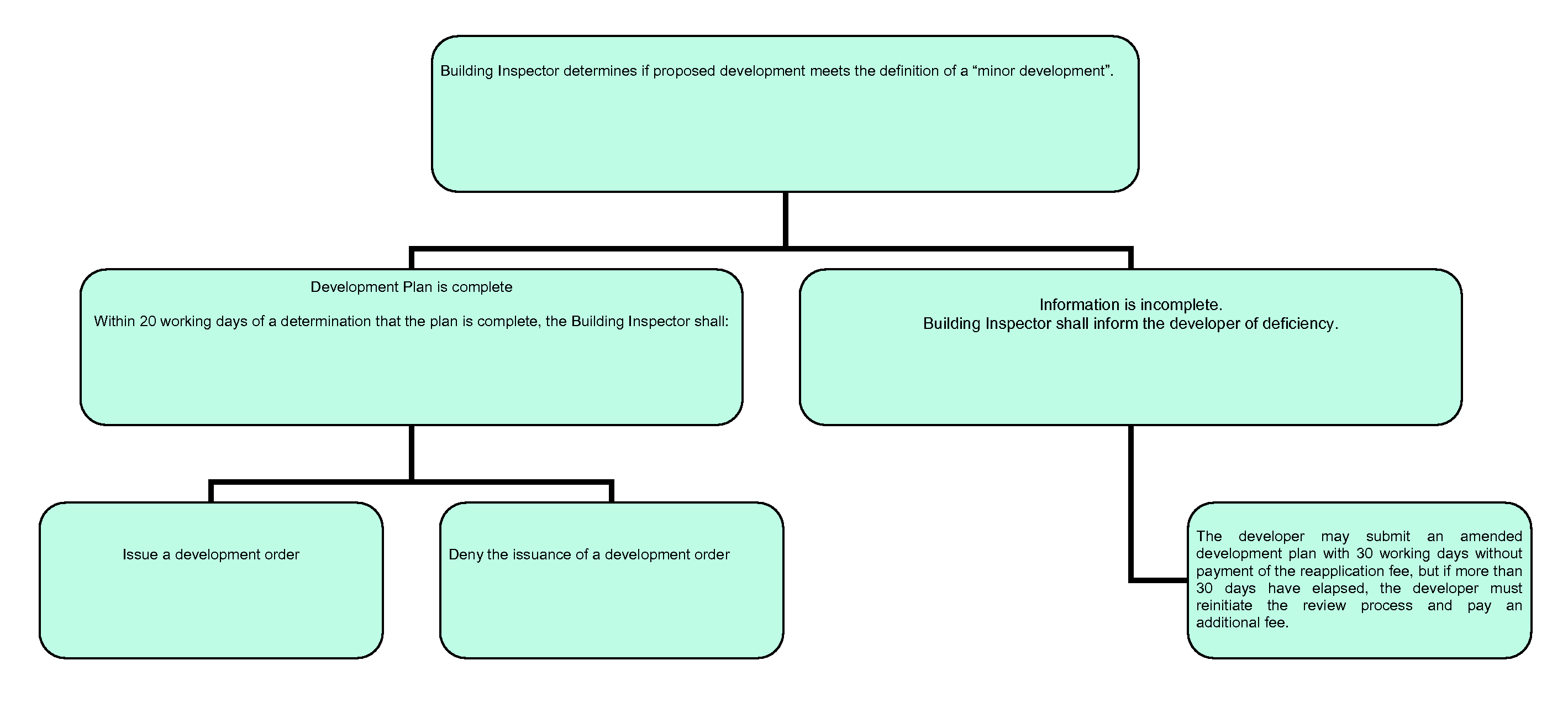
The developer or any adversely affected person may appeal any decision of the building inspector by filing an appeal with the planning and development review board. The PDRB shall make the final decision regarding any appeals related to minor developments.
* Minor development plans: residential project of four or less dwelling units or involves less than 5,000 square feet of nonresidential gross floor area and does not meet the requirements of a major development.
APPENDIX II-2. REVIEW PROCESS FOR MAJOR DEVELOPMENT PLANS*
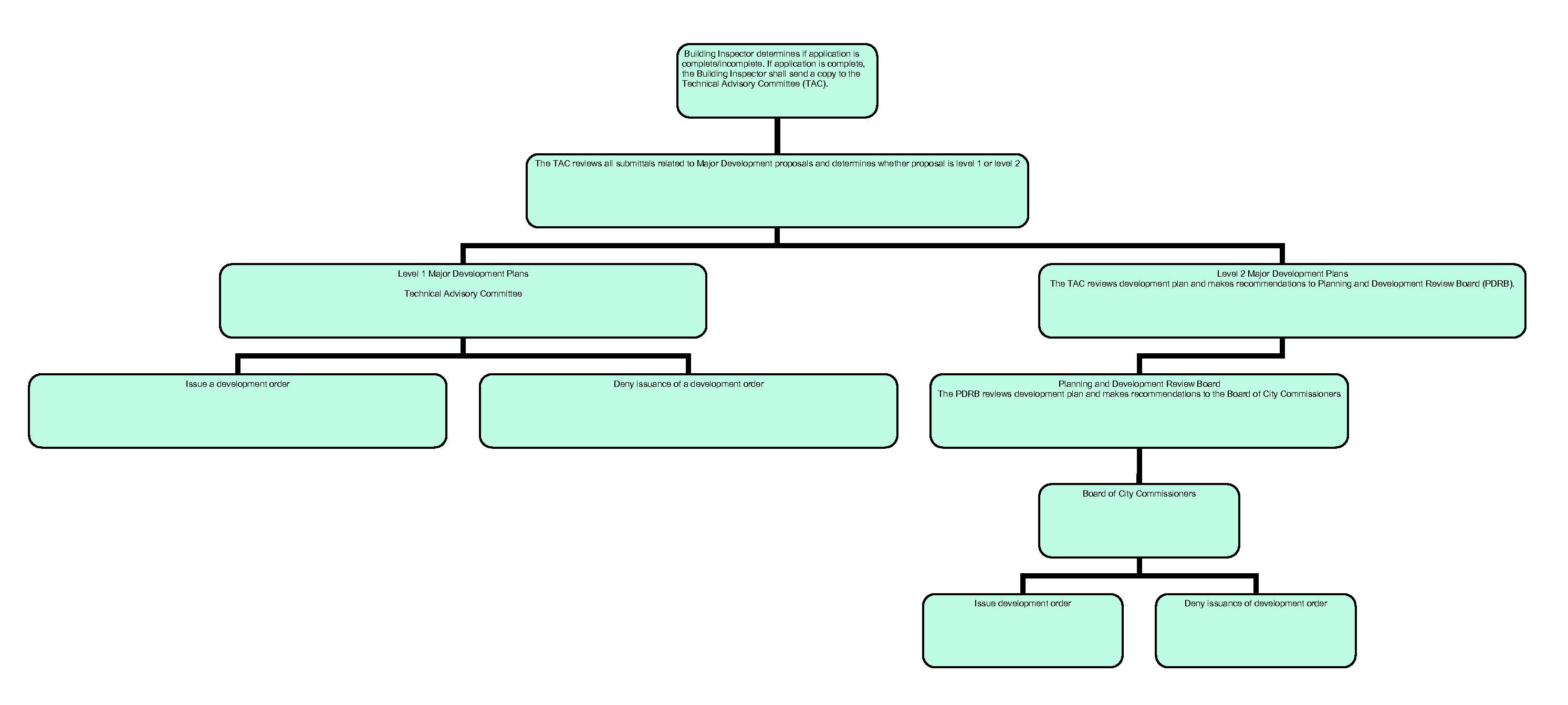
* Major development plans are those projects that meet one of the following criteria:
(1)
The development is a residential project of five or more dwelling units.
(2)
The development involves 5,000 square feet or more of nonresidential gross floor area.
(3)
Any development that requires a variance from zoning restrictions as set forth hereinafter.
(4)
Any development that involves the subdivision of land.
(5)
Any development that the building inspector designates as a major development.

