
Port Wentworth City Zoning Code
PART III
DEVELOPMENT PROVISIONS
This page is intentionally blank.
Section 6.10 - General Compliance.
A.
Compliance with Ordinance. Except as otherwise provided in this ordinance, no building, structure, or premises shall be used or occupied; and no building or part of any building or other structures shall be erected, razed, moved, placed, reconstructed, extended, enlarged, or altered, except in conformity with the provisions of this ordinance.
B.
Unlawful Buildings and Uses. Any building, use, or lot which has been unlawfully constructed, occupied or created prior to the date of adoption of this ordinance shall continue to be unlawful unless expressly permitted by this ordinance. Such unlawful buildings, uses, or lots shall not be considered to be nonconforming buildings, uses, or lots and shall not be afforded any protections or allowances otherwise granted to legally nonconforming buildings, uses, or lots.
C.
Trash, Litter, or Junk. It shall be unlawful for any person to accumulate, place, store, or allow or permit the accumulation, placement or storage of trash, litter, or junk on premises in the City, except in a lawful sanitary landfill, a lawful junkyard, or not to exceed seven (7) days storage in watertight storage receptacles designed for the temporary accumulation of trash. Waste receptacles and trash shall not be left unattended in any yard longer than a period of twenty-four (24) hours unless they are kept or enclosed in a permanent structure designed to prevent disturbance of such receptacles by animals or severe weather conditions.
D.
Restoring Unsafe Buildings. Nothing in this ordinance shall prevent the strengthening or restoration to a safe condition of any part of any building or structure declared unsafe by the building official or required to comply with his lawful order, provided such restoration shall be subject to and completed in accordance with the City of Port Wentworth building code and all other applicable ordinances. Nonconforming buildings and uses shall also be subject to the limitations of this ordinance.
E.
Voting Place. The provisions of this ordinance shall not interfere with the temporary use of any property as a voting place in connection with a federal, state, county, municipal, or other public election.
(Ord. No. 23-03-0010, § 5(Exh. A), 6-22-23)
Section 6.20 - Accessory Buildings, Uses, and Structures.
A.
Accessory Buildings.
1.
Residential.
a.
Accessory buildings or garages shall be considered to be part of the main building if structurally and architecturally integrated into the main building or if attached by an enclosed breezeway or similar enclosed structure not more than ten (10) feet in length.
b.
Detached accessory buildings shall not be located closer than ten (10) feet to the main building on the lot.
c.
A building permit shall be required for any accessory building exceeding two hundred forty (240) square feet in area.
d.
No accessory building shall be located in a front or side yard.
e.
No accessory building shall be constructed on a lot before the principal building or use on the lot is constructed.
f.
Accessory buildings shall be set back at least five (5) feet from the side and rear lot lines. However, if the rear lot line of the property on which the accessory building is located is also the side lot line of the neighboring property, the accessory building shall be set back the same distance from the rear lot line as the required side yard setback for a principal building.
g.
If a detached garage is accessed from an alley, there shall be no rear setback requirement.
h.
The maximum number of accessory buildings permitted on any lot containing a single- or two-family dwelling shall comply with the requirements specified in Table 6.20, based on whether a garage is attached to the principal dwelling and the number of vehicle stalls provided within such garage:
i.
The area of accessory buildings shall be included in the maximum building coverage.
j.
The maximum height of an accessory building shall not exceed twelve (12) feet.
k.
No accessory building, except as otherwise permitted in this ordinance, shall be used as a dwelling or rented.
2.
Non-Residential Accessory Buildings. Non-residential accessory buildings on lots within non-residential districts and non-residential buildings in residential districts shall comply with all yard setback requirements for principal buildings within the applicable zoning district.
B.
Domestic Animals.
1.
The keeping of household pets, including dogs, cats, fish, birds, hamsters, and other animals commonly considered household pets, is permitted in any residential district, provided no more than three (3) dogs or cats, six (6) months of age or older, in any combination shall be kept or housed in or at one (1) dwelling.
2.
The keeping of farm animals not generally considered to be household pets, including, but not limited to, exotic animals, horses, pigs, sheep, cattle, goats, and poultry, is prohibited in all Zoning Districts, except within the R-1 District on existing bona fide farms and lots larger than five (5) acres. The keeping of wild animals shall not be permitted in any district.
C.
Fences and Walls.
1.
A permit shall be obtained prior to the erection or construction of any fence or wall.
2.
Fences and walls, including gates, shall be constructed of durable, weather-resistant, rustproof, and easily maintainable materials customarily used in the construction of walls and fences, such as wood, metal, masonry, chain-link, composite, or vinyl. However, this provision shall not preclude the use of decorative architectural materials when consistent with the intent of this section and the character of the area where the fence is to be placed and as approved by the Zoning Administrator. Fence material shall be permitted subject to review and approval by the Zoning Administrator.
3.
Fences shall be maintained to ensure they remain free of deficiencies and are kept upright and firmly fastened to the ground and associated supporting structures.
4.
A non-sight obscuring security fence, not exceeding twelve (12) feet high, may be permitted around the perimeter of an essential public service building, essential public service storage yard, towers, approved outdoor storage areas in the commercial (not including the C-1, Neighborhood Commercial) or Industrial Districts, and around the property boundary of sites in the I-1 District. The security fence may also include a maximum of one (1) additional foot of barbed wire. Razor wire and electrification shall not be permitted in any district.
5.
Fences or walls erected within a front yard in any residential district or on any residentially used lot shall not exceed four (4) feet in height. This shall also apply to a secondary front yard on a corner lot, provided the fence or wall shall not exceed three (3) feet in height within the clear vision corner. Fences or walls in any residential district or on any residentially used lot shall not exceed six (6) feet in height within the side and rear yards.
6.
Fences shall not be erected within any public right-of-way or easements.
7.
In any district, if both sides of the fence or wall are not identical, the finished side shall face the adjoining property.
8.
Chain link fences shall not be erected in any front yard within either a residential district or any lot containing a dwelling unless enclosing a retention pond, essential public service, or publicly owned facility that has been approved by the City. In all such cases, the chain link fence shall be black vinyl coated.
9.
Barbed wire shall not be permitted in any residential district or on any lot or parcel containing a residential use except for security around essential public services or publicly owned facilities.
10.
Required screen walls shall be located inside the property line. The design of all walls, including openings for vehicular traffic or other purposes, shall only be as approved by the Zoning Administrator.
D.
Mechanical Appurtenances.
1.
Mechanical units located on the ground shall be located in the rear or side yard and may encroach as permitted in this ordinance. When attached to a building, the mechanical equipment shall be architecturally integrated or appropriately screened by shrubbery or fencing so as not to be visible from neighboring property. Screening shall comply with the requirements of this ordinance.
2.
If located on the roof of a building or in a location that cannot otherwise be screened, the equipment shall be enclosed or designed in a manner that is architecturally integrated with the building where it is located.
3.
Mechanical units shall not be placed within any easement.
E.
Swimming Pools, Spas and Hot Tubs.
1.
Any swimming pool, spa, hot tub, or similar structure whose depth at any point exceeds twenty-four (24) inches shall be subject to the following regulations and shall be fenced securely in accordance with the applicable requirements of the City of Port Wentworth building code.
2.
Swimming pools, spas, hot tubs, and similar structures shall only be permitted in the rear yard.
3.
Swimming pools, spas, hot tubs, and similar structures, whether above or below ground, shall be set back a minimum of ten (10) feet from any side or rear lot line, as measured from the edge of the pool.
F.
Temporary Storage Units.
1.
It shall be unlawful to place or permit the placement of a temporary storage unit on property located within the City of Port Wentworth for more than seven (7) consecutive days, provided a longer period may be approved by the Zoning Administrator for building construction or remodeling projects.
2.
Temporary storage units shall only be placed upon or within a driveway, parking area or if access exists to the rear of the lot, the rear yard.
3.
No temporary storage unit shall be placed upon or within public property or a public place, including, without limitation, a street, sidewalk, or street greenway.
4.
The temporary storage unit shall not exceed eight (8) feet in height, eight (8) feet in width, and 16 feet in length.
5.
The temporary storage unit shall be secured in a manner that does not endanger the safety of persons or property in the vicinity of the unit.
6.
The temporary storage unit shall, at all times, be maintained in good condition, free from evidence of deterioration, weathering, discoloration, graffiti, rust, ripping, tearing, or other holes or breaks.
7.
No temporary storage unit shall be used for human occupancy or to store solid waste, construction debris, demolition debris, business inventory, commercial goods, hazardous materials, or goods for property other than the property on which the storage unit is located. Upon reasonable notice, the officials of the City of Port Wentworth may inspect the contents of any temporary storage unit at any reasonable time to ensure compliance with these requirements.
8.
Any temporary storage unit which is not removed at the end of the time for which it may lawfully remain in place may be removed by the City immediately, with twenty-four-hours notice and such notice affixed to the temporary storage unit, and the cost of such removal may be assessed against the property on which the unit was located.
9.
A sign identifying the storage unit supplier, mounted on the temporary storage unit, shall not require a sign permit, provided the storage unit is in compliance with this subsection and all other applicable ordinances.
(Ord. No. 23-03-0010, § 5(Exh. A), 6-22-23)
Section 6.30 - Building Height Exceptions.
The following structures are exempt from the height limitations of this ordinance: belfries, broadcast towers, antennas, chimneys, cooling towers, elevator bulkheads, fire towers, flag poles in non-residential districts, stacks, elevated water towers, stage lofts, monuments, cupolas, domes, spires, and penthouses housing necessary mechanical appurtenances such as HVAC or similar equipment on the roof of a building. Parapet walls may not exceed the height limits by more than four (4) feet.
(Ord. No. 23-03-0010, § 5(Exh. A), 6-22-23)
Section 6.40 - Setbacks and Yards.
A.
Setback Requirements. All setbacks shall be measured from the property lines. For unplatted lots, an up-to-date property survey prepared by a surveyor registered in the State of Georgia shall be submitted with any application for building permit or site development plan approval. In the case of a private street easement, setbacks shall be measured from the easement line. A building shall not be erected, converted, enlarged, reconstructed, or structurally altered except in conformity with the setback requirements of the district in which it is located.
B.
Encroachment into Right-of-Way. No buildings, structures, service areas, or off-street parking and loading facilities, except driveways, shall be permitted to encroach on public or private rights-of-way.
C.
Front Setback Requirements. All yards abutting upon a public or private street right-of-way shall be considered as front yards or secondary front yards for setback purposes, except as otherwise provided in this ordinance. A setback within a secondary front yard is a side street setback.
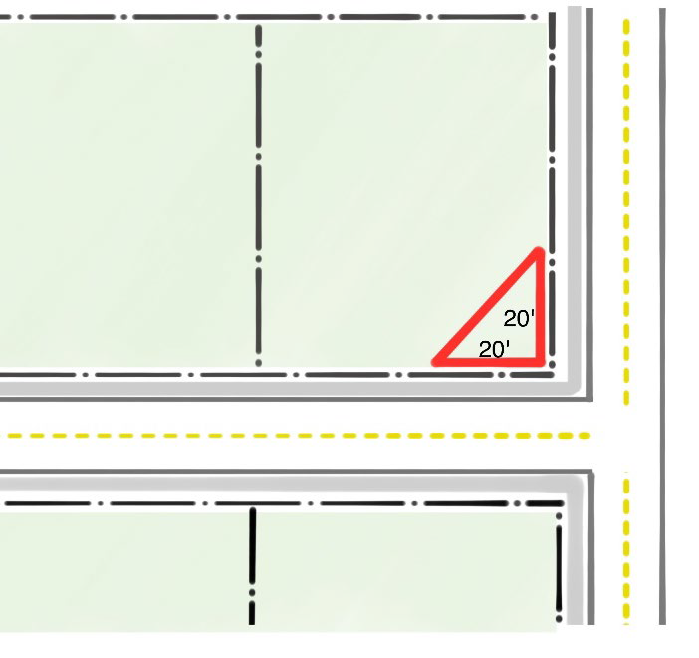
Figure 6-1 Clear Vision Corner
D.
Clear Vision Corner. Signs, fences, walls, structures, benches, shrubbery, or other potential obstructions to vision, shall not be permitted to exceed a height of three (3) feet within a triangular area formed by the intersection of two (2) street right-of-way lines or a street and railroad right-of-way line and a line connecting two (2) points located on those intersecting right-of-way lines twenty (20) feet from the point where the right-of-way lines intersect; provided, utility poles, street lights, and street signs shall be exempt from this requirement (Figure 6-1).
E.
Setbacks and Yards by Lot Type.
1.
Interior Lots. On interior lots, the minimum front, side, and rear building setbacks shall be met. Each interior lot shall be comprised of a front yard, two (2) side yards, and a rear yard.
2.
Corner Lots. On corner lots, the minimum front, side street, side, and rear building setbacks shall be met. Each corner lot shall be comprised of a front yard, a secondary front yard, a side yard, and a rear yard.
3.
Through Lots. On through lots, the minimum front building setback shall be met on the primary street frontage, which is the direction the building faces, and side setbacks shall be met. The minimum rear setback shall be the greater of the front and rear setback applicable to the zoning district. Each through lot shall be comprised of a front yard, two (2) side yards, and a rear yard.
4.
Multi-Frontage. On multi-frontage lots, the minimum front building setback shall be met on the primary street frontage, which is the direction the building faces, a street side setback shall be met, and a side setback shall be met. The minimum rear setback, along the opposite frontage of the front setback, shall be the greater of the front and rear setback applicable to the zoning district. Each multi-frontage lot shall be comprised of a front yard, a secondary front yard, a side yard, and a rear yard.
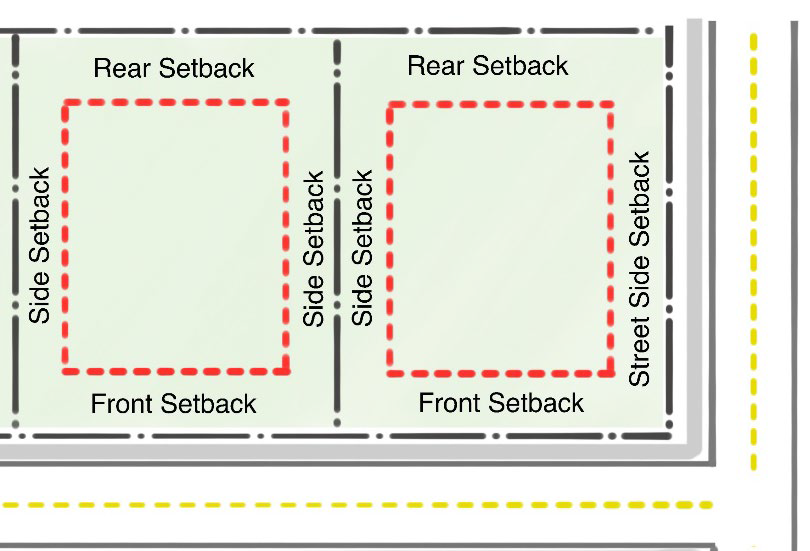
Figure 6-2 Setbacks for Interior (L) and Corner Lots (R)
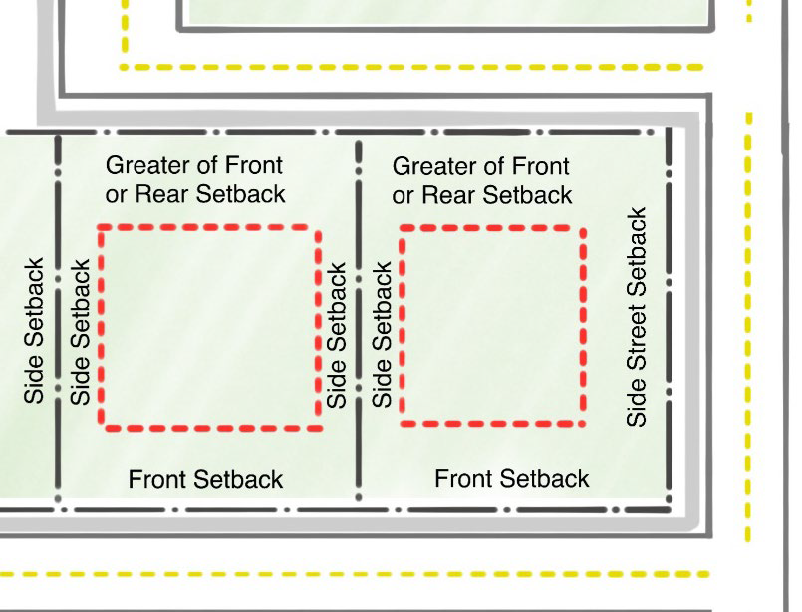
Figure 6-3 Setbacks for Through (L) and Multi-Frontage Lots (R)
F.
Projections into Required Setbacks. Certain structures and architectural features may project into the required setbacks, as provided in Table 6.40.
(Ord. No. 23-03-0010, § 5(Exh. A), 6-22-23)
Section 6.50 - Lots.
A.
Required Area or Space. No lot or lots in common ownership and no yard, court, parking area or other space shall be so divided, altered, or reduced as to make the area or space smaller than the minimum required under this ordinance. If already less than the minimum size required, the area or space shall not be further divided or reduced.
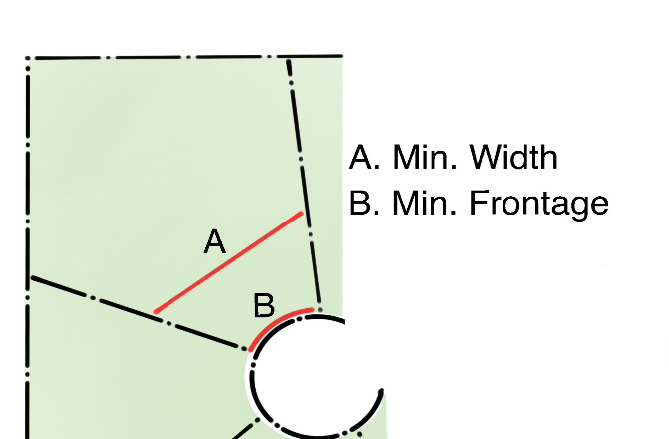
Figure 6-4 Cul-de-Sac Lot Frontage
B.
Minimum Lot Frontage. All lots and parcels shall have frontage on and be accessible from a public or private street. The required minimum frontage shall be equal to the minimum lot width. However, frontage for cul-de-sac lots for single-family and two-family dwellings may be reduced to forty (40) feet and minimum lot width shall be measured at the required front setback line. (Figure 6-3).
C.
Lots on Lakes, Rivers, and Streams.
1.
Lots abutting an inland lake, river, or stream shall comply with the following regulations:
a.
The lot width abutting a waterbody shall meet the minimum requirements of the zoning district in which the lot is located, measured at the ordinary high-water mark between side lot lines.
b.
Waterfront lots shall be considered through lots for the purpose of setback and yard designations.
2.
This subsection shall not apply to stormwater basins or other man-made water features.
(Ord. No. 23-03-0010, § 5(Exh. A), 6-22-23)
Section 6.60 - Utilities & Services.
A.
Essential Public Services. The erection, construction, alteration, or maintenance of essential public services shall be permitted in any zoning district and shall be exempt from the application of this ordinance; provided buildings, parking areas, and other uses or structures accessory to the essential service shall not be exempt and shall conform to all applicable ordinance requirements and procedures. This provision, however, shall not be construed to waive the rights of the City of Port Wentworth to require that specific services be installed underground.
B.
Water and Sanitary Sewer Service. No structure for human occupancy shall, after the effective date of this ordinance, be erected, altered, or moved upon any lot or premises and used, in whole or in part, for dwelling, business, industrial, institutional, or recreational purposes unless provided with a safe, sanitary and potable water supply and with a safe and effective means of collection, treatment, and disposal of human, domestic, commercial and industrial waste. All such systems shall be designed to preclude infiltration of flood waters into the system and discharges from the system into flood waters. Such installations and facilities shall conform to the minimum requirements for such facilities as established by the State of Georgia, Chatham County, City of Port Wentworth, and other relevant government codes, ordinances, and standards.
(Ord. No. 23-03-0010, § 5(Exh. A), 6-22-23)
This page is intentionally blank.
Section 7.10 - Intent and Purpose.
This article outlines conditions applicable to specific land uses based on the unique operational characteristics that warrant additional regulations to protect public health, safety, and welfare. These requirements apply in addition to all the regulations of the zoning district in which the use is located, as well as all other applicable requirements in this ordinance.
(Ord. No. 23-03-0010, § 5(Exh. A), 6-22-23)
Section 7.20 - Accessory Dwelling Unit.
A.
General Requirements.
1.
Single-Family. Accessory dwelling units are limited to single-family lots.
2.
Number. Only one (1) attached or detached accessory dwelling unit shall be permitted per principal dwelling.
3.
Occupancy. The principal dwelling or the accessory dwelling unit shall be owner-occupied.
4.
Setbacks. Attached accessory dwelling units shall comply with all setback requirements applicable to the principal dwelling. Detached accessory dwelling units shall comply with all setback requirements applicable to accessory buildings.
5.
Appearance. Attached and detached accessory dwellings shall retain a residential appearance consistent with the architectural design and building materials of the principal dwelling, including but not limited to roof material, roof type, siding material, and window type and placement.
6.
Area. Accessory dwelling square footage shall not exceed fifty (50) per cent of the principal dwelling square footage, or eight hundred (800) square feet, whichever is less. Square footage shall also not exceed the maximum accessory building square footage per Table 6.20. The minimum area is subject to Building Code compliance.
7.
Metering and Mailing Address. The accessory dwelling shall not have a separate meter for public utilities, such as electric and gas service or a separate mailing address.
B.
Specific Requirements for Attached Accessory Dwelling Units.
1.
An attached accessory dwelling may be designed as an independent living area that can be isolated from the principal dwelling space; however, an internal connection to the principal dwelling must be maintained, and the principal and accessory living space must both be accessible through the primary entrance of the dwelling. This requirement does not preclude separate entrances to either living space.
2.
An attached accessory dwelling unit located over an attached garage may be served by a single access point separate from the rest of the building.
C.
Specific Requirements for Detached Accessory Dwelling Units.
1.
A lot shall not be divided in a manner that separates a detached accessory dwelling unit and principal dwelling unit onto separate parcels if the division results in a nonconformity.
2.
A new detached accessory dwelling unit to be constructed shall not be located closer to a front lot line than the principal dwelling.
3.
In the case of a detached accessory dwelling unit over garage space, such as a carriage house, the first-floor garage space shall not count against the maximum square footage applicable to the accessory dwelling unit.
4.
The minimum square footage shall be the minimum necessary to comply with applicable building codes.
5.
The height of a detached accessory dwelling unit shall not exceed the height of the principal dwelling. However, the height of a detached accessory dwelling unit over garage space may exceed the height of a single-story principal dwelling by ten (10) feet.
(Ord. No. 23-03-0010, § 5(Exh. A), 6-22-23)
Section 7.30 - Adult Entertainment Establishments.
A.
Applicability and Intent. These standards are intended to regulate adult entertainment establishments businesses, promote the health, safety, morals, and general welfare of the citizens of the City, and establish reasonable and uniform regulations to prevent the deleterious location and concentration of sexually oriented businesses within the City, thereby helping to reduce and eliminate the adverse secondary effects from such sexually oriented businesses. These standards have neither the purpose nor effect of imposing a limitation or restriction on the content of any communicative materials, including sexually oriented materials. Similarly, it is not the intent or effect of these standards to restrict or deny access by adults to sexually oriented materials protected by the First Amendment of the U.S. Constitution or Georgia statute or to deny access by the distributors and exhibitors of sexually oriented entertainment to their intended market. Neither is it the intent or effect of these standards to condone or legitimize the distribution of obscene material.
B.
Licensing and Operations. Adult Entertainment Establishments shall comply with all applicable City of Port Wentworth licensing and operations requirements.
C.
Location Requirements.
1.
No adult entertainment use shall be located within two thousand (2,000) feet of the exterior boundary of any residential zoning district, place of worship, K-12 school, library, day care center, public community center, park, fairground, recreation center, and publicly owned or maintained building opened for use by the general public.
2.
No adult entertainment use shall be located within thousand (2,000) feet of any other adult entertainment use, whether such adult entertainment use is within or outside the City boundaries.
D.
Retail Display. No product for sale or gift, nor any picture or other representation of any product for sale or gift, shall be displayed so that it is visible by a person of normal visual acuity from the nearest adjoining roadway or adjoining property.
E.
Site Lighting. In addition to the requirements of Article 11, all off-street parking areas shall be illuminated from at least ninety (90) minutes prior to sunset to at least sixty (60) minutes after closing.
(Ord. No. 23-03-0010, § 5(Exh. A), 6-22-23)
Section 7.40 - Animal and Pet Services.
A.
General Requirements.
1.
Outdoor activity areas shall be screened in accordance with Section 10.70. An outdoor activity area is a location for walking leashed and unleashed dogs, pet relief, leashed and unleashed dog training, dog exercise and play areas, and outdoor dog runs.
2.
All kennels shall be operated in conformance with any applicable County and State regulations.
3.
Buildings used as commercial kennels or pet services shall be insulated in such a manner that excessive noise from barking is minimized.
4.
Habitual barking, which results in a nuisance to neighboring landowners or residents, is prohibited.
B.
Outdoor Exercise and Play Area Requirements.
1.
Outdoor exercise and play areas are locations outside of enclosed structures that are intended and used for unleashed dog exercise, training, and play.
2.
The outer limits of outdoor exercise and play areas shall not be located closer than one hundred (100) feet from any adjacent residential-zoned property.
3.
Outdoor exercise and play areas shall be fenced.
C.
Outdoor Run Requirements for Boarding and Day Care.
1.
Outdoor runs are individually fenced areas connected to buildings that accommodate outdoor access for associated indoor pens or suites.
2.
Outdoor runs shall not be located closer than one hundred (100) feet from any adjacent residential-zoned property.
3.
Outdoor runs shall be located in the rear or side yards.
4.
Outdoor runs shall be equipped with impervious surfaces suitable for cleaning with high-pressure water. Outdoor runs shall be kept in a clean and sanitary manner to prevent the accumulation of flies, the spread of disease, offensive odor, or dust generation.
(Ord. No. 23-03-0010, § 5(Exh. A), 6-22-23)
Section 7.50 - Bed and Breakfast.
A.
Principal Residence. A bed and breakfast use shall only be established in a detached single-family dwelling, which shall also be the principal residence of the owner or manager.
B.
Appearance. The building shall maintain an exterior appearance that is in character with surrounding residential uses.
C.
Lot Conformance. A bed and breakfast shall be located on a lot that conforms to non-residential area requirements.
D.
Guest Rooms. The total number of guest rooms in the establishment shall not exceed six (6).
E.
Term. The length of stay for a guest or guests shall not exceed fourteen (14) consecutive days.
F.
Cooking. No separate cooking facilities shall be provided.
G.
Food Service. Meals shall only be served to the operator's family, employees, and overnight guests.
(Ord. No. 23-03-0010, § 5(Exh. A), 6-22-23)
Section 7.60 - Campground or Recreational Vehicle Park.
A.
Minimum Lot Area. A minimum of five (5) acres is required to establish the use.
B.
Setbacks. Buildings shall be at least one hundred (100) feet from residential-zoned properties.
C.
Buffer. The site shall be subject to a buffer type B as noted in Table 10.40 B where abutting residential-zoned property.
D.
General Requirements. All recreational vehicle (RV) sites shall include water and sewer services unless separate restroom facilities are available.
1.
Accessory sheds and buildings are not permitted on individual RV sites.
2.
A park attendant must be on duty at the park or available at all times to address the needs of campers, emergencies, and maintenance issues.
3.
Common areas and individual sites shall be kept free of litter and debris at all times.
4.
Service buildings shall be maintained in a sanitary condition at all times.
5.
The operator shall ensure continued maintenance of landscaping and buildings. Common areas shall be mowed and kept free of fallen branches and tall grass and weeds.
6.
RV lots shall be provided a concrete, paved, or gravel off-street car parking area of a minimum size to accommodate two (2) vehicles without vehicle encroachment onto internal driveways.
7.
Driveways shall be clear for emergency vehicle access at all times. Guest parking shall not obstruct driveways.
8.
Dumpsters and trash bins shall be required in a common area. The dumpster shall be emptied frequently to avoid the accumulation of waste and debris.
9.
No part of any campground shall be used for any other purpose than for temporary living quarters occupancy of individual recreational vehicle units or tent camping, except for such uses that are required for the direct servicing and well-being of campground guests and for the management and maintenance of the campground.
10.
The open discharge of gray water within the park shall be prohibited.
(Ord. No. 23-03-0010, § 5(Exh. A), 6-22-23)
Section 7.70 - Commercial Outdoor Recreation, Low-Intensity.
A.
Minimum Lot Area. A minimum of five (5) acres is required to establish the use.
B.
Setbacks. Buildings shall be at least one hundred (100) feet from residential-zoned properties.
C.
Buffer. The site shall be subject to a buffer type B as noted in Table 10.40 B where abutting residential-zoned property.
D.
Parking. Parking lots shall be at least one hundred (100) feet from abutting residential-zoned property lines.
E.
Noise. Outdoor electrified sound amplification is prohibited.
F.
Lighting. Light levels shall not be detectable along lot lines on a photometric plan (0.0 foot-candles).
G.
Hours of Operation. Hours of operation are limited to dawn to dusk.
(Ord. No. 23-03-0010, § 5(Exh. A), 6-22-23)
Section 7.80 - Community Garden.
A.
Drainage. The site shall be designed and maintained so that water and fertilizer will not drain onto adjacent property.
B.
Sales. The on-site sale of community garden products is prohibited except when permitted as an approved temporary use.
C.
Noise. The use of motorized equipment is restricted to hours beginning at 7:00 a.m. and ending at 9:00 p.m.
D.
Waste and Compost. An on-site trash storage container must be provided and located as close as practicable to the rear lot line or when located on a lot with other uses, the rear side of the community garden. Compost bins or piles must also be located in the same location. Trash must be removed from the site regularly.
E.
Chickens and Farm Animals. The keeping of animals is prohibited unless the community garden is located in a zoning district that permits animals.
F.
Hours of Operation. Within a residential zoning district, operating hours for community garden activities are restricted to between 5:00 a.m. and 11:00 p.m. daily.
(Ord. No. 23-03-0010, § 5(Exh. A), 6-22-23)
Section 7.90 - Day Care Home (Adults and Children).
A.
State Approvals and Regulations.
1.
All licensing and permitting shall be obtained from the State of Georgia.
2.
All rules and regulations from the State of Georgia shall be adhered to.
B.
Residency Requirement. The owner or management of the dwelling shall reside on the premises.
C.
Separation. A day care home shall not be located within one thousand (1,000) feet from any other day care home.
(Ord. No. 23-03-0010, § 5(Exh. A), 6-22-23)
Section 7.100 - Drive-Through Service.
A.
Access and Circulation. Site access and circulation shall be designed to minimize traffic conflicts, congestion, and disruption and enhance traffic safety on abutting public and private streets and drives. Access and drive aisles shall be arranged to prevent queued or parked vehicles from encroaching upon a sidewalk, street, intersection, or public right-of-way.
B.
Stacking Spaces. The City Council may require additional stacking spaces beyond those required by Table 8.40 based on the characteristics of the use and anticipated traffic volumes.
C.
Sound. Loudspeakers shall be modulated so that any generated sound is not audible beyond property boundaries.
(Ord. No. 23-03-0010, § 5(Exh. A), 6-22-23)
Section 7.110 - Farm Markets and Agritourism.
A.
Minimum Lot Area. A minimum of five (5) acres is required to establish the use.
B.
Setbacks. Buildings shall be at least one hundred (100) feet from abutting residential-zoned property lines.
C.
Buffer. The site shall be subject to a buffer type B as noted in Table 10.40 B where abutting residential-zoned property.
D.
Parking. Parking lots shall be at least one hundred (100) feet from residential-zoned property.
E.
Lighting. Light levels shall not be detectable along lot lines on a photometric plan (0.0 foot-candles).
F.
Noise. Outdoor amplified sound is prohibited.
G.
Hours of Operation. The hours of operation of annual and seasonal events, as well as permanent uses, shall be set by the City Council. The intent of these restrictions is to ensure the use remains accessory and incidental to the farm use of the property and not a typical commercial use.
(Ord. No. 23-03-0010, § 5(Exh. A), 6-22-23)
Section 7.120 - Golf Course.
A.
Minimum Lot Area. A minimum of forty (40) acres is required to establish the use.
B.
Setbacks. Buildings shall be at least one hundred (100) feet from residential-zoned property.
C.
Parking. Parking lots shall be at least one hundred (100) feet from residential-zoned property.
(Ord. No. 23-03-0010, § 5(Exh. A), 6-22-23)
Section 7.130 - Home Occupations.
A.
Major Home Occupation.
1.
Minimum Lot Area. A minimum of five (5) acres is required to establish the use.
2.
Location. Major home occupation operations must be conducted entirely within a principal dwelling, attached accessory building, detached accessory building, or combination of these buildings.
3.
A maximum of twenty-five (25) per cent of the gross floor area of a dwelling and accessory buildings may be devoted to major home occupation business operations. Up to twenty-five (25) per cent of the floor area of the principal dwelling may be devoted to a major home occupation.
4.
There shall be no physical evidence of the major home occupation from other properties or the public right-of-way aside from parking and customer visitation.
5.
All equipment and vehicles shall be stored indoors.
6.
Retail Sales. Accessory retail sales shall only be allowed if incidental to authorized uses and shall be subject to the parking and visitation requirements of this section. Only items produced on the subject lot shall be sold.
7.
Operation and Employees.
a.
Major home occupations shall only be owned and operated by a full-time resident of the dwelling.
b.
Any occupant of the principal dwelling may be employed by the major home occupation.
c.
A maximum of four (4) persons who are not residents of the dwelling may work on-site or may pick up and return work vehicles during any one (1) day.
8.
Parking and Visitation.
a.
Visitation of the site by clients, customers, or students shall be by appointment only.
b.
No more than two (2) individual appointments shall be scheduled at any one (1) time unless group activities or classes are approved.
c.
If open to the public for appointments or other approved activities, see Article 8 for parking requirements.
B.
Minor Home Occupation.
1.
Minor home occupations shall only be owned and operated by a full-time resident of the principal dwelling. Non-resident employees may not work on-site.
2.
Home occupations must be conducted entirely within the principal dwelling and not within an accessory building.
3.
Up to twenty-five (25) per cent of the floor area of the principal dwelling may be devoted to a home occupation.
4.
There shall be no physical evidence of the home occupation from the exterior of the dwelling.
5.
No customers or clients shall visit the site.
(Ord. No. 23-03-0010, § 5(Exh. A), 6-22-23)
Section 7.140 - Manufactured Home Community.
A.
Manufactured Home Spaces.
1.
Each space shall contain a minimum area of five thousand (5,000) square feet and shall be at least forty (40) feet wide.
2.
Each space shall abut on a driveway or other access with unobstructed access to a street.
B.
Placement. Each manufactured home shall be placed upon a space so that:
1.
There is a minimum of fifteen (15) feet between mobile homes;
2.
It is not located within fifty (50) feet of an exterior boundary of the manufactured home community;
3.
It is not located within fifty (50) feet of a public right-of-way;
4.
It does not obstruct any roadway, walkway, or easement;
5.
It is not located within ten (10) feet of any internal street or drive.
C.
Access. Internal access drives shall meet all Fire Department requirements for maneuverability.
(Ord. No. 23-03-0010, § 5(Exh. A), 6-22-23)
Section 7.150 - Outdoor Display and Sales.
A.
Setbacks. Outdoor display and sales areas shall comply with setbacks applicable to principal buildings.
B.
Maximum Area. Accessory outdoor display and sales areas as part of a general retail establishment are limited to twenty (20) per cent of the principal building square footage. For businesses where the primary sales area is outdoors, such as landscaping supply, construction supply, nurseries, and similar uses, there is no maximum sales area as long as all other zoning requirements are met.
C.
Surface. See Outdoor Storage, Section 7.160 B.
(Ord. No. 23-03-0010, § 5(Exh. A), 6-22-23)
Section 7.160 - Outdoor Storage.
A.
Setbacks. Outdoor storage areas shall be subject to setbacks for principal buildings.
B.
Surface. Outdoor storage areas shall be asphalt, concrete, gravel, or crushed stone. Gravel and crushed stone surfaces are subject to the following requirements:
1.
Shall be properly drained in accordance with the City of Port Wentworth Stormwater Ordinance and Comprehensive Development Manual.
2.
Dust generation shall be minimized.
3.
The surface will be maintained and free of weeds, grass, and overgrown vegetation at all times.
C.
Screening. Outdoor storage areas shall be screened from all sides. See Section 10.70 for screening requirements.
D.
Hazardous Materials. No flammable liquids, solvents, cleaners, and other hazardous substances capable of contaminating groundwater shall be stored outdoors.
E.
Containers. Containers shall not be stacked more than five (5) high.
(Ord. No. 23-03-0010, § 5(Exh. A), 6-22-23)
Section 7.170 - Outdoor Theater.
A.
Access. Outdoor theaters shall have direct access to a state road.
B.
Setbacks. Buildings and screens shall be at least one hundred (100) feet from residential-zoned property.
C.
Buffer. The site shall be subject to a buffer type B as noted in Table 10.40 B where abutting residential-zoned property.
D.
Circulation. There shall be sufficient stacking and queuing space for vehicles entering the facility to ensure that there will be no resulting obstructions within the public right-of-way.
E.
Design. The site shall be designed to prevent the movie screens from being viewed from residential areas or adjacent major thoroughfares.
(Ord. No. 23-03-0010, § 5(Exh. A), 6-22-23)
Section 7.180 - Personal Care Home.
A.
State Approvals and Regulations.
1.
All licensing and permitting shall be obtained from the State of Georgia.
2.
All rules and regulations from the State of Georgia shall be adhered to.
B.
Residency Requirement. The owner or management of the dwelling shall reside on the premises.
C.
Separation. A personal care home shall not be located within one thousand (1,000) feet from any other personal care home.
(Ord. No. 23-03-0010, § 5(Exh. A), 6-22-23)
Section 7.190 - Salvage or Impound Operation.
A.
Surface. See Outdoor Storage, Section 7.160 B.
B.
Screening. Outdoor storage areas for damaged or disabled vehicles shall be screened from all sides. See Section 10.70 for screening requirements.
C.
Parking. Parking of operable vehicles shall comply with the requirements of Article 8.
D.
Hazardous Materials. All flammable liquids, solvents, cleaners, and other hazardous substances capable of contaminating groundwater shall be stored within a building, and secondary containment measures shall be employed to prevent ground contact of any spilled materials.
(Ord. No. 23-03-0010, § 5(Exh. A), 6-22-23)
Section 7.200 - Self-Storage.
A.
Building Separation. Storage buildings shall be separated by drive aisles no less than twenty-four (24) feet in width.
B.
Outdoor Storage.
1.
Areas provided for outdoor storage of automobiles, boats, recreational vehicles, trailers, and similar personal property shall be designated on the site plan.
2.
Outdoor storage shall not be located within any required setback area.
3.
For surface requirements, see Outdoor Storage, Section 7.160 B.
4.
Outdoor storage areas shall be screened from all sides. See Section 10.70 for screening requirements.
C.
Use Restriction. Use of any storage unit for the conduct of manufacturing, repair, service, sales, fabrication, assembly, or any other business purpose other than the storage of goods or merchandise is prohibited.
D.
Caretaker's Dwelling. A single one-bedroom dwelling unit is permitted as an on-site residence for the facility caretaker. This dwelling unit shall be physically attached to the building, which contains the leasing and management office for the facility.
(Ord. No. 23-03-0010, § 5(Exh. A), 6-22-23)
Section 7.210 - Solar Energy.
A.
Applicability. This section does not apply to rooftop solar panels or smaller-scale solar energy collectors mounted on fences, poles, or on the ground with collector surface areas less than five (5) square feet and less than six (6) feet above the ground.
B.
Solar Energy, Accessory Ground-Mounted.
1.
Applications and Review. Accessory ground-mounted solar energy systems shall be approved administratively by the Zoning Administrator and the Building Official.
2.
Requirements.
a.
Glare and Reflection. The exterior surfaces of solar energy collectors shall be substantially non-reflective of light. A system shall not be installed or located in a manner that directs glare onto neighboring dwellings or adjacent streets.
b.
Location. Systems shall be placed in rear yards unless existing vegetation and other site constraints make rear yard placement unfeasible. The Zoning Administrator shall refer side and front yard placement requests to the Planning Commission in cases where there is a higher likelihood of visual impact to nearby residents.
c.
Installation. Systems shall be installed, maintained, and used only in accordance with the manufacturer's directions. Upon request, a copy shall be submitted to the City before installation.
d.
Wires. All wires shall be buried underground. Overhead wires are prohibited.
e.
Setbacks. Accessory ground-mounted solar energy systems shall be subject to the setbacks required for principal buildings. Measurement shall be taken from the outermost edge of the support structure or solar panel, whichever is closer to the property line, to the applicable property line.
f.
Maximum Number. One (1) accessory non-commercial ground-mounted solar energy system and its associated support structure are permitted per lot. However, in the case of a uniquely shaped parcel or lot or extraordinary conditions of the land, a single system with multiple structures and panels may be approved as long as the structures are clustered in close proximity.
g.
Maximum Size. Systems shall be designed and sized to produce no more than one hundred twenty-five (125) per cent of the annual kWh usage or one thousand five hundred (1,500) square feet, whichever is less. Proposed system power generation specifications and historical annual usage data shall be provided by the applicant for review.
h.
Maximum Height. The maximum height of a system at its highest point, or at full tilt, shall be sixteen (16) feet. Height is measured from the natural grade below the system to the highest point of the panels or any part of the support structure, whichever is greater.
i.
Abandonment. Systems that cease to produce energy continuously for twelve (12) months will be considered abandoned unless the landowner provides a plan to reinstate the operation of the system within six (6) months. If the system remains non-functional after six (6) months, it shall be determined as abandoned.
j.
Removal. The landowner shall remove the support structure, panels, and all equipment and restore the site to its condition prior to installation of the system within one (1) year of abandonment.
C.
Commercial Solar Energy System.
1.
Applications. In addition to all other required application contents, equipment and unit renderings or plans shall be submitted for review. Multiple participating commercial solar energy parcels operating as one (1) commercial solar energy system may be requested under a single special land use permit application. However, each participating commercial solar energy parcel is subject to special land use and site plan application fees.
2.
Principal or Accessory Use. Commercial solar energy systems may be established as principal or accessory uses.
3.
Requirements.
a.
Building Coverage. Solar energy collectors and panels shall not count against the maximum building coverage required by the Zoning Ordinance.
b.
Glare and Reflection. The exterior surfaces of solar energy collectors shall be substantially non-reflective of light. A system shall not be installed or located in a manner that directs considerable glare onto neighboring dwellings or adjacent streets. The applicant shall provide a glare analysis to demonstrate compliance with this standard.
c.
Minimum Setbacks. Commercial solar energy systems and all equipment, aside from wires, shall be set back a minimum of one hundred (100) feet from property lines and public right-of-way. Commercial solar energy systems shall not be subject to property line setbacks between participating commercial solar energy parcels.
d.
Maximum Height. The maximum height of a system at its highest point, or at full tilt, shall be sixteen (16) feet. Height is measured from the natural grade below the system to the highest point of the panels or any part of the support structure, whichever is greater.
e.
Minimum Acreage. The minimum acreage for a commercial solar energy system on a single parcel is forty (40) acres. For commercial solar energy systems spanning multiple contiguous participating commercial solar energy parcels, the minimum combined acreage is forty (40) acres.
f.
Screening. Views of collectors and equipment from residential properties or public right-of-way may be required to be screened. Screening methods may include the use of fences, screening walls, landscaping, or preservation of existing vegetation that will blend the facility into the natural setting and existing environment.
g.
Abandonment. Systems that cease to produce energy continuously for twelve (12) months will be considered abandoned by the City unless the responsible party provides a plan to reinstate the operation before the end of the twelve-month period. If a plan is provided, a twelve-month extension for reinstatement may be granted by the City Council.
h.
Removal. The responsible party shall remove all equipment and structures and restore the site to its condition prior to the installation of the system within one (1) year of abandonment.
i.
Decommissioning. A decommissioning plan signed by the responsible party and the property owner (if different) addressing the following shall be submitted prior to approval:
i.
Defined conditions upon which decommissioning will be initiated (i.e. end of land lease, no power production for twelve (12) months, abandonment, etc.).
ii.
Removal of all non-utility owned equipment, conduit, structures, fencing, roads, solar panels, and foundations.
iii.
Restoration of property to its original condition or a condition that is stabilized and graded to be consistent with the character of the area.
iv.
The timeframe for completion of decommissioning activities.
v.
Description of any agreement (e.g. lease) with the property owner regarding decommissioning, if applicable.
vi.
The entity or individual responsible for decommissioning.
vii.
The financial plan for decommissioning activities and site restoration.
viii.
Protocol for updating the decommissioning plan.
j.
A performance guarantee may be required to be posted in the form of a bond, letter of credit, cash, or another form acceptable to the City to ensure removal upon abandonment. As a part of the decommissioning plan, the responsible party shall provide at least two (2) cost estimates from qualified contractors for full removal of the equipment, foundations, and structures associated with the facility. These amounts will assist the City when setting the performance guarantee amount. The performance guarantee shall be valid throughout the lifetime of the facility. Bonds and letters of credit shall be extended on a regular basis with expiration dates never less than two (2) years from the annual anniversary of special land use approval.
k.
The property owner and responsible shall record the decommissioning plan with the office of the Clerk of Superior Court of Chatham County.
(Ord. No. 23-03-0010, § 5(Exh. A), 6-22-23)
Section 7.220 - Stables, Commercial.
A.
Minimum Lot Area. A minimum of five (5) acres is required to establish the use.
B.
Setbacks. Buildings shall be at least one hundred (100) feet from residential-zoned property.
C.
Buffer. The site shall be subject to a buffer type B as noted in Table 10.40 B where abutting residential-zoned property.
D.
Parking. Parking lots shall be at least one hundred (100) feet from abutting residential-zoned property lines.
E.
Lighting. Light levels shall not be detectable along lot lines on a photometric plan (0.0 foot-candles).
(Ord. No. 23-03-0010, § 5(Exh. A), 6-22-23)
Section 7.230 - Temporary Offices and Land Uses.
A.
Permits. Zoning permits are required for all temporary offices and land uses except for garage and yard sales.
B.
Temporary Construction Office. A temporary office building or yard for construction materials and/or equipment is permitted in any zone without a permit for such period of time as it is both incidental and necessary to construction at the site.
C.
Temporary Sales Office. A temporary office is permitted in any zone without a permit for such period of time as it is both incidental and necessary for the sale or rental of real property in a new subdivision or housing project.
D.
Temporary Sales.
1.
Permitting. Temporary outdoor parking lot sales are subject to review and approval by the Zoning Administrator in accordance with this section in the C-1, C-2, C-3, and I-1 Zoning Districts.
2.
Application Requirements. Applications shall include a site plan illustrating structures, tents, off-street parking, and lighting.
3.
Sales and events shall be permitted a maximum of twice during a calendar year for a maximum of thirty (30) days total per lot.
4.
The sales area shall not extend into the clear vision area at any street intersection.
5.
No more than twenty (20) per cent of the available parking spaces may be utilized for temporary use.
6.
All temporary structures shall be erected in a safe manner in accordance with any applicable Building Codes, ordinances, and standards.
E.
Mobile Food Units.
1.
Location. Mobile food units may be temporarily permitted in the C-1, C-2, C-3, and I-1 Zoning Districts.
2.
Location. Mobile food units shall be located on a privately-owned property where an existing permanent business operates in a building with a certificate of occupancy. A maximum of one (1) mobile food unit shall be allowed on a lot at any time.
3.
Visibility. Mobile food units shall not obscure traffic sight visibility or operate in driveways or fire lanes.
4.
Parking. Mobile food units may operate in parking spaces if the required parking for the property remains in compliance with the parking requirements of this ordinance.
5.
Drive-Through. Mobile food units shall not provide a drive-through service of any kind.
6.
Setbacks. Mobile food unit parking shall be set back at least twenty (20) feet from public right-of-way and fifty (50) feet from all other lot lines.
7.
Licensing. Licenses shall be secured from the Georgia Department of Public Health.
F.
Garage and Yard Sales. Yard and garage sales are permitted for durations of four (4) days, no more than four (4) times a calendar year.
(Ord. No. 23-03-0010, § 5(Exh. A), 6-22-23)
Section 7.240 - Vehicle Repair.
A.
Overhead Doors. Overhead doors shall not face residential-zoned property. The City Council may modify this requirement upon a determination that there is no reasonable alternative and the visual impact will be diminished through use of building materials, architectural features, and landscaping.
B.
Indoor Work. All maintenance and repair work shall be conducted completely within an enclosed building.
C.
Outdoor Storage. There shall be no outdoor storage or display of vehicle components and parts, materials, commodities for sale, supplies, or equipment unless allowable within the applicable zoning district and in accordance with Section 7.160.
D.
Parking. Parking of operable vehicles awaiting service or pickup shall comply with the requirements of Article 8.
E.
Requirements for Major Vehicle Repair.
1.
Outdoor storage areas for damaged or disabled vehicles shall be screened from all sides. See Section 10.70 for screening requirements.
2.
Buildings shall be at least one hundred (100) feet from residential-zoned properties.
(Ord. No. 23-03-0010, § 5(Exh. A), 6-22-23)
Section 7.250 - Vehicle Service Station.
A.
Access and Circulation. All fueling pumps shall be arranged to prevent queued or parked vehicles waiting to be serviced from encroaching upon a sidewalk, street, intersection, or public right-of-way.
B.
Vehicle Repair. Repair work shall be limited to minor vehicle repair unless major vehicle repair is approved for the site.
C.
Surface. All areas designated for vehicles shall be concrete or asphalt. Notwithstanding any other allowance in this ordinance, alternative surfaces are not permitted.
D.
Canopy. A permanent building or freestanding canopy shall be located over all fuel pump islands. Canopies shall meet setback requirements for principal buildings.
E.
Hazardous Materials. All flammable liquids, solvents, cleaners, and other hazardous substances capable of contaminating groundwater shall be stored within a building, and secondary containment measures shall be employed to prevent ground contact of any spilled materials.
(Ord. No. 23-03-0010, § 5(Exh. A), 6-22-23)
Section 7.260 - Vehicle Wash.
A.
Indoor Washing. All washing activities must occur inside a building.
B.
Access and Circulation. Site access and circulation shall be designed to minimize traffic conflicts, congestion, and disruption and enhance traffic safety on abutting public and private streets and drives. Access and drive aisles shall be arranged to prevent queued or parked vehicles from encroaching upon a sidewalk, street, intersection, or public right-of-way.
C.
Bypass Lane. For automated drive-through wash facilities, a bypass lane is required that allows bypassing waiting vehicles.
D.
Overhead Doors. Overhead doors shall not face residential-zoned property. The City Council may modify this requirement upon a determination that there is no reasonable alternative and that the visual impact will be diminished through the use of building materials, architectural features, and landscaping.
E.
Setbacks. A vehicle wash facility building and any accessory buildings and uses, including vacuums, shall be located at least one hundred (100) feet from residential-zoned property.
(Ord. No. 23-03-0010, § 5(Exh. A), 6-22-23)
Section 8.10 - Intent and Purpose.
The purpose of this article is to prescribe regulations for off-street parking of motor vehicles in residential and non-residential Zoning Districts; to ensure by the provision of these regulations that adequate parking and access are provided in a safe and convenient manner; and to afford reasonable protection to adjacent land uses from light, noise, air/water pollution and other effects of parking lot proximity.
(Ord. No. 23-03-0010, § 5(Exh. A), 6-22-23)
Section 8.20 - General Requirements and Applicability.
A.
Applicability of Parking Requirements. For all buildings and uses established after the effective date of this ordinance, off-street parking shall be provided as required by this article. In addition, the following shall also apply:
1.
Whenever use of a building or lot is changed to another classification of use, off-street parking facilities shall be provided, as required by this article for that use.
2.
If the intensity of use of any building or lot is increased, through the addition of floor area, increase in seating capacity, or other means, additional off-street parking shall be provided, as required by this article.
3.
Off-street parking facilities in existence on the effective date of this ordinance shall not be reduced below the requirements of this article, nor shall nonconforming parking facilities that exist as of the effective date of this ordinance be further reduced or made more nonconforming.
4.
An area designated as required off-street parking shall not be changed to another use unless equal facilities are provided elsewhere in accordance with the provisions of this article.
B.
Location. Off-street parking facilities required for all uses other than single and two-family dwellings shall be located on the lot or within four hundred (400) feet of the building(s) or use they are intended to serve, as measured from the nearest point of the parking facility to the nearest public entry of the building(s) or use served. Off-street parking facilities required for single-and two-family dwellings shall be located on the same lot or parcel as the dwelling they are intended to serve, and shall consist of a driveway, parking strip, parking apron, and, if applicable, garage.
C.
Maximum Allowed Parking. In order to minimize excessive areas of pavement that detract from aesthetics, contribute to high rates of stormwater runoff, and generate reflective heat, the minimum parking space requirements of this section shall not be exceeded by more than ten (10) per cent unless approved by the City Council, as part of concept plan review, or if the parking spaces are located within a multi-level parking structure. In approving additional parking space, the City Council shall determine that the parking is necessary, based on documented evidence, to accommodate the use on a typical day. Further, all additional parking spaces exceeding ten (10) per cent over the minimum requirement shall be located on permeable surfaces.
D.
On-Street Parking. Where on-street parking is available within four hundred (400) feet of the boundary of a lot or parcel, a portion of the off-street parking requirement may be waived by the City Council, in its consideration of a concept plan, upon determining that one (1) or more of the following conditions is applicable (see Section 11.40 B):
1.
A number of the on-street spaces are currently routinely available and can reasonably be expected to be available to the use for which the waiver is requested;
2.
The nature of the proposed use is such that its peak demand occurs at times when the on-street parking is not likely to be used; or
3.
The on-street parking would not be the primary parking area for the use and may be considered as a temporary option in support of deferred parking, as provided in Section 8.50 B.
E.
Maintenance. All parking areas shall be maintained free of trash and debris. Surface, curbing, light fixtures, and signage shall be maintained in good condition.
F.
Limitations on Use of Parking Lots.
1.
Off-street parking areas are intended only for temporary vehicle parking. Except when land is used as storage space in connection with the business of a vehicle repair (see Section 7.240) or salvage or impound operation (see Section 7.190), the use of parking areas or open land is not permitted for the storage or parking of wrecked or junked cars, or for creating a junkyard or nuisance.
2.
Loading spaces, as required in Section 8.90, and parking spaces, as required in Section 8.40, shall be considered separate and distinct requirements and shall be provided as individual components on the site. In no case shall one (1) component be construed as meeting the requirements of the other.
3.
Parking lots and loading areas shall not be used for the long-term storage of trucks, trailers, or containers, except where such outdoor storage is specifically permitted in the zoning district and has been approved in accordance with this ordinance. Overnight parking or storage of commercial vehicles or containers shall be prohibited except for uses and locations approved for vehicle or container storage. This shall not be construed to prohibit the parking overnight of commercial fleet vehicles or the short-term parking of trailers in loading bays or staging areas related to commercial or industrial uses.
4.
It shall be unlawful to use a parking lot or open area to store or park any vehicle for the purpose of displaying vehicles for sale except in an approved vehicle sales dealership.
(Ord. No. 23-03-0010, § 5(Exh. A), 6-22-23)
Section 8.30 - Parking Lot Design and Dimensional Requirements.
A.
Location and Setbacks. Off-street parking lots shall meet the setback requirements applicable to parking, as may be specified in the zoning district, as specified for individual uses, or sufficiently set back to remain outside of required buffer areas and street yard greenways.
B.
Parking Construction and Development. The construction of any parking lot shall require approval of a site plan in accordance with Article 13. Construction shall be completed and approved by the Zoning Administrator before a certificate of occupancy is issued and the parking lot is used.
1.
Pavement. All parking lots and vehicle, container, and equipment storage areas shall be paved with asphalt or concrete and shall be graded and drained so as to dispose of surface water that might accumulate. Alternative paving materials, such as permeable/grass pavers, stone, or asphalt millings, may be approved for all or a portion of the parking areas based upon credible evidence of the durability and appearance of the proposed materials. For storage areas, a substitute for hard-surfaced pavement may be approved by the City Council in conjunction with concept plan review upon a determination that there are no adverse effects on adjoining properties.
2.
Drainage. Surface water from parking areas shall be managed in accordance with the City Engineering standards. The City Engineer shall determine the appropriate detention or retention treatment.
3.
Dimensions. Parking space and aisle dimensions shall meet the following requirements and as specified in Table 8.30.
a.
Angled parking between these ranges shall be to the nearest degree.
b.
Space length may be reduced by up to two (2) feet if an unobstructed overhang, such as a landscaped area or sidewalk, is provided. A sidewalk shall have a minimum width of seven (7) feet where abutting a parking space. There shall be a minimum distance of seven (7) feet between the parking lot curb and the building. Where curbing does not exist, bumper blocks shall be provided to protect pedestrian space adjacent to the building.
c.
All parking lots shall be striped and maintained showing individual parking bays, in accordance with the following dimensions; provided, if alternative materials are used wheel stops shall be installed to define the spaces:
4.
Stacking Spaces. Waiting/stacking spaces for drive-through uses (such as banks, restaurants, car washes, pharmacies, dry cleaners, and oil change establishments) shall be at least twenty-four (24) feet long and ten (10) feet wide. Stacking spaces shall not block required off-street parking spaces. Where the drive-through waiting lane provides for a single lane for five (5) or more vehicles, an escape/by-pass lane shall be provided to allow vehicles to exit the waiting lane.
5.
Ingress and Egress. Adequate vehicular ingress and egress to the parking area shall be provided by means of clearly limited and defined drives. Parking lots shall provide interior access and circulation aisles for all parking spaces. The use of streets for maneuvering into or out of off-street parking spaces shall be prohibited.
6.
Access Through Residential Districts. Ingress and egress to a parking lot in a non-residential zoning district shall not be through a residential district, except in instances where access is provided by means of an alley that forms the boundary between a residential and non-residential district or if specifically authorized by the City Council in conjunction with concept plan review.
7.
Curbing. A six (6) inch concrete curb or approved alternative shall be provided around all sides of any parking lot of ten (10) or more spaces to protect landscaped areas, sidewalks, buildings, or adjacent property from vehicles that might otherwise extend beyond the edge of the parking lot. Curb openings are allowed for stormwater drainage, as recommended by the City Engineer. Plantings shall be set back two (2) feet from curbs to allow for bumper overhang. This curbing requirement may be modified, as recommended by the City Engineer, where stormwater runoff is intended to flow across the parking area or where a pervious border is designed.
8.
Landscaping. Off-street parking areas shall be landscaped and/or screened in accordance with the requirements of Article 10. The use of rain gardens and other low-impact design solutions to minimize the impact of stormwater runoff is encouraged.
9.
Lighting. Parking lot lighting shall conform to the requirements of Article 9.
10.
Fire Lanes. Fire lanes shall be designated on the site and posted with signage prior to occupancy. Vehicle circulation shall meet turning radius requirements set by the Fire Department.
11.
Crosswalks. Pedestrian pathways and crosswalks in parking areas shall be distinguished from concrete and asphalt driving surfaces through the use of durable, low maintenance, striping or surface materials such as pavers, bricks, or scored, stamped, or colored concrete to enhance pedestrian safety and comfort as well as the attractiveness of the parking area.
E.
Barrier Free Parking in Parking Lots. Within each parking lot, signed and marked barrier free spaces shall be provided at a convenient location in accordance with the applicable requirements of the Americans with Disabilities Act of 1990 (ADA). Barrier free spaces shall be located as close as possible to building entrances. Where a curb exists between a parking lot surface and a sidewalk entrance, an inclined approach or curb cut with a gradient of not more than a 1:12 slope and a width of a minimum of four (4) feet shall be provided for wheelchair access.
F.
Single-Family Residential Parking. Within any single-family residential zoning district, vehicles shall be parked only on the designated driveway area that provides access to a garage or lot from the abutting street. Parking areas shall not exceed thirty (30) feet in width or half the lot width, whichever is less. The parking or storage of abandoned or inoperable vehicles, machinery, and recreational vehicles shall not be permitted except as specifically provided by Section 8.70.
(Ord. No. 23-03-0010, § 5(Exh. A), 6-22-23)
Section 8.40 - Required Off-Street Parking.
A.
Minimum Number. The minimum number of required off-street parking spaces shall be provided and maintained on the premises or as otherwise allowed by this article in accordance with the applicable requirements of Table 8.40. As a condition of site plan approval, a performance guarantee, in accordance with the provisions of Section 12.70, may be required to be posted.
B.
Fractions. When units or measurements determining the number of required parking spaces result in a fraction over one-half (½), a full parking space shall be required.
C.
Uses Not Mentioned. In the case of a use not specifically mentioned, the requirement for off-street parking facilities for a specified use that is most similar, as determined by the Zoning Administrator, shall apply.
D.
Benches and Pews. Each twenty-five (24) inches of bench, pew, or similar seating facilities shall be counted as one (1) seat, except if specifications and plans filed in conjunction with a building permit application specify a maximum seating capacity, that number may be used as the basis for required parking spaces.
E.
Occupancy. Where parking requirements are based upon maximum seating or occupancy capacity, the capacity shall be as determined by the City building and fire codes.
F.
Usable Floor Area. Unless otherwise indicated, floor area shall be usable floor area (UFA).
(Ord. No. 23-03-0010, § 5(Exh. A), 6-22-23)
Section 8.50 - Reduction and Deferment.
A.
Modification of Parking Requirements. The City Council, during concept plan review, may reduce the parking space requirements of this article for any use based upon a finding that one (1) or more of the following conditions shall be met:
1.
Other forms of travel (such as transit, bicycle, or pedestrian) are available and likely to be used. In particular, the site design will incorporate both bicycle parking facilities and pedestrian connections.
2.
Shared parking is available to multiple uses where there will be a high proportion of multipurpose visits or where uses have peak parking demands during differing times of the day or days of the week and meeting the following requirements:
a.
Pedestrian connections shall be maintained between the uses.
b.
Unless the multiple uses are all within a unified business center, office park, or industrial park all under the same ownership, shared parking agreements shall be filed by the Zoning Administrator with the City Clerk after approval.
3.
Available municipal off-street or on-street spaces are located within four hundred (400) feet of the subject property.
4.
Expectation of walk-in trade is reasonable due to sidewalk connections to adjacent residential neighborhoods or employment centers. To allow for a parking space reduction, the site design shall incorporate pedestrian connections to the site and on-site pedestrian circulation, providing safe and convenient access to the building entrance.
5.
Where the applicant has provided a parking study conducted by a qualified transportation planner or transportation engineer, demonstrating that another standard would be more appropriate based on the actual number of employees, expected level of customer traffic, or actual counts at a similar establishment.
6.
A parking study may be required, at the sole discretion of the City Council, to document that any one (1) or more of the criteria 1 through 4 above would be met.
B.
Deferred Parking.
1.
Where a reduction in the number of parking spaces is not warranted, but an applicant demonstrates that the parking requirements for a specific proposed use would be excessive, the City Council may, at the concept plan review stage, defer a portion of the required parking. A site plan shall designate areas of the site for future construction of the required parking spaces, meeting the design and dimensional requirements of this article. Any area so designated shall be maintained in a landscaped appearance and not occupy required buffers, street yard greenways, or parking lot setbacks, or be used for any other purpose.
2.
The deferred parking shall meet the requirements of this article if constructed. Construction of the additional required parking spaces within the deferred parking area may be initiated by the owner or required by the City based on parking needs or observation and shall require approval of an amended site plan which may be approved by the Zoning Administrator.
C.
Temporary Parking. It is recognized that special events or situations may occur infrequently which would result in a temporary reduction in the availability of required parking spaces or create a need for temporary off-site parking. Such events may include but are not limited to festivals or fairs, church/school car washes, holiday activities, or concerts. In those instances, the Zoning Administrator may authorize the use of a portion of the required parking area for other purposes on a temporary basis or permit temporary off-site parking, upon a demonstration by the applicant that:
1.
The loss of the required parking spaces may be offset by requiring employees or customers to park elsewhere or that due to the time of year or nature of the on-site business, the required spaces are not needed;
2.
All or part of the displaced parking may be accommodated on unpaved areas of the site;
3.
Permission has been granted by neighboring property owners or operators to use their parking facilities;
4.
The duration of the special event is so short or of such a nature as to not create any appreciable parking shortage for the normal operation of the existing on-site use;
5.
Temporary off-site parking is located and designed to ensure safe and efficient circulation for both pedestrians and vehicles (a site plan may be required to demonstrate this); and
6.
The proposed special event satisfies all other applicable City regulations.
(Ord. No. 23-03-0010, § 5(Exh. A), 6-22-23)
Section 8.60 - Shared Parking.
A.
Applicability. Two (2) or more buildings or uses may share a common parking facility, provided the number of parking spaces available shall equal the required number of spaces for all the uses computed separately. Cumulative parking requirements for mixed-use developments or shared facilities may be reduced by the City Council, as part of concept plan review, where it can be determined that one (1) or more of the factors listed in Subsection C apply. In any case, the continued availability of required parking, either shared or by other means, shall be made a condition of any site plan approval and/or conditional use approval, as provided by this ordinance.
B.
Maximum Shared Spaces and Location. Parking facilities for a church, place of worship or similar intermittently used facility may be used to meet up to fifty (50) per cent of the off-street parking for uses lying within four hundred (400) feet of the facility, as measured from the nearest edge of the parking area to the nearest public entry point of the building or use; provided, the church, place of worship, or similar facility makes the spaces available by written agreement, and there is no conflict between peak times when the uses are in need of the parking facilities.
C.
Request. A request for shared parking that will result in fewer than the total number of spaces required for all uses separately may be approved as part of concept plan review. The following documentation shall be provided in conjunction with such a request:
1.
A parking analysis shall be submitted to the Zoning Administrator that clearly demonstrates the feasibility of shared parking. The study must be provided in a form established by or acceptable to the Zoning Administrator. It must address, at a minimum, the size and type of the proposed development or combination of uses, the composition of tenants, the anticipated rate of parking turnover, and the anticipated peak parking and traffic loads for all uses that will be sharing off-street parking spaces.
2.
A shared parking plan shall be enforced through written agreement among all owners of record and included in the development agreements filed with the City. The owner of the shared parking area shall enter into a written agreement with the City of Port Wentworth with enforcement running to the City. The agreement shall state that:
a.
The land comprising the parking area shall never be disposed of, except in conjunction with the sale of the building which the parking area serves so long as the facilities are required; and
b.
The owner agrees to bear the expense of recording the agreement, which shall bind his or her heirs, successors, and assigns.
D.
Agreement. An attested copy of the shared parking agreement between the owners of record shall be submitted to the Zoning Administrator to be recorded in a form established by the City Attorney. The agreement must be recorded before issuance of a building permit or certificate of occupancy for any use to be served by the shared parking area. A shared parking agreement may only be voided if all required off-street parking spaces for individual uses will be provided on-site or if other off-street facilities are provided in accordance with the provisions of this ordinance.
(Ord. No. 23-03-0010, § 5(Exh. A), 6-22-23)
Section 8.70 - Vehicle and RV Parking, Storage, and Repair.
A.
Vehicle Parking, Storage, and Repair.
1.
It shall be unlawful for the owner, tenant, or lessee of any building or land within the City to permit the open storage or parking of any inoperable motor vehicle, machinery, or equipment, or parts thereof, outside of an enclosed garage or enclosed building, for a period of more than forty-eight (48) hours. An inoperable motor vehicle, for purposes of this section, shall include motor vehicles which, by reason of dismantling, disrepair, or other cause, are incapable of being propelled under their own power or are unsafe for operation on the streets and highways of this state because of the inability to comply with the Georgia Motor Vehicles and Traffic Code, or do not have a current license and registration as required for operation by the Georgia Motor Vehicles and Traffic Code.
2.
The repair, restoration, and maintenance of vehicles in any residential district or on property containing a dwelling unit, except as otherwise allowed, shall be conducted entirely within an enclosed building, except for those activities that can be and are completed in less than twenty-four (24) hours. All such repair shall take place on private property and may not be conducted within any street right-of-way. This provision shall not apply to any lot larger than two (2) acres and occupied by a single-family dwelling in the R-1 district.
3.
It shall be unlawful for the owner, tenant, or lessee of any residentially zoned or used lot or parcel to permit the open storage or parking outside of a building of semi-truck tractors and/or semi-truck trailers, bulldozers, earth carriers, cranes, or any other similar equipment or machinery unless parked for purposes of construction being conducted on that lot. This provision shall not apply to any lot larger than two (2) acres and occupied by a single-family dwelling in the R-1 district.
B.
Storage of RVs. On residentially zoned or used lots or parcels of less than two (2) acres in size, recreational vehicles may only be located outside an enclosed building if the following requirements are met:
1.
If located on an interior lot, recreational vehicles shall not be permitted in the front yard. On a corner or through lot, recreational vehicles shall not be permitted in any yard abutting a street.
2.
Notwithstanding the provisions of Section 8.70 B.1., recreational vehicles may be parked within any yard on a hard-surfaced area for up to forty-eight (48) hours within a seven (7) day period for purposes of cleaning, loading, or unloading.
3.
Recreational vehicles may be stored for extended periods outside of principal building setbacks in side or rear yards, provided the vehicle is on a hard-surfaced area suitable for that purpose and is screened from view of adjoining properties in accordance with the requirements of Section 10.70. On lots of five (5) acres or larger in the R-1 District, recreational vehicles may be stored within any yard but not within the yard setback area.
4.
Recreational vehicles may be used for temporary occupancy for periods not to exceed forty-eight (48) hours, provided the recreational vehicle contains sleeping accommodations and is solely for the use of the owner of the lot or guests of the owner.
(Ord. No. 23-03-0010, § 5(Exh. A), 6-22-23)
Section 8.80 - Electric Vehicle Charging Stations.
A.
Intent. To plan for the increase of electric vehicles and to expedite the establishment of a convenient, cost-effective electric vehicle infrastructure, this section authorizes required or excess parking spaces to be used as electric vehicle charging stations.
B.
Accessory Use and Accessory Structures. Electric vehicle charging station spaces are classified as accessory uses, and electric vehicle charging stations are classified as accessory structures. Electric vehicle charging station spaces and electric vehicle charging stations and equipment are permitted in all public and private parking lots.
C.
Review. The conversion of standard parking spaces to electric vehicle charging station spaces and the installation of electric vehicle charging station equipment shall be reviewed and approved by the Zoning Administrator in accordance with this section. For new and expanded parking lots subject to site plan review, the Planning Commission shall review and approve electric vehicle charging station spaces and the installation of electric vehicle charging station equipment.
D.
Encouragement of New Electric Vehicle Charging Stations.
1.
All new and expanded public and private parking lots are encouraged to include electric vehicle charging stations or be EV-capable or EV-ready.
2.
All new dwellings are encouraged to be constructed with a 220—240-volt/40 amp outlet on a dedicated circuit and in close proximity to designated vehicle parking to accommodate the potential future hardwire installation of a Level-2 electric vehicle charging station.
E.
Requirements for Electric Vehicle Charging Stations.
1.
An electric vehicle charging station space may be included in the calculation for the minimum required parking spaces in accordance with Table 8.40. There is no limit on the number of electric vehicle charging stations. However, the applicant shall demonstrate by the historical use of the parking area for internal combustion engine vehicles and the anticipated demand for electric vehicle charging stations that there is sufficient parking for both drivers of electric vehicles and internal combustion engine vehicles. At a minimum, the applicant shall provide the number of existing parking spaces and the average number of available parking spaces at peak business hours for one (1) week. The Zoning Administrator or Planning Commission, as applicable, shall make all final determinations regarding the minimum number of parking spaces for internal combustion engine vehicles to ensure compliance with Section 8.40.
2.
Electric vehicle charging station spaces shall comply with the dimensional requirements of Table 8.30.
3.
Electric vehicle charging station equipment may be located on any part of a property but shall be no less than ten (10) feet from property lines and public or private right-of-way and shall not be located within clear vision corners per Section 6.40 D. Electric vehicle charging station equipment approved for on-street parking within the right-of-way is exempt from the setback requirement.
4.
Electric vehicle charging station equipment shall be protected with bollards or a comparable method. If curbing is used, the equipment shall be located at least two (2) feet behind the face of the curb.
5.
At least five (5) feet of clear area shall be maintained if installed on or adjacent to an internal sidewalk, walkway, or another area accessible to pedestrians, cyclists, or wheelchair users abutting a parking lot. Electric vehicle charging station equipment shall not obstruct these passageways.
6.
Any parking space located in a public or private parking lot that is designated as an electric vehicle charging station or electric vehicle parking space shall have a sign posted that includes the maximum charging time allowed by the property owner and a notice that the parking of non-electric vehicles is prohibited. This does not apply to single-family and two-family dwellings.
7.
Commercial electric vehicle charging stations are prohibited on residential properties.
(Ord. No. 23-03-0010, § 5(Exh. A), 6-22-23)
Section 8.90 - Loading Zones.
A.
Uses Requiring Loading Area. On the same premises with every building, structure, or part thereof, erected and occupied for manufacturing, storage, warehousing, distribution, retail sales, consumer services, or other uses similarly involving the receipt or distribution of vehicles, materials, or merchandise, there shall be provided and maintained on the lot adequate space for standing, loading, and unloading services in order to avoid undue interference with public use of the streets, alleys, and parking spaces. This provision shall not apply to retail sales and consumer service uses of less than ten thousand (10,000) square feet.
B.
Loading Area Requirements. Loading and unloading spaces shall be paved and, unless otherwise adequately provided for, shall be ten (10) feet by fifty (50) feet, with fifteen-foot height clearance, according to Table 8.90:
C.
Orientation of Overhead Doors. Overhead doors for truck loading areas shall not face a street right-of-way and shall be screened to not be visible from a street or an adjacent residential district to the maximum extent possible.
D.
Residential Setback. Loading and unloading spaces shall not be located closer than fifty (50) feet to any residential district boundary unless the spaces are wholly within a completely enclosed building or completely screened from the residential district by an approved solid, sight-obscuring wall or fence at least six (6) feet in height.
E.
Modification or Waiver. The City Council, during concept plan review, may modify or waive the requirements of this section for any use based on the frequency of deliveries or shipping activity and/or the size of trucks.
(Ord. No. 23-03-0010, § 5(Exh. A), 6-22-23)
Section 8.100 - Access Management.
A.
Applicability. Control over the number and location of access points, as specified in this section, along the City's major roadways is necessary to reduce congestion, improve safety, maintain acceptable flow, and minimize confusion. Therefore, the standards of this section shall apply to all non-residential development having frontage on and direct access to any arterial or collector street, as defined in this ordinance.
B.
Driveway Location in General.
1.
All driveways serving non-residential uses, hereafter referred to as "commercial driveways," shall comply with the requirements of this section.
2.
Driveways shall be located to minimize interference with the free movement of traffic, to provide adequate sight distance, and to provide the most favorable driveway grade.
3.
Driveways, including the radii, but not including right turn lanes, passing lanes, and tapers, shall be located entirely within the right-of-way frontage of the lot being served unless otherwise approved by the City or the Georgia Department of Transportation (GDOT), as applicable, and upon written certification from the adjacent property owner agreeing to such encroachment.
C.
Driveway Spacing Standards.
1.
Minimum spacing between two (2) commercial driveways or a commercial driveway and a street intersection, either adjacent or on the opposite side of the street, shall be determined based upon posted speed limits along the parcel frontage. The minimum spacing indicated in Table 8.100 A is measured from centerline to centerline for driveways and nearest pavement edge to nearest pavement edge from driveways to street intersections.
2.
To reduce left-turn conflicts, new commercial driveways shall be aligned with those across the street, where possible. If alignment is not possible, driveways shall be offset from those on the opposite side of the street the same distance as required in Table 8.100 A. These standards may be reduced by the City Council during concept plan review where there is insufficient frontage and shared access with an adjacent site is not feasible. Longer offsets may be required depending on the expected inbound left-turn volumes of the driveways.
D.
Modification of Requirements.
1.
Given the variation in existing physical conditions along the City's streets, modifications to the spacing and other requirements above may be permitted as part of the concept plan review. The City Council shall consider the criteria in Section 8.100 D.2 when determining if there is a need for modification in the following circumstances and the degree to which any modification is necessary.
a.
The modification will allow an existing driveway to remain that does not meet the standards of this section, but that has or is expected to have very low traffic volumes (less than fifty (50) in- and out-bound trips per day) and is not expected to significantly impact safe traffic operations.
b.
The use is expected to generate a relatively high number of trips, and an additional driveway will improve overall traffic operations.
c.
Practical difficulties exist on the site (sight distance limitations, existing development, topography, unique site configuration or shape) that make compliance infeasible, or existing off-site driveways make it impractical to fully comply with the standards.
d.
Because of restricted turning movements or the presence of a median in the street that restricts turning movements, the driveway does not contribute to congestion or an unsafe situation.
2.
The City Council may modify the requirements of this section for any of the circumstances cited in Section 8.100 D.1. a—d, upon determining compliance with one (1) or more of the following:
a.
The proposed modification is consistent with the general intent of the standards of this section, the recommendations of the Port Wentworth Comprehensive Plan, and, if applicable, published GDOT guidelines.
b.
Driveway geometrics have been improved to the extent practical to reduce impacts on traffic flow.
c.
Shared access has been provided, or the applicant has demonstrated it is not practical.
d.
Such modification is the minimum necessary to provide reasonable access, will not impair public safety or prevent the logical development or redevelopment of adjacent sites, and is not simply for convenience of the developer.
E.
Commercial Driveways Permitted.
1.
The number of commercial driveways serving a property shall be the minimum number necessary to provide reasonable user access and access for emergency vehicles while preserving traffic operations and safety along the abutting street.
2.
Access shall be provided for each separately owned parcel. Access may be via an individual driveway, shared driveway, or service drive.
3.
More than one (1) driveway may be permitted for property by the City Council during concept plan review, only as follows:
a.
One (1) or more additional driveways may be allowed for properties with a continuous frontage greater than three hundred (300) feet if it is determined there are no other reasonable access alternatives;
b.
The City Council determines, based on a traffic impact analysis, that additional access is justified without compromising traffic operations along the abutting street(s); and
c.
The minimum spacing requirements specified in Table 8.100 A would be met.
F.
Commercial Driveway Design.
1.
All commercial driveways shall be designed according to the standards of the City of Port Wentworth or GDOT, as applicable.
2.
For high-traffic generators or for commercial driveways along streets experiencing or expected to experience congestion, the City Council may require two (2) egress lanes at a driveway.
3.
Where a boulevard entrance is proposed by the applicant or required by the City Council, a fully curbed island shall separate the ingress and egress lanes. The radii forming the edges of this island shall be designed to accommodate the largest vehicle that will use the driveway. The minimum area of the island shall be one hundred eighty (180) square feet. Landscaping, tolerant of street conditions, on the section outside the right-of-way may be required.
G.
Shared Driveways and Frontage Streets.
1.
Where noted above, or where the City Council, during concept plan review, determines that reducing the number of access points may have a beneficial impact on traffic operations and safety while preserving the property owner's right to reasonable access, a shared commercial driveway, frontage street, or rear service drive connecting two (2) or more properties or uses may be required. In particular, frontage streets or rear service drives may be required near existing traffic signals or locations having potential for future signalization; along arterial streets with high traffic volumes; and along street segments with a relatively high number of crashes or limited sight distance.
2.
Shared driveways between two (2) abutting properties shall be encouraged in order to minimize the number and spacing of individual driveways and, in particular, where parcel widths on abutting properties are insufficient to accommodate individual driveway access in compliance with the specifications in Table 8.100 A; existing driveway spacing on adjacent parcels prevents compliance with the minimum separation requirements specified in Table 8.100 A; or as a condition of allowing more than one (1) driveway access to any parcel.
3.
Shared commercial driveways and frontage streets shall be within a recorded access easement. A draft of the access easement shall be provided to the City for review prior to filing.
4.
The number of access points along a frontage street shall be according to the standards of this section. City Council, when reviewing the concept plan, may allow temporary access where the frontage street is not completed if a financial guarantee is provided, which assures elimination of the temporary access upon completion of the frontage street. Building permits shall not be issued until the financial guarantee has been submitted to the City.
H.
Design Standards. Frontage streets and service drives shall generally be parallel to the front property line and may be located either in front of, adjacent to, or behind principal buildings. In considering the most appropriate alignment for a frontage street or service drive, as part of the concept plan review, City Council shall consider the setbacks of existing buildings and anticipated traffic flow for the site. However, placement of the frontage street or service drive intersection with the driveway from the abutting street shall be as far as possible from the street for safe and efficient operation. The distance between the nearest edge of the abutting street and the first internal movement from the frontage street or service drive shall meet the minimum requirements shown in Table 8.100 B. For large sites with high volumes or heavy truck traffic and along high-volume streets, the required distance may be increased to avoid interference with the mainline traffic flow. If no other design alternatives exist, the City Council may permit lesser separation distances, provided the left turning movement shall be prevented by means of a raised concrete median. Sites shall be designed so interior driveways accommodate at least one hundred (100) feet of vehicle storage.
1.
Access Easement. The shared driveway, frontage street, or service drive shall be within an access easement permitting traffic circulation between properties. This easement shall be forty (40) feet wide, except an access easement parallel to a public street right-of-way may be thirty (30) feet wide if approved by the City Council. The required width shall remain free and clear of obstructions unless otherwise approved.
2.
Construction and Materials. Shared driveways, frontage streets, and service drives shall have a base, pavement, and curb with gutter in accordance with City standards for public streets. See Table 11.40 for street specifications.
3.
Parking. The frontage street or service drive is intended to be used exclusively for circulation, not as a parking maneuvering aisle. The posting of "no parking" signs may be required along the frontage street or service drive. In reviewing the site plan, the City Council may permit temporary parking in the easement area where a continuous frontage street or service drive is not yet available, provided the layout allows removal of the parking in the future to allow extension of the service road.
4.
Access to Frontage Street or Service Road. All access points from abutting streets to the frontage street or service drive shall comply with the driveway spacing standards listed in Table 8.100 A.
5.
Elevation. The site plan shall indicate the proposed elevation of the frontage street or service drive at the property line, and the City shall maintain a record of all elevations so their grades can be coordinated.
6.
Landscaping. The area between a frontage street and the street right-of-way shall be planted as a street yard greenway, as specified in Section 10.50.
7.
Maintenance. Each property owner shall be responsible for maintenance of the easement and frontage street or service road.
(Ord. No. 23-03-0010, § 5(Exh. A), 6-22-23)
Section 8.110 - Traffic Impact Analysis.
A.
Applicability.
1.
TIA Required Unless exempted by Section 8.110 B, a Traffic Impact Analysis (TIA) shall be required for any development abutting a Georgia state highway or which is anticipated to generate more than fifty (50) peak hour trips, based on the most recent edition of the Trip Generation Manual published by the Institute of Transportation Engineers (ITE).
2.
Redevelopment. In the case of redevelopment, trip generation will be defined as the number of net new trips generated by the proposed use beyond the trips generated by the previous use unless the previous use has been discontinued for more than twelve (12) months.
3.
Projects with Cumulative Impacts. A TIA shall be required for development projects that do not otherwise meet the thresholds of a required TIA, as specified in Section 8.110 A.1, if the application is for a project that:
a.
Shares features such as site access, common ownership, or other infrastructure with nearby undeveloped property for which future development can reasonably be anticipated; and
b.
The cumulative impact of the overall development can be expected to exceed the threshold for preparation of a TIA.
4.
Other Circumstances. The City Council may waive the requirement to complete a TIA or may require a TIA to be submitted for developments not meeting the above requirements, based upon localized safety, operational, or street capacity issues, including levels of service (LOS) of existing streets.
B.
Exemptions. Previously approved developments for which a TIA was submitted in conjunction with a preliminary plat for subdivision, site plan, or planned development shall be exempt from the requirements of this section, provided the TIA is less than two (2) years old.
C.
Procedure. The TIA shall be submitted along with an application for a preliminary plat, concept plan, and final site plan review. The TIA shall be prepared by a professional transportation engineer licensed in the State of Georgia and shall, at a minimum:
1.
Identify existing conditions, including abutting street cross-section, current (background) traffic volumes, peak hour directional volumes, signalization, and intersection level of service (LOS).
2.
Project the traffic to be generated by the proposed development and proposed developments in the immediate vicinity based on the most recent edition of the ITE Trip Generation Manual. The Zoning Administrator and/or the Georgia Department of Transportation (GDOT) may also specify annual growth factors to be used in the TIA;
3.
Evaluate site access, directional movements, and internal circulation;
4.
Evaluate, based on LOS during peak hours, the ability of the surrounding road network to support the proposed development and the cumulative traffic of current and other projected uses;
5.
Consider planned roadways or improvements identified by the City of Port Wentworth, Chatham County, and GDOT; and
6.
Identify specific improvements to the surrounding road network that are necessary to support the traffic to be generated at an acceptable level of service.
(Ord. No. 23-03-0010, § 5(Exh. A), 6-22-23)
Section 8.120 - Bicycle and Pedestrian Accommodation.
Sidewalks shall be constructed in conjunction with the development or redevelopment of adjacent property and shall be located within the right-of-way or within the required setback area of all streets to ensure current and future connectivity. Where sidewalks are not located within the right-of-way, a public access easement shall be provided. Sidewalks shall be constructed in accordance with City of Port Wentworth design standards.
(Ord. No. 23-03-0010, § 5(Exh. A), 6-22-23)
Section 9.10 - Intent and Purpose.
A.
Intent and Purpose. The intent and purpose of this article are to:
1.
Ensure that all site lighting is designed and installed to maintain safe and adequate lighting levels on-site;
2.
Prevent excessive light spillage and glare directed at adjacent properties, neighboring areas, and motorists;
3.
To minimize light pollution in the night sky; and
4.
Provide security for people, buildings, and land.
(Ord. No. 23-03-0010, § 5(Exh. A), 6-22-23)
Section 9.20 - General Requirements and Applicability.
A.
General Requirements for All Property.
1.
Limitations. Light shall be confined on-site by the direction of the fixture, shielding, or adjustment of the level of brightness.
2.
Glare. Lighting shall not be directed in any manner which causes excessive glare onto neighboring residential property or distraction to drivers.
3.
Direction. All outdoor lighting, except ground lights that illuminate governmental flags and lights that are incorporated as architectural accent features of a building, shall be directed down or onto the object being illuminated. Flag and building lighting shall be placed so that lighting or glare is not directed toward streets or adjacent properties, and fixtures shall be located, aimed, or shielded to minimize light spilling into the night sky.
4.
Prohibited Light Sources. The following light sources are prohibited:
a.
Laser Source. The use of laser source light or any similar high-intensity light for outdoor advertising or entertainment is prohibited.
b.
Searchlights. The operation of searchlights for advertising purposes is prohibited.
c.
Flashing Lights. Except for motion-activated security lighting and temporary holiday lighting, permanent lights that flash, move, revolve, rotate, scintillate, blink, flicker, vary in intensity or color, or use intermittent electrical pulsation are prohibited.
d.
Public Safety. Lighting that is similar to that used for traffic control devices or emergency vehicles is prohibited.
B.
Applicability. The remaining sections within this article apply to non-residential and multi-family residential developments.
(Ord. No. 23-03-0010, § 5(Exh. A), 6-22-23)
Section 9.30 - Lighting Plans.
A.
Submittal Requirements. Compliance with the lighting design criteria shall be demonstrated by submitting the following information as part of the required site plan:
1.
Lighting plan (as part of the site plan package) showing light fixture locations and type designations.
2.
Fixture mounting height(s).
3.
Type and number of lighting fixtures.
4.
Lamp source type (bulb type, i.e. high-pressure sodium, LED, etc.), lumen output, color temperature, and wattage.
5.
Lighting manufacturer-supplied specifications (cut sheets) that include photographs or illustrations of the fixture(s), indicating the certified full cut-off characteristics or B.U.G. rating of the fixture or demonstration that the fixture is fully shielded.
B.
Photometric Plans. A photometric plan is required for all parking areas. The Zoning Administrator or Planning Commission may require a photometric plan for other areas illuminated on a site to ensure that the intent and requirements of this section are met. Photometric plans shall include the following:
1.
Maximum illuminance levels should be expressed in ground-level footcandle measurements on a grid of the site showing footcandle readings in every five (5) or ten-foot square.
2.
The grid shall include light contributions from all sources (i.e. pole-mounted, wall-mounted, sign, and street lights).
3.
Footcandle measurements shall be shown five (5) feet beyond the property lines.
4.
A calculation summary indicating footcandle levels on the lighting plan, noting the maximum, average, and minimum, as well as the uniformity ratio of maximum to minimum, and average to minimum levels. Average and uniformity ratios shall only be calculated within the parking spaces and drive aisles and shall exclude other illuminated areas of the site.
(Ord. No. 23-03-0010, § 5(Exh. A), 6-22-23)
Section 9.40 - Fixtures.
A.
Color Temperature. The lighting color temperature of new and replacement light fixtures shall not exceed four thousand (4,000) Kelvins.
B.
Fixture Type. Lighting fixtures for non-residential and multi-family residential uses shall be a down-lighted type and full cut-off and shall not allow light to be emitted above the fixture. For LED lighting, up-light shall be zero (0) for B.U.G. (backlight, up-light, glare) ratings. Fixtures shall comply with the following requirements:
1.
A full cut-off fixture shall have no direct up-light and shall reduce glare by limiting the light output to less than ten (10) per cent at and below ten (10) degrees below the horizontal.
2.
If the applicant cannot provide manufacturer confirmation of full cut-off characteristics of light fixtures, the fixture shall be fully shielded, which will be determined by visual inspection of the fixture or a specification sheet. Fully shielded light fixtures are constructed and installed in such a manner that all light emitted by it, either directly from the lamp or a diffusing element or indirectly by reflection or refraction from any part of the fixture, is projected below the horizontal.
3.
Under-canopy lighting shall be mounted flush with the canopy surface.
C.
Setbacks. Light fixtures shall be no closer than six (6) feet from property lines but shall not be placed in any buffer area required by Section 10.40.
D.
Mounting Height. Light fixture mounting heights shall not exceed the following:
(Ord. No. 23-03-0010, § 5(Exh. A), 6-22-23)
Section 9.50 - Site Lighting Levels.
A.
Required Lighting.
1.
All non-residential and multi-family residential parking lots shall be illuminated for customer and resident safety.
2.
Lighting shall be provided throughout any parking lot. Lights to illuminate parking lots shall not be attached to any building except for illuminating parking spaces that are within ten (10) feet of building walls.
B.
Illumination Levels. Light levels on a lot or parcel that are subject to site plan approval under this ordinance shall meet the requirements in Table 9.50 for the developed portion of the site.
(Ord. No. 23-03-0010, § 5(Exh. A), 6-22-23)
Section 9.60 - Lighting Modifications.
A.
Authority. After review by the Planning Commission, the City Council may modify the illumination requirements in Table 9.50 and other lighting requirements based on a review of the applicant's proposal against industry standards and advanced lighting technology, so long as lighting plans ensure safe conditions and minimize the impact on adjacent properties.
B.
Considerations. The Planning Commission and City Council shall consider the following during the review of lighting modification requests:
1.
The amount of space on the site available for lighting.
2.
Existing lighting on the site and on adjacent properties.
3.
The type of land use on the site and the size of the development.
4.
The potential impact on existing and proposed adjacent land uses.
5.
The effect that the required lighting would have on the operation of the existing or proposed land use.
(Ord. No. 23-03-0010, § 5(Exh. A), 6-22-23)
Section 10.10 - Intent and Purpose.
The City of Port Wentworth determines it is necessary and desirable to enact landscaping and tree preservation regulations for the protection of the public health, safety, and welfare. The importance of plant material is recognized by the City for its contribution to shade, cooling, noise and wind reduction, soil erosion prevention, oxygen production, dust filtration, carbon dioxide absorption, aesthetic and economic enhancement of real property, and its contribution to the general well-being and quality of life of the citizens of Port Wentworth. In order to achieve these purposes, this article calls for landscaping specific areas and for the conservation, planting, and replacement of trees, shrubs, and groundcover without denying the reasonable use and enjoyment of real property.
(Ord. No. 23-03-0010, § 5(Exh. A), 6-22-23)
Section 10.20 - General Requirements and Applicability.
A.
Applicability. This article governs and regulates the following activities within the City:
1.
All projects subject to the site plan requirements of Section 13.20.
2.
The subdivision of land.
3.
Removal of any protected tree, as defined in Section 10.90 B.
4.
The planting, removal, and perpetual maintenance of any dedicated common area or public land.
B.
Exceptions. The regulations of this article shall apply in all areas of the City except:
1.
Those lands which are subject to Section 1.70.
2.
Those lands which may in the future be annexed into the City, and on the effective date of that annexation, are improved by the construction of a building or other structure, or have received final approval for residential subdivision, in compliance with the Zoning Ordinance of the jurisdiction from which they are annexed as they exist on the date of annexation.
3.
Commercial timber operations in existence prior to the adoption of this ordinance; provided, no cutting shall be permitted within fifty (50) feet of a street right-of-way.
4.
The mitigation of wetlands pursuant to an approved plan from the U.S. Army Corps of Engineers, shall be exempt.
5.
Trees grown for sale by commercial nurseries.
C.
Review and Permitting Procedures for Site Development. All activities identified in Section 10.20 A shall be subject to the following procedural requirements:
1.
Pre-application Review. Applicants are strongly encouraged to meet with the Zoning Administrator to discuss site design concepts or present a preliminary plan prior to submission of a request for tree removal permit or landscaping plan approval. Such discussions shall not be binding on the applicant or the City, are strictly at the option of the applicant, and no official action will be taken regarding the discussion or presentation.
2.
Application. Upon receiving an application for concept plan review, subdivision approval, or landscape plan approval, the Zoning Administrator shall determine if the application is complete in all respects, as required by this section and the applicable requirements of Article 13. Incomplete applications will be returned to the applicant without further processing. Separate applications for a tree removal permit shall be processed in accordance with the procedures described in Section 10.90.
3.
Technical Review. The Zoning Administrator shall review all applications and plans relative to compliance with the requirements of this article and all other ordinances and laws of the City. Such plans may, at the discretion of the Zoning Administrator, be submitted to qualified landscape architectural consultants, arborists and/or urban foresters for review and comment, the cost of which shall be paid by the applicant.
4.
Design Review. Schematic landscape plans shall be reviewed by the City Council as part of the concept plan review. Final site plans and tree removal applications shall be reviewed and decided upon by the Zoning Administrator, which shall consider all revisions and conditions imposed by City Council during concept plan review and the comments from the Zoning Administrator or other qualified professionals and shall approve, approve with conditions, or deny the application, based on conformance with the applicable landscape standards of Section 10.30 and requirements of this article. If denied, the reasons for the denial shall be stated in the motion to deny and submitted in writing for the record.
D.
Required Submissions.
1.
Landscape Plan. A conceptual landscape plan illustrating compliance with the requirements of this article relative to buffers, parking lot landscaping, screening, street yard greenways, and protected trees shall be submitted with any application for preliminary plat or concept plan approval unless exempted per Section 10.20 B. Following approval of such application, a detailed landscape plan and, if applicable, a tree survey in accordance with Section 10.90 D of this article shall be submitted in conjunction with the final plat or site plan review.
a.
Requirements. The detailed landscape plan, prepared and sealed by a landscape architect licensed in the State of Georgia, shall include the location, botanical name, common name, quantity, and size of all proposed plantings. Additionally, the plan shall include:
i.
Summary plant schedules, charts, and notes as necessary to clearly demonstrate conformance with all applicable planting requirements for the site;
ii.
Existing and proposed contours at intervals not to exceed two (2) vertical feet;
iii.
Anticipated mature height shall be indicated, and the crown spread shall be shown on the plan with circles indicating anticipated plant size at maturity;
iv.
Calculations for the proposed landscaping indicating how the plan complies with the regulations of this article;
v.
Existing natural and man-made landscape features and proposed buildings and structures, as required for the overall site plan;
vi.
Planting details to ensure proper installation and establishment of proposed plant material;
vii.
Grass areas and other methods of ground cover;
viii.
A description of irrigation methods for landscaped areas; and
ix.
A landscape maintenance program, including a statement that all diseased, damaged or dead materials shall be replaced in accordance with the standards of this article.
b.
Separate Plan. Unless it can be clearly shown on a plat or site plan sheet, a separate landscape plan sheet shall be drawn at the same scale as the required plat or site plan. To ensure that landscaping is not affected by, or interferes with utilities, the plans shall indicate all existing or proposed utilities and easements.
c.
Deviation from Plans. After approval of a landscape plan, an applicant may request an amendment of the proposed plan. Review of such changes shall be processed in accordance with Section 13.80 as a site plan amendment.
(Ord. No. 23-03-0010, § 5(Exh. A), 6-22-23)
Section 10.30 - General Landscape Regulations.
A.
Material Standards. Existing trees within any required buffer or street yard greenway shall be preserved, if possible. Protected trees, as defined in Section 10.90 B, shall be subject to all applicable requirements of Section 10.90. In addition, the following standards shall apply at a minimum to all newly planted landscaped areas and any additional trees needed to meet the respective requirements of this article.
1.
Native and regionally appropriate plant species are required. Invasive species, as identified by the United States Forest Service, the University of Georgia, or included as prohibited within Article 26 are prohibited from being planted in Port Wentworth. Further, the replacement of invasive species with desirable hardwood species is encouraged.
2.
All plant and tree material shall meet the American Standard for Nursery Stock standards published by and available from the American Association of Nurserymen.
3.
Landscape materials must be free from injury, pests, disease, nutritional disorders, or root defects, and must be of good vigor to assure a reasonable expectation of survivability.
4.
No more than twenty-five (25) per cent of a single tree species shall be used to meet any requirement of this article.
5.
The minimum standards specified in Table 10.30 shall apply to all plantings required by this article at the time of planting, except as otherwise specified.
B.
Installation Standards.
1.
Installation of trees and landscape materials shall be in accordance with the standards established by the American National Standards Institute (ANSI).
2.
Root barriers shall be installed within tree lawns less than seven (7) feet between the back of the curb and the sidewalk to prevent root penetration and destruction of infrastructure.
3.
Large and medium trees shall not be planted beneath or directly adjacent to overhead power lines and shall be a minimum of ten (10) feet from any building or underground utility unless a root barrier is used.
4.
Small trees and palms shall be a minimum of five (5) feet from any building or underground utility.
5.
All trees and landscaped areas shall be provided with a means of water delivery in quantities sufficient to establish and maintain the viability of the plants, except for areas of established trees and other vegetation that are retained; provided, site grading or development activities will not result in damage to those areas.
C.
Maintenance Standards.
1.
All plant material shall be maintained in good condition at all times in accordance with standards established by ANSI. Plantings that die or are destroyed must be replaced during the next suitable planting season.
2.
Attaching lights, signage, fence rails, and any other items to trees is strictly prohibited.
3.
All sites are required to remain in compliance with the requirements of this article and are subject to inspection by the City for this purpose.
(Ord. No. 23-03-0010, § 5(Exh. A), 6-22-23)
Section 10.40 - Buffer Landscaping.
A.
Buffer Screening Standards. Buffering is a method of visually shielding or obscuring one (1) use from another. The buffer may consist of a combination of required plantings, wall, screen fence, or berms. In the event walls, fences, or berms are used to provide screening, the City Council may reduce the required number of trees and shrubs by up to fifty (50) per cent if it is determined that the purpose of the buffer will still be achieved.
1.
Plantings. Plantings shall consist of a combination of trees and shrubs, as specified in Table 10.40 B. Planted areas shall be located along the abutting property lines in areas that will provide the most effective screening.
a.
Evergreen species, under normal growing conditions, shall attain a minimum height of eight (8) feet. The spacing of evergreens shall be such that within three (3) years the plantings can be expected to provide a continuous opaque screen.
b.
All other trees and shrubs used within any buffer area shall conform to the size requirements specified in Table 10.30 at time of planting.
i.
Existing trees and other vegetation within the buffer area shall be retained to the extent possible and may be counted toward meeting the applicable buffer requirement.
ii.
Protected trees, as defined in Section 10.90 B, shall be identified, and the requirements of Section 10.90 shall apply.
2.
Walls. If walls are incorporated into the buffer, they shall be constructed of masonry material on both sides and be not less than six (6) nor more than eight (8) feet in height. The wall shall be placed along the interior side of the buffer with the required plantings on the outer side facing the adjoining property.
3.
Fences. If fences are incorporated into the buffer, they shall be constructed of standard pressure-treated wood fencing materials (but not woven wood), shadow-box design, provide at least ninety (90) per cent opacity and be not less than six (6) nor more than eight (8) feet in height. Fences shall be placed along the interior side of the buffer with the required plantings on the outer side facing the adjoining property.
4.
Berms. Earthen berms, if incorporated into the buffer, shall have a slope of 3:1 and a flat-topped crown at least two (2) feet wide. Plant material shall be placed along the top of the berm and the side slope facing the adjoining property. Berms shall be undulated to provide a more natural appearance.
B.
Buffer Design. All buffers required by this article shall conform to the following specifications:
1.
Landscape plans and tree surveys shall be required to show the type and location of all existing and proposed plantings within a required buffer.
2.
Landscaping within buffer areas shall be used to screen objectionable views or nuisances, such as parking and service areas, loading docks, outdoor activity areas, refuse containers, air conditioning units, and transformers. To achieve such purposes, trees may be clustered rather than uniformly spaced to achieve optimum screening and buffering.
3.
Existing trees within the designated buffer area may be credited toward meeting the requirements of this article. Protected trees within the buffer area shall be preserved and regulated in accordance with Section 10.90.
C.
Buffer Location. Buffers shall be located on the outer perimeter of a lot or parcel along the lot lines between dissimilar zone districts or residential and non-residential uses within the same district. The required buffer shall be provided even when dissimilar districts or residential and non-residential uses are separated by an existing or proposed public right-of-way; provided, the buffer shall not be located on any portion of an existing, dedicated, or reserved public or private street right-of-way.
D.
Use of Buffers. A buffer may be used for some forms of passive recreation such as pedestrian, bike, or equestrian trails, or as stormwater retention, detention, or water quality area provided that:
1.
No required materials shall be eliminated;
2.
The total depth of the required buffer area shall be maintained; and
3.
The effectiveness of the desired screening shall not be diminished.
E.
Maintenance. The responsibility for buffer maintenance shall remain with the owner of the property. Any required plant that has died shall be replaced. Maintenance of planted areas shall consist of mowing, removal of litter and dead plant materials, and necessary pruning. Fences and walls shall be kept in a condition that meets the requirements of this article.
F.
Buffers Required.
1.
Perimeter Buffer. When two (2) adjoining properties are in dissimilar zone districts or where a non-residential use abuts a residential use in the same district, the property within the zoning district allowing the more intensive uses or the site containing the non-residential use abutting residential shall provide a buffer, as shown in Table 10.40 A. Where a buffer or trees and vegetation exist within the required buffer area, the existing trees and vegetation may count toward meeting the buffer requirements of this section and shall be supplemented, as needed, to fully comply with the requirements shown in Table 10.40 B, Buffer Zone Specifications. When two (2) adjoining parcels are vacant, no buffer shall be required until the more intensively zoned property or non-residential use for that property, as applicable, acquires a site plan approval. In calculating the area devoted to meeting the buffer requirements, areas dedicated for drainage ditches, easements, or rights-of-way shall not be included.
1
Non-residential uses within a residential zoning district.
2
Additional screening options, per paragraph A of this section, may be proposed or
required.
3 The buffer requirement shall be one hundred (100) feet for proposed heavy manufacturing uses, as defined in Article 25 of this ordinance.
4 Number required per one hundred (100) linear feet of buffer, as measured along the property line
5 An earthen berm, not less than eight (8) feet in height, shall be required along the full length of the buffer and shall meet the requirements of Subsection D.4. below. Where such berm would require the removal of existing healthy trees that provide a substantial visual screen serving the purpose of the buffer, the City Council may alter the berm requirement.
2.
Highway Buffer. In addition to the previously listed buffer requirements, buffers shall be required where residential districts abut I-95, GA-21, and GA-25. Residential developments located along or adjacent to these highways shall be buffered from traffic noise and lights. A masonry wall, berm, landscaping, or combination of these elements shall be established along the residential district boundary abutting the highway right-of-way, as approved by the City Council. The height of a wall or berm shall not be less than six (6) feet or more than eight (8) feet. Additionally, any such buffer wall or berm within a residential development shall be landscaped on the residential side with plantings that screen the wall or berm from adjacent properties.
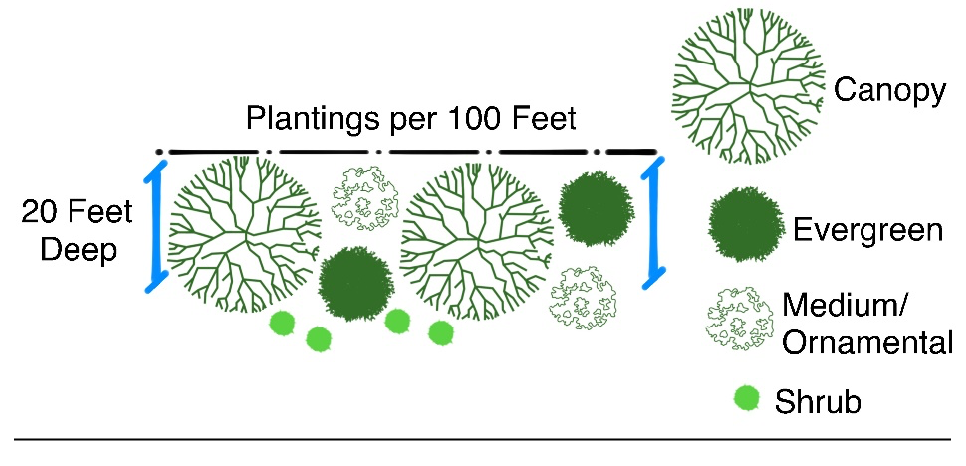
Figure 10-1 Buffer Zone A
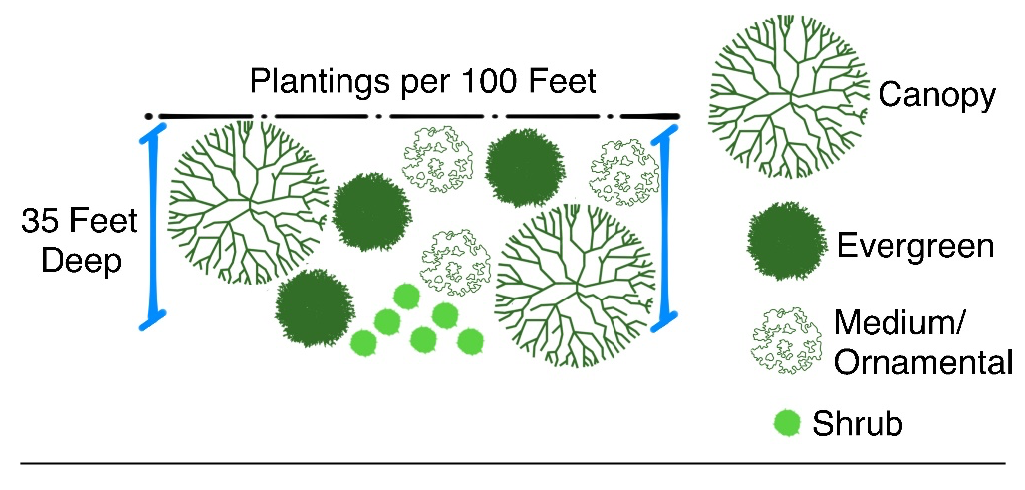
Figure 10-2 Buffer Zone B
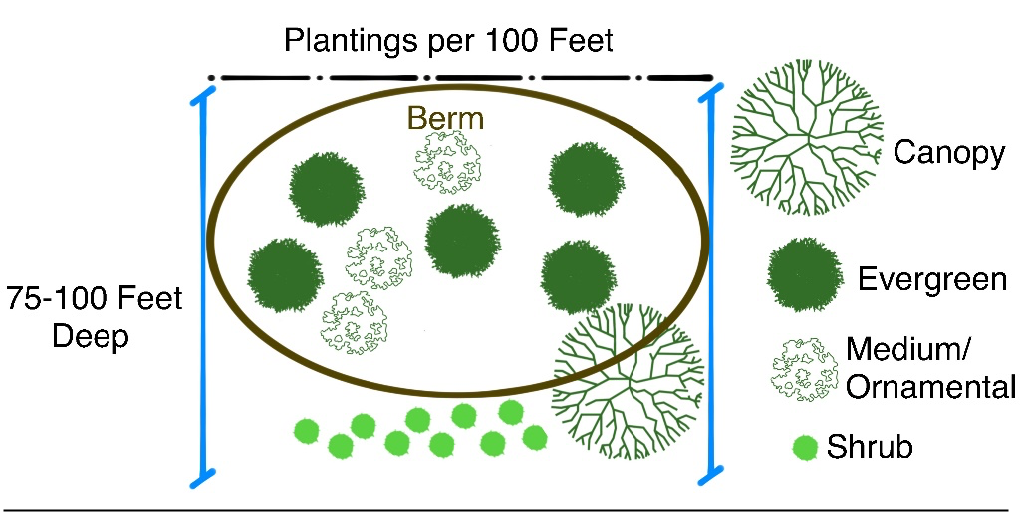
Figure 10-3 Buffer Zone C
(Ord. No. 23-03-0010, § 5(Exh. A), 6-22-23)
Section 10.50 - Street Yard Greenway Landscaping.
To protect and enhance the beauty and aesthetics of properties within the City of Port Wentworth and effectively screen front yard parking areas when viewed from the street right-of-way, the following shall be required.
A.
General Provisions.
1.
All required greenways shall contain only living plant materials; provided, the following may be located within the greenway in addition to the planting requirements when approved as part of the site plan:
a.
Decorative walls or fences less than four (4) feet high;
b.
Vehicular access drives placed approximately perpendicular to the right-of-way;
c.
Electrical, telephone, gas, water supply, sewage disposal, and other utilities may be constructed to pass through or across the required buffer area. If the installation of such services impacts the requirements of this ordinance, additional landscaping and/or greenway area may be required to meet the intent and standards of this section;
d.
Foot and bicycle paths (including sidewalks);
e.
Landscape sculpture, lighting fixtures, trellises, pedestrian amenities, and arbors;
f.
Bus/transit shelters;
g.
Signs;
h.
Berming or mounding of soil; and
i.
Bioretention and other heavily vegetated stormwater BMPs.
2.
When calculating lot frontage, driveways shall be subtracted from the linear foot total.
3.
Where existing or created lagoons and drainage swales will occupy a substantial portion of the required street yard greenway, additional depth may be required to achieve the intent of this section.
4.
Any area not otherwise planted shall be sodded.
5.
The minimum planted size for each plant type within required street yard greenways shall meet the minimum specifications cited in Table 10.30.
B.
Non-Residential Uses. Non-residential (commercial, industrial, office, civic, institutional, etc.) uses shall provide a greenway adjacent to the public street right-of-way. In all cases, the requirements of Section 10.90 shall be met; provided, that existing protected trees shall be counted toward the planting requirements for street yard greenways. This requirement does not apply to the C-1 zoning district.
1.
For non-residential development fronting on Arterial Streets, the following standards shall apply:
a.
A minimum twenty-five-foot-deep landscaped greenway shall be established parallel to the entire frontage along the road right-of-way. If an easement parallels the frontage and precludes planting the required trees, the greenway shall be in addition to the easement or increased to the extent that the planting requirements can be met. (Example: If a fifteen-foot power easement is directly adjacent to the right-of-way and does not permit trees within it, the twenty-five-foot greenway would commence from the interior edge of the easement for a total of forty (40) feet).
b.
The greenway shall include:
i.
One (1) large canopy tree (Live Oak preferred) per fifty (50) feet of linear frontage, spaced no more than fifty (50) feet on-center (o.c.) for the entire lot frontage. For areas where overhead utilities exist that preclude planting large trees, two (2) medium canopy trees shall be provided for every one (1) large tree required.
ii.
Four (4) small canopy trees (Crape Myrtle preferred) or palms for every one hundred (100) linear feet of lot frontage.
iii.
A double row staggered evergreen shrub hedge or otherwise approved continuous grouping of evergreen shrubs planted along the lot frontage planted at a minimum of two and one-half (2 ½) feet o.c. and a species capable of being maintained at a three (3) foot height within two (2) years of planting.
iv.
Vehicular entrances shall be defined using a mixture of trees, shrubs, and groundcovers that will create a sense of arrival. Clusters of flowering and other ornamental plant species such as knockout roses, ornamental grasses, and annuals, are strongly encouraged. A minimum of two hundred (200) square feet shall be planted on each side of the entrance drive.
2.
For all non-residential development fronting on collector streets the following standards shall apply:
a.
A minimum fifteen-foot-deep landscaped greenway shall be established parallel to the entire frontage along the street right-of-way. If an easement parallels the right-of-way frontage and precludes the ability to meet the requirements, as specified below, the fifteen-foot greenway shall be in addition to the easement width or increased to the extent that the planting requirements can be met. (Example: A fifteen-foot power easement directly adjacent to the right-of-way that does not allow trees planted within it will require the fifteen-foot greenway to start inside the property once outside the easement for a total of thirty (30) feet required).
b.
The greenway shall include:
i.
One (1) large canopy tree (Live Oak preferred) per 50 feet of linear frontage, spaced no more than fifty (50) feet on-center (o.c.) for the entire lot frontage. For areas where overhead utilities exist that preclude planting large trees, two (2) small or medium canopy trees shall be provided for every one (1) large tree required.
ii.
A double row staggered evergreen shrub hedge or otherwise approved continuous grouping of evergreen shrubs planted along the lot frontage planted at a minimum of two and one-half (2 ½) feet o.c. and a species capable of being maintained at a three (3) foot height within two (2) years of planting.
iii.
Vehicular entrances shall be defined using a mixture of trees, shrubs, and groundcovers that will create a sense of arrival. Clusters of flowering and other ornamental plant species, such as knockout roses, ornamental grasses, and annuals, is strongly encouraged. A minimum of one hundred (100) square feet shall be planted on each side of the entrance drive.
C.
Residential and Sylvicultural (Timbering) Uses. A street yard greenway at least twenty (20) feet in depth shall be established adjacent to the Arterial or Collector street right-of-way of all single- and two-family residential developments and fifty (50) feet in depth along timber harvesting sites; provided, timbering sites adjacent to a residential use shall maintain a separation of one hundred (100) feet along the entire property line that abuts the residential use. The following requirements shall apply to the street yard greenways:
1.
Plantings. Plantings shall consist of trees and shrubs in combination. Planted areas shall be in areas that will provide the best screening effectiveness. The following minimums shall apply to street yard greenway plantings:
a.
Fifteen (15) large evergreen shrubs per one thousand (1,000) square feet of greenway (Shrubs shall attain a minimum height of six (6) feet within three (3) years after planting).
b.
Two (2) small or medium canopy trees per one thousand (1,000) square feet of greenway.
c.
One (1) large canopy tree per one thousand (1,000) square feet.
2.
Protected Trees. In all cases, the requirements of Section 10.90 shall be met; provided, that existing protected trees shall be counted toward the planting requirements for street yard greenways.
3.
Walls. If incorporated into the required street yard greenway, walls shall be constructed in a durable fashion of masonry materials on both sides and be a minimum height of four (4) feet. The wall shall be placed along the interior of the greenway area with the required plantings located on the street side of the wall.
4.
Fences. If fences are incorporated into the greenway, they shall be constructed of durable, low-maintenance materials such as standard pressure-treated wood (but not woven wood) or vinyl and be at least four (4) feet in height. Fences shall be placed along the interior of the greenway, with the required plantings located on the street side of the fence.
5.
Berms. Earthen berms, if incorporated into the greenway, shall have a slope of 3:1 and a flat-topped crown at least two (2) feet wide. Plant material shall be placed along the top of the berm and the side slope facing the street. Berms shall not exceed six (6) feet in height and shall be undulated to provide a more natural appearance.
D.
Single-Family Detached Subdivisions. In addition to the requirements of Section 10.50 B, the required street yard greenway for single-family detached residential subdivisions shall also be subject to the following standards:
1.
For single-family subdivisions, a greenway fifty (50) feet in depth and meeting the requirements of Section 10.50 B shall be maintained along the street frontage where the rear yard of the lots abuts the street right-of-way.
2.
The greenway shall be a combination of existing healthy vegetation and/or newly planted landscaping; provided, all existing protected trees shall be retained within the greenway. The greenway shall remain uninterrupted along the length of the property, except to allow for access roads, signs, and entry features. Diseased, dead, or invasive species shall be removed from the greenway. Should the existing vegetation not provide an adequate greenway, additional supplemental plantings, berms, etc. may be required.
E.
Multiple-Family and Attached Single-Family Uses. In addition to the requirements of Section 10.50 B, the required street yard greenway for multiple-family and attached single-family uses shall also be subject to the following standards:
1.
A street yard greenway of fifty (50) feet in depth shall be maintained along the entire property frontage abutting the Arterial or Collector street right-of-way.
2.
The greenway shall remain uninterrupted along the length of the property, except to allow for access roads, signs, and entry features.
3.
All protected trees shall be retained within the greenway and supplemented as needed. In all cases, the requirements of Section 10.90 shall be met; provided, that existing protected trees shall be counted toward the planting requirements for street yard greenways.
(Ord. No. 23-03-0010, § 5(Exh. A), 6-22-23)
Section 10.60 - Parking Lot Landscaping.
A.
Applicability. Surface parking lots of more than twenty (20) spaces shall include landscaped tree islands meeting the requirements of this section.
B.
Requirements. The following landscaping requirements shall apply for parking lot interiors:
1.
A landscaped island at least ten (10) feet wide and one hundred twenty (120) square feet in area shall be installed within all parking rows at intervals no greater than every ten (10) parking spaces. Each landscaped island shall contain one (1) medium canopy tree, as specified in Table 10.30.
2.
If overhead utilities preclude the planting of a medium tree, small trees and/or palms shall be planted at a ratio of two (2) small trees and/or palms to every one (1) medium tree required.
3.
All island plantings shall be protected from vehicle bumpers with curbing, wheel stops, or other appropriate means of protection.
4.
All islands shall have soil suitable for vigorous plant growth to a minimum depth of twenty-four (24) inches. The top of grade for the center of all islands shall be mounded to a height of twelve (12) inches above adjacent curb or edge of the pavement. The use of unsuitable muck/clay soils in these areas is prohibited. Any islands that have been compacted during construction shall have the compacted soil removed and replaced with appropriate soil capable of allowing vigorous plant growth. The City reserves the right to inspect the soil within these areas at any time, and should the soils be found to be substandard, the soils, plantings, mulch, etc. shall be removed and replaced, as necessary, to be in conformance. A note acknowledging these soil requirements shall be included on all landscape plans.
5.
All islands shall also be planted with low-growing shrubs and/or groundcover.
C.
Alternatives. Alternatives to the strict application of the maximum of ten (10) spaces in a row may be considered where practices such as the preservation of existing trees are proposed.
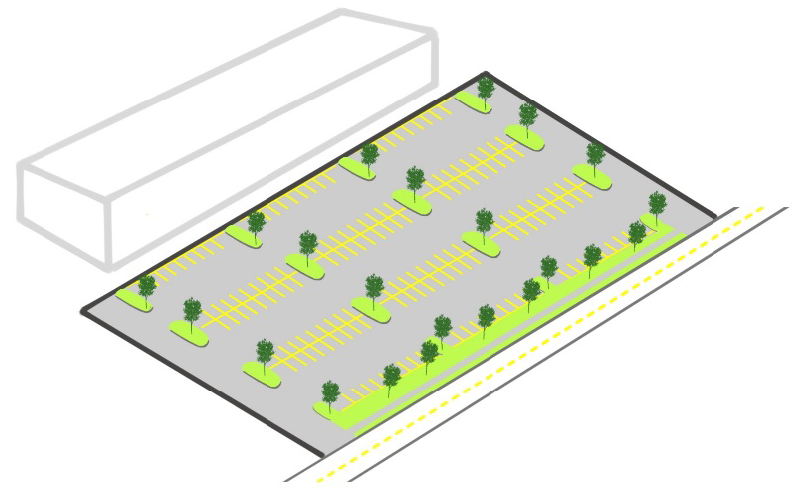
Figure 10-4 Parking Lot Landscaping
(Ord. No. 23-03-0010, § 5(Exh. A), 6-22-23)
Section 10.70 - Screening.
A.
Applicability. Outdoor storage, service, and dumpster areas shall be adequately screened with permanent vegetation and/or walls when visible from adjacent properties or street right-of-way, in accordance with the following:
1.
The design of a screening wall shall be the same architectural style as the principal building or buildings on the lot.
2.
Except where otherwise allowed by these regulations, any wall shall be opaque to prevent the passage of light and debris and shall be constructed of textured or split-faced block, brick, stone, stucco over concrete block, architectural tile, or similar opaque materials. Unfinished concrete block shall not be permitted.
3.
The height of a wall shall be adequate to block the view to the area being screened but shall not exceed eight (8) feet, except as otherwise allowed by this section. Wall height shall be measured from the finished grade at the base of the wall to the top of the fence or wall but shall not include columns or posts.
4.
Walls shall be interrupted at intervals not exceeding twenty-five (25) feet by architectural features such as pilasters or columns or by various species of plants that are at least as tall as or taller than the wall.
5.
Such walls shall be setback a minimum of five (5) feet from any adjacent property lines unless otherwise approved as part of the site plan review.
6.
Additionally, during site plan review, evergreen plantings or other trees may be required along the wall to provide a visual accent for lengthy and monotonous walls.
B.
Landscape Alternative. In lieu of a screen wall, a dense landscape screen which, in the site plan reviewer's sole discretion, meets the intent of this section to visually screen and soften the impact of the storage, service, or dumpster area.
C.
Modification. Where the storage, service, or dumpster is located adjacent to a required buffer or street yard greenway, the requirements of this section may be waived or modified by the City Council, as provided in Section 10.80.
(Ord. No. 23-03-0010, § 5(Exh. A), 6-22-23)
Section 10.80 - Landscaping Modifications.
A.
Conditions. The requirements of this article may be waived or modified by the City Council, under any of the following conditions:
1.
If it is clearly demonstrated that the existing topography and/or vegetation will achieve the purposes of this article.
2.
If it is clearly demonstrated that for topographic reasons, no required screening device could reasonably screen the ground level activities of the use from the adjacent street or first-floor view of an abutting structure.
3.
It is clearly demonstrated that an existing (or proposed) public right-of-way separation between adjoining properties will achieve the purposes of this article.
B.
Petition. Any person affected by this article may petition the City Council for a waiver or modification from the strict application of any provision or provisions, as follows:
1.
The application shall be made upon a form provided by the Zoning Administrator.
2.
A public hearing shall be held on the application after due notice to the applicant and adjoining property owners.
3.
The City Council, upon considering all evidence and input at the public hearing, shall approve or deny the request based upon the following criteria:
a.
That there are unique physical circumstances or conditions or exceptional topographical or other physical conditions peculiar to the particular property that prevent or severely inhibit compliance with all or a portion of the requirements of this article.
b.
Failure to grant relief would result in practical difficulties and exceptional hardship.
c.
That granting relief would not adversely impact the overall purpose and intent of this article and would be the minimum necessary based on conditions of the property.
C.
Alternate Site Planting. Council, after finding that a waiver or modification of the landscaping requirements meets the above review criteria, may require that the trees/shrubs shall be planted on an alternate site as approved by the City Council.
(Ord. No. 23-03-0010, § 5(Exh. A), 6-22-23)
Section 10.90 - Tree Preservation.
A.
Requirements. These regulations shall apply to all trees and land in the City of Port Wentworth, except as noted below; provided, that even for those exempted, tree preservation and best practices are strongly encouraged to uphold the intent of this ordinance.
1.
Applicability. All trees not specifically exempted shall be regulated by the provisions of this ordinance. Protected tree classifications are defined in Section 10.90 B. Conditions under which protected trees may be removed by permit are specified in this section.
2.
Exemptions. The parties listed below are exempt from this section to the extent specified.
a.
Timber harvesters and foresters: Timber harvesting and forestry shall be exempt from this section.
b.
Commercial tree farms and nurseries: Growers raising trees for sale and transplant shall not be held to the provisions of this article; provided, such trees are not planted in protected wetlands or required buffer zones after the adoption of this ordinance.
c.
Public utilities: Utility providers shall be exempt from these regulations within easements and rights-of-way in which clearing is necessary for the public safety and welfare. The regulations of this article, however, shall apply within any required buffer zone.
d.
Occupied single-family dwelling: Developed single-family residential lots shall be exempt from the heritage tree protection requirements, but not those pertaining to grand trees or specimen trees: provided, the lot is occupied by a single-family dwelling or manufactured home erected on the lot prior to the adoption of this ordinance. This provision shall not exempt individual lots or parcels being prepared for development and shall not exempt existing developed lots from the provisions of Section 10.90 A.4 regarding the preservation of trees within the street yard greenway.
3.
Maintenance or Removal. Nothing in this section shall be construed to prevent the ordinary pruning, trimming, and maintenance of a tree, nor to prevent the cutting or removal of any tree that is diseased, dying, or required to be removed by a governmental agency for public safety. However, such maintenance or removal shall only be performed by a certified arborist.
B.
Protected Tree Classifications. These regulations shall apply to three (3) categories of trees: Heritage Trees, Grand Trees, and Specimen Trees, collectively known as Protected Trees.
1.
Heritage Tree. All trees meeting a minimum of twelve (12) inches diameter at breast height (DBH) but less than twenty-four (24) inches DBH.
2.
Grand Tree. A grand tree, due to its age and stature, is considered to have irreplaceable value and is defined as any tree twenty-four (24) inches in DBH or greater.
3.
Specimen Tree. A tree that is of significant size for that species as determined by an arborist, landscape architect, forester, or other licensed tree professional.
C.
Tree Preservation Standards. Protected trees, unless otherwise permitted by these regulations, shall not be removed, or be caused to be removed. Approval to remove such trees shall be obtained from the Zoning Administrator upon filing a request for a tree removal permit. If approval to remove protected trees is given, the removed trees shall be replaced according to the mitigation requirements of Section 10.90 G. Individuals failing to obtain a tree removal permit shall be cited as provided in Section 10.90 F.
D.
Tree Removal Permit. Except as otherwise exempt, it shall be unlawful to fell, improperly prune, or otherwise destroy a protected tree without first obtaining a tree removal permit from the Zoning Administrator.
1.
Exception. A tree removal permit shall not be necessary to remove a tree creating imminent danger to other trees, permanent structures, public utilities, rights-of-way, or persons. A tree posing imminent danger shall be defined as one (1) damaged by a storm, fire, or vehicular accident such that its structural integrity is seriously compromised and that the tree can be reasonably expected to fall and injure persons or structures.
2.
Permit Application Procedure.
a.
Application for a tree removal permit must be made at least three (3) business days in advance of the proposed tree removal. The Zoning Administrator shall issue the permit, valid for sixty (60) days, if the request meets the criteria for tree removal, as specified in Section 10.90 D.3.
b.
The applicant may apply for a tree removal permit concurrently with a subdivision plan submittal, request for concept plan approval, or a building permit.
c.
A tree survey meeting the requirements of this section shall be submitted as part of the permit application. The tree survey shall be prepared by a certified arborist and shall depict the location, species, and size in DBH of all protected trees in the development area and differentiate them as to whether they are heritage, grand, or specimen trees. The development area shall be defined as all areas within fifty (50) feet of any proposed grading, temporary and permanent structures, and other improvements; and as wetlands proposed to be disturbed. The survey shall specify which trees are proposed for removal.
i.
For developments disturbing more than twenty-five (25) acres, this tree survey requirement may be satisfied by a "sample area" survey. Each sample shall cover at least one (1) acre. Sample areas shall be evenly distributed throughout the site and proportional to the acreage of types of forest found on the site. Sample areas shall represent at least five (5) per cent of the site or five (5) acres, whichever is greater. The surveyor shall estimate the relative densities and total number of heritage trees across the site based on the distribution of these trees in the samples. Grand trees and specimen trees shall nevertheless be individually surveyed and documented by location, species, and size in DBH. Upon reviewing the sample survey, the plan reviewer may require that inventories be taken of additional sample sites of their choosing.
ii.
For development plans disturbing twenty-five (25) or fewer acres, all protected trees shall be individually surveyed.
d.
Trees to be preserved will be physically marked with brightly colored engineer's tape. The property may first be inspected by the Zoning Administrator before approval is granted. The tape on those trees approved for preservation shall be left in place throughout construction. Following inspection by the Zoning Administrator, the tree removal permit will be approved, partially approved, or disapproved.
e.
If the permit is approved or partially approved, the applicant shall post a financial guarantee, as provided in Section 12.90, prior to commencing any tree removal activities to ensure preservation of those trees not authorized for removal.
f.
It shall be the responsibility of the applicant to post the tree removal permit on the property in a place that is visible from the public right-of-way throughout any tree removal activity.
3.
General Criteria. The following conditions, when attested to by a registered forester or certified arborist, shall constitute grounds for issuance of a tree removal permit regardless of use or zone:
a.
Trees potentially hazardous to surrounding trees, permanent structures, public utilities, rights-of-way, or persons due to a loss of stability caused by high wind, unstable soil, age, or other natural forces.
b.
Diseased and/or infectious trees and trees in decline.
c.
Trees or their root systems causing visible damage to permanent structures that cannot be prevented through proper pruning.
d.
Trees or their root systems causing damage to utility lines that cannot be prevented through proper pruning.
e.
Trees inhibiting access through a street right-of-way such that proper pruning cannot mitigate the condition.
f.
Trees creating hazardous conditions on pedestrian walkways underneath such trees due to excessive debris of a size and shape known to cause injuries from tripping and falling, as determined by the Zoning Administrator.
4.
Design Criteria for Property Development. The following criteria shall be followed with respect to the applicable property development:
a.
Subdivision of parcel: The subdivider shall make conscious efforts to avoid grand trees and specimen trees, as well as groupings of heritage trees in proposing placement of rights-of-way and easements. Additionally, lots shall be platted in a way that avoids the removal of grand trees, specimen trees, or groupings of heritage trees, such as locating them in the middle of proposed lots. Lot lines should be platted adjacent to protected trees to retain them as design features and vegetative buffers and to mitigate storm water run-off and erosion problems.
b.
Building envelopes: Grand trees and specimen trees within a proposed building footprint and for a distance of twenty (20) feet from the perimeter of that footprint shall be mitigated if removed, in accordance with Section 10.90 G. Heritage trees within a building footprint and an area twenty (20) feet from the perimeter of the footprint may be removed without mitigation if determined to be necessary by the reviewer.
c.
Setbacks and buffers: Protected trees shall not be removed from required setbacks (except as may be permitted by paragraph b regarding building envelopes), street yard greenways, or buffer zones and shall be counted toward the landscape requirements for such areas. A protected tree may be limbed up if located outside a required buffer. Heritage trees may be limbed up to eight (8) feet, while grand trees and specimen trees may be limbed up to sixteen (16) feet to provide view sheds.
d.
Means of access and parking: Grand trees and specimen trees shall not be removed to make way for parking lots, parking spaces, drive aisles, or driveways unless the applicant demonstrates to the satisfaction of the reviewer that no reasonable alternative exists. Heritage trees may be removed in these locations, but mitigation shall be required per Section 10.90 G.
e.
Outdoor uses and active recreation areas. Except as otherwise restricted in this section, protected trees may be removed on land where the principal use is proposed outside; provided, mitigation shall be required for all trees per Section 10.90 G. The Zoning Administrator shall determine whether the proposed outdoor use qualifies under this provision and that the protected tree removal is the minimum necessary to accommodate the proposed use. Qualifying uses shall include, but are not limited to: outdoor sales areas with minimal ancillary indoor space, transportation and construction businesses that store fleet vehicles on site, outdoor storage of containers and oversized bulk items that cannot practically be stored under roof, industrial activities and processes that do not occur under roof, as well as recreation areas, such as golf courses, athletic fields, courts, and pools managed by schools, public recreation departments, country clubs, home owners associations, and other legally established organizations.
f.
Streets: Protected trees may be removed without mitigation from public rights-of-way to allow for arterial and collector street construction, including widening, intersection improvements, parallel bicycle/pedestrian improvements, and drainage improvements. Grand and specimen trees removed for construction of local street projects shall be mitigated per Section 10.90 G, while heritage trees may be removed from local street rights-of-way without mitigation.
g.
Water, sewer, and drainage improvements: Protected trees may be removed, but must be mitigated per Section 10.90 G, for installation of water, sewer, and drainage infrastructure and implementation of associated easements on private property.
h.
Waters of the State: Protected trees within twenty-five (25) feet of any water of the State shall be preserved and no disturbance shall occur within the critical root zone, even if more than twenty-five (25) feet distant from such water.
E.
Tree Protection Procedures. The base and root systems of most trees are very sensitive to changes and must be protected to ensure the tree's health and survival. The following measures shall also be taken to protect trees located off-site but whose limbs and drip lines encroach across property boundaries.
1.
Protected trees shall have their critical root zone guarded before, during, and after construction against the following:
a.
Unnecessary cutting, breaking, or skinning of roots.
b.
Skinning and bruising of bark.
c.
Storing or stockpiling construction, excavation, or other machinery, tools, materials, and debris within drip lines.
d.
Burning within drip lines.
e.
Absorption of wastewater run-off within drip lines.
f.
Excessive foot or vehicular traffic within drip lines.
g.
Parking vehicles within drip lines.
2.
Wounds to protected trees shall be cleaned to sound wood by removing loose bark and wood, leaving a smooth edge around the wound, and be properly dressed.
3.
If any protected tree roots are to be removed, they shall be severed clean and treated with a two (2) inch layer of mulch applied on the surface above the roots, to be retained and replenished throughout harvesting and construction activities.
4.
Soil removal or fill within the drip line of a protected tree shall be limited to six (6) inches in depth. Any soil added under the drip line shall be a loamy soil mix to ensure minimal compaction.
5.
The following additional measures shall be taken to protect trees scheduled to be retained in preparation for and during property development.
a.
Setbacks. Site improvements, other than landscaping and hardscaping, shall not occur within the critical root zone.
b.
Protective barricading. Barricades shall be erected around all protected trees according to required setbacks, as provided in Subsection 5.a. above. Barricades shall be erected prior to the start of site grading and shall remain in place until all construction activities are complete. The following standards apply:
i.
Barricading trees in groups is encouraged.
ii.
Barricades a minimum of three (3) feet high shall be erected and readily apparent, including in the rearview or side mirror of vehicles and construction equipment moving in reverse.
iii.
Barricading shall consist of orange safety fencing supported by wood/metal members or other comparable material approved by the Zoning Administrator. In any case, barricading shall be capable of repelling a man moving at walking speed. Flagged string or tape alone shall not be sufficient to meet the barricading material requirements.
iv.
All tree protection areas shall be designated with signs or tape posted visibly on or within the required barricade. Tree protection area signs shall denote the area as off-limits for the sake of tree protection.
v.
Utilities shall not be installed in tree protection areas without the use of special tunneling techniques to preserve root systems.
F.
Violation and Penalty.
1.
The removal, damage, or destruction of a protected tree without a required tree removal permit shall constitute a violation of this ordinance. Each protected tree that is removed, damaged, or destroyed shall constitute a separate offense. Each day during which the loss of the tree goes unmitigated, as provided below, shall be judged a separate offense.
2.
In lieu of any fines and penalties incurred by a violator of this section, the Zoning Administrator may require tree replacement as a condition of granting Certificates of Occupancy. Replacement trees shall be required such that the total caliper inches of new trees shall be equivalent to a fifty (50) per cent increase in the mitigation requirements as set forth in Section 10.90 G. In no case, however, shall any replacement tree measure less than four (4) inch DBH for any protected tree.
3.
In the event that violations of this article result in the issuance of a stop work order, the violator shall be responsible for tree replacement, payment of fines, or posting a financial guarantee, as determined by the Zoning Administrator, before construction is allowed to resume.
4.
In the event that the violator of tree protection standards cannot be identified and located, the developer shall be held responsible for fines and mitigation.
G.
Mitigation for Tree Removal.
1.
Trees planted for mitigation shall meet the performance standards of this article. Mitigation for protected trees shall be as specified in Table 10-90, based on the species of the tree that was removed. In addition, the following size requirements shall apply:
a.
Mitigation for heritage trees shall occur at a rate of fifty (50) per cent, where every two (2) inches of heritage trees removed, measured in DBH, shall be replaced by one (1) inch of mitigation trees, measured in caliper inches.
b.
Mitigation for grand and specimen trees shall occur at a rate of one hundred (100) per cent, where every inch of tree removed, measured in DBH, shall be replaced by one (1) inch of mitigation trees, measured in caliper inches.
c.
Any tree planted for mitigation shall measure at least four (4) inches DBH at the time of planting.
2.
Any tree at least six (6) inches DBH but less than twelve (12) inches DBH retained within the area of disturbance may be retained to contribute, inch for inch, to a tree mitigation requirement; provided, the tree does not stand in a wetland, any required buffer, street yard greenway, or other area in which the tree would otherwise be required to be conserved. Such trees shall be protected as heritage trees.
3.
Trees planted for mitigation in new developments shall be in addition to those required for street yard greenways, buffering, and parking lots and may be used to create a street yard greenway in existing developments where such greenway does not currently exist.
4.
There is hereby created a City tree escrow fund for the purpose of receiving money paid to the City in lieu of mitigation. The fund will be used by the City to purchase, plant, and maintain trees or landscaping on public rights-of-way, easements, or other public property. If the required mitigation cannot be met on-site due to lot size and allowable lot coverage, then payment shall be made to the tree fund.
(Ord. No. 23-03-0010, § 5(Exh. A), 6-22-23)
Section 10.100 - Grading, Excavation, and Ponds.
The construction, maintenance, or existence within the City of any unprotected, unbarricaded, open, or dangerous excavations, holes, pits, or wells, which constitute or are likely to constitute a danger or menace to the public health, safety, or welfare, is hereby prohibited; provided, this section shall not apply to the following:
A.
Any excavation under a permit issued by the City where such excavation is properly protected and warning signs posted in such manner as approved by the City; and
B.
Rivers, streams, other natural water bodies, ditches, reservoirs, and similar bodies of water created or existing by authority of governmental units or agencies.
(Ord. No. 23-03-0010, § 5(Exh. A), 6-22-23)
Section 10.110 - Stormwater Management.
All requirements of Article III, Stormwater Management, of Chapter 7 of the City Code of Ordinances shall be met.
(Ord. No. 23-03-0010, § 5(Exh. A), 6-22-23)
Section 11.10 - Intent and Purpose.
A.
Intent. To ensure safe travel and street conditions for all users, streets established in any subdivision shall comply with the requirements of this article.
B.
Purpose. Street design shall enhance the quality of life for Port Wentworth's citizens by promoting high-quality residential development and minimizing safety hazards to drivers, cyclists, and pedestrians.
C.
Technical Specifications. The Community Development Department maintains a set of standard details and specifications on file illustrating details of construction and design of streets, sidewalks, stormwater drainage facilities, site improvements, and other elements related to the development of land in accordance with the Zoning Ordinance. These details and specifications are contained in the City of Port Wentworth Comprehensive Development Manual.
(Ord. No. 23-03-0010, § 5(Exh. A), 6-22-23)
Section 11.20 - Subdivision Street Requirements.
A.
Overall Design.
1.
Access and Circulation. Proposed streets shall provide a safe, convenient, and functional system for vehicular, bicycle, and pedestrian circulation and shall be appropriate for the particular traffic characteristics of each proposed subdivision or development. New subdivisions shall be supported by a thoroughfare network having adequate capacity and safe and efficient traffic circulation.
2.
Street Layout. Street layout should show consideration of natural features such as trees and wetlands, drainage requirements, traffic calming measures, addition or relocation of public spaces, and utility location.
3.
Major Thoroughfare Plan. The subdivider shall design the street system within such subdivision to conform to the location and arrangement of such arterial streets and collector streets of any applicable major throughfare plan adopted by the City of Port Wentworth.
4.
Interior Streets. Interior streets within subdivisions shall be so laid out and designed that their use by through traffic and speeding traffic will be discouraged.
5.
Continuation of Existing Street Pattern. The arrangement of streets in a subdivision shall provide for the alignment with, or the continuation of, or the appropriate projection of, existing principal streets in surrounding areas.
6.
Subdivisions on Arterial Streets. Where a subdivision abuts or contains an existing or proposed arterial street, residential lots shall not have individual driveways to the arterial street.
B.
Minimum Curb and Street Radius. The lot line radius at intersecting streets shall be not less than twenty (20) feet. The centerline radius of all curvilinear streets shall be not less than seventy-five (75) feet.
C.
Dead Ends.
1.
Permanent Dead-End Streets. Dead-end streets, designed to be such permanently, shall be provided at the closed end with a turnaround having an outside roadway diameter of not less than ninety-six (96) feet and a right-of-way diameter of not less than one hundred (100) feet.
2.
Temporary Dead-End Streets. Temporary dead-end streets shall be provided with a temporary turnaround area which shall meet the requirements for design, maintenance, and removal as approved by the Mayor and Council.
D.
Block lengths. Any block exceeding six hundred (600) feet in length shall include a mid-block crosswalk. Blocks shall not exceed eight hundred (800) feet.
E.
Street Names.
1.
Street Name Markers. Street name markers which shall be constructed to City specifications shall be installed at all street intersections.
2.
Street Names. All streets within a subdivision hereafter established shall be named as approved by the Manager and Council. No name shall be used which will duplicate or be confused with existing street names.
F.
Gates. No gates or other limited access devices shall be allowed on public streets.
G.
Sidewalks and Bike Lanes.
1.
Sidewalks shall be installed on both sides of streets. Requirements may be reduced or eliminated for roads adjacent to or crossing wetland areas or lakes, where dwellings or buildings are not proposed, or in industrial development.
2.
When provided, bike lanes shall be in addition to the minimum pavement width. Bike lanes are a separate feature from pedestrian sidewalks and multipurpose trails and shall be constructed as such in accordance with guidelines developed by the American Association of State Highway and Transportation Officials (AASHTO).
H.
Streetlights. Streetlights shall be installed in residential areas at a distance to provide safety to the neighborhood in accordance with City guidelines and requirements. Streetlights shall be installed in retail areas to provide illumination to encourage evening activity along the street.
(Ord. No. 23-03-0010, § 5(Exh. A), 6-22-23)
Section 11.30 - Private Street Easements and Maintenance.
A.
Review and Recording.
1.
Applications for private streets and shared commercial driveways shall include a recordable legal instrument describing and granting the easement and a maintenance agreement.
2.
The easement shall be recorded, and a copy of the recorded easement shall be provided to the Zoning Administrator.
B.
Easement Width. See Table 11.40.
C.
Maintenance Agreement Content. A copy of a recordable travel surface maintenance agreement, signed by all owners of the lands served by the access easement and other parties in interest, which includes the following:
1.
Provisions that assure that the travel surface will be maintained and repaired for the full width and length to ensure safe travel and accessibility by emergency vehicles at all times.
2.
A legal description of the easement and a legal description of the individual lots or parcels to be served. All properties served by the easement and travel surface shall be subject to the maintenance agreement.
3.
Provisions declaring that the maintenance agreement constitutes a restrictive covenant, running with the benefitted lands, and binding on all current and future owners and other parties in interest as to the respective obligations stated therein.
4.
Provisions to indemnify, save and hold the City of Port Wentworth and its officers, employees, and agents harmless from any and all claims for personal injury and/or property damage arising out of the failure to properly construct, maintain, repair, or replace the travel surface.
(Ord. No. 23-03-0010, § 5(Exh. A), 6-22-23)
Section 11.40 - Street Dimensional Requirements.
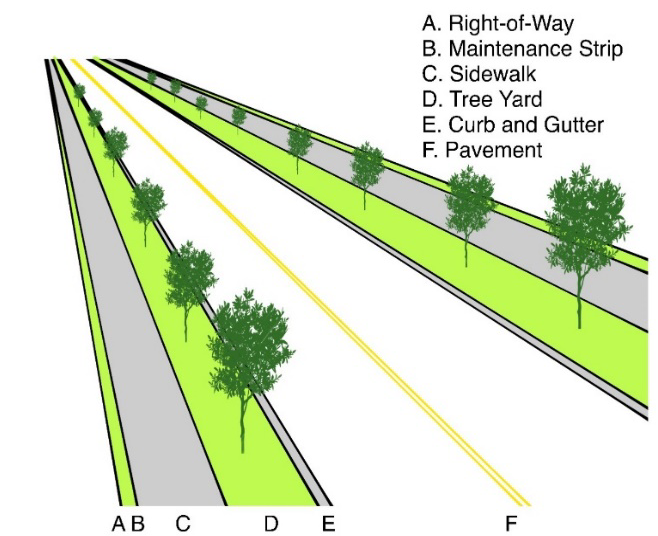
Figure 11-1 Street Design Elements
A.
Street Design and Construction Specifications. All streets established in any subdivision shall be designed and constructed in accordance with the following specifications. Street types shall be proposed as part of preliminary plat review and approved based on the design requirements and standards in this article.
B.
On-Street Parking. On-street parking lanes may be approved by the City Council during the preliminary plat process and shall be a minimum of eight (8) feet in width. This width shall be in addition to the pavement width requirements in Table 11.40. On-street parking shall be marked or posted with signage approved by the Community Development Department.
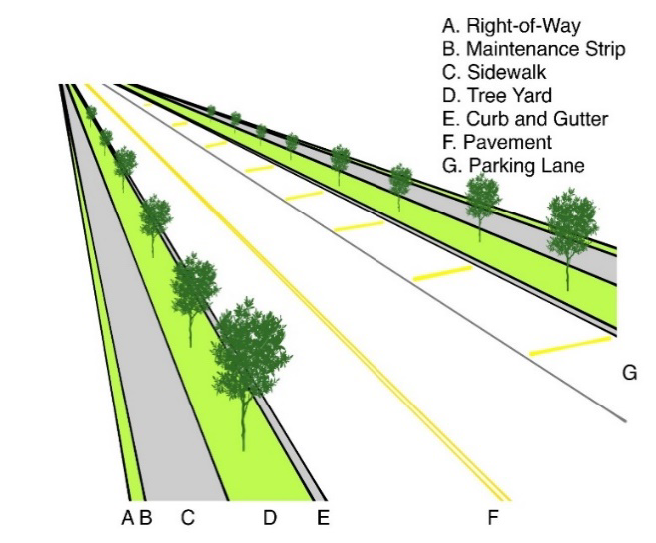
Figure 11-2 Street Design with Parking Lane
C.
Curb and Gutter. Curb and gutters shall be required for all streets.
(Ord. No. 23-03-0010, § 5(Exh. A), 6-22-23)
Section 11.50 - Subdivision Lot Layout and Design.
A.
Street Access. All lots shall front an existing public or private street unless performance guarantees are posted prior to the recording of a final plat.
B.
Lot Lines. Side lot lines shall be as nearly as practical at right angles to straight street lines and radial to curved street lines.
C.
Corner Lots. Corner lots for residential use shall be provided with sufficient width and depth to permit the establishment of front and side street setbacks.
D.
Through Lots. Through lots shall only be permitted where it shall be found necessary to separate a development from major arterials or to overcome specific disadvantages or topography and orientation.
E.
Minimum Lot Elevation. No lot shall be approved that does not contain a suitable site of sufficient elevation to permit a finished floor elevation as required in the Flood Damage Prevention Ordinance if located in a FEMA Special Flood Hazard Area, or at a greater elevation than the localized one (1) per cent annual, twenty-four-hour chance design storm event, if not located in a FEMA Special Flood Hazard Area.
F.
Residential Lots in Floodplain. Residential subdivision lots shall be prohibited within floodplain areas where the cost of providing governmental services in the area would pose an unreasonable economic burden.
G.
Lot Width and Lot Area Requirements. Lots shall conform to the lot area and lot width requirements as set forth by the applicable zoning district in which the subdivision is located or as required by the Chatham County Health Department. Where the Chatham County Health Department requires wider or larger lots for private water and sewer, the stricter requirement shall prevail.
H.
Commercial and Industrial Lots. Lots shall be of adequate depth and width for the type of commercial or industrial development contemplated and shall be sufficient in area and dimension to provide off-street parking and loading facilities.
I.
Preservation of Noteworthy Features. In all subdivisions, to the maximum degree reasonably practicable, efforts shall be made to preserve historic sites, scenic points, trees in accordance with Article 10, and other desirable natural growths, watercourses and other water areas, and other features worthy of preservation, either as portions of public sites and open spaces, or in such other forms as to provide amenity to the neighborhood.
1.
Large trees or other desirable natural growths located in public or private street rights-of-way or public or private easements shall not be removed unless such removal is necessary for the installation of utilities or drainage structures or for other purposes in the public interest and approved by the Mayor and Council.
2.
Such removal may be prohibited if the amenity of adjacent property, or the amenity of the general neighborhood, is adversely affected.
J.
Exempt Lots. Lots that do not comply with the requirements of the applicable zoning district are prohibited, except as follows:
1.
Signage, Landscape Features. The creation of an unbuildable lot in a proposed subdivision for the exclusive purpose of subdivision identification signage or subdivision entrance landscape features is authorized only under the following circumstances (no waiver, exception or variance is allowed):
a.
The lot must be located at an entrance to the subdivision as an "island" in the right-of-way of a local or minor collector street;
b.
A mandatory homeowner's association is required for the subdivision for ownership and maintenance of the lot as common area.
2.
Stormwater Management Facilities. The creation of an un-buildable lot for the exclusive purpose of providing and maintaining a stormwater management facility is authorized.
3.
Private Streets. The creation of an un-buildable lot for the exclusive purpose of providing and maintaining a private street is authorized.
4.
Conservation Areas. The creation of an un-buildable lot for the exclusive purpose of conserving land from development is authorized and must be recorded as such.
5.
Common Areas. The creation of an un-buildable lot, in common ownership, for the exclusive purpose of providing neighborhood amenities such as swimming pools or outdoor amenity space.
(Ord. No. 23-03-0010, § 5(Exh. A), 6-22-23)
Section 11.60 - Easements, Monuments, and Benchmarks.
A.
Easements.
1.
Types. The following kinds of easements shall be required within subdivisions:
a.
Utility Easement. Utility easements for water, sewer, and gas shall be provided where necessary, shall not be less than five (5) feet in width, and shall be centered on side or rear property lines when possible. The location, elevation, and construction of all public utilities, such as sewer, gas, electrical and water systems, and streets, shall be in such a manner as to minimize or eliminate damage by flooding.
b.
Drainage Easement. Where a subdivision is traversed by a water course, drainage way, channel, or stream, there shall be provided a stormwater easement or drainage right-of-way which shall conform substantially with the lines of such water course, drainageway, channel, or stream or shall be of such additional width or construction, or both, as will be adequate for the purpose.
c.
Maintenance Easement. Where a drainage canal is of such size that it requires mechanical means for cleaning, such as a dragline, there shall be a twelve-foot access easement on either side of such canal for access purposes unless similarly sized areas already lie within the drainage right-of-way within which the canal is located.
2.
Width. Required easement widths shall be increased if required by the City Engineer or in accordance with the Comprehensive Development Manual.
3.
Dedication. Easements shall be noted on the preliminary plat and shall be dedicated prior to final plat approval.
B.
Monuments. The subdivider shall provide stone or concrete monuments four (4) inches in diameter or square, thirty (30) inches long, with a flat top, which shall be set at each street corner, and at all points of curvature in each street. The top of the monument shall contain a metal pin or be scored with an indented cross to properly identify the location. The subdivider shall also provide all interior lot corners of subdivisions with concrete monuments, iron pins, or iron pipes. Iron pipes shall be at least one-half-inch in diameter and twenty-four (24) inches in length.
C.
Benchmarks. At least two (2) benchmarks shall be established within a subdivision. Such benchmarks shall be at opposite corners of the property being subdivided.
(Ord. No. 23-03-0010, § 5(Exh. A), 6-22-23)
Section 11.70 - Water Supply and Sanitary Sewerage.
A.
Public Water and Public Sewerage.
1.
When available in accordance with the Environmental Protection Division (EPD) of the Georgia Department of Natural Resources and City of Port Wentworth requirements, every portion of a subdivision shall be served by public water; when feasible, as determined by the Mayor and Council, every portion of a subdivision shall be served by a sanitary sewer system. All such systems shall be designed to preclude infiltration of flood waters into the system and discharges from the system into flood waters.
2.
Water and sewer systems must be constructed in accordance with EPD and City of Port Wentworth design specifications; sewer systems must connect to an existing publicly-owned treatment plant, where practical, and both water and sewer systems and trunk lines shall be conveyed to the City of Port Wentworth.
3.
When sewer is available, connections will be required to lots that were previously approved with septic systems.
B.
Private Water and Private Sewerage. Where either public water or public sewers or both are not available to a subdivision as determined by the Mayor and Council and a subdivider shall decide to establish a private water supply system and a private sewer system, then the plans and specifications for such private water system and sewer shall be approved by the Chatham County Health Department and the Mayor and Council. Any such private systems shall be so located as to avoid impairment of them, or contamination from them, during times of flooding.
C.
Publicly-Owned Water and Sewer Systems.
D.
Fire Hydrants. Fire hydrants shall be required for all subdivisions by a public or private internal water distribution system and shall be located and designed in accordance with the standards as set forth in the "Standard Fire Prevention Code," 1985 edition as amended, Section 603.1.3.
E.
Non-Potable Reuse Line (NPRC). A non-potable reuse water main shall be installed in a subdivision. The system shall include reuse water mains, valves, fittings, and hydrants and shall be installed in accordance with the plans and specifications approved by the City of Port Wentworth. The system shall be designed and installed in accordance with the City of Comprehensive Development Manual.
(Ord. No. 23-03-0010, § 5(Exh. A), 6-22-23)
Section 11.80 - Subdivision Modifications.
When a peculiar shape, the topography of a tract of land, or other unusual condition, makes it impractical for a developer to comply with the literal interpretations of the design requirements of this article, the City Council, following a recommendation of the Planning Commission, may approve modifications to the design requirements in this article as part of preliminary plat review; provided, however, that in so doing the intent and purpose of this article are not violated.
(Ord. No. 23-03-0010, § 5(Exh. A), 6-22-23)
This page is intentionally blank.

