
Portal City Zoning Code
ARTICLE 14
- SUPPLEMENTAL STANDARDS FOR SPECIFIC USES8
Editor's note— An amendment of Apr. 4, 2023(2), §§ 1401—14-51, repealed the former art. 14, §§ 1401—1404, and enacted a new art. 14 as set out herein. The former art. 14 pertained to MHP manufactured home park, and derived from the original Code and Ord. No. 1997-40, adopted Dec. 2, 1997.
Section 1401.- Purpose.
The purpose of this article is to establish supplemental standards for specific uses and activities that are permitted or conditionally permitted in several or all districts. These standards intend to minimize the impacts of these uses and activities on surrounding properties and to protect the health, safety, and welfare of their occupants and of the general public.
(Amd. of 4-4-23(2), § 1401)
Section 1402. - Applicability.
Each land use and activity covered by this article shall comply with the requirements of the section applicable to the specific uses or activities, in addition to any applicable standard required in the base or overlay district where the use or activity is proposed. Prior to a certificate of occupancy being issued, proof of the following must be submitted to the administrative officer:
(a)
Except for single-family and two-family residential developments, a contract or subscription with a private waste hauler is required.
(b)
The facility must meet all building, fire safety, health and safety and local tax compliance codes.
(c)
A right-of-way encroachment permit shall be applied for with the county engineer's office for approval of driveway access, design and construction.
(d)
Upon completion of 40 percent of a residential planned development, any required amenities shall be completed or installed.
(Amd. of 4-4-23(2), § 1402)
Section 1403. - Accessory uses.
(a)
They may not be located closer than ten feet to any property line in AG-5, R80, R40, R25, R15, and R8 zoning districts or five feet in R2, R3, PUD, HC, GC, NC, LI and HI zoning districts; however, this requirement does not apply to fences.
(b)
Accessory buildings not attached to the principal building must be located at least 12 feet from the principal building on the lot.
(c)
They must be located in the rear or side yard; however, this requirement does not apply to fences. Not applicable in HC, GC, LI and HI zoning districts. Also, not applicable to lots of five acres or more in the AG-5 zoning district.
(d)
Accessory structures shall not be erected on a lot prior to the construction of the principal structure.
(e)
Accessory structures shall not be used as a dwelling unit, except as provided in section 1404 which sets forth standards for accessory dwellings.
(Amd. of 4-4-23(2), § 1403)
Section 1404. - Accessory dwellings.
(a)
Accessory dwellings include, but are not limited to, site-built constructed structures including basement apartments, garage apartments, caretaker or other employee quarters, guesthouses, and other accessory dwellings.
(b)
Accessory dwellings are permissible within the principal dwelling or as a freestanding dwelling in the following zoning districts: AG-5, R80, R40, and R25.
(c)
There shall be no more than one accessory dwelling unit per lot. Accessory dwellings contained within a principal dwelling shall comply with the following standards:
(1)
There shall be no more than one accessory dwelling in a principal dwelling unit.
(2)
The accessory dwelling shall not exceed 25 percent of the habitable floor area of the principal dwelling.
(3)
One additional off-street parking space shall be provided to serve the accessory dwelling.
(4)
The accessory dwelling shall comply with all building and health code standards.
(d)
Freestanding accessory dwellings shall comply with the following standards:
(1)
The accessory dwelling unit may be located in a second floor over a detached garage or may be a separate structure.
(2)
The accessory dwelling shall be located only within the side or rear yard.
(3)
Facade materials shall be identical to the principal structure or have a coordinated architectural rhythm with the primary structure as determined by the zoning official. Material samples may be required by the zoning official for building permit approval.
(4)
The lot shall comply with the minimum lot area standards set forth in section 606.
(5)
One additional off-street parking space shall be provided to serve the accessory dwelling unit.
(6)
An accessory dwelling located in the AG-5 district shall be 750 (conditioned space) square feet or greater but shall not exceed 60 percent of the primary structure square footage up to 1,500 square feet, whichever is less.
(7)
Accessory dwellings located in residential districts shall be 750 (conditioned space) square feet or greater but shall not exceed 60 percent of the primary structure square footage up to 1,200 square feet, whichever is less.
(Amd. of 4-4-23(2), § 1404; Amd. of 12-2-25)
Section 1405. - Animals (domesticated livestock).
(a)
Horses, cows, pigs, ponies, donkeys and other domestic livestock may be kept, raised or bred for home use and enjoyment shall be allowed on tracts of two acres or more, but limited to one animal per acre.
(b)
Buildings or other structures which are located in residential districts and are used to accommodate or restrain animals noted in this section shall be located no less than 50 feet from all property lines and no less than 250 feet from any residence.
(c)
Four-foot landscape buffer width and fence from the rear of the primary building along the side and rear parcel boundaries, or a wall, or 100 percent opaque fence.
(d)
The keeping, breeding, or training of any animals or fowl for monetary gain or profit shall be deemed a commercial business and is expressly prohibited in all residential districts except where such operations may qualify as a home occupation.
(e)
The killing, slaughtering and/or butchering of livestock, fowl or other domestic or farm animals, whether for personal consumption or for resale or gift, is expressly prohibited in all residential districts.
(f)
Residential fowl restrictions.
(1)
No more than eight hens shall be kept on a residential lot as a non-commercial accessory use.
a.
Residential lots greater than eight acres may keep one additional hen per every whole acre over eight acres.
(2)
No rooster shall be kept upon the property.
(Amd. of 4-4-23(2), § 1405)
Section 1406. - Asphalt or concrete plant (temporary or permanent).
(a)
All buildings or structures shall be 1,000 feet from any residence.
(b)
Minimum lot size of five acres.
(c)
The buffer width shall be two times the minimum required with an approved fence, wall or berm.
(d)
Access shall only be from an arterial road.
(e)
Hours of operation are limited to 7:00 a.m. to 7:00 p.m., Monday through Saturday.
(f)
All outdoor lighting fixtures must be recessed and downcast and shall not produce glare or a nuisance to drivers or the surrounding properties.
(g)
An operation plan containing the following information shall be submitted as part of the application for conditional use:
(1)
Date of commencement of the operation and its expected duration.
(2)
A description of the method of operation, including a description of the equipment to be used in the manufacturing process and transport of materials.
(3)
A traffic impact study shall be submitted as part of the application for conditional use approval identifying any state or county-maintained road or bridge within or adjacent to the property, and shall state any repaving, alterations, turning lanes, signalization, or other road additions or improvements necessary to accommodate the potential increase of traffic volume or weight occasioned by the proposed operations.
(Amd. of 4-4-23(2), § 1406)
Section 1407. - Automotive sales and rental facilities, and commercial and industrial machinery and equipment sales and leasing facilities.
(a)
Buildings or structures shall be 250 feet from any residence.
(b)
Minimum lot size of one acre for automotive sales and rental facilities.
(c)
Minimum lot size of three acres for commercial and industrial machinery and equipment sales and leasing facilities.
(d)
The buffer width shall be two times the minimum required with an approved fence, wall or berm.
(e)
Minimum road frontage of 200 feet.
(f)
Access shall only be from an arterial road.
(g)
All outdoor lighting fixtures must be recessed and downcast and shall not produce glare or a nuisance to drivers or the surrounding properties.
(h)
Temporary or portable structures for offices or storage is prohibited.
(i)
Service bays with overhead doors shall not face a public road (unless provisions are made for screening them, or there is no reasonable alternative).
(j)
Vehicles and equipment not on display but approved for repair or service shall be parked and stored on a paved asphalt or concrete surface in a fully screened location on the rear or side lot with an opaque wall or fence, or within a building.
(k)
Vehicles and equipment areas shall not encroach a buffer area or a public right-of-way and segregated from employee or service area parking.
(l)
Adequate access and circulation space must be allocated, specifically identified on a site plan, and reserved on the site for the unloading of vehicles and equipment brought to the site by carriers.
(m)
All accessory merchandise shall be displayed and sold indoors.
(n)
All service work, maintenance and repair and vehicle washing shall be conducted in an enclosed building that is a permanent structure.
(Amd. of 4-4-23(2), § 1407)
Section 1408. - Automotive repair, and automotive oil change and lubrication shop.
(a)
Buildings or structures shall be 250 feet from any residence.
(b)
Minimum lot size of one acre.
(c)
Hours of operation are limited to 7:00 a.m. to 9:00 p.m.
(d)
Minimum road frontage of 200 feet.
(e)
Access shall only be from an arterial road.
(f)
All service work, maintenance and repair, sales of accessory merchandise, body work, and vehicle washing shall be conducted in an enclosed building that is within a permanent structure.
(g)
All outdoor lighting fixtures must be recessed and downcast and shall not produce glare or a nuisance to drivers or the surrounding properties.
(h)
Temporary or portable structures for offices or storage is prohibited.
(i)
Service bays with overhead doors shall not face a public road (unless provisions are made for screening them, or there is no reasonable alternative).
(j)
Outside storage of parts, supplies and junk, or parking of non-operable vehicles or vehicles with body damage is prohibited.
(k)
Vehicles and equipment approved for repair or service shall be parked and stored on a paved asphalt or concrete surface in a fully screened location on the rear or side lot, or within a building. They shall not encroach a buffer area or a public right-of-way, and be segregated from employee or service area parking.
(l)
Adequate space must be allocated, specifically identified, and reserved on the site for the unloading of vehicles and equipment brought to the site by carriers.
(m)
Vehicles for sale, limited to three, shall be parked in designated parking spaces that do not encroach buffers or in public rights-of-way.
(Amd. of 4-4-23(2), § 1408)
Section 1409. - Bed and breakfast inn.
(a)
Minimum lot size of one acre.
(b)
Minimum building size shall be 4,000 square feet, with a maximum of 8,000 square feet.
(c)
Minimum of four guest rooms, and a maximum of eight guest rooms.
(d)
All outdoor lighting fixtures must be recessed and downcast and shall not produce glare or a nuisance to drivers or the surrounding properties.
(e)
One name plate sign is allowed for the establishment limited to 16 square feet.
(f)
The establishment must be a permanent residence for the owner.
(g)
Food service shall be limited to breakfast only, which shall be served only to guests taking lodging. Guest rooms shall not contain cooking facilities.
(h)
Cooking shall be done in a central kitchen for overnight guests only. Food preparation and service shall comply with all requirements of the county health department.
(Amd. of 4-4-23(2), § 1409)
Section 1410. - Boarding house.
(a)
No new establishment shall be located within one mile of an existing establishment measured across a straight line from property line to property line.
(b)
Minimum lot size of two acres.
(c)
Outdoor play or passive recreation areas shall be provided in a rear or side yard consisting of 50 square feet per person, and shall be enclosed by a solid wall or fence at least six feet in height.
(d)
No basement, attic, or accessory building shall be used for boarding house purposes.
(e)
Parking shall be in the side or rear yard, and shall be 25 feet from any property line.
(f)
No room shall be occupied as a sleeping room by any person unless there are at least 120 square feet of bedroom space, exclusive of wardrobe and closet space, for each and every person occupying any such room.
(g)
All sleeping quarters shall be served by working heating and cooling facilities and a bed with a mattress for each registered occupant.
(h)
Cooking shall be done in a central kitchen for overnight guests only. Food preparation and service shall comply with all requirements of the county health department.
(i)
At least one flush water closet, lavatory basin, and bathtub or shower, connected to a water and sewerage system and in good working condition, shall be supplied for each eight persons or fraction thereof residing within a home. All such facilities shall be located within the dwelling so as to be accessible from a common hall or passageway to all persons sharing such facilities. Every lavatory basin and bathtub or shower shall be supplied with hot and cold water at all times.
(Amd. of 4-4-23(2), § 1410)
Section 1411. - Body art studio.
(a)
No new establishment shall be located within one mile of an existing establishment measured across a straight line from property line to property line.
(b)
Body art studios shall not be located within 300 feet, measured property line to property line, from a school (public or private), family day care home, child care facility, youth center, community center, recreational facility, park, church or religious institution, hospital, or other similar uses where children regularly gather.
(c)
The buffer with shall be two times the minimum required with an approved fence, wall or berm.
(d)
All storefronts shall contain transparent glass windows that allow for views into the establishment from the nearest public right-of-way.
(e)
All canopy lighting shall be recessed into its ceiling.
(f)
Temporary or portable structures for offices or storage is prohibited.
(g)
The establishment shall comply with chapter 8, article 6 of the Bulloch County Code of Ordinances.
(Amd. of 4-4-23(2), § 1411)
Section 1412. - Building material dealers.
(a)
Buildings or structures, including parking, circulation and storage areas shall be 250 feet from any residence.
(b)
The buffer width shall be two times the minimum required with an approved fence, wall or berm.
(c)
Access shall only be from an arterial road.
(d)
Use of sound amplification devices is prohibited.
(e)
All outdoor lighting fixtures must be recessed and downcast and shall not produce glare or a nuisance to drivers or the surrounding properties.
(f)
Temporary or portable structures for offices or storage is prohibited.
(g)
Storage areas shall be fully enclosed with a fence or a wall and not used as a retail sales area.
(h)
Adequate access and circulation space must be allocated, specifically identified on a site plan, and reserved on the site for the unloading of vehicles and equipment brought to the site by carriers.
(i)
Merchandise displayed shall be stored in a fully screened location on the rear or side lot with an opaque wall or fence, or within a building.
(Amd. of 4-4-23(2), § 1412)
Section 1413. - Cemeteries.
(a)
A cemetery must be located on a lot with a minimum size of one-eighth acre and a maximum size of one-half acre; provided, however, that a cemetery may be located on the same lot as a church, synagogue, chapel or other place of religious worship.
(b)
The property line of the lot on which a cemetery is located must be set back a minimum of 100 feet from any public road, street, right-of-way, or adjacent property line.
(c)
A cemetery must maintain a permanent non-illuminated sign identifying the name of the cemetery.
(d)
A cemetery must be enclosed by a chain-link or wooden fence at least four feet in height.
(e)
All graves in a cemetery must be identified with permanent grave markers.
(f)
Provided, however, that these development standards shall not apply to cemeteries governed by the Georgia Cemetery and Funeral Services Act of 2000 codified at O.C.G.A. tit. 10, ch. 14.
(Amd. of 4-4-23(2), § 1413)
Section 1414. - Church or place of worship.
(a)
It must be located on either an arterial or collector road.
(b)
The lot must have a minimum road frontage of 200 feet (except in a MHP district).
(c)
No church building shall be located within 100 yards of any establishment that has been licensed for the sale or consumption of alcoholic beverages. For purposes of this subsection, distance shall be measured by the most direct route of travel on the ground.
(d)
In R80, R40, R25, R15, R8, R2, R3 and MHP districts, the lot must have an area of at least two and one-half acres, unless a cemetery is adjacent, then five-acre lot size is required.
(e)
In R80, R40, R25, R15, and R8 districts, off street parking shall be provided as set forth in the parking section of this section.
(f)
Setbacks for churches (where no cemetery is developed):
Uses accessory to churches:
(a)
Religious education building, including an assembly room that may be used for church-related recreation activities.
(b)
Parsonage, pastorium or parish house, including any use accessory to a dwelling as permitted within section 603.
(Amd. of 4-4-23(2), § 1414; Amd. of 12-2-25)
Section 1415. - Commercial cryptocurrency mining operation.
(a)
Prior to approval of the certificate of completion or occupancy, the applicant shall provide written verification from the electrical service provider stating the following:
(1)
Adequate capacity is available on the applicable supply lines and substation to ensure that the capacity available to serve the other needs of the service area is consistent with the normal projected load growth envisioned by the provider.
(2)
Utility supply equipment and related electrical infrastructure are sufficiently sized and can safely accommodate the proposed use.
(3)
The use will not cause electrical interference or fluctuations in line voltage on and off the operating premises.
(b)
Prior to approval of the certificate of completion or occupancy, the applicant shall provide the county with written verification that the electrical work has passed a third-party final inspection.
(c)
All principal and accessory structures used for cryptocurrency mining operations, server farms, and/or data centers, shall be arranged, designed and constructed to be harmonious and compatible with the site and with the surrounding properties. If pre-fabricated, pre-engineered or modular structures are installed, the following standards are required:
(1)
All structures shall have concrete foundations.
(2)
All exterior façades shall have muted earth tone colors, and shall not be defective, decayed or corroded.
(3)
If intermodal shipping containers are utilized such installation shall comply with the requirements of the most recent edition of Industrialized Building Rules and Bulletins of the Georgia Department of Community Affairs.
(d)
The operations shall not cause the dissemination of vibration or noise in excess of the maximum environmental noise level established by Bulloch County Code of Ordinances chapter 10, article VI. The operators shall not cause, allow, or permit the operation of any source of sound which creates at an occupied residential building or defined sensitive receiver, as may exist at the time of the issuance of a certificate of completion or occupancy, a sound level that exceeds a daytime continuous sound level of 50 dBA or a nighttime continuous sound level of 45 dBA, for any 15-minute measurement interval unless otherwise permitted.
(e)
The operators shall not cause, allow, or permit the operation of any source of sound which creates a pure tone where the one-third octave band sound pressure level in the band of interest exceeds the arithmetic average of the sound-pressure levels for the two adjacent one-third octave bands by the corresponding decibel (dB (flat)) values as follows:
(1)
Five dB for center frequencies of 500 hertz and above;
(2)
Eight dB for center frequencies between and including 160 and 400 hertz; and
(3)
Fifteen dB for center frequencies less than or equal to 125 hertz.
(4)
A pure tone shall be deemed present by measurement.
(f)
For permitting and compliance purposes, measurements shall be performed using a calibrated Type 1 sound level meter, configured to log and record one-third octave flat-weighted equivalent sound pressure levels, and A-weighted equivalent level (Leq), slow time weighting, with a 15-minute averaging interval. Measurements shall be made proximate to, but no closer than, 100 feet from an occupied residential structure or other designated sensitive receiver. Transient background sounds must be excluded from the measurement period by post-processing or other means. Compliance is indicated if the noise solely generated by the operator cannot be discriminated from the equivalent-continuous background sound pressure level, or if the noise levels solely generated by the operator otherwise conform to the requirements of subsection (e) and subsection (f).
(g)
Prior to the issuance of a certificate of completion or occupancy, a report with noise level test results shall be submitted for approval by the applicant from a qualified acoustical professional for the purpose of demonstrating compliance.
(h)
A noise reduction barrier or device may be required at the discretion of the zoning administrator when it is conclusive that noise level tests do not conform to subsections (e) and (f).
(i)
Terminology as used herein related to acoustic levels and measurements follow American National Standard ANSI S12.9: "Quantities and Procedures for Description and Measurement of Environmental Sound—Part 1: Basic Quantities and Definitions," and ANSI S12.9: "Quantities and Procedures for Description and Measurement of Environmental Sound. Part 3: Short-term measurements with an observer present."
(j)
The limitations of subsection (e) and subsection (f) herein shall not apply to any residential or sensitive receiver that is established after the date of issuance of a certificate of completion or occupancy for the applicant's operation.
(k)
The equipment used in any commercial cryptocurrency mining operation shall be housed in a metered electrically grounded and pre-engineered metal-encased structure with a fire rating designed to resist an internal electrical fire for at least 30 minutes. The containment space shall contain baffles that will automatically close in the event of fire independent of a possible electric system failure.
(l)
Any use or activity producing air, dust, smoke, glare, exhaust, heat, or humidity in any form shall be carried on in such a manner that it is not perceptible at or beyond the property line.
(m)
Any use of cargo containers or ISO shipping containers or similar as housing, whether horizontally combined or independent of other structures for the commercial cryptocurrency mining operation, shall not be vertically combined to exceed a height greater than nine feet.
(n)
Each commercial cryptocurrency mining operation shall provide a 24-hour emergency contact signage visible at the access entrance. Signs shall include company name if applicable, owner/representative name, telephone number, and corresponding local power company and telephone number.
(o)
All outdoor lighting fixtures must be recessed and downcast and shall not produce glare or a nuisance to drivers or the surrounding properties.
(p)
The buffer width shall be four times the minimum required with an approved fence, wall or berm.
(q)
Any commercial cryptocurrency mining operation that is not operated for a continuous period of 12 months and for which there are no applications pending for permitted use of the structure at the end of such 12-month period, shall be considered abandoned, whether or not the owner or operator intends to make use of the device(s). The owner of an abandoned server farm or data center, and the owner of the property where the abandoned server farm and data center are located shall be under a duty to remove such facilities. If such facilities are not removed within a reasonable time, not to exceed three months, after receipt of notice from the governing authority notifying the owner(s) of such abandonment, the governing authority may remove such facilities and place a lien upon the property for the costs of removal. The governing authority may pursue all legal remedies available to it to ensure that abandoned device(s) are removed. Delay by the governing authority in acting shall not in any way waive the governing authority's right to act.
(Amd. of 4-4-23(2), § 1415)
Section 1416. - Commercial vehicle washing facilities.
(a)
Supplemental standards for drive-through facilities shall be observed in addition to the standards below.
(b)
Principal and accessory uses must be 100 feet from a public right-of-way.
(c)
The buffer width shall be two times the minimum required with an approved fence, wall or berm.
(d)
If the facility is an accessory use, the facility must comply with building setbacks for a principal use.
(e)
The number of washing and drying/detailing bays shall be limited to ten.
(f)
Vehicle washing activities other than drying must occur inside a building or bay.
(g)
All outdoor lighting fixtures must be recessed and downcast and shall not produce glare or a nuisance to drivers or the surrounding properties.
(h)
Where public sanitary sewer is available, wastewater must be filtered, recycled, or otherwise cleansed to minimize the discharge of soap, wax and solid matter into public sewers.
(i)
Temporary or portable structures for offices or storage is prohibited.
(j)
At all times solid waste generated must be contained and disposed of in an approved on-site solid waste container.
(k)
Automated drive-through wash facilities shall have a by-pass lane for passing vehicles.
(l)
The operations shall not cause the dissemination of vibration or noise in excess of the maximum environmental noise level established by Bulloch County Code of Ordinances chapter 10, article VI. The operators shall not cause, allow, or permit the operation of any source of sound which creates at an occupied residential building or defined sensitive receiver, as may exist at the time of the issuance of a certificate of completion or occupancy, a sound level that exceeds a daytime continuous sound level of 50 dBA or a nighttime continuous sound level of 45 dBA, for any 15-minute measurement interval unless otherwise permitted.
(m)
The operators shall not cause, allow, or permit the operation of any source of sound which creates a pure tone where the one-third octave band sound pressure level in the band of interest exceeds the arithmetic average of the sound-pressure levels for the two adjacent one-third octave bands by the corresponding decibel (dB (flat)) values as follows:
(1)
Five dB for center frequencies of 500 hertz and above;
(2)
Eight dB for center frequencies between and including 160 and 400 hertz; and
(3)
Fifteen dB for center frequencies less than or equal to 125 hertz.
(4)
A pure tone shall be deemed present by measurement.
(n)
For permitting and compliance purposes, measurements shall be performed using a calibrated Type 1 sound level meter, configured to log and record one-third octave flat-weighted equivalent sound pressure levels, and A-weighted equivalent level (Leq), slow time weighting, with a 15-minute averaging interval. Measurements shall be made proximate to, but no closer than, 25 feet from an occupied residential structure or other designated sensitive receiver. Transient background sounds must be excluded from the measurement period by post-processing or other means. Compliance is indicated if the noise solely generated by the operator cannot be discriminated from the equivalent-continuous background sound pressure level, or if the noise levels solely generated by the operator otherwise conform to the requirements of subsection (e) and subsection (f).
(o)
Prior to the issuance of a certificate of completion or occupancy, a report with noise level test results shall be submitted for approval by the applicant from a qualified acoustical professional for the purpose of demonstrating compliance.
(p)
A noise reduction barrier or device may be required at the discretion of the zoning administrator when it is conclusive that noise level tests do not conform to subsections (e) and (f).
(q)
Terminology as used herein related to acoustic levels and measurements follow American National Standard ANSI S12.9: "Quantities and Procedures for Description and Measurement of Environmental Sound—Part 1: Basic Quantities and Definitions," and ANSI S12.9: "Quantities and Procedures for Description and Measurement of Environmental Sound. Part 3: Short-term measurements with an observer present."
(r)
The limitations of subsection (e) and subsection (f) herein shall not apply to any residential or sensitive receiver that is established after the date of issuance of a certificate of completion or occupancy for the applicant's operation.
(Amd. of 4-4-23(2), § 1416)
Section 1417. - Contractor.
(a)
Buildings or structures shall be 250 feet from any residence.
(b)
Minimum lot size of one acre.
(c)
Service bays with overhead doors shall not face a public road (unless provisions are made for screening them, or there is no reasonable alternative).
(d)
All maintenance and repair work shall be conducted within an enclosed building.
(e)
Vehicles, parts and implements, and any equipment associated with the establishment shall be stored within a building, or in a side or rear yard of the lot, fully screened from view of all public roads and nearby properties via buildings and/or a solid, opaque wooden fence or masonry wall at least six feet in height.
(f)
All outdoor surfaces where vehicles are parked or stored or where parts, implements, or any equipment associated with the establishment is stored outside, shall be on a paved asphalt or concrete surface.
(g)
All outdoor lighting fixtures must be recessed and downcast and shall not produce glare or a nuisance to drivers or the surrounding properties.
(h)
Temporary or portable structures for offices or storage is prohibited.
(Amd. of 4-4-23(2), § 1417)
Section 1418. - Day care facility, residential and commercial zones.
(a)
Minimum lot size of two acres.
(b)
No new establishment shall be located within 1,000 feet of an existing establishment measured across a straight line from property line to property line.
(c)
A buffer area and screening are required on side and rear lot lines.
(d)
Hours of operation are limited to 6:30 a.m. to 6:30 p.m., including all deliveries.
(e)
Outdoor play or passive recreation areas shall be provided in a rear or side yard consisting of 50 square feet per person, and shall be enclosed by a solid wall or fence at least six feet in height.
(f)
The facility shall provide adequate areas for the safe drop-off and pick-up of children in a driveway, turnaround or parking area.
Specifically for residential zones: There is no external signage or other evidence of the use of the dwelling as other than a residential dwelling unit.
(Amd. of 4-4-23(2), § 1418; Amd. of 8-1-23(1))
Editor's note— An amendment of Apr. 4, 2023, amended the title of § 1418 to read as herein set out. The former § 1418 title pertained to day care facility, residential zone.
Section 1419. - Drive through facility (principal and accessory).
(a)
Drive through facilities should be included in a parking and circulation plan submitted to the administrative officer.
(b)
Drive-through lanes shall not be any closer than 50 feet to a residential zoning district.
(c)
The buffer with shall be two times the minimum required with an approved fence, wall or berm.
(d)
Stacking spaces shall not impede on-site or off-site traffic.
(e)
No drive through lane shall cross an access easement on the lot.
(f)
No drive through window shall be permitted on the front façade of a building.
(g)
Each drive-through aisle shall be separated from the circulation routes necessary for ingress or egress from the property, or access to a parking space.
(h)
Pedestrian walkways should not intersect the drive-through drive aisles, but where they do the walkways shall have clear visibility and shall be delineated by textured and colored paving.
(i)
Speakers associated with drive-through facilities must be located and designed to minimize noise levels on nearby uses. Sound attenuation walls, landscaping or other mitigation measures may be required to ensure that the facility will not have adverse noise-related impacts on nearby residential uses.
(j)
All outdoor lighting fixtures must be recessed and downcast and shall not produce glare or a nuisance to drivers or the surrounding properties.
(k)
Menu/order boards shall be a maximum of 30 square feet, with a maximum height of six feet and shall be shielded from view from any public street.
(l)
Vehicle stacking lanes shall be a minimum of eight feet wide, and 160 feet in length for food service establishments, and 80 feet in length for all other uses.
(m)
A stacking lane is not required for accessory facilities where vehicles do not routinely queue up while waiting for the service. Examples are window washing, air compressor and vacuum cleaning stations.
(Amd. of 4-4-23(2), § 1419)
Section 1420. - Electric vehicle charging station (public use).
(a)
Any EV charging station installed shall be either a Level 2 or Level 3 charger and meet National Electrical Code standards.
(b)
If a charging station has more than one port, each port shall count as a charging station.
(c)
The proposed EV charging station and parking spaces shall be located within the side or rear yard of a principal building and shall not front on a public right-of-way, unless setback at least 200 feet.
(d)
The designated parking space(s) for EV chargers shall be above the minimum number of parking spaces required for the entire site, but comprising no more than ten percent of total parking spaces.
(e)
The parking space dimensions for an EV charging station are a minimum of ten feet wide by 20 feet long when new spaces are installed for such use.
(f)
Each parking space designated for an EV charging station shall be clearly marked as reserved for EV charging only.
(g)
The charging station/equipment shall be setback 24 inches from the face of the parking space, and be protected by wheel stops, curbs or bollards.
(h)
Charging station equipment shall not exceed eight feet in height.
(i)
Charging stations shall not include overhead canopies.
(j)
There shall be no appurtenances attached to the charger other than what is necessary for operation.
(k)
Cords or connectors shall be configured so that they do not cross a driveway, sidewalk or passenger unloading area.
(l)
The location, legend, and mounting height details for any proposed electric vehicle parking sign shall be included on the plans and submitted with the building permit application.
(h)
Adequate security and lighting for use of the charging station shall be provided. All outdoor lighting fixtures must be recessed and downcast and shall not produce glare or a nuisance to drivers or the surrounding properties.
(m)
Any electric vehicle charging station or combination of stations that is not operated for a continuous period of 90 days and for which there are no applications pending for permitted use of the structure at the end of such 90-day period, shall be considered abandoned, whether or not the owner or operator intends to make use of the station. The owner of an electric vehicle charging station and the owner of the property where the abandoned station is located shall be under a duty to remove such station. If such station is not removed within a reasonable time, not to exceed three months, after receipt of notice from the governing authority notifying the owner(s) of such abandonment, the governing authority may remove such device(s) and place a lien upon the property for the costs of removal. The governing authority may pursue all legal remedies available to it to ensure that abandoned device(s) are removed. Delay by the governing authority to act shall not in any way waive the governing authority's right to do so.
(Amd. of 4-4-23(2), § 1420)
Section 1421. - Family or group personal care home (agricultural-residential zone, or residential zone).
(a)
Minimum lot size of two acres in residential districts, and five acres in the AG-5 agricultural-residential.
(b)
No new establishment shall be located within 1,000 feet of an existing establishment measured across a straight line from property line to property line.
(c)
There is no external signage or other evidence of the use of the dwelling as other than a residential dwelling unit.
(d)
The managing caregiver must be the owner of the property and a full-time resident of the facility.
(e)
Outdoor play or passive recreation areas shall be provided in a rear or side yard consisting of 50 square feet per person, and shall be enclosed by a solid wall or fence at least six feet in height.
(Amd. of 4-4-23(2), § 1421)
Section 1422. - Farm winery.
(a)
Minimum lot size of 30 acres.
(b)
Must produce no less than 2,000 gallons of wine annually.
(c)
In granting a conditional use permit for a farm winery, the board of commissioners may specify allowable uses related or complementary to the operation of the farm winery other than the production and sale of wine. A farm winery that is granted a conditional use permit is prohibited from engaging in any use not specified in the conditional use permit (or otherwise allowed as a permitted use in the AG-5 zoning district) without applying for and being granted a modification of the conditional use permit by the board of commissioners. The following list of related or complementary uses that may be specified in a conditional use permit for a farm winery is not intended to be exhaustive but is merely illustrative of the types of uses the board of commissioners may consider in granting or modifying the conditional use permit:
(1)
Facilities to host private and public functions, including, but not limited to, weddings, receptions, dinners, festivals and socials.
(2)
Principal dwellings.
(3)
Parks or open space which is privately owned, operated or maintained.
(4)
Bed and breakfast inn.
(5)
Restaurant.
(6)
Wedding chapel.
(Amd. of 4-4-23(2), § 1422)
Section 1423. - Freight trucking facility.
(a)
Standards applicable to all freight facilities:
(1)
Unless located in an existing planned industrial park, no new establishment shall be located within two miles of an existing establishment measured across a straight line from property line to property line.
(2)
All new establishments must be located within 1.5 miles of Interstate 16.
(3)
Buildings or structures, including vehicle and container storage, parking and circulation areas shall be 300 feet from any residence.
(4)
A road frontage buffer and landscape strip are required.
(5)
The buffer width shall be two times the minimum required with an approved fence, wall or berm.
(6)
Perimeter fencing is required and must be decorative metal or dark vinyl-coated chain link with landscaping external to fencing.
(7)
A solid fence or wall is required to screen truck headlights contiguous to any residential property.
(8)
Minimum lot size of ten acres.
(9)
Access shall only be from an arterial road, unless within a planned industrial park.
(10)
All access, circulation and designated parking areas shall be on a paved asphalt or concrete surface.
(11)
All outdoor lighting fixtures must be recessed and downcast and shall not produce glare or a nuisance to drivers or the surrounding properties.
(12)
A stormwater management plan is required for review and approval.
(13)
Vehicle gates or access control features shall not be installed within 150 feet of the public right-of-way.
(14)
Truck stop electrification equipment must be provided for a minimum of 25 percent of the parking spaces.
(15)
Maximum vertical stacking for intermodal shipping containers is limited to two containers in height.
(16)
The following uses or activities are prohibited:
a.
Temporary or portable structures for offices or storage except when permitted with an active building permit. Structure(s) must be removed upon the conclusion of the building permit.
b.
Vehicle repairs or dismantling of vehicles owned or operated by an entity other than the property owner.
c.
Maintenance or sales are only allowed for company-owned vehicles or trailers; unrelated party sales or transactions of any kind are prohibited.
d.
Long-term storage of parts.
e.
Non-operable, salvaged or abandoned vehicles.
(17)
Containers will be stacked in a "pyramid" appearance along the front of the site. Corner lots shall be treated as having two front property lines. The initial row shall not exceed one container in height, with such successive interior row gaining one container in height to a maximum of two containers in height. For the sides beyond the front area, the "pyramid" appearance shall not be required.
(18)
If containers or container trailers are to be stacked, a stacking plan must be approved by the administrative official. Such plan shall, at a minimum, show the location of all abutting streets and sidewalks, all internal travel-ways, a stacking schedule, and the proposed maximum stacking height, and shall indicate how it meets all of the requirements of this section.
(b)
Standards applicable to freight terminals:
(1)
Outdoor storage except for trailers waiting to be loaded or unloaded is prohibited.
(2)
All loading docks shall be screened from view of the public right-of-way.
(Amd. of 4-4-23(2), § 1423; Amd. of 2-6-24)
Section 1424. - Gasoline station with convenience store.
(a)
Buildings or structures shall be 250 feet from any residence.
(b)
Fuel pumps must be located at least 50 feet from any public right-of-way or lot line.
(c)
Maximum building size of 7,500 square feet, unless the use is within or attached to a multi-tenant building, the floor area cannot exceed 15 percent of the gross floor area of the entire building or 5,000 square feet, whichever is greater.
(d)
Minimum lot size of two acres.
(e)
Vehicle repair or service is prohibited.
(f)
All outdoor lighting fixtures must be recessed and downcast and shall not produce glare or a nuisance to drivers or the surrounding properties.
(g)
Drive-under canopies shall only utilize recessed lighting.
(h)
Earth tone colors complimentary to building design shall be required.
(i)
The color of the canopy sign should be compatible with the color or trim of the building façade or signage.
(j)
Merchandise for sale shall be inside of the building except for secured items such as ice coolers, propane gas or similar goods customary to convenience store sales. All such goods shall be attached to or contiguous to the principal building.
(k)
Temporary or portable structures for offices or storage is prohibited.
(l)
Outside vending machines except for tire pumps, water and vacuum cleaners are prohibited.
(m)
Ground floor front window paintings and signage shall cover no more than 25 percent of the total window and door area.
(n)
For all new buildings constructed after April 1, 2023, and existing buildings which expand the gross square footage of the buildings by more than 50 percent, the minimum ground floor transparency shall be 50 percent on the front façade consisting of windows and doors, and 20 percent on all other ground floor street facing façades.
(o)
Supplemental standards for drive-through facilities and small-scale retail and commercial service centers shall be observed.
(Amd. of 4-4-23(2), § 1424)
Section 1425. - Home occupation, cottage industry.
(a)
The following list of uses allowable as cottage industries is illustrative only and is not intended to be exhaustive: sales of antiques and collectibles, art or photography studios, computer software development, handicrafts, ironworking or blacksmith shop, construction or trades office, furniture repair or refinishing, pottery shop, real estate sales office, small equipment repair, woodworking shop, excavating contractors, small engine and boat repair.
(b)
Cottage industries are appurtenant and accessory uses.
(c)
The cottage industry shall conform to the development standards in the applicable zoning district, except as provided below.
(d)
The cottage industry must be owned and operated by the owner of the property upon which the cottage industry is to be located, or the business owner must have written approval of the owner of the property, if the applicant is a tenant.
(e)
The appurtenant and accessory structure used as a cottage industry shall not occupy a total area greater than 2,400 square feet.
(f)
All activity related to the conduct of the business or industry, except for activities related to the growing and storing of plants, shall be conducted within an enclosed structure or be sufficiently screened from view of adjacent residences. A buffer may be required by the administrative officer if it is determined that the use needs to be sufficiently screened from view of adjacent residences, using site location, topography, landscaping, fencing, the retention of native vegetation, or a combination thereof.
(g)
No cottage industry shall be located on a lot less than 80,000 square feet in size, regardless of whether the lot was a lot of record at the time of the original passage of this section (November 4, 1994).
(h)
Except for outside storage of materials or equipment, all business operations, activities, and transactions associated with the cottage industry shall be conducted entirely within the primary dwelling unit and/or in an accessory building located on the same lot. No business operations, activities, or transactions shall be conducted in any portion of the lot not approved for cottage industry use by the county.
(i)
Business traffic (either by the business operators or business customers) is permitted only between the hours of 8:00 a.m. and 6:00 p.m. The use shall not generate pedestrian or vehicular traffic beyond that normal in the neighborhood in which it is located. Traffic generated by the cottage industry shall not exceed the level of service adopted for the public roadway which accesses the use, nor generate significant traffic in excess of that normally generated by typical uses found within the particular district.
(j)
No business may provide drive-through service.
(k)
The use of more than six general purpose and/or heavy-duty vehicles and the employment of more than six employees for exclusive use of the business are prohibited. In approving the conditional use, the number of vehicles that may be parked on the premises at any time may be limited and vehicles may be required to be kept behind an enclosed fenced or buffered area.
(l)
A permitted cottage industry shall maintain a service agreement with a competent waste handler chosen from a list provided by the hazardous waste management section of the Georgia Environmental Protection Division of the Georgia Department of Natural Resources, for the periodic removal and recycling of any batteries, gasoline, oil, transmission fluid, brake fluid, and other solvents and chemical agents. Interim storage of such materials shall be in a manner satisfactory to the county health department. The county public safety director shall verify the use or absence of hazardous materials for the cottage industry upon registration.
(m)
There shall be no parking or storage of damaged vehicles except on a temporary basis which is not to exceed 72 hours. Junk parts and junk vehicles shall not be kept outside the building.
(n)
No nuisances shall be produced including, but not limited to, smoke, glare, vibrations, noises, or odors that may be discernable by neighbors proximate to the dwelling unit.
(o)
There shall be no structural, electrical or plumbing alterations necessary for the cottage industry which are not customarily found in dwellings or residential accessory structures.
(p)
There shall be no outdoor display of merchandise on the premises.
(q)
All noise-generating operations shall be buffered.
(r)
All lights shall be directed on site and shielded to reduce glare to adjacent areas.
(s)
Business operations shall not cause any visual or audible interference with radio or television reception.
(t)
One sign is permitted advertising the cottage industry, not exceeding two square feet, that is nonmoving, and which has illumination, if any, which is non-flashing.
(Amd. of 4-4-23(2), § 1425)
Section 1426. - Home occupation, residential.
(a)
The following and similar uses shall be considered home occupations, but are not limited to this list: accountant, addressing service, architect, art instructor, beauty shop (with no more than one operator), drafting, dressmaking, insurance agent, manufacturing agent, music instruction, (students: limited to two students at a time), teacher, notary public, photographer, real estate agent, and tax consultant.
(b)
The following and similar uses are considered appropriate uses of accessory buildings for home occupations: artist or craftsman's work area, photographic darkroom, clock repair shop, gunsmith shop, laboratory, pottery shop, and basket weaver's shop.
(c)
The following uses are prohibited as home occupations: auto sales or auto repair, restaurants, animal hospitals, veterinary clinics, funeral homes, retail or wholesale shops, machine shops or manufacturing.
(d)
The home occupation shall be operated by a resident of the home.
(e)
No home occupation shall employ more than two persons who do not reside in the dwelling located on the premises.
(f)
The home occupation must be incidental and subordinate to the residential use of the dwelling and must not change the residential character of the property.
(g)
No internal or external alterations shall be permitted which would change the fire rating for the structure.
(h)
The home occupation shall be limited to 25 percent of one floor of the square footage of the principal structure.
(i)
If an accessory structure is used for the business, the size of the accessory structure is limited to 25 percent of the square footage of the residential building. It shall be located behind the residential building with setback requirements of no less than 20 feet from the property line and 30 feet from the side yard.
(j)
No display of products shall be visible from the street.
(k)
One non-illuminated name plate, not more than two square feet in area may be attached to the building which shall contain only the name of the occupation conducted on the premises.
(l)
A home occupation shall be operated in such a manner as not to be a nuisance to adjacent residential structures. This shall apply to noise, lighting, traffic, and unsightly outside storage, where applicable.
(m)
No outside storage of materials or supplies used in connection with the home occupation shall be permitted.
(n)
All parking for the home occupation shall be located on the property and only on the side or rear yards.
(o)
Truck deliveries or pick-ups of supplies or products associated with a home business shall be limited to the type of vehicles and pick-up/delivery hours that are typical and customary for residential dwellings and uses located in the zoning district within which the home business is located. Specifically, these vehicles shall be limited to the types of vehicles associated with the delivery of domestic mail and packages.
(p)
Owners/proprietors of all home businesses shall maintain a valid occupational tax certificate. Failure to hold a valid occupational tax certificate will invalidate the home occupation or professional home office.
(Amd. of 4-4-23(2), § 1426; Amd. of 12-2-25)
Section 1427. - Hotel, extended stay.
(a)
Buildings or structures shall be 250 feet from any residence.
(b)
Minimum lot size of two acres.
(c)
Extended stay hotels shall be classified as upper mid-scale or higher by the Smith Travel Report Chain Scales Report.
(d)
Management must be on the property 24 hours a day, seven days a week.
(e)
Daily maid service must be included in the standard room rate.
(f)
No extended stay hotel, motel, or facility shall provide lodging at an hourly rate.
(g)
No more than 25 guest rooms per acre shall be permitted.
(h)
Each guest room must have a minimum area of 240 square feet.
(i)
The facility must contain a lobby area of at least 750 square feet.
(j)
The facility must contain an enclosed, heated and air-conditioned laundry space containing a minimum of one clothes washer and one clothes dryer for each ten guest rooms.
(k)
All outdoor lighting fixtures must be recessed and downcast and shall not produce glare or a nuisance to drivers or the surrounding properties.
(l)
Extended stay hotels, motels, or facilities must have a minimum of 25 percent of the lot area dedicated to either active or passive open space with a minimum size of 750 square feet. The open space shall include active recreation, such as a children's playground area, and/or passive recreation, such as green space and walking paths.
(m)
All vehicles parked at any extended stay hotel, motel, or facility must be in good working order.
(n)
Temporary or portable structures for offices or storage is prohibited.
(Amd. of 4-4-23(2), § 1427)
Section 1428. - Junk yard, salvage and auto wrecking yard.
(a)
Buildings or structures, including parking and circulation areas, shall be 750 feet from any residence, and 500 feet from any property line.
(b)
Buildings or structures, including parking and circulation areas shall be 1,000 feet from any water body or flood zone.
(c)
The buffer width shall be two times the minimum required, with an opaque wall or fence of eight feet in height, and 100 percent opacity.
(d)
All outdoor lighting fixtures must be recessed and downcast and shall not produce glare or a nuisance to drivers or the surrounding properties.
(e)
Materials or vehicles stored shall not exceed the height of the fence or wall.
(f)
There shall be no temporary or permanent storage outside of any fence or wall.
(g)
Objectionable smoke, noise, odors or other adverse impacts on adjoining properties is prohibited.
(h)
Any draining of fluids or removal of batteries from wrecked or towed vehicles must be completed in an enclosed structure on a concrete pad or floor or other impervious surface. Any drained fluids shall be disposed of in a manner consistent with state or federal regulations.
(i)
The ground surface in the outdoor work/storage area shall be covered with gravel, asphalt or concrete or other material as approved by the administrative official.
(j)
Vehicles may not be stored at an outdoor work/storage area for longer than 12 months.
(k)
Towing and wrecker service businesses are a separate type of business from salvage yards and junk yards. Towing and wrecker service businesses that store and resell used vehicle parts or dismantle, demolish, and abandon inoperable vehicles shall comply with all county ordinances that are applicable to salvage and junk yards.
(Amd. of 4-4-23(2), § 1428)
Section 1429. - Liquor stores.
(a)
The buffer width shall be two times the minimum required with an approved fence, wall or berm.
(b)
All storefronts shall contain transparent glass windows that allow for views into the establishment from the nearest public right-of-way.
(c)
All outdoor lighting fixtures must be recessed and downcast and shall not produce glare or a nuisance to drivers or the surrounding properties.
(Amd. of 4-4-23(2), § 1429)
Section 1430. - Manufactured home and prefabricated structure/building dealers.
(a)
Buildings or structures shall be 250 feet from any residence.
(b)
The buffer width shall be two times the minimum required with an approved fence, wall or berm.
(c)
All display units shall be setback 100 feet from the public right-of-way and a landscaped frontage strip or screening device is required.
(d)
Hours of operation are limited to 7:00 a.m. to 7:00 p.m.
(e)
Minimum lot size of two acres.
(f)
Minimum road frontage of 200 feet.
(g)
Access shall only be from an arterial road.
(h)
All outdoor lighting fixtures must be recessed and downcast and shall not produce glare or a nuisance to drivers or the surrounding properties.
(i)
The sale of vehicles is prohibited.
(j)
No outside storage of parts or parking of non-operable vehicles or vehicles with body damage is prohibited.
(k)
Units on display shall not encroach a buffer area or a public right-of-way and shall be segregated from employee or service area parking.
(l)
An area shall be designated for employee and customer parking on such area shall be on a paved asphalt or concrete surface.
(m)
Adequate space must be allocated, specifically identified, and reserved on the site for the unloading of units and equipment brought to the site by carriers.
(n)
All access, circulation and designated parking areas shall be on a paved asphalt or concrete surface.
(o)
All accessory merchandise shall be sold indoors.
(p)
Temporary or portable structures for offices or storage is prohibited.
(q)
A permanent building or structure for sales or other business activities is required. Such building or structure shall be constructed or installed according to local building codes prior to occupancy.
(Amd. of 4-4-23(2), § 1430)
Section 1431. - Mini-warehouses and self-storage units.
(a)
Buildings or structures shall be 100 feet from any residence.
(b)
The buffer with shall be two times the minimum required with an approved fence, wall or berm.
(c)
The minimum lot size shall be two acres.
(d)
Access shall only be on an arterial road, unless located in a planned industrial park.
(e)
Overhead access doors of individual bays shall not face any road frontage, unless provisions are made for screening them.
(f)
Building façades shall have muted earth tone colors.
(g)
All outdoor lighting fixtures must be recessed and downcast and shall not produce glare or a nuisance to drivers or the surrounding properties.
(h)
Storage buildings or structures shall have gabled roofs with a 2:12 slope.
(i)
No individual building shall exceed 200 feet in length.
(j)
There shall be a minimum separation of 20 feet between buildings.
(k)
The minimum aisle width shall be 18 feet for one-way traffic and 36 feet for two-way traffic.
(l)
Traffic flow patterns in the aisle ways shall be clearly marked with directional signage and painted lane markings with arrows.
(m)
To assure appropriate access and circulation by emergency vehicles and equipment, a minimum turning radius for all aisle ways and access roads within the development will be determined by the fire chief and county engineer.
(n)
The maximum size of a storage bay shall be 1,000 square feet.
(o)
The facility shall be fenced along the entire perimeter boundary.
(p)
Fencing adjacent to a road frontage or abutting a residential use shall be a decorative with a minimum height of six feet, and shall be placed interior to any required landscape strip.
(q)
Storage units shall not be used to manufacture, fabricate, or process goods; service or repair vehicles, boats, small engines or electrical equipment, or to conduct similar repair activities; conduct garage sales or retail sales of any kind; rehearsing or practicing utilizing band instruments; conversion to an apartment or dwelling unit; or to conduct any other commercial or industrial activities, or for the storage of hazardous materials, toxic substances, flammable liquids, or highly combustible or explosive materials.
(r)
Open storage of recreational vehicles, boats, trailers, recreational equipment and similar vehicles of the type customarily maintained by private individuals for their personal use shall be permitted subject to the total area devoted to open storage shall not exceed 25 percent of the site.
(s)
No vehicle maintenance, washing, or repair shall be permitted within the open storage area.
(t)
Abandoned, wrecked or junked vehicles are prohibited.
(u)
A leasing, management, and/or security office shall be permitted in conjunction with a self-service storage facility. Within such office, the sale or rental of items related to moving and storage such as moving boxes, packing supplies and hand trucks shall be permitted.
(v)
Temporary or portable structures for offices is prohibited.
(Amd. of 4-4-23(2), § 1431)
Section 1432. - Natural resource development.
(a)
No activities conducted shall be within 500 feet of any residence, or within 250 feet of the lot line of a property with any other use.
(b)
Activities shall be setback 250 feet from any public road.
(c)
Minimum lot size of ten acres.
(d)
The buffer width shall be two times the minimum required with an approved fence, wall or berm.
(e)
Hours of operation are limited to 7:00 a.m. to 7:00 p.m., Monday through Saturday.
(f)
Activities having greater than one acre of disturbed area must obtain state and local permits.
(g)
Surety in the form of a bank letter of credit is required as a guarantee against the damages of any publicly maintained roads and shall remain in place until operations have ceased, and all reclamation activities have been completed.
(h)
An operation plan containing the following information shall be submitted as part of the application for conditional use:
(1)
Date of commencement of the operation and its expected duration.
(2)
A description of the method of operation, including the disposition of topsoil, overburden and by-products.
(3)
A description of the equipment to be used in the extraction process.
(4)
A statement regarding the intended use of explosives, if any, or other hazardous materials, if any, and the methods and procedures proposed for handling, use, storage and disposal of the materials.
(5)
A plan for reclamation of the land upon completion of mining, quarrying, or other excavation.
(6)
An analysis by a licensed civil engineer containing the following information shall be submitted as part of the application for conditional use approval identifying any state or county-maintained road or bridge within or adjacent to the property, and shall state any repaving, alterations, turning lanes, signalization, or other road additions or improvements necessary to accommodate the potential increase of traffic volume or weight occasioned by the proposed operations.
(Amd. of 4-4-23(2), § 1432)
Section 1433. - Outdoor seasonal sales, transient merchants and mobile vendors.
(a)
A temporary use permit shall be required from the planning and development office.
(b)
Permit requirements are exempted for such activities if conducted by the following organizations for fund raising or special events:
(1)
Bona fide religious institution.
(2)
K-12 school.
(3)
501-c3 non-profit or civic organization.
(4)
Roadside stands selling agricultural products grown on site.
(5)
Authorized special events held on public property are exempted.
(c)
No sales of merchandise shall be permitted on vacant private lots.
(d)
Evidence of permission of the property owner, and/or all tenants of a group development is required.
(e)
The location of any merchandise, vehicles and equipment or displays shall be a minimum of 15 feet from the edge of any driveway, utility box or vaults, ADA required ramp or parking space, building entrance, sidewalks, fire lane or fire hydrant.
(f)
The location of any merchandise, vehicles and equipment shall not interfere with pedestrian or vehicular traffic movements, and shall not be in the public right-of-way or buffer areas.
(g)
Hours of operation are limited to 6:30 a.m. to 9:30 p.m.
(h)
All vehicles, equipment, parking, and customer seating areas associated with a mobile business must be located on an improved surface, such as asphalt, concrete, or gravel.
(i)
Evidence of a current occupational tax certificate with Bulloch County or another jurisdiction is required.
(j)
Free standing signage, flashing or moving lights or a sound amplification device is prohibited.
(k)
If electricity is used for operation, the electrical connection must be of a type which can be quickly disconnected and must comply with all applicable laws, including National Electrical Code Chapter 550.
(l)
Recreational vehicles shall be allowed as temporary occupancy units for the duration of a temporary seasonal sales use permit.
(m)
At all times solid waste generated must be contained and disposed of in an approved on-site solid waste container.
(n)
If food is prepared or served, a permit is required by the county health department.
(Amd. of 4-4-23(2), § 1433)
Section 1434. - Pawn shop, check cashing and small loan establishments.
(a)
No new establishment shall be located within one mile of an existing establishment measured across a straight line from property line to property line.
(b)
Pawn shops, check cashing and small loan establishments shall not be located within 300 feet, measured property line to property line, from a school (public or private), family day care home, child-care facility, youth center, community center, recreational facility, park, church or religious institution, hospital, or other similar uses where children regularly gather.
(c)
The buffer with shall be two times the minimum required with an approved fence, wall or berm.
(d)
All outdoor lighting fixtures must be recessed and downcast and shall not produce glare or a nuisance to drivers or the surrounding properties.
(e)
All storefronts shall contain transparent glass windows that allow for views into the establishment from the nearest public right-of-way.
(f)
Onsite storage or sales of vehicles or equipment is prohibited.
(g)
Temporary or portable structures for storage is prohibited.
(Amd. of 4-4-23(2), § 1434)
Section 1435. - Planned commercial development, large-scale.
(a)
Buildings or structures, including parking, circulation and storage areas shall be 250 feet from any residence.
(b)
The buffer width shall be two times the minimum required with an approved fence, wall or berm.
(c)
Primary access shall be from an arterial road.
(d)
Supplemental standards for drive-through facilities, and seasonal, transient merchants and mobile vendors shall be observed.
(e)
The use of sound amplification devices is prohibited.
(f)
Primary building materials and finishes shall consist of 75 percent brick, brick veneer, stacked stone, marble, split face block/concrete masonry unit, finished concrete tilt up, concrete masonry unit, or finished concrete block.
(g)
Secondary materials permitted for trim and accents can include natural wood, metal, aluminum, stucco, exterior insulation and finish systems, engineered fiber cement board, or composite vinyl siding.
(h)
Buildings that are located on outparcels including accessory buildings shall be constructed of materials complimenting the principal buildings.
(i)
Where pre-engineered steel buildings are constructed all building façades shall consist of primary and secondary materials to minimize the static appearance.
(j)
The use of muted and earth tone colors as the predominant colors on the façade is preferred. Building trim, accent areas, and entrance doors into the units may feature brighter colors.
(k)
Façades over 100 feet in length shall provide wall projections or recesses with a minimum of three feet in depth and a minimum of 20 contiguous feet in length for each 100 feet.
(l)
Twenty-five percent of the façades visible from a public street shall use arcades, display windows (real or faux), entry areas and awnings, or any combination thereof.
(m)
Parapets, gable and hip roofs or dormers shall be used to conceal flat roofs and roof top equipment from public view.
(n)
Areas for outdoor storage, truck parking, loading and unloading, refuse collection or compaction or similar uses shall not be visible from a public right-of-way, and have approved screening devices.
(o)
Temporary or portable structures for offices or storage is prohibited.
(p)
Landscape plans shall be prepared by a landscape architect, architect, or engineer legally registered under the laws of this state regulating the practice of landscape architecture, architecture, or engineering, and shall affix their seal to such plan.
(q)
Retail shopping centers and big-box retail facilities shall provide at a ratio of ten percent of the building space shall include a public amenity including one or more of the following: a common area or green, a park, sitting areas, playground, or a plaza.
(r)
All plant material shall be of native plant species and nursery grown meeting number 1 grade American Nursery and Landscape Association standards.
(s)
Five percent of the entire area devoted to parking spaces, aisles and connecting driveway shall be formally landscaped with any combination of trees, shrubs, grass or ground cover.
(t)
Interior landscape islands with raised curbing is required for parking lots of 20 or more spaces, and shall be designed having a minimum width of ten feet, and a minimum length of the required parking space(s).
(u)
The landscape frontage strip must be 20 feet wide for sites containing 50 or more parking spaces.
(v)
Forty percent of the parking and circulation space shall be on the sides of the building frontage.
(w)
Uses that propose night lighting other than incidental security lighting shall be required to submit a photometric plan to enable the evaluation of impacts from illumination and that are compliance with the outdoor lighting requirements.
(x)
Parking lot lighting poles and fixtures that are constructed shall complement the overall site architecture and design in terms of scale, color, and style, and shall not exceed 20 feet in height.
(y)
Roof mounted lighting or backlit awnings are prohibited.
(z)
All outdoor lighting fixtures must be recessed and downcast and shall not produce glare or a nuisance to drivers or the surrounding properties. All canopy lighting shall be recessed into its ceiling.
(Amd. of 4-4-23(2), § 1435)
Section 1436. - Planned commercial development, medium scale.
(a)
Buildings or structures, including parking, circulation and storage areas shall be 150 feet from any residence.
(b)
Primary access shall be from an arterial road.
(c)
Supplemental standards for drive-through facilities, and seasonal, transient merchants and mobile vendors shall be observed.
(d)
The use of sound amplification devices is prohibited.
(e)
Primary building materials and finishes shall consist of 75 percent brick, brick veneer, stacked stone, marble, split face block/concrete masonry unit, finished concrete tilt up, concrete masonry unit, or finished concrete block.
(f)
Secondary materials permitted for trim and accents can include natural wood, metal, aluminum, stucco, exterior insulation and finish systems, engineered fiber cement board, or composite vinyl siding.
(g)
Buildings that are located on outparcels including accessory buildings shall be constructed of materials complimenting the principal buildings.
(h)
Where pre-engineered steel buildings are constructed all building façades shall consist of primary and secondary materials to minimize the static appearance.
(i)
The use of muted and earth tone colors as the predominant colors on the façade is preferred. Building trim, accent areas, and entrance doors into the units may feature brighter colors.
(j)
Façades over 100 feet in length shall provide wall projections or recesses with a minimum of three feet in depth and a minimum of 20 contiguous feet in length for each 100 feet.
(k)
Twenty-five percent of the façades visible from a public street shall use arcades, display windows (real or faux), entry areas and awnings, or any combination thereof.
(l)
Parapets, gable and hip roofs or dormers shall be used to conceal flat roofs and roof top equipment from public view.
(m)
Areas for outdoor storage, truck parking, loading and unloading, refuse collection or compaction or similar uses shall not be visible from a public right-of-way, and have approved screening devices.
(n)
Temporary or portable structures for offices or storage is prohibited.
(o)
Landscape plans shall be prepared by a landscape architect, architect, or engineer legally registered under the laws of this state regulating the practice of landscape architecture, architecture, or engineering, and shall affix their seal to such plan.
(p)
All plant material shall be of native plant species and nursery grown meeting number 1 grade American Nursery and Landscape Association standards.
(q)
Five percent of the entire area devoted to parking spaces, aisles and connecting driveway shall be formally landscaped with any combination of trees, shrubs, grass or ground cover.
(r)
Interior landscape islands with raised curbing is required for parking lots of 20 or more spaces, and shall be designed having minimum width of ten feet, and a minimum length of the required parking space(s).
(s)
The landscape frontage strip must be 20 feet wide for sites containing 50 or more parking spaces.
(t)
Forty percent of the parking and circulation space shall be on the sides of the building frontage.
(u)
Uses that propose night lighting other than incidental security lighting shall be required to submit a photometric plan to enable the evaluation of impacts from illumination and that are compliance with the outdoor lighting requirements.
(v)
Parking lot lighting poles and fixtures that are constructed shall complement the overall site architecture and design in terms of scale, color, and style, and shall not exceed 20 feet in height.
(w)
Roof mounted lighting or backlit awnings are prohibited.
(x)
All outdoor lighting fixtures must be recessed and downcast and shall not produce glare or a nuisance to drivers or the surrounding properties. All canopy lighting shall be recessed into its ceiling.
(Amd. of 4-4-23(2), § 1436)
Section 1437. - Planned commercial development, small scale.
(a)
Buildings or structures, including parking, circulation and storage areas shall be 100 feet from any residence.
(b)
Primary access shall be from an arterial road, or a collector road if in a general commercial or neighborhood commercial zoning district.
(c)
Supplemental standards for drive-through facilities, and seasonal, transient merchants and mobile vendors shall be observed.
(d)
The use of sound amplification devices is prohibited.
(e)
Primary building materials and finishes shall consist of 75 percent brick, brick veneer, stacked stone, marble, split face block/concrete masonry unit, finished concrete tilt up, concrete masonry unit, or finished concrete block.
(f)
Secondary materials permitted for trim and accents can include natural wood, metal, aluminum, stucco, exterior insulation and finish systems, engineered fiber cement board, or composite vinyl siding.
(g)
Where pre-engineered steel buildings are constructed all building façades shall consist of primary and secondary materials to minimize the static appearance.
(h)
The use of muted and earth tone colors as the predominant colors on the façade is preferred. Building trim, accent areas, and entrance doors into the units may feature brighter colors.
(i)
Façades over 50 feet in length shall provide wall projections or recesses with a minimum of one and one-half feet in depth and a minimum of ten contiguous feet in length for each 50 feet.
(j)
Twenty-five percent of the façades visible from a public street shall use arcades, display windows (real or faux), entry areas and awnings, or any combination thereof.
(k)
Parapets, gable and hip roofs or dormers shall be used to conceal flat roofs and roof top equipment from public view.
(l)
Areas for outdoor storage, truck parking, loading and unloading, refuse collection or compaction or similar uses shall not be visible from a public right-of-way, and have approved screening devices.
(m)
Temporary or portable structures for offices or storage is prohibited.
(n)
Landscape plans shall be prepared by a landscape architect, architect, or engineer legally registered under the laws of this state regulating the practice of landscape architecture, architecture, or engineering, and shall affix their seal to such plan.
(o)
All plant material shall be of native plant species and nursery grown meeting number 1 grade American Nursery and Landscape Association standards.
(p)
Five percent of the entire area devoted to parking spaces, aisles and connecting driveway shall be formally landscaped with any combination of trees, shrubs, grass or ground cover.
(q)
Interior landscape islands with raised curbing is required for parking lots of 20 or more spaces, and shall be designed having minimum width of ten feet, and a minimum length of the required parking space(s).
(r)
The landscape frontage strip must be 20 feet wide for sites containing 50 or more parking spaces.
(s)
Forty percent of the parking and circulation space shall be on the sides of the building frontage.
(t)
Uses that propose night lighting other than incidental security lighting shall be required to submit a photometric plan to enable the evaluation of impacts from illumination and that are compliance with the outdoor lighting requirements.
(u)
Parking lot lighting poles and fixtures that are constructed shall complement the overall site architecture and design in terms of scale, color, and style, and shall not exceed 20 feet in height.
(v)
Roof mounted lighting or backlit awnings are prohibited.
(w)
All outdoor lighting fixtures must be recessed and downcast and shall not produce glare or a nuisance to drivers or the surrounding properties. All canopy lighting shall be recessed into its ceiling.
(Amd. of 4-4-23(2), § 1437)
Section 1438. - Planned residential developments with multi-family dwellings, including mixed-use or mixed residential developments.
(a)
Multi-family buildings or structures including parking and circulation areas, shall be 75 feet from any property line or public right-of-way.
(b)
The buffer with shall be two times the minimum required with an approved fence, wall or berm.
(c)
Access shall only be from an arterial or collector road.
(d)
Sidewalks, curb and gutter are required on all internal public streets.
(e)
No less than five percent of the net buildable area must be set aside as open space that includes an amenity such as a clubhouse, pool, athletic court(s), active playground, walking trail, pedestrian plaza with benches, a passive use recreation area (fishing, boating/dock, picnicking, etc.), or any combination thereof.
(f)
All interior roads, sidewalk systems and open space set asides shall remain private and maintained by a common interest element.
(g)
No more than 12 attached dwelling units per floor shall form a single building for apartments.
(h)
No more than eight attached dwelling units shall form a single building for a townhouse or condominium.
(i)
Townhomes and condominium dwellings shall not front face-to-face, or back-to-back less than 50 feet apart, and the front of a dwelling shall not face the rear of another dwelling unless separated by 100 feet.
(j)
Dwelling units shall have private open space including enclosed balconies, sundecks, patios equivalent to ten percent of the floor area of the unit served.
(k)
Primary materials and finishes are required to consist of 50 percent natural wood, brick, brick veneer, stacked stone, marble, unglazed tile, split face block/concrete masonry unit, finished concrete tilt up, concrete masonry unit, or finished concrete block.
(l)
Secondary materials permitted for trim and accents can include metal, aluminum or vinyl siding stucco or EIFS, engineered fiber cement board, composite vinyl siding.
(m)
All buildings shall provide articulated building planes along each elevation, containing variations of mass to voids in a coordinated rhythm. Acceptable variations include fluctuations in the building plane on each elevation, which incorporate architectural elements such as building projections, roof lines, material changes, windows, canopies, arcades, eaves, and other decorative features that enhance the building's appearance. A flat unarticulated wall with just windows and doors serving as voids is prohibited.
(n)
A minimum of ten percent of the total buildable area in any parcel shall be devoted to formal landscaping (including ground cover, grass, or sod), in addition to any required landscape buffers.
(o)
Ground and roof mounted equipment shall be screened from view with landscaping or solid fencing.
(p)
Parking lot lighting poles and fixtures, if constructed, shall complement the overall site architecture and design in terms of scale, color, and style, and shall not exceed 20 feet in height.
(q)
Night-time intersection lighting at primary entrances will be required, with the cost for installation and maintenance to be borne by the developer or a common interest element.
(r)
All outdoor lighting fixtures must be recessed and downcast and shall not produce glare or a nuisance to drivers or the surrounding properties.
(s)
Uses that propose night lighting other than incidental security lighting shall be required to submit a photometric plan to enable the evaluation of impacts from illumination and that are compliance with the outdoor lighting requirements.
(t)
Temporary or portable structures for offices or storage is prohibited.
(Amd. of 4-4-23(2), § 1438)
Section 1439. - Planned residential developments with single-family and/or two-family dwellings, including mixed-use and mixed-use residential developments.
(a)
Anti-monotony facades.
(1)
There should be distinctly different front facade designs for each dwelling unit including variation in width or height, roof planes, location and proportion of front porches and garages. This does not prohibit the home to the rear from being the same front elevation.
(2)
Mirror images or repetition of the same configuration of each dwelling are prohibited.
(3)
No dwelling shall be of the same front elevation design as any other house within two houses to each side of the subject lot nor directly across the street.
(4)
No single front elevation design may be applied to more than 25 percent of the front elevations within any single phase of a development.
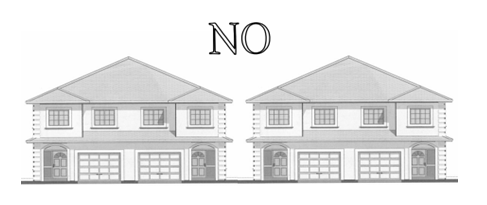
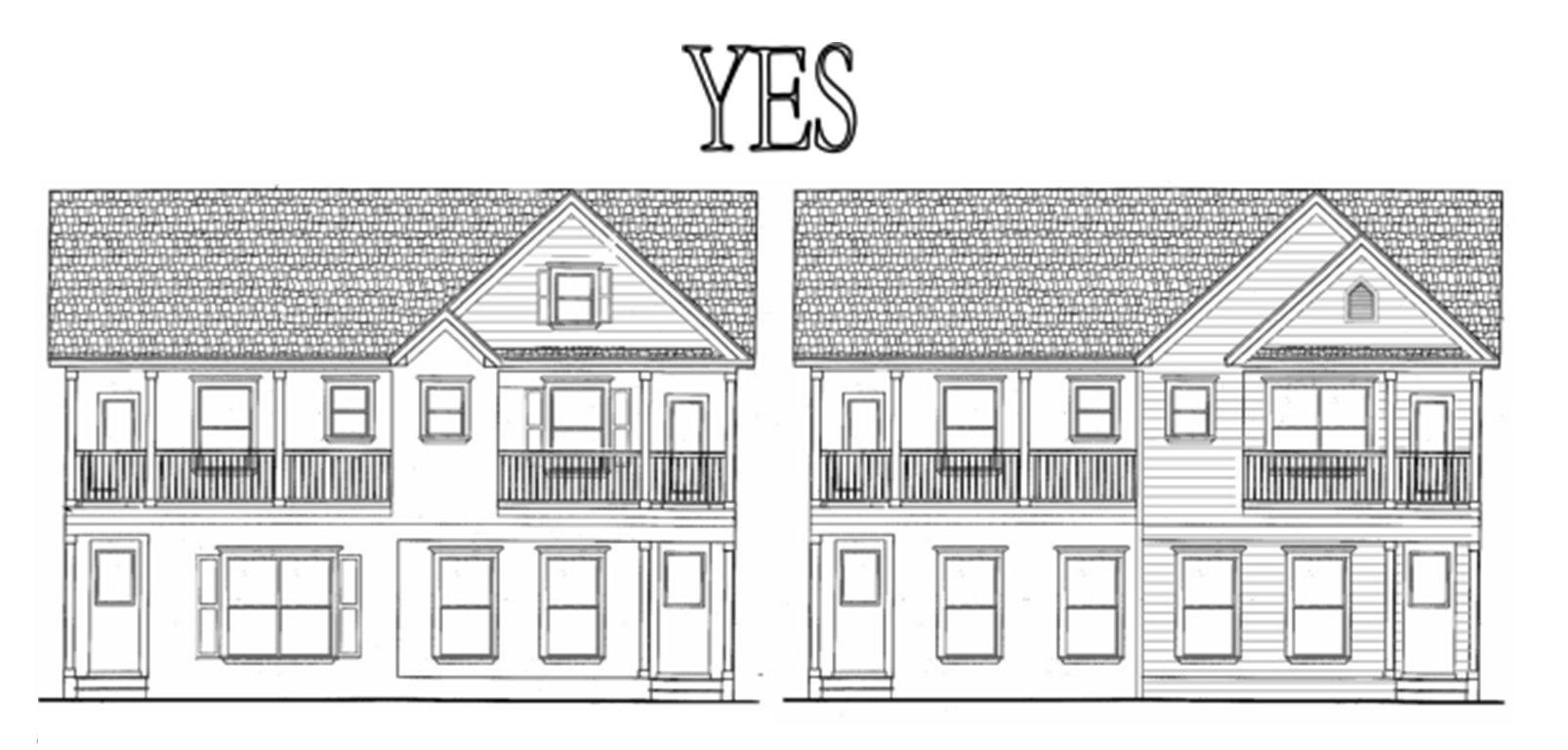
(b)
Front facade. Each front elevation shall include architectural elements from the following list that total a minimum of six points. Unless specified, all features are worth one point.
(1)
Front porch, minimum eight feet in width and six feet in clear depth supported by columns and with a rail (two points).
(2)
Side-loaded or court-entry garage (two points).
(3)
A separate overhead door for each single garage bay.
(4)
Brick, stone or textured concrete masonry on 100 percent of the front elevation (excluding openings).
(5)
Turret.
(6)
Two or more roof planes visible (change in elevation or direction of roof ridge) on the front of the house.
(7)
Veranda/balcony.
(8)
At least four feet of relief at one or more points along the front or rear elevations.
(9)
Bay, dormer or oriel windows.
(10)
Decorative geometric front, rear and side gable roof vents or windows.
(11)
Architectural details such as quoins, pilasters, cornices, and dentil molding.
(12)
Architectural-grade roof shingles.
(13)
Dormer windows/shed dormer.
(14)
Architectural brackets or corbels.
(15)
Twelve-inch roof overhang.
(16)
Chimneys beginning at grade and faced with brick or stacked stone; extend chimneys between three and six feet above the roof line.
(17)
Mullions, muttons, true divided lights on the exterior of the window surface.
(18)
Shutters, each, half the width of the adjacent window, mounted with shutter hinge and anchor hardware; not mounted directly to the surface of the adjoining facade.
(19)
Decorative accent roofs using secondary material (copper accent roof).
(c)
Wall finishes/materials. Exterior wall finish materials (excluding foundations, trim, windows, and doors) are limited to the following:
(1)
Brick: Full-depth masonry brick, but not adhered brick veneers;
(2)
Stone: Unpainted natural stone, unpainted cast stone or manufactured stone having the appearance of natural stone, and unpainted terra cotta;
(3)
True three-coat cement stucco;
(4)
Siding: Natural wood, vinyl or cementitious siding including lap siding and board and batten;
(5)
Shingles: Wood or cementitious shakes and shingles.
(d)
Street lighting.
(1)
Street lighting within the development will only be allowed under a county streetlight special tax district.
(2)
Night-time intersection lighting at primary subdivisions entrances will be required, with the cost for installation and maintenance to be borne by the developer or a common interest element.
(3)
All outdoor lighting fixtures must be recessed and downcast and shall not produce glare or a nuisance to drivers or the surrounding properties.
(e)
Foundation walls. Exposed foundation walls must be faced in brick, stone, or manufactured stone to the level of the first finished floor for the entire perimeter wall. When the building has a slab on grade construction, at least 18 inches above grade for the entire perimeter is required.
(f)
Windows.
(1)
Any exterior wall facing the side yard must provide window openings or false windows that equal or exceed five percent of the total area of that wall. Any exterior wall facing the front yard must provide window openings that equal or exceed 13 percent of the area of the wall. Walls that face the side yard and are finished in brick, stone, or manufactured stone are exempt from the window area requirement.
(2)
Garage door windows may count towards ratio requirements.
(g)
Garage doors. For single-family detached dwellings with attached garages, garage doors facing a street must not project or be recessed less than 18 inches, or project more than ten feet from the surface of the exterior wall or from the front face of a porch. For the sake of this requirement, a porch must be:
(1)
At least six feet deep. The depth of a porch shall be measured from the outermost edge of the walking surface to the lowest projecting face of the wall cladding.
(2)
At least 33 percent of the width of the exterior wall from which it projects.
(3)
Covered and continuous.
(4)
If a porch exceeds the 33 percent width requirement, the portion which exceeds this standard may measure less than six feet in depth.
(Amd. of 4-4-23(2), § 1439; Amd. of 12-2-25)
Section 1440. - Private and public event facilities.
(a)
Standards for all zoning districts:
(1)
Buildings and structures, including parking and circulation areas shall be set back 150 feet from the property line and 500 feet from any residence.
(2)
The buffer width shall be two times the minimum required.
(3)
Hours of operation are limited to 9:00 a.m. to 11:00 p.m.
(4)
No outdoor amplified sound or entertainment is allowed between 11:00 p.m. and 9:00 a.m.
(5)
All outdoor lighting fixtures must be recessed and downcast and shall not produce glare or a nuisance to drivers or the surrounding properties.
(6)
The following information must be submitted to the administrative officer with any conditional use application:
A site plan, survey or sketch drawing depicting the location of event structures, signage in compliance with the county sign ordinance, parking and traffic circulation for guests and staff, emergency vehicle access route, location of sanitation and refuse facilities, including portable toilets or restrooms connected to the sanitary sewer system.
(7)
A right-of-way encroachment permit shall be applied for with the county engineer's office for approval of driveway access, design and construction.
(8)
Prior to each event, where applicable proof of the following must be submitted to the administrative officer:
(9)
Catered alcohol service shall have a proper license issued by the county.
(10)
Catered food service is subject to proper permitting issued by the county health department.
(b)
Standards for commercial zoning districts:
(1)
The minimum lot size is three acres.
(2)
Maximum number of guests is 300.
(3)
All driveways, parking and circulation areas shall be on a paved asphalt or concrete surface.
(c)
Standards for the Agricultural-Residential (AG-5) zoning district:
(1)
The venue in whole or in part must be on property used for bona fide agricultural purposes and contains land that is classified as such by the county's property appraiser (agricultural exemption).
(2)
Minimum lot size is ten acres.
(3)
Maximum number of guests is 300.
(4)
Parking and circulation areas for event patrons must be on a surface that is flat and durable enough to withstand the event traffic except where required by off-street parking standards and should not be a fire hazard.
(5)
Commensurate with the number of guests, portable toilets must be provided, unless the property has adequate restroom facilities that are connected to the sanitary sewer or septic system.
(Amd. of 4-4-23(2), § 1440)
Section 1441. - Recreation facility, outdoor commercial.
(a)
Buildings and structures, including parking and circulation areas shall be set back 150 feet from the property line and 1,000 feet from any residence.
(b)
The buffer width shall be two times the minimum required, with a noise barrier for activities that generate over 50 decibels.
(c)
Minimum lot size of ten acres.
(d)
Hours of operation are limited to 8:00 a.m. to 10:00 p.m., including all deliveries.
(e)
All outdoor lighting fixtures must be recessed and downcast and shall not produce glare or a nuisance to drivers or the surrounding properties.
(f)
Prior to a certificate of occupancy or other development permit being issued, proof of the following must be submitted to the administrative official:
(1)
A site plan, survey or sketch drawing depicting the location of event structures, signage in compliance with the county sign ordinance, parking and traffic circulation for guests and staff, emergency vehicle access route, location of sanitation and refuse facilities, including portable toilets or restrooms connected to the sanitary sewer system.
(g)
Prior to each event, where applicable proof of the following must be submitted to the administrative officer:
(1)
Catered alcohol service shall have a proper license issued by the county.
(2)
Catered food service is subject to proper permitting issued by the county health department.
(Amd. of 4-4-23(2), § 1441)
Section 1442. - Recreation facility, outdoor private.
(a)
Buildings or structures shall be 100 feet from any residence.
(b)
Hours of operation are limited to 8:00 a.m. to 10:00 p.m.
(c)
An adequate fire access route shall be reviewed and approved by the fire chief.
(d)
A parking and circulation plan are required.
(e)
If proposed as part of a residential subdivision or multi-family development, a community recreation facility must be built during the first phase if the development has phases, and no more than 40 percent of first phase of the dwelling units authorized within the development or subdivision phase will be granted building permits until the community recreation facility is completed.
(Amd. of 4-4-23(2), § 1442)
Section 1443. - Recreational vehicle park and campground.
(a)
Buildings or structures shall be 500 feet from any residence.
(b)
All campers, tents, trailers and vehicles shall be 50 feet from a public road or right-of-way.
(c)
Every vehicle or trailer must be parked at least 20 feet apart from each other.
(d)
The buffer width shall be four times the minimum required with an approved fence, wall or berm.
(e)
Minimum lot size of ten acres.
(f)
Minimum of camping site size of 360 square feet for tents, 720 feet for campers, and 1,200 square feet for recreational vehicles.
(g)
Minimum 100 feet of road frontage is required.
(h)
All outdoor lighting fixtures must be recessed and downcast and shall not produce glare or a nuisance to drivers or the surrounding properties.
(i)
Only passive recreational activities are permitted, such as hiking, bicycling, walking, picnicking, canoeing, fishing and wildlife observation, etc.
(j)
Recreational vehicle parks shall be connected to a public water supply and a public sanitary sewer system or a community water system and on-site sewage management system approved by the county health department.
(k)
All access roads within the development shall be private with a minimum easement width of 40 feet and on a paved asphalt or concrete surface with a minimum pavement width of 20 feet, and lighted with a minimum spacing of 200 feet each between streetlights.
(l)
At least 20 percent of the park must be set aside as open space or for recreation purposes.
(m)
No recreational vehicle or space shall be rented or occupied for a period of more than 30 days.
(n)
Management offices, active indoor or passive outdoor recreational facilities, toilets, showers, laundry facilities and other uses and structures customarily incidental to the operation of a recreational vehicle park are permitted as accessory uses, provided use is restricted to the occupants of the park.
(o)
A copy of the park management rules and regulations must be submitted to the administrative official for approval prior to a certificate of occupancy. The park operator will be responsible for ensuring that visitors comply with the rules and regulations.
(Amd. of 4-4-23(2), § 1443)
Section 1444. - Solar electric power generation.
(a)
Buildings or structures shall be 500 feet from any residence.
(b)
Inverters, transformers and similar noise producing equipment (not including arrays or panels) shall be placed a minimum of 75 feet away from properties abutting adjacent residential properties.
(c)
Minimum lot size is ten acres.
(d)
The buffer width shall be two times the minimum required with an approved fence, wall or berm.
(e)
Screened chain-link or pressure treated lumber security fencing will be required at a minimum height of six feet, but not at a greater height than eight feet around the perimeter of the facility inside the required setbacks, and it shall be regularly maintained.
(f)
All mechanical equipment (including arrays and panels) and outdoor lighting fixtures shall be limited to a height of 15 feet.
(g)
All outdoor lighting fixtures must be recessed and downcast and shall not produce glare or a nuisance to drivers or the surrounding properties.
(h)
Solar panels shall not be placed in the vicinity of any airport in a manner that would interfere with airport flight patterns.
(i)
A right-of-way encroachment permit shall be applied for with the county engineer's office with design and construction providing for a paved asphalt or concrete surface driveway and apron leading to any access gate upon completion of the project.
(j)
The developer shall be able to graphically demonstrate to the administrative officer through the use of renderings, photographs or similar credible media that proposed solar collection devices, or combination of devices, shall be designed and located to avoid glare or reflection onto adjacent properties and adjacent roadways and shall not interfere with traffic or create a safety hazard.
(k)
Textured glass and/or anti-reflective coating shall be used on solar panels to minimize glare.
(l)
Any solar collection device or combination of devices that is not operated for a continuous period of 12 months and for which there are no applications pending for permitted use of the structure at the end of such 12-month period, shall be considered abandoned, whether or not the owner or operator intends to make use of the device(s). The owner of an abandoned solar collection device and the owner of the property where the abandoned solar collection device is located shall be under a duty to remove such device. If such device is not removed within a reasonable time, not to exceed three months, after receipt of notice from the governing authority notifying the owner(s) of such abandonment, the governing authority may remove such device(s) and place a lien upon the property for the costs of removal. The governing authority may pursue all legal remedies available to it to ensure that abandoned device(s) are removed. Delay by the governing authority to act shall not in any way waive the governing authority's right to do so.
(m)
The developer of any solar collection device or combination of devices shall provide the following documentation to the administrative official before any land development begins:
(1)
A recorded plat creating a new parcel containing the boundaries of the facility and showing the panel locations within a properly fenced area.
(2)
Name, address, phone number and contact information of the owners of the installed solar infrastructure which shall be submitted the county tax appraiser's office for personal property tax purposes.
(3)
Proof of adequate project financing, along with insurance or surety.
(4)
Proof of compliance with regard to interconnection requirements with appropriate public utilities or public utilities regulatory agencies.
(5)
A letter from the Georgia Department of Natural Resources that there are no adverse impacts on historical or cultural resources.
(6)
Submission of a site plan that meets the requirements of the county soil erosion and sedimentation ordinance, and a drainage plan approved by the county engineer.
(Amd. of 4-4-23(2), § 1444)
Section 1445. - Temporary occupancy unit during single-family building construction.
(a)
There shall be an additional permit required for placement of a temporary occupancy unit with a fee as prescribed in the county's schedule of fees. Subject to any other conditions of expiration herein, a temporary occupancy permit shall be valid for one year. The zoning administrator may grant a one-year extension of the permit if, in the zoning administrator's opinion, the permittee has made a good-faith effort to construct the principal residential use.
(b)
If a valid building permit for a dwelling serving as a principal use on the subject lot, parcel or tract is not maintained, the temporary permit shall become void on the day the building permit lapses.
(c)
No more than one temporary occupancy unit may be occupied per parcel.
(d)
The temporary occupancy unit may be occupied either by the permanent occupants of the principal use under construction, or any work crew employed by the owner-occupant(s) whose purpose is for the construction of the principal use of the subject lot, parcel or tract. At no time shall any temporary occupancy unit be leased or rented for other residential or occupancy purposes.
(e)
The temporary occupancy unit must be removed no later than 30 days after receiving an approved certificate of occupancy for the principal residential structure, unless such unit is for the recreational use of the owner-occupant of the principal structure.
(f)
The temporary occupancy unit shall comply with all other applicable requirements of the zoning ordinance, including, but not limited to, setback and height requirements.
(g)
All recreational vehicles and campers shall be built to American National Standards Institute Code (ANSI).
(h)
If the temporary occupancy unit has restroom facilities that are used, the temporary occupancy unit must be attached to an on-site sewage disposal system (septic tank) approved by the county health department.
(i)
Heating systems shall be maintained in accordance with the manufacturer's requirements. Any additional or new solid or liquid-fuel burning appliances to be used in a recreational vehicle or camper shall be installed, used and maintained in accordance with the listing for the appliance and the manufacturer's requirements, including provisions allowing their use in recreational vehicles or campers.
(j)
LP-gas storage and delivery systems shall be maintained in accordance with the manufacturer's requirements. In lieu of complying with the manufacturer's requirements, additional storage of LP-gas is permitted provided the storage and delivery systems comply with the current editions of the Uniform Fire, Building and Mechanical Codes.
(k)
The recreational vehicle and campers shall be set up in compliance with the manufacturer's minimum specifications and shall remain mobile. No ancillary structures may be permitted with regard thereto for the temporary occupancies provided for herein.
(l)
The application for the placement and use of a manufactured home or mobile office for the purpose(s) herein may require the applicant to post a bond in the form of a surety bond, cash or irrevocable letter of credit in the amount not to exceed $3,000.00 per unit to ensure the removal of the temporary occupancy unit within the specified time frame.
(m)
Upon request of a county code enforcement officer investigating any complaint, satisfactory evidence shall be presented of continuing compliance with the applicable standards for temporary occupancy or the occupancy shall cease.
(Amd. of 4-4-23(2), § 1445)
Section 1446. - Tobacco shops, vape shops and hookah lounges.
(a)
No new establishment shall be located within one mile of an existing establishment measured across a straight line from property line to property line.
(b)
These establishments shall not be located within 300 feet, measured property line to property line, from a school (public or private), family day care home, child-care facility, youth center, community center, recreational facility, park, church or religious institution, hospital, or other similar uses where children regularly gather.
(c)
The buffer with shall be two times the minimum required with an approved fence, wall or berm.
(d)
All storefronts shall contain transparent glass windows that allow for views into the establishment from the nearest public right-of-way.
(e)
Temporary or portable structures for offices or storage is prohibited.
(f)
These establishments shall post clear signage stating that minors may not enter the premises unless accompanied by a parent or legal guardian. At least one such sign shall be placed in a conspicuous location near each public entrance to the smoke shop and tobacco store. It shall be unlawful for a smoke shop and tobacco store to fail to display and maintain, or fail to cause to be displayed or maintained, such signage.
(g)
Except for hookah lounges, no smoking shall be permitted indoors at any time.
(h)
No sales may be solicited or conducted on the premises to persons under the age of 21.
(Amd. of 4-4-23(2), § 1446)
Section 1447. - Transfer station.
(a)
Such facility must receive a permit from and comply with the rules of the Environmental Protection Division of the Georgia Department of Natural Resources for transfer stations.
(b)
The buffer shall be two times the minimum required with an approved fence, wall or berm.
(c)
Solid waste shall be confined to the interior of transfer stations, and not allowed to scatter to the outside. Waste shall not be allowed to accumulate, and floors, shall be kept clean and well drained.
(d)
All outdoor lighting fixtures must be recessed and downcast and shall not produce glare or a nuisance to drivers or the surrounding properties.
(e)
Sewage solids shall be excluded from transfer stations.
(f)
Dust, odors and similar conditions resulting from transfer operations shall be controlled at all times.
(g)
Rodents, insects and other pests shall be controlled.
(h)
Any contaminated runoff from wash water shall be discharged to a wastewater treatment system and, before final release, shall be treated in a manner approved by EPD.
(i)
Hazardous waste: no person owning or operating a transfer station shall cause, suffer, allow, or permit the handling of regulated quantities of hazardous waste.
(Amd. of 4-4-23(2), § 1447)
Section 1448. - Utility substation.
(a)
Minimum setbacks. Utility substations, including any required fencing, must be set back a minimum of 60 feet from all public rights-of-way and from adjacent property lines of any lot on which a residence is located, and 30 feet from all other adjacent property lines.
(b)
Minimum lot size. The lot on which a utility substation is located must be of sufficient size to meet the minimum setback requirements; however, in no case shall the lot on which a utility substation is located be less than one-quarter acre.
(c)
Utility substations, including any woven wire fencing, shall be completely enclosed by decorative fencing such as, but not necessarily limited to, brick, stone or wood. Utility substations must also be enclosed by a woven wire fence at least eight feet high with bottom of fence either flush with the ground or with a masonry footing; however, the requirement for woven wire fencing may be waived if the applicant reasonably demonstrates that the utility substation does not pose a hazard to the public. If the requirement for woven wire fencing is waived, then the zoning administrator may waive the requirement for the building to be completely enclosed by decorative fencing if the zoning administrator determines that such waiver would not negatively impact the aesthetic quality of the building. However, all equipment located outside the building, such as but not limited to generators and tanks, shall be enclosed by decorative fencing.
(d)
All outdoor lighting fixtures must be recessed and downcast and shall not produce glare or a nuisance to drivers or the surrounding properties.
(e)
No vehicles or equipment may be stored on the lot.
(f)
A buffer a minimum of 25 feet wide must be maintained along the side and rear property lines. If any decorative fencing requirements are waived, the zoning administrator may require additional landscaping to preserve the aesthetic quality of the site.
(g)
Any building at a utility substation site must be architecturally compatible with adjacent properties.
(h)
The applicant must submit a site plan to the administrative officer, showing the proposed location and design of any buildings, the proposed location and type of any exterior equipment, the proposed location and design of all fencing, any proposed landscaping, the means of ingress and egress, the uses of adjacent property, and the distance of all improvements from adjacent property lines and rights-of-way. The site plan must be approved by the administrative officer prior to the issuance of a permit, and the zoning administrator may require any modifications to the site plan necessary to achieve compliance with the standards and spirit of this ordinance.
(i)
The development standards in each district shall not apply to utility substations.
(Amd. of 4-4-23(2), § 1448)
Section 1449. - Variety store.
(a)
No new establishment shall be located within one mile of an existing establishment measured across a straight line from property line to property line.
(b)
Buildings or structures shall be 250 feet from any residence.
(c)
Hours of operation are limited to 7:00 a.m. to 9:00 p.m., including all deliveries.
(d)
Maximum building size of 12,000 square feet.
(e)
Minimum lot size of two acres.
(f)
No merchandise for sale including vending machines shall be permitted outside of the building.
(g)
The buffer width shall be two times the minimum required with an approved fence, wall or berm.
(h)
Access shall only be from an arterial or collector road.
(i)
Use of sound amplification devices is prohibited.
(j)
A minimum of 20 percent of the site shall be landscaped, not including buffers.
(k)
Façades over 50 feet in length shall provide wall projections or recesses with a minimum of one foot in depth and a minimum of ten contiguous feet in length for each 100 feet.
(l)
A minimum of 25 percent of façades visible from a public street shall consist of window (real or faux) and door openings.
(m)
Parapets, gable and hip roofs or dormers shall be used to conceal flat roofs and roof top equipment from public view.
(n)
Temporary or portable structures for offices or storage is prohibited.
(o)
Seasonal, transient merchants and mobile vendors shall follow requirements of this ordinance.
(Amd. of 4-4-23(2), § 1449)
Section 1450. - Veterinary services, and commercial and private kennels.
(a)
All buildings, structures, and outdoor runs shall be 200 feet from all property lines.
(b)
Minimum lot size of two acres where commercials kennels or outdoor runs are present.
(c)
The buffer width shall be two times the minimum required with an approved fence, wall or berm.
(d)
Animal boarding shall take place entirely within an enclosed building. Buildings shall be designed and constructed to mitigate noise to limit negative impacts on adjacent properties. Additional noise mitigation shall be required for existing buildings not originally built for the boarding of animals, including the use of acoustical tiles, caulking to seal penetrations made in floor slabs for pipes, and spray on noise insulation
(e)
Odors shall be controlled by means of an air filtration system or an equivalent measure.
(f)
Buildings housing animals shall have a drain connected to an approved sanitary facility, and shall not be located in a front yard, or buffer areas.
(Amd. of 4-4-23(2), § 1450)
Section 1451. - Wastewater pre-treatment facility.
(a)
The facility shall either be connected to a municipal wastewater treatment system for final treatment of wastewater created from the de-watering process, or the wastewater created from the de-watering process shall be discharged into a remote lift station of a municipal wastewater treatment system which is approved by the municipality. The facility shall be subject to the rules of the accepting municipality.
(b)
Minimum lot size shall be five acres.
(c)
No facility shall be within 1,000 feet of a residential dwelling.
(d)
No facility shall be within 100 feet of a floodplain or wetland.
(e)
No facility shall be within 300 feet of an individual or public water supply source or well.
(f)
No facility shall be within 300 feet of any water impoundment, lake, stream, pond or any permanent or intermittent waterbody considered waters of the state.
(g)
No facility shall be located in an unconfined aquifer which is used or may be used as a principal source of potable water.
(h)
Odor control methods must be used.
(i)
A 25-foot landscaped buffer consisting of trees capable of growing to a height of no less than 40 feet shall be installed and maintained along the side and rear property lines. If the facility is visible from the road accessing the property, either the aforementioned standard of landscaping or opaque fencing of no less than six, but not greater than eight feet in height shall be installed within the front setback.
(j)
Access to the property shall be on a paved public road with all driveway aprons being paved to the edge of the right-of-way.
(k)
All interior parking and circulation within the facility shall consist at a minimum of a gravel or similarly compacted pervious or impervious surface to minimize on-site erosion and runoff.
(l)
All outdoor lighting fixtures must be recessed and downcast and shall not produce glare or a nuisance to drivers or the surrounding properties.
(m)
All on-site and off-site drainage shall be installed so as to minimize the potential for any pollution run-off and shall be compliant with NPDES requirements.
(n)
All collected solid waste must be deposited only in an EPD permitted solid waste handling facility authorized to receive the applicable waste types.
(o)
Wastewater pre-treatment facilities shall be paved and enclosed.
(p)
Vehicles or containers used for the collection and transportation of wastes shall be covered, substantially leakproof, durable, and of easily cleanable construction.
(q)
Solid waste collection and transportation vehicles shall be cleaned frequently and shall be maintained in good repair.
(r)
Vehicles or containers used for the collection and transportation of solid waste shall be loaded and moved in such a manner that the contents will not leak or spill therefrom.
(s)
All wastewater from cleaning of vehicles must be handled in a manner which meets all applicable environmental laws and regulations.
(t)
The facility shall be maintained in a clean and sanitary condition.
(u)
The facility shall receive all permits required by the State of Georgia.
(v)
No business that pumps or hauls waste from grease traps or septic tanks whose primary place of business is located outside of Bulloch County would be allowed to utilize this facility or transfer waste to a truck owned by a business in Bulloch County.
(Amd. of 4-4-23(2), § 1451)
Section 1452. - Dispenser of low THC oil.
(a)
May not operate within a 1,000-foot radius of a covered entity, measured from property boundary to property boundary.
(b)
For purposes of subsection (a), a "covered entity" means a public or private school; an early care and education program as defined in O.C.G.A. § 20-1A-2; or a church, synagogue, or other place of public religious worship, in existence prior to the date of licensure of the dispenser of low THC oil by the State Board of Pharmacy.
(c)
Subject to the procedures in section 410, a variance from the distance requirements in subsection (a) may be granted if it is determined that the variance is needed to allow retail outlets to be established to service registered patients residing within Bulloch County.
(Amd. of 8-1-23(1))
Section 1453. - Go cart, ATV, motorbike track and trails.
(a)
The use is limited to parcels greater than 100 acres.
(b)
Any activity proposing to use a dirt track must include a plan whereby no dust shall leave the property on which the track is located.
(c)
All stream crossings shall be by way of a drainage structure (no fording of creeks).
(d)
Hours of operation shall be limited to the following:
(1)
Sunday through Thursday: no earlier than 7:00 a.m. and no later than one hour after the sun sets.
(2)
Friday and Saturday: no earlier than 7:00 a.m. and no later than 10:00 p.m.
(e)
All ATV and motorcycles operating on the trails will be limited to a maximum decibel level of 120db at operating speeds. Tested no more than five feet from the vehicle.
(f)
All ATV and motorcycles operating on the trails will be required to have spark arrestors.
(g)
Property boundaries shall be clearly marked with signage visible to patrons.
(h)
"Quiet zones" to limit loud music and noise other than that produced by the vehicles shall be enforced within 500 feet of property lines in trail areas that are adjacent to residential properties. Quiet zones shall be clearly marked with signage visible to patrons.
(i)
Access to public streets shall require permit approval by the county engineer or designee.
(j)
No trail shall be located within 50 feet of the property boundaries.
(k)
Where trails are proposed to disturb wetlands, Chapter 4, Section 4-50.1 of this Code and requirements of the Federal Clean Water Act, as amended, are required. Generally, a wetland determination by the U.S. Army Corps of Engineers must be provided prior to site plan or other permit approval.
(Amd. of 12-2-25)
Section 1454. - Microbrewery and brewpub.
(a)
Standards applicable to brewpubs.
(1)
In HC district a brewpub may not exceed 5,000 square feet gross floor area.
(2)
In the LI district a brewpub cannot exceed 7,500 square feet gross floor area.
(3)
All activities shall comply with the Bulloch County Noise Ordinance.
(b)
Standards applicable to microbreweries.
(1)
In HC district, a microbrewery may not exceed 5,000 square feet gross floor area.
(2)
In the HC microbreweries shall have a tap room that is oriented to the street or main pedestrian entrance of the building. A minimum of 500 square feet shall be provided for the tap room and this area shall be open for business at least one-quarter of the time each week the business facility is operating.
(3)
In the LI district a microbrewery cannot exceed 7,500 square feet gross floor area.
(4)
No loading or distribution activities shall take place outside of the enclosed building between the hours of 9:00 p.m. and 7:00 a.m. when the microbrewery is located within 500 feet of any residential or institutional use.
(Amd. of 12-2-25)
Section 1455. - Conservation subdivisions.
(a)
Purpose. A conservation subdivision is intended to provide for residential subdivisions that are designed based first and foremost on the provision and preservation of open space, but that accommodate the entire amount of development that would otherwise be legally possible under conventional subdivision designs, and that:
(1)
Minimize the environmental and visual impacts of new development on critical resources, aesthetically pleasing areas, and historically and culturally significant sites and structures;
(2)
Encourage more efficient development of land by affording greater flexibility of design and placement of buildings and structures;
(3)
Reduce infrastructure construction costs;
(4)
Contribute to an interconnected network of permanent open space in the County;
(5)
Provide for undivided open space within new developments;
(6)
Enhance quality of life for residents by creating more attractive and pleasing living environments;
(7)
Reduce the demand on public expenditures for open space, parkland, play fields, and other areas for active and passive recreation;
(8)
Minimize disturbances to streams, steep slopes, and vegetation and provide increased opportunities to maintain natural conditions; and
(9)
Meet design requirements and guidelines established in this chapter for the protection of conservation areas.
(b)
Open space and conservation areas.
Required specifications.
(1)
Minimum size. The minimum size of a conservation subdivision shall be 25 contiguous acres. Division of the subject property by a public road is prohibited.
(2)
Area in open space.
a.
Each conservation subdivision shall provide a minimum of 40 percent of its total land area as open space, as defined by this Code. The amount of acreage dedicated to secondary conservation areas must equal at least 30 percent of the total primary conservation areas. If the total amount of open space provided is comprised of 60 percent or more secondary conservation area as described below, the overall total open space amount required shall be reduced to 30 percent of the total land area. Open space may be comprised of up to 100 percent secondary conservation area.
b.
Open space shall be no less than five contiguous acres.
c.
The width of any open space tract shall be at least 25 feet.
d.
Exterior buffers cannot be counted towards the secondary conservation area total.
(3)
Primary conservation areas. Primary conservation areas refer to the most ecologically sensitive and often severely constrained land, including land as shown in table 1455.1. A conservation subdivision shall identify and integrate all primary conservation areas into permanent open space. Refer to figure 1455.1 for guidance on the conservation subdivision design process.
(4)
Secondary conservation areas. Secondary conservation areas refer to locally noteworthy or significant features of the natural or cultural landscape and include land as shown in table 1455.1. A conservation subdivision shall identify secondary conservation areas and shall strive to integrate all or a portion of them into undivided, permanent, open space. "Undivided" refers to contiguous, usable open space; small strips of land remaining randomly among parcels or isolated "alley" strips do not qualify as meeting the required conservation area standards. Refer to figure 1455.1 for guidance on the conservation subdivision design process.
Table 1455.1
DEFINITIONS FOR PRIMARY AND SECONDARY CONSERVATION AREAS
Standards for open space. This section provides standards and guidelines for establishing open space.
(1)
Location. When a conservation subdivision site abuts an existing conservation area, park, nature preserve, or public undeveloped land, conservation areas shall be designed so that they are located along the common boundary line.
(2)
Trails. Open space shall provide for trails, between ten and 12 feet wide and shall be designed to connect with a sidewalk network and/or function as pathways to common area and/or amenity destinations. Trails are required to be located external to individual residential lots and are not intended to be accessed via easements through individual residential lots. No trail located within open space may include impervious materials. Motorized vehicles shall not be permitted on trails except for maintenance, construction, or public safety purposes. This prohibition shall be included within the required covenants. Where appropriate and convenient, such trails shall be made handicapped accessible. Connection to off-site county trails is strongly encouraged.
(3)
Trail/street crossings. Where trail systems cross an internal subdivision street, the access points shall be directly across from each other, clearly identified both to the motorist and pedestrian, and located with appropriate sight distance as determined by the county engineer, subject to the approval of the engineering department. Where a trail crosses any county road not interior to the subdivision, the trail shall be grade separated (i.e., by a tunnel or bridge) or located at a traffic control device approved by the county engineer and planning director.
(4)
Limits of disturbance. No clearing or grading shall be permitted in the primary or secondary conservation areas with the following exemptions:
a.
Encroachments for infrastructure and stormwater shall be granted only for perpendicular buffer crossings that have been reviewed and issued an encroachment permit by the county engineer.
b.
Removal of vegetation as identified on the United States Department of Agriculture Georgia List of Exotic and Invasive Plants is permitted provided such removal is minimal. This exemption shall not apply to undisturbed state and county stream buffers.
(5)
Tree cover. Preservation and enhancement of existing tree canopy is strongly desired and encouraged wherever possible but at minimum, must be consistent with any special conditions created at the time of zoning approval.
(6)
Permitted uses. For the purposes of this chapter, open space may be used for primary conservation area and secondary conservation area. Pervious surface trails for passive recreation may be allowed.
(7)
Active recreational facilities. Active recreational facilities, if provided, shall not be located in the primary or secondary conservation areas and shall not count toward required open space.
(8)
Golf courses prohibited. Golf courses do not comply with the conservation intent of this chapter and thus are not permitted.
Figure 1455.1 Conservation Subdivision Design Process
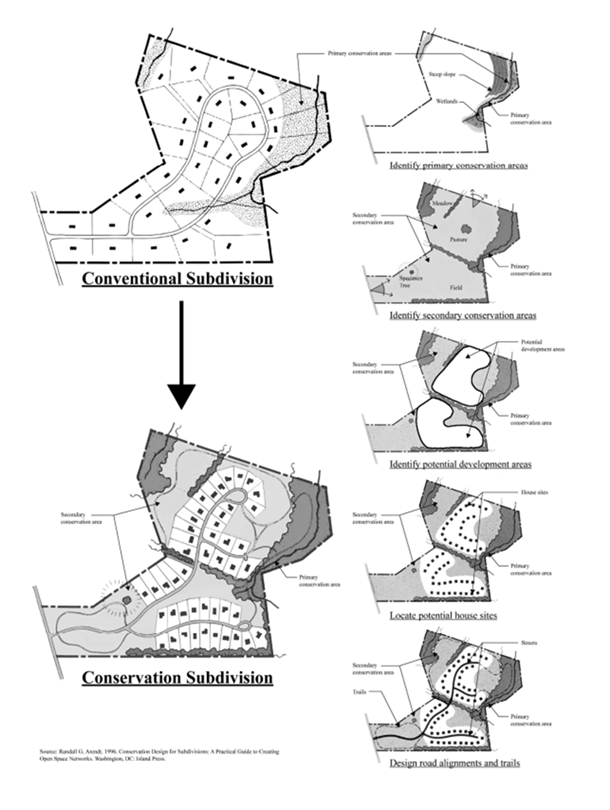
(c)
Determining lot yield.
Maximum number of lots. In conservation subdivisions, lot sizes are allowed to be smaller than permitted in conventional subdivisions. The minimum lot size shall be as provided in table 1445.2 in subsection 1445(d), so as to ensure that lots created will not be substantially out of character with lot sizes in conventional subdivisions within the same zoning district. The development must, however, be density neutral i.e., the overall number of dwellings allowed must be no more than the total number of dwellings a conventional subdivision layout would yield. The applicant may choose one of the methods below to determine the maximum number of lots. The greater of option (1) or (2) is the maximum allowed lots.
(1)
Yield plan. A yield plan shows the site developed as a conventional subdivision and the maximum number of lots the site would theoretically yield. The design of the yield plan must be realistic and account for areas that cannot be developed such as flood plain, stream buffers and wetlands.
(2)
Adjusted tract acreage method. This calculation deducts the adjusted constrained lands from the gross tract acreage. The resulting net tract acreage is then multiplied by the zoning district density. The process for this calculation is described as follows:
a.
Determine the constrained lands. Identify all land in the following categories:
1.
Slopes over 35 percent of at least 5,000 square feet contiguous area.
2.
The 100-year flood plain.
3.
Wetlands that meet the definition of the Army Corps of Engineers pursuant to the Clean Water Act.
4.
Area of land in stream buffers as required by federal, state or local regulations.
5.
Area of land designated for construction of roads and associated right-of-way.
6.
Area of all impervious surfaces associated with amenities, including, but not limited to, parking areas, tennis courts, swimming pools, clubhouses and other impervious surfaces.
b.
Calculate the adjusted constrained lands by multiplying the total area of land in items (a) through (d) by 50 percent and adding 100 percent of area of land in (e) and (f).
c.
Determine the net tract acreage. The net tract acreage is calculated by subtracting the adjusted constrained lands from the gross tract acreage of the property to be developed.
d.
The number of allowed lots is determined by multiplying the net tract acreage by the zoning district density as listed in table 1445.2 in section 11-5.1.
Example scenario:
100-acre property
Ten acres of wetlands (time 50 percent)
Ten acres of slopes (times 50 percent)
15 acres of roads/ROW/amenity
1.09 u/a R-40 density
(d)
Site design standards.
(1)
After determining primary and secondary conservation areas. This section provides standards and guidelines for conservation subdivisions.
a.
Performance standards shall be in accordance with table 11.2 below.
b.
Homes shall not front directly on off-site streets.
c.
No less than 85 percent of lots shall be entirely abutted on at least one side by open space.
d.
All buildings and structures shall be set back a minimum of 75 feet from all primary conservation areas.
e.
Fencing is prohibited unless otherwise required by state or county rules or regulations.
f.
Conservation subdivisions in all zoning districts shall provide an exterior buffer. The size of the exterior buffer is determined by the size and zoning of the lot proposed adjacent to the exterior buffer of the conservation subdivision and shall be in accordance with table 1445.3 below. In the event that the subject property is abutted by more than one zoning along a property line, the largest of the adjacent buffer sizes shall determine the buffer size required on the subject property for that property line.
g.
Neither exterior buffers nor stream buffers shall be incorporated within individual residential lots.
Table 1445.2
Performance Standards
(1) Measured from the edge of the dedicated right-of-way or from access ally easement.
(2) Maximum lot coverage for the purposes of this chapter means the percentage of the lot covered by all structures including primary and any accessory buildings, however lot coverage does not include other impervious surfaces such as driveways, pools, at grade patios or at grade pool decks.
Table 1445.3
Minimum Exterior Buffer
(2)
Sewage treatment and disposal systems. A conservation subdivision must be served by public sewer.
(e)
Design standards and guidelines for streets.
Introduction. This article provides standards and guidelines for designing streets serving conservation subdivisions.
(1)
Location and alignment. Designers should avoid crossing wetlands with streets where possible. Existing farm roads should be incorporated into conservation subdivision designs. Roads should follow existing contours with a minimum of cut and fills and disturbance for construction. In cases where agricultural protection or meadow preservation is a primary objective, new roads should be placed along the edge of a field, rather than through the middle, so as to be less intrusive on the open space character of the tract.
(2)
Lengths and curves. The length of roads should be minimized to reduce costs and aesthetic impacts. Long, straight road segments should be avoided. Curvilinear designs are preferred for rural conservation subdivisions. Streets should be curved and aligned to produce vistas of open space elements, where possible. Short, straight, interconnected streets (i.e., grid patterns) are appropriate for clustered home sites within conservation subdivisions.
(3)
Separate travel lanes. Where necessary, the directional travel lanes should split or curve apart to protect natural features. In cases where travel lanes are split or curve apart, the minimum width of each travel lane should be ten feet in paved width.
(4)
Right-of-way and clearance. Rights-of-way should be only wide enough to accommodate the required street width improvement, adequate shoulder bases for utilities, bikeways and/or walkways, and open storm drainage ditches at appropriate bank slope. Drainage easements may be provided in lieu of expanding the right-of-way for drainage ditches if approved by the county engineer. The entire right-of-way may not necessarily have to be cleared if it can be shown to the satisfaction of the county engineer that remaining trees or other features do not pose a traffic safety hazard.
(5)
Connections. Streets shall be connected with one another unless doing so involves traversing designated conservation areas; preferably streets connect in three-way intersections, so that the number of dead ends are minimized. An exception will be allowed when a street connection would cross conservation areas and break up open space amenities, in which case [subsection] 1445.6 provisions shall govern. Whenever possible, streets shall be designed to connect with adjoining properties.
(6)
Culs-de-sac. Traditional culs-de-sac are discouraged. Culs-de-sac create large expanse of impervious cover and increase the amount of stormwater runoff. As such, street loops and/or cul-de-sac with planted centers meet the intent and purpose of conservation subdivision districts and are strongly encouraged for non-connecting street ends. Culs-de-sac with planted centers shall increase in diameter to accommodate the planted center. All plans for culs-de-sac with planted centers shall be approved by the county engineer.
(7)
Reverse curves. For roads serving less than 2,000 average daily trips and where speed limits are controlled to prevent high-speed traffic, reverse curves (consecutive left and right curves without a straight segment separating them) are considered appropriate and may be encouraged, subject to the approval of the county engineer.
(8)
Single-loading streets. "Single-loading streets" (i.e., having houses only on one side) are considered appropriate and encouraged, particularly around common or amenity areas.
(9)
Curbs and drainage. Curbs and gutters shall be required and installed in accordance with Bulloch County Appendix B Schedule 7.7.3: Right-of-Way Design Standards—Curb and Gutter, unless otherwise approved by the county engineer.
(10)
Street trees. Street tree plantings are encouraged, provided that they are located so as not to present a traffic safety hazard, as determined by the county engineer.
(11)
Sidewalks. Concrete or asphalt sidewalks may detract from the character of rural conservation subdivisions. The use of pervious materials is strongly encouraged. Safe access for pedestrians and/or bicyclists shall be provided via trails in the open space and where needed along the improved or semi-improved shoulders of roads. No trail located within open space may include impervious materials.
(f)
Procedures. In addition to the application procedures for zoning approval, sketch plan approval, preliminary and final plat approval, as specified in appendix B of this Code, conservation subdivisions shall comply with the following procedures.
(1)
Pre-application conference. A pre-application conference with the department is required at least 14 days prior to the submission of a sketch plat application. At the time of a pre-application conference, an existing features and site analysis report, as detailed in subsection 1445(b), shall be submitted and a site visit, as detailed in subsection 1445(c), shall be scheduled. In the event amendments to the existing features and site analysis report are necessary as a result of information gathered during the site visit, an updated report shall be submitted in accordance with subsection 1445(c). Refer to figure 1445.2 for guidance on the order of procedures. At the applicant's request, the department shall make available all relevant information about primary and secondary conservation areas, including soil survey, natural resource maps, and geographic information, for which reasonable reproduction costs for this information may be charged. Ideally, the pre-application conference will be preceded by the submittal of a boundary survey of the property to be subdivided with sufficient time for the development department to collect applicable information.
(2)
Existing features and site analysis report. The purpose of the existing features and site analysis report is to familiarize county staff with existing site conditions and shall form the basis for the development design as shown on the concept plan. This report shall consist of a map and narrative identifying and describing all important existing site features in accordance with the list below and shall be sealed by a registered engineer or landscape architect to ensure accuracy. The following features shall be included where applicable:
a.
Significant wildlife habitats, if any. If information on habitats is not available, the wildlife potential of various soil types on the site shall be included with the soil analysis.
b.
Soils, including analysis of suitability for septic tanks, and erosion potential as shown on the National Cooperative Soil Survey developed by the National Resources Conservation Service.
c.
Wetlands as shown as shown on the National Wetlands Inventory developed by the United States Fish and Wildlife Service.
d.
Flood plains. Areas of 100-year flood plain as identified on flood hazard boundary maps or flood insurance rate maps developed by the Federal Emergency Management Agency.
e.
Slopes 25 percent or greater.
f.
Historic, archaeological, and cultural features. Applicant shall refer to the Bulloch County Historic Resources Survey and data from the state archeologist (Historic Preservation Division of the Department of Natural Resources) when developing in areas of suspected cultural and/or historical resources. Photos of such features, if existing, shall be required.
h.
Tree cover, existing forests including acreage, and/or specimen tree stands with critical root zone identified.
i.
Orchards.
j.
Open meadows and/or pastures including acreage.
k.
Views into and out from the site, and any scenic qualities. Photos and/or illustrations shall be required.
l.
Aquifer recharge areas as shown on Hydrogeologic Atlas 18 developed by the Georgia Department of Natural Resources.
(3)
Site visit. The purpose of the site visit is to familiarize staff with the property's existing conditions and special features, to identify potential site design issues, and to provide an informal opportunity to discuss site design concepts, including the general layout of the designated open space areas and potential locations for proposed. buildings and street alignments. Comments made by staff regarding design shall be interpreted as being only suggestive. It shall be understood by all parties that no formal recommendations will be offered, and no official decisions can be made during the site visit. In the event that staff determines that existing site features have not been fully represented within the existing features and site analysis report, the applicant shall amend the report and submit it to accompany other application requirements in accordance with appendix B of this Code, adhering to required departmental deadlines.
(4)
Yield plan or adjusted tract acreage method. Along with all other required documents and site plan submittals for rezoning and/or sketch plat applications, applicants shall submit one of the following:
a.
A yield plan that demonstrates the number of lots that would be generated if the site were developed as a conventional subdivision; or
b.
An adjusted tract acreage calculation detailing the values used to arrive at the maximum number of lots in accordance with subsection 1445(c).
Figure 1445.4
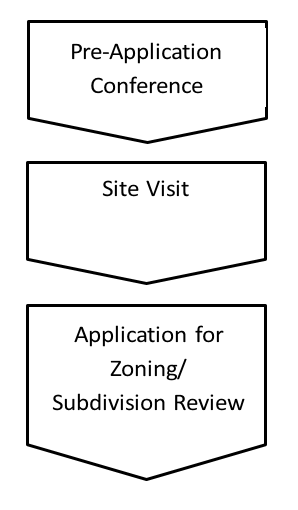
(g)
Easements and ownership.
(1)
Conservation easement required. All primary conservation areas and all secondary conservation areas shown on the rezoning application site plan and/or sketch plat that are required to be retained as open space, shall be permanently protected from further subdivision, development, and unauthorized use, by a conservation easement. A conservation easement, as defined by this Code, shall be approved by Bulloch County, and:
a.
Co-signed by Bulloch County and donated to a conservation organization or land trust; or
b.
Co-signed by Bulloch County and donated to a homeowners association; or
c.
Donated to Bulloch County if accepted by the county. Copies of the draft easements and delineation of primary and secondary conservation areas shall be submitted for review concurrent with the submittal of a land disturbance permit application.
(2)
Guidelines for drafting conservation easements. The following guidelines are offered for drafting conservation easements and may be required:
a.
The easement recognizes and describes in a statement of purpose the special qualities of the property subject to the easement. Preferably, conditions within the tract subject to the conservation easement are shown by map and/or photograph.
b.
The easement clearly identifies the owner of the property subject to the easement, the holder of the easement, and co-signer, and the responsibilities of the property owner, easement holder, and co-signer.
c.
The easement specifically and clearly identifies the boundaries of the property subject to the easement, preferably by metes and bounds legal description and survey plat.
d.
The easement contains restrictions as to what the owner may do with the property and specifically delineate what may not be done with the property. Limitations may include, but may not be confined to, prohibitions against subdivision, earthmoving, dumping, signs, utility lines, construction, changes to existing structures, and uses made of the property.
e.
The easement provides for the right of the easement holder and co-signer to inspect the property to assure observance of restrictions as well as provides for enforcement procedures.
f.
The easement provides for the maintenance of property.
g.
The easement contains provisions governing its amendment, including provisions that the easement shall not be altered except with the express written permission of the easement holder, property owner, and any co-signers.
(3)
Required ownership of open space. In addition to a conservation easement, the open space shall be permanently protected through ownership either by a homeowners' association or by Bulloch County, if accepted by the county, in accordance with this article.
(4)
Homeowners association. If open space is owned and managed in common by a homeowners' association, it shall be subject to the following requirements:
a.
The developer of the conservation subdivision shall provide a description of the homeowners' association, including bylaws and methods for maintaining open space, to the planning director for approval, prior to the approval of a final plat.
b.
The homeowners' association shall be established by the conservation subdivision developer and endowed with a financial subsidy from the developer prior to the approval of a final plat on the property involving a conservation subdivision.
c.
Membership of each non-open space lot owner in the conservation subdivision shall be mandatory and automatic.
d.
The homeowners' association shall be responsible for maintenance, insurance, and taxes on the open space within the conservation subdivision. The association shall be required to assess dues for the maintenance of open space, purchase of insurance, and payment of taxes, unless another income source is proven to be available. Members of the association shall share equitably the costs of open space development and maintenance as indicated in bylaws. The association shall be empowered with the legal ability to place liens on non-open space lot owners for failure to pay association dues.
e.
Said homeowners' association shall not be dissolved without the consent of the board of commissioners. If common ownership of open space by a homeowners' association is proposed and approved, then open space shall be subject to permanent deed and final plat restrictions or covenants on the future use, development, and subdivision of open space, in addition to the requirement of a conservation easement.
f.
The board of commissioners may require that the homeowners' association establish a minimum amount of funds to be initially deposited and maintained in a maintenance account.
(5)
Fee simple dedication to Bulloch County. Dedication in fee-simple ownership to the public for recreational and/or open space use, is a possible mechanism for the permanent retention and maintenance of open space within the conservation subdivision, at the sole discretion of the board of commissioners, and subject to the following:
a.
Dedication to the county shall only be approved if the board of commissioners finds that the size, shape, location, type of open space, or cost of development or maintenance of such open space or the availability of open space would make public ownership desirable or necessary.
b.
The decision to accept open space for fee simple public ownership shall be at the sole discretion of the board of commissioners but guided by recommendations of the planning director, planning and zoning commission, the comprehensive plan as it pertains to open space acquisition, and the Bulloch County parks and recreation director.
c.
The board of commissioners generally will require dedication of all open space or park and recreation areas indicated for acquisition in the county's comprehensive plan or capital improvement program.
d.
The board of commissioners may require a maintenance bond or other financial security with a duration of 12 months following public acceptance in an amount sufficient to ensure that such lands do not cause unwarranted public expenditures because of faulty conditions or construction. The board shall have authority to cash said bond in the event substandard conditions or construction are evident. Otherwise, following the one-year period following public dedication, with satisfactory performance, the board shall return the performance bond to the subdivider.
In addition to the required conservation easement, a deed for open space lands in a form acceptable to the county attorney in favor of Bulloch County shall be signed and recorded prior to the approval of any final plat pertaining to land within the conservation subdivision.
(h)
Criteria for approval.
(1)
Evaluation criteria for approval. In addition to the criteria listed in article IV of appendix B, evaluation criteria for a sketch plan for a conservation subdivision shall be based on the extent to which the plan meets the following criteria:
a.
All primary conservation areas are protected as permanent open space.
b.
The required amount of secondary conservation areas are protected as permanent open space, and meet the requirements established within subsection 1445(b), but also meet the over-all intent of conservation design.
c.
The configuration of the secondary open space tract is contiguous and undivided.
d.
The conservation subdivision meets applicable provisions of appendix B, subdivisions regulations, of this Code, to the extent they are interpreted by the planning director to be applicable to a conservation subdivision.
(2)
Grounds for denial. In addition to the criteria listed in appendix B, article IV and appendix C, section 410 of this Code, grounds for denial of a rezoning and/or sketch plan application for a conservation subdivision shall include, but are not limited to, the following:
a.
The application fails to fully identify primary and secondary conservation areas, or requirements pertaining to secondary conservation areas have not been met.
b.
The proposed method of sewage treatment is inappropriate for the site or found to be potentially dangerous to public health.
c.
One or more of the lots within the conservation subdivision are too small to meet the minimum lot size established by this chapter.
d.
The street configuration does not provide for connectivity, or preserve natural features, or it is found to be inconsistent with the open space character of the subject property and its surroundings.
e.
The proposed open space network is divided, not functional, inconsistent with open space plans of the county, or does not provide for the protection of the most valuable secondary conservation areas on the site given the natural and scenic properties inherent on the site, as substantiated by photographs or other documentation.
f.
The proposed open space network fails to maximize the length of the common boundary between conservation areas on site and conservation areas or parkland abutting the conservation subdivision site.
g.
The rezoning application and/or sketch plan appears to be submitted for the purpose of circumventing improvement requirements that would otherwise be required for conventional subdivisions pursuant appendix B of this Code.
h.
The design fails to incorporate standards and guidelines established herein, thus failing to comply with the intention of the chapter, and/or there is indication that the application was submitted for the purpose of increasing lot yield only.
(Amd. of 12-2-25)
Section 1456. - Supplemental standards applicable to all recovery residences.
(a)
No new establishment shall be located within 1,000 feet of an existing establishment measured across a straight line from property line to property line.
(b)
There is no external signage or other evidence of the use of the facility.
(c)
Outdoor recreation areas shall be provided in a rear or side yard consisting of 50 square feet per person, and shall be enclosed by a solid wall or fence at least six feet in height.
(Amd. of 2-3-26)

