
Portal City Zoning Code
ARTICLE 4
- GENERAL PROCEDURES
Section 401.- Initial information.
(a)
Article 4 outlines the procedures to be followed in order to comply with the requirements of this appendix. Initial information about the appendix may be obtained from the building and zoning official.
(b)
The building and zoning official will provide and maintain copies of the appendix for review and/or sale.
(Amd. of 4-4-23(2), § 401)
Section 402. - Compliance with zoning ordinance required.
No building shall be erected, used, occupied, moved or altered nor shall any use be allowed that does not conform to the requirements specified for the district in which such building or use is located, except that all buildings or uses not in conformity with the district requirements which lawfully existed at a particular location at the time this appendix was originally adopted (November 4, 1994) may be continued but only as provided in section 403, continuance of nonconforming uses.
(Amd. of 4-4-23(2), § 402)
Section 403. - Continuance of nonconforming uses or structures.
A lawful use of or vested right to use any building, structure or land existing at the time of the original adoption of this appendix (November 4, 1994) or the adoption of any amendment thereto may be continued subject to the restrictions contained in this appendix even though such use does not conform with the regulations of this ordinance except that:
(a)
A nonconforming use or structure shall not be changed to another nonconforming use or structure.
(b)
A nonconforming residential or agricultural structure, provided the use therein is a permitted use, may be enlarged, provided it is an improvement, subject to building codes and regulations, to come into conformity with the zoning district development standards, after the date of original adoption of this appendix (November 4, 1994) or the adoption of any amendments thereto.
(c)
A nonconforming use shall not be reestablished after discontinuance for six months regardless of any reservation of an intent not to abandon.
(d)
Any intended nonconforming use for which a vested right was acquired prior to the original adoption of this appendix (November 4, 1994) or the adoption of an amendment thereto shall be prohibited unless such is actually commenced within one year of the original adoption of this appendix (November 4, 1994) or the adoption of an amendment thereto regardless of the intent or expectation to commence or abandon such nonconforming use.
(e)
A nonconforming structure shall not be rebuilt, altered, or repaired except as provided herein:
(1)
If the structure is altered or repaired, said alterations or repairs shall be an improvement and in conformity with the building codes and development standards (except for minimum lot area) in force at the time of said alteration or repair.
(2)
If the structure is totally rebuilt, the replacement structure shall conform with all the requirements and development standards (except minimum lot area) of this appendix except as to the uses permitted in the particular district.
(Amd. of 4-4-23(2), § 403)
Section 404. - Height of fences and walls in a residential zoning district.
No fence or freestanding wall, other than a retaining wall, in a required setback area for a residential zoning district shall be more than six feet in height above finished grade, except as required for screening.
(Amd. of 4-4-23(2), § 404)
Section 405. - Buffers, screening and landscaping, intent and general provisions.
(a)
Buffers, screening, and landscaping are necessary to visibly separate one use from another through screening and distance, to provide privacy and security, and to shield or block the effects of potential nuisances, including, but not limited to, noise, the glare of lights, dust, dirt, and litter.
(b)
Supplemental standards for specific uses may have more restrictive requirements.
(c)
Bona fide agriculture or silviculture use, commercial timber operations, and single-family subdivisions of five dwelling units or less are exempt from these requirements.
(d)
Existing natural vegetative buffers may be maintained to satisfy buffer, screening, and landscaping requirements provided the building and zoning official determines that it is appropriate. If existing natural buffers are intended to be cleared or removed in any manner, the developer must submit what is to be replaced in a landscape plan before development approval.
(e)
Exceptions and alternative methods of compliance may be authorized by the building and zoning official if site conditions such as lot shape and size and nearby physical features prohibit compliance. Financial hardship is not a justification for alternative compliance.
(f)
Buffers and screening devices used on side lot lines for side yards must extend from the rear lot line to the public right-of-way, and rear lot lines must extend from side yard to side yard.
(g)
Only approved roads, streets, site entrances, driveways, signs, utility and drainage structures, and easements may encroach on the required buffers.
(h)
Merchandise displays or storage of equipment shall not encroach on the buffers or landscape frontage buffer widths.
(i)
Chain-link fencing is only permitted in side or rear yards and must be dark vinyl coated if it is facing a street.
(j)
Dumpsters or trash enclosures in refuse areas shall be placed on a concrete foundation and screened from view from the street and adjacent parcels with an opaque wall or fence consisting of similar primary building materials as the principal building structure at a height that is no less than the height of the receptacle.
(k)
Screening devices can be combined to create a more decorative effect. Walls and fences can be combined with landscaping materials or berms, or landscaping materials can be combined with berms provided minimum and maximum height and opacity requirements can be met.
(l)
Landscape materials can be combined to include a dense mix of trees and massed low to medium-height shrubbery.
(m)
No certificate of occupancy or completion shall be issued for any principal residential structures, without foundation landscape bedding, a permanent stand of seeded turfgrass, sprigs or sod established for the front and side yards extending to the rear drip line exclusive of designated landscape beddings to abate soil erosion, and unless the current phase of development complies with county erosion control and sedimentation standards.
(n)
In nonresidential subdivisions or planned developments, at least five percent of the interior parking area shall be landscaped with plantings, and at least one tree for each ten spaces shall be installed exclusive of any buffer.
(o)
Plantings shall be maintained in a manner appropriate for the specific plant species through the first growing season, with appropriate irrigation methods, and dead and dying plants shall be replaced by the applicant during the next planting season. Buffer areas shall be maintained and kept free of all debris, rubbish, weeds, and tall grass.
(p)
Trees and vegetation shall be located so that roots do not intrude into underground utilities, roads, and pedestrian ways. Branches shall not intrude into overhead utilities.
(q)
The building and zoning official is authorized to ensure inspection for all buffers, screening, and landscaping to assure compliance with a submitted landscape plan for correct installation and condition. No certificate of occupancy or additional or future phases of development shall be approved if the installed landscaping materials in a previous phase have not been installed, have been poorly maintained, or require corrective action.
(r)
Any enforcement inspections required after the final inspection (for project release by phase) are subject to re-inspection fee schedules approved by the board of commissioners.
(s)
Buffers shall be designated as landscaped areas on the application for development approval, as landscape easements when shown on a subdivision plat, and shall be shown on the recorded plat of the property as a landscape buffer easement.
(Amd. of 4-4-23(2), § 405)
Editor's note— An amendment of Apr. 4, 2023(2), § 405, amended the title of § 405 to read as herein set out. The former § 405 title pertained to required buffers in commercial and industrial districts.
Section 406. - Buffers, screening and landscaping; applicability.
(a)
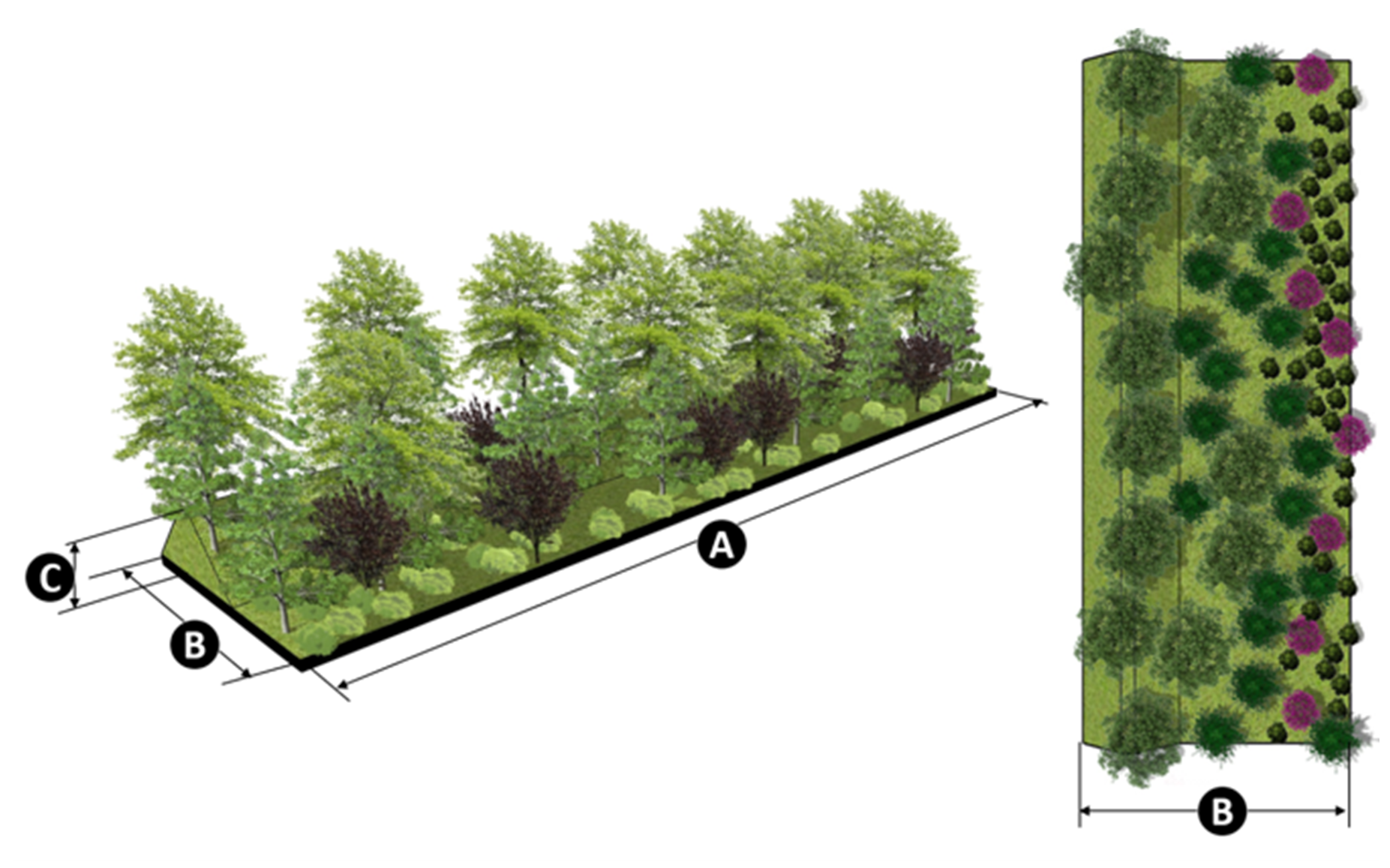
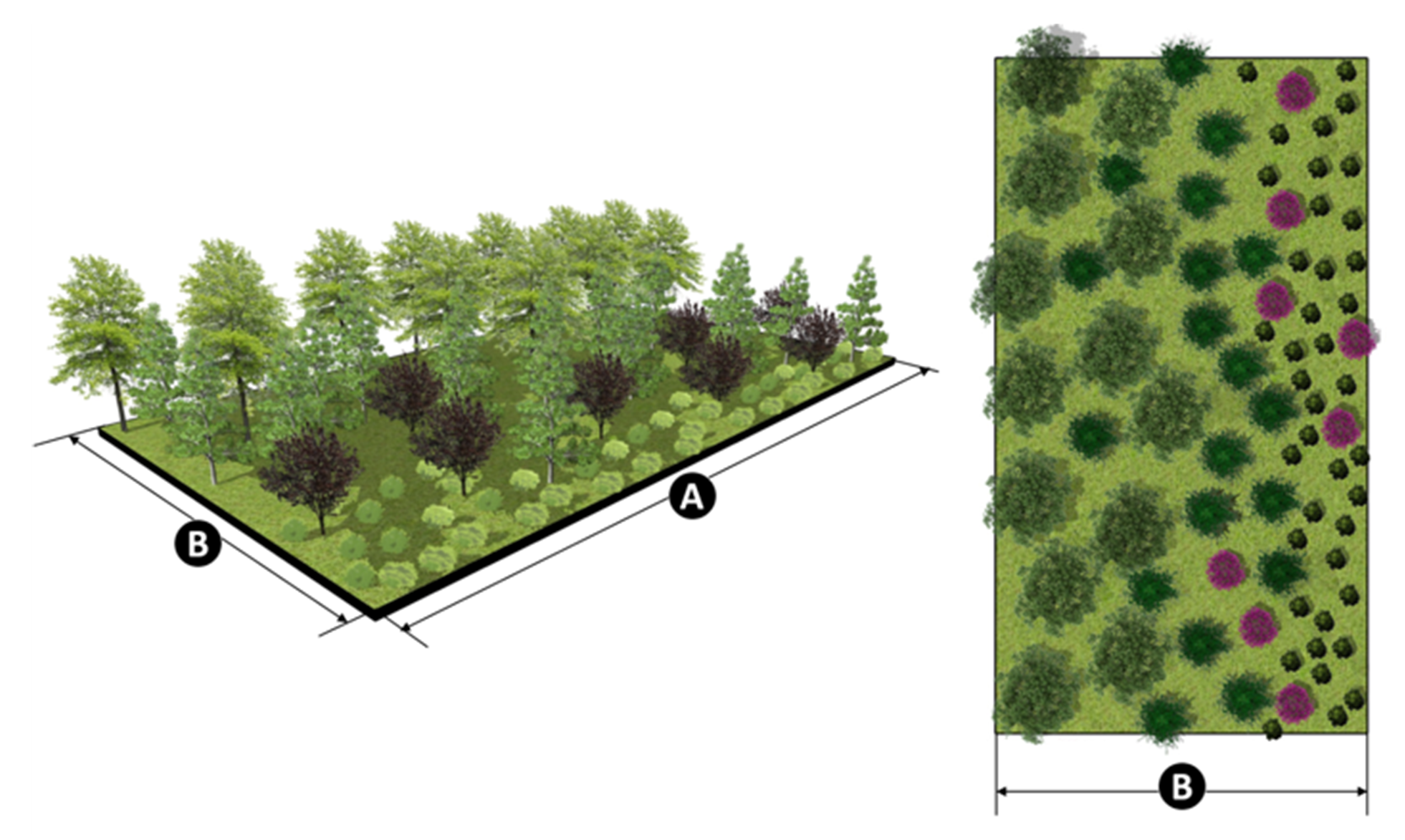
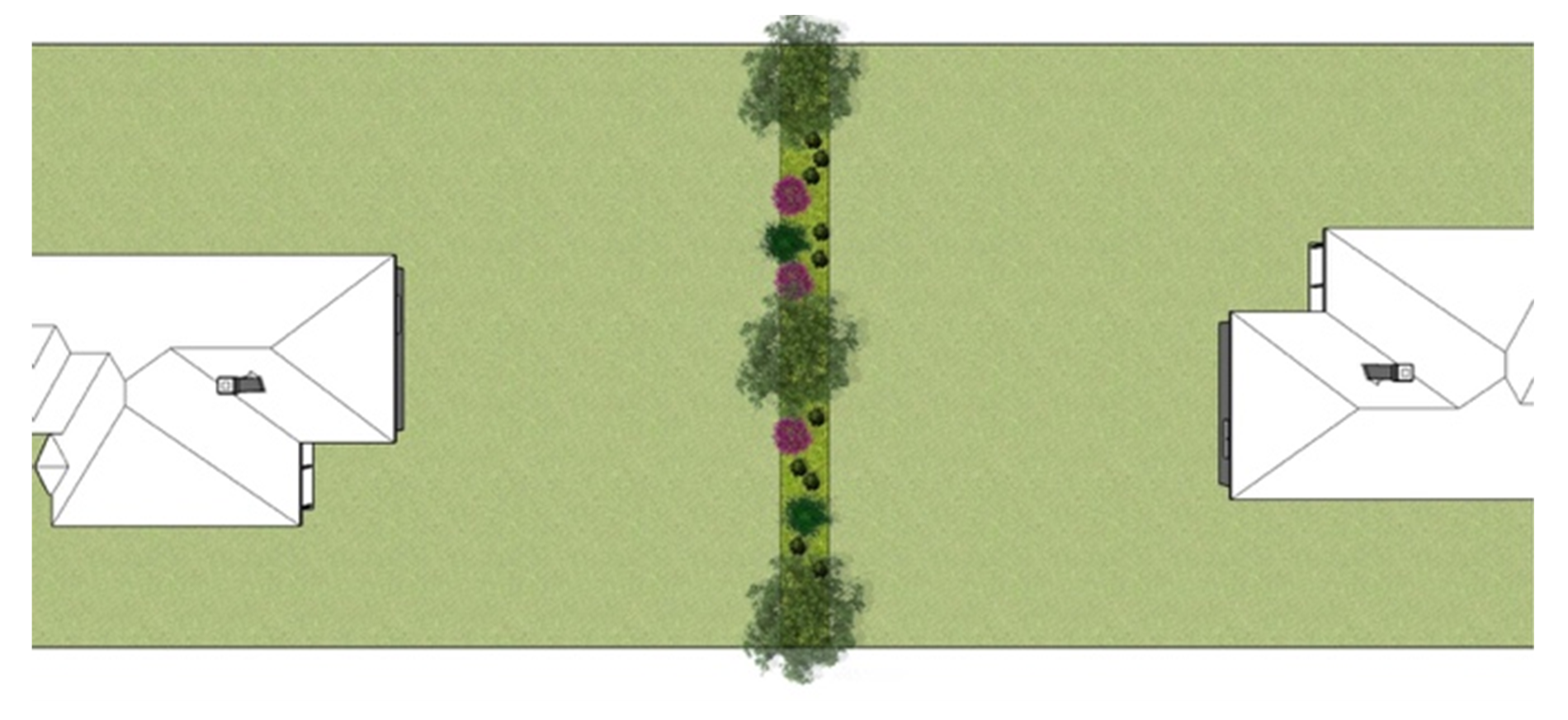
Buffers widths, screening devices by purpose and use, and applicable zoning districts are described in the table below.
(b)
Installation of approved landscape materials shall be external to fencing.
| Illustrative examples of buffers, screening and landscaping | |
| 8-foot wide landscape buffer (length scale: 100 feet) | 15-foot wide landscape buffer (length scale: 100 feet) |
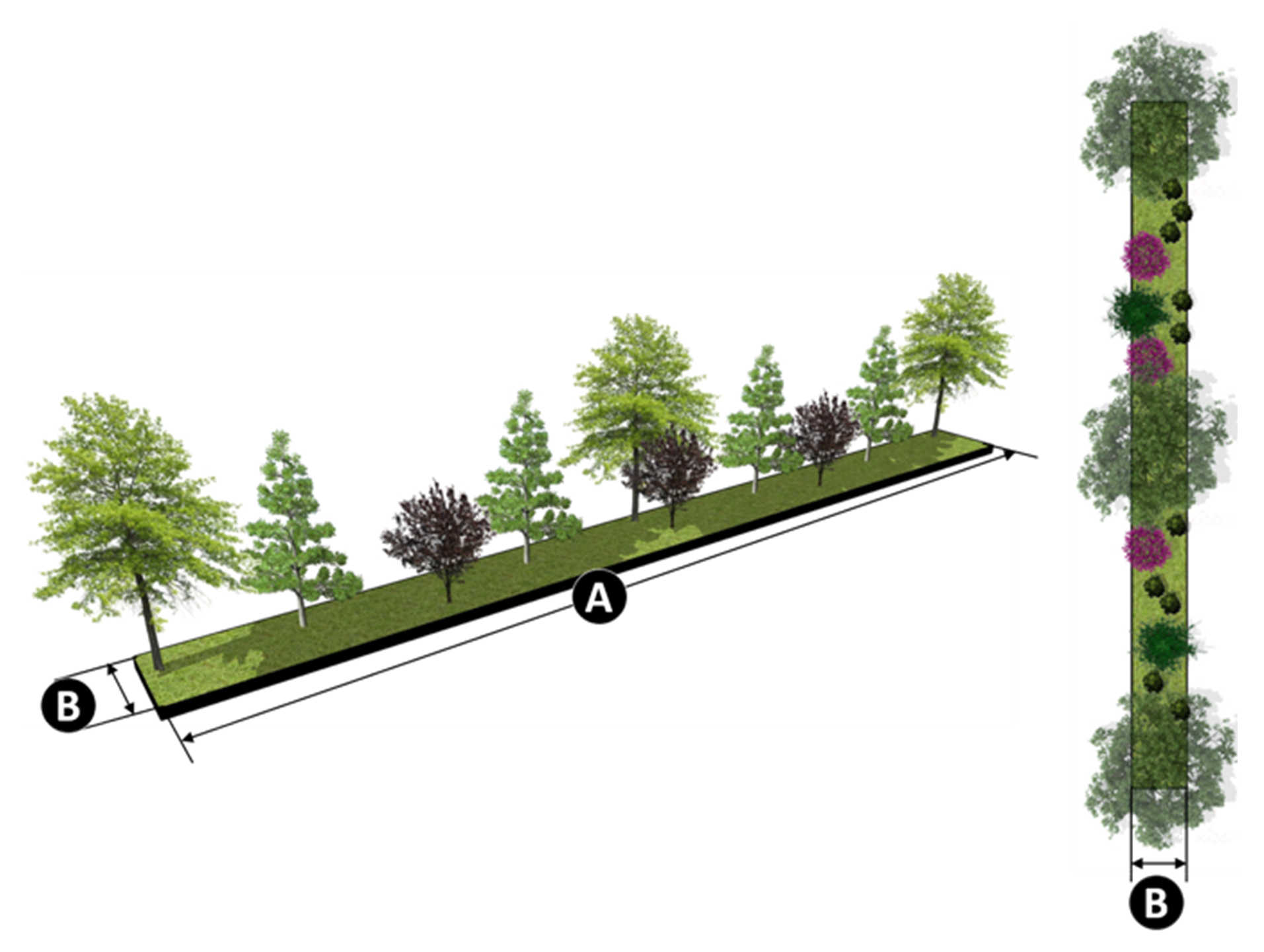 | 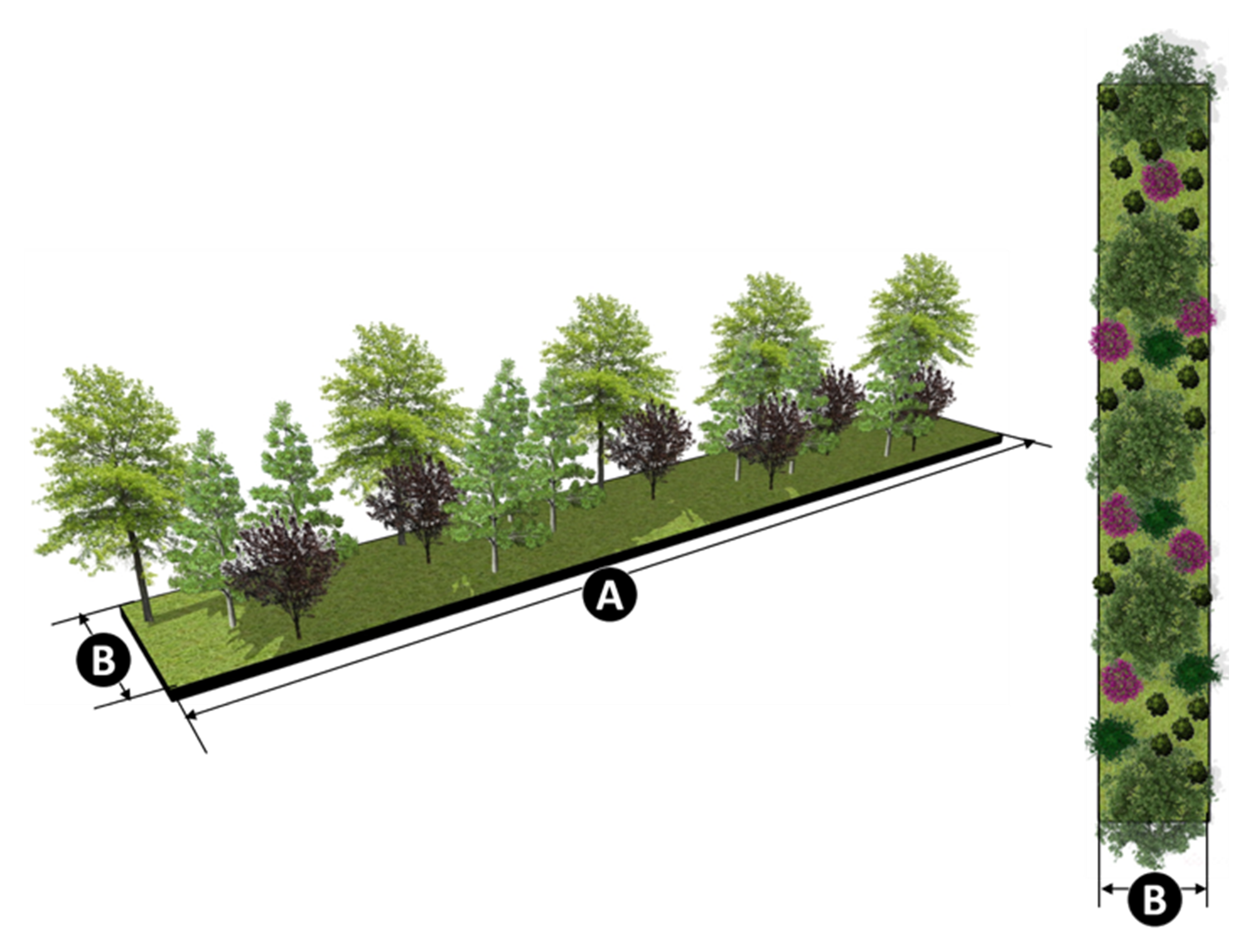 |
| 15-foot wide buffer with a six-foot high fence (length scale: 100 feet) | 20-foot wide landscape buffer (length scale: 100 feet) |
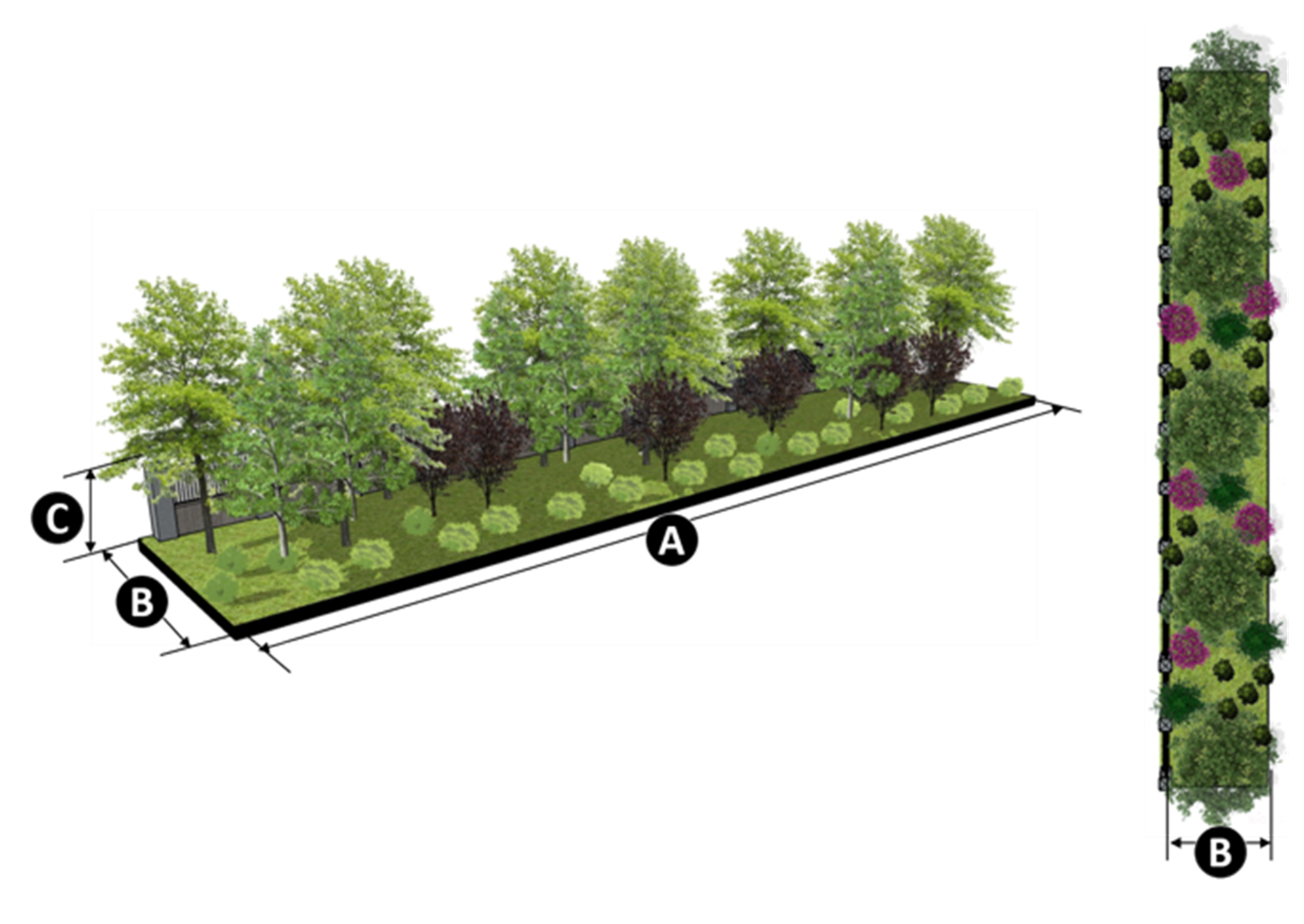 | 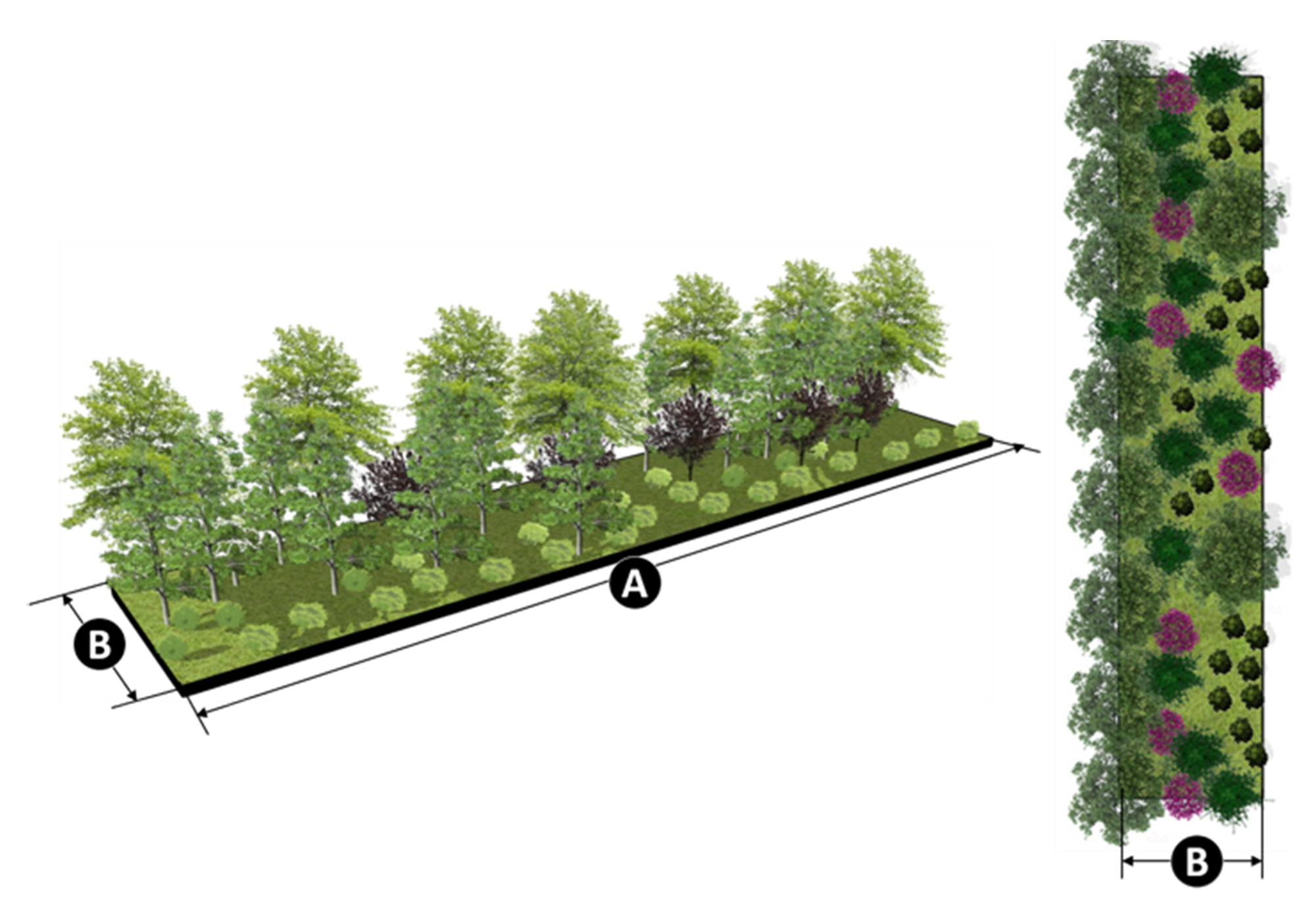 |
| 25-foot wide buffer with a six-foot high landscape berm (length scale: 100 feet) | 50-foot wide landscape buffer (length scale: 100 feet) |
 |  |
| 8-foot wide buffer for a back-to-back lot | |
 | |
(Amd. of 4-4-23(2), § 406)
Editor's note— An amendment of Apr. 4, 2023(2), § 406, amended the title of § 406 to read as herein set out. The former § 406 title pertained to screening of service areas within 100 feet of public street.
Section 407. - Buffers, screening and landscaping, specifications and plan review.
(a)
Specifications for screening and landscaping are described in the table below.
(b)
A landscaping plan shall be prepared by a Georgia licensed landscape architect providing sufficient detail to determine whether the required amount and type of materials that best serve the intended function has been selected.
(c)
Landscape plans submitted for plan review shall include the following information for buffers and screening:
(1)
Location of buffers, screening devices and landscape materials (minimum scale of one inch = 400).
(2)
Show and label existing vegetation to remain or to be removed, and vegetation to be installed.
(3)
Location, name, and size of all existing trees, shrubs, groundcover and other plant materials that are to be incorporated as part of the landscape plan but will not count toward required landscaping.
(4)
A plant installation schedule to include scientific and common name, size at time of installation, method of containment (container size, etc.), quantity, and comments.
(5)
Symbols designating type, size, and location, with center of each tree noted (shrubs and groundcover can be shown as a mass).
(6)
Landscape beds and architectural planting surrounding existing and/or proposed structures on the site.
(7)
A maintenance plan for the first growing season.
(8)
Where applicable, location and sizes of irrigation facilities adequate to maintain the planting areas, including meters, wells, pumps and backflow prevention devices. The total square footage of irrigated area of each type of zone (turf, shrub or flower bed), shall be clearly indicated on the plan.
(Amd. of 4-4-23(2), § 407)
Editor's note— An amendment of Apr. 4, 2023(2), § 407, amended the title of § 407 to read as herein set out. The former § 407 title pertained to screening required.
Section 407A. - Minimum yard setback.
Wherever this ordinance requires a minimum setback between a property line and a building line, unless otherwise indicated, this shall mean the required minimum distance between any point on the property line to the nearest point on the corresponding building line, i.e., the minimum front building line shall be at least the required minimum distance from the front property line, the rear building line shall be a least the required minimum distance from the rear property line, etc.
(Amd. of 4-4-23(2), § 407A)
Section 408. - Reserved.
Editor's note— Amd. of April 5, 2005 repealed sections 408, 409 in its entirety. Former section 408 pertained to a building permit requirement and certificates of occupancy, respectively, and derived from Ord. No. 1997-38, adopted Nov. 4, 1997.
Section 409. - Appealing an action of the building and zoning official or planning and zoning commission.
(a)
If the building and zoning official executes an action which the aggrieved party believes to be contrary to this ordinance, that action may be appealed. Such an appeal must be filed within 30 days of the date on which the action by the building and zoning official was taken.
(b)
The planning and zoning commission has jurisdiction for hearing appeals concerning actions of the building and zoning official related to this ordinance. Applications for appeal may be obtained from and submitted to the building and zoning official, who will transmit them to the planning and zoning commission for its consideration.
(c)
When an action of the building and zoning official is appealed, all construction or other activity authorized by the appealed action must be stopped immediately. In certain cases, however, the building and zoning official may feel that the stopping of such construction or other activity authorized by the appealed action will cause imminent peril to life or property. Then, the building and zoning official may certify to the planning and zoning commission that, by reason of facts stated in the certificate, the halting of construction or other activity authorized by the appealed action would in his opinion cause imminent peril to life or property. In such cases, the construction or other activity authorized by the appealed action is allowed to continue unless the construction is halted by the planning and zoning commission or a restraining order is granted by a court of competent jurisdiction.
(d)
When an application for appeal of an action of the building and zoning official is received, the planning and zoning commission will set a time and place for a public hearing on the appeal. Notice of the hearing must be published in a newspaper of general circulation in the county at least 30 days before the hearing and, if the appeal concerns a variance, the building and zoning official shall post a sign on the subject property at least 30 days prior to the hearing setting forth the purpose, date, time, and place of the scheduled public hearing. In addition, the parties to the appeal (including the owner of any property that is the subject of the proposed action) will be mailed notice of the date of the hearing by the planning and zoning commission at least 30 days before the hearing. Any person may appear at the hearing or have a representative attend instead.
(e)
The planning and zoning commission will make a decision concerning the appeal and record the decision in the minutes for that meeting. Any person aggrieved by any decision of the planning and zoning commission (including, but not limited to, decisions on appeals or variances) may appeal such decision to the county board of commissioners. Such an appeal must be filed in writing with the building and zoning official within 30 days of the date of the decision being appealed. When an application for appeal of a decision of the planning and zoning commission is received, the board of commissioners will set a time and place for a public hearing on the appeal. Notice of the hearing must be published in a newspaper of general circulation in the county at least 30 days before the hearing and, if the appeal concerns a variance, the building and zoning official shall post a sign on the subject property at least 30 days prior to the hearing setting forth the purpose, date, time, and place of the scheduled public hearing In addition, the parties to the appeal (including the owner of any property that is the subject of the proposed action) will be mailed notice of the date of the hearing by the board of commissioners at least 30 days before the hearing. Any person may appear at the hearing, or have a representative attend instead.
(f)
An application for appeal of an action of the building and zoning official may be withdrawn by the applicant as a matter of right until 5:00 p.m. the day prior to the meeting of the planning and zoning commission or the board of commissioners at which such application is scheduled to be heard. Such withdrawal must be in writing and must be received by the building and zoning official by 5:00 p.m. the day before the scheduled meeting.
(Amd. of 11-6-07(3); Amd. of 4-4-23(2), § 409)
Editor's note— An amendment of Apr. 4, 2023(2), § 409, amended the title of § 409 to read as herein set out. The former § 409 title pertained to appealing an action of the zoning administrator, building official, or planning and zoning commission.
Section 410. - Procedures: variances, conditional uses and amendments.
(a)
Pre-application conference.
(1)
Pre-application conference: Recommended. Any applicant seeking approval for a proposed zoning action is advised to engage in a pre-application conference. Prior to filing an application, an applicant may meet with the building and zoning official and the county staff development review committee and discuss their intentions with regard to a given application and questions regarding the procedures or substantive requirements of this appendix. The applicant should bring sufficient information including sketch maps of the site, a description of the existing environmental, topographical and structural features on the site, the proposed project or use, graphics that illustrate the scale, location and design of any buildings or structures to the extent known, and a list of the issues to be discussed at the conference. No matters discussed at said meeting shall be binding on either the applicant or the county.
(2)
Pre-application conference: Mandatory. Any applicant seeking approval for a proposed zoning action involving 1) a residential use of more than 50 dwelling units; 2) a nonresidential use that would generate an additional 500 or more vehicle trips per day as defined by the Institute of Traffic Engineers Trip Generation Manual; 3) a planned unit development; or, 4) a development of regional impact, is required to engage in a pre-application conference with the building and zoning official and the county staff development review committee at its regularly scheduled monthly meeting or such other meeting as the building and zoning official may determine. The building and zoning official may waive the pre-application conference requirement in cases where it is clear such a waiver is not detrimental to the applicant or the county.
(b)
Application.
(1)
The developer or owner submitting a request for a variance, conditional use, or an amendment to the official map or text of the zoning ordinance (hereinafter in this section collectively referred to as a "zoning request") must have at least 51 percent ownership of the subject property or be the duly authorized agent of such a person, possessing notarized authorization in writing, under the owner's signature. The building and zoning official, the planning and zoning commission, or the board of commissioners (hereinafter collectively referred to as the "local government") may also propose a zoning request.
(2)
Application for a zoning request may be made with the building and zoning official. The building and zoning official will take the required information and transmit it to the planning and zoning commission for its consideration. The planning and zoning commission shall hold a public hearing on all variances and shall make the final decision on all variances, unless such decision is appealed to the board of commissioners in accordance with the provisions of section 409. The board of commissioners shall hold a public hearing on all conditional uses and amendments and shall make the final decision on all conditional uses and amendments, after receiving a recommendation on the conditional use or amendment from the planning and zoning commission. The planning and zoning commission may at its option hold a public hearing on a conditional use or amendment prior to making its recommendation to the board of commissioners.
(3)
No application is to be accepted from any person in violation of the Bulloch County Code of Ordinances. If an applicant for a zoning request or any other action by the planning and zoning commission is, at the time of such application, determined by the building and zoning official to be in violation of the Bulloch County Code of Ordinances, then the building and zoning official will be prohibited from accepting or processing any application from that applicant until the applicant voluntarily removes or changes the cause of the violation and ceases to be in violation. The applicant must notify the building and zoning official that he has ceased the violation and obtain a release from the building and zoning official as to the violation. When the applicant has ceased to be in violation of the Bulloch County Code of Ordinances, the building and zoning official will then accept the application for a zoning request. A receipt showing that all county ad valorem taxes on the subject property have been paid and that no delinquencies exist must be submitted with all applications for zoning requests. The building and zoning official may waive the requirements of this paragraph when the building and zoning official, in his discretion, determines that the enforcement of these requirements would cause an extraordinary and undue hardship on the applicant, and that the waiver of these requirements will not have a significant negative impact on the safety, benefit or welfare of the public.
(4)
A traffic impact study (TIS) shall be required for any development which involves a use (or re-use) of a property which is determined to produce 100 vehicle trips or more in the peak hour or 500 vehicle trips or more per day. A preliminary determination of the anticipated vehicle trips shall be based on the guidelines of the Institute of Transportation Engineer's (ITE's) Trip Generation Manual. In certain cases, supplemental traffic data based on actual data from similar developments can be included and considered. The TIS shall include:
a.
Level of service (LOS) and capacity analysis. Evaluate existing and proposed LOS or capacity conditions as applicable on roadways and intersections. The difference in operations shall be considered the site impacts. If the access point is on an arterial or collector road LOS should be recalculated as necessary. Roadway improvements shall be developed to address the proposed site impacts.
b.
Sensitivity analysis. In special circumstances, typically involving large developments or developments on critical roadways, the county may require either sensitivity testing or ten- to 20-year traffic projections. Sensitivity testing would entail capacity analyses on incremental (five percent to 20 percent) traffic increases. Traffic projections would require evaluation of future traffic operations based on an agreed annual growth rate. Operational impacts as a result of background traffic increases (sensitivity testing or traffic projections) may not be required to be mitigated unless such is a result of a phased development.
c.
Peak-hour analysis. Existing and proposed a.m. (7:30—8:30) and p.m. (5:00 and 6:00) peak hour trips.
d.
Trip generation analysis. Evaluate existing and proposed trip generation. It should be noted that often trip generation data is based on limited sample size and, therefore, application of such could have varying results. Additionally, some land uses may not lend well to direct application of the Manual and upward or downward adjustments may be justifiable. An example of such might include trip rate factors for apartments in which the ITE Trip Generation Manual bases such on national apartment profile characteristics. However, in the case of the county, many of the apartment complexes house two to four students in a single unit. This would result in a higher number of vehicles than expected (four vehicles versus two) and higher trip numbers per unit.
e.
Trip distribution analysis. Existing and proposed 24-hour directional traffic count on a typical weekday for each roadway or access point.
f.
Internal circulation analysis. Evaluation of driveway lengths for vehicular queuing and lane needs, which would affect the operation of the public roadway system, should be addressed as part of the site impacts.
g.
Traffic impact mitigation. Evaluation and recommendations of on-site and off-site roadway improvements to accommodate the additional predicted traffic to be generated by the site, including access management and safety improvements regarding warrants for additional turn lanes and channelization, medians and islands and signalization as provided in the GDOT Driveway and Encroachment Control Manual.
h.
The results of the traffic impact study submitted to the county are not automatically binding. The county, at its discretion, may review the traffic study and may overrule submitted recommendations.
(c)
Notification.
(1)
Notice of the hearing for a zoning request that is a variance must be published in a newspaper of general circulation in the county at least 30 days but not more than 45 days before the hearing. Such notice will state the time, place and purpose of the hearing. If the zoning request for a variance is initiated by a party other than the local government, the building and zoning official shall also post a sign in a conspicuous place on the subject property at least 30 days prior to the date of the scheduled public hearing. The sign should set forth the purpose, date, time, and place of the scheduled public hearing. In addition, the building and zoning official shall mail notice of the hearing to the applicant and property owner (if different from the applicant) at least 30 days prior to the hearing.
(2)
Notice of the hearing for a zoning request that is a conditional use or amendment must be published in a newspaper of general circulation in the county at least 15 days but not more than 45 days before the hearing. Such notice will state the time, place and purpose of the hearing. If the zoning request is for an amendment to rezone property from one district to another and is initiated by a party other than the local government, then the notice shall also include the location of the property, the present zoning district of the property, and the proposed zoning district of the property. If the zoning request for a conditional use or amendment is for a particular parcel or parcels of property and is initiated by a party other than the local government, the building and zoning official shall post a sign in a conspicuous place on the property at least 15 days prior to the date of the scheduled public hearing. The sign should set forth the purpose, date, time, and place of the scheduled public hearing, and the present and proposed zoning districts in case of a rezone.
(3)
The planning and zoning commission shall make its recommendation respecting a requested conditional use or amendment to the board of commissioners within 60 days of its first meeting at which the application is heard. If the planning and zoning commission fails to send its recommendation to the board of commissioners within the aforesaid 60 days, it shall mean that the planning and zoning commission recommends approval of the conditional use or amendment, including any conditions recommended by staff. Provided, however, that the planning and zoning commission may defer making its recommendation on a conditional use or amendment for more than 60 days with the consent of applicant. After receipt of the recommendation of the planning and zoning commission, the board of commissioners shall conduct a public hearing on the proposed conditional use or amendment.
(d)
General guidelines.
(1)
Any person desiring a transcript of the hearing must arrange for a court reporter at their own expense.
(2)
Zoning requests shall, as a general rule, be called in the order in which they are received by the county, provided that nothing shall prevent the commission or board from changing the order of decisions reviewed at the time of the hearing for the convenience of the commission or board and the public.
(3)
The chairperson will read or cause to be read a summary of the proposed zoning request under consideration prior to receiving public input.
(4)
As a general rule, the chairperson shall call each person who has signed up to speak on the zoning request in the order in which the persons have signed up to speak, except for the applicant, who will always speak first, or if the local government has brought a zoning request to the hearing, then a representative of the local government shall speak first.
(5)
Nothing contained herein shall be construed as prohibiting the commission or board from taking reasonable steps necessary to insure that hearings are conducted in a decorous manner, and to assure that the public hearing on each zoning request is conducted in a fair and orderly manner.
(6)
The planning and zoning commission and board of commissioners will make a decision concerning the zoning request and record the decision in the minutes for that meeting.
(e)
Public comments.
(1)
Written comments on the subject of the hearing may be submitted by any citizen or property owner at any time prior to the adjournment of the hearing.
(2)
All persons who wish to address the planning and zoning commission or board of commissioners at a hearing concerning a zoning request shall first sign up on a form to be provided by the county prior to the commencement of the hearing. Only those persons signed up to speak prior to the commencement of the hearing shall be entitled to speak, unless the chairperson of the planning and zoning commission or board of commissioners, in his discretion, decides to make an exception at the time of the hearing, notwithstanding the failure of the person to sign up prior to the hearing.
(3)
Each side will be allowed a minimum time period of ten minutes to make its presentation. The length of time of oral presentations permitted to each speaker will be determined by the chairperson of the planning and zoning commission or board of commissioners, and will depend upon the number of persons present and desiring to speak and the complexity of the zoning request under consideration.
(4)
All questions will be addressed to the chairperson of the planning and zoning commission or board of commissioners.
(5)
Each speaker shall speak only to the merits of the proposed zoning request under consideration and shall address his or her remarks only to the members of the planning and zoning commission or board of commissioners.
(6)
Each speaker shall refrain from personal attacks on any other speaker or from discussing facts or opinions irrelevant to the proposed zoning request under consideration.
(7)
The chairperson of the planning and zoning commission or board of commissioners may limit or refuse a speaker the right to continue, if the speaker, after first being cautioned, continues to violate this subsection.
(8)
Prior to speaking, the speaker will identify himself or herself and state his or her current address, and if an attorney or other designated agent, identify his or her principal.
(9)
The merits of the zoning request shall include, but not necessarily be limited to, evidence or opinions regarding devaluation, fair market value, nuisance, environmental concerns, traffic, noise, aesthetics and in general, the health, welfare and benefit of the community or county as it is affected by the zoning request. The speaker shall refrain from comment on unrelated zoning issues and unrelated tracts of land.
(f)
Decisions.
(1)
The board of commissioners is not bound by the recommendation of the planning and zoning commission. The board of commissioners may grant or deny the application for a zoning request and, if granted, establish such additional conditions and development standards as it deems appropriate for the protection and benefit of surrounding landowners and neighborhoods, to ameliorate the effects of the zoning request, and otherwise for the general public safety and welfare.
(2)
The planning and zoning commission may impose such additional conditions and development standards on variances and recommend such additional conditions and development standards on conditional uses and amendments as it deems appropriate for the protection and benefit of surrounding landowners and neighborhoods, to ameliorate the effects of the zoning request, and otherwise for the general public safety and welfare.
(3)
After reviewing the record of the public hearing and considering recommendations from the planning and zoning commission, the board of commissioners may approve or deny the requested amendment, reduce the land area for which the amendment is requested, change the district or land use category requested, or impose conditions which may restrict the use or development of the property in a manner not otherwise required by this appendix. Any such conditions imposed by the board of commissioners shall be incorporated into this appendix and shall become a part of the official zoning map, whether or not actually entered upon the official zoning map.
(4)
The power to approve a variance rests with the planning and zoning commission, except that in consideration of a rezoning of property from one zoning district to another or a conditional use the board of commissioners may approve a variance in connection with its approval of a conditional rezoning or conditional use.
(5)
The power to approve a conditional use and enact an amendment rests with the board of commissioners.
(g)
Deferrals.
(1)
Prior to the close of the hearing, the planning and zoning commission or board of commissioners shall announce whether it will vote on the zoning request at that same hearing or whether it will defer its vote for a period not to exceed 45 days. Provided, however, that the planning and zoning commission or board of commissioners may defer its vote on a zoning request for more than 45 days with the consent of the applicant.
(h)
Withdrawals.
(1)
An application for a zoning request or the appeal of the denial of a zoning request may be withdrawn by the applicant as a matter of right until 5:00 p.m. the day prior to the meeting of the planning and zoning commission or the board of commissioners at which such application is scheduled to be heard. Such withdrawal must be in writing and must be received by the building and zoning official by 5:00 p.m. the day before the scheduled meeting.
(i)
Reapplication.
(1)
If an application for a zoning request is for an amendment to rezone property and the zoning request is denied, then an application to rezone the same property may not be filed with the building and zoning official until the expiration of at least six months following the denial of the rezoning. If an application for a zoning request that is a variance or a conditional use is denied, then an application for a conditional use or a variance on the same property that is substantially the same may not be filed with the building and zoning official until at least six months following the denial.
(Amd. of 11-6-07(3); Amd. of 8-2-11; Amd. of 4-4-23(2), § 410)
Editor's note— An amendment adopted Nov. 6, 2007(3), enacted provisions designated as §§ 409—414, and have been treated as superseding the former §§ 410—414, which pertained to similar subject matter and derived from an ordinance adopted April 3, 2001; an ordinance adopted May 1, 2001; an amendment adopted June 4, 2002(1); an amendment adopted Nov. 5, 2002; an amendment adopted Aug. 3, 2004; and an amendment adopted April 5, 2005(3).
Section 411. - Variances.
(a)
A variance is a permit, issued by the planning and zoning commission, which allows construction or maintenance of a building or structure in a way that varies from requirements for the district in which the property is located. A variance may be granted only in an individual case where unnecessary or undue hardship would result if all of the requirements of this appendix were applied stringently to a particular piece of property. Unnecessary or undue hardship means that owing to conditions peculiar to the property and not as a result of any action on the part of the property owner, a permitted use of a lot is not reasonable if all of the requirements of this appendix are to be met.
(b)
A hardship may exist for medical reasons which would permit the temporary placement of a manufactured home, meeting applicable development standards, on the same parcel as the original principal dwelling. Such temporary dwelling shall be placed behind and within 300 feet of the principal dwelling whenever possible. Such temporary dwelling shall provide living quarters for an infirmed family member or provide living quarters for a family member or certified/registered assisted living employee to aid in the care of one or more infirmed family members living in the original principal dwelling. Variances approved for medical hardship cases shall be reviewed annually by the zoning administrator. When the medical hardship ceases to exist, the owner of the principal dwelling shall notify the zoning administrator. Such manufactured home shall be removed within 30 days, or subject the owner of the principal dwelling to fines and penalties as outlined in section 418.
(c)
With the exception of a medical hardship variance, a variance may be granted only for permitted uses in the zoning district in which the property in question is located. (For example, a two-family dwelling would not be allowed to be placed in an R15 district under a variance).
(d)
Where a variance is granted for a construction activity requiring a building permit, the building permit must be obtained within 12 months of the issuance of the variance. Otherwise, the variance expires after 12 months.
(e)
The planning and zoning commission will consider the following standards in arriving at a decision on the variance.
(1)
Will the variance cause substantial detriment to the public good or impair the purposes of this appendix?
(2)
Is the spirit of this appendix observed and the public safety and welfare secured?
(3)
Is the hardship related to conditions peculiar to the property and not a result of any action of the property owner?
(f)
The building and zoning official shall have the power to grant administrative variances from the development standards of this appendix where, in the opinion of the building and zoning official, the intent of this appendix can be achieved and equal performance obtained by granting a variance. The authority to grant such variances shall be limited to variances from the following requirements:
(1)
Front yard or yard adjacent to public street setback: variance not to exceed 20 percent of the setback in the applicable zoning district.
(2)
Side yard setback: variance not to exceed 20 percent of the setback in the applicable zoning district.
(3)
Rear yard setback: variance not to exceed 20 percent of the setback in the applicable zoning district.
(4)
Height of building: variance not to exceed 20 percent of the setback in the applicable zoning district.
(5)
Extension of variance or conditional use for a construction activity requiring a building permit: variance to grant a maximum of two one-year extensions of the time limits in subsections 411(d) and 413(e) if the variance or conditional use is for a project requiring multiple building permits and at least one of the permits has been obtained and construction has begun under that permit.
(6)
Parking spaces: variance not to exceed ten percent of required in applicable zoning district.
(7)
Lot size: variance not to exceed five percent of the lot size in the applicable zoning district (minor subdivisions only—as determined by the subdivision ordinance).
(8)
Lot width: variance not to exceed ten percent of the lot width in the applicable zoning district (minor subdivisions only—as determined by the subdivision ordinance).
(9)
Minor amendments to conditions of approval established by the planning and zoning commission.
(g)
When an application for an administrative variance is received, the building and zoning official will set a time and place for a public hearing on the administrative variance. Notice of the hearing must be published in a newspaper of general circulation in the county at least 30 days but not more than 45 days before the hearing. The building and zoning official shall also post a sign on the subject property at least 30 days prior to the hearing setting forth the purpose, date, time, and place of the scheduled public hearing. In addition, the building and zoning official shall mail notice of the hearing to the applicant and property owner (if different from the applicant) at least 30 days prior to the hearing. The building and zoning official shall allow the applicant and/or property owner the opportunity to speak at the hearing. The building and zoning official shall also allow anyone at the hearing who is opposed to the granting of the administrative variance the opportunity to speak. The building and zoning official may limit the time for speakers to no more than ten minutes per side. The building and zoning official will make a decision to either grant or deny the administrative variance at the conclusion of the hearing.
(Amd. of 11-6-07(3); Amd. of 4-4-23(2), § 411)
Editor's note— An amendment adopted Nov. 6, 2007(3), enacted provisions designated as §§ 409—414, and have been treated as superseding the former §§ 410—414, which pertained to similar subject matter and derived from an ordinance adopted April 3, 2001; an ordinance adopted May 1, 2001; an amendment adopted June 4, 2002(1); an amendment adopted Nov. 5, 2002; an amendment adopted Aug. 3, 2004; and an amendment adopted April 5, 2005(3).
Section 412. - Developments of regional impact (DRI).
Local zoning provision to allow for DRI review. For new developments proposed within the county which meet or exceed the minimum threshold identified in the department of community affair's procedures and guidelines for the review of developments of regional impact (DRI), the county will comply with these intergovernmental review procedures. The county shall be allowed up to a maximum of 30 days to complete the review process for large development projects that are likely to create impacts in other local jurisdictions. The county will not take any official action to further any such developments until the DRI review process is completed or a maximum of 30 days has transpired from the date the completed DRI request for review form was forwarded to the regional commission.
(Amd. of 11-6-07(3); Amd. of 4-4-23(2), § 412)
Editor's note— An amendment adopted Nov. 6, 2007(3), enacted provisions designated as §§ 409—414, and have been treated as superseding the former §§ 410—414, which pertained to similar subject matter and derived from an ordinance adopted April 3, 2001; an ordinance adopted May 1, 2001; an amendment adopted June 4, 2002(1); an amendment adopted Nov. 5, 2002; an amendment adopted Aug. 3, 2004; and an amendment adopted April 5, 2005(3).
Section 413. - Conditional use.
(a)
Some zoning districts permit certain uses only upon approval of the board of commissioners after receiving a recommendation from the planning and zoning commission. These uses are identified in this appendix as conditional uses and such uses are allowed only under the circumstances specified in this appendix.
(b)
An applicant requesting a conditional use shall provide the building and zoning official any information as may be deemed appropriate to assist in the consideration of the request (e.g., sketch plan, traffic impact study).
(c)
The planning and zoning commission and board of commissioners will consider the following standards in arriving at a decision on the conditional use:
(1)
Is the type of street providing access to the use adequate to serve the proposed conditional use?
(2)
Is access into and out of the property adequate to provide for traffic and pedestrian safety, the anticipated volume of traffic flow, and access by emergency vehicles?
(3)
Are public facilities such as schools, EMS, sheriff and fire protection adequate to serve the conditional use?
(4)
Are refuse, service, parking and loading areas on the property located or screened to protect other properties in the area from such adverse effects as noise, light, glare or odor?
(5)
Will the hours and manner of operation of the conditional use have no adverse effects on other properties in the area?
(6)
Will the height, size, or location of the buildings or other structures on the property be compatible with the height, size or location of buildings or other structures on neighboring properties?
(7)
Is the proposed conditional use consistent with the purpose and intent of the zoning ordinance?
(d)
If the building and zoning official finds that any restrictions upon which a conditional use was granted are not being complied with, he/she may suspend the permit for the conditional use until such time as the applicant brings the conditional use into compliance with the restrictions imposed by the board of commissioners. Only work upon the conditional use may be allowed during suspension of the permit which is necessary to bring the conditional use into compliance with the restrictions imposed by the board of commissioners.
(e)
Where a conditional use is granted for a construction activity requiring a building permit, the building permit must be obtained within 12 months of the issuance of the conditional use. Otherwise, the conditional use expires after 12 months.
(Amd. of 11-6-07(3); Amd. of 4-4-23(2), § 413)
Editor's note— An amendment adopted Nov. 6, 2007(3), enacted provisions designated as §§ 409—414, and have been treated as superseding the former §§ 410—414, which pertained to similar subject matter and derived from an ordinance adopted April 3, 2001; an ordinance adopted May 1, 2001; an amendment adopted June 4, 2002(1); an amendment adopted Nov. 5, 2002; an amendment adopted Aug. 3, 2004; and an amendment adopted April 5, 2005(3).
Section 414. - Amendments.
(a)
Any landowner may request that the official map be amended from the existing zoning district to another as it applies to the owner's property. Also, any person affected by this zoning ordinance may propose an amendment to the text of this zoning ordinance under the provisions of this section. As used in this section, the term "amendment" shall mean both a change to the official map and a change to the text of this appendix unless otherwise indicated.
(b)
An applicant requesting an amendment to the official map shall provide the building and zoning official the following:
(1)
Details of the specific proposed use(s) of the property, including, but not limited to, a sketch plan prepared by a licensed surveyor or engineer. Applications for speculative zoning without specific uses will not be accepted.
(2)
A copy of the recorded plat and legal description will be the minimum requirement for the planning and zoning commission.
(3)
Where the building and zoning official or the county staff development review committee has recommended the preparation of special studies pursuant to a pre-application conference or where the applicant elects to submit additional technical reports in support of the proposed development, such reports shall be submitted with the initial application form.
(4)
During review of any application, the planning and zoning commission may determine that additional specific technical information is needed regarding any potential environmental, fiscal, or public service impacts. If such a determination is made, the planning and zoning commission shall have the discretion to defer its recommendations concerning such an application upon preparation of a special study intended to analyze the potential impacts or any specific areas of concern.
(5)
Where preparation of a special study has been required, no application shall be recommended to be submitted to the board of commissioners for a public hearing until such study has been received and reviewed by the planning and zoning commission. The cost of any special study shall be borne by the applicant, unless the board of commissioners approves the participation of public funds, as necessary, or being in the public interest.
(6)
Any other materials or information as may be deemed appropriate by the building and zoning official.
(c)
When considering a proposal to amend the official map, the following standards shall be considered.
Standards:
(1)
Is the proposed use suitable in view of the zoning and development of adjacent and nearby property?
(2)
Will the proposed use adversely affect the existing use or usability of adjacent or nearby property?
(3)
Are there substantial reasons why the property cannot or should not be used as currently zoned?
(4)
Will the proposed use cause an excessive or burdensome use of public facilities or services, including, but not limited to, streets, schools, EMS, sheriff or fire protection?
(5)
Is the proposed use compatible with the purpose and intent of the comprehensive plan?
(6)
Will the proposed use be consistent with the purpose and intent of the proposed zoning district?
(7)
Is the proposed use supported by new or changing conditions not anticipated by the comprehensive plan?
(8)
Does the proposed use reflect a reasonable balance between the promotion of the public health, safety, morality, or general welfare and the right to unrestricted use of property?
(d)
When considering a proposal to amend the text of the zoning ordinance, the following standards shall be considered.
Standards:
(1)
Is the proposed text amendment compatible with the purpose and intent of the comprehensive plan?
(2)
Is the proposed text amendment consistent with the purpose and intent of the zoning ordinance?
(3)
Will adoption of the amendment further the protection of the public health and safety or general welfare?
(Amd. of 11-6-07(3); Amd. of 4-4-23(2), § 414)
Editor's note— An amendment adopted Nov. 6, 2007(3), enacted provisions designated as §§ 409—414, and have been treated as superseding the former §§ 410—414, which pertained to similar subject matter and derived from an ordinance adopted April 3, 2001; an ordinance adopted May 1, 2001; an amendment adopted June 4, 2002(1); an amendment adopted Nov. 5, 2002; an amendment adopted Aug. 3, 2004; and an amendment adopted April 5, 2005(3).
Section 415. - Planning and zoning commission.
(a)
The planning and zoning commission shall consist of seven members, appointed by the board of commissioners to serve for staggered three-year terms or until their successor has been appointed. Any vacancy in the membership shall be filled for the unexpired term in the same manner as the initial appointment. Members shall be removable for cause by the board of commissioners upon written notice and an opportunity to be heard. The board of commissioners shall determine the amount of compensation, if any, to be paid to the members of the planning and zoning commission.
(b)
The planning and zoning commission shall elect from its membership a chairman, a vice-chairman, and a secretary, each of whom shall serve for one year or until he is re-elected or his successor is elected. The vice-chairman shall preside over meetings in the chairman's absence. The chairman (or, in the chairman's absence, the vice-chairman) may not introduce or second motions and shall not vote except in the case of a tie vote among the other members, the chairman then voting to break the tie. The planning and zoning commission shall adopt rules in accordance with this ordinance and state law. Meetings of the planning and zoning commission shall be held at the call of the chairperson and every 30 days or at other times as the planning and zoning commission may determine. The planning and zoning commission shall keep minutes of its proceedings, showing the vote of each member upon each question, and shall keep records of its examinations and other official actions, all of which shall be filed, upon official approval, in the office of the clerk of the board of commissioners and shall be a public record. All meetings and all records of the planning and zoning commission shall comply with O.C.G.A. chs. 14 and 18, tit. 50.
(c)
The planning and zoning commission shall require the applicant to furnish such information as it deems necessary when filing an application.
(d)
It shall be the responsibility of the planning and zoning commission to review and recommend to the board of commissioners its approval, disapproval, or approval with conditions on all requests for rezoning, map and text interpretations and other amendments submitted to the designated officials or initiated by any other individual or governmental unit.
(e)
The planning and zoning commission does not have the power to amend any zoning ordinance, to rezone any land, or to allow any use not permitted by this ordinance.
(Amd. of 4-5-05(3); Amd. of 4-4-23(2), § 415)
Section 416. - Designation of officers for service of petitions and appeals.
(a)
The county manager or, in his absence, the assistant county manager, is designated as the officer who has the authority to approve or issue any form or certificate necessary to perfect the petition described in O.C.G.A. tit. 5 for review of lower judicatory bodies and upon whom service of such petition may be effected or accepted on behalf of the planning and zoning commission during normal business hours at the regular offices of the board of commissioners.
(b)
The county manager or, in his absence, the assistant county manager, is designated as the officer who has the authority to accept service and upon whom service of an appeal of a quasi-judicial decision may be effected or accepted on behalf of the board of commissioners during normal business hours at the regular offices of the board of commissioners.
(Amd. of 4-4-23(2), § 416)
Editor's note— An amendment of Apr. 4, 2023(2), § 416, amended the title of § 416 to read as herein set out. The former § 416 title pertained to appealing an action of the board of commissioners.
Section 417. - Fees.
Fees shall be set forth in the Bulloch County schedule of fees and charges.
(Ord. of 5-1-01; Amd. of 8-3-04(2); Amd. of 4-4-23(2), § 417)
Section 418. - Penalties.
Any person who violates any provision of this appendix or any amendment to this appendix, or who fails to perform any act required hereunder or commits any prohibited act, upon conviction thereof shall be subject to punishment as provided in section 1-11 of the Bulloch County Code of Ordinances. Each and every day for which any violation is committed or permitted to continue shall constitute a separate offense and shall be punishable as such hereunder.
(Amd. of 1-2-07; Amd. of 4-4-23(2), § 418)
Section 419. - Remedies.
If any building or land is used or maintained in violation of this appendix, anyone, including the county, who would be harmed by such a violation, may initiate legal proceedings to obtain an injunction or other appropriate remedy to stop the violation or to prevent any act which would constitute such a violation. Other legal remedies are also available as provided by Georgia law.
(Amd. of 4-4-23(2), § 419)

