
Portland City Zoning Code
DIVISION 1
INTRODUCTION
Section 1-1. - Title.
This ordinance shall be known and may be cited as the "City of Portland Zoning Ordinance."
Section 1-2. - Purpose.
Pursuant to the authority granted to the city by the Michigan Zoning Enabling Act, this ordinance is established to regulate the use of land and structures for the following purposes:
(1)
to meet the needs of the state's citizens for food, fiber, energy, and other natural resources, places of residence, recreation, industry, trade, service, and other uses of land;
(2)
to ensure that use of the land is situated in appropriate locations and relationships;
(3)
to limit the inappropriate overcrowding of land and congestion of population, transportation systems, and other public facilities;
(4)
to facilitate adequate and efficient provision for transportation systems, sewage disposal, water, energy, education, recreation, and other public service and facility requirements; and
(5)
to promote public health, safety, and welfare.
Section 1-3. - Scope.
(a)
Except as otherwise provided for in this ordinance, every building and structure erected; every use of property, building, or structure established; every structural alteration or relocation of an existing building or structure; and every enlargement of, or addition to, an existing use, building, or structure occurring after the effective date of the ordinance, shall be subject to this ordinance.
(b)
In its interpretation and application, the provisions of this ordinance shall be held to be minimum requirements adopted for the promotion of the public health, safety, comfort, convenience, or general welfare. It is not intended by this ordinance to impair or interfere with any other existing provision of law or ordinance. However, where this ordinance imposes a greater restriction than is required by existing ordinance or by rules, regulations, or permits, the provisions of this ordinance shall control.
(c)
Except as otherwise noted, nothing in this ordinance shall be interpreted or construed to give rise to any permanent vested rights in the continuation of any particular use, district, zoning classification, or any permissible activities therein. All rights are hereby declared to be subject to such subsequent amendment, change, or modification of this ordinance as may support the stated purposes of section 1-2.
(d)
The right to continue a land use or activity or construct a building or structure which is either permitted by this ordinance or established as a nonconformity shall be vested with the property rather than the owner. No rights shall be terminated for reasons of transfer of ownership. The right to continue a land use or activity shall transfer automatically upon the conveyance of the property unless terminated pursuant to article 15, or unless otherwise provided in the approval of the land use or activity.
Section 1-4. - Legal basis.
This ordinance is enacted pursuant to the Michigan Zoning Enabling Act, Public Act 110 of 2006, as amended.
Section 1-5. - Effect of ordinance.
No land, building, structure, or other premises shall be used, developed, or occupied, and no building or structure shall be constructed, reconstructed, moved, removed, extended, enlarged, or altered except in compliance with the provisions of this ordinance.
Section 2-1. - Rules of construction.
The following definitions and rules of construction shall apply when used in this ordinance, shall have the meanings ascribed to them in this section, except where the context clearly indicates a different meaning:
(1)
The particular shall control the general. For terms used in this ordinance, the use of a general term shall not be taken to be the same as the use of any other specific term. For example, a "truck stop," as used in this ordinance, shall not be interpreted to be the same as a "vehicle service establishment" since each is listed as a separate and distinct use.
(2)
In case of any difference of meaning or implication between the text of this ordinance and any caption or illustration, the text shall control.
(3)
A building or structure includes any part thereof.
(4)
The phrase "used for" includes: "arranged for," "designed for," "intended for," "maintained for" and "occupied for."
(5)
Unless the context clearly indicates the contrary, where a regulation involves two or more items, conditions, provisions, or events connected by the conjunctions "and", "or", or "either...or," the conjunction shall be interpreted as follows:
a.
"And" indicates that the connected items, conditions, provisions, or events apply.
b.
"Or" indicates that the connected items, conditions, provisions, or events may apply singly or in any combination.
c.
"Either...or" indicates that the connected items, conditions, provisions, or events apply singly but not in combination.
(6)
"Holidays", as used in this ordinance, shall mean the day on which any holiday officially recognized by the city is celebrated.
(7)
The word "person" includes an individual, corporation, partnership, incorporated association, or any other similar entity. Gender related words include all genders.
(8)
Terms not defined in this ordinance shall have the meaning customarily assigned to them.
(9)
The word "shall" is always mandatory and not discretionary. The word "may" is permissive.
(10)
Whenever reference is made to a federal, state, county, or municipal ordinance, law, or act, it is presumed to include any amendments.
(11)
In computing a period of days, the first day is excluded and the last day is included. If the last day of any period during which an application, filing, or request is required to be made to the city or other governmental agency is a Saturday, Sunday, or legal holiday, the period is extended to include the next day which is not a Saturday, Sunday, or legal holiday.
Section 2-2. - Definitions: A-C.
Accessory building: a detached building or structure that is clearly incidental to, customarily found in connection with, and located on the same zoning lot or parcel as the principal use to which it is related.
Accessory use: a use customarily and normally incidental and subordinate to the principal use of the premises.
Adult foster care (state licensed residential care facility): a governmental or nongovernmental establishment that provides foster care to adults. Subject to Act 218 of 1979, adult foster care facility includes facilities and foster care family homes for adults who are aged, mentally ill, developmentally disabled, or physically disabled who require supervision on an ongoing basis but who do not require continuous nursing care.
(1)
Adult foster care family home: A private residence with the approved capacity to receive not more than six adults who are provided with foster care for five or more days a week and for two or more consecutive weeks.
(2)
Adult foster care large group home: An adult foster care facility with the approved capacity to receive at least 13 but not more than 20 adults to be provided with foster care.
(3)
Adult foster care small group home: An adult foster care facility with the approved capacity to receive not more than 12 adults who are provided with foster care.
(4)
Adult foster care congregate facility: an adult foster care facility with the approved capacity to receive more than 20 adults to be provided with foster care.
Alteration or reconstruction: any change, addition or modification to a structure or type of occupancy, any change to the structural members of a building such as walls or partitions, columns, beams or girders.
Arcade: any establishment with more than four recreation or entertainment games for pay including, but not limited to, pinball, video games, and other like activities involving active participation by the customer.
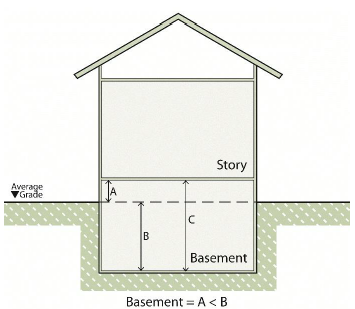
Basement: that portion of a building that is partly or completely below grade where the vertical distance from the average grade to the floor is greater than the vertical distance from the average grade to the ceiling.
Bed and breakfast establishment: An owner-occupied dwelling that offers overnight accommodations to guests within the dwelling for compensation for periods not exceeding 10 consecutive nights and which may or may not serve breakfast as part of the overnight accommodation.
Berm: a mound of soil graded, shaped and improved with landscaping in such a fashion as to be utilized for screening and/or aesthetic purposes.
Buffer strip: a strip of land of definite width and location reserved for the planting of shrubs and/or trees to serve as an obscuring screen or greenbelt in carrying out the requirements of this ordinance.
Buildable area (also "building envelope"): the space remaining on a lot or parcel after required setbacks are met.
Building: an enclosed structure having a roof supported by columns, walls, or other supports, intended for the shelter or enclosure of persons, animals, chattels, business activities, or other uses. The term "building" includes the phrase "structure" or any part thereof.
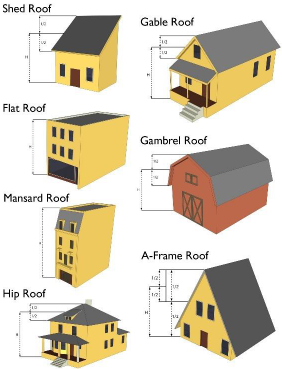
Building height: the vertical distance from average grade to a point halfway between the eaves and the ridge of gable, hip, and gambrel roofs; the top of the highest point of the roof surface for flat roofs; and the deck line for mansard roofs.
Building, main or principal: a building in which is conducted the principal use of the lot on which it is situated.
Certificate of zoning compliance: a document signed by an authorized city official and issued prior to the development of property or establishment of a use, acknowledging that the use, structure, or building complies with the provisions of this ordinance.
Clearing: the removal of vegetation from any site, parcel, or lot except when land is cleared and cultivated for bona fide agricultural or garden use in a district permitting that use. Mowing, trimming, pruning or removal of vegetation to maintain it in a healthy, viable condition is not considered clearing.
Clinic, medical/dental: a place for the care, diagnosis, and treatment of persons in need of medical, dental, or minor surgical attention. A clinic may also include customary laboratories and pharmacies incidental or necessary to its operation but does not include facilities for inpatient care or major surgery.
Clinic, veterinary: a place for the care, diagnosis, and treatment of sick or injured animals, and those in need of medical or minor surgical attention. A veterinary clinic may include customary pens or cages only within the clinic structure.
Condominium documents: the master deed, recorded pursuant to the Condominium Act, Public Act No. 59 of 1978 (MCL 559.101 et seq.), and any other instrument referred to in the master deed or bylaws affecting the rights and obligations of a co-owner of the condominium.
Conservation easement: a nonpossessory interest in real property imposing limitations or affirmative obligations on the use of the property, which may include retaining or protecting natural, scenic, or open space values of the property; assuring its continued availability for agricultural, forest, recreational, or open space use; or protecting its natural resources.
Convalescent or nursing home: a residential establishment, whether operated for profit or not, for the care of the aged, infirm, or those suffering from bodily disorders, wherein two or more persons are housed or lodged and furnished with nursing care.
Cul-de-sac: a dead-end public or private street, generally short in distance, terminating in a circular or semi-circular section of street allowing for vehicle turnaround.
Section 2-3. - Definitions: D-G.
Day care:
(1)
Family day care home: a private home in which one but fewer than seven minor children are received for care and supervision for periods of less than 24 hours a day, unattended by a parent or legal guardian, except children related to an adult member of the family by blood, marriage or adoption. The term "family day care home" includes a home that gives care to an unrelated minor child for more than four weeks during a calendar year.
(2)
Group day care home: a private home in which more than six but not more than 12 minor children are given care and supervision for periods of less than 24 hours a day, unattended by a parent or legal guardian, except children related to an adult member of the family by blood, marriage or adoption. Group day care includes a home that gives care to more than six but not more than 12 unrelated minor children for more than four weeks during a calendar year.
(3)
Day care center: a facility, other than a private residence, receiving one or more preschool or school age children for care for periods of less than 24 hours a day, and where the parents are not immediately available to the child.
Development: the construction of a new building or other structure on a lot or parcel, the relocation of an existing use or building on another lot or parcel, or the use of acreage or open land for a new use.
District or zoning district: a portion of the incorporated part of the city, as shown on the city zoning map, within which certain uses of land, buildings, and structures are permitted and within which specified regulations and requirements apply under the provisions of this ordinance.
Drive-through facility: any facility used to serve patrons of a business establishment while in their motor vehicles, either exclusively or in addition to service within a building or structure.
Driveway, private: an undedicated, privately controlled and maintained right-of-way or other interest in land that provides access to no more than two lots or parcels.
Dwelling:
(1)
Dwelling, accessory: an attached or detached dwelling unit subordinate to a principal one-family detached dwelling on the same lot or parcel, with a separate entry and containing sleeping quarters, a bathroom, living area, and kitchen facilities.
(2)
Dwelling, multiple-family, a building containing three or more individual dwelling units.
(3)
Dwelling, one-family, attached: A dwelling designed for occupancy by one family in a row of at least three dwelling units in which each unit has its own front and rear access to the outside, no unit is located over another, and each unit is separated from any other unit by one or more vertical common fire-resistant walls.
(4)
Dwelling, one-family, detached: a detached building designed for and occupied exclusively by one family.
(5)
Dwelling, two-family: a building containing two individual dwelling units.
Dwelling unit: a room or other portion of a building, designed for occupancy by one family for living and sleeping purposes, with housekeeping facilities.
Easement: a right, distinct from ownership of the land, to cross property with facilities such as, but not limited to, driveways, roads, utility corridors, sewer lines, water lines, and transmission lines, or the right, distinct from the ownership of the land, to reserve and hold an area for open space, recreation, drainage, or access purposes.
Essential services: the erection, construction, alteration, or maintenance by public utilities or municipal departments of underground, surface, or overhead gas, electrical, steam, fuel, or water transmission or distribution system; collection, communication, supply or disposal systems, including towers, poles, wires, mains, drains, sewers, pipes, conduits, cables, fire alarms, traffic signals, hydrants; and similar equipment in connection therewith; provided, this definition shall not include any buildings associated with the furnishing of such essential services. For the purposes of this ordinance, wireless communications towers and antennas are not considered essential services.
Excavation: any breaking of the ground to hollow out by cutting, digging, or removing soil or rock matter, except for common household gardening and general farm care.
Family: one of the following:
(1)
An individual or group of two or more persons related by blood, marriage or adoption, together with foster children and servants of the principal occupants, with not more than one additional unrelated person, who are domiciled together as a single, domestic, housekeeping unit in a dwelling unit; or
(2)
A collective number of individuals domiciled together in one dwelling unit whose relationship is of a continuing non-transient domestic character and who are cooking and living as a single nonprofit housekeeping unit. This definition does not include any society, club, fraternity, sorority, association, lodge, coterie, organization, or group of students or other individuals whose domestic relationship is of a transitory or seasonal nature or for an anticipated limited duration of a school term or other similar determinable period.
Fence: a permanent enclosure, barrier, wall, structure, or gate erected and used as a means of enclosing, confining, or delineating a boundary line.
Filling: depositing or dumping of any matter onto or into the ground, except common household gardening and general farm care.
Flood or flooding: a general and temporary complete inundation of normally dry land area from:
(1)
the overflow of inland or tidal waters, or
(2)
the unusual and rapid accumulation or runoff of surface waters from any source.
Flood hazard area: that area subject to flooding, on the average of at least once in every 100 years as determined by the Federal Emergency Management Agency (FEMA).
Flood hazard boundary map (FHBM): an official map of the city issued by the FEMA where the boundaries of the areas of special flood hazard have been designated as zone A.
Flood insurance rate map (FIRM): an official map of the city on which the FEMA has delineated both the areas of special flood hazards and the risk premium zones applicable to the city.
Flood insurance study: the official report provided by the FEMA. The report contains flood profiles, as well as the flood hazard boundary floodway map and the water surface elevation of the base flood.
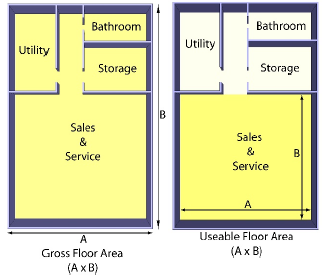
Floor area:
(1)
Floor area, gross (GFA): the sum of the gross horizontal areas of the several floors of a building measured from the exterior walls or from the centerline of walls separating two buildings.
(2)
Floor area, residential: the area of a dwelling unit measured from the interior of the exterior walls of the unit: provided, areas of basements, unfinished attics, attached or detached accessory structures, breezeways, or enclosed and unenclosed porches shall not be counted as floor area.
(3)
Floor area, usable (UFA): the gross floor area of the building minus the areas of the building not being used in a manner that contributes to the principal use of the property, such as floor area used or designed to be used as restrooms, closets, corridors, and mechanical rooms.
Foster family care (state licensed residential care facility):
(1)
Foster family home: a private home in which one but not more than four minor children, who are not related to an adult member of the household by blood or marriage, or who are not placed in the household under the Michigan Adoption Code, Public Act No. 288 of 1939 (MCL 710.21 et seq.), are given care and supervision for 24 hours a day, for four or more days a week, for two or more consecutive weeks, unattended by a parent or legal guardian.
(2)
Foster family group home: a private home in which more than four but fewer than seven minor children, who are not related to an adult member of the household by blood or marriage, or who are not placed in the household under the Michigan Adoption Code, Public Act No. 288 of 1939 (MCL 710.21 et seq.), are provided care for 24 hours a day, for four or more days a week, for two or more consecutive weeks, unattended by a parent or legal guardian.
Garage, private: an accessory building or portion of a main building designed or used for the storage of motor-driven vehicles, boats, and similar vehicles owned and used by the occupants of the building to which it is accessory.
Grade: the highest point of ground contacting any portion of the basement or foundation of a dwelling.
(1)
Grade, average: a reference plane representing the average of the finished ground level adjoining the building at all exterior walls; provided, for purposes of measuring height of residential buildings, "average grade" is the average of the finished ground level adjoining the building along the front elevation.
(2)
Grade, natural: the grade of a site that exists or existed prior to manmade alterations, such as grading, filling, or excavating.
(3)
Grade, finished: the final grade of a site after grading, filling, or excavating.
Section 2-4. - Definitions: H-M.
Home occupation: a business or profession that is customarily incidental and secondary to the use of a dwelling. It is conducted in the dwelling or accessory building on the same lot as the dwelling, carried out by its occupants utilizing equipment typically found in a home, and is not evident from the outside.
Hospital: a facility providing health care services primarily for in-patient and surgical care of the sick or injured, including related facilities that are an integral part of the facility such as laboratories, out-patient departments, clinics, central service facilities, and staff offices.
Hotel or motel: a facility offering lodging accommodations to the traveling public for a daily or other rate and which may provide additional services, such as restaurants, gift shops, meeting and banquet rooms, and recreational facilities.
Junkyard: an open area where waste, used, or secondhand materials are bought and sold, exchanged, stored, baled, packed, disassembled, or handled, including, but not limited to, scrap iron and other metals, paper, rags, rubber tires, and bottles. A junkyard includes automobile wrecking yards and any area of more than 200 square feet for storage, keeping, or abandonment of junk, but does not include uses conducted entirely within enclosed buildings.
Kennel: any lot or premises on which three or more dogs, cats, or other household pet are bred, boarded, or sold for commercial purposes.
Laboratory: a place devoted to experimental study such as testing and analyzing, but not devoted to the manufacturing of a product or products.
Land Division Act: Michigan law regulating the division of land (MCL 560.101 et seq.).
Livestock: cattle, sheep, goats, poultry, and other animals normally kept or raised on a farm.
Loading space: an off-street space on the same lot with a building or group of buildings, for temporary parking of a commercial vehicle while loading and unloading merchandise or materials.
Lot: a parcel of land intended for individual use, separately described on a deed or other instrument recorded in the office of the Ionia County Register of Deeds, whether by metes and bounds, as part of a platted subdivision, or as a site condominium.
Lot area: the total horizontal area within the lot lines of the lot, excluding any public right-of-way.
Lot coverage: the part or percentage of the lot area occupied by buildings, including accessory buildings.
Lot depth: the horizontal distance between the front and rear lot lines, measured along the median between side lot lines.
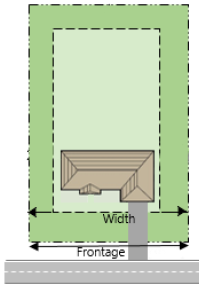
Lot frontage: the shortest linear distance of that portion of a lot or parcel abutting a public or private street right-of-way, measured along the right-of-way line between the side lot lines on an interior or through lot and between the designated side lot line and opposite front lot line on a corner lot.
Lot width: the horizontal distance between side lot lines measured at the two points where the required front setback intersects with the side lot lines.
Lot, corner: a lot with at least two contiguous sides abutting two intersecting streets, and where the interior angle of the intersecting streets is less than 135 degrees. Also, a lot located on a curved street or streets if tangents of the curve, at the points of beginning with the lot or the points of intersection of the side lot lines with the street line, intersect at the interior angle of less than 135 degrees.
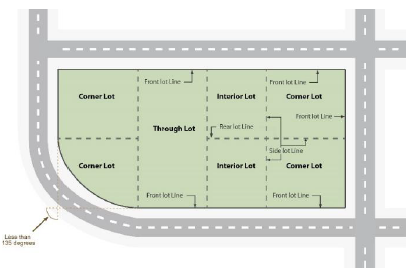
Lot, through (also called a "double frontage lot"): any interior lot having frontage on two more or less parallel streets as distinguished from a corner lot.
Lot, interior: any lot other than a corner lot or through lot.
Lot lines: the lines bounding a lot defined as follows:
(1)
Front lot line:
a.
In the case of an interior lot, the line separating the lot from the street.
b.
Corner and through lots shall have two front lot lines and two front yards. The other yards shall be considered side yards.
(2)
Rear lot line: The lot line opposite the front lot line. In the case of a lot pointed at the rear, the rear lot line shall be an imaginary line parallel to the front lot line, not less than 10 feet long lying farthest from the front lot line and wholly within the lot.
(3)
Side lot line: Any lot lines other than the front lot line or rear lot line. A side lot line separating a lot from another lot is an interior side lot line.
Lot of record: a parcel of land separately described on a plat, condominium document, or metes and bounds description recorded in the office of the Ionia County Register of Deeds.
Main building: a building in which is conducted the principal use of the lot upon which it is situated.
Manufactured home: a structure designed or used for residential occupancy built, in compliance with the National Manufactured Home Construction and Safety Standards Act, upon or having a frame or chassis to which wheels may be attached so it may be moved upon a highway, whether or not such structure actually has, at any given time, such wheels attached, or is jacked up or skirted.
Manufactured home community: any plot of ground upon which two or more manufactured homes, occupied for dwelling or sleeping purposes, are or may be located, and licensed as such by the state.
Manufactured home site: a site dedicated for the placement of a manufactured home within a manufactured home community, but not including drives, common open space, or other open areas not specifically for manufactured home occupancy.
Marihuana , also known as medical marihuana, also known as marijuana, also known as cannabis: That term shall have the meaning given to it in Section 7601 of the Michigan Public Health Code, 1978 PA 368, as amended, MCL 333.7106 et seq., as is referred to in Section 3(d) of the Michigan Medical Marihuana Act, PA 2008, Initiated Law 1, MCL 333.26423(d). Any other term pertaining to marihuana used in this section and not otherwise defined shall have the meaning given to it in the Michigan Medical Marihuana Act and/or in the general rules of the Michigan Department of Community Health issued in connection with that act.
Marihuana collective or cooperative: Any facility, structure, dwelling or other location where medical marihuana is grown, cultivated, processed, stored, transmitted, dispensed, consumed, used, given, delivered, provided, made available to and/or distributed by two or more of the following: a registered primary caregiver or a registered qualifying patient, as defined by the Michigan Medical Marihuana Act, PA 2008, Initiated Law 1, MCL 333.26421 et seq. (the "act"), or a person in possession of an identification card issued under the act or in possession of an application for such an identification card. The term "collective" or "cooperative" shall not apply to a registered primary caregiver that provides necessary care and marihuana for medical use exclusively to his/her five or fewer designated qualifying patients in strict accordance with the Michigan Medical Marihuana Act, PA 2008, Initiated Law 1, MCL 333.26421 et seq. or the Administrative Rules of the Michigan Department of Community Health, Michigan Admin Code, R 333.101 through R 333.133. A "marijuana collective or cooperative" shall not include the following uses: a state-licensed health care facility; a state-licensed residential care facility for the elderly or infirmed; or a residential hospice care facility, as long as any such use complies strictly with applicable laws and rules of the State of Michigan. It is unlawful to establish or operate a profit or nonprofit medical marihuana dispensary, collective or cooperative within the city.
Marihuana dispensary or dispensary: Any facility, structure, dwelling or other location where medical marihuana is grown, cultivated, processed, stored, transmitted, dispensed, consumed, used, given, delivered, provided, made available to and/or distributed by two or more of the following: a registered primary caregiver or a registered qualifying patient, as defined by the Michigan Medical Marihuana Act, PA 2008, Initiated Law 1, MCL 333.26421 et seq. (the "act"), or a person in possession of an identification card issued under the act or in possession of an application for such an identification card. The term "dispensary" shall not apply to a registered primary caregiver that provides necessary care and marihuana for medical use exclusively to his/her five or fewer designated qualifying patients in strict accordance with the Michigan Medical Marihuana Act, PA 2008, Initiated Law 1, MCL 333.26421 et seq. or the administrative rules of the Michigan Department of Community Health, Michigan Admin Code, R 333.101 through R 333.133. A "marihuana dispensary" shall not include the following uses: a state-licensed health care facility; a state-licensed residential care facility for the elderly or infirmed; or a residential hospice care facility, as long as any such use complies strictly with applicable laws and rules of the State of Michigan. It is unlawful to establish or operate a profit or nonprofit medical marihuana dispensary, collective or cooperative within the city.
Massage establishment: Any establishment having a fixed place of business where massages are administered for pay and duly licensed by the city or the State of Michigan. The term "massage" is defined as a method of treating the external parts of the human body by rubbing, stroking, kneading, tapping, or vibrating with the hand or any instrument.
Master plan: the future plan for the city prepared in accordance with the Michigan Planning Enabling Act (PA 33 of 2008) and adopted by the city.
Medical use of marihuana: The acquisition, possession, cultivation, manufacture, use, internal possession, delivery, transfer or transportation of marihuana or paraphernalia relating to the administration of marihuana to treat or alleviate a registered qualifying patient's debilitating medical condition or symptoms associated with the debilitating medical condition, as defined under the Michigan Medical Marihuana Act, PA 2008, Initiated Law 1, MCL 333.26421 et seq.
Mezzanine: an intermediate or fractional story between the floor and ceiling of a main story, occupying not more than one-third of the floor area of such main story.
Mini storage: a building or group of buildings in a controlled access compound where individual compartments, stalls, or lockers are rented to tenants for the storage of goods.
Motel. See hotel.
Section 2-5. - Definitions: N-S.
Natural features: includes soils, wetlands, woodlots, landmark and specimen trees, floodplains, water bodies, groundwater, topography, vegetative cover, and geologic formations.
Nonconforming building: a building or portion thereof, lawfully existing at the effective date of this ordinance, or subsequent amendments, that does not conform to the current setback, height, size, or other dimensional provisions related to buildings or building placement of the district in which it is located.
Nonconforming lot: a lot lawfully existing at the effective date of this ordinance, or subsequent amendments, that does not meet the current area, width and/or, depth requirements for the zoning district in which it is located.
Nonconforming use: a use which lawfully occupied a building or land on the effective date of this ordinance, or subsequent amendments, that does not conform to the use provisions of this ordinance.
Nuisance: an offensive, annoying, unpleasant, or obnoxious thing or practice being a cause or source of annoyance.
Nursery, plant: a space, building, or structure, or combination thereof, for growing and storage of live trees, shrubs, or plants.
Occupancy load: the number of individuals normally occupying a building or part thereof or for which the existing facilities have been designed as calculated by the adopted state construction code.
Open air business: a use operated for profit substantially in the open air, including, but not limited to:
(1)
bicycle, utility truck or trailer, boats, or home equipment sale, repair, rental, or storage service;
(2)
outdoor display and sale of garages, motor homes, manufactured homes, snowmobiles, farm implements, swimming pools, and similar activities; and
(3)
retail sale of trees, fruits, vegetables, shrubbery, plants, seeds, topsoil, humus, fertilizer, trellises, lawn furniture, playground equipment, and other home garden supplies and equipment.
Parcel: a tract of land, legally described, and capable of being located by survey.
Parking lot: an open area, outside of the public right-of-way, intended and used for vehicular parking spaces along with drives and aisles for access and maneuvering.
Parking space: a space of definite length and width, exclusive of drives, driveways, aisles, or entrances, fully accessible for the storage or parking of permitted vehicles.
Personal service establishment: a business providing services involving the care of a person or repair of personal goods or apparel.
Planned unit development: a development tool that permits certain flexibility in use, lot dimensions, and other development requirements for purposes as specified in this ordinance.
Planning commission: the planning commission of the city.
Poultry: domestic fowl such as chickens, turkeys, ducks, and geese.
Principal use: the primary use of a property.
Public utility: any person, municipal department, board, or commission duly authorized to furnish to the public under federal, state, or municipal regulations: natural gas, steam, electricity, sewage disposal, communication, transportation, or water. This definition shall not include wireless communication providers.
Recreational vehicle: a vehicle or equipment used primarily for recreational purposes, including, but not limited to motor homes, travel trailers, camper trailers, pop-up campers, boats, snowmobiles, motorcycles, dune buggies, and similar vehicles, and trailers used to transport them.
Residential district: the R-1, R-2, R-3, and R-4 zoning districts.
Road authority: the city, Ionia County Road Commission, or Michigan Department of Transportation, having jurisdiction over a particular street or street segment.
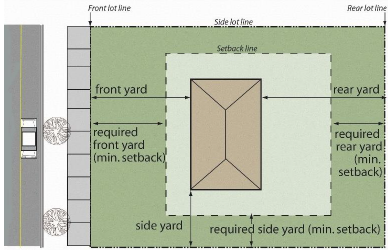
Setback, required: the minimum required horizontal distance by which specified buildings and structures must be set back from a lot line and/or street right-of-way line.
(1)
Setback, required front: the line marking the minimum required distance a building and structure must be located from the street right-of-way line or private street easement line.
(2)
Setback, required rear: the line marking the minimum required distance a building and structure must be located from the rear lot line.
(3)
Setback, required side: the line marking the minimum required distance a building and structure must be located from the side lot line.
Sexually oriented business: includes adult bookstores, adult cabarets, adult motion picture theaters, and nude artist and photography studios. These terms shall have the following indicated meanings:
(1)
Adult book store: An establishment having as a substantial or significant portion of its stock in trade, books, magazines, or other periodicals, videotapes, movies, electronic media, or adult-related novelties which are distinguished or characterized by their emphasis on matter depicting, describing or relating to "specified sexual activities" or "specified anatomical areas," as defined herein, or an establishment with a segment or section devoted to the sale or display of such material.
(2)
Adult cabaret: An establishment including, but not limited to, a cafe, restaurant or bar which features erotic dancers, strippers, or similar entertainers who perform in a state of undress and display specified anatomical body parts.
(3)
Adult motion picture theater: An establishment used for presenting material distinguished or characterized by an emphasis on matter depicting, describing, or relating to "specified sexual activities" or "specified anatomical areas," as defined herein, for observation by patrons therein.
(4)
Nude artist and photography studio: Any building, structure, premises, or part thereof used solely or primarily as a place which offers as its principal activity models to display "specified anatomical areas" as defined herein for artists and photographers for a fee or charge.
(5)
Specified anatomical areas: Specified anatomical areas are defined as less than completely and opaquely covered:
a.
Human genitals, pubic region, buttock, and female breast below a point immediately above the top of the areola; and
b.
Human male genitals in a discernible turgid state, even if completely and opaquely covered.
(6)
Specified sexual activities: Specified sexual activities are defined as:
a.
Human genitals in a state of sexual stimulation or arousal.
b.
Acts of human masturbation, sexual intercourse or sodomy.
c.
Fondling or other erotic touching of human genitals, pubic region, buttock or female breast.
Shopping center: three or more commercial establishments that are contiguous and developed under one site plan.
Short-term rental: A business engaged in the rental of an entire dwelling unit to provide guest lodging for pay for periods not-to-exceed 29 days and which does not include serving food.
Sign: a device, structure, fixture, or placard designed for the purpose of advertising or identifying a service, establishment, merchandise, or entertainment establishment or otherwise intended or used to advise or inform.
Site condominium development: a development designed to function in a similar manner, or as an alternative, to a platted subdivision but is recorded under the condominium law rather than the land division act.
Site plan: a plan showing all relevant features of a proposed development and adjoining properties in order to determine whether it meets the requirements and standards of this ordinance.
Special land use: a use specified in this ordinance as permissible in a specific district upon approval by the planning commission.
Stable, commercial: buildings and grounds used for boarding, riding, or breeding of horses or for equestrian events for compensation.
Stable, private: buildings and grounds used for boarding of horses which are owned by the owners or occupants of the facility and are not open to the general public or for commercial breeding.
Story: that part of a building, except a mezzanine or basement, that is between the surface of any floor above the ground and the surface of the next floor above it, or if there is no floor above then the ceiling next above.
Story, half: an uppermost story under a sloping roof with a usable floor area that does not exceed two-thirds of the gross floor area in the story directly below: provided, the area contains at least 200 square feet of usable floor space with a clear height of seven feet.
Street: a public thoroughfare providing the principal access to abutting property.
Private street: an undedicated, privately controlled and maintained right-of-way or other interest in land that provides access to more than two lots or parcels.
Structure: anything constructed or erected and designed for a permanent location in or on the ground, or that must be attached to something having such a permanent location. Structures include, but are not limited to: buildings, parking lots, access drives, swimming pools, and signs.
Section 2-6. - Definitions: T-Z.
Tattoo parlor: a business establishment where an indelible mark is made upon the body of another individual by the insertion of a pigment under the skin or by the production of scars or by branding.
Temporary building or use: a structure or use established on private property which is inherently for only a limited period. Examples include street fairs, art exhibits, weddings, and gatherings or events in neighborhoods involving large groups of people, and office trailers erected during construction of a specific building or project. Temporary uses do not include garage sales or events/activities which occur entirely within a park, street, or other property owned or controlled by the city or the schools and approved by the city or schools.
Use or used: the purpose for which land or a building is designed, arranged, or intended, or for which land or a building is or may be occupied, either as its principal purpose or accessory to the principal purpose.
Variance: an allowed modification of this ordinance granted by the zoning board of appeals, where there is a demonstrated practical difficulty or an unnecessary hardship in the way of carrying out the strict letter of this ordinance.
Vehicle repair, major: any activity involving the general repair, rebuilding, or reconditioning of motor vehicles, engines or trailers; collision service, such as body, frame or fender straightening and repair; overall painting and vehicle rust-proofing; or steam cleaning.
Vehicle repair, minor: any activity involving routine repair and maintenance of passenger vehicles and light trucks/vans, including, but not limited to vehicle detailing, oil change establishments, brake and muffler repair or installation, audio installation, and auto glass installation and repair, but not including fuel sales.
Vehicle service station: an establishment where motor vehicle fuel is sold and other accessory uses/services may be found, including minor vehicle repair, sale of related products and accessories which may also be installed on the premises, and the sale of convenience items. Convenience items may include, by way of example, snacks, beverages, apparel, gifts, and food.
Vehicle wash facilities: a building, or portion of a building, the primary purpose of which is that of washing motor vehicles, either as a self-service or automatic process.
Watercourse: any waterway, river, stream, inland lake or pond, or other body of water having definite banks, a bed, and visible evidence of a continued flow or continued occurrence of water. The term "watercourse" does not include lakes or ponds constructed by excavating or diking dry land and maintained for the sole purpose of cooling or storing water and does not include lagoons used for treating polluted water.
Wetland: land characterized by the presence of water at a frequency and duration sufficient to support and that, under normal conditions, does support wetland vegetation or aquatic life and is commonly referred to as a bog, swamp, or marsh.
Whole-house lodging: A business engaged in the rental of an entire dwelling unit to provide guest lodging for pay for periods not-to-exceed 29 days and which does not include serving food.
Wireless communication tower: a structure designed and constructed to support one or more antennas used for licensed telecommunications services including cellular, personal communication services (PCS), specialized mobilized radio (SMR), enhanced specialized mobilized radio (ESMR), paging, and similar services marketed to the general public.
Yard: the open spaces on a lot located between a building and a lot line, unoccupied and unobstructed from the ground upward.
(1)
Front yard: an open space extending the full width of the lot, the depth of which is the minimum horizontal distance between a public or private street right-of-way line and the nearest point of the main building.
(2)
Rear yard: an open space extending the full width of the lot, the depth of which is the minimum horizontal distance between the rear lot line and the nearest point of the main building. Corner lots and through lots are not considered to have a rear yard.
(3)
Side yard: an open space between the nearest point of a main building and the side lot line, extending from the front yard to the rear yard.
Yard, required: that portion of the yard lying between the minimum required setback lines and the lot lines.
Zoning Act: the Michigan Zoning Enabling Act, Public Act No. 110 of 2006 (MCL 125.3101 et seq.).
Zoning administrator: the person designated by the city council to administer the provisions of this ordinance.

