
Portola Valley City Zoning Code
CHAPTER 18
04 - DEFINITIONS
18.04.010 - Definitions—Generally.
For the purpose of this title, certain terms used in this title are defined as set forth in this chapter.
(Ord. 1967-80 § 1 (6102 (part)), 1967)
18.04.020 - Construction.
All words used in the present tense shall include the future tenses; all words in the plural number include the singular, and all words in the singular include the plural number unless the natural construction of the wording indicates otherwise. The word "structure" includes the word "building." The word "shall" is mandatory and not directory. The word "town" as used in this title means the town of Portola Valley, state of California; the word "council" means the town council of the town of Portola Valley, state of California; the words "planning commission" means the planning commission of the town of Portola Valley, state of California; and the words "town boundary" mean the boundary of the town of Portola Valley, state of California.
(Ord. 1967-80 § 1 (6102 (part)), 1967)
18.04.030 - Accessory structure.
"Accessory structure" means a detached building or structure which is subordinate to and the use of which is customarily incidental to that of the main building, structure, or use on the same lot. This term excludes accessory dwelling units (see Section 18.04.151, Dwelling unit, accessory).
(Ord. 2024-451 § 1 (Att. A), 2024; Ord. 2024-450 § 1 (Att. A), 2024; Ord. 1967-80 § 1 (6102 (part)), 1967)
18.04.040 - Accessory use.
See Section 18.02.110.
(Ord. 1967-80 § 1 (6102 (part)), 1967)
18.04.050 - Accessory, individual.
"Individual accessory" means a portion of a parcel of land which because of its size and shape and its relationship to the street and the balance of the property, is suitable only for providing vehicular or pedestrian access to the balance of the property.
(Ord. 1967-80 § 1 (6102 (part)), 1967)
18.04.055 - Affordable housing.
Affordable housing is housing for which moderate, low and very low income households pay thirty percent or less of their monthly income. Moderate, low and very low income households have monthly incomes below limits determined annually by the California Department of Housing and Community Development (California Code of Regulations, Title 25).
(Ord. 1991-261 § 1, 1991)
18.04.057 - Reserved.
Editor's note— Ord. 2011-393, § 2, adopted Nov. 9, 2011, repealed § 18.04.057, which pertained to antenna, and derived from Ord. 1997-295, § 1(part), adopted in 1997.
18.04.060 - Automobile service station.
"Automobile service station" means a place where motor fuel or lubricating oil or grease is offered for sale to the public and delivered directly into vehicles.
(Ord. 1967-80 § 1 (6102 (part)), 1967)
18.04.065 - Basement.
"Basement" is a floor level directly under a building which meets the following criteria:
A.
The ceiling height is not more than twelve feet.
B.
Provisions for light, ventilation and access do not exceed the minimum requirements of the building code, notwithstanding that additional provisions for light, ventilation and access may be permitted by the architectural and site control commission when it finds such additional provisions will not be visible from adjoining or nearby properties as such properties currently exist or as the architectural and site control commission believes may be used or developed in the future. Garages are not permitted under this provision. By virtue of the foregoing definition, a basement is permitted to meet the minimum requirements of the building code, including, but not limited to, light, ventilation and access, without approval of the architectural and site control commission.
C.
The underside of the floor joists of the floor above are not more than eighteen inches above the adjoining natural or finished grade at any point, whichever is lower.
D.
Where a room(s) partially meets the provisions of subsection C. of this section, that is, a portion is not more than eighteen inches above adjoining natural or finished grade, whichever is lower, and a portion is more than eighteen inches above such grade, a portion of such room(s) shall be considered as basement and a portion shall be considered as floor area. The rule for such determination shall be as follows:
1.
The outside perimeter of the room(s) shall be measured and designated "A."
2.
The outside perimeter of the room(s) where the underside of the floor joists of the floor above are not more than eighteen inches above adjoining natural or finished grade, whichever is lower, shall be measured and designated "B."
3.
The amount of floor area of the subject room(s) that will be counted as basement is then equal to the entire floor area of the room(s) multiplied by the fraction of B/A. The balance of the floor area shall be counted as floor area.
E.
The basement floor area shall not exceed the floor area of the first floor of the building above.
(Ord. 2017-419 § 2, 2017; Ord. 1999-323 § 1, 1999: Ord. 1995-285 § 1 Exh. A (part), 1996: Ord. 1988-242 3 (Exh. B) (part), 1988)
18.04.070 - Building.
"Building" means a roofed structure built for the support, shelter or enclosure of persons, animals, chattels, or property of any kind. When a structure is divided into separate parts by unpierced walls extending from the ground to the roof or when the parts of a structure are joined only by a breezeway each such part is a separate building.
(Ord. 1967-80 § 1 (6102 (part)), 1967)
18.04.075 - Building envelope.
"Building envelope" is the three-dimensional space on a parcel within which buildings and most other structures are required to be confined and which is defined by zoning ordinance regulations governing building setbacks and building heights.
(Ord. 2005-360, § 1, 2005)
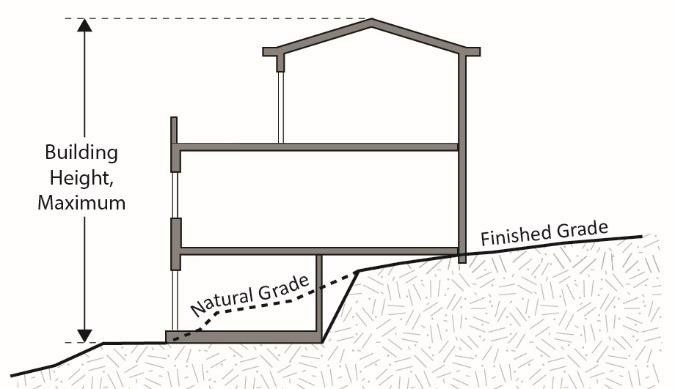
18.04.077 - Building height, maximum.
"Building height, maximum" is the vertical distance between the lowest point of contact with the finished ground surface to the highest point of the building or any appurtenance to the building.
Figure 18.04.077: Building height, maximum.
(Ord. 2024-451 § 1 (Att. A), 2024; Ord. 2024-450 § 1 (Att. A), 2024)
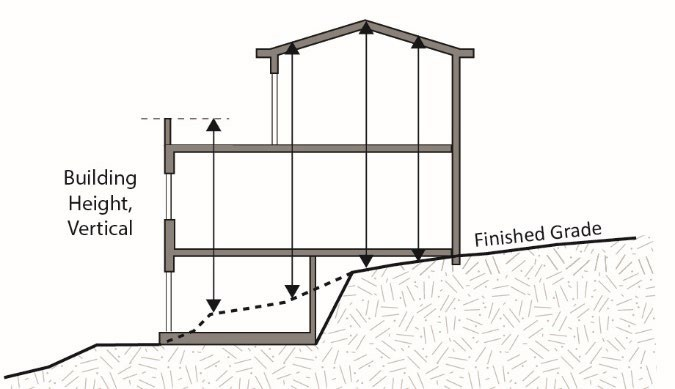
18.04.078 - Building height, vertical.
"Building height, vertical" is the vertical distance from the lowest point of the structure at natural grade to the highest point of the structure directly above.
Figure 18.04.078: Building height, vertical.
(Ord. 2024-451 § 1 (Att. A), 2024; Ord. 2024-450 § 1 (Att. A), 2024)
18.04.080 - Building inspector.
"Building inspector" means the person, agency or firm appointed by the town to function as such and may include such person(s) or position(s) delegated by resolution of the council to perform such functions. The building inspectors's duties include inspecting building plans and building construction.
(Ord. 1979-166 § 1 (part), 1979: Ord. 1967-80 § 1 (6102 (part)), 1967)
18.04.090 - Building, main.
"Main building" means a building within which is conducted the principal use on the parcel. Where a use involves more than one building designed or used for the primary purpose, as in the case of group dwellings or a group of commercial buildings, each such building on the parcel shall be construed as constituting a main building.
(Ord. 1967-80 § 1 (6102 part)), 1967)
18.04.100 - Carport.
"Carport" means a building or part thereof accessory to a main building, used primarily for the storage of private passenger automobiles, and which is not enclosed on all sides.
(Ord. 1967-80 § 1 (6102 (part)), 1967)
18.04.110 - Common area.
"Common area" means an area shown or to be shown on a recorded final subdivision map and devoted to the common use and enjoyment of the owners of the lots in the subdivision.
(Ord. 1967-80 § 1 (6102 (part)), 1967)
18.04.112 - Common open space.
"Common open space" means pervious open space area that is accessible to all residents of a development to enhance social interaction.
(Ord. 2024-451 § 1 (Att. A), 2024; Ord. 2024-450 § 1 (Att. A), 2024)
18.04.113 - Coverage area.
"Coverage area" is the total footprints of all buildings on-site but does not include hardscaped areas.
(Ord. 2024-451 § 1 (Att. A), 2024; Ord. 2024-450 § 1 (Att. A), 2024)
18.04.114 - Coverage area ratio (CAR).
"Coverage area ratio" means the ratio of the total footprints of all buildings on-site to the size of a site. Coverage area does not include hardscaped areas.
(Ord. 2024-451 § 1 (Att. A), 2024; Ord. 2024-450 § 1 (Att. A), 2024)
18.04.115 - Density.
"Density" means the ratio between dwelling units and land, expressed as the number of dwelling units per gross acre (du/ac). For the MU (mixed use) and R-MF (multi-family) districts, density means the ratio between dwelling units and a site's developable area, expressed as the number of dwelling units per net acre.
(Ord. 2024-451 § 1 (Att. A), 2024; Ord. 2024-450 § 1 (Att. A), 2024)
18.04.120 - Development.
See Section 18.32.020.
(Ord. 1978-164 § 1 (part), 1978: Ord. 1967-80 § 1 (6102 (part)), 1967)
18.04.125 - Distribution lines.
"Distribution lines" are those lines which have electric or communication capacity only sufficient to serve a local area and there is no excess capacity. These lines are usually owned by a utility and located in street rights-of-way, public utility easements or other public property.
(Ord. 1990-256 § 2 (Exh. B) (part), 1990)
18.04.129 - Domestic fence.
"Domestic fence" is a fence that is not a horse fence as defined in Section 18.04.215.
(Ord. 2005-360, § 1, 2005)
18.04.130 - Domestic needs.
"Domestic needs" means needs which residents have in living in and caring for a household and its appurtenances.
(Ord. 1979-166 § 1 (part), 1979: Ord. 1967-80 § 1 (6102 (part), 1967)
18.04.131 - Dooryard.
"Dooryard" is a type of building entry that provides a limited amount of private open space at the primary entrance. The dooryard area is defined by a low wall, planter or fence that provides a buffer between the right-of-way and the building while preserving a sense of openness to the building entrance.
(Ord. 2024-451 § 1 (Att. A), 2024; Ord. 2024-450 § 1 (Att. A), 2024)
18.04.133 - Duplex.
"Duplex" means a residential building containing two primary dwelling units, both of which are located on a single parcel. The dwelling units are attached and may be located on separate floors or side-by-side.
(Ord. 2024-451 § 1 (Att. A), 2024; Ord. 2024-450 § 1 (Att. A), 2024)
18.04.135 - Dwelling, multi-family.
"Multi-family dwelling" means three or more primary dwelling units on a single lot. Multi-family residential types include triplexes, fourplexes, townhouses, single-unit groups (e.g., cottage cluster), and apartment buildings.
(Ord. 2024-451 § 1 (Att. A), 2024; Ord. 2024-450 § 1 (Att. A), 2024)
18.04.140 - Dwelling, single-family.
"Single-family dwelling" means a building designed or used exclusively as a single dwelling unit together with related accessory uses.
(Ord. 1979-166 § 1 (part), 1979: Ord. 1971-113 § 1, 1971: Ord. 1967-80 § 1 (6102 (part)), 1967)
18.04.150 - Dwelling unit.
"Dwelling unit" means one or more rooms arranged for the use of one household with cooking, living, and sleeping facilities.
(Ord. 1967-80 § 1 (6102 (part)), 1967)
18.04.151 - Dwelling unit, accessory.
"Accessory dwelling unit" is distinguished from "dwelling unit" in that a dwelling unit can be an accessory unit or a primary unit. An accessory dwelling unit (ADU) is an attached or a detached residential dwelling unit that provides complete independent living facilities for one or more persons and is located on a lot with a proposed or existing primary residence. It shall include permanent provisions for living, sleeping, eating, cooking, and sanitation on the same parcel as the single-family or multi-family dwelling is or will be situated. An accessory dwelling unit also includes an efficiency unit, as defined in California Health and Safety Code Section 17958.1, or a manufactured home, as defined in Section 18007 of the Health and Safety Code.
(Ord. 2024-451 § 1 (Att. A), 2024; Ord. 2024-450 § 1 (Att. A), 2024)
18.04.152 - Dwelling unit, junior accessory.
"Junior accessory dwelling unit" is distinguished from "dwelling unit" in that a dwelling unit can be an accessory unit or a primary unit. A junior accessory dwelling unit (JADU) is a unit that is no more than five hundred square feet in size and contained entirely within a single-family residence. A junior accessory dwelling unit must include kitchen facilities and a separate entry. A junior accessory dwelling unit may include separate sanitation facilities or may share sanitation facilities with the existing structure.
(Ord. 2024-451 § 1 (Att. A), 2024; Ord. 2024-450 § 1 (Att. A), 2024)
18.04.153 - Emergency shelter.
An "emergency shelter" provides temporary housing, usually for six months or less, with at least minimal supportive services for homeless persons. Temporary housing includes, but is not limited to, low barrier navigation centers, bridge housing, and respite or recuperative care.
(Ord. 2024-451 § 1 (Att. A), 2024; Ord. 2024-450 § 1 (Att. A), 2024; Ord. 2011-390 § 2, 2011)
18.04.155 - Fence.
"Fence" is a structure made of wire, wood, metal, masonry or other man-made material, or combination thereof, including gates and posts, typically used as a screen, enclosure, retaining wall, or entryway feature, for a parcel of land or portion thereof.
(Ord. 2005-360, § 1, 2005)
18.04.156 - Fence opacity.
"Fence opacity" is the surface area of a fence that is impenetrable to light when viewed perpendicularly to the plane of the fence.
(Ord. 2005-360, § 1, 2005)
18.04.157 - Fire station.
"Fire station" means a building or facility that provides firefighting services, and may also provide technical rescue, fire protection, fire investigation, emergency medical services, and hazardous material mitigation.
(Ord. 2021-441 § 2, 2021)
18.04.157.5 - Floor area ratio (FAR).
"Floor area ratio," or "FAR," means the ratio of floor area as established in Section 18.54.050, Floor area, to the size of a site.
(Ord. 2024-451 § 1 (Att. A), 2024; Ord. 2024-450 § 1 (Att. A), 2024)
18.04.160 - Garage, private.
"Private garage" means a building or part thereof accessory to a main building and used primarily for the storage of private passenger automobiles and which is enclosed on all sides.
(Ord. 1967-80 § 1 (6102 (part)), 1967)
18.04.170 - Ground level, average, finished.
See subsection A of Section 18.54.020.
(Ord. 1967-80 § 1 (6102 (part)), 1967)
18.04.180 - Guest.
"Guest" means any person other than a member of the resident household who rents or occupies a room for sleeping purposes.
(Ord. 1967-80 § 1 (6102 (part)), 1967)
18.04.200 - Guest room.
"Guest room" means a room occupied, or intended, arranged, or designed for occupation by one or more guests.
(Ord. 1967-80 § 1 (6102 (part)), 1967)
18.04.210 - Habitable room.
"Habitable room" means a room or enclosed floor space arranged for living, eating or sleeping purposes, not including bath or toilet rooms, laundries, pantries, foyers or communicating corridors.
(Ord. 1967-80 § 1 (6102 (part)), 1967)
18.04.215 - Horse fence.
"Horse fence" is a fence that complies with the horse fence standards set forth in Section 18.43.060.
(Ord. 2005-360, § 1, 2005)
18.04.220 - Horses, maintenance for private use.
"Horses, maintenance for private use" means the keeping of horses for private use as a use accessory to a residence on the same parcel and not for remuneration, hire or sale.
(Ord. 1967-80 § 1 (6102 (part)), 1967)
18.04.230 - Household.
"Household" means one person living alone or two or more persons sharing residency in a dwelling unit.
(Ord. 2024-451 § 1 (Att. A), 2024; Ord. 2024-450 § 1 (Att. A), 2024; Ord. 2011-390 § 1, 2011; Ord. 1967-80 § 1 (6102 (part)), 1967)
18.04.232 - Impervious area ratio (IAR).
"Impervious area ratio," or "IAR," means the ratio of impervious area to the size of the site. Impervious area excludes areas covered by buildings. Impervious areas include any kind of hardscaped areas and any surfaces on the ground plane that are impervious to water.
(Ord. 2024-451 § 1 (Att. A), 2024; Ord. 2024-450 § 1 (Att. A), 2024)
18.04.235. - Landscape area ratio (LAR).
"Landscape area ratio," or "LAR," means the ratio of landscaped area to the size of a site. Landscape area includes all areas on the ground plane that are left in their natural state or that have been landscaped. Landscape area excludes all impervious areas.
(Ord. 2024-451 § 1 (Att. A), 2024; Ord. 2024-450 § 1 (Att. A), 2024)
18.04.240 - Lot.
"Lot" means a portion of land shown as a unit on a recorded parcel or subdivision map.
(Ord. 1967-80 § 1 (6102 (part)), 1967)
18.04.250 - Lot size.
For the purposes of lot size requirements pursuant to the zoning and building ordinances of the town, the area lying within private roads shall be subtracted from the area otherwise lying within the lot or parcel of land.
(Ord. 1965-43 § 1, 1965)
18.04.255 - Low barrier navigation center.
A housing first, low-barrier, service-enriched shelter focused on moving people into permanent housing that provides temporary living facilities while case managers connect individuals experiencing homelessness to income, public benefits, health services, shelter and housing as defined in California Government Code Section 65660.
(Ord. 2024-451 § 1 (Att. A), 2024; Ord. 2024-450 § 1 (Att. A), 2024)
18.04.256 - Net acre.
"Net acre" is the gross acreage minus areas not available for development, such as: conservation easements, access easements, seismic setbacks, riparian setbacks, sensitive habitats or other similar constraints.
(Ord. 2024-451 § 1 (Att. A), 2024; Ord. 2024-450 § 1 (Att. A), 2024)
18.04.258 - Nonconforming structure.
"Nonconforming structure" means a building or other structure that was lawfully constructed in accordance with the regulations for parcel area, height, floor area, coverage, yard and any special building setbacks that were in effect at the time of construction, but which does not conform to the current regulations for parcel area, height, floor area, coverage, yard or special building setbacks.
(Ord. 2008-374 § 1, 2008)
18.04.260 - Nonconforming use.
"Nonconforming use" means a use of a structure or land which was lawfully established and maintained before the adoption of the ordinance codified in this title but which under this title does not conform with the use regulations or the district in which it is located.
(Ord. 1967-80 § 1 (6102 (part)), 1967)
18.04.270 - One ownership.
"One ownership" means ownership of a parcel of land or possession thereof under a contract to purchase or under a lease, the term of which is not less than five years, by a person or persons, firm or corporation, or partnership, individually, jointly, in common or in any other manner whereby such land is under single or unified control.
(Ord. 1967-80 § 1 (6102 (part)), 1967)
18.04.280 - Open space.
"Open space" means the portion or portions of a parcel unoccupied or unobstructed by structures from the ground upward except as permitted by this title.
(Ord. 1967-80 § 1 (6102 (part)), 1967)
18.04.290 - Open space, required.
"Required open space" means any front, side or rear yard or other open space, provided on the same parcel as a building, to meet the requirements of this title.
(Ord. 1967-80 § 1 (6102 (part)), 1967)
18.04.300 - Parcel.
"Parcel" means a lot or unit of land of record which complies with one of the provisions of Section 18.50.030 of this title.
(Ord. 1988-229 § 1 (Exh. A) (part), 1988: Ord. 1979-166 § 1 (part), 1979: Ord. 1967-80 § 1 (6102 (part)), 1967)
18.04.310 - Parcel, corner.
"Corner parcel" means a parcel bounded on two or more adjacent sides by street lines, provided that the angle of intersection does not exceed one hundred thirty-five degrees.
(Ord. 1967-80 § 1 (6102 (part)), 1967)
18.04.320 - Parcel definitions.
If the definitions in Sections 18.04.330 through 18.04.390 pertaining to parcel lines or measurement are not applicable because of parcel shape, the town planner shall make such determination as is appropriate.
(Ord. 1967-80 § 1 (6102 (part)), 1967)
18.04.330 - Parcel depth.
"Parcel depth" means the horizontal distance between the front and rear parcel lines from the midpoint of the front parcel line and measured in the mean direction of the side parcel lines.
(Ord. 1967-80 § 1 (6102 (part)), 1967)
18.04.340 - Parcel, interior.
"Interior parcel" means a parcel other than a corner parcel.
(Ord. 1967-80 § 1 (6102 (part)), 1967)
18.04.350 - Parcel line, front.
"Front parcel line" means the line separating the parcel from the street. In case a parcel abuts on more than one street, the parcel owner may elect any street parcel line as the front parcel line provided that such choice, in the opinion of the town planner, will not be injurious to adjacent properties. Where a parcel does not abut on a street or where access is by means of an individual accessway, the parcel line nearest to and most nearly parallel to the street line shall be the front parcel line.
(Ord. 1967-80 § 1 (6102 (part)), 1967)
18.04.360 - Parcel line, rear.
"Rear parcel line" means ordinarily that line of a parcel which is opposite and most distant from the front line of the parcel. In the case of a triangular or gore shaped parcel, a line ten feet in length within the parcel parallel to and at a maximum distance from the front parcel line shall be deemed to be the rear parcel line for the purpose of determining the depth of the rear yard.
(Ord. 1967-80 § 1 (6102 (part)), 1967)
18.04.370 - Parcel line, side.
"Side parcel line" means any parcel boundary not a front or rear parcel line. A side parcel line separating a parcel from another parcel or parcels in an interior side parcel line; a side parcel line separating a parcel from the street is a street side parcel line.
(Ord. 1967-80 § 1 (6102 (part)), 1967)
18.04.380 - Parcel, reversed corner.
"Reversed corner parcel" means a corner parcel, a street side line of which is substantially a continuation of the front parcel line of the parcel to its rear.
(Ord. 1967-80 § 1 (6102 (part)), 1967)
18.04.390 - Parcel width.
"Parcel width" means the average horizontal distance between the side parcel lines, measured at right angles to the lines followed in measuring parcel depth.
(Ord. 1967-80 § 1 (6102 (part)), 1967)
18.04.395 - Porch.
"Porch" is a type of building entry and a potentially raised landing attached to the façade. Porches may be open on two or three sides and may be either engaged within or attached to the front façade.
(Ord. 2024-451 § 1 (Att. A), 2024; Ord. 2024-450 § 1 (Att. A), 2024)
18.04.400 - Refuse.
"Refuse" includes all types of waste material including garbage, rubbish and waste matter.
(Ord. 1967-80 § 1 (6102 (part)), 1967)
18.04.405 - Religious institution.
A facility such as a church, mosque, temple or synagogue run by a nonprofit establishment, organization or association intended to advance or promote religious purposes or beliefs. Activities at such institutions shall be limited to those related to the purpose of the institution and may include religious activities, office space, living space for clergy and other members of religious orders who carry out their primary duties on site, religious education classes and other similar activities customarily associated with religious institutions.
(Ord. 2011-390 § 2, 2011)
18.04.410 - Repairs, minor automotive.
"Minor automotive repairs" includes replacement of minor parts for and adjustments to fuel systems, cooling systems, heating systems, electrical systems, hydraulic systems, brakes, and work of similar character.
(Ord. 1967-80 § 1 (6102 (part)), 1967)
18.04.415 - Residential care facility.
"Residential care facility" means an establishment which is maintained and operated to provide twenty-four-hour non-medical residential care and supervision to children or adults. This use category includes group homes.
(Ord. 2024-451 § 1 (Att. A), 2024; Ord. 2024-450 § 1 (Att. A), 2024; Ord. 2011-390 § 2, 2011)
18.04.420 - Retail store.
"Retail store" means a business selling goods, wares or merchandise directly to the ultimate consumer.
(Ord. 1967-80 § 1 (6102 (part)), 1967)
18.04.422 - Reserved.
Editor's note— Ord. 2024-450, § 1 (Att. A), adopted June 13, 2024, repealed § 18.04.422, which pertained to second units and derived from Ord. 2017-420 § 1, adopted May 24, 2017; Ord. 2015-408 § 1, adopted Sept. 9, 2015; and Ord. 199-263 § 2, adopted in 1991.
18.04.425 - Service lines.
Service lines are those lines which provide electric and communication service from a distribution line to an individual property.
(Ord. 1990-256 2 (Exh. B)(part), 1990)
18.04.430 - Sign.
"Sign" means any writing, pictorial representation, symbol, registered trademark, flag or any similar figure used to identify, announce, direct attention, or advertise or communicate, together with any material or color forming an integral part of the display or used to differentiate the sign from the background, which is visible from outside a building and is located on or outside a building, or is within a building and primarily intended to be visible from the outside.
(Ord. 1967-80 § 1 (6102 (part)), 1967)
18.04.440 - Sign, area of.
A. "Area of sign" for wall, marquee and awning signs means the area of the smallest geometric figure enclosing the outer limits of writing, representation, emblem or similar form of communication.
B.
"Area of sign" for freestanding, roof, projecting and banner or pennant signs means the entire sign exclusive of uprights or other structural members. Where such signs have multiple sides or faces, including signs in the form of cylinders.
(Ord. 1967-80 § 1 (6102 (part)), 1967)
18.04.450 - Sphere of influence.
"Sphere of influence" means an unincorporated area designated by a local agency formation commission as appropriate for annexation to a designated adjoining city and in which annexations will be allowed only to such city.
(Ord. 1979-166 § 1 (part), 1979: Ord. 1967-80 § 1 (6102 (part)), 1967)
18.04.460 - Stable, boarding.
"Boarding stable" means any establishment regularly providing services or facilities for the keeping of horses limited to boarding stables and appropriate training facilities, subject to all the provisions of the stable ordinance of the town.
(Ord. 1967-80 § 1 (6102 (part)), 1967)
18.04.470 - Stable, community.
"Community stable" means a horse stable and related areas and facilities for the maintenance of horses for private use as a use accessory to a residence in the planned unit development in which the stable is located.
(Ord. 1967-80 § 1 (6102 (part)), 1967)
18.04.480 - Stable, horse.
"Horse stable" means a building or portion thereof designed or used for the housing or feeding of horses.
(Ord. 1967-80 § 1 (6102 (part)), 1967)
18.04.482 - Stoop.
A "stoop" is a type of building entry where the façade is set back from the property line by a distance that is generally equal to the depth of the entry stairs and landing. The first story may be elevated from the sidewalk sufficiently to secure privacy for first-story windows and the entrance is accessed via an exterior stair and landing and/or ramp.
(Ord. 2024-451 § 1 (Att. A), 2024; Ord. 2024-450 § 1 (Att. A), 2024)
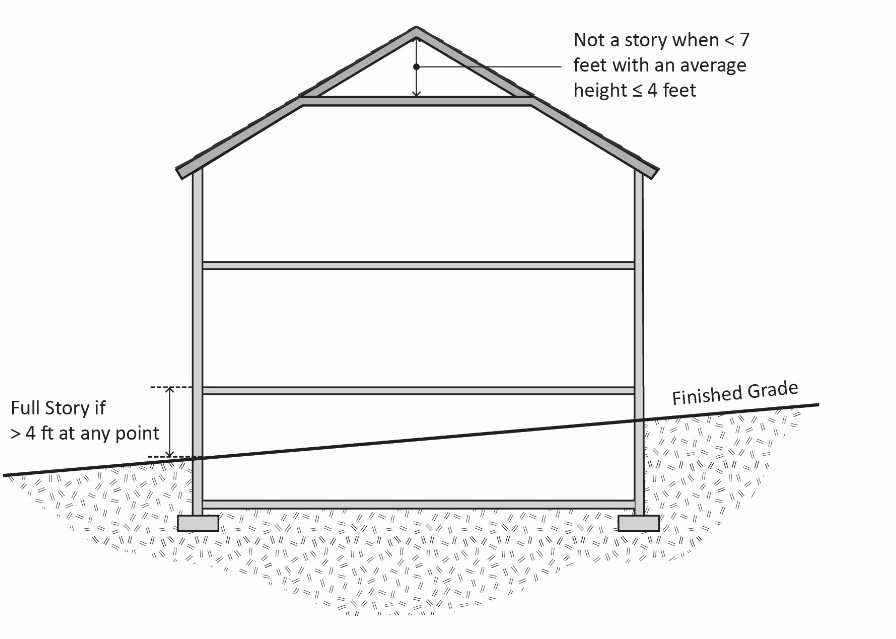
18.04.485 - Story.
A "story" is a portion of a building included between the upper surface of any floor and the upper surface of the floor next above; except that the topmost story shall be that portion of a building included between the upper surface of the topmost floor and the roof above. A basement is considered a story when the distance between the finished grade and the floor of the story above is greater than four feet at any point. An attic is not considered a story provided it is unconditioned, unfinished, and less than seven feet in height at its highest point with an average height not exceeding four feet.
Figure 18.04.485: Story.
(Ord. 2024-451 § 1 (Att. A), 2024; Ord. 2024-450 § 1 (Att. A), 2024)
18.04.490 - Structure.
"Structure" means anything constructed or erected which requires location on the ground or which is attached to something having location on the ground, excluding vehicles designed and used only for the transportation of people or goods.
(Ord. 1967-80 § 1 (6102 (part)), 1967)
18.04.500 - Structural alteration.
"Structural alteration" means any change in the supporting members of a building, such as in a bearing wall, column, beam or girder, floor or ceiling joist, roof rafters, roof diaphragms, foundations, piles or retaining walls or similar components or changes in roof or exterior lines.
(Ord. 1969-99 § 2 (part), 1969: Ord. 1967-80 § 1 (6102 (part)), 1967)
18.04.510 - Substantial improvement.
See Section 18.32.020.
(Ord. 1978-164 § 1 (part), 1978: Ord. 1967-80 § 1 (6102 (part)), 1967)
18.04.515 - Supportive housing.
"Supportive housing" shall have the same meaning as defined in Section 50675.14 of the Health and Safety Code, as amended from time to time.
(Ord. 2011-390 § 2, 2011; Ord. 2022-448 § 1, 2022)
18.04.517 - SB 9 definitions.
The terms defined in Section 17.13.020 of Title 17 (Subdivisions) shall have the same meanings for purposes of Chapter 18.27 (SB 9 Residential Lot Split Definitions).
(Ord. 2021-443 §4, 2021)
18.04.520 - Town planner.
"Town planner" means the person or firm appointed by the town to function as such and may include such person(s) or position(s) delegated by resolution of the council to perform such functions. The town planner's duties include advising the town on planning matters and administering plans and regulations.
(Ord. 1979-166 § 1 (part), 1979: Ord. 1967-80 § 1 (6102 (part)), 1967)
18.04.523 - Transitional housing.
"Transitional housing" shall have the same meaning as defined in Section 50675.2 of the Health and Safety Code, as amended from time to time.
(Ord. 2011-390 § 2, 2011; Ord. 2022-448 § 2, 2022)
18.04.525 - Transmission lines.
"Transmission lines" are those lines which have electric or communication capacity in excess of that needed to serve an immediate area. These lines are usually owned by a utility and located in street rights-of-way, public utility easements or other public property.
(Ord. 1990-256 § 2 (Exh. B) (part), 1990)
18.04.530 - Use.
"Use" means the purpose for which land or a structure is arranged, designed or intended, or for which either land or a structure is or may be occupied or maintained. See also Section 18.02.080.
(Ord. 1967-80 § 1 (6102 (part)), 1967)
18.04.540 - Vegetation, removal of.
"Removal of vegetation" means cutting vegetation to the ground or stumps, complete extraction, or killing by spraying.
(Ord. 1967-80 § 1 (6102 (part)), 1967)
18.04.545 - Reserved.
Editor's note— Ord. 2011-393, § 3, adopted Nov. 9, 2011, repealed § 18.04.545, which pertained to wireless communication facility, and derived from Ord. 1997-295, § 1(part), adopted in 1997.
18.04.550 - Yard, interior side.
See Section 18.52.010.
(Ord. 1967-80 § 1 (6102 (part)), 1967)
18.04.555 - Yard, required.
"Required yard" means an open space required by subsections 18.52.010 A., B. or C. located between a parcel line and a building envelope.
(Ord. 2005-360, § 1, 2005)
18.04.560 - Yard, required front.
See Section 18.52.010.
(Ord. 1967-80 § 1 (6102 (part)), 1967)
18.04.570 - Yard, required rear.
See Section 18.52.010.
(Ord. 1967-80 § 1 (6102 (part)), 1967)
18.04.580 - Yard, required side.
See Section 18.52.010.
(Ord. 1967-80 § 1 (6102 (part)), 1967)

