
Portola Valley City Zoning Code
CHAPTER 18
15 - R-MF MULTI-FAMILY RESIDENTIAL DISTRICT REGULATIONS
18.15.010 - Intention—Applicable regulations.
This class of district is intended to promote and encourage the establishment and maintenance of a suitable environment to accommodate multi-family dwellings of differing characteristics and broader ranges of affordability, incorporate fire resilient design, ensure privacy, preserve the visual amenities of existing open space to the maximum extent feasible, and preclude unwarranted reductions in parcel sizes. Any parcel in an R-MF district may be occupied by a principal use listed in Section 18.15.020 or, when authorized by the planning commission, by a conditional use listed in Section 18.15.030, together with uses accessory to such principal use or conditional use as specified in Section 18.15.040. Use of any parcel is subject to:
A.
Development standards set forth in Section 18.15.050;
B.
Design standards set forth in Section 18.15.060;
C.
The required conditions set forth in Section 18.15.070;
D.
The provisions governing accessory uses, fences, and planned unit developments set forth in Chapters 18.42 through 18.44;
E.
The provisions regulating nonconforming uses set forth in Chapter 18.46;
F.
Yards, building bulk, and site design requirements set forth in Chapters 18.52 through 18.56;
G.
Special building setback lines set forth in Chapter 18.58; and
H.
The off-street parking requirements set forth in Chapter 18.60.
(Ord. 2024-451 § 1 (Att. A), 2024; Ord. 2024-450 § 1 (Att. A), 2024)
18.15.020 - Principal uses permitted.
Principal uses permitted in the R-MF districts shall be as follows:
A.
Uses permitted by Section 18.36.010;
B.
Single-family dwellings;
C.
Duplexes;
D.
Emergency shelters;
E.
Multi-family dwellings;
F.
Residential care facilities;
G.
Supportive housing;
H.
Transitional housing;
I.
Low barrier navigation centers;
J.
Temporary uses permitted by Section 18.36.030; and
K.
Public schools when located in conformance with the general plan.
(Ord. 2024-451 § 1 (Att. A), 2024; Ord. 2024-450 § 1 (Att. A), 2024)
18.15.025 - Uses allowed by right.
In accordance with Housing Element Law (Government Code Section 65583.2, subdivisions (h) and (i)), housing developments with a minimum density of twenty units per acre in which twenty percent or more of the units are affordable to lower income households shall be permitted by right (without discretionary action). In compliance with Section 18.64.090 (Action by architectural and site control commission), the ASCC will review the proposed project for consistency with the objective standards contained in this chapter.
(Ord. 2024-451 § 1 (Att. A), 2024; Ord. 2024-450 § 1 (Att. A), 2024)
18.15.030 - Conditional uses permitted.
The following uses shall be permitted only when a conditional use permit is granted as provided in Chapter 18.72:
A.
Uses permitted by Section 18.36.020;
B.
Residential planned unit developments as regulated by Chapters 18.44 and 18.72;
C.
Landscaping, open space, growing of plants and similar low intensity uses each of which is attendant to adjoining uses in the C-C district, provided such uses are not required to meet the requirements of Chapters 18.42 and 18.48 through 18.60;
D.
Publicly-owned park, recreation or open space areas when located in conformance with the general plan;
E.
Fire stations when located in conformance with the general plan. Development standards, including but not limited to, floor area, setbacks and parking, shall be established by the decision-making body; and
F.
Stable, boarding.
(Ord. 2024-451 § 1 (Att. A), 2024; Ord. 2024-450 § 1 (Att. A), 2024)
18.15.040 - Accessory uses permitted.
Accessory uses permitted in the R-MF districts shall be as follows:
A.
Accessory uses as permitted in Section 18.36.040 and Chapter 18.42;
B.
Accessory uses permitted by Section 18.12.040 (subsections B through J). Subsection C is limited to long-term (minimum thirty-day) rentals;
C.
Household pets permitted by town ordinances.
(Ord. 2024-451 § 1 (Att. A), 2024; Ord. 2024-450 § 1 (Att. A), 2024)
18.15.050 - Development standards.
Table 18.15.050, Development standards—Multi-family residential zoning districts establishes the development standards for the R-MF zoning districts. The numbers in the figure below correspond with the regulations in the table that follows.
Figure 18.15.050: Development standards—Multi-family residential zoning districts.
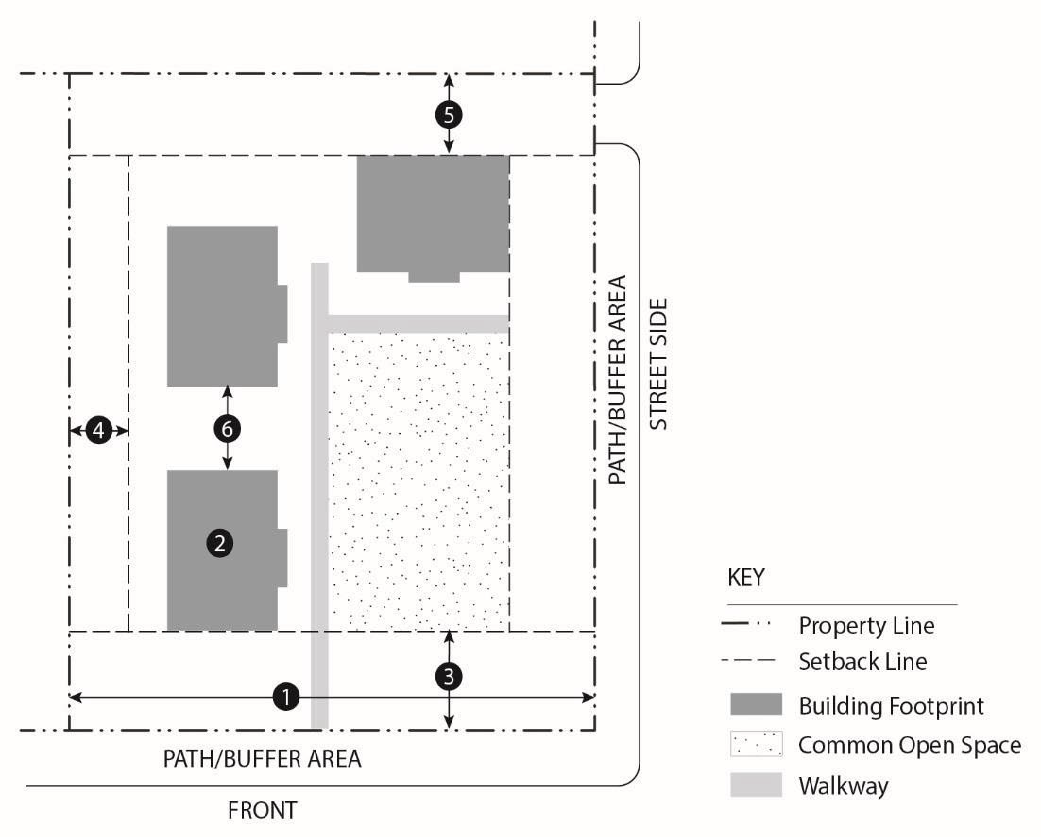
Table 18.15.050: Development standards—Multi-family residential zoning districts.
Notes:
1.
In accordance with the 2023-2031 housing element and based on the preliminary site analysis described therein, the estimated developable area of the Glen Oaks housing site is four acres. The density, FAR, CAR, LAR, and IAR are anticipated to be calculated based on the estimated developable area.
2.
A 2.48 acre portion of The Dorothy Ford Park site (APN 77272010) (included in Table 6-6 of the 2023-2031 housing element), which shall exclude the existing little league baseball field and the adjacent surface parking lot serving the baseball field (as shown on the conceptual site plan on page 127 of the 2023-2031 housing element), shall be permitted to be developed as high density housing and that owner-occupied and rental multi-family uses are allowed by right for housing developments in which twenty percent or more of the units are affordable to lowerincome households on the specified portion of the Dorothy Ford Park site (APN 77272010).
(Ord. 2025-452 § 1, 2025; Ord. 2024-451 § 1 (Att. A), 2024; Ord. 2024-450 § 1 (Att. A), 2024)
Editor's note— Ord. 2025-452 § 1, adopted April 23, 2025, set out provisions intended for use as 18.15.040, note 2. For the purposes of maintaining topical consistency, and at the editor's discretion, as well as the request of the municipality, these provisions have been included as 18.15.050, note 2.
18.15.060 - Design standards.
A. Building Massing.
1.
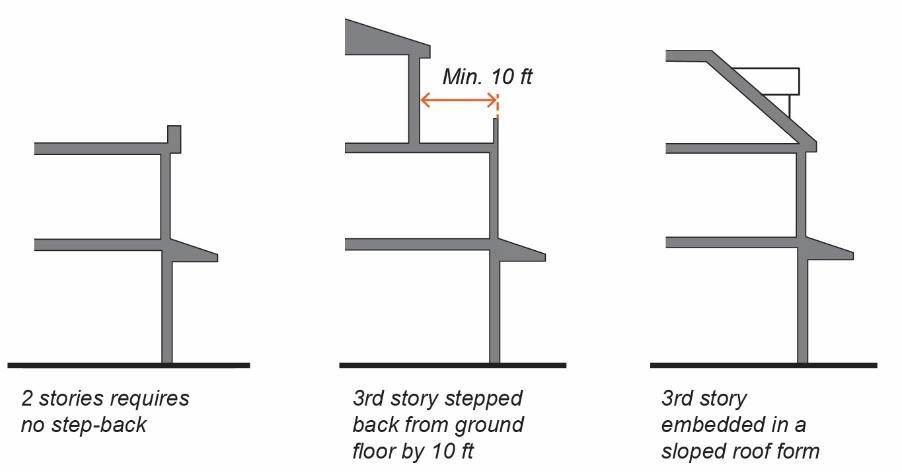
Street-Facing Upper-Story Step-Backs. Along the front and street side façade, the third story must be stepped back a minimum of ten feet from the ground floor façade or be embedded in a sloped roof form.
Figure 18.15.060.A.1: Upper story step-backs.
2.
Interior Side Daylight Plane.
a.
R-MF-4. The building envelope must fit within a plane which starts at the natural ground surface at the property line and increases in height at a ratio of two vertical units to one horizontal unit away from the property line.
b.
R-MF-23. The building envelope must fit within a plane which starts at twelve feet above the natural ground surface at the property line and increases in height at a ratio of two vertical units to one horizontal unit away from the property line.
3.
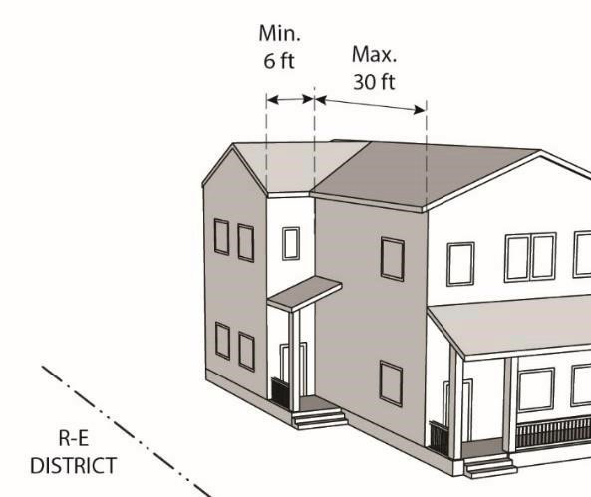
Building Massing Abutting the R-E Zone. Building façades abutting and facing the R-E zone may not exceed thirty feet in width without a break of minimum six feet in depth.
Figure 18.15.060.A.2: Building massing abutting the R-E zone.
B.
Façade Articulation and Composition.
1.
Vertical Articulation.
a.
Building façades up to sixty-five feet in length along a right-of-way must incorporate two or more of the following:
i.
Window bays a minimum two feet in depth from the building façade every twelve horizontal feet.
ii.
Recesses offset a minimum two feet in depth from the building façade every twelve horizontal feet.
iii.
Porches or decks over a minimum twenty-five percent of the façade length.
b.
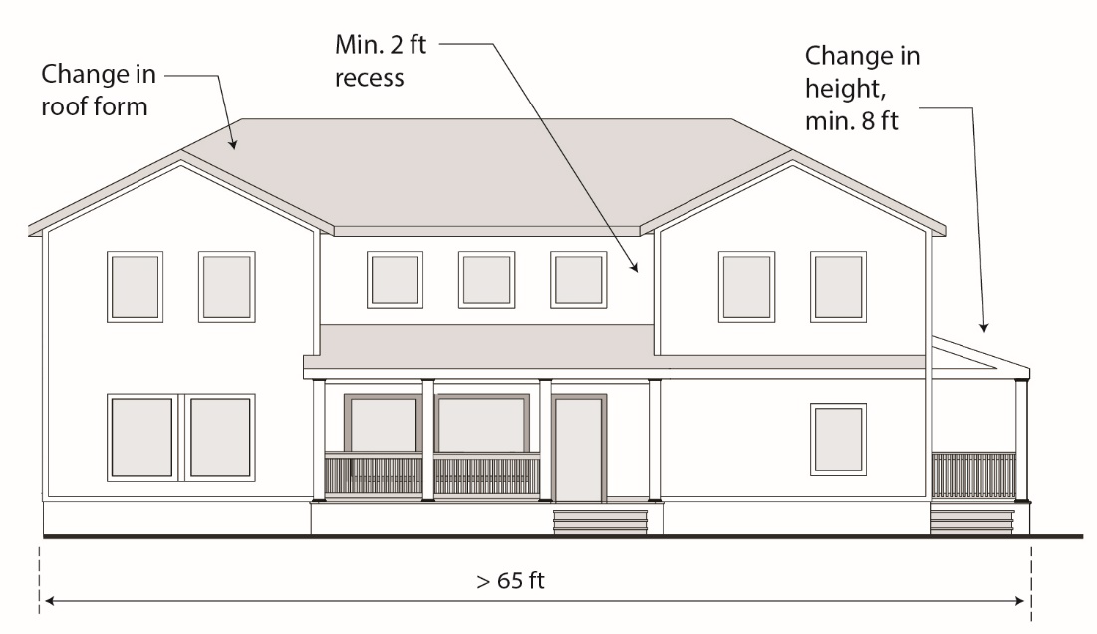
When a building façade exceeds sixty-five feet in length along a right-of-way, it must be separated into façade bays no greater than fifty feet in width defined by a recess or offset a minimum of two feet in depth and at least one of the following strategies:
i.
Change in roof parapet height or shape.
ii.
Change in roof form.
iii.
Change in building height, minimum eight-foot difference.
Figure 18.15.060.B.1: Building articulation, façades over sixty-five feet.
2.
Bay Articulation. The eave or roof form of a recessed façade bay shall be no higher than the corresponding elements of the primary façade bay(s).
3.
Townhouses/Rowhouses. In townhouse and rowhouse development types, all primary facade planes of adjacent attached units must be staggered a minimum of twelve inches every three units.
C.
Building Entrances. Building entrances must take one of the following forms:
1.
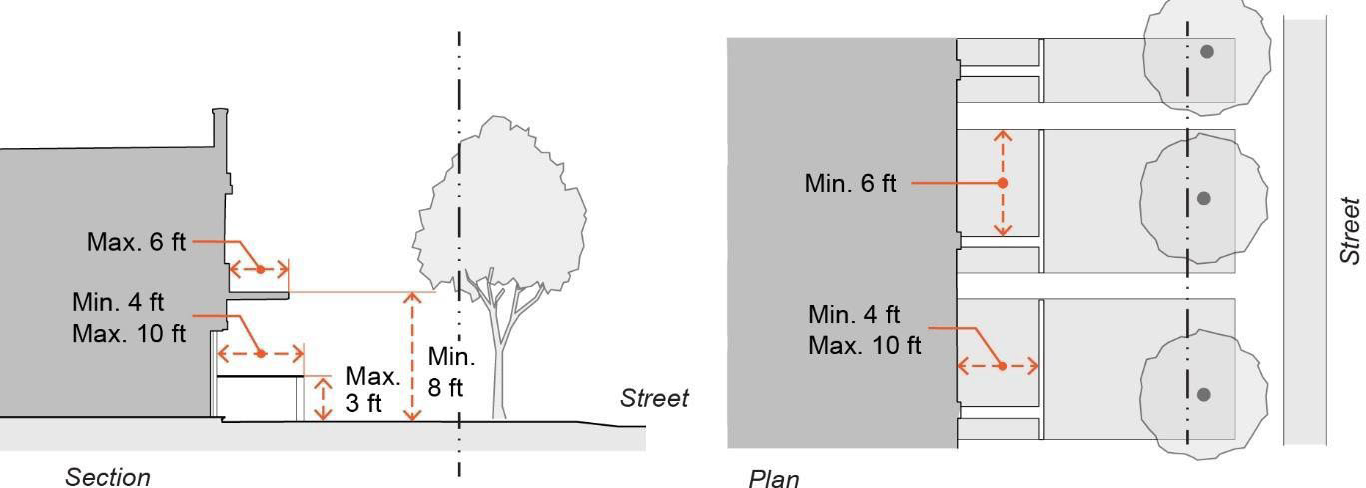
Individual covered dooryard frontages with dimensions as indicated below:
a.
Width of usable yard area: Minimum six feet.
b.
Depth of dooryard from door: Minimum four feet, maximum ten feet.
c.
Projection depth: Maximum six feet.
d.
Height of enclosure: Maximum three feet.
e.
Clear height to projection: Minimum eight feet, maximum twelve feet.
Figure 18.15.060.C.1: Dooryard.
2.
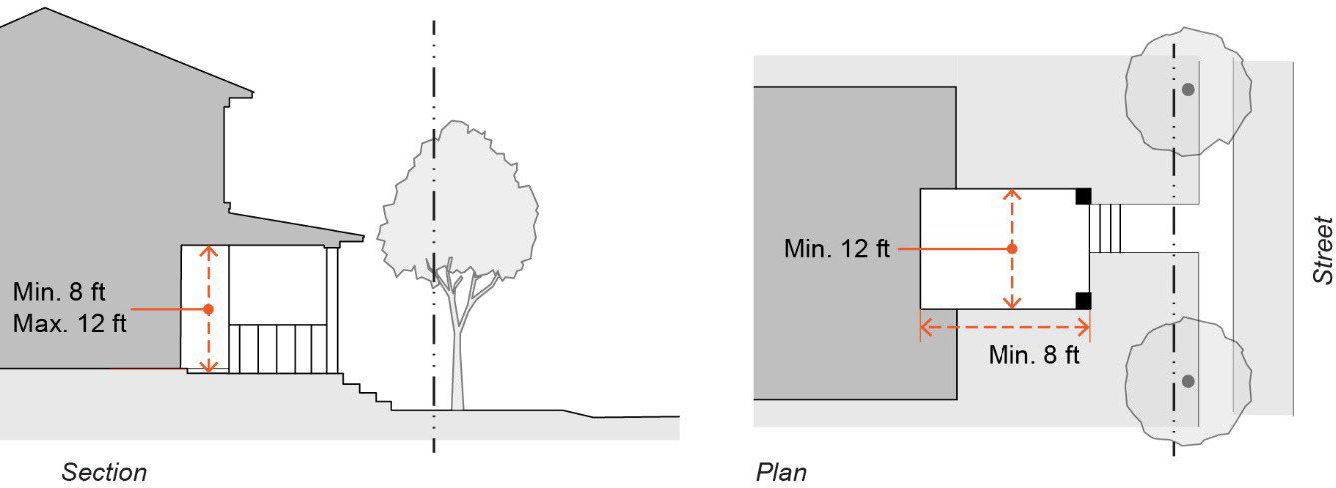
Individual covered porch frontages with dimensions as indicated below:
a.
Width of porch: Minimum twelve feet.
b.
Depth of porch: Minimum eight feet.
c.
Clear height, if porch is covered: Minimum eight feet, maximum twelve feet.
Figure 18.15.060.C.2: Porch.
3.
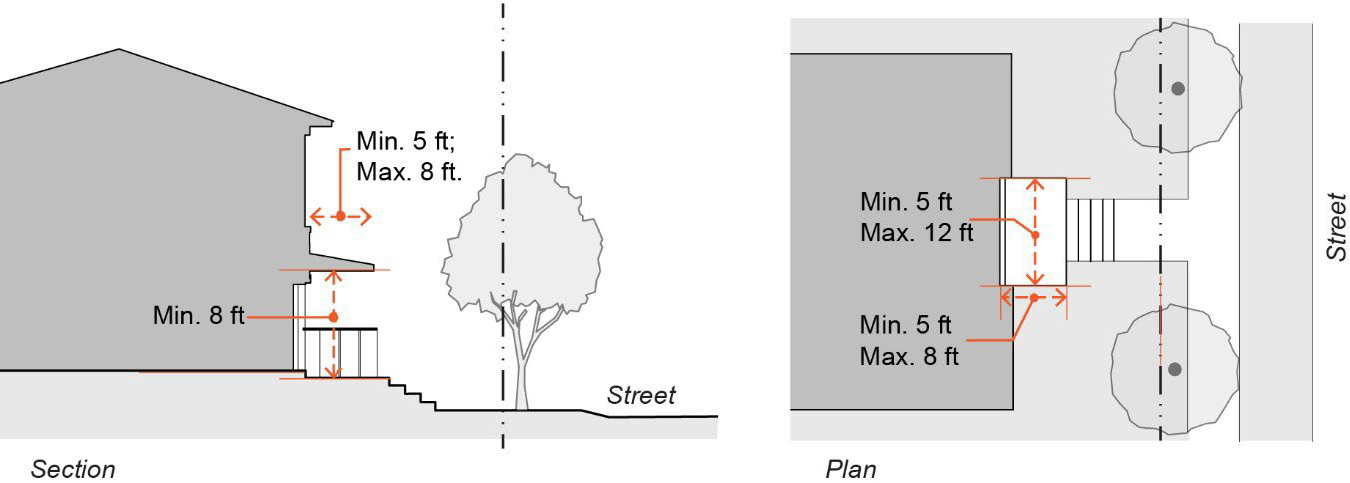
Individual covered stoop frontages with dimensions as indicated below:
a.
Width of stoop: Minimum five feet, maximum twelvefeet.
b.
Depth of stoop: Minimum five feet, maximum eight feet.
c.
Projection depth: Minimum five feet, maximum eight feet.
d.
Clear height to projection: Minimum eight feet.
Figure 18.15.060.C.3: Stoop.
4.
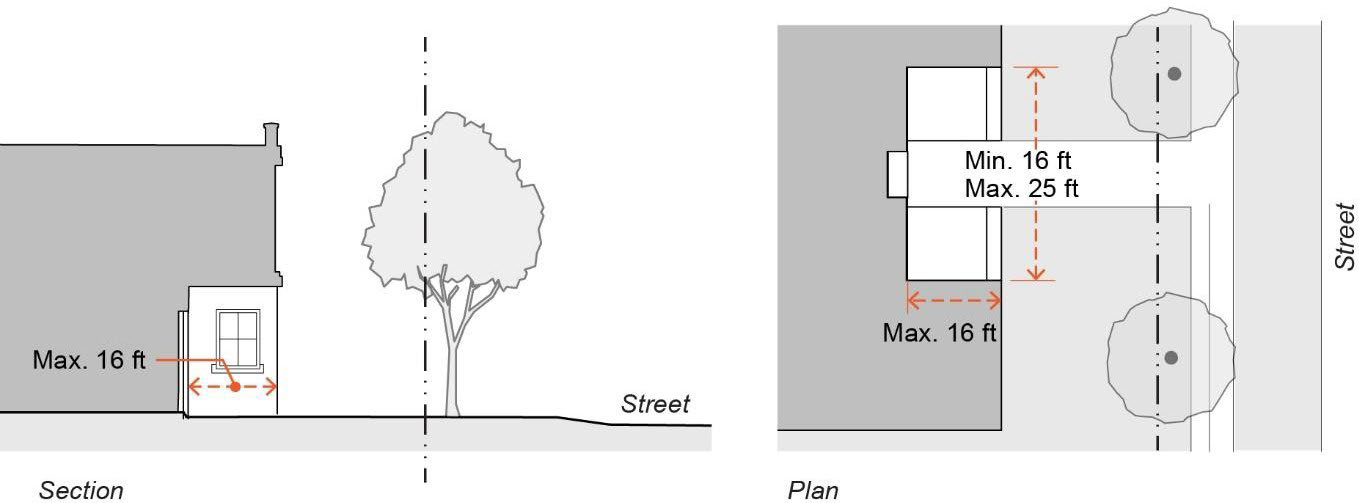
Individual recessed frontages with dimensions as indicated below:
a.
Width of recessed entry: Minimum sixteen feet, maximum twenty-five feet.
b.
Depth of recess entry: Maximum sixteen feet.
c.
Recessed surfaces eight horizontal feet or more require at least one window or door.
Figure 18.15.060.C.4: Recess.
D.
Roof Design.
1.
Eaves. If eaves are incorporated into the roof design, the eaves must be at least eighteen inches in depth.
2.
Dormers. The total width of a single dormer or multiple dormers shall not exceed fifty percent of the total roof length at the street-facing façade. The dormer width shall be measured at the dormer roof fascia or the widest part of the dormer.
3.
Roof Decks. Roof decks are not allowed.
E.
Windows and Doors.
1.
Window Shape. Windows must be square, rectangular, or arched.
2.
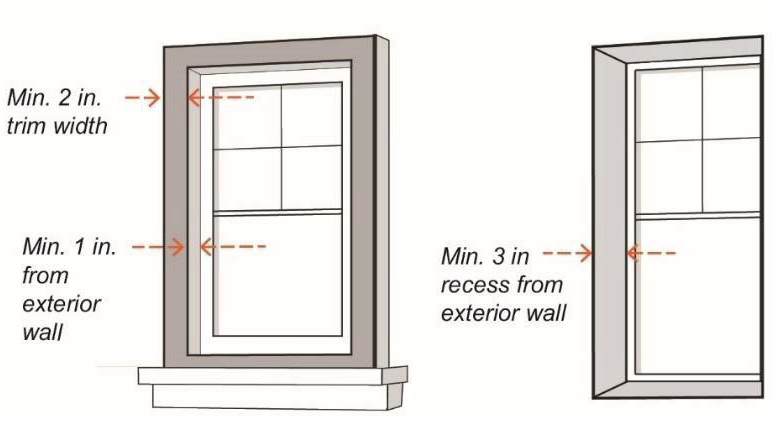
Window Recess and Trim. All windows must be either:
a.
Recessed a minimum of one inch from the outer wall surface with trim at least two inches in width; or
b.
Recessed a minimum of three inches from the outer wall surface.
Figure 18.15.060.E.2: Window recess and trim.
3.
Divided Lites. Simulated divided-lite grilles are acceptable only if they are located on both the outside and inside faces of the window, have spacer bars between the double panes of glass, and a thickness of at least one-fourth inch on each side of the window.
4.
"360-Degree" Design. All windows on each floor of each façade must be consistent in design, including proportions, trim, material, and color.
5.
Glazing. Reflective or opaque tinting of glazing on windows of primary living spaces (living rooms, dining room, family rooms, and bedrooms) is prohibited.
F.
Residential Unit Design.
1.
Universal Design. Minimum fifteen percent of units must employ principles of universal design, including at a minimum the following:
a.
At least one entrance without steps and a flat threshold.
b.
Living space on one floor or stair landings big enough to accept lifts.
c.
Wide interior doors (thirty-two-inch clear, typically provided with thirty-six-inch door), hallways, and alcoves with sixty by sixty-inch turning space at doors, in kitchens, and dead ends.
d.
At least one bathroom must be located on the ground level.
e.
A thirty by forty-eight-inch clear space at appliances and fixtures in bathrooms and kitchens.
2.
Affordable Unit Design. Affordable units and market rate units in the same group of buildings constructed under the same approval shall be constructed with the same exterior materials and details so that the affordable units are not distinguishable from market-rate units.
G.
Building Materials and Colors.
1.
Primary Building Materials. Primary shall mean fifty percent or more of a façade surface area excluding transparent surfaces. The following primary cladding materials are allowed:
a.
Stucco (minimum two-coat, twenty/thirty finish or finer);
b.
Stone (must extend vertically to the foundation);
c.
Stone-colored brick (must extend vertically to the foundation);
d.
EIFS; and
e.
Fiber cement.
2.
Secondary Accent Materials.
a.
Metal (wrought iron, copper, bronze) with a non-reflective finish;
b.
Fiber cement;
c.
Split-face CMU;
d.
Terra cotta tile;
e.
Brick or brick veneer; and
f.
Glazed tile.
3.
Building Colors.
a.
A maximum of four colors shall be applied to the building façade:
i.
Primary color comprising sixty percent or more of the façade.
ii.
Secondary color comprising no more than thirty percent of the façade.
iii.
Tertiary color comprising no more than ten percent of the façade.
iv.
Accent color for use on trim and architectural details.
b.
The reflectivity value for colors shall not exceed forty percent, except that the colors for trim must not have a reflectivity value over fifty percent.
c.
Materials with intrinsic, naturally occurring colors, materials with prefinished color such as stucco, and colorized metal shall count towards the maximum of four colors.
H.
On-Site Circulation.
1.
Walkways shall connect all primary building entrances on a site to each other, to on-site automobile and bicycle parking areas, to any on-site open space areas, and to adjoining public rights-of-way.
2.
Paving within Setback Area. Paving within required setback areas shall be visually distinct from the adjacent public sidewalk.
3.
Hardscape Materials. On-site hardscape material shall be permeable or pervious.
I.
Parking Configuration and Design.
1.
Location. Parking may be located in:
a.
Tuck-under individually secured garages;
b.
Shared ground-floor garages;
c.
Underground garages;
d.
Carports; or
e.
Surface parking lots.
2.
Tandem Parking. Tandem parking may satisfy the off-street parking requirement in accordance with the following:
a.
No more than two vehicles may be placed one behind the other.
b.
Both spaces shall be assigned to a single dwelling unit or to employees of the same nonresidential establishment.
c.
Each tandem parking bay must be a minimum forty feet in length by twelve feet in width.
3.
Driveway Access.
a.
Driveways may not exceed twenty feet in width, unless pre-empted by fire code.
b.
Parking Lot Access. Parking lot access shall be provided from a maximum of one driveway for developments of up to ten units and a maximum of two driveways for developments of more than ten units, unless pre-empted by fire code.
4.
Separation From Buildings. Surface parking areas and drive aisles must be separated from on-site buildings by a minimum distance of six feet, which may include landscaping or walkways.
J.
Exterior Lighting. Exterior building lighting shall comply with Section 18.36.040.A.8 in addition to the following standards:
1.
All exterior lighting fixtures shall be oriented downward, fully shielded, and certified by the International Dark Sky Association to prevent light intrusion into adjacent building use and sensitive habitat such as riparian habitat, streams, and wetlands.
2.
Electrical elements such as wires, conduits, and panel boxes shall be concealed from public view or painted to match the background surface color.
K.
Mechanical, Electrical, and Plumbing Equipment.
1.
Location of Equipment. Equipment, particularly if noise producing, shall be located away from private and common open space areas and shall not be located within the front setback of any residential or mixed-use zone. Public utilities are excluded from this requirement.
2.
Screening and Visibility Requirements. All exterior equipment and utilities shall be screened or incorporated into the design of buildings so as not to be visible from public rights-of-way or adjacent residential zones.
3.
Rooftop-Mounted Equipment Screening. Roof mounted mechanical equipment shall be screened in compliance with the following standards:
a.
To the greatest extent possible equipment shall be placed in wells or behind parapet walls.
b.
Screening materials may be solid concrete, wood, or other opaque material and shall effectively screen the mechanical equipment so that it is not visible from a public street;
c.
Screening shall be consistent with other on-site improvements in terms of color, material, and architectural style; and
d.
Equipment must be screened from view from adjacent public rights-of-way.
(Ord. 2024-451 § 1 (Att. A), 2024; Ord. 2024-450 § 1 (Att. A), 2024)
18.15.070 - Required conditions.
Required conditions in the R-MF districts shall be as follows:
A.
Required conditions as stipulated by subsections A, B and C of Section 18.12.050;
B.
Conformance with the recycling and trash enclosure requirements set forth in Section 18.37.010.
(Ord. 2024-451 § 1 (Att. A), 2024; Ord. 2024-450 § 1 (Att. A), 2024)

