
Post Falls City Zoning Code
CHAPTER 18
24 - Performance Standards
18.24.010. - Purpose.
The purpose of this chapter is to provide performance standards that provide consistency in Site development and conformance with the regulations found in this title. The following performance standards apply to developments in all zoning districts.
(Ord. 1061 § 2, 2005)
18.24.020. - General standards.
A.
Corner Lot Visibility. Visibility shall be maintained at all intersections of public Rights-of-Way or the intersection of a public Right-of-Way with a private street in conformance with title 10, chapter 10.52, "Maintenance of Intersection Visibility," of this Code.
B.
Temporary Buildings. Temporary buildings, trailers, equipment and materials used in conjunction with construction work, may be permitted in any district during the construction period upon showing that their Use and placement will not harm the area in which they are located. Temporary facilities shall be removed upon completion of the construction or issuance of the certificate of occupancy.
C.
Screening and Landscaping. Screening devices and Landscaping shall not impair the visibility of drivers entering or exiting a commercial, industrial, or multi-family Site.
D.
Dangerous and Objectionable Conditions. No land or building in any district shall be used or occupied in any manner creating dangerous, injurious, noxious or otherwise objectionable conditions, which may adversely affect the surrounding area or adjoining premises. Methods and procedures for the determination of the existence of any dangerous and objectionable elements shall conform to applicable standard measurement procedures listed in the International Fire Code or other applicable Life Safety Codes.
E.
Glare/Exterior Lighting. No interior or exterior lighting shall create direct or reflected glare which will adversely affect any surrounding property nor shall such lighting adversely affect Use of public streets or Rights-of-Way.
F.
Street Right-of-Way Dedication and Frontage Improvements. Dedication of necessary additional street Rights-of-Way, easements and construction of Frontage Improvements is required at the time of establishment of other than a temporary use, any construction on a Lot to establish a new land Use or expansion of an existing Use by twenty-five (25) percent or more in Floor Area. Frontage Improvements shall be to centerline of existing fully developed roadways, or to centerline, plus ten (10) feet for nondeveloped roadways, including transitions on each end of the developing property, as determined by the city engineer. Right-of-Way dedication shall conform to the transportation element of the Comprehensive Plan, the transportation master plan, or as otherwise required by the city engineer pursuant to Site plan review or other ordinance specified procedures. Private streets and associated streetlights may be allowed, as determined by the city, and shall meet city street and illumination standards.
G.
Utility Line Placement. All wire or cable utility service lines shall be placed underground, in accordance with franchise agreements. The Zoning Administrator may waive this requirement if the Use is temporary in nature or if there are practical physical difficulties.
H.
Surfacing.
1.
Residential. All required residential access drives and Parking Areas must be surfaced with concrete or asphalt paving. Driveways to individual residences may not exceed a maximum of twenty (20) percent slope, provided that any residence with a driveway in excess of fifteen (15) percent slope must be provided with a separate access route from the front door to the edge of the paved street or sidewalk that meets the design requirements for a means of egress contained in the adopted Building Code applicable to Structure. Each driveway must have a drive approach that meets city standards. Driveways to individual residences must be twenty (20) feet in length and not be narrower than the approved driveway approach per PFMC Section 12.12.060. Approach Width.
2.
Commercial/Industrial. All required commercial/industrial access drives, maneuvering areas and Parking Areas, outdoor merchandise display areas and motorized vehicle display Lots shall be surfaced with concrete or asphalt paving. Surfacing material shall be designed for the loading anticipated. Actual load design for commercial/industrial Uses will be determined at Site plan review. Outdoor nonvehicular storage areas in the Commercial and Industrial Zones may be surfaced with gravel and shall be enclosed within a sight obscuring fence. Outdoor merchandise display areas may be provided without paving and/or a sight obscuring fence as determined by the Zoning Administrator.
I.
Water Supply and Sewage Disposal. The method of water supply and sewage disposal for all land Uses must comply with Municipal and other applicable codes. Developers shall extend utility systems to the boundaries of the land developed in order to maintain system continuity.
J.
Dust Control. During all on-site grading and construction activities, adequate measures shall be implemented to control dust. Methods for dust control may be required to be approved at Site plan review. The Zoning Administrator may issue a stop work order on any project that demonstrates persistent inability to control dust until an acceptable dust control program is implemented.
K.
Fences and Walls (Excluding Retaining Walls). All walls and fences shall not exceed three (3) feet in height within the required Front Yard setback and nor shall they exceed six (6) feet in height in the Rear and Side Yard setback areas, unless otherwise permitted per section 18.20.150 of this title. For Corner Lots, fences measuring six (6) feet in height along the Street Side Yard can be permitted so long as such fence height does not extend into the Front Yard setback where the primary entrance of the residence is oriented. Corner Lots which abut the Side Yard of an adjoining Lot may not block visibility of a driveway on the adjoining Lot above three (3) feet. The height and location of new fences or walls that affect visibility from existing Abutting driveways shall be restricted, to provide for vision clearance measuring ten (10) feet by ten (10) feet on the subject private property. Where new driveways are proposed adjacent to existing fences that exceed three (3) feet in height, the driveway approach shall be located no closer than fifteen (15) feet to the fence.
1.
Exemption. Fencing or screening that is a customary component of a sports or recreation facility utilized to define the area or play or to protect persons from injury resulting from the play of the sport is exempt from the height requirement to the extent necessary for the fence or Screen to serve its customary purpose.
L.
Unsightly Conditions. The exterior of all Structures and Yards shall be maintained in such manner that there is no detrimental effect on the property of others. There shall be no keeping or depositing on, or scattering over, the property of any of the following:
1.
Junk, trash, or debris.
2.
Abandoned, discarded or unused objects or equipment, such as automobiles, furniture, stoves, refrigerators, freezers, cans, containers, or similar items.
3.
Stagnant water or excavations.
4.
Any device, decoration, design, Structure or vegetation which offends the visual sensibilities of a reasonable person by reason of its conditions.
M.
Building Materials and Equipment. No building materials, machinery or other materials or equipment used in or for a business shall be stored outdoors on any Lot in any residential district, except during construction on the Lot.
N.
Commercial Curbing. Curbing is required at the outer limits of a paved surface to ensure the integrity of the edge of asphalt, direct storm drainage, function as wheel stops, provide separation of pedestrian facilities and for aesthetics. A six-inch high cement concrete curb shall be constructed at the edge and along all landscaped areas and extent of pavement. All extruded curbs shall be dowelled. Flush curbs may be used in areas designated for snow storage. Curbing located at the extent of a paved surface, in a phased project or in an extraordinary case of vast amounts of asphalt, may be waived by the Zoning Administrator.
O.
Outbuildings or Carports. All commercial and residential outbuildings or carports that require a building Permit shall be constructed with either a concrete or asphalt floor. Outbuilding and/or carports for livestock shall not require such floors in livestock areas.
P.
Swimming Pools. All in-ground and aboveground Swimming Pools with a depth greater than forty-eight (48) inches or larger than two hundred (200) square feet must comply with the following requirements:
1.
Swimming Pools at Single-Family Homes must be sited in a Side or Rear Yard.
2.
Swimming Pools, filter systems, and all other associated equipment must be sited at least five (5) feet from any property line.
3.
Swimming Pools must be sited at least six (6) feet from the main building on the Site and the outside of the Swimming Pools edge wall or coping.
Q.
Police Access Exigent Circumstances. Where access to or within a structure or an area is restricted because of secured openings or gated entries, or where immediate access is necessary for life-saving or exigent circumstances, the chief of police is authorized to require the owner or developer to install and maintain a keyless entry system or suitable alternative, to provide police access to the common areas and corridors. The keyless entry system or alternative shall be subject to review and approval by the city. Exigent circumstances shall mean and include those situations where urgent and immediate action is necessary to prevent imminent harm to individuals, protect public safety, prevent the destruction of evidence, or stop a fleeing suspect.
(Ord. 1469, § 1, 2022; Ord. 1453 §§ 3, 4, 2022; Ord. 1433 § 8, 2021; Ord. 1368, 2019; Ord. 1357, 2019; Ord. 1237, 2012; Ord. No. 1523, § 1, 2025)
18.24.030. - Residential performance standards.
A.
Single-Family and Duplex Residential. Single-family and duplex residential development shall conform to the following standards:
1.
When buildings are adjacent to a public street or private street, the building entrances must be clearly visible and oriented to face the public street. The Zoning Administrator may grant deviations when the implementation of this criteria is practically implausible, the proposed deviation creates a better design for the community, or there has been a general attempt to meet this criterion.
2.
Accessory Structures. Accessory Structures in any zone shall be set back behind the front of the residence. On a Corner Lot the Accessory Structure may be placed in front of the residence on the Street Side Yard.
3.
Accessory Dwelling Units. Accessory Dwelling Units may be permitted as secondary Dwellings to Single-Family Homes subject to the following restrictions:
a.
Only one Accessory Dwelling Unit is allowed on a Lot.
b.
One of the residences must be owner-occupied.
c.
One additional off-street parking space must be provided.
d.
Building materials must be consistent with the primary residence.
e.
No more than one entrance to the Accessory Dwelling Unit may be visible from the street.
f.
The Accessory Dwelling Unit cannot have a separate drive approach, unless drive approach is from a Rear Loaded alley or side street of a Corner Lot.
g.
The Accessory Dwelling Unit (attached or detached) can be no larger than fifty (50) percent of the living area of the primary residence and no more than one thousand (1,000) square feet.
h.
An Accessory Dwelling Unit must have electricity, kitchen facilities, and sanitary facilities.
i.
The Applicant must include a detailed Site plan, drawn to scale, including the proposed accessory living unit, Setback Lines, ingress/egress routes.
j.
An existing accessory building that is proposed to be converted to an accessory living unit must meet the requirements of the adopted building codes.
B.
Twin Home Performance Standards. Twin Home development projects shall conform to the following standards:
1.
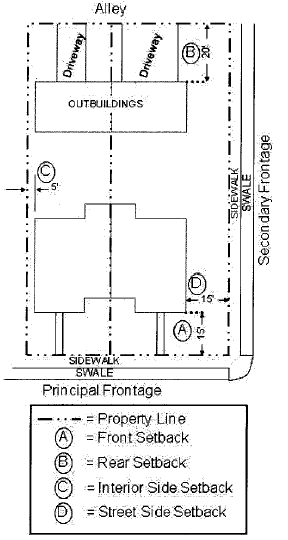
Open porches may extend five (5) feet from the Principal Plane, such that they do not restrict the visibility of pedestrians along the adjacent sidewalk or vehicles accessing/leaving a residence.
2.
All Twin Homes shall have a walkway connecting each residential unit to the adjacent sidewalk.
3.
All garages must either be accessed from the rear as depicted in the following diagram or be Front Loaded with the garage face being recessed at a minimum of five (5) feet from the Principal Face.
4.
Twin Homes may have detached outbuildings as illustrated below or attached garages.
C.
Townhome Performance Standards. Townhome development projects shall conform to the following standards:
1.
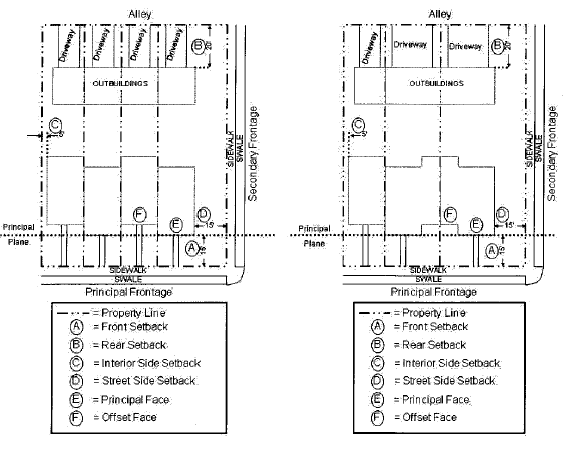
Open porches may extend five (5) feet from the Principal Plane, such that they do not restrict the visibility of pedestrians along the adjacent sidewalk or vehicles accessing/leaving a residence.
2.
All Townhomes shall have a walkway connecting each residential unit to the adjacent sidewalk.
3.
Unless otherwise approved through the Site plan review process per chapter 18.20 of this title, all Townhomes shall have vehicular access from the rear.
4.
In order to avoid a continuous plane, an Offset Face shall be provided to not create two (2) adjoining Principal Faces (see following diagrams).
5.
The Offset Face shall be set back a minimum distance of five (5) feet from the Principal Face.
6.
The Offset Face or the sum of two (2) adjoining Offset Faces shall be at least three-fourths (¾) or equal to the width of the adjoining Principal Face. (See following diagrams.)
7.
Townhomes shall develop under a unified theme to include at least two (2) distinct architectural facade designs that are alternated in adjacent units. A two-unit Townhome development would follow the design standards set forth for Twin Homes.
8.
Common parking Lots approved through the Site plan review process for Townhomes shall provide Street Screens that complement the architectural theme of the constructed Townhomes.
9.
A minimum of two (2) separate siding materials shall be applied on the exterior of Townhomes. Vinyl siding is prohibited.
10.
Townhome developments shall comply with the standards set forth in title 17, "Subdivisions," of this Code and the Site plan review process per section 18.20.130 of this title, unless otherwise approved by the Zoning Administrator.
11.
Townhome developments will be required to provide information regarding the coordination and installation of a trash enclosure with a refuse company.
D.
Multi-Family Performance Standards. Multi-family development (three (3) units or greater on a single Lot) shall utilize the Site plan review process, section 18.20.130 of this title, and shall conform to the following standards:
1.
Equipment Screening.
a.
Roof-mounted or wall mounted mechanical equipment such as air conditioning, elevator overruns, heating or ventilating units/ducting must be screened from a horizontal line of sight. Such screening must be architecturally consistent with the building and an integral part of the roof design. For flat roofs, an architecturally consistent Screen enclosure behind a parapet wall may be used if it is made to appear as an integral part of the building.
b.
The ground-mounting of mechanical equipment that would be visible from the public Right-of-Way, must be inset into the building facades and/or screened with Landscaping or low walls.
2.
All outside storage areas and solid waste storage areas must meet the requirements of Municipal Code Section 18.24.040 of this title. Adequate access must be provided for collection of solid waste. The Zoning Administrator may approve alternative methods of reducing the visual impact in lieu of screening if the proposed screening is at least as effective at screening the storage areas from view as the requirements of this section.
3.
When buildings are adjacent to a public street, the building entrances must be oriented to face the public street. The Zoning Administrator may grant deviations when the implementation of this criteria is practically implausible, the proposed deviation creates a better design for the community, or there has been a general attempt to meet this criterion.
4.
Private streets along perimeter property lines must include a minimum ten-foot wide landscape Buffer to provide an attractive landscape feature as well as privacy between developments.
5.
Multi-family development with Structures above thirty-five (35) feet along the exterior of a development Site adjacent to an R1, R1S, R2 and SC3 zoning district or within the RM zoning district and adjacent to a Duplex House, Twin-Home, or Single-Family Home development Lot; must either provide a Buffer Yard meeting the requirements for a Category B Buffer under Section 18.24.080 (Table B) of this title or provide an additional one foot of setback for each foot of additional height over thirty-five (35) feet.
6.
Lighting must be provided to illuminate all parking Lots and walking paths or sidewalks on the Site. Lighting must be installed in a manner that prevents light crossing property lines or creating glare for adjacent properties. Free standing light poles cannot exceed twenty (20) feet in height.
7.
At least one hundred fifty (150) square feet of common Open Space must be provided for each one (1) bedroom unit and three hundred (300) square feet for each two-bedroom plus unit. The Open Space must meet the following criteria:
a.
For Sites greater than two acres, the majority of required Open Space must be consolidated into a primary Open Space area.
b.
Stormwater management areas and utility easements are generally excluded from the calculation of Open Space areas unless the primary Use and design of the area is for recreational purposes and the Use of the area for stormwater management or utilities does not impair the Use of the area for its designed recreational Use.
c.
Required Buffer Yards are not counted towards the required percentage of Open Space.
d.
The required Open Space must contain at least two of the following amenities that are accessible for Use by the residents and should be centrally located:
i.
Play Structure;
ii.
Community garden;
iii.
Picnic tables and BBQ areas. Providing a gazebo or other permanently affixed shade Structures nearby counts as two (2) amenities;
iv.
Swimming Pool;
v.
Indoor recreation facility;
vi.
Sports courts (e.g., tennis, basketball, volleyball);
vii.
Internal courtyards;
viii.
Connected internal trail/sidewalk system. (when possible, connect to nearby parks, trails, or other public amenities.);
ix.
Natural Open Space area with benches/viewing areas and/or trails;
x.
Other active or passive recreation areas as approved by the community development director that meets the intent of this requirement.
e.
Density bonus. For each additional amenity provided beyond the two (2) required amenities, a ten (10) percent Density increase, in excess of the maximum allowed Density, is available up to a maximum of three (3) bonuses.
8.
The required Open Space may be reduced by up to thirty (30) percent if the project provides indoor recreation areas fitted with game equipment, work-out equipment, sport court facilities, Swimming Pools, plant greenhouses, wood shop, or other designated project or game equipment. The indoor facility must meet the following criteria:
a.
The minimum area of any single space must be at least three hundred fifty (350) square feet, with no dimension being less than seventeen (17) feet.
b.
Interior common space must be at least ten (10) feet in floor to ceiling height; glazed window and skylight areas must be provided in the proportion of one square foot of window/skylight for each four (4) square feet of the Floor Area of the common space.
c.
The space must be accessible from a common lobby, courtyard, or exterior common Open Space.
d.
Office/managerial areas are excluded from the calculation.
9.
Bike Rack(s) shall be provided and be permanently affixed and capable of accommodating at least one (1) bike for every two (2) units and placed in a manner as to not interfere or obstruct pedestrian traffic.
10.
The Open Space required by subsection D.7. may be reduced by fifty percent for Rear Loaded townhouse style projects that provide twelve (12) units or less on a single parcel if each unit is provided a patio or balcony of at least eighty (80) square feet and a minimum depth of six (6) feet.
E.
Manufactured/Modular Home Placement Standards on Private Platted Lots. This subsection establishes minimum placement standards for manufactured/modular homes for all districts in which a Manufactured Home can be located. Restrictions are in addition to those applicable to the district where a Manufactured Home is located. Manufactured/modular homes are a factory built assembly designed for residential occupancy. Such housing is built on a permanent chassis and has wheels attached for transportation, which are removed on-site when connected to the required utilities and set on a foundation approved by the Idaho "Manufactured Home Installation Standards Manual." Such housing is manufactured on or after June 15, 1976, and is certified as meeting the manufactured housing construction safety standards of the U.S. department of housing and urban development, and shall be placed with the following standards:
1.
Designed for long term residential Use by a family, contains a kitchen, bath, living and sleeping facilities, multisectional and at least twenty (20) feet wide with a minimum total square footage equal to eight hundred (800) square feet.
2.
Recessed permanent foundations are required. Foundations must comply with the setup requirements of title 44, chapter 22, Idaho Code, when placed in any residential or commercial district.
3.
Where garages are required for Site built homes, they are required for Manufactured Homes.
4.
Placement of a Manufactured/Modular Home on a Lot not located in a residential Mobile Home Park will comply with the single-family bulk and placement requirements and the single-family residential off-street parking standards.
F.
Residential Mobile Home Park Performance Standards. The Mobile Home Park development standards contained in the following subsections shall apply to all land and Structures in the RMHP district. The following subsections describe the standards for design, issuance of Permits, authorizing the licensing of operations, authorizing the inspection of Mobile Home Parks, and fixing penalties for violations. The following are standards for development in existing residential Mobile Home Parks:
1.
Uses and development permitted. The following Uses and developments may be conducted or constructed in the Mobile Home Park district:
a.
Accessory buildings such as storage buildings, attached or detached garages and toolsheds.
b.
Carports, garages and patios.
c.
Individual Mobile Home as part of a Mobile Home Park.
d.
Parks, playgrounds, and other Open Space amenities.
2.
Nonresidential Uses.
a.
No part of any park shall be used for nonresidential purposes, except such Uses that are required for the direct servicing and well being of park residents and for the management and maintenance of the park.
b.
Nothing contained in this subsection shall be deemed as prohibiting the sale of a Mobile Home located on a Mobile Home stand and connected to the pertinent utilities.
3.
Home Separation, Setbacks, Buffer Strips and Screening.
a.
All Mobile Homes shall be located at least twenty-five (25) feet from any park property boundary line Abutting upon a public street or highway and at least fifteen (15) feet from other park boundary lines.
b.
There shall be a minimum distance of ten (10) feet between individual Mobile Homes or an individual Mobile Home with an adjoining improved or unimproved park street, or common Parking Area or other common areas.
c.
All Mobile Home Parks located adjacent to industrial or commercial land Uses shall be provided with screening such as fences or natural growth along the property boundary line separating the park and such adjacent nonresidential Uses.
4.
Off-Street Parking. Off-street Parking Areas shall be provided in all Mobile Home Parks for the Uses of park occupants and guests. Each Mobile Home Lot shall be designed to provide two (2) off-street parking spaces. Parking may be in tandem.
5.
Mobile/Manufactured Home Placement/Tiedown. The placement and tiedown of a Mobile/Manufactured Home shall be in accordance with the latest adopted Idaho Manufactured Home installation standards for a temporary installation.
(Ord. 1453 § 5, 2022; Ord. 1433 §§ 9, 10, 2021; Ord. 1377 §§ 6, 7, 2020. Ord. 1237, 2012)
18.24.032. - Cottage home residential performance standards.
A.
Purpose. The purpose of this section is to: to provide housing types that are responsive to changing household demographics (e.g., retirees, small families, and young professionals); to expand opportunities for home ownership; to encourage creation of functional usable Green Space in residential communities; to promote neighborhood interaction and safety through design; to encourage opportunities for infill development; and ensure that residents of such housing enjoy a high-quality environment, with permanence, stability, and access to Green Space.
B.
Applicability. Cottage Home residential development is permitted in the R-2, R-3, and RM zoning districts. Cottage Home residential development is also allowed in those areas in the CCM zoning district where the approved development agreement for the property authorizes multi-family residential Uses. Cottage Homes may also be approved with a Special Use Permit in the CCS and R-1 zoning district.
C.
General Development Standards.
1.
Attached Garages.
a.
Garages on Front Loaded Cottage Homes and Side Loaded Cottage Homes cannot exceed three hundred sixty (360) square feet in size.
b.
Garages on Rear Loaded Cottage Homes cannot exceed five hundred (500) square feet in size.
2.
Architectural Design.
a.
Each Cottage Home must have a front porch with a minimum depth of six (6) feet. The porch must also meet the following requirements:
(1)
Front Loaded Cottage Homes must have a front porch no less than fifty (50) square feet in size.
(2)
Side Loaded and Rear Loaded Cottage Homes must have a front porch no less than eighty (80) square feet in size.
b.
Attached garages for Front Loaded Cottage Homes cannot exceed sixty-six (66) percent of the width of the Structure.
c.
Accessory Structures must match the architectural style of the Cottage Home and meet separation requirements contained in the adopted building code.
d.
No two (2) Abutting or directly opposing Cottage Homes may have the same, or a substantially similar, front facade.
e.
Each Cottage Home must have a minimum of four (4) of the following building elements, features, or treatments incorporated into the front facade and street facing facade.
(1)
Windows with visible trim and mullions or recessed windows;
(2)
Dormers/false dormers;
(3)
Bay windows;
(4)
Gables detailing;
(5)
Architectural detailing on pillars, posts, or railings;
(6)
Stonework or masonry;
(7)
Minimum sixteen-inch offset in building face or roof;
(8)
Detailed door (multi-panel or glass insert) or window adjacent to front door (sidelite);
(9)
Variation in roof or building colors and materials, on Cottage Homes, including but not limited to, brick, stone, or other masonry accents;
(10)
Any other building elements, treatments, features approved by the Zoning Administrator that provide for variety and visual interest.
3.
Green Space.
a.
Green Space. Except as otherwise provided, Cottage Home developments must provide five hundred fifty (550) square feet of common Green Space for each Cottage Home. For Cottage Homes placed on individual Lots, the amount of common Green Space may be reduced to three hundred twenty-five (325) square feet. Each common Green Space must provide at least one pet waste clean-up station.
b.
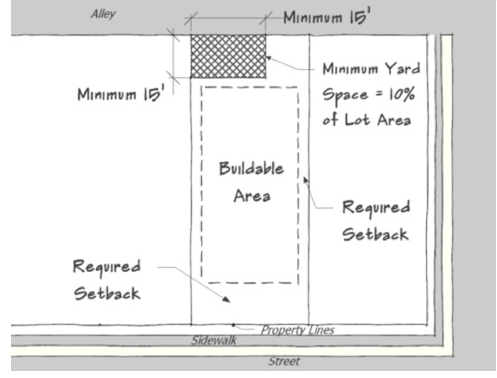
When Cottage Homes are placed on individual Lots, each Lot must provide a contiguous and usable Yard. This area cannot include Structures, driveways, or parking. Additionally, the Yard must:
(1)
Be located in the Rear or Side Yard and not be within the required Front Yard setback;
(2)
Be equal to at least ten (10) percent of the parcel area; and
(3)
Have no dimension less than fifteen (15) feet or less than twelve (12) feet for parcels smaller than three thousand five hundred (3,500) square feet.
c.
Within common Green Spaces one class II or III Tree, as outlined in the Post "Falls Tree Standards Manual," for each seven thousand five hundred (7,500) square feet of Green Space is required. The species must be approved by the Urban Forester.
4.
Fences. Fences are not allowed within common Green Space areas, unless approved by the Zoning Administrator to secure or enclose an amenity within the Green Space that creates a safety, security, or usability concern. Examples of where exemptions may be considered include; dog parks, tennis/pickleball courts, community gardens, Swimming Pools, etc.
5.
Parking.
a.
Each Cottage Home Dwelling Unit must provide at least two (2) off-street parking spaces for each Cottage Home Unit that meets the requirements of Section 18.24.020.
b.
An additional .25 parking spaces must be provided in a Parking Cluster for each Cottage Home within a development of eight (8) or more units that fronts on a Green Space or on a street where parking is not allowed.
D.
Cottage Home Single-Family Performance Standards. Single-Family Cottage Home development must also meet the following standards:
1.
Minimum Lot Area. Two thousand four hundred (2,400) square feet.
2.
Site Design and Orientation.
a.
Vehicular access to Cottage Homes must be from the rear or side. Where Site constraints make this requirement impractical or where an alternative creates a better design, the Zoning Administrator may grant a deviation allowing up to fifty (50) percent to be Front Loaded.
b.
Cottage Homes are encouraged to front Green Space.
c.
Each Cottage Home must have a pedestrian path constructed of concrete or asphalt between the sidewalk and the building entry. If no sidewalk is present then a connection must be made to the edge of private street or public Right-of-Way.
d.
Cottage Home developments with eight (8) or more Cottage Homes must have fifty (50) percent of the common Green Space centrally located. Common Green Space must front a public or private street and have twenty (20) percent of the perimeter of the Green Space fronting the public or private street.
(1)
Common Green Space must be in a separate tract or tracts and be owned and maintained by a homeowner's association (HOA). The homeowner's association's covenants must include the perpetual maintenance of all common areas, including common Green Space and preclude the conversion of such common areas to any other Use.
e.
Cottage Home developments with less than eight (8) Cottage Homes must consolidate the common Green Space into one location and the Green Space cannot have any dimension less than twenty (20) feet per side. Pet waste clean-up stations are not required.
3.
Setbacks and Height Limitations.
a.
Front. Sixteen (16) feet to the Principal Plane and garages must comply with the Official Bulk and Placement Regulations Table in PFMC 18.20.040.
(1)
If no easement exists along the front property line, then the front setback may be reduced up to five (5) feet.
(2)
For Front Loaded Cottage Homes, garages must not project beyond the front porch. Additionally, the front entryway must be visible and generally parallel to the public or private street.
b.
Side. Each Side Yard must have a setback of at least three (3) feet and both Side Yards must total at least twelve (12) feet.
c.
Rear.
(1)
Front Loaded Cottage Homes: Twelve (12) feet.
(2)
Rear Loaded Cottage Homes: Twenty (20) feet.
d.
Flanking Street: Ten (10) feet; and
e.
Height: Thirty (30) feet.
4.
Accessory Structures: Accessory Structures cannot exceed the height of the primary Structure. Additionally, Accessory Structures cannot exceed the square footage of the primary Structure or seven hundred twenty (720) square feet, whichever is less.
5.
Green Infrastructure Design Standards. Where a minimum of twenty-five (25) percent of the Lots contain green infrastructure amenities contained in this section, common Green Space requirements may be reduced by fifty (50) square feet for each Dwelling Unit.
a.
Solar collection system used to capture solar energy, convert it to electrical or thermal power and supply electrical or thermal power primarily for on-site Use via roof mounted solar arrays or modules, or solar related equipment which is intended to primarily reduce on-site consumption of utility power or fuels.
b.
Rain gardens located in community or Green Space areas.
c.
Water harvesting barrels or downspouts.
d.
Green roofs.
e.
EV charging stations.
6.
Fences. Fences on individual Lots must comply with PFMC 18.24.020.K.
E.
Cottage Home Multi-Family Performance Standards. Multi-family development of three (3) or more Cottage Homes on a single Lot must utilize the Site plan review process in Section 18.20.130 of this Title, and must also conform to the following standards:
1.
Separation. All Cottage Homes must meet the separation requirements in the adopted building code without the use of additional fire rated materials.
2.
Site design and orientation:
a.
Vehicular access to the Cottage Home must be from the rear or side, unless approved through a Special Use Permit.
b.
Cottage Homes are encouraged to front Green Space.
c.
Each Cottage Home must have a pedestrian path constructed of concrete or asphalt between the sidewalk and the building entry. If no sidewalk is present then a connection must be made to the edge of private street or public Right-of-Way.
3.
Setbacks and Height Limitations. The following setbacks from exterior property lines of the multi-family development are as follows:
a.
Front: Twenty (20) feet;
b.
Side: Ten (10) feet;
c.
Rear: Ten (10) feet;
d.
Flanking Street: Twenty (20) feet; and
e.
Height: Thirty (30) feet.
4.
Green Space. The required Green Space must comply with the requirements of Section 18.24.030 D.7. of this Title but do not qualify for Density bonuses.
5.
Green Infrastructure Design Standards. Where green infrastructure amenities are provided and selected from the following list, common Green Space requirements may be reduced by fifty (50) square feet per Cottage Homes.
a.
Electrical vehicle (EV) charging stations at a minimum of one (1) station per twenty-five (25) Cottage Homes.
b.
Solar collection system used to capture solar energy, convert it to electrical or thermal power and supply electrical or thermal power primarily for on-site use via roof mounted solar arrays or modules, or solar related equipment which is intended to primarily reduce on-site consumption of utility power or fuels.
6.
Access, Driveways, Parking, and Garages. The Zoning Administrator may consider consolidated parking Structures under the Site plan review process.
7.
Refuse. All outside storage areas and solid waste storage areas must meet the requirements of Post Falls Municipal Code Section 18.24.040(C). Adequate access must be provided for collection of solid waste. The Zoning Administrator may approve alternative methods of screening if the proposed screening is at least as effective at screening the storage areas from view as the requirements of this section.
(Ord. 1477 § 3, 2023)
18.24.034. - Tiny home residential performance standards.
A.
Purpose. The purpose of this section is to: to provide housing types that are responsive to changing household demographics (e.g., retirees, small families, and young professionals); to expand opportunities for home ownership; to encourage creation of functional usable Green Space in residential communities; to promote neighborhood interaction and safety through design; to encourage opportunities for infill development; and ensure that residents of such housing enjoy a high-quality environment, with permanence, stability, and access to Green Space.
B.
Applicability.Tiny Home residential development is permitted in the R-2, R-3, LC and RM zoning districts. Tiny Home residential development is also allowed in those areas in the CCM zoning district where the approved development agreement for the property authorizes multi-family residential uses. Tiny Homes may also be approved with a Special Use Permit in the CCS and R-1 zoning districts.
C.
General Development Standards.
1.
Attached Garages:
a.
Garages on Front Loaded Tiny Homes and Side Loaded Tiny Homes cannot exceed three hundred and sixty (336) square feet in size.
b.
Garages on Rear Loaded Tiny Homes cannot exceed five hundred (500) square feet in size.
2.
Architectural Design.
a.
Each Tiny Home must have a front porch with a minimum depth of six (6) feet. The porch must also meet the following requirements:
i.
Front Loaded Tiny Homes must have a porch no less than fifty (50) square feet square feet in size.
ii.
Side Loaded and Rear Loaded Tiny Homes must have a porch no less than eighty (80) square feet in size.
b.
Attached garages for Front Loaded Tiny Homes cannot exceed sixty-six (66) percent of the width of the structure.
c.
Accessory Structures must match the architectural style of the Tiny Home and meet separation requirements contained in the adopted building code.
d.
Each Tiny Home must have a minimum of two (2) of the following building elements, features, or treatments incorporated into the front façade and street facing façade.
i.
Windows with visible trim and mullions or recessed windows;
ii.
Dormers/false dormers;
iii.
Bay windows;
iv.
Gables detailing;
v.
Architectural detailing on pillars, posts, or railings;
vi.
Stonework or masonry;
vii.
Minimum sixteen (16) inch offset in building face or roof;
viii.
Detailed door (multi-panel or glass insert) or window adjacent to front door (sidelite);
ix.
Variation in roof or building colors and materials, on Tiny Homes, including but not limited to, brick, stone, or other masonry accents;
x.
Any other building elements, treatments, features approved by the Zoning Administrator that provide for variety and visual interest.
e.
Tiny Homes containing vinyl siding cannot be within ten (10) feet of another structure with vinyl siding.
3.
Green Space.
a.
Green Space.Tiny Home developments must provide five-hundred and fifty (550) square feet square feet of common Green Space for each Tiny Home. For Tiny Homes placed on individual Lots, the amount of common Green Space may be reduced to three-hundred and twenty-five (325) square feet. Each common Green Space must provide at least one (1) pet waste clean-up station.
b.
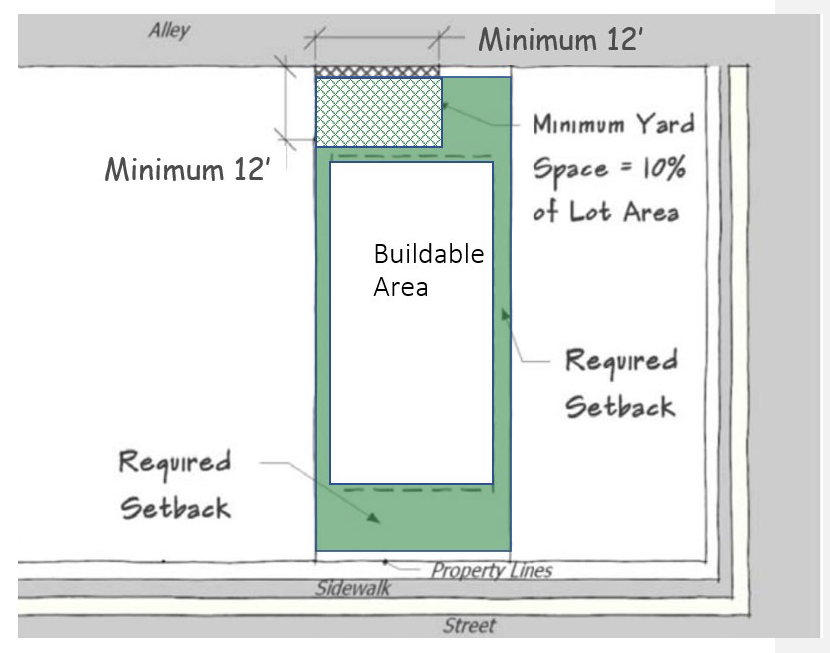
When Tiny Homes are placed on individual Lots, each Lot must provide a contiguous and usable Yard. This area cannot include structures, driveways, parking, or be included within common Green Space. Additionally, the Yard must:
i.
Be located in the Rear or Side Yard and not be within the required Front Yard setback;
ii.
Be equal to at least ten (10) percent of the parcel area; and
iii.
Have no dimension less than twelve (12) feet or less than ten (10) feet for parcels smaller than two thousand four hundred (2,400) sq ft.
c.
Within common Green Spaces one (1) class II or III Tree, as outlined in the "Post Falls Tree Standards Manual," for each seven thousand five hundred (7,500) square feet of Green Space is required. The species must be approved by the Urban Forester.
d.
Structures providing indoor recreational space (excluding office/managerial areas), with a minimum area of at least three hundred fifty (350) square feet, with no dimension being less than seventeen (17) feet and having a floor to ceiling height of at least ten (10) feet, may be included as part of the common Green Space if they provide the residents any of the following activities:
i.
Game equipment.
ii.
Work-out equipment.
iii.
Sport court facilities.
iv.
Swimming Pools.
v.
Greenhouses.
vi.
Wood shop.
vii.
Or other designated project or game equipment approved by the Zoning Administrator.
4.
Fences.Fences are not allowed within common Green Space areas, unless approved by the Zoning Administrator to secure or enclose an amenity within the Green Space that creates a safety, security, or usability concern. Examples of where exemptions may be considered include; dog parks, tennis/pickleball courts, community gardens, Swimming Pools, etc.
5.
Parking.
a.
Each Tiny Home Dwelling Unit must provide at least two (2) parking spaces for each Tiny Home Unit that meets the requirements of Section 18.24.020. For Tiny Home development projects up to fifty (50) percent of the required parking spaces may consist of on-street parking. On-street parking spaces on a public street are community spaces and may not be assigned to a designated Tiny Home.
b.
An additional twenty-five hundredths (0.25) parking spaces must be provided in a Parking Cluster for each Tiny Home within a development of eight (8) or more units.
6.
Limitations.
a.
Tiny Home developments can be no larger than five (5) acres of contiguous Tiny Home use.
D.
Tiny Home Single-Family Performance Standards.Single-Family Tiny Home development must also meet the following standards:
1.
Minimum Lot area: two thousand (2,000) square feet. Corner Lots shall not be narrower than twenty-five (25) feet.
2.
Site Design and Orientation.
a.
Up to fifty (50) percent of the vehicular access to Tiny Homes in a development can be Front Loaded.Tiny Homes with a detached garage placed behind the home are not considered Front Loaded for the purposes of this section.
b.
Tiny Homes are encouraged to front Green Space.
c.
Each Tiny Home must have a pedestrian path constructed of concrete or asphalt between the sidewalk and the building entry. When no sidewalk is present, then a connection must be made to the edge of private street or public right-of-way.
d.
Tiny Home developments with eight (8) or more Tiny Homes must have fifty (50) percent of the common Green Space centrally located. Common Green Space must front a public or private street and have twenty (20) percent of the perimeter of the Green Space fronting the public or private street.
i.
Common Green Space must be in a separate tract or tracts and be owned and maintained by a homeowner's association (HOA). The homeowner's association's covenants must include the perpetual maintenance of all common areas, including common Green Space and preclude the conversion of such common areas to any other Use. Alternatively, the Zoning Administrator may approve an alternative guarantee of maintenance and limitation to Green Space use upon a determination that the alternative provides an equivalent guarantee that the Green Space will be adequately maintained.
3.
Setbacks and Height Limitations.
a.
Front. Sixteen (16) feet to the Principal Plane and garages must comply with the Official Bulk and Placement Regulations Table in section 18.20.040 of this ordinance.
i.
If no easement exists along the front property line, then the front setback may be reduced up to five (5) feet.
ii.
For Front Loaded Tiny Homes, garages must not project beyond the front porch. Additionally, the front entryway must be visible and generally parallel to the public or private street.
b.
Side: Each Side Yard must have a setback of at least three (3) feet and both Side Yards must total at least ten (10) feet.
c.
Rear:
i.
Front Loaded Tiny Homes: Twelve (12) feet.
ii.
Rear Loaded Tiny Homes: Twenty (20) feet.
d.
Flanking Street: Ten (10) feet; and
e.
Height: Twenty-Five (25) feet.
4.
Accessory Structures. Accessory Structures cannot exceed the height of the primary structure and not exceed one (1) story. Additionally, the sum of all permitted Accessory Structures cannot exceed seven-hundred twenty (720) square feet with no single Accessory Structure greater than five hundred (500) square feet.
5.
Green Infrastructure Design Standards.
a.
Where a minimum of twenty-five (25) percent of the Lots contain green infrastructure amenities contained in this section, common Green Space requirements may be reduced by fifty (50) square feet for each Dwelling Unit.
i.
Solar collection system used to capture solar energy, convert it to electrical or thermal power and supply electrical or thermal power primarily for on-site use via roof mounted solar arrays or modules, or solar related equipment which is intended to primarily reduce on-site consumption of utility power or fuels.
ii.
Water harvesting barrels or downspouts.
iii.
Green Roofs.
iv.
EV charging stations.
b.
When at least seventy-five (75) percent of the common Green Space utilizes Xeriscaping meeting the requirements of Section 18.24.080(E) the common Green Space requirements may be reduced by fifty (50) square feet for each Dwelling Unit.
6.
Fences: Fences on individual Lots must comply with 18.24.020 (K).
E.
Tiny Home Multi-Family Performance Standards. Multi-family development of three (3) or more Tiny Homes on a single Lot must utilize the site plan review process in Section 18.20.130 of this Title, and must also conform to the following standards:
1.
Separation. All Tiny Homes must meet the separation requirements in the adopted building code without the use of additional fire rated materials.
2.
Site Size, Design and Orientation.
a.
Vehicular access to the Tiny Home must be from the rear or side, unless approved through a Special Use Permit.
b.
Tiny Homes are encouraged to front Green Space.
c.
Each Tiny Home must have a pedestrian path constructed of concrete or asphalt between the sidewalk and the building entry. If no sidewalk is present, then a connection must be made to the edge of private street or public right-of-way.
3.
Setbacks and Height Limitations. The following setbacks from exterior property lines of the multi-family development are as follows:
a.
Front: Twenty (20) feet;
b.
Side: Ten (10) feet;
c.
Rear: Ten (10) feet;
d.
Flanking Street: Twenty (20) feet; and
e.
Height: Twenty-five (25) feet.
4.
Green Space. The required Green Space must comply with the requirements of Section 18.24.030 D.7. of this Title but do not qualify for density bonuses.
5.
Green Infrastructure Design Standards. Where green infrastructure amenities are provided and selected from the following list, common Green Space requirements may be reduced by fifty (50) square feet per Tiny Homes.
a.
Electrical vehicle (EV) charging stations at a minimum of one (1) station per twenty-five (25) Tiny Homes.
b.
Solar collection system used to capture solar energy, convert it to electrical or thermal power and supply electrical or thermal power primarily for on-site use via roof mounted solar arrays or modules, or solar related equipment which is intended to primarily reduce on-site consumption of utility power or fuels.
c.
Apply Xeriscaping on at least fifty (50) percent of the Open Space meeting the requirements of Section 18.24.080(E) located in community or Green Space areas.
6.
Access, Driveways, Parking, and Garages. The Zoning Administrator may consider consolidated parking structures under the Site plan review process.
7.
Refuse. All outside storage areas and solid waste storage areas must meet the requirements of Post Falls Municipal Code Section 18.24.040(C). Adequate access must be provided for collection of solid waste. The Zoning Administrator may approve alternative methods of screening if the proposed screening is at least as effective at screening the storage areas from view as the requirements of this section.
(Ord. No. 1513, § 2, 2024)
18.24.035. - Vertical mixed-use performance standards.
Vertical Mixed-Use Performance Standards. Structures that incorporate a minimum of two (2) separate Uses (such as a mix of office, retail, residential, entertainment, cultural, recreation, etc.) within the Structure must meet the following performance standards. Parking areas are not considered a separate Use for purposes of establishing a mixed-Use Structure.
A.
Parking on the ground floor of a mixed-Use Structure may not be placed within the mixed-Use Structure's frontage on a street. Commercial, office and other non-residential Uses must make up seventy (70) percent of the mixed-Use Structure's Street Frontage with residential Uses not exceeding thirty (30) percent of the Street Frontage.
B.
In order to diminish the visual impact of Parking Areas and to enhance the pedestrian experience:
1.
Surface parking Lots must be located behind buildings to the greatest extent possible. If necessary, parking Lots may be located to the side of the building. Surface parking Lots cannot be located between the public street and the building or at intersection corners.
2.
Sharing surface parking Lots, between surrounding businesses or day and night Uses is encouraged. Angled, perpendicular, or parallel parking within the public Rights-of-Way adjacent to mixed-Use building is also encouraged.
C.
In order to reduce the visual impact of surface parking Lots:
1.
Parking Lots that abut a public street must be screened with a continuous Screen that is at least two (2) feet in height and no more than three (3) feet in height. The Screen may be one or a combination of the following treatments:
a.
Landscape plantings consisting of Evergreen Shrubs and groundcover materials.
b.
Low walls made of concrete, masonry, or other similar material.
c.
Continuous raised planters planted with Evergreen Shrubs.
d.
Use of railings. In the event that there is insufficient space to allow the use of Evergreen plant material or low walls to Screen Parking Areas, a railing with articulation of detail may be used.
2.
Walls and raised planters cannot exceed a maximum height of three (3) feet, unless all the following conditions have been met:
a.
The Screen treatment does not create a safety hazard.
b.
The portion of treatment that is above three (3) feet in height is a minimum of seventy-five (75) percent transparent (i.e. see-through metal railing, trellis, or other similar treatment).
c.
The portion of wall/landscape treatment that is above three (3) feet in height provides added visual interest, detail, and character suitable to the character of the development.
3.
Chain link fencing is not be permitted to be used to Screen or enclose parking along a public sidewalk.
D.
Vehicular drives cannot be located between the building entrance and the street.
E.
The ground floor of a mixed-Use building must have a minimum floor to ceiling height of eleven (11) feet.
F.
Buildings greater than thirty-five (35) feet in height that abut a residential zoning district must provide an additional one foot of setback for each foot of additional height over thirty-five (35) feet.
G.
Awnings arcades, and galleries may encroach the sidewalk to within two (2) feet of the curb but must clear the sidewalk vertically by at least eight (8) feet.
H.
A minimum of sixty-five (65) percent of the street facing building facade for non-residential Uses between two (2) feet and eight (8) feet in height must be comprised of clear windows that allows views of indoor space or product display areas.
I.
All Uses within the ground floor must have a primary entrance door facing a public sidewalk. Entrances at building corners may be Uses to satisfy this requirement.
(Ord. 1377 § 8, 2020)
18.24.040. - Commercial and industrial performance standards.
The following standards apply to commercial, Technology Mixed and industrial districts. Development in the commercial and industrial districts requires Site plan review in accordance with section 18.20.130 of this title.
A.
Equipment Screening.
1.
Roof-mounted or wall mounted mechanical equipment such as air conditioning, elevator overruns, heating or ventilating units/ducting must be screened from a horizontal line of sight. Such screening must be architecturally consistent with the building and an integral part of the roof design. For flat roofs, an architecturally consistent Screen enclosure behind a parapet wall may be used if it is made to appear as an integral part of the building.
2.
The ground-mounting of mechanical equipment that would be visible from public Right-of-Way, must be inset into the building facades and/or screened with Landscaping or low walls.
B.
Bicycle Parking. Bike rack(s) shall be provided and be permanently affixed and placed in such a manner as to not interfere or obstruct pedestrian traffic. Commercial Sites shall accommodate at least one (1) bike per five (5) parking stalls. Industrial Sites shall accommodate at least one (1) bike per ten (10) parking stalls. At minimum two (2) bikes shall be accommodated for within a commercial or industrial development Site.
C.
Solid Waste Screening. All solid waste storage areas shall be enclosed on at least three (3) sides by a sight obscuring wall or fence six (6) feet in height or shall be stored within an enclosed building or Structure. Adequate access shall be provided for collection.
D.
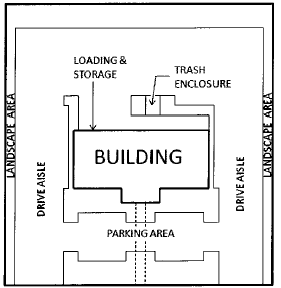
Outside Storage and Screening. Outside storage areas, service and loading areas must be screened from public view by sight obscuring fences, walls, Berms, Structures, or a combination of these, as approved by the Zoning Administrator. Screening by vegetative plantings in combination with Street Screens may also be acceptable, as approved by the Zoning Administrator. The Zoning Administrator may approve alternative methods of reducing the visual impact in lieu of screening, or waive the requirements if visual impact is not an issue. Please reference the following diagram:
E.
Parking Lot Lighting. Lighting shall be provided for all parking Lots for commercial and industrial Sites. Lighting shall be installed in a manner that prevents glare on adjoining lands.
F.
Landscaping. Landscaping shall be provided in accordance with section 18.24.080 of this chapter.
G.
Limited Commercial (LC); Special Development Standards. Within the Limited Commercial Zone building coverage on a single Lot or parcel is limited to ten thousand (10,000) square feet or thirty (30) percent of the Lot whichever is less. No outside storage or display of goods is permitted in the LC Zone. A minimum of thirty (30) percent of the Lot area of any development in the LC Zone shall be landscaped. All Parking Areas shall be screened from adjacent residential Uses or zones.
H.
Animal Clinics, Hospitals, Veterinary Facilities, and Kennels. Shall be located at least three hundred (300) feet from any residence including motels and hotels, except for an owner's residence. The Zoning Administrator may modify these requirements if the animals are completely housed in soundproof Structures that completely Screen them from view of the Abutting residential property; and will comply with all State and local regulations relative to such an operation, and maintain adequate housekeeping practices designed to prevent the creation of a nuisance and to reduce to a minimum the factors of noise and odor.
I.
Automotive Impound Yards. Outdoor surface storage of automobiles shall comply with Code provisions for a paved surface, storm drainage treatment, and visual screening or Landscape buffering from public Rights-of-Way and adjacent properties.
J.
Seasonal Outdoor Markets. "Seasonal outdoor markets" are defined as seasonally operated outdoor markets located on publicly or privately owned property, where single or multiple vendors or merchants locate on a common Site to sell their products to the general public for more than thirty (30) days but less than one hundred eighty (180) days annually. Outdoor markets wanting to operate less than thirty (30) days annually may be permitted under section 18.20.120 of this title. Outdoor markets wanting to operate more than one hundred eighty (180) days annually are required to meet the same performance standards as all other commercial retail businesses. Vendors allowed in seasonal outdoor markets may include farmers, crafters, fresh food merchants, vendors (trinkets, flea market vendors), and prepared food vendors. The following are performance standards for seasonal outdoor markets:
1.
Location is limited to nonresidential zones in compliance with all underlying height, area, setback, and Density requirements. Approval is subject to Site plan review in accordance with this Code.
2.
Must possess Permit for food service if required by Panhandle Health District.
3.
Must provide adequate all-weather parking spaces to meet traffic generated by the outdoor market.
4.
Public restrooms adequate to meet needs of the public must be provided.
5.
Solid waste collection and disposal must be provided; the method and location will be reviewed at Site plan review.
6.
Electrical power to the Site and/or vendor stalls must be permitted by the State of Idaho Labor and Industrial Services, Electrical Division, and comply with applicable Code requirements.
7.
No overnight use of the outdoor market area, between the hours of 10:00 p.m. and 7:00 a.m., may be allowed.
8.
The Site shall be maintained in a dust free, litter free condition with weeds controlled to prevent spread to adjoining lands and to avoid risk of fire.
9.
Signage shall comply with the regulations contained in this title. Signage is discussed in chapter 18.36 of this title.
10.
All temporary Structures must be removed at the end of the season, and the Site left clean and free of debris.
K.
Mini-Storage Warehouse/Self-Storage Uses are not permitted within Lots or parcels that have frontage on Hwy 41, Seltice Way, Mullan Avenue, and Prairie Avenue.
(Ord. 1433 § 11, 2021; Ord. 1340, 2018)
18.24.050. - Miscellaneous performance standards.
Editor's note— Repealed by Ord. 1237 of 2012.
18.24.060. - Site disturbance.
The intent of this section is to protect the existing natural topography and prevent erosion of land by restricting construction activity that may cause accelerated soil erosion or sedimentation due to unstable soils, steep slopes, high groundwater, or road and building construction. Exempt from these requirements are emergency grading activities necessary to protect lives or property.
A.
Any person or agency planning or conducting a land disturbing activity involving the following Sites shall submit a plan for erosion and sediment control when applying for a building Permit, Special Use Permit, Planned Unit Development or subdivision Permit:
1.
Sites that are in high erosion hazard areas as determined by the city engineer by nature of the slope, soil characteristics or by concentration of drainage or by existing or proposed stormwater runoff influence.
2.
Sites where the slope is fifteen (15) percent or more.
3.
Sites where disturbance could have water quality impacts on the Spokane River, as determined by the city engineer.
4.
Sites that have the potential to discharge stormwater to the surface waters of the United States (Spokane River) and are greater than one acre in size or less than one acre that are part of a larger project totaling more than one acre.
B.
The following information is required on erosion control plans, unless waived by the city engineer. An engineer or landscape architect, licensed in Idaho, must stamp and sign plans submitted pursuant to this section.
1.
Information thoroughly describing the construction of facilities, grading, filling or clearing of vegetation from the Site, including resulting slopes, identification of runoff potential, soil depth, erosion potential and natural drainage.
2.
Contours must be depicted at two-foot intervals for slopes up to fifteen (15) percent and five-foot intervals for slopes over fifteen (15) percent, showing the topography of the ground to be graded, filled, or cleared and the topography of the ground within fifteen (15) feet of the Site, before and after the proposed Site work. Spot elevations must be provided at high and low points, Grade breaks, and inlets to drainage control Structures.
3.
Evaluations, proposed grading, dimensions and location of proposed construction, including calculated quantities of earth to be moved must be addressed.
4.
The type and location of all temporary and permanent runoff control methods, including those to be used during construction to prevent the discharge of degraded runoff water into surface waters must be depicted and described.
5.
Slope stabilization methods employed, identifying the location, design and specifications for slope stabilization that will be utilized during and after construction of the project.
6.
Revegetation/remediation strategy must be provided, specifying the methods to be used following completion of the project.
7.
A copy of the notice of intent (NOI), as required by the EPA, for projects greater than one acre in size, or less than one acre that are part of a larger project totaling more than one acre, and having the potential for runoff discharge to surface waters of the United States (Spokane River).
(Ord. 1237, 2012)
18.24.070. - Parking.
The following standards are applicable to and required for off-street parking for newly established or substantially modified land Uses subject to this Code. Parking provisions do not apply to any existing building or Structure, or Use, unless there is a change of Use or expansion requiring additional parking. Whenever a building or Structure existing prior to the adoption of this Code, is enlarged in Floor Area, such addition must comply with current parking requirements and Site improvements, without diminishing the usefulness of existing Site improvements. Parking requirements and configuration must be reviewed and approved in the Site plan review process. The following are general requirements that apply to off-street parking in all zoning districts:
A.
Uses Not Listed. Where a proposed Use is not listed in this section the Zoning Administrator will determine parking needs based on the information provided by the Applicant or Staff. Appeal of the Zoning Administrator's determination may be applied for in accordance with provisions of this title.
B.
Lighting. Lighting used to illuminate a parking Lot must be arranged to direct light and glare away from adjoining property or public Right-of-Way.
C.
Paving. The required number of parking and loading spaces as set forth in this section, together with driveways, aisles, and other circulation areas, must be surfaced with asphalt or concrete.
D.
Drainage. All parking and loading areas must provide for proper drainage of surface water to approved drainage areas or Structures. Surface drainage must be retained on Site to the extent that Site runoff not exceed runoff from the Site in its undeveloped condition.
E.
Striping. Parking Lots must be permanently striped to delineate parking spaces and circulation patterns in accordance with the adopted Building Code and related standards.
F.
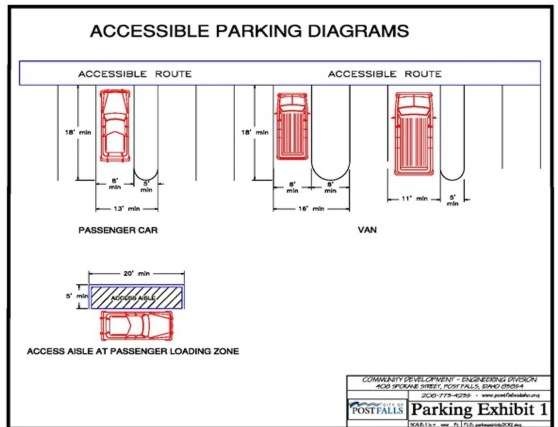
Accessible parking standards. Accessible parking must be provided in accordance with ICC/ANSI accessibility standards.
G.
Residential off-street parking requirements.
H.
Commercial, office, industrial, technology, and institutional parking requirements. Generally, nonresidential Uses should provide one (1) space for each two hundred fifty (250) square feet of Gross Floor Area. For any nonresidential Use an absolute minimum of two (2) spaces is required.
1.
Additional Parking Requirements. Parking for nonresidential land Uses must comply with the following standards in addition to other parking requirements:
a.
Joint Use Parking. Separate nonresidential Uses may jointly provide and Use parking spaces in a complementary manner, provided that a written agreement between joint users, approved by the Zoning Administrator, must be completed.
b.
Off-Street Parking Location. Off-street parking must be located on the premises it is intended to serve or within one hundred fifty (150) feet thereof. Parking spaces for all detached residential Uses must be located on the same Lot as the Use which they are intended to serve.
c.
Multi-Tenant User Parking Space Requirements. Off-street parking must be calculated for each individual Use requirement. The Zoning Administrator may reduce the total number of spaces required, taking into consideration tenant composition and complementary Uses. In no case should the number of spaces be less than four (4) per one thousand (1,000) square feet. A change of Use may require a reevaluation of parking requirements. A proposed subsequent Use may be denied if sufficient parking is not provided.
d.
Maintenance of Parking Areas. The owner must maintain all Parking Areas. Maintenance must include Landscaping, removal of trash and weeds, and repair of signs, light standards, fences, walls, maintenance of drainage, surfacing materials, curbs, snow removal and striping.
e.
Access. Any commercial, industrial, technology or institutional Parking Area must be designed in such a manner that any vehicle leaving or entering the Parking Area from or onto a public or private street must be traveling in a forward motion. Access driveways for Parking Areas or loading spaces must be located in such a way that any vehicle entering or leaving such area be clearly visible to a pedestrian or motorist approaching the access or driveway from a public or private street.
I.
Seasonal Parking in the Community Commercial Services Zone. Privately owned parcels of at least four (4) acres may be used to provide seasonal parking for recreational activities without complying with the parking standards contained in this section if the property owner complies with the following requirements:
1.
The Parking Area must be open to the public without charge.
2.
The Parking Area may only be open from April 1 through October 31 annually.
3.
The Parking Area must be located at least twenty-five (25) feet from all property lines.
4.
Public restrooms and solid waste collection and disposal must be provided and must be located at least twenty-five (25) feet from all property lines.
5.
The Parking Area must be closed between the hours of 10:00 p.m. and 7:00 a.m.
6.
Dust abatement must be applied to the Parking Area.
7.
The Site must be maintained in good condition and repair, free from garbage, paper, litter, tall grasses or weeds, and other debris to prevent the Parking Area from becoming unsightly or a fire hazard.
J.
Parking Spaces. The following standards apply to development of Parking Areas:
1.
Accessible Parking.
a.
Parking. Parking requirements must be provided in accordance with ICC/ANSI standards and chapter 11 of the International Building Code, regarding number of spaces.
b.
Maximum Slope. Parking spaces and access aisles must have a maximum slope of two (2) percent in all directions.
c.
Parked Vehicle Overhangs. Parked vehicle overhangs must not reduce the clear width of an accessible route to less than four (4) feet.
2.
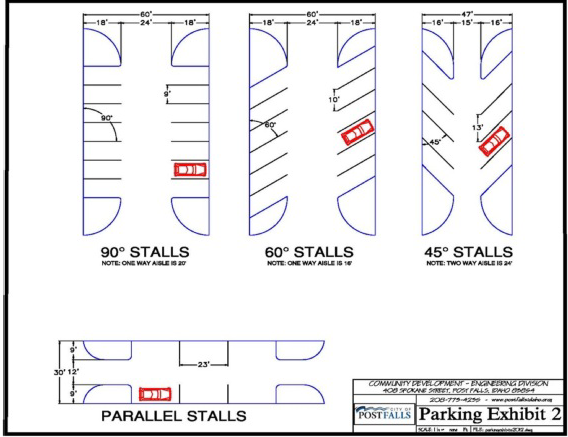
Parking Dimensions and Maneuvering Aisles. Parking space and maneuvering aisles must comply with the following minimum standards. See parking diagrams of this section.
(Ord. 1453 § 6, 2022)
18.24.080. - Landscaping.
The objectives of this section are to establish Landscaping requirements that improve the appearance of development within the city and to protect and preserve the appearance, character, and value of the surrounding neighborhoods. Minimum standards and requirements are intended to assure attractive landscapes throughout the city and to promote safety, provide Screens, and/or Buffers between incompatible land Uses, to safeguard privacy, and to promote the general welfare of the community. It is not meant to inhibit imaginative landscape design. When equal or superior Landscaping solutions are presented, the Zoning Administrator has the authority to approve alternatives that meet the intent of this chapter.
A.
Landscape plan. A landscape plan is required for the entire Site including adjacent Rights-of-Way. The landscape plan must be submitted as part of the Site plan review process within section 18.20.130 of this title. The plan must show the following elements:
1.
Boundaries and dimensions of the Site.
2.
Location of existing and proposed streets, curbs, utility lines, sidewalks.
3.
Location of buildings and Structures, parking Lots, driveways, loading areas, outdoor mechanical equipment, signs, refuse enclosures, overhead utilities, water meter location, grassy swales, parking Lot lighting, and any plants or Trees that are to remain on Site.
4.
The location and design of landscape areas to be landscaped, and plant list to include the location, number, size and type of plant material by botanical and common name.
5.
North arrow and scale.
6.
Proposed irrigation system. All landscaped areas, including adjacent Rights-of-Way must be provided with an underground irrigation system.
7.
Planting details (using Post Falls detail for Trees).
8.
Name, address and phone number of the person preparing the plan.
9.
Landscaping calculations in compliance with subsections C.5 and D of this section.
The Zoning Administrator will review the submitted landscape plans for compliance with this title and may approve, approve with modifications, or disapprove the plans. Decisions of the Zoning Administrator must be in writing, and if disapproved, must set forth necessary steps to obtain approval. Appeal of the Zoning Administrator's decision must follow the appeals procedures listed in the appeals section of this title.
No building Permits will be issued until a landscape plan is reviewed and approved. Improvements must be installed in accordance with the approved landscape plan before the city will issue a certificate of occupancy (CO). Any modifications to the landscape plan must be approved by the Zoning Administrator prior to installation. A suitable guarantee may be provided if installation is not possible or advisable due to seasonal constraints.
B.
Screening and Buffering Noncompatible Uses. Transitional landscape Buffers must be provided when the development of a noncompatible Site abut noncompatible Uses. Buffers must be used to reduce the impact of the development by creating a horizontal and vertical separation with plants, earth Berms, fences, walls, or a combination of such elements. To determine Buffer requirements, refer to the following tables:
1.
Exemptions. Single tax parcels of less than ½ acre being developed with a single-, two-, or three-family Dwellings are exempt from applying the Buffer stated within this section.
2.
Additional Requirements. Additional Buffer requirements for multi-family developments may be found under 18.24.030 D.
A Berm may be used in conjunction with a fence or wall. The Berm may be no more than fifty (50) percent of the total minimum height of six (6) feet (Berm and fence or wall combined).
C.
General Requirements.
1.
All the Lot area that is not covered by building, parking, or driveways must be landscaped to enhance visual appeal, protect property values, and integrate buildings with the Site. All of the Landscaping types (parking Lot, Right-of-Way, Buffer, and screening) may be incorporated into the landscape plan. Parts of larger parcels that have area reserved for future development must be maintained with a suitable landscape cover approved by the Zoning Administrator. This reserve area must be kept maintained and free of noxious weeds.
2.
Snow removal and storage must be accommodated when developing a landscape plan to minimize damage to plants and to complement the stormwater management design.
3.
Public Trees must be selected and installed within the street Right-of-Way in accordance with the Post Falls "Tree Standards Manual."
4.
All trash receptacles, exposed machinery or mechanical equipment and other negative visual impacts must be screened from the public Right-of-Way and from residential Uses or zones. To be effective, Screens must consist of one or more of the following elements:
a.
Sight obscuring fences or walls.
b.
Berms, used in conjunction with Landscaping (seventy-five (75) percent minimum Evergreen plant material).
c.
Landscaping (seventy-five (75) percent minimum Evergreen plant material) that will achieve a height of six (6) feet and totally obscure visibility within three (3) years.
d.
A combination of fences or walls, and Landscaping.
5.
Where a literal application is impractical, due to the location of utilities or other physical constraints, the Zoning Administrator has the discretion to grant deviations from strict implementation of this chapter's Landscaping requirements provided that the spirit of the code is retained to the greatest extent possible.
6.
Landscaping shall must be installed prior to occupancy. The Zoning Administrator may authorize a delay in the completion of planting due to seasonal conditions. Should such a delay be approved, suitable surety equal to one hundred fifty (150) percent of the estimated cost of the delayed improvements must be provided by the owner/developer. No final certificate of occupancy will be issued until the required Landscaping improvements are complete or guaranteed.
D.
Parking Lot Landscaping. Landscaping is required for all common or shared parking Lots located in any zone, whether developed as part of a building project, as an addition to an existing parking Lot, or as a stand alone Lot.
1.
The amount of parking Lot Landscaping required must be sufficient to provide coverage that achieves a minimum of thirty (30) percent shading of the Parking Area within fifteen (15) years of construction. Refer to the following table to approximate thirty (30) percent shade coverage.
a.
Exceptions to the thirty (30) percent shading requirement include:
i.
Parking Structures.
ii.
Truck maneuvering and loading areas in front of overhead doors.
iii.
Automobile dealerships, lumberyards, and similar facilities used for display sales, service, and vehicle storage. (Parking Areas for these Uses are still subject to shading requirements.)
iv.
Parking Areas shaded by Structures such as covered stalls, garages, and adjacent buildings.
2.
At least one-half (½) of the required parking Lot Landscaping must be installed within the interior of any parking Lot serving more than forty (40) vehicles. The intent is to provide shade within the Lot and to break up the expanse of paving with islands of Landscaping. The balance of parking Lot Landscaping may be installed as perimeter Landscaping. Trees must be dispersed throughout the interior and perimeter of a parking Lot to maximize the ability to meet the thirty (30) percent shade requirement.
3.
Landscaped islands or projections within a parking Lot must be a minimum of eight (8) feet wide, and contain a minimum of one hundred fifty (150) square feet. Islands or projections must be designed so that any Trees planted are protected from damage by vehicles.
4.
The landscaped area between a parking Lot (including driveways) and exterior property line must be a minimum of four (4) feet in width, unless otherwise permitted per section 18.20.150 of this title.
5.
The landscape area between a parking Lot and a residential zone or Use must be a minimum of fifteen (15) feet in width, except where an industrial development is located next to a residential Use, then the landscape area is twenty-five (25) feet in width. This area must be landscaped to provide a reduction of visibility at time of planting. The height of the visibility reduction area must be at least six (6) feet from ground level of the parking Lot. This may be accomplished through the use of plants, fences, walls, Berms, or a combination of elements approved by the Zoning Administrator.
6.
Trees must be located to avoid conflicts with signage and lighting within parking Lots and along Rights-of-Way.
7.
It is the intent that parking Lot shading is accomplished by installation of within the parking Lot, immediately adjacent to the outer limits of the parking Trees Lot to cast a shadow onto the paved surface, and preferably with shading Trees installed along the southern and western extents of the Lot.
E.
Xeriscape Landscaping. The purpose of this section is to provide an alternative for developing Sites with a method for Landscaping that conserves water.
Xeriscaping is applicable to private properties outside the public street Rights-of-Way that are either very large and costly to water or desire to conserve water with plant species more appropriate to planting zone 6. Xeriscaping cannot be applied to areas within the landscape plans that are designated to facilitate swales.
The xeriscaping design would be a detailed element within the landscape plan as part of the Site plan review process. The following required elements need to be identified within each xeriscaped area of the Landscaping plan:
1.
Identification. Identify Xeriscape areas within the landscape plan and the appropriate plants with a planting plan that reinforces the areas in the appropriate scale.
2.
Soil Amendment. In most cases, soil amendment will not be appropriate. If required, coordinate with the City of Post Falls Urban Forester and provide information on agreed course of the application of soil amendment.
3.
Irrigation. Identify the application of efficient irrigation with shutoff rain sensors within the landscape plan.
4.
Plant Zones. Different areas receive different amounts of light, wind and moisture. Identify the appropriateness of selection of the plant selection to the planting zone.
5.
Mulch. Provide rationale on how mulch will be applied within the landscape plan in order to prevent soil from crusting, minimize evaporation and reduce weed growth.
6.
Alternative Turf. Identify the appropriate turf for planting zone 6 and design with the intent to reduce the watering and maintenance requirements.
7.
Maintenance. All landscapes require some degree of care during the year. Provide information in regards to the preferred maintenance schedule for the applied Xeriscape areas within the landscape plans.
F.
Maintenance Responsibility of Owner/Developer. The owner/developer is responsible for the installation, irrigation, and maintenance of Landscaping within the public Rights-of-Way adjacent to the property. The adjoining Right-of-Way area is considered to be part of the Site when the landscape plan is reviewed. The property owner or the property owner's designee must maintain all Landscaping as per approved landscape plan.
1.
Street Trees shall be selected and installed within the street Right-of-Way in accordance with the Post Falls "Tree Standards Manual." Tree selection shall be from the approved street Tree list. It is intended that the number of Trees required be calculated using the spacing requirements within the Post Falls "Tree Standards Manual." The required number of Trees may be clustered or arranged to achieve the best design.
2.
Visibility between three (3) feet and ten (10) feet from street level shall be maintained at all street intersections in accordance with Idaho Code and provisions of this Code governing same.
3.
The sides of a driveway access shall maintain visibility as described above for the area within a triangle on either side of an access, having perpendicular sides of ten (10) feet or as otherwise required by Site plan review.
4.
Irrigation for all Right-of-Way Landscaping shall be the responsibility of adjacent property owners.
5.
Right-of-Way areas shall be landscaped with a combination of Trees, low growing Shrubs, ground covers, and/or turf grass. Larger Shrubs and hedges shall be placed outside the Right-of-Way unless approved by the Zoning Administrator to maintain visibility along Rights-of-Way.
G.
Ground Preparation. Proper ground preparation and installation is required for an approved landscape. The following specifications shall be the minimum:
1.
Topsoil that is reasonably free of stones shall be placed in all planting beds. Subsoil shall not be used for a planting medium. Planting areas must be filled to the top of all curbing or edging of a planting bed, allowing for settling of approximately two (2) inches to finish Grade of turf or ground cover.
2.
Mulch, bark, decorative rock, or other suitable material shall be placed in all planting beds except those to be covered with grass.
3.
Grassed slopes requiring mowing shall not exceed a ratio of three to one (3:1). The Zoning Administrator may Permit other planted slopes at a ratio of two to one (2:1), or greater, if appropriate measures are provided to hold the soil. Erosion shall be controlled by design to prevent topsoil loss and allow plant growth.
4.
Trees planted within the Right-of-Way shall be sized according to the Post Falls "Tree Standards Manual" and staked appropriately.
5.
Trees planted on Site, and not used as a Buffer, shall be a minimum of one and one-half-inch caliper for Deciduous, and a four-foot height for Evergreen Trees, and staked appropriately.
6.
Trees must be located so damage from vehicles is avoided.
7.
Soils in planting areas shall have adequate porosity to allow root growth. Soils that have been compacted shall be loosened to increase aeration to a minimum depth of eighteen (18) inches or replaced with imported topsoil.
8.
Root barriers shall be used in accordance with the Post Falls "Tree Standards Manual."
H.
Landscape plan modifications. Under certain Site conditions, a strict interpretation of requirements may prove impossible. Changes may be dictated by plant availability or other factors. In such cases, the following procedure should be followed:
1.
Approval. Any deviations from the approved landscape plan must receive written approval from the Zoning Administrator prior to construction. Deviations must not reduce the required elements of the landscape plan. The approved plan, including any approved deviations, is the plan used when inspecting the Site for completion and compliance.
2.
Plant Substitutions. Due to seasonal planting problems and a lack of plant availability, approved landscape plans may require plant substitutions. Substitutions are accepted if there is no reduction in the quality of plant material or no significant change in the size or location of plant material. Substitutions need approval by the Zoning Administrator prior to installation.
3.
Request for Exception. The Zoning Administrator may grant exceptions to the landscape requirements, due to unusual physical circumstances. A request for exception shall be in writing and submitted at the time of Site plan review, when any of the following conditions exist:
a.
Topography, soil, vegetation, or other Site conditions are such that full compliance would create a hardship.
b.
Implementation may adversely affect public safety.
4.
Justification Statement. A justification statement submitted by the Applicant is a key element of the granting of an exception. Within the statement, an Applicant must describe which requirements in the ordinance cannot be complied with, which project conditions justify using alternatives, and how the proposed measures equal or exceed strict compliance.
(Ord. 1453 § 7, 2022; Ord. 1433 § 13, 2021; Ord. 1340, 2018; Ord. 1237, 2012)

