
Prairie Village City Zoning Code
CHAPTER 19
44 - HEIGHT AND AREA EXCEPTIONS
19.44.005.- HEIGHT AND AREA EXCEPTIONS GENERALLY.
The regulations and requirements as to height of buildings and area of lots which may be occupied by buildings, front yards, side yards, and rear yards, and other regulations and requirements as set out in the foregoing sections of this title shall be subject to the following exceptions and additional regulations contained in sections 19.44.010 through 19.44.025.
19.44.010. - LOT WIDTH, DEPTH AND AREA EXCEPTIONS.
The requirements established in these regulations as to width, depth and area of lots and as to required front, side and rear yards shall not apply to lots having lesser widths, depths, areas or yards in plats of land in the city which have been recorded prior to the adoption of this title or to lots having lesser widths, depths, areas of yards in plats in the city which are recorded after the adoption of this title, if such exceptions are approved by the city planning commission and the governing body.
19.44.015. - HEIGHT.
(a)
Subject to approval of a special use permit, public or semipublic buildings, such as hospitals, hotels, churches, sanitariums or schools, either public or private, where permitted, may be erected to a height not exceeding 75 feet; provided that such buildings shall have yards which shall be increased one foot on all sides for each additional foot that such buildings exceed the specified height limit as established by the regulations of the district in which such buildings are situated.
(b)
Parapet wall and false mansards shall not exceed more than six feet above the height limit. Flagpoles, chimneys, cooling towers, elevator bulkheads, penthouses, finales, radio towers, ornamental towers, monuments, cupolas, domes, spires, and necessary mechanical appurtenances shall not exceed a height of 75 feet or the maximum height allowed by a special use or conditional use permit.
(Ord. 2350, Sec. IV, 2016)
19.44.020. - YARD EXCEPTIONS.
(a)
In districts R-1a through R-4 inclusive, where at least five lots or lots comprising 40 percent or more of the frontage, whichever is greater, on the same side of a street between two intersecting streets (excluding reverse corner lots), are developed with buildings having front yards with a variation of not more than ten feet in depth, the average of such front yards shall establish the minimum front yard depth for the entire frontage; except that where a recorded plat has been filed showing a setback line which otherwise complies with the requirements of this title, yet is less than the established setback for the block as provided above, such setback line shall apply.
(b)
Where an official line has been established for future widening or opening of a street upon which a lot abuts, then the depth or width of a yard shall be measured from such official line to the nearest wall of the building.
(c)
In all use districts, portions of buildings may project into required yards as follows:
(1)
Chimneys, bay, bow, oriel, dormer or other projecting windows and stairway landings other than full two or more story windows and landings may project into required yards not to exceed three feet, provided they are limited to no more than 20 percent of the total building elevation;
(2)
Miscellaneous architectural features, including balconies, eaves, cornices, sills, belt courses, spoutings, brackets, pilasters, grill work, trellises and similar projections for purely ornamental purposes may project into required yards not to exceed four feet;
(3)
Window wells may project into required yards up to four feet;
(4)
Structures associated with the front entrance to the principal building or outside spaces, such as porches, stoops, canopies or porticos, may encroach up to 12 feet into the front or rear setback, and up to ten feet into any street side setback, provided:
a.
Any roof structure shall be single story, establishing an eave line between seven feet and nine feet above the top of foundation, and no gable or other part of the structure shall exceed 14 feet.
b.
The structure shall remain unenclosed on all sides encroaching into the setback, except for railings or walls up to three feet above the structures surface.
c.
The structure shall be integrated with the design of the principal structure including materials, roof form and pitch, and architectural style and details.
(5)
All projections permitted by this sub-section shall not project into required side yards a distance greater than one-half the required minimum width of side yard;
(d)
Open and uncovered porches, decks or patios less than 30 inches high may encroach into the required side or rear yards up to three feet from the property line, but are subject to the impervious surface coverage limits. If these structures are 30 inches high or more they shall meet all setback, building coverage, and lot impervious coverage requirements.
(e)
In R-1a and R-1b, when applying the development and design standards, the building official may determine corner lots be oriented as follows, based on any prevailing patterns of the adjacent lots and blocks:
(1)
Standard corner. The building orients to the same front as all other buildings along the same street and the front setback and design standards apply to this street. The expanded street side setback applies to the other street, the side and rear setbacks apply to the remaining sides.
(2)
Reverse corner. The building orients to the short side of the block, different from other lots on the interior of the block, and the front setback and design standards apply to this street. The expanded side setback applies to the other street and the side and rear setbacks apply to the remaining sides.
(3)
Intersection orientation. The building orients to both streets and the front setback and design standards apply to each street. The interior side setbacks apply to both abutting lot sides, and no rear yard setback applies.
(f)
A through lot having one end abutting a limited access highway with no access permitted to that lot from said highway, shall be deemed to front upon the street which gives access to that lot.
(g)
Accessibility to the rear portion of all lots in a district C-O to C-2 inclusive, for four-wheeled vehicles from and to a public street, alley or way shall be provided unless waived by the planning commission.
(Ord. 2392, Sec. 5, 2018; Ord. 2407, Sec XVII, 2019)
19.44.025. - FENCES AND WALLS.
(a)
Purpose and Intent.
(1)
To buffer or screen uses that may have a negative impact on adjacent uses.
(2)
To provide privacy in outdoor spaces.
(3)
To provide safety from hazards such as swimming pools, hot tubs, spas, and other similar facilities.
(4)
To enhance the quality of appearance of developed land use.
(b)
Design.
(1)
Appearance. Those fences which have surface material, whether it be wood, chain link, metal bars, or other permitted material, attached on one side of posts and/or rails, thus producing a finished side and an unfinished side, shall be installed with the finish sides exposed toward the street and adjacent properties. When doubt exists as to which way the surface of the proposed fence shall face, the building official shall make the final determination.
(2)
Prohibited Fences. The installation of farm type fences such as barbed wire, high tensile wire, wire mesh, welded wire, woven wire, pipe and cable, electric and razor ribbon fences or any similar type fence shall be prohibited.
(3)
Height. No fence shall exceed six feet in height, except tennis court enclosures which may not exceed 12 feet in height, and except fences which are located within the building envelope of a lot shall not exceed eight feet in height. The height of the fence shall be deemed to be the average distance from the finished grade to the highest point on the fence panel, excluding posts which may project above the fence panel not more than eight inches. Where the terrain is not level, the average dimension may, at the discretion of the building official, be applied to each eight feet section of the fence. Fences built in combination with retaining walls and/or berms shall be measured from the finished grade on the high side of the wall. In addition, fences and walls built on slopes shall comply with the required height measurement along the line of the fence location.
(4)
Decorative Fences. Decorative fences shall be designed so they are at least 50 percent open and do not exceed two and a half feet in height. Split rail and wrought iron fences are examples of this type of fence.
(c)
Location.
(1)
Fences located in the front yard are limited to decorative fences no closer than ten feet from the street right-of-way line.
(2)
Fences located on the side street of a corner lot shall be on private property and at least 18 inches from any public sidewalk, whichever is greater, except that if an adjacent lot faces the side street, the fence shall be setback from the right-of-way line a distance of 15 feet or not less than one-half the depth of the front yard of an adjacent building, whichever is the greater setback.
(3)
If the rear of a through lot is fenced, a gate shall be installed to provide access to the right-of-way.
(4)
Diagrams depicting the location of fences on various types of lots are attached at the end of this chapter.
(d)
Retaining Walls.
(1)
Retaining walls shall be designed and constructed to support lateral loads. Applications for retaining walls exceeding four feet in height, whether terraced or not, shall be accompanied by design calculations and plans sealed by a professional engineer licensed in the State of Kansas. Said plans shall be reviewed prior to the issuance of a building permit. Retaining walls shall setback a minimum of two feet from side and rear property lines, and retaining walls exceeding six feet in height shall be required to be set back from side and rear property lines an additional one foot for each two feet, or part thereof, in excess of six feet in height, e.g. a ten feet high retaining wall would be required to set back a minimum of four feet from the property line. Allowances will be made for tie backs to existing grade. Diagrams depicting the location of retaining walls on various types of situations are attached at the end of this chapter. Any exceptions or deviations from this formula shall require site plan approval by the planning commission.
(e)
Drainage and Utility Easements.
(1)
Fences and walls shall not restrict natural surface drainage nor be constructed to divert or channel water flow with increased velocity. Fences shall not be constructed in drainage easements if they affect the flow of stormwater.
(2)
Fences installed in a utility easement may need to be removed in order to access the utilities. Fences constructed in easements are at the risk of the owner and shall not be the responsibility of the utility or city to replace them.
(f)
Permits Required.
(1)
All fences and retaining walls as defined herein, unless otherwise excepted, shall require a building permit. No fence may be erected, constructed, or replaced until said permit has been procured from the building official. The building official may allow minor deviations and adjustments relative to the dimensions set out in this section where topographic or other natural features, utility locations, meters, trees, or other conditions so warrant and where the spirit and intent of this section will be preserved.
(2)
Enclosures erected around compost piles in compliance with the conditions set forth in Chapter 15, Article 3 of the City Code are excluded from these regulations and shall not require a permit.
(g)
Site Plan Approval.
(1)
As part of the site plan approval process as set out in Section 19.32 Site Plan Approval, the planning commission may approve solid walls or make adjustments to the height and location of fences, solid walls, and retaining walls provided that it results in a project that is more compatible, provides better screening, provides better storm drainage management, or provides a more appropriate utilization of the site.
(2)
An application may be made to the planning commission for sire plan approval of a solid wall, retaining wall, or a fence that is unique and does not have the locational or design characteristics set out in these regulations.
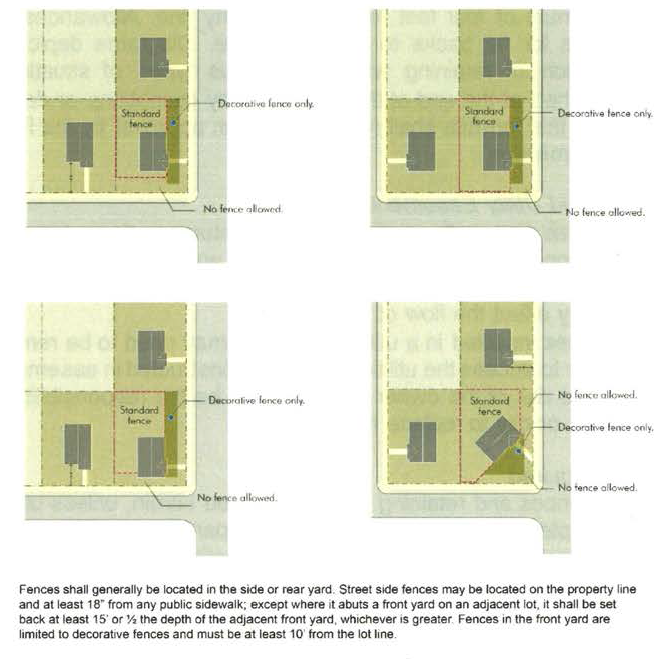
Figure 19.44-1: Prairie Village Fence Regulations
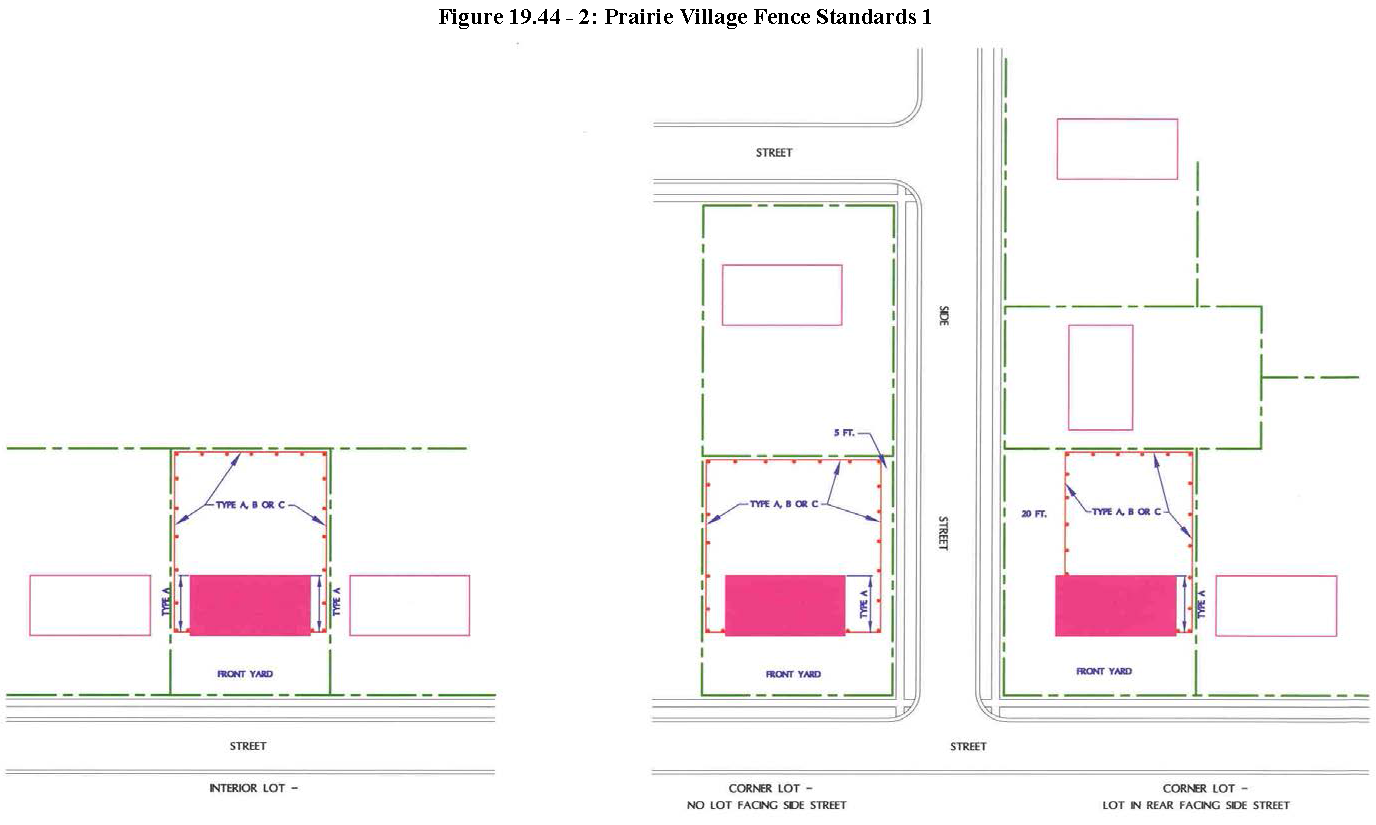
FENCE REGULATIONS
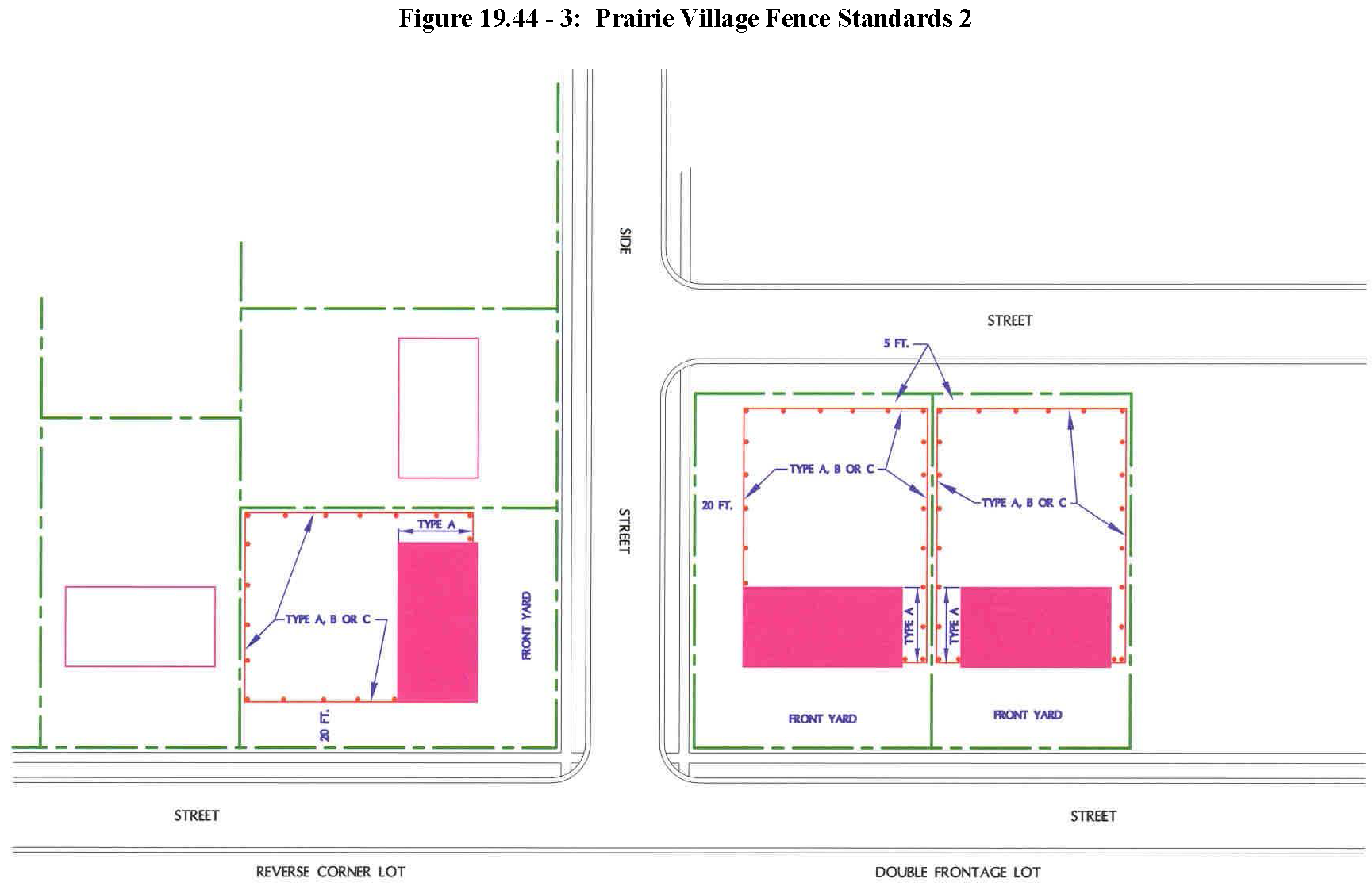
FENCE REGULATIONS
(Ord. 2117, Sec. 2, 2006; Ord. 2248, Sec. 2, 2011; Ord. No. 2464, § II, 12-20-2021)

