
Prairie Village City Zoning Code
CHAPTER 19
47 - LANDSCAPE STANDARDS
19.47.010.- INTENT AND APPLICABILITY.
(a)
Intent. The intent of the landscape standards are to:
(1)
Create an attractive aesthetic environment in the city, and preserve the value of properties as new investment occurs.
(2)
Improve the relationship of buildings and sites to the streetscape, and coordinate the designs of multiple sites and buildings along a block through consistent frontage designs.
(3)
Encourage creative and efficient site design where the layout of sites and buildings can allow open spaces and landscape to serve multiple aesthetic, screening, environmental, and social or recreational functions.
(4)
Enhance the environmental and ecological function of un-built portions of sites.
(5)
Reduce the exposure and adverse impacts of intense land uses, activities and site conditions on streets and adjacent areas, and mitigate the effects through landscape designs.
(6)
Preserve the tree canopy and streetscape of Prairie Village for the aesthetic, economic, and environmental benefits of tree preservation.
(b)
Applicability. A landscape plan shall be required for any application that requires a site plan approval per section 19.32. Landscape standards shall specifically apply to:
(1)
All development in the R-3, R-4, C-O, C-1, C-2, and MXD districts.
(2)
Any permitted non-residential uses in the R-1A, R-1B, or R-2 districts, including any conditional uses, special uses, or accessory uses that have a landscape requirement as part of their conditions.
(3)
Any single-family development project that requires streetscape or landscape improvements per the Neighborhood Design Standards shall meet the standards in Sections 19.06.025 and 19.08.025.
(4)
The tree protection provisions apply as specifically stated in section 19.47.010.
(Ord. 2407, Sec. XVIII, 2019; Ord. No. 2446, § II, 3-15-2021, eff. 6-1-2021)
19.47.020. - REQUIRED LANDSCAPE.
(a)
Site Elements and Planting. The required landscape shall be based on different elements of the site, according to Table 19.47 A: Plant Specifications.
Table 19.47 A: Plant Specifications
(b)
Credits for Existing Vegetation. Preservation of existing landscape material that is healthy and of a desirable species may count towards these requirements provided protection measures in section 19.47.060 are taken to ensure the survival of the vegetation through construction and all other location and design standards are met. Credits shall be on a one for one basis provided existing trees shall be at least three inches caliper to count. Landscape material that is of exceptional quality due to size, maturity and health may be credited on a two for one basis.
(c)
Design. The required landscape material shall be arranged and designed on a particular site in a way that best achieves the intent expressed in section 19.47.010, with regard to the specific context, street frontage, property adjacencies and other elements proposed on the site. Specifically, designs shall:
(1)
Create an attractive site.
(2)
Improve the relationships of buildings and sites to the streetscape and block.
(3)
Promote efficient layouts of the site and landscape areas.
(4)
Enhance environmental and ecological functions of the site.
(5)
Screen and buffer any potential adverse impacts of site elements.
(Ord. 2407, Sec. XVIII, 2019; Ord. No. 2446, § II, 3-15-2021, eff. 6-1-2021)
19.47.030. - LANDSCAPE SPECIFICATIONS.
(a)
Location. Required plantings shall be planted in the following specific locations and open spaces on the lot.
(1)
Frontage Trees. Frontage trees shall be located in line with other trees along the block to create a rhythm along the streetscape and enclosure of the tree canopy. In the absence of a clearly established line along the block, trees may be planted the following locations, where applicable and in order of priority:
a.
Street trees on center between the sidewalk and curb where at least six feet of landscape area exists;
b.
Street trees four to eight feet from the back of curb where no sidewalk exists; or
c.
Private frontage trees within the first five feet of the front lot line where any constraints in the right-of-way or on the lot would prevent other preferred locations.
d.
Where the depth of the frontage between the building and streetscape require additional trees per Table 19.47 A, any additional trees shall be located between the front building line and the street.
e.
Ornamental trees may be substituted for large frontage trees only in situations where no other alternative is available due to constraints of the site and right-of-way conditions.
f.
Planting of any frontage trees in the right-of-way or any work in the right-of-way shall be coordinated with public works for permits, location, and planting specifications.
g.
Any work within the sight line triangle should be reviewed for compliance with the city's Sight Line Obstruction Ordinance 2059, Section 1.
(2)
Foundation Trees and Shrubs. Foundation plantings shall generally be located in open spaces within 20 feet of the building, or within planting beds at least eight feet deep and along at least 35 percent of the building. Groupings of required trees and shrubs are permitted to provide the best balance of the following goals:
a.
Relate sites and building to the lot frontage and streetscape;
b.
Accent or emphasize points of significance along the building frontage;
c.
Soften larger expanses of building wall planes along the frontage; and
d.
Maintain visibility of signs or key elements of the building.
(3)
Parking Perimeter and Island Planting. Parking lot perimeters shall be permeable vegetated ground cover meeting the following size and dimension requirements:
a.
Parking lot perimeters shall be at least eight feet wide except for locations where walkways are necessary to provide access to the building or to a public sidewalk in the streetscape, in which case the width of the walkway shall be added to the minimum eight feet requirement.
b.
Parking lot islands shall be at least 120 square feet and at least eight feet wide in all directions. Parking lots under 80 spaces shall not require islands; parking lots 80 spaces or more shall require at least one island per 40 spaces. Islands may stand alone within the parking lot or may project into the parking area from the perimeter buffer, but should generally be spaced equally throughout the parking lot. In general no space shall be further than 100 feet from an island or perimeter buffer, and no more than 40 consecutive spaces shall occur without being adjacent to a perimeter buffer, "end cap," or "peninsula" island.
(b)
Specifications. Required planting shall meet the following specifications at planting.
Table 19.47 B: Plant Specifications
All landscape materials shall meet the American Standards for Nursery Stock, published by the American Nurserymen's Association, and be selected for its native characteristics or survival in the climate for the Kansas City region, and be planted and maintained according to ANSI-accredited specifications for this region. Right-of-way trees must be selected from the City of Prairie Village Right-of-Way Tree List.
(c)
Tree Diversity. The required trees planted shall promote diversity with the following species selection criteria:
Table 19.47 C: Tree Diversity
(d)
Maintenance. All landscape plans shall include installation specifications, a statement on the of maintenance methods. All plantings shall be properly maintained. All elements of an approved landscape plan, including plant materials shall be considered elements of the project in the same manner as parking, buildings or other details. Plant materials which fail to grow within a two-year period, or which exhibit evidence of insect pests, disease, and/or damage shall be appropriately treated. The city may order that any plant that dies or is in danger of dying be removed and replaced by the property owner. Planting may be deferred for up to six months from completion of any site or right-of-way construction to allow for timely planting that ensures the health and survival of plants.
(Ord. 2407, Sec. XVIII, 2019)
19.47.040. - BUFFERS AND SCREENING.
Intense land uses or unattractive site elements shall be buffered and screened from streetscapes and adjacent property using the following strategies and techniques, which may require additional landscape materials beyond the requirements in Table 19.47 A.
(a)
Areas of parking or circulation near streets or property lines may require two and one-half (2.5) to four feet hedge and/or ornamental wall screen.
(b)
Accessory structures, mechanical equipment, trash enclosures, loading or service areas, and other similar functional or utility elements of the site shall be buffered and screened from streetscapes or adjacent property with a combination of landscape, fencing, walls or other structure components compatible with the building design.
(c)
Commercial uses, or parking service areas of non-residential uses allowed in residential districts, abutting residential property may require a screen and buffer combination, using a combination of dense vegetation, fences and walls compatible with the buildings, other structural or landscape elements of the site.
(d)
Areas that transition to different uses or building scale, whether across streetscapes or between lots along the same street, may require enhanced landscape areas to soften transitions.
(e)
Areas designed as gathering places, for social function or as civic amenities to support the site or area may require enhanced landscape to create human-scale spaces, comfort, visual interest, and appropriate transitions.
(Ord. 2407, Sec. XVIII, 2019)
19.47.050. - EXCEPTIONS.
(a)
Administrative Adjustment. Staff may grant an administrative adjustment of up to ten percent of any location or dimension requirement (i.e. nine feet or 11 feet instead of ten feet) and up to 25 percent of any plant requirement (i.e. three plants instead of four plants), or types of plant and species where the following criteria are met:
(1)
The proposed landscape plan taken as a whole equally or better meets the intent of this section, and any design objective of the specific standards.
(2)
The proposed plan incorporates any existing vegetation in a manner that is not better served by new plants.
(3)
The proposed plan uses sound landscape architecture design principles and industry standards considering the context, species, and planting specifications that ensure the long-term maintenance and survival of plants.
(4)
The request for the adjustment is justified by some specific conditions on the site that would make compliance with the standard less effective than the proposed plan or unreasonably difficult when compared to the proposed plan.
(b)
Site Plan Exceptions. The planning commission may grant exceptions to these standards beyond what is permitted by administrative adjustments through the site plan review process. The planning commission shall use the same criteria stated for administrative adjustments. In addition, the planning commission may consider balancing the need for adaptive reuse of existing sites with a landscape budget proportionate to the amount of work being done on the site.
(Ord. 2407, Sec. XVIII, 2019)
19.47.060. - TREE PROTECTION.
(a)
Applicability. The provisions of this section shall specifically apply to:
(1)
Any removal of a tree in the public right-of-way, except for those authorized by an official city project.
(2)
All applications that are subject to the landscape standards in section 19.47.010(b);
(3)
The following situations in R-1A and R-1B zoning where:
a.
Any new residential structure is built on a vacant lot;
b.
An existing residential structure is torn down, whether it is just a demolition or a demolition and rebuild of a new residential structure;
c.
Any remodel of an existing residential structure that adds more than 600 square feet to the existing building footprint; and
d.
Any remodel of an existing residential structure that tears down more than ten percent of the existing structure associated with the new construction.
(b)
Tree Protection and Removal Plan. A tree protection and removal plan shall be provided for all applicable projects where:
(1)
The property has a tree protected by section 19.47.060(c);
(2)
As part of a landscape plan associated with development, where existing trees will be retained and protected to meet landscape requirements;
(3)
Any trees are proposed to be removed as part of a building permit associated with situations listed in 19.47.060(a) above.
The tree protections and removal plan shall:
(1)
Show all existing trees, including size and species;
(2)
Identify trees proposed for removal and those to be retained;
(3)
Include locations of protection fences and other protection measures required by this Section.
(c)
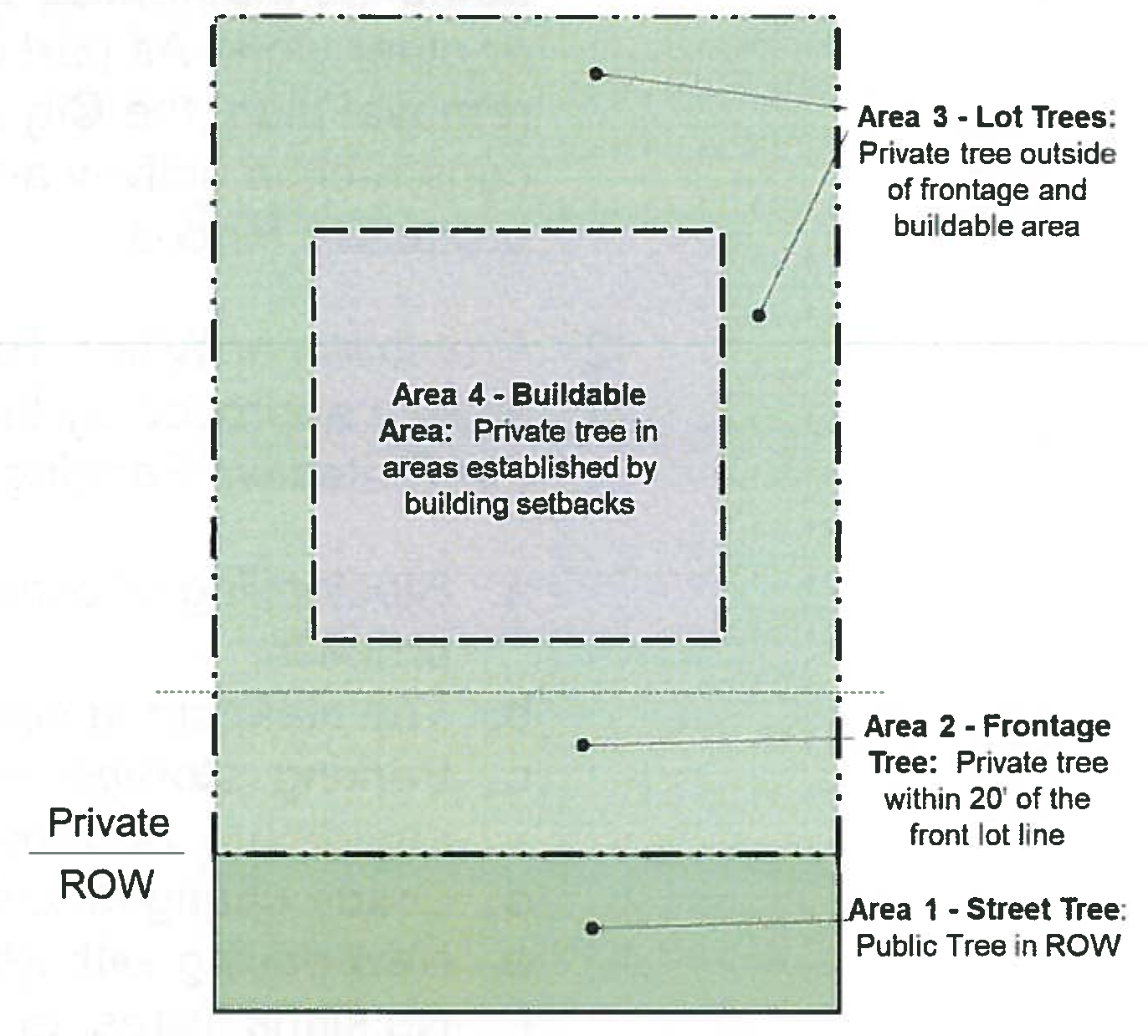
Protected Trees. Trees are protected based on their size and location, as specified in Table 19-57-D and Figure 19-47-1. Protected trees require mitigation if removed; trees prohibited from removal require special circumstances and approval to remove the tree, and require additional mitigation if authorized to be removed.
(1)
Area 1: Area 1, "street trees" includes any tree that is in the public right-of-way.
Figure 19-4-1 Tree protection provisions and required mitigation is based on the area of the lot
and the size of trees in particular areas.
(2)
Area 2: Area 2, "frontage trees" includes any tree that is three inches caliper or more, on private property and within 20 feet of the front lot line.
(3)
Area 3: Area 3, "lot trees," includes any tree that is six inches caliper or more, on private property, but outside of the frontage or buildable area.
(4)
Area 4: Area 4, "buildable area trees" includes any tree that is six inches caliper or more, and in the buildable area determined by the zoning setbacks applicable to the principal building.
(d)
Protection Measures. All trees that are prohibited from removal and any other tree that will remain on site according to the Tree Protection and Removal plan shall be protected by the following measures:
(1)
Fences. Protective/temporary fences shall be required for all trees noted to remain on the tree protection and removal plan, or otherwise not authorized for removal. Fences shall be a snow fence, chain-link fence, orange vinyl construction fence, or other similar fencing with a minimum four feet height. The protective fence shall prevent infringement on the root system from any construction-related activities and be installed according to Table 19-47-E.
Fenced areas shall exclude any preexisting structures, foundations, slabs, roadways, sidewalks, and driveways. The fence shall be installed along the edge of the driveways/roadways encompassing the tree to restrict access from the street side. All fences shall appear on construction documents and be installed prior to any other construction-related activity. The fence shall remain in place at all times until all other construction-related activity has been completed or final grade achieved. The city may authorize that fences be moved at certain times for final grading, access, or other work. As part of a permit or review of a tree protection and removal plan, the city may determine that areas of the site removed from construction activity and where damage to roots is not likely may not need protective fences.
(2)
Prohibited activities. Except for utility work or in association with other activity approved by the city, the following activities are not allowed within the protective fencing area:
a.
Stock piling of construction materials or waste from the construction process;
b.
The cleaning of construction equipment;
c.
Parking, storage, or placement of any vehicles, construction equipment, or temporary structures;
d.
Grade changes, cut of fill, in excess of two inches;
e.
New paving with asphalt, concrete, or other materials; and
f.
No signs, wires, or other attachments other than those of a protective nature shall be attached to any tree.
(e)
Exceptions for Removal. It is the property owner's responsibility to ensure that no person remove, damage, or otherwise impair any tree prohibited from removal without written authorization from the building official to remove the tree. The building official may consider an exception to remove the tree only upon a written request indicating the specific tree and documentation establishing justification for removal. The building official shall generally grant the exception for the following:
(1)
The tree is dead;
(2)
The tree is diseased or dying, and constitutes a threat to healthy trees, property, or public safety; or
(3)
Removal of the tree is necessary for construction, development, or redevelopment under the following criteria:
a.
All reasonable efforts have been made to avoid removing the tree through comparable alternative designs;
b.
The presence of the tree places an undue financial burden on the applicant; and
c.
No other reasonable accommodations, including adjustments to the otherwise allowable building footprint or site design can be made to preserve the tree.
The building official may seek advice from the Prairie Village Tree Board, other staff, or departments or a third party consultant. Written authorization by the building official shall be valid for the duration of any permit associated with the authorization. Except for applications associated with a site plan approved by the planning commission, the building official's decision may be appealed as provided in section 19.54.025.
(f)
Violation and Enforcement. Removal, damage, or impairment of any protected tree, except as provided in this section, is a violation of this section, enforceable as provided in section 19.01.045, and each tree shall be considered a separate incident. Any fines and penalties shall be in addition to the mitigation measures required in sub-section (c) for removal of protected trees.
(Ord. No. 2446, § II, 3-15-2021, eff. 6-1-2021)

