
Prior Lake City Zoning Code
ARTICLE V
- PERFORMANCE STANDARDS
Sec. 10-563. - Compliance required.
(a)
This chapter. All properties must comply with all applicable provisions of this chapter, including, but not limited to, the performance standards in this division and all other applicable provisions of this article.
(b)
Public works design manual (PWDM). All properties must comply with all applicable provisions of the public works design manual (PWDM). The PWDM is adopted and incorporated into this article by reference as if fully set forth. If there is a conflict between this article and the PWDM, this article shall govern, provided that two provisions addressing the same matter that are more or less restrictive are not a conflict and the more restrictive provision shall apply.
(c)
Plat and plans. All properties must comply with the subdivision regulations, all applicable plats and all applicable city-approved plans; provided that the plans may be modified or revised by updated city-approved plans or approved city permits.
(Prior Code, § 1140.100)
Sec. 10-564. - Lot provisions.
(a)
Principal buildings. There shall be no more than one principal building on any lot except as permitted by conditional use permit or PUD.
(b)
Twinhome. If a parcel containing an existing twinhome is subdivided into two lots, the minimum lot area, lot width and side yard requirements may be waived subject to the following conditions:
(1)
A common wall shared by the two dwellings is located in its entirety on the boundary line separating the two lots;
(2)
The common wall meets the standards of the state building code for owner-occupied units and any other applicable codes adopted or enforced by the city;
(3)
A covenant or other agreement is approved by the city attorney and filed with the county recorder; and
(4)
Each of the two dwellings is served separately by public utilities, none of which are shared.
(Prior Code, § 1140.200)
Sec. 10-565. - No sewer and water.
(a)
All developments and structures intended for human use or occupancy shall be connected to the public water supply and sanitary sewer systems. If a development is proposed for a site which does not have either a public water supply or sanitary sewer system available adjacent to the property proposed to be developed, no building permit shall be issued for such development until adequate provisions have been made by the person proposing the development to provide a public water supply and sanitary sewer service to the property. The city shall determine what constitutes adequate water and sewer service. The city may also require cash, or an irrevocable letter of credit be provided to the city in an amount equal to 125 percent of the estimated costs of extending public water and sanitary sewer facilities to the subject property.
(b)
No certificate of occupancy shall be issued until the new structure or development is connected to the public water supply and sanitary sewer system.
(c)
Properties located outside the metropolitan urban service area on the comprehensive plan and zoned agricultural or R-S and properties located on one of the islands in Prior Lake are exempt from this section. In these cases, the developer, property owner or builder must receive approval for an individual septic treatment system from the county and approval of a private well from the state health department. No certificate of occupancy shall be issued until these systems have been inspected and approved.
(Prior Code, § 1140.300)
Sec. 10-566. - Height limitations.
(a)
Height limitations set forth elsewhere in this chapter shall be increased by 50 percent when applied to the following structures:
(1)
Art objects.
(2)
Belfries.
(3)
Chimneys.
(4)
Spires.
(5)
Cooling towers.
(6)
Cupolas and domes which do not contain usable space.
(7)
Elevator penthouses.
(8)
Fire and hose towers.
(9)
Flag poles.
(10)
Monuments.
(11)
Observation towers.
(12)
Smokestacks.
(b)
Parapet walls shall not extend more than three feet above the height of the building.
(c)
Public water towers are exempt from height limitations.
(Prior Code, § 1140.400)
Sec. 10-567. - Pedestrian access.
(a)
Purpose and effect. A goal of the comprehensive plan is to encourage transportation facilities which adequately consider pedestrian, bicycles and other nonmotorized transportation needs. In order to implement this goal, pedestrian links need to be incorporated into development.
(b)
Required linkage to trails. All new residential developments having more than six dwelling units and all new nonresidential developments shall have pedestrian and bicycle access to public sidewalks or trails which are existing or identified as proposed by the comprehensive plan, unless there are practical difficulties in providing such a connection which would impose a hardship on the proposed development. Practical difficulties may include, but are not limited to, steep slopes, wetlands and lakes.
(Prior Code, § 1140.500)
Sec. 10-568. - Grading, filling, land reclamation, excavation.
(a)
Grading and excavating permit required. No grading, filling, land reclamation or excavation shall be permitted without a grading and excavating permit required by this chapter.
(b)
Conditional use permit. In addition, any grading, filing, excavation or land reclamation involving the removal, movement or placement of over 400 cubic yards of fill shall be permitted only by conditional use permit in all zoning districts. The permit application shall include, but is not limited to:
(1)
A site plan which shows the existing and finished grade of the land after the work;
(2)
A soil analysis of the type of fill material to be used or extracted;
(3)
The proposed use of the land after the work;
(4)
The effect of the proposed operation upon the community and the adjacent land;
(5)
The type of equipment to be used;
(6)
The period of time the operation will be conducted;
(7)
Plans for implementation of measures to guarantee safety on the site and on adjacent sites;
(8)
Plans for rodent and other animal control, fire control, general maintenance of the site and adjacent area;
(9)
Provisions for control of material hauled to or from the site, routes of trucks moving to and from the site to deposit or remove fill material from the site, and controls to be employed to limit the effect of wind or other elements on the material;
(10)
A plan which shows the routes of trucks moving to and from the site;
(11)
An inventory of significant trees on the site, and other pertinent information necessary to the decision whether to approve the conditional use permit.
The conditional use permit shall impose conditions upon the owner of the land, the developer and the person doing the work, which will ensure that the type of fill used is appropriate for the proposed land use and prevent damage to the community and adjacent landowners during the course of the operation. Those conditions may impose restrictions in all areas affecting the operation and the city may require a letter of credit to ensure the performance of the conditions imposed and the completion of the work in the manner described in the plan and conditional use permit. No permit shall be granted for a period longer than 12 months.
(c)
Exception. Grading, filling, land reclamation and excavation of more than 400 cubic yards conducted pursuant to a grading plan approved as part of an approved preliminary or final plat, building permit, or demolition permit shall be exempt from the provisions of this section.
(Prior Code, § 1140.600)
Sec. 10-600. - Introduction.
All properties must comply with all applicable provisions of this chapter, including, but not limited to, the performance standards in this division and all other applicable provisions of this article.
(Prior Code, § 1141.100)
Sec. 10-601. - Residential performance standards.
No structure or premises within any R use district shall be used for one or more of the following uses unless its use complies with the following regulations:
(1)
Dwellings. All single-family detached and twinhome dwellings:
a.
Shall be built on a permanent foundation;
b.
Shall be connected to city sanitary sewer and water unless exempted under the provisions of section 10-565; and
c.
If the home is a manufactured home:
1.
Shall have a permanent, completely enclosed foundation constructed around the entire circumference of the structure which complies with the state manufactured home building code.
2.
Shall meet the standards and be certified by the U.S. Department of Housing and Urban Development.
(2)
Undergrounding. All utility lines, including electric, gas, water, sanitary sewer, telephone, and television cable, shall be placed underground when used with all new structures or additions which expand the gross square footage of a structure by more than 50 percent of the floor area. In addition, any new service to an existing building shall be placed underground.
(3)
Curbs. All access roads shall have a poured-in-place concrete curb measuring at least six inches above and below the grade in all developments except developments of single-family detached or twinhome dwellings.
(4)
Vehicle storage. No vehicle shall be stored, displayed, parked, or allowed in any of the required yard or landscaped areas, except as permitted by division 7 of this article.
(5)
Recreational equipment. The intent of this division is to allow for the orderly storage of recreational equipment on property at certain locations during on and off seasons. During off-season times, the equipment shall be located in the most visually inconspicuous portion of the lot as viewed from the front, or from the street.
a.
Currently licensed and operable winter recreational equipment may be parked on or adjacent to a driveway on a lot in the residential zoning districts from November 1 to April 1 each year. Currently licensed and operable summer recreational equipment may be parked on or adjacent to a driveway on a lot in a residential zoning districts from April 1 to November 1 each year. In addition to all other requirements, all recreational equipment parked on or adjacent to a driveway shall be operable and shall have the current license posted or displayed in a visible manner on the equipment. Any recreational equipment parked on or adjacent to a driveway which is not both currently licensed and operable shall be considered an accessory structure as regulated in subsection (6) of this section or as junk regulated pursuant to this chapter.
b.
At all other times, recreational equipment shall be stored in the rear or side yard, provided the recreational equipment is operable. For purposes of this section, side yards shall also include areas extending from the principal house structure, using lines parallel to the sides of the house extending to the rear and front yard lines. Except as allowed above, in no case shall recreational equipment be parked in the front yard, unless an exemption is granted by the zoning administrator identified in this division. Recreational equipment shall be set back a minimum of five feet from the rear and side property lines; except that recreational equipment may be stored within five feet of a rear or side property line if screened by a fence located on the property, which fence is at least six feet high and is in compliance with the fence requirements of this article.
c.
No recreational equipment may be parked in residential zoning districts that do not have the same ownership between the equipment and any family member occupying the property. A house being rented shall only allow storage of recreational equipment owned by the persons renting the principal structure.
d.
For riparian lots without a principal structure, recreational equipment shall be located between the ordinary high-water level, and a line no more than 30 feet from the ordinary high-water level and no less than five feet from the side lot line.
(6)
Pedestrian access. Interior pedestrian circulation and pedestrian linkage to any existing public trails or sidewalks shall be provided where practically possible for all developments except developments of single-family detached or twinhome dwellings.
(7)
Accessory structures.
a.
General requirements. Accessory uses and structures shall comply with the following standards and all other applicable regulations:
1.
No accessory use or structure shall be constructed or established on any lot prior to the time of construction of the principal use to which it is accessory.
2.
The accessory use or structure shall be incidental to and associated with the principal use or structure.
3.
The accessory use or structure shall be subordinate in area, extent, and purpose to the principal use or structure served.
4.
The accessory use or structure shall be located on the same parcel of land as the principal use or structure except as allowed by the nonconformity regulations in this chapter.
b.
Design criteria. In all residential districts, the design and construction of any garage, carport, or storage building shall be similar to or compatible with the design and construction of the main building. The exterior building materials, roof style, and colors shall be similar to the main building or shall be commonly associated with residential construction.
c.
Attached structures. An accessory structure shall be considered attached, and an integral part of, the principal structure when it is structurally connected to the principal structure or located six feet or less from the principal structure. Such structures shall be subject to the provisions of this chapter applicable to principal structures, including, but not limited to, setbacks, building height, and other dimensional requirements.
d.
Detached structures. A detached accessory structure must be structurally independent from the principal structure. Detached accessory structures shall be permitted in residential districts in accordance with the following:
1.
The total ground floor area of all detached accessory structures located on a single residential property in the R-1 and R-2 zoning districts shall not exceed 1,000 square feet or 30 percent of the rear yard.
2.
The total ground floor area of all detached accessory structures in the R-3 zoning district shall not exceed 750 square feet or 30 percent of the rear yard.
3.
No accessory building shall be located within five feet of any lot line or within the limits set forth below if more restrictive.
4.
Maximum height shall not exceed 15 feet as measured from the mean grade level at the front face of the accessory structure to the top of the parapet or rooftop equipment, whichever is higher, of a flat roof; to the deck line of a mansard roof; to the uppermost point on a round or other arch type roof; or the mean distance of the highest gable on a pitched or hip roof.
5.
Detached accessory structures shall be located to the side or rear of the principal building and are not permitted within the front yard or within a side yard abutting a street except as provided in the following provisions.
6.
No detached accessory building erected to the side or rear of a principal building on a corner lot shall be located within 25 feet of any property line abutting a street.
7.
No accessory structure may be located in any public right-of-way or public easement except by consent of the city engineer or his/her designee.
8.
On riparian lots in the shoreland district, one detached accessory structure designed and used as a garage may be located between the front building wall and the street or private road providing access to the lot subject to the following conditions:
(i)
The accessory structure must be located so that it meets all front yard requirements of a principal structure.
(ii)
The accessory building must be compatible in design and materials with the principal structure.
(iii)
The accessory structure may be used only for storage of vehicles and other equipment incidental to residential uses.
(Prior Code, § 1141.200; Ord. No. 122-07, 8-13-2022)
Sec. 10-602. - A Agricultural dimensional standards.
The following dimensional standards shall apply to the A zoning district:
(1)
No structure shall exceed 35 feet in height unless approved by the board of adjustment.
(2)
The maximum density shall not exceed 0.10 unit per acre.
(3)
The following minimum requirements shall govern the use and development of lots in the A zoning district:
(Prior Code, § 1141.300)
Sec. 10-603. - R-S Rural Subdivision dimensional standards.
The following dimensional standards shall apply to the R-S zoning district:
(1)
No structure shall exceed three stories or 35 feet in height, whichever is less.
(2)
The floor area ratio within the R-S zoning district shall not exceed 0.3.
(3)
The following minimum requirements shall govern the use and development of lots in the R-S zoning district:
(4)
The depth of the front year of a lot shall be at least 25 feet. The depth of the required front yard may be reduced if the average depth of at least two existing front yards, for buildings within 150 feet along the same block front of the lot in question is less than 25 feet. However, the depth of a front yard shall not be less than 20 feet.
(5)
Through lots shall have a required front yard on each street.
(6)
The width of the side yard setback abutting a building wall shall be increased two inches for each one foot the length of the building wall exceeds 60 feet. The additional setback will not be applied if there is a break in the building wall equal to ten percent of the entire length of the wall. For the purpose of this section, a wall includes any building wall within ten degrees of being parallel to and abutting the side lot line of a lot.
(7)
Side yard widths may be reduced if the side wall of a building is not parallel by more than ten degrees with the side lot line to permit the average depth of the side yard to conform to the minimum side yard depth in the zoning district, but no side yard shall be less than five feet deep. No side yard shall be reduced to prevent construction of a driveway from the street into the rear of the lot unless a garage which has access from the street is located on the lot or an alley provides a secondary access to the rear yard of the lot.
(8)
A single-family detached or twinhome dwelling which legally existed or for which a valid building permit had been granted on or before the effective date of the applicable provisions of this division may be expanded by an addition or dormer, provided the addition does not extend into the existing side yard and provided the combined width of the side yard for the building and the adjacent building is not less than ten feet.
(9)
Any parcel which is subdivided for the purpose of creating condominium ownership is permitted, provided that the overall density created within all condominium parcels and the common area do not exceed the maximum density permitted within the zoning district. Any front, rear, and side yard dimensions shall apply from the building face to the property line of the common area.
(Prior Code, § 1141.400)
Sec. 10-604. - R-1 Low Density Residential dimensional standards.
The following dimensional standards shall apply to the R-1 zoning district:
(1)
No structure shall exceed three stories or 35 feet in height, whichever is less.
(2)
The floor area ratio within the R-1 zoning district shall not exceed 0.3.
(3)
The following minimum requirements govern the use and development of lots in the R-1 zoning district:
(4)
Density. The minimum density for new development in the R-1 zoning district is two units per acre. The maximum density for new development in the R-1 zoning district is four units per acre.
(5)
The depth of the front yard of a lot shall be at least 25 feet. The depth of the required front yard may be reduced if the average depth of at least two existing front yards for buildings within 150 feet along the same block front of the lot in question is less than 25 feet. However, the depth of a front yard shall not be less than 20 feet.
(6)
Through lots and corner lots shall have a required front yard on each street.
(7)
The width of the side yard setback abutting a building wall shall be increased two inches for each one foot the length of the building wall exceeds 60 feet. The additional setback will not be applied if there is a break in the building wall equal to ten percent of the entire length of the wall. For the purpose of this section, a wall includes any building wall within ten degrees of being parallel to and abutting the side lot line.
(8)
Side yard widths may be reduced if the side wall of a building is not parallel by more than ten degrees with the side lot line, to permit the average depth of the side yard to conform to the minimum side yard depth in the district, but no side yard shall be less than five feet deep. No side yard shall be reduced to prevent construction of a driveway from the street into the rear of the lot unless a garage which has access from the street is located on the lot or an alley provides a secondary access to the rear yard of the lot.
(9)
A single-family or twinhome dwelling which legally existed or for which a valid building permit had been granted on or before the effective date of the applicable provisions of this division may be expanded by an addition or dormer, provided the addition does not extend into the existing side yard, and provided the combined width of the side yard for the building and the adjacent building is not less than ten feet.
(10)
Any parcel which is subdivided for the purpose of creating condominium ownership is permitted provided that the overall density created within all condominium parcels and the common area does not exceed the maximum density permitted within the zoning district. Any front, rear, and side yard dimensions shall apply from the building face to the property line of the common area.
(11)
The lot width and lot area allowed in the R-1 zoning district may be reduced to no less than 80 feet in width and 11,000 square feet in area if the property abuts an outlot area designated for public drainage or utility lines. The following criteria must also be met:
a.
Lots may have side yards of not less than five feet for interior side yards which abut the outlot area.
b.
No fences, walls, accessory structures or overhangs are allowed within the outlot area.
(Prior Code, § 1141.500)
Sec. 10-605. - R-2 Medium Density Residential dimensional standards.
The following dimensional standards shall apply to the R-2 zoning district:
(1)
No structure shall exceed three stories or 35 feet in height, whichever is less.
(2)
The floor area ratio within the R-2 zoning district shall not exceed 0.3.
(3)
The following minimum requirements shall govern the use and development of property in the R-2 zoning district:
(4)
The minimum density for new developments in the R-2 zoning district is 4.1 units per acre. The maximum density for new developments in the R-2 zoning district is 7.0 units per acre.
(5)
The depth of the front yard of a lot shall be at least 25 feet. The depth of the required front yard may be reduced if the average depth of at least two existing front yards, for buildings within 150 feet along the same block front of the lot in question, is less than 25 feet. However, the depth of a front yard shall not be less than 20 feet.
(6)
Through lots and corner lots shall have a required front yard on each street.
(7)
The width of the side yard setback abutting a building wall shall be increased two inches for each foot the length of the building wall exceeds 60 feet. The additional setback will not be applied if there is a break in the building wall equal to ten percent of the entire length of the wall. For the purpose of this section, a wall includes any building wall within ten degrees of being parallel to and abutting the side lot line of a lot.
(8)
Side yard widths may be reduced if the side wall of a building is not parallel by more than ten degrees with the side lot line, to permit the average depth of the side yard to conform to the minimum side yard depth in the district, but no side yard shall be less than five feet deep. No side yard shall be reduced to prevent construction of a driveway from the street into the rear of the lot unless a garage which has access from the street is located on the lot or an alley provides a secondary access to the rear yard of the lot.
(9)
A single-family or twinhome dwelling which legally existed or for which a valid building permit had been granted on or before the effective date of the applicable provisions of this division may be expanded by an addition or dormer, provided the addition does not extend into the existing side yard, and provided the combined width of the side yard for the building and the adjacent building is not less than 15 feet.
(10)
Any parcels which are subdivided for the purpose of creating condominium ownership are permitted provided that the overall density created within all condominium parcels and the common area does not exceed the maximum density permitted within the R-2 zoning district. Any front, rear, and side yard dimensions shall apply from the building face to the property line of the common area.
(Prior Code, § 1141.600)
Sec. 10-606. - R-3 High Density Residential dimensional standards.
The following dimensional standards shall apply to the R-3 zoning district:
(1)
No structure or building shall exceed four stories or 45 feet in height, whichever is less.
(2)
The floor area ratio shall not exceed 0.35.
(3)
The minimum density for all new developments shall be 7.1 units per acre. The maximum density for all new developments shall be 20 units per acre.
(4)
The minimum lot area shall be 8,000 square feet; except as provided below where subdivisions for the purpose of establishing condominium ownership result in lot sizes smaller than the established minimum.
(5)
The minimum lot width shall be 60 feet; except as provided below where subdivisions for the purpose of establishing condominium ownership result in lot sizes smaller than the established minimum.
(6)
The front yard depth shall be a minimum of 30 feet or a distance equal to the building height, unless the average depth of at least two existing buildings within 150 feet along the same block front of the lot in question are less than 30 feet, then the required front yard depth shall be the average depth of such existing front yards or the building height whichever is greater. However, the depth of the front yard shall not be less than 15 feet.
(7)
The side yards shall be a minimum of 15 feet on one side and one-half the building height on the other if the building height is less than 40 feet. If the building height exceeds 40 feet, the side yards shall be 15 feet plus one foot for each foot of building height in excess of 40 feet for each one foot of building height in excess of 40 feet on the other. If property abuts land in an R-1 or R-2 zoning district at the side yard, that side shall have the larger required side yard.
(8)
The width of the side yard abutting a building wall shall be increased two inches for each one foot the length of the wall of the building exceeds 50 feet. For the purpose of this section, a wall includes any building wall within ten degrees of being parallel to and abutting the side lot line of a lot.
(9)
Side yard widths may be reduced if the side wall of a building is not parallel by more than ten degrees with the side lot line, to permit the average depth of the side yard to conform to the minimum side yard depth in the zoning district, but no side yard shall be less than five feet deep. No side yard shall be reduced to prevent construction of a driveway from the street into the rear of the lot unless a garage which has access from the street is located on the lot or an alley provides a secondary access to the rear yard of the lot.
(10)
The rear yard depth shall be a minimum of 25 feet, except when the rear lot line of land on the R-3 zoning district abuts lands in the R-1 or R-2 zoning district; then the rear yard shall be a minimum of 25 feet or the building height of the building in the R-3 zoning district, whichever is greater.
(11)
All dwelling units shall be at or above the grade of all land abutting the structure within a distance of 25 feet from all faces of the building.
(12)
Each lot shall contain a minimum of 400 square feet of usable open space for each dwelling unit located on it.
(13)
Any parcels which are subdivided for the purpose of creating condominium ownership are permitted, provided that the overall density created within all condominium parcels plus the common area does not exceed the maximum density permitted within the zoning district. Provisions for open space may be provided on a common lot. Any front, rear, and side yard dimensions required by this division shall apply from the building face to the property line of the common area.
(Prior Code, § 1141.700)
Sec. 10-607. - Required yards/open space; yard encroachments.
The following shall not be deemed encroachments on yard requirements unless located less than five feet from a lot line, within a drainage and utility easement, or in violation of regulations below or elsewhere in this article.
(1)
All yards.
a.
Appurtenances associated with a principal building such as eaves, gutters, basement egress windows, balconies, bay windows (at least 18 inches above the corresponding floor level), fireplace bump-outs, and platforms.
b.
Yard lights and nameplate signs for single-family detached and twinhome residential structures in the R-1, R-2 and R-3 zoning districts.
c.
Flag poles, bird baths and other ornamental features detached from the principal building.
d.
Canopies no more than 12 feet wide are permitted in the R-3 zoning district if they are open at the sides and provide 14 feet of clearance if located over any access roadway or fire lane.
(2)
Front yards.
a.
Awning and door hoods which extend five feet or less into the required front yard.
b.
A vestibule which extends five feet or less into the required front yard under the following conditions:
1.
The vestibule shall be designed, constructed, and attached to the principal building in compliance with the state building code.
2.
The vestibule shall be constructed of materials compatible with those of the principal building.
3.
The vestibule area, measured from the outside of the outside walls, shall not exceed 30 square feet.
c.
Heating, ventilating and air conditioning equipment which extends less than six feet from the principal structure, is not more than 36 inches in height, and is screened from view.
(3)
Side yards, including side yards abutting streets.
a.
Eaves which extend no more than six inches into the required yard and gutters which extend no more than 12 inches into the required yard.
b.
Heating, ventilating and air conditioning equipment.
c.
Recreational equipment stored as allowed by this division.
(4)
Rear yards.
a.
Heating, ventilating and air conditioning equipment, compost bins, firewood storage, play structures, outdoor fireplaces and fire pits.
b.
Recreational equipment stored as allowed by this division.
(5)
New decks may not encroach into required yards. Existing decks not meeting the required setbacks may be replaced if the following criteria are met:
a.
The deck existed on the date the structure setbacks was established;
b.
The replacement deck is in the same size, configuration, location and elevation as the deck in existence at the time the structure setbacks were established;
c.
The deck is constructed primarily of wood and is not roofed or screened; and
d.
The existing deck is not located within an easement, right-of-way, or over a lot, parcel or property line.
(6)
Items not specifically listed in this section but that are similar may be allowed subject to approval by the zoning administrator.
(Prior Code, § 1141.800)
Sec. 10-608. - Lighting.
(a)
Purpose. The purpose of this section is to minimize the adverse effect of light and glare on operators of motor vehicles, pedestrians, and on residential and other land uses in the vicinity of a light source in order to promote traffic safety and to prevent the nuisances associated with the intrusion of spillover light and glare. The requirements of this section apply to all exterior lighting except for the following: holiday décor, lighting for signs which is regulated by the sign regulations of this article, street lighting within public rights-of-way, and lighting for single-family detached and twinhome residential structures.
(b)
General provisions.
(1)
Lighting plan.
a.
The city shall require submission of a light distribution plan to ensure compliance with the intent of this section for all new multifamily residential development, redevelopment and additions which exceed 20 percent of the floor area of the principal structure. The plan shall include the type and arrangement of proposed lighting and proposed lighting levels in footcandles at all locations on the site, including at lot, property or parcel lines.
b.
Upon completion of any project requiring a lighting distribution plan, measurement of lighting levels of lots, properties or parcels within the project area must be shown to be within Illuminating Engineering Society (IES) standards as specified in the most recent version of the IES handbook and shown to comply with the provisions of this section. Mitigating measures shall be employed to limit glare and spill light to protect neighboring lots, properties, or parcels and to maintain traffic safety on public streets and roadways. These measures shall include lenses, shields, louvers, prismatic control devices and limitations of the height and type of fixtures used.
(2)
Measurements shall be made after dark at the lot, property or parcel lines.
(3)
Exterior lighting shall be designed and arranged to limit direct illumination and glare to any contiguous lot, property or parcel of land. Reflected glare or spill light shall not exceed 0.5 footcandle when the source of light abuts any residential parcel or one footcandle when the source of light abuts any commercial or industrial parcel or any public right-of-way all as measured at one foot above the ground.
(4)
The city may limit the hours of operation of outdoor lighting equipment if the city believes it necessary to reduce the impact of light on the surrounding neighborhood.
(5)
No flickering or flashing lights shall be permitted.
(6)
Lighting equipment shall not be placed or permitted to remain on a site if the light source or its reflected image can be viewed directly from a location off the site unless ornamental light fixtures are installed in the manner provided in a site and building plan approved by the city. Ornamental fixtures shall only be approved when the developer can demonstrate that undesirable off-site impacts stemming from direct or reflected view of the light source are eliminated by the fixture design or location of the lighting fixture.
(7)
No light source or luminaire shall be located within a bufferyard except on pedestrian walkways unless it is demonstrated that no other alternative to provide site lighting is available.
(8)
Light poles or standards for exterior lighting shall not exceed a height of 45 feet, except for outdoor recreational lighting as provided in subsection (c) of this section.
(c)
Outdoor recreational lighting. Outdoor recreational facilities, such as baseball diamonds and other athletic playing fields which are in existence at the time of the enactment of the ordinance from which this section is derived, are exempted from the exterior light standards of this section between the hours of 4:00 p.m. and 11:00 p.m. because of their unique requirements for nighttime visibility and their limited hours of operation. Any new lighting or replacement lighting shall submit a lighting plan subject to the approval of the zoning administrator. Lighting facilities for these outdoor recreational uses shall not exceed a maximum height of 80 feet.
(Prior Code, § 1141.900)
Sec. 10-635. - Introduction.
All properties must comply with all applicable provisions of this chapter, including, but not limited to, the performance standards in this division and all other applicable provisions of this article.
(Prior Code, § 1142.100)
Sec. 10-636. - C Commercial restrictions and performance standards.
The following restrictions and performance standards shall govern uses permitted in any C zoning district:
(1)
Goods produced on the premises in the C-1 zoning district shall be sold only at retail on the premises and the processes and equipment employed in production shall be of such character that no offensive odor, dust, smoke, ash, gas, noise, vibration, or waste matter are produced from the use of them.
(2)
Uses shall front on a public way or an interior arcade.
(3)
All delivery service entrances to a building in the C-1 zoning district shall be from a public alley, service alley, off-street parking lot, or all deliveries shall be made from the curb.
(4)
There shall be no vehicular access within 50 feet of the intersection of the projection of the nearest curblines of any public streets to a parcel on which a commercial use is operated.
(5)
No storage, display or parking of vehicles shall be allowed in any of the required yards or landscaped areas.
(6)
New structures and structures which expand the gross square footage of the structure by more than 50 percent shall be required to place all utility service lines underground. Any new service to an existing building shall be placed underground.
(7)
Access for all commercial uses shall be from a roadway identified in the comprehensive plan as a collector or arterial or otherwise located so that access can be provided without generating significant traffic on local residential streets.
(8)
Unless otherwise noted in this article, all commercial uses shall maintain a minimum setback of 60 feet from any side or rear lot line abutting a residential zoning district.
(9)
Noxious matter. The emission of noxious matter shall be controlled so that no such emission crosses the lot line of the property from which it originates. The term "noxious matter" means any solid, liquid or gaseous material, including, but not limited to, gases, vapors, odor, dusts, fumes, mists or combinations thereof, the emission of which is detrimental to or endangers the public health, safety, comfort or general welfare, or causes damage to property. The owner of the property or the manager of the business that generates noxious matter shall comply with a Minnesota Pollution Control Agency (MPCA) regular inspection schedule as approved by the city and shall submit reports of such inspections to the city.
(10)
Restricted operations. Noise, odors, smoke and particulate matter shall not exceed MPCA standards. Glare, whether directed or reflected, such as from spotlights or high temperature processes, as differentiated from general illumination, shall not be visible beyond the lot line of the property from which it originates.
(Prior Code, § 1142.200)
Sec. 10-637. - TC Town Center dimensional and design standards.
The following standards shall apply to the TC Town Center district:
(1)
Dimensional standards.
(2)
Design standards.
a.
Purpose. The purpose of this subsection is to provide guidance and direction in the development and redevelopment of lots within the town center zoning district. The long-term viability of materials, visual character and sense of place of the town center zoning district are important attributes to the high quality of life in the community. The design of existing and new structures shall be complementary and of high quality. The design standards have been developed for the following purposes:
1.
To ensure new development compliments the established character of the town center zoning district;
2.
To set clear standards for the development and redevelopment that reinforces the small town feel and character of the town center zoning district;
3.
To implement the community goals of the comprehensive plan; and
4.
To guide developers and property owners on expansions, renovations, or new construction.
b.
Applicability. The design standards and the design review procedure per subsection (2)d of this section apply only to the buildings being developed or altered, including:
1.
All new commercial or mixed-use buildings.
2.
Any renovation, expansion, or exterior changes to existing commercial or mixed-use structures. Existing façades and building features that are not compatible with the style and period of the building shall be removed to the extent feasible. These may include, but are not limited to, wood or plastic shake mansard roofs, plastic or oddly shaped awnings, window opening infills, or surrounds designed to reduce the size of window openings, modern siding materials inconsistent with the original façade, and light fixtures inconsistent with the building's original style or a traditional downtown aesthetic.
(i)
Masonry buildings shall be cleaned as necessary to lighten the overall color.
(ii)
New masonry work shall match the color and materials or the original façade.
(iii)
Wherever practical, façade renovations shall not destroy or cover original details on a building. Brick and stone façades shall not be covered with artificial siding or panels.
(iv)
Original window and door openings shall be maintained wherever practical. New window and door openings shall maintain a similar horizontal and vertical relationship as the original.
c.
Exemptions. The design standards do not apply to:
1.
Internal alterations that do not result in a change to the building height, roofline, or footprint.
2.
Building additions of less than 50 percent gross floor area.
d.
Review procedure. In addition to the site plan review information required under section 10-848, the following items shall be submitted for review and approval:
1.
Elevations. Complete exterior elevations of all proposed buildings and existing buildings if they are joined to new development. Elevations should be drawn at an appropriate scale (usually one-fourth inch equals one foot) and should show:
(i)
Designations of materials and colors proposed for all exterior façades;
(ii)
Percentage breakdown by material for each façade; and
(iii)
Proposed style, size, and location for all signs.
2.
Material samples. Material samples should be presented, including color and material type, for all walls and roof.
3.
Color samples. Samples of all principal and accent colors to be used.
4.
Building height and context. Photographs of surrounding buildings on the same block or street that show the proposed construction or renovations in context.
e.
Design. Design criteria may be found in division 5 of this article.
f.
Screening. Utility service structures such as utility meters, transformers, above-ground tanks, refuse handling, loading docks, maintenance structures and other ancillary equipment must be inside a building or be entirely screened from abutting property views by a decorative fence, wall, or screen of plant material of sufficient height. Fences and walls shall be architecturally compatible with the primary structure. Loading docks or doors should always be located on a side or rear elevation.
(Prior Code, § 1142.300; Ord. No. 123-01, §§ 1, 2, 1-6-2023)
Sec. 10-638. - TC-T Transitional Town Center purpose, permitted uses, standards.
(a)
Purpose. The purpose of the TC-T Transitional Town Center zoning district is to provide a special designation for the fringe areas of the historical and recognized downtown business area. Eventually, redevelopment, stimulated in part by available city programs, should encourage the complete transition of this district to commercial uses which are compatible with the purposes of the town center. New development and redevelopment in the TC-T zoning district will only be permitted if it conforms to the uses allowed in the TC zoning district.
(b)
Permitted uses. Uses, whether commercial or residential, legally existing on June 1, 2009, may continue. The intent of this provision is to allow existing uses to remain and be maintained. To meet this intent, the following work is permitted:
(1)
Work required bringing existing structures into compliance with current building code;
(2)
Interior remodeling;
(3)
The addition of a two-car garage, either attached or detached to residential structures.
(4)
Existing residential uses may be converted to provide additional units. A minimum of two parking spots per unit must be provided on the site.
(c)
Uses permitted by conditional use permit. No structure or land in a TC-T zoning district may be used for any of the uses listed below except by conditional use permit. Conditional uses must comply with all provisions of this chapter, including, but not limited to, conditions, requirements, performance standards and procedures and with any other conditions the planning commission may impose that are intended to promote the health, safety, and welfare of the residents within the city to maintain the characteristics of a neighborhood. Conversion of existing residential uses to commercial uses may be permitted subject to approval of a conditional use permit.
(1)
The use must be located completely within the existing structure. No additions to the structure are permitted.
(2)
The exterior of the existing building shall maintain the residential character of the structure.
(3)
No more than one wall sign shall be permitted.
(d)
Redevelopment of existing structures and uses. Development of properties within the TC-T zoning district for commercial use shall not be permitted unless the property is rezoned to the TC zoning district.
(e)
Dimensional standards. Dimensional standards for uses in existence on June 1, 2009, in the TC-T zoning district shall be the same as those standards in the R-2 zoning district.
(Prior Code, § 1142.400)
Sec. 10-639. - C-1 Neighborhood Business dimensional standards.
(a)
Minimum requirements. The following minimum requirements shall govern the use and development of lots in the C-1 zoning district:
(b)
Lots adjacent to residential zoning districts. The following setbacks shall apply to developments and use of lots adjacent to residential zoning districts:
(Prior Code, § 1142.500)
Sec. 10-640. - C-2 General Business dimensional standards.
(a)
Minimum requirements. The following minimum requirements shall govern the use and development of lots in the C-2 zoning district:
(b)
Lots adjacent to residential zoning districts. The following setbacks shall apply to developments on lots adjacent to residential zoning districts:
(Prior Code, § 1142.700)
Sec. 10-641. - C-3 Business Park dimensional standards.
(a)
Minimum requirements. The minimum lot size in the C-3 zoning district shall be one acre, and the minimum lot width shall be 100 feet. No more than 50 percent of any lot shall be covered by structures. The maximum floor area ratio is 0.50. No structure shall exceed four stories or 45 feet in height, whichever is less.
(b)
Required setbacks. Within the C-3 zoning district, the following minimum setbacks shall apply:
(Prior Code, § 1142.700)
Sec. 10-642. - Yard encroachments.
The following shall not be deemed encroachments on yard requirements unless located less than five feet from a lot line, within a drainage and utility easement, or in violation of regulations below or elsewhere in this article:
(1)
All yards.
a.
Appurtenances associated with a principal structure such as eaves, gutters, basement egress windows, balconies, bay windows (at least 18 inches above the corresponding floor level), fireplace bump-outs, and platforms.
b.
Yard lights, floodlights or other sources of light illuminating authorized illuminated signs, parking areas, loading areas, or yards for safety and security purposes.
c.
Flag poles, bird baths and other ornamental features detached from the principal building.
d.
Canopies no more than 12 feet wide are permitted in the C-1, C-2, and C-3 zoning districts if they are open at the sides and provide 14 feet of clearance if located over any access roadway or fire lane.
(2)
Front yards.
a.
Awnings and door hoods which extend five feet or less into the required front yard.
b.
A vestibule which extends five feet or less into the required front yard under the following conditions:
1.
The vestibule shall be designed, constructed, and attached to the principal structure in compliance with the state building code.
2.
The vestibule shall be constructed of materials compatible with those of the principal structure.
3.
The vestibule area, measured from the outside of the outside walls, shall not exceed 30 square feet.
c.
Heating, ventilating and air conditioning equipment which extends less than six feet from the principal structure, is not more than 36 inches in height, and is screened from view.
(3)
Side yards, including side yards abutting streets.
a.
Eaves which extend no more than six inches into the required yard, and gutters which extend no more than 12 inches into the required yard.
b.
Heating, ventilating and air conditioning equipment.
(4)
Rear yards. Heating, ventilating and air conditioning equipment.
(5)
Items not specifically listed in this section but that are similar may be allowed subject to approval by the zoning administrator.
(Prior Code, § 1142.800)
Sec. 10-643. - Lighting.
(a)
Purpose. The purpose of this section is to minimize the adverse effect of light and glare on operators of motor vehicles, pedestrians, and on residential and other land uses in the vicinity of a light source in order to promote traffic safety and to prevent the nuisances associated with the intrusion of spillover light and glare. The requirements of this section apply to all exterior lighting except for the following: holiday décor, lighting for signs which is regulated by the sign regulations of this chapter or street lighting within public rights-of-way.
(b)
General provisions.
(1)
Lighting plan.
a.
The city shall require submission of a light distribution plan to ensure compliance with the intent of this section for all new commercial development, redevelopment and additions which exceed 20 percent of the floor area of the principal structure. The plan shall include the type and arrangement of proposed lighting and proposed lighting levels in footcandles at all locations on the site, including at lot, property or parcel lines.
b.
Upon completion of any project requiring a light distribution plan, measurement of lighting levels of lots, properties or parcels within the project area must be shown to be within Illuminating Engineering Society (IES) standards as specified in the most recent version of the IES handbook and shown to comply with the provisions of this section. Mitigating measures shall be employed to limit glare and spill light to protect neighboring lots, properties, or parcels and to maintain traffic safety on public streets and roadways. These measures shall include lenses, shields, louvers, prismatic control devices and limitations of the height and type of fixtures used.
(2)
Measurements shall be made after dark at the lot, property, or parcel lines.
(3)
Exterior lighting shall be designed and arranged to limit direct illumination and glare to any contiguous lot, property or parcel of land. Reflected glare or spill light shall not exceed 0.5 footcandle when the source of light abuts any residential parcel or one footcandle when the source of light abuts any commercial or industrial parcel or any public right-of-way all as measured at one foot above the ground.
(4)
The city may limit the hours of operation of outdoor lighting equipment if the city believes it necessary to reduce the impact of light on the surrounding neighborhood.
(5)
No flickering or flashing lights shall be permitted.
(6)
Lighting equipment shall not be placed or permitted to remain on a site if the light source or its reflected image can be viewed directly from a location off the site unless ornamental light fixtures are installed in the manner provided in a site and building plan approved by the city. Ornamental fixtures shall only be approved when the developer can demonstrate that undesirable off-site impacts stemming from direct or reflected view of the light source are eliminated by the fixture design or location of the lighting fixture.
(7)
No light source or luminaire shall be located within a bufferyard except on pedestrian walkways unless it is demonstrated that no other alternative to provide site lighting is available.
(8)
Light poles or standards for exterior lighting shall not exceed a height of 45 feet, except for outdoor recreational lighting as provided in subsection (c) of this section.
(c)
Outdoor recreational lighting. Outdoor recreational facilities, such as baseball diamonds and other athletic playing fields which are in existence at the time of the enactment of the ordinance from which this section is derived, are exempted from the exterior light standards of this section between the hours of 4:00 p.m. and 11:00 p.m. because of their unique requirements for nighttime visibility and their limited hours of operation. Any new lighting or replacement lighting shall submit a lighting plan subject to the approval of the zoning administrator. Lighting facilities for these outdoor recreational uses shall not exceed a maximum height of 80 feet.
(Prior Code, § 1142.900)
Sec. 10-675. - Compliance.
All properties must comply with all applicable provisions of this chapter, including, but not limited to, the performance standards in this division and all other applicable provisions of this article.
(Prior Code, § 1143.100)
Sec. 10-676. - I-1 Industrial performance standards.
No structure or premises within any I-1 zoning district shall be used for one or more of the following uses unless its use complies with the following regulations:
(1)
Enclosed structure. Except for off-street vehicular parking, off-street loading, or as specifically permitted elsewhere in this chapter, all business, service, storage, merchandise, display, repair, waste disposal, and processing shall be conducted wholly within an enclosed structure.
(2)
Processes and equipment of goods. Processes and equipment employed in production of goods shall conform to the following standards:
a.
Vibration. Any vibration discernible beyond the property line to the human sense of feeling for five minutes or more duration (cumulative) in any one hour or any vibration producing a particle velocity of more than 0.035 inch per second are prohibited. For properties abutting an R zoning district, no vibration producing a particle acceleration velocity of more than 0.035 inch per second at the property line is permitted between the hours of 7:00 p.m. and 7:00 a.m.
b.
Glare and heat. Any operation producing glare or heat shall be performed within an enclosure so as not to be perceptible at the property line.
c.
Industrial waste material. All liquid and solid waste shall be identified in all processes and operations and approved disposal methods identified. All waste discharged to the sanitary sewer shall meet the requirements of the city and the rules and regulations of the metropolitan waste control commission. All proposed discharges to the storm sewer shall be identified. No waste will be permitted to be discharged into the storm sewer system, provided that this does not exclude storm drainage, cooling water, and other water not prohibited by any law, rule, regulation, or ordinance. Stormwater drainage and erosion and sediment control shall meet the requirements of all state laws, rules, regulations, watershed district requirements, and city requirements. Stormwater drainage shall be protected from undue pollution and contaminants. All solid waste must be identified and handled in compliance with federal, state, and local requirements.
d.
Noise. Noise levels inside and outside of all buildings must meet federal, state and local requirements.
e.
Air pollution. All emissions shall meet federal, state and local requirements.
(3)
Manufacture of product. The manufacture of a product which decomposes by detonation or produces dioxin is prohibited.
(4)
Property access. There shall be no access to a property which is within 50 feet of the intersection of the nearest curb of any public streets.
(5)
Storage area, display or parking of vehicle. No storage areas, no display or parking of vehicles shall be permitted in any required yard or landscaped areas.
(6)
Utility service lines. All utility service lines, including electric, gas, water, sanitary sewer, storm sewer, telephone, and cable, shall be placed underground at the owner's expense for all new structures or new additions which expand the gross square footage by more than 50 percent, and in those instances in which any new service is provided to an existing building.
(7)
Access to industrial uses. Access to all industrial uses shall be from a roadway identified in the comprehensive plan as a collector or arterial or shall be otherwise located so that access can be provided without generating significant traffic on local residential streets.
(8)
Industrial property abutting a property line of property zoned for residential use. When any part of an industrial property abuts any property line of property used or zoned for residential use or is designated in the comprehensive plan for residential use, all outdoor activities are limited to normal hours of operation. Normal hours of operation are defined as being between the hours of 6:00 a.m. and 10:00 p.m., Monday through Sunday inclusive. Outdoor activities include all manufacturing, testing, processing, loading, unloading, truck maneuvering, movement of equipment and other materials and other similar uses that occur outside of an entirely enclosed principal structure. All activities that are not conducted within normal hours of operation shall be conducted entirely within a completely enclosed principal structure.
(9)
Temporary permit for extended hours of outdoor operation.
a.
A business may apply for a temporary permit to conduct outdoor operations outside of normal business hours (between 10:00 p.m. and 6:00 a.m.). The application for such permit shall specify the name and address of the applicant, the location of the temporary outdoor operation, the nature of the activity, the anticipated duration of such activity and the name and telephone number of the responsible person available on the premises while temporary outdoor operations are being conducted. The permit application shall be submitted to, reviewed by and either issued or denied by the zoning administrator.
b.
A temporary permit may be granted for a period not to exceed 15 days. A person receiving a temporary permit may apply for extensions, provided that the number of days for which temporary permits are granted shall not exceed 90 days in any calendar year.
c.
A permit shall not be issued to any applicant who has had two violations of a temporary permit or this chapter within a period of one year preceding the date of application.
d.
A permit issued pursuant to this division shall be revoked upon a violation of this section or the terms of the permit.
e.
When a permit is issued for a period of time exceeding five days, notice shall be sent to owners of property in a residential zoning district abutting the property for which a permit is granted informing them of the terms of the permit. The holder of the temporary permit shall reimburse the city for the cost of such notice.
f.
Employee parking during temporary outdoor operations shall be located on site as far as possible from the abutting residential zoning district.
g.
The fee for a temporary permit shall be as set forth in the city fee schedule.
h.
A business shall apply for a temporary permit at least seven business days before the after-hours activity is to commence.
(10)
Outdoor public address systems. No outdoor public address systems shall be permitted.
(11)
Setback of industrial buildings. Unless otherwise noted in this chapter, all industrial buildings shall maintain a minimum setback of 60 feet from any side or rear property line abutting a residential zoning district.
(Prior Code, § 1143.200)
Sec. 10-677. - Industrial dimensional standards.
(a)
The following minimum requirements shall govern the use and development of property in the I-1 zoning district:
(b)
Lots adjacent to residential zoning districts: The following setbacks shall apply to developments on lots adjacent to residential zoning districts:
(Prior Code, § 1143.300)
Sec. 10-678. - Yard encroachments.
The following shall not be deemed encroachments on yard requirements unless located less than five feet from a lot line, within a drainage and utility easement, or in violation of regulations below or elsewhere in this chapter:
(1)
All yards.
a.
Appurtenances associated with a principal structure such as eaves, gutters, basement egress windows, balconies, bay windows (at least 18 inches above the corresponding floor level), fireplace bump-outs, and platforms.
b.
Yard lights, floodlights or other sources of light illuminating authorized illuminated signs, parking areas, loading areas, or yards for safety and security purposes.
c.
Flag poles, bird baths and other ornamental features detached from the principal building.
d.
Canopies no more than 12 feet wide are permitted in the I-1 district if they are open at the sides and provide 14 feet of clearance if located over any access roadway or fire lane.
(2)
Front yards.
a.
Awnings and door hoods which extend five feet or less into the required front yard.
b.
A vestibule which extends five feet or less into the required front yard under the following conditions:
1.
The vestibule shall be designed, constructed, and attached to the principal structure in compliance with the state building code.
2.
The vestibule shall be constructed of materials compatible with those of the principal structure.
3.
The vestibule area, measured from the outside of the outside walls shall not exceed 30 square feet.
c.
Heating, ventilating and air conditioning equipment which extends less than six feet from the principal structure, is not more than 36 inches in height, and is screened from view.
(3)
Side yards, including side yards abutting streets.
a.
Eaves which extend no more than six inches into the required yard and gutters which extend no more than 12 inches into the required yard.
b.
Heating, ventilating and air conditioning equipment.
(4)
Rear yards. Heating, ventilating and air conditioning equipment.
(5)
Items not specifically listed in this section but that are similar may be allowed subject to approval by the zoning administrator.
(Prior Code, § 1143.400)
Sec. 10-679. - Lighting.
(a)
Purpose. The purpose of this section is to minimize the adverse effect of light and glare on operators of motor vehicles, pedestrians, and on residential and other land uses in the vicinity of a light source in order to promote traffic safety and to prevent the nuisances associated with the intrusion of spillover light and glare. The requirements of this section apply to all exterior lighting except for the following: holiday décor, lighting for signs which is regulated by the sign regulations of this chapter or street lighting within public rights-of-way.
(b)
General provisions.
(1)
Lighting plan.
a.
The city shall require submission of a light distribution plan to ensure compliance with the intent of this section for all new industrial development, redevelopment and additions which exceed 20 percent of the floor area of the principal structure. The plan shall include the type and arrangement of proposed lighting and proposed lighting levels in footcandles at all locations on the site, including at lot, property or parcel lines.
b.
Upon completion of any project requiring a light distribution plan, measurement of lighting levels of lots, properties or parcels within the project area must be shown to be within Illuminating Engineering Society (IES) standards as specified in the most recent version of the IES handbook and shown to comply with the provisions of this section. Mitigating measures shall be employed to limit glare and spill light to protect neighboring lots, properties, or parcels and to maintain traffic safety on public streets and roadways. These measures shall include lenses, shields, louvers, prismatic control devices and limitations of the height and type of fixtures used.
(2)
Measurements shall be made after dark at the lot, property or parcel lines.
(3)
Exterior lighting shall be designed and arranged to limit direct illumination and glare to any contiguous lot, property or parcel of land. Reflected glare or spill light shall not exceed 0.5 footcandle when the source of light abuts any residential parcel or one footcandle when the source of light abuts any commercial or industrial parcel or any public right-of-way all as measured at one foot above the ground.
(4)
The city may limit the hours of operation of outdoor lighting equipment if the city believes it necessary to reduce the impact of light on the surrounding neighborhood.
(5)
No flickering or flashing lights shall be permitted.
(6)
Lighting equipment shall not be placed or permitted to remain on a site if the light source or its reflected image can be viewed directly from a location off the site unless ornamental light fixtures are installed in the manner provided in a site and building plan approved by the city. Ornamental fixtures shall only be approved when the developer can demonstrate that undesirable off-site impacts stemming from direct or reflected view of the light source are eliminated by the fixture design or location of the lighting fixture.
(7)
No light source or luminaire shall be located within a bufferyard except on pedestrian walkways unless it is demonstrated that no other alternative to provide site lighting is available.
(8)
Light poles or standards for exterior lighting shall not exceed a height of 45 feet, except for outdoor recreational lighting as provided in subsection (c) of this section.
(c)
Outdoor recreational lighting. Outdoor recreational facilities, such as baseball diamonds and other athletic playing fields which are in existence at the time the enactment of the ordinance from which this section is derived, are exempted from the exterior light standards of this section between the hours of 4:00 p.m. and 11:00 p.m. because of their unique requirements for nighttime visibility and their limited hours of operation. Any new lighting or replacement lighting shall submit a lighting plan subject to the approval of the zoning administrator. Lighting facilities for these outdoor recreational uses shall not exceed a maximum height of 80 feet.
(Prior Code, § 1143.500)
Sec. 10-702. - Purpose.
(a)
The purpose of this division is to serve the public interest by requiring development in the city to meet certain minimum architectural design standards. Through a comprehensive review of both functional and aesthetic aspects of new or intensified developments, the city needs to accomplish all the following objectives:
(1)
Implement the goals and policies set out in its comprehensive plan;
(2)
Preserve the character of residential neighborhoods and the city's commercial and industrial areas;
(3)
Maintain and improve the city tax base;
(4)
Reduce the impacts of dissimilar land uses;
(5)
Promote orderly and safe flow of vehicular and pedestrian traffic;
(6)
Discourage the development of identical and similar building façades which detract from the character and appearance of the neighborhood;
(7)
Preserve the natural and built environment; and
(8)
Minimize adverse impacts on adjacent properties from buildings which are or may become unsightly.
(b)
All properties must comply with all applicable provisions of this chapter, including, but not limited to, the performance standards in this division and all other applicable provisions of this article.
(Ord. No. 123-01, § 3(1144.100), 1-6-2023)
Sec. 10-703. - Multifamily design standards.
The provisions in this section apply to multifamily residential uses in the R-3 zoning district. These provisions apply to all new buildings and all additions to existing buildings. If an addition exceeds a 50 percent expansion of the existing building area, both the existing building and the addition shall meet the provisions of this section. When only the building's exterior is being renovated, the renovations may replace existing materials with new like materials, or with permitted exterior materials identified in this section.
(1)
Roofs and parts of building equipment. Roofs that are exposed or an integral part of the building aesthetics shall be constructed only of commercial grade asphalt or wood shingles and be of an approved earth tone color. The visual impact of rooftop equipment shall be minimized using one of the following methods:
a.
A parapet wall.
b.
A fence or screen, the height of which extends at least one foot above the top of the rooftop equipment and incorporates the architectural features of the building.
c.
The rooftop equipment shall be painted to match the roof facing material of the building.
(2)
Noise-producing developments. The development must locate the noise-producing portions of the development, such as loading docks and outside activity, away from adjacent residential areas.
(3)
Utility service structures and equipment. Utility service structures such as utility meters, utility lines, transformers, generators, maintenance structures, and other ancillary equipment must be inside a building or be entirely screened from off-site views.
(4)
Utility services. All utility services shall be underground except as provided elsewhere in this chapter.
(5)
Exterior surface materials of buildings. Exterior surface materials of buildings shall be subject to the following regulations:
a.
Permitted exterior materials.
1.
The following materials shall be allowed as exterior finishes for all buildings:
(i)
Brick, stone, stucco or EIFS synthetic stucco (provided the material shall not be allowed within four feet from grade), architectural concrete precast panels, color-impregnated decorative block, and glass. Architectural precast panels may be painted to the manufacturer's painting specifications.
(ii)
Masonry materials such as brick, stone and block may be used as face or veneer, adhered, or anchored, as long as the exterior finish remains durable with high architectural quality.
2.
The following materials shall be allowed as exterior finishes for all buildings, provided that no more than 50 percent of any individual exterior wall shall consist of this material: fiber cement siding. This 50 percent limit may be exceeded only as follows:
(i)
Up to 75 percent of any individual exterior wall, including accessory structures, may be constructed of these materials for walls that do not abut a street or public right-of-way.
(ii)
Architectural accent materials, such as prefinished metal or wood, shall be allowed as exterior finishes for all buildings, provided that no more than 25 percent of any individual exterior wall shall consist of this material.
b.
Prohibited exterior materials. The following materials shall not be allowed as exterior finishes for all buildings: unadorned pre-stressed concrete panels; non-decorative concrete block; sheet metal; plywood; reflective or mirrored glass; corrugated or unfinished metal (except copper or other metal specifically engineered for exterior architectural use); aluminum siding or vinyl siding.
c.
Long walls. No wall shall exceed 100 feet in length without visual relief, defined as the incorporation of design features such as large doors, windows, horizontal and vertical patterns, contrasting materials, or varying wall depths.
d.
Use of non-listed materials. The zoning administrator may permit an exterior surface material not identified in this section, provided the material is a result of new technology or the material is equal to or better in quality, appearance, and durability than the permitted materials. The applicant must submit the manufacturer's warranty of the non-listed material. This subsection does not intend to reduce the percentage of required materials.
e.
Colors. Building colors shall consist of subtle, neutral, muted colors, with low reflectance which complement the principal materials. Bright or primary colors should only be used as accents, occupying a maximum of ten percent of building façades. This standard does not apply to murals or other approved public art.
(6)
Building design. Building design shall include a minimum of two of the following design elements:
a.
At least two contrasting, yet complementary, exterior building colors, accent materials, or material textures;
b.
At least 25 percent window coverage on each building wall facing a street;
c.
A combination of horizontal and vertical design features;
d.
A front entry that, in addition to doors, shall be accented a minimum of 150 square feet around the door entrance;
e.
Varying roofline;
f.
Varying wall depths and shapes; or
g.
Other unique architectural features in the overall building design.
(Ord. No. 123-01, § 3(1144.200), 1-6-2023)
Sec. 10-704. - Commercial, business park and industrial design standards.
The provisions in this section apply to all commercial and industrial uses in the C-1, C-2, C-3, and I-1 zoning districts. These provisions apply to all new buildings and all additions to existing buildings. If an addition exceeds a 50 percent expansion of the existing building area, both the existing building and the addition shall meet the provisions of this section. When only the building's exterior is being renovated, the renovations may replace existing materials with new like materials, or with permitted exterior materials identified in this section.
(1)
Roofs and parts of building equipment. Roofs that are exposed or an integral part of the building aesthetics shall be constructed only of commercial grade asphalt shingles, wood shingles, standing seam prefinished metal, concrete, slate, tile or copper and be of an approved earth tone color. The visual impact of rooftop equipment shall be minimized using one of the following methods:
a.
A parapet wall.
b.
A fence or screen, the height of which extends at least one foot above the top of the rooftop equipment and incorporates the architectural features of the building.
c.
The rooftop equipment shall be painted to match the roof facing material of the building.
(2)
Noise-producing developments. The development must locate the noise-producing portions of the development, such as loading docks, outside storage and outside activity away from adjacent residential areas.
(3)
Screening of outside storage areas. All outside storage areas shall be screened to minimize off-site views using a Type C bufferyard or greater, as defined by this chapter.
(4)
Utility service structures and equipment. Utility service structures such as utility meters, utility lines, transformers, generators, above-ground tanks, fuel canisters, maintenance structures, and other ancillary equipment must be inside a building or be entirely screened from off-site views.
(5)
Utility services. All utility services shall be underground except as provided elsewhere in this chapter.
(6)
Exterior surface materials of buildings. Exterior surface materials of buildings shall be subject to the following regulations:
a.
Permitted exterior materials.
1.
The following materials shall be allowed as exterior finishes for all buildings:
(i)
Brick, stone, stucco or EIFS synthetic stucco (provided the material shall not be allowed within four feet from grade), architectural concrete precast panels, color-impregnated decorative block, and glass. Architectural precast panels may be painted to the manufacturer's painting specifications.
(ii)
Masonry materials such as brick, stone and block may be used as face or veneer, adhered, or anchored, as long as the exterior finish remains durable with high architectural quality.
2.
The following materials shall be allowed as exterior finishes for all buildings, provided that no more than 50 percent of any individual exterior wall shall consist of this material: fiber cement siding. This 50 percent limit may be exceeded only as follows:
(i)
Up to 75 percent of any individual exterior wall, including accessory structures, may be constructed of these materials for walls that do not abut a street or public right-of-way.
(ii)
There is no limit on the amount of insulated metal wall panels that may be used on an exterior wall in the C-3 or I-1 use districts, provided they are used in a panelized system that consists of prefabricated or factory manufactured insulated metal wall panels and the building design includes a minimum of three of the building design elements listed in subsection (7) of this section.
(iii)
Architectural accent materials, such as prefinished metal or wood, shall be allowed as exterior finishes for all buildings, provided that no more than 25 percent of any individual exterior wall shall consist of this material.
b.
Prohibited exterior materials. The following materials shall not be allowed as exterior finishes for all buildings: unadorned pre-stressed concrete panels; non-decorative concrete block; sheet metal; plywood; corrugated or unfinished metal (except copper or other metal specifically engineered for exterior architectural use); aluminum siding or vinyl siding.
c.
Long walls. No wall shall exceed 100 feet in length without visual relief, defined as the incorporation of design features such as large doors, windows, horizontal and vertical patterns, contrasting materials, or varying wall depths.
d.
Use of non-listed materials. The zoning administrator may permit an exterior surface material not identified in this section, provided the material is a result of new technology or the material is equal to or better in quality, appearance, and durability than the permitted materials. The applicant must submit the manufacturer's warranty of the non-listed material. This section does not intend to reduce the percentage of required materials.
e.
Colors. Building colors shall consist of subtle, neutral, muted colors, with low reflectance which complement the principal materials. Bright or primary colors should only be used as accents, occupying a maximum of ten percent of building façades. This standard does not apply to murals or other approved public art.
(7)
Building design. Building design shall include a minimum of two of the following design elements:
a.
At least two contrasting, yet complementary, exterior building colors, accent materials, or material textures;
b.
At least 25 percent window coverage on each building wall facing a street;
c.
A combination of horizontal and vertical design features;
d.
A front entry that, in addition to doors, shall be accented a minimum of 150 square feet around the door entrance;
e.
Varying roofline;
f.
Varying wall depths and shapes; or
g.
Other unique architectural features in the overall building design.
(Ord. No. 123-01, § 3(1144.300), 1-6-2023)
Sec. 10-705. - Town Center design standards.
The provisions in this section apply to all uses in the TC zoning district. These provisions apply to all new buildings and all additions to existing buildings. If an addition exceeds a 50 percent expansion of the existing building area, both the existing building and the addition shall meet the provisions of this section. When only the building's exterior is being renovated, the renovations may replace existing materials with new like materials, or with permitted exterior materials identified in this section.
(1)
Roofs subject to projects of residentially zoned lots. Sloped roofs should only be used when the project abuts residentially zoned lots. Sloped roofs on projects not abutting residentially zoned lots shall only be used if concealed by a parapet or false front.
(2)
Utility service structures and equipment. Utility service structures such as utility meters, utility lines, transformers, generators, and other ancillary equipment must be inside a building or be entirely screened from view from off site.
(3)
Utility services. All utility services shall be underground except as provided elsewhere in this chapter.
(4)
Exterior surface materials of buildings. Exterior surface materials of buildings shall be subject to the following regulations:
a.
Permitted exterior materials.
1.
With Main Avenue or Dakota Street frontage. For buildings with frontage on Main Avenue or Dakota Street:
(i)
A minimum of 80 percent of façades abutting public right-of-way shall be constructed of high-quality, durable principal materials, including brick, stone, or glass. Masonry materials such as brick and stone may be used as face or veneer, adhered, or anchored, if the exterior finish remains durable with high architectural quality.
(ii)
A maximum of 20 percent of façades abutting public right-of-way may be constructed of high quality, durable accent materials, including stucco or EIFS synthetic stucco (provided the material shall not be allowed within four feet from grade), architectural concrete precast panels, fiber cement siding, or color-impregnated decorative block. Architectural precast panels may be painted to the manufacturer's painting specifications.
(iii)
Side or rear façades not abutting public right-of-way shall have a minimum of 60 percent of the principal materials listed in subsection (4)a.1(i) of this section and may have a maximum of 40 percent of accent materials as per subsection (4)a.1(ii) of this section.
2.
Without Main Avenue or Dakota Street frontage. For buildings without frontage on Main Avenue or Dakota Street:
(i)
A minimum of 50 percent of façades abutting public right-of-way shall be constructed of high-quality, durable principal materials, including brick, stone, or glass. Masonry materials such as brick and stone may be used as face or veneer, adhered, or anchored, if the exterior finish remains durable with high architectural quality.
(ii)
A maximum of 50 percent of façades abutting public right-of-way may be constructed of high-quality, durable accent materials, including stucco or EIFS synthetic stucco (provided the material shall not be allowed within four feet from grade), architectural concrete precast panels, fiber cement siding, or color-impregnated decorative block. Architectural precast panels may be painted to the manufacturer's painting specifications.
(iii)
A maximum of 25 percent of all façades may be constructed of high-quality durable architectural accent materials, including prefinished metal or wood.
(iv)
Side or rear façades not abutting public right-of-way shall have a minimum of 35 percent of the principal materials listed in subsection (4)a.2(i) of this section and may have a maximum of 65 percent of accent materials as per subsection (4)a.2(ii) of this section.
b.
Prohibited exterior materials. The following materials shall not be allowed as exterior finishes for all buildings: unadorned pre-stressed concrete panels; non-decorative concrete block; sheet metal; plywood; reflective or mirrored glass; corrugated or unfinished metal (except copper or other metal specifically engineered for exterior architectural use); aluminum siding or vinyl siding.
c.
Long walls. No wall shall exceed 100 feet in length without visual relief, defined as the incorporation of design features such as doors, windows, horizontal and vertical patterns, contrasting materials, or varying wall depths.
d.
Use of non-listed materials. The zoning administrator may permit an exterior surface material not identified in this section, provided the material is a result of new technology or the material is equal to or better in quality, appearance, and durability than the permitted materials. The applicant must submit the manufacturer's warranty of the non-listed material. This section does not intend to reduce the percentage of required materials.
e.
Colors. Building colors shall consist of subtle, neutral, muted colors, with low reflectance which complement the principal materials. Bright or primary colors should only be used as accents, occupying a maximum of ten percent of building façades. This standard does not apply to murals or other approved public art.
(5)
Building design. Building design shall include a minimum of two of the following design elements:
a.
At least two contrasting, yet complementary, exterior building colors, accent materials, or material textures;
b.
At least 25 percent window coverage on each building wall facing a street;
c.
A combination of horizontal and vertical design features;
d.
A front entry that, in addition to doors, shall be accented a minimum of 150 square feet around the door entrance;
e.
Varying roofline;
f.
Varying wall depths and shapes; or
g.
Other unique architectural features in the overall building design.
(Ord. No. 123-01, § 3(1144.400), 1-6-2023)
Sec. 10-724. - Compliance.
All properties must comply with all applicable provisions of this chapter, including, but not limited to, the performance standards in this division and all other applicable provisions of this article.
(Prior Code, § 1145.100)
Sec. 10-725. - Required yards/open space.
(a)
The area of a yard, bufferyard, or other open space shall not be reduced below the minimum size required by this chapter.
(b)
If the existing yard is less than the minimum size required by this chapter, it shall not be further reduced in size.
(c)
If the existing bufferyard or other open space is less than the minimum size required by this chapter, it shall not be reduced in size.
(d)
No yard or open space which is required by this chapter for any structure shall be included as a part of any yard or open space which is required by this chapter for another structure, unless specifically provided in this division.
(e)
Usable open space which is required by this chapter may contain improvements such as outdoor swimming pools, patio areas, game areas, landscaped and grassy areas which contain benches, sculpture gardens, pedestrian paths and trails, or similar outdoor fixtures or features. Roofs, driveways, and parking areas shall not constitute usable open space. The minimum dimension of usable open space shall be 30 feet.
(f)
On a through lot, both street lines shall be front lot lines for the purpose of applying this chapter.
(Prior Code, § 1145.200)
Sec. 10-726. - Landscaping and screening.
(a)
Purpose.
(1)
The purpose of this section is to establish performance standards and minimum requirements for landscaping, buffering and screening that will enhance the visual, environmental, and aesthetic character of property and site development within the city. These standards will be used to review and evaluate subdivision and site plans and development proposals.
(2)
The objectives of these requirements are to establish and maintain forestation of the city; to provide appropriate ground cover vegetation for controlled soil erosion; to preserve and enhance, when necessary, the natural environment, particularly in instances where the natural environment is disturbed during the course of development; and to establish standards for utilization of natural and other materials to achieve desired screening, buffering and landscaping.
(3)
This section sets forth minimum requirements for landscaping and reforestation and technical limitations to ensure that the result is consistent with reasonable maintenance requirements on a long-term basis and to ensure that the results provide landscape amenities to the urban environment.
(4)
This section is intended to provide standards that allow flexibility in design and individual site needs. Designers are encouraged to utilize a variety of site landscape elements (i.e., trees, shrubs, ground covers, flowers, berms and ground form, fences, walls, existing topography and vegetation, art forms and other similar items), in creative ways that are aesthetically pleasing yet functional where required.
(b)
Plan review standard. Plan review by the city will include such items as: choice of materials, especially plantings, to determine if they are functionally appropriate for the intended purpose; hardiness; disease resistance; compatible choice and mix of materials; whether materials complement or provide pleasing contrast to on-site and off-site conditions to maintain interest; and other issues as site appropriate. Specific site plans may be required to go beyond the minimum requirements to meet the purpose and objectives of this section due to unique or exceptional circumstances and conditions which are existing or proposed.
(c)
Application.
(1)
This section applies to all proposed commercial, industrial, multifamily residential (projects of three or more dwelling units per building), public assembly, and school uses which are permitted, permitted with conditions or permitted with conditional use permits within their respective zoning districts. Properties in TC zoning districts which do not have frontage on CH 21 or State Highway 13 shall be exempt from this section.
(2)
Existing commercial, industrial, multifamily residential (projects of three or more dwelling units per building), and public assembly uses shall also comply with this section, except as exempted herein, when a building permit is issued for their expansion. Exceptions include additions in which the ground building footprints in total are under ten percent of the existing structures gross floor area or 4,000 square feet, whichever is less.
(d)
General provisions and landscape requirements.
(1)
To help ensure the best possible results, landscaping plans must be prepared and certified by a registered landscape architect in the state for:
a.
Commercial, industrial, and public assembly development projects with sites over 20,000 square feet or gross building area of 4,000 square feet or more;
b.
Multifamily residential projects of eight or more dwelling units per building.
Plans for projects smaller than those identified above shall be prepared by either a registered landscape architect or a professional site planner with educational training or work experience in site analysis and landscape plan preparation.
(2)
The quantity of plant materials shown on the landscape plans of proposed developments shall meet or exceed the minimums defined in this section.
(3)
The city requires landscape treatment of the whole site to include the following elements:
a.
The site perimeter.
b.
The entry focal areas of a development (i.e., major entity drives, corner areas, signage locations and other similar focal points).
c.
The parking lot landscape.
d.
Screening of mechanical equipment, exterior storage, loading docks, trash storage or visual clutter as identified by the city in plan review process.
(4)
The plant materials used must meet or exceed the city standards of size and species in order to qualify for credit towards the landscape requirements. Additional plant materials smaller than required herein may be appropriate and necessary to achieve the design effect.
(5)
Preservation of existing vegetation on site is encouraged and will be credited toward the landscape requirement if it can successfully be incorporated into the landscape plan. Existing plant materials must meet or exceed the city standard in order to qualify for a 1:1 substitution credit.
(6)
Plantings at street intersections shall not block visibility within the traffic visibility zone.
(7)
Plantings shall not interfere with drainage patterns, create unreasonable conflict with utilities (i.e., frequent pruning near overhead power lines, etc.) or restrict access to any utilities.
(8)
Landscape coverage shall be defined as all ground areas surrounding the principal building and accessory buildings which are not garden areas, driveways, parking lots, sidewalks or patios. All ground areas shall be landscaped with grass, shrubs, trees or other approved material.
(9)
Landscaping or irrigation systems within city right-of-way are not permitted without written consent of the city engineer and an executed private use of public property agreement.
(10)
Trees shall be from balled and burlapped, certified nursery stock as defined and controlled by Minn. Stats. ch. 18H. Landscaping trees may also be from bare root stock, provided the trees are planted no later than May 15, and the planting is inspected by the city.
(e)
Calculation of requirements, credits and sizes.
(1)
Planting requirement. The planting requirement shall be the sum of the following separate requirements. These formulas are only intended as a method to generate a quantitative performance level and not a design instruction. Creativity of design is encouraged to provide specific solutions.
a.
Perimeter tree calculation.
1.
Commercial, industrial, school, and public assembly sites shall contain, at a minimum, the greater of one tree per 40 feet of the site perimeter or one tree per 1,000 square feet of gross building area.
2.
Multifamily dwelling sites shall contain, at a minimum, the greater of one tree per dwelling unit, or one tree per 40 feet of site perimeter.
b.
Entry plantings. Each entry and focal area of a development shall include landscaping (trees, shrubs, etc.). No numerical requirement of plants is provided, but the landscape plan shall reflect the proposed plantings. Trees required on the perimeter calculation are not applicable to this design feature.
c.
Parking lot landscape. Requirements for landscaping of parking lots are outlined in division 8 of this article.
d.
Miscellaneous screenings. As identified in subsection (f) of this section, other screening shall be provided. No numerical requirement of plants is provided. The perimeter tree planting requirement may be used to provide trees for this purpose.
(2)
Plant sizes. Plants provided by the developer as credit for meeting the landscape requirement shall meet the following size criteria:
a.
Deciduous canopy trees: two-inch caliper balled and burlapped.
b.
Coniferous trees: six feet high balled and burlapped.
c.
Others.
1.
Ornamental or half trees. 1¾-inch caliper balled and burlapped (can substitute for canopy trees at a ratio of two ornamental/half trees for one canopy tree).
2.
Other shrubs. No minimum, except that they must meet the stated purpose (screening, etc.).
d.
All plantings shall be appropriate to the hardiness zone and physical characteristics of the site. They shall conform to the size and quality standards in the most current edition of the American Standard for Nursery Stock as published by the American Nursery and Landscape Association.
e.
Any deciduous and coniferous trees proposed to meet the minimum requirements must be included on the list of acceptable species in section 10-728.
f.
The complement of trees fulfilling the minimum requirements shall be at least 25 percent deciduous and at least 25 percent coniferous to maintain a mix of plant types. Any proposed modification to this requirement will consider the site-specific design solution if site conditions are deemed appropriate and other functional requirements (screening, etc.) are met.
g.
Installation will be in accordance with professional horticultural standards as established in the most current edition of the Landscape Construction Reference Manual as published by the American Nursery and Landscape Association.
(3)
Credits for existing materials. The developer may request credit for plant materials preserved on site provided the developer has demonstrated that the plant material has been accurately identified by species and location on a survey. The plant materials correct location shall also be shown on the grading plan with appropriate measures to ensure their protection and survival (i.e., snow fence barrier, appropriate distance to tree base and root structure, pruning, watering, mulching, root protection/pruning, timing, fertilization, tree removal plan/techniques, disease prevention, method to prevent soil compaction over root systems, etc.). This tree protection/preservation plan shall be prepared by a qualified forester, registered landscape architect or arborist.
a.
Existing trees must conform to the minimum size requirements identified in this section to be credited.
b.
Plants must be of approved species included on the list in section 10-728. Weak-wooded and disease-prone species are not suitable for credit.
c.
The extent of credit will be based on staff review of data (plans and narrative) presented by the developer. Criteria will include type of material, size, quality, location and extent of site coverage.
(4)
Variation of plant sizes.
a.
For all landscape plans, at least ten percent of the coniferous or deciduous canopy trees must exceed the minimum size (at least eight feet high or 3½-inch caliper balled and burlapped, respectively) to establish some diversity in size.
b.
For multifamily projects, 20 percent of the required plants shall be of larger sizes. These plants shall be used in the areas for strategic screening, softening of buildings, focal point enhancement, adjacent to recreational areas for shade, etc.
(f)
Other screening. Developers shall make design efforts to fully screen service areas, trash storage, loading, mechanical equipment and other similar areas, from view by the general public or adjacent residential areas. Berming and landscaping shall be placed around fence and wall screening where applicable. Each site will be evaluated as to its specific needs and solutions which may exceed these minimum standards.
(1)
Trash handling. Exterior dumpsters, trash, trash handling equipment and recycling equipment shall be screened by a 100 percent solid fence or wall of at least one foot above the height of the trash equipment or six feet in height, whichever is greater.
(2)
Docks and loading areas. Where adjacent to residentially zoned or used property, all docks and loading areas shall be screened from immediately adjacent property by a 100 percent solid fence of at least six feet in height.
(g)
Grounds and lawns.
(1)
All areas must be finished off with a stable landscape (trees, shrubs, turf, mulch, etc.) or hard constructed surface (concrete, bituminous, pavers, etc.). No site areas can be left unfinished or subject to erosion. Landscape rock or bark/wood chip mulch may be substituted for sod in shrub and flower planting beds and building maintenance strips.
(2)
All lawn areas and drainage swales shall be sodded. At least a two-foot width of sod shall be provided between all paved/curbed areas and seeded/natural/native areas to provide a finished edge and control erosion. Seeding or reseeding is allowed for less visible or large and remote portions of a site that are unused or subject to future development. Seed mixes could include prairie grass or other appropriate low maintenance mixes. Athletic fields may be seeded.
(3)
Slopes in excess of 3:1 will not be allowed in areas intended for maintained turf. For slopes in excess of 3:1, a slope stabilization plan must be approved by the city; otherwise terracing or retaining walls will be required.
(4)
In all areas to be lawn and landscaped, the developer may provide a built-in irrigation system. In this case, an irrigation plan shall be required at the time of the building permit. This plan shall indicate the overlapping pattern, head type, control type and location, source of water and connection method. The system plan shall be prepared by a qualified designer with experience designing systems for similar uses, project type, and size. The irrigation system must also be equipped with a rain sensor. If an irrigation system is not installed, the developer must meet the maintenance standards in subsection (h) of this section.
(5)
Undisturbed areas containing existing viable natural or native vegetation shall be maintained free of foreign or noxious plant materials. Top seeding or enhancement of these areas should occur as needed and appropriate to fill in thin areas and revitalize existing vegetation.
(h)
Maintenance standards.
(1)
All cultivated landscape areas shall be maintained by the property owner to present a healthy, neat and orderly area. This shall include:
a.
Maintaining a healthy, pest-free condition.
b.
Removing dead, diseased or dangerous trees or shrubs or parts thereof.
c.
Providing appropriate pruning per National Arborist Association and American Nursery and Landscape Association Standards.
d.
Mowing or removal of noxious weeds and grasses.
e.
Removing trash and other debris.
f.
Watering to ensure plant growth and survival.
(2)
Natural or native plant communities shall be managed in order to maintain the plant community for the purpose that it was preserved or created. This includes trimming as needed of all noxious vegetation and long grasses, removal of trash or other debris, and other horticulturally appropriate maintenance methods for the specific type of plant community.
(i)
Performance guarantee.
(1)
All plants shall be guaranteed by the developer for one year after total project acceptance if a built-in irrigation system is installed, or for two years after total project acceptance if a built-in irrigation system is not installed.
(2)
If an irrigation system is installed, the irrigation system shall be guaranteed for one year concurrent with the plant guarantee. This will ensure one winter season with a fall shutdown and spring startup.
(3)
The developer shall notify the city prior to total project acceptance, for city concurrence on the acceptability of the complete landscape and irrigation system installation. The city shall issue a letter accepting the landscape and irrigation system installation and therein fixing the date for guarantee purposes.
(4)
For projects without a built-in irrigation system, the developer shall post an irrevocable letter of credit in a form approved by the city with the city for the complete landscaping plan, including plants, mulch and edgers, before the building permit is issued. The letter of credit shall be held by the city for at least two years following the completion of the project and acceptance of the landscaping by the city. The letter of credit shall be used, if necessary, to effect satisfactory completion of the project in the event of incomplete or failed work. The value of the letter of credit shall be 125 percent of the estimated construction costs for plants, mulching and edgers.
(j)
Submission requirements. Landscape plans must be drawn to scale, show all proposed plants, quantities and sizes, seed/sod areas/limits, etc. The plans must include:
(1)
The entire project area, project name, developer, registered landscape architect or landscape designer, architect, dates, existing site conditions, including topography, vegetation, ponding areas or water bodies, utilities, boundary data and sidewalks; proposed site conditions, including grading plan and tree preservation/protection plan; site lighting, off-site conditions approximately 100 feet beyond the site, and other site conditions that would be expected to affect landscaping.
(2)
Calculations to evaluate compliance with the provisions of this division, including area in square footage and percentage in total area for building, parking lot, including driveways, landscape areas and total area; and quantities of trees and shrubs required and planted or preserved.
(3)
Supportive plans, details, written narrative notes, cross sections of other information as may be required by the zoning administrator that is reasonable and necessary to demonstrate the design intent and general compliance with this section.
(Prior Code, § 1145.300)
Sec. 10-727. - Bufferyards.
(a)
Purpose. This section provides the landscaping and width requirements for bufferyards. A bufferyard combines distance and a visual buffer or barrier to reduce the undesirable impact of a use on neighboring property. It includes an area, and a combination of plantings, berms, fences and walls that are required to eliminate or reduce existing or potential nuisances. These nuisances can occur between adjacent zoning districts and between different development options within the same zoning district. Such nuisances are dirt, litter, noise, glare of lights, signs, and incompatible land uses/buildings/parking areas. Bufferyards will operate to minimize the negative impact of any use of neighboring property. Plant material proposed to meet necessary landscaping requirements may also be used toward meeting the purpose of the bufferyard requirements.
(b)
Required locations for bufferyards. Bufferyards shall be located along (and within) the outer perimeter of a lot wherever two uses of differing intensity abut one another. Bufferyards may be located in required yard areas. Bufferyard plantings or structures shall not be located on any portion of any existing, dedicated or officially mapped right-of-way. Properties which are located adjacent to any city boundary are required to provide a bufferyard when the more intense use is located in Prior Lake.
(c)
Determination of required bufferyard. The type of bufferyard required is determined by first identifying the zoning district of the property to be developed, and then by identifying the zoning district of the adjacent property. The table below specifies the intensity of the required bufferyard:
Bufferyard Requirements
(d)
Additional bufferyard requirements. When two uses of differing intensity are located on either side of an existing public right-of-way, the bufferyard requirement shall be one letter less than required by the above table. In such instances, half the width of the right-of-way may be counted as contributing to the width requirements for a bufferyard. When a property is located adjacent to a municipal boundary, a bufferyard is required if the more intense development is located within the city.
(e)
Identification of detailed bufferyard requirements.
(1)
All bufferyards allow a variety of bufferyard widths, ranging from ten feet to 30 feet. Bufferyards are not required when site improvements, including, but not limited to, parking lots, buildings, storage enclosures, etc., are greater than 30 feet from the property line. The number of plantings required in each bufferyard is specified in the table below:
Bufferyard Options
(Requirements are per 100 feet of distance)
1 Width refers to separation distance between property line and site improvements.
(2)
In bufferyards D and E, fences are required in addition to the plantings when a narrow bufferyard is used. Required fences shall be a minimum of six feet in height with 90 percent opacity. Fences shall comply with all applicable provisions of this chapter. Building walls which are located within 15 feet of any property line may be considered to be a fence, provided that no doors open into the area and that required bufferyard plant units are installed between the wall and property line.
(3)
To calculate the required number of plantings in a bufferyard, determine the type and width of bufferyard, and apply the following formula:
Number of canopy plantings x linear distance/100 = total canopy plantings
Number of ornamental plantings x linear distance/100 = total ornamental plantings
Number of shrubs x linear distance/100 = total shrubs
For example, a Type C bufferyard that is 15 feet wide on a 250-foot lot will require the following plantings:
2.0 x 250/100 = 5 canopy plantings
4.0 x 250/100 = 10 ornamental plantings
6.0 x 250/100 = 15 shrubs
(f)
Plant materials. Planting materials for bufferyards must meet the following criteria:
a.
All plants shall be winter hardy.
b.
All plants shall fall under one of the following categories: canopy tree, ornamental tree, evergreen tree, ornamental shrub or evergreen shrubs. In addition, herbaceous plants such as perennial prairie grasses and ornamental grasses may be used if approved by the city. The permitted types of trees shall be those listed as significant trees in section 10-728.
(g)
Party responsible for installation of bufferyard. If a use is proposed which abuts or is across the street from an existing use which results in requirements for a bufferyard that proposed use shall provide the bufferyard.
(h)
Exceptions to bufferyard requirements.
(1)
Plant material existing on a parcel which meets the bufferyard planting requirements for location, size and species may be counted toward the total bufferyard plant material requirements.
(2)
Bufferyard plant materials which are existing on an adjacent developed parcel of land may be counted toward total plant material requirements if the minimum bufferyard width is provided and a voluntary agreement with the adjoining landowner can be negotiated which is consistent with the provisions of this section.
(Prior Code, § 1145.400)
Sec. 10-728. - Tree preservation and restoration.
(a)
Intent and purpose. It is the intent of the city to protect, preserve and enhance the natural environment of the community, and to encourage a resourceful and prudent approach to the development and alteration of wooded areas in the city. This section has the following specific purposes:
(1)
Recognize and protect the natural environment consistent with the city's mission statement and goals of the comprehensive plan through preservation and protection of significant trees.
(2)
Promote protection of trees for the benefits provided, including beauty, protection against wind and water erosion, enhancement of property values, noise reduction, air quality, energy reduction, buffering, privacy and natural habitats.
(3)
Establish requirements related to cutting, removal or destruction of existing trees, especially significant trees.
(4)
Establish reasonable requirements for replacement of significant trees.
(5)
To allow the development of wooded areas in a manner that minimizes and mitigates the removal and destruction of trees, preserves aesthetics, property values, and the nature and character of the surrounding area.
(6)
To provide for the fair and effective enforcement of the regulations contained herein.
(b)
Application. This section applies to the following:
(1)
All new public or private development on either platted or unplatted property.
(2)
New construction on vacant building sites on lots platted before January 1996.
(3)
Redevelopment of sites platted prior to January 1996, where existing structures are removed or destroyed.
(c)
Acceptable species.
(1)
Coniferous trees. Coniferous trees are considered to be significant for purposes of this section at a height of 12 feet or more. Species of coniferous trees required to be surveyed for tree preservation plan approval are as follows:
(2)
Deciduous trees. Deciduous trees are considered to be significant at six diameter breast height (DBH) inches or more. Species required to be surveyed are as follows:
(3)
Heritage trees.
a.
A heritage tree is any tree listed in subsection (c)(1) or (2) of this section in fair or better condition which equals or exceeds the following diameter size:
b.
A tree in fair or better condition must meet the following criteria:
1.
A life expectancy of greater than ten years.
2.
A relatively sound and solid trunk with no extensive decay or hollow.
3.
No major insect or pathological problem.
4.
A lesser size tree can be considered a heritage tree if a certified forester determines it is a rare or unusual species or of exceptional quality.
5.
A lesser size tree can be considered a heritage tree if it is specifically used by a developer as a focal point in the project.
(4)
Other trees. Trees not included in the above species lists may be included for credit as part of the tree inventory subject to city approval and the following criteria:
a.
A life expectancy of greater than ten years.
b.
A relatively sound and solid trunk with no extensive decay or hollow.
c.
No major insect or pathological problem.
d.
A certified forester determines it is a rare or unusual species or of exceptional quality.
e.
It is specifically used by a developer as a focal point in the project.
(d)
Tree preservation plan approval required. It is unlawful for any person to engage directly or indirectly in land alteration, as defined in this chapter, unless such person has first applied for and obtained approval of a tree preservation plan from the city's zoning administrator. No preliminary plat, building permit, grading and excavating permit, or other city required permit shall be granted unless approval of a tree preservation plan has first been obtained.
(1)
Meeting with city staff. Prior to submittal of a preliminary plat application where there is impact to trees, the applicant may meet with city staff to discuss alternative designs for the development of a site. This meeting may also be part of a concept plan review, permitted under the subdivision regulations.
(2)
Alternative analysis. The following guidelines shall be considered when developing or reviewing proposed development alternatives:
a.
It is capable of being done from an engineering point of view;
b.
It is in accordance with accepted engineering standards and practices;
c.
It is consistent with reasonable requirements of the public health, safety, and welfare;
d.
It is an environmentally preferable alternative based on a review of social, economic, and environmental impacts;
e.
It would create no truly unusual problems; and
f.
Any plans reviewed by the city as part of this alternative analysis shall be kept on file at the city.
(3)
Determination of impact minimization. The applicant shall provide justification that the preferred alternative will minimize impacts to trees. The following guidelines shall be used:
a.
The location of existing structural or natural features that may dictate the placement or configuration of the project;
b.
The sensitivity of the site design to the natural features of the site, including topography, hydrology, existing vegetation, preservation of natural vistas, and impacts on adjacent property. In cases of infill development, consideration shall be placed on sensitivity to adjacent properties; and
c.
The value, function, and spatial distribution of the trees on the site.
(4)
Unavoidable impacts. Unavoidable impacts that remain after efforts to minimize, rectify, or reduce require replacement as set forth in subsection (e)(3) of this section.
(e)
Tree preservation permit process.
(1)
Application. Application for approval of a tree preservation plan shall be made in writing to the zoning administrator. This application may be made separately or may be included as part of a development application. Information to be included in the application includes at least the following:
a.
A tree inventory which includes the following information for each significant tree on the site and any off-site/bordering trees whose critical root zone is on the property:
1.
Identification number for each tree.
2.
Tree type: significant or heritage.
3.
Tree size (diameter breast height).
4.
Tree species.
5.
Indication of preservation or removal.
6.
Total number of significant and heritage trees on site.
7.
Total number of significant trees and heritage trees proposed to be preserved/removed.
b.
A tree preservation plan exhibiting a stamp/certification and signature of the certified forester, arborist, or landscape architect. The tree preservation plan shall be prepared at the same scale as the proposed development plan and shall show the following:
1.
Survey location of all significant trees with identification number.
2.
Identification of critical root zones extending from trees located on adjacent tracts, including the location of the trees.
3.
A graphic delineation of the following areas:
(i)
Proposed significant tree retention areas.
(ii)
Proposed afforestation and reforestation areas.
(iii)
Proposed limits of disturbance.
(iv)
Steep slopes of 25 percent or more.
(v)
Delineated wetlands, including any required buffers and conservation easements.
(vi)
Topographic contours and intervals.
4.
Such other information that the city determines is necessary to implement this section.
c.
A simplified tree preservation plan may be submitted where trees do not currently exist on the site or where existing trees will not be cut, cleared, or graded for the proposed development, and where adequate tree protection devices and long-term agreements are established for the protection of existing significant trees. This simplified plan may be included on the existing conditions survey required as part of the preliminary plat.
d.
Tree replacement plan. A scaled drawing of the site depicting where the replacement trees will be planted is required to be submitted with the following:
1.
Locations of all preserved and replacement trees;
2.
Plant list including tree species and size in DBH; and
3.
Easements, right-of-way, construction limits, building pads, driveway and utilities.
(2)
Allowable tree removal.
a.
Following the concept plan review and the alternative analysis criteria listed above, significant trees may be destroyed without any required replacement within the width of required easements for public streets, utilities and stormwater ponding areas.
b.
In areas outside of the exempted areas listed above, up to 35 percent of the total diameter at breast height inches of all significant trees may be removed without replacement or restitution.
c.
Vacant lot development on lots platted prior to January 1996. On individual lots, up to 35 percent of the total diameter at breast height inches of all significant trees may be removed for the installation of utilities, driveways and the building pad without tree replacement or restitution.
d.
Redevelopment of lots platted prior to January 1996, and developed lots. On previously platted and developed lots where the structures have been removed or destroyed to more than 50 percent of the current market value, up to 35 percent of the total diameter breast height inches of all significant trees may be removed for the installation of utilities, driveways and building pads without tree replacement or restitution.
e.
Significant trees in excess of the limitations of this section may be removed, provided all trees removed in excess of the limitations shall be replaced in accordance with the tree replacement formula.
(3)
Tree replacement formula. Replacement of removed or disturbed trees in excess of the percentage allowed in subsection (e)(2) of this section requires a tree replacement plan and shall be according to the following guidelines:
a.
For development which exceeds the percentage of allowable removal of significant trees, all trees shall be replaced at the ratio of one-half caliper inch per one diameter at breast height inch removed.
b.
For each heritage tree saved, the developer may receive credit toward the required replacement trees. This credit will be at a rate of two caliper inches for each one diameter at breast height inch saved. To receive this credit, the applicant must demonstrate that extraordinary measures have been taken to preserve the heritage trees that otherwise would not be saved.
c.
The zoning administrator, in his/her sole discretion, may allow a portion of the requirement for replacement trees to be satisfied through an approved landscape plan that may include understory trees, shrubs, and landscape beds; however, in any case, 80 percent of the required replacement trees shall be satisfied through overstory trees. The overall landscape plan must be approved prior to construction of any lots within the development. This option is at the discretion of the zoning administrator.
d.
Required replacement trees shall be planted on private property on the site being developed. If the applicant demonstrates to the satisfaction of the zoning administrator that it is not practical or reasonable to plant all or some of the required replacement trees on private property on the site, the applicant may meet the tree replacement requirements through one or a combination of the following:
1.
Trees may be planted on city owned or managed land on the site being developed as approved by the zoning administrator;
2.
Trees may be planted on city owned or managed land off the site being developed as approved by the zoning administrator or his/her designee;
3.
Trees may be planted on other private property within the city with permission of the property owner as approved by the zoning administrator. If a buffer area as defined by the natural resource corridor map is on the property, replacement trees shall be planted in the buffer area first; or
4.
Upon request of the applicant, applicant may make a cash payment to city to be used for planting of trees within the city or to subsidize trees sold to the city's residents; such payment shall be per caliper inch required as reflected in the current city fee schedule.
The above-listed options are listed in the order that the city will consider replacement.
e.
Minimum sizes for replacement trees shall be:
1.
Deciduous: two caliper inches.
2.
Coniferous: six feet in height.
f.
Replacement trees shall be from balled and burlapped, certified nursery stock as defined and controlled by Minn. Stats. ch. 18H. Replacement trees may also be from bare root stock, provided the trees are planted no later than May 15 and the planting is inspected by the city.
g.
Replacement trees shall be covered by a minimum one-year guarantee.
h.
Replacement trees shall be of a species similar to other trees found on the site where removal has taken place or shall be selected from the list of significant coniferous and deciduous trees found in this section. Selection of replacement tree types for use on public sites shall be at the sole discretion of the city.
i.
Where heritage trees have been removed, replacement trees shall consist of the same species as the removed heritage tree or a tree that has the same potential value as the removed heritage tree. This value shall be certified by a certified forester or arborist. For the purposes of this subsection, the term "value" is defined as a species which has the same growth and life potential as the removed tree.
j.
New subdivision trees, as required by the subdivision regulations, may be counted towards required replacement. New subdivision trees must meet the size requirements listed in the applicable subdivision requirement.
k.
Replacement trees may be utilized to meet landscaping requirements if placement, species, and location are consistent with necessary landscaping provisions.
(4)
Certification of compliance with approved tree preservation plan. Upon completion of the required tree replacement, the developer shall notify the city and request an inspection of the work. Following the inspection, the city shall notify the developer that all work has been satisfactorily completed, or what work is still required. The required warranty period outlined below shall begin on the date of the letter satisfactory completion issued by the city. The city may, at the discretion of the zoning administrator, hire a consultant to verify and advise the city on matters involving this division. All costs incurred by the city in hiring a consultant shall be reimbursed by the developer, if not included within a development contract.
(5)
Warranty requirement.
a.
Sites of new development. The developer shall provide a financial guarantee, in a form satisfactory to the city, prior to the approval or issuance of any permit for land alteration.
1.
The amount of the guarantee shall be 125 percent of the estimated cost to furnish and plant replacement trees. The estimated cost shall be provided by the developer subject to approval by the city. The estimated cost shall be at least as much as the reasonable amount charged by nurseries for the furnishing and planting of replacement trees. The city reserves the right in its sole discretion to determine the estimated cost in the event the developer's estimated cost is not approved.
2.
The security shall be maintained for at least one year from the inspection approval. Upon expiration of the year, the city may release that portion of the security being held for the replacement trees which are alive and healthy at the end of such year. Any portion of the security not entitled to be released at the end of the year shall be maintained and shall secure the developer's obligation to remove and replant replacement trees which are not alive or are unhealthy at the end of such year and to replant missing trees. Upon completion of the replanting of such trees, the entire security may be released.
b.
Previously platted vacant lots. For construction on vacant lots platted prior to January 1996, the developer shall provide a cash escrow in the amount determined by the city fee schedule to guarantee compliance with the requirements of this division. The estimated cost shall be provided by the developer subject to approval by the zoning administrator. The security shall be released upon certification of compliance by the developer to the satisfaction of the zoning administrator. Notwithstanding the foregoing, no portion of the security shall be released while there are unsatisfied developer's obligations to indemnify the city for any expenses in enforcing the terms of this section.
c.
Redevelopment of lots platted prior to January 1996, and developed lots. For construction on previously platted and developed lots, the developer shall provide a cash escrow in the amount determined by the city fee schedule to guarantee compliance with the requirements of this division. The estimated cost shall be provided by the developer subject to approval by the zoning administrator. The security shall be released upon certification of compliance by the developer to the satisfaction of the zoning administrator. Notwithstanding the foregoing, no portion of the security shall be released while there are unsatisfied developer's obligations to indemnify the city for any expenses in enforcing the terms of this section.
d.
Reimbursement of security by city. The city may retain from the security required in subsections (e)(5)a, b and c of this section as reimbursement an amount expended by the city to enforce the provisions of this section.
(f)
Entry on private property and interference with inspection. The city's zoning administrator may enter upon private premises at any reasonable time for the purposes of enforcing the regulations set forth in this section. No person shall unreasonably hinder, prevent, delay or interfere with the city's zoning administrator while they are engaged in the enforcement of this section.
(g)
Applicability. This section does not apply to dead and diseased trees.
(Prior Code, § 1145.500)
Sec. 10-729. - Fences and walls.
(a)
Provisions supplemental; measurement. In addition to all other applicable regulations, fences and walls are subject to the provisions in this section. For the purposes of this section, the height of a fence or wall shall be measured from the ground level to the top of the fence or wall section at its highest point.
(b)
Permit required for fences. A permit shall be obtained prior to the construction or replacement of any fence as follows:
(1)
A zoning permit shall be obtained prior to the installation of a fence seven feet or less in height. A site plan showing the location of the fence in relation to the property lines and structures shall be submitted with the permit application.
(2)
A building permit shall be obtained prior to the installation of a fence greater than seven feet in height. A fence greater than seven feet in height shall be considered a structure and shall meet all state building code requirements for a structure.
Application shall be on a form furnished by the city and shall be submitted to the zoning administrator. The zoning administrator shall review the application for compliance with this section and for the effect of the fence on the public health, safety and welfare.
(c)
Fence regulations. Regardless of whether a permit is required, all fences shall comply with the following regulations:
(1)
Fence posts may extend no more than eight inches above the height limit of a fence.
(2)
Barbed wire and other materials that are deemed by the city to be dangerous or hazardous, including electric fences or razor wire, are not allowed except in the agriculture zoning district if the fence is used to fence livestock.
(3)
Temporary snow fences, including accompanying posts and supports, shall be permitted in any yard only from November 1 to April 1.
(4)
No fence or wall shall be permitted which violates traffic visibility regulations.
(5)
No fence shall be constructed above a height of 30 inches within any sight area abutting any driveway, which area is described as follows: Side 1 which begins at the point of intersection of the existing curbline of the street (or pavement edge if no curb) and the driveway and extends 25 feet along the edge of the street away from the driveway; Side 2 which begins at the point of intersection of the existing curbline of the street (or pavement edge if no curb) and the driveway and extends 25 feet along the length of the driveway; and Side 3 connecting the end points of the two sides described above (see Figure 1).
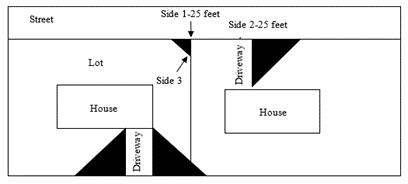
Figure 1
Fences and Walls
(6)
The finished side of the fence (having no structural supports) must face to the outside (away from the property being fenced) toward abutting property or street right-of-way.
(7)
A fence greater than six feet in height which is located in any side yard, rear yard or side yard abutting street shall have a minimum 90 percent opacity, leaving a maximum of ten percent open for the passage of air and light. A fence located in a front yard shall have a maximum 50 percent opacity, leaving a minimum of 50 percent open for the passage of air and light.
(8)
All fences, including footings, shall be located entirely upon the private property for which the zoning permit or building permit has been issued. All fences shall maintain a one-foot setback from trails and sidewalks.
(9)
No fence may be located in any public right-of-way or public easement except by written permission of the city engineer. Fences within easements shall not be located above underground utilities and shall not impede the flow of water. If a fence is located in a public easement or public right-of-way, the fence or wall may be removed and disposed of by the city at the expense of the property owner.
(10)
Every fence shall be constructed in a substantial, workmanlike manner and of substantial material reasonably suited for the purpose for which the fence or wall is proposed to be used. All fences are to be maintained in good condition and in a vertical position, and any missing or deteriorated wood slats, pickets, other fencing material, or structural elements shall be replaced in a timely manner with the same quality of material and workmanship so as not to be unsightly or present harmful health or safety conditions.
(11)
On a corner lot or a through lot, which have two or more front yards, the zoning administrator shall designate the front yard, side yard, rear yard and side yard abutting a street, as may be appropriate, for purposes of application of this section to the installation of a fence. In making this determination, the zoning administrator may but is not required to consider the alignment of an attached garage or the alignment of the main entrance of the principal structure.
(d)
Permit required for walls. A permit shall be obtained prior to the construction or replacement of any wall as follows:
(1)
Any wall four feet or greater in height shall meet the state building code requirements for a structure and a building permit shall be obtained prior to construction.
(2)
Any wall located in the shoreland overlay district shall meet the requirements of section 10-435(4).
(e)
Wall regulations. Regardless of whether a permit is required, all walls shall comply with the following regulations:
(1)
No wall shall be permitted which violates traffic visibility regulations.
(2)
No wall shall be constructed above a height of 30 inches within any sight area abutting any driveway, which area is described as follows: Side 1 which begins at the point of intersection of the existing curbline of the street (or pavement edge if no curb) and the driveway and extends 25 feet along the edge of the street away from the driveway; Side 2 which begins at the point of intersection of the existing curbline of the street (or pavement edge if no curb) and the driveway and extends 25 feet along the length of the driveway; and Side 3 connecting the end points of the two sides described above (see Figure 1 in subsection (c)(5) of this section).
(3)
The finished side of the wall (having no structural supports) must face to the outside (away from the property being fenced) toward abutting property or street right-of-way.
(4)
A wall greater than six feet in height which is located in any side yard, rear yard or side yard abutting street shall have a minimum 90 percent opacity, leaving a maximum of ten percent open for the passage of air and light. A wall located in a front yard shall have a maximum 50 percent opacity, leaving a minimum of 50 percent open for the passage of air and light.
(5)
All walls, including footings, shall be located entirely upon the private property for which the zoning permit or building permit has been issued. All walls shall maintain a one-foot setback from trails and sidewalks.
(6)
No wall may be located in any public right-of-way or public easement except by written permission of the city engineer. Walls within easements shall not be located above underground utilities and shall not impede the flow of water. If a wall is located in a public easement or public right-of-way, the wall may be removed and disposed of by the city at the expense of the property owner.
(7)
Every wall shall be constructed in a substantial, workmanlike manner and of substantial material reasonably suited for the purpose for which the wall is proposed to be used. All walls are to be maintained in good condition and in a vertical position, and any missing or deteriorated wood slats, pickets, other fencing material, or structural elements shall be replaced in a timely manner with the same quality of material and workmanship so as not to be unsightly or present harmful health or safety conditions.
(8)
On a corner lot or a through lot which has two or more front yards, the zoning administrator shall designate the front yard, side yard, rear yard and side yard abutting a street, as may be appropriate, for purposes of application of this section to the installation of a wall. In making this determination, the zoning administrator may but is not required to consider the alignment of an attached garage or the alignment of the main entrance of the principal structure.
(f)
Fences and walls in agricultural, residential and transitional town center zoning districts. In addition to the requirements for all fences and walls above, all fences and walls in the agricultural, residential and transitional town center zoning districts shall comply with the following requirements:
(1)
A fence or wall located in any side yard, side yard abutting a street or rear yard shall not exceed six feet in height except at follows:
a.
A fence or wall not exceeding eight feet in height is allowed if placed in any side yard, side yard abutting a street or rear yard which abuts a principal or minor arterial road.
b.
A fence or wall not exceeding eight feet in height is allowed if placed in any side yard or rear yard which separates a commercial or industrial use from a residential use or from a place of public assembly.
(2)
A fence or wall not exceeding four feet in height may be located in a front yard. Fences in the front yard shall be limited to decorative fences, such as picket fences, split rail fences and decorative iron fences. Chain-link fences are not permitted in the front yard.
(3)
A fence or wall exceeding four feet in height shall be located behind the front corner of the principal building. In the event an accessory structure is located in front of the principal building, a fence or wall exceeding four feet in height may be located behind the rear corner of the accessory structure.
(4)
Where a fence or wall is used as part of an animal kennel or run, it may not exceed six feet in height, it may not be located in any side yard, side yard abutting a street or front yard and it shall be located at least ten feet from any lot, property or parcel line.
(5)
Residential swimming pool fencing shall comply with all residential swimming pool regulations and state building code regulations.
(g)
Fences and walls in commercial and industrial zoning districts. In addition to the requirements for all fences and walls above, all fences and walls within commercial and industrial zoning districts shall comply with the following requirements:
(1)
A fence or wall located in any side yard, rear yard or side yard abutting a street shall not exceed eight feet in height except as follows: A fence or wall not exceeding ten feet in height is allowed if placed in any side yard, rear yard or side yard abutting a street which abuts a principal or minor arterial road.
(2)
A fence or wall, not exceeding six feet in height, may be located in a front yard.
(3)
Chain-link fences within commercial zoning districts shall be coated with vinyl and shall not include vinyl, plastic or metal slats within the fence.
(4)
Chain-link fences within industrial zoning districts shall be coated with vinyl and may include vinyl, plastic or metal slats within the fence, including in the front yard.
(5)
All chain-link fences must have a top rail and vertical posts must be spaced at intervals not to exceed ten feet.
(h)
Fences and walls in town center zoning district. In addition to the requirements for all fences and walls above, all fences and walls within town center zoning district shall comply with the following requirements:
(1)
A fence or wall located in any side yard, rear yard or side yard abutting a street shall not exceed six feet in height.
(2)
A fence or wall not exceeding four feet in height may be located in a front yard. Fences in the front yard shall be limited to decorative fences, such as picket fences, split rail fences and decorative iron fences.
(3)
Chain-link fences are not permitted.
(Prior Code, § 1145.600)
Sec. 10-730. - Traffic visibility.
No walls, fences, structures, trees, shrubs, vegetation or other obstructions shall be permitted in any yard when it poses a danger to traffic by obscuring the view from any street, roadway, or alley; except as provided below:
(1)
Visibility from any street or roadway shall be unobstructed above the height of 2½ feet and below five feet within the triangle described as beginning from a point at the intersection of the extension of the existing curblines of the two streets, and extending a distance of 50 feet along the edge of each street. This defines two sides of the triangle. The third side is a line connecting the end points of the two sides described above.
(2)
Visibility from the intersection of any street or roadway and an alley shall be unobstructed above the height of 2½ feet and below five feet within the triangle described as beginning from a point at the intersection of the extension of the existing curblines or pavement edges or if unpaved, the edge of the traveled surface, of the street and alley, and extending a distance of 15 feet along the edge of each street. This defines two sides of the triangle. The third side is a line connecting the end points of the sides described above.
(3)
Visibility from the intersection of any two alleys shall be unobstructed above the height of 2½ and below five feet within the triangle described as beginning from a point at the intersection of the extension of the existing curblines or pavement edges of the two alleys and extending a distance of ten feet along the edge of each alley. This defines two sides of the triangle. The third side is a line connecting the end points of the two sides described above.
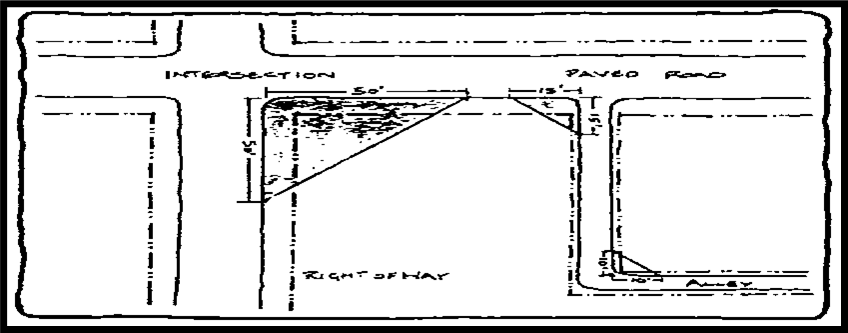
(Prior Code, § 1145.700)
Sec. 10-759. - Purpose and intent.
(a)
Intent. The provisions of this division provide the general performance standards which are applicable to all districts, unless specifically noted in other provisions of this chapter. All properties must comply with all applicable provisions of this chapter, including, but not limited to, the performance standards in this division and all other applicable provisions of this article.
(b)
Purpose. Regulation of off-street parking and loading spaces in this division is necessary to alleviate or prevent congestion of the public right-of-way and to promote the safety and general welfare of the public. Regulation is accomplished by establishing minimum requirements for off-street parking of vehicles and loading and unloading operations associated with their use for the uses regulated by this division by analysis of the intensity, duration, time and style of utilization of the land or structures in or from which each use is conducted.
(Prior Code, § 1146.100)
Sec. 10-760. - Off-street parking areas.
(a)
Reduction of existing off-street parking space. Off-street parking and loading spaces existing upon the effective date of the ordinance from which this division is derived shall not be reduced in number unless their number exceeds the requirements imposed for the use by this division; however, if the existing parking meets more than 90 percent of the requirements of this division, the number of parking spaces may be reduced to 90 percent of the requirement for the purpose of establishing landscaping where such a reduction is necessary to construct a landscaping or bufferyard improvement required by this article.
(b)
Floor area. The term "floor area" means the floor area as defined in this chapter. Indoor parking and indoor loading spaces shall not be counted as part of the floor area of a structure for the purpose of computing the number of parking or loading spaces which are required.
(c)
Design capacity. When a building's design capacity is used for purposes of calculating requirements for off-street parking spaces, that design capacity shall be determined by occupancy loading specified in the building code in force at the time the determination is made.
(d)
Benches in places of assembly. In stadiums, sports arenas, structures of religious institutions and other places of public assembly in which patrons or spectators occupy benches, pews, or other similar seating facilities, each 28 inches of such seating shall be counted as one seat for the purpose of determining the requirements for off-street parking where the parking requirement is calculated by application of a formula based on the total number of seats.
(e)
Calculating space. When the calculation of the number of off-street parking spaces results in a fraction, each fraction of one-half or more shall require another space. When a single site contains various uses, the parking requirement calculation of each use shall be totaled prior to the final rounding of the overall parking requirement for the site.
(f)
Assessments. When a lot has been assessed for one or more off-street parking stalls under applicable state statutes, the number of stalls forming the basis for such assessment shall constitute an equal number of spaces for purposes of this section.
(g)
Use of parking facilities. Required off-street parking facilities in residential and town center transitional zoning districts may be utilized only for parking passenger automobiles, except as allowed for home occupations. No required parking facilities or public rights-of-way in any residential and town center transitional zoning district shall be used for open-air storage of commercial motor vehicles.
(h)
Location of parking facilities. Required off-street parking in the R-1, R-2, and town center transitional zoning districts shall be on the same lot as the building housing the principal use, except in the cases of:
(1)
Condominium developments where off-street parking is designed on a lot or within a garage on a separate parcel but within the same condominium development.
(2)
Freestanding parking lots accessory to existing nonresidential or recreational uses, located within the same zoning district, and located within 500 feet of the existing use, may be permitted in the R-1, R-2, R-3, TC and TC-T zoning districts, subject to approval of a conditional use permit.
(i)
Calculating space for a compound use. Should a structure contain two or more types of uses, the total off-street parking spaces required for each use shall be calculated separately.
(j)
Control of off-site parking facilities. When required accessory off-street parking facilities are provided on a lot other than the lot on which the principal use is located, the following requirements shall be met.
(1)
A paved pedestrian way from the off-site parking facilities to the use being served has been provided and is properly maintained.
(2)
The off-site parking area and the lot on which the principal use is located must be in the same ownership, or the use of the parking facilities shall be protected by covenants that run with the land on both the lot on which the parking facility is provided and the lot on which the principal use is located. The manner of execution and content of such covenants shall be written in a form that is approved by the city attorney and the covenants must be recorded with the county recorder or registrar of title as applicable for the county.
(3)
The closest point of the off-site parking area shall be located no more than 500 feet from an entrance to the principal building of the use being served as measured along an established path of travel between the parking lot and such entrance unless shuttle service is provided. If shuttle service is provided, the location of the parking need not satisfy any distance requirement.
(4)
The failure to provide on-site parking shall not result in patrons, visitors, or employees parking on the public streets, on other private property, or in private driveways or other areas not expressly set aside for off-street parking purposes.
(5)
The off-site parking shall be maintained until on-site parking is provided or an alternate off-site parking facility which meets the requirements of this section has been approved by the zoning administrator.
(k)
Joint parking facilities. Off-street parking facilities may be provided collectively in any zoning district for more than one structure or use, if the following conditions are met:
(1)
The applicant demonstrates to the zoning administrator that, because of the hours, size and mode of operation of the respective uses, there will be an adequate amount of parking available to each use during its primary hours of operation to meet the needs of such use.
(2)
The joint use of the parking facilities shall be protected by covenants that run with the lots housing all the joint users and the lot or lots on which the parking facility which satisfies the parking requirements of this division is provided. Those covenants shall contain all of the conditions of the joint agreement and shall grant an easement for parking to the joint principal use lots. The manner of execution and content of such covenants shall be in a form approved by the city attorney and the document containing the covenants shall be recorded with the county recorder or the register of titles as applicable for the county. Parties to the covenant shall reimburse the city for the costs of legal review.
(3)
Total required parking spaces for the joint use shall be based on the combined peak requirement and shall not be fewer than the minimum requirements set forth in this division for the use which requires the most parking. Joint parking arrangements shall not qualify for proof of parking reductions described in section 10-763.
(4)
Any change in use or in the conditions of the joint parking agreement without approval of the zoning administrator shall nullify the joint parking agreement. Approved changes shall be added to the covenants and recorded with the county recorder or the registrar of titles as applicable for the county. If changes are not approved all parties to the nullified joint parking agreement shall be required to meet the required parking for the applicable use.
(l)
Use of parking area. Required off-street parking space and the driveways providing access to them shall not be utilized for storage, display, sales, rental, or repair of motor vehicles or any other goods, the storage of inoperable vehicles, the loading and unloading of vehicles, or the storage of snow.
(m)
Conversion of attached garage space. No person shall alter a garage to living space in any residential or town center transitional zoning district, unless other legal provisions are made to provide the required parking for the lot.
(Prior Code, § 1146.200)
Sec. 10-761. - Design and maintenance of off-street parking areas.
(a)
Access. Parking areas shall be designed to provide access to a public alley or street. Driveway access shall be located at a place which will minimize interference with traffic movement and is in conformance with the public works design manual standards. Access to required parking spaces shall not be restricted by a fence or other barrier.
(b)
Setbacks. Setbacks shall be measured from property lines unless otherwise noted. Parking shall comply with all applicable setbacks in this article.
(c)
Parking spaces. Each parking space shall not be less than nine feet wide and 18 feet long exclusive of access drives or aisles, ramps or columns. Each parking space shall be served by access drives which shall have the minimum dimensions provided in the following table. Each parking space shall be located by striping of a contrasting color on the concrete or asphalt surface.
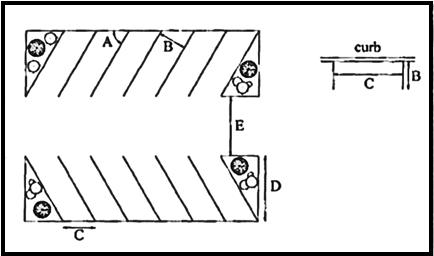
(d)
Accessible parking spaces. The size, number, and location of spaces reserved for accessible parking shall be provided and identified as required by applicable state and federal regulations.
(e)
Turnaround. All parking areas except those serving single-family detached and single-family attached twinhome dwellings on local streets shall be designed so that cars do not have to back into the public street or alley.
(f)
Surfacing. All driveways and all of the area intended to be used for parking or vehicular circulation shall be surfaced with a minimum of 1½ inches of bituminous paving on a suitable base, or six inches of non-reinforced concrete or equivalent material approved by the city engineer. Interlocking pavers, or similar, may also be used in parking lots subject to approval by the city engineer.
(g)
Drainage. There shall be adequate drainage of the surface of the parking or paved rea to a public storm sewer or to other approved stormwater facilities. Drainage and stormwater management for parking or paved areas must be in conformance with the requirements of the city public works design manual. Plans for surfacing of all parking lots for six spaces or more or paved areas of 6,000 square feet or more shall be approved in advance by the city engineer.
(h)
Lighting. All parking lots containing parking for six vehicles or more shall provide an average horizontal illumination of between four-tenths and one footcandle. The average horizontal illumination within all parking ramps shall be one footcandle. All lighting shall comply with the lighting regulations of the applicable zoning district. In cases where light spillage to adjacent properties cannot be determined a photometric plan shall be submitted to the zoning administrator for review prior to installation or change to the lighting.
(i)
Traffic islands. Raised islands shall be provided at the end of any parking row where it abuts vehicle circulation lanes or driveways for traffic control. Raised islands shall also be provided to separate pedestrian and vehicular traffic.
(j)
Curbs. A six-inch-high poured-in-place concrete curb shall be provided around the periphery of all parking lots. A six-inch poured-in-place concrete curb or other pavement edge treatment is required along all internal access roads.
(k)
Landscaping. Parking lot screening shall be provided on the perimeter of any parking lot. Screening shall be maintained and replaced as needed to comply with the approved landscape or site plan.
(1)
Screening shall be provided using a combination of shrubs, coniferous trees, fencing, berming, etc., to minimize the effect of headlights and reflected light from bumpers, grills and headlights. Screening must attempt to address at least 60 percent of the perimeter where views of the parking lot could originate.
(2)
Effectiveness of the screening shall be 80 percent opacity year round.
(3)
Berming must achieve a 30-inch height to provide 80 percent opacity on three-foot high screening. Berms cannot be used as the only method of screening and must be used in combination with other elements such as landscaping and fencing.
(4)
Plant materials must be spaced no more than 30 inches apart on single rows of deciduous shrubs, 48 inches apart on double staggered rows of deciduous shrubs, with initial planted height of at least two feet. Spacing may vary, subject to species used.
(5)
Coniferous trees must be placed no further than eight feet apart, to be counted as screening.
(6)
All parking lot landscape areas shall be separated from the parking surface by cast-in-place concrete curbs of an equal or better standard. Bituminous or precast concrete curbs or similar curbs are not permitted.
(l)
Bufferyards.
(1)
When an off-street parking area for six vehicles or more or a paved area of 1,500 square feet or more is located next to a right-of-way, a Type B bufferyard, as defined in section 10-727, shall be provided between such parking lot or paved area and street right-of-way. The width of the driveway at the property line shall be excluded from the bufferyard requirement.
(2)
If there is insufficient space for the required bufferyard between a parking lot or paved area and a public right-of-way, part of the required plant material may be installed on the public right-of-way under the following conditions:
a.
Such material does not impair access and meets all requirements of this chapter restricting visual and physical obstructions, including visual obstructions at intersections.
b.
The placement of landscaping materials does not inhibit the storage of snow when streets are plowed.
c.
The landscaping is not inconsistent with public landscaping schemes.
d.
The location of the landscaping is approved by the city engineer.
(m)
Yards.
(1)
Parking areas shall be prohibited in front yards and side yards abutting a street in all residential and the town center transitional zoning districts, except that in the R-1, and R-2 zoning districts, parking for a single-family detached or single-family attached twinhome residence may be permitted by the city engineer in the front yard, provided there is no other location on the lot where parking is practical and the front yard offers the only place where the required parking can be located.
(2)
Parking areas in the C-1 and C-2 use districts shall be permitted in the front yard and side yards abutting a street only if all of the following requirements are met:
a.
In no case shall the required yard be reduced to less than five feet.
b.
All of the bufferyard requirements of this article are met.
c.
A solid bumper, curb or fence not more than 3½ feet in height shall be constructed in such a position and such a manner that no part of a parked vehicle can extend into the bufferyard.
(n)
Parking space abutting R zoning districts. When a parking lot for more than six vehicles is located abutting a residential zoning district or residential developed property, a Type C bufferyard, as defined in section 10-727, shall be installed between parking lot and abutting property. Off-street parking spaces and access drives for nonresidential uses shall be set back a minimum of 20 feet from any side or rear lot line abutting a residential zoning district.
(o)
Maintenance of off-street parking space. The owner and tenant shall maintain the parking space, access ways, landscaping, bufferyards, and required fences in compliance with this article and in a neat and adequate manner.
(p)
TC parking standards.
(1)
Location. If off-street parking is provided by an individual business within the TC zoning district, it shall be located to the side or rear of the business's principal building, not between the building and the street. Individual business parking may not occupy a corner location.
(2)
Landscaping. The corners of surface parking lots and all other areas not used for parking or vehicular circulation shall be landscaped with turfgrass, native grasses or perennial flowering plans, vines, shrubs and trees. Such spaces may include architectural features such as benches, kiosks or bicycle parking.
(Prior Code, § 1146.400)
Sec. 10-762. - Number of required off-street parking spaces.
The minimum number of required off-street parking spaces for the following uses shall be as specified in this section. Where no required minimum number of parking spaces is specifically listed for an individual use, the zoning administrator shall determine the minimum number of required off-street parking spaces required. The zoning administrator shall consider functional similarities between uses where a parking requirement is listed in this section and the proposed use in determining the parking requirement.
(1)
Residential uses.
(2)
Commercial uses.
(3)
Industrial uses.
(Prior Code, § 1146.500)
Sec. 10-763. - Proof of parking.
(a)
For any parking lot for 30 vehicles or more, the property owner or tenant is only required to pave and stripe 75 percent of the required parking spaces if the following conditions which constitute proof of area for the additional required parking (proof of parking) are met:
(1)
A parking plan drawn to scale for the property is submitted to the zoning administrator and the plan indicates the site complies with the total parking requirements stated above and with the parking lot design and standards contained in this division.
(2)
The proof of parking area, which is not paved or striped, but is capable of containing the amount of parking needed to reach 100 percent of the required parking is suitably landscaped and curbed to meet the landscaping and bufferyard requirements of this article.
(3)
The proof of parking area is clearly delineated on the parking plan for the site.
(4)
The proof of parking area is not used to satisfy any other landscaping requirement of this article, is not located in any other area on the site which is required by this article to be used for other purposes, and is not located in an area occupied by a building.
(b)
The property owner is responsible for informing any subsequent owner of the property of the parking status of the property.
(c)
The city may, in its sole discretion, require that the proof of parking area be paved and striped in such a way that it meets the requirements of this division to provide the total number of required parking spaces on the site.
(Prior Code, § 1146.600)
Sec. 10-764. - Parking bonuses.
If 50 percent or more of all spaces in the R-3 zoning district or commercial zoning districts are placed in or under the proposed principal structure or totally underground, the following bonuses shall apply:
(1)
The site shall receive a 300-square-foot lot area bonus for each space so placed; the additional footage is used to determine the allowable square footage of the buildings on the site.
(2)
The height added to the principal structure by any floor that is totally used for parking in or under the principal structure shall not be included to determine the size of the required yards.
(3)
Maximum bonuses. The maximum floor area which may be added to a building by placing parking spaces in or under the principal structure shall be not more than one-third the net floor area or one-third the number of dwelling units, whichever is applicable, and whichever is less if both are applicable.
(Prior Code, § 1146.700)
Sec. 10-765. - Off-street loading facilities.
(a)
Qualifications for loading zone, dock. The off-street loading requirement for nonresidential buildings with less than 20,000 square feet may be satisfied by the designation of a loading zone area on the site. This loading zone area shall be separate from any required off-street parking area and access to the loading zone area shall be provided which does not conflict with automobile circulation to, from, or within the site. A minimum of one loading dock shall be provided for nonresidential buildings over 20,000 square feet in floor area.
(b)
Definitions. The following words, terms and phrases, when used in this section, shall have the meanings ascribed to them in this subsection, except where the context clearly indicates a different meaning:
Loading facility includes the dock, the berth for the vehicle, maneuvering areas, and the necessary screening walls.
(c)
Location. All loading berth curb cuts shall be located 25 feet or more from the intersection of two street rights-of-way. No loading berth shall be located less than 50 feet from a residential zoning district unless it is entirely within a building. In situations where access to the loading berth is directly from the street and no other practical means of access exists, a bufferyard screening requirement shall apply. Existing uses in the TC zoning district may utilize on-street loading areas, only if there is no off-street loading area alternative.
(d)
Size. A loading dock shall have a berth area at least 12 feet in width and 55 feet long.
(e)
Access. Each loading berth location shall permit vehicular access to a street or public alley in a manner which will least interfere with traffic.
(f)
Surfacing. All loading facilities and accessways shall be paved with bituminous or concrete paving to control the dust and drainage.
(g)
Screening. All berths shall be screened from view from any adjacent property in a residential zoning district with a bufferyard. The width of the driveway at the property line shall be excluded from the bufferyard requirement.
(h)
Storage. No required loading berth or access drive shall be used for the storage of goods or inoperable vehicles. It may not be included as a part of the space necessary to meet the off-street parking requirements.
(i)
Visibility. No off-street parking spaces shall be located in areas where it may impede visibility for adjacent intersections. Refer to division 6 of this article for additional traffic visibility requirements.
(Prior Code, § 1146.800)
Sec. 10-766. - Driveways.
(a)
The purpose of this section is to provide minimum setback and slope standards for driveway construction. The intent is to reduce interference with drainage and utility easements by providing setback standards, reduce erosion by requiring a hard surface for all driveways, and provide positive drainage to the street via establishment of minimum driveway slope standards. This section shall apply to all new, replaced or altered driveways.
(b)
Driveways shall be set back at least five feet from the side yard property line.
(c)
Driveways shall be located as indicated on the subdivision grading plan. However, an alternate location meeting the provisions of this section may be permitted if the driveway is not located over the city curb stop and is subject to approval by the city engineer.
(d)
Driveways shall not be installed over sewer and water services. Curb stops are not allowed to be located within the driveway.
(e)
The vertical profile for a driveway shall not exceed ten percent maximum slope. In circumstances when unusual topography or existing conditions of the property prohibit compliance with this section, the city engineer may approve a driveway with a slope exceeding ten percent.
(f)
Accessory structures which are deemed by the zoning administrator to have potential access to a public or private street and have door openings exceeding six feet in width shall have a bituminous or concrete surfaced driveway of a minimum of eight feet wide to access the structure.
(g)
Driveways shall be a minimum of eight feet in width and surfaced with bituminous, concrete, or other hard surface material, as approved by the city engineer. Separate driveway strips for individual tires, if installation of a full width driveway would increase the impervious surface percentage of the parcel over the allowed maximum, are prohibited. For agricultural uses, driveways shall be surfaced from the intersection of the road for the first 100 feet of driveway, with concrete or other hard surface material, as approved by the city engineer.
(h)
The minimum corner clearance from the street right-of-way line shall be at least 30 feet to the edge of the driveway.
(i)
For residential uses, the width of the driveway access shall not exceed 24 feet at the right-of-way line. No portion of the right-of-way may be paved except that portion used for the driveway.
(j)
For all other uses, the width of the driveway access shall not exceed 36 feet in width measured at the right-of-way line. No portion of the right-of-way may be paved except that portion used for the driveway.
(k)
On lots not meeting the minimum width requirements at the right-of-way line, the driveway setback may be reduced subject to the following criteria:
(1)
The driveway will not interfere with any existing easement.
(2)
The location of the driveway must be approved by the city engineer to ensure that it will not cause runoff onto adjacent properties.
(3)
A shared driveway may be approved conditional upon the property owners providing a recorded copy of cross access easements, and the combined width of the driveway may not exceed 24 feet at the right-of-way line.
(4)
All other provisions of this section must be met.
(l)
On lots with concrete sidewalks, a concrete apron shall be installed from the curb to the sidewalk.
(m)
In single-family attached rowhome and cluster housing developments, the driveway setback and width requirements may be modified subject to the following criteria:
(1)
The driveway locations must be approved by the city engineer as part of the subdivision grading plan.
(2)
The driveway will not interfere with any existing easement.
(3)
All other provisions of this section must be met.
(n)
Driveway alterations and additions. Prior to commencing any work, a driveway permit approved by the city engineer is required for each of the following:
(1)
Replacement of a driveway;
(2)
Alteration of a driveway; or
(3)
Addition to an existing driveway if the addition exceeds the length and width approved as part of the original building permit.
This permit is subject to a fee set forth in the city fee schedule.
(Prior Code, § 1146.900)
Sec. 10-786. - Findings and purpose.
(a)
Findings.
(1)
The size, height, location, illumination, distance between, and proliferation of signs in the city raise constitutional and regulatory challenges for the city. Signs are one means used to communicate noncommercial and commercial speech and messages and therefore are protected under the First and Fourteenth Amendments to the U.S. Constitution. However, the size, height, location, illumination, and distance between signs creates hazards by distracting drivers' attention from the road and can be an eyesore and impact aesthetics, property values, and civic pride.
(2)
The city council finds that it has a legitimate and substantial interest to preserve and protect the public welfare and safety and preserve the aesthetic qualities and characteristics in and of the city. This division is intended to protect the city and its residents.
(3)
The city council finds it has legitimate and substantial interest in promoting and protecting the public welfare, and safety of residents and maintaining and enhancing the aesthetic integrity of the city. While the city believes its interests in regulating signs are substantial, it also believes the First Amendment is one of the cornerstones in a vital and relevant democracy and that they have sworn an oath to defend, protect and preserve the First Amendment.
(4)
The provisions of this division are intended to advance the city's interests articulated herein and are not more extensive than is necessary to serve those interests. The individual provisions are content-neutral and do not favor commercial speech over noncommercial.
(5)
The city council finds that the regulations in this division vary depending on the zoning district where the subject sign will be located. The city council finds that the essential characteristics and activities are different among the town center, commercial, industrial and residential zoning districts. There are substantial differences between a private residence in the residential zoning district and a manufacturing facility in the Industrial zoning district and these differences support the varying regulations between zoning districts.
(6)
The city council finds that the regulation of signs imposed in this division were evaluated to ensure that alternative means, methods, and forums of communication exist to communicate speakers' message foreclosed by these sign regulations. These regulations are necessary to achieve the city's legitimate and substantial interests. Without these regulations the city will be unable to protect and preserve the public health, welfare, safety, and aesthetic qualities in and of the city.
(b)
Purpose.
(1)
The purpose of these sign regulations is to further promote and protect the following substantial government interests:
a.
The effective use of signs as a means of promotion and communication in the city;
b.
The aesthetic environment and the city's ability to attract sources of economic development and growth;
c.
Pedestrian and traffic safety;
d.
Potential for the adverse effect of signs on nearby public and private property;
e.
Fair and consistent means to enforce these sign restrictions;
f.
The number, location, size, type, illumination and other physical characteristics of signs within the city in order to promote the public health, safety, general welfare, and property values; and
g.
Ensuring that the public is not endangered, annoyed, or distracted by the unsafe, disorderly, indiscriminate or unnecessary use of exterior signs.
(2)
The city council finds that these sign regulations do not deny a business or other entity a reasonable degree of freedom of choice in the design and placement of signage while at the same time ensuring the public is not endangered, annoyed, or distracted by the unsafe, disorderly, indiscriminate or unnecessary use of exterior signs.
(Prior Code, § 1147.100)
Sec. 10-787. - Definitions.
The following words, terms and phrases, when used in this division, shall have the meanings ascribed to them in this section, except where the context clearly indicates a different meaning:
Address sign means an on-premises sign giving the name or address of the building or premises which is compliant with city addressing requirements.
Athletic field sign means any advertising sign located on the interior-facing of athletic field fences or scoreboard of a city athletic field in accordance with city policy.
Awning means a cloth, plastic, or other nonstructural covering that projects from a wall for the purpose of shielding a doorway or window. An awning is either permanently attached to a building or can be raised or retracted to a position against the building when not in use.
Awning sign means any sign painted on, attached to, or applied to an awning.
Balloon sign means a temporary sign which is printed, painted, or secured to a balloon which may be secured to a permanent structure or the ground or attached to a rope, chain, string or other device, allowing it to move about within the atmosphere.
Banner sign means any temporary on-premises sign possessing characters, letters, illustrations, or ornamentations applied to paper, plastic, or lightweight fabric of any kind, which is anchored on two or more edges or at all four corners, to advertise products, goods or services sold or provided on the property or a special event, which is hung either with or without frames. National flags, state or municipal flags, or the official flag of any institution or business shall not be considered banners.
Beacon means a guiding or warning signal, as a light or fire, especially one in an elevated position.
Bench sign means a sign attached to or painted on a bench for seating.
Billboard sign means an off-premises poster panel board, painted bulletin board or other communicative device which is used to advertise products, goods or services, any part of which are not sold, produced, assembled, manufactured, furnished, or otherwise related to activities conducted on the property where the sign is located.
Building façade means any exterior elevation of a building extending from grade to the top of the parapet wall or eaves and the entire width of the building elevation. The area of a building façade is measured as follows: height (a single straight line parallel, or essentially parallel, with the side of the building from grade to the top of the parapet wall or eaves; a building may have multiple heights) multiplied by length (a single straight line parallel, or essentially parallel, with the side of the building from one corner to the next corner).
Building façade, front, means the sides of the building which contain the primary public entrances. A building may have more than one front building façade.
Building marker means a sign carrying the name of a building, its date of erection, monumental citations, commemorative tablets and the like when carved into stone, concrete, or similar material or made of bronze, aluminum or other permanent type of construction and made an integral part of the structure.
Business means any establishment, occupation, employment or enterprise wherein merchandise is manufactured, exhibited or sold, or which occupies time, attention, labor and materials or where services are offered for compensation.
Canopy means a freestanding or attached open-air structure constructed for the purpose of shielding service stations from the elements.
Canopy sign means any sign that is part of, or attached to, the vertical sides of a canopy.
Changeable copy sign means a sign or portion thereof on which the copy or symbols change manually through placement of letters or symbols on a panel mounted in or on a track system. The two types of changeable copy signs are manual changeable copy signs and electronic changeable copy signs, which include message center signs and digital displays.
Clearance means the distance above the walkway, or other surface if specified, to the bottom edge of a sign. The term "clearance" can also refer to a horizontal distance between two objects.
Community event permit sign means a sign related to an activity or event permitted pursuant to a community event permit. The temporary sign may only be displayed in location of the community event for 14 days prior to, and the duration of, a specific event.
Construction sign means a temporary sign giving the project name, names of principal contractors, architects, and lending institutions responsible for construction on the property where the sign is placed.
Copy and graphic mean the wording and other display messages such as logos or symbols on a sign.
Development sign means a temporary sign located on the site of a new development listing owners, developers, development name, and builders, together with other sales related information.
Digital display means the portion of a sign message made up of internally illuminated components capable of changing the message periodically. Digital displays may include, but are not limited to, LCD, LED, or plasma displays.
Eave means the edge of a roof, usually projecting beyond the walls, the height of which edge is measured from the lowest point thereof to grade.
Election sign means a temporary sign promoting the candidacy of a person running for a governmental office or promoting an issue to be voted on at a governmental election.
Electronic message sign, also referred to as a dynamic display sign, means an electronic message sign is a sign which shows messages and graphics that are changed by electrical pulsations. This also includes, but is not limited to, any rotating, revolving, moving, flashing, blinking or animated display, and any display that incorporated rotating panels, LED lights manipulated through digital input, digital ink, or any other method or technology that allows the sign face to present a series of images or displays.
Employment opportunity sign means a temporary sign indicating employment opportunities.
Footcandle means a unit of incident light (on a surface) stated in lumens per square foot and measurable with an illuminance meter or light meter.
Franchise architecture means any franchise color schemes or other designs, symbols, or features intended to attract the attention of the public and reinforce the corporate or distinct image of a given business.
Freestanding sign means an on-premises sign supported by structures or supports that are placed on, or anchored in, the ground and that are detached from any building or other structure.
Government/regulatory sign means a sign that has been erected on behalf of a governmental body for the purpose of posting legal notices, identifying public property and conveying public information, including, but not limited to, directional signs, regulatory signs, warning signs, and informational signs.
Home occupation sign means a sign that advertises or describes products, goods or services at a private residential location.
Illumination means a source of any artificial or reflected light, either directly from a source of light incorporated in or indirectly from an artificial source.
Illumination, external, means artificial light located away from the sign which lights the sign, the source of which may or may not be visible to persons viewing the sign from any street, sidewalk, or adjacent property.
Illumination, internal, means a light source that is concealed or contained within the side and becomes visible in darkness through a translucent surface. Message center signs, digital displays, and signs incorporating neon lighting shall not be considered internal illumination for the purposes of this chapter.
Incidental sign means an on-premises sign not exceeding six square feet in size and no more than four feet in height above the natural grade of the ground directly below, that displays general site information, instructions, directives, or restrictions that are primarily oriented to pedestrians and motor vehicle operators who have entered a property from a public street such as "no parking," "entrance," "loading only" and other similar directives. No sign with a commercial message shall be considered incidental.
Incidental window sign means a sign displayed in the window displaying information such as the business's hours of operation, credit institutions accepted, commercial and civic affiliations, and similar information. These signs shall be informational only and shall not contain a commercial message.
Inflatable sign means a sign that is an air-inflated object, which may be of various shapes, made of flexible fabric, resting on the ground or structure and equipped with a portable blower motor that provides a constant flow of air into the device.
Luminance means an objective measurement of the brightness of illumination, including illumination emitted by an electronic sign, measured in candles per square foot (cd/ft 2 ).
Marquee means a permanent structure, other than a roof or canopy, attached to, supported by, and projecting from a building and providing protection from the elements.
Marquee sign means any sign attached to or made a part of a marquee.
Menu board means a sign that indicates selections available at businesses that serve customers via automobiles, such as a fast-food establishment with a drive-through facility.
Multi-business building means a building located on one tract which is occupied by multiple businesses.
Multi-business building sign means a type of wall sign used to identify individual businesses within a multi-use building.
No trespass sign means a sign which is intended to notify the public that entry onto a person's private land or property is prohibited without the property owner's permission.
Noncommercial on-premises sign means a sign displayed by the owner of property or tenant used to communicate, express, convey or depict a message or viewpoint held by the owner of the property or a tenant.
Off-premises identification sign means a permanent identification sign used to identify the location of a business park or industrial park along a designated county or state highway and may also include identification of individual businesses located within the business park or industrial park.
Off-premises regional directional sign means a sign erected on private property for the purpose of directing vehicular and pedestrian traffic to a facility of regional significance which is not located on the premises on which the sign is located. A billboard sign is not an off-premises regional directional sign. A facility of regional significance is a facility that has directional signage on an interstate or state highway; generates 2,500 vehicle trips per day; is located on land owned by a governmental unit other than public right-of-way; and is located within the city corporate limits.
Off-premises sign means a sign whose message and design relate to an individual business, profession, service, event, point of view, or other commercial or noncommercial activity sold, offered, or conducted on a property other than the property on which the sign is located.
On-premises sign means a sign whose message and design relate to an individual business, profession, service, event, point of view, or other commercial or noncommercial activity sold, offered, or conducted on the same property where the sign is located.
Parapet means an architecturally, structurally, and aesthetically integral low, protective wall or railing extending above the roof, balcony, or similar structure.
Place of assembly sign means an on-premises sign which identifies the name and other characteristics of a place of assembly. For purposes of this division, the term "place of assembly" includes schools.
Portable sign means any temporary sign not permanently attached to the ground or other permanent structure, or a sign designed to be transported. A sandwich board sign is not a portable sign for the purpose of this division. A vehicular sign is not a portable sign for the purpose of this division.
Projecting sign means a building-mounted, double-sided sign with the two faces generally perpendicular to the building wall, not to include signs located on a canopy, awning, or marquee.
Pylon sign means a freestanding sign erected upon a single post or posts or shafts that converge at a common base with the posts not more than 15 feet apart, with the display portion mounted on the top thereof.
Real estate sign means a temporary sign erected on private property for purposes of advertising the sale or lease of a particular building or property.
Residential nameplate sign means a sign located on a residential premises, giving only the name or address of the premises.
Roof sign means a sign erected upon, against, or above a roof or parapet of a building or above the eaves in the case of a hip, gable, or mansard roof.
Rotating sign means a sign which revolves or rotates in a circular motion on its axis by mechanical means.
Sandwich board sign means a sign that is freestanding, portable, and temporary, consisting of two faces connected and hinged at the top that does not require staking into the ground and whose message is targeted to pedestrians.
Seasonal sign means a temporary on-premises sign limited in duration of time and placed on a premises for a specific purpose that is not part of a business's ongoing activity. Seasonal signs include, but are not limited to, holiday tree and wreath for sale signs, farmers' market signs, similar seasonally oriented sales, and signs advertising temporary agricultural commodity sales and transient merchants.
Sign means any device, structure, fixture, painting, emblem, or visual that uses words, graphics, colors, illumination, symbols, numbers, or letters for the purpose of communicating a message.
Sign area means the total dimensions of a sign surface used to display copy and graphics, including information, messages, advertising, logos, or symbols.
Sign face means the part of the sign that is or can be used for the sign area. The sign area could be smaller than the sign face.
Sign height means the distance between the uppermost portion of the sign and the average natural grade of the ground directly below.
Snipe sign means a sign of any material whatsoever that is placed, located, painted or attached, in any manner on any public property or in the public right-of-way, or on any private property without the permission of the property owner.
Special event means an event by a civic organization, nonprofit organization, educational organization or governmental entity such as a local fundraiser, festival, bazaar, tournament or similar event.
Special event sign means a temporary sign, such as a banner, sandwich board sign, or window sign, used to promote or identify a special event.
Streamer/pennant sign/feather flag means any lightweight plastic, fabric or other material, suspended from a rope, wire, or string, or other material, usually in series, designed to move in the wind or any sign constructed of a vertical pole, tube or post supporting one edge of a sheet of cloth, vinyl or similar material.
Street banner means a temporary banner sign which is stretched across and hung over a public right-of-way which advertises public entertainment or a public event.
Street frontage means the sides of a tract abutting a private or public street or separated from a private or public street only by a frontage road.
Strings of lights means lights strung by wire, cord, or similar means.
Subdivision identification sign means an on-premises freestanding sign used to identify a residential subdivision, a planned unit development, a commercial development, business center, or industrial park.
Temporary sign means a sign that is erected or displayed for a specified period of time and not permanently mounted.
Tract means a parcel of land that is separately identified with its own property identification number with the county.
Vehicular sign means signs painted or attached to vehicles where the vehicle is parked on a property and not intended to be moved for a period of 48 hours or more and the use of vehicles or trailers designed for or utilized exclusively for the purpose of mobile advertising upon public streets or other rights-of-way.
Video display sign means a sign capable of displaying full-motion imagery of television quality or higher. The term "video display sign" includes images or messages projected onto buildings or other objects.
Wall sign means a building-mounted sign which is either attached to or displayed on an exterior wall in a manner parallel with the wall surface or which projects less than 15 inches from the surface at all points of the building or structure, and which displays only one sign surface.
Wall sign, painted, means a sign which has been painted directly onto a building wall, using the wall material as a base of the sign, whose message and design reflects an individual business, profession, service, event, or other commercial activity sold, offered, or conducted on the same property where the sign is located.
Wetland buffer sign means a city-approved sign that defines the buffer area boundary around a delineated wetland.
Window sign means any sign, picture, symbol, or combination thereof, affixed to the inside of a window and visible from the outside of the premises directed to pedestrian and vehicular traffic. A window sign is used to communicate information about an activity, business, commodity, event, sale, or service.
Works of art means artistic expressions, aesthetic treatments, and designs that do not include a commercial message such as the city logo, Centennial emblem, holiday lights, and decorations with no commercial message.
Yard sale sign means a temporary sign display advertising the on-premises sale of personal property, by an occupant, including general household rummage, used clothing and appliances, provided the exchange or sale of merchandise is conducted on the property or within the residence or an accessory structure on the property.
(Prior Code, § 1147.200)
Sec. 10-788. - Exempt signs.
In addition to signs exempted from regulation by state or federal law, the following signs shall be exempt from regulation under this division:
(1)
Incidental signs.
(2)
Incidental window signs.
(3)
Government/regulatory signs.
(4)
Works of art.
(5)
Athletic field signs.
(Prior Code, § 1147.300)
Sec. 10-789. - Allowed signs; no sign permit required.
(a)
Generally.
(1)
Each property may have each of the signs identified in this section.
(2)
The signs in this section shall be allowed in the zoning districts identified for each sign type. If no zoning districts are identified, the signs are allowed in every zoning district.
(3)
The signs in this section do not require sign permits.
(4)
The signs in this section do not count toward the sign limits for wall signs, freestanding signs or temporary signs below.
(5)
A brief description of the signs and display guidelines follow, including regulations related to sign number, size, area and location.
(b)
Address signs. One address sign per address located on a home or business allowed near the front entrance which shall not exceed two square feet in area.
(c)
Building markers. One building marker sign per building not to exceed four square feet is allowed.
(d)
Community event permit signs. Two community event permit signs are allowed on the property where the community event is to be located subject to the issuance of a community event permit. The signage may be utilized for 14 days prior to, and the duration of, a specified event. The community event permit holder shall be responsible for the removal of all signage at the conclusion of the event. All signs are to be positioned to limit their exposure to residential areas.
(e)
Construction signs. One sign shall be allowed upon each property during construction, in addition to any development signs on site. The sign shall only be allowed after a building permit has been issued and shall be removed before the building or any part thereof is occupied. Sites of more than ten acres are allowed up to three signs so long as the total sign area does not exceed 100 square feet. All signage shall maintain a ten-foot setback from property lines and a minimum of 50 feet from any existing or to be occupied dwelling. Each sign shall not exceed the following size limitations:
(f)
Development signs.
(1)
Residential. One sign per entrance shall be allowed for each subdivision in any residential zoning district (including multifamily dwellings) under the following conditions:
a.
The sign shall only be allowed for a residential subdivision after a final plat has been filed;
b.
The sign shall not exceed 50 square feet in area;
c.
The sign shall be located a minimum of 50 feet from any existing or to be occupied dwelling unit;
d.
The sign shall be removed upon the earlier of 80 percent completion of construction, sale or lease of the dwellings within the project, or two years from issuance of the first permit for the construction of a dwelling or dwellings within the project; and
e.
Where more than one builder is involved in a residential subdivision, there still shall be only one sign per entrance as described above, which may list the builders for the subdivision.
(2)
Commercial and industrial. One sign per entrance shall be allowed in any commercial or industrial zoning district under the following conditions:
a.
The sign shall only be allowed after the final plat has been filed;
b.
The sign shall not exceed 50 square feet in area;
c.
The sign shall not be located upon a developed lot; and
d.
The sign shall be removed upon completion of construction, or the occupancy of the building, whichever occurs first.
(g)
Election signs.
(1)
Any election signs pertinent to Minn. Stats. § 211B.045 shall be allowed on private property with the express consent of the owner or occupant of such property. In a state general election year, such signs may not be posted more than 46 days before the date of the election and must be removed by those responsible for the erection of the sign or the property owner within ten days following the state general election. Such signs shall be located at least five feet from all property lines.
(2)
Election signs for elections held at other times than a state general election year shall be located on private property and at least five feet from all property lines.
(h)
Employment opportunity signs. One on-premises sign per business denoting employment opportunities shall be allowed on a private property in the town center, commercial or industrial zoning districts with the express consent of the property owner or occupant. Such signs shall not exceed 32 square feet and shall be located on the private property where the employment opportunity exists.
(i)
No trespass signs. "No trespass" and "no dumping" signs not exceeding two square feet in area per side and not exceeding four in number, per property, are allowed in the residential, town center, commercial and industrial zoning districts. In the agricultural zoning district, such signs shall not be less than 300 feet apart.
(j)
Noncommercial on-premises signs. One noncommercial on-premises sign per property may be placed on private property by the owner of the property or by the tenant. The sign shall be set back five feet from the property line and not exceed 12 square feet in size.
(k)
Real estate signs. One real estate sign may be placed per street frontage and one sign per lake frontage on property to be sold or leased. Such signs shall be set back from the property line or right-of-way (whichever is greater), no less than one foot per one foot of sign height. Placement of real estate signs shall have the express consent of the owner or occupant of the property. Such signs shall be removed within ten days following the closing of the lease or sale. The area of any such sign shall not exceed the following:
(l)
Residential nameplate signs. One nameplate sign, up to two square feet in area per surface with a maximum of two surfaces, shall be allowed for single-family residences. In the R-2 and R-3 zoning districts, one nameplate sign for each dwelling group of six or more units is allowed. Such nameplate sign shall not exceed six square feet in area per surface, and no sign shall have more than two surfaces.
(m)
Seasonal signs. A maximum of 32 square feet of on-premises temporary signage is allowed per organization for the duration of the sales event.
(n)
Strings of lights. Lights strung by wire, cord or similar means, other than temporary holiday lighting, shall only be allowed in the town center, commercial and industrial zoning districts. Such lighting is limited to pedestrian areas, including plazas, patios, landscape features and primary entries into buildings. No such illumination is allowed in any required setback. No flashing or blinking lights shall be allowed.
(o)
Wetland buffer signs. Wetland buffer signs shall not be removed without the written consent of the regulating agency responsible for their installation.
(p)
Window signs. A business may display one or more window signs, provided the total window sign area does not exceed more than 75 percent of the total window area.
(q)
Yard sale signs. Two on-premises yard sale signs are allowed and may be displayed seven days prior to the sale and must be removed immediately after the end of the yard sale. Yard sale signs shall only be placed on private property.
(Prior Code, § 1147.400)
Sec. 10-790. - Allowed signs; permit required.
(a)
Generally.
(1)
Each property may have each of the signs identified in this section.
(2)
The signs in this section shall be allowed in the zoning districts identified for each sign type. If no zoning districts are identified, the signs are allowed in every zoning district.
(3)
The signs in this section require sign permits.
(4)
The signs in this section do not count toward the sign limits for wall signs, freestanding signs or temporary signs below.
(5)
A brief description of the signs and display guidelines follow, including regulations related to sign number, size, area and location.
(b)
Canopy signs. Two canopy signs, in addition to those otherwise permitted on the principal structure, are allowed per property. Canopy signs shall not exceed ten feet in length or 20 square feet each and shall not be placed on the same side of the canopy. Lettering on the signs shall not exceed two feet in height or the average height of the letters on the sign attached to the principal structure, whichever is less. Canopy signs shall be placed in a manner that will allow a six-inch minimum border between the top, bottom, and sides of a canopy face. The sign area is determined by measuring the text only. Stripes or colors do not contribute to the sign area computation.
(c)
Menu board signs. Properties in the town center and commercial zoning districts with a restaurant providing drive-up window service shall be allowed one menu board per drive-through lane up to a maximum two menu boards. When one menu board exists for a drive-through, the menu board shall not exceed 50 square feet in area. If more than one menu board exists, each menu board shall not exceed 36 square feet in area and may be in addition to any other signs permitted by this division. The menu board shall be single-sided and oriented in such a manner so that the signs provide information to the patrons using the drive-through lane only, and do not provide supplemental advertising to pass-by traffic. The menu board signage shall be completely enclosed within one sign area. Order confirmation signage no greater than one square foot and incorporated into the drive-through speaker pedestal shall not be calculated as part of the menu board signage area. Order confirmation signage greater than one square foot shall be incorporated into the menu board and calculated as part of the board's sign area. The applicant shall demonstrate that the proposed sign location will not obstruct pedestrian or vehicular movement.
(d)
Off-premises regional directional signs. One off-premises regional directional sign is permitted within a two-mile radius of the property on which the facility of regional significance is located. Signage shall be erected on property located in a commercial zoning district. Signage shall not exceed 20 feet in height and 144 square feet in area per side with a minimum of four sides. Signage may be internally illuminated. External illumination directed away from the sign face or into the air (e.g., spotlights, light beams, etc.) is prohibited. Reflected glare or spill light from the sign shall not exceed 0.5 footcandle when the source abuts any residential parcel or one footcandle at any public right-of-way measured at one foot above the ground. Off-premises regional directional shall be located at least 40 feet from another permanent sign allowed by this division.
(e)
Off-premises identification signs. Off-premises identification signs shall be permitted in the C-3, and I-1 zoning districts, provided the requirements set out in this section are met.
(1)
No more than two off-premises identification signs shall be permitted for each business park or industrial park. Business and industrial parks are those properties that have been platted and developed as a business or industrial park as determined by the zoning administrator. Off-premises identification signs shall have a minimum separation of 500 linear feet from any other off-premises identification sign on the same side of the right-of-way.
(2)
The sign shall be located only on a property which is part of the business park or industrial park with written permission of the property owner. The sign may be located on a property abutting the business park or industrial park only with written permission of the property owner and written approval of the zoning administrator.
(3)
The sign shall be allowed only on property abutting county or state highways.
(4)
The sign shall be constructed as a freestanding block-type sign structure where the base of the sign structure is in contact with the ground, or a maximum of 12 inches above the ground adjacent to the sign, where the width of the base of the sign shall be at least 80 percent of the width of the sign.
(5)
Pylon signs shall not be permitted.
(6)
The sign may only contain identification of the business park or industrial park or identification of the businesses located within the business or industrial park. A minimum of 30 percent of the sign area shall be dedicated to identifying the business or industrial park. No more than 70 percent of the monument sign area shall be dedicated to identification of businesses located within the business park or industrial park. A signage plan and agreement, subject to the approval of the city, shall be entered into and recorded against the property on which the sign will be located in the business or industrial park. The agreement shall detail:
a.
How the monument sign area will be allocated to all property owners within the business park or industrial park; and
b.
How the monument sign area will be maintained.
(7)
The sign shall not exceed 150 square feet in total area. Maximum allowable signage shall be computed on the basis of one side of any double-faced sign. The sign shall not exceed 15 feet in height. Sign height shall be measured from ground grade elevation to the highest point of the sign. The sign shall have a minimum separation of 200 linear feet from any freestanding signs on the same side of the right-of-way. The sign shall be set back from all street right-of-way lines a minimum of 20 feet and shall be set back from all property lines a minimum of ten feet.
(f)
Subdivision identification signs. Subdivision identification signs are freestanding, on-premises, permanent signs permitted in the town center, commercial, industrial, and residential zoning districts and used to identify a residential subdivision, a planned unit development, a commercial development, business center, or industrial park.
(1)
Residential districts. Freestanding signs indicating the name of a residential subdivision or planned unit development neighborhood with a residential component are permitted for the purpose of permanent identification. At each principal entrance to such an area, a maximum of two signs, not to exceed 50 square feet of sign area per side with a maximum of two sides, excluding decorative landscaping and sign base, will be permitted on private property. The maximum height of such signs shall be ten feet above the natural grade.
(2)
Commercial and industrial districts.
a.
Freestanding signs indicating the name of a business center shall be permitted for the purpose of permanent identification. At each principal entrance to such an area, a maximum of two signs, not to exceed 50 square feet of sign area per side with a maximum of two sides, excluding decorative landscaping and sign base, will be permitted on private property. The maximum height of such signs shall be ten feet above the natural grade.
b.
In the town center, and commercial and industrial subdivisions with street frontage along TH13, CSAH 42, and CSAH 21, one freestanding subdivision sign may be located along the street frontage of TH13, CSAH 42, or CSAH 21. In the TC, TC-T, C-1, C-2, and I-1 districts, the maximum height of the sign shall be 20 feet above the natural grade. In the C-3 district, the maximum height of the sign shall be ten feet above the natural grade. In the town center, town center-transitional, C-1, C-2, and I-1 districts, this sign shall not exceed 100 square feet in area per side with a maximum of two sides. In the C-3 district, the sign shall not exceed 80 square feet per side, with a maximum of two sides. Freestanding subdivision signs permitted under this subsection must also be located at least 40 feet from any other freestanding sign.
(3)
Setbacks. Subdivision identification signs must be located at least ten feet from any property line, regardless of the zoning district. The sign may not be located in a manner that violates the traffic visibility regulations in this article.
(Prior Code, § 1147.500)
Sec. 10-791. - Wall signs; permit required.
(a)
Generally.
(1)
The signs in this section require sign permits.
(2)
Except for multi-business buildings which are regulated below, each building in the town center, commercial, and industrial zoning district may contain one or more wall signs provided the combined total size of such permanent wall signs do not exceed 20 percent of the area of the front building façade or 200 square feet, whichever is less. If one building is located on multiple tracts, the length of the front building façade shall be measured from property line to property line parallel to the front building façade.
(3)
Each property in the residential and agricultural zoning districts may have either one home occupation sign or one place of assembly sign.
(4)
No wall sign shall project from the building more than 15 inches, except for marquee and projecting signs as allowed below.
(5)
If there is any direct contradiction between these provisions and a specific type of wall sign the more specific regulation applies.
(6)
A brief description of the wall sign options and related display guidelines follow, including regulations related to sign size, area, and location.
(b)
Awning signs. Signs consisting of letters or an identification emblem, insignia, initial, or other similar design may be painted or imprinted on an awning, provided the total sign area does not exceed 30 percent of the awning surface. The bottom of an awning sign shall be no less than nine feet above the sidewalk or above the centerline grade of the adjacent street, whichever is higher, at any point.
(c)
Changeable copy signs. Changeable copy signs are allowed.
(d)
Home occupation signs. Signs shall be allowed for the purpose of identifying a home occupation business. The sign shall be non-illuminated, shall be limited to one sign per residential property, shall be attached to the wall of a dwelling, attached garage or detached accessory structure and shall not exceed two square feet.
(e)
Marquee signs. Signs may be placed on the vertical face of a marquee and may project from the lower edge of the marquee not more than 24 inches. The bottom of a sign placed on a marquee shall be no less than nine feet above the sidewalk or above the centerline grade of the adjacent street, whichever is higher, at any point. No part of the sign shall extend more than five feet above the roofline. Signs shall not be permitted on a marquee which projects over any public right-of-way, with the exception of town center zoning district.
(f)
Multi-business building signs. A multi-business building is allowed each of the following if applicable:
(1)
Each multi-business building is allowed one wall sign per business which has an exclusive exterior customer entrance. The sign may not exceed ten percent of the portion of the front building façade abutting the business's area and shall be located on the same building façade as and within ten feet of the business's exclusive exterior customer entrance. The total combined size of such permanent wall signs shall not exceed 20 percent of the area of the front building façade on which the signs are located.
(2)
Each multi-business building is allowed one wall sign to identify any businesses in the building which do not have exclusive exterior customer entrances. The sign shall not exceed 32 square feet in area and shall be located on the same building façade as and within ten feet of the common public entrance which provides access to the businesses.
(3)
If a multi-business building has street frontage on a major collector, minor arterial or principal arterial street and the street frontage is not a front building façade, the multi-business building may contain one or more wall signs identifying businesses which have an exclusive exterior customer entrance on the building façade with street frontage provided the combined total size of such permanent wall signs do not exceed ten percent of the area of the building façade with street frontage or 200 square feet, whichever is less.
(g)
Place of assembly signs. Total sign area of place of assembly signs may not exceed 75 square feet. Internally or externally illuminated signs are permitted if the sign is located so it faces an arterial road or collector street as identified in the comprehensive land use plan. Reflected glare or spill light from the sign shall not exceed 0.5 footcandle when the source abuts any residential parcel or one footcandle at any public right-of-way measured at one foot above the ground. Freestanding signs located in a residential zoning district may be no higher than ten feet above the adjacent grade or centerline grade of the adjacent street, whichever is higher.
(h)
Projecting signs. Projecting signs located over public right-of-way shall be located a minimum of nine feet above the natural grade level. The maximum size of a projecting sign is limited to 20 square feet in area. Projecting signs and any support mechanism of the sign shall not project more than five feet out from the face of the building provided they do not infringe on the public right-of-way. No projecting sign shall be located within ten feet of another projecting sign. Projecting signs may contain two back-to-back sign faces provided that such faces may not be more than 24 inches apart and that the maximum angle permitted between faces is ten degrees.
(Prior Code, § 1147.600)
Sec. 10-792. - Freestanding signs; permit required.
(a)
Generally.
(1)
The signs in this section require sign permits.
(2)
Each property in the town center, commercial, and industrial zoning districts may have one freestanding sign per street frontage up to a maximum of two freestanding signs per property.
(3)
In the TC, C-1, C-2, and I-1 zoning districts, the maximum height of the sign shall be 20 feet with a maximum size of 100 square feet per side.
(4)
In the C-3 zoning district, the maximum height of the sign shall be ten feet with a maximum size of 80 square feet per side with a maximum of two sides.
(5)
Freestanding signs may contain two back-to-back sign faces, provided that such faces may not be more than 24 inches apart and that the maximum angle permitted between faces is ten degrees.
(6)
Each property in the residential and agricultural zoning districts may have one place of assembly sign.
(7)
No freestanding sign shall extend beyond a property line or right-of-way line or be located closer than 40 feet to another freestanding sign.
(8)
Freestanding signs must be set back at least ten feet from the property line or right-of-way line, whichever is greater, with the exception of the town center district where a freestanding sign may have a zero setback (setback measurement will be from the part of the sign closest to the property or right-of-way line).
(9)
If there is any direct contradiction between this provision and a specific type of freestanding sign, the more specific regulation applies.
(10)
A brief description of the freestanding sign options and related display guidelines follow, including regulations related to sign size, area, and location.
(b)
Changeable copy signs. Changeable copy signs are allowed.
(c)
Electronic message signs (dynamic display signs). One electronic message sign may be permitted per property. The following standards shall apply to image duration, transition, and other characteristics of signs with dynamic display.
(1)
Electronic message signs shall not exceed 50 percent of the sign area for any one sign and shall not exceed more than 30 percent of the total area for all signs permitted on a property.
(2)
Business and government/regulatory signs with dynamic display may either have stable text or stable images, or they may have scrolling text or scrolling images. Signs with dynamic display which contain stable text or stable images may not change their text or image more than once every eight seconds, except one for which changes are necessary to correct hour-and-minute, date, or temperature information. Time, date, or temperature information is considered one dynamic display and may not be included as a component of any other dynamic display. A display of time, date, or temperature must remain for at least 20 minutes before changing to a different display, but the time, date, or temperature information itself may change no more often than once every three seconds. Signs with dynamic display which contain scrolling text or scrolling images may not scroll at a rate faster than one word per second, where words contain an average of five characters each.
(3)
For stable text or stable images, the transition from one static display to another must be direct and immediate without any special effects. Electronic message signs shall not emit sound.
(4)
Modes which cause the message or images to flash are prohibited.
(5)
Illumination and brightness. Signs with dynamic display shall be limited to 500 NITS from sunset to sunrise. These signs shall be limited to 7500 NITS from sunrise to sunset. Additionally, the sign shall not exceed a maximum illumination of 0.3 footcandle above ambient light level as measured from 100 feet from the sign's face. All signs with dynamic display having illumination by means other than natural light must be equipped with an automatic dimmer control or other mechanism that automatically controls the sign's brightness to comply with this requirement.
(6)
No sign with dynamic display may be of such intensity or brilliance that it interferes with the effectiveness of an official traffic sign, device, signal or the safety of the public, or located where it would do so as determined by the city engineer. If there is a violation of the brightness standards, the adjustment must be made within one business day upon notice of noncompliance from the city.
(7)
Malfunction. Signs with dynamic display must be designed and equipped to freeze the sign face in one position if a malfunction occurs. Signs with dynamic display must also be equipped with a means to immediately discontinue the display if the sign malfunctions. The sign owner or operator must immediately turn off the display when notified by the city that it is not complying with the standards of this division or when owner or operator has notice of the malfunction.
(d)
Place of assembly signs. Total sign area of place of assembly signs may not exceed 75 square feet. Internally or externally illuminated signs are permitted if the sign is located so it faces an arterial road or collector street as identified in the comprehensive land use plan. Reflected glare or spill light from the sign shall not exceed 0.5 footcandle when the source abuts any residential parcel or one footcandle at any public right-of-way measured at one foot above the ground. Place of assembly signs located in a residential zoning district may be no higher than ten feet above the adjacent grade or centerline grade of the adjacent street, whichever is higher.
(e)
Pylon signs. Pylon signs are allowed.
(Prior Code, § 1147.700)
Sec. 10-793. - Annual signs; permit required.
(a)
Generally.
(1)
Each property in the town center, commercial, and industrial zoning districts may, by permit, have each sign identified in this section.
(2)
The signs in this section require annual sign permits.
(3)
The signs in this section do not count toward the sign limits for wall signs, freestanding signs or temporary signs below.
(4)
A brief description of the signs and display guidelines follow, including regulations related to sign number, size, area and location.
(b)
Banner signs. One banner sign is allowed in the town center, and commercial or industrial zoning districts and for places of assembly, schools, and marinas located in a residential zoning district. Banner signs are allowed by permit and subject to the requirements of this section.
(1)
One banner sign may be displayed per property.
(2)
The total area of the banner sign shall not exceed 32 square feet, regardless of the size of the building.
(3)
An annual banner sign permit shall be issued for one specified location on the exterior of the principal building, which shall be designated at the time of sign permit issuance.
(4)
Banner signs may be used for advertising an occasion relating to the goods or services sold or provided on the property or to inform the public of an upcoming special event. Banner signs may be used for grand openings, short-term specials, sales events, or special events that are limited in duration or similar event approved by the zoning administrator.
(5)
Banner signs shall not be used in place of permanent signage.
(6)
The owner of a building occupied by multiple tenants is responsible for designating the manner in which the tenants will rotate use of the banner.
(7)
The zoning administrator shall have full discretion to permit the banner to be firmly affixed to a permanent structure that is not classified as the principal structure, particularly in cases where the alternative location assists in limiting the banner from the view of adjacent residential properties.
(8)
The owner or tenant of a building with a sign permit may allow an organization or entity to use the banner location to promote a special event. A banner for a special event sign cannot be displayed for more than 30 days prior to the first day of the event. The banner shall be removed at the conclusion of the event.
(c)
Sandwich board signs. One sandwich board sign (sandwich board) is allowed in the town center, commercial, and industrial zoning districts by permit and provided the requirements set out in this section are met.
(1)
Only one sandwich board is allowed for each business not to exceed eight square feet per sign face.
(2)
All permit applications shall contain a sketch of the sandwich board which includes the sign's dimensions, color, and design, and the placement location, including an accurate to-scale depiction of the sidewalk adjacent to the premises.
(3)
In determining whether to issue a permit, the zoning administrator shall consider the impact on adjacent buildings and pedestrians.
(4)
Sandwich boards can be displayed only during the times the entity is open. No sandwich board shall be displayed overnight or when there has been any snow accumulation.
(5)
Sandwich boards may only be located on the sidewalk adjacent and near to the entity's front entrance to the premises. A sandwich board shall be located such that there is a minimum of three feet of unobstructed clearance, does not take up more than three feet of sidewalk width, and does not interfere with pedestrian traffic.
(6)
In no case shall sandwich boards occupy off-street parking space or be used in conjunction with portable signs.
(7)
A sandwich board sign shall not be used instead of permanent building signage.
(8)
A sandwich board may be removed by the city if it interferes with any city activities or public safety (including, but not limited to, snow removal activities and sidewalk maintenance).
(9)
The owner of a building or business who has a valid temporary permit for a sandwich board may allow the sponsor of a special event to utilize their sandwich board location for a special event sign.
(Prior Code, § 1147.800)
Sec. 10-794. - Temporary signs; permit required.
(a)
Generally. Each property in the town center, commercial, and industrial zoning districts may, by permit, have one temporary sign at any time which may be erected for no more than 14 consecutive days. The signs in this section require sign permits. In no case shall more than three permits per property be granted during any calendar year. If there is any direct contradiction between this provision and a specific type of temporary sign the more specific regulation applies. A brief description of the temporary sign options and related display guidelines follow, including regulations related to sign size, area and location.
(b)
Balloon sign. One temporary balloon sign per property not exceeding 35 feet in height, whether tethered or not. The sign shall be set back no less than ten feet from the property line or right-of-way line, whichever is greater, and cannot be placed in a location that obstructs the view of motorists. In no case shall balloon signs take up required off-street parking spaces.
(c)
Inflatable signs. One temporary inflatable sign per property not exceeding 35 feet in height. The sign shall be set back no less than ten feet from the property line or right-of-way line, whichever is greater, and cannot be placed in a location that obstructs the view of motorists. In no case shall inflatable signs take up required off-street parking spaces.
(d)
Portable signs. The maximum area shall be 32 square feet, and the maximum height shall be six feet. No sign shall be located in a manner that violates the traffic visibility regulations in this article. Portable signs shall be located on private property and shall not be displayed off the premises of the business that the sign is intended to advertise, with the exception of signs advertising public and charitable functions approved by the zoning administrator.
(e)
Special event sign. A special event sign may be displayed for 14 days prior to and for the duration of the special event. The special event sign shall be removed at the conclusion of the event. A special event sign shall not exceed two square feet in area unless the special event sign also qualifies under another allowed sign in this division in which case the special event sign shall meet the size and other requirements of the allowed sign.
(f)
Streamers/pennant signs/feather flag. Temporary streamers, pennant signs and feather flags are allowed.
(g)
Street banner signs. Street banners are permitted in locations authorized by the city engineer.
(Prior Code, § 1147.900)
Sec. 10-795. - Prohibited signs.
(a)
The following signs are prohibited:
(1)
Beacons.
(2)
Bench signs.
(3)
Billboard signs.
(4)
Off-premises signs (except for off-premises identification signs and off-premises regional directional signs as allowed above).
(5)
Painted wall signs.
(6)
Roof signs.
(7)
Rotating signs.
(8)
Signs with flashing or blinking lights.
(9)
Snipe signs.
(10)
Vehicular signs.
(11)
Video display signs.
(b)
In addition, all signs not expressly allowed under this division are prohibited.
(Prior Code, § 1147.1000)
Sec. 10-796. - Calculating sign area.
(a)
Sign face. The area of a sign face (which is also the sign area of a wall sign or other sign with only one face) shall be computed by drawing a box around the smallest square, circle, rectangle, triangle, or combination thereof that will encompass the extreme limits of the writing, representation, emblem or other display, together with any material or color forming an integral part of the background of the display or used to differentiate the sign from the backdrop or structure against which it is placed. The structural supports for a sign, whether they are columns, pylons, or a building, or a part thereof, shall not be included in the calculation of the sign area.
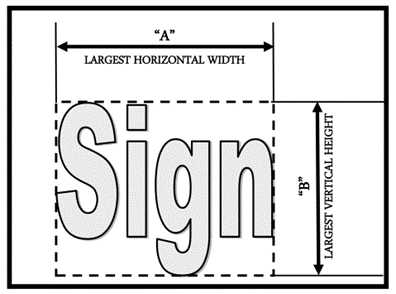
(b)
Individual letters.
(1)
When attached to the surface of a building, canopy, awning, wall or window, the sign area shall be calculated as that part of the smallest rectangle or other geometric shape that encompasses all of the letters or symbols. The sign area shall include all lettering, wording, and accompanying designs, or symbols.
(2)
When two identical sign faces are placed back to back so that neither face can be viewed from any point at the same time, and when such sign faces are part of the same sign structure and are not more than 42 inches apart, the sign area shall be computed by the measurement of one of the faces. The maximum angle permitted between faces of a multi-face sign is 45 degrees.
(Prior Code, § 1147.1100)
Sec. 10-797. - General sign regulations.
In addition to all regulations specific to types of signs above, all signs must comply with the following regulations:
(1)
Setbacks. Unless noted otherwise in relation to a specific zoning district or sign type, all signage shall maintain a setback of ten feet from any property line. Pylon signs, exclusive of the supporting structure, may project five feet into the minimum required setback with approval by the city engineer.
(2)
Interference. No sign shall, by reason of position, illumination, shape, size, color, or any other characteristic, interfere in any way with vehicle or pedestrian traffic, including, but not limited to, interference with the proper functioning or purpose of a traffic sign or signal or interference with traffic visibility.
(3)
Public property/right-of-way. No sign shall be located on public property or within a public right-of-way unless approved in writing by the public entity owning or controlling the property.
(4)
Illuminated signs. Unless noted otherwise in relation to a specific zoning district or sign type, illumination of signs is prohibited in all agricultural and residential zoning districts. Illuminated signs are allowed in the town center, commercial and industrial zoning districts, provided the signs shall be illuminated only by steady, stationary, shielded light sources that are either directed solely at the sign or are internal to them, without causing glare for motorists, pedestrians, or neighboring property.
(Prior Code, § 1147.1200)
Sec. 10-798. - Sign permit requirements.
(a)
Permit required. Before a sign requiring a permit under the provisions of this division is placed, constructed, erected, modified, or relocated, the property owner shall obtain a sign permit from the zoning administrator. The property owner shall maintain a sign permit for all signs on the property. Any sign involving electrical components shall be wired by a licensed electrician. A building permit may be required in cases where the state building code requires it.
(b)
Banner and sandwich board signs.
(1)
Permits for banners and sandwich board signs are issued annually. A banner or sandwich board permit is valid for one year commencing on January 1 and expiring on December 31 of the year of issuance. An applicant may apply for a banner or sandwich board permit at any time during the year, but the fee will not be prorated.
(2)
If a banner permit is issued for a multi-business building, the property owner shall allocate the time among the tenants to display the banner.
(c)
Application. Application for a sign permit shall be made in writing on the forms furnished by the city. The application shall contain the following information:
(1)
Name, address, telephone number and email address of the property owner, tenant (if applicable), and the company or individual who is providing and installing the sign.
(2)
Address and legal description of the property where the sign will be located.
(3)
Sign type.
(4)
Sign plan as described in section 10-799.
(5)
Other pertinent information as may be required by the zoning administrator.
The permit application shall be signed by the applicant. When the applicant is any person other than the owner of the property, the application shall also be signed by the owner of the property.
(d)
Exemptions. The following sign modifications shall not require a sign permit. These exemptions shall not be construed as relieving the owner of the sign from the responsibility of its proper erection and maintenance and its compliance with the provisions of this division or any other law or ordinance regulating the same:
(1)
Changing the advertising copy or message on a marquee, changeable copy, electronic message, or similar sign specifically designed for the use of replaceable copy.
(2)
Painting, repainting, replacement, or cleaning of a legal sign structure or sign whereby only the color or message is altered.
(Prior Code, § 1147.1300)
Sec. 10-799. - Sign plan requirements.
In addition to a sign permit application, no sign permit shall be issued until a sign plan for the entire property or building on which the sign will be erected has been submitted to the city and approved by the zoning administrator. The purpose of the sign plan is to provide accurate information for the city to determine whether the proposed sign is in compliance with the requirements of this division. The sign plan shall include:
(1)
Name, address, telephone number and email address for the property owner or duly authorized agent for the owner, tenant (if applicable) and sign company completing the work.
(2)
Description and dimensions for all existing signage which will remain on the property.
(3)
Identification of the type of signs to be erected by the applicant.
(4)
A site plan, drawn to scale depicting:
a.
Total building area and the proposed location of signs.
b.
Lot dimensions, building façade, easements, and existing rights-of-way and driveways.
c.
The design of each sign face and sign structure, including dimensions, total area, sign height, depth, color scheme, structural details, materials, lighting scheme and proposed location.
d.
Building elevations, existing and proposed façades, parapet walls, eaveline and the location and size of all proposed and existing permanent signage.
e.
Current photographs showing existing signs.
(5)
Plans, specifications, and method of construction or attachment to the building or in the ground, including all dimensions, showing all light sources, wattage, type and color of lights, details, and the manufacturer's specifications for the lighting fixture and any light shield or shades that will be used.
(6)
For multi-business buildings, in addition to the items listed above, a comprehensive sign plan shall be submitted and approved by the zoning administrator identifying the public entrances, tenant spaces with exclusive, exterior customer entrances, and the locations, size and type of all signage for the building and property. Upon approval by the zoning administrator, this plan will serve as a reference for all future sign permit applications on that subject property.
(Prior Code, § 1147.1400)
Sec. 10-800. - Maintenance.
(a)
All signs shall be constructed in such a manner and of such material that they shall be safe and substantial. All signs shall be maintained in a safe, non-deteriorating and sound structural condition at all times. Cracked, broken or bent, glass, plastic, wood or metal and burnt-out light bulbs and peeling, faded, or cracked paint must be repaired, replaced, or removed.
(b)
Any sign which the city finds is in a dangerous or defective condition shall be removed or repaired by the owner of the sign or the owner of the property on which the sign is located.
(Prior Code, § 1147.1500)
Sec. 10-801. - Lapse of sign permit.
A sign permit shall lapse automatically if the business related to the sign is discontinued for a period of at least one year.
(Prior Code, § 1147.1600)
Sec. 10-802. - Removal of signs.
(a)
Removal by city. If the city finds that any sign, or other structure regulated herein is unsafe or insecure, a menace to the public, or in violation of the provisions of this division or any conditions set out in the sign application or approved permit, city may remove the sign.
(b)
Removal process. The zoning administrator shall provide written notice to the permit holder or property owner of the problem and what action must be taken to bring the sign into compliance with this division. The permit holder or property owner shall bring the sign into compliance within seven calendar days after the notice is issued. The zoning administrator, in his/her sole discretion, may grant additional time to bring the sign into compliance. If the permit holder or property owner fails to bring the sign into compliance in the time provided or if the city deems the sign constitutes a danger, the city may enter the property and remove, repair, or make safe the sign. All costs incurred by the city, including administration expenses and reasonable attorney fees, may be levied against the property pursuant to Minn. Stats. ch. 429. The city shall not be required to store any removed sign. If the city does store the removed sign, the city shall not return the sign to the permit holder or property owner until the city's expenses for removal and storage have been paid. The city shall not be responsible for any damage or loss of a removed sign or for any reasonable action taken under this provision.
(c)
Snipe signs. The city may remove all snipe signs without any notice. The city shall not be required to store any removed sign. If the city does store the removed sign, the city shall not return the sign until the city's expenses for removal and storage have been paid. The city shall not be responsible for any damage or loss of a removed sign or for any other reasonable action taken under this provision.
(Prior Code, § 1147.1700)

