
Prosper City Zoning Code
CHAPTER 4
DEVELOPMENT REQUIREMENTS
SECTION 1. - SITE PLAN PROCESS[1]
(Ord. No. 2020-59, 9-8-2020)
SECTION 2. - LANDSCAPING[2]
(Ord. No. 2020-59, 9-8-20)
SECTION 3. - TREE MITIGATION[3]
(Ord. No. 18-11, 1-23-18)
SECTION 4. - PARKING, CIRCULATION, AND ACCESS[4]
(Ord. No. 2020-59, 9-8-20)
SECTION 5. - SCREENING FENCES AND WALLS[5]
(Ord. No. 2020-59; 9-8-20)
SECTION 8. - NON-RESIDENTIAL & MULTIFAMILY DESIGN AND DEVELOPMENT[6]
(Ord. No. 2020-59, 9-8-20)
SECTION 9. - ADDITIONAL AND SUPPLEMENTAL[7]
(Ord. No. 2020-59, 9-8-20)
1.1 - General.
This section establishes a site plan review process for land development. The process involves a series of two plans, progressing from a generalized evaluation of a site and development concept to approval of a detailed development plan.
The first plan is a preliminary site plan. This plan presents detailed information on building layout, parking, drives, landscaping, screening, and other site improvements. Preliminary site plan approval assures the applicant that the general layout is acceptable prior to proceeding with detailed engineering and design work. Site plan approval is the final step in the process. A site plan is a detailed, scaled drawing of all surface improvements, structures and utilities proposed for development. Site plan approval is required prior to a construction release and prior to the issuance of building permits. Preliminary site plans and site plans require review and approval by the Planning and Zoning Commission.
The purpose of this process is to:
A.
Ensure compliance with adopted town development regulations and other applicable regulations for which the town has enforcement responsibility.
B.
Promote safe, efficient and harmonious use of land through application of Town-adopted design standards and guidelines.
C.
Protect and enhance the town's environmental and aesthetic quality.
D.
Ensure adequate public facilities to serve development.
E.
Prevent or mitigate adverse development impacts, including overcrowding and congestion.
F.
Aid evaluation and coordination of land subdivision.
G.
Promote the public health, safety and welfare.
1.2 - Applicability.
The site plan review process shall apply to:
A.
Nonresidential development, except for agricultural buildings and temporary field construction offices/staging areas as permitted by the Building Official.
B.
Multifamily residential development having more than four dwelling units.
C.
Mobile home parks.
D.
Parking lot development, reconstruction or reconfiguration of more than 20 spaces.
1.3 - Submission of applications.
Applications for approval of plans required by this section must be submitted to the Planning Division. A calendar of official submittal dates for items requiring Planning and Zoning Commission approval shall be published by the town 30 days prior to the beginning of each calendar year. All applications received on a date other than an official submittal date shall be dated received on the next official submittal date. Applications must be complete for acceptance, in accordance with Chapter 1, Section 9.
1.4 - Fees, forms and procedures.
The Town Council shall establish a schedule of fees relating to the site plan approval process. The Director of Development Services may establish procedures, forms and standards with regard to the content, format and number of copies of information constituting an application for preliminary site plans and site plans.
1.5 - Preliminary site plan.
A.
General. A preliminary site plan is the first plan in the site plan approval process. The purpose of the plan is to:
1.
Ensure compliance with applicable development regulations and previously approved, valid plans affecting development of the property.
2.
Determine the placement, configuration, coverage, size and height of buildings.
3.
Determine the design of public street improvements and right-of-way, the design and location of drives, aisles and parking.
4.
Determine location and preliminary design of open space, landscaping, walls, screens and amenities.
5.
Determine the preliminary design of drainage facilities and utilities.
B.
Applicability. Except as provided in Chapter 4, Section 1.6(A), an approved, valid preliminary site plan shall be required prior to the consideration of a site plan for development property defined in Chapter 4, Section 1.2. The plan must include all contiguous property of common ownership, except that approved platted lots that are not part of the intended development may be shown for informational purposes only.
C.
Application procedure and requirements.
1.
Pre-application. Before preparing a preliminary site plan, the applicant shall meet with Planning Division staff to discuss the application procedure and requirements, and review the proposed development concept.
2.
General application. The property owner, or an authorized representative, shall submit an application for the approval of a preliminary site Plan. This application shall include the information listed in the development manual.
3.
Additional requirements. In addition to meeting the requirements for preliminary site plan approval, the following approvals may be necessary: (such applications and plans shall be accepted for filing, however, prior to approval of the preliminary site plan, and failure to submit such applications prior to approval of the preliminary site plan shall be grounds for denial or rejection of the preliminary site plan).
a.
Preliminary plat, if applicable.
b.
Preliminary utility plans, if applicable.
4.
Standards of Approval. The Planning and Zoning Commission may approve, conditionally approve, table or deny a Preliminary Site Plan based on:
a.
Conformance with the Comprehensive Plan and adopted design guidelines.
b.
Compliance with the zoning ordinance and other applicable regulations and previously approved, valid plans for the property.
c.
Impact on the site's natural resources.
d.
Affect on adjacent and area property and land use.
e.
Safety and efficiency of vehicular and pedestrian circulation, traffic control and congestion mitigation.
f.
Safety and convenience of off-street parking and loading facilities.
g.
Access for fire fighting and emergency equipment to buildings.
h.
Use of landscaping and screening to shield lights, noise, movement or activities from adjacent properties and to complement the design and location of buildings and parking.
i.
The location, size and configuration of open space areas to ensure that such areas are suitable for intended recreation and conservation uses.
5.
Effect. Approval of a preliminary site plan by the Planning and Zoning Commission shall constitute authorization by the town for the land owner(s) to submit an application for final site plan approval for development of the entire site or a portion thereof provided that the site plan conforms to the preliminary site plan and any conditions attached to its approval. During the time the preliminary site plan remains valid, the location of buildings, landscaped areas, open space, streets, drives, fire lanes, median breaks, curb cuts and parking shall remain fixed except as to permit minor adjustments resulting from subsequent engineering of improvements or to prevent a condition affecting public health or safety which was not known at the time of approval. Except where authorized by ordinance, a preliminary site plan may not be used to approve an exception to development regulations. Where an approved plan conflicts with an adopted regulation and no variance or exception is expressly approved, the regulation shall apply.
6.
Lapse. The approval of a preliminary site plan shall be effective for a period of two years from the date that the preliminary site plan is approved by the Planning and Zoning Commission, at the end of which time the applicant must have submitted and received approval of a site plan by the Planning and Zoning Commission. If a site plan is not approved within such two year period, the preliminary site plan approval is null and void. If site plan approval is only for a portion of the property, the approval of the preliminary site plan for the remaining property shall be null and void. The applicant shall be required to submit a new preliminary site plan for review and approval subject to the then existing regulations.
7.
Appeal. The applicant, Director of Development Services, or a simple majority of the Town Council may appeal the decision of the Planning and Zoning Commission by submitting a written notice of appeal to the Planning Division. The applicant or Director of Development Services must submit said written notice of appeal no later than 14 days from the date of such decision. The Town Council shall consider and act on whether it will appeal the Commission's decision no later than 14 days from the date of such decision or at its first regular meeting (for which there is time to post an agenda as required by law) that occurs after the Commission meeting at which the decision was made, whichever is later. Written notice of the Town Council's vote to appeal shall be submitted to the Planning Division within seven days of the Town Council's vote. The Town Council shall consider the appeal at a public meeting no later than 45 days after the date on which the notice of appeal is submitted to the Planning Division. The Town Council may affirm, modify, or reverse the decision of the Planning and Zoning Commission.
1.6 - Site plan.
A site plan is the final plan required in the site plan approval process. The site plan is a detailed plan of the public and private improvements to be constructed. The purpose of the plan is to:
• Ensure compliance with applicable development regulations and previously approved, valid plans affecting development of the property.
• Coordinate and document the design of public and private improvements to be constructed.
• Coordinate the subdivision of land, including the granting of easements, development agreements and provision of surety.
A.
Applicability. An approved and valid site plan shall be required prior to the approval of any construction plan and permit for any development defined in Chapter 4, Section 1.2 of this Ordinance. An approved, valid preliminary site plan is required prior to the consideration of a site plan except as provided below:
1.
Development of a single building on one lot not exceeding three net acres and where the lot is not being subdivided from a larger property.
2.
Development of property proposed to occur in a single phase.
2.
Development of parking or outside storage areas.
3.
Development of utilities and non-occupied structures.
4.
Development of outdoor recreation structures and amenities.
B.
Application procedure and requirements.
1.
Pre-application. Before preparing a site plan, the applicant shall meet with Planning Division staff to discuss the procedures for approval and to review the general concept of the proposed development.
2.
General application. The property owner shall submit an application for the approval of a site plan. This application shall include the information listed in the development manual.
3.
Additional requirements. The following plans shall be submitted with a site plan application and approval is necessary prior to final authorization for development:
a.
Final plat or replat.
b.
Engineering plans.
c.
Landscape plans.
d.
Facade plan, if applicable.
e.
Other approvals as required by ordinance or resolution.
4.
Standards of approval. Where application for site plan approval is made for development defined on an approved, valid preliminary site plan, the Planning and Zoning Commission may approve, conditionally approve or deny the application based upon the criteria listed below:
a.
Conformance with the Comprehensive Plan and adopted design guidelines.
b.
Compliance with the zoning ordinance and other applicable regulations and previously approved, valid plans for the property.
c.
The design and location of off-street parking and loading facilities to ensure that all such spaces are usable and are safely and conveniently arranged.
d.
The width, grade and location of streets designed to accommodate prospective traffic and to provide access for fire fighting and emergency equipment to buildings.
e.
The use of landscaping and screening (1) to provide adequate buffers to shield lights, noise, movement or activities from adjacent properties when necessary, and (2) to complement the design and location of buildings and be integrated into the overall site design.
f.
The location, size and configuration of open space areas to ensure that such areas are suitable for intended recreation and conservation uses.
g.
Protection and conservation of soils from erosion by wind or water or from excavation or grading.
h.
Protection and conservation of water courses and areas subject to flooding.
i.
The adequacy of streets, water, drainage, sewerage facilities, garbage disposal and other utilities necessary for essential services to residents and occupants.
5.
Effect. Approval of a site plan is the town's authorization to apply for approval of building permits and to receive approval of engineering plans. During the time the site plan remains valid the town shall not apply any additional requirements concerning building placement, streets, drives, parking, landscaping or screening. Site plan approval is separate and distinct from other permits and approvals as may be required by the town and other regulatory agencies. Approval of a site plan shall not affect other applicable regulations concerning development and land use. Except where authorized by ordinance, a site plan may not be used to approve a variance to development regulations. Where an approved plan conflicts with an adopted regulation and no variance or exception is expressly approved, the regulation shall apply.
6.
Lapse. The approval of a site plan shall be effective for a period of 18 months from the date of approval by the Planning and Zoning Commission, at the end of which time the applicant must have submitted and received approval of engineering plans and building permits. If the engineering plans and building permits are not approved, the site plan approval, together with any preliminary site plan for the property, is null and void. If engineering plans and permits have been approved only for a portion of the property and for improvements, the site plan for the remaining property and/or improvements, together with any preliminary site plan for the property, shall be null and void. The applicant shall be required to submit a new preliminary site plan and, subsequently, a new site plan consistent therewith, for review and approval by the Planning and Zoning Commission subject to the then existing regulations (see Chapter 4, Section 1.6(B)). Site plan approval shall expire upon completion of the improvements shown on the plan. Subsequent additional development, site modifications and redevelopment shall be permitted in accordance with Chapter 4, Section 1.10.
7.
Appeal. The applicant, Director of Development Services, or a simple majority of the Town Council may appeal the decision of the Planning and Zoning Commission by submitting a written notice of appeal to the Planning Division. The applicant or Director of Development Services must submit said written notice of appeal no later than 14 days from the date of such decision. The Town Council shall consider and act on whether it will appeal the Commission's decision no later than 14 days from the date of such decision or at its first regular meeting (for which there is time to post an agenda as required by law) that occurs after the Commission meeting at which the decision was made, whichever is later. Written notice of the Town Council's vote to appeal shall be submitted to the Planning Division within seven days of the Town Council's vote. The Town Council shall consider the appeal at a public meeting no later than 45 days after the date on which the notice of appeal is submitted to the Planning Division. The Town Council may affirm, modify, or reverse the decision of the Planning and Zoning Commission.
1.7 - Amendments.
At any time following the approval of a preliminary site plan or site plan, and before the lapse of such approval the property owner(s) may request an amendment. Amendments shall be classified as major and minor. Minor amendments shall include corrections of distances and dimensions, adjustments of building configuration and placement, realignment of drives and aisles, layout of parking, adjustments to open space, landscaping and screening, changes to utilities and service locations which do not substantially change the original plan. Any increase of building height or proximity to an adjacent (off-site) residential use shall not be considered a minor amendment. The Director of Development Services or his/her designee may approve or disapprove a minor amendment. Disapproval may be appealed to the Planning and Zoning Commission and Town Council (see Chapter 4, Section 1.6(B)(7) for appeal procedure). All other amendments shall be considered major amendments and will be considered by the Planning and Zoning Commission at a public meeting in accordance with the same procedures and requirements for the approval of a plan.
1.8 - Extension procedure.
A.
A property owner, or his/her representative, may request extension of an approved preliminary site plan if such request is submitted to the Director of Development Services, or his/her designee at least 30 days prior to lapse of such plan as provided in these regulations. The preliminary site plan may be extended up to 12 months. Application for the extension shall be made by submitting a development application to the town's Planning Division on or before one of the town's official submittal dates for development requests. The application shall be accompanied by a letter detailing the reason for the extension and by the required number of copies of the plan. If the Director of Development Services or his/her designee denies the extension, the applicant may request an appeal to the Planning and Zoning Commission in writing within 14 days of such denial. If the Planning and Zoning Commission denies the extension, the applicant may request an appeal to the Town Council in writing within 14 days of such denial.
In reviewing an extension request, the Director of Development Services or his/her designee shall consider the following:
• Has a site plan been submitted for any portion of the property shown on the preliminary site plan?
• Does the preliminary site plan comply with new ordinances, those approved after the initial approval of the preliminary site plan, that impact the health, safety, and general welfare of the community?
• Are there adequate public facilities, such as parks or schools, in the area surrounding the property?
Negative answers to any of the above shall be grounds to deny the extension or approve the extension with conditions. In granting any extension, the Director of Development Services or his/her designee, the Planning and Zoning Commission, upon appeal, or the Town Council, upon appeal, may apply current development standards to the application, or make such other conditions as are needed to assure that the land will be developed in a timely fashion and that the public interest is served. A second one year extension may be requested using the same process after the expiration of the initial extension.
B.
A property owner, or his/her representative, may request extension of an approved site plan if such request is submitted to the Director of Development Services, or his/her designee at least 30 days prior to lapse of such plan as provided in these regulations. Site plans may be extended up to six months. Application for the extension shall be made by submitting a development application to the town's Planning Division on or before one of the town's official submittal dates for development requests. The application shall be accompanied by a letter detailing the reason for the extension and by the required number of copies of the plan. If the Director of Development Services or his/her designee denies the extension, the applicant may request an appeal to the Planning and Zoning Commission in writing within 14 days of such denial. If the Planning and Zoning Commission denies the extension, the applicant may request an appeal to the Town Council in writing within 14 days of such denial.
In reviewing an extension request, the Director of Development Services or his/her designee shall consider the following:
• Has the preparation of civil engineering plans progressed, a grading permit been issued, or construction commenced?
A negative answer to the above shall be grounds to deny the extension. In granting an extension, the Director of Development Services or his/her designee, the Planning and Zoning Commission, upon appeal, or the Town Council, upon appeal, may apply current development standards to the application, or make such other conditions as are needed to assure that the land will be developed in a timely fashion and that the public interest is served. A second six-month extension may be requested using the same process after the expiration of the initial extension.
C.
In determining whether to grant such request, the Director of Development Services or his/her designee, the Planning and Zoning Commission, and/or the Town Council shall take into account the reasons for the requested extension, the ability of the property owner to comply with any conditions attached to the original approval and the extent to which newly adopted regulations shall apply to the plan. The Director of Development Services or his/her designee, the Planning and Zoning Commission, and/or the Town Council shall extend or reinstate the plan, with or without conditions, or deny the request, in which instance the property owner must submit a new application for approval.
D.
The Director of Development Services or his/her designee, the Planning and Zoning Commission, and/or the Town Council may extend or reinstate the approval subject to additional conditions based upon newly enacted regulations or such as are necessary to assure compliance with the original conditions of approval. The Director of Development Services or his/her designee, the Planning and Zoning Commission, and/or the Town Council may also specify a shorter time for lapse of the extended plan than is applicable to original approvals.
1.9 - Revocation of approval.
The Town Council or the Planning and Zoning Commission may revoke approval of a preliminary site plan or site plan if it determines that the conditions of the approval have not been met or if the plan contains, or is based upon, incorrect information. The town shall notify an applicant within 14 days of such revocation of approval via U.S. Postal Service.
1.10 - Additional development and redevelopment.
Following the completion of improvements shown on an approved site plan, additional development, site modifications or redevelopment of the site shall be permitted subject to the approval of a revised site plan. Minor expansions and redevelopment may be approved by the Director of Development Services or his/her designee under the terms of Chapter 4, Section 1.7. All other expansions or redevelopment shall require submittal of a revised site plan and the approval of the Planning and Zoning Commission under the requirements and procedures then in effect.
1.11 - Waiver of certain development regulations by the town manager.
Notwithstanding the authority granted to the Director of Development Services or his//her designee to approve or disapprove minor amendments, pursuant to Subsection 1.7 of this section, as amended, the Town Manager is hereby authorized to approve minor waivers or exceptions to any of the following development regulations contained in this Chapter: site plan requirements (Section 1), landscaping (Section 2), tree mitigation (Section 3), parking and loading requirements (Section 4), screening fences and walls (Section 5), outdoor lighting (Section 6), accessory buildings (Section 7), and non-residential design and development (Section 8), all as amended.
In no event shall the Town Manager approve any waiver or exception to a requirement that would (1) alter the permitted uses on the property; (2) increase the permitted density; (3) increase any permitted building height; (4) reduce any required setbacks; or (5) alter any façade requirements. Moreover, the Town Manager is not authorized and shall not approve any waiver or exception for any development requirement contained in a duly-authorized development agreement, including any requirements relative to building products or materials, or aesthetic method in the construction, renovation, maintenance or other alteration of a building.
(Ord. No. 2020-43, 5-12-20)
2.1 - Purpose.
The purpose of this section is to provide for the orderly and aesthetic development of the town and to promote the health, safety and general welfare of the community. It is the intent of this section to achieve the following:
• A balance between the need for landscape treatments and the need for commercial growth in the town.
• Promote a flexible attitude of enforcement sufficient to meet the spirit and intent of these requirements.
• To aid in stabilizing the environment's ecological balance by contributing to the processes of air purification, oxygen regeneration, ground-water recharge, storm water runoff retardation and erosion control.
• Provide for the separation and buffering of incongruous uses and intensity of activities; and provide for the visual softening of building masses.
• Reduce glare from paved surfaces, dust nuisances and the impact of noise.
• Protect and promote the value of residential and commercial properties within the town.
• Promote a positive image for the attraction of new business enterprises within the town.
• Encourage the protection of healthy trees and vegetation and promote the natural ecological environmental and aesthetic qualities of the town.
Therefore, landscaping is required of new development and altered or repaired construction on all developments, and construction of the developments shall conform to the standards in this section (the "Landscape Standards").
2.2 - Scope.
The standards and criteria contained in this section are the minimum standards for all new development and existing developments that are expanding or redeveloping 30 percent or more of that development. For the purposes of this section, expanding or redeveloping, shall be based on an increase of the overall building area. All construction in these developments shall conform to this section. In addition, any use requiring a specific use permit (SUP) or any property having a Planned Development (PD) zoning designation must comply with these landscape standards or the standards set forth in the SUP or PD zoning designation, whichever is more restrictive. The provisions of this section shall be administered and enforced by the Director of Development Services, or his/her designee. For new construction, landscape standards shall be shown on a landscape plan as required in this section.
A.
Permits. No permits will be issued for building, paving, utilities or construction until a landscape plan is submitted and approved by the town. A certificate of occupancy will not be issued until the landscape plan approved by the town has been installed in accordance with that plan and approved by the town.
If a certificate of occupancy is sought during a season of the year in which the town determines that it would be impractical to plant trees, shrubs or grass, or to lay turf, the developer/owner will deposit with the town a sum of money equal to the cost of installing all or the remaining portion of the approved landscape plan. In lieu of paying cash, the developer/owner may provide financial assurance of payment of the cost of installing the landscape plan acceptable to the town, which will remain in effect until the landscape plan is installed and accepted by the town. The landscape plan will be installed within six months of final acceptance of the development by the town or issuance of the first certificate of occupancy within the development. Failure to do so will be a violation of this ordinance and subject to the penalties contained herein.
B.
Enforcement. If at any time after the issuance of a certificate of occupancy, the landscaping that was installed does not conform to the landscape plan or the landscape standards, the town will issue notice to the property owner, tenant and/or agent, citing the violation and describing the action required to comply with this section. The owner, tenant or agent shall have 30 days from date of said notice to comply with approved landscape plan. If the landscaping is not installed within the allotted time, the property owner, tenant, and agent shall be in violation of this ordinance. In addition to any other remedy available to the town, the certificate of occupancy for that property may be revoked.
2.3 - Landscape plan.
A.
A landscape plan shall be submitted in conjunction with a site plan and/or final plat for all developments. A landscape plan is not required for individual single family lots. With the exception of properties consisting of less than two acres and located in DTO, DTR, or DTC district, the landscape plans shall be prepared by a landscape architect and shall contain the information outlined in the development manual.
2.4 - Maintenance.
A.
The owner, tenant and/or their agent, if any, shall be jointly and severally responsible for the maintenance of all landscaping required by this ordinance. All plant material shall be perpetually maintained in a healthy and growing condition as is appropriate for the season of the year. Plant materials that die shall be replaced by property owner, tenant or agent with plant material of similar variety and size, within 30 days of notification by the town or a date approved by the town.
B.
All trees located on town property shall be cared for by the town unless that responsibility is transferred to another entity through a Council-approved agreement. The Director of the Parks and Recreation Department shall ensure that the town, or its contractor, monitors and cares for trees in a way that promotes a healthy and growing urban forest, is performed according to ANSI A300, "Standards for Tree Care Operations," and tree care best management practices published by the International Society of Arboriculture. It shall be unlawful to remove, prune, damage or otherwise harm trees on town property without permission from the Director of the Parks and Recreation Department. The Parks and Recreation Department shall be responsible for developing and updating an annual work plan. This work plan shall document what maintenance activities are being performed and scheduled each year. The Parks and Recreation Board may appoint an advisory committee to focus on issues and initiatives that pertain to any urban forest that is located on public lands.
(Ord. No. 17-74, 9-26-17)
2.5 - General standards.
The following criteria and standards shall apply to landscape materials and installation:
A.
All required landscaped open areas shall be completely covered with living plant material. Mulch and other materials can be used around required shrub and tree plantings. Supplemental plantings or design elements that are beyond requirements can be submitted for town review and approval at any time. Landscape plans must meet the minimum requirements of this section prior to approval by the town.
B.
Plant materials shall conform to the standards of the approved plant lists in this section and substitutions of plant material may be approved by the town. The quantity of plant material required by this section must equal or exceed the minimum number of plants required by this section. Unless otherwise noted on the approved landscape plan, required plant material can be placed in groupings or utilized in appropriate planting designs that are proposed by the applicant and approved by the town.
C.
Trees shall have an average spread of crown of greater than 15 feet at maturity. Trees having a lesser average mature crown of 15 feet may be substituted by grouping the same so as to create the equivalent of 15 feet crown of spread. Unless otherwise specified herein, trees shall be of a minimum of three inches in caliper as measured 12 inches above natural soil level and seven feet in height at time of planting.
D.
Shrubs other than dwarf variety shall be a minimum of two feet in height when measured immediately after planting. A screening hedge, where required, shall be planted and maintained so as to form a continuous, unbroken, solid visual screen that will be three feet in height within one year after planting. Any parking area abutting the landscape perimeter will be screened from the adjacent street as approved by the town. Parking areas that are beyond 60 feet from the property line do not require screening unless adjacent to a residential zoning district or a residential development.
E.
Ground covers used in lieu of grass must provide complete coverage within one year of planting. Ground cover planting must provide and maintain adequate coverage as approved by town.
F.
Earthen berms shall not exceed a 3:1 slope (three feet of horizontal distance for each one foot of height). All berms will contain adequate drainage and preventive erosion measures as may be required by the town. Berms shall not include construction debris. Slippage or damage to the smooth finish grade of the berm must be corrected prior to acceptance by town.
G.
Large trees must be planted four feet or greater from curbs. Large trees shall be placed a minimum of four feet from sidewalks, utility lines, screening walls and/or other structures. Ornamental trees can be placed closer than four feet with approval from the town. Any reduction in spacing requires a root barrier approved by the town. Utility installation that includes common trench and conduit banks is exempt from the large tree planting distance requirements. The town has final approval for all tree placements. The landscape plan will show the size and location of duct banks.
H.
Evergreen trees such as conifers intended for screening will have a minimum height of six feet at the time of planting. Evergreen shrubs intended for required screening shall be a minimum of seven gallons and be capable of attaining six feet in height in two growing seasons.
I.
A Tree Permit, in accordance with Chapter 4, Section 3.3, and/or grading permit is required for all clear-cutting and/or mass removal of under-story or wooded areas.
J.
All driveways will maintain visibility as approved by the town. Landscaping shall not impede visibility affecting the health, safety, and welfare of the public.
K.
All plantings intended for erosion control will be maintained by the land owner, applicant, or tenant. The town may require re-vegetation to prevent erosion or slippage.
L.
Small trees maybe substituted for large trees at the rate of three small trees for each one large tree (3:1) with approval of the town. Unless otherwise specified herein, small trees will have a minimum size of three inch caliper.
M.
New or proposed plant materials will be measured and sized according to the Texas Association of Nursery (TAN) standards.
N.
Other plant materials in excess of the quantities required in this Ordinance may be smaller than the required material. All shrubs intended for public, non-residential, or multi-families developments should be at least two gallons or more.
O.
Alternate designs may be considered by the town to conform to the intent of this ordinance. Any alternate design requires town approval. The alternate method of utilizing large quantities of small material may include, but are not limited to:
One five-gallon shrub = Two three-gallon or four two-gallon
One three-inch large tree = Three three-inch ornamental trees
All substitutions are subject to town approval and must be specified on the approved landscape plan.
P.
The right-of-way adjacent to required landscape areas shall be maintained by the adjacent property owner in the same manner as the required landscape area.
Q.
Existing trees on a property that are preserved may be used to meet the requirements of this section upon approval by the town.
1.
Existing trees approved by the town for credit are to remain in a living and growing condition. Any existing tree for which credit was given that dies shall be replaced on the same basis as set forth in this section.
2.
Large groups of small or under-story trees are eligible for tree preservation credits with approval from the town. Credits shall be indicated on the landscape plan.
3.
Credit will be revoked where trees intended for preservation credits are damaged due to, among other things, construction, broken branches, soil compaction or soil cut/fill.
2.6 - Landscape area requirements.
A.
Single Family, two family (duplex), town home, and mobile home landscape area requirements.
1.
Trees from the large tree list in Section 2.7 below shall be planted on all single-family detached, two family (duplex), and town home lots. Trees shall be planted to meet the total number of caliper inches referenced in the table below. Required trees shall not be smaller than three caliper inches. A minimum of one - four caliper inch tree(s) shall be located in the front yard of all residential lots less than 7,000 square feet in size. A minimum of two - four caliper inch trees shall be located in the front yard of all residential lots 7,000 square feet in size and larger. The remaining required large trees may be placed in the front or rear of the residential lot. The total caliper inches of large trees and number of shrubs are required as shown in the table below.
2.
A minimum of one tree from the large tree list in Section 2.7 below shall be planted in the side yard area adjacent to the street on a corner lot. When more than two trees are required per lot, the corner lot, side yard tree may count toward the requirement. Street trees (trees located in the parkway area between the curb and the sidewalk) adjacent to the side yard of a corner lot may count toward the requirement.
3.
Ground cover shall be planted in the front, side, and rear yards of all residential lots. Ground cover includes, but is not limited to: grasses, shrubs, mulched planter beds, and hardscape.
4.
Required shrubs shall be a minimum of three gallon in size when planted and shall be planted in the front yard of all residential lots.
5.
All landscaping required above shall be planted prior to issuance of the certificate of occupancy on the dwelling.
6.
Two family (duplex) and townhome open space. Each parcel of land developed under the 2F or TH standards shall provide usable open space totaling ten percent for 2F and 20 percent for TH of the area being developed. The open space shall be computed on the percentage of total platted area in the subdivision, excluding right-of-way dedicated major thoroughfares. This open space shall be owned and maintained by a homeowners' association. Areas provided as usable open space shall meet the following criteria:
a.
All residential lots must be located within 1,400 feet of a usable open space area as measured along a street. In order to preserve existing trees or should a property have unique topography, size, or configuration, this distance may be increased by the Planning and Zoning Commission with approval of the plat.
b.
All open space areas shall be minimum of 20,000 square feet with no slope greater than ten percent and no width less than 50 feet. The Planning and Zoning Commission may give full or partial credit with approval of the plat for open areas that exceed the maximum slope or that are otherwise unusable, if it is determined that such areas are environmentally or aesthetically significant.
c.
Open space areas must be easily viewed from adjacent streets and homes. Open space areas must abut a street on a minimum of 40 percent of the perimeter of the open space. However, the perimeter street requirement may be reduced to 30 percent with Planning and Zoning Commission approval of the preliminary plat when:
i.
Preserving existing trees;
ii.
Preserving natural geographic features; or
iii.
Physical constraints such as overall property size, configuration, or topography exist.
d.
Landscaping, sidewalks, and amenities such as tennis courts and swimming or wading pools may be located within usable open space areas. Detention ponds that contain a constant water level, are landscaped, or otherwise treated as an amenity for the development, as determined by the Director of Development Services or his/her designee, may be calculated toward the required open space.
e.
Open space shall contain one minimum three-inch caliper large tree for every 1,000 square feet of required open space. The tress shall be maintained in a healthy and growing condition, and must be replaced with trees of similar variety and size if damaged, destroyed, or removed. A landscape plan must be approved prior to approval of the final plat.
B.
Multifamily landscape area requirements. These standards apply to all multifamily zoning districts. Any area within a PD district containing landscaping standards shall comply with the standards set forth in the PD district.
1.
General requirements.
a.
Landscaped areas will be of varying depths intended to separate and screen incompatible land uses from one another and to provide green areas along major thoroughfares.
b.
Foundation plantings of a single row of shrubs are required along the front façade of all buildings adjacent to a public street.
c.
Trees required by the open space planting requirements are encouraged to be placed along the south and west sides of the residential building(s) to increase energy efficiency.
d.
A summary of tabulations for all required plantings, preservation credits, tree mitigation, and/or other data as necessary to document the landscape requirements shall be shown on the landscape plan.
2.
Perimeter requirements.
a.
A landscaped area at least 25 feet wide shall be located between multifamily developments and public street(s) unless otherwise stated in another ordinance. One large tree, three-inch caliper minimum, will be planted on 30 foot centers within the required landscaped area (or quantity for size substitution can be approved by the town). All landscaping shown on the approved landscape plan will be installed in the vicinity of the building and its adjoining parking prior to the issuance of a certificate of occupancy for units in said building. Required landscape areas adjacent to public streets shall be exclusive of easements or other restrictions which could inhibit planting, growth, or permanence of landscaping.
b.
Where multifamily development is adjacent to the property line of single family zoned property or areas shown as single family on the future land use plan, a double row of three-inch caliper trees on 50 foot offset centers shall be located adjacent to single family zoning districts with one row being shade trees and the other row being evergreen trees in a 25 foot wide landscape perimeter area, unless otherwise approved by the Director of Development Services or his/her designee.
c.
Where a multifamily development is adjacent to the property line of property zoned for uses other than single family or parcels not shown as single family on the future land use plan, a 15-foot wide landscape area is required. In addition, one large tree, three-inch caliper minimum, will be required for each 50 linear feet that abuts the adjacent property line. Trees will be located within the 15 foot perimeter area or within the area located between the property line and the side or rear building line. Trees required under this section that are planted in parking areas may not be credited towards meeting the number of required trees as outlined in the interior parking requirements listed below.
d.
Berms ranging in height from three feet to six feet, and an overall minimum average of four and a half feet, shall be required along US 380, Frontier Parkway/FM 1461/Parvin Road, Custer Road/FM 2478, Preston Road, Dallas Parkway, and FM 1385.
3.
Interior parking requirements.
a.
Twenty square feet of landscaping for each parking space shall be provided within the paved boundaries of the parking lot, exclusive of the required perimeter landscape requirements stated above.
b.
One large tree, three-inch caliper minimum, must be provided for every ten parking spaces, in addition to the perimeter trees required in Chapter 4, Section 2.6(B)(2). In addition, the trees required in this section may not be planted in the required perimeter landscaped areas to receive credit for the perimeter landscape area. Three small trees, a minimum of six feet in height and three inches in diameter, may be substituted for one required large tree for up to 25 percent of the required large trees.
c.
Landscaped islands within the parking lot shall be a minimum of 160 square feet, not less than nine foot wide, and a length equal to the abutting space.
d.
There shall be at least one large tree, three inch caliper minimum, within 50 feet of every parking space. Only trees located in parking areas are available to meet this requirement.
e.
Landscaped islands will be located at the terminus of all parking rows, and should contain at least one large tree, with no more than 12 parking spaces permitted in a continuous row without being interrupted by a landscaped island. Areas where parking is located between the public street and the buildings, trees will be placed every five parking spaces.
f.
Landscape islands in parking areas may be grouped to form one large island subject to town approval, provided however, grouping for large islands is prohibited adjacent to public street frontage.
g.
All landscaped areas will be protected by a raised six inch concrete curb or wheel stop where curbs are not provided. Pavement will not be placed closer than four feet from the trunk of a tree unless a town approved root barrier is utilized.
h.
A solid living screen using evergreen trees shall be placed around any RV/trailer parking areas.
4.
Irrigation requirements. Permanent irrigation shall be provided for all required landscaping as follows:
a.
Irrigation lines shall be placed a minimum of two and one-half feet from a town sidewalk. Reduction of this requirement is subject to review and approval by the Town Engineer.
b.
Trees and shrubs shall be irrigated by bubbler irrigation lines only. Other landscaping may be irrigated by spray irrigation. Separate valves shall be provided to turn off the spray irrigation line during periods of drought or water conservation.
c.
Rain, freeze, and wind detectors shall be installed on all irrigation lines.
5.
Open space.
a.
Each parcel of land developed under the MF standards shall provide usable open space totaling 30 percent of the area being developed. The open space shall be computed on the percentage of total platted area in the subdivision, excluding right-of-way dedicated major thoroughfares. Areas provided as usable open space shall meet the following criteria:
i.
The open space shall have a maximum slope not exceeding ten percent.
ii.
The open space shall have a minimum dimension of not less than 30 feet.
iii.
Of the required open space, 15 percent or 20,000 square feet, whichever is greater, shall be arranged or located in a contiguous mass. Flood plain used for open space may receive full credit for that portion that is maintained in its natural state. Floodplain that is reclaimed and used for open space shall receive a 50 percent credit toward open space.
iv.
At the time of preliminary site plan approval, the Planning and Zoning Commission may give full or partial credit for open areas that exceed the maximum slope, that are otherwise unusable, or that are less than the 15 percent or 20,000 square feet required in Chapter 4, Section 9.16(B)(3). These areas must be determined to be environmentally or aesthetically significant and/or an enhancement to the development or the area.
v.
Landscaping, sidewalks, and amenities such as tennis courts, swimming or wading pools, and clubhouses may be located within usable open space areas. Detention ponds that contain a constant water level, are landscaped, or otherwise treated as an amenity for the development, as determined by the Director of Development Services or his/her designee, may be calculated toward the required open space.
vi.
Open space shall contain one minimum three-inch caliper large tree for every 1,000 square feet of required open space. The tress shall be maintained in a healthy and growing condition, and must be replaced with trees of similar variety and size if damaged, destroyed, or removed. A landscape plan must be approved prior to approval of the final plat.
C.
Non-residential landscaped area requirements. These standards apply to all non-residential uses. Any area within a PD containing landscaping standards shall comply with the standards set forth in the PD district.
1.
Perimeter requirements:
a.
A landscaped area consisting of living trees (as specified below), turf, or other living ground cover and being at least 25 feet in width measured from the property line interior to the property shall be provided adjacent to and outside of the right-of-way on all properties located adjacent to a major or minor thoroughfare as defined by the Town of Prosper Thoroughfare and Circulation Designs Standards.
i.
The landscaped area may be reduced to 15 feet for the portion of a property adjacent to a collector or equivalent street as defined by the Town of Prosper Thoroughfare and Circulation Designs Standards.
ii.
The landscaped area shall be increased to 30 feet for properties adjacent to Preston Road, University Drive, and Dallas Parkway.
iii.
One large tree, three-inch caliper minimum per 30 linear feet of roadway frontage shall be planted within the required landscape area. The trees may be planted in groups with appropriate spacing for species.
iv.
In the DTO District, one large tree, three-inch caliper minimum per 30 linear feet of roadway frontage, excluding the width of driveways at the property line, shall be planted within the required landscape area. Where the width of the roadway frontage is greater than 80 feet, excluding the width of driveways at the property line, the number of large trees may be planted at a rate of one, three-inch large tree per 40 feet of roadway frontage, in lieu of the required one tree per 30 linear feet. The trees may be planted in groups with appropriate spacing for species. In the DTO District, the substitution of three small, ornamental trees for one large tree shall not be permitted.
v.
A minimum of 15 shrubs with a minimum size of five gallons each will be planted in the landscaped area for each 30 feet of linear frontage.
vi.
Parking abutting the landscape area shall be screened from the adjacent roadway. The required screening may be accomplished with shrubs or earthen berms.
vii.
Unless there is parking adjacent to the landscape area, shrubs are not required in the landscape area in the DTO District.
viii.
Required landscape areas adjacent to public streets shall be exclusive easements or other restrictions which could inhibit planting, growth, or permanence of landscaping.
ix.
Berms ranging in height from three feet to six feet, and an overall minimum average of four and a half feet, shall be required along US 380, Frontier Parkway/FM 1461/Parvin Road, Custer Road/FM 2478, Preston Road, Dallas Parkway, and FM 1385.
b.
Where a non-residential development is adjacent to the property line of residential zoned parcels or areas shown as residential on the future land use plan, one large tree, three-inch caliper minimum, will be planted on 30 foot centers in a 15 foot landscape area, with the following exceptions:
i.
Evergreen trees, three-inch caliper minimum, that will reach a minimum of 15 feet in height, shall be planted on 20 foot centers within the 15 foot landscape area where truck docks or loading spaces are adjacent to residentially zoned property or areas shown as residential on the future land use plan.
ii.
Evergreen trees, three-inch caliper minimum, that will reach a minimum of 15 feet in height, shall be planted on 20 foot centers within the 15 foot landscape area on any lot containing a drive-through restaurant, drive-in restaurant, and/or automotive use as defined in Chapter 4, Section 9.11(A) that is adjacent to a residential zoning district or area shown as residential on the future land use plan. All landscape screening materials shall be maintained in a manner to provided the intended screening.
iii.
In the DTO District, regardless of the adjacent use, zoning, or future land use designation; the width of perimeter landscape area adjacent to the property line may be reduced to a minimum of five feet.
iv.
In the DTO District, in lieu of the required large trees, one small (ornamental) tree shall be planted 30-foot centers along the adjacent property lines.
c.
Where a non-residential development is adjacent to the property line of parcels zoned for uses other than residential or parcels not shown as residential on the future land use plan:
i.
A five-foot-wide landscape area is required.
ii.
If the property line is the centerline of a fire lane or drive aisle, the five-foot-wide landscape area will begin at the edge of the lane/aisle. If the drive aisle or fire lane only allows access to parking spaces, the landscape area may be eliminated or moved at the discretion of the town.
iii.
The five-foot-wide landscape area may be eliminated for a building where the building is attached to another building and the attached buildings are shown on an approved site plan.
iv.
One small tree and one five-gallon shrub shall be planted every 15 linear feet. These trees and shrubs may be clustered in lieu of placing them every 15 feet.
v.
All uses containing a drive-in, drive-through, or that require stacking shall provide a ten-foot-wide landscape area along the perimeter of the property. If the property line is the centerline of a fire lane or drive aisle, the ten-foot-wide landscape area will begin at the edge of the lane/aisle. The landscape area shall contain a minimum three-inch caliper evergreen trees planted 15 feet on-center with minimum five-gallon shrubs planted three feet on center.
2.
Interior parking requirements. Any non-residential parking area that contains 20 or more parking spaces shall provide interior landscaping, in addition to the required landscaped edge, as follows:
a.
Fifteen square feet of landscaping for each parking space shall be provided within the paved boundaries of the parking lot area.
b.
Where an existing parking lot area is altered or expanded to increase the number of spaces to 20 or more, interior landscaping shall be provided on the new portion of the lot in accordance with this section.
c.
All landscaped areas shall be protected by a raised six-inch concrete curb. Pavement shall not be placed closer than four feet from the trunk of a tree unless a town approved root barrier is utilized.
d.
Landscaped islands shall be located at the terminus of all parking rows, and shall contain at least one large tree, three-inch caliper minimum, with no more than 15 parking spaces permitted in a continuous row without being interrupted by a landscaped island. Where there is a minimum eight-foot-wide landscaped median between two rows of head-in parking, landscaped islands are required every 20 spaces.
e.
Landscaped islands shall be a minimum of 160 square feet, not less than nine feet wide and a length equal to the abutting space.
f.
Subject to approval by the town, islands may be grouped to form one large island.
g.
There shall be at least one large tree, three-inch caliper minimum, within 150 feet of every parking space. This minimum distance may be expanded with town approval in the event that required islands are grouped to form larger islands.
h.
Required parking lot trees may be consolidated into groups under the following conditions:
i.
The number of required trees is one per ten parking spaces.
ii.
Consolidated tree islands require 180 square feet per tree.
iii.
The maximum run of parking spaces is increased from 15 to 30.
iv.
This consolidation does not include the tree islands at the end of a row of parking or along perimeter parking rows that face a drive aisle or street.
v.
A consolidated tree island shall not be located closer than five parking spaces from an end of row tree island.
i.
All uses containing a drive-in, drive-through, or that require stacking shall be subject to the following standards:
i.
A minimum five-foot-wide landscape island shall be constructed around the outer edge of the drive-through lane(s) along the outer edge of the escape lane, extending from the point entry to the exit.
ii.
The landscape island shall contain minimum three inch caliper evergreen trees planted 15 feet on-center with minimum five gallon shrubs planted three feet on center. Ornamental trees may be used in place of a portion of shrubs to create a mixture of species and types of vegetation. If the landscape island is located on the perimeter of the property, perimeter landscaping requirements may be applied towards this requirement.
3.
Building landscaping.
a.
Foundation plantings are required for buildings or groups of contiguous buildings that are 100,000 square feet or larger. One large tree, three inch caliper, shall be required for every 10,000 square feet of gross building area. These trees shall be located within 30 feet of the face of the building. These plantings are intended to provide pedestrian areas while breaking up the large areas of impervious surface. Trees required by other sections of this ordinance will not meet this requirement. Trees may be planted within the building landscape area described above or within tree grates. Trees can be grouped or planted in singular form. These tree plantings should be placed so as not to impede sign visibility. Trees intended for foundation plantings shall meet the following criteria:
i.
Planted within 30 feet of the front building face.
ii.
Trees planted less than four feet from the back of curb shall be located in a tree grate with a minimum dimension of four feet.
iii.
Small trees may be substituted for large tree foundation plantings at the rate of five ornamentals for each requirement of a large tree (5:1) with town approval. Small trees shall have a minimum size of three inch caliper. Multi-trunk trees will be required to meet a three inch requirement based on standard nursery trade specifications.
iv.
Trees may be placed in groups with appropriate spacing for species.
v.
The above requirements may be reduced if approved by the town and additional pedestrian features such as plazas, seating areas, fountains, and outdoor recreation facilities are provided. These facilities must occupy an area equal to or greater than five percent of the total building area.
b.
In the DTR and DTC Districts, large trees shall be planted every 30 feet on center in tree grates within the sidewalk a minimum of four feet behind the back of curb. The trees shall be a minimum three inch caliper at the time of planting.
4.
Irrigation requirements. Permanent irrigation shall be provided for all required landscaping as follows:
a.
Irrigation lines shall be placed a minimum of two and one-half feet from a town sidewalk or alley. Reduction of this requirement is subject to review and approval by the Town Engineer.
b.
Trees and shrubs shall be irrigated by bubbler irrigation lines only. Other landscaping may be irrigated by spray irrigation. Separate valves shall be provided to turn off the spray irrigation line during periods of drought or water conservation.
c.
Rain, freeze, and wind detectors shall be installed on all irrigation lines.
5.
Median planting requirements. Non-residential developments having frontage on a divided thoroughfare are required to plant or escrow funds for one three-inch caliper large tree per 70 linear feet of frontage. The purpose of this requirement is to establish trees in the medians as development of properties adjacent to divided thoroughfares occurs. The Town will be responsible for maintenance of the trees and medians following the initial installation. The town is responsible for the installation of trees and irrigation where funds are escrowed or a bond is provided. The Town will have the sole authority to approve any alternate methods of meeting median obligations. Right-of-way median plantings shall meet the following criteria:
a.
Median plantings within the public right-of-way are to be a minimum of 60 feet from back of curb at the median nose.
b.
Median plantings shall be a minimum of five feet from back of curb.
c.
Visibility corridors are to be shown on landscape plans.
d.
Trees shall be a minimum of five feet from utility lines.
e.
Six inches of topsoil shall be provided in medians.
6.
Open space requirements.
a.
A final open space plan shall be submitted with the final site plan application for all non-residential uses. Open space plans will be used only to ensure minimum standards are met. Open space plans shall be reviewed and approved by the Director of Development Services or his/her designee. The applicant may appeal the decision to the Planning and Zoning Commission. For nonresidential development, seven percent of the net lot area is required to be provided as open space. The open space may consist of any element that is not one of the following:
i.
Vehicular paving.
ii.
Required parking lot landscape islands.
iii.
Building footprint.
iv.
Utility yards.
v.
Required landscape setbacks.
vi.
Sidewalks, unless the sidewalk is designated as an outdoor dining area on the approved site plan.
vii.
Detention ponds. Detention ponds that are located between the building and street and contain a constant water level, are landscaped, or otherwise treated as an amenity for the development, as determined by the Director of Development Services or his/her designee, may be calculated toward the required open space.
D.
Nonresidential and multifamily development adjacent to a major creek:
1.
Major creeks within the Town of Prosper shall be defined as:
• Button Branch
• Doe Branch
• Gentle Creek
• Rutherford Branch
• Wilson Creek
Each major creek begins at its headwater (as determined by the Federal Emergency Management Agency and/or the U.S. Army Corps of Engineers) as is generally depicted on Flood Insurance Rate Maps (FIRM) as provided by the Federal Emergency Management Agency.
2.
All nonresidential and multifamily lots developing adjacent to the 100-year floodplain of a major creek shall comply with the requirements listed below. Multifamily-zoned property that develops as single-family is not subject to these requirements, but shall comply with Section 14 of the subdivision ordinance, as it exists or may be amended.
a.
Retaining walls, where provided, shall be constructed of clay-fired brick, stone, patterned concrete, modular concrete block, or split faced concrete masonry units. This requirement does not apply to walls constructed within the channel of the creek to control water flow.
b.
Three inch caliper trees planted on 30 foot centers and three gallon shrubs planted on five foot centers shall be provided between parking and the flood plain when parking is located directly adjacent to the flood plain. The trees and shrubs are not required to be planted in a single row; they may be planted in groups. Existing trees in healthy growing condition and of a species from the list of recommended plant materials in Chapter 4, Section 2 of this Ordinance, as it exists or may be amended, may be counted toward this requirement.
c.
Maintenance access, as required by the Town Engineer, or his/her designee, shall be provided to the flood plain, hike and bike trail, and creek.
d.
The development shall incorporate a connection to a hike and bike trail along the major creek by way of a sidewalk, stairs, and/or ramps. The connection shall comply with ADA and TAS accessibility requirements. The Director of Development Services or his/her designee may waive this requirement if he/she determines that a connection is not needed due to the property size, configuration and constraints, or land use.
e.
Open space areas adjacent to the floodplain that have been improved with patios, courtyards, or additional landscaping listed in Section 9.14(C)(1) and Section 9.14(C)(6) below may be used to meet minimum open space requirements.
f.
Loading areas located adjacent to the major creek shall be screened from the flood plain by a solid living screen to reach a minimum of 14 feet tall within two years. Existing trees in healthy growing condition and of an evergreen species from the list of Recommended Plant Materials in Chapter 4, Section 2 of this ordinance, as it exists or may be amended, may be counted toward this requirement. For industrial development, this requirement may be waived by the Planning and Zoning Commission upon site plan approval if the adjacent property on the opposite side of the creek is zoned Industrial or designated on the future land use plan as industrial, unless zoned other than industrial.
3.
Multifamily, except those multifamily properties that are developed as single-family, and office development adjacent to a major creek shall provide four of the amenities listed below. Retail and commercial development adjacent to a major creek shall provide three of the amenities listed below. Industrial development adjacent to a major creek shall provide two of the amenities listed below. Amenity selection is subject to approval by the Planning and Zoning Commission upon preliminary site plan or site plan approval.
a.
A 30 foot landscape edge adjacent to the floodplain of the major creek with a double row of three inch caliper trees planted on 30 foot centers. Existing trees in healthy growing condition and of a species from the list of recommended plant materials in Chapter 4, Section 2 of this Ordinance, as it exists or may be amended, may be counted toward this requirement.
b.
A minimum of 25 percent of the surface area of walls that face the major creek to be provided as windows.
c.
Construction of a hike and bike trail along the creek.
d.
A visibility corridor of at least 100 feet shall be required between and/or adjacent to buildings adjacent to the flood plain. This visibility corridor can include parking, landscape medians or areas, amenities, and drive aisles.
e.
Trail Head Park. A trailhead park shall have minimum dimensions of 50 feet and be located adjacent to the hike and bike trail. Park benches shall be provided. Trailhead parks are subject to review and approval by the Director of Parks & Recreation or his/her designee.
f.
A common patio, balcony, courtyard, or terrace a minimum of 750 square feet located between the building and the major creek.
g.
Building orientation such that the entire side of the building adjacent to the flood plain is not the back of the building.
h.
Building to have the same building materials and architectural elements on all four sides.
i.
Creek restoration (plan shall be designed and implemented according to USACOE standards and approved by Army Corps of Engineers).
j.
Other amenities not listed may be approved by the Planning and Zoning Commission in conjunction with a preliminary site plan if they determine that the proposed amenity meets the intent of these requirements.
4.
The Planning and Zoning Commission may grant variances to the requirements of this section, as it exists or may be amended, upon preliminary site plan or site plan approval only if they determine that conforming to these requirements is not possible due to the property size, configuration, topography, constraints, or land use and that no other alternative is available. The decision by the Planning and Zoning Commission may be appealed to the Town Council using the site plan appeal process described in Chapter 4, Section 1, as it exists or may be amended.
(Ord. No. 15-55, 9-22-15; Ord. No 16-46, 7-26-16; Ord. No. 2024-08, § 3, 1-9-24)
2.7 - Required plant materials.
A.
Artificial plants or turf are expressly prohibited. Drought tolerant and/or native plants from the lists below are required for compliance to this section. Other species may be utilized with approval from the town.
*Ornamental Pear does not include Bradford Pears
B.
Landscaping installed that exceeds the minimum required amounts above does not have to be from the drought tolerant/native plant lists contained herein. However, cottonwood trees may not be planted within 25 feet of any public infrastructure.
3.1 - Purpose.
The purpose of this section is to promote site planning which furthers the preservation of mature trees and natural areas; to protect trees during construction; to facilitate site design and construction which contribute to the long-term viability of existing trees; and to control the removal of trees when necessary. It is the further purpose of this section to achieve the following broader objectives:
A.
Prohibit the indiscriminate clearing of property.
B.
Protect and increase the value of residential and commercial properties within the town.
C.
Maintain and enhance a positive image for the attraction of new residences and business enterprises to the town.
D.
Protect healthy quality trees and promote the natural ecological environmental and aesthetic qualities of the town.
E.
To reduce the erosive effects of rainfall.
3.2 - Scope.
The scope of this section includes the removal and/or transplanting of any tree and mitigation for the removal of protected trees. A permit approved by the Director of Development Services or his/her designee is required before removing and/or transplanting any tree and mitigation for the removal of protected trees.
3.3 - Definitions.
The following words, terms and phrases, when used in this article, shall have the meanings ascribed to them in this section, except where the context clearly indicates a different meaning:
Protected tree means a tree that is determined to be healthy by the Director of Development Services, or his/her designee, and meets one of the following requirements:
• Any tree, regardless of species, within a 100-year floodplain, six inches or larger in diameter when measured at a point four and one-half feet above the ground level and which normally attains a height of at least 12 feet at maturity.
• Any tree outside of the floodplain, except those listed below, six inches or larger in diameter when measured at a point four and one-half feet above the ground level and which normally attains a height of at least 12 feet at maturity.
Historic tree means any protected tree 40 inches or larger in diameter when measured at a point four and one-half feet above the ground level and which normally attains a height of at least 12 feet at maturity; or any tree deemed to be of historical significance.
Unprotected trees means the following trees shall not be included in the above definition of protected trees:
3.4 - Tree permit.
A tree permit shall be required for the transplanting and/or removal of all trees within the Town of Prosper, regardless of size or species, except for trees located on a single-family or two-family lot contained within a plat of record, and as otherwise described in Chapter 4, Section 3.5 below.
A.
Application for tree permit. An application for a tree permit may be submitted at any time and is not required to be submitted in conjunction with development plans, final plat or a building permit. Tree permits shall be obtained by making application to the Director of Development Services, or his/her designee. The application must include a letter signed by the property owner allowing the town access to the property for verification of all survey information. The application shall also be accompanied by a written document indicating the reasons for transplanting and/or removal of protected trees and two copies of a legible site or planting plan, and a detailed tree survey and preservation plan if required in Chapter 4, Section 3.10.
B.
Review of application for tree permit. Upon receipt of a proper application for a tree permit, the Director of Development Services or his/her designee shall review the application and may conduct field inspections of the site or development and/or refer the permit application to other departments for review and recommendations as deemed necessary and appropriate by the town. Protected trees may not be removed or transplanted unless the Director of Development Services or his/her designee approves the tree permit. The Director of Development Services or his/her designee shall act on a tree permit application within ten business days of its submittal. If action has not been taken within this specified time frame, the application shall be deemed approved.
C.
Historic tree preservation. No tree removal permit may be issued for a historic tree unless the owner establishes that preserving the historic tree constitutes an unreasonable financial hardship on the owner. Appeals from this determination shall be to the Town Council.
3.5 - Exceptions.
A.
A tree permit shall be required to remove and/or transplant a protected tree, except for a protected tree located on a single-family or two-family lot contained within a plat of record and having a certificate of occupancy. The Director of Development Services or his/her designee may authorize, in writing, removal of a protected tree provided that the protected tree:
1.
Is determined to be in a hazardous or dangerous condition so as to endanger the public health, welfare or safety;
2.
Hinders or obstructs the construction, maintenance, repair, and/or replacement of Town streets, water and sewer lines, and drainage and storm sewer;
3.
Is located in any major thoroughfare right-of-way dedicated to and accepted by the town. This does not include trees being removed for proposed neighborhood streets, driveways, right and left turn lanes, and/or median openings. Removal of these trees shall require a permit and mitigation at a rate of 50 percent of the mitigation requirements contained in Chapter 4, Section 3.7(A) of this Ordinance;
4.
Hinders or obstructs the construction, repair, maintenance, and/or replacement of public improvement projects including, but not limited to, major collection lines for sanitary sewer, distribution lines for water, collection and management of storm water runoff and thoroughfares pursuant to the town's Capital Improvement Project, Water and Sanitary Distribution Line Maps and/or Thoroughfare Plan;
5.
Is damaged or killed by a tornado, ice or wind storms, flooding or other acts of nature; or
6.
A tree that is determined to be diseased or dead by a certified arborist or landscape architect, regardless of species or size.
B.
All retail, commercial, and wholesale nurseries are exempt from the terms and provisions of this section 3 in relation to those trees planted and growing on the premises of said business and that are planted and growing for the sale or intended sale in the ordinary course of business only.
C.
Utility companies franchised by the town in easements or rights-of-way accepted by the town or otherwise authorized to provide utility service may remove protected tree(s) that endanger public safety and welfare by interfering with utility service. Any trimming and/or removal of protected tree(s) by a utility company requires prior written approval from the Director of Development Services or his/her designee, except in the case of emergency repairs. A utility company shall notify the Director of Development Services or his/her designee of any trimming and/or removal of protected trees done while making emergency repairs on the first business day following the emergency.
D.
The mowing and clearing of brush located within or under the drip lines of protected trees is allowed, provided such mowing or clearing is accomplished by hand or by mechanical mowers with turf tires.
E.
Developments that have submitted a preliminary plat for residential development or a final plat for non-residential development prior to the effective date of this ordinance shall be exempt from this ordinance.
F.
The removal of trees for the development or redevelopment of golf courses and pedestrian trails shall require a permit and mitigation at a rate of 50 percent of the mitigation requirements contained in Chapter 4, Section 3.7(A) of this ordinance.
G.
Agricultural users can remove protected tree(s) for agricultural production with prior written permission from the Director of Development Services or his/her designee. A protected tree inventory summary is required to list tree(s) removed and preserved. Replacement requirements of protected tree(s) being removed for agricultural production will be prorated equally over a period of ten years. Should the property be developed prior to the full ten years the remainder of required trees shall be planted on the property in addition to the required trees.
H.
A tree located on a common property line may not be removed without first obtaining a tree permit. Each of the affected property owners must request the tree permit. A single request may be submitted if it is signed by each of the affected property owners.
3.6 - Mitigation for trees removed.
A.
It shall be the responsibility of any person obtaining a tree permit for the removal of protected trees to provide replacement tree(s) having a total diameter of inches equivalent to the percentage rates set forth in Chapter 4, Section 3.7(A). The diameter for replacement trees shall be measured as follows:
1.
For single-trunk trees, the width shall be measured at four and one-half feet above ground level.
2.
For multi-trunk trees, combine the diameter of largest stem or trunk with one-half of the diameter of each additional stem or trunk, all measured at four and one-half feet above ground level.
An example: If an eight-inch protected tree in the flood plain is removed that tree must be replaced at 150 percent by trees with a total caliper width of 12 inches. This total caliper width could be satisfied by one 12-inch caliper replacement tree, or two six inch caliper width replacement trees, or any other combination providing a total caliper width of 12 inches using a minimum width of three inches.
B.
Should a transplanted tree die, it shall be removed and replacement trees shall be planted at a rate of 100 percent of the caliper inches of the transplanted tree(s).
C.
If any tree, which was preserved and used as a credit toward mitigation requirements is later removed for any reason, it shall be replaced by the number of trees for which it was originally credited. Replacement trees shall have a minimum trunk diameter of three inches measured six inches above the ground.
D.
If any replacement tree cannot be properly located on the property being developed or redeveloped, the applicant may plant these replacement tree(s) on property owned by the town and/or common open space and/or pay a fee, as approved by the Director of Development Services, or his/her designee. The cash value of replacement trees will be set by the Director of Development Services, or his/her designee, annually.
E.
The person(s) or entity responsible for the developing and or redeveloping property that causes or results in the removal of existing Tree(s) in proposed driveways, right turn lanes, and/or in proposed median openings, shall plant replacement tree(s) at a rate of 100 percent of the total diameter of the tree(s) being removed. The replacement tree(s) will be planted on public property according to a written plan approved by the Director of Development Services or his/her designee.
3.7 - Replacement requirements.
A.
Removal of protected trees. Protected trees shall be replaced by planting trees on the property equal to the total caliper inches as calculated using the following replacement rate:
* All existing tree measurements are in caliper inches as measured four and one-half feet above the natural ground level.
** All replacement tree measurements are in caliper inches as measured twelve inches above natural ground level.
B.
Transplanted trees. Protected trees on a property may be transplanted to another location on the same property without being subject to the above replacement rates.
C.
Tree credits. If any protected tree is preserved within an area that would otherwise be considered a buildable area, credit for preservation shall be given that will be counted toward the mitigation requirements for the removal of protected trees within the buildable area on a site or project. Such mitigation credits shall be given only for those trees whose critical root zones are left predominately in their natural state. No cutting, filling, or other construction related activities are allowed within the critical root zones of trees eligible for mitigation credit unless otherwise approved in writing and in advance by the town. Following is a list of credits available for the preservation of protected trees on a site or project. Tree credits will be awarded using the following table:
*(One credit is equal to one three-inch caliper tree. Healthy, protected trees only.)
D.
Any tree that is preserved and receives positive credit towards mitigation is exempt from being used to fulfil required landscaping as described in Chapter 4 Section 2 of this ordinance.
E.
Any tree preserved within a floodplain is exempt from receiving positive credit towards mitigation.
3.8 - Transplanting protected trees.
No person(s) or entity, directly or indirectly, shall replant, relocate, transfer or move from one location to another any protected tree within the town without first obtaining a tree permit as provided in Chapter 4, Section 3.4. All transplanting shall be in accordance with the applicable Texas Association of Nurserymen Grades and Standards shall satisfy the tree replanting requirements of this section.
3.9 - Tree protection measures.
Prior to construction, the contractor or subcontractor shall construct and maintain, for each protected tree on a construction site, a protective fence and where necessary, bark protection (See Diagram A). All protective measures shall be in place prior to commencement of any site work and remain in place until all exterior work has been completed.
During any construction or land development, the developer shall clearly mark all trees to be maintained. The developer shall not allow the movement of heavy equipment or the storage of equipment, materials, debris, or fill to be placed within the drip line of any trees. This is not intended to prohibit the normal construction required within parking lots. All protected tree(s) shall be protected by the owner as follows, unless otherwise directed by the Director of Development Services or his/her designee:
A.
Before development or redevelopment, the owner shall install a minimum three foot tall protective barricade made of wood, fencing or solid material. These barricades will be installed a minimum of ten feet from protected trees or a minimum of two feet outside the designated protective root zone, whichever is the greater distance.
B.
Vertical posts no less than three feet in height and no more than six feet apart. Horizontal members consisting of wood no less than three feet above existing grade and securely attached to the vertical posts.
C.
Before development or redevelopment, the owner shall establish and maintain a construction entrance that avoids protected trees.
D.
During the construction stage of development, the developer shall not allow cleaning of equipment or material under the canopy of any tree or group of trees to remain, nor shall the developer allow the disposal of any waste material such as, but not limited to, paint, oil, solvents, asphalt, concrete, mortar, etc., under the canopy of any tree or groups of trees to remain. No attachment or wires of any kind, other than those of a protective nature, shall be attached to any tree.
E.
No parking or storing of vehicles, equipment or materials allowed within the protective root zone.
F.
Attachments or wires are prohibited from being attached to any protected tree. Cables, tree rods, and similar hardware installation that aid structural integrity of a protected tree are exempt from this section as approved in writing by the Director of Development Services or his/her designee.
G.
Fill or excavation may not occur within the canopy or drip line of a protected tree. Major changes of grade (i.e., three inches or greater) within the canopy or drip line will require additional measures to maintain proper oxygen and water exchange with the roots.
H.
Unless otherwise approved in writing by the town, construction or construction-related activity is prohibited under the canopy or drip line of protected trees.
I.
Any trees removed shall be chipped and used for mulch on site or hauled off-site. Burning of removed trees, stumps, or foliage requires written approval by the Fire Department.
J.
Root pruning will be required when disturbance will occur under the drip line of protected trees. This root pruning shall be completed a minimum of two weeks prior to any construction activity within the drip line.
K.
All tree maintenance techniques shall be in conformance with industry identified standards. Alternative maintenance techniques may be approved by the town.
L.
No person(s) or entity may use improper or malicious maintenance or pruning techniques which would likely lead to the death of the tree. Improper or malicious techniques include, but are not limited to, topping or other unsymmetrical trimming of trees, trimming trees with a backhoe, or use of fire or poison to cause the death of a tree.
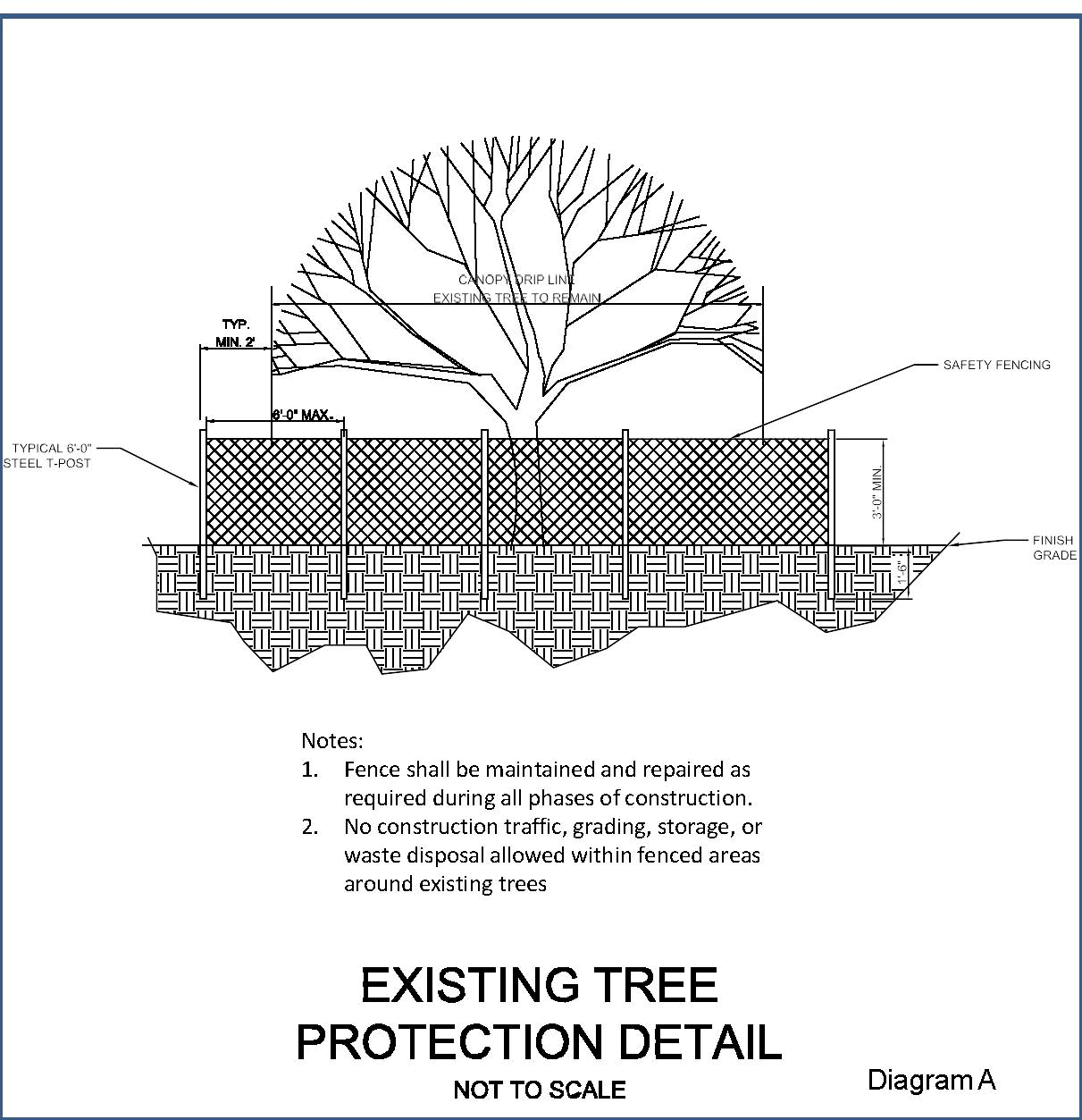
3.10 - Tree survey and preservation plan.
A.
Preliminary plat and preliminary site plans. A general survey identifying natural vegetation, trees, and anticipated tree losses shall be submitted with all preliminary plats for residential developments and all preliminary site plans for non-residential and multi-family developments within the protected area. The general tree survey can be included on the preliminary plat or preliminary site plan. The general survey shall include:
1.
Existing topography at five foot intervals;
2.
Vegetation groups;
3.
Development plans;
4.
Specific trees that are 20 inches and larger; and
5.
Photographic information is to accompany submission with sufficient data to convey which trees are to remain as they correspond to the general survey.
B.
Final site plans and final plats. A detailed tree survey and tree preservation plan shall be submitted with all site plans and final plats. The detailed tree survey and tree preservation plan shall include the following:
1.
The location, diameter, height, and common name of all single-trunk trees of six inches diameter or greater, measured at four and one-half feet above natural grade level, and at least 12 feet high; and all multi-trunk trees having a total caliper width of six inches, measured by combining the diameter of the largest stem or branch with one-half the diameter of each additional stem or branch, all measured at four and one-half feet above natural grade level, and at least 12 feet high.
2.
The location of the trunk and drip line, diameter, height, estimated age (not to be determined using invasive measures which might damage the tree), a reproducible color photograph, and common name of the protected trees proposed to be removed or transplanted.
3.
Provide existing natural grade elevation and proposed final grade elevation at each location for each protected tree for which a tree permit is requested.
4.
The location and dimensions of all existing or proposed public streets, alleys, rights-of-way, and utility easements.
5.
The location of all existing or proposed property lines, lot lines, building lines, setback and yard requirements, any proposed building footprint or floor plan, and other special relationships or significant features on the proposed development plans, final plat and site plan of the development.
6.
Existing and proposed site elevations, grades and major contours including a table listing all protected trees and their respective locations.
7.
The information required herein shall be summarized in legend or table form on the tree survey and note the reason for removal or transplanting of the protected tree(s).
8.
The survey shall bear the stamp or seal of a registered surveyor relative to the location of any protected trees and shall bear the stamp, seal, or signature of a registered landscape architect, certified arborist, or arboriculturist relative to the specie(s) of any protected tree.
9.
A detail tree survey shall be prepared by or under the supervision of a landscape architect, certified arborist, or certified forester. The following shall be on the tree survey:
"I ___________ being a landscape architect or arborist attest that the identification and size of trees identified on this survey are correct and that all Protected Trees have been shown.
Signature: ___________ Date: ________
10.
A detailed survey is only required for areas that are intended to be disturbed by the proposed development/redevelopment. A boundary of the area to be included in a detailed survey will be established with the approval of the general survey that is submitted with the preliminary plat or preliminary site plan.
C.
Field verification. Prior to written approval of the detailed tree survey and tree preservation plan, the applicant shall mark all trees to be preserved and notify (in writing) the Director of Development Services or his/her designee of the marking. The Director of Development Services or his/her designee shall inspect and verify the markings within seven working days of his/her receipt of applicants' notification. If the Director of Development Services, or his/her designee, has not contacted the land owner within ten working days from the date of notification, the detailed tree survey and tree preservation plan submitted by the applicant is deemed approved.
D.
Preparation. Prior to the preconstruction meeting or obtaining a grading permit, all tree markings and protective fencing and standard erosion control measures (i.e. silt fence) must be installed by the owner and be inspected by the Director of Development Services or his/her designee. Approved silt fence may serve as protective fencing and must remain in place until the town accepts the project. A stop work order will be issued at any time if Tree preservation requirements are not being met.
E.
Final Inspections. The owner shall notify the Director of Development Services or his/her designee for an inspection ten working days prior to receiving a certificate of occupancy. Any deficiencies or dead trees shall be replaced prior to receiving the certificate of occupancy.
3.11 - Enforcement.
The town Landscape Architect shall be authorized to approve tree loss mitigation plans. The provisions of this section shall be enforced by the Landscape Architect and Code Compliance Officer. The Landscape Architect shall be an employee of the town and certified as an arborist by the International Society of Arboriculture (ISA) or registered as a landscape architect by the Texas Board of Architectural Examine.
3.12 - Violations and penalties.
A.
Any person(s) or entity causing the transplanting or removing of a tree without first obtaining an approved tree permit is in violation of this ordinance.
B.
Each tree removed or transplanted without a permit shall constitute a separate offence. Violation of this ordinance shall not constitute an exemption to the replacement requirements contained herein.
C.
A person commits an offense if the person critically alters a protected tree not meeting an exception listed in this section without first obtaining a tree permit from the town.
D.
A person commits an offense if the person critically alters a tree in violation of a tree permit.
E.
Any person who violates this section by critically altering a protected tree without first obtaining a tree permit from the town, or by critically altering a tree in violation of the permit, or by failing to follow the tree replacement procedures, shall be guilty of a misdemeanor and upon conviction shall be fined $100.00 per caliper inch of the tree critically altered, not to exceed $500.00 per incident. The unlawful critical alteration of each protected tree shall be considered a separate incident and each incident shall subject the violator to the maximum penalty set forth herein for each tree.
F.
Any person, firm, corporation, agent or employee thereof who violates any provisions of this section other than those listed in above, shall be guilty of a misdemeanor and upon conviction hereof shall be fined not to exceed $500.00 for each incident. The unlawful critical alteration of each protected tree shall be considered a separate incident and each incident subjects the violator to the maximum penalty set forth herein for each tree.
G.
Allegation and evidence of a culpable mental state is not required for the proof of an offense defined by this section.
H.
Acceptance of improvements. The town may refuse to accept any public improvements until the person pays all penalties for violations of this section; provided, however, that acceptance of public improvements shall be authorized before all trees shall be replaced if, with the Director of Development Services' approval, the person furnishes the town with a cash deposit or surety bond in the approximate amount of the cost to replace the tree.
I.
Certificate of occupancy. No certificate of occupancy (CO) shall be issued until any and all penalties for violations of this section have been paid to the town. No CO shall be issued until all required replacement trees have been planted or appropriate payments have been made to the reforestation fund; provided, however, that a CO may be granted before all trees have been replaced if, with the Director of Development Services' approval, the person furnishes the town with a cash deposit or surety bond in the approximate amount of the cost to replace the tree.
4.1 - Purpose.
To secure safety from fire, panic, and other dangers; to lessen congestion on public streets; to facilitate the adequate provisions of transportation; to conserve the value of buildings; and to encourage the most appropriate use of land. Minimum off-street parking and loading shall be provided as set forth in the following schedules and provisions.
4.2 - Residential parking provisions (Z12-0002).
A.
Required parking shall be provided on the same lot as the use it is to serve.
B.
All required parking spaces shall be constructed from paved concrete or another similar impervious surface if approved by the Town Council prior to construction.
C.
For agricultural uses in the A District, required parking may be constructed from washed gravel, asphalt, or similar all-weather surface.
D.
No required parking space, garage, carport, or other automobile storage space shall be used for the storage of any heavy load vehicle.
E.
In the SF, DTSF, TH and 2F Zoning Districts, there shall be a minimum of two parking spaces located behind the front building line and enclosed in the main or an accessory building. In addition, there shall be two paved parking spaces provided behind the front property line only for the purpose of allowing on-site stacking or maneuvering to the enclosed spaces.
F.
In the SF, DTSF, TH and 2F Zoning Districts, all required parking spaces shall be a minimum of nine feet wide and 20 feet long. Required enclosed parking and stacking spaces shall remain clear of any encroachments.
G.
Circular driveways shall be designed to accommodate any required parking behind the front building line.
(Ord. No. 12-06, 2-14-12)
4.3 - Non-residential and multifamily parking provisions.
A.
To prevent nuisance situations, all parking area lighting shall be designed and operated so as not to reflect or shine on adjacent properties and in accordance with the standards established in Chapter 4, Section 6 of this ordinance.
B.
For safety and fire-fighting purposes, free access through to adjacent parking areas shall be provided between adjoining non-residential parcels or building sites.
C.
All required parking spaces shall be constructed from paved concrete or another similar impervious surface if approved by the Town Council prior to construction. Parking spaces shall be permanently and clearly identified by stripes, buttons, tiles, curbs, barriers, or other approved methods. Non-permanent type marking, such as paint, shall be regularly maintained to ensure continuous clear identification of the space.
D.
Dead-end parking aisles are not permitted. In the DTO District, where 20 or fewer off-street parking spaces are provided, a dead-end parking aisle is permitted.
E.
Each head-in parking space shall be a minimum of nine feet wide and 20 feet long, exclusive of driveways and maneuvering aisles, and shall be of usable shape and condition (see Chapter 5, Section 2.3, Illustrations A-G). Where it is possible for a vehicle to overhang the front of a parking space above a paved, stoned, mulched, or grassed area other than a sidewalk, street right-of-way, or adjacent property, the depth of the standard space may be reduced to 18 feet. No parking space shall overhang required landscape areas. Parallel parking spaces must be a minimum of eight feet wide and 22 feet long. Parking spaces within non-residential structured parking garages shall be a minimum of eight and one-half feet wide and 18 feet long.
F.
All parking and loading spaces and vehicle sales areas on private property shall have a vehicle stopping device installed so as to prevent parking of motor vehicles in any required landscaped areas, and to prevent any parked vehicle from overhanging a public right-of-way line, or public sidewalk. Parking shall not be permitted to encroach upon the public right-of-way in any case. All vehicle maneuvering shall take place on-site. No public right-of-way shall be used for backing or maneuvering into a parking space.
G.
Refuse storage facilities placed in a parking lot shall not be located in a designated parking or loading space. Each refuse facility shall be located so as to facilitate pickup by refuse collection agencies and shall be screened according to Chapter 4, Section 5 of this Ordinance.
H.
Handicap parking space(s) shall be provided according to State of Texas Program for the Elimination of Architectural Barriers and shall conform to the Americans Disability Act (ADA) of 1991, as may be amended, accessibility guidelines or the Uniform Federal Accessibility Standards.
I.
Parking shall be prohibited in required landscape areas and on unimproved surfaces. Institutional uses shall be exempt from this requirement.
J.
Reserved.
K.
Reserved.
L.
Internal drive aisles shall be designed to incorporate 90 degree intersections. A five degree variance is allowable.
M.
All parking spaces for a building must be located within 350 feet of walking distance from the building's public entrance. Big Box, Industrial, Wholesale, and Institutional uses are excluded from this provision.
N.
Parking spaces that face and are adjacent to a building shall utilize curbs, wheel stops, and/or bollards.
O.
Speed bumps are not permitted within a fire lane.
P.
Drive aisles in front of buildings cannot be longer than 300 feet continuous without an offset equal to the width of the drive aisle, traffic circle, or other acceptable traffic-calming feature approved by the Director of Development Services or his/her designee.
Q.
Restaurants shall receive a 50 percent reduction to the required parking for areas designated as outdoor dining. The reduction in parking only applies to parking spaces that are required due to the square footage of the outdoor dining area.
R.
All paved areas, which includes, but is not limited to, parking areas, fire lanes, drive aisles, driveways, turn-arounds, and loading areas, shall be paved with concrete or a comparable surface (masonry pavers, stone, brick, etc.), constructed to standards approved by the Director of Development Services or his/her designee. Pervious concrete or other alternative permeable paving surfaces may be used if approved by the Town Council. The use of asphalt, gravel, and crushed rock are strictly prohibited, unless approved as a temporary paving surface by the Director of Development Services or his/her designee. (Z10-0007)
S.
Cart returns shall be constructed of ornamental metal and be permanently affixed to pavement.
T.
For industrial, wholesale, and institutional uses, no more than ten percent of the required parking can be located in the service/loading area of a building except for buildings located on the street.
U.
Multifamily parking is only allowed between the building and a public street when located at or beyond the required landscape setback and screened with a headlight screen of earthen berms and/or a row of shrubs. Buildings with enclosed garages, when adjacent to a public street, must face garage doors internally to the development. Garage doors may not face a public street. No detached garages may be located between residential buildings and a public street. Enclosed garage parking spaces shall be a minimum of ten by 20 feet.
V.
Multifamily access to a public street in a single-family neighborhood will be limited access and will not function as a primary access point for the complex. Access to single-family alleys is prohibited. Direct or indirect access to a median opening where located on divided thoroughfare is required.
W.
Drive aisles within multifamily developments cannot be longer than 500 feet continuous without an offset equal to the width of the drive aisle, traffic circle, or other acceptable traffic-calming feature approved by the Director of Development Services or his/her designee.
(Ord. No. 16-46, 7-26-16)
4.4 - Parking access from a public street—All districts.
A.
In the approval of a development plan, consideration shall be given to providing entrance/exit drives which extend into the site to provide adequate queuing of vehicles on the site.
B.
In all districts (except all SF and 2F Districts) building plans shall provide for entrance/exit drive(s) appropriately designed and located to minimize traffic congestion or conflict within the site and with adjoining public streets as approved by the Building Official or designated representative.
1.
Where based upon analysis by the town, projected volumes of traffic entering or leaving the planned developments are likely to interfere with the projected peak traffic flow volumes on adjoining streets, additional right-of-way and paving in the form of a deceleration lane or turn lane may be required to be furnished by the land owner in order to reduce such interference.
2.
The determination of additional right-of-way or paving requirements shall be made at the submittal and approval of a preliminary site plan for multifamily and non-residential developments and preliminary plat for all other residential developments.
C.
Vehicular access to non-residential uses shall not be permitted from alleys serving residential.
D.
All retail/commercial driveways served by a median opening shall be divided.
1.
Driveway medians located along major thoroughfares shall be a minimum of six feet wide, and a depth equivalent to the required throat depth, as determined by the Engineering Department. Medians are required to be comprised of natural turf and/or landscaping that does not obstruct visibility, as determined by the Parks Department.
2.
Driveway medians located along minor thoroughfares shall be a minimum of four feet wide, and a depth equivalent to the required throat depth, as determined by the Engineering Department. Medians are required to be comprised of natural turf and/or landscaping that does not obstruct visibility, as determined by the Parks Department.
E.
All non-residential properties shall have access to a median opening either directly, or through cross access.
F.
All non-residential lots shall provide cross access drive aisles to adjacent non-residential properties.
1.
If used as a fire lane, the cross access drive aisle shall meet all the criteria for a fire lane.
2.
A shared driveway located along a common property line is encouraged and satisfies the requirement for cross access.
4.5 - Parking requirements based on use.
In all zoning districts, at the time any building or structure is erected or structurally altered, parking spaces shall be provided in accordance with the following requirements:
• Automobile oil change and similar establishments: One parking space per service bay plus one parking space per maximum number of employees on a shift.
• Bank, savings and loan, or similar institution: One space per 350 square feet of gross floor area.
• Bed and breakfast facility: One space per guest room in addition to the requirements for a normal residential use.
• Bowling alley: Three parking spaces for each alley or lane.
• Business or professional office (general): One space per 350 square feet of gross floor area except as otherwise specified herein.
• Car wash: One space per 500 square feet of gross floor area, or one space per employee, whichever is greater. Stacking and/or self-service areas shall not count toward required parking.
• Church, rectory, or other place of worship: One parking space for each three seats in the main auditorium.
• College or university: One space per each day student.
• Community center, library, museum, or art gallery: Ten parking spaces plus one additional space for each 300 square feet of floor area in excess of 2,000 square feet. If an auditorium is included as a part of the building, its floor area shall be deducted from the total and additional parking provided on the basis of one space for each four seats that it contains.
• Commercial amusement: One space per three guests at maximum designed capacity.
• Country club or golf club: One parking space for each 150 square feet of floor area or for every five members, whichever is greater.
• Dance hall, assembly or exhibition hall without fixed seats: One parking space for each 200 square feet of floor area thereof.
• Dwellings, single family and duplex: Two covered spaces, located behind the front building line, and two maneuvering spaces for each unit.
• Dwellings, multifamily: Two spaces for one and two bedroom units, plus one-half additional space for each additional bedroom.
• Flea market: One space for each 500 square feet of site area.
• Fraternity, sorority, or dormitory: One parking space for each two beds on campus, and one and one-half spaces for each two beds in off campus projects.
• Furniture or appliance store, hardware store, wholesale establishments, machinery or equipment sales and service, clothing or shoe repair or service: Two parking spaces plus one additional parking space for each 300 square feet of floor area over 1,000.
• Gasoline station: Minimum of three spaces for employees. Adequate space shall be provided for waiting, stacking, and maneuvering automobiles for refueling.
• Golf course: Five parking spaces per hole.
• Health studio or club: One parking space per 200 square feet of exercise area.
• Hospital: One space per employee on the largest shift, plus one and one-half spaces per each bed or examination room whichever is applicable.
• Hotel: One parking space for each sleeping room or suite plus one space for each 200 square feet of commercial floor area contained therein.
• Kindergartens, day schools, and similar child training and care establishments shall provide one paved off-street loading and unloading space for an automobile on a through "circular" drive for each ten students, or one space per ten students, plus one space per teacher.
• Library or museum: Ten spaces plus one space for every 300 square feet, over 1,000 square feet.
• Lodge or fraternal organization: One space per 200 square feet.
• Manufacturing or industrial establishment, research or testing laboratory, creamery, bottling plant, warehouse, printing or plumbing shop, or similar establishment: One parking space for each employee on the maximum working shift plus space to accommodate all trucks and other vehicles used in connection therewith, but not less than one parking space for each 1,000 square feet of floor area.
• Medical or dental office: One space per 250 square feet of floor area. Facilities over 20,000 square feet shall use the parking standards set forth for hospitals.
• Mini-warehouse: Four spaces per complex plus one additional space per 300 square feet of rental office.
• Mobile home park: Two spaces for each mobile home plus additional spaces as required herein for accessory uses.
• Mortuary or funeral home: One parking space for each 50 square feet of floor space in slumber rooms, parlors or individual funeral service rooms.
• Motel: One parking space for each sleeping room or suite plus one additional space for each 200 square feet of commercial floor area contained therein.
• Motor vehicle repair and service: Three parking spaces per service bay plus one parking space per maximum number of employees on a shift.
• Motor-vehicle salesroom and used car lots: One parking space for each 500 square feet of the structure. These required spaces may not be used to store or display automobiles for sale.
• Nursing home: One space per five beds and one parking space for each 1,000 square feet of lot area for outdoor uses.
• Private club or restaurant with a private club: One parking space for each 75 square feet of gross floor area.
• Retail store, except as otherwise specified herein (Z13-0010): One space per 250 square feet of gross floor area.
• Restaurant, cafe or similar dining establishment: One parking space for each 75 square feet of gross floor area for stand alone buildings without a drive-through, and one parking space for each 100 square feet of gross floor area for restaurants located within a multi-tenant building and for stand alone buildings with a drive-through.
• Rooming or boarding house: One parking space for each sleeping room.
• Sanitarium, convalescent home, home for the aged or similar institution: One parking space for each five beds.
• School, elementary, secondary, or middle: One and one half (1.5) parking spaces per classroom, or the requirements for public assembly areas contained herein, whichever is greater.
• School, high school: One and one-half parking spaces per classroom plus one space per five students the school is designed to accommodate, or the requirements for public assembly areas contained herein, whichever is greater.
• Theater, sports arena, stadium, gymnasium or auditorium (except school): One parking space for each four seats or bench seating spaces.
• Truck stops: One truck parking space for each 10,000 square feet of site area, plus one vehicle parking space per 200 square feet of building area.
• Warehouse, wholesale, mini, manufacturing and other industrial type uses: One space per 1,000 square feet of gross floor area, or one space per maximum number of employees on a shift, whichever is less.
(Ord. No. 3-48, 9-10-13)
4.6 - Rules for computing number of parking spaces.
In computing the number of parking spaces required for each of the above uses, the following rules shall govern:
A.
"Floor area" shall mean the gross floor area of the specific use.
B.
Where fractional spaces result, the parking spaces required shall be constructed to be the next whole number.
C.
The parking space requirements for a use not specifically mentioned herein shall be the same as required for a use of similar nature, as determined by the Director of Development Services or his/her designee.
D.
The Planning and Zoning Commission may approve alternative parking space requirements and/or ratios, subject to consideration of detailed comparable data/studies in conjunction with a site plan.
E.
Whenever a building or use constructed or established after the effective date of this ordinance is changed or enlarged in floor area, number of employees, number of dwelling units, seating capacity or otherwise, to create a need for an increase of ten percent or more in the number of existing parking spaces, such spaces shall be provided on the basis of the enlargement or change. Whenever a building or use existing prior to the effective date of this ordinance is enlarged to the extent of 50 percent or more in floor area or in the area used, said building or use shall then and thereafter comply with the parking requirements set forth herein.
F.
In the case of mixed uses, the parking spaces required shall equal the sum of the requirements of the various uses computed separately. Up to 50 percent of the parking spaces required for a theater or other place of evening entertainment (after 6:00 p.m.), or for a church, may be provided and used jointly by banks, offices, and similar uses not normally open, used, or operated during evening hours if specifically approved by the Planning and Zoning Commission. Shared parking must be on the same site. Such approval may be rescinded by the Planning and Zoning Commission and additional parking shall be obtained by the owners in the event that the Planning and Zoning Commission determines that such joint use is resulting in a public nuisance by providing an inadequate number of parking spaces or otherwise adversely affecting the public health, safety, or welfare. A decision by the Planning and Zoning Commission to rescind a shared parking approval may be appealed to the Town Council (see appeal procedure in Chapter 4, Section 1.6(B)(7) of this Ordinance).
4.7 - Location of parking spaces.
All parking spaces required herein shall be located on the same lot with the building or use served, except as follows:
A.
Where an increase in the number of spaces is required by a change or enlargement of use or where such spaces are provided collectively or used jointly by two or more buildings or establishments, the required spaces may be located not to exceed 300 feet from an institutional building served and not to exceed 600 feet from any other non-residential building served.
B.
In any case where the required parking spaces are not located on the same lot with the building or use served, or where such spaces are collectively or jointly provided and used, a written agreement thereby assuring their retention for such purpose, shall be properly drawn and executed by the parties concerned, approved as to form by the Town Attorney and shall be filed with the application for a site plan, building permit or certificate of occupancy (CO); whichever occurs first.
C.
Required parking in the DTR, and DTC Districts may be reduced by 50 percent of the current parking requirements as they exist or may be amended. If it is determined that due to existing site constraints, the requirements of this ordinance cannot be met, the Director of Development Services may approve the use of parallel or head-in parking located within the street right-of-way, if sufficient right-of-way exists, to satisfy parking requirements.
4.8 - Use of required parking spaces in non-residential districts.
Required parking and loading spaces shall be used only for these respective purposes and not for the storage or permanent display of boats, trailers, campers, motor vehicles or other goods, materials, products for sale.
4.9 - Loading space requirements.
A.
A minimum of one loading space shall be required for big box uses. Loading spaces for other non-residential uses may be required as determined by the Director of Development Services, if it is determined the use or configuration of the site warrants such.
B.
All non-residential uses providing loading spaces shall provide such loading spaces in accordance with the following requirements:
1.
A loading space shall consist of an area of a minimum of 12 feet wide and 30 feet long.
2.
All drives and approaches shall provide adequate space and clearances to allow for the maneuvering of trucks. Each site shall provide a designated maneuvering area for trucks. (See Chapter 5, Section 2.3, Illustration H).
(Ord. No. 2024-08, § 4, 1-9-24)
4.10 - Stacking requirements.
1.
Stacking space definition. Stacking spaces provide the ability for vehicles to queue on site prior to receiving a service.
2.
Stacking space size and location.
a.
A stacking space shall be a minimum of nine feet wide and 20 feet long and shall not be located within or interfere with any other circulation driveway, parking space, or maneuvering aisle.
b.
Stacking spaces shall be provided behind the vehicle bay door, middle of the service window, or middle of the service island, whichever is applicable.
c.
The stacking/drive-through lanes shall not be placed between the building and the adjacent public right-of-way.
3.
Number of required stacking spaces (all districts). In all zoning districts, at the time any building or structure is erected or altered, stacking spaces shall be provided in the number and manner set forth in the following list of property uses:
• Automated teller machine (ATM): Three stacking spaces.
• Automobile oil change and similar establishments: Three stacking spaces per bay.
• Car wash: Three stacking spaces for drive-through, or one stacking space per bay.
• Dry cleaning, pharmacy, or other retail establishments with a drive-through: Three stacking spaces for first service window.
• Financial institution: Five stacking spaces per window or service lane.
• Kiosk (with food service): Five stacking spaces for first window, order board, or other stopping point.
• Kiosk (without food service): Two stacking spaces for first window, order board, or other stopping point.
• Restaurant with drive-through: Five stacking spaces for first window, order board, or other stopping point.
4.
Single stacking space required after the final window, order board, or stopping point. A single stacking space shall be provided after the final window, order board, or stopping point to allow vehicles to pull clear of the transaction area prior to entering an intersecting on-site driveway or maneuvering aisle.
5.
Setback requirement. Buildings and other structures shall be setback a minimum of ten feet from the back of the curb of the intersecting driveway or maneuvering aisle to provide adequate visibility and to allow vehicles to safely exit drive-through lanes and escape lanes prior to merging into intersecting driveways or maneuvering aisles.
6.
Escape lane requirement for drive-through facilities.
a.
An escape lane shall be provided for any use containing a drive-through facility.
b.
An escape lane shall be provided in proximity to the first stopping point for any use containing a drive-through facility.
c.
An escape lane shall be nine feet in width and shall provide access around the entirety of the drive-through facility from the point of entry, around the stacking lane, and to the exit.
7.
Landscape requirements. Landscaping shall comply with the requirements set forth in Chapter 4, Section 2.6(C).
(Ord. No. 2024-08, § 5, 1-9-24)
5.1 - Purpose.
Standards set forth in this section are intended to encourage the appropriate use of land and conserve and protect the privacy and value of adjacent permitted uses. Regulations are prescribed for the location and type of various screening devices to be used when required in the various zoning districts or in this section in accordance with the following standards.
5.2 - Location of required screening.
A.
When a boundary of a multifamily, institutional, or non-residential use sides or backs to a property that is zoned or designated on the future land use plan for residential (non-multifamily) uses, or when any institutional or non-residential use sides or backs to a MF District, a solid screening wall or fence of not less than six feet nor more than eight feet in height shall be erected on the property line separating these uses. The purpose of the screening wall or fence is to provide a visual barrier between the properties.
Any lot a containing drive-through restaurant, drive-in restaurant, and/or automotive use, as defined in Chapter 4, Section 9.11(A), and that is adjacent to a residentially zoned property or areas shown as residential on the future land use plan, shall have a screening wall eight feet in height and shall be maintained in a manner to provide the intended screening.
The owner of such property of the lesser restrictive use shall be responsible for and shall build the required wall or fence on his property line dividing his property from the more restrictive zoning district. In cases where the Planning and Zoning Commission finds this requirement to be better met by an irrigated living screen, the same may be substituted for the screening wall after a landscape plan has been prepared to demonstrate equal visual screening.
A screening wall or fence required under the provisions of this section, under a specific use permit, a Planned Development District, or other requirement shall be constructed of clay-fired brick masonry units or other suitable permanent materials which do not contain openings constituting more than 40 square inches in each one square foot of wall or fence surface, and the surface of such wall or fence shall constitute a visual barrier. All wall or fence openings shall be equipped with gates equal in height and screening characteristics to the wall or fence. Concrete masonry units, poured in place concrete, tilt-up concrete, or concrete panels may be used upon approval by the Planning and Zoning Commission.
Properties zoned for the DTC, DTR, or DTO District are only required to provide screening along property lines that are adjacent to properties shown as residential on the future land use plan. The screening shall consist of an eight-foot cedar board-on-board wooden fence constructed in accordance with the fence ordinance as it exists or may be amended. In the DTO District, the height of the fence may be reduced to six feet.
B.
All required screening walls shall be equally finished on both sides of the wall.
C.
All loading and service areas shall be screened from view from adjacent public streets and adjacent property that is zoned or designated on the future land use plan for residential uses. Screening shall be by walls with complimentary landscaping that is compatible with the project design.
1.
Screening walls shall be 14 feet tall with one row of perimeter evergreen trees adjacent to the loading area.
2.
A screening wall is not required if a double row of perimeter evergreen trees is provided on offset 50 foot centers within a 15 foot landscape edge. Fifty percent of the trees shall be canopy evergreen trees.
D.
All uses providing open storage shall provide a site plan and landscape plan depicting the following:
1.
The location of open storage on the property;
2.
The location of parking and vehicular maneuvering aisles and/or fire lanes in relation to the open storage;
3.
The location of pedestrian access and/or sidewalks adjacent to and accessing the open storage and the primary use; and
4.
The location, height, and type of screening. A new use utilizing an existing building shall submit an amended site plan depicting the location of open storage. If the open storage area exceeds 20 percent of the gross floor area of the primary use building or ten of the lot area, it must be presented on a site plan and approved by the Planning and Zoning Commission.
E.
Trash and recycling collection area requirements are as follows:
1.
Trash and recycling collection areas shall be located to minimize visibility.
2.
Trash and recycling collection areas shall not be located between a building and street unless approved by the Director of Development Services, or his/her designee.
3.
Collection area enclosures shall contain permanent walls on three sides with the service opening not directly facing any public right-of-way or any residentially zoned property, unless setback a minimum of 250 feet from the right-of-way or residentially zoned property. The fourth side will incorporate a metal gate of a height equal to the height of the wall to visually screen the dumpster or compactor. The metal gate shall be closed at all times unless the container(s) are being serviced.
4.
Screening enclosures shall be visually and aesthetically compatible with the overall project.
5.
Trash and recycling receptacles shall be screened with a minimum eight-foot clay fired brick or stone wall of sufficient height to entirely screen the container(s) and of a color that is consistent with the color of the primary building.
6.
Trash compactors shall be screened with a minimum eight-foot clay fired brick or stone wall of sufficient height to entirely screen the container(s) and of a color that is consistent with the color of the primary building.
7.
Enclosure sizes and specifications shall be determined by the Town's trash and recycling contractor, subject to approval by the Director of Development Services, or his/her designee.
8.
A row of Nellie R. Stevens Holly, or other evergreen species as approved by the Director of Development Services, or his/her designee, that is a minimum four feet in height at the time of planting and has a mature height of a minimum six feet, shall be planted in a minimum five-foot wide landscaped area that borders the three permanent walls of the enclosure. If this required landscape area is located on the perimeter of the property, the perimeter landscape area may be used towards this requirement and will not need to be widened, provided that it is a minimum five feet in width and can accommodate the required plantings. The required landscape area shall be irrigated.
9.
The path used from the business door to the collection area enclosure shall remain clear of debris and food residue at all times.
F.
Where any alley intersects with a street, no fence or plant taller than two and one-half feet may be placed within a sight visibility triangle defined by measuring five feet down the alley right-of-way line and measuring 15 feet down the street right-of-way line, then joining said points to form the hypotenuse of the triangle.
G.
In any residential zoning district, or along the common boundary between any residential and non-residential district where a wall, fence, or screening separation is provided, the following standards for height, location, and design shall be observed:
1.
Any fence or wall located to the rear of the minimum required front yard line shall not exceed eight feet in height above the grade of the adjacent property. Where a fence intersects a screening wall and the height of the fence exceeds the height of the screening wall, the height of the fence shall transition to the height of the screening wall over a distance of 20 feet.
2.
The maximum height of a fence or wall in a required front yard of a single family or duplex shall not exceed four feet. Combinations of berms and fences shall not exceed four feet in height. Ornamental metal fencing that is attached to required screening walls as defined in Subdivision Ordinance No. 03-05, as it currently exists or may be amended, may be constructed up to eight feet in height in the front yard of cul-de-sac lots for only the side of the lot that is adjacent to a street with a right-of-way width of 60 feet or greater. The height of this fence shall not exceed the height of the adjacent required screening wall.
3.
The maximum height of a fence in a required front yard of a single family lot that is one acre or larger may exceed the four foot height limit established above, provided that said fence shall not exceed eight feet in height and shall be constructed of wrought iron or decorative tubular steel.
H.
Screening shall be required between residential lots and adjacent rights-of-way as required by Subdivision Ordinance No. 03-05, as it currently exists or may be amended.
I.
Rooftop and ground-mounted mechanical equipment shall be screened with a parapet wall and/or masonry wall a minimum of 12 inches in height taller than the mechanical equipment being screened. Where rooftop-mounted mechanical equipment is not screened from view at a point six feet above ground level at the property line, alternative forms of screening are required, and may be constructed of metal, acrylic, or a similar material, subject to approval by the Director of Development Services.
J.
A six foot irrigated living screen shall be required when parking is located adjacent to residential in the DTC or DTR District. In the DTO District, the living screen may be reduced to a minimum of three feet but shall be solid at the time of planting. In the DTO District, the living screen is not required where a wood fence is required in accordance with Subsection 5.2(A) above.
K.
Air conditioning units, trash/recycling containers, and pool equipment shall be entirely screened from view from adjacent public right-of-way by a living screen consisting of evergreen shrubs, a solid privacy fence, or through building orientation.
(Z07-7, Z07-8, Z07-17, Z09-5; Ord. No 16-46; 7-26-16; Ord. No. 2024-07, § 2, 1-9-24; Ord. No. 2024-08, § 6, 1-9-24)
6.1 - Purpose.
The purpose of this section is to:
• Reduce the problems created by improperly designed and installed outdoor lighting.
• Eliminate problems of glare on operators of motor vehicles, pedestrians and land uses.
• Minimize light trespass.
• Reduce the energy and financial costs of outdoor lighting by establishing regulations, which limit the area that certain kinds of outdoor lighting fixtures can illuminate.
• Preserve the night sky as a natural resource and thus people's enjoyment of looking at the sky and stars.
6.2 - General requirements.
A.
The following standards shall apply to all exterior lighting except public street lighting and other lighting that is specifically exempted by this section.
1.
Light sources or luminaries are prohibited in buffer areas and within required setback yard areas except on pedestrian walkways and hike and bike trails.
2.
Light for outdoor advertising shall be designed to function as full cutoff type of luminary(s). Lighting intended for outdoor advertising shall be directed downward. The temporary use of lasers and spotlights that project light into the sky may be allowed subject to the restrictions of temporary outdoor lighting in Section 6.3 below.
3.
All luminaries located on non-residential use properties shall be designed so that the light source (bulb or lamp) is completely shielded from direct view of at a point three feet above grade on the lot line abutting a protected residential property. In all other instances, the light source must be completely shielded from direct view of at a point five feet above grade on the lot line.
4.
All luminaries located on private property shall be designed or positioned so that the maximum illumination at the property line next to protected residential property shall not exceed ¼ foot-candle and shall not exceed ½ foot-candle adjacent to a street right-of-way.
5.
All luminaries and light sources subject to this section shall be maintained and kept in good working order.
6.
Lighting for canopies covering fueling stations at automobile service stations and drive-thru facilities shall not illuminate abutting properties and the luminaries shall be designed so that the light source (bulb or lamp) is completely shielded from direct view at a point five feet above the grade on the lot line.
7.
Wall or roof lighting may be used to illuminate the pedestrian walkways, entrance areas, and yard areas within 30 feet of the building. No wall or roof lighting shall be used to illuminate areas for motor vehicle parking or access unless the Building Official finds the following:
(i)
That the proposed lighting is not in conflict with the stated purpose;
(ii)
That the proposed lighting will not unreasonably harm or restrict public health, safety and welfare or create a nuisance; and
(iii)
The proposed lighting will not result in an impairment of vision creating a hazard for vehicular or pedestrian traffic.
8.
Any open area used for motor vehicle parking, storage or access shall be illuminated with freestanding luminaries. Freestanding luminaries are permitted to be a maximum of 30 feet in height. When a luminary is located within 100 feet of protected residential property, the maximum permitted luminaries' height shall be 20 feet. All luminaries must have a total cutoff angle equal to or less than 90 degrees. The use of exterior lighting with a cutoff angle greater than 90 degrees shall be permitted only when the Building Official find the following:
(i)
That the proposed lighting is not in conflict with the stated purpose;
(ii)
That the proposed lighting will not unreasonably harm or restrict public health, safety and welfare or create a nuisance; and
(iii)
The proposed lighting will not result in an impairment of vision creating a hazard for vehicular or pedestrian traffic.
9.
Externally illuminated signs, advertising displays, billboards, building identification, and monument signs shall use top mounted light fixtures which shine light downward and which are fully shielded or upward with pin-pointed light which are fully shielded.
10.
Outdoor light fixtures used to illuminate flags, statues, or any other objects mounted on a pole, pedestal, or platform shall use a very narrow cone of light for the purpose of confining the light to the object of interest and minimize spill-light and glare.
11.
Building facades and architectural features of buildings may be floodlighted when the following conditions are met:
(i)
Floodlight fixtures are equipped with shields and are located so as to limit the fixture's direct light distribution to the façade or feature being illuminated;
(ii)
The configuration of the floodlight installation shall block all view to the floodlight fixture's lamp from adjacent properties; and
(iii)
The maximum luminance of any floodlighted surface does not exceed the foot-candles specified in the Illuminating Engineering Society of North America Lighting Handbook for floodlighting surfaces.
6.3 - Temporary outdoor lighting.
A.
Any temporary outdoor lighting that conforms to the requirements of this section shall be allowed. Nonconforming temporary outdoor lighting may be permitted by the Planning and Zoning Commission after considering:
1.
The nature of the exemption;
2.
The public and/or private benefits that would result from the temporary lighting;
3.
Placement and height of outdoor light fixtures;
4.
Type of outdoor light fixture to be used, including total lumen output and character of shielding, if any;
5.
Any annoyance or safety problems that may result from the use of the temporary lighting;
6.
The duration of the temporary nonconforming lighting and time that lights will be operating; and
7.
Such other data and information as may be required by the Building Official and/or Planning and Zoning Commission to clarify the request.
B.
The applicant shall submit a detailed description of the proposed temporary nonconforming lighting to the Building Inspections Department who shall prepare and forward a report to the Planning and Zoning Commission for its consideration.
6.4 - Illumination levels.
The illumination levels contained in the Illuminating Engineering Society of North America Lighting Handbook, as amended from time to time, shall be used as a guide for providing adequate and safe illumination levels. The Planning and Zoning Commission may require conformance with the illumination levels contained in the Lighting Handbook, Illuminating Engineering Society of North America as part of the review and approval of a private and/or public development project.
6.5 - Method of measurement.
The light measuring meter shall have a color and cosine-corrected sensor with multiple scales and shall read within an accuracy of plus or minus five percent. It should have been tested, calibrated, and certified by an independent commercial photometric laboratory or the manufacturer within one year of its use.
Illumination levels shall be measured in foot-candles with a meter sensor in a horizontal position at an approximate height of three feet above grade. Maximum illumination readings are to be taken directly beneath the luminaries. Readings should be taken after a cumulative initial lamp burn for a period of at least 200 hours.
6.6 - Exterior lighting plan.
A.
A lighting plan shall be required anytime exterior lighting is proposed, or modified, that is associated with a use of greater intensity than a single family detached or duplex dwelling. The lighting plan shall be submitted to the Building Inspections Department. The submission shall contain, but not be limited to the following:
1.
plans indicating the location of the exterior lighting on the premises, and the type of illuminating devices, fixtures, lamps, supports, reflectors, and other devices;
2.
description of the illuminating devices, fixtures, lamps, supports, reflectors, and other devices and the description may include, but is not limited to, catalog cuts by manufacturers and drawings (including sections where required) and height of the luminaries; and
3.
photometric plan and data sheets, such as that furnished by manufacturers, or similar to that furnished by manufacturers, showing the angle of cut off or light emissions.
B.
A certified engineer, architect, landscape architect, or lighting engineer or designer shall prepare the plan. The plan shall also contain a certification by the property owner or agent and the preparer of the plan that the exterior lighting depicted on the plan complies with the requirements of this ordinance after installation. Once the plan is approved by Building Inspections, the exterior lighting of the property shall conform to the approved plan.
C.
Additional submission. The above required plans, descriptions and data shall be sufficiently complete to enable the reviewer to readily determine whether compliance with the requirements of this section will be secured. If such plans, descriptions and data cannot enable this ready determination, by reason of the nature or configuration or the devices, fixtures, or lamps proposed, the applicant shall additionally submit as evidence of compliance to enable such determination such certified reports of tests as will do so provided that these tests shall have been performed and certified by a recognized testing laboratory.
Before issuance of a certificate of occupancy, the applicant or his/her designee shall submit to building inspections a photometric plan, stamped by a certified testing laboratory or engineering firm that the installed lighting is in compliance with this section.
D.
Lamp or fixture substitution. Should any outdoor light fixture or the type of light source therein be changed after the issuance of the building permit and/or certificate of occupancy, a change request with adequate information, as required in Section 6.6(A) above, to assure compliance with this section must be submitted to the Building Official for review and approval prior to the substitution.
6.7 - Prohibited.
The following are prohibited by this section:
A.
"Cobra head" type lighting fixtures having dished or "drop" lenses or refractors which house other than incandescent light sources.
B.
Flickering or flashing lights.
C.
Exposed neon lighting, except for open/closed signs hanging inside a buildings door or window.
6.8 - Exemptions.
The following are exempt from the standards contained in this Ordinance:
A.
Decorative seasonal lighting. The decorative seasonal lights shall be removed within a reasonable time after any given reason. The Building Official will determine what the "reasonable time" should be.
B.
Lighting for single family detached or duplex dwellings, provided that:
1.
The lamps have a power rating of less than or equal to 75 watts;
2.
A cutoff component is incorporated in the design of the luminaries;
3.
The lighting level at the property line shall not exceed the maximum level specified within this section; and
4.
The maximum lighting level at the property line may be exceeded in cases where the lamp is turned on and off by a motion sensor and the lamp is not on for a continuous period exceeding ten minutes.
C.
Signs of the type constructed of translucent materials and wholly illuminated from within are exempt from the shielding requirement.
D.
Temporary emergency lighting used by police, fire fighters, or other emergency services, as well as all vehicular luminaries.
E.
Hazard warning luminaries, which are required by federal and state regulatory agencies.
F.
Residential party lights for social gatherings. Such temporary outdoor lighting includes, but is not limited to, strings of lights and lanterns. The party lights shall be removed within a reasonable time after any given reason. The Building Official will determine what the "reasonable time" should be.
G.
Because of their unique requirement for nighttime visibility and their limited hours of operations, public and commercial ball diamonds, playing fields, and tennis courts are exempted from the general standards of this section. Private ball diamonds, playing fields, and tennis courts on a single family lot built as an accessory use to the home on that lot are subject to the requirements of this section. Lighting for these public and commercial outdoor recreational uses shall be shielded to minimize light and glare from spilling over onto protected residential properties. The maximum permitted illumination at the property line shall not exceed two foot-candles.
H.
Town Council may vary from these requirements as part of the approval of public street or sidewalk projects.
6.9 - Nonconforming luminaries.
A.
Exterior lighting luminaries in existence on the effective date of this ordinance shall be considered nonconforming. Such fixtures may be repaired, maintained and replaced. However, the nonconforming lighting luminaries shall be replaced to comply with this section when the property is redeveloped.
B.
Exterior lighting luminaries existing on the effective date of this ordinance which are located on private non-residentially used property and are found to direct light or glare to protected residential properties may be declared a public nuisance if the level of illumination on protected residential property, which is caused by the luminaries, is greater than one-quarter foot-candle. Such fixtures shall be altered to reduce the level of illumination in the protected residential property to a one-quarter foot-candle within two months of receiving a written notice of the violation from the town. Two foot candles are allowed for public and commercial ball diamonds, playing fields and tennis courts.
6.10 - Enforcement.
The Building Official, or his/her designee, is hereby empowered and directed to administer and enforce the provisions of this section relating to outdoor light control.
7.1 - [Definition.]
In a residential zoning district, an accessory building is a subordinate or incidental building, attached to or detached from the main building without separate kitchen facilities, not used for commercial purposes and not rented. A garage apartment and a guest house may include kitchen facilities, but shall not be used for commercial purposes and shall not be rented.
7.2 - [Subordinate building.]
In other zoning districts, an accessory building is a subordinate building, the use of which is incidental to and used only in conjunction with the main building.
7.3 - [Guest house.]
A guest house shall permitted in the A through DTR Districts as an incidental residential use of a building on the same lot or tract as the main dwelling unit and used by the same person or persons of the immediate family and shall meet the following standards:
A.
The guest house must be constructed to the rear of the main dwelling, separate from the main dwelling. A lot must have a minimum of one-half acre for a guest house to be permitted.
B.
The guest house may be constructed only upon issuance of a building permit.
C.
The guest house may not be sold separately from sale of the entire property, including the main dwelling unit, and shall not be sub-let.
D.
Setback requirements shall be the same as for the main structure.
7.4 - Area regulations for accessory buildings in residential and multifamily districts.
A.
Accessory building yard requirements in the MF District shall be the same as the main building unless approved by the Planning and Zoning Commission on a preliminary site plan for the multifamily development. Accessory building yard requirements for all other residential zoning districts shall be as set forth below in Section 7.4(B).
B.
Size of yards:
1.
Front yard: Detached front accessory buildings shall have a front yard not less than the main building or as specified in the particular zoning district.
2.
Side yard: There shall be a side yard not less than three feet from any side lot line, or alley line for any accessory building provided that such building is separated from the main building by a minimum distance of ten feet. In the case of an accessory building being closer than ten feet to the main building, the minimum side yard requirements for the main building shall be observed. Accessory buildings adjacent to a side street shall have a side yard not less than 15 feet. Garages located and arranged so as to be entered from the side yard shall have a minimum distance of 20 feet from the side lot line, alley line, or easement line. Carports or garages arranged to be entered from the side yard, facing a public street, shall have a minimum distance equal to the required front yard for the main building.
3.
Rear yard: There shall be a rear yard not less than three feet from any lot line or alley line, or easement line, except that;
a.
If no alley exists, the rear yard shall be not less than ten feet as measured from the rear lot line;
b.
Carports, garages, or other accessory buildings, located within the rear portion of a lot as heretofore described, constructed closer than ten feet to the main building, shall have a rear yard equivalent to the rear yard requirement for the main building;
c.
Accessory buildings constructed ten feet or more from the main building shall have a rear yard of three feet. If an alley exists, accessory buildings may be located within three feet of a rear lot line if the height of the building is no greater than eight feet and a solid fence or wall of the same height shall be built on the rear lot line to screen the building from property located to the rear;
d.
Garages arranged so as to be entered by a motor vehicle from an alley or rear alley easement shall be set back from the rear yard or alley easement line a minimum distance of 20 feet.
7.5 - Accessory buildings in MH district.
In the MH District, no carport, garage, storage building, office, or caretaker's dwelling, laundry house, or other permitted structure may be located nearer than ten feet to any side or rear property line. Such structures shall also be subject to front yard requirements above.
7.6 - Detached garage and accessory building construction.
A.
The exterior facades of a detached garage or other accessory building or structure, greater than 160 square feet shall be subject to the same exterior construction material(s) requirements as the main building or structure.
B.
An accessory building that is larger than 160 square feet may be vinyl, fiber cement board, or factory coated decorative metal if the wall height of the building does not exceed 14 feet and if three of the following six conditions are met:
1.
A minimum three foot high wainscoting is provided on all sides, excluding windows and doors;
2.
Divided light windows are provided on at least two sides of the building;
3.
A minimum roof pitch of four in 12 is provided;
4.
A cupola is provided;
5.
One tree, a minimum size of two caliper inches, is planted every 25 feet, or portion thereof, along the longest two sides of the building; or
6.
A minimum 20 foot side yard setback is provided.
C.
An accessory building or structure that is 160 square feet or less in size may use metal or wood as an exterior construction material in an SF or 2F District.
D.
Fiber cement board may be used to fulfill masonry requirements for structures accessory to an existing main building or structure when the main building or structure is constructed entirely of wood or vinyl siding.
E.
In no instance shall the height of an accessory building or detached garage exceed the height of the primary dwelling.
F.
Accessory buildings in excess of 160 square feet shall be located behind the primary structure at a point no closer than ten feet from the rear wall line of the primary structure.
G.
A specific use permit is required for either of the following instances:
1.
An accessory building that is greater in size than the primary dwelling. For the purpose of this subsection, the total size of the primary dwelling includes the size of an attached private garage;
2.
The size of the accessory building is greater than seven percent of the size of the lot area; or
3.
The size of the accessory structure is greater than 4,000 square feet.
(Ord. No. 17-43, 6-13-17)
7.7 - Carport design standards.
The support structures of a carport shall be of the same material as the main structure. The roof shall have a minimum roof pitch of 6:12 and be of similar material and architectural design as the main structure.
(Ord. No. 15-55, 9-22-15)
8.1 - Applicability.
The regulations provided in Sections 8.2—8.6 shall apply to all office, retail, restaurant, service, automobile, and commercial uses. The regulations provided in sections 8.7—8.10 shall apply to all industrial, wholesale, and institutional uses. Where the regulations of this section conflict with other sections of this ordinance, the regulations of this section shall apply.
The intent of these provisions is to promote high-quality architecture that relates to the street, scale of development, and surrounding land uses by utilizing three properties of good design: massing, use of materials, and attention to detail.
OFFICE, RETAIL, RESTAURANT, SERVICE, AUTOMOBILE, AND COMMERCIAL DEVELOPMENT STANDARDS
8.2 - Exterior appearance of buildings and structures.
A.
All exterior facades of an office, retail, restaurant, and commercial building or structure, excluding glass windows and doors, shall be constructed using the permitted buildings materials in Chapter 4, Section 8.2 (B. & C).
B.
All exterior facades for a main building or structure, excluding glass windows and doors, in the O, DTR, NS, R, DTC, C, and CC Districts shall be constructed of 100 percent masonry as defined in Chapter 3, Section 2. The use of stucco and EIFS are only permitted as secondary or accent materials.
1.
The Town Council, after recommendation by the Planning and Zoning Commission, may grant an exception to the foregoing exterior façade and design requirements, based upon consideration of the criteria listed in subpart 2, below.
2.
In considering an exception to the exterior façade requirements, the Planning and Zoning Commission and Town Council may consider whether a proposed alternate material:
a.
Is a unique architectural expression;
b.
Includes unique building styles and materials;
c.
Is consistent with high quality development;
d.
Is or would be visually harmonious with existing or proposed nearby buildings;
e.
Has obvious merit based upon the quality and durability of the materials; and
f.
Represents an exterior building material that is in keeping with the intent of this chapter to balance the abovementioned objectives.
3.
Any exterior façade exception shall be considered in conjunction with a preliminary site plan or site plan application.
C.
Permitted primary exterior materials are clay fired brick, natural, precast, and manufactured stone, granite, and marble. Architectural concrete block, split face concrete masonry unit, and architecturally finished concrete tilt wall may be used for big box uses.
D.
Secondary materials used on the façade of a building are those that comprise a total of ten percent or less of an elevation area. Permitted secondary materials are all primary materials, aluminum or other metal, cedar or similar quality decorative wood, stucco, and high impact exterior insulation and finish systems (EIFS). Stucco and EIFS are only permitted a minimum of nine feet above grade.
E.
No single material shall exceed 80 percent of an elevation area. A minimum of 20 percent of the front façade and all facades facing public right-of-way shall be natural or manufactured stone. A minimum of ten percent of all other facades shall be natural or manufactured stone.
F.
All buildings with a footprint of less than 10,000 square feet and located 100 feet or less from a residential zoning district shall incorporate a pitched, gabled, mansard, hipped, or otherwise sloped roof. All sloped roofs shall have a six in 12-inch minimum slope. All buildings with a footprint of less than 10,000 square feet and located 100 feet or greater from a residential zoning district shall incorporate a pitched, gabled, mansard, hipped, or otherwise sloped roof, or a flat roof with an articulated parapet wall or cornice. Wood shingles are prohibited. Composition shingles are allowed provided they have architectural detail and a minimum 30 year life.
G.
All buildings with a footprint of 10,000 square feet and greater shall incorporate sloped roof elements including, but not limited to pitched roofs on towers or arcades, sloped awnings, sloped parapets. Flat roofs are permitted with an articulated parapet wall or cornice in place of the required sloped roof elements. The sloped elements shall be provided along a minimum of 60 percent of each wall's length. All sloped roof elements shall have a six in 12-inch minimum slope. Wood shingles are prohibited. Composition shingles are allowed provided they have architectural detail and a minimum 30 year life.
H.
All buildings shall be designed to incorporate a form of architectural articulation every 30 feet, both horizontally along each wall's length and vertically along each wall's height. Acceptable articulation may include the following:
• Canopies, awnings, or porticos;
• Recesses/projections;
• Arcades;
• Arches;
• Display windows, including a minimum sill height of 30 inches;
• Architectural details (such as tile work and moldings) integrated into the building facade;
• Articulated ground floor levels or base;
• Articulated cornice line;
• Integrated planters or wing walls that incorporate landscape and sitting areas;
• Offsets, reveals or projecting rib used to express architectural or structural bays; or
• Varied roof heights;
I.
All buildings shall be designed to incorporate a form of window articulation. Acceptable articulation may include the following:
• Detailed/patterned mullions
• Glass depth from wall min. eight inches
• Projected awnings/sunshades
• Water table in lieu of floor to ceiling glass
• Articulated lintel (i.e. soldier course in brick or material change EIFS or cast stone with min. ½" projection)
• Articulated sill (i.e. soldier course in brick or material change EIFS or cast stone with min. ½" projection)
• Cast stone surrounds on entire window
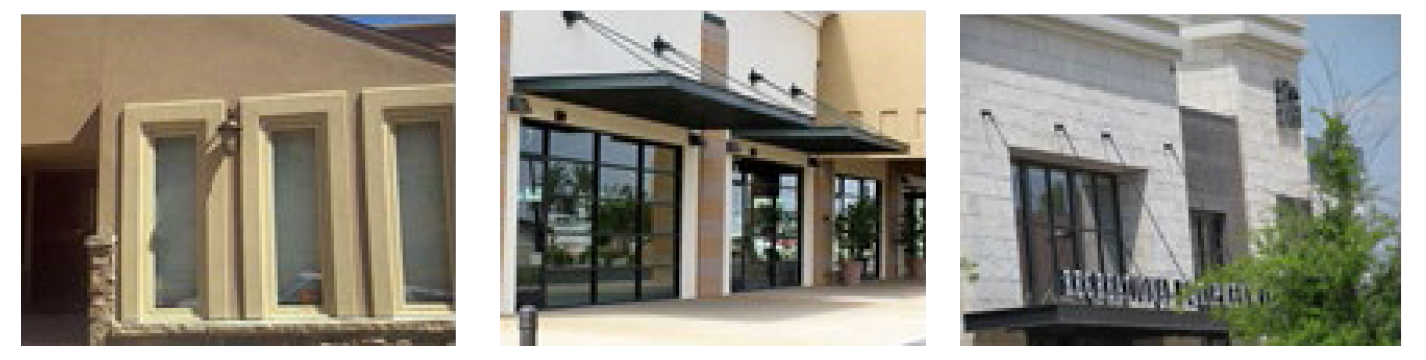
J.
All buildings constructed primarily of brick shall incorporate a form of brick patterning (excluding typical traditional brick patterning, i.e. Running Bond). Acceptable patterning may include those represented below, or similar subject to approval by the Director of Development Services:
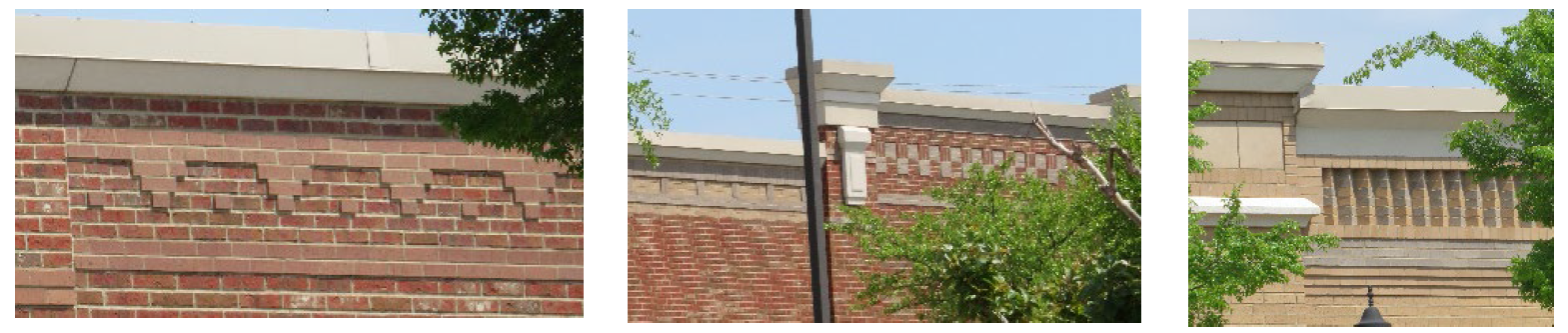
K.
All buildings shall be architecturally finished on all four sides with same materials, detailing, and features except the rear if two rows of trees are planted on the perimeter behind the building. In this case, the architectural finish must match the remainder of the building in color only. A double row of trees on offset 50 foot centers in a 15-foot landscape edge, where 50 percent of the trees are canopy evergreen trees. This is for facades that are not visible from public streets and apply to anchor buildings and attached in line spaces only. This provision does not apply to "out" buildings or pad sites.
L.
Windows shall have a maximum exterior visible reflectivity of ten percent. The intent of this provision is to prevent the safety hazard of light reflecting from the windows on to adjacent roadways.
M.
All retail/commercial buildings with facades greater than 200 feet in length shall incorporate wall plane projections or recesses that are at least six feet deep. Projections/recesses must be at least 25 percent of the length of the facade. No uninterrupted length of facade may exceed 100 feet in length. This requirement does not apply to building developed and occupied entirely for office uses.
N.
All buildings within a common development, as shown on a preliminary site plan, shall have similar architectural styles, materials, and colors.
1.
Conceptual facade plans and sample boards shall be submitted with the preliminary site plan application for all non-residential uses. The purpose of the conceptual facade plan is to ensure consistency and compatibility for all buildings within a single development. Facade plans will be used only to ensure minimum standards are met.
2.
A final facade plan and sample boards shall be submitted with the final site plan application for all non-residential uses. Facade plans will be used only to ensure minimum standards are met. Façade plans shall be reviewed and approved by the Director of Development Services or his/her designee. The applicant may appeal the decision to the Planning and Zoning Commission and Town Council using the appeal procedure in Chapter 4, Section 1 of this Ordinance.
O.
All primary and secondary exterior building materials (exclusive of glass) shall be of natural texture and shall be neutrals, creams, or other similar, non-reflective earth tone colors. Bright, reflective, pure tone primary or secondary colors, such as red, orange, yellow, blue, violet, or green are not permitted.
P.
Corporate identities that conflict with the building design criteria shall be reviewed on a case-by-case basis and approved by the Director of Development Services or his/her designee. The applicant may appeal the decision to the Planning and Zoning Commission and Town Council using the appeal procedure in Chapter 4, Section 1 of this Ordinance.
Q.
Exposed conduit, ladders, utility boxes, and drain spouts shall be painted to match the color of the building or an accent color. Natural metal finishes (patina) are an acceptable alternative to paint.
R.
Unclassified non-residential uses (i.e. amenity centers) which are permitted in residential districts shall develop in accordance with the office, retail, restaurant, service, automobile, and commercial development standards.
S.
The Town Council may approve materials which are equivalent to, or exceed, the standards set forth in Chapter 4, Section 9.8 (A & C), above.
T.
Downtown development standards are as follows:
1.
In the DTR and DTC Districts, an articulated parapet wall or cornice may be used in place of the sloped roof as required in Section 8.2(E) and (F) above.
2.
In the DTR and DTC Districts, all windows shall include a minimum sill height of 18 inches.
3.
In the DTO District, cementatious fiber board may be used on up to 90 percent of a structure.
4.
Roof pitches of a main building or structure in the DTO District shall meet the following:
a.
A minimum of 65 percent of the surface area of composition roofs shall maintain a minimum roof pitch of 8:12.
b.
A minimum of 75 percent of the surface area of clay tile, cement tile, slate or slate products, or metal roofs shall maintain a minimum roof pitch of 3:12.
c.
Wood roof shingles are prohibited.
INDUSTRIAL, WHOLESALE, AND INSTITUTIONAL DEVELOPMENT STANDARDS
8.3 - Exterior appearance of buildings and structures.
A.
All exterior facades of an industrial, wholesale, or institutional building or structure, excluding glass windows and doors, shall be constructed using the permitted buildings materials in Chapter 4, Section 8.2 (B. & C).
B.
All exterior facades for a main building or structure, excluding glass windows and doors, in the I District shall be constructed of 100 percent masonry as defined in Chapter 3, Section 2. The use of stucco and EIFS are only permitted as secondary or accent materials.
1.
The Town Council, after recommendation by the Planning and Zoning Commission, may grant an exception to the foregoing exterior façade and design requirements, based upon consideration of the criteria listed in subpart 2, below.
2.
In considering an exception to the exterior façade requirements, the Planning and Zoning Commission and Town Council may consider whether a proposed alternate material:
a.
Is a unique architectural expression;
b.
Includes unique building styles and materials;
c.
Is consistent with high quality development;
d.
Is or would be visually harmonious with existing or proposed nearby buildings;
e.
Has obvious merit based upon the quality and durability of the materials; and
f.
Represents an exterior building material that is in keeping with the intent of this chapter to balance the abovementioned objectives.
3.
Any exterior façade exception shall be considered in conjunction with a preliminary site plan or site plan application.
C.
Permitted primary exterior materials are clay fired brick, natural, precast, and manufactured stone, granite, marble, architectural concrete block, split face concrete masonry unit, and architecturally finished concrete tilt wall.
D.
Secondary materials used on the façade of a building are those that comprise a total of ten percent or less of an elevation area. Permitted secondary materials are all primary materials, aluminum or other metal, cedar or similar quality decorative wood, stucco, and high impact exterior insulation and finish systems (EIFS). Stucco and EIFS are only permitted a minimum of nine feet above grade.
E.
No single material shall exceed 80 percent of an elevation area. A minimum of 20 percent of the front façade and all facades facing public right-of-way shall be clay fired brick or natural, precast, or manufactured stone. The clay fired brick or natural, precast, or manufactured stone shall be located at the main entry points of the building.
F.
The front façade, all facades facing public right-of-way, and all facades facing property that is zoned or designated on the future land use plan for residential uses shall be architecturally finished with same materials, detailing, and features. The architectural finish of all other facades must match the remainder of the building in color only.
G.
All buildings with a front façade or a facade facing public right-of-way which are greater than 200 feet in length shall incorporate projections or recesses that are at least six feet deep. Projections/recesses must be at least 20 percent of the length of the façade.
H.
Windows shall have a maximum exterior visible reflectivity of ten percent. The intent of this provision is to prevent the safety hazard of light reflecting from the windows on to adjacent roadways.
I.
All buildings within a common development, as shown on a preliminary site plan, shall have similar architectural styles, materials, and colors.
1.
Conceptual facade plans and sample boards shall be submitted with the preliminary site plan application for all non-residential uses. The purpose of the conceptual facade plan is to ensure consistency and compatibility for all buildings within a single development. Facade plans will be used only to ensure minimum standards are met.
2.
A final facade plan and sample boards shall be submitted with the final site plan application for all non-residential uses. Facade plans will be used only to ensure minimum standards are met. Façade plans shall be reviewed and approved by the Director of Development Services or his/her designee. The applicant may appeal the decision to the Planning and Zoning Commission and Town Council using the appeal procedure in Chapter 4, Section 1 of this Ordinance.
J.
All primary and secondary exterior building materials (exclusive of glass) shall be of natural texture and shall be neutrals, creams, or other similar, non-reflective earth tone colors. Bright, reflective, pure tone primary or secondary colors, such as red, orange, yellow, blue, violet, or green are not permitted.
K.
Corporate identities that conflict with the building design criteria shall be reviewed on a case-by-case basis and approved by the Director of Development Services or his/her designee. The applicant may appeal the decision to the Planning and Zoning Commission and Town Council using the appeal procedure in Chapter 4, Section 1 of this ordinance.
L.
Exposed conduit, ladders, utility boxes, and drain spouts shall be painted to match the color of the building or an accent color. Natural metal finishes (patina) are an acceptable alternative to paint.
M.
Exterior construction of maintenance buildings for golf courses, public or parochial schools, churches, of the Town of Prosper may be metal upon issuance of a specific use permit. Exterior construction of buildings used for agricultural purposes in conjunction with a school may be metal upon issuance of a specific use permit.
If an expansion or an addition to an existing metal building is not greater than ten percent or 7,000 square feet, whichever is greater, the masonry requirement shall not apply to the expansion or addition to the existing metal building.
N.
The Town Council may approve materials which are equivalent to, or exceed, the standards set forth herein.
MULTIFAMILY DEVELOPMENT STANDARDS
8.4 - Multifamily development standards.
A.
All exterior facades for a main building or structure, excluding glass windows and doors, in the MF District shall be constructed of 100 percent masonry as defined in Chapter 3, Section 2. The use of stucco and EIFS are only permitted as secondary or accent materials.
1.
The Town Council, after recommendation by the Planning and Zoning Commission, may grant an exception to the foregoing exterior façade and design requirements, based upon consideration of the criteria listed in subpart 2, below.
2.
In considering an exception to the exterior façade requirements, the Planning and Zoning Commission and Town Council may consider whether a proposed alternate material:
a.
Is a unique architectural expression;
b.
Includes unique building styles and materials;
c.
Is consistent with high quality development;
d.
Is or would be visually harmonious with existing or proposed nearby buildings;
e.
Has obvious merit based upon the quality and durability of the materials; and
f.
Represents an exterior building material that is in keeping with the intent of this chapter to balance the abovementioned objectives.
3.
Any exterior façade exception shall be considered in conjunction with a preliminary site plan or site plan application.
B.
The Town Council may approve materials which are equivalent to, or exceed, the standards set forth in herein.
C.
Structure Separation. Multifamily structures on the same parcel shall have the following minimum distance between structures:
1.
From main structure to main structure with walls that have openings for doors or windows on facades facing each other.
a.
Face to Face: 50 feet
b.
Face to End: 30 feet
c.
Corner to Face or End: 30 feet
d.
End to End: 30 feet
2.
From main structure to main structure with walls that do not have openings, the minimum distance between structures is 20 feet for one- and two-story buildings and 30 feet for three-story buildings.
3.
From main structure to accessory buildings or pools, the minimum distance between structures is 20 feet.
4.
From main structure to free standing garage building, the minimum distance between structures is 30 feet.
D.
All multifamily buildings shall be designed to incorporate a form of architectural articulation every 30 feet, both horizontally along each wall's length and vertically along each wall's height. Acceptable articulation may include the following:
• Canopies, awnings, or porticos;
• Recesses/projections;
• Arcades;
• Arches;
• Architectural details (such as tile work and moldings) integrated into the building facade;
• Articulated ground floor levels or base;
• Articulated cornice line;
• Integrated planters or wing walls that incorporate landscape and sitting areas;
• Offsets, reveals or projecting rib used to express architectural or structural bays;
• Accent materials (minimum 15 percent of exterior facade);
• Varied roof heights;
• Or other architectural features approved by the Director of Development Services or his/her designee.
E.
All buildings shall be designed to incorporate a form of window articulation. Acceptable articulation may include the following:
• Detailed/patterned mullions
• Glass depth from wall minimum eight inches
• Projected awnings/sunshades
• Water table in lieu of floor to ceiling glass
• Articulated lintel (i.e. soldier course in brick or material change EIFS or cast stone with minimum one-half inch projection)
• Articulated sill (i.e. soldier course in brick or material change EIFS or cast stone with minimum one-half inch projection)
• Cast stone surrounds on entire window
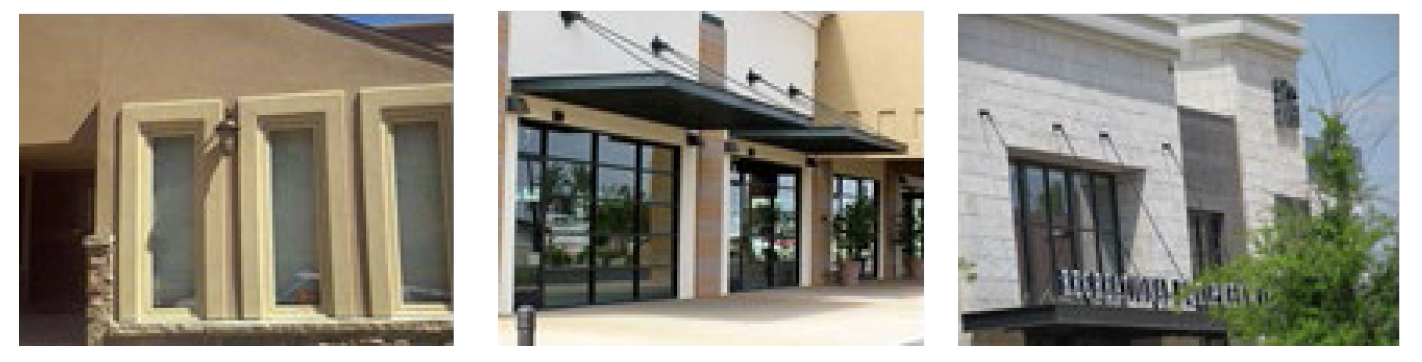
F.
All buildings constructed primarily of brick shall incorporate a form of brick patterning (excluding typical traditional brick patterning, i.e. Running Bond). Acceptable patterning may include those represented below, or similar subject to approval by the Director of Development Services:
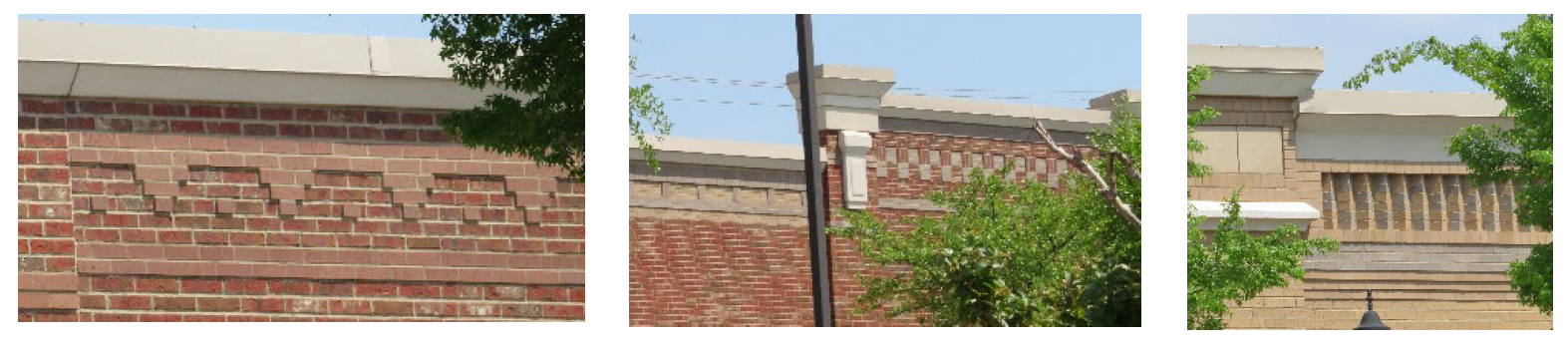
G.
All multifamily buildings shall incorporate a pitched, gabled, mansard, hipped, or otherwise sloped roof. All sloped roofs shall have a three in 12 inch minimum slope. Wood shingles are prohibited.
9.1 - Lot regulations.
A.
The minimum lot area for the various zoning districts shall be in accordance with the individual districts except that a lot having less area than herein required which was an official "lot of record" prior to the adoption of this ordinance, may be used for a single-family dwelling and no lot existing at the time of passage of this ordinance shall be reduced in area below the minimum requirements set forth in the respective district.
B.
Location of dwellings and buildings. Only one main building for single family and two-family use, with permitted accessory buildings, may be located upon a lot or unplatted tract.
C.
Every means of access shall have a minimum lot width of 25 feet at the property line.
D.
Whenever two or more main buildings, or portions thereof, are placed upon a single lot or tract and such buildings do not face upon a public street, the same may be permitted when the site plan for such development is approved by the Planning and Zoning Commission so as to comply with the town subdivision regulations' requirements for platting.
E.
No parking area, storage area, or required open space for one building shall be computed as being the open space, yard, or area requirements for any other dwelling or other use.
F.
Residential density calculations. The maximum permitted residential densities for the TH and MF Districts shall be calculated using the net acreage of the site to be developed. Net acreage shall not include the following:
• Right-of-way dedicated for major thoroughfares.
• Required parkland dedication.
• Detention.
• Land used for non-residential purposes.
Net acreage may include the following:
• Non-reclaimed floodplain.
• Private open space.
• Park dedication in excess of minimum park dedication requirements.
• Detention ponds that contain a constant water level, are landscaped, or otherwise treated as an amenity for the development, as determined by the Director of Development Services or his/her designee.
9.2 - Minimum dwelling unit area.
The minimum dwelling unit area of a residential unit shall be as specified in each residential zoning district in Chapter 2 of this ordinance. Dwelling unit area is defined as that area devoted to the living area in a residence or dwelling unit and is exclusive of porches, enclosed or open breezeways, storage area or closets, garages, or other non-living space. The minimum dwelling unit area will generally be that space which is air-conditioned.
9.3 - Front yard.
A.
On corner lots, the front yard setback shall be observed along the frontage of both intersecting streets, unless shown specifically otherwise on a final plat.
B.
Where the frontage on one side of a street between two intersecting streets is divided by two or more zoning districts, the front yard shall comply with the requirements of the most restrictive zoning district for the entire frontage.
C.
Where a building line has been established by a plat approved by the Town of Prosper or by ordinance prior to the adoption of this ordinance, and such line required is a greater or lesser front yard setback than prescribed by this ordinance for the zoning district in which the building line is located, the required front yard shall comply with the building line so established by such ordinance or plat provided no such building line shall be set back less than 20 feet.
D.
The front yard shall be measured from the property line to the front face of the building, covered porch, covered terrace or attached accessory building. Eaves and roof extensions or a porch without posts or columns may project into the required front yard for a distance not to exceed three feet, and subsurface structures, platforms or slabs may not project into the front yard to a height greater than 30 inches above the average grade of the ground under the structure (See Chapter 5, Section 2.3, Illustration I).
E.
Where a lot fronts and backs to two different streets, a required front yard shall be provided on both streets unless a building line for accessory buildings has been established along one frontage on the plat or by ordinance, in which event only one required front yard need be observed (See Chapter 5, Section 2.3, Illustration J).
F.
In all single family and 2F Districts, the minimum front yard setbacks for all lots fronting onto the same street along a block shall be staggered such that one-third of the lots have a front yard setback that is reduced by five feet, one-third of the lots have a front yard setback as defined in Chapter 2, and one-third of the lots have a front yard setback that is increased by five feet. Not more than two lots in a row may incorporate the same front yard setback. The average setback along the block shall equal the required setback for the particular zoning district. The lots with an increased front building line may also decrease the rear building line by five feet to maintain the necessary building pad depth. The purpose of this requirement is to produce a variety of front yard setbacks along a street, creating a more pleasing street presence and appearance of houses in the subdivision. In no case shall the front yard setback be less than 20 feet. The front setbacks for each lot shall be designated on the final plat. (See Chapter 5, Section 2.3, Illustration K)
G.
Visual clearance shall be provided in all zoning districts so that no fence, wall, architectural screen, earth mounding or landscaping 30 inches or higher above the street center line obstructs the vision of a motor vehicle driver approaching any street, alley, or driveway intersection.
1.
At a street intersection where one or both of the streets is a major thoroughfare, clear vision must be maintained for a minimum of 25 feet across any lot measured from the corner of the property line in both directions. (See Chapter 5, Section 2.3, Illustration L)
2.
At an intersection of two neighborhood streets, this clearance must be maintained for ten feet. (See Chapter 5, Section 2.3, Illustration M)
3.
At an intersection of a neighborhood street and an alley, this clearance must be maintained for five feet down the alley and 15 feet down the street. (See Chapter 5, Section 2.3, Illustration N)
4.
Fences, walls, and 30 inches in height, as measured from the centerline of the street, or less may be located in the visual clearance areas of all districts.
H.
Gasoline, or other hydrocarbon fuel, service station pump islands including their associated unenclosed canopies shall meet the front yard setback requirements established in Chapter 2 of this ordinance when located adjacent to a public street.
I.
Where a future right-of-way line has been established for future widening or opening of a street or thoroughfare, upon which a lot abuts, then the front or side yard shall be measured from the future right-of-way line.
J.
The minimum front yard in single-family and two-family zoning districts may be reduced by ten feet in the following circumstances. In no case shall the reduction cause the minimum front yard to be less than 15 feet.
1.
For an outside swing-in garage provided the wall of the garage that faces the street contains a glass pane window with a minimum size of three feet by five feet and the height of the garage does not exceed one story; or
2.
For a non-enclosed porch, stoop, or balcony, or an architectural feature, such as bay window without floor area or chimney; or
3.
For a non-enclosed porch and the main structure provided:
a.
The height of the main structure does not exceed one story;
b.
The porch has a minimum dimension of seven feet in depth measured from stud to the front edge of the porch floor and a minimum width of 20 feet; and
c.
The minimum front yard for a front entry garage is increased one foot for every one foot the minimum front yard for the main structure is reduced.
9.4 - Side and rear yards.
A.
On a key lot used for one or two-family dwellings, both street exposures shall be treated as front yards (See Chapter 5, Section 2.3 Illustration O) on all key lots except where one street exposure is designated as a side yard and separated from the adjacent lot by an alley (See Chapter 5, Section 2.3 Illustration P). In such case, a building line shall be designated on the plat approved by the Town of Prosper containing a side yard of 15 feet or more. On lots that were official lots of record prior to the effective date of this ordinance, the minimum side yard adjacent to a side street shall comply with the minimum required side yard for the zoning district.
B.
Every part of a required side yard shall be open and unobstructed from the ground upward except for accessory buildings as permitted herein and the ordinary projections of window sills, belt courses, cornices, and other architectural features not to exceed 12 inches into the required side yard, and roof eaves projecting not to exceed 36 inches into the required side yard. Air conditioning compressors and similar appurtenances are permitted in the side yard.
C.
Side yard setbacks in the R, C, and CC Districts may be waived for a building when attached to an adjacent building and is shown on a site plan approved by the Planning and Zoning Commission. (Z07-8)
D.
The face (meaning garage door) of a garage that faces a side yard (a swing-in garage) must be setback 24 feet from the side property line. (Z10-0013)
E.
Non-residential uses that are permitted within a single family zoning district (such as a day care, school, or church) shall maintain a 40 foot side and rear building setback when adjacent to a property that is zoned or designated on the future land use plan for residential uses.
9.5 - Special height regulations.
Water stand pipes and tanks (excluding town owned and/or operated water tanks), church steeples, domes, spires, school buildings, and institutional buildings may be erected to exceed three stories in height, provided that one additional foot shall be added to the width and depth of front, side, and rear yards for each foot that such structures exceed three stories.
Ornamental features in all non-residential zoning districts may exceed the maximum building height provided that the ornamental feature does not contain floor area and provided the required setbacks for the ornamental feature are increased by two feet for every one foot that the ornamental feature exceeds the maximum height. Ornamental features include, but are not limited to towers, spires, steeples, and cupolas.
9.6 - Measurements.
All measurements of setback requirements shall be made according to Chapter 5, Section 2.3, Illustrations Q-U.
9.7 - Modular homes.
A modular home may be permitted in the A, SF, DTSF, 2F, TH, MH, or MF Districts providing that the following requirements are met:
A.
The dwelling shall meet or exceed all building code requirements that apply to other dwelling units concerning on-site construction.
B.
Conforms to all applicable zoning standards for the respective zoning district.
C.
Is affixed to an approved permanent foundation system.
D.
The building official is so notified in writing for the purpose of establishing procedures for the inspection, issuing of building permits, and compliance with the Texas Manufactured Housing Standards Act (Article 1221f V.T.C.S.).
E.
The modular home is placed on an approved platted lot of the town.
9.8 - Exterior construction of residential buildings.
A.
The exterior facades of a main building or structure, excluding glass windows and doors, in the A, SF, DTSF, 2F, and TH Districts shall comply with the following requirements:
1.
The exterior facades shall be constructed of 100 percent masonry, unless otherwise specified in this ordinance.
2.
Cementatious fiber board is considered masonry, but may only constitute 50 percent of stories other than the first story.
3.
Cementatious fiber board may not be used as a façade cladding material for portions of upper stories that are in the same vertical plane as the first story.
4.
Unless an alternate material is approved by the Town Council, any portion of an upper story, excluding windows, that faces a street, public or private open space, public or private parks, or hike and bike trails, shall be 100 percent masonry and shall not be comprised of cementatious fiber board.
5.
Unless an alternate material is approved by the Town Council, the exterior cladding of chimneys shall be brick, natural or manufactured stone, or stucco.
6.
In the DTSF District, cementatious fiber board may be used on up to 90 percent of a structure.
7.
Cementatious fiber board may be used for architectural features, including window box-outs, bay windows, roof dormers, garage door headers, columns, or other architectural features approved by the Building Official.
B.
The roof pitches of a main building or structure, including garages, in the A, SF, DTSF, 2F, and TH Districts shall meet the following roof pitch standards:
1.
A minimum of 65 percent of the surface area of composition roofs shall maintain a minimum roof pitch of 8:12.
2.
A minimum of 75 percent of the surface area of clay tile, cement tile, slate or slate products, or metal roofs shall maintain a minimum roof pitch of 3:12.
3.
Wood roof shingles are prohibited.
(Ord. No. 15-55, 9-22-15; Ord. No. 16-29, 4-26-16)
9.9. - Handicap accessibility.
If applicable all nonresidential buildings and parking areas shall conform to the Americans with Disabilities Act (ADA) of 1991, as may be amended, accessibility guidelines, the Uniform Federal Accessibility Standards, and Texas Accessibility Standards (TAS).
9.10. - Self-storage and mini-warehouse facilities.
The side building lines of a self-storage or mini-warehouse facility may be reduced by approval of the Planning and Zoning Commission at the time of the preliminary site plan approval. The configuration of the storage units shall be with the doors facing into the site with the rear walls of the units serving as the outer boundary.
Self-storage or mini-warehouse facilities must comply with Chapter 4, Section 9.8 of this ordinance, and its amendments, relating to the construction material used for exterior buildings. Notwithstanding any other provisions to the contrary, a self-storage or mini-warehouse facility constructed adjacent to a residential area, whether separated by a dedicated street or not, shall exclusively use clay fired brick or stone as the exterior construction material.
9.11 - Adjacency of certain uses to residential zoning.
A.
All buildings, gasoline pump islands, vacuums, outdoor speakers, gasoline or fuel storage tanks, air and water dispensers, and other structures in conjunction with any automotive use shall be located a minimum of 200 feet from any residential zoning district or areas shown as residential on the future land use plan. No service bay shall face a residential zoning district or areas shown as residential on the future land use plan. An automotive use shall be defined as the sales, leasing, renting, servicing, repair, or washing of automobiles, boats, motorcycles, trucks, or any other motor vehicle.
B.
All buildings, structures, and outdoor speakers used in conjunction with any drive-through restaurant or drive-in restaurant shall be located a minimum of 200 feet from any residential zoning district or areas shown as residential on the future land use plan.
C.
Any lot containing a drive-through restaurant, drive-in restaurant, and/or an automotive use as defined in Chapter 4, Section 9.11(A) and that is adjacent to a residentially zoned property or areas shown as residential on the future land use plan shall comply with the landscape requirements set forth in Chapter 4, Section 2.6(C) and screening wall requirements set forth in Chapter 4, Section 5.2.
D.
The requirements listed in Chapter 4, Section 9.11(A) and 9.11(B) shall not apply to a drive-through restaurant, drive-in restaurant, and/or an automotive use within 200 feet of a residential zoning district that is separated from the residential area by an existing or future major thoroughfare identified on the town's thoroughfare plan.
(Ord. No. 2024-08, § 7, 1-9-24)
9.12 - Day care centers, private schools, and similar facilities.
A.
All day care centers shall provide outdoor play space at a rate of 65 square feet per child. This requirement shall be based on the maximum licensed capacity of the facility. The outdoor play space shall have no dimension of less than 30 feet. If the facility provides care to all children for less than four hours per day, this requirement may be waived by the Town Council.
B.
Outdoor play space is defined as the area used for outside recreational purposes for children. The outdoor play area must be enclosed by a fence of at least four feet in height with at least two emergency exits. One exit may be an entrance to the building. The adequacy of the emergency exits shall be determined by the Fire Chief or his/her designee.
9.13 - Residential development adjacent to railways.
A.
Minimum building setback, screening, and landscaping requirements. When a boundary of a residential subdivision is adjacent to a railroad right-of-way, one of the two following screening options shall be installed within three months from the date of Town acceptance of public improvements:
1.
Option One.
a.
A minimum building setback of 50 feet shall be required from the railroad right-of-way; and
b.
A 100 percent clay fired brick or stone wall with a minimum height of six feet shall be constructed on the railroad right-of-way line; and
c.
One three-inch caliper large tree shall be planted a minimum of 30 linear feet on center adjacent to the residential side of the wall. A minimum of 50 percent of the trees shall be of the evergreen variety. The landscaped area shall be mechanically irrigated. The lot owner shall be responsible for the replacement of required plant materials.
2.
Option Two.
a.
A minimum building setback of 80 feet shall be provided from the railroad right-of-way; and
b.
A six foot high earthen berm with a maximum slope of 3:1 shall be constructed adjacent to the railroad right-of-way line.
c.
One three-inch caliper large tree shall be planted a minimum of 20 linear feet on center along the top or on the residential side of the berm. A minimum of 50 percent of the trees shall be of the evergreen variety. The landscaped area shall be mechanically irrigated. The lot owner shall be responsible for the replacement of required plant materials.
B.
Platting requirements:
1.
The setback area shall be designated on the plat as follows: "This setback area is reserved for screening purposes. The placement of structures on this land or the removal of healthy screening plant materials is prohibited."
2.
Should the setback area be part of a single-family lot, the setback area shall also be recorded on the plat as a building line.
C.
This section shall not apply to any residential development with an approved concept plan, preliminary plat, and/or final plat prior to adoption of this ordinance.
9.14 - Alternating single family plan elevations.
A.
In the SF Districts, a minimum of four distinctly different home elevations shall be built on the same side of the street. Similar elevations shall not face each other. The same elevation shall not be within three homes of each other on the same side of the street.
B.
Different exterior elevations can be met by meeting at least two of the following criteria:
1.
Different roof forms/profiles;
2.
Different facades consisting of different window and door style and placement;
3.
Different entry treatment such as porches and columns;
4.
Different number of stories.
(Ord. No. 15-55, 9-22-15)
9.15 - Residential garage standards.
A.
In the SF and DTSF Districts, garages shall meet the following requirements:
1.
In no instance shall a garage door directly facing a street be less than 25 feet from the property line.
2.
Garage doors directly facing a street shall not occupy more than 50 percent of the width of the front façade of the house.
3.
Where a home has three or more garage/enclosed parking spaces, no more than two single garage doors or one double garage door shall face the street, unless the garage door(s) are located behind the main structure.
(Ord. No. 15-55, 9-22-15)

