
Raytown City Zoning Code
ARTICLE VIII
SIGN REGULATIONS4
Editor's note—Ord. No. 5636-20, §§ 1, 2, (Exh. A), adopted January 21, 2020, repealed the former Art. VIII, §§ 50-488—50-498, and enacted a new Art. VIII as set out herein. The former Art. VIII pertained to similar subject matter and derived from §§ 25-1, 25-2, 25-3, 25-4, 25-5.01, 25-5.02, 25-5.03, 25-5.04, 25-5.05, 25-5.06, 25-6, from Comp. Ord. adopted April 20, 2010.
Sec. 50-488.- Introduction.
(a)
Purpose.
(1)
General intent. The purpose of this section is to protect, preserve, and promote the beauty, safety and general welfare of the city by establishing certain minimum standards and procedures for the erection of signs in various zoning districts.
(2)
Findings and intent; interpretation.
a.
Signs may obstruct views, distract motorists, displace alternative uses for land, and pose other problems that legitimately call for regulation. The purpose of this article is to regulate the size, color, illumination, movement, materials, location, height and condition of all signs placed on private property for exterior observation, thus ensuring the protection of property values, the character of the various neighborhoods, the creation of a convenient, attractive and harmonious community, protection against destruction of or encroachment on historic convenience to citizens and encouraging economic development. This article allows adequate communication through signage while encouraging aesthetic quality in the design, location, size, and purpose of all signs. This article must be interpreted in a manner consistent with the First Amendment guarantee of free speech. If any provision of this article is found by a court of competent jurisdiction to be invalid, such finding must not affect the validity of other provisions of this article which can be given effect without the invalid provision.
b.
A sign placed on land or on a building for the purpose of identification, protection or directing persons to a use conducted therein must be deemed to be an integral but accessory and subordinate part of the principal use of land or building. Therefore, the intent of this article is to establish limitations on signs in order to ensure they are appropriate to the land, building or use to which they are appurtenant and are adequate for their intended purpose while balancing the individual and community interests identified in subsection (a) of this section.
c.
These regulations are intended to promote signs that are compatible with the use of the property to which they are appurtenant, landscape and architecture of surrounding buildings, are legible and appropriate to the activity to which they pertain, are not distracting to motorists, and are constructed and maintained in a structurally sound and attractive condition.
d.
These regulations do not regulate every form and instance of visual communication that may be displayed anywhere within the jurisdictional limits of the City. Rather, they are intended to regulate those forms and instances that are most likely to meaningfully affect one or more of the purposes set forth above.
e.
These regulations do not entirely eliminate all of the harms that may be created by the installation and display of signs. Rather, they strike an appropriate balance that preserves ample channels of communication by means of visual display while still reducing and mitigating the extent of the harms caused by signs.
(3)
Standards applicable to all signs.
a.
Erection at street intersection/location prohibited. No sign or other advertising structure regulated by this section shall be erected at the intersection of any street in such a manner as to obstruct free and clear vision, or at any location where, by reason of its position, shape, and color, it may interfere with, obstruct the view of or be confused with any authorized traffic sign, signal or device.
b.
Advertising adult materials. No sign shall indicate the presence of adult videos or materials in an establishment unless such use is permitted by article IV, division 1 of this chapter.
c.
Signs not expressly permitted as being allowed by right or by conditional use permit under this article or by specific requirements in another portion of this chapter, or otherwise expressly allowed by the board of aldermen or board of zoning adjustment are not allowed.
(4)
Definitions.
a.
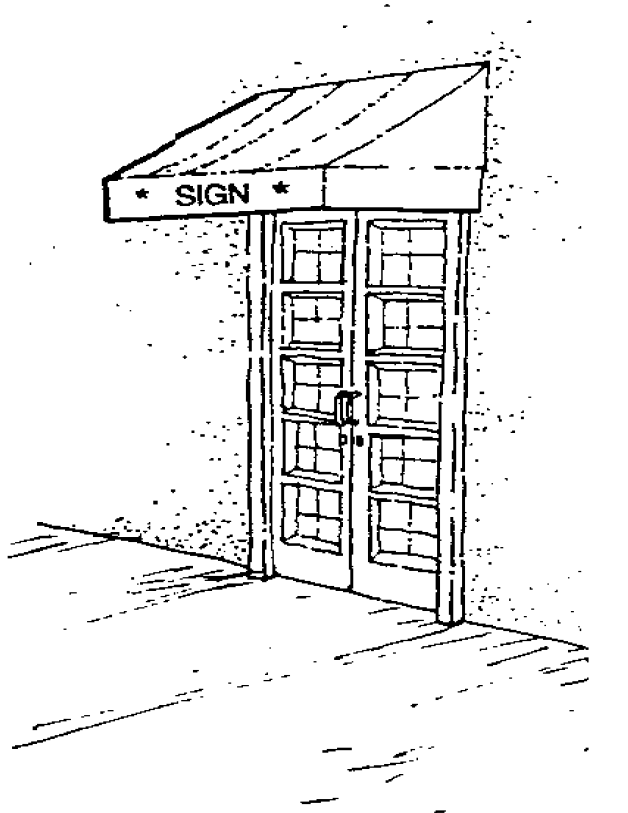
Awning or canopy sign. A sign that is mounted or painted on or attached to an awning, canopy or marquee that is otherwise permitted by these regulations. No such sign shall project farther below than seven feet from the ground level or beyond the physical dimensions of the awning, canopy or marquee.
b.
Bulletin board sign. A sign that indicates the name of an institution or organization on whose premises it is located and that contains the name or names of persons connected with it, and announcements of persons, events or activities occurring at the institution. Such signs may also present a greeting or other similar message.
c.
Electric Sign. Any sign containing electric wiring. This does not include signs illuminated by an exterior floodlight source.
d.
Flashing Sign. Any illumined sign on which the artificial light is not maintained stationary or constant in intensity and color at all times when such sign is in use. For the purpose of this Code any moving illuminated sign, except digital billboards, must be considered a flashing sign.
e.
Government Sign. A government sign is a sign that is constructed, placed or maintained by the federal, state or local government or a sign that is required to be constructed, placed or maintained by the federal, state or local government either directly or to enforce a property owner's rights.
f.
Identification sign. A sign giving the name and/or address of a building, business, development or establishment. Such signs may be wholly or partly devoted to a readily recognized symbol.
g.
Integral Sign. A sign that is embedded, extruded or carved into the material of a building façade. A sign made of bronze, brushed stainless steel or aluminum, or similar material attached to the building façade.
h.
Marquee Sign. A canopy or covering structure bearing a signboard or copy projecting from and attached to a building.
i.
Monument or ground sign. Any sign placed upon or supported by the ground independently of any building or structure on the property and whose supports are not visible. Signs on accessory structures shall be considered monument signs. This sign type includes Neighborhood Entry Monument signs.
j.
Nameplate sign. A sign giving the name and/or address of the owner or occupant of a building or premises on which it is located and, where applicable, a professional status.
k.
Off Premises Sign. A sign that directs attention to a business, commodity, service, or entertainment conducted, sold or offered at a location other than the premises on which the sign is located or to which it is affixed.
l.
Pole sign. A sign that is mounted on a freestanding pole(s), which are visible, either freely visible if legal non-conforming, or with architecturally designed cladding if a new or remodeled sign.
m.
Projecting Sign. A sign, other than a wall sign, which projects no more than 12 inches from and is supported by a wall of a building or structure.
n.
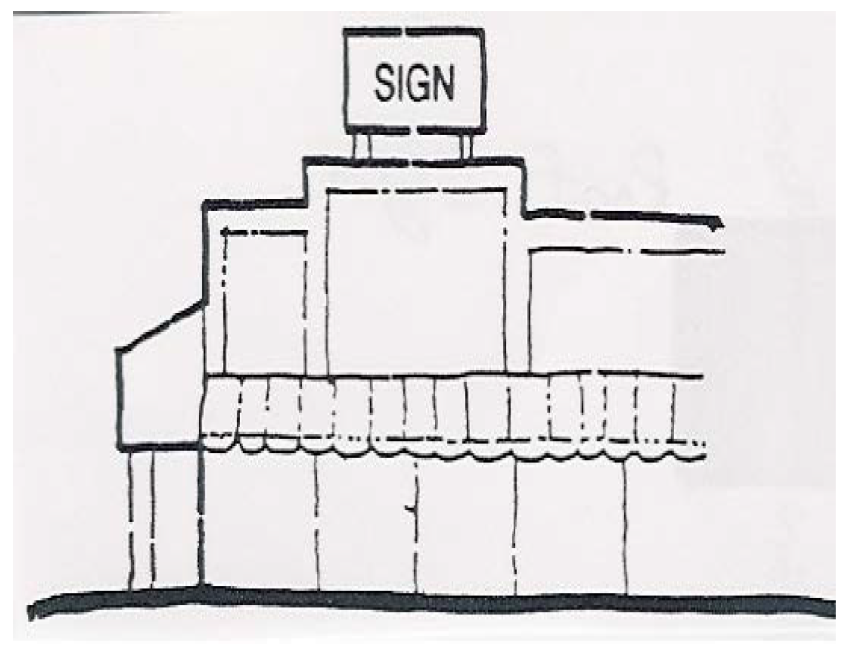
Roof Sign. A sign located on or above the roof of any building, not including false mansard roof, canopy, or other fascia.
o.
Sign. A name, identification, description, display or illustration, which is affixed to, painted or represented directly or indirectly upon a building, or other outdoor surface which directs attention to or is designed or intended to direct attention to the sign face or to an object, product, place, activity, person, institution, organization or business. Signs located completely within an enclosed building, and not exposed to view from a street, are not considered a sign pursuant to this chapter. Each display surface of a sign or sign face is considered to be a sign.
p.
Sign area:
1.
the space enclosed within the extreme edges of the sign for each sign face, not including the supporting structure; or
2.
where attached directly to a building wall or surface, the space within the outline enclosing all the characters of the words, numbers or design.
q.
Sign face: The entire display surface area of a sign upon, against, or through which copy is placed.
r.
Temporary Sign. A banner, pennant, poster or advertising display constructed of paper, cloth, canvas, plastic sheet, cardboard, wallboard, plywood or other like materials and that appears to be intended or is determined by the code official to be displayed for a limited period of time (rather than permanently attached to the ground or a structure). All banners are considered to be temporary signs.
s.
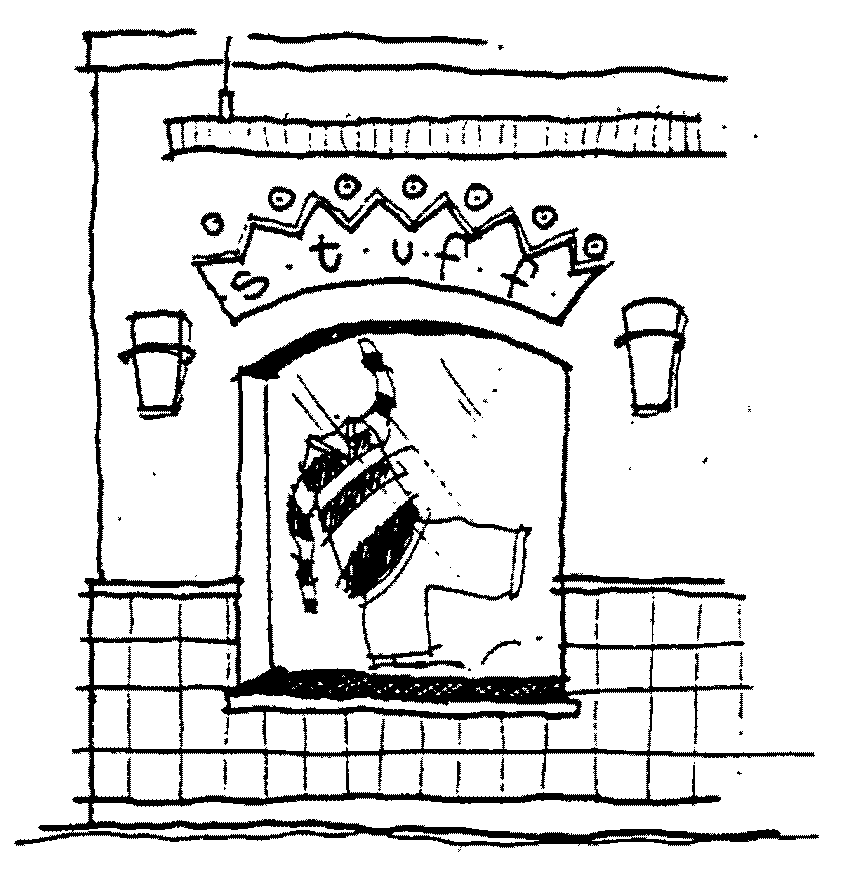
Wall sign. A sign fastened to or painted on a wall of a building or structure, which does not project more than 12 inches from such building, and is attached to the building in such a manner that the wall becomes merely the supporting structure or forms the background surface.
(Ord. No. 5636-20, §§ 1, 2(Exh. A), 1-21-2020)
Sec. 50-489. - New or rebuilt signs; permits.
(a)
Permit required. Unless otherwise provided in these regulations, no new, permanent or temporary sign shall hereafter be hung, erected, attached or supported on a building or structural support, and no existing sign shall be altered, rebuilt, extended, replaced or relocated until a permit has been issued by the director of community development or the director's designee. All signs legally existing on the effective date of the ordinance from which this chapter is derived may remain in use including those in the status of legal non-conforming sign.
(b)
Application for permit. Applicants for sign permits shall submit an application form (furnished by the director of community development or the director's designee), appropriately filled out. Said application shall include, or have attached, the following information:
(1)
The name, address, and telephone number of the applicant.
(2)
The location of the building, structure or lot where the sign is to be located.
(3)
Position of the sign in relation to nearby buildings and structures.
(4)
Two sets of prints showing the plans and specifications of the proposed sign and sign structure along with the method of construction and attachment to the building or in the ground.
(5)
The name of the person, firm, corporation or association erecting the sign.
(6)
Written consent of the owner of the building, structure or land to which or on which the sign is to be erected.
(7)
Additional information as the director of community development or the director's designated representative shall require to show full compliance with this and all other applicable laws and regulations of the city.
(8)
A sign permit fee. Said fees shall be set by the board of aldermen.
(c)
Issuance of sign permit. If in the opinion of the director of community development or the director's designed representative, the application meets the requirements of this section, a sign permit shall be issued. If the work authorized by such permit is not started within 120 days from the date of its issuance, such permit shall become null and void. When work is started but delayed, the permit shall remain valid for an additional 120 days.
(d)
Permit revocation. If the director of community development shall find that any sign subject to these regulations is unsafe or insecure, is a menace to the public, has been constructed or erected or is being maintained in violation of the provisions of these regulations, written notice shall be given to the person or entity in possession and control of the premises on which the sign is located, specifying the problem. If such person fails to remove or alter the sign so as to comply with the provisions of these regulations within 30 days of such notice, the director of community development may cause such sign to be removed or altered to comply with these regulations at the expense of the permittee or owner of the property on which said sign is located. If, in the opinion of the director of community development, a sign is an immediate hazard to the public health, safety, or welfare, the director of community development may cause the sign to be removed immediately and without notice.
(Ord. No. 5636-20, §§ 1, 2(Exh. A), 1-21-2020)
Sec. 50-490. - General standards.
(a)
Height of sign. The maximum height of signs shall be measured from ground level at the base of or below the sign to the highest element of the sign and shall be determined for purposes of this section as independent from the maximum height for zoning districts.
(b)
Design, construction and maintenance standards. All signs shall be designed, constructed, and maintained in accordance with the following standards:
(1)
All signs shall comply with the applicable provisions of the building code, electrical code, and fire code, as adopted by the city.
(2)
Except for temporary signs, and temporary event signs conforming in all respects with the requirements of this chapter, all signs shall be constructed of permanent materials and shall be permanently attached to the ground, a building, or another structure by direct attachment to a rigid wall, frame or structure.
(3)
All signs shall be maintained in good structural condition, in compliance with all building and electrical codes, and in conformance with this chapter at all times.
(c)
Aesthetic standards. All signs shall be reviewed by the director of community development or the director's designated representative for compliance with the provisions contained herein and in regards to the signs compatibility with the property on which the sign is located and surrounding property. Such review shall occur prior to installation of any sign requiring a sign permit under these regulations. Compatibility of the proposed sign shall be determined based upon the following:
(1)
Use of similar or complimentary materials, shapes and/or colors as existing or proposed on the principle buildings on the property.
(2)
The sign shall be in scale with the structure and/or the property on which it is located.
(d)
Monument signs. Monument signs shall conform to the following standards:
(1)
All support structures, poles, and wiring related to a monument sign shall be enclosed within the base or sign face of said monument sign so that they are not visible.
(2)
The color of the base and the materials enclosing the base of a monument sign shall be consistent with the exterior color and materials of the buildings on the property or the homes in the neighborhood in the case of a neighborhood entry monument sign unless otherwise required by design standards specified elsewhere within this chapter.
(3)
The maximum number of monument signs allowed on a property is specified in the applicable zoning district regulations in this article.
(4)
Monument signs having a base greater than 18 inches in height shall have a base that is constructed of the same materials and incorporates the same colors as the principle structure(s) on the property. Monument sign bases that are 18 inches or less in height may have a base constructed of the same material as the exterior of the sign cabinet.
(5)
Landscaping shall be installed around the base of the monument sign that is appropriate for the size and scale of the sign.
(6)
The maximum height of a monument sign is as follows unless a lower height is required elsewhere within these regulations:
a.
Residential District: five feet.
b.
Neighborhood Commercial District: Eight feet. For developments with three to five businesses, a community monument sign shall be a maximum of 12 feet. For large developments with six or more businesses, community monument sign shall be a maximum of 16 feet.
c.
Highway Commercial District: Twelve feet. For large developments with six or more businesses, a community monument sign shall be a maximum of 16 feet.
d.
Industrial District: Twelve feet.
(7)
Monument sign bases shall be approved by the director of community development or the director's designee in compliance with the specific standards for such signs.
(8)
Monument signs designating single-family residential neighborhoods shall be approved as part of the overall subdivision development plan. For existing neighborhoods, the entrance monument shall be reviewed and approved by the director of community development or the director's designated representative, and shall be consistent with the overall character of the neighborhood and constructed of quality materials that are consistent with materials used on home facades or decorative walls within the neighborhood.
(9)
Community monument signs for large multi-tenant developments shall be architecturally designed to be unique for each development. Structural and aesthetic plans for each such community monument sign shall be submitted for approval by the director of community development or the director's designated representative.
(e)
Illuminated signs. Signs shall be shaded wherever necessary to avoid casting bright light upon property located in any residential district or upon any public street or park. Illumination shall be restricted to the face of the signboard.
(f)
Flashing or moving signs. No flashing signs, rotating or moving signs, animated signs, signs with moving lights, or signs that create the illusion of movement shall be permitted. A sign whereon the current time and/or temperature are indicated by intermittent lighting shall not be deemed to be a flash sign if the lighting changes are limited to the numerals indicating the time and/or temperature.
(g)
Electric changeable copy shall be allowed on signs subject to the following requirements:
(1)
Electric changeable message copy shall not include any flashing, alternating, or blinking lights. Electronic copy message boards that include scrolling, flowing, or delayed timing messages shall scroll, flow, or cycle through messages at a rate of speed determined by the director of community development or designated representative, to be appropriate for the specific sign location on a case by case basis. All sign permit applications for this sign type shall include detailed design information including scrolling, flowing, or delayed timing rate of speed or cycling, to assist in making this determination.
(2)
Electric changeable message copy shall be integral to and a part of an approved sign for the applicable district in which the sign is located.
(3)
Electric changeable message copy shall be either multi-color or single color on dark background.
(4)
Electric changeable message copy shall be proportional in size to the overall sign but shall not exceed 40% of the overall sign area.
(h)
Metal signs. Signs constructed of metal and illuminated by any means requiring internal wiring or electrically wired accessory fixtures attached to a metal sign shall maintain a free clearance to grade of ten feet. Accessory lighting fixtures attached to a non-metal frame sign shall maintain a clearance of ten feet to ground.
(i)
Location. No sign shall be permitted to project over the public right-of-way, except with the approval of the board of aldermen as a conditional use or as a permitted use in the Town Square Overlay District (TS) when the lowest part of such sign is at least eight feet above the sidewalk area.
(j)
Accessway or window. No sign shall block any accessway or window required by any applicable building, housing, fire or other codes or regulations.
(k)
Signs on trees or utility poles. No sign shall be attached to a tree or utility pole whether on public or private property, except signs attached directly to utility poles by licensed public utilities for safety or identification purposes.
(l)
Traffic safety.
(1)
No sign shall be maintained at any location where by reason of its position, size, shape or color, it may obstruct, impair, obscure, interfere with the view of, or be confused with, any traffic control sign, signal or device, or where it may interfere with, mislead or confuse traffic.
(2)
No sign shall be located in any vision triangle as defined in these regulations, except official traffic signs or other signs mounted eight feet or more above the ground whose supports (not exceeding two) do not exceed 12 inches at the widest dimension and thus do not constitute an obstruction.
(m)
Abandoned signs.
(1)
Any sign structure, excluding temporary signs, in a business, commercial, or industrial district which advertises an activity which no longer takes place at that location, shall be considered an off-premises sign unless the face of such sign is covered or removed. A sign structure which remains in such a state whereby the face has been covered or removed for a period of more than 60 days shall be considered to have been abandoned and shall be subject to removal by the property owner within 30 days of a notice to do so by the director of community development or the director's designated representative. Additionally, as part of the removal of said sign the facade of the building, structure, or premises shall be restored to an appearance that is consistent with the remaining facade of the building, structure or premises and any support structures of the sign shall be removed.
(2)
The face of any on-site sign used for a business that has ceased operating for a period of 30 days shall be removed within ten business days upon notification.
(3)
Upon failure to comply with any provided in this section within the time specified, the city is hereby authorized to cause removal of such sign and/or sign face, including any related support structures; restore the building, structure or premises to an appearance that is consistent with the remaining facade of the building, structure or premises and any expense incidental thereto shall be paid by the permittee or owner of the land, building or structure to which such sign is attached.
(n)
Temporary signs.
(1)
Temporary signs allowed at any time.
a.
A property owner may place one sign with a sign face no larger than six (6) square feet on a single parcel at any time. Such sign may remain for a period not to exceed 120 days, after which it must be removed for at least 30 days and then may be replaced.
b.
A property owner may place a sign no larger than 8.5 inches by 11 inches in one window on the property at any time.
(2)
Additional Temporary Signs
a.
Election seasons.
1.
An election season is defined as the a period beginning 90 days prior to an election and ending 10 days after an election.
2.
During an election season a property owner in a residential district may place up to one additional sign no larger than six (6) square feet for each race or issue on the ballot.
3.
During an election season a property in a business, commercial, or industrial district may place additional signs as provided in the residential district in Subsection 2).a.2. above, or one additional sign no larger than four feet by eight feet.
b.
Winter holidays.
1.
The winter holiday season is defined as the period between December 1 st of each year and January 30 th of the following year.
2.
During the Winter Holiday season, a property in any district may display one additional sign no larger than four feet by eight feet.
c.
Building construction or remodeling. Initiation upon issuance of a building permit and termination upon issuance of the certificate of occupancy or approval for connection to electric power for the work authorized by the building permit.
d.
Real Estate Sales. In addition, one temporary sign may be located on a property when the owner is offering the property for sale.
1.
The sign is displayed only from the period beginning when the property is offered for sale and ending not later than ten (10) business days after a contract for sale has been signed.
2.
In addition, during the period that the property is being offered for sale, the property may display a sign indicating that the property is available to be viewed by the general public (open house). Such signs may be displayed beginning five (5) days prior to the day before the open house until two hours after the ending of the open house.
(3)
Location of temporary signs.
a.
Temporary signs shall not be located in the public right-of-way.
b.
Temporary signs shall not be painted on, attached to, or affixed to any trees, rocks, or other similar organic or inorganic natural matter including light poles, utility poles or similar apparatus.
(4)
Prohibited temporary signs. The following type of signs and sign features are prohibited unless approved by the board of aldermen after review by the planning commission:
a.
Moving, flashing or animated signs;
b.
Pennant streamers;
c.
Accessory elements or features (such as computers, dolls, balloons or other inflatable devices, etc.) attached to the temporary sign.(5) Removal. Temporary signs must be removed at the end of the period for which they are allowed.
(6)
Maintenance. Temporary signs must be maintained in good condition, free of tears and damage. Torn, damaged, or worn temporary signs must be repaired, removed or replaced upon instruction to do so by the director of community development or the director's designated representative. Signs which are replaced may remain for the duration of the period allowed.
(7)
Exceptions.
a.
These regulations shall not apply if the temporary event sign is placed on a legal sign structure such as a legal advertising (billboard) sign.
b.
These regulations shall not apply to temporary government signs.
(8)
Any temporary sign not already allowed by section 50-490(n) shall only be displayed upon approval of a temporary sign permit by the director of community development or designated representative, under the following criteria:
a.
Only applicable in commercial and manufacturing districts.
b.
Issuance of temporary sign permits is subject to the requirements of section 50-489.
c.
A maximum of one temporary sign at a time is permitted per each separate entity on a property, not to exceed 32 square feet in size
d.
A temporary sign permit shall be valid for a maximum of 30 days, renewable until a maximum of 120 days per calendar year is attained for any one entity.
e.
Not for profit organizations may submit applications to the city for permits to place temporary signs that are off premise with the approval of the property owners upon whose land the signs will be displayed.
(Ord. No. 5636-20, §§ 1, 2(Exh. A), 1-21-2020)
Sec. 50-491. - Exemptions.
(a)
The following signs shall be exempt from the requirements of this article as long as no traffic safety issues are involved:
(1)
Signs of a duly constituted governmental body, including traffic or similar regulatory devices, legal notices, warnings at railroad crossings and other instructional or regulatory signs having to do with health, hazards, parking, swimming, dumping, etc.
(2)
Replacing or altering changeable copy on signs.
(3)
Flags or emblems of a government or of a civic, philanthropic, educational or religious organization displayed on private property.
(4)
Garage sales signs, not exceeding four square feet in area provided they are removed 48 hours after the conclusion of the sale.
(5)
Small signs, not exceeding five square feet in area, displayed on private property for the convenience of the public, including signs to identify entrance and exit drives, parking areas, one-way drives, rest rooms, freight entrances and the like.
(6)
Address numerals and other signs required to be maintained by other laws, rules or regulations, provided, however, that the content and size of the sign do not exceed such requirements.
(7)
Interior signs.
(8)
Scoreboards in athletic fields or stadiums intended to be primarily visible only to participants in the event.
(b)
The following signs are exempt from the sign permit requirements of this section, but shall comply with all of the other regulations imposed by this section:
(1)
Nameplate signs not exceeding two square feet in gross surface area accessory to a residential dwelling.
(2)
Identification signs not exceeding 40 square feet in gross surface area accessory to a multiple dwelling.
(3)
One bulletin board sign not exceeding 40 square feet in gross surface area for each street frontage accessory to a church, school or public or non-profit institution. Any sign may be either a monument or wall sign and must maintain a minimum eight-foot setback from any property line.
(4)
Home occupation signs that are not illuminated and do not exceed two square feet in gross area.
(Ord. No. 5636-20, §§ 1, 2(Exh. A), 1-21-2020)
Sec. 50-492. - District sign regulations table.
The district sign regulations table of this section provides a tabular summary of the type of functional signs and structural signs that are allowed within each zoning district.
(a)
Permitted. Sign types identified with a "P" in a zoning district column of the district sign regulations table that follows are permitted in the applicable zoning district, subject to such standards as specified for each applicable zoning district and all other requirements specified in this chapter.
(b)
Conditionally permitted. Sign types that are identified with a "C" in a zoning district column of the district sign regulations table that follows are allowed upon approval of conditional use permit as specified in article IX of this chapter.
(c)
Not permitted. Sign types that are identified with an "N" in a zoning district column of the district sign regulations table that follows are not allowed.
(Ord. No. 5636-20, §§ 1, 2(Exh. A), 1-21-2020)
Sec. 50-493. - Residential districts.
The following provisions shall apply to residential districts:
(a)
Number of signs permitted: one of each functional type per zoning lot or as otherwise set forth in section 50-490.
(b)
Maximum gross surface area:
(1)
Bulletin board and identification signs: 16 square feet.
(2)
Nameplate signs: two square feet.
(3)
Neighborhood entry monument signs: 32 square feet not including base and architectural features.
(c)
Required setback: ten feet from any property line or ten feet from the paved surface of any road or sidewalk, whichever is greater.
(d)
Illumination: no sign shall be illuminated except that bulletin board signs may be indirectly illuminated.
(Ord. No. 5636-20, §§ 1, 2(Exh. A), 1-21-2020)
Sec. 50-494. - Town Square Overlay District (TS).
All signs in the Town Square Overlay District (TS) shall comply with the requirements specified in article VIII of this chapter:
(a)
Number of signs permitted: Monument signs: See article VIII of this chapter.
(b)
Other structural types permitted: See article VIII of this chapter.
(c)
Maximum gross surface area: two square feet of sign area for each one foot of lineal building frontage along a street frontage provided no single sign shall exceed a gross surface area of 200 square feet unless otherwise specified in article VIII of this chapter.
(d)
Required setback: See article VIII of this chapter.
(e)
Illumination: See article VIII of this chapter.
(Ord. No. 5636-20, §§ 1, 2(Exh. A), 1-21-2020)
Sec. 50-495. - Neighborhood Commercial (NC) and Adult Entertainment Use (AE).
The following provisions shall apply to Neighborhood Commercial (NC) and Adult Entertainment Use (AE) Districts:
(a)
Number of signs permitted:
(1)
Monument signs: one per zoning lot.
(2)
Other structural types permitted: no limit on the number of wall, awning, canopy, marquee, or projecting signs subject to maximum gross surface area. Temporary signs are allowed as set forth in section 50-490.
(b)
Maximum gross surface area: three square feet of sign area for each one foot of building lineage along a street frontage provided that no single sign shall exceed a gross surface area of 300 square feet.
(c)
Required setback: no minimum required.
(d)
Illumination: illuminated signs shall be permitted.
(Ord. No. 5636-20, §§ 1, 2(Exh. A), 1-21-2020)
Sec. 50-496. - Highway Corridor Commercial (HC).
The following provisions shall apply to Highway Commercial Corridor (HC) Districts:
(a)
Number of signs permitted:
(1)
Monument signs: one per zoning lot. For large developments of three or more tenants with entranceways from two adjacent streets, a monument sign may be placed on each frontage. Such sign may not be placed if a pole sign exists on a particular frontage.
(2)
Pole signs: one per zoning lot or development, regardless of size, if no monument sign exists on a particular frontage. No pole sign shall be located closer than 150 feet from any other pole sign. All pole sign permit applications shall include architectural drawings that provide full cladding for the entire pole supporting the sign to create a sign appearance that is consistent with building architecture in the vicinity.
(3)
Other structural types permitted: no limit on the number of wall, awning, canopy, marquee, or projecting signs, subject to maximum gross surface area. Temporary signs are allowed as set forth in section 50-490.
(b)
Maximum gross surface area: three square feet of sign area for each one foot of building lineage along a street frontage provided that no single sign shall exceed a gross surface area of 300 square feet. Community monument signs serving a large development containing five or more tenants may submit an architecturally designed multi-tenant monument sign plan for approval by the director of community development or the director's designated representative that does not exceed 400 square feet of present or future tenant sign area.
(c)
Required setback: no minimum.
(d)
Illumination: illuminated signs shall be permitted.
(Ord. No. 5636-20, §§ 1, 2(Exh. A), 1-21-2020)
Sec. 50-497. - Industrial (M).
The following provisions shall apply to Industrial (M) Districts:
(a)
Number of signs permitted:
(1)
Monument signs: one per zoning lot.
(2)
Other structural types permitted: no limit on the number of wall, awning, canopy, marquee, or projecting signs, subject to maximum gross surface area. Temporary signs are allowed as set forth in section 50-490.
(b)
Maximum gross surface area: four square feet of sign area for each one foot of building lineage along a street frontage provided that no single sign shall exceed a gross surface area of 400 square feet.
(c)
Required setback: no minimum required.
(d)
Illumination: illuminated signs shall be permitted.
(Ord. No. 5636-20, §§ 1, 2(Exh. A), 1-21-2020)
Sec. 50-498. - Nonconforming signs.
Every sign in existence at the time the ordinance from which this chapter is derived becomes effective may continue in existence, subject to the following:
(a)
It shall not be altered structurally or moved unless it is made to comply with the provisions of these regulations. However, the changing of the movable parts of an existing sign that is designed for such changes, or the repainting or repasting of display matter shall not be deemed a structural alteration.
(b)
The lawful use of a sign existing on the effective date of the ordinance from which this chapter is derived, although such sign does not conform to the provisions hereof, may continue, but if such nonconforming use is discontinued for a period of 60 days, any future use of such sign shall be in conformity with the provisions of these regulations.
(c)
No sign that has been damaged by accident, fire, wind, explosion, or other act of God to the extent that 50 percent or more of the sign is destroyed shall be restored except in conformity with these regulations. Any sign that has been damaged to an extent less than 50 percent may be restored to the same condition and dimensions that existed as a nonconforming use prior to its damage.
(Ord. No. 5636-20, §§ 1, 2(Exh. A), 1-21-2020)

