
Redington Shores City Zoning Code
PART 2
- ZONING3
Editor's note— Adopted 10-27-1981 by Ord. No. 81-10 (Appendix A of the 1977 Code); amended in its entirety 12-12-2007 by Ord. No. 07-06; renumbered from Part 5 to Part 2 by Ord. No. 21-12.
Sec. 90-88. - Short title.
This part 2 shall be known as the "Town of Redington Shores Zoning Ordinance."
Sec. 90-89. - Purpose and interpretation.
A.
The purposes of these regulations are to reduce congestion and prevent overcrowding of the land; to secure safety from fire, flood and other danger; to promote health and the general welfare; to provide adequate light and air; to avoid undue concentration of population in order to facilitate the adequate provision of transportation, water, sewage, schools, parks and other public requirements; to conserve the value of the property and the natural environment; and to encourage the most appropriate use of the land within the area delineated on the official zoning map. Such regulations shall be consistent with Chapter 26164, Laws of Florida, Special Acts, 1949, and as amended by Chapter 57-1730, Laws of Florida, Special Acts, 1957, all in accordance with a Comprehensive Plan developed pursuant to the Florida Local Government Comprehensive Planning Act, F.S. § 163.3177.
B.
In interpreting and applying the provisions of this part 2, they shall be held to be those which are reasonable for the promotion of the public safety, health, convenience, comfort, morals, prosperity and general welfare.
C.
It is not intended by this part 2 to interfere with or abrogate or annul any ordinance, rules, regulations or permits previously adopted or issued pursuant to law relating to the use of buildings or premises and likewise not in conflict with this part 2, nor is it intended by this part 2 to interfere with or abrogate or annul any easements, covenants or other agreement between parties, except that if this part 2 imposes a greater restriction, this part 2 shall control.
Sec. 90-90. - Applicability.
A.
No building, structure or land shall be used or occupied and no building or part thereof shall be erected, moved or structurally altered unless in conformity with the regulations of this part 2. However, the regulations of this part 2 shall not require any change to any building, structure or use legally existing at the effective date of this part 2 or any addition thereto except as regards nonconforming uses as provided for in section 90-114, provided that such use shall be in compliance with other public safety provisions of the Code of the Town of Redington Shores as to setbacks, off-street parking and Federal Flood Insurance Program hazard-reduction factors.
B.
Neither this part 2 nor any provision thereof shall apply to the use or construction by the Town of Redington Shores, Florida, of or upon lands or interest therein owned by said town or lands, parks, easements, rights-of-way, streets, alleys and thoroughfares dedicated or held for municipal purposes.
Sec. 90-91. - Codification.
It is the intention of the town board of commissioners that the provisions of this part 2 shall become and be made a part of the Town of Redington Shores Code, and the publisher of the Town Code is hereby authorized to appropriately renumber or otherwise designate the provisions of this part 2 to accomplish proper inclusion into the existing Code.
Sec. 90-92. - Word usage; terms defined.
For the purpose of this part 2, certain terms and words are hereby defined. Words used in the present tense shall include the future; the singular number shall include the plural and the plural the singular; the word "building" includes the word "premises"; and the word "shall" is mandatory and not directory. Said definitions are as follows:
Abandon—To discontinue a use for more than 180 consecutive days.
Accessory use or structure—A use or a structure (attached or detached) subordinate to the principal use or building on the same lot and serving a purpose customarily incidental to the use of the principal building. Accessory structures must not include cooking facilities.
Acreage, gross—Net acreage, when applicable, multiplied by 1.1 as recognition of a lot's or tract's approximate share of infrastructure land, exclusive of submerged lands or public road right-of-way.
Acreage, net—The fee simple (deeded) acreage contained in a given lot or tract as platted and recorded in the official records of Pinellas County, Florida.
Advertising—The action of attracting public attention to a product, sale, property location, business, organization, event, public matter, political candidacy or advocacy of an issue on a ballot.
Advertising structure—A structure erected or intended for advertising purposes, with or without advertisement display thereon, situated upon or attached to real property, upon which any poster, bill, printing, painting or device is fastened, affixed or displayed.
Alley—A through public right-of-way of less than minimum required street width which affords only a secondary means of access to abutting property.
Alteration—Any change, rearrangement, enlargement, extension or reduction of any structure or part thereof on the same site.
Apartment house—See "dwelling unit, multiple."
Approved plans—Plans and specifications which have met with the approval of the building inspector, the town building code and any ordinance and amendments thereto.
Basement—A story having part but not more than one-half of its height below grade. A "basement," as herein defined, is counted a story for the purpose of height regulations.
Beach—All lands fronting on the Gulf of Mexico seaward of the coastal construction control line, as established by the Florida Department of Natural Resources.
Billboard—See "sign, off-premises."
Boardinghouse—A building other than a hotel or motel where for compensation and by prearrangement meals or lodging and meals are provided for three or more persons, but not exceeding 20 persons.
Building—Any habitable structure having a roof supported by columns or walls designed or built for the support, enclosure, shelter or protection of persons, animal, chattels or property of any kind.
Building, height of—The vertical distance from the design flood elevation to the highest point of the eave of a flat roof or to the deckline of a mansard roof or to the average height of the highest gable of a pitch or hip roof.
Carport/covered parking areas—A roofed structure open at two or more sides, either attached to or apart from the main structure on a lot, and used to park and shelter motor-driven vehicles.
Certificate of occupancy—A certificate issued by the Town of Redington Shores for all residential dwellings and commercial and nonprofit establishments identifying the legal use of the property and any limitations thereto as established by ordinance or administrative procedure.
Commercial/nonresidential (C-NR)—All commercial uses permitted in any district, but excluding dwellings, hotels and motels, boardinghouses and any other use which provides overnight sleeping accommodations.
Commercial tourist uses—All uses permitted in the commercial tourist district identified in section 90-103.
Commercial uses—All business uses listed in the general commercial (C-NR) zoning district, and those residential uses that are transient and multifamily greater than three units.
Community services laundry—A building or portion of a building equipped with washing machines, drying and ironing machines, electric irons and other equipment and supplies used in the washing, drying and ironing of clothes, which are to be rented and used on the premises by the customer to launder his or her own washing.
Condo-hotel—A hotel comprised of units that are owned by an individual, corporation or any other legal entity, having mandatory membership of all units in the structure into an association comprised of all owners of all units within the same development. All units must be made available for guest rental on a daily, weekly or monthly basis. Each unit is part of a larger complex of similarly situated units and is not to be used as a time-share or fractional interest. In addition, in order for a structure to be considered as a condo-hotel, it must be used in accordance with the provisions of section 90-103 H. and applicable state laws, as amended.
Court—An open area or yard bounded on two or more sides by structural walls of a residential use building.
Density—The measure of permitted development expressed as a maximum number of dwelling or transient accommodation units per gross acre of land area.
Design flood elevation—The elevation of the "design flood," including wave height, relative to the datum specified on the community's legally designated flood hazard map. In areas designated as Zone AO, the design flood elevation shall be the elevation of the highest existing grade of the building's perimeter plus the depth number (in feet) specified on the flood hazard map. In areas designated as Zone AO where the depth number is not specified on the map, the depth number shall be taken as being equal to two feet. [Also defined in FBC, B, § 1612.2.] Flood Insurance Rate Map base flood elevation, plus freeboard as defined in Part 2.
District, zoning—Any section of the town for which the regulations governing the use of building and premises or the height and area of buildings are uniform.
Duplex—A building designed to contain two dwelling units on a single lot under a single roof.
Duplex townhouse—A one-family dwelling attached to one other one-family dwelling by a common vertical wall, with each dwelling located on a separate lot. The minimum lot size shall not be less than 2,520 square feet.
Dwelling, townhouse—A one-family dwelling attached in a series by common walls to at least two other one-family dwellings, with each dwelling located on a separate lot. Each townhouse must provide direct means of access from the outside. Furthermore, each dwelling unit shall be provided with cooking, sleeping and sanitary facilities for the use of each family or household of the townhouse. For the purpose of this part 2, a townhouse shall be a residential dwelling owned in fee simple.
Dwelling unit—Any building or portion thereof which is designed or used exclusively for residential purposes. Each dwelling unit shall contain kitchen, bath and living areas designed or designated for the use of a single individual or family.
Dwelling unit, multiple—One structure containing three or more dwelling units on a single lot.
Dwelling unit, single-family—A building designed for or occupied exclusively by one family.
Easement, subsurface—A grant by a property owner to another party of the use of the subsurface of his or her land for a specific purpose, such as for a conduit or pipe.
Easement, surface—A grant by a property owner of the use of the surface of his or her land to another party for a specific purpose.
Family—A group of one or more persons occupying a dwelling unit and living as a single housekeeping unit, as distinguished from a group occupying a boardinghouse, lodging house or hotel, as herein defined.
Filling station—Any building or premises used solely or principally for the storing, dispensing, sale or offering for sale at retail of any vehicular or marine motor fuel or heating oil or propane.
Floor area—The sum of the total area of all floors of a building.
Floor area ratio (FAR)—A ratio of square footage of gross floor area divided by the square footage of land area, as applied to nonresidential uses.
Floors—See "story."
Frontage, street—That portion of a plot of real estate abutting a public or private vehicular thoroughfare.
Frontage, water—That portion of a plot of real estate abutting the Gulf of Mexico, Boca Ciega Bay or any related waterways.
Garage, commercial parking—A building or portion thereof used for parking motor-driven vehicles owned by persons not residing on the same premises.
Garage, condominium or apartment parking—A structure accessory to a duplex or multiple dwelling used for parking motor-driven vehicles owned by persons residing on the same premises.
Garage, private parking—A building accessory to a single-family dwelling, designed or used for parking of not more than three motor-driven vehicles owned and used by the occupants of the dwelling to which it is accessory.
Garage, public—A building or portion thereof designed or used for servicing, repairing, equipping, hiring, selling or daily storage of motor-driven vehicles.
Garage, storage—A building or portion thereof designed exclusively for long-term storage of motor-driven vehicles.
Grade—For the purpose of regulating height of structures, excluding buildings the legal established grade shall be the highest point of that portion of any street bounding the land to be filled, altered or built upon.
Gross floor area—See "floor area."
Gross land area—For the purpose of computing density/intensity, that total land area within the property boundaries of the subject parcel, and specifically exclusive of any submerged land or public road right-of-way.
Guest house—A building where lodging only is provided for compensation to three or more, but not exceeding 20, permanent guests or tenants.
Height—The vertical distance between the design flood elevation to midpoint of a pitched roof or to the deckline of a mansard roof over highest floors, or the top of a flat roof if no rooftop structures other than mechanical equipment exist; or if half-story is being measured, the vertical distance between grade to the midpoint of the half-story.
Home occupation—Any business or professional operation in or from a dwelling by a member or members of a family residing in said dwelling.
Hotel and motel unit—Each room or suite with bath facilities which can be or is ever rented as a separate rental unit shall be deemed to be a "hotel or motel unit." The minimum square foot area for hotel and motel units is 200 square feet.
Hotels and motels—Commercial enterprises offering rooms or suites for rent, holding a valid business tax receipt as a hotel or motel and operating under the jurisdiction of the state department of business regulation, division of hotels and restaurants.
Impervious surface—A surface that has been compacted or covered with a layer of material so that it is highly resistant to or prevents infiltration by stormwater. It includes limerock or clay as well as most conventionally surfaced streets, roofs, sidewalks, parking lots and other similar surfaces.
Impervious surface ratio (ISR)—A measure of the intensity of hard-surfaced development on a site. An impervious surface ratio is the relationship between the total impervious surface area on a site and the gross land area. The ISR is calculated by dividing the square footage of the area of all impervious surfaces on the site by the square footage of the gross land area.
Infrastructure land—Streets, roads, parks, beach and other municipally owned open land.
Kennel—Any of the conditions listed shall constitute a kennel for the purpose of this part 2: the maintenance of more than four adult dogs and/or cats over six months in age; the maintenance of more than one brood bitch maintained for active breeding; the production of more than two litters annually.
Livestock maintenance—The maintenance of animals other than those commonly considered as household pets, including fowl, grazing farm animals, including horses, and wild animals of a type normally found in zoos. These animals are not permitted within the Town of Redington Shores, except as may be specially permitted by the planning and zoning board.
Living area—The area actually occupied, including accessory unoccupied areas such as corridors, stairs, closets, thickness of walls, columns, toilet room, mechanical area or other features.
Lodging house—A building where lodging only is provided for compensation to three or more but not exceeding 20 permanent guests or tenants.
Lot—A parcel of subdivided real estate, improved or unimproved, platted and recorded in the office of the Clerk of the Circuit Court of Pinellas County.
Lot, corner—A lot having frontage upon two or more streets at their intersection.
Lot coverage—Includes the lot area covered by the ground floor of all principal and accessory uses and structures, including all areas covered by the roof of such uses and structures.
Lot, depth of—The mean horizontal distance between the front and rear lot lines.
Lot, double frontage (through lots)—A lot having a frontage on two streets, other than at any intersection of those streets.
Lot, interior—A lot other than a corner lot.
Lot lines—The lines bounding a lot.
Lot of record—A lot, the map of which has been recorded in the office of the Clerk of the Circuit Court of Pinellas County.
Lot width—The mean width measured at right angles to its depth.
Marina—Any dock, pier or wall area used for the support, rental, maintenance, servicing or storage of more than two boats not the personal property of the proprietor.
Minimum standard of improvements—Includes a paved road, connection with a water main providing a supply of potable water and a connection with the municipal sewer system.
Nonconforming use—Any building or land lawfully occupied by a use at the time of passage of this part 2, or amendments thereto, which does not conform after the passage of this part 2, or amendments thereto, with the use regulations of the district in which it is situated.
Open space—Any portion of a lot or parcel unoccupied and open to the sky.
Ornamentation, sign—Any illustration, pictorial or other embellishment on signs or structures which relates to products or services of the business or is used to attract attention for business purposes.
Parking space—An improved land surface area, enclosed or unenclosed, required for parking one automobile. For computation and plan review purposes, the minimum standard is 200 square feet per required vehicle space, excluding passageways.
Person—Includes a natural person, corporation, general partnership, limited partnership, management group, owners' association, general association or any other group of two or more persons engaged in any cooperative effort for a common purpose.
Plat—A map prepared and sealed by a professional engineer or land surveyor designating parcel boundaries, lots, rights-of-way and easements, suitable for recording as an official public record.
Premises—An individual lot, including its building and accessory structures.
Professional—Practitioners of healing arts and sciences, architects, engineers, lawyers, accountants and other occupations requiring comparable academic training, experience and public recognition.
Public/semipublic uses—Those primary and secondary uses listed under the institutional, transportation/utility, recreation/open space, and preservation plan categories.
Rental, transient—The rental of a structural unit (dwelling/hotel/ motel/lodging house/guest house) in the RM-15 District or in the RD-15 district to a tenant for any period of time less than one month, or in the RS-7 District or the RS-10 District to a tenant for any period of time less than 181 consecutive days. As used in this definition, such term of "rental, transient" shall mean any rental of a dwelling unit, or any portion thereof, for less than the period of time as stated herein, and shall include any subletting or the use of such real property for overnight housing purposes, whether or not such overnight housing purposes involve consideration or remuneration specifically related to the housing of such tenant.
Repair/maintenance—The repair or replacement of existing materials in a structure in a manner which does not result in any rearrangement, enlargement, extension or reduction of any structure or part thereof.
Replat—A change in an existing plat which changes the existing boundaries of the platted lots for the purpose of creating more or fewer lots or to change the area and size of existing lots.
Restorium, rest home or nursing home—Any building and premises used for housing and caring for the aged, convalescents or physically unfit, except persons suffering from mental ailments and persons so ill as to require regular hospitalization.
Retail business—The sale of goods or services directly to the general public.
Satellite antenna—Any spherical, parabolic or dish-like antenna structure used for receiving television or other signals from orbiting satellites or other devices. The height of the antenna is the maximum elevation of the top of the structure above grade to which the antenna is capable of being raised. A satellite antenna shall be considered as an accessory structure unless it is an integral part of a public utility (e.g., telephone system).
Seawalls—Any hardening of the shore by the installation of a vertical wall where such structure is toed in within the waters of the town, county or state. This definition specifically excludes upland retaining walls located outside the waters of the town, county or state.
Setback—Minimum distances specified between the nearest vertical wall of any construction on a lot and any of the lot boundaries or seawalls, whichever is closer.
Sign—Any display of characters, letters, illustration or related ornamentation and the structure on which they are applied and supported, intended to draw attention to businesses, products or services and to promote their use or to identify properties, institutions or activities.
Sign, animated—A sign with action or motion, including flashing lights or other changes in color or form, but not including wind-activated pennants or flags.
Sign, banner—Any sign having characters, letters, illustrations or ornamentation applied to cloth, paper or sheeting of any kind hanging freely, not attached to solid backing or framing.
Sign, billboard—A sign and/or sign structure advertising an establishment, merchandise, service or entertainment provided at a place other than on the property on which the sign is located.
Sign, canopy—A sign attached, painted and/or made a part of an awning or other fixed shelter structure projected from a building.
Sign, flat or wall—A sign erected on the wall or parallel to it and extending not more than 12 inches from the wall and supported throughout its area by that building facade.
Sign, marquee—A sign attached, printed, affixed or otherwise made a part of the flat forward edge or vertical side edge of a marquee.
Sign, off-premises—A sign which directs attention to a business, commodity, service or entertainment conducted, sold or offered elsewhere than on the premises where the sign is located.
Sign, painted, wall—A sign painted on any outside wall of any building.
Sign, pole (pylon or freestanding)—A sign erected on a self-supporting advertising structure, including a pole or poles firmly installed into the surface of the ground, wholly independent of any building or other structure for support.
Sign, political—A sign supporting the election or defeat of a candidate seeking political office or urging passage or defeat of any issue, question or other matter in a public election or referendum.
Sign, portable—A sign readily movable (neither installed in the ground nor firmly affixed to a building or other structure). Examples are towable, A-frame or other signs that can be moved easily from the ground or are lightly attached to a structure.
Sign, projecting—A sign attached to and projecting from the wall of any building at any angle.
Sign, roof—A sign erected on or over the roofline of any building (cannot be part of a roof).
Sign, swinging—A sign projecting from any structure and suspended in such a manner that all sides of the sign are not firmly attached permitting the sign to swing in one or more directions.
Sign, temporary—A sign for a limited time or purpose, normally related to an occurrence of a predestined event, not permanently attached to a building or other structure and constructed of lightweight materials.
Sign, window—A sign painted, taped, glued or otherwise mounted on a window or door of a business establishment.
Special exception—A use that would not be appropriate generally or without restriction throughout the particular zoning district or classification, but which, if controlled as to number, area, location or relation to the neighborhood, would not adversely affect the public health, safety, comfort, good order, appearance, convenience, morals and the general welfare.
Special use permit—A permit issued by the planning and zoning board or the town clerk for uses defined as special uses within this part 2 in accordance with procedures specified in section 90-111 D.
Spot zoning—Any zoning different from the zoning of property on both sides of the subject property.
Story—That portion of a building included between the surface of any floor and the surface of the floor next above it or, if there is no floor above it, then the space between the floor and the ceiling next above it.
Story, half—A space under a sloping roof which has the line of intersection of roof decking above the top floor level exceeding three feet in height if usable and in which space not more than two-thirds of the floor area is finished for use. A half story shall not contain independent apartments or living quarters.
Street—All property dedicated or intended for public or private street purposes or subject to public easements therefor. The minimum width shall be 35 feet.
Street line—A dividing line between a lot, tract or parcel of land and a contiguous street.
Structure—Anything constructed, erected or installed, whether permanent or portable, the use of which requires location on the ground or attached to something having a location on the ground. When a building is divided into separate parts by unpierced walls, each part shall be deemed a separate building. It ("structure") includes a movable structure while it is located on the land which can be used for housing, business, commercial, agricultural or office purposes, either temporarily or permanently. "Structure" also includes signs and swimming pools, etc.
Supermarket—A market in excess of 10,000 square feet of floor space specializing in groceries and household sundries.
Tenant—A person or persons occupying a dwelling unit to which he or she does not hold title. Where two or more persons simultaneously occupy such a dwelling unit under a common rental arrangement, the singular term "tenant" shall include all such persons.
Tract—A parcel of real estate, platted but not subdivided into lots, recorded in the office of the Clerk of the Circuit Court of Pinellas County.
Transfer of development rights—The conveyance of development rights, which are transferrable pursuant to the provisions of this Code, by deed, easement, or other legal instrument authorized by this Code, to another parcel of land or within the same parcel of land, and the recording of that conveyance pursuant to this Code.
Transient accommodation unit—An individual room or rooms within a transient accommodation use designed to be rented as a single unit for temporary occupancy of a limited duration, and without independent cooking or kitchen facilities.
Transient accommodation use—A facility containing one or more transient accommodation units, the occupancy of which occurs, or is offered or advertised as being available, for a term of less than one month, more than three times in any twelve-month period. In determining whether a property is used as a transient accommodation use, such determination shall be made without regard to the form of ownership interest in the property or unit; and without regard to whether the right of occupancy arises from a rental agreement, or other agreement, or payment of consideration.
Transient rental—See "rental, transient."
Vacation rental—Any dwelling unit or residence, including, but not limited to, any unit or group of units in a condominium, cooperative, or apartment building, that is rented in whole or in part to a transient occupant for a period of less than 30 days or one calendar month, whichever is less, or which is advertised or held out to the public as a place that may be rented to a transient occupant, but shall not include a hotel or motel as defined in this Code.
Variance—A modification of this part 2 or of regulations issued pursuant thereto when such variance will not be contrary to the public interest and when, owing to conditions peculiar to the property and not the result of actions of the applicant, a literal enforcement of this part 2 would result in unnecessary and undue hardship.
Vehicle—Any automobile, trailer, motor home, truck, bus, motorcycle, moped or any other conveyance designed for operation on the streets or highways and normally requiring the issuance of a license plate or license tag.
Yard—An open space, other than a court, on the same lot with a building, unoccupied and unobstructed by any portion of a structure from the ground upward, except as otherwise provided herein. In measuring a yard for the purpose of determining the width of a side yard, the depth of a front yard or the depth of a rear yard, the minimum horizontal distance between the lot line and the main building, nearest wall or other vertical part of the structure shall be used.
Yard, front—A yard extending across the front of a lot between the side yard lines and being the minimum horizontal distance between the street line and the main building.
Yard, rear—A yard extending across the rear of a lot measured between side lot lines and being the minimum horizontal distance between the rear of the main building and the rear lot property line or inside of the seawall, whichever is closer. On the corner lots, the rear yard shall be considered as parallel to the street upon which the lot has its least dimension. On interior lots, the rear yard shall in all cases be at the opposite end of the lot from the front yard.
Yard, side—A yard between the nearest wall or other vertical part of the structure and the side line of the lot and extending from the front line to the rear lot line.
(Ord. No. 08-04, 7-9-2008; Ord. No. 10-01, 7-14-2010; Ord. No. 10-05, 7-14-2010; Ord. No. 15-01, § 4, 4-8-2015; Ord. No. 20-06, § 2, 8-12-2020; Ord. No. 21-06, § 3, 10-13-2021)
Editor's note— Ord. No. 10-05 also provided that it should be retroactive to and concurrent with the adoption of Ord. No. 08-04 on 7-9-2008.
Sec. 90-93. - Districts enumerated.
In order to classify, regulate and restrict the location of trades, industries and the location of buildings designed for specified uses, to regulate and limit the intensity of the use of lots and to regulate and determine the area of yards, courts and other open spaces surrounding buildings, the town is hereby divided into districts, of which there shall be 11 in number, known as:
Sec. 90-93.1. - Correlation of zoning districts and future land use plan categories.
The table below shows the correlation between the town's zoning districts and future land use plan categories. The Gulf Boulevard Overlay District is not represented, as it is an overlay district addressing design standards and its boundaries are established in Figure 90-107-A [in section 90-107 A].
X = Zoning district is consistent with the future land use plan category.
Blank = Zoning district is not consistent with the future land use plan category.
(Ord. No. 10-01, 7-14-2010)
Sec. 90-94. - Zoning map.
The locations and boundaries of these districts are established as shown on the current Zoning Map of the Town of Redington Shores. The zoning map is hereby made a part of this part 2. The zoning map shall be identified by the signature of the mayor-commissioner, attested by the town clerk and bear the seal of the town. The official zoning map shall be maintained on display in the Town Hall.
Sec. 90-95. - Interpretation of boundaries.
If uncertainty exists as to the boundary of any district shown on the Zoning Map, the Planning and Zoning Board shall determine the location of such boundaries. Generally, district boundaries are either streets, alleys or lot lines unless otherwise shown.
Sec. 90-96. - General provisions.
A.
Except as hereinafter provided, no building shall be erected, converted, enlarged, reconstructed or structurally altered nor shall any building or land be used which does not comply with all of the district regulations established by this part 2 for the district in which the building or land is located. No mobile home parks (trailer parks) shall be permitted in the Town of Redington Shores, Florida.
B.
No building or other facility, such as a swimming pool, shall be built nearer than 20 feet to a seawall; provided, however, that where a lot has a depth of less than 100 feet, the building or other facility may be constructed not nearer than a distance equal to 20 percent of the depth of the lot, but in no case less than 15 feet, in order that tieback access be protected. As an alternative to the above with regard to seawall tiebacks, a swimming pool may be constructed nearer to the seawall if the seawall cap is replaced with a new cap designed and certified to be adequate by a licensed Florida structural/civil engineer, at least two feet high, minimum, by a width to be designed and certified to be adequate by a licensed Florida structural/civil engineer, with adequate reinforcing and tiebacks flanking the swimming pool with adequate tieback anchors. The beam of such seawall cap shall be not less than the length of the swimming pool plus three feet on each side. In this instance, a swimming pool may be constructed within six feet from the water's edge of the pool to the water's side face of the seawall cap.
C.
On property fronting on the Gulf of Mexico, no seawall shall be constructed seaward of the coastal construction control line; no bearing wall shall be constructed less than 25 feet landward of that line; and no recreational facility, such as swimming pools, shall be constructed less than 18 feet landward of that line.
D.
The word "density," when used in this part 2, is an expression of the permitted number of structural units (dwelling/hotel/motel/lodging house/guest house) per net acre, as herein defined, and is expressed as units per acre or "u/a." The total number of units permitted on a lot or tract shall be calculated by multiplying the allowed density by the gross acreage, as herein defined, of the lot or tract. Less than whole numbers of total permitted units shall in all cases be rounded off to the next lower whole number. The exception is in the RD-15 land use district only, if a lot has an existing single-family dwelling, the lot may be developed for a duplex containing two living units, provided other dimensional lot requirements are met, in order to provide uniformity throughout the land use district. Under no circumstances shall the exception herein stated be deemed to permit more than three units on any combined two lots.
E.
All land use and land development shall be in accordance with the town's comprehensive plan, the countywide comprehensive plan and rules and these regulations. Where these regulations differ from the town's comprehensive plan or the countywide comprehensive plan and rules, the more restrictive of the two shall be applied.
F.
Spot zoning is not desirable and should be discouraged.
Sec. 90-97. - RS-7 low-density residential district.
The following regulations shall apply in the RS-7 low-density residential district:
A.
Permitted uses shall be as follows:
(1)
Single-family detached dwellings.
(2)
Municipally owned or operated parks and playgrounds.
(3)
Accessory structures.
B.
Special uses requiring a permit shall be as follows:
(1)
Home occupations.
C.
Transient rentals, as defined by the Code, are specifically prohibited in the RS-7 district.
D.
Minimum lot dimensions.
(1)
Minimum lot dimensions shall be as follows:
(2)
Every lot shall have an area of not less than 5,808 square feet, except that if a lot has less area than herein required and the plat thereof was of record at the time of passing of this part 2, such lot may be used for a single-family dwelling in conformity with other provisions of this section.
(3)
Maximum building height shall be two and one-half stories, not to exceed 30 feet.
E.
Minimum living area shall be as follows:
(1)
First floor: 1,000 square feet.
(2)
Second floor: 500 square feet.
F.
Maximum density. A maximum of seven and one-half residential dwelling units per acre are permitted within this district.
G.
Government/public service uses shall not exceed a maximum area of three acres. Such uses or contiguous like uses in excess of this threshold shall require the parcel to be amended to the PI zoning district and to the appropriate comprehensive plan category.
H.
See also chapter 90, parts 1 and 2; §§ 90-108 and 90-138; and chapter 133, article I, business tax and business tax receipts.
(Ord. No. 10-05, 7-14-2010; Ord. No. 15-01, § 5, 4-8-2015; Ord. No. 21-06, § 3, 10-13-2021)
Sec. 90-98. - RS-10 medium/low-density residential district.
The following regulations shall apply in the RS-10 medium/low-density residential district:
A.
Permitted uses shall be as follows:
(1)
Single-family dwellings.
(2)
Municipally owned or operated parks and playgrounds.
(3)
Accessory structures.
B.
Special uses requiring a permit shall be as follows:
(1)
Home occupations.
C.
Transient rentals, as defined by the Code, are specifically prohibited in the RS-10 district.
D.
Minimum lot dimensions.
(1)
Minimum lot dimensions shall be as follows:
(2)
Every lot shall have an area of not less than 4,356 square feet, except that if a lot has less area than herein required and the plat thereof was of record at the time of passing of this part 2, such lot may be permitted, if variance is warranted, a single-family dwelling in conformity with other provisions of this section.
(3)
Maximum building height shall be two and one-half stories, not to exceed 30 feet.
E.
Minimum living area shall be as follows:
(1)
First floor: 1,000 square feet.
(2)
Second floor: 500 square feet.
F.
Maximum density. A maximum of 10.0 residential dwelling units per acre are permitted within this district.
G.
Government/public service uses shall not exceed a maximum area of three acres. Such uses or contiguous like uses in excess of this threshold shall require the parcel to be amended to the PI zoning district and to the appropriate comprehensive plan category.
H.
See also chapter 90, parts 1 and 2; sections 90-108 and 90-138; and Chapter 133, article I, business tax and business tax receipts.
(Ord. No. 10-05, 7-14-2010; Ord. No. 15-01, § 6, 4-8-2015; Ord. No. 21-06, § 4, 10-13-2021)
Sec. 90-99. - RD-15 medium-density duplex residential district.
The following regulations shall apply in the RD-15 medium-density duplex residential district:
A.
Permitted uses shall be as follows:
(1)
Single-family dwellings.
(2)
Duplexes.
(3)
Multifamily dwellings and townhouses, with the following limitations:
(a)
Maximum building height shall be two stories or 30 feet.
(b)
No such multifamily dwelling or townhouse shall exceed three living units in any structure.
(c)
There shall be a maximum of one such structure (maximum of three living units) on any platted or replatted lot.
(4)
Municipally owned or operated parks and playgrounds.
(5)
Accessory structures and uses.
(6)
Single-family semidetached in accordance with subsections G. and H. below.
B.
Special uses requiring a permit shall be as follows:
(1)
Home occupations.
(2)
Parking lots.
C.
Transient rentals, as defined by the Code, are specifically prohibited in the RD-15 district.
D.
Minimum lot dimensions shall be as follows:
(1)
Single-family dwellings and duplexes shall be governed by the minimum dimensions for lots of 5,000 square feet or more as contained in section 90-97.
(2)
Maximum density shall be 15 residential dwelling units per net acre.
(3)
Maximum building height for single-family and duplex dwellings shall be two and one-half stories or 30 feet.
(4)
Pervious surface shall be 30 percent of each lot.
E.
Minimum living area shall be as follows:
(1)
First floor: 1,000 square feet.
(2)
Second floor: 500 square feet.
F.
Government/public service uses shall not exceed a maximum area of three acres. Such uses or contiguous like uses in excess of this threshold shall require the parcel to be amended to the PI zoning district and to the appropriate comprehensive plan category.
G.
In the event that any structure located in the RD-15 district is damaged or destroyed by a hurricane, tornado, fire, flood, wind, storm or other natural disaster, or if any owner of a structure desires to replace the structure, even if such structure has not been damaged or destroyed by any such natural disaster, it can be replaced, repaired or reconstructed in a manner which guarantees that each unit and all permitted accessory uses can be restored to the same number of units, and square footage as determined by established setbacks and building height. Replacement, repairs and reconstruction shall adhere to all flood management regulations in effect.
H.
In accordance with subsection G above, a duplex structure in the RD-15 district and CTF district can be replaced with another duplex or, at the option of the owner, with a duplex townhouse. The single lot on which the duplex was located can be divided in two equal parts to allow each duplex townhouse to be located on a separate lot with each lot having frontage on a public right-of-way. Minimum setbacks for a semidetached structure shall be: side, five feet, one wall attached. Each development that includes a duplex townhouse shall submit a minor subdivision plat to the town for review, including a survey of the existing single lot and the proposed lots as divided, proposed structures and a means of maintenance of attached and common portions of the structure (i.e., the roof and common wall) by way of a homeowners' association or other legal document. Such lots can only be created if approved by the Building Commissioner, and if so approved, shall be noted in the town's records, and the lot configuration and homeowners' association or other legal document shall be recorded by the property owner in the records of Pinellas County, with a recorded copy filed with the town.
I.
See also chapter 90, parts 1 and 2; sections 90-108 and 90-138; and chapter 133, article I, business tax and business tax receipts.
(Ord. No. 10-05, 7-14-2010; Ord. No. 15-01, § 7, 4-8-2015)
Sec. 90-100. - RM-15 medium/high-density multiresidential district.
The following regulations shall apply in the RM-15 medium/high-density multiresidential district:
A.
Permitted uses shall be as follows:
(1)
Single-family dwellings.
(2)
Duplexes.
(3)
Multifamily dwellings and townhouses.
(4)
Municipally owned or operated parks and playgrounds.
(5)
Accessory structures and uses.
B.
Special uses requiring a permit shall include the following:
(1)
Home occupations.
(2)
Private, nonprofit recreational uses or social uses where membership is limited to adjacent residential areas.
(3)
Nonresidential use shall not exceed a floor area ratio (FAR) of forty hundredths (.40), nor an impervious surface ratio (ISR) of seventy hundredths (.70).
(4)
Accessory off-street parking lots and retention facilities as part of an abutting office or commercial use are allowed as a special exception in the RM-15 zoning district. Such accessory uses are allowed when the abutting office or commercial use abuts Gulf Boulevard and gains access through the abutting office or commercial use.
C.
Transient rentals, as defined by the Code, are specifically prohibited in the RM-15 district.
D.
Single-family dwellings and duplexes:
(1)
Minimum lot sizes for single-family dwellings and duplexes shall be 6,000 square feet.
(2)
Other lot dimensions, height restrictions and minimum living areas for such structures shall be governed by those established for lots of 5,000 square feet or more contained in section 90-97.
E.
Multifamily dwellings and townhouses:
(1)
Multifamily dwellings and townhouses shall be governed by the minimum lot dimensions established under the site plan review procedures described in section 90-110.
(2)
Maximum density shall be 15 residential dwellings per net acre.
(3)
Maximum building height shall be four stories of living area, and no building or structure shall exceed 45 feet in height, except that in the area east of Gulf Boulevard and north of 177th Terrace, the maximum height shall be two stories of living area, exclusive of ground-level parking and utility space, and no building or structure shall exceed 30 feet in height.
(4)
Subject to site plan approval, height and density bonuses may be earned as follows:
(a)
Under-building, off-street parking in an amount sufficient to constitute a significant addition to the basic requirements of this part 2, zoning, will earn a bonus of one additional living story, an additional ten feet in height, with a maximum density of 20 residential dwelling units per net acre.
(b)
Side setbacks on those sides of the lot or tract perpendicular to Gulf Boulevard equal to one-half of the width of the lot or tract, but in no case less than 30 feet on the lesser side, will earn a bonus of one additional living story, an additional ten feet in height, with a maximum density of 20 residential dwelling units per net acre.
(c)
A combination of under-building parking and additional setbacks as prescribed in subsection D.(4)(a) and (b) above will earn a bonus of two additional living stories, an additional 20 feet in height, with a maximum density of 25 residential dwelling units per net acre.
(d)
Under no circumstances shall the maximum of six living stories, 65 feet height or a maximum density of 25 residential dwelling units per net acre be exceeded, except that in the area east of Gulf Boulevard and north of 177th Terrace, the maximum height shall be four living stories and 50 feet.
(e)
Under no circumstances shall the density permitted exceed that allowed in the town and/or countywide future land use plan, whichever is more restrictive.
F.
Side setbacks as open areas. To ensure maintenance of open vistas, no structures or plantings will be permitted in the side setback open areas without prior approval of the planning and zoning board.
G.
Minimum living area shall be as follows:
(1)
First floor: 1,000 square feet.
(2)
Second floor: 500 square feet.
H.
See also chapter 90, parts 1 and 2; section 90-108 and 90-138; and chapter 133, article I, business tax and business tax receipts.
(Ord. No. 10-05, 7-14-2010; Ord. No. 15-01, § 8, 4-8-2015)
Sec. 90-101. - ROR-15 residential/office/retail district.
In the ROR-15 residential/office/retail district, the following regulations shall apply:
A.
Permitted uses shall be as follows:
(1)
Multiple-family dwellings.
(2)
Commercial buildings.
(3)
Combination multiple-family residential/office/retail buildings.
(4)
For purely commercial buildings, all uses permitted in the C-NR district except automotive, bars, restaurants, lounges and all special uses requiring a permit.
(5)
For combination residential/office/retail buildings, all uses permitted in the purely commercial buildings except fast-food service, bakeries, hardware stores, food stores, restaurants and office reproduction facilities.
B.
Special uses shall be as follows: None.
C.
Minimum lot dimensions and density.
(1)
All permitted uses shall be governed by the minimum lot dimensions established under site plan review procedures described in section 90-110, and residential density shall not exceed 15 units per net acre.
(2)
Maximum height of all buildings in the ROR-15 zoning district shall be three stories, not to exceed 30 feet.
(3)
Pervious surface shall be 20 percent of each lot.
(4)
Transient accommodation uses shall not exceed 25 units per acre.
D.
Intensity regulations. Nonresidential uses shall not exceed a floor area ratio (FAR) of forty hundredths (.40), nor an impervious surface ratio (ISR) of eighty hundredths (.80).
E.
Mixed use shall not exceed, in combination, the respective number of units per acre and the floor area ratio permitted, when allocated in their respective proportion to the total lot area. Mixed uses shall not exceed a maximum impervious surface ratio (ISR) of eighty hundredths (.80).
F.
See also chapter 90, parts 1 and 2; section 90-108 and section 90-138; and chapter 133, article I, business tax and business tax receipts.
(Ord. No. 15-01, § 9, 4-8-2015)
Sec. 90-102. - C-NR general commercial district.
In the C-NR general commercial district, the following regulations shall apply:
A.
Permitted uses shall be as follows:
(1)
General commercial uses, limited to:
(a)
Real estate.
(b)
Travel agencies.
(c)
Medical, dental and eye doctors, including other similar health-related professions.
(d)
Professional services.
(e)
Brokerage houses.
(f)
Financial institutions.
(g)
Studio schools: art, sculpture, music, dance, pottery and like instruction.
(h)
Automotive service facilities, excluding body repair and major vehicular repair.
(i)
Office reproduction services.
(j)
Barbershops, salon/day spas, and beauty parlors.
(k)
Laundromat and dry-cleaning pickup facilities.
(l)
Shoe repair shops.
(m)
Tailors.
(n)
Pharmacies.
(o)
Bakeries, selling at retail on premises.
(p)
Hardware stores.
(q)
Florists.
(r)
Food stores.
(s)
Restaurants.
(t)
Variety stores, sundries.
(u)
Stationery, book, tobacco shops.
(v)
Liquor stores.
(w)
Novelty stores.
(x)
Television and appliance stores, sales and service.
(y)
Specialty shops: men's, women's, children's clothing, shoes and similar apparel shops.
(z)
Photographic supplies and studios.
(aa)
Sporting goods stores.
(bb)
Bars/restaurants/lounges.
(cc)
Antique shops.
(dd)
Gift shops.
(ee)
Fast-food service, snack bars (non-drive-in or drive-through).
(ff)
Drugstores.
(gg)
Telecommunication towers and antennas.
[1]
Telecommunication transmission towers or antennas and accessory buildings east of Gulf Boulevard, south of 180th Avenue, but north of Shells Restaurant, or west of Gulf Boulevard at Town Hall property and east of Gulf Boulevard between 174th Terrace Drive and 174th Avenue, properties zoned CNR, commercial, institutional, semipublic or public, or on existing buildings in excess of 86 feet zoned RM-15, west of Gulf Boulevard, north of Coral Avenue, but south of 180th Avenue West; also within the Town of Redington Shores in areas zoned RM-15 west of Gulf Boulevard, north of 174th Avenue, but south of 175th Terrace Drive.
[2]
Towers and antennas that increase the height of any building or structure are prohibited from being attached to any new or existing structure. Structures to qualify for the supporting of antennas shall be a minimum of 86 feet in height. Antennas shall be attached to the sides and made obscure from vision with neutral color similar to that of the structure. Antennas preexisting this subsection used for the sole private use, such as emergency communication for that institution, shall be considered grandfathered.
[3]
A permit shall be required as described in section 133-21* [4].
[4]
Definitions. As used in this subsection, the following terms shall have the meanings indicated:
Antenna—Any exterior apparatus designed for telephonic, radio or television communications, through the sending or receiving of electromagnetic waves.
FAA—The Federal Aviation Administration.
FCC—The Federal Communications Commission.
Tower—Any structure that is designed and constructed primarily for the purpose of supporting one or more antenna lattice towers, guy towers, or monopole towers. The term includes, but is not limited to, radio and television transmission towers, microwave, common carrier and cellular towers.
(2)
Government/public service uses, limited to:
(a)
Police station.
(b)
Fire station.
(c)
Library.
(d)
Post office.
(e)
Town Hall.
(f)
Churches.
(3)
Accessory uses and structures for all permitted uses.
B.
Special uses requiring a permit shall be as follows:
(1)
Commercial uses, limited to:
(a)
Garden supplies and plant nurseries.
(b)
Gas and service stations.
(c)
Marinas and light marine repair facilities.
(d)
Laundry and dry-cleaning facilities.
(e)
Department stores.
(f)
Furniture stores.
(g)
Supermarkets.
(h)
Parking garages.
(i)
Passenger car rentals.
(j)
Delivery services.
(2)
Commercial recreation uses, limited to:
(a)
Health clubs.
(b)
Gymnasiums.
(c)
Miniature golf courses.
(d)
Movie theaters.
(e)
Fishing piers.
(f)
Tennis clubs.
(g)
Shuffleboard clubs.
C.
Minimum lot dimensions. All general commercial uses shall be governed by the minimum lot dimensions established under the site plan review procedures described in section 90-110.
(1)
Maximum building height is three stories, not to exceed 30 feet.
(2)
Pervious surface shall be 20 percent of each lot.
D.
Intensity regulations. No use shall exceed a floor area ratio (FAR) of 0.55, nor an impervious surface ratio (ISR) of 0.80.
E.
Government/public service uses shall not exceed a maximum area of five acres. Such uses or contiguous like uses in excess of this threshold shall require the parcel to be amended to the PI zoning district and to the appropriate comprehensive plan category.
F.
See also chapter 90, parts 1 and 2; section 90-108 and section 90-138; and chapter 133, article I, business tax and business tax receipts.
(Ord. No. 15-01, § 10, 4-8-2015)
*Editor's note—Former § 133-21, regarding required permits for telecommunications services, was superseded by the provisions of Ord. No. 01-08, adopted 7-10-2001. See now Ch. 133, Art. II, Local Communications Services Tax.
Sec. 90-103. - CTF commercial tourist facilities district.
The following regulations shall apply in the CTF commercial tourist facilities district:
A.
Permitted uses shall be as follows:
(1)
Hotels and motels.
(2)
Lodging and guest houses.
(3)
General commercial uses permitted in the C-NR district.
(4)
Accessory uses and structures for all permitted uses.
(5)
Single-family dwellings.
(6)
Duplexes.
B.
Special uses shall be as follows:
(1)
Commercial recreation uses permitted with special permit in the C-NR district.
(2)
Accessory off-street parking lots and retention facilities as part of an abutting office or commercial use are allowed as a special exception in the CTF commercial tourist facilities zoning district. Such accessory uses are allowed when the abutting office or commercial use abuts Gulf Boulevard and gains access through the abutting office or commercial use.
(3)
Municipally owned parking lots.
C.
Minimum lot dimensions. All permitted uses shall be governed by the minimum lot dimensions established under site plan review procedures described in section 90-110.
(1)
Maximum height of all hotels and motels shall be the same as for multiple dwellings in the RM-15 district. A height and density bonus as described in the RM-15 district shall apply.
(2)
In no case will the maximum of six living stories, not to exceed 65 feet in height, or 25 transient accommodation units per acre be exceeded. Each rental unit shall contain a minimum floor area of 200 square feet and shall contain complete bathroom facilities.
(3)
All other permitted and special uses shall have a maximum height of three stories, not to exceed 30 feet.
(4)
Pervious surface shall be 20 percent of each lot.
D.
Intensity regulations. No use shall exceed a floor area ratio (FAR) of .55, nor an impervious surface ratio of (ISR) .80.
E.
Mixed use shall not exceed, in combination, the respective number of units per acre and the floor area ratio permitted, when allocated in their respective proportion to the total lot area. Mixed uses shall not exceed a maximum impervious surface ratio (ISR) of .80.
F.
Height restriction and design criteria:
(1)
Towers shall not exceed 70 feet in height from the ground base of the structure to the highest point of that structure.
(2)
Towers and supporting structures shall be a neutral and nonglare color or finish so as to reduce visual obtrusiveness.
(3)
All towers shall meet applicable standards of the FAA and FCC.
(4)
Towers shall be set back from a residential area a distance equal to that of its height, plus 20 additional feet.
(5)
All guides and accessories must meet the minimum setback required as set forth in the Building Code.
(6)
Towers shall be enclosed by security fencing six feet in height, and a landscape buffer shall be installed.
(7)
Towers shall be free of advertising.
G.
Residential density regulations. The number of permitted residential units shall not exceed 15 units per acre.
H.
Condo-hotels. A condo-hotel is a specialized form of transient accommodation use. Condo-hotels shall be allowed in any land use district where a hotel, motel or transient accommodation use would be allowed. Units in a condo-hotel are exempt from the prohibition of kitchens in transient accommodations, provided the structure of the condo-hotel and the units within the condo-hotel are constructed, maintained and used in accordance with the following criteria:
(1)
All units in a condo-hotel shall be considered transient accommodation units and must be made available for rentals on a continual basis on a daily, weekly or monthly basis. If the occupancy of any such unit does not change more frequently than 12 times or more in any continuous twelve-month period, then a rebuttable presumption shall arise that the unit is not being used as a condo-hotel unit for transient accommodations.
(2)
All units in a condo-hotel must have appropriate licenses as hotel units prior to any certificate of occupancy being issued for the structure. All licenses must be kept up-to-date annually.
(3)
Business tax receipts for the rental of each unit from the Town of Redington Shores shall be required, and such business tax receipts must be maintained annually for all such units.
(4)
All units in a condo-hotel shall be subject to all applicable tourist tax collection requirements.
(5)
No unit in a condo-hotel shall be used for homesteading purposes.
(6)
No home business tax receipt shall be issued for any unit in a condo-hotel.
(7)
All units in a condo-hotel must be subject to requirements of mandatory membership in a common association and may be subject to rental by an exclusive rental agency selected by such condo association, or shall be subject to rental by the owner or by a rental agency selected by the unit owner, and all unit owners shall make such units available for rent through one of such rental agencies, or directly by the unit owner.
(8)
No unit in a condo-hotel shall be used as a time-share or fractional-ownership unit.
(9)
One unit in a condo-hotel structure may be used for the permanent, year-round occupancy by a person or family unit serving as the on-site manager. However, the occupant of such unit must have the ability to handle rentals and rent all other units in the building on a daily, weekly or monthly basis.
(10)
A condo-hotel structure must be designed with and must contain a front desk lobby, internally oriented, and easily signed and accessible to members of the public.
(11)
All condo-hotels must have sufficient signage viewable by the general public on adjacent streets advertising such structure as a rental facility, available for daily, weekly or monthly rentals.
(12)
Units in a condo-hotel may not be occupied by the individual owners of such units for more than a total of 60 days in any twelve-month consecutive period.
(13)
The books and records of the condo-hotel pertaining to the rentals of each unit in the condo-hotel shall be open for inspection by representatives of the Town of Redington Shores, upon reasonable notice, in order to confirm compliance with these regulations.
(14)
Each unit in a condo-hotel structure shall be limited to a maximum of two bedrooms, a maximum of two bathrooms and a maximum square footage per unit not to exceed 850 square feet.
I.
See also chapter 90, parts 1 and 2; section 90-108 and section 90-138; and chapter 133, article I, business tax and business tax receipts.
J.
Vacation rentals. All permitted vacation rentals must comply with the regulations set forth in section 90-116.
(Ord. No. 15-01, § 11, 4-8-2015; Ord. No. 20-06, § 3, 8-12-2020)
Sec. 90-104. - Planned unit development (PUD).
A.
Purpose.
(1)
It is the purpose of the planned unit development zoning district to allow for a creative and flexible approach to development, which may include a harmonious and cohesive mix of uses on a single site.
(2)
Further, it is the purpose of the planned unit development zoning district to promote implementation of the Gulf Boulevard Overlay District the objectives of which are:
(a)
To preserve, enhance or create public spaces that are distinctive, accessible and desirable.
(b)
To create compact concentrations of compatible uses through the development of multiple uses within the same buildings, parcels or blocks.
(c)
To create safe and welcoming pedestrian environments, particularly along and near Gulf Boulevard, through the use of streetscaping, traffic calming, and effective architectural design.
(d)
To create a coherent design aesthetic for the town through attention to the placement, configuration and architectural detail of new construction.
B.
Application of zoning. Planned unit development zoning may be applied to:
(1)
Properties that are encompassed within the Gulf Boulevard Overlay District; or
(2)
Properties that are sizable in area (generally four or more acres) and are proposed for development utilizing a creative approach not available through other zoning.
C.
Submission of plans for review by town commission; advertisement required. To allow town officials the opportunity to determine that a proposed development meets the articulated purposes and standards for planned unit development zoning, plans shall first be submitted to and reviewed by the Planning and Zoning Board of the Town of Redington Shores, which shall make recommendation concerning such proposed planned unit development to the town commission, and such plans shall then be submitted to and reviewed by the town commission in conjunction with any application for this zoning. Consideration of the development plans by the commission shall occur concurrently with consideration of the application for zoning and shall be advertised as part of such zoning. These provisions shall supersede the requirements of sections 90-110 and 90-126 of this Code.
D.
Approval of zoning and plans by town commission. In order for the town commission to approve planned unit development zoning and the associated development plans, it must find that the development advances the purposes of the zoning, complies with the standards of this Code and the town's comprehensive plan, is compatible with the surrounding neighborhood and the town and, if in the Gulf Boulevard Overlay District, the commission must find that plans are substantially consistent with the urban design guidelines. Furthermore, the commission may prescribe conditions of approval as determined necessary to ensure compliance with all standards, compatibility with the neighborhood and town, and substantial consistency with the design guidelines.
E.
Design and use standards.
(1)
Uses.
(a)
The future land use plan category of the town's comprehensive plan shall be used to determine permitted and special uses within planned unit development districts, specifically:
(b)
Within the Gulf Boulevard Overlay District, uses shall conform to the ground floor requirements specified in the urban design guidelines.
(2)
Density, floor area ratio and impervious surface ratio.
(a)
The future land use plan category of the town's comprehensive plan shall determine the maximum density and intensity of uses within planned unit development districts, specifically:
(b)
Use mixes consisting of residential and nonresidential uses shall not exceed, in combination, the respective number of units per acre and the floor area ratio permitted, when allocated in their respective proportion to the total lot area.
(3)
Lot area, width and depth. No minimum lot dimensions are required; however, lots shall be sufficiently proportioned to support the buildings and uses proposed and provide comfortable spatial relationships with surrounding buildings and uses.
(4)
Setbacks.
(a)
Within the Gulf Boulevard Overlay District, setbacks shall be provided in conformance with the urban design guidelines.
(b)
Outside of the Gulf Boulevard Overlay District:
[1]
Building setbacks shall be determined through the course of development plan review.
[2]
Setbacks shall provide appropriate spatial relationships between buildings and uses. That is, setbacks shall be based on the size, height and use of proposed buildings in relationship to other nearby buildings on and off site, and shall include consideration of all other land use and natural characteristics of the surrounding neighborhood that affect appropriate building placement.
[3]
All setbacks shall be delineated or otherwise specified on the preliminary development plan. Approval of the preliminary development plan by the commission constitutes approval of such setbacks.
[4]
Uniform front building setback lines shall be provided for single-family development.
[5]
Garages shall not be situated forward of the front wall of single-family dwellings.
[6]
No building shall be located closer than ten feet to any exterior boundary of the planned unit development.
[7]
Setbacks are not required for accessory structures except as may be expressly designated on the preliminary development plan.
[8]
If a zero lot line development is proposed, maintenance easements on adjoining lots shall be recorded to facilitate building maintenance.
[9]
As an alternative to the positioning requirements contained in section 90-12 of this Code, docks, boat lifts and davits may be constructed continuously along the waterfront of planned unit development properties adjoining Boca Ciega Bay and its waterways, provided such structures pose no obstruction to navigation or conflict with the shared use of the water and:
[a]
Have a minimum setback of 15 feet from the extension of the side property lines; or
[b]
Are shared by adjacent properties and, accordingly, are constructed across the extension of the common side property line with no setback.
(5)
Building height.
(a)
Within the Gulf Boulevard Overlay District:
[1]
Buildings or portions thereof located within 100 feet of the Gulf Boulevard right-of-way shall conform to the height criteria set forth in the urban design guidelines.
[2]
Buildings or portions thereof located more distant than 100 feet from the Gulf Boulevard right-of-way shall not exceed 85 feet in height as measured from the crown of the adjoining road to the bottom of the eave of the primary roof.
(b)
Outside of the Gulf Boulevard Overlay District, the maximum allowable height as measured from the crown of the adjoining road to the bottom of the eave of the primary roof shall be 75 feet, except that the maximum height for single-family dwellings shall be 40 feet.
(6)
Architecture.
(a)
Within the Gulf Boulevard Overlay District, buildings shall conform to the architectural standards contained in the urban design guidelines.
(b)
Outside of the Gulf Boulevard Overlay District:
[1]
Buildings other than single-family dwellings shall conform to the Spanish or Mediterranean architectural standards contained in the urban design guidelines. Furthermore, any such building over 200 feet in length shall be provided with vertical architectural breaks to provide visual interest and relief.
[2]
Single-family dwellings are not required to conform to any specific architectural motif.
(7)
Parking. Off-street parking and loading shall conform to the requirements contained in section 90-108, except that development of properties located within the Gulf Boulevard Overlay District shall be guided by the parking standards set forth in the urban design guidelines, including those which may be less restrictive than section 90-108.
(8)
Landscaping.
(a)
Street trees shall align all public and private roadways. Within the Gulf Boulevard Overlay District, trees planted within the Gulf Boulevard/SR699 right-of-way will need the prior written approval of the Florida Department of Transportation. In all other areas, trees shall be planted in accordance with the terms of the urban design guidelines. Outside of the Gulf Boulevard Overlay District, deciduous shade trees shall align both sides of all roadways in planned unit development districts. Specifically, one tree shall be planted on each side of the roadway per 100-foot length of roadway. Palm trees may substitute for deciduous shade trees; however, if palm trees are used, one tree shall be planted on each side of the roadway per 30-foot length of roadway.
(b)
Any opaque fence or wall located within ten feet of a public or private street right-of-way shall be buffered on the right-of-way side with mass plantings of a variety of shrubs. The shrubs shall provide an interesting landscape buffer of varying textures and heights. Shrubs shall be selected that, at maturity, will attain a minimum height of three feet and will cover at least 50 percent of the length of the fence or wall.
(9)
Signs. Within the Gulf Boulevard Overlay District, all signs shall be placed in accordance with the standards contained in the urban design guidelines. Outside of the Gulf Boulevard Overlay District, signs shall be placed in accordance with the standards contained in section 90-112 of this Code.
(10)
Density averaging. Density averaging may be allowed upon approval by the town commission in accordance with the "Rules Concerning the Administration of the Countywide Future Land Use Plan."
(11)
Storm preparedness. Design and construction of all buildings and other site improvements shall take into account the town's coastal exposure to severe storms that may produce flooding and hurricane-force winds. In particular, roll-down shutters or shatter-resistant windows shall be installed during construction.
(12)
Construction of streets, sidewalks and utilities.
(a)
All streets, whether public or private, shall be constructed in accordance with Pinellas County specifications. Maintenance of private streets shall be the responsibility of the respective homeowners' or condominium owners' association.
(b)
Streetlights shall be installed in accordance with the specifications of the town. All streetlights shall be shielded so that direct light is deflected away from residences. Maintenance of private streetlights shall be the responsibility of the respective homeowners' or condominium owners' association.
(c)
Sidewalks aligning public and private streets shall be constructed in accordance with specifications of the Town of Redington Shores, including the urban design guidelines.
(d)
Water lines and fire hydrants shall be installed and constructed in accordance with specifications of the Pinellas County Water Department.
(e)
Storm drainage improvements shall be constructed in accordance with specifications of the Town of Redington Shores, and stormwater runoff shall conform to the requirements of the Southwest Florida Water Management District.
(f)
Sanitary sewer lines shall be installed and constructed in accordance with specifications of the Pinellas County Utility Department.
(g)
Locations of utilities, existing and proposed, including depicting all easements on the property, whether such are utility easements or private easements. Any property fronting on Gulf Boulevard shall show and provide a ten-foot-wide utility easement, for aboveground and below-ground utilities, along such portions of the property abutting Gulf Boulevard. The providing of such utility easement to the Town of Redington Shores shall be a condition that must be fulfilled prior to the issuance of any building permit.
F.
Processing of plans. All plans submitted for development in the planned unit development district shall be of sufficient clarity and detail to facilitate judgments by town officials regarding compliance with all applicable development standards.
(1)
Conceptual development plan. The conceptual development plan provides an opportunity for the applicant and building official to have an informal and nonbinding exchange of information regarding the development proposal at an early stage in the development process. To initiate this review, the applicant submits three copies of a conceptual development plan to the building official. The building official in turn shall identify any major concerns and the need for additional support data. The conceptual plan shall, at a minimum, consist of the following information:
(a)
Project name.
(b)
North arrow, scale and date.
(c)
Boundary survey.
(d)
Site acreage.
(e)
Existing and proposed streets.
(f)
Existing and proposed drainage patterns.
(g)
Proposed land uses, including number and location of dwelling units, and floor area and location of nonresidential uses.
(h)
Density calculations for residential development and floor area ratio calculations for nonresidential development.
(i)
Proposed building heights.
(j)
Proposed parking locations.
(k)
Existing and proposed driveway access locations.
(l)
Pedestrian and open space areas.
(m)
Phase lines, if the development is to be built in phases.
(2)
Preliminary development plan and architectural plans.
(a)
Following review of the conceptual plan, the applicant shall submit eight copies of a preliminary development plan to the building official. The preliminary development plan shall consist of the information enumerated in section 90-110 of this Code and such other information as may be necessary to facilitate determination by town officials regarding the development's compliance with this Code, the urban design guidelines, and applicable concurrency requirements.
(b)
In addition, if the property is located within the Gulf Boulevard Overlay District, eight copies of architectural plans shall be submitted. The architectural plans shall consist of sufficient detail to facilitate determination by town officials regarding the development's consistency with the urban design guidelines.
(c)
The building official, upon determining that the preliminary development plan and architectural plans meet all requirements for submission, shall coordinate with the town clerk the advertisement of the plans for review by the town commission. This plan review shall occur concurrently with the request for planned unit development zoning.
(d)
As part of the aforementioned plan review, the town commission may grant waivers of development standards that do not affect density, floor area ratio or impermeable surface coverage.
(3)
Final building plans. The final building plans shall consist of detailed site, engineering, architectural, landscaping and other plans as may be necessary to procure building permits. The applicant shall submit three complete sets of final building plans to the building official within one year of preliminary development plan approval. The applicant may, prior to the one-year expiration date, submit a written request for one extension of up to one additional year, which the town commission may grant for good cause. Review of any extension request shall take into account changed conditions, including the effect of new regulations on the project. If final building plans are not submitted within the aforementioned time frames, the preliminary plan approval shall expire and all subsequent development proposals shall be processed as new submissions.
(4)
Amendment of an approved preliminary development plan. The building official shall determine whether a proposed preliminary development plan amendment is a minor or major amendment based upon the type and magnitude of the proposed change, including the cumulative effect of multiple changes.
(a)
Minor amendments. The building official is authorized to approve minor plan modifications that do not present issues regarding neighborhood compatibility or consistency with the urban design guidelines. Any changes must be resubmitted in the form of a revised preliminary or final development plan.
(b)
Major amendments. Major amendments shall be subject to review by the town commission and shall be advertised as part of a zoning change. In order for the commission to approve a major amendment, it must find the amendment to be appropriate for and compatible with the neighborhood, compliant with this Code and the comprehensive plan and, if in the Gulf Boulevard Overlay District, it must find that the development remains substantially consistent with the urban design guidelines. The Commission may prescribe conditions of approval as determined necessary to ensure both neighborhood compatibility and compliance with all applicable development standards. The following modifications typically constitute major amendments:
[1]
Any change that denigrates the objectives of the urban design guidelines.
[2]
Any change that increases density or floor area ratio (not to exceed that permitted by the future land use plan).
[3]
Any change of land use that produces significant new or additional impacts.
[4]
Any change that affects uniform setbacks approved on the preliminary development plan by the town commission.
[5]
Any significant change to the size, height, location, or appearance of a building.
[6]
Any change or changes that increase traffic generation rates in excess of ten percent of that approved on the preliminary development plan by the town commission.
[7]
Any change that creates additional vehicular access points.
[8]
Any reduction, relocation, or changed use of open space.
[9]
Any change that affects existing conditions of approval.
[10]
Any other change that produces significant impacts, such as, but not limited to, the alteration of fire lanes, a change affecting a public access easement, or a change that affects drainage flows or patterns.
G.
See also chapter 90, parts 1 and 2; section 90-108 and section 90-138; and chapter 133, article I, business tax and business tax receipts; and section 90-113, satellite antennas.
(Ord. No. 15-01, § 12, 4-8-2015)
Sec. 90-105. - PP outdoor recreation/public open space district.
In the PP outdoor recreation/public open space district, the following regulations shall apply:
A.
Permitted uses shall be as follows:
(1)
Public beach and public access thereto.
(2)
Public parks and bayside public accesses.
(3)
Public parking off-highway areas.
(4)
Fishing piers and marinas.
(5)
Miniature golf courses.
(6)
Tennis, shuffleboard and swimming clubs.
(7)
Accessory uses and structures for permitted uses.
B.
Special uses shall be as follows: None.
C.
Minimum lot dimensions. All permitted uses shall be governed by the minimum lot dimensions established under site plan review procedures described in section 90-110.
(1)
The height limit for accessory structures shall be one story, not to exceed 15 feet.
(2)
Pervious surface shall be 40 percent of each lot.
D.
Intensity regulations. No use shall exceed a floor area ratio (FAR) of 0.25, nor an impervious surface ratio (ISR) of 0.60.
E.
See also chapter 90, parts 1 and 2; section 90-108 and section 90-138; chapter 133, article I, business tax and business tax receipts; and section 90-113, satellite antennas.
(Ord. No. 15-01, § 13, 4-8-2015)
Sec. 90-106. - PI public/semipublic institutional district.
The following regulations shall apply in the PI public/semipublic institutional district:
A.
Permitted uses shall be as follows:
(1)
Public buildings and support facilities.
(2)
Public utility installations (sewer, water, drainage, etc.).
(3)
Schools, libraries, churches.
(4)
Fraternal, veterans, public service clubs.
(5)
Accessory uses and structures.
B.
Special uses shall be as follows: None.
C.
Minimum lot dimensions.
(1)
All permitted uses shall be governed by the minimum lot dimensions established under site plan review procedures described in section 90-110.
(2)
The height limit for accessory structures shall be one story, not to exceed 15 feet, but public utility poles and lines or church steeples shall not be considered as structures for this purpose.
D.
Intensity regulations. No use shall exceed a floor area ratio (FAR) of sixty-five hundredths (0.65), nor an impervious surface ratio (ISR) of eighty hundredths (.80).
E.
All transportation/utility and institutional uses shall require the appropriate corresponding plan designation.
F.
See also chapter 90, parts 1 and 2; section 90-108 and section 90-138; chapter 133, article I, business tax and business tax receipts; and section 90-113, satellite antennas.
(Ord. No. 15-01, § 14, 4-8-2015)
Sec. 90-107. - GBO Gulf Boulevard Overlay District.
A.
Purpose.
(1)
It is the purpose of the Gulf Boulevard Overlay District (GBOD) to establish a unifying set of development design standards that guide infill and redevelopment activities occurring within the town on properties located adjacent to portions of Gulf Boulevard. See Figure 90-107-A for the GBOD limits.
(2)
Implementation of the design standards will create a pedestrian-friendly and aesthetically cohesive town; a desirable place to live, work, and play that is known for its distinctive coastal character. This coastal character is fostered through a building's size and mass, placement, relationship to other buildings and ancillary facilities, and overall appearance.
(3)
Further, the objectives of the overlay district are:
(a)
To preserve, enhance or create public spaces that are distinctive, accessible and desirable.
(b)
To create compact concentrations of compatible uses, through the development of multiple uses within the same buildings, parcels or blocks.
(c)
To create safe and welcoming pedestrian environments, particularly along and near Gulf Boulevard, through the use of streetscaping, shading, protection from weather, traffic calming, and effective architectural design.
(d)
To create unifying design treatments throughout the district through attention to the placement, configuration and architectural detail of new construction.
Figure 90-107-A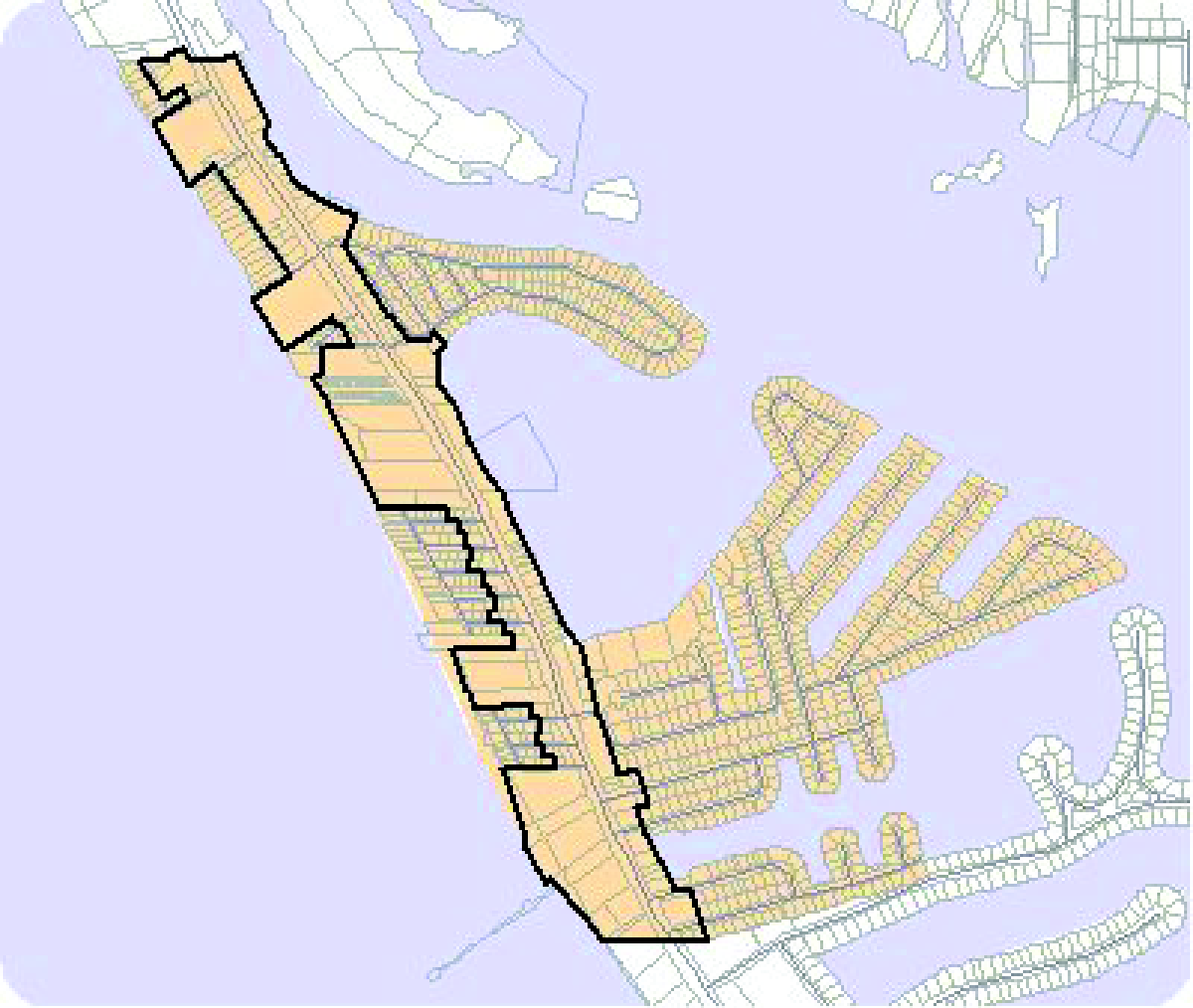
B.
Definitions. For the purpose of this district, certain terms and words are hereby defined. Words used in the present tense shall include the future; the singular number shall include the plural and the plural the singular; the word "building" includes the word "premises"; and the word "shall" is mandatory and not discretionary. Said definitions are as follows:
Alignment—The configuration of the building facades cooperating to define open space in much the same way as walls define a room.
Arcade—A series of arches linked together, usually as an element of a building and covering a sidewalk.
Arcade frontage—Certain lines designed for arcades on the ground story. The arcade length is measured as the distance along the building facade. The depth is measured back from the building facade. The height is measured from the sidewalk to the ceiling of the arcade.
Awning—An ancillary lightweight structure of wood, metal or canvas, cantilevered from a building facade and providing shade to the building windows, doorway openings, and spatial containment for pedestrians.
Back building—An ancillary segment of a building extending from a principal building into a rear yard. A back building may connect the main building to an outbuilding.
Balcony—An unenclosed, habitable structure, usually cantilevered from a facade or an elevation, providing private outdoor space to an apartment.
Bands of windows—A horizontal series of three windows or more, separated only by mullions, that forms a horizontal band across the facade of a building.
Bays—Openings formed by the supports of the arcade or colonnade.
Build-to line—A line appearing graphically on the site development plan and/or stated as a setback dimension, along which a building facade must be placed.
Canopy sign (awning sign)—A sign that is mounted on, painted to, or otherwise attached to an awning.
Canopy tree—A large-scale deciduous or evergreen shade tree used as part of streetscape plantings to define space, buildings, and shade sidewalks.
Cap—A horizontal cross member at the top of a window frame in semicircles, arches, or triangular shapes.
Colonnade—A series of columns similar to an arcade but spanned by straight lintels instead of arches (see "gallery").
Configuration, building—The three-dimensional form of a building, including the form and materials of roofs, walls, openings, and other elements.
Cornice—Any crowning projection.
Crosswalk—The axis of pedestrians crossing a thoroughfare. The crosswalk typically to connect sidewalks at the corners of blocks.
Detached single-family house—A freestanding building, designed for or occupied exclusively by one family.
Diagonal parking—A pattern of parking where the vehicle is stored at an angle to the curbline.
Door, entry—A primary entrance that provides security at the main building entry point.
Driveway—A vehicular accessway within a private lot connecting a garage to a thoroughfare.
Dwelling, multifamily—A dwelling where three or more dwelling units are contained in one structure on a single lot or parcel and attached by common vertical walls.
Dwelling, single-family detached—A dwelling unit on a single parcel or parcels attached to one or more one-family dwellings connected by common vertical walls.
Dwelling, single-family attached—A one-family dwelling on a single lot attached to two or more one-family dwellings that are on single lots attached by common vertical walls.
Eave—The junction of the wall of a building and an overhanging roof. To avoid discouraging pitched roofs, the designated maximum building height should be measured to the eave, and not the ridge of the roof.
Facade, primary—The elevations of a building usually set parallel to a frontage line.
Fenestration—The arrangement, proportioning, and design of windows and doors in a building.
Frontage lot—That portion of a lot, between the facade and the lot line, that fronts onto a public open space or a thoroughfare.
Frontage width—The measure of the lot line that coincides with the right-of-way of a thoroughfare. In a corner condition, a frontage width is measured at the more important of the two thoroughfares.
Gable—The orientation of a pitched roof that shows the vertical, triangular side rather than the sloped.
Gallery—A roofed promenade where the columns are set at regular intervals.
Garage door ratio—The vertical surface area of the garage (the doors and their surrounds) relative to the rest of the facade.
Gate—An exterior door connecting one outdoor space within another.
Green—A public open space available for unstructured recreation, generally contained by building facades, landscaped with grassy areas and trees.
Head-in parking—A pattern of parking where the vehicle is stored at a ninety-degree angle to the curbline.
Lawn—Grassed lands controlled by mowing. A lawn is a uniform, durable groundcover suitable for playing fields.
Liner building—A building conceived specifically to mask a parking lot or a parking structure from the frontage.
Lintel—A supporting wood or stone beam across the top of an opening, such as that of a window or door.
Live-work building—A townhouse or stand-alone structure, generally owner-occupied, with the first story available as commercial space. This space is controlled by the building's owner and may be leased to an independent business owner.
Loft—A high-ceilinged and internally well-lit dwelling with few partitions reaching the ceiling.
Loggia—An open-air room within the mass of a building, with ceiling and floors, but no wall on at least one side.
Main building—The principal building on a lot, disposed to provide the facade on the frontage.
Mullion—A vertical member dividing a window or opening.
Off-street parking—A parking area located within a lot, generally to the rear of a building frontage, masking it from the public space.
On-street parking—A single line of parking located along the curbline of a thoroughfare, accessible directly from a moving lane.
Out building—A secondary building associated with a principal building by ownership and shared lot.
Parallel parking—A pattern of parking where the vehicle is stored parallel to the curbline. Parallel parking permits a narrower street section and creates the most positive sidewalk experience of the possible patterns, but it requires a difficult driving maneuver and provides the lowest density of parking per linear foot of street frontage.
Parapet—A low guarding wall at any point of sudden drop, such as the edge of a terrace, roof or balcony.
Park—A large open area available for recreation, usually located at the neighborhood edge, and fronted by buildings. Its landscape comprises paved paths and trails, some open lawn, trees and open shelters, all naturalistically disposed and requiring limited maintenance.
Passage—A pedestrian connector passing between buildings.
Pedestrian shed—A determinant of urban size, defined as the area described by a radius equaling the distance that can be covered by a five-minute or one-quarter-mile walk at an easy pace.
Pedestrian way—The portion of the thoroughfare right-of-way that is dedicated to uses other than vehicular movement and parking. The pedestrian way includes the sidewalks, arcades, and planting areas of streetscapes.
Placement, building—The location of a building on its lot. Placement is determined by dimensional setback or build-to requirements measured from the lot boundary lines.
Playground—A small open area specifically designed and equipped for the play of small children. A playground is usually fenced and may include an open shelter.
Plaza—A public space set at the intersection of important streets, set aside for civic purposes and/or commercial activities.
Porch—An open-air room appended to the mass of a building with floor and roof, but no walls on at least two sides.
Public realm (space)—Those parts of the urban fabric that are held in common, such as plazas, squares, parks, thoroughfares and civic buildings.
Rear lane—A vehicular accessway located to the rear of a lot providing access to parking and outbuildings as well as easements for utilities. Rear lanes are paved as lightly as possible, to driveway standards or with shell.
Retail frontage—Certain frontage lines designated for mandatory retail on the regulating plan. These building facades are subject to special adaptation for retail use at the ground story.
Roof—That element of a building that covers the top of a building, as the walls cover the sides.
Roof overhang—The overhead cantilever of an architectural element beyond the building wall.
Roof slope—The angle of the roof, usually stated as a ratio of the vertical to the horizontal (e.g., "4:12" that is, a four-foot vertical rise across each twelve-foot horizontal run).
Shared parking—The policy wherein day/night and weekday/weekend schedules of two or more uses allow the parking to be shared by more than one use or building.
Sign, monument—A sign not attached to a building, where the entire base of the sign is in contact with or close to the ground, and the sign is independent of any other structure.
Sign, wall—A sign applied directly to the exterior face of a building, with the exposed face within the plane of the facade or parallel to the facade. This category includes those signs painted onto or applied directly to the surface of a building's exterior face.
Streetscaping—An assemblage of landscapes, walks, and curbs between the private lot line and the public right-of-way or vehicular frontage.
Thoroughfare—An urban element that provides a major part of the public open space as well as moving lanes for vehicles. A thoroughfare is endowed with two attributes: capacity and character.
(1)
Thoroughfare capacity — The number of vehicles that can move safely through a segment of a thoroughfare within a given time period.
(2)
Thoroughfare character — The suitability of a thoroughfare as a setting for pedestrian activities and as a location for a variety of building types.
Vehicular circulation—The combination of moving and parking lanes within thoroughfares. The network of thoroughfares also constitutes the majority of the public realm available to pedestrians.
Vehicular way—The portion of the thoroughfare that is occupied by vehicles, usually consisting of the moving lanes and the parking lanes. The vehicular way, together with the pedestrian way, fills the right-of-way.
Vertical height—The height as measured to the highest point of a building or specific component.
Walk—A lightly paved path of grass, gravel or sand within a garden or open space.
C.
Permitted uses. Uses within the GBOD shall be limited as identified within the underlying zoning districts included in this chapter.
D.
Special uses. Special uses within the GBOD shall be limited as identified within the underlying zoning districts included in this chapter.
E.
Building placement standards. All newly constructed buildings and substantial building renovations exceeding 50 percent appraised value identified within this section shall meet the intent of FEMA regulations through the standards and requirements of the PCCLB coastal construction code and Part 2 of the town's Code.
(1)
General requirements. Enhance the harmony and character of the community by establishing standards for placement and detailing among the various structures.
(2)
Build-to and setback requirements.
(a)
All commercial and mixed use structures adjacent to the Gulf Boulevard right-of-way may be built with their primary facade located along a build-to line, measured ten feet from the right-of-way line, or such greater distance as may be required if necessary to accommodate large palms or shade trees planted street-side in order to be consistent with other plantings in the surrounding area. See Figure 90-107-B.
Figure 90-107-B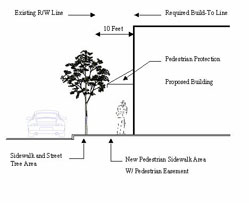
(b)
All commercial and mixed use buildings adjacent to Gulf Boulevard may have an arcade, gallery, porch, or awning to provide pedestrian protection. Buildings taller than two stories shall provide balconies on all floors above the first floor. See Figure 90-107-C.
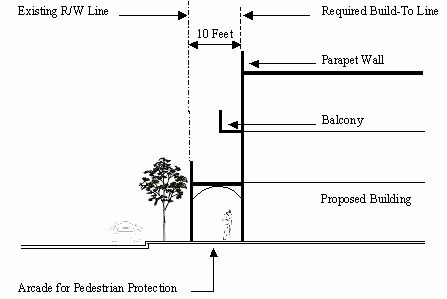
Figure 90-107-C
(3)
Building ground floor use requirements.
(a)
The ground floor of all commercial and mixed use buildings located along Gulf Boulevard may include street-front retail, restaurants, office, commercial, civic or other residential or nonresidential uses as limited by the underlying zoning district provisions listed in this chapter.
(b)
Ground floor nonresidential development areas shall be a minimum of 20 feet in depth from the primary facade of the building. See Figure 90-107-D.
(c)
All development areas shall be constructed according to necessary standards for protection from flooding.
Figure 90-107-D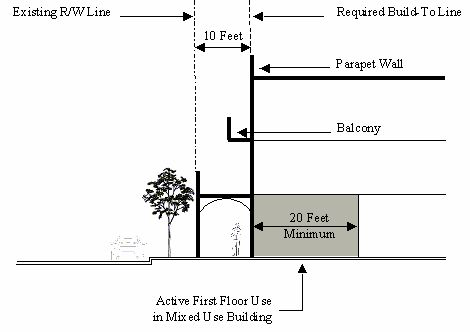
(4)
Building width requirements.
(a)
The maximum continuous facade of any building fronting the Gulf Boulevard right-of-way shall be 60 feet. See Figure 90-107-E.
(b)
Buildings wider than 60 feet must be architecturally defined as a series of smaller, repetitive units, with insets located within the primary facades.
(c)
The inset facade shall be recessed a minimum of five feet from the front of the primary facade.
(d)
The ratio of the width of a primary facade to an inset facade shall be no greater than three to one (3:1), or a minimum of ten (10) feet.
Figure 90-107-E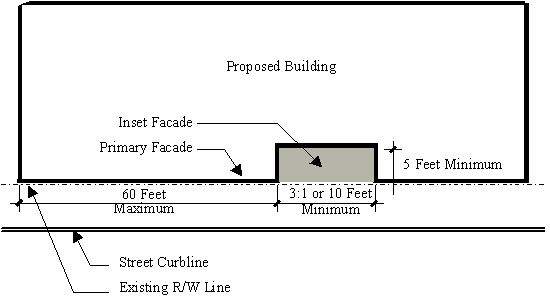
(5)
Building height requirements.
(a)
All newly constructed buildings located along Gulf Boulevard shall be a minimum of two stories in height, and measure no greater than 25 feet, as measured from right-of-way finished grade to the top of the parapet on a flat roof or 22 feet as measured to the top edge of the eave on a pitched roof. See Figure 90-107-F.
Figure 90-107-F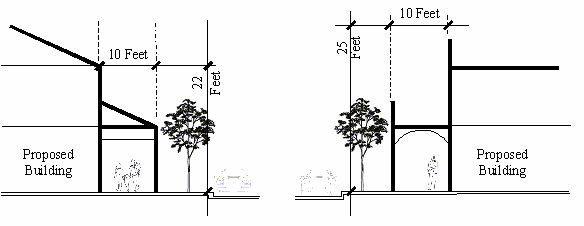
(b)
All newly constructed buildings located along Gulf Boulevard may be a maximum of four stories in height, and measure no greater than 52 feet, as measured from right-of-way finished grade to the top of the parapet on a flat roof or 48 feet as measured to the top edge of the eave on a pitched roof. See Figure 90-107-G.
Figure 90-107-G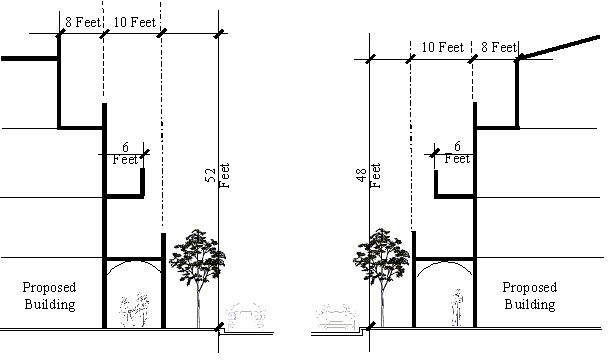
(c)
If the building is four stories, the primary facade of the highest floor must be set back eight feet from the primary facade of the lower three stories. Balconies on the third floor may extend up to six feet from the build-to line towards the right-of-way line.
(d)
A newly constructed one-story building may be permitted for commercial uses if it meets the requirements for minimum building heights and the finished floor level is located at sidewalk level.
(e)
The maximum interior height dimension for the first floor story of a building shall be 14 feet, as measured from the finished floor to the finished ceiling. First floor ceiling-to-floor heights in all newly constructed multistory buildings must be greater than the ceiling-to-floor height of any upper floor.
(6)
Building setback requirements.
(a)
Side yard setbacks.
[1]
A minimum seven-foot-wide building setback shall be provided for all parcels fronting Gulf Boulevard. The setback may be reduced to 0 feet on one side in cases where shared access is provided on the opposite side yard, and building construction design and techniques do not impact adjacent properties. See Figure 90-107-H.
[2]
Adjacent parcel sideyard setbacks may be dedicated as a one-way access lane for the parcels, if a minimum sixteen-foot clear width between side-walls exists, property owner easements are identified and recorded in the public records of Pinellas County, and access management and site plan approval provisions are approved by the town.
Figure 90-107-H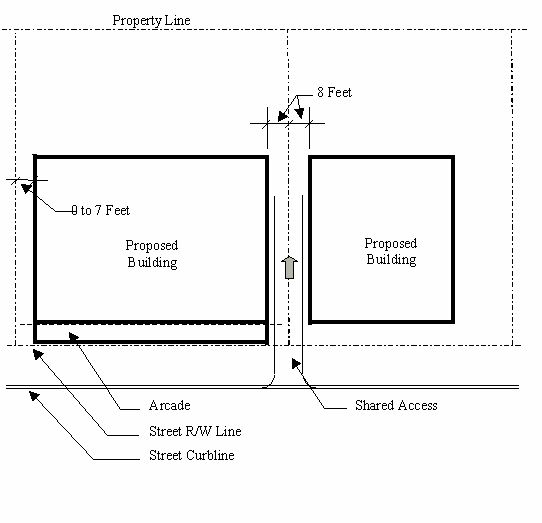
(b)
Rear yard setbacks.
[1]
A minimum 25-foot wide building setback shall be provided for all parcels that are adjacent to an accessible right-of-way, or the rear or side yard lot line of another parcel.
[2]
A minimum 45-foot wide building setback shall be provided for parcels adjacent to a public waterway.
[3]
Alternative design solutions may be proposed for the narrow lot depth parcels located adjacent to the Boca Ceiga Bay. Reduction of this setback may be approved by the town if an acceptable alternative design solution is provided.
F.
All newly constructed building configuration standards.
(1)
Buildings fronting gulf boulevard general requirements.
(a)
An approved architectural building character type is required, with a preference towards masonry structures.
(b)
Structures shall include stucco exterior coating, pitched roofing, arcades with semicircular arches, and other standard motifs and details appropriate for tropical and subtropical climates.
(c)
A building canopy, awning or similar form of weather protection may be provided, with a minimum projection of six feet over the fronting walk.
(2)
Nonresidential and mixed-use buildings.
(a)
Building materials and techniques.
[1]
Nonresidential and mixed-use buildings fronting Gulf Boulevard shall be constructed using brick, cast concrete, stucco, stone or other masonry material similar to those listed if appearance and durability is approved by the town.
[2]
Regular or decorative concrete block may be used on building walls not visible from a public street.
[3]
All ancillary structures shall be clad in materials similar to the primary structure.
[4]
All stucco surfaces shall be knockdown finished.
[5]
All window installations shall be set to the inside of the building facade wall.
[6]
Any overhanging eave lines may expose rafters.
[7]
All rooftop equipment shall be enclosed in building material that matches the structures of the main building or is visually compatible with the structure. Rooftop equipment shall not be visible from Gulf Boulevard.
(b)
Building roofs.
[1]
Pitched roofs shall be clad in Spanish tiles, barrel tiles, colored standing seam metal, slate or similar materials.
[2]
Main roofs on buildings shall be, where possible, symmetrical hips or gables with a pitch of between 4:12 and 12:12. See Figure 90-107-I.
[3]
All pitched roofs must have an overhang of at least 12 inches and can extend to a maximum of 30 inches beyond the face of the facade.
[4]
Flat roofs are permissible on nonresidential or mixed-use buildings. Flat roofs must be raked at the minimum slope necessary to shed water and meet other construction requirements.
[5]
Buildings with flat roofs must include parapets that shall be no less than 18 inches in height and not greater than 36 inches in height, measured along the face of the facade. The top of this parapet shall be no less than 18 inches higher than the adjacent finished roof surface. Building parapets shall be treated as unique topping elements on the facades of flat roof buildings. Special attention shall be used in articulations, signage, details, inlays, friezes or other appropriate design elements.
Figure 90-107-I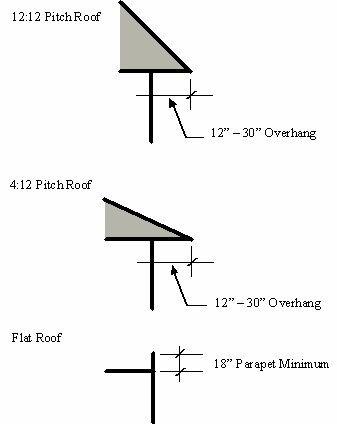
(c)
Building windows and doors.
[1]
A minimum of 50 percent of the linear dimension of the building's primary facade shall include windows or doors. Primary facade walls shall not continue uninterrupted without a window or functional public access doorway for a distance greater than 12 feet.
[2]
First-floor windows shall be clear or transparent glass. Mirrored or reflective glass of any kind is prohibited. Stained glass shall be used sparingly in special cases primarily as an architectural accent.
[3]
Window sills shall be located no higher than 42 inches above building finish floor level.
[4]
Window headers shall be located no lower than eight feet above adjacent building finish floor level.
[5]
Window types shall include bay, casement, clerestory, dormer, and double hung. Single-pane and tilt windows are permissible if the glass panes have mullions within.
[6]
The minimum vertical proportion of a window shall be 1.5 times its width.
[7]
Bands of windows are permissible.
[8]
Window treatments shall include caps, lintels, and sills.
[9]
The principal doorway or building entrance inset for public entry into a building shall be from Gulf Boulevard. Corner entrances may occur where appropriate on corner lots.
[10]
Door types shall include entry, French, patio, and storm.
(d)
Building chimneys.
[1]
Exterior chimneys shall be finished in brick, stucco or stone.
[2]
Chimney hoods and caps shall be terracotta, brick, or stucco.
[3]
Chimney shafts shall be integrated to the design of the building.
(e)
Building arcades, galleries, porches, and awnings.
[1]
All newly constructed buildings located along Gulf Boulevard shall include physical extensions (i.e., other than minimum limits of required arcades) that project into the intermediate zone between the build-to line and the edge of the public right-of-way that serve for additional pedestrian protection.
[a]
These extensions shall include arches, galleries, porches, awnings, or other physical extensions from the primary facade.
[b]
These extensions shall extend no less than one-third the length of the primary facade and must, at a minimum, provide protection for all entries into the building that are not covered by an arcade. It is recommended that additional protection be provided for all openings, including windows.
[2]
Awnings must extend a minimum of six feet from the primary facade of the building.
[3]
Porches must extend a minimum of seven feet in width from the primary facade.
[4]
All buildings greater than two stories in height, and with a primary facade greater than 60 feet in width, must have a continuous arcade or colonnade for the full length of that facade.
[a]
The front (exterior) edge of an arcade shall sit along the Gulf Boulevard right-of-way line.
[b]
The interior dimension of an arcade shall be a minimum of eight feet wide. See Figure 90-107-J.
[c]
The proportions of the arcade bays shall be vertical and at least ten percent greater than the width of the bay at its widest point. The minimum height for an arcade bay opening shall be ten feet. The minimum width for an arcade bay opening shall be eight feet.
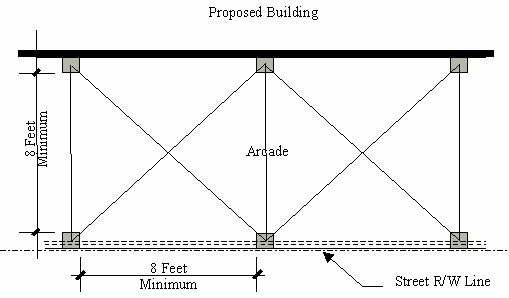
Figure 90-107-J
[5]
Towers are permitted at the corners of buildings that are located at the intersection of Gulf Boulevard and any connecting street. See Figure 90-107-K.
[a]
The design of a tower shall be architecturally continuous with the primary building.
[b]
A tower shall be built above the intersecting primary facade and intersecting street facade, and may extend up to one story above the maximum primary building height.
[c]
A tower must have a square footprint whose width cannot be greater than 1/6th the width of the building, and a maximum of 20 feet.
[d]
A tower may be accessible, or inhabited if compliant with other provision of this Code.
[e]
Towers shall be constructed with sufficient open space at ground level in order that such tower not constitute sight line obstructions.
Figure 90-107-K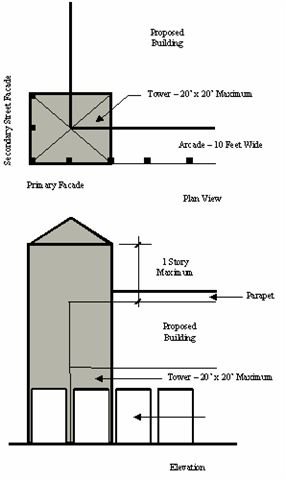
(3)
Single-family residential buildings.
(a)
Materials and techniques.
[1]
Residential building walls shall be wood clapboard, primed board, brick, stone, stucco, approved vinyl siding, Hardiplank, or similar approved material.
[2]
Garden (freestanding exterior) walls may be of brick, stone or stucco matching the main building.
[3]
Residential roofs, including the roofs of porches, shall be clad in wood shingles, standing seam metal, slate, barrel tile, asphalt shingles or a similar approved material.
[4]
All rooftop equipment shall be enclosed in building materials that match the materials of the main building, or are otherwise compatible with the design of the structure.
(b)
Front yard porches.
[1]
Usable porches shall be a dominant element.
[2]
Porches shall be at least six feet in depth and located along at least 50 percent of the primary facade of the building. A greater percentage of primary facade length is recommended, as well as the location of porches on one or more side facades if possible.
(c)
Garage doors.
[1]
Garage doors that are facing the right-of-way shall be designed with individual door openings for each vehicular space.
[2]
The visible width of the garage, when viewed from the right-of-way, shall be no more than 40% of the lot width. For sites that include frontage on both Gulf Boulevard and an ancillary side street, ingress and egress shall occur from the side street. For narrow sites with only frontage on Gulf Boulevard where the forty-percent maximum width limits site design options, up to two twelve-foot wide garage doors are allowed.
[3]
Where driveways and garages are located on the Gulf Boulevard frontage, the garage opening shall be set back a minimum of 20 feet from the right-of-way line.
[4]
Where driveways and garages face other street frontages, the garage opening shall be set back a minimum of 15 feet from the right-of-way line.
[5]
When the side of a single-family residence faces another street frontage, and the driveways and garage occur to the side, the side yard setback shall be a mandatory 20 feet for the frontage containing the garages and/or car ports.
(d)
Roofs.
[1]
Main roofs on buildings shall be symmetrical hips or gables with a pitch of between 4:12 and 12:12.
[2]
All pitched roofs must have an overhang of at least 12 inches and can extend to a maximum of 30 inches beyond the facade, and may extend into required setbacks.
(e)
Walls.
[1]
Two different wall materials may be combined horizontally on the facades of the building, with the heavier material (i.e., masonry, brick, stucco, stone, etc.) installed below.
[2]
When two materials are combined horizontally on one facade and terminate at the outside corner of the facade, both materials must continue for a minimum distance of three feet around the corner onto the side facade.
[3]
Moldings or other elements shall be used to indicate the transition at the joint between a wall and an overhanging pitch roof.
(f)
Windows and doors. Moldings or other surrounds on windows and doorways shall be used.
(g)
Chimneys. Exterior chimneys shall be finished in brick, stucco or stone.
G.
Public realm design. The creation of compatible public realm design elements along the Gulf Boulevard parcels located within the GBOD limits may be considered as a responsibility of both private developer and town, depending upon the identified application. Ultimately, private redevelopment projects must demonstrate that they meet local requirements for approval. The town shall seek implementation of the identified standards, through town funding, private developer contribution as appropriate fair share, or combination thereof where possible.
(1)
General street design. The private developer(s) shall design and construct public realm improvements to Gulf Boulevard to implement the provisions of this section.
(a)
Streets shall be designed as the primary public space within the community and shall be designed to the scale of the pedestrian.
(b)
Gulf Boulevard shall be designed to include appropriately selected street trees planted in a manner appropriate to their placement and function.
[1]
Gulf Boulevard shall have trees that complement the facades of the structures, that provide for visual access to storefronts and signage, and that shade the sidewalks.
[2]
Residential streets shall provide for an appropriate street canopy, designed to shade both street and sidewalk during summer months and serve as a visual buffer between street and the adjacent dwellings.
[3]
Required shade trees shall provide 14 feet six inches of clearance over the roadway.
(c)
On-street parking is preferred and shall be provided wherever possible. Use of on-street parking shall credit towards on-site parking requirements.
(d)
Within designated areas of Gulf Boulevard, parallel parking shall be acceptable if approved by the Florida Department of Transportation.
(e)
Within all other areas, on-street parking is allowed except where expressly prohibited.
(2)
Traffic calming.
(a)
Every opportunity should be taken to implement the full compliment of traffic calming techniques within the town as follows:
[1]
Narrowing the visual field.
[2]
Narrowing or deflecting the roadway.
[3]
Altering the height of the roadway surface.
(b)
This is particularly important along the length of Gulf Boulevard, where the use of such techniques will need to be negotiated between the town, private developers, and the Florida Department of Transportation, as appropriate.
(c)
On other streets located within the town, however, the town and private developers should implement these techniques on an incremental basis as timing, demand, and resources permit.
(3)
Curb cuts.
(a)
Adjacent properties shall be designed to share ingress and egress points where possible to reduce the number and interval of existing curb cuts in the town through cross-access easements.
(b)
Corner properties with ingress and egress to intersecting streets shall have access occur from the secondary intersecting street as opposed to Gulf Boulevard right-of-way.
(c)
Continuous, paved right-of-way access should be eliminated and parking redesigned throughout the entire length of Gulf Boulevard right-of-way.
(4)
Bicycles. New development should be designed to enhance mobility within the town through increased design emphasis for bicyclists from both within and outside the community.
(a)
Indicate through signage, lanes and street markings, desirable locations for bicycle use.
(b)
Provide bicycle storage racks and other facilities for temporarily storing bicycles on private property and in the public realm.
(5)
Mass transit. New development activity that exceeds a minimum of 50 percent of the existing property appraised value should be designed to support trolley/bus stop locations within the community. These locations and facilities will link with adjacent commercial, restaurant or civic uses through construction of covered waiting areas.
(6)
Sidewalks. New development activity that exceeds a minimum of 50 percent of the existing property appraised value shall improve and/or enhance existing sidewalks within the GBOD along Gulf Boulevard and intersecting secondary streets fronting the project.
(a)
A minimum eight-foot wide sidewalk shall be provided along Gulf Boulevard.
(b)
A minimum five-foot-wide sidewalk shall be provided along intersecting secondary streets.
(c)
The paved areas along Gulf Boulevard should be thought of as including three distinct elements: the edge area closest to the street and/or parking; the central area used primarily for walking; the area closest to the private property lines used for access to these properties, window shopping, and outdoor dining.
[1]
The edge area, adjacent to the roadway, should be used for street trees, street furniture, lighting fixtures, trash receptacles, and other elements. This band should be between two feet and four feet wide, depending on the size, type and nature of the trees and/or street furniture placed there. All street furnishings, palms and shade trees must maintain a minimum of four-foot offset to the face of the curb.
[2]
The central area should be dedicated to pedestrian use. Surfaces should be durable, and not overly ornate. Few, if any, impediments should be found within the realm, which should be at least five feet wide and might extend to be as large as eight feet in high traffic areas.
[3]
The area closest to the private property lines should allow enough space for people to stop and stand and look at these properties. A portion of the build-to line setback may support outdoor cafe seating. At a minimum, this element of the sidewalk should be at least two feet wide.
[4]
A combination of the sidewalk areas identified in subsection G.(6)(c)[2] and [3] above may be approved by the town for use as part of outdoor cafe seating.
(7)
Street trees. Street trees shall be planted along all primary streets within the town. New development shall install and maintain the installations. See Figure 90-107-L.
(a)
Street trees should be installed a maximum of 30 feet on center, and be located within planting strips or tree wells. Such trees may require a variance from the Florida Department of Transportation Design Engineer if located within the limits of clear sight.
(b)
The minimum width for all planting strips is five feet.
(c)
The minimum dimensions for tree wells are five feet by five feet, and shall utilize tree grates to permit pedestrian access.
Figure 90-107-L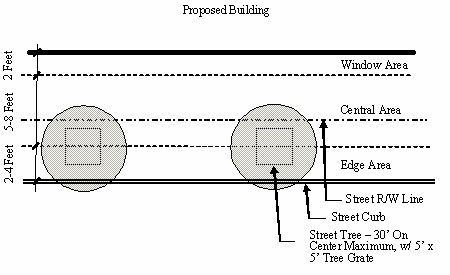
(8)
Lighting. New development shall include lights that are installed as part of a single unified fixture comprising both pedestrian and street lighting.
(a)
All lights shall be designed, installed and maintained to protect sea turtle nesting patterns. [5]
(b)
Additional pedestrian lights shall be located at critical intersections or high-intensity areas, as warranted on an as-needed basis.
(c)
All site lighting shall be designed to eliminate glare to adjacent properties, minimize spill over by providing shielding and other appropriate design and construction techniques.
H.
See also chapter 90, parts 1 and 2; section 90-108 and section 90-138; chapter 133, article I, business tax and business tax receipts; and § 90-113, satellite antennas.
(Ord. No. 15-03, § 1, 2-10-2016)
Cross Reference: See also Ch. 56, Animals, Art. II, Protection of Sea Turtles.
Sec. 90-108. - Parking regulations and requirements.
All off-street parking and loading shall conform to the following requirements:
A.
Locations. Off-street parking or loading lots may be developed in any required side, front or rear yards. Parking garages shall conform to the minimum yard requirements for principal buildings of the district in which they are located. Required parking may be off the site of the principal structure and separated from the site of the principal structure by up to 400 feet; and must meet and be approved under the standards of this [subsection] K.(4)(e).
B.
Lot surfaces/drainage. Parking lots designed for 20 or more vehicles shall be designed for storm runoff pollution control. Appropriate pollution control facilities may include pervious bituminous concrete surfaces and on-site retention of stormwater. Performance criteria shall be included in the site plan application.
C.
Dimensions. Each parking space shall measure a minimum of ten feet wide and 20 feet deep, exclusive of maneuver space. The marking of parking spaces is required in lots designed for more than four vehicles. The developer, at his or her option, may increase the number of parking spaces by designating and marking up to 25 percent of the required spaces for smaller vehicles. Spaces for smaller vehicles shall measure a minimum of nine feet wide and 20 feet deep, exclusive of maneuver space. Total required space for parking will, however, be based on the ten-foot-by-twenty-foot dimension plus maneuver space for normal vehicles for the required number of spaces.
D.
Vehicular access. Vehicular access to street, pedestrian areas and landscaped areas shall be restricted and controlled by curbs or concrete bumpers. Unrestricted access to streets shall not exceed 25 feet per access point.
E.
Illumination. Lots shall be adequately illuminated if designed for use by more than four vehicles after dark.
F.
Egress. Excluding single-family and duplex residences, all off-street parking areas shall be designed so that no vehicle is required to back into a public or private street or through drive to obtain egress. For the purposes of this provision, drives or aisles serving more than 25 vehicles and which are not internal to a parking bay but serve one or more parking bays are considered to be through drives.
G.
Landscaping. Eight percent of the area of parking lots shall be devoted to landscaping encompassing trees and shrubs and a mechanical irrigation system. Landscaping arrangement shall contribute both to buffering between adjacent properties and to effective traffic control for safety.
H.
Loading areas. Loading areas shall comprise one space for every commercial or multiple-residence building of 5,000 square feet or more, plus one additional space for each additional 25,000 square feet of gross building space. Each loading space shall be at least 400 square feet in area.
I.
Residential zone restriction. A garage designed for more than three vehicles is not permitted as an accessory use for a single-family dwelling.
J.
Off-street parking areas.
(1)
The schedule of off-street parking shall be as follows:
(2)
For combined permitted uses located in a single enterprise, required parking shall be calculated separately. However, if under the site plan review procedures described in section 90-110 it can be demonstrated that separate calculation will result in more parking than is necessary because of shared clientele or because of nonoverlapping hours of use, the requirements may be adjusted accordingly.
K.
Gulf Boulevard Overlay District (GBOD) parking standards. The following parking standards are provided for use within the district limits where appropriate.
(1)
General conditions. Parking lots shall not interrupt key pedestrian routes, or otherwise negatively impact Gulf Boulevard. The Building Official shall review and make recommendation to the Planning and Zoning Board during site plan review process.
(2)
Location.
(a)
Vehicular parking areas may be located at the rear of buildings or within the interior of blocks. However, vehicular parking areas may be approved by the town in side yard areas and/or fronting right-of-way where needed.
(b)
When located alongside a building, the vehicular parking areas shall not occupy more than one-third of the entire lot or block frontage, whichever is smaller.
(3)
Landscaping. All landscaping shall meet or exceed provisions within this chapter. Additionally:
(a)
All parking areas will be screened from public rights-of-way by landscape plantings and/or masonry walls.
(b)
Screening shall be a minimum of three feet in height at time of installation and be designed to accommodate either FDOT or town safe visibility criteria at access points.
(4)
Shared parking.
(a)
All nonresidential uses within the GBOD can meet their parking requirements through the use of non-designated on-street parking (in front of the individual use as a credit to one-half car per full space towards required parking count) or designated spaces located within accessible private lots with available extra space to designate to the intended users, and an agreement as outlined in this [subsection] (4)(e).
(b)
All designated spaces must be located in lots within a reasonable walking distance, a maximum of 400 feet from the primary entrance of the use, and approved by the town.
(c)
Nonresidential uses may also meet their requirements through the use of a valet service that has access to off-site parking spaces sufficient to accommodate the need of the combined uses, based upon town approval.
(d)
All residential uses must accommodate required parking on-site. However, for upper-story residential apartments located within mixed-use buildings, parking requirements may be met with designated spaces in adjacent shared parking lots.
(e)
The joint use of shared off-street parking spaces must be designated by agreement between the users and the owner. The applicant shall submit a detailed traffic report prepared by a professional engineer using the Institute of Traffic Engineers (ITE) latest edition for trip generation and shared parking use. The report will identify the specific uses, hours of operation and stipulations acceptable to the town. Such shared use agreements shall be subject to final approval by the Town Commission and after execution, recorded by the requesting party with each parcel of property involved so as to run with the land.
(5)
Trash dumpsters.
(a)
All trash dumpsters shall be stored and screened from the Gulf Boulevard right-of-way and adjacent residential uses.
(b)
Trash dumpsters shall be located in an accessible service area and enclosed within an opaque fence/wall with gates. Such gates shall remain closed at all times other than when being picked up.
(Ord. No. 15-02, § 1, 11-12-2015; Ord. No. 15-03, § 3, 2-10-2016)
Sec. 90-109. - Boat, vessel, watercraft and trailer parking.
A.
It shall be unlawful for any person to place or park more than one boat and one trailer upon any lot, piece or parcel of land in the town. It shall not be deemed a violation of this section if no more than two personal watercraft are stored on a lot as long as they are on a trailer designed to accommodate two personal watercraft and as long as such trailer is the only trailer stored on such lot, piece or parcel of land in the town. Placing or parking such equipment upon any right-of-way or easement within the town is expressly prohibited.
B.
Boats, vessels, watercraft and trailers placed or parked upon the owner's or occupant's property shall be maintained in a neat, clean and presentable manner, and the area beneath the equipment shall be kept in a neat condition, and no accumulation of trash, weeds or overgrown grass shall be allowed under, near or around the equipment.
C.
It is further provided, notwithstanding any of the provisions contained in subsection A. of this section, that any resident of the town may park or store more than one boat, vessel, watercraft or trailer if such equipment is in an enclosed garage or enclosed carport out of view of the general public.
D.
Notwithstanding the above provisions, any resident of the Town of Redington Shores may obtain a permit from the town clerk to allow a guest or guests of such resident to park a boat, vessel or watercraft upon such resident's property for a period not to exceed 14 days in any calendar year.
E.
It shall be unlawful to violate the provisions of this section, and any person, firm or entity violating the provisions of this section shall be subject to a fine of up to $500.00 or incarceration for a period not to exceed 60 days in the Pinellas County Jail, with each day of violation being a separate violation of the provisions of this section.
Sec. 90-110. - Mandatory site plan review.
All applications for new construction or substantial improvement, other than single-family detached houses and duplex units east of Gulf Boulevard, whether permitted or special, shall be subject to site plan review by the planning and zoning board for recommendation, and by the town commission for final approval or denial, which application shall be processed in accordance with the provisions of section 90-124.
A.
Site plan requirements. A site plan shall depict the following:
(1)
The locations of buildings and their relation to property lines.
(2)
Driveways and parking areas.
(3)
Pedestrian walks and landscaping.
(4)
Elevations and/or renderings, if required.
(5)
Locations of utilities, existing and proposed, including depicting all easements on the property, whether such are utility easements or private easements. Any property fronting on Gulf Boulevard shall show and provide a ten-foot wide utility easement, for aboveground and below-ground utilities, along such portions of the property abutting Gulf Boulevard. The providing of such utility easement to the Town of Redington Shores shall be a condition that must be fulfilled prior to the issuance of any building permit.
(6)
Spot locations of major trees in excess of eight inches in diameter, and waterways.
(7)
Topography to the one-foot contour interval.
(8)
Elevation of lowest habitable floor of building in relation to mean sea level.
(9)
When appropriate, the coastal construction control line and the flood zone boundaries of the most current flood insurance rate map (FIRM).
(10)
Facilities for control of runoff water.
(11)
Soil types.
B.
Site plan design criteria. The following criteria shall be considered by the planning and zoning board for conformance to the design criteria, after adequate review of the site plan and inspection of the site in question:
(1)
Density and design harmonious with the environment and meeting the zoning district requirements. The use must be appropriate to the neighborhood with regard to street width, alignment and traffic access. Parking areas and yards shall be screened with evergreen planting where necessary for privacy and noise control. Planted buffer strips up to 20 feet in width may be required. Opaque fencing may, at the discretion of the board of commissioners, be allowed where necessary.
(2)
The location of buildings and structures on the site and the provision of minimum front, rear and side yards shall be established based on desired standards for the neighborhoods. Desired standards may be at variance with prevailing standards. Such yards must be designed to conserve scenic amenities, particularly where water frontage is involved.
C.
Guidelines. The following criteria shall serve as guidelines:
(1)
Guideline yard standards for new construction of principal structures shall be as follows:
Height Standards
Notes:
1 Except for properties east of Gulf Boulevard and north of 177th Terrace where a maximum of two stories, not to exceed 30 feet is permitted.
2 A height bonus may be permitted for parking of ten feet and one story through site plan approval.
3 A height bonus may be permitted for parking and setbacks of 20 feet and two stories through site plan approval.
4 A maximum of six habitable stories, not to exceed 65 feet, and 25 density units per net acre shall be permitted, except for properties east of Gulf Boulevard and north of 177th Terrace where the maximum permitted shall be four habitable stories, not to exceed 50 feet.
5 Buildings within the GBOD shall comply with the design requirements of the district.
6 Buildings located more than 100 feet from the Gulf Boulevard right-of-way.
7 Buildings located outside the limits of the GBOD, except that single-family residential dwellings shall not exceed 40 feet.
8 Excluding public utility poles, lines, and church steeples.
9 Minimum within ten feet from Gulf Boulevard right-of-way, to establish pedestrian arcade/protection area.
10 Maximum with building stepback and architectural treatments contained within the district standards.
(2)
Corner lots may be considered to have two front yards. Yard standards less than the guidelines may be approved if there is a finding that the proposed yards are in harmony with the neighborhood, comprise the most appropriate use of the land and, furthermore, that the yard reduction serves the greater public interest. Accessory structures may be located in yards based upon the standards of section 90-3 F.
(3)
Traffic circulation:
(a)
Unrestricted access to streets is not allowed. Generally curb cuts are limited to a maximum of 25 feet.
(b)
Access to streets should take into consideration sight distance and alignment.
(c)
All sites must provide for emergency vehicle access.
(d)
Separate ingress and egress is encouraged.
(e)
Traffic collection to reduce access points to Gulf Boulevard is encouraged.
(f)
Maneuver lanes between rows of parked autos shall be at least 20 feet in width.
(g)
Traffic lanes shall conform to the same design standards as public streets as regards alignment on intersection.
(h)
All buildings, exclusive of single-family and duplex dwelling districts, must provide for pedestrian circulation. Hard-surfaced pedestrian walks a minimum of four feet wide shall be provided generally as follows:
[1]
Along public rights-of-way.
[2]
Along access corridors to buildings.
[3]
At interconnecting points where significant numbers of people will seek to walk.
(i)
See also section 90-108, parking regulations and requirements.
(4)
Landscaping. All uses shall be landscaped.
(a)
Required landscaping may encompass the following:
[1]
Street trees or shrubs.
[2]
Foundation planting.
[3]
Planting islands to define curb cuts.
[4]
Perimeter planting to define and beautify sites.
[5]
Parking lot and walkway landscaping.
[6]
Buffer strips and screening for privacy.
[7]
Landscaping for underutilized acreage.
[8]
Landscaping for recreation space.
[9]
Landscaping for erosion control.
(b)
See also part 3, resources; vegetation and environmentally sensitive lands, article XXIX and article XXX, landscaping.
D.
Site plan approval criteria. The planning and zoning board shall have the option to recommend to the town commission approval as submitted, approval with conditions or disapproval of any submitted site plan, and the town commission shall have the option to approve, approve with conditions, or disapprove any submitted site plan. In approving a site plan with conditions, the written conditions become an appendage to the site plan. No building permit may be issued until the conditions are incorporated in the site plan, and no certificate of occupancy may be issued until all the conditions are satisfied. Conditions may include modifications to the layout or transfer of development rights. They may also relate to the use of the facility, including activities conducted therein, occupancy or hours of use.
E.
Exceptions. In a Commercial Tourist Facilities (CTF) Zoning District in the Town of Redington Shores, mandatory site plan review shall not be required as to single-family or duplex residences which are being altered only for the purpose of general repair and maintenance, up to a maximum expenditure of $2,500.00. However, no expansion of present residential premises by conversion of breezeways, carports, garages, patios, covered parking areas or parking areas in order to provide additional living area shall be permitted without mandatory site plan review. In addition, any enclosure which would negate code parking otherwise required on the property shall not be permitted. Any general maintenance, repairs or changes to the premises which involve a total expenditure of over the amount of $2,500.00 shall require a mandatory special exception review, but the property owner shall only be required to provide a current certified survey for such review. Nothing contained in these exceptions shall be deemed to authorize new construction or second-level additions without mandatory site plan review, and all such construction shall have drawings certified with the seal/stamp of a Florida-registered architect/engineer.
(Ord. No. 15-01, § 15, 4-8-2015)
Editor's note— Former subsection E., transfer of development rights, was repealed 7-14-2010 by Ord. No. 10-01; said ordinance also provided for the redesignation of former subsection F. as subsection E. See now section 90-115.
Sec. 90-111. - Regulations governing home occupations and other special uses.
A.
Home occupations.
(1)
Home occupations shall include the following:
(a)
Art studio.
(b)
Dressmaking.
(c)
Teaching with musical instrument limited to a single pupil at a time.
(d)
Tutoring for not more than two students at a time.
(e)
Foster family care (for not more than four children simultaneously).
(f)
Boarding of not more than two persons.
(g)
Other approved home occupations as approved by the board of commissioners.
(2)
Home occupations shall not be interpreted to include the following:
(a)
Retail wholesale outlets.
(b)
Barbershops and beauty parlors.
(c)
Kennels.
(d)
Commercial and professional offices.
(e)
Restaurants.
(f)
Automotive repairs.
(3)
Licenses for home occupations shall be issued by the town clerk in accordance with the provisions of chapter 133, taxation, of the Code of the Town of Redington Shores.
(4)
Personnel employed shall be limited to members of the immediate family residing on the premises; no mechanical equipment which will create noise, smoke or odor may be installed; no commodity may be sold on the premises; commercial vehicles may be parked or stored only in an enclosed garage where they are totally obscured from view; not over 25 percent of any one story of a residence may be used for home occupation; frequent or regular pickup or delivery of materials or merchandise is prohibited; any activity which will create congested or excessive vehicular traffic or the congregating of persons which would disrupt the peace and quiet of a residential neighborhood is prohibited; one nonilluminated sign not larger than two square feet attached to the building may be displayed; establishment of a home occupation to avoid payment of a higher business tax receipt fee shall be considered a violation of this part 2 and chapter 133, taxation, article I, business tax and business tax receipts, of the Code of the Town of Redington Shores.
B.
Other special uses.
(1)
Private, nonprofit recreational uses or social uses where membership is limited to adjacent residential areas in the RM-15 district. Standards shall be as follows:
(a)
The use, including accessory structures, shall be no closer than 25 feet to any property line.
(b)
The property line shall be screened by a ten-foot landscaped strip.
(2)
Commercial uses and commercial recreation uses in the C-NR district. standards shall be as follows:
(a)
The use shall not be closer than 50 feet to any residential district.
(b)
The property line shall be screened by a ten-foot landscaped strip.
(c)
A six-foot solid privacy fence or wall may be permitted as necessary to provide buffering for the residential district.
C.
Transient rentals. Transient rentals, as defined in this part 2, shall be deemed to constitute the operation of a commercial tourist facility and are specifically prohibited in the RS-7, RD-15, RS-10 and RM-15 districts. Under special circumstances, a special use permit for such transient rentals in other residential districts may be granted for specified limited periods of time. The participation, either directly or indirectly, in such transient rentals by any person acting either as an owner, agent, broker or any other form of representative shall constitute participation in the operation of a commercial tourist facility. The advertising or use of any such property for transient rental, by any formal method, including the Internet, shall be deemed to be conducting the operation of a transient rental. Any violation of this provision shall be subject to a fine of $500.00. Each day of violation shall constitute a separate violation. The penalties contained in this provision shall be the exclusive penalties applicable to a violation of this transient rental subsection, and no other fines, penalties or provisions contained elsewhere in the Town of Redington Shores Code of Ordinances shall apply to violations of the transient rental subsection.
D.
Authority for issuance of special permits.
(1)
The town clerk is authorized to issue special use permits for home occupations, portable signs and temporary parking of recreation vehicles/housecars.
(2)
All other special use permits shall be subject to approval of the planning and zoning board.
(3)
Fees for special use permits shall be in the same amounts as those established for business tax receipts in chapter 133, taxation, of the Code of the Town of Redington Shores.
(Ord. No. 08-04, 7-9-2008; Ord. No. 10-0514, 7-14-2010; Ord. No. 11-03, 5-25-2011)
Sec. 90-112. - Signs.
A.
Prohibited signs. The following types of signs or advertising structures are not permitted in the Town of Redington Shores in any zoning district:
(1)
Animated or flashing light signs of such size, intensity of lighting or degree of animation as to present a garish appearance or to constitute a traffic hazard by diverting motorists' attention.
(2)
Billboards.
(3)
Off-premises signs.
(4)
Banner signs.
(5)
Portable signs, except for sandwich board signs in the C-NR, ROR-15 and CTF zoning districts.
(6)
Roof signs (where the location of an existing structure makes the placement of other signs not feasible, variances may be granted for the construction of roof and/or projecting signs).
(7)
Projecting signs.
(8)
Swinging signs.
B.
Sign permits.
(1)
All signs six square feet or more in area require permits issued by the building department. Erection and construction of signs shall conform to the Florida Building Code.
(2)
All sandwich board signs require annual permits issued by the town clerk.
C.
Signs permitted in single-family (RS-7 and RS-10) and duplex (RD-15) residential districts shall be in accordance with the following:
D.
Signs permitted in multifamily (RM-15, ROR-15, PUD) residential districts shall be as follows:
(1)
All those in subsection C. above.
(2)
Institutional name signs, as follows:
E.
Signs permitted in commercial tourist facilities (CTF), general commercial (C-NR) and residential/office/retail (ROR-15) districts:
(1)
All those in subsections C. and D. above.
(2)
Institution and business signs for businesses occupying premises with frontage as follows:
(3)
Sandwich board signs for businesses occupying premises, provided that:
(a)
Sandwich board signs shall be no larger than 30 inches in width and 48 inches in height. No material such as papers, balloons, windsocks, etc. or other items prohibited by the Code may be added to such sign. The height of such signs may not be artificially increased above the allowed maximum by placing material under the base of such sign.
(b)
No more than one sandwich board sign per business is permitted.
(c)
Sandwich board signs may be placed no closer than ten feet from another such sign.
(d)
Sandwich board signs shall not be placed in the public right-of-way, in any parking space or drive isle, or in such a way to obstruct vehicular traffic sight, or to block any door or required ADA route.
(e)
Sandwich board signs may only be used during the hours when the business is open to the public and must be brought in at the close of business or in the event of high wind conditions.
(f)
No sandwich board sign shall contain foil, mirrors, bare metal or other reflective materials which could create hazardous conditions to motorists, bicyclists or pedestrians.
(g)
No sandwich board sign shall swing, rotate, twirl or contain any moving parts.
(h)
Sandwich board signs shall not contain lights of any kind.
F.
Signs permitted in outdoor recreation/public open space and public/semipublic institutional districts:
(1)
Commercial uses will be in accordance with subsection E. above.
(2)
Noncommercial uses may have signs up to 20 square feet in area.
G.
Temporary signs. A temporary sign/banner will require a permit for use for a special event. The permit will include the date when the sign will be removed, which is no later than three days after the event. Maximum dimensions are four feet in height by eight feet in width. No more than one sign is permitted for any site. Small temporary window signs (restaurant menus, "open" and "closed" signs, daily specials, etc.) less than ten square feet in aggregate may be posted without permit.
H.
Pole signs. Pole signs or other types of freestanding signs are permitted where district requirements are met. Only one such sign is permitted per property. Multibusiness buildings and shopping centers are considered to be one property. National flags and state flags on poles are permitted in the same manner as pole signs. The maximum flag size is 32 square feet and may be in addition to a pole sign.
I.
Double-faced signs. In calculating maximum sign area allowances, only one side of double-faced signs will be considered.
J.
Number of signs per district.
(1)
For multifamily residential districts (RM-15 and PUD), up to two signs are permitted for buildings with less than 100 linear feet frontage and up to four for those with 100 linear feet or more frontage.
(2)
For resort facilities medium and commercial general districts, up to two signs are permitted for businesses with 50 linear feet or less of frontage, up to three signs for those with 51 linear feet to 125 linear feet of frontage and up to four signs for those with more than 125 linear feet of frontage. Multiple window signs may count as one sign if the aggregate area does not exceed the individual sign area maximum for that property.
(3)
Shopping centers and multibusiness buildings, (commercial general), are permitted one pole/freestanding sign plus one wall, canopy/marquee or window sign for each business. Uniform design of signs in each instance is encouraged. The pole/freestanding sign for the shopping center/multibusiness building may also contain identification of the individual businesses located therein, but all signs shall not exceed aggregate sign area allowed for the business.
(4)
Parking and directional signs will not count as part of the allowable total. The area of a canopy/marquee sign is considered to be only the actual sign area and not necessarily the overall area of the canopy/marquee.
K.
Design of signs.
(1)
Design of signs shall be harmonious with the environment and compatible with the structures in the area. In no case will any sign exceed eight feet in its vertical dimension or 16 feet in width. Pole/Freestanding signs will not extend more than 15 feet above grade for single-story buildings or 21 feet for multiple story buildings. Signs fixed to the building may not extend above the roofline. Marquees are considered to be within the roofline.
(2)
No sign will employ words, shapes or colors which might be confused with any authorized traffic sign, signal or device.
(3)
No sign advertising products, services or places other than those located on the premises may be erected except upon approval by the board of commissioners.
(4)
No wall sign shall cover more than ten percent of the area of the wall to which it is applied. It will not extend more than 12 inches from the surface. Window signs shall not cover more than 20 percent of any glass area.
(5)
It shall be unlawful for any person to display false or misleading information in any sign.
(6)
Each sign shall be strongly constructed and securely anchored to withstand wind pressure as required by Florida Building Codes, as adopted, or alternatively as designed by a professional engineer (P.E.).
L.
Placement of signs.
(1)
All signs must be placed within the limits of the property to which they apply. Freestanding signs are not permitted closer than ten feet to the legal right-of-way of the road. Where the placement of existing structures makes the ten-foot setback for freestanding signs impractical, variance procedures may be applied. However, no sign may project beyond the property line.
(2)
Freestanding signs in areas where pedestrian traffic is expected must have the lowest edge at least eight feet above grade.
(3)
Access to buildings. No sign shall be erected or maintained so as to prevent free ingress or egress through any door, window or fire escape or to prevent access from one part of a roof to any other part. No sign of any kind shall be attached to a standpipe or fire escape.
(4)
Traffic or visual obstruction. No sign or supporting structure shall be erected so as to obstruct free and clear vision at street and driveway intersections.
(5)
Painting or posting signs. No sign may be painted, posted, nailed or otherwise affixed to any part of sidewalks, curbs, pavements, trees, lampposts, utility poles, hydrants, bridges, etc., within the limits of any public right-of-way.
(6)
All signs and surrounding premises shall be maintained in good condition by the owner.
M.
Electrical signs.
(1)
The construction and maintenance of all signs using electrical illumination shall be subject to town requirements for approval of plans and for inspection.
(2)
Neon or similar electrical signs shall be located and protected to ensure that they do not endanger life or property.
(3)
Sign illumination will be focused directly on the sign and shielded to assure that it does not throw light which could interfere with the vision of motorists or pedestrians or cause a nuisance for adjoining properties.
(4)
No electrical sign shall be maintained which shall cause interference with radio or television receivers.
(5)
Illuminated tubing or strings of lights around open sale areas, on fences or on other property or building edges are not permitted.
N.
Political signs.
(1)
No political signs of any nature may be placed within the limits of any public right-of-way or on any public place.
(2)
Political signs for qualified candidates for any office in any election in which electors of the town may vote are allowed for any candidate and may be displayed in the nonresidential districts in the town.
(3)
Political signs shall not exceed four square feet in area.
(4)
The building inspector is hereby authorized to remove any political sign posted in the town in violation of this article and to notify the candidate or the person responsible for posting the sign.
O.
Removal of signs.
(1)
Removal upon terminating of business or vacating of property. All signs must be removed within 60 days. If not removed, the town will remove them after ten days' written notice to the owner of the property. Cost of removal will be borne by the property owner. Sign structures which have intrinsic property value may remain in place if they otherwise meet ordinance requirements (or are under approved variances) and are properly maintained. Sign information relating to the terminated business must be removed. If the signs are relevant to a new occupant of the property, a single 60-day extension may be granted upon request to the building inspector. Any additional extension(s) would require approval of a variance.
(2)
"For Sale," "For Rent," "For Lease" or "Sold" signs shall be removed immediately after closing.
(3)
The town building inspector is hereby authorized to remove any sign that is not properly maintained or is unsafe or hazardous after giving written notice to the owner of the sign at least ten days prior to removal. He or she is also authorized to cause to be removed any signs constructed or modified after December 14, 1983, which are in violation of provisions of this article, unless variances were approved and/or permits issued prior to such construction or modification. Cost of removal will be borne by the property owner.
P.
Nonconforming signs.
(1)
Except for prohibited signs, previously approved signs in place prior to enactment of this part 2 and not in conformance thereto may continue in place if properly maintained without meeting the requirements of this article. Any replacement sign must meet the provisions of this article. Damaged signs must be removed from the premises within seven days unless repaired or replaced.
(2)
Failure to comply with the provisions of this part 2 shall constitute basis for revocation of business tax receipts.
Q.
Gulf Boulevard Overlay District sign standards.
(1)
General.
(a)
Nonresidential uses along Gulf Boulevard may be permitted one sign oriented towards automobile traffic and one that is oriented towards pedestrian traffic.
(b)
All signs shall be externally illuminated, not translucent or internally illuminated.
(c)
All signs must be designed concurrently and coherently with the facade or shopfront with which it is to be associated, sharing overall composition, material and color.
(2)
Auto-orientated signage.
(a)
Auto-oriented signage can be of the following types: wall sign, vertical blade sign, canopy sign and window sign.
(b)
Wall signs and vertical blade signs must be affixed to the primary facade of the building, immediately above the designated commercial use.
(c)
Canopy signs must be affixed to the canopy or awning immediately in front of the commercial use.
(d)
Auto-oriented wall signs and window signs shall be no more than 30 inches in height and eight feet in length.
Figure 90-112-A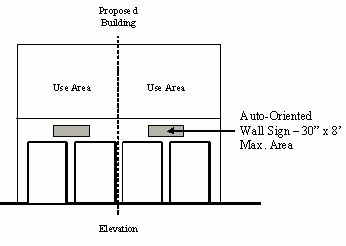
(e)
Window signs shall not occupy more than 25 percent of the available transparent glass area. Window signs must be within the windows of the designated use and may include use of neon lighting.
(f)
Canopy signs must fit along the vertical edge of the canopy, and may not extend more than six inches in height and ten feet in length.
(g)
Vertical blade signs shall be no more than eight feet in height and 15 inches in length, and shall be offset from the wall up to a maximum of six inches.
Figure 90-112-B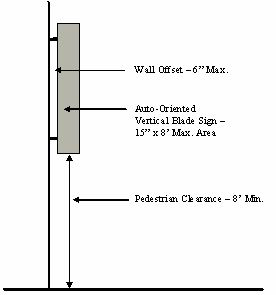
(h)
When more than one commercial use is contained within a building, all of the commercial uses must use the same type of auto-oriented signage.
(i)
Each use along Gulf Boulevard that has a distinct street number must portray that number adjacent to the appropriate entryway.
[1]
Such number should be wall- or window-mounted, no less than four feet and no more than eight feet above adjacent grade, and should be placed so as to be visible from Gulf Boulevard.
[2]
The individual numbers shall be no less than five inches and no more than eight inches in height.
[3]
If the numbers are contained within a frame, the frame should be no more than one inch wider and higher than the enclosed numbers.
(3)
Pedestrian-oriented signage. Pedestrian-oriented signage may be of the following types: wall sign, horizontal blade sign, and window sign.
(a)
Wall signs must be affixed to the wall of the structure, in front of the designated commercial use.
(b)
Blade signs must hang overhead within arcades or porches, in front of the designated commercial use. These signs can also be supported by horizontal brackets that project from the wall of the structure.
Figure 90-112-C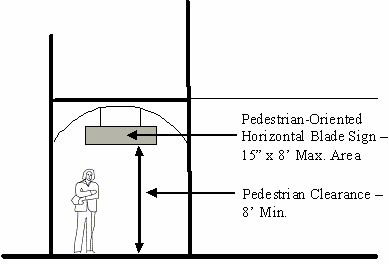
(c)
Window signs must be within the windows of the designated commercial use. Neon lights can be used for these signs.
(4)
Noncommercial signs. Each building along Gulf Boulevard may be permitted to have one auto-oriented sign identifying the building, such as the name or address of the building.
(a)
Such signs can be wall or vertical blade signs.
(b)
Wall signs shall be no more than 30 inches in height and no more than eight feet in width.
(c)
Vertical blade signs shall be no more than eight feet in height and no more than 15 inches in width or extension.
R.
Permit required; exceptions. No person shall erect, construct or alter within the town any sign containing six square feet or more of area without first having obtained a permit for the construction of such sign. Plans for the construction or alteration of signs submitted in accordance with section 90-2 of this chapter will clearly show the design, coloring and wording of the proposed sign.
S.
Building code to govern construction. The erection or construction of signs shall be in accordance with the Florida Building Codes, as adopted.
T.
Signage utilized by the Town of Redington Shores for special events shall be exempt from all provisions of this section.
(Ord. No. 19-02, § 1, 6-12-2019)
Sec. 90-113. - Satellite antennas.
A.
Satellite antennas and related guy wires shall be considered accessory structures and shall meet setback requirements. They will be fixed-point structures. No more than one satellite antenna per property shall be permitted.
B.
Satellite antennas shall be installed and maintained in compliance with requirements of the Florida Building Code and National Electrical Code. A building permit shall be required prior to construction and installation.
C.
Satellite antennas shall be appropriately finished to avoid bright light reflection and to blend with surroundings. No advertising or signage of any type is permitted on satellite antennas. Satellite antennas mounted above the roofline shall be of open web or mesh construction. Solid antenna dishes may be used in ground or pole mountings where no part of the antenna extends beyond the roofline at its nearest point.
D.
The maximum height of the antenna shall not exceed 15 feet above grade, except where roof-mounted or pole-mounted adjacent to the roof where it will not extend more than 15 feet above roof level at its nearest point.
E.
All poles or other brackets extending into the ground on which satellite antennas are mounted shall be securely anchored to conform to the Florida Building Code for like structures, so that in the event of flooding, such ground mounts shall not come out of the ground. The plans and specifications for such mounts shall be submitted to and approved by the building inspector prior to any installation.
F.
For single-family and duplex residences (RS-7, RS-10, RD-15), satellite antennas are permitted only within the rear yard buildable area for principal or accessory structures. Where roof mounting or pole mounting above the roofline is necessary, such installation will only be made in the rear half of the roof area.
G.
For multifamily residences (RM-15), retail office, residential structures (ROR-15), motels, hotels (CTF), commercial structures (C-NR) and public institutional structures (PI), satellite antennas are permitted in buildable area for principal or accessory structures but not forward of the principal structure.
H.
Construction and installation of satellite antennas shall be considered in site plan review as described in section 90-110, except for existing single-family and duplex residences.
I.
No variances may be granted which would allow satellite antennas in the required front yard setback.
J.
Satellite antennas legally in existence at the date of enactment of this section shall be considered "grandfathered." Satellite antennas not otherwise in compliance with this part 2 shall be removed at the owner's expense.
Sec. 90-114. - Nonconforming uses.
A.
Buildings existing at the time this part 2 becomes effective; alteration or change of use. The lawful use of a building, which use existed at the time of the effective date of this part 2, may be continued although such use does not conform to the provisions hereof. If no structural alterations are made, a nonconforming use of a building may be changed to another nonconforming use of the same or of a more restricted classification. Whenever a nonconforming use has been changed to a more restricted use or to a conforming use, such use shall not thereafter be changed to less restricted use.
B.
Buildings which become nonconforming through zoning change. Whenever the use of a building becomes nonconforming through a change in the zoning ordinance or district boundaries, such use may be continued; and if no structural alterations are made, it may be changed to another nonconforming use of the same or of a more restricted classification.
C.
Discontinuance of a nonconforming use. In the event that a nonconforming use of any building or place is discontinued for a period of six months, the use of the same shall thereafter conform to the use permitted in the district in which it is located; provided, however, that the board of commissioners may permit a continuation of such nonconforming building or premises.
D.
Alteration of building housing nonpermitted use. No existing building devoted to a use not permitted by this part 2 in the district in which such building is located shall be enlarged, extended, reconstructed or structurally altered unless such use is changed to a use permitted in the district in which such building is located.
E.
Restoration of nonconforming uses damaged by any cause. When a building, the use of which does not conform to the provisions of this part 2, is less than 51 percent damaged without design or connivance of the owner thereof by fire, explosion, hurricane or any cause, it may be restored, provided that the same meets with the provisions of the town building code and the permit issued thereunder.
F.
Special exception. Where an individual single-residence is located in a zoning district permitting single residences, but does not meet criteria as to lot size or flood protection, and is destroyed or damaged beyond 51 percent of total value by a disaster not of the owner's design, connivance or contribution, a building permit may be issued by the building department for reconstruction or replacement of a like single-family residence meeting flood protection and minimum setback criteria for the district in which the property is located.
G.
In the event that any residential structure is damaged or destroyed by a hurricane, tornado, fire, flood, windstorm, or other natural disaster, it can be repaired or reconstructed in a manner which guarantees that each unit and all permitted accessory uses can be restored to the same square footage and structure footprint upon the lot or lots which existed immediately prior to such disaster. Repairs and reconstruction shall adhere to all other Town Code provisions and flood management regulations in effect. In the event that such flood regulations require the elevation of a structure, the town shall permit the height of the structure to be increased the minimum necessary to accommodate the required flood elevation. If the repairs or reconstruction cannot be made in accordance with the current Town Code provisions, the town shall grant the owners relief from such code provisions to permit the same number of grandfathered units, and all existing legally permitted accessory uses, to be constructed on the same structure footprint upon the lot or lots which existed prior to the disaster, provided such restoration does not create a greater nonconformity than that which existed prior to the disaster.
Sec. 90-115. - Transferable development rights.
A.
Applications for transferable development rights shall be processed in accordance with the provisions of section 90-124. Applications will be subject to review by the planning and zoning board, which shall pass its recommendation to the town board of commissioners, who shall, in its sole discretion, taking into consideration the existing density of other parcels in the vicinity of the receiving parcel, ingress and egress to the receiving parcel, and other such factors, make the final determination as to whether to allow the transfer of development rights as requested, or as modified.
B.
Transfer of development rights shall be subject to the following:
(1)
The permitted uses within any given future land use plan category shall be consistent with those permitted uses enumerated for each future land use plan category, and no transfer of development rights shall be permitted which is inconsistent with the permitted uses of a given future land use plan category.
(2)
There shall be no transfer of development rights from existing developed property, irrespective of whether or not that property has been developed to the maximum density/intensity permitted under the future land use map and this Code, except for archaeological, historical, architectural preservation, or Leadership in Energy and Environmental Design (LEED) building certification purposes, pursuant to the enumerated policies and locations as set forth in the Comprehensive Plan and this Code. For the purpose of this provision, any lot or parcel which has been developed to a density that is less than its maximum density shall be considered to be an "existing developed property."
(3)
Transfer of development rights is permitted between all future land use plan categories except for transfer to the preservation and recreation/open space categories.
(4)
The maximum permitted density/intensity of the future land use plan category for any parcel of land to which development rights are transferred shall not exceed an additional 20 percent of the otherwise maximum permitted density/intensity allowed for each respective future land use plan category applicable to such parcel.
(5)
Where development rights are transferred from a sending parcel, that property shall only be used in a manner and to the extent specified in the transfer and recording mechanism. Any parcel from which development rights are transferred will be limited to the use and density/intensity that remains after the transfer. In particular:
(a)
The residual development rights on the sending parcel will be limited to the remnant use and density/intensity available under the future land use map designation, and not otherwise transferred.
(b)
Neither the use nor density/intensity of a sending parcel shall be double-counted, and the transfer of development rights shall not result in any combination of use or density/intensity above that which was otherwise permitted under the future land use map designation for each of the sending and receiving parcels, when taken together.
(c)
A sending parcel from which all development rights are transferred shall not thereafter be available for use except consistent with the permitted uses and density/intensity standards of the recreation/open space category, except for sending parcels classified as preservation or required to be classified as preservation as a function of the transfer, in which case such parcels shall be limited to the permitted uses and density/intensity standards of the preservation category.
(6)
Where all development rights have previously been transferred from a sending parcel, no additional development rights shall be transferable from that sending parcel.
(7)
There shall be no transfer of development rights from or to submerged land, or from outside the coastal high hazard area into the coastal high hazard area.
(8)
The sending parcel must be located within the Town of Redington Shores unless it is owned by the Town of Redington Shores or another unit of local government.
(9)
Where development rights cannot otherwise be determined for the preservation or recreation/open space category based on these provisions for transfer of development rights, such categories shall be assigned a maximum density/intensity of one dwelling unit or five percent floor area ratio per acre, or both, as is applicable based on the permitted uses to be utilized in the receiving parcel for any transfer of development rights under the future land use map and this Code.
(10)
Where an entire parcel of property is located in a preservation or recreation/open space category, and the development rights of such parcel have not been and cannot be transferred, such property shall be permitted a minimum beneficial use subject to the various provisions set forth in the future land use map and this Code, but private property shall not be taken without due process of law and the payment of just compensation.
(11)
All transfers of development rights shall be recorded, in a form approved by the countywide planning authority, in the public records with the Clerk of the Circuit Court for Pinellas County, and a record copy of same to be filed with the Pinellas Planning Council.
(12)
All applications for transfer of development rights shall be on a form, as required by the building official, and shall be accompanied by the payment of a fee, as enacted, and as may be from time to time amended, by the town commission, by resolution.
(Ord. No. 10-01, 7-14-2010)
Sec. 90-116. - Vacation rentals.
A.
Applicability and purpose.
(1)
This section shall apply to all permitted vacation rentals located in the Town of Redington Shores, Florida, including any grandfathered use of vacation rentals in zoning districts other than Commercial Tourist Facilities (CTF) and Planned Unit Development (PUD) with a Future Land Use category of Resorts Facilities Medium (RFM).
(2)
The purpose of this section is to provide additional regulations pertaining to vacation rentals to preserve the quiet nature and atmosphere of residential areas and to ensure to the town's residents the tranquility and peaceful enjoyment of their neighborhoods. These regulations shall be in addition to and shall not supplant other provisions in this Code that may apply to vacation rentals; and in the event of a conflict, the more restrictive provision shall control. Nothing in this section shall be deemed to create an enforceable right or private right of action against the town.
B.
Definitions. For purposes of this section, the following definitions shall apply:
(1)
Peer-to-peer or platform entity shall mean any person, service, business company, marketplace, or other entity that, for a fee or other consideration, provides property owners and responsible parties a platform or means to offer vacation rentals to transient occupants whether through the internet or other means.
(2)
Property owner shall mean the person who, or entity that, owns the property being used or occupied as a vacation rental.
(3)
Responsible party shall mean the person or entity authorized by the property owner to obtain a certificate of use for a vacation rental, and who will be:
(a)
Responsible for ensuring compliance with all regulations related to vacation rentals; and
(b)
Available to respond 24 hours per day, seven days per week to an issue that arises relating to the vacation rental.
The property owner may serve as responsible party.
(4)
Transient occupant shall mean any person who rents or occupies any dwelling unit or residence or part thereof for less than 30 days or one calendar month whichever is less, and any guest or invitee of such person.
C.
Certificate of use required. No property owner, responsible party, or peer-to-peer or platform entity shall offer as a vacation rental or allow any person to rent or occupy as a vacation rental any property in whole or in part within the Town of Redington Shores, unless a certificate of use has first been obtained in accordance with the provisions of this section. A property may be offered as a vacation rental immediately upon submission of an application for certificate of use, unless and until such time as the application is thereafter rejected or revoked.
(1)
Application. A complete certificate of use application shall be submitted to the town. The application must be signed under oath or affirmation, and shall include the following:
(a)
The address and legal description of the vacation rental property;
(b)
Name address, email address, and phone number of the property owner;
(c)
Name, address, email address, and phone number of the responsible party;
(d)
Name and contact information for the peer-to-peer or platform entity or entities on which the vacation rental is, or will be, listed for rent;
(e)
Statement that the responsible party is, or will be, remitting all applicable local Pinellas County business and tourist taxes; or that a peer-to-peer or platform entity through which vacation rentals are booked will be remitting all such taxes associated with the vacation rental on the responsible party's behalf;
(f)
Statement that the responsible party is authorized by the property owner to offer the property as a vacation rental and act as the responsible party;
(g)
Statement as to whether the entire property, or just a part thereof (i.e., a room or rooms) will be used as a vacation rental;
(h)
Statement that insurance coverage will be in effect at all times while the property is being used as a vacation rental to cover liability for injury or harm to transient occupants or other invitees, and acknowledging that a standard homeowner's or renter's insurance policy may not necessarily provide such liability coverage while the property is used as a vacation rental;
(i)
Statement acknowledging that the vacation rental must be registered with the Florida Department of Revenue, or successor agency, for purposes of collecting and remitting applicable state taxes and all such state taxes have been, or will be, paid;
(j)
Statement acknowledging that a vacation rental license, issued by the Florida Department of Business and Professional Regulation, or successor agency, must be obtained; and
(k)
Statement acknowledging that the property is, and will be at all times during which it is used as a vacation rental, maintained in compliance with the vacation rental standards set forth in subsection D. below;
(l)
Statement acknowledging that copies of any executed rental contract in existence prior to August 12, 2020, which contains provisions contrary to this section but are otherwise permissible under Town Code, along with evidence of any deposit received in conjunction with such contract(s), must be submitted to the town with the initial certificate of use application. The property owner or responsible party must also execute the corresponding affidavit promulgated by the town, as may be amended from time to time. Failure to submit such affidavit and documentation shall result in all rentals being subject to the terms of this section despite the date such rental agreement was entered into by the parties.
(m)
A building sketch(s) shall be provided by floor showing a floor layout. The sketch shall be drawn to scale, showing all bedrooms and sleeping areas.
(2)
Supporting documentation. The responsible party shall maintain all required licenses, records, and other documentation sufficient to demonstrate that the statements and information required by subsection (1) above are true and accurate.
(3)
Providing false information. Failure to provide truthful and complete information and responses in an application for a certificate of use is grounds to deny or revoke the certificate of use. A determination that an applicant has failed to provide truthful and complete information and responses in an application is appealable to the town commission, provided that a written notice of appeal is filed with the town clerk within ten calendar days from the date of the written denial or revocation of the certificate of use.
(4)
Annual renewal. The certificate of use shall be renewed annually. A certificate of use may not be renewed if there are any outstanding fines or liens for violations of Town Code.
D.
Vacation rental standards. The following vacation rental standards shall govern vacation rentals in the Town of Redington Shores:
(1)
Duties of peer-to-peer or platform entity. For each vacation rental listed or offered, a peer-to-peer or platform entity shall:
(a)
Provide notice of the requirements of this section to any person or entity listing or offering a vacation rental on its service or platform by including a summary of such requirements in a format acceptable to the town on its service of platform:
(b)
Only provide payment processing services, or otherwise facilitate payment for a vacation rental that has a valid certificate of use in accordance with this section. A peer-to-peer or platform entity shall not be held liable pursuant to this subsection where it:
(i)
As part of its vacation rental listing registration process, informs the responsible party that a certificate of use must be obtained before offering a vacation rental in the town; includes a link to the town's webpage where a certificate of use application can be located: requires the responsible party to confirm that such party has been advised of the town's regulations, including the certificate of use requirement; and provides a dedicated field to enable the responsible party to input the certificate of use number before such party completes registration and lists a vacation rental on the service or platform:
(ii)
Provides the town on a monthly basis a report disclosing for each vacation rental listing the information entered by the responsible party in the certificate of use dedicated field, or whether the responsible party left that field blank; the total number of vacation rental listings on the service or platform during the prior month; and the total number of nights that vacation rentals listed on the service or platform were rented during the prior month.
(c)
Comply with administrative subpoenas or other appropriate legal process from the town seeking information relating to persons or entities listing or offering vacation rentals on its service or platform;
(d)
Maintain records demonstrating that the requirements of this subsection have been satisfied and such records shall be subject to inspection by the town upon request pursuant to the issuance of an administrative subpoena or other appropriate legal process, provided however, that certain confidential information, such as social security numbers, credit card information, and names of minors, shall not be subject to inspection upon request of the town; and
(e)
Make available to the town for inspection upon request pursuant to the issuance of an administrative subpoena or other appropriate legal process all records relating to any suspected violations of state or local law associated with any vacation rental property in the town, provided, however, that certain confidential information, such as social security numbers credit card information, and names of minors, shall not be subject to inspection upon request of the town.
(2)
Duties of responsible party. For each vacation rental, the responsible party shall:
(a)
Provide written notice to transient occupants, prior to occupancy of the vacation rental, of the town's vacation rental standards set forth in this section, as well as the town's current regulations concerning noise, public nuisance, vehicle parking, solid waste collection, pet dogs on the beach, and condominium common area usage. This information, which is compiled and updated by the town and maintained on the vacation rental standards page of the town's website, shall also be made available to each transient occupant inside the subject property;
(b)
Ensure that any violations regarding the rental of the property, including violations of regulations concerning noise, public nuisance, vehicle parking, solid waste collection, pet dogs on the beach, and condominium common area usage, are able to be promptly addressed and resolved 24 hours a day/seven days per week; and
(c)
Maintain a register with names and dates of stay of all guests, including, but not limited to, all transient occupants and their invitees.
(3)
Maximum occupancy. Maximum overnight occupancy for vacation rentals shall be up to a maximum of two persons per permitted bedroom, plus two additional persons per property up to a maximum of 12 persons excluding children under six years of age. At all other times maximum occupancy for vacation rentals shall not exceed the maximum overnight occupancy of the vacation rental plus four additional persons per property, up to a maximum of 16 persons, excluding children under six years of age. For purposes of this subsection, "overnight" shall mean from 10:00 p.m. until 7:00 a.m. the following day. Notwithstanding the foregoing, at no time may the occupancy of a vacation rental exceed the maximum occupant load for the property under the Florida Building Code.
(4)
Solid waste handling and containment. Solid waste containers sufficient to handle the maximum occupancy permitted shall be maintained in accordance with chapter 127. All regulations regarding screening and storage of solid waste containers shall apply to vacation rentals. For purposes of this section, and as required in section 127-4 all solid waste containers shall be placed near the curb or alley no earlier than 6:00 p.m. of the evening preceding the collection day and must be removed not later than 7:00 p.m. of the day of collection.
(5)
Advertising and signs. Signs shall only be allowed to the extent permitted by the regulations in the Code applicable to the relevant zoning district. Any advertisements or signs pertaining to vacation rentals that are inconsistent with the requirements, restrictions and regulations of the certificate of use or these vacation rental standards shall be deemed prima facie evidence in any enforcement action that a vacation rental is being operated in violation of this section.
(6)
Posting of certificate of use. Whenever a property is being used as a vacation rental, the certificate of use required by this section shall be available in a conspicuous location that is clearly visible to guests within the vacation rental and shall include at a minimum the name, address and phone number of the responsible party and the maximum occupancy of the vacation rental.
(7)
Parking and vehicles. All vehicles associated with the vacation rental, whether in the possession or control of the property owner, responsible party, or transient occupant, including maintenance, service and catering providers, shall comply with chapter 140 and all other applicable sections of the Code, and shall not obstruct emergency vehicles, normal movement of traffic, block driveways, mailboxes or beach access. Transient occupants shall not be permitted to park more than two vehicles at any one time on the subject property during the rental period, unless the property has additional lawfully permitted parking spaces sufficient to park additional vehicle(s) without encroaching on town right-of-way.
(8)
Noise. All transient occupants shall abide by chapter 101 of the Town Code, which prohibits unreasonably loud, excessive, unnecessary, or unusual noise. Outdoor amplified sound at a vacation rental shall not be permitted at any time.
(9)
Public nuisance. The responsible party and all transient occupants shall abide by the following state and town nuisance laws: F.S. §§ 823.05 and 823.10, and article II of chapter 103 of the Town Code.
(10)
Pets. If the responsible party permits transient occupants to have pets at the vacation rental, such pets shall be at all times secured within the property lines or on a leash but shall not be tethered. Continual nuisance barking by pets is prohibited. The keeping of pets shall be subject to the regulations of this section and chapter 56 of the Town Code regarding animals.
(11)
Swimming pool safety features. If there is a swimming pool onsite, the responsible party shall ensure that the swimming pool has in place at least one of the pool safety features listed in F.S. § 515.27, (i.e., pool safety barrier pool safety cover pool alarm or door latch/alarm) prior to use of the property as a vacation rental by any person under the age of six. The responsible party shall be deemed to have complied with this provision if the pool safety feature is put in place at the time that the property is turned over to any transient occupant occupying the vacation rental. This provision shall not apply to a vacation rental with a community swimming pool onsite, such as in a condominium. Compliance with this provision shall be in addition to compliance with article V of chapter 90 of the Town Code pertaining to swimming pool fences.
E.
Enforcement. The requirements of this section shall be enforced in accordance with the following:
(1)
Penalties. Any person operating a vacation rental without a certificate of use or in violation of the vacation rental standards or any other provisions in this section shall be subject to the penalties set forth in section 1-16 and for the civil infractions as provided below, or both, and to all other enforcement measures authorized in this Code or by other applicable law:
(a)
Failure to obtain certificate of use for vacation rental.
(i)
First offense—$100.00;
(ii)
Second offense—$1,000.00;
(iii)
Third offense and subsequent violations thereafter—$2,500.00.
(b)
Violation of vacation rental standard or any other provision of section 90-116.
(i)
First offense—$100.00;
(ii)
Second offense occurring within 12 months of the first offense—$1,000.00;
(iii)
Third offense occurring within 12 months of the most recent two preceding offenses—$2,500.00 and revocation of the certificate of use.
(c)
Revocation of a certificate of use pursuant to this section shall be for a period of 12 months. Any certificate of use revoked pursuant to this section shall be appealable to the town commission provided that a written notice of appeal is filed with the town within ten calendar days from the date of the written notice of revocation. The notice of appeal must be in writing and filed with the town clerk. The appeal shall be accompanied by a fee as specified by resolution of the town commission.
(2)
Joint and several liability. The property owner of the vacation rental property shall be liable for any violations of this section, including any rule or regulation promulgated pursuant to this section. Whenever two or more persons commit such a violation, each violator shall be jointly and severally liable for any fines assessed. This applies to situations where a property owner, responsible party, peer-to-peer or platform entity, or transient occupant, or any combination thereof, are together responsible for a violation of this section. It is provided however, that where a peer-to-peer or platform entity does not itself commit a violation of this section, it shall not be held jointly and severally liable, nor shall it be held vicariously liable for any violations committed solely by the responsible party or transient occupants. In addition where a peer-to-peer or platform entity complies with subsection D.(1)(b)(i) and (ii), it shall not be held jointly and severally liable for providing a listing for, or collecting a fee for listing, any vacation rental. It is the intent of this subsection (2) to address liability for administrative code violations only. This subsection (2) is not intended to address liability for damages suffered by any person as a result of negligent or intentional acts which are sought or awarded under criminal or tort law.
(Ord. No. 20-06, § 4, 8-12-2020; Ord. No. 21-03, § 1, 2-10-2021; Ord. No. 22-03, § 1, 4-13-2022; Ord. No. 2022-11, § 1, 1-11-2023)
Sec. 90-117. - Pollution performance standards.
All uses, existing and proposed, in all zoning districts are subject to the following performance standards and procedures:
A.
Air pollution. No person shall cause or permit an air emission from any source of air pollutants in violation of standards enforced by the Pinellas County Department of Environmental Management. No smoke emission from any combustion source shall be permitted which is darker than shade No. 1 of the Ringelmann Smoke Chart. No open burning is permitted within the Town of Redington Shores unless a special permit is issued. No emission of fly ash, dust, fumes, vapors, gases and other forms of air pollution shall be permitted which may constitute a nuisance or which can cause any damage to health, to animals, vegetation or other forms of property or which can cause any excessive soiling.
B.
Noise. No person shall cause or permit a noise emission from any source in violation of standards enforced by the Pinellas County Department of Environmental Management Code. No outdoor public address system, audible from any property line, is permitted in the Town of Redington Shores except by one-time permit for a special civic purpose.
C.
Outdoor storage. No person shall cause or permit outdoor storage of materials, objects, debris, litter, disassembled motor vehicles, household furnishings, gravel, fill dirt or construction materials on any lot within the Town of Redington Shores with the exception of construction sites where the temporary storage of building materials is essential. Storage of firewood in quantities not to exceed one cord is permitted, provided that it shall be neatly stacked, screened and maintained, and further provided that the owner shall take all reasonable measures to eliminate invasion by termites, vermin or other pests.
D.
Odor. No emission shall be permitted of odorous gases or other odorous matter in such quantities as to be readily detectable, without instruments, at the property line of the lot from which they are emitted.
E.
Radioactivity and electrical disturbance. The standards for radioactive emissions shall be those of the United States Federal Atomic Energy Commission. No electrical disturbance is permitted affecting the operation of any equipment.
Sec. 90-118. - Standards governing flood and beach erosion control.
No new use shall be issued a building permit unless it is found to be in complete compliance with the standards of the coastal construction requirements of the Florida Department of Natural Resources and with part 2 of this chapter.
Sec. 90-119. - Standards governing waterfront and underwater lands.
A.
All areas within the corporate limits of the Town of Redington Shores which are under water and not shown as included within any district shall be subject to all of the regulations of the district which immediately adjoins the water area. If the water area adjoins two or more districts, the boundaries of each district shall be construed to extend into the water area in a straight line until they meet the other district. Accretions to lots in zoned districts shall be subject to the same zoning regulations as the original lots. Dimensions as shown on the zoning district map shall apply.
B.
Standards governing beach access. Under site plan review the planning and zoning board may require the dedication of access to the public beach in the form of an improved, dedicated ten-foot right-of-way.
Sec. 90-120. - Reserved.
Editor's note— Ord. No. 2024-06, § 1, adopted January 8, 2025, repealed § 90-120 which pertained to land dedication for public use; cash contribution in lieu thereof.
Sec. 90-121. - Natural resource protection.
The following requirements must be met in order to protect trees, wetland vegetation and dune systems:
A.
All development and redevelopment must be consistent with F.S. ch. 161, Beach and Shore Preservation.
B.
All developments must meet the requirements of Chapter 17-27 F.A.C., Mangrove Protection Regulations, of the Department of Environmental Regulations.
C.
Developments shall utilize native vegetation to stabilize shoreline and to provide native wildlife habitat. The use of punk trees, Australian pine trees and pepper trees shall be prohibited.
D.
All new development and redevelopment must be consistent with the Pinellas County Tree Protection Ordinance.
E.
All development must meet the requirements of Chapter 17-312 F.A.C., Dredge and Fill, of the Department of Environmental Regulations.
Sec. 90-122. - Water quality protection measures.
The Town of Redington Shores adopts by reference the standards and regulations set forth in the Pinellas Aquatic Preserve Management Plan.
A.
All new development and redevelopment which may affect tidal circulation/flushing must provide sufficient hydrographic information prior to development approval.
B.
All projects which may inhibit tidal circulation shall include measures to maintain or improve tidal circulation/flushing.
C.
All new development and redevelopment must be consistent with the Department of Environmental Regulations Chapter 17-312.
Sec. 90-123. - Interpretation and municipal comprehensive plan.
The zoning ordinance is a principal implementation process of the legally adopted municipal comprehensive plan. In interpreting the ordinance, the planning needs and objectives as identified in the municipal comprehensive plan shall be considered in any determination relative to the administration of this part 2.
Sec. 90-124. - Procedure for amending code and/or Comprehensive Plan.
A.
State law controlling. The provisions of the Florida Statutes shall be adhered to on all matters pertaining to any changes in the Comprehensive Land Use Plan (CLUP) designation and/or the zoning classification of any property or district or the boundaries of any district within the town.
B.
Application for change of land use/zoning. Any property owner, the planning and zoning board or the town commission may initiate an action to effect a change in the CLUP designation and/or the zoning classification of real property by filing written application with the town clerk. The application shall contain:
(1)
The signature of the property owner(s) when the property owner is the person initiating the request. If the property owner is represented by an agent, proof of the agency shall be made a part of the application.
(2)
The names and addresses of all owners of the property sought to be affected by the change.
(3)
An accurate legal description of the property to be sought to be affected by the change.
(4)
The CLUP designation and the zoning classification of said property at the time of the application.
(5)
The CLUP designation and/or the zoning classification proposed for said property.
(6)
The names and addresses of the owners of other properties lying within 300 feet of said property.
(7)
When the application is initiated by the property owner, a certification of title stating that the applicant is the title holder of record of the property described in the application and setting out all mortgagees and lienholders. The certification shall be signed by an officer of a reputable title company.
(8)
Statement of reasons for granting the requested change in CLUP designation and/or zoning classification. The reasons may include but are not to be limited to:
(a)
Change of conditions in the area.
(b)
Community need for additional lands with the CLUP designation and/or zoning classification proposed.
(c)
Benefits to the community.
(9)
Any application for a rezoning shall be accompanied by a site plan showing the intended use and structure of the property sought to be rezoned.
(10)
Application forms; fees.
(a)
Applications for the following actions shall be on forms as may be prescribed from time to time by the board of commissioners, and shall be accompanied by the fees as indicated in the town's currently adopted fee schedule, copies of which may be obtained at Town Hall.
(b)
The town's fee schedule may be revised by the town commission from time to time by resolution. However, any such resolution must be proposed at one meeting, but not enacted until a subsequent meeting of the town commission.
(11)
Failure of an applicant or his representative to be present at a scheduled proceeding shall be sufficient cause to deny the request on the basis of lack of evidence.
(12)
Withdrawal of an application must be made in writing over the signature of the applicant. If the applicant elects to withdraw the application after the town has commenced any work in processing the application, the applicant shall not be entitled to any refund of any fee that has been submitted.
C.
Amending this regulation. The town clerk shall refer applications to amend this regulation to the planning and zoning board for comment.
(1)
General requirements. The planning and zoning board shall hold a hearing on each application to amend this regulation or the comprehensive plan and thereafter submit to the Redington Shores Town Commission a written recommendation.
(2)
Requirements for CLUP and zoning amendments.
(a)
All applications for change in CLUP designation and/or zoning classification shall be forwarded to the Planning and Zoning Board for the Town of Redington Shores for review and recommendation to the town commission.
(b)
The town shall adhere to the procedures of the Florida Statutes pertaining to notice requirements in the holding of any required hearings in considering any CLUP or zoning amendments.
(c)
The planning and zoning board shall receive all direct testimony and evidence whether favorable or unfavorable to the application.
(d)
Following the planning and zoning board review of the application and of pertinent testimony and evidence presented, the planning and zoning board shall make recommendation thereon which shall be presented to the town commission. The planning and zoning board recommendations shall include a summation of the testimony and evidence presented to the planning and zoning board.
(3)
Decision by town commission.
(a)
Generally. The town commission shall hold a hearing on the proposed amendment and may enact or reject the proposal or enact a modified proposal that is within the scope of matters considered in the hearing.
(b)
Changes in CLUP designations. Applications concerning or involving a proposed change in CLUP designation shall be considered by the town commission in hearings noticed and conducted in accordance with the requirements of the Florida Statutes.
(c)
Zoning application. Applications for change in zoning classification of real property that do not include or involve a change in the CLUP designation of that property shall be decided by the town commission at public hearing, duly noticed and scheduled in conformance with the requirements of the Florida Statutes.
D.
Records and proceedings.
(1)
All records of any proceedings shall be filed with the town clerk to be held as a part of the public records of the Town of Redington Shores Planning and Zoning Board.
(2)
All hearings shall be recorded in the following manner:
(a)
Minutes shall be kept in which applications, findings of fact, recommendations and all decisions shall be recorded.
(b)
Whenever possible, all hearings shall be recorded by electronic recording device.
(c)
Any person may request a verbatim transcript. The person so requesting shall furnish a reporter to take such transcript, bearing the cost thereof, and shall deliver a certified copy of the transcript to the town clerk who shall file it with the records of other proceedings on the application.
(Ord. No. 08-03, 6-11-2008)
Sec. 90-125. - Building department established.
A.
There is hereby established in the Town of Redington Shores a department to be called a "building department," which shall be under the direction and supervision of a licensed building official, in accordance with part 1 of this chapter or amendments thereto. Any reference herein to the building inspector or the building official shall be interpreted to mean the building official, or his designee.
B.
No building permit shall be issued unless the use of the proposed structure and the installation and construction thereof shall be in accordance with the provisions of pertinent town ordinances.
Sec. 90-126. - Planning and zoning board established; procedures, powers and duties.
A.
Establishment. There is hereby created a new Planning and Zoning Board of the Town of Redington Shores, which board shall have all of the duties and responsibilities of the prior planning and zoning board and the prior Board of Adjustment of the Town of Redington Shores, which prior planning and zoning board and prior board of adjustment are declared to cease in existence as of the date of passage of this chapter. The board of commissioners shall nominate and vote approval of members of the planning and zoning board, which shall consist of five members and two alternates who shall reside in the Town of Redington Shores. The members of the planning and zoning board may be removed from time to time by the board of commissioners and shall be removed if any member misses three consecutive meetings. Vacancies shall be filled by the board of commissioners for the unexpired term of any member whose term becomes vacant. The initial appointment of members to the newly created planning and zoning board shall be conducted as follows: Nominations shall be made by the commissioners from districts I and III, and the mayor-commissioner, for an initial term of two years; and nominations shall be made by the commissioners from districts II and IV for an initial term of one year. The commission at large shall nominate one alternate member for an initial term of one year (designated as alternate member A), and one alternate member for an initial term of two years (designated as alternate member B). Thereafter, nominations shall be made by the commissioners from districts I and III in the odd-numbered years, and nominations shall be made by the commissioners from districts II and IV in the even-numbered years. The mayor/commissioner shall nominate the fifth member of the planning and zoning board, with such nomination being made in the odd-numbered years. All subsequent terms shall be for a period of two years. In addition, the commission at large shall nominate the two alternate members for two-year terms, with one position being appointed in the even-numbered years, and with one position being appointed in the odd-numbered years.
B.
Procedures. The board of commissioners shall appoint the chairperson of the planning and zoning board and may redesignate the chairperson from time to time. The planning and zoning board shall establish and promulgate rules and regulations for its own procedures and not inconsistent with the provisions of this part 2. The planning and zoning board shall hold regularly scheduled meetings on a certain scheduled day and time each month. Such meetings may be cancelled in the event there is no business to come before the board. The planning and zoning board may appoint one of its members to serve as secretary.
C.
Quorum. Three or more members of the board shall constitute a quorum; however, recommendation for approval of any site plan or any other substantive matter, as herein provided for, shall require the affirmative votes of three members of the board. No board member shall act in a case in which he or she has a personal interest. If any member of the board is unable to attend a meeting, alternate member A shall constitute a regular member of the board for such meeting; and if two members are unable to attend a meeting, alternate member B will also constitute a regular member of the board for such meeting.
D.
Records. The town clerk or representative shall attend all meetings of such board and shall make a detailed record of all its proceedings, which record shall set forth the reasons for its decisions, the vote of each member participating therein, the absence of a member and any failure of a member to vote, which record shall be filed in the office of the town clerk and shall be open to the public.
E.
Powers and duties. It shall be the duty of the planning and zoning board to:
(1)
Serve as the town's local planning agency.
(2)
Investigate and recommend to the board of commissioners proposed amendments to the municipal comprehensive plan and to prepare a comprehensive review of the municipal comprehensive plan in June 1983, and every three years thereafter, in accordance with the Local Government Comprehensive Planning Act.
(3)
Investigate and make recommendations to the Board of commissioners on any proposed changes or amendments in this part 2, zoning, or in the boundaries or districts herein established or necessary building permit renewal actions.
(4)
Investigate and make recommendations to the board of commissioners on all building applications requiring site plan reviews as encompassed in section 90-110.
(5)
Investigate and make recommendations to the board of commissioners on any applications which shall be made for the approval of plats or replats of land within the town. No unplatted land shall be platted, nor shall any platted land be replatted, until there shall first have been submitted to the planning and zoning board a preliminary plat of the proposed subdivision, and the planning and zoning board shall investigate such plat or replat and make its recommendations to the board of commissioners.
(6)
Consider and grant or deny applications for all types of special use permits for the various zoning districts as specified in article XXV, other than those issued by the town clerk in accordance with section 90-111 D. In order to authorize special use permits under the terms of this part 2, the board must find:
(a)
That the nature of the special use is in keeping with the intent of this part 2.
(b)
That the use is compatible and harmonious with the surrounding neighborhood and will not create any nuisance, hazard or hardship.
(7)
Receive and make a recommendation to the Board of Commissioners concerning applications for transfer of development rights, as provided for in section 90-115.
(8)
Consider and make recommendations to the board of commissioners on applications for special exceptions, as defined herein; including recommendations as to when special exceptions should be granted with appropriate conditions and safeguards or denied when not in harmony with the purpose and intent of this part 2.
(a)
In recommending any special exception, the board shall find that such grant will not adversely affect the public interest.
(b)
In recommending any special exception, the board may recommend appropriate conditions and safeguards in conformity with this part 2. Violation of such conditions and safeguards, when made a part of the terms under which the special exception is granted, shall be deemed a violation of this part 2.
(9)
Consider and make recommendations to the board of commissioners on appeals when it is alleged that there is error in any order, requirement, decision or determination made by the building inspector or other administrative official in the enforcement of this part 2 or any regulation issued pursuant thereto or when, in the opinion of the board, the interpretation of the building inspector or other official should be modified or reversed.
(10)
In recommending authorization of any special use permit, special exception, or other such matters, THE PLANNING AND ZONING BOARD shall provide a reasonable period of time, which in no event shall exceed a period of one year, during which action on such approval must be commenced. The commencement of such action shall be deemed to have occurred upon obtaining any required building permits and commencing substantial construction and keeping such construction underway, or commencing the activity for which any such special exception or special use permit has been granted. Upon timely application within such period of time, the planning and zoning board may recommend extension of any such period of time for an additional period of six months. Any approval on which action has not been commenced within the period of time allowed by the board of commissioners, or within a period of one year if no such reasonable period of time has been set forth by the board of commissioners, shall be deemed to have been withdrawn and shall be void, and any action or approval thereon shall be deemed void.
F.
Zoning requests requiring site plan review as specified in sections 90-110 and 90-124. For the purposes of determining what constitutes a variance, all site planning design criteria, traffic circulation and landscaping standards contained in section 90-110 comprise nonbinding guidelines for the town planning and zoning board, and any proposed deviations from those guidelines do not constitute a variance under this part 2.
G.
[Appeals.] All applicants for appeals to the planning and zoning board must submit an application form. This application form is available at the Town Hall.
(Ord. No. 09-01, 3-11-2009; Ord. No. 10-01, 7-14-2010; Ord. No. 10-04, 9-9-2010; Ord. No. 12-01, 4-11-2012)
Sec. 90-127. - Appointment of special magistrate for variance requests; powers and duties.
The board of commissioners shall appoint such special magistrate as may be deemed necessary or required from time to time to hear variance requests filed with the town. Such special magistrate shall have the following powers and duties:
A.
Authorize such variance, as herein defined, from the terms of this part 2, other than those establishing zoning and density, as will not be contrary to the public interest when, owing to special conditions, a literal enforcement of the provisions of this part 2 would result in unnecessary and undue hardship and when the requested variance meets all the requirements set forth herein.
B.
In order to authorize any variance from the terms of this part 2, the special magistrate must find:
(1)
That special conditions and circumstances exist which are peculiar to the land, structure or building involved and which are not applicable to other lands, structures or buildings in the same zoning district.
(2)
That the special conditions and circumstances do not result from the actions of the applicant.
(3)
That granting the variance requested will not confer on the applicant any special privilege that is denied by this part 2 to other lands, buildings or structures in the same zoning district.
(4)
That literal interpretation of the provisions of this part 2 would deprive the applicant of rights commonly enjoyed by other properties in the same zoning district under the terms of this part 2 and would work unnecessary and undue hardship on the applicant.
(5)
That the variance granted is the minimum variance that will make possible the reasonable use of the land, building or structure.
(6)
That the grant of the variance will be in harmony with the general intent and purpose of this part 2, and that such variance will not be injurious to the area involved or otherwise detrimental to the public welfare.
C.
In granting any variance, the special magistrate may prescribe appropriate conditions and safeguards in conformity with this part 2. Violation of such conditions and safeguards, when made a part of the terms under which the variance is granted, shall be deemed a violation of this part 2.
D.
In authorizing any variance, the special magistrate shall provide a reasonable period of time, which in no event shall exceed a period of one year, during which action on such approval must be commenced. No variance shall be good for a period exceeding one year from its authorization, unless action has been commenced for construction in accordance with the variance. The commencement of such action shall be deemed to have occurred upon obtaining any required building permits and commencing substantial construction and keeping such construction underway. Upon timely application within such period of time, the special magistrate may extend any such period of time for an additional period of six months. Any approval on which action has not been commenced within the period of time allowed by the special magistrate, or within a period of one year if no such reasonable period of time has been set forth by the special magistrate, shall be deemed to have been withdrawn and shall be void, and any action or approval thereon shall be deemed void.
E.
Under no circumstances, except as permitted above, shall the special magistrate grant a variance to permit a use not generally or by special exception permitted in the zoning district involved or by any use expressly or by implication prohibited by the terms of this part 2 in the zoning district. No nonconforming use of neighboring lands, structures or buildings in the same zoning district and no permitted use of lands, structures or buildings in other zoning districts shall be considered grounds for the authorization of a variance.
F.
This section shall apply to any variances hereinafter or heretofore granted. Any variance that has been granted prior to the effective date of this section shall have a period of one year from the effective date of this section in which action on such variance shall be commenced. Action on such variance shall be deemed to have been commenced upon the issuance of a land development permit (building permit) for the construction for which the variance was granted, and by continuing to keep such land development permit current, as required by the building code. Any variance heretofore granted for which action is not commenced pursuant to this section within a period of one year of the effective date of this section shall be deemed to be vacated and void.
G.
Additional variance procedures for communication towers.
(1)
In the event an applicant for a tower or antenna is required to apply for a variance to the section or other related section of the Town Code, in addition to the variance criteria set forth above, the following additional criteria shall be used:
(a)
The variance, if granted, will result in the opportunity for co-location and thereby reduce the number of towers necessary to provide telecommunication services within the town.
(b)
The proposed location must have a commercial, institutional or public/semipublic regulatory land use classification. In addition, the applicant must demonstrate to the reasonable satisfaction of the board that no existing tower or structure can accommodate the applicant's proposed tower or antenna.
(2)
Appeals may be made by the applicant to the board of commissioners.
(Ord. No. 10-04, 9-9-2010)
Editor's note— Ord. No. 10-04 also provided for an effective date of 11-1-2010.
Sec. 90-129. - Appeals to planning and zoning board.
A.
Any person aggrieved or any officer or bureau of the Town of Redington Shores affected by any decision of the building department of said town may appeal therefrom to the planning and zoning board. Appeals to the planning and zoning board, other than those initiated by either elected or appointed officials of the town, shall be accompanied by a fee as required by the town's current fee schedule, which shall not be refunded for failure to grant the relief requested. All applicants for appeals to the planning and zoning board must submit an application form, which application form is available at the Town Hall. Notice of appeal shall be in writing and filed with the town clerk within ten calendar days after the date of the hearing or entry of the order, whichever is later.
B.
Procedure. Whenever a notice of appeal has been filed, the building department shall forthwith transmit to the board all the papers constituting the record upon which the action appealed from was taken.
C.
Stay. An appeal stays all proceedings in furtherance of the action appealed from, unless the officer from whom the appeal is taken certifies to the planning and zoning board, after the notice of appeal shall have been filed with him or her, that by reason of facts stated in the certificate a stay would, in his or her opinion, cause imminent peril to life and property. In such case, proceedings shall not be stayed other than by a restraining order granted by a court of competent jurisdiction, on application or notice to the officer from whom the appeal is taken and on due cause shown.
D.
Appearance and oath. Any party may appeal in person or by agent or by attorney. The presiding officer of the board may administer oaths and may compel the attendance of witnesses by subpoena.
E.
Recommendations of the planning and zoning board shall be in writing and shall indicate the vote upon the recommendation; shall specify in what manner any modification is made, the conditions upon which it is made and the reason therefor; shall be filed in the office of the town clerk and shall be open to public inspection.
F.
An adjustment from the FAR and ISR standards of this part 2 may be granted by the board of commissioners upon recommendation by the planning and zoning board. An adjustment under this subsection shall only be recommended by the planning and zoning board governing body or its designee when substantial competent evidence in the official record of the hearing supports all of the following findings:
(1)
A literal interpretation of the provisions of the FAR and ISR standards of these rules will deprive the applicant of rights commonly enjoyed by other properties in the same future land use category and will work unnecessary and undue hardship on the applicant.
(2)
The alleged hardship is unique and singular with regard to the property for which the adjustment is sought and is not that suffered in common with other property similarly located.
(3)
The alleged hardship is not self-imposed by the applicant, and the situation sought to be relieved by the adjustment does not result from an illegal act or result from the actions of the applicant, resulting in self-imposed hardship.
(4)
The adjustment, if allowed, will not substantially interfere with or injure the rights of others whose properties would be affected by allowance of the adjustment.
(5)
The adjustment, if allowed, will be in harmony with, serves the general intent and purpose of and is consistent with the countywide future land use plan and rules, the town's comprehensive plan and these regulations.
(6)
The adjustment, if allowed, will be the minimum adjustment that will make possible the reasonable use of the land, building or structure.
(7)
The adjustment, if allowed, will not confer on the applicant any special privilege that is denied by the countywide future land use plan and rules, the town's comprehensive plan or these regulations or other lands, buildings or structures in the same land use classifications.
(8)
The adjustment, if allowed, shall not constitute an amendment to the town's comprehensive plan or land development regulations or to the countywide comprehensive plan.
(9)
An amendment to another land use category under the countywide future land use plan has been considered by the applicant and the town, and it has been determined that such an amendment would not meet the objective of the adjustment and would not be appropriate.
(Ord. No. 09-01, 3-11-2009; Ord. No. 10-04, 9-9-2010; Ord. No. 12-01, 4-11-2012)
Sec. 90-130. - Appeals from decisions of planning and zoning board and special magistrate.
Any person aggrieved or any officer of the Town of Redington Shores affected by any decision of the planning and zoning board or the special magistrate may appeal therefrom to the board of commissioners. Notice of appeal shall be in writing and filed with the town clerk within ten calendar days after the date of hearing to be appealed from was held or entry of an order, whichever is later. For the purpose of this section, the term "person aggrieved" shall be defined as any contiguous, adjacent property owner, or other person directly impacted by the ruling who is determined by the board of commissioners to have standing. Whenever a notice of appeal has been filed, the planning and zoning board or the special magistrate shall forthwith transmit to the board of commissioners all of the papers constituting the record upon which the action appealed from was taken. Any determination of standing of a party to bring the appeal may be made by the board of commissioners prior to or at its hearing. The review and hearing of the board of commissioners shall be by certiorari proceedings. The only issues to be heard and decided are (1) whether procedural due process is accorded, (2) whether the essential requirements of the law have been observed, and (3) whether the findings and judgment are supported by competent substantial evidence. Every decision of the board of commissioners shall be final, subject, however, to such remedy as any aggrieved party might have at law or in equity. Appeals to the courts may require a formal verbatim transcript. It is the appellant's burden to obtain such transcript, which might require a certified court reporter. Tapes of board of commissioners' meetings are normally maintained, and upon written request of the person deciding so to appeal and payment of any fees as required by the town's current fee schedule, a copy of any such tape which has been maintained will be produced.
(Ord. No. 10-04, 9-9-2010; Ord. No. 12-01, 4-11-2012; Ord. No. 17-01, § 1, 7-12-2017)
Sec. 90-131. - Enforcement; violation and penalty.
A.
Unlawful to construct without a permit. It shall be unlawful for any person to construct, repair, remodel, alter or convert any building or structure, except ordinary repairs and maintenance not affecting structural qualities, without first obtaining both a zoning permit and a building permit required by this part 2 and other ordinances of the Town of Redington Shores.
B.
Unlawful to use premises without a zoning permit. It shall be unlawful for any person to use permanently or part-time any building, structure or parcel of land without first obtaining a zoning use permit therefor as required by this part 2 and other ordinances of the Town of Redington Shores.
C.
Each day constitutes an individual violation. Each day an individual violates any of the provisions of this part 2 or order of the building inspector or order or subpoena of the planning and zoning board shall be considered a separate and distinct offense.
D.
Penalties. Any individual violating any of the provisions of this part 2 or order or subpoena of the planning and zoning board shall, upon conviction thereof, be punished as set forth in chapter 1, general provisions, article II. When a co-partnership or a corporation violates any of the provisions of this part 2, the member of the co-partnership responsible for said violation and the managing officer of the corporation guilty of the violation or who directs the same to be done shall be punished in the same manner as the punishment prescribed for an individual in this section. Every person who aids or assists in the violation of the provisions of this part 2 shall be punished as a principal.

