
Redington Shores City Zoning Code
PART 3
- RESOURCES; VEGETATION AND ENVIRONMENTALLY SENSITIVE LANDS6
Editor's note— Adopted 9-14-2004 by Ord. No. 04-09; amended in its entirety 12-12-2007 by Ord. No. 07-06; renumbered from Part 6 to Part 3 by Ord. No. 21-12.
Sec. 90-138. - Intent and purpose.
A.
It is the legislative intent of this part 3 to protect and preserve the appearance, character, value and safety of the town's urban area and nearby properties and, by so doing, promote the general welfare of the community.
B.
The purpose is to improve the appearance of properties within the town through the protection, installation, and maintenance of trees and landscaping for screening and aesthetic effects, and to recognize the importance of such trees and landscaping, in the enhancement of property values, the improvement of air quality, and their contribution to the cooling of our environment. It is also recognized that native tree and landscape species are most compatible with the town's climate and soil conditions, require less irrigation and fertilization than do exotic species, and therefore help to conserve water and reduce the pollution in stormwater runoff, which in turn helps to maintain the water quality of Boca Ciega Bay and the Gulf of Mexico. Therefore, the use of native tree and landscape species, and removal of exotic invasive trees and vegetation, is strongly encouraged. The planting of exotic invasive trees and vegetation is to be prohibited.
Sec. 90-139. - Definitions.
The following words, terms and phrases when used in this part 3 shall have the meanings ascribed to them in this section, except where the context clearly indicates a different meaning:
Crown—The main mass of branching of a plant above the ground.
DBH—The diameter at breast height. "Breast height" is defined to be 54 inches above the surface of the ground at the base of the plant or tree. In the case of a tree with multiple main stems, the diameter shall be the sum of the diameters of the stems.
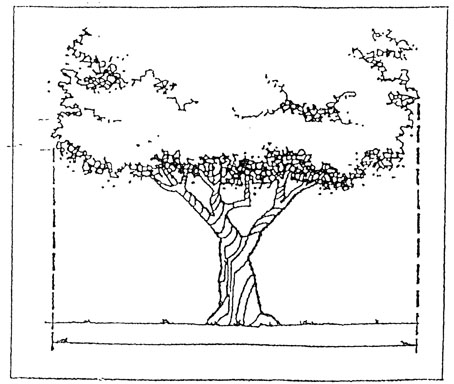
Drip line—The outermost perimeter of the crown of a plant as projected vertically to the ground. See Figure 1-A.
Grubbing—The effective removal of vegetation, other than defined trees, from the site.
Hedge—A dense row of shrubs or bushes forming a boundary.
Land-clearing stage—A stage in the construction process in which trees and/or vegetation are removed from the land, i.e., proposed right-of-way excavation and paving, drainage systems excavation; utility clearings, grubbings and prebuilding construction projects.
Landscape area or green space—An area or areas including beautification strips, consisting of those materials, such as, but not limited to, hedges, trees, planted ground cover, sodded and grassed areas and planted floral installations, all of which must be composed of natural plantings only, as distinguished from artificially manufactured planting reproductions.
Mangrove—Rooted trees and seedlings of the following species, but only when having a coastal or estuarine association:
A.
Red mangrove (Rhizophora mangle L.).
B.
White mangrove (Laguncularia racemosa Gaertn.).
C.
Black mangrove [Avicennia germinans (L) L.].
D.
Buttonwood mangrove (Conocarpus erecta L.).
Overall height (OH)—The height, in feet, of a tree measured from the top of the root ball/system to the top of the uppermost foliage branches.
Protected tree—Any tree that has a DBH of more than six inches, and which is not otherwise exempted from this Code. For the purpose of this Code, all mangroves are hereby declared to be protected trees.
Remove, removal, replanting or replacement—The act of digging up, cutting down, damaging, destroying, relocating, or killing any tree.
Shrub—A low-growing perennial, woody or evergreen plant with persistent stem.
Species of trees—Applies to trees possessing common distinctive characteristics and the ability to reproduce these characteristics.
Transplant—The act of digging up a tree from one location and planting the same tree in another place.
Tree—A self-supporting woody plant having one or more well-defined trunks capable of being maintained with a clear trunk and normally growing to an overall height at maturity in the county of a minimum of 15 feet. For the purpose of this definition, palms shall be considered trees.
Tree bank—The storage for future use of trees permitted for removal under the terms of this chapter which are donated to the town for its use.
Tree cluster—Two or more primary tree trunks that are within three feet of one another.
Tree, historic—A tree which has been found by a professional forester, horticulturist or other professional plantsman to be of notable historic interest to the town and/or county because of its age, type, size or historic association and has been so designated by resolution of the town commission of the town.
Tree protection zone—A circular zone around each protected tree defined as follows:
A.
If the drip line is less than six feet from the trunk of the tree, the zone shall be that area within a radius of six feet around the tree.
B.
If the drip line is more than six feet from the trunk of the tree, but less than 20 feet, the zone shall be that area within a radius of the full drip line around the tree.
C.
If the drip line is 20 feet or more from the trunk of the tree, the zone shall be that area within a radius of 20 feet around the tree.
Tree, shade/canopy—An evergreen or deciduous tree that can be maintained with a clear trunk of not less than six feet and with a spreading branching structure of at least 15 feet and opaque foliage habit such that a reasonably dense shade pattern is provided during peak daylight hours in the late spring, summer and early fall months of the year. For the purposes of this part 3, palms shall not be considered shade/canopy trees.
Tree, specimen—A tree which has been determined by the judgment of a professional forester, horticulturist or other professional plantsman to be of high value because of its type, size, age or other professional criteria, and has been so designated by resolution of the town commission of the town.
Vehicular use area—An open area used for the storage of four or more vehicles, including the accessways to such area.
Sec. 90-140. - Planting in rights-of-way or near utilities.
It shall be unlawful to plant trees, bushes and/or hedges with deep root systems over, upon or within ten feet of the paved portion of the town-owned rights-of-way or easements. It shall also be unlawful to plant trees, bushes and/or hedges with deep root systems within ten feet of any town-owned underground sewer lines. Trees with widespread root systems that might impact the paved portion of the town-owned rights-of-way or easements may not be used.
Sec. 90-141. - Hazardous conditions.
A.
It shall be unlawful for the owner or occupant of any property to permit to remain upon property any tree or tree branch or other growth that is in danger of falling upon any public way. The canopy of shade trees must be maintained with a minimum of eight and one-half feet of clearance above the roadway within the limits of clear sight.
B.
When it shall be determined by the town that any existing trees, plants or hedges upon private property or public rights-of-way or easements contiguous to such private property are causing hazardous conditions to any underground sewer, water or electrical lines, or overhead electrical or telephone wires, it shall forthwith give notice to the property owner upon whose property or right-of-way or easement such hazard exists, that such trees, plants or hedges shall be removed within a time certain as designated in such notice.
C.
The notice hereby required shall be served as follows:
(1)
By personal delivery to the owner; or
(2)
By delivery to a person at least 18 years of age within the household of the owner;
(3)
By affixing a copy of the notice in a conspicuous place near the entry to such premises; or
(4)
By mailing by certified mail a copy of the notice to the last known address of the owner.
D.
If a person who has been served with notice to remove trees, plants or hedges which constitute the hazardous conditions described herein from private property, rights-of-way or easements shall fail to comply within the specified time, the town shall remedy the conditions, or contract with others to remedy such conditions; and the cost thereof shall be charged against the owner of such property.
E.
If the cost of remedying such conditions is not paid within 30 days after receipt of the statement therefor from the town, the amount thereof shall become and constitute a lien and charge against the real property with interest.
F.
The lien imposed by this section shall be a first and prior lien against the property subject only to the lien for taxes imposed by the county and the state, and shall be of the same character as the lien for municipal taxes and assessments. If the lien is not paid within 180 days from its effective date, the lien may be enforced in the same manner as delinquent ad valorem tax liens or special assessment liens and shall be certified by the director of finance to the town attorney for collection.
Sec. 90-142. - Exemption from county ordinance.
The town does hereby exclude and exempt itself from the provisions of any county ordinance regarding the planting or removal of trees or other vegetation.
Sec. 90-143. - Variances.
Where strict adherence to the provisions of this part 3 is impossible or impractical to enforce, the special magistrate may authorize a variance if such a variance can be made without destroying the intent of this part 3. Any request for a variance to the provisions of this part 3 shall be submitted in writing on the form provided for this purpose by the town to the special magistrate and shall clearly and in detail state what adjustment of requirements is being requested and the reason such adjustment is warranted. The appeal shall be accompanied by a processing fee as specified by resolution of the town commission.
(Ord. No. 10-04, 9-9-2010)
Editor's note— Ord. No. 10-04, also provided for an effective date of 11-1-2010.
Sec. 90-145. - Subject areas.
A.
All vehicular use areas, except those located on, under or within buildings, and except those that service single-family, and duplex uses, shall conform to the minimum landscaping requirements hereinafter provided. "Vehicular use areas" shall include all areas used for the parking, circulation and/or display of any and all types of vehicles, boats or heavy construction equipment, or other machinery capable of movement over streets and highways, whether self-propelled or not, and all areas upon which such vehicles traverse as a function of the primary use of the related structures or property. This shall include, but is not limited to, activities of a drive-in nature, such as service stations, convenience stores, banks, restaurants and the like. The requirements set forth herein shall also apply to additions to existing vehicular use areas.
B.
Single-family dwellings, two-family dwellings and multiple-family dwellings. Required front yards and required side yards abutting public streets shall be maintained in permeable landscaped vegetative green space, with the exception of necessary driveways, walks, patios and similar paved areas, which shall not exceed 25 percent of the required yard area for corner lots and 45 percent of the required yard area for inside lots.
C.
All uses and structures other than those listed in subsection B. above. The exterior portion of all required yards abutting public streets, with the exception of necessary entrance driveways and walks, shall be maintained in permeable landscaped vegetative green space to the minimum depth as established according to the following table or to the minimum yard (building setback) requirements (depth and width), whichever requirement is lower.
D.
Nonconforming uses of required yards and redevelopment.
(1)
Any uses or required yard area inconsistent with subsection B. or C. above shall be nonconforming uses and no such nonconforming use shall be extended to occupy a greater area nor to occupy any other portion of the required yard area than was occupied at the time the nonconforming status was attached. Any nonconforming site that is redeveloped or altered at a total cost equal to or exceeding the percentage shown shall comply with the above provisions according to the following table:
(2)
When redevelopment costs are one-half or more of the redevelopment threshold percentages shown, then not less than one-half of required landscaping under subsection B. or C. shall be installed. Such landscaping plan shall be approved by the board which normally reviews the redevelopment plan and may be modified to fit site constraints, so long as the basic intent of the landscaping requirements are met.
(3)
Construction costs shall be determined by the building inspector or, at the expense of the applicant, a licensed contractor, itemizing total costs in a certified estimate. In the event that such construction costs have not been determined at time of application, the town building commissioner or his or her designee shall determine a reasonable and fair cost of the proposed redevelopment, based on current conditions.
E.
Should the requirements of subsection C. prohibit proper design of structures or parking area because of abnormal lot configuration, the required depth of the permeable green space along any one street may be varied up to 20 percent, provided that the total required green space area along that street is not diminished.
F.
Where the average lot depth from a street lies between two streets, that lot depth shall be halved in order to determine the depth of required green space, according to subsection C.
Sec. 90-146. - Application of article.
All uses of land and development thereof, excepting single-family dwellings, and duplex, and triplex dwellings on lots of 6,000 square feet or less, shall be required to comply with the provisions of this article, as contained within the following sections, prior to obtaining a building permit.
Sec. 90-147. - Development requiring approval.
A.
All uses of land and development thereof, excepting as permitted within section 90-145, single-family dwellings and duplex dwellings on lots of 6,000 square feet or less, where off-street parking and open lot sales, display and services are provided, except within buildings, shall comply with the provisions of this article, and the developer shall submit required information for review and approval.
B.
All property within existing paved vehicular use areas on the effective date of the ordinance from which this article was derived shall not be required to conform to provisions of this article unless reconstruction or expansion of improvements on the property requires a site plan approval in accordance with the town site plan review as set forth in chapter 90, article XXIV.
Sec. 90-148. - Application for approval: submission requirements.
An application for landscape approval in accordance with the requirements of this article shall be accompanied by the following information and processed by the town only after the following procedural requirements have been complied with:
A.
Three copies of all plans and required supporting documentation, together with an application signed by the owner of record, shall be submitted to the designated official's office. Each application shall be accompanied by the application fee as specified by resolution of the town commission, and no application will be accepted nor a review conducted until the fee is paid to the town.
B.
All paved area landscape plans shall be prepared at a scale not smaller than one inch equals 50 feet and shall be submitted on sheets 24 inches by 36 inches.
C.
All paved area landscape plans submitted for review and approval shall include the following information:
(1)
The shape and dimensions of the lot or parcel;
(2)
All existing and proposed parking spaces, access aisles, driveways, sidewalks, wheel stops, curbs and other vehicular use controls;
(3)
The location of existing and proposed curb and/or driveway cuts and median openings;
(4)
The distance between curb cuts, including the distance from any curb cuts on adjacent property;
(5)
Existing and proposed lighting and irrigation systems, planting areas and decorative or screen walls. Planting areas must indicate the quantity, spacing, size and name of proposed plant material. An exterior elevation and wall section shall be provided for any decorative or screen wall indicated on the plan.
Sec. 90-149. - Application for approval: submission and review procedures.
A.
An application for landscape approval in accordance with the provisions of this article shall be made to the town prior to an application for a building permit. The paved area landscape plan shall be submitted with the site plan review application and serve to comply with the site plan review application requirement for landscaping.
B.
Upon receipt of an application for landscape approval, the town shall have ten working days to determine its appropriateness and completeness and accept or reject the application. Upon acceptance of such application, the review process shall be a component of and concurrent with a site plan review application. The review period, procedures and approval shall be in conformance with those provisions of the site plan review application.
Sec. 90-150. - Findings required for approval.
The granting of approval or granting of approval with conditions and/or changes by the planning and zoning board shall indicate not only the approval conclusion, but also findings of fact related to the specific proposal and shall set forth with particularity compliance with the criteria set forth in sections 90-147 and 90-148.
Sec. 90-151. - Exceptions for landscape plans.
Applicants required to submit a proposed development for site plan review and approval before obtaining a building permit shall be entitled to demonstrate, by submission of the requirements of the site plan review, that an improvement or betterment of the environment can be accomplished over the existing site conditions if such landscaping plan is carried out in full. If such landscape plan is so offered and is approved as a part of the site plan review and approval, completion of the landscaping plan in its entirety shall be completed prior to the issuance of a certificate of occupancy for the development.
Sec. 90-152. - Grounds permit required.
The building official is to be responsible for the issuance of grounds permits. Prior to the development, modification or expansion of any vehicular use areas, application shall be made to the building official for the issuance of a grounds permit. The grounds permit shall be issued by the building official upon submission of the following requirements by the applicant and upon a finding by the building official that the provisions of this article have been complied with:
A.
Vehicular use plan. The developer shall submit to the building official such information as the building official deems necessary, to include three copies of a combination site plan/planting plan and which shall be in addition to any plans submitted for building permits. Such plan shall hereinafter be referred to as the "vehicular use plan" and shall be required to be submitted for all proposed vehicular use areas. When the vehicular use area is adjacent to or developed in connection with a proposed new structure, the vehicular use plan shall be submitted at the time of the submittal of a site plan for the proposed structure.
B.
Contents. The name and address of the owner and of the designer shall be indicated on the plan. The date the plan is completed shall be stated. The plan shall be drawn to scale no smaller than one inch equals 30 feet, indicate all dimensions and property lines, provide elevation data and the North point, and clearly delineate existing and proposed parking spaces, access aisles, driveways, sidewalks, wheel stops, curbs and other vehicular use controls. The location of curb cuts on adjacent property, median openings on abutting streets, lighting, irrigation systems, fire hydrants, water check valves, proposed planting areas, decorative or screen walls and fencing, existing trees and related buildings shall be shown to completion of the vehicular use area. A temporary certificate of occupancy may be issued if a financial guarantee, acceptable in form to the building official, is provided.
C.
Filing fee. At the time of the issuance of the grounds permits, the applicant shall pay to the town a filing fee in the amount as established by the town commission. If any person commences work on the development of any vehicular use area prior to obtaining the necessary grounds permit, the filing fee shall be five times the normal permit fee; and such person shall be liable for the penalties prescribed for violation of this Code.
D.
Certification of compliance. Upon completion of improvements, the building official shall inspect the vehicular use area for compliance with the approved vehicular use plan and other requirements of this article. A certificate of compliance must be issued by the building official before a certificate of occupancy can be issued for any related structure. When occupancy of a related building is desired prior to completion of the vehicular use area, a temporary certificate of occupancy may be issued if a financial guarantee, acceptable in form to the building official, is provided.
Sec. 90-153. - Landscaping standards.
The development of vehicular use areas within the town shall conform to and meet the standards as set forth herein:
A.
Landscaping shall consist of any of the following or combination thereof: material, such as, but not limited to, grass, ground covers, shrubs, vines, hedges, shade/canopy trees or palms. In addition, nonliving durable material may be used to complement, but not to be credited as, landscaping. These materials include, but are not limited to, rocks, pebbles, walls or fences, but excluding paving and sand.
B.
Plant material used in conformance with provisions of this article shall conform to the standards for Florida #1 or better, as given in Grades and Standards for Nursery Plants, Part I, 1963, and Part II, State of Florida, Department of Agriculture, Tallahassee, or equal thereto. Grass sod shall be clean and reasonably free of weeds and noxious pest or diseases. Grass seed shall be delivered to the job site in bags with State Department of Agriculture tags attached, indicating the seed grower's compliance with the department's quality control program:
(1)
Trees.
(a)
Trees shall be of species recognized by the State Division of Forestry as being drought-tolerant and suitable for successful propagation and growth in the town. Trees shall be of species having average spreads/crowns of greater than 15 feet in diameter, and which can be maintained with a minimum of five feet of clear trunk. At least 60 percent of required trees shall be of species native to Florida or drought-tolerant, including, but not limited to, the following species: Red Maple (Acer rubrum); Silver Buttonwood (Conocarpus erectus "sericeus"); American Holly varieties (Ilex opaca); Yaupon Holly (Ilex vomitoria); Sweet gum (Liquidambar styraciflua); Southern Magnolia (Magnolia grandiflora); Southern Wax Myrtle (Myrica cerifera); Slash Pine (Pinus elliotti); Longleaf Pine (Pinus palustris); Loblolly Pine (Pinus taeda); Cherry Laurel (prunus caroliniana); Oaks (Quercus spp.); Cabbage Palm (Sabal palmetto); Saw Palmetto (Serenoa repens); Bald Cypress (Taxodium distichum). Trees having an average mature crown spread of less than 15 feet may be substituted by grouping same so as to create the equivalent of a fifteen-foot crown spread.
(b)
Tree species shall have a minimum two-inch diameter at breast height (DBH), and shall be a minimum of eight feet in overall height immediately after planting. Trees of species whose roots are known to cause damage to public roadways or other public works shall not be planted closer than 12 feet to such public works, unless the tree root system is completely contained within a barrier for which the minimum interior containing dimensions shall be five feet square and five feet deep and for which the construction requirements shall be four-inch thick concrete reinforced with No. 6 road mesh, six inches by six inches by six inches or equivalent.
(c)
The following tree species are considered undesirable due to their growth characteristics, and their planting shall be prohibited. No formal authorization by the town shall be required for the removal of these species, which include trees considered undesirable plant species by either the Town and/or Pinellas County (Pinellas County Land Development Code Chapter 166, Article II, § 166-53): Australian Pine (Casuarina sp.); Bishopwood (Bischofia javanica); Brazilian Pepper (Schinus terebinthifolius); Punk Tree (melaleuca leucadendra); Ear Tree (Enterolobium cyclocarpum); Laurel Fig (Ficus retusa "nitida"); Weeping Fig (Ficus benjamina); Chinese tallow (Sapium sebiferum); Silk Oak (Grevillea robusta); Java Plum (Syzgium cumini); Carrotwood (Cupaniopsis anacardioides); Eucalyptus (Eucalyptus spp.); and Willow trees.
(2)
Shrubs and hedges. Shrubs shall be a minimum of one and one-half feet in height when measured immediately after planting. Hedges, where required, shall be of species which, when planted at appropriate spacing and properly maintained, will form a continuous, unbroken, and solid visual screen within a maximum of two years after time of planting. At least 60 percent of the shrubs and hedges planted shall be of native or drought-tolerant varieties, including, but not limited to, the following species: Century plant (Agave attenuata); Ponytail Palm (Beaucarnea recurvata); Bougainvillea spp.; Powderpuff (Calliandra haematocephala); Natal Plum (Carissa grandiflora); Sea Grape (Coccoloba uvifera); Croton (Codiaeum variegatum); Ti Plant (Corydyline terminalis); King Sago (Cycas revoluta); Dracaena spp.; Silverthorn (Elaegnus pungens); Chinese Juniper (Juniperus chinensis); Texas Sage (Leucophyllum frutescens); Oleander (Nerium oleander); Dwarf Philodendron (Philodendron "Xanadu"); Indian Hawthorn (Raphiolepis indica); Boxthorn (Severina busiflia); White Bird of Paradise (Strelitzia Nicolai); Bird of Paradise (Strelitzia reginae); Sandankwa Viburnum (Viburnum suspensum); Spineless Yucca (Yucca elephantipes).
(3)
Vines. Vines shall be of native or drought-tolerant species, a minimum of 30 inches in height immediately after planting, and may be used in conjunction with fences, screens, or walls to meet physical requirements as specified.
(4)
Ground covers. The use of ground covers in lieu of grass, in whole or in part, is encouraged in the interest of water conservation. Ground covers shall be planted in such a manner as to present a finished appearance and reasonably complete coverage within 18 months after planting. At least 60 percent of the ground covers shall be of native or drought-tolerant varieties, including, but not limited to, the following species: Aloe spp.; Dwarf Carissa (Carissa macrocarpa); Periwinkle (Catharanthus roseus); Crown-of-Thorns (Euphorbiamilli); Creeping Fig (Ficus repens); Day Lily (hemerocallis spp.); Railroad Vine (Ipomoia pes-cprae); Lily Turf (Liriope muscari); Sea Purslane (Sesuvium portulacastrum); Dwarf Confederate Jasmine (Trachelospermum asiaticum); Society Garlic (Tulbaghia violacea); Sea Oats (Uniola paniculata); Coontie (Zamia floridana).
(5)
Lawn grass. Grass areas shall be planted and grown as permanent lawns using varieties that are suitable for the county. Grass may be sodded, plugged, sprigged or seeded, except that solid sod shall be used in swales or other areas subject to erosion, and provided that, in areas where other than solid sod or grass seed is used, nursegrass seed shall be sown for immediate effect and protection until coverage is achieved.
Sec. 90-154. - Installation and maintenance.
A.
All landscaping shall be installed in a sound workmanlike manner and according to accepted good planting procedures, with the quality of plant materials as herein described. All elements of landscaping exclusive of plant material, except hedges, shall be installed so as to meet all other applicable ordinances and code requirements. Landscaping shall be maintained in good condition so as to present a healthy, neat, and orderly appearance. Lineal and mass planting beds shall be mulched with a minimum of two inches of organic mulch (bark, leaves, pine needles, etc.) in order to decrease evaporation of moisture from the soil. Plastic surface covers shall be prohibited. Landscaped areas are to be irrigated with reclaimed wastewater, if available to the site. In order to conserve water, planting areas shall be irrigated by automatically timed drip-type systems, only in accordance with county regulations or guidelines established by the Southwest Florida Water Management District, whichever may be more stringent. In accordance with F.S. § 373.62, any new irrigation system shall be equipped with a rain sensor device or switch which will override the automatic cycle of the system when adequate rainfall has occurred. Landscaped areas shall be protected from vehicular encroachment (defined as any protrusion of a vehicle outside of a parking space, display area, or accessway into a landscaped area) and shall be kept free of refuse and debris. The property owner, tenant, and/or agent, if any, shall be jointly and severally responsible for the maintenance of all landscaping. The responsibility for maintenance as set forth herein shall include the parkways within right-of-way areas outside the property line contiguous to the site.
B.
Failure of the owner or tenant of the property to maintain the premises in good condition as set forth in subsection A. of this section shall make such owner or tenant liable for the penalties for violation of a town ordinance.
C.
On the site of any development requiring site plan approval, where such site abuts a public right-of-way, excluding dedicated alleys, a landscaped strip shall be provided along the boundary of the site abutting said right-of-way as follows:
(1)
Landscaped strip. A strip of land at least three feet in depth, located along and within the boundary of the site abutting said right-of-way, shall be landscaped, such landscaping to include one tree for every 35 linear feet or fraction thereof, spaced not less than 30 feet nor more than 40 feet apart. In addition, a hedge, wall or other durable landscape barrier, maintained at least two feet in height, shall be placed along the entire length of this linear frontage. If such durable barrier is of nonliving material, for every ten feet thereof, one shrub or vine shall be planted abutting such barrier, unless they are of sufficient height at the time of planting to be readily visible over the top of such barrier. The remainder of the landscape strip shall be improved with grass, ground cover, shrubs or other landscape treatment, excluding gravel, paving or sand.
(2)
Other property. All property, other than the required landscaped strip lying along and within the boundary of the site abutting the street, shall be landscaped at least with grass or other ground cover.
(3)
Necessary accessways. Necessary driveways and other accessways from the public right-of-way shall be permitted to service the vehicular use areas, and the widths of such accessways may be subtracted from the linear dimensions used to determine the number of trees required.
Sec. 90-155. - Perimeter landscaping relating to abutting properties.
A.
On the site of a building or structure or open lot having a vehicular use area, where such area will not be entirely screened visually by an intervening building or structure from abutting property, that portion of such area not so screened shall be provided with a wall or hedge or other durable landscape barrier maintained no greater than six feet in height nor less than three and one-half feet in height to form a continuous screen between the common lot line and the vehicular use area and such abutting property. Such landscape barrier shall be located at any point between the common lot line and the vehicular use area exposed to the abutting property, provided the purpose of screening the vehicular use area is accomplished. If such barrier consists all or in part of plant materials, such plant material shall be planted in a planting strip averaging at least three feet in depth.
B.
In addition, one tree shall be provided for every 50 linear feet of such landscape barrier or fractional part thereof, spaced not less than 45 feet nor more than 55 feet apart. Such trees shall be located between the common lot line and the vehicular use area. Each planting area shall be landscaped with grass, ground cover or other landscape material, excluding paving or sand, in addition to the required tree(s).
C.
Compliance with this section is required in all cases of new construction, change of use or expansion of use or structure.
D.
The provisions of this section shall not be applicable in the following situations:
(1)
When a property line abuts a dedicated alley;
(2)
Where a proposed parking area or other vehicular use area abuts an existing hedge, wall or other durable landscape barrier on an abutting property, the existing barrier may be used to satisfy the landscape barrier requirements of this section, provided that the existing barrier meets all applicable standards of this section, and protection against vehicular encroachment is provided for hedges;
(3)
Where the abutting property is categorized and used for nonresidential uses, only the tree provisions with its planting area as prescribed in this article shall be required. The number of trees shall be one tree for every 50 linear feet or fraction thereof, spaced no less than 45 feet nor more than 55 feet apart; but all perimeter requirements shall apply within the front setback area.
E.
Buffer requirements.
(1)
The purpose and intent of this section is to reduce the impacts of a development on adjacent uses which are of a significantly different character.
(2)
A buffer consists of a horizontal distance from a property line which may only be occupied by drainage areas, utilities and landscaping materials. The required buffering distance between land uses on adjoining lots is set forth in the buffer matrix below. Mechanical/air-conditioning equipment, outdoor storage areas and parking areas shall not be located within the required buffers.
(3)
Compliance with this section is required in all cases of new construction, change of use or expansion of use or structure.
(4)
The following buffer matrix identifies required horizontal distances between adjacent property uses.
Table 90-155-A
Landscape Buffer Matrix
Abutting Use
Sec. 90-156. - Interior landscaping requirements.
A.
An area or a combination of areas equal to eight percent (see section 90-108 G.) of the total vehicular use area shall be devoted to interior landscaping. Any perimeter landscaping provided in excess of that required may be counted as part of the interior landscaping requirement. Landscaping adjacent to a structure or structures on the same parcel of land, which serves to beautify the vehicular use area and implements the purpose and intent of this article, may be counted toward meeting the interior landscape requirements. The credit may not exceed 50 percent of the total required interior landscaping and shall be reviewed by the building official for compliance with the purpose and intent of this article.
B.
Such landscaped areas shall be located in such a manner so as to divide and break up the monotony and expanse of paving, to prevent and discourage cross taxiing and to provide well-dispersed tree canopy shading. A combination of the following interior landscaping elements shall be counted as part of the interior landscaping requirements, where applicable:
(1)
Terminal islands. Contiguous rows of 15 or more parking spaces shall be terminated on both ends by landscaped islands which measure an average of not less than five feet in width and extend the entire length of the parking space(s). At least one deciduous tree, palm, or grouping, as per section 90-153 B.(1), shall be planted on such island.
(2)
Interior islands. Interior landscaped islands which measure an average of not less than five feet in width and extend the length of a parking space shall be placed within rows of contiguous parking spaces so that there is at least one interior island for every 18 parking spaces or major portion thereof within the row. These islands shall be placed at intervals of not less than six spaces nor more than 18 spaces. At least one deciduous tree or grouping, as per section 90-153 B.(1), shall be planted on every interior island. Interior islands need not be placed directly opposite each other when in abutting parking rows.
(3)
Additional interior landscaping requirements.
(a)
Trees. There shall be a minimum of one tree, planted for each separate planter installed in the vehicular use area, but the total number of trees shall not be less than one for each 200 square feet, or fraction thereof, of required interior landscaped area.
(b)
Perimeter landscaping. In vehicular use areas where the strict application of this section will seriously limit the function of such area, the required landscaping may be located near the perimeter of the paved area, including such perimeters which may be adjacent to a building on the site. Such required interior landscaping which is relocated as herein provided shall be in addition to the perimeter landscaping requirements.
(c)
Vehicle encroachment; wheel stops. The front of a vehicle may encroach upon any interior landscaped area when such area is at least three and one-half feet in depth per abutting parking space and protected by wheel stops that are anchored and placed within the confines of a parking area or curbing. Two feet of such interior landscaped area may be part of the required depth of each abutting parking space.
Sec. 90-157. - Sight visibility at intersections.
A.
General standards. Sight visibility triangles are designated areas located near streets and/or driveway intersections that shall be free from visual obstruction in order to maintain safe visibility for vehicles, bicyclists, and pedestrians. All property shall maintain sight visibility triangles as described in this section.
(1)
Sight visibility triangles shall be provided on all corners at the intersection of any public or private street with another street, an alley or a driveway; and, on all corners of the intersection of an alley and driveway.
(2)
Within sight visibility triangles, unobstructed sight lines and cross visibility shall be maintained between a height of two and one-half feet and eight feet.
(3)
No structure, object, and/or vegetation shall be placed and/or maintained in a manner which materially impedes the visibility from a street, alley or driveway of lawfully oncoming traffic from any direction in the intersecting public street.
B.
Sight visibility triangle areas. The required sight visibility triangle area is based on the type of intersection and specified below.
(1)
Intersection of two streets. The sight visibility triangle is formed with two sides being 25 feet in length along the abutting street pavement (illustrated by the letter "B" on the diagram below), measured from their point of intersection, illustrated by the letter "A" in the diagram below, and the third side being a line connecting the ends of the other two sides, illustrated by the letter "C" in the diagram below.
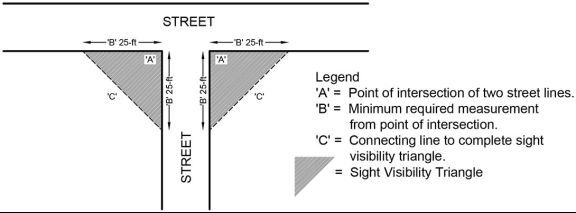
Figure 1 — Sight visibility triangle at the intersection of two streets.
(2)
Intersection of an alley and a street, a street and a driveway, and/or alley and a driveway. The triangle is formed on both sides of the alley and driveway with two sides of each triangle being ten feet in length along the abutting street pavement, measured from their point of intersection, illustrated by the letter "A" on diagram below, and the third side being a line connecting the ends of the other two sides, illustrated by the letter "C" on the diagram below.
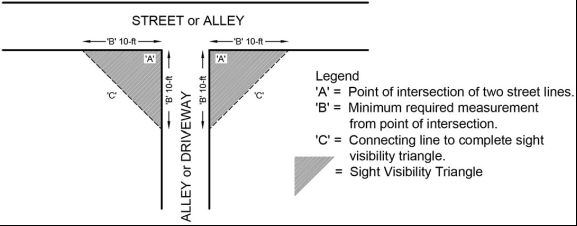
Figure 2 — Sight visibility triangle at the intersection of a street and alley or
driveway; OR alley and driveway.
(3)
For all of the above cases, in the case of rounded corners and corner chords, the point at which the street/driveway/alley pavement would meet, if extended without such rounding, will be used as the point of intersection, as illustrated by the letters "A" and "B" in the diagram below.
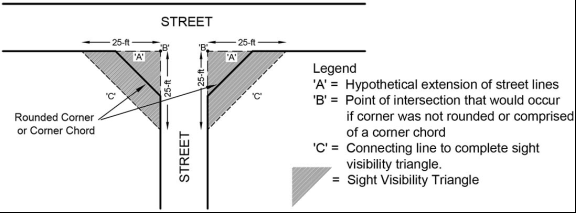
Figure 3 — Sight visibility triangle calculation with corner chords.
C.
Exemptions. The following exemptions may apply to sight visibility standards.
(1)
Governmental signage and governmental sign posts in the right-of-way.
(2)
Fire hydrants, benches, and traffic control devices in the right-of-way.
(3)
Utility poles and one utility transmission or control device in the right-of-way.
(Ord. No. 20-03, § 1, 7-8-2020)
Sec. 90-158. - Existing plant material.
In instances where healthy native plant material exists on a site prior to its development, in part or in whole, for the purposes of off-street parking or other vehicular use areas, the application of the above landscape standards may be adjusted to allow credit for such plant material if such an adjustment is in keeping with and will preserve the intent of this article. In no event will exotic species such as Australian pine, Bishopwood, Brazilian pepper, punk tree, ear tree, laurel fig, weeping fig, eucalyptus and willow trees be considered for credit.
Sec. 90-159. - Existing developed vehicular use areas.
A.
Existing developed vehicular use areas not meeting the requirements contained in this article shall be brought into full compliance under one or more of the following conditions:
(1)
If expansion of 30 percent or more of an existing vehicular use area requires the installation of additional parking spaces.
(2)
If an existing vehicular use area is improved or remodeled in a value of 30 percent or more of the valuation of the existing use as reflected on the property appraiser's current records.
(3)
If an existing structure is improved or remodeled in a value of 50 percent or more of the valuation of the existing structure as reflected on the property appraiser's current records.
(4)
If an existing structure is increased in covered floor area by 20 percent or greater.
(5)
If an amendment is required to an existing final site plan.
B.
However, in the event that such compliance would prohibit required parking areas from meeting the minimum off-street parking requirements, as set forth in other sections of this Code, then the requirements of this section may be adjusted, first modifying the requirements of the interior landscaping requirements portion and, if minimum off-street parking requirements still cannot be met, then modifying the requirements of the perimeter landscaping portion.
C.
The requirements for the responsibility of the owner, tenant or agent for the maintenance of parkway and right-of-way outside the property line contiguous to the site, as set forth herein, shall become immediately effective and applicable to all existing developed properties upon passage of this article.
Sec. 90-160. - Marine vegetation.
Nonseawalled intracoastal waterways lacking wetland vegetation should be planted with native marine vegetation in order to minimize potential flood damage, stabilize the shoreline and trap sediments and other nonpoint source pollutants, and provide additional habitat for fish and wildlife.
Sec. 90-163. - Exceptions to tree planting requirements.
A.
Nuisance trees.
(1)
The following types of trees shall be exempt from the tree protection requirements of this Code:
(a)
Australian pine.
(b)
Bishopwood.
(c)
Brazilian pepper.
(d)
Punk tree.
(e)
Ear tree.
(f)
Laurel fig.
(g)
Weeping fig.
(h)
Eucalyptus.
(i)
Willow.
(2)
In addition, the planting of the above listed species is specifically prohibited.
B.
Utility operations. Tree removals by duly constituted communication, water, sewer, electrical or other utility companies or federal, state or county agencies, or engineers or surveyors working under a contract with such utility companies or agencies, shall be exempt, provided the removal is limited to those areas necessary for maintenance of existing lines or facilities or for construction of new lines or facilities in furtherance of providing utility service to its customers; and provided further that the activity is conducted so as to avoid any unnecessary removal and, in the case of aerial electrical utility lines, is not greater than that specified by the National Electrical Code as necessary to achieve safe electrical clearances.
C.
Florida Department of Transportation. The Florida Department of Transportation shall be exempt from the provisions of this article.
D.
Surveyors. A state-licensed land surveyor, in the performance of his duties, is exempt, provided such alteration is limited to a swath three feet or less in width.
E.
Commercial growers. All commercial nurseries, botanical gardens, tree farms and grove operations shall be exempt from the provisions of this article, but only as to those trees which were planted for silvicultural or agricultural purposes or for the sale or intended sale in the ordinary course of business.
F.
Emergencies. During emergencies caused by a hurricane or other disaster, the building official may temporarily suspend these tree protection regulations.
Sec. 90-165. - Removal of trees.
A.
Special conditions for authorization to remove native and/or protected trees.
(1)
It is the intent of this section to minimize the removal of native and/or protected trees, and no authorization shall be granted to remove a tree if the developer has failed to take reasonable measures to design and locate the proposed improvements so that the least number of native and/or protected trees will be removed. In particular, the design must attempt to preserve specimen and historic trees.
(2)
No authorization for the removal of a native and/or protected tree shall be granted unless the developer demonstrates that one or more of the following conditions exists:
(a)
A permissible use of the site cannot reasonably be undertaken unless specific trees are removed or relocated.
(b)
The tree is located in such proximity to an existing or proposed structure that the safety, utility or structural integrity of the structure is materially impaired.
(c)
The tree materially interferes with the location, servicing or functioning of existing utility lines or services.
(d)
The tree creates a substantial hazard to motor, bicycle or pedestrian traffic due to physical proximity to traffic or impairment of vision.
(e)
The tree is diseased or weakened by age, abuse, storm or fire and is likely to cause injury or damage to people, buildings or other improvements.
(f)
Any law or regulation requires the removal.
(3)
Authorization required. No native or otherwise protected tree (two-inch diameter at breast height or larger) shall be removed without prior authorization by the town. The Building Official or his/her designee shall have the authority to issue tree removal permits, subject to the provisions of Subsection B of this section.
B.
Replacement of removed trees.
(1)
Trees removed pursuant to subsection A. of this section shall be replaced at the expense of the developer.
(2)
For each inch of diameter at breast height removed, an inch of diameter at breast height shall be replaced. (Example: If a 12-inch DBH tree is removed, four three-inch DBH trees may be used to replace it.)
(3)
A replacement tree may be a tree moved from one location to another on the site, or moved off the site pursuant to subsection B. of this section.
(4)
Replacement trees shall, if practicable, be planted on the development site. If on-site replacement is not practicable, replacement trees may be donated, or a fee-in-lieu may be paid to the town for the purpose of planting trees on public property. The fee-in-lieu shall be based on the cost of purchasing the requisite size and number of replacement trees.
C.
Historic and specimen trees.
(1)
An historic tree is one that has been designated by the town commission as one of notable historical interest and value to the town because of its location or historical association with the town community. A public hearing shall be held by the town commission on the designation, with due notice to the owner of the tree.
(2)
A specimen tree is one that has been officially designated by the town commission to be of high value because of its type, size, age, or other relevant criteria. A public hearing on the designation shall be held by the town commission, with due notice to the owner of the tree.
(3)
No historic or specimen tree shall be removed without a finding by the town commission that the tree is a hazard or that it is not economically or practically feasible to develop the parcel without removing the historic or specimen tree. The town building official shall make a presentation to the commission on the application and make a recommendation as to whether it should be approved or denied. The decision by the town commission on the application shall be made within 30 days of the date the application was filed.
Sec. 90-166. - Protection of trees during development activities.
A.
Generally.
(1)
To assure the health and survival of protected trees that are not to be removed, the developer shall avoid the following kinds of tree injuries during all development activities:
(a)
Mechanical injuries to roots, trunk and branches;
(b)
Injuries by chemical poisoning;
(c)
Injuries by grade changes;
(d)
Injuries by excavations; and
(e)
Injuries by paving.
(2)
At a minimum, the protective measures described in Subsections B through F of this section shall be taken where appropriate to the development activity.
B.
Avoiding mechanical injuries.
(1)
Prior to any land preparation or other development activities, a protective barrier easily visible to equipment operators shall be placed around all protected trees so as to encompass the entire tree protection zone. See Figure 90-166-A.
(2)
No attachment, wires (other than supportive wires), signs or permits may be fastened to any protected tree.
(3)
No equipment, construction materials or debris of any kind shall be placed within the protective barrier.
(4)
Landscaping activities within the bounds of the protective barrier (before and after it is removed) shall be accomplished with light machinery or manual labor. Grubbing and similar activities are prohibited.
(5)
In lieu of constructing the barriers required in subsection B.(1) of this section, the developer may physically designate large areas containing protected trees where no land preparation or other development activities of any kind will occur. The area shall be designated by placing stakes a maximum of 25 feet apart and tying ribbon, plastic tape, rope, etc., from stake to stake along the outside perimeter of the area. This perimeter line shall be beyond the tree protection zone of any protected trees growing within the area.
(6)
Required protective barriers and perimeter lines shall remain in place until all construction activity, except landscaping within the protected area, is terminated.
Figure 90-166-A Protective Tree Barricade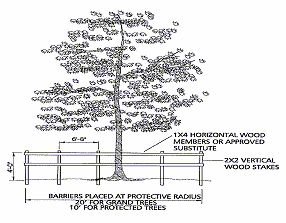
C.
Avoiding injuries due to chemical poisoning.
(1)
No fuel, paint, solvent, oil, thinner, asphalt, cement, grout or any other construction chemical or other material or tools of any kind shall be stored, or allowed in any manner to enter, within a required protective barrier or perimeter line.
(2)
No equipment shall be cleaned within a required protective barrier or perimeter line.
D.
Avoiding injuries due to grade changes. Grade changes shall not be made within the tree protection zone unless the following protective measures are taken:
(1)
Raising the grade. When raising the grade, the following measures shall be taken:
(a)
Within the tree protection zone, existing sod, vegetation and leaf litter shall be removed and the soil loosened without injuring the roots.
(b)
The area within the tree protection zone shall be properly fertilized to improve the vigor and growth of the roots.
(c)
Porous, four-inch agriculture drain shall be laid over the soil to drain liquids away from the trunk. A drop of at least one-eighth inch per foot shall be provided. The drain field shall be designed to provide adequate drainage of the existing configuration of the trees.
(d)
The number of drains shall depend upon soil material; lighter sandy soils and porous gravelly material require fewer drains than heavy nonporous soils.
(e)
Aeration shall be provided by installing vertical tiles along the system. The vertical tiles shall be filled with gravel and capped with a heavy-duty mesh to keep out trash and debris.
(f)
Dry wells shall be large enough to allow for maximum growth of the tree trunk. Most large shade trees require at least a 60-inch diameter well. For slow-growing mature trees, a space of 12 inches to 18 inches shall be provided between the trunk and the side of the well at every point.
(g)
To prevent washing of material into the well, the dry well casing walls shall be high enough to bring the coping just above the level of the proposed fill.
(h)
Dry well walls shall be constructed of materials that permit passage of air and water. Concrete blocks backed with galvanized screening may be used for the sides of the well.
(i)
Gratings or barriers shall be used around openings that are large enough to present a hazard to pedestrians.
(j)
Open wells shall be cleaned regularly to remove sediment, leaves, and debris that might interfere with the free passage of air.
(k)
Large stones shall be placed over the drainage tiles, and a layer of smaller stones shall be placed over the remainder of the ground within the drip line.
(l)
A layer of gravel shall be placed over the stones.
(m)
The fill shall be completed with a layer of porous soil. See Figures 2-B, 2-C, 2-D.* [7]
(2)
Lowering the grade. When lowering the grade, the following measures shall be taken:
(a)
Roots shall be cut cleanly and retrimmed after excavation.
(b)
The canopy shall be pruned to aid in maintaining tree vigor.
(c)
When lowering the grade of the soil surrounding a protected tree, the maximum number of tree roots within the tree protection zone shall be preserved by using any of the following methods:
[1]
Terracing. The area within the tree protection zone is left at the original grade by terracing.
[2]
Retaining wall. The area within the tree protection zone is left at the original grade constructing a dry retaining wall. The retaining wall shall be porous to allow for aeration.
[3]
Terracing and retaining wall. The area within the tree protection zone is left at the original grade by the combined use of terracing and dry retaining wall. See Figure 90-166-B.
(3)
Minor changes in grade. When the change in grade is minor, as determined by the building official, lesser protective measures than those described in subsection D.(1) and D.(2) of this section may be taken. The building official shall approve the use of these methods where their use will not endanger the health of the protected tree.
Figure 90-166-B Grade Changes Near Existing Trees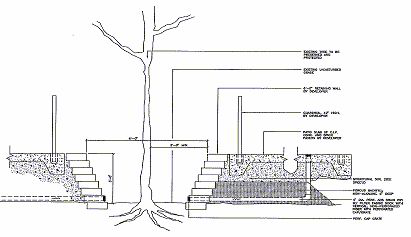
E.
Avoiding injuries due to excavations.
(1)
Water, sewer, and other utility lines should be routed around the tree protection zones of protected trees.
(2)
If a line cannot reasonably be routed around the tree protection zone, the line shall be tunneled beneath the area within the zone. The tunnel shall be offset to one side of the trunk to prevent damage to the main taproots.
F.
Avoiding injury by paving within the drip line. Porous paving may be placed within the tree protection zone of a protected tree, so long as no damage is inflicted to the tree by grade change, compaction of the soil, or any other cause.
*Editor's Note: Figures 2-B, 2-C and 2-D are included at the end of this chapter.
Sec. 90-167. - Special provisions for protection of mangroves.
A.
Generally. In addition to the foregoing tree protection requirements, the following special provisions shall apply to the removal or alteration of mangroves and other vegetation from wetland areas, as defined in F.S. § 373.019, and Rule 62-340.200, F.A.C. These standards shall apply to all property owners, including single-family, duplex, and multifamily homeowners.
B.
Replacement. Mangroves and wetland vegetation may not be removed unless the developer replaces or relocates on the same development site at least an equal number of mangroves and sufficient other wetland vegetation to revegetate a land area equal to or greater than the land area from which mangroves/wetland vegetation was removed. The developer shall provide a plan, to be approved by the Building Official, to ensure the survival of the replaced or relocated mangroves and wetland vegetation, and to stabilize the shoreline from which mangroves/wetland vegetation was removed. The approved plan shall be an express condition of any permit. Failure to carry out any provision of the plan shall be a violation of this Code.
C.
Other protective measures. The following protective measures shall apply to all mangroves and/or wetland vegetation:
(1)
A permit shall be obtained from the State Department of Environmental Protection (DEP) for any alteration of mangroves or wetland vegetation in jurisdictional waters.
(2)
A permit shall be obtained from the Pinellas County Environmental Management Department for any alteration of mangroves or wetland vegetation that may be exempt from DEP permit requirements.
(3)
The alteration of mangroves shall be subject to the provisions of F.S. §§ 403.9321 through 403.9333, ("Mangrove Trimming and Preservation Act"), and any additional standards contained in Chapter 166, Article II, Division 3, of the Pinellas County Land Development Code.
Sec. 90-168. - Automatic waiver.
The terms and provisions of this sections 90-165 through 90-167 may automatically be waived by the administration as follows:
A.
No-tree verification. Upon submission of a notarized statement by the owner or his agent that no trees as defined within the province of this article exist upon the site, the administration, after a verification visit to the site, may waive the requirements and provisions of sections 90-165 through 90-167.
B.
No-effect verification. Upon submission of a notarized statement by the owner or his agent that the proposed improvements or development involves less than ten percent of the total site and that no trees as defined within the province of this article will in any manner be affected, the administration, after a verification visit to the site, may waive the requirements and provisions of sections 90-165 through 90-167.

