
Redmond City Zoning Code
ARTICLE IV
SITE AND DESIGN REVIEW STANDARDS
Sec. 8.3000. - Purpose and Intent.
The purpose of this Article is to conserve and enhance the appearance of the City and to promote functional, safe, and innovative site development. The intent is to ensure that there is general compatibility between adjoining uses, outdoor space is designed and installed in a functional and attractive manner, vehicular access and circulation is designed and constructed consistent with maximizing public safety, adequate public utilities are available, and the structures on-site provide a consistent architectural theme. This Article further implements the policies and goals of the City of Redmond Comprehensive Plan.
Sec. 8.3005. - Applicability of Site and Design Review.
Unless exempted in Section 8.3010, Site and Design Review shall be required for any new development or use containing a structure, or multiple structures, and Mobile Food Pods.
(Ord. No. 2016-17, 1-31-2017; Ord. No. 2022-04, 6-28-2022; Ord. No. 2022-09, 12-13-2022; Ord. No. 2023-07, 12-19-2023)
Sec. 8.3010. - Exemptions.
The following are exempt from Site Design and Review:
1.
Normal maintenance and repair.
2.
Hangar development entirely on and interior to airport property.
3.
Single family detached dwellings and middle housing, unless located on a lot within 100 feet of the canyon.
4.
Manufactured home in an approved manufactured home park.
5.
Additions to an existing building of less than 25 percent of the total building square footage, not to exceed 1,000 square feet.
6.
Any development that does not include the construction or alteration of a building which will have a negligible impact on the land as determined by the Community Development Director, or designee.
7.
Overhead electrical power transmission lines and poles greater than 12.5 kv.
8.
Child care facility in residential neighborhoods that utilize existing structures.
9.
Any single room occupancy development which complies with the development and design standards of Sections 8.141, 8.142, or 8.143.
10.
Supportive Shelters, as identified in Section 8.370.
(Ord. No. 2016-17, 1-31-2017; Ord. No. 2017-12, 12-12-2017; Ord. No. 2020-15, 11-10-2020; Ord. No. 2022-04, 6-28-2022; Ord. No. 2022-09, 12-13-2022; Ord. No. 2023-07, 12-19-2023)
Sec. 8.3015. - Procedure.
Prior to submitting a Site and Design Review application, the applicant shall be required to submit a Pre-development application and meet with the Community Development Director, or designee, to review the proposal. A Site and Design Review application shall be submitted and reviewed by the Community Development Director, or designee, as an administrative land use decision with prior notice consistent with Section 8.1310.
A minor alteration or modification may be submitted for an approved Site and Design Review consistent with Section 8.1400. In addition to the procedures above, procedures to review Site and Design Review applications for properties in the C-2 Central Business District Commercial Zone and Downtown Overlay District are established in Sections 8.3040 and 8.3045.
(Ord. No. 2020-15, 11-10-2020; Ord. No. 2022-09, 12-13-2022)
Sec. 8.3017. - Neighborhood Meeting.
Proof a neighborhood meeting was conducted for residential or mixed use development proposals that generate 200 or more daily trip ends, or 20 or more PM peak hour trip ends, where a Transportation Impact Analysis (TIA) is required. See Section 8.385 for meeting requirements.
(Ord. No. 2022-09, 12-13-2022)
Sec. 8.3020. - Site Improvement Agreement.
Where public improvements are required as a condition of approval, the applicant may be required to execute and record an Improvement Agreement subject to the following.
1.
The developer may, in lieu of completion of the required improvements, request the Community Development Director, or designee, to approve an agreement specifying the schedule by which the required improvements and repairs shall be completed. Provided, however, any schedule of improvements agreed to other than sidewalks shall not exceed two years from the date of land use approval. The agreement shall also provide the following information:
A.
The repairs required and cost of the project.
B.
That the City may call upon the security filed to construct or complete the improvements and repairs if the schedule of improvements is not adhered to.
C.
That the City shall recover the full cost and expense of any work performed by the City to complete construction of the improvements and repairs including, but not limited to attorneys' and engineering fees.
D.
That a warranty bond for two years shall be deposited with the City following acceptance of the improvements. Said bond shall be in the amount of ten percent of the value of the improvements.
2.
The Community Development Director, or designee, may reject an agreement authorized by this Section for any reason the Community Development Director, or designee, deems sufficient.
(Ord. No. 2020-15, 11-10-2020; Ord. No. 2022-04, 6-28-2022)
Sec. 8.3025. - Plans Required.
The Applicant shall submit to the Community Development Department the following documents with the required fee.
1.
Exterior Elevations. Drawings or sketches of elevations for each proposed building. Such plans shall indicate the building height, primary building materials, color, shape, and other design features of the building, including the location of all exterior mechanical devices.
2.
Site Plan. Site plans containing the following.
A.
A drawing showing the floor plans for each building and a description of each internal "use."
B.
A written summary showing the following:
1.
For commercial and industrial development:
a.
The square footage of the "project area", and a clearly defined outline of this area.
b.
The percentage of the lot covered by structures.
c.
The total number of parking spaces.
d.
The total square feet to be landscaped and location of existing trees.
e.
The total square feet within the project area to be left natural, gravel, or other surface not required by this provision.
2.
For residential developments.
a.
The total square footage of all floors of the structures.
b.
The number of dwelling units in the development (include the units by the number of bedrooms in each unit, e.g., 10 one-bedroom, 25 two-bedroom, etc.).
c.
Percentage of lot coverage by:
i.
Structures.
ii.
Recreation areas.
iii.
Landscaping and location of existing trees.
iv.
Parking and paved areas.
C.
The legal description, dimensions, and total square footage or acreage of the site.
D.
All vehicle and pedestrian access points to public rights-of-way and the interior circulation plan for the property.
E.
Project name.
F.
A vicinity map.
G.
The identified scale.
H.
North arrow.
I.
Date the site plan is prepared.
J.
Street names, locations, and right-of-way widths of all existing and proposed streets within or on the boundary of the proposed development.
K.
Lot layout with dimensions for all lot lines.
L.
Zoning of the site.
M.
Zoning of all adjacent properties.
N.
Location and use of all proposed and existing buildings, fences, and structures within the proposed development. Indicate which buildings are to remain and which are to be removed.
O.
Location and size of all existing and proposed public utilities, serving the subject property, in and adjacent to the proposed development with the locations shown of:
1.
Water lines, services, backflow prevention device and meter sizes.
2.
Sewer lines, manholes, services, and cleanouts.
3.
Storm drains, facilities and catch basins.
4.
Power/phone poles and lines; show whether the lines are overhead or underground.
5.
Existing fire hydrants.
P.
The proposed location of:
1.
Connection to the City water system.
2.
Connection to the City sewer system.
3.
The proposed method of drainage of the site.
4.
All exterior mechanical equipment or equipment areas.
Q.
Location of existing canals and laterals including easements and right-of-way.
R.
Location of existing drainage on-site.
S.
Location of all utility and access easements on the property.
T.
Location, size, and use of all contemplated and existing public areas within the proposed development.
U.
All fire hydrants proposed to be located within the site.
V.
A topographic map of the site at a contour interval not to exceed five feet.
W.
Location of all parking areas and dimensions of all parking spaces.
X.
Locations of all existing natural features including, but not limited to, any existing trees having a six inch trunk diameter or greater, three feet above grade, and any natural drainage ways existing on the site, and all significant natural features including (but not limited to) outcroppings of rocks, boulders, etc. Indicate any contemplated changes that would affect a natural feature.
3.
Landscape Plan. See Sections 8.520 through 8.540 for applicable landscaping standards.
4.
Lighting Plan. A lighting plan showing the type, placement, wattage, and method of shielding all exterior lights from adjacent sites shall be submitted.
5.
Neighborhood Compatibility Statement. A statement shall be submitted that addresses the applicable neighborhood compatibility criteria within Section 8.3035(3.).
(Ord. No. 2022-04, 6-28-2022; Ord. No. 2023-07, 12-19-2023)
Sec. 8.3030. - Special Studies, Investigations and Reports.
Special studies, investigations and reports may be required to ensure that the proposed development of a particular site does not adversely affect the surrounding community, does not create hazardous conditions for persons or improvements on the site. These may include Traffic Impact Analysis, trip generation or parking studies/reports, impact of contaminated soils, soil conditions, flooding of waters and excessive storm water runoff, tree preservation, and other concerns of the development's impact on adjacent properties or public facilities.
1.
An approved Transportation Impact Analysis (TIA) will be required prior to land use application completeness acceptance. A TIA approval memorandum, issued by the City Engineer, shall be included with the application submittal per Section 8.1015.
(Ord. No. 2020-15, 11-10-2020; Ord. No. 2022-09, 12-13-2022; Ord. No. 2023-07, 12-19-2023)
Sec. 8.3035. - Design Review Criteria.
Prior to issuance of a building permit, the following applicable criteria shall be met.
1.
Installation of Utilities. All new service lines and relocated transmission lines shall be placed underground. Existing overhead transmission lines or utility lines shall be relocated underground unless otherwise approved by the CDD Director, City Engineer, or Hearings Body.
2.
Right-of-Way Dedication & Public Improvements. Adequate right-of-way dedication and improvements to streets, alleys, sidewalks, bikeways, and other public ways shall be provided by the Owner that conform to City of Redmond adopted Transportation Plan, Transportation Impact Analysis & Access Management Standards, Public Works Standards & Specification, and the local service street policies, including the grid policy. In lieu of actual construction of improvements, the City may choose to accept financial payment, contribution, other approved security, or agreement for the purpose of providing the needed improvements. The City may require that no building permit be issued until public improvements are completed; this shall be clearly identified (if applicable) within the Site Improvement Agreement.
3.
Neighborhood Compatibility. This standard shall not apply to any development that requires a conditional use permit. Subsections (B. and D.) do not apply to needed housing (ORS 197.307).
A.
The proposal will be consistent with applicable zoning standards.
B.
The location, size, design, and physical characteristics of the proposal (such as setbacks, height, position of structure on the site) will have minimal adverse impact on the livability or value of abutting properties.
C.
The project will not exceed the operational capacity of public facilities, and which are required to serve the development unless the City Engineer determines that sufficient capacity can be provided. The capacity of public facilities and services shall be based primarily on the City's Water and Wastewater Master Plan and the Transportation System Plan.
D.
The proposal is consistent with the applicable Great Neighborhood Planning Principles described in Section 8.270(3.C.14.) and adopted Area Plans.
4.
Architectural Requirements.
A.
Architectural Theme. A specific architectural theme is required for any structure that is a candidate for Site and Design review. The theme used shall be carried out completely in the design and not mixed with conflicting themes. The theme used shall be consistent with all buildings on the subject site.
B.
False Front Design. A false front design of a building shall be avoided, except for the Downtown (C-2) Commercial District.
C.
Historical Buildings. Compliance with the preservation of historic buildings and sites pursuant to Sections 8.855 and 8.860 where applicable.
D.
Commercial and Industrial Buildings.
1.
Building Orientation. The City may require the applicant to position buildings to have their architectural orientation toward the primary focal point on the site (typically the higher ordered street). However, the City may also require the applicant to orient the building in any position on the site if the perceived focal point is internal to the site. At no time shall unbroken spans of side or rear walls of buildings be visible from any street without architectural treatments and screening added. Orientation of the building shall consider compatibility with neighboring structures in terms of setbacks, height of building, architectural treatment, and entrances of neighboring buildings.
2.
Buildings shall comply with the City's access policies regarding vehicle access and provide adequate pedestrian ways to safely navigate the parking areas and to connect to the public sidewalks. Adequate internal vehicle access shall be designed to minimize or eliminate vehicle/vehicle or vehicle/pedestrian conflicts.
3.
Commercial Drive-up windows and drive-throughs should be oriented away from the principal street.
4.
Industrial Building Basic Architecture. To avoid the effect of single, long, or massive walls with no relation to human size, industrial buildings shall provide features of architectural interest for all street-facing facades.
a.
Defined Building Entrance and Orientation. At least one entrance (not including emergency exit) of any building shall be oriented toward the street. A primary building entrance shall be clearly defined and recessed or framed by a sheltering element such as an awning, canopy, or portico.
b.
Street-facing facades shall include a change of material (such as a wainscot or similar architectural features) along the façade(s).
c.
Awnings, canopies, or structural overhangs of at least three feet in depth shall be provided over doors and windows along the primary street-facing façade. This requirement does not apply to roll up doors.
E.
Multi-Family Complexes. This Section establishes a process for the review of multi-family complexes development proposals in order to promote functional, safe, innovative, and attractive development that is compatible with the natural and man-made environment. The intent is to promote compatible development, foster the attractiveness and functional utility of multi-family development, protect public and private investments in the area, raise the level of community expectations for the quality of its environment.
1.
Table A. Minimum Standards. The following minimum standards apply in each of the Residential zones:
2.
Building Orientation. All buildings facing a public street right-of-way shall have a functional primary entrance oriented to each public street frontage, except for buildings fronting along and facing a Major Arterial Street as designated on the City of Redmond Transportation System Plan. Additional primary entrances, if provided, or, in cases where buildings are internal to the development and do not front on the public street right of way, shall be oriented to a private common area (common areas include private streets, courtyards, or open spaces). A hard-surfaced pedestrian sidewalk or pathway connecting the building entrances to the public streets right of way shall be provided.
3.
Building Form. In order to preclude large expanses of uninterrupted building surfaces, each floor of the building shall include at least three of the following features within every 30 lineal feet or portion thereof along all elevations of the structure:
a.
Recess (e.g., deck, patio, courtyard, entrance, or similar feature) that has a minimum depth of four feet;
b.
Extension (e.g., floor area, deck, patio, entrance, or similar feature) that projects a minimum of two feet and runs horizontally for a minimum length of four feet; and/or
c.
Offsets or breaks in roof elevations of two feet or greater in height.
d.
Offset or breaks in building façade elevations of two feet or greater in relief.
4.
Detailed Architectural Features. All buildings shall provide detailed design along all elevations (e.g., front, rear, and sides). Detailed design requires use of at least five of the following architectural features on all front and exterior side (corner lot) elevations and at least three of the following architectural features on all interior and rear yard elevations, at a minimum of every 30 lineal feet of horizontal wall. Architectural features shall be varied on the different building elevations. The standard applies to each full and partial building story.
a.
Dormers.
b.
Gables.
c.
Recessed and covered porch entries of at least four feet in depth.
d.
Towers, at least two, minimum two-foot elevation change to roof ridge.
e.
Eaves (minimum 12-inch projection).
f.
Off-sets in building face or roof (minimum 16 inches).
g.
Window trim on all windows on the façade.
h.
Bay or oriel windows.
i.
Balconies.
j.
Decorative patterns on exterior finishes (e.g., paint scheme, scales/shingles, wainscoting, ornamentation, and similar features).
k.
An alternative feature providing visual relief and detail, similar to option a-j above, may be approved through the development review process.
5.
Exterior Finish. The exterior finish on all vertical surfaces shall be comprised primarily of materials such as masonry/wood lap siding, shingles, brick, or stucco. The use of sheet metal, plywood, T1-11 siding, smooth face cinder block and other similar materials is not permitted except as minor accents. Textured cinder blocks are permitted on side and rear façades but shall not exceed 40 percent of the total exterior wall area of the ground/bottom floor.
6.
Building Alignment. There shall be no window to adjoining window alignment when adjacent buildings are less than 30 feet apart. Frosted windows or similar are exempt from this standard.
7.
Trash Receptacles. A common trash enclosure shall be required and is subject to the following standards.
a.
Trash enclosures shall be oriented away from adjacent residences and shall be screened by use of brick or stone walls.
b.
Trash enclosures shall be accessible to trash pick-up vehicles and shall provide an unobstructed, straight on approach a minimum of 40 feet in length.
c.
Trash enclosures, a minimum of six feet in height, shall be constructed of masonry, durable and attractive walls, with solid screen doors and shall be visually consistent with project architecture. Gate opening shall be a minimum of ten feet wide and shall not include a center pole or other obstruction preventing access to the enclosure. Gates must swing open 180 degrees and shall include a gate stop to hold it open.
d.
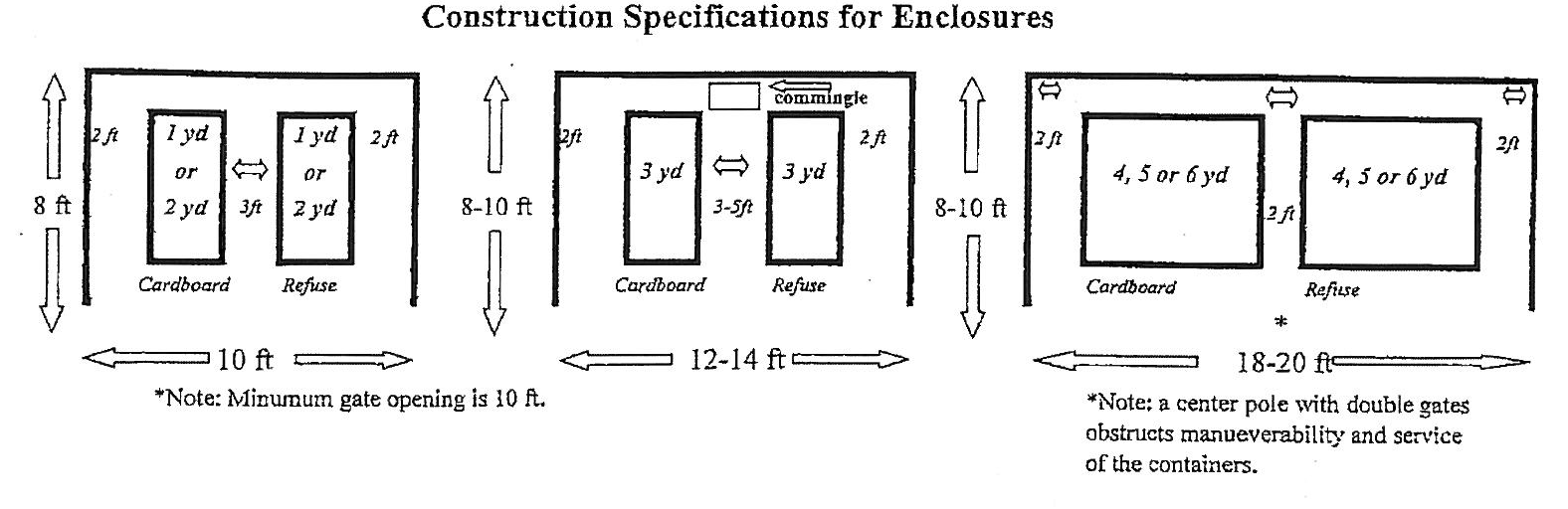
Enclosure areas shall contain sufficient space to accommodate both refuse disposal and recycling containers adequate to accommodate the degree of development. Disposal needs shall be calculated at 0.3 yards per dwelling unit for refuse and 0.2 yards per dwelling unit for recycling. The following construction specifications shall be used as a guide for enclosure design based on the calculation requirements listed herein:
e.
The area standards for trash enclosures listed in Subsection (d.) above shall be met unless documentation is submitted from the applicable trash collection company indicating that an alternative design will be adequate to accommodate the amount of refuse and recycling that is anticipated to be generated on an ordinary basis.
8.
Mechanical Equipment. External mechanical equipment, such as heating or cooling equipment, pumps, or generators, that is located on the ground or on the roof of buildings, must be entirely screened from view at ground level by sight obscuring walls, fences, parapet, or other similar means consistent with the overall architecture of the development. Landscaping is not an acceptable alternative for such screening as specified herein. Screening shall be compliant with all applicable codes. No heating or cooling equipment shall be placed on exterior walls unless completely screened from view.
9.
Common Open Space. Common open space(s) shall be incorporated into the site plan for multi-family complexes as a primary design feature. All multi-family complex developments shall provide either 3,000 square feet or 15 percent of site area for open space, whichever is greater. The open space may include required setbacks areas but may not include dedicated street rights-of-way and land dedicated to other public uses like parks and schools. The Community Development Director, or designee, may require this area to be protected from streets, parking areas, or the like, by a fence or the equivalent. Sensitive lands and historic buildings or landmarks open to the public and designated by the Comprehensive Plan may be counted toward meeting the common open space requirements.
The open space provided must be landscaped in the active or passive park style, shall include amenities such as pedestrian paths, lighting, and trash receptacles. If the common open space is landscaped as an active style park, it may be of any size provided it meets the requirements of this Subsection and shall not be subject to the irrigated turf restrictions of Section 8.530(7.). Additionally, all multi-family complexes with 20 or more units shall provide two or more amenities for the residents as listed below. Such amenities shall be centrally located for a majority of the residents.
a.
Tot lot/play structure.
b.
Community garden.
c.
Picnic tables/barbecue areas.
d.
Swimming pool, splash pad, or other water feature.
e.
Indoor recreation facility.
f.
Sports courts (i.e., basketball, tennis, volleyball).
g.
Other active or passive recreation area that meets the intent of this standard as approved through the development review process.
10.
Private Open Space. Private open space accessible from interior shall be required for all triplexes and quadplexes based on the following standards:
a.
Ground/bottom floor housing units shall have front or rear patios or decks at least four feet deep and measuring at least 48 square feet in area.
b.
A minimum of 50 percent of all upper floor (second floor and above) housing units shall have balconies or porches at least 4 feet deep and measuring at least 48 square feet in area.
c.
To the maximum extent possible, private open space areas shall be oriented toward common open space areas and away from adjacent single family residences, parking areas and driveways and trash enclosures.
11.
Special Yards. In order to allow air circulation and light, the distance between buildings on the same lot shall be as follows:
a.
All front and rear walls, and all walls with a primary entrance shall be separated from all other walls on all other buildings on the same lot by a minimum of 20 feet.
b.
The distance between side walls on buildings on the same lot shall be no less than 12 feet.
12.
Storage. All multifamily dwellings and complexes shall provide for storage of furniture, tools, equipment, building materials or supplies belonging to the occupants or management of the complex. Each dwelling unit shall have one assigned, securable storage area, a minimum 18 square feet, but shall be of a minimum size and dimension that is suitable to accommodate one bicycle of average size. Storage areas may be indoor, such as attached or detached garages, or within specific areas what are internal to each dwelling unit. Storage areas may also be within outdoor structures such as within a separate storage building located on premises. The City may exempt or reduce the storage space requirement for "specialty housing", such as senior housing or for housing for long-term infirm care.
13.
Off-Street Parking. All off-street parking provisions addressed herein (including: number of spaces; loading areas; and design and improvement standards) shall be provided in conformance with Sections 8.500 through 8.515. Plexes shall comply with the City's access policies regarding vehicle access and provide adequate pedestrian ways to safely navigate the parking areas and to connect to the public sidewalks. Adequate internal vehicle access shall be designed to minimize or eliminate vehicle/vehicle or vehicle/pedestrian conflicts in off-street parking areas. If off-street parking areas are proposed to be placed between the primary building elevations and public streets, the application shall be subject to a public hearing pursuant to Article II Land Use Procedures, Sections 8.1000 through 8.1720.
F.
Exterior Mechanical Equipment. These shall be screened so as not to be visible from public streets or residences and not placed on exterior walls unless fully screened.
G.
Surfacing. Gravel is prohibited as a surfacing material in the commercial or mixed use zones. Areas that are not part of the required landscaped areas shall be surfaced with asphalt or concrete unless natural, undisturbed open areas.
H.
Building Design for Automotive Service Stations. The entrance to the service bays shall not be open to the street but shall be so designed to face the rear or interior side property line.
I.
Retail, Office, Commercial and Mixed Use Buildings in the MUN and MUE Zones.
1.
Building Entrances and Orientation. At least one entrance (not including emergency exit) of any building shall be oriented toward the street and the main entrance shall be accessed directly from a public sidewalk. Primary building entrances shall be clearly defined and recessed or framed by a sheltering element such as an awning, arcade, or portico for weather protection.
2.
Entries to retail, office, and mixed-use buildings in the MUN zone shall be at sidewalk level.
3.
Entryways. Retail, office, commercial and mixed-use buildings in the MUN zone shall have clearly defined, highly visible customer entrances that include at least three of the following elements, listed below.
a.
Recesses/projections;
b.
Arcades;
c.
Raised corniced parapets over the door;
d.
Peaked roof forms;
e.
Arches;
f.
Outdoor patios;
g.
Architectural details such as tile work and moldings that are integrated into the building structure and design;
h.
Integral planters or wing walls that incorporate landscaped areas and/or places for sitting.
4.
For buildings located at the corner of street intersections, one of the three treatments is required to emphasize the importance of this location in the district.
a.
Locate the primary entry to the building at the corner of the building or within 25 feet of the corner of the building.
b.
Incorporate prominent architectural elements, such as increased building height or massing, a cupola, a turret, or a pitched roof, at the corner of the building or within 25 feet of the corner of the building.
c.
Chamfer the corner of the building (i.e., cut the corner at a 45-degree angle and a minimum of ten feet from the sidewalk corner) and incorporate include extended weather protection (arcade or awning), special paving materials, street furnishings, or plantings in the cut.
5.
Facade Transparency. The main front (street-facing) elevation(s) shall provide at least 50 percent windows or transparency at the pedestrian level. The side elevations shall provide at least 25 percent transparency. The transparency is measured in lineal fashion (For example, 100-foot-long building elevation shall have at least 50 feet (50 percent of 100 feet) of transparency in length).
6.
Minimum wall articulation, side or rear walls that face walkways may only include false windows and door openings defined by frames, sills and lintels, or similarly proportioned modulations of the wall, only when actual doors and windows are not feasible because of the nature of the use of the building.
7.
Facade Treatment.
a.
Minimum Wall Articulation.
i.
Facades shall add architectural interest and variety and avoid the effect of a single, long, or massive wall with no relation to human size. No wall that faces a street or connecting walkway shall have a blank, uninterrupted length exceeding 30 feet in the MUN Zone without including, but not be limited to, at least two of the following:
A.
Change in plane,
B.
Change in texture or masonry pattern,
C.
Windows, trellises with vines, or
D.
An equivalent element that subdivides the wall into human scale proportions.
ii.
Facades greater than 100 feet in length, measured horizontally, shall incorporate wall plane projections or recesses having a depth of at least 3 percent of the length of the facade and extending at least 20 percent of the length of the facade. No uninterrupted length of any facade shall exceed 100 horizontal feet.
iii.
Ground floor facades that face public streets shall have arcades, display windows, entry areas, awnings, or other such features along no less than 50 percent of their horizontal length.
iv.
Ground floor facades that face public streets shall incorporate at least two of the following elements:
A.
Canopies or overhangs (5 feet-0 inches minimum, measured from either the face of the column or the street-facing elevation) for the width of the building;
B.
Transom window;
C.
Storefront frieze, horizontal sign band, or a belt course above the transom window or mezzanine level;
D.
Window plant box (minimum of one per window);
E.
Projected window sill (12 inches to 24 inches above grade).
v.
Building facades must include a repeating pattern that includes any one or more of the following elements:
A.
Color change;
B.
Texture change;
C.
Material module change.
vi.
Facades shall have at least one of elements Subsections (8.a.ii., iii., or iv.) of this Section repeat horizontally. All elements shall repeat at intervals of no more than 30 feet, either horizontally or vertically.
b.
Common concrete masonry unit (CMU) is prohibited (textured CMU is allowed).
c.
All sides of the building shall include materials and design characteristics consistent with those on the front. Use of inferior or lesser quality materials for side or rear facades shall be prohibited.
d.
Trellises, canopies, and fabric awnings may project up to five feet into front setbacks and public rights-of-way, provided that the base is not less than eight feet at the lowest point and no higher than ten feet above the sidewalk. Awnings shall be no longer than a single storefront unless multiple storefronts exist. If multiple storefronts exist, trellises, canopies, and fabric awnings shall create uniform cover without breaks.
8.
Roof Treatments.
a.
All facades shall have a recognizable "top" consisting of, but not limited to:
i.
Cornice treatments, other than just colored "stripes" or "bands," with integrally textured materials such as stone or other masonry or differently colored materials; or
ii.
Sloping roof with overhangs and brackets; or
iii.
Stepped parapets;
iv.
Special architectural features, such as bay windows, decorative roofs and entry features may project up to three feet into street rights-of-way, provided that they are at least nine feet above the sidewalk.
5.
Landscaping. See Sections 8.520 through 8.540 for applicable landscaping standards.
6.
Mobile Food Pods.
A.
Applicability. Mobile Food Pod Site and Design review shall be required for any new Mobile Food Pod development. An alteration to a site of, or an addition of a Mobile Food Unit to an existing Mobile Food Pod, is subject to a Minor Alteration pursuant to Section 8.1400(2.). These provisions do not apply to:
1.
A Mobile Food Unit approved and permitted through a Temporary Use Permit, Section 8.380.
2.
A Mobile Food Vendor on private or public property.
B.
General Requirements. The following provisions apply to all Mobile Food Units within a Mobile Food Pod. Mobile Food Units shall:
1.
Obtain a valid City business license and operational permit from Redmond Fire and Rescue.
2.
Sell primarily food and/or beverage items.
3.
Be maintained in a neat and clean condition including but not limited to:
a.
Regular maintenance and cleaning of the exterior of the Mobile Food Unit to avoid rust and peeling paint.
b.
Repair of broken or sagging awnings, canopies, platforms, counters, benches, tables, seating, umbrellas, and other structures.
4.
Not dump wastewater onto the ground, onto the streets, or into a storm drainage facility. All liquid waste from the waste tank or from cleaning activities such as cleaning the Mobile Food Unit, shall be captured, and properly disposed, except as approved by the City Engineer. Discharge or leakage draining into the stormwater system is prohibited.
5.
Be placed on an impervious surface such as asphalt, concrete, pavers, or other surface as approved by the City Engineer. Spills shall be cleaned and disposed of properly.
6.
Provide vehicular access pursuant to Section 8.2820, Access Management Standards, and per Public Works Standards and Specifications.
7.
Provide permanent restrooms with hand-washing stations and located within 250 feet of the Mobile Food Pod. No portable bathrooms are allowed onsite.
8.
Connect to a public water and sewer or other approved permanent source, as required in City Code, Chapter 4, and conforming to Public Works Standards and Specifications, unless exempted by the City Engineer.
9.
Connect to a permanent power source:
a.
Power connections may not be connected by overhead wires or extension cords to individual Mobile Food Units.
C.
Design Standards. The following provisions apply to all Mobile Food Units within a Mobile Food Pods.
1.
Mobile Food Units shall not be located in the right-of-way and are only permitted on the subject property. Equipment, customer queue, or any accompanying items shall not be located within the right-of-way, clear vision areas, or sight distance areas.
2.
Mobile Food Units shall ingress and egress from an approved access point conforming to Public Works Standards and Specifications and must be kept clear and free from obstructions.
3.
Mobile Food Units shall be a minimum of five feet from other Mobile Food Units and all structures.
4.
Mobile Food Units shall have a minimum setback of ten feet from all property lines or comply with the underlying zone setback, whichever is greater.
5.
A Mobile Food Pod containing more than eight Mobile Food Units, at any time, shall have a designated loading area. The loading area shall be provided with paved access, driveways and surfacing in the same manner as for off-street parking, except that each space shall be ten feet wide and 22 feet long with a height clearance of at least 14 feet. A sight-obscuring screen shall conceal the loading area from view from public streets.
6.
Mechanical or power-generating equipment located outside the Mobile Food Unit shall be concealed with screening at a height equal to or exceeding that of the equipment.
7.
Any proposed fencing shall not be constructed of chain link and shall comply with Section 8.340.
8.
A minimum of at least 300 square feet of open space per Mobile Food Unit shall be provided for queuing, eating, and communal space.
9.
Each Mobile Food Unit shall have an assigned, securable, interior storage area that is a minimum of 20 square feet.
10.
Trash receptacles for the disposal of solid waste shall be provided in convenient, secure, and concealed locations and be of such capacity so that there is no accumulation of uncovered trash at any time. Solid waste shall be removed from the property on a scheduled basis to prevent health hazard or nuisance.
11.
Deviation from any of the above standards may be granted administratively by the Community Development Director, or designee, provided extenuating circumstances.
7.
Parking and Unloading Areas/Docks.
A.
Off-Street Parking Areas. Parking areas shall be as near the public entrances to the structure served as possible.
B.
Parking lot. The parking shall be dispersed around the building, emphasizing the importance of the building and accessibility to entrances. In the MUN and MUE zones, parking shall be located to the side, rear, or under the building or in a designed central parking lot.
C.
Truck loading areas or docks. Truck loading areas or docks, where delivery is done by semi-truck with a specified loading dock, shall be located or screened from the street or from the major public entrance to the building. The Applicant shall identify the specific type(s) and size of delivery vehicles which will deliver and/or take goods to/from the building; the hours of delivery, the location of delivery doors and their dimensions. Truck loading areas or docks shall not inhibit circulation on-site or create access problems from adjacent streets.
8.
General Site Criteria.
A.
Grading and Drainage.
1.
Grading. Grading shall conform to the City of Redmond Public Works Standards and Specifications.
2.
Drainage and Stormwater. Drainage shall be maintained in conformance with the Public Works Standards and Specifications. A stormwater drainage plan shall be developed in conformance with the Public Works Standards and Specifications.
3.
Blasting. A permit for explosive blasting shall be obtained from Redmond Fire & Rescue and City Engineer prior to blasting.
B.
Clear Vision Standard. The plan must conform to Section 8.305, Establishment of Clear Vision Areas.
C.
Trash Collection Areas. Trash collection areas shall not be oriented towards building entrances or public streets other than alleys and shall be screened or enclosed with building material which is compatible with those used in the exterior of the building. Location(s) of all trash collection area(s) shall be reviewed and approved by the Community Development Department Director, or designee.
D.
Water and Sewer Service. Connection to the City's public water and sewer systems shall be required and shall comply with the current Public Works Standards & Specifications.
E.
Accessibility. At least one pedestrian pathway, which meets UBC accessibility requirements, shall be provided within the boundary of the site from public transportation stops, accessible parking spaces, passenger loading and drop off zones, and public streets or sidewalks to an accessible entry. When more than one building or facility is located on a site, at least one accessible route shall be provided between accessible buildings and accessible site facilities. The accessible route shall be the most practical and direct route among accessible building entries, accessible site facilities and the accessible entry to the site. Walks paralleling vehicular ways shall be separated from vehicular ways by curbs, planted areas, railings, or other means between the pedestrian way and vehicular routes.
F.
Streetscape Standards in the MUN Zone. New retail, office, commercial and mixed-use development, and major modifications (per Sections 8.3005 and 8.3010) within the MUN zone shall provide one or more of the Category A pedestrian amenities listed below and all of the Category B amenities, as generally illustrated in the figure below. Pedestrian amenities may be provided within a planting strip or street furnishing zone, building frontage zone or plaza, as shown in the figure below. Use of the public right-of-way requires approval by the roadway authority.
Category A:
1.
A plaza, courtyard, square or extra-wide sidewalk next to the building entrance (minimum width of feet feet);
2.
Sitting space (i.e., dining area, benches, garden wall or ledges between the building entrance and sidewalk) with a minimum of 16 inches in height and 30 inches in width;
3.
Public art that incorporates seating (e.g., fountain, sculpture).
Figure for Subsection (7.f.): Pedestrian Amenities for streetscape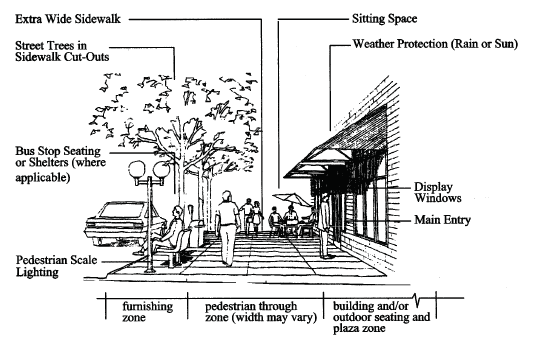
Category B:
1.
Building canopy, awning, pergola, or similar weather protection (minimum projection of four feet over a sidewalk or other pedestrian space).
2.
Street trees, as specified in Section 8.540, in grates.
3.
One trash receptacle per building, for buildings wider than 40 feet at street/sidewalk frontage.
4.
One pedestrian scale light fixture per building.
5.
Parking areas shall be located behind buildings, below buildings, or to the sides of buildings.
6.
Neighborhood-scale signs, as specified in City Code Chapter 11, Sign Standards.
9.
Transportation System Analysis (TIA). The development must meet requirements per Section 8.2815 (Transportation System Analysis).
10.
Access Management Standards. The development must meet requirements per Section 8.2820 Access Management Standards.
(Ord. No. 2009-03, 5-26-2009; Ord. No. 2009-14, 12-8-2009; Ord. No. 2012-04, 4-24-2012; Ord. No. 2013-04, 5-14-2013; Ord. No. 2015-01, 2-24-2015; Ord. No. 2016-17, 1-31-2017; Ord. No. 2017-12, 12-12-2017; Ord. No. 2020-15, 11-10-2020; Ord. No. 2022-04, 6-28-2022; Ord. No. 2022-09, 12-13-2022; Ord. No. 2023-07, 12-19-2023)
Sec. 8.3040. - Downtown Overlay District Design Review Criteria.
In addition to the standards in Section 8.3035, prior to the issuance of a building permit, all properties, and structures in the Downtown Overlay District, unless exempt under Section 8.3040(2.) below, shall comply with the Downtown Design Standards. If a conflict exists between the Sections 8.3035, 8.3040, and 8.3045, then Section 8.3040 shall take precedence.
1.
Purpose. In an effort to enhance and improve downtown's character, the quality of the pedestrian experience, and economic vitality, the City Council has adopted architectural design standards for the downtown core area.
The intent of the architectural design standards is to achieve the following:
A.
Quality Economic Growth. Assure opportunities for a stable, vital, diverse, and competitive economy at the heart of the city.
B.
Vibrant Downtown. Strengthen downtown as a vibrant, mixed use district that draws a wide spectrum of residents and visitors.
C.
Downtown Appearance. Improve and enhance the appearance of the built environment and natural features throughout Downtown, especially along primary commercial corridors, and other major arterials.
D.
Historic Character. Preserve and retain historic structures and cultural resources throughout downtown.
E.
Pedestrian Environment. Improve and enhance the pedestrian environment throughout downtown, as well as the pedestrian.
2.
Exempt Development. These Design Standards shall apply to any development in the Downtown Overlay District except for the following uses:
A.
Minor Modifications.
B.
Landscaping or landscape alterations.
C.
Repair or maintenance of public or private buildings, structures and landscaping that present a risk to public safety.
D.
Maintenance of the exterior of an existing structure such as re-roofing, or re-siding where similar materials and colors are used.
E.
Interior remodeling.
F.
Temporary structures and uses which are for relief of victims of disaster or an emergency.
G.
Single family detached dwellings and middle housing.
H.
Child care facilities that operate in existing residential structures.
3.
Non-exempt Development. Any development in the Downtown Overlay District that does not qualify as Exempt Development, including major modifications, shall meet the applicable design standards in Section 8.3040. If a conflict exists among Section 8.3040, Section 8.3035, and Section 8.3045, then Section 8.3040 shall apply.
4.
Procedure. The Community Development Director, or designee, or Hearings Body, shall approve, approve with conditions, or deny an application based upon compliance with the design standards. Approval shall be obtained from the review authority prior to the issuance of a building permit for all non-exempt development. Per the Downtown Architectural Design Standards, applicants can choose two tracks of review:
A.
Track 1 - Clear and Objective: Administrative Review of Compliance with Design Standards. Track 1 requires applicants to meet the downtown design standards, including the intent and approach of each standard as noted below. The design standards are quantifiable and can be administered as part of the plan-review process. These applications are reviewed administratively by City of Redmond Planning staff.
B.
Track 2 - Discretionary: City Review of Compliance with Design Standards. Track 2 allows applicants to satisfy the intent of the design standards as determined by the Hearings Body. In Track 2, the intent statements serve as the criteria for determining if the "intent" of the downtown design standard is being met. In Track 2, applicants are required to identify how their proposed site and/or building meet the intent statements of the design standards, and why specific objective standards cannot be met.
5.
Application Requirements. The applicant shall attend a pre-development meeting with City of Redmond Planning or Urban Renewal staff to determine if the proposed development is "exempt" or "non-exempt" from the Downtown Design Standards, and to determine, if possible, if the development should be processed as a Track 1 or Track 2 review. The application shall contain information specified in this Article, as well as sample paint colors.
6.
Approval Process. For each standard, there will be one or more approaches an applicant will need to follow to meet the design intent under Track 1. Within each approach, there may be a menu of elements or techniques that an applicant may employ. In many cases, the same elements and techniques are presented as a means to meet different standards. In the event that a specific element or technique is used to meet two standards, an applicant will be required to choose another element or technique to meet a third standard. In this way, applicants are required to make use of multiple elements or techniques thereby increasing the attractiveness of downtown.
For Track 1, Planning Staff shall use the downtown design standards, approaches, elements, and techniques to ensure compliance with the intent of downtown design standards. For Track 2 applications, the City of Redmond Hearings Body shall use the intent statements to ensure compliance with the downtown design standards.
7.
Downtown Design Standards. The downtown design standards establish a palette of objective, design-oriented elements that help ensure that proposed development, redevelopment, and modifications conserves and enhances desired scale and character of the downtown. They are intended to implement City's goals and objectives in the Redmond Comprehensive Plan and Downtown Action Plan.
A.
Standard: Cohesive Architectural Elements.
Intent. Enhance the experience of passing motorists, pedestrians, and bicyclists by incorporating cohesive and repetitive architectural elements into the ground-floor design of street-facing façades (and alley-facing façades where feasible).
Approach 1. Divide the ground floor of commercial storefronts into distinct architectural bays that are no more than 30 feet on center. For the purpose of this standard, an architectural bay is defined as the zone between the outside edges of an engaged column, pilaster, post, or vertical wall area.
Approach 2. For each architectural bay, incorporate a minimum of three of the following elements/techniques:
Element/Technique.
•
Building lighting (minimum of a pair).
•
Suspended signs/blade signs.
•
Canopies or overhangs (5 inches-0 inches minimum, measured from either the face of the column or the street-facing elevation).
•
Transom window.
•
Storefront frieze, horizontal sign band, or a belt course above the transom window or mezzanine level.
•
Window plant box (minimum of one per window).
•
Projected windowsill (12 inches to 24 inches above grade).
•
Architectural treatment (minimum of a pair).
Where feasible, building elevations that face an alley should be enhanced with a minimum of a doorway (with glass) and lighting.
B.
Standard: Streetscape and Pedestrian Amenities.
Intent. Ensure that Downtown development contributes to the creation of a cohesive, exciting, and vibrant street life. Create safe and friendly pedestrian zones, on private property, that promotes walking, shopping, and meeting with friends.
Approach. To reinforce the pedestrian realm and create spaces where people are encouraged to gather, implement one of the four space-making elements/techniques below.
Element/Technique.
•
Courtyard. Incorporate a small courtyard into the design of street facing and/or alley-facing façades that includes transparent windows and/or doors, exterior lighting, and special paving.
Where possible, windows should be incorporated into all walls that face the courtyard. These windows should be large enough to encourage interaction between inside and outside. Other elements that should be considered in the design of courtyards are benches, planter boxes, trees, and bike racks.
•
Recessed Entry. Create a small, covered transition zone between the sidewalk and the front door. Define this space with special lighting, paving, and storefront windows.
•
Chamfer Entry. Create a gathering place at the corner of the building by chamfering the corner of the building (i.e., cutting the corner at a 45-degree angle for a minimum of 10 feet-0 inches on each side of the corner).
•
Arcade. Set the front door to the building a minimum of 5 feet-0 inches (clear) behind an arcade that is located at the front property line or the adjusted property line.
Provide architectural and/or structural vertical columns at an interval that does not exceed 20 feet.
C.
Standard: Human Scale.
Intent. Design building façades to a "human scale" — with details, materials, and workmanship that is aesthetically appealing as well as comfortable for, and at the scale of, pedestrians.
The most successful ground floor street elevations exhibit a high degree of transparency and consist of a palette of well-designed elements that are scaled to the human body. To continue this tradition, applicants shall select elements for each of the horizontal building divisions that comprise the ground floor façade as described below.
Approach 1. The base of the ground floor façade extends from the top of the finished grade or sidewalk to the bottom of the windowsill. To continue this development pattern, select at least one of the following elements/techniques:
Element/Technique.
•
Defined base of an engaged column or pier.
•
Projected windows sills (12-24 inches above grade).
Note: "Human Scale" in architecture considers how people interact with the built environment based upon their physical dimensions and capabilities. Besides anthropometric (human) measurements, human scale looks at the visual, acoustic, and spatial properties of a space and scales those properties to relate to the human form.
Note: The area below the projected windowsill is commonly referred to as a bulkhead, window base, or window panel. This zone is usually constructed of concrete, brick, stone, or wood and serves to anchor the façade to the ground floor plane. With the exception of the entry door, this base element usually extends the length of the elevation.
Approach 2. Storefront windows typically frame the middle of the ground floor façade. To continue this development pattern, select at least one of the following elements/techniques:
Element/Technique.
•
Medallion (minimum of a pair).
•
Window plant box (minimum of one per window).
•
Integrated horizontal and vertical window mullions.
Approach 3. The top of the ground floor façade is the area between the storefront and the upper stories of the building. To continue this development pattern, select at least one of the following elements/techniques:
Element/Technique.
•
A marquee or suspended sign/blade sign that extends (perpendicular) from the building façade (the bottom of the marquee or sign shall be 8-12 feet above grade) (See Section 8.4180(5.)).
•
Sign frieze.
•
Storefront awning or canopy (the bottom of the awning or canopy shall be at least eight feet above grade, and no higher than the 1 st floor of the building or 15 feet above grade whichever is less. Minimum clearance below an awning on which signage is hung or displayed is eight feet from the sidewalk or ground level to the lowest portion of the awning or suspended sign whichever is lowest.).
•
Storefront cornice/belt course.
•
Transom window(s).
D.
Standard: Weather Protection.
Intent. Protect pedestrians from sun, wind, and rain.
Approach. Provide weather protection along 50 percent of the ground floor façade (50 percent of the linear frontage abutting a right-of-way) by incorporating one of the following elements/techniques:
Element/Technique.
•
Awnings (glass, metal, or fabric).
•
Balconies.
•
Building overhangs (including recessed entries).
•
Arcade.
The depth of all canopies and awnings shall be a minimum of 5 feet-0 inches, measured from either the face of the column or the street facing elevation, unless limited by the building code. Internal illumination (underlighting) is prohibited unless the awning is made of an opaque material.
Note: Arcades are strongly encouraged along full-block developments.
E.
Standard: Pedestrian-Oriented Ground Floor.
Intent. Design street and sidewalk-facing storefronts and entries to be inviting and easily accessible to passersby. Ensure that the ground floor promotes a sense of interaction between activities in the building and activities in the public realm.
Approach. Create a prominent entry and foster interaction between inside and outside by incorporating three or more of the following elements/techniques:
Element/Technique.
•
Overhangs (canopies, awnings).
•
Clerestory or transom window as part of the large storefront system.
•
Glass windows that flank the door.
•
Decorative lighting.
•
Large glass entry doors.
•
Creative signage.
•
Artwork.
•
Recessed entry bay.
•
Incorporating paving and color.
The depth of all canopies and awnings shall be a minimum of 5 feet-0 inches, measured from either the face of the column or the street facing elevation.
Applicants are strongly encouraged to use earth tones or muted colors.
The use of mirrored or tinted glass is prohibited.
F.
Standard: Tri-Partite Façades.
Intent. To enhance the image of the downtown by creating an attractive and unified building façade that reflects and complements Redmond's historic buildings and celebrates ground floor activities, the top of the building (where the edifice meets the sky), and everything in between. To ensure the design of a unified and cohesive building façade, applicants shall design building façades consisting of a clear and distinct base, middle, and top. This standard shall apply to buildings of all heights (or number of stories).
Approach 1: Base. The base of the building typically extends from the sidewalk to the bottom of the second story or the belt course / string course that separates the ground floor from the middle of the building. In order to enhance the character of the base of the building, applicants shall include in the design of the façade at least one of the following elements/techniques.
Element/Technique.
•
Storefront windows.
•
Canopies or awnings (5 feet-0 inches minimum, measured from either the face of the column or the street facing elevation).
•
Distinct architectural bays.
•
Entry overhang.
•
Large floor-to-floor heights.
Approach 2: Middle. Distinguish the middle of the building from the top and base of the building by incorporating one of the following elements:
Element/Technique.
•
Change in color.
•
Balconies.
•
Change in windows.
•
Step backs.
•
Signage.
•
Horizontal band(s). Horizontal bands shall be a minimum of 8 inches high (the length of a standard brick) and can be formed by a change in material, a change in color, brick orientation, or, preferably, by projecting materials from the face of the building.
Note: Where possible, windows should express the use inside the building. For example, second story residential windows are often times oriented vertically with a width to height relationship of 2:1.
Approach 3: Top. All building façades shall have a "cap" element at the uppermost portion of the façade that visually terminates the façade. To create visual interest at the top of the building, applicants shall incorporate one of the following three elements/techniques.
Element/Technique.
•
Detailed cornice or projected parapet.
•
A roof form, other than a flat roof, that projects beyond the face of the building.
•
Roof top garden that consists of plant materials that are visible from the sidewalk and the street.
Note: Besides being attractive, the incorporation of a roof top garden has the added benefit of helping to manage storm water run-off that would otherwise go into the ground water.
G.
Standard: Materials.
Intent. Use building materials and construction practices that evoke a sense of permanence and are compatible with Redmond's historic buildings.
Approach. Incorporate one of the following building materials, found on traditional commercial storefronts, into the design of the ground-floor (street facing) façades:
•
Brick.
•
Metal.
•
Terra cotta.
•
Stone.
•
Concrete (and CMU).
•
Stucco.
•
Horizontal wood or cementitious siding.
•
Wood shingles.
•
Board and batten vertical wood siding.
•
Ceramic detail.
Prohibited Building Materials. The following materials are prohibited:
•
T-11 or similar sheet materials.
•
Stucco clad foam (EIFS).
•
Vinyl siding.
•
Log construction.
•
Mirrored or tinted windows (except for that which is required by code).
Note: Where possible, use materials indigenous to Central Oregon.
Note: Concrete and wood siding should be painted using a palette of earth tone or muted colors.
H.
Standard: Reinforce the Corner.
Intent. Create dynamic public gathering spaces where streets intersect. Enhance way-finding and the comprehension of Downtown by making recognizable and memorable design elements at the corner of each block.
Approach. Choose one or more of the following elements/techniques to make intersections exciting places for people to gather.
Element/Technique.
•
Locate the primary entry to the building at the corner of the building or within 25 feet of the corner of the building.
•
Incorporate prominent architectural elements, such as increased building height or massing, a cupola, a turret, or a pitched roof, at the corner of the building or within 25-feet of the corner of the building.
•
Chamfer the corner of the building (i.e., cut the corner at a 45-degree angle and a minimum of 10 feet-0 inches from the corner of the property line) and incorporate a combination of special paving materials, street furnishings, and plantings.
Note: Where possible, incorporate double storefront doors that include large expanses of glass.
I.
Standard: Color.
Intent. Color a very important ingredient for enlivening and enhancing the built environment. A building's color should accentuate and harmonize with its architecture, as well as complement surrounding structures.
Approach. The color of any structure shall comply with all of the following criteria:
•
Be compatible with the existing built environment. A building's color should not compete for attention with neighboring buildings.
•
Limit the use of too many colors on a single building. Typically, three colors are sufficient to create a successful façade; richer or deeper hues should be used to accent door and window trim and other, small architectural details.
•
On primary façades visible from public streets, use warm, more muted colors that have low reflectivity and complement the natural colors found in the surrounding landscape. Where possible, street-facing façades should consist of unadorned materials such as brick, stone, stucco, and wood shingles.
•
Avoid the use of bright colors (such as primary or neon colors) that have intense and bright hues.
(Ord. No. 2020-15, 11-10-2020; Ord. No. 2022-04, 6-28-2022)
Sec. 8.3045. - C-2 Central Business District Commercial Design Review Criteria.
In addition to the standards in Section 8.3035, prior to the issuance of a building permit, all properties in this zoning district, except single use residential structures, shall comply with the standards in this Section. If a conflict exists between the Sections 8.3035 and 8.3045, then Section 8.3045 shall take precedence.
1.
Façade Treatment.
A.
Minimum Wall Articulation.
1.
Façades shall add architectural interest and variety and avoid the effect of a single, long, or massive wall with no relation to human size. No wall that faces a street or connecting walkway shall have a blank, uninterrupted length exceeding 30 feet without including, but not be limited to, at least two of the following:
a.
Change in plane;
b.
Change in texture or masonry pattern;
c.
Windows, trellises with vines; or
d.
An equivalent element that subdivides the wall into human scale proportions.
2.
Façades greater than 100 feet in length, measured horizontally, shall incorporate wall plane projections or recesses having a depth of at least three percent of the length of the façade and extending at least 20 percent of the length of the façade. No uninterrupted length of any façade shall exceed 100 horizontal feet.
3.
Ground floor façades that face public streets shall have arcades, display windows, entry areas, awnings, or other such features along no less than 50 percent of their horizontal length.
4.
Building façades must include a repeating pattern that includes any one of more of the following elements:
a.
Color change;
b.
Texture change;
c.
Material module change.
5.
Side or rear walls that face walkways may only include false windows and door openings defined by frames, sills and lintels, or similarly proportioned modulations of the wall, only when actual doors and windows are not feasible because of the nature of the use of the building.
2.
Entryways. Commercial buildings shall have clearly defined, highly visible customer entrances including at least three of the following elements, listed below.
A.
Recesses/projections;
B.
Arcades;
C.
Raised corniced parapets over the door;
D.
Peaked roof forms;
E.
Arches;
F.
Outdoor patios;
G.
Architectural details such as tile work and moldings which are integrated into the building structure and design;
H.
Integral planters or wing walls that incorporate landscaped areas and/or places for sitting.
3.
Reinforcing the Corner. For buildings located at the corner of intersections, one of the three treatments is required to emphasize the importance of this location in the district.
A.
Locate the primary entry to the building at the corner of the building or within 25 feet of the corner of the building.
B.
Incorporate prominent architectural elements, such as increased building height or massing, a cupola, a turret, or a pitched roof, at the corner of the building or within 25 feet of the corner of the building.
C.
Chamfer the corner of the building (i.e., cut the corner at a 45-degree angle and a minimum of ten feet from the sidewalk corner) and incorporate include extended weather protection (arcade or awning), special paving materials, street furnishings, or plantings in the cut.
4.
Materials.
A.
Incorporate one of the following building materials into the design of the ground floor (street-facing) façades: brick, metal, terra cotta, stone, concrete, stucco, horizontal wood or cementitious siding, wood shingles, board and batten vertical wood siding, ceramic detail.
B.
Prohibited Materials. T-111 or similar sheet materials, stucco clad foam (EIFS), or common concrete masonry units (CMU).
C.
All sides of the building shall include materials and design characteristics consistent with those on the front. Use of inferior or lesser quality materials for side or rear façades shall be prohibited.
D.
Trellises, canopies, and fabric awnings may project up to five feet into front setbacks and public rights-of-way, provided that the base is not less than eight feet at the lowest point and no higher than ten feet above the sidewalk. Awnings shall be no longer than a single storefront unless multiple storefronts exist.
5.
Roof Treatments.
A.
All façades shall have a recognizable "top" consisting of, but not limited to:
1.
Cornice treatments, other than just colored "stripes" or "bands," with integrally textured materials such as stone or other masonry or differently colored materials; or
2.
Sloping roof with overhangs and brackets; or
3.
Stepped parapets; or
4.
Special architectural features, such as bay windows, decorative roofs and entry features may project up to three feet into street rights-of-way, provided that they are at least nine feet above the sidewalk.
6.
Streetscape Standards. New commercial or mixed-use development and major modifications shall provide streetscape amenities, as generally illustrated in the figure below. Pedestrian amenities may be provided within a planting strip or street furnishing zone, building frontage zone or plaza, as shown in the figure below. Use of the public right-of-way requires approval by City of Redmond and must comply with the Redmond Downtown Right of Way (ROW) Standards and Specifications.
Figure: Pedestrian Amenities for streetscape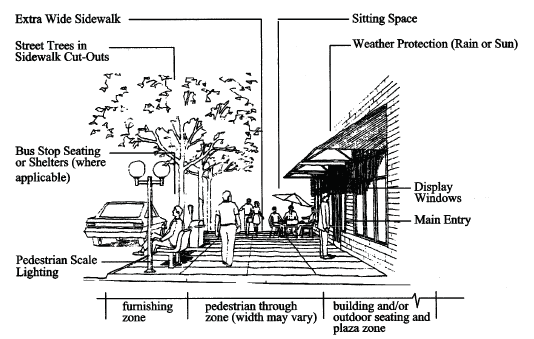
Amenities.
A.
Building canopy, awning, pergola, or similar weather protection (minimum projection of four feet over a sidewalk or other pedestrian space).
B.
Street trees, as specified in Redmond Downtown ROW standards.
C.
Trash Receptacles for buildings wider than 40 feet at street/sidewalk frontage as per Redmond Downtown ROW standards.
D.
Decorative pedestrian scale light fixtures as per Redmond Downtown ROW standards.
E.
Parking areas shall be located behind buildings, to the sides of buildings or below buildings.
F.
Pedestrian-scale signs, as specified in Article V. Sign Standards for properties in the C-2 Central Business District Commercial Sign Standards.
Sec. 8.30410. - (Reserved)
Editor's note— Section 8.30410 "Master Plans" was deleted by Ord. No. 2009-04 passed April 28, 2009.
Sec. 8.3050. - Partial Master Development Plans.
When the development proposed is for less than the entire site a partial master development plan may be required. In addition to providing all plans associated with Site and Design review, a partial master plan shall also clearly show the project area and shall clearly identify the timing of each specific phase within the master plan, if phases are proposed.
(Ord. No. 2009-04, 4-28-2009; Ord. No. 2015-01, 2-24-2015; Ord. No. 2020-15, 11-10-2020)
Sec. 8.3100. - Site and Design Review for Live/Work Units.
Editor's note— Section 8.3100 was added by Ord. No. 2011-09 passed November 8, 2011.
Sec. 8.3110. - Purpose and Intent.
The Live/Work Unit is a new combined form of living unit which can provide the necessities and comforts of home and provide a venue for a source of income to promote the success of the owner. In order for these units to be approved as new or modified units, new construction must be well-designed, architecturally interesting, and made of quality products.
(Ord. No. 2011-09, 11-8-2011)
Sec. 8.3120. - Applicability of Site and Design Review and Modified Site and Design Review.
Site and Design Review shall be required to establish any New Live/Work Unit.
1.
Modified Site and Design Review shall be required for a Modified Live/Work Unit for any of the following:
A.
The change of use or building addition to add a business component (more intensive than a home occupation) to a residential property.
B.
The change of use or building addition to add a residential use to a business property.
2.
Exemptions from Site and Design review for Modified Live/Work Units may be allowed if the Community Development Director, or designee, determines with findings that the proposed development will have a negligible impact on the neighborhood.
(Ord. No. 2011-09, 11-8-2011)
Sec. 8.3130. - Zoning Applicability.
Live/Work Units that comply with Section 8.260 are a permitted use in the Mixed Use Live Work (MULW) zone.
(Ord. No. 2011-09, 11-8-2011)
Sec. 8.3140. - Procedure.
A Site and Design Review application for a Live/Work Unit shall be submitted to and reviewed by the Community Development Director, or designee, as a Land Use action as described in Section 8.1300. A pre-development meeting is required prior to submitting a Site and Design Review application.
(Ord. No. 2011-09, 11-8-2011; Ord. No. 2020-15, 11-10-2020; Ord. No. 2023-07, 12-19-2023)
Sec. 8.3150. - Site Improvement Agreement.
Upon approval the applicant/owner, at the City's discretion, shall enter into a Site Improvement Agreement, which states the applicant/owner shall abide by the decision and conditions of approval for the Live/Work Unit.
(Ord. No. 2011-09, 11-8-2011)
Sec. 8.3160. - Plans Required.
The applicant shall submit to the Community Development Department the following documents with the required fee.
1.
Exterior Elevations. Drawings or sketches of elevations for all sides of the proposed building(s). Such plans shall indicate the building height, primary building materials, color, shape, architectural features, and other design features of the building, including the location of all exterior mechanical devices.
2.
Site Plan. Site plans containing the following.
A.
A drawing showing the floor plans for each building and a description of each internal "use."
B.
Location and use of all proposed and existing buildings, fences, and structures within the proposed development. Indicate which buildings are to remain and which are to be removed.
C.
Location of all parking areas and dimensions of all parking spaces (existing and proposed).
D.
Location and size of all existing & proposed public utilities serving the subject property including water lines, sewer lines, storm drains, power poles and lines, telephone poles and lines, and existing fire hydrants.
E.
Location of existing drainage on-site, canals and laterals.
F.
Location of all utility and access easements on the property.
G.
Locations of all existing natural features including, but not limited to, any existing trees having a six inch trunk diameter or greater, three feet above grade, and any significant natural features including (but not limited to) outcroppings of rocks, boulders, etc. Indicate any contemplated changes that would affect a natural feature.
H.
Photograph of building(s) and site.
3.
Landscape Plan. See Sections 8.520 through 8.540 for applicable landscaping standards.
4.
Lighting Plan. A lighting plan showing the type, placement, wattage, and method of shielding all exterior lights from adjacent sites shall be submitted.
(Ord. No. 2011-09, 11-8-2011; Ord. No. 2023-07, 12-19-2023)
Sec. 8.3170. - Site and Design Review Criteria.
Prior to issuance of a building permit, the following applicable criteria shall be met.
1.
Dimensional Standards for New Live/Work Units.
A.
Minimum Work Space. Each New Live/Work Unit shall have a minimum work space of 200 square feet.
B.
Minimum Living Area. Each New Live /Work Unit shall have a minimum living area of 600 square feet.
2.
Outside Requirements.
A.
Parking. Each live/work unit shall have one off-street parking space for each dwelling unit and one off-street parking space for the first 1,000 square feet of non-residential floor area. Additional off-street parking spaces for non-residential floor area over and above the first 1,000 square feet shall be provided pursuant to Sections 8.500 through 8.515 (Off-Street Parking and Loading Requirements). The applicant may propose approved materials for parking that are porous and yet strong enough to support vehicles. The Community Development Director, or designee, shall be the final authority for acceptable alternatives to pavement.
B.
Exterior Mechanical Equipment. Exterior mechanical equipment shall be screened so as not to be visible from public streets.
C.
Installation of Utilities. All new utility service lines serving the site shall be placed underground, unless otherwise approved by the Community Development Director.
D.
Landscaping. See Sections 8.520 through 8.540 for applicable landscaping standards.
E.
Grading and Drainage. All site drainage shall be maintained on site and shall not drain onto public streets, irrigation canals/ditches or neighboring properties.
F.
Outdoor Storage. All outdoor storage shall be screened to a minimum of six feet in height.
G.
Fencing. Fencing standards for residential zones described in Section 8.340 shall apply to Live/Work Units.
H.
Trash Collection. Trash collection areas in which one yard or larger containers are located shall be screened from public view or in a trash enclosure. Trash enclosures shall be constructed of materials similar and matching to the subject building.
I.
Lighting. Artificial Lighting shall not shine off-site greater than 0.5-foot candles.
3.
Architectural Requirements for New Construction. New Live/Work Unit shall comply with the following standards.
A.
Architectural Consistency. Each New Live/Work Unit shall have consistent architectural elements present on all of the facades.
B.
Flat, Unbroken Walls. Single, long, or unbroken flat walls shall be avoided. Each New Live/Work Unit shall have a change of plane and change of material on the main facades (street visible) of the building.
C.
Recessions and Projections. Each unit shall have architectural recessions and projections not less than two inches in change.
D.
Transparency (windows or glass block-type elements). Each unit shall have a minimum of 25 percent transparency of the total square footage of the street-facing façade on the first floor of the business portion of the unit.
E.
Change in Texture or Masonry Pattern. Two or more finishing products or masonry patterns on the elevations of each unit is required.
F.
Building Entrance. Each unit must have a primary ground floor entrance on the street-facing façade with associated pedestrian access to the public right of way.
G.
Prohibited Materials. The New Live/Work Unit shall not use the following building products, T-111, Exterior Insulation and Finishing System (EIFS), continuous corrugated metal (30 gauge or lighter). Use of metal cargo shipping containers for residential use is prohibited.
4.
Additional Architectural Requirements. Each of the New Live/Work Unit shall have a minimum of two of the following:
A.
Change in color.
B.
Canopies or overhangs (with a minimum projection depth of two feet).
C.
Display windows (projected or recessed).
D.
Roof Treatments.
E.
Outside patio or seating area.
F.
Other elements of architectural interest. The applicant may propose an unlisted type of architectural feature or elements as permitted by the Community Development Director.
5.
Modifications to Existing Structures. To convert an existing structure to a Live/Work Unit, the following applicable criteria shall be met.
A.
Dimensional Standards for the Modified Live/Work Unit.
1.
Minimum Work Space. Each Live/Work Unit shall have a minimum work space of 200 square feet.
2.
Minimum Living Area. Each Live /Work Unit shall have a minimum living area of 600 square feet.
B.
Outside Requirements.
1.
Parking. Each live/work unit shall have one off-street parking space for each dwelling unit and one off-street parking space for the first 1,000 square feet of non-residential floor area. Additional off-street parking spaces for non-residential floor area over and above the first 1,000 square feet shall be provided pursuant to Sections 8.500 through 8.515 (Off-Street Parking and Loading Requirements). The applicant may propose approved materials for parking that are porous and yet strong enough to support vehicles. The Community Development Director, or designee, shall be the final authority for acceptable alternatives to pavement.
2.
Exterior Mechanical Equipment. Exterior mechanical equipment shall be screened so as not to be visible from public streets.
3.
Landscaping. See Sections 8.520 through 8.540 for applicable landscaping standards.
4.
Outdoor Storage. All outdoor storage shall be screened to a minimum of six feet in height by a vegetative hedge, solid fencing, or on-site buildings.
5.
Fencing. Fencing standards for residential zones described in Section 8.340 shall apply to Live/Work Units.
6.
Trash Collection. Trash collection areas in which one yard or larger containers are located shall be screened or in a trash enclosure. Trash enclosures shall be constructed of materials similar and matching to the subject building.
7.
Lighting. Artificial Lighting shall not shine off-site greater than 0.5-foot candles.
C.
Architectural Requirements for the Modified Live/Work Unit.
1.
Architectural Consistency. Each Modified Live/Work Unit shall have consistent architectural elements present on each of the facades.
2.
Exterior Walls. Any exterior wall or surface area that has more than 33 percent of its total area bare, peeling, flaking, pitted, corroded, or otherwise deteriorated, as determined by the Community Development Director, or designee, shall be surface coated in its entirety.
3.
Other Exterior Surfaces. All deteriorated or decayed doors, porches, floors, steps, walkways, driveways, railings, decks, or parts of features thereof, shall be repaired or replaced.
4.
Window and Sills. All damaged or broken windows, and deteriorated or decayed sill, sash, molding, lintel, frame, or trim thereof shall be repaired or replaced.
5.
Roofs. The roof of the Modified Live/Work Unit shall be weather-tight and free of debris, including moss and mildew. All missing shingles, or other roofing materials shall be replaced with materials of similar kind, nature, design, and color as the original thereof.
6.
Gutters and/or Downspouts. A Modified Live/ Work Unit having gutters and/or downspouts in place shall have such gutters and downspouts properly mounted to such structure and be in good working condition.
7.
Chimney. A chimney, if present, shall be structurally sound and in good repair, free of loose, missing, or deteriorated mortar and bricks, or other chimney building materials. Any such loose, missing, or deteriorated mortar or bricks shall be refitted, replaced, or repaired.
8.
Prohibited Materials. The Modified Live/Work Unit shall not use the following building products, T-111 (unless matching existing materials), Exterior Insulation and Finishing System (EIFS), continuous corrugated metal (30 gauge or lighter). Use of metal cargo shipping containers for residential use is prohibited.
D.
Architectural Requirements. Each Modified Live/Work Unit shall have a minimum of three of the following:
1.
Change in color.
2.
Canopies, awnings, or overhangs (with a minimum projection depth of two feet).
3.
Display windows (projected or recessed).
4.
Roof treatments.
5.
Outside patio or seating area.
6.
Decorative window trim.
7.
Other elements of architectural interest. The applicant may propose an unlisted type of architectural feature or elements as permitted by the Community Development Director.
6.
Detached Accessory Live/Work Buildings. A Live/Work Unit may have a separate accessory detached building in which work may be conducted as a function of the Live/Work Unit. The following standards shall apply to new and modified Accessory Buildings.
A.
Minimum Size. The detached accessory building shall be a minimum of 200 square feet in size.
B.
Setbacks. The detached accessory building shall be setback a minimum of five feet from any property line.
C.
Building Height. The detached accessory building shall be no taller than the height of the primary building.
D.
Architectural Requirements for Detached Accessory Buildings. The detached accessory buildings shall comply with the following:
1.
Architectural Consistency. Each detached unit shall have consistent architectural elements present on each of the facades and shall be similar to the primary unit.
2.
Flat, Unbroken Walls. Single, long, or unbroken flat walls shall be avoided. Each detached unit shall have a change of plane and change of material on the main facades (street visible) of the building.
3.
Change in Texture or Masonry Pattern. Two or more finishing products or masonry patterns on the elevations of each detached unit is required.
4.
Prohibited Materials. The Detached Accessory Live/Work building shall not use the following building products, T-111, Exterior Insulation and Finishing System (EIFS), continuous corrugated metal (30 gauge or lighter). Use of metal cargo shipping containers for residential use is prohibited.
E.
Additional Architectural Requirements for Detached Accessory Buildings. Each of the new units shall have a minimum of two of the following:
1.
Change in color.
2.
Canopies or overhangs (with a minimum projection depth of two feet).
3.
Display windows (projected or recessed).
4.
Roof Treatments.
5.
Other elements of architectural interest. The applicant may propose an unlisted type of architectural feature or elements as permitted by the Community Development Director.
7.
Limiting Factors. The following is required for all types of Live/Work Units. The limiting factors listed below shall be applicable as conditions of approval to guarantee reasonability of working in conjunction with residential living. These restrictions include the following:
A.
Noise Levels. The work use shall not generate noise exceeding 75 decibels as measured at the lot line of the lot containing the live/work dwelling from 6 AM to 9 PM. Likewise, work use shall not generate noise exceeding 55 decibels as measured at the lot line of the lot containing the live/work dwelling from 9 PM to 6 AM.
Decibel Reference Chart
B.
Odors. No noxious odors shall be evident off the premises.
(Ord. No. 2011-09, 11-8-2011; Ord. No. 2023-07, 12-19-2023)
Sec. 8.3180. - Enforcement.
1.
It shall be the duty of the Community Development Director, or designated representative to administer and enforce the provisions of these standards in such a way as to carry out its intent and purpose.
2.
Violation of any provisions of these standards is a Class A Civil Infraction and/or a Class A administrative infraction and shall be enforced through the procedures established in Sections 2.750 through 2.799.
3.
Each day that a nuisance continues to exist constitutes a separate violation, and a separate penalty may be assessed for each day the violation continues.
4.
Violation of these standards is hereby declared a nuisance and may be subject to abatement, removal or other remedy provided in the City of Redmond nuisance code under Section 5.345.
5.
When any real property is or is proposed to be used, transferred, sold or disposed of in violation of these standards, the Community Development Director, designee, or any person whose interest in the property is or may be affected by the violation, in addition to other remedies provided by law, may institute injunction, mandamus, abatement or other appropriate proceedings to prevent, temporarily or permanently enjoin, abate or set aside such use, transfer, sale, disposition, offer, negotiation or agreement.
6.
If any section, subsection, sentence, clause, or phrase of these standards is for any reason held to be invalid or unconstitutional by any court of competent jurisdiction, such decision shall not affect the validity of the remaining portions of these standards.
(Ord. No. 2013-06, 4-9-2013; Ord. No. 2014-05, 4-8-2014)

