
Republic City Zoning Code
ARTICLE 405
X Landscaping And Screening
405.750 Applicability
- All new structures, buildings and parking lots must comply with the landscaping and screening standards of this Article.
- If an addition is proposed to a building; an additional building is proposed for a lot; or if an expansion is proposed to an existing parking lot, the existing and expanded parking lot shall comply with the provisions of this Article.
- Exceptions.
- Previously approved developments which have been given a permit to begin construction.
- Additions to existing structures that are under ten percent (10%) of the gross floor area of the existing structure or five thousand (5,000) square feet, whichever is less.
- Subdivisions that include a mix of commercial and industrial zoning that were developed in a coordinated fashion with the intent to mix uses and zoning without the need to buffer and screen between these uses, such as a business park development. This exception shall not apply to situations in which a local commercial, commercial office, or residential district adjoins an industrial district.
- An application for alternative landscaping schemes is justified only when one (1) or more of the following conditions apply. In such a case, the applicant shall describe in a letter to the Community Development Department which of the requirements set forth in this Article will be met with modifications, which project conditions justify using alternatives and how the proposed measures equal or exceed normal compliance. The request will be evaluated on a case-by-case basis. [Ord. No. 16-23 § 1, 11-28-2016]
- The site involves space limitations or unusually shaped parcels.
- Topography, soil, vegetation, or other site conditions are such that full compliance is impossible or impractical.
- Safety considerations require a change.
- Landscaping, screening and bufferyard standards shall apply to all applicable situations, regardless of requests from adjoining property owners to omit the same.
- Main Street District (MSD) – Property with a Principal Structure constructed prior to November 5th, 2024, shall be exempt from Article 405-X Landscaping And Screening.
- Main Street District (MSD) – Property with this zoning designation is exempt from Section 405.770 Landscaped Area Requirements (B)(1)(2).
[Ord. No. 15-21 §1, 8-10-2015]
Amended by Ord. 24-62 on 11/5/2024
405.760 Permits
- No permits shall be issued for the improvement of any site, the construction of any building, or the establishment of any use for which a landscaping plan is required by this Article until such plan has been submitted to and approved by the Community Development Department. [Ord. No. 16-23 § 1, 11-28-2016]
- Prior to the issuance of a permanent certificate of occupancy for any building or structure, all screening and landscaping shall be in place in accordance with the landscape plan required in this Article.
- Standards have been established for installation of all plant materials within the City of Republic. These requirements must be followed in order to receive approval of the site work and final occupancy or approval of the development. The Community Development Department has the authority to deny the issuance of a final occupancy permit until landscaping is installed according to the requirements of this Article and to the satisfaction of the site inspector. [Ord. No. 16-23 § 1, 11-28-2016]
- The Community Development Department may approve temporary occupancy permits if occupancy is sought at a time in which it is impractical to plant trees, shrubs or grass, or to lay turf. [Ord. No. 16-23 § 1, 11-28-2016]
[Ord. No. 15-21 §1, 8-10-2015]
405.770 Landscaped Area Requirements
- Where Required. All uses must provide and maintain a landscaped area as provided in this Section. Landscaped areas may not include rights-of-way and accessory uses, and must be maintained as a permeable and uncovered surface that contains living material. No more than twenty percent (20%) of the required landscaped area may consist of porous non-living materials.
Landscaped Area Requirements Type of Use Required Landscaped Area (percent) Single-family residential 30 Two-family residential 30 Multifamily residential 20 Commercial 10 Industrial 10 Mixed-Use 10 - Placement Of Landscaped Areas. Landscaping in the following areas shall be provided:
- Landscaped area a minimum of six (6) feet in width along street frontages; and
- Landscaped area a minimum of six (6) feet in width along all perimeter property lines. This required landscape area may be utilized in conjunction with the screening requirements of this Article. This requirement does not apply to single-family detached dwellings.
- Plantings shall not be placed within the required sight triangle at the intersection of any public thoroughfare or private driveway with a public thoroughfare according to the table below.
Sight Triangle Requirements Intersecting Streets Driveway Local Collector Secondary Arterial Primary Arterial Driveway A A A A B Local A A A A B Collector A A A B B Secondary arterial A A B C C Primary arterial B B B C C Key: A = ten-foot-by-ten-foot sight triangle B = thirty-foot-by-thirty-foot sight triangle C = sixty-foot-by-sixty-foot sight triangle - The utility locations shall be agreed upon prior to submission of landscape plans. Utility easements shall be provided at locations that minimize their impact on required bufferyards and perimeter landscaping. Plantings on utility easements shall be limited to ornamental trees, shrubs and hedges and ground cover. Each required canopy tree may be replaced by two (2) understory or ornamental trees to reduce conflicts with overhead utilities. Plantings in or adjacent to a utility easement shall be coordinated with the utility.
[Ord. No. 15-21 §1, 8-10-2015]
Amended by Ord. 24-62 on 11/5/2024
405.780 Parking Area Landscaping
- Interior Parking Lot Landscaping.
- Landscape islands with at least one (1) shade tree and two (2) shrubs must be provided at a minimum of one (1) for every thirty (30) parking spaces in all off-street parking areas. Flexibility in placement of landscape islands may be allowed for creative parking lot design and preservation of existing trees and vegetation. Landscape islands that include a light pole may eliminate the required shade tree, provided the shade tree is included elsewhere in the required landscaped area.
- Landscape islands include those areas that are a minimum of eight (8) feet wide and one hundred twenty-eight (128) square feet in area, and are open to the parking area on at least three (3) sides. "Bump-out" landscape areas will be considered landscape islands if they meet these criteria.
- Perimeter Parking Lot Landscaping.
- Applicability. All new off-street parking areas must install perimeter parking lot landscaping. Areas counted toward interior parking lot landscaping requirements (such as bump-outs) may not be counted as perimeter parking lot landscaping.
- Parking Areas Abutting Residential Districts. When a parking area abuts a residential district, a Type A opaque landscape screen must be provided to shield the parking area from view at any point within the residential district, as described in Section 405.810(C)(1).
- Parking Areas Abutting Public Streets.
- When an off-street parking area abuts a public street, a minimum landscape strip at least six (6) feet wide must be provided along the length of the right-of-way, excluding driveways. One (1) shade tree must also be provided per fifty (50) linear feet along the portion of the parking area that abuts a public street. These trees may be clustered or spaced linearly.
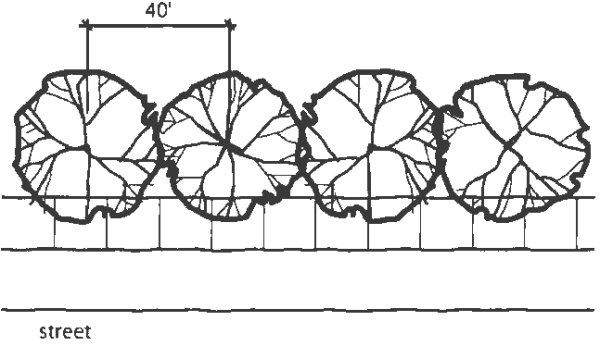
- When a parking area is separated from a residential district by a public street right-of way, screening to shield vehicle headlights shall be provided along the length of the right-of-way.
- When an off-street parking area abuts a public street, a minimum landscape strip at least six (6) feet wide must be provided along the length of the right-of-way, excluding driveways. One (1) shade tree must also be provided per fifty (50) linear feet along the portion of the parking area that abuts a public street. These trees may be clustered or spaced linearly.
[Ord. No. 15-21 §1, 8-10-2015]
405.790 Loading Areas
All loading areas abutting a residential district must be permanently screened from view along the abutting property line(s) by a Type A opaque landscape screen, as described in Section 405.810(C)(1).
[Ord. No. 15-21 §1, 8-10-2015]
405.800 Site Trees
- One (1) tree must be planted along street frontages between the front building line and the front lot line of each lot in a residential subdivision. Said tree shall be of a size in accordance with Section 305.860(A)(1). On lots with two (2) street frontages one (1) site tree is required on each frontage. Once planted, the maintenance of these trees is the responsibility of the property owner. Required site trees must be installed on an individual lot prior to issuance of a certificate of occupancy.
- To reduce the risk of disease and/or insect infestation, no more than fifty percent (50%) of the site trees in a subdivision may be of one (1) species.
[Ord. No. 15-21 §1, 8-10-2015]
405.810 Screening Requirements
- Applicability. All uses must provide and maintain screening as required by this Section. In cases where a use would be required to provide both landscaping and screening at the same location, the two (2) requirements may overlap; however, the most restrictive requirement applies. Additionally, screening requirements may be counted toward the percent of landscaped area required by Section 405.770.
- Screening Table. The following table establishes which type of screen is required. To determine the type required, first identify the zoning of the subject lot (the new or expanded use). Then identify the zoning of each adjacent lot. Types of screens are labeled A, B and C; these are described in Section 405.810(C).
Types of Screening requiredZoning of Subject Lot Zoning of Adjacent Lot AG R1-L R1-M R1-H R1-Z R-2 R-3 MH C-0 MSD C-1 C-2 C-3 M-1 M-2 AG n/a n/a n/a n/a n/a n/a n/a n/a n/a n/a n/a n/a n/a n/a n/a R1-L n/a n/a n/a n/a n/a n/a n/a n/a n/a n/a n/a n/a n/a n/a n/a R1-M n/a n/a n/a n/a n/a n/a n/a n/a n/a n/a n/a n/a n/a n/a n/a R1-H n/a n/a n/a n/a n/a n/a n/a n/a n/a n/a n/a n/a n/a n/a n/a R1-Z B A A A n/a n/a n/a n/a n/a n/a n/a n/a n/a n/a n/a R-2 B A A A A n/a n/a n/a n/a n/a n/a n/a n/a n/a n/a R-3 B A A A A A n/a n/a n/a n/a n/a n/a n/a n/a n/a MH B A A A A A A n/a n/a n/a n/a n/a n/a n/a n/a C-0 B A A A A A A A n/a n/a n/a n/a n/a n/a n/a MSD B A A A A A A A A n/a n/a n/a n/a n/a n/a C-1 B A A A A A A A C C n/a n/a n/a n/a n/a C-2 B A A A A A A A C C C n/a n/a n/a n/a C-3 B A A A A A A A B C C C n/a n/a n/a M-1 B A A A A A A A B B B B C n/a n/a M-2 B A A A A A A A A A A A A B n/a - Types of Screens.
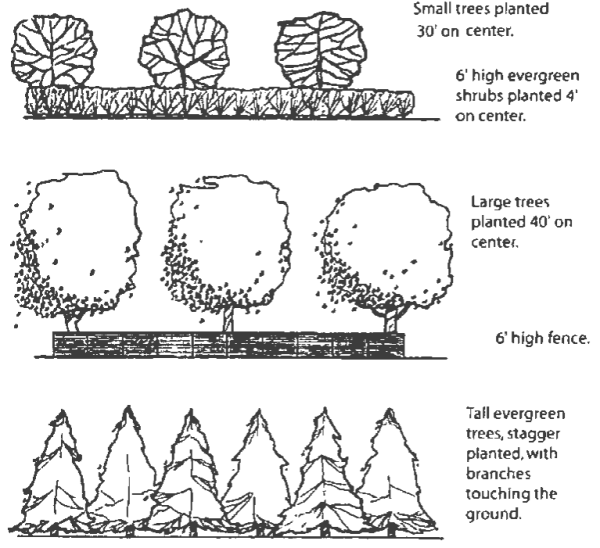
- Opaque screen, Type A. An opaque screen is intended to exclude all visual contact between uses and to create a strong impression of special separation.
- Height. Type A screens must be opaque from the ground to a height of at least six (6) feet, with intermittent visual obstructions to a height of at least twelve (12) feet.
- Materials and Installation.
- The opaque screen may be composed of wall, vinyl/wood fence, landscaped earth berm, planted vegetation or existing vegetation.
- Compliance of planted vegetative screens or natural vegetation will be judged on the basis of the average mature height and density of foliage of the subject species or field observation of existing vegetation.
- The opaque portion of the screen must be opaque in all seasons of the year. At maturity, the portion of intermittent visual obstructions may not contain any completely unobstructed openings more than ten (10) feet wide. The portion of intermittent visual obstructions may contain deciduous plants.
- Planting areas for the placement of these screens must be a minimum of five (5) feet wide.
- Example. Suggested planting patterns that will achieve this standard are included in the following diagram. See Section 430.080 for lists of suggested plant materials.
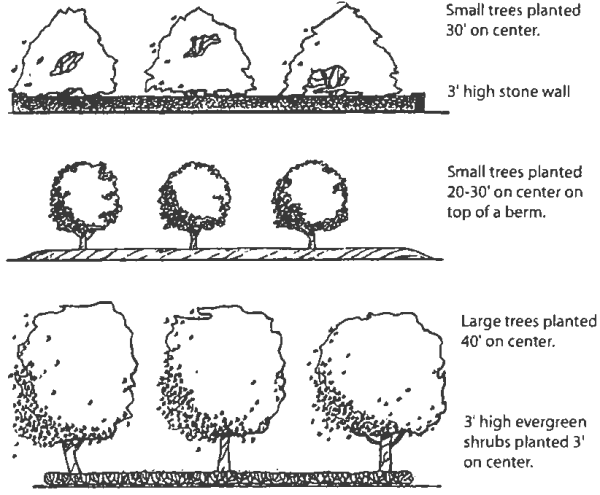
- Semi-opaque screen, Type B. The semi-opaque screen is intended to partially block visual contact between uses and create a strong impression of the separation of spaces.
- Height. Type B screens must be opaque from the ground to a height of three (3) feet, with intermittent visual obstructions to a height of at least twelve (12) feet.
- Materials and installation.
- The semi-opaque screen may be composed of a wall, vinyl/wood fence, landscaped earth berm, planted vegetation or existing vegetation.
- Compliance of planted vegetative screens or natural vegetation will be judged on the basis of the average mature height and density of foliage of the subject species or field observation of existing vegetation.
- At maturity, the portion of intermittent visual obstructions may not contain any completely unobstructed openings more than ten (10) feet wide. The zone of intermittent visual obstruction may contain deciduous plants.
- Planting areas for the placement of these screens must be a minimum of five (5) feet wide.
- Example. Suggested planting patterns that will achieve this standard are included in the following diagram. See Section 430.080 for lists of suggested plant materials.
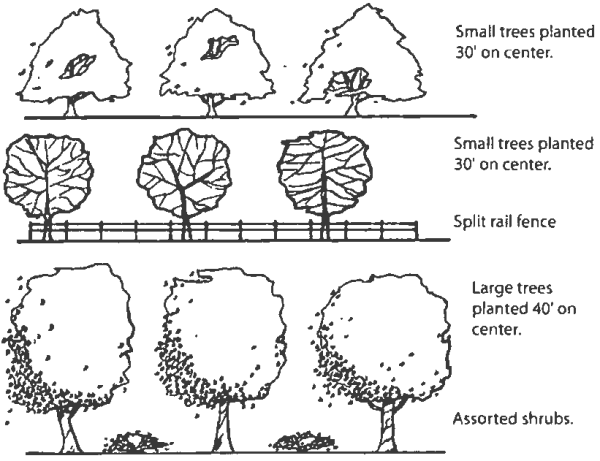
- Broken screen, Type C. The broken screen is intended to create the impression of a separation of spaces without necessarily eliminating visual contact between the spaces.
- Height. Type C screens must be composed of intermittent visual obstructions from the ground to a height of at least twelve (12) feet.
- Materials.
- The broken screen may be composed of a wall, vinyl/wood fence, landscaped earth berm, planted vegetation or existing vegetation.
- Compliance of planted vegetative screens or natural vegetation will be judged on the basis of the average mature height and density of the foliage of the subject species or field observation of existing vegetation. The screen may contain deciduous plants.
- Planting areas for the placement of these screens must be a minimum of five (5) feet wide.
- Example. Suggested planting patterns which will achieve this standard are included in the following diagrams. See Section 430.080 for lists of suggested plant materials.
- Location of screens. Screening required by this Section must be located along the common lot line(s) of adjacent uses. Where uses are separated by an intervening right-of-way, screening is not required. In its review of a site plan, the Community Development Department may require the location or dimensions to be modified to better achieve the desired level of screening on a particular site. [Ord. No. 16-23 § 1, 11-28-2016]
- Opaque screen, Type A. An opaque screen is intended to exclude all visual contact between uses and to create a strong impression of special separation.
[Ord. No. 15-21 §1, 8-10-2015]
Amended by Ord. 24-62 on 11/5/2024
405.820 Planting List
- Prohibited Plants. Plants listed as nuisance species or prohibited plants in the planting list are prohibited in required landscape areas. Prohibited plants include those that are invasive, potentially damaging to streets, sidewalks, utilities, drainage improvements, and foundations.
[Ord. No. 15-21 §1, 8-10-2015]
405.830 Tree Preservation And Existing Vegetation
- The City may require the preservation of existing trees and/or vegetation on a property as part of a rezoning, conditional use permit, preliminary plat, final plat or site plan application.
- Existing vegetation may be used to satisfy the landscaping and screening requirements of this Code if protected and maintained during site development and construction phases of work and if such trees or plants are not otherwise prohibited.
- Preserved trees will be credited toward satisfying the tree planting requirements of this Article if they meet the minimum size and species requirements of this Article. Tree credits will be granted by the Community Development Director. Multiple credits may be given to encourage preservation of existing mature trees. [Ord. No. 16-23 § 1, 11-28-2016]
[Ord. No. 15-21 §1, 8-10-2015]
405.840 Trash Receptacle Screening
- All outdoor trash receptacles, garbage areas, grease traps and trash compactors for multi-family residential and all non-residential uses must be permanently screened from view on all sides by a fence of one-hundred-percent opacity and a minimum height of six (6) feet. The fence must be constructed to prevent accidental dispersal of material within the storage area.
- Where commercial trash receptacles are used and where allowed by City codes, such receptacles must be screened as follows:
- Existing trash receptacles of any size within one hundred fifty (150) feet of an arterial street must be screened from view of the arterial street. The screen may not require full enclosure to accomplish screening; and
- Chain link and slat screening is only allowed in industrial zones. The screen must be opaque.
- No trash receptacle may be located in a required front or side yard unless located in an existing enclosure or if the existing developed site does not afford any other option; in such a case, the trash receptacle should be located in the side yard if possible and must comply with the screening requirements of this Section. The Community Development Director will have the authority to grant an administrative variance where it is demonstrated that screening is impossible. After a request for such relief, the Community Development Director will notify the applicant of the determination in writing within thirty (30) days. [Ord. No. 16-23 § 1, 11-28-2016]
[Ord. No. 15-21 §1, 8-10-2015]
405.850 Screening Of Mechanical Equipment
- Raised exterior walls or screen walls must be designed to enclose groups of equipment. Wall material should be compatible with or identical to the predominant opaque material on the exterior of the building.
- All electrical and mechanical equipment located adjacent to the building shall be screened from view from adjacent residential properties and any adjacent street.
[Ord. No. 15-21 §1, 8-10-2015]
405.855 Screening Of Certain Off-Street Parking Areas And Other Storage Yards
Off-street parking areas containing wrecked or inoperable vehicles awaiting repair as permitted according to Section 405.600 shall be screened from view of any public way or adjoining property within the Local Commercial ("C-1") or more restrictive zoning district by an opaque wall or screen at least six (6) feet in height.
[Ord. No. 19-21, 11-5-2019]
405.860 Plant Materials
- Minimum Planting Sizes.
- Trees.
- Deciduous shade trees shall be two-and-one-half-inch to three-inch caliper as measured six (6) inches above ground.
- Evergreen trees shall be six (6) feet to eight (8) feet in height.
- Ornamental trees shall be one-inch to one-and-one-half-inch caliper as measured six (6) inches above ground and a minimum of six (6) feet in height. The smallest trunk of multi-trunk clusters [three (3) or more trunks] shall be three-quarters (3/4) inch.
- Shrubs and hedges.
- Deciduous and evergreen shrubs must have a minimum container size of three (3) gallons to five (5) gallons depending upon species and spacing.
- Hedges, where required, must be planted and maintained to form a continuous, visual screen within a maximum of one (1) year after time of planting.
- Vines. Vines must be a minimum of thirty (30) inches in height immediately after planting and may be used in conjunction with fences, screens or walls to meet physical barrier requirements as specified.
- Ground covers. Ground covers used in lieu of grass in whole or in part must have a finished appearance and reasonably complete coverage within three (3) months after planting.
- Grass.
- Building permits. When a building permit has been issued for a principal structure upon a lot, the lot must either have sod or seeding installed wherever grass is required to be installed. The seeding or sod must be installed prior to the issuance of any permanent certificate of occupancy.
- Trees.
- Installation.
- The Building Inspector will inspect all landscaping, and no permanent certificates of occupancy or similar authorization will be issued unless the landscaping is completely installed in compliance with the approved landscape plan and this Article.
- All landscaping materials must be installed according to current accepted good planting procedures and in compliance with all applicable ordinances and code requirements.
- Plant materials must be free from disease and installed in a fashion that ensures the availability of sufficient soil and water to sustain healthy growth.
- Maintenance.
- All landscaping materials must be maintained in good condition so as to present a healthy, neat and orderly appearance and must be kept free from refuse and debris.
- The owner, tenant and their agent, if any, will be jointly and severally responsible for the maintenance of all landscaping.
[Ord. No. 15-21 §1, 8-10-2015]
405.870 Right-Of-Way Ground Surface
No plant material or barrier required by this Code may be located in a public right-of-way. The ground surface within the public right-of-way must be planted with sod or hydroseeded, with the exception of driveways, sidewalks and paths. Materials prohibited in the public right-of-way, unless required by this Code or specifically approved by the City, include other ground covers, shrubs, brick pavers, gravel, stone, asphalt and concrete; except those used for driveways, sidewalks and paths.
[Ord. No. 15-21 §1, 8-10-2015]

