
Rockdale City Zoning Code
ARTICLE IV
- DIMENSIONAL REGULATIONS
Sec. 90-151. - Summary of regulations.
See the text of this chapter for zoning regulations, variations and exceptions.
(Ord. of 2-3-1956; Ord. No. 1010, § 6, 5-6-2014)
Sec. 90-152. - Population density, minimum lot widths and lot area.
(a)
In future subdivisions, interior lots shall have a minimum width of 50 feet and a lot area of not less than 6,600 square feet, while corner lots shall have a minimum width of 60 feet and an area of not less than 7,920 square feet.
(b)
Hereafter, in R-1 (one-family) residential zones, no dwelling shall be erected or structurally altered for residential use on a lot less than 50 feet in width and having an area less than 6,600 square feet; provided, however, that the above regulation shall not prohibit the erection of a one-family or a two-family dwelling on a lot having an area not less than 5,200 square feet, or the erection of a one-family dwelling on a lot having an area less than 5,200 square feet, provided said lot was duly subdivided and recorded according to law prior to the passage of the ordinance from which this section is derived. While duplex and other two-family dwellings are permitted as above, in no case shall there be more than one residential building on any one lot.
(c)
In all R-2 zoning classifications for the construction of duplexes, all interior lots shall have a minimum width of 60 feet and a lot area of not less than 7,920 square feet and corner lots shall have a minimum width of 60 feet and an area of not less than 7,920 square feet.
(d)
Multiple-family dwellings shall have not less than 1,600 square feet of lot area per family unit.
(Ord. of 2-3-1956, § 12; Ord. No. 696, 12-1-1992; Ord. No. 739, 5-16-1995; Ord. No. 1010, § 7, 5-6-2014)
Sec. 90-153. - Height of buildings and structures.
(a)
The maximum vertical height of any building or structure hereafter erected in the several zones shall be as follows:
(1)
R-1 zone: 30 feet.
(2)
B zone: 50 feet.
(3)
I-1 zone: 70 feet.
(b)
Exceptions, and modifications of height regulations are as follows:
(1)
Church, synagogues or other places used for public worship are exempt from the height regulations of this chapter.
(2)
Schools, colleges, hospitals and similar institutions, in zones where such uses are permitted and provided such buildings occupy not over 25 percent of the ground area, are exempt from the height regulations herein.
(3)
The poles, towers and similar distributing facilities of public utilities are exempt from the height restrictions in subsection (a) of this section and all other provisions of this chapter.
(4)
In residential zones, accessory buildings shall not exceed 20 feet in height.
(5)
In industrial zones, additional height may be permitted by the board of trustees upon the recommendation of the zoning board of appeals.
(6)
Penthouses or roof structures for the housing of elevators, stairways, tanks, ventilators, ventilating fans, or similar structures required to operate and maintain buildings; fire parapet walls; skylights; radio or television antennas or similar structures may be erected above the height limits herein prescribed, but no penthouse or roof structure or any space above the height limit shall be allowed for the purpose of providing additional floor space.
(Ord. of 2-3-1956, § 13)
Sec. 90-154. - Required yard areas.
(a)
Required front yards.
(1)
On main streets in residential zones, required front yards (as herein defined) shall have a minimum depth of 30 feet. On side streets in such zones, the required front yard need not exceed 20 feet. For the purpose of this chapter, streets running approximately east and west shall be considered main streets and streets running approximately north and south shall be considered side or secondary streets. No accessory building in a residential zone shall be located nearer to the front street line than the building of primary use.
(2)
Where 40 percent or more of the frontage on one of the side streets, between two intersecting streets, is improved with dwellings having front yards other than herein prescribed, the required front yard shall be the average of those having a variation of not more than six feet from the standard depth herein prescribed, provided that where exceptionally deep or exceptionally shallow lots prevail, the zoning board of appeals may, in the manner provided for variations, establish an appropriate special front yard depth which, when approved by the board of trustees, shall prevail.
(b)
Required side yards.
(1)
In residential zones, required side yards of main buildings shall be not less than six feet in width. On lots 40 feet or less in width, subdivided and recorded prior to the passage of the ordinance from which this section is derived, side yards need not be greater than five feet in width.
(2)
In cases of reversed corner lots, the side yard abutting on a side street shall not be narrower than one-half the required setback on interior lots on said street, and no garage or other accessory building shall project into said external side yard. (See Illustration No. 1 at the end of this section.)
(3)
A side yard of six feet shall be required and provided in all business and industrial zones where they adjoin residential zones; otherwise, in business and industrial zones no minimum side yard is required, except that if the building is not located on the property line, the minimum distance shall be three feet.
(c)
Required rear yards. In residential zones, rear yards shall comprise not less than 20 percent of the entire lot area, but need not exceed 30 feet in depth. If there is an alley at the rear of a lot, one-half its width, but not to exceed seven feet, may be counted, as part of the required rear yard area. In all business and industrial zones hereafter improved, front yards are not required, but a rear yard comprising at least 20 percent of the lot area shall be provided for light, air, fire protection and off-street parking, and loading purposes.
(d)
General provisions concerning yards. The minimum yard area required for one building or structure shall not again be considered as required yard space for another building or structure. Where yards are required in this chapter, they shall at no point be less in depth or width than the minimum dimensions specified herein, and they shall at every point be unobstructed from the ground to the sky, except as follows:
(1)
Customary landscape work with flowers, shrubs and trees except, as hereinafter provided, where they obstruct corner visibility or otherwise constitute traffic hazards.
(2)
In residential zones, a fence, wall or hedge, not more than six feet in height, may be constructed or grown along interior lot lines to the front building setback line, and shall have a maximum height of 48 inches from the front building line to the front property line.
(3)
Outside steps, stairways, porches, balconies or landing places, if unenclosed on three sides, may extend into the required front and/or rear yards for a distance of not to exceed four feet.
(4)
The ordinary projection of windowsills, belt courses and cornices shall not be deemed to reduce the area of such yard areas or open spaces.
(5)
Detached garages or other accessory buildings may be permitted to occupy a required rear yard area, provided that not more than one-third of the total area of such required rear yard area is so occupied; provided also that such accessory building shall at no point be closer than six feet to the main building; provided also that such accessory building shall not be closer than three feet to any adjoining property line. If abutting upon an alley and containing no main garage entrance, it may extend to within one foot of the rear area property line, but if a garage has main entrance or entrances opening into an alley, the face of said garage shall be not less than five feet from the rear property line. (See Illustration No. 3 at the end of this section.)
(e)
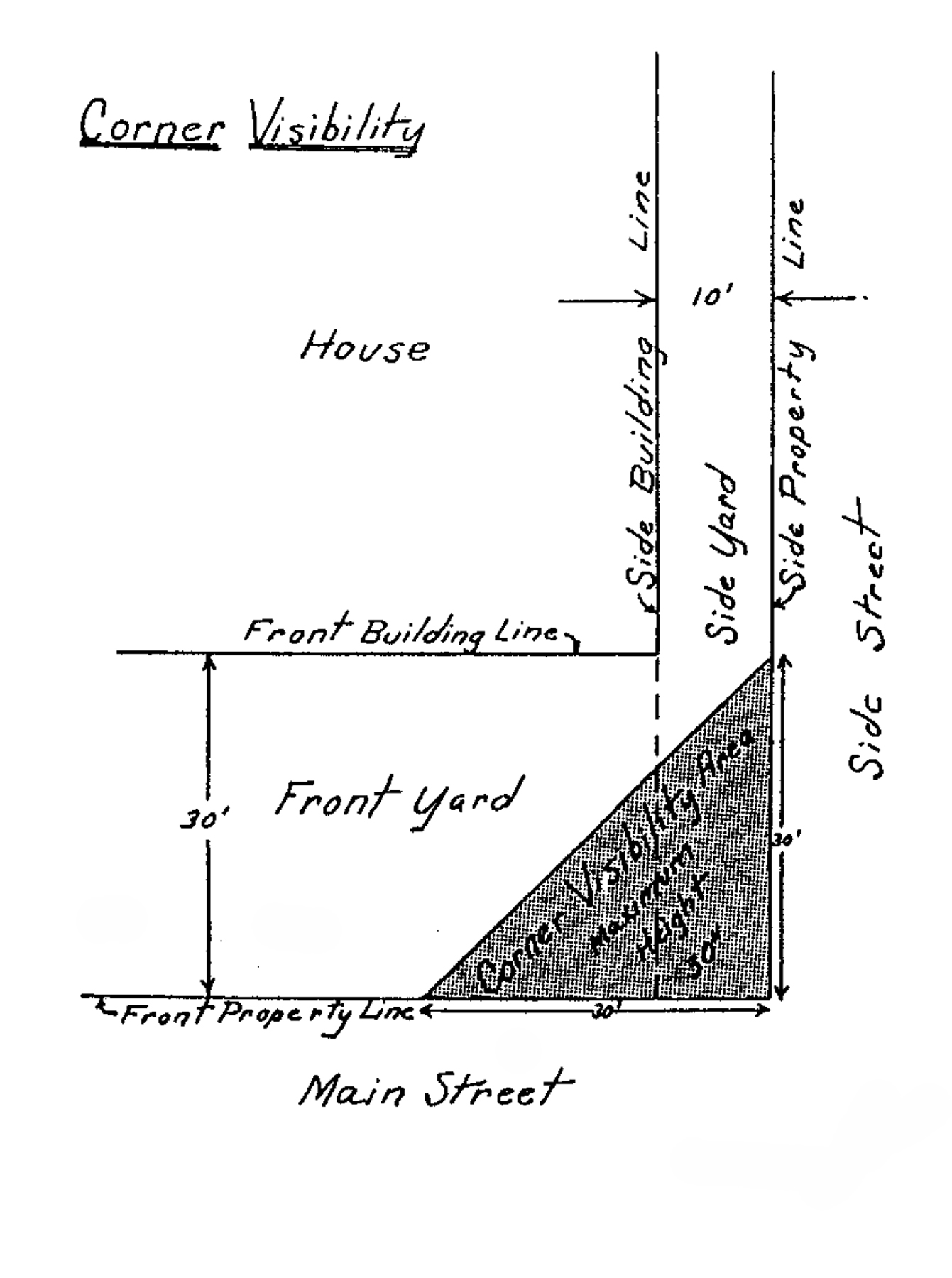
Corner visibility. No fence, wall, hedge or other obstruction to vision extending in excess of 48 inches above the established street level shall be erected, planted or maintained within the area of a corner lot that is included between the lines of the intersecting streets and a straight line connecting them at a point 30 feet from the intersection of the street lines. (See Illustration No. 4 at the end of this section).
ILLUSTRATION NO. 1
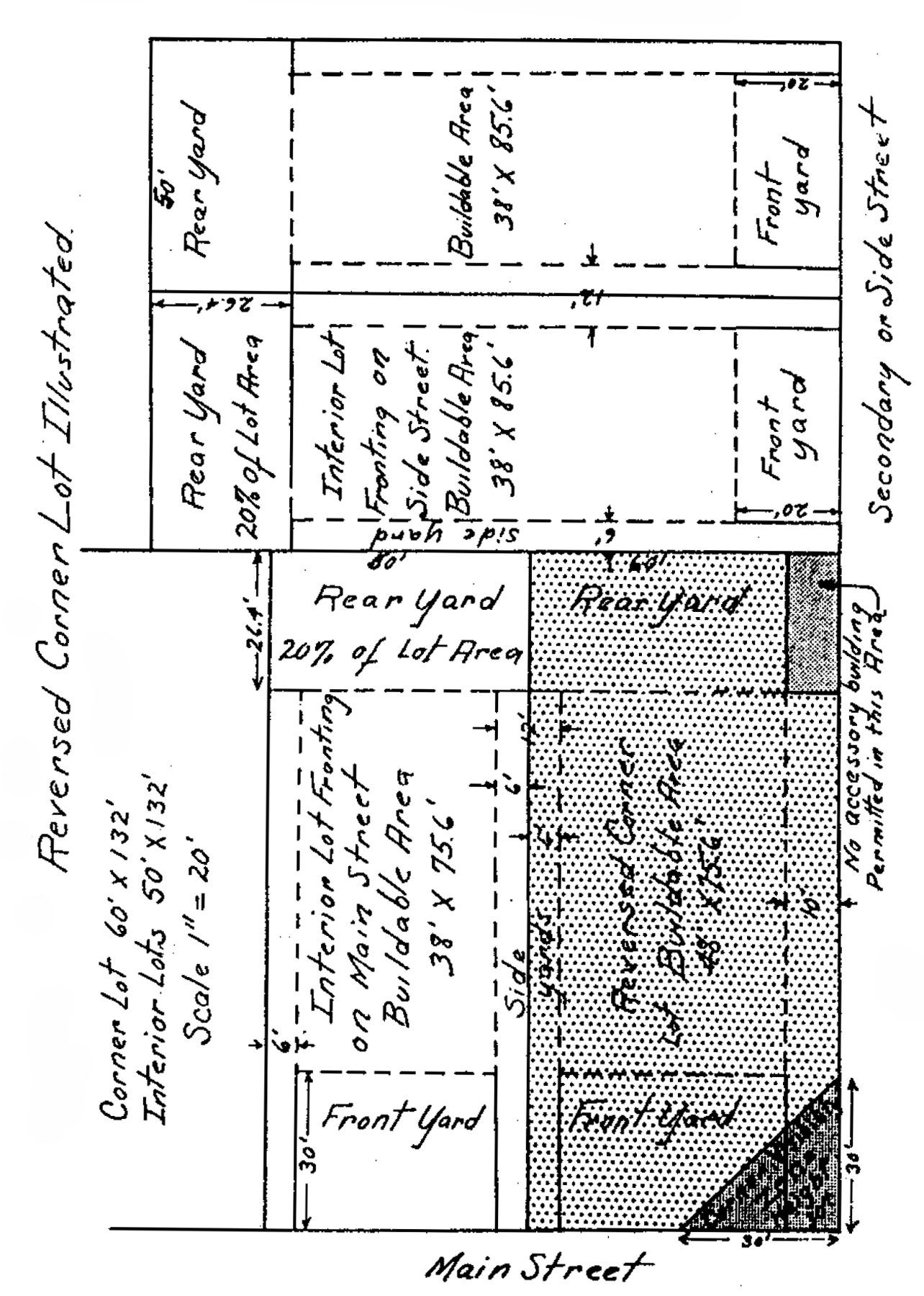
ILLUSTRATION NO. 2
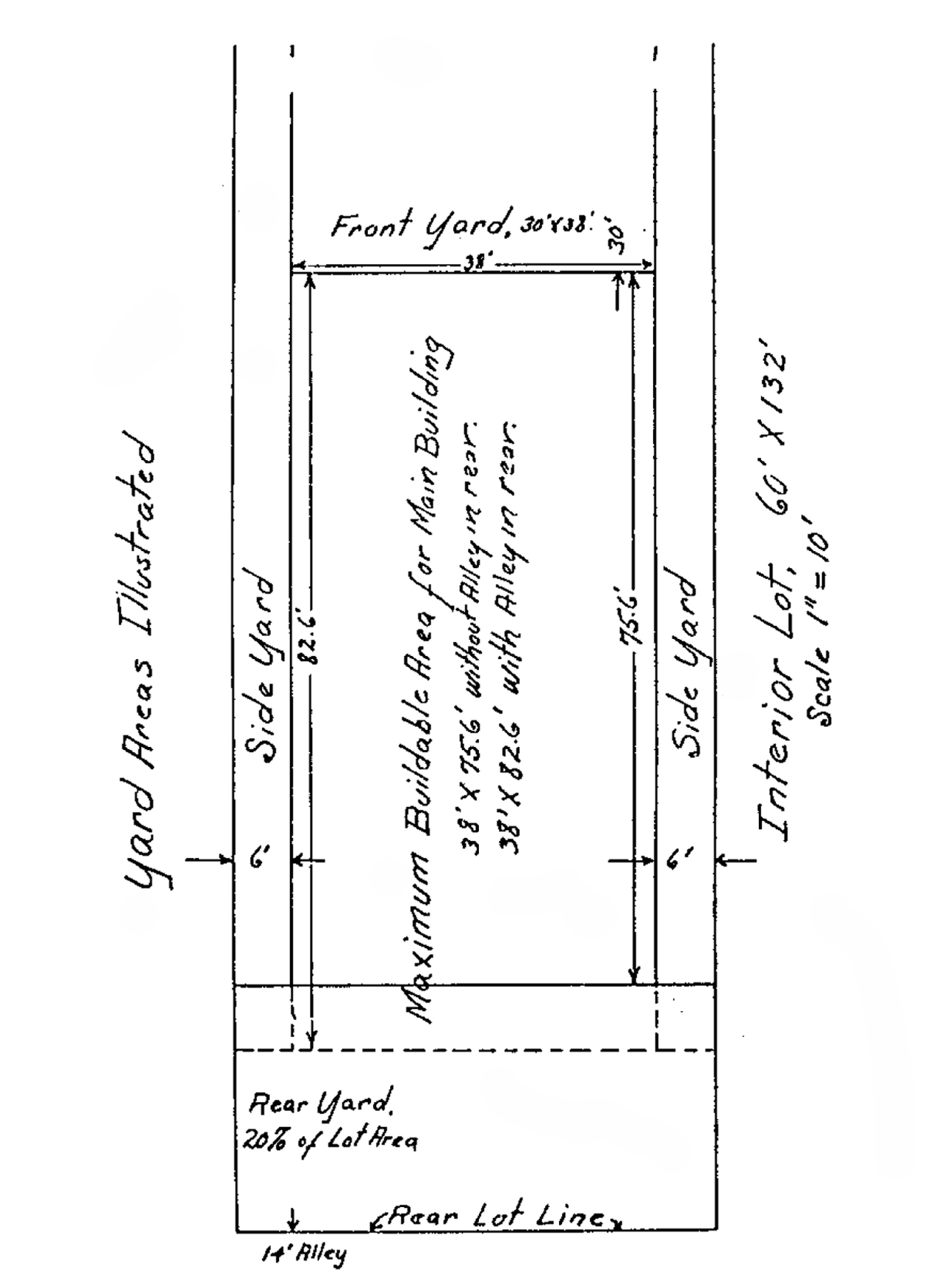
ILLUSTRATION NO. 3
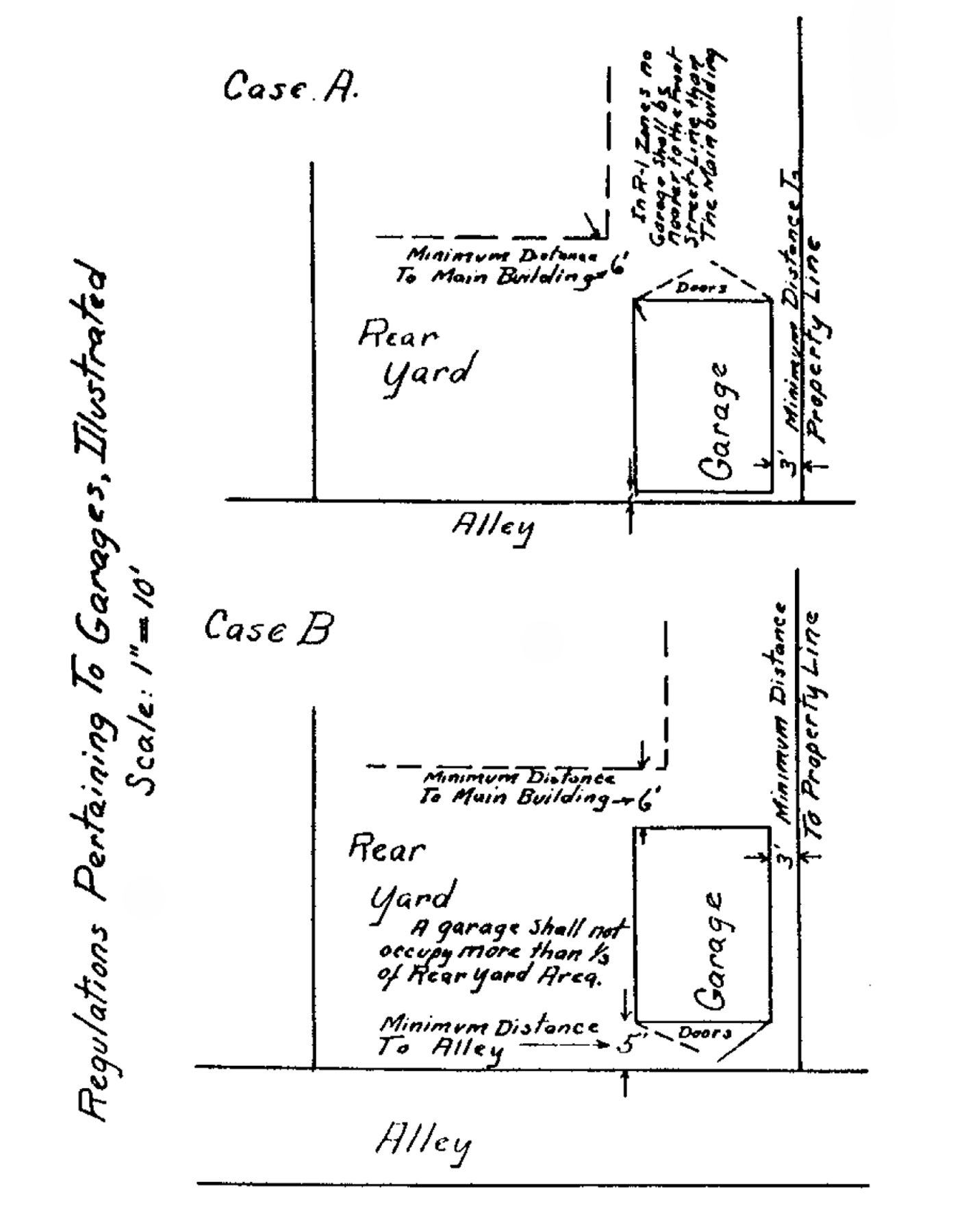
ILLUSTRATION NO. 4
(Ord. of 2-3-1956, § 14; Ord. No. 1027, §§ 1, 2, 10-20-2015)

