
Rockledge City Zoning Code
ARTICLE IV
- ZONING DISTRICTS
Sec. 118-91.- Establishment of districts generally.
The City is hereby divided into zoning districts, as listed and described below, with such requirements as set forth for the purpose of implementing the goals and objectives of the Comprehensive Plan. The following are established in this article:
(1)
The legislative intent of each district;
(2)
General requirements for each district;
(3)
Basic regulations regarding setback, height, densities and like matter;
(4)
Special requirements as needed;
(5)
The corporate area of the City is divided into districts, as follows:
(LDR 1990, § 62.01)
Sec. 118-92. - Zoning Map.
The Zoning Map of the City which complies with the requirements of F.S. § 163.3177, and which is dated August 4, 1999, and has affixed thereon the seal of the City, and the signature of Betsi Beatty Moist, City Clerk, is hereby adopted and declared to be the Official Zoning Map of the City, and the same is by these apt words of reference incorporated herein and made a part of these regulations as fully and completely as if said Zoning Map were visually and graphically depicted at this place in these regulations. Said Zoning Map is hereby adopted and established to identify zoning district boundaries pursuant to F.S. § 163.3177.
(LDR 1990, § 62.02; Ord. No. 1188-99, § 1, 8-4-1999)
Sec. 118-93. - Policy.
It is hereby declared to be the policy of the City to consider the classification of property into zoning districts as subject to the control of the City pursuant to F.S. Ch. 163 for the orderly, planned, efficient and economical development of the City. It is intended that these regulations supplement and facilitate the enforcement of the provisions and standards contained in the Building Code, Comprehensive Plan, subdivision regulations and capital budget of the City.
(LDR 1990, § 62.04)
Sec. 118-94. - Purpose and intent.
The purposes of this article, and the zoning districts and regulations herein set forth, are to provide for the orderly growth of the City, to encourage the most appropriate use of land, to protect and conserve the value of property, to prevent the overcrowding of land, and to promote the health, safety and general welfare of the public. Further:
(1)
In interpreting and applying the provisions of this article, they shall be held to be the minimum requirements for the promotion of the public health, safety, morals and general welfare of the community.
(2)
It is not intended by this article to interfere with or abrogate or annul any easements, covenants or other agreements between the parties.
(3)
Where this article imposes a greater restriction upon the use of buildings or premises or upon the height of buildings, or requires larger open spaces than those required by other rules, regulations or easements, covenants or agreements, the provisions of this article shall control.
(4)
This part shall not be construed as superseding any special act of the legislature relative to the subject matter of this article.
(5)
If, because of an error or omission in the Zoning Map, any property in the City is not shown as being in a zoning district, the classification of such property shall be established by the City Council.
(LDR 1990, § 62.05)
Sec. 118-95. - Authority.
By authority of ordinance, the City Council (hereinafter referred to as "Council") pursuant to the powers and jurisdictions vested through F.S. Ch. 163, does hereby exercise the power to classify land within the corporate limits of the City into zoning districts and to review, approve and/or disapprove requests to change zoning classifications, requests for conditional uses, requests for variances and to hear appeals on any decisions.
(LDR 1990, § 62.06)
Sec. 118-96. - Jurisdiction.
The provisions of this article shall apply to all land, buildings, structures and to the uses thereof within the City. No land, building or structure shall be moved, added to or enlarged, altered or maintained, except in conformity with the provisions of this article.
(LDR 1990, § 62.07)
Sec. 118-97. - Setback requirements within the community redevelopment district.
Within the area of the community redevelopment district as defined by Resolution No. 2002-481 and Ordinance No. 1277-2002, there exists an overlay provision which empowers, upon request by a developer or staff on all new or remodeled properties, the reduction or elimination of setback requirements upon the unanimous approval of the City Manager, Building Official and Chairperson of the Community Redevelopment Agency. Any structure given modified setbacks shall automatically become conforming structures.
(LDR 1990, § 62.09; Ord. No. 1325-2003, § 1, 10-15-2003; Ord. No. 1376-2005, § 5, 5-4-2005)
Sec. 118-123.- Intent.
The purpose of the RCE district is to establish areas where very low residential densities may be maintained and where investment in homes will be protected from the adverse effects sometimes found in agricultural districts. While the RCE Residential Country Estate District is primarily residential, certain uses found only in agricultural areas are permitted.
(LDR 1990, § 62.11)
Sec. 118-124. - Uses.
Uses in the RCE Residential County Estate District shall be as follows:
(1)
Principal. No building, structure, land or water shall be used, in whole or in part, except for one or more of the following uses:
a.
Single-family dwellings.
b.
Citrus and other fruit crop cultivation and production; however, no retail sales shall be conducted on the premises.
c.
Plant nurseries and greenhouses, provided that there shall be no retailing of products on the premises.
d.
Truck farming and gardens, provided that there shall be no retail sales conducted on the premises.
e.
Real estate and identification signs, subject to standards established in Article V, Division 3 of this chapter.
f.
The raising, keeping or maintenance of horses and cows for domestic purposes, provided that if the lot, parcel or tract of land of an ownership is one acre in size, not more than three of such animals shall be permitted on such lot, parcel or tract of land, and if the lot, parcel or tract of land of an ownership exceeds one acre in size, one additional such animal shall be permitted for each 15,000 square feet of the overall land area in excess of one acre. The raising, keeping or maintenance of horses and cows in excess of the numbers herein authorized shall not be permitted in the RCE Residential Country Estate District.
g.
Community residential home, six or fewer residents meeting the requirements in Section 118-776.
h.
Home occupation, subject to the standards and requirements established in Section 118-750.
(2)
Accessory. The following uses may be used in conjunction with one or more of the principal uses:
a.
Garages, carport or space for the housing or parking of private automobiles.
b.
Barns, corrals, utility sheds and pens.
c.
Guest cottages without kitchen facilities, as the term "guest cottages" is specifically defined in Chapter 101.
d.
Ordinary public utility uses and rights-of-way.
e.
Servants' quarters (attached or detached) for yearround, on-premises employees of the owner of the principal residence, not to exceed one dwelling unit (servants' quarters) for each three acres of land. Such servants' quarters may have kitchen facilities. If the quarters are detached, they shall have a living area of not less than 400 square feet nor more than 800 square feet. Such quarters shall not be rented to nor occupied by persons other than bona fide permanent full-time, on-premises employees of the owner of the principal residence, or by members of the immediate family of such an employee, and such quarters, whether attached or detached, shall not have, nor be equipped with, an electric meter separate and independent from the main electric meter for the principal residence.
f.
Boathouses and boat docks.
g.
Swimming pools.
h.
Tennis courts.
(3)
Special exception. When, after review of an application with plans pertinent thereto and hearing thereon, the Board of Adjustment finds that the proposed uses are in harmony with the purpose and intent of this chapter and with the Comprehensive Plan and with the public interest, the following conditional uses may be granted as per Section 102-214:
a.
Private schools with conventional academic curriculums, including colleges and universities.
b.
Public or privately owned and operated recreation facilities open to the public, such as, but not limited to, athletic fields, stadiums, swimming pools, camping and picnicking areas.
c.
Hospitals, sanitariums and nursing homes.
d.
Public utility structures.
e.
Riding stables, when located on a tract of not less than ten acres, provided that no structures, pen or corral housing animals shall be closer than 200 feet from any property line and, provided that there shall be no more than one animal per acre of lot area.
f.
Clubs, such as country and golf clubs, gun clubs, fishing clubs or similar organizations.
g.
Community residential home, seven to ten residents.
h.
Care unit, ten or fewer residents.
i.
In-home child care, subject to all conditions, limitations and restrictions set forth in Section 118-750(1)(k).
(4)
Prohibited. The following uses are specifically prohibited in this district:
a.
Fruit and produce stands.
b.
Mobile homes.
c.
Retail, wholesale and manufacturing establishments.
d.
Outdoor advertising signs.
e.
The raising, maintaining or keeping of swine, poultry, fowl or other birds.
f.
Group care facilities with four or more clients, adult congregate living facilities (ACLFs), and treatment and recovery facilities.
g.
Child care centers.
(LDR 1990, § 62.12; Ord. No. 1017-91, §§ 3, 4, 11-20-1991; Ord. No. 1379-2005, § 1, 6-1-2005; Ord. No. 1530-2009, § 2A, 9-23-2009; Ord. No. 1794-2020, § 1, 11-18-2020)
Sec. 118-125. - Lot requirements.
Lot requirements in the RCE Residential County Estate District shall be as follows:
(1)
Area. The minimum lot area required is one acre.
(2)
Width. The minimum lot width required is 130 feet.
(3)
Depth. The minimum lot depth required is 150 feet.
(4)
Buildings. Not more than one principal dwelling building shall be constructed or placed on any one lot.
(LDR 1990, § 62.13)
Sec. 118-126. - Setback requirements.
Setback requirements in the RCE Residential County Estate District shall be as follows:
(1)
Front. The minimum front setback required is 50 feet.
(2)
Rear. The minimum rear setback required is 35 feet.
(3)
Side. The minimum side setback required is 20 feet.
(4)
Corner lots. Corner lots shall have a setback not less than 50 feet from both street rights-of-way.
(5)
Accessory buildings. Accessory buildings shall be located to the rear of the principal building and shall be set back not less than 20 feet from the side and rear lot lines, except that in the case of a corner lot, the setback shall be not less than 50 feet from any side street line. A detached accessory building shall not be closer than ten feet to the principal building nor closer than six feet to any other accessory building on the same lot. In no event shall an accessory building exceed the height of the principal building on the property.
(6)
Measurement. The exterior wall of a house, or the wall or roof vertical support of an addition, shall be considered the building when measuring.
(LDR 1990, § 62.14)
Sec. 118-127. - Building requirements.
Building requirements in the RCE Residential County Estate District shall be as follows:
(1)
Lot coverage. The maximum allowable lot coverage is 30 percent of the land that may be covered by the principal and accessory buildings or structures, excluding driveways and concrete slabs, located thereon. The maximum allowable lot coverage by driveways and concrete slabs is 20 percent. An accessory building shall not exceed 18 feet in height and may not occupy more than 35 percent of a required rear yard. This provision does not apply to swimming pools.
(2)
Areas. The minimum living area is 1,500 square feet for the principal building.
(3)
Height. The maximum height of the principal building shall be 25 feet, except that the height may be increased to 35 feet, provided that both side setbacks are increased one foot for every one foot of height increase over 25 feet to a maximum of five feet of additional side setback on each side.
(4)
Density. The maximum density is one dwelling unit per acre.
(5)
Guest cottage. The maximum floor area of a guest cottage shall be 600 square feet.
(LDR 1990, § 62.15; Ord. No. 994-91, § 3, 4-3-1991)
Sec. 118-128. - Special requirements.
Special requirements in the RCE Residential County Estate District shall be as follows:
(1)
Minimum distance of stable from dwelling. There shall be a minimum distance of 50 feet between any stable erected on any lot in the RCE Residential Country Estate District and any lot line.
(2)
Drainage. Open ditches and swales which are specifically approved and authorized by the City Council may be permitted in the RCE Residential Country Estate District. Raised curbs shall not be required in connection with streets in subdivisions in RCE Residential Country Estate Districts, but concrete curbs of at least road level and approved by the Building Official shall be installed to retain the stabilization of the street.
(3)
Sidewalks. Sidewalks shall not be required in RCE Residential Country Estate Districts.
(4)
Fences. In RCE Residential Country Estate Districts fences shall be permitted as provided in Section 118-769, except those provisions of Section 118-769(b)(1)c.1 and 2 which require that any portion of a fence more than three feet above ground level shall be constructed of see-through materials for clear and unobstructed visibility shall not be applicable in RCE Residential Country Estate Districts. Strands of barbed wire may be installed and maintained on the private interior side or perimeter fences constructed of boards or other substantial material. No owner or occupant of property in the RCE Residential Country Estate District shall cause or permit any barbed wire to be used as a perimeter fence or in connection with any perimeter fence on or about such property except as herein specifically authorized.
(5)
Temporary permits for mobile homes during construction of principal residence. After a building permit has been issued for construction of a principal residence in the RCE Residential Country Estate District, the City Council may, upon application, issue a permit for a mobile home to be placed and occupied on the property being improved for the security of such property and improvements. Any such permit shall be for a period of time not exceeding six months, and such permits may be extended by the City Council upon application and good cause shown.
(6)
Signs. Signs shall be allowed in the RCE district only as specifically permitted by the provisions of Article V, Division 3 of this chapter.
(7)
Landscaping. All applicable provisions of Chapter 108, Article II, Division 6 are hereby incorporated in this section by reference, and the same constitute special requirements under this section.
(LDR 1990, § 62.16)
Sec. 118-155.- Intent.
The R1 Single-Family Dwelling District is intended to apply to an area which is predominantly developed with single-family dwellings or which, by its location, trend of development or planned development designated in the Comprehensive Plan, is appropriate to such uses. The lot areas are large and the district is designated to preserve and protect the characteristics of single-family uses.
(LDR 1990, § 62.21)
Sec. 118-156. - Uses.
Uses in the R1 Single-Family Dwelling District shall be as follows:
(1)
Principal. No building, structure, land or water shall be used, in whole or in part, except for one or more of the following uses:
a.
Single-family dwellings.
b.
Community residential home, six or fewer residents meeting the requirement in Section 118-776.
c.
Home occupation, subject to the standards and requirements established in Section 118-750.
(2)
Accessory. The following uses may be used in conjunction with one or more of the principal uses:
a.
Garage, carport or space for the housing or parking of private automobiles.
b.
Other customary accessory uses of single-family dwellings, such as guest cottages, with no kitchen facilities.
c.
Ordinary public utility uses and right-of-way.
d.
Swimming pools.
e.
Tennis courts.
f.
Detached accessory buildings, subject to all conditions, limitations and restrictions set forth in Section 118-746.
(3)
Special exceptions. When, after review of an application with plans pertinent thereto and hearing thereon, the Board of Adjustment finds that the proposed uses are in harmony with the purpose and intent of this chapter and with the Comprehensive Plan and with the public interest, the following conditional uses may be granted:
a.
Noncommercial greenhouses and nurseries.
b.
Public parks and playgrounds.
c.
Community residential home, seven to ten residents, meeting the requirements in Section 118-776.
d.
Care unit, ten to fewer residents.
e.
In-Home home child care, subject to all conditions, limitations and restrictions set forth in Section 118-750(1)(k).
(4)
Prohibited. The following uses are specifically prohibited in this district:
a.
Commercial pursuits.
b.
Mobile homes.
c.
Retail, wholesale and manufacturing establishments.
d.
Raising, keeping or maintenance of horses, cows and other farm animals, excluding the keeping of household pets normally domesticated in the United States.
e.
Keeping and maintaining bees, rabbits, ducks, chickens and other fowl.
f.
Group care facilities with four or more clients, adult congregate living facilities (ACLFs), and treatment and recovery facilities.
g.
Child care centers.
(5)
Fences. Refer to Section 118-769 for fence provisions.
(6)
Child care centers. It is not the intention of the City Council to prohibit the enlargement or expansion of any child care center duly licensed by the State and the City and in lawful operation at the time of adoption of the ordinance making such classifications, i.e., August 19, 1987; it being the express intention and declaration of the City Council that any such duly licensed child care center located in the R1 zoning district and in operation on August 19, 1987, shall be permitted to enlarge or expand its facilities and operations, provided the same is accomplished in compliance with all applicable building and zoning rules and regulations and State laws applicable to child care centers.
(LDR 1990, § 62.22; Ord. No. 992-91, § 2, 2-6-1991; Ord. No. 1017-91, §§ 5, 6, 11-20-1991; Ord. No. 1240-2000, § 8, 10-18-2000; Ord. No. 1379-2005, § 1, 6-1-2005; Ord. No. 1530-2009, § 2B, 9-23-2009; Ord. No. 1794-2020, § 1, 11-18-2020)
Sec. 118-157. - Lot requirements.
Lot requirements in the R1 Single-Family Dwelling District shall be as follows:
(1)
Area. The minimum lot area required is 12,000 square feet.
(2)
Width. The minimum lot width required is 80 feet.
(3)
Depth. The minimum lot depth required is 100 feet.
(4)
Buildings. Not more than one principal dwelling building shall be constructed or placed on any one lot.
(LDR 1990, § 62.23)
Sec. 118-158. - Setback requirements.
Setback requirements in the R1 Single-Family Dwelling District shall be as follows:
(1)
Front. The minimum front setback required is 35 feet.
(2)
Rear. The minimum rear setback required for the principal building is 30 feet from the rear lot line, except that the minimum rear setback for a screened porch attached to the rear of a principal building is 25 feet.
(3)
Side. The minimum side setback required is ten feet.
(4)
Corner lots. Corner lots shall have a setback of not less than 35 feet from both street rights-of-way.
(5)
Accessory building setback requirements. Detached accessory buildings are subject to all conditions, limitations and restrictions set forth in Section 118-746.
(6)
Measurement. The exterior wall of a house, or the wall or roof vertical support of any addition, shall be considered the building line when measuring.
(LDR 1990, § 62.24; Ord. No. 1364-2004, § 2, 12-1-2004)
Sec. 118-159. - Building requirements.
Buildings requirements R1 Single-Family Dwelling District shall be as follows:
(1)
Lot coverage. The maximum allowable lot coverage is 30 percent of the land that may be covered by the principal and accessory buildings or structures, excluding driveways and concrete slabs, located thereon. The maximum allowable lot coverage by driveways and concrete slabs is 20 percent. An accessory building not exceeding 12 feet high may occupy not more than 35 percent of a required rear yard. This provision does not apply to swimming pools.
(2)
Area. The minimum living area is 1,500 square feet.
Note: In the R1 Single-Family Dwelling District, minimum requirements for first floor area unit shall be for a two-story and 2½-story dwelling, 900 square feet; and for a one-story dwelling, 1,500 square feet. The combined total floor area of a dwelling over one story in the R1 district shall be not less than 1,500 square feet. The minimum floor area requirements of this section shall not be applicable to substandard lots of record as defined in Section 118-31, and nothing herein contained shall be construed to repeal, alter, modify or impair the provisions of Section 118-31.
(3)
Height. The maximum building height is 25 feet, except that the height may be increased to 35 feet, provided both side setbacks are increased by one foot for every one foot of height increase over 25 feet, to a maximum of five feet of additional side setback on each side.
(4)
Density. The maximum density is three dwelling units per acre.
(LDR 1990, § 62.25; Ord. No. 994-91, § 1, 4-3-1991)
Sec. 118-160. - Special requirements.
Special requirements in the R1 Single-Family Dwelling District shall be as follows:
(1)
Signs. Signs shall be allowed in the R1 district only as specifically permitted by the provisions of Article V, Division 3 of this chapter.
(2)
Required space for rear porch. Unless the site plan submitted with an application for a building permit for a dwelling discloses and provides for a rear screened porch having at least 200 square feet of floor area to be constructed at the time of construction of the main dwelling, the site plan shall demonstrate reservation of a sufficient open area of land between the rear wall of the dwelling and the 25-foot rear setback line applicable to rear screened porches as space available for possible future construction or enlargement of a rear screened porch which would upon completion have at least 200 square feet of floor area.
(3)
Landscaping. All applicable provisions of Chapter 108, Article II, Division 6 are hereby incorporated in this section by reference, and the same constitute special requirements under this section.
(LDR 1990, § 62.26)
Sec. 118-189.- Intent.
The provisions of the R2 Single-Family Dwelling District are intended to apply to an area predominantly developed with single-family dwellings or which, by its location, trend of development or planned development designated in the Comprehensive Plan, is appropriate to such uses. The prevailing lot areas are intended to be smaller than those of the R1 district, and a greater variety of uses are permitted.
(LDR 1990, § 62.31)
Sec. 118-190. - Uses.
Uses in the R2 Single-Family Dwelling District shall be as follows:
(1)
Principal. No building, structure, land or water shall be used, in whole or in part, except for one or more of the following uses:
a.
Single-family dwellings.
b.
Community residential home, six or fewer residents, meeting the requirements in Section 118-776.
(2)
Accessory. The following uses may be used in conjunction with one or more of the principal uses:
a.
Garages, carports or space for the housing or parking of private automobiles.
b.
Other customary uses of single-family dwellings, such as guest cottages, without kitchen facilities.
c.
Ordinary public utility uses and rights-of-way.
d.
Swimming pools.
e.
Tennis courts.
f.
Detached accessory buildings, subject to all conditions, limitations and restrictions set forth in Section 118-746.
(3)
Special exceptions. When, after review of an application with plans pertinent thereto and hearing thereon, the Board of Adjustment finds that the proposed uses are in harmony with the purpose and intent of this chapter and with the Comprehensive Plan and with the public interest, the following conditional uses may be granted:
a.
Schools in buildings specifically designed or modified for such use, but not including trade schools for adults.
b.
Public parks, playgrounds, libraries, noncommercial community centers.
c.
Home occupations subject to the provisions of Section 118-750.
d.
Golf courses, including golf and country clubs.
e.
Community residential home, seven to ten residents, meeting the requirements in Section 118-776.
f.
Care unit, ten or fewer residents.
g.
In-home child care, subject to all conditions, limitation and restrictions set forth in Section 118-750(1)(k).
(4)
Prohibited. The following uses are specifically prohibited in this district:
a.
Commercial pursuits.
b.
Mobile homes.
c.
Retail, wholesale and manufacturing establishments.
d.
Raising, keeping or maintenance of horses, cows or other farm animals, excluding the keeping of household pets normally domesticated in the United States.
e.
Keeping and maintaining bees, rabbits, ducks, chickens and other fowl.
f.
Group care facilities with four or more clients, adult congregate living facilities (ACLFs), and treatment and recovery facilities.
g.
Child care centers.
(5)
Fences. Refer to Section 118-769 for fence provisions.
(6)
Child care centers. It is not the intention of the City Council to prohibit the enlargement or expansion of any child care center duly licensed by the State and the City and in lawful operation at the time of adoption of the ordinance making such classifications, i.e., August 19, 1987; it being the express intention and declaration of the City Council that any such duly licensed child care center located in the R2 zoning district and in operation on August 19, 1987, shall be permitted to enlarge or expand its facilities and operations, provided the same is accomplished in compliance with all applicable building and zoning rules and regulations and State laws applicable to child care centers.
(LDR 1990, § 62.32; Ord. No. 992-91, § 3, 2-6-1991; Ord. No. 1379-2005, § 1, 6-1-2005; Ord. No. 1530-2009, § 2C, 9-23-2009; Ord. No. 1794-2020, § 1, 11-18-2020)
Sec. 118-191. - Lot requirements.
Lot requirements in the R2 Single-Family Dwelling District shall be as follows:
(1)
Area. The minimum lot area required is 7,500 square feet, except that corner lots shall be 10,000 square feet.
(2)
Width. Minimum lot width of 70 feet, except that corner lots shall be 90 feet.
(3)
Depth. The minimum lot depth required is 90 feet.
(4)
Buildings. Not more than one principal dwelling building shall be constructed or placed on any one lot.
(LDR 1990, § 62.33)
Sec. 118-192. - Setback requirements.
Setback requirements in the R2 Single-Family Dwelling District shall be as follows:
(1)
Front. The minimum front setback required is 25 feet.
(2)
Rear. The minimum rear setback required for the principal building is 20 feet from the rear lot line, except that the minimum rear setback for a screened porch attached to the rear of a principal building is 15 feet.
(3)
Side. The minimum side setback required is ten feet from either one of the side lot lines of the property and eight feet from the other (opposite) side lot line of the property.
(4)
Corner lots. Corner lots shall have a setback of not less than 25 feet from both street rights-of-way.
(5)
Accessory building setback requirements. Detached accessory buildings are subject to all conditions, limitations and restrictions set forth in Section 118-746.
(6)
Measurement. The exterior wall of a house, or the wall or roof vertical support of an addition, shall be considered the building line when measuring.
(LDR 1990, § 62.34; Ord. No. 1364-2004, § 3, 12-1-2004)
Sec. 118-193. - Building requirements.
Building requirements in the R2 Single-Family Dwelling District shall be as follows:
(1)
Lot coverage. The maximum allowable lot coverage is 35 percent of the land that may be covered by the principal and accessory buildings or structures, excluding driveways and concrete slabs, located thereon. The maximum allowable lot coverage by driveways and concrete slabs is 20 percent. An accessory building not exceeding 12 feet high may occupy not more than 35 percent of a required rear yard. This provision does not apply to swimming pools.
(2)
Area. The minimum living area is 1,200 square feet.
Note: In the R2 Single-Family Dwelling District, the minimum requirements for first floor area per dwelling shall be: For a two-story and 2½-story dwelling, 700 square feet; and for a one-story dwelling, 1,200 square feet. The combined total floor area of a dwelling over one story in the R2 district shall be not less than 1,200 square feet, exclusive of open or screen porches, carports or garages. The minimum floor area requirements of this section shall not be applicable to substandard lots of record as defined in Section 118-31, and nothing herein contained shall be construed to repeal, alter, modify or impair the provisions of Section 118-31.
(3)
Height. The maximum building height is 25 feet, except that the maximum height of structures on lots having at least 12,000 square feet may be increased to 30 feet, provided that both side setbacks are increased one foot for every one foot of additional height over 25 feet to a maximum of five feet of additional side setback on each side.
(4)
Density. The maximum density is five dwelling units per acre.
(LDR 1990, § 62.35; Ord. No. 994-91, § 2, 4-3-1991)
Sec. 118-194. - Special requirements.
Special requirements in the R2 Single-Family Dwelling District shall be as follows:
(1)
Signs. Signs shall be allowed in the R2 district only as specifically permitted by the provisions of Article V, Division 3 of this chapter.
(2)
Required space for rear porch. Unless the site plan submitted with an application for a building permit for a dwelling discloses and provides for a rear screened porch having at least 200 square feet of floor area to be constructed at the time of construction of the main dwelling, the site plan shall demonstrate reservation of a sufficient open area of land between the rear wall of the dwelling and the 15-foot rear setback line applicable to rear screened porches as space available for possible future construction or enlargement of a rear screened porch which would upon completion have at least 200 square feet of floor area.
(3)
Landscaping. All applicable provisions of Chapter 108, Article II, Division 6 are hereby incorporated in this section by reference, and the same constitute special requirements under this section.
(LDR 1990, § 62.36)
Sec. 118-212.- Intent.
The provisions of the R2A Multifamily Dwelling (Low Density) District are intended to apply to an area predominantly developed to garden-type apartments, two-family dwellings (duplex) and single-family dwellings or which, by its location, trend of development or planned development designated in the Comprehensive Plan, is appropriate to such uses.
(LDR 1990, § 62.41)
Sec. 118-213. - Uses.
Uses in the R2A Multifamily Dwelling (Low Density) District shall be as follows:
(1)
Principal. No building, structure, land or water shall be used, in whole or in part, except for one or more of the following uses:
a.
Garden apartment.
b.
Two-family dwellings (duplex).
c.
Single-family dwellings per the requirements of the R2 district.
d.
Community residential home, six or fewer residents, meeting the requirements meeting the special conditions, standards and requirements set forth in Section 118-776.
e.
Home occupation, subject to the standards and requirements established in Section 118-750.
f.
Townhouses, subject to all conditions, rules, regulations, restrictions, limitations and provisions of Division 7 of this article, entitled "TH Townhouse Dwelling District," and other provisions of these LDRs regulating the construction, development, use and maintenance of townhouses.
g.
Single-family medium density subdivision, provided the same meet all of the special conditions, standards and requirements set forth in Section 118-762.
(2)
Accessory. The following uses may be used in conjunction with one or more of the principal uses:
a.
Garages, carports or space for housing or parking of private automobiles.
b.
Other customary accessory uses of single-family dwellings, such as guest cottages, without kitchen facilities.
c.
Ordinary public utility uses and rights-of-way.
d.
Swimming pools.
e.
Tennis courts.
f.
Customary uses of garden-type apartments.
g.
Detached accessory buildings, subject to all conditions, limitations and restrictions set forth in Section 118-746.
(3)
Special exceptions. When, after review of an application with plans pertinent thereto and hearing thereon, the Board of Adjustment finds that the proposed uses are in harmony with the purpose and intent of this zoning ordinance and with the Comprehensive Plan and with the public interest, the following conditional uses may be granted:
a.
Schools in buildings specifically designed or modified for such use, but not including trade schools for adults.
b.
Public parks, playgrounds, libraries, and noncommercial community centers.
c.
Golf course, including golf and country club.
d.
Apartment buildings, condominiums and other types of multiple-family dwellings which contain over eight dwelling units.
e.
Community residential home, seven to ten residents, meeting the requirements in Section 118-776.
f.
Care unit, ten or fewer residents.
g.
In-home child care in single-family residential dwellings, subject to all conditions, limitations and restrictions set forth in Section 118-750(1)(k).
(4)
Prohibited. The following uses are specifically prohibited in this district:
a.
Commercial pursuits.
b.
Mobile homes.
c.
Retail, wholesale and manufacturing establishments.
d.
Raising, keeping or maintenance of horses, cows or other farm animals, excluding the keeping of household pets normally domesticated in the United States.
e.
Keeping and maintaining bees, rabbits, ducks, chickens and other fowl.
f.
Child care centers.
(5)
Fences. Refer to Section 118-769 for fence provisions.
(LDR 1990, § 62.42; Ord. No. 992-91, § 4, 2-6-1991; Ord. No. 1017-91, §§ 7, 8, 11-20-1991; Ord. No. 1174-98, § 6, 11-4-1998; Ord. No. 1268-2002, §§ 30, 31, 4-3-2002; Ord. No. 1379-2005, § 1, 6-1-2005; Ord. No. 1530-2009, § 2D, 9-23-2009; Ord. No. 1794-2020, § 1, 11-18-2020)
Sec. 118-214. - Lot requirements.
Lot requirements in the R2A Multifamily Dwelling (Low Density) District shall be as follows:
(1)
Single-family dwellings and two-family dwellings (duplex).
a.
Area. An area having not less than 7,500 square feet, except that corner lots shall be 10,000 square feet.
b.
Width. Minimum lot width of 70 feet, except that corner lots shall be 90 feet.
c.
Depth. Minimum lot depth of 90 feet.
d.
Buildings. Not more than one single-family dwelling building, or one two-family dwelling building, shall be constructed or placed on any one lot.
(2)
Multiple-family dwellings containing more than two dwelling units.
a.
Number of units. The number of dwelling units permitted to be erected, maintained, operated, used or occupied on any piece, parcel or tract of land shall not exceed the number of units determined by multiplying the total number of acres (less land to be dedicated for public use) and pro rata part of a fractional acre comprising such piece, parcel or tract of land by the number eight.
b.
Area. The minimum square feet of lot area required shall be not less than 10,000 square feet.
c.
Width. The minimum lot width required is 100 feet.
d.
Depth. The minimum lot depth required is 100 feet.
(LDR 1990, § 62.43)
Sec. 118-215. - Setback requirements.
Setback requirements in the R2A Multifamily Dwelling (Low Density) District shall be as follows:
(1)
Front. The minimum front setback required is 25 feet.
(2)
Rear. The minimum rear setback required for the principal building is 20 feet from the rear lot line except that the minimum rear setback for a screened porch attached to the rear of the principal building is 15 feet.
(3)
Side for single-and two-family dwellings. The minimum side setback required shall be not less than ten feet from either one of the side lot lines of property and eight feet from the other (opposite) side lot line of the property for single-family dwellings and two-family dwellings (duplex).
(4)
Side for multifamily dwellings. The minimum side setback for multiple-family dwellings shall be not less than ten feet from the side lot line.
(5)
Corner lots. Corner lots shall have a setback of not less than 25 feet from both street rights-of-way.
(6)
Accessory building setback requirements. Detached accessory buildings are subject to all conditions, limitations and restrictions set forth in Section 118-746.
(7)
Open air space. Multiple-family dwelling buildings located on the same lot shall have an open air space of not less than 15 feet between exterior walls of buildings; such spacing shall not be covered or connected to either building.
(8)
Measurement. The exterior wall of a dwelling unit, or the roof vertical support of an addition, shall be considered the building line when measuring.
(LDR 1990, § 62.44; Ord. No. 1364-2004, § 4, 12-1-2004)
Sec. 118-216. - Building requirements.
Building requirements in the R2A Multifamily Dwelling (Low Density) District shall be as follows:
(1)
Lot coverage. The maximum allowable lot coverage is 50 percent of the land that may be covered by the principal and accessory buildings or structures, excluding driveways and concrete slabs, located thereon. The maximum allowable lot coverage by driveways and concrete slabs is 20 percent. An accessory building not exceeding 12 feet high may occupy not more than 35 percent of a required rear yard. This provision does not apply to swimming pools.
(2)
Floor area. There shall be no less than 1,200 square feet of living area for a single-family dwelling and no less than 1,000 square feet of living area for each dwelling unit of a two-family dwelling (duplex). The minimum living area for each dwelling unit of a multiple-family dwelling shall be as follows:
(3)
Height. The maximum building height of structures is not more than 25 feet, subject to the provisions of Section 118-6(a).
(4)
Density. The maximum density shall be not more than eight dwelling units per acre.
(LDR 1990, § 62.45)
Sec. 118-217. - Off-street parking.
Refer to Chapter 116, Article III for off-street parking provisions.
(LDR 1990, § 62.46)
Sec. 118-218. - Special requirements.
Special requirements in the R2A Multifamily Dwelling (Low Density) District shall be as follows:
(1)
Dumpster visual barrier. See section 22-35 of the Rockledge City Code.
(2)
Signs. Signs shall be allowed in the R2A district only as specifically permitted by the provisions of Article V, Division 3 of this chapter.
(3)
Required space for rear porch. Unless the site plan submitted with an application for a building permit for a dwelling discloses and provides for a rear screened porch having at least 200 square feet of floor area to be constructed at the time of construction of the main dwelling, the site plan shall demonstrate reservation of a sufficient open area of land between the rear wall of the dwelling and the 15-foot rear setback line applicable to rear screened porches as space available for possible future construction or enlargement of a rear screened porch which would upon completion have at least 200 square feet of floor area.
(LDR 1990, § 62.47)
Sec. 118-245.- Intent.
The provisions of the R3 Multifamily Dwelling (High Density) District are intended to apply to any area predominantly developed with residential uses containing multiple-family dwellings or which, by its location or trend of development or planned development designed in the Comprehensive Plan, is appropriate to such uses. In addition, they are intended to provide for a greater variety of uses, accessory or complementary, to multiple-family units.
(LDR 1990, § 62.51)
Sec. 118-246. - Uses.
Uses in the R3 Multifamily Dwelling (High Density) District shall be as follows:
(1)
Principal. No building, structure, land or water shall be used, in whole or in part, except for one or more of the following uses:
a.
Multiple-family dwellings.
b.
Two-family dwellings per the requirements of the R2A district.
c.
Condominiums.
d.
Apartments.
e.
Townhouses, but subject to all conditions, rules, regulations, restrictions, limitations and provisions of Division 7 of this article, entitled "TH Townhouse Dwelling District," and other provisions of these LDRs regulating the construction, development, use and maintenance of townhouses.
f.
Community residential home, six or fewer residents, meeting the requirements in Section 118-776.
g.
Home occupation, subject to the standards and requirements established in Section 118-750.
h.
Single-family medium density subdivision, provided the same meet all of the special conditions, standards and requirements set forth in Section 118-762.
(2)
Accessory. The following uses may be used in conjunction with one or more of the principal uses:
a.
Garage, carport or space for the housing or parking of private automobiles.
b.
Ordinary public utility uses and rights-of-way.
c.
Swimming pools.
d.
Tennis courts, handball courts.
e.
Clubhouse facilities.
f.
Customary accessory uses of multifamily dwellings.
g.
Detached accessory buildings, subject to all conditions, limitations and restrictions set forth in Section 118-746.
(3)
Special exception. When, after review of an application with plans pertinent thereto and hearing thereon, the Board of Adjustment finds that the proposed uses are in harmony with the purpose and intent of this zoning ordinance and with the Comprehensive Plan and with the public interest, the following conditional uses may be granted:
a.
Any conditional use permitted in the R2 district subject to the limitations, requirements and procedures specified for such uses.
b.
Boardinghouses and lodginghouses.
c.
Guest or tourist homes.
d.
Hospitals, but not mental institutions or animal hospitals.
e.
Convalescent centers and homes, nursing centers and homes, and homes for the aged. Density shall be limited by the Comprehensive Plan Future Land Use Map except that, for the purposes of this section, a residential unit shall be considered the equivalent of 0.50 residential units. This equivalent residential multiplier is provided in recognition of the likelihood of reduced impacts to public facilities inherent in this type of use. Maximum number of residential dwelling units per acre shall not exceed 25.
f.
Community residential home, seven to 14 residents meeting the requirements in Section 118-776.
g.
Care unit, 14 or fewer residents.
h.
Older adult living facilities, provided the same are located in Planning District 5 of the City, and meet all of the special conditions, standards and requirements set forth in Section 118-777.
i.
In-home child care in single-family residential dwellings, subject to all conditions, limitations and restrictions set forth in Section 118-750(a)(11).
(4)
Prohibited uses. The following uses are specifically prohibited in this district:
a.
Commercial pursuits.
b.
Mobile homes.
c.
Retail, wholesale and manufacturing establishments.
d.
Keeping and maintaining farm animals and fowl.
e.
Restaurants.
f.
Child care centers.
(5)
Fences. Refer to Section 118-769 for fence provisions.
(LDR 1990, § 62.52; Ord. No. 992-91, § 5, 2-6-1991; Ord. No. 1017-91, §§ 9, 10, 11-20-1991; Ord. No. 1049-93, § 1, 4-21-1993; Ord. No. 1268-2002, §§ 32, 33, 4-3-2002; Ord. No. 1530-2009, § 2E, 9-23-2009; Ord. No. 1794-2020, § 1, 11-18-2020; Ord. No. 1825-2021, § 1, 8-18-2021)
Sec. 118-247. - Lot requirements.
Lot requirements for multiple-family dwellings containing more than two dwelling units:
(1)
Number of units. The number of dwelling units permitted to be erected, maintained, operated, or used or occupied on any piece, parcel or tract of land shall not exceed the number of units determined by multiplying the total number of acres (less land to be dedicated for public use) and pro rata part of a fractional acre comprising such piece, parcel or tract of land by the number 14.
(2)
Area. The minimum square feet of lot area required for multiple-family dwellings shall be not less than 10,000 square feet.
(3)
Width. The minimum lot width required is 100 feet.
(4)
Depth. The minimum lot depth required is 100 feet.
(5)
Site plan approval. Before the construction of any dwelling unit upon any land in an R3 zoning district, the applicant shall first submit and obtain approval of a site plan of the tract, piece or parcel of land to be developed, showing the location of all permanent improvements proposed to be constructed thereon, pursuant to Chapter 102.
(LDR 1990, § 62.53)
Sec. 118-248. - Setback requirements.
Setback requirements in the R3 Multifamily Dwelling (High Density) District shall be as follows:
(1)
Front. The minimum front setback required is 25 feet.
(2)
Rear. The minimum rear setback required for the principal building is 20 feet from the rear lot line, except that the minimum rear setback for a screened porch attached to the rear of a principal building is 15 feet. For structures in excess of 25 feet in height, two feet shall be added to the setback requirement for the principal building for each ten feet of height over 25 feet.
(3)
Side for two-family dwellings. The minimum side setback required shall be not less than ten feet for two-family dwellings.
(4)
Side for multifamily dwellings. The minimum side setback for multiple-family dwellings shall be not less than ten feet from side lot line. For structures in excess of 25 feet in height, two feet shall be added for each ten feet of height over 25 feet.
(5)
Corner lots. Corner lots shall have a setback of not less than 25 feet from both street rights-of-way.
(6)
Accessory building setback requirements. Detached accessory buildings, subject to all conditions, limitations and restrictions set forth in Section 118-746.
(7)
Open air space. Multiple-family dwelling buildings located on the same lot shall have an open air space of not less than 15 feet between exterior walls of buildings, and such spacing shall not be covered or connected to either building.
(8)
Measurement. The exterior wall of a dwelling unit, or the wall or roof vertical support of an addition, shall be considered the building line when measuring.
(LDR 1990, § 62.54; Ord. No. 1364-2004, § 5, 12-1-2004)
Sec. 118-249. - Building requirements.
Building requirements in the R3 Multifamily Dwelling (High Density) District shall be as follows:
(1)
Lot coverage. The maximum allowable lot coverage is 50 percent of the land that may be covered by the principal and accessory buildings or structures, excluding driveways and concrete slabs, located thereon. The maximum allowable lot coverage by driveways and concrete slabs is 20 percent. An accessory building not exceeding 12 feet high may occupy not more than 35 percent of a required rear yard. This provision does not apply to swimming pools.
(2)
Floor area. There shall be no less than 1,200 square feet of living area for a single-family dwelling and no less than 1,000 square feet of living area for each dwelling unit of a two-family dwelling (duplex). The minimum living area for each dwelling unit of a multiple-family dwelling shall be as follows:
(3)
Height. The maximum height of structures is not more than 40 feet, subject to Section 118-6. (The City Council may make exceptions to height limitation, as per Section 118-6.)
(4)
Density. Maximum density is not more than 14 units per acre.
(LDR 1990, § 62.55)
Sec. 118-250. - Off-street parking.
Refer to Chapter 116, Article III for off-street parking provisions.
(LDR 1990, § 62.56)
Sec. 118-251. - Landscaping.
Landscaping in the R3 Multifamily Dwelling (High Density) District shall be as follows:
(1)
Buffers to residential areas. A six-foot high buffer wall in accordance with Section 118-771 shall be constructed along property lines that abut single-family or duplex dwelling districts.
(2)
On-site improvements. Trees and shrubs shall be planted to provide two square feet of landscaped area for each square foot of off-street parking area.
(LDR 1990, § 62.57; Ord. No. 1144-97, § 7, 8-20-1997)
Sec. 118-252. - Special requirements.
Special requirements in the R3 Multifamily Dwelling (High Density) District shall be as follows:
(1)
Dumpster visual barrier. See Section 22-35 of the Rockledge City Code.
(2)
Signs. Signs shall be allowed in the R3 district only as specifically permitted by the provisions of Article V, Division 3 of this chapter.
(3)
Required space for rear porch. Unless the site plan submitted with an application for a building permit for a dwelling discloses and provides for a rear screened porch having at least 200 square feet of floor area to be constructed at the time of construction of the main dwelling, the site plan shall demonstrate reservation of a sufficient open area of land between the rear wall of the dwelling and the 15-foot rear setback line applicable to rear screened porches as space available for possible future construction or enlargement of a rear screened porch which would upon completion have at least 200 square feet of floor area.
(LDR 1990, § 62.58)
Sec. 118-283.- Intent.
The provisions of the TH (Townhouse Dwelling) District are intended to apply to a higher density single-family residential area or a low to medium density multiple-family development. Townhouses can be built as a predominantly townhouse area or as a transitional zone involving single-family detached or multiple-family residential units, depending upon location or trend of the existing uses.
(LDR 1990, § 62.61)
Sec. 118-284. - Uses.
Uses in the TH Townhouse Dwelling District shall be as follows:
(1)
Principal. Within any TH Townhouse Dwelling District, no building, structure, land or water shall be used except for the following uses:
a.
Townhouses.
b.
Community residential home, six or fewer residents, meeting the requirements in Section 118-776.
c.
Home occupation, subject to the standards and requirements established in Section 118-750.
d.
Single-family attached dwelling projects, when converting a condominium project to a platted subdivision.
(2)
Accessory. The following uses may be used in conjunction with one or more of the principal uses:
a.
Garage, carport or space for housing or parking of private automobiles, provided such uses are attached to the principal building.
b.
Ordinary public utility uses and rights-of-way.
c.
Swimming pools.
d.
Tennis courts.
e.
Detached accessory buildings, provided access is through the principal building, and subject to all other conditions, limitations and restrictions set forth in Section 118-746.
(3)
Special exceptions. When, after review of an application with plans pertinent thereto and hearing thereon, the Board of Adjustment finds that the proposed uses are in harmony with the purpose and intent of this zoning ordinance and with the Comprehensive Plan and with the public interest, the following conditional uses may be granted:
a.
Public parks, playgrounds, noncommercial community centers and recreational facilities.
b.
Golf course, including golf and country club.
c.
Community residential home, seven to 14 residents, meeting the requirement in Section 118-776.
d.
Care unit, 14 or fewer residents.
(4)
Prohibited. The following uses are specifically prohibited in this district:
a.
Commercial pursuits.
b.
Mobile homes.
c.
Retail, wholesale and manufacturing establishments.
d.
Keeping and maintaining farm animals and fowl.
e.
Child care centers.
(5)
Fences. Refer to Section 118-769.
(LDR 1990, § 62.62; Ord. No. 992-91, § 6, 2-6-1991; Ord. No. 1017-91, §§ 11, 12, 11-20-1991; Ord. No. 1379-2005, § 1, 6-1-2005; Ord. No. 1493-2008, § 1, 7-2-2008; Ord. No. 1530-2009, § 2F, 9-23-2009; Ord. No. 1794-2020, § 1, 11-18-2020)
Sec. 118-285. - Lot requirements.
Lot requirements in the TH Townhouse Dwelling District shall be as follows:
(1)
Area. The minimum lot area required is 2,400 square feet.
(2)
Width. The minimum lot width required is 24 feet.
(3)
Depth. The minimum lot depth required is 90 feet.
(4)
Buildings. Not more than one townhouse dwelling shall be constructed or placed on any one lot.
(LDR 1990, § 62.63)
Sec. 118-286. - Setback requirements.
Setback requirements in the TH Townhouse Dwelling District shall be as follows:
(1)
Front. The minimum front setback required is 25 feet.
(2)
Rear. The minimum rear setback required for the principal building is 25 feet from the rear lot line, except that the minimum rear setback for a screened porch attached to the rear of a principal building is 20 feet. If the rear lot line of the TH zoned property abuts a common area of undeveloped land owned by a homeowner's association in which the owner of the TH zoned property is a member, and which said common area is at least 25 feet in depth by right angle measurement turned off the rear lot line of the TH zoned property for the entire length of said rear lot line, and said common area is open space with no future development plan or program for the same under the provisions of the homeowner's association documents, then the minimum rear setback for either the principal building or a screened porch attached to the rear of the principal building is 12½ feet.
(3)
Corner lots. Corner lots shall have a setback of not less than 25 feet from both streets.
(4)
Accessory buildings. Accessory buildings shall be located to the rear of the principal building and located not less than 7½ feet from the rear lot line.
(5)
Accessory building setback requirements. Detached accessory buildings subject to all conditions, limitations and restrictions set forth in Section 118-746.
(6)
Measurement. The exterior wall of a dwelling unit, or the wall or roof vertical support of an addition, shall be considered the building line when measuring.
(LDR 1990, § 62.64; Ord. No. 1002-91, § 1, 6-19-1991; Ord. No. 1364-2004, § 6, 12-1-2004)
Sec. 118-287. - Building requirements.
Building requirements in the TH Townhouse Dwelling District shall be as follows:
(1)
Lot coverage. The maximum allowable lot coverage is 50 percent of the land that may be covered by the principal and accessory buildings or structures, excluding driveways and concrete slabs, located thereon. The maximum allowable lot coverage by driveways and concrete slabs is 20 percent. An accessory building not exceeding 12 feet high may occupy not more than 25 percent of a required rear yard. This provision does not apply to swimming pools.
(2)
Area. Minimum living floor area per unit shall not be less than 1,000 square feet of living area.
(3)
Height. Maximum height of structures shall not be more than 25 feet, subject to Section 118-6.
(4)
Density. Maximum density shall not be more than ten dwelling units per acre.
(5)
Contiguous units. No more than six dwelling units shall be contiguous.
(6)
Distance separating buildings. There shall be a minimum distance of open space between and separating each building containing townhouses as follows:
a.
Except as provided in Subsection (6)b of this section, each building containing townhouses shall be separated from any other building, including another building containing townhouses, by a distance of not less than 26 linear feet of open space area.
b.
The sole exception to the restriction imposed by Subsection (6)a of this section is that a building containing only two townhouses may be erected, constructed, placed, kept or maintained within 26 feet, but not less than ten feet, from only one other building containing only two townhouses. Illustration: If three buildings, each containing only two townhouses, are to be built side by side, the building on one end (either end) must be not closer than ten feet to the center building, and the building on the other end must be not closer than 26 feet to said center building.
(7)
Setback from perimeter property line. All structures shall be set back not less than 25 feet from the site's perimeter property line.
(LDR 1990, § 62.65)
Sec. 118-288. - Special requirements.
Special requirements in the TH Townhouse Dwelling District shall be as follows:
(1)
Plat. Before any building permit shall be issued for construction of a townhouse, a subdivision plat of the land upon which the townhouse is to be located shall be duly recorded in the public records of the County. Compliance with this provision requiring recording of a plat is a condition precedent to the construction of any townhouse regardless of the number of townhouses involved in the application for building permit. Prior to the recording of any townhouse subdivision plat, the same must be approved by the City Council, and no such plat shall be approved by the City Council unless all procedures, rules, regulations and requirements of the City subdivision regulations and State Statutes applicable to the preparation and filing of subdivision plats have been complied with in full.
(2)
Off-street parking. Parking shall be provided on site per the regulations as set forth in Chapter 116, Article III.
(3)
Dumpster visual barrier. See Section 22-35 of the Rockledge City Code.
(4)
Signs. Signs shall be allowed in the TH district only as specifically permitted by the provisions of Article V, Division 3 of this chapter.
(LDR 1990, § 62.66)
Sec. 118-289. - Single-family attached (SFA) projects.
Single-family attached (SFA) projects shall be as follows:
(1)
Intent. The provisions of the SFA (single-family attached dwelling) are only intended to apply to the conversion of a condominium project to a platted subdivision.
(2)
Uses. Principal and accessory uses shall be the same as stated in the townhouse dwelling district.
(3)
Special exceptions. Special exceptions shall be the same as stated in the townhouse dwelling district.
(4)
Prohibited. Prohibited uses shall be the same as the townhouse dwelling district.
(5)
Lot requirements. Lot requirements shall be as follows:
a.
Area. The minimum lot area required is 900 square feet.
b.
Width. The minimum lot width required is 18 feet.
c.
Depth. The minimum lot depth required is 50 feet.
d.
Buildings. Not more than one townhouse dwelling shall be constructed or placed on any one lot.
(6)
Building requirements.
a.
Lot coverage. The maximum allowable lot coverage is 100 percent of the land that may be covered by the principal building and accessory buildings or structures, excluding driveways and concrete slabs, located thereon. The entire site plan would be required to meet impervious coverage not to exceed 50 percent.
b.
Area. Minimum living floor area per unit shall not be less than 1,000 square feet of living area.
c.
Height. Maximum height of structures shall not be more than 40 feet, subject to Section 118-6.
d.
Density. Maximum density shall not be more than 14 dwelling units per acre.
e.
Contiguous units. No more than ten dwelling units shall be contiguous.
f.
Distance separating building. There shall be a minimum distance of open space between and separating each building containing townhouses as follows:
1.
Except as provided in Subsection (6)(f)2 of this section, each building containing townhouses shall be separated from any other building, including another building containing townhouses, by a distance of not less than 16 linear feet of open space area.
2.
The sole exception to the restriction imposed by Subsection (6)(f)1 of this section is that a building containing only two townhouses may be erected, constructed, placed, kept or maintained within 26 feet but not less than ten feet from only one other building containing only two townhouses. Illustration: If three buildings, each containing only two townhouses, are to be built side by side, the building on one end (either end) must be not closer than ten feet to the center building, and the building on the other end must be not closer than 26 feet to said center building.
g.
Setback from perimeter property line. All structures shall be set back not less than 20 feet from the site's perimeter property line.
(7)
Special requirements.
a.
Plat. Before any building permit shall be issued for construction of a SFA, a subdivision plat of the land upon which the single-family attached structure is to be located shall be duly recorded in the public records of the County. Compliance with this provision requiring recording of a plat is a condition precedent to the construction of any SFA regardless of the number of SFAs involved in the application for building permit. Prior to the recording of any SFA subdivision plat, the same must be approved by the City Council, and no such plat shall be approved by the City Council unless all procedures, rules, regulations and requirements of the subdivision regulations and State Statutes applicable to the preparation and filing of subdivision plats have been complied with in full. All plats must include ingress/egress tracts or easements from the platted lots to a dedicated road right-of-way. All proposed platted lots shall abut the ingress/egress easement or tract and provide an unencumbered space between the parking area and ingress/egress easement or tract of 18 feet or more. Maintenance of an ingress/egress easement or tract shall be the responsibility of the homeowner's association. Minimum width of the easement or tract shall be 25 feet.
b.
Off-street parking. Parking shall be provided on site per the regulations as set forth in Chapter 116, Article III.
c.
Dumpster visual barrier. See Section 22-35 of the Rockledge City Code.
d.
Signs. Signs shall be allowed in the TH district only as specifically permitted by the provisions of Article V, Division 3 of this chapter.
e.
Firewall. Firewall separation shall follow the guidelines established in the Florida Building Code, which may be amended from time to time. No platting may occur until firewall separation requirements have been made and approved by the Building Official.
(8)
Existing condominium developments. An existing condominium developments may change its present use to SFA if it complies with provisions of Section 118-284(1), and Subsection (1) through (7) of this section.
(LDR 1990, § 62.67; Ord. No. 1493-2008, § 2, 7-2-2008)
Sec. 118-403.- Intent.
The letters RV or RVP appearing in these regulations mean recreational vehicle or recreational vehicle park, respectively, when the context so requires or permits. The RVP Recreational Vehicle Park District is intended as an area in which recreational vehicle may be operated for the convenience of persons desiring temporary accommodations for camping, tenting and recreational vehicles. The use character of the RVP district shall be deemed commercial in nature, as distinguished from residential, and any recreational vehicle, tent, camper, recreational vehicle or other habitable unit occupied by a guest or patron of a recreational vehicle park shall not be deemed to be a resident, nor a residence, dwelling, or place of residence within the meaning of other provisions of this chapter which prohibit or restrict land usage in relation to residences.
(LDR 1990, § 62.91; Ord. No. 1082-94, § 1, 6-15-1994)
Sec. 118-404. - Definitions.
The following words, terms and phrases, when used in this divisions, shall have the meanings ascribed to them in this section, except where the context clearly indicates a different meaning:
Building Official means the City's duly appointed Building and Zoning Enforcement Officer or the Building and Zoning Enforcement Officer's authorized representative.
Entrance road means the principal road by which residents and the general public obtain ingress and egress to and from recreational vehicle park premises.
Health officer means the legally designated health authority of the City or the Health Officer's authorized agent.
Recreational vehicle-type unit means a unit primarily designed as temporary living quarters for recreational, camping, or travel use, which either has its own motive power or is mounted on or drawn by another vehicle. Recreational vehicle-type units, when traveling on public roadways of this State, must comply with the length and width provisions of F.S. § 316.515, as that section may hereafter be amended. As defined below, the basic entities are as follows:
Camping trailer means a vehicular portable unit mounted on wheels and constructed with collapsible partial sidewalks which fold for towing by another vehicle and unfold at the campsite to provide temporary living quarters for recreational, camping, or travel use.
Motor home means a vehicular unit which does not exceed 40 feet in length and the height and width limitation provided in F.S. § 316.515, self-propelled, and primarily designed to provide temporary living quarters for recreational, camping and travel use.
Park trailer means a transportable unit which has a body width not exceeding 12 feet and which is built on a single chassis and is designed to provide seasonal or temporary living quarters when connected to utilities necessary for operation of installed fixtures and appliances. The total area of the unit in a setup mode, when measured from the exterior surface of the exterior stud walls at the level of maximum dimensions, not including any bay windows, does not exceed 400 square feet when constructed to ANSI A-119.5 standards, and 500 square feet when constructed to United States Department of Housing and Urban Development standards. The length of the park trailer means the distance from the exterior of the front of the body (nearest to the drawbar and coupling mechanism) to the exterior of the body (at the opposite end of the body), including any protrusions.
Private motor coach means a vehicular unit which does not exceed the length, width, and height limitations provided in F.S. § 316.515(9), is built on a self-propelled bus type chassis having no fewer than three load-bearing axles, and is primarily designed to provide temporary living quarters for recreational, camping, or travel use.
Travel trailer, including a fifth-wheeled travel trailer, means a vehicular, portable unit mounted on wheels, of such size and weight as not to require special highway moving permits when drawn by a motorized vehicle. It is primarily designed and constructed for recreational, camping, or travel use. It has a body width of no more than 8½ feet and an overall body length of no more than 40 feet when factory-equipped for the road.
Truck camper means a truck equipped with a portable unit designed to be loaded onto, or affixed to, the bed or chassis of the truck and constructed to provide temporary living quarters for recreational, camping and travel use.
Van conversion means a vehicular unit which does not exceed the length and width limitations provided in F.S. § 316.515, is built on a self-propelled motor chassis, and is designated for recreational, camping, or travel use.
Recreational vehicle park means a development in which sites are rented for the placement of recreational vehicles type units, or tents, or both for temporary use as living quarters.
Recreational vehicle site means a parcel of land within a recreational vehicle park designed and improved for the accommodation of not more than one recreational vehicle or one tent.
Sanitary station means a facility used for removing and disposing of wastes from recreational vehicle holding tanks.
Service building means a building housing facilities such as recreational, maintenance, laundry and office structures necessary to the successful development and management of a recreational vehicle park.
Tent means a collapsible structure of canvas or other material, stretched and sustained by poles and usually made fast by ropes attached to pegs or stakes hammered into the ground.
(LDR 1990, § 62.91.1; Ord. No. 1082-94, § 1, 6-15-1994)
Sec. 118-405. - Inspections authorized.
The Building Official is hereby authorized to make periodic inspections of the recreational vehicle park and recreational vehicle sites for the purpose of determining satisfactory compliance with the regulations of this division pertaining to the health, safety and welfare of the residents of the City.
(LDR 1990, § 62.91.2; Ord. No. 1082-94, § 1, 6-15-1994)
Sec. 118-406. - Location to comply with zoning.
No recreational vehicle park shall be located within the City except in an area zoned for recreational vehicle parks (RVP) by this chapter.
(LDR 1990, § 62.91.3; Ord. No. 1082-94, § 1, 6-15-1994)
Sec. 118-407. - Uses.
Uses in mobile home parks, mobile home cooperatives, and mobile home condominiums shall be as follows:
(1)
Principal. Within any RVP Recreational Vehicle Park District, no building, structure, land or water shall be used except for one or more of the following uses: Spaces in recreational vehicle parks may be used by recreational vehicles, or equivalent facilities constructed in or on automotive vehicles, tents or other short-term housing devices. Nonrecreational service and administrative buildings are permitted.
(2)
Accessory. The following uses are permitted as accessories to the recreational vehicle park as a convenience solely for the guests of the park:
a.
Bottled gas sales.
b.
Grocery store.
c.
Petroleum products (gas, oil, etc.) sales and service.
d.
Laundry facilities.
e.
Playgrounds and picnic areas.
f.
Recreational hall and game courts.
g.
Swimming pools.
h.
Marina and boat rental (including bait, fishing and sports accessories sales).
i.
Manager's residence.
j.
Beauty and barbershop.
k.
Snack bar facilities seating no more than 20 people.
l.
Minor RV accessory parts.
(3)
Special exceptions. When, after review of an application with plans pertinent thereto and hearing thereon, the Board of Adjustment finds that the proposed uses are in harmony with the purpose and intent of this chapter and with the Comprehensive Plan and with the public interest, the following conditional uses may be granted:
a.
A marina and boat rental (including bait, fishing and sports accessories sales) planned to service both recreational vehicle park visitors and the general public. A separate access road on the periphery of the recreational vehicle park is required for use by the general public.
b.
Mobile home or single-family residence for the use of duly employed managers or assistant managers; however, in no event shall the total number of residences under Subsection (2)i of this section and this subsection exceed two.
(4)
Prohibited. The following uses are specifically prohibited in the RVP Recreational Vehicle Park District:
a.
Any residential dwelling unit, with the exception of mobile home or single-family residence, per Subsections (2)i and (3)b of this section.
b.
Home occupations (per Section 118-750).
c.
Adult business establishments.
d.
Child care centers.
e.
Major, structural or mechanical repairs or maintenance of RVs.
(LDR 1990, § 62.92; Ord. No. 1082-94, § 1, 6-15-1994)
Sec. 118-408. - Building requirements.
The maximum building height in mobile home parks, mobile home cooperatives, and mobile home condominiums is 25 feet.
(LDR 1990, § 62.93; Ord. No. 1082-94, § 1, 6-15-1994)
Sec. 118-409. - Submission of a site plan.
No change in zoning classification to a recreational vehicle park zone (RVP) shall be granted nor shall any use and occupancy permit be issued unless such application for zoning change or application for use and occupancy permit is predicated upon, among other factors, the submission and approval of a site plan of development, which site plan shall contain the following information:
(1)
Name and address of applicant.
(2)
Location and legal description of the proposed or existing recreational vehicle park.
(3)
Locations and dimensions of all existing and proposed streets, alleyways, rights-of-way, public easements and buffer zones.
(4)
Location and dimensions of all proposed recreational vehicle sites.
(5)
Locations, plans and specifications of all proposed service buildings and recreation areas.
(6)
Locations and sizes of water and sewer lines and restroom facilities.
(7)
Designations of streets to be paved.
(8)
Locations of lighting stands.
(9)
All setback dimensions.
(10)
Locations and dimensions of the recreational vehicle park buffer area.
(11)
Such further information as may be required by the Health Officer to determine if the proposed recreational vehicle park is in compliance with the applicable health regulations.
(12)
If the applicant desires to alter or expand an existing recreational vehicle park, an additional site plan indicating the locations and dimensions of the altered, additional and existing recreational vehicle sites, streets, walkways and service buildings.
(13)
Drainage plan.
(14)
Any other exhibits as may be required by the Building Official, Planning Division and the Health Officer.
(LDR 1990, § 62.94; Ord. No. 1082-94, § 1, 6-15-1994)
Sec. 118-410. - Site plan review.
(a)
The site plan shall be reviewed by the Planning and Zoning Commission, Health Officer and any other departments or officials as deemed necessary by the City Manager prior to a final decision by the City Council.
(b)
Prior to the issuance of a building permit, the applicant shall submit a site plan to the City for its review and approval, according to the site plan review process established in these LDRs.
(LDR 1990, § 62.94.1; Ord. No. 1082-94, § 1, 6-15-1994)
Sec. 118-411. - Design standards for parks.
(a)
Minimum size. Each parcel of land to be used for a recreational vehicle park shall be a minimum of ten acres.
(b)
Density. There shall be a minimum of 15 recreational vehicle sites per gross acre of land within the recreational vehicle park. This shall also apply to any tent camping area.
(c)
Streets and parking.
(1)
Entrance roads. Direct vehicular access to the recreational vehicle park shall be only from an abutting approved street. Access to the park shall be so located as to:
a.
Provide minimum congestion on the external street;
b.
Provide a clear and unobstructed view of oncoming traffic from both directions for a distance of not less than 350 feet; and
c.
Provide for good vehicular circulation in the park.
The administrative facility of the recreational vehicle park shall be private and shall be so located as to ensure the complete removal of recreational vehicle units from the public right-of-way during the check-in process.
(2)
Width of streets. Streets in a recreational vehicle park shall be private and shall be at least of the following widths:
a.
A one-way street shall be at least 12 feet in width.
b.
A two-way street shall be at least 24 feet in width.
(3)
Street surfacing. Access roads entering a recreational vehicle park shall match the surface of the public road providing access to the park. If the public road is paved, the access road of a recreational vehicle park shall be paved for a distance of 100 feet into the park from all entrances and exits and shall be at least 24 feet in width. Recreational vehicle park roads which are not paved shall be hard surfaced, well-drained and all weather stabilized (e.g., shell, marl, etc.).
(4)
Road curves; culs-de-sac. All road curves shall have a minimum turning radius of 50 feet. All culs-de-sac shall have a maximum length of 500 feet and terminate in a turning circle having a minimum radius of 50 feet.
(5)
Parking. Each recreational vehicle site shall have off-street parking pads for both recreational vehicles and towing vehicles. The pads shall be composed of marl, shell, paving or other stabilized material. The remainder of each recreational vehicle site shall be well-drained, grassed and landscaped.
(d)
On-site buffer strips.
(1)
There shall be a suitable landscaped perimeter buffer strip not less than 25 feet in depth between recreational vehicle sites and all public streets abutting the recreational vehicle park, and a landscaped buffer strip of not less than 15 feet in depth between recreational vehicle sites and all other boundaries of the park. Within all buffer strips (except waterfront) there shall be a plant or structural screen which shall be semi-opaque and at least six feet high and shall extend the length of the buffer strip except for street openings. Newly planted screens shall meet the height and opaqueness requirements within 12 months of planting. The landscaped buffer strip shall be separate from recreational areas, streets, recreational vehicle sites and utility sites but may be utilized for drainage purposes and two identification signs.
(2)
No camper sites, tents, camper storage area, service building, recreation facility or structures comprising part of the internal operation of a recreational vehicle park shall be located within a distance of 50 feet from the external boundary of any district or area zoned for residential purposes by the City, City of Cocoa, the County, or other zoning authority, it being the purpose of this provision to require a buffer strip at least 50 feet wide between the external boundary of any residential district of any zoning authority, and any camper site or operational facility of a recreational vehicle park.
(e)
Recreational areas. A minimum of ten percent of the total land area of a recreational vehicle park shall be devoted to one or more common use areas for recreational activity. Such recreational areas shall be exclusive of recreational vehicle sites, buffer strips, street right-of-way and storage areas; however, the periphery of such recreational areas may contain utility sites and other nonrecreational service buildings, the area of which will be subtracted from the computed recreational area. Recreational areas shall be easily accessible to all park users and management. The required space for recreational usage may be met through more than one recreational site, provided the site plan of the recreational vehicle park, including recreational area, is first approved pursuant to the provisions of these LDRs. Provision for all common open space and the construction of recreational facilities which are shown on the site plan shall proceed at an equivalent, or greater, rate as the construction of individual recreational vehicle sites.
(f)
Tent camping. Areas may be set aside for tent camping in accordance with all provisions of this section, except:
(1)
There shall be a stabilized pad on the site for parking of the transportation vehicle.
(2)
Tent camping may be permitted on a recreational vehicle site.
(g)
Design requirements for sites.
(1)
Minimum size. Back-in parking sites shall have a minimum area of 1,500 square feet. Drive-through parking sites shall have a minimum area of 1,200 square feet.
(2)
Access. Each recreational vehicle site shall abut on at least one street within the boundaries of the recreational vehicle park, and access to the site shall be only from such an internal street.
(3)
Setback requirements. No part of a recreational vehicle placed on a recreational vehicle site shall be closer than five feet to any site line and ten feet to any street.
(4)
Appurtenances. Temporary appurtenances, such as cabanas and awnings, may be erected on a recreational vehicle site as long as such appurtenances do not violate the setback requirements as set forth in this section and as long as such appurtenances are capable of being dismantled and stored within four hours. Vinyl window inserts may be used on the inside of screen rooms using vinyl windows will not constitute a Florida room, which requires additional electrical outlet restrictions.
(h)
Operation generally.
(1)
Responsibilities of management. The owner of a recreational vehicle park or the park management shall at all times maintain the park and its facilities in a clean, orderly and sanitary condition. The park management shall inform all park occupants of the provisions of this section and other related ordinances and statute, and of their responsibilities thereunder.
(2)
Length of occupancy. No owner or operator of any recreational vehicle park in the City shall allow or permit any guest sites in such recreational vehicle park to be rented to nor occupied by any person or recreational vehicle for any period of time that would permit or allow such person or recreational vehicle to remain at such recreational vehicle park for more than 180 days in any 12 consecutive month period.
(3)
Register of occupants. The owner or operator of any recreational vehicle park in the City shall file with the Building Division quarter-annually a report showing the dates of arrival and departure and the guest sites occupied by each guest at the recreational vehicle park during the preceding calendar quarter. Such reports shall be filed not later than April 15, July 15, October 15 and January 15 for the immediately preceding calendar quarter.
(4)
Evacuation. It shall be the responsibility of the park management to notify all park occupants of the need to evacuate the recreational vehicle park in case of fire, wind, water or other manmade disasters or acts of God.
(i)
Service buildings to comply with other codes. All service buildings shall comply with the building codes and regulations as adopted by the City concerning buildings, electrical installations, plumbing and sanitation systems.
(j)
Water supply. An adequate supply of water shall be provided in accordance with the State Sanitary Code and City ordinances. A minimum of one potable water supply outlet shall be provided for every two recreational vehicle sites. Each recreational area and bathhouse restroom facility shall have at least one approved drinking fountain in close proximity.
(k)
Sewage disposal generally. All sewage disposal facilities shall be provided in accordance with the State Sanitary Code and City ordinances.
(l)
Sanitary dumping stations. At least one sanitary dumping station shall be provided in every recreational vehicle park. Such station shall be readily accessible and well lighted. The following schedule shall be used in determining additional dumping stations based on the number of sites which are not connected individually to sewer lines: For every 50 sites or fractional part thereof beyond the first 50 sites, one sanitary dumping station shall be provided.
(m)
Bathhouse-restroom facilities.
(1)
At least one central bathhouse-restroom building shall be provided for every recreational vehicle park. Facilities shall be provided according to the total number of spaces within the park.
(2)
A bathhouse-restroom facility shall be located within 300 feet of all camping units which are either not supplied with sewer connections or not capable of utilizing such connections (e.g., tents, camper trailers).
(3)
Any dispersed bathhouse-restroom facility provided to meet the distance requirement of 300 feet shall have at least two of each of the following fixtures for men and women: toilets, urinals, lavatories and showers.
(4)
Recreational areas shall be located within 300 feet of a bathhouse-restroom facility.
(5)
The following schedule indicates the minimum number of bath and toilet facilities required based upon the total number of spaces within the recreational vehicle park:
(6)
For recreational vehicle parks having more than 100 recreational vehicle spaces, there shall be provided:
a.
One additional toilet and lavatory for each sex per additional 30 recreational vehicle spaces.
b.
One additional shower for each sex per each additional 40 recreational vehicle spaces.
c.
One additional men's urinal per each additional 100 recreational vehicle spaces.
(n)
Lighting. All entrances, exits, streets and service buildings shall be well lighted during the hours of darkness. Street lighting may be overhead or low level but must be shaded and reflected into the street and should be of low intensity. All recreational facilities which are to be utilized during the hours of darkness shall be adequately lighted to ensure the safety of all users of such facilities.
(o)
Electricity. Each recreational vehicle site shall be equipped with at least a 110/115 volt, 20 amp three-wire grounded weather-proof receptacle mounted on a three-foot-high post. Separate PVC Type A conduit for each circuit shall be run under ground to each site from a central circuit breaker panel. The conduit shall be buried at least 18 inches deep. The individual breakers in the panel shall be 20 amp. The conductors and ground shall be Type TW and sized so the load imposed on each conductor is 20 amps or less. The maximum run shall be 100 feet for #10 wire, 200 feet for #8 wire, and 300 feet for #6 wire. Rigid metal conduit shall be used where any service wire comes out of the ground to receptacle. (EMT not permitted.)
(p)
Service and utility lines. All service and utility lines in a recreational vehicle park shall be installed underground and at a minimum depth of 18 inches.
(q)
Refuse handling. Each recreational vehicle site shall be provided with at least one flytight, watertight, rodentproof container of a capacity not less than four gallons and not more than 30 gallons. However, this is not required when sites are within 200 feet of a large covered trash receptacle (e.g., Dempster Dumpster). All refuse shall be collected at least twice weekly and, where public or private collection service is not available, the owner or operator of the recreational vehicle park shall dispose of the refuse by transporting it to a disposal site approved by the City. All refuse shall be collected and transported in covered vehicles or covered containers.
(r)
Insect and rodent control. Grounds, buildings and structures shall be maintained free of insect and rodent harborage and infestation. Extermination methods and other measures to control insects and rodents shall conform with the requirements and regulations of the City and the Sanitary Code of the State. Adequate drainage systems will be provided and maintained in such a manner as to prevent the breeding of mosquitoes and other obnoxious insects in the park.
(s)
Fire protection and prevention. The recreational vehicle park shall be subject to the rules and regulations of the Fire Division. Fires shall be made only in stoves, fireplaces and other equipment as permitted by the Fire Division.
(t)
Fuel supply and storage. All installations and tanks furnishing or storing any type of gaseous fuels to be used by the occupants of the recreational vehicle park shall comply with the rules and regulations of the City.
(u)
Storage of recreational vehicles. Outdoor storage of recreational vehicles is permitted, provided that such storage takes place within an area especially set aside for such use.
(v)
Signs. Those signs necessary for directional or safety purposes are permitted. Two identification signs are permitted within the buffer area and shall be set back not less than 15 feet from the public road right-of-way and shall not exceed 60 square feet in size. The lighting of all signs shall be shaded and directed away from roads and adjoining property.
(w)
Animal control. It shall be the responsibility of the park manager to ensure that no owner or person in charge of an animal shall permit said animal to run at large or to commit any nuisance within the limits of any recreational vehicle park.
(LDR 1990, § 62.95; Ord. No. 1082-94, § 1, 6-15-1994)
Sec. 118-412. - Setbacks and buffers.
Setbacks and buffers shall be in accordance with the requirements of these LDRs.
(LDR 1990, § 62.95.1; Ord. No. 1082-94, § 1, 6-15-1994)
Sec. 118-413. - Special requirements.
Special requirements in mobile home parks, mobile home cooperatives, and mobile home condominiums shall be as follows:
(1)
Dumpster visual barrier. See Section 22-35 of the Rockledge City Code.
(2)
Signs. Signs shall be allowed in the RVP district only as specifically permitted by the provisions of Article V, Division 3 of this chapter.
(LDR 1990, § 62.96; Ord. No. 1082-94, § 1, 6-15-1994)
Sec. 118-414. - Permit required.
(a)
Use and occupancy permit required; application; fee. It shall be unlawful for any person to operate a recreational vehicle park within the City without first obtaining a use and occupancy permit, in the name of such person, to operate the specific park. Such permit shall be issued annually by the City Clerk. All applications for permits shall be made to the City Clerk, who shall issue a license upon compliance by the applicant with provisions of this section and regulations stated herein and other applicable legal requirements. Application for original approval shall be made in writing, accompanied by a filing fee in the amount set forth in Chapter 124, Fees and shall contain:
(1)
The name and address of the applicant and owner of the property involved.
(2)
The location and legal description of the recreational vehicle park area.
(3)
A site plan of the recreational vehicle area showing all lots, spaces, structures, roads, walkways, sanitary stations and other information as outlined in this division.
(b)
Renewal of permits. Application for renewals of permits shall be made in writing by the holders of the permits, shall be accompanied by a filing fee in the amount set forth in Chapter 124, Fees and shall contain any change in the information submitted since the original permit was issued or the latest renewal granted.
(c)
Permit revocation. Whenever the Building Official, upon inspection of a recreational vehicle park, finds that conditions or practices exist which are in violation of any applicable provision of these LDRs, the Building Official shall furnish the permittee with a list of violations that said inspection shall reveal and give the permittee written notice of a specific reasonable time in which to remedy said violations. Failure of the permittee to remedy said violations within said specific time shall result in the revocation of the permit. Said permit shall be reissued only if said violations shall have been remedied to comply with the requirements of this division. The users of the recreational vehicle park shall have two days from the date of said revocation in which to vacate said recreational vehicle park. The permittee shall be granted a hearing on such revocation before the City Council, provided a request is made by said applicant within 30 days after said revocation.
(LDR 1990, § 62.97; Ord. No. 1082-94, § 1, 6-15-1994)
Sec. 118-415. - Violations and penalties.
Any person violating any provision of this division shall be guilty of an offense against the City and, upon conviction thereof, shall be punished by a fine of not more than $500.00 or by imprisonment for a term not to exceed 60 days, or both such fine and imprisonment. In addition to the punishment hereinabove authorized, the provisions of this division may be enforced through the powers and authority of the Code Enforcement Board, as authorized by State Statutes and City ordinances, or by suit for prohibitory or mandatory injunctive relief, or by any other lawful remedy existing at law or in equity for the enforcement for the municipal ordinances. The penalty provisions of this section shall be in addition to the recreational vehicle park permit revocation provisions provided for elsewhere in these LDRs.
(LDR 1990, § 62.98; Ord. No. 1082-94, § 1, 6-15-1994)
Sec. 118-444.- Intent.
The C1 Neighborhood Retail Commercial District is intended to apply to an area predominantly developed to selected commercial uses which serve primarily residential areas adjacent and tributary thereto or which, by its location, trend of development or planned development designated in the Comprehensive Plan, is appropriate to such uses. Areas designated as C1 districts are intended to abut certain principal streets, existing or planned, the frontage of which makes such areas adaptable to the selected commercial uses designated herein.
(LDR 1990, § 62.101)
Sec. 118-445. - Uses.
(a)
Principal. All business uses and all retail material and products shall be confined within substantial buildings completely enclosed with walls and roof. No buildings, structures, land or water shall be used, in whole or in part, except for one or more of the following uses:
(1)
Banks, trust companies and other financial institutions.
(2)
Bakery, the products of which are sold on the premises.
(3)
Laundromats, laundry and dry cleaning pickup stations.
(4)
Service and repair shops, appliance repair, beauty salons, barbershops, shoe repairing, hat cleaning, radio and television repair, watch and clock repair and duplicating services.
(5)
Restaurants, tea rooms, cafeterias, delicatessens and other eating establishments with the sale of alcoholic beverages for on-premises consumption, but not including dancing and entertainments.
(6)
Florists, interior decorating, antique shops.
(7)
Studios, photography, art, music, dancing.
(8)
Retail stores, apparel, book, confectionery, department, drug and sundries, hardware, paint, haberdashery, costume jewelry, leather goods, millinery, modiste, notions, photographic supplies, pet, sporting goods, radio and television, phonographic records, stationery, shoe, toy, tailor, variety, art goods and artists' supplies, business machines, music stores, furniture and appliance stores.
(9)
Convenience stores without gas pumps.
(10)
Professional office buildings.
(11)
Any other retail store or service establishment that is consistent with those included above and, further, that will be in harmony with the spirit of this division and the Comprehensive Plan.
(12)
Private clubs.
(b)
Accessory. The following accessory uses may be used in conjunction with one or more of the principal uses:
(1)
Enclosed storage spaces. Storage areas that are entirely enclosed within a continuous fence or wall constructed of solid material that is nontransparent, opaque and cannot be seen through. Said enclosure must be a uniform height of six feet, and any gate in the enclosure shall also be constructed of nontransparent material six feet in height and be kept closed at all times except when ingress and egress is being made to or from the storage space. No materials, equipment, supplies or other form of tangible personal property shall at any time be placed, stored or kept within the storage space so as to exceed the height of the fence or wall constituting the enclosure, or so as to be visible to persons and members of the public who may walk, or travel in motor vehicles, adjacent to the enclosure.
(2)
Ordinary public utility uses and rights-of-way.
(3)
Public and private parking areas, and loading and unloading areas, with no storage facilities other than enclosure and storage spaces per Subsection (b)(1) of this section.
(4)
Facilities with drive-through service windows shall provide adequate on-site stacking of vehicles using current industry standards.
(c)
Special exceptions. When, after review of an application with plans pertinent thereto and hearing thereon, the Board of Adjustment finds that the proposed uses are in harmony with the purpose and intent of this chapter and with the Comprehensive Plan and with the public interest, the following conditional uses may be granted:
(1)
Hotels, motels or bungalow courts containing a minimum of eight rental units.
(2)
Public buildings.
(3)
Public open spaces, including parks and playgrounds.
(4)
Mortuaries and funeral homes.
(5)
Public swimming pool.
(6)
Convenience stores with gas pumps.
(7)
Child care centers, provided that no part of any playground area of said center is located, maintained or permitted forward of the front of the principal building or structure of said center.
(d)
Prohibited. The following uses are specifically prohibited in the C1 district:
(1)
Residential dwellings.
(2)
Commercial nursery or greenhouse.
(3)
Business using outdoor displays, canopies or sheds.
(4)
Cemeteries.
(5)
Trailer camps, courts or parks.
(6)
Wholesale establishments.
(7)
Laundries; automobiles, commercial, cleaning or dyeing plants.
(8)
Storage yards or any outside storage of goods, or any facility specifically designed or used for storage purposes, except as an accessory use subject to the provisions of this section.
(9)
New and used automobile, trailer or farm equipment sales and service facilities.
(10)
Drive-in services: restaurants, dairy bars, laundries, etc., except as an accessory use subject to the provisions of this section.
(11)
Planned shopping centers.
(12)
Sales from stands, wagons, trucks, etc., on vacant property or parked on or adjacent to streets, highways, or roads.
(13)
Shops: carpenter, sheet metal, paint, machine, sign painting, silver plating, soldering, upholstery, umbrella, bicycle or motorcycle rental, extermination, secondhand or rummage, feed, tire recapping, live bait, picture framing, taxidermy.
(14)
Manufacturing, fabricating or processing activities, or other similar enterprises or businesses which are deemed to be equally obnoxious or detrimental to the neighborhood retail commercial district or the public health, safety or welfare.
(15)
Transportation terminals.
(16)
Restaurants with live entertainment.
(17)
Automobile paint and body shops.
(18)
Cabinet shops.
(19)
Public use of an industrial nature.
(20)
Bars, packages stores, lounges and other retail establishments selling alcoholic beverages not forming part of a restaurant.
(21)
Large printing/publishing establishments.
(LDR 1990, § 62.102; Ord. No. 1297-2002, § 1, 11-20-2002; Ord. No. 1380-2005, §§ 1, 3, 6-15-2005)
Sec. 118-446. - Lot requirements.
Lot requirements C1 Neighborhood Retail Commercial District shall be as follows:
(1)
Area. The minimum lot area required is 7,500 square feet.
(2)
Width. The minimum lot width required is 75 feet.
(3)
Depth. The minimum lot depth required is 100 feet.
(LDR 1990, § 62.103)
Sec. 118-447. - Setback requirements.
Setback requirements C1 Neighborhood Retail Commercial District shall be as follows:
(1)
Front. The minimum front setback required is 25 feet.
(2)
Rear. The minimum rear setback is ten feet, except in the circumstances described in Section 118-449(2), in which event the minimum rear setback required is 25 feet.
(3)
Side. The minimum side setback required is five feet, except in the circumstances described in Section 118-449(2), in which event the minimum side setback required is 25 feet.
(4)
Notes.
a.
When the frontage in one block is partly in a residential district, then the front setback requirements of the residential district shall apply to the C1 district.
b.
When the side or rear of a lot in a C1 Neighborhood Retail Commercial District abuts upon the side or rear of a lot in a residential district, there shall be a side or rear setback of not less than 25 feet.
(5)
Corner lots. Corner lots shall have a setback of not less than 25 feet from both street rights-of-way.
(6)
Measurement. The exterior wall of a building, or the wall or roof vertical support of an addition, shall be considered the building line when measuring.
(LDR 1990, § 62.104; Ord. No. 1144-97, § 8, 8-20-1997)
Sec. 118-448. - Building requirements.
Building requirements in the C1 Neighborhood Retail Commercial District shall be as follows:
(1)
Lot coverage. The maximum allowable lot coverage is eight (80) percent of the land that may be covered by the principal and accessory buildings or structures, including driveways and parking lots.
(2)
Floor area. The minimum floor area is not less than 300 square feet.
(3)
Height. The maximum building height is 45 feet.
(LDR 1990, § 62.105)
Sec. 118-449. - Special requirements.
Special requirements in the C1 Neighborhood Retail Commercial District shall be as follows:
(1)
Buffer walls. Buffer walls shall be in accordance with Section 118-771.
(2)
Landscaping. All applicable provisions of Chapter 108, Article II, Division 6 are hereby incorporated in this section by reference, and the same constitute special requirements under this section.
(3)
Off-street parking. Parking shall be provided on site per the regulations as set forth in Chapter 116, Article III.
(4)
Signs. Signs shall be constructed in conformity with Article V, Division 3 of this chapter.
(5)
Submission of a site plan. A site plan shall be submitted, per the requirements of chapter 102.
(6)
Dumpster visual barrier. See Section 22-35 of the City Code.
(LDR 1990, § 62.106; Ord. No. 1144-97, § 9, 8-20-1997)
Sec. 118-467.- Intent.
The provisions of the C2 General Commercial District are intended to apply to an area developed to business establishments which serve all portions of the City and the metropolitan area, or which, by its location, trend of development or planned development designated in the Comprehensive Plan, is appropriate to such use. High land values, limitation of space and public convenience and welfare justify a greater intensity of use than in other commercial districts.
(LDR 1990, § 62.121)
Sec. 118-468. - Uses.
Uses in the C2 General Commercial District shall be as follows:
(1)
Principal. All business uses and all retail material and products shall be confined within substantial buildings completely enclosed with walls and roof. No building, structures, land or water shall be used, in whole or in part, except for one or more of the following uses:
a.
Banks, trust companies and other financial institutions.
b.
Professional and business offices, office buildings.
c.
Service and repair shops: beauty salons, barbershops, shoe repairing, hat cleaning, radio and television repair, watch and clock repair, duplicating services.
d.
Service station, gasoline.
e.
Automobile repair and service, but not including automotive paint and body work.
f.
Restaurants, cafeterias, delicatessens and other eating establishments.
g.
Florist, interior decorating, antique shops.
h.
Studios: photograph, art, music, dancing.
i.
Bakery, the products of which are sold on the premises.
j.
Indoor theater.
k.
Laundry and dry cleaning pickup stations.
l.
Retail stores: apparel, book, confectionery, department, drug and sundries, furniture, appliance, hardware, paint, haberdashery, costume jewelry, leather goods, millinery, modiste, notions, phonograph and phonograph records and supplies, package liquor, sporting goods, radio and television, office supplies and stationery, shoe, toy, tailor, variety, art goods and artist supplies, business machines, music stores. The term "retail stores," as used in this subsection, means stores engaged primarily in the retail sale of new goods, wares and merchandise, as distinguished from the sale of used goods, wares or merchandise.
m.
Planned shopping center, as defined in Chapter 101.
n.
Hotels, motels, apartments, and condominiums meeting and complying with all requirements, regulations, restrictions, limitations and conditions applicable to the erection, placement, or installation of multiple-family dwellings in R3 Multifamily Dwelling Districts of the City, including, but not in way of limitation, the lot, setback, density, building, off-street parking, landscaping and other special requirements applicable to multiple-family dwellings in R3 Multifamily Dwelling Districts of the City according to the provisions of these LDRs pertaining to R3 Multifamily Dwelling Districts, except that the density limitation for hotels and motels in the C2 (General Commercial) district shall not exceed 30 rental units per acre. Each primary rental unit of a hotel or motel shall have not less than 300 square feet of livable floor area.
o.
Package liquor stores, bars cocktail lounges and other drinking establishments where alcoholic beverage is served.
p.
Adult business establishments, subject to the limitations, regulations and restrictions set forth in Article V, Division 1 of this chapter.
q.
Child care centers, provided that no part of any playground area of said center is located, maintained or permitted forward of the front of the principal building or structure of said center.
r.
Any other retail store or service establishment that is consistent with those included above and, further, that will be in harmony with the spirit of this article and the Comprehensive Plan.
s.
Temporary automobile sales subject to the conditions and requirements of Section 118-779.
t.
Assisted living facility or nursing (convalescent) homes.
u.
Dancing and live entertainment within an enclosed building.
v.
Single-family medium density subdivision, provided the same meets all of the special conditions, standards, and requirements set forth in Section 118-762.
w.
Private clubs.
(2)
Accessory. The following accessory uses may be used in conjunction with one or more of the principal uses:
a.
Enclosed storage spaces, subject to Section 118-772.
b.
Public and private parking and loading spaces.
c.
Facilities with drive-through service windows, which shall provide adequate on-site stacking of vehicles using current industry standards.
d.
Ordinary public utility uses and rights-of-way.
(3)
Special exceptions. When, after review of an application with plans pertinent thereto and hearing thereon, the Board of Adjustment finds that the proposed uses are in harmony with the purpose and intent of this chapter and with the Comprehensive Plan and with the public interest, the following conditional uses may be granted:
a.
Public buildings and public open spaces, excluding cemeteries.
b.
Indoor amusement enterprises: bowling alleys, billiards and pool.
c.
Telephone exchange and service shops.
d.
Radio and television service shops.
e.
Bus terminals.
f.
Commercial nurseries, greenhouses and nursery storage yards.
g.
Lumber and building materials sales, provided all stock, lumber, goods and materials offered for sale at the site are stored, kept and maintained within a six-foot-high opaque and nontransparent fenced or walled enclosure and that no stock, lumber, goods or materials stored or kept within said enclosure exceed the height of the fence or wall or are visible to persons traveling on public rights-of-way and provided, further, that there is a minimum lot size of two acres for any such business establishment.
h.
Golf courses, golf and country clubs.
i.
Public swimming pool.
j.
Business establishments engaged in the retail sale of used or secondhand goods, wares or merchandise, herein referred to generally as merchandise, provided all such merchandise is at all times kept inside and within a substantial building enclosed with walls and roof and that such merchandise will never at any time be displayed, stored, placed or kept outside such building; that no merchandise will be donated, deposited or collected for resale at or about said premises except during the posted business hours of the establishment; that donations and collections will only be received at a location other than the primary point of ingress and egress of the business establishment during posted business hours; that all deposits and collections will be received at a single doorway at the nonprimary entrance of said facility and immediately stored inside the structure in a designated storage area; that no refurbishment or restoration shall occur on the premises and that the nature and character of such business and establishment, premises, and operation shall be compatible, harmonious and substantially of an equal quality to and with neighboring and surrounding business establishments and premises; and that a sign two foot by two feet in size bearing the following be posted:
DONATION ITEMS ACCEPTED ONLY AT THE REAR OR NONPRIMARY ENTRANCE OF THIS FACILITY DURING POSTED BUSINESS HOURS ONLY; IT SHALL BE A VIOLATION OF CITY OF ROCKLEDGE REGULATIONS TO PLACE ANY ITEM OUTSIDE THIS STRUCTURE IN ANY LOCATION IN THESE PREMISES.
This sign shall be conspicuously placed within three feet from all customer entranceways to the establishment on the outside face of the building or on the inside of the front window against the glass and visible from the outside. The days and hours of operation shall be prominently displayed under this sign. This special exception does not include flea markets, pawn shops, swap shops, or junk dealers. Any violation of this section may result in revocation of the special exception.
k.
Community residential home, seven to 14 residents, meeting the requirements in Section 118-776.
l.
Care unit, 14 or fewer residents.
m.
Pawnshops as an accessory use to an existing retail store which must be the principal use of the property. The pawnshop shall be at least 2,500 feet from any park, stadium, school, church, or another pawnshop. A site plan showing the principal business use and the accessory pawnshop shall be submitted with the request for a special exception. This special exception may only be granted to facilities located along and adjacent to arterial corridors.
n.
Automobile dealerships. The primary use must be for new car sales, but used car sales will be permitted as a secondary use. There must be a minimum lot size of five acres and the dealership must be located on a Federal highway.
o.
Mini-warehouses.
1.
Limited enclosed mini-warehouses (dead space storage only) may be allowed under the following conditions:
(i)
The site shall have a preexisting structure/building of not less than 100,000 square feet of which no more than 25 percent may be used for ministorage space;
(ii)
The ministorage facility shall only be open during normal business hours consistent with the hours of operation for the principal business;
(iii)
No additional points of ingress and egress, other than those required by code, shall be established to the outside of the building;
(iv)
No additional signage shall be allowed except that provided by current law;
(v)
The ministorage area shall be equipped with sprinklers in accordance with requirements of the NFPA 13;
(vi)
Storage materials shall be limited to normal nonhazardous household commodities; and
(vii)
The mini-storage area must be separated from the principal use by a two-hour rated fire resistant construction method and must meet all other provisions of the applicable building and fire codes adopted by the City.
2.
Standalone climate-controlled mini-warehouses may be allowed subject to a binding development agreement with the City including, at a minimum, the following conditions:
(i)
That there is a minimum lot size of two acres for any such business establishment;
(ii)
A building of not less than 75,000 square feet;
(iii)
No exterior rollup doors or outside storage will be permitted on the site;
(iv)
Overnight parking and storage of vehicles of any type is strictly prohibited;
(v)
No additional signage shall be allowed except that provided by current law;
(vi)
No individual unit within the facility shall be utilized as a place of business nor exceed a 300-square-foot maximum;
(vii)
No utilities, namely, electricity, water, telephone, cable TV, or gas will be provided to the individual units. Lighting and air conditioning may be located in the hallways only. No caretaker dwelling unit shall be allowed, however a security system is encouraged;
(viii)
Interior display doors may be visible but shall not make up more than ten percent of exterior facade;
(ix)
The building shall be designed with physical breaks, windows (standard or faux), facade material changes or other architectural details and features shall be intended to mimic the style of a retail structure compatible with the surrounding area;
(x)
The mini-storage area shall be equipped with sprinklers in accordance with requirements of the NFPA 13;
(xi)
Storage materials shall be limited to normal nonhazardous household commodities and customers personal property;
(xii)
The mini-storage area must meet all other provisions of the applicable building and fire codes adopted by the City;
(xiii)
The site shall be kept and maintained within walled enclosure at a minimum of six feet in height.
p.
Arcade amusement center.
q.
In-home child care in single-family residential dwellings, subject to all conditions, limitations and restrictions set forth in Section 118-750(1)(k).
(4)
Prohibited. The following uses are specifically prohibited in the C2 General Commercial District:
a.
Single-family residential dwellings, except for areas utilizing the provisions of Section 118-762.
b.
Warehousing or assembling facilities.
c.
Businesses using canopies or sheds.
d.
Fortune-tellers and clairvoyants.
e.
Uses of an industrial nature.
f.
Trailer camps, courts or parks.
g.
Wholesale establishments, except offices.
h.
Storage yards or any outside storage of goods, or any facility specifically designed or used for storage purposes, except as an accessory use subject to the provisions of this section.
i.
New recreational vehicle sales and service and/or used recreational vehicles sales and service with a provision of outdoor display.
j.
Drive-in services: restaurants, dairy bars, laundries, etc., except as an accessory use subject to the provisions of this section.
k.
Sales from stands, wagons, trucks, etc., on vacant property or parked on or adjacent to streets, highways, or roads.
l.
Shops: carpenter, sheet metal, paint, machine, sign painting, silver plating, soldering, upholstery, moped or motorcycle rental or repair, exterminating, feed, tire recapping, live bait, picture framing, taxidermy.
m.
Manufacturing, fabricating or businesses which are deemed to be equally obnoxious or detrimental to the character of the shopping center or to the public health, safety or welfare.
n.
Automobile paint and body shops.
o.
Cabinet shops.
p.
Large printing/publishing establishments.
q.
Flea markets, swap shops, junk dealerships, stores, shops, or establishments dealing in rummage, secondhand, or used goods other than those qualifying as a special exception under Subsection (3) of this section.
(LDR 1990, § 62.122; Ord. No. 991-91, § 1, 2-6-1991; Ord. No. 1076-94, §§ 1, 2, 6-15-1994; Ord. No. 1077-94, § 1, 6-15-1994; Ord. No. 1081-94, §§ 1, 2, 6-15-1994; Ord. No. 1098-95, § 8, 5-3-1995; Ord. No. 1144-97, § 12, 8-20-1997; Ord. No. 1176-98, § 1, 12-16-1998; Ord. No. 1211-2000, §§ 5, 6, 4-5-2000; Ord. No. 1297-2002, § 2, 11-20-2002; Ord. No. 1341-2004, §§ 1, 2, 3-10-2004; Ord. No. 1367-2005, § 1, 2-2-2005; Ord. No. 1378-2005, §§ 1, 2, 6-1-2005; Ord. No. 1380-2005, §§ 2, 4, 6-15-2005; Ord. No. 1444-2007, § 2, 4-4-2007; Ord. No. 1530-2009, § 2G, 9-23-2009; Ord. No. 1794-2020, § 1, 11-18-2020; Ord. No. 1854-2022, § 1, 4-20-2022)
Sec. 118-469. - Lot requirements.
Lot requirements in C2 General Commercial District shall be as follows:
(1)
Area. Except as otherwise provided in this division, the minimum lot area required is 7,000 square feet.
(2)
Width. Except as otherwise provided in this division, the minimum lot width required is 50 feet.
(3)
Lot requirements for multifamily residential structures. The lot requirements for multifamily residential structures described in Section 118-468(1)n shall be the same as for the R3 district as set forth in Section 118-247, including the provisions for designation of lower maximum density in applications for rezoning to the C2 General Commercial District.
(4)
Lot requirements for lumber and building materials sales and enclosed storage. The minimum lot size for a lumber and building materials sales and enclosed storage business establishment is two acres.
(LDR 1990, § 62.123)
Sec. 118-470. - Setback requirements.
Setback requirements in C2 General Commercial District shall be follows:
(1)
Front. The minimum front setback required is 25 feet.
(2)
Rear. The minimum rear setback required is ten feet, except in the circumstances described in Section 118-472(3), in which event the minimum rear setback required is 25 feet.
(3)
Side. The minimum side setback required is five feet, except in the circumstances described in Section 118-472(3), in which event the minimum side setback required is 25 feet.
(4)
Notes.
a.
When the frontage in one block is located partly in a residential district, then the requirements of the residential district shall apply.
b.
When the side or rear of a lot in a commercial district abuts upon the side or rear of a lot in a residential district, there shall be a side or rear setback of not less than 25 feet.
(5)
Corner lots. Corner lots shall have a setback of not less than 25 feet from both street rights-of-way.
(6)
Measurement. The exterior wall of a building, or the wall or roof vertical support of an addition, shall be considered the building line when measuring.
(7)
Requirements for multifamily residential structures in C2 General Commercial Districts. The setback requirements for multifamily residential structures described in Section 118-468(1)n shall be the same as for the R3 district as set forth in Section 118-248.
(LDR 1990, § 62.124; Ord. No. 1144-97, § 13, 8-20-1997)
Sec. 118-471. - Building requirements.
Building requirements in C2 General Commercial District shall be as follows:
(1)
Lot coverage. The maximum allowable lot coverage is 80 percent of the land that may be covered by the principal and accessory buildings or structures, including driveways and parking lots.
(2)
Height. The maximum building height is 75 feet.
(3)
Hotel and motel units. Each primary rental unit of a hotel or motel shall have not less than 350 square feet of livable floor area.
(LDR 1990, § 62.125)
Sec. 118-472. - Special requirements.
Special requirements in C2 General Commercial District shall be as follows:
(1)
Establishments offering dancing or live entertainment. For the purpose of construing and interpreting this section, if at any time the City Council shall determine, based upon procedural due process, that the live entertainment for which a conditional use permit has been issued constitutes a public or private nuisance or is not in the best interests of the public or is contrary to the general welfare or has an adverse effect upon the public health, safety, comfort, the value of property in the immediate or surrounding vicinity, good order, appearance, convenience and morals of the citizens and inhabitants of the City, then the City Council may, upon such determination, revoke, cancel or suspend such license and any person or party applying for and receiving a conditional use permit for live entertainment is hereby placed on notice that such permit may be canceled, revoked or suspended at any time pursuant to the provisions of this section. Every conditional use permit hereafter granted for live entertainment shall contain a recitation upon the fact thereof that the same is subject to revocation, cancellation or suspension for the reasons stated in this section.
(2)
Buffer walls. Buffer walls shall be in accordance with Section 118-771.
(3)
Landscaping. All applicable provisions of Chapter 108, Article II, Division 6 are hereby incorporated in this section by reference, and the same constitute special requirements under this section.
(4)
Signs. Signs shall be constructed in conformity to Article V, Division 3 of this chapter.
(5)
Site plan. A site plan shall be submitted pursuant to Chapter 102.
(6)
Dumpster visual barrier. See Section 22-35 of the Rockledge City Code.
(LDR 1990, § 62.126; Ord. No. 1144-97, § 14, 8-20-1997)
Sec. 118-498.- Intent.
The provisions of the P1 Professional District are intended to apply to urban areas with convenient access to a major thoroughfare and to other business areas, wherein activities are restricted to financial, professional and business office operations. The district is intended to accommodate office parks and is partially intended as a buffer or transitional use between residential development and more intense development.
(LDR 1990, § 62.131)
Sec. 118-499. - Uses.
(a)
Principal. No building, structure, land or water shall be used, in whole or in part, except for one or more of the following uses:
(1)
Offices for professional services, nonprofessional and any other type of office where the service of the office does not involve the transfer of a commercial product at the office site, such as, but not limited to, attorney, doctor, accountant, engineer, real estate, etc.
(2)
Hospital.
(3)
Medical clinic and medical laboratories.
(4)
Funeral homes and mortuaries.
(5)
Existing single-family and multifamily residential dwellings as of the effective date of the ordinance from which this section is derived.
(b)
Accessory. The following uses may be used in conjunction with one or more of the principal uses:
(1)
Pharmacies for the sale of drugs and pharmaceutical products.
(2)
Apothecary.
(3)
Florist.
(4)
Card/candy gift shop.
(5)
Enclosed storage spaces.
(6)
Ordinary public utility uses and rights-of-way.
(7)
Public parking areas.
(8)
Cafeteria, restaurant or food service facility for the sale and service of food products, including beer and wine, in a hospital, as defined by State Statutes.
(c)
Special exceptions. When, after review of an application with plans pertinent thereto and hearing thereon, the Board of Adjustment finds that the proposed uses are in harmony with the purpose and intent of this chapter and with the Comprehensive Plan and with the public interest, the following conditional uses may be granted:
(1)
Emergency helistops ancillary to a licensed hospital, as the term "hospital" is defined by State Statutes, and meeting all criteria, regulations and requirements set forth in Article V, Division 1 of this chapter.
(2)
Community residential home, six or fewer residents, meeting the requirements in Section 118-776.
(3)
Funeral homes and mortuaries.
(4)
Care unit, 14 or fewer residents.
(5)
Medically related commercial retail businesses.
(6)
Public buildings.
(7)
Swimming pools.
(8)
Veterinarian clinic; all activities to be within an air conditioned building.
(9)
In-home child care in existing single-family residential dwellings, subject to all conditions, limitations and restrictions set forth in Subsection 118-750(1)k.
(d)
Prohibited. The following uses are specifically prohibited in this district:
(1)
New single-family and multifamily residential dwellings constructed after the effective date of the ordinance from which this section is derived.
(2)
Retail, wholesale businesses.
(3)
Mobile homes.
(4)
Warehousing.
(5)
Open storage.
(6)
Adult business establishments.
(LDR 1990, § 62.132; Ord. No. 1379-2005, § 1, 6-1-2005; Ord. No. 1530-2009, § 2H, 9-23-2009; Ord. No. 1794-2020, § 1, 11-18-2020)
Sec. 118-500. - Lot requirements.
Lot requirements in C2 General Commercial District shall be as follows:
(1)
Area. The minimum lot area required is 7,000 square feet.
(2)
Width. The minimum lot width required is 50 feet.
(LDR 1990, § 62.133)
Sec. 118-501. - Setback requirements.
Setback requirements in C2 General Commercial District shall be as follows:
(1)
Front. The minimum front setback required is 25 feet.
(2)
Rear. The minimum rear setback required is ten feet.
(3)
Side. The minimum side setback required is five feet.
(4)
Notes.
a.
When the frontage in one block is located partly in a residential district, then the requirements of the residential district shall apply.
b.
When the side or rear of a lot in a P1 district abuts upon the side or rear of a lot in a residential district, there shall be a side or rear setback of not less than 20 feet.
(5)
Corner lots. Corner lots shall have a setback of not less than 25 feet from both street rights-of-way.
(6)
Measurements. The exterior wall of a building, or the wall or roof vertical support of an addition, shall be considered the building line when measuring.
(LDR 1990, § 62.134)
Sec. 118-502. - Building requirements.
Building requirements in C2 General Commercial District shall be as follows:
(1)
Lot coverage. The maximum allowable lot coverage is 80 percent of the land that may be covered by the principal and accessory buildings or structures, including driveways and parking lots.
(2)
Height. The maximum building height is 35 feet.
(LDR 1990, § 62.135; Ord. No. 1344-2004, § 1, 5-5-2004; Ord. No. 1371-2005, § 1, 4-20-2005)
Sec. 118-503. - Special requirements.
Special requirements in C2 General Commercial District shall be as follows:
(1)
Buffer walls Buffer walls shall be subject to Section 118-771.
(2)
Signs. Signs shall be constructed in conformance with the requirements of Article V, Division 3 of this chapter.
(3)
Site plan. A site plan shall be submitted pursuant to Chapter 102.
(4)
Dumpster visual barrier. See Section 22-35 of the Rockledge City Code for provisions pertaining to dumpster visual barriers.
(5)
Landscaping. All applicable provisions of Chapter 108, Article II, Division 6 are hereby incorporated in this section by reference, and the same constitute special requirements under this section.
(LDR 1990, § 62.136; Ord. No. 1144-97, § 15, 8-20-1997)
Sec. 118-530.- Intent.
The provisions of M1 General Industrial District are intended to apply to an area developed to a variety of storage, warehousing and light industrial operations, or which, by its location, trend of development or planned development designated in the Comprehensive Plan, is appropriate to such uses. The provisions are intended to permit the normal operation of such general industrial uses under such conditions of operation that will not be harmful to the health, safety, morals and welfare of the citizens of the City.
(LDR 1990, § 62.141)
Sec. 118-531. - Uses.
(a)
Principal. The following principal uses are permitted, providing they are in compliance with the performance standards set forth in Chapter 116, Article II, and providing they take place within an enclosed building with walls and roof. Within any M1 General Industrial District, no building, structure, land or water shall be used except for one or more of the following uses:
(1)
Bakeries.
(2)
Bottling works.
(3)
Building material storage and sale, contractors; storage yards.
(4)
Bus, cab, truck repair, storage and terminals.
(5)
Carting, express, hauling and storage yards.
(6)
Cold storage and frozen food lockers; ice plant.
(7)
Dyeing, dry cleaning and laundry.
(8)
Electronics manufacturing firm.
(9)
Machinery sales and storage.
(10)
Assembly and manufacture: precision instruments or equipment, novelties and souvenirs, cabinets, brooms and brushes, confectionery, tobacco products, ceramic products electrically fired, dairy products, ice cream, jewelry, wearing apparel.
(11)
Wholesale establishments, including storage and distribution warehouses.
(12)
Manufacturing of asphalt, brick, tile, cement, lime, plaster, paint and varnish, concrete or products thereof.
(13)
Trade shops: tinsmith, cabinet making, rug and carpet cleaning, upholstering, mattress renovation, electrical, roofing and plumbing, sign painting, auto repairing, bicycle or motorcycle rental or repair, feed and seed, picture framing and taxidermy.
(14)
Service station, auto repair and storage garages, including tire sale and recapping.
(15)
Commercial nursery or greenhouse.
(16)
New and used automobile, recreational vehicle, trailer and farm equipment sales and service facilities.
(17)
Transportation terminals, including bus and train passenger and freight, trucking.
(18)
Lumber and building materials sales and storage.
(19)
Machine shop: welding shop, tool or garage shop.
(20)
Radio and television broadcasting towers and antennas as set forth in Section 118-774.
(21)
Manufacture of products from aluminum, brass, bronze, copper, steel or other metal or from bone, cloth, hair, leather, paper, rubber, shell, plastic, wood or other materials.
(22)
Food processing and packaging; fruit processing and packaging.
(23)
Restaurants and other eating establishments.
(24)
Amusement establishments: bowling alleys, miniature golf, driving range, archery range, roller skating.
(25)
Business colleges, vocational and trade schools operated as a commercial enterprise.
(26)
Printing, bookbinding, lithograph and publishing establishments, blueprinting, photostating.
(27)
Mortuaries and funeral homes, including ambulance service.
(28)
Souvenir shops, retail fruit sales.
(29)
Automobile paint and body shops.
(30)
Any principal use permitted in the C2 district.
(31)
Adult business establishments, subject to the limitations, regulations and restrictions set forth in Chapter 6, Article III of the Rockledge Code of Ordinances and Section 118-780.
(32)
Any other industrial activity that conforms to the limitations, requirements and procedures set forth in Chapter 116, Article II; and, further, that is in harmony with the character of the district and the surrounding area and with the Comprehensive Plan.
(33)
Dredged material management areas. Dredged material management areas (DMMAs) are areas set aside for the settling, processing, removal or disposal of dredged material by public or quasi-public agencies responsible for the maintenance of public water bodies such as canals, rivers, lagoons and intracoastal waterways. All DMMAs shall meet the following conditions:
a.
Only materials from projects managed by public or quasi-public agencies responsible for the maintenance of dredging of public water bodies shall be deposited into approved DMMAs.
b.
A vegetated berm that is at least six feet in height and at least 25 feet in width shall be constructed along the entire perimeter of the DMMA.
c.
The water's edge of the DMMA shall be no closer than 400 feet from the lot line of any existing residence.
(b)
Accessory. The following uses may be used in conjunction with one or more of the principal uses:
(1)
Ordinary public utility uses and rights-of-way.
(2)
Lunchrooms, walk-up lunch stands.
(3)
Any use customarily accessory to any of the principal uses.
(4)
Public and private parking and loading areas.
(5)
Enclosed storage spaces in accordance with Section 118-772.
(c)
Special exception. When, after review of an application with plans pertinent thereto and hearing thereon, the Board of Adjustment finds that the proposed uses are in harmony with the purpose and intent of this zoning ordinance and with the Comprehensive Plan and with the public interest, the following conditional uses may be granted:
(1)
Veterinary hospitals and kennels.
(2)
Discount houses.
(3)
Drive-in theater.
(4)
Amusement enterprises; pool and billiards, amusement park, shooting gallery, dance hall.
(5)
Petroleum storage.
(6)
Storage and sale of fish and poultry; wholesale meat and produce.
(7)
Public buildings and facilities, including those of an industrial nature.
(8)
Public and private utility plants, including water and sewage treatment plants.
(9)
Any special exception permitted in the C2 district, subject to the limitations, requirements and procedures specified for such use, unless the same is prohibited or otherwise specifically permitted in this district.
(10)
Public and private mental health facilities.
(11)
Public or semipublic or private licensed institutions for the maintenance, care or treatment of sick, injured, aged or convalescent persons.
(12)
Child care centers, provided that no part of any playground area of said center is located, maintained or permitted forward of the front of the principal building or structure of said center.
(13)
Borrow pits meeting the special requirements, criteria and conditions set forth in section 118-760.
(14)
Open storage yards that are constructed to the standards of Section 118-772.
(d)
Prohibited. The following uses are specifically prohibited in the M1 district:
(1)
Residential dwellings.
(2)
Foundry, drop forging.
(3)
Junk and wrecked automobile storage yards.
(4)
Fertilizer manufacturing and/or storage.
(5)
Manufacturing, processing, fabrication, repair and servicing of any commodity or product that is deemed to be objectionable by the standards established in Chapter 116, Article II.
(6)
Reclamation, dumping and/or storage of industrial, manufacturing, radioactive, explosive or chemical waste materials.
(7)
Chemical manufacturing or processing.
(LDR 1990, § 62.142; Ord. No. 1098-95, § 9, 5-3-1995; Ord. No. 1144-97, § 16, 8-20-1997; Ord. No. 1240-2000, §§ 9, 10, 10-18-2000; Ord. No. 1699-2016, § 1, 9-21-2016)
Sec. 118-532. - Lot requirements.
Lot requirements in the M1 General Industrial District shall be as follows:
(1)
Area. The minimum lot area required is 7,000 square feet.
(2)
Width. The minimum lot width required is 50 feet.
(LDR 1990, § 62.143)
Sec. 118-533. - Building setback requirements.
Building and setback requirements in the M1 General Industrial District shall be as follows:
(1)
Front. The minimum front setback required is 20 feet.
(2)
Rear. The minimum rear setback required is ten feet.
(3)
Side. The minimum side setback required is five feet.
(4)
Corner lots. Corner lots shall have a setback of not less than 25 feet from both street rights-of-way.
(5)
Notes.
a.
One-half of the front yard setback shall be retained as a landscaped green area and remain unpaved. The remaining one-half may be used as normal entrance drives or as parking for visitors only. A maximum of five percent of the required parking spaces may be designated as visitors' parking within the front yard setback area.
b.
When the frontage in one block is partly in a residential district, then the front setback requirements of the residential district shall apply to the M1 district.
c.
Rear yards may be reduced to zero when the rear property line coincides with a railroad siding; however, no trackage shall be located within 300 feet of a residential district.
d.
On a street side yard, no paving or vehicular use areas shall be permitted except for driveways.
(6)
Measurement. The exterior wall of a building, or the wall or roof vertical support of an addition, shall be considered the building line when measuring.
(LDR 1990, § 62.144)
Sec. 118-534. - Building requirements.
Building requirements in the M1 General Industrial District shall be as follows:
(1)
Lot coverage. The maximum allowable lot coverage is 80 percent of the land that may be covered by the principal and accessory buildings or structures including driveways and parking lots.
(2)
Height. The maximum building height is 40 feet.
(LDR 1990, § 62.145)
Sec. 118-535. - Special requirements.
Special requirements in the M1 General Industrial District shall be as follows:
(1)
Buffer walls. Buffer walls shall be in accordance with Section 118-771.
(2)
Off-street parking. Parking shall be provided on site per the regulations forth in Chapter 116, Article III.
(3)
Site plans. Site plans shall be provided per the regulations as set forth in Chapter 102, Article III, Division 1.
(4)
Signs. Signs in this district shall be in conformance with Article V, Division 3 of this chapter.
(5)
Dumpster visual barrier. See Section 22-35 of the Rockledge City Code for provisions pertaining to dumpster visual barriers.
(6)
Landscaping. All applicable provisions of Chapter 108, Article II, Division 6 are hereby incorporated in this section by reference, and the same constitute special requirements under this section.
(LDR 1990, § 62.146; Ord. No. 1144-97, § 17, 8-20-1997)
Sec. 118-564.- Intent.
The provisions of the M2 Light Industrial and Warehousing District are intended to apply to an area developed as a planned industrial district or which, by its location or planned development designated in the Comprehensive Plan, is appropriate to such uses. Provisions of this district are intended to protect the character of an area planned to provide an attractive and economical environment for the operation of selected types of industries, ensuring that such character shall be appropriate to the surrounding uses and that conditions and safeguards shall be established to ensure, insofar as possible, that development will protect and enhance the value of surrounding property, in addition to achieving other public purposes.
(LDR 1990, § 62.151)
Sec. 118-565. - Uses.
Uses in the M2 Light Industrial and Warehousing District shall be as follows:
(1)
Principal. The following principal uses are permitted providing they are in compliance with the performance standards set forth in Chapter 116, and providing they take place within an enclosed building with walls and roof. Within any M2 Light Industrial and Warehousing District, no building, structure, land or water shall be used except for one or more of the following uses:
a.
Bakeries.
b.
Laboratories.
c.
Professional offices.
d.
Radio and television broadcasting stations.
e.
Enclosed warehousing and storage of all types, including fertilizer and petroleum storage.
f.
Electronic manufacturing.
g.
Transportation terminals.
h.
Manufacturing and assembly with operations and storage totally confined inside a building.
i.
Any use permitted in the M1 district.
j.
Adult business establishments, subject to the limitations, regulations and restrictions set forth in Chapter 6, Article III of the Rockledge Code of Ordinances.
k.
Any other industrial activity that conforms to the limitations, requirements and procedures set forth in Chapter 116; and, further, that is in harmony with the character of the district and surrounding area and with the Comprehensive Plan.
(2)
Accessory. The following accessory uses may be used in conjunction with one or more of the principal uses:
a.
Lunchrooms, walk-up stands.
b.
Ordinary and private parking and loading areas.
c.
Public and private parking and loading areas.
d.
Any use customarily accessory to any of the principal uses.
e.
Enclosed storage spaces, subject to Section 118-772.
(3)
Special exception. When, after review of an application with plans pertinent thereto and hearing thereon, the Board of Adjustment finds that the proposed uses are in harmony with the purpose and intent of this chapter and with the Comprehensive Plan and with the public interest, the following conditional uses may be granted:
a.
Assembly and manufacturing of all types so long as they conform to the limitations, requirements and procedures set forth in Chapter 116.
b.
Open storage yards that are constructed to the standards of Section 118-772.
c.
Any special exception permitted in the M1 district, subject to the limitations, requirements and procedures specified for such use, unless the same is prohibited or otherwise specifically permitted in this district.
d.
Radio and television broadcasting stations as set forth in Section 118-774.
e.
Child care centers, provided that no part of any playground area of said center is located, maintained or permitted forward of the front of the principal building or structure of said center.
f.
Borrow pits meeting the special requirements, criteria and conditions set forth in Section 118-760.
(4)
Prohibited. The following uses are specifically prohibited in the M2 district:
a.
Residential dwellings.
b.
Public and semipublic and private licensed institutions for the maintenance, care or treatment of sick, infirmed, aged or convalescent persons.
c.
Manufacturing, processing, fabrication, repair, servicing and storage or warehousing of any commodity or product that is deemed to be objectionable by the standards established in Chapter 116.
d.
Reclamation, dumping and/or storage of industrial, manufacturing, radioactive, explosive or chemical waste materials.
e.
Chemical manufacturing or processing.
f.
Outside storage, except as an accessory use or special exception within an enclosed storage space, subject to the provisions of this section.
(LDR 1990, § 62.152; Ord. No. 1098-95, § 10, 5-3-1995; Ord. No. 1144-97, §§ 18, 19, 8-20-1997; Ord. No. 1186-99, § 11, 7-21-1999)
Sec. 118-566. - Lot requirements.
Lot requirements in the M2 Light Industrial and Warehousing District shall be as follows:
(1)
Area. The minimum lot area required is 7,000 square feet.
(2)
Width. The minimum lot width required is 50 feet.
(LDR 1990, § 62.153)
Sec. 118-567. - Building setback requirements.
Building and setback requirements in the M2 Light Industrial and Warehousing District shall be as follows:
(1)
Front. The minimum front setback required is 20 feet.
(2)
Rear. The minimum rear setback required is ten feet.
(3)
Side. The minimum side setback required is five feet.
(4)
Corner lots. Corner lots shall have a setback of not less than 25 feet from both street rights-of-way.
(5)
Notes.
a.
One-half of the front yard setback shall be retained as a landscaped green area and remain unpaved. The remaining one-half may be used as normal entrance drives or as parking for visitors only. A maximum of five percent of the required parking spaces may be designated as visitors' parking within the front yard setback area.
b.
When the frontage in one block is partly in a residential district, then the front setback requirements of the residential district shall apply to the M2 district.
c.
Rear yards may be reduced to zero when the rear property line coincides with a railroad siding; however, no trackage shall be located within 300 feet of a residential district.
d.
On a street side yard, no paving or vehicular use areas shall be permitted, except for driveways.
(6)
Measurement. The exterior wall of a building, or the wall or roof vertical support of an addition, shall be considered the building line when measuring.
(LDR 1990, § 62.154)
Sec. 118-568. - Building requirements.
Building requirements in the M2 Light Industrial and Warehousing District shall be as follows:
(1)
Lot coverage. The maximum allowable lot coverage is 80 percent of the land that may be covered by the principal and accessory buildings or structures, including driveways and parking lots.
(2)
Height. The maximum building height is 40 feet.
(LDR 1990, § 62.155)
Sec. 118-569. - Special requirements.
Special requirements in the M2 Light Industrial and Warehousing District shall be as follows:
(1)
Buffer walls. Buffer walls shall be in accordance with Section 118-771.
(2)
Off-street parking. Parking shall be provided per the regulations as set forth in Chapter 116, Article III.
(3)
Site plan. Site plans shall be provided per the regulations as set forth in Chapter 102.
(4)
Location. Planned industrial districts shall be permitted only if they have reasonable access to major transportation routes that does not interfere with the ingress and egress of traffic from adjacent residential or commercial areas, or if it can be demonstrated in site plans or other supporting material that such access will be provided.
(5)
Signs. Signs shall be constructed in conformity with Article V, Division 3 of this chapter.
(6)
Dumpster visual barrier. See Section 22-35 of the Rockledge City Code for provisions pertaining to dumpster visual barriers.
(7)
Landscaping. All applicable provisions of Chapter 108, Article II, Division 6 are hereby incorporated in this section by reference, and the same constitute special requirements under this section.
(LDR 1990, § 62.156; Ord. No. 1144-97, § 20, 8-20-1997)
Sec. 118-587.- Intent.
This IP Industrial Park District is composed of lands so situated as to be well adapted in industrial park development. The regulations for this district are intended to encourage quality development compatible with surrounding districts, with suitable open spaces, landscaping and parking areas. Consequently, the uses permitted in this zoning district are limited to those administrative, wholesaling and manufacturing activities that can be carried on in a relatively unobtrusive manner, and to certain accessory facilities that are necessary to serve the employees of the district.
(LDR 1990, § 62.161)
Sec. 118-588. - Uses.
(a)
Principal. The following principal uses are permitted in the IP Industrial Park District providing they are in compliance with the performance standards set forth in Chapter 116, and providing they take place within a completely enclosed building with walls and roof. Within any IP Industrial Park District, no building, structure, land or water shall be used except for one or more of the following uses:
(1)
The manufacturing, compounding, processing, packing or assembly of the following uses:
a.
Food, beverage and tobacco products, except the rendering or refining of fats and oils, poultry and animal slaughtering or dressing, and fish canning.
b.
Cosmetics, pharmaceuticals and toiletries.
c.
Electrical and household appliances.
d.
Electrical and electronic equipment and supplies.
e.
Metal products and metal finishing.
f.
Furniture and office equipment.
g.
Musical instruments, toys, novelties, jewelry, rubber or metal stamps.
h.
Professional, scientific, photographic and optical instruments.
i.
Pottery, using only previously pulverized clay and kilns fired only with gas or electricity.
j.
Products from the following previously prepared materials: paper, glass, cellophane, leather, feathers, fur, precious or semiprecious metals, hair, horn, shell, tin, steel, wood, plastics, rubber, bone, cork, fibers, yard, wool, tobacco.
k.
Carting, express, hauling and crating service.
l.
Commercial nurseries and greenhouses.
m.
Commercial laundries.
n.
Lumber and building materials sales and storage.
o.
Motion picture production studios.
p.
Machine shops.
q.
Offices, laboratories and research facilities.
r.
Printing, engraving and related reproduction processes as well as the publishing and distribution of books, newspapers and other printed material.
s.
Public utilities rights-of-way and publicly owned structures and garages, exclusive of places of public assemblance such as schools and churches.
t.
Railroad facilities, exclusive of marshalling yards, maintenance and fueling facilities.
u.
Schools for industrial or business training.
v.
Warehousing wholesaling facilities.
w.
Cement manufacturing, storage, processing or batching plants, provided the same are located within the following described area of the City, i.e., the area bounded on the north by the extension westerly of the south line of the right-of-way of the street known as Park Avenue as presently located in the City; and bounded on the west by a line running parallel to the main line of the Florida East Coast Railway as presently located; and bounded on the south by the south lines of sections 14 and 15 of Township 25 South, Range 36 East; and bounded on the east by the west line of the right-of-way of the main line of the Florida East Railway as presently located.
x.
Boat repair, storage and sales.
(b)
Accessory. Customary accessory uses including operations required to maintain or support any use permitted in this zone on the same lot as the permitted use, such as maintenance shops, power plants and machine shops and warehouses, provided these take place within enclosed buildings.
(c)
Special exceptions. When, after review of an application with plans pertinent thereto and hearing thereon, the Board of Adjustment finds that the proposed uses are in harmony with the purpose and intent of this chapter and with the Comprehensive Plan and with the public interest, the following conditional uses may be granted:
(1)
Airports, hangars and airplane repair.
(2)
Assembly and manufacturing of all types so long as they conform to the limitations, requirements and procedures set forth in Chapter 102, Article III, Division 1 and the provisions of this section and are not listed as a prohibited use in Subsection (4) of this section.
(3)
Open storage yards that are constructed to the standards of Section 118-772.
(4)
Power substations.
(5)
Radio and television broadcasting towers and antennas.
(6)
Restaurants.
(7)
Retail sale of products manufacturing at an industrial facility in the district that is clearly a secondary use to the manufacturing.
(8)
Blast furnace or similar heat- or glare-generating operations.
(9)
Corrosive acid manufacturing, including, but not limited to, hydrochloric, nitric, sulfuric or similar acid.
(10)
Recreation facilities.
(11)
Child care centers, provided that no part of any playground area of said center is located, maintained or permitted forward of the front of the principal building or structure of said center, and that no child care center shall be allowed as a special exception when any part of the property line of the property upon which the center is to be located is less than 1,000 feet from any part of the property line of any property upon which another child care center is located, said 1,000 feet being measured in a straight line.
(12)
Borrow pits meeting the special requirements, criteria and conditions set forth in Section 118-760.
(d)
Prohibited. The following uses are specifically prohibited in this district:
(1)
Asphalt manufacturing, mixing or batching plant or refining of any similar petroleum or petrochemical refining or manufacturing process.
(2)
Fertilizer manufacturing, including, but not limited to, chemical or phosphate fertilizers.
(3)
Paper manufacturing or processing.
(4)
Rendering and refining of fats and oils, poultry and animal slaughtering or dressing.
(5)
Residential dwelling.
(6)
Retail commercial establishments, except as specifically permitted herein.
(7)
Manufacturing, processing, fabrication, repair, servicing and storage or warehousing of any commodity or product that is deemed to be objectionable by the standards established in Chapter 116.
(8)
Junk, salvage or wrecking yard or structure wherein used motor vehicles, appliances or similar used equipment or material are stored, dismantled or stored for display, sale or packing.
(9)
Reclamation, dumping and/or storage of industrial, manufacturing, radioactive, explosive or chemical waste materials.
(10)
Mobile homes, except as permitted by Article V, Division 1 of this chapter.
(11)
Adult business establishments.
(LDR 1990, § 62.162; Ord. No. 1144-97, § 21, 8-20-1997; Ord. No. 1363-2004, § 1, 12-1-2004)
Sec. 118-589. - Lot requirements.
Lot requirements in the IP Industrial Park District shall be as follows:
(1)
Area. The minimum area required for an individual lot is 20,000 square feet.
(2)
Width. The minimum lot width required is 100 feet.
(3)
Depth. The minimum lot depth required is 175 feet.
(4)
Size. The minimum size for an industrially zoned area shall be five acres.
(LDR 1990, § 62.163)
Sec. 118-590. - Building setback requirements.
Building setback requirements in the IP Industrial Park District shall be as follows:
(1)
Front. The minimum front setback is 50 feet.
(2)
Rear. The minimum rear setback is 25 feet.
(3)
Side. The minimum side setback is 20 feet.
(4)
Corner lots. Corner lots shall have a setback of not less than 35 feet from both street rights-of-way.
(5)
Notes.
a.
The front one-half of the front yard setback of the required minimum, on properties adjacent to roadways classified as an urban collector or higher, shall be retained as a landscaped green area and remain unpaved. The remaining one-half may be used as normal entrance drives or as parking for visitors only. A maximum of five percent of the required parking spaces may be designated as visitors' parking within the front yard setback area. Those properties having front yard setbacks adjacent to roadways not classified as urban collectors or higher, may use the back one-half of the front yard setback for parking purposes.
b.
When the frontage in one block is partly in a residential district, then the front setback requirements of the residential district shall apply to the IP district.
c.
Rear yards may be reduced to zero when the rear property line coincides with a railroad siding; however, no trackage shall be located within 300 feet of a residential district.
(6)
Measurement. The exterior wall of a building, or the wall or roof vertical support of an addition, shall be considered the building line when measuring.
(LDR 1990, § 62.164; Ord. No. 1144-97, §§ 22, 23, 8-20-1997; Ord. No. 1153-97, §§ 8, 9, 12-17-1997)
Sec. 118-591. - Building requirements.
Building requirements in the IP Industrial Park District shall be as follows:
(1)
Lot coverage. The maximum allowable lot coverage is 80 percent of the land that may be covered by the principal and accessory buildings or structures including driveways and parking lots.
(2)
Height. The maximum building height is 35 feet.
(LDR 1990, § 62.165)
Sec. 118-592. - Special requirements.
Special requirements in the IP Industrial Park District shall be as follows:
(1)
Buffer yards. A buffer yard of not less than 60 feet in width shall be provided along each IP district boundary which abuts any district other than commercial or industrial. Such buffer yard shall be in lieu of front, side or rear yards. The 30 feet of such yard nearest the district boundary shall not be used for any parking, processing activity, building or structure other than fences, walls or berms, and shall be landscaped and maintained with shrubs and trees. Such landscape material shall attain a minimum height of six feet and be at least 50 percent opaque when viewed from any point along the adjoining boundary. Such requirements are to be attained within 18 months after planting. The remaining 30 feet of said buffer yard shall not be used for any processing activities, buildings or structures other than fences, walls, berms or off-street parking lots for passenger cars.
(2)
Off-street parking. Parking shall be at the side or rear of the principal structure of those properties which are adjacent to an urban collector or higher classified roadways. Those properties which are not adjacent to an urban collector or higher classified roadways will be encouraged to place parking to the side and rear of the principal structure; however, all projects shall provide adequate space for employees. Visitors' parking may be permitted in the front yard, as allowed by these LDRs. All parking lots shall be paved. The off-street parking area shall be a minimum of one space per each 200 square feet of office floor space, and one space per each 500 square feet of manufacture or warehouse floor space. Each space shall be at least ten feet by 20 feet. The adequacy of parking provisions will be determined when the site plan is submitted for review and approval.
(3)
Signs. All signs shall conform to the requirements of Article V, Division 3 of this chapter.
(4)
Loading facilities and truck parking.
a.
Loading docks and vehicular entrances into the building are prohibited on street frontage. They shall be located in the rear half of all principal structures, be paved and have adequate drainage.
b.
Parking for trucks and other company-owned vehicles shall be located at the rear of all principal structures.
c.
No shipping or receiving shall be permitted within 75 feet of residentially zoned property.
d.
Notwithstanding the provisions of Subsections (1) and (2) of this section if, due to insufficient lot area, the location of available railroad siding facilities, the owner's plans for future expansion, or other conditions applicable to a particular site, the loading docks and parking areas described in said Subsections (1) and (2) of this section cannot be located exclusively at the rear of the principal structure, the same may be located at the side or in the back half of the front setback area of the principal structure, provided the parking area is totally screened, shielded and protected from the view of persons traversing the public road, street or right-of-way on which the site fronts or abuts by a buffer wall or an attractively landscaped berm, bunker, mound or ridge of earth, or other adequate screening device which is aesthetically pleasing and approved by the Building Official and City Council at the time of review of the site plan required under the provisions of this section. Such screening device shall be constructed and maintained by the owner, tenant or occupant of the premises in at least as effective and attractive condition as the same is represented on the site plan.
(5)
Outside storage areas. All storage areas shall be located at the rear of all structures. Such an enclosure shall be a minimum of six feet and a maximum of 12 feet in height and in no case shall materials be stacked or stored so as to exceed the height of the wall. Storage areas must be located at least 50 feet from any street right-of-way lines. No motor vehicle which is inoperable, or trailer which is usable or unusable, shall be stored or used for storage on any lot or parcel of ground. See Section 118-772.
(6)
Exterior accessories, equipment and structures. Exterior accessories, equipment and structures, including, but not limited to, cooling towers, air compressors, air mixers, etc., shall be placed directly behind and no higher than the primary structure on the property. All exterior accessories, equipment and structures shall be completely enclosed within an opaque screening and obstructed from view from any public street.
(7)
Landscaping. All applicable provisions of Chapter 108, Article II, Division 6 are hereby incorporated in this section by reference, and the same constitute special requirements under this section.
(8)
Lighting and utilities. Shaded light sources shall be used to illuminate signs, facades, buildings, parking and loading areas, and shall be so arranged as to eliminate glare from roadways and streets, and shall be directed away from properties lying outside the district.
a.
Shaded light sources are lighting elements shielded with an opaque shade to direct the light.
b.
No neon lights, intermittent or flashing lights, or such lighted signs shall be allowed.
c.
Utility lines should be placed underground where possible or at the rear property lines. Where enclosures or vaults are used, the developer must provide landscaping with shrubs and plants to screen pad-mounted transformers.
d.
Street lighting shall be provided. When the street right-of-way exceeds 66 feet, lighting shall be either on both sides or within the median.
(9)
Construction materials of building exteriors. The exterior of buildings and structures or parts thereof which are classified under the Florida Building Code as used in a Group A, B, F, H, I, M, or S shall be constructed using the standards stated below:
a.
Metal buildings are permitted in the IP Industrial Park District provided that no exterior wall of any such building shall consist of a metal covering or skin, except as hereinafter specifically provided. The exterior of any structure in this district shall be constructed of the following materials:
1.
Facade; roofline. Any portion of a structure facing a public road right-of-way shall be constructed of, or facaded by, a permanent non-metal material such as lap siding, brick or stone veneered masonry, or finished masonry. In no case shall this portion of the structure be less than 60 percent permanent non-metal material and no less than eight feet in elevation from the finished floor elevation. The roofline shall be architecturally designed and constructed with a mansard roof or other acceptable industry equivalent, including metal, to enhance the appearance of the structure.
2.
Side walls. Side walls shall be so constructed that no exterior metal skin (covering) shall be within eight feet of the finished floor elevation.
3.
Rear walls. Rear walls may be constructed using an exterior metal skin (covering).
(10)
Street and access design.
a.
All streets within an IP Industrial Park District shall be paved with rights-of-way as follows:
b.
Major collector. This road collects industrial traffic from minor collector streets and conducts it to a major arterial roadway.
c.
Minor collector. The primary purpose of this street is to provide access to individual industrial sites. Consequently, it is not conducive to through traffic. Traffic volumes are low because the street seldom serves more than 15 industrial sites.
d.
Streets may utilize either curbs and gutters or open swales for drainage.
e.
All improvements shall include comprehensive drainage facilities for positive drainage based on the ten-year design standards. Drainage plans and specifications shall be prepared by a registered professional engineer. Open swales, ditches or other waterways shall require complete engineering design data pertinent to its design and its effect within the particular drainage area to establish its adequacy.
f.
Each industrial or other permitted use shall have not more than two access points to any one street and there must be at least 100 feet between access points.
g.
Cul-de-sac streets are not normally desirable in an industrially developed area; however, any cul-de-sac shall have a minimum of a 60-foot radius and a maximum length of 500 feet. The minimum radius of the pavement in the cul-de-sac area shall be 44 feet.
(11)
Performance standards. All permitted uses within this zone shall be subject to the performance standards outlined in Chapter 116.
(12)
Special considerations. Special consideration shall be given in the layout of streets, lots, blocks, buildings and easements to the preservation of large and specimen individual trees. Special consideration shall also be given to preserving natural drainage and natural topography and landscape.
(13)
Site plan requirement. Site plans shall be provided for the regulations set forth in Part III.
(14)
Nonconforming buildings or uses. Any existing use of land or building in an IP Industrial Park District that fails to meet the requirements of the IP district shall be considered to be nonconforming and shall be controlled by Section 118-7.
(15)
Dumpster visual barrier. See Section 22-35 of the Rockledge City Code for provisions pertaining to dumpster visual barriers.
(LDR 1990, § 62.166; Ord. No. 1005-91, §§ 1, 2, 7-17-1991; Ord. No. 1078-94, § 1, 6-15-1994; Ord. No. 1144-97, §§ 24—26, 8-20-1997; Ord. No. 1153-97, §§ 10, 11, 12-17-1997; Ord. No. 1416-2006, § 1, 8-16-2006)
Sec. 118-618.- Intent.
The intent and purpose of the PUD Planned Unit Development District is as follows:
(1)
To provide for planned residential communities, containing a variety of residential structures and diversity of building arrangements with complementary and compatible commercial or industrial uses or both, planned commercial centers with complementary and compatible residential or industrial uses or both, or planned industrial parks with complementary and compatible residential or commercial uses or both, developed in accordance with an approved final development plan.
(2)
To allow diversification of uses, structures and open spaces in a manner compatible with existing and permitted land uses on abutting properties.
(3)
To reduce improvement costs through a more efficient use of land and smaller networks of utilities and streets than is possible through application of other zoning districts.
(4)
To ensure that development will occur according to limitations of use, design, density, coverage and phasing stipulated on an approved final development plan.
(5)
To preserve the natural amenities and environmental assets of the land by encouraging the preservation and improvement of scenic and functional open areas.
(6)
To encourage an increase in the amount and usability of open space areas by permitting a more economical and concentrated use of building areas than would be possible through conventional subdivision practices.
(7)
To provide maximum opportunity for application of innovative concepts of site planning in the creation of aesthetically pleasing living, shopping and work environments on properties of adequate size, shape and location, and to encourage the separation of vehicular and pedestrian traffic.
(LDR 1990, § 62.171)
Sec. 118-619. - Definitions.
Words used in the present tense shall include the future tense; words used in the singular number shall include the plural number, and words used in the plural number shall include the singular number. The word "shall" is mandatory, not directive. The term "person" includes any individual, group of persons, firms, corporations, association, organization and any legal public entity. The following words, terms and phrases, when used in this division, shall have the meanings ascribed to them in this section, except where the context clearly indicates a different meaning:
Common open space means a parcel of land, or a combination of land and water within the site designated as a planned unit development, and designed and intended for the use or enjoyment of residents of the planned unit development. All common open space shall be improved to the extent necessary to complement the residential uses and may contain compatible and complementary structures for the benefit and enjoyment of the residents of the planned unit development.
Developer means any person, firm, association, syndicate, partnership or corporation who owns land which is developed into a planned unit development and who is actually involved in the construction and creation of a planned development.
Development plan means the total site plan of a planned unit development drawn in conformity with the requirements of this division. Such development plan shall specify and clearly illustrate the location, relationship, design, nature and character of all preliminary and secondary uses, public and private easements, structures, parking areas, public and private roads, arterial roads and common open space.
Development schedule means a comprehensive statement showing the type and extent of development to be completed with the various practicable time limits and the order in which development is to be undertaken. A development schedule shall contain an exact description of the specific buildings, facilities, common open space and other improvements to be developed at the end of each time period.
Final development plan application means the application for approval of the final development plan and for approval of the required exhibits as specified in this division.
Planned unit development or PUD means an area of land developed as a single entity or in approved stages in conformity with a final development plan by a developer or group of developers acting jointly, which is totally planned to provide for a variety of residential and compatible uses and common open spaces.
Preliminary development plan application means the application for approval of the use of a site as a planned unit development and for approval of the required exhibits as specified in this division.
Site means the actual physical area to be developed as a planned unit development, including the natural and created characteristics of such area.
Stage or phase means a specified portion of the planned unit development that may be developed as an independent entity that is delineated in the preliminary development plan and the final development plan and specified within the development schedule.
(LDR 1990, § 62.172)
Sec. 118-620. - Uses.
(a)
Permitted. The principal uses permitted in the planned unit development or PUD district may include, and shall be limited to, the following:
(1)
Primary residential uses. Single-family detached and multifamily residential dwelling units (including apartments) in semidetached, attached and multistoried structures.
(2)
Secondary nonresidential uses. Nonresidential uses of a religious, public or semipublic, cultural, recreational or commercial character and personal service centers, offices and professional centers providing services to residents of the planned unit development. Such nonresidential uses shall be compatible with and secondary to the primary residential use. No building devoted primarily to a commercial use shall be built or established prior to the primary residential buildings or uses it is designed or intended to serve.
(3)
Hotels, motels and restaurants. Hotels, motels and restaurants may be permitted upon a consideration of the following criteria:
a.
The site of the planned unit development shall contain a minimum of 20 acres.
b.
The total acreage used for such hotel, motel and restaurant, including necessary parking, support buildings, grounds and appurtenances, shall not be considered common open space and shall be included within the maximum total acreage percentage permitted under this section for commercial uses.
c.
The proposed streets and traffic flow and the streets, thoroughfares and traffic plan in the area adjacent to the site plan shall be adequate to support the anticipated traffic to be generated by the proposed hotel, motel and restaurant.
d.
Such proposed hotel, motel and restaurant use is compatible with the proposed primary residential uses, secondary nonresidential uses and common open space within the planned unit development, as well as with the existing land use classification in the surrounding vicinity.
e.
The area of such use shall be calculated as part of the total commercial acreage permitted, and the density shall not exceed 30 rental units per gross acre as per specific area delineated on the development plan.
(4)
Community residential home, six or fewer residents, meeting the requirements in Section 118-776.
(5)
Pocket neighborhoods with tiny houses, pursuant to regulations adopted therefor.
(b)
Prohibited. The following uses are specifically prohibited in the PUD district: adult business establishments.
(LDR 1990, § 62.173; Ord. No. 991-91, § 2, 2-6-1991; Ord. No. 1530-2009, § 2I, 9-23-2009; Ord. No. 1681-2015, § 1, 10-21-2015)
Sec. 118-621. - Lot requirements.
Lot requirements in the PUD Planned Unit Development District shall be as follows:
(1)
Area. The minimum lot area required is five acres.
(2)
Minimum size with commercial uses. There shall be at least 20 acres and at least 200 dwelling units of primary residential use.
(3)
Lot size. No minimum lot size shall be required within a PUD district, unless otherwise provided.
(4)
Minimum lot size for detached single-family structures. The minimum lot size for detached single-family structures shall be an area not less than 4,000 square feet and having a width of not less than 40 feet.
(LDR 1990, § 62.174; Ord. No. 1120-96, § 32, 8-14-1996; Ord. No. 1681-2015, § 2, 10-21-2015)
Sec. 118-622. - Setback requirements.
(a)
Setback generally.
(1)
A minimum 25-foot setback shall be maintained between any building and the perimeter of the PUD, except when included in a development of regional impact (DRI) and the adjacent property has a PUD zoning classification.
(2)
A minimum of 20 feet shall be required from the nearest part of any building wall to the edge of any right-of-way or private street. Driveway lengths are required to be a minimum of 25 feet from the right-of-way or private street to the garage door.
(3)
Single-family detached structures shall be:
a.
Not less than five feet to the side lot line.
b.
Not less than 15 feet to the rear lot line.
c.
Corner lots shall have a setback of not less than 20 feet from both street rights-of-way.
(4)
Accessory uses and structures are allowed on all platted lots and may have a zero rear setback if adjacent to a designated open area, retention area or at least 25 feet from the perimeter of the planned unit development. No accessory uses or structures shall be located in the side setback area.
(b)
Minimum distances between structures. The minimum distance between structures shall be:
(1)
Between structures of one-story units: five feet to the side property line (provided the following conditions are followed):
a.
No fences, structures, air conditioner compressors, hedges, bushes, or any other encumbrances will be allowed in the side setback area.
b.
Principal structure walls along the side setback shall be Type 5 one hour rated exterior walls, rated for exposure from both sides.
c.
No portion of the roof overhang may protrude more than one foot into the side setback area.
d.
No more than 20 percent of the sidewalls may have non-protected openings.
e.
Roofing materials must be Type A.
f.
NR 13 in-house fire suppression systems must be offered to all potential purchasers.
(2)
Between structures of two story units: 7½ feet to the side property line.
(3)
Between structures of three story units: ten feet to the side property line.
(4)
Between structures four story units: 12½ feet to the side property line.
(5)
Between structures over four stories: 2½ feet for each additional story from the side property line.
(6)
Between structures of varying heights: Add the separation requirements from each side property line of adjoining units.
(c)
Minimum common recreation and open space. The minimum common recreation and open space shall consist of 25 percent of the gross site acreage. The term "common recreation and open space" shall be defined as the total amount of improved usable area, including outdoor space, permanently set aside and designated on the site plan as recreational or open space for use by residents of the PUD. Such usable space may be in the form of active or passive recreational area, including, but not limited to, playgrounds, golf courses, beach frontage, nature trails and lakes. Common open space shall be improved to the extent necessary to complement the residential uses and may contain compatible and complementary structures for the benefit and enjoyment of the residents of the PUD.
(d)
Determining usable open space requirements. Easements, parking areas, road rights-of-way or minimum yards and spacings between dwelling units may not be included in determining usable open space. Water areas may be used to partially fulfill open space requirements. If golf courses and/or water areas are used to partially fulfill open space requirements, calculations for such may not exceed three-fourths of the required open space. All water areas included as part of the open space requirements shall be permanent water bodies and shall be improved with docks or piers, five-to-one (5:1) minimum sloped edge extending at least 20 feet into the water body, and planted with grass and maintained around all sides so as not to harbor mosquitoes, insects and rodents.
(LDR 1990, § 62.175; Ord. No. 1174-98, § 7, 11-4-1998)
Sec. 118-623. - Building requirements.
(a)
Maximum commercial use area. The maximum commercial area permitted within a PUD shall be five percent of the total gross acreage of the site. If the PUD contains more than 500 dwelling units, the maximum commercial area may be increased to seven percent of the total gross acreage. Such areas shall be situated and buffered so as not to create any detrimental effect on residential uses.
(b)
Minimum living area per unit. The minimum living area per dwelling unit (exclusive of carports, garages, screen porches, open porches or patios) shall be:
(1)
Single-family dwellings: 1,300 square feet.
(2)
Each unit of a duplex: 1,000 square feet.
(3)
Multifamily dwellings: The minimum living area for each dwelling unit of a multifamily dwelling shall be as follows:
(4)
Hotel and motel units (where permitted): 300 square feet.
(c)
Maximum length of structures. The maximum length of structures shall be 200 feet unless an excess is specifically approved by the City Council after receiving recommendations from the Planning and Zoning Commission and Zoning Official.
(d)
Access. Each dwelling unit or other permitted use shall have access to a public street either directly or indirectly via an approach, private road, pedestrian way, court or other area dedicated to public or private use or common easement guaranteeing access. Permitted uses are not required to front on a public dedicated road. The City shall be allowed access on privately owned roads, easements and common open space to ensure the police and fire protection of the area to meet emergency needs, to conduct City services and to generally ensure the health and safety of the residents of the PUD.
(e)
Maximum density. The average density permitted in each PUD shall be established by the City Council, upon recommendation of the Planning and Zoning Commission and Zoning Official. The criteria for establishing an average density include existing zoning, adequacy of existing and proposed public facilities and services, site characteristics and the recommended density of the Comprehensive Plan involving the area in question. In no case shall maximum density be permitted to exceed an average of 12 dwelling units per acre, nor be inordinately allocated to any particular portion of the total site area.
(f)
Building height. The maximum height of any building shall be 40 feet.
(g)
Measurement. The exterior wall of a house or dwelling unit, or the wall or roof vertical support of an addition, shall be considered the building line when measuring.
(LDR 1990, § 62.176; Ord. No. 991-91, § 3, 2-6-1991; Ord. No. 1681-2015, § 3, 10-21-2015)
Sec. 118-624. - Special requirements.
(a)
Unified ownership or control. The title to all land within a proposed site for a planned unit development shall be owned or controlled by the developer submitting the applications provided for under this section. The term "controlled by" shall be interpreted to mean that such developer shall have the written consent of all owners of the property within the proposed site not wholly owned by the developer. Such consent shall contain a statement that such developer is authorized to represent such owners in the submission of an application under the provisions of this section and that such owners shall agree to be bound by the decision of the City Council the event such application is approved.
(b)
Common open space.
(1)
All common open space shall be preserved for its intended purpose as expressed in the final development plan. The developer shall choose one or a combination of the following three methods of administering common open space, which method or combination of methods must in each given case meet the approval of the City Council as being satisfactory and appropriate for the particular plan involved, via:
a.
Public dedication to the City of the common open space. This method is subject to formal acceptance by the City in its sole discretion.
b.
Establishment of an association or nonprofit corporation of all individuals or corporations owning property within the planned unit development to ensure the maintenance of all common open space.
c.
Retention of ownership, control and maintenance of all common open space by the developer.
(2)
All privately owned common open space shall continue to conform to its intended use and remain as expressed in the final development plan through the inclusion in all deeds of appropriate restrictions to ensure that the common open space is permanently preserved according to the final development plan. Such deed restrictions shall run with the land and be for the benefit of present as well as future property owners and shall contain a prohibition against partition.
(3)
All common open space, as well as public and recreational facilities, shall be specifically included in the development plan and be constructed and fully improved by the developer at an equivalent or greater rate than the construction of residential structures.
(4)
If the developer elects to administer common open space through an association or nonprofit corporation, such organization shall conform to the following requirements:
a.
The developer must establish the association or nonprofit corporation prior to the sale of any lots or units within the PUD.
b.
Membership in the association or nonprofit corporation shall be mandatory for all residential property owners within the PUD and such association or corporation shall not discriminate in its members of shareholders.
c.
The association or nonprofit corporation shall manage all common open space and recreational and cultural facilities that are not dedicated to the public, shall provide for the maintenance, administration and operation of such land and any other land within the PUD not publicly or privately owned, and shall secure adequate liability insurance on the land.
d.
If the developer elects an association or nonprofit corporation as a method of administering common open space, the title to all residential property owners shall include an undivided fee simple estate in all common open space.
(c)
Off-street parking.
(1)
Primary residential uses. A minimum of two parking spaces per dwelling unit shall be provided. Each space must contain at least 200 square feet of area and be convenient to residential use. Parking areas shall not be separated from structures to be served by any public right-of-way.
(2)
Secondary nonresidential uses. Within commercial areas, one space shall be provided for each 200 square feet of floor area. Each space must contain at least 200 square feet of area.
a.
Hotels and motels: one and one-half spaces for each unit.
b.
Other uses: to be determined by the City Council after receiving recommendations from the Planning and Zoning Commission and Zoning Official.
(3)
Landscaping. Within all common parking areas, a minimum of 50 square feet of landscaped area shall be provided per parking space and such landscaped areas shall be distributed throughout the parking area.
(d)
Underground utilities. Within the PUD, all utilities including telephone, television cable and electrical systems shall be installed underground. Primary facilities providing service to the site of the PUD may be exempted from this requirement. Large transformers shall be placed on the ground and contained within pad mounts, enclosures or vaults. The developer must provide landscaping with shrubs and plants to screen all utility facilities permitted above ground. The City Council may require that substations be screened by trees and shrubs or walls resembling a structure which is compatible with the design of the buildings within the PUD.
(e)
Development standards. The minimum construction requirements for streets or roads, sidewalks, sewer facilities, utilities and drainage shall be in compliance with the requirements of the City Subdivision Regulations.
(f)
Preservation of trees. In planned unit developments where woods or scattered trees occur, all trees of four inch diameter or larger will be preserved unless they exist within:
(1)
A proposed public or private easement or drainage facility.
(2)
A proposed structure dimensions.
(3)
Five feet of a proposed structure.
(4)
A proposed driveway.
(5)
A proposed golf course or active recreational areas.
(g)
Procedure for receiving approval of a preliminary development plan and tentative zoning. The following procedures, applications and exhibits shall be required when applying for tentative zoning and approval of a preliminary development plan:
(1)
Tentative development plan. Before submission of a preliminary application for approval as a PUD district, the developer and the developer's registered engineer, architect and site planner are advised to meet with the City Manager, the Building Official, Zoning Official and Subdivision Inspector and such other City personnel as may be necessary to determine the feasibility and suitability of the application. This step is required so that the developer may obtain information and guidance from City personnel before entering into any binding commitments or incurring substantial expenses of the site and plan preparation.
(2)
Preliminary development plan application.
a.
Preliminary application. A preliminary application shall be submitted to the Zoning Official and Planning and Zoning Commission and City Council by the developer requesting approval of the site as a planned unit development district. Such preliminary application shall contain the name of the developer, surveyor and engineer who prepared the development plan and topographic data map, and the name of the proposed PUD. At this time the City development fact sheet will be completed with the assistance of the City staff.
b.
Exhibits. The following exhibits shall be attached to the preliminary application:
1.
Vicinity map indicating the relationship between the PUD and its surrounding area including adjacent streets and thoroughfares.
2.
Development plan that shall contain, but not be limited to, the following information:
(i)
Proposed name or title of project and the name of the engineer, architect and developer.
(ii)
North arrow, scale (one inch equals 200 feet or larger), date and legal description of the proposed site.
(iii)
Boundaries of tract shown with bearings, distances, closures and bulkhead lines, all existing easements, section lines, and all existing streets and physical features in and adjoining the project, and the existing zoning.
(iv)
Names and locations of adjoining developments and subdivisions.
(v)
Proposed parks, school sites or other public or private open space.
(vi)
Vehicular and pedestrian circulation systems, including off-street parking and loading areas, driveways and access points.
(vii)
Site data including tabulation of the total number of gross acres in the project, the acreage to be devoted to each of the several types of primary residential and secondary nonresidential uses, and the total number of dwelling units.
(viii)
Proposed common open space, including the proposed improvements and any complementary structures and the tabulation of the percentage of the total area devoted to common open space. Areas qualifying for common open space shall be specifically designed on the site plan.
(ix)
General statement indicating proposed means of drainage for the site to ensure conformity with natural drainage within the vicinity area or with the drainage plan established within the vicinity area.
(x)
Delineation of specific areas designated as a proposed stage.
(xi)
General location within site of each primary residential and secondary nonresidential use and the proposed amount of land to be devoted to individual ownership.
(xii)
Schematic drawing of the elevation and architectural construction of the proposed primary and secondary nonresidential structures.
(xiii)
The proposed method of dedication and administration of the proposed common open space.
3.
Topographic data map drawn to a scale of 200 feet equals one inch or larger by a registered surveyor and/or engineer showing:
(i)
The location of existing property lines for private property and public property, streets, buildings, watercourses, transmission lines, sewers, bridges, culverts and drain pipes, water mains and any public utility easements.
(ii)
Wooded areas, streams, lakes, marshes and any physical conditions affecting the site.
(iii)
Existing contours based on U.S. Coast and Geodetic data, with a contour interval of two feet, and proposed finished elevations.
(3)
Submission.
a.
The PUD zoning application and preliminary development plan shall be submitted to the City at least 30 days prior to the meeting of the Planning and Zoning Commission at which such application is to be considered by such commission.
b.
A fee as established by the City Council shall accompany the PUD application for the purposes of administration.
c.
The application shall include five black or blueline prints of the proposed PUD and a minimum of two copies of the required exhibits.
(4)
Application review. The preliminary development plan shall be reviewed formally by the Planning and Zoning Commission and such divisions and departments of City government as may be necessary to determine the feasibility and suitability of the plan prior to the submission of the PUD zoning application to the Zoning Official. The Zoning Official shall then review such preliminary development plan to determine its conformity with the official plans and policies of the City and requirements of this division. Upon completion of the review of the preliminary development plan and all exhibits appertaining thereto, the Planning and Zoning Commission and Zoning Official shall each recommend to the City Council, the approval, approval subject to conditions, or disapproval of the preliminary plan application.
(5)
Review criteria. The recommendation of both the Zoning Official and the Planning and Zoning Commission on the preliminary development plan application shall include the findings of fact that serve as a basis for the recommendation of each. In making their recommendations, the Planning and Zoning Commission and Zoning Official shall consider the following facts:
a.
Degree of departure of proposed PUD from surrounding residential area in terms of character and density.
b.
Compatibility with the PUD and relationship with surrounding neighborhoods.
c.
Prevention of erosion and degrading of surrounding area.
d.
Provision for future public education and recreation facilities, transportation, water supply, sewage disposal, surface drainage, flood control and soil conservation as shown in the preliminary development plan.
e.
The nature, intent and compatibility of common open space, including the proposed method for the maintenance and conservation of such common open space.
f.
The feasibility and compatibility of the specified stages contained in the preliminary development plan to exist as an independent development.
g.
The availability and adequacy of primary streets and thoroughfares to support traffic to be generated within the proposed PUD.
h.
The availability and adequacy of water and sewer service to support the proposed PUD.
i.
The benefits within the proposed development and to the general public to justify the requested departure from standard land use requirements inherent in a PUD classification.
j.
The conformity and compatibility of the PUD with any adopted development plan of the City.
k.
The conformity and compatibility of the proposed common open space, primary residential and secondary nonresidential uses within the proposed PUD.
(6)
Review by City Council. Upon receiving the recommendations of the Zoning Official and Planning and Zoning Commission, the City Council shall, at a regularly scheduled public meeting, with notice, as provided in Subsection (g)(7) of this section, review such recommendations and preliminary development plan and conduct a public hearing with respect thereto, and either approve, approve subject to conditions, or disapprove the preliminary development plan application. Approval of the preliminary development plan indicates approval of the PUD zoning, subject to acceptance of the final development plan. The decision of the City Council shall be based upon a consideration of the facts specified as review criteria for the Planning and Zoning Commission and Zoning Official in Subsection (g)(5) of this section and such other matters as the City Council may deem appropriate.
(7)
Notice of public hearing. Notice of public hearing referred to in the preceding Subsection (g)(6) of this section shall be due public notice as defined in these LDRs.
(8)
Recordation of preliminary application. In the event the preliminary development plan application is approved by the City Council, a copy of such application and required exhibits shall be certified and approved by the City Manager.
a.
In the event that any PUD application is in excess of 1,000 acres, the City may approve planned unit development zoning based upon the requirements in Subsection (g)(2) of this section on a revised or general basis. Specifically, the exact requirements of Subsections (g)(2)b.2.(ii), (iii), and (xi), and (g)(2)b.3 of this section may be revised in terms of map scale and detail required.
b.
Following this, the developer shall have six months to present a preliminary development plan for any minimum stage of ten acres. At the request of the developer, and for good cause shown, the City Council may extend such period required for filing of such plan for a time certain, not to exceed six months.
c.
Such plan shall be reviewed by the Planning and Zoning Commission and Zoning Official and the procedures of Subsections (g)(1) and (2) of this section would specifically then apply to any stage of the total development; provided, however, that approval of a preliminary development plan of any minimal stage of the total development shall be a condition precedent to the filing of an application for the approval of a final development plan under Subsection (h) of this section.
(h)
Procedure for securing approval of a final development plan. The developer shall have one year from the approval of the preliminary development plan for a PUD zone in which to file a final development plan application. At the request of the developer, and for good cause shown, the City Council may extend such period required for the filing of such application for a time certain, not to exceed one year. The final development plan application may request approval for the entire PUD plan or any stage (minimum ten acres). If approval is not requested for the entire PUD, the developer shall have one year from approval of the final development plan application to file another final development plan application for approval of any or all of the remaining stages specified in the preliminary development plan. At the request of the developer, and for good cause shown, the City may extend for a time certain, not to exceed one year, the period for the filing of such application.
(1)
Required exhibits. The following exhibits shall be attached to the final development plan application:
a.
Engineering plans. Plans showing:
1.
Existing ground surfaces and proposed elevation in the PUD.
2.
If deemed necessary by the City, subsurface conditions on the tract, including the location and results of tests made to ascertain the conditions of subsurface soil, rock and groundwater, and the existing depth of groundwater.
3.
Typical cross sections of proposed grading, streets and sidewalks, canals and waterways.
4.
Proposed type of pavement in accordance with City specifications.
5.
Final engineering drawing of water, sanitary sewer and storm drainage systems and sidewalk, streets, bulkheads, street name signs and adequate lighting.
6.
Such engineering plans shall be in conformity with the requirements and specifications of the City subdivision regulations.
b.
Final development plan. Final development plan containing, in addition to those items specified in Subsection (g)(2)b.2 of this section, the following information:
1.
Dedication by owner and completion of certificate of surveyor.
2.
The location, dimensions and character of construction of all proposed streets, driveways, points of ingress and egress, loading areas, number of parking spaces and areas, primary residential areas and structures, secondary nonresidential areas and structures, recreational areas and structures and common open space.
3.
Proposed lot lines (if any), lot and block numbers and dimensions of all primary nonresidential uses and secondary nonresidential uses and common open space.
4.
The proposed architectural and landscaped design of all structure and common open space that clearly reflects the compatibility of the variety of primary and secondary uses proposed.
5.
Location and width of canals and waterways.
6.
Reservations, easements, alleys and any areas to be dedicated to the public uses and sites for other than residential use with notes stating their purpose and any limitations.
7.
Sufficient data to determine readily and reproduce on the site the location, bearing and length of every street, line, lot line, boundary line and block line, whether curved or straight.
8.
The radius, central angle, point of tangent, tangent distance and arcs and chords of all curved property lines.
9.
A legal description of the PUD boundaries with bearings, distances and tie point.
10.
Accurate location and description of all monuments and markers.
11.
All dimensions should be the nearest @@ 1 / 200 of a foot, and angles to the nearest second. The final development plan shall be properly signed and executed by the developer as required for recording.
12.
The final development plan shall meet the platting requirements of State Statutes. In case of a large plan that may require two or more sheets, the sheets are to be numbered and the numbers of the sheets are to be indicated on the first sheet below the title.
c.
Development schedule. The development schedule shall contain the following information:
1.
The order of construction of the proposed stages delineated in the development plan.
2.
The proposed date for the beginning of construction on such stages.
3.
The proposed date for the completion of construction on such stages.
4.
The proposed schedule for the construction and improvement of common open space within such stages, including any complementary buildings.
d.
Deed restrictions. Deed restriction proposals to preserve the character of the common open space as set forth in Subsection (b) of this section shall include a prohibition against partition by any residential property owner.
e.
Association or nonprofit corporation. If the developer elects this method of administering common open space, the proposed bylaws of the association or the certificate of incorporation and the corporate bylaws of the nonprofit corporation shall be submitted for approval by the City.
f.
Instruments dedicating public lands. Instruments dedicating all rights-of-way, easements, and other public land shown on the final development plan from all persons having any interest in such land.
g.
Bill of sale. A bill of sale conveying to the City all water lines and sewer utility lines, mains, lift stations and other personal property required to be installed by this section.
h.
Instruments; off-site easements and dedications. Instruments indicating that all necessary off-site easements or dedications have been acquired. In lieu of originals, certified true copies will be accepted if the recording information from the public records of the county is included thereon.
i.
Title opinion. A title opinion from an attorney showing the status of the title of the site encompassed by the final development plan and all liens, encumbrances and defects, if any.
j.
Tax receipts. Paid receipts from the City, State and County indicating taxes have been paid in full up to and including the current period.
(2)
Procedure.
a.
A fee, as established by the City Council, shall accompany the final development plan application for the purpose of administration.
b.
The Planning and Zoning Commission, upon consultation with the City Manager, Building Official, Subdivision Inspector, and such other City personnel as it may deem necessary or appropriate, shall recommend in writing the approval, approval subject to conditions, or disapproval of the final development plan with the preliminary development plan, the sufficiency and accurateness of the required exhibits, and the requirements and purposes of this section and ordinances and regulations of the City.
c.
If the City determines that the final development plan is not substantially in conformance with the approved preliminary development plan, the Planning and Zoning Commission and Zoning Official shall review the final development plan and determine the acceptability of such plan in view of the preliminary concept as approved and recorded. The Planning and Zoning Commission and Zoning Official shall recommend the approval, approval subject to change, or denial of the final development plan.
d.
The City Council shall review the recommendations of the Planning and Zoning Commission and Zoning Official at a regularly scheduled public meeting noticed as provided in Subsection (g)(7) of this section and shall approve, approve subject to conditions, or deny the final development plan application.
(3)
Recording of final development plan.
a.
After approval by the City Council of the final development plan application, the Clerk of the Board of County Commissioners shall see that all requirements of State Statutes have been complied with before the final development plan is recorded in the public records of the county. No final development plan of a planned unit development within the City shall be recorded unless it shall have the approval of the City Council inscribed thereon.
b.
The transfer of, sale of, agreement to sell or negotiation to sell land by reference to or exhibition of, or other use of a final development plan of a planned unit development, or portion thereof, that has not been given final approval by the City Council is prohibited. The description by metes and bounds in the instrument of transfer or other documents shall not exempt the transaction from such prohibition.
(i)
Physical review. The City shall have the right to evaluate the physical layout, architectural characteristics and amenities of the PUD and to suggest changes or modifications designed to create compatibility and conformity in the variety of uses within the development to ensure, protect and promote the health, safety and general welfare of the property owners of the planned unit development and the residents of the City.
(j)
Building permit. No building permit shall be issued by the City until the final development plan has been approved and duly recorded as provided in this section.
(k)
Bonding. Prior to the commencement of construction within the site of a PUD, the developer shall file with the City the following contracts and bond:
(1)
A performance, labor and material payment bond for the completion of the construction of all public improvements specified in the final development plan within one year from the date of commencement of construction.
(2)
A performance, labor and material payment bond for the completion of the construction of all common open space areas designated in the final development plan.
(3)
A maintenance warranty bond in the amount of 50 percent of the total cost of the construction of all public improvements to be in force for a period of two years following acceptance by the City of the final construction of such public improvements.
(4)
All such bonds shall be from a company licensed as a surety in the State listed by the U.S. Treasury Department and rated A, AA in Best's Insurance Guide. Upon acceptance of all improvements described in Subsections (k)(1) and (2) of this section, such performance and payment bonds shall be released.
(5)
All of the provisions relating to bonding contained in the Subdivision Regulations of the City shall be fully applicable to the bonds required under this section.
(l)
Termination of planned unit development zone.
(1)
Any owner of all or a portion of land that has been designated a planned unit development under the provisions of this division can apply to the City for termination of that portion of a stage within an approved final development plan within which the owner's property is located if construction has not been commenced pursuant to such final development plan. The procedure for such termination shall be that applicable to a land use classification change under the zoning regulations of the City.
(2)
Failure of the developer to file a final development plan applicable within the time periods specified in Subsection (h) of this section shall automatically revoke approval of the preliminary development plan filed under Subsection (g) of this section and the site shall revert to the zoning classification for which the property was zoned prior to the approval of such preliminary development plan. A notice of such revocation, containing a legal description of the site, shall be recorded in the City.
(m)
Dumpster visual barrier. See Section 22-35 of the Rockledge City Code for provisions pertaining to dumpster visual barriers.
(LDR 1990, § 62.177)
Sec. 118-625. - Zero lot line provisions within PUD.
(a)
Intent. The principal purposes of the zero lot line concept are:
(1)
The more efficient use of land as compared with the typical single-family development, making available needed housing at a more affordable cost.
(2)
The design of dwellings that integrate and relate internal/external living areas resulting in more pleasant and enjoyable living facilities.
(3)
By placing the dwelling against one of the property lines, permitting the outdoor space to be grouped and utilized to its maximum benefit.
(b)
Development requirements. All applications for a zero lot line development shall comply with the following requirements:
(1)
Uses permitted.
a.
Detached one-family dwelling on individually platted lots, including every customary accessory use permitted within this District.
b.
Fencing, trellises, and other similar uses can be used as connecting elements between one-family dwellings on adjacent lots, subject to site plan review.
c.
Garages, carports, and utility storage structures shall be permitted accessory uses; however, said structures shall not be used as connecting elements.
(2)
Minimum lot size.
a.
The minimum average net lot size shall be 4,000 square feet. This shall not include any credit for streets, recreation areas, common open space or water bodies.
b.
The minimum lot width required is 50 feet.
c.
The minimum lot depth required is 100 feet.
(3)
Setback requirements.
a.
Interior side yard. The dwelling unit shall be placed on one interior side property line with a zero setback, and the dwelling unit setback on the other interior side property line shall be a minimum of 15 feet, excluding the connecting elements such as fences, walls, and trellises. Patios, pools, garden features, and similar elements shall be permitted within the 15-foot setback area; provided, however, no structure with the exception of fences shall be placed within required maintenance and drainage easements.
b.
Front setback. The minimum front setback shall be a minimum of 15 feet.
c.
Corner lots. The dwelling setback for corner lots shall be a minimum of 20 feet from both street rights-of-way.
(4)
Maximum lot coverage.
a.
Total coverage. The total lot coverage permitted for all buildings on the site shall not exceed 65 percent of the lot area.
b.
Floor area. The minimum living area shall be no smaller than 1,200 square feet.
(5)
Building height. The maximum building height shall not exceed two stories.
(6)
Opening prohibited on zero lot line side. The wall of the dwelling located on the lot line shall have no windows, doors, air conditioning units, or any other type of openings; provided, however, that atriums or courts shall be permitted on the zero lot line side when the court or atrium is enclosed by three walls of the dwelling unit and a solid wall of at least eight feet in height is provided on the zero lot line. Said wall shall be constructed of the same material as exterior walls of the unit.
(7)
Maintenance and drainage easements. A perpetual five-foot wall maintenance easement shall be provided on the lot adjacent to the zero lot line property line, which, with the exception of fences, shall be kept clear of structures. This easement shall be shown on the plat and incorporated into each deed transferring title to the property. The wall shall be maintained in its original color and treatment unless otherwise agreed to in writing by the two affected lot owners. Roof overhangs may penetrate the easement on the adjacent lot a maximum of 24 inches, but the roof shall be so designed that water runoff from the dwelling placed on the lot line is limited to the easement area.
(8)
Parking. A minimum of two off-street parking spaces shall be provided on each platted lot.
(9)
Other requirements. All other provisions shall be subject to the requirements of the PUD District.
(LDR 1990, § 62.178; Ord. No. 1681-2015, §§ 4, 5, 10-21-2015)
Sec. 118-654.- Administration.
(a)
Interpretation. Interpretation of the standards in this division shall be the responsibility of the City Manager. Appeals from the City Manager's interpretations shall be taken to the Community Redevelopment Agency.
(b)
Review process. Applications are subject to review by the Development Review Committee. The committee shall have authority to review and/or approve all aspects of site planning and exterior architecture, including aesthetic appropriateness, environmental implications, traffic impacts, and any other site-specific matters not delineated herein as prescribed in Chapter 102, Article II, division 4.
(c)
Minimum submittal requirements for RMU projects. At a minimum, the following shall be required for full review by the Development Review Committee for projects to be located within the redevelopment area:
(1)
A current site survey, no more than one year old.
(2)
A site plan, drawn to either one inch equals 20 feet or one inch equals 50 feet, which shall contain:
a.
Building locations and orientations and landscape areas;
b.
Parking locations and number of spaces;
c.
Paved surfaces, materials, and locations;
d.
Site location diagram, map and legal description;
e.
Signage; and
f.
Tree survey of all trees larger than eight inches DBH.
(3)
Building elevations, illustrating all sides of structures that face public streets or spaces and specific architectural design elements for which bonuses may be sought.
(4)
Description of density or height bonuses being applied for and justification.
(5)
Other supporting documentation as may be requested or required under Sections 102-199 through 102-214 regarding site plan review.
(d)
Site development agreement or binding development agreement. The City and developer or property owner may enter into a binding development agreement relating to the development of a particular parcel or tract of land, and such an agreement may address such issues as impact fee credits; a specialized or negotiated concept of design or site plan development authorized or sanctioned by the code; infrastructure service credits or public-private participation in funding, design or construction; or other incentives based upon strict compliance with the requirements of the Land Development Regulations. The agreement will be mutually acceptable to the City, developer, and/or property owner. Considerations for the City in deciding whether to participate in such an agreement will include compliance with the objectives and design criteria specified in this division; demonstration of a cost benefit to City and developer; and consideration of development amenities provided by the developer. Such a binding development agreement shall be adopted and be in conformance with the requirements of the Florida Municipal Home Rule Powers Act or F.S. 163.3220 through 163.4243, as to effect, duration, public hearing requirements and other issues.
(e)
Comprehensive Plan compliance require. All development of property subject to the RMU zoning designation and these regulations shall be subject to the Comprehensive Plan, and all approvals and land development permits shall be in compliance with the Comprehensive Plan.
(LDR 1990, § 62.181; Ord. No. 1377-2005, § 1, 5-4-2005)
Sec. 118-655. - Definitions.
The following words, terms and phrases, when used in this division, shall have the meanings ascribed to them in this section, except where the context clearly indicates a different meaning:
Accessory structure means a building or structure subordinate to the principal building and used for purposes customarily incidental to the main or principal building and located on the same lot or set of attached lots therewith.
Alley means a public or privately owned secondary way that affords access to the site or rear of abutting property. Alleys shall be a minimum of 11 feet in width. All alleys shall be one-way.
Appurtenances means architectural features not used for human occupancy consisting of spires, belfries, cupolas or dormers; silos; parapet walls, and cornices without windows; chimneys, ventilators, skylights, and antennas.
Awning means an architectural projection roofed with flexible material supported entirely from the exterior wall of a building.
Balcony means a porch connected to a building on upper stories supported by either a cantilever or brackets.
Block means an increment of land composed of an aggregate of lots, tracts and alleys circumscribed by thoroughfares. (Generally, for neo-traditional subdivisions, a block shall be approximately 360 feet by 360 feet).
Build-to line means a line parallel to the property line, along which a building shall be built. Exact location of build-to lines shall be established by the DRC or site plan review at the time of application.
Building frontage means the vertical side of a building that faces the primary space or street and is built to the build-to line.
Building volume means the space displaced by the exterior walls and roof of a building; a product of the building width, depth, and height. It is the intent of this zoning category to regulate building volume in order to shape public spaces that are human-scaled, well-ordered, and which maximize the shared real estate amenity.
Building width means the distance from one side of a building frontage to the other. In conditions where buildings are attached, building width is the distinction between buildings which shall be expressed via a change in architectural expression, such as a vertical element running from ground to roof, a change in fenestration or style, color or texture, or a break in facade plane or roofline. (These changes may be subtle or significant, but it is the intent to avoid homogenous blocks of excessively long buildings.)
Colonnade or arcade means a covered, open air walkway at standard sidewalk level attached to or integral with the building frontage; structure overhead is supported architecturally by columns or arches along the sidewalk.
Dwelling area means the total internal useable space on all floors of a structure, not including porches, balconies, terraces, stoops, patios, or garages.
Front porch means a roofed area, attached at the ground floor level or first floor level and to the front of a building, open except for railings, and support columns.
Garden wall means a freestanding wall along the property line dividing private areas from streets, alleys and adjacent lots.
Height for purposes of the RMU district means the vertical distance from the lowest point on the tallest side of the structure to the top of the roofline; cornice, eave or parapet.
Liner building means a building built in front of a parking garage, cinema, supermarket, etc., to conceal large expanses of blank wall area and to face the street space with a facade that has doors and windows opening onto the sidewalk. Parking garages and their liners may be built at different times.
Marquee means a permanently roofed architectural projection, the sides of which are vertical and are intended for the display of signs; which provides protection against the weather for the pedestrian; and which is supported entirely from an exterior wall of a building.
Stoop means a small platform and/or entrance stairway at a house door, commonly covered by a secondary roof or awning.
Storefront means building frontage for the ground floor usually associated with retail uses.
Structured (garage) parking means vertically stacked parking.
(LDR 1990, § 62.182; Ord. No. 1377-2005, § 1, 5-4-2005)
Sec. 118-656. - Boundaries.
Boundaries in the RMU Redevelopment Mixed Use District shall be as follows.
Boundaries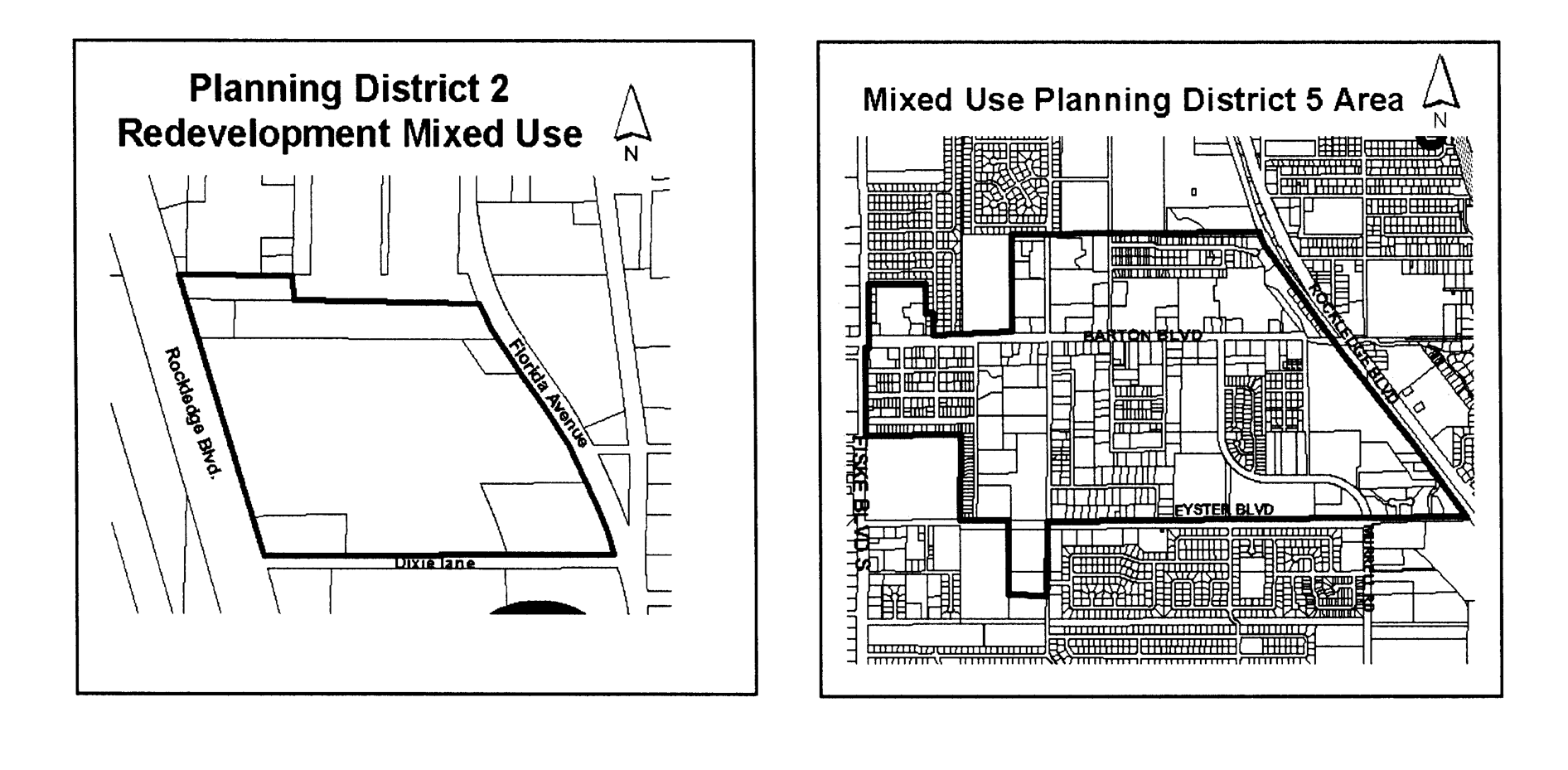
(LDR 1990, § 62.183)
Sec. 118-657. - Redevelopment Mixed Use District regulations.
(a)
Principal uses and structures. The following uses and structures are permitted for any use or group of uses that are developed, either separately or as a unit with certain site improvements shared in common within the RMU Redevelopment Mixed Use District. The RMU district is intended to promote a downtown, urban, town center environment, giving a focal point for the City in locations deemed consistent with the Comprehensive Plan. The Comprehensive Plan shall govern percentages of uses.
(1)
Residential uses.
a.
Residential uses, in the form of attached or detached units, may be developed within a single structure or within a multi-use building. Unless otherwise stated or more units are earned through use of design features, the maximum density is 14 dwelling units per acre (DUPA). Maximum allowable density is 25 DUPA with density bonuses.
1.
Units may be single-family, multifamily, patio homes, garden apartments, or townhouses, lofts, or pocket neighborhoods, with tiny houses or other styles of attached or detached dwelling units.
2.
Lots in areas that are to be platted shall depend on the type of residential dwellings.
3.
Residential uses may be contained within a single area of the development parcel or may be included in a building with nonresidential uses.
4.
All attached residential units shall have no less than 550 square feet of floor area.
5.
Any detached units shall be a minimum of 1,200 square feet, with the exception of tiny houses.
6.
Attached residential units in a mixed-use building must be located on the floors above the commercial uses. Balconies may be located on the front of attached dwellings located in the upper floors of a mixed-use building and shall contain decorative lighting and plant materials. In addition, balconies may be located elsewhere on the building.
7.
The style of architecture and site development characteristics shall incorporate design features found herein. Each development shall include a minimum of four of the 12 standard design features to promote diversity and aesthetics.
8.
If a proposed development incorporates eight or more design elements into the proposed development, a minimum of five and maximum of an additional eight units per acre may be approved by the City Council at the time of site plan approval. If all 12 features are incorporated, the Council, at the recommendation of the Planning and Zoning Commission, may award up to four more units. However, in no case shall the maximum allowable density exceed 25 dwelling units per acre.
9.
Multifamily structures shall provide parking at a rate of two spaces per unit, of which one space shall be in an enclosed garage.
b.
Nonresidential uses. The following uses may be developed as a singular nonresidential use building or mix of nonresidential and residential uses up to a maximum footprint floor area ratio (FAR) of 0.6. If eight of the 12 basic design features are integrated to the structure and site, the footprint FAR may be increased to one by approval of the City Council. For all mixed-use buildings, commercial uses shall occupy at a minimum the first floor and lower floors of the building. Where parking structures are used, the City may require that the portion of the building adjacent to the primary street be dedicated for retail or commercial uses so as to preserve the visual integrity of the district. Permitted nonresidential uses in RMU development shall be strictly limited to:
1.
Retail stores, sales and display rooms, including places where goods are produced and sold on premises (no distribution or manufacturing).
2.
Personal service establishments and administrative offices.
3.
Eating and drinking establishments. The separation requirements in the Rockledge City Code and Land Development Regulations are not applicable in either the Barton Boulevard or the Florida Avenue districts.
4.
Public or private educational facilities.
5.
Public buildings, including libraries, cultural facilities, performing arts, government uses.
6.
Professional offices for medical doctors, dentists, lawyers, accountants, design or other professionals.
7.
Bed and breakfast lodging facilities and hotel establishments.
8.
Parks and public recreational facilities.
9.
Public parking facilities and lots.
10.
Nonresidential buildings shall not exceed 60,000 square feet in one building, except where the design features, building placement, or other site issues make it compatible with the surrounding internal and external residential areas and is approved as part of the site plan process.
(2)
Neo-traditional developments. Neo-traditional single-family detached developments on a minimum of three acres may be developed in the RMU district as a sole use of land, subject to the following minimum provisions:
a.
Streets must be laid out in a grid pattern, with sidewalks, streetlights, street signs and other site amenities provided by the developer; such amenities shall be of a design acceptable to the City and approved by the City Council; on-street parking areas shall be provided and designated.
b.
Houses shall be constructed in a vernacular, historic State architecture, replete with front porches, wood finishes, metal roofs, and rear garages.
c.
Lot sizes may be a minimum of 40 feet by 100 feet and shall be platted.
d.
Minimum house size shall be 1,200 square feet.
(3)
Light industrial uses.
a.
All uses must be totally enclosed within a structure to minimize noise, odor, toxic chemical and wastes.
b.
Types of primary uses include:
1.
Light assembly and manufacturing.
2.
Packaging.
3.
Business/professional offices.
4.
Radio/TV studios, medical clinics.
5.
Veterinarians.
6.
Vocational/trade schools.
7.
Building trade contractors.
c.
Lot and yard dimensions for new industrial uses:
1.
Two-acre minimum lot size.
2.
20-foot perimeter setbacks.
3.
Light industrial uses; all activities must be contained within an enclosed structure.
d.
Outside storage of any materials, vehicles or products is prohibited. Nonresidential buildings shall not exceed 60,000 square feet in one building, except where the design features, building placement, or other site issues make it compatible with the surrounding internal and external residential areas and is approved as part of the site plan process.
(b)
Accessory uses and structures permitted. Customary accessory uses incidental and subordinate to the principal uses in Subsection (a) of this section may be permitted.
(c)
Special exceptions. The following conditional uses may be granted in redevelopment mixed-use districts.
(1)
The City Manager shall be responsible for making final determinations regarding uses that may not be specifically or provisionally identified herein. Appeals of the City Manager's decision shall be processed as a special exception.
(2)
Expansion, enlargement, replacement of existing industrial uses within the district, subject to the following conditions:
a.
A minimum of eight architectural and site design features must be used.
b.
There shall be no outside storage of any materials, vehicles or products.
c.
All activities must be contained within an enclosed structure.
d.
Solid, opaque visual screens shall separate industrial uses from commercial and residential uses for the full perimeter of the property.
(3)
Where expansion, enlargement or replacement of industrial uses is allowed, the use shall be limited to light industrial uses only; all activities shall be within enclosed structures and shall not cause the percentage of industrial uses in the RMU to exceed the standards in the Comprehensive Plan.
(4)
Metal exterior and metal buildings.
(5)
Lot and yard dimensions for new industrial uses:
a.
One acre minimum lot size.
b.
20 feet perimeter setbacks.
(d)
Prohibited. The following uses are prohibited in all mixed-use areas.
(1)
Adult entertainment.
(2)
Heavy manufacturing and/or heavy industrial uses.
(3)
New automotive repair, storage or servicing.
(4)
New warehousing.
(5)
Any other uses not specifically or professionally provided for herein.
(e)
Building height. Maximum building height is 50 feet without design bonuses. Buildings incorporating up to eight design features may be able to extend to 65 feet; buildings using all 12 minimum design features into the building and site may extend to 110 feet. Changes to the heights shall be upon recommendation by the Planning and Zoning Commission, Community Redevelopment Agency Advisory Committee, and approval by the City Council.
(f)
Setbacks. In the RMU district as a whole, the structures are intended to be developed closer to the roadway to create a sense of place and pedestrian usage. Thus, front yard setbacks are set at a maximum build-to line of 20 feet from a property line or an established road right-of-way, whichever is greater.
(g)
Rear yard. Every lot or parcel shall have a minimum rear yard setback of 20 feet. In the event of an alley, the only required setback shall be five feet from the edge of the alley. In the event the lot or parcel backs up onto a canal, lake, retention area or other water body, the rear setback shall be 15 feet for the principal structure and zero feet for porches, pools, and accessory structures.
(h)
Side yard. Side yards for commercial uses shall be regulated by FAR and through the site plan review process. For corner parcels, there shall be a corner side setback of 15 feet. Residential side yards shall be a minimum of eight feet from the perimeter, unless otherwise established through site plan review.
(i)
Bonuses. All development using density and height bonuses are subject to review and recommendations by the Development Review Committee and Planning and Zoning Commission and approval by the City Council. The City Council may also request that the Community Redevelopment Agency Advisory Committee or Community Redevelopment Agency review and comment upon proposed developments.
(j)
Minimum development standards for all sites within the RMU.
(1)
The style of architecture for development shall promote a unified theme, while allowing for varying sizes and types of individual structures, such as Historic Vernacular, Mediterranean, Colonial, etc. Garages must be placed behind the principal structures, unless they are incorporated within the structure, in which case the garage door must not face the primary street. The use of vernacular architectural elements such as porches, dormers, cupolas, and other such features shall be encouraged.
(2)
Lot sizes for platted areas shall depend on type of residential dwellings.
(3)
Landscaping shall consist of 70 percent canopy material, which shall be at a height of six feet clear trunk space at the time of planting. Landscaping may be clustered. The remaining 30 percent shall be comprised of a mix of decorative plants, shrubs and ground cover. All open areas shall be sodded.
(4)
Distance between buildings shall be the minimum necessary for fire access and safety, and in no case shall exceed ten feet, except where required by the Fire Code.
(5)
All utilities shall be located underground.
(6)
Streets shall contain sidewalks, decorative and non-standard Florida Power & Light (FPL) streetlights, street signs and other site amenities provided by the developer; such amenities shall be of a design acceptable to the City and approved by the City Council.
(7)
All vehicular access and parking areas shall be paved and contain curb and gutter.
(8)
The use of thematic parking lot lighting and signage shall be required in public and private developments.
(k)
Waivers. Waivers not covered by the Community Redevelopment Agency Subcommittee may be considered by the Planning and Zoning Commission and the City Council, upon recommendation of the DRC.
(l)
Architectural and site guidelines. To ensure quality design and development within the mixed-use district, architectural and site design guidelines are hereby established and are attached to the ordinance from which this section is derived as Exhibit A. The content of Exhibit A, titled "Architectural and Site Design Guidelines" may be amended as deemed necessary by resolution of the City Council and is on file and available for inspection in the office of the City Clerk.
(LDR 1990, § 62.184; Ord. No. 1377-2005, § 1, 5-4-2005; Ord. No. 1534-2009, § 3, 11-4-2009; Ord. No. 1682-2015, §§ 1, 2, 10-21-2015; Ord. No. 1827-2021, § 1, 9-8-2021; Ord. No. 1846-2021, § 1(exh. A), 12-15-2021)
Sec. 118-688.- Definition and uses.
Activity within the HC Hospital Campus District offers medical care more intensive than personal care services and offers facilities and beds for use beyond 24 hours for individuals requiring diagnosis, treatment or cure for illness, injury, deformity, infirmity, abnormality, disease, or pregnancy and which regularly makes available at least clinical laboratory services, diagnostic X-ray services, and treatment facilities for surgery or obstetrical care, or other definitive medical treatment of similar extent. The term "hospital" shall include the buildings themselves and any accessory uses such as hospital maintenance and storage facilities, helistops for hospital emergency services, parking and parking garages, emergency facilities, related teaching and training activities, accessory indoor auditoriums/conference rooms, accessory indoor minor retail, miscellaneous service, and personal service uses, and incidental publishing and printing of hospital related information. The term "hospital" does not include congregate living facilities; nursing, skilled nursing, convalescent, and extended care facilities; or professional residential facilities. The outside boundaries of this district shall be defined as Longwood Avenue, Seminole Drive, Rockledge Boulevard and Orange Avenue, comprising 12.12 acres.
(LDR 1990, § 62.191; Ord. No. 1371-2005, § 2, 4-20-2005)
Sec. 118-689. - Intent.
(a)
To ensure quality development and to maintain and enhance an attractive physical environment within the HC Hospital Campus District, this division outlines compliance with design criteria for all development projects. The design of the site, use of colors and materials, signage, building orientation, architectural style and compatibility with surrounding structures creates an attractive physical environment for the public. These standards supersede any other land development criteria. In the event of a conflict between any land development provisions, these standards will prevail. If this section does not address specific criteria, the general code criteria will prevail.
(b)
This division is intended to promote imagination, innovation, and variety by focusing on design principles and encouraging creative solutions that serve the following purposes:
(1)
Create a sense of permanence and place by promoting development that emulates enduring character through use of quality design and building materials;
(2)
Minimize compatibility conflicts with surrounding uses which prevent orderly site development; and
(3)
Foster the development of a positive visual character for the hospital by promoting a standard for quality development.
(LDR 1990, § 62.192; Ord. No. 1371-2005, § 2, 4-20-2005)
Sec. 118-690. - Master campus plan.
Wuesthoff Hospital has submitted a master plan guideline which proposes potential buildings and the uses associated with those buildings within this district. This is a guideline; major proposed changes must be reviewed by the Planning and Zoning Commission and approved by the City Council.
(LDR 1990, § 62.193; Ord. No. 1371-2005, § 2, 4-20-2005)
Sec. 118-691. - Lot requirements.
No lot area shall be established for the HC Hospital Campus District.
(LDR 1990, § 62.194; Ord. No. 1371-2005, § 2, 4-20-2005)
Sec. 118-692. - Building setbacks.
Building setbacks in the HC Hospital Campus District shall be as follows:
(1)
Front setbacks adjacent to ROW and across from residentially zoned property: 25 feet.
(2)
Front setbacks adjacent to all other ROW: ten feet.
(3)
Side setbacks: five feet.
(4)
Rear setbacks: zero feet.
(LDR 1990, § 62.195; Ord. No. 1371-2005, § 2, 4-20-2005)
Sec. 118-693. - Building requirements.
Building requirements in the HC Hospital Campus District shall be as follows:
(1)
The maximum lot coverage for the entire 12.12 acre site is 90 percent of the land that may be covered by principal and accessory buildings or structures, including driveways and parking lots.
(2)
Floor area ratio (FAR) shall be established at 1½ for the entire 12.12 acres, which shall exclude parking areas and parking garages. All future construction plans submitted for this area will include the current FAR and the proposed FAR after development.
(3)
Height shall be limited to no greater than 75 feet.
(LDR 1990, § 62.196; Ord. No. 1371-2005, § 2, 4-20-2005)
Sec. 118-694. - Special requirements.
(a)
Increased buffering technique next to residential neighborhoods with increased building heights.
(1)
35 feet or less: no additional buffering required.
(2)
36 to 50 feet:
a.
An increased use of urban design treatments (greater than required in Subsection (c)(2) of this section), for building treatments; or
b.
An increased use of landscaping (greater than required in Subsection (c)(4) of this section), within the perimeter setback, including additional canopy trees, palm groupings, shrub masses, and ground cover treatments; and
c.
Review and approval of the proposed enhanced design treatments by the Planning and Zoning Commission.
(3)
51 to 75 feet:
a.
New building development shall not exceed 50 feet in height unless additional setbacks and/or design and landscape treatments are provided. A maximum 75-foot height may be permitted if the following are proposed:
1.
An increased building setback, one foot additional setback for every additional one foot in height over 50 feet; and
2.
An increased use of urban design treatments (greater than required in Subsection (c)(2) of this section), for all building treatments; or
3.
An increased use of landscaping (greater than required in Subsection (c)(4) of this section), within the perimeter setback including additional canopy trees, palm groupings, shrub masses, and groundcover treatments; and
4.
Review and approval of the proposed enhanced design treatments by the Planning and Zoning Commission.
(4)
Exception. The future fifth and sixth floor expansions to the Wuesthoff Hospital east tower shall be located on top of the existing building. Total building height shall not exceed 75 feet. Additional landscaping shall be placed along the Orange Avenue and Seminole Drive rights-of-way.
(b)
In general.
(1)
Application to development. The site design of all development shall comply with the requirements of this division, except as otherwise provided in this subsection. Architectural elevations of all facades of all structures to be constructed within the district shall be a required exhibit for development plan approval. Such exhibit shall include colors, materials, building dimensions, location of service areas and mechanical equipment, screening devices, lighting fixtures, and any other information as determined necessary to ensure consistency with the intent of this division.
(2)
City approval required. The City, as part of the development plan approval process, shall determine final approval of all site designs. Such approval shall include, but not be limited to, materials, colors, orientation, signage and landscaping.
(3)
Approval for change of exterior design required. Any exterior change of any structure in the district shall require review and approval by the City. Such changes shall include, but not be limited to, colors, materials, and signage. The purpose of such approval shall be to ensure that any exterior change is consistent with the intent and requirements of this chapter. Routine maintenance and replacement of materials, which do not affect the approved exterior design shall be exempt from this subsection.
(4)
Recognized architectural style. Site development within the district shall incorporate a unified architectural style, which is recognized by design professionals as having a basis in classical, historical, or academic architectural design philosophies. The use of features deemed by this division to be integral features of a recognized architectural style shall have a rational and aesthetic relationship to the elevation of a structure, and be harmonious with the pattern, proportions, and materials of surrounding structures.
(5)
Use. New development within the district shall comply with the following requirements. Properties within the district include those identified as such on the map attached to the ordinance from which this section is derived and Official Zoning Map.
a.
Full architectural treatment shall be required on all sides of any structure. Such treatment shall include, but not be limited to, building finishes and materials, window and door styles, architectural details and colors.
b.
The height, shape, and mass of structures shall be consistent with surrounding on-site structures and transition to off-site residential uses.
c.
The use of a unified thematic parking lot lighting and site signage shall be required.
d.
Off-street vehicular use areas shall be screened from the public right-of-way with opaque landscaping and/or berms, architecturally finished walls, or combinations thereof.
(c)
Mandatory standard design criteria. New development, renovation, redevelopment, alterations, and additions of any kind, including accessory structures and appurtenances, in the district shall comply with the following requirements:
(1)
Required project standards. This section applies to both single and multi-use buildings, all new development, and any redevelopment and post-disaster redevelopment projects of preexisting uses. Such projects shall be required to include a minimum of four of the 12 following building design treatments in this section only. The City Council may impose more of the requirements upon finding that it will improve the general safety, welfare, health, appearance, or aesthetics and is in conformance with the Comprehensive Plan and these LDRs. An explanation and detailed description of each follows this section.
(2)
Required. All development and redevelopment, regardless of the size, value or amount shall be required to include the following as shown:
a.
Choose any three:
1.
Canopies or porticos, integrated with the building's massing and style;
2.
Overhangs;
3.
Arcades, a minimum of six feet clear in width;
4.
Sculptured artwork;
5.
Raised cornice parapets over doors;
6.
Peaked roof forms;
7.
Arches;
8.
Ornamental and structural architectural details, other than cornices, which are integrated into the building structure and overall design, pursuant to these regulations;
9.
External downspouts enclosed within the building structure;
10.
Any other treatment which, in the opinion of the City meets the intent of this section; ornamental and structural architectural details, which are integrated into the building structure and overall design, pursuant to these regulations; and
b.
One of the following site design elements:
1.
Decorative landscape planters or planting areas, a minimum of five feet wide located within paved pedestrian walkways;
2.
Shaded seating areas consisting of a minimum of 100 square feet;
3.
Integration of specialty pavers, or stamped concrete along the buildings walkway; said treatment shall constitute a minimum of 60 percent of the walkway area; or
4.
Water elements, such as fountains, architectural pools, statuary, etc.
(3)
Lighting.
a.
Decorative, low-level intensity, non-concealed source lighting, which defines vehicular and/or pedestrian ways, is acceptable. All site lighting shall be so designed to minimize the light source or high levels of light from being visible from the adjacent off-site residential use.
b.
Exterior building (architectural or decorative) lighting shall be generated from concealed light source, low-level light fixtures. Color lamps shall not be used.
c.
Street lamps shall conform to the style adopted by the City or as part of the development theme and must be located at any driveway entrance or pedestrian entrance within three feet of the public right-of-way.
(4)
Landscaping.
a.
Landscaping for the proposed development shall provide visually harmonious and compatible settings for structures on the same lot and on adjoining and nearby lots. Natural appearing landscape massing and forms are strongly encouraged; formal plans and the appearance of straight hedges are discouraged.
b.
Perimeter landscaping shall be required for new structures and off-street vehicular use areas along all public rights-of-way, except at points of access. The scale of proposed landscaping shall be in proportion to the building. As a minimum, perimeter landscaping shall include:
1.
Canopy trees. Tree installations shall be provided based upon a one tree per 30 linear feet of right-of-way frontage. As a minimum, trees shall be 12 feet in height and measure three-inch caliper at time of installation. Installations should be spread along the entire length of the right-of-way and may be grouped to provide a natural appearance.
2.
Screening hedge. Shrub installations shall provide a continuous screen to all off-street vehicular use areas. As a minimum, shrubs shall attain a three-foot overall height. Materials that grow in excess of three feet in height shall not be permitted along the frontage portion of the properties for both safety and aesthetic purposes without an approved maintenance plan.
3.
Foundation plantings. All structures and remaining open space shall be stabilized with a combination of shrub, ground cover, or sodding.
4.
Irrigation system. All landscaping shall provide a programmable, 100 percent coverage, automatic underground irrigation system with rain shutoff sensor.
5.
Xeriscape practices. It is strongly encouraged that plant material combinations should be designed to group similar water dependent species within common irrigation zones.
c.
Creativity and diversity in landscaping is desired. If, in the opinion of the staff and the Planning and Zoning Commission, a landscape plan meets the intent of these LDRs, the City may approve the plan, waiving the strict requirements of this section.
(5)
Screening walls.
a.
A maximum of a three-foot high decorative wall may be allowed along rights-of-way. A six-foot wall may be approved by the City to screen off-street vehicular loading areas, building mechanicals, and garbage dumpsters, etc.
b.
Such walls shall only be of masonry, decorative stone and/or brick, and architecturally finished on the public right-of-way side. Such wall is only permitted within three feet of the right-of-way. Required landscaping must be placed between the fence and the right-of-way (or sidewalk).
c.
No chain-link fencing is allowed.
d.
Any wall which is visible from any public right-of-way shall be designed as an integral feature of the architectural design of the principal structure. Such design shall include the use of similar materials, colors and finishes as the principal structure and, to the greatest extent possible, avoid extensive, monotonous sections by having breaks and bends and incorporating landscaping and other natural features.
(6)
Signs.
a.
Freestanding and wall signs, as permitted by these LDRs, shall be designed to be compatible and integral to the structure to be identified. Signboards, canopies, fascias, and other architectural features shall be designed to incorporate signage or a uniform sign program as applicable.
b.
The base treatment of all freestanding signs shall be compatible with the principal structure with regard to style, color and finish.
c.
New signs, replacement signs or alterations to existing signs shall be required to conform to these regulations and be approved by the City as part of the development review process.
d.
The City Council, based upon recommendations from the Planning and Zoning Commission, may place further requirements on signage in addition to those included herein.
(7)
Service areas. All service areas and mechanical equipment (ground or roof), including, but not limited to, air conditioning condensers, heating units, electric meters, satellite dishes, irrigation pumps, ice machines and dispensers, outdoor vending machines, and propane tanks, displays and refilling areas shall be screened using architectural features consistent with the structure or landscaping of sufficient density and maturity at planting to provide opaque screening.
(LDR 1990, § 62.197; Ord. No. 1371-2005, § 2, 4-20-2005)
Sec. 118-695. - Parking requirements.
Hospital campus district parking requirements shall be as required in Section 116-48.
(LDR 1990, § 62.198; Ord. No. 1371-2005, § 2, 4-20-2005)
Sec. 118-719.- Intent.
The ROC Recreation Open Space and Conservation District is created to ensure that properties identified in the Comprehensive Plan as having the following land uses: Recreational public passive, recreational public active and recreational public mixed use are built and designed to meet the needs of the citizens. Each land use category brings a little different use and function to the property.
(LDR 1990, § 62.201; Ord. No. 1418-2006, § 1, 8-16-2006)
Sec. 118-720. - Uses.
The following uses are permitted in each of the described Comprehensive Plan land use districts:
(1)
Recreational, public passive (RPP). Activities within this land area are predominantly associated with land areas being preserved, which contain areas of wetlands and/or habitats that serve to protect valuable threatened and endangered species. These areas may also be used to enhance the passive recreational needs of the population.
a.
Uses. Permitted uses include the following:
1.
Principal.
(i)
Hiking and bicycle trails.
(ii)
Information centers.
(iii)
Scenic vistas.
(iv)
Boating, nonmotorized.
(v)
Fishing.
(vi)
Fishing/mooring docks.
(vii)
Conservation areas.
(viii)
Open space.
2.
Accessory.
(i)
Roadways.
(ii)
Parking.
(iii)
Government and public utility facilities approved by the City Council.
(iv)
Fairs.
(v)
Special events.
(vi)
Caretaker residence.
(vii)
Signage.
3.
Conditional uses.
(i)
Telecommunication towers.
(ii)
Commercial leases.
4.
Prohibited.
(i)
Industrial and commercial uses not approved by the City Council.
(ii)
Motorized vehicles.
5.
Special requirements. Whenever possible, the City will work with permitting agencies to combine functional uses of all properties.
(2)
Recreational, public mixed use (RPMU). Activities within this land use area shall be predominantly connected to areas that serve a mixture of public functions. These areas will often be in the process of transitioning from a public works project to public use project and may be transformed into open space parks.
a.
Uses. Permitted public uses include the following:
1.
Principal.
(i)
Master stormwater lakes.
(ii)
Wetland areas.
(iii)
Conservation areas.
(iv)
Canoeing.
(v)
Sailing.
(vi)
Freshwater fishing.
(vii)
Hiking and bicycle trails.
(viii)
Picnic areas.
(ix)
Water skiing, if allowed by ordinance.
(x)
Scenic vistas.
(xi)
Fishing piers and dock and boat ramps.
(xii)
Campgrounds.
(xiii)
Dog parks.
2.
Accessory.
(i)
Roadways.
(ii)
Parking.
(iii)
Government and public utility facilities approved by the City Council.
(iv)
Fairs.
(v)
Special events.
(vi)
Caretaker residence.
(vii)
Signage.
3.
Conditional uses.
(i)
Telecommunication towers.
(ii)
Commercial leases.
4.
Prohibited.
(i)
Industrial and commercial uses not approved by the City Council.
5.
Special requirements. Whenever possible, the City will work with permitting agencies to combine functional uses of all properties.
(3)
Recreational, public active (RPA). Activities within this land area are predominantly connected to land areas being used for active recreational purposes.
a.
Uses. Permitted public uses include the following:
1.
Principal.
(i)
Field sports.
(ii)
Basketball.
(iii)
Soccer.
(iv)
Tennis courts.
(v)
Community centers.
(vi)
Recreation centers.
(vii)
Water recreation, if determined to be environmentally safe.
(viii)
Horseshoes pits.
(ix)
Volleyball.
(x)
Skateboarding areas.
(xi)
Shuffleboard.
(xii)
In-line skating.
(xiii)
Dog parks.
(xiv)
Public golf courses.
(xv)
Other activities deemed appropriate by the City.
2.
Accessory.
(i)
Roadways.
(ii)
Parking.
(iii)
Government and public utility facilities approved by City Council.
(iv)
Fairs.
(v)
Special events.
(vi)
Caretaker residence.
(vii)
Signage.
3.
Conditional uses.
(i)
Telecommunication towers.
(ii)
Commercial leases.
4.
Prohibited.
(i)
Industrial and commercial uses not approved by City Council.
5.
Special requirements. Whenever possible, the City will work with permitting agencies to combine functional uses of all properties.
(LDR 1990, § 62.202; Ord. No. 1418-2006, § 1, 8-16-2006)
Sec. 118-721. - Lot requirements.
Lot requirements in the ROC Recreation Open Space and Conservation District shall be as follows:
(1)
Area: no minimum area requirements.
(2)
Width: no minimum width requirements.
(3)
Depth: no minimum depth requirement.
(LDR 1990, § 62.203; Ord. No. 1418-2006, § 1, 8-16-2006)
Sec. 118-722. - Setback requirements.
Setback requirements in the ROC Recreation Open Space and Conservation District shall be as follows:
(a)
Adjoining properties and rights-of-way: 25 feet.
(LDR 1990, § 62.204; Ord. No. 1418-2006, § 1, 8-16-2006)
Sec. 118-723. - Building requirements.
Building requirements in the ROC Recreation Open Space and Conservation District shall be as follows:
(1)
Coverage: maximum impervious coverage ten percent.
(2)
Height: 35 feet, except telecommunication towers.
(3)
Floor area ratio (FAR): 0.1 percent.
(4)
Open space/landscape: minimum open space 90 percent.
(LDR 1990, § 62.205; Ord. No. 1418-2006, § 1, 8-16-2006)
Sec. 118-312. - Intent.
The provisions of the MH Mobile Home District are intended to apply to an area which is predominantly developed for residential use with mobile home dwellings or which, by its location or trend of development designated on the Zoning Map and in the Comprehensive Plan, is appropriate to such uses. This district shall be developed in such a way as to make efficient, economical and aesthetically pleasing use of land, so restricted that the same will be continually maintained by the owner.
(LDR 1990, § 62.71)
Sec. 118-343. - Uses.
Uses in the MH Mobile Home District shall be as follows:
(1)
Principal. No building, structure, land or water shall be used, in whole or in part, except for one or more of the following uses:
a.
Mobile homes used as a single-family dwelling unit.
b.
Home occupation, subject to the standards and requirements established in Section 118-750.
(2)
Accessory. The following uses may be used in conjunction with one or more of the principal uses:
a.
Garage, carport or space for the housing or parking of private automobiles.
b.
Cabanas, porches or awnings, patios and utility buildings.
c.
Swimming pool and customary accessory buildings, provided that the combined and collective square footage of the mobile home and accessory uses shall not exceed 35 percent of the square footage of the gross lot area.
(3)
Special exceptions. When, after review of an application with plans pertinent thereto and hearing thereon, the Board of Adjustment finds that the proposed uses are in harmony with the purpose and intent of this chapter and with the Comprehensive Plan and with the public interest, the following conditional uses may be granted:
a.
Schools in buildings specifically designed for such use, but not building trade schools for adults.
b.
Public parks, playgrounds, libraries, noncommercial community centers.
c.
Golf course, including golf and country club.
(4)
Prohibited. The following uses are specifically prohibited in the MH Mobile Home Districts:
a.
Travel trailers, campers, motor homes or recreational vehicles for use as dwelling units.
b.
Travel trailer parks, travel trailer camps, and travel trailer courts.
c.
Commercial pursuits.
d.
Raising, keeping or maintaining farm animals, excluding the keeping of household pets normally domesticated in the United States.
e.
Keeping and maintaining bees, rabbits, ducks, chickens and other fowl.
f.
Residential social service facilities (RSSF).
g.
Child care centers.
(5)
Fences. Refer to Section 118-769.
(LDR 1990, § 62.72; Ord. No. 1017-91, §§ 13, 14, 11-20-1991; Ord. No. 1379-2005, § 1, 6-1-2005; Ord. No. 1794-2020, § 1, 11-18-2020; Ord. No. 1823-2021, § 1, 8-18-2021)
Sec. 118-344. - Lot requirements.
Lot requirements in the MH Mobile Home District shall be as follows:
(1)
Area. The minimum lot area required is 5,500 square feet.
(2)
Width. The minimum lot width required is 50 feet.
(3)
Depth. The minimum lot depth required is 100 feet.
(4)
Buildings. Not more than one mobile home or manufactured home shall be constructed or placed on any one lot.
(LDR 1990, § 62.73; Ord. No. 1823-2021, § 1, 8-18-2021)
Sec. 118-345. - Setback requirements.
Setback requirements in the MH Mobile Home District shall be as follows:
(1)
Front. The minimum front setback required is 25 feet.
(2)
Rear. The minimum rear setback required is 20 feet.
(3)
Side. The minimum side setback required is 7½ feet.
(4)
Measurement. The exterior wall of a mobile home, or the wall or roof vertical support of an addition, shall be considered the building line when measuring setbacks.
(5)
Corner lots. Corner lots shall have a front yard setback of not less than 25 feet from the front lot line, and a side street setback of not less than 12½ feet from the side lot line on the secondary street, except that if the corner lot adjoins a key lot, then the side street setback shall remain at 25 feet.
(6)
Accessory building setback requirements. Detached accessory building are subject to all conditions, limitations and restrictions set forth in Section 118-746.
(LDR 1990, § 62.74; Ord. No. 1364-2004, § 7, 12-1-2004)
Sec. 118-346. - Building requirements.
Building requirements in the MH Mobile Home District shall be as follows:
(1)
Lot coverage. The maximum allowable lot coverage is 35 percent of the land that may be covered by the principal and accessory buildings or structures, excluding driveways and concrete slabs, located thereon. The maximum allowable lot coverage by driveways and concrete slabs is 20 percent. An accessory building not exceeding 12 feet high may occupy not more than 35 percent of a required rear yard. This provision does not apply to swimming pools.
(2)
Area, size. The minimum living area is 1,000 square feet. The minimum width of a mobile home shall be 24 feet. In areas zoned MH prior to July 20, 1983, the minimum living area shall be 600 square feet. The minimum size of a mobile home shall be 12 feet by 50 feet. All mobile homes installed in the City after January 16, 1985, shall bear the Department of Housing and Urban Development (HUD) seal of approval.
(3)
Height. Maximum height of structures is not more than 20 feet.
(4)
Skirting. Each mobile home shall be skirted with concrete block, lath and stucco or sheet metal in such a manner as to screen all undercarriage and stabilization devices.
(5)
Off-street parking. Two paved spaces shall be required for each mobile home lot. Each home site shall have both paved spaces located on the site.
(LDR 1990, § 62.75)
Sec. 118-347. - Special requirements.
Mobile home tie down requirements and minimum installation standards in the MH Mobile Home District shall be as follows:
(1)
Each owner or other person having possession or control of a mobile home in an MH Mobile Home District shall secure such mobile home to the ground by the use of anchors and tie downs so as to resist wind overturning and sliding. However, nothing herein shall be construed as requiring that anchors and tie downs be installed to secure mobile homes which are permanently attached to a permanent structure. A permanent structure shall have a foundation and such other structural elements as are required pursuant to rules and regulations promulgated from time to time by the State Department of Highway Safety and Motor Vehicles which ensure the rigidity and stability of the mobile home.
a.
A mobile home manufactured in accordance with the code standards, as defined by State Statutes and labeled "hurricane and windstorm resistive," shall be anchored to at each anchor point provided on the mobile home. A mobile home not meeting these standards must be anchored with anchor points spaced as required by the State Department of Highway Safety and Motor Vehicles, starting at each end of the mobile home.
b.
In addition, each mobile home shall be tied down by one of the following means:
1.
A mobile home having built-in, over-the-roof ties shall be secured by the tie down points, provided that such built-in ties and points meet the standards promulgated by the State Department of Highway Safety and Motor Vehicles.
2.
A mobile home not having built-in, over-the-roof ties and tie down points meeting State Department of Highway Safety and Motor Vehicles standards shall be secured in accordance with standards promulgated by such Department.
(2)
This section shall only apply to mobile homes that are being used as dwelling places and that are located on a particular location for a period of time exceeding 14 days.
(3)
The requirements of this section are tantamount with the tie down and installation requirements set forth in F.S. § 320.8325, 1974. In the event such F.S. 320.8325 is hereafter amended or in the event the tie down and installation requirements imposed by State law are hereafter changed or amended, then the provisions of the State Statutes pertaining to such requirements shall govern and take precedence over the provisions of this section only to the extent to any inconsistency between the provisions of this section and the provisions of applicable State Statutes.
(4)
Any person who violates any of the provisions of this section shall, upon conviction thereof, be punished as provided by law.
(5)
See Section 22-35 of the Rockledge City Code for provisions pertaining to dumpster visual barriers.
(6)
Signs shall be allowed in the MH district only as specifically permitted by the provisions of Article V, Division 3 of this chapter.
(LDR 1990, § 62.76)
Sec. 118-368. - Uses.
Uses in mobile home parks, mobile home cooperatives, and mobile home condominiums shall be as follows:
(1)
Principal. No building, structure, land or water shall be used, in whole or in part, except for one or more of the following uses:
a.
Mobile homes used as a single-family dwelling unit.
b.
Home occupation, subject to the standards and requirements established in Section 118-750.
(2)
Accessory. The following uses may be used in conjunction with one or more of the principal uses:
a.
Garage, carport or space for the housing or parking of private automobiles.
b.
Cabanas, porches or awnings, patios and utility buildings.
c.
Swimming pool and customary accessory buildings, provided that the combined and collective square footage of the mobile home and accessory uses shall not exceed 35 percent of the square footage of the gross lot area.
(3)
Special exceptions. When, after review of an application with plans pertinent thereto and hearing thereon, the Board of Adjustment finds that the proposed uses are in harmony with the purpose and intent of this chapter and with the Comprehensive Plan and with the public interest, the following conditional uses may be granted:
a.
Schools in buildings specifically designed for such use, but not building trade schools for adults.
b.
Public parks, playgrounds, libraries, noncommercial community centers.
c.
Golf course, including golf and country club.
(4)
Prohibited. The following uses are specifically prohibited in the MH Mobile Home Districts:
a.
Travel trailers, campers, motor homes or recreational vehicles for use as dwelling units.
b.
Travel trailer parks, travel trailer camps, and travel trailer courts.
c.
Commercial pursuits.
d.
Raising, keeping or maintaining farm animals, excluding the keeping of household pets normally domesticated in the United States.
e.
Keeping and maintaining bees, rabbits, ducks, chickens and other fowl.
f.
Residential social service facilities (RSSF).
g.
Child care centers.
(5)
Fences. Refer to Section 118-769 for fence provisions.
(LDR 1990, § 62.72; Ord. No. 1017-91, §§ 13, 14, 11-20-1991; Ord. No. 1379-2005, § 1, 6-1-2005; Ord. No. 1794-2020, § 1, 11-18-2020; Ord. No. 1823-2021, § 1, 8-18-2021)
Sec. 118-369. - Lot requirements.
Lot requirements in mobile home parks, mobile home cooperatives, and mobile home condominiums shall be as follows:
(1)
Area. The minimum lot area required is 5,500 square feet.
(2)
Width. The minimum lot width required is 50 feet.
(3)
Depth. The minimum lot depth required is 100 feet.
(4)
Buildings. Not more than one mobile home or manufactured home shall be constructed or placed on any one lot.
(LDR 1990, § 62.73; Ord. No. 1823-2021, § 1, 8-18-2021)
Sec. 118-370. - Setback requirements.
Setback requirements in mobile home parks, mobile home cooperatives, and mobile home condominiums shall be as follows:
(1)
Front. The minimum front setback required is 25 feet.
(2)
Rear. The minimum rear setback required is 20 feet.
(3)
Side. The minimum side setback required is 7½ feet.
(4)
Measurement. The exterior wall of a mobile home, or the wall or roof vertical support of an addition, shall be considered the building line when measuring setbacks.
(5)
Corner lots. Corner lots shall have a front yard setback of not less than 25 feet from the front lot line, and a side street setback of not less than 12½ feet from the side lot line on the secondary street, except that if the corner lot adjoins a key lot, then the side street setback shall remain at 25 feet.
(6)
Accessory building setback requirements. Detached accessory buildings, subject to all conditions, limitations and restrictions set forth in Section 118-746.
(LDR 1990, § 62.74; Ord. No. 1364-2004, § 7, 12-1-2004)
Sec. 118-371. - Building requirements.
Building requirements in mobile home parks, mobile home cooperatives, and mobile home condominiums shall be as follows:
(1)
Lot coverage. The maximum allowable lot coverage is 35 percent of the land that may be covered by the principal and accessory buildings or structures, excluding driveways and concrete slabs, located thereon. The maximum allowable lot coverage by driveways and concrete slabs is 20 percent. An accessory building not exceeding 12 feet high may occupy not more than 35 percent of a required rear yard. This provision does not apply to swimming pools.
(2)
Area, size. The minimum living area is 1,000 square feet. The minimum width of a mobile home shall be 24 feet. In areas zoned MH prior to July 20, 1983, the minimum living area shall be 600 square feet. The minimum size of a mobile home shall be 12 feet by 50 feet. All mobile homes installed in the City after January 16, 1985, shall bear the Department of Housing and Urban Development (HUD) seal of approval.
(3)
Height. Maximum height of structures is not more than 20 feet.
(4)
Skirting. Each mobile home shall be skirted with concrete block, lath and stucco or sheet metal in such a manner as to screen all undercarriage and stabilization devices.
(5)
Off-street parking. Two paved spaces shall be required for each mobile home lot. Each home site shall have both paved spaced located on the site.
(LDR 1990, § 62.75)
Sec. 118-372. - Special requirements.
Mobile home tie down requirements and minimum installation standards shall be as follows:
(1)
Each owner or other person having possession or control of a mobile home in an MH Mobile Home District shall secure such mobile home to the ground by the use of anchors and tie downs so as to resist wind overturning and sliding. However, nothing herein shall be construed as requiring that anchors and tie downs be installed to secure mobile homes which are permanently attached to a permanent structure. A permanent structure shall have a foundation and such other structural elements as are required pursuant to rules and regulations promulgated from time to time by the State Department of Highway Safety and Motor Vehicles which ensure the rigidity and stability of the mobile home.
a.
A mobile home manufactured in accordance with the code standards, as defined by State Statutes and labeled "hurricane and windstorm resistive" shall be anchored at each anchor point provided on the mobile home. A mobile home not meeting these standards must be anchored with anchor points spaced as required by the State Department of Highway Safety and Motor Vehicles, starting at each end of the mobile home.
b.
In addition, each mobile home shall be tied down by one of the following means:
1.
A mobile home having built-in, over-the-roof ties shall be secured by the tie down points, provided that such built-in ties and points meet the standards promulgated by the State Department of Highway Safety and Motor Vehicles.
2.
A mobile home not having built-in, over-the-roof ties and tie down points meeting State Department of Highway Safety and Motor Vehicles standards shall be secured in accordance with standards promulgated by such Department.
(2)
This section shall only apply to mobile homes that are being used as dwelling places and that are located on a particular location for a period of time exceeding 14 days.
(3)
The requirements of this section are tantamount with the tie down and installation requirements set forth in F.S. § 320.8325, 1974. In the event F.S. § 320.8325 is hereafter amended or in the event the tie down and installation requirements imposed by State law are hereafter changed or amended, then the provisions of the State Statutes pertaining to such requirements shall govern and take precedence over the provisions of this section only to the extent to any inconsistency between the provisions of this section and the provisions of applicable State Statutes.
(4)
Any person who violates any of the provisions of this section shall, upon conviction thereof, be punished as provided by law.
(5)
See Section 22-35 of the Rockledge City Code for provisions pertaining to dumpster visual barriers.
(6)
Signs shall be allowed in the MH district only as specifically permitted by the provisions of Article V, Division 3 of this chapter.
(LDR 1990, § 62.76)

