
Roeland Park City Zoning Code
ARTICLE 4
- ZONING DISTRICTS
DIVISION II. - ZONING DISTRICTS DESCRIBED[2]
Editor's note— Ord. No. 1056, § 2(Exh. B), adopted Aug. 5, 2024, repealed the former Art. 4, Div. II, §§ 16-406—16-420, and enacted a new Art. 4, Div. II as set out herein. The former Art. 4, Div. II pertained to similar subject matter and derived from Ord. No. 944, §§ 5—7, adopted Nov. 21, 2016; and Ord. No. 1018, §§ 3—8, adopted Nov. 1, 2021.
DIVISION III. - HEIGHT AND AREA STANDARDS[3]
Editor's note— Ord. No. 1056, § 2(Exh. B), adopted Aug. 5, 2024, repealed the former Art. 4, Div. III, §§ 16-421—16-427, and enacted a new Art. 4, Div. III as set out herein. The former Art. 4, Div. III pertained to height and area exceptions, and derived from Ord. No. 918, § 1, adopted Oct. 19, 2015; and Ord. No. 933, §§ 1—3, adopted June 20, 2016.
Sec. 16-401. - Authorization and Regulation of Zones and Districts.
The Governing Body hereby divides the City into zones and districts, in order to regulate and restrict the location of trades and industries, and the location, erection, alteration and repair of buildings designed for specific uses, and the uses of the land within each district or zone.
(Ord. No. 1056, § 2(Exh. B), 8-5-2024)
Sec. 16-402. - Zoning Districts Designated.
For the purpose of regulating and restricting the use of land and the erection, construction, reconstruction, altering, moving or use of buildings and structures, the corporate area of the City is divided into six conventional zoning districts and five planned zoning districts.
(a)
The conventional zoning districts are designated as follows:
(1)
Single-Family Residence Districts.
a.
R-1, Single-Family Residence District.
b.
R-2, Single-Family Residence District.
(2)
R-3, Duplex Residence District.
(3)
R-4, Townhouse/Row Dwelling.
(4)
R-5, Multiple Residence District.
(5)
C-1, Office Building District.
(6)
C-2, Retail Business District.
(b)
The planned zoning districts are designated as follows:
(1)
CP-O, Planned Office Building District.
(2)
CP-1, Planned Restricted Business District.
(3)
CP-2, Planned General Business District.
(4)
P-I, Planned Industrial Park District.
(5)
MXD, Planned Mixed Use District.
(c)
The overlaying zoning districts are as follows:
(1)
47th and Mission Road Area Design Review Overlay District.
(Ord. No. 1018, § 2, 11-1-2021; Ord. No. 1056, § 2(Exh. B), 8-5-2024)
Sec. 16-403. - Official Zoning Map.
The boundaries of the zoning districts enumerated in Section 16-402 shall be shown on a map officially designated as the Official Map, which map is reincorporated by reference as amended.
(Ord. No. 940, § 5, 10-10-2016; Ord. No. 1056, § 2(Exh. B), 8-5-2024)
Sec. 16-404. - General Requirements Applicable to All Zoning Districts.
(a)
Except as otherwise specifically provided, no building or structure shall be erected, constructed, reconstructed, moved or altered, nor shall any building, structure or land be used for any purpose other than is permitted in this chapter by the regulations of the zoning district in which the building, structure or land is situated.
(b)
Except as otherwise specifically provided, no building or structure shall be erected, constructed, reconstructed, moved or altered to exceed the height or area limits established in this chapter by the regulations of the zoning district in which the building or structure is situated.
(c)
Except as otherwise specifically provided, no lot area shall be reduced or diminished so that the yards or other open spaces shall be smaller than prescribed, nor shall the density be increased in any manner, except in conformity by the regulations of the zoning district in which the lot or property is situated.
(d)
Except as otherwise specifically provided, no building, structure or site improvement shall be erected, constructed, reconstructed, moved or altered except in compliance with any applicable final development plans, site plans or other development plans approved by the Governing Body or the Planning Commission. For the purposes of this section, compliance with approved plans shall include both compliance with the content of the plan drawings and compliance with any conditions or stipulations attached to the approval.
Sec. 16-405. - Prohibitions.
Prohibitions from the zoning regulations of the City shall be as follows:
(a)
No temporary or incomplete building nor any vehicular equipment, trailer, garage or appurtenance incident to a family dwelling, shall be erected, maintained or used for residence purposes in the City.
(b)
No temporary or outwardly incomplete structure or building or excavation for a basement or foundation, and no building or structure so damaged as to become unfit for use or inhabitation shall be permitted, maintained or remain in this condition with the City for a period of more than six months, except by special permission of the Governing Body.
(c)
No building material, equipment, machinery or refuse shall be stored or maintained upon a lot, tract or parcel within the City, other than during the period during which actual construction or repair operations are being regularly and continuously performed in accordance with the schedule of construction approved in conjunction with a building permit issued for these operations, as the schedule shall be amended from time to time, or otherwise beyond a reasonable period of time necessary to complete the construction or repair as determined by the Building Inspector in his sole discretion; provided, however, that the Governing Body may waive the prohibition against the storage or maintenance in unusual cases for a limited time upon good cause shown therefor.
(d)
No building, structure, or land now located within the City nor any building hereafter erected therein, shall be used or occupied for any of the following purposes, unless otherwise provided for in this article:
(1)
Junkyard or junk storage room;
(2)
Slaughterhouse, commercial poultry dressing or processing establishment where the use is primary and not incidental to some authorized use;
(3)
Trailer camps;
(4)
Circuses or carnivals;
(5)
Storage or selling of volatile or explosive materials;
(6)
Boarding houses or lodging houses;
(7)
Flea markets.
(Ord. No. 1056, § 2(Exh. B), 8-5-2024)
Sec. 16-406. - R-1 and R-2 Single-Family Residence Districts.
(a)
Permitted Uses. See Section 16-414 for a list of Permitted and Special Uses.
(b)
Bulk Regulations. See Section 16-410 for Bulk Regulations for Residential Zoning Districts.
(c)
Accessory Structures Setbacks and Regulations. See Article 6, Accessory Uses and Structures, of Chapter 16 of City Code.
(d)
Building Design Standards. See Section 16-415 for building design standards.
(e)
Construction Across Lot Lines. No single-family or two-family residential building nor accessory structure shall be constructed over or across any property line, lot line, or parcel line unless approved for merger via a lot-tie agreement or re-platted. All such lot mergers and re-platting should comply with the following:
(1)
Does not create a through lot that has more than two street frontages.
(2)
Does not create a lot with a width greater than 150 percent of the average lot widths of all the lots within 200 linear feet measured property line to property line.
(3)
Does not create a lot with an area greater than 150 percent of average lot areas of all lots within 200 linear feet measured property line to property line.
(4)
Exceptions to the above standards may be approved to address unique or special circumstances of the subject property.
(f)
Off-Street Parking Required. See Article 8, Vehicle Parking and Loading of Chapter 16 of City Code.
(Ord. No. 1056, § 2(Exh. B), 8-5-2024)
Sec. 16-407. - R-3 Duplex Residence District.
(a)
Permitted Uses. See Section 16-414 for a list of Permitted and Special Uses.
(b)
Bulk Regulations. See Section 16-410 for Bulk Regulations for Residential Zoning Districts.
(c)
Accessory Structures Setbacks and Regulations. See Article 6, Accessory Uses and Structures, of Chapter 16 of City Code.
(d)
Building Design Standards. See Section 16-415 for building design standards.
(e)
Construction Across Lot Lines. No single-family or two-family residential building nor accessory structure shall be constructed over or across any property line, lot line, or parcel line unless approved for merger via a lot-tie agreement or re-platted. All such lot mergers and re-platting should comply with the following:
(1)
Does not create a through lot that has more than two street frontages.
(2)
Does not create a lot with a width greater than 150 percent of the average lot widths of all the lots within 200 linear feet measured property line to property line.
(3)
Does not create a lot with an area greater than 150 percent of average lot areas of all lots within 200 linear feet measured property line to property line.
(4)
Exceptions to the above standards may be approved to address unique or special circumstances of the subject property.
(f)
Off-Street Parking Required. See Article 8, Vehicle Parking and Loading of Chapter 16 of City Code.
(Ord. No. 1056, § 2(Exh. B), 8-5-2024)
Sec. 16-408. - R-4 Townhouse/Row Dwelling District.
(a)
Permitted Uses. See Section 16-414 for a list of Permitted and Special Uses.
(b)
Bulk Regulations. See Section 16-410 for Bulk Regulations for Residential Zoning Districts.
(c)
Accessory Structures Setbacks and Regulations. See Article 6, Accessory Uses and Structures, of Chapter 16 of City Code.
(d)
Building Design Standards. See Section 16-415 for building design standards.
(e)
Construction Across Lot Lines. No single-family or two-family residential building nor accessory structure shall be constructed over or across any property line, lot line, or parcel line unless approved for merger via a lot-tie agreement or re-platted. All such lot mergers and re-platting should comply with the following:
(1)
Does not create a through lot that has more than two street frontages.
(2)
Does not create a lot with a width greater than 150 percent of the average lot widths of all the lots within 200 linear feet measured property line to property line.
(3)
Does not create a lot with an area greater than 150 percent of average lot areas of all lots within 200 linear feet measured property line to property line.
(4)
Exceptions to the above standards may be approved to address unique or special circumstances of the subject property.
(f)
Off-Street Parking Required. See Article 8, Vehicle Parking and Loading of Chapter 16 of City Code.
(Ord. No. 1056, § 2(Exh. B), 8-5-2024)
Sec. 16-409. - R-5 Multiple Residence District.
(a)
Permitted Uses. See Section 16-414 for a list of Permitted and Special Uses.
(b)
Bulk Regulations. See Section 16-410 for Bulk Regulations for Residential Zoning Districts.
(c)
Accessory Structures Setbacks and Regulations. See Article 6, Accessory Uses and Structures, of Chapter 16 of City Code.
(d)
Building Design Standards. See Section 16-415 for building design standards.
(e)
Off-Street Parking Required. See Article 8, Vehicle Parking and Loading of Chapter 16 of City Code.
(f)
Performance Standards. See Section 16-416 for applicable performance standards.
(g)
Landscaping and Screening Standards. See Article 10, Landscaping and Screening of Chapter 16 of City Code.
(Ord. No. 1056, § 2(Exh. B), 8-5-2024)
Sec. 16-410. - Residential Bulk Regulations.
The following table details the minimum lot sizes, building setbacks, building size and height limitations, minimum green space, and maximum density requirements for each building type constructed within the residential zoning districts established herein.
TABLE 16-410.1: RESIDENTIAL BULK REGULATIONS
(Ord. No. 1056, § 2(Exh. B), 8-5-2024)
Sec. 16-411. - C-1 Office Building District.
(a)
Permitted Uses. See Section 16-414 for a list of Permitted and Special Uses.
(b)
Bulk Regulations. See Section 16-413 for Bulk Regulations for Office and Commercial Zoning Districts.
(c)
Accessory Structures Setbacks and Regulations. See Article 6, Accessory Uses and Structures, of Chapter 16 of City Code.
(d)
Building Design Standards. See Section 16-415 for building design standards.
(e)
Off-Street Parking Required. See Article 8, Vehicle Parking and Loading of Chapter 16 of City Code.
(f)
Performance Standards. See Section 16-416 for applicable performance standards.
(g)
Landscaping and Screening Standards. See Article 10, Landscaping and Screening, Chapter 16 of City Code.
(Ord. No. 1056, § 2(Exh. B), 8-5-2024)
Sec. 16-412. - C-2 Retail Business District.
(a)
Permitted Uses. See Section 16-414 for a list of Permitted and Special Uses.
(b)
Bulk Regulations. See Section 16-413 for Bulk Regulations for Office and Commercial Zoning Districts.
(c)
Accessory Structures Setbacks and Regulations. See Article 6, Accessory Uses and Structures, of Chapter 16 of City Code.
(d)
Building Design Standards. See Section 16-415 for building design standards.
(e)
Off-Street Parking Required. See Article 8, Vehicle Parking and Loading of Chapter 16 of City Code.
(f)
Performance Standards. See Section 16-416 for applicable performance standards.
(g)
Landscaping and Screening Standards. See Article 10, Landscaping and Screening, Chapter 16 of City Code.
(Ord. No. 1056, § 2(Exh. B), 8-5-2024)
Sec. 16-413. - Office/Retail Bulk Regulations.
The following table details the minimum lot sizes, building setbacks, building size and height limitations, minimum green space, and maximum density requirements for each non-residential zoning district.
TABLE 16-413.1: OFFICE AND COMMERCIAL BULK REGULATIONS
(Ord. No. 1056, § 2(Exh. B), 8-5-2024)
Sec. 16-414. - Permitted and Special Uses.
The following table identifies the allowable uses within each zoning district. A use identified with a "P" within a given zoning district column is a Permitted use. A use identified with an "S" within a given zoning district column requires approval of a Special Use Permit from the Planning Commission and Governing Body in accordance with this Chapter. A use identified with an "L" requires approval of a city license but does not necessarily require approval of a Special Use Permit. A blank space indicated that use is not permitted within the given zoning district. Uses not listed shall be considered not permitted uses.
The definitions for each listed use shall coincide first with the definition contained within Article 2 of this Chapter, second as may be defined elsewhere in the City Code, and finally the commonly understood definition as determined by the Zoning Administrator.
A proposed use may follow under more than one category; however, for the purposes of this section, the proposed use shall follow the closest, most similar or specific use as listed in the Use Matrix.
It shall be the sole discretion of the Zoning Administrator to make the determine as to where a proposed use falls within the Uses Table, whether it fits within or is similar to a use listed within the Uses Table or is otherwise not listed and therefore not permitted. The determination by the Zoning Administrator is appealable as provided in this Chapter.
TABLE 16-414.1: PERMITTED AND SPECIAL USES TABLE
(Ord. No. 1056, § 2(Exh. B), 8-5-2024)
Sec. 16-415. - Building Design Standards.
(a)
Applicability. The standards contained in this section shall apply to all new buildings, the redevelopment of any existing buildings, including building additions and expansions and changes or modifications to building facades. All new buildings, including accessory structures, and additions to existing buildings shall be subject to the standards of this section. However, minor building expansions or additions, including successive additions, totaling less than 20 percent of the gross floor area of the existing building, may use exterior building materials that match or complement the existing building materials and building design features that are aesthetically consistent with the existing building.
(b)
Exceptions. The standards of this section apply to any changes in existing building facades but do not apply to existing building facade maintenance and repair, including repainting of existing painted surfaces, window, door, siding and roof replacement with identical or similar materials. At the full discretion of the review authority, any deviations from these standards may be considered and/or granted in order to achieve building additions that are aesthetically compatible with the existing building design and appearance.
(c)
General Provisions. The design and construction of all buildings shall employ architectural design principles and high-quality materials in compliance with these standards to create structures that are durable and attractive while complimenting neighboring properties.
All buildings shall employ recognized architectural styles and design principles on all sides of each structure, with overall building massing and articulations that are proportional and scaled appropriately. Exterior building materials shall be integrated in an authentic and honest manner reflecting the material's purpose, weight, and typical use in order to convey a sense of permanence and durability. Every building shall clearly express a base, a body and a top.
The following specific provisions do not apply to single-family and two-family dwellings.
(1)
Application of Brick and Stone Masonry. Heavy exterior materials, such as any type of brick and stone masonry, shall be applied so as to acknowledge its historic use as a building foundation and structural material. Brick or stone masonry that appears to be unsupported or 'float' within a facade shall not be permitted, e.g., stone applied to a roof dormer or stone placed directly above doors/windows without a supporting lintel above the door/window.
(2)
Use of EIFS. Exterior Insulation and Finish System (EIFS) shall be "water managed" type and shall further not be permitted within ten feet of the finished floor elevation of the facade on which it is located.
(3)
Thin Brick and Stone Masonry Veneer. Thin brick and stone masonry veneer shall comply with the following:
a.
Thin brick and stone masonry veneer shall only be used in applications where the actual brick or stone thickness will not be distinguishable or is otherwise addressed by adjustments in the wall plane to provide the appearance of full depth brick or real stone.
b.
'L' shaped brick/stone corner pieces and full-depth brick/stone caps shall be utilized at all corners and edges to maintain the appearance of full-depth brick/stone.
c.
Thin brick and stone masonry veneer shall be continued (returned) a minimum of 12-inches around all wall corners to further maintain the appearance of full-depth brick or real stone and shall be terminated at a 90-degree inside corner along the given facade.
d.
More than one facade material may be used on a single building, however, transitions from one wall material to another must occur along all visible sides of a building and should always follow a horizontal and level line.
(4)
Building Mounted Equipment Screening (Roof-Top and Exterior-Mounted Mechanical Equipment). All exterior-mounted and all roof-top building HVAC and mechanical equipment, vents, piping, roof access ladder, and utility meters shall be located out of view or otherwise appropriately screened by architectural features and landscape plantings from view from all adjacent public or private streets and residentially developed or zoned properties. Screening shall be accomplished via landscaping, site walls, and architectural building elements or screen walls, or a combination of these methods. For roof-top equipment not adequately screened by the parapet, a supplementary screen around all visible sides of the equipment shall be provided by the use of prefinished architectural metal panels, stucco panels, masonry walls, or similar building materials that are consistent with the overall architectural design and finish materials of the proposed building. The height of the screen shall be no lower than the height of the equipment. The above provisions shall not apply to solar energy panels and solar energy systems.
(d)
Single-Family and Two-Family Dwelling Standards.
(1)
Surfaces, Materials and Finishes. Exterior finish building and roofing materials for all single-family and two-family dwellings shall be based on the quality of its design, relationship and compatibility to building materials in the immediate neighborhood. The exterior of single-family dwellings must be composed of quality, exterior grade materials customary for residential construction, such as the following:
a.
Brick and stone veneer.
b.
Stucco traditional Portland based.
c.
Wood panels, siding, and trim.
d.
Cement fiberboard and composite wood - panels, siding, and trim.
e.
Architectural grade metal and vinyl siding and trim designed for residential applications.
f.
Exterior Insulation and Finish System (EIFS) - water managed.
g.
Glass windows and doors, and glass blocks.
h.
Concrete block and cast-in-place concrete - foundation walls only.
i.
Roofing materials include:
1.
Laminate style asphalt shingles (architectural asphalt shingles).
2.
Standing seam metal roofing.
3.
Slate and tile (including synthetic and composite).
4.
Solar energy collectors and panels and related apparatus.
The non-glass exterior surfaces of the dwelling shall not be made of shiny metal or other highly reflective materials and shall, in general, not reflect light to a greater extent than would a coat of semi-gloss enamel applied to wood. Copper, standing seam and other metal roofing materials are acceptable for use in residentially zoned areas and if used, must be installed over a solidly sheathed surface. Painted metal or steel roofing and siding materials shall be limited to earth tones or typical colors produced by composition shingle manufacturers. However, corrugated metal siding and roofing materials shall be prohibited.
(2)
Single-Family Residence Districts; Wall Articulation and Windows. The following standards apply to residential dwellings and additions constructed after the date of the ordinance from which this section is derived.
a.
Wall Articulation. The walls on all sides of each residential dwelling shall be varied by a combination of methods including window and door openings, dormers, changes in the wall plains, wall projections and off-sets, or changes in exterior building materials. No street facing building wall shall exceed 30 feet in width without a change of articulation in the wall plane by means of a horizontal off-set of at least two feet in depth or projection running vertically from top to bottom of the wall.
b.
Windows. Each street facing facade of a residential dwelling shall include window openings that comprise at least ten percent of the total wall area of that facade.
(e)
Manufactured Homes Standards. Manufactured homes shall be residentially designed and conform to the following architectural or aesthetic standards:
(1)
The roof must be double-pitched and have a minimum vertical rise of 2.2 feet for each 12 feet of horizontal run, and covered with roofing material that is residential in appearance, including, but not limited to, approved wood, asphalt composition shingles or fiberglass, but excluding corrugated aluminum, corrugated fiberglass or metal roofs.
(2)
All roof structures shall provide an eave projection of no less than six inches, which may include a gutter.
(3)
The exterior siding shall consist predominantly of vinyl or metal horizontal lap siding (the reflectivity of which does not exceed that of gloss white paint), wood or hardboard, brick, stone or stucco comparable in composition, appearance and durability to the exterior siding commonly used in standard residential construction in the City.
(4)
The manufactured home is set up in accordance with the recommended installation procedures of the manufacturer and the standards set by the National Conference of States on Building Codes and Standards and published in "Manufactured Home Installations, 1987" (referred to as NCS BCS A225.1), and a continuous, permanent masonry foundation or masonry curtain wall, unpierced except for required ventilation and access, is installed under the perimeter of the manufactured home.
(5)
Stairs, porches, entrance platforms, ramps and other means of entrance and exit to and from the home shall be installed or constructed in accordance with the standards set in Chapter IV of the City Code and attached firmly to the primary structure and anchored securely to the ground.
(6)
All fuel supply systems shall be constructed and installed within the foundation wall or underground in accordance with all applicable building and safety Codes except that any bottled gas tanks may be fenced so as not to be clearly visible from the street or abutting properties.
(7)
The moving hitch, transporting lights, and wheels and axles shall be removed.
(8)
The manufactured home must be oriented on the lot so that its long access is parallel with the street. A perpendicular or diagonal placement may be permitted if the narrow dimension of the unit, as it appears from the street, is no less than 50 percent of the unit's long dimension.
(9)
The lot must be landscaped to ensure compatibility with surrounding properties.
(10)
The manufactured home has a length not exceeding four times its width, with length measured along the longest access and width measured at the narrowest part of the other access. The minimum dimensions of the manufactured home shall be 22 feet in width and 40 feet in length.
(11)
A garage or carport, constructed in accordance with the requirements of Chapter IV of the City Code is required.
(f)
Building Exterior Finish Materials.
(1)
For the purpose of this Article, exterior building materials shall be divided into the following categories. All materials must be utilized in the application as intended by the manufacturer and follow property installation requirements and standards, including management of water migration and installation of appropriate substrate material.
The Zoning Administrator may recategorize a building material provided below or may categorize a building material not listed below if it finds that the material is similar or of higher quality to the other materials in the same category with regard to durability, quality, and appearance.
TABLE 16-415.1: EXTERIOR FINISH MATERIALS TABLE
(g)
Building Exterior Finish Standards by Building Type, Except Single-Family and Duplex Dwellings.
(1)
For the purposes of this Article, all buildings, except for single-family and duplex dwellings, shall be categorized in the following building use types. Any building type not listed or any question as to the appropriate categorization of a building shall be as determined by the Zoning Administrator. The building design standards shall be regulated by both building use type and the zoning district in which the building is located. Unless otherwise permitted by the Zoning Administrator, all accessory buildings and structures shall comply with the design standards required of the principal building.
TABLE 16-415.2: BUILDING DESIGN STANDARD BY BUILDING TYPE
(Ord. No. 1056, § 2(Exh. B), 8-5-2024)
Sec. 16-416. - Performance Standards.
(a)
Trash or other like material storage. No material to be disposed of, trash, garbage, or like items, shall be visible to the public either within a building or structure or outside a building or structure and these items shall be disposed of in a safe and sanitary manner.
(b)
Trash and Recycling Collection. The following trash and recycling collection standards shall apply to all sites excluding single-family dwellings, two-family dwellings, and townhouse/row dwellings:
(1)
Provisions Required. All buildings and dwellings shall have adequate provisions for the collection of trash, grease, and recyclable materials with sufficient numbers and locations of collection containers as determined by the Zoning Administrator, at their sole discretion.
(2)
Screening of Collection Containers. All outdoor trash and recycling receptacles, dumpsters, and grease collection containers shall be opaquely screened on all sides by the use of a permanent enclosure, with gates for disposal truck access. The enclosure shall be constructed of permanent materials such as textured block, split faced concrete block, brick or stone. Colors shall be compatible with the dominant architectural materials of buildings on site and shall be integral to a building on site whenever possible. The enclosure shall be located out of public view and constructed to visibly screen the views from the adjoining properties.
(c)
Equipment Screening. The following equipment screening standards shall apply to all sites excluding single-family dwellings, two-family dwellings, and townhouse/row dwellings:
(1)
All ground mounted and all roof-top building HVAC and mechanical equipment, vents, piping, roof access ladder, and utility meters shall be screened from view from adjacent public streets and residential developed or zoned properties.
(2)
Required screening shall be accomplished by one or more of the following: landscaping, screen walls, and building structure.
(d)
Exterior Lighting. The following exterior lighting standards shall apply to all sites excluding single-family dwellings and two-family dwellings:
(1)
All site and building lighting shall be LED type (light produced via light emitting diodes) of a soft-white or bright-white light color and quality.
(2)
All light fixtures shall be downcast in nature and must possess sharp, cut-off qualities to limit off-site glare. Wall-pack type light fixtures are prohibited.
(3)
All parking lot, building exterior, and site lighting shall be designed, angled, or shielded so as not to glare or shine onto abutting properties or to cause glare upon the adjoining public rights-of-way.
(4)
Buildings and signage may be up-cast or downcast illuminated provided said lighting does not shine or glare off or past the sign or building wall.
(5)
Upon the request of the Zoning Administrator, a photometric plan and cut-sheets of all light fixtures shall be provided to the City during the site plan and/or building permit review process to ensure compliance with the regulations of this section.
(e)
Attached and Free-Standing Drive-Thru Canopies. The following regulations shall apply to all vehicle drive-thru or drive-up canopies, including bank ATM and teller service canopies, fuel pump island canopies, and restaurant drive-thru and drive-up canopies.
(1)
Canopies shall meet the building setback requirements for the property on which it is located.
(2)
The minimum vertical clearance for all canopies shall be 14 feet.
(3)
The maximum height for all free-standing canopies shall be 20 feet.
(4)
All structural and supporting columns shall be wrapped in a material consistent with or complementary to the primary building material of the principal building or buildings located on the same site. Canopies clad in any architectural metal panel shall consist of no more than two different colors.
(5)
Under-canopy lighting shall be flush mounted.
(f)
Office Building and Retail Business District Standards.
(1)
All goods, merchandise and equipment shall be sold and rented, and all business activities or services shall be rendered or conducted within completely enclosed buildings; provided that, each permitted use shall be allowed to locate food and/or drink vending machines immediately adjacent to the enclosed building from which that activity or service is conducted.
(2)
No goods, merchandise or equipment shall be stored or displayed outside of a fully enclosed building, except if the storage or display is screened or fenced in accordance with a plan reviewed by the Planning Commission and approved by the Governing Body.
(Ord. No. 1056, § 2(Exh. B), 8-5-2024)
Sec. 16-421. - Lot and Yard Regulations.
(a)
Corner Lots. For corner lots, the front yard regulation shall apply to each street side of the corner lot. The Zoning Administrator shall designate the rear yard of a lot which shall generally be that portion of yard opposite the narrow street side.
(b)
Corner Lot Exception for Single-Family and Two-Family Dwellings. For corner lots for single-family and two-family dwellings, the Zoning Administrator shall designate the primary front yard, which shall generally be the side with the least dimension. The front yard building setback requirement shall apply to this yard. The second yard adjacent to the street shall be considered a secondary front yard and a 20-foot building setback requirements shall apply to this yard.
(c)
Double Frontage Lots. The Zoning Administrator shall designate the front yard of a double frontage lot (also known as a through lot) which shall generally be the yard adjacent to the local street or lower street hierarchy classification designation. The front yard regulations shall apply to each street side of a double frontage lot.
(d)
Double Frontage Lot Exception for Single-Family and Two-Family Dwellings. For double frontage lots for single-family and two-family dwellings, the Zoning Administrator shall designate the primary front yard which shall generally be the yard adjacent to the local street or lower street hierarchy classification designation. The front yard building setback requirement shall apply to this yard. The second yard adjacent to the street shall be considered a secondary front yard and a 20-foot building setback requirements shall apply to this yard.
(e)
Postage-Stamp Lot. Structures built within a postage-stamp lot shall be setback no less five feet from all lot lines, excluding shared walls located along a common lot line, and shall otherwise meet all other building setback requirements for the zoning district in which it is located. Postage-stamp lots may or may not have public street frontage but shall at a minimum have access to public streets and public utilities via an adjoining outlot or association held parcel.
(f)
Projecting Overhang or Structure. The ordinary horizontal projection from buildings including eaves, sills, fascia, parapets, cornices, bay windows, or other similar architectural features, except for gutters and downspouts, may not project or extend more than three feet into a required yard, provided no part of a building is closer than five feet to a lot line.
(g)
Yard Encroachments.
a.
Carports, cantilevered projections, chimneys, accessory buildings, and structures may not project into any required yard.
b.
Air conditioning units, heat pumps, or other similar devices may encroach into the required side yard.
c.
Steps providing access to the ground level of a dwelling may encroach no more than 30-inches into any required side yard.
d.
Front stoops, stairs, open decks and unenclosed porches may encroach up to eight feet into the required front yard setback.
e.
Decks, pools, and similar at or below grade structures may be located within a rear or side yard provided they are no closer than five feet to a property line.
f.
Uncovered patios, brick or stone pavers, concrete slab structures, or other paved surfaces constructed on the ground, or less than 12 inches above the average grade of the ground, shall be allowed to be constructed within the required front, side, or rear yards, except that no such patio or paved area shall encroach closer than two feet of the property line.
(Ord. No. 1056, § 2(Exh. B), 8-5-2024)
Sec. 16-422. - Yard Exceptions—Platted Setback Lines.
Where a setback line for a front yard, side yard or rear yard is established on any plat approved by the City, which platted setback is more restrictive than the yard requirements set forth in this title, the setbacks shall control and building permits shall not be issued for any building or structure outside of the platted setback which would not otherwise be allowed to be located in the yard pursuant to this title. An exception to this restriction can be made for a covered front porch as outlined in section 16-425(a)(1).
(Ord. No. 1056, § 2(Exh. B), 8-5-2024)
Sec. 16-423. - Yard Exceptions—Residential Districts; Front Yards.
In residential districts where lots comprising 40 percent or more of the frontage on the same side of a street between two intersecting streets are developed with buildings having front yards with a variation of not more than ten feet in depth, the average of these front yards shall establish the minimum front yard depth for the entire frontage; provided, however, that where a recorded plat has been filed showing a setback line which otherwise complies with the requirements of this title, but which is less than the established setback for the block as provided herein, the setback line shall control. Provided further, that the Board of Zoning Appeals may establish a reasonable setback by variance where the configuration of the ground and buildings is such as to make conformity with the front yard requirements established pursuant to this section impractical. An exception to this restriction can be made for a covered front porch as outlined in section 16-425(a)(1).
(Ord. No. 1056, § 2(Exh. B), 8-5-2024)
Sec. 16-424. - Yard Exceptions—Sight Distance on Corner Lots.
All corner lots shall provide two sight distance triangles, the short leg of which shall be 15 feet, and the long leg of which shall be 140 feet measured along the edge of the pavement as depicted in Figure 16-297A. The area within the triangles, as depicted in Figure 16-297B shall be and remain free of shrubbery, fences or other obstructions to vision more than two feet in height measured above the edge of pavement at a point nearest the obstruction.
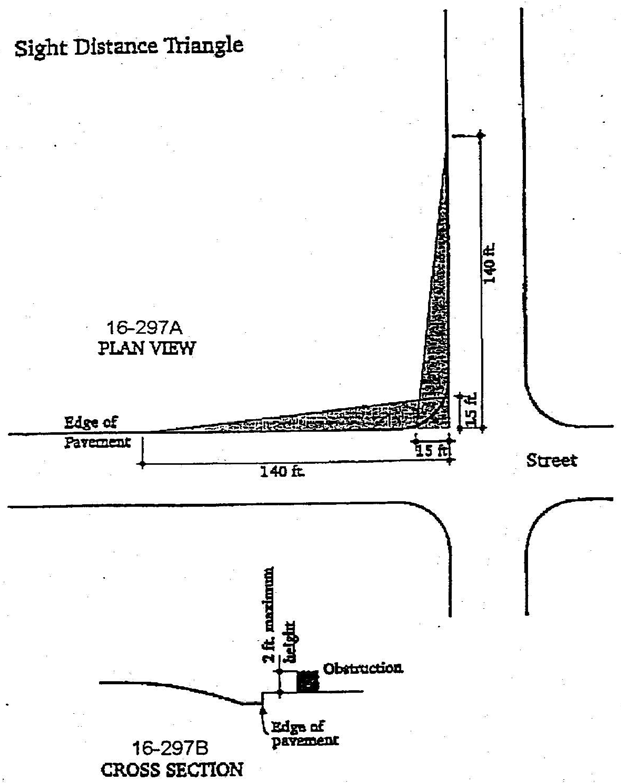
(Ord. No. 1056, § 2(Exh. B), 8-5-2024)
Sec. 16-428. - Planned Zoning Districts; Statement of Objectives.
The zoning of land to one of the planned zoning districts designated in section 16-402(b) shall be for the purpose of encouraging and requiring orderly development at a quality level generally equal to or exceeding that commonly found in projects developed under conventional zoning, but permitting deviations from the normal and established development techniques. The use of planned zoning procedures is intended to encourage large-scale developments, efficient development of small tracts, innovative and imaginative site planning, conservation of natural resources and minimum waste of land. The following are specific objectives of the planned zoning districts:
(a)
Planned developments are groupings of buildings or building sites that are planned as an integrated unit or cluster on property under unified control or ownership at the time the zoning was approved by the City. The sale, subdivision or other partition of the site after zoning approval does not exempt or protect the portions thereof from complying with the development standards, architectural quality, sign concepts and other conditions that were committed to at the time of the rezoning. The submittal by the developer and the approval by the City of development plans represents a firm commitment by the developer that development will indeed follow the approved plans in concept, intensity of use, aesthetic levels and quantities of open space.
(b)
Planned commercial and industrial developments should be designed so as to result in attractive, viable and safe centers and clusters, as opposed to strip patterns along thoroughfares. Control of vehicular access, architectural quality, landscaping and signs will be exercised to soften the impact on nearby residential neighborhoods, and to assure minimum adverse effects on the street system and other services of the community.
(c)
The developer will be given latitude in using innovative techniques in the development of land not feasible under application of conventional zoning requirements.
(d)
Deviations from the performance and development standards, as provided for in section 16-449, may be approved if it is deemed that other amenities or conditions will be gained to the extent that an equal or higher quality development is produced.
(Ord. No. 1056, § 2(Exh. B), 8-5-2024)
Sec. 16-429. - Planned Zoning Districts; Standards of Development.
(a)
The uses permitted in any planned zoning district shall be those set forth in the section applicable to that planned zoning district. Provided, however, were found to be reasonably necessary in the interest of the public health, safety and general welfare, the City may condition approval of a development plan by specifying that certain uses otherwise permitted in the district shall not be allowed in that particular development.
(b)
At the time of preliminary development plan approval, the applicant may propose, or the City may require, that a phasing plan be submitted setting forth the timing and sequencing of development among various types of uses or subgroups of uses or buildings in the development.
(c)
As a general rule, the floor area ratio shall be as set forth in the section applicable to a particular planned zoning district. Provided, however, that as long as the overall density of the development does not exceed the density otherwise permitted for a parcel of that size, taking into consideration standard street patterns and right-of-way requirements, the density of portions of the development may vary from that otherwise applicable to that planned zoning district. In determining whether or not to allow the density of development to be varied, the Planning Commission and Governing Body shall give consideration to the following: (1) the amount, location and proposed use of common space; (2) the location and physical characteristics of the site of the proposed development; and (3) the location, design and type of uses.
(d)
Any common open space resulting from the variance of standards for density of land shall be set aside for the use and benefit of the occupants of the development. The amount of common open space shall be determined at the time of preliminary development plan approval. As a condition of preliminary plan approval, the Planning Commission or Governing Body may require that the developer provide for and establish an agency for the ownership and maintenance of any common open space and may require assurance of the financial and administrative ability of any agency. Further, the Planning Commission or Governing Body may require that any agency shall not be dissolved or permitted to dispose of any common open space by sale or otherwise (except to a new agency assuming all the duties and obligations of the original agency) without first offering to dedicate the same to the City or any other government agency. Failure of the agency to maintain the common open space shall be considered to be a violation of the ordinance from which this chapter derives.
(e)
At the time of final development plan approval the Planning Commission may apply the provisions of Article 14, Subdivision Regulations, to the planned development and upon the acceptance of the Governing Body, the filing of the final development plan with the Register of Deeds shall constitute the effective dedication of easements, rights-of-way, access control and the equivalent of an alternate for the platting of land prior to the issuance of buildings permits for the planned development. Rule exceptions to the standards set forth in Article 4 of this chapter may be granted at the time of the final development plan approval under the same conditions applicable to plat approvals.
(f)
Standards for the design, bulk and location of buildings and structures shall be as set forth in the sections applicable to any planned zoning district. Provided, that the Planning Commission or Governing Body may, in the process of approving preliminary or final development plans, approve the following deviations from the minimum standards where there is ample evidence that the deviations will not adversely affect neighboring property and that this action will not constitute the mere granting of a privilege:
(1)
Setbacks of buildings and paved areas from a public street right-of-way may be reduced to 75 percent of the stated requirement.
(2)
Setbacks of buildings from a property line other than a public street right-of-way may be reduced to 85 percent of the stated requirement and setbacks of paved areas from a property line other than a public street right-of-way may be reduced to zero, if existing or proposed development on that adjacent land justifies any reduction.
(3)
Side yards between buildings may be reduced to zero.
(4)
Setbacks of buildings and paved areas from a freeway right-of-way may be reduced to five feet.
(5)
A portion of the parking area required under this title may remain unimproved until such time as the City Council deems it must be improved to serve parking demand adequately.
(6)
Reduction of setbacks or other open space shall be compensated by additional open space in other appropriate portions of the project and shall be in keeping with good land use planning principles.
(g)
The Planning Commission or Governing Body may, in the process of approving preliminary or final development plans, approve deviations from applicable development standards other than those listed in subsection (f) of this section only if it finds that all of the following conditions are met:
(1)
That the deviation requested arises from a condition which is unique to the property in question, is not ordinarily found in the same zoning district, and is not created by an action or actions of the landowner or the applicant.
(2)
That the granting of the deviation will not adversely affect the rights of adjacent landowners or residents.
(3)
That the strict application of the provisions of this chapter would constitute unnecessary hardship upon the landowner represented in the application.
(4)
That the deviation desired will not adversely affect the public health, safety, morals, order, convenience, prosperity or general welfare.
(5)
That the granting of the deviation will not be opposed to the general spirit and intent of this chapter.
(h)
The design of all planned developments shall be that access and circulation by firefighting equipment and other emergency vehicles is assured and may not be retarded by steep grades, heavy landscaping or building spacing.
Sec. 16-430. - Planned Industrial Park District; Uses.
In a planned industrial park district, District P-I, no building or premises shall be used and no building or structure shall be hereafter erected or altered, unless otherwise provided in this article, except for the following:
(a)
Manufacturing, processing, fabrication or assembling of any commodity or equipment, except junk or salvage;
(b)
Sale, distribution, wholesaling, warehousing and storage of any commodity, except junk or salvage;
(c)
Offices, laboratories;
(d)
Public utility facilities;
(e)
Storage of vehicles clearly accessory and necessary to the normal operation of the uses;
(f)
Freight terminals;
(g)
Restaurants and automatic food and beverage vending machines;
(h)
Structures and uses that are clearly accessory and necessary to the normal operation of the above uses, including signs as provided in this Code; and
(i)
Communications Facilities as follows, subject to the application, location and performance standards set forth in Article 11 of this Chapter:
(1)
Towers up to a maximum height of 100 feet; provided, an additional 50 feet to accommodate Collocation may be approved upon submission of information certifying the capacity of the Tower for up to two additional providers and an owner's letter indicating the owner's intent to share space. A lightning rod, not to exceed ten feet, shall not be included within these height limitations.
(2)
Base Stations that comply with the same height and setback requirements as other structures in this district.
(3)
Antennas mounted on existing buildings and water towers.
(4)
Small Cell/DAS Facilities on utility poles or street lights in the public right-of-way.
(Ord. No. 944, § 8, 11-21-2016)
Sec. 16-431. - Planned Industrial Park District; Standards.
All uses above shall meet the following minimum standards:
(a)
A planned industrial park shall consist of a minimum area of four acres; provided, however, that an area of less than four acres may be zoned for a planned industrial park so long as it abuts an area presently zoned planned industrial park district;
(b)
All operations shall be conducted within a fully enclosed building;
(c)
All storage of material, products or equipment shall be within a fully enclosed building or in an open yard, fenced or screened as required by the Planning Commission;
(d)
No use shall create harmful noise in excess of that of normal daily traffic measured at the lot lines of the premises;
(e)
No use shall create harmful dust, dirt, particulate matter, smoke, obnoxious odor, radiation, obnoxious gases, heat, unscreened glare, vibration or confusion;
(f)
All lights, other than publicly installed street lights, shall be located and installed to reflect the light away from abutting properties in an area zoned for or developed with residential structures;
(g)
Industrial wastes shall be of a quantity and nature as to not overburden the public sewage disposal facilities or to cause odor and unsanitary effects beyond the property line.
(h)
Communication towers are permitted to a maximum height of 100 feet. An additional 75 feet of height to accommodate co-location may be approved administratively by the City Engineer if the applicant submits information to the City Engineer's satisfaction certifying the capacity of the tower for two additional providers and a letter from the applicant indicating its intent to share space with other providers on the communication tower. A lightning rod, not to exceed ten feet, shall not be included within the height limitations. In addition, the communication tower shall be subject to the performance standards outlined in subsection 16-1101(a)(2)-(14), (17) and (20). Communication antennas located on existing buildings shall be subject to the performance standards set out in Article 11 of this chapter.
Sec. 16-432. - Planned Industrial Park District; Height, Open Space and Landscape Requirements.
(a)
The height of buildings, including equipment on the roof shall not exceed three stories or 50 feet in height.
(b)
Minimum open space requirement. At least 25 percent of the site in the industrial park district must be set aside as open space exclusive of all buildings, parking facilities and access drives. This open space shall be landscaped and maintained in a manner as to provide park-like setting for the building or buildings.
(c)
Landscape requirements. All required setback areas and open space shall be landscaped with grass, trees, shrubs and other appropriate materials in a manner as to provide a park like setting for the building or buildings. These areas shall be kept free of debris and refuse and shall be maintained by the owner, occupant or developer.
Sec. 16-433. - Planned Industrial Park District; Minimum Lot Dimensions.
The minimum dimension of setbacks and yards shall be determined at the time the preliminary development plans are approved by the Planning Commission.
Sec. 16-434. - Planned Industrial Park District; Parking.
Off-street parking shall be provided on the site of the industry or the business which it serves in an amount sufficient to meet the needs of all persons associated with the use, either as employees, customers, suppliers, or visitors, however, in no case shall all the amount of off-street parking depicted on the site plan be less than one space for each 1,000 square feet of contributing floor area. Provided however, the Planning Commission, may for good cause shown, allow the deferral of the actual building of off-street parking, so long as the requisite spaces are provided on the preliminary and final development plans and the area maintained as open space until building of the parking spaces is required. This open space may not be utilized to comply with the requirements set forth in subsection 16-432(b).
Sec. 16-435. - Planned Office Building District; Statement of Intent.
The zoning of property as CP-O, planned office building district, is intended to provide for restricted commercial development, limited to office uses and certain service and retail uses compatible with offices.
Sec. 16-436. - Planned Office Building District; Permitted Uses.
On property zoned CP-O no building, structure, land or premises shall be used, and no building or structure shall be hereafter erected, constructed, reconstructed, moved or altered, except for one or more of the following uses, subject to the development and performance standards set forth in Section 16-439:
(a)
Offices for the administrative and management functions only of businesses and civic organizations.
(b)
Services, limited to the following:
(1)
Accounting and bookkeeping;
(2)
Advertising;
(3)
Alterations and tailoring;
(4)
Banks and financial institutions;
(5)
Barber shops and beauty salons;
(6)
Broadcasting studios;
(7)
Business machine services (including photocopy; tele-facsimile; computer and data processing);
(8)
Consulting services;
(9)
Employment services;
(10)
Engineering, architects and designers;
(11)
Information services;
(12)
Insurance;
(13)
Investment services;
(14)
Labor unions and business associations;
(15)
Libraries;
(16)
Legal services;
(17)
Medical and dental offices and clinics;
(18)
Medical and optical labs;
(19)
Postal services;
(20)
Public and private utilities;
(21)
Real estate;
(22)
Securities and commodities brokers; and
(23)
Travel agents.
(c)
Marketing, display or repairs of office business equipment.
(d)
Antennas mounted on existing structures subject to the performance standards set forth in Article 11 of this Chapter; provided that, the Antenna is installed on an existing structure (such as a building, utility pole, water tower, etc.) three stories in height or greater but no less than 35 feet and; provided also that, the Antennas shall add no more than 20 feet to the height of that existing structure. Antennas that are architecturally compatible with the building architecture may locate on nonresidential buildings less than three stories or 35 feet in height, subject to final development plan approval in accordance with subsection 16-328. Equipment associated with the Antenna may be permitted on the roof so long as it is screened from view in accordance with Section 16-1010.
(Ord. No. 944, § 9, 11-21-2016)
Sec. 16-437. - Planned Office Building District; Height and Area Regulations.
The height of buildings and the minimum dimensions of lots and yards shall be as follows:
(a)
Height: Permitted height shall be determined at the time of preliminary development plan approval.
(b)
Minimum front yard:
(1)
Buildings 30 feet in height or less—30 feet.
(2)
Buildings in excess of 30 feet in height—Equal to the average height of the building above finished grade, but need not be more than 100 feet.
(c)
Side yard setbacks:
(1)
Setbacks from an interior side lot line:
(i)
Buildings not exceeding 18 feet in height—Seven feet;
(ii)
Buildings not exceeding 30 feet in height—Ten feet;
(iii)
Buildings in excess of 30 feet in height—20 feet.
(2)
Setbacks from street-side lot lines:
(i)
Buildings up to 60 feet in height—30 feet;
(ii)
Buildings in excess of 60 feet in height—Equal to one-half of the average height of the building above finished grade, but not less than 30 feet.
(d)
Minimum rear yard—30 feet.
(e)
Floor area ratio: The maximum floor area ratio shall be .35. For purposes of this section, and other applicable sections of this chapter, the term "floor area ratio" shall mean the numerical ratio between the floor area of the building(s) on the site and the gross land area of the site, measured in square feet. "Floor area" shall mean the sum of areas for use on all floors of a building measured from the outside faces of the exterior walls including halls, lobbies, stairways, elevator shafts, enclosed porches and balconies, and below grade areas used for habitation and access, work or storage space. Not countable as floor area are parking garages, carports, open terraces, patios, atriums or balconies. "Gross land areas" shall mean all land, described as conveyed to the owner, for which a preliminary development plan is sought and includes all existing and proposed public and private streets plus one-half of any abutting street rights-of-way, excluding state and federal street rights-of-way.
Sec. 16-438. - Planned Office Building District; Parking Regulations.
A minimum of 3.8 off-street parking spaces shall be provided the premises, but not within 30 feet of a street right-of-way, for each 1,000 square feet of total floor area.
Sec. 16-439. - Planned Office Building District; Development and Performance Standards.
(a)
No merchandise shall be handled or displayed except inside buildings and no equipment or vehicle other than passenger cars shall be stored outside a building in this district for more than 24 hours in a 30-day period.
(b)
Pharmacies or optical shops are permitted as an accessory use in medical office buildings, provided that there shall be no street exterior entrance to the pharmacy or optical shop and no exterior sign or advertising relative to the pharmacy or optical shop.
(c)
In no case shall the noise level exceed 60 dB(A) at repeated intervals or for a sustained length of time measured at any point along the property line.
(d)
Any lighting used to illuminate an off-street parking area, sign or other structure shall be arranged as to deflect light away from any adjoining residentially zoned property or from public streets. Direct or sky-reflected glare from flood lights or commercial operations shall not be directed into any adjoining property. The source of lights shall be hooded or controlled. Bare incandescent light bulbs shall not be permitted in view of adjacent property or public right-of-way. Any light or combination of lights that cast light on a public street shall not exceed one footcandle (meter reading) as measured from the center line of the street. Any light or combination of lights that cast light on adjacent residentially zoned property shall not exceed 0.5 foot-candles (meter reading) as measured from the property line.
(e)
All business shall be conducted within the building, except as follows:
(1)
Financial institutions may be permitted drive-up or walk-up service as part of final development plan approval.
(2)
Day-care centers and preschools may be permitted outdoor activity areas as part of final development plan approval.
(f)
Areas devoted to the display of business equipment shall not exceed 50 percent of any tenant space. Areas devoted to repair services shall not exceed ten percent of any tenant space. No over-the-counter sales shall be permitted.
Sec. 16-440. - Planned Restricted Business District; Statement of Intent.
The zoning of property as CP-1, planned restricted business district, is intended to provide for the majority of retail business uses within the City. These districts are limited to retail activities which are conducted wholly within the facility, with certain minor exceptions. The districts are intended to be used primarily for neighborhood shopping centers.
Sec. 16-441. - Planned Restricted Business District; Permitted Uses.
On property zoned CP-1, no building, structure, land or premises shall be used, and no building or structure shall be hereafter erected, constructed, reconstructed, moved or altered, except for one or more of the following uses, subject to the development and performance standards set forth in section 16-444:
(a)
Any use permitted in District CP-O subject to the applicable development and performance standards.
(b)
Retail sale of goods and services including or similar to the following, but excluding any use specifically listed in District CP-2:
(1)
Apparel;
(2)
Antiques;
(3)
Appliances;
(4)
Appliance and electronics repair;
(5)
Art galleries and studios (includes photo);
(6)
Automotive parts;
(7)
Bakeries (retail only);
(8)
Books and periodicals;
(9)
Cameras and photo equipment;
(10)
Carpet and floor coverings;
(11)
Consumer electronics;
(12)
Drugs and cosmetics;
(13)
Flowers and plants;
(14)
Food (including candy, meat and specialty items);
(15)
Furniture and home furnishings;
(16)
Greeting cards and stationery;
(17)
Hardware;
(18)
Health or fitness clubs;
(19)
Housewares and kitchenware;
(20)
Interior decorating;
(21)
Jewelry;
(22)
Junior department stores (less than 80,000 square feet);
(23)
Mortuaries and funeral parlors;
(24)
Music and musical instruments;
(25)
Office supplies;
(26)
Optical shops;
(27)
Package sales of alcoholic liquor or cereal malt beverages;
(28)
Paint and wallpaper;
(29)
Pet stores;
(30)
Photocopying and retail printing;
(31)
Picture framing;
(32)
Restaurants;
(33)
Shoe repairs;
(34)
Sporting goods and bicycles;
(35)
Toys and hobby supplies;
(36)
Veterinarian (domesticated pets only);
(37)
Video rental.
(c)
Dry cleaning and laundry pick-up or coin-operated laundry and dry cleaning operations classified as low hazard in applicable Codes.
(d)
Customary accessory uses.
Sec. 16-442. - Planned Restricted Business District; Height and Area Regulations.
The maximum height of buildings and the minimum dimensions of lots and yards shall be as follows:
(a)
Height: Permitted height shall be determined at the time of preliminary development plan approval.
(b)
Minimum front yard:
(1)
Buildings not exceeding 30 feet in height—30 feet.
(2)
Buildings in excess of 30 feet in height—30 feet plus one foot for each five feet in height over 30 feet or portion thereof.
(c)
Side yards:
(1)
No side yard is required except that where a side lot line abuts the side lot line of residentially zoned property, or property zoned office building district or planned office building district, a side yard shall be provided which is at least equal to the minimum side yard required in the district which the property abuts, plus one foot for every six feet of building height over 30 feet or portion thereof.
(2)
On the street side of a corner lot, a side yard shall be provided of 15 feet, plus one foot for every four feet of building height over 30 feet or portion thereof.
(3)
Except where the foregoing provisions would require a greater side yard, the minimum side yard shall be 20 feet where that side yard abuts any residentially zoned property, and the minimum side yard shall be 15 feet where that side yard is separated from any residentially zoned property by a street.
(d)
Rear yard: No rear yard is required except as provided hereinafter. Where a rear lot line abuts residentially zoned property or property zoned office building district or planned office building district, a rear yard shall be provided of not less than ten feet, plus one foot for every six feet of building height over 30 feet or portion thereof; where a rear lot line abuts a street, a rear yard shall be provided of not less than 15 feet, plus one foot for every six feet of building height over 30 feet for a portion thereof; in any case, where the rear yard abuts any residentially zoned property, the minimum rear yard shall be 30 feet, and where the rear yard is separated form any residentially zoned property by a street, the minimum rear yard shall be 20 feet.
(e)
Floor area ratio: The maximum floor area ratio shall be .25.
(f)
Setback: The minimum setback of all buildings or structures from Roe Boulevard shall be 30 feet.
Sec. 16-443. - Planned Restricted Business District; Parking Regulations.
In district CP-1, parking shall be provided on the premises in the following minimum amounts:
(a)
[Four] spaces per 1,000 square feet of total floor areas for any structure up to 400,000 square feet in total floor area.
(b)
[Four and one-half] spaces per 1,000 square feet of total floor area for any shopping center in excess of 400,000 square feet in total floor area.
Sec. 16-444. - Planned Restricted Business District; Development and Performance Standards.
(a)
No wholesale sales shall be conducted.
(b)
No goods, merchandise, or equipment shall be stored or displayed outside of a fully enclosed building, except, if the storage or display is screened or fenced in accordance with an approved final development plan.
(c)
All goods, merchandise and equipment shall be sold or rented, and all business activities or services shall be rendered or conducted inside of a fully enclosed building, except that drive-up or walk-up service shall be permitted if approved as a part of a final development plan; provided, however, that drive-up, walk-through or walk-up restaurants shall not be permitted; provided further, that each permitted use shall be allowed to locate food and/or drink vending machines immediately adjacent to the enclosed building from which the business or service is conducted.
(d)
No smoke, radiation, vibration or concussion, heat or glare shall be produced that is perceptible outside a building, and no dust, fly ash or gas that is toxic, caustic or obviously injurious to humans or property shall be produced.
(e)
In no case shall the noise level exceed 60 dB(A) at repeated intervals or for a sustained length of time measured at any point along the property line.
(f)
Sales and consumption of cereal malt beverages or alcoholic liquor are prohibited except as follows:
(1)
Package liquor stores licensed with the State of Kansas and the City shall be allowed provided that the exterior walls of the establishment are at least 200 feet from the nearest property line of any hospital, school, church or library. For purposes of this section, the term "school" shall mean any public, private or parochial learning facility for children in pre-school through grade 12 accredited by the State Board of Education or, where required, certified as a pre-school by the Kansas Department of Health & Environment.
(2)
Food service establishments serving cereal malt beverages and clubs serving alcoholic liquor shall be allowed where the sales of food for consumption on the premises exceeds 30 percent of the annual gross income for the establishment, provided that the exterior walls of the establishment are at least 200 feet from the nearest residentially zoned property line. A special use permit shall be required for those establishments within 200 feet of residentially zoned property.
(3)
Package sales of cereal malt beverages not for consumption upon the premises shall be allowed.
(g)
Eating establishments may have an outdoor service area that is accessory to the main restaurant function. The outdoor service area must be a well-defined space, designed and serviced to keep debris from blowing off the premises. Patrons must gain entrance through the main entrance to the restaurant, but at least one exit shall be provided for fire safety. Parking shall be provided on-site at a ratio of one parking space for each three seats.
(h)
Any lighting used to illuminate an off-street parking area, sign or other structure shall be arranged as to deflect light away from any adjoining residentially zoned property or from public streets. Direct or sky-reflected glare from floodlights or commercial operations shall not be directed into any adjoining property. The source of lights shall be hooded or controlled. Bare incandescent light bulbs shall not be permitted in view of adjacent property or public right-of-way. Any light or combination of lights that cast light on a public street shall not exceed one footcandle (meter reading) as measured from the centerline of the street. Any light or combination of lights that cast light on adjacent residentially zoned property shall not exceed 0.5 foot-candles (meter reading) as measured from that property line.
Sec. 16-445. - Planned General Business District; Statement of Intent.
The zoning of property as CP-2, planned general business district, is intended to provide for all but the harshest commercial uses. Outside storage and display of merchandise is permitted in this district.
Sec. 16-446. - Planned General Business District; Permitted Uses.
On property zoned CP-2, no building, structure, land or premises shall be used, and no building or structure shall be hereafter erected, constructed, reconstructed, moved or altered, except for one or more of the following uses, subject to the development and performance standards set forth in section 16-449:
(a)
Any use permitted in district CP-1 subject to the applicable development and performance standards.
(b)
Retail sale of goods and services including or similar to the following:
(1)
Building supplies;
(2)
Communication and specialty electronics;
(3)
Delivery services;
(4)
Department stores;
(5)
Gasoline and other motor vehicle fuels;
(6)
Glass;
(7)
Medical equipment;
(8)
Newspaper publishing and printing;
(9)
Office equipment;
(10)
Theaters, movie and stage.
(c)
Rental, leasing or sale at retail or wholesale of new or used automobiles, motorcycles, trucks, trailers, recreational vehicles, boats, construction equipment and farm machinery.
(d)
Rental or leasing of furniture and home furnishings.
(e)
Passenger car repair in connection with new passenger car sales, and automotive services limited to class installation and replacement, brake and muffler repairs, window tinting, radio and stereo installation, tire and battery stores, and tune-up, quick lube and auto diagnostic centers.
(f)
Sales and servicing of swimming pools, patio furnishings and related equipment.
(g)
Rental or leasing of lawn care equipment.
(h)
Commercial or wholesale facilities for bakeries, printing and publishing, cold storage and ice, and nurseries and greenhouses.
(i)
Car washes.
(j)
Clubs and drinking establishments.
(k)
Services such as pest control, custom maintenance and small equipment repair.
(l)
Classrooms and training facilities for business and trade schools.
(m)
Entertainment or recreational uses including or similar to the following: bowling alleys; pool or billiard parlors; skating rinks; tennis and racquet courts; and miniature golf.
(n)
Plumbing and electrical supplies and services.
(o)
Taxi and limousine dispatching centers.
(p)
Hospitals.
(q)
Hotels and motor hotels.
(r)
Customary accessory uses.
Sec. 16-447. - Planned General Business District; Height and Area Regulations.
The maximum height of buildings and the minimum dimensions of lots and yards shall be as follows:
(a)
Height: Permitted height shall be determined at the time of preliminary development plan approval.
(b)
Minimum front yard:
(1)
Buildings not exceeding 30 feet in height—30 feet.
(2)
Buildings in excess of 30 feet in height—30 feet, plus one foot for every four feet in height over 30 feet or portion thereof.
(c)
Side yards:
(1)
No side yard is required except that where a side lot line abuts the side lot line of residentially zoned property, or property zoned office building district or planned office building district, a side yard shall be provided which is at least equal to the minimum side yard required in the district which the property abuts, plus one foot for every six feet of building height over 30 feet or portion thereof.
(2)
On the street side of a corner lot, a side yard shall be provided of 15 feet, plus one foot for every four feet of building height over 30 feet or portion thereof.
(3)
Except where the foregoing provisions would require a greater side yard, the minimum side yard shall be 20 feet where that side yard abuts any residentially zoned property, and the minimum side yard shall be 15 feet where that side yard is separated from any residentially zoned property by a street.
(d)
Rear yards: No rear yard is required except as provided hereinafter. Where a rear lot line abuts residentially zoned property, or property zoned office building district or planned office building district, a rear yard shall be provided of not less than ten feet, plus one foot for every six feet of building height over 30 feet or portion thereof where a rear lot line abuts a street, a rear yard shall be provided of not less than 15 feet, plus one foot for every six feet of building height over 30 feet or a portion thereof; in any case, where the rear yard abuts any residentially zoned property, the minimum rear yard shall be 30 feet, and where the rear yard is separated from any residentially zoned property by a street, the minimum rear yard shall be 20 feet.
(e)
Floor area ratio: The maximum floor area ratio shall be .25.
(f)
Setback: The minimum setback of all buildings or structures from Roe Boulevard shall be 30 feet.
Sec. 16-448. - Planned General Business District; Parking Regulations.
In district CP-2, parking shall be provided on the premises in the following minimum amounts:
(a)
Four spaces per 1,000 square feet of total floor area for any structure up to 400,000 square feet in total floor area.
(b)
[Four and one-half] spaces per 1,000 square feet of total floor area for any shopping center in excess off 400,000 square feet in total floor area.
Sec. 16-449. - Planned General Business District; Development and Performance Standards.
All uses permitted in the planned general business district, pursuant to section 16-444 or section 16-318, shall meet the following minimum standards:
(a)
Drive-through service wherein a patron is served through a window or other device while remaining in a motor vehicle may be provided except where cereal malt beverages in any form are served or sold through the drive-through window. All property for which drive-through food service is provided shall comply with the following standards:
(1)
No order box or order window shall be located within 175 feet of any residentially zoned property; provided, however, that the 175-foot distance may be reduced by a maximum of 25 percent at the time of final development plan approval where circumstances warrant the reduction.
(2)
A solid screening fence or wall shall be required to be placed between any property used for a drive-through facility and any abutting residentially zoned property in order to screen passenger car headlight glare from adjacent residential property. The extent and height of the fence or wall is to be determined at the time of final development plan approval, but with a minimum height of six feet.
(3)
Adequate passenger car stacking space shall be provided from the order box or order window to ensure that public right-of-way or common driveway easements will not be blocked due to the drive-through facility. The amount of stacking space is to be determined as a part of the preliminary development plan at the time of the rezoning of the property and after consultation with the City Engineer.
(b)
Offices for the rental, lease or sale of new and used motor vehicles may be permitted only after final development plans for these uses have been approved with the following standards applying:
(1)
The servicing of the motor vehicles shall occur inside a building.
(2)
The number of vehicles to be kept on the site at any one time shall be determined by the size and location of the site and its relationship to surrounding property. The motor vehicles shall be stored in an orderly manner on the site as depicted on the approved plan.
(3)
No advertising shall be permitted on the motor vehicles.
(c)
No smoke, radiation, vibration or concussion, or heat shall be produced that is perceptible outside a building and no dust fly ash or gas that is toxic, caustic or obviously injurious to humans or property shall be produced.
(d)
In no case shall the noise level exceed 60 dB(A) at repeated intervals or for a sustained length of time measured at any point along the property line.
(e)
Any lighting used to illuminate an off-street parking area, sign or other structure shall be arranged as to deflect light away from any adjoining residentially zoned property or from public streets. Direct or sky-reflected glare, from floodlights or commercial operations, shall not be directed into any adjoining property. The source of lights shall be hooded or controlled. Bare incandescent light bulbs shall not be permitted in view of adjacent property or public right-of-way. Any light or combination of lights that casts light on a public street shall not exceed one foot-candle (meter reading) as measured from the centerline of the street. Any light or combination of lights that cast light on adjacent residentially zoned property shall not exceed 0.5 foot-candles (meter reading) as measured from that property line.
(f)
No goods, merchandise, or equipment shall be stored or displayed outside of a fully enclosed building, except if the storage or display is screened or fenced in accordance with an approved final development plan. In no event shall merchandise displayed or stored outside a fully enclosed building in accordance with an approved final development plan be stored on the public sidewalk or street, reduce the capacity of a parking lot below that required by this chapter, or occupy an area greater than 20 percent of the ground floor area of the building. Motor vehicles for sale may be stored or displayed outside a building, but not within 15 feet of a street right-of-way, nor within six feet of a side or rear lot line.
(g)
The sale and consumption of cereal malt beverages and alcoholic liquor shall be subject to the provisions set out in subsection 16-444(f).
(h)
The sale, dispensing, or changing hands of any cereal malt beverages shall be prohibited at facilities used for motor vehicle repair, service or the sale of gasoline or other motor vehicle fuels, except where the business conforms to all of the following minimum requirements.
(1)
The business shall contain not less than 800 square feet of sales display area, exclusive of storage rooms and walk-in refrigeration coolers.
(2)
The business shall have at least two employees on duty on the premises at all times.
(i)
Outdoor kennels or runs are not permitted in conjunction with veterinary clinics without a special use permit.
Sec. 16-450. - "MXD" Planned Mixed-Use District; General Purpose and Description.
The zoning of property to MXD, planned mixed use district, is intended to encourage sustainable neighborhoods with a mixture of land uses, independently or when combined with adjacent mixed use zoned areas, which create a distinctive and unique sense of place. This district is expected to have a pedestrian orientation with a mixture of residential, office and retail uses in closer proximity to one another than would be possible with conventional zoning districts. Developments in this district are expected to have a defined character, public spaces and a central gathering space or focal point. Developments are also expected to utilize shared parking facilities linked to multiple buildings and uses by an attractive and logical pedestrian network that places more emphasis on the quality of the pedestrian experience than is generally found in typical suburban development. Buildings are intended to be primarily multistory structures with differing uses organized vertically rather than the horizontal separation of uses that commonly results from conventional zoning districts.
Sec. 16-451. - Permitted Uses.
Mixed use districts are encouraged to include a mix of residential, office and commercial uses, either within an individual property zoned "MXD" or as part of a larger area of similarly zoned properties. The size, location, appearance and method of operation may be specified to the extent necessary to ensure compliance with the purpose of this district. After approval of the MXD District, uses may be added, changed or deleted by amendment. The procedure for considering an amendment shall be the same as for the original adoption. Permitted uses include the following, unless otherwise modified or prohibited by the ordinance granting a MXD planned mixed use district:
(a)
Any use permitted in District CP-1.
(b)
Multiple-family dwellings.
(c)
Live-work spaces.
(d)
Any other use established by the ordinance granting a MXD planned mixed use district.
Sec. 16-452. - Design Guidelines.
Development in areas zoned MXD, planned mixed use district shall be subject to any design guideline standards for the area as adopted by resolution.
Sec. 16-453. - Area and Height Regulations.
Area and height regulations for each separate MXD, planned mixed use district, shall be set forth in the ordinance granting the MXD district and may include but shall not be limited to: lot area, lot width, lot depth, yard setbacks, building height, lot coverage, dwelling unit size, density, and other requirements as the City Council may deem appropriate.
(a)
Building height.
(1)
No maximum height, provided that the height of buildings shall be as determined by the MXD development plan;
(2)
At least 50 percent of the total floor area (excluding structured parking) shall be located above the ground floor, with the exception of auditoriums, conference facilities, theaters, and other similar uses.
(b)
Setbacks. The requirements regulating setbacks shall conform to the following, unless otherwise approved by the City Council as a part of the preliminary development plan. Additionally, during the rezoning or preliminary development plan approval process, the City Council may require additional setbacks, if it is determined that the yard is necessary to provide adequate open space, access to light and air, a healthful living environment, prevent visual obstruction of adjoining properties, or to ensure compatibility with existing adjacent development.
(1)
Front yard setback. No minimum requirement. The front yard setback shall be established as shown on the approved MXD plans.
(2)
Side yard setback. No setback required except that where a lot line abuts the lot line of a residentially zoned property, a setback shall be required which is at least equal to the minimum setback required in the district which the MXD District abuts.
(3)
Rear yard setback. No setback required except that where a lot line abuts the lot line of a residentially zoned property, a setback shall be required which is at least equal to the minimum setback required in the district which the MXD District abuts.
Sec. 16-454. - Parking and Loading Regulations.
Off-street parking and loading requirements for each separate MXD, planned mixed use district, shall be as set forth in sections 16-801 through 16-820 unless otherwise modified by the ordinance granting the MXD district.
(a)
The City Council may reduce the parking and loading requirements set forth by sections 16-801 through 16-820 after considering documentation and/or study provided by the applicant, staff's recommendation, and giving decisive weight to all relevant facts including, but not limited to the following factors: Availability and accessibility of alternative parking; the availability of bicycle parking; impact on adjacent residential neighborhoods; existing or potential shared parking arrangements; the characteristics of the use, including hours of operation and peak parking demand times; design and maintenance of off-street parking that will be provided; and whether the proposed use is new or a small addition to an existing use.
(b)
Shared or community parking areas shall be required. Off-street parking areas shall be small in scale and divided into surface parking fields not to exceed 50 parking spaces, unless otherwise approved by the City Council.
(c)
Maximum grade level parking allowed per use or per project shall be 150 percent of the minimum parking required for that use. Any new parking facility with a capacity 200 spaces shall accommodate no more than 50 percent of the total parking at grade level.
(d)
On-street parking spaces on public and private streets may be counted towards the required off-street parking, provided the on-street spaces are located on an adjacent or internal street that allows on-street parking. These on-street parking spaces must be identified on plans at time of submittal to the City.
(e)
Unless otherwise approved by City Council, no open parking areas shall be located closer than 15 feet to a street right-of-way, or no closer than ten feet to a property line other than a street line. Parking areas within the building, or within a parking structure extending more than six feet above the finished grade, shall comply with the setback regulations of the main building. The parking setback and other open areas shall be brought to finish grade and planted with grass, shrubs and trees, and maintained to at least the average level of maintenance of the other developed property within the immediate neighborhood.
(f)
No parking areas shall be located between the front of a building and the street toward which the building faces.
(g)
No parking structures shall have any façade on any public street. All visible sides of parking structures shall be constructed with similar materials as the main building.
(h)
Bicycle Parking. To encourage the use of bicycles, safe and convenient bicycle parking shall be required for development in the MXD district. At least one bicycle parking space shall be required for each ten automobile parking spaces required in section 16-818. Bicycle parking must be provided by bicycle racks or lockers that are anchored so that they cannot be easily removed. Unless otherwise approved by City Council, bicycle parking must be located within 50 feet of an entrance to the building.
Sec. 16-455. - Development and Performance Standards.
Unless otherwise approved by the City Council, development within the MXD zoning district shall comply with the standards pursuant to section 16-449, any duly adopted design guidelines applicable for that property, and the following minimum guidelines.
(a)
Signage. Sign standards including the location, height, size, materials and design of all proposed signage shall be established by the MXD plans and set forth in the ordinance granting the MXD district.
(b)
Public open space/civic space. Formal and informal areas of usable outdoor open spaces are required. These serve as areas for community gatherings, landmarks, and as organizing elements for the neighborhood. Usable open space includes squares, plazas, greens, preserves, parks, and greenbelts.
(c)
Pedestrian and bicycle network. An interconnected network of pedestrian and bicycle facilities shall be integrated into the overall development and street design. The design of streets shall include adequate right-of-way to create safe and well furnished pedestrian and bicycle corridors in the public streetscape.
(d)
The streetscape design should include sidewalks, landscaping and street trees, pedestrian lighting, and other pedestrian amenities and furnishings such as benches, trash receptacles, bicycle racks, and similar elements contributing to the character of the area.
(e)
Street network. An interconnected network of streets shall be required. Dead-end streets, including cul-de-sac streets, are prohibited unless determined with the MXD plan approval that the most desirable plan requires laying out a dead-end street.
(f)
Roadway design. The roadway designs used within the different areas of a MXD district may vary depending on the proposed function of the roadway, the anticipated adjacent land uses, the anticipated traffic load, and appropriate accommodations for pedestrian and bicycle facilities as directed by the City Engineer. Streets in a MXD district may be narrower than in conventional development, as well as more varied in size and form to control automobile traffic and give character to the district or neighborhood. A variety of unique and innovative roadway designs that lend character to the neighborhood and provide safe pedestrian and bicycle facilities are required.
(g)
Vehicular access to alleys or lanes. Residential driveway access from a lot to an alley or lane in a MXD is permitted and preferred. Driveway access from a lot to a street is permitted, subject to architectural design and setback requirements detailed with development plan approvals. Where garage access is from the street, special architectural and setbacks are required to ensure the garage is not the dominant building feature.
(h)
Drive-up and drive-thru services. All drive-up, drive-thru, and drive-in services shall be prohibited, unless specifically exempted in the ordinance granting the MXD district. When permitted, these facilities shall be integrally designed into the development; the drive-thru lane and drive-thru window shall not be located where visible from the public street or private drive network; and shall comply with the minimum standards pursuant to section 16-449, or as specifically granted in the ordinance granting the MXD district.
(i)
Service and loading areas. All service and loading areas shall be entirely screened from view. Loading docks and overhead doors shall be incorporated into the building design and screened or located in a manner to not be visible from public streets.
(j)
Outdoor eating and drinking. Outdoor areas for eating and drinking shall be permitted and are encouraged as part of the development design. Any outdoor areas shall be designated on a final development plan. When located on public right-of-way, these areas may be subject to a right-of-way maintenance agreement.
(k)
The MXD, planned mixed use district, shall conform to all other sections of Chapter XVI unless specifically exempted in the ordinance granting the MXD district.
Sec. 16-456. - Preliminary and Final Development Plans.
The procedure for establishing a MXD district shall follow the procedure for zoning amendments as set forth in section 16-317. A tract of land may be zoned "MXD" only upon approval of a preliminary development plan. In addition, an approved final development plan shall be required for development in the MXD district. The preliminary and final development plan process shall follow the procedures established in sections 16-323 through 16-330.

