
Roeland Park City Zoning Code
ARTICLE 5
- OVERLAY DISTRICTS
Sec. 16-501.- 47 and Mission Road Area Design Review Overlay District.
Purpose and authority. The 47 th and Mission Road Area Design Review Overlay District is established by this Zoning Ordinance, enacted to implement the goals and policies of the 47 th and Mission Road Area Concept Plan, adopted by the cities of Westwood, Roeland Park, and the Unified Government of Wyandotte County and Kansas City, Kansas. The 47 th and Mission Road Area Concept Plan was drafted pursuant to:
i.
The interlocal cooperation acts, Sections 12-2901 through 12-2909 of the Kansas Statutes Annotated;
ii.
Section 12-744(c) of the Kansas Statutes Annotated; and
iii.
The interlocal agreement between the Cities of Roeland Park, Westwood, and the Unified Government of Wyandotte County/Kansas City, Kansas (collectively "Jurisdictions").
This Ordinance translates the relevant portion of the plan within the boundaries of City into the Zoning Ordinance, in addition to all current regulations. This Ordinance will accompany a similar ordinance adopted by each jurisdiction to ensure consistent implementation of the 47 th and Mission Road Area Concept Plan.
(a)
Applicability.
(1)
Property.
a.
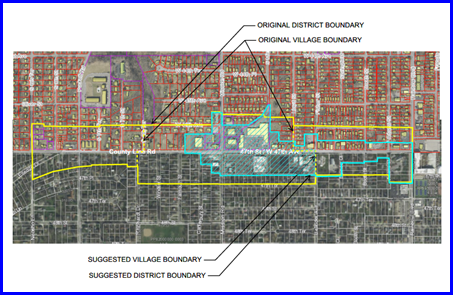
This Ordinance shall apply to all property within the City and within the 47 th and Mission Road Area Design Review Overlay District, as shown in Section 15-601(L) below as the "Suggested District Boundary", which hereby replaces the "Original District Boundary" as shown. The official zoning map of The City is hereby amended to reflect the updated 47 th and Mission Road Area Design Review Overlay District.
b.
The standards in this Ordinance shall apply to all property currently or subsequently zoned for commercial or multi-family use within this overlay district.
c.
Any property zoned for single-family residential use is included within this overlay district to indicate neighborhood areas to be protected by buffers and design enhancements established in this Ordinance for commercial or multi-family use. In addition, to further protect existing neighborhoods, any property currently zoned for single-family residential use within this overlay district which is subsequently rezoned to multi-family or commercial uses must satisfy all design standards in this Ordinance.
d.
Any legal nonconforming structure or use cannot increase its level of nonconformity without complying with this Ordinance.
(2)
Type of development. These standards shall be applied to new development, redevelopment, or exterior modifications that alters the appearance of a building or site within the overlay district including, but not limited to, building additions, facade improvements, or landscaping improvements. Only those standards required by this Ordinance and directly related to proposed development, redevelopment, or exterior modification shall be applied.
Other regulations. Within the overlay district, all City Code ordinances, policies, regulations, and plans shall apply. Where conflicts occur regarding development standards in this Ordinance, the standards established in this Ordinance shall supersede those in the conflicting ordinance, policy, regulation, or plan.
(b)
Definitions. For the purposes of this overlay Ordinance, the following terms and phrases shall have the meaning given in this section. All other terms and phrases shall use definitions given in the City Code Zoning Ordinance or other codes, unless context indicates that a standard dictionary definition is more appropriate. Terms and phrases not defined in this section or by any provision of the City Code shall have the standard dictionary definition.
Adjacent lot: A lot having a common border or endpoint with subject lot, or lots that would have a common border or endpoint in the absence of an existing right-of-way.
Development: The construction of man-made site elements on an improved or unimproved parcel of land.
Distinctly different hours of operation: Uses with hours of operation where 50 percent or more of one use's hours of operation, including peak hours of operation based on a parking demand study, are mutually exclusive of the hours of operation of the other uses which it proposes to share parking.
Distinctly different peak hours of operation: The peak hours of operation, based on a parking demand study, of uses proposing to share parking are mutually exclusive.
Exterior modification: Any maintenance, improvement, construction, or reconstruction of a structure or site, or any portion of a structure or site, that will result in an apparent change visible from the right-of-way or adjacent property.
Redevelopment: The reconstruction, enlargement, conversion, relocation of a manmade structure.
(c)
Uses.
(1)
Underlying zoning uses. The uses allowed in the 47 th and Mission Road Area Design Review Overlay District shall be those uses allowed by the current or any future underlying zoning classification, provided that all future development and redevelopment meets the standards established in this Ordinance. Any future rezoning shall be to a use district consistent with the 47 th and Mission Road Area Concept Plan.
(2)
Overlay uses. In addition to those uses allowed by the underlying zoning, all property zoned for commercial use within the 47 th Street and Mission Road, Area Design Review Overlay District shall be allowed residential uses as a supplemental use, subject to the following:
a.
No property with an underlying zone for Commercial use may have residential uses on the ground floor or at street level.
b.
No structures with supplemental residential uses may exceed 40 feet in height or 3½ stories, whichever is less.
c.
All structures with supplemental residential uses, whether new or existing at the time of adoption of this Ordinance, must comply with all other standards established in this Ordinance in order to be eligible for supplemental residential uses.
(d)
Commercial site design standards. Commercial site design in the 47 th and Mission Road Area Design Review Overlay District shall conform to the principles outlined in the 47 th and Mission Road Concept Plan. The following design standards implement and shall be interpreted consistent with the Plan.
(1)
Building placement. Site design in the 47 th and Mission Road Area shall conform to the following design standards. The provisions of this section shall apply to new development.
a.
Front setback. All new buildings shall be built to the right-of-way line unless an additional setback is required to meet the minimum sidewalk width and buffer requirements in the Pedestrian Access requirement in subsection (e) titled site access.
b.
Side setbacks. The minimum side setbacks shall be:
1.
Property abutting residential districts shall have a side setback equivalent to that of the abutting residential district. In this case, the side setback area shall be used to provide a buffer according to subsection (i) of this article.
c.
Rear setback. Minimum rear setbacks shall be as defined by the zoning regulations of the municipality that the property is located in, unless the property is abutting a residential zoned property on its rear yard property line. If abutting a residential zoned property, the setback shall be equal to the residential properties rear yard setback requirements.
d.
Continuous building frontage. Building facades on the street frontage should be maximized to provide continuous corridors within the overlay district. All lot frontages should be occupied by building frontages except for entrance drives or alleys to rear parking, courtyards or patios, or any side parking. In the case of courtyards and patios, or side parking, the appearance of a continuous building frontage shall be maintained by a 2½- to four-foot fence or wall constructed out of the same material as the building facade, or by a continuous landscape element.
e.
Main entrance. The main entrance of all buildings shall be oriented to the street. In the case of the corner lots, a building may have one entrance on each street or may have one corner entrance facing the intersection at a 45-degree angle.
(e)
Site access.
(1)
Pedestrian access. All buildings shall have a continuous sidewalk along the frontage of the lot. The sidewalk shall be seven feet wide. All sidewalks shall be buffered from vehicular traffic with a minimum three-foot buffer zone that includes landscaping, street trees, street furniture, pedestrian lighting, bicycle facilities, or other amenities that provide physical separation from vehicular traffic. Alternative: Sidewalks outside the Village Area (as identified as the "Suggested Village Boundary" in the 47 th and Mission Road Area Design Review Overlay District) may be a minimum of five feet in width, but the three-foot buffer zone must be maintained. Alternative: Where unique site characteristics prevent a seven-foot sidewalk and three-foot buffer zone from being achievable in the Village Area, sidewalk widths shall be maximized on that site.
a.
Vehicle access. Curb cuts in the 47 th and Mission Road Area should be minimized. Wherever possible, adjacent properties are encouraged to minimize curb cuts by use of shared parking or shared access to separate parking lots.
b.
Connections. Continuous pedestrian connections shall be provided through all parking lots and between parking lots and store-front sidewalks. These pedestrian connections shall primarily be pedestrian-only sidewalks but may include crosswalks across parking lot drive aisles and driveways where necessary. The following design elements shall be used to maintain pedestrian connections and minimize conflicts with vehicles:
1.
Alleys, driveways, and parking lot drive aisles shall not exceed 24 feet for two-way access or 12 feet for one-way access.
2.
"Bulb outs" for pedestrian-only travel should be used to minimize the distance of pedestrian walkways across driveways, alleys, parking lots, or other vehicle access ways.
3.
All pedestrian walkways across driveway[s], alleys, parking lots, or other vehicle access ways shall be distinguished from the vehicle access way by a visually identifiable path or distinctly textured surface.
(f)
Parking.
(1)
Required parking. The parking required for uses in the overlay district shall be established by the applicable standards for the underlying zoning district.
a.
Location. Parking shall be provided primarily behind buildings in the Village Area. Parking on commercial lots outside the Village Area should be located primarily behind the building but may be located on the side of the building.
b.
Shared parking. Parking requirements in the overlay district may be met through shared parking according to the following conditions and standards:
1.
A written agreement for the joint use of the parking facilities shall be executed by the parties, approved by the City and recorded with the register of deeds for any county in which property subject to the agreement is situated. The agreement shall include any necessary cross access easements among property owners. Must meet all other shared parking standards of the said jurisdiction.
2.
Parking requirements are cumulative except that parking may be shared based on uses either on the same site or on other sites that meet the requirements of this Section 16-501, at the sole discretion of City, according to the following standards:
3.
When two or more uses have distinctly different hours of operation (e.g., commercial office and residential, or church and school), 100 percent of the required parking may be shared. Required parking shall be based on the use that demands the greatest amount of parking per the underlying Ordinance requirement.
4.
When two or more uses have distinctly different peak hours of operation (e.g., office and restaurant/entertainment), 50 percent of the required parking spaces may be shared among the uses.
5.
Shared parking shall meet jurisdiction standards. If the parking spaces are more than 800 feet from the main entrance of the building.
(2)
Direct pedestrian access, meeting the requirements of Section 16-501, is required between any shared parking and the main entrance of any building proposing to share parking.
a.
Applicants for shared parking shall submit a statement indicating the ability of the proposed shared parking arrangement to meet the demands of all uses involved. The statement shall include hours of operation, hours of peak operation, forecasted demand, and other data indicating the appropriateness of shared parking.
b.
Any change of use or other change causing violation of the shared parking agreement or these standards shall invalidate the shared parking eligibility, and the parking requirements of the underlying Zoning Ordinance shall be met. A plan for meeting the parking requirements of this Ordinance if the shared agreement is invalidated must be submitted with the proposed agreement.
c.
On-street parking. Any on-street parking, authorized by City and within 300 feet of the lot, may be credited towards the on-site parking requirements. A maximum of ten percent of the required parking may be satisfied by on-street parking credits. On-street parking spaces may be counted by more than one user in meeting this requirement.
d.
Bicycle parking. Bicycle parking facilities are required at a rate of one bicycle for every 15 required vehicle parking spaces, with a minimum of two bicycle parking spaces. Bicycle parking facilities may be counted by more than one property in meeting this requirement, as long as the facility is within 150 feet of the entrance and the total required parking is met for each property.
e.
Landscape elements. Parking lots larger than 20 spaces shall incorporate at least one internal landscape island into the lot design. Landscape islands shall be at least ten percent of the parking lot area. Each required landscape island shall be a minimum of 20 square feet and a maximum of 500 square feet. Landscape islands shall maintain a minimum five-foot width at all times. Landscape islands shall be planted with landscape elements consistent with subsection (i) of this article. Landscape elements along the perimeter of a parking lot shall not count towards the landscape island requirement. Where a parking lot incorporates internal rows of parking, each row shall be terminated with a landscape element.
f.
Lighting. Exterior lighting on commercial properties shall be designed to have minimal light trespass onto adjacent residential properties.
(g)
Lighting.
(1)
All exterior lighting on the building must be full cut-off with non-adjustable heads to direct light 90 degrees downward. No light may cast light or glare off the property or onto the public street.
(2)
Any lighting used to illuminate an off-street parking area, sign or other structure shall be arranged as to deflect light away from any adjoining residentially zoned property or from public streets. Direct or sky-reflected glare, from floodlights or commercial operations, shall not be directed into any adjoining property. The source of lights shall be full cut-off with non-adjustable heads to direct light 90 degrees downward. Bare light bulbs shall not be permitted in view of adjacent property or public right-of-way.
(3)
Any light or combination of lights that casts light on a public street shall not exceed one foot-candle (meter reading) as measured from the centerline of the street. Any light or combination of lights that cast light on adjacent residentially zoned property shall not exceed 0.5 foot-candles (meter reading) as measured from that property line.
(4)
Applicants shall be required to submit a base meter reading as part of their application materials.
(h)
Architecture features.
(1)
Enhanced entrances. All main entrances shall be enhanced by architectural details. Such details may include, but are not limited to, slightly protruding entrances, building material variations, color variations, or artistic elements and other special treatments.
(2)
Windows. All buildings shall be predominantly transparent at the street level, with a minimum of 40 percent and a maximum of 80 percent of the facade occupied by windows. Upper levels may be less transparent, with a minimum of 25 percent of the facade occupied by windows.
(3)
Awnings and canopies. Awnings or canopies are encouraged on facades to provide weather protection and shade to pedestrians, and to add visual appeal to the 47 th and Mission Road Area Design Review Overlay District. Awnings and canopies may project into the building setback or right-of-way provided they are a minimum of seven and one-half feet above grade. Any awnings provided shall be fabric and shall not be back-lit. Permanent canopies may be constructed if designed as an integral part of the structure. All awnings or canopies on a single block shall be hung at the same height above finished floor elevation of the building it is associated with.
(4)
Facade lighting. Facade lighting is encouraged within the overlay district. Facade lighting may be used to highlight architectural features of a building, provide secondary light to the pedestrian zone, or to enhance visibility of signs. Facade lighting shall be shielded so that the light source is applied to the building and does not provide any direct light or glare on sidewalks or streets.
(5)
Roof. Flat and pitched roofs are allowed. Flat roofs shall incorporate a roof-screening element, such as a parapet or pediment, as part of the building design. Pitched roofs shall be complementary to the building design. All mechanical equipment shall be screened from view, preferably mounted to the roof and behind a parapet.
(i)
Landscape requirements and screening.
(1)
Residential buffers. All commercial uses and multi-family residential uses shall provide a landscape buffer from any single-family uses. The landscape buffer shall be of a density to provide an all-season visual screen from the single-family property. Treatments may include any combination of earth berms, walls or fences approved by the jurisdiction having authority, and tree, bush, and shrub plantings. The buffer zone shall be a minimum of ten feet in width.
(2)
Screening. Specialty equipment, such as antennas, satellite dishes, trash and recycling containers, meter and utility boxes, and HVAC equipment, shall be screened from direct view from streets, sidewalks, and other areas of regular public access. Ground-mounted equipment and trash enclosures shall be screened from view with year-round landscape coverage or masonry wall enclosure consistent with the main building material. Roof-mounted equipment shall be placed far enough from the roof edge, or shall be screened with architectural elements, such as parapets, incorporated into the design of the building, so as not to be seen from the sidewalk across any adjacent street.
(j)
Signs. The following signs are allowed in the overlay district:
(1)
Facade sign. One facade sign shall be allowed per building tenant, identifying the business or tenant. A facade sign shall be allowed on each facade fronting a street utilized for pedestrian or vehicular access, except no such sign should face a local street.
(2)
Pedestrian signs. One pedestrian sign shall be allowed per building tenant, identifying the business of the tenant. Pedestrian signs may be suspended from canopies or awnings, or affixed perpendicular to a building. Pedestrian signs shall not be lower than seven feet, six inches from grade level and shall not exceed ten square feet. Building-affixed pedestrian signs shall not protrude more than three feet from the building surface.
(k)
Murals. Murals are allowed in the overlay district.
(1)
Definition. A "mural" is a hand produced or machined graphic applied or affixed to the exterior of a building wall through the application of paint, canvas, tile, metal panels, applied sheet graphic or other medium generally so that the wall becomes the background surface or platform for the graphic, generally for the purpose of decoration or artistic expression, including, but not limited to, painting, fresco or mosaic.
(2)
Standards.
a.
Murals are not permitted on the primary facade. A primary facade is defined, for purposes of this section, as a building elevation that faces the adjacent street right-of-way and is the primary customer entrance. Buildings located on a block corner with the primary customer entrance located diagonally at the building corner to both intersecting streets has two primary facades.
b.
On lots that share a property line with a residential zoning district, murals are not allowed on building walls that face a residential zoning district.
c.
Up to 20 percent of a mural may include text or commercial copy. No more than five items of information may be included in the area used for text or commercial copy. However, murals should not include any textural reference to the associated business or shall be considered a sign.
d.
The mural shall be kept in good condition for the life of the mural according to the maintenance schedule and responsibilities approved by the director and incorporated into the sign permit. A mural is in a state of disrepair when ten percent or more of the display surface area contains peeling, faded or flaking paint, or is otherwise not preserved in the manner in which it was originally created.
e.
The display surface shall be kept clean, neatly painted, and free from corrosion.
f.
Murals shall be subject to the jurisdiction ordinances and requirements.
(l)
Public improvements and notification. Prior to placement of any public improvements on the Capital Improvements Program, or construction of public improvements within the 47 th and Mission Road Area Design Review Overlay District, the City shall send notice of the intent to construct public improvements to each jurisdiction. This notice shall provide the opportunity for the jurisdictions to coordinate for construction of public improvements consistent with the 47 th and Mission Road Area Concept Plan and Streetscape Design Concept Plans.
For any proposed development, re-zoning, variance, or other action within the overlay district that would require a public hearing and notification to neighbors, notification will also be sent to the other jurisdictions.
(1)
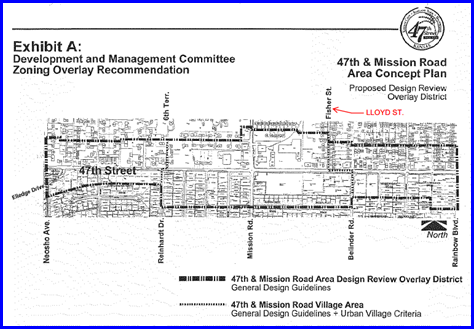
Depiction of 47thand Mission Road Area Design Review Overlay District and 47thand Mission Road Area Concept Plan. The 47 th and Mission Road Area Design Review Overlay District is hereby amended such that the overlay district shall consist of that area identified below as the "Suggested District Boundary." The Village Area, as used in this overlay district Ordinance, shall mean that area identified below as the "Suggested Village Boundary."
(Ord. No. 1031, § 1, 5-2-2022)

