
Rolesville City Zoning Code
ARTICLE 14
- LANDSCAPE AND APPEARANCE STANDARDS
Section 14.1: - Purpose and Intent
The Town of Rolesville recognizes that the maintenance and enhancement of community appearance produces numerous environmental, aesthetic and economic benefits. The primary intent if this ordinance is to realize these benefits by establishing regulations, policies, and incentives in keeping with the traditions and future vision of Rolesville. As appearance issues typically are broad in definition, this ordinance shall apply specifically to issues related to planting materials, architectural design respectful of immediate surroundings, and other site features, which produce an impact on the aesthetic value of our community.
This ordinance is intended to enhance, rather than inhibit, economic development. This can be accomplished by directing existing and future development in a manner that both preserves the uniqueness and spirit of the community and builds upon an attractive, safe and healthful environment.
Section 14.4: - Streetscape Buffers Along Thoroughfares
Streetscape buffers are required on all thoroughfares as shown on the adopted land use plan and/or thoroughfare map. Streetscapes are to remain undisturbed except where no existing vegetation is present.
14.4.1
All uses which require site plan approval or subdivision plan approval shall preserve, install and maintain a planted streetscape along each thoroughfare it abuts which protects the existing vegetation and abuts the perimeter of the property. All streetscape plantings, including the installation of all plant materials, shall conform in accordance with the specifications of this section.
14.4.2
The width of the streetscape buffer shall be at least 30 feet, as measured from the right-of-way line but can be reduced to as little as ten feet by the Board of Commissioners in cases of hardship as provided in NC General Statutes 160A-388. The following are the primary factors to be considered in determining hardship situations:
(1)
Existing topography;
(2)
The type, amount, and location of existing vegetation;
(3)
The size and configuration of the parcel;
(4)
The location and extent of underground and overhead utilities;
(5)
Rights-of-way bounded by slopes steeper than two and one-half to one and,
(6)
Natural barriers to installation or maintenance of the streetscape, such as waterways, rock formations and soil conditions.
14.4.3
If the streetscape is disturbed or non-vegetated, the property owner or developer shall install and maintain the following vegetation every 40 linear feet of frontage. Along collector streets, this vegetation may be installed up to every 50 linear feet of frontage.
(1)
One street tree of at least two and one-half inches in caliper; or,
(2)
Two understory ornamental type trees one and one-half inches in caliper (this option is used only with overhead utility lines)
(3)
Small trees shall be located under overhead power lines. Such small trees shall be at least one and one-half inches in caliper at the time of installation and two such trees shall be installed or maintained for every 40 linear feet of streetscape, rather than one larger tree per 40 feet required above.
14.4.4
Trees shall be installed on the thoroughfare side of any berm or screen planting no less than ten feet from the right-of-way of the thoroughfare. Street trees may be installed in a linear fashion or in clusters or groupings of larger and/or small trees in combination with associated plantings so as to enhance the visual appearance of the streetscape and views from adjacent properties.
14.4.5
Each large canopy tree in the streetscape shall be provided with at least 350 square feet of pervious ground area for root growth. Any planting area bounded by an impervious surface shall be at least ten feet wide.
14.4.6
All slopes steeper than two to one shall be stabilized with permanent slope retention devices or a suitable combination of plantings and retention devices.
14.4.7
Where there is a vehicular use area between the right-of-way of the thoroughfare and a permanent building, the streetscaping shall provide a semi-opaque screen or barrier between the right-of-way and the vehicular use area. The screen of barrier may consist of existing vegetation, plants, earthen berms, decorative entry fences (not privacy), walls or any combination thereof which meets the following requirements:
(1)
The screen shall occupy the entire (100 percent) length of the vehicular use area except for sidewalks and driveways. All vehicular use areas must be screened from off-site view. Plant material shall be at least two feet in height above the root balls at the time of installation, and must reach a height of at least three feet within three years.
(2)
Berms may be installed in lieu of or in addition to plantings. If the berm does not meet the performance standards of paragraph 14.4.7 or 14.4.7 (1) above, then plant materials shall be installed which meet these standards. The installation of additional plant materials is encouraged so as to enhance the visual and aesthetic qualities of the streetscape.
Section 14.5: - Buffers Along Fully-and Limited Controlled Access Highways
14.5.1
All properties adjacent to a fully controlled access highway or a limited access highway shall install and maintain a vegetated buffer along each controlled access highway, if any, which abuts the property. All buffer plantings shall perform in accordance with the specifications of this section. A 100-foot undisturbed buffer width is required along all fully and limited controlled access highways, measured from the ultimate right-of-way.
14.5.2
No development shall be allowed within required buffers; however, the Board of Commissioners may, permit the construction of a street, driveway, or utility easement in the buffer upon finding by the Town Board of Commissioners that such construction is necessary for safe ingress, egress, or utility service to the site. The nature and limits of such construction must be designated on an approved site plan, subdivision plan, or public street dedication map.
Section 14.7: - Vehicular Use Areas (VUAs)
14.7.1
Vehicular Use Areas (VUAs) shall be planted according to the following requirements:
14.7.2
No portion of the VUAs shall be further than 60 feet from the trunk of a required large tree.
14.7.3
Where overhead utility lines are in conflict with large trees, two ornamental trees shall be substituted per one large tree.
14.7.4
Each large type tree shall be minimum of two and one-half inch caliper at planting and a minimum height of ten feet from the ground surface. Ornamental trees shall be a minimum of one and one-half inch caliper and eight feet in height from ground level at planting.
14.7.5
All VUAs must be screened from the off-site view with a continuous evergreen hedge that will reach a minimum height of three feet within three years of installation. Screening plants shall be a minimum of 24 inches in height and three-gallon size at installation.
14.7.6
Streetscape and streetfront buffer trees can be used to meet the VUA coverage requirements.
14.7.7
Existing vegetation can be sued to meet the VUA requirements in lieu of new trees. A large grouping of existing vegetation is encouraged if the vegetation is in good health.
14.7.8
Planting areas provided for VUA plantings must meet the following requirements:
14.7.9
Demonstrate that adequate drainage and mulching have been provided for all planting areas.
14.7.10
Planting areas shall have a minimum dimension of ten feet in any one direction.
14.7.11
Minimum planting areas for each large shade tree shall be 350 square feet, and 250 square feet for each ornamental tree.
Section 14.11: - Inspections
14.11.1
The Wake County Inspections, in coordination with the Town staff, shall inspect the site prior to the issuance of a permanent Certificate of Occupancy or recording of the final subdivision plat for the development. The permanent Certificate of Occupancy shall not be issued and the final subdivision plat shall not be recorded if the landscaping required under this Section is not installed in accordance with the standards set forth in this Section and in accordance with the approved site plan or subdivision plan.
14.11.2
Prior to obtaining a Certificate of Occupancy or recording of the final subdivision plat, the developer or property owner shall submit an "as-built" plan to the Town staff for all landscaping-related components of the site plan or subdivision plan.
14.11.3
Wake County inspectors, in coordination with the Town staff, shall inspect the site one year after the issuance of a permanent Certificate of Occupancy or recording of the final subdivision plat in order to ensure compliance with the approved site plan or subdivision plan and to ensure that the landscape is properly maintained.
14.11.4
In cases of delayed installation of plant material, based on seasonal considerations, security in the form of a cash bond shall be given to the Town of Rolesville by the developer or property owner, equal to one and one-half the value of the materials and/or vegetation to be installed and the installation costs related thereto.
14.2.1 - Site Plans and Subdivisions
Site plans and subdivision plans shall be submitted for approval as required by Articles 14 and 15. Site plans and subdivision plans shall be prepared by individual(s) or professional firm(s) possessing the necessary qualifications and certifications to develop such plans.
14.2.2 - Building Design
Proposed building façades shall be designed to be compatible with adjacent developments in terms of architectural design, exterior building materials and arrangements of buildings. In addition, shopping centers and their outparcels shall utilize consistent colors, materials and design throughout the project.
14.2.3 - Modifications to Standards
Where essential to avoid unnecessary hardship, the Board of Commissioners may modify the requirements of this Article in reviewing and approving a site plan or subdivision plan in accordance with the principles of G.S. § 160A-388. The modifications may include any equivalent that will perform in the same effective manner as the required standard.
14.2.4 - Buffers
Interior and perimeter buffers for Planned Unit Developments and Traditional Neighborhood Districts shall be delineated on the master land use plan for approval and shall be subject to the landscaping standards identified in the Code of ordinances as unique to these type land uses.
14.3.1 - [Priority of Preserving Existing Vegetation]
The Town will consider the preservation of existing vegetation as its first priority before taking new plantings into consideration.
14.3.2 - [Existing Vegetation]
All existing vegetation which meets the landscape buffer requirements of this section, or which is located in a preservation area (plant communities, groves and selected individual trees) designated on the approved site plan or subdivision plan shall be preserved on the site. Existing vegetation that is to remain on the site shall be clearly delineated and identified on all site plans or subdivision plans.
14.3.3 - [Property Owner Responsibilities]
The owner of the property shall be responsible for protecting and maintaining the plants in the designated preservation areas in a healthy, growing condition and for keeping the area free of refuse and debris. The owner of the property shall be responsible fir replacing the vegetation if they are destroyed or substantially damaged. The proposed methods for protection shall be reviewed and approved as part of the site plan approval process, shall be installed prior to the issuance of the grading permit, and shall be maintained until all site work is complete.
14.3.4 - Tree Protection—Fencing Requirements
All vegetation and buffers that are to be preserved shall be enclosed with a sturdy and visible fence before grading begins for both site plans and subdivisions. This fence shall be located at a distance determined by the following formula: No less than one foot from the tree trunk for each one inch in tree diameter. For example, fencing is to be placed no less than ten feet from a ten-inch caliper tree. Both applicant and staff in determining the exact location of any tree protection fencing will consider the existing site conditions. All tree protection fencing must remain in place throughout the entire site development process until the time a certificate of occupancy is issued. In the case of subdivision development, tree protection fencing must remain in place until all units are completed (received certifications of occupancy) within any designated phase or plat.
14.3.5 - Incentives
The following incentives are provided to encourage the preservation of existing vegetation:
(1)
Existing healthy vegetation may be counted towards meeting the performance criteria for buffers and vehicular use areas.
(2)
A five to 20 percent reduction in the number of parking spaces required on the site shall be allowed to the extent that the reduction will preserve existing healthy trees. The amount of reduction will be determined after taking all unique site conditions into account.
(3)
Any internal save areas can be used to meet other buffer requirements provide the equivalent amount of square footage is saved. The perimeter buffers cannot be reduced any further than one-half of the required buffer width or a minimum of ten feet in width, whichever is larger. This incentive will be determined after taking into account unique site conditions such as existing healthy trees, steep topography, water features, etc. These criteria are based on a site by site land analysis of existing conditions.
14.3.6 - Care, Maintenance and Upkeep of Plant Material during Site Development, including Outparcels
The owner of the property shall be responsible for protecting and maintaining the plantings in a healthy, growing condition or replacing them when necessary and for keeping the area free of refuse and debris. The proposed methods for protection shall be reviewed and approved as a part of the site plan approval process and shall be installed prior to the issuance of a grading permit and shall be maintained until all site work is complete. Outparcels which are graded shall be seeded, mowed and maintained until development occurs on the parcel.
14.6.1 - Applicability
All site and master subdivision plans shall provide a landscape buffer to separate that use or subdivision from adjacent land uses with the buffers having the width, amount of vegetation and other features described below. Buffers between parcels within a shopping center shall be ten feet in width, with a Type "B" semi-opaque for each parcel. All perimeter shopping center buffers must be installed prior to receiving a Certificate of Occupancy.
14.6.2 - Purposes
Landscaped buffers to separate adjacent land uses shall be provided in accordance with this section in order to fulfill the following purposes:
(1)
To shield adjacent properties from any adverse external affects of the development, so as to render incompatible adjacent uses more compatible;
(2)
To shield development from the negative impacts of adjacent land uses, so as to render incompatible adjacent uses more compatible;
(3)
To preserve open space and existing vegetation, using supplemental plantings only when necessary;
(4)
To prevent adverse grade changes between properties and to provide adequate land area from transition of proposed grades.
14.6.3 - Hardship
In cases of hardship as provided by N.C. General Statues 160A-388, the Board of Commissioners may reduce landscape buffers, but to no less than ten feet in width. Also, building setbacks may not be reduced to less than ten feet in width. The following hardship factors, among others, are to be considered:
(1)
Existing topography;
(2)
The type, amount and location of existing vegetation;
(3)
The size and configuration of the parcel;
(4)
The location and extent of underground and overhead utilities;
(5)
Rights-of-way bounded by slopes steeper than two and one-half feet;
(6)
Natural barriers to installation or maintenance of the streetscape, such as waterways, rock formation and soil conditions.
14.6.4 - Building Setbacks from Edge of Buffer
All building setbacks are determined by the buffer widths within the Landscape Buffer Table below, or by the dimensional requirements of the applicable zoning district, whichever is more restrictive.
14.6.5 - Type and Width of Buffer Required
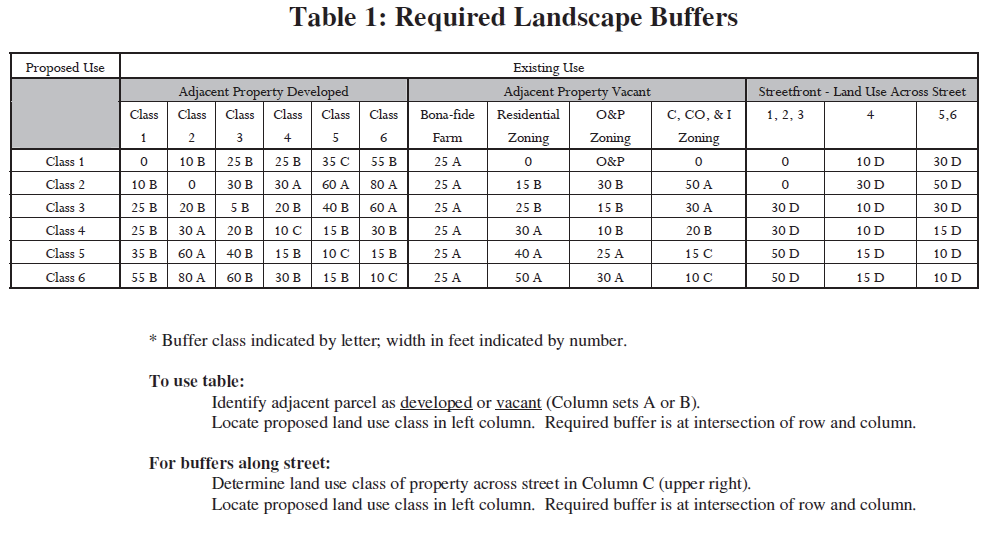
The type of landscape buffer that must be installed is as identified in Table 1, below. Depending on the land use classifications of the proposed use and the uses of the adjacent property(s), Table 1 specifies a landscaped buffer of a particular type and a particular minimum width. Paragraph f., below, identifies the land uses that fall within each land use classification shown in Table 1 and paragraph g. identifies the width and type of vegetation for each type buffer.
14.6.6 - Land Use Classes
The six land use classes of Table 1 include the following uses:
(1)
Class 1 - Parks, greenways and similar uses.
(2)
Class 2 - Single-family detached residential uses on lots greater than 6000 square feet.
(3)
Class 3 - Multi-family residential uses and single-family detached housing on lots less than 6,000 square feet and zero lot line.
(4)
Class 4 - Land uses with internally oriented activities such as day care centers, offices, churches, life care, managed care or nursing home facilities, clinics, personal service establishments, restaurants without drive-thru facilities.
(5)
Class 5 - Land uses with externally oriented activities such as restaurants with drive-thru facilities, convenience stores, gas stations, without auto repair services, car washes, shopping centers, shopping center outparcels adjacent to property Classes 2 and 3.
(6)
Class 6 - Warehousing, mini-storage and distribution facilities, manufacturing, hospital, outdoor amusement facilities, transmission towers, auto repair, restaurants with outdoor entertainment, laboratories or research facilities, hotels, motels, railroad stations and yards, outdoor dog kennels, animal clinics with outdoor kennels and dog runs, public utility facilities, outdoor amphitheaters with greater than 200 seating capacity.
14.6.7 - Types of Buffers
The four types of landscaped buffers appearing in Table 1 are defined as follows:
(1)
Opaque Type A This buffer functions as an opaque screen from the ground to a height of at least six feet. Plantings of deciduous and evergreen trees are expected to reach a height of no less than 20 feet and to have no unobstructed openings wider than ten feet between tree canopies at maturity. The Type "A" buffer shall include a wall, an opaque fence, landscaped earthen berm, existing or planted vegetation, or any appropriate combination of these elements which will create the desired spatial separation between land uses. At least 50 percent of the required trees and shrubs must be of the evergreen species. Shrubbery is to be planted sufficiently close together to form an opaque screen within three years after planting.
(2)
Semi-opaque Type B This buffer serves as a semi-opaque screen from the ground up to a height of at least three feet. Canopy trees shall reach a height of at least 20 feet at maturity and have no unobstructed openings greater than 20 feet between canopies. This buffer may include a wall, an earthen berm, an opaque or semi- opaque fence existing or planted vegetation, or any appropriate combination of these elements to achieve the desired opacity. At least 50 percent of the required shrubs must be of the evergreen species. Shrubbery is to be planted sufficiently close together to form an opaque screen within three years after planting.
(3)
Spatial Definition Type C This buffer is intended to provide a sense of separation between adjoined properties without specifically obstructing the view from one to the other. Generally, it will be less opaque than the Type B buffer, and more oriented towards aesthetic enhancement. A Type C buffer may include a wall, fence, earthen berm, planted vegetation, existing vegetation, or any appropriate combination of these elements. Tree plantings may be installed in either a random or clustered fashion with unobstructed openings between canopies no greater than 50 feet at maturity.
(4)
Street front Type D This buffer is intended to provide a softening of the view of a particular property from the street, without eliminating views to and from the property. This will include at least one evergreen or deciduous canopy tree in a random, clustered, or linear pattern for each 40 feet of street frontage with a spacing of no less than 25 feet between trunks or clusters at maturity. At maturity, these trees are expected to reach a height of at least 20 feet. Where the vehicular use area is adjacent to the street front buffer, the buffer shall include a semi-opaque screen of at least three feet in height above the ground. This screen may include a wall, fence, landscaped earthen berm, plantings, existing vegetation, or any combination of these elements. A street front buffer is required along all private and public streets except major thoroughfares and controlled access highways.
14.6.8 - Location of Buffers
The buffers required by this Section shall be located along the outer perimeter of the parcel and shall extend to the parcel boundary line or right-of-way. Buffers shall not include any portion of an existing or proposed public or private street, easement or right-of-way. Plantings within a buffer are to be spread across the entire width of the buffer.
14.6.9 - Existing Vegetation, Fences, Walls, and Berms
Existing significant vegetation within the required buffer shall be preserved and credited toward standards for the type buffer required at the time of site plan or subdivision review and approval. Existing berms, walls, or fences within the buffer, but not including chain link fencing or other visually open fencing, may be used to fulfill the standards for the type of buffer required. Other existing site features within the required buffer area which do not otherwise function to meet the standards for the required buffer shall be screened from the view of other properties or removed, as determined during the review and approval of the site plan or subdivision plan. All opaque fences (i.e., solid wood, brick, etc.) must include at installation evergreen shrub plantings which will reach a minimum height of three feet at maturity, and five feet on center. All plantings must face towards the public right-of-way.
14.6.10 - Installation of New Vegetation and Other Features
If existing significant vegetation and other site features do not fully meet the standards for the type of buffer required, then additional vegetation and/or site features (including fences) shall be planted or installed within the required buffer area.
14.6.11 - Standards for New Plantings
All large trees which this Section requires to be planted shall be at least eight feet in height above ground level and at least two and one-half inches in caliper at the time of installation and shall have an expected mature height of at least 30 feet. All small ornamental type trees shall be at least eight feet above ground level and at least one and one-half inches in caliper at installation and shall have an expected mature height at time of planting and shall reach the height required for performance within three years of installation. The standards for all trees and shrubs in the buffer, including the minimum height, root ball size, number of branches, and width shall conform with the American Standard for Nursery Stock published by the American Association of Nurserymen for that type of tree or shrub at the time of installation.
14.6.12 - No Development within the Required Buffer
The required buffer shall not contain any development, impervious surfaces or site features that do not function to meet the standards of this section or that require removal or existing vegetation. No grading, development or land-disturbing activities shall occur within the buffer unless approved by the Town staff and the Planning Board at the time of site plan or subdivision plan review.
14.6.13 - Dripline Encroachment
If a specimen tree dripline encroaches one-third or more onto an adjacent parcel to be developed and has been saved, the second developing site also must protect the dripline to protect the health of the tree.
14.6.14 - Easements
Nothing shall be planted or installed within an underground or overhead utility easement or a drainage easement without the consent of the Town and the easement holder at the time of a site plan or subdivision plan approval.
14.6.15 - Responsibility for Buffer Installation
Where a vacant parcel in being developed adjacent to another vacant parcel, then the developer or owner of the first parcel shall provide the required buffer adjacent to the vacant land as indicated in Table 1. Where a vacant parcel is being developed adjacent to an existing land use, the developer or owner of the vacant parcel shall provide the buffer required adjacent to existing land use as in Table 1. If the required second buffer is wider than ten feet, then the width of the required second buffer may be reduced to ten feet or 50 percent of the required total buffer, whichever is greater, so long as the total aggregate buffer between the existing use and the developing use meets the buffer requirement of the developing parcel as set forth in Table 1. In the event both vacant parcels are obtaining site plan approval at the same time, 50 percent of the required buffer in Table 1 shall be provided by each parcel.
14.6.16 - Zoning Change
If the zoning district classification changes for an existing use or parcel, then the parcel shall comply with the buffer requirements of this section. The owner or developer may need to install additional pant material on the parcel in order to meet the intent of this section, especially on developed sites, or to bring the parcel up to the standards for the type of buffer which would be required under this section.
14.6.17 - Buffer Width Reduction Allowed
When required, and unless prohibited elsewhere in this Ordinance, the width of landscape buffers between uses may be reduced by one-half, provided all of the following are met:
(1)
Buffer Type A, B, or C is required by Table 1, and
(2)
The alternate plan provides for, at a minimum, the planting, density, opacity, and spacing requirements of the of the next highest Type listed in 14.6.7, and
(3)
Any reduced width buffer shall, in all cases, require the installation of at least one of the visual and/or sound attenuating barriers listed in that next highest class, and
(4)
Where a Type A buffer is required by Table 1, any buffer that has been reduced to greater than 20 feet in width shall contain, at a minimum, an earthen berm and an opaque fence at least six feet but no more than eight feet in height, and
(5)
Where a Type A buffer is required by Table 1, any buffer that has been reduced to 20 feet or less in width shall provide for the same as (4) above, except a masonry wall at least six feet, but no more than nine feet in height must be included in lieu of fencing.
14.8.1 - Purpose and Intent
The provision of outdoor lighting is to heighten nighttime safety and visibility, and to enhance the security of property and people. Proper lighting should control light spillover and glare so as not to adversely affect the operation of motor vehicles, pedestrians, and uses of adjoining properties. All exterior lighting, with the exception of street lighting, that is used in and around buildings, recreation areas, parking lots and signs shall be designed to protect against the spillover of light onto adjacent properties.
14.8.2 - Lighting Plan
Any proposed development requiring a site plan or subdivision plan shall include, as part of site plan or subdivision plan submission, a detailed exterior lighting plan. This plan shall include as a minimum:
14.8.2.1
Specifications for the lighting fixtures such as: Type of unit (cutoff, non cutoff glare shields, etc.) lamps (wattage, etc.), electrical load requirements, utility company involved, location of lights and mounting heights.
14.8.2.2
An isofootcandle plan that provides typical foot-candle contours and a point photometric grid that indicates foot-candle levels measured at grade across the site. Maximum, average and minimum site foot-candles, uniformity ratio (average and minimum), and depreciation factors also are required.
14.8.2.3
Plan certification by a licensed lighting engineer and/or lighting manufacturer verifying that the plans meet the town's design requirements and illumination standards.
14.8.3 - General Design Standards
Exterior lighting, such as that used in and around buildings, recreation areas, parking lots and signs shall be designed so as to prevent the excessive spillover of light onto adjacent properties. Lighting shall be designed to protect against glare onto public rights-of-way to prevent impairing the vision of motorists and adversely impacting adjoining property. All exterior lighting shall be shielded from adjacent properties by existing vegetation, thick evergreen vegetated buffers, berms, walls, fences and/or the use of directional lighting, lighting shields, special fixtures, timing devices, appropriate light intensities, luminaries and mountings at appropriate heights. All outdoor lighting shall conform to the design standards discussed below.
14.8.4 - Illumination Standards
Following are specific standards for lighting intensity based upon the general land use and activity involved. Values are presented in maintained foot-candles measured at grade. Site lighting should not exceed these average foot-candle levels.
14.8.5 - Fixtures
Figure 2 depicts the types of lighting fixtures that are desirable in controlling spillover lighting and glare.
14.8.6 - Mounting Heights
Outdoor lighting fixtures shall be designed, located and mounted at heights no greater than 18 feet above grade for non-cutoff lights and for wall-pack units, and 35 feet above grade for pole mounted cutoff lights.
Mounting heights are measured from the finished grade or surface and includes the total height of the fixture, pole and any base or other supporting structure required to mount the light(s)
14.8.7 - Location of Ground Based Lights
All outdoor lighting fixtures not mounted on buildings shall be located a minimum of ten feet from a property line or right-of-way line, and should be no closer than two feet from any required perimeter or streetscape buffer.
14.8.8 - Site Compatibility
Lighting fixtures shall be of a design and size compatible with the principal building of a development and adjacent areas, and shall be designed to be an integral part of the entire development site.
14.8.9 - Spillover Light
All outdoor lighting shall be designed and located such that the maximum illumination measured in foot-candles at the property line does not exceed three-tenths onto adjacent residential property and one onto adjacent commercial sites and public rights-of-way.
14.8.10 - Wattage
Lamps for non-cutoff fixtures shall not exceed 100 watts. Lamps for cutoff fixtures shall not exceed 250 watts unless the Town Manager gives special permission and the overall lighting plan is approved during the development review process.
14.8.11 - Wall-pack Fixtures
Wall packs on buildings may be used at entrances to a building or to light potentially unsafe areas. They should not be intended to draw attention to the building or provide general building or site lighting. Wall packs shall be fully shielded, cutoff type fixtures with concealed light sources. The lighting must be directed downward and the wattage must not exceed 100 watts.
14.8.12 - Floodlights
Floodlights or other types of lighting attached to light poles that illuminate the site and/or building(s) are prohibited unless the Town Manager gives special permission and approval has been granted through the development review process.
14.8.13 - Building Façade Lighting
Floodlights, spotlights, or any other similar lighting shall not be used to illuminate buildings or other site features unless approved as an integral architectural element on the development plan. On-site lighting may be used to accent architectural elements but not used to illuminate entire portions of building(s) or sign(s). Where accent lighting is used, the maximum illumination on any vertical surface or angular roof surface shall not exceed five average maintained foot-candles. Building façade and accent lighting will not be approved unless the light fixtures are carefully selected, located, aimed, and shielded sop that light is directed only onto the building façade and spillover light is negligible.
14.8.14 - Sign Lighting
All external lighting for signs will be so designed and located so as to assure that there is no spillover light. Sign lighting, including ground mounted stop lights, shall not exceed five foot-candles.
14.8.15 - Awning and Canopy Lighting
Awnings and canopies used for building accents, such as over doors and windows, shall not be internally lit, i.e., from underneath or behind the awnings and canopies.
14.8.16 - Flashing Lights
Lights that flash, move, rotate, blink, flicker, vary in intensity, or color, or use intermittent electrical pulses are prohibited.
14.8.17 - Lighting for Gas Stations/Convenience Store Canopies
Lighting for canopies for service stations and similar uses shall be restricted to no more than two 320 watt recessed lighting fixtures (including lenses) mounted flush with the bottom of the canopy on each side if a gasoline pump island, or any other design that meets the standards of this ordinance. Lighting for canopies for service stations and other similar uses shall not exceed a maintained average of 12 foot-candles as measured at ground level at the outer edge of the canopy.
14.8.18 - Sports and Athletic Field Lighting
Lighting for ball fields may need to exceed illumination standards for general recreational needs in order to meet higher standards required for tournament play. The Town manager must approve any deviations from the illumination standards; however, before any changes will be considered, the field lighting must meet the following standards:
14.8.18.1
Fixtures must not exceed 80 feet in mounting height, including bases for poles and/or other mounting structures.
14.8.18.2
Without exception, fixtures must be fitted with the manufacture's glare control package.
14.8.18.3
Fixtures must be designed and aimed so that their beams fall within the primary playing area and the immediate surroundings, so that off-site direct illumination is significantly restricted, with spillover levels at the field property lines do not exceed .03 foot-candles.
14.8.18.4
Lighting shall be extinguished no later than one hour after the event ends.
14.8.19 - Exemptions
The standards of this section shall not apply too:
14.8.19.1
Individual residential lighting that is not part of a site plan or a subdivision plan
14.8.19.2
Lighting associated with temporary uses that have been permitted.
14.8.19.3
Seasonal lighting that is part of customary holiday decorations and annual civic events.
14.8.19.4
Municipal lighting installed for the benefit of public health, safety, and welfare.
14.8.20 - Certificates of Occupancy
Before certificates of occupancy are released, the owner/builder must supply the Town with a final letter of certification from the lighting engineer and/or manufacturer verifying that all site lighting is installed according to Town standards, the approved plans, and any applicable conditions.
14.9.1 - [Loading and Service Areas]
Loading and service areas shall be screened from public off-site view, from adjacent property, and public right-of-way.
14.9.2 - [Screening]
Screening shall be accomplished by provisions of either Section 14.9.2.1 or Section 14.9.2.2 below.
14.9.2.1
An opaque screen of evergreen shrubs or wall. At installation, shrubs shall be the minimum height of the proposed structure to be screened. The spacing of the plant material shall be sufficient to assure opacity at maturity. Alternatively, the owner or developer may use an opaque wall or fence that reached the height of the structure to be screened. The design and materials of any fence or wall must be presented as part of the site plan approval process. The Board of Commissioners reserves the right to deny use of materials that would create a maintenance problem. All exterior structures such as walls must be of similar building materials as the primary structure.
14.9.2.2
An earthen berm shall be vegetated with grass, shrubs, or trees to meet the screening criteria. The height of the berm with vegetation must be at a minimum be the height of the structure to be screened.
14.10.1 - Time Limit
All landscaping, including mulching and seeding, shall be completed in accordance with the approved site or subdivision plan, and be in compliance with the standards set forth in this Section, prior to issuance of a Certificate of occupancy for the site or recording of a final subdivision plat.
14.10.2 - Extensions and Exceptions
The Town staff may grant exceptions and extensions to the above time limit under the following conditions:
14.10.2.1
Exceptions may be granted due to unusual environmental conditions, such as drought, ice, over-saturated soil (deep mud) or inappropriate planting season for the plant species, provided that the developer or property owner provided the Town with a cash bond ensuring the installation of the remaining landscape materials. In such cases, the Town staff may issue a temporary Certificate of Occupancy for a period of 30 to 180 days, depending on prevailing soil and weather conditions. The bond shall be accompanied by documentation of the estimated cost of the remaining landscaping to be completed. This documentation may be a landscaping contractor's bid or contract, a nurseryman's bill or similar document. The amount of the cash bond shall be one and one-half times the cost of the plant material yet to be installed and installation costs relating thereto, based on the highest estimate received.
14.10.2.2
Exceptions may be granted due to the substitution or unavailability of plant species or acceptable plant size as specified on the site or subdue=vision plan, provided that the developer or property owner provided the Town with a cash bond to ensure the unavailable plants will be installed on the property. In such cases, the Town staff may issue a Certificate of Occupancy for a term of 180 days or until the next planting season, whichever comes first. Only 20 percent of the plant materials to be installed on the property may be delayed and bonded under this exception. All such substitutions shall be marked in the "as-built" landscaping plans submitted to the Town staff or the Planning Board and must be signed, dated, and approved prior to installation.
14.10.2.3
Exceptions may be granted due to circumstances beyond the developer's or property owner's control, such as incomplete construction or utility work in a proposed landscaped area, within 30 days after expected site completion provided that the developer or property owner submits a letter from the utility company stating the expected installation date and provides a cash bond to ensure installation of the required landscaping. In such cases, the Town staff may issue a temporary certificate of Occupancy for a period not to exceed 30 days.
14.12.1 - Maintenance Responsibility
The owners(s) of the property and his/her agent(s), heirs or assigns shall be responsible for the installation, preservation and maintenance of all planting and physical features required under this Section. Installed vegetation, or existing vegetation for which credit had been given, which is dead, substandard or unhealthy, of poor structural quality, or missing, shall be removed and replaced in conformance with the standards of this Section and to the approved site plan or subdivision plan. In the event that any vegetation or physical element functioning to meet the standards of this Section is severely damaged due to an unusual weather occurrence or natural catastrophe, the owner shall have one year or one growing season, whichever is sooner, to replace or replant. All plant materials should be allowed to reach their mature size and maintained at their mature size. Plants shall not be cut or severely pruned so that their natural form is impaired.
14.12.2 - Replacement of Disturbed and Damaged Vegetation
The disturbance of any landscaped area or vegetation required by this Section shall constitute a violation of the site plan or subdivision plan. All disturbed landscaped areas and vegetation shall be replanted so as to meet the standards of this section as well as the approved site plan or subdivision plan.
14.12.3 - Replacement of Existing, Original Vegetation
Where the vegetation that has been disturbed or damaged existed on the site at the time of the development was approved, all replacement vegetation shall meet the standards set forth in this Section, taking into account any unique site conditions and vegetation remaining within the landscaped area. Replacement consists of one or a combination of the following:
14.12.3.1
Any tree with a caliper of at least eight inches which is damaged or removed shall be replaced with one or more trees which have a caliper of at least two and one-half inches and a cumulative caliper equal to or greater than one half of the original tree.
14.12.3.2
For all other cases where existing vegetation is damaged or removed, the type and amount of replacement vegetation required shall be of the type and amount that is necessary to provide the type of landscaped buffer required under this Section. This shall consist of one or more of the following for each 2,000 square feet of disturbed area (specific quantities listed below may be adjusted by the Town staff to meet required buffer standards).
(1)
Two canopy trees of at least two and one-half inches caliper.
(2)
Two small trees of at least one and one-half inches caliper and at least six feet high above ground level at the time of installation.
(3)
Two evergreen trees of at least two and one-half inches caliper and at least six feet high above ground level at the time of installation.
(4)
Seven evergreen shrubs of at least 18 inches in height and three-gallon container size at the time of installation.
(5)
Eight deciduous shrubs of at least 18 inches in height and three-gallon container size at the time of installation.
(6)
On slopes equal to or greater than a ration of two and one-half to one, 22 ground cover plants with a container size of one gallon at the time of installation.
Amendments
10-4-04 to entire document; 4-19-05 with TA05-01; 10-18-11 to 14.5 under TA11-06;
5-17-16 to 14.6.4 under TA16-06; 11-16-05 to 14.6 with TA16-09.

