
Roswell City Zoning Code
ARTICLE 52
- BUILDING AND PERFORMANCE STANDARDS
Sec. 1. - Purpose.
The purpose of this article is to establish general building and performance standards to preserve and promote an attractive, well-planned, and stable urban environment.
Sec. 2. - Access to public streets.
Except in the PUD district and as otherwise provided for in this and other ordinances, every residential dwelling unit structure constructed or erected after the effective date of this ordinance shall be located on a lot which has access to or abuts, as a minimum, a local public street.
Sec. 3. - Buildings per lot.
A.
In residentially zoned districts, every single-family detached dwelling, mobile home, two-family attached dwelling, or multiple family dwellings used for rental purposes, constructed or erected after the effective date of this ordinance, shall be located on one duly subdivided and recorded lot and there shall not be more than one principal building on one lot; excepting in the R-3 and R-4 districts.
B.
When two or more lots, each of which lacks adequate area and dimension alone to qualify for a permitted use, are contiguous and are held under single ownership, they may be used as one zoning lot for such use following the completion of a boundary survey to combine the parcels into a single parcel.
Sec. 4. - Accessory uses.
A.
For residential zoned districts, two sets of plans containing a site plan with overhead and underground utilities noted and structure design shall be required for all accessory structures. All construction shall comply with the latest City approved and accepted New Mexico Building Code, International Building Code, International Fire Code, National Electrical Code, Uniform Mechanical Code, and Uniform Plumbing Code. Accessory structures uses shall also meet the following requirements:
1.
An accessory building shall be compatible with the principal building that it serves and shall not be constructed prior to the construction of the principal building, except when used for agricultural purposes in the R-S district.
2.
Location of an accessory structure shall meet the following requirements:
a.
Shall not be within the front yard setback established and permitted for a lot in that zoning district.
b.
Shall be a minimum of five feet from all shared property lines. A shared property line is a side or rear property line abutting a neighboring property with no alley or easement in between.
c.
Shall be a minimum of ten feet or a maximum of 25 feet at the discretion of planning and zoning staff and the city engineer to ensure clear sight triangle from the street side yard property line for corner lots.
d.
Shall be a minimum of ten feet from the principal building with the exception of carports and pergolas which may be attached or unattached with no specified distance between carport or pergola and principle structure.
e.
Structures 200 square feet or less not requiring a building permit shall require a placement permit to ensure adequate setbacks are met.
3.
Accessory structures shall not occupy more than 40 percent of the required Rear Yard Ordinance 19-02 75, Amended March 14, 2019 setback area, nor have more floor area than the principal structure it serves, nor exceed the height of the principal building it serves.
4.
All runoff or drainage from an accessory structure shall remain on the lot that it serves and shall not encroach on an abutting lot or alley.
5.
Tanks used for storage of fuel used for heating shall be located in the rear yard or side yard and shall not be closer than ten feet to the principle building or structure that it serves, or any other structure, and ten feet from the interior side property line and 30 feet from street side yard setback on corner lots.
6.
In-ground swimming pools and ponds shall be a minimum of 40 feet from the front property line, five feet from interior and rear property lines, 15 feet from street side property lines, and ten feet from any other structure on the lot except with a joint administrative adjustment granted by the building official and planning and zoning staff. Construction shall comply with the latest approved International Building Code standards per the city.
B.
For commercial and industrial zoned districts, three sets of plans containing a site plan with overhead and underground utilities noted and structure design shall be required for all accessory structures. All construction shall comply with the latest city approved and accepted New Mexico Building Code, International Building Code, International Fire Code, National Electrical Code, Uniform Mechanical Code, and Uniform Plumbing Code. Accessory structures uses shall also meet the following requirements:
1.
An accessory building shall be compatible with the principal building that it serves, shall not occupy any required parking space or area as determine by planning and zoning staff, and shall not be constructed prior to the construction of the principal building.
2.
Location of an accessory structure shall meet the following requirements:
a.
Shall not be within the front yard setback established and permitted for a lot in that zoning district.
b.
Shall be a minimum of five feet from all shared property lines. A shared property line is a side or rear property line abutting a neighboring property with no alley or easement in between.
c.
Shall be a minimum of 30 feet or at a distance at the discretion of planning and zoning staff and the city engineer to ensure clear sight triangle and other considerations from the street side yard property line for corner lots.
d.
Shall be a minimum of ten feet from the principal building and/or any other structure on that lot, with the exception of carports and pergolas which may be attached or unattached with no specified distance between carport or pergola and principle structure.
e.
Structures 120 square feet or less not requiring a building permit shall require a placement permit to ensure adequate setbacks are met.
3.
Accessory structures shall not occupy more than 40 percent of the required setback area, nor have more floor area than the principal structure it serves, nor exceed the height of the principal building it serves.
4.
All runoff or drainage from an accessory structure shall remain on the lot that it serves and shall not encroach on an abutting lot or alley.
(Ord. No. 20-08, § 4, 8-13-2020)
Sec. 5. - Exceptions to required yards.
A required yard space shall remain open and unobstructed, except as follows:
A.
Eaves, overhangs, ornamental features, and other common projections normally associated with residential dwellings may project no more than 18 inches into required yard spaces.
B.
Open stairways, balconies, and chimneys may project no more than five feet into required front yard, rear yard, or street side yard on a corner lot.
C.
A non-enclosed porch, carport, or patio cover shall not project more than five feet into the required front yard setback or street side yard setback.
D.
A non-enclosed porch or patio cover shall not project more than ten feet into the required rear yard spaces.
E.
Where a lot is adjacent to a lot with a principal building that projects into the required front yard setback and if both lots are in the same block on the same side of the street, then the required front yard setback of the lot may be that as established by the adjacent principal building setback, and the required side yard setback on a corner lot may be that as established by the existing or adjacent principal building setback providing that clear sight triangles are met.
(Ord. No. 20-08, § 4, 8-13-2020)
Sec. 6. - Exceptions to height requirements.
Except within the C-3 and C-4 zoning districts, and those properties located within the adopted Railroad District Metropolitan Redevelopment Area Plan ("MRA"), as established by Resolution 11-44, and subsequently amended in Resolution 20-23, the following are exceptions to the height requirements.
A.
Public service buildings, hospitals, institutions, or schools shall not exceed 60 feet in height.
B.
Churches, temples, and their spires shall not exceed 75 feet in height.
C.
In residentially zoned areas, privately-owned, non-commercial radio towers, antennas, monuments, steeples, chimneys, or other similar structures shall not exceed 60 feet in height.
(Ord. No. 22-03, § 1, 3-10-2022)
Sec. 7. - Off-street parking and loading requirements.
A.
Location of off-street parking spaces. All required off-street parking spaces shall be located within the property lines of the same lot that accommodates the building or use being served, except that where an increase in the number of spaces is required by a change or enlargement of a use, or where such spaces are provided collectively and are to be used jointly or shared by two or more uses as provided herein, the required spaces may be located not more than 200 feet from the property line if the lot accommodates the use being served. If such is the case, a written agreement assuring their retention for such purposes, shall be properly drawn and executed by the parties concerned, approved as to form by the city attorney, and shall be filed' with the application for a building permit.
B.
Shared off-street parking. Up to 50% of the off-street parking spaces provided for other uses may be utilized by those uses seeking additional off-street parking spaces, provided that the two uses are not normally open, used, or operated during the same hours. The parking spaces must be within the distance requirement set forth herein.
C.
Rules for computing the number of off-street parking spaces. The number of required off-street parking spaces to be provided for each use shall be determined as set forth herein.
1.
The parking space requirement for a use not specifically mentioned herein shall be the same as required for a use of a similar nature, as determined by the planning and zoning staff.
2.
Except as otherwise indicated, the number of parking spaces shall be determined by the net floor area, which for the purpose of this section, shall mean that floor area of the building accessible to or devoted to use by the customer or patron. Net floor area shall not include those areas used for storage, cooking, stairwells, etc.
3.
Where fractional spaces result, the parking spaces required shall be constructed to be the nearest whole number.
4.
Whenever a building or use is changed or enlarged in floor area, number of employees, number of dwelling units, seating capacity, or otherwise, to create a need for an increase of ten % or more in the number of existing parking spaces, such spaces shall be provided on the basis of the change or enlargement.
D.
Accessible parking standards. No building permit shall be issued for the construction or substantial renovation of a commercial building inviting public access unless the parking lot has designated accessible parking spaces for persons with significant mobility limitation. The following requirements are minimum standards, additional requirements and standards may be found in the latest city accepted New Mexico building code:
1.
Designated accessible parking spaces shall be located so as to provide the most convenient access to entranceways;
2.
A minimum of one van accessible parking space shall be designed to accommodate a motor vehicle passenger van and there shall be a minimum of one such space for every eight designated accessible parking spaces. A "van accessible" sign shall be posted. the required loading and unloading area shall be clearly marked by diagonal, blue pavement striping with the language "no parking" painted in white;
3.
Accessible spaces shall be identified by a sign centered at the head of each parking space with the international symbol for accessibility; and shall be clearly marked with a depiction of the symbol painted in blue on the pavement surface. Striping and unloading areas shall also be painted in blue and white. All posted signs shall have designated language "violators are subject to a fine and/or towing."
E.
The minimum number of designated accessible parking spaces shall be as follows:
F.
Minimum standards for the number of off-street parking spaces. For all zoning districts, except within the C-3 and C-4 zoning districts, and those properties located within the adopted Railroad District Metropolitan Redevelopment Area Plan (MRA), the minimum number of off-street parking spaces required shall be as follows:
1.
Amusement parks: One per three persons in designed capacity, plus two per every three employees during peak hours.
2.
Athletic clubs/gyms: Three plus, one per 250 square feet of net floor area.
3.
Bowling alley: Three plus, two spaces per lane, plus additional spaces as required for ancillary uses.
4.
Business, professional, medical, or public office building: One per 200 square feet of net floor area.
5.
Community center, library, museum, private club, or lodge: One per 200 square feet of net floor area.
6.
Convention, banquet halls, auditoriums, exhibition centers: One per 200 square feet of net floor area.
7.
Child care facilities: Three plus, one per three children, during peak hours.
8.
Bank/credit unions/financial services: One per 250 square feet of net floor area.
9.
Furniture/household equipment or appliance store: One per 300 square feet of net floor area.
10.
Hospital: One per two beds plus one for every two employee during peak shift.
11.
Hotel, motel: Three plus, one per room plus additional spaces as required for ancillary uses.
12.
Industrial or manufacturing establishment: Three plus one per employee during peak shift plus one for each company vehicle used for business purposes.
13.
Motor vehicle or machinery sales: Three plus, one per 300 square feet of net floor area.
14.
Outside sales areas: Where items are displayed for sale and are accessible to patron, the display area shall be paved as specified for a parking lot.
15.
Religious assembly: One per three seats in designed capacity.
16.
Residential dwelling: Two per dwelling unit.
17.
Restaurants, night club, café, or similar activity: One per 200 square feet of net floor area.
18.
Retail sales: One for every 200 square feet of net floor area.
19.
Retirement/convalescent, sanitarium, or group care facility: One per two beds plus One per each employee, during peak hours.
20.
Theater, stadium, or auditorium: One per four seats, plus two per every three employees during peak hours.
21.
Shopping center: One per 300 square feet of net floor area, including mall areas.
22.
Schools: Elementary and junior high = 3.5 per classroom; high schools, trade schools, colleges and universities = one for every two students enrolled.
23.
Warehouses/storage establishment or motor freight terminal: Three plus one per employee during peak shift plus one per each company vehicle used for business purposes.
G.
Minimum standards for parking lots. Parking lots shall be designed to city standards for efficient access, traffic flow, and drive lanes and shall be approved by the city engineer.
H.
Loading zones. For all zoning districts where loading and unloading is needed, except within the C-3 and C-4 zoning districts, and those properties located within the adopted Railroad District Metropolitan Redevelopment Area Plan (MRA), a designated off-street Loading Zone shall be provided so as not to obstruct parking, pedestrian or vehicular traffic flows on-site or to adjacent properties, streets, and alleys.
I.
Construction and maintenance of off-street parking and loading zones:
1.
Construction: All parking and loading zones shall be constructed with either four inches of base course and two inches of asphalt, or a minimum of six inches of concrete.
A.
Each parking space shall be a minimum of nine feet by 18 feet with circulation drives of adequate width to make each stall accessible.
B.
Each loading zone shall be a minimum of 12 feet by 35 feet with a minimum height clearance of 15 feet and it shall not reduce the number of required parking spaces.
C.
All spaces shall be appropriately striped, including all handicapped access spaces.
2.
Maintenance: All previously paved parking and loading areas shall be maintained at all times to be functional and free from trip hazards. Paved areas shall:
A.
Have no potholes, major cracking, or other types of hazards, and
B.
Be properly striped; and,
C.
Properties where funding to perform the upgrades may not be available, may prepare a parking plan and timeline for completion which will be submitted to the city for the city's review and approval.
(Ord. No. 22-03, § 2, 3-10-2022)
Sec. 8. - Fences, walls, and other obstructions.
Except as set forth elsewhere in this Ordinance and in other Ordinances, rear yard fences and walls shall not exceed eight feet in height. Front yard fences on individual lots in C-1, C-3, C-4, and R-1 through R-4 zoning districts shall not exceed four feet in height with the exception of ornamental or design elements that meet with staff approval, and chain link fences must remain see through above three feet and shall not exceed six feet in height in residential districts and six feet in C-3 and C-4 districts. Front yard fences and walls in R- S, R-VL and R-L, and around subdivisions and gated communities are allowed to exceed four feet in height under approval by Staff through the development review process. Front yard fences and gates in C-2, I-1, and I-2 may exceed four feet in height and be no higher than six feet in height unless approved by Staff through the development review process for security purposes and designed to meet clear site triangle safety standards. Fences or walls over seven feet in height require a Building Permit from the Building Inspection Department. A placement permit shall be required for all new fences and walls. Fence and wall permits shall be reviewed by Staff. Code Enforcement Officials have the authority to condemn and cause to have demolished fences and walls that are unsafe and pose a potential health or safety hazard. All fences and walls must be of uniform construction from standard fence or wall materials, and must be properly maintained. Upon Staff discretion, fences and walls constructed of non- uniform building materials may be subject to review by the Planning & Zoning Commission through the Variance process.
A.
Fences shall not consist of barbed wire, except if the fence is constructed with conventional materials, then no more than three strands of barbed wire may be placed at the top of the fence for security purposes. Such exception is only allowed in the commercial/industrial districts, publicly owned properties, and related buildings, utility and service facilities.
B.
Fences may not be located within the public right-of-way of streets and/or alley-ways.
C.
Fences located within any sight-triangle of any ingress or egress of a lot or public right-of-way may not exceed three feet in height from natural ground.
D.
High voltage electric fences are prohibited within city limits, but do not include animal restrain electric fences.
(Ord. No. 24-09, § 1, 8-12-2024)
Sec. 9. - Outside storage.
All outside storage of materials, not on display for direct sale or rental to the consumer, shall be enclosed and effectively screened from adjacent streets and properties by placing a solid fence or wall, made of brick, masonry, stone, or wood at the property line not less than six feet in height or the height of the materials being screened, whichever is greater.
Sec. 10. - Lighting.
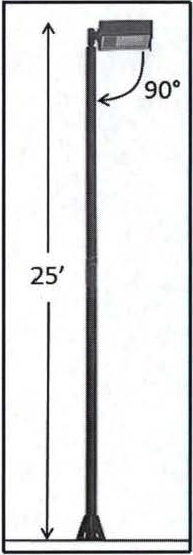
Figure 52-10-1
A.
All lighting, glare, and/or general illumination shall not be cast upon any other properties from which the lighting, glare, and/or general illumination originates.
B.
No lighting, glare, and/or general illumination which flashes, revolves, or otherwise resembles a traffic control signal or in any way creates a hazard for passing traffic shall be permitted.
C.
All exterior lighting shall conform to the New Mexico Night Skies Act.
D.
All signage and street graphics may be backlit or down-lit, but shall not be up-lit.
E.
LED lighting: Specific criteria for LED lighting shall be as follows (see figure 52-10-1):
1.
All light poles shall not exceed 25 feet in height with the exception of street lighting in public rights-of-way (ROW) as approved by the city engineer.
2.
Lighting shall not exceed 4,000K CCT (correlated color temperature).
3.
Light units shall be adjusted to 90 degrees from the light pole and oriented perpendicularly to the ground.
4.
Light units shall be shielded to prevent light spilling onto or in the direction of residential areas.
Sec. 11. - Landscaping.
To promote and preserve an aesthetically pleasing setting, reduce water erosion and runoff and improve the overall quality of the environment, the owners of all buildings and parking lots hereinafter erected or constructed in the R-3 through I-2 zoning districts, except those properties located within the C-3 and C-4 zoning districts, and those properties located within the adopted Railroad District Metropolitan Redevelopment Area Plan (MRA), shall provide and maintain landscaping in the amount and locations as set forth herein.
A.
Definition. Landscaping shall mean trees with a combination of either shrubs or ground cover. Trees are mandatory for landscaping to count towards the total required landscaping.
1.
Deciduous or evergreen trees shall be placed throughout the required landscaped area, spaced no more than 40 feet on-center. Trees shall have a minimum two-inch caliper trunk at the time of planting, which is measured four inches above the soil line in the container or four inches above the soil line on a balled-and-bur lapped tree. Trees planted in turf shall have a three-inch deep by four-foot radius mulch ring. The material shall be an organic type of bark mulch. The bark shall not be placed within three inches of the base of the trunk to inhibit pathogens from entering the tree.
2.
Shrubs shall be a minimum of two feet in height at the time of planting and shall be no more than six feet apart at the time of planting. Trees and shrubs shall be planted in accordance with ANSI A300 Part 6 (Transplanting) American National Standard Institute, which is available through the city park's superintendent and/or urban forester.
3.
Where trees are planted in parking lot islands, the islands shall be a minimum of six feet wide by six feet long. The soil contained in the islands shall be of quality topsoil with a minimum of 20% organic material. Engineered fill is not acceptable.
4.
Grass and/or low-lying green plants shall be planted to provide at least 75% coverage of the ground area at maturity.
5.
Mulch, bark, asphalt, concrete, gravel, or other decorative or non-decorative aggregate are not permitted as ground cover for the required landscaping purposes.
6.
Materials. All planting materials shall be selected for drought tolerance, water conservation, and adaptability to the climate in the Roswell area.
B.
Location and area requirements.
1.
To determine the required area to be landscaped, take the area (square footage) to be developed and subtract the square footage of structure(s) and required parking area; this shall be called the remaining area (square footage). Multiply the remaining area by 12% to calculate the required landscape area. Exception: in the C-4 districts use eight % to calculate the required area.
2.
The required landscaped area shall be clearly visible from bordering streets but not within the sight triangle for public safety. Up to one-half of the total required landscaping and its required irrigation may be located within the public right-of-way with prior written approval from the city engineer and/or the New Mexico Department of Transportation (NMDOT), whichever has jurisdiction over said right-of-way. This area may be limited for reasons of safety, practicality, and/or accessibility. Landscaping located in the sight triangle at intersections shall be in accordance with city codes.
3.
Landscaping for phased development may be determined based on the square footage of the area to be developed per each phase.
4.
Landscaped areas shall not be used for temporary or permanent retail sales, product or vehicular displays, signage, or any kind of storage.
C.
Landscape screen fence. This section only includes screen fencing made from living plants.
1.
A screen fence shall have the opacity of a solid fence to a height of at least six feet at the time of maturity. In no instance shall plants that cannot survive in this close proximity to other plants be permitted in the screen fence.
2.
A screen fence shall be irrigated and maintained continuously.
3.
A screen fence shall not extend onto sidewalks, drive lanes, or public rights-of-ways.
4.
A screen fence can account for up to two % of the total 12% required landscaping.
5.
A screen fence shall not be changed, modified, reduced, or deleted at any time without approval of the planning and zoning staff.
D.
Other location criteria. Up to half of the required landscaped area and its required irrigation may be located within the public rights-of-way with approval from the city engineer or the NMDOT to ensure that safety, practicality and accessibility are not hindered.
E.
Landscape plan review. A landscape plan shall include the type and location of all living plants and irrigation system components. This plan shall be submitted in conjunction with the site plan during the building permit application and shall be reviewed and approved by planning and zoning staff in accordance with this ordinance. Changes to the landscaping during construction will require approval prior to planting.
F.
Installation. In order to receive a certificate of occupancy the irrigation system and all landscaping must be in place in accordance with the approved landscape plan. Only one temporary certificate of occupancy (maximum of 60 days) may be granted to complete the landscaping.
G.
Maintenance. It is the property owner's responsibility to maintain all landscaped areas, including public rights-of-way and sight triangles in a healthy, neat, trimmed, clean, and weed-free condition, whether or not negligence or damage to the landscaping was the cause of the owner. Dead plant material shall be replaced with new plant material in accordance with this article within 60 days of receiving written notice from city staff.
H.
Approved landscaping shall not be changed, modified, reduced, or removed at any time without approval of the planning and zoning staff. When landscaping is removed for construction or any other reason, it shall be replanted within 180 days after being removed.
I.
Landscaped areas shall not be used for retail sales, temporary signs or any kind of temporary or permanent storage. Landscaped areas shall not be used for any type of vehicular parking. This includes, but is not limited to, the parking of carts, ATVs, motorcycles, cars, trucks, utility vehicles, recreational vehicles, trailers, boats, and airplanes.
(Ord. No. 22-03, § 3, 3-10-2022)
Sec. 12. - Site specific drainage control requirements.
A.
For a residential-commercial, commercial, or industrial development, as required by the city engineer or the NMDOT, the developer shall provide a drainage site plan which shows the site elevations for the existing and developed conditions and how the storm water shall be detained on the property. This sheet may also require the calculations and design for the detention structure as designed by a professional engineer registered in New Mexico.
B.
The amount of storm water that shall be detained and the rate at which it can be released shall be in accordance with the standards and procedures as required by the city engineer or the NMDOT, and as adopted and required by the City in this and other Ordinances.
Sec. 13. - Site specific traffic analysis requirements.
For a residential-commercial, commercial, or industrial development, as required by the city engineer or the NMDOT, the developer shall provide a traffic impact analysis for developments which require in excess of 12 parking spaces. If required by the city engineer, the traffic impact analysis shall be prepared by a professional engineer registered in New Mexico.
Sec. 14. - Dumpsters and grease bins.
A.
All sanitation dumpsters and grease bins in all commercial districts shall be constructed as shown below.
B.
All sanitation dumpsters shall be enclosed on three sides with walls no less than six feet in height constructed with consistent masonry building materials used on the main commercial property.
1.
Enclosure openings shall abut the rear property line (at a right angle OR at a 15 degree angle facing N/S/E/W according to the sanitation department's route plan for service) and be located away from high-traffic public areas, such as eating tables.
2.
Enclosures shall have metal-framed doors to fully enclose sanitation dumpsters installed.
3.
Sanitation dumpster enclosures shall have dimensions of a minimum of seven feet by nine feet per dumpster to include space for pipe bollards and associated railing.
4.
Dumpsters shall include a pedestrian access isle with a minimum width of three feet.
5.
Pipe bollards and connected railing shall be installed within the enclosure to prevent damage to the enclosure from routine sanitation pick-up services.
a.
Three pipe bollards shall be located inside each separate enclosure between the sanitation dumpster or grease bin and the rear wall located at either corner and in the center.
b.
Pipe bollards shall be placed on either side of the sanitation dumpster location at the opening of the enclosure. Therefore, an enclosure with one sanitation dumpster will necessitate five bollards whereas an enclosure with two sanitation dumpsters will necessitate eight bollards. (Please reference figures 52.14.1—52.14.3 below.)
c.
All bollards shall be a minimum of three inches in diameter and 32 inches in height and constructed of metal.
d.
All bollards shall be connected by two inches diameter metal railing which shall be welded to the bollards.
C.
Grease bins shall be located in a separate enclosure from the sanitation dumpsters with separate access and conform to the same requirements for the enclosure as listed above for sanitation dumpsters except for the following requirements:
1.
The grease bin enclosure may be attached to the sanitation dumpster enclosure, but shall be separated by a wall of the same material used for the sanitation dumpster.
2.
Grease bin enclosures shall be no less than six feet in height and allow for dimensions to accommodate the size of the grease bin and required bollards with connective railing.
3.
Grease bin enclosures shall have floor drains installed which drain into an approved grease receptor as listed in city code and approved by staff.
D.
The city engineer shall have final approval of all dumpster and grease bin locations and layouts.
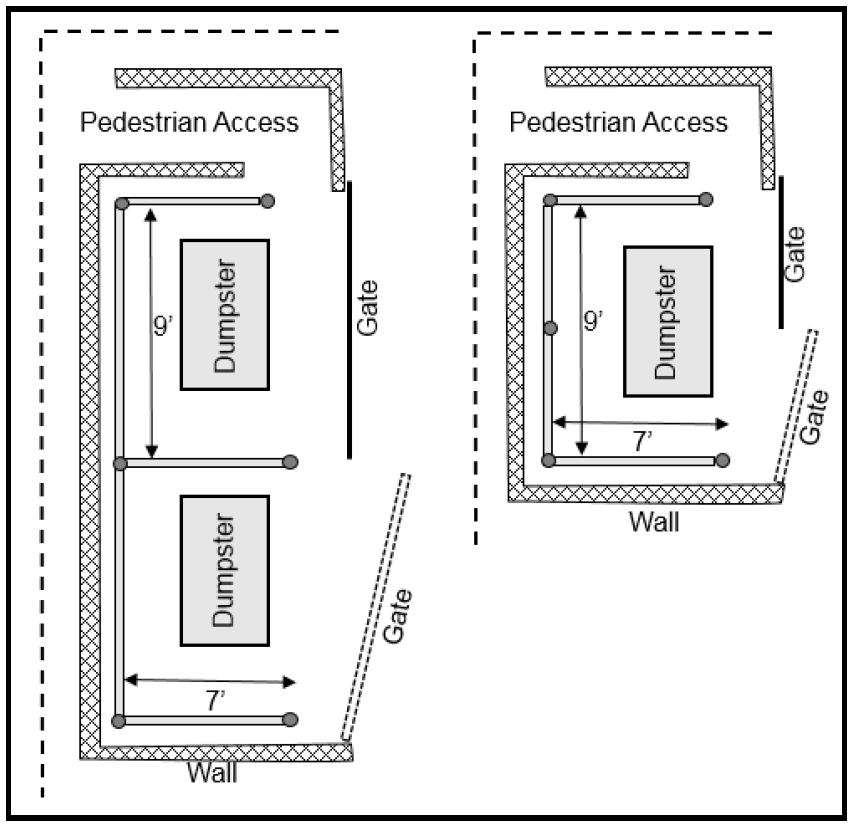
Figure 52.14.1, Top View
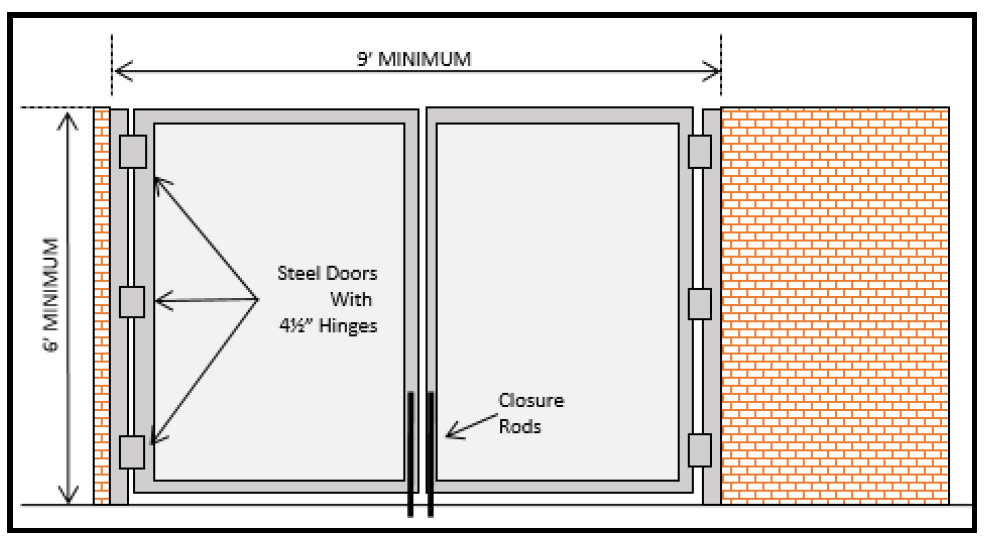
Figure 52.14.2, Dumpster Front Detail
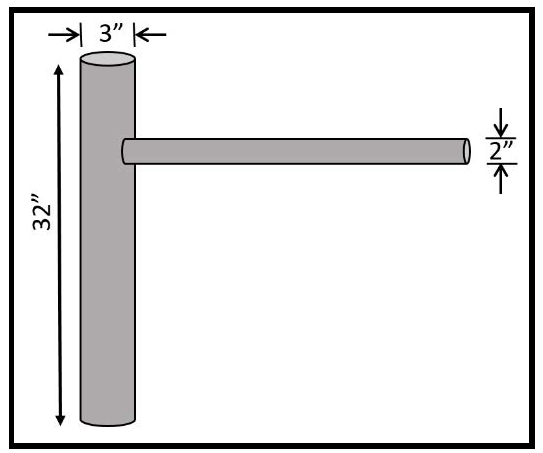
Figure 52.14.3, Bollard Detail
Sec. 15. - Airport hazards and obstructions.
A.
Airport hazards generally:
1.
Airport hazards not in public interest. It is hereby found and declared that an airport hazard endangers the lives and property of users of the airport and of occupants of land in its vicinity, and also, if of the obstruction type, in effect reduces the size of the area available for the landing, taking-off and maneuvering of aircraft, thus tending to destroy or impair the utility of the airport and the public investment therein, and is therefore not in the interest of the public health, public safety or general welfare.
2.
Airport hazards include not only physical obstructions, but also include light features that may pose a hazard to aircraft by potentially blinding aircraft operators, including, but not limited to, searchlights, lasers, or ground-mounted lighting that may mimic landing areas. In addition, hazards may include any non-official activities that generates any types of non-physical hazards that may interfere with the operations of aircraft.
B.
Preparation of airport approach plans. The governing body is hereby empowered to formulate and adopt, and from time to time as may be necessary, revise an airport approach plan for any publicly-owned airport within its corporate or political limits. Each such plan shall indicate the hazards, the area within which measures for the protection of the airport's aerial approaches should be taken, and what the height limits and other objectives of such measure should be. In adopting or revising any such plan, the governing body shall consider, among other things, the character of the flying operations expected to be conducted at the airport, the nature of the terrain, the height of existing structures and trees above the level of the airport, and the possibility of lowering or removing existing obstructions, and the governing body may obtain and consider the views of the agency of the federal government charged with the fostering of civil aeronautics as to the aerial approaches necessary to safe flying operations at the airport.
C.
Removal of airport obstructions. The governing body hereby is authorized and empowered whenever, in its judgment, any structure or object located adjacent to the airport or landing field constitutes a hazard to the efficient and safe use of the airport, or whenever notified of the existence of any such hazard, to require the removal and elimination or relocation of such structure or such object, and to acquire all necessary lands or rights-of-way and easements over lands incidental to such removal, elimination or relocation of any such structure or object upon payment to the owner of any land that may be affected by such relocation and the damages occasioned by such removal, elimination or relocation.
(Ord. No. 20-06, § 2, 7-9-2020)
Editor's note— Ord. No. 20-06, § 2, adopted July 9, 2020, enacted provisions designated as Art. 52, § 18, however, to maintain accurate numerical order, said provisions have been redesignated as § 15, at the discretion of the editor.

