
Roswell City Zoning Code
ARTICLE 70
- DESIGN GUIDELINES—OLD MUNICIPAL AIRPORT
Sec. 1. - Purpose.
The purpose of this article is to provide design guidelines for the Old Municipal Airport (OMA). This area is bounded by 8 th Street on the south, Sycamore Road on the west, Montana Avenue on the east, and 19 th Street along the north. Development within the MXP zoning district shall conform to the following land development standards.
Sec. 2. - Building mass.
Structures in the MXP area shall be multiple stories with the bottom floor being used for commercial purposes. Upper floors shall be used for residential purposes. The overall height of the structure shall not exceed 45 feet as shown in Figure 70-1.
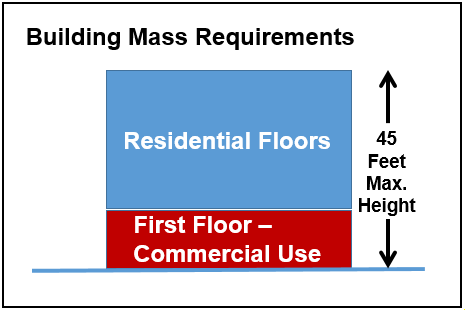
Figure 70.1
Sec. 3. - Parking.
Residential properties located in the residential-very low (R-VL), residential-L (R-L), and the townhouse and apartments developments inside the MXP zone but which are not fronting the plaza, shall be based on two spaces per unit. Details for this parking shall be based on the standards shown in article 52 (Building and Performance Standards), section 7 (Off-Street Parking and Loading Standards).
Properties in the MXP zone which front onto the plaza shall not be required to provide off-street parking, but off-street parking may be provided, so long as the parking spaces are located to the backside of the property and does not front the plaza.
Sec. 4. - Signage.
A.
General provisions for all OMA zoning districts.
1.
Flags. State or national flags are permitted in all districts except that each flag pole in excess of 30 feet shall be erected in compliance with recommendations of a signed, sealed report from a New Mexico registered structural engineer for pole height, pole installation methods, and flag size.
2.
Hazardous or nuisance signs. No sign shall be located in a manner that could constitute a hazard or nuisance; or no sign shall be illuminated to an intensity or brightness to a degree that could constitute a hazard or nuisance. Moving, flashing, intermittently-lighted, changing colors, beacons, revolving or similarly constructed signs are not allowed in any zoning district. It shall be an affirmative defense if such signs are otherwise allowed in this Code.
4.
Illuminated signs. No internally illuminated sign shall be erected in single family or two-family residential zoning districts; or within 150 feet of a single family or two-family residential development unless the lighting is shielded from view of the residential development.
5.
Murals Murals require a permit. A drawing of the mural, size and specifications, shall be attached to the permit application. Murals shall not provide signage or advertisement for a business and shall be compatible with the character of the general area.
6.
Restricted language or wording. Signs shall not display gestures or words that are obscene, profane, or pornographic in nature or any other manner promote activities that are illegal under state or federal law.
7.
Searchlights. Searchlights require a permit and are limited to a 72-hour operation period. Consecutive permits are not allowed for continuous use and a permit shall be limited to the initial opening of a business.
8.
Sign on fence, wall, etc. No person shall paint a sign or attach a sign, other than a nameplate and address (showing a street number), to the outside of a fence, railing or a wall which is not a structural part of a building. The name of the company that constructed the fence is permitted but not exceeding one square foot in size.
9.
Sign on sidewalk, street, etc. No person shall attach any sign, paper, or material, or paint, stencil, or write any name, number (except house or street address numbers) or otherwise mark on any sidewalk, curb, gutter, or street.
10.
Sign on tree, pole, or similar objects etc. No person shall attach or maintain any sign upon any tree or utility pole, light pole, traffic control sign pole, or similar structure located within the right-of-way.
11.
Signs over rights-of-way. Signs over or in public rights-of-way are prohibited, except movement control, traffic control devices, street signs, way-finding, entry-way or portal signs, or directional signs placed by the city or state. Projected banner signs over U.S. Highway 285 (Main Street) right of way are allowed in areas specified in the city wayfinding plan if part of a special event and if in compliance with New Mexico Department of Transportation guidelines.
12.
Temporary real estate directional signs. Temporary signs known as weekend real estate directional signs may be posted so long as they are sandwich board style and collected at the end of each weekend. The maximum width is 24 inches. The maximum height is 48 inches.
13.
Off-premise signs. Off-premise signage is prohibited unless specifically allowed by this Code.
F.
Protective signs. The occupant of a premise may erect two protective signs, in accordance with the following provisions:
1.
Attached sign shall not exceed one square foot in effective area.
2.
Detached signs shall not exceed one square feet in area and two feet in height.
3.
Letters shall not exceed four inches in height.
G.
Political signs.
1.
Political signs shall comply with this Code to the extent allowed by state and federal law.
2.
Political signs will not require a permit.
3.
Political signs are not allowed in the right-of-way, on any public property, or located on any utility, light, traffic signal or sign pole.
4.
No political signs can be within 100 feet of any polling location on election day when voting at a school, church or private residence; and 100 feet of the door through which voters may enter to vote at the office of the county clerk, an alternate voting location, a mobile voting site or any location used as a polling place on election day that is not a school, church or private residence.
H.
Signs not requiring permits. No permit shall be required for the following signs although the standards of this Code shall be met:
1.
Signs advertising the sale or lease of real property on which they are located on subject property.
2.
A garage sale sign located on the same premise having the sale.
3.
A protective sign that has as its purpose the protection of life and property.
4.
A sign or marker giving information about the location of underground electric transmission lines, telegraph or telephone properties and facilities, pipelines, public sewers, or water lines or other public utilities.
5.
Political signs as governed by state law.
6.
Memorial signs or tablets, names of buildings and date of erection, when cut into any masonry surface or when constructed of bronze or other similar materials.
7.
Flags, emblems, and insignia of any governmental body; decorative displays for holidays or public demonstrations which do not contain advertising.
I.
Construction and development signs.
1.
Residential. Two temporary construction or development signs may be permitted for a residential subdivision. The signs may be off-site or onsite. Developers may have the temporary development signs until houses have been constructed on 80% of the lots in the advertised subdivision. Off-site signs shall not exceed eight feet in height or 32 square feet per side. The sign shall be placed on private property with the permission of property owner. The building official may order a sign to be removed if it does not meet the requirements of this Code. Failure of the building official to order removal is not a defense to a violation of this Code.
2.
Non-residential. Only one temporary on-site development sign advertising builder, contractor, architect, lending institution, and/or name of specific business coming soon is allowed.
a.
The sign may be erected for a period of 90 days prior to the submittal of development plans for the project. If no development plans are submitted in 90 days prior, the sign shall be removed. The city council may grant a one-time extension of 45 days upon request.
b.
The sign may remain on the property for the duration of construction and shall be removed prior to the issuance of a certificate of occupancy.
c.
A permit is not required for this sign, however the size may not exceed 32 square feet and may not stand higher than eight feet from the ground to the top of the sign.
d.
Two sided signs are permitted.
J.
Sign requirements for non-residential zoning.
1.
Detached building signs.
a.
General provisions.
1)
Detached building signs shall be located on-premise unless otherwise allowed by this Code.
2)
Unless otherwise allowed in this Code, only the following types of signs shown below are permitted in all non-residential zoning districts.
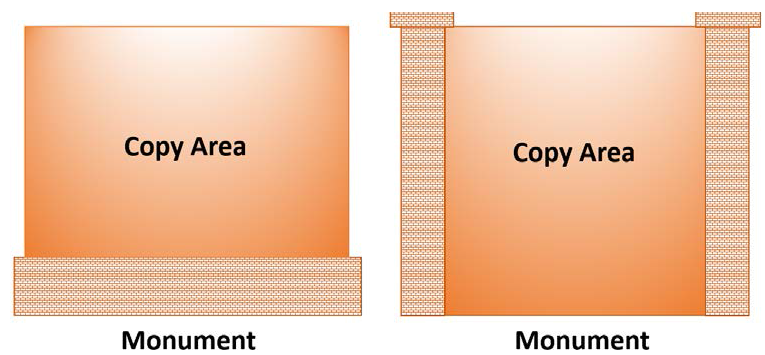
Figure 70.2
3)
Sign height and copy area is determined by the type of classification of the roadway, shown below in Table 70.3.
4)
All signs shall have decorative surface areas that equal a minimum of 20% of the total surface area square footage. This area shall be constructed thru the use of stone, brick, or other masonry materials. Wood may be incorporated as an accent material.
5)
The width of the support case on pylon signs shall be no less than 50% of the width of the copy area.
6)
Detached signs may be internally or externally illuminated.
7)
All detached building signs shall be constructed of materials matching the primary building material in color and finish.
8)
Signs may be single or double-faced.
9)
The sign shall be located a minimum of five feet from the public right-of-way and shall not create hazards to traffic or pedestrians. The planning manager or designee shall approve the exact location of the sign at the time of sign permit.
10)
Message boards are allowed as part of a sign but shall not occupy more than 24 square feet of the area of the sign face. This area shall be included in the total sign area. Non-profit organizations may utilize 50% of a sign as a message board.
2.
Attached building signs.
a.
General provisions.
1)
Attached signs are permitted in non-residential zoning districts in accordance with the provisions of this Code.
2)
Attached signs may be internally or externally illuminated.
3)
No business or non-residential occupancy shall erect a sign above the eaves or edge of the roof or on a parapet or edge of a canopy unless no other area is feasible and can be demonstrated at the time of permit.
4)
Signs for buildings in a multi-use development approved as part of one preliminary site evaluation or zoning application shall be compatible in design, size, material and lighting.
b.
Attached wall-mounted signs allowed using the formula of 0.076 times the square footage of the designated front of the building(s). Multiple occupant structure may have multiple signs based on the formula times the square footage of each bay. Commercial centers with multiple buildings may use the formula on each building. Buildings located on a corner lot may have attached signage facing both roads.
3.
Signs and awning projecting from building surface.
a.
Any non-residential occupancy may erect one attached sign projecting up to a maximum of six feet from a vertical building surface, but not above the roof. The sign shall be located a minimum of ten feet above grade and shall not project into or over any public right-of-way (see Figure 70.4 below), unless approval is obtained from the ROW owner.
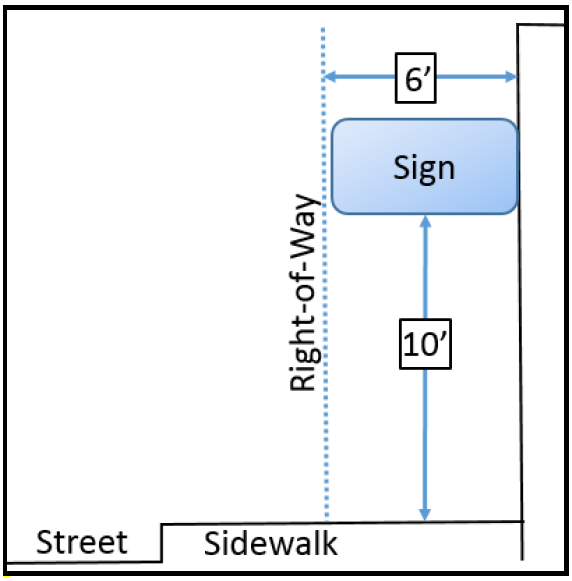
Figure 70.4
b.
Any non-residential occupancy may erect awnings projecting out to a maximum of six feet from a vertical building surface, but not above the roof, and shall be located a minimum of eight feet above grade and shall not project into or over any public right-of-way (see Figure 70.5 below), unless approval is obtained from the ROW owner.
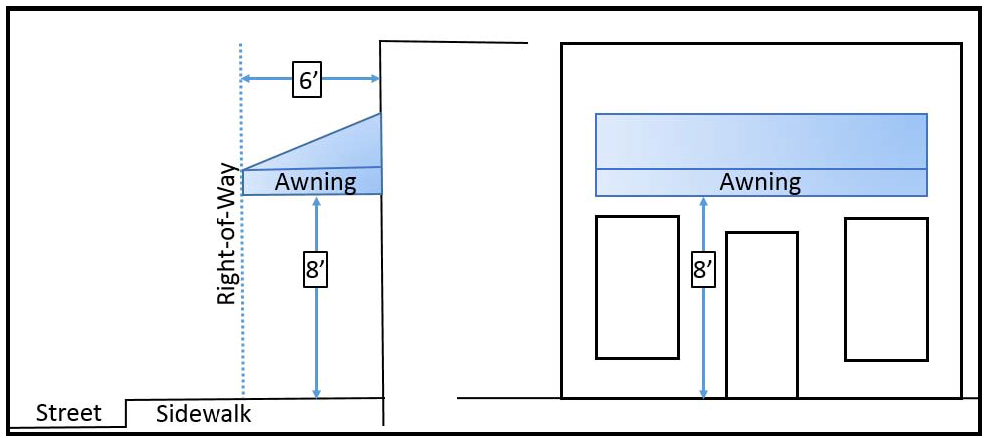
Figure 70.5
c.
Projecting signs may be combined with awnings, but neither may project above the building parapet wall.
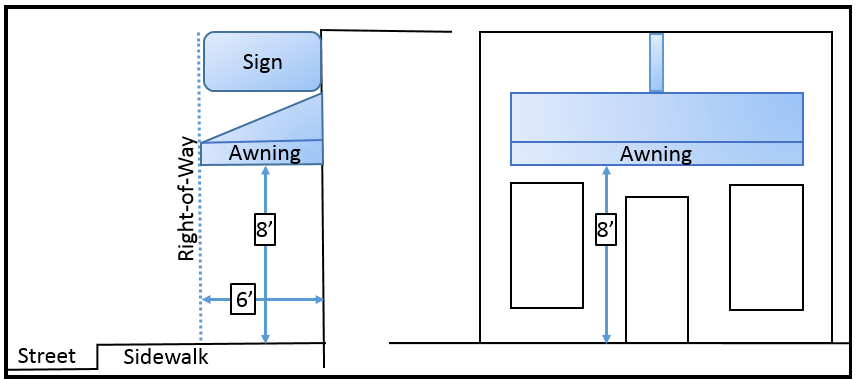
Figure 70.6
d.
Square footage for the copy area of the awning face or projecting sign face shall be determined as shown in section 70.6. Square footage of the awning face and projecting sign faces combined for the copy area shall be determined as shown in section 70.5.
4.
Menu board signs. A maximum of two menu boards for drive-through cafes/restaurants are permitted per lot. The sign shall not exceed eight feet in height and shall be single-faced with the message area not exceeding 32 square feet. The area may be increased to 40 square feet if one sign is utilized for the lot. The signs shall not face a public right-of-way that serves the front of the building.
5.
Movement control signs.
a.
Movement control signs (entrance/exit) may be erected for non-residential uses. The signs may be attached or detached, and shall be erected in accordance with the following requirements:
b.
Each sign not exceed six square feet in effective area and four feet in height.
c.
If a sign is an attached sign, the letters shall not exceed four inches in height.
d.
Each sign must convey a message which directs vehicular or pedestrian movement within or onto the premise on which the sign is located.
e.
The signs must contain no advertising but logos are allowed.
6.
Temporary signage for non-residential uses.
a.
A permit is required for all temporary signs.
b.
Temporary signs are allowed as follows:
1)
Temporary signs are prohibited within the right-of-way or adjacent to the right of way, and shall not be located in the parking area, on parking lot lights or on detached signs of any business.
2)
One attached temporary sign shall be allowed per building for single occupant buildings or per business for multiple occupant buildings for a maximum duration of 30 calendar days two times per calendar year provided there is a minimum 60 day separation between the placement of temporary signs. The allowable sign area for a temporary banner sign is one-half square feet of sign area for every one linear foot of building or lease space frontage up to a maximum of 20 square feet. Temporary banner signs shall be made of cloth, plastic or other fabric-like flexible material. Temporary banner signs shall be securely anchored to the building.
c.
Other temporary signs are allowed as follows:
1)
Temporary/promotional items such as inflatable or air-blown devices, flags, small balloons, pennants, or banners are allowed on a temporary basis for 30 days for the opening date of a business. The 30-day period may start on the date of issuance of a certificate of occupancy for the business, but shall not start later than six months after the issuance of the certificate of occupancy. Flags or pennants shall be located only on the main building of the business and not within parking lots, light poles etc.
2)
Window displays of open/close signs, name of business, hours of operation, and acceptance of credit cards shall be allowed and is not considered as part of the 25% coverage. The letters for such information shall not exceed six inches in height.
3)
Free standing advertising/signs or other signs inside the building(s) shall be located a minimum of three feet away from the windows.
d.
All existing non-residential uses shall conform to the provisions of this sub-section upon the adoption of this Code.
7.
Signage for non-occupied buildings. All sign faces for a non-occupied building or premise shall be removed upon vacation of the property. The sign structure may remain for future occupancies. It is the responsibility of the property owner to cause such a removal.
8.
Real estate signs for non-residential or undeveloped property.
a.
A permit is not required.
b.
Property owners are allowed to have one sign per street frontage to advertise the sale or lease of a property. The sign shall be located on premise and shall not exceed six feet in height or 20 square feet in total area.
c.
The sign shall be self-supporting.
d.
The sign shall be removed after 80% of the property is sold or leased.
e.
One "For Lease" or "For Sale" sign may be located inside the building on the window front.
K.
Signage for OMA residential zoning districts:
1.
Three wall signs (special uses and conditional uses).
2.
One monument sign built to the following criteria.
a.
Not to exceed 35 square feet in total area and five feet in height above the average grade of the nearest public right-of-way. (See Figure 70.7)
b.
Monument signs shall be built on a monument base.
c.
Monument signs shall use permanent materials matching the primary building material in color and finish.
d.
Signs may be single or double-faced.
e.
The thickness of the sign shall not exceed 30 inches.
f.
Detached monument signs may be internally or externally illuminated.
g.
May not be constructed of wood or be a painted.
h.
An electronic message board sign shall not be allowed as part of the sign.
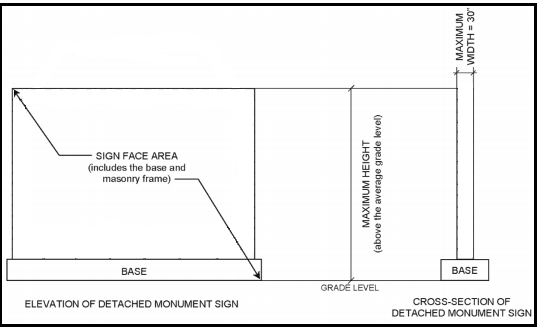
Figure 70.7
L.
Government signs. Nothing in this Code shall be construed to prevent the display of a national flag or state flag, or to limit flags, insignia, legal notices, or informational, directional, or traffic signs which are legally required or necessary to the essential functions of government agencies.
Sec. 4. - Lighting.
A.
Project applicability: Street lights shall be installed in subdivisions, developments, at all intersections, development entrances, and along internal streets.
B.
Street light system design: The proposed street light system shall meet the following conditions:
1.
Style. Streetlights shall be vintageor art-deco-style use poles (See Figure 70-8) and fixtures that do not exceed 18 feet in height.
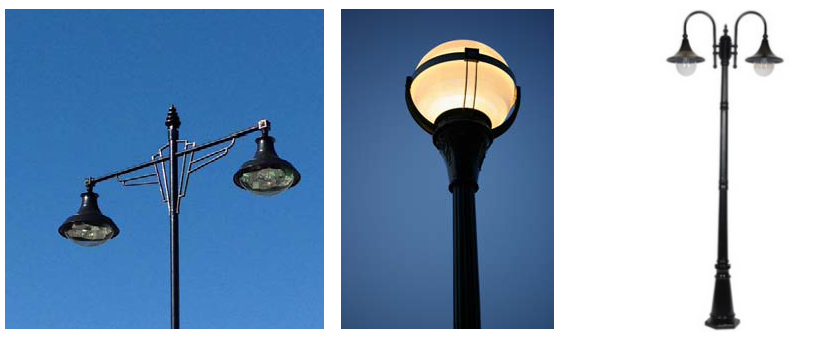
Figure 70.8
2.
Continuity. Street lights shall be consistent style throughout the entire development.
3.
If a street light exists along the street on which the entrance to the development is located, the applicant shall install the same or similar street light at the entrance.
4.
At intersections, the applicant shall propose a lighting design that provides the minimum amount of light necessary for vehicular and pedestrian safety at all intersections within the development.
Sec. 5. - Utility installations.
All utilities needed to support the development shall be located underground.
Sec. 6. - Architectural standards.
1.
All non-residential architecture shall be encouraged to incorporate vintage, art-deco-style elements, including materials, windows, and colors.
2.
Entrance points off of College Boulevard, 8 th Street, Nevada Avenue, and Sycamore shall be limited to one entrance for every 1,000 feet of linear frontage. In addition, these entrances shall incorporate an entryway feature that includes the name of the development pod.

