
Round Rock City Zoning Code
CHAPTER 1
INTRODUCTORY PROVISIONS
Sec. 1-1. - Short title.
This code shall be officially known and cited as the Zoning and Development Code of the City of Round Rock, Texas. References to "this code" or "the code" shall be interpreted as references to the zoning and development code.
Sec. 1-2. - Authority.
This code is adopted under authority of the constitution and laws of the state, including particularly V.T.C.A., Local Government Code ch. 211, and pursuant to the provisions of the City Charter.
Sec. 1-3. - Scope and purpose.
The purpose of this code is to place all city regulations governing the development of real property subject to the jurisdiction of the city into one place to facilitate administration and use. More specifically, this code provides regulations for zoning, subdivision platting, streets and thoroughfares, buildings, signs, tree protection, and other aspects of land development that are written in accordance with the general plan to achieve objectives that include, but are not limited to the following:
(a)
Promote the public health, safety and general welfare of the citizens of the city;
(b)
Encourage protection and preservation of the natural environmental and beauty of the city;
(c)
Provide for adequate light, air, and privacy;
(d)
Secure from fire, flood, and other danger;
(e)
Prevent overcrowding of the land and undue congestion of population;
(f)
Protect the social and economic stability of all parts of the city;
(g)
Protect the character and the established pattern of desirable development in each area;
(h)
Encourage the orderly and beneficial development of the city through appropriate growth management techniques assuring the timing and sequencing of development;
(i)
Guide public and private policy and action in order to provide adequate and efficient transportation, water, wastewater, schools, parks, and other public improvements and facilities;
(j)
Provide for the most beneficial relationship between the uses of land and the circulation of traffic throughout the city; and
(k)
Establish processes that effectively and fairly apply the regulations and standards of this code and respects the rights of property owners and the interests of citizens.
Sec. 1-4. - Rules of construction.
In the interpretation of provisions in this code, the rules of this section shall be observed and applied, except when the context clearly indicates or requires otherwise:
(a)
For the purpose of this section, certain terms and words are hereby defined; terms not defined herein shall be construed in accordance with adopted building codes or their customary usage and meaning.
(b)
The term "building" includes the term "structure."
(c)
In the case of any difference of meaning or implication between the text of this code and any caption, number, illustration or table, the text shall control, unless otherwise specifically noted herein.
Sec. 1-5. - Jurisdiction.
This code shall apply to all land within the city limits. All structures and land uses constructed or commenced after the effective date of the ordinance from which this code is derived, and all enlargements of, additions to, changes in and relocations of existing structures and uses occurring after the effective date of the ordinance from which this code is derived shall be subject to this code.
Sec. 1-6. - Minimum requirements.
(a)
In their interpretation and application, the provisions of this code shall be held to be minimum requirements adopted for the promotion of public health, safety and general welfare.
(b)
Whenever the requirements of this code are at variance with the requirements of any other lawfully adopted rules, regulations, or ordinances, the requirement that is most restrictive or that imposes higher standards as determined by the zoning administrator shall govern.
(c)
The issuance of any permit, certificate or approval in accordance with the standards and requirements of this code shall not relieve the recipient of such permit, certificate or approval from the responsibility of complying with all other applicable requirements of any other city, state or federal agency having jurisdiction over the structures or land uses for which the permit, certificate or approval was issued.
Sec. 1-7. - Round Rock Comprehensive Plan.
Pursuant to V.T.C.A., Local Government Code § 213.002, the City Council of Round Rock, Texas has adopted a comprehensive plan which is a coordinated set of plans organized by subject and geographic area to be used to coordinate and guide the establishment of development regulations in the City of Round Rock. The coordinated set of plans shall be collectively referred to as the "Round Rock Comprehensive Plan". The Round Rock Comprehensive Plan shall consist of the following set of plans:
(a)
Comprehensive Plan 2030. The Comprehensive Plan 2030 was adopted on June 25, 2020 in Ordinance No. O-2020-0175. The Comprehensive Plan 2030 is referred to in this Code as the "comprehensive plan" or the "general plan."
(b)
Comprehensive Parks and Recreation Master Plan. The Comprehensive Parks and Recreation Master Plan was adopted on August 23, 2018 in Ordinance No. O-2018-5727. The Comprehensive Parks and Recreation Master Plan is referred to in this Code as the "parks master plan."
(c)
Comprehensive Transportation Master Plan Update. The Comprehensive Transportation Master Plan Update was adopted on October 12, 2017 in Ordinance No. O-2017-4842. The Comprehensive Transportation Master Plan Update is referred to in this Code as the "transportation master plan."
(d)
Downtown Master Plan. The Downtown Master Plan was adopted on June 24, 2010 in Ordinance No. G-10-06-24-10A1.
(e)
Austin Executive Airport Joint Airport Hazard Zoning Regulations. The Austin Executive Airport Joint Airport Hazard Zoning Regulations, adopted on May 12, 2017, by the Austin Executive Joint Airport Zoning Board, are hereby adopted as part of this Code.
(Ord. No. O-2020-0175, § II, 6-25-2020)
Sec. 1-8. - Compliance required.
No land shall be used and no structure shall be constructed, occupied, enlarged, altered or moved until the following requirements are met:
(a)
All applicable development review and approval processes have been followed.
(b)
All applicable approvals have been obtained.
(c)
All required permits or authorizations to proceed have been issued.
Sec. 1-9. - Conflicting provisions.
(a)
Conflict with state or federal regulations. If the provisions of this code are inconsistent with those of the state or federal government, the more restrictive provision will control, to the extent permitted by law. Local regulations provided herein shall not preclude compliance with international, federal, or state building codes.
(b)
Conflict with other city regulations. If the provisions of this code are inconsistent with one another or if they conflict with provisions found in other adopted ordinances or regulations of the city, the more restrictive provision or the one which imposes higher standards as determined by the zoning administrator will control.
(c)
Conflict with private agreements. It is not the intent of this code to interfere with, abrogate or annul any easement, covenant, deed restriction or other agreement between private parties. If the provisions of this code impose a greater restriction than imposed by a private agreement, the provisions of this code will control. The city shall not be responsible for monitoring or enforcing private agreements.
Sec. 1-31. - Authority to administer the development code.
This code shall be enforced by the zoning administrator. No oversight or dereliction on the part of the zoning administrator, or on the part of any official or employee of the city shall legalize, authorize, or excuse the violation of any of the provisions of this code.
Sec. 1-32. - Violation and penalties.
The owner of a building or premises in or upon which a violation of any provision of this code has been committed or shall exist, or the lessee or tenant of an entire building or entire premises in or upon which a violation has been committed or shall exist, or the agent, architect, building contractor, or any other person who commits, takes part, or assists in any violation, or who maintains any building or premises in or upon which such violation exists, shall be guilty of a misdemeanor and, upon conviction, shall be punished in accordance with the provisions of Sec. 1-9 of the Code of Ordinances.
Sec. 1-33. - Remedies and enforcement powers.
In case any building or structure is erected, constructed, reconstructed, altered, repaired, converted, maintained, or any building, structure, or land is used in violation of this code, the appropriate city authorities, in addition to other remedies, may institute appropriate action or proceeding to prevent such unlawful erection, construction, reconstruction, alteration, conversion, maintenance, or use to correct or abate such violation, or to prevent the occupancy of such building, structure or land.
Sec. 1-50. - Definitions.
The purpose of this section is to define words, terms and phrases contained within this code, unless otherwise specifically defined elsewhere herein. Definitions for words not defined below may be defined elsewhere in the City of Round Rock Code of Ordinances or found in Webster's Dictionary of the English language, unabridged, subject to interpretation by the PDS director.
| Term | Definition |
|---|---|
| Abate/Abatement | To end a nuisance, emergency, or nonconformance. |
| Abandoned sign | A sign which for a period of at least 90 consecutive days advertises or identifies a business establishment that has been closed or abandoned. |
| Abutting (same as Adjoining, Contiguous) | Having a common border with or being separated from such common border only by an alley. |
| Access | A means of vehicular entry to or exit from property. |
|
Accessory building/structure
(nonresidential) | A structure which is on the same parcel of property as the principal structure and the use of which is incidental to the use of the principal structure. Includes, but is not limited to, storage facilities, detached garages, parking structures or enclosures, and other similar buildings or structures. |
|
Accessory building/structure
(residential) | A structure which is on the same parcel of property as the principal structure and the use of which is incidental to the use of the principal structure. Includes, but is not limited to, swimming pools, pool houses/cabanas, workshops, decks, storage sheds, barbeque structures, detached garages, playscapes, tree houses and other similar buildings or structures. Conexes and shipping containers are not considered to be an accessory structure in residential zoning districts. |
| Accessory dwelling unit | A dwelling unit built on a legal lot in addition to a principal dwelling unit or structure. Accessory dwelling units are subordinate in size, location, and use to the principal structure. |
|
Accessory dwelling unit,
connected | A dwelling unit which is integrated into the floorplan of a principal dwelling unit and includes a connecting door to the principal unit. A connected accessory dwelling unit is subordinate in size and use to the principal structure and may include a front door separate from the primary dwelling unit and its own dedicated garage parking space. A connected accessory dwelling cannot be a separate structure. |
| Active master electrician | A licensed master electrician under the provisions of Chapter 8, article X, division 9, who is currently in good standing status. |
| Activity centers, children's | Children's participatory recreational and entertainment uses conducted within an enclosed building. Typical uses include party rooms, inflatable playground equipment, other playground equipment and food service for participants. Use of the facility is generally limited to a reservation basis. Does not include bowling alleys, game arcades, pool halls, dance halls, movie theaters, other theaters or other types of indoor entertainment activities. |
| Addition | One lot, tract or parcel of land lying within the corporate limits or ETJ which is intended for development. |
| Address | The number or other designation assigned to a housing unit, business establishment, or other structure for purposes of mail delivery, emergency services, and so forth. |
| Adjoining | See "abutting". |
| Agricultural operations | Farming, including any customary agricultural buildings and structures; and uses such as field crops, orchards and horticulture. |
| Alley | A vehicular way located to the rear of lots providing access to service areas, parking and outbuildings and containing utility easements. |
| Alluvial fan flooding | Flooding occurring on the surface of an alluvial fan or similar landform which originates at the apex and is characterized by high velocity flows; active processes of erosion, sediment transport, and deposition; and unpredictable flow paths. |
| Alternative standards agreement | An agreement between the city and developer and/or owner of the land that modifies the regulations herein. |
| Amenity center | A private facility associated with a specific development that provides social gathering areas, recreational facilities, or other types of common space for the exclusive benefit of residents of the development. Examples include pools, fitness centers, and social rooms. |
| Animal, small | Any domesticated animal which is generally considered a household pet, such as dogs, cats, cockatiels, ferrets, hamsters, guinea pigs, gerbils, rabbits, fish, or small nonpoisonous reptiles or nonpoisonous snakes. Does not include livestock, caged or penned fowl or pigeons. |
| Animated sign | A sign which has any visible moving part, flashing or oscillating lights, visible mechanical movement of any description, or other apparent visible movement achieved by any means that move, scroll, rotate, revolve, change, flash, oscillate or visibly alters in appearance of the sign. This shall specifically exclude barber poles, and time/temperature signs. |
| Apartment | A self-contained dwelling unit which is located within a structure which contains three or more such units which share common walls and/or floors/ceilings with one or more units. |
| Apartment building | A residential structure consisting of three or more dwelling units sharing common walls and/or floors/ceilings with one or more units. Units may have a single access from a shared hallway or walkway, either enclosed or open directly to the outside. |
| Apex | A point on an alluvial fan or similar landform below which the flow path of the major stream that formed the fan becomes unpredictable and alluvial fan flooding can occur. |
| Applicable governing body | The City of Round Rock, Texas, shall be the applicable governing body. |
| Approved | Approved by the zoning administrator, building official, or other authority having jurisdiction. |
| Appurtenant structure | See "Accessory building/structure" (either nonresidential or residential, whichever is applicable). |
| Architectural concrete masonry unit (CMU) | A block masonry product made from molded or cast concrete and having a split-face, stone-face, or similar decorative finish. Smooth-face, burnished, scored, and fluted CMU do not qualify as architectural CMU under this definition. |
| Architectural feature | Any element or details of a building or structure that defines its style, such as, but not limited to, windows, doors, and building material coursing patterns. |
| Architecturally finished steel or metal | A steel or metal product used for the exterior wall finish of structures that is coated or otherwise finished by the manufacturer prior to sale and has a minimum 20-year warranty. Typical products include corrugated, ribbed, or flat panels. |
| Area identification sign/entry feature sign | Any sign or entry feature identifying the name of a subdivision, district or development with multiple buildings grouped together with a distinct identity. |
| Area of future conditions flood hazard | The land area that would be inundated by the one percent annual chance (100-year) flood based on future conditions hydrology. |
| Area of shallow flooding | A designated AO, AH, AR/AO, AR/AH, or VO zone on a community's flood insurance rate map (FIRM) with a one percent chance or greater annual chance of flooding to an average depth of one to three feet where a clearly defined channel does not exist, where the path of flooding is unpredictable and where velocity flow may be evident. Such flooding is characterized by ponding or sheet flow. |
| Area of special flood hazard | The land in the floodplain within a community subject to a one percent or greater chance of flooding in any given year. The area may be designated as zone A on the flood hazard boundary map (FHBM). After detailed ratemaking has been completed in preparation for publication of the FIRM, zone A usually is refined into zones A, AO, AH, A1-30, AE, A99, AR, AR/A1-30, AR/AE, AR/AO, AR/AH, AR/A, VO, V1-30, VE or V. |
| Armature sign | A freestanding sign that hangs, suspended by chains, hooks, or similar means, below an arm extending horizontally from a single vertical support affixed to the ground. |
| Assessment | For the purpose of water and wastewater impact fees, "assessment" shall have the meaning set forth in V.T.C.A., Local Government Code § 395.016(f). |
| Assisted living | A residential facility providing 24-hour care in a protected living arrangement for residents and supervisory personnel. Typical uses include nursing homes and assisted living centers, congregate living facilities for seniors, foster homes, maternity homes, and homes for the physically and mentally impaired or the developmentally disabled. Requires licensing by the state. Does not include post-incarceration facilities or facilities for those who are a danger to themselves or others. |
| Attached wireless transmission facility (attached WTF) | A wireless transmission facility (WTF) that is attached to a monopole, self-enclosed monopole, building or other permanent structure. |
| Awning/canopy | A shelter extending from the exterior wall of a building. |
| Awning/canopy sign | Any sign that is painted on or applied directly to, and contained entirely within the face, valance, or side panels of an awning/canopy. When the shelter is made from rigid materials, a sign may be mounted to the underside or top. |
| Auto body, painting and repair shops | An establishment that provides collision repair services for automobiles and light trucks and other similar motor vehicles, including body frame straightening and repair, replacement of damaged parts and painting. The term "auto body, painting and repair shops" may also include general repairs, but excludes establishments in which the principal use is service or retail sales oriented, including but not limited to quick lube, brake shops, tire replacement and muffler shops. |
| Auto sales, rental or leasing facilities | The sale or rental of automobiles, light trucks, motorcycles, recreational vehicles, or boats, including storage, maintenance, body painting and repair and servicing. Typical uses include new and used car dealerships, motorcycle dealerships, and boat, trailer or recreational vehicle dealerships. |
| Auto service and repair facilities | An establishment that provides service, repair and maintenance of automobiles and light trucks and other similar motor vehicles. Typical uses include gas stations (without vehicle repair/service bays), quick lube services, tire sales and installation, engine repairs, muffler shops wheel and brake shops, and inspection shops. The term "auto service and repair facilities" does not include auto body repair and auto painting. |
| Bandit sign | A temporary sign, usually made of cardboard or foam board, mounted on an angle iron or a wooden stake. |
| Banner sign | A temporary, lightweight sign that contains a message which is attached or imprinted on a flexible surface and that is typically constructed of nondurable materials, including, but not limited to, cloth, and/or plastic. |
| Base (of a sign) | The portion of a sign that is in contact with the finished grade, and acts as the sign structure. |
| Base flood | The flood having a one percent chance of being equaled or exceeded in any given year. |
| Base flood elevation (BFE) | The elevation shown on the flood insurance rate map (FIRM) and found in the accompanying flood insurance study (FIS) for zones A, AE, AH, A1-A30, AR, V1-V30, or VE that indicates the water surface elevation resulting from the flood that has a one percent chance of equaling or exceeding that level in any given year. Also called the "base flood." |
| Basement | Any area of the building having its floor subgrade (below ground level) on all sides. |
| Bed and breakfast | A private residence or commercial operation that offers sleeping accommodations and serves breakfasts at no extra cost to its lodgers. |
| Berm, landscape | An earthen mound designed to screen views, provide topographic variety and promote visual interest. A typical berm has a minimum height of 36 inches with a maximum side slope of four horizontal feet to one vertical foot. |
| Billboard sign | A large outdoor board for displaying advertisements which promotes or advertises commodities or services available at a location other than where the sign is located and shall include those signs whose message space is available for lease, rent or hire and exceeds the maximum allowance of sign display area for freestanding signs in this Code. |
| Block | A unit of land bounded by streets or by a combination of streets and public land, railroad rights-of-way, waterways, or any other barrier to the continuity of development. |
| Bona fide residence | The principal address and primary residence, including an accessory dwelling unit, of an occupant conducting a home occupation, as determined by one of the following criteria: The registered homestead of the occupant, voter registration (precinct), address displayed on driver's license, or other state or federal registration documents identifying the principal address. |
| Bond | Any form of security including a cash deposit, surety bond, collateral, property or instrument of credit in an amount and form satisfactory to the city council. |
| Breakaway wall | A wall that is not part of the structural support of the building and is intended through its design and construction to collapse under specific lateral loading forces, without causing damage to the elevated portion of the building or supporting foundation system. |
| Brewpub | An establishment containing both a restaurant and a brewery that produces beer for on-site sale. |
| Brick | A masonry building product rated SW for severe weathering and manufactured primarily from clay, shale, or similar naturally occurring earthy substances, which is subjected to a heat treatment at elevated temperatures known as firing, and which is applied unit by unit and set in mortar. Thin brick veneer does not qualify as brick under this definition. |
| Building | Any structure built for the support, shelter or enclosure of persons, animals, chattels or property of any kind which has enclosing walls for 50 percent of its perimeter. The term "building" shall be construed as if followed by the words "or part thereof." Each portion of a building separated from other portions by a four-hour firewall shall be considered as a separate building. |
|
Building area
(Building coverage) | The area of a lot covered by buildings (principal and accessory) or roofed areas, as measured along the outside wall at ground level, and including all projections other than open porches, fire escapes, canopy areas and the first two feet of a roof overhang. |
| Building construction sign | A nonpermanent sign identifying persons, firms or businesses directly connected with a construction project. |
| Building line (Setback line) | The line or lines within a lot created by the intersection of the vertical planes of a building and the ground. The required building setback line is measured from the property line. |
| Building lot | A platted tract of land that, at the time of filing for a building permit, is intended by its owner or developer to be used, developed, or built upon as a unit, under single ownership or control. A building lot shall front upon a dedicated street. |
| Building official | The officer or other designated authority charged with the administration and enforcement of Chapter 8, article X (Buildings and Building Regulations), or his duly authorized representative. |
| Building permit | A permit issued by the city for the construction, erection or alteration of a structure or building. |
| Building, front of | That exterior wall of a building that faces an adjacent street right-of-way. |
| Building, principal | A building in which is conducted the principal use(s) of the lot on which it is situated as permitted by the zoning district. Accessory buildings are not principal buildings. |
| Building scrim sign | A large non-rigid banner of a durable, mesh, fabric material that allows air and light to pass through, used to wrap a building or portion of a building with items of information. |
| Building sign | Any sign attached to any portion of a building, including accessory buildings and structures, on windows, and attached or placed on awnings/canopies. |
| Business use | Land uses classified by the zoning ordinance as commercial or industrial, including places of worship, schools and similar institutional uses, governmental and civic uses, and mixed-use projects where a building contains residential and commercial Customary home occupations shall not be considered as business uses. |
| Cabinet sign | A sign which is internally lit and contains all its components and items of information within a single enclosure and whose perimeter is not shaped to the content of the sign and where the sign face is differentiated from the structure against or within which a sign face is placed. An internally lit backer board shall be considered a cabinet. Logos, pan-faced signs, raceways, taglines shall be exempt from this definition. |
| Caliper, tree | The diameter of a tree to be planted in the ground. The caliper is measured six inches above the root ball for trees that are up to and including four-inch caliper size. For trees that are larger than four-inch caliper, measurement shall be 12 inches above the root ball. |
| Canopy sign | See Awning/canopy sign. |
| Canopy, tree | The upper vegetative cover of a tree or tree grouping. |
| Cap (of a sign) | The uppermost surface or part of a sign that is usually added as a decorative feature. |
| Caretaker residence | A dwelling unit which is used exclusively by the owner, manager or operator of a principal permitted use and which is located on the same lot or parcel as the principal use. |
| Carwash | A facility for washing passenger vehicles, recreational vehicles, or other light duty equipment. Includes facilities in which the washing process is automated and those in which it is manually operated. |
| Cemetery (also Memorial Park) | Land used for interment of human or animal remains or cremated remains, including a burial park for earth interments, a mausoleum for vault or crypt interments, a columbarium for cinerary interments, or a combination thereof. |
| Certify | A declaration made in any manner, oral or written, providing reasonable assurance of the accuracy of the declaration. |
| Champion tree registry | A registry containing a list of the champion tree of a species within the city limits as identified by the forestry manager and adopted by the city council. |
| Changeable message (of a sign) | Items of information that may be changed or rearranged through manual, mechanical or electrical means, including time and temperature messages and EMC's. |
| Channel letters (of a sign) | Individually constructed and individually illuminated letters, graphics, or graphic elements. |
| Character-defining features | For the purposes of historic preservation, any unique feature, typically but not limited to architectural features, whose deterioration or removal would threaten or compromise the historical integrity and significance of a structure. |
| Chief appointing authority | The person or persons designated by the laws of the local governing body as having authority to appoint persons to various boards. |
| Chief electrical inspector | That employee of the city appointed by the city manager to carry out the duties and responsibilities of Chapter 8, article X, division 9. |
| Circulation | Systems, structures, and physical improvements for the movement of people and goods by such means as streets, highways, sidewalks, and other paved improvements. |
| City | The City of Round Rock, a home rule municipal corporation in the State of Texas. |
| City council | The City Council of the City of Round Rock. |
| City enforcing official | The officer or other designated authority charged with the administration and enforcement of the codes set forth herein, or his duly authorized representative. |
| City engineer | The individual designated by the city manager to provide civil engineering review of land development projects. |
| City manager | The individual appointed by the city council to supervise all city operations. |
| Clearance (of a sign) | The distance between the finished grade and the bottom of a sign over a public-right-of-way or walkway that shall remain clear of all obstruction. |
| Code ("this code") | The latest edition of the Round Rock Zoning and Development Code, as amended. |
| Code enforcement | Duties designated to the zoning administrator to cause property owners and others responsible for buildings and related land uses to bring their properties up to standards required by building codes, housing codes and other regulations. |
| College or university | An educational institution or other institutions of higher learning that offer courses of general or specialized study leading to a degree. |
| Collocation, WTF | The locating of wireless communications equipment from more than one provider on a single mount or support structure. |
| Columbarium | A structure or building substantially exposed above ground intended to be used for the interment of the cremated remains of a deceased person or animal. |
| Commercial kitchen | An area on the premises in which food is prepared for on- or off-site consumption which includes commercial kitchen equipment consisting at a minimum of a three-compartment sink, commercial range, and appropriate exhaust and fire suppression devices. |
| Commercial message | Words and trademarked logos which identify the goods and services available at a business use. |
| Commercial road | Those roads that are specifically designated as such by the Code. |
| Commission | In general, the planning and zoning commission. For the purposes of chapter 8, article X, the term commission shall refer to the Building Standards Commission of the city as appointed by the city council. |
| Community recreational facilities | Any parks, playgrounds and sports, recreation or other community buildings owned and/or operated by the city or other governmental agency, but not including country clubs or golf courses, miniature golf courses, driving ranges or similar forms of commercial amusement. |
| Community/government service | Uses of a governmental, public, nonprofit, or charitable nature providing professional service of an ongoing education, training, or non-correctional counseling to the public, on a regular basis, without a residential component. Typical uses include federal, state, county, or local government offices, libraries, museums, senior centers, community centers, youth club facilities, and social service facilities. |
| Compound meter | A water meter system containing two or more metering devices in parallel with each other. |
| Comprehensive sign plan (CSP) | A coordinated plan of all signs, including exempt and temporary signs for one or more business uses, located on a development site. The CSP shall include, but not be limited to, indications of the locations, dimensions, colors, letter styles and sign types of all signs to be installed on a site. |
| Concept plan | A plan submitted by a developer for implementing an integrated development scheme of a proposed addition or subdivision, and to foster general consensus regarding compliance with this Code. |
| Condominium | A form of real property ownership that combines separate ownership of individual living units with common ownership of other elements such as land or accessory buildings, in compliance with relevant State real property laws. |
| Connectivity index | A tool used to quantify how well a given transportation network connects destinations as measured by a ratio of links to nodes. |
| Contiguous | See "abutting". |
| Conversion | A change of use from single-family or two-family residential to a nonresidential use. Downtown, a conversion shall be a change of use from any single-family, downtown residential, upper-story residential, or accessory dwelling unit to a nonresidential use. |
| Corporate architecture | A style of architecture intended to evoke a specific brand or company and which is typically used for new construction or renovation of all or most locations of the company regardless of geography. |
| Corporate limits | The boundaries of the city. |
| Cosmetic services | Retail services focused on matters of personal cosmetic health and beauty which are typically elective in nature, such as but not limited to hair and nail salons, spas, massage therapy, waxing, permanent makeup, microblading, microdermabrasion, botox, chemical peels, facials, tanning, eyelash extensions, and eyebrow threading. This definition does not include tattoo or piercing shops. |
| County | Travis or Williamson County, Texas, whichever is applicable. |
| Country club | Any private recreational, social, and multi-purpose use associated with a private golf course for the benefit and enjoyment of members and their guests. Typical uses include clubhouses, tennis courts, playgrounds and swimming pools. |
| Covenant, protective (see Deed Restriction) | Contract made between private parties as to the manner in which land may be used with a view towards protecting and preserving the physical and economic integrity of an area. Covenants are enforced by the parties of the contract. |
| Creek | A stream of surface water sufficient to produce a defined channel or bed. |
| Critical feature | An integral and readily identifiable part of a flood protection system, without which the flood protection provided by the entire system would be compromised. |
| Critical root zone (CRZ), tree | A region measured outward from the trunk of a tree representing the essential area of the roots that must be preserved for the tree's livelihood. The CRZ is measured as one foot of radial distance outward from the trunk for every inch of the tree's diameter, but may not be less than a radius of eight feet. |
| Crown, tree | All portions of a tree, excluding the trunk and roots. |
| Day, business or work | A work day in which the city offices are open for business, exclusive of weekends and holidays, as established by the city council. |
| Day care (in home) | A residential use in which an individual or organization provides daytime care for six or fewer children not related by blood or marriage to, or not the legal wards or foster children of, the attendant adult. |
| Day care (all other) | A nonresidential building where care, supervision, custody or control is provided for children or adults for any part of a 24-hour day, not including overnight care. |
| Deciduous | A plant or tree with foliage that sheds annually. |
| Decorative feature | Any element including, but not limited to, planters, windmills, pillars, structures that serve as a logo, or similar element being used for decoration placed in conjunction with an area identification sign or entry feature. Planters shall only be considered decorative features when they are not part of the allowable base height of an area identification sign or entry feature. |
| Decorative groundcover | Assorted aggregate materials that are intended to create decorative, pervious or semi-pervious areas within the landscape. Typical materials used as decorative groundcover are: decomposed granite, crushed granite gravel, river rock, pea gravel, tumbled glass and bark mulch. Decorative groundcover shall be shown graphically by a delineated boundary of the area to be covered and an associated call-out that includes the name of the material, depth of material and square footage of area to be covered. |
| Decorative paving | Modular paving or custom finishes and textures for cast-in-place concrete. Modular paving includes, but is not limited to, brick, tiles, stone and concrete pavers. Decorative paving for concrete includes textured finishes, integrated color, exposed aggregate, scoring patterns and stamped patterns. |
| Decorative wall | A wall constructed of brick, stone, stucco, concrete, or architectural concrete masonry units with a masonry cap having an exterior finish that complements and/or matches the primary architecture of a proposed or existing development. |
| Dedication | The commitment of land, or an easement therein, by the owner, for the use of the public, and accepted for such use by or on behalf of the public. |
| Deed | A warranty deed in a form approved by the city attorney. |
| Deed restriction (see also Covenant, Protective) | An agreement that binds and restricts the land in the hands of present owners and subsequent purchasers. Deed restrictions are enforced by the land owners who are parties to the agreement. |
| Demolition by neglect | Neglect in the maintenance of any structure on a property with H (Historic Overlay) district zoning that results in deterioration of the structure, including but not limited to structural defects, or threatens the preservation of the structure through the loss of any character-defining features. |
| Density | The number of dwelling units permitted per acre of land. |
| Department of planning and development services or planning department (PDS) | The offices of the city which oversee the administration of the regulations contained in this code. |
| Design (irrigation systems) | For the purposes of regulating irrigation systems, design means the act of determining the various elements of a landscape irrigation system that will include, but not be limited to, elements such as collecting site specific information, defining the scope of the project, defining plant watering needs, selecting and laying out emission devices, locating system components, conducting hydraulics calculations, identifying any local regulatory requirements, or scheduling irrigation work at a site. Completion of the various components will result in an irrigation plan. |
| Design and Construction Standards (DACS) | The specifications, procedures, and standards approved by the city council, as amended for the purpose of regulating the design and construction of specified public improvements, a copy of which shall be maintained by the city clerk. |
| Designated arterial roadway | The following roadways are considered designated arterial roadways: IH 35, RM 620, U.S. Hwy. 79, FM 1325, RM 1431, Old Settlers Boulevard, Greenlawn Boulevard, Double Creek Drive, Sunrise Road, University Boulevard, Sam Bass Road, Chisholm Trail, McNeil Road, Hesters Crossing Road, Gattis School Road, Louis Henna Boulevard, Mays Street, Creek Bend Boulevard, Kenney Fort Boulevard, Redbud Lane (C.R. 122), FM 1460, C.R. 172, C.R. 112, SH 45, SH 130, Wyoming Springs Drive, and A.W. Grimes Blvd. |
| Developed lot | A lot that has a fully constructed building or other site improvements, such as parking, whether occupied or not. |
| Developer | The person or entity who submits an application pursuant to this Code. A developer includes the owner of a tract of land, or an authorized agent of an owner. |
| Development | The division of a parcel of land into two or more parcels; the construction, reconstruction, conversion, structural alteration, relocation, or enlargement of any buildings; any use or change in use of any buildings or land; any extension of any use of land or any clearing, grading, excavation or other movement of land, for which permission may be required pursuant to this Code. Includes reconstruction, alteration of the size, or material change in the external appearance of a structure; changes in intensity of land use; alteration of shores or banks of ponds, lakes, creeks or streams; and excavation for the construction, the moving, alteration, or repair, except ordinary repairs, of any building or other structure, including an accessory structure, exceeding 100 square feet in area. For the purposes of part III, chapter 8, article X, division 12 of this Code, development shall also include any man-made change in improved and unimproved real estate, including but not limited to, mining, dredging, filling, paving or drilling operations or storage of equipment or materials. |
| Development packet | The set of application procedures and fees maintained by the PDS director and on file at the planning and development services department pertaining to the various development procedures contained in this code. |
| Directional sign | A permanent freestanding sign located on private property, directing or guiding traffic onto the property and/or toward parking, exits or other identified locations on the property. |
| Directory sign | A permanent building sign identifying all building tenants and the location or suite number for each tenant using a uniform means of display. |
| District | A zoning district which is a part of the City of Round Rock, Texas, wherein the regulations of this Code are uniform. |
| Disturb, critical root zone | Conducting any hazardous activities within the critical root zone. |
| Dog day care, indoor kennel, grooming, and training facility | A facility providing services for dogs and other small animals, such as day care, boarding, obedience classes, training and grooming, in which all overnight activities occur indoors. |
| Downtown | Downtown is defined geographically beginning with the eastern edge of the northbound frontage road of Interstate Highway 35 where it crosses the approximate centerline of Brushy Creek, then proceeding south along said edge of the northbound frontage road to the approximate centerline of the northern most track of the Union Pacific Railroad, then proceeding northeast along the approximate centerline of the northern most track of the Union Pacific Railroad, then proceeding north along the property line between 1099 East Main Street and 1201 East Main Street, then proceeding east along East Main Street, then proceeding north along the eastern property line of 1280 East Main Street, then proceeding north along the western property line of 1116 East Austin Avenue to the approximate centerline of Brushy Creek, then proceeding west along the approximate centerline of Brushy Creek to the eastern edge of the northbound frontage road of Interstate Highway 35, being the point of beginning. |
| Downtown development area | The Downtown Development Area is defined geographically beginning with the eastern edge of the northbound frontage road of Interstate Highway 35 where it crosses the approximate centerline of Brushy Creek, then proceeding south along said edge of the northbound frontage road to the approximate centerline of Lake Creek, then proceeding southeast along the approximate centerline of Lake Creek to the approximate centerline of the northern most track of the Union Pacific Railroad, then proceeding northeast along the approximate centerline of the northern most track of the Union Pacific Railroad to the western line of the original P.A. Holder Survey, then proceeding north along said western line of the survey (east of College Street) to the approximate centerline of Brushy Creek, then proceeding west along the approximate centerline of Brushy Creek to the eastern edge of the northbound frontage road of Interstate Highway 35, being the point of beginning. Standards that apply in the Downtown Development Area shall not apply to properties zoned MU-1, MU-2 or MU-L. |
| Downtown residential | Any multi-unit or clustered housing type located in downtown except upper story residential and accessory dwelling units located above a garage. Because of the commercial nature of a live/work unit, it shall not be considered downtown residential. |
| Downtown sidewalk furniture | A collective term for commercial grade moveable outdoor furniture and features that are manufactured for exterior uses that a business places in public rights-of-way or open space adjacent to the business such as planters, umbrellas, benches, chairs, and sandwich board signs subject to a Downtown Sidewalk Furniture License Agreement and permitting fee. |
| Drip line, tree | The periphery of the area underneath a tree that would be encompassed by perpendicular lines dropped from the outermost edges of the canopy of the tree. The term "drip line" also includes "canopy" or "crown". |
| Drive, connecting | An authorized extension of an internal drive that links the internal drive with a similar such internal drive extension from an abutting building lot at the common lot line. |
| Drive, external | An authorized extension of an internal drive that links the internal drive with a public street, an alley, or an approved private street. |
| Drive, internal | Authorized means of vehicular access to parking and loading spaces located within a given building lot. |
| Driveway | An authorized private roadway of an impervious nature providing access for vehicles to a parking space, garage, dwelling, or other structure. |
| Drought-tolerant turf grasses | Turf grass varieties and mixes that have been developed to minimize, once established, the requirements for irrigation, mowing, weeding and fertilizer in central Texas landscapes and have summer-dormancy capabilities. Drought-tolerant turf grasses include species such as Buffalo, Bermuda hybrids that do not produce viable seed, Zoysia, Native Sun Turf™, Thunder Turf™, and HABITURF®. St. Augustine is not considered a drought-tolerant turf grass. |
| Dwelling unit | A building or portion of it designed and used for residential occupancy by a single household and that includes exclusive sleeping, cooking, eating and sanitation facilities. A building containing more than one entrance on the front street yard side of the building or more than one entrance from an attached garage to the building is considered to be a multi-dwelling unit structure. The term "dwelling unit" does not include hotels, motels, lodging houses, sheds or similar accessory structures, campers or camp trailers, any recreational vehicle, or vehicle or portable structure having no permanent foundation other than wheels, jacks, or skirtings. |
| Easement | A grant by a property owner to the use of land by the public, a corporation, or persons for specific purposes such as the construction of utilities, drainage ways and roadways. |
| Easement, public utility | An easement dedicated by plat or separate instrument to and/or for the use by a public utility. |
| Easement vacation | The nullification of all or a portion of an easement established in a previously recorded plat or by separate instrument by recording the vacation instrument with the county. |
| Electrical work | Any act in connection with the installing, altering, or repairing of electrical wires, conduits, apparatus, or other electrical installation, designed or capable of carrying electrical energy, which act ordinarily requires the use of tools. |
| Electronic messaging center (EMC) sign | Any sign using an array of lights which can be programmed to provide items of information as a changeable message displayed through electronic means. |
| Elevated building | (1) The term "elevated building" means a non-basement building: |
| a. Built, in the case of a building in zones Al-30, AE, A, A99, AO, AH, B, C, X, and D, to have the top of the elevated floor, or in the case of a building in zone Vl-30, VE, or V, to have the bottom of the lowest horizontal structure member of the elevated floor elevated above the ground level by means of pilings, columns (posts and piers), or shear walls parallel to the floor of the water; and | |
| b. Adequately anchored so as not to impair the structural integrity of the building during a flood of up to the magnitude of the base flood. | |
| (2) In the case of zones Al-30, AE, A, A99, AO, AH, B, C, X, and D, the term "elevated building" also includes a building elevated by means of fill or solid foundation perimeter walls with opening sufficient to facilitate the unimpeded movement of floodwaters. | |
| (3) In the case of zone Vl-30, VE, or V, the term "elevated building" also includes a building otherwise meeting the definition of elevated building, even though the lower area is enclosed by means of breakaway walls, if the breakaway walls met the standards of section 60.3(e)(5) of the National Flood Insurance Program regulations. | |
| Elevation | A view of a building seen from one side. |
| Emergency medical services | A service dedicated to the treatment and ambulatory transport of patients with severe illnesses and injuries which prevent the patient from transporting themselves. |
| Enclosed building | A building surrounded on all sides by walls and with a roof. |
| Engineer | A person who is duly licensed and registered to engage in the practice of professional engineering in the State of Texas. |
| Engineer's report | A written report sealed by an engineer, including schematic diagrams as appropriate, addressing and describing utility service, drainage, streets and floodplain issues, and any other items that may be listed in the development packet. |
| Enrichment center | A facility where persons of any age regularly assemble for the purpose of instruction or education. Programs include, but are not limited to, academic, vocational, and recreational programs, workshops, community forums, and nontraditional training programs. Enrichment centers shall not be interpreted as private or public schools but shall be non-traditional, supplementary educational facilities. |
| Erected | Includes the terms "constructed," "moved," "located," or "relocated." |
| Event center | A facility consisting of multi-purpose rooms, outdoor courtyards, or recreational facilities used for hosting social gatherings such as weddings, parties, receptions, and dances. |
| Evergreen | Plant material with foliage that remains green year-round. |
| Existing construction | For the purposes of determining rates, structures for which the start of construction commenced before the effective date of the FIRM or before January 1, 1975, for FIRMs effective before that date. The term "existing construction" may also be referred to as "existing structures." |
| Existing manufactured home park or subdivision | A manufactured home park or subdivision for which the construction of facilities for servicing the lots on which the manufactured homes are to be affixed (including, at a minimum, the installation of utilities, the construction of streets, and either final site grading or the pouring of concrete pads) is completed before the effective date of the floodplain management regulations adopted by a community. |
| Expansion | The addition of square footage to an existing building that is less than the total square footage of the existing building and associated structures. |
| Expansion to an existing manufactured home park or subdivision | The preparation of additional sites by the construction of facilities for servicing the lots on which the manufactured homes are to be affixed (including the installation of utilities, the construction of streets, and either final site grading or the pouring of concrete pads). |
| Exterior wall materials | The primary materials covering the outermost portions of a structure's exterior wall; may refer to a veneer such as brick or stone or to a load bearing wall such as concrete tilt-wall or concrete masonry units. As it pertains to this Code, exterior wall materials comprise the remainder of the exterior wall finish not occupied by doors, windows, and trim. |
| External illumination (of a sign) | Light shining on the outer surface of a sign. Includes backlit signs when shielding is provided. |
| Extraterritorial jurisdiction (ETJ) | The unincorporated area that is contiguous to the corporate limits of the city as further provided for in the V.T.C.A., Local Government Code § 42.021. |
| Farm | An area of two or more contiguous acres, used for the growing of usual farm products such as vegetables, fruits, trees and grain, and their storage, as well as the raising thereon of usual farm animals such as horses, cattle, sheep, chickens and swine on a limited basis, and including dairy farms with the necessary accessory uses for treating and storing the produce; provided, however, that the operation of such accessory use shall be secondary to that of the normal activities, and provided further that the term "farm" does not include the commercial raising or pen feeding of animals, or the commercial feeding of offal or garbage to swine or other animals, and not including any type of agriculture or husbandry specifically prohibited by ordinance or law. |
| Fascia-mounted sign | A building sign mounted to the fascia of a building with a pitched roof. |
| Feed lot | A small area where livestock are confined and fed to fatten them. |
| Fence | A construction, not considered a structure, which is designed for screening or enclosing. |
| Fence, lot | A construction, not considered a structure, which is designed for enclosing a lot. |
| Fence, view | Any fence that is made of, or imitates, a cast iron or wrought iron fence, including decorative metal, constructed in such a way that the surface area of the fence does not obstruct a view through the fence from a position perpendicular to the fence. |
| Festoon | A fabric suspended, draped and bound at intervals and suspended between two locations or points. |
| Final completion | The stage in the progress of the construction of public subdivision improvements when, in the PDS director's opinion, the entire construction of the public subdivision improvements has been completed, and the developer's obligations under this Code have been fulfilled, as evidenced by a Certificate of Acceptance approved by the PDS director. |
| Finished floor elevation | The lowest floor level of a building that is entirely at or above grade. |
| Finished grade | The completed elevations of lawns, walks, roads and other surfaces brought to a grade as designed. |
| Fire wall | A fire-resistant wall, having protective openings, which restricts the spread of fire and extends continuously from the foundation to or through the roof, with sufficient structural stability under fire conditions to allow collapse of construction on either side without collapse of the wall. |
| Flag | Any fabric, banner or bunting used as a symbol of a government, or political subdivision. |
| Flood (flooding) | A general and temporary condition of partial or complete inundation of normally dry land areas from the overflow of inland or tidal waters or the unusual and rapid accumulation or runoff of surface waters from any source. |
| Flood elevation study | An examination, evaluation and determination of flood hazards and, if appropriate, corresponding water surface elevations, or an examination, evaluation and determination of mudslide (i.e., mudflow) and/or flood-related erosion hazards. |
| Flood insurance rate map (FIRM) | An official map of a community, on which the Federal Emergency Management Agency (FEMA) has delineated both the areas of special flood hazards and the risk premium zones applicable to the community. |
| Flood insurance study | The official report provided by the Federal Emergency Management Agency (FEMA). The report contains flood profiles, water surface elevation of the base flood, as well as the flood boundary-floodway map. |
| Flood protection system | Those physical structural works for which funds have been authorized, appropriated, and expended and which have been constructed specifically to modify flooding in order to reduce the extent of the areas within a community subject to a "special flood hazard" and the extent of the depths of associated flooding. Such a system typically includes hurricane tidal barriers, dams, reservoirs, levees or dikes. These specialized flood modifying works are those constructed in conformance with sound engineering standards. |
| Floodplain (or flood-prone area) | That area defined as having a one percent chance of flooding in any given year and shall include all area shown in the 100-year floodplain as designated on the Flood Insurance Study (FIS), as prepared by the Federal Emergency Management Agency or its equivalent agency; any land area susceptible to being inundated by water from any source. |
| Floodplain management | The operation of an overall program of corrective and preventive measures for reducing flood damage, including but not limited to emergency preparedness plans, flood control works and floodplain management regulations. |
| Floodplain management regulations | Zoning ordinances, subdivision regulations, building codes, health regulations, special purpose ordinances (such as a floodplain ordinance, grading ordinance and erosion control ordinance) and other applications of police power. The term describes such state or local regulations, in any combination thereof, which provide standards for the purpose of flood damage prevention and reduction. |
| Floodproofing | Any combination of structural and nonstructural additions, changes, or adjustments to structures which reduce or eliminate flood damage to real estate or improved real property, water and sanitary facilities, structures and their contents. |
| Floodway (regulatory floodway) | The channel of a river or other watercourse and the adjacent land areas that must be reserved in order to discharge the base flood without cumulatively increasing the water surface elevation more than a designated height. |
| Floor area, gross (GFA) | The sum of the gross area for each of a building's stories under roof, measured from the exterior faces of the exterior walls or from the centerline of walls separating two buildings, including the following areas: |
| (1) The area of each floor of the structure; and | |
| (2) All attic space having headroom of seven feet, ten inches or more. | |
| Forestry manager | The person who oversees the urban forestry program and all aspects of public tree planting, public tree care, and other duties as provided in chapter 8, article III, or his or her designated assignee. |
| Fowl | Any goose, pheasant, chicken, prairie chicken, peacock, guinea, duck, turkey, and other normally undomesticated fowl. |
| Fowl raising | Domesticating fowl, including any customary buildings and structures. |
| Freestanding sign | Any sign which is attached to or is a part of a completely self-supporting structure. The supporting structure shall be firmly in or below the ground surface and not attached to any building or other structure, whether portable or stationary. |
| Freeway | Limited-access highways intended to move high volumes of automobile traffic at relatively high speeds over long distances. |
| Frontage | The line where a parcel of land, lot or site abuts a street. |
| Functionally dependent use | A use which cannot perform its intended purpose unless it is located or carried out in close proximity to water. The term includes only docking facilities, port facilities that are necessary for the loading and unloading of cargo or passengers, and ship building and ship repair facilities, but does not include long-term storage or related manufacturing facilities. |
| Funeral home | An establishment engaged in undertaking services such as preparing the human dead for burial and arranging and managing funerals. Typical uses also include mortuaries. |
| Garage | A structure or part thereof, designed, used or intended to be used for the parking and storage of motor vehicles. |
| Garage, j-swing | An attached garage for which the entry point from the street is located in front of the house and the garage door is perpendicular to the front of the house. |
| Garage, rear access | A garage that only has access to an alley and not to a street right-of-way. |
| Garage, side entry | A garage for which the entry point from the street is a secondary frontage on a side of the house and the garage door is perpendicular to the front of the house. |
| Garage/yard sale sign | Any sign advertising the sale of personal household goods in a residential zoning district or on the property of a nonprofit organization. |
| Gas station | An establishment engaged in the sale of motor vehicle fuel. May also include retail sales of goods and food and a car wash. |
| Gated community | A residential development that contains private streets and has a gated or guarded entrance that permits only residents of the development and their guests to enter the development. |
| General plan | The planning documents and related materials officially adopted by the city, as amended, containing the goals, objectives and policies pertaining to urban growth, community facilities, housing, infrastructure, parks, transportation and other subjects related to the development of the city. |
| Glazing | The portions of windows or doors containing glass. |
| Golf course | A tract of land which is laid out with at least nine holes for playing a game of golf and improved with tees, greens, fairways, and hazards. A golf course includes a clubhouse and shelters as accessory uses. |
| Good standing | All fees, bonds, etc., of a licensee (who is not currently under suspension or revocation) have been paid. |
| Grading | The mechanical or physical act of disturbing, moving, removing, transferring, or redistributing soil or earthen surfaces. |
| Greenbelt | A series of connected open spaces that may follow natural features such as ravines, creeks, or streams. |
| Greenhouse | A glass or plastic enclosure used for the protection and cultivation of plants. |
| Gross floor area (GFA) | The total area in square feet of all floors of a building, measured from the exterior walls or from the centerline of walls separating two buildings. |
| Groundcover | Plants, other than turf grasses, that have a growth habit ranging from six inches to 18 inches in height at maturity. |
| Groundcover planting | A groundcover consisting of live plant material that is low growing and spreading that is generally maintained at a height of six inches to 18 inches and is intended to completely cover the area with no bare earth visible between plants when established. |
| Group home (six or fewer persons) | A home-based facility providing 24-hour care in a protected living arrangement for not more than six residents. This classification includes foster homes, homes for the physically and mentally impaired, homes for the developmentally disabled, congregate living facilities for seniors, and maternity homes. Requires licensing by the state. Does not include post-incarceration facilities or facilities for those who are a danger to themselves or others. |
| Halation illumination (of a sign)/illumination by halation | Effect given off by cove or reverse channel lighting where the light source is shielded from direct view and illumination of a sign occurs as a result of the light reflecting off an adjacent background. |
| Hanging sign | Any sign suspended from an awning, canopy, eave or overhang, typically by a chain, hooks, brackets or similar devices intended to affix hanging signs to a building. |
| Hazardous activities, tree | The activities described in Sec. 8-22 which may endanger the health of a tree. |
| Hazardous material | Any substance or combination of substances that, because of its quantity, concentration, or physical, chemical or infectious characteristics, poses a significant present or potential hazard to human health and safety or to the environment if released into the workplace or the environment. The term "hazardous material" includes, but is not limited to, explosives and blasting agents, compressed gasses, flammable and combustible fuels and combustible liquids, flammable solids, organic peroxides, oxidizers, pyrophoric materials, unstable (reactive) materials, water-reactive solids and liquids, cryogenic fluids, highly toxic and toxic materials, radioactive materials, corrosives, carcinogens, irritants, sensitizers, biological agents and other health hazards. |
| Heavy equipment and large vehicle sales, leasing and repair | Retail sales, leasing and repair of self-propelled vehicles such as construction equipment and large trucks, tractor-trailers, semi-trucks, buses, vans, and other similar vehicles. May include engine repair, servicing, collision repair and painting of vehicles having a gross vehicle weight of 17,000 pounds or more. |
| Heliport | The area of land, water or structure used or intended to be used for the touchdown and lift-off of helicopters. |
| Heliport, hospital | A heliport limited to serving helicopters engaged in air ambulance. |
| Highest adjacent grade | The highest natural elevation of the ground surface prior to construction next to the proposed walls of a structure. |
| Historic-age sign | A sign that is itself of historic significance, contributes to the historic fabric of the area, or is historically linked with the operation of a business. These signs are typically at least 50 years old and may be preserved in place as decorative features. |
| Historic district | Any district designated according to the procedures in Sec. 10-55. |
| Historic overlay | Any historic area designated according to the procedures in Sec. 10-55 of this Code. |
| Historic structure | Any structure that is: |
| (1) Listed individually in the National Register of Historic Places (a listing maintained by the Department of Interior) or preliminarily determined by the Secretary of the Interior as meeting the requirements for individual listing on the National Register; | |
| (2) Certified or preliminarily determined by the Secretary of the Interior as contributing to the historical significance of a registered historic district or a district preliminarily determined by the Secretary to qualify as a registered historic district; | |
| (3) Individually listed on a state inventory of historic places in states with historic preservation programs which have been approved by the Secretary of the Interior; or | |
| (4) Individually listed on a local inventory or historic places in communities with historic preservation programs that have been certified either by an approved state program as determined by the Secretary of the Interior or directly by the Secretary of the Interior in states without approved programs. | |
| Holiday decorations | Signs or displays including lighting which are a nonpermanent installation celebrating national, state and local holidays or holiday seasons. |
| Home occupation | Any occupation, profession, business or activity serving as an accessory use of a dwelling that constitutes all or some portion of the livelihood of a person or persons living in the dwelling and is conducted entirely within a dwelling unit or attached garage of the bona fide residence of that person or persons. |
| Home occupation sign | A sign located at a residence that displays the name of a customary home occupation. |
| Hospital | An institution providing primary health care services, including in-patient medical or surgical care, including related facilities such as out-patient clinics, offices, laboratories, teaching facilities, meeting areas, cafeterias, maintenance and parking facilities. Typical uses include medical centers and hospitals. |
| Hospital, Rehabilitation | An institution health care services to patients recovering from medical procedures who require in-patient medical care, including related facilities such as out-patient clinics, offices, laboratories, teaching facilities, meeting areas, cafeterias, maintenance and parking facilities. Does not include surgery centers or emergency room facilities. |
| Hotel/Motel/Lodging | A building or a group of buildings used for providing temporary lodging open to the public and that may provide additional services such as restaurants, meeting rooms, entertainment, and recreational facilities. A hotel/motel/lodging facility may offer suites, which include kitchen facilities, sitting rooms, and bedrooms. |
| HUD-code manufactured home | A structure constructed on or after June 15, 1976, according to the rules of the United States Department of Housing and Urban Development, transportable in one or more sections, which in the traveling mode is eight body feet or more in width or 40 body feet or more in length, or when erected on site is 320 or more square feet, and which is built on a permanent chassis and designed to be used as a dwelling with or without a permanent foundation when connected to the required utilities, and includes the plumbing, heating, air-conditioning, and electrical systems. The term "HUD-code manufactured home" does not include a recreational vehicle as the term is defined by 24 CFR 3282.8(g), as amended. |
| Illuminance | A measure of the amount of light intercepting an object at a given distance from a light source measured in foot candles. |
| Illumination (of a sign) | Any sign for which an artificial source of light is used in order to make readable the sign's message, including internally and externally lighted signs, halation, and reflectorized, glowing or radiating signs. Illumination includes light sources such as neon, cold cathode, LED (light emitting diodes) incandescent lamps, fluorescent lamps, high intensity discharge lighting and photo luminescent material. |
| Impervious surface | Any hard-surfaced, manmade area that does not readily absorb or retain water, including but not limited to, building roofs, parking and driveway areas, graveled areas, sidewalks and paved recreation areas. |
| Improved soils | Soil mixture that is intended to sustain plant growth within planted beds, usually a mixture of one-third organic compost, one-third sandy loam, and one-third native soil. |
| Improvements | See "Development." |
| Incidental sign | A small sign, emblem or decal (not otherwise defined herein) containing information incidental to the operation of the business, such as, but not limited to, hours of operation, telephone number, address, accepted credit cards, information signs, drive-through menu board signs, and parking signs within a parking lot or garage. |
| Indoor entertainment activities | Participatory and spectator-oriented recreation and entertainment uses conducted within an enclosed building. Typical uses include bowling alleys, game arcades, pool halls, dance halls, music venues, and movie or other theaters. |
| Inflatable sign | Any hollow sign or balloon expanded or enlarged using air or gas that contains a commercial message. |
| Information sign | Bulletin boards, changeable copy directories or temporary signs relating solely to governmental institutions (city, county, state, school district) intended for use by the institution on whose site the sign is located. |
| Inpatient clinics | A non-hospital medical facility providing inpatient care, not including emergency medical services. Typical uses include rehabilitation clinics. |
| Institution | A facility providing 24-hour supervision and counseling in a protected living arrangement for residents and supervisory personnel. This classification includes soup kitchens, halfway houses for juvenile delinquents and adult offenders, pre-parole detention facilities (not including prisons), halfway houses providing residence in lieu of incarceration, halfway houses providing residence to those needing correctional and mental institutionalization, and residential rehabilitation for alcohol and chemical dependence. This classification also includes overnight shelters for the homeless. Requires licensing by the state. |
| Internal illumination (of a sign) | Lighting for a sign where conduits are housed within the sign or sign cabinet so that light shines through the front face of the sign. |
| Irrigation inspector | A person who inspects irrigation systems and performs other enforcement duties for a municipality or water district as an employee or as a contractor and is required to be licensed under 30 Tex. Admin. Code ch. 30 (relating to occupational licenses and registrations). |
| Irrigation system | An assembly of component parts that is permanently installed for the controlled distribution and conservation of water to irrigate any type of landscape vegetation in any location, and/or to reduce dust or control erosion. This term does not include a system that is used on or by an agricultural operation as defined by V.T.C.A., Agriculture Code § 251.002. |
| Irrigator | A person who sells, designs, offers consultations regarding, installs, maintains, alters, repairs, services or supervises the installation of an irrigation system, including the connection of such system to a private or public, raw or potable water supply system or any water supply, and who is required to be licensed under 30 Tex. Admin. Code ch. 30. |
| Items of information (on a sign) | A word, logo, abbreviation, number, symbol, geometric shape, or similar that is intended to be part of the sign display area. |
| Journeyman electrician | A person licensed as a journeyman electrician, under the provisions of Chapter 8, article X, division 9, who does electrical work under the supervision, direction, and control of a licensed master electrician. |
| Kennel, indoor | A facility where small animals are boarded within an enclosed building or where such animals are bred or raised for sale. |
| Kennel, outdoor | A facility where small animals are boarded within open air structures or where such animals are bred or raised for sale. |
| Landmark | A structure (including any building) of unusual historical and usually aesthetic interest; especially one that is officially designated in accordance with Sec. 10-55. |
| Landscape | The improvement and enhancement of an area of land with any combination and placement of plant material (trees, shrubs, vines, groundcover, turf, or flowers), natural elements (berms, rocks, stones, boulders, or water) and/or structural features (not limited to walkways, walls, fences, pools, fountains, outdoor art work, or benches). |
| Landscape architect | A person who is licensed and registered to engage in the practice of landscape architecture in the state. |
| Landscaping, interior parking | The landscaping provided for buffering and providing visual breaks within parking areas. |
| Landscaping, perimeter parking | The landscaping provided for buffering and screening of parking areas having frontage along public rights-of-way and/or private drives. |
| Levee | A manmade structure, usually an earthen embankment, designed and constructed in accordance with sound engineering practices to contain, control, or divert the flow of water to provide protection from temporary flooding. |
| Levee system | A flood protection system which consists of a levee, or levees, and associated structures, such as closure and drainage devices, which are constructed and operated in accordance with sound engineering practices. |
| License | An occupational license that is issued by the Texas Commission on Environmental Quality under Title 30, Texas Administrative Code, Chapter 30 to an individual that authorizes the individual to engage in an activity that is covered by 30 Tex. Admin. Code ch. 30. |
| Licensed electrician | A person licensed and authorized to do electrical work as defined by this code who is currently in good standing status. |
| Light industrial service, manufacturing and assembly | Firms engaged in the manufacturing, fabrication, assembly, repair, processing or servicing of industrial, business, or consumer machinery, products, or by-products mainly by providing centralized services for separate retail outlets. |
| Includes contractors and building maintenance services and similar uses that perform services off-site. Few customers, especially the public, come to the site. Typical uses include: | |
| (1) Welding, machine, and tool repair shops; | |
| (2) Repair of scientific or professional instruments; | |
| (3) Building, heating, plumbing, or electrical contractors; | |
| (4) Printing, publishing, and lithography; | |
| (5) Exterminators; | |
| (6) Laundry, dry-cleaning, and carpet cleaning plants; | |
| (7) Photo-finishing laboratories; | |
| (8) Maintenance facilities; | |
| (9) Contractors and others who perform services off site, but store equipment and materials or perform fabrication or similar work on-site; | |
| (10) Vehicle and equipment maintenance facilities; | |
| (11) Fuel oil distributors; | |
| (12) Production or fabrication of metals or metal products including enameling and galvanizing; | |
| (13) Large-scale catering establishments; | |
| (14) Woodworking, including cabinet makers and furniture manufacturing; | |
| (15) Clothing or textile manufacturing; | |
| (16) Movie production facilities; | |
| (17) Manufacture or assembly of equipment, instruments (including musical instruments), appliances, precision items, and other electrical items; | |
| (18) Production of artwork and toys; and | |
| (19) Sign making. | |
| Light pole-mounted banner | A banner mounted on a vertical light pole. |
| Light source | A single, artificial source of luminescence that emits measurable radiant energy in or near the visible spectrum. |
| Limits of construction | A line delineating the area within a project site that is to be disturbed or otherwise affected by activities related to construction of such project. |
| Link | Any portion of a street defined by a node at each end or at one end. |
| Live/work unit | A structure with a combination of uses where work activities associated with the operations of a business or trade occur as allowed in the zoning district, and includes a dwelling unit for the occupant. Such units shall have only one kitchen, at least one bathroom, and shall be occupied by the person operating the business. |
| Livestock | Any horse, stallion, mare, gelding, filly, colt, mule, hinny, jack, jenny, all species of swine, sheep, goat, llama, all species of cattle, emu, ostrich and rhea. |
| Livestock raising | Ranching, including any customary buildings and structures, and uses such as animal husbandry. |
| Living unit equivalent (LUE) | A unit of measurement used to facilitate the sizing of water, reuse water, and wastewater mains. One LUE consumes 450 gallons per day of water and produces 280 gallons per day of wastewater. |
| Loading dock | A sorting, loading or staging platform area and any loading space associated with the platform used by vehicles for the purpose of loading and unloading merchandise or materials. Also includes truck wells and dock lifts. |
| Loading space | An off-street space designed on an approved site plan for the parking of a vehicle that exceeds 35 feet in length, while loading or unloading merchandise or materials at locations other than primary public entrances. |
| Logo | An emblem, letter, character, pictograph, trademark, color scheme, or symbol that is registered, trademarked, or used in media to represent any firm, organization, entity, product, or service. |
| Lot | A single, legally created parcel of land intended as a unit for transfer of ownership or for development and having frontage on a dedicated street. |
| Lot area | The area contained within the boundary lines of a lot, excluding any street, easement for street purposes, or street right-of-way. |
| Lot, corner | A lot located at the intersection of two or more streets. |
| Lot coverage, maximum | The percentage of lot area allowed to be included within the outside lines of the exterior walls of all buildings located on a lot. |
| Lot, double frontage | Any lot having frontage on two streets which are nonintersecting. |
| Lot, flag or panhandle | A lot resulting from the division of a tract of land that, before its division, did not have sufficient width on a street to create more than one lot abutting said street but had sufficient area and depth to be divided into more than one buildable lot. |
| Lot line | The boundary of a lot. |
| Lot line, front | A front lot line is the boundary of a building lot that abuts an existing or dedicated street. In cases where two or more lot lines abut an existing or dedicated street, all such lot lines are considered front lot lines for the purposes of calculating building setbacks and meeting other development requirements. In the case of lots with two parallel lot lines meeting the criteria, both shall be considered front lot lines as for the purposes of calculating building setbacks and meeting other development requirements, except where the rear setback requirement is greater than the front setback requirement, in which case one of two opposing setbacks shall be a rear setback. |
| Lot line, rear | That lot line which is parallel to and most distant from the front lot line of the lot; in the case of a triangular, or an irregular lot, a line 20 feet in length, entirely within the lot, parallel to and at the maximum possible distance from the street lot line shall be considered to be the rear lot line. In the case of corner lots, the rear lot line shall be opposite the lot line along which the lot takes access to a street. |
| Lot line, side | Any lot line other than a front or rear lot line. |
| Lot of record | An area of land designated as a lot on a subdivision plat duly recorded with the county clerk; or an area of land held in single ownership described by metes and bounds upon a deed recorded or registered with said county clerk. |
| Lot, interior | Any lot other than a corner lot. |
| Lot, through | A lot other than a corner lot, with frontage on two nonintersecting streets. |
| Lot, zoning | A parcel of land: |
| (1) Comprised of one or more recorded lots that are contiguous and under the same ownership; | |
| (2) Occupied or intended to be occupied by a principal building or buildings, or principal use or uses, along with permitted accessory buildings or uses; and | |
| (3) Meeting all the requirements for area, buildable area, frontage, width, yards, and any other requirements set forth in this Code. | |
| Lots separated by streets or alleys shall not be considered contiguous for the purposes of this definition. | |
| Lot width | The width of a lot at the minimum building setback line. |
| Lowest floor | The lowest floor of the lowest enclosed area (including basement). An unfinished or flood-resistant enclosure, usable solely for parking or vehicles, building access or storage in an area other than a basement area is not considered a building's lowest floor; provided that such enclosure is not built so as to render the structure in violation of the applicable non-elevation design requirement of section 60.3 of the National Flood Insurance Program regulations. |
| Low-profile sign | A freestanding sign, with a base measuring 100 percent of the width of the sign which may be placed on a lot five acres or greater with at least 200 feet of contiguous lot frontage and is not required to meet spacing requirements. |
| Maintenance | The act of keeping in a state of safe operating or occupying condition. |
| Major recreational equipment | Equipment such as boats and boat trailers, travel trailers, pickup truck campers, camping trailers, tent trailers, converted trucks and buses, recreational vehicles, and other related equipment intended for recreational purposes. |
| Manufactured home | A structure constructed on or after June 15, 1976, according to the rules of the United States Department of Housing and Urban Development, transportable in one or more sections, which in the traveling mode is eight body feet or more in width or 40 body feet or more in length, or when erected on-site is 320 or more square feet, and which is built on a permanent chassis and designed to be used as a dwelling with or without a permanent foundation when connected to the required utilities, and includes the plumbing, heating, air conditioning, and electrical systems. Does not include recreational vehicles or mobile homes. |
| Manufactured home park or subdivision | A parcel (or contiguous parcels) of land divided into two or more manufactured home lots for rent or sale. |
| Map, zoning | The official zoning map of the City, which may be a single map or a series of smaller maps. |
| Margin, sign | The area of a sign that is required to be kept free and clear of items of information and may be required around a building sign or around the items of information contained in a sign cabinet's panel in a freestanding sign. |
| Masonry | A type of construction or veneer made up of natural or man-made brick, stone, or glass products laid unit by unit and set in mortar. |
| Maximum extent feasible | The point at which all possible measures have been undertaken by the applicant, at which point further measures would involve physical or economic hardships that would render a development project infeasible or would be unreasonable in the judgment of a review or decision-making body. |
| Mean sea level | For purposes of the National Flood Insurance Program, the North American Vertical Datum (NAVD) of 1988 or other datum, to which base flood elevations shown on a community's flood insurance rate map are referenced. |
| Memorial park (also Cemetery) | Land used for interment of human or animal remains or cremated remains, including a burial park for earth interments, a mausoleum for vault or crypt interments, a columbarium for cinerary interments, or a combination thereof. |
| Menu boards | On-site signs for the purpose of displaying products offered at drive-thru areas or order windows at eating and drinking establishments. |
| Microbrewery | A facility that produces no more than 15,000 barrels of beer annually and which may include a tasting room and retail space. |
| Microdistillery | A facility that produces no more than 5,000 gallons of spirituous beverages annually and which may include a tasting room and retail space. Also referred to as craft, boutique, or artisanal distilleries. |
| Microwinery | A facility that produces no more than 50,000 gallons of wine and related beverages annually and which may include a tasting room and retail space, but does not include a vineyard. |
| Mineral extraction | The extraction of minerals, including solids, such as coal and ores; liquids, such as crude petroleum; and gases, such as natural gases. The term "mineral extraction" also includes quarrying; well operation; milling, such as crushing, screening and washing; and other preparation customarily done at the extraction site or as part of the extractive activity. |
| Mini-warehouse | A structure containing separate storage spaces of varying sizes leased or rented as individual leases. This term "mini-warehouse" includes self-service storage facility and mini-storage facility. |
| Mirrored glass | Glass with a reflectivity of 20 percent or greater. |
| Mixed-use | The combining of complementary residential and commercial uses in the same building, on the same site, or on the same block. |
| Mobile food establishment | A motor vehicle or enclosed trailer with walls and a roof inside of which a certified food handler operates kitchen equipment that is used for cooking, preparing, and/or assembling food items for sale to the public. |
| Mobile Food Establishment Park | Property where three (3) or more mobile food establishments (MFEs) congregate to offer food sales to the public in an area of a site that has been designated and reviewed for this use. |
| Mobile Food Park Manager | The person responsible for the general management of the mobile food establishment park, including but not limited to: addressing inquiries, questions and concerns; ensuring property maintenance; enforcing hours of operation; and other operational matters. |
| Mobile home | A structure that was constructed before June 15, 1976, transportable in one or more sections, which in the traveling mode is eight body feet or more in width or 40 body feet or more in length, or when erected on-site is 320 or more square feet, and which is built on a permanent chassis and designed to be used as a dwelling with or without a permanent foundation when connected to the required utilities, and includes the plumbing, heating, air conditioning and electrical systems. Does not include manufactured homes or recreational vehicles. |
| Model home sign | Any sign identifying a model home, as being a builder's or contractor's model open to the public for inspection. |
| Modular housing | A residential structure that is: |
| (1) Designed for the occupancy of one or more families; | |
| (2) Constructed in one or more modules or constructed using one or more modular components built at a location other than the permanent site; and | |
| (3) Designed to be used as a permanent residential structure when the module or the modular component is transported to the permanent site and erected or installed on a permanent foundation system. | |
| The term "modular housing" does not include: | |
| (1) Housing constructed of a sectional or panelized system that does not use a modular component; | |
| (2) A ready-built home constructed in a manner in which the entire living area is contained in a single unit or section at a temporary location for the purpose of selling and moving the home to another location; or | |
| (3) Manufactured housing. | |
| Monument sign | Any freestanding sign, the entire bottom of which is attached directly [in] the ground or is supported by a sign structure that is a base whose width measures at least 75 percent of the width of the sign that is placed or anchored in the ground. |
| Multifamily | For the purposes of water and wastewater impact fees, multifamily shall mean all multi-unit residential buildings, including without limitation, apartments, multifamily houses, townhouses, and single-family attached houses containing two dwelling units. |
| Multifamily signs | Any building sign, freestanding sign or entry feature identifying a multifamily housing development with a single building containing at least 12 units or with multiple buildings containing four or more units where the buildings are grouped together with a distinct identity. |
| Multi-occupant center | Three or more separate business uses that utilize common facilities such as off-street parking and landscaping and share driveways and utilities. Three or more separate lots under single or multiple ownership that utilize common facilities may choose to be considered a multi-occupant center by entering into and agreement subject to the approval of the city which agreement is recorded in the real property records of the applicable county. |
| Mural | A picture on an exterior surface of a structure. A mural is a sign only if it is related by language, logo, or pictorial depiction, to the advertisement of any product or service or the identification of any business. |
| Native plant | Any species that is indigenous to the central Texas region. |
| Natural stone | A naturally occurring, minimally processed block masonry product that does not include panels or tiles which are sometimes referred to as manufactured stone, simulated stone, or thin stone. |
| Neighborhood event signs | Signs promoting drives, events, or meetings related to neighborhood activities sponsored by a homeowners association or neighborhood association. |
| Neighborhood information kiosks | A sign utilized and maintained by a homeowners association or a neighborhood association with a legal entity for the purpose of conveying information related to association activities to the association members. |
| Neighborhood road | For the purposes of regulating signs, any road not listed as a freeway or commercial road in subsection 8-74. |
| Neon sign | A sign with tubing that is internally illuminated by neon or other electrically-charged gas. |
| New construction | For the purpose of determining insurance rates, structures for which the start of construction commenced on or after the effective date of an initial FIRM or after December 31, 1974, whichever is later, and includes any subsequent improvements to such structures. For floodplain management purposes, the term "new construction" means structures for which the start of construction commenced on or after the effective date of a floodplain management regulation adopted by a community and includes any subsequent improvements to such structures. |
| New manufactured home park or subdivision | A manufactured home park or subdivision for which the construction of facilities for servicing the lots on which the manufactured homes are to be affixed (including, at a minimum, the installation of utilities, the construction of streets, and either final site grading or the pouring of concrete pads) is completed on or after the effective date of floodplain management regulations adopted by a community. |
| Node | The terminus of a street or the intersection of two or more streets. |
| Noise; noise pollution | Continuous or episodic excessive noise in the human environment that is damaging or otherwise annoying. |
| Nonconforming building | Any building, or part thereof, lawfully existing or occupied at the effective date of the ordinance from which this Code is derived which does not comply, after the passage of this Code, with the height, yard, parking, loading, coverage area, or screening regulations of the district in which it is located. |
| Nonconforming lot | Any lot lawfully existing at the effective date of the ordinance from which this Code is derived that does not conform, after the passage of this Code, to the width, depth, and area regulations of the zoning district in which it is located. |
| Nonconforming sign | A sign which is in conflict with the current provisions of this Code. |
| Nonpolluting industries | An industry in full compliance with federal and state regulations. |
| Non-recorded subdivision | A tract that has been divided, for which a plat has not been recorded in the official plat records of the county. |
| Non-reflective, prefinished metal | For the purposes of roofing materials, non-reflective, prefinished metal refers to metallic materials (typically steel or aluminum) that have a colored or colorless finish applied by the manufacturer and need no further processing prior to installation. Typical products include standing seam, rib, and snap or lock panels, but not corrugated metal. |
| Nonresidential private street development | A nonresidential development that contains private streets. Such development shall not contain a gated or guarded entrance. |
| Novelty sign | A sign which is irregularly shaped, whose structure does not conform to the regulations defining other types of signs. |
| Occupant frontage | That length of a wall of a building occupied by a single business or by multiple businesses with a single entrance, which faces either a dedicated public street or internally to a parking lot or driveway of a multi-occupant center. |
| Office | The use of a building or a portion of a building for the provision of executive, consulting, professional, management, or administrative services. Typical uses include administrative offices and services including real estate, law, architecture, design, engineering, accounting, insurance, property management, investment, personnel, travel, secretarial services, telephone answering, and business offices of public utilities, organizations and associations, or other use classifications when the service rendered is that customarily associated with office services. |
| Office, medical | A use providing consultation, diagnosis, therapeutic, preventative, or corrective personal treatment services by doctors, dentists, medical and dental laboratories, or similar practitioners of medical and healing arts for humans on an outpatient basis, licensed for such practice by the state. |
| Office of the recorder | That office responsible for recording deeds and other legal documents or actions. |
| Office, public | The use of a building or a portion of a building for business offices of public or community service organizations and associations. |
| Office/Warehouse | An establishment engaged in both the administration and management of, and the storage and movement of, goods for themselves or other firms. Typical uses for the office portion include business functions related to the goods being stored and transferred. A limited amount of on-site sales activity with the customer present is expected. Typical uses for the warehouse portions include storage by retail stores such as furniture and appliance stores, household moving and general freight storage. The office/warehouse facility's typical design has an office entry on the street-facing side of the building and a warehouse and loading entry on the rear of the building. Uses for the warehouse portion shall not include major wholesale distribution centers, cold storage plants including frozen food lockers, storage of weapons and ammunition, truck or air freight terminals, bus barns, parcel services, major post offices, grain terminals, transfer and storage businesses and the stockpiling of sand, gravel or other aggregate materials. |
| Official filing date | The date provided in a schedule adopted by the planning and zoning commission indicating when a concept plan or plat submittal may be filed with the city in order to comply with the planning and zoning commission meeting calendar. |
| Off-premises sign | Any sign normally used for promoting an interest other than that of a business, individual, products, or service available on the premises where the sign is located. |
| Off-site | Located outside the boundary area of the subject property. |
| On-premises sign | Any sign used for promoting a business, individual, product or service available on the premises where the sign is located. |
| Open space | Land within or related to a development, not individually owned or dedicated for public use that is designed and intended for the common use or enjoyment of the residents of the development. |
| Ordinary maintenance and repair | Any work, the sole purpose and effect of which is to correct deterioration, decay, or damage, including repair or damage caused by fire or other disaster and which does not result in a change in the existing appearance and materials of a property. Examples of this work include, but are not limited to the following: |
| (1) Caulking or re-glazing windows; | |
| (2) Minor repairs to windows, doors, siding, gutters, etc.; | |
| (3) Replacement of existing mechanical equipment; | |
| (4) Repairing or repaving of flat concrete work in side and rear yards; | |
| (5) Repairing or repaving of existing front yard paving, concrete work and walkways, if material the same or similar in appearance is used; | |
| (6) Roofing work, if no change in appearance occurs; | |
| (7) Foundation work, if no change in appearance occurs; and | |
| (8) Chimney work, if no change in appearance occurs. | |
| Ornamental grasses | A grass-like plant grown in a landscape bed similarly to annuals and perennials which typically requires minimal maintenance and irrigation, and dies back or requires cutting back each winter. |
| Outdoor cooking area | An area outdoors used for the commercial preparation of food such as barbeque pits, grills, pizza ovens, smokers, rotisseries and other similar cooking facilities. |
| Outdoor entertainment | Participatory and spectator-oriented recreation and entertainment uses conducted in open, partially enclosed, or screened facilities. Typical uses include sports arenas, racing facilities, amusement parks, golf driving ranges, miniature golf courses, live music venues, and amplified live music performed in association with a restaurant or bar. |
| Outdoor storage | Any area used for the purposes of trash collection; outdoor loading and unloading spaces; docks or outdoor shipping and receiving areas; outdoor storage of bulk materials and/or parts; or areas regularly used for outdoor repair storage and/or storage of vehicles. |
| Owner | The person having the right of legal title or beneficial interest in or a contractual right to purchase a parcel of land. For the purpose of providing notices required by this Code, the owner is the person who last paid taxes on any parcel as identified by county property tax records. |
| Paging system, outdoor | Any outdoor speaker system for the provision of drive-through operations, music, advertising, or notification. |
| Pan-faced sign | An internally lit sign with an opaque frame of multi-dimensional extruded structural plastic that is shaped to the content of the sign and where the sign face is sculpted in relief. |
| Panel (of a sign) | A flat, solid surface containing the raised, recessed, or framed part of the sign display area that is separate and distinct from the background to which it is attached or from the sign's supports. |
| Parapet | The extension of a false front or wall above a roofline. |
| Parcel | Any legally described area of land. |
| Parent tract | The tract or parcel of land from which the property being platted is derived and is owned by the developer of the property being platted; provided however that the developer may exclude from the parent tract any land in excess of 500 acres including the property being platted. The PDS director may determine what portion of the developer's land will be included in the parent tract up to the 500-acre limit. |
| Park, community | A site of approximately 16 to 500 acres with a service area of several neighborhoods. Facilities included in such a park are tennis courts, separate or multi-purpose sport fields/small complexes, playgrounds, picnic areas, walking/jogging trails, swimming pools, open space, restrooms, lakes, skate parks, and/or other specified facilities (disc golf, etc.). |
| Park, linear/linkage | Usually developed around a natural resource such as a creek, river, or lakeshore. Some potential benefits of a linear park/linkage are: |
| (1) Preserve valuable open space and natural habitat; | |
| (2) Provide a natural environment for walking, jogging, and bicycling trails; | |
| (3) Provide a transportation corridor linking neighborhoods to parks, schools, and shopping areas; and | |
| (4) Provide a variety of passive recreational opportunities all free or relatively free from automobile interference. | |
| Linear parks/linkages can also serve as a natural buffer between land uses, serve as utility (underground) easements and can usually be acquired at a relatively inexpensive price due to the potential of flooding. | |
| Park, neighborhood | A site of approximately one to 15 acres which serves the area within one-fourth to one-half mile radius with both active and passive recreational opportunities. Facilities found in neighborhood parks typically include playgrounds, picnic areas, shelters, pavilions, play courts (tennis/volleyball), open space, benches, walking trails and restrooms if necessary. A playground is defined as combinations of the following: Swings, slides, climbing apparatus and play apparatus. Parking is only along collector or arterial streets for traffic safety. |
| Park, regional/metropolitan | A site of 500 or more acres which serves the area within an approximate one hour drive time of the park with a wide range of recreational opportunities. Potential facilities include sports fields, tennis courts, basketball courts, swimming pools, campgrounds, bicycle and hiking trails, nature areas, a golf course, recreation center, amenity center (leisure pools, etc.), restrooms, and ample parking. As indicated by the broad range of facilities, such a park should provide both active and passive recreational opportunities. |
| Parking bay | A single row of parking between the end islands. |
| Parking, commercial | Parking of motor vehicles on a temporary basis within a privately owned off-street parking facility, other than accessory to a principal use. Typical uses include commercial parking lots or parking garages. |
| Parking, general | Parking of motor vehicles on a temporary basis within a privately owned off-street parking facility that serves a principal use, but is not contiguous to or adjacent to the principal use and due to its location is not considered an accessory to a principal use. |
| Parking space | An area reserved exclusively for the parking of motorized vehicles, located outside a public right-of-way. |
| Parks and recreation facilities | Parks, playgrounds, swimming pools, recreation facilities, and open spaces available to the public and under the management or control of a public agency. The term "parks and recreation facilities" also includes golf courses, whether public or private. |
| Parks director | The director of the parks and recreation department of the city, or an authorized representative. |
| Park zone | Areas identified on a park zone map adopted by the city council. |
| Passenger terminal | Facilities for the takeoff and landing of airplanes and helicopters, and terminals for rail or bus service. Typical uses include bus passenger terminals, train passenger terminals, airports, and helicopter landing facilities. |
| Paved areas | An area surfaced with asphalt, concrete or similar all-weather surface, not including gravel. |
| Peak hour | The time periods on a typical weekday of 7:00 a.m. to 9:00 a.m. and 4:00 p.m. to 6:00 p.m., or as otherwise defined by the transportation director. |
| Pedestal sign | A ground-mounted sign with a height of less than five feet from the finished grade that has a panel mounted on a stand. |
| Pedestrian way | A right-of-way dedicated to public use, which cuts across a block to facilitate pedestrian access to adjacent streets and properties. |
| Pennant | Any lightweight plastic, fabric or other material, whether it contains a message of any kind, suspended from a rope, wire or string designed to move in the wind and whether existing in a series or individually. |
| Permanent building | A building attached to a permanent slab on grade or a pier and beam foundation. |
| Permanent foundation | An exterior wall and necessary support columns or piers designed to support any building for the usable life of that structure. The exterior wall of a permanent foundation shall conform to the foundation requirements of the building code. |
| Permit | An official document or certificate issued by the authority having jurisdiction, authorizing performance of a specified activity. |
| Person | An individual, partnership, firm, corporation, association, governmental body and all other legal entities, or the agent of any of the aforesaid. |
| Pervious | The ability of a substance to allow water to permeate. |
| Pillar sign | A sign that is a stream-lined sculptural element of a single geometric shape such as an ellipse, an obelisk, or a column. |
| Place of worship | A use located in a permanent building, except where otherwise provided for in this Code, providing regular organized religious worship. Parsonages, rectories, and buildings providing classroom space for religious education shall be considered part of the permitted principal use. The term place of worship also includes the following accessory uses, which occur on the grounds of the place of worship: principal or secondary educational facilities, offices, community recreational facilities, and day care facilities. |
| Planned unit development (PUD) | A zoning district unique to one or more properties containing a single or mixed uses as approved in the PUD's adopting ordinance, and which typically contains alternative development standards not accommodated by strict interpretation of a base zoning district. Development may be done as a whole or in a definitely programmed series of development phases. |
| Planning and development services director (PDS director) | The person appointed by the city manager to oversee the planning and development services department, and who has been delegated by the city council the ability to approve, approve with conditions, or disapprove a plat. |
| Planning and zoning commission | The planning and zoning commission of the city which acts as an advisory body to the city council, recommends action and changes to the city council on the official zoning map, and performs such other functions as may be duly delegated to them from time to time by the city council, the PDS director, or as required by law. For the purposes of zoning and subdivisions, also referred to as commission. |
| Plastic (signs) | For the purpose of regulating signs, a synthetic material made from a wide range of organic polymers such as polycarbonate, acrylic, or a non-rigid material sometimes referred to as flex face or flex panel. Banners do not qualify as plastic under this definition. |
| Plat | The map describing an addition, subdivision or replat including any streets, alleys, squares, parks or parts of a tract intended to be dedicated to public use. The plat shall also describe private streets not intended to be dedicated to public use. |
| Plat, amending | A change to a recorded plat as permitted in this Code. |
| Plat, final | The plat that is submitted to the planning and zoning commission or the PDS director for final approval. |
| Plat, minor subdivision final | The plat that is submitted to the PDS director for final approval without the submission of a concept plan or preliminary plat. |
| Plat, preliminary | The plat indicating the proposed layout of the subdivision or addition that is submitted to the planning and zoning commission or the PDS director for preliminary approval. |
| Plat, recorded | The duly approved final plat filed in the official plat records of the county. |
| Plat vacation | A recorded plat which is vacated through the procedures described in this Code. |
| Political campaign sign | Any sign that displays information which references an election or referendum, or pertains to or advocates political views and policies that may be considered during an election or referendum. |
| Poultry farm | An area where fowl are confined and fed to fatten them for commercial purposes or areas where laying fowl are confined and fed for their eggs for commercial purposes. |
| Portable sign | Any sign not permanently affixed to a building, structure or the ground that is designed or installed in a manner allowing the sign to be moved or relocated without any structural or support changes. This term specifically includes an advertising display affixed to or installed on a vehicle or other mobile unit, such as a trailer, wheel, or skid. |
| Post/panel sign | A freestanding sign that is not internally illuminated where the sign face is a panel that is raised off the ground by two poles with a clearance of less than four feet between the finished grade and the sign display area. |
| Pre-submittal meeting | A meeting of the developer and/or his engineer with the PDS director and other department representatives to identify and evaluate items to be addressed with the initial submittal through the review of a sketch plan. |
| Primary entrance | Entrance to a principal building on a primary frontage. |
| Primary facade | A building elevation with design features intended to promote pedestrian interaction and connection between the building and the public spaces. Multiple primary facades may be included on a building with elevations facing public rights-of-way or public open space. |
| Primary frontage | The building frontage typically designated to bear the address and primary entrance to the building. |
| Private drive | Any street or road that is not publicly owned, dedicated or intended to be dedicated, and maintained and used for access by the occupants of the development, their guests, and the public. |
| Private school, primary or secondary | A private, parochial or charter school offering instruction at the elementary, middle (junior) and/or high school level in the branches of learning and study required to be taught in the public schools of the state. |
| Private street | A street located within a gated community or a nonresidential private street development which is not dedicated to the public for maintenance, operation, or ownership, and which are designated as special purpose lots on a plat. |
| Privately owned public spaces | Open space owned and operated by private entities for shared public use such as but not limited to courtyards, plazas, parks or patios. |
| Projecting sign | A sign which projects from and is supported by a wall or parapet of a building with the display surface of the sign perpendicular to a wall attached by a bracket or similar device intended to affix this type of sign to a building. |
| Promotional signs | Signs and/or banners promoting drives or events of civic, philanthropic, educational, or religious organizations, certain events at business uses, or those promoting special events lawfully permitted pursuant to Chapter 34. |
| Property line | A line bounding a parcel which divides one parcel from another or from a street or any other public or private space (same as "lot line"). |
| Protected tree | A tree eight inches in diameter or greater, except as otherwise provided in Sec. 8-17. The following species of trees are not included in the definition of protected tree: Celtis occidentalis (Hackberry), Melia azedaragh (China-Berry), Sapium sebiferum (Chinese Tallow), Maclura pomifera (Osabe-orange), Juniperus ashei (Texas Common Cedar), and Prosopis glandulosa (Honey Mesquite). |
| Protected tree removal permit | Written authorization granted by the forestry manager, under the provisions of Sec. 8-19, for the removal or transplanting of a protected tree. |
| Public improvement | Any improvement, facility or service together with its associated public site, right-of-way or easement necessary to provide transportation, drainage, public or private utilities, parks or recreational area or use, energy or similar essential public services and facilities, for which the city may ultimately assume the responsibility for maintenance and operation or ownership, or both. Public improvements include but are not limited to the following: grading, drainage facilities, streets and other rights-of-way, potable water system, reuse water system, sanitary sewerage system, survey monuments, illumination including street lights, traffic control signs and traffic signalization, landscaping and irrigation, walls, fire protection, sidewalks and curb ramps, street name signs, traffic control signs, street pavement markings, and parkland improvements. |
| Public safety facility | A facility owned or operated by a governmental entity for the purpose of public safety and emergency services. Typical facilities include police and fire stations. |
| Public school, elementary or middle | A public school offering instruction at the elementary or middle school level in the branches of learning and study required to be taught in the public schools of the state. |
| Public school, high | A public school offering instruction at the senior high school level in the branches of learning and study required to be taught in the public schools of the state. |
| Public utility | An enterprise which provides to the public a utility service deemed necessary for the public health, safety and welfare; and includes all buildings, structures and facilities relating thereto. |
| Public view | A view to a subject property from a public street or an adjacent property, or from portions of a subject property that are utilized by the general public. |
| Public works director | The director of the public works department of the city, or an authorized representative. |
| Pylon sign | A freestanding sign, that is supported by a structure extending from and permanently attached to the ground by a foundation or footing where the width of the sign structure measures less than 75 percent of the width of the sign. |
| Raceway (on a sign) | An electrical enclosure which may also serve as a mounting device for individual letters in a sign and other elements of display that are items of information. |
| Real estate marketing sign | Any nonpermanent sign pertaining to the sale, exchange, lease, rental, or availability of land, buildings, condominium and similar units, or apartments. Such signs may include building name and address, price and amenities, identity of seller or broker, and similar information. |
| Recordation | The act of recording a plat, which has been approved by the city as required by this Code, as an official record in the plat records of the office of the county clerk. |
| Recreational vehicle | A unit designed as temporary living quarters for recreational, camping or travel use that has a body width not exceeding eight feet and a body length not exceeding 40 feet. Units may have their own power, or be designed to be drawn or mounted on an automotive vehicle. The term "recreational vehicle" includes motor homes, travel trailers, truck campers, camping trailers, converted buses, house boats or other similar units as determined by the zoning administrator. A recreational vehicle may or may not include an individual toilet and bath. Does not include manufactured or mobile homes. |
| Redevelopment or redeveloping | Construction activities that result in a significant modification to a previously developed site. Any one of the following activities will be considered redevelopment: |
| (1) Replacing a previously demolished building with a newly constructed building; | |
| (2) Demolishing a parking lot and replacing it with a newly constructed parking lot; or | |
| (3) The removal and replacement of water and wastewater utilities to serve a more intense development. | |
| Re-facing | Replacement of the contents within an existing cabinet or other existing sign-related frame structure. Re-facing is used to change out cabinet panels with new tenant graphics or to repair or freshen the look of an existing, previously approved sign. |
| Reflectivity | The degree of transparency of glass, as measured by the manufacturer's specifications. |
| Regional Attraction | A land use designation in the City of Round Rock's comprehensive plan used for a parcel or tract of land intended for use as an entertainment venue, shopping or spectator sports arena/stadium which draws participants from outside of the Round Rock area. |
| Registered landscape architect | An individual currently registered or licensed by the state to practice landscape architecture. |
| Regulatory floodway | The channel of a river or other watercourse and the adjacent land areas that must be reserved in order to discharge the base flood without cumulatively increasing the water surface elevation more than a designated height. |
| Regulatory sign | Signs or notices erected and maintained by public officers or governmental agencies. |
| Removal, tree | As it applies to a protected tree, the uprooting, severing the main trunk or any activity which causes or may reasonably be expected to cause a tree to die. Activities are included, such as, but not limited to, damage inflicted upon the root system by machinery, storage of materials, or soil compaction; substantially changing the natural grade above the root system or around the trunk; excessive pruning; or paving with concrete, asphalt, or impervious materials within the drip line in a manner which may reasonably be expected to destroy the tree. |
| Replat | To re-subdivide all or any part of a recorded plat, which does not require the vacation of the entire preceding plat, but not including an amending plat. |
| Research and development | A business that engages in research and/or development of innovative ideas and products. The business may include testing laboratories for product development, including the construction and testing of prototypes. Typical uses include biotechnology, pharmaceuticals, medical instrumentation or supplies, communications and information technology, electronics and instrumentation and computer hardware and software. Allowed uses do not include the mass manufacture, fabrication, processing or on-site retail sale of products. Research involving the use of animals or human cadavers is prohibited unless conducted wholly within a building. |
| Reserve specialist | An individual holding the designation of a "reserve specialist" issued by the Community Associations Institute. |
| Residential to office conversion | A single-family or two-family residential structure that is converted into an office or medical office. |
| Restaurant/Bar | An establishment engaged in the preparation and retail sale of food and beverages for on-premises sale or consumption. Uses include sit-down restaurants, fast-food restaurants with or without drive-through lanes, diners, cafeterias, bars, brewpubs, and taverns. |
| Retail sales and service | An establishment primarily engaged in the sale, lease or rent of new or used products to the public, including those providing personal services, entertainment, product repair or sales of consumer goods, but excluding those establishments more specifically defined in this section. The following are typical uses: |
| Sales-oriented | Stores selling, leasing, or renting consumer, home, and business goods including alcoholic beverages, antiques, appliances, art, art supplies, baked goods, bicycles, books, cameras, carpet and floor coverings, crafts, clothing, computers, convenience goods, dry goods, electronic equipment, fabric, flowers, furniture, garden supplies, gifts, groceries, hardware, home improvements, household products, jewelry, medical supplies, musical instruments, pet food and/or pets, pharmaceuticals, photo finishing, picture frames, plants, prepared foods, printed material, produce, sporting goods, stationery, tobacco and related products, vehicle parts, and videos. |
| Personal service-oriented | Banks; |
| Business, driving, martial arts and other trade schools; | |
| Dance, art, or music studios or classes; | |
| Dry-cleaning and laundry drop-off establishments; | |
| Athletic or health clubs; | |
| Laundromats; | |
| Mortuaries; | |
| Photographic studios; | |
| Photocopy, blueprint, and quick-sign services; | |
| Psychics and mediums; | |
| Security services; | |
| Small animal day care, training, and grooming facilities; | |
| Taxidermists; | |
| Entertainment-oriented | Private lodges or service clubs; |
| Membership clubs and lodges; | |
| Repair-oriented | Locksmith; |
| Repair of appliances, bicycles, canvas products, clocks, computers, guns, jewelry, musical instruments, office equipment, radios, shoes, televisions, and watches; | |
| Tailor; | |
| Upholsterer. | |
| Retail sales and service consisting of predominantly outdoor storage or consumer loading areas | An establishment primarily engaged in the sale, lease or rent of new or used products to the public that consists of goods that are stored and distributed outdoors. Typical uses include lumber yards and wholesale landscaping materials sales. |
| Right-of-way (ROW) | A strip of land acquired by reservation, dedication, prescription, or condemnation and intended to be occupied by a street, trail, water line, sanitary sewer, and/or other public utilities or facilities. |
| Riverine | Relating to, formed by, or resembling a river (including tributaries), stream, brook, etc. |
| Road type | The hierarchy of roadways used herein to regulate sign types and sizes. |
| Roadway | The paved area of a street between the face of the curb lines, including the driving, parking and bicycle lanes. |
| Roof-mounted sign | Any sign erected upon a roof or roof-mounted structure and extending above the roof or parapet of a building or structure, except for building signs that are attached flush to the parapet, on a mansard roof, and signs mounted on a building canopy but do not extend above the top of the wall or parapet. |
| Root collar, tree | An encircling structure of swollen tissue or a marked color change (from the tree bark) located at the highest part of the root system joining the trunk of a tree at or slightly below the soil line. |
| Rough-in work | Initial work of installing, altering, repairing or maintaining of electrical wires, conduits, apparatus or other electrical installation, performed so that all such work is easily visible and may be easily corrected or changed. |
| Row house | Multiple housing units often two or 2½ stories tall and often having a narrow front facade with raised front steps off the sidewalk to access the main entrance built adjacent to one another with common walls, separate access to each unit from the street and parking access from the rear. |
| Sandwich board | A moveable, portable, pedestrian-oriented, temporary sign that is supported by its own frame, and that is not secured or attached to the ground or surface upon which it is located. Sometimes referred to as A-frame signs or sidewalk signs. |
| School, business or trade | A use providing education or training in business, commerce, language, or other similar activity or occupational pursuit, and not otherwise defined as a home occupation, college, university, or public or private educational facility. |
| Screening | A method of visually obscuring nearby structures or land uses (i.e., parking, vehicle use areas, outdoor storage) from another land use by using one or a combination of fencing, walls, dense vegetation, and berming. |
| Self-enclosed monopole, WTF | A wireless transmission facility (WTF) constructed as a freestanding structure which consists of a single vertical pole, fixed into the ground and/or attached to a foundation with no guy wires, containing one or more antennas and associated equipment no larger than 36 inches in diameter at any given point with no externally mounted or visible antennae. |
| Self-service storage | Storage services primarily for personal and household goods within enclosed storage areas having individual access, but excluding use as workshops, hobby shops, manufacturing, or commercial activity. Typical uses include mini-warehouses. |
| Senior housing | Housing that is occupied solely by seniors; or that houses at least one person who is age 55 or older in at least 80 percent of the total number of residential units, and which adheres to a policy that demonstrates an intent to house persons who are 55 years of age or older. Sometimes referred to as independent living. |
| Seniors | Persons 55 years of age or older. |
| Service area | The area on-site used by a business to service the building with deliveries or other necessary services associated with the maintenance and operation of the building and may include, but is not limited to, a loading space, loading dock, or outdoor storage, trash dumpster and mechanical equipment. |
| Service unit | One Living Unit Equivalent (LUE). |
| Setback, front | A setback extending the full width of a lot between the street lot line and the front building line. |
| Setback, rear | A setback extending the full width of the lot in the area between the rear lot line and the rear building line. |
| Setback, side | A setback extending the full length of the lot in the area between a side lot line and a side building line. |
| Setback (of a sign) | The horizontal distance between a sign and the front or side property line, as measured from any part of the sign, including its extremities, supports, and sign structure. |
| Setback, street side | A setback extending the full width of a lot between the street lot line and a side building line. |
| Setback line (Building line) | The line or lines within a lot created by the intersection of the vertical planes of a building and the ground. The required building setback line is measured from the property line. |
| Sewage treatment plant, public | Any facility designed for the collection, removal, treatment, and disposal of waterborne sewage that serves in excess of two dwelling units and is operated by a publicly regulated board/organization. |
| Shade structure | Gazebos, arbors, pergolas or similar structures intended as decorative features to provide respite from the sun and partial protection from the elements while still out of doors. Shade structures may include vines that are native or adapted to the central Texas region. |
| Shared parking | A parking facility such as a parking lot or parking garage that is used jointly by one or more uses, in accordance with an executed shared parking agreement. |
| Shooting and archery range | A facility at which archery is practiced and firearms, as defined in Chapter 6, Article IV of the Code of Ordinances, are discharged at targets and which is designed so that projectiles fired from firearms at targets are prevented, by means of backstops or other barriers, from going beyond the boundaries of the area for the discharge of firearms. This definition excludes an archery range where only toy bows and soft rubber tip arrows are used. |
| Shrub, large | A woody, ornamental landscape plant whose natural form is generally maintained at a height and spread of greater than six feet and is a species that is native or adapted to the central Texas region. |
| Shrub, medium | A woody, ornamental landscape plant whose natural form is generally maintained at a height of three to six feet and is a species that is native or adapted to the central Texas region. |
| Shrub, small | A woody, ornamental landscape plant whose natural form is generally maintained at a height and spread of three feet or less and is a species that is native or adapted to the central Texas region. |
| Sight visibility triangle | Where one street intersects with another street or a primary vehicle circulation route for large retail developments, the triangular area formed by extending two curb lines a distance of 40 feet from their point of intersection, and connecting these points with an imaginary line, thereby making a triangle. If there are no curbs existing, the triangular area shall be formed by extending the property lines a distance of 30 feet from their point of intersection, and connecting these points with an imaginary line, thereby making a triangle. Where a street intersects with an alley or driveway, the sight visibility triangle is the triangular area formed by measuring eight (8) feet to a point along the property lines and adjoining said points with an imaginary line, thereby making a triangle. |
| Sign | Any device or surface on which letters, numbers, illustrations, designs, figures or other symbols are painted, printed, stamped, raised, projected or in any manner outlined or attached that is used for the purpose of advertisement, announcement, declaration, demonstration, way-finding, display, identification or expression, The sign shall include any device, or structure supporting the same, or any other device of similar nature design to attract attention outdoors, and shall include all parts, portions, units, and materials composing the same, together with the frame, background, and supports or anchoring thereof. |
| Sign display area | The surface or face of a sign, as measured in accordance with Sec. 8-73, that can be used to identify, display, advertise, communicate, or otherwise represent items of information, exclusive of the sign structure. |
| Sign structure | Any pole, pylon, post, foundation or other supporting materials or fixtures, including decorative elements, which are used to hold, secure or support a sign, or part thereof to the finished grade and is not considered part of the sign display area when items of information are not displayed on it. |
| Simulated stone | A manufactured cementitious masonry product a minimum of one and a half inches thick set in mortar such as to appear as natural stone. Thin veneer products applied to a lath or panel with adhesive or by a tongue-and-groove system shall not qualify as simulated stone under this definition. |
| Single-family, attached | A single dwelling unit located on its own lot which shares one or more common or abutting walls with one other dwelling unit. |
| Single-family, detached | A single dwelling unit located by itself on a single lot with no other dwelling units attached. |
| Single-family, village residential | A single dwelling unit located on its own lot not attached to any other dwelling unit, and with a rear-access garage. |
| Single-family, zero lot line | A single dwelling unit located on its own lot not attached to any other dwelling unit and set on or within two feet of one interior side lot line. |
| Single-story mixed-use residential | A residential unit in a single-story building containing nonresidential uses. |
| Site | A parcel of land for which a permit is issued pursuant to this Code. |
| Site furniture | Permanently installed commercial grade site features such as benches, tables, trash receptacles, bike racks with a minimum of five spaces, umbrellas, and similar features. |
| Site plan, small project | A site plan with a limited development scope that does not require a traffic impact analysis, a floodplain analysis, and construction of subdivision improvements, and consists of at least one of the following development activities: |
| (1) The construction on a vacant legal lot or redevelopment of a previously developed legal lot with an area of .5 acres or less; | |
| (2) The expansion or addition of not more than 20 percent of the existing building square footage of a previously developed legal lot; | |
| (3) The conversion of a single-family or two-family residence to a commercial use; | |
| (4) The expansion or addition of a parking lot; or | |
| (5) The construction of a temporary building or a wireless telecommunication facility. | |
| Site plan, standard | A site plan with a complex development scope that requires any of the following: |
| (1) A traffic impact analysis; | |
| (2) A floodplain analysis; | |
| (3) Construction of subdivision improvements; | |
| (4) Construction on a lot that is larger than .5 acres that is either vacant or being redeveloped; or | |
| (5) An expansion or addition of more than 20 percent of the existing building square footage of a previously developed site. | |
| Sleep clinic | A medical office for the diagnosis and monitoring of sleep and/or respiratory breathing disorders, where patients may be monitored for symptoms during an overnight stay at the clinic. |
| Small scale-alcohol production | The production of limited amounts of alcoholic beverages for on-site and/or off-site consumption. Includes facilities such as microbreweries, microdistilleries, and microwineries, plus brewpubs in which the restaurant aspect of the establishment is accessory to the brewing aspect. |
| Small-scale manufacturing and assembly | An establishment that includes small-scale assembly and/or small-scale manufacturing and includes an on-site retail component for direct sales to consumers. Typical examples include, but are not limited to, coffee roasters, artisanal production, metal working, woodcraft production and furniture assembly, jewelry manufacturing, package production, design and print facilities, screen printing, textile production, electronic repair, and candle and soap making. |
| Solar energy system | A system of components designed to produce electrical or mechanical power by collecting, transferring or storing solar-generated energy. |
| Spacing, sign | The distance required between signs of the same category or, between freestanding signs located on the same lot or multi-occupant center. |
| Special area, sign | Areas of the city identified in this Code as having different requirements than and superseding those requirements associated with road type, as identified in Sec. 8-74. |
| Sports training facility/specialty gym | A facility, wholly enclosed within a building, designed for individual training in team sports or fitness-related activities. Includes baseball, gymnastics, martial arts, cheerleading, rock climbing, weight lifting, game courts and other fitness-related activities. Does not include Indoor Entertainment Activities. |
| Start of construction (for other than new construction or substantial improvements under the Coastal Barrier Resources Act (Pub. L. 97-348)) | Includes substantial improvement and means the date the building permit was issued, provided the actual start of construction, repair, reconstruction, rehabilitation, addition, placement, or other improvement was within 180 days of the permit date. The actual start means either the first placement of permanent construction of a structure on a site, such as the pouring of slab or footings, the installation of piles, the construction of columns, or any work beyond the stage of excavation; or the placement of a manufactured home on a foundation. Permanent construction does not include land preparation, such as clearing, grading and filling; nor does it include the installation of streets and/or walkways; nor does it include excavation for basement, footings, piers or foundations or the erection of temporary forms; nor does it include the installation on the property of accessory buildings, such as garages or sheds not occupied as dwelling units or not part of the main structure. For a substantial improvement, the actual start of construction means the first alteration of any wall, ceiling, floor, or other structural part of a building, whether that alteration affects the external dimensions of the building. |
| Stealth wireless transmission facility (stealth WTF) | A wireless transmission facility (WTF) that is screened, disguised, concealed or otherwise camouflaged as a natural structure, or part of a structure, such that the WTF is indistinguishable from other natural structures, or the structure that it is attached to or within. |
| Stop work order | An order issued by the zoning administrator to the owner to cease and desist with work being performed on a site. |
| Stormwater | The runoff or flow of water caused by rainfall. |
| Stormwater drainage facilities | The system of pipes, appurtenances and open channels used to collect and transport stormwater. Also includes water quality facilities. |
| Stormwater management | The control and management of stormwater to minimize the detrimental effects of stormwater runoff. |
| Stormwater runoff | Surplus surface water generated by rainfall that does not seep into the earth but flows overland to flowing or stagnant bodies of water, measured in depth of inches. |
| Story | A set of rooms on one floor level of a building. Includes mezzanines or other occupiable levels but not rooftop decks or patios. |
| Story, half | A space under a sloping roof that has the line of intersection of the roof and wall face not more than three feet above the floor level, and in which space the possible floor area with head room of five feet or less occupies at least 40 percent of the total floor area of the story directly beneath. |
| Street | Street shall mean the right-of-way or, for private streets, a special purpose lot, and all associated improvements including, but not limited to, driveways, sidewalks, curbs, gutters, storm sewers, drainage facilities, medians, roadway and landscaped areas. As used herein, the term "street" shall include private streets as well as public streets. |
| Street, arterial | Continuous routes intended to serve high volume needs of both the local area and the region. Arterial streets are identified on the Transportation Master Plan Map. |
| Street, collector | An intermediate major vehicular thoroughfare that is typically designed to carry moderate volumes of traffic from local streets to arterial streets. |
| Street, cul-de-sac | A street having one open end to vehicular traffic and the other end permanently closed with a vehicular turnaround. |
| Street design | The location of streets, alignment of streets, grades, and widths of streets, alignment of easements, grades and widths of easements, alignment and right-of-way for drainage and sanitary sewers, and the designation of minimum lot area, width and length. |
| Street right-of-way line | The dividing line between a privately owned lot or parcel of land and the outside boundary of a public or private street. |
| Street, stub | A nonpermanent dead end street intended to be extended in conjunction with the subdivision and development of the adjacent un-platted land. |
| Street tree landscaping | The placement of large canopy trees in a linear or staggered layout that visually creates a corridor along or within a public right-of-way or private drive. |
| Street yard | For the purpose of this Code, the area of a lot which lies between the property line adjacent to street or right-of-way and any wall line of the building, as such building wall line extends from the outward corners of the building, parallel to the street. |
| Street yard, front | For the purpose of this Code, the area of a lot which lies between the property line adjacent to street or right-of-way and the wall line of the Primary Façade of the building, as such building wall line extends from the outward corners of the building, parallel to the street. |
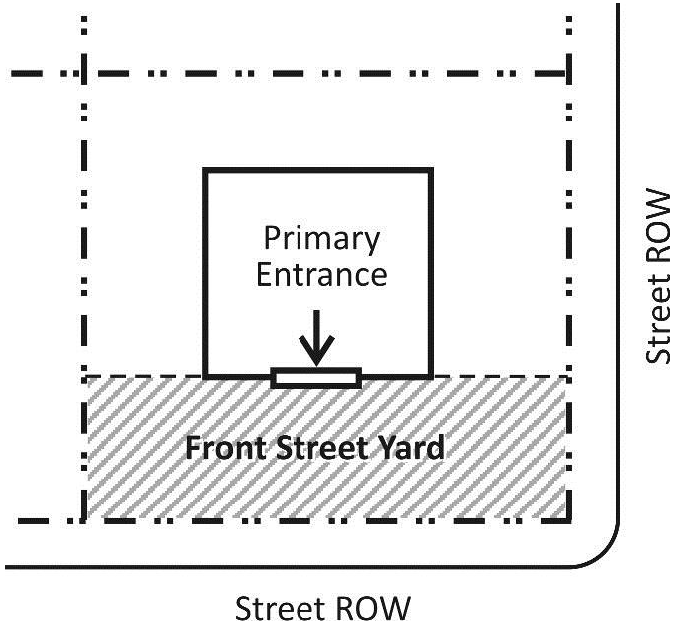
| Term | Definition |
|---|---|
| Structural alterations | Any change in the supporting members of a building, such as bearing walls or partitions, columns, beams or girders, or any complete rebuilding of the roof or the exterior walls. |
| Structure | Anything manmade constructed, erected, or placed, which has location in or on the ground or is attached to something having a location on the ground. For floodplain management purposes, a walled and roofed building, including a gas or liquid storage tank, that is principally above ground, as well as a manufactured home. |
| Stucco | An exterior wall finish made of an aggregate, a binder, and water which is applied over a lath in a minimum of two coats. |
| Subdivision | The division of a lot, tract or parcel of land into two or more parts. |
| Subdivision development permit | A permit issued by the PDS director, after the recording of a final plat, authorizing a developer to proceed with the next step in the development process of the lot(s) within the recorded final plat, as set forth in subsection 10-28(f). |
| Subdivision improvement construction plans | Engineering plans required by the city for the construction and installation of public improvements necessary to provide required services for proper development including, but not limited to, plans for grading, drainage facilities, water, reuse water and sewer, open space, parks or other recreational space, streets and illumination of streets. |
| Substantial completion | The stage in the progress of the construction of public subdivision improvements when the construction work may still require some additional work, minor modifications, and/or adjustments, but in the PDS director's opinion the construction work has progressed to the point that permits may be issued for initial homes as provided in Sec. 8-109. Such opinion of the PDS director shall be evidenced by a Certificate of Substantial Completion issued to the developer. |
| Substantial damage | Damage of any origin sustained by a structure whereby the cost of restoring the structure to the condition it was in prior to becoming damaged would equal or exceed 50 percent of the market value of the structure before the damage occurred. |
| Substantial improvement | Any reconstruction, rehabilitation, addition, or other improvement of a structure, the cost of which equals or exceeds 50 percent of the market value of the structure before "start of construction" of the improvement. This includes structures which have incurred "substantial damage," regardless of the actual repair work performed. The term does not, however, include either: |
| (1) Any project for improvement of a structure to correct existing violations of state or local health, sanitary, or safety code specifications which have been identified by the local code enforcement official and which are the minimum necessary to assure safe living conditions; or | |
| (2) Any alteration of a historic structure provided that the alteration will not preclude the structure's continued designation as a historic structure. | |
| Surround (of a sign) | The area framing the sign display area that is typically constructed of the same material of the sign's base for freestanding signs and is required when using a cabinet sign. |
| Surrounding (see Adjacent or Abutting) | Surrounding shall mean properties located immediately adjacent to or abutting the subject property. |
| Surveyor | A person who is a registered professional land surveyor and licensed by the State of Texas. |
| Swooper flag sign | A temporary, freestanding, vertical sign consisting of a loose poly-knit sign face that flutters in the wind from a harpoon-style pole or staff driven into the ground for support. |
| TCEQ | The Texas Commission on Environmental Quality or its successor. |
| Tagline sign | A secondary sign that is rectilinear in shape with rounded ends and displays a single line of text where the text size is too small to use channel letters. |
| Temporary building | An enclosed building which complies with the provisions of Sec. 2-92 or an enclosed building, the use of which is incidental to construction work on the premises, which enclosed building shall be removed upon the completion or abandonment of construction work and which complies with the provisions of Sec. 2-92. |
| Temporary sign | Any sign which conforms to the requirements stated in this Code and the use of which is for a limited time. |
| Temporary tree protection device | Physical barriers installed prior to construction for the purpose of preventing damage to trees. |
| Theater | Movie or other theaters that meet the definition of an indoor entertainment activity in this section. |
| Townhouse | A residential structure consisting of three or more dwelling units sharing one or more wall(s) with an abutting unit, each unit occupying space from ground to roof and having front and rear walls open directly to the outside for access. |
| Townhouse, common-lot | A townhouse development having more than one dwelling unit per lot. |
| Townhouse, single-lot | A townhouse development having only one dwelling unit per lot. |
| Traffic, average daily (ADT) | The average number of vehicles that pass a specified point during a 24-hour period. |
| Traffic Impact Analysis (TIA) | A report analyzing current and future traffic movements with and without an addition's or subdivision's impact, which includes an analysis of mitigation measures and which shall be prepared by a licensed professional engineer. |
| Trailhead | The point or place where a trail begins. |
| Transportation director | The director of the transportation services department of the city, or an authorized representative. |
| Tree | A self-supporting, woody perennial plant usually having a single trunk with a diameter of no less than two inches at maturity, measured at one foot above grade, and which normally grows to an overall height of no less than 12 feet in central Texas. |
| Tree, champion | The largest tree of a species that is registered by the forestry manager in the champion tree registry, is designated as a monarch tree by the city council, and shall serve as the guide for the designation of other monarch trees of that same species. |
| Tree inventory | A drawing showing the tag number, species, size, and approximate location of all existing protected trees. |
| Tree, large | Any species of tree that typically reaches a height of 40 feet or more upon maturity, and is included in the city's list of approved large species trees as identified in the Tree Technical Manual. |
| Tree, medium | Any species of tree that typically reaches a height of 25 feet to 40 feet upon maturity, and is included in the city's list of approved medium species trees as identified in the Tree Technical Manual. |
| Tree, monarch | (1) A tree of a specific size or species that is designated as a monarch tree pursuant to Sec. 8-18; |
| (2) A champion tree; | |
| (3) A tree of historic or unique significance that is specifically designated as a monarch tree by the city council; or | |
| (4) A tree whose monarch designation requires additional restrictive protections over and above those described for protected trees. | |
| Tree protection plan | A plan submitted by the owner in a form or manner specified by the forestry manager, or zoning administrator, whichever is applicable, providing the method of protecting trees during construction that may or may not include protection details, standards, notes and construction plans in accordance with generally accepted methods such as those provided in the Tree Technical Manual. |
| Tree removal | Uprooting, severing the main trunk of the tree, or any act which causes or may reasonably be expected to cause the tree to die including, without limitation, damage inflicted on the root system by machinery, storage of materials or soil compaction; substantially changing the natural grade above the root system or around the trunk; excessive pruning; or paving with concrete, asphalt, or other impervious materials in a manner which may reasonably be expected to kill the tree. |
| Tree replacement plan | A plan submitted by the owner in a form and manner specified by the forestry manager, or zoning administrator, whichever is applicable, providing the method of replacement for the proposed protected trees to be removed that identifies the location, size, and species of all new trees proposed as replacement for the protected trees being removed and fees in lieu of replacement trees. |
| Tree, small | Any species of tree that typically reaches a height of eight feet up to 25 feet upon maturity, and is included in the city's list of approved small species trees as identified in the Tree Technical Manual. |
| Tree, specimen | A tree that is of exceptional quality in terms of form, structure, health and general condition, from the city's list of approved species trees in the Tree Technical Manual, or is otherwise approved by the zoning administrator. A specimen tree shall have a caliper of at least six inches at the time of planting. |
| Tree survey | A drawing showing the size, location, species, critical root zone of all existing protected trees, any protected tree to be removed or transplanted, a table summarizing all protected trees and the total number of caliper inches of protected trees, in accordance with generally accepted methods such as those provided in the Tree Technical Manual. |
| Tree survey, partial | A drawing showing all protected trees within the limits of construction, easements, rights-of-way, and a 20-foot strip abutting rights-of-way. |
| Tree Technical Manual | The standards and specifications based on generally accepted practices developed by the forestry manager for sound arboricultural practices, techniques and procedures which shall serve as guidelines for trees regulated by this article, including but not limited to, tree selection, planting, pruning, alteration, treatment, protection, and removal, as approved by city council and maintained by the city clerk. |
| Tree topping | The severe cutting back of limbs to stubs larger than three inches in diameter within the crown of a tree to such a degree that removal of the top canopy disfigures and invites disease to the tree. |
| Trim | Portions of an exterior wall not finished by the primary exterior wall materials, doors, or windows. Also referred to as an accent feature. |
| Tripartite/three-part design | A traditional building form where the building façade design is divided into three distinct horizontal sections: the base, the shaft, and the capital (or crown), often used to create balance, proportion, and visual coherence, especially in tall buildings. |
| Tuck under garage | A garage that is fully incorporated into a residential structure at ground level and is located below the living levels. |
| Ultimate 1% annual chance floodplain | The area of land that would be inundated by a flood having a one percent chance of occurring in any given year based on the expected fully developed state of the upstream contributing drainage area. Sometimes referred to as the 100-year floodplain. |
| Ultimate 4% annual chance floodplain | The area of land that would be inundated by a flood having a four percent chance of occurring in any given year based on the expected fully developed state of the upstream contributing drainage area. Sometimes referred to as the 25-year floodplain. |
| Unsafe building | Any building or structure that has any of the following conditions, such that the life, health, property or safety of its occupants or the general public are endangered: |
| (1) Any means of egress or portion thereof that is not of adequate size or is not arranged to provide a safe path of travel in case of fire or panic. | |
| (2) Any means of egress or portion thereof, such as, but not limited to, fire doors, closing devices and fire-resistive ratings, that is in disrepair or in a dilapidated or nonworking condition such that the means of egress could be rendered unsafe in case of fire or panic. | |
| (3) The stress in any material, member or portion thereof, due to all imposed loads including dead load, that exceeds the stresses allowed in the International Building Code for new buildings. | |
| (4) The building, structure or portion thereof that has been damaged by fire, flood, earthquake, wind or other cause to the extent that the structural integrity of the building or structure is less than it was prior to the damage and is less than the minimum requirement established by the International Building Code for new buildings. | |
| (5) Any exterior appendage or portion of the building or structure that is not securely fastened, attached, or anchored such that it is capable of resisting wind, seismic or similar loads as required by the International Building Code for new buildings. | |
| (6) If for any reason the building, structure or portion thereof is manifestly unsafe or unsanitary for the purpose for which it is being used. | |
| (7) The building, structure or portion thereof as a result of decay, deterioration or dilapidation is such that it is likely to fully or partially collapse. | |
| (8) The building, structure or portion thereof has been constructed or maintained in violation of a specific requirement of the International Codes or of a city, county or state law. | |
| (9) Any building, structure or portion thereof that is in such a condition as to constitute a public nuisance. | |
| (10) Any building, structure or portion thereof that is unsafe, unsanitary or not provided with adequate egress, or which constitutes a fire hazard, or is otherwise dangerous to human life, or, which in relation to existing use, constitutes a hazard to safety or health by reason of inadequate maintenance, dilapidation, obsolescence or abandonment. | |
| Upper-story residential | Dwelling units located on the upper floors in a building with ground-level nonresidential uses. |
| Urgent care facility | A medical facility staffed and equipped for the reception and treatment of persons with conditions requiring immediate medical care, such as broken bones, severe illness or trauma, which may require ambulatory transport to a hospital. Such establishments are detached from a hospital and are typically located in commercial centers or as freestanding structures on pad sites. Includes uses such as urgent care clinics and local emergency rooms. |
| Use, principal | The purpose or activity for which land, or any structure thereon, is designed, arranged, or intended, or for which it is occupied or maintained. |
| Use, accessory | A use that: |
| (1) Is subordinate to and services a principal building or a principal use legally existing on the same zoning lot; | |
| (2) Is subordinate in area, extent and purpose to the principal building or principal use; | |
| (3) Contributes to the comfort, convenience or necessity of the occupants, business or industry of the principal structure or principal use served; and | |
| (4) Is located on the same zoning lot as the principal structure or principal use served. | |
| Use, temporary | A use established for a fixed period of time with the intent to discontinue the use upon the expiration of the time. |
| Utility director | The director of the water/wastewater utility department of the city, or an authorized representative. |
| Utility, intermediate | Services necessary to support principal development and involve only minor structures, such as lines, poles, minor electrical switching facilities, lift stations, and gas regulated facilities. |
| Utility, major | Primary substations, generating plants, water treatment plants, wastewater treatment plants and similar facilities. |
| Utility, minor | Service necessary to support a principal development and involving only ground-mounted mechanical equipment. |
| Vacation | The termination of or termination of an interest in, an easement, right-of-way, or public dedication of land. |
| Vape and smoke shop | An establishment utilized primarily for the sale, display, distribution, delivery, offering, furnishing, or marketing of tobacco products, electronic smoking devices, electronic vaping devices, electronic vaping liquid, and related accessories in which the sale of other products is merely incidental, with the exception of cigar lounges. |
| Variance | For zoning purposes, a relief granted by the zoning board of adjustment from the literal requirements of the zoning and development regulations where strict enforcement would result in unnecessary hardship. |
| Vehicle reclamation yard | Any area, lot, land or parcel used for the storage, collection, processing, purchase, sale, or abandonment of inoperable motor vehicles. |
| Vehicle service canopy | A covered structure which shelters a vehicle service use and is detached from the building to which it is an accessory, and is open on two or more sides. |
| Vehicle storage and towing | Includes short-term (six months or less) storage of operable vehicles for sale or lease. Includes towing service and associated storage. |
| Vehicle trip | A single directional trip that has one origin and one destination regardless of the number of occupants in the vehicle. |
| Vehicular use areas | Paved surface areas used for vehicular circulation, parking and storage. |
|
Veterinary clinic,
livestock | A facility for the care, diagnosis and medical treatment by a licensed veterinarian for livestock and small animals. |
|
Veterinary clinic,
small animals | A facility for the care, diagnosis and medical treatment by a licensed veterinarian for small animals. |
| Violation | For flood damage prevention purposes, the failure of a structure or other development to be fully compliant with the community's floodplain management regulations. A structure or other development without the elevation certificate, other certifications, or other evidence of compliance required in sections 60.3(b)(5), (c)(4), (c)(10), (d)(3), (e)(2), (e)(4), or (e)(5) of the National Flood Insurance Program regulations is presumed to be in violation until such time as that documentation is provided. |
| Wall sign | Any sign, erected flush against the exterior wall of a building, supported by the wall, and having the sign face parallel to the wall or painted directly onto a wall. |
| Warehouse and freight movement | An establishment engaged in the storage or movement of goods for themselves or other firms. Goods are generally delivered to other firms or the final consumer, except for some will-call pickups. There is little on-site sales activity with the customer present. Typical uses include: |
| Separate warehouses used by retail stores such as furniture and appliance stores; | |
| Household moving and general freight storage; | |
| Cold storage plants, including frozen food lockers; | |
| Storage of weapons and ammunition; major wholesale distribution centers; | |
| Truck, or air freight terminals; | |
| Bus barns; | |
| Parcel services; | |
| Major post offices; | |
| Grain terminals; | |
| Transfer and storage businesses where there are no individual storage areas or where employees are the primary movers of the goods to be stored or transferred; and | |
| The stockpiling of sand, gravel or other aggregate materials. | |
| Waste-related service | Uses that receive solid or liquid waste from others for transfer to another location; uses that collect sanitary waste; or uses that manufacture or produce goods or energy from the composting of organic material. Typical uses include solid or liquid waste transfer or composting facilities and recycling centers. |
| Wastewater | Solids, liquids, or gaseous materials discharged into an approved wastewater collection and treatment system. |
| Wastewater facility | A capital improvement or facility expansion for providing wastewater service including but not limited to, land or easements, treatment facilities, lift stations, and interceptor mains. The term "wastewater facility" does not include wastewater lines or mains which are constructed by developers, the costs of which are reimbursed from charges paid by subsequent users of facilities and which are maintained in dedicated trusts. The term "wastewater facility" also does not include dedication of easement or rights-of-way or easements or construction or dedication of on-site wastewater collection facilities required by valid ordinances of the city and necessitated by and attributable to new development. |
| Wastewater system | The system of pipes and appurtenances used to collect and transport wastewater. |
| Water | Potable water and/or reuse water. |
| Water conservation | For the purposes of regulating irrigation systems, the design, installation, service, and operation of an irrigation system in a manner that prevents the waste of water, promotes the most efficient use of water, and applies the least amount of water that is required to maintain healthy individual plant material or turf, reduce dust, and control erosion. |
| Water facility | Improvements for providing water and/or reuse water service including but not limited to, land or easements, water and/or reuse water supply facilities, treatment facilities, pumping facilities, storage facilities or transmission mains. The term "water facility" does not include water and/or reuse water lines or mains constructed by developers, the costs of which are reimbursed from charges paid by subsequent users of the facilities maintained in dedicated trusts. The term "water facility" also does not include dedication of rights-of-way or easements or construction or dedication of on-site water and/or reuse water distribution facilities required by valid ordinances of the city and necessitated by and attributable to new development. |
| Water surface elevation | The height, in relation to the North American Vertical Datum (NAVD) of 1988 (or other datum, where specified), of floods of various magnitudes and frequencies in the floodplains of coastal or riverine areas. |
| Wellness center | A facility that promotes physical, mental, and emotional health through wellness activities including, but not limited to, fitness programs, counseling and stress management, health education, and non-medical therapeutic services such as massage therapy, saunas and cold plunges. Wellness services do not include invasive procedures which result in medical waste. |
| Wholesale trade | An establishment engaged in the sale, lease, or rent of products primarily intended for industrial, institutional, or commercial businesses. The uses emphasize on-site sales or order taking and often include display areas. Businesses may or may not be open to the public, but sales to the public are limited. Products may be picked up on-site or delivered to the customer. Typical uses include sale or rental of machinery, equipment, heavy trucks, building materials, special trade tools, welding supplies, machine parts, electrical supplies, janitorial supplies, restaurant equipment and store fixtures; mail order houses; and wholesalers of food, clothing, auto parts, building hardware. |
| Window, area of | The area of a single window including all the window panes in a larger frame that is separated by mullions or other dividers. |
| Window sign | Any items of information affixed in any manner to a window or exterior glass door such that is intended to be viewable from the exterior. |
| Wireless transmission facility (WTF) | An antenna and associated equipment intended for transmitting or receiving television, AM/FM radio, digital, microwave cellular, telephone or similar forms of electronic communication. |
| Written notice | A notification in writing delivered in person to the individual or parties intended, or delivered at, or sent by certified mail or registered mail to the last residential or business address of legal record. |
| Zoning administrator | The director of planning and development services who is appointed by the city manager and who has the duty of administering this development code. |
| Zoning board of adjustment | The board that has been created by the city council to hear and determine appeals of administrative decisions, special exceptions, and variances. |
(Ord. No. O-2019-0202, § I, 5-9-2019; Ord. No. O-2020-0012, § I, 1-9-2020; Ord. No. O-2020-0158, § I, 6-11-2020; Ord. No. O-2020-0288, § I, 10-22-2020; Ord. No. O-2022-052, § I, 2-10-2022; Ord. No. O-2021-187, § I, 7-8-2021; Ord. No. O-2022-234, § I, 7-14-2022; Ord. No. O-2024-168, § I, 6-27-2024; Ord. No. O-2024-266, § XX, 9-26-2024; Ord. No. O-2025-044, § I, 2-13-2025; Ord. No. O-2025-277, § I, 10-23-2025)

