
Round Rock City Zoning Code
CHAPTER 2
ZONING DISTRICTS AND USE REGULATIONS
Sec. 2-1. - Purpose.
(a)
This chapter, supplemented with the subsequent chapters in this code, provides for the division of land into different districts that, in combination with the regulations pertaining to such districts, are written in accordance with the goals of the general plan to fulfill the following purposes:
(1)
Promote the beneficial and appropriate development of all land and the most desirable use of land in accordance with a well-considered plan;
(2)
Prevent or minimize land use incompatibilities and conflicts among different land uses; and
(3)
Maintain property values by stabilizing expectations and ensuring predictability in development.
Sec. 2-2. - Establishment of districts.
(a)
Districts. For the purpose of this code, portions of the city, as specified on the official zoning map of the city, are hereby divided into the following zoning districts:
(b)
Official zoning map.
(1)
The city is hereby divided into the zoning districts provided in subsection (a) of this section, as shown on the official zoning map, which, together with all explanatory matter thereon, is hereby adopted by reference and declared to be a part of this chapter. The official zoning map shall be identified by the signature of the mayor attested by the city secretary and bearing the seal of the City of Round Rock under the following words:
"This is to certify that this is the official zoning map referred to in section 2-1(b) of the Code of Ordinances, City of Round Rock, Texas, 2010."
(2)
If, in accordance with the provisions of this chapter and V.T.C.A., Local Government Code § 211.006, changes are made in the district boundaries or other matter portrayed on the official zoning map, such changes shall be entered on the official zoning map within five business days after the amendment has been approved by the city council and signed by the mayor.
(3)
Approved zoning changes shall be entered on the official zoning map by the zoning administrator and each change shall be identified on the map with the date and number of the ordinance making the change.
(4)
No change of any nature shall be made on the official zoning map or matter shown thereon except in conformity with procedures set forth in this code. Any unauthorized change of whatever kind by any person or persons shall be considered a violation of this code and punishable as provided under chapter 1, article II of this code.
(5)
Regardless of the existence of purported copies of the official zoning map which may from time to time be made or published, the official zoning map, which shall be located in the office of the zoning administrator, shall be the final authority as to the current zoning status of land and water areas, buildings and other structures in the city. The official zoning map shall be available to the public at all hours when the city hall is open to the public.
(c)
Replacement of official zoning map.
(1)
In the event that the official zoning map becomes damaged, destroyed, lost or difficult to interpret because of the nature and/or number of changes and additions, the city council shall, by ordinance, adopt a new official zoning map, which shall supersede the prior official zoning map. The new official zoning map may correct drafting or other errors or omissions in the prior official zoning map, but no such correction shall have the effect of amending the original official zoning map or any subsequent amendment thereof. The new official zoning map shall be identified by the signature of the mayor, attested by the city secretary, and bearing the seal of the city and date under the following words:
"This is to certify that this official zoning map supersedes and replaces the official zoning map adopted (date of adoption of map being replaced) as part of Ord. No. ____________ of the City of Round Rock, Texas."
(2)
Unless the prior official zoning map has been lost or has been totally destroyed, the prior map or any significant parts thereof remaining shall be preserved, together with all available records pertaining to its adoption or amendment.
(d)
Rules for interpretation of district boundaries. Where uncertainty exists as to the boundaries of districts as shown on the official zoning map, the following rules shall apply:
(1)
Boundaries indicated as approximately following the centerlines of streets, highways, or alleys shall be construed to follow such centerlines.
(2)
Boundaries indicated as approximately following platted lot lines shall be construed as following such lot lines.
(3)
Boundaries indicated as approximately following city limits shall be construed as following such city limits.
(4)
Boundaries indicated as following railroad lines shall be construed to be midway between the rails of the main line.
(5)
Boundaries indicated as following shorelines shall be construed to follow such shorelines, and, in the event of change in the shoreline, shall be construed as moving with the actual shoreline. Boundaries indicated as approximately following the centerlines of streams, rivers, canals, lakes, or other bodies of water shall be construed to follow such centerlines.
(6)
Boundaries indicated as parallel to or extensions of features indicated in subsections (d)(1) through (5) of this section shall be so construed. Distances not specifically indicated in a classification amendment shall be determined by the scale of the map.
(7)
Where physical or cultural features existing on the ground are at variance with those shown on the official zoning map, or in other circumstances not covered by subsections (d)(1) through (6) of this section, the zoning administrator shall interpret the district boundaries.
(e)
Uniform application of district regulations. The regulations set by this chapter within each district shall be minimum regulations and shall apply uniformly to each class or kind of structure or land, except as hereinafter provided:
(1)
Except for residential uses in SF-R, SF-1, SF-2, SF-3, SF-D, and TF districts, no person shall initiate any development or construction activity, including site preparation, foundation forming, sign erection, construction, improvement, repair or demolition within the city limits without first applying for and obtaining a certificate of zoning compliance as required in Sec. 10-2.
(2)
No building, structure, or land shall hereafter be used or occupied, and no building or structure or part thereof shall hereafter be erected, constructed, reconstructed, moved, or structurally altered except in conformity with all the regulations herein specified for the district in which it is located.
Sec. 2-3. - Treatment of property without a zoning classification.
Property that was annexed without a zoning classification, or property existing within the city limits without a zoning classification, shall be treated as follows:
(a)
A parcel of land that is less than ten acres shall be treated as if it were zoned SF-R (Single-family - Rural); and
(b)
A parcel of land that is ten acres or more shall be treated as if it were zoned AG (Agricultural).
Sec. 2-4. - Permitted and prohibited uses.
The following sections describe the types of permitted uses, density and development standards, and any other development standards for each zoning district:
(a)
Permitted uses.
(1)
Uses permitted by right (P). Uses listed as permitted by right are permitted. Such uses are subject to all other applicable regulations of this code.
(2)
Uses permitted subject to special standards (P/S). Uses listed as permitted with conditions are permitted, provided that the use meets the supplementary use standards referenced in the far right special standards column of the summary table contained within each zoning category. Such uses are subject to all other applicable regulations of this code.
(3)
Special exceptions (SE). Uses listed as permitted subject to special exception criteria are allowed only if approved as a special exception by the zoning board of adjustment in accordance with the procedures of Sec. 10-53. Special exception uses are subject to all other applicable regulations of this code, including the additional listed standards contained in Sec. 2-91.
(4)
Special standards. The final column titled special standards contains a cross-reference to supplementary use standards that apply to specific uses in Sec. 2-91 or other applicable standards elsewhere in this chapter.
(5)
Uses not allowed. Any use, structure, or improvement not specifically permitted is not allowed.
(6)
Uses not listed. The zoning administrator shall use the criteria in subsection (b) of this section to assist in determining how an unlisted use should be treated.
(b)
Considerations regarding principal uses.
(1)
Determination of the appropriate category for a proposed principal use shall be made by the zoning administrator in accordance with the provisions of Sec. 10-4.
(2)
The following shall be used to determine the appropriate classification of any use not listed in this chapter and whether a use is considered principal or accessory:
a.
The actual or projected characteristics of the activity in relationship to the stated characteristics of each use category.
b.
The relative amount of site area or floor space and equipment devoted to the activity.
c.
Relative amounts of sales from each activity.
d.
The customer type for each activity.
e.
The relative number of employees in each activity.
f.
Hours of operation.
g.
Building and site arrangement.
h.
Vehicles used and their parking requirements.
i.
The relative number of vehicle trips generated.
j.
Required signage.
k.
How the use is advertised.
l.
The likely impact on surrounding properties.
m.
Whether the activity is likely to be found independent of the other activities on the site.
(3)
When considering appropriate districts for a use not listed in the use table, the district purpose statements shall be taken into consideration.
(c)
Multiple principle uses on a single parcel or lot. Where more than one principal use is permitted in the following use tables, such uses may be developed on a single site. Where such mixed uses include any use subject to special exception review, the entire project shall be subject to the special exception review process. Any supplementary use standards shall continue to apply in a mixed-use development.
(d)
Prohibited uses. The following uses are prohibited, as determined by the zoning administrator, building official, or fire marshal:
(1)
Uses which constitute a hazard, danger or nuisance to the public because of noise, odor, glare, particulate matter, traffic impediments or similar reasons;
(2)
Uses which may cause or significantly contribute to an increase in mortality or an increase in serious irreversible or incapacitating reversible illnesses; and
(3)
Uses which involve hazardous materials, as defined in section 1-50, and by the National Fire Protection Association Guide or any successor publication thereto officially used by the building official or fire marshal.
(e)
Other uses, structures, or improvements prohibited. The following uses are considered noxious and/or inappropriate and are therefore prohibited within the city limits:
(1)
Battery manufacturing or recycling;
(2)
Concrete and asphalt batch plants (except temporary units for the express purpose of constructing SH 45 and SH 130);
(3)
Intensive agriculture and animal husbandry;
(4)
Meat packing;
(5)
Petroleum drilling, refining and terminal storage;
(6)
Plastics manufacturing;
(7)
Pulp and paper manufacturing;
(8)
Rubber manufacturing;
(9)
Tanneries;
(10)
Temporary buildings and structures except those described in section 2-92;
(11)
Toxic waste storage or disposal;
(12)
Vehicle recycling and reclamation yards;
(13)
Off-premises signs and billboards; and
(14)
Outdoor kennels.
Sec. 2-5. - Austin Executive Airport Joint Airport Hazard Zoning Regulations.
The Austin Executive Airport Joint Airport Hazard Zoning Regulations ("Airport Zoning Regulations"), adopted on May 12, 2017, by the Austin Executive Joint Airport Zoning Board, apply to the appropriate areas of the city and may restrict land use beyond the regulations contained in this Code. A copy of the Airport Zoning Regulations and a map depicting its area of impact shall be maintained by the Planning and Development Services Department.
Sec. 2-6. - Interpretation.
Any use that is not specifically listed as permitted by this code shall be prohibited. Appeals may be made in writing to the zoning administrator in accordance with Sec. 10-4. Appeals of the zoning administrator's interpretation regarding permitted and prohibited uses shall be made to the zoning board of adjustment.
Sec. 2-7. - Transitional provisions and vested rights.
(a)
Violations continue. Any violation of the previous zoning regulations of the city shall continue to be a violation under this code and shall be subject to penalties and enforcement under article II of this code, administration, unless the use, development, construction or other activity is consistent with the express terms of this code, in which case enforcement action shall cease, except to the extent of collecting penalties for violations that occurred before the effective date of the ordinance from which this code is derived.
(b)
In accordance with V.T.C.A., Local Government Code ch. 245, a completed application submitted prior to the effective date of the ordinance from which this code is derived will be reviewed on the basis of any regulations or requirements in effect at the time the completed application is filed; unless, at the applicant's option, the applicant elects to proceed under the new regulations or requirements.
(c)
Vested rights. Any applicant that claims exception from any provision of this code based upon a claim of vested rights shall file a request for vested rights determination with the zoning administrator demonstrating:
(1)
In reliance upon properly issued permits or approvals:
a.
The applicant made substantial financial commitments or assumed substantial financial obligations within the purview of the activities authorized by said permit or approval; and
b.
The applicant has proceeded in good faith, and no approvals or permits have lapsed or been revoked; or
c.
The applicant has established any other factor which may establish vested rights under state or federal law; or
(2)
The applicant used its property or filed an application as provided in V.T.C.A., Local Government Code § 43.002 prior to annexation, and that the regulations against which vested rights are claimed are not subject to an exemption as provided in V.T.C.A., Local Government Code § 43.002(c); or
(3)
The applicant filed an application as provided in V.T.C.A., Local Government Code ch. 245 prior to adoption of the regulations against which vested rights are claimed, that the regulations against which vested rights are claimed are not subject to an exemption as provided in V.T.C.A., Local Government Code § 245.004 and that the project has not become dormant as defined in V.T.C.A., Local Government Code § 245.005 and this code.
(d)
After receiving a request for vested rights determination, the zoning administrator shall review the request and approve, deny or request additional information to be provided for consideration of the request within 20 working days. Upon review of the request, if the zoning administrator finds that the applicant has provided sufficient information to establish that one or more permits exists on a project, the administrator shall issue a certificate to the applicant recognizing vested rights for the project and the terms and conditions required for the continuance of the vested rights.
(e)
This section shall not extend the time of validity for any permit. Any rights recognized by the application of this section shall not extend beyond the time periods prescribed for the validity or the permit or permits that were submitted for recognition except by the granting of a variance from the time limit as provided herein.
(f)
Projects from which no completed application has been submitted prior to the effective date of the ordinance from which this code is derived shall be subject to all requirements and standards of this code.
Sec. 2-11. - In general.
Residential zoning districts provide for dwelling units of varying densities. Single-family neighborhoods are preserved and protected by compatibility buffers from more intense development, while townhouse, low-density multifamily, and senior living developments serve as transitional uses between single-family neighborhoods and areas of commercial and employment activity.
Sec. 2-12. - AG (Agricultural) district
(a)
Purpose. To establish and preserve areas of low-intensity land use primarily devoted to agricultural activities and having the potential of becoming urban areas in the future.
(b)
Permitted uses. Uses permitted in the AG district may be found in Sec. 2-25.
(c)
Lot and building dimensional standards. Property and buildings in the AG district shall conform to the standards found in Sec. 2-26.
(d)
Supplementary development standards. In addition to the standards found in chapter 8 of this code, the following regulations apply to the AG district:
(1)
Limits on residential buildings. For parcels having 40 acres or less, a maximum of two buildings may be used for residential purposes. For parcels more than 40 acres, one building per 20 acres, with a maximum of five buildings, may be used for residential purposes.
(2)
Livestock structures. For new development of barns, stables, corrals, sheds, pens, or other similar structures where livestock may be housed, fed, or confined, or where food for livestock is stored shall not be located within 150 feet of the property line of any residence, business or commercial establishment or office (other than the livestock owner's residence, business or commercial establishment or office), grocery store, school building, church, hospital, assisted living home, or restaurant or other food service establishment.
(3)
Confinement of livestock. Livestock shall be enclosed with adequate fences or barriers that will prevent such livestock from damaging shrubbery or other property situated on adjacent property. Such fences or barriers shall be sufficient to prevent the livestock from escaping the enclosure.
Sec. 2-13. - SF-R (Single-Family - Rural) district
(a)
Purpose. To establish and preserve areas of low-intensity land use primarily devoted to large lot rural residential development.
(b)
Permitted uses. Uses permitted in the SF-R district may be found in Sec. 2-25.
(c)
Lot and building dimensional standards. Property and buildings in the SF-R district shall conform to the standards found in Sec. 2-26, with the following supplementary notes:
(1)
No accessory buildings of any kind are permitted in any street yard.
(d)
Supplementary development standards. In addition to the standards found in chapter 8 of this Code, the following regulations apply to the SF-R district:
(1)
Garage conversions. Where otherwise permitted, garage conversions are subject to the following requirements:
a.
The converted area shall not operate as a separate dwelling unit.
b.
The converted area shall not include additional utility meters.
c.
The converted area shall not include an exterior entry door.
d.
If garage doors are removed, they must be replaced with a wall with new exterior materials that match the existing structure's primary exterior materials. If the replaced doors are less than 14 linear feet, then at least one window is required. If the replaced doors are 14 linear feet or more, then at least two windows are required. If only one window is installed, it shall be centered on the wall. If two or more windows are installed, they shall be installed symmetrically on the wall.
(2)
Fence requirements and maintenance.
a.
These regulations shall apply only to fences that:
1.
Face a public street, a public park, a public recreation facility, a school, a library, or a government office; or
2.
Are adjacent to a public drainage facility and are visible from a public street.
b.
Fences are not required in the SF-R district. However, the owners of fences subject to this section shall maintain fences in a safe condition and in good repair, with all components free from deterioration, dilapidation, rot, rust, loosening, or leaning. Fences shall be able to withstand the wind load for which they were designed. In addition, the following regulations shall apply:
1.
A fence shall not be out of vertical alignment more than one (1) foot from the vertical measured at the top of the fence, with the exception of fencing measuring four (4) feet or less in height, which vertical alignment shall not be more than six (6) inches from the vertical measured at the top of the fence.
2.
A fence shall not have any broken, loose, damaged or rotted components having a combined total area of twenty (20) square feet or more, said area being calculated over any 50 contiguous linear foot section of fence.
3.
A fence shall not have any missing posts, panels, or pickets.
4.
Painted fence components shall be regularly maintained to prevent rusting, peeling, or blistering surfaces.
5.
If the city determines a fence is unsafe, dilapidated or a public nuisance, or otherwise in violation of this chapter, it shall be repaired, replaced or demolished within 60 days upon first notification of non-compliance. Repairs shall be made with materials comparable in composition, color, size, shape and quality to the original fence. Products not intended to be used as fencing are prohibited from being used in the repair of a fence.
(Ord. No. O-2019-0463, § I, 11-26-2019)
Sec. 2-14. - SF-1 (Single-Family - Large Lot) district.
(a)
Purpose. To establish and preserve areas of low-intensity land use primarily devoted to large lot single-family residential development.
(b)
Permitted uses. Uses permitted in the SF-1 district may be found in Sec. 2-25.
(c)
Lot and building dimensional standards. Property and buildings in the SF-1 district shall conform to the standards found in Sec. 2-26.
(d)
Supplementary development standards. In addition to the standards found in chapter 8 of this Code, the following regulations apply to the SF-1 district:
(1)
Garage conversions. Where otherwise permitted, garage conversions are subject to the following requirements:
a.
The converted area shall not operate as a separate dwelling unit.
b.
The converted area shall not include additional utility meters.
c.
The converted area shall not include an exterior entry door.
d.
If garage doors are removed, they must be replaced with a wall with new exterior materials. If the replaced doors are less than 14 linear feet, then at least one window is required. If the replaced doors are 14 linear feet or more, then at least two windows are required. If only one window is installed, it shall be centered on the wall. If two or more windows are installed, they shall be installed symmetrically on the wall.
(2)
Fence requirements and maintenance.
a.
These regulations shall apply only to fences that:
1.
Face a public street, a public park, a public recreation facility, a school, a library, or a government office; or
2.
Are adjacent to a public drainage facility and are visible from a public street.
b.
Fences are not required in the SF-1 district. However, the owners of fences subject to this section shall maintain fences in a safe condition and in good repair, with all components free from deterioration, dilapidation, rot, rust, loosening, or leaning. Fences shall be able to withstand the wind load for which they were designed. In addition, the following regulations shall apply:
1.
A fence shall not be out of vertical alignment more than one (1) foot from the vertical measured at the top of the fence, with the exception of fencing measuring four (4) feet or less in height, which vertical alignment shall not be more than six (6) inches from the vertical measured at the top of the fence.
2.
A fence shall not have any broken, loose, damaged or rotted components having a combined total area of twenty (20) square feet or more, said area being calculated over any 50 contiguous linear foot section of fence.
3.
A fence shall not have any missing posts, panels, or pickets.
4.
Painted fence components shall be regularly maintained to prevent rusting, peeling, or blistering surfaces.
5.
If the city determines a fence is unsafe, dilapidated or a public nuisance, or otherwise in violation of this chapter, it shall be repaired, replaced or demolished within 60 days upon first notification of non-compliance. Repairs shall be made with materials comparable in composition, color, size, shape and quality to the original fence. Products not intended to be used as fencing are prohibited from being used in the repair of a fence.
(Ord. No. O-2019-0463, § II, 11-26-2019)
Sec. 2-15. - SF-2 (Single-Family - Standard Lot) district.
(a)
Purpose. To establish and preserve areas of low intensity land use primarily devoted to traditional single-family residential development.
(b)
Permitted uses. Uses permitted in the SF-2 district may be found in Sec. 2-25.
(c)
Lot and building dimensional standards. Property and buildings in the SF-2 district shall conform to the standards found in Sec. 2-26, with the following supplementary notes:
(1)
Side-entry garages may have may have a 15-foot setback from the street (ROW).
(2)
Where SF-2 lots are subdivided abutting existing homes on lots 10,000 square feet or larger, the SF-2 lots that abut the large lots shall be a minimum of 10,000 square feet.
(d)
Supplementary development standards. In addition to the standards found in chapter 8 of this Code, the following regulations apply to the SF-2 district:
(1)
Garage door width. No single garage door facing a public street shall exceed 18 feet in width.
(2)
Garage conversions. Where otherwise permitted, garage conversions are subject to the following requirements:
a.
The converted area shall not operate as a separate dwelling unit.
b.
The converted area shall not include additional utility meters.
c.
The converted area shall not include an exterior entry door.
d.
If garage doors are removed, they must be replaced with a wall with new exterior materials. If the replaced doors are less than 14 linear feet, then at least one window is required. If the replaced doors are 14 linear feet or more, then at least two windows are required. If only one window is installed, it shall be centered on the wall. If two or more windows are installed, they shall be installed symmetrically on the wall.
(3)
Fence requirements and maintenance.
a.
These regulations shall apply only to fences that:
1.
Face a public street, a public park, a public recreation facility, a school, a library, or a government office; or
2.
Are adjacent to a public drainage facility and are visible from a public street.
b.
Fences are not required in the SF-2 district. However, the owners of fences subject to this section shall maintain fences in a safe condition and in good repair, with all components free from deterioration, dilapidation, rot, rust, loosening, or leaning. Fences shall be able to withstand the wind load for which they were designed. In addition, the following regulations shall apply:
1.
A fence shall not be out of vertical alignment more than one (1) foot from the vertical measured at the top of the fence, with the exception of fencing measuring four (4) feet or less in height, which vertical alignment shall not be more than six (6) inches from the vertical measured at the top of the fence.
2.
A fence shall not have any broken, loose, damaged or rotted components having a combined total area of twenty (20) square feet or more, said area being calculated over any 50 contiguous linear foot section of fence.
3.
A fence shall not have any missing posts, panels, or pickets.
4.
Painted fence components shall be regularly maintained to prevent rusting, peeling, or blistering surfaces.
5.
If the city determines a fence is unsafe, dilapidated or a public nuisance, or otherwise in violation of this chapter, it shall be repaired, replaced or demolished within 60 days upon first notification of non-compliance. Repairs shall be made with materials comparable in composition, color, size, shape and quality to the original fence. Products not intended to be used as fencing are prohibited from being used in the repair of a fence.
(4)
Landscaping. Landscaping requirements apply to the development of new single-family homes as outlined in Sec. 8-10(l).
(e)
Special standards for zero lot line.
(1)
Open space requirement. Although lot size and dimensions may be reduced for zero lot line lots, the reduced lot size shall be compensated by providing common open space equal to the difference between the minimum required lot area for conventional single-family lots and the smaller lots. This common open space requirement is not credited toward the parkland dedication requirements specified in the City subdivision ordinance.
(2)
Eaves. The eaves on the side of a house with a reduced setback may project a maximum of 24 inches over the adjacent property line. In this case, an easement for the eave projection shall be recorded on the deed for the lot where the projection occurs.
(3)
Maintenance easement. An easement between the two property owners to allow for maintenance or repair of the house is required when the eaves or side wall of the house are less than five (5) feet from the adjacent property line. The easement on the adjacent property shall provide at least five (5) feet of unobstructed space between the furthermost projection of the structure and the edge of the easement.
(4)
Privacy. If the side wall of the house is on the property line, or within three (3) feet of the property line, windows or other openings that allow for visibility into the side setback of the adjacent lot are prohibited. Windows that do not allow visibility into the side setback of the adjacent lot, such as a clerestory window or a translucent window, are permitted.
(5)
One side setback may be zero (0) feet; the other side setback shall be at least 12 feet.
(6)
Accessory buildings are permitted in a side or rear street yard.
(f)
Special standards for village residential.
(1)
All village residential lots shall provide garages with rear access to an alley.
(2)
Garages on village residential lots may not face or have direct access to the front right-of-way.
(3)
Garage doors shall be set back a minimum of 20 feet from the alley.
(4)
Fencing located within 10 feet of an alley right-of-way or common lot boundary shall be constructed of materials which will not impede the visibility of drivers backing into the alley.
(5)
The minimum setback for an accessory building shall be five (5) feet, except that common walls are not required to have a setback.
(Ord. No. O-2019-0204, § I, 5-9-2019; Ord. No. O-2019-0463, § III, 11-26-2019)
Sec. 2-16. - SF-3 (Single-Family - Mixed Lot) district.
(a)
Purpose. To establish and preserve areas of low intensity land use primarily devoted to low density residential development on lots of various sizes and with increased design standards than other single-family residential zoning districts. This district is intended for subdivisions that can accommodate a variety of lot sizes and detached housing types.
(b)
Permitted uses. Uses permitted in the SF-3 district may be found in Sec. 2-25.
(c)
Lot and building dimensional standards. Property and buildings in the SF-3 district shall conform to the standards found in Sec. 2-26, with the following supplementary notes:
(1)
Alleys. Lots less than 45 feet in width shall provide garages with rear access to an alley.
(2)
Minimum dwelling area. The living area of the primary residential structure exclusive of porches and garages.
(3)
Compatibility standard. Where SF-3 lots are subdivided abutting existing homes on lots 10,000 sq. ft. and over, the SF-3 lots that immediately abut the large lots shall be a minimum of 10,000 sq. ft.
(4)
Lot composition. Except as provided below, each new subdivision with SF-3 zoning shall meet the following lot size composition:
a.
Estate lots shall compose no less than 40% of the total number of residential lots.
b.
Standard lots shall compose no less than 30% of the total number of residential lots.
c.
Small lots shall compose no more than 30% of the total number of residential lots.
d.
A subdivision may vary from the lot size composition outlined above, so long as: (1) the number of estate lots comprise no less than 10% of the total number of residential lots; and (2) the number of estate lots and standard lots combined comprise more than 50% of the total number of residential lots. In order to be eligible for this exception, the subdivision must have a connectivity index of 1.4 or greater and must include the following features, as further described in subsection (e) below:
1.
Arterial and collector road landscaping;
2.
Enhanced detention facilities and bridge/culvert design;
3.
Usable open spaces (such as parks, amenity centers, and trails) which exceed the parkland requirement by a minimum of 25%; and
4.
Brick or natural stone subdivision walls.
(d)
Supplementary development standards. In addition to the standards found in chapter 8 of this Code, the following regulations apply to the SF-3 district:
(1)
Garage and driveway treatment.
a.
No single garage door facing a public street shall exceed 18 feet in width.
b.
An upgraded garage door, defined as a metal door with the addition of window panels, a faux wood garage door with decorative hardware, or a wood clad garage door, shall be required for all garages facing the street.
c.
Swing in, side entry garages are permitted as a primary garage or 3rd car garage with the following standards:
1.
The exterior wall of the garage facing any public street shall include a minimum of one (1) three-foot (3') by five-foot (5') window for every nine (9) linear feet in width; and
2.
There shall be a minimum of 30 feet between garage doors and the side lot line which they face.
(2)
Front Elevation Requirements. The front elevation of all homes shall conform with subsection (2)a. or b. below:
a.
A street-facing garage shall not extend beyond the front building façade; or
b.
The front elevation shall contain a minimum of two of the following elements of wall plane articulation, to be identified on the architectural plans submitted for a building permit:
1.
A minimum of two wall planes on the front elevation, offset a minimum of 18 inches.
2.
A covered front porch or patio with a minimum of 60 square feet.
3.
A shed roof at least 18 inches deep above garage door for an additional architectural detail.
4.
A combination of at least two roof types (e.g., hip and gable) or two different roof planes of varying height and/or direction.
5.
The addition of one or more dormers on the front elevation to complement the architectural style of the home.
(e)
Subdivision features.
(1)
Arterial and collector road landscaping is defined as the following:
a.
A minimum 10-foot landscape easement from each side of the right-of-way to the abutting public utility easement. Exceptions may be granted by the zoning administrator for limited site-specific variations where a reduction of the 10 feet is requested. The landscape easement shall contain sidewalks, street tree plantings, plant beds, subdivision walls, and neighborhood entry monuments.
b.
The landscaping within the landscape easement shall comply with Secs. 8-10(g)(1)b.1 and 8-10(g)(1)b.2.
c.
Meandering five (5) foot sidewalks shall be provided along both sides of the arterial and collector streets. The sidewalks shall be permitted to meander inside and outside the collector right-of-way and landscape easement.
(2)
Enhanced detention facilities includes the following: limestone cladding on cement walls; a minimum of 25% greater trees and shrubs than is required by the code; and if any permanent bodies of water are proposed they shall be curvilinear, non-rectangular shapes and which provide passive or active recreation opportunities. Enhanced bridge/culvert design includes colored concrete or a masonry veneer to complement the subdivision walls.
(3)
The size and number of usable open spaces shall be clearly defined in the preliminary plat of the subdivision.
(4)
The brick or natural stone subdivision wall shall conform to the regulations found in Sec. 4-30.
(f)
Design Standard Incentive. A developer shall be allowed to have a subdivision comprised of no less than 60% standard lots and no more than 40% small lots with no requirement of estate lots, so long as the following conditions are met:
(1)
The exterior wall finish shall be a minimum of 75% stone, simulated stone, brick, or stucco. No more than 50% shall be stucco. Up to 25% of the exterior wall finish may be fiber cement siding (excluding flat, unarticulated panels).
(2)
An alternative wall finish consisting of 100% stucco will be permitted, but only in conjunction with a tile roof.
(3)
The use of materials such as wood shingles, wood siding, and architectural steel or metal shall be limited to accent features.
(4)
The front elevation of each home shall have two or more masonry finished to compliment the architectural style of the home.
(Ord. No. O-2019-0203, § I, 5-9-2019; Ord. No. O-2019-0204, § II, 5-9-2019; Ord. No. O-2019-0463, § IV, 11-26-2019; Ord. No. O-2019-0464, § I, 11-26-2019)
Sec. 2-17. - SF-D (Single-Family - Downtown) district.
(a)
Purpose. To establish and preserve areas of land use primarily devoted to low density residential development. This district provides for traditional residential development and includes standards to reinforce the scale and design of an established residential neighborhood with numerous historic structures.
(b)
Permitted uses. Uses permitted in the SF-D district may be found in Sec. 2-25.
(c)
Lot and building dimensional standards. Property and buildings in the SF-D district shall conform to the standards found in Sec. 2-26, with the following supplementary notes:
(1)
The front setback from the street shall be the same as adjacent buildings +/- 5 feet. If the two setbacks on either side of the subject property are greater than 10 feet different from one another, the owner of the subject property may choose which adjacent property to use to establish the contextual setback.
(2)
All portions of a garage and garage doors shall be set back a minimum of 5 feet from the front elevation of the main structure.
(3)
Floor to floor heights shall be the same as adjacent structures in a block.
(4)
Fences may be up to eight (8) feet in height to accommodate topographical changes, as approved by the zoning administrator.
(d)
Supplementary development standards. In addition to the standards found in chapter 8 of this Code, the following regulations apply to the SF-D district:
(1)
Parking requirements.
a.
Parking and access shall be permitted only on improved surfaces.
b.
On-site parking is not required for single-family dwelling units, but is required for the following uses:
1.
A bed and breakfast shall provide one on-site parking space for each guest room.
2.
Other uses shall provide on-site parking in accordance with chapter 8, article VI.
c.
Garages shall not be required. When a garage is constructed, it shall be complementary in materials and design to the primary structure on the lot.
d.
Where an alley exists and is clear of man-made obstructions, new garages shall be oriented toward the alley. If no alley exists, new garages shall be oriented toward an available secondary frontage. If the garage is oriented toward the secondary frontage, the facade that faces the primary frontage shall include articulation such as windows.
e.
A driveway constructed to access a new garage shall be no wider than 18 feet within the setback, and no wider than the garage at any point.
f.
No single garage door facing a public street shall exceed 18 feet in width.
g.
On-site parking placement.
1.
Where access is available from an alley or secondary frontage, parking shall be located at the rear of the property behind the principal structure.
2.
If a property has an existing driveway, it may be utilized to meet any on-site parking requirement but may not be expanded in the street yard to accommodate additional parking. Slight modifications may be made to the existing driveway to access additional parking located at the rear of the structure. A driveway shall be no wider than 18 feet within the required front or side setback.
(2)
Exterior wall finish. Day-Glo, luminescent, neon, or similar types of color finishes are prohibited.
(3)
Height, massing and placement requirements.
a.
Front facades of the primary structure shall be parallel to the street.
b.
The scale of a new building or addition shall reflect the scale of adjacent buildings.
c.
The scale and placement of façade elements such as doors, windows, porches, columns, and other architectural features shall be similar to surrounding buildings.
(4)
Additions to the primary structure on a lot. Additions shall be compatible and secondary in size, design, proportion, and detail to the primary residential structure on a lot.
(5)
Roofs. Roof pitch shall be a minimum of 4:12.
(6)
Lot fencing.
a.
Fences shall be constructed of the following materials: brick, stone, wrought iron, or wood. Other decorative masonry materials, reinforced concrete, or wrought iron equivalents may be approved by the zoning administrator.
b.
Fence posts shall be constructed of wood, rust-resistant metal parts, concrete-based masonry or concrete pillars.
c.
Fence posts and fence panels for non-wood fences shall be capped.
d.
All fences shall provide a finished face to all public rights-of-way.
e.
Fences shall not conflict with sight triangles at street intersections or obstruct views from adjacent driveways.
(7)
Fence requirements and maintenance.
a.
These regulations shall apply only to fences that:
1.
Face a public street, a public park, a public recreation facility, a school, a library, or a government office; or
2.
Are adjacent to a public drainage facility and are visible from a public street.
b.
Fences are not required in the SF-D district. However, the owners of fences subject to this section shall maintain fences in a safe condition and in good repair, with all components free from deterioration, dilapidation, rot, rust, loosening, or leaning. Fences shall be able to withstand the wind load for which they were designed. In addition, the following regulations shall apply:
1.
A fence shall not be out of vertical alignment more than one (1) foot from the vertical measured at the top of the fence, with the exception of fencing measuring four (4) feet or less in height, which vertical alignment shall not be more than six (6) inches from the vertical measured at the top of the fence.
2.
A fence shall not have any broken, loose, damaged or rotted components having a combined total area of twenty (20) square feet or more, said area being calculated over any 50 contiguous linear foot section of fence.
3.
A fence shall not have any missing posts, panels, or pickets.
4.
Painted fence components shall be regularly maintained to prevent rusting, peeling, or blistering surfaces.
5.
If the city determines a fence is unsafe, dilapidated or a public nuisance, or otherwise in violation of this chapter, it shall be repaired, replaced or demolished within 60 days upon first notification of non-compliance. Repairs shall be made with materials comparable in composition, color, size, shape and quality to the original fence. Products not intended to be used as fencing are prohibited from being used in the repair of a fence.
(8)
Mechanical equipment and trash receptacles for nonresidential uses.
a.
Roof-mounted equipment shall be set back from the edges of roofs and screened so as not to be visible from public view.
b.
No mechanical or service areas shall be placed in the street yard.
c.
Trash receptacles shall be screened from the street and pedestrian areas with fencing or appropriate height landscaping.
(Ord. No. O-2019-0204, § III, 5-9-2019; Ord. No. O-2019-0463, § V, 11-26-2019)
Sec. 2-18. - MH (Manufactured Housing) district.
(a)
Purpose. To establish and provide for the inclusion of manufactured housing on single lots at locations which are suitable for such housing and to provide adequate space and site diversification for residential purposes.
(b)
Permitted uses. Uses permitted in the MH district may be found in Sec. 2-25, with the following supplementary note:
(1)
Mobile homes are prohibited within the corporate limits of the City.
(c)
Lot and building dimensional standards. Property and buildings in the MH district shall conform to the standards found in Sec. 2-26, with the following supplementary notes:
(1)
Side-entry garages may have a 15-foot setback from the street (ROW).
(2)
Stacking of manufactured homes is prohibited.
(3)
Where manufactured housing lots are subdivided abutting existing homes on lots 10,000 square feet and over, the manufactured housing lots that immediately abut the large lots shall be a minimum of 10,000 square feet.
(4)
All manufactured housing shall be constructed on lots subdivided in conformance with the subdivision regulations of this code.
(d)
Supplementary development standards. In addition to the standards found in chapter 8 of this Code, the following regulations apply to the MH district:
(1)
Garage door width. No single garage door facing a public street shall exceed 18 feet in width.
(2)
Garage conversions. Where otherwise permitted, garage conversions are subject to the following requirements:
a.
The converted area shall not operate as a separate dwelling unit.
b.
The converted area shall not include additional utility meters.
c.
The converted area shall not include an exterior entry door.
d.
If garage doors are removed, they must be replaced with a wall with new exterior materials that match the existing structure's primary exterior materials. If the replaced doors are less than 14 linear feet, then at least one window is required. If the replaced doors are 14 linear feet or more, then at least two windows are required. If only one window is installed, it shall be centered on the wall. If two or more windows are installed, they shall be installed symmetrically on the wall.
(3)
Fence requirements and maintenance.
a.
These regulations shall apply only to fences that:
1.
Face a public street, a public park, a public recreation facility, a school, a library, or a government office; or
2.
Are adjacent to a public drainage facility and are visible from a public street.
b.
Fences are not required in the MH district. However, the owners of fences subject to this section shall maintain fences in a safe condition and in good repair, with all components free from deterioration, dilapidation, rot, rust, loosening, or leaning. Fences shall be able to withstand the wind load for which they were designed. In addition, the following regulations shall apply:
1.
A fence shall not be out of vertical alignment more than one (1) foot from the vertical measured at the top of the fence, with the exception of fencing measuring four (4) feet or less in height, which vertical alignment shall not be more than six (6) inches from the vertical measured at the top of the fence.
2.
A fence shall not have any broken, loose, damaged or rotted components having a combined total area of twenty (20) square feet or more, said area being calculated over any 50 contiguous linear foot section of fence.
3.
A fence shall not have any missing posts, panels, or pickets.
4.
Painted fence components shall be regularly maintained to prevent rusting, peeling, or blistering surfaces.
5.
If the city determines a fence is unsafe, dilapidated or a public nuisance, or otherwise in violation of this chapter, it shall be repaired, replaced or demolished within 60 days upon first notification of non-compliance. Repairs shall be made with materials comparable in composition, color, size, shape and quality to the original fence. Products not intended to be used as fencing are prohibited from being used in the repair of a fence.
(Ord. No. O-2019-0204, § IV, 5-9-2019; Ord. No. O-2019-0463, § VI, 11-26-2019)
Sec. 2-19. - TF (Two-Family) district.
(a)
Purpose. To establish and preserve areas of low-medium intensity land use primarily devoted to moderate density residential development.
(b)
Permitted uses. Uses permitted in the TF district may be found in Sec. 2-25.
(c)
Lot and building dimensional standards. Property and buildings in the TF district shall conform to the standards found in Sec. 2-26, with the following supplementary notes:
(1)
The minimum lot size of 3,500 square feet depicted in Sec. 2-26 is for a fee simple lot containing one dwelling unit in a two-dwelling unit building.
(2)
The side and rear setbacks shall be five (5) feet, except that common walls are not required to have a setback.
(d)
Supplementary development standards. In addition to the standards found in chapter 8 of this Code, the following regulations apply to the TF district:
(1)
Garage door width. No single garage door facing a public street shall exceed 18 feet in width.
(2)
Garage conversions. Where otherwise permitted, garage conversions are subject to the following requirements:
a.
The converted area shall not operate as a separate dwelling unit.
b.
The converted area shall not include additional utility meters.
c.
The converted area shall not include an exterior entry door.
d.
If garage doors are removed, they must be replaced with a wall with new exterior materials. If the replaced doors are less than 14 linear feet, then at least one window is required. If the replaced doors are 14 linear feet or more, then at least two windows are required. If only one window is installed, it shall be centered on the wall. If two or more windows are installed, they shall be installed symmetrically on the wall.
(3)
Fence requirements and maintenance.
a.
These regulations shall apply only to fences that:
1.
Face a public street, a public park, a public recreation facility, a school, a library, or a government office; or
2.
Are adjacent to a public drainage facility and are visible from a public street.
b.
Fences are not required in the TF district. However, the owners of fences subject to this section shall maintain fences in a safe condition and in good repair, with all components free from deterioration, dilapidation, rot, rust, loosening, or leaning. Fences shall be able to withstand the wind load for which they were designed. In addition, the following regulations shall apply:
1.
A fence shall not be out of vertical alignment more than one (1) foot from the vertical measured at the top of the fence, with the exception of fencing measuring four (4) feet or less in height, which vertical alignment shall not be more than six (6) inches from the vertical measured at the top of the fence.
2.
A fence shall not have any broken, loose, damaged or rotted components having a combined total area of twenty (20) square feet or more, said area being calculated over any 50 contiguous linear foot section of fence.
3.
A fence shall not have any missing posts, panels, or pickets.
4.
Painted fence components shall be regularly maintained to prevent rusting, peeling, or blistering surfaces.
5.
If the city determines a fence is unsafe, dilapidated or a public nuisance, or otherwise in violation of this chapter, it shall be repaired, replaced or demolished within 60 days upon first notification of non-compliance. Repairs shall be made with materials comparable in composition, color, size, shape and quality to the original fence. Products not intended to be used as fencing are prohibited from being used in the repair of a fence.
(4)
Landscaping. Landscaping requirements apply to the development of new homes in the TF district as outlined in Sec. 8-10(l).
(Ord. No. O-2019-0204, § V, 5-9-2019; Ord. No. O-2019-0463, § VII, 11-26-2019)
Sec. 2-20. - TH (Townhouse) district.
(a)
Purpose. To establish and preserve areas of medium intensity land use devoted to moderate density residential development. This district often provides a transition between lower intensity residential uses and more intensive uses. Townhouses may be developed in either a common-lot or single-lot (fee simple) configuration.
(b)
Permitted uses. Uses permitted in the TH district may be found in Sec. 2-25.
(c)
Lot and building dimensional standards. Property and buildings in the TH district shall conform to the standards found in Sec. 2-26, with the following supplementary notes:
(1)
Townhouses shall not exceed 12 dwelling units per acre.
(2)
A side setback of zero feet is allowed only for internal attached units with a common wall.
(3)
End units shall have a 10-foot side setback.
(4)
Accessory buildings shall have a five (5) foot setback, except that common walls are not required to have a setback.
(5)
Parking areas for common-lot townhouses shall be separated from adjacent properties by a 15-foot wide landscape buffer, in accordance with Sec. 8-10.
(6)
Recreational uses with overhead illumination such as swimming pools, tennis courts, ballfields, or playground areas are prohibited within 50 feet of any adjacent SF-R, SF-1, SF-2, SF-3, SF-D, or TF district lot line.
(7)
A maximum of five percent (5%) of the total number of dwelling units within a single townhouse development may be within residential structures consisting of two (2) dwelling units sharing a common wall.
(8)
Buildings with a height of three (3) stories that are adjacent to existing or planned single or two-family lots, shall have a minimum setback of twenty (20) feet, and the following shall apply:
a.
The setback area shall be subject to the following requirements:
1.
Use of the setback area shall be limited to fencing, landscaping, and natural drainage.
2.
Buildings, parking areas, refuse containers and any similar improvements shall not be permitted within the setback area.
3.
A pre-cast concrete panel or architectural concrete masonry unit (CMU) fence shall be required within the setback area in accordance with subsection 8-2(f)(1).
4.
A landscape buffer of at least eight (8) feet wide with one large tree with a minimum of three (3) caliper inches per 50 linear feet and one medium tree with a minimum of two (2) caliper inches per 50 linear feet shall be required within the setback area. The trees shall be selected from the list of approved evergreen tree species in Appendix B of the Tree Technical Manual, City of Round Rock.
b.
All buildings shall be oriented so that no front or rear of the structures face the adjacent existing or planned single-family or two-family lots.
c.
No balconies shall face the adjacent existing or planned single-family or two-family lots.
(d)
Supplementary development standards. In addition to the standards found in chapter 8 of this Code, the following regulations apply to the TH district:
(1)
Garages. Garages shall not face a public street, nor shall garages be permitted in any street yard.
(2)
Fences. Lot fences shall be constructed of the following materials: brick, natural stone, simulated stone, architectural CMU, or wrought iron. A brick, natural stone, simulated stone, or architectural CMU fence shall be installed abutting single-family or two-family uses. View fencing shall be installed where abutting a park, trail, or open space, in accordance with Section 8-35.
(3)
Light fixture height. The height of a light fixture shall not exceed 20 feet.
(e)
Townhouse design standards. The following design standards apply to all buildings in the TH district. These standards are intended to ensure an attractive built environment in Round Rock. These standards supplement any district-specific standards. Alternative design standards may be approved by the zoning administrator in order to permit a more flexible or creative design.
(1)
Building elevation variation. Any wall in excess of 60 feet in length shall include offsets of at least two feet in depth, to preclude a box design. There shall be no less than one offset for every 40 feet of horizontal length.
(2)
Exterior wall color finishes. Day-glo, luminescent, iridescent, neon or similar types of color finishes are prohibited.
(3)
Glass. Mirrored glass with a reflectivity of 20 percent or more is prohibited on the exterior walls and roofs of all buildings and structures.
(4)
Orientation requirements. Building elevations that face a public street shall have at least 15 percent of the wall facing the street consist of windows and/or entrance areas.
(5)
Windows. Windows shall be provided with trim. Windows shall not be flush with exterior wall treatment. Windows shall be provided with an architectural surround at the jamb, header and sill.
(6)
Roofing. Portions of the roof shall be permitted to be flat to provide for mechanical equipment wells or roof decks, provided that such flat areas are screened by pitched sections of the roof.
(7)
Special design features. All buildings, other than garages, shall be designed to include varied relief to provide interest and variety and to avoid monotony. This shall include details that create shade and cast shadows to provide visual relief to the buildings. A minimum of five (5) features from the following list shall be incorporated into the building design:
a.
Bow window.
b.
Bay window.
c.
Arched window.
d.
Gable window.
e.
Oval or round windows.
f.
Shutters.
g.
Arched entry, balcony or breezeway entrance.
h.
Stone or brick accent wall.
i.
Decorative stone or brick band.
j.
Decorative tile.
k.
Veranda, terrace, porch or balcony.
l.
Projected wall or dormer.
m.
Variation of roof lines on the building.
n.
Decorative caps on chimneys.
o.
Other feature as approved by the zoning administrator.
(f)
Amenities. At least one (1) amenity accessible to all residents shall be provided for each new townhouse development with 30 or more dwelling units. Additional amenities shall be included at the following rate:
Amenities include but are not limited to the following:
(1)
Playground equipment,
(2)
Fenced dog park, to measure no smaller than 2,500 square feet, with minimum depth 25 feet,
(3)
Private fitness facility*,
(4)
Picnic area, to contain no fewer than two tables and two cooking grills,
(5)
Swimming pool,
(6)
Business center, to contain no less than one computer, printer, fax machine, copier, and scanner (printer, fax machine, copier, and scanner may be integrated into a single device), available for resident use*,
(7)
Tennis court,
(8)
Basketball court,
(9)
Volleyball court,
(10)
Kitchen available for resident use*,
(11)
Social room available for resident use*.
* These amenities may be located in the amenity center and each one qualifies toward the amenity requirement.
(g)
Design standard incentive. A Developer shall be allowed to have a townhouse development containing up to 14 dwelling units per acre, so long as all of the following conditions are met:
(1)
The ground floor of all buildings shall be a minimum of 75 percent natural stone, simulated stone, or brick.
(2)
A minimum of two different materials shall be used on each structure, and each material used shall comprise no less than 20 percent of the exterior wall finish.
(3)
No more than 33 percent of the building façade may be fiber cement or architecturally finished steel or metal.
(4)
Roofing materials shall consist of 25-year architectural dimensional shingles, tile (clay, cement, natural, or simulated stone), non-reflective pre-finished metal, or reflective metal such as copper or other similar metals as approved by the zoning administrator.
(h)
Single-lot (fee simple unit) additional restrictions.
(1)
Garage requirements. Garages shall not protrude toward the street greater than six (6) feet beyond the ground floor of the front building façade. All garages that protrude beyond the ground floor of the front building façade shall contain living space above them.
(Ord. No. O-2019-0463, § VIII, 11-26-2019; Ord. No. O-2020-0158, § II, 6-11-2020; Ord. No. O-2022-053, § I, 2-10-2022)
Sec. 2-21. - SR (Senior) district.
(a)
Purpose. To establish and provide locations for living facilities that primarily serve the community's aging population. This district serves as an additional option for transition from lower intensity residential uses to commercial uses. Proximity to neighborhood commercial activities is desired.
(b)
Permitted uses. Uses permitted in the SR district may be found in Sec. 2-25.
(c)
Lot and building dimensional standards. Property and buildings in the SR district shall conform to the standards found in Sec. 2-26, with the following supplementary notes:
(1)
The maximum height shall be four (4) stories with the exception of facilities that share a common lot line with a single-family or two-family use, in which case the maximum height shall be three (3) stories.
(2)
Accessory buildings shall have a five (5) foot setback, except that common walls are not required to have a setback.
(3)
Parking shall be permitted in the setback more than 15 feet from the property line where a compatibility buffer is required.
(4)
Recreational uses with overhead illumination such as swimming pools, tennis courts, ballfields, or similar facilities are prohibited within 50 feet of any adjacent SF-R, SF-1, SF-2, SF-3, SF-D, or TF district lot line.
(d)
Supplementary development standards. In addition to the standards found in chapter 8 of this Code, the following regulations apply to the SR district:
(1)
Covered parking. A minimum of 25% of the required parking spaces for senior apartment developments shall be covered. Garage enclosed spaces shall count toward this requirement.
(2)
Light fixture height. The height of a light fixture shall not exceed 20 feet.
(e)
Senior design standards. The following design standards apply to all buildings in the SR district. These standards are intended to ensure an attractive built environment in Round Rock. These standards supplement any district-specific standards. Alternative design standards may be approved by the zoning administrator in order to permit a more flexible or creative design.
(1)
Building elevation variation. Any wall in excess of 60 feet in length shall include offsets of at least two feet in depth, to preclude a box design. There shall be no less than one offset for every 40 feet of horizontal length.
(2)
Exterior wall color finishes. Day-Glo, luminescent, iridescent, neon or similar types of color finishes are prohibited.
(3)
Glass. Mirrored glass with a reflectivity of 20 percent or more is prohibited on the exterior walls and roofs of all buildings and structures.
(4)
Orientation requirements. Building elevations that face a public street shall have at least 15 percent of the wall facing the street consist of windows and/or entrance areas.
(5)
Windows. Windows shall be provided with trim. Windows shall not be flush with exterior wall treatment. Windows shall be provided with an architectural surround at the jamb, header and sill.
(6)
Roofing. Portions of the roof shall be permitted to be flat to provide for mechanical equipment wells or roof decks, provided that such flat areas are screened by pitched sections of the roof.
(7)
Special design features. All buildings, other than garages, shall be designed to include varied relief to provide interest and variety and to avoid monotony. This shall include details that create shade and cast shadows to provide visual relief to the buildings. A minimum of five (5) features from the following list shall be incorporated into the building design:
a.
Bow window.
b.
Bay window.
c.
Arched window.
d.
Gable window.
e.
Oval or round windows.
f.
Shutters.
g.
Arched entry, balcony or breezeway entrance.
h.
Stone or brick accent wall.
i.
Decorative stone or brick band.
j.
Decorative tile.
k.
Veranda, terrace, porch or balcony.
l.
Projected wall or dormer.
m.
Variation of roof lines on the building.
n.
Decorative caps on chimneys.
o.
Other feature as approved by the zoning administrator.
(Ord. No. O-2019-0463, § IX, 11-26-2019)
Sec. 2-22. - MF-1 (Multifamily - Low Density) district.
(a)
Purpose. To establish and preserve areas of medium intensity land use primarily devoted to low density multifamily residential development that is compatible with abutting and nearby single-family neighborhoods.
(b)
Permitted uses. Uses permitted in the MF-1 district may be found in Sec. 2-25.
(c)
Lot and building dimensional standards. Property and buildings in the MF-1 district shall conform to the standards found in Sec. 2-26, with the following supplementary notes:
(1)
The minimum lot area shall be 10,000 sq. ft. for buildings with four (4) or fewer units and 20,000 sq. ft. for buildings with more than four (4) units.
(2)
Accessory buildings shall be setback 20 feet from abutting SF and TF zoned property when a pre-cast concrete panel fence is used and 15 feet from abutting SF and TF zoned property when a masonry fence is used.
(3)
For all properties abutting SF and TF zoned property a minimum 15-foot landscape buffer is required. No other use is permitted within the buffer.
(4)
A side setback of zero (0) feet is permitted only for internal attached units with a common wall. End units shall have a 10-foot side setback.
(d)
Supplementary development standards. In addition to the standards found in chapter 8 of this Code, the following regulations apply to the MF-1 district:
(1)
Unit limit. Density shall not exceed 12 units per acre. No more than 120 dwelling units shall be permitted in any single apartment complex. No more than 12 dwelling units shall be permitted in any single residential structure.
(2)
Low density multifamily separation requirement. No more than 120 apartment units can be grouped on the same or separate but adjacent lots unless they are separated by open space, natural features such as a creek or stand of trees, or OF or C-2 zoning (with the exception of a gas station use). If the separation requirement is fulfilled in the form of open space, it shall comply with the following standards:
a.
The open space shall measure no smaller than 100 feet wide on average and at no point shall be less than 75 feet wide.
b.
The open space shall contain a minimum of one (1) large tree and one (1) medium tree for every 5,000 square feet.
c.
The open space may be used as space for an outdoor recreational amenity for the abutting low density multifamily complexes.
d.
The open space shall comply with all compatibility standards.
(3)
Amenities. At least one (1) amenity accessible to all residents shall be provided for each low density multifamily complex with 30 or more dwelling units. Amenities shall be included at the following rate:
Amenities include but are not limited to the following:
a.
Playground equipment,
b.
Fenced dog park, to measure no smaller than 2,500 square feet, with minimum depth 25 feet,
c.
Private fitness facility*,
d.
Picnic area, to contain no fewer than two tables and two cooking grills,
e.
Swimming pool,
f.
Business center, to contain no less than one computer, printer, fax machine, copier, and scanner (printer, fax machine, copier, and scanner may be integrated into a single device), available for resident use*,
g.
Tennis court,
h.
Basketball court,
i.
Volleyball court,
j.
Kitchen available for resident use*,
k.
Social room available for resident use*,
* These amenities may be located in the amenity center and each one qualifies toward the amenity requirement.
(4)
Garage requirements. Garages shall comply with the following standards:
a.
Garages shall not be located within 15 feet of any SF or TF property.
b.
Only garages that are integrated within the dwelling structures shall be permitted to face a public street, and they shall not extend beyond the front building facade of the dwelling structure.
c.
Street-facing garage doors shall not comprise more than 50 percent of the facade width of each dwelling unit.
d.
Street-facing driveways located adjacent to one another shall be separated by a landscaped area measuring a minimum of six (6) feet wide.
e.
Detached garages are prohibited in the front street yard and shall be constructed with the same materials and with similar architectural features as the residential structure.
f.
No garage door shall face a SF or TF district or lot within 200 feet, with the exception of SF or TF lots located across an adjacent public street.
g.
Garages contained within a detached structure shall contain no more than eight (8) parking spaces.
(5)
Additional parking. Additional parking that is not within a garage is prohibited in any street yard, with the exception of parking on driveways in front of garages that have been integrated into the dwelling structures. Additional parking shall not be located within 15 feet of any SF or TF property line.
(6)
Landscaping. In addition to the regulations located in Sec. 8-10, a linear area with improved soils and planted with annuals, perennials, and small shrubs shall be installed and maintained along the foundation of all elevations facing the public right-of-way. This area shall measure a minimum of four (4) feet wide on average, and at no point shall be less than two (2) feet wide. This requirement shall not apply where sidewalks and driveways meet the building perpendicularly.
(7)
Lot fencing. A view fence in the front street yard shall be permitted to reach a height of six (6) feet.
(8)
Light fixture height. The height of a light fixture shall not exceed 20 feet in parking areas and 12 feet in pedestrian areas.
(e)
Low density multifamily design standards. The following design standards apply to all residential buildings in the MF-1 (Multifamily - Low Density) district. Other recognized architectural designs may be approved by the zoning administrator in order to permit a more flexible, compatible or creative design:
(1)
Building orientation. Building elevations that face a public street shall have at least 15 percent of the wall facing the street consist of windows and/or entrance areas.
(2)
Building elevation variation. Any wall in excess of 40 feet in length shall include offsets of at least two feet in depth. There shall be no less than one offset for every 30 feet of horizontal length.
(3)
Building design variation. The design of individual buildings within multi-building developments shall vary. No two identical buildings shall be located adjacent to one another.
(4)
Exterior wall color finishes. Day-Glo, luminescent, iridescent, neon or similar types of color finishes are prohibited.
(5)
Exterior stairwells. Exterior stairwells shall be permitted provided that the design, color, and materials complement the architectural theme of the dwelling structure. Final exterior stairwell design shall be approved by the zoning administrator.
(6)
Glass. Mirrored glass with a reflectivity of 20 percent or more is prohibited on the exterior walls and roofs of all buildings and structures.
(7)
Windows. Windows shall be incorporated on every elevation that is visible from a public street. Windows shall be provided with trim and shall not be flush with exterior wall treatment. Windows shall be provided with an architectural surround at the jamb, header and sill.
(8)
Roofing. Portions of the roof shall be permitted to be flat to provide for mechanical equipment wells or roof decks, provided that such flat areas are screened by pitched sections of the roof.
(9)
Special design features. A minimum of five (5) features from the following list shall be incorporated into the building design:
a.
Bay window.
b.
Arched window.
c.
Gable window.
d.
Oval or round windows.
e.
Shutters.
f.
Arched entry, balcony or breezeway entrance.
g.
Stone or brick accent wall.
h.
Decorative stone or brick band.
i.
Decorative tile.
j.
Veranda, terrace, patio, porch or balcony.
k.
Projected wall or dormer.
l.
Variation of roof lines on the building.
m.
Decorative caps on chimneys.
n.
Other feature as approved by the zoning administrator.
(f)
Multifamily house design standards. A multifamily house is a structure that is designed to appear as a large, custom-built single-family home but may contain up to six (6) dwelling units inside. Individual dwelling units are indistinguishable within the larger building form. Design aspects not specifically addressed below shall be regulated by subsection (e) above. Other recognized architectural designs may be approved by the zoning administrator in order to permit a more flexible, compatible or creative design.
(1)
Access. Each building shall have a singular principal entryway on the front that is in scale with the overall mass of the building. Secondary entrances shall be located along the rear or side of the building.
(2)
Additional setback requirements. Chimneys, roof overhangs, bay windows, and other architectural elements approved by the zoning administrator may encroach into the setback by a maximum of 24 inches. Porches and patios may encroach into the front setback by up to eight (8) feet and into the side setback by up to five (5) feet.
(3)
Porch/patio/balcony requirement. Each unit shall have a minimum of 60 square feet of outdoor living space in the form of a patio, porch or balcony adjacent to its principal living space. The minimum depth of the space shall be six (6) feet. This space shall qualify as one of the required special design features.
(g)
Design standard incentive. A Developer shall be allowed to have multi-family housing in the MF-1 district with an increased density from 12 units per acre to 14 units per acre; have no limit on the number of units per building; and shall be permitted to have only 50 percent of parking enclosed within a garage, so long as all of the following conditions are met:
(1)
The exterior finish of all buildings shall be natural stone, simulated stone, brick, stucco, fiber cement siding (excluding flat, unarticulated panels), glass or architecturally finished steel or metal, except for doors, windows, accents and trim. The use of other materials shall be limited to accent features. Other wall finishes or recognized architectural styles not explicitly permitted by this section may be approved in writing by the zoning administrator.
(2)
The ground floor of all buildings shall be a minimum of 75 percent natural stone, simulated stone, or brick.
(3)
A minimum of two different materials shall be used on each structure, and each material used shall comprise no less than 20 percent of the exterior wall finish.
(4)
No more than 33 percent of the building façade may be fiber cement siding or architecturally finished steel or metal.
(5)
Roofing materials shall consist of 25-year architectural dimensional shingles, tile (clay, cement, natural or simulated stone), non-reflective prefinished metal, or reflective metal such as copper or other similar metals as approved by the zoning administrator.
(h)
Applicability to PUDs. Design and development standards specifically addressed in planned unit developments (PUDs) adopted prior to October 25, 2012 shall prevail.
(Ord. No. O-2019-0463, § X, 11-26-2019; Ord. No. O-2020-0158, § III, 6-11-2020)
Sec. 2-23. - MF-2 (Multifamily - Medium Density) district.
(a)
Purpose. To establish and preserve areas of medium intensity land use primarily devoted to medium density multifamily residential development.
(b)
Permitted uses. Uses permitted in the MF-2 district may be found in Sec. 2-25.
(c)
Lot and building dimensional standards. Property and buildings in the MF-2 district shall conform to the standards found in Sec. 2-26, with the following supplementary notes:
(1)
Detached garages shall be set back from the street a minimum of 50 feet.
(2)
Residential structures shall be permitted to reach four (4) stories in height provided that the first level is garage parking and the upper three (3) stories are dwelling units. In situations where there is a natural gradient change that can accommodate walk-out living units, the zoning administrator may permit four (4) stories of dwelling units. In no case shall a structure exceed four (4) stories.
(d)
Supplementary development standards. In addition to the standards found in chapter 8 of this Code, the following regulations apply to the MF-2 district:
(1)
Unit limit. Density shall not exceed 20 units per acre. Apartments shall not exceed 400 units per complex. Any parcel with MF (Multifamily) district zoning prior to October 25, 2012 is not subject to this limit.
The open space shall comply with all compatibility standards.
(2)
Amenities. At least one amenity accessible to all residents shall be provided for each medium density multifamily complex with 50 or more dwelling units. Additional amenities shall be included at the following rate:
Amenities include but are not limited to the following:
a.
Playground equipment.
b.
Fenced dog park, to measure no smaller than 2,500 square feet, with minimum depth 25 feet.
c.
Private fitness facility*.
d.
Picnic area, to contain no fewer than two tables and two cooking grills.
e.
Swimming pool.
f.
Business center, to contain no less than one computer, printer, fax machine, copier, and scanner (printer, fax machine, copier, and scanner may be integrated into a single device), available for resident use*.
g.
Tennis court.
h.
Basketball court.
i.
Volleyball court.
j.
Kitchen available for resident use*.
k.
Social room available for resident use*.
* These amenities may be located in the amenity center and each one qualifies toward the amenity requirement.
(3)
Off-street parking requirements.
a.
No less than 50 percent of the required residential parking shall be covered or in garages, and no less than 25 percent of all required residential parking shall be in garages.
b.
No parking shall be permitted in any street yard.
c.
Driveways in front of "tuck under" garages, if they are at least 20 feet deep, shall count toward the required residential parking.
d.
If a flat roof is installed as a canopy for covered parking it shall have a minimum six-inch wide decorative banding.
(4)
Garage requirements. Garages shall comply with the following standards:
a.
Detached garages shall be constructed of the same exterior materials and include similar roof pitch to the residential structures.
b.
Detached garages shall not consist of more than six (6) garage doors, with the exception of double-sided garages that have doors on opposite sides of the structure with a dividing wall in the middle, for a maximum total of 12 garage doors on a single structure.
c.
No detached garage shall be placed between a residential building and its adjacent drive aisle.
d.
Where a detached garage is placed adjacent to a residential building, a landscaped area no less than 10 feet wide shall be installed between the garage and the building.
e.
No garage door shall face a single-family home within 250 feet or be permitted in a street yard.
(5)
Landscaping. In addition to the regulations located in Sec. 8-10, a linear area with improved soils and planted with annuals, perennials, and small shrubs shall be installed and maintained along the foundation of all elevations facing the public right-of-way. This area shall measure a minimum of four (4) feet wide on average, and at no point shall be less than two (2) feet wide. This requirement shall not apply where sidewalks and driveways meet the building perpendicularly.
(6)
Lot fencing. A view fence in the front street yard shall be permitted to reach a height of six (6) feet.
(7)
Light fixture height. The height of a light fixture shall not exceed 20 feet in parking areas and 12 feet in pedestrian areas.
(e)
Multifamily - medium density design standards. The following design standards apply to all residential buildings in the MF-2 (Multifamily - medium density) district:
(1)
Building elevation variation. Any wall in excess of 60 feet in length shall include offsets of at least two feet in depth. There shall be no less than one offset for every 40 feet of horizontal length.
(2)
Exterior wall color finishes. Day-Glo, luminescent, iridescent, neon or similar types of color finishes are prohibited.
(3)
Exterior stairwells. Exterior stairwells facing the public right-of-way shall comply with the following standards:
a.
They shall be concealed within a fully enclosed structure, except for appropriately sized cutouts to allow for ventilation and pedestrian access;
b.
The landing shall be recessed a minimum of five (5) feet into said structure; and
c.
The stairwell structure shall not protrude more than eight (8) feet beyond the facade of the residential structure.
(4)
Glass. Mirrored glass with a reflectivity of 20 percent or more is prohibited on the exterior walls and roofs of all buildings and structures.
(5)
Orientation requirements. Buildings adjacent to a public street shall be oriented such that their longest facade faces the street, unless a building is located on the corner of a lot where two (2) streets intersect. Building elevations that face a public street shall have at least 15 percent of the wall facing the street consist of windows, balconies and/or stairwells. Alternative orientation due to physical site constraints such as topography or natural features may be approved by the zoning administrator.
(6)
Windows. Windows shall be provided with trim and shall not be flush with exterior wall treatment unless approved by the zoning administrator as part of a recognized architectural style.
(7)
Roofing. Portions of the roof shall be permitted to be flat to provide for mechanical equipment wells or roof decks, provided that such flat areas are screened by pitched sections of the roof. Alternative roof designs associated with recognized architectural styles may be permitted by the zoning administrator.
(8)
Special design features. A minimum of five (5) features from the following list shall be incorporated into the building design:
a.
Bay window.
b.
Arched window.
c.
Gable window.
d.
Oval or round windows.
e.
Shutters.
f.
Arched entry, balcony or breezeway entrance.
g.
Stone or brick accent wall.
h.
Decorative stone or brick band.
i.
Decorative tile.
j.
Veranda, terrace, porch or balcony.
k.
Projected wall or dormer.
l.
Variation of roof lines on the building.
m.
Decorative caps on chimneys.
n.
Entry onto the public facade for ground floor units facing the public ROW.
o.
Other feature as approved by the zoning administrator.
(f)
Design standard incentive. A Developer shall be allowed to have multifamily housing in the MF-2 district with an increased density from 20 units per acre to 24 units per acre, and shall be permitted to have four stories without a requirement of "tuck under" garage parking, if the developer has 10 percent garage parking and 40 percent covered parking, so long as all of the following conditions are met:
(1)
The ground floor of all buildings shall be a minimum of 75 percent natural stone, simulated stone, or brick.
(2)
A minimum of two different materials shall be used on each structure, and each material used shall comprise no less than 20 percent of the exterior wall finish.
(3)
No more than 33 percent of the building façade may be fiber cement siding or architecturally finished steel or metal.
(4)
Roofing materials shall consist of 25-year architectural dimensional shingles, tile (clay, cement, natural or simulated stone), non-reflective prefinished metal, or reflective metal such as copper or other [similar metals as approved by the zoning administrator.]
(g)
Applicability to PUDs. Design and development standards specifically addressed in planned unit developments (PUDs) adopted prior to October 25, 2012 shall prevail.
(Ord. No. O-2019-0463, § XI, 11-26-2019; Ord. No. O-2020-0158, § IV, 6-11-2020)
Sec. 2-24. - MF-3 (Multifamily - Urban) district.
(a)
Purpose. To establish and preserve areas of high intensity land use primarily devoted to high density residential development combined with general commercial and office activities by means of a planned unit development (PUD).
(b)
Permitted uses. Uses permitted in the MF-3 district shall be found in each PUD.
(c)
Lot and building dimensional standards. Property and buildings in the MF-3 district shall conform to the standards found in each PUD.
(d)
Supplementary development standards. In addition to the standards found in each PUD, the following elements are required of each MF-3 development. Certain elements may be waived or altered at the discretion of the zoning administrator in order to properly implement the specific features and infrastructure of each PUD.
(1)
Structured parking. All required residential parking shall be provided within a parking structure that is directly attached to the residential structure.
(2)
Balconies. No less than 25 percent of all dwelling units shall have a balcony.
(3)
Stairways. All stairways shall be located completely within the residential structure.
(4)
Amenities. At least one amenity accessible to all residents shall be provided for each urban multifamily complex. Additional amenities are required at the following rate:
Amenities include but are not limited to the following:
a.
Playground equipment.
b.
Fenced dog park, to measure no smaller than 2,500 square feet, with minimum depth 25 feet.
c.
Private fitness facility*.
d.
Picnic area, to contain no fewer than two tables and two cooking grills.
e.
Swimming pool.
f.
Business center, to contain no less than one computer, printer, fax machine, copier, and scanner (printer, fax machine, copier, and scanner may be integrated into a single device), available for resident use*.
g.
Tennis court.
h.
Basketball court.
i.
Volleyball court.
j.
Kitchen available for resident use*.
k.
Social room available for resident use*.
* These amenities may be located in the amenity center and each one qualifies toward the amenity requirement.
(5)
Open space. A landscaped open space shall be provided immediately adjacent to or across a local street from each residential building containing 100 or more dwelling units. If located across a local street, a pedestrian crosswalk shall be provided.
(6)
Special streetscape and landscape features. A minimum of four (4) of the following streetscape and landscape features shall be installed along the public right-of-way:
a.
Benches.
b.
Bicycle racks.
c.
Public art to be installed or displayed along the primary street frontage.
d.
Courtyards or plazas.
e.
Decorative paving.
f.
Water features such as fountains.
g.
Other feature as approved by zoning administrator.
(e)
Applicability to existing PUDs. Design and development standards specifically addressed in planned unit developments (PUDs) adopted prior to October 25, 2012 shall prevail.
Sec. 2-25. - Permitted Uses in the Residential Districts.
Summary use table by residential zoning district
(Ord. No. O-2020-0288, § II, 10-22-2020)
Sec. 2-26. - Residential lot and building dimensional standards.
(a)
Residential zoning districts lot and building dimensional standards chart:
(b)
Special purpose lots exemption. Special purpose lots, including but not limited to, landscape lots and utility lots, may be exempted from these requirements.
(c)
Encroachments in setbacks. Except as specified in (d) below, all required setbacks shall be free from any encroachments, including but not limited to, eaves, roof overhangs, bay windows, and fireplaces. Air conditioning units and other similar ground-mounted equipment are exempt from this requirement.
(d)
Permitted limited encroachments. In the SF-R, SF-1, SF-2 and SF-3 districts, limited encroachment into the front and rear setbacks by a maximum of two (2) feet shall be permitted for the following: eaves; roof overhangs; and minor architectural details such as fireplaces and bay windows.
(e)
Accessory buildings prohibition. Accessory buildings are prohibited in the front street yard.
(f)
Accessory building setbacks in SF-1, SF-2 and S-3. When a rear or rear side lot line does not abut a developed or planned single-family lot, there is no setback requirement.
(Ord. No. O-2019-0080, § I, 2-14-2019; Ord. No. O-2020-0206, § I, 7-23-2020; Ord. No. O-2022-053, § II, 2-10-2022)
Sec. 2-31. - In general.
The commercial zoning districts provide for areas of commercial activity serving regional, local, and neighborhood users. General commercial districts accommodate a wide variety of uses, intensities, and a depth of goods and services not available in neighborhood shopping centers. The nature of the uses that locate in general commercial districts are active at most times of day, particularly in evenings, making them more suited for property along freeways, highways, and designated arterial roadways and in limited areas near residential neighborhoods. The local commercial district serves as a lower intensity district accommodating smaller commercial sales and services as well as offices. Such uses are active only during the day and are not disruptive to local residents, making it a suitable transitional use along collectors and some arterials.
Sec. 2-32. - C-1 (General Commercial) district.
(a)
Purpose. To establish and preserve areas of medium intensity land use primarily devoted to general commercial activities.
(b)
Permitted uses. Uses permitted in the C-1 district may be found in Sec. 2-35.
(c)
Lot and building dimensional standards. Property and buildings in the C-1 district shall conform to the standards found in Sec. 2-36, with the following supplementary notes:
(1)
Additional setback requirement. All uses which contain structures in excess of 20 feet in height and which also abut SF (Single-Family) or TF (Two-Family) zoned property, shall be required to meet the following additional setback requirement: for each one foot of height in excess of 20 feet, the structure shall be set back from said abutting property line one extra foot in addition to the minimums set forth in the lot and building dimensional standards in Sec. 2-36.
(d)
Supplementary development standards. In addition to the standards found in chapter 8 of this Code, the following regulations apply to the C-1 district:
(1)
Light fixture height. The height of a light fixture shall not exceed 25 feet, however if a light fixture is within 25 feet of a residential lot line, it shall not exceed 20 feet in height. Developments in existence prior to the adoption of this code which have light fixtures exceeding 25 feet may maintain the existing fixture height.
(e)
General commercial design standards. The following design standards apply to all buildings in the C-1 district. These standards are intended to ensure an attractive built environment in Round Rock. Alternative designs may be approved in writing by the zoning administrator in order to implement a specific, recognized architectural style not accommodated by the design standards below, excluding corporate architecture. Additions to sites and projects with existing buildings may continue the design style that has been previously established.
(1)
Exterior wall finish.
a.
All CMU shall have an ashlar pattern.
b.
Glass with steel framing shall not exceed 25% of the total exterior wall finish for buildings less than three (3) stories tall. Buildings that are three (3) stories or taller may consist of a maximum 50% glass with steel framing.
(2)
Exterior color. Day-Glo, luminescent, neon, or similar types of color finishes are prohibited.
(3)
Orientation requirements. Building elevations that face a public street shall have at least 15 percent of the wall facing the street consist of windows and/or pedestrian entrance areas.
(4)
Building articulation. All buildings shall be designed to include varied relief to provide interest and variety and to avoid monotony. This shall include details that create shade and cast shadows to provide visual relief to the buildings. Horizontal and vertical elements of exterior walls should vary in height, design and projection to provide substantial architectural interest and style. A minimum of four (4) features from the following list shall be incorporated into the building design:
a.
Arcades/colonnades.
b.
Decorative cornices.
c.
Eaves.
d.
Sloped or unique roof features (e.g., parapets, mansard).
e.
Variation of roof lines.
f.
Arched and/or recessed entryway.
g.
Arched windows.
h.
Gable windows.
i.
Oval or round windows.
j.
Transom windows.
k.
Stone coursing around windows.
l.
Shutters.
m.
Stone or brick accent wall.
n.
Decorative stone or brick band.
o.
Decorative tile or metal.
p.
Awnings.
q.
Canopies.
r.
Storefronts.
s.
Other feature as approved by the zoning administrator.
(5)
Building elevation variation. The following regulations shall apply to the primary façade and all building elevations facing a public street (right-of-way):
a.
Changes in wall planes shall be provided with a minimum depth of 12 inches at intervals of not more than 80 feet. A depth of 24 inches is recommended.
b.
Building elevations shall include a change in color, texture, and/or exterior wall finish material at horizontal intervals of not more than 80 feet.
c.
Building elevations shall include vertical articulation by means of a minimum of one (1) change in color, texture, and/or exterior wall finish material for any structure exceeding 20 feet in height.
(Ord. No. O-2019-0207, § I, 5-9-2019; Ord. No. O-2019-0463, § XII, 11-26-2019)
Sec. 2-33. - C-1a (General Commercial - Limited) district.
(a)
Purpose. To establish and preserve areas of low-medium intensity land use primarily devoted to limited general commercial activities.
(b)
Permitted uses. Uses permitted in the C-1a district may be found in Sec. 2-35.
(c)
Lot and building dimensional standards. Property and buildings in the C-1a district shall conform to the standards found in Sec. 2-36, with the following supplementary notes:
(1)
Additional setback requirement. All uses which contain structures in excess of 20 feet in height and which also abut SF (Single-Family) or TF (Two-Family) zoned property, shall be required to meet the following additional setback requirement: for each one foot of height in excess of 20 feet, the structure shall be set back from said abutting property line one extra foot in addition to the minimums set forth in the lot and building dimensional standards in Sec. 2-36.
(d)
Supplementary development standards. In addition to the standards found in chapter 8 of this Code, the following regulations apply to the C-1a district:
(1)
Light fixture height. The height of a light fixture shall not exceed 25 feet, however if a light fixture is within 25 feet of a residential lot line, it shall not exceed 20 feet in height.
(e)
General commercial - limited design standards. The following design standards apply to all buildings in the C-1a district. These standards are intended to ensure an attractive built environment in Round Rock. Alternative designs may be approved in writing by the zoning administrator in order to implement a specific, recognized architectural style not accommodated by the design standards below, excluding corporate architecture. Additions to sites and projects with existing buildings may continue the design style that has been previously established.
(1)
Exterior wall finish.
a.
All CMU shall have an ashlar pattern.
b.
Glass with steel framing shall not exceed 25% of the total exterior wall finish for buildings less than three (3) stories tall. Buildings that are three (3) stories or taller may consist of a maximum 50% glass with steel framing.
(2)
Exterior color. Day-Glo, luminescent, neon, or similar types of color finishes are prohibited.
(3)
Orientation requirements. Building elevations that face a public street shall have at least 15 percent of the wall facing the street consist of windows and/or pedestrian entrance areas.
(4)
Building articulation. All buildings shall be designed to include varied relief to provide interest and variety and to avoid monotony. This shall include details that create shade and cast shadows to provide visual relief to the buildings. Horizontal and vertical elements of exterior walls should vary in height, design and projection to provide substantial architectural interest and style. A minimum of four (4) features from the following list shall be incorporated into the building design:
a.
Arcades/colonnades.
b.
Decorative cornices.
c.
Eaves.
d.
Sloped or unique roof features (e.g., parapets, mansard).
e.
Variation of roof lines.
f.
Arched and/or recessed entryway.
g.
Arched windows.
h.
Gable windows.
i.
Oval or round windows.
j.
Transom windows.
k.
Stone coursing around windows.
l.
Shutters
m.
Stone or brick accent wall.
n.
Decorative stone or brick band.
o.
Decorative tile or metal.
p.
Awnings.
q.
Canopies.
r.
Storefronts.
s.
Other feature as approved by the zoning administrator.
(5)
Building elevation variation. The following regulations shall apply to the primary façade and all building elevations facing a public street (right-of-way):
a.
Changes in wall planes shall be provided with a minimum depth of 12 inches at intervals of not more than 80 feet. A depth of 24 inches is recommended.
b.
Building elevations shall include a change in color, texture, and/or exterior wall finish material at horizontal intervals of not more than 80 feet.
c.
Building elevations shall include vertical articulation by means of a minimum of one (1) change in color, texture, and/or exterior wall finish material for any structure exceeding 20 feet in height.
(6)
Roofing materials. Roofing materials for pitched roofs shall consist of 25-year architectural dimensional shingles, tile (clay, cement, natural or simulated stone), non-reflective prefinished metal, or reflective metal such as copper or other similar metals as approved by the zoning administrator.
(Ord. No. O-2019-0207, § II, 5-9-2019; Ord. No. O-2019-0463, § XII, 11-26-2019)
Sec. 2-34. - C-2 (Local Commercial) district.
(a)
Purpose. To establish and preserve areas of low-medium to medium intensity land use primarily devoted to local commercial and office uses on sites of two (2) acres or less. Development projects larger than two (2) acres may be permitted if comprehensively designed as a village center.
(b)
Permitted uses. Uses permitted in the C-2 district may be found in Sec. 2-35.
(c)
Lot and building dimensional standards. Property and buildings in the C-2 district shall conform to the standards found in Sec. 2-36.
(d)
Supplementary development standards. In addition to the standards found in chapter 8 of this Code, the following regulations apply to the C-2 district:
(1)
Light fixture height. The height of a light fixture shall not exceed 20 feet.
(e)
Local commercial design standards. The following design standards apply to all buildings in the C-2 district. These standards are intended to ensure an attractive built environment in Round Rock. Selection of materials, color, building orientation, articulation, and windows shall reflect the design themes established in the neighborhood which the proposed development borders. Alternative designs may be approved in writing by the zoning administrator in order to implement a specific, recognized architectural style not accommodated by the design standards below, excluding corporate architecture. Additions to sites and projects with existing buildings may continue the design style that has been previously established.
(1)
Exterior wall finish. Architectural CMU shall have an ashlar pattern.
(2)
Exterior color. Day-Glo, luminescent, neon, or similar types of color finishes are prohibited.
(3)
Glass. Mirrored glass with a reflectivity of 20 percent or more is prohibited on the exterior walls and roofs of all buildings and structures.
(4)
Orientation requirements.
a.
Building elevations that face a public street shall have at least 15 percent of the wall facing the street consist of windows and/or pedestrian entrance areas.
b.
Main entrances shall be visible to pedestrians from the street or a public plaza on the primary frontage.
c.
Buildings with multiple street frontages shall be designed with primary facades facing each public street.
(5)
Building articulation. All buildings shall be designed to include varied relief to provide interest and variety and to avoid monotony. This shall include details that create shade and cast shadows to provide visual relief to the buildings. Horizontal and vertical elements of exterior walls should vary in height, design and projection to provide substantial architectural interest and style. A minimum of four (4) features from the following list shall be incorporated into the building design:
a.
Arcades/colonnades.
b.
Decorative cornices.
c.
Eaves.
d.
Offset in building elevation.
e.
Variation of roof lines.
f.
Arched and/or recessed entryway.
g.
Arched windows.
h.
Gable windows.
i.
Oval or round windows.
j.
Transom windows.
k.
Stone coursing around windows.
l.
Shutters.
m.
Stone or brick accent wall.
n.
Decorative stone or brick band.
o.
Decorative tile or metal.
p.
Awnings.
q.
Canopies.
r.
Storefronts.
s.
Other feature as approved by the zoning administrator.
(6)
Building elevation variation. The length of walls facing public streets shall be broken into smaller planes. Wall planes shall not extend more than an average of 35 feet without an offset or interruption by a pilaster or structural frames, change in roof line, or change in exterior wall finish.
(Ord. No. O-2019-0206, § I, 5-9-2019; Ord. No. O-2019-0463, § XII, 11-26-2019)
Sec. 2-35. - Permitted Uses in the Commercial Districts.
Summary use table by commercial zoning district
(Ord. No. O-2019-0495, § I, 12-5-2019)
Sec. 2-36. - Commercial Lot and Building Dimensional Standards.
Commercial zoning districts lot and building dimensional standards chart
Additional notes:
(1)
Special purpose lots, including but not limited to landscape lots and utility lots, may be exempted from these requirements.
(2)
All required setbacks shall be free from any encroachments, including but not limited to, accessory buildings or structures, eaves, roof overhangs, box windows, and fireplaces. Air conditioning units and other similar ground-mounted equipment are exempt from this requirement.
(3)
The minimum rear and side setbacks shall be 10 feet, except that common walls are not required to have a setback. The setback may be increased based on current fire and building codes.
(4)
The minimum setback for accessory buildings shall be five (5) feet, except that common walls are not required to have a setback.
(5)
Accessory buildings and structures are prohibited in any street yard, except for portable buildings being used by public or private schools or places of worship, which may be located in a side or rear street yard.
Sec. 2-41. - In general.
The employment and industrial districts are intended to serve as areas where large numbers of people are employed on a daily basis. These areas see slightly less activity during midday hours than commercial districts and little activity during evening and overnight hours. They accommodate a range of buildings including single offices, business parks, and industrial parks, and uses that include professional services, call centers, research and development, and manufacturing and assembly, among others. Compatibility buffers are always required for the less intense developments that are adjacent to residential neighborhoods, and more intense developments are prohibited from locating adjacent to neighborhoods altogether.
Sec. 2-42. - OF-1 (General Office) district.
(a)
Purpose. To establish and preserve areas of medium intensity land use primarily devoted to offices and related accessory uses. This district often serves as a transition between more intense commercial uses and residential areas.
(b)
Permitted uses. Uses permitted in the OF-1 district may be found in Sec. 2-48.
(c)
Lot and building dimensional standards. Property and buildings in the OF-1 district shall conform to the standards found in Sec. 2-49.
(d)
Supplementary development standards. In addition to the standards found in chapter 8 of this Code, the following regulations apply to the OF-1 district:
(1)
Light fixture height. The height of a light fixture shall not exceed 20 feet.
(e)
General office design standards. The following design standards apply to all buildings in the OF-1 district. These standards are intended to ensure an attractive built environment in Round Rock. Selection of materials, color, building orientation, articulation, and windows shall reflect the design themes established in the neighborhood which the proposed development borders. Alternative designs may be approved in writing by the zoning administrator in order to implement a specific, recognized architectural style not accommodated by the design standards below, excluding corporate architecture. Additions to sites and projects with existing buildings may continue the design style that has been previously established.
(1)
Exterior wall finish. The building materials of a project shall be durable, require low maintenance, and be of the same or higher quality as surrounding developments.
a.
At least 50 percent of the exterior wall finish of all buildings shall be natural stone, simulated stone, or brick, except for doors, windows and trim.
b.
Other materials allowed for the exterior wall finish are: stucco; fiber cement siding; architecturally finished steel or metal; glass with steel framing; or architectural concrete masonry units (CMU). These materials shall not comprise more than 50 percent of the total exterior wall finish (breezeways are not included in this calculation). However, 100 percent stucco may be permitted in conjunction with a tile roof. The use of materials other than those listed in this section and in subsection (e)(1)a, above, shall be limited to accent features.
c.
Fiber cement siding shall not comprise more than 25% of the total exterior wall finish. Flat, unarticulated panels are prohibited.
d.
Architectural CMU shall have an ashlar pattern.
(2)
Exterior color. Day-Glo, luminescent, neon, or similar types of color finishes are prohibited.
(3)
Glass. Mirrored glass with a reflectivity of 20 percent or more is prohibited on the exterior walls and roofs of all buildings and structures.
(4)
Orientation requirements.
a.
Building elevations that face a public street shall have at least 15 percent of the wall facing the street consist of windows and/or pedestrian entrance areas.
b.
Main entrances shall be visible to pedestrians from the street or a public plaza on the primary frontage.
c.
Buildings with multiple street frontages shall be designed with primary facades facing each public street.
(5)
Building articulation. All buildings shall be designed to include varied relief to provide interest and variety and to avoid monotony. This shall include details that create shade and cast shadows to provide visual relief to the buildings. Horizontal and vertical elements of exterior walls should vary in height, design and projection to provide substantial architectural interest and style. A minimum of four (4) features from the following list shall be incorporated into the building design:
a.
Arcades/colonnades.
b.
Decorative cornices.
c.
Eaves.
d.
Offset in building elevation.
e.
Variation of roof lines.
f.
Arched and/or recessed entryway.
g.
Arched windows.
h.
Gable windows.
i.
Oval or round windows.
j.
Transom windows.
k.
Stone coursing around windows.
l.
Shutters.
m.
Stone or brick accent wall.
n.
Decorative stone or brick band.
o.
Decorative tile or metal.
p.
Awnings.
q.
Canopies.
r.
Storefronts.
s.
Other feature as approved by the zoning administrator.
(6)
Building elevation variation. The length of walls facing public streets shall be broken into smaller planes. Wall planes shall not extend more than an average of 35 feet without an offset or interruption by a pilaster or structural frames, change in roof line, or change in exterior wall finish.
(Ord. No. O-2019-0206, § II, 5-9-2019)
Sec. 2-43. - OF-2 (Mid-Rise Office) district.
(a)
Purpose. To establish and preserve areas of medium to high intensity land use primarily devoted to offices and related accessory uses. This district is intended to allow for more intense development that is compatible with commercial and employment zoning districts.
(b)
Location criteria.
(1)
New OF-2 zoning is prohibited adjacent to existing or planned single-family neighborhoods.
(2)
OF-2 zoned properties shall front on a designated arterial roadway or freeway/tollway.
(c)
Permitted uses. Uses permitted in the OF-2 district may be found in Sec. 2-48.
(d)
Lot and building dimensional standards. In addition to the standards found in Sec. 2-49, the following regulations apply to the OF-2 district:
(1)
The maximum height shall be five (5) stories or 75 feet, whichever is less, except that properties with frontage on and taking access from IH 35, SH 45, or SH 130 shall be permitted to reach 12 stories.
(e)
Supplementary development standards. In addition to the standards found in chapter 8 of this Code, the following regulations apply to the OF-2 district:
(1)
Light fixture height. The height of a light fixture shall not exceed 25 feet.
(f)
Mid-rise office design standards. The following design standards apply to all buildings in the OF-2 district. These standards are intended to ensure an attractive built environment in Round Rock. Alternative designs may be approved in writing by the zoning administrator in order to implement a specific, recognized architectural style not accommodated by the design standards below, excluding corporate architecture.
(1)
Exterior wall materials. The building materials of a project shall be durable, require low maintenance, and be of the same or higher quality as surrounding developments. Building materials shall be harmonious and compatible with adjacent developments.
a.
The exterior finish of all buildings shall be natural stone, simulated stone, brick, stucco, architectural concrete masonry unit (CMU), glass with steel framing, or architecturally finished steel or metal, except for doors, windows and trim. The use of other materials shall be limited to accent features.
b.
Architectural CMU shall have an ashlar pattern.
(2)
Exterior color. Color schemes shall be harmonious and compatible with adjacent developments. Accent colors shall be compatible with the main color theme.
(3)
Glass. Mirrored glass with a reflectivity of 20 percent or more is prohibited on the exterior walls and roofs of all buildings and structures.
(4)
Orientation requirements. Building elevations that face a public street shall have at least 25 percent of the wall facing the street consist of windows and/or pedestrian entrance areas.
Sec. 2-44. - BP (Business Park) district.
(a)
Purpose. To establish and preserve areas of medium-high intensity land use primarily devoted to office, research and development, and light industrial uses with limited support services in a campus-like setting.
(b)
Permitted uses. Uses permitted in the BP district may be found in Sec. 2-48.
(c)
Lot and building dimensional standards. Property and buildings in the BP district shall conform to the standards found in Sec. 2-49, with the following supplementary notes:
(1)
Additional setback requirement. All uses which contain structures in excess of 20 feet in height and which also abut SF (Single-Family) or TF (Two-Family) zoned property, shall be required to meet the following additional setback requirement: for each one foot of height in excess of 20 feet, the structure shall be set back from said abutting property line one extra foot in addition to the minimums set forth in the lot and building dimensional standards in Sec. 2-48.
(d)
Supplementary development standards. In addition to the standards found in chapter 8 of this Code, the following regulations apply to the BP district:
(1)
Light fixture height. The height of a light fixture shall not exceed 30 feet, however if a light fixture is within 25 feet of a residential lot line, it shall not exceed 20 feet in height. Developments in existence prior to the adoption of this code which have light fixtures exceeding 25 feet may maintain the existing fixture height.
(e)
Business park building design standards. The following design standards apply to all buildings in the BP district. These standards are intended to ensure an attractive built environment in Round Rock. Alternative designs may be approved in writing by the zoning administrator in order to implement a specific, recognized architectural style not accommodated by the design standards below, excluding corporate architecture. Additions to sites and projects with existing buildings may continue the design style that has been previously established.
(1)
Exterior wall finish. The building materials of a project shall be durable, require low maintenance, and be of the same or higher quality as surrounding developments.
a.
The exterior finish of all buildings shall be brick, natural stone, simulated stone, stucco, architecturally finished steel or metal, architectural concrete masonry units (CMU), concrete tilt wall, or glass with steel framing.
b.
Architectural CMU shall have an ashlar pattern.
(2)
Exterior color. Color schemes shall be harmonious and compatible with adjacent developments. Accent colors shall be compatible with the main color theme.
(3)
Building articulation. Architectural relief shall be used in building design to provide interest and variety and to avoid monotony. This shall include details that create shade and cast shadow to provide visual relief to the building. The following methods of providing building articulation shall be incorporated:
a.
All buildings shall have horizontal and vertical articulation. Any wall in excess of 100 feet in length facing a public right-of-way shall incorporate wall plane projections or recesses having a depth of at least two (2) feet and extending a minimum of 20 feet in length. No façade facing a right-of-way shall have an uninterrupted length exceeding 100 horizontal feet.
b.
Buildings that exceed 40 feet in height shall incorporate a change in material application that creates an architectural delineation between the base of the building, the upper levels, and the roof silhouette. Such base delineation shall not be less than 30 percent or more than 40 percent of the overall height of the building.
c.
Entries shall be recessed or covered with canopies.
(f)
Business park site design standards. New business park developments shall be designed in a manner that accommodates features such as plazas, courtyards, and similar pedestrian-oriented open spaces between buildings. Each new business park development shall incorporate a minimum of one such feature for every four (4) buildings, and each feature shall be adjacent to a centrally located building.
Sec. 2-45. - LI (Light Industrial) district.
(a)
Purpose. To establish and preserve areas of high intensity land use primarily devoted to light manufacturing, assembly and other nonpolluting industries.
(b)
Permitted uses. Uses permitted in the LI district may be found in Sec. 2-48.
(c)
Lot and building dimensional standards. Property and buildings in the LI district shall conform to the standards found in Sec. 2-49.
(d)
Supplementary development standards. In addition to the standards found in chapter 8 of this Code, the following regulations apply to the LI district:
(1)
Light fixture height. The height of a light fixture shall not exceed 30 feet, however if a light fixture is within 25 feet of a residential lot line, it shall not exceed 20 feet in height. Developments in existence prior to the adoption of this code which have light fixtures exceeding 25 feet may maintain the existing fixture height.
(e)
Light industrial design standards. The following design standards apply to all buildings in the LI district. These standards are intended to ensure an attractive built environment in Round Rock. Alternative designs may be approved by the zoning administrator to implement a specific, recognized architectural style not accommodated by the design standards below, excluding corporate architecture. Additions to sites and projects with existing buildings may continue the design style that has been previously established.
(1)
Exterior wall finish. The exterior finish of all buildings shall be constructed of brick, natural stone, simulated stone, stucco, concrete masonry units (CMU) having a split-face, stone-face, or burnished finish, concrete tilt wall, architectural steel or metal, other steel or metal, or similar material approved in writing by the zoning administrator, except for doors, windows, and trim.
a.
Architectural steel or metal shall not exceed 33% of the total exterior wall finish.
b.
Other steel or metal, such as unfinished corrugated aluminum and similar products, shall be prohibited on elevations that face public streets, access drives, or lots zoned for residential uses.
c.
Quonset style buildings and structures are prohibited.
Sec. 2-46. - I (Industrial) district.
(a)
Purpose. To accommodate areas of high intensity land use primarily devoted to traditional industrial uses and vehicle repair facilities, and other nonpolluting industries.
(b)
Permitted uses. Uses permitted in the I district may be found in Sec. 2-48.
(c)
Lot and building dimensional standards. Property and buildings in the I district shall conform to the standards found in Sec. 2-49, with the following supplementary notes:
(1)
Location. New industrial development is prohibited within 500 feet of single-family and two-family uses or within 500 feet of designated arterial roadways, as defined in Sec. 1-50, or any future designated arterial roadways identified in the general plan, as defined in Sec. 1-50.
(2)
Additional setback requirement. All uses which contain structures in excess of 20 feet in height and which also abut SF (Single-Family) or TF (Two-Family) zoned property, shall be required to meet the following additional setback requirement: for each one foot of height in excess of 20 feet, the structure shall be set back from said abutting property line one extra foot in addition to the minimums set forth in the lot and building dimensional standards in Sec. 2-48.
(d)
Supplementary development standards. In addition to the standards found in chapter 8 of this Code, the following regulations apply to the I district:
(1)
Light fixture height. The height of a light fixture shall not exceed 30 feet, however if a light fixture is within 25 feet of a residential lot line, it shall not exceed 20 feet in height. Developments in existence prior to the adoption of this code which have light fixtures exceeding 25 feet may maintain the existing fixture height.
Sec. 2-47. - MI (Mining) district.
(a)
Purpose. To accommodate existing mining operations.
(b)
Permitted uses. Uses permitted in the MI district may be found in Sec. 2-48.
(c)
Supplementary development standards. In addition to the standards found in chapter 8 of this Code, the following regulations apply to the MI district:
(1)
Landscaping. A 250-foot vegetative buffer is required from the property line to active mining operations and buildings. This buffer shall be required for all operations abutting any other district. The buffer may be left in a natural, undisturbed state or may include added plant materials.
Sec. 2-48. - Permitted Uses in the Employment and Industrial Districts.
Summary use table by employment and industrial zoning district
(Ord. No. O-2019-0495, § II, 12-5-2019; Ord. No. O-2020-0156, § I, 6-11-2020; Ord. No. O-2022-052, § II, 2-10-2022; Ord. No. O-2025-257, § I, 9-25-2025)
Sec. 2-49. - Employment and Industrial Districts Lot and Building Dimensional Standards.
Employment and industrial zoning districts lot and building dimensional standards chart
Additional notes:
(1)
Special purpose lots, including but not limited to landscape lots and utility lots, may be exempted from these requirements.
(2)
All required setbacks shall be free from any encroachments, including but not limited to, accessory buildings or structures, eaves, roof overhangs, box windows, and fireplaces. Air conditioning units and other similar ground-mounted equipment are exempt from this requirement.
(3)
The minimum rear and side setbacks shall be 10 feet, except that common walls are not required to have a setback. The setback may be increased based on current fire and building codes.
(4)
The minimum setback for accessory buildings shall be five (5) feet, except that common walls are not required to have a setback.
(5)
Accessory buildings and structures are prohibited in any street yard, except for portable buildings being used by public or private schools or places of worship, which may be located in a side or rear street yard.
Sec. 2-55. - In general.
The public and civic use zoning districts are intended to accommodate uses drawing large numbers of people at various times of day, typically for non-commercial purposes. Uses include government facilities, hospitals and similar medical institutions, large educational facilities, places of worship, and public open spaces. The public facilities districts are specifically designed for large uses requiring significant amounts of parking, and thus require compatibility buffers when adjacent to residential neighborhoods. The open space district applies to both passive and active recreational areas including parks, floodplains, trails, and scenic areas, and may or may not be developed with low-intensity structures.
Sec. 2-56. - PF-1 (Public Facilities - Low Intensity) district.
(a)
Purpose. To establish and preserve areas of low intensity land use primarily devoted to places of worship and other public uses.
(b)
Permitted uses. Uses permitted in the PF-1 district may be found in Sec. 2-60.
(c)
Lot and building dimensional standards. Property and buildings in the PF-1 district shall conform to the standards found in Sec. 2-61, with the following supplementary notes:
(1)
Additional setback requirement. All uses which contain structures in excess of 20 feet in height and which also abut SF (Single-Family) or TF (Two-Family) zoned property, shall be required to meet the following additional setback requirement: for each one foot of height in excess of 20 feet, the structure shall be set back from said abutting property line one extra foot in addition to the minimums set forth in the lot and building dimensional standards in Sec. 2-61.
(2)
Additional height requirement. Places of worship buildings, gyms, or auditoriums shall have a maximum height of 70 ft. provided they do not contain more than two stories.
(d)
Supplementary development standards. In addition to the standards found in chapter 8 of this Code, the following regulations apply to the PF-1 district:
(1)
Light fixture height. The height of a light fixture shall not exceed 20 feet.
(e)
Public facilities - low intensity design standards. The following design standards apply to all buildings in the PF-1 district. These standards are intended to ensure an attractive built environment in Round Rock. Selection of materials, color, building orientation, articulation, and windows shall reflect the design themes established in the neighborhood which the proposed development borders. Alternative designs may be approved in writing by the zoning administrator in order to implement a specific, recognized architectural style not accommodated by the design standards below, excluding corporate architecture. Additions to sites and projects with existing buildings may continue the design style that has been previously established.
(1)
Exterior wall finish. The building materials of a project shall be durable, require low maintenance, and be of the same or higher quality as surrounding developments.
a.
At least 50 percent of the exterior wall finish of all buildings shall be natural stone, simulated stone, or brick, except for doors, windows and trim.
b.
Other materials allowed for the exterior wall finish are: stucco; fiber cement siding; architecturally finished steel or metal; glass with steel framing; or architectural concrete masonry units (CMU). These materials shall not comprise more than 50 percent of the total exterior wall finish (breezeways are not included in this calculation). However, 100 percent stucco may be permitted in conjunction with a tile roof. The use of materials other than those listed in this section and in subsection (e)(1)a, above, shall be limited to accent features.
c.
Fiber cement siding shall not comprise more than 25% of the total exterior wall finish. Flat, unarticulated panels are prohibited.
d.
Architectural CMU shall have an ashlar pattern.
(2)
Exterior color. Day-Glo, luminescent, neon, or similar types of color finishes are prohibited.
(3)
Glass. Mirrored glass with a reflectivity of 20 percent or more is prohibited on the exterior walls and roofs of all buildings and structures.
(4)
Orientation requirements.
a.
Building elevations that face a public street shall have at least 15 percent of the wall facing the street consist of windows and/or pedestrian entrance areas.
b.
Main entrances shall be visible to pedestrians from the street or a public plaza on the primary frontage.
c.
Buildings with multiple street frontages shall be designed with primary facades facing each public street.
(5)
Building articulation. All buildings shall be designed to include varied relief to provide interest and variety and to avoid monotony. This shall include details that create shade and cast shadows to provide visual relief to the buildings. Horizontal and vertical elements of exterior walls should vary in height, design and projection to provide substantial architectural interest and style. A minimum of four (4) features from the following list shall be incorporated into the building design:
a.
Arcades/colonnades.
b.
Decorative cornices.
c.
Eaves.
d.
Offset in building elevation.
e.
Variation of roof lines.
f.
Arched and/or recessed entryway.
g.
Arched windows.
h.
Gable windows.
i.
Oval or round windows.
j.
Transom windows.
k.
Stone coursing around windows.
l.
Shutters.
m.
Stone or brick accent wall.
n.
Decorative stone or brick band.
o.
Decorative tile or metal.
p.
Awnings.
q.
Canopies.
r.
Storefronts.
s.
Other feature as approved by the zoning administrator.
(6)
Building elevation variation. The length of walls facing public streets shall be broken into smaller planes. Wall planes shall not extend more than an average of 35 feet without an offset or interruption by a pilaster or structural frames, change in roof line, or change in exterior wall finish.
(Ord. No. O-2019-0206, § III, 5-9-2019)
Sec. 2-57. - PF-2 (Public Facilities - Medium Intensity) district.
(a)
Purpose. To establish and preserve areas of medium intensity land use primarily devoted to public offices, religious campuses, educational facilities, and assisted living facilities.
(b)
Permitted uses. Uses permitted in the PF-2 district may be found in Sec. 2-60.
(c)
Lot and building dimensional standards. Property and buildings in the PF-2 district shall conform to the standards found in Sec. 2-61, with the following supplementary notes:
(1)
Additional setback requirement. All uses which contain structures in excess of 20 feet in height and which also abut SF (Single-Family) or TF (Two-Family) zoned property, shall be required to meet the following additional setback requirement: for each one foot of height in excess of 20 feet, the structure shall be set back from said abutting property line one extra foot in addition to the minimums set forth in the lot and building dimensional standards in Sec. 2-61.
(2)
Additional height requirement. Places of worship buildings, gyms, or auditoriums shall have a maximum height of 70 ft. provided they do not contain more than two stories.
(d)
Supplementary development standards. In addition to the standards found in chapter 8 of this Code, the following regulations apply to the PF-2 district:
(1)
Light fixture height. The height of a light fixture shall not exceed 20 feet.
(e)
Public facilities - medium intensity design standards. The following design standards apply to all buildings in the PF-2 district. These standards are intended to ensure an attractive built environment in Round Rock. Selection of materials, color, building orientation, articulation, and windows shall reflect the design themes established in the neighborhood which the proposed development borders. Alternative designs may be approved in writing by the zoning administrator in order to implement a specific, recognized architectural style not accommodated by the design standards below, excluding corporate architecture. Additions to sites and projects with existing buildings may continue the design style that has been previously established.
(1)
Exterior wall finish. The building materials of a project shall be durable, require low maintenance, and be of the same or higher quality as surrounding developments.
a.
At least 50 percent of the exterior wall finish of all buildings shall be natural stone, simulated stone, or brick, except for doors, windows and trim.
b.
Other materials allowed for the exterior wall finish are: stucco; fiber cement siding; architecturally finished steel or metal; glass with steel framing; or architectural concrete masonry units (CMU). These materials shall not comprise more than 50 percent of the total exterior wall finish (breezeways are not included in this calculation). However, 100 percent stucco may be permitted in conjunction with a tile roof. The use of materials other than those listed in this section and in subsection (e)(1)a, above, shall be limited to accent features.
c.
Fiber cement siding shall not comprise more than 25% of the total exterior wall finish. Flat, unarticulated panels are prohibited.
d.
Architectural CMU shall have an ashlar pattern.
(2)
Exterior color. Day-Glo, luminescent, neon, or similar types of color finishes are prohibited.
(3)
Glass. Mirrored glass with a reflectivity of 20 percent or more is prohibited on the exterior walls and roofs of all buildings and structures.
(4)
Orientation requirements.
a.
Building elevations that face a public street shall have at least 15 percent of the wall facing the street consist of windows and/or pedestrian entrance areas.
b.
Main entrances shall be visible to pedestrians from the street or a public plaza on the primary frontage.
c.
Buildings with multiple street frontages shall be designed with primary facades facing each public street.
(5)
Building articulation. All buildings shall be designed to include varied relief to provide interest and variety and to avoid monotony. This shall include details that create shade and cast shadows to provide visual relief to the buildings. Horizontal and vertical elements of exterior walls should vary in height, design and projection to provide substantial architectural interest and style. A minimum of four (4) features from the following list shall be incorporated into the building design:
a.
Arcades/colonnades.
b.
Decorative cornices.
c.
Eaves.
d.
Offset in building elevation.
e.
Variation of roof lines.
f.
Arched and/or recessed entryway.
g.
Arched windows.
h.
Gable windows.
i.
Oval or round windows.
j.
Transom windows.
k.
Stone coursing around windows.
l.
Shutters.
m.
Stone or brick accent wall.
n.
Decorative stone or brick band.
o.
Decorative tile or metal.
p.
Awnings.
q.
Canopies.
r.
Storefronts.
s.
Other feature as approved by the zoning administrator.
(6)
Building elevation variation. The length of walls facing public streets shall be broken into smaller planes. Wall planes shall not extend more than an average of 35 feet without an offset or interruption by a pilaster or structural frames, change in roof line, or change in exterior wall finish.
(Ord. No. O-2019-0206, § IV, 5-9-2019)
Sec. 2-58. - PF-3 (Public Facilities - High Intensity) district.
(a)
Purpose. To establish and preserve areas of high intensity land use primarily devoted to offices, institutions, religious campuses, educational facilities, hospitals, and assisted living facilities.
(b)
Permitted uses. Uses permitted in the PF-3 district may be found in Sec. 2-60.
(c)
Lot and building dimensional standards. Property and buildings in the PF-3 district shall conform to the standards found in Sec. 2-61, with the following supplementary notes:
(1)
Additional setback requirement. All uses which contain structures in excess of 20 feet in height and which also abut SF (Single-Family) or TF (Two-Family) zoned property, shall be required to meet the following additional setback requirement: for each one foot of height in excess of 20 feet, the structure shall be set back from said abutting property line one extra foot in addition to the minimums set forth in the lot and building dimensional standards in Sec. 2-61.
(2)
Additional height requirements.
a.
For buildings located within 500 feet of IH-35 or SH-45, the maximum height of the principal building shall be 12 stories.
b.
For buildings located within 1,000 feet of a designated arterial roadway, as defined in Sec. 1-50, and more than 500 ft. from SF and TF lots, the maximum height of the principal building shall be 12 stories.
(d)
Supplementary development standards. In addition to the standards found in chapter 8 of this Code, the following regulations apply to the PF-3 district:
(1)
Light fixture height. The height of a light fixture shall not exceed 30 feet, however if a light fixture is within 25 feet of a residential lot line, it shall not exceed 20 feet in height. Developments in existence prior to the adoption of this code which have light fixtures exceeding 25 feet may maintain the existing fixture height.
(2)
Noise. The noise regulations of the Code shall apply, along with the following additional standards: Outdoor paging systems, speakers, and remote ordering appliances shall not be located within 150 feet of any residential district. This standard shall not apply to face-to-face drive-up windows where the following conditions exist:
a.
Cashiers and customers have direct, face-to-face contact; and
b.
Drive aisles are adjacent to the principal structure.
(e)
Public facilities - high intensity design standards. The following design standards apply to all buildings in the PF-3 district. These standards are intended to ensure an attractive built environment in Round Rock. Alternative designs may be approved in writing by the zoning administrator in order to implement a specific, recognized architectural style not accommodated by the design standards below, excluding corporate architecture. Additions to sites and projects with existing buildings may continue the design style that has been previously established.
(1)
Exterior wall finish. The building materials of a project shall be durable, require low maintenance, and be of the same or higher quality as surrounding developments.
a.
For all buildings, except for concrete tilt-wall construction:
1.
At least 75% of the total exterior wall finish, except for doors, windows, and trim, shall be natural stone, simulated stone, brick, stone-face or split-face concrete masonry unit (CMU); and
2.
No more than 25% may consist of stucco, fiber cement siding, architectural steel or metal, CMU other than split-face or stone face, or glass with steel framing, except as modified by subsection (e)(1)e, below.
b.
For buildings utilizing concrete tilt-wall construction:
1.
At least 75% of the total exterior wall finish, except for doors, windows, and trim, shall be natural stone, simulated stone, brick, stone-face or split-face concrete masonry unit (CMU), or stucco.
i.
Where stucco exceeds 75% of the total exterior wall finish, a minimum of four-foot (4') wainscot of stone, simulated stone, or brick shall be incorporated.
2.
No more than 25% may consist of fiber cement siding, architectural steel or metal, CMU other than split-face or stone face, or glass with steel framing, except as modified by subsection (e)(1)e, below.
c.
New or emerging materials not explicitly permitted herein may comprise a maximum of 25% of the total exterior wall finish if approved in writing by the zoning administrator based upon the product's durability and longevity.
d.
All CMU shall have an ashlar pattern.
e.
Glass with steel framing shall not exceed 25% of the total exterior wall finish for buildings less than three (3) stories tall. Buildings that are three (3) stories or taller may consist of a maximum 50% glass with steel framing.
(2)
Exterior color. Day-Glo, luminescent, neon, or similar types of color finishes are prohibited.
(3)
Orientation requirements. Building elevations that face a public street shall have at least 15 percent of the wall facing the street consist of windows and/or pedestrian entrance areas.
(4)
Building articulation. All buildings shall be designed to include varied relief to provide interest and variety and to avoid monotony. This shall include details that create shade and cast shadows to provide visual relief to the buildings. Horizontal and vertical elements of exterior walls should vary in height, design and projection to provide substantial architectural interest and style. A minimum of four (4) features from the following list shall be incorporated into the building design:
a.
Arcades/colonnades.
b.
Decorative cornices.
c.
Eaves.
d.
Sloped or unique roof features (e.g., parapets, mansard).
e.
Variation of roof lines.
f.
Arched and/or recessed entryway.
g.
Arched windows.
h.
Gable windows.
i.
Oval or round windows.
j.
Transom windows.
k.
Stone coursing around windows.
l.
Shutters.
m.
Stone or brick accent wall.
n.
Decorative stone or brick band.
o.
Decorative tile or metal.
p.
Awnings.
q.
Canopies.
r.
Storefronts.
s.
Other feature as approved by the zoning administrator.
(5)
Building elevation variation. The following regulations shall apply to the primary façade and all building elevations facing a public street (right-of-way):
a.
Changes in wall planes shall be provided with a minimum depth of 12 inches at intervals of not more than 80 feet. A depth of 24 inches is recommended.
b.
Building elevations shall include a change in color, texture, and/or exterior wall finish material at horizontal intervals of not more than 80 feet.
c.
Building elevations shall include vertical articulation by means of a minimum of one (1) change in color, texture, and/or exterior wall finish material for any structure exceeding 20 feet in height.
(6)
The use of a steel framed fabric tension structure or a tensile fabric membrane structure shall be allowed for community recreational facility buildings which contain a minimum of 40,000 square feet of enclosed area. The provisions contained in subsections (e)(1) through (5) of this section shall not apply to such buildings.
(Ord. No. O-2019-0207, § III, 5-9-2019)
Sec. 2-59. - OS (Open Space) district.
(a)
Purpose. To establish and preserve land for public and private uses which consist of primarily open space.
(b)
Permitted uses. Uses permitted in the OS district may be found in Sec. 2-60.
(c)
Supplementary development standards. In addition to the applicable standards found in Chapter 8 of this Code, the following regulations apply to the OS district:
(1)
Screening.
a.
Screening shall be required if a structure or facility is less than 200 feet from a public right-of-way or residential district.
b.
Wood may be used as a screening material in lieu of the materials required in Sec. 8-40.
(2)
Outdoor storage. Maintenance yards in the OS district must meet the provisions for general outdoor storage in Sec. 8-65 except that wood may be used as a screening material in lieu of the materials required in Sec. 8-65.
Sec. 2-60. - Permitted Uses in the Public and Civic Use Districts.
Summary use table by public and civic use zoning district
Sec. 2-61. - Public and Civic Use Districts Lot and Building Dimensional Standards.
Public and civic use zoning districts lot and building dimensional standards chart
Additional notes:
(1)
Special purpose lots, including but not limited to landscape lots and utility lots, may be exempted from these requirements.
(2)
All required setbacks shall be free from any encroachments, including but not limited to, accessory buildings or structures, eaves, roof overhangs, box windows, and fireplaces. Air conditioning units and other similar ground-mounted equipment are exempt from this requirement.
(3)
The minimum rear and side setbacks shall be 10 feet, except that common walls are not required to have a setback. The setback may be increased based on current fire and building codes.
(4)
The minimum setback for accessory buildings shall be 5 feet, except that common walls are not required to have a setback.
(5)
Accessory buildings and structures are prohibited in any street yard, except for portable buildings being used by public or private schools or places of worship, which may be located in a side or rear street yard.
Sec. 2-70. - In general.
The intent of the mixed-use and planned unit development (PUD) districts is to permit flexibility in uses and densities not accommodated by traditional zoning districts. This allows a variety of uses to locate on the same building, site, or block, and in structures of varying size and design. Commercial and residential uses, which are usually separated into discrete zoning districts, are encouraged to be combined, along with offices and public open spaces. The close proximity of the different land uses fosters increased pedestrian activity, as residents are able to accomplish a wide variety of tasks in a relatively small area without the continuous need for a vehicle. Additionally, this type of development, whether built in a mixed-use district or in a PUD, allows for the more efficient provision of infrastructure and natural resources.
Sec. 2-71. - MU-1 (Mixed-Use Historic Commercial Core) district.
(a)
Purpose.
(1)
To establish areas of mixed land uses that maintain the architectural integrity and scale of the designated historic National Register District while encouraging a variety of retail, dining, entertainment, and upper story residential uses.
(2)
Mixed-use zoning for this district refers to the combining of a variety of complementary commercial uses, on the same site, with residential on upper stories or as live/work units, creating an active and pedestrian-friendly streetscape.
(3)
The standards herein are intended to encourage high-quality construction and development that fits the proportions and functional characteristics of a mixed-use district with a traditional block structure, with building design in conformance to the existing historic National Register District.
(4)
Standards herein are in conformance with the recommendations in the adopted downtown and comprehensive plans.
(b)
Permitted uses. Uses permitted in the MU-1 district may be found in Sec. 2-77.
(c)
Lot and building dimensional standards. Property and buildings in the MU-1 district shall conform to the standards found in Sec. 2-78, with the following supplementary notes:
(1)
When courtyards, patios with outdoor seating, and plazas are incorporated in the front streetyard, the facade of the building may be recessed.
a.
Elements of building articulation such as recessed storefront entries, steps, stoops, and other access features shall qualify as portions of a facade that meet the zero-foot setback.
b.
When courtyards, patios with outdoor seating, and plazas are incorporated along the primary frontage, the building may be set back to accommodate these features.
(2)
Side wall requirements for separation from adjacent structures, wall construction, and allowable openings for elements such as windows and doors shall be regulated by the Fire Code.
(3)
Maximum setbacks shall be permitted to be adjusted to accommodate conflicts with utility easements.
(4)
When courtyards, patios with outdoor seating, and plazas are incorporated into the front of a structure, the maximum front setback line shall be defined with a low wall, fence/gate, or other defining feature.
(5)
Site furniture shall be permitted within the required setbacks.
(6)
The minimum height of a one-story building shall be 20 feet, with the exception of accessory buildings.
(7)
Designated historic structures shall not exceed two (2) stories or 30 feet in height.
(d)
Supplementary development standards. In addition to the applicable standards found in Chapter 8 of this code, the following regulations apply to the MU-1 district:
(1)
Parking.
a.
Parking requirements. On-site parking is not required for any use in the MU-1 district.
b.
On-site surface-level parking.
1.
If on-site surface-level parking is proposed or required it shall be in accordance with the following requirements in addition to standards provided in chapter 8, article VI of this code:
i.
Parking and access shall be permitted only on improved surfaces.
ii.
Wherever possible, alleys shall be utilized to access on-site parking areas.
iii.
If a property owner desires vehicular access from the alley and the alley is not improved, the property owner shall be responsible for the necessary improvements from the alley entrance to the entrance of the parking area.
iv.
Vehicular entrances and exits for all parking areas shall be no wider than the minimum standard allowed by the city's Design and Construction Standards.
v.
On-site parking areas are prohibited in any street yard, and all parking shall be set back a minimum of five feet from any street-facing building facade.
vi.
All existing driveways that are no longer required for parking access shall be removed and replaced with landscaping at the time of site plan review and street improvements installed to match adjacent areas.
vii.
On-site parking areas visible from a public street shall be screened by a building or wall, hedge or other landscaping screen that is at least three feet in height.
c.
Structured parking. All structured parking garages where any of the parking is above grade shall meet the following standards:
1.
The first 20 feet in height of the frontage of a garage that faces a public street, except for pedestrian and vehicular ingress and egress areas, shall require either a ground-level use or vehicle parking areas to be screened from public view by means of landscaping or manufactured materials.
2.
Exterior garage building materials shall be limited to natural stone, simulated stone, brick, or split-face or stone-face concrete masonry units (CMU). In addition, architectural steel or metal may be used as accent features.
3.
The glazing percentage requirements provided in subsection (e)(8) shall apply to ground-level occupant spaces, if any.
4.
Pedestrian access.
i.
Pedestrian ingress and egress to all parking structures shall provide access directly to a street or public frontage except for underground parking levels, where pedestrians may exit the parking area directly into a building.
ii.
Pedestrians shall have direct access from parking areas to the street on the primary frontage.
iii.
There shall be direct access to the street from commercial uses.
5.
Vehicular access shall be from a non-primary frontage where possible.
6.
Service access shall be from an alley where possible. Where an alley does not exist, service access shall be from a non-primary frontage where one exists.
(2)
Access and circulation.
a.
Vehicle access and circulation standards provided in Sec. 8-60 shall not apply to development in the MU-1 district.
b.
New drive-through services shall be prohibited. Buildings with existing drive-throughs shall be permitted to change the location or configuration of a drive-through in accordance with the following standards:
1.
Off-street vehicle stacking spaces are prohibited in any front street yard and shall meet the stacking area standards and design provided in subsection Sec. 8-52.
2.
Vehicular entrances and exits shall be no wider than the minimum required for one vehicle and shall be in accordance with the city's Design and Construction Standards.
(3)
Fencing and screening wall design standards. The following standards apply to fencing in the MU-1 district, in addition to the applicable portions of Sec. 8-35:
a.
Lot fences shall be constructed of the following materials: brick, natural stone, simulated stone, or shall be view fencing. Other decorative masonry materials or view fencing equivalents may be approved by the zoning administrator. Single-family uses may install new wood fencing or replace existing wood fencing with the same or similar material in accordance with subsection (d)(3)e, below.
b.
A view fence in the street yard shall be permitted to reach a height of six (6) feet.
c.
Opaque fencing shall be permitted in the street yard for the purpose of screening service areas containing supplies, equipment and restrooms, subject to the approval of the zoning administrator.
d.
Fences in all other yards shall not exceed six (6) feet.
e.
All fences shall provide a finished face to the exterior of the property.
f.
Decorative fencing around patios and decks may be of a material other than one specified above, but shall be approved by the zoning administrator. Galvanized steel or similar welded wire materials shall be no smaller than 14-gauge, and shall be framed on all sides with wood or metal rails and posts.
g.
Decorative walls for the screening of stages or bandstands shall be natural stone, simulated stone, or brick and shall provide a finished face to abutting properties and rights-of-way. Wood shall be permitted as a screening material only when the stage or bandstand is at the rear of the property.
(4)
Landscaping.
a.
Required landscaping is included in Sec. 8-10.
b.
Minor modifications to design and development standards may be permitted to protect and accommodate protected trees as identified in chapter 8, article III.
c.
Pervious concrete and pervious pavers for parking and maneuvering areas are permitted. Other permeable surfaces may be approved by the zoning administrator.
(5)
Outdoor display, storage, and sales.
a.
General outdoor storage is prohibited.
b.
Outdoor display and limited outdoor storage shall be allowed in accordance with Sec. 8-65.
c.
Limited outdoor storage is prohibited in the street yard.
(6)
Ground-mounted equipment. All ground-mounted equipment shall be screened from public view and adjacent properties by a stone or brick wall.
(7)
Site furniture and sidewalk furniture.
a.
Site furniture and sidewalk furniture, as defined in Sec. 1-50, shall be required to be of a commercial grade and manufactured for exterior use.
b.
All sidewalk furniture, which pertains to moveable outdoor furniture and features in the right-of-way, including alleys, must comply with the Sidewalk Furniture Program.
c.
A sidewalk furniture license agreement and permit shall be required for all sidewalk furniture.
d.
No plastic site furniture or sidewalk furniture shall be permitted.
e.
Sidewalk furniture shall include sandwich boards which must be in accordance with Sec. 8-79.
(8)
Special conditions for public open space including parks, trails, creeks, and public plazas.
a.
Building facades abutting public open space including parks, trails, creeks, and public plazas shall meet design requirements of a primary facade.
b.
No opaque fences shall be allowed on the portion of a lot abutting any public open space. Wrought iron fencing or equivalent may be used.
c.
There shall be no loading or service areas between the buildings and public open spaces.
d.
An eight-foot wide linear landscaped area in accordance with Sec. 8-10(g)(4) shall be required on lots abutting public open space that have their parking between the buildings and the public open space. If site constraints inhibit the incorporation of the required landscaped area, alternative landscaping may be approved by the zoning administrator.
(9)
Lighting.
a.
The height of a freestanding light fixture shall not exceed 12 feet.
b.
A minimum of eight feet of clearance shall be required from the finished grade to any hanging lights, including string lights, over a pedestrian area.
c.
Rope and tape/strip lighting shall only be permitted on private property as down lighting.
(10)
Noise. Exterior speakers are only permitted for service and gathering areas at restaurants/bars and public plazas. Said speakers shall be oriented in such a manner to minimize the amount of sound audible to adjacent properties and in the right-of-way.
(e)
Mixed-use historic commercial core design standards. The following design standards apply to all buildings in the MU-1 district, except for certain expansions, as addressed in subsection (g):
(1)
In addition to the design standards in this subsection, design shall be in accordance with the Building Form and Building Fabric sections of the city's adopted Historic Design Guidelines for Commercial Properties. The Historic Design Guidelines apply to all projects in order to ensure designs are in conformance with the existing historic National Register District.
(2)
Alternate design standards that complement the historic National Register District may be approved by the zoning administrator to permit a more flexible or creative design that still meets the intent of the MU-1 district design standards.
(3)
Exterior wall materials. The exterior finish of all buildings shall be natural stone, brick, and/or stucco, except for doors, windows, accents, and trim. The use of wood shingles or wood siding shall be limited to accent features.
(4)
Orientation requirements.
a.
All street-facing facades shall be designed as primary facades.
b.
Buildings shall have their main entrance off a public street or plaza. Entrances shall be easily accessible for pedestrians from the street, a plaza, or the sidewalk.
c.
Where ramps or other accessibility-related structures are installed, they shall be integrated into the building design by facing the structure with the same exterior materials as the building, using the same masonry material that was used in the landscape if applicable, or screening structures behind planters and other landscape features.
d.
Where a building is located on a double frontage lot, the front and rear of the structure shall both be designed as primary facades.
(5)
Exterior color.
a.
All finishes shall be compatible with the historic district.
b.
Day-Glo, luminescent, neon, or similar types of color finishes are prohibited.
c.
Stone and brick shall not be painted unless severe deterioration of the brick or stone can be shown to require painting. If masonry was previously painted, it may be repainted in accordance with the historic design guidelines.
(6)
Building elevation variation.
a.
The design of the primary facade of the ground floor of all buildings shall be symmetrical by the placement of windows, doors and other architectural features.
b.
The length of walls facing public streets shall be broken into smaller balanced planes. Wall planes shall not extend more than 30 feet without an offset or interruption by a pilaster or structural frames, change in roof line or architectural materials.
c.
The composition of windows and other major features shall relate to the wall plane between each offset or other feature identified in subsection (e)(6)b.
d.
A horizontal design feature between the first and second floors of a building shall be indicated on the building's primary facade. Examples of design features delineating first and second floors include awnings, canopies, transoms, moldings, balconies, pergolas, wainscoting, decorative stone or brick band, or changes in color or texture.
e.
Where a single occupant occupies more than 60 feet of street frontage on the primary facade of a building, the primary facade shall appear to have multiple primary entrances with no more than 50 feet between entries.
(7)
Building articulation.
a.
All buildings shall be designed to include varied relief to provide interest and variety and to avoid monotony. This shall include details that create shade and cast shadows to provide visual relief to the buildings. Horizontal and vertical elements of exterior walls should vary in height, design and projection to provide architectural interest and style.
b.
A recessed entry at the primary entrance door shall be required with a minimum depth of three (3) feet from the primary facade.
c.
The following is a list of design features that may be used as part of an integrated, comprehensive building design to provide architectural interest and style. Such interest and style shall include a minimum of five (5) of the following:
1.
Decorative cornices.
2.
Eaves.
3.
Arched windows.
4.
Gable windows.
5.
Transom windows.
6.
Multiple sashed and/or multiple-paned upper story windows.
7.
Shutters.
8.
Storefront.
9.
Decorative stone or brick band.
10.
Decorative tile.
11.
Arcade/gallery.
12.
Veranda, porch or balcony.
13.
Variation of roof lines on the building.
14.
Corbels.
15.
Metal canopies.
16.
Fabric awnings that relate to window and door bays.
17.
Other features as approved by the zoning administrator.
d.
For buildings with a facade length of greater than 120 feet, offsets of at least two (2) feet shall be required for every 60 feet of building facade.
(8)
Windows. In order to ensure appropriate proportion, shape, position, location, pattern and size of windows on a building, the following shall be required:
a.
Windows shall be provided with relief. Examples include architectural surround, trim, or coursing.
b.
The ground floor of the primary facade shall have a minimum of 60 percent glazing with a minimum light transmittance of 70 percent. The maximum sill height shall be 24 inches; however, 18 inches is recommended.
c.
Upper floors of the primary frontage shall have a minimum of 30 percent glazing.
d.
At least 25 percent of the wall area on any side or rear elevation facing a public street, alley, park, or plaza shall consist of glazing or as permitted by the building code, whichever is less.
e.
Muntins shall not be placed between panes of glass in windows and doors.
f.
To assist with energy efficiency and solar gain the requirements in this subsection may be reduced by the zoning administrator to the extent that the required level or location of glazing conflicts with the standards of the building code, a recognized green building program, or the functionality of the structure.
(9)
Glass. Except for photovoltaic cells, mirrored glass with a reflectivity of 20 percent or more is prohibited on the exterior walls and roofs of buildings and structures.
(10)
Roof pitch. For all new construction, roofs shall be flat and shall incorporate a parapet.
(11)
Roofing materials.
a.
Flat roofs that are not visible from the ground do not need to abide by the following standards which apply to existing pitched roofs. Roofing materials for pitched roofs shall consist of a minimum 25-year architectural dimensional shingles, tile (clay, cement, natural or simulated stone), non-reflective prefinished metal, copper or other similar materials as approved by the zoning administrator. Portions of the roof shall be permitted to be flat to provide for mechanical equipment wells or roof decks, provided that such flat areas are screened by pitched sections of the roof that meet the roofing material requirements.
b.
All roof-mounted mechanical equipment on a building with a flat roof shall be screened from public view by parapets so as to not be visible from an abutting street, public plaza or public open space. The parapet shall utilize the same or similar materials as the principal structure.
(12)
Awnings and canopies. Awnings and canopies attached to buildings shall meet the following standards:
a.
Awnings and canopies shall be placed so as to avoid obscuring details of the building facade.
b.
For arched window openings, fabric awnings shall relate to each individual window or bay.
c.
Awnings and canopies shall be placed so that there is a minimum clearance of eight feet at its lowest point when over a sidewalk or other pedestrian walkway.
d.
Awnings and canopies may encroach up to 10 feet or 66 percent of the distance from the building face to the curb, whichever is less. For awnings and canopies over the right-of-way, a clearance of at least eight (8) feet shall be required.
(f)
Accessory Buildings.
(1)
Only buildings less than 100 square feet shall be considered to be accessory buildings.
(2)
Accessory buildings shall not be required to meet the mixed-use historic commercial core design standards in subsection (e) but shall meet the Historic Design Guidelines.
(3)
Accessory buildings shall only be permitted at the rear of a property and shall be 5 feet off any property line and not be placed in any side street yard.
(4)
The height of an accessory building shall be limited to 12 feet.
(g)
Expansions/Conversions/Tenant Change. All expansions, conversions, and tenant changes shall meet general compatibility standards in accordance with Sec. 8-1, and requirements for landscaping and screening in accordance with Sec. 8-10 and Sec. 8-40.
(1)
Expansions.
a.
Expansions that are less than 35 percent of the existing gross floor area shall meet the following criteria:
1.
Expansions shall reflect the architectural style of the original building, including roof, articulation, windows, doors, and exterior finish. If the existing style is not desired for the expanded portion of the structure, the expansion shall meet the design standards provided in subsection (d) and (e), as applicable and shall be in accordance with the Building Form and Building Fabric sections of the city's adopted Historic Design Guidelines for Commercial Properties. The Historic Design Guidelines apply to all projects in order to ensure designs are in conformance with the existing historic National Register District.
2.
Newly constructed portions of the building shall meet all applicable density and development standards in subsections (c) and (d).
b.
Expansions of over 35 percent of the gross floor area shall be considered new construction and shall meet all standards in Sec. 2-71 and Sec. 2-78 except as determined by the zoning administrator.
(2)
Conversions.
a.
In the MU-1 district, conversions from a residential to a nonresidential use shall meet all development standards in subsection (d).
b.
Design shall be in accordance with the Building Form and Building Fabric sections of the city's adopted Historic Design Guidelines. The Historic Design Guidelines apply to all projects in order to ensure designs are consistent to the existing National Register District. Design Standards requirements in subsection (e) may apply when changes to the exterior of a building are being made to a conversion, as determined by the zoning administrator.
c.
Driveways that access garages and carports shall no longer be permitted to be used for that purpose. Driveways may still be used for access to on-site parking in permitted locations if access from an alley or secondary frontage is not possible.
(3)
Tenant Change. In the MU-1 district, tenant changes shall meet all development standards in subsection (d).
(h)
Development Standards Thresholds.
(1)
In the event that a property has any combination of repair, reconstruction, rehabilitation, alteration, addition or other improvement of a building or structure, the cost of which cumulatively equals or exceeds 50 percent of the market value of the structure before the improvement or repair is started, the development shall be subject to the design standards in subsection (e) unless waived by the zoning administrator.
(2)
If a structure is damaged or destroyed to an extent greater than 50 percent by a natural or manmade disaster, not including damage caused intentionally or negligently by the owner, the site layout and building footprint may be rebuilt to the pre-existing building and site form, and the structure may be expanded up to 35 percent of the pre-existing gross floor area. However, if the building official has not issued a certificate of occupancy within five (5) years following the date of destruction of the structure, all future use of the property must conform to all MU-1 standards.
(Ord. No. O-2019-0205, § I, 5-9-2019; Ord. No. O-2020-0158, § V, 6-11-2020; Ord. No. O-2024-266, § XXI, 9-26-2024; Ord. No. O-2025-277, § II, 10-23-2025; Ord. No. O-2026-119, § III, 5-14-2026)
Sec. 2-72. - MU-2 (Mixed-Use Downtown Medium Density) district.
(a)
Purpose.
(1)
To establish areas of mixed land uses primarily devoted to combining moderate density residential and commercial development with allowances for higher density development on major corridors. Mixed-use zoning for this district refers to the combining of complementary residential and commercial uses in the same building, on the same site, or in the same block.
(2)
To create an active, pedestrian-oriented downtown that respects the integrity of the historic commercial core while expanding opportunities for mixed-use development in the surrounding area.
(3)
To encourage high-quality construction and development that fits the proportions and functional characteristics of a mixed-use district with a grid-oriented block structure.
(b)
Permitted uses. Uses permitted in the MU-2 district may be found in Sec. 2-77, with the following supplementary notes:
(1)
In order for an eating establishment with an outdoor cooking area to qualify for a special exception, no outdoor cooking areas shall be permitted to share a common lot line with an existing single-family use.
(c)
Building and site arrangement.
(1)
All projects shall designate a primary frontage. Interstate Highway 35 shall not be designated as a primary frontage unless a site does not abut either a public street or public open space.
(2)
Primary facades shall be included on the following building elevations:
a.
All street-facing facades as required by building type in subsection (f).
b.
Elevations facing public open space including parks, trails, creeks, and public plazas as required by building type in subsection (f).
c.
Alternate standards for primary facade design may be considered by the zoning administrator to allow for incorporation of on-site parking and service areas as defined in Section 1-50.
d.
Alternate standards may apply for certain lot configurations as specified in subsection (f).
(d)
Lot and building dimensional standards. Property and buildings in the MU-2 district shall conform to the standards found in Sec. 2-78, with the following supplementary notes:
(1)
Any frontage containing a primary façade shall meet the lot and dimensional standards associated with a primary facade in Sec. 2-78.
(2)
In instances where more than one detached building is constructed, at least one building shall be subject to the front setback requirement in accordance with Sec. 2-78.
(3)
Steps, stoops and other access features are allowed in the front setback.
(4)
Side wall requirements for separation from adjacent buildings, wall construction, and allowable openings for elements such as windows and doors shall be regulated by the fire code.
(5)
Maximum setback shall be permitted to be adjusted to accommodate conflicts with utility easements.
(6)
Site furniture shall be permitted within the required setbacks.
(7)
Sandwich boards shall be in accordance with Sec. 8-79. For buildings with a primary façade at the property line, sandwich boards shall be subject to Sidewalk Furniture Program Requirements.
(8)
The following table addresses maximum heights permitted in the MU-2 district. Heights vary depending on location:
(e)
Supplementary development standards. In addition to the applicable standards found in Chapter 8 of this code, the following regulations apply to the MU-2 district:
(1)
When streetscape improvements in public rights-of-way are constructed, they shall be in accordance with the downtown master plan or downtown improvement plan and shall be incorporated into a site development permit.
(2)
Parking. In accordance with the downtown master plan, the following standards are meant to encourage a pedestrian-friendly environment by minimizing curb cuts and the presence of on-site parking. Where on-site parking is incorporated, it shall be placed in an unobtrusive location that minimizes impacts to pedestrian circulation.
a.
On-site parking. On-site parking may consist of surface-level or structured parking.
1.
On-site parking is not required for nonresidential establishments, with the following exceptions:
i.
Overnight accommodations at the ratio at 0.8 parking spaces per bedroom. A parking generation study shall be required for event and conference space within overnight accommodations.
ii.
Parking determined to be required as a result of a parking generation study performed in accordance with subsection (2) below. Alternative solutions may include a shared parking agreement as described in Sec. 8-47, on-site parking, or other solution as approved by the zoning administrator.
2.
On-site parking shall be required for all residential uses, or residential portions of any building.
i.
Minimum required residential parking.
(i)
One space per residential unit regardless of dwelling unit type shall be required for any project with 20 units or less.
(ii)
For projects with 21 or more residential units regardless of dwelling unit type:
One (1) bedroom shall require one (1) space
Two (2) or more bedrooms shall require two (2) spaces.
Guest parking shall be an additional 5% of the total number of required spaces.
ii.
New garages for residential units.
(i)
The location of new garages and their associated driveways shall be approved by the city.
(ii)
Garages are prohibited in any street yard. For an existing single-family dwelling, a garage on a primary frontage shall be set back from the primary façade a minimum of ten (10) feet. A garage may be permitted off of a non-primary frontage if a lot does not have access from an alley.
3.
Overnight fleet parking shall be prohibited in rights-of-way and in public parking lots and garages. When located on-site, no more than (3) fleet vehicles shall be permitted and shall be screened from a public street by a building or wall, hedge or other landscaping screen that is at least three feet in height.
b.
If on-site surface-level parking is proposed or required, it shall be in accordance with the following requirements in addition to standards provided in chapter 8, article VI of this code:
1.
Parking and access shall be permitted only on improved surfaces.
2.
Wherever possible, alleys shall be utilized to access on-site parking areas.
3.
If a property owner desires vehicular access from the alley and the alley is not improved, the property owner shall be responsible for the necessary improvements from the alley entrance to the entrance of the parking area. The alley entrance shall have a maximum 15 foot curb return radius in accordance with Type 2 driveway standards in the city's Design and Construction Standards.
4.
Where a service drive and service bay are installed, access shall be from the rear of the property and only one (1) roll-up service door shall be permitted on the rear elevation of the building. Loading docks are prohibited.
5.
Vehicular entrances to all parking areas shall have a maximum five (5) foot curb return radius in accordance with Type 1 driveway standards in the city's Design and Construction Standards.
6.
On-site parking areas are prohibited in any street yard associated with a primary facade with the exception of double frontage lots where parking is permitted in the rear street yard. For double frontage lots, the non-primary frontage will be considered the rear of the property.
7.
All parking shall be setback a minimum of five (5) feet from any street-facing building facade, with the exception of in the rear street yard of a double frontage lot.
8.
All existing driveways that are no longer required for parking access shall be removed and replaced with landscaping at the time of site plan review and street improvements installed to match adjacent areas.
9.
On-site parking areas visible from a public street shall be screened by a building or wall, hedge or other landscaping screen that is at least three (3) feet in height.
c.
For lots located on Brushy Creek or Lake Creek, if on-site parking is constructed, it may be allowed in the street yard when other options are not available. Parking lots with more than 30 spaces shall comply with the requirements of Secs. 8-10(f)(1) and (g)(1).
d.
On-street parking. The applicant for a building permit may provide interim on-street parking adjacent to the property, if the existing right-of-way will accommodate it and improved on-street parking and/or public parking lots are not available within 300 feet. The materials, design and location of the interim parking improvements shall be in accordance with the downtown master plan or downtown improvement plan and approved by the zoning administrator.
e.
Structured parking. All structured parking garages where any of the parking is above grade shall meet the following standards:
1.
The first 20 feet in height of the elevation of a garage that faces a public street, except for pedestrian and vehicular ingress and egress areas, shall require either a ground-level use or vehicle parking areas to be screened from view from a public street by means of landscaping or manufactured materials.
2.
Exterior garage building materials shall be limited to natural stone, simulated stone, brick, or split-face or stone-face concrete masonry units (CMU). In addition, architectural steel or metal may be used as accent features.
3.
The glazing percentage requirements provided in subsection (e) shall apply to ground-level occupant spaces, if any.
4.
Pedestrian access.
i.
Pedestrian ingress and egress to all parking structures shall provide access directly to a street or public frontage except for underground parking levels, where pedestrians may exit the parking area directly into a building.
ii.
Pedestrians shall have direct access from parking areas to the street on the primary frontage.
iii.
There shall be direct access to the street from commercial uses.
5.
Vehicular access shall be from a non-primary frontage where possible.
6.
Service access shall be from an alley where possible. Where an alley does not exist, service access shall be from a non-primary frontage where one exists and shall be enclosed or screened from view.
f.
Off-site parking. Off-site parking shall be permitted on a limited basis in accordance with the standards found in subsection (e)(4)b. below.
(3)
Parking generation studies.
a.
A parking generation study for nonresidential uses shall be required for any new development, conversion, or change of use within a building that has a gross floor area of greater than 10,000 square feet, and for assembly uses, event centers, and conference space of any size.
1.
The parking generation study shall include the following criteria:
i.
A demand analysis of parking need based on industry standards.
ii.
Characteristics of those using parking, including turnover rate.
2.
In instances where a required parking generation study determines that a use will utilize ten or more on-street parking spaces at a turnover rate of greater than every two hours, the use shall be required to identify alternative parking solutions. Alternative solutions may include a shared parking agreement as described in subsection Sec. 8-47, on-site parking, or other solution as approved by the zoning administrator.
b.
The purpose of this subsection is to permit, on a limited basis, private parking on a lot without buildings and/or not on the same site as the land use or uses associated with the parking.
1.
In order to determine whether parking may occur on a lot separate from its associated land use(s), a parking generation study shall be submitted by an applicant when parking demand for proposed land use(s) in a development exceeds available parking based on the commercial parking standards in Sec. 8-46 for the proposed use(s).
2.
Available parking is determined by the number of spaces on private property outside of the street yard and improved parking spaces in the right-of-way adjacent to the property.
3.
A parking generation study for this analysis shall include the following criteria:
i.
The parking demand of the proposed use or uses based on the standards found in Sec. 8-46;
ii.
The number of on-site parking spaces associated with a development that are not located in the street yard; and
iii.
The number of spaces that will be improved in the right-of-way in accordance with the City's downtown parking plan for any road frontage associated with a development. These spaces may or may not be determined to meet demand depending on the timeline for public improvement.
4.
If the parking generation study determines that additional parking is necessary, the applicant may be required to provide that parking at an alternate location. Parking may be provided through a shared parking agreement or if the need is demonstrated, parking may be located on a separate private lot for the associated use even if the parking is located in the street yard. Private parking lots shall meet the following standards:
i.
Parking lots shall be designed in accordance with City standards including parking space design and surfacing requirements.
ii.
Driveways shall be no greater than the minimum width required by City standards.
iii.
Parking lots shall meet the following requirements for interior parking lot landscaping and landscape buffers:
(i)
Interrupting islands shall not be required.
(ii)
End islands shall be provided at the terminus of each parking bay and shall have a minimum width of nine (9) feet from face of curb to face of curb. Head-to-head parking bays shall include two (2) such end islands. Each end island shall have one (1) large three (3) inch caliper shade tree and meet additional planting requirements for end islands in accordance with Sec. 8-10(f). In lieu of end islands, an island at each corner of a lot may replace end islands but shall have the same planting requirements. Existing healthy trees of a protected species in appropriate locations may be used as credits for these required trees as described in Sec. 8-10(f)(1)f.
(iii)
Perimeter vegetation consisting of a solid hedge row of evergreen shrubs planted at three (3) feet on-center shall provide screening from the ground to a minimum height of 36 inches, except for walkway and driveway access areas.
(iv)
Parking lots with greater than 30 spaces shall meet the interior parking lot landscaping and landscape buffers in Secs. 8-10(f) and (g), rather than those in this section.
(v)
All parking lot landscaping shall be irrigated in accordance with Sec. 8-10(i).
iv.
Any parking lot that shares a property line with a single-family use shall install a six (6) foot tall masonry fence to screen vehicles from view in lieu of perimeter vegetation. This requirement does not alter the requirement of end islands along the affected property lines.
v.
Parking shall not be used for commercial, for-profit purposes.
vi.
Trucks, tractor-trailers, semi-trucks, and semi-trailers shall not be parked in parking lots. Panel trucks, pickup trucks, and those motor vehicles necessary and accessory to the operation of the associated use may utilize the parking lot as long as the vehicle has no more than two (2) axles.
(4)
Access and circulation.
a.
Vehicle access and circulation standards provided in Sec. 8-60 apply to all new development. These include requirements for connections to existing and future roads, connection to adjacent development, and design requirements for driveways.
b.
Drive-throughs shall be prohibited.
(5)
Lot fencing design standards. The following standards apply to fencing in the MU-2 district, in addition to the applicable standards of Sec. 8-35:
a.
Fences shall be constructed of the following materials: brick, natural stone, simulated stone, or shall be view fencing. Other decorative masonry materials, reinforced concrete, or view fencing equivalents may be approved by the zoning administrator. Wood fencing may be permitted if deemed appropriate by the zoning administrator based on the architecture and exterior materials of the principal building. Single-family uses may install new wood fencing or replace existing wood fencing with the same or a similar material and in accordance with subsection (e)(6)b, below.
b.
All fences shall provide a finished face to abutting single-family or townhouse uses.
c.
Fences outside the street yard may be eight (8) feet in height to accommodate topographical changes, as approved by the zoning administrator.
d.
View fencing in the street yard shall be permitted to reach a height of six (6) feet.
e.
Fences shall be eight (8) feet in height where outdoor rear or side dining or patio areas associated with eating establishments and indoor entertainment uses share a common lot line with a residential use, except for multi-story apartments and upper story residential.
f.
Decorative street yard fencing of a material other than one specified above may be approved by the zoning administrator, except that chain link fencing is prohibited.
g.
Opaque screening, including fencing, of a maximum of six (6) feet in height shall be required in the street yard for the purpose of screening service areas containing supplies, equipment and restrooms, subject to the approval of the zoning administrator.
h.
Opaque fences up to 6 feet tall constructed of brick, natural stone, simulated stone or other decorative masonry materials or reinforced concrete may be permitted in a rear street yard for the purpose of enclosing a patio if approved by the zoning administrator.
i.
Repairs shall be made with materials comparable in composition, color, size, shape and quality to the original fence. Products not intended to be used as fencing are prohibited from being used in the repair of a fence.
(6)
Landscaping.
a.
Landscaping, including landscape foundation treatment, shall be required in accordance with the standards in Sec. 8-10.
1.
Where the building setback does not provide adequate space, a license agreement shall be required to place required foundation treatment in the right-of-way.
2.
Streetscape improvements shall not count towards the required foundation treatment calculation.
b.
Minor modifications to design and development standards may be permitted to protect and accommodate protected trees as identified in chapter 8, article III.
c.
Pervious concrete and pervious pavers for parking and maneuvering areas are permitted. Other permeable surfaces may be approved by the zoning administrator.
(7)
Outdoor storage, display, and sales.
a.
General outdoor storage is prohibited.
b.
Outdoor display, sales and limited outdoor storage shall be allowed in accordance with Sec. 8-65.
c.
Limited outdoor storage is prohibited in the street yard.
(8)
Ground-mounted equipment. Screening for air conditioning units and electrical transformers shall be in conformance with Sec. 8-40. All other ground-mounted equipment, including gas or liquid canisters and tanks, shall be screened from public view and adjacent properties by a stone or brick wall.
(9)
Site furniture and sidewalk furniture.
a.
With the exception of single-family uses, site furniture and sidewalk furniture, as defined in Sec. 1-50, shall be required to be of a commercial grade and manufactured for exterior use.
b.
All sidewalk furniture, which pertains to moveable outdoor furniture and features in the right-of-way, including alleys, must comply with the Sidewalk Furniture program.
c.
A sidewalk furniture license agreement and permit shall be required for all sidewalk furniture.
d.
No plastic site furniture or sidewalk furniture shall be permitted.
e.
Sidewalk furniture shall include sandwich boards which must be in accordance with Sec. 8-79.
(10)
Special conditions for public open space including parks, trails, creeks, and public plazas.
a.
As required by building type in subsection (f), building facades abutting public open spaces shall meet design requirements for a primary façade.
b.
No opaque fences shall be allowed on the portion of a lot abutting any public open space. Wrought iron fencing or equivalent may be used.
c.
There shall be no loading or service areas between the buildings and public open spaces.
d.
An eight-foot wide linear landscaped area in accordance with Sec. 8-10(g)(4) shall be required on lots abutting public open space that have their parking between the buildings and the public open space. If site constraints inhibit the incorporation of the required landscaped area, alternative landscaping may be approved by the zoning administrator.
(11)
Lighting.
a.
The height of a freestanding light fixture shall not exceed 12 feet.
b.
A minimum of eight (8) feet of clearance shall be required from the finished grade to any hanging lights, including string lights, over a pedestrian area.
c.
Rope and tape/strip lighting shall only be permitted on private property as down lighting.
(12)
Noise. Exterior speakers are only permitted for service and gathering areas at restaurants/bars and public plazas. Said speakers shall be oriented in such a manner to minimize the amount of sound audible to adjacent properties and in the right-of-way.
(f)
Design standards by building type. The following design standards apply to all buildings in the MU-2 district, except for certain expansions, conversions, and tenant changes, as addressed in subsection (g). The purpose of the following design standards is to prioritize human scale and pedestrian-oriented design regardless of building height. Alternate design standards may be approved by the zoning administrator to permit a more flexible or creative design that meets the intent of the MU-2 district design standards.
(1)
Building Type 1. The following design and development standards shall be associated with Building Type 1:
a.
Purpose. Building form complementing other residential forms downtown such as bungalows and other traditional single-family structures where all buildings have a pitched roof. The majority of these structures will be various forms of residential or conversion from residential to nonresidential in formerly residential structures.
b.
Design and Development Standards.
1.
Up to 2.5 stories not to exceed 35 feet.
2.
Pitched roof.
3.
All buildings shall have a minimum of one (1) entrance on a primary facade on the primary frontage.
4.
To the extent possible, all mechanical equipment shall be ground mounted when the building has a pitched roof.
c.
Exterior wall finish. The exterior finish of all buildings shall be natural stone, simulated stone, brick, stucco, wood siding (excluding flat, unarticulated panels), or fiber cement siding (excluding flat, unarticulated panels), except for doors, windows, accents and trim.
1.
The use of other materials shall be limited to accent features.
2.
Other wall materials or recognized architectural styles not explicitly permitted by this section may be approved by the zoning administrator.
d.
Orientation requirements.
1.
Buildings shall have a main entrance off a public street or plaza. Entrances shall be easily accessible for pedestrians from the street, a plaza, or the sidewalk.
2.
Buildings on double frontage lots shall be designed in accordance with the following standards:
i.
Primary facades facing each public street. When only one building is proposed, only one primary facade shall be required to meet the maximum front setback.
ii.
Both primary facades shall be subject to lot fencing, landscaping, and screening requirements.
iii.
If on-site parking is required or desired, parking configuration and driveway placement shall be approved by the zoning administrator.
3.
Where ramps or other accessibility-related structures are installed such that they are visible from the right-of-way, they shall be integrated into the building design by facing the structure with the same exterior materials as the building, using the same stone material that was used in the landscape if applicable, or screening structures behind planters and other landscape features.
e.
Exterior color.
1.
Day-Glo, luminescent, neon, or similar types of color finishes are prohibited.
2.
Color schemes shall be compatible with the era and architectural style of the building and compatible with the character of the property, block, or neighborhood.
3.
Existing stone and brick buildings shall not be painted unless previously painted or unless severe deterioration of the brick or stone can be shown to require painting.
f.
Building elevation variation.
1.
The length of walls facing public streets shall be broken into smaller planes. Wall planes shall not extend more than an average of 30 feet without an offset or interruption by a pilaster or structural frames, change in roof line, or architectural materials.
2.
For buildings with a primary facade length of greater than 70 feet, offsets of at least three (3) feet in depth shall be required for every 35 feet of facade length.
3.
The composition of windows and other major features shall relate to the wall plane between each offset or other feature identified in subsection (f)(2), immediately above.
g.
Building articulation.
1.
Building facades should be varied and articulated to provide visual interest to pedestrians.
2.
The following is a list of design features that may be used as part of an integrated, comprehensive building design to provide architectural interest and style. Such interest and style shall include a minimum of three (3) unique features of the following on the front and side elevations combined:
i.
Arched, bay, bow, gable, oval, round, or other feature windows.
ii.
Sashed and/or paned windows.
iii.
Shutters.
iv.
Covered entry or portico.
v.
Breezeway.
vi.
Accent wall of stone, brick, or other decorative cladding material complementary to the primary exterior material.
vii.
Window boxes with automatically irrigated living plant material on ground floor.
viii.
Decorative stone or brick accent features.
ix.
Decorative tile surrounding primary entryways or on stairs leading to primary entrances.
x.
Veranda or porch.
xi.
Balcony.
xii.
Dormers.
xiii.
Brackets.
xiv.
Variation of roof lines on the building.
xv.
Exposed masonry chimney.
xvi.
Fabric awnings.
h.
Special design features. The following is a list of special design features that shall be used as part of an integrated, comprehensive building and site design to provide architectural interest and style. Such interest and style shall include a minimum of at least one (1) of the following:
1.
Stoops.
2.
Patios.
3.
Decorative street yard fencing.
4.
Low masonry walls at property lines.
5.
Courtyard.
i.
Windows. In order to ensure appropriate proportion, shape, position, location, pattern and size of windows on a building, the following shall be required:
1.
Each primary facade shall have a minimum of 30 percent glazing. The ground floor of each primary facade shall have a minimum of 30 percent glazing. Upper floors may have less than 30 percent glazing as long as each primary facade has the minimum of 30 percent.
2.
To assist with energy efficiency and solar gain the requirements in this subsection may be reduced by the zoning administrator to the extent that the required level or location of glazing conflicts with the standards of the building code, a recognized green building program, or the functionality of the building.
j.
Glass. Except for photovoltaic cells, mirrored glass with a reflectivity of 20 percent or more is prohibited on the exterior walls and roofs of buildings and structures. All glazing on primary façade(s) of the ground floor shall have a minimum light transmittance of 70 percent.
k.
Roofing materials. Roofing materials for pitched roofs shall consist of a minimum 25-year architectural dimensional shingles, tile (clay, cement, natural or simulated stone), non-reflective prefinished metal, copper or other similar materials as approved by the zoning administrator.
(2)
Building Type 2. The following design and development standards shall be associated with Building Type 2:
a.
Purpose. Building form with a flat roof and a commercial appearance. The design should incorporate a mixture of uses, support connectivity between the ground floor and public spaces, consider building scale from a pedestrian perspective, and provide shelter from the sun and rain.
b.
Design and Development Standards.
1.
Up to 4 stories not to exceed 64 feet.
2.
Flat roof.
3.
When greater than 2 stories, ground floor design shall be differentiated from upper floors to reinforce the street level space.
c.
Exterior wall finish. The exterior finish of all buildings shall be natural stone, simulated stone, brick, architectural concrete masonry units (CMU), glass, stucco, or architecturally finished steel or metal, except for doors, windows, accents and trim.
1.
Neither corrugated nor ribbed metal shall comprise more than 33 percent of the exterior wall finish.
2.
Architectural CMU shall have an ashlar pattern.
3.
The use of other materials shall be limited to accent features.
4.
Other wall materials or recognized architectural styles not explicitly permitted by this section may be approved by the zoning administrator.
d.
Orientation requirements.
1.
The primary frontage shall include a main entrance off a public street or plaza. Entrances shall be easily accessible for pedestrians from the street, a plaza or the sidewalk.
2.
All street-facing facades shall be designed as primary facades. Where a building is situated where all facades are to be primary facades, the zoning administrator may approve one facade as non-primary.
3.
Buildings on double frontage lots shall be designed in accordance with the following standards:
i.
Primary facades facing each public street. When only one building is proposed, only one primary facade shall be required to meet the maximum front setback.
ii.
Primary frontage standards shall include but are not limited to lot fencing, landscaping, and screening.
iii.
If on-site parking is required or desired, parking configuration and driveway placement shall be approved by the zoning administrator.
4.
Building facades facing public open space including parks, trails, creeks, and public plazas shall be designed as primary facades and for nonresidential uses shall include a main entrance.
5.
Where ramps or other accessibility-related structures are installed such that they are visible from the right-of-way, they shall be integrated into the building design by facing the structure with the same exterior materials as the building, using the same stone material that was used in the landscape if applicable, or screening structures behind planters and other landscape features.
e.
Exterior color.
1.
Day-Glo, luminescent, neon, or similar types of color finishes are prohibited.
2.
Color schemes shall be compatible with the era and architectural style of the building and compatible with the character of the property, block or neighborhood.
3.
Existing stone and brick shall not be painted unless previously painted or unless severe deterioration of the brick or stone can be shown to require painting.
f.
Building elevation variation.
1.
The length of walls facing public streets shall be broken into smaller planes. Wall planes shall not extend more than an average of 35 feet without an offset or interruption by a pilaster or structural frames, change in roof line, or architectural materials.
2.
For buildings with a primary facade length of greater than 140 feet, offsets of at least three (3) feet in depth shall be required for every 70 feet of facade length.
3.
The composition of windows and other major features shall relate to the wall plane between each offset or other feature identified in subsection (f)(2), immediately above.
g.
Building articulation.
1.
Building facades should be varied and articulated to provide visual interest to pedestrians. This shall include details that create shade and cast shadows to provide visual relief to the buildings. Horizontal and vertical elements of exterior walls should vary in height, design and projection to provide architectural interest and style.
2.
The following is a list of design features that may be used as part of an integrated, comprehensive building design to provide architectural interest and style. Such interest and style shall include a minimum of five (5) unique features of the following on the front and side elevations combined:
i.
Decorative cornices or roof band not to include flashing.
ii.
Lintel or plinth band.
iii.
Arched windows.
iv.
Transom windows on ground floor.
v.
Window boxes with automatically irrigated living plant material on ground floor.
vi.
Arched entry or breezeway entrance.
vii.
Recessed entryways of at least three (3) feet in depth.
viii.
Storefront (for retail uses).
ix.
Arcade/gallery (for retail uses).
x.
Columns or pilasters, a minimum of two (2).
xi.
Change in material, color, texture, or application between ground floor and upper stories.
xii.
Wall plane depth variation with vertical proportion when not required to meet the building elevation variation offset requirement.
xiii.
Veranda or porch.
xiv.
Occupiable balcony at least three (3) feet in depth.
xv.
Dormer or projected wall at least 18 inches in depth.
xvi.
Stone or brick coursing around windows.
xvii.
Metal canopies.
xviii.
Fabric awnings.
xix.
Exterior walk-up window or service area for customers in commercial space with protective overhang.
h.
Special design features. The following is a list of special design features that shall be used as part of an integrated, comprehensive building and site design to provide architectural interest and style. Such interest and style shall include a minimum of at least one (1) of the following:
1.
Stoops.
2.
Rooftop decks.
3.
Patios.
4.
Decorative street yard fencing.
5.
Low masonry walls at property lines.
6.
Courtyard.
i.
Windows/openings with glazing. In order to ensure appropriate proportion, shape, position, location, pattern and size of windows on a building, the following shall be required:
1.
Openings shall visually interrupt the depth of the wall plane.
2.
There shall be a minimum of 30 percent glazing on each floor on each primary facade.
3.
The maximum sill height on the ground floor shall be 30 inches; however, 18 inches is recommended for retail uses. Sill height requirements shall not apply to downtown residential.
4.
To assist with energy efficiency and solar gain the requirements in this subsection may be reduced by the zoning administrator to the extent that the required level or location of glazing conflicts with the standards of the building code, a recognized green building program, or the functionality of the building.
j.
Glass. Except for photovoltaic cells, mirrored glass with a reflectivity of 20 percent or more is prohibited on the exterior walls and roofs of buildings and structures. All glazing on a primary facade of the ground floor shall have a minimum light transmittance of 70 percent.
k.
Roofs. All roof-mounted mechanical equipment shall be screened from public view by parapets so as to not be visible from an abutting street, public plaza or public open space. The parapet shall utilize the same or similar materials as the building.
(3)
Building Type 3.
a.
Purpose. Building form with a flat roof and a commercial appearance with added height requiring additional design features and ground floor commercial space. This building type is typically located along major corridors and in established commercial areas. The design should incorporate a mixture of uses, support connectivity between the ground floor and public spaces, consider building scale from a pedestrian perspective, and provide shelter from sun and rain. Increased density will allow for intergenerational activities so the building feels like an extension of the neighborhood.
b.
Design and Development Standards.
1.
Between 5 and 8 stories not to exceed 110 feet.
2.
Flat roof.
3.
Tripartite/three-part design shall be required with the following standards:
i.
The base design and materials shall be differentiated from upper floors with a horizontal break in design to reinforce the street-level space.
ii.
The shaft shall feature harmonious/repetitive patterns of windows, balconies, and other materials to serve as a visual break to emphasize the base and capital.
iii.
The capital shall be defined through the use of architectural features which provide relief and contrast from lower floors.
4.
A minimum of 50 percent of the length of the building along the primary frontage shall be leasable space for non-residential uses.
5.
Privately owned public space required in accordance with subsection (i) below.
6.
Streetscape improvements in public rights-of-way shall be required to be constructed in accordance with the downtown master plan or downtown improvement plan and shall be incorporated into a site development permit.
c.
Exterior wall finish. The exterior finish of all buildings shall be natural stone, simulated stone, brick, architectural concrete masonry units (CMU), glass, stucco, or flat panel architecturally finished steel or metal. Exterior finish requirements shall not pertain to doors, windows, accents and trim.
1.
Architectural CMU shall have an ashlar pattern.
2.
The use of other materials shall be limited to accent features.
3.
Other wall materials or recognized architectural styles not explicitly permitted by this section may be approved by the zoning administrator.
d.
Orientation requirements.
1.
The primary frontage shall include a main entrance off a public street or plaza. Entrances shall be easily accessible for pedestrians from the street, a plaza or the sidewalk.
2.
All street-facing facades shall be designed as primary facades. Where a building is situated where all facades are to be primary facades, the zoning administrator may approve one facade as non-primary.
3.
Buildings on double frontage lots shall be designed in accordance with the following standards:
i.
Primary facades facing each public street. When only one building is proposed, only one primary façade shall be required to meet the maximum front setback.
ii.
Primary frontage standards shall include but are not limited to lot fencing, landscaping, and screening.
iii.
If on-site parking is required or desired, parking configuration and driveway placement shall be approved by the zoning administrator.
4.
Building facades facing public open space including parks, trails, creeks, and public plazas shall be designed as primary facades and shall include a main entrance.
5.
Where ramps or other accessibility-related structures are installed such that they are visible from the right-of-way, they shall be integrated into the building design by facing the structure with the same exterior materials as the building, using the same stone material that was used in the landscape if applicable, or screening structures behind planters and other landscape features.
e.
Exterior color.
1.
Day-Glo, luminescent, neon, or similar types of color finishes are prohibited.
2.
Color schemes shall be compatible with the era and architectural style of the building and compatible with the character of the property, block or neighborhood.
3.
Existing stone and brick shall not be painted unless previously painted or unless severe deterioration of the brick or stone can be shown to require painting.
f.
Building elevation variation.
1.
For buildings with a primary facade length of greater than 140 feet, offsets of at least three (3) feet in depth shall be required for every 70 feet of facade length.
2.
The composition of windows and other major features shall relate to the wall plane between each offset or other feature identified in subsection (f)(1), immediately above.
g.
Building articulation.
1.
Building facades should be varied and articulated to provide visual interest to pedestrians. This shall include details that create shade and cast shadows to provide visual relief to the buildings. Horizontal and vertical elements of exterior walls should vary in height, design, and projection to provide architectural interest and style.
2.
The following is a list of design features that may be used as part of an integrated, comprehensive building design to provide architectural interest and style. Such interest and style shall include a minimum of five (5) unique features of the following, of which a minimum of three (3) shall be on the elevation containing the primary frontage:
i.
Decorative cornices or sloped, stepped or curved parapet.
ii.
Transom windows on ground floor.
iii.
Sashed and/or paned upper story windows.
iv.
Oval, round, arched, or other feature windows.
v.
Window boxes with automatically irrigated living plant material on ground floor.
vi.
Arched entry, balcony or breezeway entrance.
vii.
Recessed entryways.
viii.
Storefront (for retail uses).
ix.
Arcade/gallery (for retail uses).
x.
Stone or brick accent wall.
xi.
Decorative stone or brick band.
xii.
Decorative tile.
xiii.
Veranda or balcony.
xiv.
Projected wall (minimum 18 inches in depth).
xv.
Stone or brick coursing around windows.
xvi.
Metal canopies.
xvii.
Fabric awnings that relate to window and door bays.
xviii.
Sun shades.
xix.
Walk-up window in commercial space.
h.
Special design features. The following is a list of special design features that shall be used as part of an integrated, comprehensive building and site design to provide architectural interest and style, which may be private or semi-private. Such interest and style shall include at least two (2) of the following, of which a minimum of one (1) shall be on an elevation facing a public open space when applicable:
1.
Rooftop decks.
2.
Patios associated with a commercial use.
3.
Courtyard (only privately accessible).
4.
Shade structures.
5.
Dog park/run.
6.
Playground.
7.
Private community gathering space such as gyms, pools, or other amenities.
8.
Green roof.
9.
Community garden.
10.
Public art to be installed or displayed along the primary frontage.
i.
Site design features. A plaza, patio or courtyard that is a privately owned public space shall be required and shall be:
1.
A minimum of 500 square feet or 10 percent of the ground floor commercial space, whichever is greater.
2.
Privately owned and maintained.
3.
Publicly accessible from the adjacent sidewalk on the primary frontage or the ground floor commercial space.
4.
Shall be accessible to the public during the hours of operation of the commercial establishment on-site.
5.
Shall include the following elements in the site design:
i.
Lighting and landscaping that meets Sec. 2-72(e)(5) and Sec. 8-10.
ii.
Site furniture.
iii.
Signage indicating that the space is public.
iv.
Shade elements.
j.
Windows/openings with glazing. In order to ensure appropriate proportion, shape, position, location, pattern and size of windows on a building, the following shall be required:
1.
Openings shall visually interrupt the depth of the wall plane.
2.
The ground floor shall have a minimum of 70 percent glazing on a primary frontage and a minimum of 50 percent glazing on any ground floor elevation on other primary façades for nonresidential and 30 percent glazing for residential. Each floor above the ground floor shall have a minimum of 30 percent glazing on every elevation.
3.
The maximum sill height on the ground floor shall be 30 inches; however, 18 inches is recommended for retail uses. Sill height requirements shall not apply to downtown residential.
4.
To assist with energy efficiency and solar gain the requirements in this subsection may be reduced by the zoning administrator to the extent that the required level or location of glazing conflicts with the standards of the building code, a recognized green building program, or the functionality of the building.
5.
Juliette/false balconies shall be prohibited on the lower four (4) stories.
k.
Glass. Except for photovoltaic cells, mirrored glass with a reflectivity of 20 percent or more is prohibited on the exterior walls and roofs of buildings and structures. All glazing on a primary facade on the ground floor shall have a minimum light transmittance of 70 percent.
l.
Roofs. All roof-mounted mechanical equipment shall be screened from public view by parapets so as to not be visible from an abutting street, public plaza or public open space. The parapet shall utilize the same or similar materials as the principal building.
(4)
Building Type 4.
a.
Purpose. Intended for buildings located in close proximity to the Interstate Highway but oriented toward downtown streets and open spaces. Building form includes a flat roof and commercial appearance requiring design features and ground floor commercial space for primary facades including on public open space and non-interstate frontages. The design should incorporate a mixture of uses and support connectivity between the ground floor and public spaces. The building design on elevations not facing Interstate Highway 35 should create a favorable pedestrian experience on the ground floor.
b.
Design and Development Standards.
1.
Between 9-12 stories not to exceed 160 feet.
2.
Flat roof.
3.
Tripartite/three-part design shall be required with the following standards:
i.
The base design and materials shall be differentiated from upper floors with a horizontal break in design to reinforce the street-level space.
ii.
The shaft shall feature harmonious/repetitive patterns of windows, balconies, and other materials to serve as a visual break to emphasize the base and capital.
iii.
The capital shall be defined through the use of architectural features which provide relief and contrast from lower floors.
4.
Ground floor nonresidential use required for buildings elevations facing public spaces and streets with the exception of Interstate Highway 35.
5.
Privately owned public space required in accordance with subsection (i) below.
6.
Streetscape improvements in public rights-of-way shall be required to be constructed in accordance with the downtown master plan or downtown improvement plan and shall be incorporated into a site development permit.
c.
Exterior wall finish. The exterior finish of all buildings shall be natural stone, simulated stone, brick, architectural concrete masonry units (CMU), glass, stucco, or flat panel architecturally finished steel or metal. Exterior finish requirements shall not pertain to doors, windows, accents and trim.
1.
Architectural CMU shall have an ashlar pattern.
2.
The use of other materials shall be limited to accent features.
3.
Other wall materials or recognized architectural styles not explicitly permitted by this section may be approved by the zoning administrator.
d.
Orientation requirements.
1.
The primary frontage shall include a main entrance off a public street or plaza. Entrances shall be easily accessible for pedestrians from the street, a plaza or the sidewalk.
2.
All street-facing facades shall be designed as primary facades. Where a building is situated where all facades are to be primary facades, the zoning administrator may approve one facade as non-primary.
3.
Buildings on double frontage lots shall be designed in accordance with the following standards:
i.
Primary facades facing each public street.
ii.
Primary frontage standards shall include but are not limited to lot fencing, landscaping, and screening.
iii.
If on-site parking is required or desired, parking configuration and driveway placement shall be approved by the zoning administrator.
4.
Building facades facing public open space including parks, trails, creeks, and public plazas shall be designed as primary facades and shall include a main entrance.
5.
Where ramps or other accessibility-related structures are installed such that they are visible from the right-of-way, they shall be integrated into the building design by facing the structure with the same exterior materials as the building, using the same stone material that was used in the landscape if applicable, or screening structures behind planters and other landscape features.
e.
Exterior color.
1.
Day-Glo, luminescent, neon, or similar types of color finishes are prohibited.
2.
Color schemes shall be compatible with the era and architectural style of the building and compatible with the character of the property, block or neighborhood.
3.
Existing stone and brick shall not be painted unless previously painted or unless severe deterioration of the brick or stone can be shown to require painting.
f.
Building elevation variation.
1.
For buildings with a primary facade length of greater than 140 feet, offsets of at least three (3) feet in depth shall be required for every 70 feet of facade length.
2.
The composition of windows and other major features shall relate to the wall plane between each offset or other feature identified in subsection (f)(1), immediately above.
g.
Building articulation.
1.
Building facades should be varied and articulated to provide visual interest to pedestrians. This shall include details that create shade and cast shadows to provide visual relief to the buildings. Horizontal and vertical elements of exterior walls should vary in height, design and projection to provide architectural interest and style.
2.
The following is a list of design features that may be used as part of an integrated, comprehensive building design to provide architectural interest and style. Such interest and style shall include a minimum of five (5) unique features of the following, of which a minimum of three (3) shall be on the elevation containing the primary frontage:
i.
Decorative cornices or sloped, stepped or curved parapet.
ii.
Transom windows on ground floor.
iii.
Sashed and/or paned upper story windows.
iv.
Oval, round, arched or other feature windows.
v.
Window boxes with automatically irrigated living plant material on ground floor.
vi.
Arched entry, balcony or breezeway entrance.
vii.
Recessed entryways.
viii.
Storefront (for retail uses).
ix.
Arcade/gallery (for retail uses).
x.
Stone or brick accent wall.
xi.
Decorative stone or brick band.
xii.
Decorative tile.
xiii.
Veranda or balcony.
xiv.
Projected wall at least 18 inches in depth.
xv.
Stone or brick coursing around windows.
xvi.
Metal canopies.
xvii.
Fabric awnings that relate to window and door bays.
xviii.
Sun shades.
h.
Special design features. The following is a list of special design features that shall be used as part of an integrated, comprehensive building and site design to provide architectural interest and style, which may be private or semi-private. Such interest and style shall include at least two (2) of the following, of which a minimum of one (1) shall be on an elevation facing a public open space when applicable:
1.
Rooftop decks.
2.
Patios associated with a commercial use.
3.
Courtyard (only privately accessible).
4.
Shade structures.
5.
Dog park/run.
6.
Playground.
7.
Private community gathering space such as gyms, pools, or other amenities.
8.
Green roof.
9.
Community garden.
10.
Public art to be installed or displayed along the primary frontage.
i.
Site design features. A plaza, patio or courtyard that is a privately owned public space shall be required and shall be:
1.
A minimum of 1,000 square feet or 20 percent of the ground floor commercial space, whichever is greater.
2.
Privately owned and maintained.
3.
Publicly accessible from the adjacent sidewalk on the primary frontage or the ground floor commercial space.
4.
Shall include the following elements in the site design:
i.
Lighting and landscaping that meets Sec. 2-72(e)(5) and Sec. 8-10.
ii.
Site furniture.
iii.
Signage indicating that the space is public.
iv.
Shade elements.
j.
Windows/openings with glazing. In order to ensure appropriate proportion, shape, position, location, pattern and size of windows on a building, the following shall be required:
1.
Openings shall visually interrupt the depth of the wall plane.
2.
The ground floor shall have a minimum of 70 percent glazing on the primary frontage and a minimum of 50 percent glazing on any ground floor primary facade for nonresidential and 30 percent glazing for residential. Each floor above the ground floor shall have a minimum of 30 percent glazing on every elevation.
3.
The maximum sill height on the ground floor shall be 30 inches; however, 18 inches is recommended for retail uses. Sill height requirements shall not apply to downtown residential.
4.
To assist with energy efficiency and solar gain the requirements in this subsection may be reduced by the zoning administrator to the extent that the required level or location of glazing conflicts with the standards of the building code, a recognized green building program, or the functionality of the building.
5.
Juliette/false balconies shall be prohibited on the lower four (4) stories.
k.
Glass. Except for photovoltaic cells, mirrored glass with a reflectivity of 20 percent or more is prohibited on the exterior walls and roofs of buildings and structures. All glazing on the primary facade(s) on a ground floor shall have a minimum light transmittance of 70 percent.
l.
Roofs. All roof-mounted mechanical equipment shall be screened from public view by parapets so as to not be visible from an abutting street, public plaza or public open space. The parapet shall utilize the same or similar materials as the principal building.
(g)
Expansions/Conversions/Tenant Change.
(1)
All expansions, conversions, and tenant changes shall meet general compatibility standards in accordance with 8-1, and requirements for landscaping and screening in accordance with Sec. 8-10 and Sec. 8-40.
(2)
When an expansion or conversion results in a new building type categorization, the building shall meet the standards for the new building type in accordance with subsection (f).
(3)
Expansions.
a.
Expansions to existing single-family buildings shall meet the development and design standards established in subsection (f) for Building Type 1 except as determined by the zoning administrator.
b.
Expansions, excluding existing single-family, that are less than 35 percent of the existing gross floor area shall meet the following criteria:
1.
Expansions shall reflect the architectural style of the original building, including roof, articulation, windows, doors, and exterior finish. If the existing style is not desired for the expanded portion of the structure, the expansion shall meet the design standards provided in subsection (f), as applicable.
2.
Newly constructed portions of the building shall meet all density and development standards in subsections (e) and (f), as applicable.
c.
Expansions of 35 percent or more of the gross floor area shall be considered new construction and shall meet the following standards:
1.
Expansions shall meet all standards in Sec. 2-72 and Sec. 2-78 except as determined by the zoning administrator.
2.
Expansions of buildings categorized as Building Type 1 and 2 and without a residential component shall abide by the maximum front setback in Sec. 2-78, or shall create a privately owned public space between the primary facade and the property line. In instances where a building has multiple primary facades, the POPS shall be located on a designated primary frontage.
(4)
Conversions.
a.
In the MU-2 district, conversions from a residential to a nonresidential use shall meet all supplementary development standards in subsection (e).
b.
Requirements from the district design standards (subsection (f)) shall apply when changes to the exterior of a building are being made to a conversion except as determined by the zoning administrator.
(5)
Tenant Change. In the MU-2 district, tenant changes shall meet all supplementary development standards in subsection (e).
(h)
If a building is damaged or destroyed to an extent greater than 50 percent by a natural or manmade disaster, not including damage caused intentionally or negligently by the owner, the site layout and building footprint may be rebuilt to the pre-existing building and site form, and the building may be expanded up to 35 percent of the pre-existing gross floor area. However, if the building official has not issued a certificate of occupancy within five years following the date of destruction of the building, all future use of the property must conform to all MU-2 standards.
(Ord. No. O-2019-0205, § II, 5-9-2019; Ord. No. O-2020-0158, § VI, 6-11-2020; Ord. No. O-2024-266, §§ XXII, XXIII, 9-26-2024; Ord. No. O-2025-277, § III, 10-23-2025)
Sec. 2-73. - MU-L (Mixed-Use Limited) district.
(a)
Purpose. The purpose of the MU-L district is to allow single-family and commercial uses in a neighborhood setting with buildings that exhibit a traditional residential style and preserve the historic character of the east end of downtown. For the purposes of this district, commercial uses include businesses that are complementary to and minimally impact single family homes. Expanded uses shall be permitted on lots fronting Main Street and Georgetown Street as major corridors through this district. Standards herein are in conformance with the recommendations in the adopted downtown and comprehensive plans.
(b)
Permitted uses. Uses permitted in the MU-L district may be found in Sec. 2-77.
(c)
Lot and building dimensional standards. Property and buildings in the MU-L district shall conform to the standards found in Sec. 2-78, with the following supplementary notes:
(1)
At least one (1) building shall be subject to the front setback requirement in Sec. 2-78. For principal buildings arranged around a courtyard, the side of the buildings along the primary frontage and the entrance to the courtyard shall meet the front setback requirements. A contextual setback may be considered by the zoning administrator when the established minimum and maximum setbacks are not achievable due to a site constraint.
(2)
Up to three (3) principal buildings shall be permitted on one (1) lot as long as the design meets the Historic Design Guidelines for Residential Properties and meets the following requirements:
a.
No more than 60% of a lot shall be covered by buildings.
b.
There shall be no maximum square footage requirement when only one (1) principal building is on a lot. When there are two (2) or more principal buildings on a lot, no single building shall exceed 2,800 square feet.
c.
Roofs of each principal building shall be pitched at a minimum of 4:12.
d.
All principal buildings shall be separated by a minimum of ten (10) feet.
e.
Each principal building may only have one (1) primary entrance on the primary frontage or from a courtyard accessed from the primary frontage.
(3)
Setbacks shall be permitted to be adjusted to accommodate conflicts with utility easements.
(d)
Supplementary development standards. In addition to the applicable standards found in Chapter 8 of this code, the following regulations apply to the MU-L district:
(1)
Parking. In accordance with the downtown master plan, the following standards are meant to encourage a pedestrian-friendly environment by minimizing curb cuts and the visual presence of on-site parking:
a.
Parking shall not be required for non-residential uses.
b.
No new parking shall be constructed in the street yard of East Main Street or Georgetown Street.
c.
Parking shall be accommodated in an existing on-site driveway and/or garage first before the applicant improves other areas. New driveways shall not be permitted on East Main Street or Georgetown Street.
d.
Parking and access shall be permitted only on improved surfaces.
e.
A minimum of two (2) on-site parking spaces shall be required for single-family uses.
f.
For all other residential units, including for the residential component of a live/work unit, parking shall provide one (1) parking space per unit.
g.
Where on-site parking is incorporated for any use, it shall be placed in an unobtrusive location that minimizes impacts to pedestrian circulation.
1.
On-site parking is not required for non-residential uses, but may be constructed in any amount as desired by the applicant.
2.
On-site parking is prohibited in the street yard of the primary frontage.
3.
On-site parking shall be accessed from an alley or non-primary frontage where available.
4.
If a property has an existing driveway, it may be utilized to meet the parking requirement but may not be expanded in the street yard to accommodate additional parking. Slight modifications may be made to the existing driveway to access additional parking located outside the street yard.
5.
A driveway may be constructed in the front street yard only for new single-family residential not located on East Main or Georgetown Streets.
6.
A property may have more than one driveway only when the existing driveway accesses a garage and an additional driveway is necessary to access on-site parking.
7.
A driveway shall be no wider than 18 feet within the required front or side setback.
h.
Construction of new on-street parking shall meet the requirements of the Downtown Improvement Plan.
1.
Diagonal parking shall be utilized on the following streets: North Lewis Street, North or South Stone Street, North or South Black Street, North Nelson Street, and North College Street.
2.
Parallel parking shall be utilized on the following streets: East Liberty Avenue, East Austin Avenue, Park Way, and Timberwood Drive.
3.
On-street parking is prohibited on East Main Street without prior written approval from the zoning administrator.
4.
The materials and design for all on-street parking shall be approved by the zoning administrator.
i.
A new garage shall be permitted with the following standards:
1.
The maximum size of a garage shall be 625 square feet. Where an accessory dwelling unit is located above a garage, it shall not exceed 625 square feet.
2.
Where an alley exists, garages shall be oriented toward the alley and the alley shall be utilized to access the garage. If an alley does not exist, garages shall be oriented toward a secondary frontage, which shall be utilized to access the garage. If the garage is oriented toward the secondary frontage, the facade that faces the primary frontage shall include articulation such as windows or doors.
3.
No portion of a garage is permitted in any street yard along the primary frontage. In no instance shall a garage extend closer to the street than any other front facade on a lot.
4.
In no instance shall a new garage be attached to a principal structure or have a combined width of garage doors exceeding 18 feet.
5.
A driveway constructed to access a new garage shall be no wider than 18 feet within the setback, and no wider than the garage at any point.
(2)
Lot fencing standards.
a.
The following design standards apply to fencing in the MU-L district, in addition to the applicable portions of Sec. 8-35:
1.
Fences shall be constructed of the following materials: brick, natural stone, simulated stone, wood, or shall be view fencing. Other decorative masonry materials, reinforced concrete, or view fencing equivalents may be approved by the zoning administrator.
2.
View fencing in the street yard shall be permitted to reach a height of six (6) feet.
3.
Fences in all other yards shall not exceed six (6) feet, except that fences may be eight (8) feet in height for single-family uses or to accommodate topographical changes, as approved by the zoning administrator.
b.
All nonresidential uses shall be required to install and maintain a fence constructed of masonry materials such as brick, natural stone, simulated stone, decorative reinforced concrete, or other equivalent material approved by the zoning administrator, a minimum of six feet in height, along every property line which is adjacent to a residential use, except when a view fence is required in accordance with Section 8-35. The zoning administrator may waive the requirement based upon a finding of any of the following:
1.
The zoning administrator determines that due to the site plan layout and/or existing conditions, potential impacts will be negligible;
2.
The zoning administrator receives a letter from the adjacent residential property owner(s) requesting that the fence not be installed; or
3.
The zoning administrator determines that existing and/or proposed vegetation will serve as an adequate screen.
(3)
Landscaping.
a.
Landscaping, including landscape foundation treatment, is required in accordance with Sec. 8-10.
b.
Minor modifications to design and development standards may be adjusted to protect and accommodate protected trees as identified in chapter 8, article III.
(4)
Visual Screening.
a.
For conversions from single-family to nonresidential uses, visual screening with landscaping or fencing of trash receptacles, ground-mounted equipment, and other similar features shall be required where visible from any public street.
b.
When outdoor activity associated with a non-residential use occurs in the street yard, a minimum 24" tall landscape screening or a three (3) foot decorative fence shall be required on private property abutting any outdoor commercial gathering spaces. Plastic and vinyl materials shall not be permitted. The location and design shall be approved prior to permit issuance.
(5)
Outdoor display and storage. No equipment, goods, supplies or materials associated with the commercial use shall be displayed or stored where visible from an abutting right-of-way or at the property line of an abutting property at a point six feet above the finished grade.
(6)
Ground-mounted equipment. For nonresidential uses, screening for air conditioning units and electrical transformers shall be in conformance with Sec. 8-40. All other ground-mounted equipment, including gas or liquid canisters and tanks, shall be screened from public view with a material that is compatible with the principal use.
(7)
Lighting.
a.
Building illumination. Compact fluorescent, incandescent, or light emitting diode (LED) fixtures appropriate to a residential style of a building shall be used.
b.
Height of fixture. The height of a freestanding fixture shall not exceed eight (8) feet.
(8)
Accessory buildings/structures.
a.
Accessory buildings/structures shall not be permitted in the street yard, with the exception of decks, pergolas, or ramps/accessibility structures.
b.
Accessory buildings/structures shall not count towards the lot coverage maximum requirement.
c.
Accessory buildings shall not be considered principal buildings and shall not count toward the maximum number of buildings permitted on a lot.
d.
Accessory buildings requirements shall only apply to buildings less than 150 square feet.
e.
Accessory buildings on lots with single-family uses shall be exempt from exterior finish requirements.
(e)
Mixed-use limited design standards.
(1)
New construction shall meet the City of Round Rock Historic Design Guidelines for residential properties, except as specifically modified by this Code.
(2)
Architectural changes to an existing building and expansions shall reflect the original architecture, including architectural style, roof materials, articulation, windows, doors, and exterior finish, and shall be in compliance with the historic residential character recommendations in the City of Round Rock Historic Design Guidelines for residential properties where it does not conflict with the standards herein. An appeal to this design requirement shall be heard by the Historic Preservation Commission.
(3)
Pitched roofs shall be required for all principal buildings and shall have a pitch equal to or greater than 4:12.
(4)
The exterior finish of all new buildings shall be of natural stone, simulated stone, brick, stucco, fiber cement siding (excluding flat, unarticulated panels), or wood siding. Vinyl siding and vinyl windows shall not be permitted.
(5)
Windows with muntins or grilles between layers of glass are prohibited.
(6)
New construction on a vacant lot shall consist of detached structures not sharing a common wall and each building shall have only one entrance fronting on the street bearing the address.
(7)
Where ramps or other accessibility-related structures are installed such that they are visible from the right-of-way, they shall be integrated into the building design by facing the structure with the same exterior materials as the building, using the same stone material that was used in the landscape if applicable, or screening structures behind planters and other landscape features.
(8)
Signs for nonresidential uses shall meet the standards in Article IX, including prohibited installation in the right-of-way.
(f)
Operating hours. The hours of operation of any nonresidential use shall be limited to the hours between 6:00 a.m. and 9:00 p.m. Outdoor uses including mobile food establishments shall not be permitted to operate prior to 7:00 a.m. Appeals to these operating hours may be heard by the zoning board of adjustment.
(g)
Expansions/Conversions/Tenant Change.
(1)
All expansions, conversions, and tenant changes shall meet general compatibility standards in accordance with Sec. 8-1, and requirements for landscaping and screening in accordance with Sec. 8-10 and Sec. 8-40.
(2)
All expansions, conversions, and tenant changes shall meet the requirements of the Historic Design Guidelines for residential properties.
(3)
Expansions.
a.
Expansions to existing single-family buildings shall abide by the height and minimum setback standards established in subsection (c) and Sec. 2-78.
b.
Expansions, excluding existing single-family, that are less than 35 percent of the existing gross floor area shall meet the following criteria:
1.
Expansions shall reflect the architectural style of the original building, including roof, articulation, windows, doors, and exterior finish. If the existing style is not desired for the expanded portion of the building, the expansion shall meet the design standards provided in subsection (e), as applicable.
2.
Newly constructed portions of the building shall meet all density and development standards in subsections (c) and (d), as applicable.
c.
Expansions that are more than 35 percent of the existing gross floor area shall be considered new construction and shall meet all standards in Sec. 2-73 and Sec. 2-78 except as determined by the zoning administrator.
(4)
Conversions.
a.
In the MU-L district, conversions from a residential use to a nonresidential use shall meet all site development standards in subsection (d).
b.
Requirements from the district design standards (subsection (e)) shall apply to exterior changes to a building during a conversion except as determined by the zoning administrator.
(5)
Tenant Change. In the MU-L district, tenant changes shall meet all development standards in subsection (d).
(h)
If a building is damaged or destroyed to an extent greater than 50 percent by a natural or manmade disaster, not including damage caused intentionally or negligently by the owner, the site layout and building footprint may be rebuilt to the pre-existing building and site form, and the building may be expanded up to 35 percent of the pre-existing gross floor area. However, if the building official has not issued a certificate of occupancy within five years following the date of destruction of the building, all future use of the property must conform to all MU-L standards.
(Ord. No. O-2020-0158, § VII, 6-11-2020; Ord. No. O-2024-266, § XXIV, 9-26-2024; Ord. No. O-2025-277, § IV, 10-23-2025)
Sec. 2-74. - MU-R (Mixed-Use Redevelopment and Small Lot) district.
(a)
Purpose.
(1)
To allow for the development of small lots where the desired development or redevelopment cannot be accommodated with existing commercial district standards. This district also permits mixed-uses, including a residential component that typically would not otherwise be accommodated. The development standards establish projects with a more pedestrian-oriented and urban scale.
(2)
The standards herein are not intended to be of a particular style or period, but to encourage high-quality construction and development that fits the proportions and functional characteristics of a mixed-use district with an urban and pedestrian-oriented feel.
(b)
Permitted uses. Uses permitted in the MU-R district may be found in Sec. 2-77, with the following supplementary note:
(1)
In order for a restaurant/bar with an outdoor cooking area to qualify for a special exception, no outdoor cooking areas shall be permitted to share a common lot line with an existing single-family use.
(c)
Lot and building dimensional standards. Property and buildings in the MU-R district shall conform to the standards found in Sec. 2-78, with the following supplementary notes:
(1)
Special purpose lots, such as landscape lots and utility lots, are exempted from these requirements.
(2)
A contextual setback may be considered when the frontage within a block is occupied or partially occupied by a building or buildings with front yards of greater depth than 10 feet. The zoning administrator shall consider roadway type, development patterns, and adopted land use plans for the block on which the project is located in determining a modification to this setback.
(3)
Side wall requirements for separation from adjacent structures, wall construction, and allowable openings for elements such as windows and doors shall be regulated by the Fire Code.
(4)
Number of stories includes mezzanines or other occupiable levels. Rooftop decks and patios shall not be included in the number of stories, but structures placed on rooftop decks and patios shall qualify towards the height requirement. The height of the structure abutting an existing single-family residential use is limited to the height of the single-family structure's nearest wall excluding the roof and attic plus one foot in height from every foot of distance from the existing single-family residential use.
(5)
Fences may be eight (8) feet in height to accommodate topographical changes, as approved by the Zoning Administrator.
(d)
Supplementary development standards. In addition to the applicable standards found in Chapter 8 of this Code, the following regulations apply to the MU-R district:
(1)
Parking. On-site parking shall be placed in an unobtrusive location that minimizes impacts to pedestrian circulation.
a.
On-site parking.
1.
Due to the variable nature of lot sizes and use, a parking generation study shall be provided with each development application for all nonresidential uses. The parking generation study shall include the following criteria:
i.
A demand analysis of parking need based on industry standards.
ii.
Characteristics of those using parking, including turnover rate.
2.
On-site parking shall be required for all residential uses, or residential portions of any building.
i.
Required residential parking per unit:
1 Bedroom: 1 space
2 Bedrooms or more: 2 spaces
ii.
For residential units without defined bedrooms:
Under 800 square feet: 1 space
800 square feet or more: 2 spaces
iii.
Tandem parking shall be permitted to accommodate the residential parking requirement.
3.
Alternative solutions may include a shared parking agreement as described in Sec. 8-47 or other solution as approved by the Public Works Director.
b.
All parking shall be constructed in accordance with the following requirements in addition to standards provided in chapter 8, article VI of this Code:
1.
Parking and access shall be permitted only on improved surfaces.
2.
Vehicular entrances to all parking areas shall be no wider than the minimum standard allowed by the Design and Construction Standards.
3.
On-site parking areas are prohibited in any street yard, and all parking shall be setback a minimum of five (5) feet from any street-facing building façade. For the purposes of through lots, the street yard shall be designated as that which fronts on the roadway with the higher classification.
4.
All existing driveways that are no longer required for parking access shall be removed and replaced with landscaping at the time of site plan review and street improvements installed to match adjacent areas.
5.
On-site parking areas visible from a public street shall be screened by a building or wall, hedge or other landscaping screen that is at least three (3) feet in height.
c.
On-street parking.
1.
The applicant for a building permit may provide on-street parking adjacent to the property, if the existing right-of-way will accommodate it. The materials, design and location of the parking improvements shall be approved by the City.
d.
Structured parking. All structured parking garages where any of the parking is above grade shall meet the following standards, in addition to the standards in subsection (c) above:
1.
The first 20 feet in height of the frontage of a garage that faces a public street, except for pedestrian and vehicular ingress and egress areas, shall require either a ground-level use or vehicle parking areas to be screened from view from a public street by means of landscaping or manufactured materials.
2.
Exterior garage building materials shall be limited to natural stone, simulated stone, brick, split-face or stone-face concrete masonry units (CMU), or architecturally finished steel or metal.
3.
The glazing percentage requirements provided in subsection (e)(7) shall apply to ground-level occupant spaces, if any.
4.
Pedestrian access.
i.
Pedestrian ingress and egress to all parking structures shall provide access directly to a street or public frontage except for underground parking levels, where pedestrians may exit the parking area directly into a building.
ii.
Pedestrians shall have direct access from parking areas to the street on the primary frontage.
iii.
There shall be direct access to the street from commercial uses.
5.
Service access shall be from the rear or a secondary frontage where one exists and shall be enclosed or screened from view.
(2)
Traffic impact analysis. A Traffic Impact Analysis (TIA), deferral, or waiver shall be required for any development in the MU-R district prior to any site plan approval.
(3)
Access and circulation.
a.
Vehicle access and circulation standards provided in Sec. 8-60 apply to all new development. These include requirements for connections to existing and future roads, connection to adjacent development, and design requirements for driveways.
b.
Drive-throughs shall be prohibited except on lots fronting arterials, as defined by the Transportation Master Plan. The following conditions shall apply to any site where a drive-through is incorporated:
1.
Only one (1) business on a site shall have a drive-through.
2.
Drive-throughs shall be part of a building containing two (2) or more occupants or uses.
3.
The principal use associated with the drive-through shall not occupy more than 50% of the gross floor area of a single-story building. For multi-story buildings, the principal use may occupy the entire first floor.
4.
Off-street vehicle stacking spaces are prohibited in any front street yard and shall meet the stacking area standards and design provided in Sec. 8-52.
5.
Vehicular entrances and exits shall be no wider than the minimum required for one (1) vehicle and shall be in accordance with the Design and Construction Standards.
(4)
Lot fencing design standards.
a.
The following standards apply to all lot fencing in the MU-R district, in addition to the applicable standards found in Sec. 8-35:
1.
Fences shall be constructed of brick, natural stone, simulated stone, or shall be view fencing. Other decorative masonry materials, reinforced concrete, or view fencing equivalents may be approved by the Zoning Administrator.
2.
Fence posts shall be constructed of rust-resistant metal parts, concrete-based masonry or concrete pillars of sound structural integrity.
3.
Fence posts and fence panels shall be capped.
4.
All fences shall provide a finished face to abutting single-family or townhouse uses.
5.
All fences shall provide a finished face to abutting streets.
b.
Except when view fencing is required by Section 8-65, all nonresidential uses shall be required to install and maintain a fence constructed of masonry materials such as brick, natural stone, simulated stone, decorative reinforced concrete, or other equivalent material approved by the zoning administrator, a minimum of six feet in height, along every property line which is shared with a SF or TF use and is not in the street yard. The zoning administrator may waive the requirement based upon a finding of any of the following:
1.
The zoning administrator determines that due to the site plan layout and/or existing site conditions, potential impacts will be negligible;
2.
The zoning administrator receives a letter from the adjacent residential property owner(s) requesting that the fence not be installed; or
3.
The zoning administrator determines that existing and/or proposed vegetation will serve as an adequate screen.
(5)
Landscaping.
a.
Where the building setback provides adequate space, landscaping foundation treatment shall be required in accordance with the Category 3 standards in Sec. 8-10.
b.
Minor modifications to design and development standards may be permitted to protect and accommodate protected trees as identified in chapter 8, article III.
c.
Screening for parking shall be in accordance with subsection (d)(1)b.5. above.
d.
Pervious concrete and pervious pavers for parking and maneuvering areas are permitted. Other permeable surfaces may be approved by the Zoning Administrator.
(6)
Outdoor storage and display.
a.
General outdoor storage is prohibited.
b.
Outdoor display and limited outdoor storage shall be allowed in accordance with Sec. 8-65.
c.
Limited outdoor storage is prohibited in the street yard.
(7)
Site furniture.
a.
Site furniture for nonresidential uses, as defined in Sec. 1-50, shall be required to be of a commercial grade and manufactured for exterior use.
b.
Site furniture may also include moveable outdoor site features such as outdoor café tables and planters.
(8)
Special conditions for public open space including parks, trails, creeks, and public plazas.
a.
No opaque fences shall be allowed on the portion of a lot abutting any public open space. Wrought iron fencing or equivalent may be used.
b.
There shall be no loading or service areas between the buildings and public open spaces.
c.
An eight (8) foot wide linear landscaped area in accordance with Sec. 8-10(g)(4) shall be required on lots abutting public open space that have their parking between the buildings and the public open space. If site constraints inhibit the incorporation of the required landscaped area, alternative landscaping may be approved by the Zoning Administrator.
(e)
MU-R district design standards. The following design standards apply to all buildings in the MU-R district, except for certain expansions, as addressed in subsection (g). Additional standards for expansions and conversions are provided in subsections (f) and (g) below and replace their counterparts in this subsection where applicable. Alternate design standards may be approved by the zoning administrator to permit a more flexible or creative design that still meets the intent of the MU-R district design standards.
(1)
Exterior wall finish. The exterior finish of all buildings shall be natural stone, simulated stone, brick, architectural concrete masonry units (CMU), glass, stucco, fiber cement siding (excluding flat, unarticulated panels), or architecturally finished steel or metal, except for doors, windows, accents and trim.
a.
Fiber cement siding shall not comprise more than 33 percent of the exterior wall finish.
b.
If architectural CMU is incorporated into a project, it shall have an ashlar pattern.
c.
The use of materials such as wood shingles and wood siding shall be limited to accent features.
d.
Other wall materials or recognized architectural styles not explicitly permitted by this section may be approved in writing by the Zoning Administrator.
(2)
Orientation requirements.
a.
Main entrances shall be visible to pedestrians from the street or a public plaza on the primary frontage.
b.
Buildings with multiple street frontages shall be designed with primary facades facing each public street.
c.
Where ramps or other accessibility-related structures are installed, they shall be integrated into the building design by facing the structure with the same exterior materials as the building, using the same stone material that was used in the landscape if applicable, or screening structures behind planters and other landscape features.
(3)
Exterior color. Day-Glo, luminescent, neon, or similar types of color finishes are prohibited.
(4)
Building elevation variation.
a.
The length of walls facing public streets shall be broken into smaller planes. Wall planes shall not extend more than an average of 50 feet without an offset or interruption by a pilaster or structural frames, change in roof line or architectural materials.
b.
For buildings with a primary façade length of greater than 100 feet, offsets of at least three (3) feet in depth shall be required for every 50 feet of façade length.
c.
The composition of windows and other major features shall relate to the wall plane between each offset or other feature identified in subsection (e)(4)b, immediately above.
(5)
Building articulation.
a.
All buildings shall be designed to include varied relief to provide interest and variety and to avoid monotony. This shall include details that create shade and cast shadows to provide visual relief to the buildings. Horizontal and vertical elements of exterior walls should vary in height, design and projection to provide architectural interest and style.
b.
The following is a list of design features that may be used as part of an integrated, comprehensive building design to provide architectural interest and style. Such interest and style shall include a minimum of five (5) of the following:
1.
Decorative cornices.
2.
Eaves.
3.
Bow window.
4.
Bay window.
5.
Arched window.
6.
Gable window.
7.
Transom windows.
8.
Multiple sashed and/or paned upper story windows.
9.
Oval or round windows.
10.
Shutters.
11.
Arched entry, balcony or breezeway entrance.
12.
Recessed entryways.
13.
Storefront (for retail uses).
14.
Arcade/Gallery (for retail uses).
15.
Stone or brick accent wall.
16.
Decorative stone or brick band.
17.
Decorative tile.
18.
Veranda, porch or balcony.
19.
Projected wall or dormer.
20.
Variation of roof lines on the building.
21.
Decorative caps and chimneys.
22.
Stone coursing around windows.
23.
Metal canopies.
24.
Fabric awnings that relate to window and door bays.
25.
Other features as approved by the zoning administrator.
(6)
Special design features for buildings with a setback greater than zero feet. The following is a list of special design features that shall be used as part of an integrated, comprehensive building and site design to provide architectural interest and style. Such interest and style shall include a minimum of at least one (1) of the following:
a.
Stoops,
b.
Rooftop decks,
c.
Courtyard,
d.
Forecourt,
e.
Structural landscape elements or public art that are installed within the setback.
(7)
Windows. In order to ensure appropriate proportion, shape, position, location, pattern and size of windows on a building, the following shall be required:
a.
The ground floor of the primary façade shall have a minimum of 40 percent glazing. All glazing on the primary façade of the ground floor shall have a light transmittance of 70 percent.
b.
Upper floors of the primary façade shall have a minimum of 30 percent glazing.
c.
At least 25 percent of the wall area on any side or rear elevation facing a park or plaza shall consist of glazing or as permitted by the Building Code, whichever is less.
d.
To assist with energy efficiency and solar gain the requirements in this subsection may be reduced by the Zoning Administrator to the extent that the required level or location of glazing conflicts with the standards of the Building Code or a recognized green building program.
(8)
Glass. Except for photovoltaic cells, mirrored glass with a reflectivity of 20 percent or more is prohibited on the exterior walls and roofs of buildings and structures.
(9)
Roofing Materials.
a.
Roofing materials for pitched roofs shall consist of a minimum 25-year architectural dimensional shingles, tile (clay, cement, natural or simulated stone), non-reflective prefinished metal, copper or other similar materials as approved by the Zoning Administrator. Portions of the roof screened by pitched roof sections shall be permitted to be flat to provide for mechanical equipment wells or roof decks provided all pitched sections of the roof meet the roofing material requirements.
b.
All roof-mounted mechanical equipment shall be screened from public view so as to not be visible from an abutting street, public plaza or public open space. The screen shall utilize the same or similar materials as the principal structure.
(10)
Awnings and Canopies. Awnings and canopies attached to buildings shall meet the following standards:
a.
Awnings and canopies shall be placed so as to avoid obscuring details of the building façade.
b.
Awnings and canopies shall be placed so that there is a minimum clearance of eight (8) feet at its lowest point when over a sidewalk or other pedestrian walkway.
c.
Awnings and canopies may encroach up to 10 feet or 66 percent of the distance from the building face to the curb, whichever is less.
(f)
Expansions.
(1)
Expansions to existing structures shall meet the height and setback standards established in subsection (c) or the contextual setback as defined in Sec. 2-96.
(2)
Expansions that are less than 35 percent of the existing gross floor area shall meet the following criteria:
a.
Expansions shall reflect the architectural style of the original building, including roof, articulation, windows, doors, and exterior finish. If the existing style is not desired for the expanded portion of the structure, the expansion shall meet the design standards provided in subsection (e), as applicable.
b.
Newly constructed portions of the building shall meet all development standards in subsection (d), as applicable.
(3)
The cumulative expansion of 35 percent or more of the gross floor area over any five (5) year period shall meet the following standards:
a.
Each street-facing façade shall be required to incorporate a minimum of three (3) improvements in accordance with subsection (e).
b.
Newly constructed portions of the building shall meet all development standards in subsection (d), as applicable.
(g)
Conversions.
(1)
Conversions in the MU-R District from single-family residential to a nonresidential use shall meet the following development standards in subsection (d):
a.
Parking (subsection (d)(1));
b.
Traffic impact analysis (subsection (d)(2));
c.
Access and circulation (subsection (d)(3));
d.
Fencing design standards (subsection (d)(4));
e.
Landscaping (subsection (d)(5));
f.
Outdoor display and storage (subsection (d)(6));
g.
Site furniture (subsection (d)(7)); and
h.
Special conditions for public open space (subsection (d)(8)).
The following requirements from the district design standards (subsection (e)) may apply when changes to the exterior of a building are being made to a conversion:
a.
Exterior wall finish (subsection (e)(1));
b.
Orientation requirements (subsections (e)(2)a. and (e)(2)c.);
c.
Exterior color (subsection (e)(3));
d.
Roofing (subsection (e)(9)); and
e.
Awnings and canopies (subsection (e)(10)).
(2)
Expansions in the gross floor area during the conversion process shall meet the standards in subsection (e) above, as applicable.
(Ord. No. O-2020-0158, § VIII, 6-11-2020; Ord. No. O-2024-266, § XXV, 9-26-2024; Ord. No. O-2026-119, § IV, 5-14-2026)
Sec. 2-75. - MU-G (Mixed-Use Greenfield and Large Lot) district.
(a)
Purpose.
(1)
To establish areas of mixed land uses for the comprehensive development of a mixed-use project that includes a large tract of land and one of the following conditions:
a.
Where commercial zoning districts and a residential component could not otherwise be accommodated;
b.
Where desired development or redevelopment cannot be accommodated with existing commercial zoning standards; or
c.
Where the desired development is of an urban scale which is oriented toward the pedestrian.
(2)
This district is intended to serve as the base zoning district in PUD negotiations for developers to utilize for new, large mixed-use development.
(3)
Mixed-use zoning for this district refers to the combining of complementary residential and commercial uses in the same building, on the same site, or in the same block. The standards herein are not intended to be of a particular style or period, but to encourage high-quality construction and development that fits the proportions and functional characteristics of a mixed-use district with an urban and pedestrian-oriented feel.
(4)
This district is intended to serve as an option for property owners to use for new, large-scale mixed-use development instead of creating a PUD, or as the base zoning district in PUD negotiations.
(b)
Site and land use criteria. The following site and land use criteria shall be provided for all proposed projects:
(1)
The total acreage of the project, which shall be a minimum of 10 acres.
(2)
A general plan indicating the layout, land uses, and percentages of each land use.
(3)
Allocation of open space accessible to the public comprising a minimum of 15% of the total acreage.
(4)
Each project shall have a designated main street which is configured in a block layout and serves as the core of each development.
a.
The maximum block size shall be three (3) acres in size and 400 feet in length.
b.
Buildings on the main street shall have their primary façade facing the main street.
c.
The design of building facades in the first block off the main street shall reflect the design of the buildings on the main street.
(5)
A minimum of two (2) land use/zoning categories (residential, commercial, employment) shall be identified.
a.
If a development is entirely nonresidential it shall have at least one (1) of the following:
1.
Any type of residential neighborhood or multifamily development abutting at least one (1) side of the proposed project.
2.
The entirety of the proposed project fronts on a multi-lane divided roadway and is on average not more than one (1) block in depth according to the measurement standards for blocks provided within this section.
3.
The proposed project contains a building with overnight accommodations that occupies a minimum of four (4) stories.
b.
When residential uses are incorporated into a project, the first phase of the project shall meet at least one (1) of the following criteria:
1.
All development abutting a thoroughfare shall have nonresidential uses on at least seventy-five (75%) percent of the ground floor of buildings.
2.
At least forty (40%) percent of any building(s) shall be allocated to nonresidential uses.
3.
For buildings in the first phase of a project to include more than sixty (60%) percent residential, all multi-unit residential buildings shall have units accessed from the interior of the building without exterior stairs to access main entrances of units.
(c)
Thoroughfare criteria. A general plan indicating the internal roadway system throughout a proposed project shall be provided. Special emphasis should be placed on a roadway system that emphasizes a grid pattern that allows for pedestrian linkages and visual enhancements. Street design should encourage commercial and residential buildings with a build-to line without intervening parking between buildings, sidewalks and roads, and provides for community-serving retail, commercial, office and services uses available to those that access the site as pedestrians or in vehicles.
(1)
The following thoroughfare provisions shall be required of all proposed projects:
a.
All streets shall be private streets, unless the city agrees to accept dedication of some or all as public streets. Private street standards shall be subject to city approval.
b.
All streets shall be open for public use and shall not be gated or have restricted access, except for permitted special events.
c.
A private street lot or public right-of-way may vary in width but must be sufficient to accommodate travel lanes, medians, sidewalks, utilities, street furniture and fixtures, and landscaping of public or common ownership.
d.
Street design.
1.
All proposed projects shall have a main street which serves as the core of the project and is designed in accordance with the "Walkable Thoroughfares" standards in the table in subsection (c)(2) below. No parking garages or surface parking lots shall have a driveway on the main street.
2.
Street design shall allow a variety of routes from point of origin to destination.
3.
Street design shall allow for parking on one or both sides of the road.
4.
Street design shall provide continuous landscaping, especially for shade trees.
5.
Culs-de-sac shall be prohibited.
e.
Pedestrian orientation. The individual uses, buildings, and clusters of development within a mixed-use project shall provide the following:
1.
Interconnecting pedestrian areas including but not limited to sidewalks, plazas, and trails.
2.
Pedestrian connections to the City's parks and trails system where applicable.
3.
Internalized pedestrian connections between residential and nonresidential land uses.
4.
Multi-modal transportation access where applicable.
(2)
The following table shall serve as guidelines for the development of the streetscape and pedestrian realm within the PUD. The source of the table is "Designing Walkable Urban Thoroughfares: A Context Sensitive Approach" (RP-036A) published in 2010 by the Institute of Transportation Engineers in partnership with the Congress for the New Urbanism.
(d)
Permitted uses.
(1)
All uses shall be permitted, with the exception of the prohibited uses listed in Sec. 2-91 and the following: single-family detached with the exception of zero lot line and village lots; manufactured housing; two-family; funeral home/mortuary, cemetery, mausoleum, columbarium, and memorial park; institutions; auto service facilities; car wash; self-service storage; vehicle sales, rental, or leasing facilities; auto body, painting and repair shops; fuel sales; pawn shops; sexually oriented businesses; taxidermists; retail sales and service consisting of predominantly outdoor storage or consumer loading areas; light industrial services including manufacturing and assembly; wholesale trade; outdoor kennels; livestock veterinary clinics; warehouse and freight movement; large vehicle and equipment repair; heavy equipment sales and leasing; vehicle storage and towing; waste-related services; agricultural operations; fowl or livestock raising; mineral extraction; and commercial parking with the exception of multistory structured parking.
(2)
The following uses are permitted only with a special exception granted by the ZBA: outdoor entertainment, passenger terminals.
(e)
Baseline lot and building dimensional standards. Property and buildings in the MU-G district shall utilize the standards found in Sec. 2-78 as the baseline in PUD negotiations, with the following supplementary notes:
(1)
Special purpose lots, such as landscape lots and utility lots, are exempted from these requirements.
(2)
For courtyard multifamily, the front setback from the street (ROW) may be more than the maximum as long as the courtyard fills the space from the maximum setback to the façade of any building.
(3)
Side wall requirements for separation from adjacent structures, wall construction, and allowable openings for elements such as windows and doors shall be regulated by the Fire Code.
(4)
Number of stories includes mezzanines or other occupiable levels. Rooftop decks and patios shall not be included in the number of stories, but structures placed on rooftop decks and patios shall qualify towards the height requirement.
(5)
Fences may be eight (8) feet in height to accommodate topographical changes, as approved by the Zoning Administrator.
(f)
Baseline supplementary development standards. In addition to the applicable standards found in Chapter 8 of this Code, the following regulations shall provide the baseline for PUD negotiations for the MU-G district:
(1)
Parking. The following standards are meant to encourage a pedestrian-friendly environment by minimizing curb cuts. On-site parking shall be placed in an unobtrusive location that minimizes impacts to pedestrian circulation.
a.
On-site parking.
1.
Due to the variable nature of uses and lot sizes, a parking generation study shall be provided with each development application for all nonresidential uses. The parking generation study shall include the following criteria:
i.
A demand analysis of parking need based on industry standards.
ii.
Characteristics of those using parking, including turnover rate.
2.
On-site parking shall be required for all residential uses, or residential portions of any building.
i.
Required residential parking per unit:
1 Bedroom: 1 space
2 Bedrooms or more: 2 spaces
ii.
For residential units without defined bedrooms:
Under 800 square feet: 1 space
800 square feet or more: 2 spaces
iii.
Tandem parking shall be permitted to accommodate the residential parking requirement.
3.
Alternative solutions may include a shared parking agreement as described in Sec. 8-47 or other solution as approved by the Public Works Director.
b.
All parking shall be constructed in accordance with the following requirements in addition to standards provided in chapter 8, article VI of this Code:
1.
Parking and access shall be permitted only on improved surfaces.
2.
Vehicular access shall be from the secondary frontage where possible.
3.
Vehicular entrances to all parking areas shall be no wider than the minimum standard allowed by the Design and Construction Standards.
4.
On-site parking areas are prohibited in any front street yard of any internal thoroughfare, and all parking shall be setback a minimum of five (5) feet from any thoroughfare-facing building façade. No parking shall be permitted in any street yard of a public right-of-way.
5.
On-site parking areas visible from a public right-of-way shall be screened by a building or wall, hedge or other landscaping screen that is at least three (3) feet in height.
c.
Thoroughfare parking.
1.
Parking adjacent to the property may be used to fulfill a parking requirement determined in a parking generation study, as determined by the zoning administrator. The materials, design and location of the parking improvements shall be approved by the City.
d.
Structured parking. All structured parking garages where any of the parking is above grade shall meet the following standards:
1.
The first 20 feet in height of the frontage of a garage that faces a public street, with the exception of pedestrian and vehicular ingress and egress areas, shall require either a ground-level use or vehicle parking areas to be screened from view from a public street by means of landscaping or manufactured materials.
2.
Exterior garage building materials shall be limited to natural stone, simulated stone, brick, split-face or stone-face concrete masonry units (CMU), or architecturally finished steel or metal.
3.
The glazing percentage requirements provided in subsection (h)(2) below shall apply to ground-level occupant spaces, if any.
4.
Pedestrian access.
i.
Pedestrian ingress and egress to all parking structures shall provide access directly to a street or public frontage except for underground parking levels, where pedestrians may exit the parking area directly into a building.
ii.
Pedestrians shall have direct access from parking areas to the street on the primary frontage.
iii.
There shall be direct access to the street from commercial uses.
5.
Vehicular access shall be from the secondary frontage where possible.
6.
Service access shall be from an alley where possible. Where an alley does not exist, service access shall be from a secondary frontage where one exists and shall be enclosed or screened from view.
(2)
Traffic impact analysis. A Traffic Impact Analysis (TIA) shall be required for any development in the MU-G district.
(3)
Access and circulation.
a.
Vehicle access and circulation standards provided in Sec. 8-60 apply to all new development. These include requirements for connections to existing and future roads, connection to adjacent development, and design requirements for driveways.
b.
Drive-throughs shall be prohibited except on lots fronting arterials, as defined by the Transportation Master Plan. The following conditions shall apply to any site where a drive-through is incorporated:
1.
Only one (1) business on a site shall have a drive-through.
2.
Drive-throughs shall be part of a building containing two (2) or more occupants or uses.
3.
The primary use associated with the drive-through shall not occupy more than 50 percent of the gross floor area of a single-story building. For multi-story buildings, the principal use may occupy the entire first floor.
4.
Off-street vehicle stacking spaces are prohibited in any front street yard and shall meet the stacking area standards and design provided in Sec. 8-52.
5.
Vehicular entrances and exits shall be no wider than the minimum required for one (1) vehicle and shall be in accordance with the Design and Construction Standards.
(4)
Lot fencing design standards. The following standards apply to fencing in the MU-G district, in addition to the applicable standards found in Sec. 8-35:
a.
Fences shall be constructed of brick, natural stone, simulated stone, or shall be view fencing. Other decorative masonry materials, reinforced concrete, or view fencing equivalents may be approved by the Zoning Administrator.
(5)
Landscaping.
a.
Where the building setback provides adequate space, landscaping foundation treatment shall be required in accordance with the Category 3 standards in Sec. 8-10.
b.
Minor modifications to design and development standards may be permitted to protect and accommodate protected trees as identified in chapter 8, article III.
c.
Screening for parking shall be in accordance with subsection (f)(2)b.5. above.
d.
Pervious concrete and pervious pavers for parking and maneuvering areas are permitted. Other permeable surfaces may be approved by the Zoning Administrator.
(6)
Outdoor storage and display.
a.
General outdoor storage is prohibited.
b.
Outdoor display and limited outdoor storage shall be allowed in accordance with Sec. 8-65.
c.
Limited outdoor storage is prohibited in the street yard.
(7)
Site furniture.
a.
Site furniture for nonresidential uses, as defined in Sec. 1-50, shall be required to be of a commercial grade and manufactured for exterior use.
b.
Site furniture may also include moveable outdoor site features such as outdoor café tables and planters.
(8)
Special conditions for open spaces including parks, trails, creeks, and plazas.
a.
No opaque fences shall be allowed on the portion of a lot abutting any public open space. Wrought iron fencing or equivalent may be used.
b.
There shall be no loading or service areas between the buildings and open spaces.
c.
An eight (8) foot wide linear landscaped area in accordance with Sec. 8-10(g)(4) shall be required on lots abutting public open space that have their parking between the buildings and the public open space. If site constraints inhibit the incorporation of the required landscaped area, alternative landscaping may be approved by the Zoning Administrator.
(g)
Baseline design standards. The following design standards shall be utilized as the baseline for PUD negotiations for all buildings in the MU-G District.
(1)
Exterior wall finish. The exterior finish of all buildings shall be natural stone, simulated stone, brick, architectural concrete masonry units (CMU), glass, stucco, fiber cement siding (excluding flat, unarticulated panels), or architecturally finished steel or metal, except for doors, windows, accents and trim.
a.
Fiber cement siding shall not comprise more than 33 percent of the exterior wall finish.
b.
If architectural CMU is incorporated into a project, it shall have an ashlar pattern.
c.
The use of materials such as wood shingles and wood siding shall be limited to accent features.
d.
Other wall materials or recognized architectural styles not explicitly permitted by this section may be approved in writing by the Zoning Administrator.
(2)
Orientation requirements.
a.
Buildings shall have their main entrance off a thoroughfare or plaza. Entrances shall be easily accessible for pedestrians from the street, a plaza or the sidewalk.
b.
Buildings on corner lots shall be designed with primary facades facing each thoroughfare.
(3)
Building elevation variation.
a.
For buildings on the main street, the length of walls facing any street shall be broken into smaller planes. Wall planes shall not extend more than an average of 50 feet without an offset or interruption by a pilaster or structural frames, change in roof line or architectural materials.
b.
The composition of windows and other major features shall relate to the wall plane between each offset or other feature identified in subsection (g)(3)a, immediately above.
c.
For buildings on any thoroughfare, any wall facing the street in excess of 100 feet in length shall incorporate wall plane projections or recesses having a depth of at least two (2) feet and extending at least 20 percent of the length of the facade. No uninterrupted length of any facade shall exceed 100 horizontal feet.
(4)
Roofing materials.
a.
Roofing materials for pitched roofs shall consist of a minimum 25-year architectural dimensional shingles, tile (clay, cement, natural or simulated stone), non-reflective prefinished metal, copper or other similar materials as approved by the Zoning Administrator.
b.
All roof-mounted mechanical equipment shall be screened from public view by parapets or other opaque screening materials so as to not be visible from an abutting street, public plaza or public open space. The parapet or screen shall utilize the same or similar materials as the principal structure.
(5)
Glass. Except for photovoltaic cells, mirrored glass with a reflectivity of 20 percent or more is prohibited on the exterior walls and roofs of buildings and structures.
(h)
MU-G district design standards for buildings within one (1) block of the main street.
(1)
Building articulation.
a.
All buildings shall be designed to include varied relief to provide interest and variety and to avoid monotony. This shall include details that create shade and cast shadows to provide visual relief to the buildings. Horizontal and vertical elements of exterior walls should vary in height, design and projection to provide architectural interest and style.
b.
The following is a list of design features that may be used as part of an integrated, comprehensive building design to provide architectural interest and style. Such interest and style shall include a minimum of five (5) of the following:
1.
Decorative cornices.
2.
Eaves.
3.
Bow window.
4.
Bay window.
5.
Arched window.
6.
Gable window.
7.
Transom windows.
8.
Multiple sashed and/or paned upper story windows.
9.
Oval or round windows.
10.
Shutters.
11.
Arched entry, balcony or breezeway entrance.
12.
Recessed entryways.
13.
Storefront (for retail uses).
14.
Arcade/Gallery (for retail uses).
15.
Stone or brick accent wall.
16.
Decorative stone or brick band.
17.
Decorative tile.
18.
Veranda, porch or balcony.
19.
Projected wall or dormer.
20.
Variation of roof lines on the building.
21.
Decorative caps and chimneys.
22.
Stone coursing around windows.
23.
Metal canopies.
24.
Fabric awnings that relate to window and door bays.
25.
Other features as approved by the zoning administrator.
(2)
Windows. In order to ensure appropriate proportion, shape, position, location, pattern and size of windows on a building, the following shall be required:
a.
The ground floor of the primary façade shall have a minimum of 40 percent glazing. All glazing on the primary façade of the ground floor shall have a light transmittance of 70 percent.
b.
Upper floors of the primary façade shall have a minimum of 30 percent glazing.
c.
At least 25 percent of the wall area on any side or rear elevation facing a park or plaza shall consist of glazing or as permitted by the Building Code, whichever is less.
d.
To assist with energy efficiency and solar gain the requirements in this subsection may be reduced by the Zoning Administrator to the extent that the required level or location of glazing conflicts with the standards of the Building Code or a recognized green building program.
(3)
Awnings and canopies. Awnings and canopies attached to buildings shall meet the following standards:
a.
Awnings and canopies shall be placed so as to avoid obscuring details of the building façade.
b.
Fabric awnings for windows shall be a drop-front style, except at arched window openings, and shall relate to each window or bay.
c.
Awnings and canopies shall be placed so that there is a minimum clearance of eight (8) feet at its lowest point when over a sidewalk or other pedestrian walkway.
d.
Awnings and canopies may encroach up to 10 feet or 66 percent of the distance from the building face to the curb, whichever is less.
(Ord. No. O-2020-0158, § IX, 6-11-2020; Ord. No. O-2024-266, § XXVI, 9-26-2024; Ord. No. O-2026-119, § V, 5-14-2026)
Sec. 2-76. - PUD (Planned Unit Development) district.
(a)
Purpose. Proper private development of infill areas, as well as the comprehensive development of large areas of vacant or substantially vacant land, requires a flexible approach to be available both to the city and to the landowner. The PUD (Planned Unit Development) is intended to encourage mixed-uses, allow a more flexible response to the market, and encourage innovative subdivision or site plan design that may not be explicitly accommodated by the standards contained within this code. Development within each PUD shall be clearly superior to development in a typical zoning district with respect to design, function, and compatibility with adjacent land uses.
(b)
Application. Procedures for application of the PUD district are located in Sec. 10-22.
(c)
Each PUD district unique. Each designated PUD district will have unique standards and requirements that are described in the adopting ordinance for that district.
(d)
Underlying standards and requirements. The standards and requirements of this code shall apply in every PUD district unless specifically superseded by the standards and requirements of the PUD district.
(e)
Clearly superior. The following are examples of ways in which a PUD may demonstrate superior development over that which would typically occur in a traditional zoning district:
(1)
Residential PUDs.
a.
For single-family homes, the exterior wall materials of the front and side facades shall contain a designated minimum percentage of brick or natural stone.
b.
Single-family neighborhoods shall be made up of a variety of lot sizes, with a large percentage of lots exceeding the minimum Code standard.
c.
Automatic, programmable underground irrigation shall be installed with each new single-family home or townhouse unit.
d.
All homes shall incorporate enhanced architectural design features, including but not limited to porches or patios, large windows, gutters and downspouts, decorative trim, and upgraded front doors, garage doors, roofing and fencing.
e.
Multifamily developments shall provide trees in an amount exceeding the minimum Code requirement.
f.
Multifamily developments shall construct public improvements such as connections to a city park or trail where possible.
(2)
Nonresidential PUDs.
a.
Building facades facing the right-of-way shall be designed with pedestrians in mind by being oriented toward the street and sidewalk and having significant glazing on the ground floor.
b.
All on-site parking shall be provided at the rear of the lot.
c.
Sidewalks shall be constructed at a width greater than the Code minimum and shall include pedestrian-friendly features such as benches, street trees, bike racks, shade structures, public art, and decorative paving.
d.
Trees and shrubs shall be incorporated in an amount exceeding the Code minimum.
e.
Protected trees that are removed during development shall be replaced at a rate greater than that stated in the code.
f.
Compatibility buffers, where required, shall contain an amount of trees above the Code minimum and fences shall be constructed of brick or natural stone.
g.
The development shall incorporate water conservation measures such as rainwater harvesting and utilizing the city's reuse water, where available.
Sec. 2-77. - Permitted Uses in the Mixed-Use and PUD districts.
Summary use table by mixed-use and PUD zoning district
(1)
All uses are permitted in the MU-G district except for those listed in Sec. 2-4 and Sec. 2-75.
(Ord. No. O-2019-0208, § I, 5-9-2019; Ord. No. O-2019-0495, § III, 12-5-2019; Ord. No. O-2020-0157, § I, 6-11-2020; Ord. No. O-2022-235, § I, 7-14-2022; Ord. No. O-2025-277, § V, 10-23-2025)
Sec. 2-78. - Mixed-use and PUD districts lot and building dimensional standards.
Mixed-use and PUD zoning districts lot and building dimensional standards chart
(Ord. No. O-2025-277, § VI, 10-23-2025)
Sec. 2-85. - In general.
The overlay districts serve to protect or highlight geographically or culturally unique characteristics of the city across one or more previously established base zoning districts. An overlay district supplements, and sometimes replaces, specific development standards of the underlying zoning district. Common uses for overlay districts are to preserve the historic character of a given area or to establish a unifying architectural theme.
Sec. 2-86. - H (Historic Overlay) district.
(a)
Purpose. To establish and preserve structures, sites or areas that have outstanding historical and cultural significance.
(b)
Application. Procedures for application of the H (Historic Overlay) district are located in Sec. 10-55.
(c)
Designation of existing historic sites. Any existing designated historic landmark, site or district in the city at the time of adoption of the ordinance from which this chapter is derived is designated as an H (Historic Overlay) district. Any special requirements or standards for such existing sites shall continue to apply to the H (Historic Overlay) district.
(d)
Certificate of appropriateness required for development. A certificate of appropriateness is required prior to commencing any development or exterior alteration in any H (Historic Overlay) district. Procedures for obtaining a certificate of appropriateness are described in Sec. 10-56.
(e)
Each historic overlay unique. Each designated H (Historic Overlay) district may have unique standards that are described in the adopting ordinance for that district. Standards for underlying districts remain in effect unless supplanted by the district-specific standards.
(f)
H (Historic Overlay) district standards. All H (Historic Overlay) districts shall be subject to the following district standards or requirements:
(1)
Any regulations for a specific H (Historic Overlay) district shall apply to all properties or structures wholly contained within that district, and to those portions of any property located within the district.
(2)
Because the H district is an overlay district, the regulations for the underlying zoning district shall remain in effect, except as otherwise provided in this chapter.
(3)
In case of any conflict between the regulations applicable in the underlying district and the regulations of the H (Historic Overlay) district, the regulations of the overlay district shall apply, even where the applicable regulation may not be the "higher" standard.
(4)
The findings adopted by the city council for a specific H (Historic Overlay) district shall define the scope of the city's interest in protecting the historic resource and shall provide the guidelines to be used by the historic preservation commission, along with the applicable regulations, in considering whether to grant or deny a certificate of appropriateness.
(g)
Minimum maintenance and duty to maintain.
(1)
Every person responsible for a structure or lot with H (Historic Overlay) district zoning shall keep the following in good repair such that its historic integrity and significance is not threatened or compromised:
a.
All the exterior portions of such structures.
b.
All interior portions of such structures, which, if not maintained, may cause or tend to cause the exterior portions of such structures to deteriorate, decay, become damaged, or otherwise fall into a state of disrepair.
c.
Any other improvements on a lot with H (Historic Overlay) district zoning.
d.
The following minimum property, structural and health standards shall be used to assess whether minimum maintenance conditions have been met:
1.
All exterior materials including, but not limited to, siding, trim, masonry, chimneys and roofing shall be free of decay, securely attached and weather-tight;
2.
All exterior surfaces of a structure that are vulnerable to decay shall be sealed with paint or other coatings and maintained in a manner to effectively protect these surfaces from deterioration to weather;
3.
Foundations shall be level so as to not cause structural stress;
4.
No glazing on structures shall be cracked or broken;
5.
Exterior doors, door frames, windows and associated trim shall be free from damage, and character-defining features intact;
6.
Other character-defining features such as but not limited to screens, shutters, lighting, gutters, downspouts, and hardware, shall not be damaged;
7.
Skirting around the structure, if any, shall be intact and in sound condition;
8.
Porches, balconies exterior steps, railings and other exterior features shall be maintained in a sound condition so as to maintain character;
9.
Fences and any structures other than the principal structure shall be free of decay;
10.
Dead trees and tree limbs that are reasonably capable of causing damage shall be removed.
(2)
The provisions of this section shall be in addition to all other provisions of law requiring any such improvement to be kept in good repair.
(3)
The historic preservation commission may enforce the provisions of this section at law or at equity.
(h)
Prevention of demolition by neglect.
(1)
Demolition by neglect is prohibited. No person shall allow a structure on a lot with H (Historic Overlay) district zoning or its character-defining features, to deteriorate through demolition by neglect. The Historic Preservation Commission and the Chief Building Official shall examine the following to determine demolition by neglect:
a.
Parts which are improperly or inadequately attached so that they may fall and injure persons or property.
b.
A deteriorated or inadequate foundation.
c.
Defective or deteriorated floor supports or floor supports that are insufficient to carry the loads imposed.
d.
Walls, partitions, or other vertical supports that split, lean, list, or buckle due to defect or deterioration, or are insufficient to carry the loads imposed.
e.
Ceilings, roofs, ceiling or roof supports, or other horizontal members which sag, split, or buckle due to defect or deterioration, or are insufficient to support the loads imposed.
f.
Fireplaces and chimneys which list, bulge, or settle due to defect or deterioration, or are of insufficient size or strength to carry the loads imposed.
g.
Deteriorated, crumbling, or loose exterior stucco or mortar.
h.
Deteriorated or ineffective waterproofing of exterior walls, roofs, foundations, or floors, including broken or open windows and doors.
i.
Any fault, defect, or condition in the structure which renders it structurally unsafe or not properly watertight.
j.
Deterioration of any unique architectural feature which would detract from the original architectural style.
(2)
Demolition by neglect procedure.
a.
Any interested party may request that the city investigate whether a property with H (Historic Overlay) district zoning is being demolished by neglect.
b.
The Zoning Administrator and the Building Official shall prepare a report for the Historic Preservation Commission on the condition of the structure as stated in the criteria in (h)(1) above, and the repairs needed to satisfy those criteria.
c.
The Historic Preservation Commission shall consider and take action on the report and determine whether a property is in a state of demolition by neglect. Conditions of the action shall include that the repairs be started within 30 days and be completed within one (1) year from the date of notification of the property owner.
d.
Ineligibility for historic tax exemption. During the period of time when a property is in a state of demolition by neglect, the property owner may not be considered for a partial tax exemption for historically significant sites.
e.
Extensions. The property owner may request annual extensions of the completion date from the Historic Preservation Commission. The Historic Preservation Commission shall require that the property owner provide a progress report in order to be considered for an extension.
f.
If the property owner fails to begin repairs by the date in the notification letter, fails to make continuous progress toward completion, or fails to complete repairs by the date set by the Historic Preservation Commission, this zoning violation shall be forwarded to Code Enforcement for enforcement.
(i)
Taxes. Nothing in this section shall be construed as reason for an increased evaluation of the property for purposes of ad valorem taxation because of historic designation.
Sec. 2-87. - CT (Chisholm Trail Overlay) district.
(a)
Purpose. To establish and preserve areas within the overlay that have significance and interest, and to encourage commercial development that supports and complements the historic nature and general theme of the area as Round Rock's founding settlement. The city began as a trade center that grew informally at a stop on a stagecoach line during the post-pioneer, pre-railroad era. Structures originating in this era were constructed by skilled builders from raw natural materials available in the immediate area, with later additions and outbuildings of manufactured materials made available by the railroad.
(b)
Use restrictions; permitted uses.
(1)
All permitted uses in the C-1 district, except automobile service facilities, car washes, self-service storage, vehicle repair facilities and body shops, and vehicle sales, rental or leasing facilities.
(2)
A single residence within a structure also containing any principal permitted use.
(3)
Drive-throughs shall only be permitted on buildings with frontage on I-35, and entrances and exits for drive-throughs are prohibited to access Chisholm Trail Road.
(4)
Buildings shall be restricted to 2.5 stories.
(c)
Density and development standards. All development within the CT (Chisholm Trail Overlay) district shall conform to the lot and building dimensions, development, and supplementary standards of the underlying zoning district, C-1 (General Commercial).
(d)
Special criteria for site plan approval.
(1)
All plans for new construction in the CT district are subject to the approval of the zoning administrator prior to the issuance of a building permit.
(2)
The zoning administrator shall consider the following design criteria as part of review of building plans:
a.
The architecture of all buildings and structures shall be compatible with the style of vernacular post-pioneer, pre-railroad buildings and structures typical of the Hill Country and Central Texas region. This provision shall not prohibit the construction of multi-story or multi-level structures, but shall ensure that the design of such structures is compatible with the architecture of the surrounding historic landmark buildings. These buildings are characterized by a simple primary volume with accretions of later additions and/or outbuildings, rather than a single large volume.
b.
A minimum of 50% of the exterior finish of all buildings shall be limestone, with the remainder to consist of wood and clear-appearing non-reflective window/door glass. Wood siding should be in a narrow lap or board-and-batten pattern. Fiber cement siding is not considered to be wood.
c.
All structures other than buildings shall be constructed of limestone and wood to the extent practicable.
d.
Metal may be used where structurally required and shall be integrated into the design of the building or structure or shall be appropriately camouflaged. Metal may also be used in a decorative manner in keeping with the theme of the surrounding historic landmark buildings. Acceptable metal finishes shall be the same as those recommended in the Historic Design Guidelines including dark bronze or wrought iron finishes, except for roofing material.
e.
Doors and window frames shall be constructed of wood or a material that looks like wood such as fiberglass. All glass for windows and doors shall be non-reflective and clear-appearing, and muntins shall not be sandwiched between layers of glass. The size, proportion and placement of windows and doors on the primary volume shall be similar to surrounding historic landmark buildings. Windows on all elevations shall be paned and evenly spaced.
f.
Roofs shall be pitched with simple gables and no dormers or hips. Roofing materials may be galvanized metal, wood, tile, or such other material as may be approved by the zoning administrator. Prefinished colored metal roofing is prohibited. Only one category of roofing material shall be used on all roof surfaces of a given structure.
g.
All buildings or structures located upon a lot having frontage onto Chisholm Trail shall provide a primary pedestrian entrance and building facade on Chisholm Trail. When a lot has more than one street frontage, more than one primary entrance and building facade may be developed. In no case shall any street yard fronting Chisholm Trail give the appearance as a service entrance for a building or structure.
h.
All parking, stacking spaces for drive-throughs, and other service areas shall be located and designed so as to achieve maximum screening from Chisholm Trail.
i.
Asphalt is prohibited between the front façade of any building and Chisholm Trail Road.
Sec. 2-88. - PV (Palm Valley Overlay) district.
(a)
Purpose. To establish and preserve the unique characteristics of the Palm Valley area, and to implement the design goals of the Palm Valley plan.
(b)
Special criteria for site plan approval. In addition to complying with the site plan approval criteria listed in Sec. 10-45, any site plan in the PV district shall also comply with the following special approval criteria whenever the criteria are applicable. Failure to provide for these special approval criteria shall result in disapproval of the site plan. Site plan approval is required prior to commencing any development within the PV district.
(1)
Building fronts shall be easily accessible by pedestrians from the street or sidewalk.
(2)
Public spaces shall be provided in front of buildings and protected from the street using planting strips or other amenities (e.g., trees, lighting standards) and on-street parking.
(3)
Parking and vehicular circulation shall be subordinate to pedestrian access to buildings.
(4)
Developments shall promote walkability within the surrounding area.
(5)
View corridors and vistas shall be protected.
(6)
Building massing shall be addressed by breaking large structures into a series of smaller units and places.
(7)
Building facades shall be broken into small components to bring them into the human scale.
(8)
Building fronts shall encourage pedestrian activity on the street, by utilizing porches, awnings, arcades, colonnades, entries and windows.
(9)
All building elevations that front onto a street, any parking areas, or public open space shall have prominent windows.
(10)
No parking is permitted in the required front setback.
(11)
Entrances to neighborhoods shall be marked with defining architectural features as described in subsection 2-88(c)(3).
(12)
Buildings and landscaping shall incorporate unifying design themes representative of Palm Valley and consistent with subsection 2-88(c)(3).
(13)
Signs shall be consistent in style and representative of Palm Valley architectural themes.
(c)
Density and development standards. All development within the PV (Palm Valley overlay) district shall conform to the density, development, and special standards of the underlying zoning district and the following special standards. When in conflict, the special development standards shall apply:
(1)
Build-to lines.
a.
Build-to lines are established for all development in the Palm Valley overlay district. Build-to requirements replace minimum setback requirements in the overlay area. If no build-to requirements are established, then the applicable setback standards shall remain in force.
b.
Fifty-five percent of the street frontage of all townhouse or multifamily residential structures shall be between 20 to 25 feet from the street edge. Townhouse or multifamily structures located within 300 feet of single-family detached structures may not be closer than ten feet to the street.
c.
Sixty percent of the street frontage of all structures in nonresidential districts shall be between 20 to 25 feet from the street edge. Pedestrian accessible plazas and courtyards along commercial streets may count as part of this building frontage if they extend to the edge of the sidewalk.
d.
Garages shall be setback a minimum of 25 feet, and may not be included in calculation of residential building frontage.
e.
With the approval of the zoning administrator, the minimum build-to lines established above may be modified to allow for pedestrian passages or protected spaces that create wider sidewalk areas for cafes, patios or other types of outdoor pedestrian activities as well as driveways and access to parking.
f.
Buildings along curved rights-of-way are required to have one or more points tangent to the build-to line. This eliminates any unintended requirement for curved walls.
g.
The build-to line may be averaged when there are two or more contiguous lots.
h.
Build-to lines do not apply to designated arterial roads.
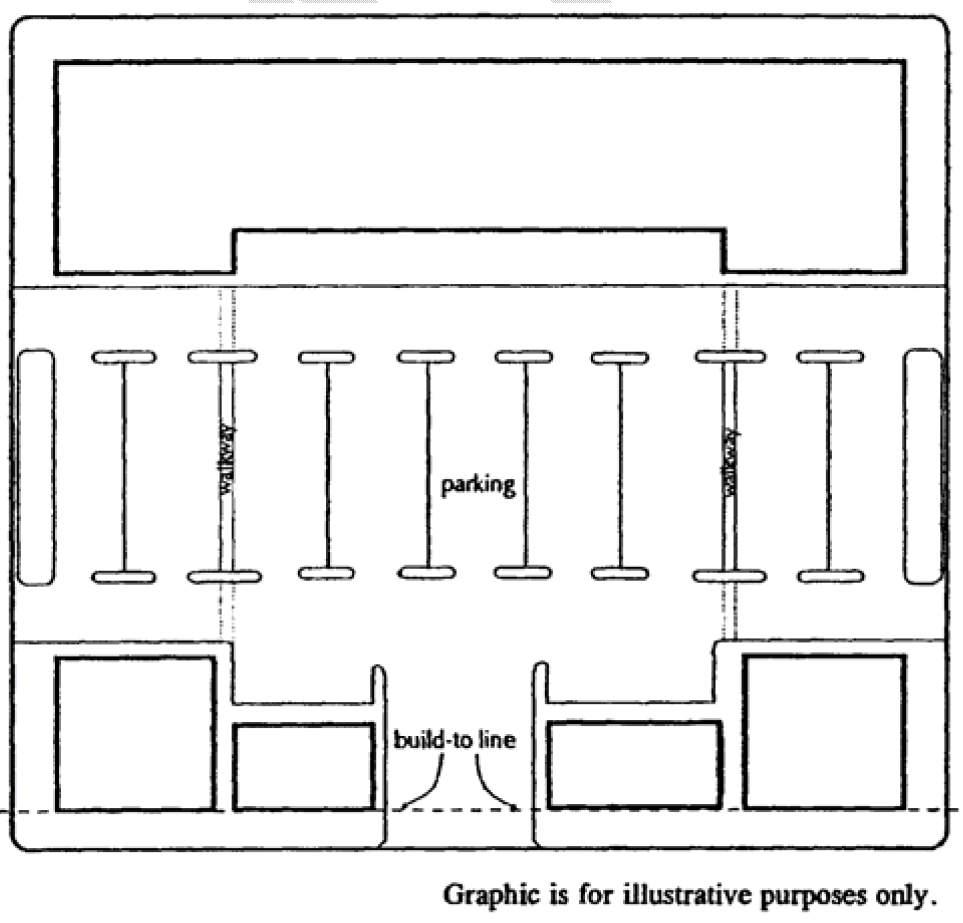
C-2: Palm Valley Configuration
(2)
Building materials.
a.
Exterior wall finish for single-family (detached and attached) residential buildings. Metal of any type is prohibited except horizontal, prefinished aluminum siding. Accessory buildings not exceeding 150 square feet in gross floor area are exempt from this requirement.
b.
Exterior wall finish for townhouse, multifamily and senior residential buildings. Exterior wall finish for townhouse, multifamily and senior residential development shall be in accordance with the exterior wall finish standards listed in the townhouse, multifamily and senior zoning districts.
c.
Exterior wall finish for nonresidential buildings.
1.
Any exterior wall facing a public right-of-way, parking area, or public open space, shall be brick, natural stone, simulated stone, stucco, or similar material approved in writing by the zoning administrator, except for doors, windows and trim. Stucco shall not comprise more than 50 percent of the exterior finish (breezeways are not included in this calculation).
2.
The exterior wall finish of all other sides of the building (not facing a public right-of-way) shall be constructed of brick, natural stone, simulated stone, stucco, architectural concrete masonry unit (CMU), concrete tilt wall, or similar material approved in writing by the zoning administrator.
(3)
Building design standards. Buildings, other than those located in an LI, I, BP or PUD base district, should be designed with characteristics of the Pioneer architectural style. Buildings shall contain one or more of the following design features from the Pioneer architectural style. These characteristics include the following:
a.
Front porches, back porches, wrap-around porches, add-on porches, and cut-out porches.
b.
Stone walls of various stone coursing.
c.
Gable end roofs, some hip roofs, occasional hip-gable roofs.
d.
Pitched roofs with multiple pitch angles.
e.
Galvanized metal roofing.
f.
Dormer windows.
g.
Pronounced stone chimneys.
h.
Breezeways between parts of buildings.
i.
Courtyards.
j.
Small add-on structures.
k.
Exterior stairs to upper levels.
l.
Exposed rafters at eaves.
m.
Rock fences.
n.
Arbors.
(4)
Palm Valley overlay district additional signage standards. Signs shall meet the requirements of chapter 8, article IX of this Code and shall be in harmony with the style and character of the development and shall be an integral design component of the building architecture, building materials, landscaping and overall site development.
Sec. 2-91. - Supplementary use standards.
(a)
Accessory dwelling unit.
(1)
Accessory dwelling units in the C-2 and OF-1 districts are subject to the following standards:
a.
Only one unit is permitted per platted lot.
b.
Each unit shall be occupied by the owner or manager of the principal use on the same lot.
c.
Each unit shall be subject to the density and development standards for principal structures of the district in which it is located.
(2)
Accessory dwelling units in the MU-L district are subject to the following standards:
a.
Accessory dwelling units shall comply with all regulations associated with principal buildings.
b.
Units located above a garage, excluding balconies and landings, shall have a maximum area of 625 square feet including both finished and unfinished square footage. Balconies and landings shall not exceed a cumulative square footage of 120 square feet.
(b)
Amenity center.
(1)
Amenity centers located in residential districts district shall have their principal vehicular entrance and exit on a collector street. Amenity centers shall be operated by the property owners' association.
(2)
Amenity centers are permitted in the BP district provided they serve the employee population. The site shall be larger than two acres and shall have principal vehicular entrance and exit on a street internal to the business park.
(c)
Apartment. Apartments in the SR district are restricted to senior housing.
(d)
Assisted living. Assisted living facilities in the SR district are limited to facilities that function as senior housing.
(e)
Auto body and painting shops and large vehicle and equipment repair facilities.
(1)
All activities shall be conducted within an enclosed building.
(2)
All damaged vehicles shall be enclosed behind a minimum six-foot screening fence.
(3)
Buildings shall not be less than 100 feet from the boundary of any SF-R, SF-1, SF-2, SF-3, SF-D, TF, TH, SR, MF-1, MF-2, or MF-3 district.
(4)
No facilities shall be permitted to have bay doors facing an SF-R, SF-1, SF-2, SF-3, SF-D, TF, TH, SR, MF-1, MF-2, or MF-3 district.
(f)
Auto sales, rental or leasing facilities.
(1)
Auto sales, rental or leasing, including trucks and recreational vehicles, shall be subject to the following additional standards:
a.
Fixed lighting shall be so arranged to prevent direct glare of beams onto any adjacent public or private property or street.
b.
Repairs shall be performed only within a principal building.
c.
Screening shall be provided along all lot lines abutting or adjacent to residentially zoned or developed property, to block any view of the use, its operations and stored materials and equipment from all points on such residential property when viewed from a point six feet above ground level.
d.
Outdoor display of vehicles shall be set back a minimum of 20 feet from all lot lines abutting residentially zoned or developed property.
e.
Landscaping shall be in accordance with Sec. 8-10.
f.
Facilities located in the BP district are restricted to limited vehicle renting with eight available vehicles located on-site at any given time.
(2)
Auto sales are prohibited in the C-1a district, unless the use is located on a lot with frontage on IH-35 and shall be subject to the standards provided in subsection (e)(1) of this section.
(g)
Auto service and repair facilities. Facilities are permitted subject to the following conditions:
(1)
All services and repairs shall be conducted within an enclosed building.
(2)
Outdoor storage of vehicles is prohibited.
(3)
Buildings shall not be less than 50 feet from the boundary of any SF-R, SF-1, SF-2, SF-3, SF-D, TF, TH, SR, MF-1, MF-2, or MF-3 district.
(4)
No automobile service and repair facility shall be permitted to have bay doors facing an SF-R, SF-1, SF-2, SF-3, SF-D, TF, TH, SR, MF-1, MF-2, or MF-3 district.
(h)
Bed and breakfast.
(1)
A bed and breakfast shall be subject to the following standards:
a.
A maximum of six guest rooms shall be provided in any one bed and breakfast establishment.
b.
No food preparation, except beverages, is allowed within individual guest rooms. Meal service shall be provided to overnight guests only.
c.
Preparation and service of food for guests shall conform to all applicable regulations of the state and the city.
(2)
A bed and breakfast located in the SF-2 or SF-D district shall be subject to the following additional standards:
a.
A bed and breakfast located in an SF-2 district shall only be permitted downtown.
b.
The operator of the bed and breakfast shall be a full-time resident of the dwelling in which the bed and breakfast establishment is housed.
c.
A maximum of four (4) guest rooms shall be provided in any one bed and breakfast establishment.
(i)
Car wash.
(1)
Multi-bay car wash facilities are permitted subject to the following conditions:
a.
All washing facilities shall occur under a roofed area with at least two (2) walls.
b.
The building shall be set back not less than 50 feet from the front property line.
(2)
In addition to the conditions provided in subsection (i)(1) of this section, multi-bay car wash facilities in the C-1a district and multi-bay car wash facilities in any district which share a common lot line with a single-family or two-family use are subject to the following conditions:
a.
The entrance and exit of the bays shall be aligned parallel with the primary road that the property fronts in order to limit the visibility of the interior of the bays.
b.
The queuing area shall be screened from view from the primary road the property fronts and from adjacent single-family or two-family property lines by either a masonry wall extending from the side of the outside bay or by a landscaped berm.
c.
The building shall not be less than 100 feet from any single-family or two-family property line.
d.
Vacuuming facilities may be outside the building but shall not be in the street yard and shall not be closer than 150 feet from any single-family or two-family property line.
(3)
Single-bay car washes are permitted with the following conditions:
a.
The building shall not be less than 100 feet from any residential property line.
b.
The entrance and exit of the bay shall face as few residential properties as possible.
c.
Vacuuming facilities may be outside the building but shall not be in the street yard and shall not be closer than 150 feet from any single-family or two-family property line.
(j)
Commercial and general parking.
(1)
Trucks, truck-tractors, and semi-trailers may not be parked in commercial or general parking lots except for panel trucks, pickup trucks, school buses and those motor vehicles necessary and accessory to the operation of uses permitted in the zoning district.
(2)
No commercial or general parking lot may be used as a towing service storage yard or as an abandoned vehicle yard.
(k)
Community/government service.
(1)
A community/government service use located in the C-2, OF-1, MU-R, or any district adjacent to a residential district shall have its principal vehicular entrance and exit on a collector street or local street within 200 feet of its intersection with a collector or arterial street.
(2)
A community/government service use located in the C-2, OF-1, or MU-R district shall be limited to 2,500 square feet of gross floor area and shall not serve as a location primarily for in-person customer contact.
(3)
A community/government service use located in the OS district shall be set back not less than 100 feet from any property in a residential district.
(4)
A community/government service use located in the SR district shall be for the use of seniors.
(5)
In the MU-1 district, a community/government service shall be limited to municipal facilities.
(l)
Day care. A day care facility shall be permitted, subject to the following conditions, in addition to the general development standards applicable in the districts:
(1)
All day care facilities shall meet the minimum state requirements for such facilities.
(2)
Day care facilities located in C-2 and OF-1 districts that do not have frontage on a designated arterial roadway may not exceed 5,000 square feet. All day care facilities located in C-2 and OF-1 districts shall meet following requirements as required for the size of the facility:
a.
All day care facilities regardless of size shall provide a 25-foot unencumbered landscape buffer along property lines that adjoin existing or planned single- or two-family homes. However, this increased buffer shall not be required if the outdoor play/instruction area is located adjacent to a principal building elevation that is the farthest away from the single- or two-family lots.
b.
All day care facilities less than 7,500 square feet shall provide a masonry fence at least six feet in height along property lines that adjoin existing or planned single- or two-family homes with a residential zoning designation.
c.
All day care facilities that exceed 7,500 square feet shall provide a masonry fence at least eight feet in height along property lines that adjoin existing or planned single- or two-family homes.
d.
All day care facilities that exceed 7,500 square feet shall submit a traffic impact analysis (TIA) for review and approval by the transportation division. The TIA shall address the projected traffic impacts to the surrounding neighborhood and how these impacts will be mitigated. This TIA is required regardless of whether or not the proposed facility generates at least 100 trips during the peak hour.
e.
All day care facilities 10,000 square feet and larger shall require special exception approval by the zoning board of adjustment (ZBA) and shall meet the aforementioned standards.
(3)
Day care facilities in the OF-2 district may not be located in a building with no other uses.
(4)
In MU-2, a new day care shall not be located within a 750-foot radius of an existing day care, measured from property line to property line.
(m)
Dog day care, indoor kennel, grooming, and training facility. Dog day care, grooming, and training facilities in the C-2 district are subject to the following standards:
(1)
Animals shall not be allowed to be dropped off or picked up except between the hours of 6:00 a.m. and 9:00 p.m.
(2)
On sites smaller than two acres, the gross floor area for each facility shall not exceed 2,500 square feet.
(3)
On sites larger than two acres, the gross floor area for each facility shall not exceed 5,000 square feet.
(4)
On sites with 50 percent or greater frontage on an arterial roadway, the gross floor area for each facility shall not exceed 7,500 square feet.
(n)
Downtown Residential.
(1)
Any multi-unit or clustered housing type located in downtown except upper story residential and accessory dwelling units located above a garage. Because of the commercial nature of a live/work unit, it shall not be considered downtown residential.
(2)
In the MU-2 District, dwelling unit requirements shall be based on building type standards in Sec. 2-72(f).
(o)
Enrichment Center. In the MU-L zoning district, enrichment centers shall be permitted with the following standards:
(1)
Enrichment centers shall only be permitted on lots fronting on Main Street and Georgetown Street.
(2)
All activities shall be limited to the hours between 6:00 a.m. and 9:00 p.m.
(3)
When abutting residential uses, privacy screening shall be installed surrounding all outdoor activity spaces in accordance with Sec. 2-73(d)(5).
(4)
Portable classrooms shall not be permitted on-site.
(5)
Outdoor storage and display shall be in accordance with Sec. 8-65.
(p)
Event Center.
(1)
In the MU-2 zoning district, event centers shall be permitted with the following standards:
a.
When abutting residential uses, privacy screening shall be installed surrounding all outdoor activity spaces in accordance with Sec. 2-73(d)(5).
b.
All activities associated with events, including outdoor activity, the delivery and retrieval of event materials, and set-up and take-down operations, shall be limited to the hours between 6:00 a.m. and 9:00 p.m.
c.
Event occupancy shall not exceed the maximum occupant load for the facility or 50 occupants, whichever is fewer.
d.
Event-related outdoor storage and display shall be in accordance with Sec. 8-65.
e.
Outdoor amplified sound shall not be permitted.
f.
Events Centers exceeding the standards herein are allowed only if approved as a special exception by the zoning board of adjustment in accordance with the procedures of Sec. 10-53.
(2)
In the MU-L zoning district, event centers shall only be permitted on lots fronting on Main Street and Georgetown Street and with the following standards:
a.
When abutting residential uses, privacy screening shall be installed surrounding all outdoor activity spaces in accordance with Sec. 2-73(d)(5).
b.
All activities associated with events, including outdoor activity, the delivery and retrieval of event materials, and set-up and take-down operations, shall be limited to the hours between 6:00 a.m. and 9:00 p.m.
c.
Event occupancy shall not exceed the maximum occupant load for the facility or 50 occupants, whichever is fewer.
d.
Event-related outdoor storage and display shall be in accordance with Sec. 8-65.
e.
Outdoor amplified sound shall not be permitted.
(q)
Golf courses and country clubs. Any structure established in connection with such uses shall be set back not less than 100 feet from any property in a residential district.
(r)
Group home (six or fewer persons). Group homes shall comply with state licensing requirements.
(s)
Hospital heliports.
(1)
Hospital heliports shall comply with FAA hospital heliport design standards (U.S. Department of Transportation, Federal Aviation Administration, Advisory Circular No. 150/5390-2A, as amended).
(2)
Hospital heliports shall be limited in use to touchdown and lift-off areas only and shall not include maintenance, storage or refueling facilities.
(3)
Touchdown and lift-off areas may be located at ground level or on the rooftop of a hospital facility.
(4)
Ground level touchdown and lift-off areas shall be paved and maintained in accordance with Sec. 8-50(d).
(5)
Touchdown and lift-off areas shall not be located on required parking spaces for the hospital facility.
(6)
Touchdown and lift-off areas shall be shown on the site development plan submitted for the hospital facility.
(7)
Touchdown and lift-off areas shall not be located within 1,000 feet of residentially zoned property.
(t)
Hotel/motel/lodging. Hotels/motels/lodging in the MU-1 and MU-2 districts shall be subject to the following standards:
(1)
One hundred percent of the primary facade on the ground floor of the primary structure shall consist only of lobby, reception areas, dining areas, drinking areas, and/or other facilities associated with the hotel/motel/lodging use.
(u)
Indoor entertainment activities.
(1)
In the C-1 or C-1a districts, a freestanding indoor entertainment activities facility, including the building footprint, outdoor eating, drinking and entertainment areas/patios, drive-through lanes and associated facilities, trash dumpsters and receptacles, and loading/unloading facilities, are prohibited within 150 feet of a residential property line.
(2)
In the C-1 and C-1a districts, an indoor entertainment activities facility within a multi-tenant building are prohibited within 50 feet of a residential property line. Outdoor eating, drinking and entertainment areas/patios and drive-through lanes and associated facilities are prohibited within 150 feet of a residential property line.
(3)
In MU-1, MU-2, and MU-R districts, indoor entertainment activities shall be subject to the following standards:
a.
Firing ranges and game rooms are prohibited.
b.
Outdoor rear or side patio areas shall be screened by a natural stone, simulated stone, or brick fence that is eight feet in height in MU-2 and at least six (6) feet in height in MU-1 and MU-R.
The zoning administrator may waive the above requirement based upon a finding of any of the following:
1.
The zoning administrator determines that due to the site plan layout and/or existing conditions, potential impacts will be negligible;
2.
The zoning administrator receives a letter from the adjacent residential property owner(s) requesting that the fence not be installed; or
3.
The zoning administrator determines that existing and/or proposed vegetation will serve as an adequate screen.
(v)
Light industrial services, manufacturing, and assembly.
(1)
All activities shall occur within a fully enclosed building; and
(2)
Outdoor loading docks, service areas, and fleet parking are prohibited.
(w)
Live/work units.
(1)
Live/work units permitted in the MU-1, MU-2, and MU-R districts shall be subject to the following standards:
a.
The occupant of the unit shall be the person who operates the business or trade that occupies the unit.
b.
The unit may have nonresident employees and a commercial exterior.
c.
The unit shall have the elements of a dwelling unit, including a kitchen and a bathroom but may not have more than one kitchen.
d.
Home occupation requirements as provided for in Sec. 2-93(b) shall apply to a nonresidential use in a townhouse or upper story residence.
e.
The work component of a live/work unit shall be limited to the nonresidential uses permitted for that district in which the unit is located.
(2)
Live/work units permitted in the MU-L district shall be subject to the following standards:
a.
The work component of a live/work unit in the MU-L district shall be limited to office or to the limited retail sales and services provided in Sec. 2-91(ee)(7).
(x)
Office.
(1)
Office uses in the C-2 district are subject to the following requirements:
a.
On sites smaller than two acres, no single office use shall exceed 2,500 square feet of gross floor area.
b.
On sites larger than two acres, no single office use shall exceed 5,000 square feet of gross floor area.
c.
On sites with 50 percent or greater frontage on an arterial roadway, no single office use shall exceed 10,000 square feet of gross floor area.
(2)
Office uses in the MU-1 district are subject to the following requirements:
a.
Except as provided below, in the two blocks of Main Street between Mays and Sheppard, office uses are prohibited on the ground floor of all buildings. Regardless of the foregoing, office use shall be permitted on the ground floor of buildings that contain office uses on the ground floor as of July 11, 2013, which such buildings are located at the following addresses, to wit: 100 E. Main, 102 E. Main, 104 E. Main, 105 E. Main, 108 E. Main, 109 E. Main, 110 E. Main, 115 E. Main, 116 E. Main, and 206 E. Main.
(y)
Office, medical.
(1)
Ambulance access ramps and other special design features for the accommodation of ambulances are prohibited.
(2)
Except for sleep clinics, medical offices in the MU-1, MU-2, C-2, OF-1, and MU-R districts shall be limited to regular service hours not beginning before 7:00 a.m. and not extending past 9:00 p.m. Sleep clinics are prohibited in the MU-1 and MU-2 districts.
(3)
Medical office use is prohibited in the two blocks of Main Street between Mays and Sheppard in the MU-1 district.
(z)
Outdoor entertainment. Amplified live music performed in association with a restaurant/bar is permitted by right in the C-1 and C-1a districts. All other outdoor entertainment in the C-1 and C-1a districts requires special exception approval from the Zoning Board of Adjustment.
(aa)
Park, community. Any structure established in connection with such uses shall be set back not less than 100 feet from any property in a residential district.
(bb)
Park, linear and linkages. In residential districts, any trailhead (with parking) shall be located on a collector or higher street. Trail access points, intended to serve only pedestrians from the subdivision or neighborhood, may be located on local streets.
(cc)
Passenger terminal. Passenger terminals in the C-1 and C-1a districts may not include airports.
(dd)
Places of worship.
(1)
With accessory uses totaling less than 2,500 square feet: Places of worship shall meet development standards and supplementary use standards for any accessory uses. They are required to have direct access to a collector or higher street.
(2)
With accessory uses totaling greater than 2,500 square feet but less than 20,000 square feet: Places of worship shall meet development standards and supplementary use standards for any accessory uses. They are required to either front on or have direct access to a collector or higher street.
(3)
With unrestricted square footage of accessory uses: Places of worship shall meet development standards and supplementary use standards for any accessory uses. They are required to either front on or have direct access to an arterial street.
(4)
In MU-L, accessory uses shall not be permitted.
(ee)
Research and development. No facilities for overnight stays by human test subjects shall be provided, nor shall such overnight stays be permitted.
(ff)
Residential to office conversion. In cases where an existing single-family or two-family residential structure is converted to an office use in a C-1, C-1a, C-2 or OF-1 zoning district, the following special standards shall apply. Where standards are not mentioned in this section, applicable district standards shall apply:
(1)
Any architectural changes to an existing building associated with a change in use for a residential to office conversion shall reflect the original architecture, including roof, roof pitch, articulation, windows, doors, treatment and exterior finish.
(2)
Residential to office conversions shall apply only to existing structures that were formerly used as single-family or two-family residences. The existing principal building on a site establishes the allowable setbacks for a residential to office conversion. Any expansions shall be subject to the zoning district standards. Existing residential structures that were expanded after the adoption of the ordinance from which this section is derived, and prior to an office conversion, shall not be allowed to utilize these standards for a period of five years after rezoning.
(3)
A residential to office conversion may also operate as a live/work unit, as defined in Sec. 1-50, provided the work component is limited to an office use.
(4)
The hours of operation of any residential to office conversion use shall be limited to 7:00 a.m. to 8:00 p.m. for access by the public. No emergency medical services shall be permitted.
(5)
Landscaping requirements provided in Sec. 8-10, except for landscape buffer requirements, apply to all residential to office conversions.
(6)
Parking.
a.
Residential to office conversions shall have an off-street parking requirement of one space per 250 square feet of gross floor area.
b.
If a residential to office conversion operates as a live/work unit, parking shall be calculated using the relevant office requirements for the total square footage of the structure. No additional parking spaces shall be required for the residential component.
(7)
Outdoor storage and display is prohibited.
(8)
Fencing requirement. All residential to office conversions shall be required to install and maintain a fence constructed of masonry materials such as brick, natural stone, simulated stone, decorative reinforced concrete, or other equivalent material approved by the zoning administrator, a minimum of six (6) feet in height along every property line which abuts residential uses. The zoning administrator may waive the requirement based upon a finding of all of the following:
a.
The zoning administrator determines that due to the site plan layout and/or existing conditions, potential impacts will be negligible;
b.
The zoning administrator receives a letter from the abutting residential property owner requesting that the fence not be installed; and
c.
The zoning administrator determines that existing and/or proposed vegetation will serve as an adequate screen.
(9)
Lighting.
a.
All external lighting shall be arranged and controlled so as to deflect light away from residential areas and shall not result in any spillover to adjacent properties.
b.
Site lighting.
1.
Freestanding fixtures shall not exceed eight feet in height and shall not be required to be concealed within an opaque housing. For parking lot lighting fixtures, if a site has greater than ten parking spaces, freestanding fixtures may be up to 16 feet in height; however, the light source for fixtures taller than eight (8) feet shall be completely concealed (recessed) within an opaque housing.
2.
Building fixtures shall not be required to be concealed within an opaque housing if located at a height of no more than eight (8) feet above grade.
c.
The design of building fixtures shall be consistent with the character of the area and the style of the building.
(gg)
Restaurants/bars.
(1)
Freestanding restaurants/bars. In the C-1, C-1a, and MU-R districts, freestanding restaurants/bars shall locate any outdoor eating, drinking, or entertainment areas, patios, drive-through lanes, speaker boxes, and associated facilities a minimum of 150 feet from any residential property line. This requirement may be waived in situations where the zoning administrator determines that topography, natural features, site design, or other existing site conditions render such a setback unnecessary or impractical.
(2)
Restaurants/bars in a multi-tenant building. In the C-1, C-1a, and MU-R districts, all outdoor eating, drinking, or entertaining areas, patios, drive-through lanes, speaker boxes, and associated facilities with a restaurant/bar in a multi-tenant building shall be located more than 150 feet from any residential property line. This requirement may be waived in situations where the zoning administrator determines that topography, natural features, site design, or other existing site conditions render such a setback unnecessary or impractical.
(3)
Requirements for C-2. Restaurants/bars in the C-2 district are subject to the following requirements:
a.
On sites smaller than two acres, no single restaurant/bar shall exceed 2,500 square feet of gross floor area.
b.
On sites larger than two acres, no single restaurant/bar shall exceed 5,000 square feet of gross floor area.
c.
On sites with 50 percent or greater frontage on an arterial roadway, no single restaurant/bar shall exceed 7,500 square feet of gross floor area.
d.
No drive-through service is allowed.
(4)
Requirements for BP and OF-2. Restaurants/bars permitted in the BP and OF-2 districts are subject to the following requirements:
a.
The gross floor area of any single establishment shall not exceed 2,500 square feet.
b.
The establishment shall clearly be a secondary, support use for the regular operation of the business park or office building.
c.
The establishment may not be located in a building with no other uses.
d.
All outdoor eating, drinking, or entertaining areas, patios, drive-through lanes, speaker boxes, and associated facilities with a restaurant/bar shall be located more than 150 feet from any residential property line. This requirement may be waived in situations where the zoning administrator determines that topography, natural features, site design, or other existing site conditions render such a setback unnecessary or impractical.
(5)
Requirements for MU-1. New bars in the MU-1 district shall be prohibited.
a.
For the purposes of this section, the following terms are defined:
1.
Bar shall be defined as an establishment which:
i.
Sells alcoholic beverages for on-site consumption;
ii.
Does not have a commercial kitchen; and
iii.
Does not meet the definition of "restaurant/bar" as defined in Sec. 1.50.
b.
For existing bars located at 112 E Main Street, 204 E Main Street, 300 E Main Street, 105 S Mays Street, 101 E Main Street, 107 W Main Street, 111 W Main Street, and 105 N Sheppard Street the following shall apply:
1.
Existing bars as of November 1, 2025, may continue to operate as a bar subject to the following conditions:
i.
The business must continue and shall not cease operation of the bar use. Any new bar operators in the existing bar address must apply for a TABC permit within 90 days.
ii.
If the structure is damaged or destroyed to an extent greater than 50 percent by a natural or manmade disaster, not including damaged caused intentionally or negligently by the owner, the site layout and building footprint may be rebuilt to the pre-existing building and site form, and the structure may be expanded up to 35 percent of the pre-existing gross floor area. However, in the event the building official has not issued a certificate of occupancy within five years from the date of destruction of the structure, a bar shall no longer be permitted.
2.
In no instance shall a primary footage of an existing bar be made to exceed a maximum 100 feet in length. If, as of November 1, 2025, the facade of an existing bar exceeds 100 feet in length, it can remain a bar but cannot expand its primary footage.
3.
In no instance shall an existing bar be allowed to expand vertically.
(6)
Requirements for MU-2. Restaurants/bars in the MU-2 district shall be subject to the following requirements:
a.
Outdoor rear or side dining areas shall be required to install and maintain a natural stone, simulated stone, or brick fence that is eight (8) feet in height along any shared property line with a residential use, with the exception of multi-story apartments and upper story residential.
The zoning administrator may waive the above requirement based upon a finding of any of the following:
1.
The zoning administrator determines that due to the site plan layout and/or existing conditions, potential impacts will be negligible;
2.
The zoning administrator receives a letter from the adjacent residential property owner(s) requesting that the fence not be installed; or
3.
The zoning administrator determines that existing and/or proposed vegetation will serve as an adequate screen.
b.
All restaurants/bars that serve alcohol must hold a food and beverage certificate issued by the Texas Alcoholic Beverage Commission pursuant to V.T.C.A., Alcoholic Beverage Code § 28.18.
(7)
Requirements for MU-L. Restaurants in the MU-L district shall be subject to the following requirements:
a.
Restaurants shall only be permitted on lots fronting on Main Street and Georgetown Street.
b.
Bars are prohibited in the MU-L district. All restaurants that serve alcohol must hold a food and beverage certificate issued by the Texas Alcoholic Beverage Commission pursuant to V.T.C.A., Alcoholic Beverage Code § 28.18.
c.
Outdoor dining shall be permitted and shall meet fencing and screening requirements. Additionally, when dining is located in the front street yard, a six (6) foot evergreen landscape screen shall be required at the side property line abutting single-family use.
(hh)
Retail sales and services.
(1)
Special standard for banks and pharmacies in any district. Stacking spaces, speaker boxes, service windows, and other facilities associated with a drive-through lane shall be located a minimum of 150 feet from any residential property line. This requirement may be waived in situations where the zoning administrator determines that topography, natural features, site design, or other existing site conditions render such a setback unnecessary or impractical.
(2)
C-1a district. Retail sales and service uses in the C-1a district are subject to the following standards:
a.
Amusement parks or carnivals; boat sales (except on IH-35); camper sales (except on IH-35); campgrounds; flea markets; heavy equipment sales, rental and leasing; kennels; landscaping services; manufactured home sales; pawn shops; portable building sales; recreational vehicle parks; self-service storage; sexually oriented businesses; shooting ranges; truck service or repair; and truck stops are prohibited in the C-1a district.
b.
Resale stores in the C-1a district are prohibited on lots with frontage on IH-35.
(3)
C-2 district. Cosmetic services and retail sales and service uses in the C-2 district are subject to the following requirements:
a.
On sites smaller than two acres, no single use shall exceed 2,500 square feet of gross floor area. No drive-through facilities are permitted.
b.
On sites larger than two acres, no single use shall exceed 5,000 square feet of gross floor area. No drive-through facilities are permitted.
c.
On sites with 50 percent or greater frontage on an arterial roadway, no single use shall exceed 7,500 square feet of gross floor area. Drive-through facilities are permitted for banks if there is an intervening building that effectively screens the drive-through area, including stacking spaces, from adjacent residences.
d.
Auto sales, rental, and leasing facilities; boat sales; camper sales; check-cashing services; flea markets; gold sales; gun sales; heavy equipment sales, rental and leasing; manufactured home sales; pawn shops; portable building sales; recreational vehicle parks; self-service storage; sexually oriented businesses; shooting/archery ranges; title loan or payday loan services; truck service or repair; and truck stops are prohibited.
e.
Fuel sales are permitted with the following conditions:
1.
For establishments that share a common lot line with a single-family or two-family use, the number of fuel pump islands shall not exceed four (4) without special exception approval from the Zoning Board of Adjustment. There is no limit to the number of fuel pumps for establishments that do not share a common lot line with a single-family or two-family use;
2.
The canopy shall have a pitched roof with a minimum 3:12 pitch;
3.
Lighted bands around the exterior of the canopy are prohibited;
4.
Columns supporting the canopy over the fuel pumps shall be clad in brick or natural stone that is complementary to the masonry used on the exterior of the convenience store;
5.
No automated teller machines (ATMs) may be located outside the convenience store; and
6.
The hours of operation for the convenience store may not exceed 6:00 a.m. to 10:00 p.m.
(4)
OF-2 district.
a.
Cosmetic services and retail sales and services, including tattoo/piercing shops, are permitted only when incorporated into the ground floor of a multi-story structure.
b.
Animal boarding; art and craft studios with welding or heavy machinery; auto parts sales; auto sales, rental, and leasing facilities; boat sales; camper sales; donation centers; flea markets; fortune tellers/psychic readers; heavy equipment sales; machinery repair and services; manufactured home sales; mortuaries; pawn shops; portable building sales; self-service storage; sexually oriented businesses; shooting/archery ranges; taxidermists; and title loan or payday loan services are prohibited.
(5)
BP district. Retail sales and service uses in the business park (BP) district are restricted to commercial gyms only. They are permitted provided that they generally serve the employee population of the business park.
(6)
MU-1, MU-2, and MU-R districts. Retail sales and services in the MU-1, MU-2, and MU-R districts are subject to the following standards:
a.
Animal boarding; attached wireless transmission facilities; auto parts sales; auto repair and body shops; auto sales, rental, and leasing facilities; boat sales; camper sales; campgrounds; car washes; donation centers; flea markets; game rooms; gasoline and fuel sales; heavy equipment sales; machinery repair and services; manufactured home sales; mini-warehouses; monopoles; mortuaries; pawn shops; portable building sales; recycling centers; self-enclosed monopoles; self-service storage; sexually oriented businesses; shooting/archery ranges; taxidermists; wholesale nurseries; and wrecking yards are prohibited.
b.
Tattoo and/or piercing shops shall be prohibited within a 500-foot radius of an existing tattoo and piercing shop, as measured from property line to property line.
c.
Gun and/or firearm shops shall be prohibited within a 500-foot radius of an existing gun and/or firearm shop, as measured from property line to property line.
d.
Animal grooming shops are prohibited in MU-1, but permitted in MU-2 and MU-R.
e.
Vape and smoke shops shall be prohibited in the MU-1 and MU-2 districts.
(7)
MU-L district. It is the intent of the MU-L district to encourage the establishment of specialized personal services, boutique shops selling specialty items, artisanal workshops, and cosmetic services, excluding the uses prohibited in subsection (7)a below. Therefore, retail sales and service users are subject to the following standards:
a.
The following uses are prohibited: animal boarding; art and craft studios with welding and heavy machinery; attached wireless transmission facilities; auto parts sales; auto repair and body shops; auto sales, rental, and leasing facilities; banks including savings and loans, credit unions, and check-cashing facilities; campgrounds; car washes; donation centers; dry cleaning; flea markets; fortune tellers/psychic readers; game rooms; gasoline and fuel sales; gun or firearm shops; hair salons; heavy equipment sales; laundromats; machinery repair and services; manufactured home sales; mini-warehouses; monopoles; mortuaries; nail salons; pawn shops; portable building sales; recycling centers; self-enclosed monopoles; self-service storage; sexually oriented businesses (as defined in the Code); shooting/archery ranges; tanning salons; tattoo and piercing shops; taxidermists; tobacco sales including cigar sales; wholesale nurseries; vape and smoke shops; and wrecking yards.
b.
All permitted uses shall have no more than 2,000 total square feet of sales floor, service areas accessible to the public, food preparation areas, and manufacturing areas with the exception of businesses located on Main Street or Georgetown Street.
(ii)
Schools, public and private.
(1)
Elementary schools, public. Elementary schools shall have a front yard setback of not less than 50 feet, shall front on a collector street, and shall not front on an arterial street. Portable classrooms are prohibited in the front street yard.
(2)
Middle schools, public. Middle schools shall have a front yard setback of not less than 50 feet and shall front on either a major collector or minor arterial street. Portable classrooms are prohibited in the front street yard.
(3)
High schools, public. High schools shall have a front yard setback of not less than 50 feet and shall front on either a minor or major arterial. Portable classrooms are prohibited in the front street yard.
(4)
Colleges, universities, business/trade, and other post-secondary educational facilities. Colleges, universities, business/trade, and other post-secondary educational facilities shall front on either a minor or major arterial street.
(5)
Primary/secondary, private.
a.
Portable classrooms are prohibited in the front street yard.
b.
Schools shall front on collector or arterial streets.
(jj)
Self-service storage. Self-service storage facilities shall be allowed subject to the following standards:
(1)
In the C-1 district only multi-story facilities with internal access to storage units are allowed, and exterior roll-up doors providing access to individual units are prohibited.
(2)
The use of the individual storage units shall be limited to storage purposes only.
(3)
No direct glare from any illumination on the site shall be visible from lots in any adjacent residential zoning district.
(4)
Electrical service to any individual storage unit shall be limited to a single circuit providing a maximum force of 20 amperes, with no more than one duplex outlet providing single-phase electrical service of no more than 110 volts.
(5)
A caretaker's residence is permitted only in the LI and I districts as an accessory use for self-storage facilities.
(6)
Each self-storage facility in the LI and I districts that abuts a designated arterial roadway shall comply with the following requirements:
a.
Each landscaped street yard shall contain a depth of at least 25 feet.
b.
Parking spaces shall not be located in the street yard.
c.
One hundred percent of each street yard shall be landscaped.
d.
Each wall or fence that abuts a street yard shall be constructed of brick, natural stone, simulated stone, or other similar masonry product; but not including cinder block unless covered with stucco or similar material.
e.
The entire tract shall be enclosed by a building wall or a six-foot perimeter fence. Any portion of said building wall or fence that is visible from the designated arterial roadway shall be constructed of brick, natural stone, simulated stone, or similar masonry product.
f.
Storage or parking of recreational vehicles, boats, trailers, and other similar unenclosed storage is prohibited in any street yard and shall be enclosed by a building wall or an eight-foot perimeter fence constructed in accordance with subsection (jj)(6)e. of this section.
(kk)
Single-family attached and single-family detached dwelling units.
(1)
C-1 and C-1a districts. Single-family attached (two dwelling units) and single-family detached dwelling units in the C-1 and C-1a districts are permitted only downtown.
(2)
MU-2 district. Single-family dwelling units are subject to the following standards:
a.
A single-family use that is converted to a nonresidential use shall not return to a single-family use.
b.
Single-family uses shall not be required to provide on-site parking in a garage.
c.
Nonresidential uses shall not be required to provide a compatibility buffer adjacent to single-family uses.
d.
After the 1st day of August, 2013, if a single-family structure is damaged or destroyed to an extent greater than 50 percent by natural or manmade disaster, not including damage caused intentionally or negligently by the owner, the single-family structure may be rebuilt according to the following density and development standards and time deadlines:
1.
No minimum lot area required;
2.
Front, side, and rear setbacks shall conform to either SF-2 or MU-2 standards;
3.
The exterior finish of all new buildings shall be of natural stone, simulated stone, brick, stucco, and/or fiber cement siding;
4.
If the building official has not issued a certificate of occupancy within five years following the date of destruction of the single-family structure, all future use of the property must conform to all MU-2 standards.
(3)
TF district. Single-family detached dwelling units in the TF district shall comply with the lot and building dimensional standards for the SF-2 zoning district, which can be found in Sec. 2-26.
(4)
MU-1 district.
a.
Single-family detached dwelling units shall be permitted only on properties located at the following addresses in the city: 309 East Liberty, 306 East Liberty, and 102 East Liberty.
b.
Single-family detached dwelling units are subject to the following standards:
1.
A single-family use that is converted to a nonresidential use shall not return to a single-family use.
2.
Single-family uses shall not be required to provide on-site parking in a garage.
3.
Nonresidential uses shall not be required to provide a compatibility buffer adjacent to single-family uses.
4.
The MU-2 (Mixed-Use Downtown Medium Density) district design standards contained in Subsection 2-72(e) shall apply.
(ll)
Small-scale alcohol production.
(1)
In the BP district, all temporary outdoor storage areas shall be screened from any public right-of-way or abutting property by an opaque wall a minimum of six (6) feet in height. The wall shall be constructed of materials complementary to the principal structure.
(2)
Micro-breweries in MU-2 shall have a public tasting room and must conform to restaurant standards requiring a commercial kitchen. An on-site food truck shall not substitute for a commercial kitchen.
(mm)
Small-scale manufacturing and assembly. Small scale manufacturing and assembly is permitted in MU-1 and MU-2 with the following standards:
(1)
On-site retail component for direct sales to consumers shall be required.
(2)
Not less than 10% of the gross floor area shall be occupied by retail sales, including showroom, gallery, or similar customer-serving uses which shall be accessed from the primary frontage.
(3)
All manufacturing activities shall be conducted indoors. Outdoor operations, external dust collectors, and/or outdoor storage are not permitted.
(4)
No use shall be permitted which constitutes a hazard, danger or nuisance to the public in accordance with Sec. 2-4(d). Uses shall not adversely impact the neighborhood through noise, dust, debris, odor, lighting, fire safety, and/or traffic.
(5)
Exhaust shall be directed away from all residential uses.
(6)
A maximum of one (1) roll-up garage door for delivery services shall be permitted and shall be located on the rear building elevation.
(nn)
Townhouses. Townhouses in the SR district are restricted to senior housing.
(oo)
Upper story residential.
(1)
Except as provided in subsection (oo)(2) of this section, upper story residential uses are permitted subject to the following standards:
a.
In the C-1 and C-1a districts, upper story residential is permitted only downtown and the CT overlay.
b.
In the C-2 district, upper story residential uses are permitted only on sites larger than two acres.
c.
In the C-1, C-1a and C-2 districts, the residential use shall be clearly secondary to the principal commercial use. The gross floor area of the entire building shall include not more than 50 percent residential uses.
d.
In the C-1, C-1a and C-2 districts, separate designated parking spaces for use by the residential units are required. Shared parking calculations are prohibited.
(2)
Upper story residential uses in the MU-1, MU-2, MU-L, and MU-R districts shall comply with the following standards:
a.
For upper story residences, if on-site resident parking is included, it shall be separated from customer or employee parking, reserved for residents' use only, and shall be clearly marked for such purposes.
b.
The ground floor of the building shall be occupied by nonresidential uses.
c.
The residential use shall have a separate entrance from the nonresidential uses.
d.
On the primary facade, direct access from the ground level to balconies or landings of upper story residential uses is prohibited.
e.
The following additional standards apply to zoning districts downtown:
1.
In MU-2, upper story residential is differentiated from downtown residential to allow for residential units in a building above a ground floor nonresidential use.
2.
In MU-L, upper story residential shall only be permitted on lots fronting on Main Street and Georgetown Street with a maximum of two (2) units per building.
(pp)
Urgent care facilities.
(1)
Urgent care facilities in the C-1 and C-1a districts that offer emergency medical services may not be located within 300 feet of an existing or zoned residential use.
(2)
Urgent care facilities in the OF-1 district shall not be specifically designed to accommodate ambulances.
(qq)
Utilities.
(1)
Minor utilities. Minor utilities shall be treated as ground-mounted mechanical equipment and shall comply with the district-specific standards and any required landscaping standards in Sec. 8-10.
(2)
Intermediate and major utilities. Except as provided in subsection (qq)(3) below, intermediate and major utilities are required to provide an eight (8) foot masonry fence (or alternate material approved in writing by the zoning administrator) with landscaping in compliance with Sec. 8-10. The facility shall be secured.
(3)
MU-2 district. Major utilities in the MU-2 district shall be fully enclosed within a building.
(rr)
Veterinary clinic, livestock.
(1)
Corrals and stables may be provided solely incidental to animal hospital use and for convalescing livestock.
(2)
Cremation services shall be prohibited.
(ss)
Veterinary clinic, small animals.
(1)
Any veterinary clinic, small animals in the OF-1 district shall be limited to regular service hours beginning at 7:00 a.m. and ending at 9:00 p.m.
(2)
Kennel facilities shall be limited to indoors and incidental to animals being treated at the facility.
(3)
Ancillary sales of pet care products, including but not limited to, prescription food, medications, and grooming accessories shall be limited to no more than ten percent of the gross floor area of the facility.
(4)
Cremation services shall be prohibited.
(tt)
Waste-related service. Waste-related services are permitted in the LI district, subject to the following conditions:
(1)
The facility shall be visually screened from any adjacent roadways, residential districts and any other nonindustrial uses by an eight-foot perimeter fence. Any portion of the fence that is visible from the adjacent roadways shall be constructed of brick, natural stone, simulated stone, or architectural concrete masonry units.
(2)
All recycling bins shall be enclosed behind a minimum eight (8) foot screening fence.
(3)
All solid, liquid or sanitary waste collected shall be stored within an enclosed building.
(4)
All manufacturing or production of goods or energy from solid, liquid or sanitary waste or recycled materials shall be conducted in an enclosed building.
(5)
Accessory buildings shall be set back more than 100 feet from single-family and two-family lots.
(uu)
Wellness Center. In the MU-2 and MU-L zoning districts, wellness centers shall be permitted with the following standards:
(1)
Physical medical screening and invasive procedures shall be prohibited.
(2)
Medical waste, and any procedure resulting in medical waste, shall be prohibited.
(3)
Programs and activities shall not create a noise disturbance as defined in Sec. 14-210.
(4)
Fitness equipment shall not produce noise audible outdoors.
(5)
Outdoor non-medical therapeutic equipment shall not be permitted in any street yard.
(6)
In MU-L, programs and activities on-site shall only be permitted between 6:00 a.m. to 9:00 p.m.
(7)
When abutting residential uses in MU-L, privacy screening in accordance with Sec. 2-73(d)(5) shall be required.
(8)
Outdoor amplified sound shall not be permitted.
(9)
Animals also permitted on single-family standard zoned lots may be kept on-site.
(vv)
Wireless transmission facility (WTF). Wireless transmission facilities shall comply with the standards provided in Sec. 2-97.
(ww)
Sports Training Facilities/Specialty Gyms.
(1)
No Sports Training Facility or Specialty Gym shall exceed 5,000 square feet of gross floor area.
(Ord. No. O-2019-0208, § II, 5-9-2019; Ord. No. O-2019-0465, § I, 11-26-2019; Ord. No. O-2019-0495, § IV, 12-5-2019; Ord. No. O-2020-0157, § II, 6-11-2020; Ord. No. O-2022-203, § I, 6-9-2022; Ord. No. O-2022-235, § II, 7-14-2022; Ord. No. O-2023-336, §§ I—III, 10-12-2023; Ord. No. O-2025-256, § I, 9-25-2025; Ord. No. O-2025-257, § II, 9-25-2025; Ord. No. O-2025-277, § VII, 10-23-2025; Ord. No. O-2026-119, § II, 5-14-2026)
Sec. 2-92. - Temporary uses, structures, and permits.
(a)
Purpose. Temporary buildings and structures, as set forth below, are declared to have characteristics which require certain controls to ensure compatibility with other uses in the district within which they are proposed for location.
(b)
Temporary buildings. No temporary building or structure shall be erected in any required setback area.
(1)
Temporary buildings providing classrooms for schools, religious institutions and other similar facilities may be permitted only where such buildings are part of an approved site plan for future development of the site.
(2)
Temporary buildings, where permitted, are subject to site plan approval. The zoning administrator may require buffering or screening as set forth in Secs. 8-10 and 8-40.
(3)
Temporary buildings shall not be placed in any street yard of the principal building, except for those providing classrooms for schools and places of worship, which may be placed in a side or rear street yard.
(4)
Temporary buildings shall not interfere with on-site circulation.
(c)
Use of model home as temporary sales office. The following regulations shall apply to the use of model homes as temporary sales offices:
(1)
The use of a model home as a temporary sales office may be located within residential districts as part of an ongoing residential development, if the office is directly and exclusively related to initial sales of dwelling units within the respective residential subdivision or development.
(2)
The zoning administrator shall ensure that each use of a model home as a temporary sales office is issued only a temporary certificate of occupancy. The temporary certificate of occupancy shall expire in one year, except as described below or unless it is renewed by the respective real estate agency upon which the burden shall lie to demonstrate that the conditions of approval still exist.
(3)
If a model home is used as a temporary sales office, the sales office shall be removed when certificates of occupancy have been issued to 90 percent of the associated residential units.
(4)
If any garage space has been used as office space, it shall be converted back to a garage for automobile parking prior to the issuance of a certificate of occupancy for use as a home.
(5)
Temporary sales offices shall only be located in model homes.
(d)
Contractors' offices and equipment sheds. Contractors' offices and equipment sheds containing no sleeping or cooking accommodations are permitted in any district when accessory to an ongoing construction project. Such use shall be removed prior to the issuance of a certificate of occupancy for the associated construction project.
(e)
Use of temporary buildings or temporary outdoor storage during expansion, remodeling or reconstruction. The following regulations shall apply to the use of temporary buildings or temporary outdoor storage during expansions, remodeling or reconstruction:
(1)
The temporary buildings or the temporary outdoor storage can only be used to accommodate staff, equipment or inventory displaced by the expansion, remodel or reconstruction.
(2)
The location of the temporary building or temporary outdoor storage must be shown on a site plan; and reviewed and approved by the zoning administrator. The location requirements are as follows:
a.
The placement of temporary outdoor storage shall not conflict with any vehicle circulation.
b.
The placement of temporary outdoor storage shall not conflict with any public utilities, easements or rights-of-way.
c.
If an alternative location exists, the temporary outdoor storage shall not be placed within the street yard.
d.
The location of the temporary building or temporary outdoor storage shall meet the accessory building requirements for that zoning district.
(3)
Upon review and approval by the zoning administrator, a temporary use permit shall be applied for all temporary buildings and temporary outdoor storage used during the expansion, remodeling or reconstruction of an existing business.
(4)
Separate building permits shall be obtained for the temporary building or temporary outdoor storage; and the expansion, remodel or reconstruction of the existing business.
(5)
The temporary building or temporary outdoor storage shall be removed no later than 45 days after the issuance of the certificate of occupancy for the building permit related to the expansion, remodel or reconstruction of the existing business.
(6)
The business undergoing the expansion, remodel or reconstruction must be an existing business and not a new business, changing businesses or changing uses.
(7)
An existing site plan for the existing business must already be on file with the city.
(8)
Temporary outdoor storage uses shall also comply with the requirements provided in Sec. 8-35.
(f)
Temporary portable storage units. Temporary, portable storage units are subject to the following regulations:
(1)
Location. Temporary portable storage units are prohibited in any right-of-way or easement, and must be located on an improved surface such as a paved driveway or parking lot.
(2)
Duration. Temporary portable storage units shall not remain on any residential lot for more than seven consecutive days.
(3)
Shipping containers and conexes. Industrial shipping containers, sometimes known as conexes, are prohibited in any residential or mixed-use zoning district except during construction, expansion, or remodeling as noted in subsection (e) above.
(g)
Temporary use permits.
(1)
Applicability. Before temporary uses are permitted on private or public property, applicants shall obtain a temporary use permit from the zoning administrator that outlines conditions of operations to protect the public, health, safety and welfare. Temporary uses are prohibited in public rights-of-way.
(2)
Temporary uses types. Temporary uses shall be deemed to include short-term or seasonal uses that are not otherwise allowed by the zoning district regulations of this Code. The following uses and activities shall be considered temporary uses:
a.
Fundraising activities by not-for-profits. Fundraising or noncommercial events for nonprofit religious, educational or community service organizations where the public is invited to participate in the activities and which last longer than 72 hours, but not longer than 45 days. This description shall not preclude the use of existing religious institutions or other not-for-profit facilities for events conducted entirely within a building.
b.
Other temporary uses. Other temporary uses found by the zoning administrator to comply with the provisions of this section.
(3)
Review and action by zoning administrator.
a.
Application should be made at least 15 days in advance of the requested start date for a temporary use.
b.
The zoning administrator shall determine whether to approve, approve with conditions, or disapprove the permit within ten days after the date of application and shall determine the length of time that the permit is valid. Permits requested for a temporary building or temporary outdoor storage during expansions, remodeling or reconstruction as provided for in this section shall be valid for a period of up to one year and an extension may be requested from the zoning administrator for a period not to exceed one additional year prior to the expiration of the original temporary use permit issued. All other permits shall be valid for a period between one and 45 days.
c.
Where an application has been disapproved by the zoning administrator, the applicant shall be notified in writing of the reasons for the disapproval.
(4)
Temporary use approval criteria. Temporary uses shall comply with the following standards:
a.
Land use compatibility. The temporary use shall be compatible with the purpose and intent of this Code and the zoning district in which it will be located. The temporary use shall not impair the normal, safe and effective operation of a permanent use on the same site. The temporary use shall not endanger or be materially detrimental to the public health, safety or welfare, or injurious to property or improvements in the immediate vicinity of the temporary use, given the nature of the activity, its location on the site, and its relationship to parking and access points.
b.
Compliance with other regulations. A building permit or temporary certificate of occupancy may be required before any structure used in conjunction with the temporary use is constructed or modified. All structures and the site as a whole shall meet all applicable building code, zoning district, and fire code standards and shall be promptly removed upon the cessation of the use or event. Upon cessation of the event or use, the site shall be returned to its previous condition (including the removal of all trash, debris, signage, attention attracting devices or other evidence of the special event or use).
c.
Hours of operation and duration. The duration and hours of operation of the temporary use shall be consistent with the intent of the event or use and compatible with the surrounding land uses. The duration and hours of operation shall be established by the zoning administrator at the time of approval of the temporary use permit.
d.
Traffic circulation. The temporary use shall not cause undue traffic congestion or accident potential, as determined by the city traffic engineer, given anticipated attendance and the existing design of adjacent streets, intersections and traffic controls.
e.
Off-street parking. Adequate off-street parking shall be provided for the temporary use, and it shall not create a parking shortage for any of the other existing uses on the site.
f.
Public conveniences and litter control. On-site restroom facilities are required. Adequate on-site solid waste containers may also be required. The applicant shall provide a written guarantee that all litter generated by the event or use shall be removed at no expense to the city.
g.
Appearance and nuisances. The temporary use shall be compatible in intensity, appearance and operation with surrounding land uses in the area, and it shall not impair the usefulness, enjoyment or value of adjacent property due to the generation of excessive noise, dust, smoke, glare, spillover lighting, or other forms of environmental or visual pollution.
h.
Signs and attention-attracting devices. The zoning administrator shall review all signage in conjunction with the issuance of the permit. The zoning administrator may approve signs and the temporary use of attention attracting devices that conform to the requirements of chapter 8, article VIII, of this Code.
i.
Other conditions. The zoning administrator may establish any additional conditions deemed necessary to ensure land use compatibility and to minimize potential adverse impacts on nearby uses, including but not limited to, time and frequency of operation, temporary arrangements for parking and traffic circulation, requirements for screening/buffering, and guarantees for site restoration and cleanup following the temporary use.
(5)
Expiration and lapse of approval. If the use described in the temporary use permit has not begun within 60 days from the date of issuance, the temporary use permit shall expire and be of no further effect.
Sec. 2-93. - Accessory uses and home occupations.
(a)
Generally. Any accessory use customarily associated with a principal use that may be permitted by right consistent with applicable provisions of this chapter may be permitted. The establishment of such accessory uses shall be consistent with the following standards in addition to any district specific requirements:
(1)
The accessory use shall be subordinate to and serve a principal use or principal structure.
(2)
The accessory use shall be subordinate in area, extent and purpose to the principal use served.
(3)
The accessory use shall contribute to the comfort, convenience or necessity of occupants of the principal use served.
(4)
The accessory use shall be located within the same zoning district as the principal use.
(5)
Accessory uses located in residential districts shall not be used for commercial purposes other than legitimate home occupations.
(b)
Home occupation.
(1)
Home occupation limitations.
a.
The home occupation shall be conducted entirely within a dwelling unit or attached garage which is the bona fide residence of the practitioners.
b.
No person other than a person or persons who reside in the dwelling unit may participate in a home occupation on the premises.
c.
Neither the interior, nor the exterior of the dwelling shall be structurally altered so as to require compliance with nonresidential construction codes to accommodate the home occupation. No additional buildings or structures shall be added on the property to accommodate the home occupation. This provision shall not prohibit the construction of an accessory building as permitted by a residential zoning district.
d.
The home occupation shall not interfere with the use of the garage as a required parking space under this code.
e.
No equipment, goods, supplies or materials associated with the home occupation shall be displayed or stored where visible from an abutting right-of-way or at the property line of an abutting property at a point six (6) feet above the finished grade.
f.
The sale of merchandise directly to a customer on the premises shall be prohibited; provided, however, this provision shall not be construed to prohibit the following:
1.
Up to one garage sale every six (6) months.
2.
A service that involves the sale of a custom item made by the home occupant.
g.
The home occupation shall not produce external noise, vibration, smoke, dust, odor, heat, glare, fumes, electrical interference or waste runoff outside the dwelling unit or on the property surrounding the dwelling unit. Commercial repair of automobiles or engines and appliance repair are prohibited, and storage of these items shall not be allowed on the premises.
h.
The street address of the home occupation shall not be advertised through pamphlets, signs, billboards, television, radio, the internet, the phone book, newspapers or on vehicles.
i.
A home occupation shall not generate more than 24 single directional vehicle trips each day of customer-related vehicular traffic.
j.
Not more than two customers shall be permitted to conduct business associated with the home occupation at one time, except for day care, which allows six children to be cared for at one time.
k.
Organized events for the purpose of displaying or modeling articles for sale shall not be conducted at a home more than six times per year.
l.
Signs shall meet the requirements of Chapter 8, article IX, of this code.
(2)
Remedies and enforcement power. Remedies and enforcement powers shall be as described in Sec. 1, article II of this code.
(c)
Mobile food establishments.
(1)
General. A mobile food establishment is a temporary food service operation that supports certain types of businesses in certain locations in the City.
(2)
Site location criteria.
a.
Mobile food establishments shall not locate on public streets or in public parking lots.
b.
Mobile food establishments shall not be located within 50 feet of a single-family dwelling unit. This measurement shall be taken from the property line of the dwelling unit to the closest point of the mobile food establishment location. Separation requirements for food trucks located downtown shall be found in subsection (7) below.
c.
Mobile food establishments shall not locate in access drives, fire lanes, or improved alleys.
d.
Mobile food establishments shall not locate on sidewalks in or along the right-of-way without prior approval from the city. Approval may be granted if a minimum width of five (5) feet of sidewalk remains free of any obstructions.
e.
Mobile food establishments may not occupy any parking spaces needed for the minimum required parking for the primary use.
f.
Mobile food establishments shall be located a minimum of 15 feet from fire hydrants and five (5) feet from any utility box, ADA accessibility ramp, or building entrance.
(3)
Other requirements.
a.
The mobile food establishment shall be in compliance with Williamson County and Cities Health District regulations and applicable City fire department regulations.
b.
All signage and identification for the mobile food establishment shall be on or attached to the vehicle. Menu items may be displayed on sandwich boards which are not attached to the vehicle.
c.
All food vending transactions shall occur from the vehicle.
d.
No trash or grease shall be left at the site after the departure of the mobile food establishment, except in existing on-site containers specifically designed for such waste.
e.
Vehicles, generators, and other equipment shall be maintained so as to be in operable condition at all times.
f.
Durable exterior-grade finishes and decorations shall be utilized for all exterior materials on the vehicle and shall be maintained in accordance with minimum property, structural and health standards.
g.
The mobile food establishment shall remain on wheels and drivable or with the hitch in place necessary for it to be mobile.
(4)
Long-term accessory use. This section shall apply to all long-term mobile food establishments located in the city, with the exception of those located downtown which are regulated in subsection (7) below.
a.
Mobile food establishments are meant to be open and on-site on a temporary basis. As such, the following requirements for long-term accessory use shall be met:
1.
New connections to city water or wastewater infrastructure are prohibited;
2.
New electric meters are prohibited; and
3.
For mobile food establishments serving a municipal park and recreation facility, the Parks and Recreation Department shall determine the permissible duration for which each establishment may operate.
b.
Upon the issuance of an annual permit as described in subsection (c)(4)c. below, mobile food establishments are permitted as long-term accessory use supporting the following primary uses:
1.
A multi-tenant center where the mobile food establishment is located within an internally oriented pedestrian promenade which is not visible from the public right-of-way;
2.
Small-scale alcohol production facilities;
3.
Event centers;
4.
Municipal parks and recreation facilities;
5.
Public and private education facilities, corporate office campuses, and business/industrial parks, at which the mobile food establishment provides service to the students or employees of the hosting organization; and
6.
Homeowners Association-owned common areas.
c.
An annual permit from the city for each calendar year beginning January 1 shall be required for long term accessory use.
1.
The property owner or tenant who is hosting the mobile food establishment shall be responsible for obtaining the permit. If a tenant applies for the permit, the signature of the property owner or property management company must be on the application.
2.
The permit applicant shall attest that all mobile food establishments hosted on-site have the required Williamson County and Cities Health District and Round Rock Fire Department permits and inspections and are in compliance with all applicable regulations. Mobile food establishments may be shut down immediately by the Williamson County and Cities Health District or the Fire Department if they are in violation of any permitting or inspection requirements, including displaying the proper permits.
3.
The zoning administrator may revoke a permit issued under this section (4) if the permit holder is found to be in violation of sections (c)(2) and (3) above three (3) times in a twelve (12) month period. The permit shall remain revoked for twelve (12) months from the date of revocation.
4.
A site map showing the proposed location of the mobile food establishment(s) shall be provided.
5.
Applications for mobile food establishment permits shall be accompanied by the appropriate fee as set forth in appendix A of the Code of Ordinances. Municipal parks and recreation facilities and homeowner association properties shall be exempt from fees.
6.
The mobile food establishment shall not operate during the hours that the primary use is closed.
7.
It shall be unlawful for the owner of a mobile food establishment which is visible from public rights-of-way to park the vehicle overnight at the location of their associated primary use on any Sunday, Monday, Tuesday, Wednesday, or Thursday night, except for Sunday and Thursday nights that coincide with a federal holiday the following day.
8.
All signage and identification for the mobile food establishment shall be on or attached to the vehicle. Menu items may be displayed on sandwich boards which are not attached to the vehicles.
9.
Sites smaller than one (1) acre are prohibited from having more than two (2) mobile food establishments on-site at any time.
(5)
Mobile food establishment park.
a.
Upon the issuance of an annual permit as set forth in subsection (c)(5)b. below, mobile food establishment parks are permitted as an accessory use supporting the following primary uses:
1.
Public and private education facilities;
2.
Corporate office campuses;
3.
Business/industrial parks; and
4.
Municipal parks and recreation facilities.
b.
An annual permit from the city for each calendar year being beginning January 1 shall be required for a mobile food establishment park.
1.
The property owner shall be responsible for obtaining the permit.
2.
The property owner shall attest that all mobile food establishments within the mobile food establishment park have the required Williamson County and Cities Health District and Round Rock Fire Department permits and inspections and are in compliance with all applicable regulations. Mobile food establishments may be shut down immediately by the Williamson County and Cities Health District or the Fire Department if they are in violation of any permitting or inspection requirements, including displaying the proper permits.
3.
The zoning administrator may revoke a permit issued under this section (5) if the permit holder is found to be in violation of sections (c)(2) and (3) above three (3) times in a twelve (12) month period. The permit shall remain revoked for twelve (12) months from the date of revocation.
4.
A mobile food park manager shall be designated for the property on the permit application and posted on-site with contact information.
5.
A site map showing the proposed location of the mobile food establishments within the park and any other associated structures shall be provided, including required restroom facilities. A building permit shall be required for any permanent structures associated with the mobile food establishment park.
6.
All mobile food establishment parks shall have restroom facilities with hand washing onsite. These facilities shall be open and available during the hours the park is open for business. The following types of facilities shall be allowed.
i.
A freestanding restroom structure constructed in accordance with the city's code.
ii.
An on-site principal building's restrooms may be utilized with a separate entrance provided for park use.
iii.
A mobile restroom trailer with a minimum of two (2) separate lockable stalls (men's and women's facility). Handicap accessible stalls shall be available and may required a third restroom unit.
7.
Signage and identification for individual mobile food establishments within the park shall be on or attached to the vehicle. Menu items may be displayed on sandwich boards which are not attached to the vehicle. Mobile food establishment parks may install one (1) on-site post and panel sign within the park area that meets the size, height, materials and illumination standards provided in section 8-78. This sign shall meet applicable location requirements for freestanding signs in accordance with section 8-78. If a freestanding post and panel sign will be added to the park, a separate sign permit with associated fee shall be required.
8.
Applications for mobile food establishment park permits shall be accompanied by the appropriate fees as set forth in Appendix A of the Code of Ordinances. Municipal parks and recreation facilities shall be exempt from those fees.
(6)
Short-term accessory use. This section shall apply to all short-term mobile food establishments located in the city, with the exception of those located downtown which are regulated in subsection (7) below.
a.
Upon issuance of a three-day permit as described in subsection (c)(6)b. below, mobile food establishments are permitted as an accessory use supporting the following uses:
1.
Property located within a Commercial Zoning District, which contains an operational business;
2.
Property located within an Employment and Industrial Zoning District which contains an operational business;
3.
Small-scale alcohol production facilities;
4.
Event centers;
5.
Community/government service facilities/places of worship;
6.
Municipal parks and recreation facilities;
7.
Homeowner Association-owned common areas; and
8.
Public and private education facilities, corporate office campuses, and business/industrial parks, at which the mobile food establishment provides services to the students or employees of the hosting organization.
b.
A three-day permit shall be required for short-term accessory use.
1.
Each event shall be for a maximum of three (3) consecutive days.
2.
A maximum of four (4) permits within each calendar year shall be used for each property.
3.
The property owner or tenant who is hosting the event shall be responsible for obtaining the permit. If a tenant applies for the permit, the signature of the property owner or property management company must be on the application.
4.
The permit applicant shall attest that all mobile food establishments hosted on-site have the required Williamson County and Cities Health District and Round Rock Fire Department permits and inspections and are in compliance with all applicable regulations. Mobile food establishments may be shut down immediately by the Williamson County and Cities Health District or the Fire Department if they are in violation of any permitting or inspection requirements, including displaying the proper permits.
5.
The zoning administrator may limit permits issued under this section (6) if the permit holder is found to be in violation of sections (c)(2) and (3) above three (3) times in a twelve (12) month period. The permit shall remain revoked for twelve (12) months from the date of revocation.
6.
Applications for mobile food establishment permits shall be accompanied by the appropriate fee as set forth in appendix A of the Code of Ordinances. Municipal parks and recreation facilities and homeowner association properties shall be exempt from the fees.
(7)
Downtown (DT) accessory use.
a.
Site location criteria.
1.
Mobile food establishments shall be located on private property. Mobile food establishments may be permitted on unimproved alleys downtown with approval by the zoning administrator.
2.
Mobile food establishments shall not locate in access drives, fire lanes, or improved alleys.
3.
Mobile food establishments may not occupy any parking spaces in the event that the space is required to meet an on-site parking requirement.
4.
Mobile food establishments shall be located a minimum of 15 feet from fire hydrants and five (5) feet from any utility box, ADA accessibility ramp, or building entrance.
b.
Mobile food establishments DT are permitted on lots with the following land uses:
1.
A restaurant/bar located on lots zoned MU-1.
2.
A restaurant/bar or retail sales and service located on lots zoned MU-2. For a restaurant/bar located in MU-2, mobile food establishments shall not serve as a commercial kitchen associated with the required food and beverage certificate issued by the Texas Alcoholic Beverage Commission pursuant to V.T.C.A., Alcoholic Beverage Code § 28.18.
3.
Limited mobile food services on lots zoned MU-L with frontage on Main St. and Georgetown St. in conjunction with restaurant/bar, retail sales and service establishments, wellness centers, and event centers.
4.
Event centers on lots zoned MU-2.
5.
Small-scale alcohol production facilities on lots zoned MU-1 or MU-2.
6.
Places of worship, short-term accessory use permit only.
7.
Government service facilities.
8.
Community facilities, short-term accessory use permit only.
9.
PUDs downtown as specified in the PUD.
10.
For mobile food establishments in Municipal parks and public open spaces, the Parks and Recreation Department shall determine the permissible duration for which each establishment may operate.
c.
Other requirements.
1.
Mobile food establishments shall be at least 25 feet from a single-family dwelling unit in MU-L and at least 50 feet from a single-family dwelling unit in MU-2. This shall apply to long-term accessory uses only.
2.
Mobile food establishments adjacent to a single-family dwelling unit in the MU-2 and MU-L zoning districts shall be required to provide the following screening requirements:
i.
In MU-2 screening shall be in accordance with outdoor dining requirements in Sec. 2-72(e)(5).
ii.
In MU-L screening shall be in accordance with screening requirements in Secs. 2-73(d)(2) and (4).
3.
In the MU-L zoning district food preparation shall not be allowed, including the use of exhaust fans, grills, deep fryers, range, griddles or similar items needed for cooking. Food warming, packaging of pre-prepared foods, and beverage preparation are permitted.
4.
Mobile food establishments parked on private property overnight shall not be located in the front street yard.
5.
New connections to city water or wastewater infrastructure are prohibited.
6.
Gas-powered generators powering mobile food establishments shall be prohibited in the MU-L zoning district.
d.
Permitting process.
1.
Long-term accessory use.
i.
An annual permit from the city for each calendar year beginning January 1 shall be required for DT accessory use.
ii.
The property owner or tenant who is hosting the mobile food establishment shall be responsible for obtaining the permit. If a tenant applies for the permit, the signature of the property owner or property management company must be on the application.
iii.
The property owner shall attest that all mobile food establishments hosted on-site have the required Williamson County and Cities Health District and Round Rock Fire Department permits and inspections and are in compliance with all applicable regulations. Mobile food establishments may be shut down immediately by the Williamson County and Cities Health District or the Fire Department if they are in violation of any permitting or inspection requirements, including displaying the proper permits.
iv.
The zoning administrator may revoke a permit issued under this section (7) if the permit holder is found to be in violation of subsections (a) and (c) above three (3) times in a twelve (12) month period. The permit shall remain revoked for twelve (12) months from the date of revocation.
v.
A site map showing the proposed location of the mobile food establishment(s) shall be provided.
vi.
Applications for mobile food establishment permits shall be accompanied by the appropriate fee as set forth in appendix A of the Code of Ordinances. Municipal parks and recreation facilities shall be exempt from fees.
vii.
The mobile food establishment shall only operate in MU-1 or MU-2 zoning districts during the hours that the host on-site business is open, or in the MU-L zoning district between 7:00 a.m. and 9:00 p.m.
viii.
All signage and identification for the mobile food establishment shall be on or attached to the vehicle. Menu items may be displayed on sandwich boards which are not attached to the vehicles.
ix.
No more than one (1) mobile food establishment may operate on-site downtown at any time with the exception of mobile food establishments at event centers in MU-2.
2.
Short-term accessory use.
i.
A three-day permit shall be required for short-term DT accessory use.
ii.
Mobile food establishments shall only be permitted on lots with nonresidential uses.
iii.
Each event shall be for a maximum of three (3) consecutive days.
iv.
A maximum of four (4) permits within each calendar year shall be issued for each property.
v.
The property owner or tenant who is hosting the event shall be responsible for obtaining the permit. If a tenant applies for the permit, the signature of the property owner or property management company must be on the application.
vi.
The permit applicant shall attest that all mobile food establishments hosted on-site have the required Williamson County and Cities Health District and Round Rock Fire Department permits and inspections and are in compliance with all applicable regulations. Mobile food establishments may be shut down immediately by the Williamson County and Cities Health District or the Fire Department if they are in violation of any permitting or inspection requirements, including displaying the proper permits.
vii.
The zoning administrator may limit permits issued under this section (7) if the permit holder is found to be in violation of subsections (a) and (c) above three (3) times in a twelve (12) month period. The permit shall remain revoked for twelve (12) months from the date of revocation.
viii.
Applications for mobile food establishment permits shall be accompanied by the appropriate fee as set forth in appendix A of the Code of Ordinances.
(Ord. No. O-2019-0083, § I, 2-14-2019; Ord. No. O-2021-187, § II, 7-8-2021; Ord. No. O-2025-277, § VIII, 10-23-2025)
Sec. 2-94. - Limited and specific use standards.
(a)
Generally.
(1)
Alcoholic beverages. Regulations pertaining to alcoholic beverages may be found in chapter 4 of the Code of Ordinances.
(2)
Sexually oriented businesses. Regulations pertaining to sexually oriented businesses may be found in chapter 6, article III of the Code of Ordinances.
(3)
Shooting and archery ranges. Regulations pertaining to shooting and archery ranges may be found in chapter 6, article IV of the Code of Ordinances.
Sec. 2-95. - Renewable energy standards.
(a)
Purpose. The purpose of this section is to facilitate the installation and construction of solar energy systems in the City of Round Rock, subject to reasonable restrictions, which will mitigate possible nuisances and preserve the public health, safety, and general welfare.
(b)
Applicability. The requirements set forth in this section shall govern the siting of solar energy systems used to generate electricity or perform work which may be connected to the electric distribution grid, serve as an independent source of energy, or serve in a hybrid system. The requirements are not intended to apply to landscape lighting, security lighting, and other self-contained lighting fixtures that are not connected to other electrical components.
(c)
Zoning. Solar energy systems may be permitted as an accessory structure in all zoning districts.
(d)
Removal of defective or abandoned solar energy systems. Any solar energy systems found to be unsafe by the building official shall be repaired by the landowner to meet federal, state and local safety standards or removed within 10 days following written notice. If any solar energy system is not operational for a period of 12 consecutive months or more, the city shall give written notice to the landowner to take corrective action within 45 days after receipt of notice. In such a response, the landowner shall set forth reasons for the operational difficulty and provide a reasonable timetable for corrective action. If the city deems the timetable for corrective action to be unreasonable, the city must notify the landowner and the landowner shall remove the structure at the landowner's own expense within 30 days of receipt of notice from the city. The city shall have the authority to pursue legal action if necessary.
(e)
Application requirements.
(1)
Building permit applications for solar energy systems shall be accompanied by:
a.
Standard drawings, and a site plan showing the location of the proposed system and the locations of all existing buildings, structures and property lines to scale along with distances;
b.
A line drawing of the electrical components in sufficient detail to allow for a determination that the manner of installation conforms to the adopted electrical code; and
c.
The specifications and performance standards of the system, as provided by the manufacturer.
(2)
An engineering analysis of any structure over 20 feet in total height showing compliance with the International Building Code and certified by a licensed professional engineer shall also be submitted.
(3)
When a solar energy system will be connected to the electric distribution grid, an interconnect agreement with the electrical utility provider must be in place prior to the issuance of a building permit.
(f)
Additional requirements for solar energy systems.
(1)
Height.
a.
Roof-mounted systems:
i.
Must conform to the slope of the roof and the top edge must be parallel to the roofline;
ii.
Shall not project above the ridge of a gabled or gambrel roof;
iii.
Shall not project more than five feet above the deck or parapet of a flat roof;
iv.
Must screen all mounting hardware from public view; screening shall utilize the same or similar materials as the principal structure.
b.
Ground-mounted systems shall not be higher than eight (8) feet. If located in a fenced yard or patio, height of the system shall not exceed the height of the fence.
c.
Appurtenant components must be located within an enclosed structure or screened by the planting of one large shrub every four (4) linear feet around the boundary of the equipment.
Sec. 2-96. - Height and placement requirements.
(a)
Lot area. Lot area refers to the land contained within the boundaries of the lot.
(b)
Lot width. Lot width is measured between side lot lines along a line that is parallel to the front lot line or its chord and located the minimum front setback distance from the front lot line.
(c)
Setbacks. Setbacks refer to the open area between the furthermost projection of a structure and the property line of the lot on which the structure is located, except as modified by the standards of this section.
(1)
Features allowed within setbacks. The following features may be located within a required setback:
a.
Trees, shrubbery or other landscape features may be located within setbacks.
b.
Fences and walls, if they are in compliance with any specific requirements of the zoning district.
c.
Driveways and parking pads may be located in front and street side setbacks.
d.
Sidewalks may be located in setbacks.
e.
Utility lines, wires and associated structures, such as power poles may be located in setbacks.
f.
Satellite dish antennas are treated as accessory buildings, and may not be placed in required setbacks for accessory buildings.
(2)
Corner lot vision clearance. On all corner lots, nothing shall be erected, placed, planted or allowed to grow in such a manner to impede vision between a height of three feet and ten feet above the centerline grades of the intersecting streets in the area bounded by the curb lines of such corner lots and a line joining points along the curb lines 40 feet from the point of the intersection. See Sec. 8-10 for additional requirements.
(3)
Contextual setbacks. Where 51 percent or more of the frontage within a block is occupied or partially occupied by a building or buildings with front yards of less depth than required by this chapter, the remainder of that block may be developed by observing the established front yard line, if approval thereof is granted by the zoning administrator.
(4)
Special setbacks. Where setback lines have been established on any street by the appropriate approval authority of a subdivision plat, such setback lines shall prevail over the front setbacks of the underlying zoning district if greater than those required by the underlying zoning district.
(5)
Structures built over property lines. Where structures are built over one or more property lines and the lots are owned by the same person, the setback requirements applicable to the property lines crossed do not apply.
(d)
Building coverage. Building coverage refers to the area of a lot covered by buildings (principal and accessory) or roofed areas, as measured along the outside wall at ground level, and including all projections.
(e)
Height.
(1)
Building height. Building height refers to the vertical distance from the highest point on a structure to the average ground level of the grade where the walls or other structural elements intersect the ground.
(2)
Fences or walls. In the case of fences or walls, height shall be measured from ground level at any point along the fence and wall.
(3)
Height limits.
a.
The maximum height permitted for a flagpole is ten feet above the maximum building height for the zoning district in which the flagpole is located.
b.
The maximum height permitted for belfries, cupolas, spires, domes or similar architectural features is twice the maximum building height for the zoning district in which the structure is located. In addition, the height of belfries, cupolas, spires, domes or similar architectural features may not exceed the distance from the base of the structure to the nearest property line.
(4)
Exceptions to height limits. Unless otherwise expressly stated, the height limitations of this code shall not apply to electrical power transmission lines or water tanks.
(f)
Any portion of a building, or attachment to a building, such as, but not limited to, canopies, signs, or light fixtures, shall have a minimum clearance of eight feet at its lowest point over a sidewalk or pedestrian walkway.
(Ord. No. O-2025-277, § IX, 10-23-2025)
Sec. 2-97. - Wireless transmission facilities (WTFs).
(a)
General standards. All wireless transmission facilities (WTFs) shall comply with the following standards:
(1)
Location prioritization. The city shall prioritize proposed locations for new WTFs in the following order:
a.
Attached to an existing WTF.
b.
Attached to a utility infrastructure, as defined in chapter 44, article X of the Code of Ordinances.
c.
Attached as a stealth WTF to an existing building or structure in a nonresidential zoning district.
d.
Attached to an existing building or structure in a nonresidential zoning district.
e.
Located as a freestanding stealth WTF in a permitted nonresidential zoning district.
f.
Located as a self-enclosed monopole in a permitted nonresidential zoning district.
g.
Located as a monopole in a permitted nonresidential zoning district.
h.
Attached as a stealth WTF to an existing nonresidential building or structure in a residential zoning district.
i.
Attached to an existing nonresidential building or structure in a residential zoning district.
j.
Located as a freestanding stealth WTF on a lot of a nonresidential use within a residential zoning district.
k.
Located as a self-enclosed monopole on a lot of a nonresidential use within a residential zoning district.
(2)
Historic regulations. Any application to locate a WTF in an historic district or on a building or structure that is listed on an historic register shall be subject to review and approval by the historic preservation commission in accordance with Sec. 10-56.
(3)
Combination with other uses. Except as provided in subsection (5) of this section, a WTF is permitted on a lot with an existing use.
(4)
Combination with nonconforming buildings, uses and land. A WTF is permitted on a nonconforming building, on a lot with an existing nonconforming use, or in combination with a nonconforming use of land, provided that the WTF shall cease to operate if and when the provisions in Sec. 2-98 require that the nonconforming building, structure, use or use of land be removed, if the nonconforming use is not able to be brought into compliance with the required provisions of this Code.
(5)
Prohibited combination. A WTF is prohibited on billboard signs.
(6)
Signage. Advertising is prohibited anywhere on a WTF, except for the minimum signage as required by the Federal Communications Commission (FCC) regulations or necessary for the operation of a WTF.
(7)
Identification sign. An identification sign for each service provider responsible for the operation and maintenance of a WTF at the site, not larger than two square feet, shall be posted at a location from which it can be easily read from outside the perimeter of the WTF, and shall provide the name, address, and emergency telephone number of the responsible service provider.
(8)
Noise. Equipment located at the base of a WTF shall not generate noise in excess of 75 db at the property line.
(9)
Automation. Except as provided in subsection (10) of this section and during construction or an emergency, a WTF shall be fully automated and unattended on a daily basis, and shall be visited only for periodic and necessary maintenance.
(10)
Maintenance and repair. All WTFs and associated equipment shall at all times be kept and maintained in good condition, order, and repair so that the same shall not menace or endanger the life or property of any person. Routine testing and maintenance shall be limited to weekdays between 8:30 a.m. and 4:30 p.m. Emergency repairs shall be allowed at all times.
(11)
Removal. Any WTF that is not operated for a continuous period of six months shall be considered abandoned, and shall be removed within 60 days of receipt of notice from the city of such abandonment. Each property owner and person in control of the site is responsible for removal, jointly and severally. If such facility is not removed within said 60 days, the city may remove such facility at their expense. If there are two or more users of a single WTF, then this provision shall not become effective until all users cease operations on the facility housing the users.
(12)
Improvement and replacement. An existing WTF may be improved or replaced with a new WTF provided the improvements or replacement comply with the provisions of this article.
(13)
Violations. In addition to any other relief provided by this article, the city may apply to a court of competent jurisdiction for an injunction to prohibit the continuation of any violation of this article and other available relief.
(b)
Monopoles and self-enclosed monopoles.
(1)
Permitted locations.
a.
Monopoles may only be located in LI and I zoning districts, subject to the conditions set forth in this article.
b.
Self-enclosed monopoles may be located in SF-R, SF-1, SF-2, SF-3, SF-D, C-1, BP, LI, I, PF-3 and OS zoning districts, subject to the following conditions and the conditions set forth in this article:
1.
Self-enclosed monopoles in SF-R, SF-1, SF-2, SF-3, SF-D, C-1, BP, PF-3 and OS districts shall be located at a minimum of 200 feet from a residential property line and 100 feet from the centerline of a public right-of-way.
2.
Self-enclosed monopoles shall only be permitted in C-1, BP and PF-3 zoning districts on lots that are ten acres or more; or on a lot adjacent to other lots that are zoned C-1, BP and PF-3, which when combined provide the cumulative sum of ten acres or more.
3.
Only one self-enclosed monopole is permitted for every ten acres of contiguous development in C-1, BP and PF-3 districts. Multiple self-enclosed monopoles may be clustered together.
4.
Self-enclosed monopoles in BP, PF-3 and C-1 districts are permitted only in the service area at the rear or side of a building.
5.
Self-enclosed monopoles in BP, PF-3 and C-1 districts may not be located in a street yard or in a side or rear yard that abuts a residential use.
6.
Self-enclosed monopoles shall only be permitted in OS zoning districts on lots that are ten acres or more; or on a lot adjacent to other lots zoned OS, which when combined provide the cumulative sum of ten acres or more.
7.
Self-enclosed monopoles in OS districts must be approved by the director of the parks and recreation department.
8.
Self-enclosed monopoles shall only be permitted in SF-R, SF-1, SF-2, SF-3, and SF-D districts on lots used for the following nonresidential purposes: places of worship, schools or fire stations.
9.
Self-enclosed monopoles shall only be permitted in SF-R, SF-1, SF-2, SF-3, and SF-D districts as a special exception in accordance with Sec. 10-53.
(2)
Setbacks. The standard setbacks for each zoning district shall apply to monopoles and any associated equipment, with additional setbacks or separation being required in the sections below.
(3)
Maximum height.
a.
LI and I zoning districts. The maximum height of a monopole in LI and I zoning districts shall be no more than 150 feet (including antenna).
b.
SF-R, SF-1, SF-2, SF-3, SF-D, C-1, BP, PF-3 and OS zoning districts. The maximum height of a self-enclosed monopole in SF-R, SF-1, SF-2, SF-3, SF-D, C-1, BP, PF-3 and OS zoning districts shall be no more than 80 feet (including antenna).
c.
The maximum height of associated equipment located at the base of a monopole or self-enclosed monopole shall be no more than ten feet.
(4)
Color. Monopoles and self-enclosed monopoles shall be painted a non-contrasting gray, beige or similar neutral color minimizing its visibility, unless otherwise required by the FCC or Federal Aviation Administration (FAA).
(5)
Lighting. No monopole or self-enclosed monopole shall be artificially lighted except as required by the FCC and FAA. Security lighting around the equipment shelter is permitted provided it is not visible from neighboring properties. Lighting for maintenance purposes is permitted, provided the lights are not used at any other time.
(6)
Screening. The equipment shelter at the base of a monopole or self-enclosed monopole shall be screened from public view by an unpainted split-face decorative masonry wall with a minimum height of one foot greater than the height of the equipment shelter.
(7)
Hazardous waste. No hazardous waste shall be discharged on the site of any monopole or self-enclosed monopole. If any hazardous materials are to be used on-site, there shall be provisions for full containment of such materials. An enclosed containment area shall be provided with a sealed floor, designed to contain at least 100 percent of the volume of the hazardous materials stored or used on the site.
(8)
Collocation requirements. New monopoles and self-enclosed monopoles shall be designed to accommodate at a minimum three WTFs, including the antennae and any associated ground-mounted equipment, unless the applicant demonstrates that such a design is not feasible for economic, technical or physical reasons. Service providers shall allow the collocation of attached WTFs by competing service providers.
(9)
Application requirements for site plan review and building permit. The following steps must be taken for the application of a new monopole or self-enclosed monopole to be considered for review:
a.
Applications and all associated plans and documentation shall be submitted to the planning and development services department.
b.
The applicant shall provide an inventory of all existing WTFs used by the applicant within the city limits or its ETJ, including but not limited to the location, height and design of each existing WTF.
c.
The applicant shall demonstrate in writing that the WTF must be located where it is proposed in order to service the applicant's service area and shall address the location prioritization criteria listed in subsection (a)(1) above.
d.
The applicant shall provide evidence of written contact with all wireless service providers which supply service within a quarter mile of the proposed facility. The applicant shall inquire about potential collocation opportunities at all technically feasible locations. The contacted providers shall be requested to respond in writing to the inquiry within 30 days. The applicant's letter, as well as responses, shall be included in the application as a means of demonstrating the need for a new monopole or self-enclosed monopole.
e.
If the WTF is to be located on a lot with another principal use, the applicant shall present documentation that the owner of the property has granted an easement or entered into a lease for the proposed facility and that vehicular access is provided to the facility.
f.
The applicant shall provide a site plan for the proposed WTF in accordance with the requirements of Sec. 10-45, as applicable.
g.
The applicant shall provide detailed construction plans showing the design and installation of the WTF. These plans shall be sealed by a professional engineer and/or licensed architect, as applicable, and shall be in compliance with the National Electrical Code.
h.
After the WTF has been constructed, the project engineer shall provide a letter certifying that the WTF was constructed in accordance with the approved plans.
(c)
Attached WTF.
(1)
Permitted locations.
a.
An attached WTF may be placed on a monopole, building or structure in the SR, MF-2, MF-3, C-1, C-2, OF-1, OF-2, BP, LI, I, MI, PF-1, PF-2, PF-3, MU-R, MU-G and OS zoning districts, subject to the conditions of this article.
b.
An attached WTF may be attached to the following nonresidential buildings and structures that are permitted or accessory uses in SF-R, SF-1, SF-2, SF-3, SF-D, TF, TH, MH, MF-1 and SR residential zoning districts: Schools, places of worship, municipal or governmental buildings or facilities or buildings or structures owned by a utility, subject to the conditions of this article.
(2)
Mounting and setbacks. The support structure or equipment for an attached WTF shall be mounted flush with the vertical exterior of the building or structure to which it is attached or shall project no more than 24 inches from the surface of the building or structure to which it is attached, and shall not violate the building setback requirements of the zoning district in which the building or structure is located.
(3)
Maximum height.
a.
An attached WTF shall not extend more than ten feet above the building or structure to which it is attached and shall not violate the maximum height restriction of the zoning district in which the building or structure is located. The foregoing restriction shall not apply to WTFs attached to state, county and municipal structures.
b.
An existing WTF may be extended in order to accommodate an attached WTF. Under no circumstances shall the height of the WTF exceed 150 feet (including antenna) in LI and I zoning districts and 80 feet (including antenna) in SF-R, SF-1, SF-2, SF-3, SF-D, C-1, BP, PF-3 and OS zoning districts.
(4)
Visibility.
a.
Equipment associated with roof-mounted WTFs shall be screened from public view. Screening shall utilize the same or similar materials as the principal structure. If roof decks with mechanical equipment are visible from any level of adjacent buildings, the mechanical equipment must be painted to match the finished roof material.
b.
Attached WTFs that are side-mounted shall blend with the existing building's architecture and shall be painted or shielded with material that is consistent with the design features and materials of the building.
c.
All cabinets, boxes and WTF associated equipment that is not roof-mounted or side-mounted shall be located underground, unless it is so designed and located that it is not visible from a street.
(5)
Application requirements for site plan review and building permit. The following steps must be taken for the application of a new attached WTF to be considered for review:
a.
Applications and all associated plans and documentation shall be submitted to the planning and development services department.
b.
The applicant shall provide an inventory of all existing WTFs used by the applicant within the city limits or its ETJ, including but not limited to the location, height and design of each existing WTF.
c.
The applicant shall demonstrate in writing that the attached WTF must be located where it is proposed in order to service the applicant's service area and shall address the location prioritization criteria listed in subsection (a)(1) above. If the applicant is applying for a permit in a residential district, the applicant must present substantial evidence as to why it is not technically feasible to locate in a more appropriate nonresidential zoning district.
d.
If the applicant is proposing to attach the WTF to any building or structure other than an existing WTF, the applicant shall provide evidence of written contact with all wireless service providers who supply service within a quarter mile of the proposed facility. The applicant shall inquire about potential collocation opportunities at all technically feasible locations. The contacted providers shall be requested to respond in writing to the inquiry within 30 days. The applicant's letter, as well as responses, shall be included in the application as a means of explaining why the proposed attached WTF cannot be located on an existing WTF.
e.
The applicant shall present documentation that the owner of the building or structure to which the WTF will be attached has granted permission for the proposed facility to be attached and maintained.
f.
If the attached WTF includes associated equipment that is ground-mounted, the applicant shall provide a site plan for the proposed WTF in accordance with the requirements of Sec. 10-45, as applicable.
g.
If the applicant is proposing to install a roof-mounted WTF, the planning and development services department shall be provided with an engineer's certification that the roof will support the proposed WTF and associated roof-mounted equipment.
h.
The applicant shall provide detailed construction plans showing the design and installation of the WTF. These plans shall be sealed by a professional engineer and/or licensed architect, as applicable, and shall be in compliance with the National Electrical Code.
i.
After the WTF has been constructed, the project engineer or architect shall provide a letter certifying that the WTF was constructed in accordance with the approved plans.
(d)
Stealth WTF.
(1)
Permitted locations.
a.
A stealth WTF may be located in the SR, MF-2, MF-3, C-1, C-2, OF-1, OF-2, BP, LI, I, MI, PF-1, PF-2, PF-3, OS, MU-1, MU-2, MU-R, and MU-G zoning districts, subject to the conditions of this article.
b.
A stealth WTF may be attached to a nonresidential building or structure that is a permitted or accessory use in SF-R, SF-1, SF-2, SF-3, SF-D, TF, TH, MH, MF-1, SR, and MU-L zoning districts, including but not limited to, a homeowners' association amenity center, a school, a church, a municipal or governmental building or facility, an agricultural building or a building or structure owned by a utility, subject to the conditions of this article.
(2)
Setbacks. The standard setbacks for each zoning district shall apply to all stealth WTFs. To protect citizens in their homes, freestanding stealth WTFs shall be placed a minimum distance equal to the height of the freestanding stealth WTF away from any residential structure. No guy wires may be used.
(3)
Maximum height. The maximum height of a stealth WTF shall be determined by the height limitations stated in Chapter 2 for the type of structure the WTF resembles.
(4)
Visibility. The antenna and associated equipment of a stealth WTF shall be screened, disguised, concealed or otherwise camouflaged as part of a structure such that the antenna and associated equipment of the WTF are indistinguishable from the structure that it is attached to or within. If the zoning administrator determines that the associated equipment cannot be feasibly or adequately camouflaged due to the unique circumstances of the proposed location, it shall be placed underground; or it may be screened from view from the public right-of-way and adjacent properties by an unpainted decorative masonry wall with a minimum height of one foot greater than the height of the equipment shelter. In zoning districts other than LI, I, and PF-3, the required masonry wall shall be screened by planting one five-gallon or larger size shrub for every three linear feet around the boundary of the wall. Shrubs shall be a minimum height of 2.5 feet at installation.
(5)
Application requirements for site plan review and building permit. The following steps must be taken for the application of a new freestanding or attached stealth WTF to be considered for review:
a.
Applications and all associated plans and documentation shall be submitted to the planning and community development department.
b.
The applicant shall provide an inventory of all existing WTFs used by the applicant within the city limits or its ETJ, including but not limited to the location, height and design of each existing WTF.
c.
The applicant shall demonstrate in writing that the stealth WTF must be located where it is proposed in order to service the applicant's service area and shall address the location prioritization criteria listed in subsection (a)(1) above. If the applicant is applying for a permit in a residential district, the applicant must present substantial evidence as to why it is not technically feasible to locate in a more appropriate nonresidential zoning district.
d.
The applicant shall provide evidence of written contact with all wireless service providers who supply service within a quarter mile of the proposed facility. The applicant shall inquire about potential collocation opportunities at all technically feasible locations. The contacted providers shall be requested to respond in writing to the inquiry within 30 days. The applicant's letter, as well as responses, shall be included in the application as a means of explaining why the proposed stealth WTF cannot be located on an existing WTF and as a means of demonstrating the need for a new stealth WTF.
e.
If a stealth WTF is to be located on a lot with another principal use, the applicant shall present documentation that the owner of the property has granted an easement or entered into a lease for the proposed facility and that vehicular access is provided to the facility.
f.
The applicant shall provide an artist's rendering of the proposed stealth WTF, along with images of comparable structures, both of similar stealth WTFs and of the actual structures that the WTF will be mimicking.
g.
The applicant shall provide detailed construction plans showing the design and installation of the WTF. These plans shall be sealed by a professional engineer and/or licensed architect, as applicable, and shall be in compliance with the National Electrical Code.
h.
Applications for attached stealth WTFs with ground-mounted associated equipment and applications for freestanding stealth WTFs shall also include a site plan for the proposed WTF in accordance with the requirements of Sec. 10-45, as applicable.
i.
After the stealth WTF has been constructed, the project engineer or architect shall provide a letter certifying that the stealth WTF was constructed in accordance with the approved plans.
(6)
Criteria for approval. The zoning administrator shall determine whether a proposed stealth WTF is sufficiently camouflaged based on the type, size, scale and appropriateness of the structure that the stealth WTF will resemble in relation to the architectural and land use context in which the stealth WTF is located.
Sec. 2-98. - Nonconformities.
(a)
General regulation. Except as specified in this section, any use, building or structure existing at the time of enactment of this chapter or classification amendment applicable to its use, may be continued even though such use, building or structure may not conform with the provisions of this chapter for the district in which it is located; provided, however, that this section shall not apply to any use, building or structure established in violation of this chapter or ordinance previously in effect in the city.
(b)
Nonconforming lots of record. In any district in which single-family dwellings are a permitted use, a single-family detached dwelling that complies with the restrictions below may be erected on a nonconforming lot that is not less than 30 feet in width, consisting entirely of one tract of land of not less than 3,000 square feet, and that meets each of the following conditions:
(1)
Has less than the prescribed minimum lot area, width and depth, or any of them.
(2)
Is shown by a recorded plat or deed to have been a lot of record owned separately and individually from adjoining tracts of land at a time when the creation of a lot of such size, depth and width at such location would not have been prohibited by any zoning or other ordinance.
(3)
Has remained in separate and individual ownership from adjoining tracts of land continuously during the entire time that the creation of such lot has been prohibited by the applicable zoning ordinance or other ordinances.
(c)
Nonconforming buildings, uses, and land. Prior to the issuance of any building or development permit, all nonconforming buildings, structures and uses shall be removed or brought into compliance with all provisions of the code except as follows:
(1)
Nonconforming buildings and structures.
a.
Normal repairs and maintenance may be made to a nonconforming building or structure; provided that no structure alterations shall be made except those required by law or ordinance or those necessary for installing or enclosing required sanitary facilities, such as toilets and bathrooms.
b.
Unless otherwise provided, a nonconforming building or structure shall not be added to or enlarged in any manner unless such additions and enlargements meet the requirements of the district in which such building or structure is located.
c.
A nonconforming building or structure shall not be moved in whole or in part unless every portion of such building or structure is made to conform to all regulations of the district in which it is to be located.
d.
If a nonconforming building or structure has been damaged or destroyed to an extent greater than 50 percent of its fair market value (as determined by the most recent appraised value of the appraisal district in which the building or structure is located), such building or structure and its use, if repaired or replaced, shall conform to all regulations of the district in which it is located, and it shall be treated as a new building.
e.
Where the building official determines that a nonconforming building or structure has been damaged or destroyed to an extent greater than 50 percent of its fair market value (as determined by the most recent appraised value of the appraisal district in which the building or structure is located) and denies a building permit for reconstruction on the basis of a nonconforming use, an applicant for a permit shall have the right of appeal to city council within 15 days after receipt of notification of such action. The applicant shall be advised by the city secretary of the time and place of the hearing at which the appeal will be considered and that the applicant shall have the right to attend and be heard as to reasons for filing the appeal. In determining the time and place of the hearing the city secretary shall cause a public notification to be published in the official newspaper describing the requested development, a minimum of ten days prior to the hearing; and cause certified letters to be sent to all property owners within 200 feet of the boundary of the parcel of land for which the building permit is being applied for. In determining whether to allow the issuance of a building permit, the city council shall determine that each of the following standards has been met:
1.
It will not be contrary to the public interest.
2.
It will be in harmony with adjacent land uses.
3.
It will not adversely affect the public health, safety and welfare.
f.
A vacant, nonconforming building or structure lawfully constructed before the date of enactment of this section may be occupied by a use for which the building or structure was designed or intended, if so occupied within a period of 90 days after the effective date of the ordinance from which this section is derived. The use of a nonconforming building or structure lawfully constructed before the date of enactment of this section which becomes vacant after the effective date of the ordinance from which this section is derived, may be re-occupied by the use for which the building or structure was designed or intended, if so occupied within a period of 90 days after the building or structure becomes vacant. All such buildings, after 90 days of vacancy, shall be converted to a conforming use.
(2)
Nonconforming uses. The nonconforming use of a building or structure may be continued as hereinafter provided:
a.
The nonconforming use of a building or structure may not be changed to a use which does not conform to the requirements of the district in which it is situated.
b.
A nonconforming use of a conforming building or structure shall not be extended or expanded into any other portion of such conforming building or structure, nor changed except to a conforming use. If such nonconforming use or portion thereof is voluntarily discontinued or changed to a conforming use, any future use of such building, structure or portion thereof shall conform to the regulations of the district in which such building or structure is located.
(3)
Nonconforming use of land. The nonconforming use of land existing at the time of the effective date of the ordinance from which this section is derived may continue as hereinafter provided:
a.
A nonconforming use of land shall not be expanded, extended, or changed to some other use not in compliance with the regulations of the district in which the land is situated.
b.
If a nonconforming use of land or any portion thereof, is voluntarily discontinued for a period of 90 days, any future use of such land or portion thereof shall be in conformity with the regulations of the district in which such land or portion thereof is located.
(4)
Abandonment. The nonconforming use of building, structure, or land which has been abandoned shall not thereafter be returned to such nonconforming use. A nonconforming use shall be considered abandoned when:
a.
The intent of the owner to discontinue the use is apparent, for example by termination of utility services;
b.
The characteristic equipment and furnishings of the nonconforming use have been removed from the premises and have not been replaced by similar equipment within 90 days;
c.
A nonconforming building, structure, or land, or portion thereof, which is, or hereafter, becomes vacant and remains unoccupied for a period of 90 days; or
d.
A nonconforming use has been replaced by a conforming use.
(5)
Change in district boundaries. Whenever the boundaries of a zoning district shall be changed as to transfer an area from one district to another district, or when the boundaries of districts are changed as the result of annexation of new territory, or changed in the regulations or restriction of this section, the foregoing provisions relating to nonconforming uses shall also apply to any uses existing therein which may become nonconforming.
Sec. 2-99. - Air conditioning units.
(a)
Purpose and intent. The purpose of this section is to set forth requirements regarding the installation of air conditioning units in residential properties.
(b)
Applicability. This section shall apply to all residential properties within the city limits and in areas where this section is in effect by contractual agreement.
(c)
Requirements. Air conditioning units are prohibited from being installed in a wall that is facing a public street.
Sec. 2-100. - Recycling for multifamily developments.
(a)
Purpose and intent. The purpose of this section is to establish recycling collection requirements for new multifamily developments as set forth in subsection (b) below.
(b)
Applicability. This section shall apply to new multifamily developments within any zoning district with a minimum of eight (8) units contained within one building.
(c)
Requirements. The owner or manager shall implement and provide continuous recycling collection services in a centralized location in accordance with this section. Prior to receiving a site development permit, the owner or property manager of the development shall indicate the following on the site development plan:
(1)
The location of recycling collection facilities; and
(2)
The screening for all recycling dumpsters and receptacles as required by subsection 8-40(a)(3).
(Ord. No. O-2022-102, § I, 3-24-2022)

