
Ruston City Zoning Code
CHAPTER 25
06 - ARCHITECTURAL STANDARDS1
Editor's note— Ord. 1458, § 1, adopted Dec. 1st, 2015, changed the title of Chapter 25.06 from "Design standards" to "Architectural standards".
25.06.010 - Intent.
This chapter is intended to implement the goals and policies established in the City's Comprehensive Plan by providing design standards for the review of projects described herein.
The architectural standards contained herein are intended to protect the general health, safety and welfare of the citizens by protecting property values; protecting the natural environment; promoting pedestrian activities; promoting community pride; protecting historical resources; preserving the aesthetic qualities which contribute to the City's small town characteristics which have attracted residents, businesses and customers; and promoting the economic viability of the community by preserving and creating well-designed commercial districts which attract customers and businesses.
(Ord. 1407, § 1, June 4th, 2013; Ord. 1458, § 2, Dec. 1st, 2015).
25.06.020 - Applicability.
The requirements of this chapter apply to all proposals to subdivide land under the provisions of Title 29 RMC and to all proposals to build, locate, construct, remodel, alter or modify any facade on any structure or building or other visible element of the facade of the structure or building or site, including, but not limited to: landscaping, parking lot layout, signs, outdoor furniture in public, quasi-public, or commercial locations, outdoor lighting fixtures, fences, walls and roofing materials. Any development subject to this chapter shall be reviewed for compliance and processed under the site plan approval process as described in Title 19 RMC.
(Ord. 1407, § 1, June 4th, 2013; Ord. 1428, § 1, Dec. 23rd, 2013; Ord. 1591 § 14, June 17th, 2025).
25.06.030 - Building Design—Pedestrian-Oriented Frontages.
Except for single-family residences, accessory buildings to single-family residences, middle housing residences, or accessory dwelling units, when any building is located on a pedestrian-oriented frontage, as listed in RMC 25.06.050(a), building facades must meet the following requirements:
(a)
Facades over 25 feet wide must provide a five-foot setback for 50 percent of the total facade length. The five-foot-wide area must include street furniture available to the public such as benches and trash receptacles.
(b)
At least 60 percent of the first floor facade must be glass.
(c)
The remaining percentage of the first floor facade material must be brick, copper, or natural stone.
(d)
Awnings must be provided for over 50 percent of the depth and length of sidewalk area but no greater than seven feet in depth or closer than four feet to the curb.
(e)
Buildings over one story must provide retail or commercial space for the entire first floor open to the public on the ground floor fronting Pearl Street or 51st Street.
(f)
Lights must be provided capable of lighting the sidewalk in front of the property. Building wall-mounted lights must provide soft "pedestrian friendly" character and environment.
(Ord. 1428, § 2, Dec. 23rd, 2013; Ord. 1591 § 15, June 17th, 2025).
Editor's note— Ord. 1428, § 2, adopted Dec. 23rd, 2013, amended § 25.06.030 in its entirety to read as set out herein. Former § 25.06.030 pertained to building design—commercial zones and derived from Ord. 1407, § 1, adopted June 4th, 2013.
25.06.040 - Building architectural standards.
(a)
General Applicability. The design standards of this section are required to implement the goals of the City of Ruston for all development in the City. The building design standards apply to all new development in the City except as follows:
(1)
Standards. Each item of this section shall be addressed individually. Exceptions and exemptions noted for specific development situations apply only to the item noted.
(2)
Temporary. Temporary structures are exempt from the design standards of this section. Temporary structures require review under the building code. Temporary structures, regardless of International Building Code (IBC) classification shall be required to comply with the standards of this chapter if they occupy a site for more than 180 calendar days.
(3)
Remodel. Interior remodel projects valued below 60 percent of the building value, as determined by the Building Code, are exempt from the design standards of this section.
(4)
Single-family residences, accessory buildings to single-family residences, middle housing residences, and accessory dwelling units are not subject to the non-residential design standards included in this chapter.
(5)
All lots designated as "prominent places", regardless of their underlying zoning designation or use, are subject to the development standards contained in RMC 25.06.045, Prominent Places and Landmark Buildings.
(b)
Residential Design Standards. The design standards of this section are applicable to all residential development, including middle housing and accessory dwelling units, regardless of size or type.
(1)
Weather Protected Entries.
a.
General Requirement. Every residential unit must have at least one weather-protected pedestrian entry that is visible from and faces the street.
b.
Multiple Unit Developments. These developments may offer a shared common entry, such as a front porch or courtyard leading to a shared lobby with internal entries to individual units.
c.
Sidewalk Connection. Each entry must be connected to the nearest public sidewalk along the property frontage by a pedestrian sidewalk that is at least five feet wide and made of brick, stone, or concrete. For accessory dwelling units (ADU) located in the rear yard and providing pedestrian access via a rear alley, access to the alley is permitted instead of the frontage sidewalk. This access must be incorporated into a private outdoor space, designed as a courtyard enclosed by a six-foot-high wall with a gate. The enclosure must be constructed of concrete with stucco, split-face masonry blocks, brick, or stone and must also comply with the requirements for private outdoor open space.
d.
Size and Usage. Each weather-protected entry must be at least 50 square feet per unit. This space can also count towards the requirement for common outdoor open space, when shared by multiple units.
(2)
Private Outdoor Open Space.
a.
Minimum Requirement. Each residential unit must have at least 100 square feet of private outdoor open space.
b.
Examples of Compliant Spaces. Acceptable private outdoor spaces include porches, balconies, rooftop or ground-level patios, stoops, or similar structures.
c.
Exclusive Use and Location. The private outdoor open space must be solely for the use of the individual unit and must be located directly adjacent to the unit's pedestrian entry.
d.
Separation of Adjacent Spaces. In developments where multiple private outdoor spaces are required, each space must be visually and functionally separated from the others.
(3)
Common Outdoor Open Space.
a.
Minimum Requirement. All residential development must provide at least 100 square feet of common outdoor space per unit.
b.
Examples of Compliant Spaces. Suitable common outdoor open spaces include main entry porches, entry courtyards, patios with outdoor gathering structures (e.g., benches, tables, fireplaces, barbecues, gazebos), community gardens with raised garden beds, greenhouses, and similar structures.
c.
Combining Space. Where feasible, the required square footage for common outdoor spaces should be combined into larger areas.
d.
Landscaping. Landscaping such as planters and lawns may be included within the common outdoor open space but does not count toward the square footage requirements.
(c)
Mass Reduction. The design choices of this item are intended to help reduce the apparent mass of structures and achieve a more human scale environment by providing physical breaks in the building volume that reduce large, flat, geometrical planes on any given building elevation.
(d)
Rooflines. These requirements are intended to ensure that roofline is addressed as an integral part of building design to avoid flat, unadorned rooflines that can result in an industrial appearing, monotonous skyline. Roofline features are also intended to further reduce apparent building volume and further enhance features associated with residential and human scale development.
(e)
Windows and Openings. These requirements are intended to increase public visibility for public safety, to provide visual interest to pedestrians that helps encourage pedestrian mobility, and to provide architectural detailing and variety to building elevations on each story.
(f)
Facade Surface. These requirements are intended to help reduce the apparent mass of structures and achieve a more human scale environment by providing visual breaks at more frequent intervals to the building volume that reduce large, flat, geometrical planes on any given building elevation, especially at the first story. The choices are also intended to encourage variety in the selection of facade materials and/or treatment and to encourage more active consideration of the surrounding setting.
(g)
Pedestrians. These requirements are intended to enhance pedestrian mobility and safety in commercial areas by providing increased circulation, decreasing walking distances required to enter large developments, and providing walkways partially shielded from rain and/or snow.
(h)
Screening and Mechanical Equipment. These requirements are intended to minimize visibility of utilities, mechanical equipment, and service areas to mitigate visual impact on residential privacy, public views, and general community aesthetics.
(i)
Residential Compatibility Standards. The following items apply when any nonresidential zone or use is located adjacent to residential zones. The standards are required to help ensure compatibility between nonresidential development and adjacent residential districts, in terms of building bulk and scale, location of activity areas for privacy and noise reduction, provision of green space, and visual separation:
(j)
Off Street Parking Requirements. Three on-site parking spaces are required for every 25 feet of arterial frontage. The minimum dimensions for the first three on-site spaces is eight feet by 19 feet. Additional parking shall comply with RMC 25.01.090, except that one business and three units of housing may be developed without providing additional on-site parking between N. 50th and N. 52nd Streets. One business and two units of housing may be developed without providing additional parking on site south of 50th Street and north of N. 52nd Street.
Parking must comply with RMC 25.01.090 for development over the levels listed in the previous paragraph; except that, multiple unit residential units may provide one parking space per unit.
Commercial space existing at the time of this Code amendment may be remodeled for any commercial use without providing additional parking. Building enlargements will require additional parking at rates set forth in this section. Parking must be located in the rear yard if alley access is available. If additional on site parking is required, it may not be located within 20 feet of the front lot line and must be screened from view.
Sound barriers (solid wall higher than the noise generating source) must be provided for parking lots with more than three cars per 25 feet of frontage; garbage and loading areas.
(k)
Fences. See RMC 25.01.101 for further regulations related to rockery/retaining wall height and height of fences on rockeries; and RMC 25.06.030(g), herein, regulating fencing for screening of utilities.
(1)
Fences less than 20 feet from front property line: 36 inches maximum height. Fences must be made of material such as wrought iron or metal chain with bollards or glass and frame. Chain link fencing is prohibited in any yard abutting Pearl Street or N. 51st Street.
(2)
Fences in required side yard: 72 inches maximum height, 36 inches maximum height within 20 feet of the front property line.
(3)
Fences in required rear yard: 72 inches maximum height.
(4)
Chain link fencing, when permitted, must be black or brown color coated.
(Ord. 1407, § 1, June 4th, 2013; Ord. 1428, § 3, Dec. 23rd, 2013; Ord. 1458, § 3, Dec. 1st, 2015; Ord. 1591 § 16, June 17th, 2025).
25.06.045 - Prominent places and landmark buildings.
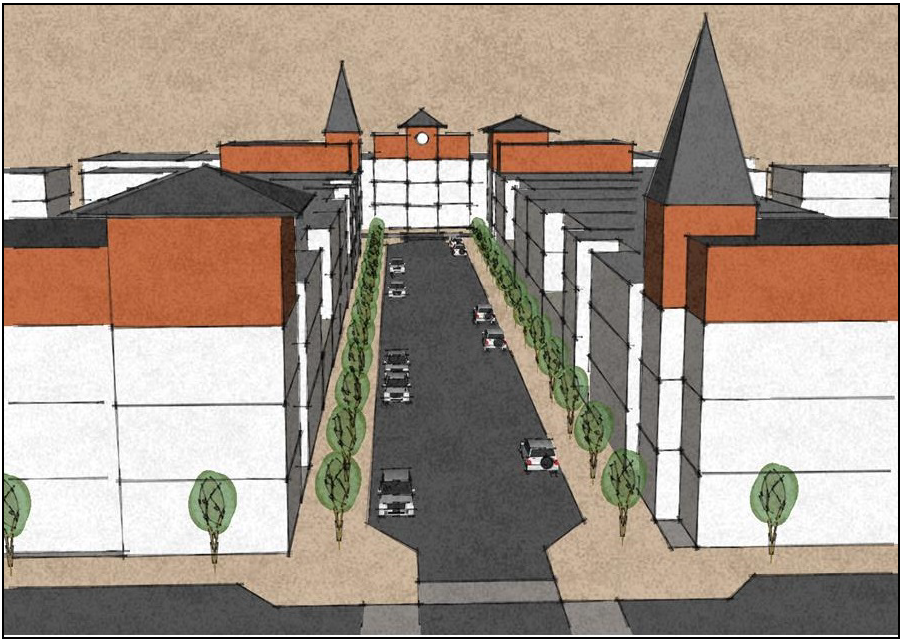
Figure 1. This demonstrates the typical application of the prominent places standards.
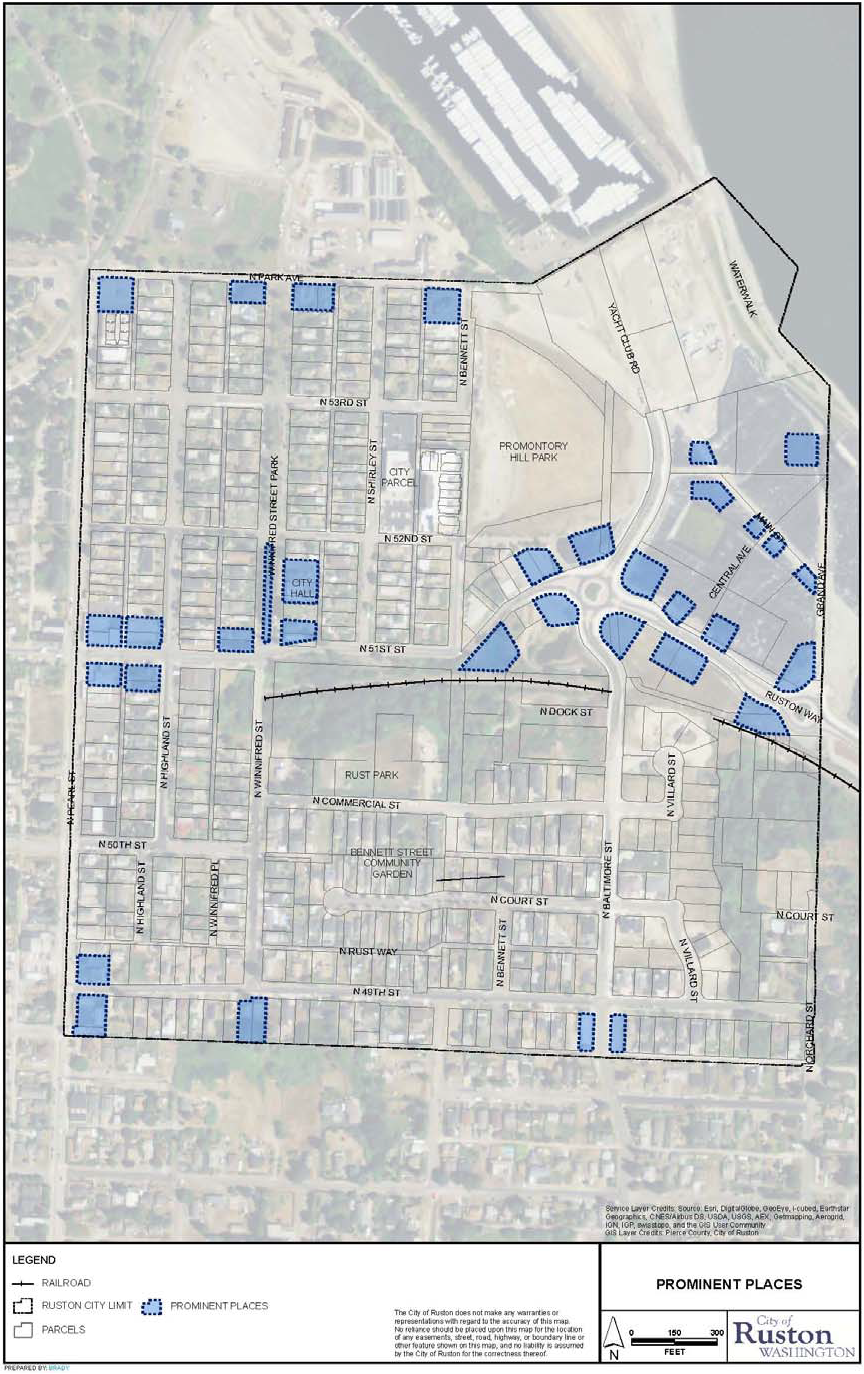
"Prominent places" are locations within Ruston that are prominently visible due to their location and/or topography. Prominent locations typically include street corners, street ends that serve as a visual terminus, and atop bluffs visible from Commencement Bay and beyond. In these locations it is important to provide opportunities for architectural creativity and significance by encouraging the construction of landmark buildings that include quality building materials, prominent architecture, exceptional building design and allowing increased building height to make these buildings draw the eye and stand out. Examples of prominent architecture include spires, steeples, turrets, clock towers, bell towers, and penthouses with terraced patios or roof-top gardens.
(a)
Prominent Places Map. The "Prominent Places Map" is adopted as part of the Ruston Zoning Code and those parcels so designated on the map are subject to the requirements of this section. The locations shown on the Prominent Places Map are designated as "Prominent Places" in the Ruston Zoning Code and those parcels shall be allowed to exceed underlying zoning district standards as described in subsection (b) below.
(b)
Lots designated as "prominent places" shall be allowed to incorporate an additional story of up to 2,000 square feet in area or 50 percent of the building footprint at the first story level (whichever is greater), provided that the overall height of all stories combined does not exceed the maximum height of the underlying zoning district by more than 12 feet, unless specifically provided below.
(A)
Sloped roof forms with a minimum roof pitch of at least four-foot rise/12-foot run, (including habitable attic space), shall not be included within the maximum height calculation.
(B)
Parapet walls, mechanical equipment, elevator shafts and stairways shall not be included within the maximum height calculation.
(C)
Spires, steeples, clock towers, bell towers and turrets incorporated within the bonus story space provided in subsection (b) above which are between 250 square feet and 650 square feet in area may project an additional five feet above the maximum height level.
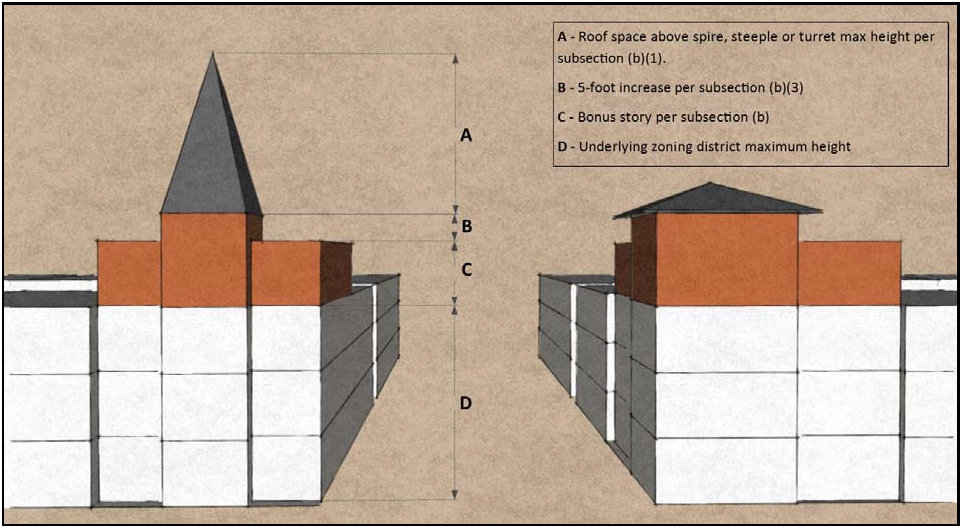
Figure 2. Primary Prominent Places height measurement illustration.
(c)
None of the provisions of this section shall allow additional height beyond the maximum height established under an approved master development plan.
(Ord. 1458, § 4, Dec. 1st, 2015)
25.06.050 - Parking Design Standards.
(a)
Pedestrian-Oriented Frontages. The following streets are designated pedestrian-oriented streets:
(1)
Pearl Street.
(2)
51st Street.
(3)
Main Street.
(4)
Central Avenue.
(5)
Grand Avenue.
Whenever a parking structure is to be located on a lot that touches one or more of these streets, additional design standards will apply in accordance with this section.
(b)
For parking structures located on one of the streets listed in subsection (a) above, wrapping of structure with usable commercial or residential building space meeting the standards set forth in RMC 25.06.030 is required.
(c)
Parking structures located on one of the streets listed in subsection (a) above shall not have vehicle access from the pedestrian-oriented street, but such access shall be from a street which is not so designated with access from alleys as the preferred vehicle entrance orientation. If vehicle access from a street other than those listed in subsection (a) is not feasible, then any such entrance shall comply with the following:
(1)
Driveways shall be limited in width to the minimum necessary to provide safe vehicle access while minimizing impacts to pedestrian-oriented facades. One-way entrances are preferred over two-way access and exiting from a garage onto any of the streets listed in subsection (a) above is prohibited unless no other feasible alternative is available. Two-way access and/or parking structure exits are allowed when the entrance is incorporated into a signalized or otherwise controlled street intersection. The determination under this subsection shall be consistent with the City's public works standards in Chapter 12.09 RMC and all other applicable City Codes.
(2)
Parking structure entrances shall be flanked on either side with building facades which are situated such that continuous urban streetscape character is not significantly diminished by vehicle-oriented uses. Landscaping may also be required to soften the visual impact of the entrance.
(d)
Parking Structures; Building Design. This subsection is applicable to all parking structures developed in the City regardless of location. These standards are supplemental to any other standards contained in this chapter.
(1)
The purpose of this subsection is to reduce the visual impact of structured parking which may be located all or partially above grade.
(2)
The exterior design of any parking structure located all or partially above grade shall comply with the following standards:
(A)
The street-facing facades of parking levels within a building shall be treated in such a way as to seem more like a typical floor rather than open slabs with visible cars and ceiling lights. This may be accomplished by two or more of the following treatments:
1.
Square openings rather than horizontal.
2.
Planting designed to grow on the facade.
3.
Louvers.
4.
Expanded metal panels.
5.
Decorative metal grills.
6.
Spandrel (opaque) glass.
7.
Wrapping the parking structure with usable building space (i.e., commercial or residential space).
(B)
Freestanding parking structures shall incorporate the above features on portions of the facade above the ground level.
(Ord. 1428, § 4, Dec. 23rd, 2013).

