
Saginaw City Zoning Code
ARTICLE 7
- SPECIAL DISTRICTS
Sec. 7-1.- PD Planned development district.
A.
Central description and purpose. The "PD" Planned Development District is a district which accommodates planned associations of uses developed as integral land use units such as industrial districts, offices, commercial or service centers, shopping centers, residential developments of multiple or mixed housing including attached single-family dwellings or any appropriate combination of uses which may be planned, developed or operated as integral land use units either by a single owner or a combination of owners. A PD district may be used to permit new or innovative concepts in land utilization not permitted by other zoning districts in this ordinance. While greater flexibility is given to allow special conditions or restrictions which would not otherwise allow the development to occur, procedures are established herein to insure against misuse of increased flexibility.
B.
Permitted uses. Any use permitted in this ordinance shall be permitted in a PD district if such use is specified in the amending ordinance granting a planned development district. The size, location, appearance, and method of operation may be specified to the extent necessary to insure compliance with the purpose of this ordinance.
C.
Planned development requirements.
1.
Development requirements for each PD district shall be set forth in the amending ordinance granting that PD district and shall include, but may not be limited to; uses, density, lot area, lot width, lot depth, yard depths and widths, building height, building elevations, coverage, floor area ratio, parking, access, screening, landscaping, accessory buildings, signs, lighting, project phasing or scheduling, management associations, and other requirements as the city council and planning and zoning commission may deem appropriate.
2.
In the PD district, unless otherwise stipulated in the PD, uses shall conform to the standards and regulations of the base zoning district to which it is most similar. The particular zoning district must be stated in the granting ordinance. All applications to the city shall list all requested changes from the standard requirements set forth throughout this ordinance (applications without this list will be considered incomplete).
3.
The ordinance granting a PD district shall include a statement as to the purpose and intent of the PD granted therein. A specific list is required of variances in each district or districts and a general statement citing the reason for the PD request.
4.
The planned development district shall conform to all other sections of the ordinance unless specifically excluded in the granting ordinance.
D.
Establishment. In establishing a planned development district in accordance with this section, the city council shall approve and file as part of the amending ordinance appropriate plans and standards for each planned development district. To facilitate understanding of the request during the review and public hearing process, the planning and zoning commission and city council shall require a conceptual plan and/ or a development plan. A development plan may be submitted in lieu of the conceptual plan, in which case no further approval is required by the city council.
E.
Development plan.
1.
This plan shall set forth the final plans for development of the planned development district and shall conform to the data presented and approved on the conceptual plan.
2.
Changes of detail on the development plan, which differ from the original concept plan, may be authorized by the planning and zoning commission without public hearing providing such changes conform to the following:
a.
The basic relationship of the proposed development to adjacent property are not altered;
b.
The uses permitted are not revised;
c.
Density is not altered;
d.
Building height or coverage of the site is not altered;
e.
Any landscape plans as indicated on the approved conceptual plan are not revised;
f.
The off-street parking ratio is not decreased;
g.
Yards provided at the boundary of the site are not reduced.
3.
If an agreement cannot be reached by the commission regarding whether a development plan conforms to the original concept plan, the planning and zoning commission shall follow the procedures for public hearing for zoning change before final approval of the plan. Approval of the development plan shall be the basis for issuance of a building permit, but does not release the applicant of the responsibility to submit plans to the building official for a building permit.
4.
The development plan may be submitted for the total area of the PD or for any section or part as approved on the conceptual plan.
5.
The development plan must be recommended for approval by the planning and zoning commission and approved by the city council, but a public hearing is not required unless there is change from the approved concept plan.
6.
A public hearing for the development plan shall be required if the hearing requirement is specifically stated at the time of conceptual plan approval in the original amending ordinance.
7.
The development plan shall include:
a.
A site inventory analysis including: a scale drawing showing natural features including:
(1)
Existing vegetation;
(2)
Natural water courses, creeks or bodies of water;
(3)
An analysis of planned changes in such natural features as a result of the development;
(4)
A delineation of any flood prone areas.
b.
A scale drawing showing:
(1)
Any proposed public or private streets and alleys;
(2)
Building sites or lots;
(3)
Areas reserved as parks, parkways, playgrounds;
(4)
Utility easements;
(5)
School sites;
(6)
Street widening and street changes;
(7)
Points of ingress and egress from existing streets;
(8)
General location and description of existing and proposed utility services, including size of water and sewer mains;
(9)
The location and width for all curb cuts; and
(10)
The land area of all abutting sites and the zoning classification thereof on an accurate survey of the tract with a topographical contour interval of not more than five feet.
c.
A site plan for proposed building complexes showing:
(1)
The location of separate buildings;
(2)
The minimum distance between buildings;
(3)
The minimum distance between building and property lines;
(4)
Street and alley lines;
(5)
The arrangement and provision of off-street parking; and
(6)
The size and location for ingress and egress to any nonresidential uses.
d.
A landscape plan showing:
(1)
Turf areas;
(2)
Screening walls;
(3)
Ornamental planting;
(4)
Any wooded areas; and
(5)
Trees to be planted.
e.
An architectural plan showing elevations and signage style to be used throughout the development in all districts except that single-family, and two-family may be required by the planning and zoning commission or city council if deemed appropriate.
f.
All development plans may have supplemental data describing standards, regulations or other data pertinent to the development of the PD district which is to be included in the text of the amending ordinance.
F.
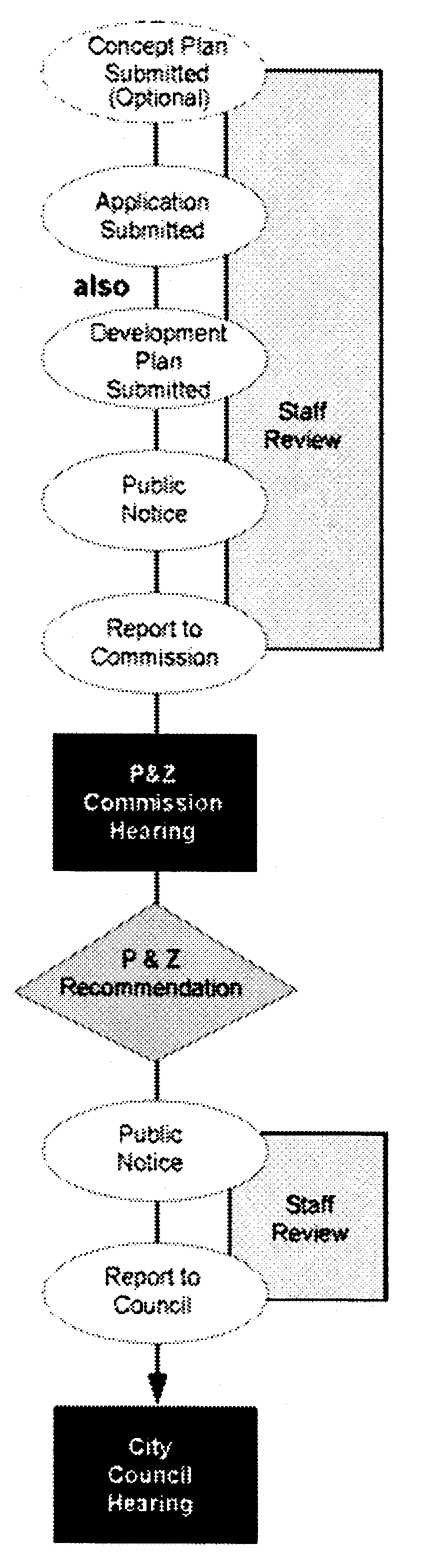
Procedure. The procedure for establishing a planned development district shall follow the procedure for zoning amendments as set forth in section 1-3, Changes and Amendments. This procedure is further expanded as follows for approval of conceptual and development plans.
1.
The planning and zoning commission and city council may approve the conceptual plan and the development plan or any section of the development plan, separately or jointly in public hearings. A single public hearing for the PD request is adequate when:
a.
The applicant submits adequate data with the request for the planned development district to fulfill the requirement for a development plan; or
b.
Information on the conceptual plan and attached application is sufficient to determine the appropriate use of the land and the development plan will not deviate substantially from it.
2.
The ordinance establishing the planned development district shall not be approved until the development plan is approved.
3.
The development plan may be approved in sections. when the plan is approved in sections, then separate approvals by the planning and zoning commission and city council for the initial and subsequent sections will be required.
4.
A development plan shall be submitted for approval within 18 months after the approval of the conceptual plan for some portion of the conceptual plan. If a partial development plan is not submitted within 12 months, the conceptual plan is subject to review by the planning and zoning commission and city council.
5.
If the project is not started within five years, the planning and zoning commission and city council may review the original concept plan to ensure its continued validity. If the city determines the concept is not valid, a new concept plan must be approved prior to issuing a building permit for any portion of the PD district.
6.
Although a public hearing may not be required for the development plan, approval by the planning and zoning commission and city council is still required.
G.
Consideration. When a PD district is being considered, a written report from the city manager or his designated representative, discussing the impact on planning, engineering, water utilities, electric utilities, sanitation, building inspection, tax, police, fire, and traffic, and written comments from the applicable public school district, and from private utilities may be submitted to the planning and zoning commission prior to the commission making any recommendations to the city council. In the event written comments are not forthcoming in a reasonable amount of time, the commission may, at its discretion, make a recommendation to the city council without these written comments.
H.
Approval. All planned development districts approved in accordance with the provisions of this ordinance in its original form, or by subsequent amendments thereto, shall be referenced on the zoning district map, and a list of such planned development districts, together with the category of uses permitted therein, shall be maintained as part of this ordinance.
(Ord. No. 2022-19, § 1, 11-15-22)
Sec. 7-2. - Reserved.
Editor's note— Ord. No. 2022-08, § 3, adopted Oct. 18, 2022, repealed § 7-2, which pertained to carport overlay district and derived from Ord. No. 2014-18, § 1, adopted Oct. 21, 2014; Ord. No. 2021-07, § 1, adopted Feb. 19, 2021; Ord. No. 2021-16, § 1, adopted July 20, 2021.
Sec. 7-3. - Clinic overlay district.
(a)
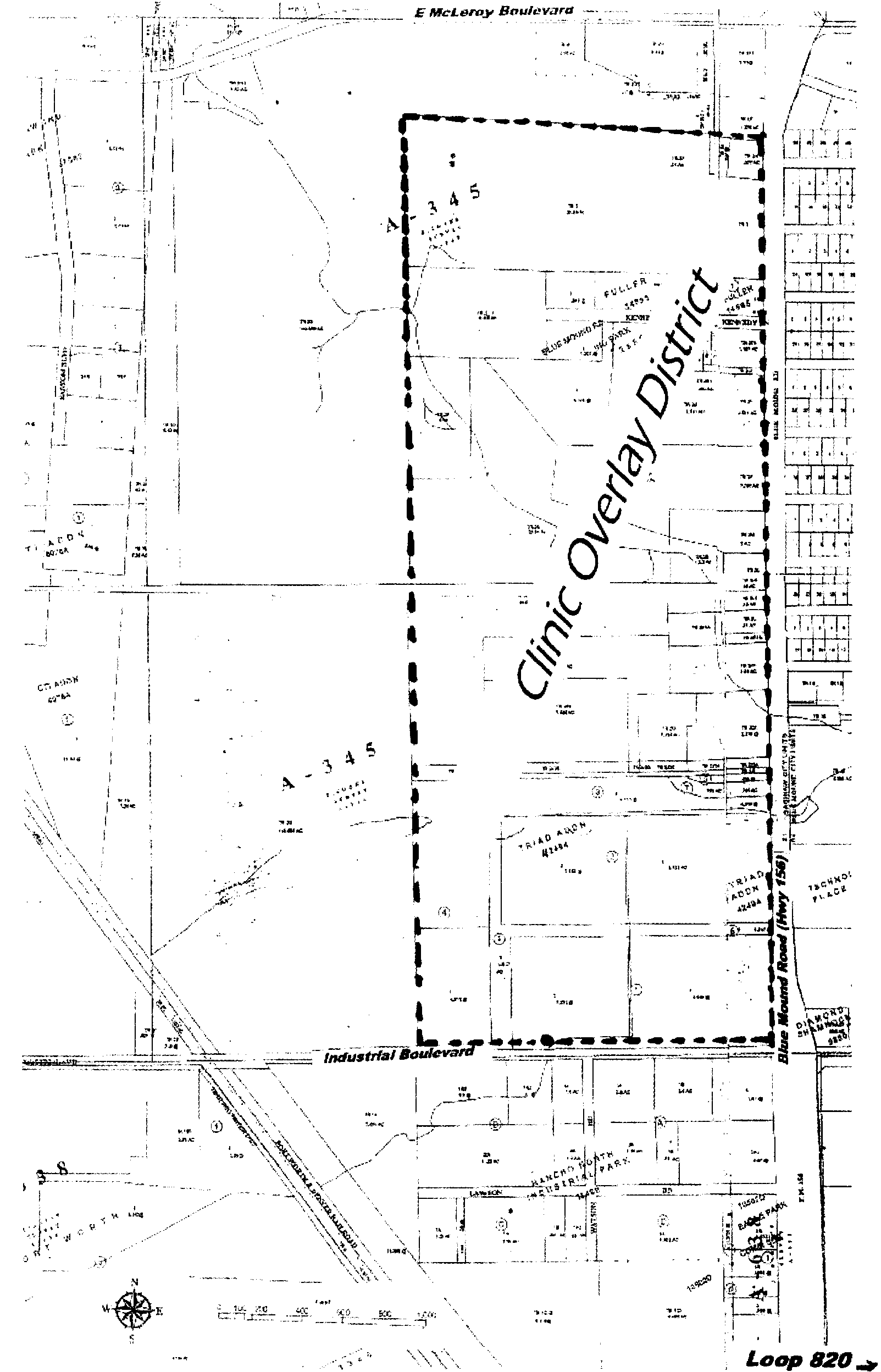
District established. There is hereby established a clinic overlay district where the use and operation of a clinic, as that term is defined in section 12-2 of article 12 of the Zoning Regulations, is expressly permitted by right irrespective of the underlying (base) zoning district classification. Notwithstanding the requirements of section 5-1 hereof, the "Permitted Use Table," no specific use permit shall be required for the use and operation of a clinic within the clinic overlay district defined below:
(b)
Purpose. The purpose of the clinic overlay district is to encourage and foster the development of medical clinic facilities and to encourage the development of the southeast region of the city.
(c)
Applicability in event of conflict. This section is to be superimposed in addition to the regulations applicable to any approved underlying (or base) district. To the extent of any conflict between this section and any other provision in any city ordinance, the more strict provision shall prevail, except as provided in paragraph (a) of this section.
(d)
Setback. No clinic within the clinic overlay district shall be permitted within 1000 feet of any licensed day care center located within the territorial limits of the city. The measurement of the distance between the clinic and the licensed day care center shall be in a direct line from front door to front door, without regard to intervening structures, streets or property lines.
(Ord. No. 2014-08, § 1, 4-15-14)
Sec. 7-4. - Saginaw boulevard overlay district.
A.
Purpose. This ordinance establishes development standards for properties that have frontage and/or access (either direct or through another property) to Saginaw Boulevard. These regulations govern land use, building materials, landscaping, signage, and screening and recognize the street's unique character and importance as the city's primary commercial boulevard and entryway. The intent of these standards is to promote the public health, safety and general welfare, to coordinate and guide future development and redevelopment in accordance with the comprehensive plan and to protect and enhance the city's aesthetic and visual quality.
B.
Boundaries. The Saginaw Boulevard overlay district includes all properties zoned office professional, neighborhood commercial, and community commercial that have frontage and/or access (either direct or through another property) to Saginaw Boulevard from East Industrial Boulevard on the south, the railroad on the east and the northern city boundary. The provisions of the overlay district shall apply to all properties located fully or partially within the above defined area.
C.
Base zoning districts. Where the Saginaw Boulevard overlay district requirements conflict with the base zoning for properties located within the area described in subsection B above, the overlay district shall apply. Otherwise the base zoning of a property shall not be affected by the provisions of this overlay district.
D.
General requirements of the Saginaw Boulevard overlay district.
1.
Permitted and prohibited uses. Uses permitted by right or by specific use permit within the overlay district shall be as noted for the base zoning districts in the use charts in section 5-1 except as follows:
a.
Prohibited uses:
(1)
Auto sales, new and used.
(2)
Building material sales.
(3)
Cargo container.
(4)
Landscape service.
(5)
Machinery sales or repair.
(6)
Mini-warehouse.
(7)
Motorcycle sales.
(8)
Non-depository financial institutions.
(9)
Recreational vehicle rental.
(10)
Rental yard, commercial and heavy equipment.
(11)
Stone monument sales.
(12)
Private card club.
(13)
Bingo hall.
b.
Uses requiring a specific use permit. The following uses shall require approval of a specific use permit in accordance with section 5-4:
(1)
Convenience store with fuel sales.
(2)
Golf course, driving range.
(3)
Golf course, miniature.
(4)
Water park, commercial.
(5)
Auto car wash.
(6)
Auto rental (car and truck).
(7)
Auto service station.
(8)
Auto service station, light maintenance.
(9)
Contractor, no outside storage permitted.
(10)
Exterminating service.
(11)
Greenhouse or plant nursery.
(12)
Home improvement store.
(13)
Small engine repair.
(14)
Auto paint and body shop.
c.
Non-conforming uses. Non-conforming uses shall be regulated by the provisions of article 4, section 4-13 of this appendix.
2.
Setbacks. Buildings shall be located on properties in accordance with the following minimum and maximum front yard setbacks:
a.
For buildings with no drive aisles or parking located between the building face and the street right-of-way—A minimum setback of 20 feet and a maximum setback of 25 feet.
b.
For buildings with drive aisles and/or parking located between the building face and the street right-of-way—A maximum setback of 100 feet. Alternatively, the building setback may exceed 100 feet with a 15 foot increase in the minimum landscaped edge for single tenant buildings or multiple-tenant retail shopping centers that are 60,000 square feet or greater in size.
3.
Landscaping. Landscaping shall be provided and installed in accordance with section 8-13. Where buildings observe the 25 foot maximum setback, a minimum of 15 feet of landscaping must be provided between the building face and the street right-of-way.
4.
Screening. Walls, fences, landscaping and other screening devices shall be installed in accordance with section 8-12 and as follows:
a.
Trash enclosures. Chain link with vinyl slats is prohibited as a screening material. Solid gates must be provided for trash enclosures that face a public street.
b.
Rooftop mechanical units. Roof-mounted mechanical units must be screened from view at a point 5.5 feet above the property line with a parapet wall, screen, mansard roof, or alternative architectural element. The height of the screening element shall be equal or greater than the height of the mechanical unit(s) provided that the element shall not extend more than five feet above the roof on a one or two-story building or more than 13 feet above the roof on a building of three or more stories. A mechanical unit which is taller than the maximum permitted height of the screening feature shall be set back from the screen five feet plus two feet for each foot it exceeds the height of the screen.
5.
Building materials and design. All buildings constructed within the overlay district shall comply with the following:
a.
Building façade materials. A minimum of 75 percent of each exterior wall shall be of masonry construction as defined in section 12-2 and glass, except that concrete may only be used as an exterior material on the rear of buildings not visible from public streets. A maximum of ten percent of any exposed exterior wall may be finished with exterior insulation and finish systems (EIFS).
b.
Building façade design. The following articulation standards shall apply to all building facades that face public streets:
(1)
Horizontal articulation. No building façade shall extend for a distance greater than three times its average height without a perpendicular offset. The depth of an offset may vary but shall be a minimum of 15 percent of the average building height. The minimum length of an offset shall be equal to ten percent of the entire façade.
(2)
As an alternative to the articulation requirement in (1) above, one-story commercial storefronts designed for multiple tenants with a minimum of 60 percent glass may utilize a minimum of four of the following architectural details along 100 percent of facades that face public streets:
(a)
Canopies or awnings.
(b)
Pilasters.
(c)
Recessed entries.
(d)
Ornamental cornices.
(e)
Façade material change.
(f)
Color change.
(g)
Repetitive decorative applied features and/or decorative lighting.
(3)
Vertical articulation. No wall shall extend horizontally for a distance greater than three times its average height without a change in elevation. An elevation change shall be a minimum 15 percent of the average building height and shall extend for a distance of at least ten percent of the entire facade.
d.
Roofs. Flat roofs and parapet walls around flat roofs shall have a cornice, cap or other detail with a vertical dimension equal to at least three percent of the height of the building.
e.
Additions to non-conforming buildings. The square footage of existing non-conforming buildings may be increased up to 20 percent without bringing the building into compliance with the above standards.
6.
Signage. Signage in the overlay district shall comply with the following requirements:
a.
Pole signs are prohibited.
b.
Signs attached to or hung behind windows may only cover 25 percent of the window surface on each building face.
c.
Freestanding signs must be monument signs with a maximum height of 12 feet and a maximum size of 90 square feet.
d.
Reserved.
e.
Reserved.
f.
Single tenant properties are limited to one freestanding sign per street front.
g.
For shopping centers and other multi-tenant uses, one multi-purpose sign of a monument style shall be allowed per street frontage. Multi-purpose monument signs shall not exceed 12 feet in height with a maximum overall square footage of 225 square feet. However, the copy area of the sign shall not exceed 150 square feet, leaving a base area of 75 square feet.
h.
Murals may be painted or applied to the exterior walls of buildings; however, the mural shall not contain logos or names of any business entity.
7.
Light standards. Light standards installed in parking lots shall not exceed 32 feet in height and shall be of square or shoebox design.
(Ord. No. 2019-22, § 2, 11-5-19; Ord. No. 2020-16, § 2, 8-18-20)

